Motorola Solutions Germany MR1145 RADIOTELEPHONE MR1145 User Manual OPERATING MANUAL
Motorola Solutions Germany GmbH RADIOTELEPHONE MR1145 OPERATING MANUAL
OPERATING MANUAL
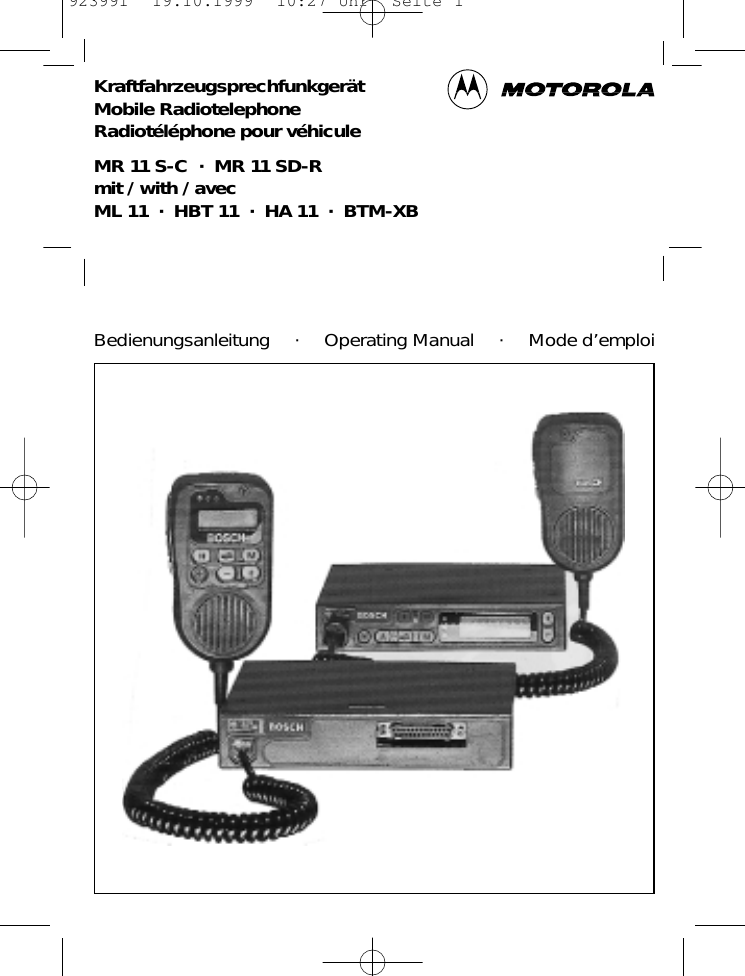
KraftfahrzeugsprechfunkgerätMobile RadiotelephoneRadiotéléphone pour véhiculeMR 11 S-C · MR 11 SD-Rmit / with / avecML 11 · HBT 11 · HA 11 · BTM-XBBedienungsanleitung · Operating Manual · Mode d’emploi923991  19.10.1999  10:27 Uhr  Seite 1
2923991  19.10.1999  10:27 Uhr  Seite 2
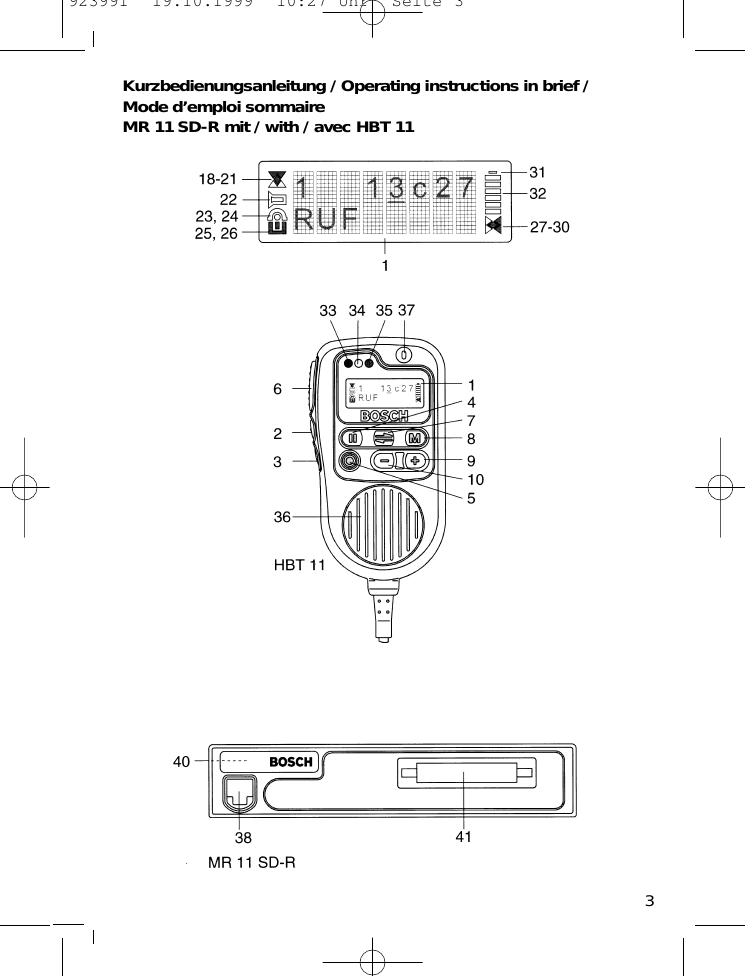
3Kurzbedienungsanleitung / Operating instructions in brief /Mode d’emploi sommaireMR 11 SD-R mit / with / avec HBT 11923991  19.10.1999  10:27 Uhr  Seite 3
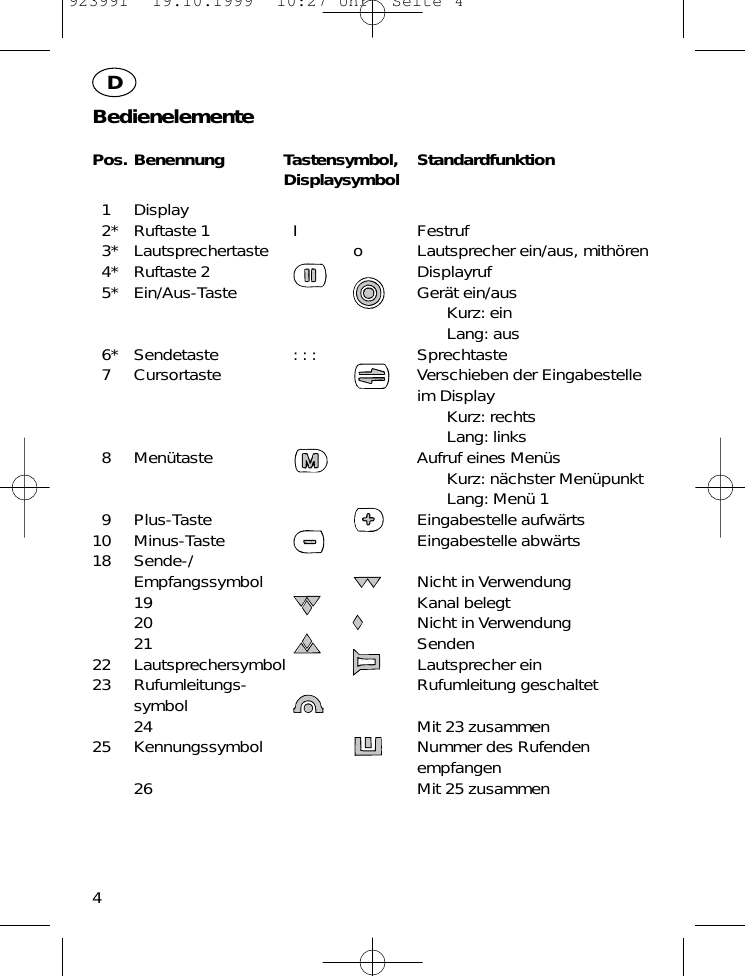
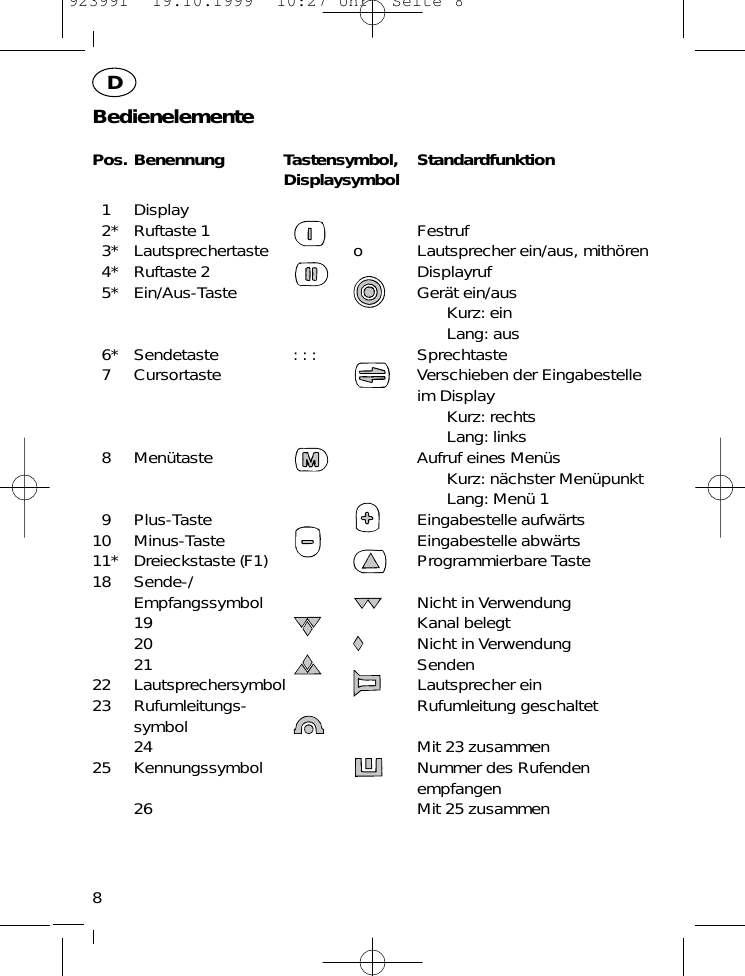
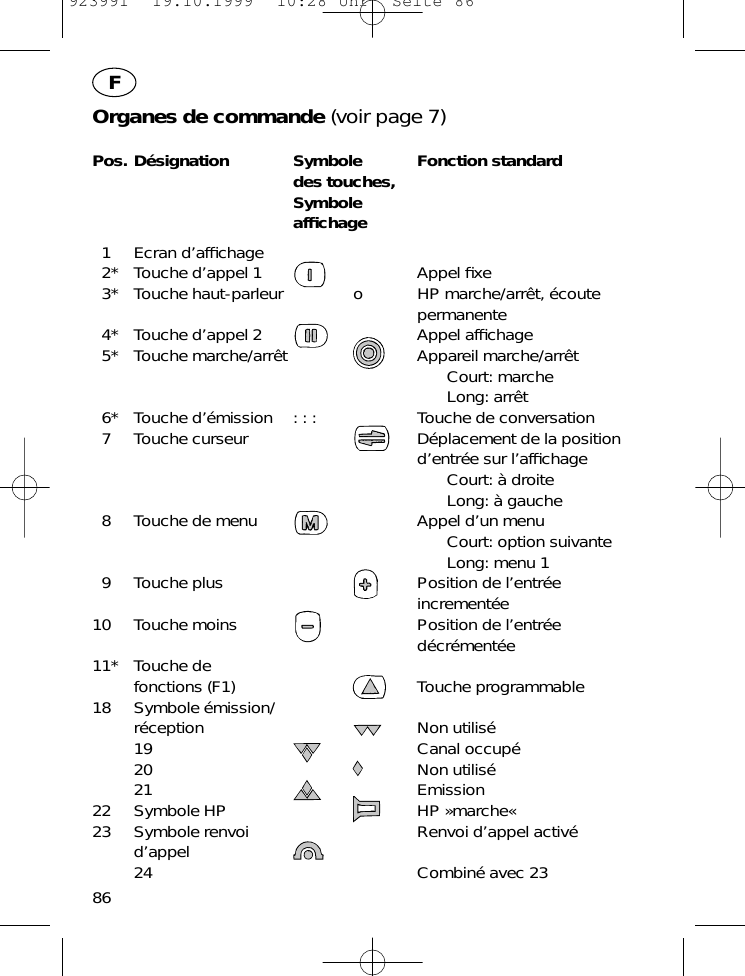
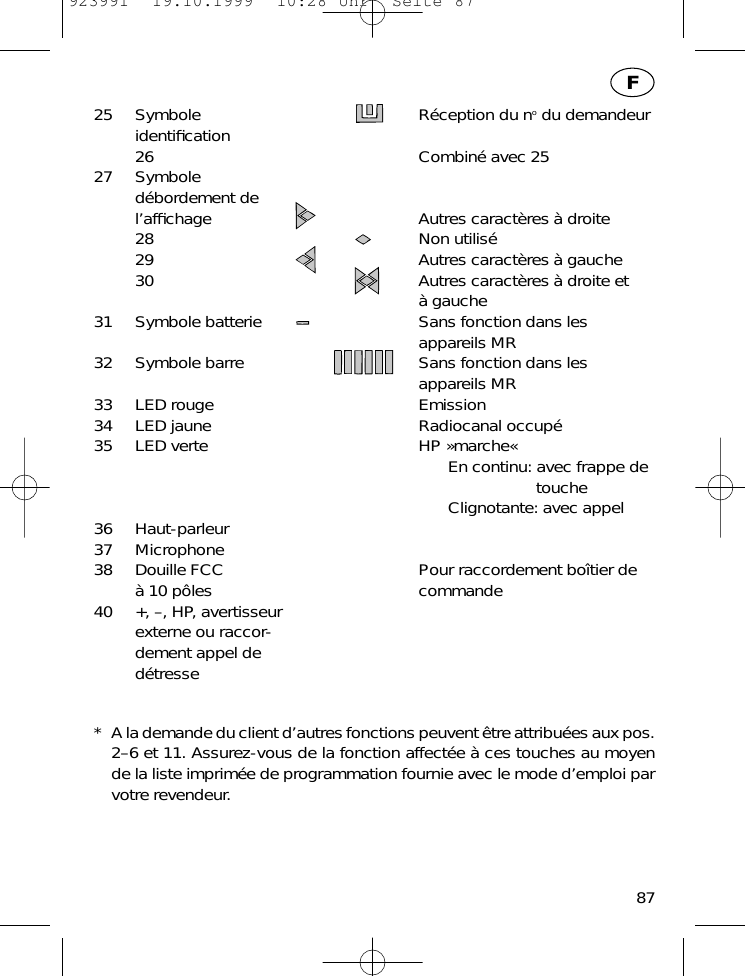
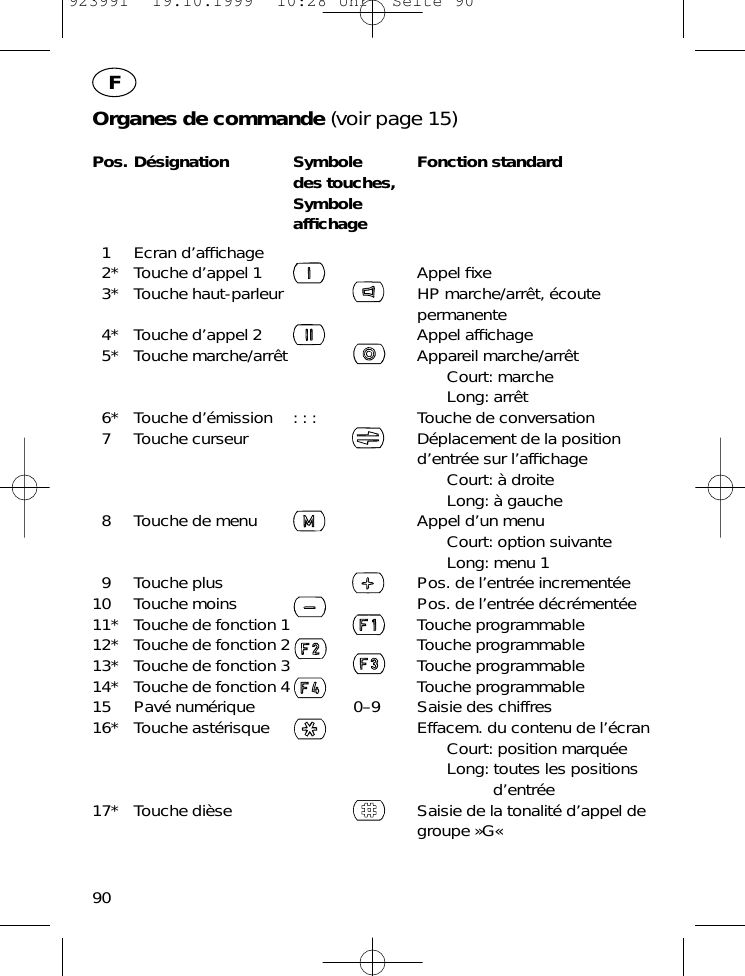
BedienelementePos. Benennung Tastensymbol, StandardfunktionDisplaysymbol1 Display2* Ruftaste 1 I Festruf3* Lautsprechertaste o Lautsprecher ein/aus, mithören4* Ruftaste 2 Displayruf5* Ein/Aus-Taste Gerät ein/ausKurz: einLang: aus6* Sendetaste : : : Sprechtaste7 Cursortaste Verschieben der Eingabestelleim DisplayKurz: rechtsLang: links8 Menütaste Aufruf eines MenüsKurz: nächster MenüpunktLang: Menü 19 Plus-Taste Eingabestelle aufwärts10 Minus-Taste Eingabestelle abwärts18 Sende-/Empfangssymbol Nicht in Verwendung19 Kanal belegt20 Nicht in Verwendung21 Senden22 Lautsprechersymbol Lautsprecher ein23 Rufumleitungs- Rufumleitung geschaltetsymbol24 Mit 23 zusammen25 Kennungssymbol Nummer des Rufenden empfangen26 Mit 25 zusammen4D923991  19.10.1999  10:27 Uhr  Seite 4
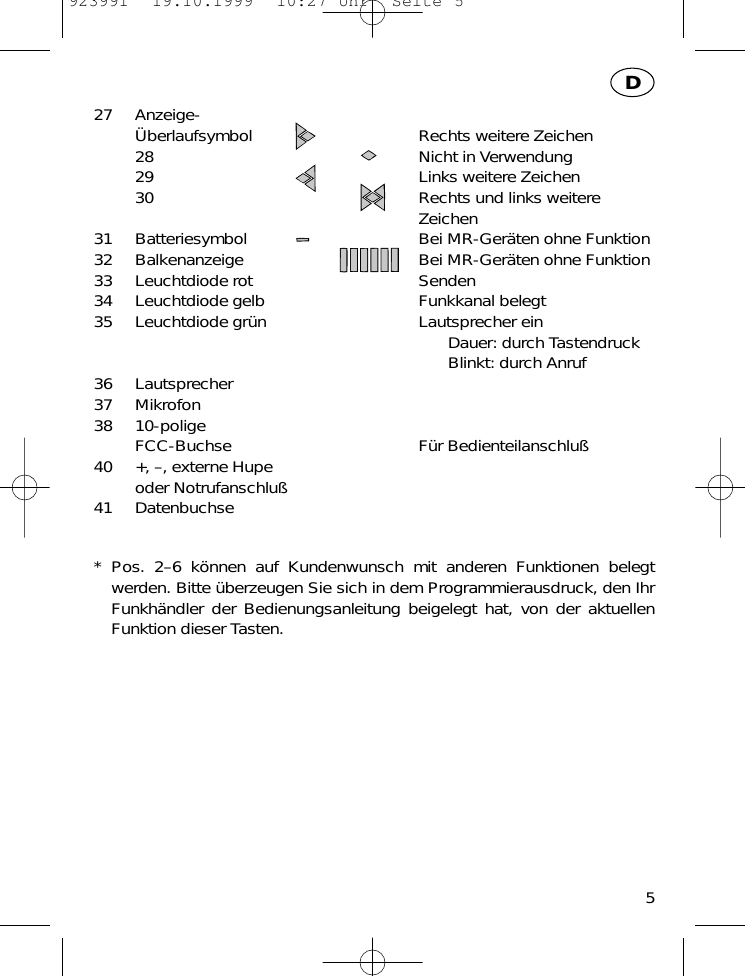
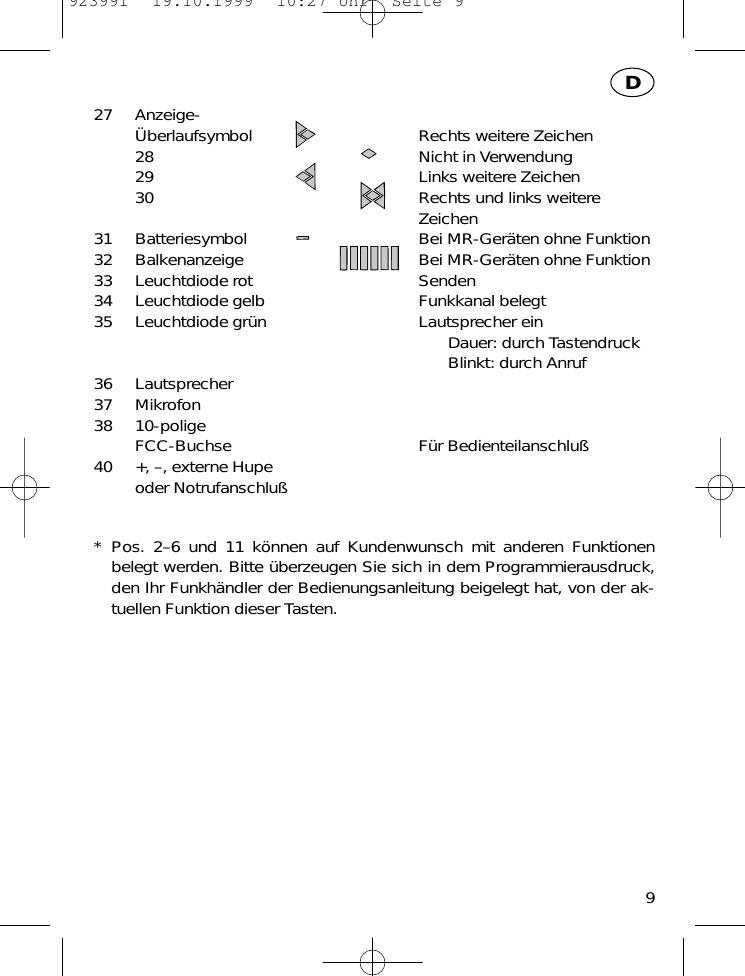
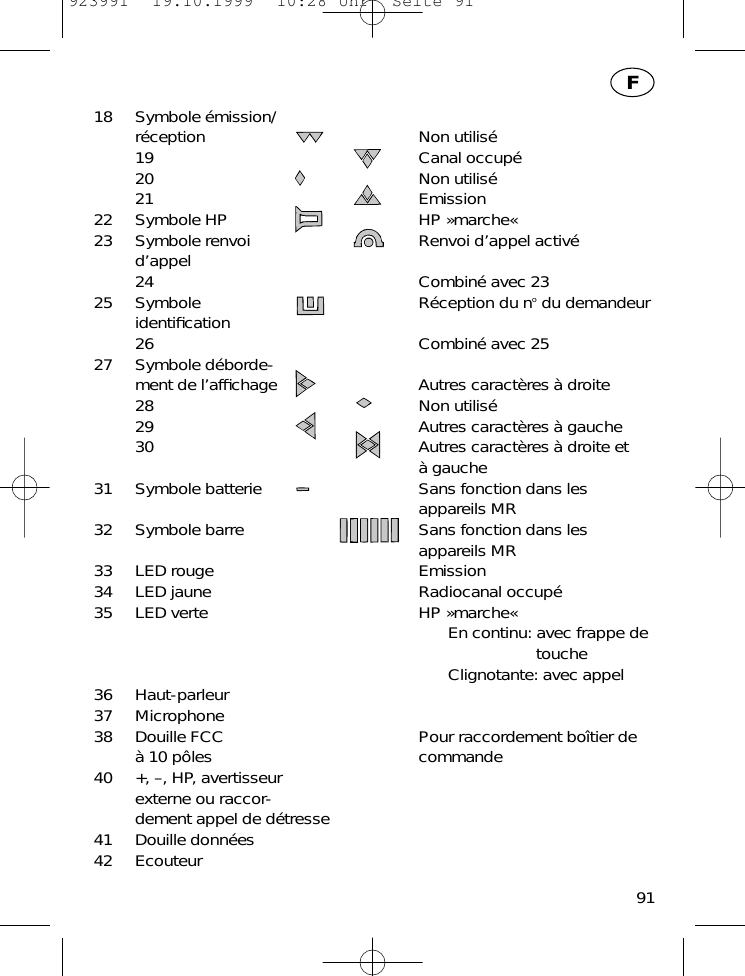
27 Anzeige-Überlaufsymbol Rechts weitere Zeichen28 Nicht in Verwendung29 Links weitere Zeichen30 Rechts und links weitere Zeichen31 Batteriesymbol Bei MR-Geräten ohne Funktion32 Balkenanzeige Bei MR-Geräten ohne Funktion33 Leuchtdiode rot Senden34 Leuchtdiode gelb Funkkanal belegt35 Leuchtdiode grün Lautsprecher einDauer: durch TastendruckBlinkt: durch Anruf36 Lautsprecher37 Mikrofon38 10-polige FCC-Buchse Für Bedienteilanschluß40 +, –, externe Hupeoder Notrufanschluß41 Datenbuchse* Pos. 2–6 können auf Kundenwunsch mit anderen Funktionen belegtwerden. Bitte überzeugen Sie sich in dem Programmierausdruck, den IhrFunkhändler der Bedienungsanleitung beigelegt hat, von der aktuellenFunktion dieser Tasten.5D923991  19.10.1999  10:27 Uhr  Seite 5
6923991  19.10.1999  10:27 Uhr  Seite 6
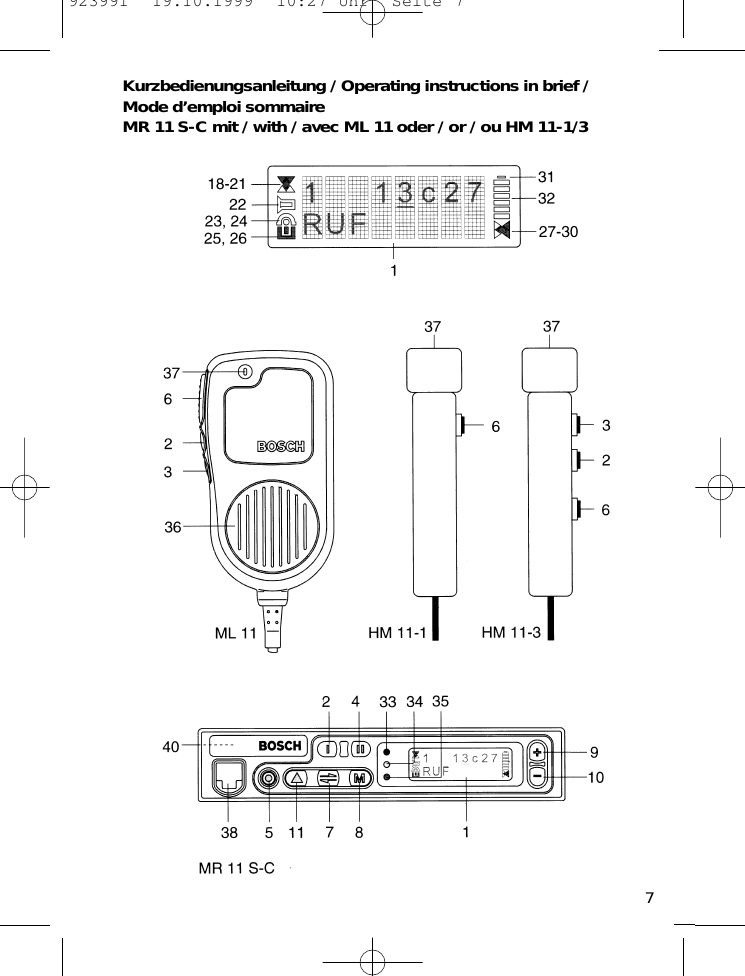
Kurzbedienungsanleitung / Operating instructions in brief /Mode d’emploi sommaireMR 11 S-C mit / with / avec ML 11 oder / or / ou HM 11-1/37923991  19.10.1999  10:27 Uhr  Seite 7
BedienelementePos. Benennung Tastensymbol, StandardfunktionDisplaysymbol1 Display2* Ruftaste 1 Festruf3* Lautsprechertaste o Lautsprecher ein/aus, mithören4* Ruftaste 2 Displayruf5* Ein/Aus-Taste Gerät ein/ausKurz: einLang: aus6* Sendetaste : : : Sprechtaste7 Cursortaste Verschieben der Eingabestelleim DisplayKurz: rechtsLang: links8 Menütaste Aufruf eines MenüsKurz: nächster MenüpunktLang: Menü 19 Plus-Taste Eingabestelle aufwärts10 Minus-Taste Eingabestelle abwärts11* Dreieckstaste (F1) Programmierbare Taste18 Sende-/Empfangssymbol Nicht in Verwendung19 Kanal belegt20 Nicht in Verwendung21 Senden22 Lautsprechersymbol Lautsprecher ein23 Rufumleitungs- Rufumleitung geschaltetsymbol24 Mit 23 zusammen25 Kennungssymbol Nummer des Rufenden empfangen26 Mit 25 zusammen8D923991  19.10.1999  10:27 Uhr  Seite 8
27 Anzeige-Überlaufsymbol Rechts weitere Zeichen28 Nicht in Verwendung29 Links weitere Zeichen30 Rechts und links weitere Zeichen31 Batteriesymbol Bei MR-Geräten ohne Funktion32 Balkenanzeige Bei MR-Geräten ohne Funktion33 Leuchtdiode rot Senden34 Leuchtdiode gelb Funkkanal belegt35 Leuchtdiode grün Lautsprecher einDauer: durch TastendruckBlinkt: durch Anruf36 Lautsprecher37 Mikrofon38 10-polige FCC-Buchse Für Bedienteilanschluß40 +, –, externe Hupeoder Notrufanschluß* Pos. 2–6 und 11 können auf Kundenwunsch mit anderen Funktionenbelegt werden. Bitte überzeugen Sie sich in dem Programmierausdruck,den Ihr Funkhändler der Bedienungsanleitung beigelegt hat, von der ak-tuellen Funktion dieser Tasten.9D923991  19.10.1999  10:27 Uhr  Seite 9
10923991  19.10.1999  10:27 Uhr  Seite 10
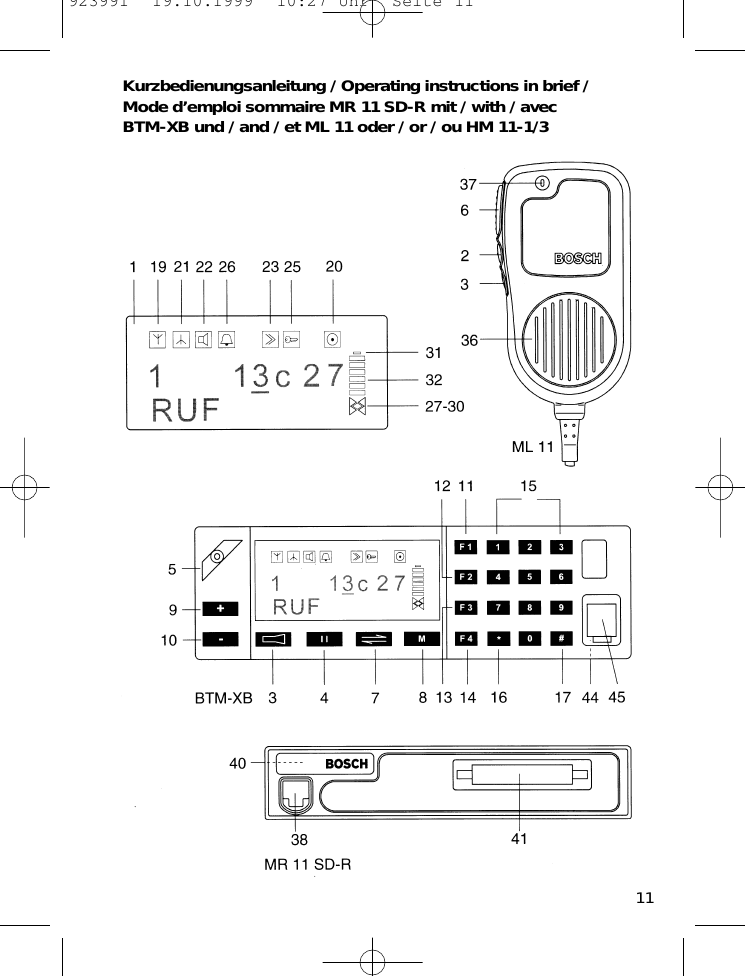
11Kurzbedienungsanleitung / Operating instructions in brief /Mode d’emploi sommaire MR 11 SD-R mit / with / avec BTM-XB und / and / et ML 11 oder / or / ou HM 11-1/3923991  19.10.1999  10:27 Uhr  Seite 11
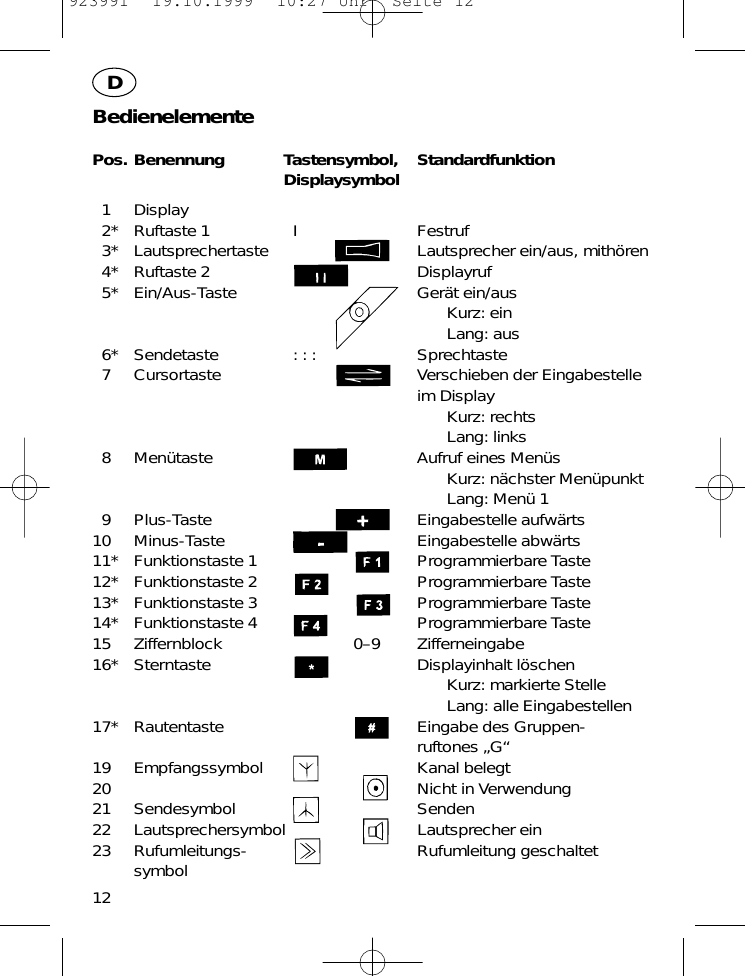
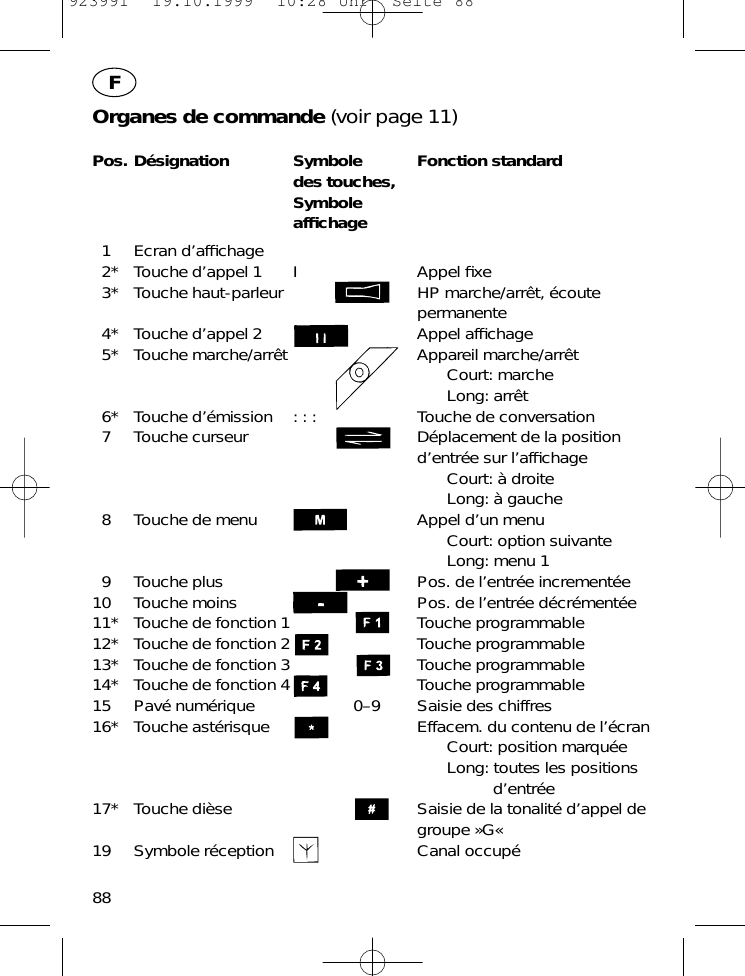
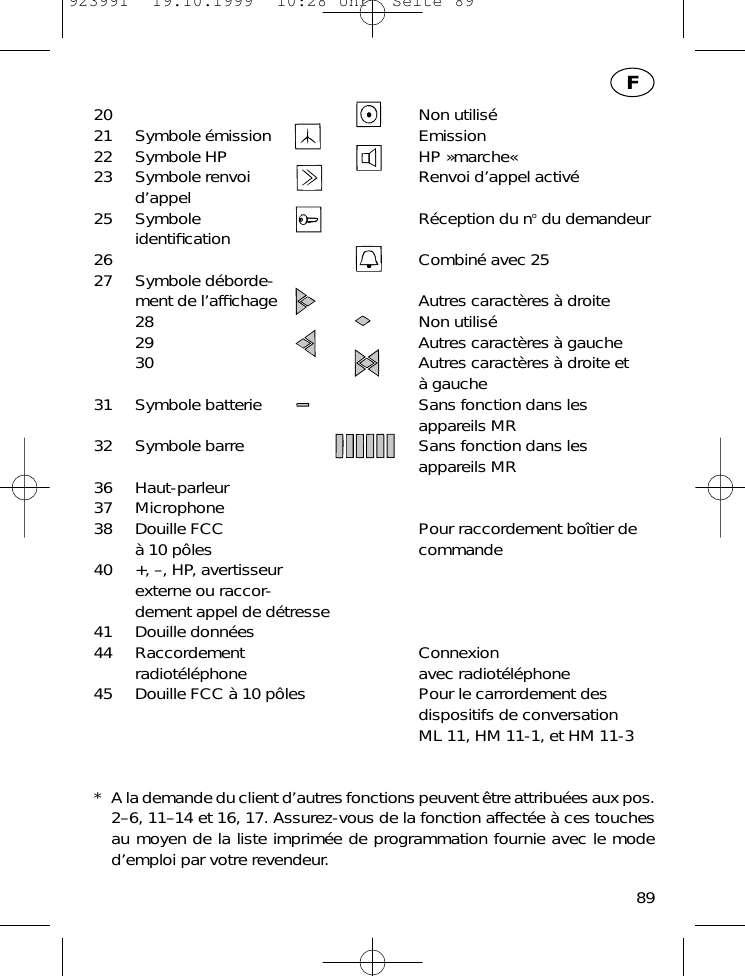
BedienelementePos. Benennung Tastensymbol, StandardfunktionDisplaysymbol1 Display2* Ruftaste 1 I Festruf3* Lautsprechertaste Lautsprecher ein/aus, mithören4* Ruftaste 2 Displayruf5* Ein/Aus-Taste Gerät ein/ausKurz: einLang: aus6* Sendetaste : : : Sprechtaste7 Cursortaste Verschieben der Eingabestelleim DisplayKurz: rechtsLang: links8 Menütaste Aufruf eines MenüsKurz: nächster MenüpunktLang: Menü 19 Plus-Taste Eingabestelle aufwärts10 Minus-Taste Eingabestelle abwärts11* Funktionstaste 1 Programmierbare Taste12* Funktionstaste 2 Programmierbare Taste13* Funktionstaste 3 Programmierbare Taste14* Funktionstaste 4 Programmierbare Taste15 Ziffernblock 0–9 Zifferneingabe16* Sterntaste Displayinhalt löschenKurz: markierte StelleLang: alle Eingabestellen17* Rautentaste Eingabe des Gruppen-ruftones „G“19 Empfangssymbol Kanal belegt20 Nicht in Verwendung21 Sendesymbol Senden22 Lautsprechersymbol Lautsprecher ein23 Rufumleitungs- Rufumleitung geschaltetsymbol12D923991  19.10.1999  10:27 Uhr  Seite 12
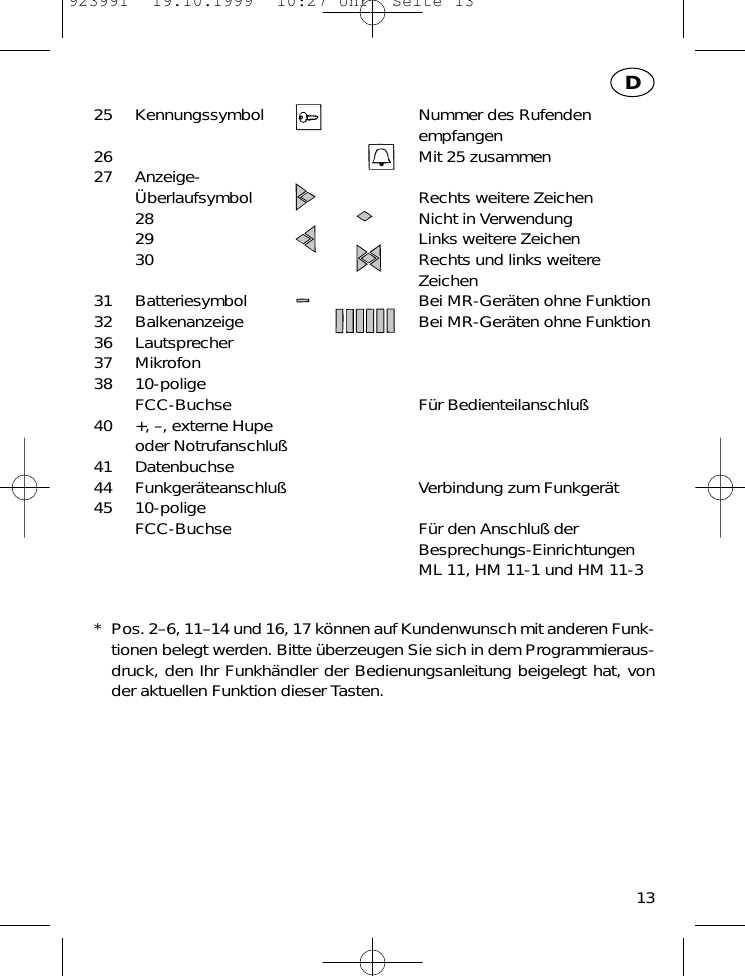
25 Kennungssymbol Nummer des Rufenden empfangen26 Mit 25 zusammen27 Anzeige-Überlaufsymbol Rechts weitere Zeichen28 Nicht in Verwendung29 Links weitere Zeichen30 Rechts und links weitere Zeichen31 Batteriesymbol Bei MR-Geräten ohne Funktion32 Balkenanzeige Bei MR-Geräten ohne Funktion36 Lautsprecher37 Mikrofon38 10-polige FCC-Buchse Für Bedienteilanschluß40 +, –, externe Hupeoder Notrufanschluß41 Datenbuchse44 Funkgeräteanschluß Verbindung zum Funkgerät45 10-polige FCC-Buchse Für den Anschluß derBesprechungs-EinrichtungenML 11, HM 11-1 und HM 11-3* Pos. 2–6, 11–14 und 16, 17 können auf Kundenwunsch mit anderen Funk-tionen belegt werden. Bitte überzeugen Sie sich in dem Programmieraus-druck, den Ihr Funkhändler der Bedienungsanleitung beigelegt hat, vonder aktuellen Funktion dieser Tasten.13D923991  19.10.1999  10:27 Uhr  Seite 13
14923991  19.10.1999  10:27 Uhr  Seite 14
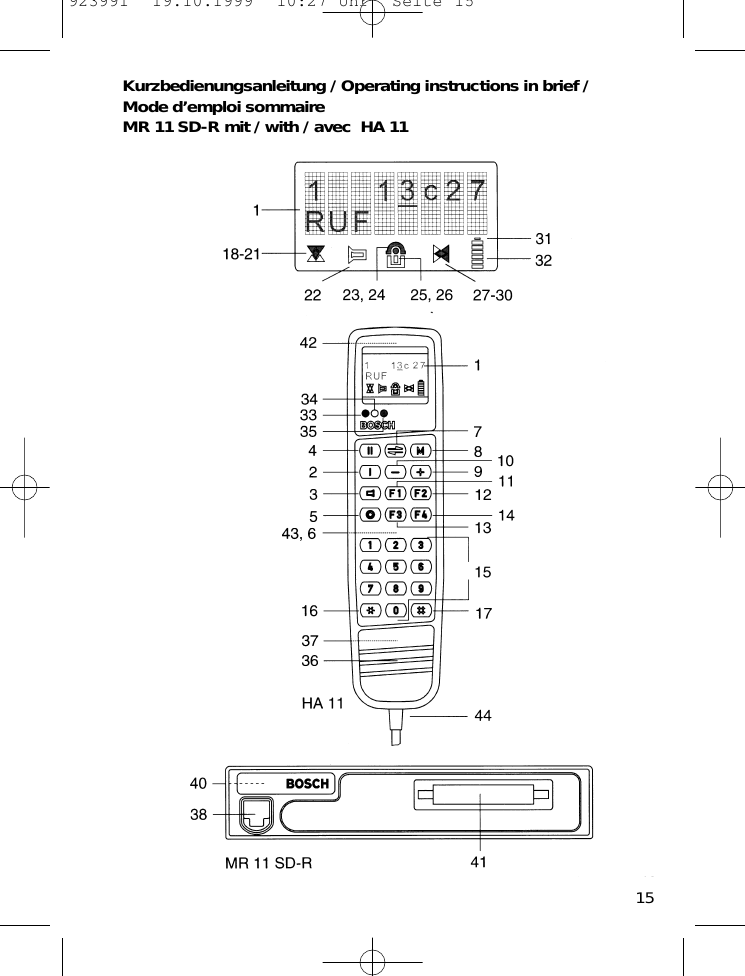
15Kurzbedienungsanleitung / Operating instructions in brief /Mode d’emploi sommaire MR 11 SD-R mit / with / avec  HA 11923991  19.10.1999  10:27 Uhr  Seite 15
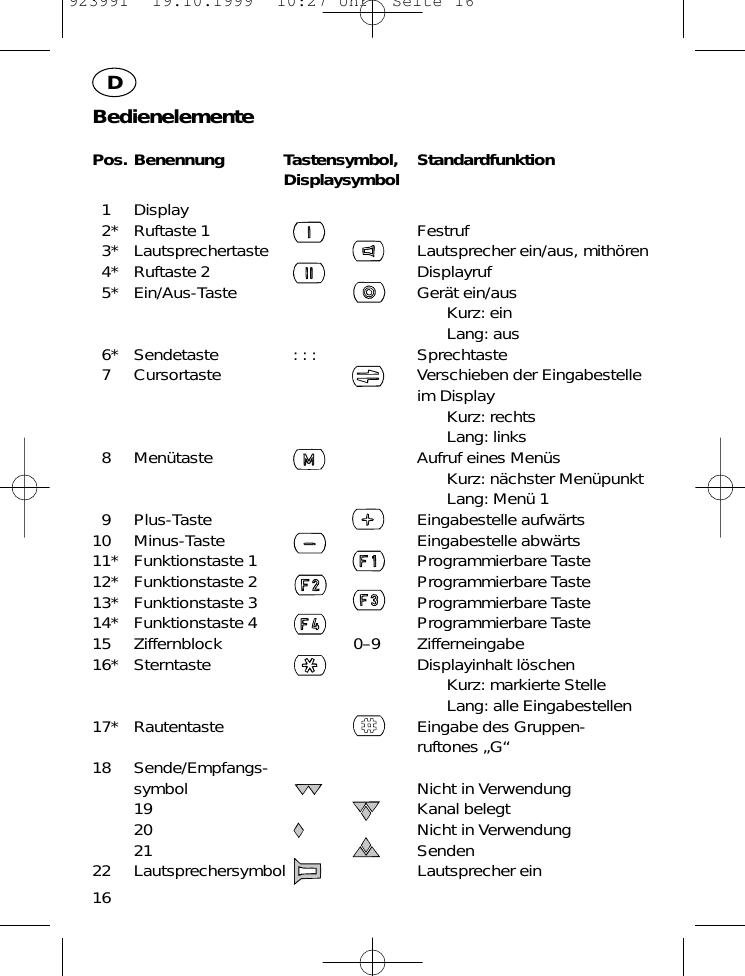
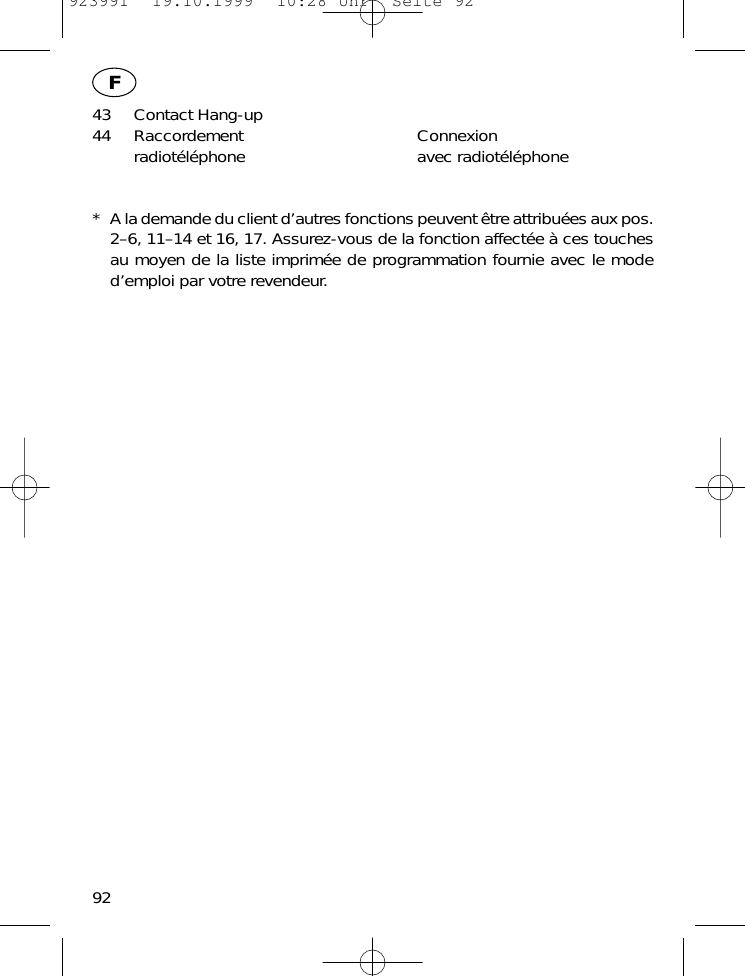
BedienelementePos. Benennung Tastensymbol, StandardfunktionDisplaysymbol1 Display2* Ruftaste 1 Festruf3* Lautsprechertaste Lautsprecher ein/aus, mithören4* Ruftaste 2 Displayruf5* Ein/Aus-Taste Gerät ein/ausKurz: einLang: aus6* Sendetaste : : : Sprechtaste7 Cursortaste Verschieben der Eingabestelleim DisplayKurz: rechtsLang: links8 Menütaste Aufruf eines MenüsKurz: nächster MenüpunktLang: Menü 19 Plus-Taste Eingabestelle aufwärts10 Minus-Taste Eingabestelle abwärts11* Funktionstaste 1 Programmierbare Taste12* Funktionstaste 2 Programmierbare Taste13* Funktionstaste 3 Programmierbare Taste14* Funktionstaste 4 Programmierbare Taste15 Ziffernblock 0–9 Zifferneingabe16* Sterntaste Displayinhalt löschenKurz: markierte StelleLang: alle Eingabestellen17* Rautentaste Eingabe des Gruppen-ruftones „G“18 Sende/Empfangs-symbol Nicht in Verwendung19 Kanal belegt20 Nicht in Verwendung21 Senden22 Lautsprechersymbol Lautsprecher ein16D923991  19.10.1999  10:27 Uhr  Seite 16
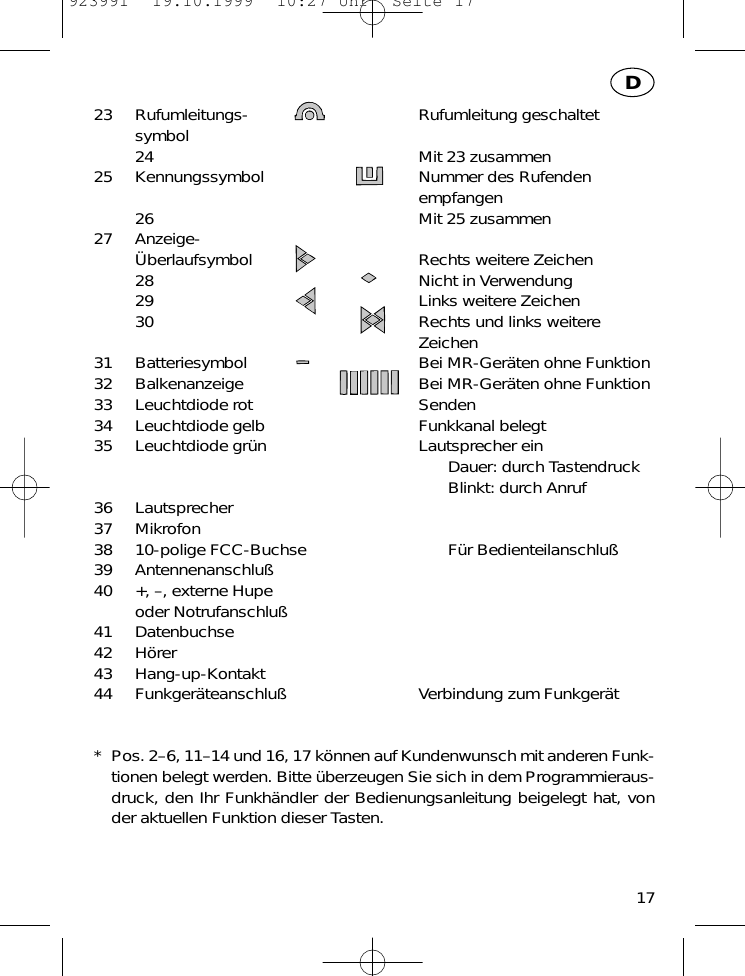
23 Rufumleitungs- Rufumleitung geschaltetsymbol24 Mit 23 zusammen25 Kennungssymbol Nummer des Rufenden empfangen26 Mit 25 zusammen27 Anzeige-Überlaufsymbol Rechts weitere Zeichen28 Nicht in Verwendung29 Links weitere Zeichen30 Rechts und links weitere Zeichen31 Batteriesymbol Bei MR-Geräten ohne Funktion32 Balkenanzeige Bei MR-Geräten ohne Funktion33 Leuchtdiode rot Senden34 Leuchtdiode gelb Funkkanal belegt35 Leuchtdiode grün Lautsprecher einDauer: durch TastendruckBlinkt: durch Anruf36 Lautsprecher37 Mikrofon38 10-polige FCC-Buchse Für Bedienteilanschluß39 Antennenanschluß40 +, –, externe Hupeoder Notrufanschluß41 Datenbuchse42 Hörer43 Hang-up-Kontakt44 Funkgeräteanschluß Verbindung zum Funkgerät* Pos. 2–6, 11–14 und 16, 17 können auf Kundenwunsch mit anderen Funk-tionen belegt werden. Bitte überzeugen Sie sich in dem Programmieraus-druck, den Ihr Funkhändler der Bedienungsanleitung beigelegt hat, vonder aktuellen Funktion dieser Tasten.17D923991  19.10.1999  10:27 Uhr  Seite 17
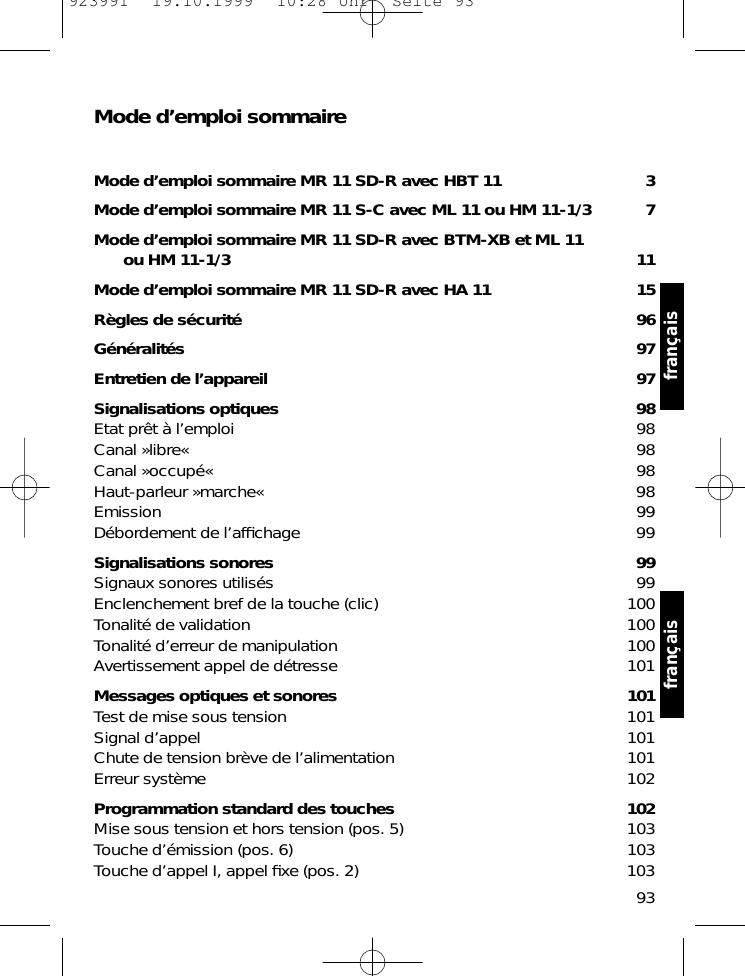
InhaltsverzeichnisKurzbedienungsanleitung MR 11 SD-R mit HBT 11 3Kurzbedienungsanleitung MR 11 S-C mit ML 11 oder HM 11-1/3 7Kurzbedienungsanleitung MR 11 SD-R mit BTM-XB und ML 11 oder HM 11-1/3 11Kurzbedienungsanleitung MR 11 SD-R mit HA 11 15Sicherheitshinweise 21Allgemeines 22Reinigen des Gerätes 22Optische Meldungen 23Betriebsbereitschaft 23Kanal „frei“ 23Kanal „belegt“ 23Lautsprecher „ein“ 23Senden 24Anzeige-Überlauf 24Akustische Meldungen 24Verwendete Tonsignale 24Tastenklick 25Bestätigungston 25Fehlbedienungston 25Notrufvorwarnung 26Optisch-akustische Meldungen 26Einschalttest 26Anrufmeldung 26Kurzzeitiger Spannungsabfall der Stromversorgung 26Systemfehler 27Standardprogrammierung der Tasten 27Ein-/Ausschalten (Pos. 5) 28Sendetaste (Pos. 6) 28Ruftaste I, Festruf (Pos. 2) 2818D923991  19.10.1999  10:27 Uhr  Seite 18
19DRuftaste II, Displayruf (Pos. 4) 28Lautsprechertaste (Pos. 3) 28Sterntaste (Pos. 16) 29Rautetaste (Pos. 17) 29Standardprogrammierung der Tasten zur Menübedienung 29Menütaste (Pos. 8) 29Cursortaste (Pos. 7) 30Plus- und Minustaste (Pos. 9, 10) 30Ziffernblock 0 bis 9 (Pos. 15) 31Das Menüsystem 31Anwendermenü 31Menüpunkt 31Menüanzeige 31Anzeigeformat 32Menüreihenfolge 32Basisanzeige 32Servicemenü 33Kennungsanzeige 33Verfügbare Standardmenüpunkte 33Lautstärke-Einstellung 33Kompakteingabe mit Textanzeige und Kanalscrollen 34Verfügbare Sondermenüpunkte 34Sicherungsabfrage beim Einschalten 34Paßwortänderung 35Kompakteingabe 35Kompakteingabe mit Kanalscrollen 36Kompakteingabe mit Textanzeige 36Kanaleingabe 37Kanalscrollen 37Rufnummerneingabe 38Kurzwahleingabe 38Kurzwahlscrollen 39Kurzwahleingabe mit Textanzeige 39Kurzwahlscrollen mit Textanzeige 39Statuseingabe 39923991  19.10.1999  10:27 Uhr  Seite 19
Statuseingabe mit Textanzeige 40Tastatursperre 40DTMF-Betrieb 40Kanalscanning 41Folgekontakt-Aktivierung 41Hupe (Folgekontakt schalten) 42Rufumleitung 42QRE-Betrieb 42Notizen 43Sendeleistung 43Auswerter-Rufnummer 43Servicebetrieb 44Rückrufspeicher 44Sonderfunktionen 44Notruf auslösen 44Tastenkombinationen 45Abschalten akustischer Signaltöne und Lautsprecherstummschaltung 45Umschalten der Sendeleistung 45Umschalten der Sendeleistung und Abschalten akustischer Signaltöne 4620D923991  19.10.1999  10:27 Uhr  Seite 20
Sicherheitshinweise– Das Funkgerät mit sämtlichem Zubehör darf nicht in schlagwetter- oderexplosionsgefährdeten Bereichen betrieben werden.– Halten Sie beim Betätigen der Sendetaste einen Abstand von minde-stens 30 cm zwischen Funkantenne und Körper bei Geräten mit 7-15 WSendeleistung und einen Abstand von mindestens 60 cm bei Gerätenmit 16-50 W Sendeleistung.– Halten Sie nie bei eingeschaltetem Funkgerät das Handbedienteil mitdem Lautsprecher direkt an das Ohr, testen Sie vorher einen verträg-lichen Abstand bei gewählter Lautstärkestufe durch Öffnen der Rausch-sperre. Andernfalls könnten Sie bei extrem großer Lautstärke Ihr Gehörschädigen.– Führen Sie während der Fahrt im Auto als Fahrer keinen Funkbetrieb, derSie vom Straßenverkehr ablenkt.– Wenn Sie Träger eines Herzschrittmachers sind, informieren Sie sich vorBetrieb des Funkgerätes bei dem Hersteller Ihres Herzschrittmachersüber eventuelle Beeinträchtigungen durch Hochfrequenz. Vermeiden Siees, die Sendetaste außerhalb des Fahrzeuges in Antennennähe zubetätigen, bleiben Sie dabei im Fahrzeug.– Halten Sie Funkgeräte fern aus dem Bereich von Kindern oder nicht mitder Bedienung vertrauten Personen.21D923991  19.10.1999  10:27 Uhr  Seite 21
AllgemeinesDas Bedienkonzept für die Kraftfahrzeugfunkgeräte der 11er-Generation inAusführung PMR (private mobile radio/Betriebsfunk) ist, unabhängig von derBedienteilausstattung, für alle Geräte einheitlich. Selbstverständlich ist dieArt der Anzeige und die Anzahl der verfügbaren Tasten von der jeweiligenGeräte-Bedienteilkombination und von der entsprechenden Programmie-rung abhängig.Wählen Sie deshalb bitte von den Seiten 3, 7, 11 und 15 die für Ihre Geräte-kombination passende Abbildung und nehmen den von Ihrem Funk-fachhändler beigefügten Programmierausdruck mit zu Hilfe, wenn Sie sichmit der Bedienung Ihres Funkgerätes vertraut machen möchten.Bis auf vier Tasten (Menü-, Cursor-, Plus- und Minus-Taste) und die Ziffern-tastatur 0 bis 9 sind alle weiteren Tasten durch Ihren Funkfachhändler pro-grammierbar und können unter Umständen mit einer vom Standard abwei-chenden Funktion programmiert sein. Dadurch sind, je nach AusführungIhres Funkgerätes, für Sie nur einige der in dieser Anleitung aufgeführtenBedienprozeduren von Interesse.Reinigen des GerätesZum Reinigen des äußeren Gehäuses Ihres Funkgerätes und der Bedientei-le verwenden Sie bitte nur Wasser mit etwas Spülmittel und einen weichenLappen. Wischen Sie das Funkgerät mit dem angefeuchteten Lappen ab(keinesfalls das Funkgerät bzw. das Zubehör in das Wasser tauchen) undtrocknen anschließend mit einem trockenen Tuch nach. Achten Sie darauf,daß keine Feuchtigkeit im Bereich des Bedienteilsteckers und des Anten-nenkontaktes zurückbleibt.Verwenden Sie keinesfalls Lösungsmittel!22D923991  19.10.1999  10:27 Uhr  Seite 22
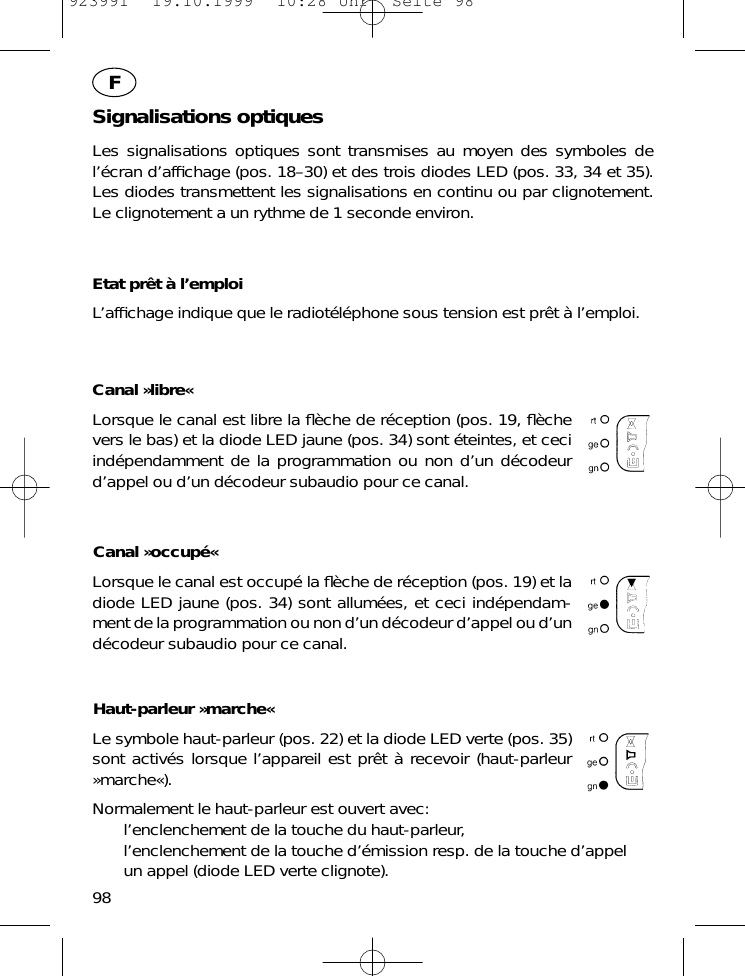
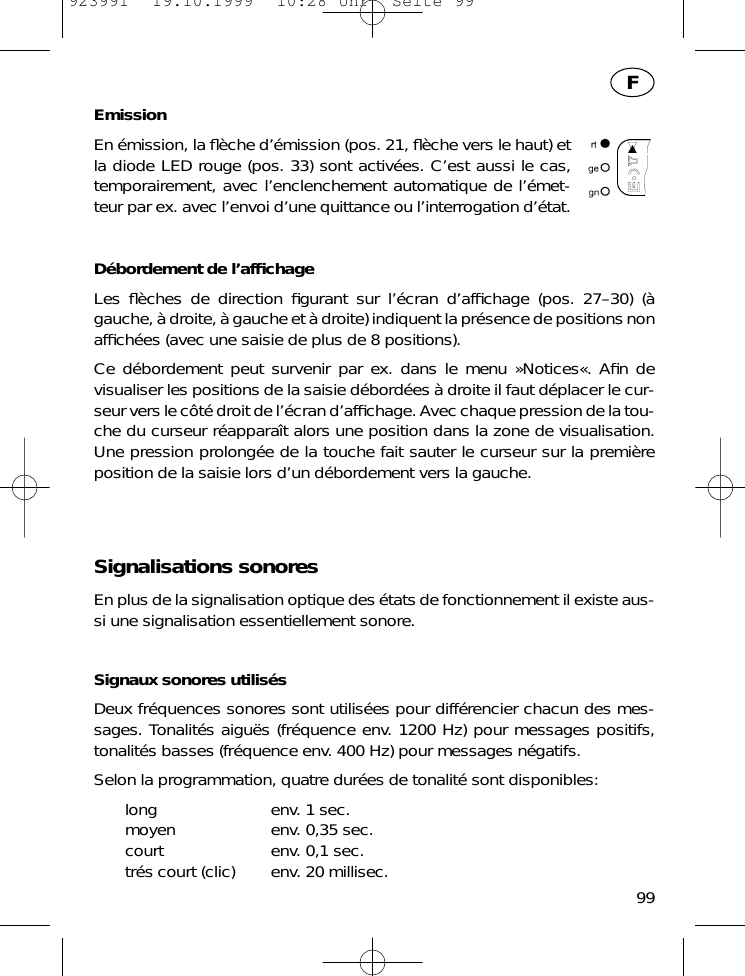
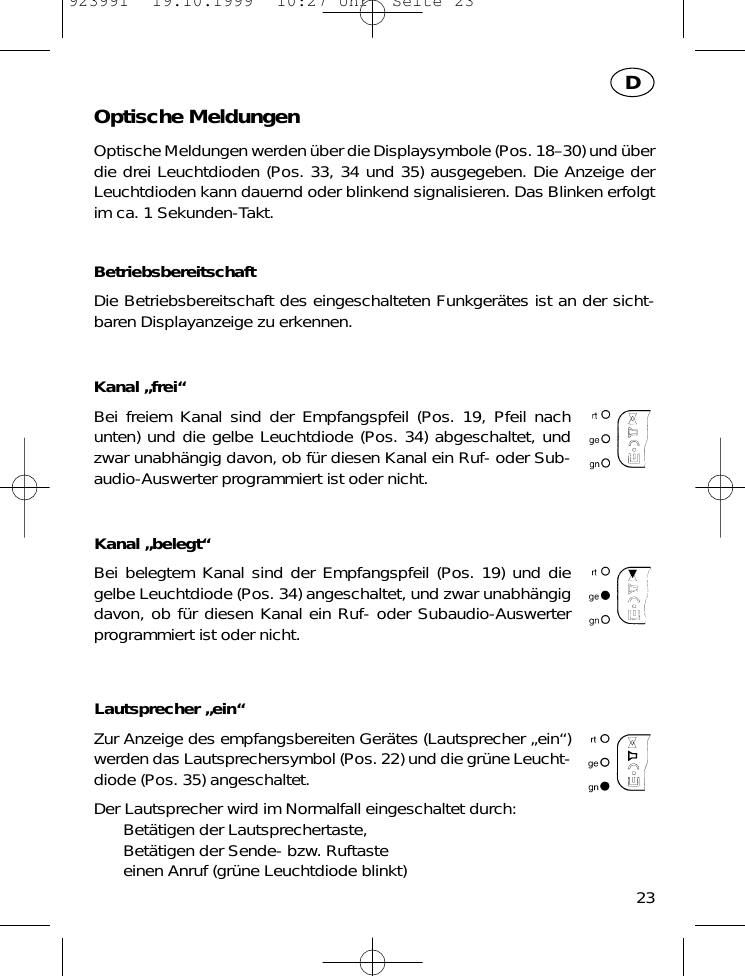
Optische MeldungenOptische Meldungen werden über die Displaysymbole (Pos. 18–30) und überdie drei Leuchtdioden (Pos. 33, 34 und 35) ausgegeben. Die Anzeige derLeuchtdioden kann dauernd oder blinkend signalisieren. Das Blinken erfolgtim ca. 1 Sekunden-Takt.BetriebsbereitschaftDie Betriebsbereitschaft des eingeschalteten Funkgerätes ist an der sicht-baren Displayanzeige zu erkennen.Kanal „frei“Bei freiem Kanal sind der Empfangspfeil (Pos. 19, Pfeil nachunten) und die gelbe Leuchtdiode (Pos. 34) abgeschaltet, undzwar unabhängig davon, ob für diesen Kanal ein Ruf- oder Sub-audio-Auswerter programmiert ist oder nicht.Kanal „belegt“Bei belegtem Kanal sind der Empfangspfeil (Pos. 19) und diegelbe Leuchtdiode (Pos. 34) angeschaltet, und zwar unabhängigdavon, ob für diesen Kanal ein Ruf- oder Subaudio-Auswerterprogrammiert ist oder nicht.Lautsprecher „ein“Zur Anzeige des empfangsbereiten Gerätes (Lautsprecher „ein“)werden das Lautsprechersymbol (Pos. 22) und die grüne Leucht-diode (Pos. 35) angeschaltet.Der Lautsprecher wird im Normalfall eingeschaltet durch:Betätigen der Lautsprechertaste,Betätigen der Sende- bzw. Ruftasteeinen Anruf (grüne Leuchtdiode blinkt)23D923991  19.10.1999  10:27 Uhr  Seite 23
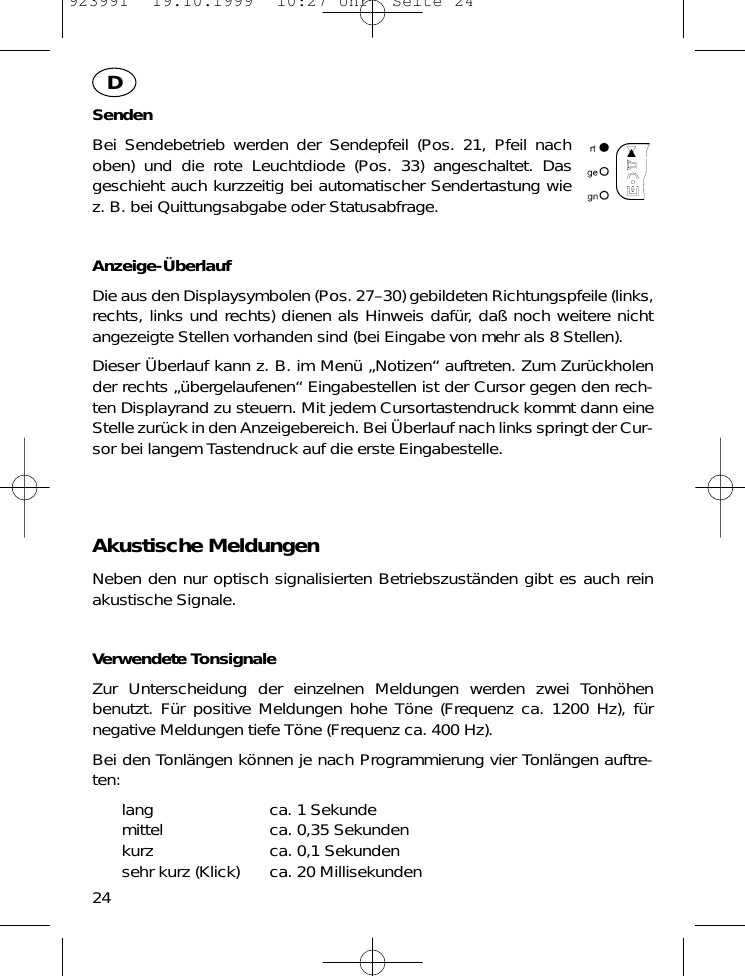
SendenBei Sendebetrieb werden der Sendepfeil (Pos. 21, Pfeil nachoben) und die rote Leuchtdiode (Pos. 33) angeschaltet. Dasgeschieht auch kurzzeitig bei automatischer Sendertastung wiez. B. bei Quittungsabgabe oder Statusabfrage.Anzeige-ÜberlaufDie aus den Displaysymbolen (Pos. 27–30) gebildeten Richtungspfeile (links,rechts, links und rechts) dienen als Hinweis dafür, daß noch weitere nichtangezeigte Stellen vorhanden sind (bei Eingabe von mehr als 8 Stellen).Dieser Überlauf kann z. B. im Menü „Notizen“ auftreten. Zum Zurückholender rechts „übergelaufenen“ Eingabestellen ist der Cursor gegen den rech-ten Displayrand zu steuern. Mit jedem Cursortastendruck kommt dann eineStelle zurück in den Anzeigebereich. Bei Überlauf nach links springt der Cur-sor bei langem Tastendruck auf die erste Eingabestelle.Akustische MeldungenNeben den nur optisch signalisierten Betriebszuständen gibt es auch reinakustische Signale.Verwendete TonsignaleZur Unterscheidung der einzelnen Meldungen werden zwei Tonhöhenbenutzt. Für positive Meldungen hohe Töne (Frequenz ca. 1200 Hz), fürnegative Meldungen tiefe Töne (Frequenz ca. 400 Hz).Bei den Tonlängen können je nach Programmierung vier Tonlängen auftre-ten:lang ca. 1 Sekundemittel ca. 0,35 Sekundenkurz ca. 0,1 Sekundensehr kurz (Klick) ca. 20 Millisekunden24D923991  19.10.1999  10:27 Uhr  Seite 24
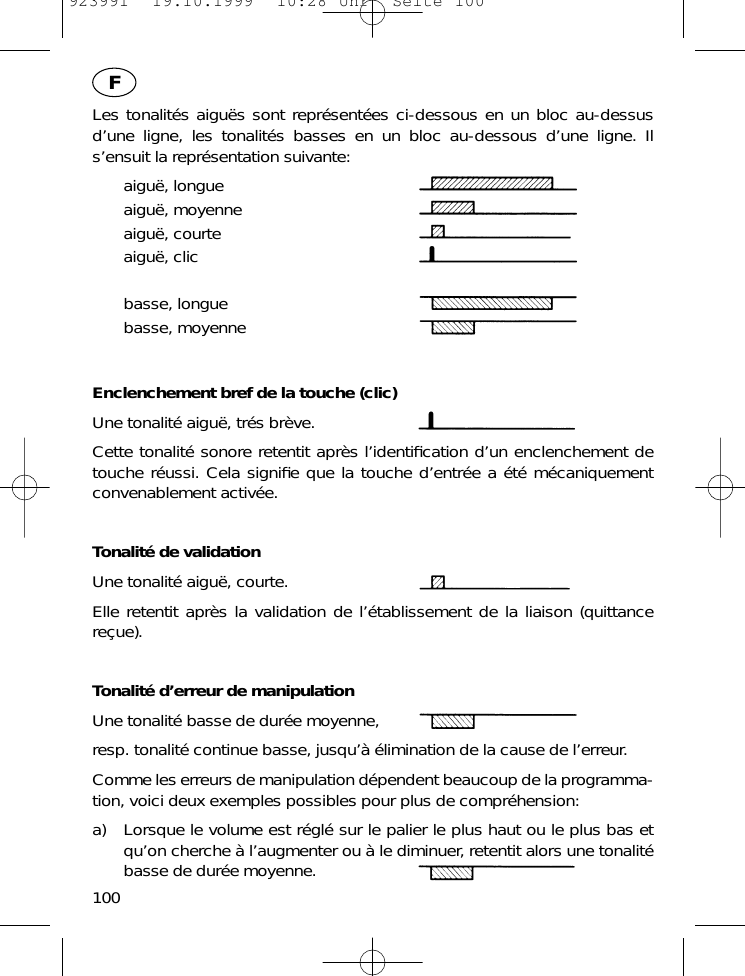
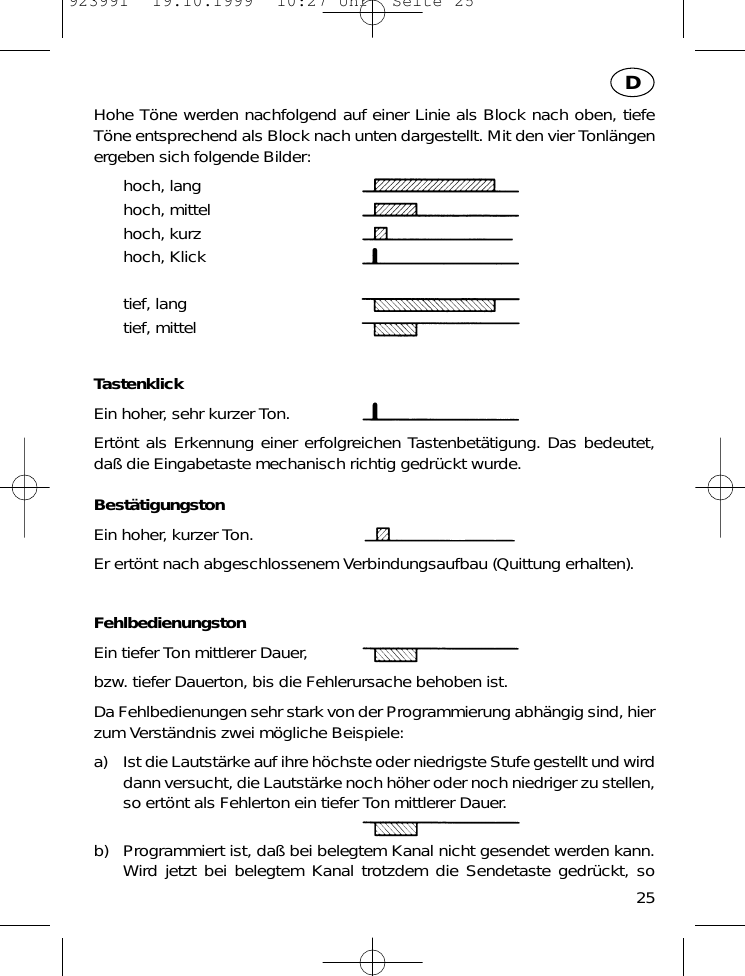
Hohe Töne werden nachfolgend auf einer Linie als Block nach oben, tiefeTöne entsprechend als Block nach unten dargestellt. Mit den vier Tonlängenergeben sich folgende Bilder:hoch, langhoch, mittelhoch, kurzhoch, Klicktief, langtief, mittelTastenklickEin hoher, sehr kurzer Ton.Ertönt als Erkennung einer erfolgreichen Tastenbetätigung. Das bedeutet,daß die Eingabetaste mechanisch richtig gedrückt wurde.BestätigungstonEin hoher, kurzer Ton.Er ertönt nach abgeschlossenem Verbindungsaufbau (Quittung erhalten).FehlbedienungstonEin tiefer Ton mittlerer Dauer,bzw. tiefer Dauerton, bis die Fehlerursache behoben ist.Da Fehlbedienungen sehr stark von der Programmierung abhängig sind, hierzum Verständnis zwei mögliche Beispiele:a) Ist die Lautstärke auf ihre höchste oder niedrigste Stufe gestellt und wirddann versucht, die Lautstärke noch höher oder noch niedriger zu stellen,so ertönt als Fehlerton ein tiefer Ton mittlerer Dauer.b) Programmiert ist, daß bei belegtem Kanal nicht gesendet werden kann.Wird jetzt bei belegtem Kanal trotzdem die Sendetaste gedrückt, so25D923991  19.10.1999  10:27 Uhr  Seite 25
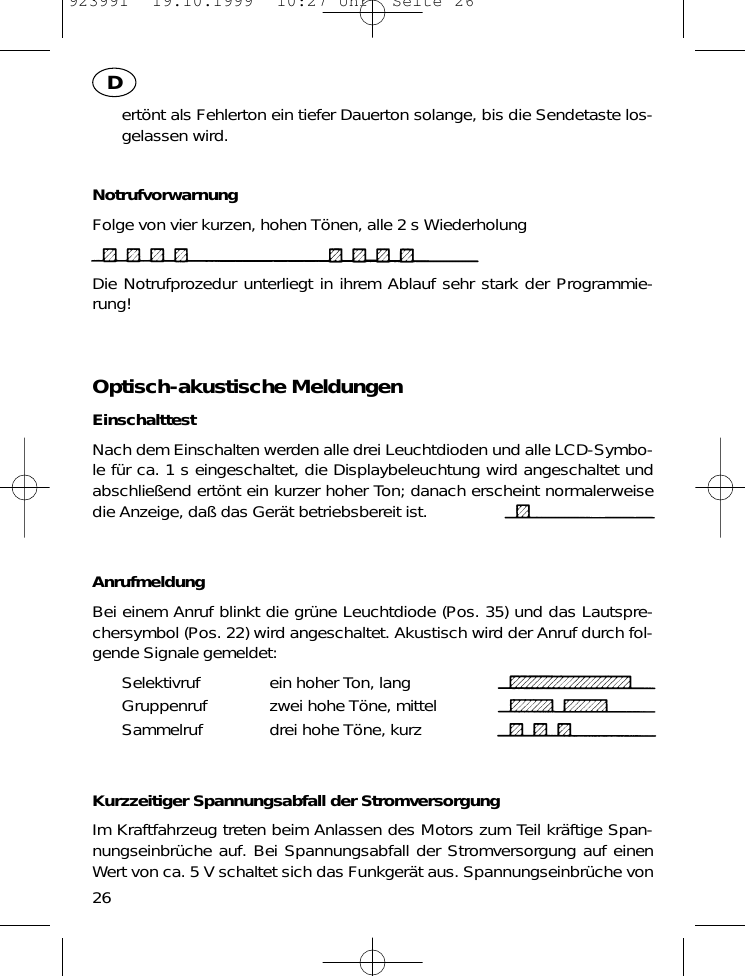
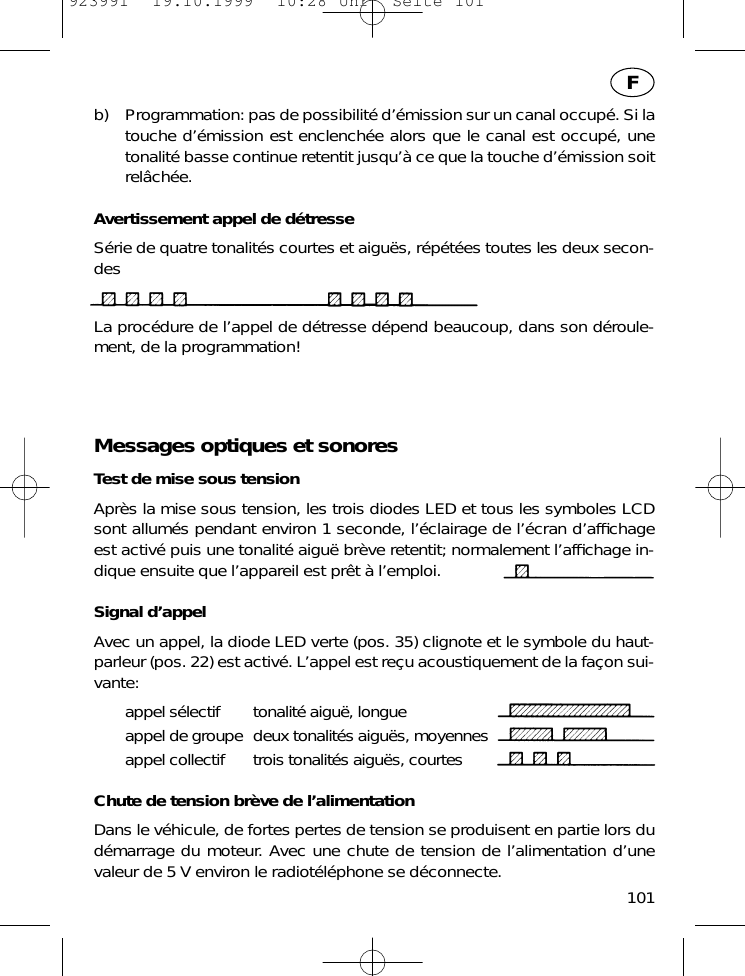
ertönt als Fehlerton ein tiefer Dauerton solange, bis die Sendetaste los-gelassen wird.NotrufvorwarnungFolge von vier kurzen, hohen Tönen, alle 2 s WiederholungDie Notrufprozedur unterliegt in ihrem Ablauf sehr stark der Programmie-rung!Optisch-akustische MeldungenEinschalttestNach dem Einschalten werden alle drei Leuchtdioden und alle LCD-Symbo-le für ca. 1 s eingeschaltet, die Displaybeleuchtung wird angeschaltet undabschließend ertönt ein kurzer hoher Ton; danach erscheint normalerweisedie Anzeige, daß das Gerät betriebsbereit ist.AnrufmeldungBei einem Anruf blinkt die grüne Leuchtdiode (Pos. 35) und das Lautspre-chersymbol (Pos. 22) wird angeschaltet. Akustisch wird der Anruf durch fol-gende Signale gemeldet:Selektivruf ein hoher Ton, langGruppenruf zwei hohe Töne, mittelSammelruf drei hohe Töne, kurzKurzzeitiger Spannungsabfall der StromversorgungIm Kraftfahrzeug treten beim Anlassen des Motors zum Teil kräftige Span-nungseinbrüche auf. Bei Spannungsabfall der Stromversorgung auf einenWert von ca. 5 V schaltet sich das Funkgerät aus. Spannungseinbrüche von26D923991  19.10.1999  10:27 Uhr  Seite 26
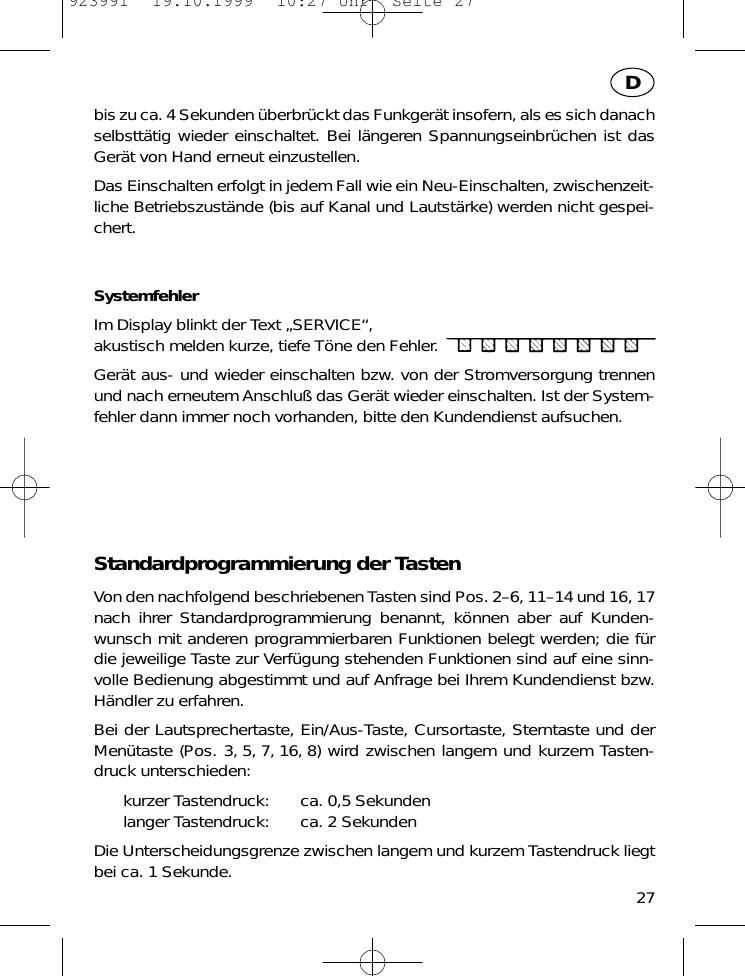
bis zu ca. 4 Sekunden überbrückt das Funkgerät insofern, als es sich danachselbsttätig wieder einschaltet. Bei längeren Spannungseinbrüchen ist dasGerät von Hand erneut einzustellen.Das Einschalten erfolgt in jedem Fall wie ein Neu-Einschalten, zwischenzeit-liche Betriebszustände (bis auf Kanal und Lautstärke) werden nicht gespei-chert.SystemfehlerIm Display blinkt der Text „SERVICE“,akustisch melden kurze, tiefe Töne den Fehler.Gerät aus- und wieder einschalten bzw. von der Stromversorgung trennenund nach erneutem Anschluß das Gerät wieder einschalten. Ist der System-fehler dann immer noch vorhanden, bitte den Kundendienst aufsuchen.Standardprogrammierung der TastenVon den nachfolgend beschriebenen Tasten sind Pos. 2–6, 11–14 und 16, 17nach ihrer Standardprogrammierung benannt, können aber auf Kunden-wunsch mit anderen programmierbaren Funktionen belegt werden; die fürdie jeweilige Taste zur Verfügung stehenden Funktionen sind auf eine sinn-volle Bedienung abgestimmt und auf Anfrage bei Ihrem Kundendienst bzw.Händler zu erfahren.Bei der Lautsprechertaste, Ein/Aus-Taste, Cursortaste, Sterntaste und derMenütaste (Pos. 3, 5, 7, 16, 8) wird zwischen langem und kurzem Tasten-druck unterschieden:kurzer Tastendruck: ca. 0,5 Sekundenlanger Tastendruck: ca. 2 SekundenDie Unterscheidungsgrenze zwischen langem und kurzem Tastendruck liegtbei ca. 1 Sekunde. 27D923991  19.10.1999  10:27 Uhr  Seite 27
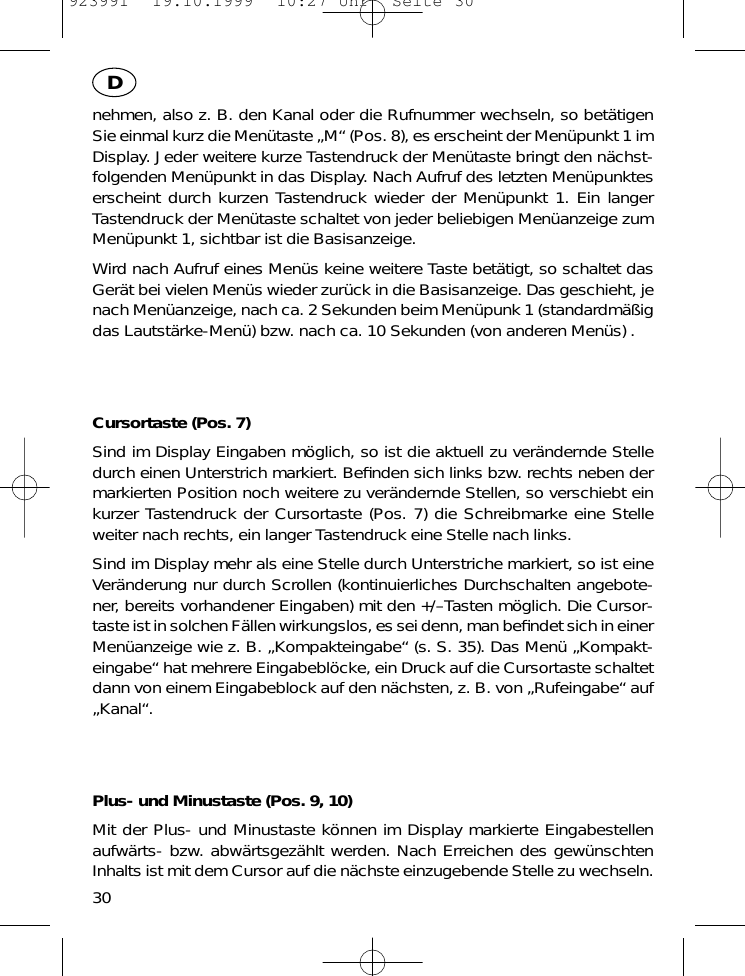
Ein-/Ausschalten (Pos. 5)Zum Einschalten des Funkgerätes die Ein/Aus-Taste (Pos. 5) kurz drücken.Der Einschalttest wird durchgeführt (ca. 1 Sekunde), nach Ertönen desBestätigungstones ist das Gerät betriebsbereit.Zum Ausschalten ist die Ein/Aus-Taste (Pos. 5) lang zu drücken, bis derBestätigungston ertönt. Mit dem Loslassen der Taste wird das Funkgerätabgeschaltet.Beim Abschalten werden die letzten Einstellungen von Kanal und Lautstärkegespeichert und bei erneutem Einschalten wieder übernommen.Sendetaste (Pos. 6)Zum Senden ist die Sendetaste (Pos. 6) gedrückt zu halten, das Mikrofon istangeschaltet und es kann gesprochen werden. Für die Dauer des Sendenssind die rote Leuchtdiode (Pos. 33) und das Sendesymbol (Pos. 21, Pfeilnach oben) angeschaltet. Zum Hören ist die Sendetaste wieder loszulassen.Ruftaste I, Festruf (Pos. 2)Bei programmiertem Festruf (keine im Display veränderbaren Rufwahlstellen)die Ruftaste 1 (Pos. 2) drücken, der Ruf wird ausgesendet. Für die Dauer derSendertastung sind die Sendesymbole aktiv.Ruftaste II, Displayruf (Pos. 4)Bei programmiertem Displayruf (mit der Zifferntastatur bzw. Cursor-, Plus-und Minustaste kann die im Display erscheinende Rufnummer verändertwerden) die Ruftaste 2 (Pos. 4) drücken, der Ruf wird ausgesendet. Für dieDauer der Sendertastung sind die Sendesymbole aktiv.Lautsprechertaste (Pos. 3)In der Standardprogrammierung besitzt die Lautsprechertaste (Pos. 3) eineKombination aus Lösch-, Monitor- und Mithörfunktion. Hierbei erhält dieTaste nur für die Monitorfunktion eine kurz–lang-Unterscheidung, d. h. dieMonitorfunktion wird nur bei einem kurzen Tastendruck ausgeführt.28D923991  19.10.1999  10:27 Uhr  Seite 28
Gerät mit Rufauswerter:MithörenWährend die Taste gedrückt gehalten wird, kann man in den Funkkanalhineinhören. Ist Funkbetrieb auf dem Kanal, so hört man diesen mit, istder Kanal frei, so hört man ein Rauschen. Für die Dauer des Tasten-drucks wird das Lautsprechersymbol (Pos. 22) und die grüne Leucht-diode (Pos. 35) angeschaltet. [Ruf-, Subaudioauswerter und Rausch-sperre werden umgangen]MonitorMit jedem Loslassen der Taste wird der Lautsprecher gleichzeitig in denjeweils anderen Zustand geschaltet, d. h. Lautsprecher „ein“ (grüneDiode auf Dauerlicht, Lautsprechersymbol an) oder Lautsprecher „aus“(grüne Diode aus und Lautsprechersymbol aus). [Nur Rufauswerter wirdumgangen]LöschenDarüber hinaus wird mit jedem Tastendruck ein eventuell vorhandenesAnrufsignal zurückgesetzt.Sterntaste (Pos. 16)Die Sterntaste ist standardmäßig mit der Funktion „Displayinhalt löschen“(kurz = markierte Eingabestelle, lang = alle Eingabestellen) belegt. Sie stehtnicht bei allen Bedienteilen zur Verfügung.Rautetaste (Pos. 17)Die Rautetaste dient in der Standardprogrammierung der Eingabe des Grup-penruftones „G“. Sie steht nicht bei allen Bedienteilen zur Verfügung.Standardprogrammierung der Tasten zur MenübedienungMenütaste (Pos. 8)Im Ruhezustand (Standby-Betrieb) des Funkgerätes ist auf dem Display dieBasisanzeige sichtbar (siehe „Das Menüsystem“ ). Wollen Sie Eingaben vor-29D923991  19.10.1999  10:27 Uhr  Seite 29
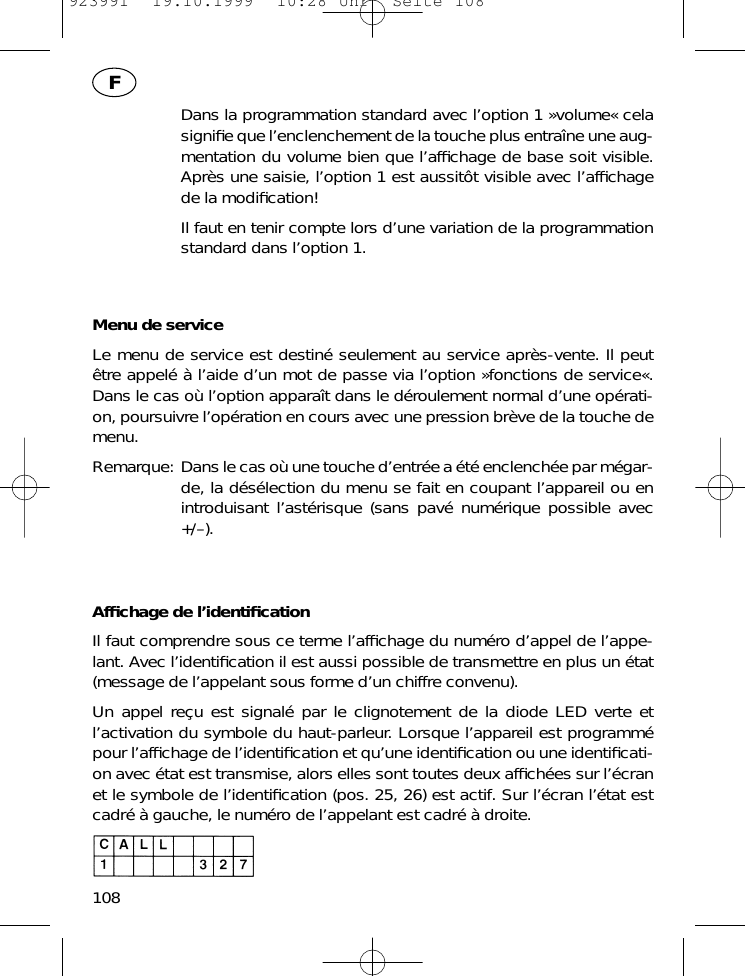
nehmen, also z. B. den Kanal oder die Rufnummer wechseln, so betätigenSie einmal kurz die Menütaste „M“ (Pos. 8), es erscheint der Menüpunkt 1 imDisplay. Jeder weitere kurze Tastendruck der Menütaste bringt den nächst-folgenden Menüpunkt in das Display. Nach Aufruf des letzten Menüpunkteserscheint durch kurzen Tastendruck wieder der Menüpunkt 1. Ein langerTastendruck der Menütaste schaltet von jeder beliebigen Menüanzeige zumMenüpunkt 1, sichtbar ist die Basisanzeige.Wird nach Aufruf eines Menüs keine weitere Taste betätigt, so schaltet dasGerät bei vielen Menüs wieder zurück in die Basisanzeige. Das geschieht, jenach Menüanzeige, nach ca. 2 Sekunden beim Menüpunk 1 (standardmäßigdas Lautstärke-Menü) bzw. nach ca. 10 Sekunden (von anderen Menüs) .Cursortaste (Pos. 7)Sind im Display Eingaben möglich, so ist die aktuell zu verändernde Stelledurch einen Unterstrich markiert. Befinden sich links bzw. rechts neben dermarkierten Position noch weitere zu verändernde Stellen, so verschiebt einkurzer Tastendruck der Cursortaste (Pos. 7) die Schreibmarke eine Stelleweiter nach rechts, ein langer Tastendruck eine Stelle nach links.Sind im Display mehr als eine Stelle durch Unterstriche markiert, so ist eineVeränderung nur durch Scrollen (kontinuierliches Durchschalten angebote-ner, bereits vorhandener Eingaben) mit den +/–Tasten möglich. Die Cursor-taste ist in solchen Fällen wirkungslos, es sei denn, man befindet sich in einerMenüanzeige wie z. B. „Kompakteingabe“ (s. S. 35). Das Menü „Kompakt-eingabe“ hat mehrere Eingabeblöcke, ein Druck auf die Cursortaste schaltetdann von einem Eingabeblock auf den nächsten, z. B. von „Rufeingabe“ auf„Kanal“.Plus- und Minustaste (Pos. 9, 10)Mit der Plus- und Minustaste können im Display markierte Eingabestellenaufwärts- bzw. abwärtsgezählt werden. Nach Erreichen des gewünschtenInhalts ist mit dem Cursor auf die nächste einzugebende Stelle zu wechseln.30D923991  19.10.1999  10:27 Uhr  Seite 30
Ziffernblock 0 bis 9 (Pos. 15)Über die Zifferntastatur kann an den in der Menüanzeige vorgesehenen Stel-len der Inhalt direkt eingegeben werden. Mit jeder eingegebenen Ziffer bzw.jedem Buchstaben schaltet der Cursor automatisch auf die nächste Einga-bestelle. Die Zifferntastatur ist nicht an jedem Bedienteil vorhanden.Das MenüsystemDie Funkgeräte der 11er-Generation sind menügeführt zu bedienen. Darun-ter ist zu verstehen, daß die Anzeige- bzw. Eingabestellen im Display jeweilsindividuell auf den Bedienvorgang abgestimmt sind. Dazu gehört unter ande-rem auch, daß im Display angezeigt wird, welcher Bedienungsablauf geradeaktiviert ist.AnwendermenüDas Anwendermenü ist über die Menütaste aufrufbar und ermöglicht demBenutzer des Gerätes eine optimal auf seine Bedürfnisse zugeschnitteneBedienung. So wie hier in dieser Bedienungsanleitung alle Menüpunkte undBediendetails erwähnt werden müssen, sind sie in ihrer Vielfalt sicher ver-wirrend. Deshalb wird der Benutzer durch fachgerechte Auswahl und Pro-grammierung nur mit dem konfrontiert, was er auch wirklich für seine spezi-ellen Anwendungen braucht.MenüpunktUnter einem Menüpunkt ist innerhalb des über die Menütaste aufgerufenenMenüs eine Displayanzeige mit ihren zugehörigen Eingabe- und Anzei-gemöglichkeiten zu verstehen.Als Menüpunkte stehen zur Zeit ca. 30 verschiedene zur Verfügung, vondenen je nach Kundenwunsch eine individuelle Auswahl von bis zu 23 Menü-punkten programmiert werden kann.MenüanzeigeJedem Menüpunkt ist eine Menüanzeige mit fest definierten Anzeige- undEingabemöglichkeiten zugeordnet. 31D923991  19.10.1999  10:27 Uhr  Seite 31
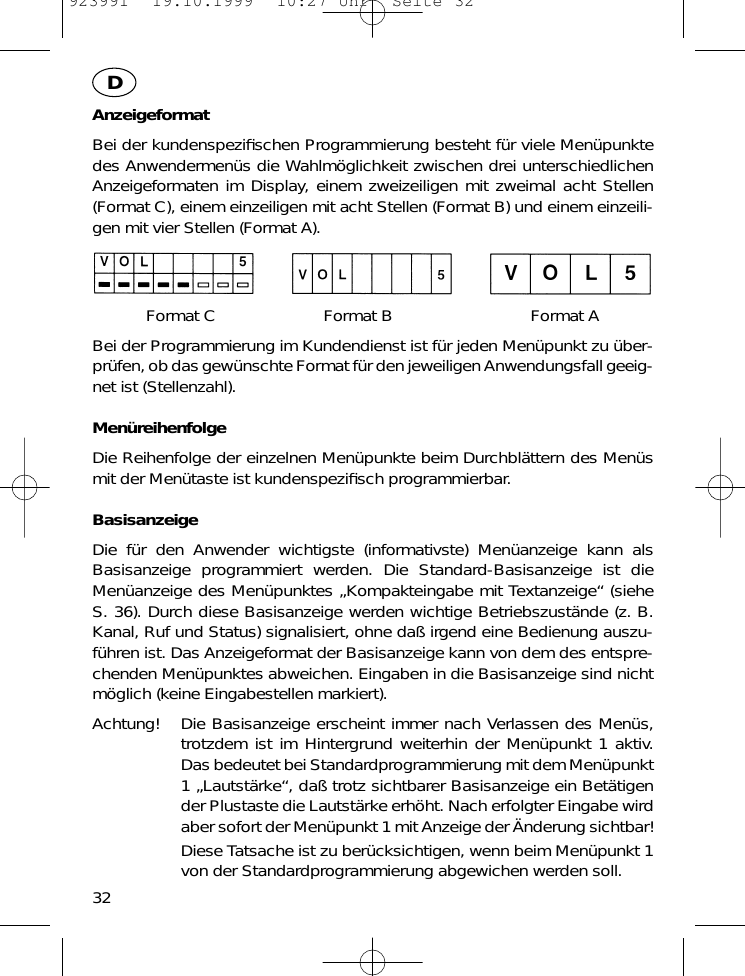
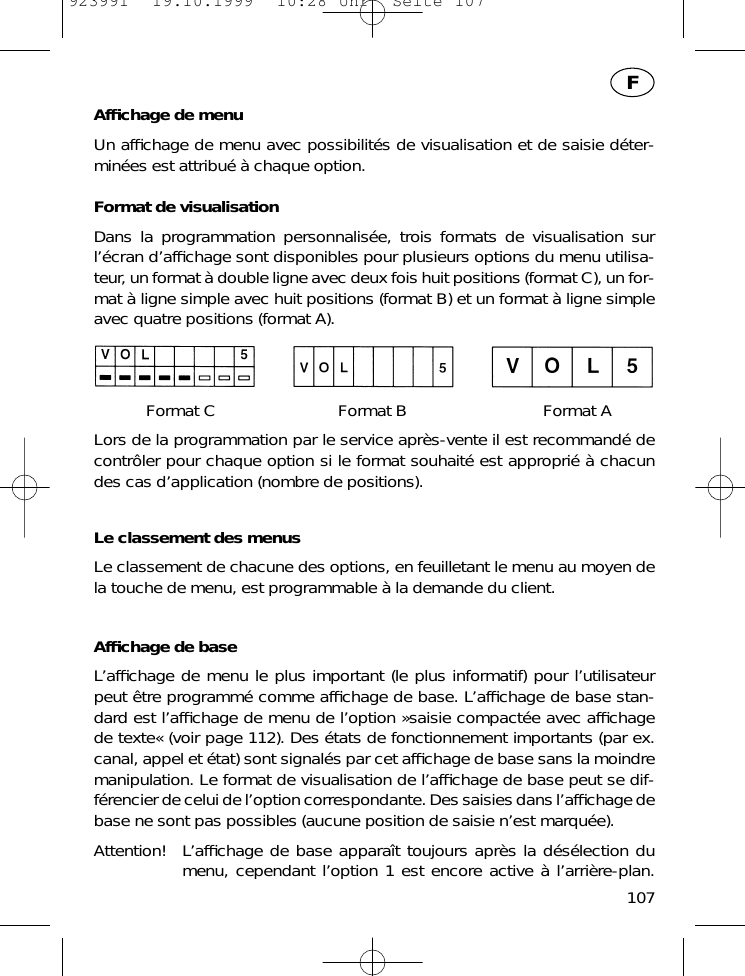
AnzeigeformatBei der kundenspezifischen Programmierung besteht für viele Menüpunktedes Anwendermenüs die Wahlmöglichkeit zwischen drei unterschiedlichenAnzeigeformaten im Display, einem zweizeiligen mit zweimal acht Stellen(Format C), einem einzeiligen mit acht Stellen (Format B) und einem einzeili-gen mit vier Stellen (Format A).Format C Format B Format ABei der Programmierung im Kundendienst ist für jeden Menüpunkt zu über-prüfen, ob das gewünschte Format für den jeweiligen Anwendungsfall geeig-net ist (Stellenzahl).MenüreihenfolgeDie Reihenfolge der einzelnen Menüpunkte beim Durchblättern des Menüsmit der Menütaste ist kundenspezifisch programmierbar.BasisanzeigeDie für den Anwender wichtigste (informativste) Menüanzeige kann alsBasisanzeige programmiert werden. Die Standard-Basisanzeige ist dieMenüanzeige des Menüpunktes „Kompakteingabe mit Textanzeige“ (sieheS. 36). Durch diese Basisanzeige werden wichtige Betriebszustände (z. B.Kanal, Ruf und Status) signalisiert, ohne daß irgend eine Bedienung auszu-führen ist. Das Anzeigeformat der Basisanzeige kann von dem des entspre-chenden Menüpunktes abweichen. Eingaben in die Basisanzeige sind nichtmöglich (keine Eingabestellen markiert).Achtung! Die Basisanzeige erscheint immer nach Verlassen des Menüs,trotzdem ist im Hintergrund weiterhin der Menüpunkt 1 aktiv.Das bedeutet bei Standardprogrammierung mit dem Menüpunkt1 „Lautstärke“, daß trotz sichtbarer Basisanzeige ein Betätigender Plustaste die Lautstärke erhöht. Nach erfolgter Eingabe wirdaber sofort der Menüpunkt 1 mit Anzeige der Änderung sichtbar!Diese Tatsache ist zu berücksichtigen, wenn beim Menüpunkt 1von der Standardprogrammierung abgewichen werden soll.32D923991  19.10.1999  10:27 Uhr  Seite 32
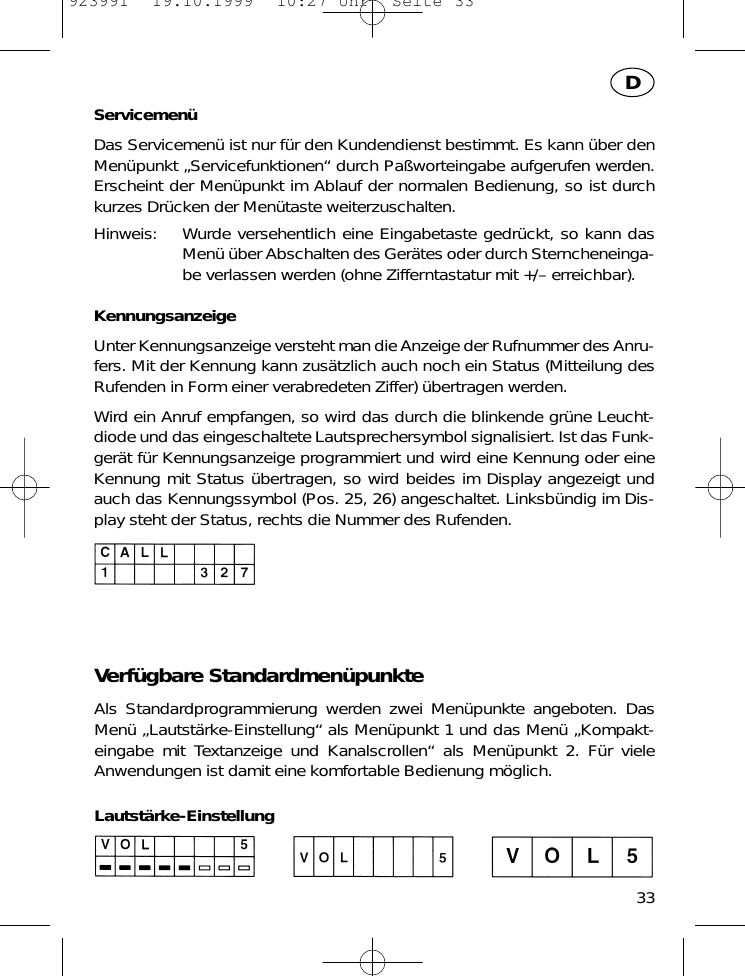
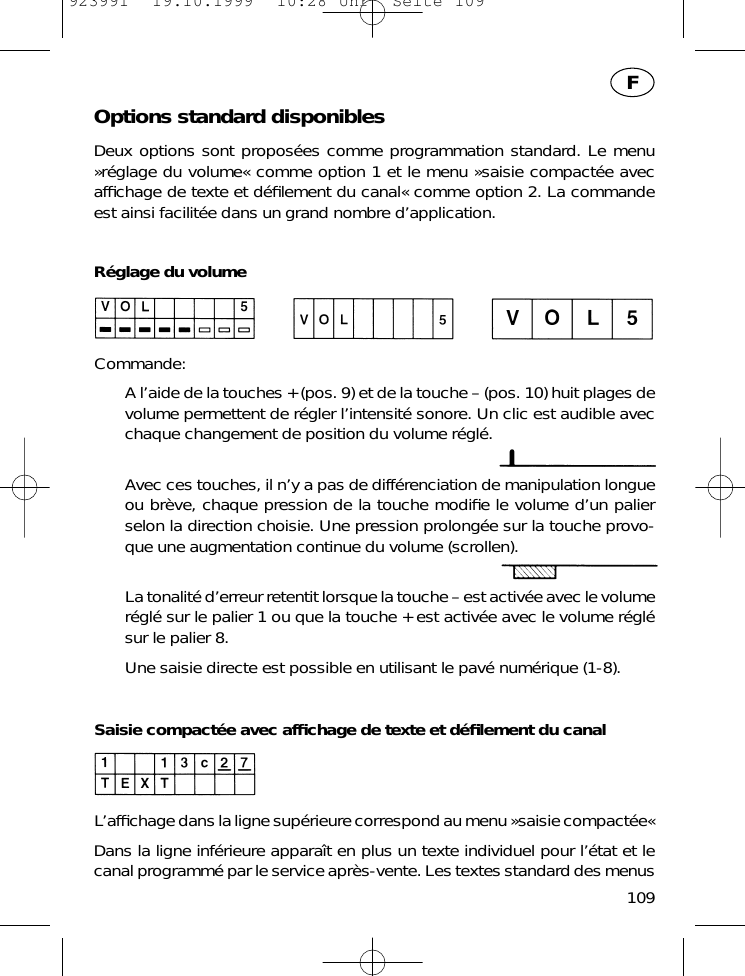
ServicemenüDas Servicemenü ist nur für den Kundendienst bestimmt. Es kann über denMenüpunkt „Servicefunktionen“ durch Paßworteingabe aufgerufen werden.Erscheint der Menüpunkt im Ablauf der normalen Bedienung, so ist durchkurzes Drücken der Menütaste weiterzuschalten.Hinweis: Wurde versehentlich eine Eingabetaste gedrückt, so kann dasMenü über Abschalten des Gerätes oder durch Sterncheneinga-be verlassen werden (ohne Zifferntastatur mit +/– erreichbar).KennungsanzeigeUnter Kennungsanzeige versteht man die Anzeige der Rufnummer des Anru-fers. Mit der Kennung kann zusätzlich auch noch ein Status (Mitteilung desRufenden in Form einer verabredeten Ziffer) übertragen werden.Wird ein Anruf empfangen, so wird das durch die blinkende grüne Leucht-diode und das eingeschaltete Lautsprechersymbol signalisiert. Ist das Funk-gerät für Kennungsanzeige programmiert und wird eine Kennung oder eineKennung mit Status übertragen, so wird beides im Display angezeigt undauch das Kennungssymbol (Pos. 25, 26) angeschaltet. Linksbündig im Dis-play steht der Status, rechts die Nummer des Rufenden.Verfügbare StandardmenüpunkteAls Standardprogrammierung werden zwei Menüpunkte angeboten. DasMenü „Lautstärke-Einstellung“ als Menüpunkt 1 und das Menü „Kompakt-eingabe mit Textanzeige und Kanalscrollen“ als Menüpunkt 2. Für vieleAnwendungen ist damit eine komfortable Bedienung möglich.Lautstärke-Einstellung33D923991  19.10.1999  10:27 Uhr  Seite 33
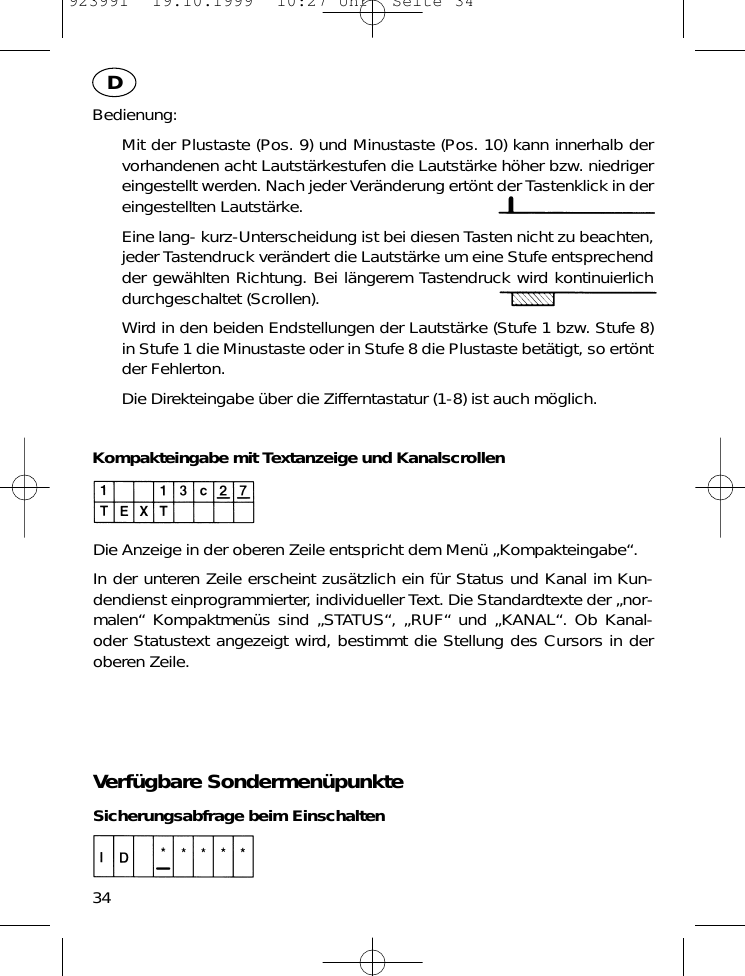
Bedienung:Mit der Plustaste (Pos. 9) und Minustaste (Pos. 10) kann innerhalb dervorhandenen acht Lautstärkestufen die Lautstärke höher bzw. niedrigereingestellt werden. Nach jeder Veränderung ertönt der Tastenklick in dereingestellten Lautstärke.Eine lang- kurz-Unterscheidung ist bei diesen Tasten nicht zu beachten,jeder Tastendruck verändert die Lautstärke um eine Stufe entsprechendder gewählten Richtung. Bei längerem Tastendruck wird kontinuierlichdurchgeschaltet (Scrollen).Wird in den beiden Endstellungen der Lautstärke (Stufe 1 bzw. Stufe 8)in Stufe 1 die Minustaste oder in Stufe 8 die Plustaste betätigt, so ertöntder Fehlerton.Die Direkteingabe über die Zifferntastatur (1-8) ist auch möglich.Kompakteingabe mit Textanzeige und KanalscrollenDie Anzeige in der oberen Zeile entspricht dem Menü „Kompakteingabe“.In der unteren Zeile erscheint zusätzlich ein für Status und Kanal im Kun-dendienst einprogrammierter, individueller Text. Die Standardtexte der „nor-malen“ Kompaktmenüs sind „STATUS“, „RUF“ und „KANAL“. Ob Kanal-oder Statustext angezeigt wird, bestimmt die Stellung des Cursors in deroberen Zeile.Verfügbare SondermenüpunkteSicherungsabfrage beim Einschalten34D923991  19.10.1999  10:27 Uhr  Seite 34
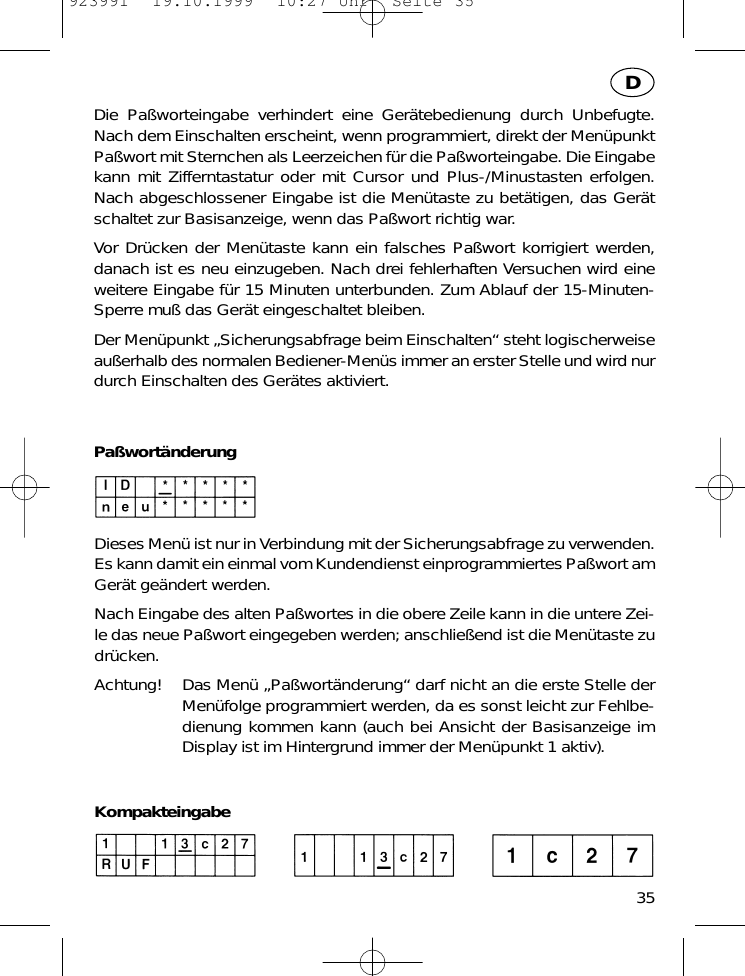
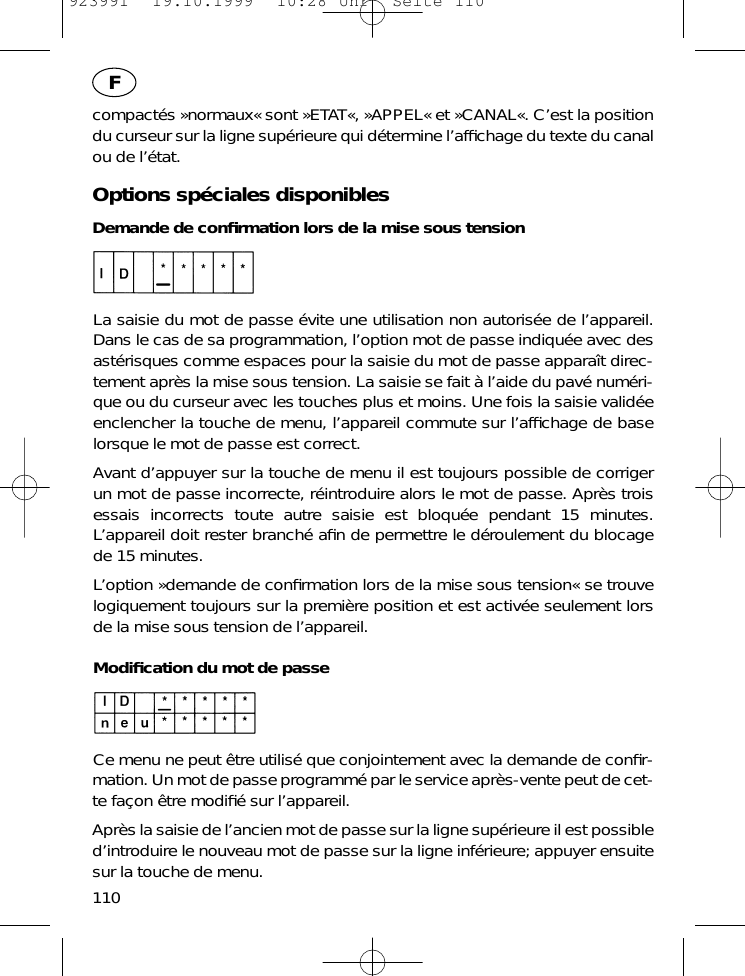
Die Paßworteingabe verhindert eine Gerätebedienung durch Unbefugte.Nach dem Einschalten erscheint, wenn programmiert, direkt der MenüpunktPaßwort mit Sternchen als Leerzeichen für die Paßworteingabe. Die Eingabekann mit Zifferntastatur oder mit Cursor und Plus-/Minustasten erfolgen.Nach abgeschlossener Eingabe ist die Menütaste zu betätigen, das Gerätschaltet zur Basisanzeige, wenn das Paßwort richtig war.Vor Drücken der Menütaste kann ein falsches Paßwort korrigiert werden,danach ist es neu einzugeben. Nach drei fehlerhaften Versuchen wird eineweitere Eingabe für 15 Minuten unterbunden. Zum Ablauf der 15-Minuten-Sperre muß das Gerät eingeschaltet bleiben.Der Menüpunkt „Sicherungsabfrage beim Einschalten“ steht logischerweiseaußerhalb des normalen Bediener-Menüs immer an erster Stelle und wird nurdurch Einschalten des Gerätes aktiviert.PaßwortänderungDieses Menü ist nur in Verbindung mit der Sicherungsabfrage zu verwenden.Es kann damit ein einmal vom Kundendienst einprogrammiertes Paßwort amGerät geändert werden.Nach Eingabe des alten Paßwortes in die obere Zeile kann in die untere Zei-le das neue Paßwort eingegeben werden; anschließend ist die Menütaste zudrücken.Achtung! Das Menü „Paßwortänderung“ darf nicht an die erste Stelle derMenüfolge programmiert werden, da es sonst leicht zur Fehlbe-dienung kommen kann (auch bei Ansicht der Basisanzeige imDisplay ist im Hintergrund immer der Menüpunkt 1 aktiv).Kompakteingabe35D923991  19.10.1999  10:27 Uhr  Seite 35
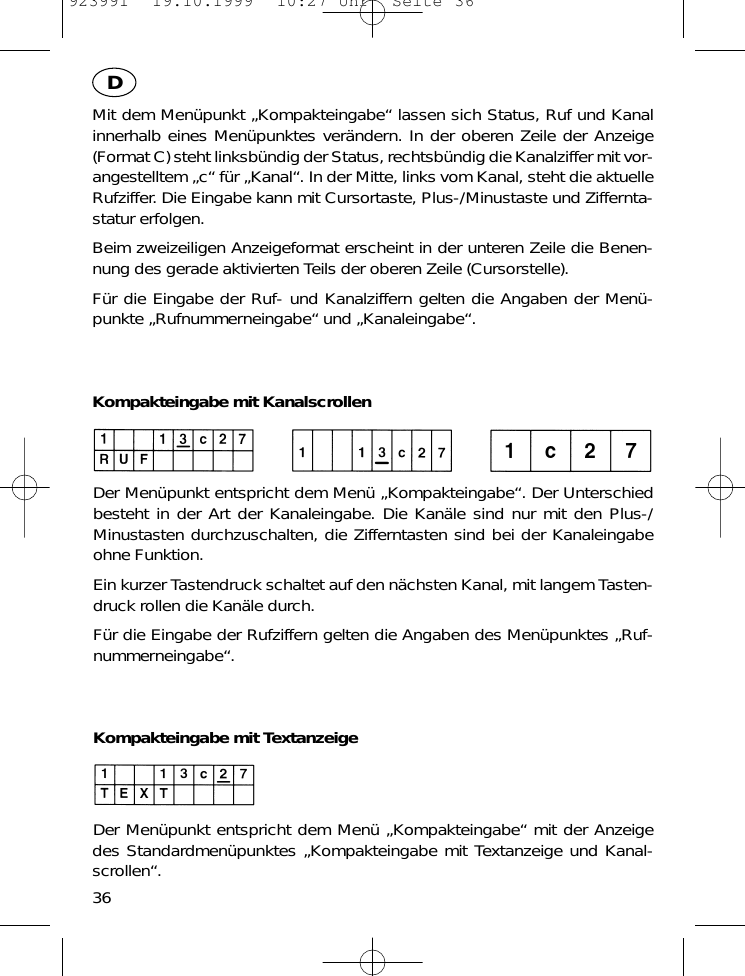
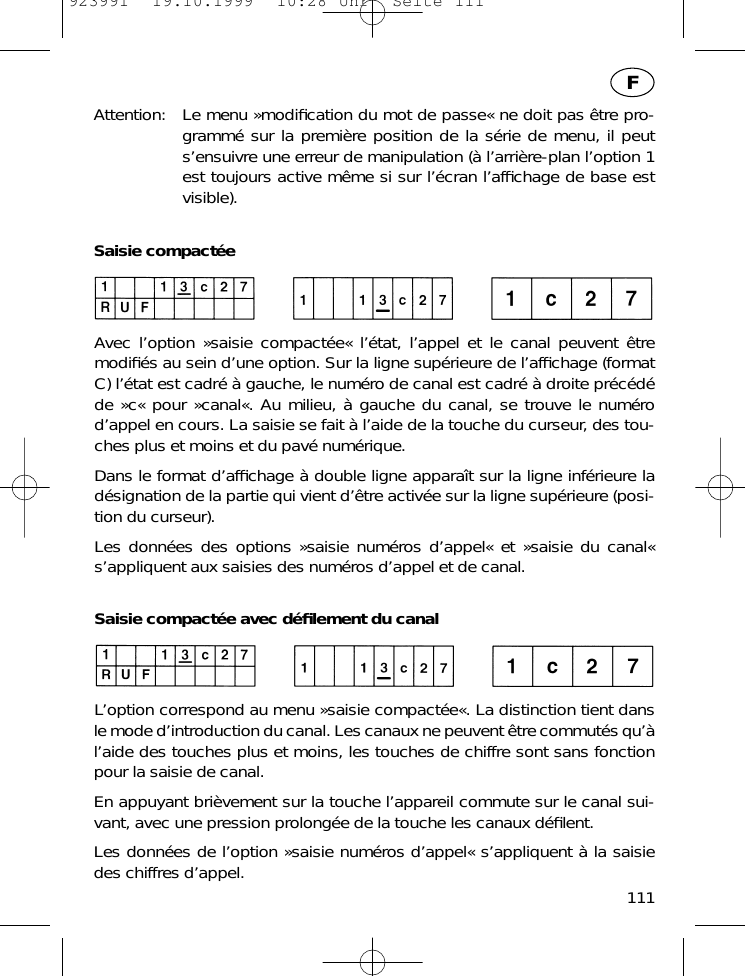
Mit dem Menüpunkt „Kompakteingabe“ lassen sich Status, Ruf und Kanalinnerhalb eines Menüpunktes verändern. In der oberen Zeile der Anzeige(Format C) steht linksbündig der Status, rechtsbündig die Kanalziffer mit vor-angestelltem „c“ für „Kanal“. In der Mitte, links vom Kanal, steht die aktuelleRufziffer. Die Eingabe kann mit Cursortaste, Plus-/Minustaste und Ziffernta-statur erfolgen.Beim zweizeiligen Anzeigeformat erscheint in der unteren Zeile die Benen-nung des gerade aktivierten Teils der oberen Zeile (Cursorstelle).Für die Eingabe der Ruf- und Kanalziffern gelten die Angaben der Menü-punkte „Rufnummerneingabe“ und „Kanaleingabe“.Kompakteingabe mit KanalscrollenDer Menüpunkt entspricht dem Menü „Kompakteingabe“. Der Unterschiedbesteht in der Art der Kanaleingabe. Die Kanäle sind nur mit den Plus-/Minustasten durchzuschalten, die Zifferntasten sind bei der Kanaleingabeohne Funktion.Ein kurzer Tastendruck schaltet auf den nächsten Kanal, mit langem Tasten-druck rollen die Kanäle durch.Für die Eingabe der Rufziffern gelten die Angaben des Menüpunktes „Ruf-nummerneingabe“.Kompakteingabe mit TextanzeigeDer Menüpunkt entspricht dem Menü „Kompakteingabe“ mit der Anzeigedes Standardmenüpunktes „Kompakteingabe mit Textanzeige und Kanal-scrollen“.36D923991  19.10.1999  10:27 Uhr  Seite 36
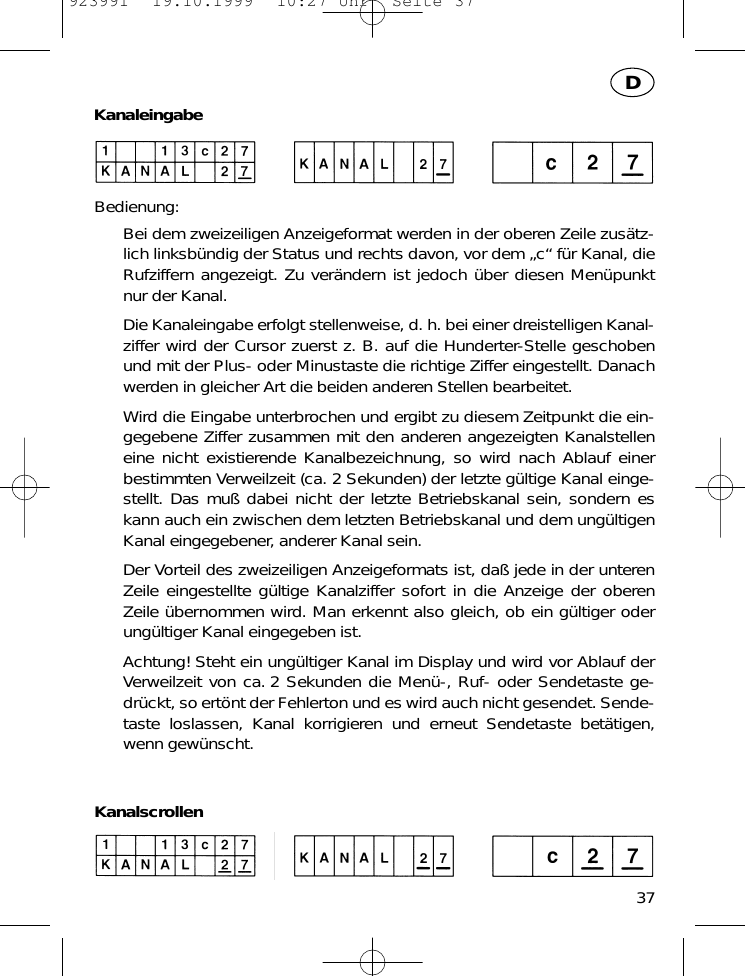
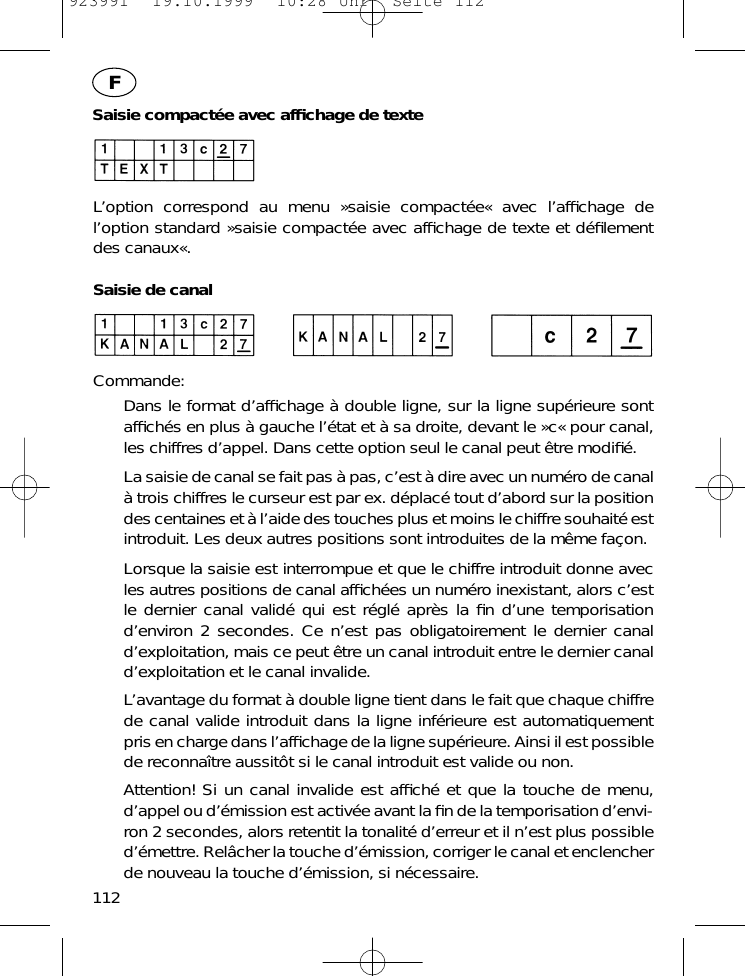
KanaleingabeBedienung:Bei dem zweizeiligen Anzeigeformat werden in der oberen Zeile zusätz-lich linksbündig der Status und rechts davon, vor dem „c“ für Kanal, dieRufziffern angezeigt. Zu verändern ist jedoch über diesen Menüpunktnur der Kanal.Die Kanaleingabe erfolgt stellenweise, d. h. bei einer dreistelligen Kanal-ziffer wird der Cursor zuerst z. B. auf die Hunderter-Stelle geschobenund mit der Plus- oder Minustaste die richtige Ziffer eingestellt. Danachwerden in gleicher Art die beiden anderen Stellen bearbeitet.Wird die Eingabe unterbrochen und ergibt zu diesem Zeitpunkt die ein-gegebene Ziffer zusammen mit den anderen angezeigten Kanalstelleneine nicht existierende Kanalbezeichnung, so wird nach Ablauf einerbestimmten Verweilzeit (ca. 2 Sekunden) der letzte gültige Kanal einge-stellt. Das muß dabei nicht der letzte Betriebskanal sein, sondern eskann auch ein zwischen dem letzten Betriebskanal und dem ungültigenKanal eingegebener, anderer Kanal sein.Der Vorteil des zweizeiligen Anzeigeformats ist, daß jede in der unterenZeile eingestellte gültige Kanalziffer sofort in die Anzeige der oberenZeile übernommen wird. Man erkennt also gleich, ob ein gültiger oderungültiger Kanal eingegeben ist.Achtung! Steht ein ungültiger Kanal im Display und wird vor Ablauf derVerweilzeit von ca. 2 Sekunden die Menü-, Ruf- oder Sendetaste ge-drückt, so ertönt der Fehlerton und es wird auch nicht gesendet. Sende-taste loslassen, Kanal korrigieren und erneut Sendetaste betätigen,wenn gewünscht.Kanalscrollen37D923991  19.10.1999  10:27 Uhr  Seite 37
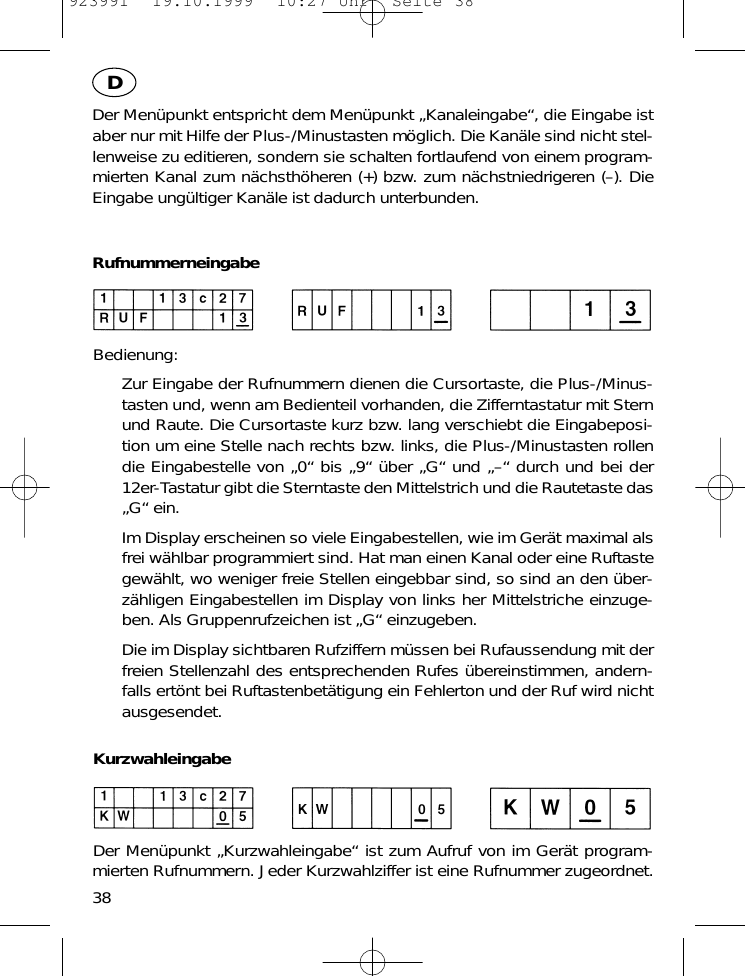
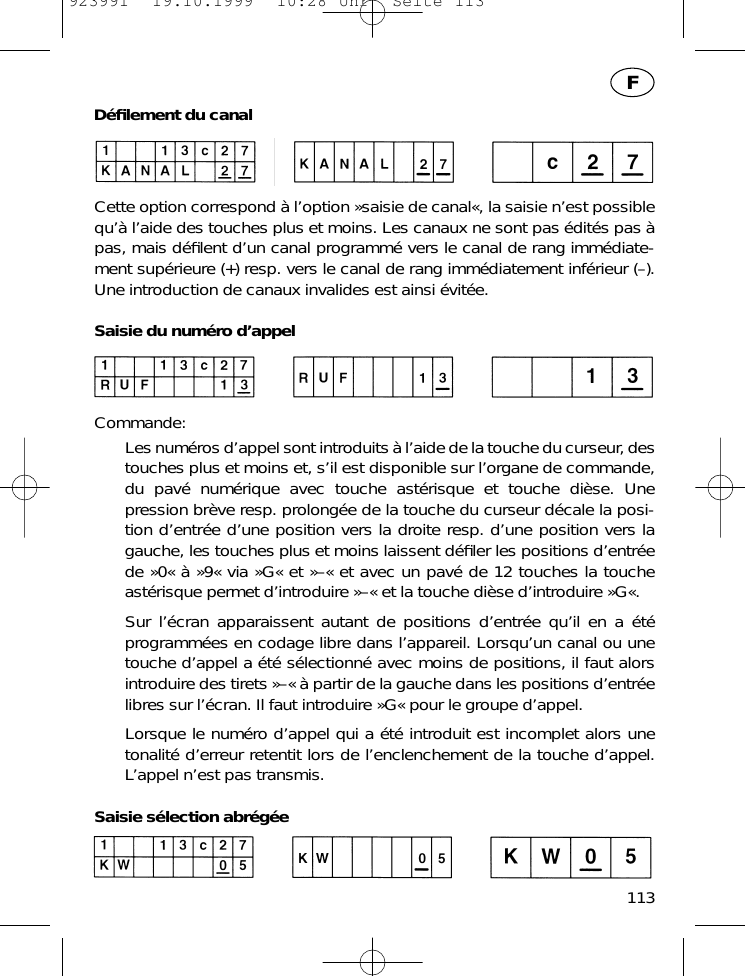
Der Menüpunkt entspricht dem Menüpunkt „Kanaleingabe“, die Eingabe istaber nur mit Hilfe der Plus-/Minustasten möglich. Die Kanäle sind nicht stel-lenweise zu editieren, sondern sie schalten fortlaufend von einem program-mierten Kanal zum nächsthöheren (+) bzw. zum nächstniedrigeren (–). DieEingabe ungültiger Kanäle ist dadurch unterbunden.RufnummerneingabeBedienung:Zur Eingabe der Rufnummern dienen die Cursortaste, die Plus-/Minus-tasten und, wenn am Bedienteil vorhanden, die Zifferntastatur mit Sternund Raute. Die Cursortaste kurz bzw. lang verschiebt die Eingabeposi-tion um eine Stelle nach rechts bzw. links, die Plus-/Minustasten rollendie Eingabestelle von „0“ bis „9“ über „G“ und „–“ durch und bei der12er-Tastatur gibt die Sterntaste den Mittelstrich und die Rautetaste das„G“ ein. Im Display erscheinen so viele Eingabestellen, wie im Gerät maximal alsfrei wählbar programmiert sind. Hat man einen Kanal oder eine Ruftastegewählt, wo weniger freie Stellen eingebbar sind, so sind an den über-zähligen Eingabestellen im Display von links her Mittelstriche einzuge-ben. Als Gruppenrufzeichen ist „G“ einzugeben.Die im Display sichtbaren Rufziffern müssen bei Rufaussendung mit derfreien Stellenzahl des entsprechenden Rufes übereinstimmen, andern-falls ertönt bei Ruftastenbetätigung ein Fehlerton und der Ruf wird nichtausgesendet.KurzwahleingabeDer Menüpunkt „Kurzwahleingabe“ ist zum Aufruf von im Gerät program-mierten Rufnummern. Jeder Kurzwahlziffer ist eine Rufnummer zugeordnet.38D923991  19.10.1999  10:27 Uhr  Seite 38
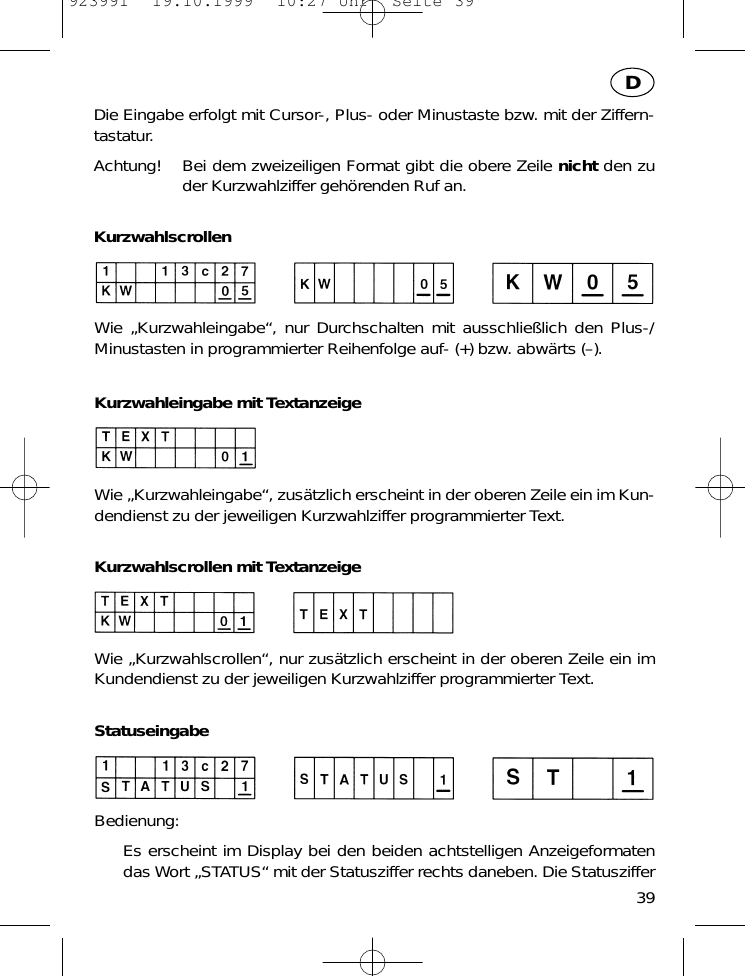
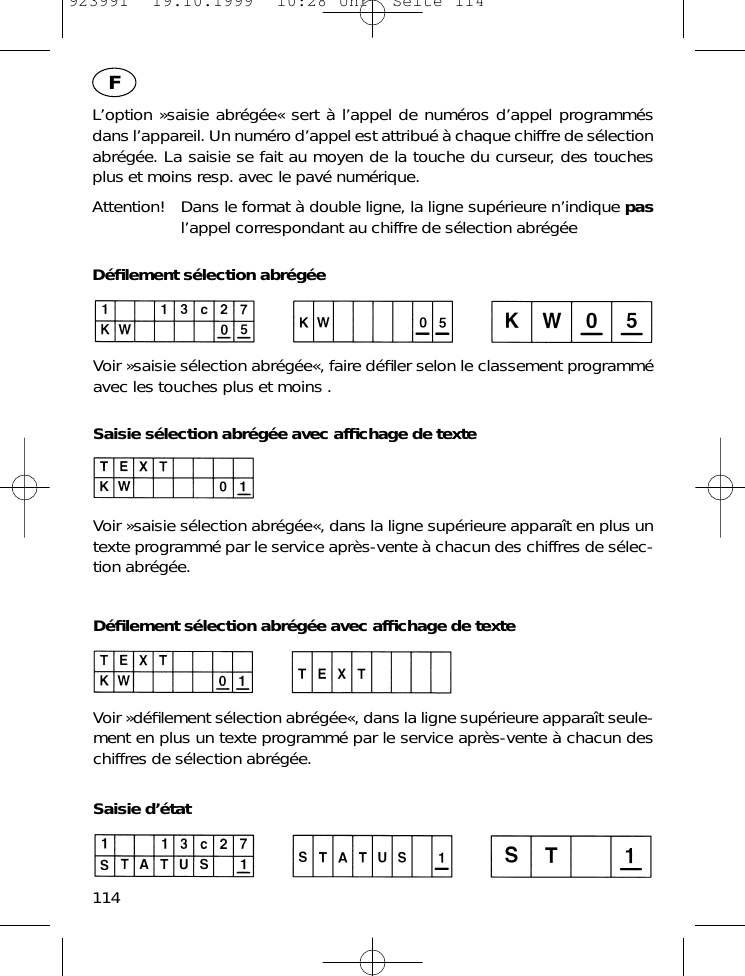
Die Eingabe erfolgt mit Cursor-, Plus- oder Minustaste bzw. mit der Ziffern-tastatur. Achtung! Bei dem zweizeiligen Format gibt die obere Zeile nicht den zuder Kurzwahlziffer gehörenden Ruf an.KurzwahlscrollenWie „Kurzwahleingabe“, nur Durchschalten mit ausschließlich den Plus-/Minustasten in programmierter Reihenfolge auf- (+) bzw. abwärts (–).Kurzwahleingabe mit TextanzeigeWie „Kurzwahleingabe“, zusätzlich erscheint in der oberen Zeile ein im Kun-dendienst zu der jeweiligen Kurzwahlziffer programmierter Text.Kurzwahlscrollen mit TextanzeigeWie „Kurzwahlscrollen“, nur zusätzlich erscheint in der oberen Zeile ein imKundendienst zu der jeweiligen Kurzwahlziffer programmierter Text.StatuseingabeBedienung:Es erscheint im Display bei den beiden achtstelligen Anzeigeformatendas Wort „STATUS“ mit der Statusziffer rechts daneben. Die Statusziffer39D923991  19.10.1999  10:27 Uhr  Seite 39
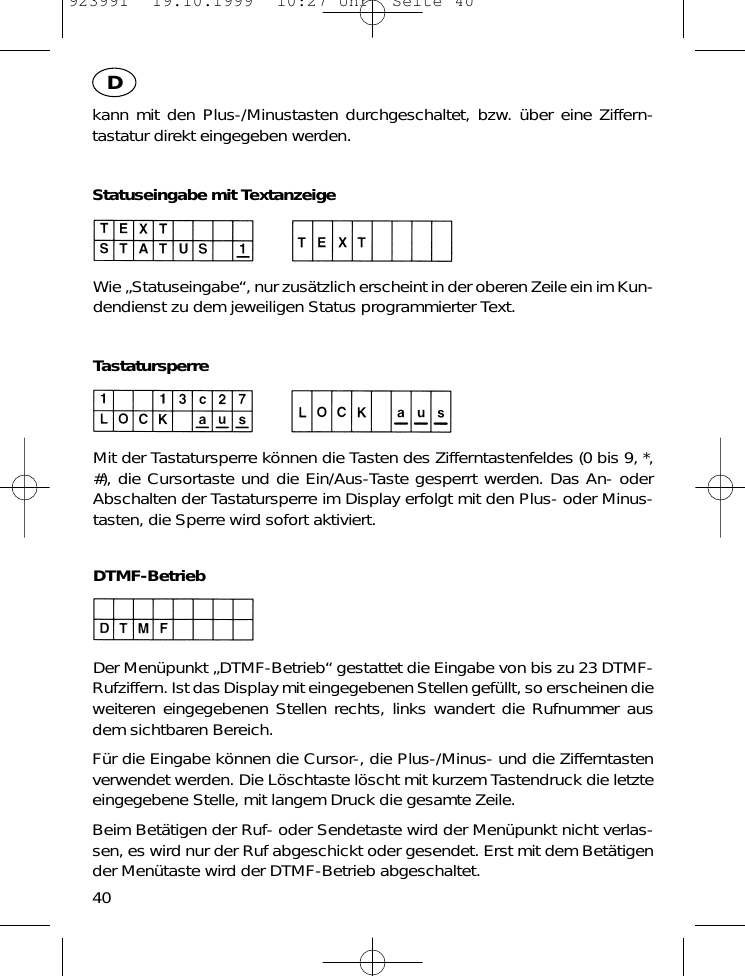
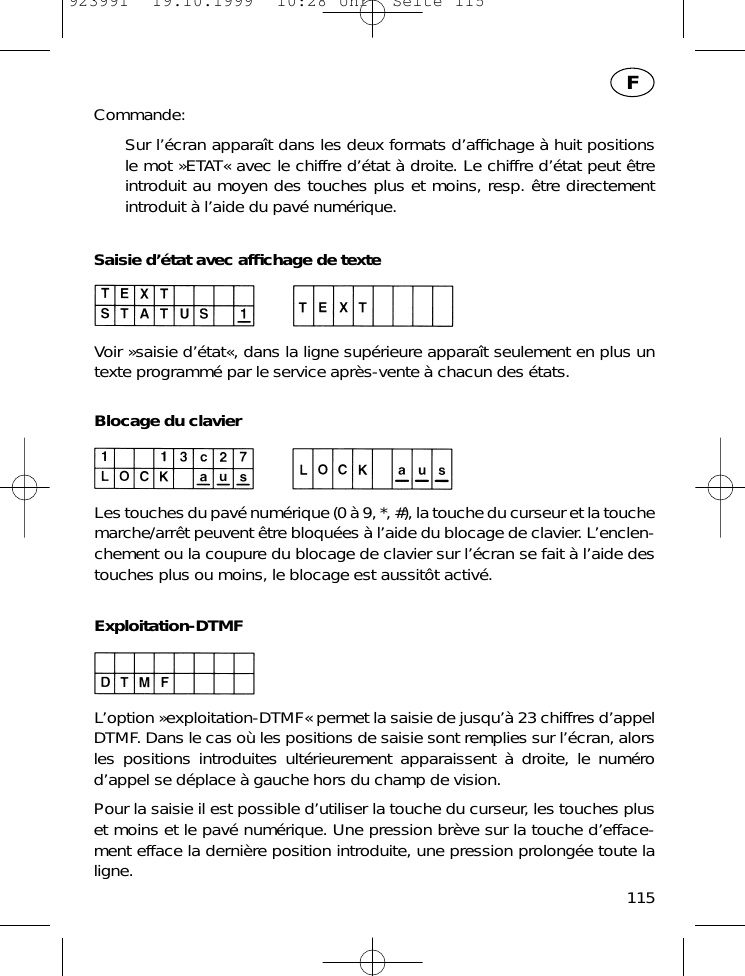
kann mit den Plus-/Minustasten durchgeschaltet, bzw. über eine Ziffern-tastatur direkt eingegeben werden.Statuseingabe mit TextanzeigeWie „Statuseingabe“, nur zusätzlich erscheint in der oberen Zeile ein im Kun-dendienst zu dem jeweiligen Status programmierter Text.TastatursperreMit der Tastatursperre können die Tasten des Zifferntastenfeldes (0 bis 9, *,#), die Cursortaste und die Ein/Aus-Taste gesperrt werden. Das An- oderAbschalten der Tastatursperre im Display erfolgt mit den Plus- oder Minus-tasten, die Sperre wird sofort aktiviert.DTMF-BetriebDer Menüpunkt „DTMF-Betrieb“ gestattet die Eingabe von bis zu 23 DTMF-Rufziffern. Ist das Display mit eingegebenen Stellen gefüllt, so erscheinen dieweiteren eingegebenen Stellen rechts, links wandert die Rufnummer ausdem sichtbaren Bereich.Für die Eingabe können die Cursor-, die Plus-/Minus- und die Zifferntastenverwendet werden. Die Löschtaste löscht mit kurzem Tastendruck die letzteeingegebene Stelle, mit langem Druck die gesamte Zeile.Beim Betätigen der Ruf- oder Sendetaste wird der Menüpunkt nicht verlas-sen, es wird nur der Ruf abgeschickt oder gesendet. Erst mit dem Betätigender Menütaste wird der DTMF-Betrieb abgeschaltet.40D923991  19.10.1999  10:27 Uhr  Seite 40
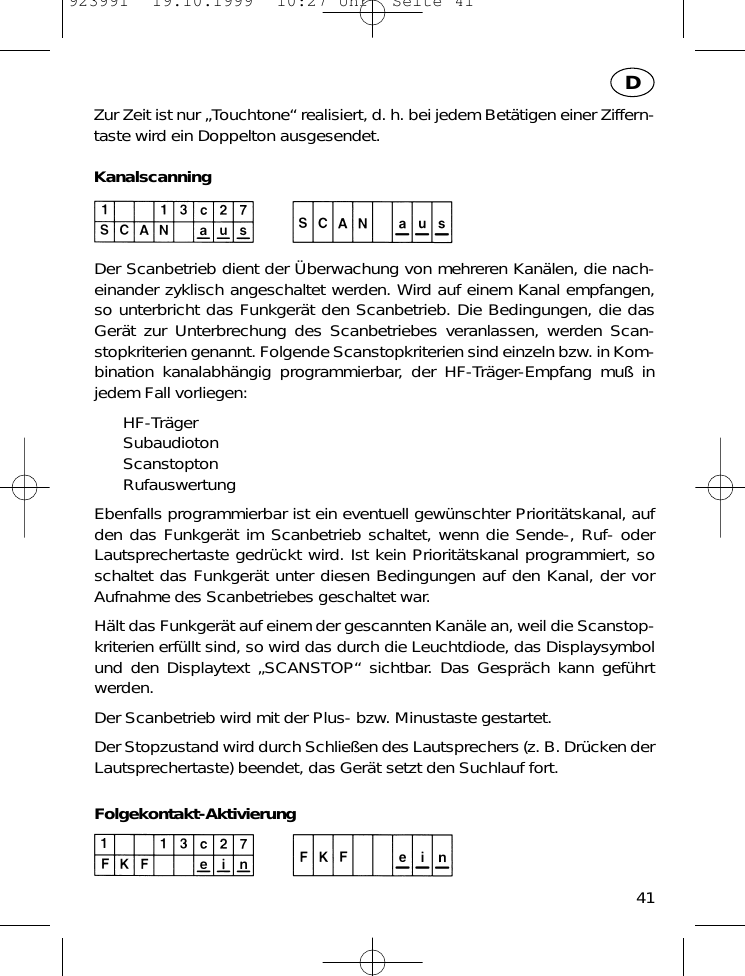
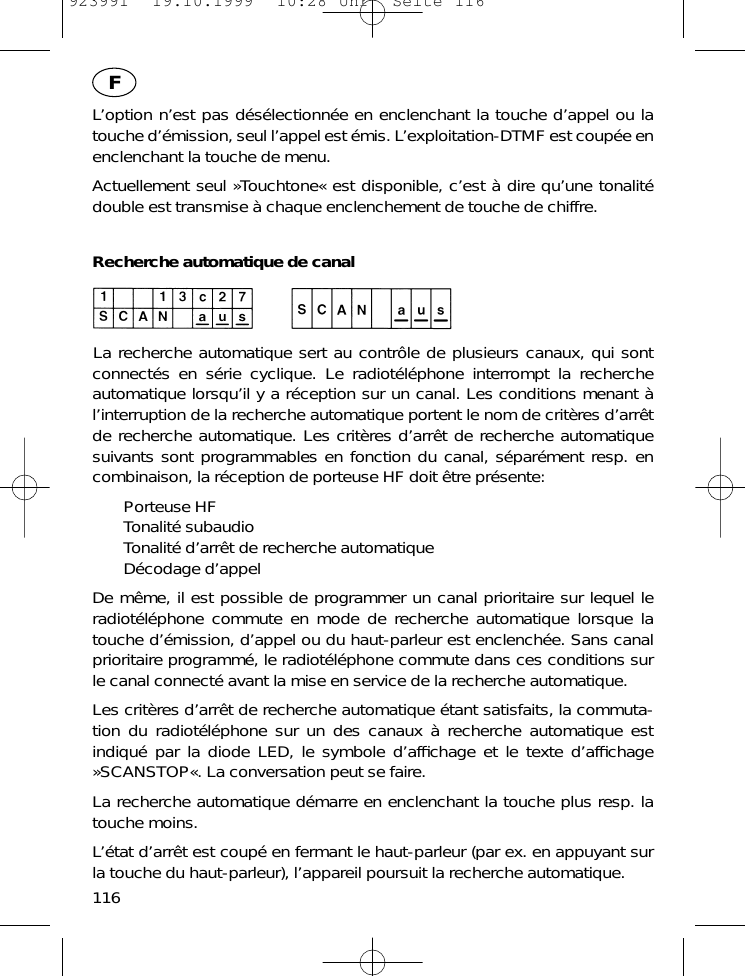
Zur Zeit ist nur „Touchtone“ realisiert, d. h. bei jedem Betätigen einer Ziffern-taste wird ein Doppelton ausgesendet.KanalscanningDer Scanbetrieb dient der Überwachung von mehreren Kanälen, die nach-einander zyklisch angeschaltet werden. Wird auf einem Kanal empfangen,so unterbricht das Funkgerät den Scanbetrieb. Die Bedingungen, die dasGerät zur Unterbrechung des Scanbetriebes veranlassen, werden Scan-stopkriterien genannt. Folgende Scanstopkriterien sind einzeln bzw. in Kom-bination kanalabhängig programmierbar, der HF-Träger-Empfang muß injedem Fall vorliegen:HF-TrägerSubaudiotonScanstoptonRufauswertungEbenfalls programmierbar ist ein eventuell gewünschter Prioritätskanal, aufden das Funkgerät im Scanbetrieb schaltet, wenn die Sende-, Ruf- oderLautsprechertaste gedrückt wird. Ist kein Prioritätskanal programmiert, soschaltet das Funkgerät unter diesen Bedingungen auf den Kanal, der vorAufnahme des Scanbetriebes geschaltet war.Hält das Funkgerät auf einem der gescannten Kanäle an, weil die Scanstop-kriterien erfüllt sind, so wird das durch die Leuchtdiode, das Displaysymbolund den Displaytext „SCANSTOP“ sichtbar. Das Gespräch kann geführtwerden.Der Scanbetrieb wird mit der Plus- bzw. Minustaste gestartet.Der Stopzustand wird durch Schließen des Lautsprechers (z. B. Drücken derLautsprechertaste) beendet, das Gerät setzt den Suchlauf fort.Folgekontakt-Aktivierung41D923991  19.10.1999  10:27 Uhr  Seite 41
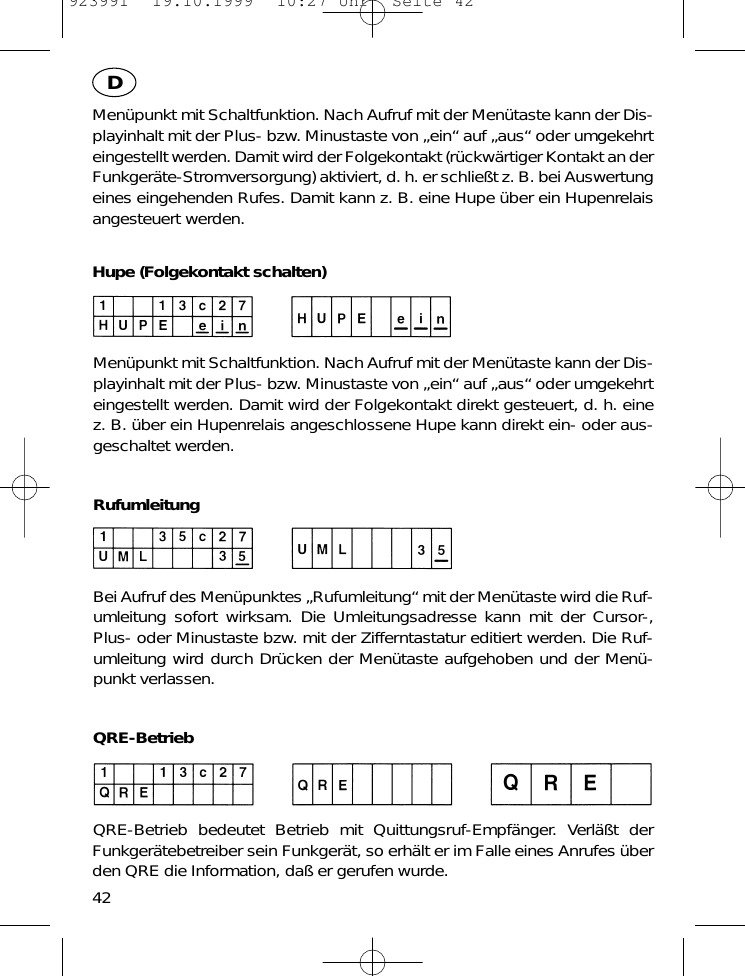
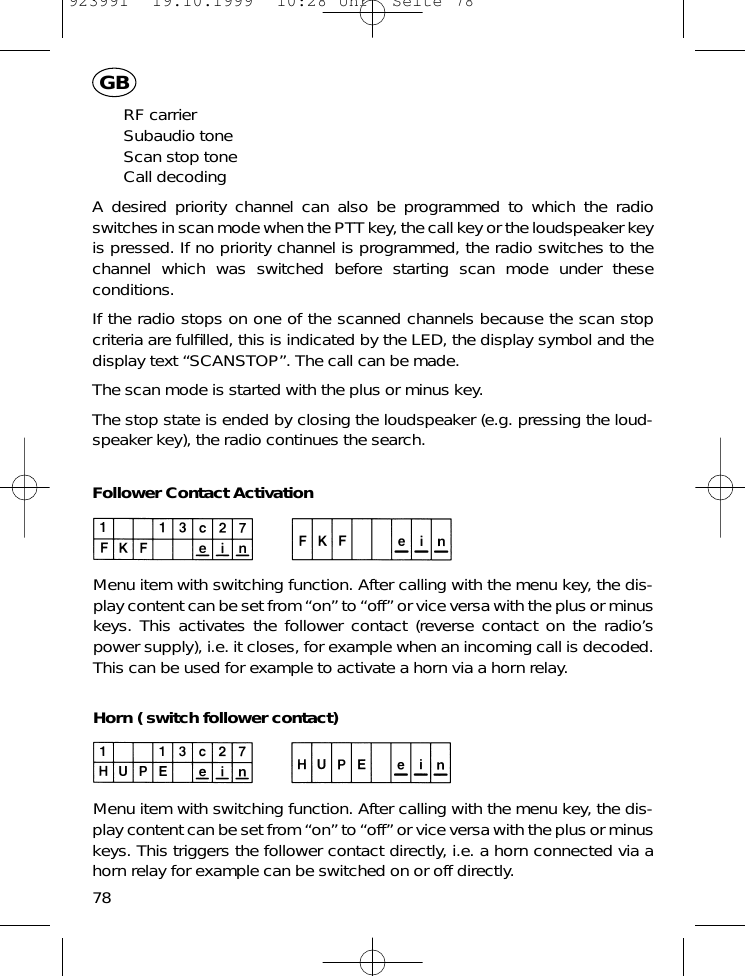
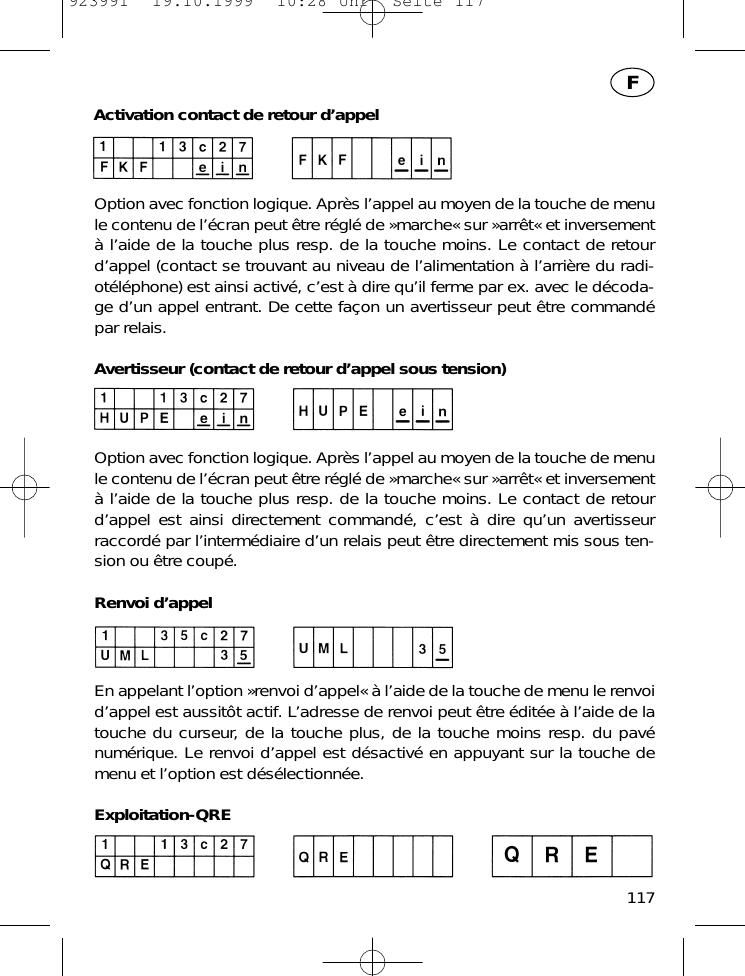
Menüpunkt mit Schaltfunktion. Nach Aufruf mit der Menütaste kann der Dis-playinhalt mit der Plus- bzw. Minustaste von „ein“ auf „aus“ oder umgekehrteingestellt werden. Damit wird der Folgekontakt (rückwärtiger Kontakt an derFunkgeräte-Stromversorgung) aktiviert, d. h. er schließt z. B. bei Auswertungeines eingehenden Rufes. Damit kann z. B. eine Hupe über ein Hupenrelaisangesteuert werden.Hupe (Folgekontakt schalten)Menüpunkt mit Schaltfunktion. Nach Aufruf mit der Menütaste kann der Dis-playinhalt mit der Plus- bzw. Minustaste von „ein“ auf „aus“ oder umgekehrteingestellt werden. Damit wird der Folgekontakt direkt gesteuert, d. h. einez. B. über ein Hupenrelais angeschlossene Hupe kann direkt ein- oder aus-geschaltet werden.RufumleitungBei Aufruf des Menüpunktes „Rufumleitung“ mit der Menütaste wird die Ruf-umleitung sofort wirksam. Die Umleitungsadresse kann mit der Cursor-,Plus- oder Minustaste bzw. mit der Zifferntastatur editiert werden. Die Ruf-umleitung wird durch Drücken der Menütaste aufgehoben und der Menü-punkt verlassen.QRE-BetriebQRE-Betrieb bedeutet Betrieb mit Quittungsruf-Empfänger. Verläßt derFunkgerätebetreiber sein Funkgerät, so erhält er im Falle eines Anrufes überden QRE die Information, daß er gerufen wurde.42D923991  19.10.1999  10:27 Uhr  Seite 42
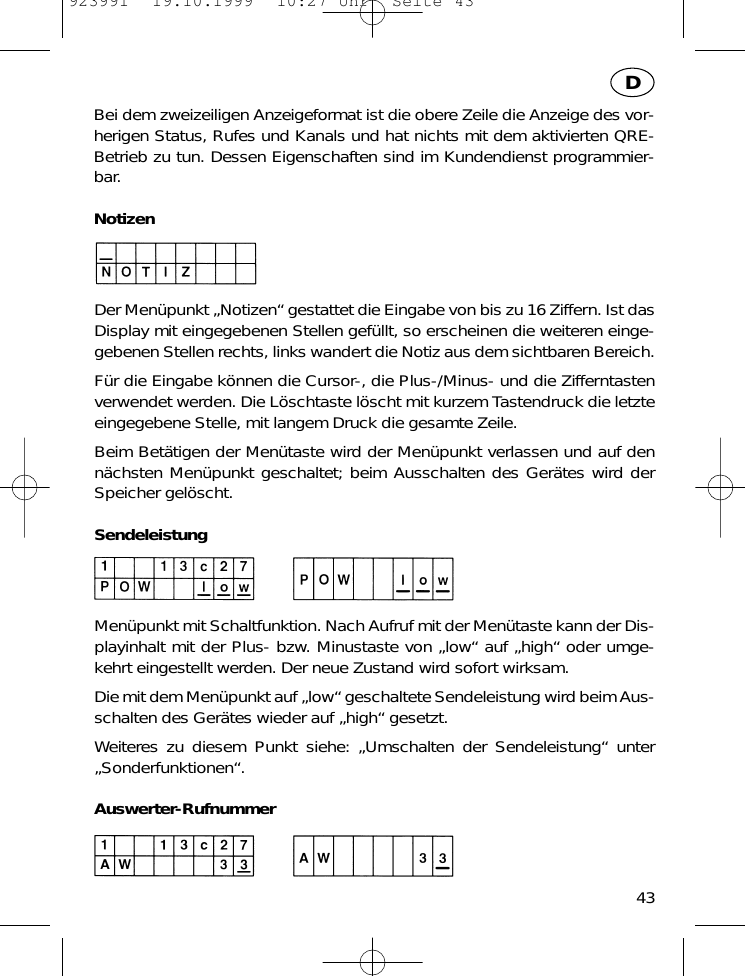
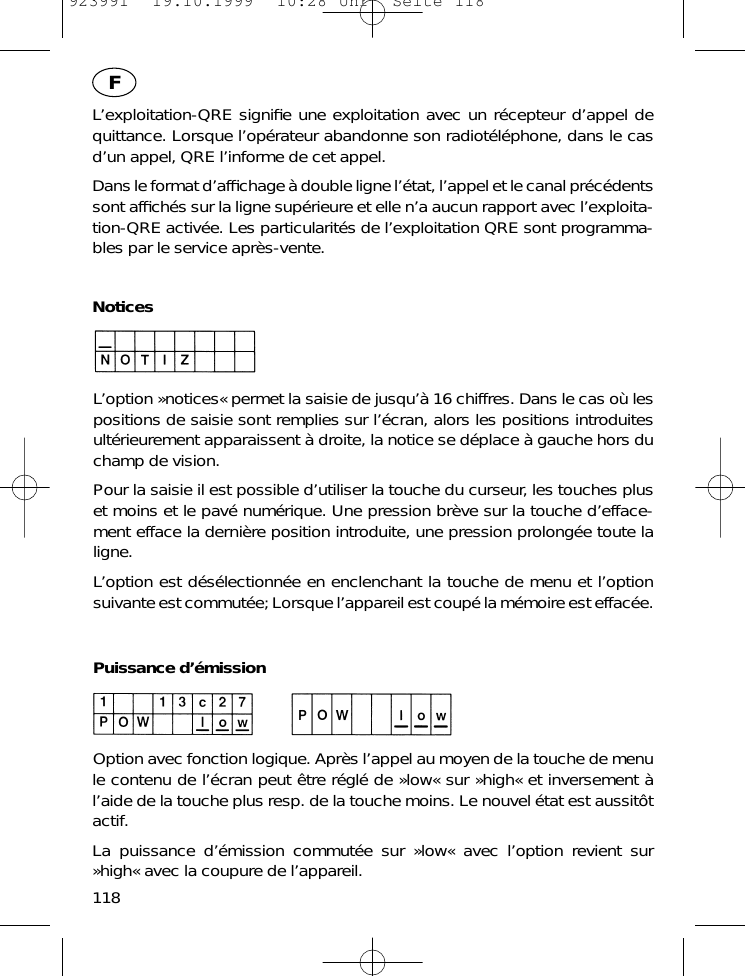
Bei dem zweizeiligen Anzeigeformat ist die obere Zeile die Anzeige des vor-herigen Status, Rufes und Kanals und hat nichts mit dem aktivierten QRE-Betrieb zu tun. Dessen Eigenschaften sind im Kundendienst programmier-bar.NotizenDer Menüpunkt „Notizen“ gestattet die Eingabe von bis zu 16 Ziffern. Ist dasDisplay mit eingegebenen Stellen gefüllt, so erscheinen die weiteren einge-gebenen Stellen rechts, links wandert die Notiz aus dem sichtbaren Bereich.Für die Eingabe können die Cursor-, die Plus-/Minus- und die Zifferntastenverwendet werden. Die Löschtaste löscht mit kurzem Tastendruck die letzteeingegebene Stelle, mit langem Druck die gesamte Zeile.Beim Betätigen der Menütaste wird der Menüpunkt verlassen und auf dennächsten Menüpunkt geschaltet; beim Ausschalten des Gerätes wird derSpeicher gelöscht.SendeleistungMenüpunkt mit Schaltfunktion. Nach Aufruf mit der Menütaste kann der Dis-playinhalt mit der Plus- bzw. Minustaste von „low“ auf „high“ oder umge-kehrt eingestellt werden. Der neue Zustand wird sofort wirksam.Die mit dem Menüpunkt auf „low“ geschaltete Sendeleistung wird beim Aus-schalten des Gerätes wieder auf „high“ gesetzt.Weiteres zu diesem Punkt siehe: „Umschalten der Sendeleistung“ unter„Sonderfunktionen“.Auswerter-Rufnummer43D923991  19.10.1999  10:27 Uhr  Seite 43
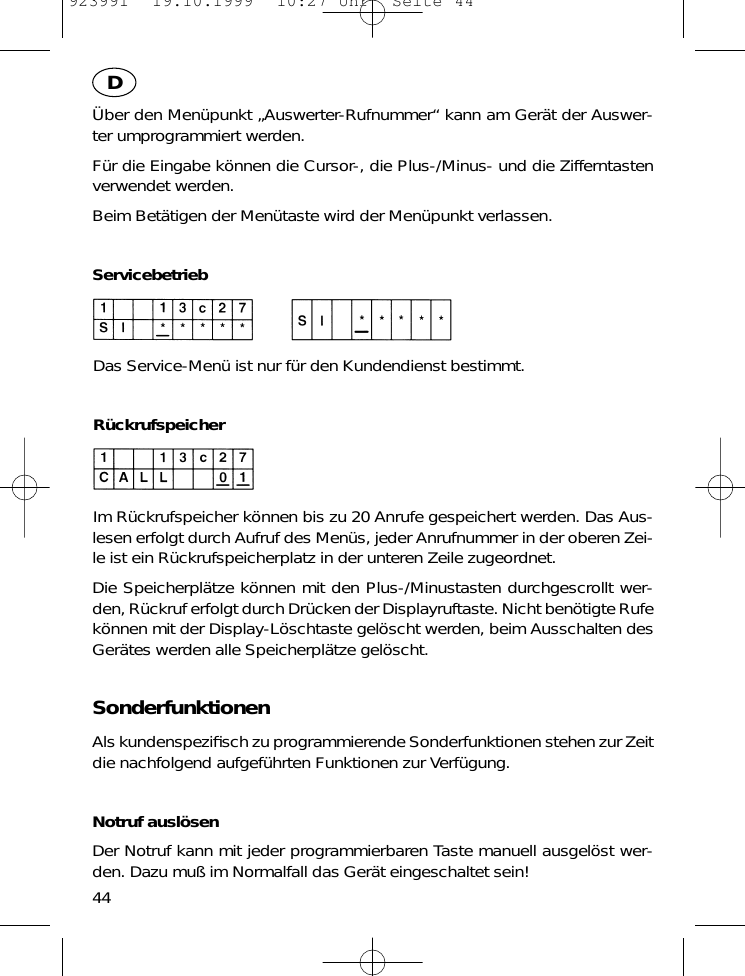
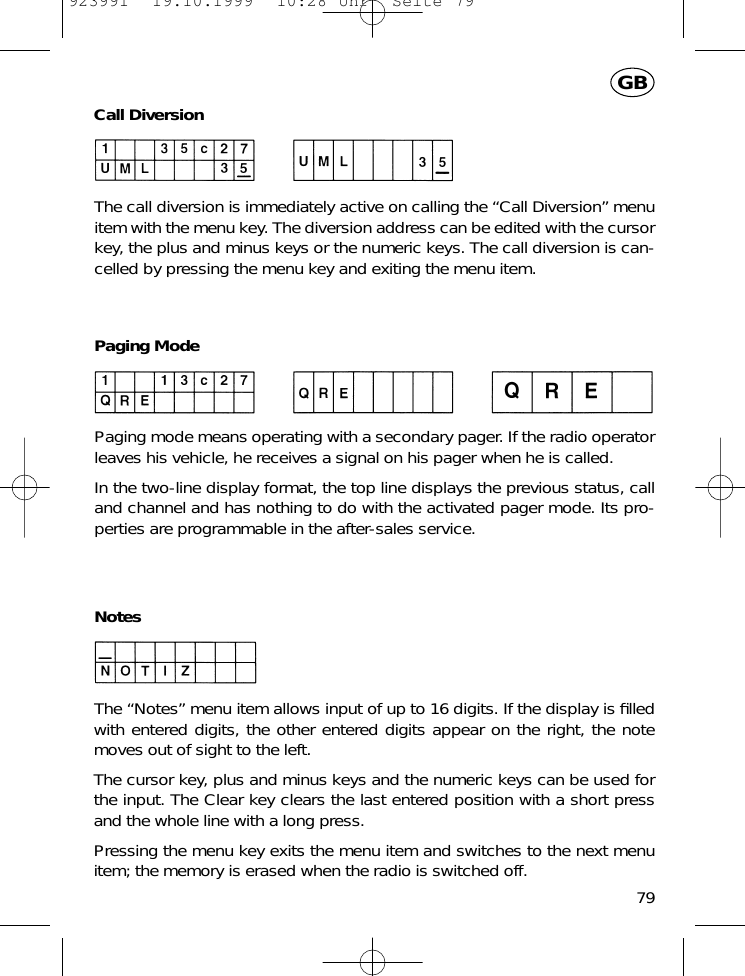
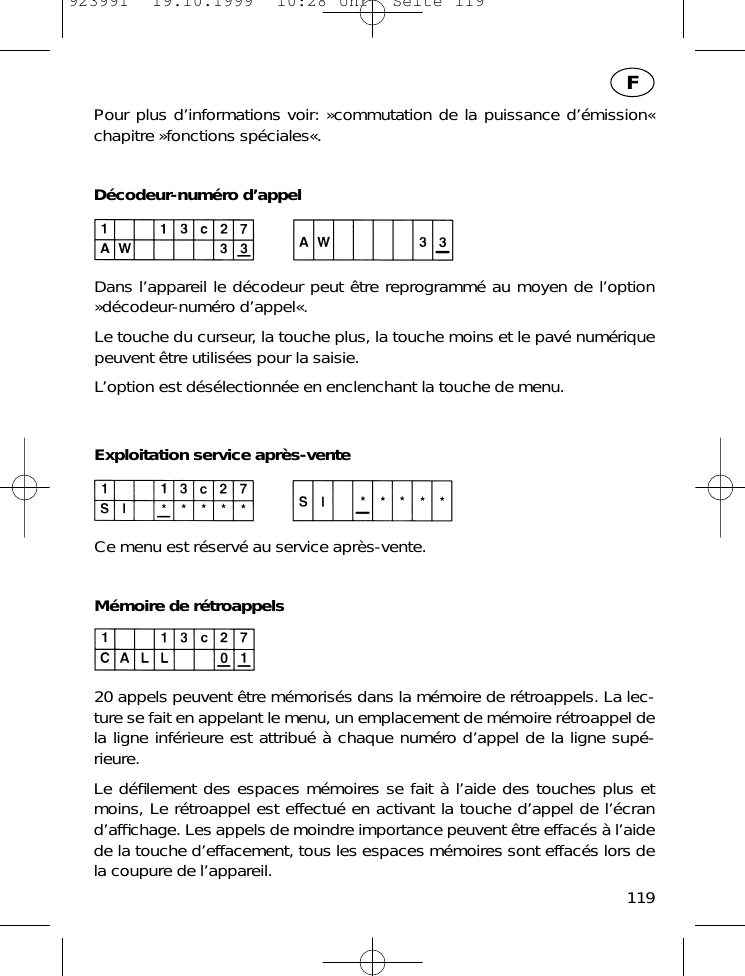
Über den Menüpunkt „Auswerter-Rufnummer“ kann am Gerät der Auswer-ter umprogrammiert werden.Für die Eingabe können die Cursor-, die Plus-/Minus- und die Zifferntastenverwendet werden.Beim Betätigen der Menütaste wird der Menüpunkt verlassen.ServicebetriebDas Service-Menü ist nur für den Kundendienst bestimmt.RückrufspeicherIm Rückrufspeicher können bis zu 20 Anrufe gespeichert werden. Das Aus-lesen erfolgt durch Aufruf des Menüs, jeder Anrufnummer in der oberen Zei-le ist ein Rückrufspeicherplatz in der unteren Zeile zugeordnet.Die Speicherplätze können mit den Plus-/Minustasten durchgescrollt wer-den, Rückruf erfolgt durch Drücken der Displayruftaste. Nicht benötigte Rufekönnen mit der Display-Löschtaste gelöscht werden, beim Ausschalten desGerätes werden alle Speicherplätze gelöscht.SonderfunktionenAls kundenspezifisch zu programmierende Sonderfunktionen stehen zur Zeitdie nachfolgend aufgeführten Funktionen zur Verfügung.Notruf auslösenDer Notruf kann mit jeder programmierbaren Taste manuell ausgelöst wer-den. Dazu muß im Normalfall das Gerät eingeschaltet sein!44D923991  19.10.1999  10:27 Uhr  Seite 44
Bei ausgeschaltetem Gerät kann nach entsprechender Programmierung derNotruf nur mit dem externen Notrufkontakt (Pos. 40) ausgelöst werden.Dabei wird bei der Betätigung das Gerät eingeschaltet und anschließendautomatisch die Notrufprozedur eingeleitet.TastenkombinationenGenerell gilt für alle Tastenkombinationen, daß sie nicht zum Umfang derStandardprogrammierung gehören und nur auf Kundenwunsch aktiviertwerden.Tastenkombinationen sind ein bis zwei Tasten, die gedrückt zu halten sind,während die Ein/Aus-Taste (Pos. 5) betätigt wird. Die nachfolgend beschrie-benen Tasten sind Beispiele, das Gerät kann auch abweichend davon pro-grammiert werden.Abschalten akustischer Signaltöne, Anzeigen und Lautsprecherstumm-schaltungUm vorübergehend die akustische Signalisierung abzuschalten, ist bei aus-geschaltetem Gerät die Ruftaste 1 (Pos. 2) gedrückt zu halten und dann dasGerät einzuschalten. Welche Signalisierungstöne vorübergehend abgeschal-tet werden, ist durch die Programmierung des Gerätes festgelegt. Es kannkeine, eine einzelne oder eine beliebig kombinierte Gruppe aus folgendenPositionen sein:Tastenklick und Bestätigungstonakustische Anruf- und QuittungssignalisierungFehlbedienungstonNotrufvorwarnungFehlerton und AkkuwarntonLautsprecher komplett stummgeschaltetTastatur- und DisplaybeleuchtungUm die vorübergehende Abschaltung aufzuheben, ist das Gerät aus- undwieder einzuschalten.Umschalten der SendeleistungEs besteht die Möglichkeit, unterschiedlich hohe Sendeleistungen des Funk-gerätes kanalabhängig oder auf allen Kanälen gleich zu programmieren. Pro45D923991  19.10.1999  10:27 Uhr  Seite 45
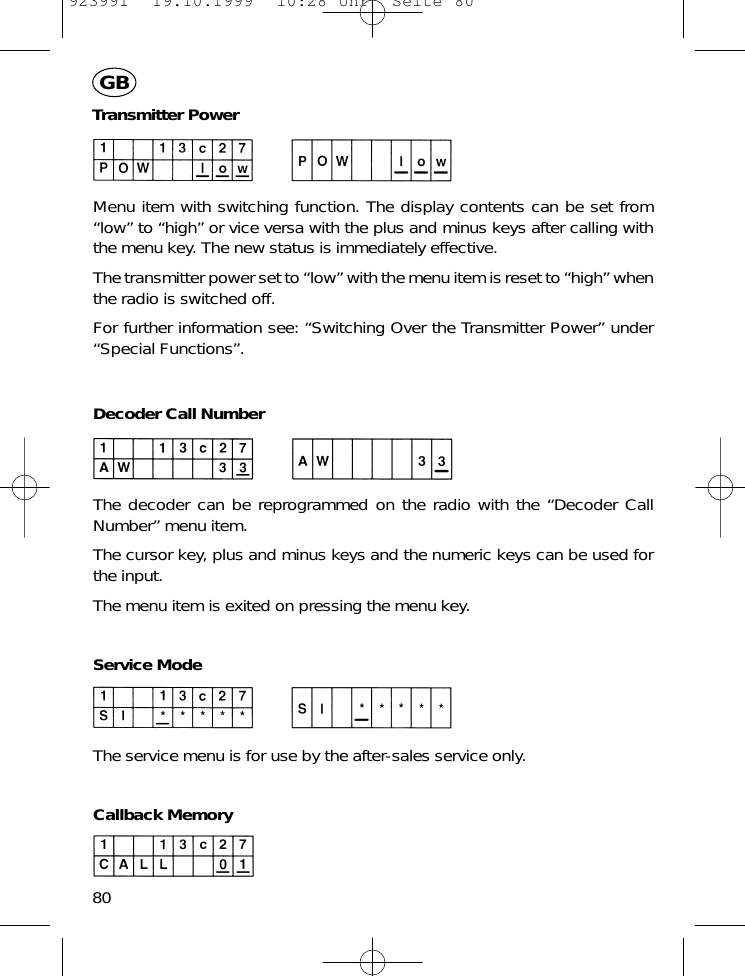
Kanal können zwei von vier Abgleichwerten als „Hohe Sendeleistung“ und„Niedrige Sendeleistung“ hinterlegt werden. Ebenfalls ist es möglich, aufeinem oder mehreren Kanälen für beide Leistungen den gleichen Wert zuprogrammieren, damit kann eine Leistungsumschaltung auf nur einem Kanalrealisiert werden.Beim normalen Einschalten des Funkgerätes arbeitet der Sender mit denWerten „Hohe Sendeleistung“. Um auf die Werte „Niedrige Sendeleistung“zu gelangen, sind bei ausgeschaltetem Funkgerät die Ruftaste 1 (Pos. 2) unddie Plustaste (Pos. 9) gemeinsam zu drücken und dann die Ein/Aus-Taste(Pos. 5) zu betätigen. Diese Tastenkombinationen werden eigentlich nur beidem Handsprechfunkgerät PR 11 S-E (ohne Display) benötigt, funktionierenaber auch an allen anderen Geräten.Um von der Stufe „Niedrige Sendeleistung“ wieder zur Stufe „Hohe Sende-leistung“ zurückzugelangen, ist das Gerät aus- und wieder einzuschalten.Bei Bedarf kann auch ein niedriger Leistungswert dem Programmierpunkt„Hohe Sendeleistung“ und ein hoher Leistungswert dem Programmierpunkt„Niedrige Sendeleistung“ einprogrammiert werden. Damit arbeitet das Gerätdann nach dem normalen Einschalten mit der niedrigen Sendeleistung undnach dem Einschalten mit gedrückten Tasten mit der hohen Sendeleistung.Umschalten der Sendeleistung und Abschalten akustischer SignaltöneHierbei handelt es sich um eine Kombination aus den beiden zuletztbeschriebenen Um- bzw. Abschaltungen. Um sie gemeinsam zu aktivieren,ist das Gerät ebenfalls auszuschalten und bei Drücken der Ruftaste 1(Pos. 2) das Gerät mit der Ein/Aus-Taste (Pos. 5) einzuschalten.Durch Aus- und wieder Einschalten des Gerätes gelangt man zurück in dennormalen Betrieb.46D923991  19.10.1999  10:27 Uhr  Seite 46
47Notizen:923991  19.10.1999  10:27 Uhr  Seite 47
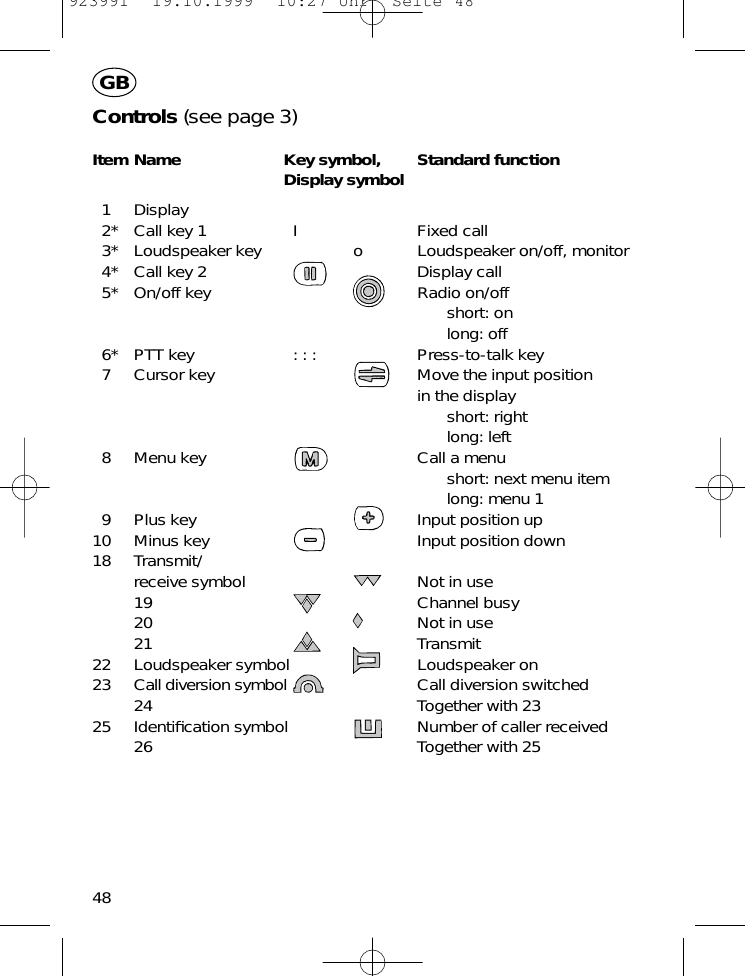
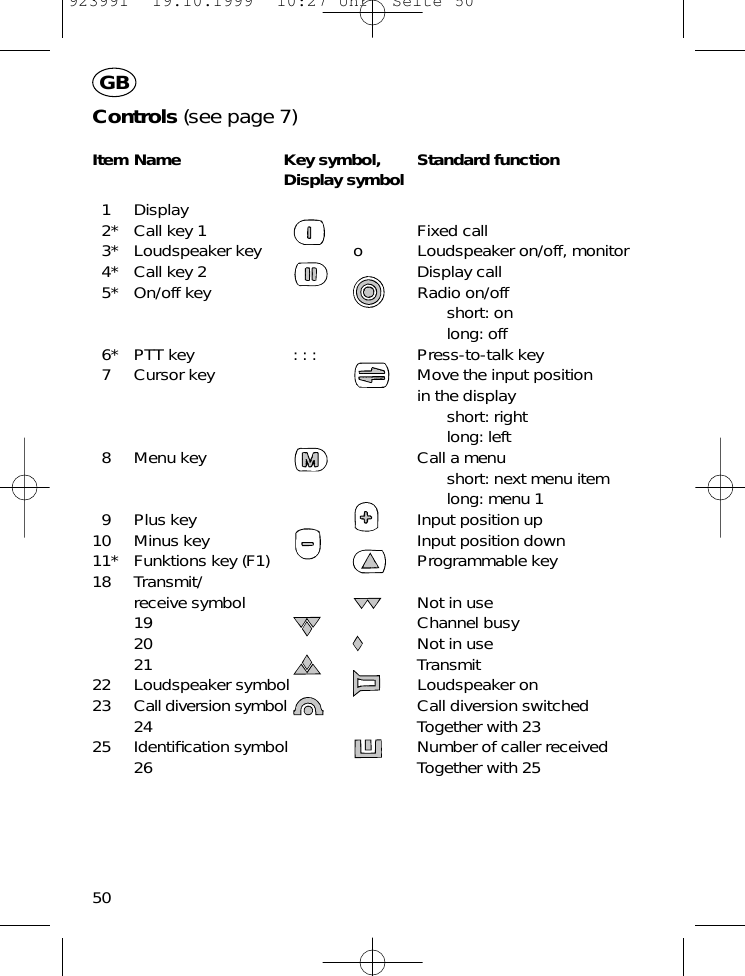
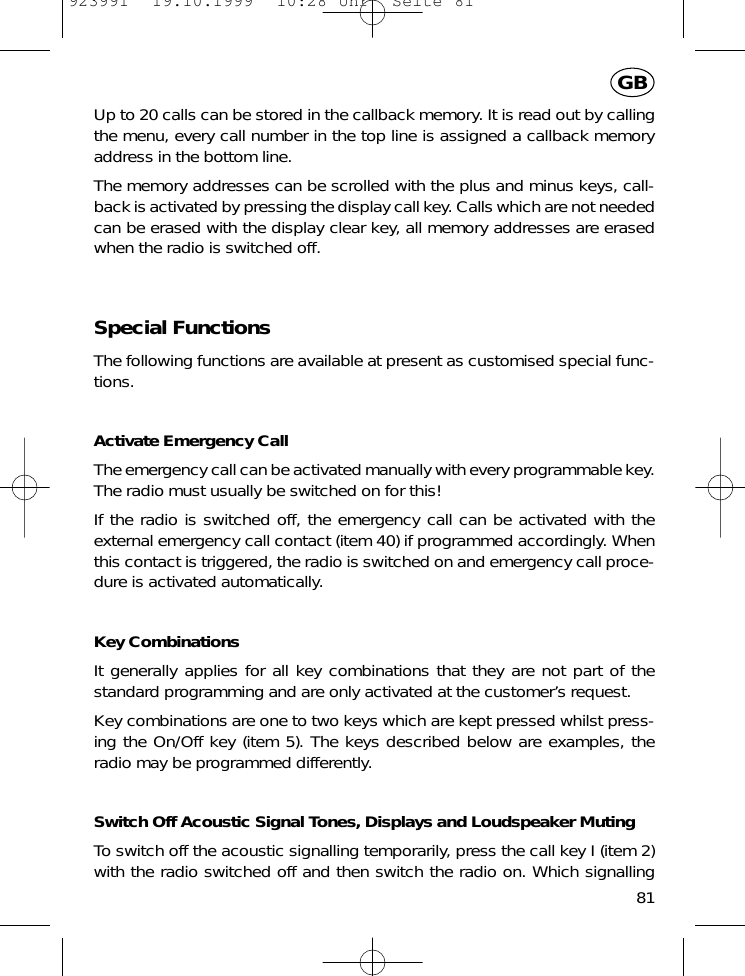
Controls (see page 3)Item Name Key symbol, Standard functionDisplay symbol1 Display2* Call key 1 I Fixed call3* Loudspeaker key o Loudspeaker on/off, monitor4* Call key 2 Display call5* On/off key Radio on/offshort: onlong: off6* PTT key : : : Press-to-talk key7 Cursor key Move the input positionin the displayshort: rightlong: left8 Menu key Call a menushort: next menu itemlong: menu 19 Plus key Input position up10 Minus key Input position down18 Transmit/receive symbol Not in use19 Channel busy20 Not in use21 Transmit22 Loudspeaker symbol Loudspeaker on23 Call diversion symbol Call diversion switched24 Together with 2325 Identification symbol Number of caller received26 Together with 2548GB923991  19.10.1999  10:27 Uhr  Seite 48
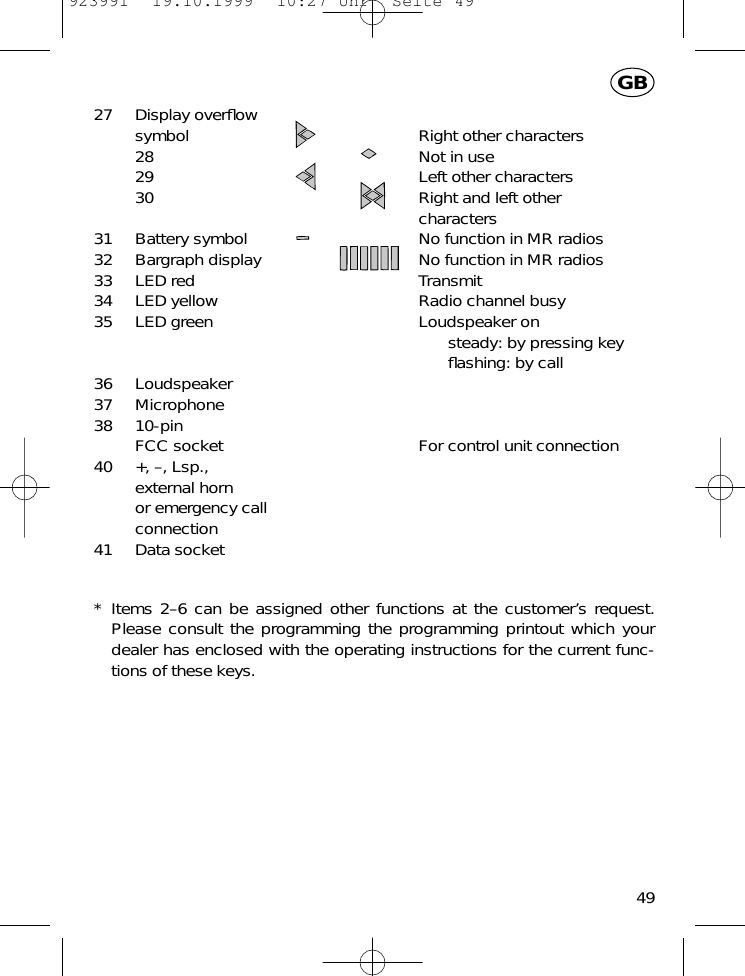
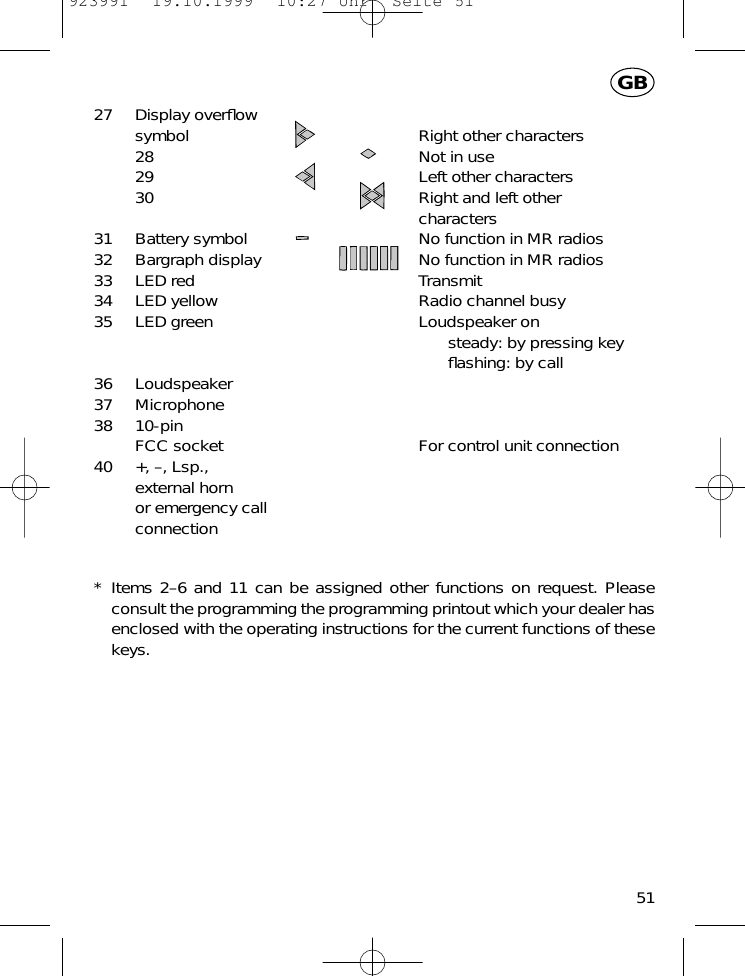
27 Display overflowsymbol Right other characters28 Not in use29 Left other characters30 Right and left other characters31 Battery symbol No function in MR radios32 Bargraph display No function in MR radios33 LED red Transmit34 LED yellow Radio channel busy35 LED green Loudspeaker onsteady: by pressing keyflashing: by call36 Loudspeaker37 Microphone38 10-pin FCC socket For control unit connection40 +, –, Lsp., external hornor emergency callconnection41 Data socket* Items 2–6 can be assigned other functions at the customer’s request.Please consult the programming the programming printout which yourdealer has enclosed with the operating instructions for the current func-tions of these keys.49GB923991  19.10.1999  10:27 Uhr  Seite 49
Controls (see page 7)Item Name Key symbol, Standard functionDisplay symbol1 Display2* Call key 1 Fixed call3* Loudspeaker key o Loudspeaker on/off, monitor4* Call key 2 Display call5* On/off key Radio on/offshort: onlong: off6* PTT key : : : Press-to-talk key7 Cursor key Move the input positionin the displayshort: rightlong: left8 Menu key Call a menushort: next menu itemlong: menu 19 Plus key Input position up10 Minus key Input position down11* Funktions key (F1) Programmable key18 Transmit/receive symbol Not in use19 Channel busy20 Not in use21 Transmit22 Loudspeaker symbol Loudspeaker on23 Call diversion symbol Call diversion switched24 Together with 2325 Identification symbol Number of caller received26 Together with 2550GB923991  19.10.1999  10:27 Uhr  Seite 50
27 Display overflowsymbol Right other characters28 Not in use29 Left other characters30 Right and left other characters31 Battery symbol No function in MR radios32 Bargraph display No function in MR radios33 LED red Transmit34 LED yellow Radio channel busy35 LED green Loudspeaker onsteady: by pressing keyflashing: by call36 Loudspeaker37 Microphone38 10-pin FCC socket For control unit connection40 +, –, Lsp., external hornor emergency callconnection* Items 2–6 and 11 can be assigned other functions on request. Pleaseconsult the programming the programming printout which your dealer hasenclosed with the operating instructions for the current functions of thesekeys.51GB923991  19.10.1999  10:27 Uhr  Seite 51
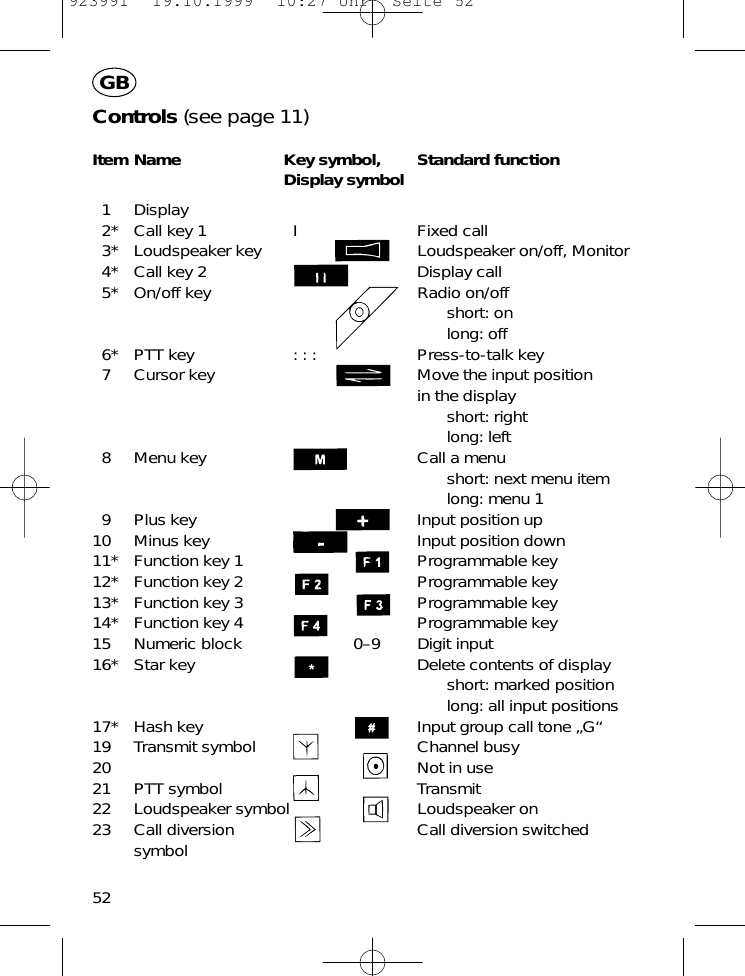
52GBControls (see page 11)Item Name Key symbol, Standard functionDisplay symbol1 Display2* Call key 1 I Fixed call3* Loudspeaker key Loudspeaker on/off, Monitor4* Call key 2 Display call5* On/off key Radio on/offshort: onlong: off6* PTT key : : : Press-to-talk key7 Cursor key Move the input position in the displayshort: rightlong: left8 Menu key Call a menushort: next menu itemlong: menu 19 Plus key Input position up10 Minus key Input position down11* Function key 1 Programmable key12* Function key 2 Programmable key13* Function key 3 Programmable key14* Function key 4 Programmable key15 Numeric block 0–9 Digit input16* Star key Delete contents of displayshort: marked positionlong: all input positions17* Hash key Input group call tone „G“19 Transmit symbol Channel busy20 Not in use21 PTT symbol Transmit22 Loudspeaker symbol Loudspeaker on23 Call diversion  Call diversion switchedsymbol923991  19.10.1999  10:27 Uhr  Seite 52
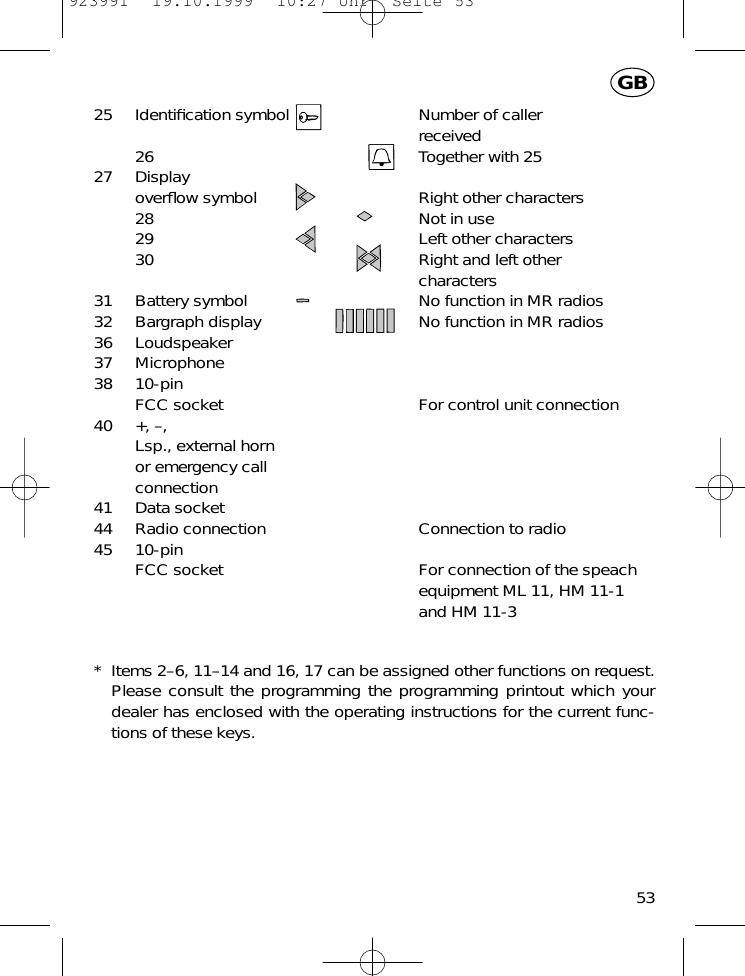
53GB25 Identification symbol Number of callerreceived26 Together with 2527 Displayoverflow symbol Right other characters28 Not in use29 Left other characters30 Right and left other characters31 Battery symbol No function in MR radios32 Bargraph display No function in MR radios36 Loudspeaker37 Microphone38 10-pin FCC socket For control unit connection40 +, –, Lsp., external hornor emergency callconnection41 Data socket44 Radio connection Connection to radio45 10-pin FCC socket For connection of the speachequipment ML 11, HM 11-1 and HM 11-3* Items 2–6, 11–14 and 16, 17 can be assigned other functions on request.Please consult the programming the programming printout which yourdealer has enclosed with the operating instructions for the current func-tions of these keys.923991  19.10.1999  10:27 Uhr  Seite 53
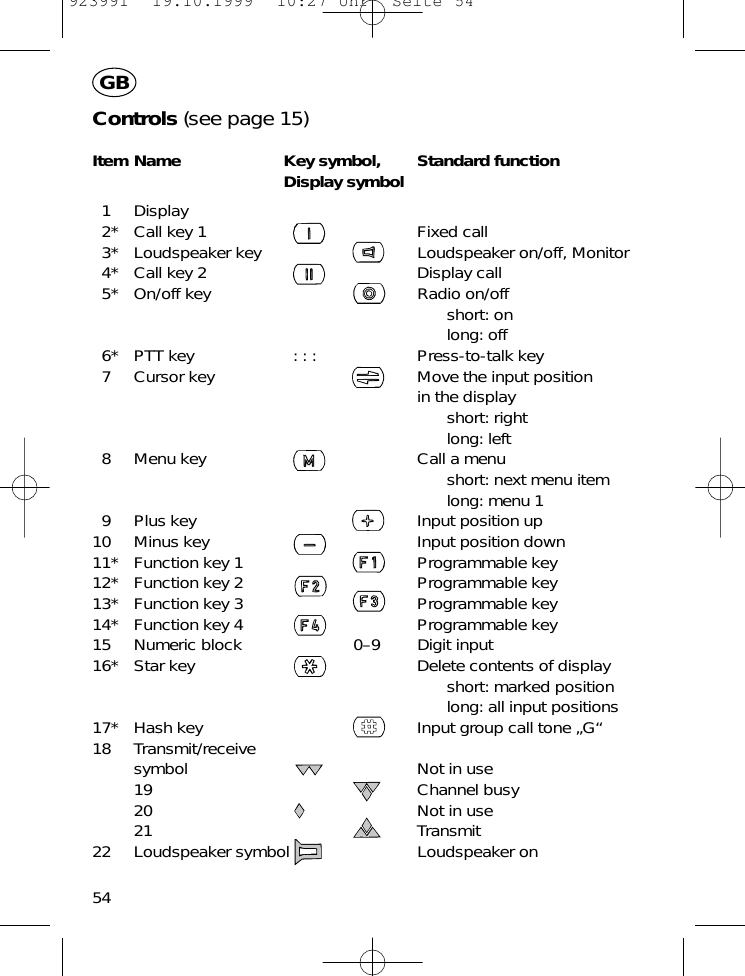
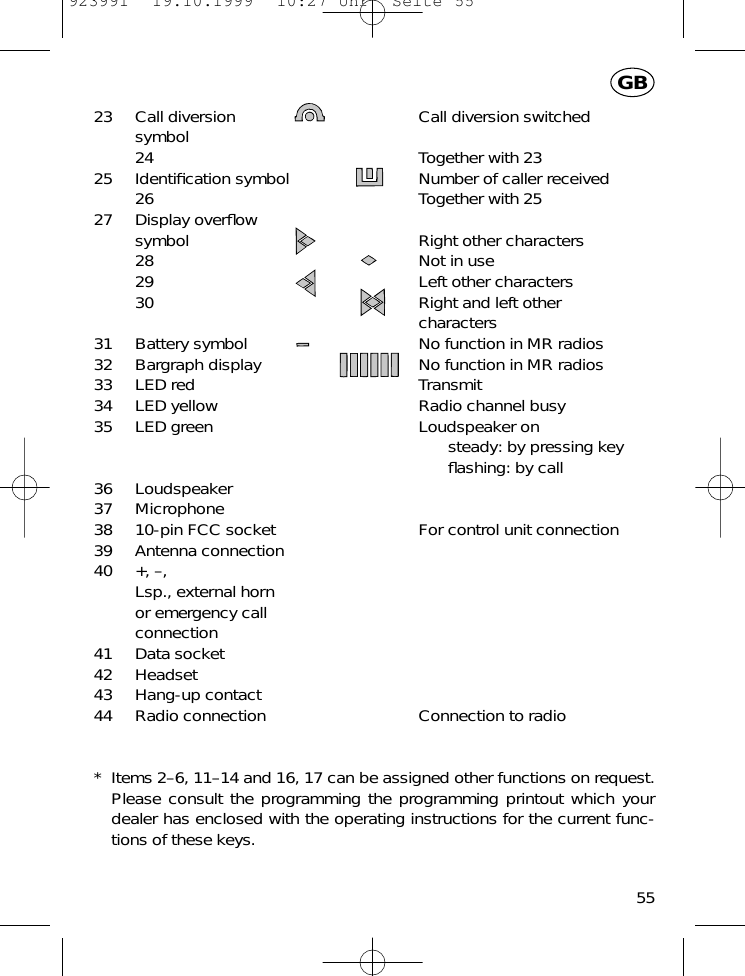
54GBControls (see page 15)Item Name Key symbol, Standard functionDisplay symbol1 Display2* Call key 1 I Fixed call3* Loudspeaker key Loudspeaker on/off, Monitor4* Call key 2 Display call5* On/off key Radio on/offshort: onlong: off6* PTT key : : : Press-to-talk key7 Cursor key Move the input position in the displayshort: rightlong: left8 Menu key Call a menushort: next menu itemlong: menu 19 Plus key Input position up10 Minus key Input position down11* Function key 1 Programmable key12* Function key 2 Programmable key13* Function key 3 Programmable key14* Function key 4 Programmable key15 Numeric block 0–9 Digit input16* Star key Delete contents of displayshort: marked positionlong: all input positions17* Hash key Input group call tone „G“18 Transmit/receivesymbol Not in use19 Channel busy20 Not in use21 Transmit22 Loudspeaker symbol Loudspeaker on923991  19.10.1999  10:27 Uhr  Seite 54
55GB23 Call diversion Call diversion switchedsymbol24 Together with 2325 Identification symbol Number of caller received26 Together with 2527 Display overflowsymbol Right other characters28 Not in use29 Left other characters30 Right and left other characters31 Battery symbol No function in MR radios32 Bargraph display No function in MR radios33 LED red Transmit34 LED yellow Radio channel busy35 LED green Loudspeaker onsteady: by pressing keyflashing: by call36 Loudspeaker37 Microphone38 10-pin FCC socket For control unit connection39 Antenna connection40 +, –, Lsp., external hornor emergency callconnection41 Data socket42 Headset43 Hang-up contact44 Radio connection Connection to radio* Items 2–6, 11–14 and 16, 17 can be assigned other functions on request.Please consult the programming the programming printout which yourdealer has enclosed with the operating instructions for the current func-tions of these keys.923991  19.10.1999  10:27 Uhr  Seite 55
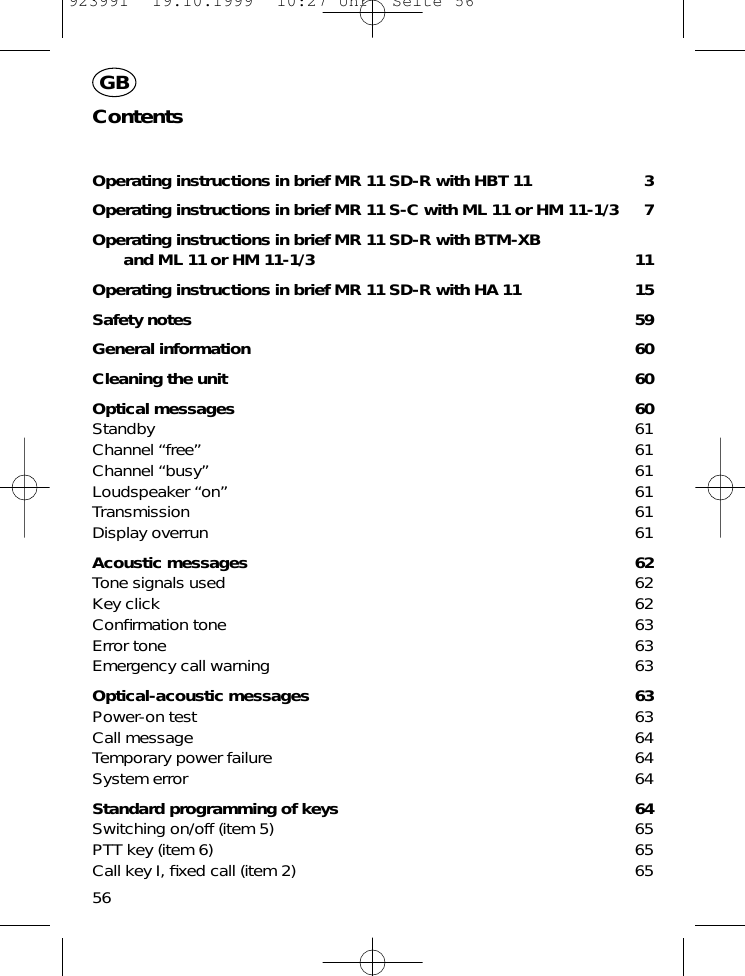
ContentsOperating instructions in brief MR 11 SD-R with HBT 11 3Operating instructions in brief MR 11 S-C with ML 11 or HM 11-1/3 7Operating instructions in brief MR 11 SD-R with BTM-XB and ML 11 or HM 11-1/3 11Operating instructions in brief MR 11 SD-R with HA 11 15Safety notes 59General information 60Cleaning the unit 60Optical messages 60Standby 61Channel “free” 61Channel “busy” 61Loudspeaker “on” 61Transmission 61Display overrun 61Acoustic messages 62Tone signals used 62Key click 62Confirmation tone 63Error tone 63Emergency call warning 63Optical-acoustic messages 63Power-on test 63Call message 64Temporary power failure 64System error 64Standard programming of keys 64Switching on/off (item 5) 65PTT key (item 6) 65Call key I, fixed call (item 2) 6556GB923991  19.10.1999  10:27 Uhr  Seite 56
Call key II, display call (item 4) 65Loudspeaker key (item 3) 66Star key (item 16) 66Hash key (item 17) 66Standard programming of keys for menu operation 67Menu key (item 8) 67Cursor key (item 7) 67Plus and minus key (items 9, 10) 67Numeric block 0 to 9 (item 15) 68Menu system 68User menu 68Menu item 68Menu display 68Display format 69Menu order 69Basic display 69Service menu 70Identification display 70Available standard menu items 70Volume control 70Compact input with channel text display and channel scrolling 71Available special menu items 71Security prompt when switching on 71Change password 72Compact input 72Compact input with channel scrolling 73Compact input with text display 73Channel input 73Channel scrolling 74Call number input 74Short dial input 75Short dial scrolling 75Short dial input with text display 76Short dial scrolling with text display 76Status input 7657GB923991  19.10.1999  10:27 Uhr  Seite 57
Status input with text display 76Keyboard lock 76DTMF mode 77Channel scanning 77Follower contact activation 78Horn (follower contact open) 78Call diversion 79Paging mode 79Notes 79Transmitter power 80Decoder call number 80Service mode 80Callback memory 80Special functions 81Activate emergency call 81Key combinations 81Switch off acoustic signal tones, display and loudspeaker muting 81Switch over transmitter power 82Switch over transmitter power and switch off acoustic signal tones 8358GB923991  19.10.1999  10:27 Uhr  Seite 58
59GBSafety Notes– The radiotelephone and all its accessories may not be used in areaswhere there is fire damp or risk of explosion.– Keep the radio antenna at least 30 cm away from your body for units with7-15 W transmitter power and at least 60 cm for units with 16-50 Wwhen you press the PTT key.– Never hold the hand control unit with the loudspeaker directly to your earwhen it is switched on, test a bearable distance first at the selectedvolume by opening the squelch. Otherwise extremely high volumescould damage your hearing.– Do not use the radio when driving in such a way as might distract yourattention from the traffic.– If you wear a heart pacemaker, contact the manufacturer of the pace-maker before using the radio. He will tell you whether this could beaffected by high frequencies. Avoid pressing the PTT key outside thevehicle close to the antenna, stay in the vehicle.– Keep the radio away from children or persons not familiar with its use.923991  19.10.1999  10:27 Uhr  Seite 59
General InformationThe operating concept for mobile radio telephones of the 11th generation in the PMR (Private Mobile Radio) version is identical for all units irrespectiveof the control unit equipment. Of course the type of display and number ofkeys available depends on the respective radio-control unit combination andthe corresponding programming.Therefore choose the combination from pages 3, 7, 11 and 15 which mostsuits you requirements and use the programming printout provided by yourdealer as a help to familiarise yourself with operation of your radio.Apart from four keys (Menu, Cursor, Plus and Minus) and the numeric keyblock 0 to 9, all other keys can be programmed by your dealer and may beprogrammed with a function which deviates from the standard programming.Therefore, not all of the operating procedures in this manual apply necessa-rily to your radio model.Cleaning the UnitTo clean the outside of your radio housing and the control units, please useonly water with a little washing up liquid and a soft cloth. Wipe the radio withthe damp cloth (do not immerse the radio or the accessories in water) andthen dry with a dry cloth. Make sure there is no moisture left in the vicinity ofthe control unit plug and the antenna contact.Do not use solvents!Optical MessagesOptical messages are indicated by the display symbols (items 18–30) andthe three LEDs (items 33, 34 and 35). The LEDs may light steadily or flash.They flash in a rhythm of about 1 second.60GB923991  19.10.1999  10:27 Uhr  Seite 60
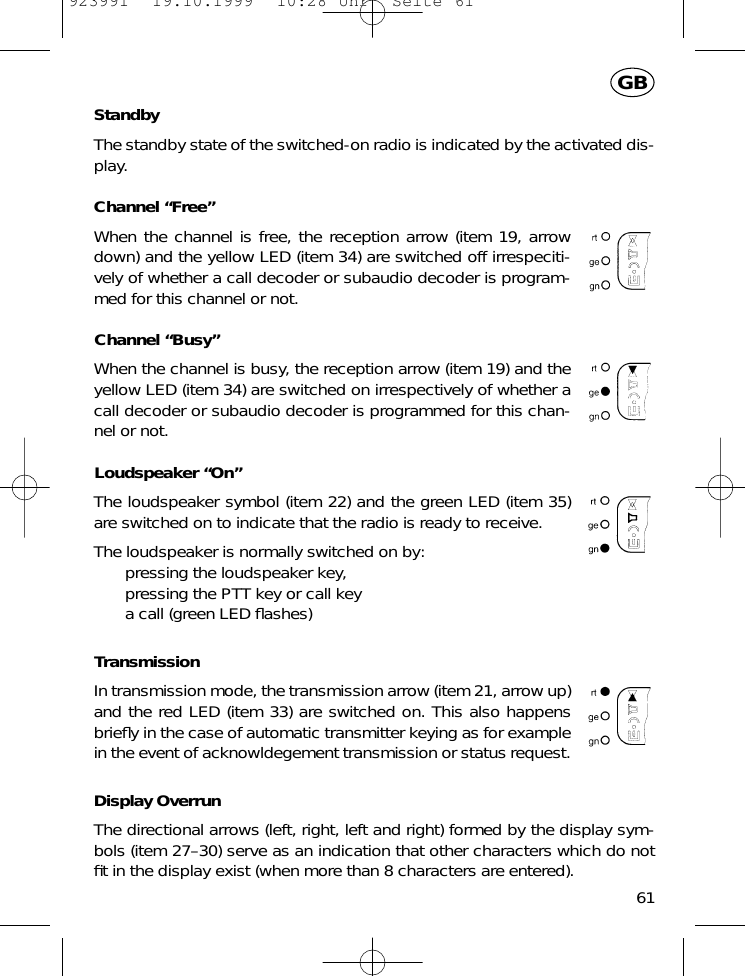
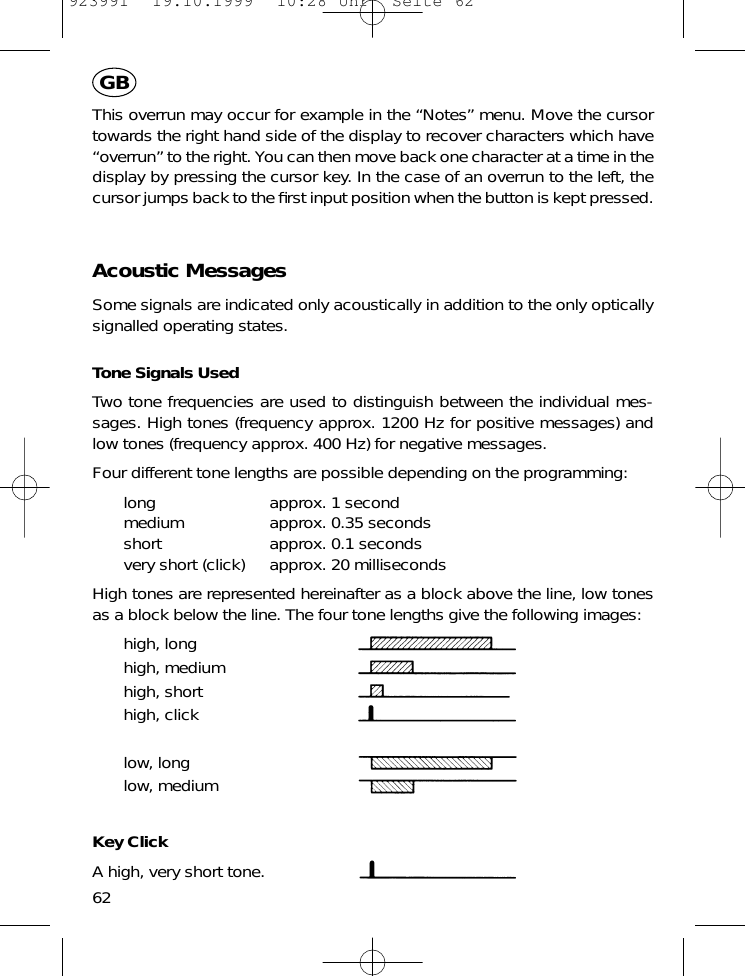
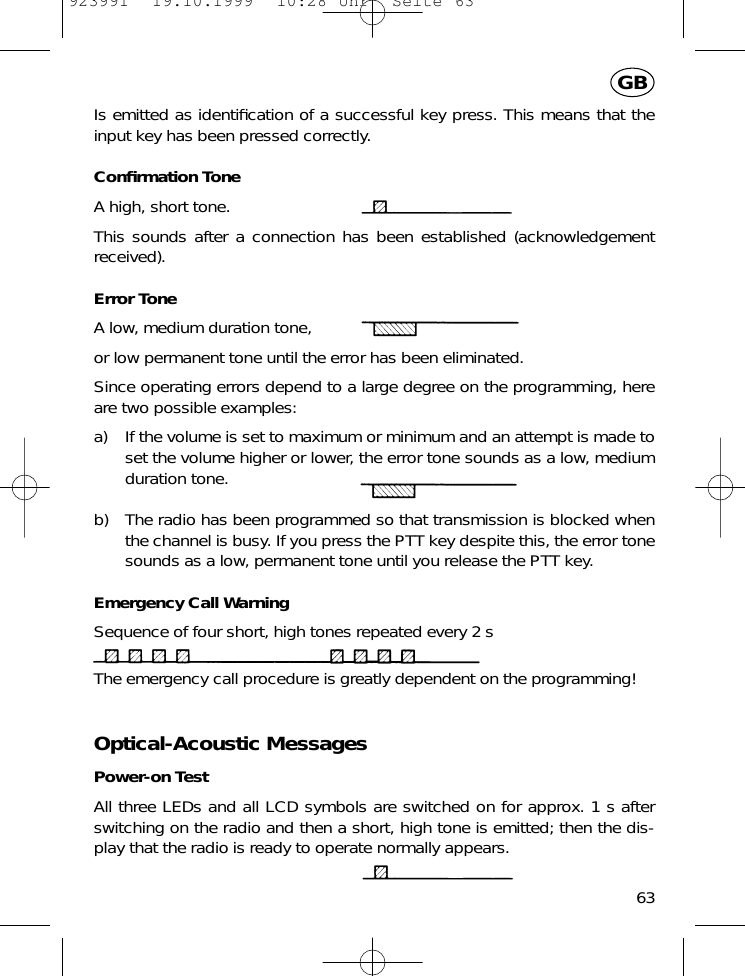
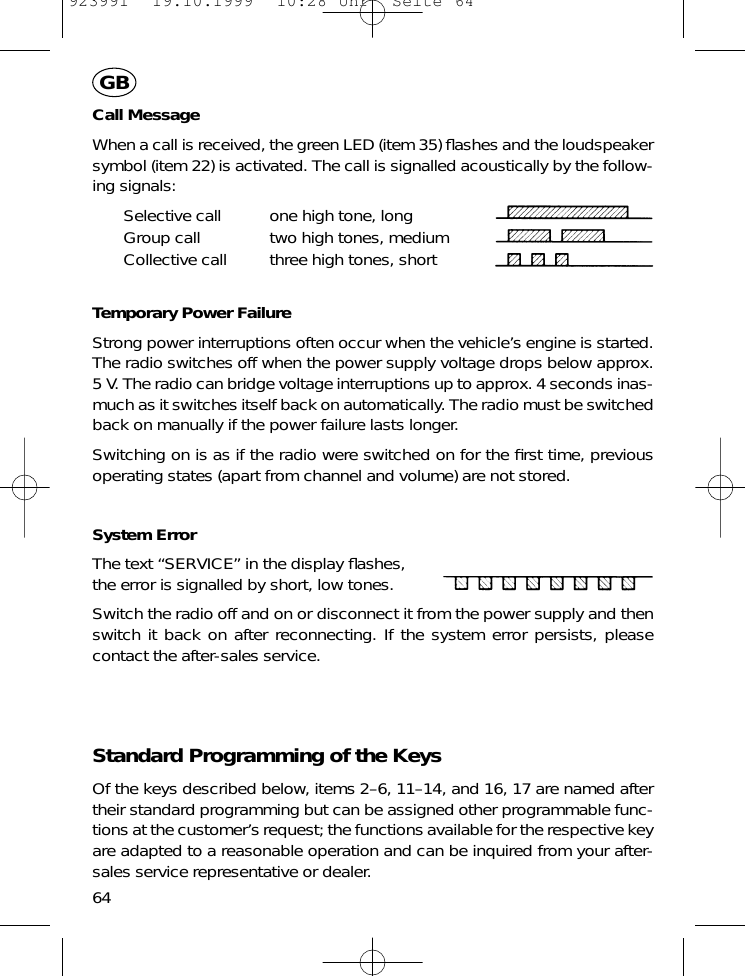
StandbyThe standby state of the switched-on radio is indicated by the activated dis-play.Channel “Free”When the channel is free, the reception arrow (item 19, arrowdown) and the yellow LED (item 34) are switched off irrespeciti-vely of whether a call decoder or subaudio decoder is program-med for this channel or not.Channel “Busy”When the channel is busy, the reception arrow (item 19) and theyellow LED (item 34) are switched on irrespectively of whether acall decoder or subaudio decoder is programmed for this chan-nel or not.Loudspeaker “On”The loudspeaker symbol (item 22) and the green LED (item 35)are switched on to indicate that the radio is ready to receive.The loudspeaker is normally switched on by:pressing the loudspeaker key,pressing the PTT key or call keya call (green LED flashes)TransmissionIn transmission mode, the transmission arrow (item 21, arrow up)and the red LED (item 33) are switched on. This also happensbriefly in the case of automatic transmitter keying as for examplein the event of acknowldegement transmission or status request.Display OverrunThe directional arrows (left, right, left and right) formed by the display sym-bols (item 27–30) serve as an indication that other characters which do notfit in the display exist (when more than 8 characters are entered).61GB923991  19.10.1999  10:28 Uhr  Seite 61
This overrun may occur for example in the “Notes” menu. Move the cursortowards the right hand side of the display to recover characters which have“overrun” to the right. You can then move back one character at a time in thedisplay by pressing the cursor key. In the case of an overrun to the left, thecursor jumps back to the first input position when the button is kept pressed.Acoustic MessagesSome signals are indicated only acoustically in addition to the only opticallysignalled operating states.Tone Signals UsedTwo tone frequencies are used to distinguish between the individual mes-sages. High tones (frequency approx. 1200 Hz for positive messages) andlow tones (frequency approx. 400 Hz) for negative messages.Four different tone lengths are possible depending on the programming:long approx. 1 secondmedium approx. 0.35 secondsshort approx. 0.1 secondsvery short (click) approx. 20 millisecondsHigh tones are represented hereinafter as a block above the line, low tonesas a block below the line. The four tone lengths give the following images:high, longhigh, mediumhigh, shorthigh, clicklow, longlow, mediumKey ClickA high, very short tone.62GB923991  19.10.1999  10:28 Uhr  Seite 62
Is emitted as identification of a successful key press. This means that theinput key has been pressed correctly.Confirmation ToneA high, short tone.This sounds after a connection has been established (acknowledgementreceived).Error ToneA low, medium duration tone,or low permanent tone until the error has been eliminated.Since operating errors depend to a large degree on the programming, hereare two possible examples:a) If the volume is set to maximum or minimum and an attempt is made toset the volume higher or lower, the error tone sounds as a low, mediumduration tone.b) The radio has been programmed so that transmission is blocked whenthe channel is busy. If you press the PTT key despite this, the error tonesounds as a low, permanent tone until you release the PTT key.Emergency Call WarningSequence of four short, high tones repeated every 2 sThe emergency call procedure is greatly dependent on the programming!Optical-Acoustic MessagesPower-on TestAll three LEDs and all LCD symbols are switched on for approx. 1 s afterswitching on the radio and then a short, high tone is emitted; then the dis-play that the radio is ready to operate normally appears.63GB923991  19.10.1999  10:28 Uhr  Seite 63
Call MessageWhen a call is received, the green LED (item 35) flashes and the loudspeakersymbol (item 22) is activated. The call is signalled acoustically by the follow-ing signals:Selective call one high tone, longGroup call two high tones, mediumCollective call three high tones, shortTemporary Power FailureStrong power interruptions often occur when the vehicle’s engine is started.The radio switches off when the power supply voltage drops below approx.5 V. The radio can bridge voltage interruptions up to approx. 4 seconds inas-much as it switches itself back on automatically. The radio must be switchedback on manually if the power failure lasts longer.Switching on is as if the radio were switched on for the first time, previousoperating states (apart from channel and volume) are not stored.System ErrorThe text “SERVICE” in the display flashes,the error is signalled by short, low tones.Switch the radio off and on or disconnect it from the power supply and thenswitch it back on after reconnecting. If the system error persists, pleasecontact the after-sales service.Standard Programming of the KeysOf the keys described below, items 2–6, 11–14, and 16, 17 are named aftertheir standard programming but can be assigned other programmable func-tions at the customer’s request; the functions available for the respective keyare adapted to a reasonable operation and can be inquired from your after-sales service representative or dealer.64GB923991  19.10.1999  10:28 Uhr  Seite 64
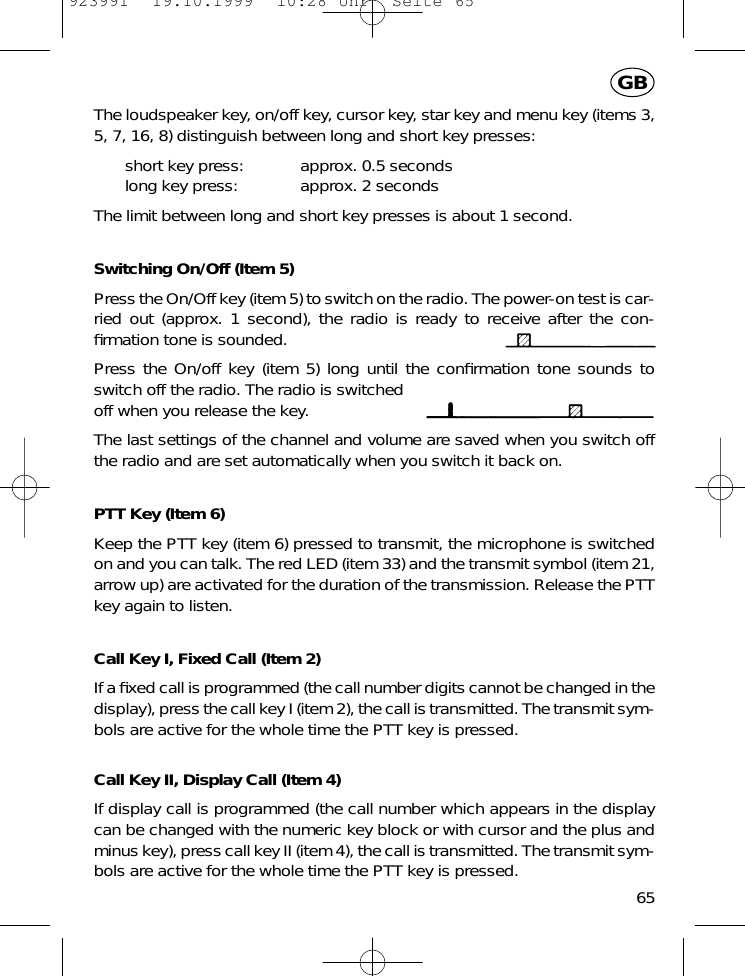
The loudspeaker key, on/off key, cursor key, star key and menu key (items 3,5, 7, 16, 8) distinguish between long and short key presses:short key press: approx. 0.5 secondslong key press: approx. 2 secondsThe limit between long and short key presses is about 1 second.Switching On/Off (Item 5)Press the On/Off key (item 5) to switch on the radio. The power-on test is car-ried out (approx. 1 second), the radio is ready to receive after the con-firmation tone is sounded.Press the On/off key (item 5) long until the confirmation tone sounds toswitch off the radio. The radio is switchedoff when you release the key.The last settings of the channel and volume are saved when you switch offthe radio and are set automatically when you switch it back on.PTT Key (Item 6)Keep the PTT key (item 6) pressed to transmit, the microphone is switchedon and you can talk. The red LED (item 33) and the transmit symbol (item 21,arrow up) are activated for the duration of the transmission. Release the PTTkey again to listen.Call Key I, Fixed Call (Item 2)If a fixed call is programmed (the call number digits cannot be changed in thedisplay), press the call key I (item 2), the call is transmitted. The transmit sym-bols are active for the whole time the PTT key is pressed.Call Key II, Display Call (Item 4)If display call is programmed (the call number which appears in the displaycan be changed with the numeric key block or with cursor and the plus andminus key), press call key II (item 4), the call is transmitted. The transmit sym-bols are active for the whole time the PTT key is pressed.65GB923991  19.10.1999  10:28 Uhr  Seite 65
66GBLoudspeaker Key (Item 3)In its standard programming, the loudspeaker key (item 3) has a combinati-on of Clear, Listen In and Monitor functions. The key only distinguishesbetween short and long presses in its Monitor function, i.e. the monitor func-tion is only executed when the key is pressed short.Radio with call decoder:Listen inYou can listen into the radio channel when you keep the key pressed. Ifthere is radio traffic on the channel, you can listen in, if the channel isfree, you will hear noise. The loudspeaker symbol (item 22) and the greenLED (item 35) are active for the whole time the key is pressed. [Call deco-der, subaudio decoder and squelch are bypassed]MonitorEvery time the key is released the loudspeaker is switched to therespective other state, i.e. loudspeaker “on” (green LED lights steadily,loudspeaker symbol active) or loudspeaker “off” (green LED off andloudspeaker symbol off). [Only the call decoder is bypassed]ClearAny calling signal is reset in addition every time the key is pressed.Star Key (Item 16)The standard assignment of the star key is “Clear Display Content” (short =marked input position, long = all input positions). It is not available in all con-trol units.Hash Key (Item 17)The hash key is used in its standard programming for entering the group calltone “G”. It is not available in all control units.923991  19.10.1999  10:28 Uhr  Seite 66
Standard Programming of the Keys for Menu OperationMenu Key (Item 8)The basic display is visible in the standby mode of the radio (see “MenuSystem”). If you want to make entries, for example change the channel or callnumber, press the menu key “M” (item 8) once short, menu item 1 appearsin the display. Each time you press the menu key again, you move to the nextitem in the display. Menu item 1 then reappears after the last item after ashort key press. A long key press switches from any menu item to the firstmenu item, the basic display is visible.If you do not press any other keys after calling a menu, the radio switchesback to the basic display from many of the menus. This takes place, depend-ing on the menu display, after approx. 2 seconds in menu item 1 (the Volumemenu in the standard program) or after approx. 10 seconds (from othermenus).Cursor Key (Item 7)If entries can be made in the display, the position which can now be chang-ed is marked by an underscore ( _ ). If other positions to be changed are loca-ted to the right and left of the marked position, you can move the cursor tothe right by pressing the cursor key (item 7) short or to the left by pressing itlong.If more than one position is marked by an underscore in the display, you canonly change them by scrolling (continuous switching of all existing entries)with the +/– keys. The cursor key is inactive in this case unless you are in amenu such as “Compact Input” (see page 72). The “Compact Input” menuhas several input blocks, one press of the cursor key then switches from oneinput block to the next, e.g. from “Call Input” to “CHANNEL”.Plus and Minus Keys (Items 9, 10)Marked input positions can be counted up and down with the plus and minuskeys in the display. On reaching the desired entry, you can change to the nextposition to be entered with the cursor.67GB923991  19.10.1999  10:28 Uhr  Seite 67
Numeric Block 0 to 9 (Item 15)The content can be entered directly at the positions provided in the menudisplay with the numeric key block. The cursor switches to the next inputposition automatically with every entered digit or letter. Not every control unithas a numeric key block.Menu SystemThe radios of the 11th generation are operated with menus. This means thatthe display or input positions in the display are adapted individually to theoperating procedure. This includes the operating process which is currentlyactivated being displayed among other things.User MenuThe user menu can be called with the menu key and enables the radio userto adapt the operation optimally to his requirements. All the menu items andoperating details which need to be mentioned in this operating manual mayseem confusing in their variety. Therefore the user, by proper selection andprogramming, is only confronted with what he really needs for his own spe-cial applications.Menu ItemA menu item is a display and the corresponding input and display possibili-ties in a menu called with the menu key.At the moment, about 30 different menu items are available of which an indi-vidual selection of up to 23 menu items can be programmed depending onthe customer’s wishes.Menu DisplayEvery menu item is assigned a menu display with fixed display and inputpossibilities.68GB923991  19.10.1999  10:28 Uhr  Seite 68
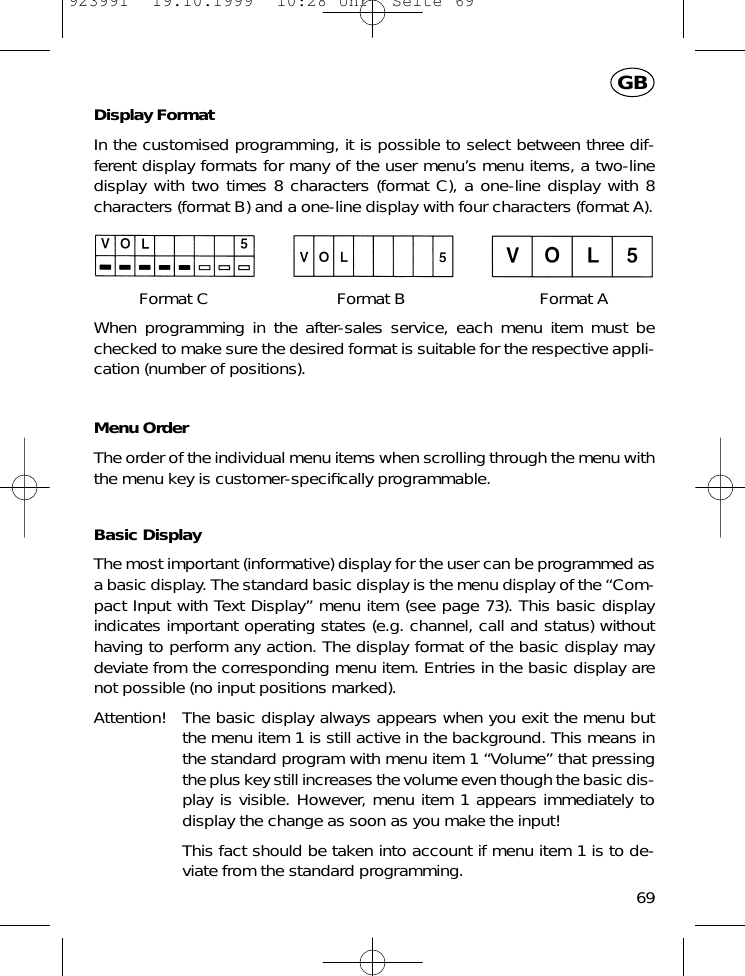
Display FormatIn the customised programming, it is possible to select between three dif-ferent display formats for many of the user menu’s menu items, a two-linedisplay with two times 8 characters (format C), a one-line display with 8characters (format B) and a one-line display with four characters (format A).Format C Format B Format AWhen programming in the after-sales service, each menu item must bechecked to make sure the desired format is suitable for the respective appli-cation (number of positions).Menu OrderThe order of the individual menu items when scrolling through the menu withthe menu key is customer-specifically programmable.Basic DisplayThe most important (informative) display for the user can be programmed asa basic display. The standard basic display is the menu display of the “Com-pact Input with Text Display” menu item (see page 73). This basic displayindicates important operating states (e.g. channel, call and status) withouthaving to perform any action. The display format of the basic display maydeviate from the corresponding menu item. Entries in the basic display arenot possible (no input positions marked).Attention! The basic display always appears when you exit the menu butthe menu item 1 is still active in the background. This means inthe standard program with menu item 1 “Volume” that pressingthe plus key still increases the volume even though the basic dis-play is visible. However, menu item 1 appears immediately todisplay the change as soon as you make the input!This fact should be taken into account if menu item 1 is to de-viate from the standard programming.69GB923991  19.10.1999  10:28 Uhr  Seite 69
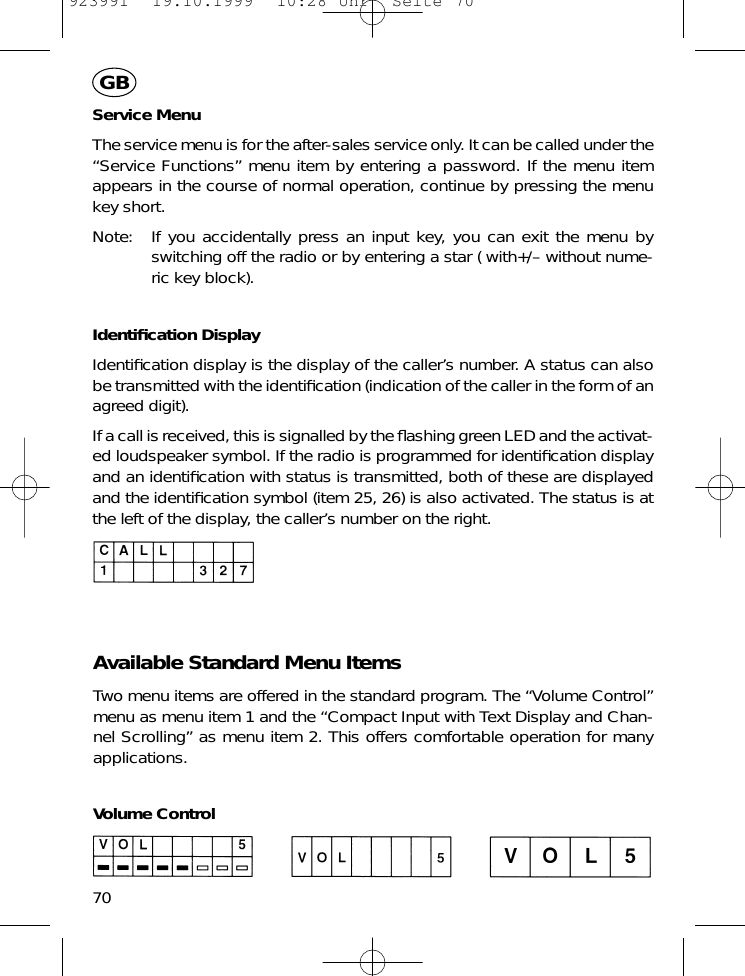
Service MenuThe service menu is for the after-sales service only. It can be called under the“Service Functions” menu item by entering a password. If the menu itemappears in the course of normal operation, continue by pressing the menukey short.Note: If you accidentally press an input key, you can exit the menu byswitching off the radio or by entering a star ( with+/– without nume-ric key block).Identification DisplayIdentification display is the display of the caller’s number. A status can alsobe transmitted with the identification (indication of the caller in the form of anagreed digit).If a call is received, this is signalled by the flashing green LED and the activat-ed loudspeaker symbol. If the radio is programmed for identification displayand an identification with status is transmitted, both of these are displayedand the identification symbol (item 25, 26) is also activated. The status is atthe left of the display, the caller’s number on the right.Available Standard Menu ItemsTwo menu items are offered in the standard program. The “Volume Control”menu as menu item 1 and the “Compact Input with Text Display and Chan-nel Scrolling” as menu item 2. This offers comfortable operation for manyapplications.Volume Control70GB923991  19.10.1999  10:28 Uhr  Seite 70
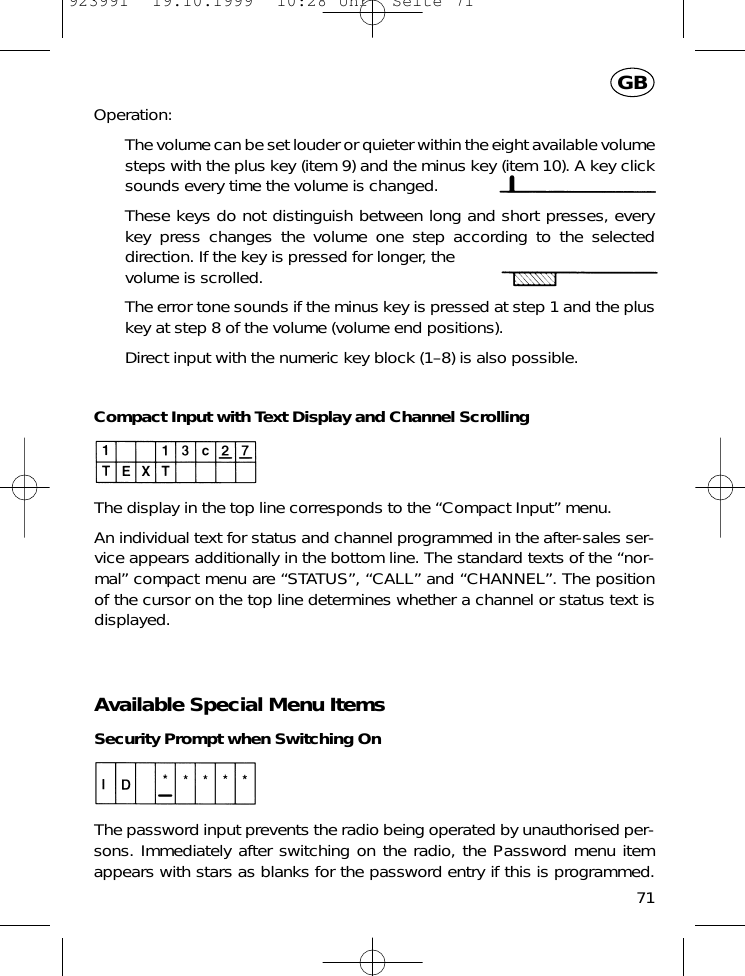
Operation:The volume can be set louder or quieter within the eight available volumesteps with the plus key (item 9) and the minus key (item 10). A key clicksounds every time the volume is changed.These keys do not distinguish between long and short presses, everykey press changes the volume one step according to the selecteddirection. If the key is pressed for longer, thevolume is scrolled.The error tone sounds if the minus key is pressed at step 1 and the pluskey at step 8 of the volume (volume end positions).Direct input with the numeric key block (1–8) is also possible.Compact Input with Text Display and Channel ScrollingThe display in the top line corresponds to the “Compact Input” menu.An individual text for status and channel programmed in the after-sales ser-vice appears additionally in the bottom line. The standard texts of the “nor-mal” compact menu are “STATUS”, “CALL” and “CHANNEL”. The positionof the cursor on the top line determines whether a channel or status text isdisplayed.Available Special Menu ItemsSecurity Prompt when Switching OnThe password input prevents the radio being operated by unauthorised per-sons. Immediately after switching on the radio, the Password menu itemappears with stars as blanks for the password entry if this is programmed.71GB923991  19.10.1999  10:28 Uhr  Seite 71
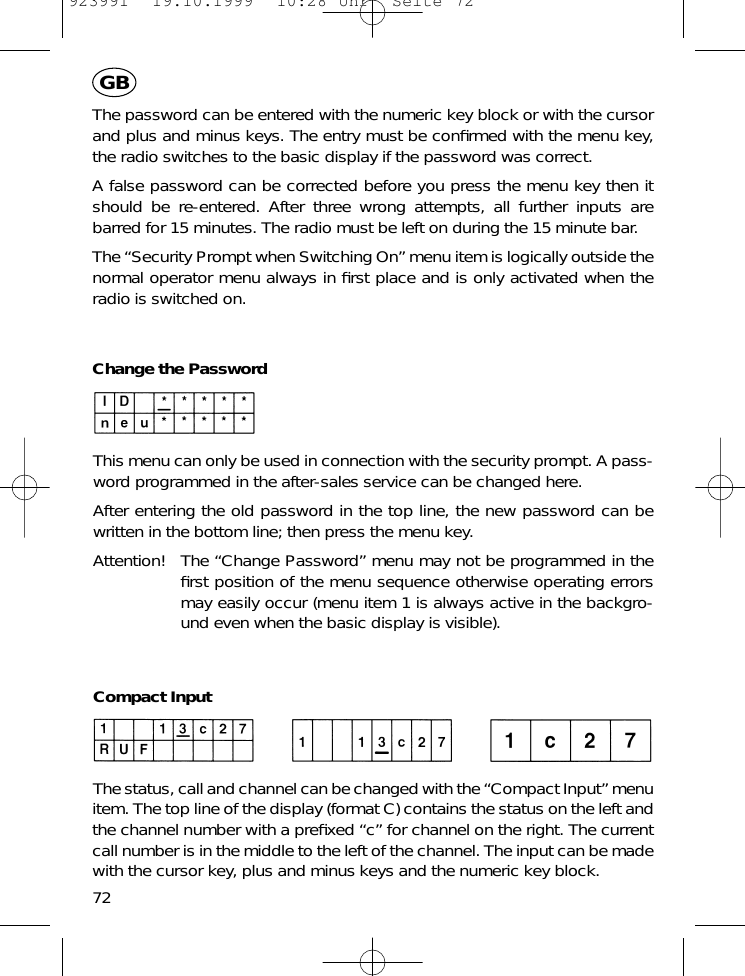
The password can be entered with the numeric key block or with the cursorand plus and minus keys. The entry must be confirmed with the menu key,the radio switches to the basic display if the password was correct.A false password can be corrected before you press the menu key then itshould be re-entered. After three wrong attempts, all further inputs arebarred for 15 minutes. The radio must be left on during the 15 minute bar.The “Security Prompt when Switching On” menu item is logically outside thenormal operator menu always in first place and is only activated when theradio is switched on.Change the PasswordThis menu can only be used in connection with the security prompt. A pass-word programmed in the after-sales service can be changed here.After entering the old password in the top line, the new password can bewritten in the bottom line; then press the menu key.Attention! The “Change Password” menu may not be programmed in thefirst position of the menu sequence otherwise operating errorsmay easily occur (menu item 1 is always active in the backgro-und even when the basic display is visible).Compact InputThe status, call and channel can be changed with the “Compact Input” menuitem. The top line of the display (format C) contains the status on the left andthe channel number with a prefixed “c” for channel on the right. The currentcall number is in the middle to the left of the channel. The input can be madewith the cursor key, plus and minus keys and the numeric key block.72GB923991  19.10.1999  10:28 Uhr  Seite 72
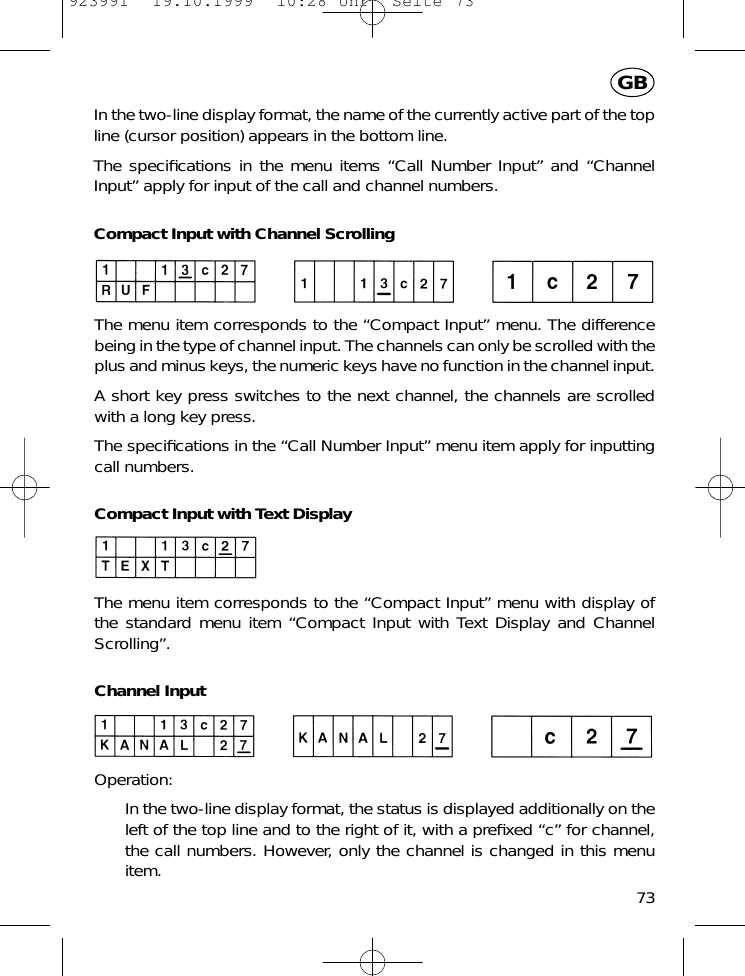
In the two-line display format, the name of the currently active part of the topline (cursor position) appears in the bottom line.The specifications in the menu items “Call Number Input” and “ChannelInput” apply for input of the call and channel numbers.Compact Input with Channel ScrollingThe menu item corresponds to the “Compact Input” menu. The differencebeing in the type of channel input. The channels can only be scrolled with theplus and minus keys, the numeric keys have no function in the channel input.A short key press switches to the next channel, the channels are scrolledwith a long key press.The specifications in the “Call Number Input” menu item apply for inputtingcall numbers.Compact Input with Text DisplayThe menu item corresponds to the “Compact Input” menu with display of the standard menu item “Compact Input with Text Display and ChannelScrolling”.Channel InputOperation:In the two-line display format, the status is displayed additionally on theleft of the top line and to the right of it, with a prefixed “c” for channel,the call numbers. However, only the channel is changed in this menuitem.73GB923991  19.10.1999  10:28 Uhr  Seite 73
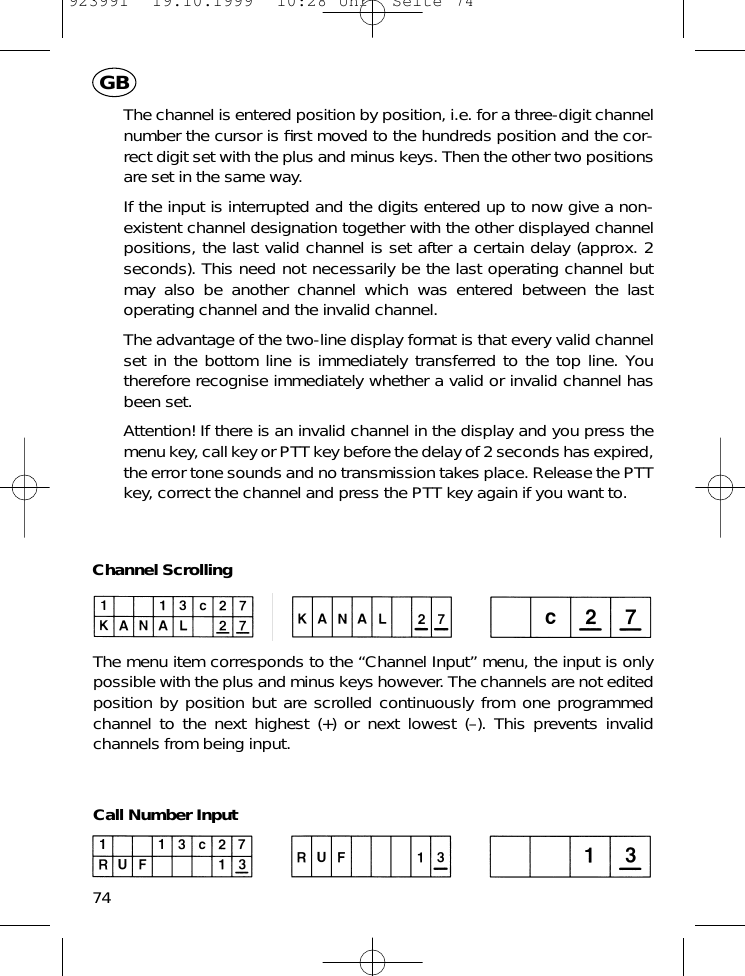
The channel is entered position by position, i.e. for a three-digit channelnumber the cursor is first moved to the hundreds position and the cor-rect digit set with the plus and minus keys. Then the other two positionsare set in the same way.If the input is interrupted and the digits entered up to now give a non-existent channel designation together with the other displayed channelpositions, the last valid channel is set after a certain delay (approx. 2seconds). This need not necessarily be the last operating channel butmay also be another channel which was entered between the lastoperating channel and the invalid channel.The advantage of the two-line display format is that every valid channelset in the bottom line is immediately transferred to the top line. Youtherefore recognise immediately whether a valid or invalid channel hasbeen set.Attention! If there is an invalid channel in the display and you press themenu key, call key or PTT key before the delay of 2 seconds has expired,the error tone sounds and no transmission takes place. Release the PTTkey, correct the channel and press the PTT key again if you want to.Channel ScrollingThe menu item corresponds to the “Channel Input” menu, the input is onlypossible with the plus and minus keys however. The channels are not editedposition by position but are scrolled continuously from one programmedchannel to the next highest (+) or next lowest (–). This prevents invalidchannels from being input.Call Number Input74GB923991  19.10.1999  10:28 Uhr  Seite 74
Operation:The cursor key, the plus and minus keys and the numeric key block withstar and hash keys, if the control unit has one, are used to input the callnumbers. Short or long pressing of the cursor key moves the input po-sition one to the right or left, the plus and minus keys roll the input po-sition from “0” to “9” via “G” and “–” and on the 12-key numeric block,the star enters the hyphen and the hash key the “G”.As many input positions as can be freely programmed in the radio ap-pear in the display. If you have selected a channel or a call key whereless free positions can be entered, the rest of the input positions in thedisplay must be filled up with hyphens from the left. “G” must be enteredas a group call character.The call digits visible in the display must match the free number of posi-tions of the appropriate call when transmitting otherwise an error tonesounds when the call key is pressed and no call will be transmitted.Short Dial InputThe “Short Dial Input” menu item is designed for calling numbers program-med in the radio. Every short dialling digit is assigned a call number. Theseare input with the cursor key, plus or minus key or with the numeric keys.Attention! In the two-line display format, the top line does not indicate thenumber belonging to the short dialling digit.Short Dial ScrollingLike “Short Dial Input” except scrolling only with the plus and minus keys inprogrammed order up (+) and down (–).75GB923991  19.10.1999  10:28 Uhr  Seite 75
Short Dial Input with Text DisplayLike “Short Dial Input” but a text for the respective short dialling digit pro-grammed in the after-sales service appears additionally in the top line.Short Dial Scrolling with Text DisplayLike “Short Dial Scrolling” but a text for the respective short dialling digit pro-grammed in the after-sales service appears additionally in the top line.Status InputOperation:The word “STATUS” with the status digit to the right of it appears in thedisplay in the two eight-digit display formats. The status digit can bescrolled with the plus and minus keys or entered directly with the nu-meric keys.Status Input with Text DisplayLike “Status Input” but a text for the respective status programmed in theafter-sales service appears additionally in the top line.Keyboard Lock76GB923991  19.10.1999  10:28 Uhr  Seite 76
The keys of the numeric block (0 to 9, *, #), the cursor key and the ON/Offkey can be locked with the keyboard lock. The keyboard lock is switched onand off in the display with the plus and minus keys, the lock is activatedimmediately.DTMF ModeThe “DTMF Mode” menu item allows input of up to 23 DTMF call digits. If thedisplay is filled with entered digits, the other digits entered appear on theright, the call number moves to the left out of sight.The cursor key, plus and minus keys and the numeric keys can be used forthe input. The Clear key clears the last entered position with a short pressand the whole line with a long press.The menu is not exited when the call key or PTT key is pressed, the call ismerely sent or transmitted. The DTMF mode is not switched off until themenu key is pressed.Only “Touchtone” is available at present, i.e. a double tone is emitted everytime a numeric key is pressed.Channel ScanningScan mode is used to monitor several channels which are switched on in acycle. The radio interrupts scan mode when a channel is receiving. The con-ditions which lead to the radio interrupting scan mode are known as the scanstop criteria.The following scan stop criteria are channel-dependently programmablesingly or in combination, the RF carrier reception must be available in anycase:77GB923991  19.10.1999  10:28 Uhr  Seite 77
RF carrierSubaudio toneScan stop toneCall decodingA desired priority channel can also be programmed to which the radioswitches in scan mode when the PTT key, the call key or the loudspeaker keyis pressed. If no priority channel is programmed, the radio switches to thechannel which was switched before starting scan mode under theseconditions.If the radio stops on one of the scanned channels because the scan stopcriteria are fulfilled, this is indicated by the LED, the display symbol and thedisplay text “SCANSTOP”. The call can be made.The scan mode is started with the plus or minus key.The stop state is ended by closing the loudspeaker (e.g. pressing the loud-speaker key), the radio continues the search.Follower Contact ActivationMenu item with switching function. After calling with the menu key, the dis-play content can be set from “on” to “off” or vice versa with the plus or minuskeys. This activates the follower contact (reverse contact on the radio’spower supply), i.e. it closes, for example when an incoming call is decoded.This can be used for example to activate a horn via a horn relay.Horn ( switch follower contact)Menu item with switching function. After calling with the menu key, the dis-play content can be set from “on” to “off” or vice versa with the plus or minuskeys. This triggers the follower contact directly, i.e. a horn connected via ahorn relay for example can be switched on or off directly.78GB923991  19.10.1999  10:28 Uhr  Seite 78
Call DiversionThe call diversion is immediately active on calling the “Call Diversion” menuitem with the menu key. The diversion address can be edited with the cursorkey, the plus and minus keys or the numeric keys. The call diversion is can-celled by pressing the menu key and exiting the menu item.Paging ModePaging mode means operating with a secondary pager. If the radio operatorleaves his vehicle, he receives a signal on his pager when he is called.In the two-line display format, the top line displays the previous status, calland channel and has nothing to do with the activated pager mode. Its pro-perties are programmable in the after-sales service.NotesThe “Notes” menu item allows input of up to 16 digits. If the display is filledwith entered digits, the other entered digits appear on the right, the notemoves out of sight to the left.The cursor key, plus and minus keys and the numeric keys can be used forthe input. The Clear key clears the last entered position with a short pressand the whole line with a long press.Pressing the menu key exits the menu item and switches to the next menuitem; the memory is erased when the radio is switched off.79GB923991  19.10.1999  10:28 Uhr  Seite 79
Transmitter PowerMenu item with switching function. The display contents can be set from“low” to “high” or vice versa with the plus and minus keys after calling withthe menu key. The new status is immediately effective.The transmitter power set to “low” with the menu item is reset to “high” whenthe radio is switched off.For further information see: “Switching Over the Transmitter Power” under“Special Functions”.Decoder Call NumberThe decoder can be reprogrammed on the radio with the “Decoder CallNumber” menu item.The cursor key, plus and minus keys and the numeric keys can be used forthe input.The menu item is exited on pressing the menu key.Service ModeThe service menu is for use by the after-sales service only.Callback Memory80GB923991  19.10.1999  10:28 Uhr  Seite 80
Up to 20 calls can be stored in the callback memory. It is read out by callingthe menu, every call number in the top line is assigned a callback memoryaddress in the bottom line.The memory addresses can be scrolled with the plus and minus keys, call-back is activated by pressing the display call key. Calls which are not neededcan be erased with the display clear key, all memory addresses are erasedwhen the radio is switched off.Special FunctionsThe following functions are available at present as customised special func-tions.Activate Emergency CallThe emergency call can be activated manually with every programmable key.The radio must usually be switched on for this!If the radio is switched off, the emergency call can be activated with theexternal emergency call contact (item 40) if programmed accordingly. Whenthis contact is triggered, the radio is switched on and emergency call proce-dure is activated automatically.Key CombinationsIt generally applies for all key combinations that they are not part of thestandard programming and are only activated at the customer’s request.Key combinations are one to two keys which are kept pressed whilst press-ing the On/Off key (item 5). The keys described below are examples, theradio may be programmed differently.Switch Off Acoustic Signal Tones, Displays and Loudspeaker MutingTo switch off the acoustic signalling temporarily, press the call key I (item 2)with the radio switched off and then switch the radio on. Which signalling81GB923991  19.10.1999  10:28 Uhr  Seite 81
tones are switched off temporarily is determined by the radio’s programming.This may be none, one or any group of the following items:Keyclick and confirmation toneAcoustic calling and acknowledge toneError toneEmergency call warning signalError tone and battery warning toneLoudspeaker completely mutedKeyboard and display lightingTo cancel the temporary deactivation, switch the radio off and then back on.Switch Over the Transmitter PowerIt is possible to program different transmitter powers of the radio channel-dependently or on all channels. Two of four adjustment values can be storedper channel as “high transmitter power” and “low transmitter power”. It isalso possible to program the same value for both powers on one or morechannels, a power switching on just one channel is then possible.When the radio is switched on normally, the transmitter operates with thevalues “high transmitter power”.To switch to the “low transmitter power” values, press the call key I (item 2)and the plus key (item 9) together, with the radio switched off and then pressthe On/Off key (item 5). These key combinations are only really necessary inthe hand-held radio PR 11 S-E (without display) but also work in all otherradios.Switch the radio off and back on to switch from “low transmitter power” to“high transmitter power”.If required, a low power value can also be programmed for the “high trans-mitter power” programming item and a high power value for the “low trans-mitter power” programming item. The radio then operates after normalswitching on with the low transmitter power and after switching on withpressed keys with the high transmitter power.82GB923991  19.10.1999  10:28 Uhr  Seite 82
Switch Over the Transmitter Power and Switch Off Acoustic SignalTonesThis is a combination of the two switchover and switch-off proceduresdescribed above. To activate them together, switch off the radio and thenswitch on the radio with the On/Off key (item 5) with call key I (item 2) pres-sed.Normal operation is reinstated by switching the radio off and back on.83GB923991  19.10.1999  10:28 Uhr  Seite 83
Organes de commande (voir page 3)Pos. Désignation Symbole Fonction standarddes touches,Symbole affichage1 Ecran d’affichage2* Touche d’appel 1 I Appel fixe3* Touche haut-parleur o HP marche/arrêt, écoute permanente4* Touche d’appel 2 Appel affichage5* Touche marche/arrêt Appareil marche/arrêtCourt: marcheLong: arrêt6* Touche d’émission : : : Touche de conversation7 Touche curseur Déplacement de la positiond’entrée sur l’affichageCourt: à droiteLong: à gauche8 Touche de menu Appel d’un menuCourt: option suivanteLong: menu 19 Touche plus Position de l’entrée incrementée10 Touche moins Position de l’entréedécrémentée18 Symbole émission/réception Non utilisé19 Canal occupé20 Non utilisé21 Emission22 Symbole HP HP »marche«23 Symbole renvoi Renvoi d’appel activéd’appel24 Combiné avec 2384F923991  19.10.1999  10:28 Uhr  Seite 84
25 Symbole  Réception du nodu demandeuridentification26 Combiné avec 2527 Symbole débordement del’affichage Autres caractères à droite28 Non utilisé29 Autres caractères à gauche30 Autres caractères à droite età gauche31 Symbole batterie Sans fonction dans les appareils MR32 Symbole barre Sans fonction dans les appareils MR33 LED rouge Emission34 LED jaune Radiocanal occupé35 LED verte HP »marche«En continu: avec frappe de toucheClignotante: avec appel36 Haut-parleur37 Microphone38 Douille FCC  Pour raccordement boîtier de à 10 pôles commande40 +, –, HP, avertisseurexterne ou raccor-dement appel dedétresse41 Douille données* A la demande du client d’autres fonctions peuvent être attribuées aux pos.2–6. Assurez-vous de la fonction affectée à ces touches au moyen de laliste imprimée de programmation fournie avec le mode d’emploi par votrerevendeur.85français923991  19.10.1999  10:28 Uhr  Seite 85
Organes de commande (voir page 7)Pos. Désignation Symbole Fonction standarddes touches,Symbole affichage1 Ecran d’affichage2* Touche d’appel 1 Appel fixe3* Touche haut-parleur o HP marche/arrêt, écoute permanente4* Touche d’appel 2 Appel affichage5* Touche marche/arrêt Appareil marche/arrêtCourt: marcheLong: arrêt6* Touche d’émission : : : Touche de conversation7 Touche curseur Déplacement de la positiond’entrée sur l’affichageCourt: à droiteLong: à gauche8 Touche de menu Appel d’un menuCourt: option suivanteLong: menu 19 Touche plus Position de l’entrée incrementée10 Touche moins Position de l’entréedécrémentée11* Touche de fonctions (F1) Touche programmable18 Symbole émission/réception Non utilisé19 Canal occupé20 Non utilisé21 Emission22 Symbole HP HP »marche«23 Symbole renvoi Renvoi d’appel activéd’appel24 Combiné avec 2386F923991  19.10.1999  10:28 Uhr  Seite 86
25 Symbole  Réception du nodu demandeuridentification26 Combiné avec 2527 Symbole débordement del’affichage Autres caractères à droite28 Non utilisé29 Autres caractères à gauche30 Autres caractères à droite età gauche31 Symbole batterie Sans fonction dans les appareils MR32 Symbole barre Sans fonction dans les appareils MR33 LED rouge Emission34 LED jaune Radiocanal occupé35 LED verte HP »marche«En continu: avec frappe de toucheClignotante: avec appel36 Haut-parleur37 Microphone38 Douille FCC  Pour raccordement boîtier de à 10 pôles commande40 +, –, HP, avertisseurexterne ou raccor-dement appel dedétresse* A la demande du client d’autres fonctions peuvent être attribuées aux pos.2–6 et 11. Assurez-vous de la fonction affectée à ces touches au moyende la liste imprimée de programmation fournie avec le mode d’emploi parvotre revendeur.87F923991  19.10.1999  10:28 Uhr  Seite 87
88FOrganes de commande (voir page 11)Pos. Désignation Symbole Fonction standarddes touches,Symbole affichage1 Ecran d’affichage2* Touche d’appel 1 I Appel fixe3* Touche haut-parleur HP marche/arrêt, écoute permanente4* Touche d’appel 2 Appel affichage5* Touche marche/arrêt Appareil marche/arrêtCourt: marcheLong: arrêt6* Touche d’émission : : : Touche de conversation7 Touche curseur Déplacement de la positiond’entrée sur l’affichageCourt: à droiteLong: à gauche8 Touche de menu Appel d’un menuCourt: option suivanteLong: menu 19 Touche plus Pos. de l’entrée incrementée10 Touche moins Pos. de l’entrée décrémentée11* Touche de fonction 1 Touche programmable12* Touche de fonction 2 Touche programmable13* Touche de fonction 3 Touche programmable14* Touche de fonction 4 Touche programmable15 Pavé numérique 0–9 Saisie des chiffres16* Touche astérisque Effacem. du contenu de l’écranCourt: position marquéeLong: toutes les positionsd’entrée17* Touche dièse Saisie de la tonalité d’appel degroupe »G«19 Symbole réception Canal occupé923991  19.10.1999  10:28 Uhr  Seite 88
89F20 Non utilisé21 Symbole émission Emission22 Symbole HP HP »marche«23 Symbole renvoi Renvoi d’appel activéd’appel25 Symbole  Réception du nodu demandeuridentification26 Combiné avec 2527 Symbole déborde-ment de l’affichage Autres caractères à droite28 Non utilisé29 Autres caractères à gauche30 Autres caractères à droite età gauche31 Symbole batterie Sans fonction dans les appareils MR32 Symbole barre Sans fonction dans les appareils MR36 Haut-parleur37 Microphone38 Douille FCC  Pour raccordement boîtier de à 10 pôles commande40 +, –, HP, avertisseurexterne ou raccor-dement appel de détresse41 Douille données44 Raccordement Connexionradiotéléphone avec radiotéléphone45 Douille FCC à 10 pôles Pour le carrordement desdispositifs de conversationML 11, HM 11-1, et HM 11-3* A la demande du client d’autres fonctions peuvent être attribuées aux pos.2–6, 11–14 et 16, 17. Assurez-vous de la fonction affectée à ces touchesau moyen de la liste imprimée de programmation fournie avec le moded’emploi par votre revendeur.923991  19.10.1999  10:28 Uhr  Seite 89
90FOrganes de commande (voir page 15)Pos. Désignation Symbole Fonction standarddes touches,Symbole affichage1 Ecran d’affichage2* Touche d’appel 1 Appel fixe3* Touche haut-parleur HP marche/arrêt, écoute permanente4* Touche d’appel 2 Appel affichage5* Touche marche/arrêt Appareil marche/arrêtCourt: marcheLong: arrêt6* Touche d’émission : : : Touche de conversation7 Touche curseur Déplacement de la positiond’entrée sur l’affichageCourt: à droiteLong: à gauche8 Touche de menu Appel d’un menuCourt: option suivanteLong: menu 19 Touche plus Pos. de l’entrée incrementée10 Touche moins Pos. de l’entrée décrémentée11* Touche de fonction 1 Touche programmable12* Touche de fonction 2 Touche programmable13* Touche de fonction 3 Touche programmable14* Touche de fonction 4 Touche programmable15 Pavé numérique 0–9 Saisie des chiffres16* Touche astérisque Effacem. du contenu de l’écranCourt: position marquéeLong: toutes les positionsd’entrée17* Touche dièse Saisie de la tonalité d’appel degroupe »G«923991  19.10.1999  10:28 Uhr  Seite 90
91F18 Symbole émission/réception Non utilisé19 Canal occupé20 Non utilisé21 Emission22 Symbole HP HP »marche«23 Symbole renvoi Renvoi d’appel activéd’appel24 Combiné avec 2325 Symbole  Réception du nodu demandeuridentification26 Combiné avec 2527 Symbole déborde-ment de l’affichage Autres caractères à droite28 Non utilisé29 Autres caractères à gauche30 Autres caractères à droite età gauche31 Symbole batterie Sans fonction dans les appareils MR32 Symbole barre Sans fonction dans les appareils MR33 LED rouge Emission34 LED jaune Radiocanal occupé35 LED verte HP »marche«En continu: avec frappe detoucheClignotante: avec appel36 Haut-parleur37 Microphone38 Douille FCC  Pour raccordement boîtier de à 10 pôles commande40 +, –, HP, avertisseurexterne ou raccor-dement appel de détresse41 Douille données42 Ecouteur923991  19.10.1999  10:28 Uhr  Seite 91
43 Contact Hang-up44 Raccordement Connexionradiotéléphone avec radiotéléphone* A la demande du client d’autres fonctions peuvent être attribuées aux pos.2–6, 11–14 et 16, 17. Assurez-vous de la fonction affectée à ces touchesau moyen de la liste imprimée de programmation fournie avec le moded’emploi par votre revendeur.92F923991  19.10.1999  10:28 Uhr  Seite 92
Mode d’emploi sommaireMode d’emploi sommaire MR 11 SD-R avec HBT 11 3Mode d’emploi sommaire MR 11 S-C avec ML 11 ou HM 11-1/3 7Mode d’emploi sommaire MR 11 SD-R avec BTM-XB et ML 11 ou HM 11-1/3 11Mode d’emploi sommaire MR 11 SD-R avec HA 11 15Règles de sécurité 96Généralités 97Entretien de l’appareil 97Signalisations optiques 98Etat prêt à l’emploi 98Canal »libre« 98Canal »occupé« 98Haut-parleur »marche« 98Emission 99Débordement de l’affichage 99Signalisations sonores 99Signaux sonores utilisés 99Enclenchement bref de la touche (clic) 100Tonalité de validation 100Tonalité d’erreur de manipulation 100Avertissement appel de détresse 101Messages optiques et sonores 101Test de mise sous tension 101Signal d’appel 101Chute de tension brève de l’alimentation 101Erreur système 102Programmation standard des touches 102Mise sous tension et hors tension (pos. 5) 103Touche d’émission (pos. 6) 103Touche d’appel I, appel fixe (pos. 2) 10393français français923991  19.10.1999  10:28 Uhr  Seite 93
Touche d’appel II, appel sur écran d’affichage (pos. 4) 103Touche haut-parleur (pos. 3) 103Touche astérisque (pos. 16) 104Touche dièse (pos. 17) 104Programmation standard des touches pour la commande des menus 105Touche de menu (pos. 8) 105Touche du curseur (pos. 7) 105Touche plus et moins (pos. 9, 10) 105Pavé numérique 0 à 9 (pos. 15) 106Le système de menu 106Menu utilisateur 106Option 106Affichage de menu 107Format de visualisation 107Classement des menus 107Affichage de base 107Menu de service 108Affichage de l’identification 108Options standard disponibles 109Réglage du volume 109Saisie compactée avec affichage de texte et défilement du canal 109Options spéciales disponibles 110Demande de confirmation lors de la mise sous tension 110Modification du mot de passe 110Saisie compactée 111Saisie compactée avec défilement du canal 111Saisie compactée avec affichage de texte 112Saisie de canal 112Défilement du canal 113Saisie du numéro d’appel 113Saisie sélection abrégée 113Défilement sélection abrégée 114Saisie sélection abrégée avec affichage de texte 114Défilement sélection abrégée avec affichage de texte 11494F923991  19.10.1999  10:28 Uhr  Seite 94
Saisie d’état 114Saisie d’état avec affichage de texte 115Blocage du clavier 115Exploitation-DTMF 115Recherche automatique de canal 116Activation contact de retour d’appel 117Avertisseur (contact de retour d’appel sous tension) 117Renvoi d’appel 117Exploitation-QRE 117Notices 118Puissance d’émission 118Décodeur-numéro d’appel 119Exploitation service après-vente 119Mémoire de rétroappels 119Fonctions spéciales 120Déclenchement appel de détresse 120Combinaison de touches 120Coupure des tonalités de signalisation sonores, de l’affichageet de la fonction »secret« du haut-parleur 120Commutation de la puissance d’émission 121Commutation de la puissance d’émission et coupure des tonalitésde signalisations sonores 12195F923991  19.10.1999  10:28 Uhr  Seite 95
Règles de sécurité– Le radiotéléphone avec tous ses accessoires ne doit pas être utilisédans des lieux exposés à des risques de coups de grisou ou d’explosi-on.– En activant la touche d’émission, maintenez une distance de 30 cm aumoins entre vous et le radiotéléphone avec des appareils ayant unepuissance d’émission de 7-15 W au max. et une distance de 60 cm aumoins avec des appareils ayant une puissance d’émission de 16-50 Wau maximum.– Le radiotéléphone étant en service, ne jamais maintenir le combinémanuel avec le haut-parleur directement appliqué sur l’oreille, aupara-vant testez une distance acceptable avec le volume sonore choisi enouvrant le silencieux. Des volumes trop forts peuvent provoquer deslésions de l’ouïe.– Ne pas utiliser le radiotéléphone en conduisant, cela peut détourner vot-re attention de la circulation routière.– Si vous portez un stimulateur cardiaque, avant d’utiliser le radiotélé-phone informez-vous auprès du fabricant sur les préjudices éventuellesoccasionnés par les hautes fréquences. Evitez d’actionner la touched’émission hors du véhicule à proximité de l’antenne, restez dans levéhicule.– Ne pas mettre les batteries et les radiotéléphones à la portée desenfants ou de personnes non habilitées.96F923991  19.10.1999  10:28 Uhr  Seite 96
GénéralitésIndépendamment de l’équipement en organes de commande, le procédéd’exploitation des radiotéléphones pour véhicule de la 11ème génération dela version PMR (private mobile radio/réseau radio des entreprises) est com-mun à tous les appareils. Naturellement le mode d’affichage et le nombredes touches disponibles dépend de chacune des combinaisons des organesde commande des appareils et de la programmation correspondante.C’est pourquoi il vous est recommandé de sélectionner la figure correspon-dant à votre combinaison d’appareils et de consulter la liste imprimée deprogrammation fournie par votre revendeur afin de vous familiariser avec lacommande de votre radiotéléphone.A part quatre touches (la touche de menu, la touche du curseur, la touche +et la touche –) et le pavé numérique de 0 à 9 toutes les autres touches peu-vent être programmées par votre revendeur et le cas échéant peuvent êtreprogrammées avec une fonction personnalisée. Selon la version choisie,seule une partie des procédés de commande mentionnés dans les instruc-tions suivantes vous concerne.Entretien de l’appareilPour nettoyer le boîtier de votre radiotéléphone et des organes de comman-de n’utiliser que de l’eau avec un peu de produit détergent et un chiffondoux. Essuyez le radiotéléphone à l’aide du chiffon humide (ne jamais plon-ger le radiotéléphone resp. les accessoires dans l’eau) et ensuite séchezavec un chiffon sec. Prenez soin à ce qu’aucune trace d’humidité ne reste auniveau de la fiche de l’organe de commande et du contact d’antenne.Ne jamais utiliser de dissolvant!97F923991  19.10.1999  10:28 Uhr  Seite 97
Signalisations optiquesLes signalisations optiques sont transmises au moyen des symboles del’écran d’affichage (pos. 18–30) et des trois diodes LED (pos. 33, 34 et 35).Les diodes transmettent les signalisations en continu ou par clignotement.Le clignotement a un rythme de 1 seconde environ.Etat prêt à l’emploiL’affichage indique que le radiotéléphone sous tension est prêt à l’emploi.Canal »libre«Lorsque le canal est libre la flèche de réception (pos. 19, flèchevers le bas) et la diode LED jaune (pos. 34) sont éteintes, et ceciindépendamment de la programmation ou non d’un décodeurd’appel ou d’un décodeur subaudio pour ce canal.Canal »occupé«Lorsque le canal est occupé la flèche de réception (pos. 19) et ladiode LED jaune (pos. 34) sont allumées, et ceci indépendam-ment de la programmation ou non d’un décodeur d’appel ou d’undécodeur subaudio pour ce canal.Haut-parleur »marche«Le symbole haut-parleur (pos. 22) et la diode LED verte (pos. 35)sont activés lorsque l’appareil est prêt à recevoir (haut-parleur»marche«).Normalement le haut-parleur est ouvert avec:l’enclenchement de la touche du haut-parleur,l’enclenchement de la touche d’émission resp. de la touche d’appelun appel (diode LED verte clignote).98F923991  19.10.1999  10:28 Uhr  Seite 98
EmissionEn émission, la flèche d’émission (pos. 21, flèche vers le haut) etla diode LED rouge (pos. 33) sont activées. C’est aussi le cas,temporairement, avec l’enclenchement automatique de l’émet-teur par ex. avec l’envoi d’une quittance ou l’interrogation d’état.Débordement de l’affichageLes flèches de direction figurant sur l’écran d’affichage (pos. 27–30) (àgauche, à droite, à gauche et à droite) indiquent la présence de positions nonaffichées (avec une saisie de plus de 8 positions).Ce débordement peut survenir par ex. dans le menu »Notices«. Afin devisualiser les positions de la saisie débordées à droite il faut déplacer le cur-seur vers le côté droit de l’écran d’affichage. Avec chaque pression de la tou-che du curseur réapparaît alors une position dans la zone de visualisation.Une pression prolongée de la touche fait sauter le curseur sur la premièreposition de la saisie lors d’un débordement vers la gauche.Signalisations sonoresEn plus de la signalisation optique des états de fonctionnement il existe aus-si une signalisation essentiellement sonore.Signaux sonores utilisésDeux fréquences sonores sont utilisées pour différencier chacun des mes-sages. Tonalités aiguës (fréquence env. 1200 Hz) pour messages positifs,tonalités basses (fréquence env. 400 Hz) pour messages négatifs.Selon la programmation, quatre durées de tonalité sont disponibles:long env. 1 sec.moyen env. 0,35 sec.court env. 0,1 sec.trés court (clic) env. 20 millisec. 99F923991  19.10.1999  10:28 Uhr  Seite 99
Les tonalités aiguës sont représentées ci-dessous en un bloc au-dessusd’une ligne, les tonalités basses en un bloc au-dessous d’une ligne. Ils’ensuit la représentation suivante:aiguë, longueaiguë, moyenneaiguë, courteaiguë, clicbasse, longuebasse, moyenneEnclenchement bref de la touche (clic)Une tonalité aiguë, trés brève.Cette tonalité sonore retentit après l’identification d’un enclenchement detouche réussi. Cela signifie que la touche d’entrée a été mécaniquementconvenablement activée.Tonalité de validationUne tonalité aiguë, courte.Elle retentit après la validation de l’établissement de la liaison (quittancereçue).Tonalité d’erreur de manipulationUne tonalité basse de durée moyenne,resp. tonalité continue basse, jusqu’à élimination de la cause de l’erreur.Comme les erreurs de manipulation dépendent beaucoup de la programma-tion, voici deux exemples possibles pour plus de compréhension:a) Lorsque le volume est réglé sur le palier le plus haut ou le plus bas etqu’on cherche à l’augmenter ou à le diminuer, retentit alors une tonalitébasse de durée moyenne.100F923991  19.10.1999  10:28 Uhr  Seite 100
b) Programmation: pas de possibilité d’émission sur un canal occupé. Si latouche d’émission est enclenchée alors que le canal est occupé, unetonalité basse continue retentit jusqu’à ce que la touche d’émission soitrelâchée.Avertissement appel de détresseSérie de quatre tonalités courtes et aiguës, répétées toutes les deux secon-desLa procédure de l’appel de détresse dépend beaucoup, dans son déroule-ment, de la programmation!Messages optiques et sonoresTest de mise sous tensionAprès la mise sous tension, les trois diodes LED et tous les symboles LCDsont allumés pendant environ 1 seconde, l’éclairage de l’écran d’affichageest activé puis une tonalité aiguë brève retentit; normalement l’affichage in-dique ensuite que l’appareil est prêt à l’emploi.Signal d’appelAvec un appel, la diode LED verte (pos. 35) clignote et le symbole du haut-parleur (pos. 22) est activé. L’appel est reçu acoustiquement de la façon sui-vante:appel sélectif tonalité aiguë, longueappel de groupe deux tonalités aiguës, moyennesappel collectif trois tonalités aiguës, courtesChute de tension brève de l’alimentationDans le véhicule, de fortes pertes de tension se produisent en partie lors dudémarrage du moteur. Avec une chute de tension de l’alimentation d’unevaleur de 5 V environ le radiotéléphone se déconnecte. 101F923991  19.10.1999  10:28 Uhr  Seite 101
Avec des pertes de tension de jusqu’à environ 4 secondes le radiotéléphoneest toujours prêt à l’emploi. Avec des pertes de tension plus longuesl’appareil doit être de nouveau mis sous tension manuellement.Cette mise sous tension de l’appareil est dans tous les cas une remise soustension, des états de fonctionnement provisoires (à part le canal et le vo-lume) ne sont pas mémorisés.Erreur systèmeLe texte »SERVICE« clignote sur l’écran d’affichage,des tonalités courtes et basses signalent l’erreur.Couper et remettre l’appareil sous tension resp. le couper de l’alimentationet après l’avoir rebranché mettre de nouveau l’appareil sous tension. Con-sulter le service après-vente dans le cas où l’erreur système persiste.Programmation standard des touchesL’appellation des positions 2–6, 11–14 et 16, 17 dépend de leur program-mation standard, d’autres fonctions programmables peuvent être attribuéesà ces touches à la demande du client; les fonctions disponibles pour cha-cune des touches s’appliquent à une utilisation bien définie, S.V.P consultezle service après-vente.Une distinction est faite entre une frappe de touche longue et une frappe detouche brève sur la touche du haut-parleur, la touche marche/arrêt, la touchedu curseur, la touche astérique et la touche de menu (pos. 3, 5, 7, 16, 8):frappe de touche brève: env. 0,5 sec.frappe de touche longue: env. 2 sec.La limite de différenciation entre la frappe de touche brève et la frappe detouche longue est d’environ 1 seconde.102F923991  19.10.1999  10:28 Uhr  Seite 102
Mise sous tension et hors tension (pos. 5)L’appareil est sous tension en appuyant brièvement sur la touchemarche/arrêt (pos. 5). Le test d’enclenchement se déroule (env. 1 seconde),l’appareil est prêt à fonctionner après la tonalité de validation.Pour couper l’appareil appuyer longuement sur la touche marche/arrêt(pos. 5), jusqu’à ce que la tonalité de validation retentisse. L’appareil est horstension en relâchant la touche.Avec la mise hors tension de l’appareil, les derniers réglages du canal et duvolume sont mémorisés et se retrouvent lorsque l’appareil est remis soustension.Touche d’émission (pos. 6)Pour émettre, maintenir la pression sur la touche d’émission (pos. 6), lemicrophone est ouvert et il est possible de parler. La diode LED rouge(pos. 33) et le symbole de l’émission (pos. 21, flèche vers le haut) sontallumés pendant l’émission. Relâcher la touche d’émission pour pouvoirécouter.Touche d’appel I, appel fixe (pos. 2)Avec un appel fixe programmé (les positions à codage libre ne peuvent êtremodifiées sur l’écran d’affichage) appuyer sur la touche d’appel 1 (pos. 2),l’appel est transmis. Les symboles de l’émission sont activés pendant ladurée d’enclenchement de l’émetteur.Touche d’appel II, appel sur écran d’affichage (pos. 4)Avec un appel sur écran d’affichage programmé (le numéro d’appel figurantsur l’écran d’affichage peut être modifié à l’aide du pavé numérique resp. dela touche du curseur, de la touche plus et de la touche moins) appuyer sur latouche d’appel 2 (pos. 4), l’appel est transmis. Les symboles de l’émissionsont activés pendant la durée d’enclenchement de l’émetteur.Touche haut-parleur (pos. 3)Dans la programmation standard la touche du haut-parleur (pos. 3) possèdeune fonction multiple (fonction écoute permanente, moniteur et reverrouilla-103F923991  19.10.1999  10:28 Uhr  Seite 103
ge). La touche est affectée d’une différenciation entre frappe brève et frappelongue seulement pour la fonction moniteur, c’est à dire que seule une pres-sion brève de la touche active la fonction moniteur.Appareil avec décodeur d’appel:Fonction écoute permanentePendant que la pression est maintenue sur la touche, il est possibled’écouter dans le canal radio. Si le canal est occupé, on écoute alors letrafic radio, si le canal est libre, on entend un bruit de fond. Pendant ladurée de l’enclenchement de touche, le symbole haut-parleur (pos. 22)et la diode LED verte (pos. 35) sont allumés. [le décodeur d’appel, ledécodeur subaudio et le silencieux sont contournés]MoniteurA chaque relâchement de touche, le haut-parleur est branché soit surl’état »marche« (diode verte sur lumière continue, symbole haut-parleuractivé) ou sur l’état »arrêt« (diode verte éteinte et symbole haut-parleurdésactivé ). [seul le décodeur d’appel est contourné]ReverrouillageDe plus, chaque enclenchement de touche entraîne le reverrouillaged’un signal d’appel éventuel.Touche astérisque (pos. 16)La fonction »effacement du contenu de l’écran d’affichage« (pressionbrève=position de la saisie marquée, pression prolongée=toutes les posi-tions de la saisie) est, dans la version standard, affectée à la touche asté-risque. Elle n’est pas disponible sur tous les organes de commande.Touche dièse (pos. 17)La touche dièse sert à la saisie de la tonalité d’appel de groupe »G« dans laprogrammation standard. Elle n’est pas disponible sur tous les organes decommande.104F923991  19.10.1999  10:28 Uhr  Seite 104
Programmation standard des touches pour lacommande des menusTouche de menu (pos. 8)Lorsque le radiotéléphone est en état de repos (exploitation standby) l’affi-chage de base est visible sur l’écran (voir »le système menu«). Dans le casd’une saisie, c’est à dire par exemple pour changer de canal ou de numérod’appel, appuyez une fois brièvement sur la touche de menu »M« (pos. 8),l’option 1 apparaît sur l’écran d’affichage. Avec chaque nouvelle pressionbrève de la touche apparaît sur l’écran d’affichage l’option suivante. Aprèsl’appel de la dernière option, l’option 1 réapparaît en appuyant brièvementsur la touche. Une pression prolongée sur la touche de menu entraîne le pas-sage d’un affichage de menu quelconque sur l’option 1, l’affichage de baseest visible.Sans pression de touche après l’appel d’un menu, l’appareil revient dans laplupart des menus sur l’affichage de base. C’est le cas, selon l’affichage demenu, après environ 2 secondes avec l’option 1 (menu haut-parleur dans laprogrammation standard) resp. après 10 secondes (avec les autres menus).Touche du curseur (pos. 7)Lors d’une saisie sur l’écran d’affichage, la position effective à modifier estsoulignée. Si d’autres positions à modifier se trouvent à gauche resp. à droitede la position marquée, une pression brève sur la touche du curseur (pos. 7)déplace alors le curseur d’une position vers la droite et une pression prolon-gée d’une position vers la gauche.Lorsque plusieurs positions sont soulignées sur l’écran d’affichage, alorsseules les touches +/– permettent une modification par défilement (passagecontinu de saisies déjà introduites). Dans ce cas la touche du curseur n’a pasde fonction, sauf si l’on se trouve dans un affichage de menu comme par ex.»saisie compactée« (voir page 111). Le menu »saisie compactée« possèdeplusieurs blocs d’entrée, une pression sur la touche du curseur entraîne lepassage d’un bloc sur le suivant, par ex. de »saisie d’appel« sur »canal«.Touche plus et moins (pos. 9, 10)Les positions de saisie marquées sur l’écran d’affichage peuvent être décré-mentées et incrémentées à l’aide de la touche plus et de la touche moins.105F923991  19.10.1999  10:28 Uhr  Seite 105
Une fois le contenu souhaité introduit, utiliser le curseur pour passer sur laposition suivante.Pavé numérique 0 à 9 (pos. 15)Le contenu peut être directement introduit sur les positions prévues dansl’affichage de menu à l’aide du pavé numérique. Avec chaque chiffre resp.chaque lettre introduite le curseur se déplace automatiquement sur la posi-tion de saisie suivante. Le pavé numérique n’est pas disponible sur tous lesorganes de commande.Le système de menuLes radiotéléphones de la 11ème génération sont commandés par menu.C’est à dire que chacune des positions de visualisation et de saisie surl’écran d’affichage dépend du procédé d’exploitation. Il est à remarqué quela manipulation en cours est affichée sur l’écran.Menu utilisateurLe menu utilisateur est appelé au moyen de la touche de menu et permet àl’utilisateur de l’appareil une exploitation optimale adaptée à ses besoins.Toutes les options et les détails d’exploitation qui doivent être mentionnésdans ce mode d’emploi sont trés certainement déroutants, c’est pourquoigrâce à une sélection et une programmation appropriées l’utilisateur n’estconfronté qu’à ce dont il a vraiment besoin pour ses applications personnel-les.OptionSous ce terme il faut comprendre un affichage sur écran avec ses possibi-lités de saisie et de visualisation, appelé au moyen de la touche de menu.Actuellement environ 30 options différentes sont disponibles; une sélectionpersonnalisée de jusqu’à 23 options peut être programmée à la demande duclient.106F923991  19.10.1999  10:28 Uhr  Seite 106
Affichage de menuUn affichage de menu avec possibilités de visualisation et de saisie déter-minées est attribué à chaque option.Format de visualisationDans la programmation personnalisée, trois formats de visualisation surl’écran d’affichage sont disponibles pour plusieurs options du menu utilisa-teur, un format à double ligne avec deux fois huit positions (format C), un for-mat à ligne simple avec huit positions (format B) et un format à ligne simpleavec quatre positions (format A).Format C Format B Format ALors de la programmation par le service après-vente il est recommandé decontrôler pour chaque option si le format souhaité est approprié à chacundes cas d’application (nombre de positions).Le classement des menusLe classement de chacune des options, en feuilletant le menu au moyen dela touche de menu, est programmable à la demande du client.Affichage de baseL’affichage de menu le plus important (le plus informatif) pour l’utilisateurpeut être programmé comme affichage de base. L’affichage de base stan-dard est l’affichage de menu de l’option »saisie compactée avec affichagede texte« (voir page 112). Des états de fonctionnement importants (par ex.canal, appel et état) sont signalés par cet affichage de base sans la moindremanipulation. Le format de visualisation de l’affichage de base peut se dif-férencier de celui de l’option correspondante. Des saisies dans l’affichage debase ne sont pas possibles (aucune position de saisie n’est marquée).Attention! L’affichage de base apparaît toujours après la désélection dumenu, cependant l’option 1 est encore active à l’arrière-plan.107F923991  19.10.1999  10:28 Uhr  Seite 107
Dans la programmation standard avec l’option 1 »volume« celasignifie que l’enclenchement de la touche plus entraîne une aug-mentation du volume bien que l’affichage de base soit visible.Après une saisie, l’option 1 est aussitôt visible avec l’affichagede la modification!Il faut en tenir compte lors d’une variation de la programmationstandard dans l’option 1.Menu de serviceLe menu de service est destiné seulement au service après-vente. Il peutêtre appelé à l’aide d’un mot de passe via l’option »fonctions de service«.Dans le cas où l’option apparaît dans le déroulement normal d’une opérati-on, poursuivre l’opération en cours avec une pression brève de la touche demenu.Remarque: Dans le cas où une touche d’entrée a été enclenchée par mégar-de, la désélection du menu se fait en coupant l’appareil ou enintroduisant l’astérisque (sans pavé numérique possible avec+/–).Affichage de l’identificationIl faut comprendre sous ce terme l’affichage du numéro d’appel de l’appe-lant. Avec l’identification il est aussi possible de transmettre en plus un état(message de l’appelant sous forme d’un chiffre convenu).Un appel reçu est signalé par le clignotement de la diode LED verte etl’activation du symbole du haut-parleur. Lorsque l’appareil est programmépour l’affichage de l’identification et qu’une identification ou une identificati-on avec état est transmise, alors elles sont toutes deux affichées sur l’écranet le symbole de l’identification (pos. 25, 26) est actif. Sur l’écran l’état estcadré à gauche, le numéro de l’appelant est cadré à droite.108F923991  19.10.1999  10:28 Uhr  Seite 108
Options standard disponiblesDeux options sont proposées comme programmation standard. Le menu»réglage du volume« comme option 1 et le menu »saisie compactée avecaffichage de texte et défilement du canal« comme option 2. La commandeest ainsi facilitée dans un grand nombre d’application.Réglage du volumeCommande:A l’aide de la touches + (pos. 9) et de la touche – (pos. 10) huit plages devolume permettent de régler l’intensité sonore. Un clic est audible avecchaque changement de position du volume réglé. Avec ces touches, il n’y a pas de différenciation de manipulation longueou brève, chaque pression de la touche modifie le volume d’un palierselon la direction choisie. Une pression prolongée sur la touche provo-que une augmentation continue du volume (scrollen).La tonalité d’erreur retentit lorsque la touche – est activée avec le volumeréglé sur le palier 1 ou que la touche + est activée avec le volume réglésur le palier 8.Une saisie directe est possible en utilisant le pavé numérique (1-8).Saisie compactée avec affichage de texte et défilement du canalL’affichage dans la ligne supérieure correspond au menu »saisie compactée«Dans la ligne inférieure apparaît en plus un texte individuel pour l’état et lecanal programmé par le service après-vente. Les textes standard des menus109F923991  19.10.1999  10:28 Uhr  Seite 109
compactés »normaux« sont »ETAT«, »APPEL« et »CANAL«. C’est la positiondu curseur sur la ligne supérieure qui détermine l’affichage du texte du canalou de l’état.Options spéciales disponiblesDemande de confirmation lors de la mise sous tensionLa saisie du mot de passe évite une utilisation non autorisée de l’appareil.Dans le cas de sa programmation, l’option mot de passe indiquée avec desastérisques comme espaces pour la saisie du mot de passe apparaît direc-tement après la mise sous tension. La saisie se fait à l’aide du pavé numéri-que ou du curseur avec les touches plus et moins. Une fois la saisie validéeenclencher la touche de menu, l’appareil commute sur l’affichage de baselorsque le mot de passe est correct.Avant d’appuyer sur la touche de menu il est toujours possible de corrigerun mot de passe incorrecte, réintroduire alors le mot de passe. Après troisessais incorrects toute autre saisie est bloquée pendant 15 minutes.L’appareil doit rester branché afin de permettre le déroulement du blocagede 15 minutes.L’option »demande de confirmation lors de la mise sous tension« se trouvelogiquement toujours sur la première position et est activée seulement lorsde la mise sous tension de l’appareil.Modification du mot de passeCe menu ne peut être utilisé que conjointement avec la demande de confir-mation. Un mot de passe programmé par le service après-vente peut de cet-te façon être modifié sur l’appareil.Après la saisie de l’ancien mot de passe sur la ligne supérieure il est possibled’introduire le nouveau mot de passe sur la ligne inférieure; appuyer ensuitesur la touche de menu.110F923991  19.10.1999  10:28 Uhr  Seite 110
Attention: Le menu »modification du mot de passe« ne doit pas être pro-grammé sur la première position de la série de menu, il peuts’ensuivre une erreur de manipulation (à l’arrière-plan l’option 1est toujours active même si sur l’écran l’affichage de base estvisible).Saisie compactéeAvec l’option »saisie compactée« l’état, l’appel et le canal peuvent êtremodifiés au sein d’une option. Sur la ligne supérieure de l’affichage (formatC) l’état est cadré à gauche, le numéro de canal est cadré à droite précédéde »c« pour »canal«. Au milieu, à gauche du canal, se trouve le numérod’appel en cours. La saisie se fait à l’aide de la touche du curseur, des tou-ches plus et moins et du pavé numérique.Dans le format d’affichage à double ligne apparaît sur la ligne inférieure ladésignation de la partie qui vient d’être activée sur la ligne supérieure (posi-tion du curseur).Les données des options »saisie numéros d’appel« et »saisie du canal«s’appliquent aux saisies des numéros d’appel et de canal.Saisie compactée avec défilement du canalL’option correspond au menu »saisie compactée«. La distinction tient dansle mode d’introduction du canal. Les canaux ne peuvent être commutés qu’àl’aide des touches plus et moins, les touches de chiffre sont sans fonctionpour la saisie de canal.En appuyant brièvement sur la touche l’appareil commute sur le canal sui-vant, avec une pression prolongée de la touche les canaux défilent.Les données de l’option »saisie numéros d’appel« s’appliquent à la saisiedes chiffres d’appel. 111F923991  19.10.1999  10:28 Uhr  Seite 111
Saisie compactée avec affichage de texteL’option correspond au menu »saisie compactée« avec l’affichage del’option standard »saisie compactée avec affichage de texte et défilementdes canaux«.Saisie de canalCommande:Dans le format d’affichage à double ligne, sur la ligne supérieure sontaffichés en plus à gauche l’état et à sa droite, devant le »c« pour canal,les chiffres d’appel. Dans cette option seul le canal peut être modifié.La saisie de canal se fait pas à pas, c’est à dire avec un numéro de canalà trois chiffres le curseur est par ex. déplacé tout d’abord sur la positiondes centaines et à l’aide des touches plus et moins le chiffre souhaité estintroduit. Les deux autres positions sont introduites de la même façon.Lorsque la saisie est interrompue et que le chiffre introduit donne avecles autres positions de canal affichées un numéro inexistant, alors c’estle dernier canal validé qui est réglé après la fin d’une temporisationd’environ 2 secondes. Ce n’est pas obligatoirement le dernier canald’exploitation, mais ce peut être un canal introduit entre le dernier canald’exploitation et le canal invalide.L’avantage du format à double ligne tient dans le fait que chaque chiffrede canal valide introduit dans la ligne inférieure est automatiquementpris en charge dans l’affichage de la ligne supérieure. Ainsi il est possiblede reconnaître aussitôt si le canal introduit est valide ou non.Attention! Si un canal invalide est affiché et que la touche de menu,d’appel ou d’émission est activée avant la fin de la temporisation d’envi-ron 2 secondes, alors retentit la tonalité d’erreur et il n’est plus possibled’émettre. Relâcher la touche d’émission, corriger le canal et enclencherde nouveau la touche d’émission, si nécessaire.112F923991  19.10.1999  10:28 Uhr  Seite 112
Défilement du canalCette option correspond à l’option »saisie de canal«, la saisie n’est possiblequ’à l’aide des touches plus et moins. Les canaux ne sont pas édités pas àpas, mais défilent d’un canal programmé vers le canal de rang immédiate-ment supérieure (+) resp. vers le canal de rang immédiatement inférieur (–).Une introduction de canaux invalides est ainsi évitée.Saisie du numéro d’appelCommande:Les numéros d’appel sont introduits à l’aide de la touche du curseur, destouches plus et moins et, s’il est disponible sur l’organe de commande,du pavé numérique avec touche astérisque et touche dièse. Unepression brève resp. prolongée de la touche du curseur décale la posi-tion d’entrée d’une position vers la droite resp. d’une position vers lagauche, les touches plus et moins laissent défiler les positions d’entréede »0« à »9« via »G« et »–« et avec un pavé de 12 touches la toucheastérisque permet d’introduire »–« et la touche dièse d’introduire »G«.Sur l’écran apparaissent autant de positions d’entrée qu’il en a étéprogrammées en codage libre dans l’appareil. Lorsqu’un canal ou unetouche d’appel a été sélectionné avec moins de positions, il faut alorsintroduire des tirets »–« à partir de la gauche dans les positions d’entréelibres sur l’écran. Il faut introduire »G« pour le groupe d’appel.Lorsque le numéro d’appel qui a été introduit est incomplet alors unetonalité d’erreur retentit lors de l’enclenchement de la touche d’appel.L’appel n’est pas transmis.Saisie sélection abrégée113F923991  19.10.1999  10:28 Uhr  Seite 113
L’option »saisie abrégée« sert à l’appel de numéros d’appel programmésdans l’appareil. Un numéro d’appel est attribué à chaque chiffre de sélectionabrégée. La saisie se fait au moyen de la touche du curseur, des touchesplus et moins resp. avec le pavé numérique.Attention! Dans le format à double ligne, la ligne supérieure n’indique pasl’appel correspondant au chiffre de sélection abrégéeDéfilement sélection abrégéeVoir »saisie sélection abrégée«, faire défiler selon le classement programméavec les touches plus et moins .Saisie sélection abrégée avec affichage de texteVoir »saisie sélection abrégée«, dans la ligne supérieure apparaît en plus untexte programmé par le service après-vente à chacun des chiffres de sélec-tion abrégée.Défilement sélection abrégée avec affichage de texteVoir »défilement sélection abrégée«, dans la ligne supérieure apparaît seule-ment en plus un texte programmé par le service après-vente à chacun deschiffres de sélection abrégée.Saisie d’état114F923991  19.10.1999  10:28 Uhr  Seite 114
Commande:Sur l’écran apparaît dans les deux formats d’affichage à huit positions le mot »ETAT« avec le chiffre d’état à droite. Le chiffre d’état peut êtreintroduit au moyen des touches plus et moins, resp. être directementintroduit à l’aide du pavé numérique.Saisie d’état avec affichage de texteVoir »saisie d’état«, dans la ligne supérieure apparaît seulement en plus untexte programmé par le service après-vente à chacun des états.Blocage du clavierLes touches du pavé numérique (0 à 9, *, #), la touche du curseur et la touchemarche/arrêt peuvent être bloquées à l’aide du blocage de clavier. L’enclen-chement ou la coupure du blocage de clavier sur l’écran se fait à l’aide destouches plus ou moins, le blocage est aussitôt activé.Exploitation-DTMFL’option »exploitation-DTMF« permet la saisie de jusqu’à 23 chiffres d’appelDTMF. Dans le cas où les positions de saisie sont remplies sur l’écran, alorsles positions introduites ultérieurement apparaissent à droite, le numérod’appel se déplace à gauche hors du champ de vision.Pour la saisie il est possible d’utiliser la touche du curseur, les touches pluset moins et le pavé numérique. Une pression brève sur la touche d’efface-ment efface la dernière position introduite, une pression prolongée toute laligne.115F923991  19.10.1999  10:28 Uhr  Seite 115
L’option n’est pas désélectionnée en enclenchant la touche d’appel ou latouche d’émission, seul l’appel est émis. L’exploitation-DTMF est coupée enenclenchant la touche de menu.Actuellement seul »Touchtone« est disponible, c’est à dire qu’une tonalitédouble est transmise à chaque enclenchement de touche de chiffre.Recherche automatique de canalLa recherche automatique sert au contrôle de plusieurs canaux, qui sontconnectés en série cyclique. Le radiotéléphone interrompt la rechercheautomatique lorsqu’il y a réception sur un canal. Les conditions menant àl’interruption de la recherche automatique portent le nom de critères d’arrêtde recherche automatique. Les critères d’arrêt de recherche automatiquesuivants sont programmables en fonction du canal, séparément resp. encombinaison, la réception de porteuse HF doit être présente:Porteuse HFTonalité subaudioTonalité d’arrêt de recherche automatique Décodage d’appelDe même, il est possible de programmer un canal prioritaire sur lequel leradiotéléphone commute en mode de recherche automatique lorsque latouche d’émission, d’appel ou du haut-parleur est enclenchée. Sans canalprioritaire programmé, le radiotéléphone commute dans ces conditions surle canal connecté avant la mise en service de la recherche automatique.Les critères d’arrêt de recherche automatique étant satisfaits, la commuta-tion du radiotéléphone sur un des canaux à recherche automatique estindiqué par la diode LED, le symbole d’affichage et le texte d’affichage»SCANSTOP«. La conversation peut se faire.La recherche automatique démarre en enclenchant la touche plus resp. latouche moins.L’état d’arrêt est coupé en fermant le haut-parleur (par ex. en appuyant surla touche du haut-parleur), l’appareil poursuit la recherche automatique.116F923991  19.10.1999  10:28 Uhr  Seite 116
Activation contact de retour d’appelOption avec fonction logique. Après l’appel au moyen de la touche de menule contenu de l’écran peut être réglé de »marche« sur »arrêt« et inversementà l’aide de la touche plus resp. de la touche moins. Le contact de retourd’appel (contact se trouvant au niveau de l’alimentation à l’arrière du radi-otéléphone) est ainsi activé, c’est à dire qu’il ferme par ex. avec le décoda-ge d’un appel entrant. De cette façon un avertisseur peut être commandépar relais.Avertisseur (contact de retour d’appel sous tension)Option avec fonction logique. Après l’appel au moyen de la touche de menule contenu de l’écran peut être réglé de »marche« sur »arrêt« et inversementà l’aide de la touche plus resp. de la touche moins. Le contact de retourd’appel est ainsi directement commandé, c’est à dire qu’un avertisseurraccordé par l’intermédiaire d’un relais peut être directement mis sous ten-sion ou être coupé.Renvoi d’appelEn appelant l’option »renvoi d’appel« à l’aide de la touche de menu le renvoid’appel est aussitôt actif. L’adresse de renvoi peut être éditée à l’aide de latouche du curseur, de la touche plus, de la touche moins resp. du pavénumérique. Le renvoi d’appel est désactivé en appuyant sur la touche demenu et l’option est désélectionnée.Exploitation-QRE117F923991  19.10.1999  10:28 Uhr  Seite 117
L’exploitation-QRE signifie une exploitation avec un récepteur d’appel dequittance. Lorsque l’opérateur abandonne son radiotéléphone, dans le casd’un appel, QRE l’informe de cet appel.Dans le format d’affichage à double ligne l’état, l’appel et le canal précédentssont affichés sur la ligne supérieure et elle n’a aucun rapport avec l’exploita-tion-QRE activée. Les particularités de l’exploitation QRE sont programma-bles par le service après-vente.NoticesL’option »notices« permet la saisie de jusqu’à 16 chiffres. Dans le cas où lespositions de saisie sont remplies sur l’écran, alors les positions introduitesultérieurement apparaissent à droite, la notice se déplace à gauche hors duchamp de vision.Pour la saisie il est possible d’utiliser la touche du curseur, les touches pluset moins et le pavé numérique. Une pression brève sur la touche d’efface-ment efface la dernière position introduite, une pression prolongée toute laligne.L’option est désélectionnée en enclenchant la touche de menu et l’optionsuivante est commutée; Lorsque l’appareil est coupé la mémoire est effacée.Puissance d’émissionOption avec fonction logique. Après l’appel au moyen de la touche de menule contenu de l’écran peut être réglé de »low« sur »high« et inversement àl’aide de la touche plus resp. de la touche moins. Le nouvel état est aussitôtactif.La puissance d’émission commutée sur »low« avec l’option revient sur»high« avec la coupure de l’appareil.118F923991  19.10.1999  10:28 Uhr  Seite 118
Pour plus d’informations voir: »commutation de la puissance d’émission«chapitre »fonctions spéciales«.Décodeur-numéro d’appelDans l’appareil le décodeur peut être reprogrammé au moyen de l’option»décodeur-numéro d’appel«.Le touche du curseur, la touche plus, la touche moins et le pavé numériquepeuvent être utilisées pour la saisie.L’option est désélectionnée en enclenchant la touche de menu.Exploitation service après-venteCe menu est réservé au service après-vente.Mémoire de rétroappels20 appels peuvent être mémorisés dans la mémoire de rétroappels. La lec-ture se fait en appelant le menu, un emplacement de mémoire rétroappel dela ligne inférieure est attribué à chaque numéro d’appel de la ligne supé-rieure.Le défilement des espaces mémoires se fait à l’aide des touches plus etmoins, Le rétroappel est effectué en activant la touche d’appel de l’écrand’affichage. Les appels de moindre importance peuvent être effacés à l’aidede la touche d’effacement, tous les espaces mémoires sont effacés lors dela coupure de l’appareil.119F923991  19.10.1999  10:28 Uhr  Seite 119
Fonctions spécialesLes fonctions spéciales décrites ci-dessous peuvent être programmées etadaptées aux besoins du client.Déclenchement appel de détresseL’appel de détresse peut être déclenché manuellement avec chaque toucheprogrammable. L’appareil doit alors être sous tension!Lorsque l’appareil est coupé, l’appel de détresse peut être déclenché, grâceà une programmation appropriée, seulement avec le contact extérieurd’appel de détresse (pos. 40). En enclenchant la touche, l’appareil est missous tension et la procédure de l’appel de détresse est ensuite automa-tiquement déclenchée.Combinaison de touchesToutes les combinaisons de touches ne font pas partie de la programmationstandard et ne sont activées que sur la demande du client.Une combinaison de touches signifie que la pression doit être maintenue surune à deux touches pendant l’enclenchement de la touche marche/arrêt(pos. 5). Les touches décrites ci-dessous vous fournissent quelques exem-ples, l’appareil peut cependant être programmé différemment.Coupure des tonalités de signalisations sonores, de l’affichage et de lafonction »secret« du haut-parleurPour pouvoir couper temporairement la signalisation sonore, l’appareil étanthors tension, maintenir la pression sur la touche d’appel 1 (pos. 2) puis mett-re l’appareil en marche. C’est la programmation de l’apparail qui déterminelaquelle des tonalités sonores est temporairement coupée. Ce peut êtreaucune, une seule ou bien un groupe combiné quelconque:Clic de touche et tonalité de validationSignalisation d’appel et de quittance sonoreTonalité de fausse manipulationAvertissement appel de détresse120F923991  19.10.1999  10:28 Uhr  Seite 120
Tonalité d’erreur et tonalité d’avertissement de l’accuHaut-parleur sur fonction »secret«Eclairage du clavier et de l’écran d’affichageCouper et remettre sous tension l’appareil pour désactiver la coupure tem-poraire.Commutation de la puissance d’émissionIl est possible de programmer différentes puissances d’émission du radio-téléphone en fonction d’un canal ou de programmer les mêmes puissancessur l’ensemble des canaux. Deux valeurs »puissance d’émission haute« et»puissance d’émission basse« entre quatre peuvent être attribuées à chacundes canaux. De même il est possible de programmer la même valeur pourles deux puissances sur un ou plusieurs canaux, la commutation de puis-sance ne peut alors se faire que sur un canal.Avec une mise sous tension normale du radiotéléphone, l’émetteur fonc-tionne sur les valeurs »puissance d’émission haute«. Pour parvenir à la valeur»puissance basse«, enclencher simultanément la touche d’appel 1 (pos. 2)et la touche + (pos. 9) l’appareil étant coupé puis activer la touche mar-che/arrêt (pos. 5). Cette combinaison de touches n’est nécessaire que dansle radiotéléphone PR11S-E (sans écran), elle fonctionne cependant sur tousles autres appareils.Pour passer de la plage »puissance d’émission basse« à la plage »puissanced’émission haute«, couper puis remettre l’appareil sous tension.Au besoin il est possible de programmer une valeur de puissance plus bas-se dans le point de programmation »puissance d’émission haute« et unevaleur de puissance plus haute dans le point de programmation »puissanced’émission basse«. Avec une mise sous tension normale l’appareil fonc-tionne alors sur la puissance d’émission basse et avec une mise sous tensi-on avec pression des touches sur la puissance d’émission haute.Commutation de la puissance d’émission et coupure des tonalités designalisations sonoresIl s’agit ici d’une combinaison des deux derniers points décrits ci-dessus.Afin d’activer conjointement la commutation et la coupure, l’appareil doit121F923991  19.10.1999  10:28 Uhr  Seite 121
également être coupé et en enclenchant la touche 1 (pos. 2) mettre l’appareilsous tension avec la touche marche/arrêt (pos. 5).En coupant et en remettant sous tension l’appareil on revient sur le mode defonctionnement normal.122F923991  19.10.1999  10:28 Uhr  Seite 122
123Notices:923991  19.10.1999  10:28 Uhr  Seite 123
FunksystemeMotorola GmbHGeschäftsbereich FunksystemePostfach 200459D -13514 BerlinTelefon (030) 33 88 – 02Telefax (030) 33 88 – 18 09Gedruckt in der Bundesrepublik Deutschland Änderungen vorbehaltenPrinted in the Federal Republic of Germany Subjects to modificationImprimé en R. F. A. par Austermeier, Berlin Sous réserve de modificationsGM 8 699 923 991/0003  (0593) A923991  19.10.1999  10:28 Uhr  Seite 124

Navigation menu