Motorola Solutions Germany MR1145 RADIOTELEPHONE MR1145 User Manual Service Manual MR 11

Motorola Solutions Germany GmbH RADIOTELEPHONE MR1145 Service Manual MR 11

Contents

SERVICE MANUAL PART 1
Motorola GmbH • Geschäftsbereich Funksysteme>>IService ManualRadiotelephones MR 11Edition 2Product survey 1Technical description, external connections 2Circuit diagrams 3Spare parts 4Assembly and conversion instructions 5Service accessories 6Programming with WinIPP 7© All rights reserved by Motorola GmbH • Geschäftsbereich Funksysteme, also for patent andtrade mark applications. Rights of disposal, e.g. copyright and right of transfer to third parties, arelikewise held by us.
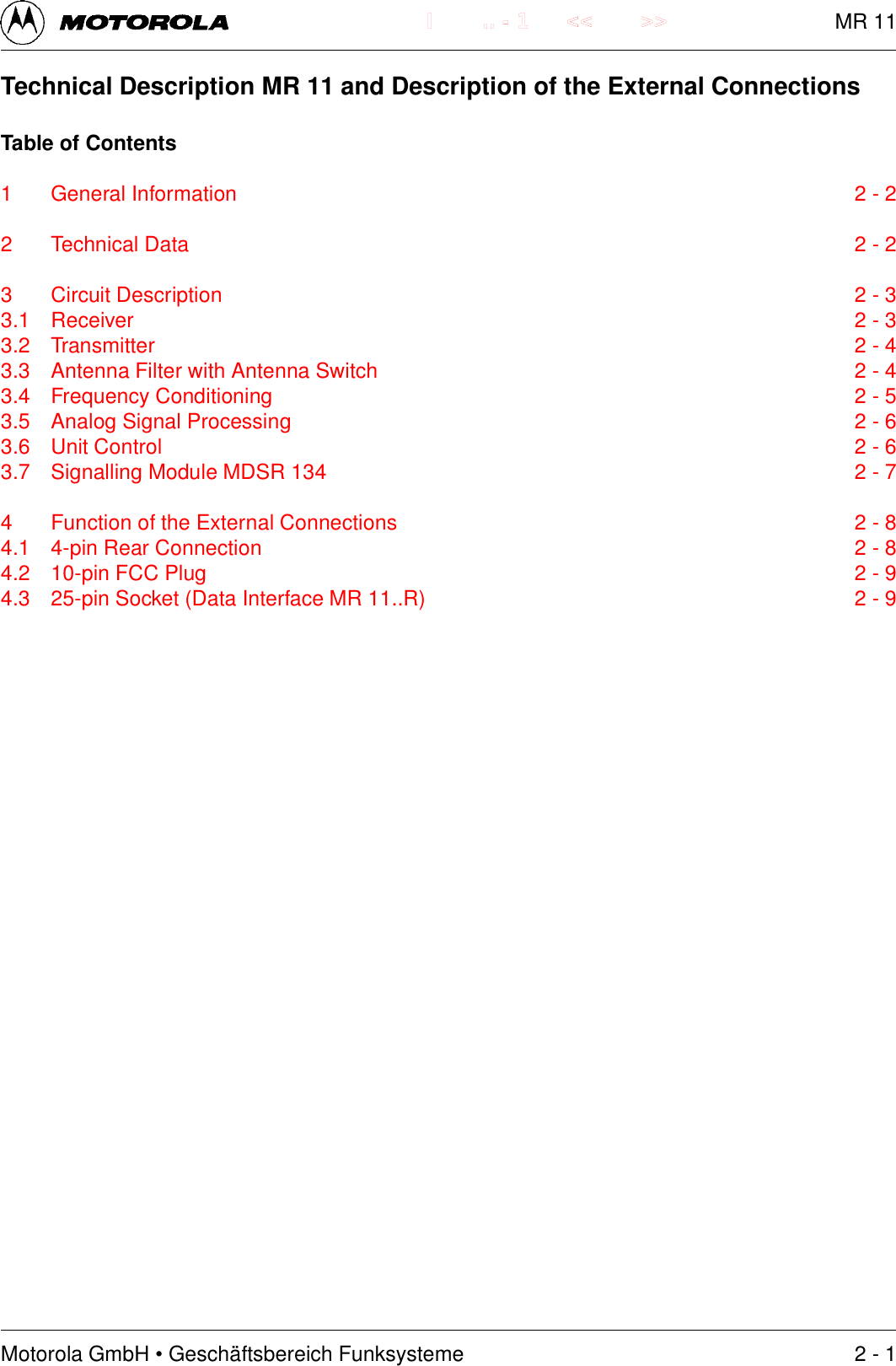
Motorola GmbH • Geschäftsbereich Funksysteme.. - 1 << >>ITechnical Description MR 11 and Description of the External ConnectionsTable of Contents1 General Information 2 - 22 Technical Data 2 - 23 Circuit Description 2 - 33.1 Receiver 2 - 33.2 Transmitter 2 - 43.3 Antenna Filter with Antenna Switch 2 - 43.4 Frequency Conditioning 2 - 53.5 Analog Signal Processing 2 - 63.6 Unit Control 2 - 63.7 Signalling Module MDSR 134 2 - 74 Function of the External Connections 2 - 84.1 4-pin Rear Connection 2 - 84.2 10-pin FCC Plug 2 - 94.3 25-pin Socket (Data Interface MR 11..R) 2 - 92 - 1MR 11
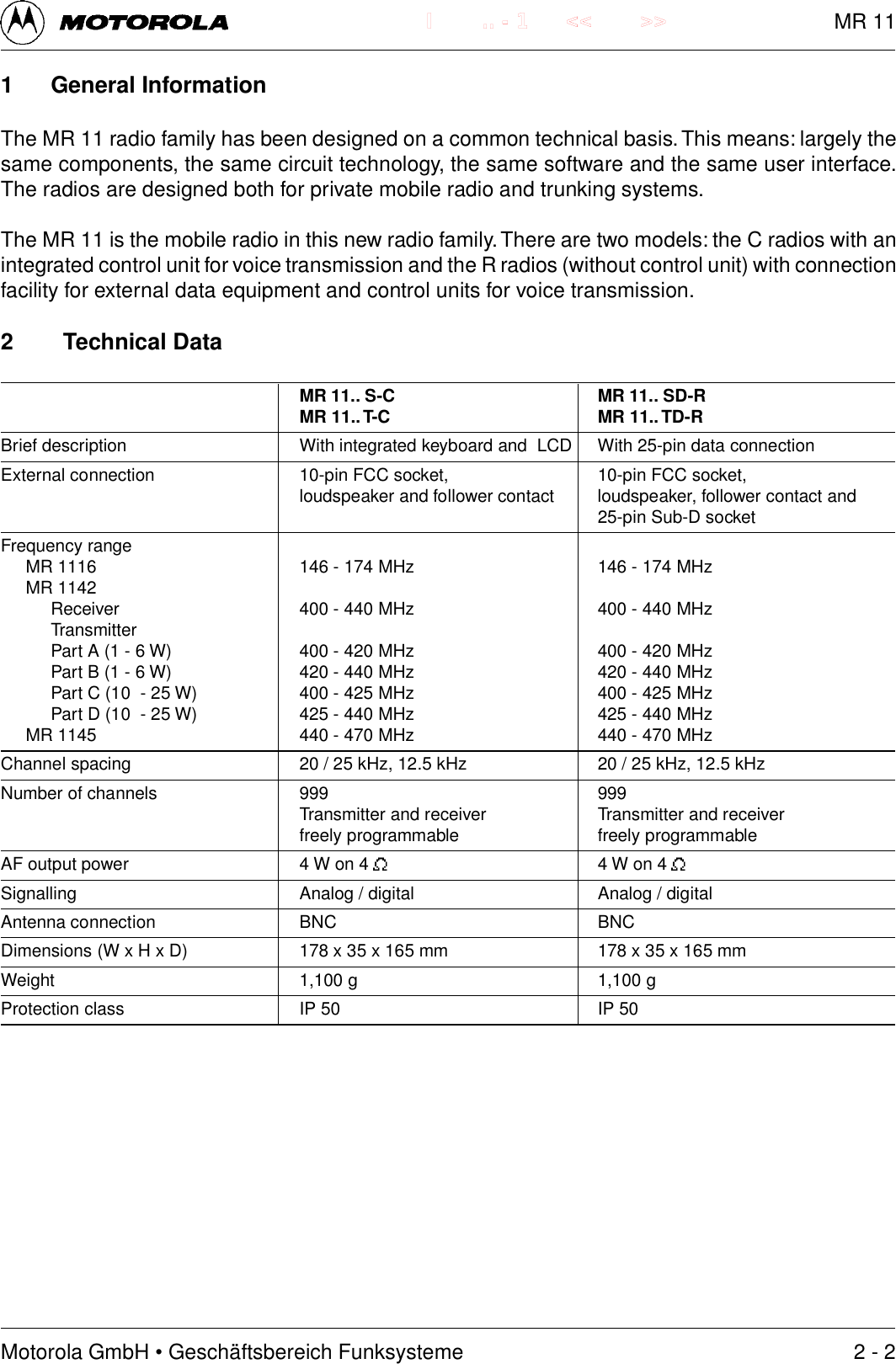
Motorola GmbH • Geschäftsbereich Funksysteme.. - 1 << >>I1 General InformationThe MR 11 radio family has been designed on a common technical basis. This means: largely thesame components, the same circuit technology, the same software and the same user interface.The radios are designed both for private mobile radio and trunking systems.The MR 11 is the mobile radio in this new radio family. There are two models: the C radios with anintegrated control unit for voice transmission and the R radios (without control unit) with connectionfacility for external data equipment and control units for voice transmission.2 Technical DataMR 11.. S-C MR 11.. SD-RMR 11.. T-C MR 11.. TD-RBrief description With integrated keyboard and  LCD With 25-pin data connectionExternal connection 10-pin FCC socket, 10-pin FCC socket,loudspeaker and follower contact loudspeaker, follower contact and25-pin Sub-D socketFrequency rangeMR 1116 146 - 174 MHz 146 - 174 MHzMR 1142Receiver 400 - 440 MHz 400 - 440 MHzTransmitterPart A (1 - 6 W) 400 - 420 MHz 400 - 420 MHzPart B (1 - 6 W) 420 - 440 MHz 420 - 440 MHzPart C (10  - 25 W) 400 - 425 MHz 400 - 425 MHzPart D (10  - 25 W) 425 - 440 MHz 425 - 440 MHzMR 1145 440 - 470 MHz 440 - 470 MHzChannel spacing 20 / 25 kHz, 12.5 kHz 20 / 25 kHz, 12.5 kHzNumber of channels 999 999Transmitter and receiver Transmitter and receiverfreely programmable freely programmableAF output power 4 W on 4  4 W on 4 Signalling Analog / digital Analog / digitalAntenna connection BNC BNCDimensions (W x H x D) 178 x 35 x 165 mm 178 x 35 x 165 mmWeight 1,100 g 1,100 gProtection class IP 50 IP 502 - 2MR 11
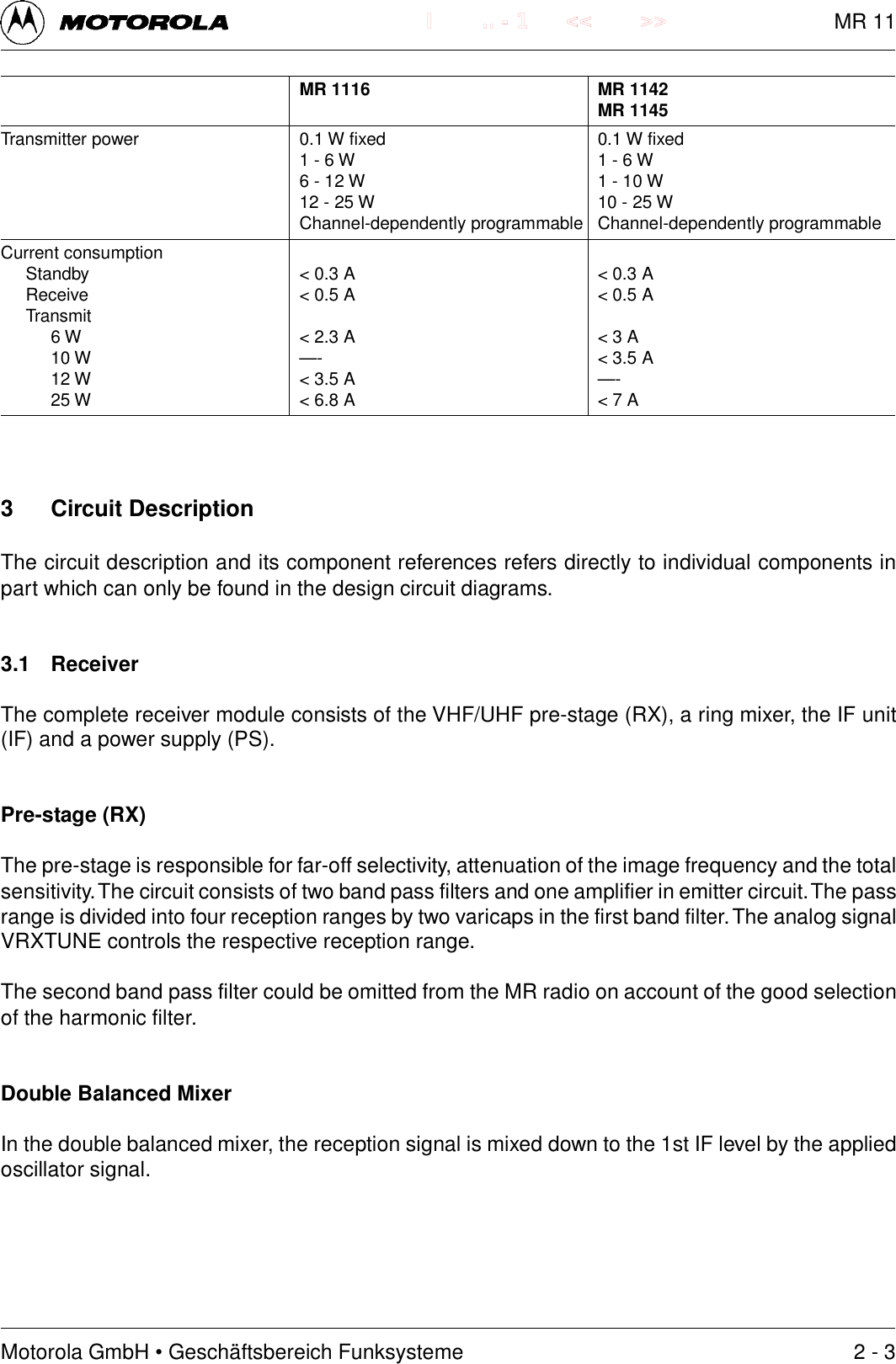
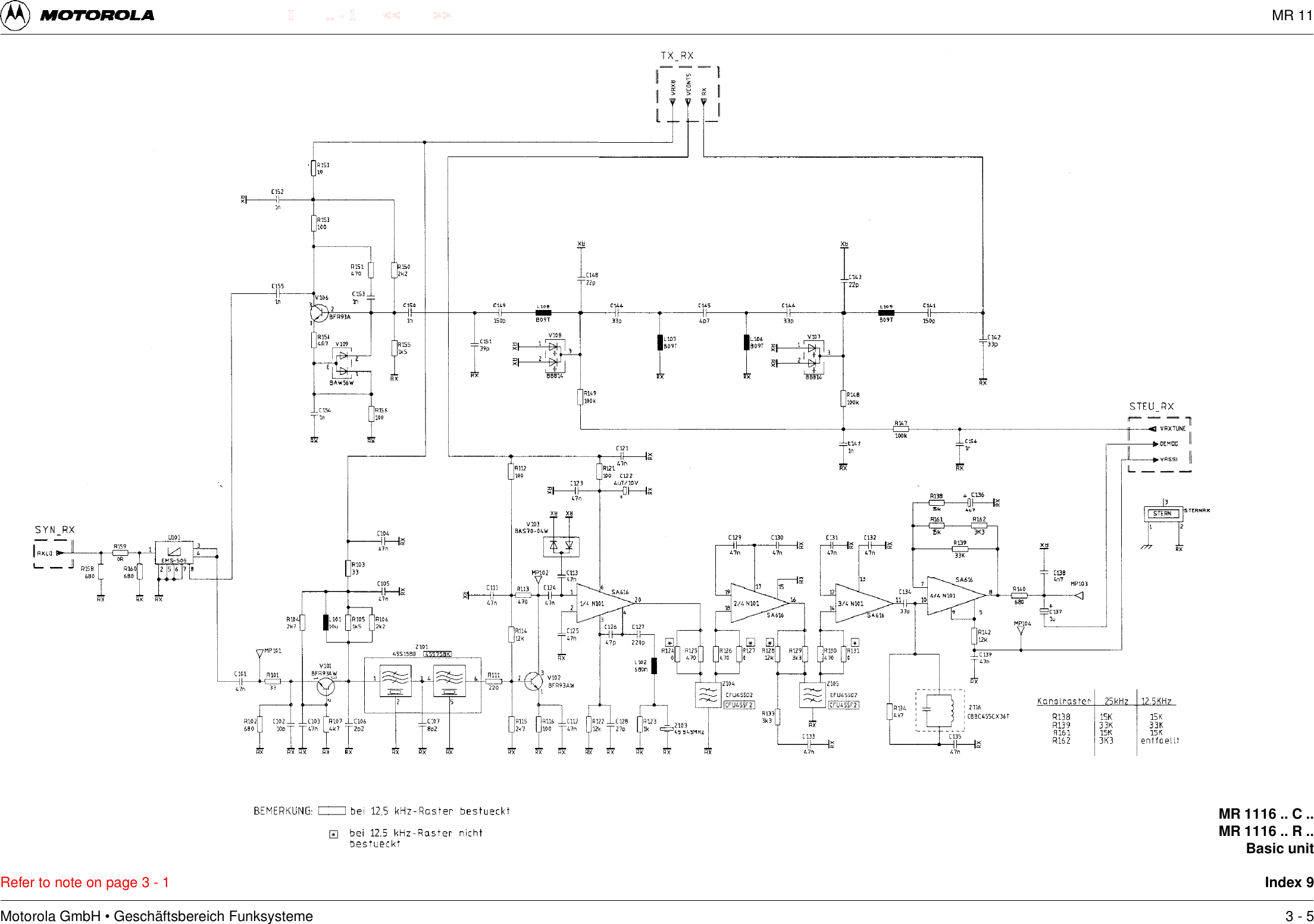
Motorola GmbH • Geschäftsbereich Funksysteme.. - 1 << >>IMR 1116 MR 1142MR 1145Transmitter power 0.1 W fixed 0.1 W fixed1 - 6 W 1 - 6 W6 - 12 W 1 - 10 W12 - 25 W 10 - 25 WChannel-dependently programmable Channel-dependently programmableCurrent consumptionStandby < 0.3 A < 0.3 AReceive < 0.5 A < 0.5 ATransmit6 W < 2.3 A < 3 A10 W —- < 3.5 A12 W < 3.5 A —-25 W < 6.8 A < 7 A3 Circuit DescriptionThe circuit description and its component references refers directly to individual components inpart which can only be found in the design circuit diagrams.3.1 ReceiverThe complete receiver module consists of the VHF/UHF pre-stage (RX), a ring mixer, the IF unit(IF) and a power supply (PS).Pre-stage (RX)The pre-stage is responsible for far-off selectivity, attenuation of the image frequency and the totalsensitivity. The circuit consists of two band pass filters and one amplifier in emitter circuit. The passrange is divided into four reception ranges by two varicaps in the first band filter. The analog signalVRXTUNE controls the respective reception range.The second band pass filter could be omitted from the MR radio on account of the good selectionof the harmonic filter.Double Balanced MixerIn the double balanced mixer, the reception signal is mixed down to the 1st IF level by the appliedoscillator signal.2 - 3MR 11
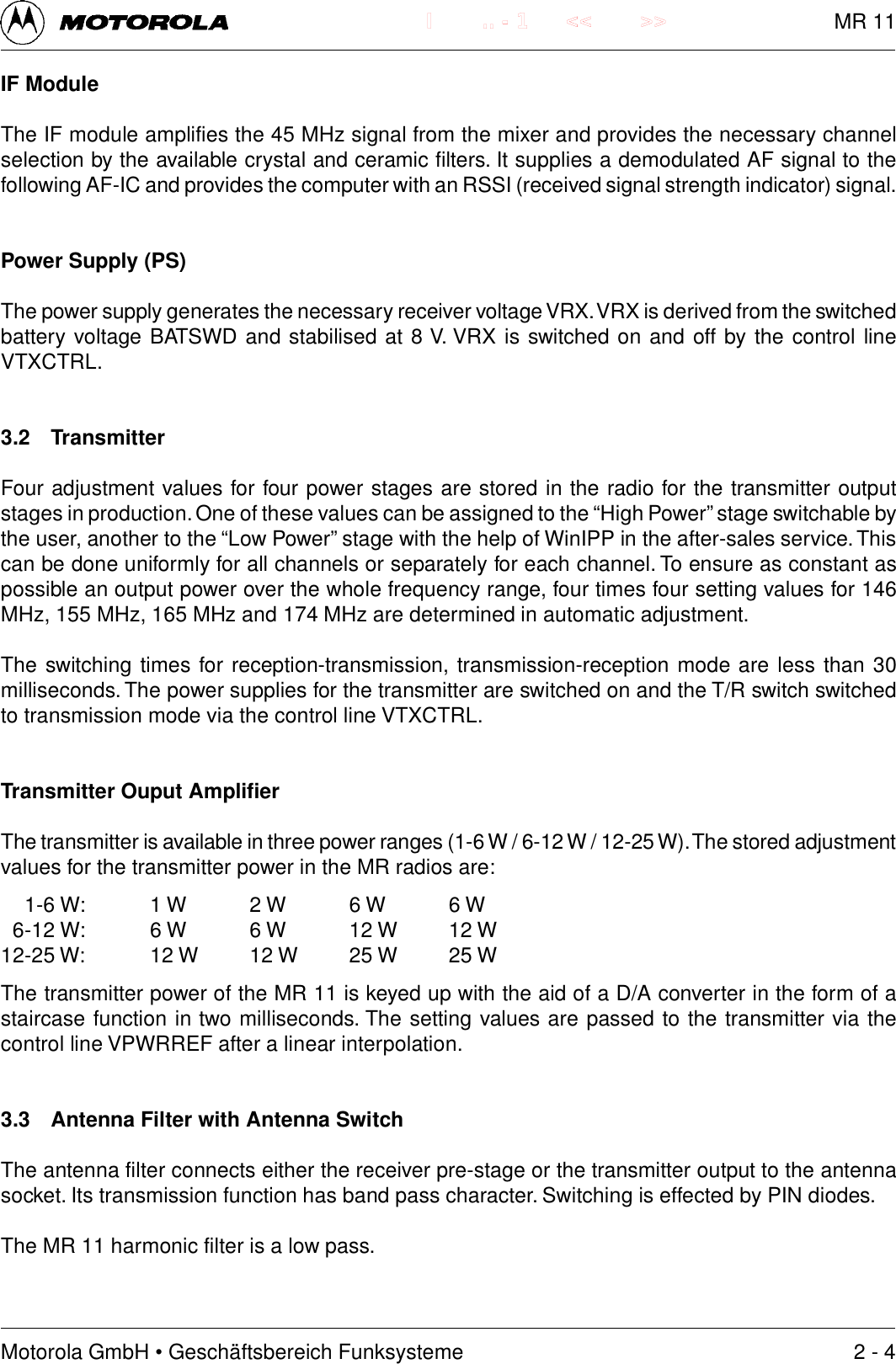
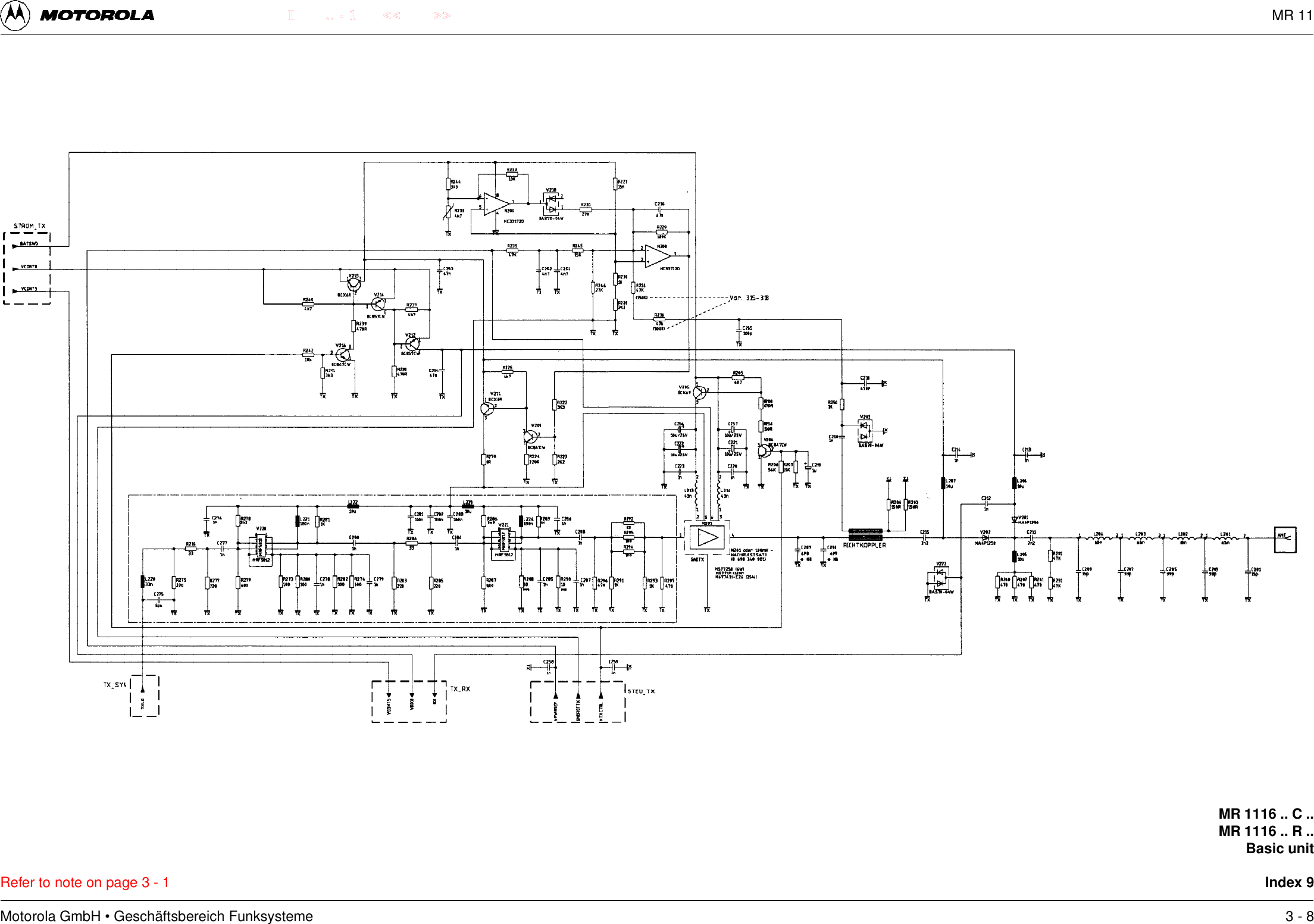
Motorola GmbH • Geschäftsbereich Funksysteme.. - 1 << >>IIF ModuleThe IF module amplifies the 45 MHz signal from the mixer and provides the necessary channelselection by the available crystal and ceramic filters. It supplies a demodulated AF signal to thefollowing AF-IC and provides the computer with an RSSI (received signal strength indicator) signal.Power Supply (PS)The power supply generates the necessary receiver voltage VRX. VRX is derived from the switchedbattery voltage BATSWD and stabilised at 8 V. VRX is switched on and off by the control lineVTXCTRL.3.2 TransmitterFour adjustment values for four power stages are stored in the radio for the transmitter outputstages in production. One of these values can be assigned to the “High Power” stage switchable bythe user, another to the “Low Power” stage with the help of WinIPP in the after-sales service. Thiscan be done uniformly for all channels or separately for each channel. To ensure as constant aspossible an output power over the whole frequency range, four times four setting values for 146MHz, 155 MHz, 165 MHz and 174 MHz are determined in automatic adjustment.The switching times for reception-transmission, transmission-reception mode are less than 30milliseconds. The power supplies for the transmitter are switched on and the T/R switch switchedto transmission mode via the control line VTXCTRL.Transmitter Ouput AmplifierThe transmitter is available in three power ranges (1-6 W / 6-12 W / 12-25 W). The stored adjustmentvalues for the transmitter power in the MR radios are:1-6 W: 1 W 2 W 6 W 6 W6-12 W: 6 W 6 W 12 W 12 W12-25 W: 12 W 12 W 25 W 25 WThe transmitter power of the MR 11 is keyed up with the aid of a D/A converter in the form of astaircase function in two milliseconds. The setting values are passed to the transmitter via thecontrol line VPWRREF after a linear interpolation.3.3 Antenna Filter with Antenna SwitchThe antenna filter connects either the receiver pre-stage or the transmitter output to the antennasocket. Its transmission function has band pass character. Switching is effected by PIN diodes.The MR 11 harmonic filter is a low pass.2 - 4MR 11
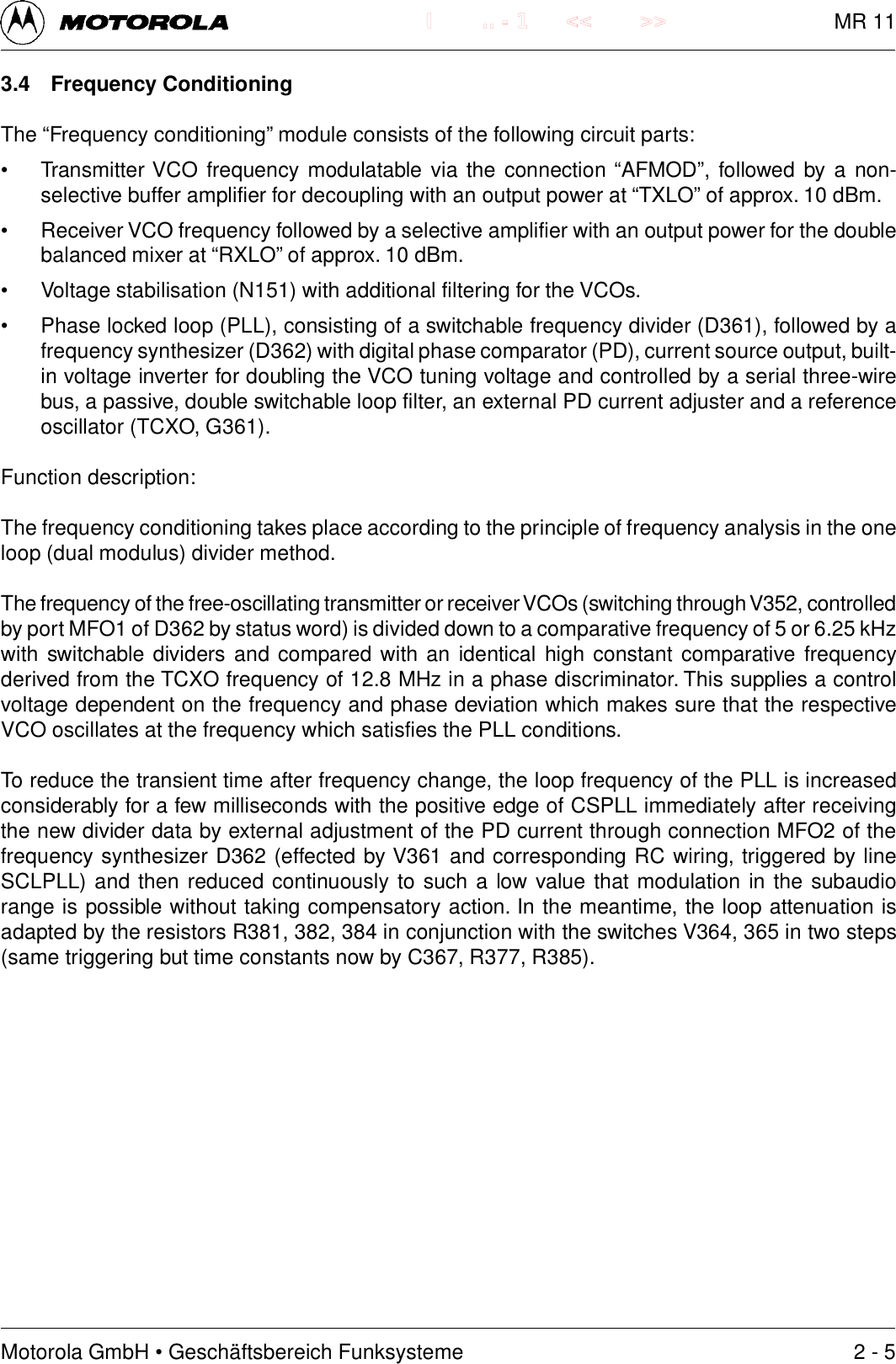
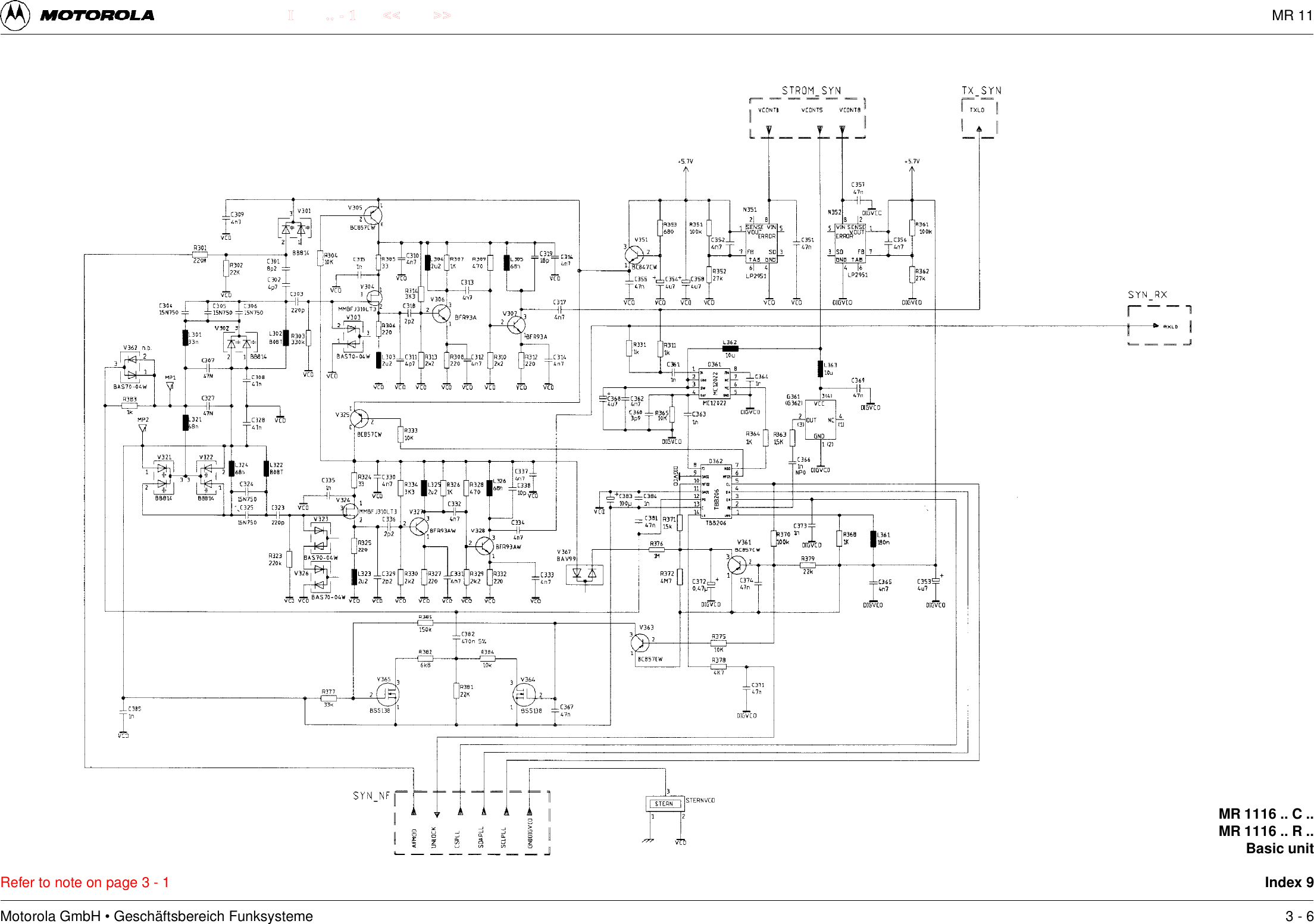
Motorola GmbH • Geschäftsbereich Funksysteme.. - 1 << >>I3.4 Frequency ConditioningThe “Frequency conditioning” module consists of the following circuit parts:• Transmitter VCO frequency modulatable via the connection “AFMOD”, followed by a non-selective buffer amplifier for decoupling with an output power at “TXLO” of approx. 10 dBm.• Receiver VCO frequency followed by a selective amplifier with an output power for the doublebalanced mixer at “RXLO” of approx. 10 dBm.• Voltage stabilisation (N151) with additional filtering for the VCOs.• Phase locked loop (PLL), consisting of a switchable frequency divider (D361), followed by afrequency synthesizer (D362) with digital phase comparator (PD), current source output, built-in voltage inverter for doubling the VCO tuning voltage and controlled by a serial three-wirebus, a passive, double switchable loop filter, an external PD current adjuster and a referenceoscillator (TCXO, G361).Function description:The frequency conditioning takes place according to the principle of frequency analysis in the oneloop (dual modulus) divider method.The frequency of the free-oscillating transmitter or receiver VCOs (switching through V352, controlledby port MFO1 of D362 by status word) is divided down to a comparative frequency of 5 or 6.25 kHzwith switchable dividers and compared with an identical high constant comparative frequencyderived from the TCXO frequency of 12.8 MHz in a phase discriminator. This supplies a controlvoltage dependent on the frequency and phase deviation which makes sure that the respectiveVCO oscillates at the frequency which satisfies the PLL conditions.To reduce the transient time after frequency change, the loop frequency of the PLL is increasedconsiderably for a few milliseconds with the positive edge of CSPLL immediately after receivingthe new divider data by external adjustment of the PD current through connection MFO2 of thefrequency synthesizer D362 (effected by V361 and corresponding RC wiring, triggered by lineSCLPLL) and then reduced continuously to such a low value that modulation in the subaudiorange is possible without taking compensatory action. In the meantime, the loop attenuation isadapted by the resistors R381, 382, 384 in conjunction with the switches V364, 365 in two steps(same triggering but time constants now by C367, R377, R385).2 - 5MR 11
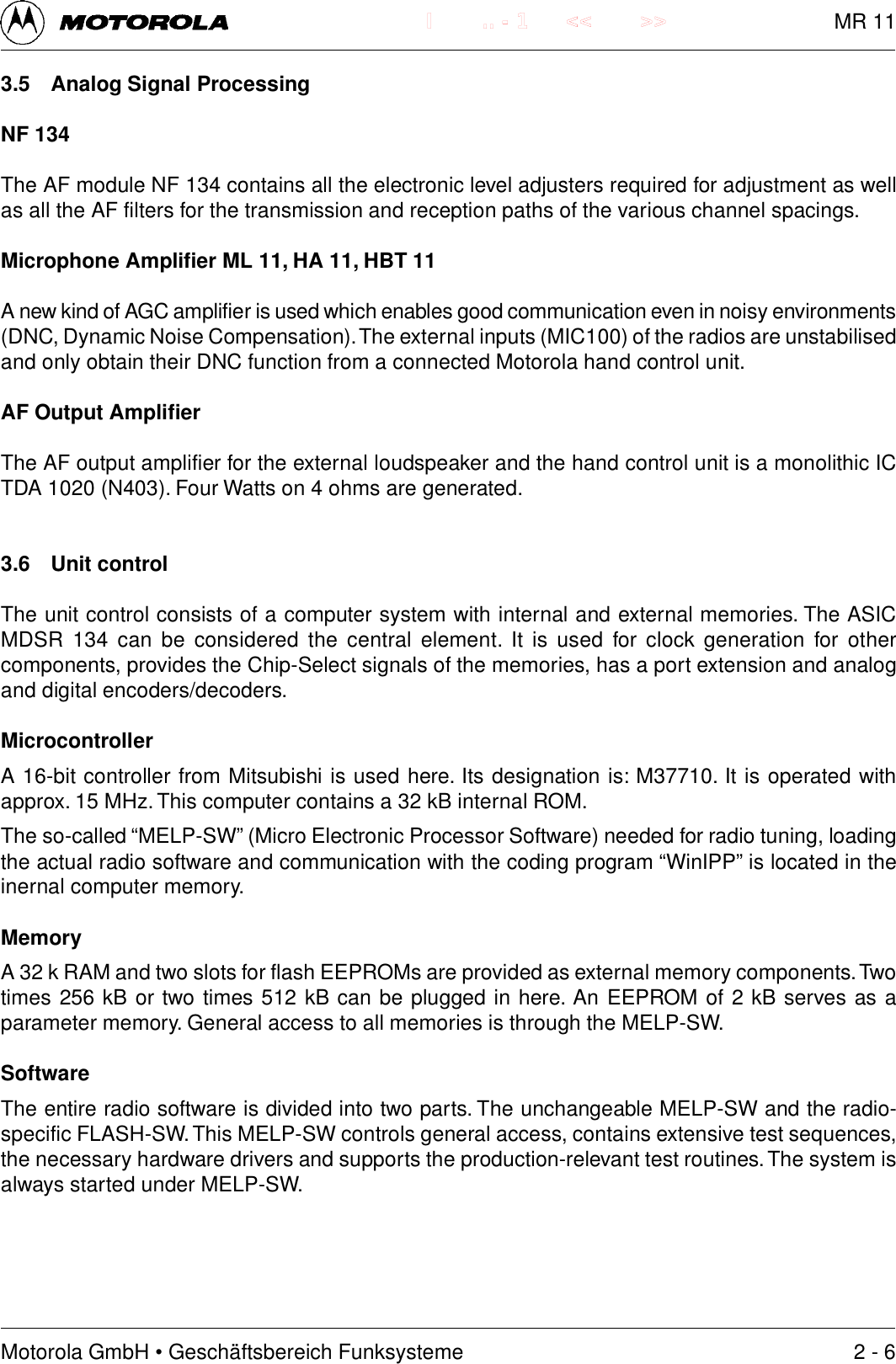
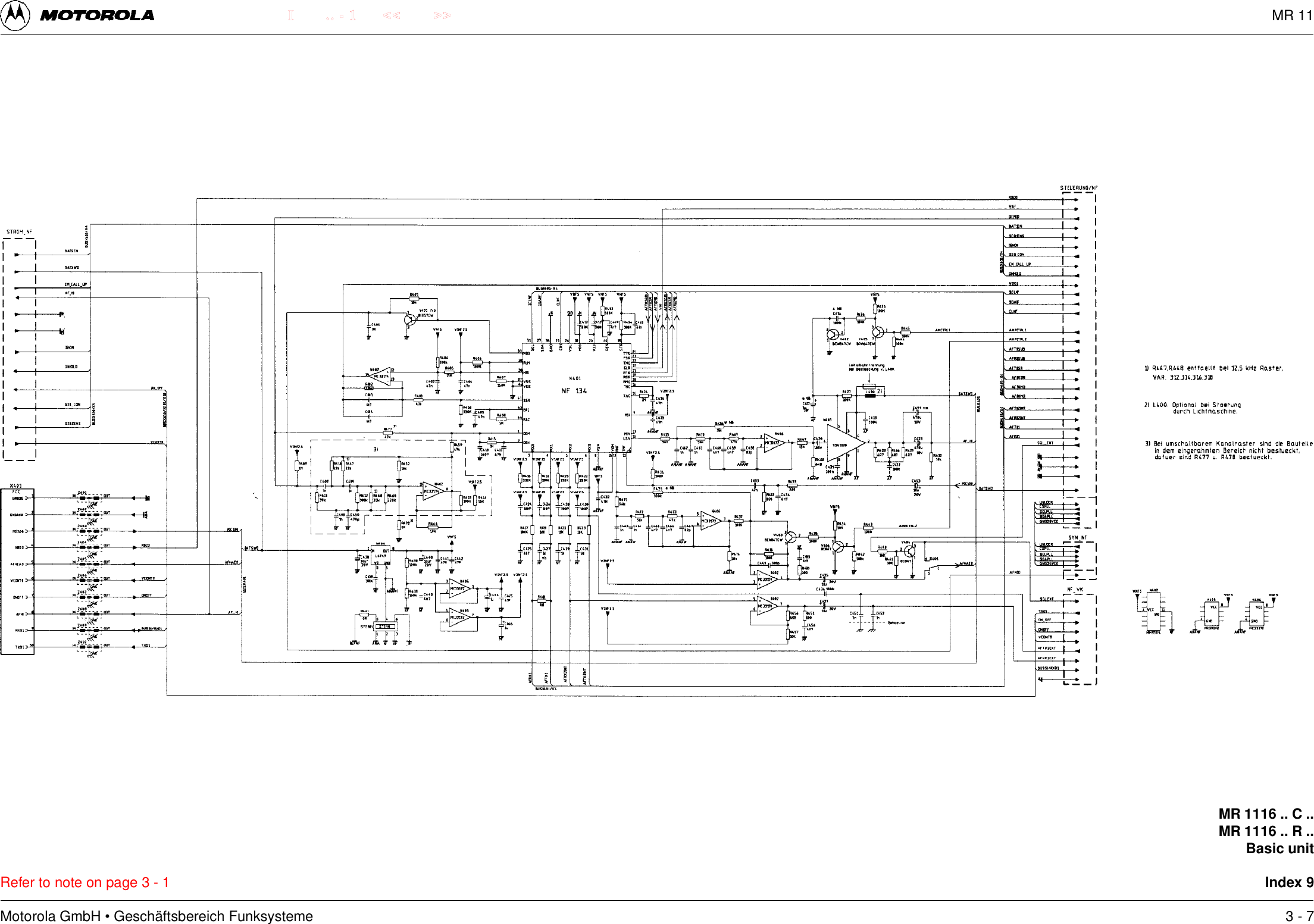
Motorola GmbH • Geschäftsbereich Funksysteme.. - 1 << >>I3.5 Analog Signal ProcessingNF 134The AF module NF 134 contains all the electronic level adjusters required for adjustment as wellas all the AF filters for the transmission and reception paths of the various channel spacings.Microphone Amplifier ML 11, HA 11, HBT 11A new kind of AGC amplifier is used which enables good communication even in noisy environments(DNC, Dynamic Noise Compensation). The external inputs (MIC100) of the radios are unstabilisedand only obtain their DNC function from a connected Motorola hand control unit.AF Output AmplifierThe AF output amplifier for the external loudspeaker and the hand control unit is a monolithic ICTDA 1020 (N403). Four Watts on 4 ohms are generated.3.6 Unit controlThe unit control consists of a computer system with internal and external memories. The ASICMDSR  134  can  be  considered the  central  element.  It is used  for  clock generation  for  othercomponents, provides the Chip-Select signals of the memories, has a port extension and analogand digital encoders/decoders.MicrocontrollerA 16-bit controller from Mitsubishi is used here. Its designation is: M37710. It is operated withapprox. 15 MHz. This computer contains a 32 kB internal ROM.The so-called “MELP-SW” (Micro Electronic Processor Software) needed for radio tuning, loadingthe actual radio software and communication with the coding program “WinIPP” is located in theinernal computer memory.MemoryA 32 k RAM and two slots for flash EEPROMs are provided as external memory components. Twotimes 256 kB or two times 512 kB can be plugged in here. An EEPROM of 2 kB serves as aparameter memory. General access to all memories is through the MELP-SW.SoftwareThe entire radio software is divided into two parts. The unchangeable MELP-SW and the radio-specific FLASH-SW. This MELP-SW controls general access, contains extensive test sequences,the necessary hardware drivers and supports the production-relevant test routines. The system isalways started under MELP-SW.2 - 6MR 11
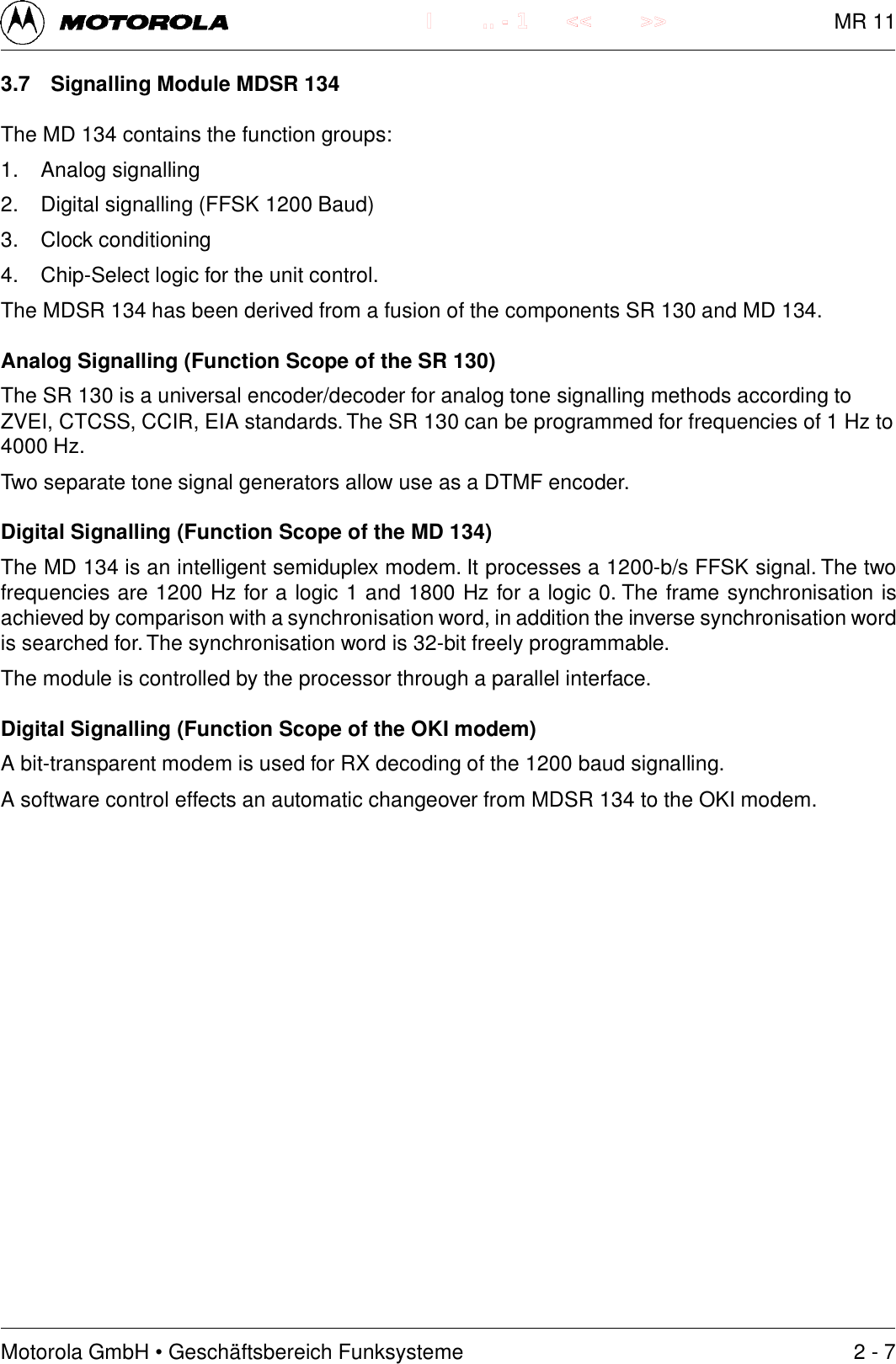
Motorola GmbH • Geschäftsbereich Funksysteme.. - 1 << >>I3.7 Signalling Module MDSR 134The MD 134 contains the function groups:1. Analog signalling2. Digital signalling (FFSK 1200 Baud)3. Clock conditioning4. Chip-Select logic for the unit control.The MDSR 134 has been derived from a fusion of the components SR 130 and MD 134.Analog Signalling (Function Scope of the SR 130)The SR 130 is a universal encoder/decoder for analog tone signalling methods according toZVEI, CTCSS, CCIR, EIA standards. The SR 130 can be programmed for frequencies of 1 Hz to4000 Hz.Two separate tone signal generators allow use as a DTMF encoder.Digital Signalling (Function Scope of the MD 134)The MD 134 is an intelligent semiduplex modem. It processes a 1200-b/s FFSK signal. The twofrequencies are 1200 Hz for a logic 1 and 1800 Hz for a logic 0. The frame synchronisation isachieved by comparison with a synchronisation word, in addition the inverse synchronisation wordis searched for. The synchronisation word is 32-bit freely programmable.The module is controlled by the processor through a parallel interface.Digital Signalling (Function Scope of the OKI modem)A bit-transparent modem is used for RX decoding of the 1200 baud signalling.A software control effects an automatic changeover from MDSR 134 to the OKI modem.2 - 7MR 11
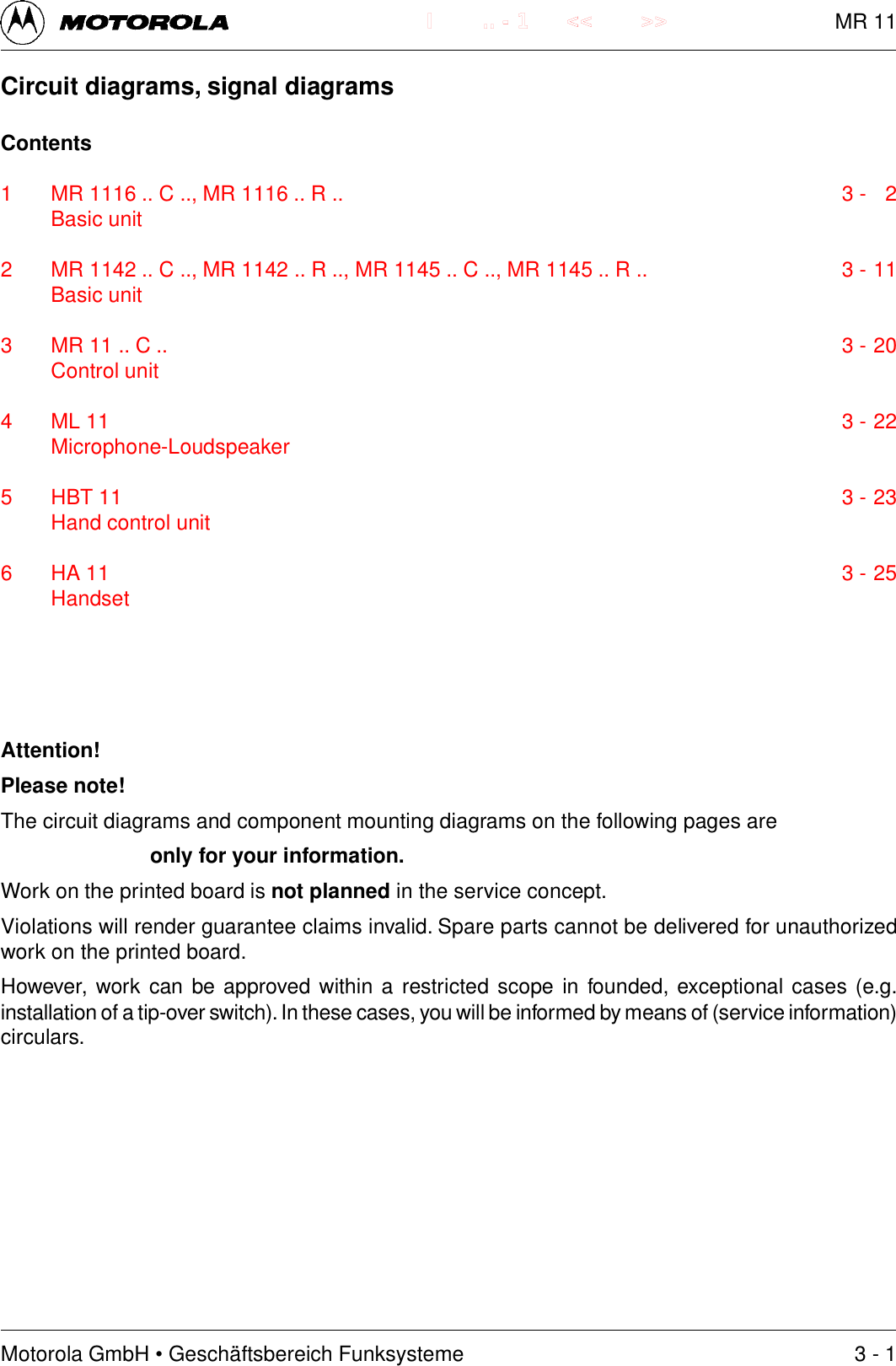
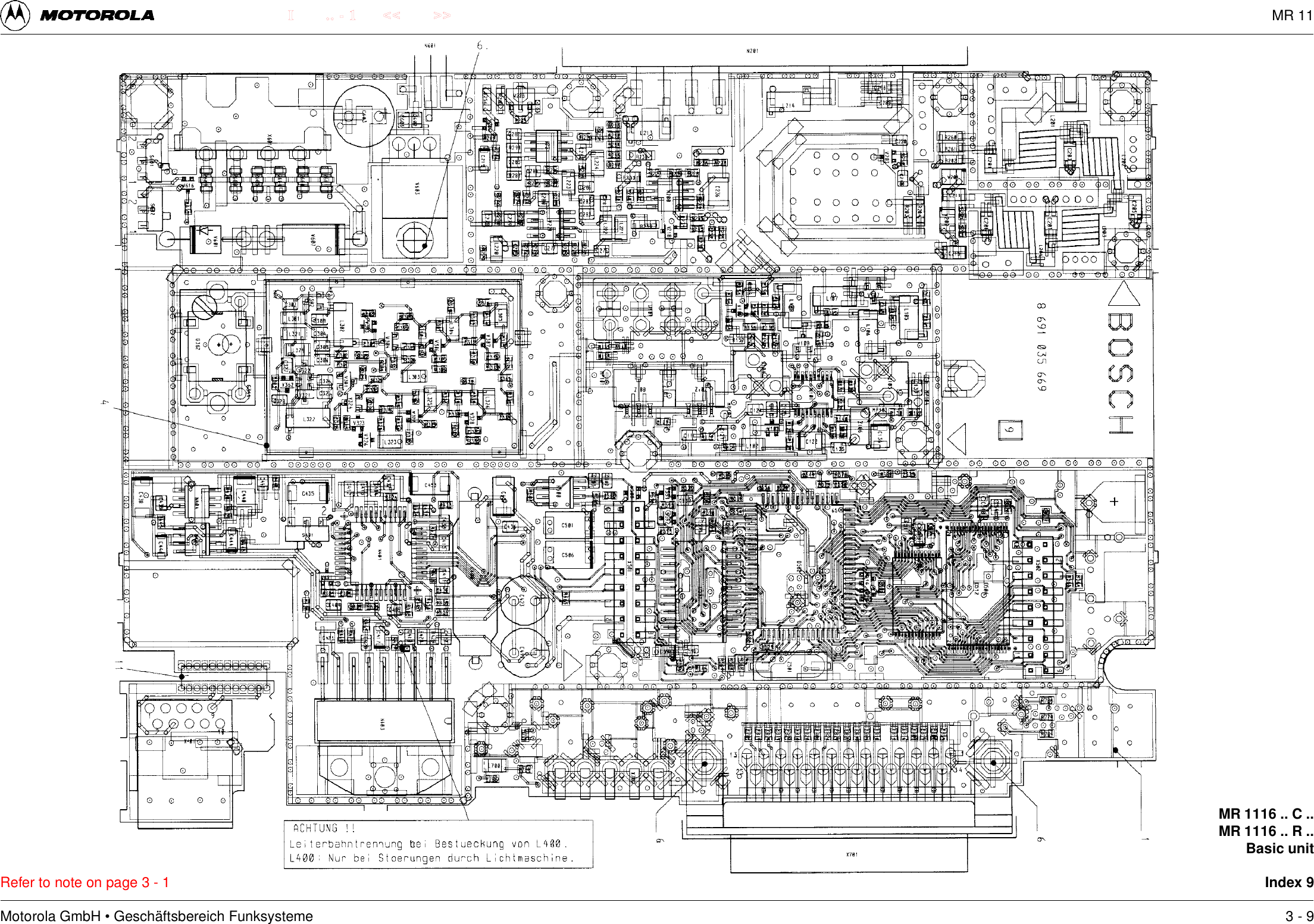
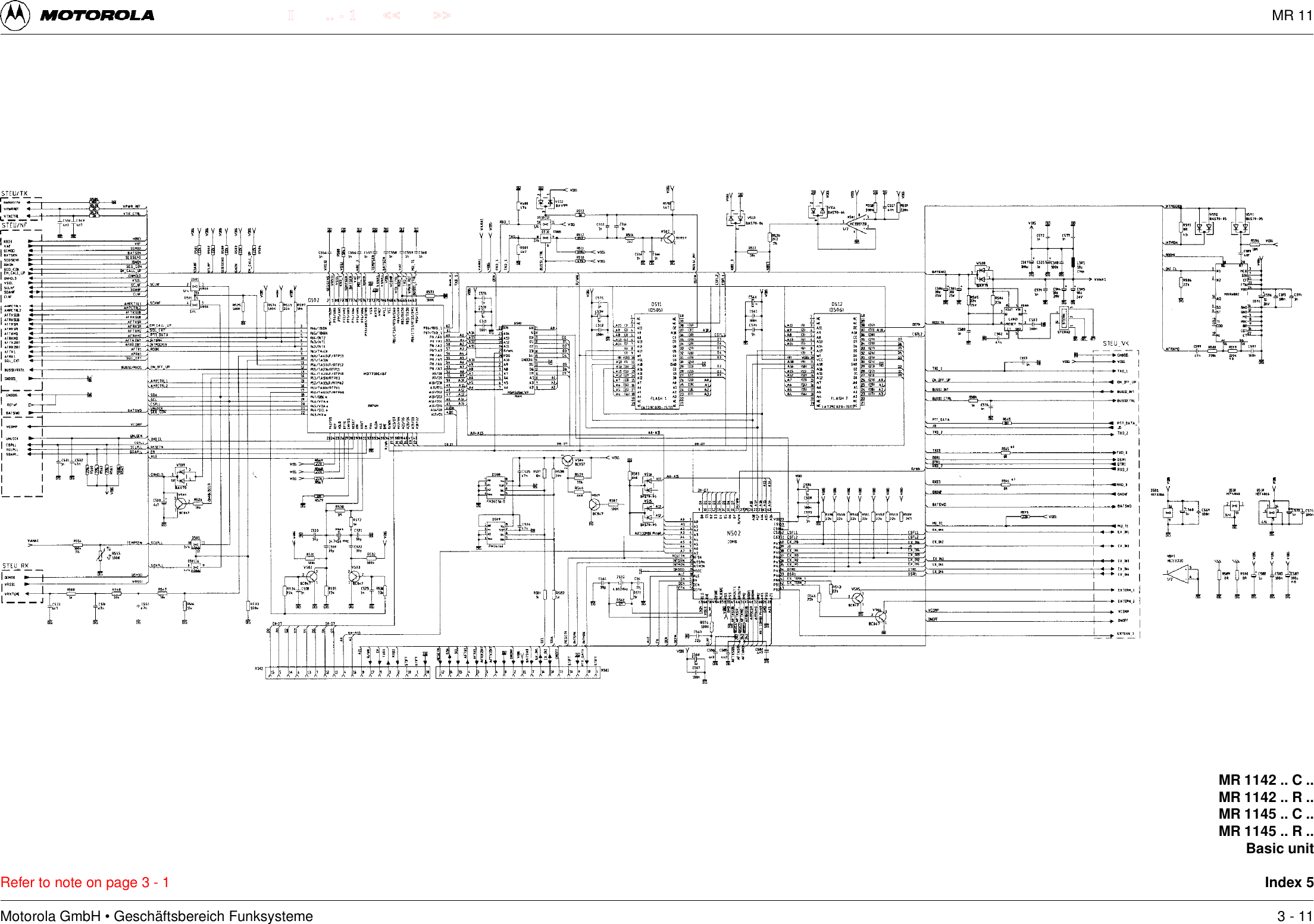
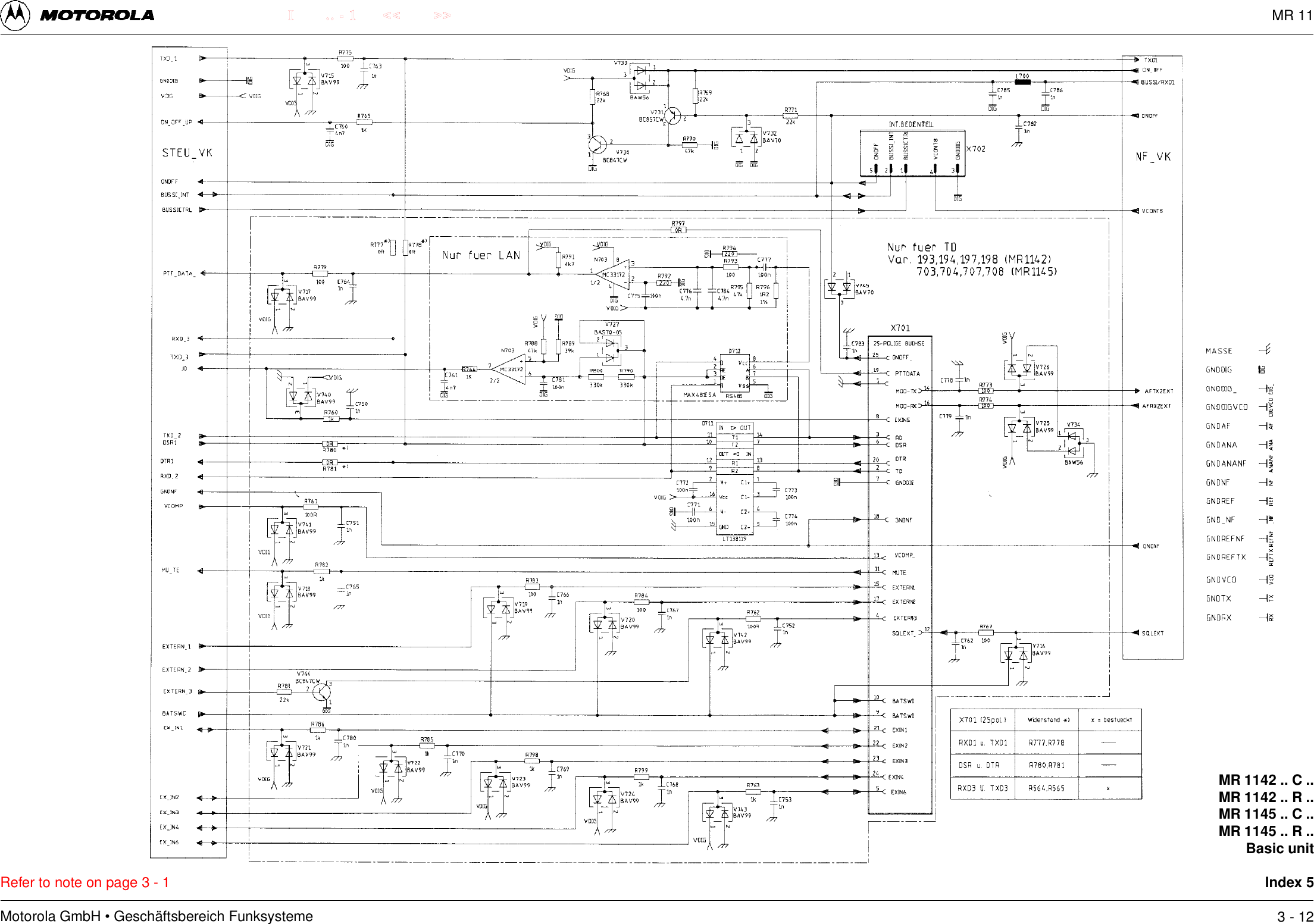
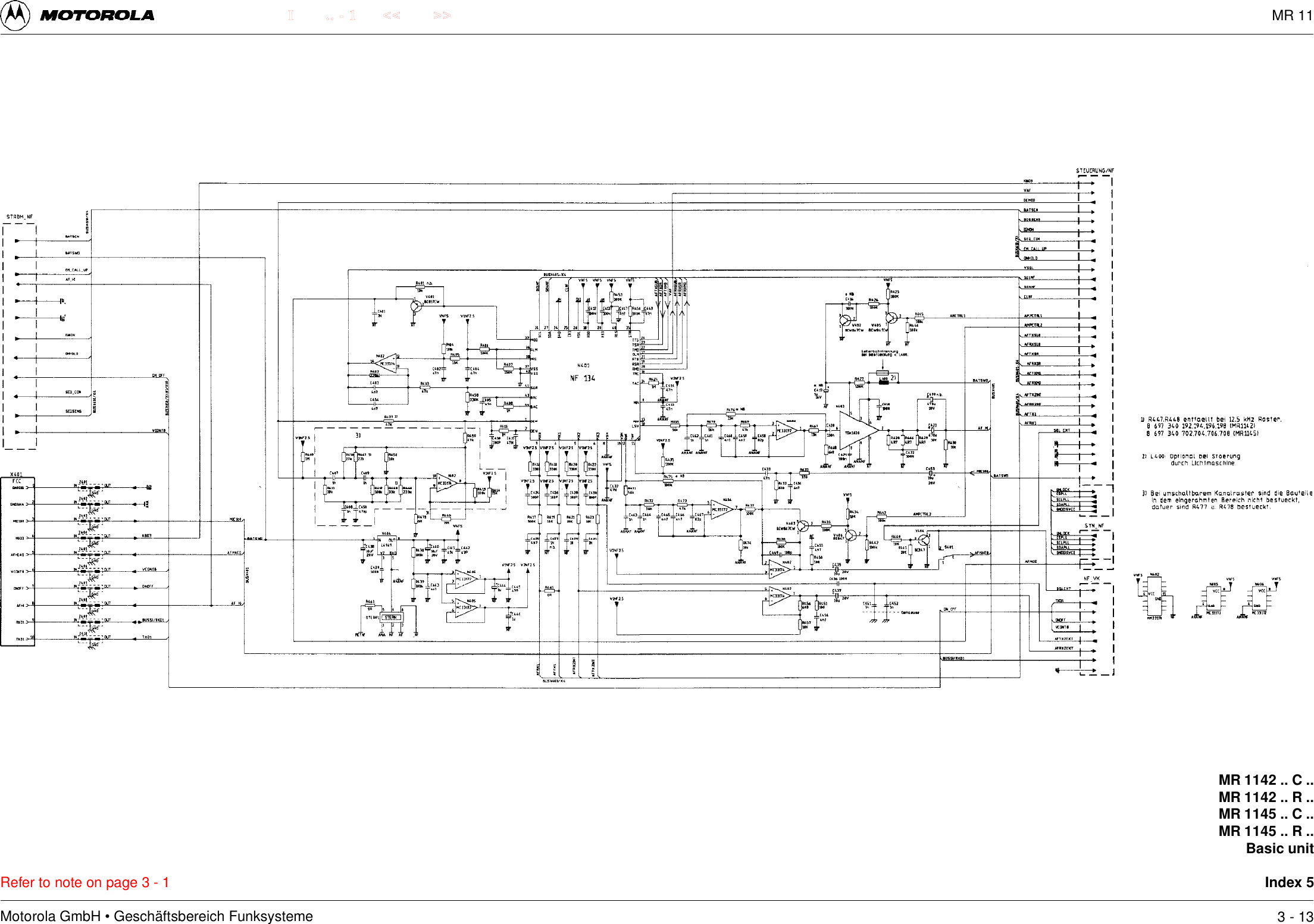
Motorola GmbH • Geschäftsbereich Funksysteme.. - 1 << >>I3 - 1Circuit diagrams, signal diagramsContents1 MR 1116 .. C .., MR 1116 .. R .. 3 - 2Basic unit2 MR 1142 .. C .., MR 1142 .. R .., MR 1145 .. C .., MR 1145 .. R .. 3 - 11Basic unit3 MR 11 .. C .. 3 - 20Control unit4 ML 11 3 - 22Microphone-Loudspeaker5 HBT 11 3 - 23Hand control unit6 HA 11 3 - 25HandsetAttention!Please note!The circuit diagrams and component mounting diagrams on the following pages areonly for your information.Work on the printed board is not planned in the service concept.Violations will render guarantee claims invalid. Spare parts cannot be delivered for unauthorizedwork on the printed board.However, work can be approved within a restricted scope in founded, exceptional cases (e.g.installation of a tip-over switch). In these cases, you will be informed by means of (service information)circulars.MR 11
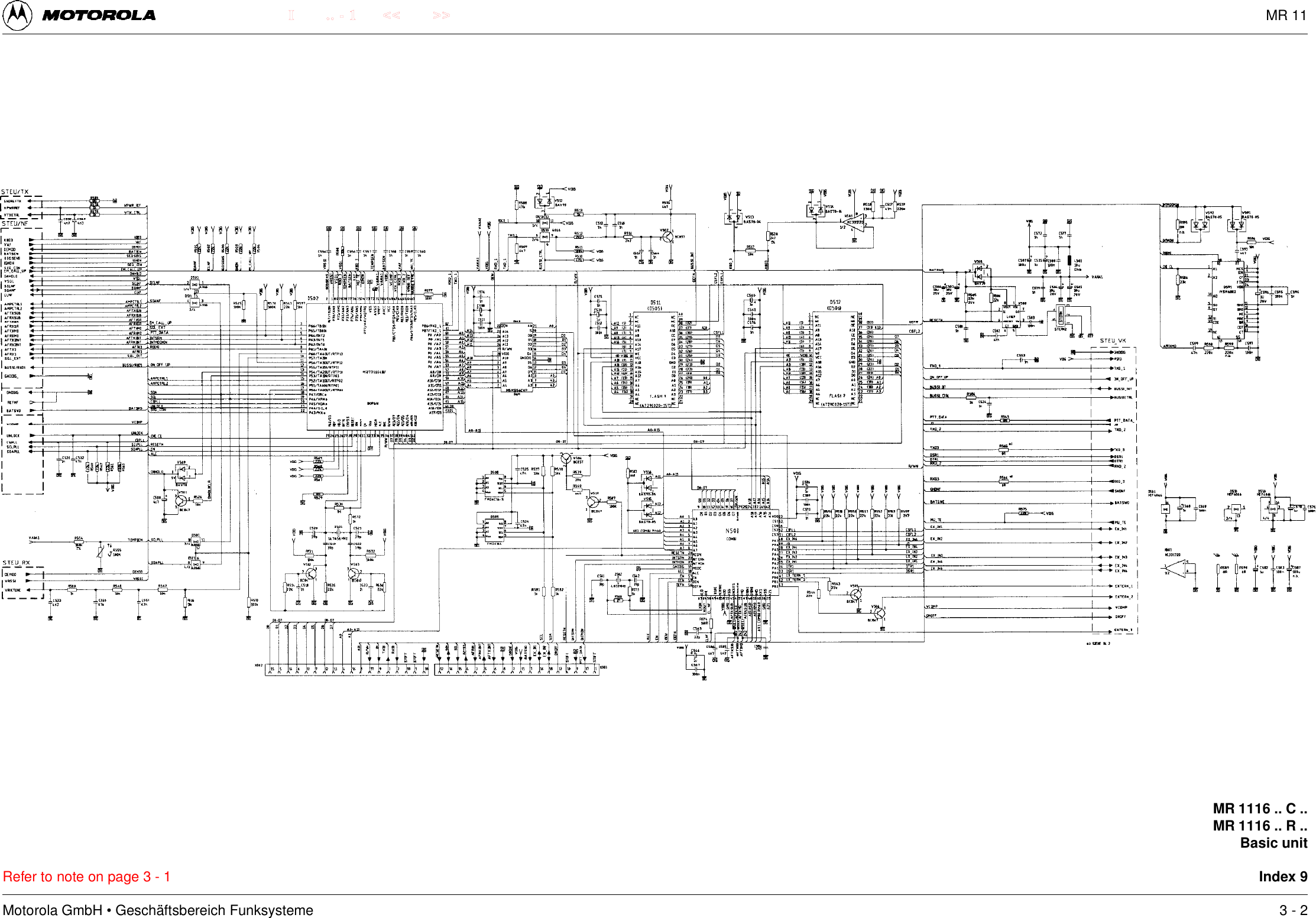
Motorola GmbH • Geschäftsbereich Funksysteme.. - 1 << >>IRefer to note on page 3 - 1MR 1116 .. C ..MR 1116 .. R ..Basic unitIndex 93 - 2MR 11
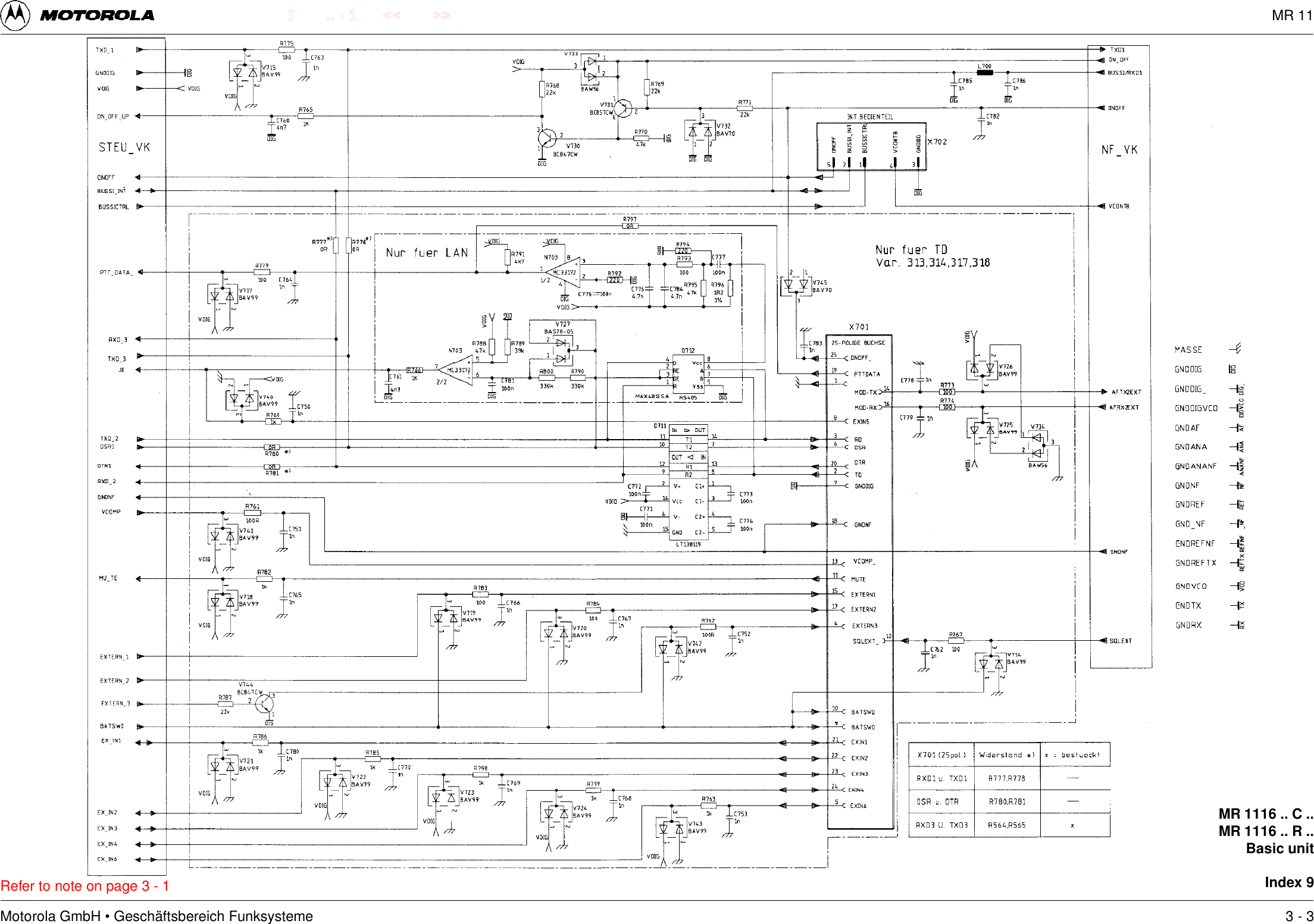
Motorola GmbH • Geschäftsbereich Funksysteme.. - 1 << >>IRefer to note on page 3 - 1MR 1116 .. C ..MR 1116 .. R ..Basic unitIndex 93 - 3MR 11
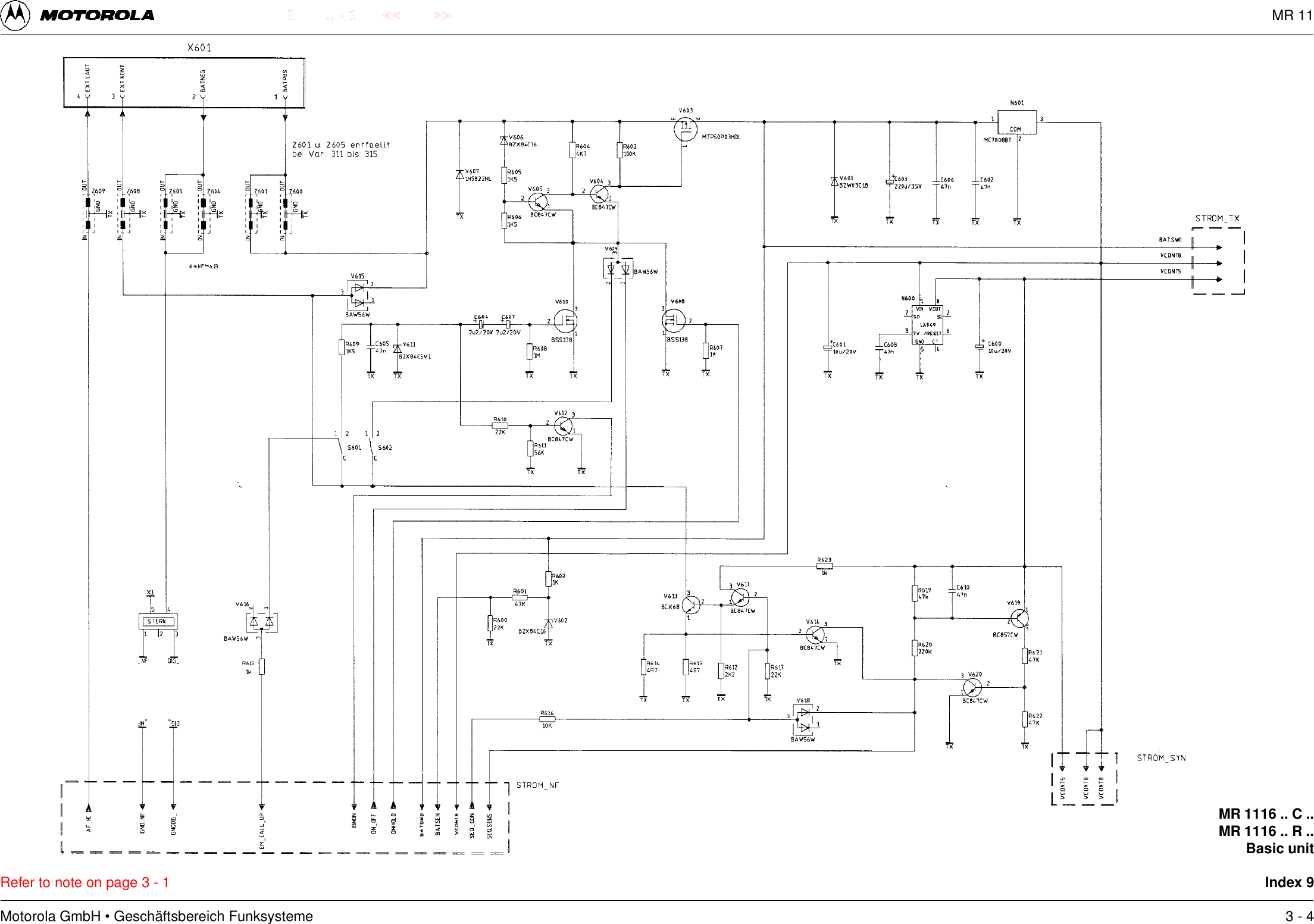
Motorola GmbH • Geschäftsbereich Funksysteme.. - 1 << >>IRefer to note on page 3 - 1MR 1116 .. C ..MR 1116 .. R ..Basic unitIndex 93 - 4MR 11
Motorola GmbH • Geschäftsbereich Funksysteme.. - 1 << >>IRefer to note on page 3 - 1MR 1116 .. C ..MR 1116 .. R ..Basic unitIndex 93 - 5MR 11
Motorola GmbH • Geschäftsbereich Funksysteme.. - 1 << >>IRefer to note on page 3 - 1MR 1116 .. C ..MR 1116 .. R ..Basic unitIndex 93 - 6MR 11
Motorola GmbH • Geschäftsbereich Funksysteme.. - 1 << >>IRefer to note on page 3 - 1MR 1116 .. C ..MR 1116 .. R ..Basic unitIndex 93 - 7MR 11
Motorola GmbH • Geschäftsbereich Funksysteme.. - 1 << >>IRefer to note on page 3 - 1MR 1116 .. C ..MR 1116 .. R ..Basic unitIndex 93 - 8MR 11
Motorola GmbH • Geschäftsbereich Funksysteme.. - 1 << >>IRefer to note on page 3 - 1MR 1116 .. C ..MR 1116 .. R ..Basic unitIndex 93 - 9MR 11
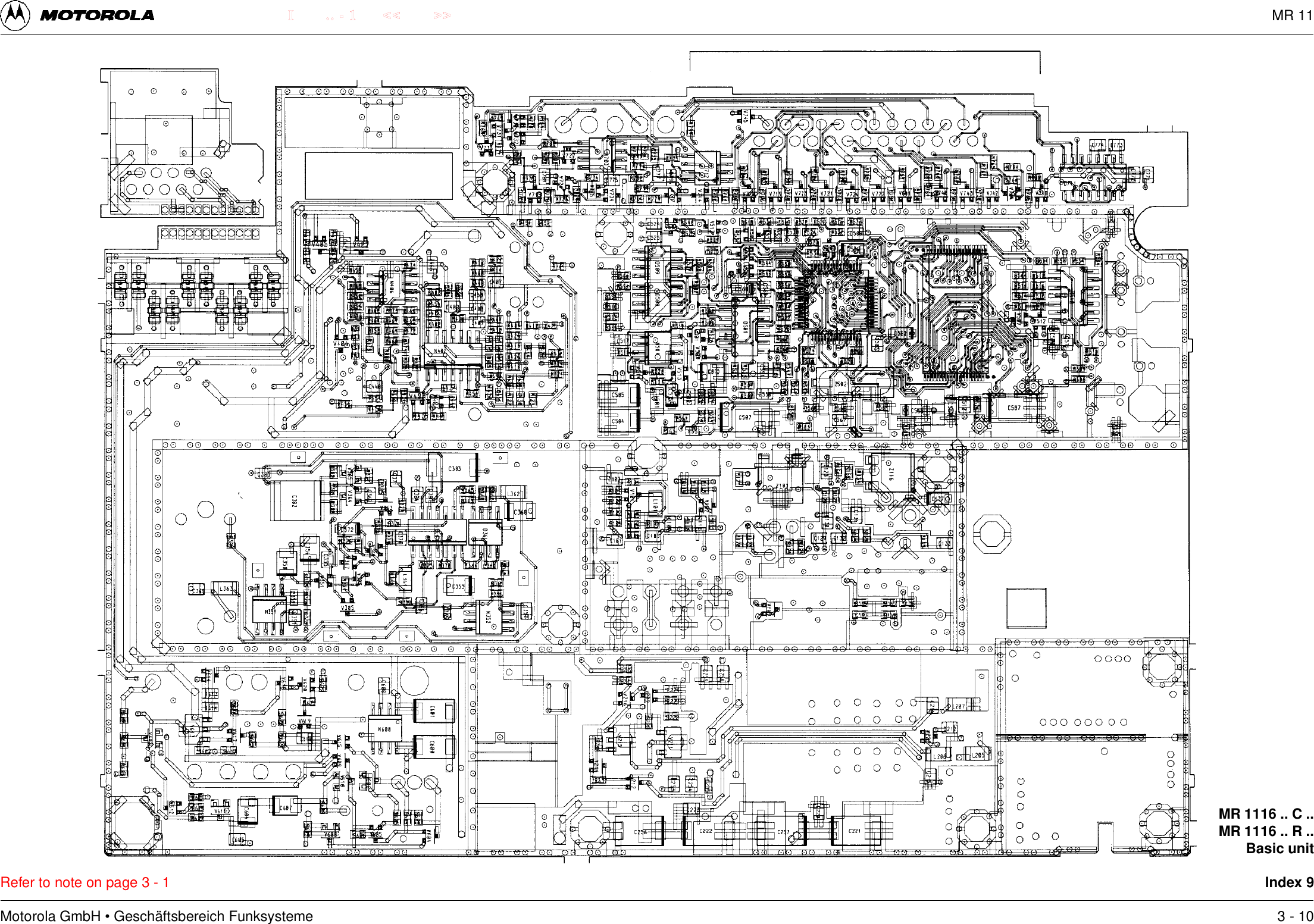
Motorola GmbH • Geschäftsbereich Funksysteme.. - 1 << >>IRefer to note on page 3 - 1MR 1116 .. C ..MR 1116 .. R ..Basic unitIndex 93 - 10MR 11
Motorola GmbH • Geschäftsbereich Funksysteme.. - 1 << >>IRefer to note on page 3 - 1MR 1142 .. C ..MR 1142 .. R ..MR 1145 .. C ..MR 1145 .. R ..Basic unitIndex 53 - 11MR 11
Motorola GmbH • Geschäftsbereich Funksysteme.. - 1 << >>IRefer to note on page 3 - 1MR 1142 .. C ..MR 1142 .. R ..MR 1145 .. C ..MR 1145 .. R ..Basic unitIndex 53 - 12MR 11
Motorola GmbH • Geschäftsbereich Funksysteme.. - 1 << >>IRefer to note on page 3 - 1MR 1142 .. C ..MR 1142 .. R ..MR 1145 .. C ..MR 1145 .. R ..Basic unitIndex 53 - 13MR 11
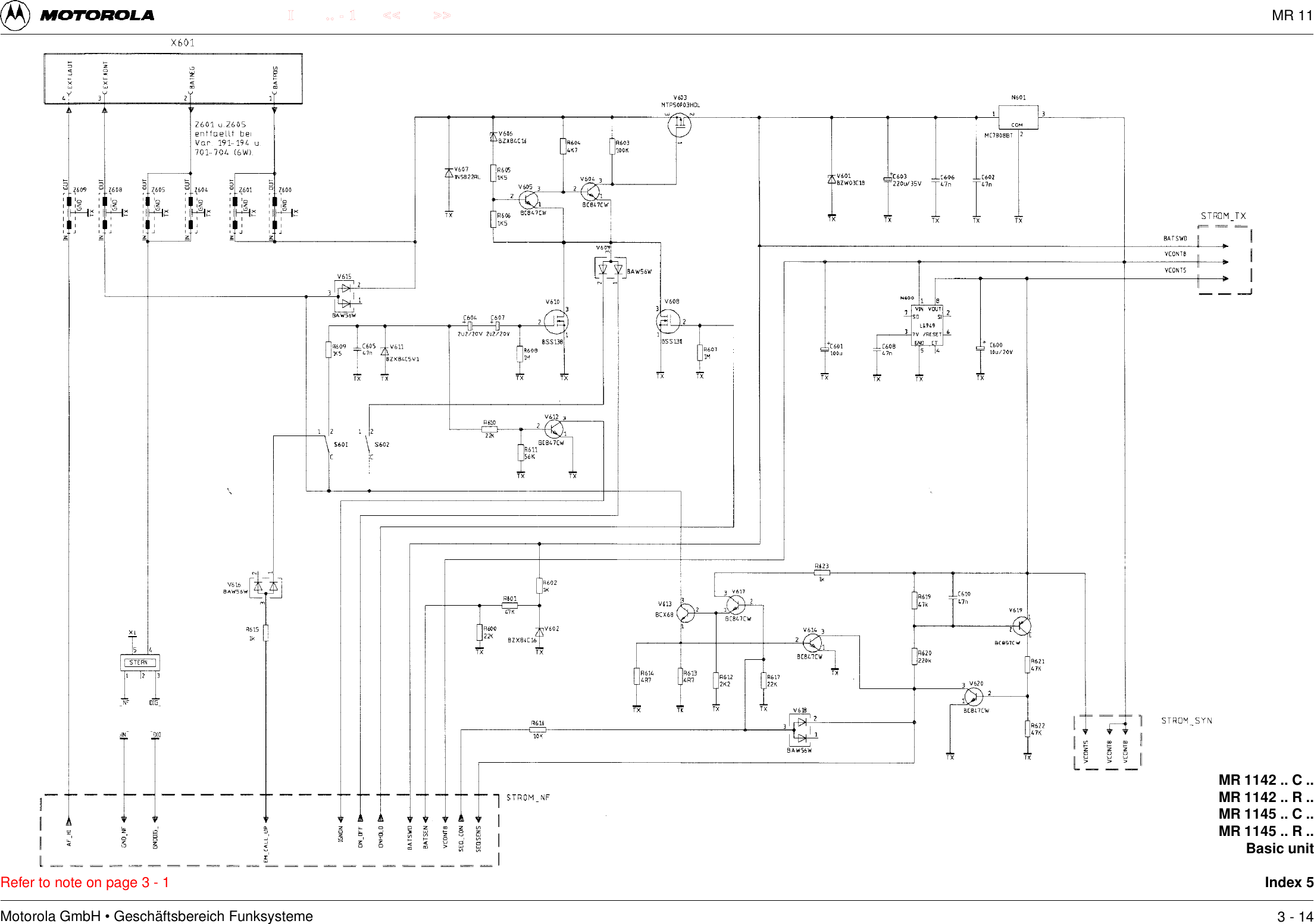
Motorola GmbH • Geschäftsbereich Funksysteme.. - 1 << >>IRefer to note on page 3 - 1MR 1142 .. C ..MR 1142 .. R ..MR 1145 .. C ..MR 1145 .. R ..Basic unitIndex 53 - 14MR 11
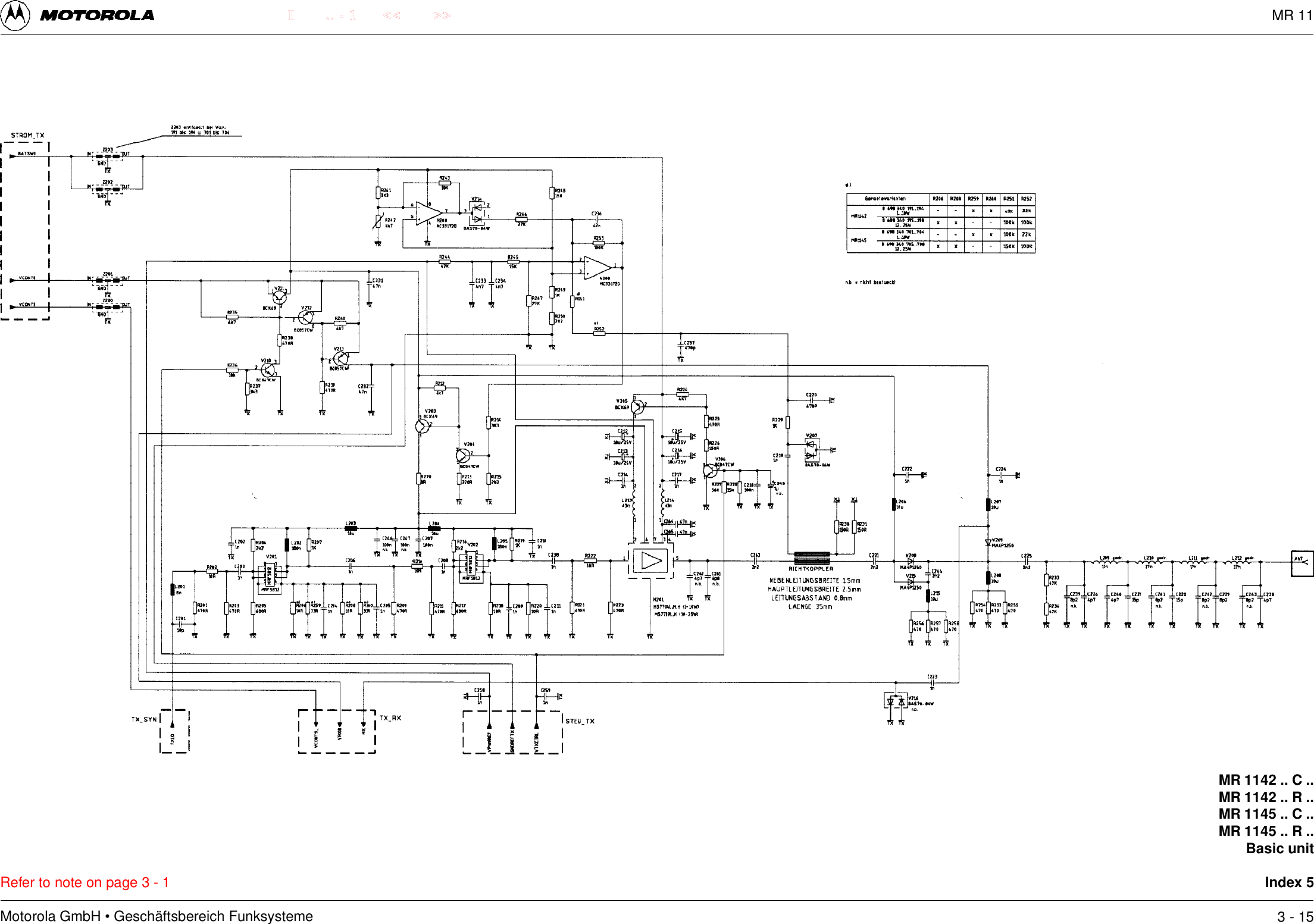
Motorola GmbH • Geschäftsbereich Funksysteme.. - 1 << >>IRefer to note on page 3 - 1MR 1142 .. C ..MR 1142 .. R ..MR 1145 .. C ..MR 1145 .. R ..Basic unitIndex 53 - 15MR 11

Navigation menu