Muratec Automation VEHICLEMCOM MCOM: Merge/divergecommunication Modem User Manual

Muratec Automation Co.,LTD MCOM: Merge/divergecommunication Modem Users Manual

Users Manual

                MCOM Operation Manual    Model: MCOM(M-COM4,COM-TR,IND-TR)                                                                      1st edition    January 26, 2011  Control Design Section,   Semiconductor Engineering Dept. MURATEC AUTOMATION CO., LTD.     Rev.     Approved Checked Prepared    Rev.3  11.03.04 Change    Filter rate switch    Rev.2  11.03.03 Change FCC ID     Rev.1  11.02.28 Change block diagram Engineerring Dept2011.2.10Kawashima Kawashima Engineerring Dept2011.2.10Inagaki Inagaki Development Dept2011.1.26Onishi Ohnishi    Doc. No. YSDA-3490 Rev.3
ii Muratec Automation Co., Ltd.  < Revision History >   Ver. Date  Page  Description 0  2011/01/26    The first edition. 1  2011/02/28  10  Change block diagram 2  2011/03/03  5.11  Change FCCID 3  2011/03/04  8  Change Filter rate switch setting
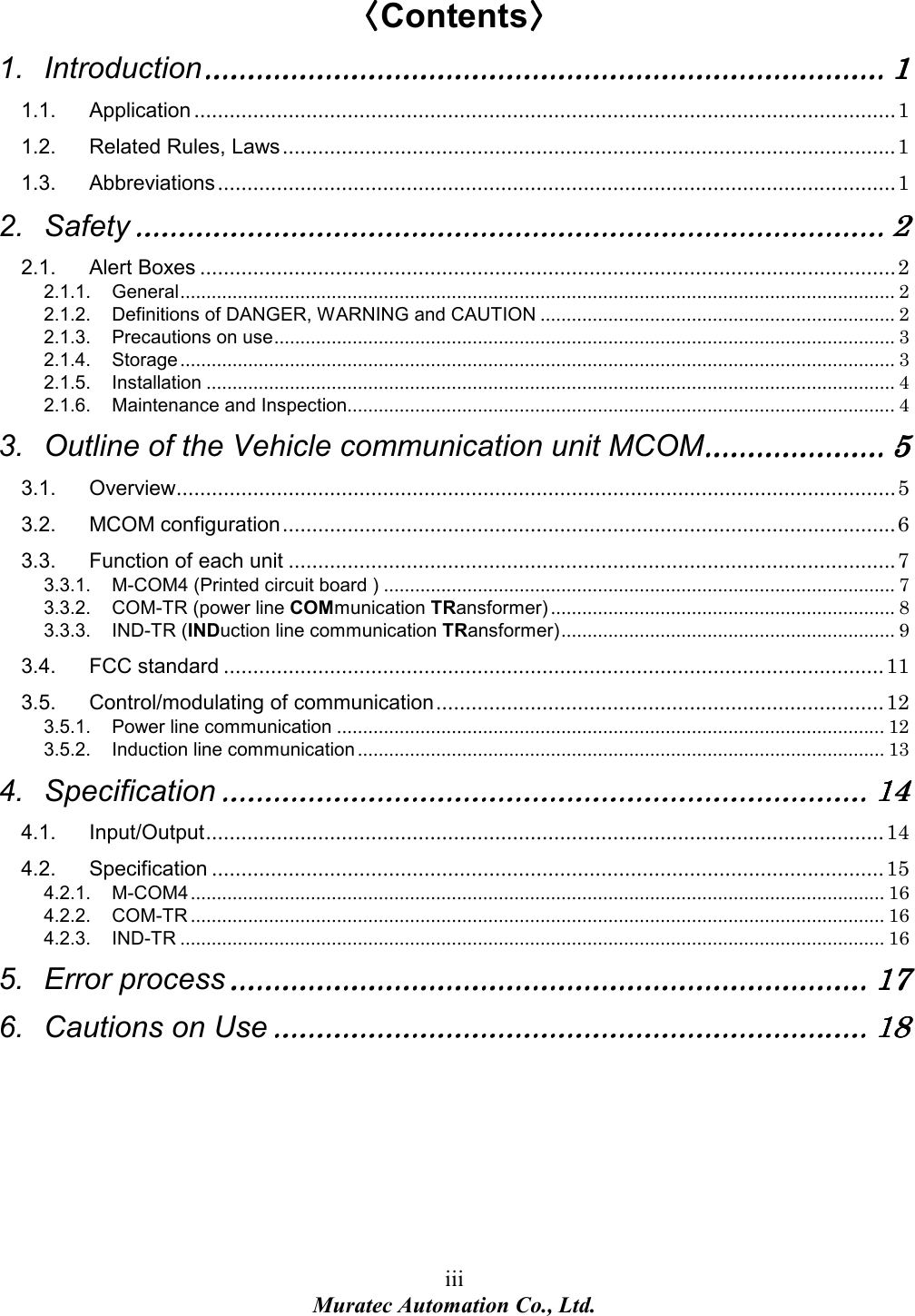
iii Muratec Automation Co., Ltd.   〈〈〈〈Contents〉〉〉〉 1. Introduction............................................................................................................................................................................................................................................................................................................................ 1111 1.1. Application .......................................................................................................................1 1.2. Related Rules, Laws........................................................................................................1 1.3. Abbreviations...................................................................................................................1 2. Safety............................................................................................................................................................................................................................................................................................................................................................ 2222 2.1. Alert Boxes ......................................................................................................................2 2.1.1. General......................................................................................................................................... 2 2.1.2. Definitions of DANGER, WARNING and CAUTION .................................................................... 2 2.1.3. Precautions on use....................................................................................................................... 3 2.1.4. Storage ......................................................................................................................................... 3 2.1.5. Installation .................................................................................................................................... 4 2.1.6. Maintenance and Inspection......................................................................................................... 4 3. Outline of the Vehicle communication unit MCOM.................................................................................... 5555 3.1. Overview..........................................................................................................................5 3.2. MCOM configuration........................................................................................................6 3.3. Function of each unit .......................................................................................................7 3.3.1. M-COM4 (Printed circuit board ) .................................................................................................. 7 3.3.2. COM-TR (power line COMmunication TRansformer) .................................................................. 8 3.3.3. IND-TR (INDuction line communication TRansformer)................................................................ 9 3.4. FCC standard ................................................................................................................11 3.5. Control/modulating of communication............................................................................12 3.5.1. Power line communication ......................................................................................................... 12 3.5.2. Induction line communication ..................................................................................................... 13 4. Specification............................................................................................................................................................................................................................................................................................................ 14141414 4.1. Input/Output...................................................................................................................14 4.2. Specification ..................................................................................................................15 4.2.1. M-COM4 ..................................................................................................................................... 16 4.2.2. COM-TR ..................................................................................................................................... 16 4.2.3. IND-TR ....................................................................................................................................... 16 5. Error process........................................................................................................................................................................................................................................................................................................ 17171717 6. Cautions on Use.................................................................................................................................................................................................................................................................................... 18181818
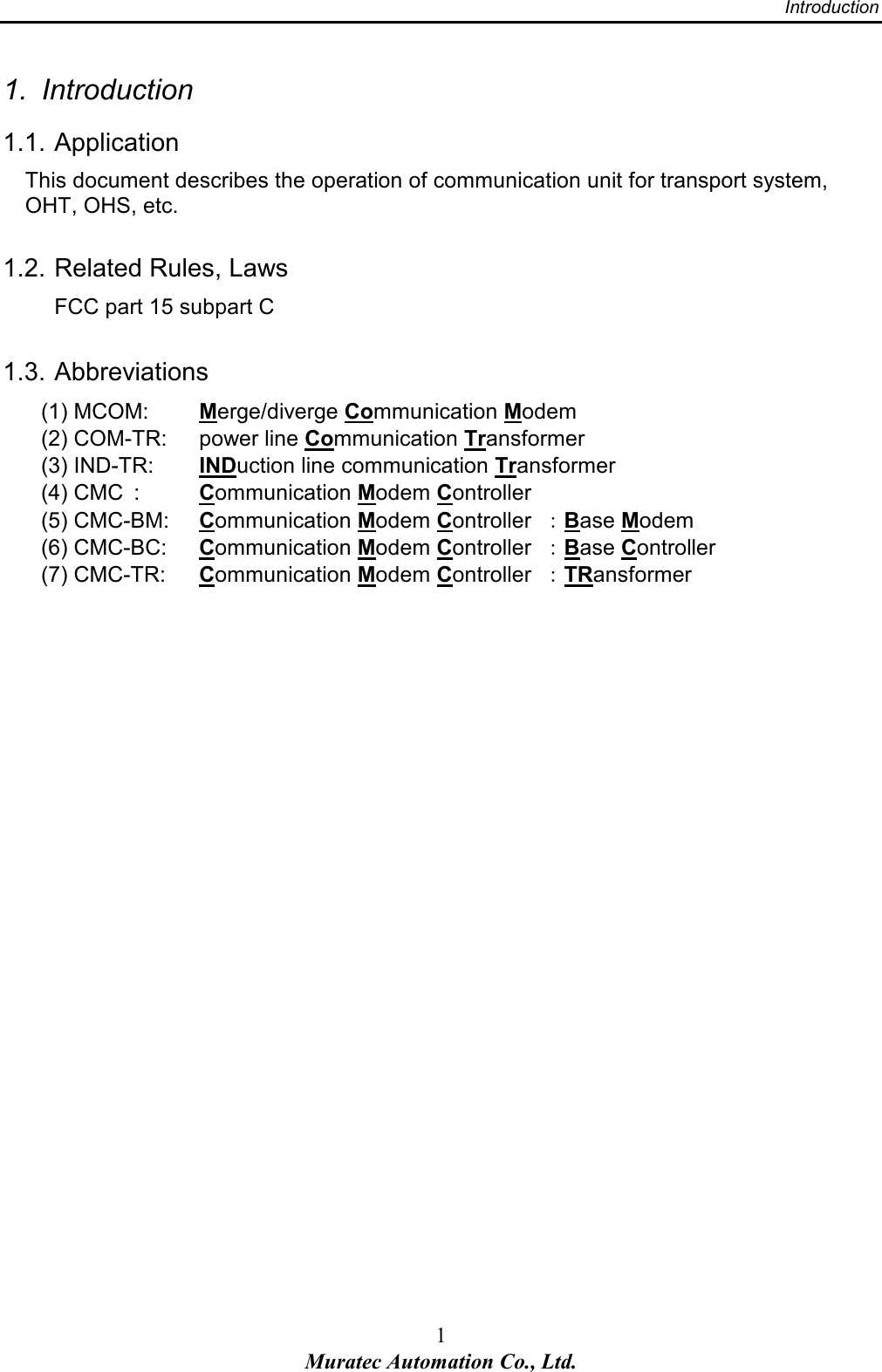
Introduction 1 Muratec Automation Co., Ltd.  1.  Introduction 1.1. Application This document describes the operation of communication unit for transport system, OHT, OHS, etc.  1.2. Related Rules, Laws FCC part 15 subpart C  1.3. Abbreviations   (1) MCOM:  Merge/diverge Communication Modem (2) COM-TR:  power line Communication Transformer   (3) IND-TR:  INDuction line communication Transformer (4) CMC  :  Communication Modem Controller (5) CMC-BM:  Communication Modem Controller  :Base Modem (6) CMC-BC:  Communication Modem Controller  :Base Controller (7) CMC-TR:  Communication Modem Controller  :TRansformer
Safety 2 Muratec Automation Co., Ltd.  2.  Safety 2.1. Alert Boxes 2.1.1. General (1) Read and understand fully this manual and attached documents before operating the products. (2) Engage specialists in electrical and mechanical works. (3) Don’t improve the product by yourselves. (4) Be sufficiently proficient with the equipment, the relevant safety knowledge and the precautions prior to using this product. In the content of this “Safety Precautions ”, items which need to be alert shall be classified into “DANGER”, “WARNING” and ”CAUTION”. 2.1.2. Definitions of DANGER, WARNING and CAUTION    DANGER: An imminently hazardous situation which, if not avoided, will result in                             death or serious injury.    WARNING: A potentially hazardous situation which, if not avoided, could result                                 in death or serious injury.    CAUTION: A potentially hazardous situation which, if not avoided, may result in                               minor or moderate injury.      [Note 1]   Medium degree of injuries or light injuries refers to injuries, e.g., burns and electric shock, which do not require hospitalization of or prolonged hospital visit by the victims. As material losses refers to expanded losses pertaining to the damage of property and equipment.      [Note 2]   Depending on the situation, the events described under “WARNING” may also result in severe outcome. In either case, make sure that the advice is followed.  After reading, make sure this information shall be kept at places where it can always be read by users.
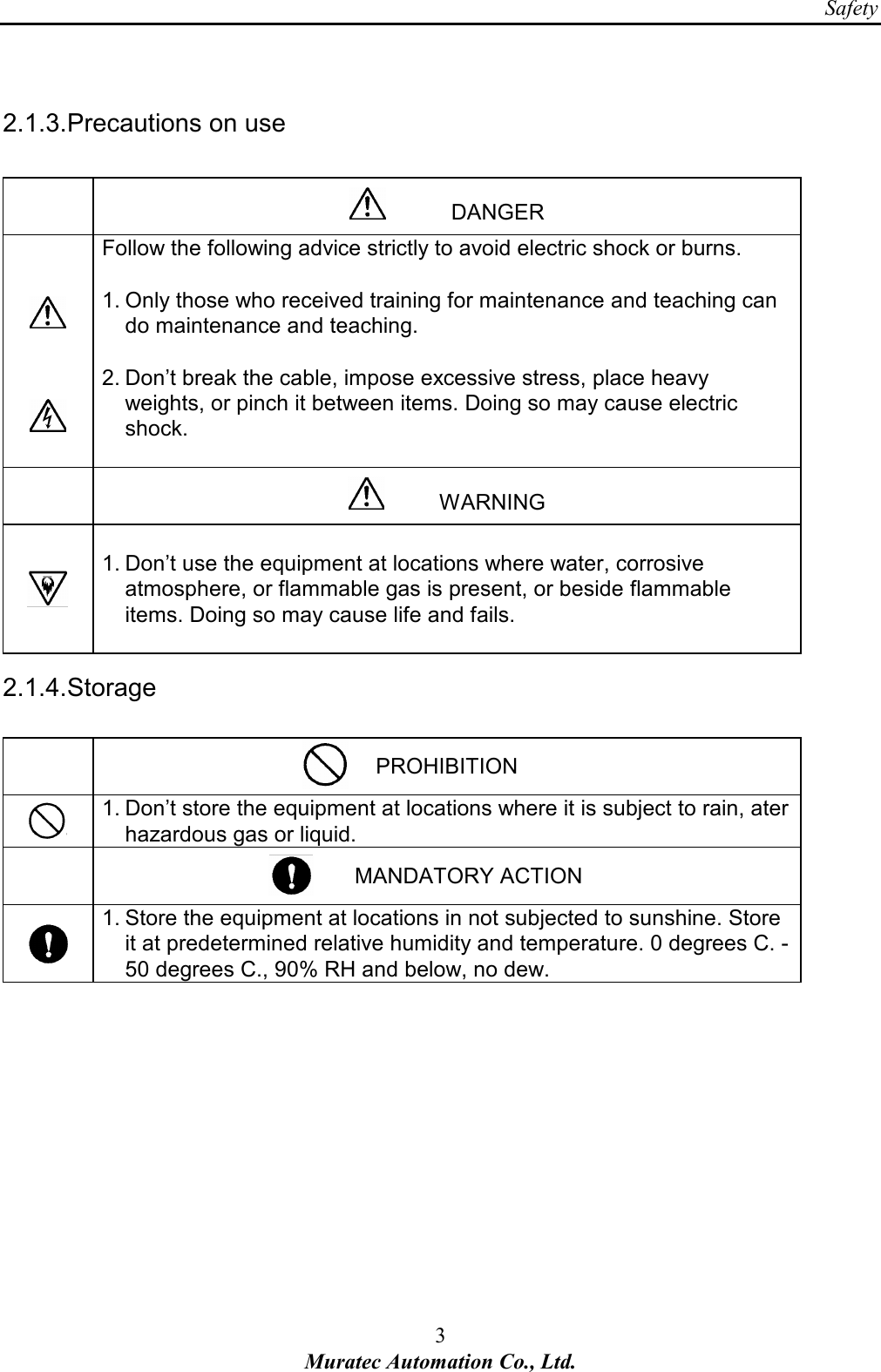
Safety 3 Muratec Automation Co., Ltd.   2.1.3. Precautions on use               DANGER  Follow the following advice strictly to avoid electric shock or burns.   1. Only those who received training for maintenance and teaching can do maintenance and teaching.   2. Don’t break the cable, impose excessive stress, place heavy weights, or pinch it between items. Doing so may cause electric shock.             WARNING   1. Don’t use the equipment at locations where water, corrosive atmosphere, or flammable gas is present, or beside flammable items. Doing so may cause life and fails.  2.1.4. Storage    PROHIBITION  1. Don’t store the equipment at locations where it is subject to rain, ater hazardous gas or liquid.           MANDATORY ACTION  1. Store the equipment at locations in not subjected to sunshine. Store it at predetermined relative humidity and temperature. 0 degrees C. - 50 degrees C., 90% RH and below, no dew.
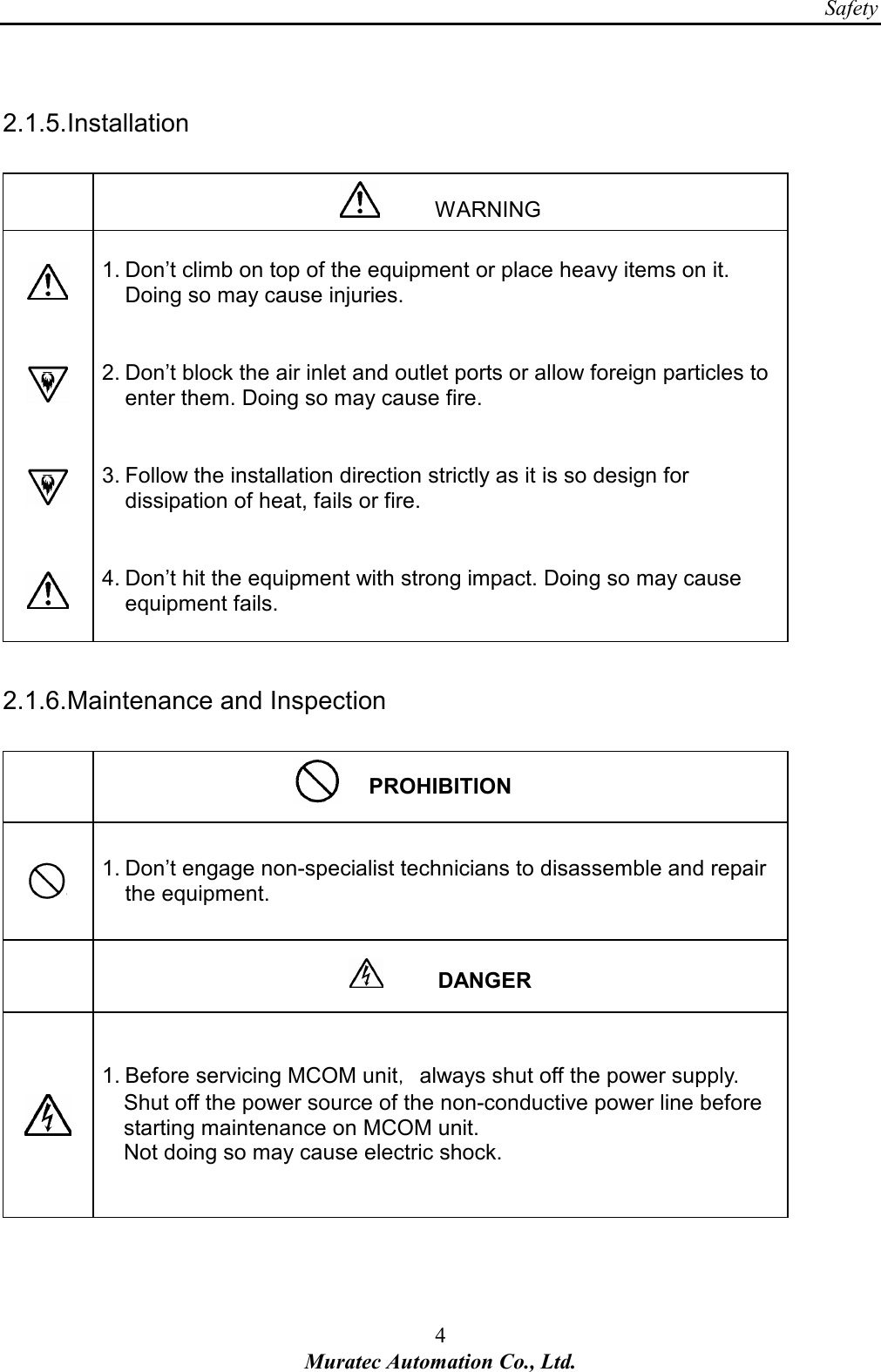
Safety 4 Muratec Automation Co., Ltd.   2.1.5. Installation             WARNING   1. Don’t climb on top of the equipment or place heavy items on it. Doing so may cause injuries.    2. Don’t block the air inlet and outlet ports or allow foreign particles to enter them. Doing so may cause fire.    3. Follow the installation direction strictly as it is so design for dissipation of heat, fails or fire.    4. Don’t hit the equipment with strong impact. Doing so may cause equipment fails.   2.1.6. Maintenance and Inspection   PROHIBITION  1. Don’t engage non-specialist technicians to disassemble and repair the equipment.       DANGER   1. Before servicing MCOM unit,always shut off the power supply. Shut off the power source of the non-conductive power line before starting maintenance on MCOM unit. Not doing so may cause electric shock.
  Outline 5 Muratec Automation Co., Ltd. 3.  Outline of the Vehicle communication unit MCOM 3.1. Overview The communication unit MCOM (Merge/diverge Communication Modem) meet the requirements of FCC Part15 Subpart C. The FCC ID is as follows. FCC ID of MCOM: ZBQVEHICLEMCOM  1) Power line communication MCOM is used for the communication between vehicle and the ground vehicle controller in the transport system.    The communication signals are overlaid onto the power line for non-contact power supply to the vehicles. In some systems, a separate signal lines may be used.  The communication unit CMC (Communication Modem Controller) is the groundside communication unit. CMC is used for the communication between the groundside vehicle controller and several vehicles.   CMC meet the requirements of FCC Part15 Subpart C. The FCC ID is as follows. FCC ID of CMC: ZBQVEHICLECMC  MCOM modulate the signals sent from the vehicle and receive the modulated signals from the ground vehicle controller. MCOM also demodulate the signals sent from the groundside vehicle controller and transmit them to the ground vehicle controller.  The communication method in use is 2 levels FSK (frequency shift keying). The communication frequencies are as follows.         From    to    Frequency (1)  CMC  →  MCOM:  300.33 kHz   (2)  MCOM→  CMC:  353.25 kHz    2) Induction line communication MCOM is used for the communication between vehicle and other Vehicle in the transport system.  MCOM outputs the detection signal of one bit in the controller when the existence of the signal which other vehicle transmitted.    An Induction line is installed on both sides of the track. Therefore one transformer and circuit are each right and left, and they are equal. It can be changed if one transformer is used for the reception or it is used for the transmission. A left-right IND-TR is combined with the loop line, and it can watch each other's transmitting signal. Then, a trouble such as the breakage of the transformer can be diagnosed.    The communication method in use is Adoption of On Off Keying Method. The communication frequencies are 88.8kHz.
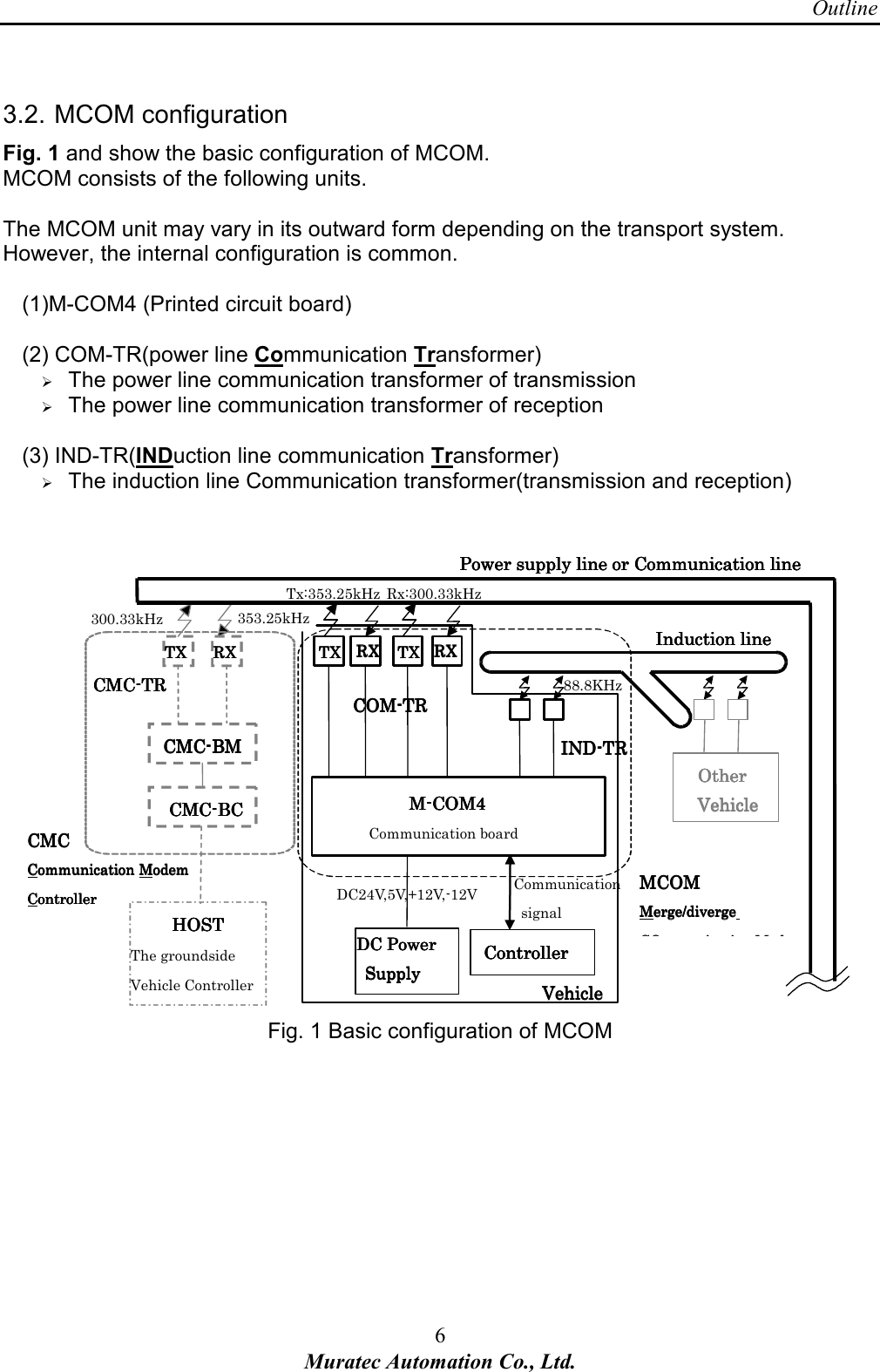
Outline 6 Muratec Automation Co., Ltd.   3.2. MCOM configuration Fig. 1 and show the basic configuration of MCOM. MCOM consists of the following units.  The MCOM unit may vary in its outward form depending on the transport system. However, the internal configuration is common.  (1)M-COM4 (Printed circuit board)  (2) COM-TR(power line Communication Transformer)  The power line communication transformer of transmission  The power line communication transformer of reception  (3) IND-TR(INDuction line communication Transformer)  The induction line Communication transformer(transmission and reception)    MMMM----COMCOMCOMCOM4444 Communication board CMCCMCCMCCMC----BCBCBCBC    CMCCMCCMCCMC----BMBMBMBM    CMCCMCCMCCMC    CCCCommunication ommunication ommunication ommunication MMMModem odem odem odem CCCControllerontrollerontrollerontroller    OtherOtherOtherOther   Vehicle  Vehicle  Vehicle  Vehicle HOSTHOSTHOSTHOST    The groundside Vehicle Controller  VehicleVehicleVehicleVehicle COMCOMCOMCOM----TRTRTRTR INDINDINDIND----TRTRTRTR 88.8KHz Tx:353.25kHz Rx:300.33kHz 353.25kHz 300.33kHz InductionInductionInductionInduction line line line line Power supplyPower supplyPower supplyPower supply line line line line or Comm or Comm or Comm or Communication lineunication lineunication lineunication line CMCCMCCMCCMC----TRTRTRTR    MMMMCCCCOMOMOMOM    MMMMerge/divergeerge/divergeerge/divergeerge/diverge    COCOCOCOmmunication mmunication mmunication mmunication MMMModemodemodemodem    RXRXRXRX    TXTXTXTX    RXRXRXRX    TXTXTXTX    DC PowerDC PowerDC PowerDC Power      Supply  Supply  Supply  Supply    DC24V,5V,+12V,-12V ControllerControllerControllerController Communication   signal TXTXTXTX    RXRXRXRX     Fig. 1 Basic configuration of MCOM
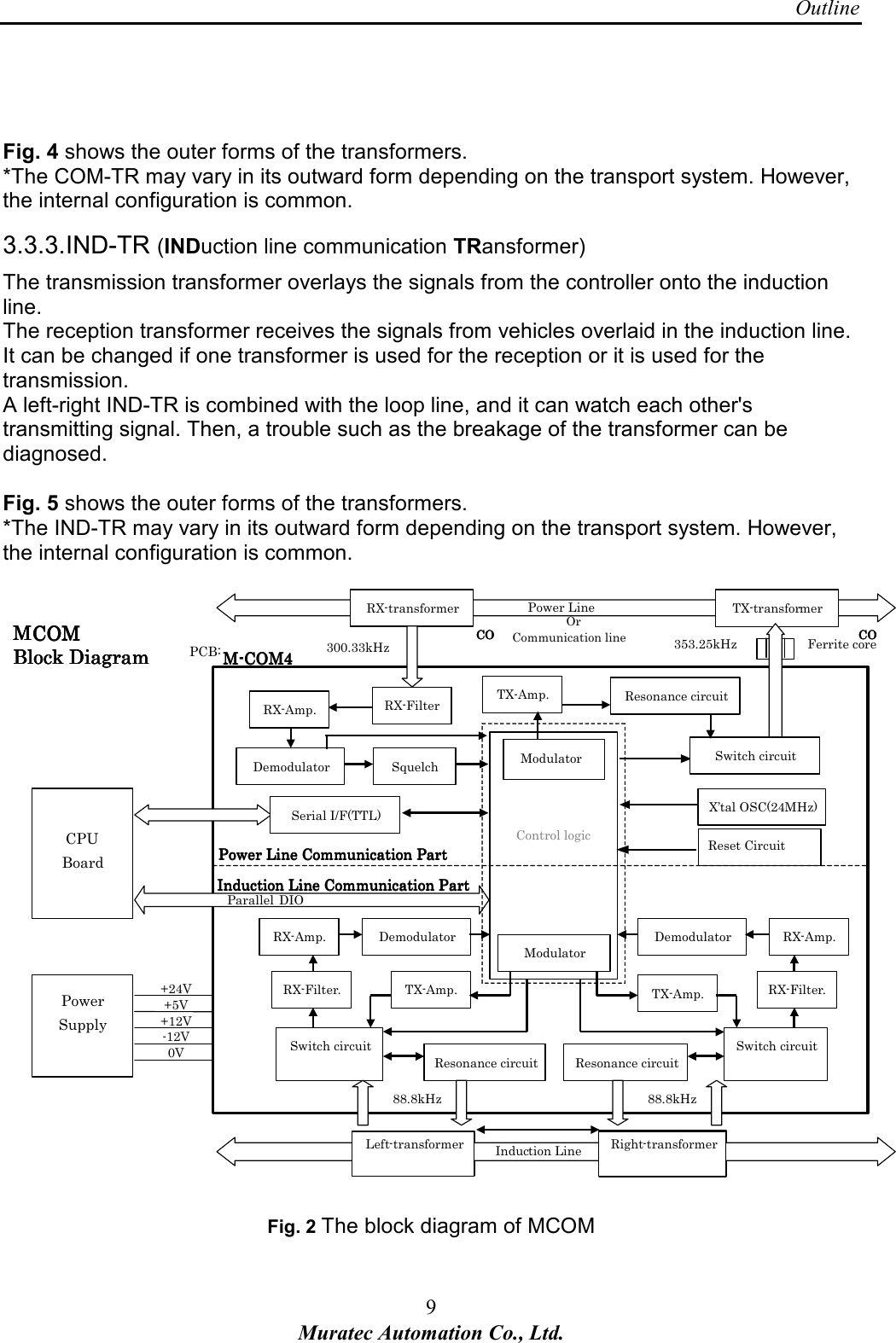
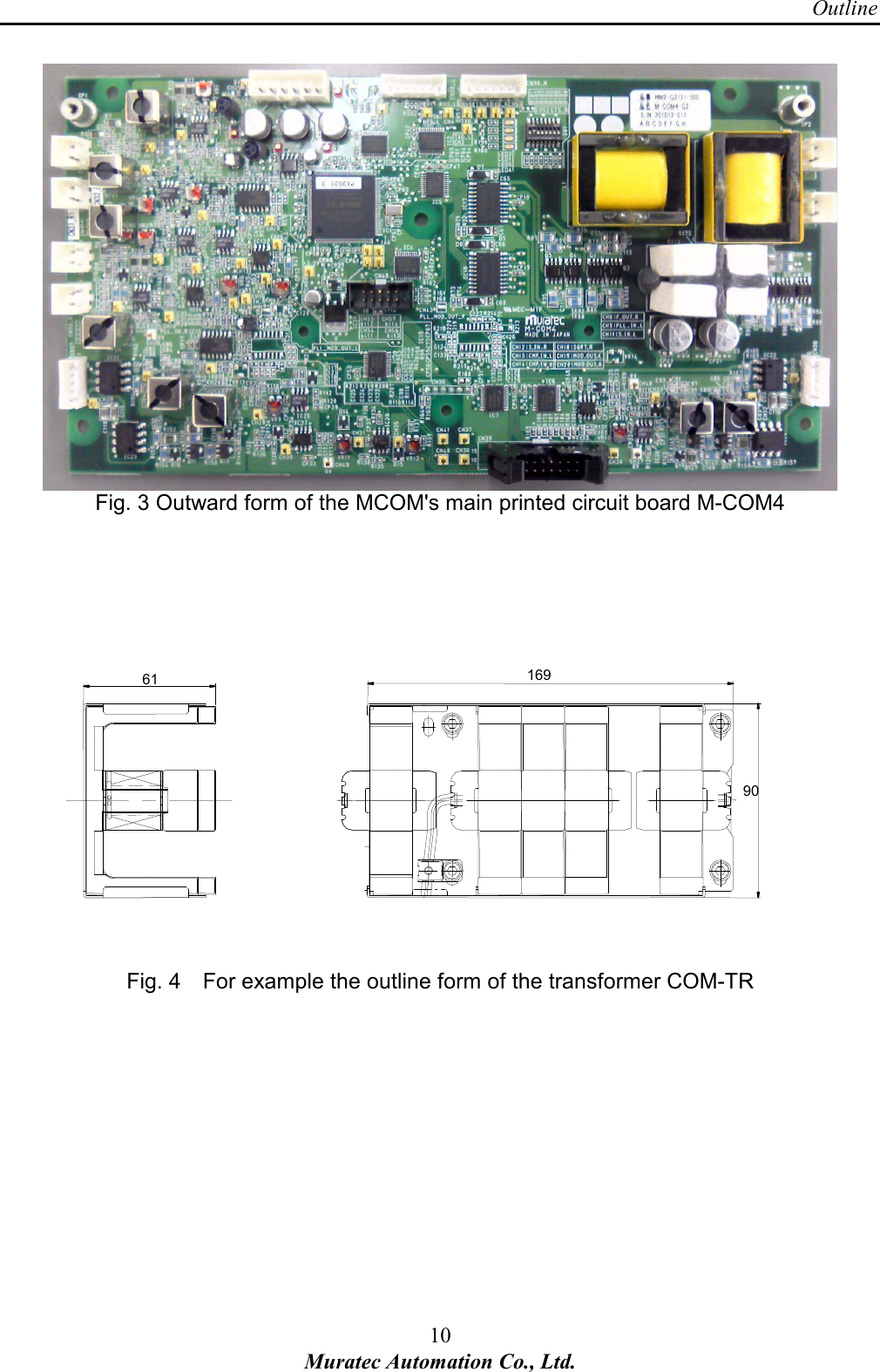
Outline 7 Muratec Automation Co., Ltd.   3.3. Function of each unit Fig. 2 shows the block diagram of M-COM4. In addition, the MCOM unit may vary in its outward form depending on the transport system. However, the internal configuration is common.    All units are connected by the cable.  3.3.1. M-COM4 (Printed circuit board ) M-COM4 is a print board with two communication functions, power line communication and induction line communication.  Fig. 3 shows the outward form of the printed circuit board M-COM4.  1) Power line communication M-COM4 board is an interface unit to handle the signals from/to the groundside vehicle controller. A signal is transmitted and received by the order of the controller. This is a modem unit to handle the signals from/to the groundside vehicle controller. It incorporates a driver that modulates the digital signals sent from the controller to analog signals and overlay the converted signals onto the non-contact power supply line or signal line. It also demodulates the analog signals sent from the groundside vehicle controller to digital signals and transmit them to controller.  2) Induction line communication M-COM4 board is an interface unit to handle the signals from/to the other vehicles. A signal is transmitted and received by the order of the controller.   This is a modem unit to handle the signals from/to the other vehicles. It incorporates a driver that modulates the digital signals sent from the controller to analog signals and overlay the converted signals onto the induction line. It also demodulates the analog signals sent from the other vehicles to digital signals and transmit them to controller.  The receiving circuit and the transmitting circuit are prepared by the set to the induction coil on either side. It can change whether a receiving circuit is connected or a transmitting circuit is connected with the setting signal from the controller to a right-and-left IND-TR. Intermittent sending of the 88.88kHz digital signal is carried out from the signal generating circuit, and a transmitted signal is amplified with transmitting amplifier, and is transmitted with a coil. The capacitor for resonance is connected to a coil in series, and voltage amplification of the 88.88kHz is carried out alternatively. A receiving circuit converts into a pulse signal the modulation signal received with the receiving coil, and counts the number of pulses by the signal detector. If it becomes beyond a value with the number of counts, it will be considered that other vehicles were detected.
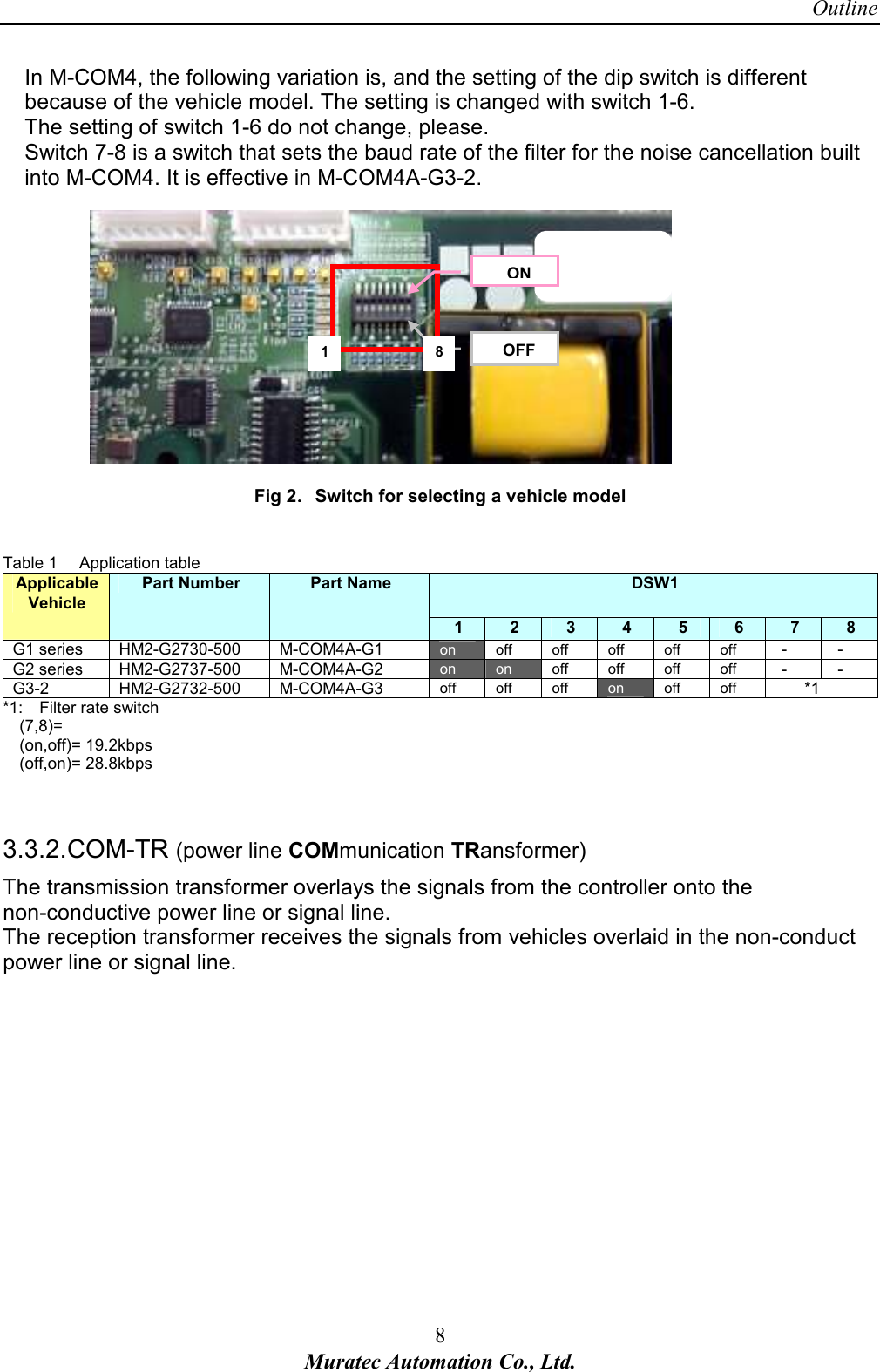
Outline 8 Muratec Automation Co., Ltd.  In M-COM4, the following variation is, and the setting of the dip switch is different because of the vehicle model. The setting is changed with switch 1-6.   The setting of switch 1-6 do not change, please.   Switch 7-8 is a switch that sets the baud rate of the filter for the noise cancellation built into M-COM4. It is effective in M-COM4A-G3-2.               Fig 2....Switch for selecting a vehicle model   Table 1    Application table DSW1 Applicable Vehicle Part Number  Part Name 1  2  3  4  5  6  7  8 G1 series HM2-G2730-500  M-COM4A-G1 on  off  off  off  off  off -  - G2 series  HM2-G2737-500  M-COM4A-G2 on  on  off  off  off  off -  - G3-2  HM2-G2732-500  M-COM4A-G3 off  off  off  on  off  off *1 *1: Filter rate switch       (7,8)=     (on,off)= 19.2kbps     (off,on)= 28.8kbps   3.3.2. COM-TR (power line COMmunication TRansformer) The transmission transformer overlays the signals from the controller onto the non-conductive power line or signal line. The reception transformer receives the signals from vehicles overlaid in the non-conduct power line or signal line.             OFF 1 8 ON
Outline 9 Muratec Automation Co., Ltd.     Fig. 4 shows the outer forms of the transformers. *The COM-TR may vary in its outward form depending on the transport system. However, the internal configuration is common. 3.3.3. IND-TR (INDuction line communication TRansformer) The transmission transformer overlays the signals from the controller onto the induction line. The reception transformer receives the signals from vehicles overlaid in the induction line. It can be changed if one transformer is used for the reception or it is used for the transmission. A left-right IND-TR is combined with the loop line, and it can watch each other's transmitting signal. Then, a trouble such as the breakage of the transformer can be diagnosed.  Fig. 5 shows the outer forms of the transformers. *The IND-TR may vary in its outward form depending on the transport system. However, the internal configuration is common.   ININININININININCOCOCOCOCOCOCOCOPCB: Or   Communication line     CPU   Board   Reset Circuit         Demodulator   Control logic       Modulator   Squelch  RX-Amp.  TX-Amp. Resonance circuit Serial I/F(TTL)   RX -Filter RX- transformer TX-transfor mer  Ferrite core   Power Line  353.25kHz   300.33kHz   Switch circuit  Switch circuit TX-Amp. Resonance circuit Resonance circuit  RX- Amp.   RX-Filter. Demodulator  X’tal OSC(24MHz)   TX-Amp.  RX -Filter.  Demodulator  RX-Amp. Modulator   Left - transformer   Right - transformer  Induc tion Line   88.8kHz  88.8kHz   Power Line Communication PartPower Line Communication PartPower Line Communication PartPower Line Communication Part     Induction Line Communication PartInduction Line Communication PartInduction Line Communication PartInduction Line Communication Part     MMMM ---- COMCOMCOMCOM4444    Power Supply  Parallel   DIO +24V +5V +12V 0V -12V  MMMM COM COM COM COM   Block DiagramBlock DiagramBlock DiagramBlock Diagram    Switch circuit   Fig. 2 The block diagram of MCOM
Outline 10 Muratec Automation Co., Ltd.   Fig. 3 Outward form of the MCOM's main printed circuit board M-COM4                 Fig. 4    For example the outline form of the transformer COM-TR 169 61 90
Outline 11 Muratec Automation Co., Ltd.      Fig. 5 The outer forms of the transformer IND-TR 3.4. FCC standard The transmission assembly in the communication unit MCOM meets FCC Part15 Subpart C as the intentional radiator.       FCC ID of MCOM:   ZBQVEHICLEMCOM  [Note.1]   The FCC certificate position may vary because different case materials and shapes are adopted for different customers.    This device complies with part 15 of the FCC Rules.Operation is subject to the following two conditions;this device may not cause interference, and this device must accept any interference received, including interference that may cause undesired operation
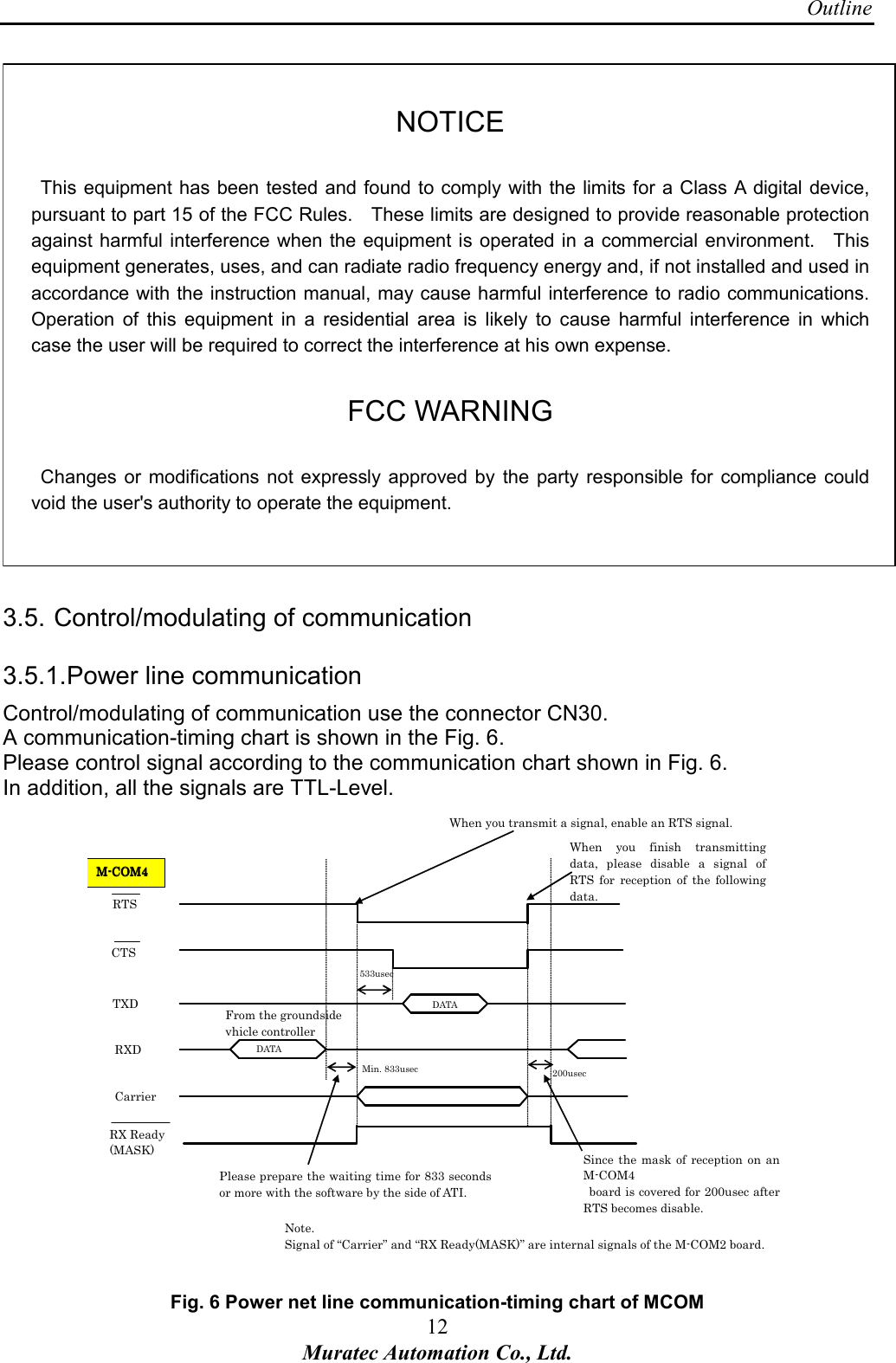
Outline 12 Muratec Automation Co., Ltd.   NOTICE    This  equipment has been tested  and found to comply with the limits for a Class A digital device, pursuant to part 15 of the FCC Rules.    These limits are designed to provide reasonable protection against harmful interference when the equipment is operated in a commercial environment.    This equipment generates, uses, and can radiate radio frequency energy and, if not installed and used in accordance with the instruction manual, may cause harmful interference to radio communications.   Operation  of this  equipment  in  a  residential  area  is  likely  to  cause  harmful  interference  in  which case the user will be required to correct the interference at his own expense.  FCC WARNING    Changes  or  modifications not  expressly approved  by  the party responsible for  compliance  could void the user's authority to operate the equipment.        3.5. Control/modulating of communication 3.5.1. Power line communication Control/modulating of communication use the connector CN30. A communication-timing chart is shown in the Fig. 6. Please control signal according to the communication chart shown in Fig. 6. In addition, all the signals are TTL-Level.  RTS CTS TXD RXD Carrier 200usec Min. 833usec 533usec MMMM----COM4COM4COM4COM4    DATA DATA Please prepare the waiting time for 833 seconds or more with the software by the side of ATI. When  you  finish  transmitting data,  please  disable  a  signal  of RTS  for  reception  of  the  following data. Since  the  mask of reception  on  an M-COM4   board is covered for 200usec after RTS becomes disable. When you transmit a signal, enable an RTS signal. RX Ready (MASK) Note. Signal of “Carrier” and “RX Ready(MASK)” are internal signals of the M-COM2 board. From the groundside vhicle controller     Fig. 6 Power net line communication-timing chart of MCOM
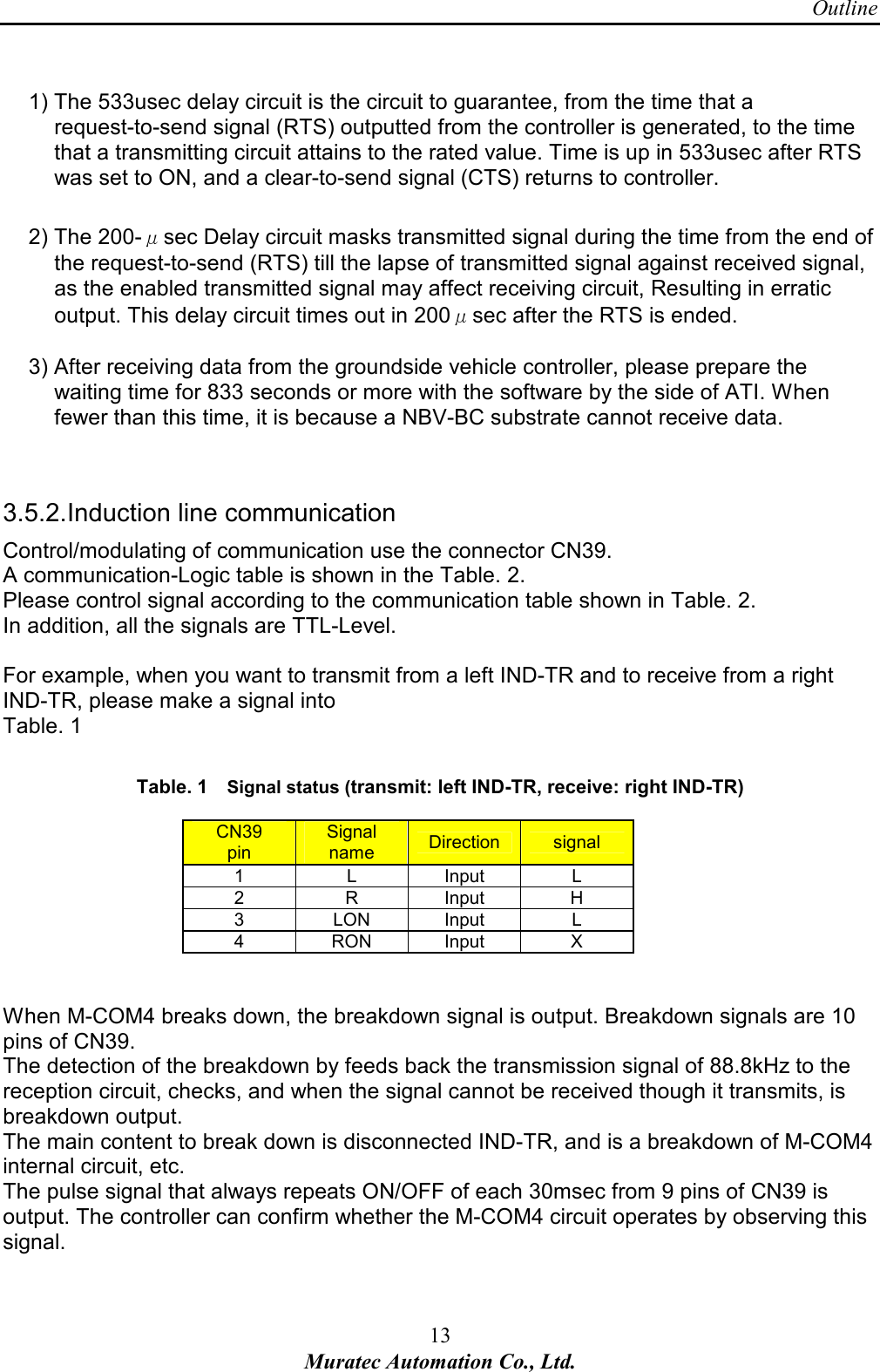
Outline 13 Muratec Automation Co., Ltd.   1) The 533usec delay circuit is the circuit to guarantee, from the time that a request-to-send signal (RTS) outputted from the controller is generated, to the time that a transmitting circuit attains to the rated value. Time is up in 533usec after RTS was set to ON, and a clear-to-send signal (CTS) returns to controller.  2) The 200-μsec Delay circuit masks transmitted signal during the time from the end of the request-to-send (RTS) till the lapse of transmitted signal against received signal, as the enabled transmitted signal may affect receiving circuit, Resulting in erratic output. This delay circuit times out in 200μsec after the RTS is ended.    3) After receiving data from the groundside vehicle controller, please prepare the waiting time for 833 seconds or more with the software by the side of ATI. When fewer than this time, it is because a NBV-BC substrate cannot receive data.   3.5.2. Induction line communication Control/modulating of communication use the connector CN39. A communication-Logic table is shown in the Table. 2. Please control signal according to the communication table shown in Table. 2. In addition, all the signals are TTL-Level.  For example, when you want to transmit from a left IND-TR and to receive from a right IND-TR, please make a signal into   Table. 1  Table. 1      Signal status (transmit: left IND-TR, receive: right IND-TR) CN39 pin Signal name  Direction  signal 1  L  Input  L 2  R  Input  H 3  LON  Input  L 4  RON  Input  X   When M-COM4 breaks down, the breakdown signal is output. Breakdown signals are 10 pins of CN39.   The detection of the breakdown by feeds back the transmission signal of 88.8kHz to the reception circuit, checks, and when the signal cannot be received though it transmits, is breakdown output.   The main content to break down is disconnected IND-TR, and is a breakdown of M-COM4 internal circuit, etc. The pulse signal that always repeats ON/OFF of each 30msec from 9 pins of CN39 is output. The controller can confirm whether the M-COM4 circuit operates by observing this signal.
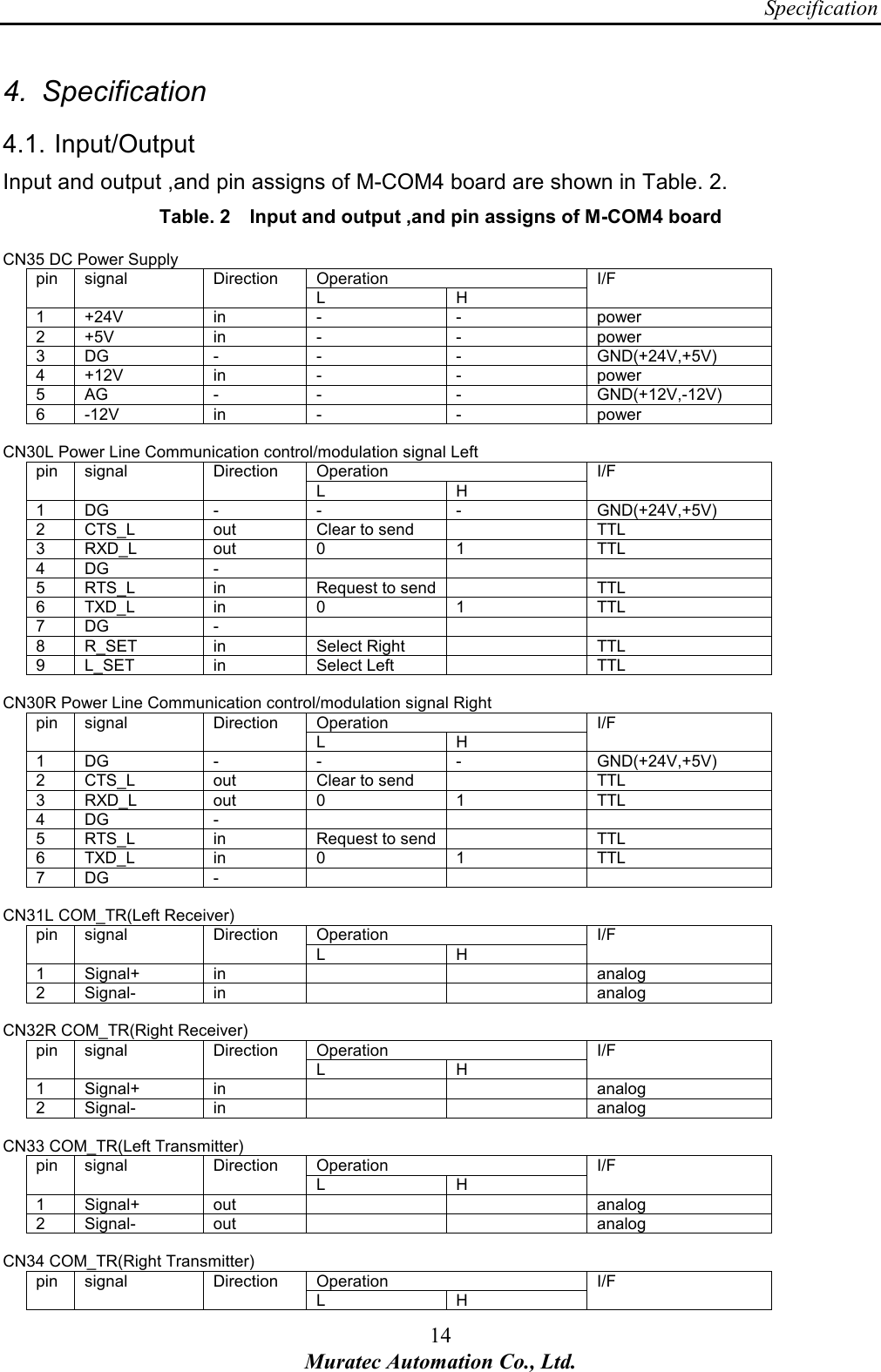
Specification 14 Muratec Automation Co., Ltd.  4.  Specification 4.1. Input/Output Input and output ,and pin assigns of M-COM4 board are shown in Table. 2. Table. 2      Input and output ,and pin assigns of M-COM4 board CN35 DC Power Supply Operation pin  signal  Direction L  H I/F 1  +24V  in  -  -  power 2  +5V  in  -  -  power 3  DG  -  -  -  GND(+24V,+5V) 4  +12V  in  -  -  power 5  AG  -  -  -  GND(+12V,-12V) 6  -12V  in  -  -  power  CN30L Power Line Communication control/modulation signal Left Operation pin  signal  Direction L  H I/F 1  DG  -  -  -  GND(+24V,+5V) 2  CTS_L  out  Clear to send    TTL 3  RXD_L  out  0  1  TTL 4  DG  -       5  RTS_L  in  Request to send   TTL 6  TXD_L  in  0  1  TTL 7  DG  -       8  R_SET  in  Select Right    TTL 9  L_SET  in  Select Left    TTL  CN30R Power Line Communication control/modulation signal Right Operation pin  signal  Direction L  H I/F 1  DG  -  -  -  GND(+24V,+5V) 2  CTS_L  out  Clear to send    TTL 3  RXD_L  out  0  1  TTL 4  DG  -       5  RTS_L  in  Request to send   TTL 6  TXD_L  in  0  1  TTL 7  DG  -        CN31L COM_TR(Left Receiver) Operation pin  signal  Direction L  H I/F 1  Signal+  in      analog 2  Signal-  in      analog  CN32R COM_TR(Right Receiver) Operation pin  signal  Direction L  H I/F 1  Signal+  in      analog 2  Signal-  in      analog  CN33 COM_TR(Left Transmitter) Operation pin  signal  Direction L  H I/F 1  Signal+  out      analog 2  Signal-  out      analog  CN34 COM_TR(Right Transmitter) Operation pin  signal  Direction L  H I/F
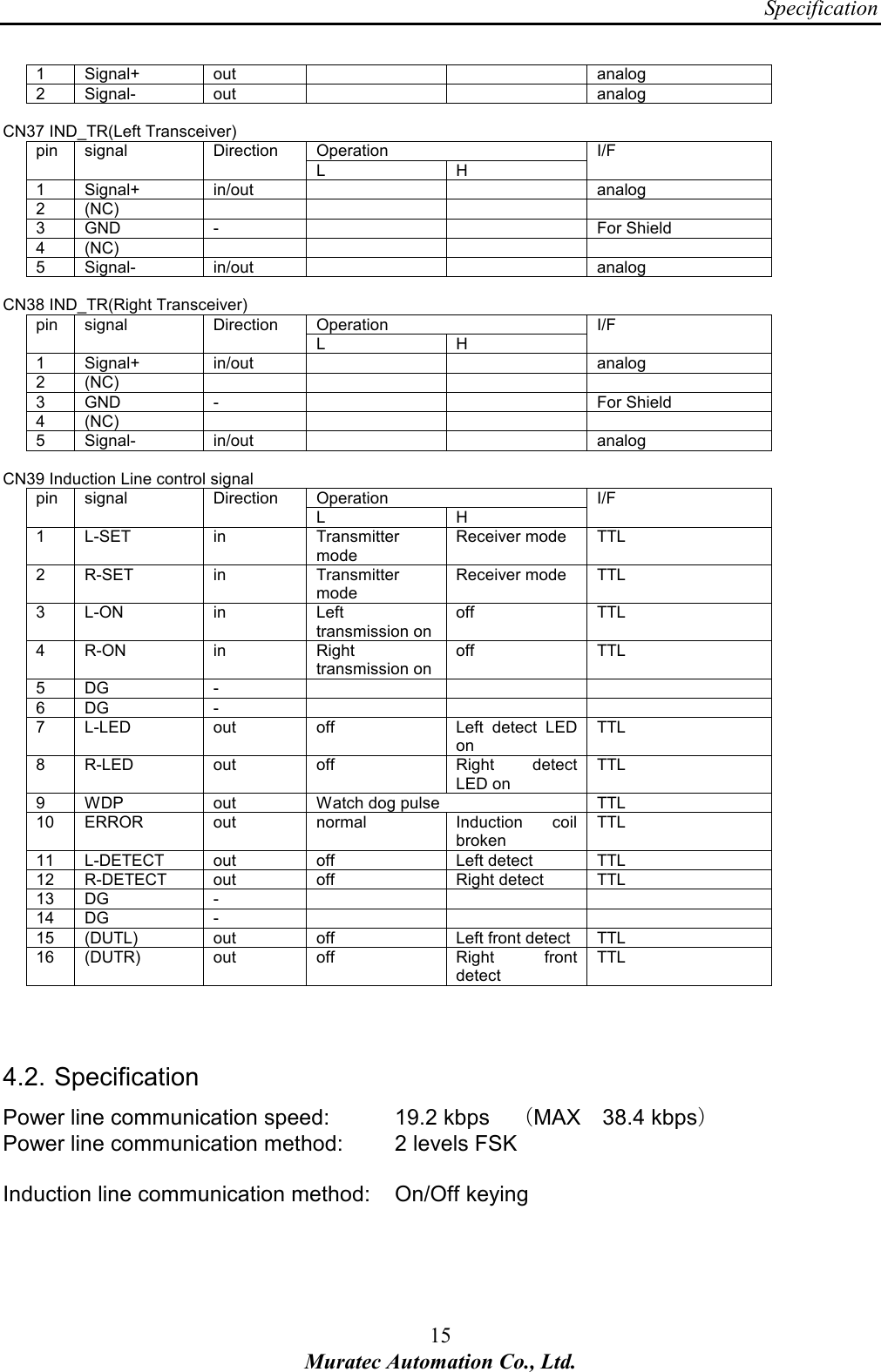
Specification 15 Muratec Automation Co., Ltd.  1  Signal+  out      analog 2  Signal-  out      analog  CN37 IND_TR(Left Transceiver) Operation pin  signal  Direction L  H I/F 1  Signal+  in/out      analog 2  (NC)         3  GND  -      For Shield 4  (NC)         5  Signal-  in/out      analog  CN38 IND_TR(Right Transceiver) Operation pin  signal  Direction L  H I/F 1  Signal+  in/out      analog 2  (NC)         3  GND  -      For Shield 4  (NC)         5  Signal-  in/out      analog  CN39 Induction Line control signal Operation pin  signal  Direction L  H I/F 1  L-SET  in  Transmitter mode Receiver mode  TTL 2  R-SET  in  Transmitter mode Receiver mode  TTL 3  L-ON  in  Left transmission on off  TTL 4  R-ON  in  Right transmission on off  TTL 5  DG  -       6  DG  -       7  L-LED  out  off  Left  detect  LED on TTL 8  R-LED  out  off  Right  detect LED on TTL 9  WDP  out  Watch dog pulse  TTL 10  ERROR  out  normal  Induction  coil broken TTL 11  L-DETECT  out  off  Left detect  TTL 12  R-DETECT  out  off  Right detect  TTL 13  DG  -       14  DG  -       15  (DUTL)  out  off  Left front detect  TTL 16  (DUTR)  out  off  Right  front detect TTL    4.2. Specification Power line communication speed:  19.2 kbps    (MAX    38.4 kbps) Power line communication method:  2 levels FSK  Induction line communication method:  On/Off keying
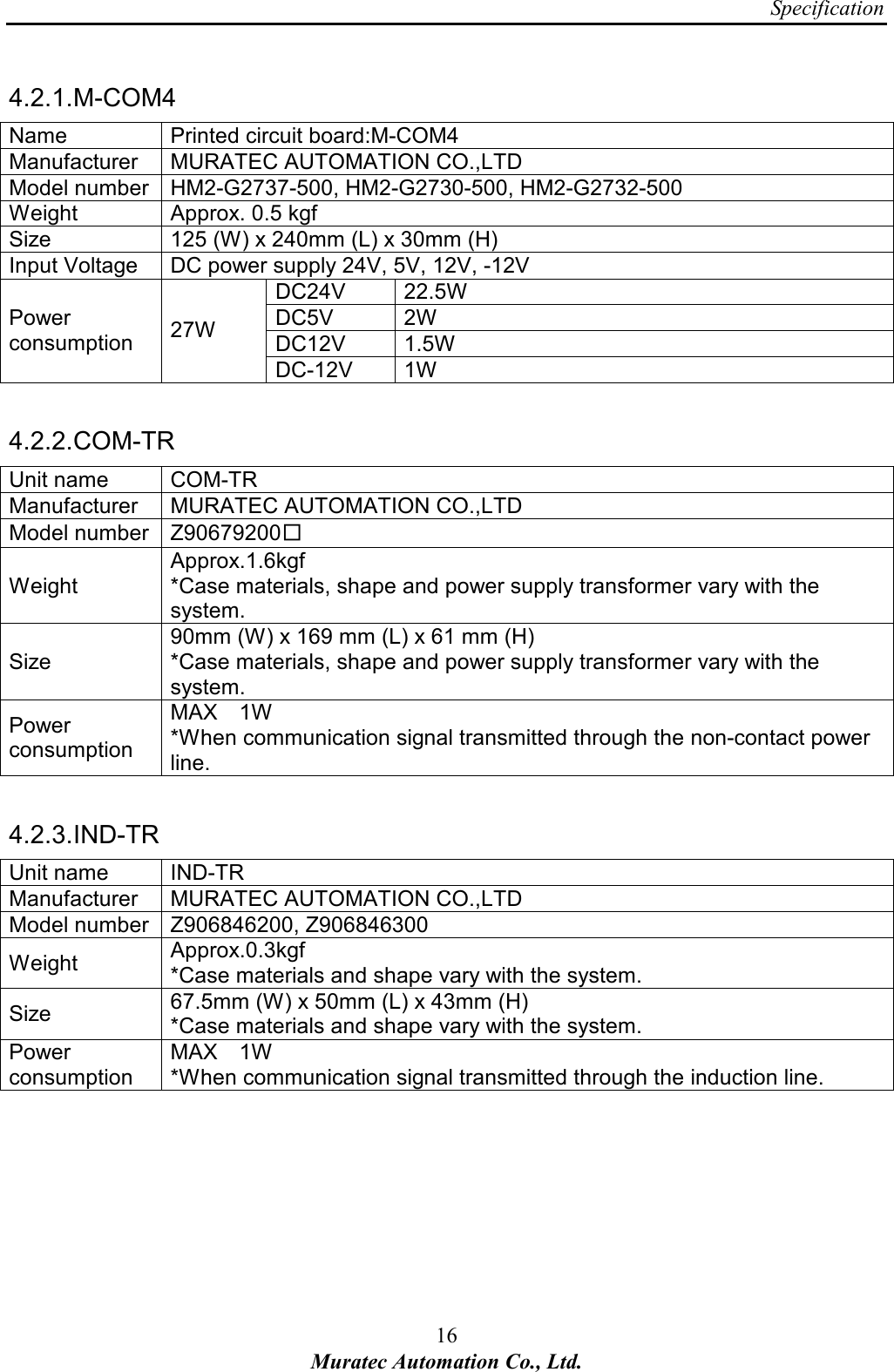
Specification 16 Muratec Automation Co., Ltd.  4.2.1. M-COM4 Name  Printed circuit board:M-COM4 Manufacturer  MURATEC AUTOMATION CO.,LTD Model number HM2-G2737-500, HM2-G2730-500, HM2-G2732-500 Weight  Approx. 0.5 kgf   Size  125 (W) x 240mm (L) x 30mm (H)       Input Voltage  DC power supply 24V, 5V, 12V, -12V DC24V  22.5W DC5V  2W DC12V  1.5W Power consumption  27W DC-12V  1W  4.2.2. COM-TR Unit name  COM-TR Manufacturer  MURATEC AUTOMATION CO.,LTD Model number Z90679200□ Weight Approx.1.6kgf     *Case materials, shape and power supply transformer vary with the system. Size 90mm (W) x 169 mm (L) x 61 mm (H)       *Case materials, shape and power supply transformer vary with the system. Power consumption MAX    1W     *When communication signal transmitted through the non-contact power line.  4.2.3. IND-TR Unit name  IND-TR Manufacturer  MURATEC AUTOMATION CO.,LTD Model number Z906846200, Z906846300 Weight  Approx.0.3kgf     *Case materials and shape vary with the system. Size  67.5mm (W) x 50mm (L) x 43mm (H)       *Case materials and shape vary with the system. Power consumption MAX    1W     *When communication signal transmitted through the induction line.
Specification 17 Muratec Automation Co., Ltd.  5.  Error process [Note.1] Before servicing MCOM,always shut off the power supply.  [Note.2] If the communication signals are overlaid onto the non-conductive power line, also shut off the power source of the non-conductive power line before starting maintenance on MCOM.  <Power net line Communication error trouble shooting> Communication error Is the Controller sending communication signals?     Check the settings for the Controller. Are the power indicator lights of M-COM4 illuminated? Is the power supply of DC24V,5V and  ±12V connected? Turn the power supply OFF. Is the input resistance of the DC power   almost 0 ohm?     Replace the DC power supply. Is the connection between the controller and M-COM4 normal?     Restore connection. Is the connection between the COM-TR and M-COM4 normal?     Restore connection. Is the noise of a power net line normal?     The noise of a power net line is reduced.  <Induction line Communication error trouble shooting> Communication error Is the Controller sending communication signals?     Check the settings for the Controller. Are the power indicator lights of M-COM4 illuminated? Is the power supply of DC24V,5V and  ±12V connected? Turn the power supply OFF. Is the input resistance of the DC power   almost 0 ohm?     Replace the DC power supply. Is the connection between the controller and M-COM4 normal?     Restore connection. Is the connection between the IND-TR and M-COM4 normal?     Restore connection. Isn't the source of a noise that emits 100kHz near IND-TR?       Remove the source of a noise.   Doesn't it disconnect a induction line?     Restore disconnection of a guidance line.
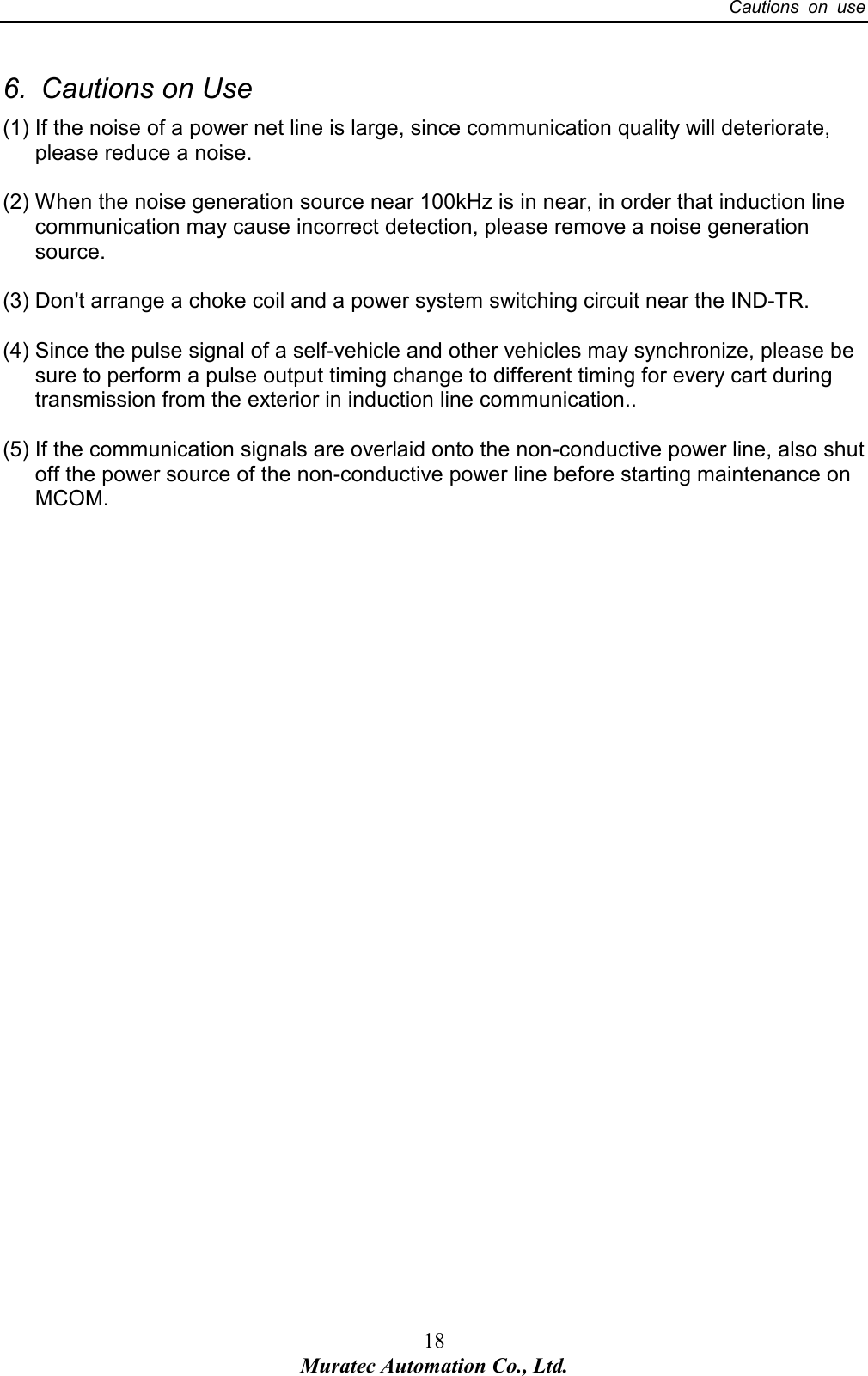
  Cautions  on  use 18 Muratec Automation Co., Ltd. 6.  Cautions on Use (1) If the noise of a power net line is large, since communication quality will deteriorate, please reduce a noise.  (2) When the noise generation source near 100kHz is in near, in order that induction line communication may cause incorrect detection, please remove a noise generation source.  (3) Don't arrange a choke coil and a power system switching circuit near the IND-TR.    (4) Since the pulse signal of a self-vehicle and other vehicles may synchronize, please be sure to perform a pulse output timing change to different timing for every cart during transmission from the exterior in induction line communication..  (5) If the communication signals are overlaid onto the non-conductive power line, also shut off the power source of the non-conductive power line before starting maintenance on MCOM.

Navigation menu