Ogemray Technology PA0XT Wireless Module User Manual PA User s manual V19
Shenzhen Ogemray Technology Co.,Ltd Wireless Module PA User s manual V19
user manual
150Mbps
Long Range
USB WIRELESS ADAPTER
User’s Manual
Version 1.9

User’s Manual Wireless USB Adapter
Page 1
This device complies with part 15 of the FCC Rules. Operation is subject to the following two
conditions: (1) This device may not cause harmful interference, and (2) this device must accept
any interference received, including interference that may cause undesired operation.
Changes or modifications not expressly approved by the party responsible for compliance
could void the user's authority to operate the equipment.
NOTE: This equipment has been tested and found to comply with the limits for a Class B digital
device, pursuant to Part 15 of the FCC Rules. These limits are designed to provide reasonable
protection against harmful interference in a residential installation. This equipment generates,
uses and can radiate radio frequency energy and, if not installed and used in accordance with
the instructions, may cause harmful interference to radio communications. However, there is no
guarantee that interference will not occur in a particular installation. If this equipment does
cause harmful interference to radio or television reception, which can be determined by turning
the equipment off and on, the user is encouraged to try to correct the interference by one or
more of the following measures:
-- Reorient or relocate the receiving antenna.
-- Increase the separation between the equipment and receiver.
-- Connect the equipment into an outlet on a circuit different from that to which the receiver is
connected.
-- Consult the dealer or an experienced radio/TV technician for help.
Introduction
Thank you for purchasing the IEEE 802.11b/g or 802.11n Wireless USB Adapter, it supports
USB2.0 and USB1.1 standards interface. It operates in 2.4GHz frequency and fully complies
with IEEE 802.11b/g standards based on 1T1R mode.
A Ralink RT3070 MAC/BBP/Transceiver single chip, a RF power amplifier and a LNA in Rx
circuitry are used to achieve high-performance of the latest Wi-Fi technology.
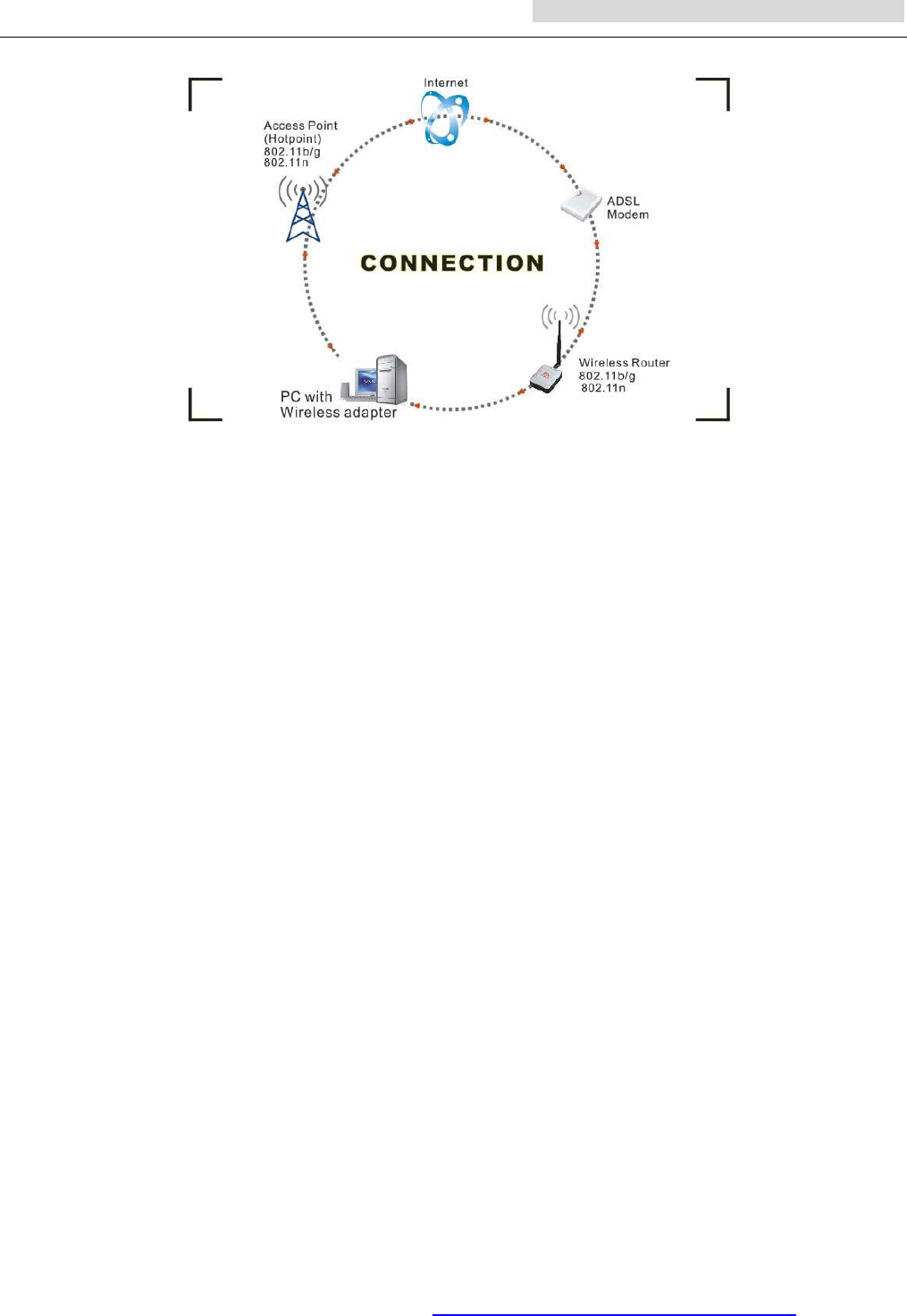
A typical Internet access application for the USB wireless adapter is shown as the following
figure:
FCC Radiation Exposure Statement
This equipment complies with FCC radiation exposure limits set forth for an uncontrolled environment.
This equipment should be installed and operated with minimum distance 20cm between the radiator & your body
User’s Manual Wireless USB Adapter
Page 2
There are two different ways to access Internet:
1. With a wireless adaptor, receiving and transferring signal via a wireless router, then
passed to an ADSL modem, then to local ISP (Internet service supplier) through a
telephone line.
2. With a wireless adaptor, receiving and transferring signal via local AP (Access Point) or
so called Hotpoint directly.
Tips: An 802.11 LAN is based on a cellular architecture where the system is subdivided into
cells, where each cell (called Basic Service Set or BSS) is controlled by a Base Station
(called Access Point, or in short AP).
Package
Contents
:
One 150Mbps 802.11n USB Wireless Adapter.
Adapter Installation disc.
User’s Manual.
Antenna (optional)
Warranty
The warrants for the end user (“Customer”) that this hardware product will be free from defects
in workmanship and materials, under normal use and service, for twelve (12) months from the
date of purchase from its authorized reseller. Information in this document is subject to change
without prior notice.
Installation
To install the driver of the USB adapter, please use administrator user account to login before
the following steps:
Tips: the latest original drivers can be down loaded from the website of Ralink chipset
manufacturer. The current website is http://www.ralinktech.com/support.php To find a
correct driver, please identify the chipset type applied in the adapter you have.
User’s Manual Wireless USB Adapter
Page 3
1. For a 150Mbps 802.11n adapter, double click Ralink_***.exe program, which is located
in the driver folder in the installation disc. Such as: G:\WiFi Driver\Windows Driver\
RT307X.exe.
Notes: Because Ralink often updates software, the drivers contained in the disc
might be changed without prior notice.
2. Follow the instructions and prompts of the “InstallShield Wizard” to finish the driver
installation:
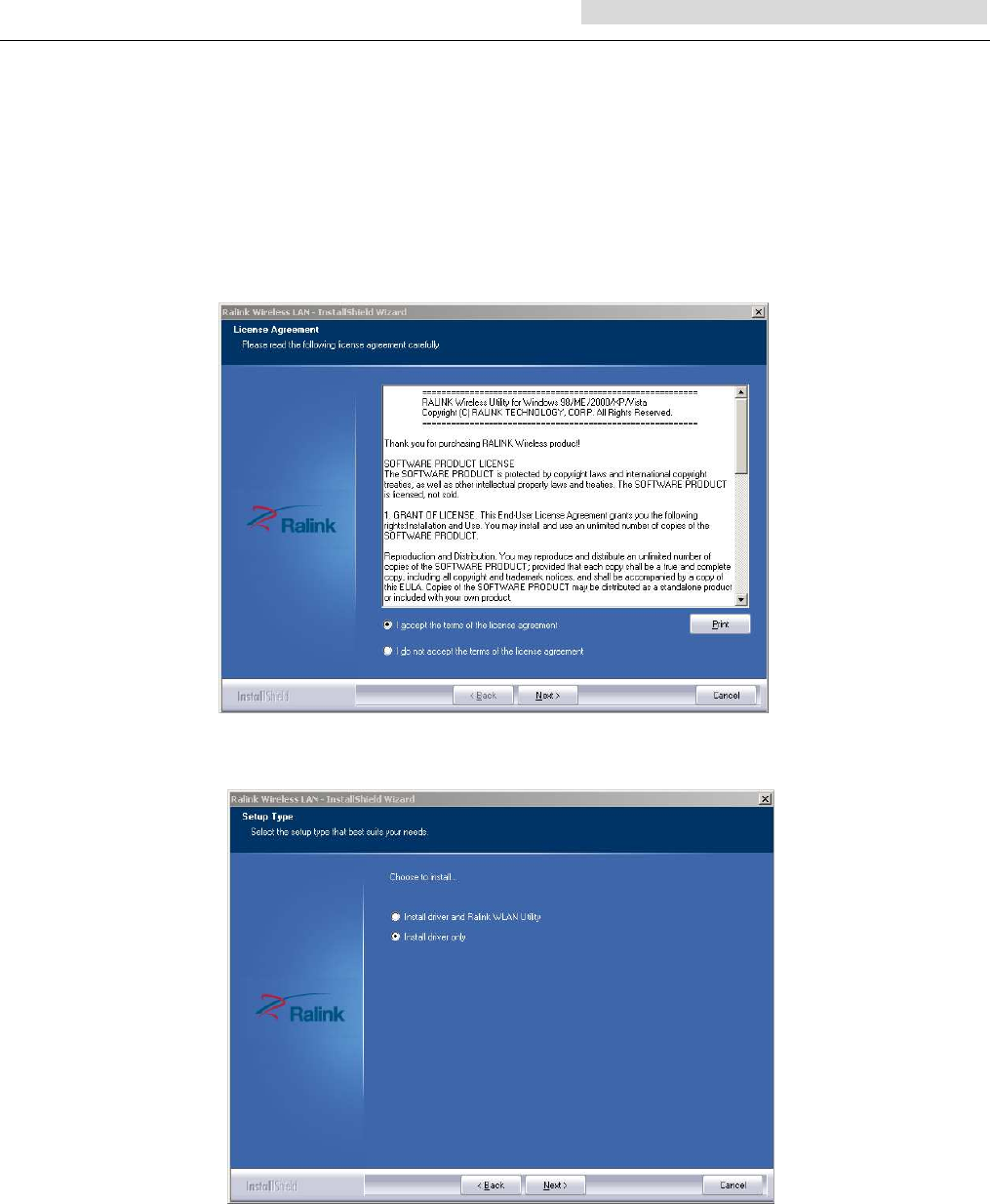
a. Select the “I accept the terms of the license agreements”, then click the “Next”.
b. There shows a setup type window, you can select “Install driver only” or “Install driver
and Ralink WALN utility” and then click the “Next”.
Tips:
1).The Windows XP utilizes a "Wireless Zero Configuration( WZC)" Service built into
the operating system. Many wireless network adapter cards utilize this service.
2). Ralink- the chipset manufacturer has developed a utility for setting up wireless
connection. If you select this item, you can switch between the Windows XP’s WZC
service and the Ralink WLAN utility service later.
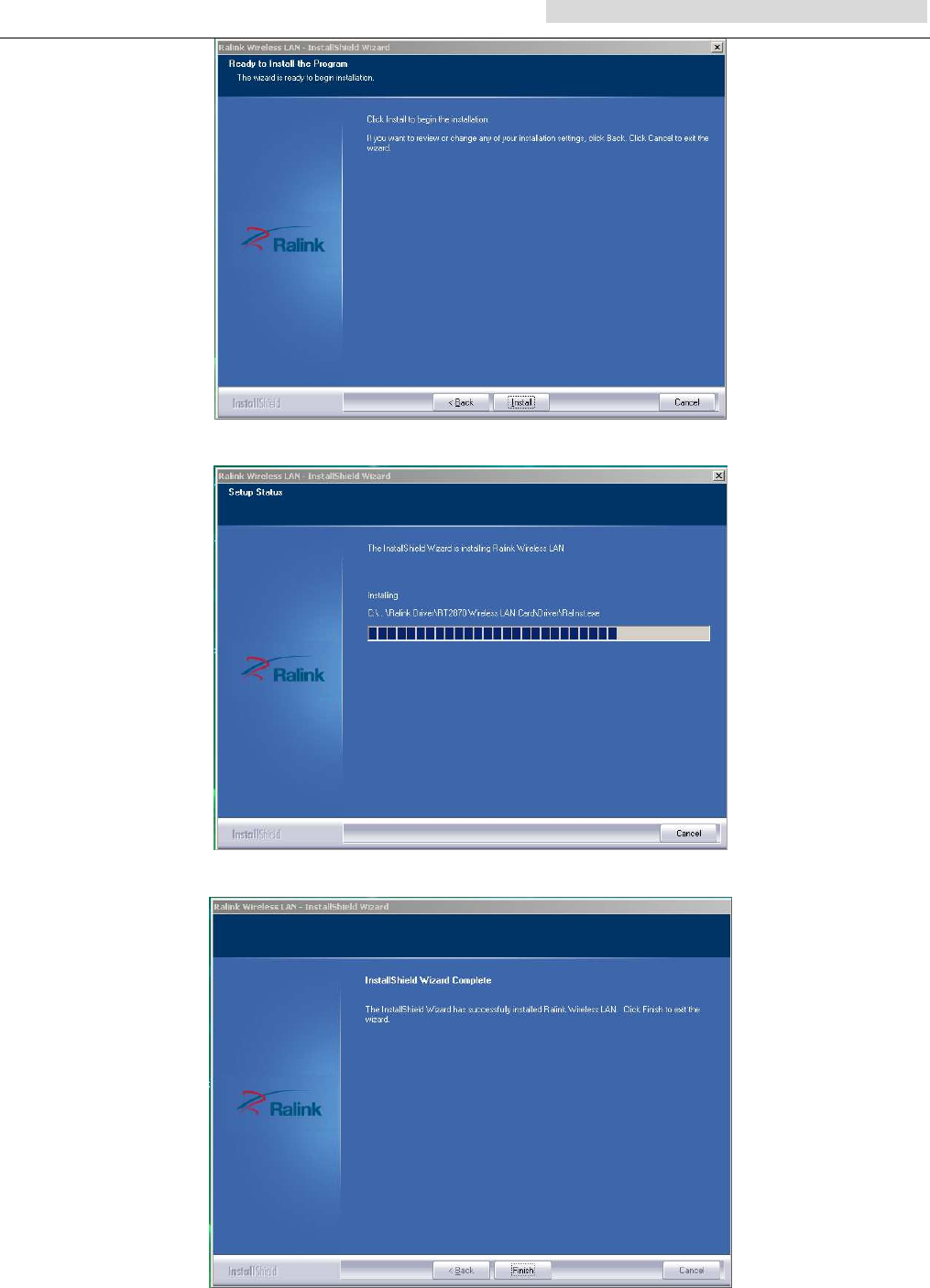
c. Click the “Install” to confirm the installation, there shows the installation progress.
User’s Manual Wireless USB Adapter
Page 4
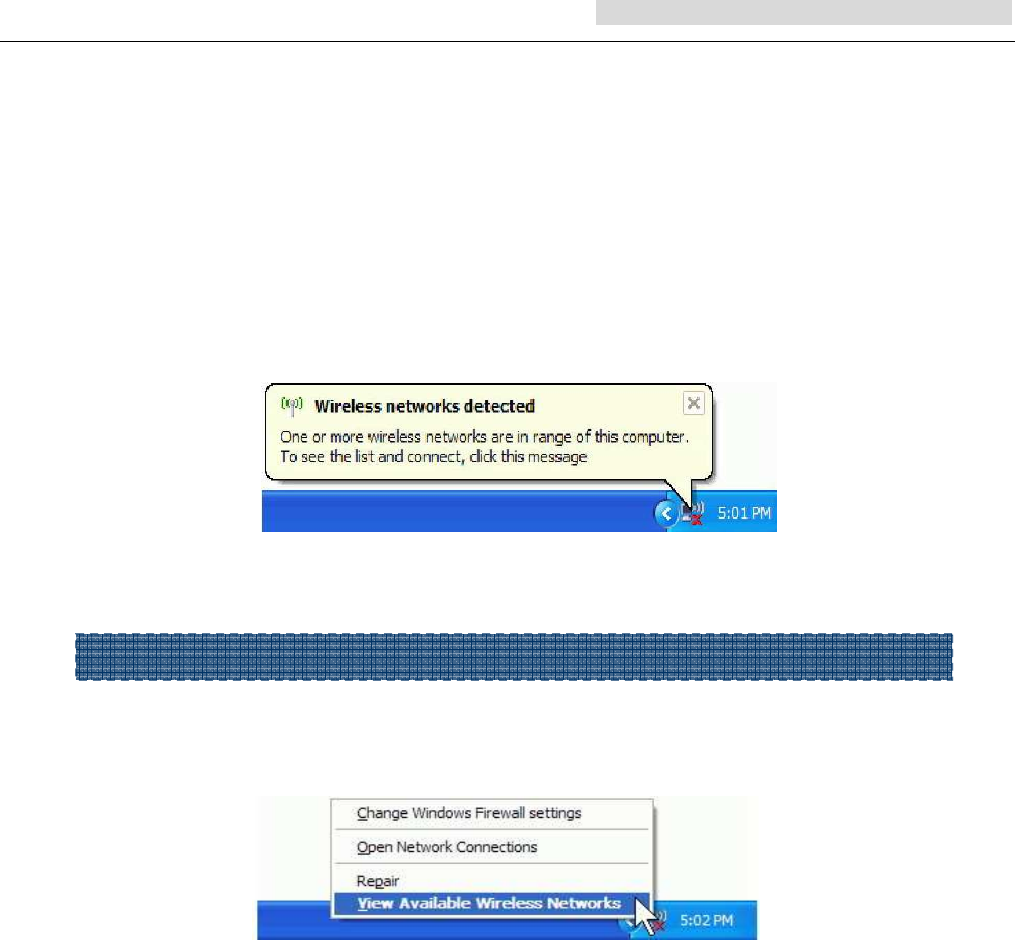
d. Click “finish” to finish the driver installation.
User’s Manual Wireless USB Adapter
Page 5
Wireless
Connection
1. After finishing driver installation, insert the USB adapter to Notebook or PC that
supports USB 2.0/1.1 interface.
Remarks: Make sure to connect the adapter to an USB port on your computer
directly rather than an USB hub. Although it might work when connecting with an
USB hub, the likelihood of configuration problems will be higher.
2. The system shows a wireless utility icon in the Windows system tray, which locates in
the bottom-right corner of your computer screen, and pops up a message that indicates
a new hardware is found and installed, something like this:
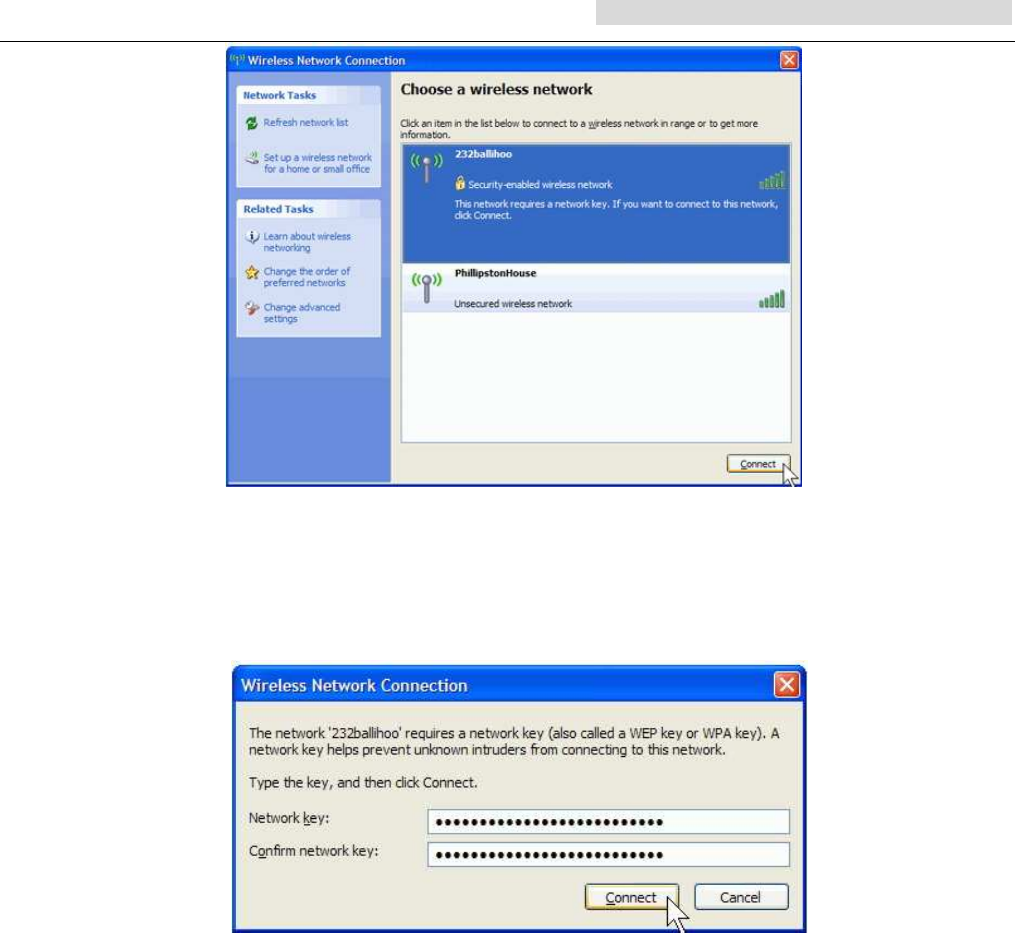
1. Double-click the utility icon or right click the icon and then select “View Available
Wireless Networks” to launch the utility, the Wireless Network Connection window
appears and displays your wireless network listed with the SSID you chose.
Notes: Before configuring your WiFi access, you need to have your network’s SSID
(service set identifier), security key and authentication type handy. Check the
documentation coming with your router, ask your network administrator to get the
information.
2. If you don't see your network, click “Refresh network list” in the upper left corner. If you
are locating within the valid range of hotspots or wireless routers, all available networks
will be recognized and listed automatically. Click your preferred network, and then click
“Connect” in the lower right corner.
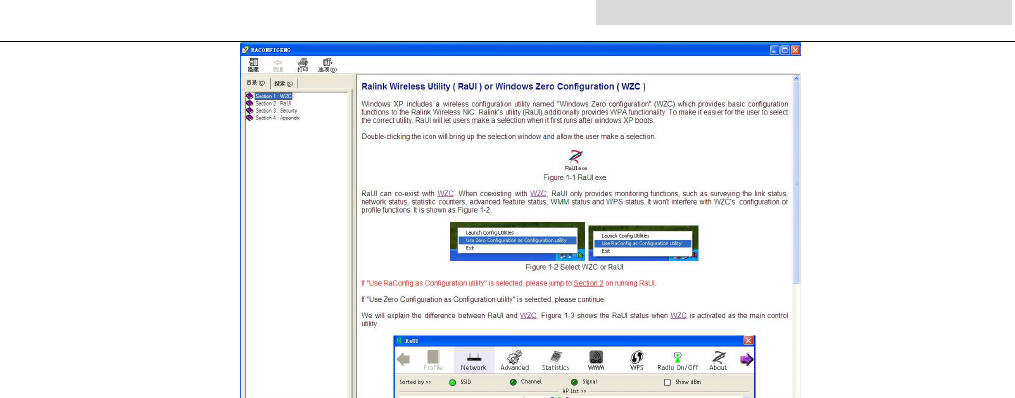
Should the service " Wireless Zero Configuration ( WZC)" be applied.
User’s Manual Wireless USB Adapter
Page 6
3. If the network security key hasn’t been inputted before, Windows XP prompts you to
enter the network’s security key to access the wanted SSID. Type the encryption key
that you wrote down earlier in both the Network key and Confirm network key boxes,
and then click “Connect”.
Tips: If there are free hotspots, simply select the network you want from the list
displayed, then click Connecting. It tries to launch your Internet browser—you should
be connected to the Internet.
If there is a pay hotspot, signing in or up will require either to enter your login
information-if you‘re an existing customer, or to enter your credit card information for
payment, it is just decided by you. Then clicking the Connecting, your default Internet
browser will launch and take you to the service provider’s login page. Most providers
have very simple and step-by-step instructions for you to sign up and then to be
connected. Another way to access the service provider’s login page is to simply
launch your Internet browser, if there’s a pay network available, you’ll be taken
directly to the login page.
User’s Manual Wireless USB Adapter
Page 7
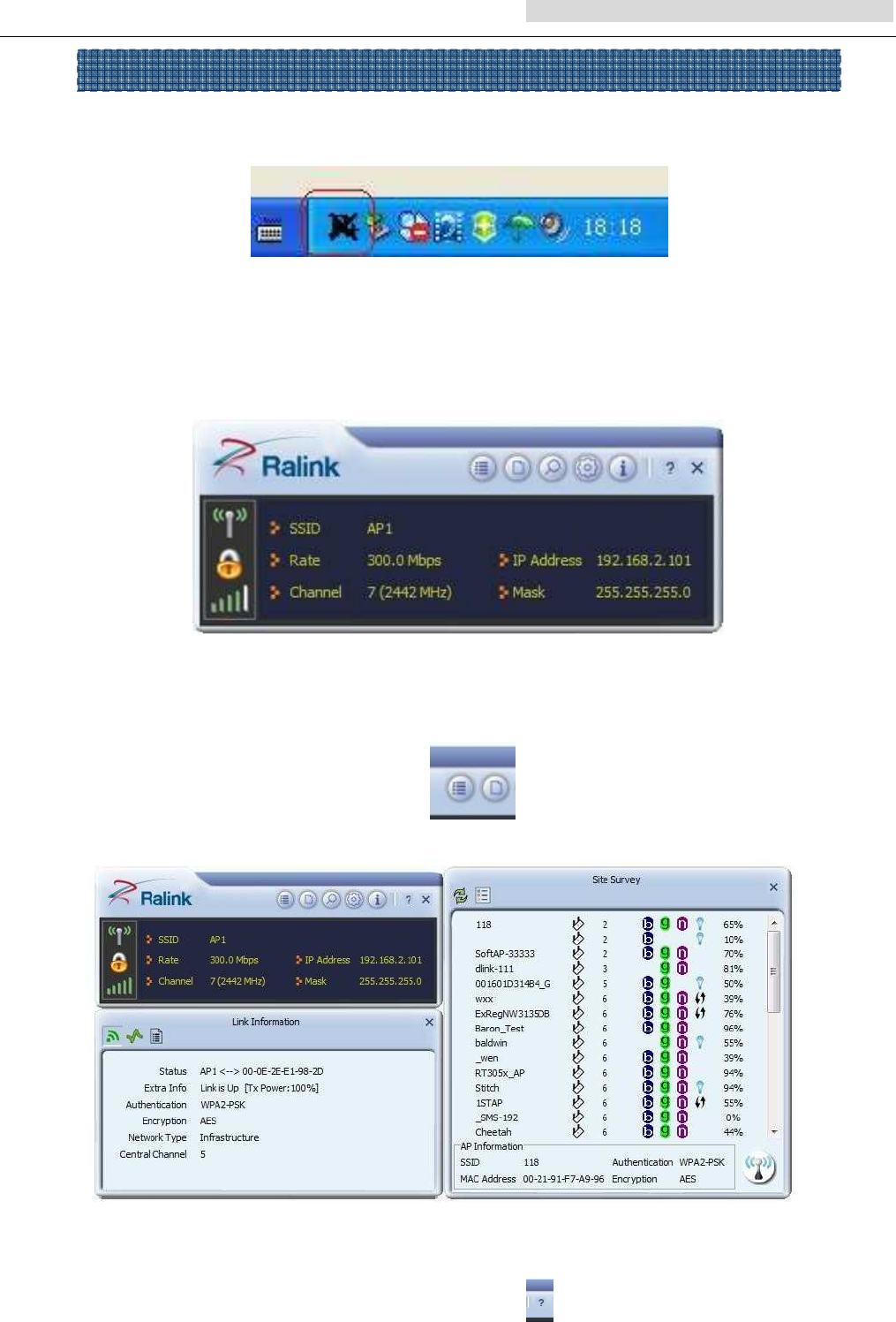
After the installation of Ralink utility, the system shows a special wireless utility icon in the
Windows system tray, which locates in the bottom-right corner of your computer screen:
When an USB wireless adapter is inserted into an USB 2.0/1.1 port of Notebook or PC,
the icon changes colors according to the wireless signal quality.
1. Double-click the icon or right click the icon and then select “Launch Config Utility” to
launch the utility, the RaUI window appears like:
The Ralink wireless utility starts in compact mode as shown above, provides profile
management, the available networks listing, a statistical counter display, Wi-Fi
multimedia (WMM), protected Wi-Fi setup, Cisco compatible extensions (CCX), call
admission control (CAC), radio controls, Ralink driver/utility information, and help
functions. Clicking the expanding icon can change to the full mode as shown
below:
For more details about the RaUI utility, please read the help
information of the utility by clicking the tap
.
Should the service of Ralink wireless connection utility be applied.
User’s Manual Wireless USB Adapter
Page 8
Tips for Wi-Fi users
With a Wi-Fi connection, you can roam about 150 m around the access point (depends on
different environment), so find a spot where you can work without any interruption. Then see
how much work you can do, such as:
Easily and quickly receive and transmit files within your local network — no problem
for big files.
Access your email and surf the web with the same speed as that connected with
network cables.
Synchronize data between devices.
Take advantage of wireless printing — send files directly from your laptop PC to a
wireless printer over Wi-Fi connection.
Warning
Wi-Fi offers greater speed and range than Bluetooth, but it drains your portable device
batteries a lot faster than Bluetooth does. In fact, if you use a Wi-Fi connection regularly on
your laptop PC, you'll undoubtedly notice that you need to recharge more often. If you need to
conserve battery life — on a long trip for example — turn off your Wi-Fi connection when you
don't actually need it.
Security
Because wireless networks rely on radio signals to transmit data, they are not as secure as
wire network. Wireless networks are susceptible to viruses and breaches like eavesdropping
and need to be protected in order to be secure.
There are many security measures to safeguard wireless networks, protect the data, and
keep unauthorized users out. Hotspots, on the other hand, are often free of standard security
practices in an effort to make it easy for anyone to connect. It may be found that some pay
hotspots administered by service providers offer have some level of security, however, when
using a hotspot, it’s always a good idea to be proactive and to employ security measures of
your own.
Key terms
Wi-Fi: Short for “wireless fidelity,” a generic label that refers to wireless networks or
networking.
Hotspot: A specific geographic location in which an access point provides public
wireless broadband network services to mobile visitors through a WLAN.
User’s Manual Wireless USB Adapter
Page 9
Throughput: The amount of data transmitted in a set amount of time.
Bandwidth: the amount of data that can be carried from one point to another in a
given time period (usually a second).
Chipset: A group of microchips that execute various functions (like memory) to
support the CPU.
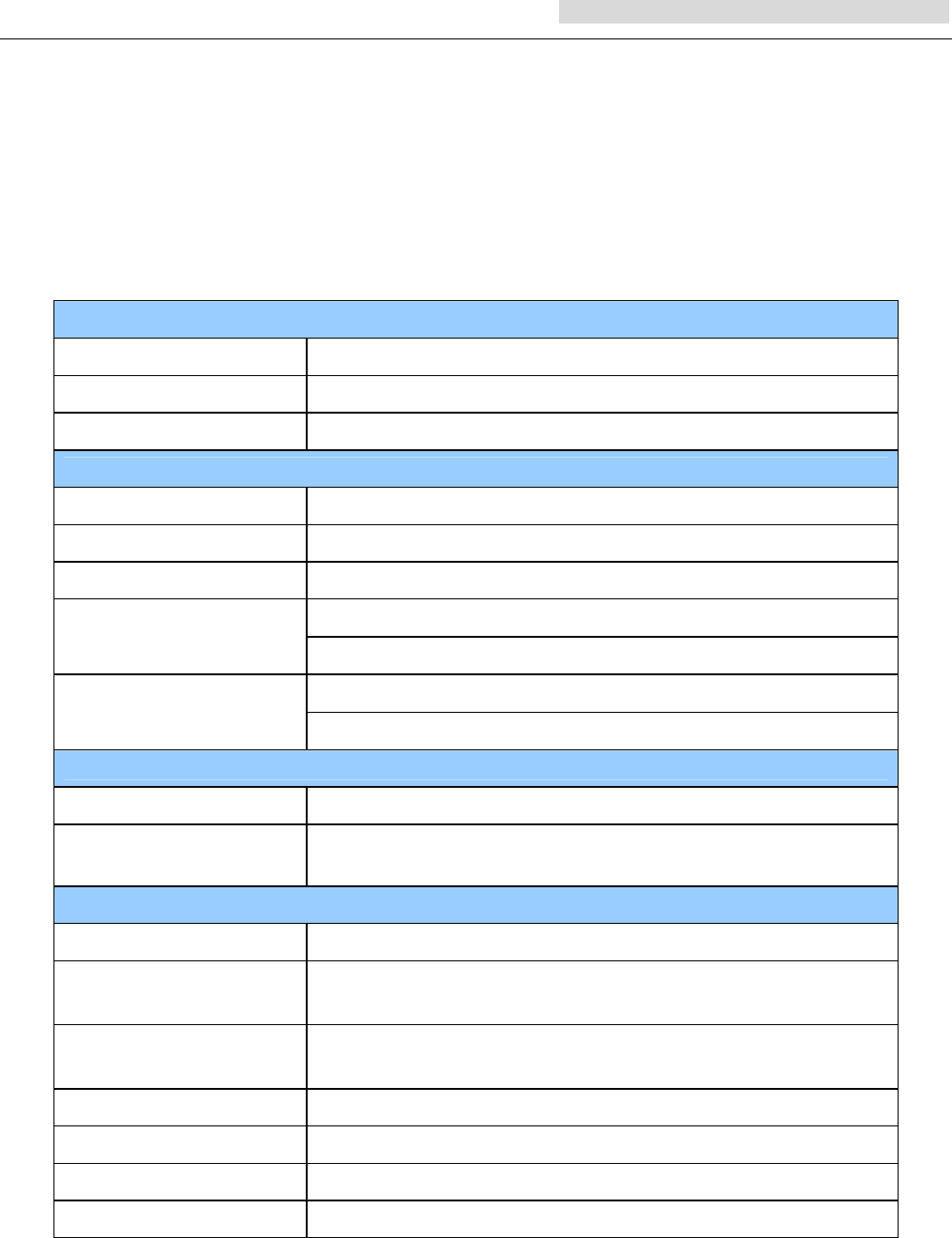
Specifications (Typical):
Hardware
Main Chipset Ralink RT3070
Host interface USB 2.0/1.1 Type A
LED Link/ Activity
RF
Antennas External Antenna 5 dBi
Antenna Impedance 50 ohm@2.4GHz
Operation Frequency 2412~2462 MHz
802.11b (CCK) 11Mbps: 22+/-1dBm
Typical Peak Tx Power
( excludes antenna gain) 802.11g (OFDM) 54Mbps: 18+/-1dBm
802.11b: -98+/-1dBm
Receive Sensitivity
( excludes antenna gain) 802.11g: -83+/-1dBm
Software
Operation System Windows 2000/XP/Vista/7; Linux 2.6.X; Mac OS X
Security WEP 64/128bit , WPA, WPA2, 802.1x, and 802.11i
Cisco CCS V1.0, 2.0 and V3.0 Compliant
Operation Conditions
Voltage Range DC 5.0V ± 5%
Current Range Quiescent current: 85 +/- 5mA, Operation current: 310+/-10 mA
( @ 802.11g, 54Mbps)
Power Consumption Tx: <1600mW@802.11g
Operating Temperature 0°C - 50°C
Storage Temperature -20°C - 70°C
Operating Humidity RH 95% (Non-Condensing)
Storage Humidity RH 95% (Non-Condensing)