Parente Fireworks Srl FIREMASTER4KT Firemaster IV Base Station User Manual SISTEMA FIREMASTER III

Parente Fireworks Srl Firemaster IV Base Station SISTEMA FIREMASTER III

Users Manual II

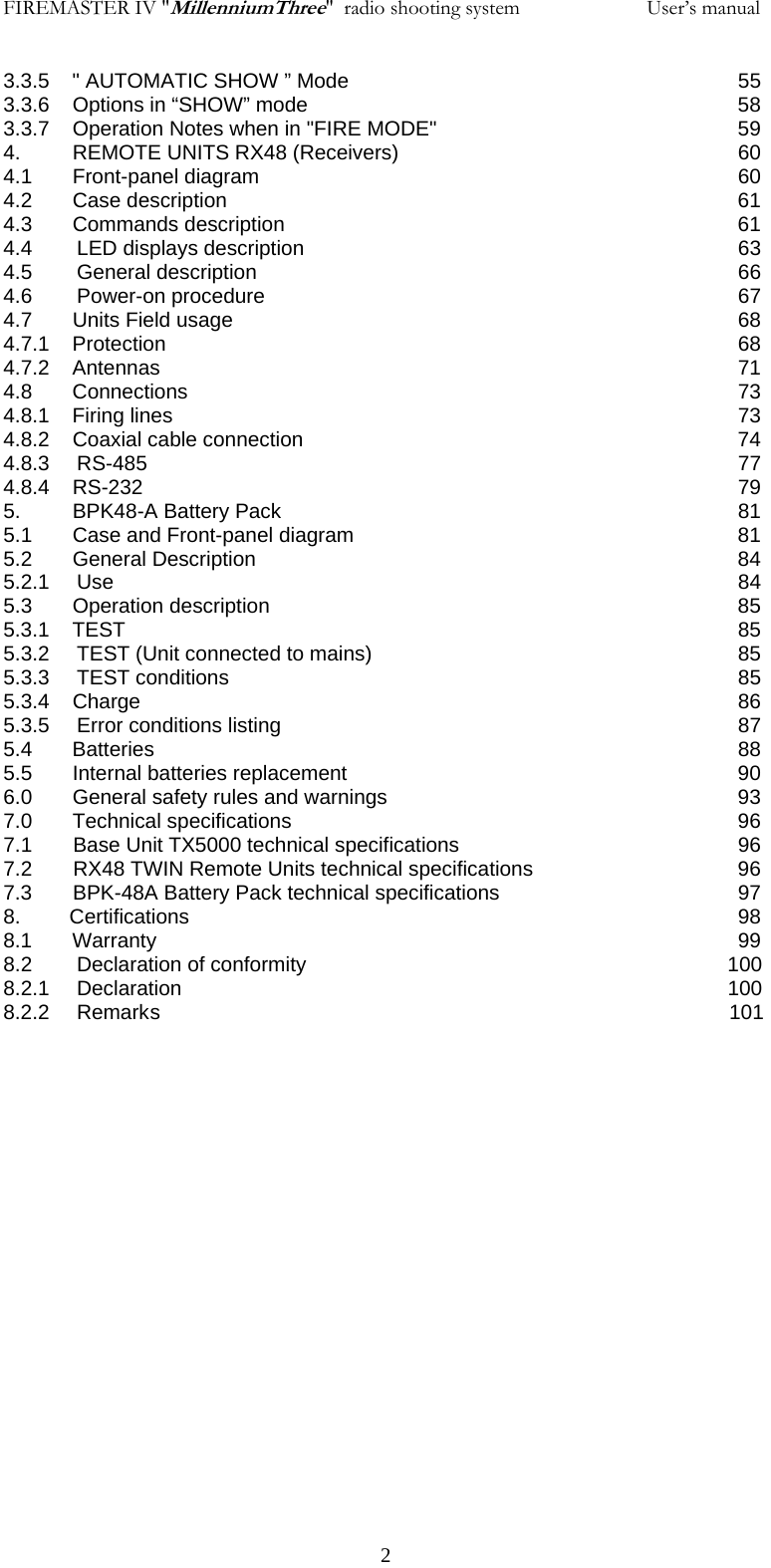
FIREMASTER IV "MillenniumThree"  radio shooting system           User’s manualSYSTEM FIREMASTER IV "Millennium Three" RADIO-CONTROLLED SYSTEM FOR REMOTE SHOOTING OF PYROTECHNIC SHOWS  USER’S MANUAL  CONTENTS  Paragraph               Page  1.         Base Station - Control Unit TX5000          3 1.1       Front panel diagram              3 1.1.1    Front-panel commands description          3   1.2.1    Instrument case and connector description        6 1.3       Operation                7    1.4       Base Station TX5000 usage procedure          7    1.5       "SHOW MANAGEMENT" mask description        8 1.6       "TOOLS" mask                10     1.7       "SYSTEM SETUP" Icon             11    1.8       "OLD UNITS SETUP" Icon            12 1.9       "TONE GENERATOR" Icon            15 1.10 “TONE GENERATOR” TESTING     16 1.11 SMPTE TEST ICON       18 1.12 MIDI TEST ICON       20 2.         "TESTING" Icon               21 2.1       "TEST LINE" Icon              21    2.1.1    Modify the single line parameters          26    2.2       Notes about the usage of the numeric keypad        28                 2.3       "TEST UNIT" Icon              30    2.3.1    Data modification       34 2.3.2  How to remove all timed sequences from the same remote unit    36    2.4 “IMPORT/EXPORT” Icon      37 2.4.1  How to compile a pyrotechnic show on a PC        38 2.4.2  How to download the show file to the TX5000 Unit      39 2.4.3  EDIT and SAVE the downloaded show data        41 2.4.4 The “EDITING” menu       43 2.5 The “UNITS PROGRAM” menu      44 2.5.1 “SHOW VERIFY” mask       45 2.5.2 Error messages        46 3.         "FIRE" function                48 3.1       Foreword        48 3.2       "FIRE" mask                49 3.3       Firing options                51 3.3.1    MANUAL Mode        52 3.3.2    "MUSIC" Mode        52 3.3.3   "MANUAL SHOW" Mode       54 3.3.4    " PYROMUSICAL SHOW" Mode       55   1
FIREMASTER IV "MillenniumThree"  radio shooting system           User’s manual3.3.5    " AUTOMATIC SHOW ” Mode       55 3.3.6    Options in “SHOW” mode            58 3.3.7    Operation Notes when in "FIRE MODE"         59 4.         REMOTE UNITS RX48 (Receivers)          60 4.1       Front-panel diagram              60 4.2       Case description              61 4.3       Commands description              61 4.4 LED displays description      63 4.5 General description       66 4.6 Power-on procedure       67 4.7       Units Field usage              68 4.7.1    Protection        68 4.7.2    Antennas         71 4.8       Connections        73 4.8.1    Firing lines        73 4.8.2    Coaxial cable connection            74 4.8.3 RS-485         77 4.8.4    RS-232         79 5.         BPK48-A Battery Pack              81 5.1       Case and Front-panel diagram            81 5.2       General Description              84 5.2.1 Use         84 5.3       Operation description              85 5.3.1    TEST         85 5.3.2 TEST (Unit connected to mains)     85 5.3.3 TEST conditions       85 5.3.4    Charge         86 5.3.5 Error conditions listing       87 5.4       Batteries        88 5.5       Internal batteries replacement            90 6.0       General safety rules and warnings          93 7.0       Technical specifications             96 7.1   Base Unit TX5000 technical specifications        96 7.2   RX48 TWIN Remote Units technical specifications      96 7.3   BPK-48A Battery Pack technical specifications        97 8.      Certifications        98 8.1       Warranty        99 8.2  Declaration of conformity                     100 8.2.1  Declaration                         100 8.2.2  Remark s                                    101       2
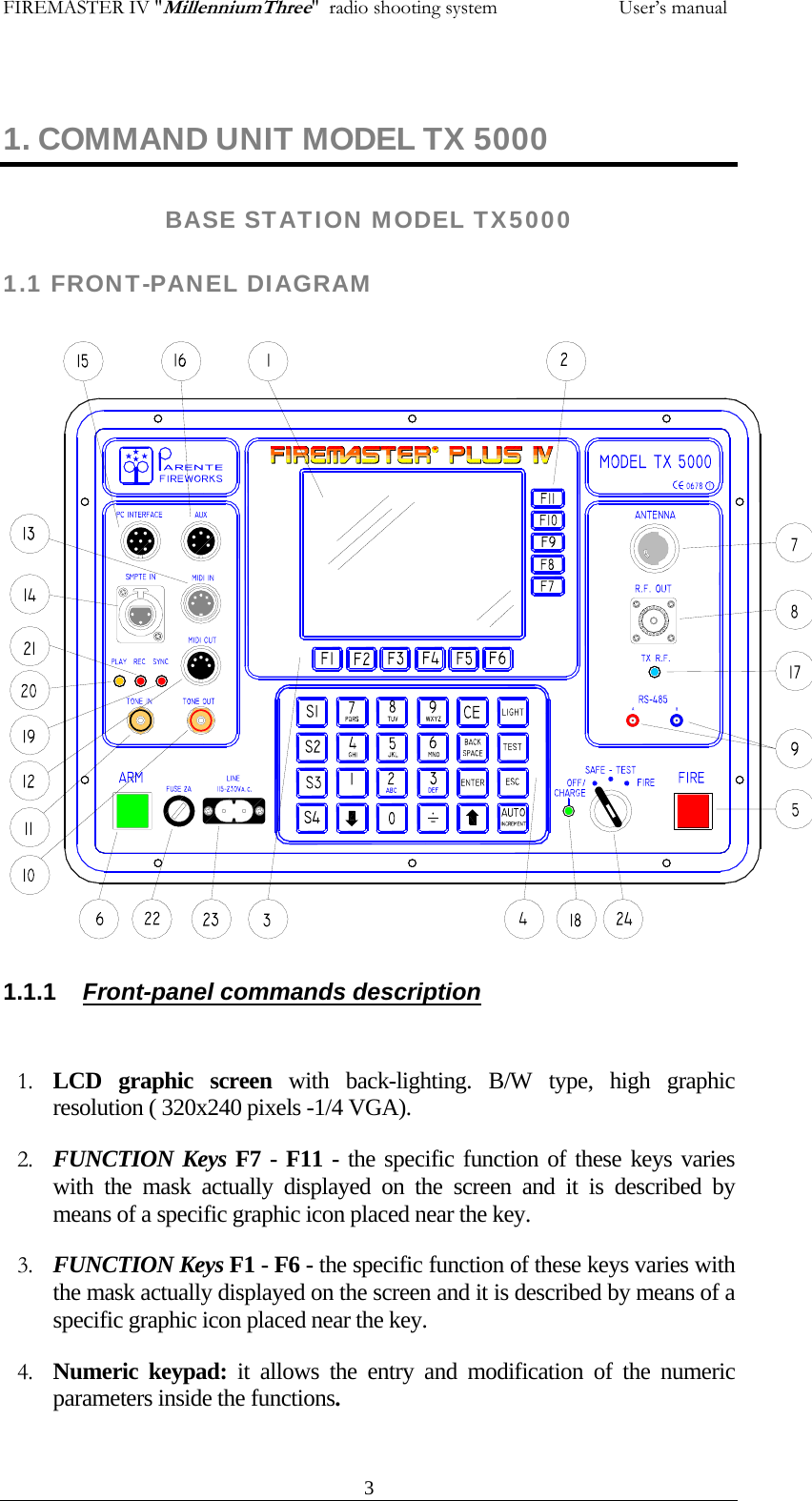
FIREMASTER IV "MillenniumThree"  radio shooting system           User’s manual 1. COMMAND UNIT MODEL TX 5000  BASE STATION MODEL TX5000 1.1 FRONT-PANEL DIAGRAM                           1.1.1    Front-panel commands description   1. LCD graphic screen with back-lighting. B/W type, high graphic resolution ( 320x240 pixels -1/4 VGA). 2. FUNCTION Keys F7 - F11 - the specific function of these keys varies with the mask actually displayed on the screen and it is described by means of a specific graphic icon placed near the key. 3. FUNCTION Keys F1 - F6 - the specific function of these keys varies with the mask actually displayed on the screen and it is described by means of a specific graphic icon placed near the key. 4. Numeric keypad: it allows the entry and modification of the numeric parameters inside the functions.   3
FIREMASTER IV "MillenniumThree"  radio shooting system           User’s manual5. FIRE Pushbutton – When pressed together with the ARM key, starts immediately the firing of all lines with the sequence number actually displayed. ARM and FIRE buttons, if pressed alone, have NO EFFECT. When a sequence has been fired, in order to step to the next one (or to allow the auto-increment function to do it automatically), it will be necessary to release BOTH buttons. ARM or FIRE buttons, when the keyswitch is SAFE/TEST position, can be used INDIFFERENTLY to trigger a SYNCHRONISM tone output (see a more detailed description at chapter 1.6 “Tools Mask”). 6. ARM Pushbutton – When pressed, the system (if the selector key is on the FIRE position), is ARMED and ready to fire. 7. Main Antenna. Turret for the attachment of the whip antenna supplied with the instrument. The antenna resonates at λ/4 on 40,675MHz.     NOTE: use the original antenna only. 8. R.F. OUTPUT – “UHF” coaxial connector. Output for test purposes only. It is capacitively-coupled and allows to monitor the output R.F. signal with an oscilloscope or a frequency counter. 9. RS-485 standard SERIAL Port. 2mm plug connectors. This port is used to connect the base Unit TX5000 to the Remote Units RX48 when a CABLE CONNECTION is required in place of the standard RADIO link (or to implement a mixed-type connection: CABLE+RADIO). The connection wiring requires TWO WIRES ONLY: A and B connections MUST be respected (i.e.: pin A of TX5000 must be connected to ALL pins A of the RX-48 units and pin B to ALL corresponding pins B of the RX-48 units. Only the LAST RX48 unit must be LOADED with a terminating 120ohm resistor placed between A and B. 10. TONE OUT: RCA-type connector (red). Generates an audio synchronism tone: it can be recorded along with the musical base in order to synchronize the FIRE command. 11. TONE IN: RCA-type connector (black). Accepts an AUDIO input synchronism coded signal to synchronize the FIRE command with the musical base during the show. 12. MIDI OUT: 5-pole (180°) female DIN connector. It is a standard MIDI output replicating exactly the signals present at connector 13 (MIDI IN). It can be used to pass the MIDI signal to other units sharing the same synchronism. 13. MIDI IN: 5-pole (180°) male DIN connector. It is a standard MIDI input with total opto-insulation of the incoming signal.  14. SMPTE IN: 3-pole “XLR” female connector. Accepts a standard SMPTE/EBU timecode signal. It can be used to synchronize the firing sequence to an external timing source.   4
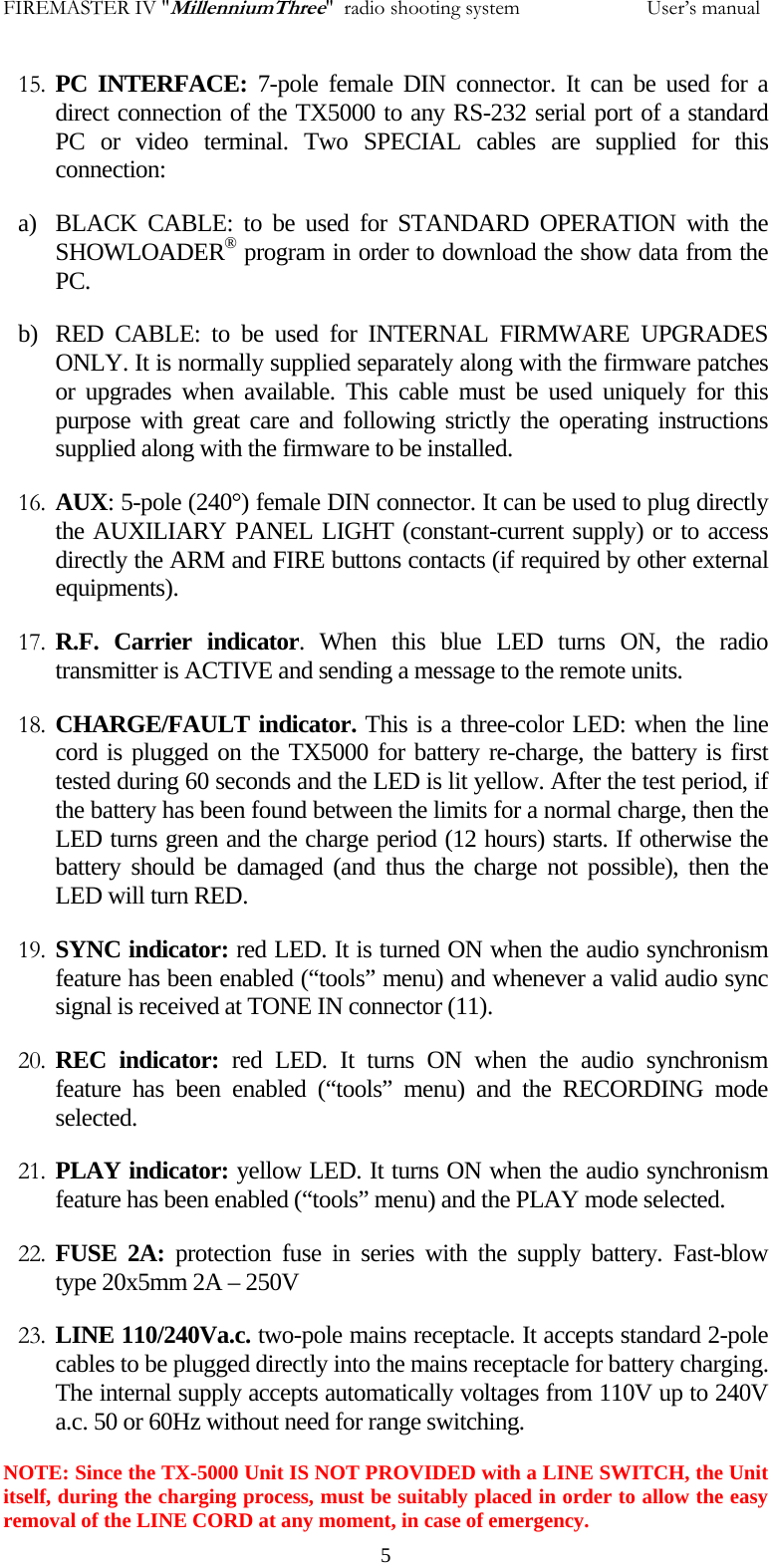
FIREMASTER IV "MillenniumThree"  radio shooting system           User’s manual15. PC INTERFACE: 7-pole female DIN connector. It can be used for a direct connection of the TX5000 to any RS-232 serial port of a standard PC or video terminal. Two SPECIAL cables are supplied for this connection: a) BLACK CABLE: to be used for STANDARD OPERATION with the SHOWLOADER® program in order to download the show data from the PC. b) RED CABLE: to be used for INTERNAL FIRMWARE UPGRADES ONLY. It is normally supplied separately along with the firmware patches or upgrades when available. This cable must be used uniquely for this purpose with great care and following strictly the operating instructions supplied along with the firmware to be installed. 16. AUX: 5-pole (240°) female DIN connector. It can be used to plug directly the AUXILIARY PANEL LIGHT (constant-current supply) or to access directly the ARM and FIRE buttons contacts (if required by other external equipments). 17. R.F. Carrier indicator. When this blue LED turns ON, the radio transmitter is ACTIVE and sending a message to the remote units. 18. CHARGE/FAULT indicator. This is a three-color LED: when the line cord is plugged on the TX5000 for battery re-charge, the battery is first tested during 60 seconds and the LED is lit yellow. After the test period, if the battery has been found between the limits for a normal charge, then the LED turns green and the charge period (12 hours) starts. If otherwise the battery should be damaged (and thus the charge not possible), then the LED will turn RED. 19. SYNC indicator: red LED. It is turned ON when the audio synchronism feature has been enabled (“tools” menu) and whenever a valid audio sync signal is received at TONE IN connector (11). 20. REC indicator: red LED. It turns ON when the audio synchronism feature has been enabled (“tools” menu) and the RECORDING mode selected. 21. PLAY indicator: yellow LED. It turns ON when the audio synchronism feature has been enabled (“tools” menu) and the PLAY mode selected. 22. FUSE 2A: protection fuse in series with the supply battery. Fast-blow  type 20x5mm 2A – 250V 23. LINE 110/240Va.c. two-pole mains receptacle. It accepts standard 2-pole cables to be plugged directly into the mains receptacle for battery charging. The internal supply accepts automatically voltages from 110V up to 240V a.c. 50 or 60Hz without need for range switching. NOTE: Since the TX-5000 Unit IS NOT PROVIDED with a LINE SWITCH, the Unit itself, during the charging process, must be suitably placed in order to allow the easy removal of the LINE CORD at any moment, in case of emergency.   5
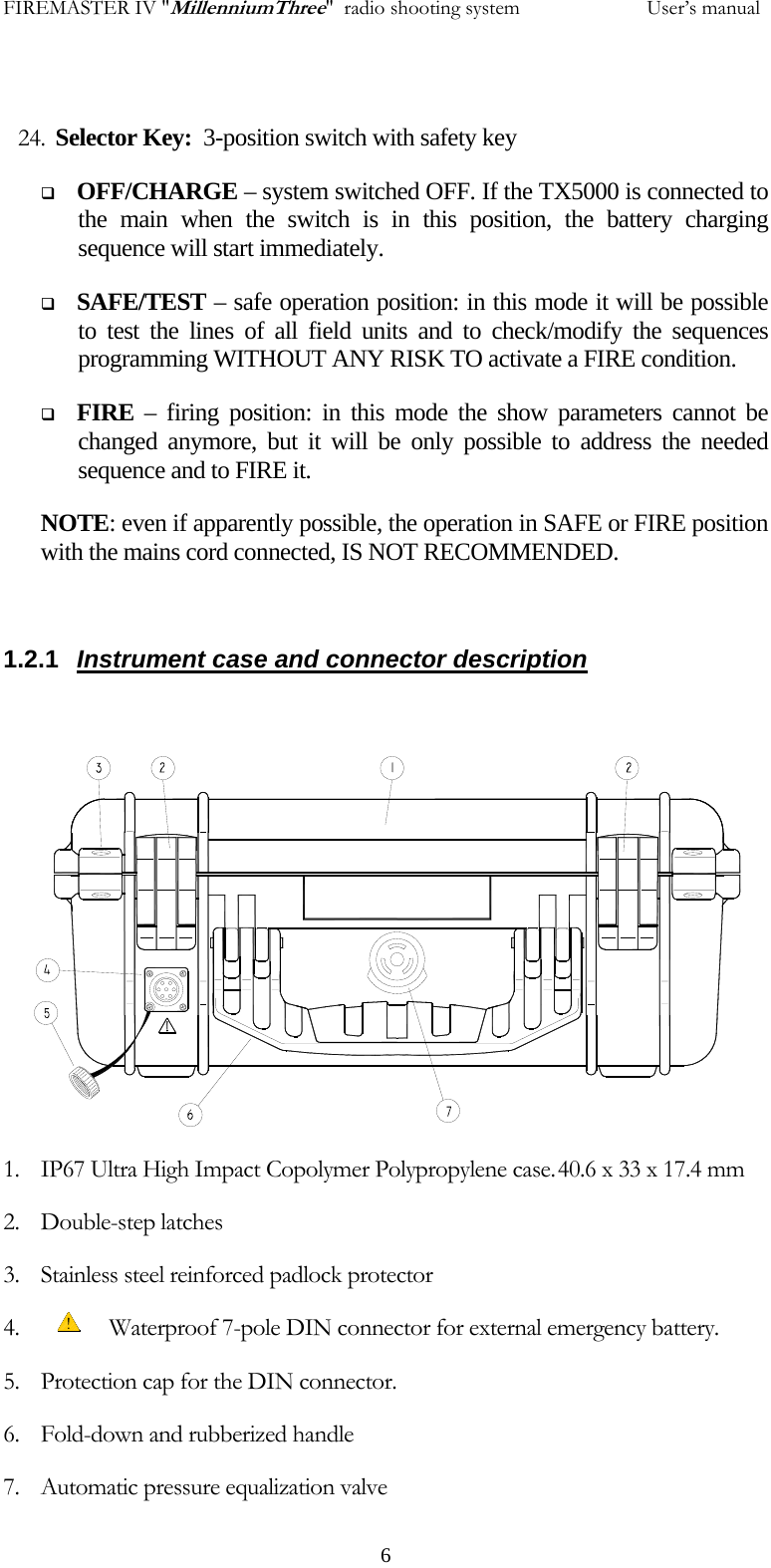
FIREMASTER IV "MillenniumThree"  radio shooting system           User’s manual 24. Selector Key:  3-position switch with safety key  OFF/CHARGE – system switched OFF. If the TX5000 is connected to the main when the switch is in this position, the battery charging sequence will start immediately.   SAFE/TEST – safe operation position: in this mode it will be possible to test the lines of all field units and to check/modify the sequences programming WITHOUT ANY RISK TO activate a FIRE condition.  FIRE – firing position: in this mode the show parameters cannot be changed anymore, but it will be only possible to address the needed sequence and to FIRE it. NOTE: even if apparently possible, the operation in SAFE or FIRE position with the mains cord connected, IS NOT RECOMMENDED.   1.2.1  Instrument case and connector description                1. IP67 Ultra High Impact Copolymer Polypropylene case. 40.6 x 33 x 17.4 mm 2. Double-step latches 3. Stainless steel reinforced padlock protector 4.             Waterproof 7-pole DIN connector for external emergency battery. 5. Protection cap for the DIN connector. 6. Fold-down and rubberized handle 7. Automatic pressure equalization valve   6
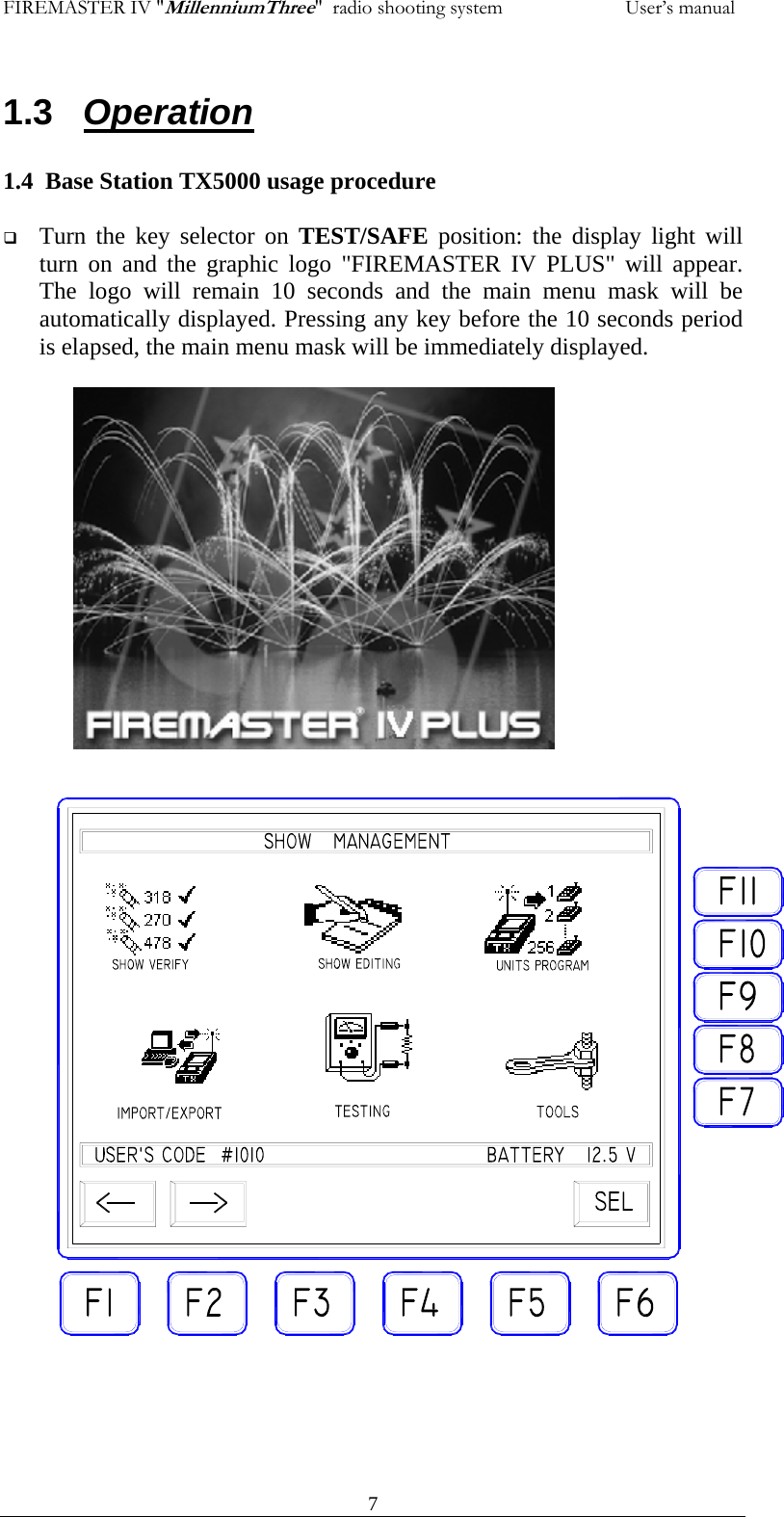
FIREMASTER IV "MillenniumThree"  radio shooting system           User’s manual1.3   Operation  1.4  Base Station TX5000 usage procedure   Turn the key selector on TEST/SAFE  position: the display light will turn on and the graphic logo "FIREMASTER IV PLUS" will appear. The logo will remain 10 seconds and the main menu mask will be automatically displayed. Pressing any key before the 10 seconds period is elapsed, the main menu mask will be immediately displayed.     7
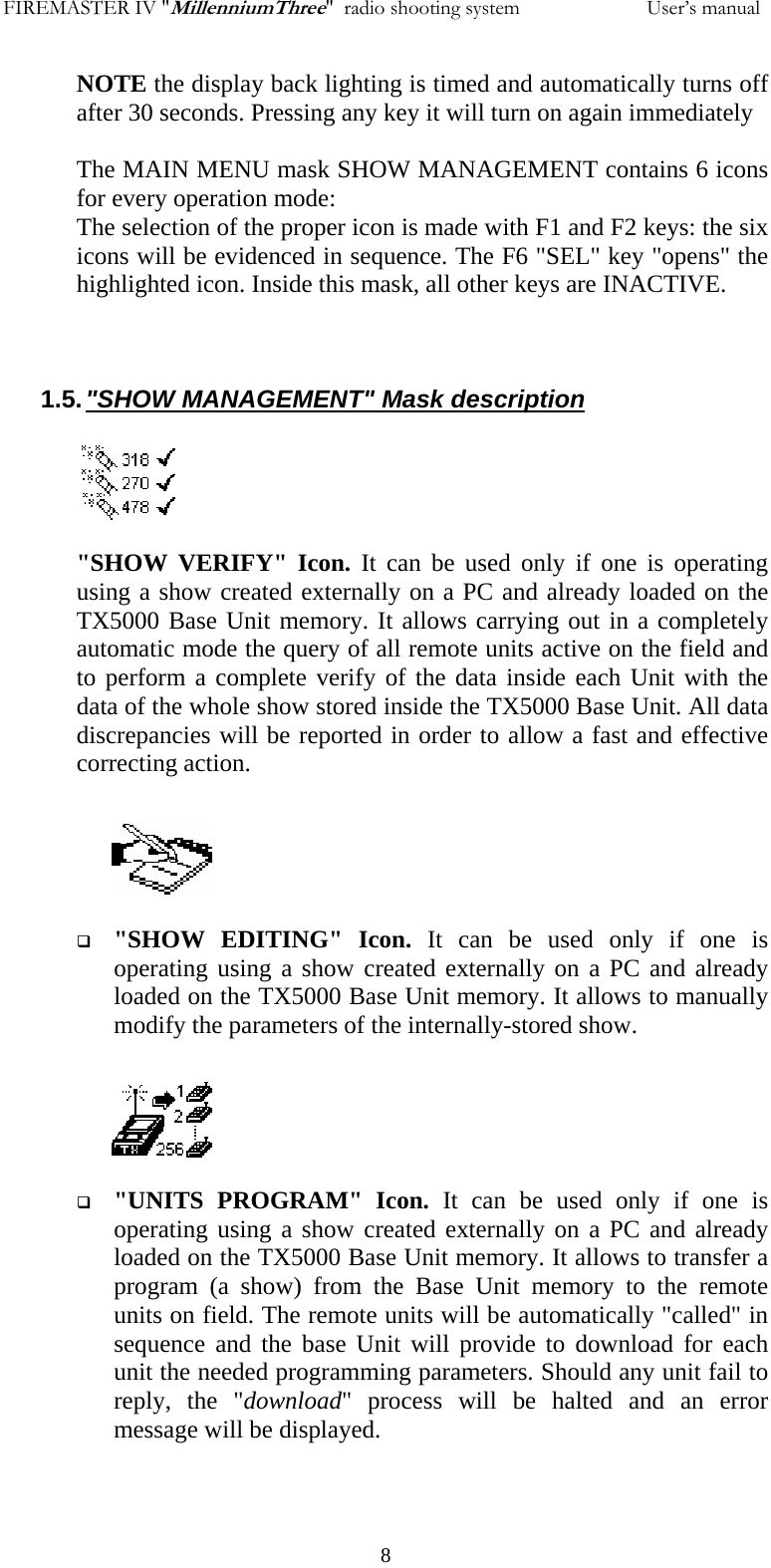
FIREMASTER IV "MillenniumThree"  radio shooting system           User’s manualNOTE the display back lighting is timed and automatically turns off after 30 seconds. Pressing any key it will turn on again immediately  The MAIN MENU mask SHOW MANAGEMENT contains 6 icons for every operation mode: The selection of the proper icon is made with F1 and F2 keys: the six icons will be evidenced in sequence. The F6 "SEL" key "opens" the highlighted icon. Inside this mask, all other keys are INACTIVE.    1.5. "SHOW MANAGEMENT" Mask description  "SHOW VERIFY" Icon. It can be used only if one is operating using a show created externally on a PC and already loaded on the TX5000 Base Unit memory. It allows carrying out in a completely automatic mode the query of all remote units active on the field and to perform a complete verify of the data inside each Unit with the data of the whole show stored inside the TX5000 Base Unit. All data discrepancies will be reported in order to allow a fast and effective correcting action.    "SHOW EDITING" Icon. It can be used only if one is operating using a show created externally on a PC and already loaded on the TX5000 Base Unit memory. It allows to manually modify the parameters of the internally-stored show.    "UNITS PROGRAM" Icon. It can be used only if one is operating using a show created externally on a PC and already loaded on the TX5000 Base Unit memory. It allows to transfer a program (a show) from the Base Unit memory to the remote units on field. The remote units will be automatically "called" in sequence and the base Unit will provide to download for each unit the needed programming parameters. Should any unit fail to reply, the "download" process will be halted and an error message will be displayed.      8
FIREMASTER IV "MillenniumThree"  radio shooting system           User’s manual   "IMPORT/EXPORT" Icon. It can be used only if one is operating using a show created externally on a PC. It allows to transfer the show data created on an external PC to the memory of the Base Unit TX5000 and vice-versa. For all data transfers the serial port RS-232 will be used.    "TESTING" Icon. This icon allows access to the most important functions of the FIREMASTER III SYSTEM. By means of these functions the shooter can verify, modify and program all the remote units creating a complete show on the field or at the company. Unlike a show created on a PC and loaded on the base Unit TX5000 (it remains permanently stored in memory), all data loaded "manually" on the RX48 remote units with these functions, will remain stored on the memory of each remote unit only. It will be then impossible any automatic function of verify of the whole show. The verify must be performed "manually" unit by unit, checking the returned data with a paper copy of the show program.   "TOOLS" Icon. It gives access to several "auxiliary" functions of the FIREMASTER SYSTEM. In particular: - the data transmission mode (CABLE or RADIO) - definition of a specific receiver (RX-24) as "old unit" (FIREMASTER II) in order to obtain the full compatibility with the existing units of the previous generation - the management of the music synchronization system (tone generation). - The management of SMPTE and MIDI time code formats for automatic firing under external control.    9The lower data bar (always present in all masks) shows the following data:  the  user's code (user's # ) and the internal system battery voltage. The “user's #” is the system owner personal code number (4 digits). Every user has a different code, generated at the moment of the first purchase of the System. This code must match with the corresponding one on all Remote Units. This prevents the risk of cross-interference when two or more FIREMASTER SYSTEMS are used at the same time by different companies on the same site. The personal code also protects against any malicious competitor that, using his TX5000 Unit, could try to intentionally interfere with the regular show execution.
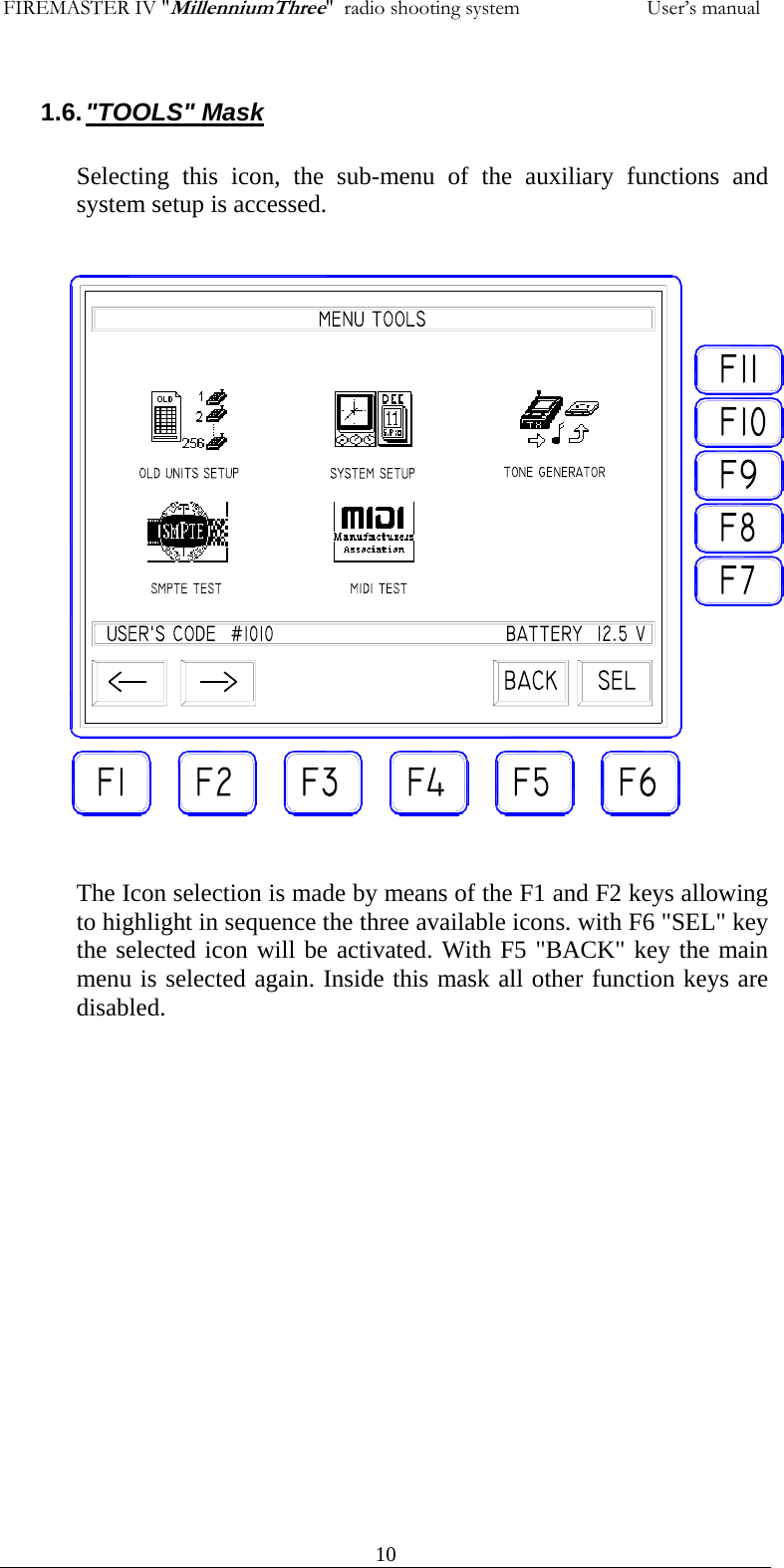
FIREMASTER IV "MillenniumThree"  radio shooting system           User’s manual  101.6. "TOOLS" Mask  Selecting this icon, the sub-menu of the auxiliary functions and system setup is accessed.                     The Icon selection is made by means of the F1 and F2 keys allowing to highlight in sequence the three available icons. with F6 "SEL" key the selected icon will be activated. With F5 "BACK" key the main menu is selected again. Inside this mask all other function keys are disabled.
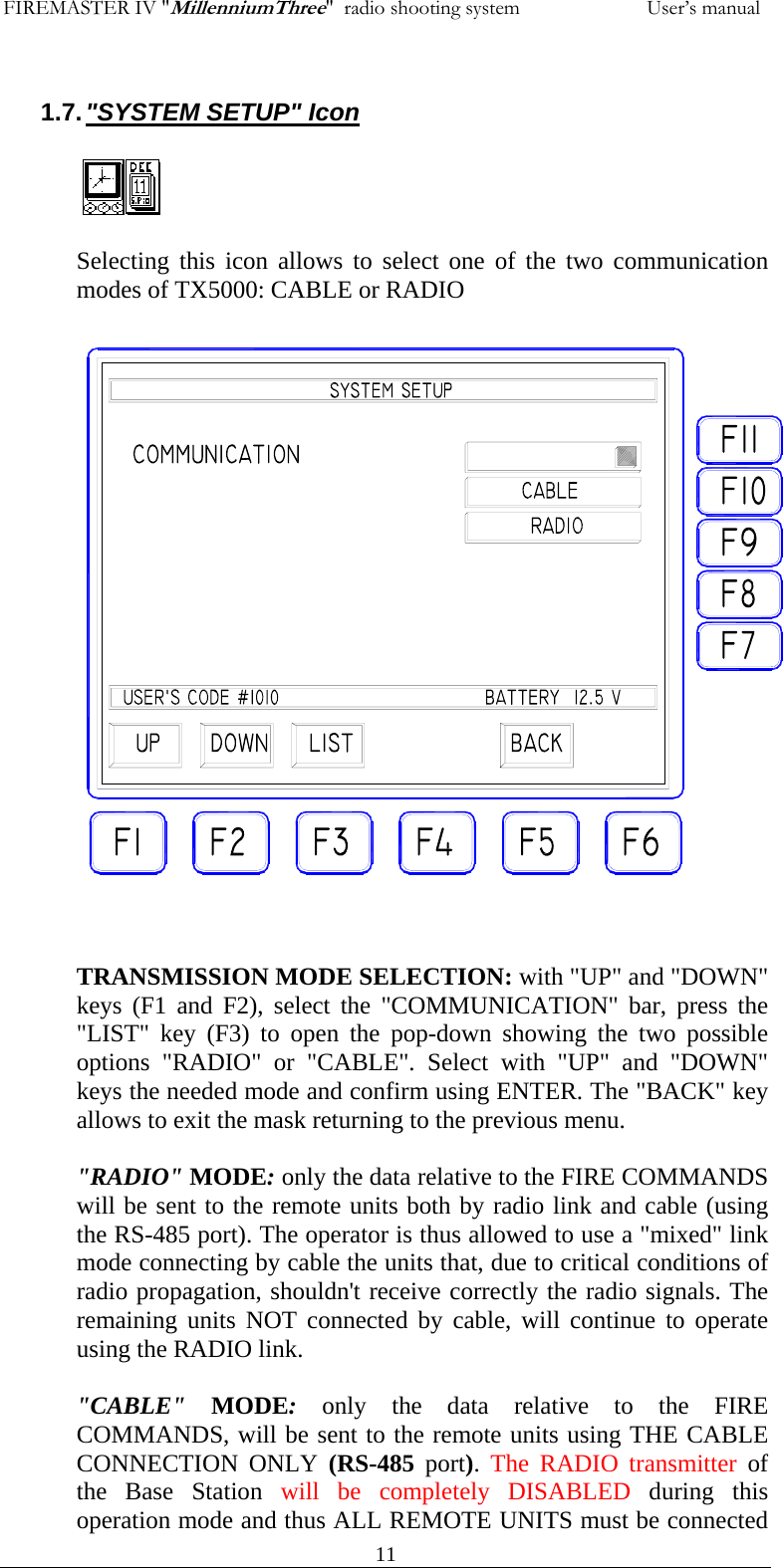
FIREMASTER IV "MillenniumThree"  radio shooting system           User’s manual  111.7. "SYSTEM SETUP" Icon  Selecting this icon allows to select one of the two communication modes of TX5000: CABLE or RADIO                        TRANSMISSION MODE SELECTION: with "UP" and "DOWN" keys (F1 and F2), select the "COMMUNICATION" bar, press the "LIST" key (F3) to open the pop-down showing the two possible options "RADIO" or "CABLE". Select with "UP" and "DOWN" keys the needed mode and confirm using ENTER. The "BACK" key allows to exit the mask returning to the previous menu.  "RADIO" MODE: only the data relative to the FIRE COMMANDS will be sent to the remote units both by radio link and cable (using the RS-485 port). The operator is thus allowed to use a "mixed" link mode connecting by cable the units that, due to critical conditions of radio propagation, shouldn't receive correctly the radio signals. The  remaining units NOT connected by cable, will continue to operate using the RADIO link.  "CABLE" MODE: only the data relative to the FIRE COMMANDS, will be sent to the remote units using THE CABLE CONNECTION ONLY (RS-485 port).  The RADIO transmitter of the Base Station will be completely DISABLED during this operation mode and thus ALL REMOTE UNITS must be connected
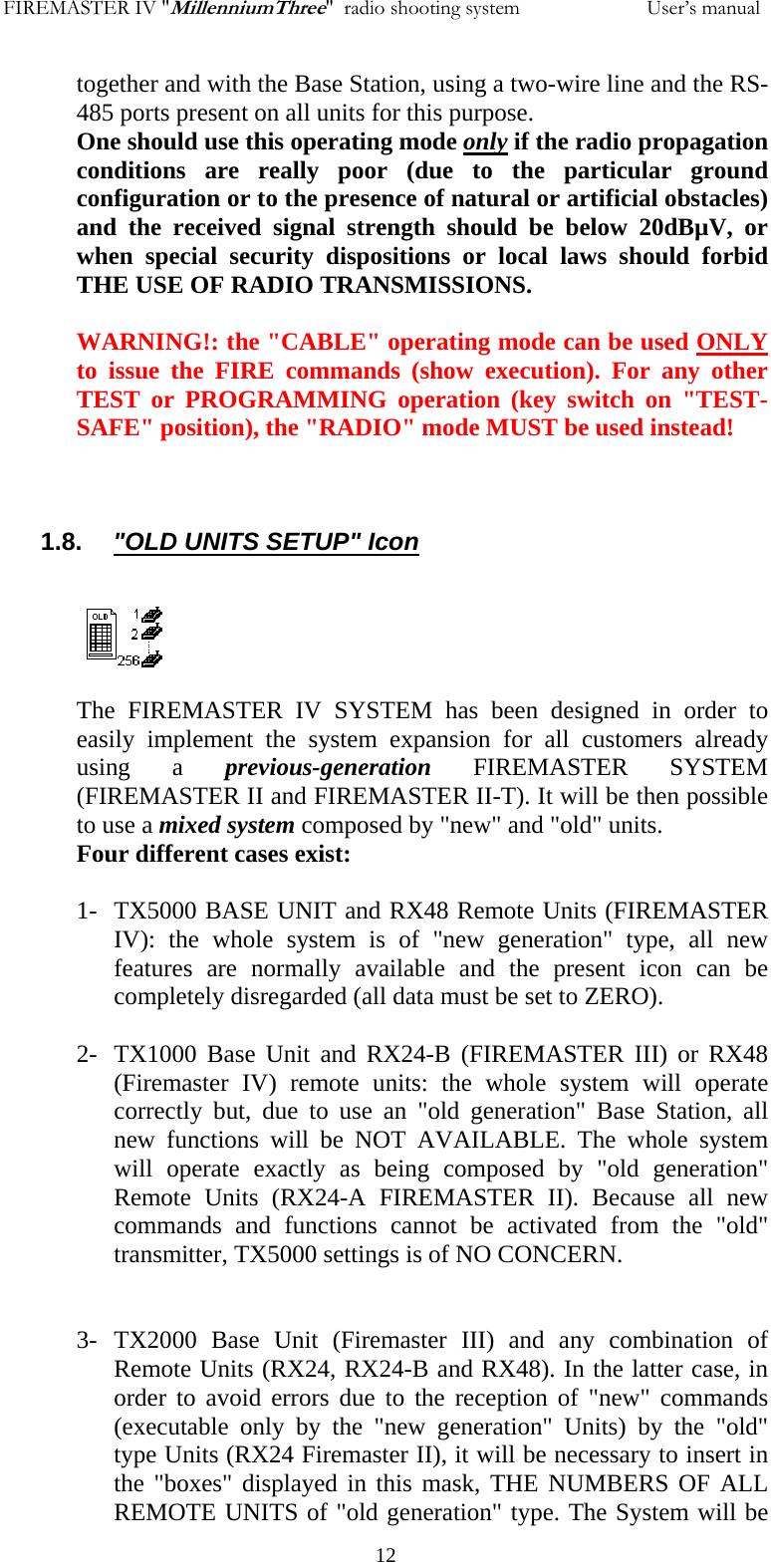
FIREMASTER IV "MillenniumThree"  radio shooting system           User’s manualtogether and with the Base Station, using a two-wire line and the RS-485 ports present on all units for this purpose.  One should use this operating mode only if the radio propagation conditions are really poor (due to the particular ground configuration or to the presence of natural or artificial obstacles) and the received signal strength should be below 20dBµV, or when special security dispositions or local laws should forbid THE USE OF RADIO TRANSMISSIONS.  WARNING!: the "CABLE" operating mode can be used ONLY to issue the FIRE commands (show execution). For any other TEST or PROGRAMMING operation (key switch on "TEST-SAFE" position), the "RADIO" mode MUST be used instead!    1.8.     "OLD UNITS SETUP" Icon   The FIREMASTER IV SYSTEM has been designed in order to easily implement the system expansion for all customers already using a previous-generation FIREMASTER SYSTEM (FIREMASTER II and FIREMASTER II-T). It will be then possible to use a mixed system composed by "new" and "old" units. Four different cases exist:  1- TX5000 BASE UNIT and RX48 Remote Units (FIREMASTER IV): the whole system is of "new generation" type, all new features are normally available and the present icon can be completely disregarded (all data must be set to ZERO).  2- TX1000 Base Unit and RX24-B (FIREMASTER III) or RX48 (Firemaster IV) remote units: the whole system will operate correctly but, due to use an "old generation" Base Station, all new functions will be NOT AVAILABLE. The whole system will operate exactly as being composed by "old generation" Remote Units (RX24-A FIREMASTER II). Because all new commands and functions cannot be activated from the "old" transmitter, TX5000 settings is of NO CONCERN.   3- TX2000 Base Unit (Firemaster III) and any combination of  Remote Units (RX24, RX24-B and RX48). In the latter case, in order to avoid errors due to the reception of "new" commands (executable only by the "new generation" Units) by the "old" type Units (RX24 Firemaster II), it will be necessary to insert in the "boxes" displayed in this mask, THE NUMBERS OF ALL REMOTE UNITS of "old generation" type. The System will be   12
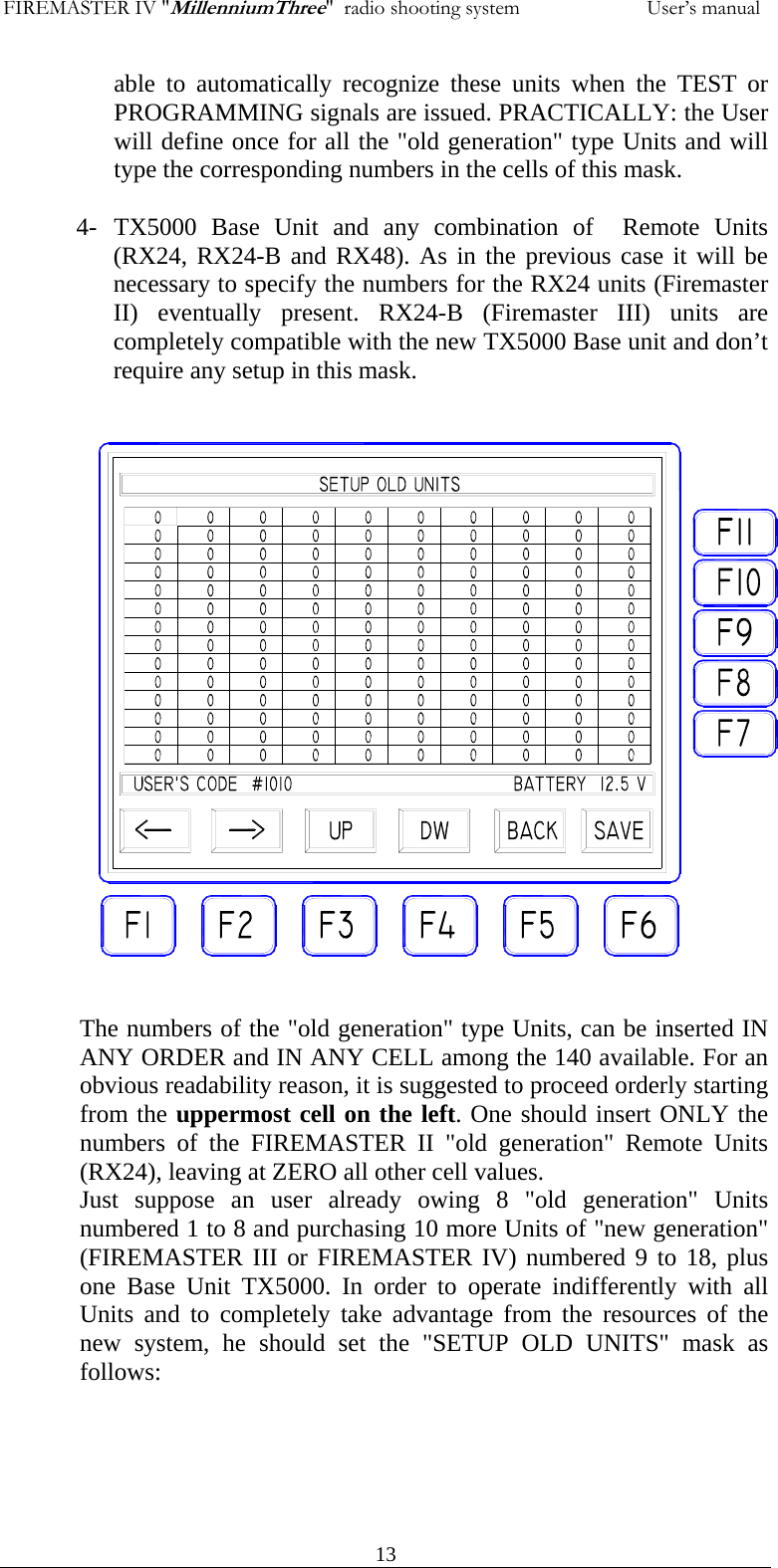
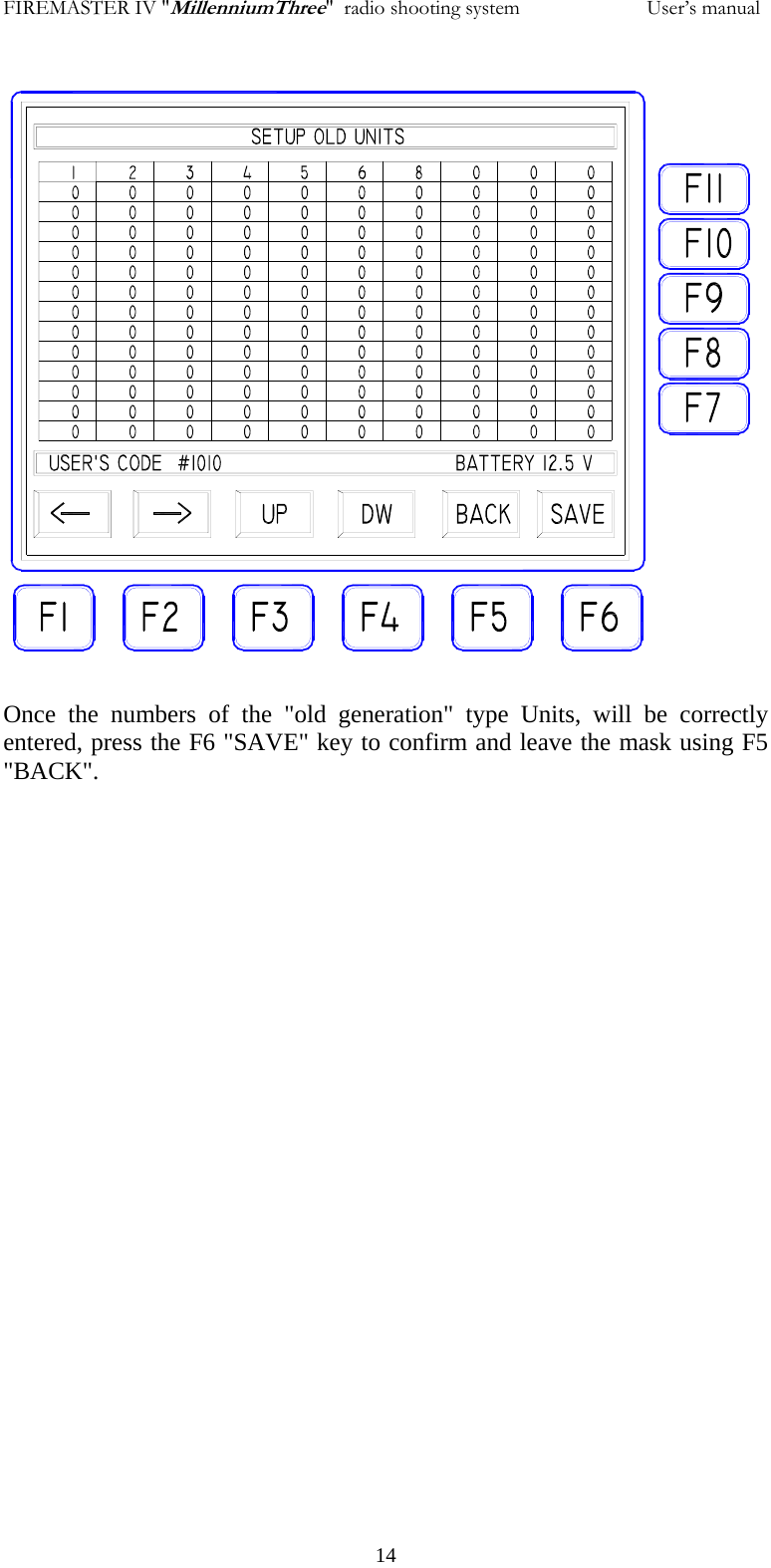
FIREMASTER IV "MillenniumThree"  radio shooting system           User’s manualable to automatically recognize these units when the TEST or PROGRAMMING signals are issued. PRACTICALLY: the User will define once for all the "old generation" type Units and will type the corresponding numbers in the cells of this mask.  4- TX5000 Base Unit and any combination of  Remote Units (RX24, RX24-B and RX48). As in the previous case it will be necessary to specify the numbers for the RX24 units (Firemaster II) eventually present. RX24-B (Firemaster III) units are completely compatible with the new TX5000 Base unit and don’t require any setup in this mask.                       The numbers of the "old generation" type Units, can be inserted IN ANY ORDER and IN ANY CELL among the 140 available. For an obvious readability reason, it is suggested to proceed orderly starting from the uppermost cell on the left. One should insert ONLY the numbers of the FIREMASTER II "old generation" Remote Units (RX24), leaving at ZERO all other cell values. Just suppose an user already owing 8 "old generation" Units numbered 1 to 8 and purchasing 10 more Units of "new generation" (FIREMASTER III or FIREMASTER IV) numbered 9 to 18, plus one Base Unit TX5000. In order to operate indifferently with all Units and to completely take advantage from the resources of the new system, he should set the "SETUP OLD UNITS" mask as follows:        13
FIREMASTER IV "MillenniumThree"  radio shooting system           User’s manual                      Once the numbers of the "old generation" type Units, will be correctly entered, press the F6 "SAVE" key to confirm and leave the mask using F5 "BACK".   14
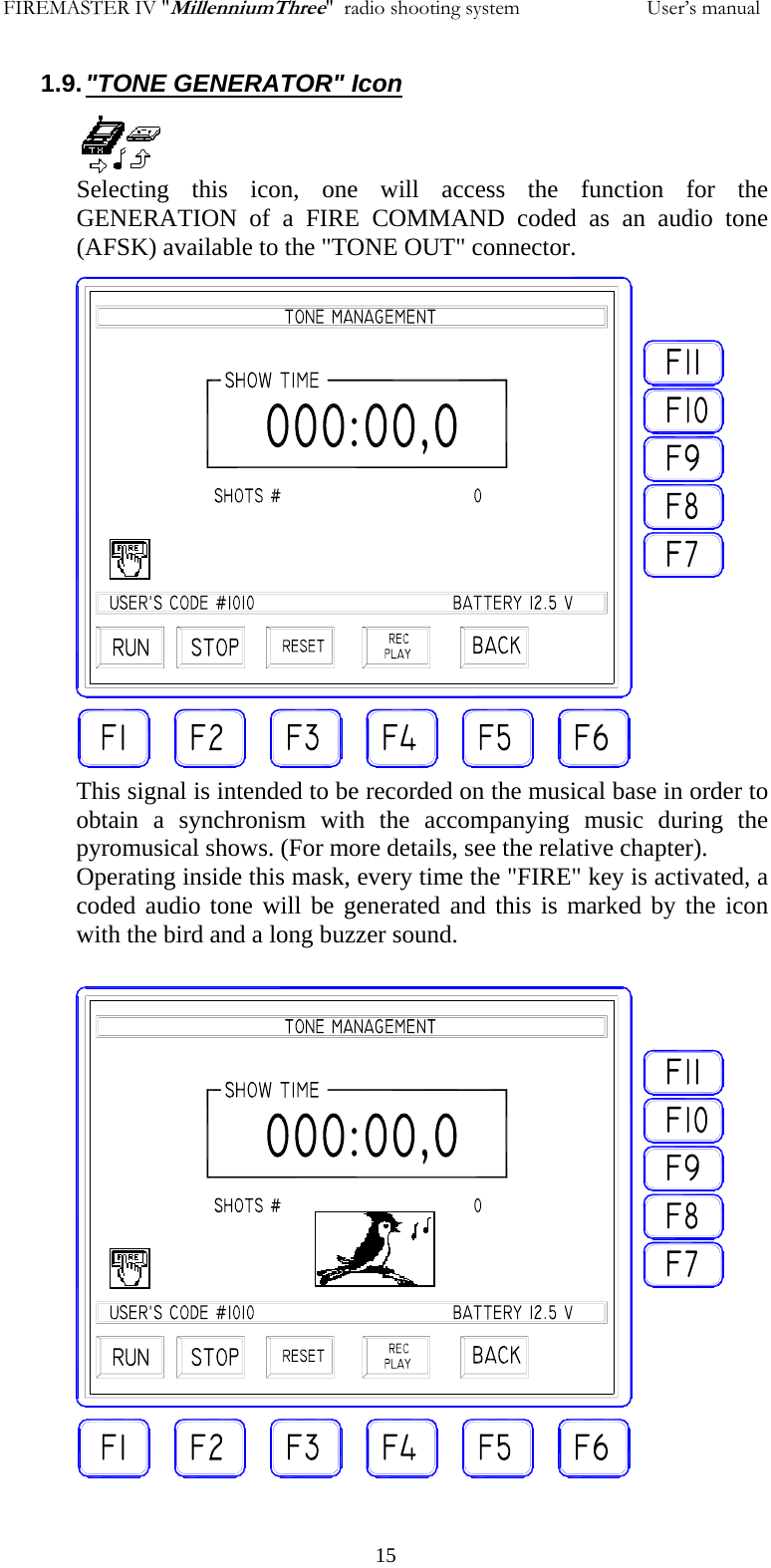
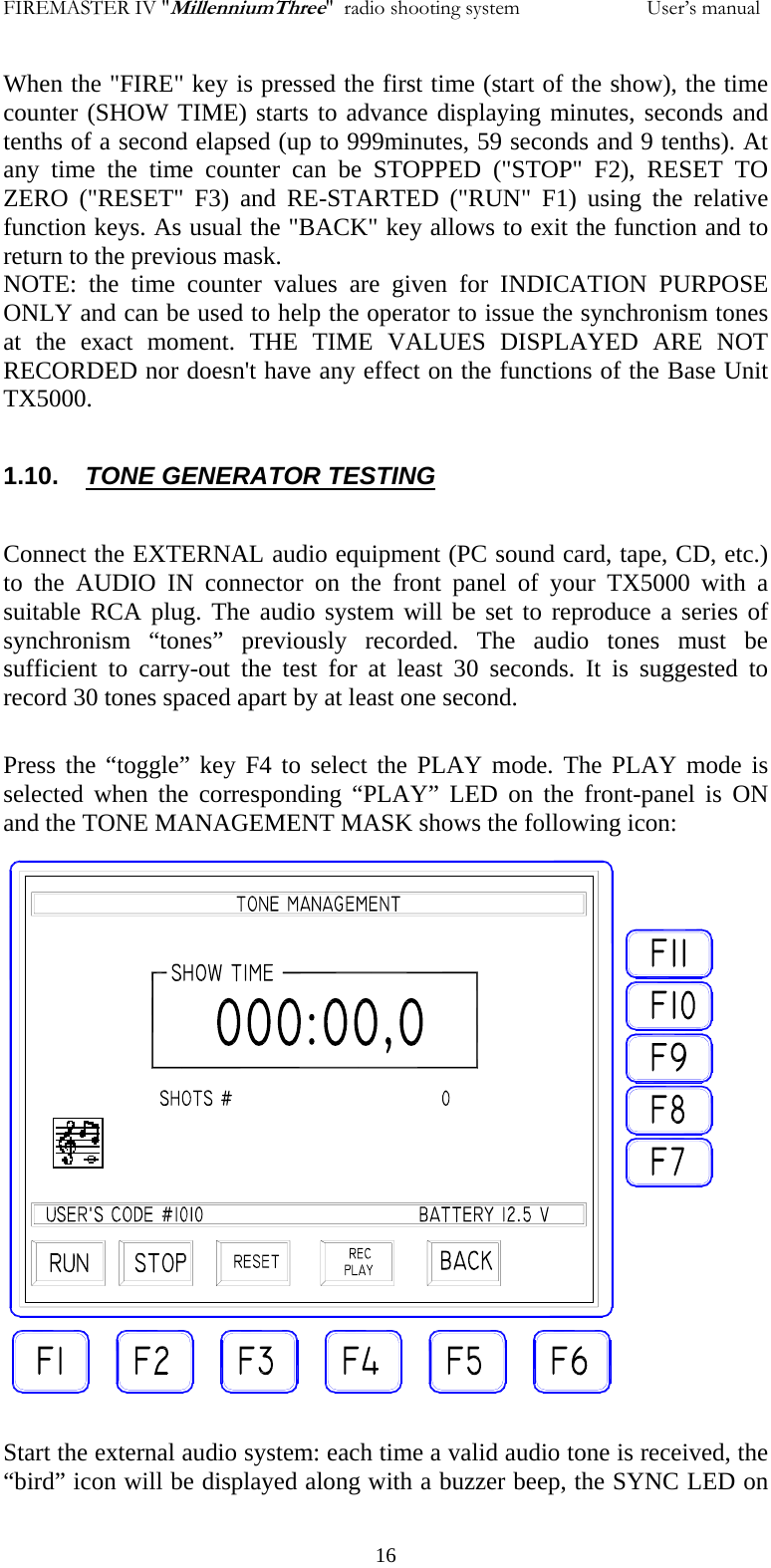
FIREMASTER IV "MillenniumThree"  radio shooting system           User’s manual 151.9. "TONE GENERATOR" Icon Selecting this icon, one will access the function for the GENERATION of a FIRE COMMAND coded as an audio tone (AFSK) available to the "TONE OUT" connector.                   This signal is intended to be recorded on the musical base in order to obtain a synchronism with the accompanying music during the pyromusical shows. (For more details, see the relative chapter). Operating inside this mask, every time the "FIRE" key is activated, a coded audio tone will be generated and this is marked by the icon with the bird and a long buzzer sound.
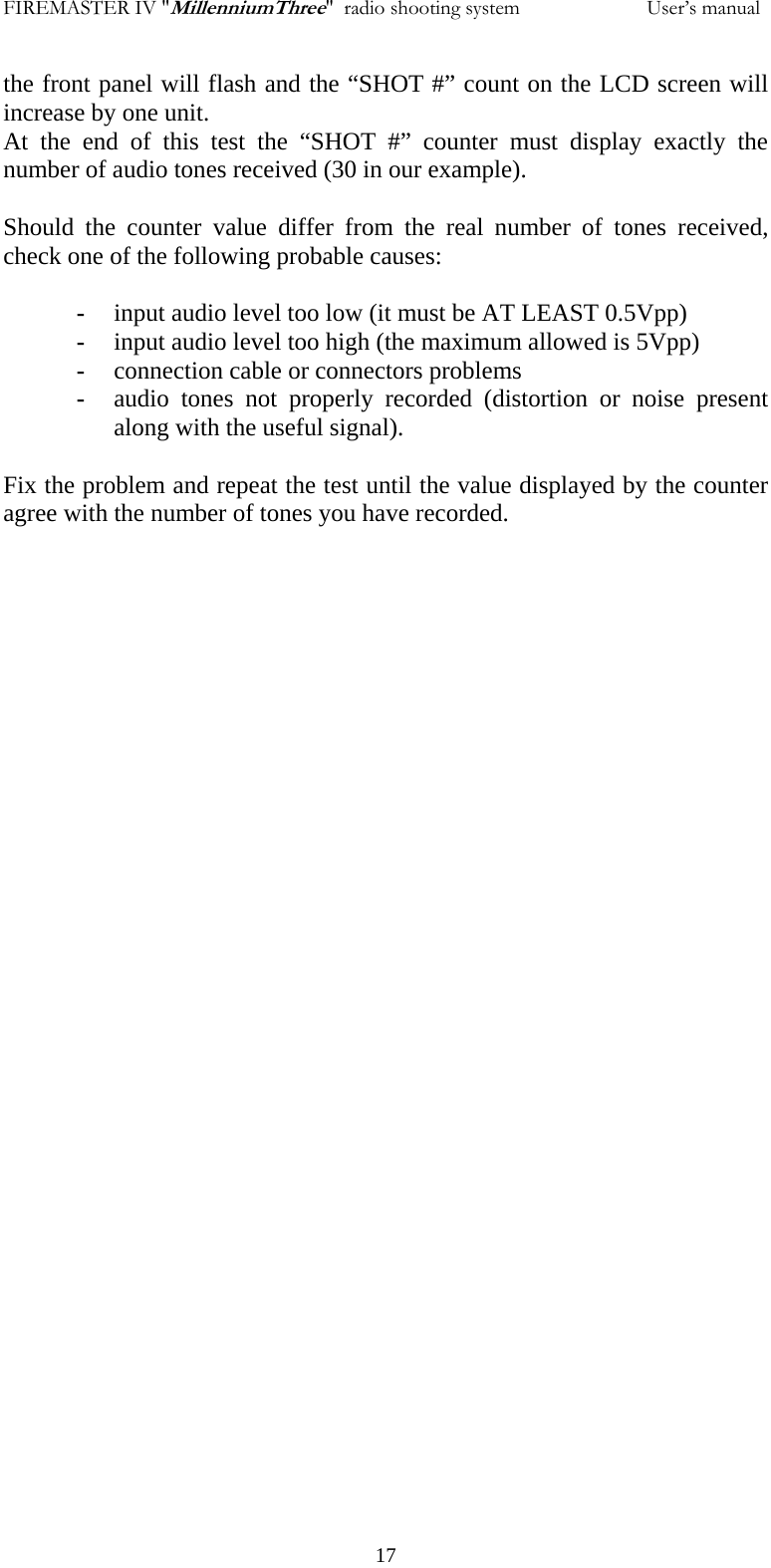
FIREMASTER IV "MillenniumThree"  radio shooting system           User’s manualWhen the "FIRE" key is pressed the first time (start of the show), the time counter (SHOW TIME) starts to advance displaying minutes, seconds and tenths of a second elapsed (up to 999minutes, 59 seconds and 9 tenths). At any time the time counter can be STOPPED ("STOP" F2), RESET TO ZERO ("RESET" F3) and RE-STARTED ("RUN" F1) using the relative function keys. As usual the "BACK" key allows to exit the function and to return to the previous mask. NOTE: the time counter values are given for INDICATION PURPOSE ONLY and can be used to help the operator to issue the synchronism tones at the exact moment. THE TIME VALUES DISPLAYED ARE NOT RECORDED nor doesn't have any effect on the functions of the Base Unit TX5000.  1.10.  TONE GENERATOR TESTING  Connect the EXTERNAL audio equipment (PC sound card, tape, CD, etc.)  to the AUDIO IN connector on the front panel of your TX5000 with a suitable RCA plug. The audio system will be set to reproduce a series of synchronism “tones” previously recorded. The audio tones must be sufficient to carry-out the test for at least 30 seconds. It is suggested to record 30 tones spaced apart by at least one second.  Press the “toggle” key F4 to select the PLAY mode. The PLAY mode is selected when the corresponding “PLAY” LED on the front-panel is ON and the TONE MANAGEMENT MASK shows the following icon:                        Start the external audio system: each time a valid audio tone is received, the “bird” icon will be displayed along with a buzzer beep, the SYNC LED on   16
FIREMASTER IV "MillenniumThree"  radio shooting system           User’s manualthe front panel will flash and the “SHOT #” count on the LCD screen will increase by one unit. At the end of this test the “SHOT #” counter must display exactly the number of audio tones received (30 in our example).  Should the counter value differ from the real number of tones received, check one of the following probable causes:  - input audio level too low (it must be AT LEAST 0.5Vpp) - input audio level too high (the maximum allowed is 5Vpp) - connection cable or connectors problems - audio tones not properly recorded (distortion or noise present along with the useful signal).  Fix the problem and repeat the test until the value displayed by the counter agree with the number of tones you have recorded.   17
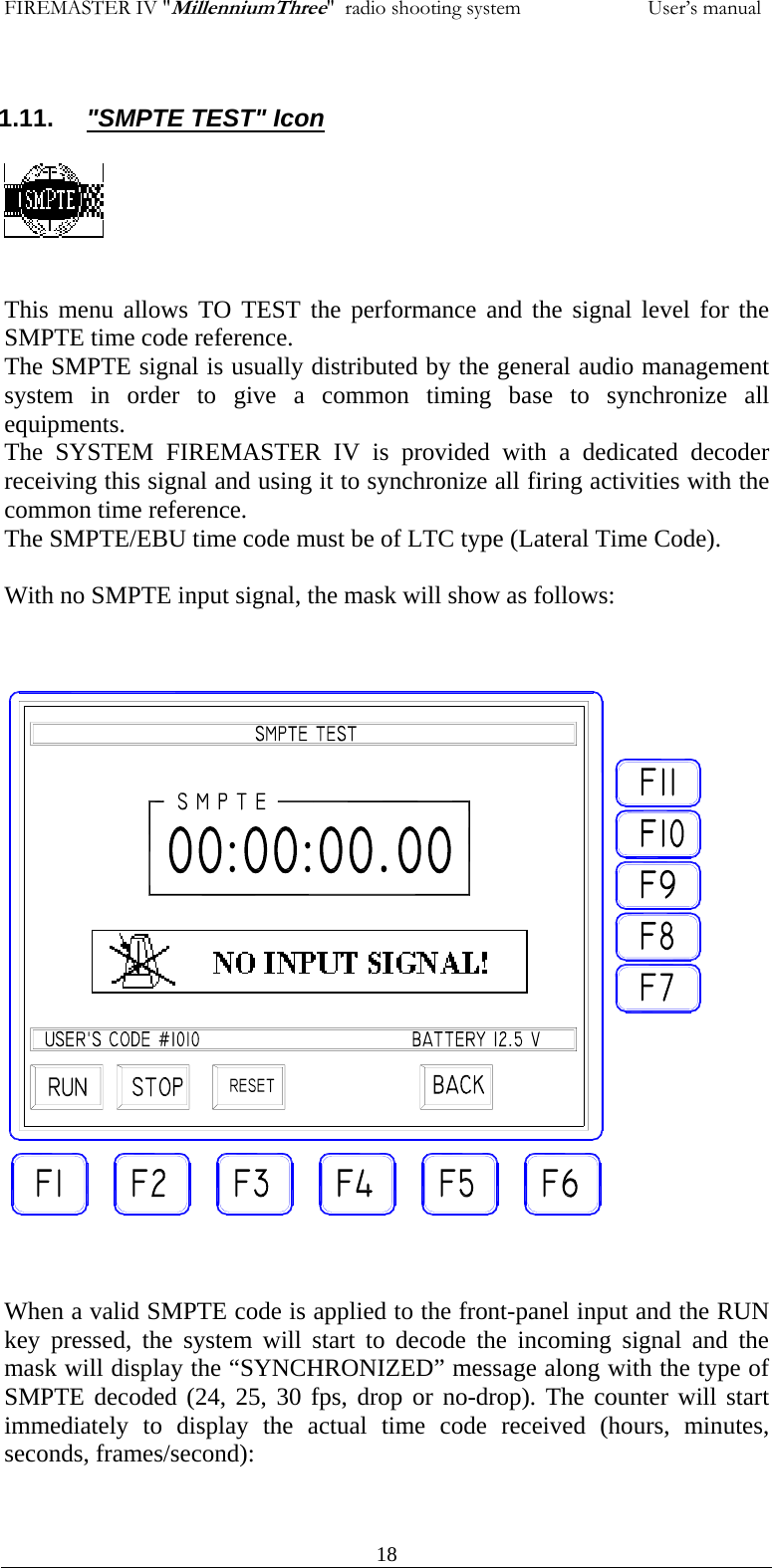
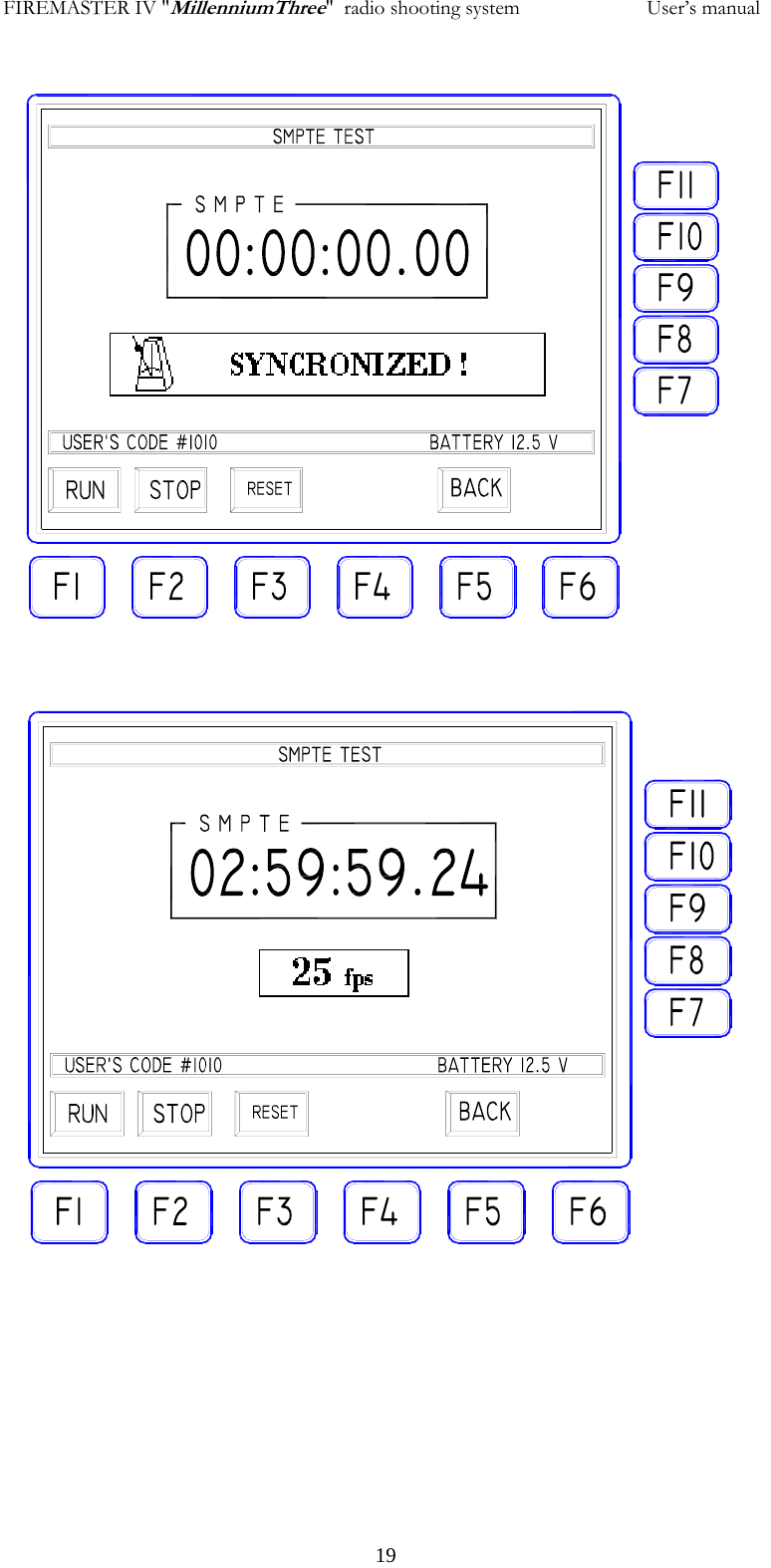
FIREMASTER IV "MillenniumThree"  radio shooting system           User’s manual 1.11.  "SMPTE TEST" Icon     This menu allows TO TEST the performance and the signal level for the SMPTE time code reference. The SMPTE signal is usually distributed by the general audio management system in order to give a common timing base to synchronize all equipments. The SYSTEM FIREMASTER IV is provided with a dedicated decoder receiving this signal and using it to synchronize all firing activities with the common time reference. The SMPTE/EBU time code must be of LTC type (Lateral Time Code).  With no SMPTE input signal, the mask will show as follows:                         When a valid SMPTE code is applied to the front-panel input and the RUN key pressed, the system will start to decode the incoming signal and the mask will display the “SYNCHRONIZED” message along with the type of SMPTE decoded (24, 25, 30 fps, drop or no-drop). The counter will start immediately to display the actual time code received (hours, minutes, seconds, frames/second):       18
FIREMASTER IV "MillenniumThree"  radio shooting system           User’s manual 19
FIREMASTER IV "MillenniumThree"  radio shooting system           User’s manual1.12.  "MIDI TEST" Icon      The MIDI test window is exactly similar to the previous one for all concerning the data displaying and general operation.  The MIDI TIMECODE signal must be connected to the MIDI IN connector on the front-panel.  Note as the time information IS THE SAME for SMPTE and MIDI: only the transmission protocol and the input/output circuitry changes between the two methods.  The SYSTEM FIREMASTER TX5000 does implement MIDI / TIMECODE decoding function only and doesn’t manage any other standard MIDI commands.       20

Navigation menu