Philips Group Innovation Research 0031357 Philips Wi-Fi reference design User Manual Product Requirements Specification

Philips Group Innovation, Research Philips Wi-Fi reference design Product Requirements Specification

UserManual

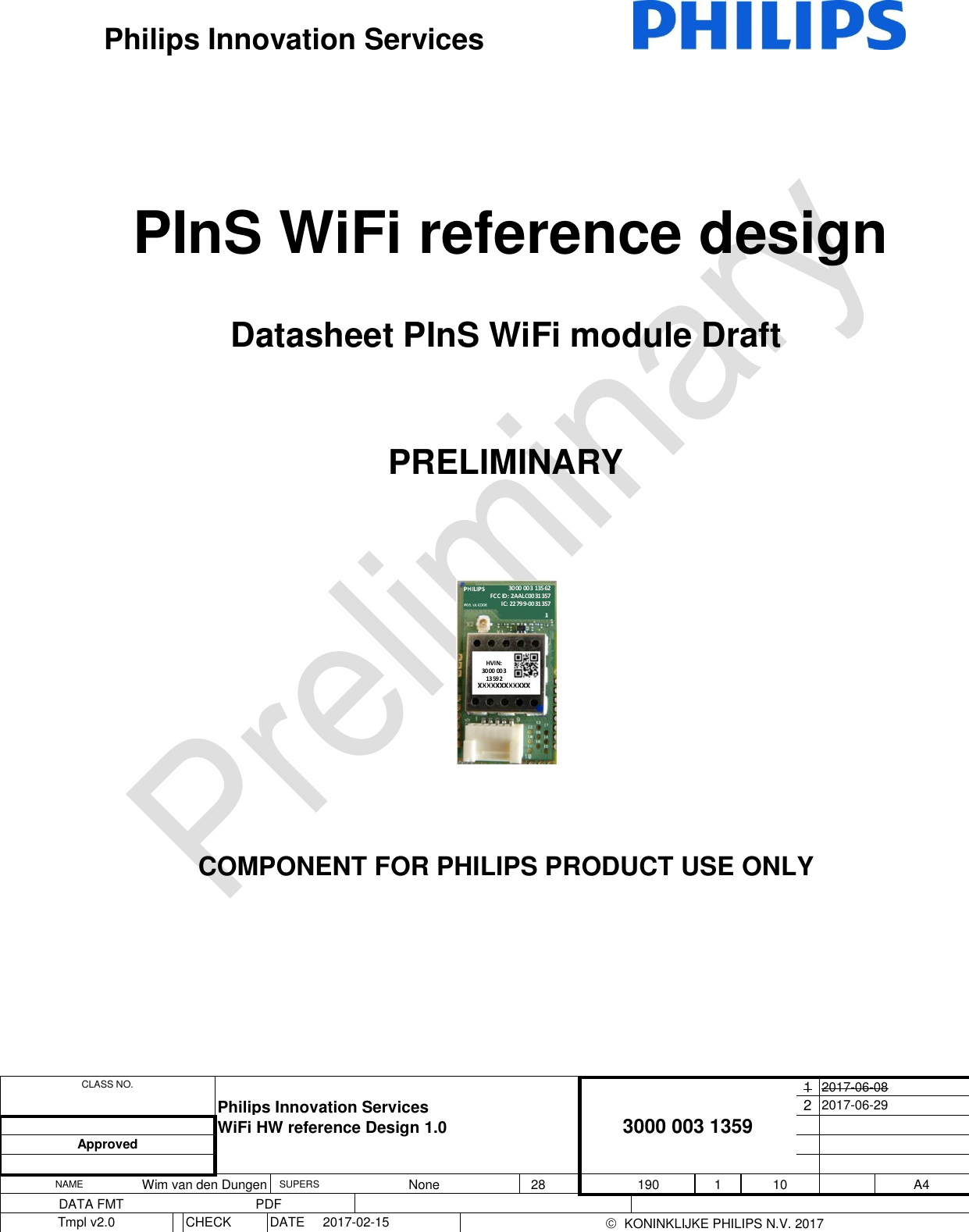
 CLASS NO.  Philips Innovation Services 3000 003 1359 1 2017-06-08 2 2017-06-29  WiFi HW reference Design 1.0   Approved      NAME Wim van den Dungen SUPERS None 28   190 1 10  A4 DATA FMT PDF      Tmpl v2.0  CHECK DATE 2017-02-15    KONINKLIJKE PHILIPS N.V. 2017  Philips Innovation Services                                       PInS WiFi reference design Datasheet PInS WiFi module Draft  PRELIMINARY      3000 003  13562FCC ID: 2AALC0031357IC: 22799-0031357HVIN:30 00 00313 592   COMPONENT FOR PHILIPS PRODUCT USE ONLY
Philips Innovation Services  Datasheet WiFi module    Doc Level: QMS Process: 04 Realisation Approver: Luc Tan Version: Status: V1.0 Approved Classification: Confidential Author: Wim van den Dungen Page: 2 of 28 Last modified: 2017 Jul 3   Printed copies are uncontrolled unless authenticated Printed copies are uncontrolled unless authenticated TABLE OF CONTENT COMPONENT FOR PHILIPS PRODUCT USE ONLY  1 DOCUMENT CHANGE HISTORY  4 1 INTRODUCTION  5 1.1 INTRODUCTION  5 1.2 OVERVIEW SPECIFICATIONS  6 1.3 FUNCTIONAL BLOCK DIAGRAM  7 1.4 OPEN POINTS  8 1.5 DEFINITIONS, ACRONYMS & ABBREVIATIONS  8 2 APPLICATIONS  9 3 INTERFACE  10 3.1 4 MAIN INTERFACES 10 4 ANTENNAS  11 4.1 EXTERNAL ANTENNA 11 4.1.1 APPROVED ANTENNA 11 5 OPERATION, STORAGE AND TRANSPORT CONDITIONS  11 5.1 OPERATIONAL CONDITIONS NORMAL OPERATION 11 5.2 OPERATIONAL CONDITIONS STORAGE 12 5.3 OPERATIONAL CONDITIONS TRANSPORT 12 5.4 ADDITIONAL CONDITIONAL SPECIFICATIONS 12 5.5 ENVIRONMENTAL 12 6 ARCHITECTURAL CHOICES AND CONSTRAINTS  13 6.1 STRATEGIC INTERFACES 13 6.2 STRATEGIC MODULE SIZE 13 7 GENERAL, SAFETY, LEGAL & SECURITY STANDARDS  14 7.1 GENERAL STANDARDS 14 7.2 CONTAMINATION 14 7.3 FCC, IC, SRRC, ETSI COMPLIANCE 14 7.3.1 IC COMPLIANCE 14 7.3.2 CONFORMITÉ AUX NORMES D’INDUSTRIE CANADA 14 7.3.3 FCC STATEMENT 15 7.4 INSTALLATION INSTRUCTION 15 7.5 LABEL REQUIREMENTS FOR END PRODUCT 16 7.6 UL COMPLIANCE 16 8 SPECIFICATIONS  16 8.1 MECHANICAL 16 8.2 ELECTRICAL 18 8.3 TYPICAL VALUES 18 8.4 COMMUNICATION 18
Philips Innovation Services  Datasheet WiFi module    Doc Level: QMS Process: 04 Realisation Approver: Luc Tan Version: Status: V1.0 Approved Classification: Confidential Author: Wim van den Dungen Page: 3 of 28 Last modified: 2017 Jul 3   Printed copies are uncontrolled unless authenticated Printed copies are uncontrolled unless authenticated 8.5 ABSOLUTE MAXIMUM RATINGS 19 8.6 MODULE LEVEL RECOMMENDED MAXIMUM RATINGS 19 8.7 ELECTROSTATIC DISCHARGE SPECIFICATIONS 20 9 RF CHARACTERISTICS  21 10 RELIABILITY  22 11 REFLOW PROFILE  22 11.1 TYPICAL PROFILE 22 11.2 MEASURED REFLOW PROFILE DURING TEST RUNS 22 12 FOOTPRINT DETAILS  23 13 ORDERING INFORMATION  26 13.1 ORDERING VARIANT OF MODULE, PRODUCT SPECIFIC 26 13.2 COMMON PINS HW VARIANT, PCBA 12NC ORDERING INFORMATION 26 13.3 MODULE LABELING 27 14 REFERENCES  28
Philips Innovation Services  Datasheet WiFi module    Doc Level: QMS Process: 04 Realisation Approver: Luc Tan Version: Status: V1.0 Approved Classification: Confidential Author: Wim van den Dungen Page: 4 of 28 Last modified: 2017 Jul 3   Printed copies are uncontrolled unless authenticated Printed copies are uncontrolled unless authenticated DOCUMENT CHANGE HISTORY Date Person Version Reason 15-02-2017 Wim van den Dungen 0.1 First draft 29-03-2017 Wim van den Dungen 0.2 Cleanup and added details 31-03-2017 Wim van den Dungen 0.9 Proposed for release 03-04-2017 Wim van den Dungen 0.91 Added footprint information 14-04-2017 Wim van den Dungen 0.92 Minor updates MSL level, Footprint 14-04-2017 Wim van den Dungen 0.93 Minor updates, explaining MSL level and WoW 02-06-2017 Ioannis Pappous 0.94 Added information about standards compliance. Update labeling, added external antenna information. Layout schematics included. Added missing information. Document reorganized 21-06-2017 Luc Tan 1.0 Release the document   Add country settings.   State that China regulation is under development.   Update external antenna directivity.   Update FCC ID and IC ID.   Clarify the 12 variants   Use full 12NC not 11NC+x   Add HVIN:
Philips Innovation Services  Datasheet WiFi module    Doc Level: QMS Process: 04 Realisation Approver: Luc Tan Version: Status: V1.0 Approved Classification: Confidential Author: Wim van den Dungen Page: 5 of 28 Last modified: 2017 Jul 3   Printed copies are uncontrolled unless authenticated Printed copies are uncontrolled unless authenticated 1  Introduction 1.1  Introduction PInS WiFi module V1.0 is a PCB Wi-Fi module designed by Philips innovation services (PInS) and based on the latest Cypress WiFI SoC. The design is based on an internal Philips study and is backwards compatible with an already used Philips module called Philips YD (obsolete), Additional functionality is added to optimize usability and a cost effective solution of adding connectivity to Philips products. The design is aligned with Philips CDPP, PSSO, PInS, and multiple business and making fast and easy integration possible.   See datasheet of CYW43903 WICED™™ IEEE 802.11 a/b/g/n SoC with an Embedded Applications Processor [1] for detailed specifications. General description of the CYW43903 SoC that forms the bases of the module reference design: The Cypress CYW43903 embedded wireless system-on-a-chip (SoC) is uniquely suited for Internet-of-Things applications. It is IEEE 802.11n compliant and provides full IEEE 802.11 b/g legacy compatibility with enhanced performance. The device includes an ARM Cortex-based applications processor, a single stream IEEE 802.11n MAC/baseband/radio, a power amplifier (PA), and a receive low-noise amplifier (LNA). It also supports optional antenna diversity for improved RF performance in difficult environments. The CYW43903 is an optimized SoC targeting embedded Internet-of-Things applications in the industrial and medical sensor, home appliance markets. Using advanced design techniques and process technology to reduce active and idle power, the device is designed for embedded applications that require minimal power consumption and a compact size. The device includes a PMU for simplifying system power topology and allows for direct operation from a battery while maximizing battery life.                                       Figure 1: Block Diagram
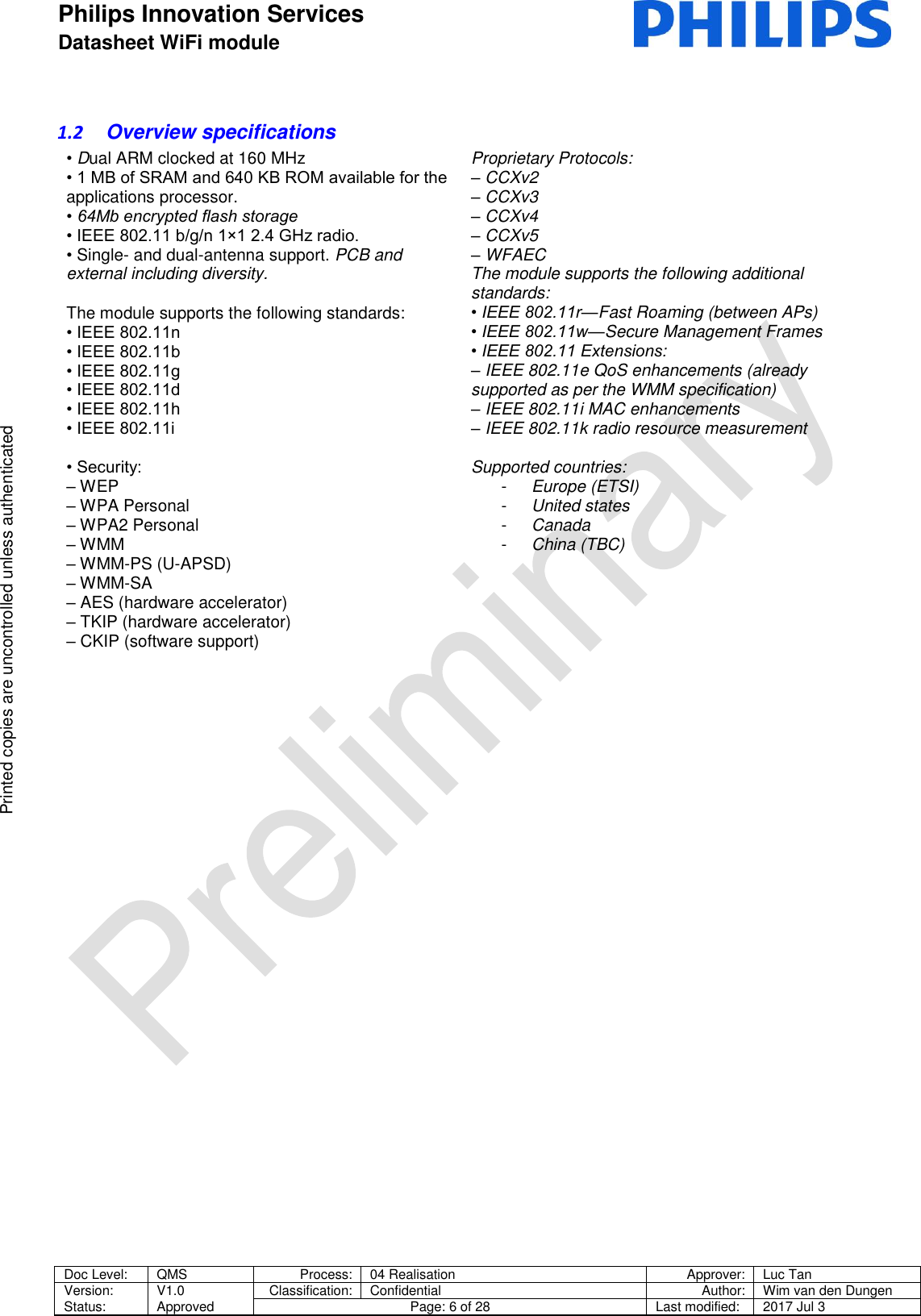
Philips Innovation Services  Datasheet WiFi module    Doc Level: QMS Process: 04 Realisation Approver: Luc Tan Version: Status: V1.0 Approved Classification: Confidential Author: Wim van den Dungen Page: 6 of 28 Last modified: 2017 Jul 3   Printed copies are uncontrolled unless authenticated Printed copies are uncontrolled unless authenticated 1.2  Overview specifications • Dual ARM clocked at 160 MHz • 1 MB of SRAM and 640 KB ROM available for the applications processor. • 64Mb encrypted flash storage • IEEE 802.11 b/g/n 1×1 2.4 GHz radio. • Single- and dual-antenna support. PCB and external including diversity.  The module supports the following standards: • IEEE 802.11n • IEEE 802.11b • IEEE 802.11g • IEEE 802.11d • IEEE 802.11h • IEEE 802.11i  • Security: – WEP – WPA Personal – WPA2 Personal – WMM – WMM-PS (U-APSD) – WMM-SA – AES (hardware accelerator) – TKIP (hardware accelerator) – CKIP (software support) Proprietary Protocols: – CCXv2 – CCXv3 – CCXv4 – CCXv5 – WFAEC The module supports the following additional standards: • IEEE 802.11r—Fast Roaming (between APs) • IEEE 802.11w—Secure Management Frames • IEEE 802.11 Extensions: – IEEE 802.11e QoS enhancements (already supported as per the WMM specification) – IEEE 802.11i MAC enhancements – IEEE 802.11k radio resource measurement  Supported countries: -  Europe (ETSI) -  United states -  Canada -  China (TBC)
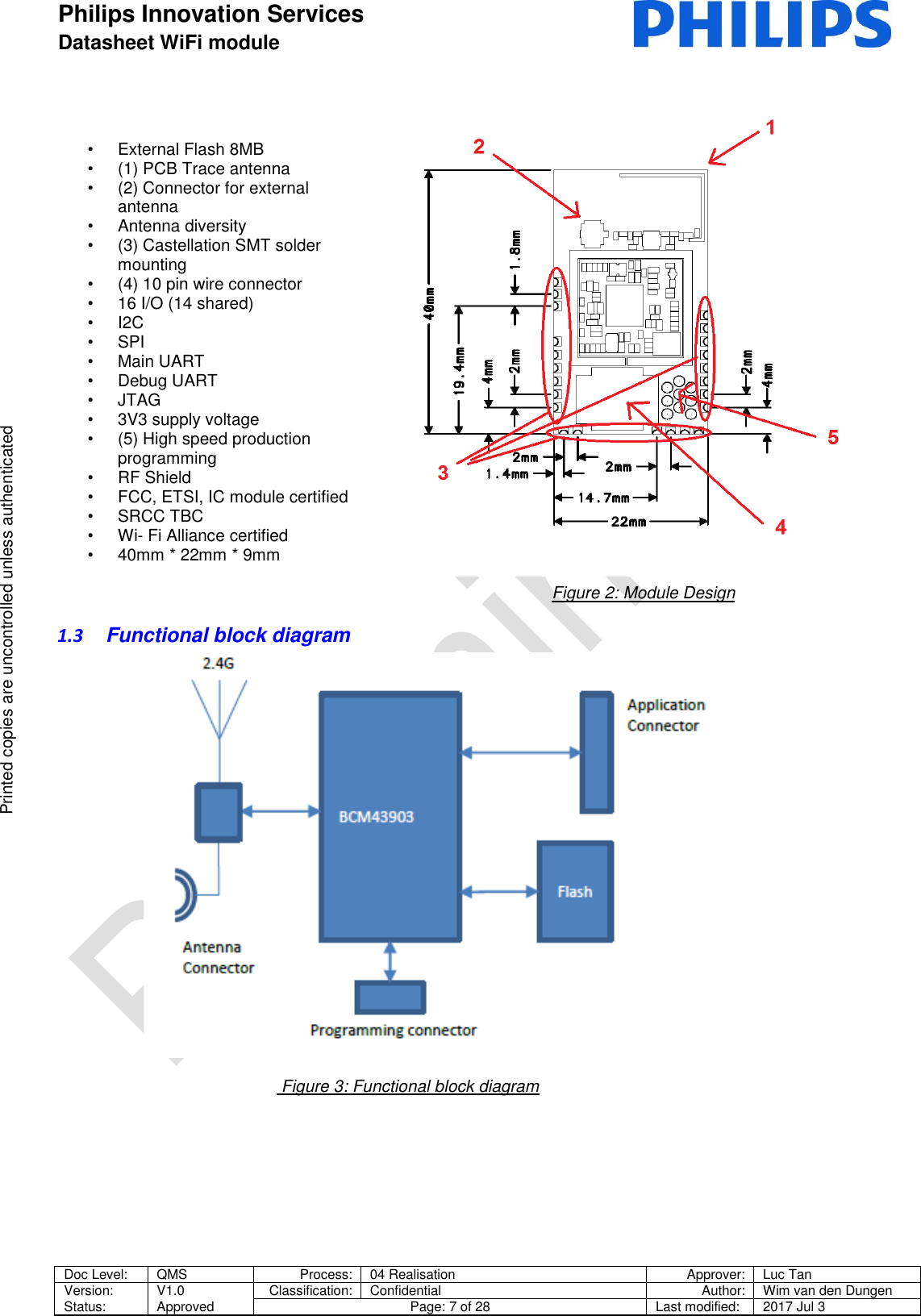
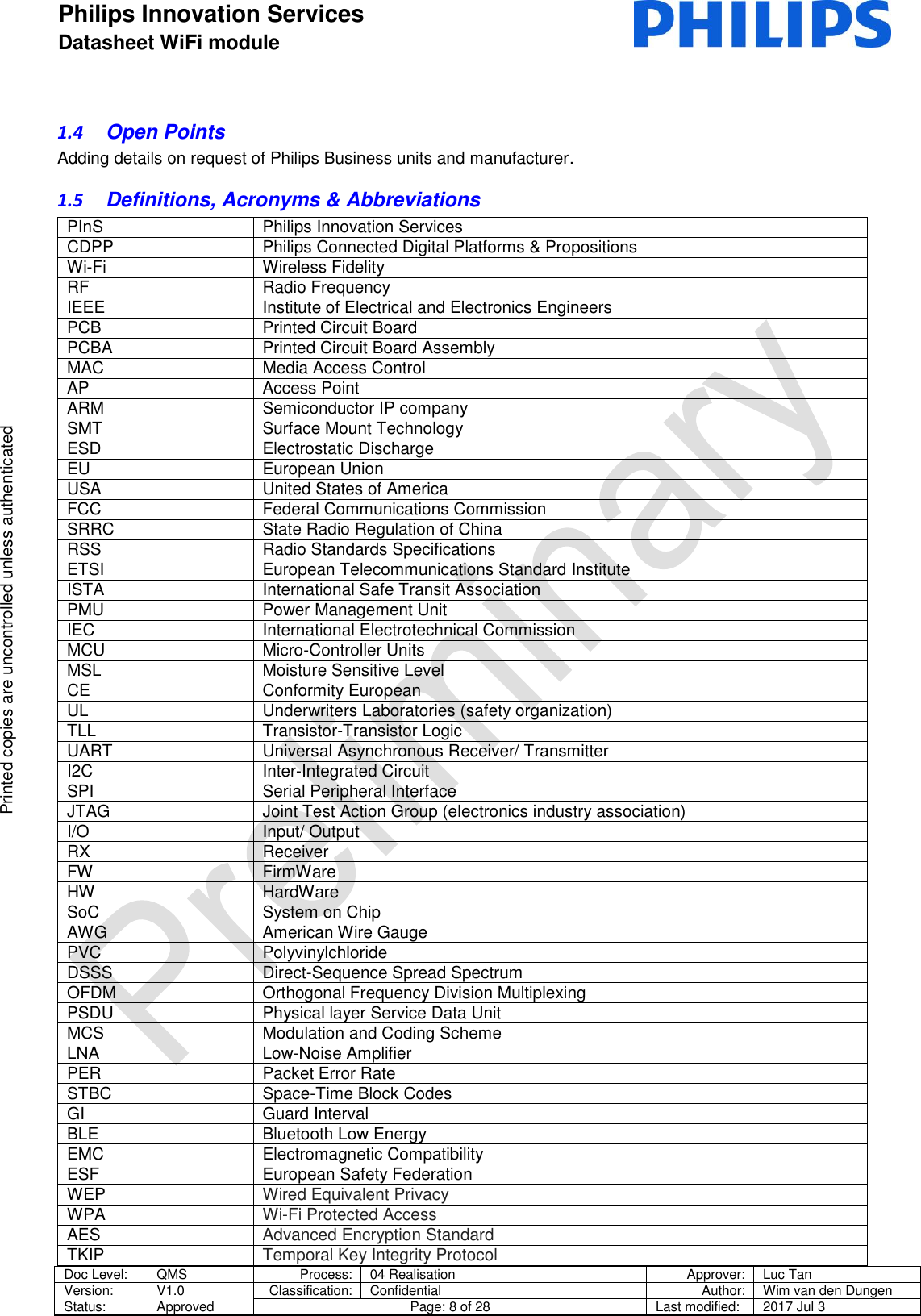
Philips Innovation Services  Datasheet WiFi module    Doc Level: QMS Process: 04 Realisation Approver: Luc Tan Version: Status: V1.0 Approved Classification: Confidential Author: Wim van den Dungen Page: 7 of 28 Last modified: 2017 Jul 3   Printed copies are uncontrolled unless authenticated Printed copies are uncontrolled unless authenticated  •  External Flash 8MB •  (1) PCB Trace antenna •  (2) Connector for external antenna •  Antenna diversity •  (3) Castellation SMT solder mounting •  (4) 10 pin wire connector  •  16 I/O (14 shared) • I2C • SPI •  Main UART •  Debug UART •  JTAG •  3V3 supply voltage •  (5) High speed production programming •  RF Shield •  FCC, ETSI, IC module certified •  SRCC TBC • Wi- Fi Alliance certified •  40mm * 22mm * 9mm                                                                                                                                                                           Figure 2: Module Design 1.3  Functional block diagram                                                                                                                      Figure 3: Functional block diagram
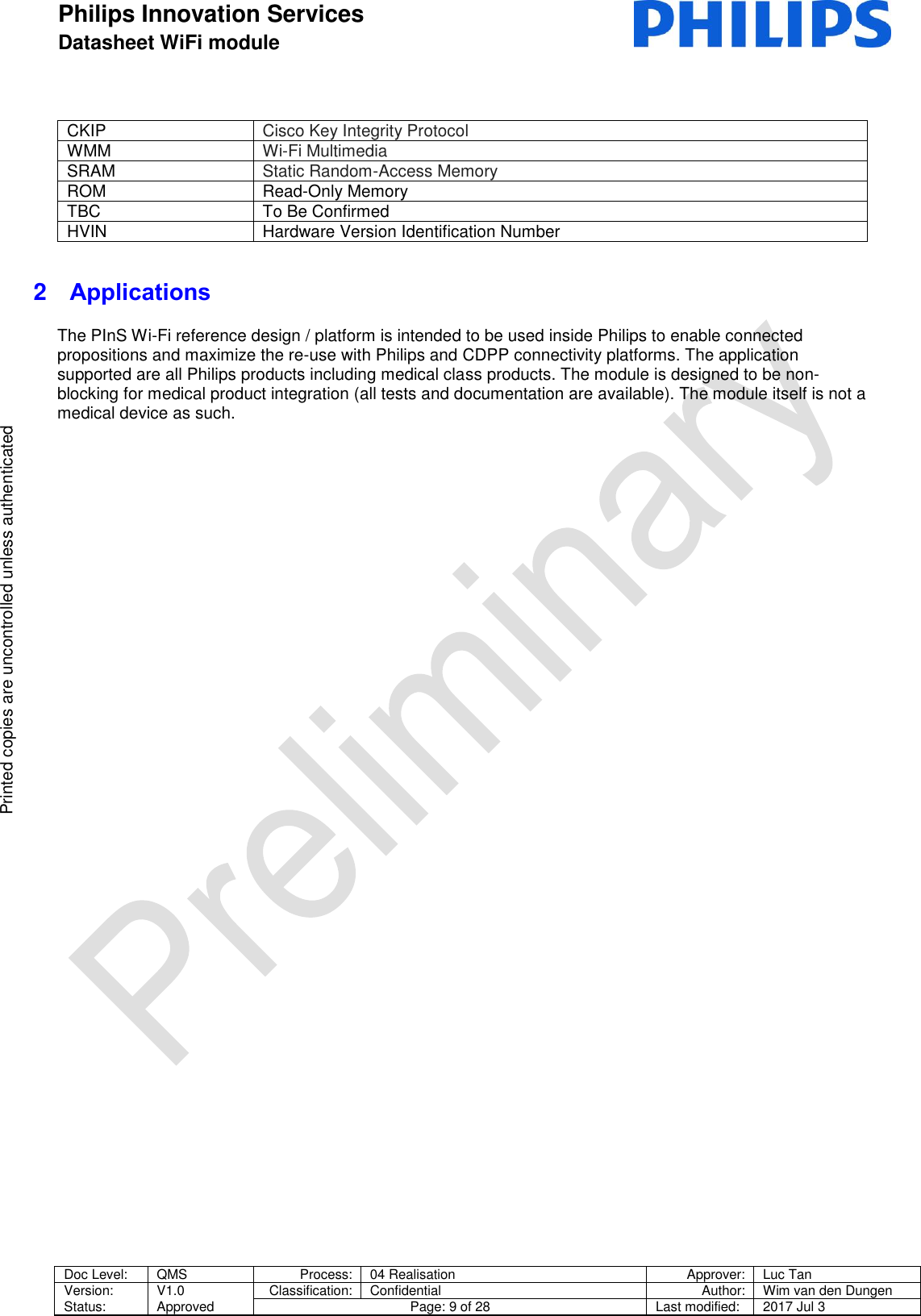
Philips Innovation Services  Datasheet WiFi module    Doc Level: QMS Process: 04 Realisation Approver: Luc Tan Version: Status: V1.0 Approved Classification: Confidential Author: Wim van den Dungen Page: 8 of 28 Last modified: 2017 Jul 3   Printed copies are uncontrolled unless authenticated Printed copies are uncontrolled unless authenticated 1.4  Open Points Adding details on request of Philips Business units and manufacturer. 1.5  Definitions, Acronyms & Abbreviations PInS Philips Innovation Services CDPP Philips Connected Digital Platforms & Propositions Wi-Fi Wireless Fidelity RF Radio Frequency IEEE Institute of Electrical and Electronics Engineers PCB Printed Circuit Board PCBA Printed Circuit Board Assembly MAC Media Access Control AP  Access Point ARM Semiconductor IP company SMT Surface Mount Technology ESD Electrostatic Discharge EU European Union USA United States of America FCC Federal Communications Commission SRRC State Radio Regulation of China RSS Radio Standards Specifications ETSI European Telecommunications Standard Institute ISTA  International Safe Transit Association PMU Power Management Unit IEC International Electrotechnical Commission MCU Micro-Controller Units MSL Moisture Sensitive Level CE Conformity European UL Underwriters Laboratories (safety organization) TLL Transistor-Transistor Logic UART Universal Asynchronous Receiver/ Transmitter I2C Inter-Integrated Circuit SPI Serial Peripheral Interface JTAG Joint Test Action Group (electronics industry association) I/O Input/ Output RX Receiver FW FirmWare HW HardWare SoC System on Chip AWG American Wire Gauge PVC Polyvinylchloride DSSS Direct-Sequence Spread Spectrum OFDM Orthogonal Frequency Division Multiplexing PSDU Physical layer Service Data Unit MCS Modulation and Coding Scheme LNA Low-Noise Amplifier PER Packet Error Rate STBC Space-Time Block Codes GI Guard Interval BLE Bluetooth Low Energy EMC Electromagnetic Compatibility ESF European Safety Federation WEP Wired Equivalent Privacy WPA Wi-Fi Protected Access AES Advanced Encryption Standard TKIP Temporal Key Integrity Protocol
Philips Innovation Services  Datasheet WiFi module    Doc Level: QMS Process: 04 Realisation Approver: Luc Tan Version: Status: V1.0 Approved Classification: Confidential Author: Wim van den Dungen Page: 9 of 28 Last modified: 2017 Jul 3   Printed copies are uncontrolled unless authenticated Printed copies are uncontrolled unless authenticated CKIP Cisco Key Integrity Protocol WMM Wi-Fi Multimedia SRAM  Static Random-Access Memory ROM Read-Only Memory TBC To Be Confirmed HVIN Hardware Version Identification Number 2  Applications The PInS Wi-Fi reference design / platform is intended to be used inside Philips to enable connected propositions and maximize the re-use with Philips and CDPP connectivity platforms. The application supported are all Philips products including medical class products. The module is designed to be non-blocking for medical product integration (all tests and documentation are available). The module itself is not a medical device as such.
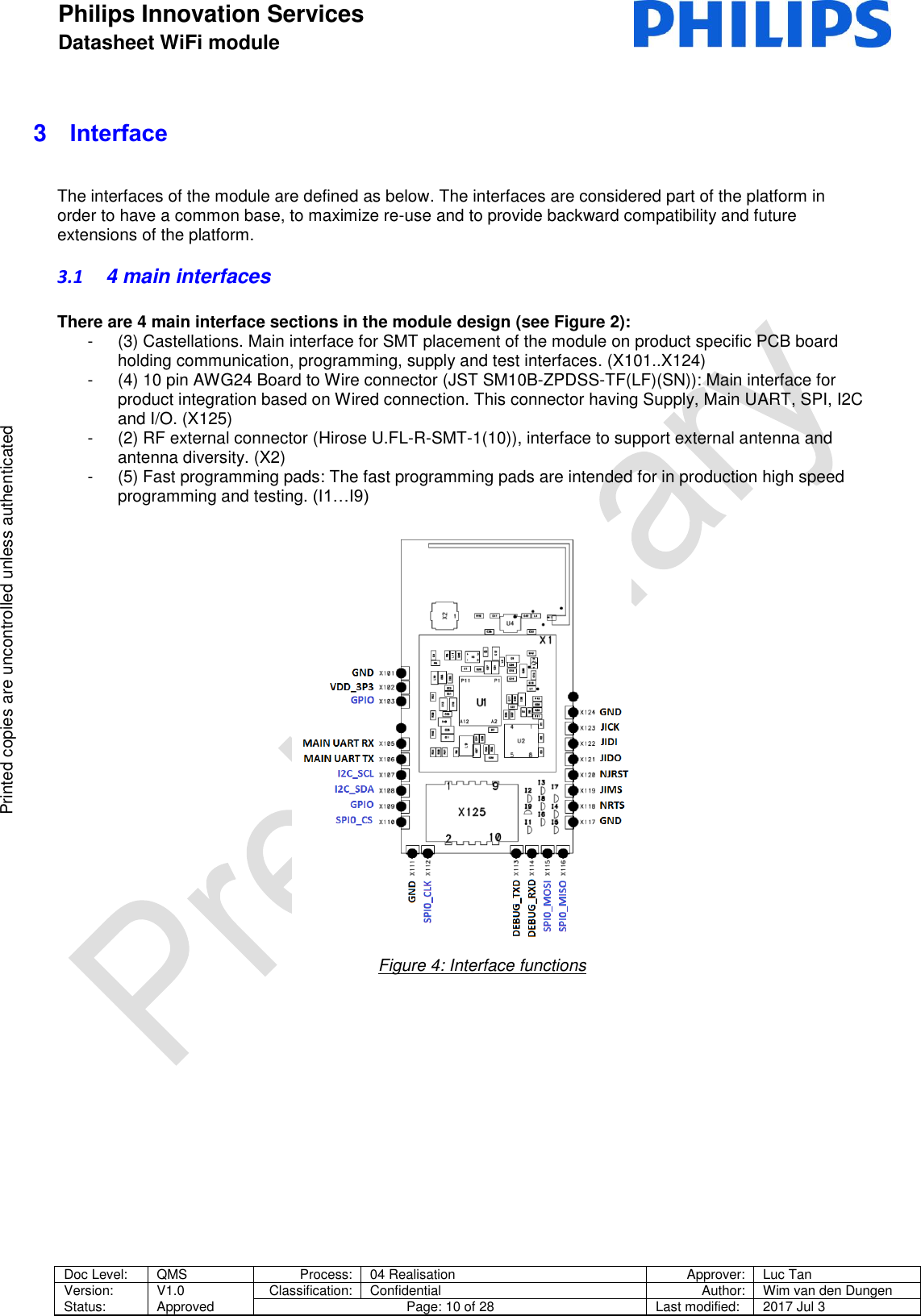
Philips Innovation Services  Datasheet WiFi module    Doc Level: QMS Process: 04 Realisation Approver: Luc Tan Version: Status: V1.0 Approved Classification: Confidential Author: Wim van den Dungen Page: 10 of 28 Last modified: 2017 Jul 3   Printed copies are uncontrolled unless authenticated Printed copies are uncontrolled unless authenticated 3  Interface  The interfaces of the module are defined as below. The interfaces are considered part of the platform in order to have a common base, to maximize re-use and to provide backward compatibility and future extensions of the platform.  3.1  4 main interfaces  There are 4 main interface sections in the module design (see Figure 2): -  (3) Castellations. Main interface for SMT placement of the module on product specific PCB board holding communication, programming, supply and test interfaces. (X101..X124) -  (4) 10 pin AWG24 Board to Wire connector (JST SM10B-ZPDSS-TF(LF)(SN)): Main interface for product integration based on Wired connection. This connector having Supply, Main UART, SPI, I2C and I/O. (X125)                -  (2) RF external connector (Hirose U.FL-R-SMT-1(10)), interface to support external antenna and antenna diversity. (X2) -  (5) Fast programming pads: The fast programming pads are intended for in production high speed programming and testing. (I1…I9)                                                                                                                                                                                                                                                                                                                                                                      Figure 4: Interface functions
Philips Innovation Services  Datasheet WiFi module    Doc Level: QMS Process: 04 Realisation Approver: Luc Tan Version: Status: V1.0 Approved Classification: Confidential Author: Wim van den Dungen Page: 11 of 28 Last modified: 2017 Jul 3   Printed copies are uncontrolled unless authenticated Printed copies are uncontrolled unless authenticated 4  Antennas The design includes 3 antenna options, PCB trace antenna, external antenna and antenna diversity.  The PCB trace antenna is design to have a performance of > 30% efficiency and maximum gain of 3dBi. 4.1  External Antenna   This chapter gives an overview of the external antenna that can be fitted to the WiFi module. This radio transmitter IC has been approved by Industry Canada to operate with the antenna type listed below with the maximum permissible gain and required antenna impedance for each antenna type indicated. Antenna types not included in this list, having a gain greater than the maximum gain indicated for that type, are strictly prohibited for use with this device.   Le chapitre suivant donne un aperçu de l'antenne externe qui peut être installée sur le module WiFi. Cet émetteur radio IC été approuvé par Industry Canada pour fonctionner avec le type d’antenne énumérés ci-dessous avec le gain maximum autorisé et l’impédance nécessaire pour chaque type d’antenne indiqué. Les types d’antenne ne figurant pas dans cette liste et ayant un gain supérieur au gain maximum indiqué pour ce type-là sont strictement interdits d’utilisation avec cet appareil.   For each antenna, the "Approvals" field defines in which test reports the antenna is included. Definitions of the «Approvals» field are:   FCC - The antenna is included in the FCC test reports and thus approved for use in countries that accept the FCC radio approvals, primarily US.   IC - The antenna is included in the IC (Industry Canada) test reports and thus approved for use in countries that accept the IC radio approvals, primarily Canada.   ETSI - The antenna is included in the ETSI test reports and thus approved for use in countries that accept the ETSI radio approvals (EU).   SRRC – TBC. 4.1.1  Approved antenna TE  Manufacturer TE connectivity Part Number 2118309-2 Polarization Linear Gain 2.5 dBi (2.4GHz band) Impedance 50 Ω Size  40.0 x 8.0 x 1.0 mm Connector u.fl Approval FCC, IC and ETSI (SRCC TBC) 5  Operation, storage and transport conditions 5.1  Operational conditions normal operation Description Range Temperature range -20°C...+70°C  Atmospheric pressure range  60kPa...110kPa  Relative humidity range  5%...95%
Philips Innovation Services  Datasheet WiFi module    Doc Level: QMS Process: 04 Realisation Approver: Luc Tan Version: Status: V1.0 Approved Classification: Confidential Author: Wim van den Dungen Page: 12 of 28 Last modified: 2017 Jul 3   Printed copies are uncontrolled unless authenticated Printed copies are uncontrolled unless authenticated 5.2  Operational conditions storage Description Range Temperature range 5°C...+50°C  Atmospheric pressure range  60 ... 110 kPa  Relative humidity range  10 ... 95 % rH  non-condensing  Tested for time in storage  6 months.   Devices are stored in a vacuum sealed barrier bag and stored in a reel to support SMT pick and place mounting  MSL3  5.3  Operational conditions Transport Description Range Temperature range -30 ... 70 °C  Atmospheric pressure range  60 ... 120 kPa  Relative humidity range  10 ... 95 % rH  non-condensing Conform broadband random vibrations according to IEC 60068-2-64   Severity level IEC 60721-4-7, Class- 7M2  And in line with ISTA standard  conform the shock test IEC 60068-2-27 mounting Severity level IEC 60724-4-7 Class-7M3  And in line with ISTA standard  The device packaging complies with ISTA standard 2A  ISTA standard 2A    5.4  Additional conditional specifications -  Module is MSL 3 level, transport and storage in sealed packaging, (limit open air “life out of the bag” to <168 hours:  make use of sealed vacuum bag which will limit exposure of the chip to moisture to less than 168 hours prior to the last reflow round (MSL3= 168 hours). in case the chips were exposed for more than 168 hours, IPC/JEDEC J-STD-020B defines a “baking” process to get the parts fit for use again. (min 8 hours @125°C)) -  Packaging supports SMT (Pick and Place) tape and reel. -  Module should be handle as component, handle with care, and ESD protection should be used. -  Supply should be within specifications and clean, injected noise can be amplified and cause the module to fail and work out of specification. -  All modules are functional tested, Wi-Fi connection speed, Carrier Wave tests, I/O tests and UART tests. The Wired interface connector is not tested, needs to be tested at product level when used. -  Maximum reflow processes allowed is 1. (Critical Murata 2.4 GHz filter).  5.5  Environmental -  Module complies to Philips Regulated Substances List PHGR-GS-BP01-012. -  CE compliance
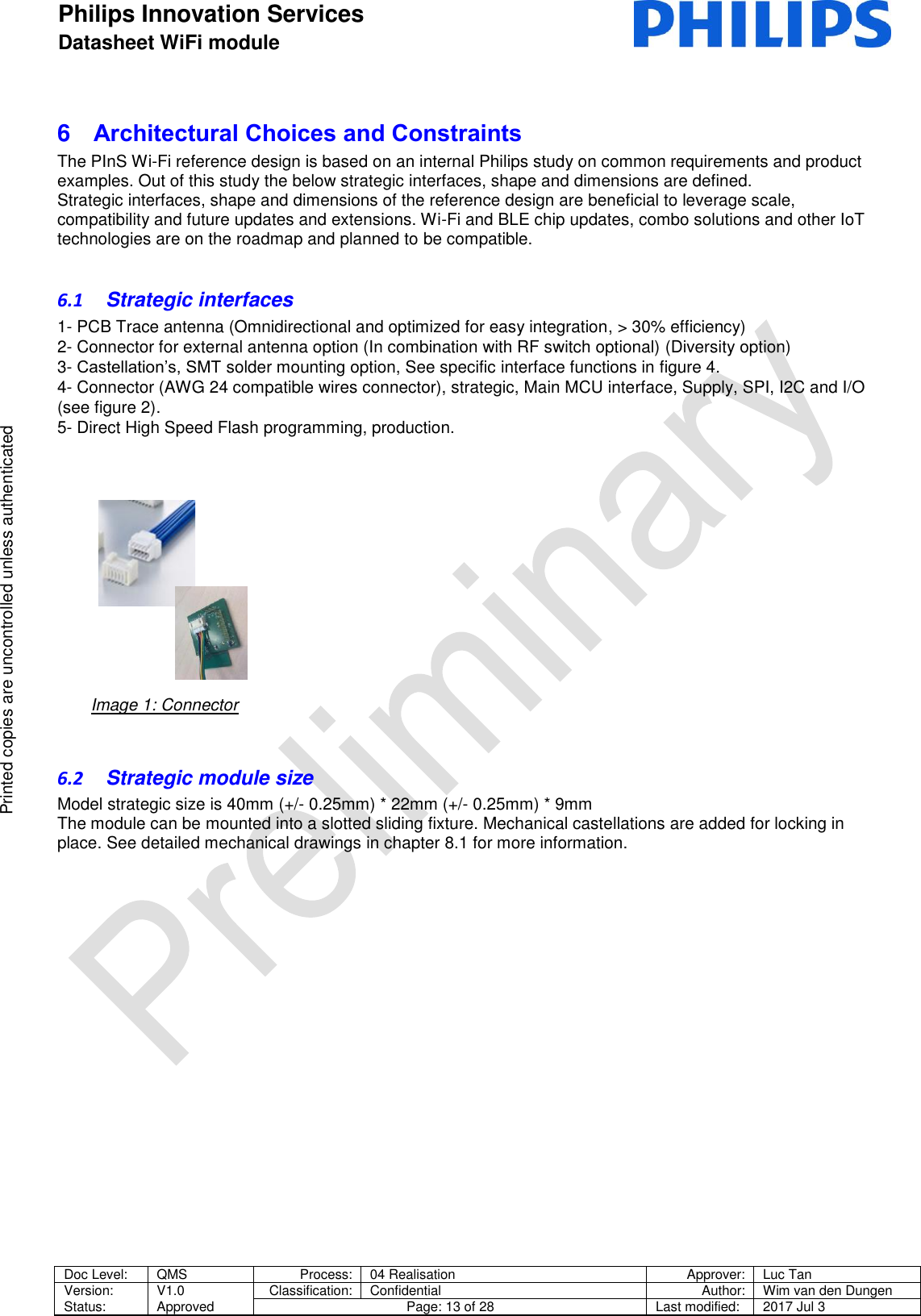
Philips Innovation Services  Datasheet WiFi module    Doc Level: QMS Process: 04 Realisation Approver: Luc Tan Version: Status: V1.0 Approved Classification: Confidential Author: Wim van den Dungen Page: 13 of 28 Last modified: 2017 Jul 3   Printed copies are uncontrolled unless authenticated Printed copies are uncontrolled unless authenticated 6  Architectural Choices and Constraints  The PInS Wi-Fi reference design is based on an internal Philips study on common requirements and product examples. Out of this study the below strategic interfaces, shape and dimensions are defined.  Strategic interfaces, shape and dimensions of the reference design are beneficial to leverage scale, compatibility and future updates and extensions. Wi-Fi and BLE chip updates, combo solutions and other IoT technologies are on the roadmap and planned to be compatible.  6.1  Strategic interfaces  1- PCB Trace antenna (Omnidirectional and optimized for easy integration, > 30% efficiency)  2- Connector for external antenna option (In combination with RF switch optional) (Diversity option)  3- Castellation’s, SMT solder mounting option, See specific interface functions in figure 4. 4- Connector (AWG 24 compatible wires connector), strategic, Main MCU interface, Supply, SPI, I2C and I/O (see figure 2). 5- Direct High Speed Flash programming, production.                                                                                                                                                       6.2  Strategic module size  Model strategic size is 40mm (+/- 0.25mm) * 22mm (+/- 0.25mm) * 9mm The module can be mounted into a slotted sliding fixture. Mechanical castellations are added for locking in place. See detailed mechanical drawings in chapter 8.1 for more information.     Image 1: Connector
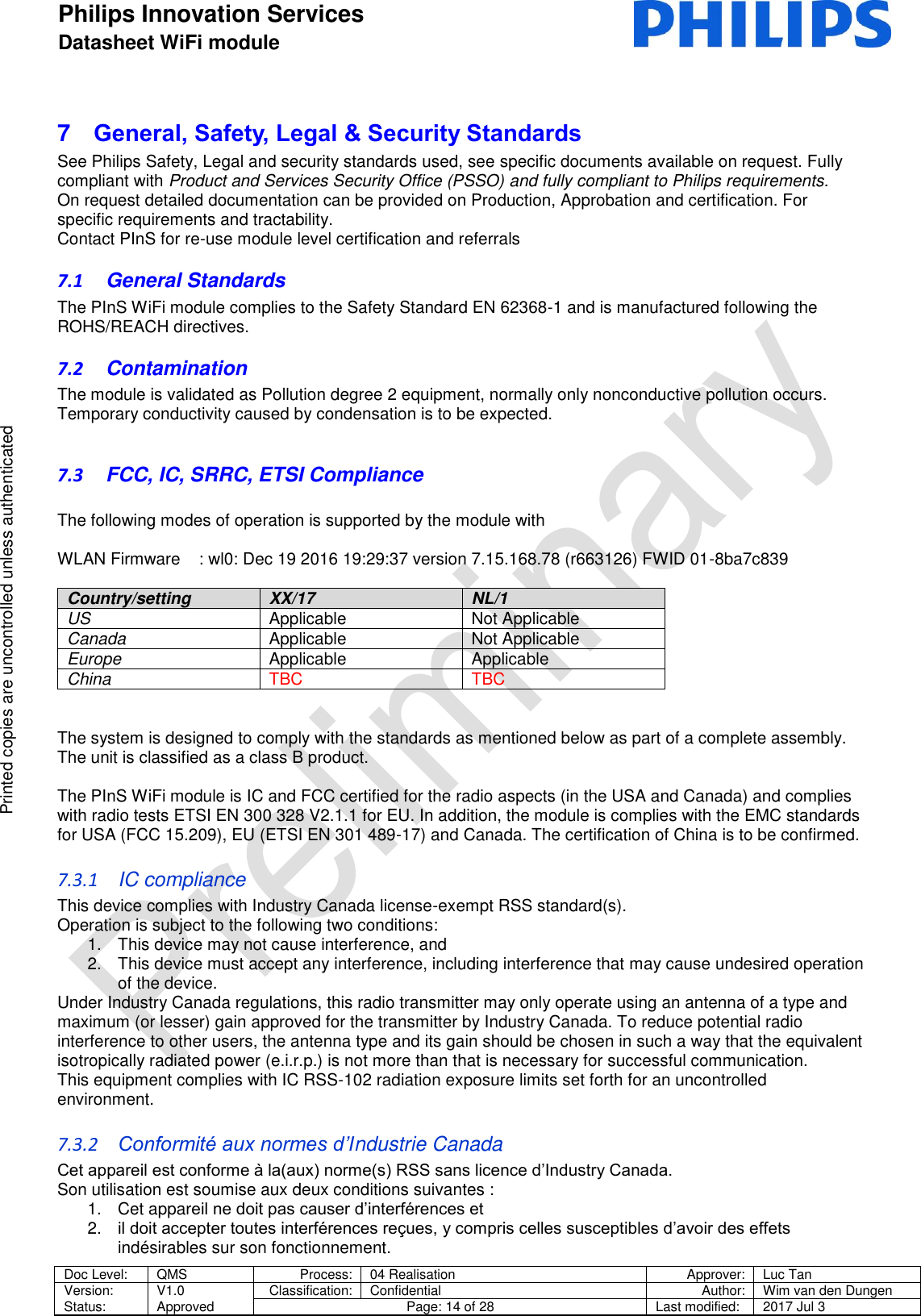
Philips Innovation Services  Datasheet WiFi module    Doc Level: QMS Process: 04 Realisation Approver: Luc Tan Version: Status: V1.0 Approved Classification: Confidential Author: Wim van den Dungen Page: 14 of 28 Last modified: 2017 Jul 3   Printed copies are uncontrolled unless authenticated Printed copies are uncontrolled unless authenticated 7  General, Safety, Legal & Security Standards  See Philips Safety, Legal and security standards used, see specific documents available on request. Fully compliant with Product and Services Security Office (PSSO) and fully compliant to Philips requirements. On request detailed documentation can be provided on Production, Approbation and certification. For specific requirements and tractability.  Contact PInS for re-use module level certification and referrals 7.1  General Standards  The PInS WiFi module complies to the Safety Standard EN 62368-1 and is manufactured following the ROHS/REACH directives.  7.2  Contamination  The module is validated as Pollution degree 2 equipment, normally only nonconductive pollution occurs. Temporary conductivity caused by condensation is to be expected.  7.3  FCC, IC, SRRC, ETSI Compliance  The following modes of operation is supported by the module with  WLAN Firmware    : wl0: Dec 19 2016 19:29:37 version 7.15.168.78 (r663126) FWID 01-8ba7c839  Country/setting XX/17 NL/1 US Applicable Not Applicable Canada Applicable Not Applicable Europe Applicable Applicable China TBC TBC   The system is designed to comply with the standards as mentioned below as part of a complete assembly.  The unit is classified as a class B product.  The PInS WiFi module is IC and FCC certified for the radio aspects (in the USA and Canada) and complies with radio tests ETSI EN 300 328 V2.1.1 for EU. In addition, the module is complies with the EMC standards for USA (FCC 15.209), EU (ETSI EN 301 489-17) and Canada. The certification of China is to be confirmed. 7.3.1  IC compliance This device complies with Industry Canada license-exempt RSS standard(s). Operation is subject to the following two conditions: 1.  This device may not cause interference, and 2.  This device must accept any interference, including interference that may cause undesired operation of the device. Under Industry Canada regulations, this radio transmitter may only operate using an antenna of a type and maximum (or lesser) gain approved for the transmitter by Industry Canada. To reduce potential radio interference to other users, the antenna type and its gain should be chosen in such a way that the equivalent isotropically radiated power (e.i.r.p.) is not more than that is necessary for successful communication. This equipment complies with IC RSS-102 radiation exposure limits set forth for an uncontrolled environment.  7.3.2 Conformité aux normes d’Industrie Canada Cet appareil est conforme à la(aux) norme(s) RSS sans licence d’Industry Canada. Son utilisation est soumise aux deux conditions suivantes : 1.  Cet appareil ne doit pas causer d’interférences et 2. il doit accepter toutes interférences reçues, y compris celles susceptibles d’avoir des effets indésirables sur son fonctionnement.
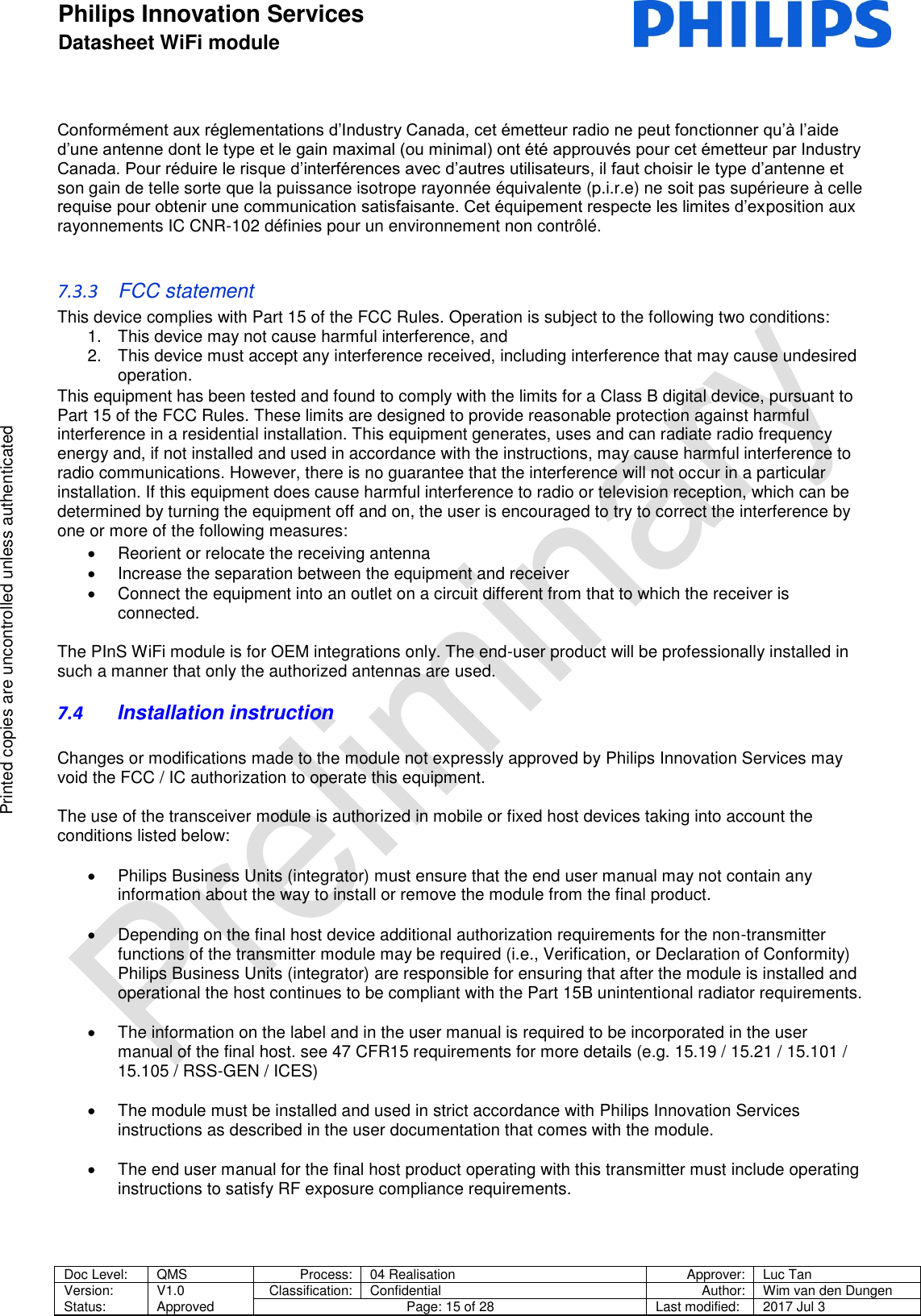
Philips Innovation Services  Datasheet WiFi module    Doc Level: QMS Process: 04 Realisation Approver: Luc Tan Version: Status: V1.0 Approved Classification: Confidential Author: Wim van den Dungen Page: 15 of 28 Last modified: 2017 Jul 3   Printed copies are uncontrolled unless authenticated Printed copies are uncontrolled unless authenticated Conformément aux réglementations d’Industry Canada, cet émetteur radio ne peut fonctionner qu’à l’aide d’une antenne dont le type et le gain maximal (ou minimal) ont été approuvés pour cet émetteur par Industry Canada. Pour réduire le risque d’interférences avec d’autres utilisateurs, il faut choisir le type d’antenne et son gain de telle sorte que la puissance isotrope rayonnée équivalente (p.i.r.e) ne soit pas supérieure à celle requise pour obtenir une communication satisfaisante. Cet équipement respecte les limites d’exposition aux rayonnements IC CNR-102 définies pour un environnement non contrôlé.   7.3.3  FCC statement  This device complies with Part 15 of the FCC Rules. Operation is subject to the following two conditions:  1.  This device may not cause harmful interference, and  2.  This device must accept any interference received, including interference that may cause undesired operation.  This equipment has been tested and found to comply with the limits for a Class B digital device, pursuant to Part 15 of the FCC Rules. These limits are designed to provide reasonable protection against harmful interference in a residential installation. This equipment generates, uses and can radiate radio frequency energy and, if not installed and used in accordance with the instructions, may cause harmful interference to radio communications. However, there is no guarantee that the interference will not occur in a particular installation. If this equipment does cause harmful interference to radio or television reception, which can be determined by turning the equipment off and on, the user is encouraged to try to correct the interference by one or more of the following measures:    Reorient or relocate the receiving antenna    Increase the separation between the equipment and receiver    Connect the equipment into an outlet on a circuit different from that to which the receiver is connected.   The PInS WiFi module is for OEM integrations only. The end-user product will be professionally installed in such a manner that only the authorized antennas are used.  7.4 Installation instruction  Changes or modifications made to the module not expressly approved by Philips Innovation Services may void the FCC / IC authorization to operate this equipment.  The use of the transceiver module is authorized in mobile or fixed host devices taking into account the conditions listed below:    Philips Business Units (integrator) must ensure that the end user manual may not contain any information about the way to install or remove the module from the final product.    Depending on the final host device additional authorization requirements for the non-transmitter functions of the transmitter module may be required (i.e., Verification, or Declaration of Conformity) Philips Business Units (integrator) are responsible for ensuring that after the module is installed and operational the host continues to be compliant with the Part 15B unintentional radiator requirements.    The information on the label and in the user manual is required to be incorporated in the user manual of the final host. see 47 CFR15 requirements for more details (e.g. 15.19 / 15.21 / 15.101 / 15.105 / RSS-GEN / ICES)    The module must be installed and used in strict accordance with Philips Innovation Services instructions as described in the user documentation that comes with the module.    The end user manual for the final host product operating with this transmitter must include operating instructions to satisfy RF exposure compliance requirements.
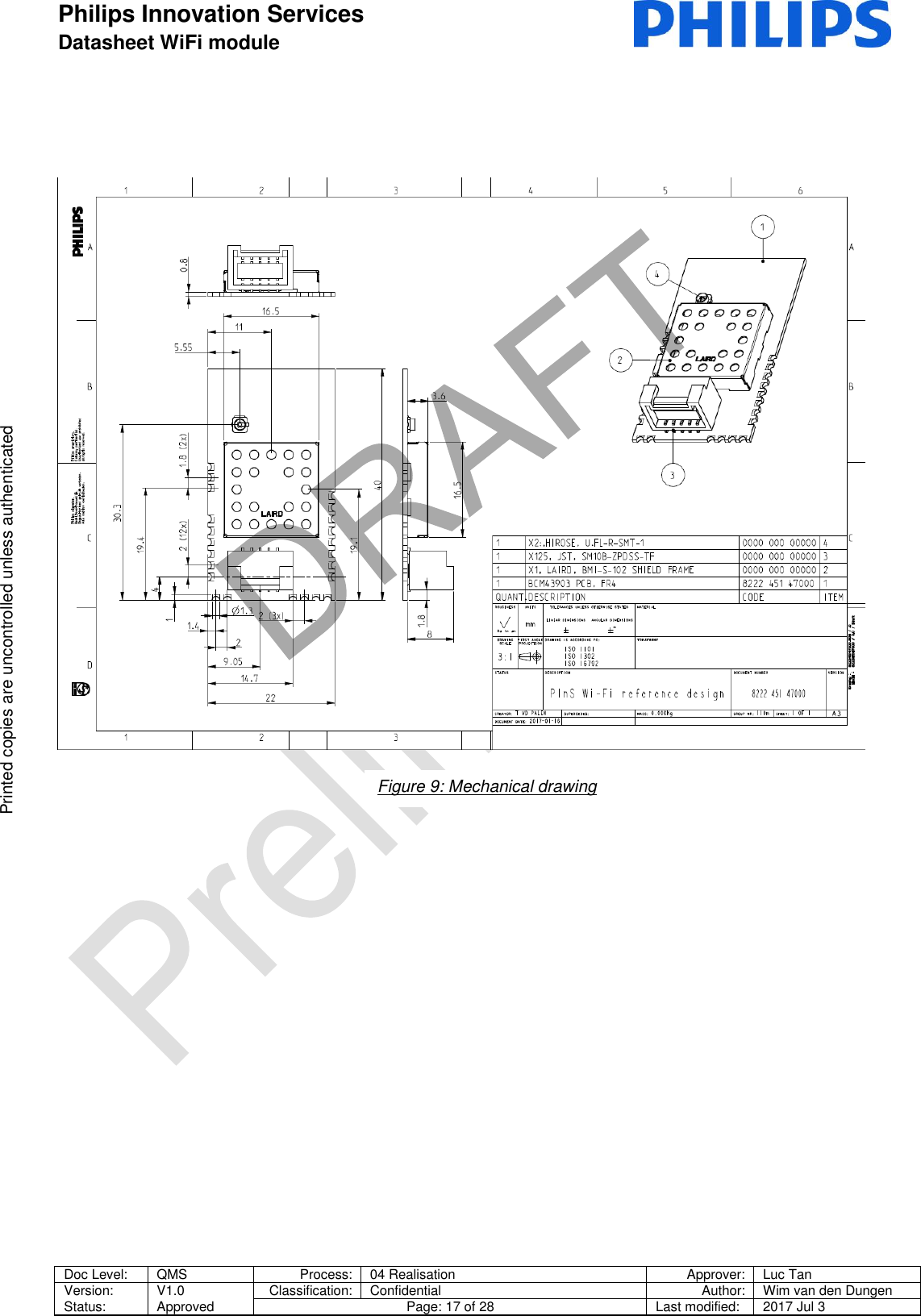
Philips Innovation Services  Datasheet WiFi module    Doc Level: QMS Process: 04 Realisation Approver: Luc Tan Version: Status: V1.0 Approved Classification: Confidential Author: Wim van den Dungen Page: 16 of 28 Last modified: 2017 Jul 3   Printed copies are uncontrolled unless authenticated Printed copies are uncontrolled unless authenticated e.g  Radiofrequency radiation exposure Information:  This equipment complies with FCC radiation exposure limits set forth for an uncontrolled environment. This equipment should be installed and operated with minimum distance of 20 cm between the radiator and your body.  This transmitter must not be co-located or operating in conjunction with any other antenna or transmitter.  Cet équipement est conforme aux limites d'exposition aux rayonnements IC établies pour un  environnement non contrôlé. Cet équipement doit être installé et utilisé avec un minimum de  20 cm de distance entre la source de rayonnement et votre corps.    The antenna of the module may not be removed, replaced nor modified. The antenna must not be co-located or operating in conjunction with any other antenna or transmitter. No additional antenna must be used.    When the final host product operating with this transmitter deviate from above, installation of this module into specific final hosts may require the submission of a Class II permissive change application containing data pertinent to RF Exposure, spurious emissions, ERP/EIRP, and host/module authentication, or new application if appropriate. 7.5  Label requirements for end product For an end product using the PInS WiFI module there must be a label containing, at least, the following information:       The label must be affixed on an exterior surface of the end product such that it will be visible upon inspection in compliance with the modular approval guidelines developed by the FCC.   In accordance with 47 CFR § 15.19, the end product shall bear the following statement in a conspicuous location on the device:  "This device complies with Part 15 of the FCC Rules.  Operation is subject to the following two conditions;  (1) This device may not cause harmful interference, and (2) This device must accept any interference received, including interference that may cause undesired operation." 7.6  UL compliance  UL94V-0 compliance on PCB level. 8  Specifications 8.1  Mechanical  The dimensions and footprint are part of the platform and are considered strategic to have a common base. Supporting backwards compatibility and future extensions of the platform proposition. The main dimensions are 40mm * 22mm (+/- 0.250mm) and a maximum height of <9mm. Refer to the latest sheet 110 [3] of the PCB for more information about the mechanical drawings.  This device contains FCC ID: 2AALC0031357 IC ID: 22799-0031357 CMIIT ID: TBC
Philips Innovation Services  Datasheet WiFi module    Doc Level: QMS Process: 04 Realisation Approver: Luc Tan Version: Status: V1.0 Approved Classification: Confidential Author: Wim van den Dungen Page: 17 of 28 Last modified: 2017 Jul 3   Printed copies are uncontrolled unless authenticated Printed copies are uncontrolled unless authenticated         Figure 9: Mechanical drawing
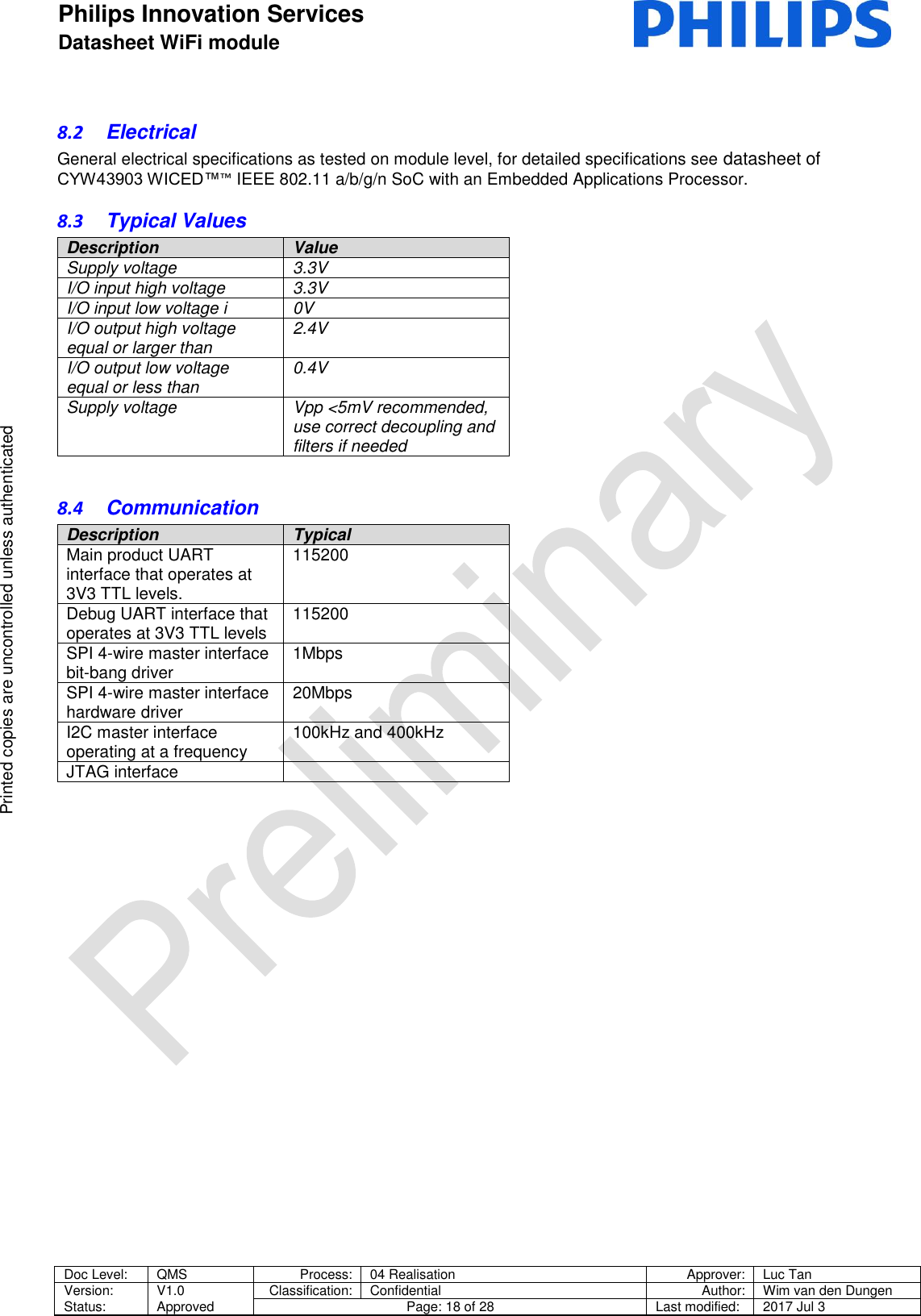
Philips Innovation Services  Datasheet WiFi module    Doc Level: QMS Process: 04 Realisation Approver: Luc Tan Version: Status: V1.0 Approved Classification: Confidential Author: Wim van den Dungen Page: 18 of 28 Last modified: 2017 Jul 3   Printed copies are uncontrolled unless authenticated Printed copies are uncontrolled unless authenticated 8.2  Electrical General electrical specifications as tested on module level, for detailed specifications see datasheet of CYW43903 WICED™™ IEEE 802.11 a/b/g/n SoC with an Embedded Applications Processor. 8.3  Typical Values Description Value Supply voltage  3.3V  I/O input high voltage  3.3V I/O input low voltage i 0V  I/O output high voltage equal or larger than  2.4V  I/O output low voltage equal or less than  0.4V  Supply voltage Vpp <5mV recommended, use correct decoupling and filters if needed  8.4  Communication Description Typical Main product UART interface that operates at 3V3 TTL levels. 115200 Debug UART interface that operates at 3V3 TTL levels 115200 SPI 4-wire master interface bit-bang driver 1Mbps SPI 4-wire master interface hardware driver 20Mbps I2C master interface operating at a frequency 100kHz and 400kHz JTAG interface
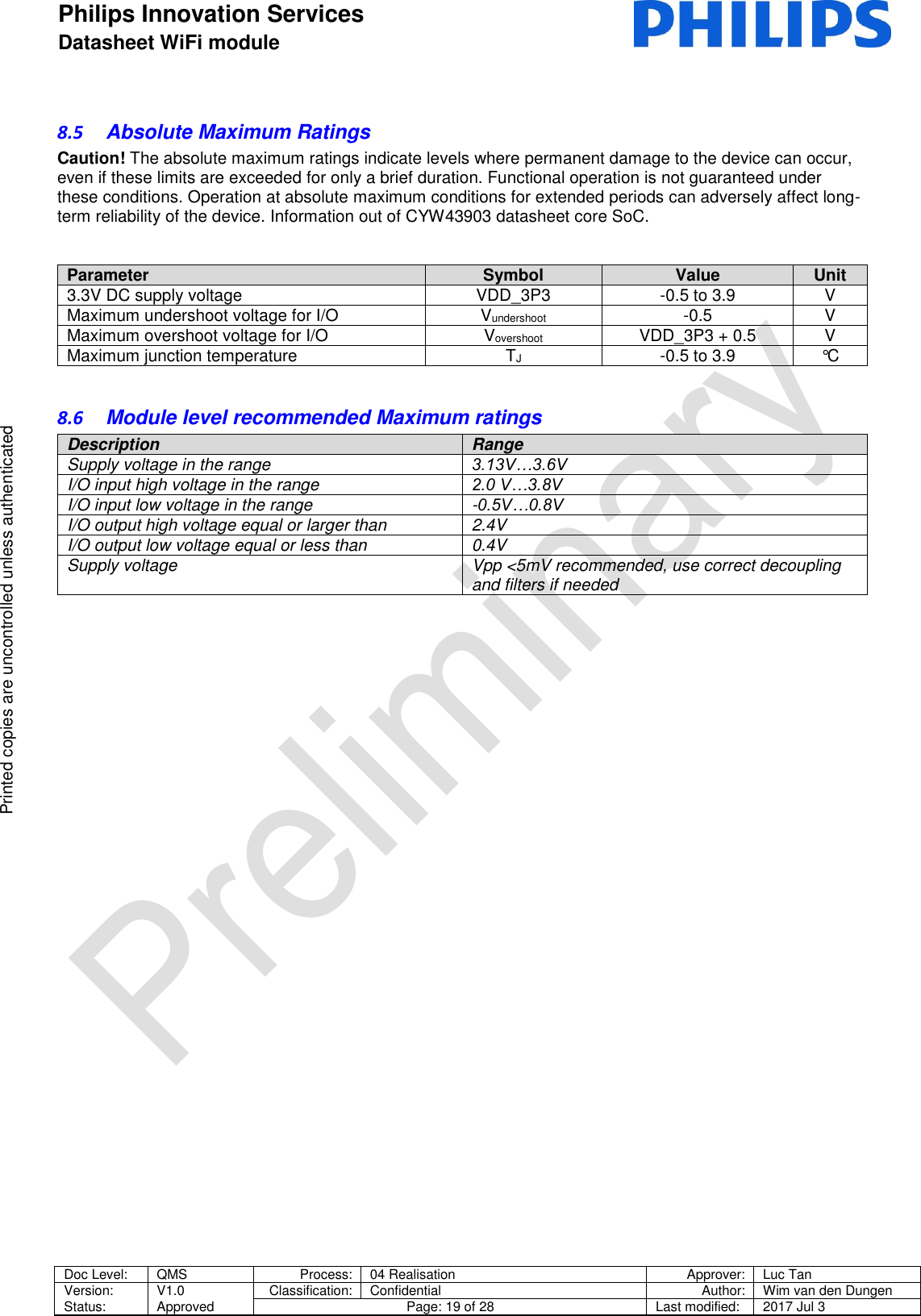
Philips Innovation Services  Datasheet WiFi module    Doc Level: QMS Process: 04 Realisation Approver: Luc Tan Version: Status: V1.0 Approved Classification: Confidential Author: Wim van den Dungen Page: 19 of 28 Last modified: 2017 Jul 3   Printed copies are uncontrolled unless authenticated Printed copies are uncontrolled unless authenticated 8.5  Absolute Maximum Ratings Caution! The absolute maximum ratings indicate levels where permanent damage to the device can occur, even if these limits are exceeded for only a brief duration. Functional operation is not guaranteed under these conditions. Operation at absolute maximum conditions for extended periods can adversely affect long-term reliability of the device. Information out of CYW43903 datasheet core SoC.   Parameter Symbol Value Unit 3.3V DC supply voltage VDD_3P3 -0.5 to 3.9 V Maximum undershoot voltage for I/O Vundershoot -0.5 V Maximum overshoot voltage for I/O Vovershoot VDD_3P3 + 0.5 V Maximum junction temperature TJ -0.5 to 3.9 °C  8.6  Module level recommended Maximum ratings Description Range Supply voltage in the range  3.13V…3.6V  I/O input high voltage in the range 2.0 V…3.8V  I/O input low voltage in the range -0.5V…0.8V  I/O output high voltage equal or larger than  2.4V  I/O output low voltage equal or less than  0.4V  Supply voltage Vpp <5mV recommended, use correct decoupling and filters if needed
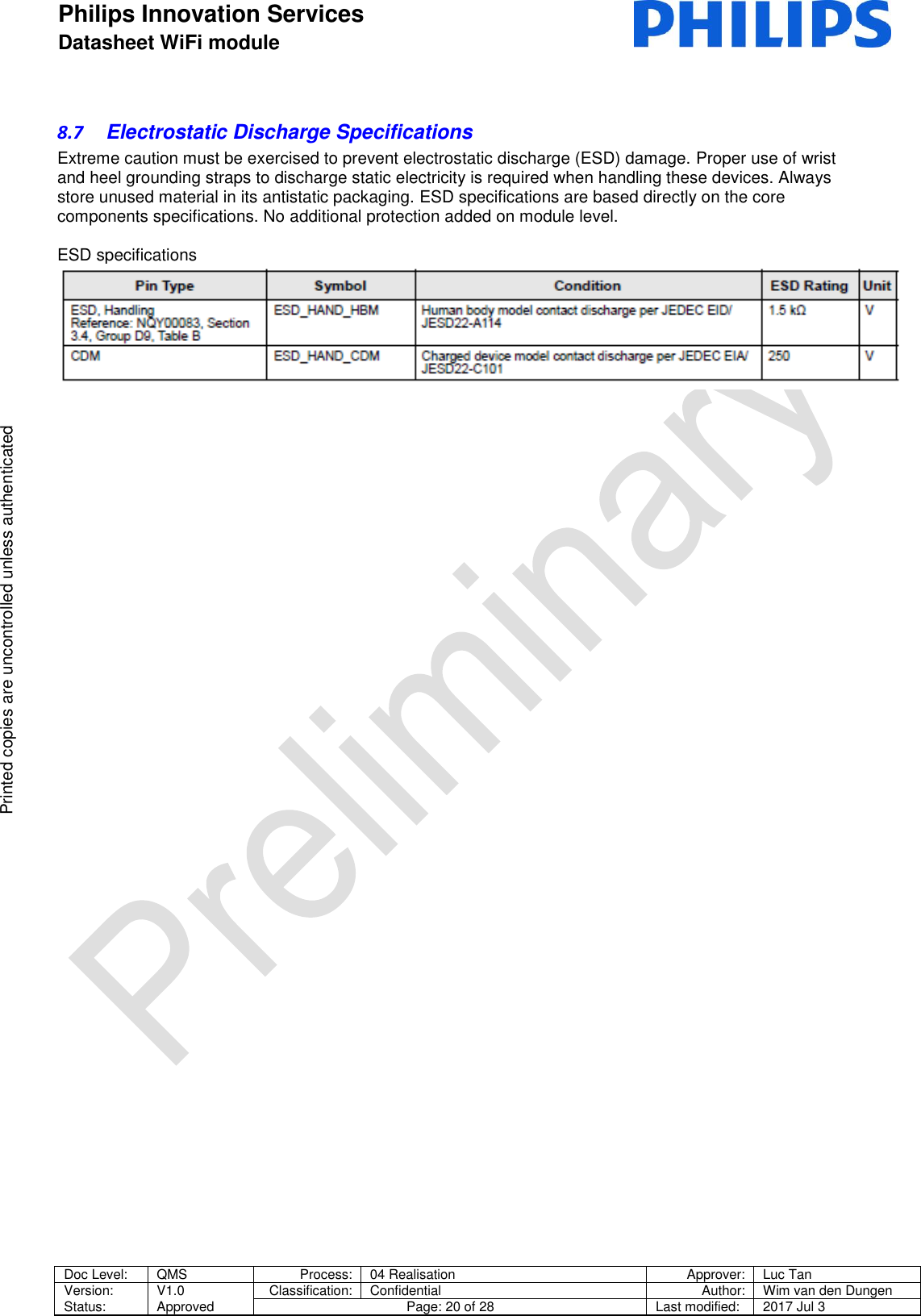
Philips Innovation Services  Datasheet WiFi module    Doc Level: QMS Process: 04 Realisation Approver: Luc Tan Version: Status: V1.0 Approved Classification: Confidential Author: Wim van den Dungen Page: 20 of 28 Last modified: 2017 Jul 3   Printed copies are uncontrolled unless authenticated Printed copies are uncontrolled unless authenticated 8.7  Electrostatic Discharge Specifications Extreme caution must be exercised to prevent electrostatic discharge (ESD) damage. Proper use of wrist and heel grounding straps to discharge static electricity is required when handling these devices. Always store unused material in its antistatic packaging. ESD specifications are based directly on the core components specifications. No additional protection added on module level.  ESD specifications
Philips Innovation Services  Datasheet WiFi module    Doc Level: QMS Process: 04 Realisation Approver: Luc Tan Version: Status: V1.0 Approved Classification: Confidential Author: Wim van den Dungen Page: 21 of 28 Last modified: 2017 Jul 3   Printed copies are uncontrolled unless authenticated Printed copies are uncontrolled unless authenticated 9  RF characteristics Also see datasheet of CYW43903 WICED™™ IEEE 802.11 a/b/g/n SoC with an Embedded Applications Processor.    Description Range Closed-loop TX power variation at highest power level stetting.  Across full temperature and voltage range. Applies to 10dBm to 20dB output power range Max +/- 1.5dB  See [1] for actual value    See datasheet CYW43903 WICED™ IEEE 802.11 a/b/g/n SoC with an Embedded Applications Processor [1] for additional information.
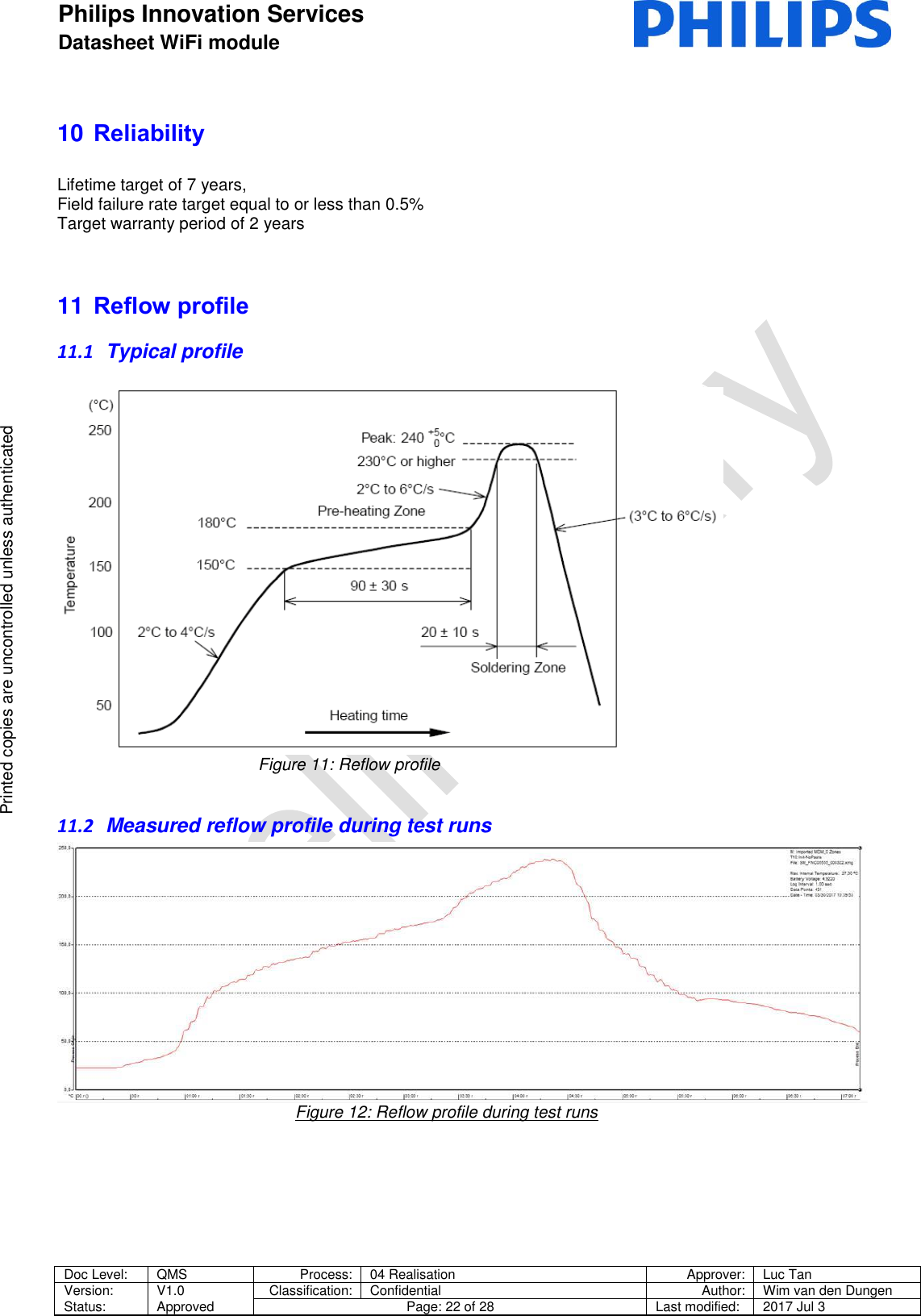
Philips Innovation Services  Datasheet WiFi module    Doc Level: QMS Process: 04 Realisation Approver: Luc Tan Version: Status: V1.0 Approved Classification: Confidential Author: Wim van den Dungen Page: 22 of 28 Last modified: 2017 Jul 3   Printed copies are uncontrolled unless authenticated Printed copies are uncontrolled unless authenticated 10 Reliability   Lifetime target of 7 years,  Field failure rate target equal to or less than 0.5%    Target warranty period of 2 years    11 Reflow profile 11.1  Typical profile                                              Figure 11: Reflow profile  11.2  Measured reflow profile during test runs                                                     Figure 12: Reflow profile during test runs
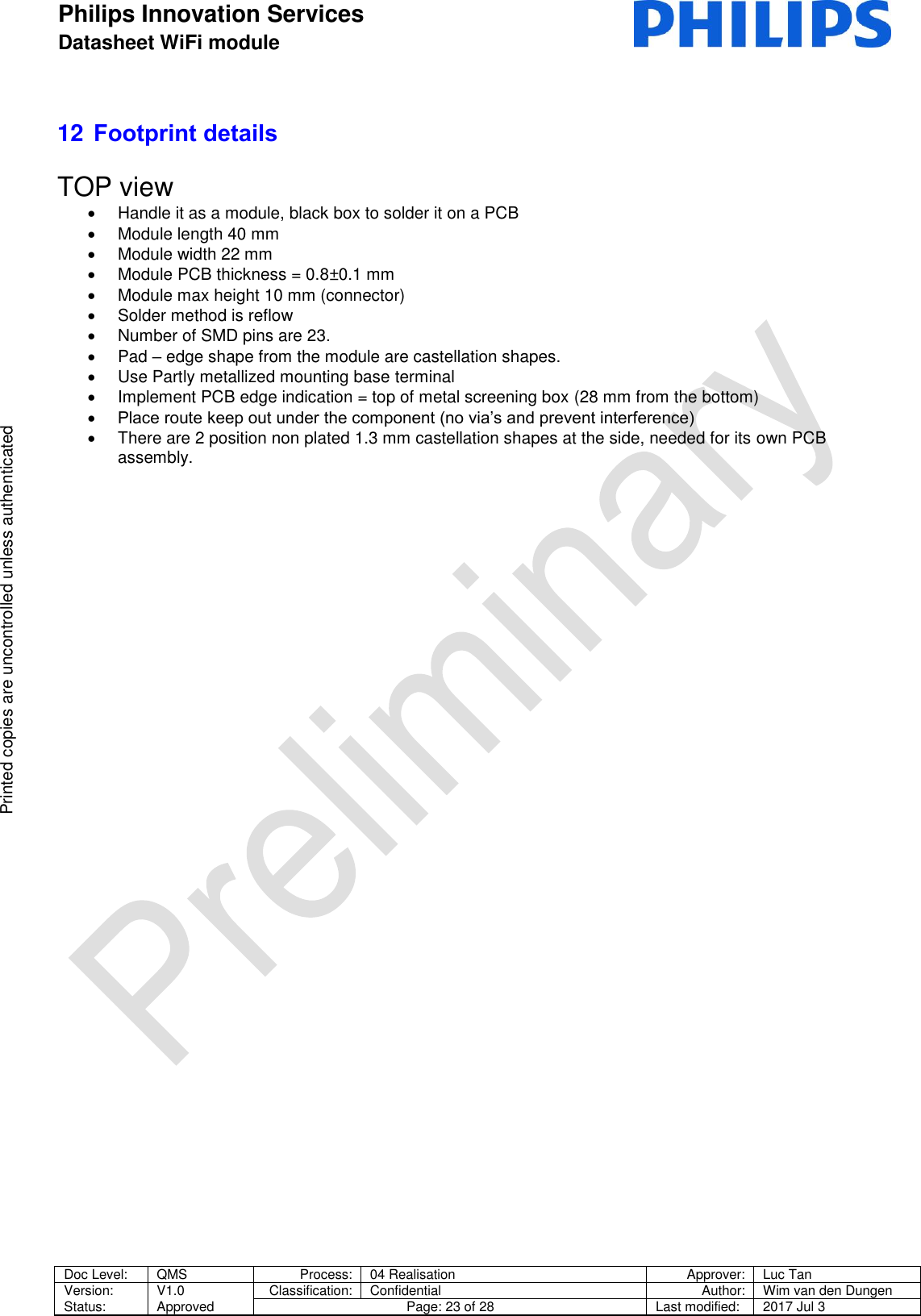
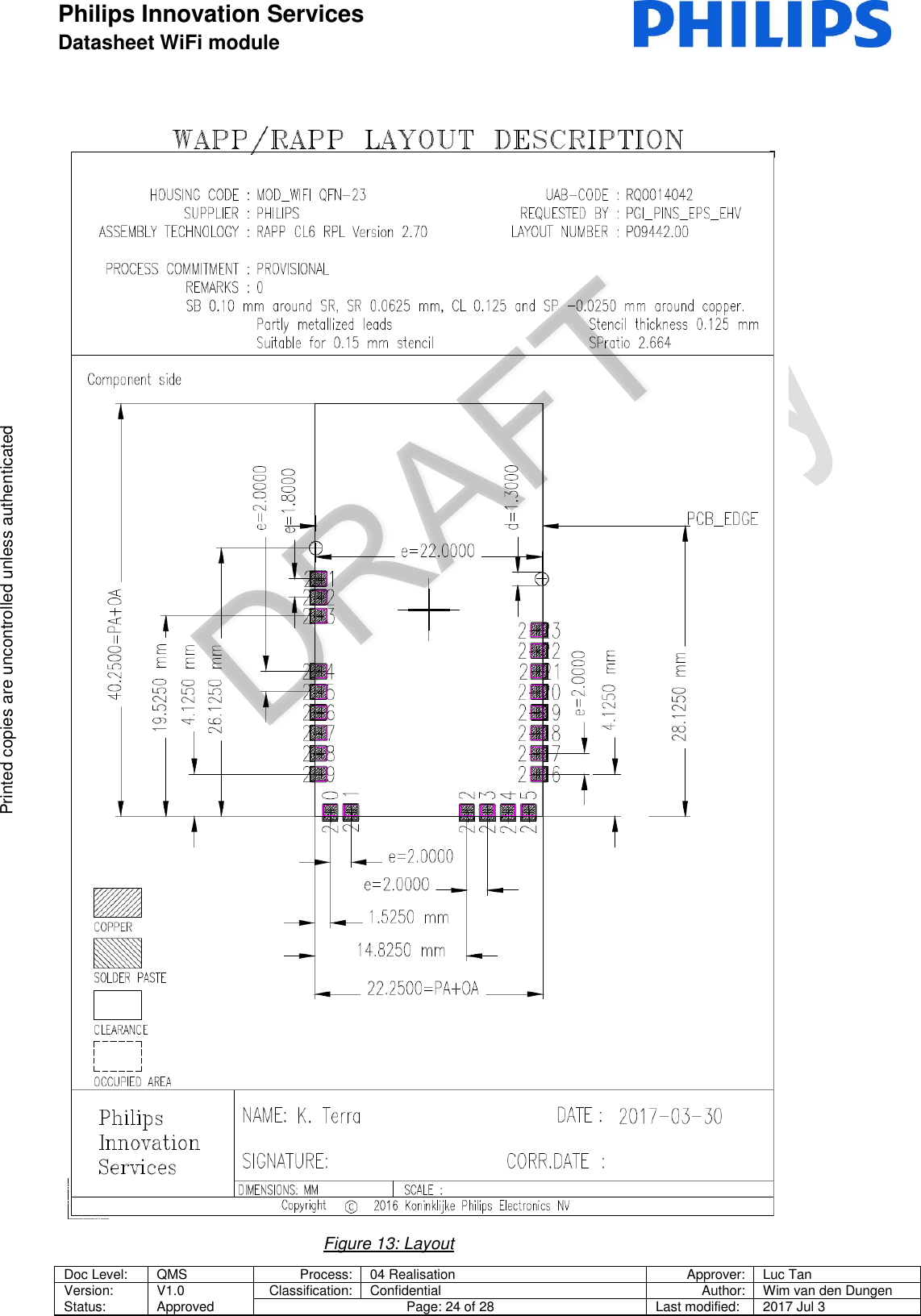
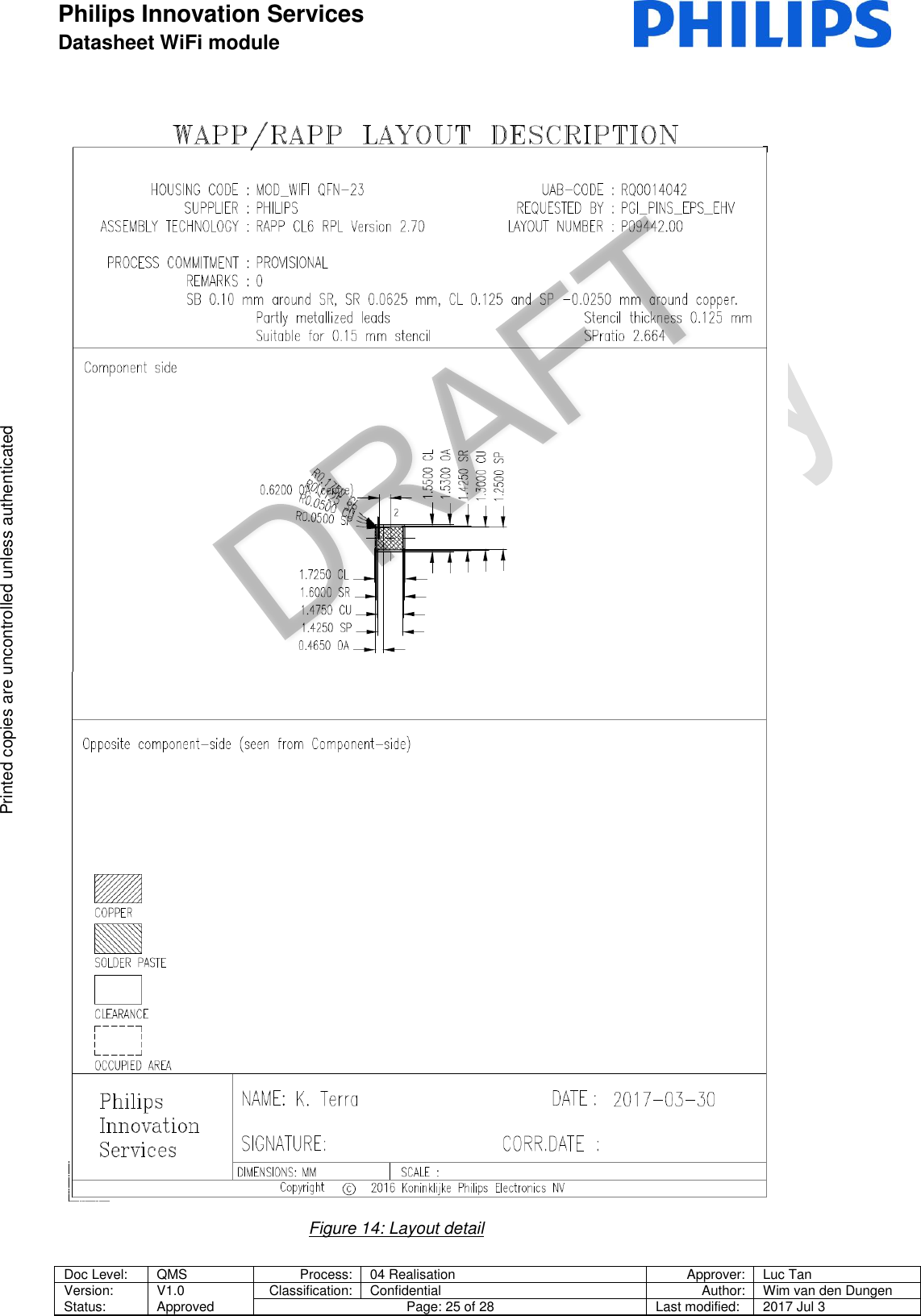
Philips Innovation Services  Datasheet WiFi module    Doc Level: QMS Process: 04 Realisation Approver: Luc Tan Version: Status: V1.0 Approved Classification: Confidential Author: Wim van den Dungen Page: 23 of 28 Last modified: 2017 Jul 3   Printed copies are uncontrolled unless authenticated Printed copies are uncontrolled unless authenticated 12 Footprint details  TOP view   Handle it as a module, black box to solder it on a PCB  Module length 40 mm   Module width 22 mm   Module PCB thickness = 0.8±0.1 mm   Module max height 10 mm (connector)   Solder method is reflow   Number of SMD pins are 23.   Pad – edge shape from the module are castellation shapes.   Use Partly metallized mounting base terminal   Implement PCB edge indication = top of metal screening box (28 mm from the bottom)  Place route keep out under the component (no via’s and prevent interference)   There are 2 position non plated 1.3 mm castellation shapes at the side, needed for its own PCB assembly.
Philips Innovation Services  Datasheet WiFi module    Doc Level: QMS Process: 04 Realisation Approver: Luc Tan Version: Status: V1.0 Approved Classification: Confidential Author: Wim van den Dungen Page: 24 of 28 Last modified: 2017 Jul 3   Printed copies are uncontrolled unless authenticated Printed copies are uncontrolled unless authenticated                                                           Figure 13: Layout
Philips Innovation Services  Datasheet WiFi module    Doc Level: QMS Process: 04 Realisation Approver: Luc Tan Version: Status: V1.0 Approved Classification: Confidential Author: Wim van den Dungen Page: 25 of 28 Last modified: 2017 Jul 3   Printed copies are uncontrolled unless authenticated Printed copies are uncontrolled unless authenticated                                               Figure 14: Layout detail
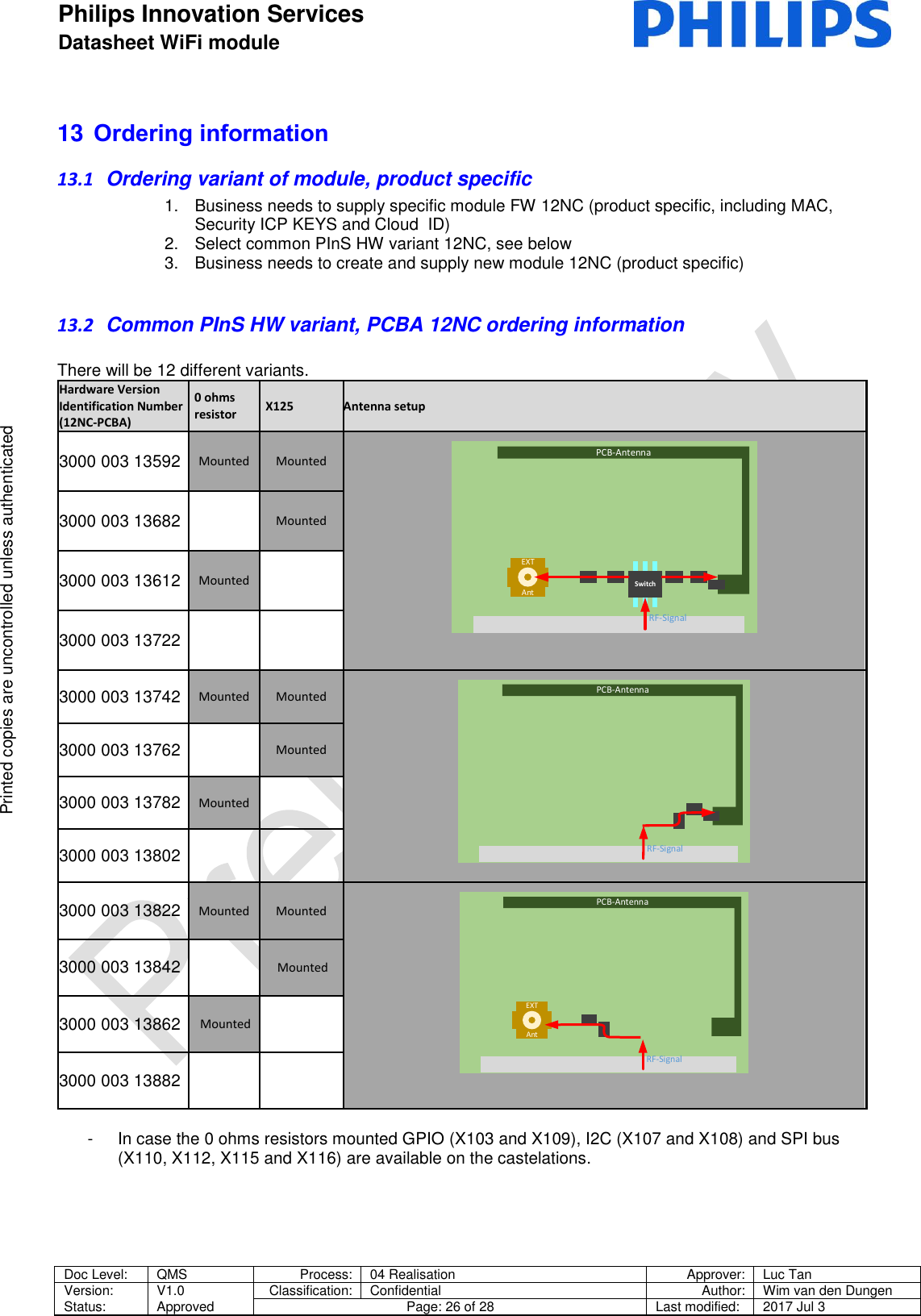
Philips Innovation Services  Datasheet WiFi module    Doc Level: QMS Process: 04 Realisation Approver: Luc Tan Version: Status: V1.0 Approved Classification: Confidential Author: Wim van den Dungen Page: 26 of 28 Last modified: 2017 Jul 3   Printed copies are uncontrolled unless authenticated Printed copies are uncontrolled unless authenticated 13 Ordering information 13.1  Ordering variant of module, product specific 1.  Business needs to supply specific module FW 12NC (product specific, including MAC, Security ICP KEYS and Cloud  ID) 2.  Select common PInS HW variant 12NC, see below 3.  Business needs to create and supply new module 12NC (product specific)  13.2  Common PInS HW variant, PCBA 12NC ordering information  There will be 12 different variants. Hardware Version Identification Number (12NC-PCBA) 0 ohms resistor X125 Antenna setup 3000 003 13592 Mounted Mounted SwitchPCB-AntennaRF-SignalEXTAnt  3000 003 13682  Mounted 3000 003 13612 Mounted  3000 003 13722   3000 003 13742 Mounted Mounted PCB-AntennaRF-Signal 3000 003 13762  Mounted 3000 003 13782 Mounted  3000 003 13802   3000 003 13822 Mounted Mounted PCB-AntennaRF-SignalEXTAnt  3000 003 13842   Mounted 3000 003 13862  Mounted  3000 003 13882    -  In case the 0 ohms resistors mounted GPIO (X103 and X109), I2C (X107 and X108) and SPI bus (X110, X112, X115 and X116) are available on the castelations.
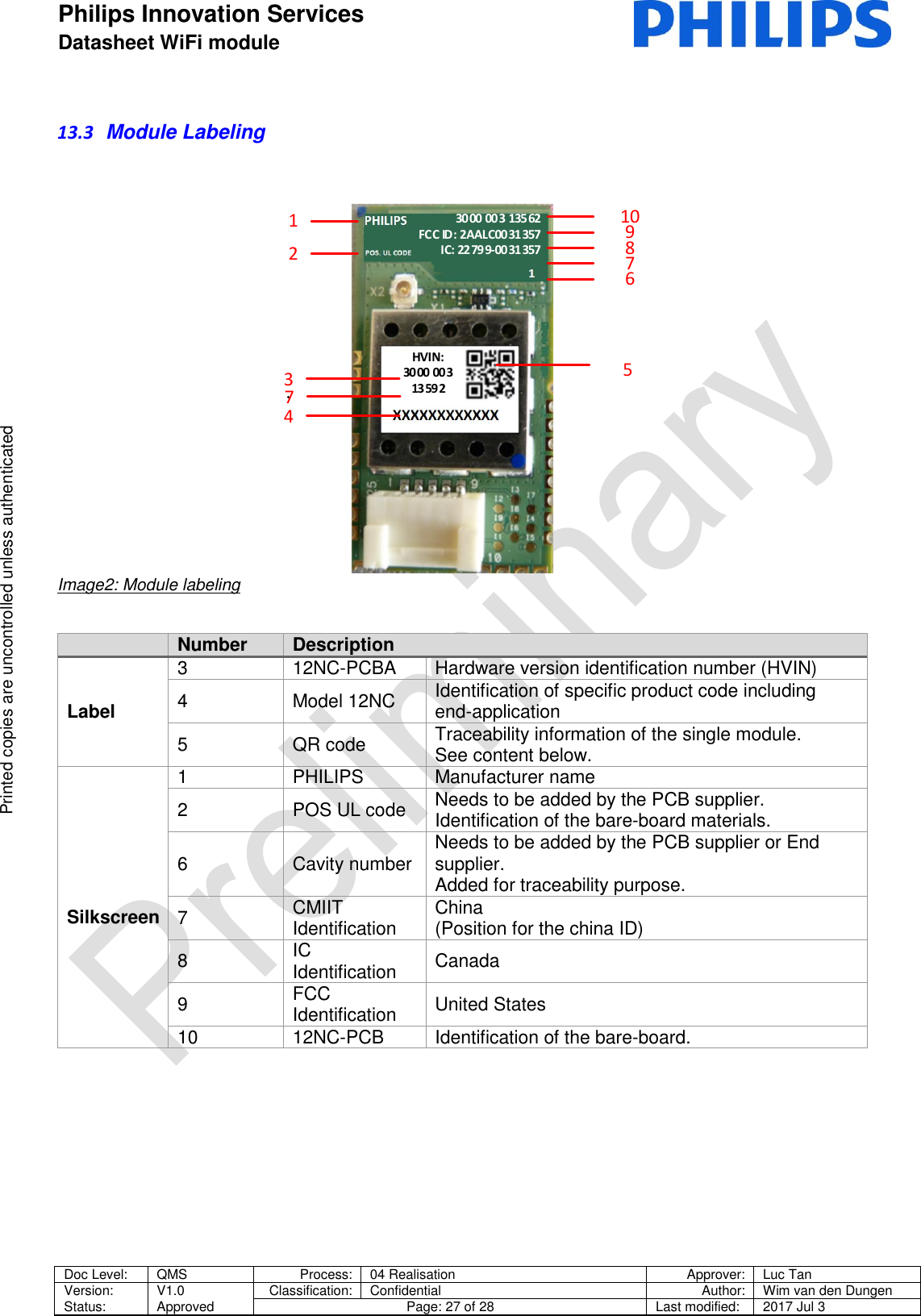
Philips Innovation Services  Datasheet WiFi module    Doc Level: QMS Process: 04 Realisation Approver: Luc Tan Version: Status: V1.0 Approved Classification: Confidential Author: Wim van den Dungen Page: 27 of 28 Last modified: 2017 Jul 3   Printed copies are uncontrolled unless authenticated Printed copies are uncontrolled unless authenticated 13.3  Module Labeling   3000 003 13562FCC ID: 2AALC0031357IC: 22799-0031357HVIN:3000 00313592345109867127 Image2: Module labeling    Number Description Label 3 12NC-PCBA Hardware version identification number (HVIN) 4 Model 12NC Identification of specific product code including end-application  5 QR code Traceability information of the single module. See content below.  Silkscreen 1 PHILIPS Manufacturer name 2 POS UL code  Needs to be added by the PCB supplier. Identification of the bare-board materials. 6 Cavity number Needs to be added by the PCB supplier or End supplier.  Added for traceability purpose. 7 CMIIT Identification China (Position for the china ID)  8 IC Identification Canada 9 FCC Identification United States 10 12NC-PCB Identification of the bare-board.
Philips Innovation Services  Datasheet WiFi module    Doc Level: QMS Process: 04 Realisation Approver: Luc Tan Version: Status: V1.0 Approved Classification: Confidential Author: Wim van den Dungen Page: 28 of 28 Last modified: 2017 Jul 3   Printed copies are uncontrolled unless authenticated Printed copies are uncontrolled unless authenticated                           QR CODE LABEL INFORMATION CODE INFORMATION YY YEAR WW WEEK   D (PRODUCTION DAY)   H: MONDAY I: TUESDAY J: WEDNESDAY K: THURSDAY L: FRIDAY M: SATURDAY N: SUNDAY MAC Address (12 digit) XXXXXXXXXXXX Model 12NC (12 digit) XXXXXXXXXXXX  14 References Ref.# Document Title Document ID  [1]   CYW43903 WICED™™ IEEE 802.11 a/b/g/n SoC with an Embedded Applications Processor Datasheet 002-14826 Rev. *C [2]   Integration manual PInS Wi-Fi module V0.1 N/A [3]   3000_003_13xxx_110_2017xxxx_WIFI_MECH N/A

Navigation menu