Phychips RED5 RFID Module User Manual Phychips

Phychips Inc. RFID Module Phychips

User Manual

                  RED5 User’s Manuals
      8 August 2017  2 of 12         RED5 User’s Manuals - Preliminary Version      Contents1 Pin Description .................................................................................................................................. 3 1.1 RED5 Pin Description.......................................................................................................................... 3 2 Operation Method .............................................................................................................................. 5 2.1 Power Supply ...................................................................................................................................... 5 2.2 UART ................................................................................................................................................... 5 2.3 RF In/Out ............................................................................................................................................. 6 2.4 GUI control .......................................................................................................................................... 6 3 Specification .................................................................................................................................... 11
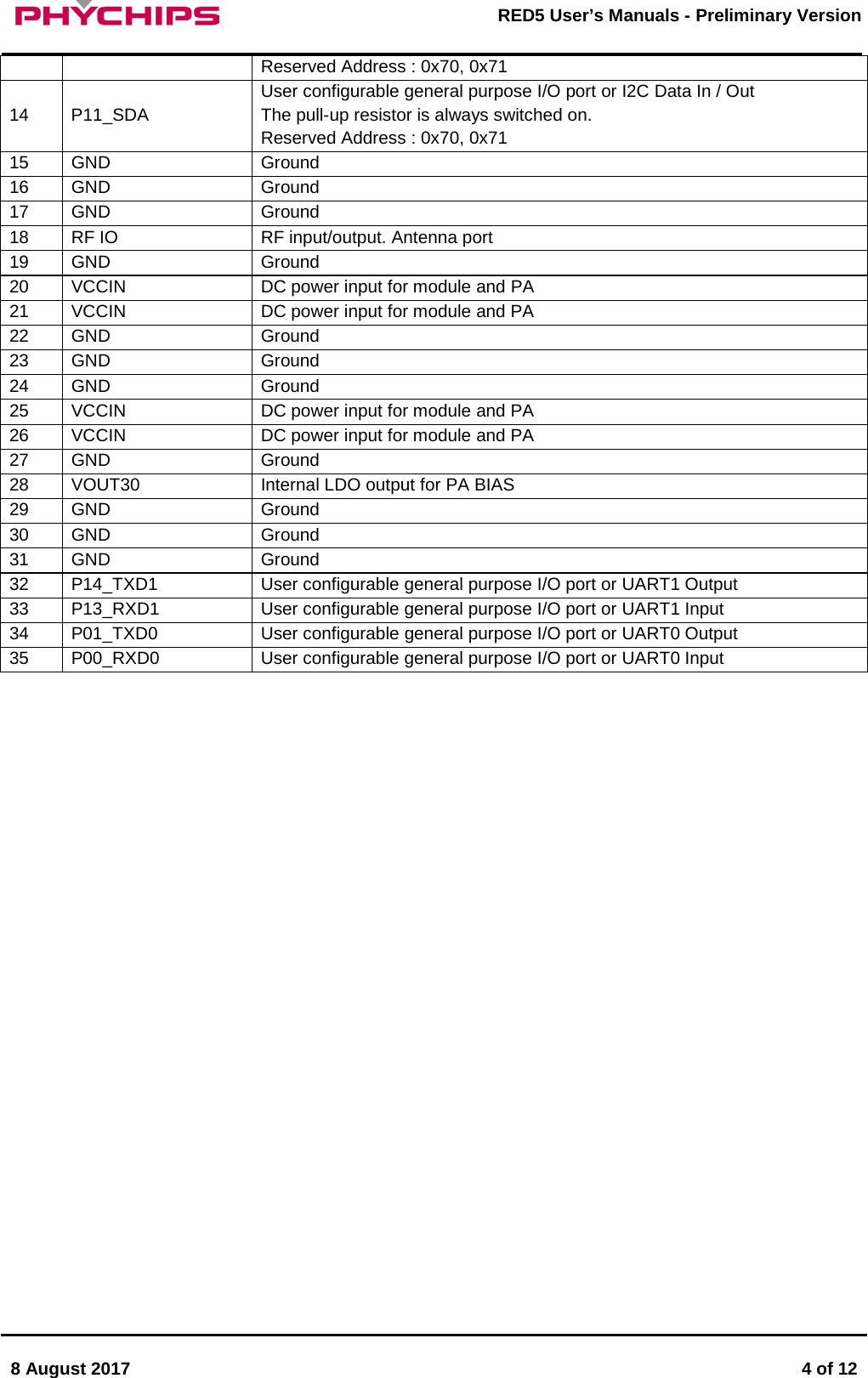
      8 August 2017  3 of 12         RED5 User’s Manuals - Preliminary Version     1  Pin Description  GNDRF IOGND1234567891011121314151617181920212223242526272829303132333435VO UT3 3GNDP13_RXD1P01_TXD0RESETbSWCLKSWDIOENABLEISP_MODEbCSENCP15P16P17P12_SCLP11_SDAP00_RXD0P14_TXD1GNDGNDGNDVO UT3 0GNDVCCINVCCINGNDGNDGNDVCCINVCCINGNDRF IOGND1234567891011121314151617181920212223242526272829303132333435VO UT3 3GNDP13_RXD1P01_TXD0RESETbSWCLKSWDIOENABLEISP_MODEbCSENCP15P16P17P12_SCLP11_SDAP00_RXD0P14_TXD1GNDGNDGNDVO UT3 0GNDVCCINVCCINGNDGNDGNDVCCINVCCIN Figure 1  Pin Description  1.1 RED5 Pin Description No. Pin Name Description 1 VOUT33 Internal LDO 3.3V output for PR9200 SOC  2 GND Ground 3 RESETb Reader SOC Reset signal 0: reset 4 SWDIO Serial Wire Debug data in out 5 SWCLK Serial Wire Debug Clock 6  ENABLE Enable pin for RED5. It turns on/off internal LDOs Logic high : enable, Logic low : disable (POWER DOWN) 7  ISP_MODEb When ISP_MODEb is Logic ‘L’, ISP mode is set as shown below table Pin No. 7 12 11 10 Pin Name ISP_MODEb P17 P16 P15 Normal 1 GPIO/INT GPIO/INT GPIO/INT FLASH UART ISP 0 0 0 0 [CAUTION] Except ISP mode, ISP_MODEb should be set “high” for robust stability for FLASH memory 8  CSE Chip Select Enable. Internally connected to VCC33. For the power control of RED5, use ENABLE pin  9 NC Not Connection 10 P15 User configurable general purpose I/O port 11 P16 User configurable general purpose I/O port or External Interrupt 4 12 P17 User configurable general purpose I/O port or External Interrupt 5 13 P12_SCL User configurable general purpose I/O port or I2C Clock  The pull-up resistor is always switched on.
      8 August 2017  4 of 12         RED5 User’s Manuals - Preliminary Version     Reserved Address : 0x70, 0x71 14 P11_SDA User configurable general purpose I/O port or I2C Data In / Out  The pull-up resistor is always switched on. Reserved Address : 0x70, 0x71 15 GND Ground 16 GND Ground 17 GND Ground 18 RF IO RF input/output. Antenna port 19 GND Ground 20 VCCIN DC power input for module and PA 21 VCCIN DC power input for module and PA 22 GND Ground 23 GND Ground 24 GND Ground 25 VCCIN DC power input for module and PA 26 VCCIN DC power input for module and PA 27 GND Ground 28 VOUT30 Internal LDO output for PA BIAS 29 GND Ground 30 GND Ground 31 GND Ground 32 P14_TXD1 User configurable general purpose I/O port or UART1 Output 33 P13_RXD1 User configurable general purpose I/O port or UART1 Input 34 P01_TXD0 User configurable general purpose I/O port or UART0 Output 35 P00_RXD0 User configurable general purpose I/O port or UART0 Input
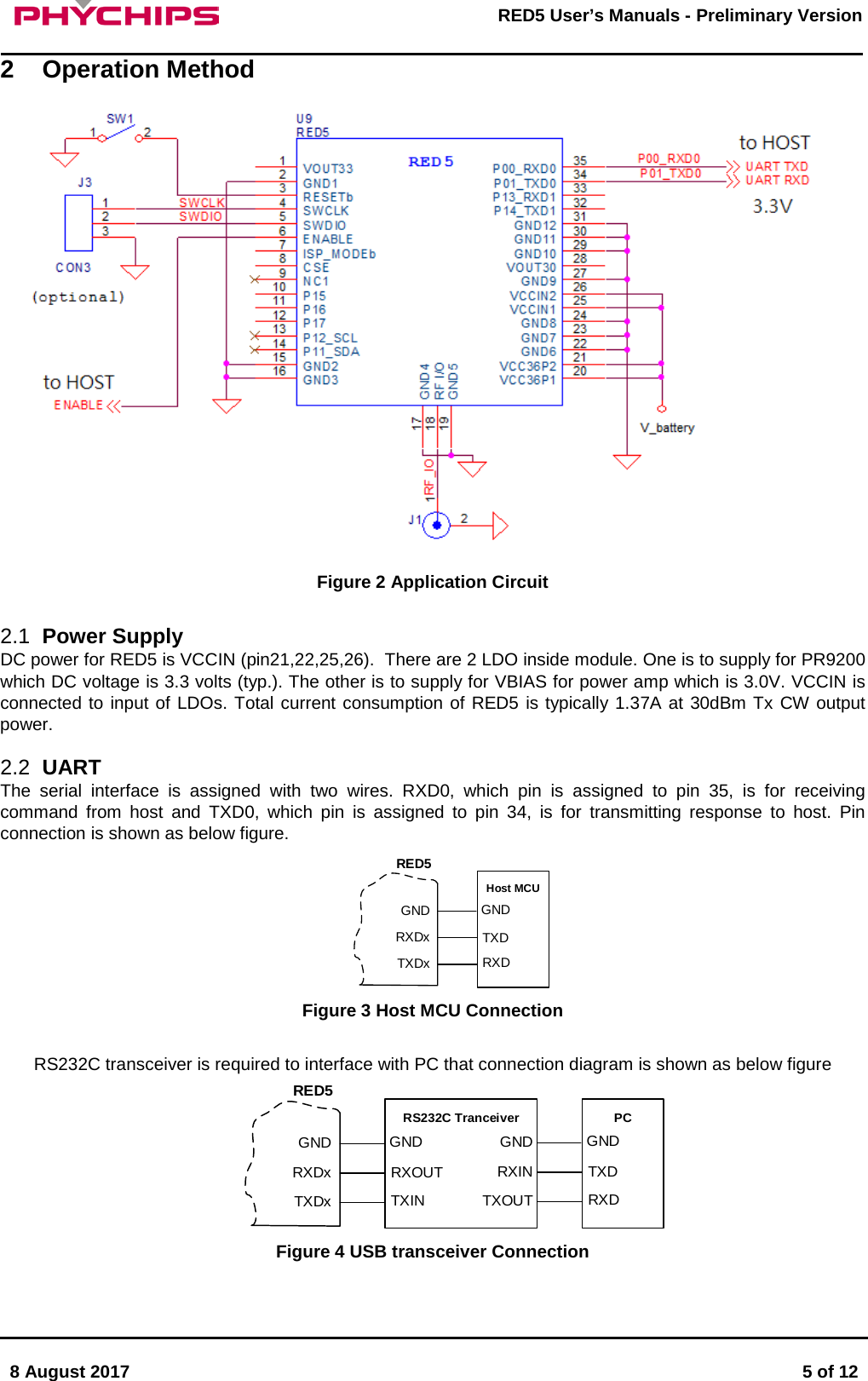
      8 August 2017  5 of 12         RED5 User’s Manuals - Preliminary Version     2  Operation Method  Figure 2 Application Circuit  2.1 Power Supply DC power for RED5 is VCCIN (pin21,22,25,26).  There are 2 LDO inside module. One is to supply for PR9200 which DC voltage is 3.3 volts (typ.). The other is to supply for VBIAS for power amp which is 3.0V. VCCIN is connected to input of LDOs. Total current consumption of RED5 is typically 1.37A at 30dBm Tx CW output power.  2.2 UART  The serial interface is assigned with two wires.  RXD0, which pin  is assigned to pin 35,  is for receiving command from host and TXD0, which pin  is  assigned to pin 34, is for transmitting response to host. Pin connection is shown as below figure. Host MCUTXDxRXDxGNDTXDRXDGNDRED5 Figure 3 Host MCU Connection  RS232C transceiver is required to interface with PC that connection diagram is shown as below figure  RS232C TranceiverTXDxRXDxGNDRXOUTTXINGNDTXOUTRXINGNDPCTXDRXDGNDRED5 Figure 4 USB transceiver Connection
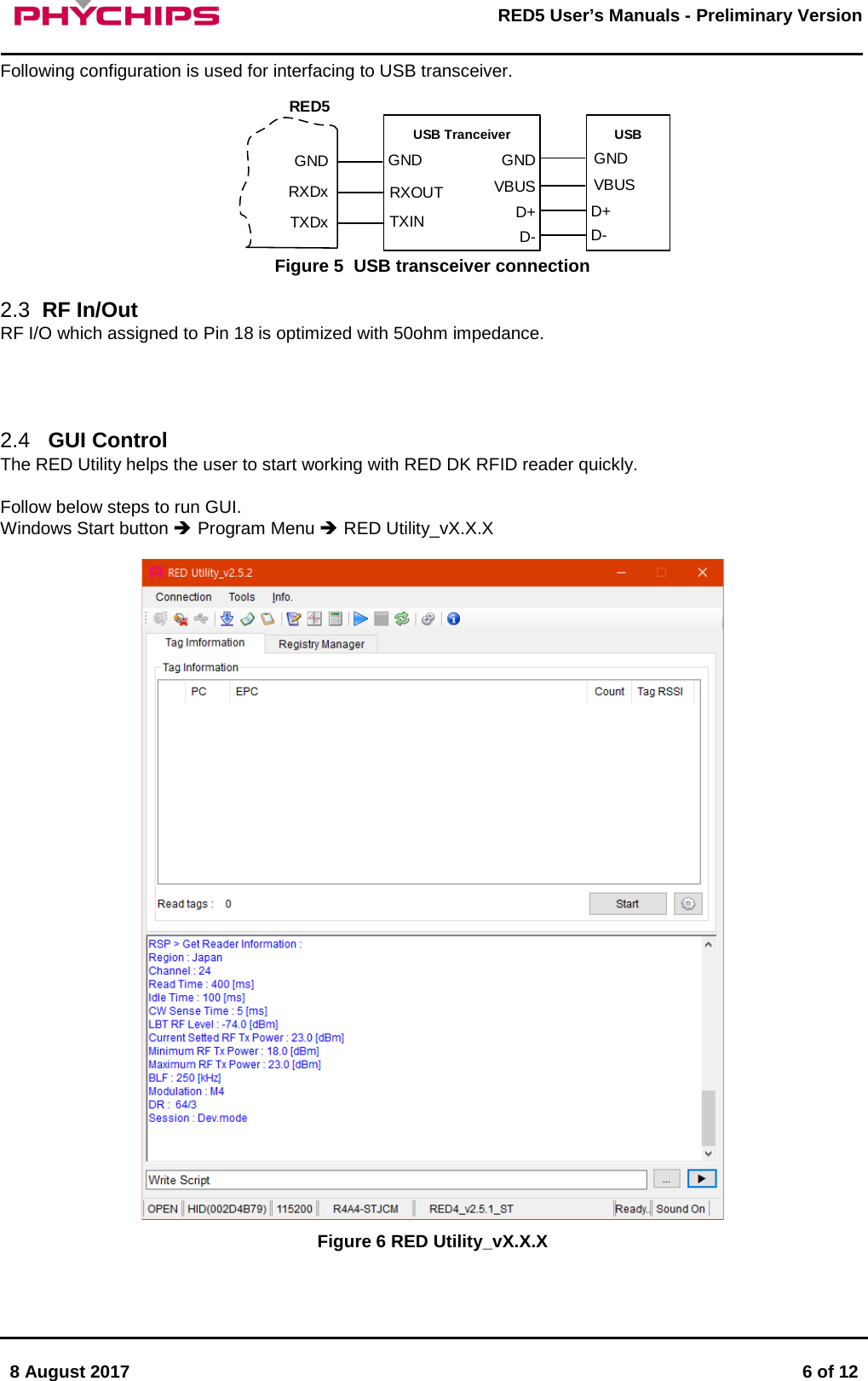
      8 August 2017  6 of 12         RED5 User’s Manuals - Preliminary Version     Following configuration is used for interfacing to USB transceiver. USB TranceiverTXDxRXDxGNDRXOUTTXINGNDD+VBUSGNDUSBD-D+VBUSGNDD-RED5 Figure 5  USB transceiver connection  2.3 RF In/Out RF I/O which assigned to Pin 18 is optimized with 50ohm impedance.     2.4  GUI Control The RED Utility helps the user to start working with RED DK RFID reader quickly.  Follow below steps to run GUI. Windows Start button  Program Menu  RED Utility_vX.X.X   Figure 6 RED Utility_vX.X.X
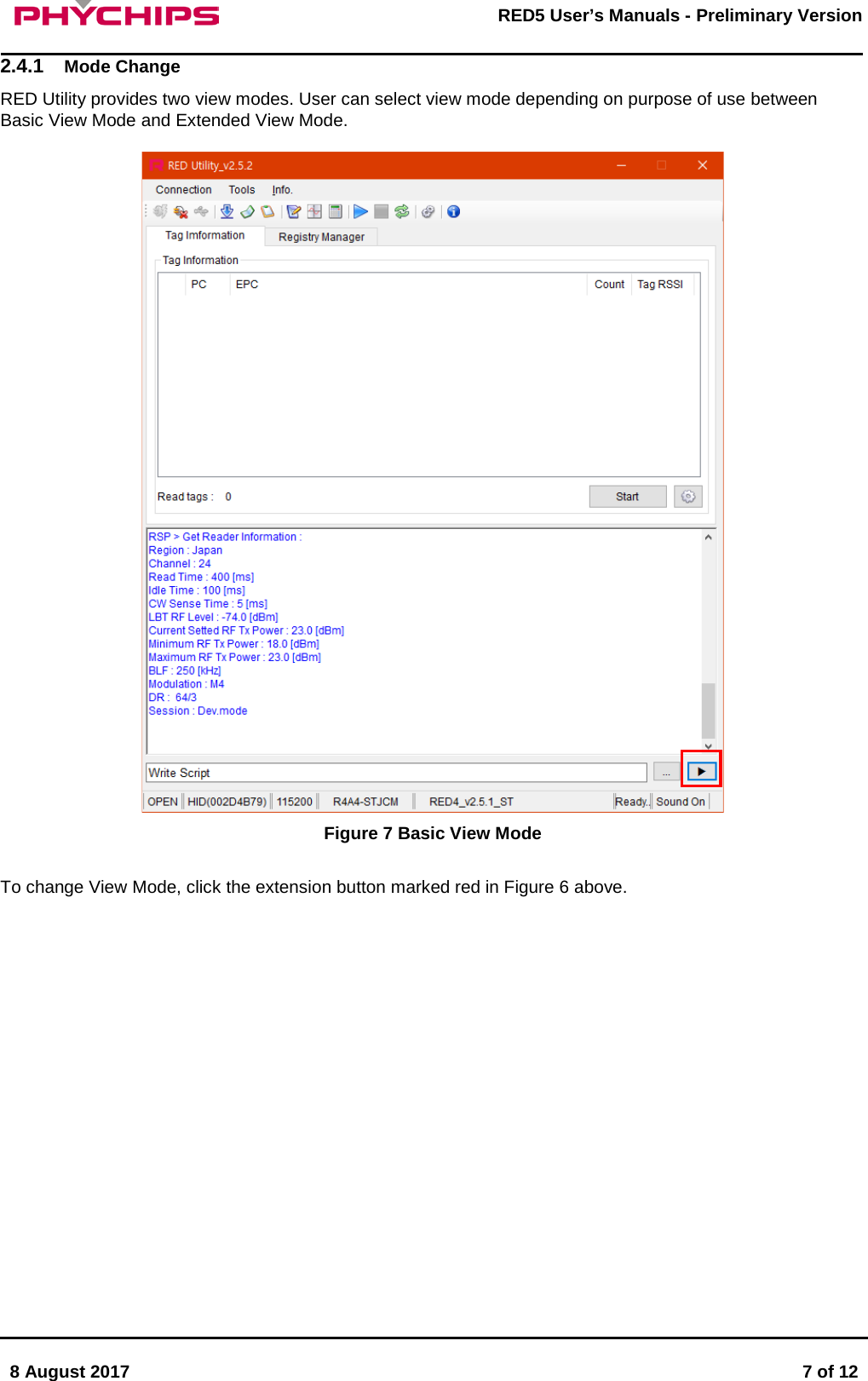
      8 August 2017  7 of 12         RED5 User’s Manuals - Preliminary Version     2.4.1 Mode Change RED Utility provides two view modes. User can select view mode depending on purpose of use between Basic View Mode and Extended View Mode.   Figure 7 Basic View Mode  To change View Mode, click the extension button marked red in Figure 6 above.
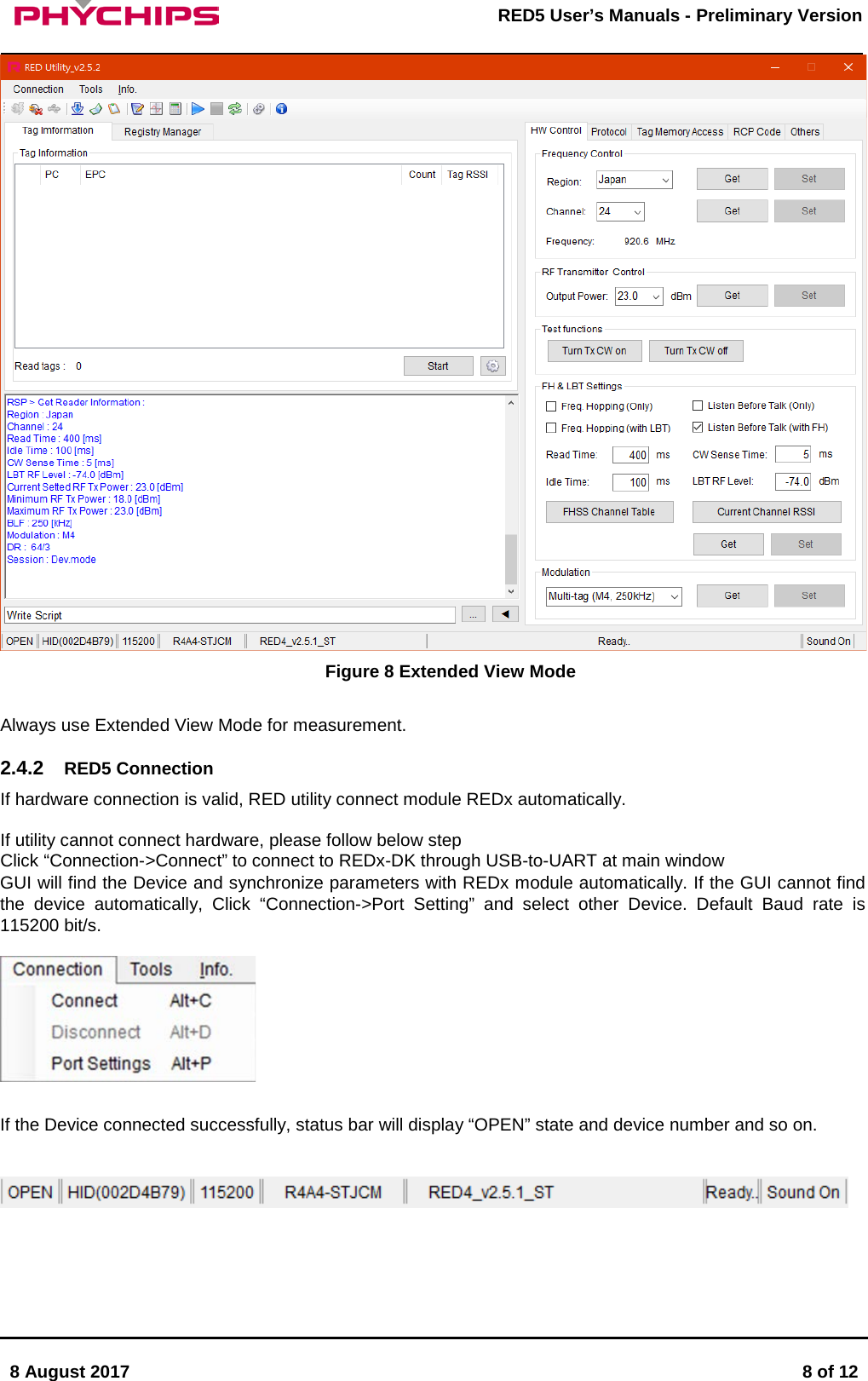
      8 August 2017  8 of 12         RED5 User’s Manuals - Preliminary Version      Figure 8 Extended View Mode  Always use Extended View Mode for measurement.  2.4.2 RED5 Connection If hardware connection is valid, RED utility connect module REDx automatically.   If utility cannot connect hardware, please follow below step  Click “Connection->Connect” to connect to REDx-DK through USB-to-UART at main window  GUI will find the Device and synchronize parameters with REDx module automatically. If the GUI cannot find the device automatically, Click “Connection->Port Setting” and select other Device. Default Baud rate is 115200 bit/s.    If the Device connected successfully, status bar will display “OPEN” state and device number and so on.
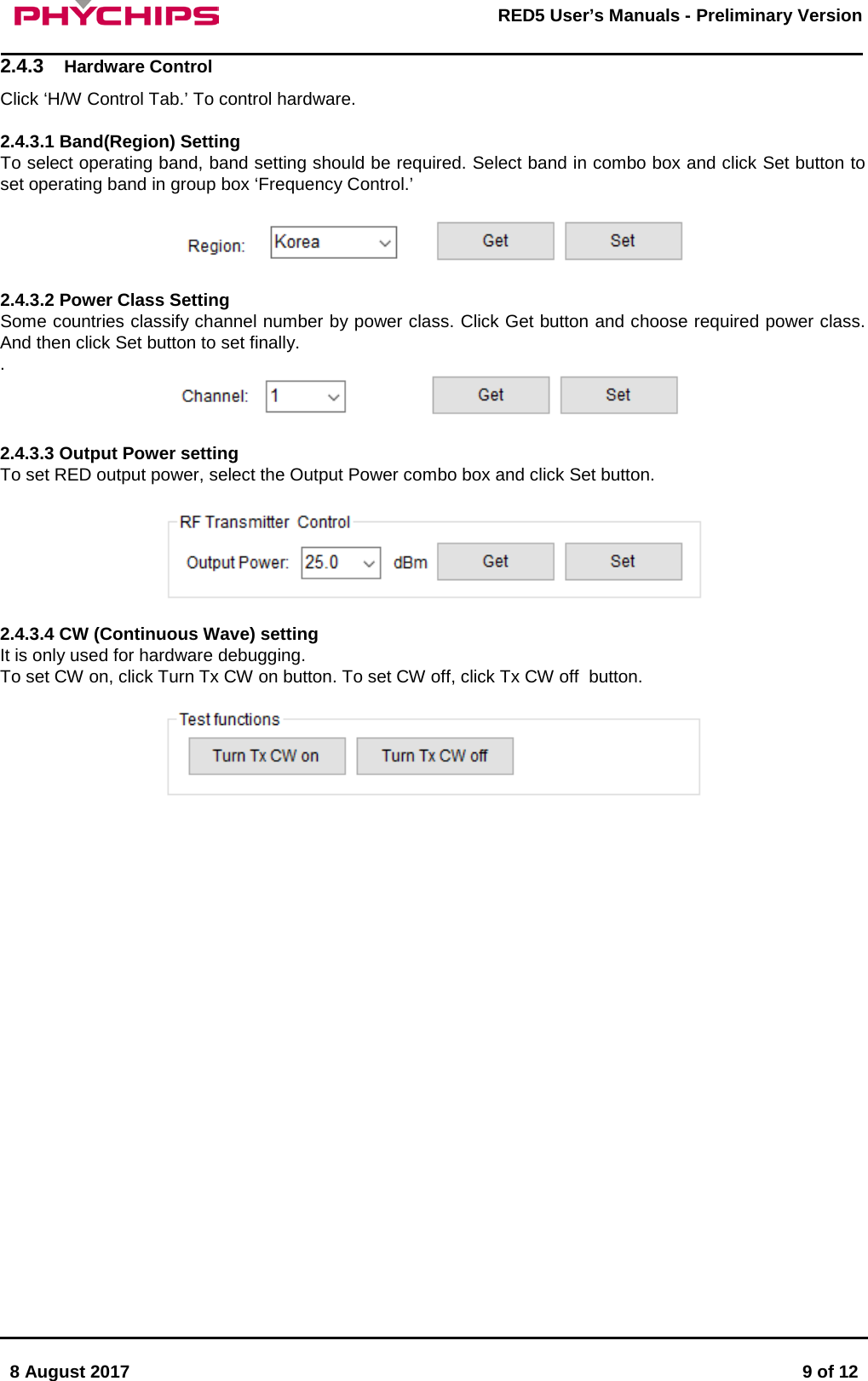
      8 August 2017  9 of 12         RED5 User’s Manuals - Preliminary Version     2.4.3 Hardware Control Click ‘H/W Control Tab.’ To control hardware.  2.4.3.1 Band(Region) Setting To select operating band, band setting should be required. Select band in combo box and click Set button to set operating band in group box ‘Frequency Control.’    2.4.3.2 Power Class Setting Some countries classify channel number by power class. Click Get button and choose required power class. And then click Set button to set finally. .    2.4.3.3 Output Power setting To set RED output power, select the Output Power combo box and click Set button.    2.4.3.4 CW (Continuous Wave) setting It is only used for hardware debugging.  To set CW on, click Turn Tx CW on button. To set CW off, click Tx CW off  button.
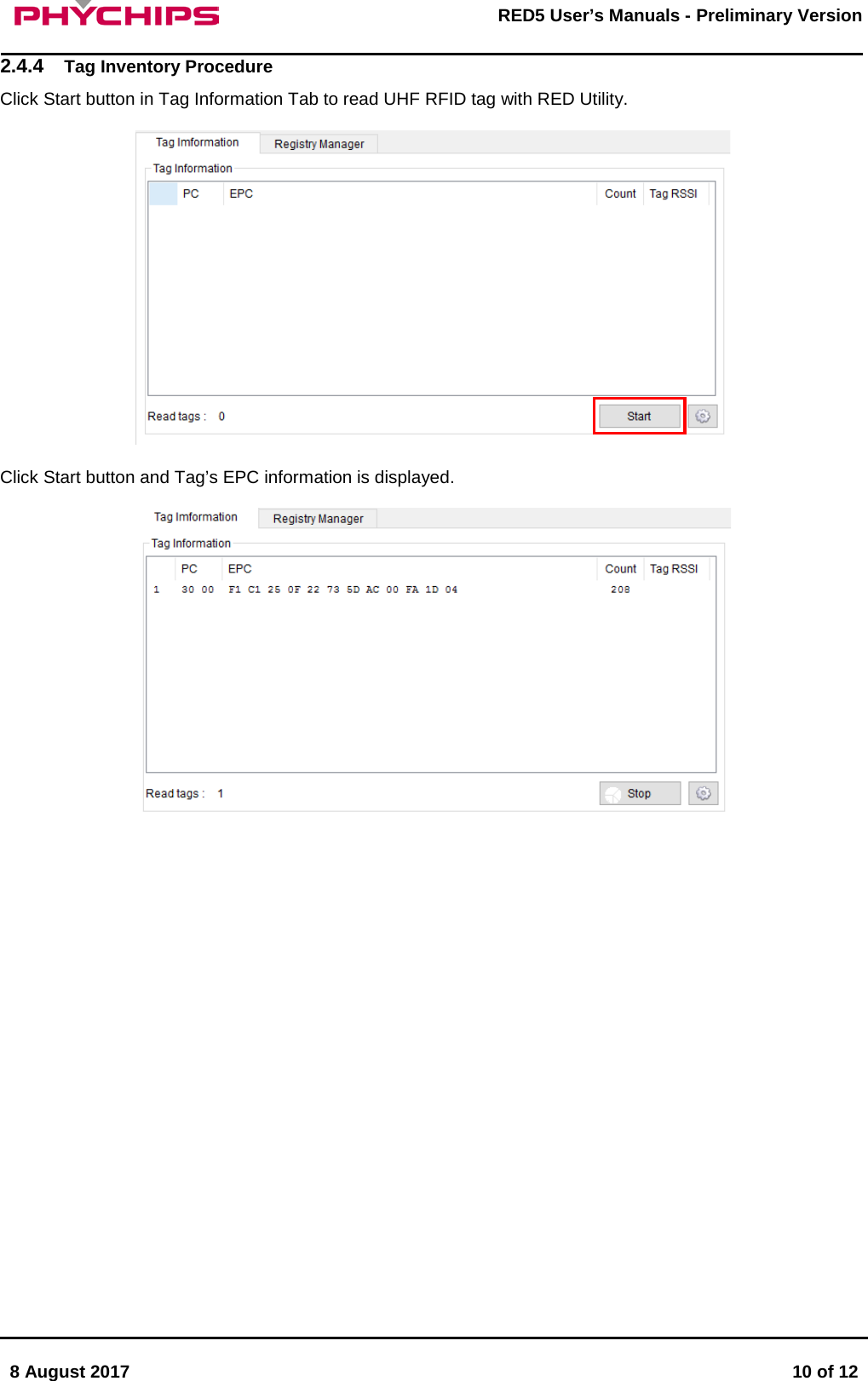
      8 August 2017  10 of 12         RED5 User’s Manuals - Preliminary Version     2.4.4 Tag Inventory Procedure  Click Start button in Tag Information Tab to read UHF RFID tag with RED Utility.    Click Start button and Tag’s EPC information is displayed.
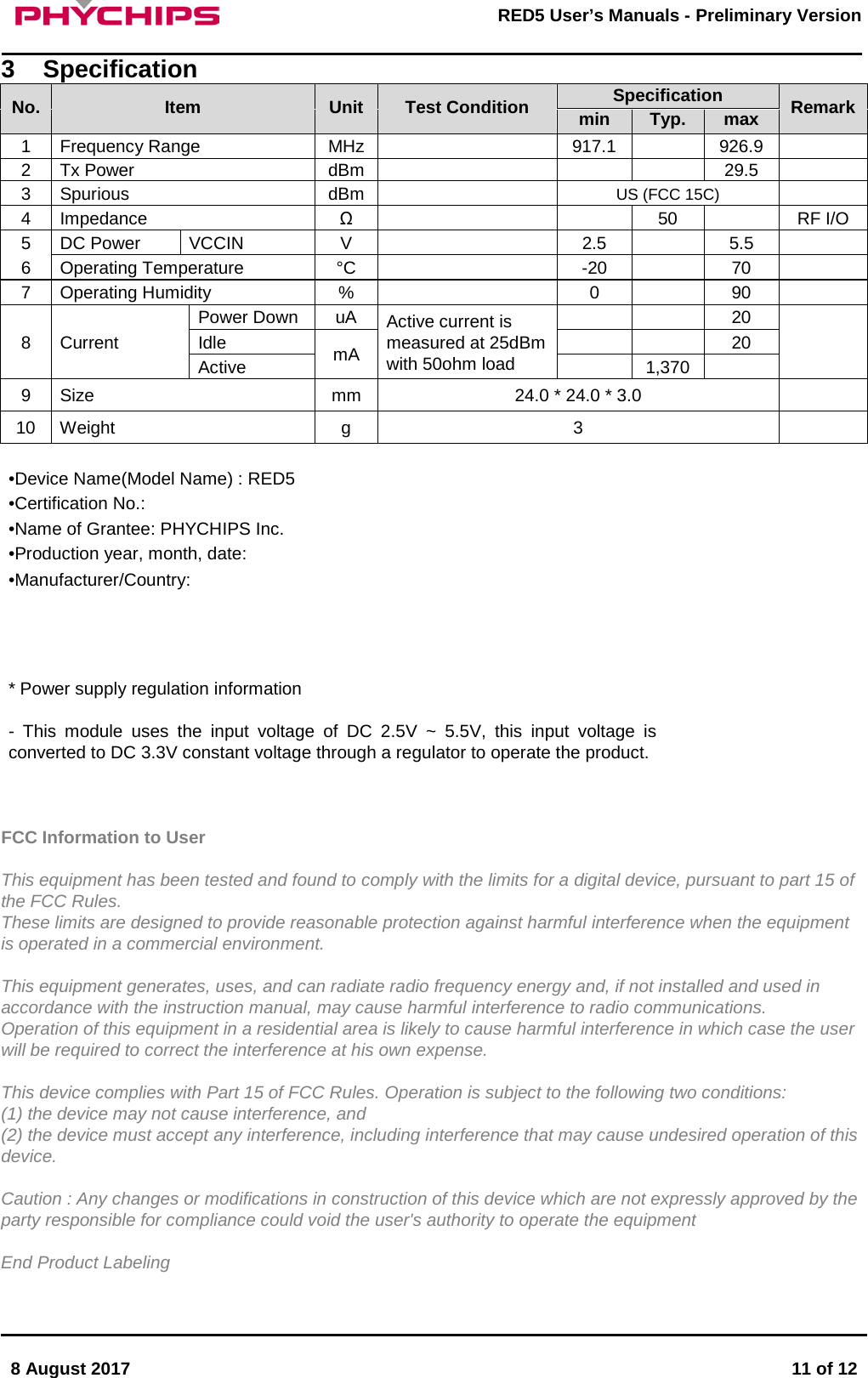
      8 August 2017  11 of 12         RED5 User’s Manuals - Preliminary Version     3  Specification No. Item Unit Test Condition Specification Remark min Typ. max 1 Frequency Range MHz  917.1  926.9  2 Tx Power  dBm    29.5  3 Spurious  dBm  US (FCC 15C)  4 Impedance Ω   50  RF I/O 5 DC Power VCCIN V  2.5  5.5  6 Operating Temperature °C  -20  70  7 Operating Humidity %  0  90  8  Current Power Down uA Active current is measured at 25dBm with 50ohm load   20  Idle mA   20 Active  1,370  9  Size mm 24.0 * 24.0 * 3.0   10 Weight  g  3    •Device Name(Model Name) : RED5 •Certification No.:  •Name of Grantee: PHYCHIPS Inc. •Production year, month, date:  •Manufacturer/Country:      * Power supply regulation information  -  This module uses the input voltage of DC 2.5V ~ 5.5V, this input voltage is converted to DC 3.3V constant voltage through a regulator to operate the product.    FCC Information to User  This equipment has been tested and found to comply with the limits for a digital device, pursuant to part 15 of the FCC Rules. These limits are designed to provide reasonable protection against harmful interference when the equipment is operated in a commercial environment.  This equipment generates, uses, and can radiate radio frequency energy and, if not installed and used in accordance with the instruction manual, may cause harmful interference to radio communications.  Operation of this equipment in a residential area is likely to cause harmful interference in which case the user will be required to correct the interference at his own expense.  This device complies with Part 15 of FCC Rules. Operation is subject to the following two conditions: (1) the device may not cause interference, and (2) the device must accept any interference, including interference that may cause undesired operation of this device.  Caution : Any changes or modifications in construction of this device which are not expressly approved by the party responsible for compliance could void the user's authority to operate the equipment  End Product Labeling
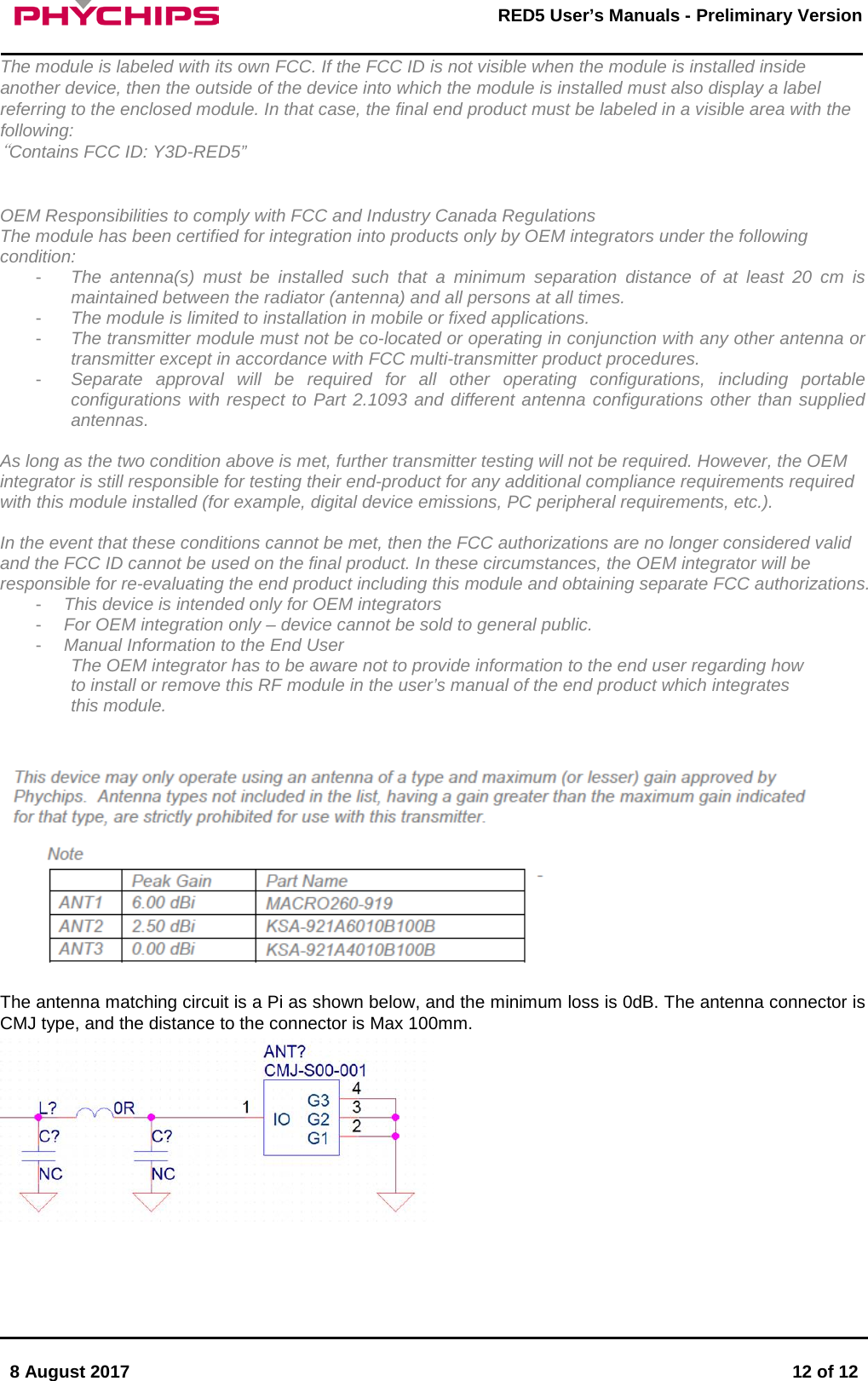
      8 August 2017  12 of 12         RED5 User’s Manuals - Preliminary Version     The module is labeled with its own FCC. If the FCC ID is not visible when the module is installed inside another device, then the outside of the device into which the module is installed must also display a label referring to the enclosed module. In that case, the final end product must be labeled in a visible area with the following: “Contains FCC ID: Y3D-RED5”   OEM Responsibilities to comply with FCC and Industry Canada Regulations  The module has been certified for integration into products only by OEM integrators under the following condition:  -  The antenna(s) must be installed such that a minimum separation distance of at least 20 cm is maintained between the radiator (antenna) and all persons at all times. -  The module is limited to installation in mobile or fixed applications. -  The transmitter module must not be co-located or operating in conjunction with any other antenna or transmitter except in accordance with FCC multi-transmitter product procedures. -  Separate approval will be required for all other operating configurations, including portable configurations with respect to Part 2.1093 and different antenna configurations other than supplied antennas.  As long as the two condition above is met, further transmitter testing will not be required. However, the OEM integrator is still responsible for testing their end-product for any additional compliance requirements required with this module installed (for example, digital device emissions, PC peripheral requirements, etc.).   In the event that these conditions cannot be met, then the FCC authorizations are no longer considered valid and the FCC ID cannot be used on the final product. In these circumstances, the OEM integrator will be responsible for re-evaluating the end product including this module and obtaining separate FCC authorizations. -  This device is intended only for OEM integrators -  For OEM integration only – device cannot be sold to general public. -  Manual Information to the End User The OEM integrator has to be aware not to provide information to the end user regarding how to install or remove this RF module in the user’s manual of the end product which integrates this module.     The antenna matching circuit is a Pi as shown below, and the minimum loss is 0dB. The antenna connector is CMJ type, and the distance to the connector is Max 100mm.

Navigation menu