Prime Electronics and Satellitics WA222M Wireless LAN AP User Manual wa222m

Prime Electronics & Satellitics Inc. Wireless LAN AP wa222m

Users Manual

   Wireless Multimedia LAN   Access Point   User  Manual          P/N:3010WA222M01 Copyright Copyright    2001 by this company.  All rights reserved.  No part of this publication may be reproduced, transmitted, transcribed, stored in a retrieval system, or translated into any language or computer language, in any form or by any means,
Wireless Access Point       electronic, mechanical, magnetic, optical, chemical, manual or otherwise, without the prior written permission of this company.  This company makes no representations or warranties, either expressed or implied, with respect to the contents hereof and specifically disclaims any warranties, merchantability or fitness for any particular purpose.  Any software described in this manual is sold or licensed "as is".  Should the programs prove defective following their purchase, the buyer (and not this company, its distributor, or its dealer) assumes the entire cost of all necessary servicing, repair, and any incidental or consequential damages resulting from any defect in the software.  Further, this company reserves the right to revise this publication and to make changes from time to time in the contents hereof without obligation to notify any person of such revision or changes. .   All brand and product names mentioned in this manual are trademarks and/or registered trademarks of their respective holders.   Federal  Communication Commission Interference Statement   This equipment has been tested and found to comply with the
Wireless Access Point       limits for a Class B digital device, pursuant to Part 15 of FCC Rules.  These limits are designed to provide reasonable protection against harmful interference in a residential installation.  This equipment generates, uses, and can radiate radio frequency energy and, if not installed and used in accordance with the instructions, may cause harmful interference to radio communications.  However, there is no guarantee that interference will not occur in a particular installation.  If this equipment does cause harmful interference to radio or television reception, which can be determined by turning the equipment off and on, the user is encouraged to try to correct the interference by one or more of the following measures:   1. Reorient or relocate the receiving antenna. 2. Increase the separation between the equipment and receiver. 3. Connect the equipment into an outlet on a circuit different from that to which the receiver is connected. 4. Consult the dealer or an experienced radio technician for help.  FCC Caution: To assure continued compliance.(example-use only shielded interface cables when connecting to computer or peripheral devices). Any changes or modifications not expressly approved by the party responsible for compliance could void the user’s authority to operate the equipment. This device complies with Part 15 of the FCC Rules. Operation is subject to the Following two conditions: ( 1 ) This device may not cause harmful interference, and ( 2 ) this Device must accept any interference received, including interference that may cause undesired operation.
Wireless Access Point       Federal  Communication Commission (FCC ) Radiation Exposure Statement This equipment complies with FCC radiation exposure set forth for an uncontrolled environment. In order to avoid the possibility of exceeding the FCC radio frequency exposure limits, human proximity to the antenna shall not be less than 20 cm(8 inches) during normal operation. R&TTE Compliance Statement This equipment complies with all the requirements of DIRECTIVE 1999/5/CE OF THE EUROPEAN PARLIAMENT AND THE COUNCIL OF 9 March 1999 on radio equipment and telecommunication terminal Equipment and the mutual recognition of their conformity ( R&TTE) The R&TTE Directive repeals and replaces in the directive 98/13/EEC(Telecommunications Terminal Equipment and Satellite Earth Station Equipment) As of April 8,2000. Safety This equipment is designed with the utmost care for the safety of those who install and use it. However , special attention must be paid to the dangers of electric shock and static electricity when working with electrical equipment. All guidelines of this and of the computer manufacture must therefore be allowed at all times to ensure the safe use of the equipment. EU Countries Not Intended for Use   The ETSI version of this device is intended for home and office use in Austria Belgium, Denmark , Finland , France ( with Frequency channel restrictions). Germany ,Greece, Ireland , Italy , Luxembourg .The Netherlands, Portugal , Spain , Sweden and United Kingdom. The ETSI  version of this device is also authorized for use in EFTA member states Iceland, Liechtenstein, Norway and Switzerland.
Wireless Access Point       EU Countries Not intended for use   None. Potential restrictive use France: Only channels 10,11,12 ,and 13
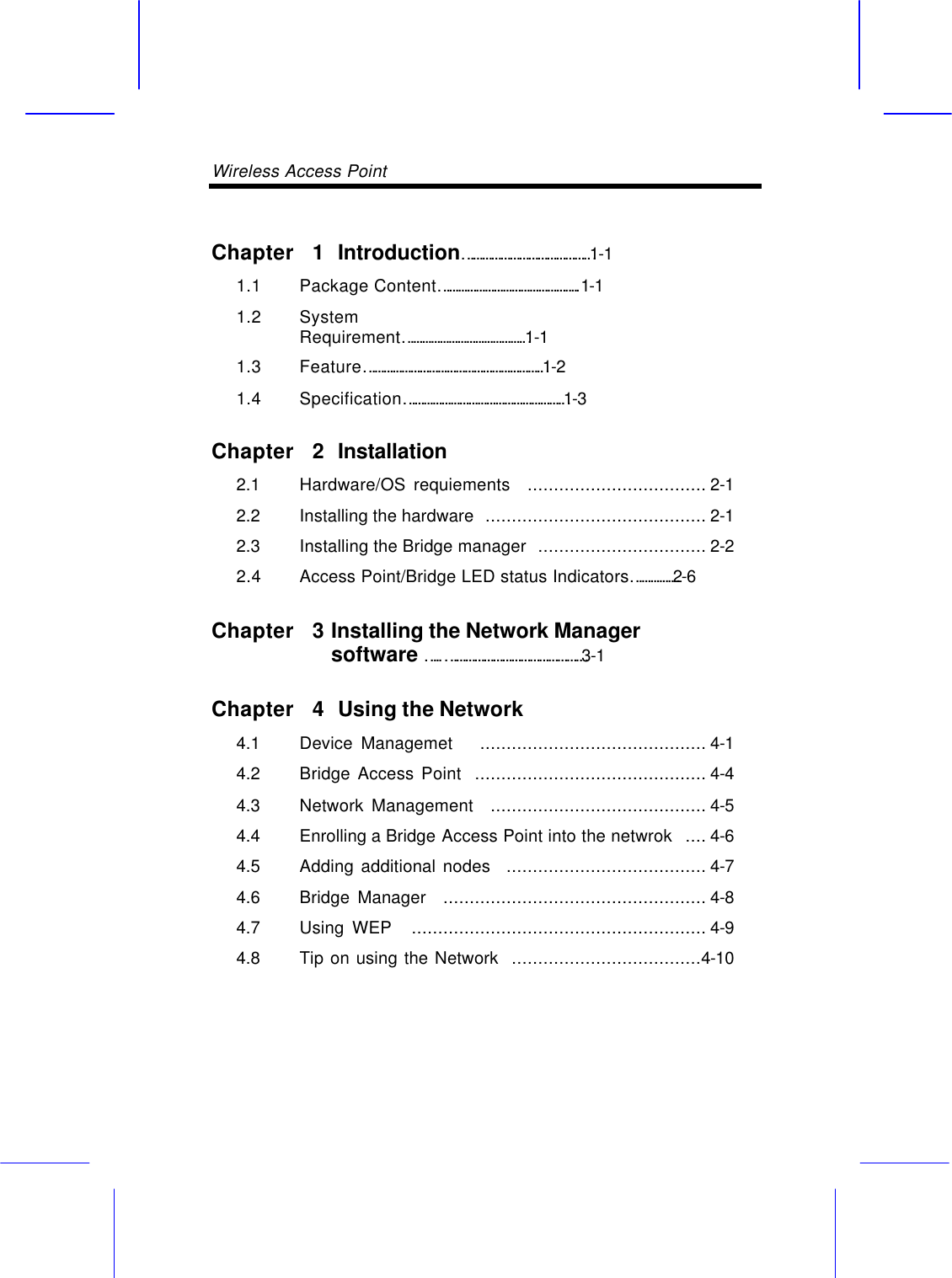
Wireless Access Point       Chapter  1 Introduction……………………………………1-1 1.1 Package Content………………………………………..1-1 1.2 System Requirement……………………………………1-1 1.3 Feature……………………………………………………1-2 1.4 Specification………………………………………………1-3 Chapter  2 Installation 2.1   Hardware/OS requiements  .................................. 2-1 2.2   Installing the hardware  .......................................... 2-1 2.3   Installing the Bridge manager  ................................ 2-2   2.4 Access Point/Bridge LED status Indicators……………2-6 Chapter  3 Installing the Network Manager software …..………………………………………3-1 Chapter  4 Using the Network 4.1   Device Managemet   ........................................... 4-1 4.2   Bridge Access Point  ............................................ 4-4 4.3   Network Management  ......................................... 4-5 4.4   Enrolling a Bridge Access Point into the netwrok  .... 4-6   4.5   Adding additional nodes  ...................................... 4-7   4.6   Bridge Manager  .................................................. 4-8   4.7   Using WEP   ........................................................ 4-9   4.8   Tip on using the Network  ....................................4-10
Wireless Access Point        Chapter  5 Uninstall 5.1 Windows 98,Me,and Windows 2000……………………5-1
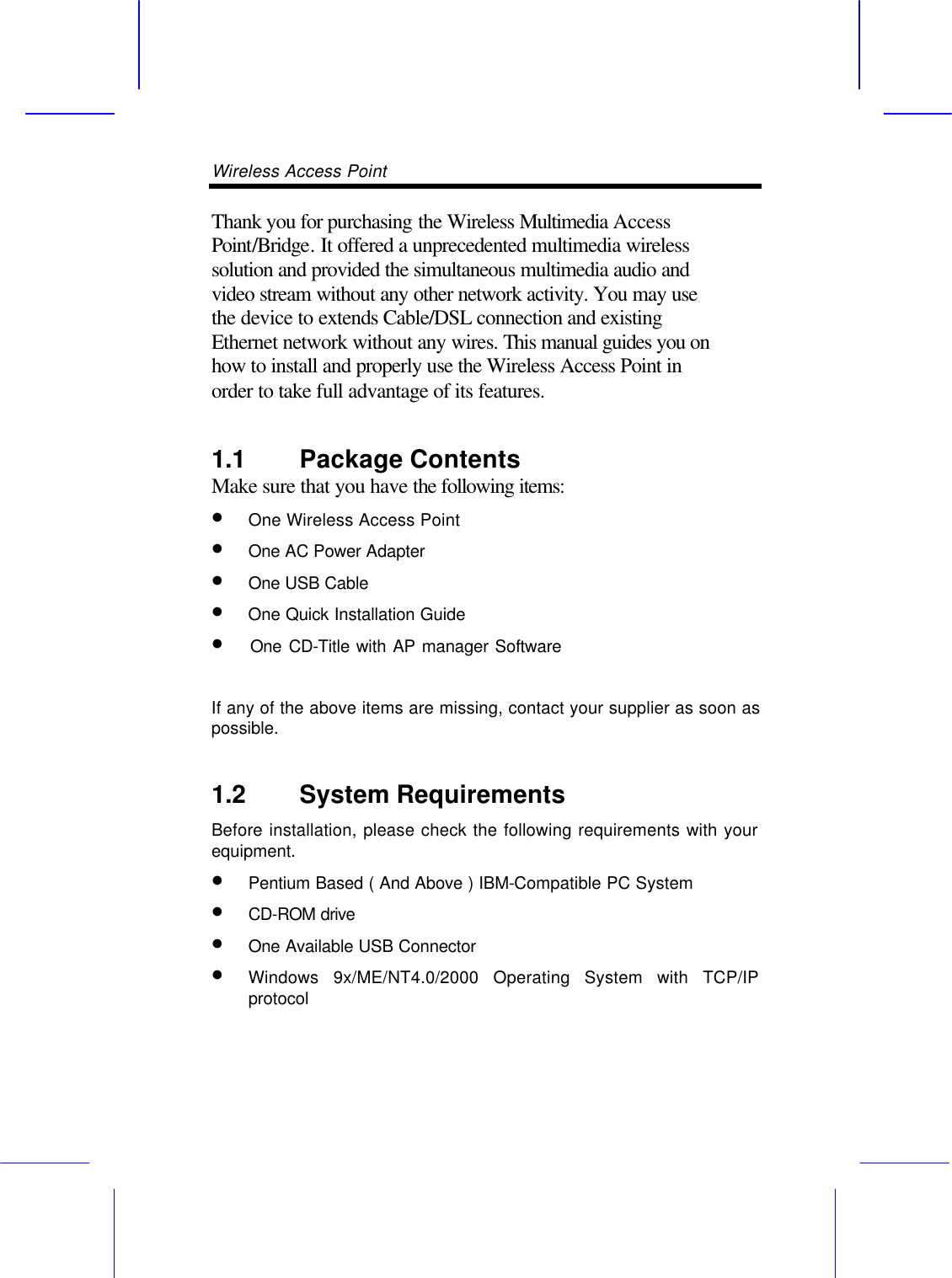
Wireless Access Point       Thank you for purchasing the Wireless Multimedia Access Point/Bridge. It offered a unprecedented multimedia wireless solution and provided the simultaneous multimedia audio and video stream without any other network activity. You may use the device to extends Cable/DSL connection and existing Ethernet network without any wires. This manual guides you on how to install and properly use the Wireless Access Point in order to take full advantage of its features. 1.1 Package Contents Make sure that you have the following items: • One Wireless Access Point   • One AC Power Adapter   • One USB Cable   •  One Quick Installation Guide  •  One CD-Title with AP manager Software   If any of the above items are missing, contact your supplier as soon as possible. 1.2 System Requirements Before installation, please check the following requirements with your equipment. • Pentium Based ( And Above ) IBM-Compatible PC System • CD-ROM drive • One Available USB Connector • Windows 9x/ME/NT4.0/2000 Operating System with TCP/IP protocol
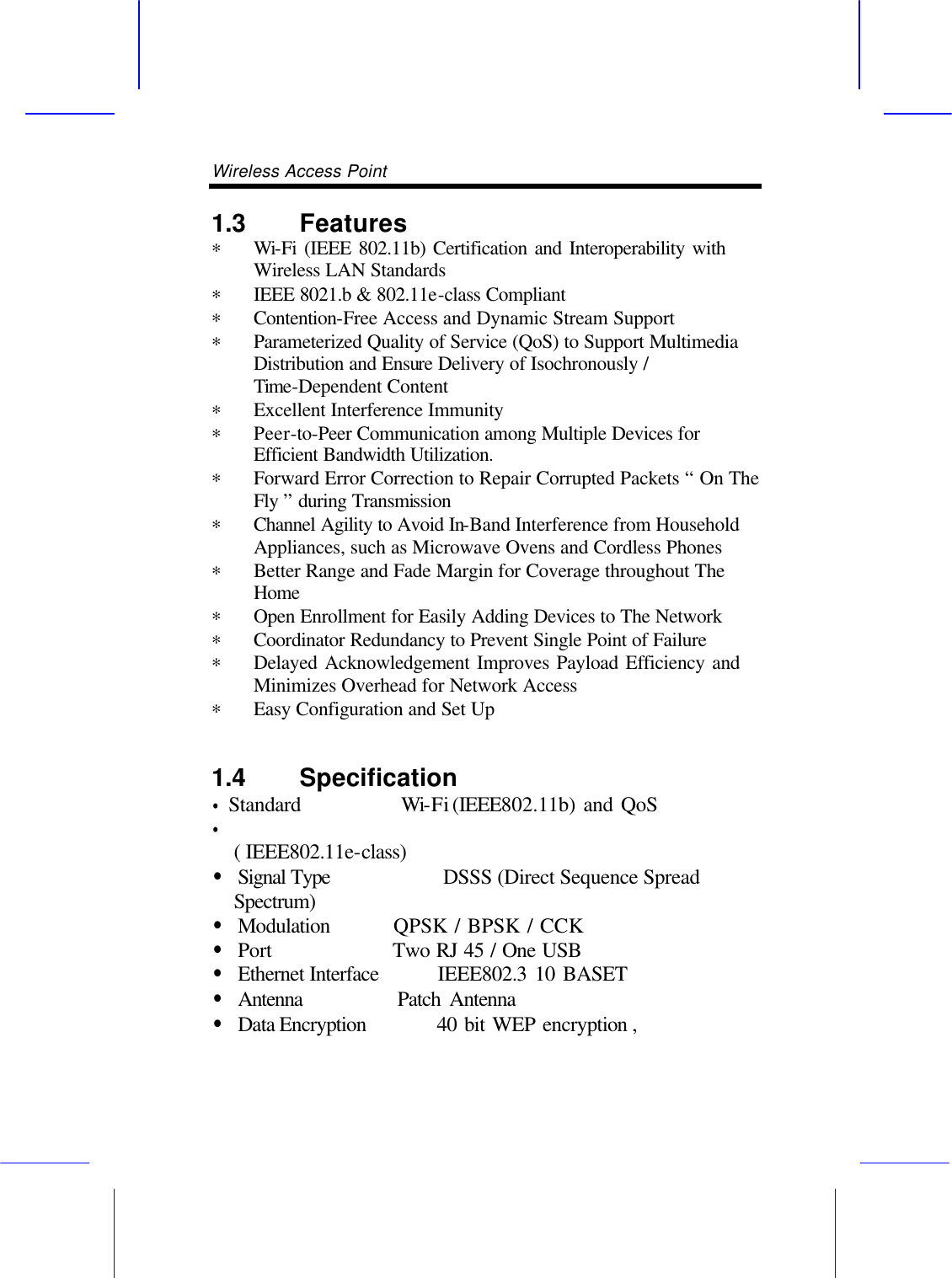
Wireless Access Point       1.3 Features  ∗ Wi-Fi (IEEE 802.11b) Certification and Interoperability with    Wireless LAN Standards ∗ IEEE 8021.b & 802.11e-class Compliant ∗ Contention-Free Access and Dynamic Stream Support   ∗ Parameterized Quality of Service (QoS) to Support Multimedia Distribution and Ensure Delivery of Isochronously / Time-Dependent Content   ∗ Excellent Interference Immunity ∗ Peer-to-Peer Communication among Multiple Devices for Efficient Bandwidth Utilization. ∗ Forward Error Correction to Repair Corrupted Packets “ On The Fly ” during Transmission   ∗ Channel Agility to Avoid In-Band Interference from Household Appliances, such as Microwave Ovens and Cordless Phones ∗ Better Range and Fade Margin for Coverage throughout The Home ∗ Open Enrollment for Easily Adding Devices to The Network ∗ Coordinator Redundancy to Prevent Single Point of Failure ∗ Delayed Acknowledgement Improves Payload Efficiency and   Minimizes Overhead for Network Access ∗ Easy Configuration and Set Up 1.4 Specification  • Standard      Wi-Fi (IEEE802.11b) and QoS   •                                      ( IEEE802.11e-class)   • Signal Type      DSSS (Direct Sequence Spread Spectrum) • Modulation      QPSK / BPSK / CCK   • Port       Two RJ 45 / One USB   • Ethernet Interface    IEEE802.3 10 BASET • Antenna      Patch Antenna • Data Encryption     40 bit WEP encryption ,
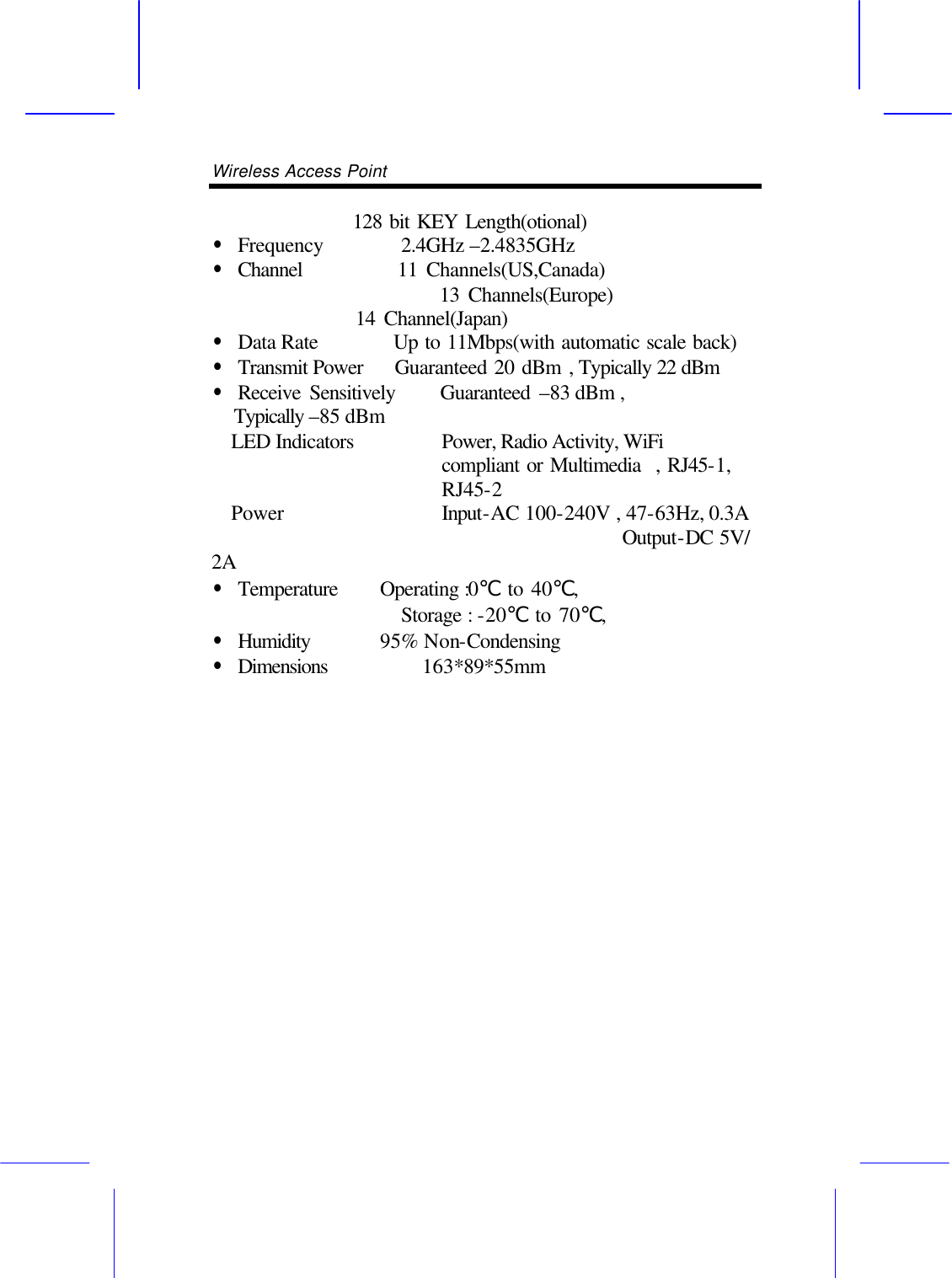
Wireless Access Point            128 bit KEY Length(otional) • Frequency    2.4GHz –2.4835GHz   • Channel        11 Channels(US,Canada)                 13 Channels(Europe)      14 Channel(Japan) • Data Rate       Up to 11Mbps(with automatic scale back) • Transmit Power   Guaranteed 20 dBm , Typically 22 dBm • Receive Sensitively     Guaranteed –83 dBm , Typically –85 dBm LED Indicators Power, Radio Activity, WiFi compliant or Multimedia  , RJ45-1, RJ45-2 Power   Input-AC 100-240V , 47-63Hz, 0.3A                                          Output-DC 5V/ 2A   • Temperature   Operating :0℃ to 40℃,   Storage : -20℃ to 70℃,   • Humidity    95% Non-Condensing • Dimensions    163*89*55mm
Wireless Access Point       Before you proceed with the installation, it is necessary that you have enough information about the Wireless Access point   2.1 Installing the hardware    Perform the following steps to install the Wireless Multimedia  Access Point/Bridge.  Ø If applicable, insert the Ethernet cable into the RJ45 connector on  the AP/Bridge to connect to a Hub  Ø Next, apply power to the AP/Bridge by plugging in the power adapter supplied with the evaluation kit.  Ø This completes the hardware portion of the installation. The next step is to enroll the AP/Bridge into the wireless network. Turn to Enrolling a Bridge Access Point into the network on page 3-1 to continue the installation by using the Network Management application on a wireless active PC node to enroll the bridge into the network.  Ø Alternatively read the below section on the installation of the Bridge manager to manually configure the Access Point/Bridge. Manual configuration is required to change AP/Bridge settings including network names, SSID and WEP settings. 2.2  Installing the Bridge manager
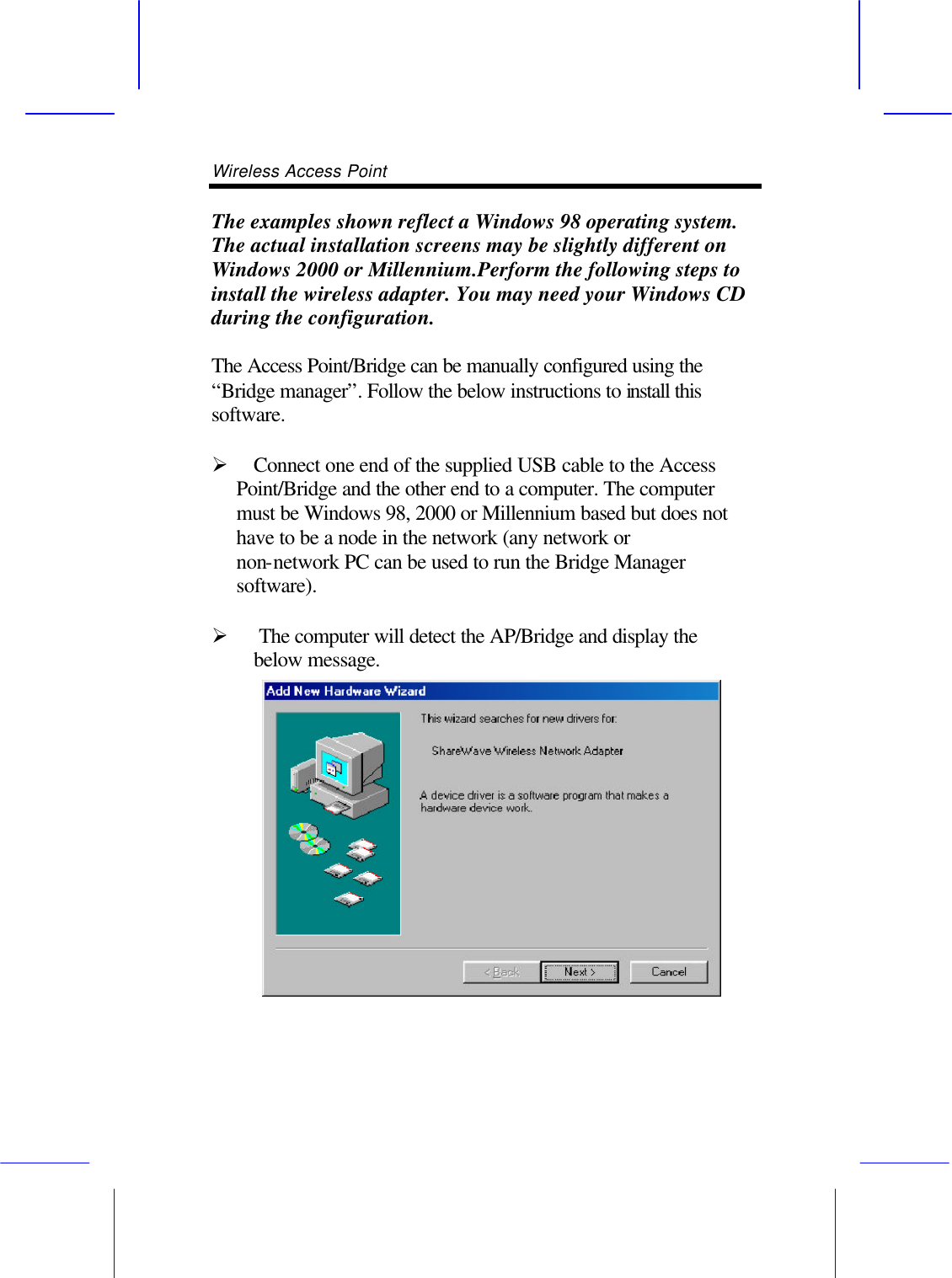
Wireless Access Point       The examples shown reflect a Windows 98 operating system. The actual installation screens may be slightly different on Windows 2000 or Millennium.Perform the following steps to install the wireless adapter. You may need your Windows CD during the configuration.  The Access Point/Bridge can be manually configured using the “Bridge manager”. Follow the below instructions to install this software.  Ø Connect one end of the supplied USB cable to the Access Point/Bridge and the other end to a computer. The computer must be Windows 98, 2000 or Millennium based but does not have to be a node in the network (any network or non-network PC can be used to run the Bridge Manager software).  Ø  The computer will detect the AP/Bridge and display the below message.
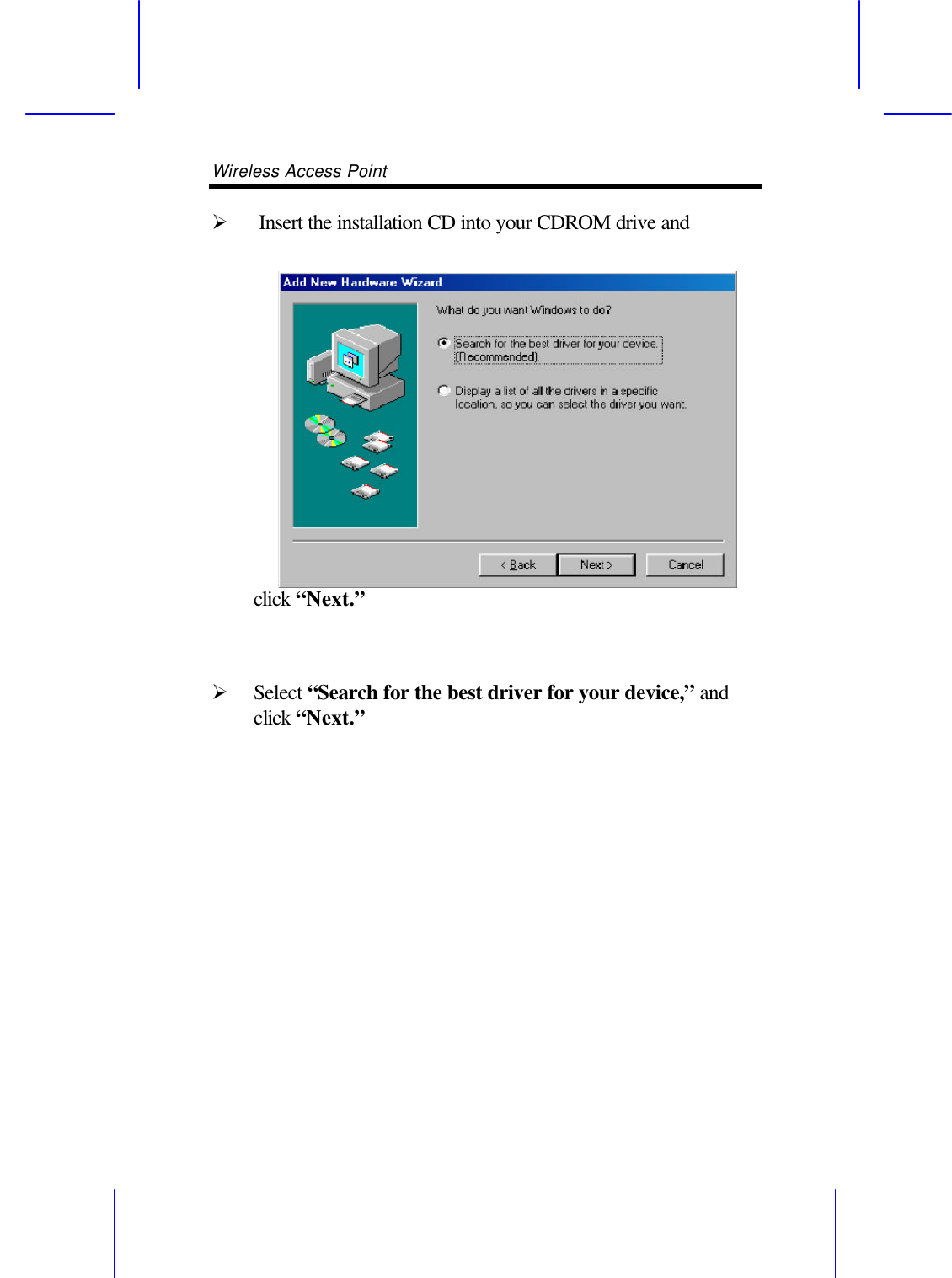
Wireless Access Point       Ø  Insert the installation CD into your CDROM drive and click “Next.”   Ø Select “Search for the best driver for your device,” and click “Next.”
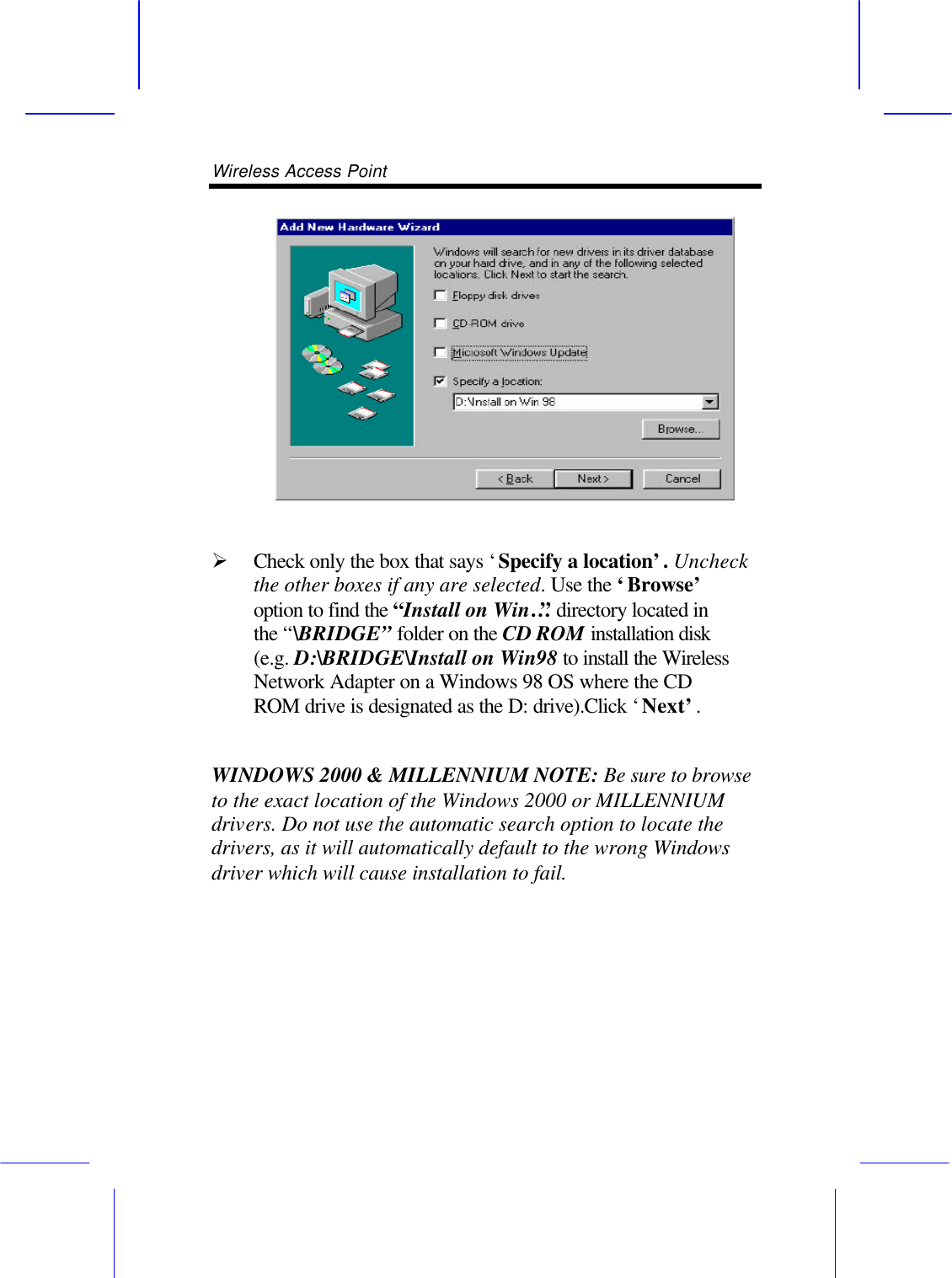
Wireless Access Point         Ø Check only the box that says ‘Specify a location’. Uncheck the other boxes if any are selected. Use the ‘Browse’ option to find the “Install on Win…” directory located in the “\BRIDGE” folder on the CD ROM installation disk (e.g. D:\BRIDGE\Install on Win98 to install the Wireless Network Adapter on a Windows 98 OS where the CD ROM drive is designated as the D: drive).Click ‘Next’.  WINDOWS 2000 & MILLENNIUM NOTE: Be sure to browse to the exact location of the Windows 2000 or MILLENNIUM drivers. Do not use the automatic search option to locate the drivers, as it will automatically default to the wrong Windows driver which will cause installation to fail.
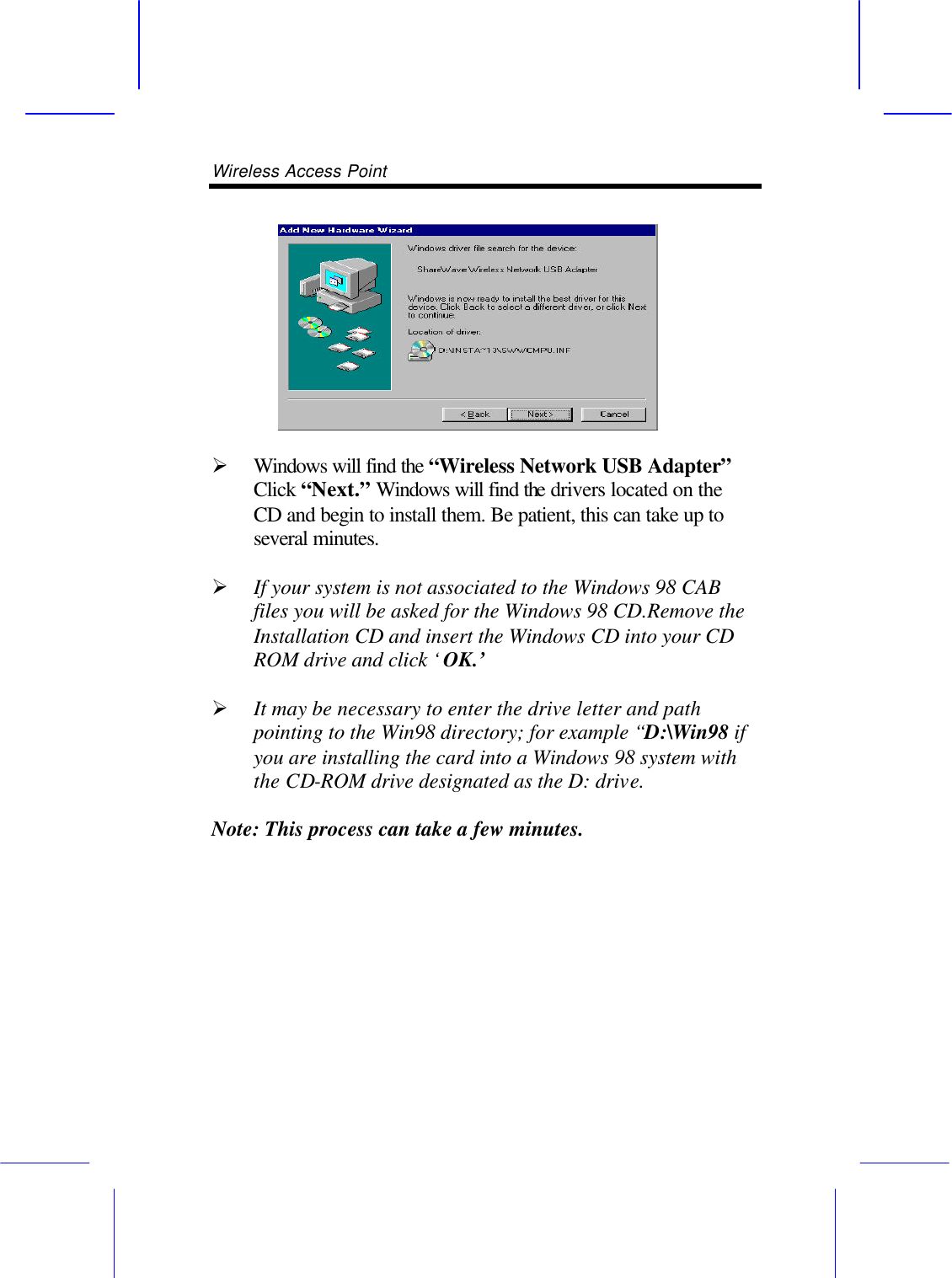
Wireless Access Point        Ø Windows will find the “Wireless Network USB Adapter” Click “Next.” Windows will find the drivers located on the CD and begin to install them. Be patient, this can take up to several minutes.  Ø If your system is not associated to the Windows 98 CAB files you will be asked for the Windows 98 CD.Remove the Installation CD and insert the Windows CD into your CD ROM drive and click ‘OK.’  Ø It may be necessary to enter the drive letter and path pointing to the Win98 directory; for example “D:\Win98 if you are installing the card into a Windows 98 system with the CD-ROM drive designated as the D: drive.  Note: This process can take a few minutes.
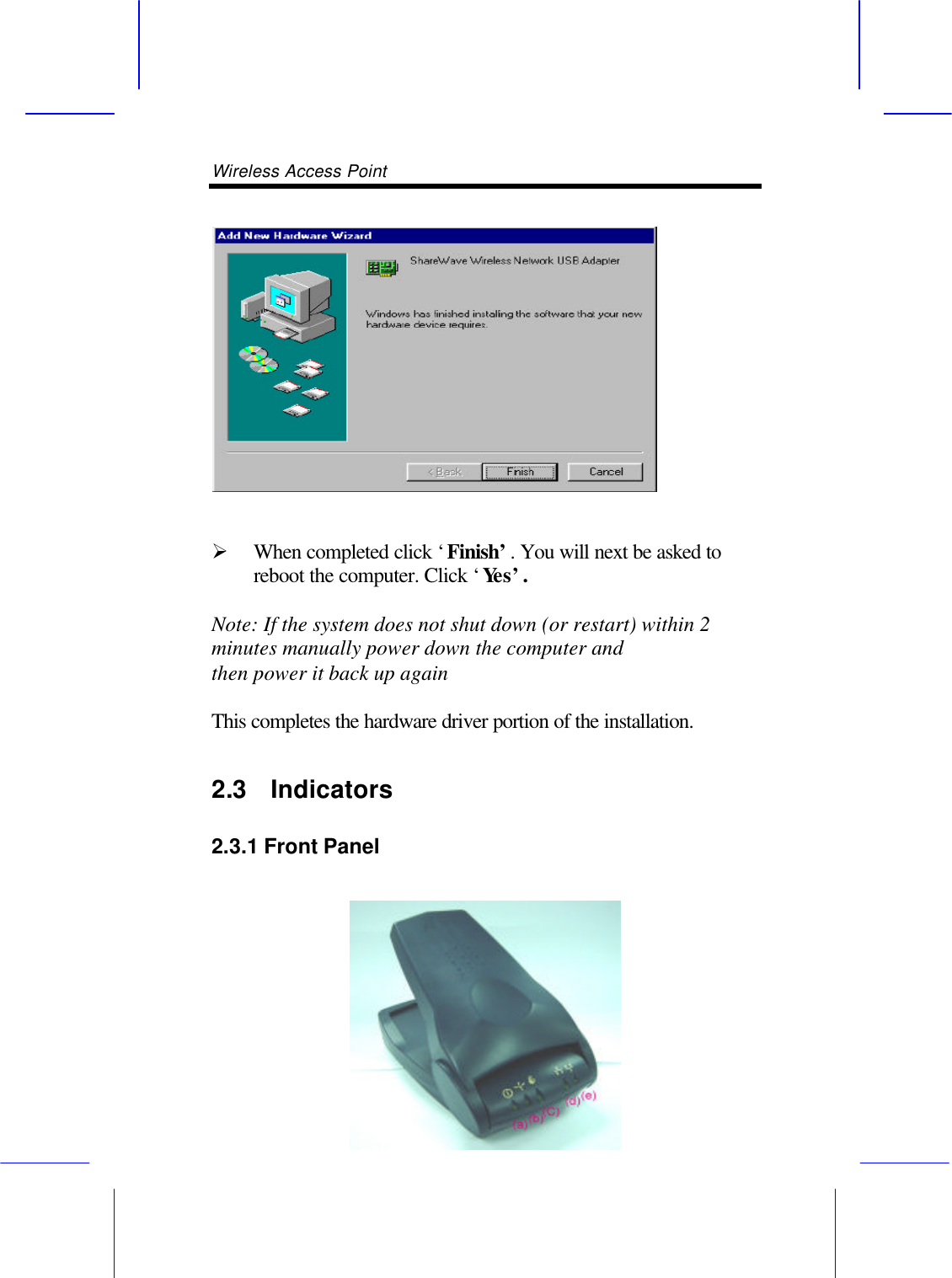
Wireless Access Point         Ø When completed click ‘Finish’. You will next be asked to reboot the computer. Click ‘Yes’.  Note: If the system does not shut down (or restart) within 2 minutes manually power down the computer and then power it back up again  This completes the hardware driver portion of the installation. 2.3  Indicators   2.3.1 Front Panel
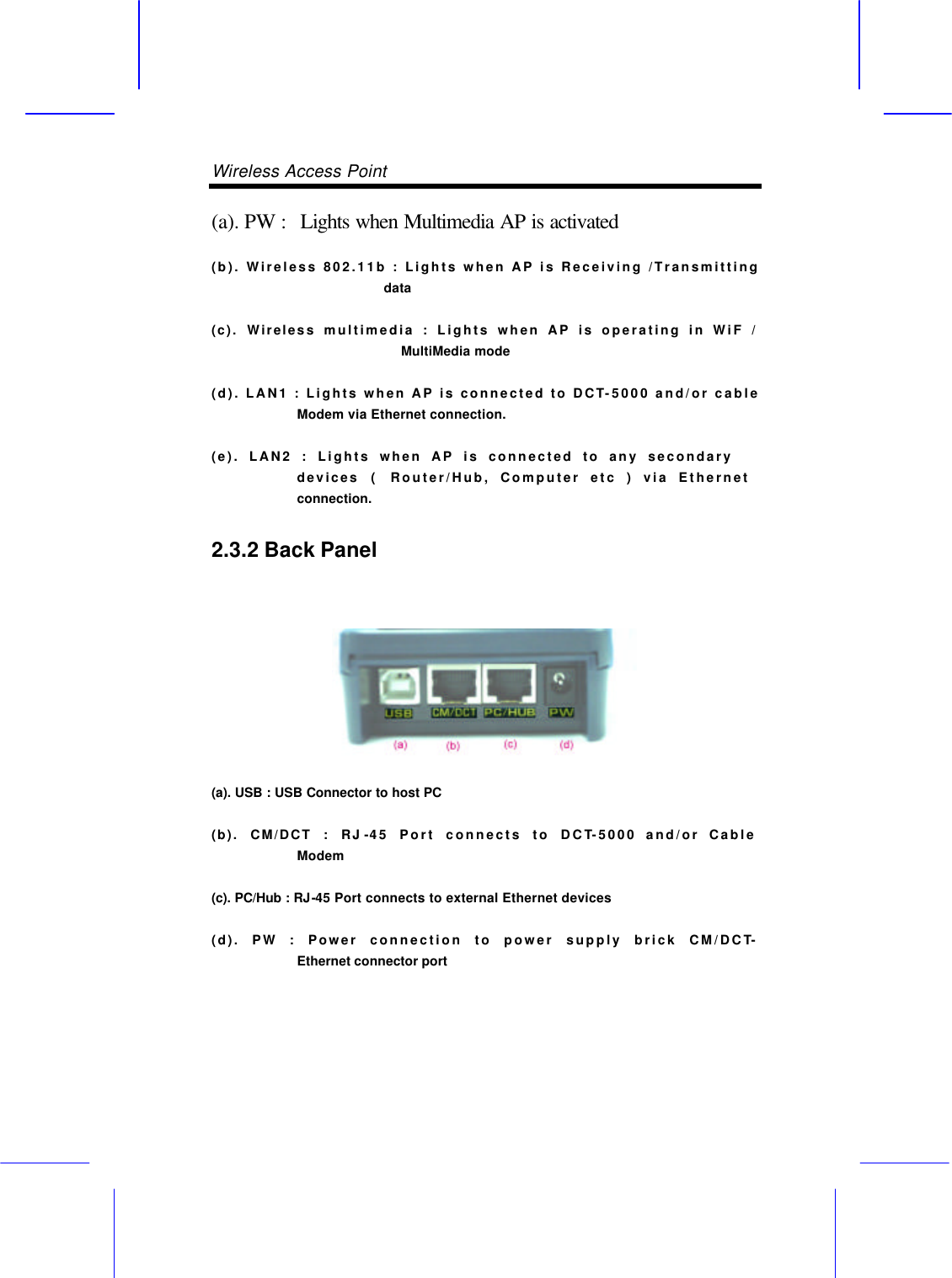
Wireless Access Point       (a). PW :  Lights when Multimedia AP is activated (b). Wireless 802.11b : Lights when AP is Receiving /Transmitting data   (c). Wireless multimedia : Lights when AP is operating in WiF / MultiMedia mode (d). LAN1 : Lights when AP is connected to DCT-5000 and/or cable Modem via Ethernet connection. (e). LAN2 : Lights when AP is connected to any secondary                         devices ( Router/Hub, Computer etc ) via Ethernet     connection.   2.3.2 Back Panel  (a). USB : USB Connector to host PC   (b). CM/DCT : RJ -45 Port connects to DCT-5000 and/or Cable Modem (c). PC/Hub : RJ-45 Port connects to external Ethernet devices (d). PW : Power connection to power supply brick CM/DCT- Ethernet connector port
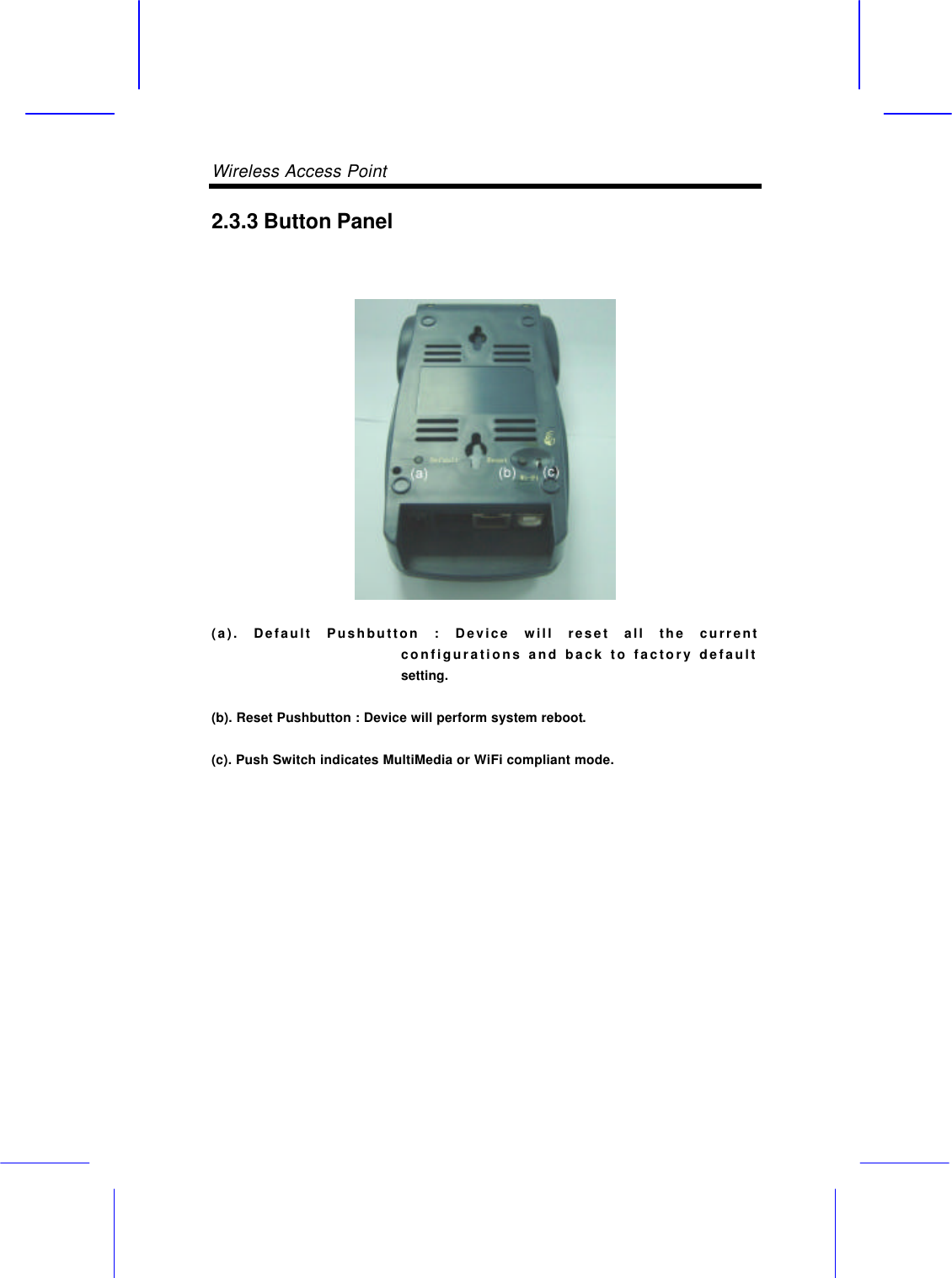
Wireless Access Point       2.3.3 Button Panel   (a). Default Pushbutton : Device will reset all the current configurations and back to factory default setting. (b). Reset Pushbutton : Device will perform system reboot. (c). Push Switch indicates MultiMedia or WiFi compliant mode.
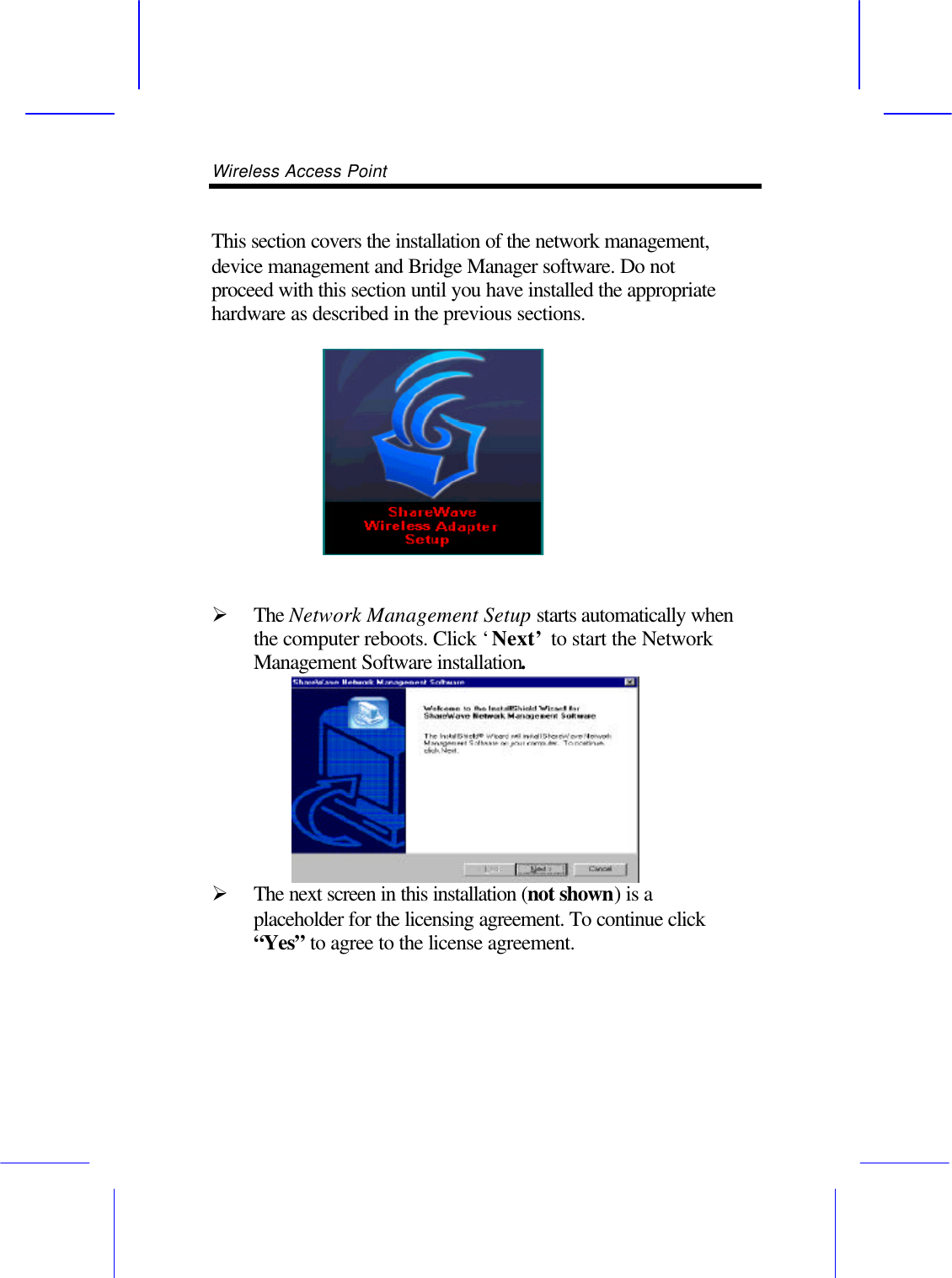
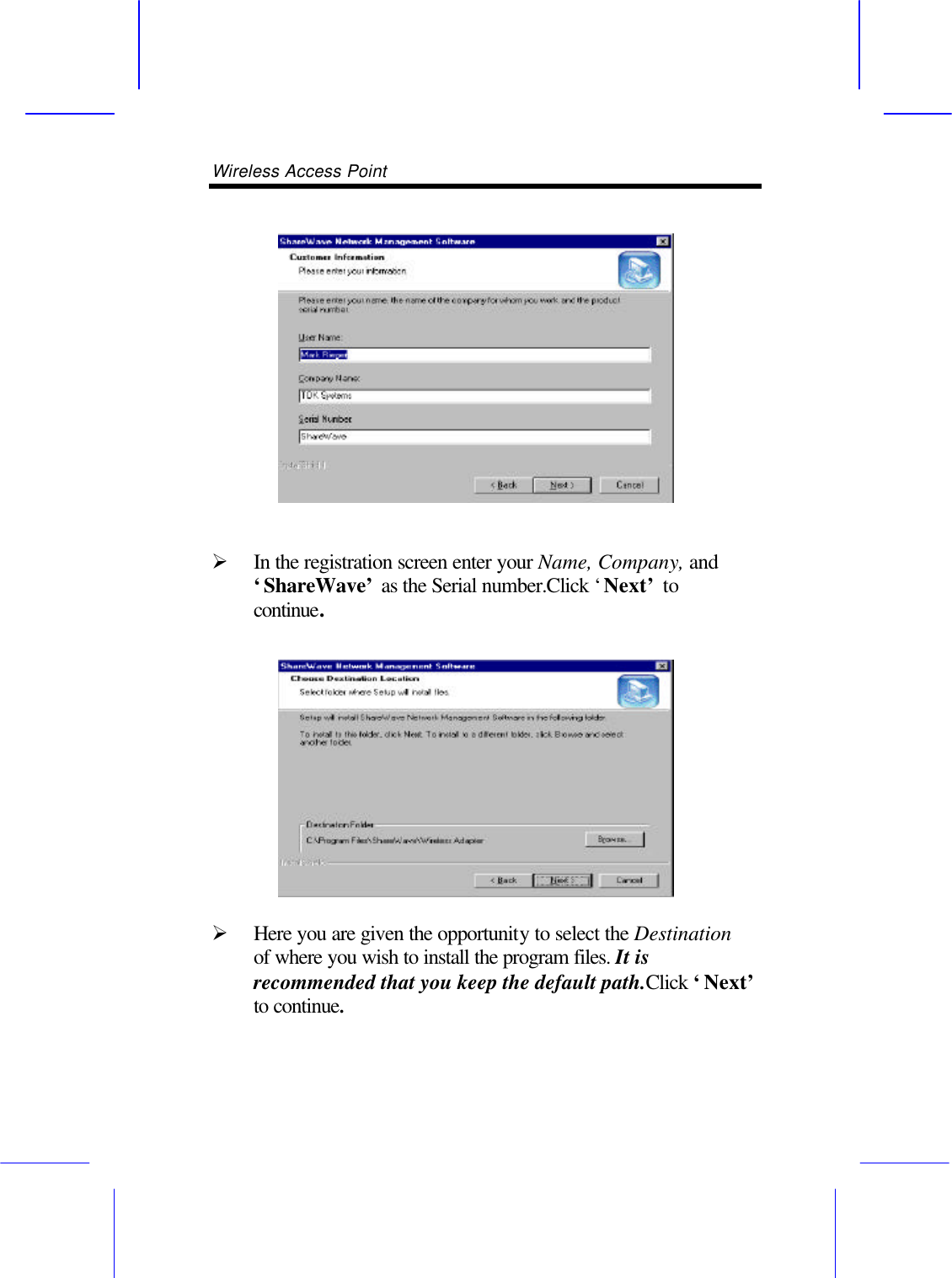
Wireless Access Point        This section covers the installation of the network management, device management and Bridge Manager software. Do not proceed with this section until you have installed the appropriate hardware as described in the previous sections.   Ø The Network Management Setup starts automatically when the computer reboots. Click ‘Next’ to start the Network Management Software installation. Ø The next screen in this installation (not shown) is a placeholder for the licensing agreement. To continue click “Yes” to agree to the license agreement.
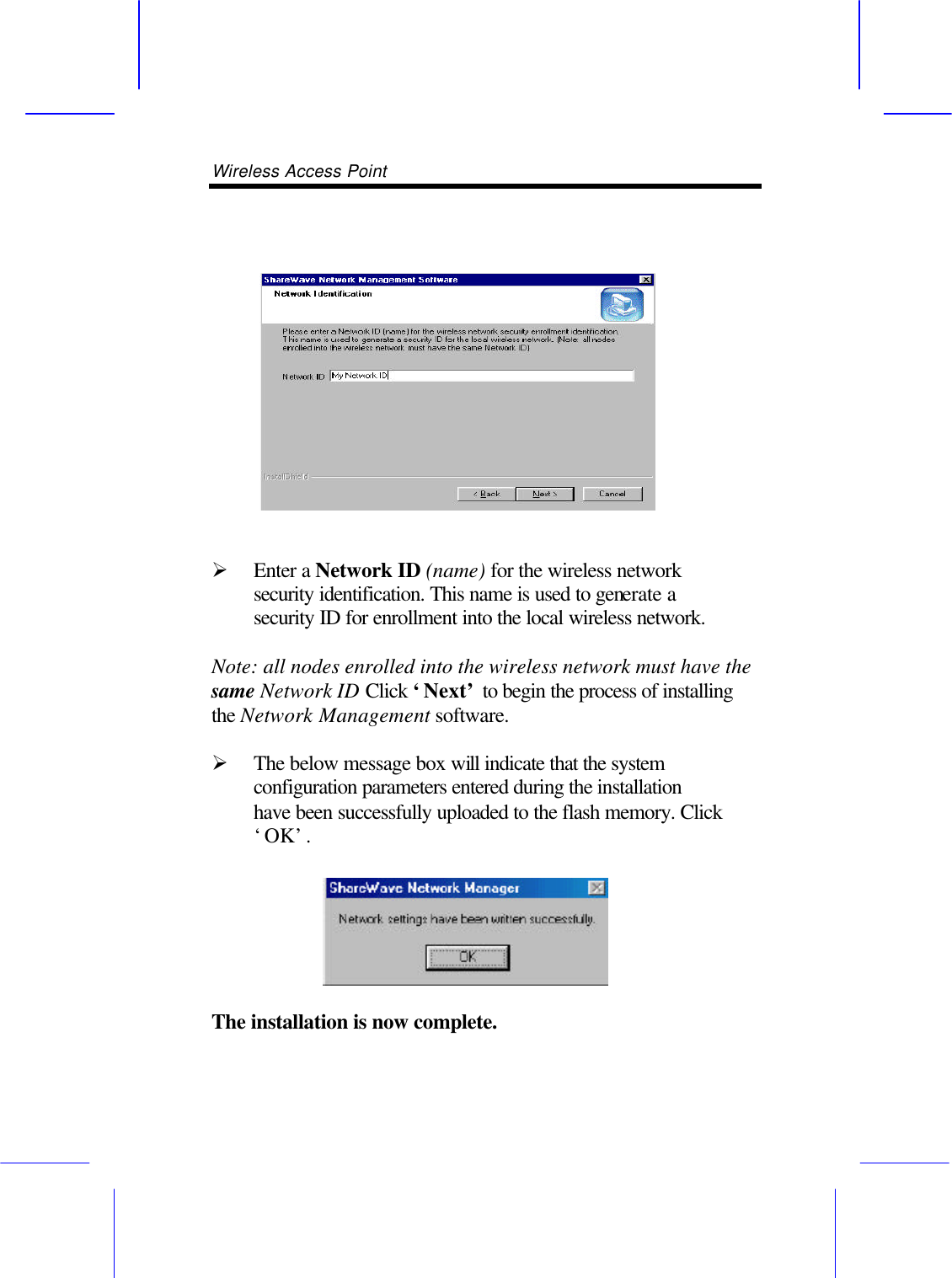
Wireless Access Point         Ø In the registration screen enter your Name, Company, and ‘ShareWave’ as the Serial number.Click ‘Next’ to continue.   Ø Here you are given the opportunity to select the Destination of where you wish to install the program files. It is recommended that you keep the default path.Click ‘Next’ to continue.
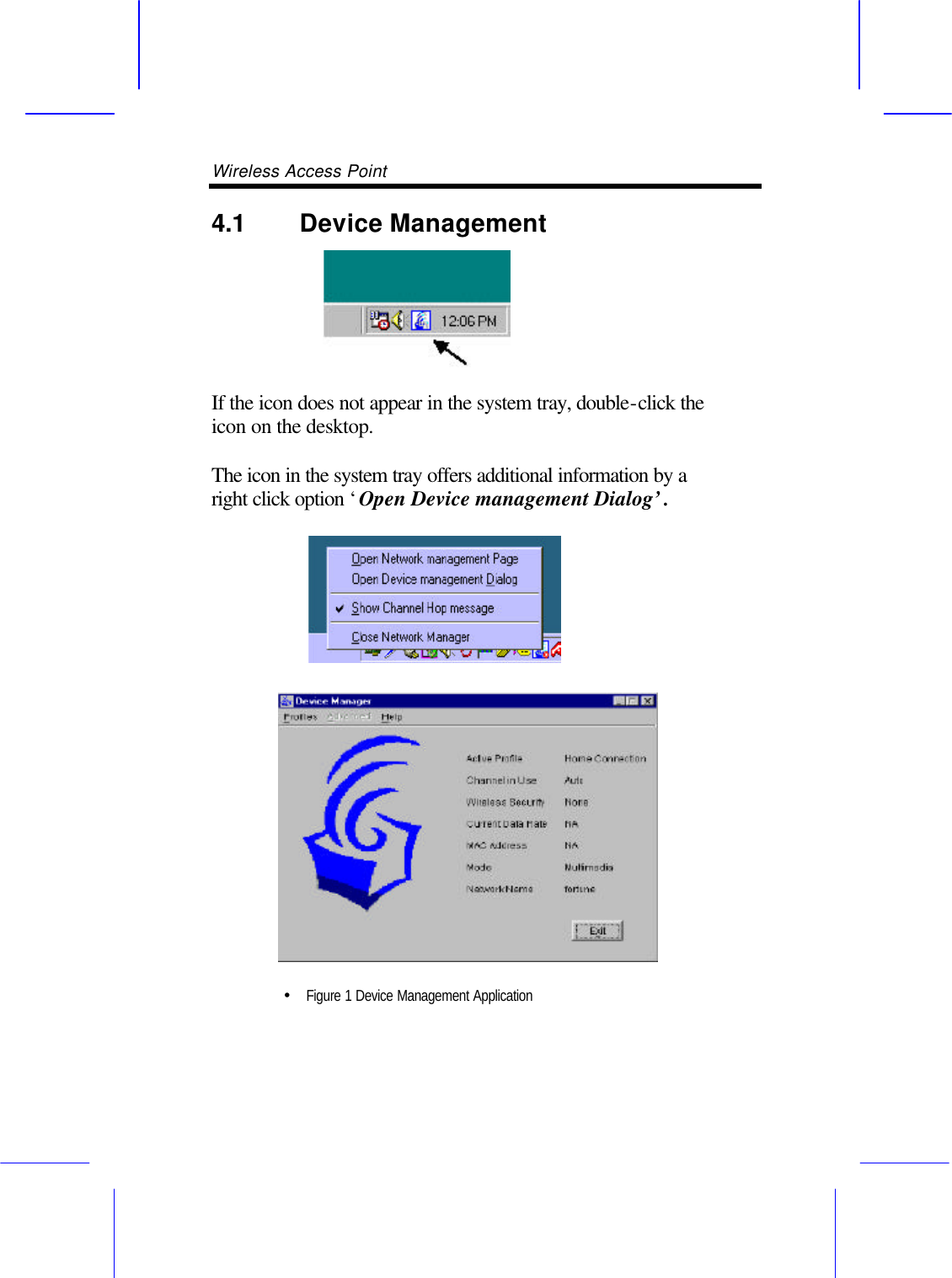
Wireless Access Point           Ø Enter a Network ID (name) for the wireless network security identification. This name is used to generate a security ID for enrollment into the local wireless network.  Note: all nodes enrolled into the wireless network must have the same Network ID Click ‘Next’ to begin the process of installing the Network Management software.  Ø The below message box will indicate that the system configuration parameters entered during the installation have been successfully uploaded to the flash memory. Click ‘OK’.   The installation is now complete.
Wireless Access Point       4.1 Device Management    If the icon does not appear in the system tray, double-click the icon on the desktop.  The icon in the system tray offers additional information by a right click option ‘Open Device management Dialog’.   •  Figure 1 Device Management Application
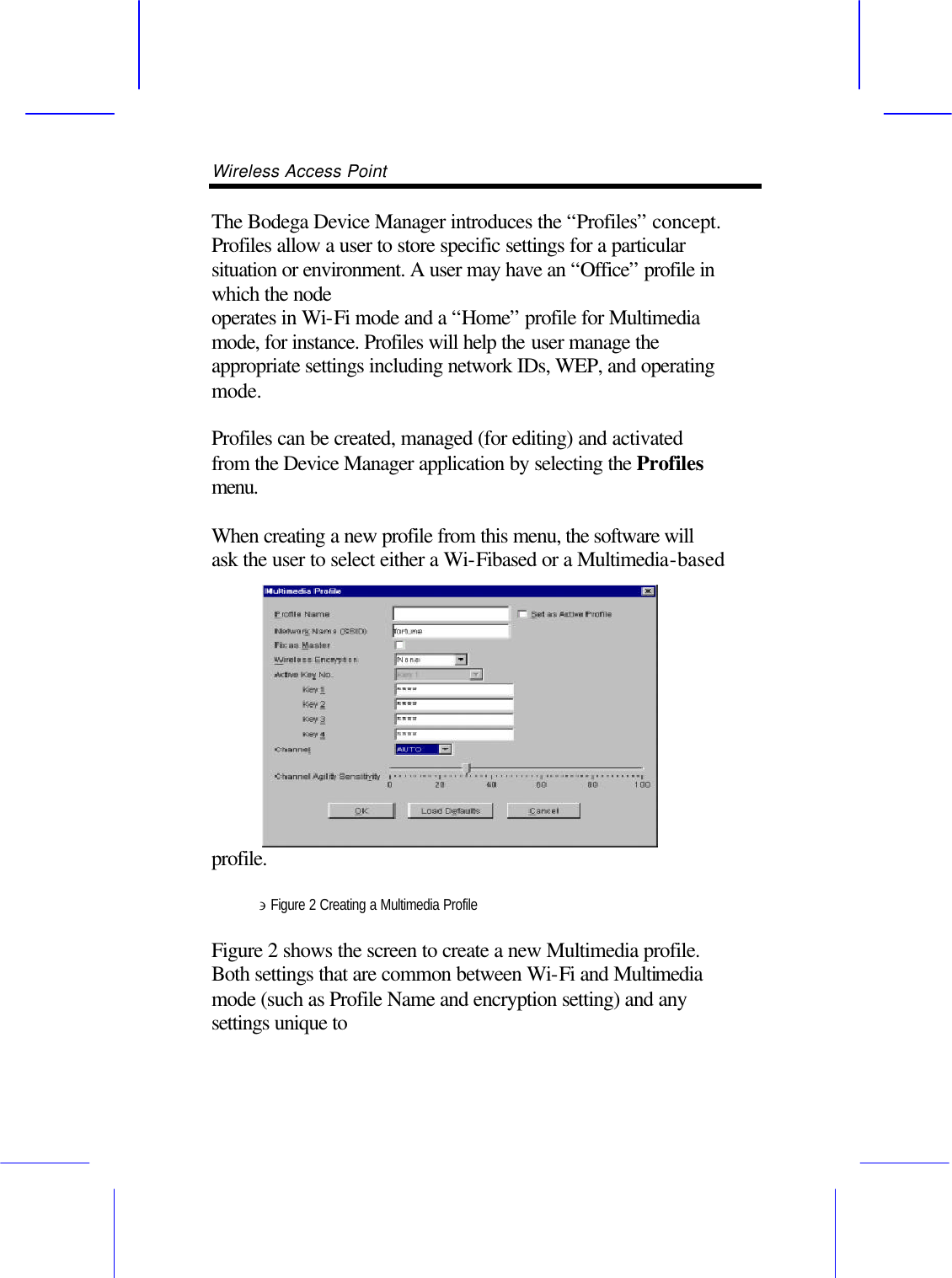
Wireless Access Point       The Bodega Device Manager introduces the “Profiles” concept. Profiles allow a user to store specific settings for a particular situation or environment. A user may have an “Office” profile in which the node operates in Wi-Fi mode and a “Home” profile for Multimedia mode, for instance. Profiles will help the user manage the appropriate settings including network IDs, WEP, and operating mode.  Profiles can be created, managed (for editing) and activated from the Device Manager application by selecting the Profiles menu.  When creating a new profile from this menu, the software will ask the user to select either a Wi-Fibased or a Multimedia-based profile.  ∋ Figure 2 Creating a Multimedia Profile  Figure 2 shows the screen to create a new Multimedia profile. Both settings that are common between Wi-Fi and Multimedia mode (such as Profile Name and encryption setting) and any settings unique to
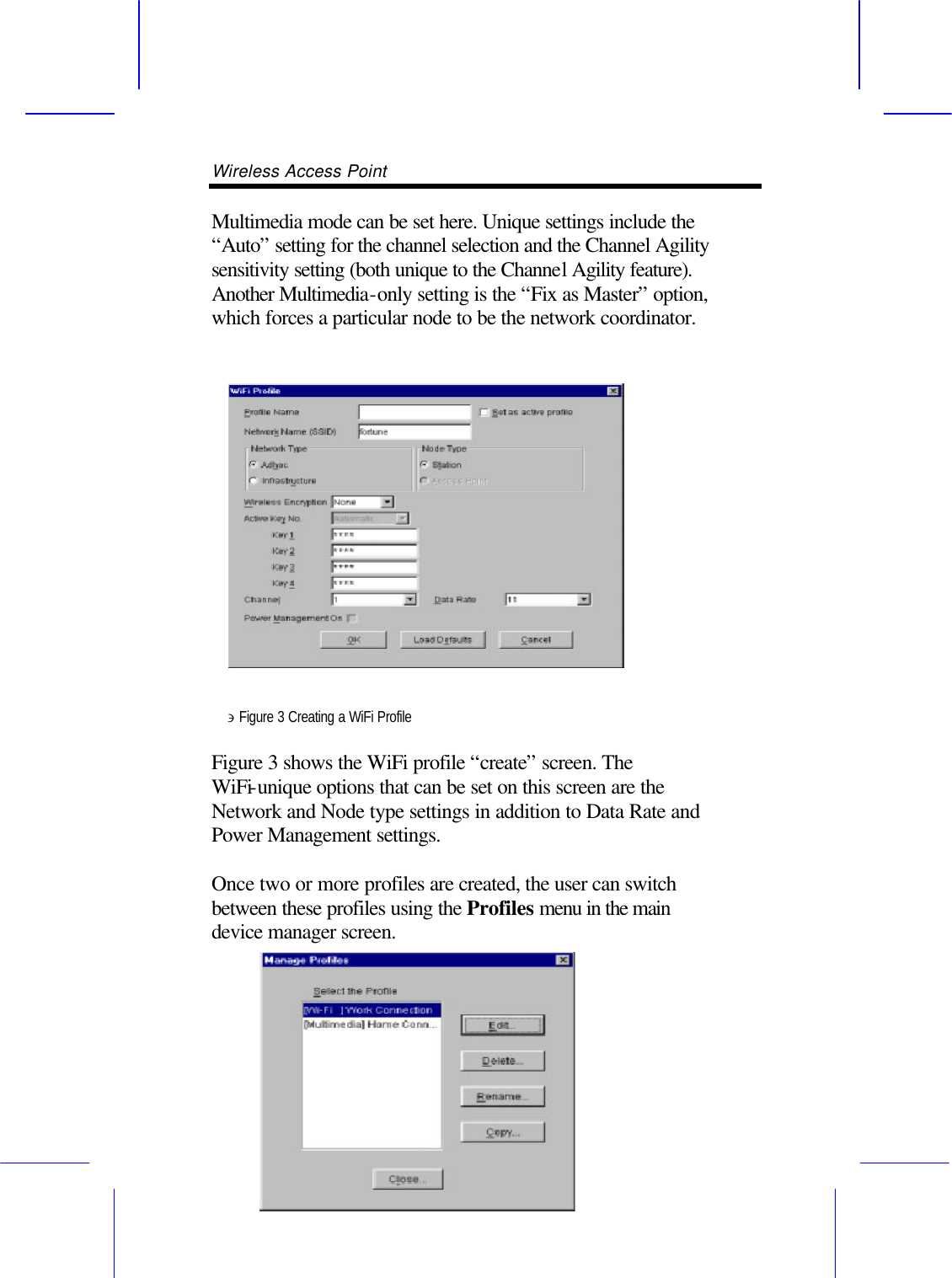
Wireless Access Point       Multimedia mode can be set here. Unique settings include the “Auto” setting for the channel selection and the Channel Agility sensitivity setting (both unique to the Channel Agility feature). Another Multimedia-only setting is the “Fix as Master” option, which forces a particular node to be the network coordinator.     ∋ Figure 3 Creating a WiFi Profile  Figure 3 shows the WiFi profile “create” screen. The WiFi-unique options that can be set on this screen are the Network and Node type settings in addition to Data Rate and Power Management settings.  Once two or more profiles are created, the user can switch between these profiles using the Profiles menu in the main device manager screen.
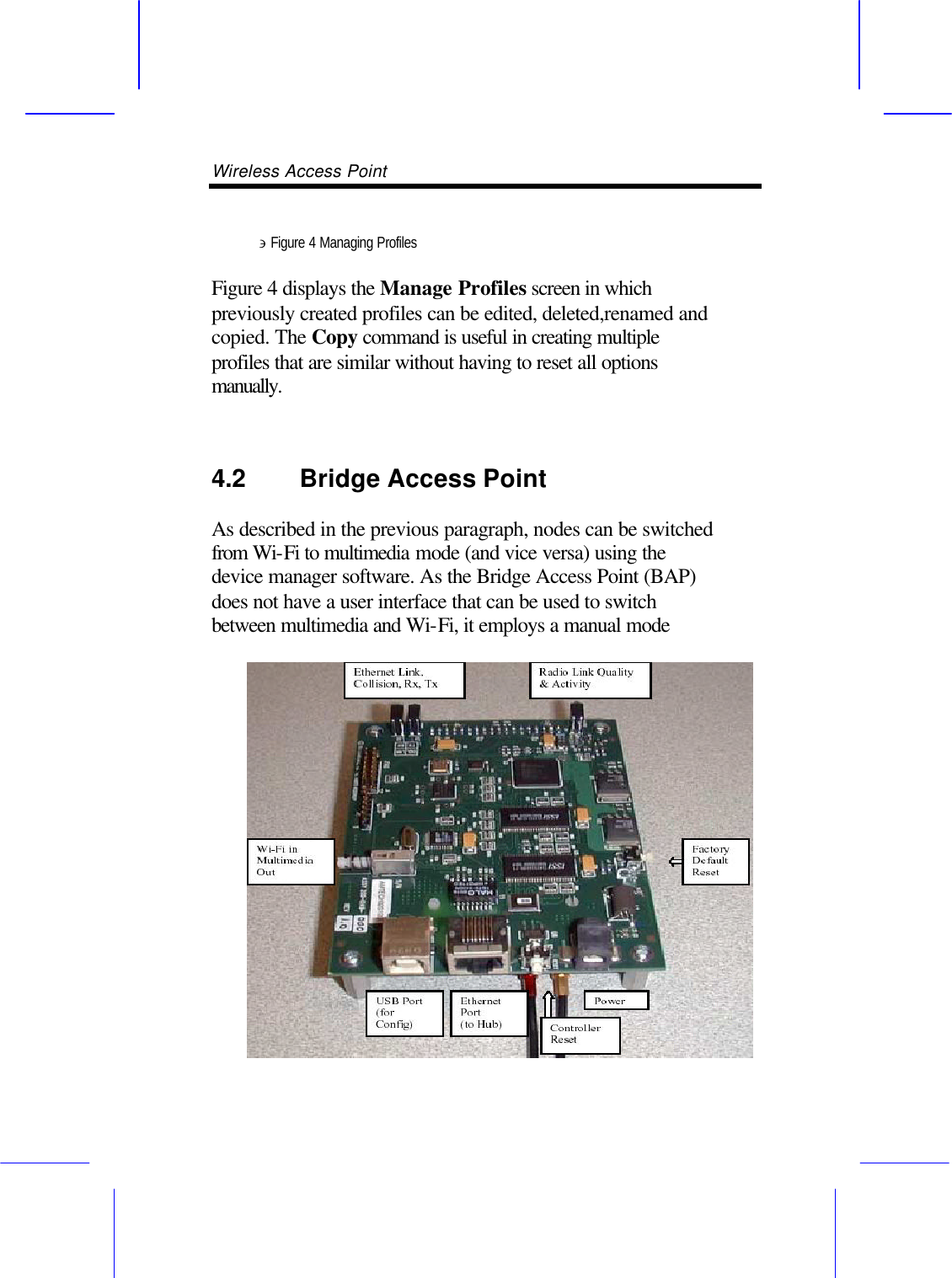
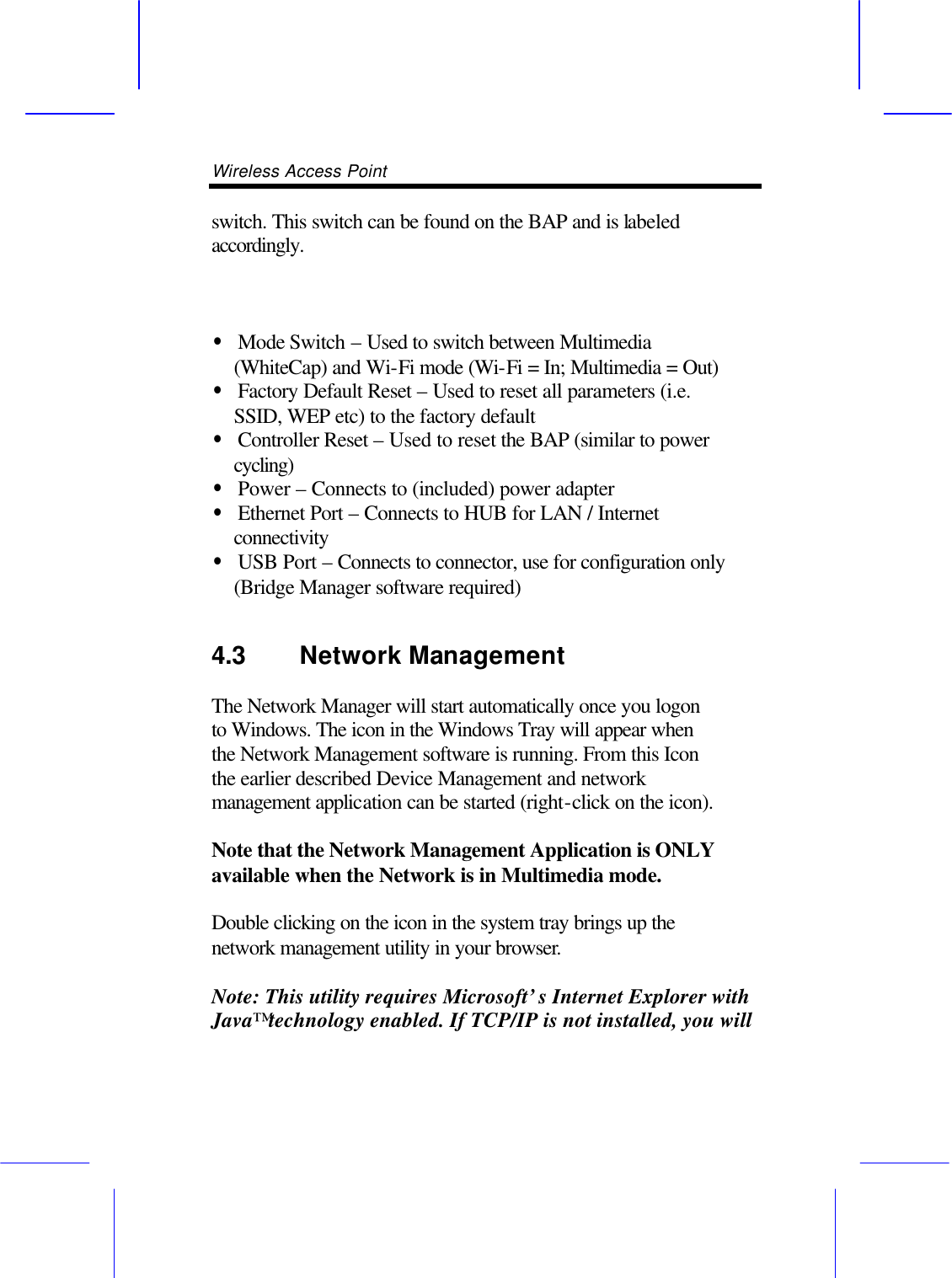
Wireless Access Point        ∋ Figure 4 Managing Profiles  Figure 4 displays the Manage Profiles screen in which previously created profiles can be edited, deleted,renamed and copied. The Copy command is useful in creating multiple profiles that are similar without having to reset all options manually.  4.2 Bridge Access Point    As described in the previous paragraph, nodes can be switched from Wi-Fi to multimedia mode (and vice versa) using the device manager software. As the Bridge Access Point (BAP) does not have a user interface that can be used to switch between multimedia and Wi-Fi, it employs a manual mode
Wireless Access Point       switch. This switch can be found on the BAP and is labeled accordingly.    • Mode Switch – Used to switch between Multimedia (WhiteCap) and Wi-Fi mode (Wi-Fi = In; Multimedia = Out) • Factory Default Reset – Used to reset all parameters (i.e. SSID, WEP etc) to the factory default • Controller Reset – Used to reset the BAP (similar to power cycling) • Power – Connects to (included) power adapter • Ethernet Port – Connects to HUB for LAN / Internet connectivity • USB Port – Connects to connector, use for configuration only (Bridge Manager software required) 4.3 Network Management  The Network Manager will start automatically once you logon to Windows. The icon in the Windows Tray will appear when the Network Management software is running. From this Icon the earlier described Device Management and network management application can be started (right-click on the icon).  Note that the Network Management Application is ONLY available when the Network is in Multimedia mode.  Double clicking on the icon in the system tray brings up the network management utility in your browser.  Note: This utility requires Microsoft’s Internet Explorer with Java™ technology enabled. If TCP/IP is not installed, you will
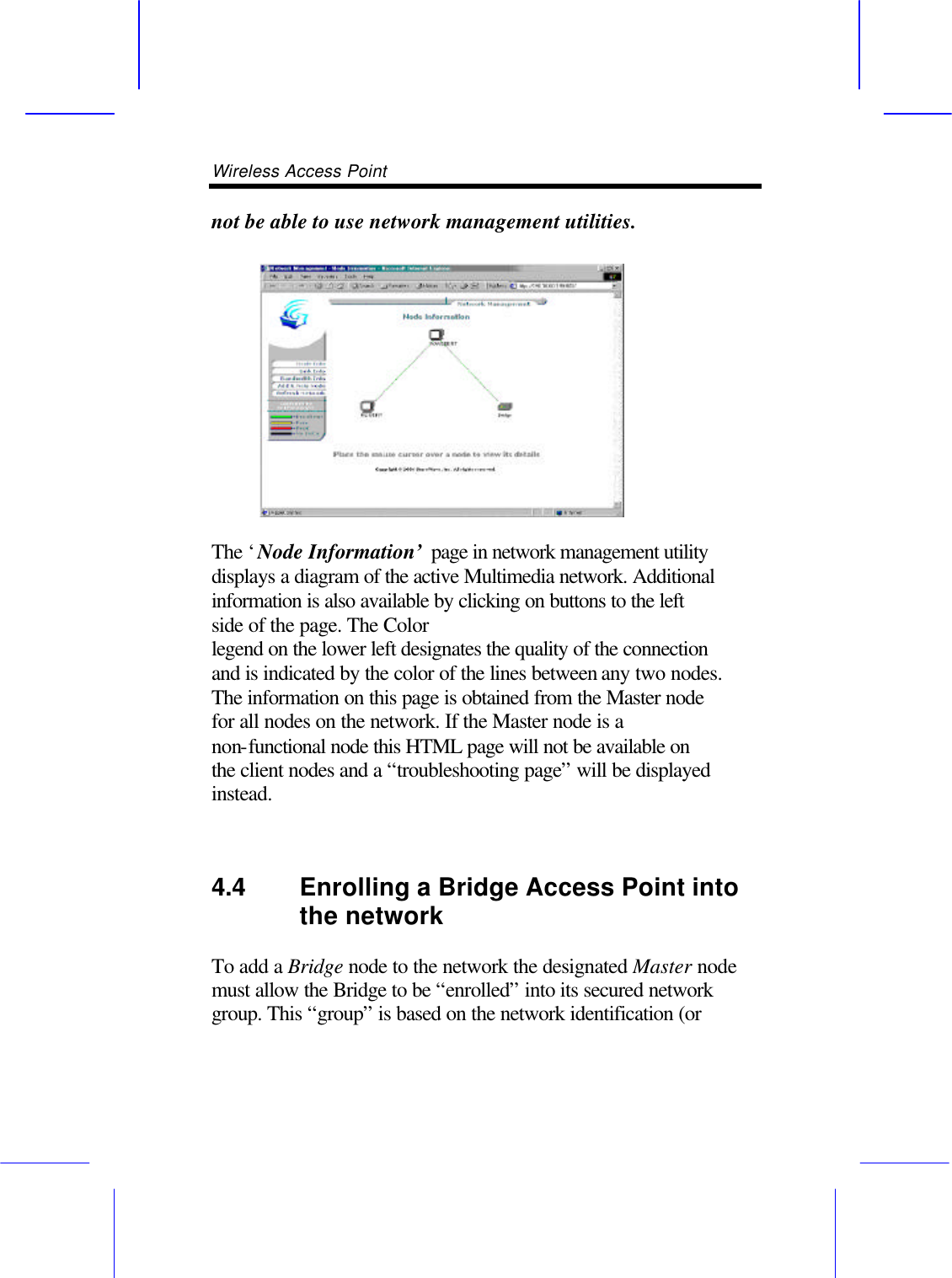
Wireless Access Point       not be able to use network management utilities.   The ‘Node Information’ page in network management utility displays a diagram of the active Multimedia network. Additional information is also available by clicking on buttons to the left side of the page. The Color legend on the lower left designates the quality of the connection and is indicated by the color of the lines between any two nodes. The information on this page is obtained from the Master node for all nodes on the network. If the Master node is a non-functional node this HTML page will not be available on the client nodes and a “troubleshooting page” will be displayed instead.  4.4 Enrolling a Bridge Access Point into the network   To add a Bridge node to the network the designated Master node must allow the Bridge to be “enrolled” into its secured network group. This “group” is based on the network identification (or
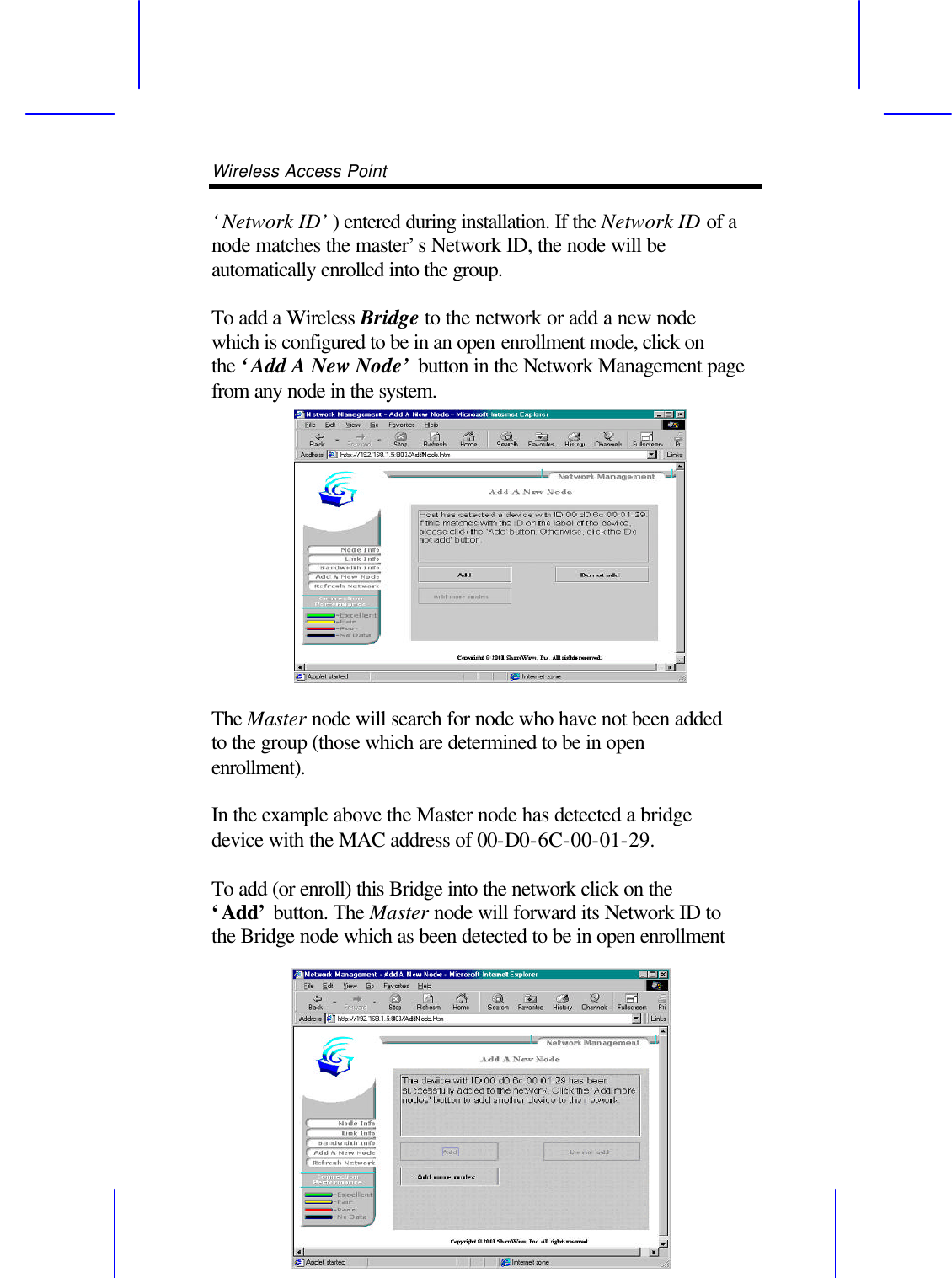
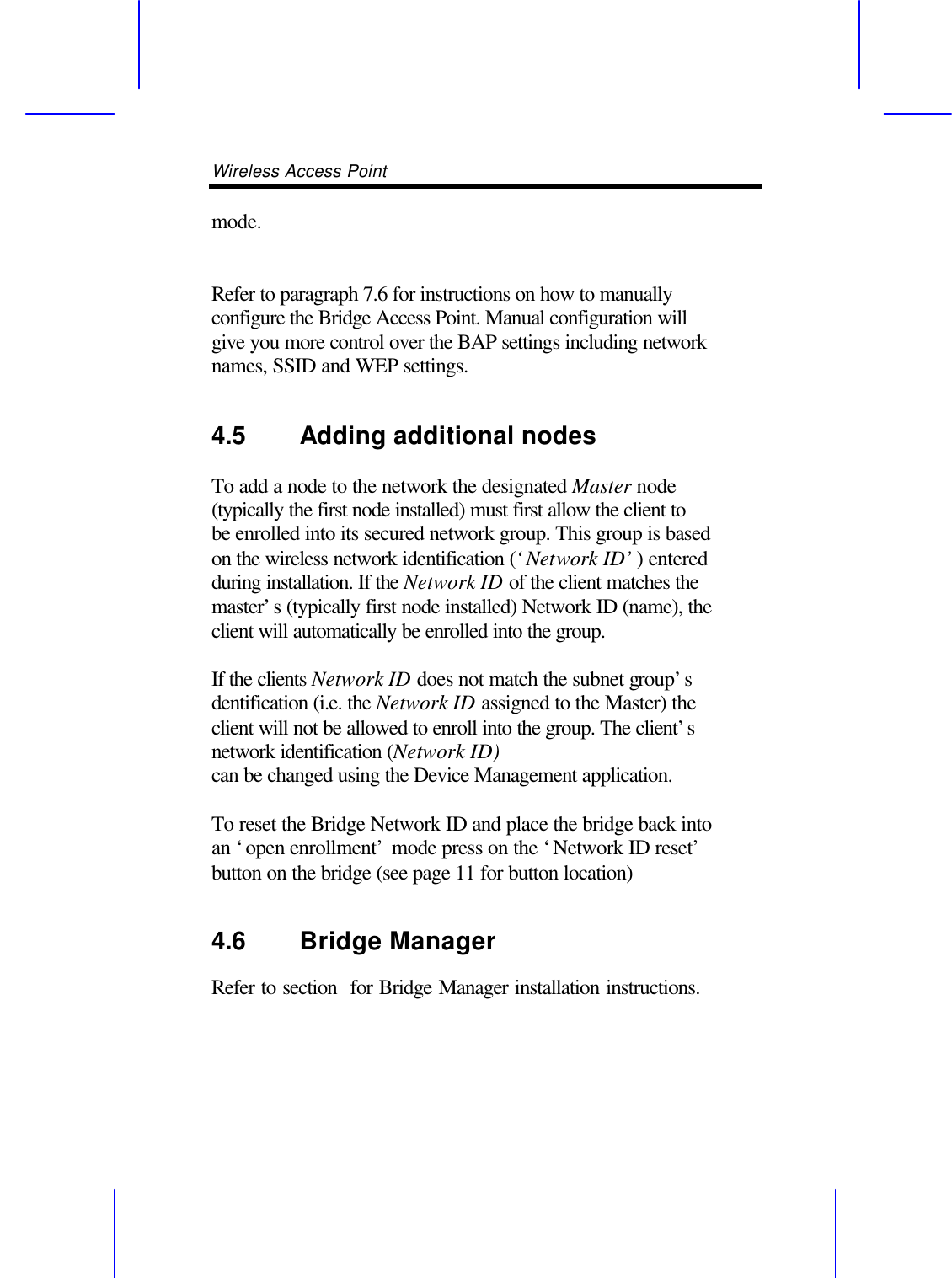
Wireless Access Point       ‘Network ID’) entered during installation. If the Network ID of a node matches the master’s Network ID, the node will be automatically enrolled into the group.  To add a Wireless Bridge to the network or add a new node which is configured to be in an open enrollment mode, click on the ‘Add A New Node’ button in the Network Management page from any node in the system.  The Master node will search for node who have not been added to the group (those which are determined to be in open enrollment).  In the example above the Master node has detected a bridge device with the MAC address of 00-D0-6C-00-01-29.  To add (or enroll) this Bridge into the network click on the ‘Add’ button. The Master node will forward its Network ID to the Bridge node which as been detected to be in open enrollment
Wireless Access Point       mode.   Refer to paragraph 7.6 for instructions on how to manually configure the Bridge Access Point. Manual configuration will give you more control over the BAP settings including network names, SSID and WEP settings. 4.5 Adding additional nodes   To add a node to the network the designated Master node (typically the first node installed) must first allow the client to be enrolled into its secured network group. This group is based on the wireless network identification (‘Network ID’) entered during installation. If the Network ID of the client matches the master’s (typically first node installed) Network ID (name), the client will automatically be enrolled into the group.  If the clients Network ID does not match the subnet group’s dentification (i.e. the Network ID assigned to the Master) the client will not be allowed to enroll into the group. The client’s network identification (Network ID) can be changed using the Device Management application.  To reset the Bridge Network ID and place the bridge back into an ‘open enrollment’ mode press on the ‘Network ID reset’ button on the bridge (see page 11 for button location) 4.6 Bridge Manager   Refer to section  for Bridge Manager installation instructions.
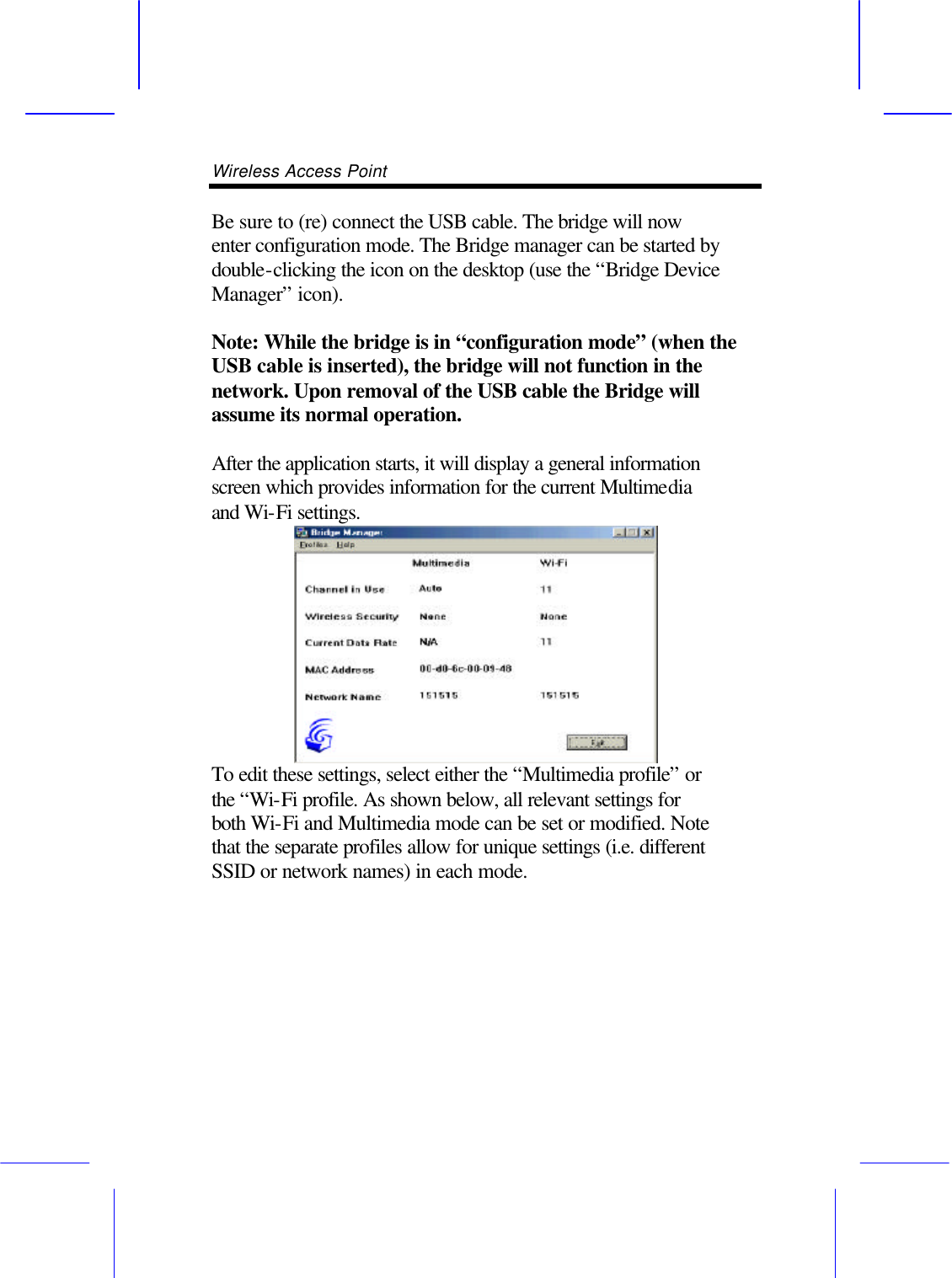
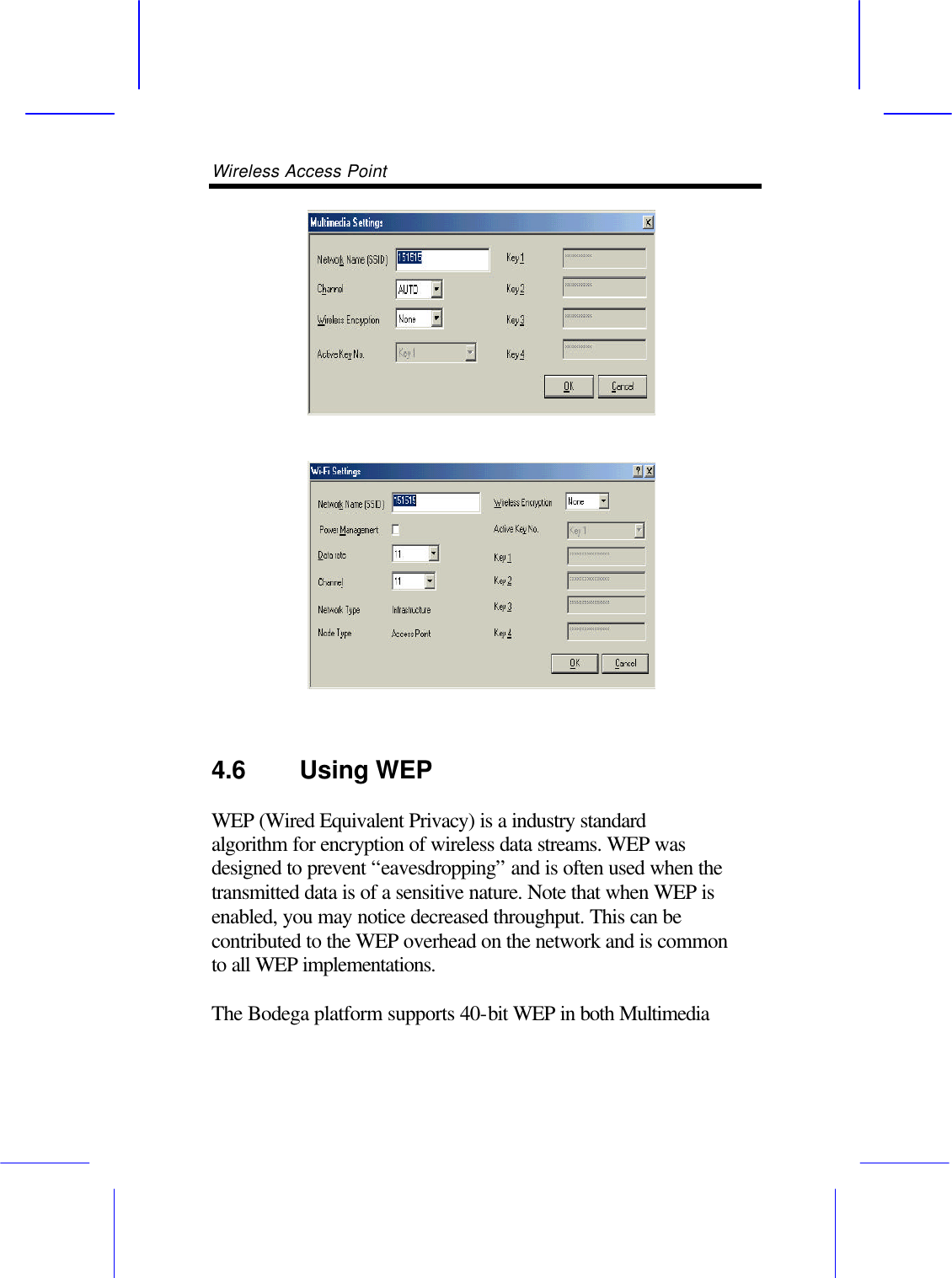
Wireless Access Point       Be sure to (re) connect the USB cable. The bridge will now enter configuration mode. The Bridge manager can be started by double-clicking the icon on the desktop (use the “Bridge Device Manager” icon).  Note: While the bridge is in “configuration mode” (when the USB cable is inserted), the bridge will not function in the network. Upon removal of the USB cable the Bridge will assume its normal operation.  After the application starts, it will display a general information screen which provides information for the current Multimedia and Wi-Fi settings. To edit these settings, select either the “Multimedia profile” or the “Wi-Fi profile. As shown below, all relevant settings for both Wi-Fi and Multimedia mode can be set or modified. Note that the separate profiles allow for unique settings (i.e. different SSID or network names) in each mode.
Wireless Access Point         4.6 Using WEP  WEP (Wired Equivalent Privacy) is a industry standard algorithm for encryption of wireless data streams. WEP was designed to prevent “eavesdropping” and is often used when the transmitted data is of a sensitive nature. Note that when WEP is enabled, you may notice decreased throughput. This can be contributed to the WEP overhead on the network and is common to all WEP implementations.  The Bodega platform supports 40-bit WEP in both Multimedia
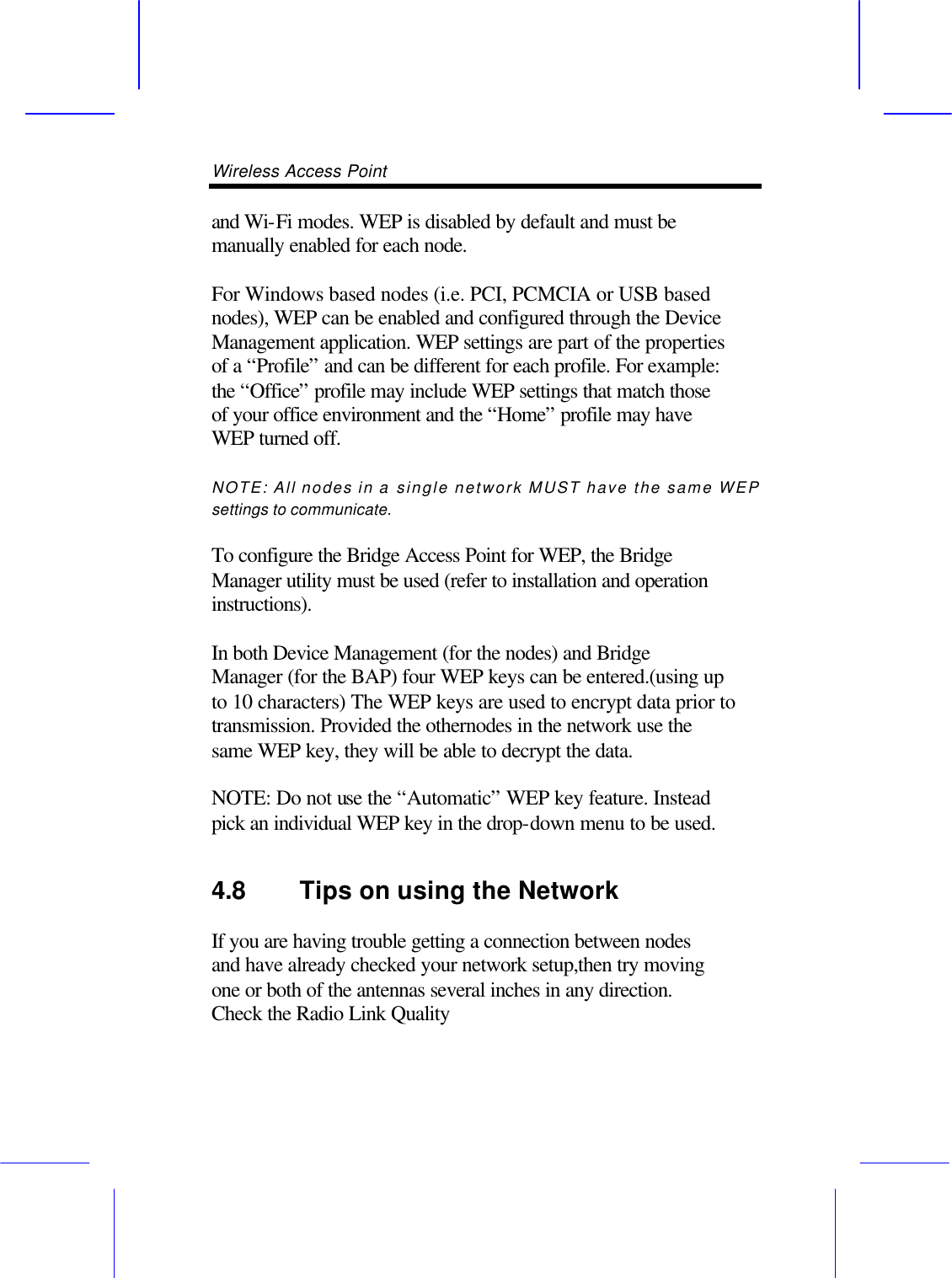
Wireless Access Point       and Wi-Fi modes. WEP is disabled by default and must be manually enabled for each node.  For Windows based nodes (i.e. PCI, PCMCIA or USB based nodes), WEP can be enabled and configured through the Device Management application. WEP settings are part of the properties of a “Profile” and can be different for each profile. For example: the “Office” profile may include WEP settings that match those of your office environment and the “Home” profile may have WEP turned off.  NOTE: All nodes in a single network MUST have the same WEP settings to communicate.  To configure the Bridge Access Point for WEP, the Bridge Manager utility must be used (refer to installation and operation instructions).  In both Device Management (for the nodes) and Bridge Manager (for the BAP) four WEP keys can be entered.(using up to 10 characters) The WEP keys are used to encrypt data prior to transmission. Provided the othernodes in the network use the same WEP key, they will be able to decrypt the data.  NOTE: Do not use the “Automatic” WEP key feature. Instead pick an individual WEP key in the drop-down menu to be used. 4.8 Tips on using the Network   If you are having trouble getting a connection between nodes and have already checked your network setup,then try moving one or both of the antennas several inches in any direction. Check the Radio Link Quality
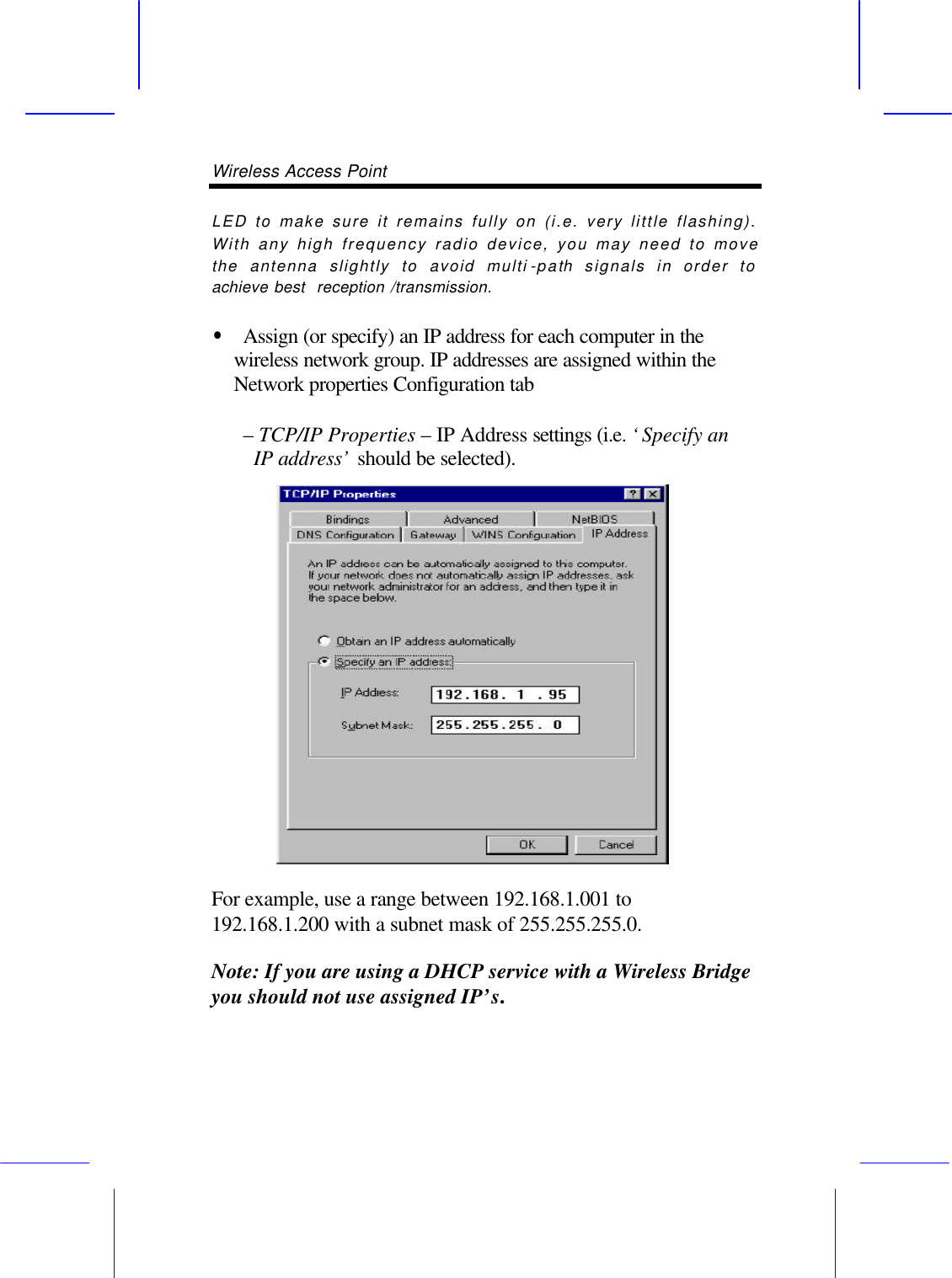
Wireless Access Point       LED to make sure it remains fully on (i.e. very little flashing). With any high frequency radio device, you may need to move the antenna slightly to avoid multi -path signals in order to achieve best  reception /transmission.  •  Assign (or specify) an IP address for each computer in the wireless network group. IP addresses are assigned within the Network properties Configuration tab     – TCP/IP Properties – IP Address settings (i.e. ‘Specify an IP address’ should be selected).  For example, use a range between 192.168.1.001 to 192.168.1.200 with a subnet mask of 255.255.255.0.  Note: If you are using a DHCP service with a Wireless Bridge you should not use assigned IP’s.
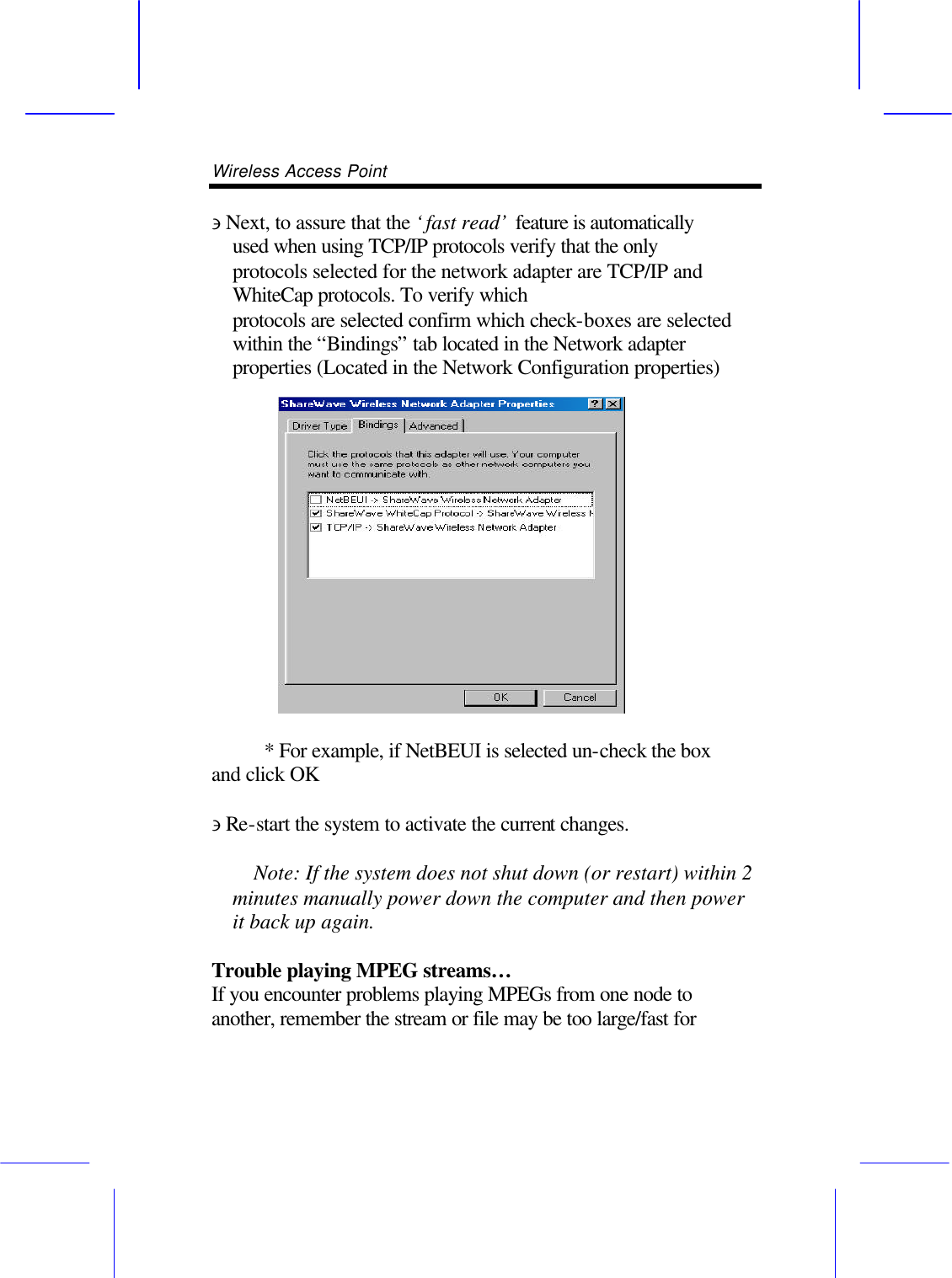
Wireless Access Point       ∋ Next, to assure that the ‘fast read’ feature is automatically used when using TCP/IP protocols verify that the only protocols selected for the network adapter are TCP/IP and WhiteCap protocols. To verify which protocols are selected confirm which check-boxes are selected within the “Bindings” tab located in the Network adapter properties (Located in the Network Configuration properties)       * For example, if NetBEUI is selected un-check the box and click OK  ∋ Re-start the system to activate the current changes.      Note: If the system does not shut down (or restart) within 2 minutes manually power down the computer and then power it back up again.  Trouble playing MPEG streams… If you encounter problems playing MPEGs from one node to another, remember the stream or file may be too large/fast for
Wireless Access Point       your CPU to use a software-decode player utility. Try using hardware MPEG decoder, often called a DVD decoder card.  Another tip, if your decoder software is hanging or locking up the system, try different decoding software or switch to a hardware-based decoding card. Since this product is on the leading edge of technology, most software MPEG decoders are not “network aware”. If the stream is interrupted, even for a moment, the utility may become unstable or can go into an unrecoverable state.
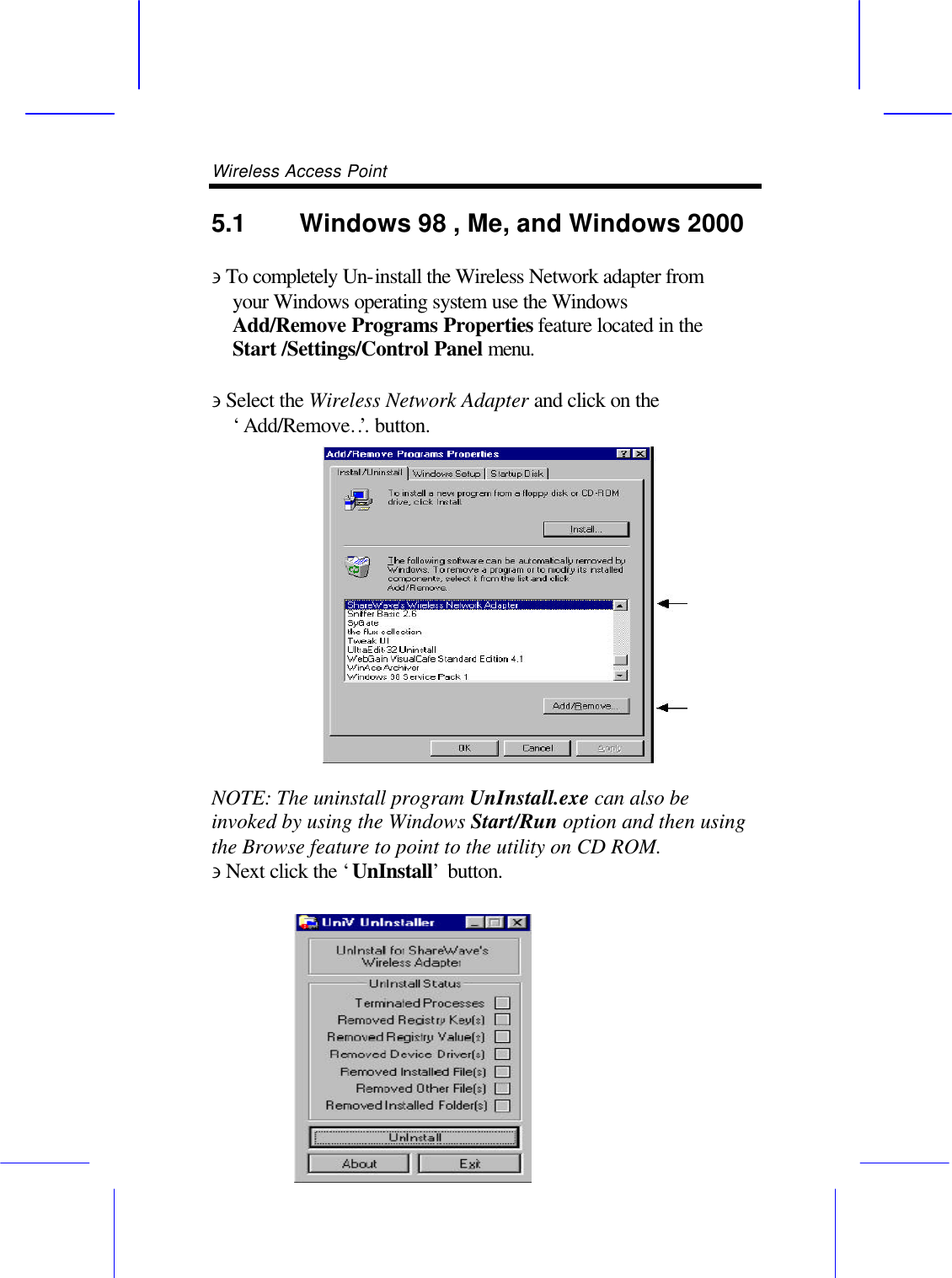
Wireless Access Point       5.1 Windows 98 , Me, and Windows 2000   ∋ To completely Un-install the Wireless Network adapter from your Windows operating system use the Windows Add/Remove Programs Properties feature located in the Start /Settings/Control Panel menu.  ∋ Select the Wireless Network Adapter and click on the ‘Add/Remove…’ button.  NOTE: The uninstall program UnInstall.exe can also be invoked by using the Windows Start/Run option and then using the Browse feature to point to the utility on CD ROM. ∋ Next click the ‘UnInstall’ button.
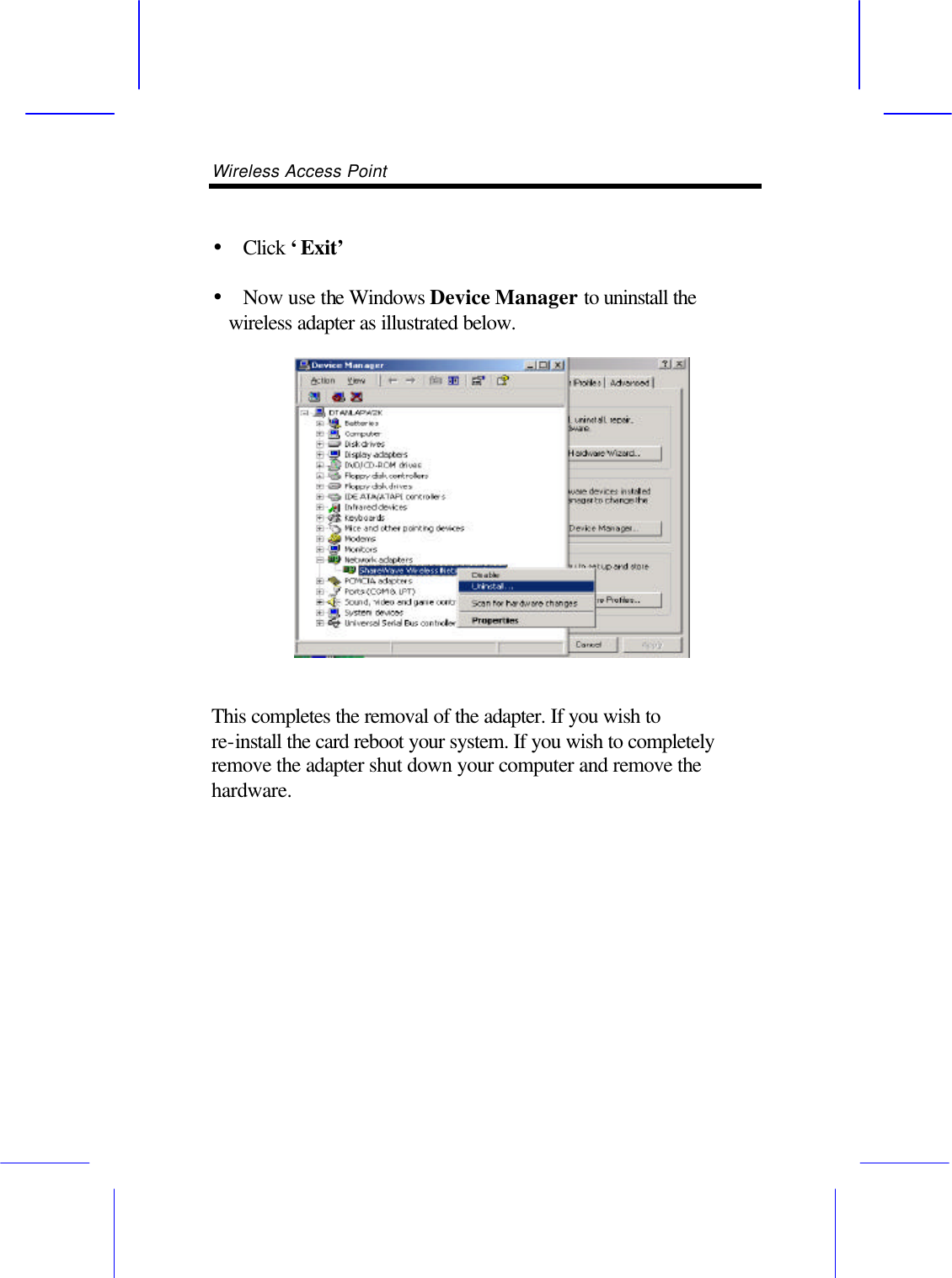
Wireless Access Point        •  Click ‘Exit’  •  Now use the Windows Device Manager to uninstall the wireless adapter as illustrated below.   This completes the removal of the adapter. If you wish to re-install the card reboot your system. If you wish to completely remove the adapter shut down your computer and remove the hardware.

Navigation menu