Prime Electronics and Satellitics WP210P-X Wireless LAN Card User Manual Manual

Prime Electronics & Satellitics Inc. Wireless LAN Card Manual

Manual

Wireless LAN 11 Mbps    User manualWireless LAN 11Mbps PC CardUser ManualVersion 1.2- August.2001
Wireless LAN 11 Mbps    User manualCopyright statementNo part of this publication may be reproduced, stored in a retrieval system, or transmittedin any form or by any means, whether electronic, mechanical, photocopying, recording, orotherwise without the prior writing of the publisher.Printed in Taiwan, August 2001Page1
Wireless LAN 11 Mbps    User manualFederal Communication Commission Interference StatementThis equipment has been tested and found to comply with the limits for a Class Bdigital device, pursuant to Part 15 of the FCC Rules. These limits are designed toprovide reasonable protection against harmful interference in a residential installation.This equipment generates, uses and can radiate radio frequency energy and , if notinstalled and used in accordance with the instructions, may cause harmfulinterference to radio communications. However, there is no guarantee thatinterference will not occur in a particular installation. If this equipment does causeharmful interference to radio or television reception, which can be determined byturning the equipment off and on, the user is encouraged to try to correct theinterference by one of the following measures:- Reorient or relocate the receiving antenna.- Increase the separation between the equipment and receiver.- Connect the equipment into an outlet on a circuit different from thatto which the receiver is connected.- Consult the dealer or an experienced radio/TV technician for help.FCC Caution: To assure continued compliance, (example-use only shielded interface cables whenconnecting to computer or peripheral devices). Any changes or modifications not expresslyapproved by the party responsible for compliance could void the user’s authority tooperate this equipment.This device complies with Part 15 of the FCC Rules. Operation is subject to theFollowing two conditions:(1) This device may not cause harmful interference, and(2) this Device must accept any interference received, including interference thatmay cause Undesired operation.Federal Communication Commission(FCC) Radiation Exposure StatmentThis equiment complies with FCC radiation exposure set forth for an uncontrolledenvironment .In order to avoid the possibility of exceeding the FCC radio frequencyExposure limits, human proximity to the antenna shall not be less than 20 cm(8 inches)during normal operation.Page 2Wireless LAN 11 Mbps    User manualR&TTE Compliance StatementThis equipment complies with all the requirements of the DIRECTIVE 1999/5/EC OF
THE EUROPEAN PARLIAMENT AND THE COUNCIL OF 9 March 1999 on radioequipment and telecommunication terminal Equipment and the mutual recognition oftheir conformity(R&TTE).The R&TTE Directive repeals and replaces in the directive 98/13/EEC (TelecommunicationsTerminal Equipment and Satellite Earth Station Equipment) As of April 8, 2000.SafetyThis equipment is designed with the utmost care for the safety of those who install and useit. However, special attention must be paid to the dangers of electric shock and staticelectricity when working with electrical equipment. All guidelines of this manual and ofthe computer manufacturer must therefore be allowed at all times to ensure the safe use ofthe equipment.EU Countries Not intended for useThe ETSI version of this device is intended for home and office use in Austria Belgium,Denmark, Finland, France (with Frequency channel restrictions). Germany, Greece,Ireland, Italy, Luxembourg, The Netherlands, Portugal, Spain, Sweden and UnitedKingdom.The ETSI version of this device is also authorized for use in EFTA member statesIceland,Liechtenstein, Norway and Switzerland.EU Countries Not intended for useNone.Potential restrictive useFrance: Only channels 10,11,12,and13Page 3Wireless LAN 11 Mbps    User manual1. Contents1. Contents ------------------------------------------------------------------------------------------------------------------------ 4
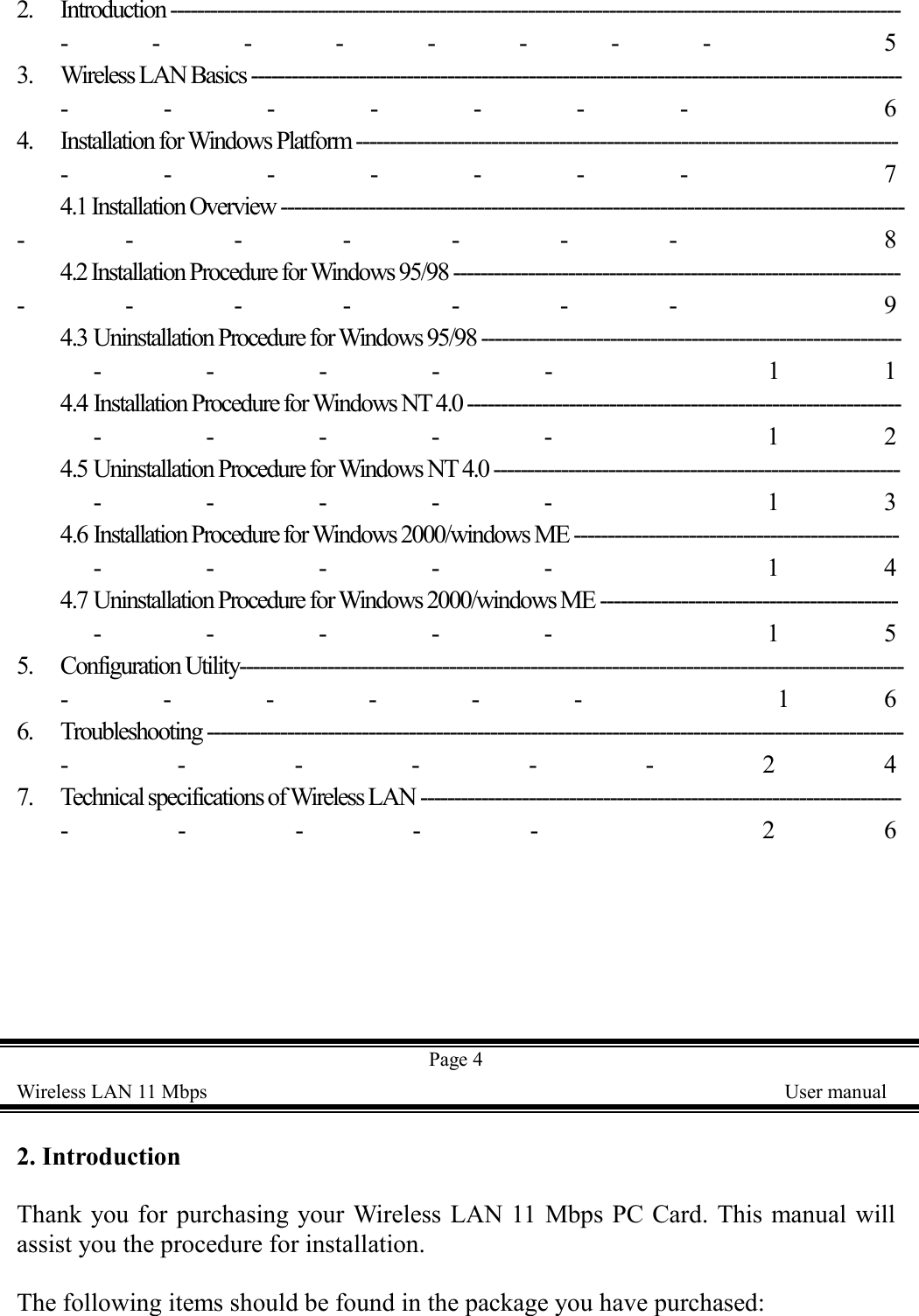
2. Introduction -------------------------------------------------------------------------------------------------------------------- 53. Wireless LAN Basics ------------------------------------------------------------------------------------------------------- 64. Installation for Windows Platform --------------------------------------------------------------------------------------- 74.1 Installation Overview --------------------------------------------------------------------------------------------------- 84.2 Installation Procedure for Windows 95/98 ------------------------------------------------------------------------- 94.3 Uninstallation Procedure for Windows 95/98 ------------------------------------------------------------------- 114.4 Installation Procedure for Windows NT 4.0 --------------------------------------------------------------------- 124.5 Uninstallation Procedure for Windows NT 4.0 ----------------------------------------------------------------- 134.6 Installation Procedure for Windows 2000/windows ME ----------------------------------------------------- 144.7 Uninstallation Procedure for Windows 2000/windows ME ------------------------------------------------- 155. Configuration Utility-------------------------------------------------------------------------------------------------------- 166. Troubleshooting -------------------------------------------------------------------------------------------------------------247. Technical specifications of Wireless LAN ---------------------------------------------------------------------------- 26Page 4Wireless LAN 11 Mbps    User manual2. IntroductionThank you for purchasing your Wireless LAN 11 Mbps PC Card. This manual willassist you the procedure for installation.The following items should be found in the package you have purchased:
■    Wireless LAN 11 Mbps PC Card■  Quick installation guide■  User manual■    Diskette or CD containing Wireless LAN Management utility and driversThe diskette or CD contains the drivers and the softwareconfiguration utility that is used for managing the Wireless LANCard as well as establishing the wireless connection with your LocalArea Network (LAN).NOTE : PLEASE CONTACT YOUR VENDER IF ANYTHING IS MISSING.Page 5Wireless LAN 11 Mbps    User manual3. Wireless LAN BasicsWireless LAN (Local Area Networks) systems offer a number of greater excellencesover a traditional wired system. Wireless LANs (WLANs) are easier to setup andmanage, more flexible and often more cost effective than their wired equivalence.By using radio frequency (RF) technology, the need for wired connections isminimized while WLANs transmit and receive data over the air. Therefore, WLANs
combine data connectivity and user mobility through simplified configuration,enabling movable LANs.Wireless LANs allow users to access shared information without looking for a place toplug in. They also enable network managers to set up or augment networks withoutinstalling or moving wires. Consequently, WLANs offer various excellences ofproductivity, convenience and cost advantages over traditional wired networks as thefollowings:■ User friendly – WLAN systems enable LAN users accessing to real-time informationanywhere in their organization. This mobility supports productivity andservice opportunities that are not possibly offered by wired networks.■  Easy installation –Fast and easy to install a WLAN system and the installationprocess eliminates the need to pull cable through walls and ceilings.■ Cost down – While the initial money capital requirement of WLAN hardwaremight be greater than those of wired LAN hardware, the overallinstallation expenses and life-cycle costs will be significantly lower.WLANs offer the greatest Lang-term cost benefits when operating indynamic environments that require frequent moves, adds andchanges.■  Easy configuration –Specific applications and installations can be met easily whileconfiguring WLANs in various topologies. Configurations also canbe altered easily and a small number of users can full infrastructurenetworks of thousands of users in the range form peer-to-peernetworks that allow roaming over a broad area.Page 6Wireless LAN 11 Mbps    User manual4. Installation for Windows platformThe Wireless LAN can easily be installed and used, unlike wired LAN, no need ofbother to connect cables for keeping your computer to use network resources. Thissection will assist you to install WLAN Adapter successfully. First, You will installsoftware (driver). Secondly, insert the Wireless LAN PC card, and finally you will setthe network properties to accommodate resource sharing and select the type of wirelessnetwork that you wish to install.
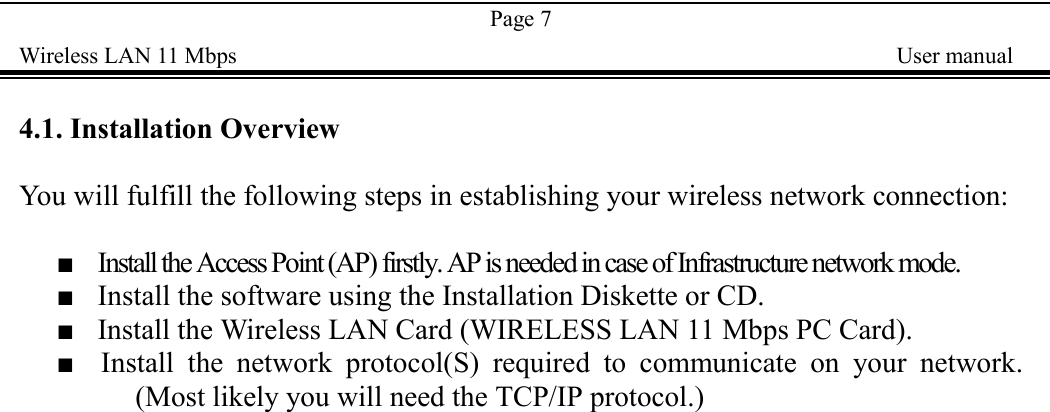
Page 7Wireless LAN 11 Mbps    User manual4.1. Installation OverviewYou will fulfill the following steps in establishing your wireless network connection:■    Install the Access Point (AP) firstly. AP is needed in case of Infrastructure network mode.■    Install the software using the Installation Diskette or CD.■    Install the Wireless LAN Card (WIRELESS LAN 11 Mbps PC Card).■  Install the network protocol(S) required to communicate on your network.(Most likely you will need the TCP/IP protocol.)
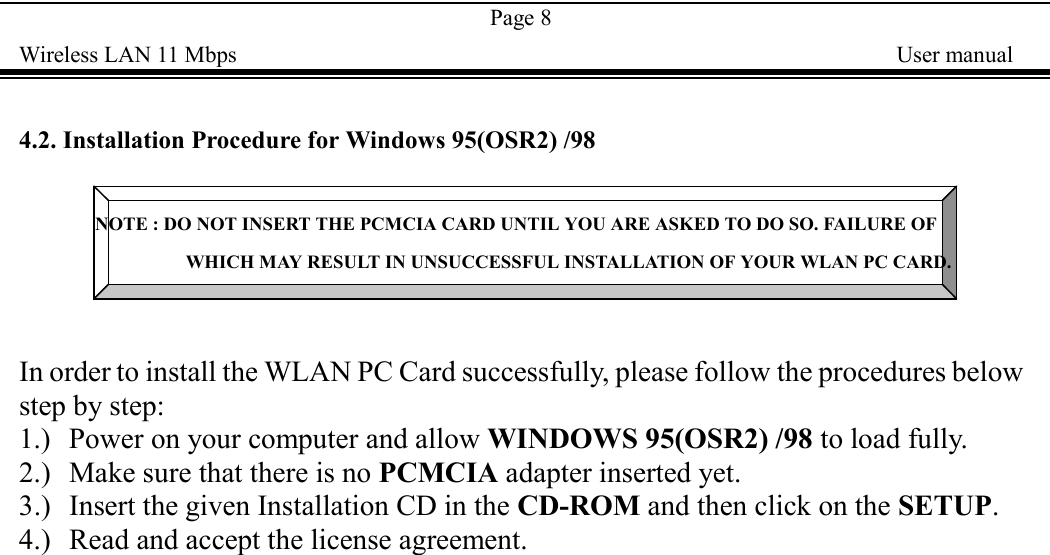
Page 8Wireless LAN 11 Mbps    User manual4.2. Installation Procedure for Windows 95(OSR2) /98NOTE : DO NOT INSERT THE PCMCIA CARD UNTIL YOU ARE ASKED TO DO SO. FAILURE OFWHICH MAY RESULT IN UNSUCCESSFUL INSTALLATION OF YOUR WLAN PC CARD.In order to install the WLAN PC Card successfully, please follow the procedures belowstep by step:1.) Power on your computer and allow WINDOWS 95(OSR2) /98 to load fully.2.) Make sure that there is no PCMCIA adapter inserted yet.3.) Insert the given Installation CD in the CD-ROM and then click on the SETUP.4.) Read and accept the license agreement.
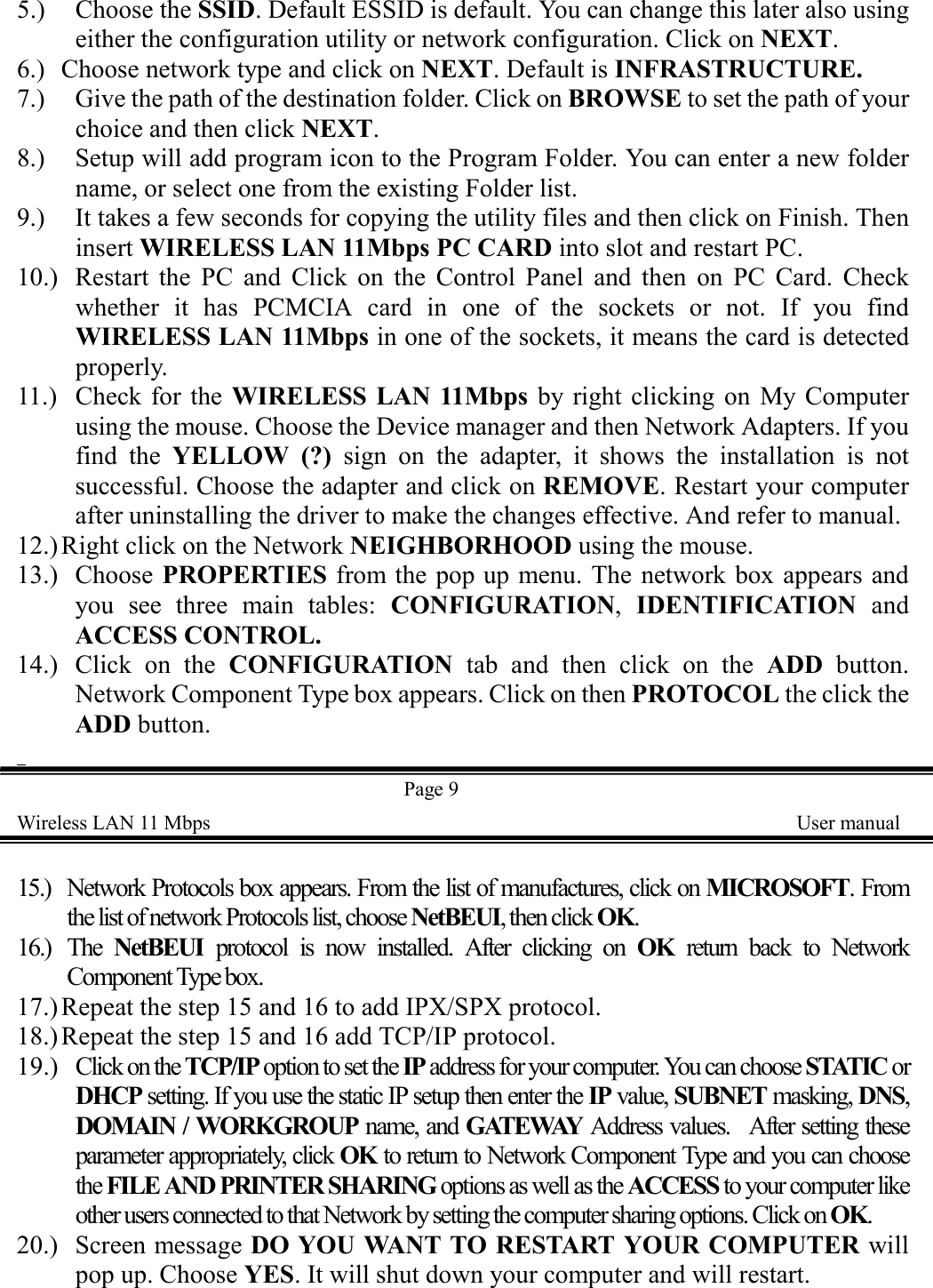
5.) Choose the SSID. Default ESSID is default. You can change this later also usingeither the configuration utility or network configuration. Click on NEXT.6.) Choose network type and click on NEXT. Default is INFRASTRUCTURE.7.) Give the path of the destination folder. Click on BROWSE to set the path of yourchoice and then click NEXT.8.) Setup will add program icon to the Program Folder. You can enter a new foldername, or select one from the existing Folder list.9.) It takes a few seconds for copying the utility files and then click on Finish. Theninsert WIRELESS LAN 11Mbps PC CARD into slot and restart PC.10.) Restart the PC and Click on the Control Panel and then on PC Card. Checkwhether it has PCMCIA card in one of the sockets or not. If you findWIRELESS LAN 11Mbps in one of the sockets, it means the card is detectedproperly.11.) Check for the WIRELESS LAN 11Mbps by right clicking on My Computerusing the mouse. Choose the Device manager and then Network Adapters. If youfind the YELLOW (?) sign on the adapter, it shows the installation is notsuccessful. Choose the adapter and click on REMOVE. Restart your computerafter uninstalling the driver to make the changes effective. And refer to manual.12.) Right click on the Network NEIGHBORHOOD using the mouse.13.) Choose PROPERTIES from the pop up menu. The network box appears andyou see three main tables: CONFIGURATION, IDENTIFICATION andACCESS CONTROL.14.) Click on the CONFIGURATION tab and then click on the ADD button.Network Component Type box appears. Click on then PROTOCOL the click theADD button.  Page 9Wireless LAN 11 Mbps    User manual15.) Network Protocols box appears. From the list of manufactures, click on MICROSOFT. Fromthe list of network Protocols list, choose NetBEUI, then click OK.16.) The  NetBEUI  protocol is now installed. After clicking on OK  return back to NetworkComponent Type box.17.)Repeat the step 15 and 16 to add IPX/SPX protocol.18.)Repeat the step 15 and 16 add TCP/IP protocol.19.) Click on the TCP/IP option to set the IP address for your computer. You can choose STATIC orDHCP setting. If you use the static IP setup then enter the IP value, SUBNET masking, DNS,DOMAIN / WORKGROUP name, and GATEWAY  Address values.  After setting theseparameter appropriately, click OK to return to Network Component Type and you can choosethe FILE AND PRINTER SHARING options as well as the ACCESS to your computer likeother users connected to that Network by setting the computer sharing options. Click on OK.20.) Screen message DO YOU WANT TO RESTART YOUR COMPUTER willpop up. Choose YES. It will shut down your computer and will restart.
IMPORTANT : RESTART YOUR COMPUTER TO MAKE THE CHANGES EFFECTIVE BEFORE YOUREINSTALLTHE DRIVER.  Page 10Wireless LAN 11 Mbps    User manual4.3. Uninstallation Procedure for Windows 95(OSR2) /98If you want to uninstall the PCMCIA PC card under Win 95 ( OSR2)/98, please followthe steps below:1.) Click on the START at the left bottom of your screen.2.) Choose the PROGRAMS.3.) Click on the Wireless Lan and click on UNINSTALLER.4.) Confirm message about removing the “Wireless Lan” and all of its componentsappear. Click on YES5.) Uninstall Shield removes the software “Wireless Lan” successfully.6.) Click on OK to finish the uninstallation procedure.IMPORTANT : RESTART YOUR COMPUTER TO MAKE THE CHANGES
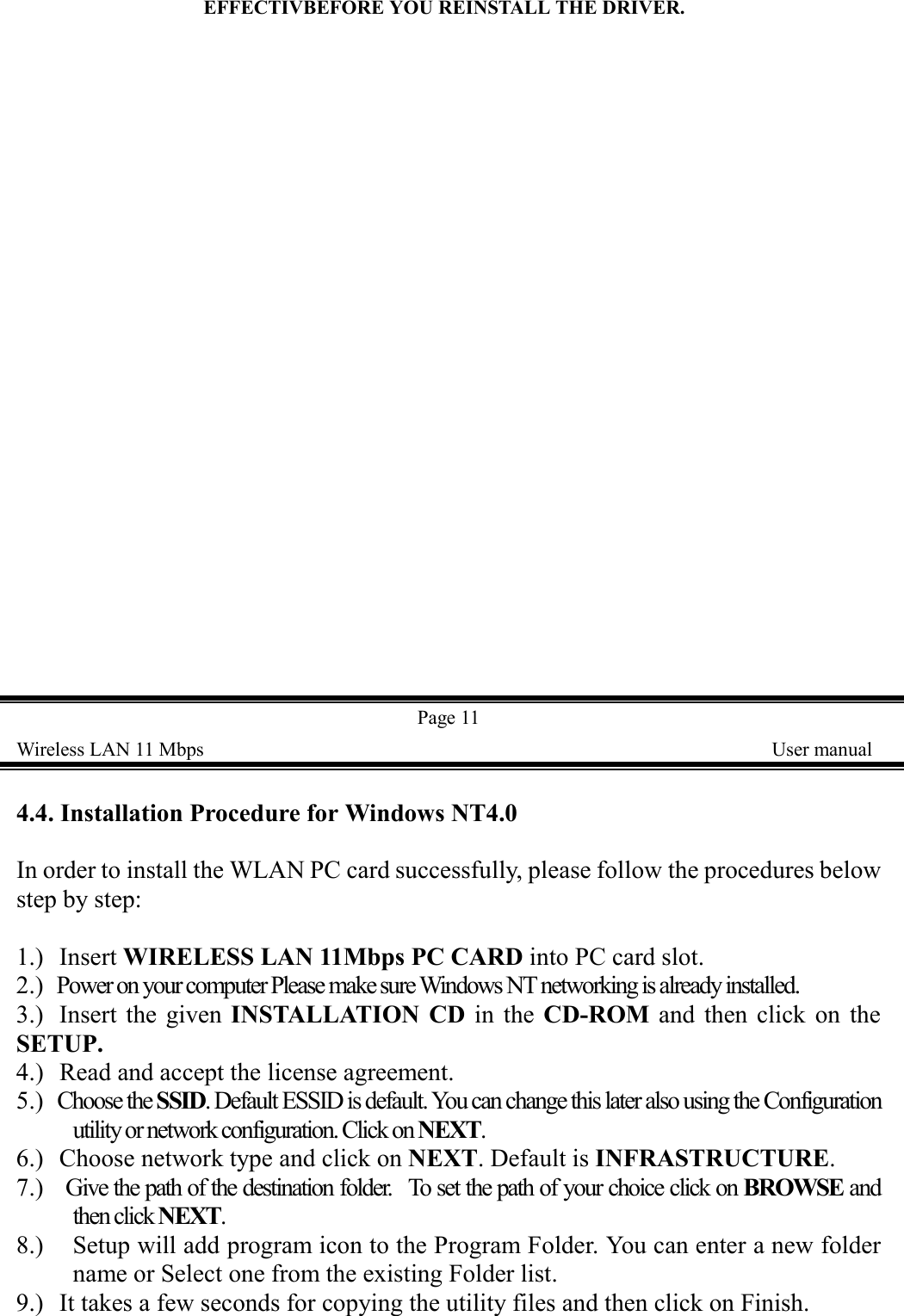
EFFECTIVBEFORE YOU REINSTALL THE DRIVER.  Page 11Wireless LAN 11 Mbps    User manual4.4. Installation Procedure for Windows NT4.0In order to install the WLAN PC card successfully, please follow the procedures belowstep by step:1.) Insert WIRELESS LAN 11Mbps PC CARD into PC card slot.2.)  Power on your computer Please make sure Windows NT networking is already installed.3.) Insert the given INSTALLATION CD in the CD-ROM and then click on theSETUP.4.) Read and accept the license agreement.5.)  Choose the SSID. Default ESSID is default. You can change this later also using the Configurationutility or network configuration. Click on NEXT.6.) Choose network type and click on NEXT. Default is INFRASTRUCTURE.7.)    Give the path of the destination folder.  To set the path of your choice click on BROWSE andthen click NEXT.8.) Setup will add program icon to the Program Folder. You can enter a new foldername or Select one from the existing Folder list.9.) It takes a few seconds for copying the utility files and then click on Finish.
10.) Few seconds later Microsoft TCP/IP properties table pops up. Set INTERNALPROTOCOL (TCP/IP), either choose “obtain an IP address automatically” or“set your own IP address.” Then click OK.11.)  Restart your Computer.Page 12Wireless LAN 11 Mbps    User manual4.5. Uninstallation Procedure for Windows NT4.0If you want to uninstall the PCMCIA PC card under Win NT4.0, please follow thesteps below:1.) Click on the START at the left bottom of your screen.2.) Choose the PROGRAMS.3.) Click on the Wireless Lan and click on UNINSTALLER.4.) Confirm message about removing the “Wireless Lan” and all of its componentsappear. Click on YES5.) Uninstall Shield removes the software “Wireless Lan” successfully.6.) Click on OK to finish the uninstallation procedure.IMPORTANT : RESTART YOUR COMPUTER TO MAKE THE CHANGESFFECTIVEBEFORE YOU REINSTALL THE DRIVER.
Proceed to section 5 for the explanation of the Configuration Utility.Page 13Wireless LAN 11 Mbps    User manual4.6. Installation Procedure for windows 2000 / Windows MENOTE : DO NOT INSERT THE PC CARD UNTIL YOU ARE ASKED TO DO SO. FAILURE OFWHICH MAY RESULT IN UNSUCCESSFUL INSTALLATION OF YOUR WLAN PCCARD.In order to install the WLAN 11Mbps PC card successfully, please follow the procedures below stepby step:1.) Power on your computer and allow WINDOWS 2000 / ME to load fully.2.) Make sure that there is no PC CARD inserted yet.3.) Insert the given INSTALLATION CD in the CD-ROM and then click on the SETUP.4.) Read and accept the license agreement.5.) Choose the SSID. Default ESSID is default. You can change this later also using the configurationutility or network configuration. Click on NEXT.6.) Choose network type and click on NEXT. Default is INFRASTRUCTURE.7.) Give the path of the destination folder.  To set the path of your choice click on BROWSE andthen click NEXT.8.) Setup will add program icon to the Program Folder. You can enter a new folder name, or chooseone from the existing Folder list.9.) It takes a few seconds for copying the utility files and then click on Finish.
10.) Then insert WIRELESS LAN 11 Mbps PC CARD into the slot, wizard will found newhardware WIRELESS LAN 11 Mbps PC CARD, click on NEXT.11.) Choose DISPLAY A LIST OF THE KNOWN DRIVERS FOR THE DEVICE SOTHAT I CAN CHOOSE A SPECIFIC DRIVER, then click on NEXT.12.) Choose Hardware types NETWORK ADAPTERS, click on NEXT, then click WIRELESSLAN 11 Mbps PC CARD ADAPTER, click HAVE DISK then enter the path name D:\(where D is the CD drive of your Notebook PC). It copies the driver files.13.) Restart your computer14.) Click Control panel – System – Hardware – Device Manager, you will find WIRELESS LAN11 Mbps PC CARD in NETWORK ADAPTERS. If you find the YELLOW (?) sign on theadapter, it shows the installation is not successful. Choose the adapter and click on REMOVE.Then reinstall from the step 3.15.) If your WIRELESS LAN 11 Mbps PC CARD is installed properly, then right click on the MYNETWORK PLACE using the mouse, click PROPERTIES to set up local area connection.Own IP address. Then click OK.16.) Restart your Computer.                                                                               Page 14Wireless LAN 11 Mbps    User manual4.7. Uninstallation Procedure for Windows 2000/Windows MEIf you want to uninstall the Wireless LAN 11Mbps PC Card under Win 2000, pleasefollow the steps below:1.) Click on the START at the left bottom of your screen.2.) Choose the PROGRAMS.3.) Click on the Wireless Lan and click on UNINSTALLER.4.) Confirm message about removing the “Wireless Lan” and all of its componentsappear. Click on YES5.) Uninstall Shield removes the software “Wireless Lan” successfully.6.) Click on to OK finish the uninstallation procedure.IMPORTANT : RESTART YOUR COMPUTER TO MAKETHECHANGESEFFECTIVEBEFORE YOU REINSTALL THEDRIVER.
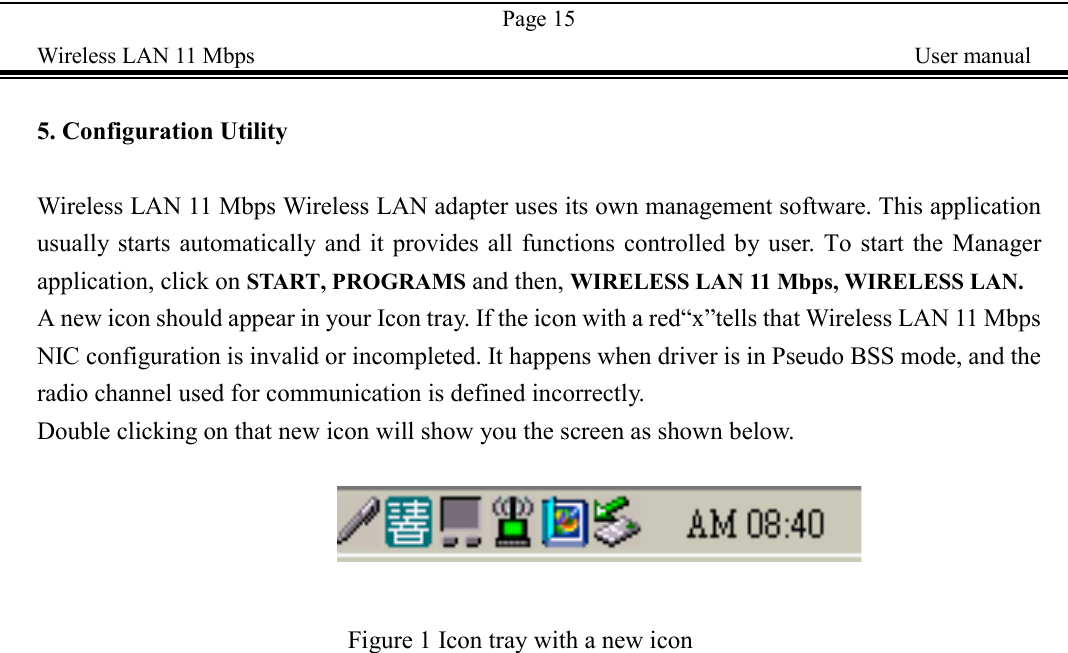
Page 15Wireless LAN 11 Mbps    User manual5. Configuration UtilityWireless LAN 11 Mbps Wireless LAN adapter uses its own management software. This applicationusually starts automatically and it provides all functions controlled by user. To start the Managerapplication, click on START, PROGRAMS and then, WIRELESS LAN 11 Mbps, WIRELESS LAN.A new icon should appear in your Icon tray. If the icon with a red“x”tells that Wireless LAN 11 MbpsNIC configuration is invalid or incompleted. It happens when driver is in Pseudo BSS mode, and theradio channel used for communication is defined incorrectly.Double clicking on that new icon will show you the screen as shown below.                               Figure 1 Icon tray with a new icon
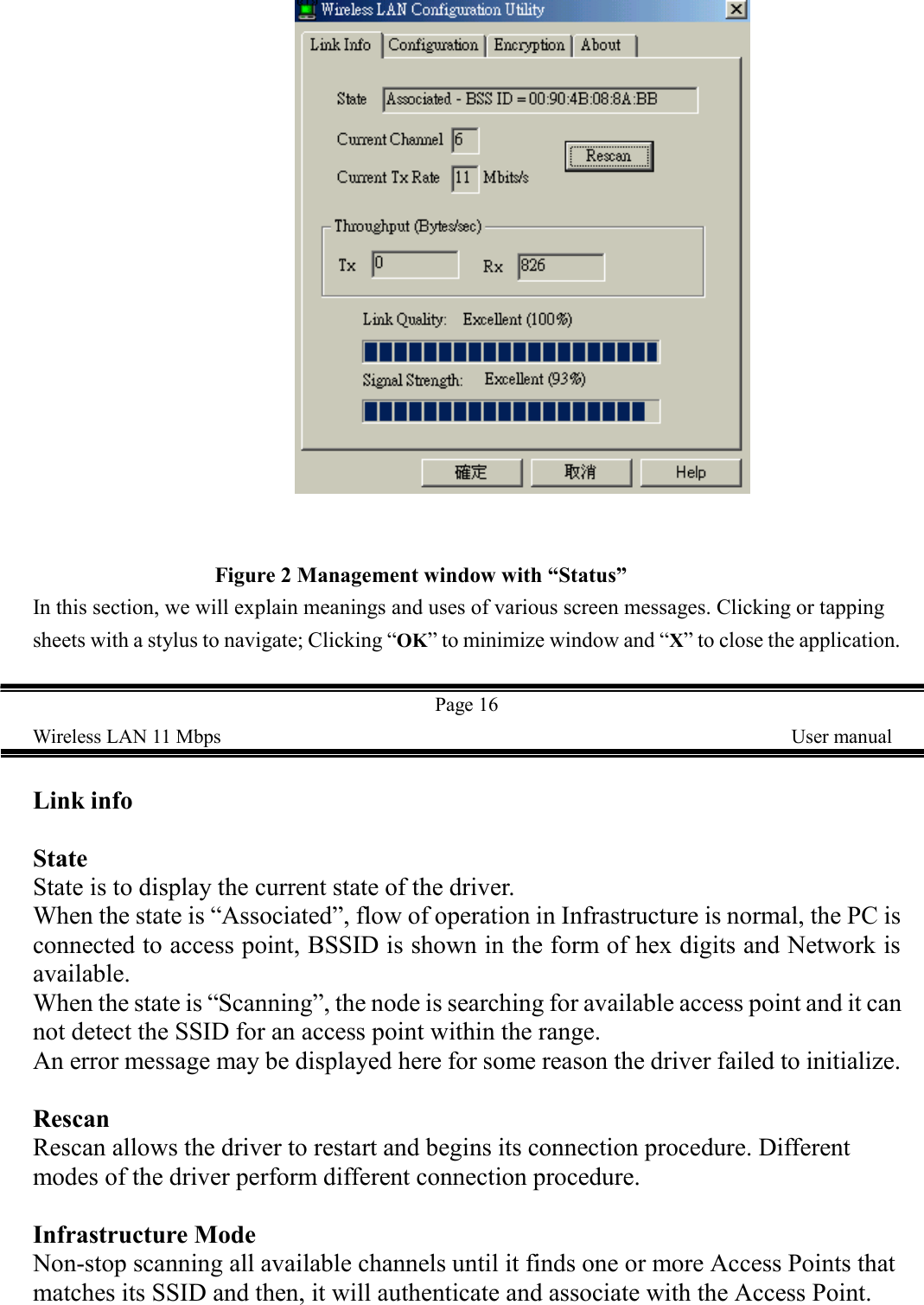
                                                     Figure 2 Management window with “Status”In this section, we will explain meanings and uses of various screen messages. Clicking or tappingsheets with a stylus to navigate; Clicking “OK” to minimize window and “X” to close the application.Page 16Wireless LAN 11 Mbps    User manualLink infoStateState is to display the current state of the driver.When the state is “Associated”, flow of operation in Infrastructure is normal, the PC isconnected to access point, BSSID is shown in the form of hex digits and Network isavailable.When the state is “Scanning”, the node is searching for available access point and it cannot detect the SSID for an access point within the range.An error message may be displayed here for some reason the driver failed to initialize.RescanRescan allows the driver to restart and begins its connection procedure. Differentmodes of the driver perform different connection procedure.Infrastructure ModeNon-stop scanning all available channels until it finds one or more Access Points thatmatches its SSID and then, it will authenticate and associate with the Access Point.
Ad Hoc ModeIt will scan for 5 seconds searching for an existing Ad Hoc network that uses the sameSSID. While not found, it will start its own Ad Hoc network.Current Channel and Tx RateHere displays the channel of the radio and transmit rate that are currently used for anactive connection. If radio is “Scanning”, there is no particular meaning.ThroughputHere displays the instantaneous wireless Receive and Transmit throughput in bytes persecond. They are updated every two seconds.Page 17Wireless LAN 11 Mbps    User manualLink Quality bar graphThis is active only when the node is in Infrastructure Mode. Here displays the qualityof the link between the node and its Access Point. One of the following statuses will beindicated by the quality of the link over the bar graph:! Not Applicable! Poor! Fair! Good! ExcellentSince link Quality is a measure of receives and transmits errors over the radio, thedriver will start looking for a better Access Point when the Link Quality indicationdisplays “Poor”.Signal Strength bar graphIt is active only when the node is in Infrastructure Mode. Here displays normalizedsignal strength as reported by the radio, averaged over all frames over 100 bytes longthat are received from the Access Point.
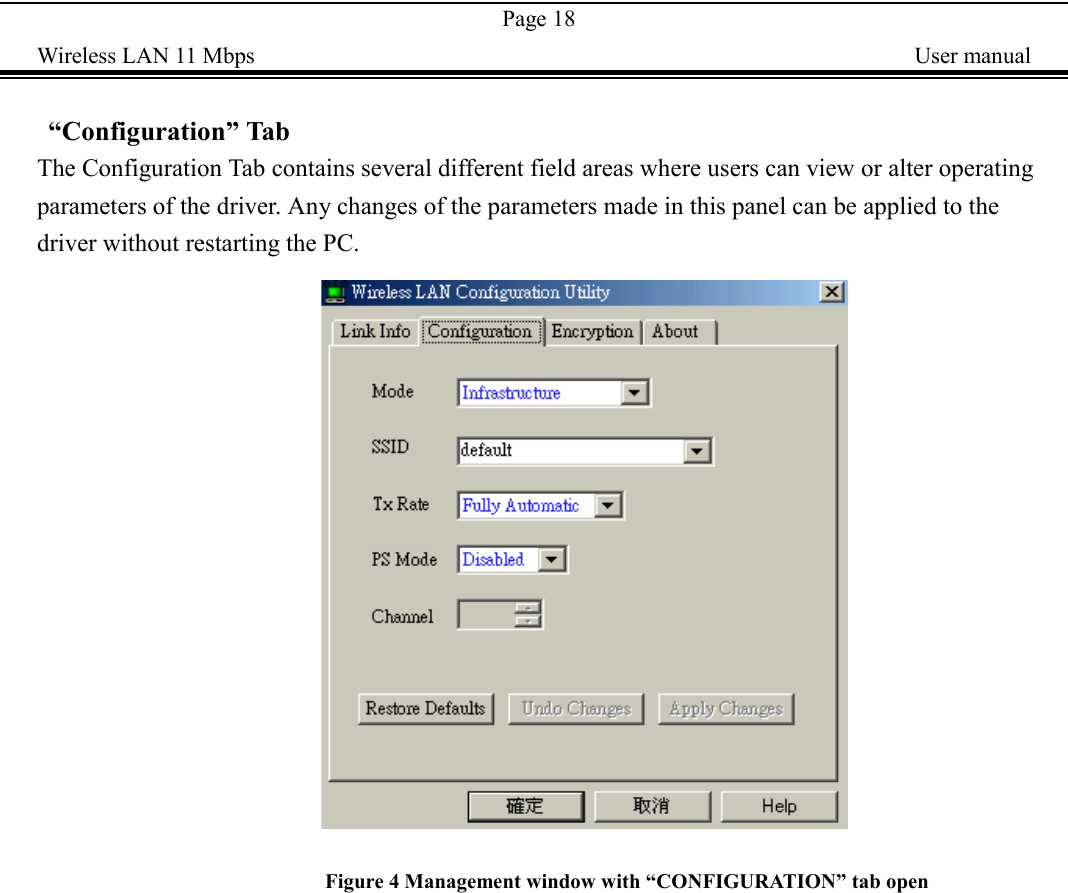
Page 18Wireless LAN 11 Mbps    User manual “Configuration” TabThe Configuration Tab contains several different field areas where users can view or alter operatingparameters of the driver. Any changes of the parameters made in this panel can be applied to thedriver without restarting the PC.                                                                                                Figure 4 Management window with “CONFIGURATION” tab open
Restore DefaultsClicking on Restore Defaults will restore each field in the panel to its default value. However, the“Apply Changes” or “OK” button must be selected before the default values are saved to the driverand registry.Undo ChangesClicking on Undo Changes will revert all fields in the panel back to the original values that werepresented previously while the Configuration Utility was opened from the Task Bar.Apply ChangesIt is active only when one of the fields has been altered. Clicking on the Apply Changes will apply thealtered values to the driver and saves them to the registry for the next time PC restarts.Page 19Wireless LAN 11 Mbps    User manualModeThis field enables you to choose from a list of supported Network “Modes”. The modesshown will have three values, i.e. 802.11Ad Hoc, Ad Hoc and infrastructure.  ! 802.11 Ad Hoc: The 802.11 peer-to-peer mode of operation. 802.11 Ad Hocnetworking use the same SSID for establishing the wireless connection. In802.11Ad Hoc, only one wireless “cell” is supported for each different SSID. Allcommunication is performed from Client to Client without using an Access Point.! Ad Hoc: Ad Hoc is a non-compliant mode that allows Prism2 cards (only Prism2)to talk with one another without the use of an AP (regardless any SSID). It is notstandards compliant so that it would have the interpretability with non-Prism2radios.! Infrastructure: Here, all communication is performed via an Access Point thatrelay packets to other wireless Clients in the BSS and nodes on a wired network.(E.g. Ethernet.) This mode of operation requires the presence of an 802.11 AccessPoint.! TX Rate: This is the transmission rate where the data packets are transmitted bythe client of an AP. You can set this to fixed 1 Mbps, fixed 2Mbps, fixed 5.5 Mbpsor 11 Mbps.! PS Mode – Power Saving Mode.
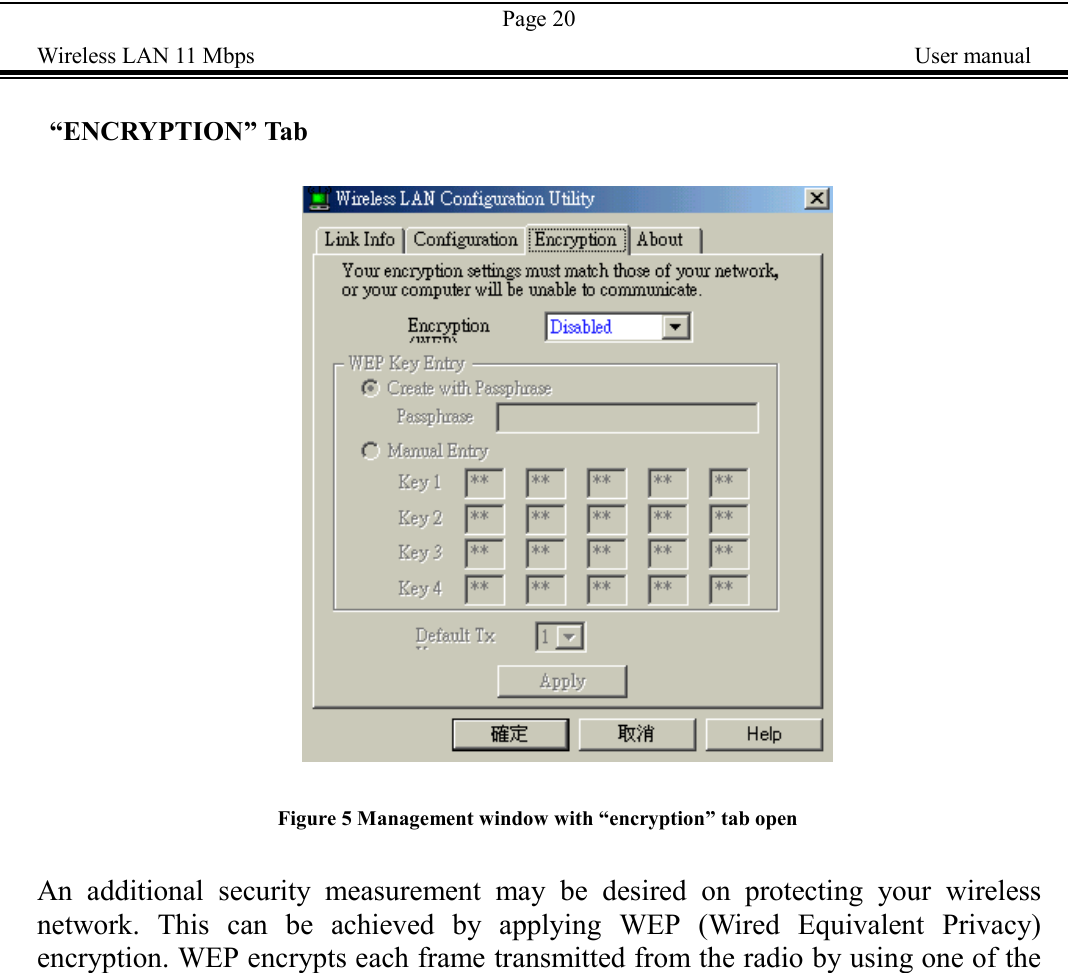
Page 20Wireless LAN 11 Mbps    User manual “ENCRYPTION” Tab                                                 Figure 5 Management window with “encryption” tab openAn additional security measurement may be desired on protecting your wirelessnetwork. This can be achieved by applying WEP (Wired Equivalent Privacy)encryption. WEP encrypts each frame transmitted from the radio by using one of the
Keys entered from this panel.An encrypted frame received can be accepted only when it decrypts correctly. Thishappens only when the receiver has the same WEP Key used by the transmitter.According to the WEP function selected, this panel allows the entry of four keys for64-bit encryption and one set of 128-bit key. To be written to the driver and registry,each key must consists of six digits meaning from digit 0-9 and letters A-F that arerecognized as valid entries. If entered wrongly, program will not write keys to a driver.On the other hand, a Pass-phrase can be entered (known as a “seed”) to randomlyorganize the four keys. This saves significant timing since the same keys must beentered into each node on the wireless network.Page 21Wireless LAN 11 Mbps    User manualKey 1 – Key 4The Keys can be entered manually in these four fields. It may be necessary if youprefer this node to match keys in a different vendor’s product. If they are organized byusing a Pass-phrase, the Keys are displayed in these fields.Default Tx KeyFor 128 bit encryption, this Default Tx Key button will be invisible. Default Tx Keyupdates the driver with the four keys that are displayed in key 1 through key4. The keysare also written to the registry for permanent storage.ApplyThis Apply button updates the driver with the four keys displayed in Key1 throughKey4. The keys are also written to the registry for permanent storage. This Applybutton clears all the bytes in the four keys. It is useful when you wish to start over andapply manually entering.
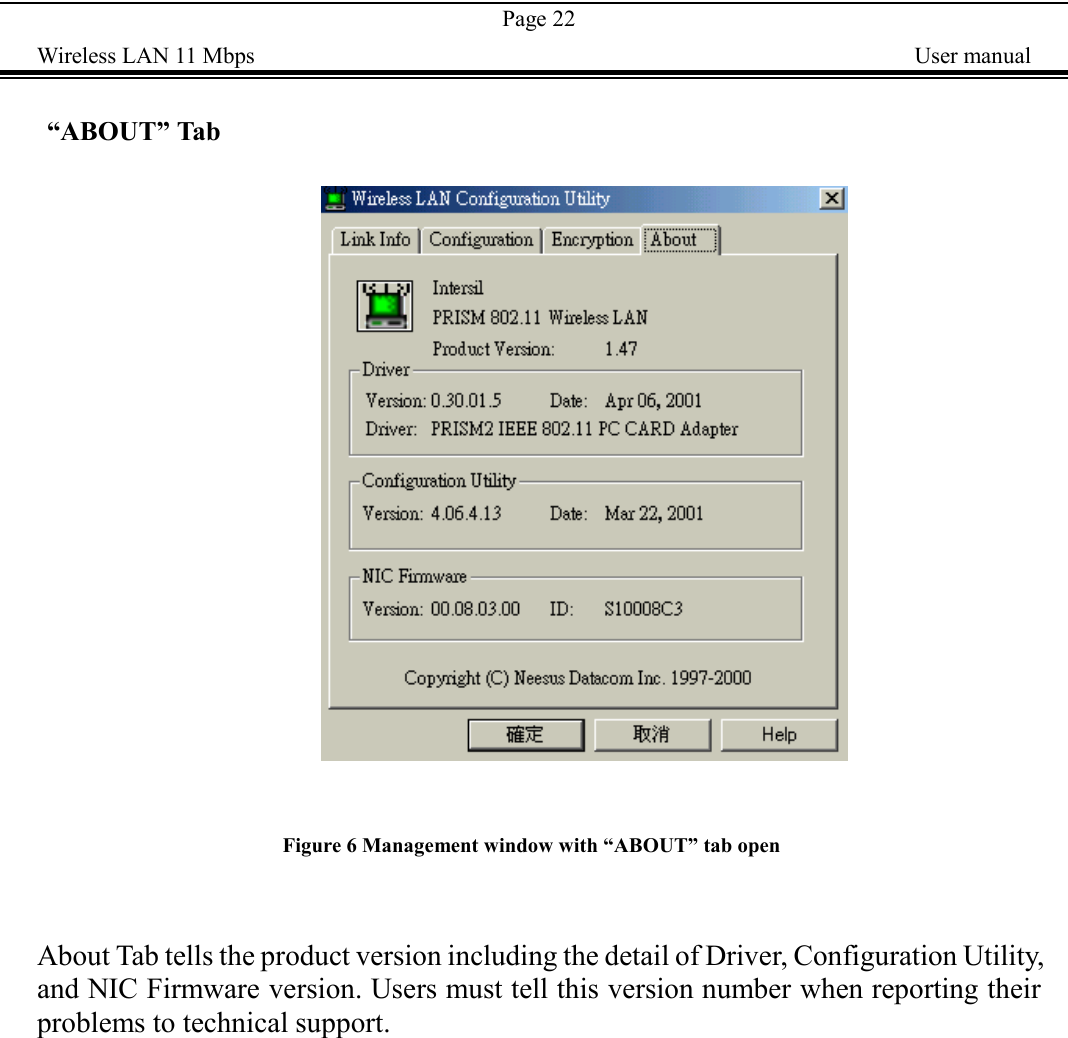
Page 22Wireless LAN 11 Mbps    User manual “ABOUT” Tab                                               Figure 6 Management window with “ABOUT” tab openAbout Tab tells the product version including the detail of Driver, Configuration Utility,and NIC Firmware version. Users must tell this version number when reporting theirproblems to technical support.
Page 23Wireless LAN 11 Mbps    User manual6. TroubleshootingTo have the installation of Wireless LAN Card more users friendly, we suggest usersfollowing the installation procedures step by step as listed in the section 4 and section 5.If some problems occur when installing the WLAN Card OR you want to confirm ifyour card is installed properly, here are the procedures for checking the variouscomponents after you have installed the card.First part of Troubleshooting contains suggestions to users to check various propertiesof the card for the proper installation. In second section lists various problems that mayoccur during the installation as well as the possible solutions. It is recommended thatusers check the first part to identify the probable reason of unsuccessful installation.Procedure to Check the Various Properties of Card after Installation underWindows 95 (OSR2)/98:If some problems occurred while installing the PC card OR your PC Card is notfunctioning, please check the followings:I. Click on the CONTROL PANEL and then PC CARD. Check if it hasWIRELESS 11Mbps PC CARD in one of the sockets. If it is in one of thesockets, the card is detected properly. If there is YELLOW sign question-mark (?), the resources are conflicting.II. Right click on MY COMPUTER and then PROPERTIES. Choose theDEVICE MANAGER and click on the NETWORK ADAPTER. You willsee WIRELESS 11Mbps PC CARD if it is installed successfully. If there isYELLOW sign (?), the resources are conflicting. Click on PCMCIA CARDand then PCMCIA CARD SERVICE, you will see the status of PCMCIAcard. If there is yellow sign (?) either on adapter or PCMCIA card, pleasecheck the followings,! Check if your Notebook supports 3.3V card.! Check if your Notebook has a free IRQ. If not, make an IRQ free by
assigning the same IRQ to some devices, for example COM 1, COM 2con be assigned same IRQ values.! Check if you have inserted the correct card and have installed the properdriver.Page 24Wireless LAN 11 Mbps    User manualProcedure to Check the Various Properties of Card after Installation underWindows NT4.0:If some problems occurred while installing the PC card OR your PC Card is notfunctioning, please check the followings:I. Check the WINDOWS NT DIAGNOSTICS. You should see whether thereis conflict in the RESOURCE allocation or the I/O ADDRESS, IRQallocations. If the IRQ or I/O addresses are already assigned to some otherdevices, you must change that value, i.e. I/O address needs 40h byte length.II. Click on the CONTROL PANEL and then, on the PC CARD, you will seeWIRELESS 11Mbps PC CARD. Click on that will show you the CARDINFORMATION, DRIVER NAME and the DRIVER FILE. You mustconfirm the name of the driver and the driver file as “cw10” and “cw10.sys”.If you do not find the names as listed before, there are some problems and thedriver is not installed properly. Reinstall the driver.NOTE: Check the PnP BIOS setup menu and select NO in case of theWireless LAN Card installation.
Page 25Wireless LAN 11 Mbps    User manual7. Technical specifications of Wireless LANHardware compatibility- IBM-compatible computer with a PC Card Type‖Driver support- Windows 95 OSR2- Windows 98- Windows 2000- Windows ME- Windows NT 4.0 and higherStandards supported- IEEE 802.11 standard for Wireless LAN- All major networking standards (including TCP/IP, IPX)EnvironmentalOperating voltage:- +5V, +3.3V DC ±5%- Nominal Temp Range:    17 dBm- Extended Temp Range:    14 dBm min- Transmit Power, 2.7v to 3v:    14 dBm min.Radio specificationsRange:- per cell indoors approx. 35-100 meters or more- per cell outdoors up to 100-300 metersFrequency range:- 2.4-2.4835 GHz, direct sequence spread spectrumNumber of Channels:- Europe: 13(3 non-overlapping)- US: 11 (3 non-overlapping)
Page 26Wireless LAN 11 Mbps    User manual- France: 4 (1 non-overlapping)- Japan: 14 (4 non-overlapping)Antenna system:- Internal patch antenna supporting diversity.Mobility:- Seamless roaming across cell boundaries with handoverSpecific featuresSupported bit rates:- 11Mbps- 5.5 Mbps- 1 Mbps- 2 MbpsData encryption:- 64/128 bit WEP EncryptionUtility Software:- Management utility softwarePage27

Navigation menu