Ranger Communications TR-286 AM/SSB CB Transceiver User Manual

Ranger Communications (M) SDN. BHD. AM/SSB CB Transceiver Users Manual

Users Manual

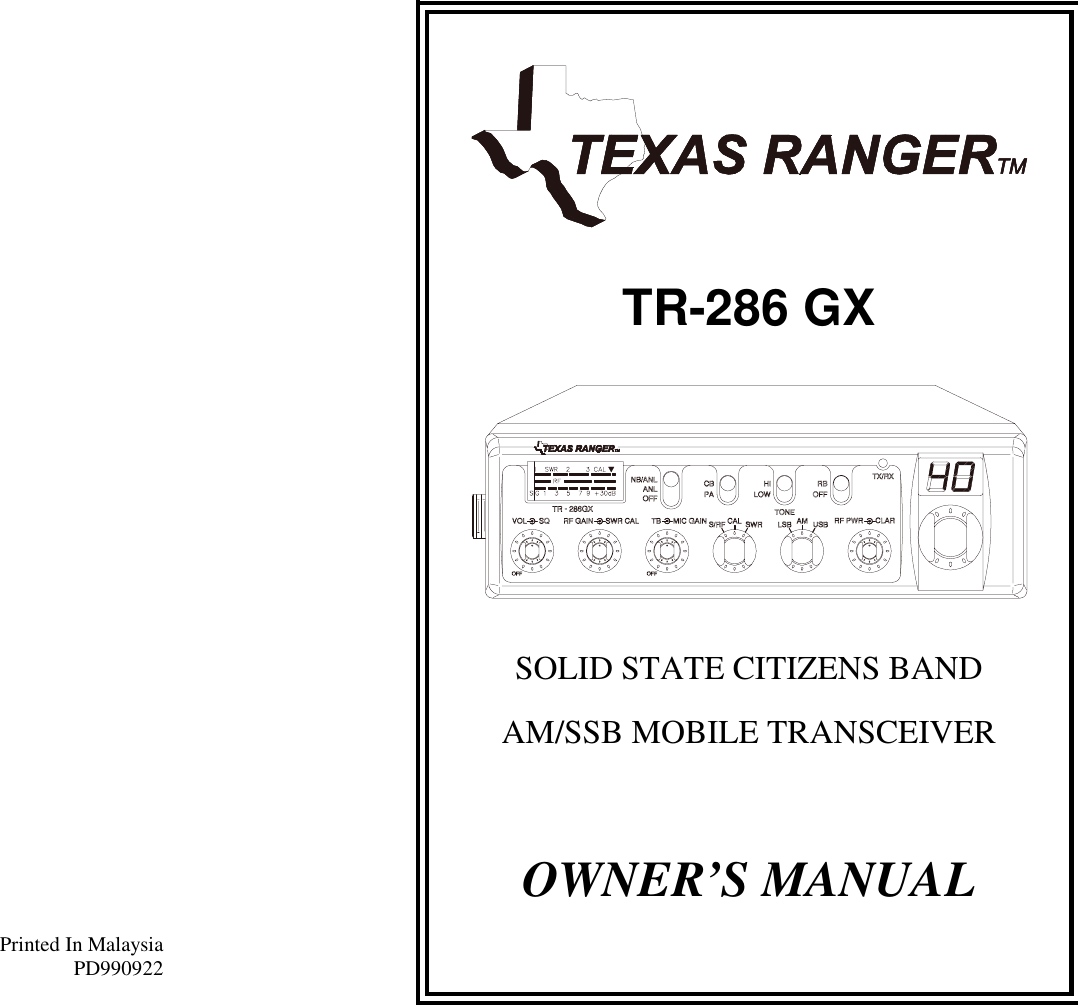
Printed In MalaysiaPD990922TR-286 GXSOLID STATE CITIZENS BANDAM/SSB MOBILE TRANSCEIVEROWNER’S MANUAL
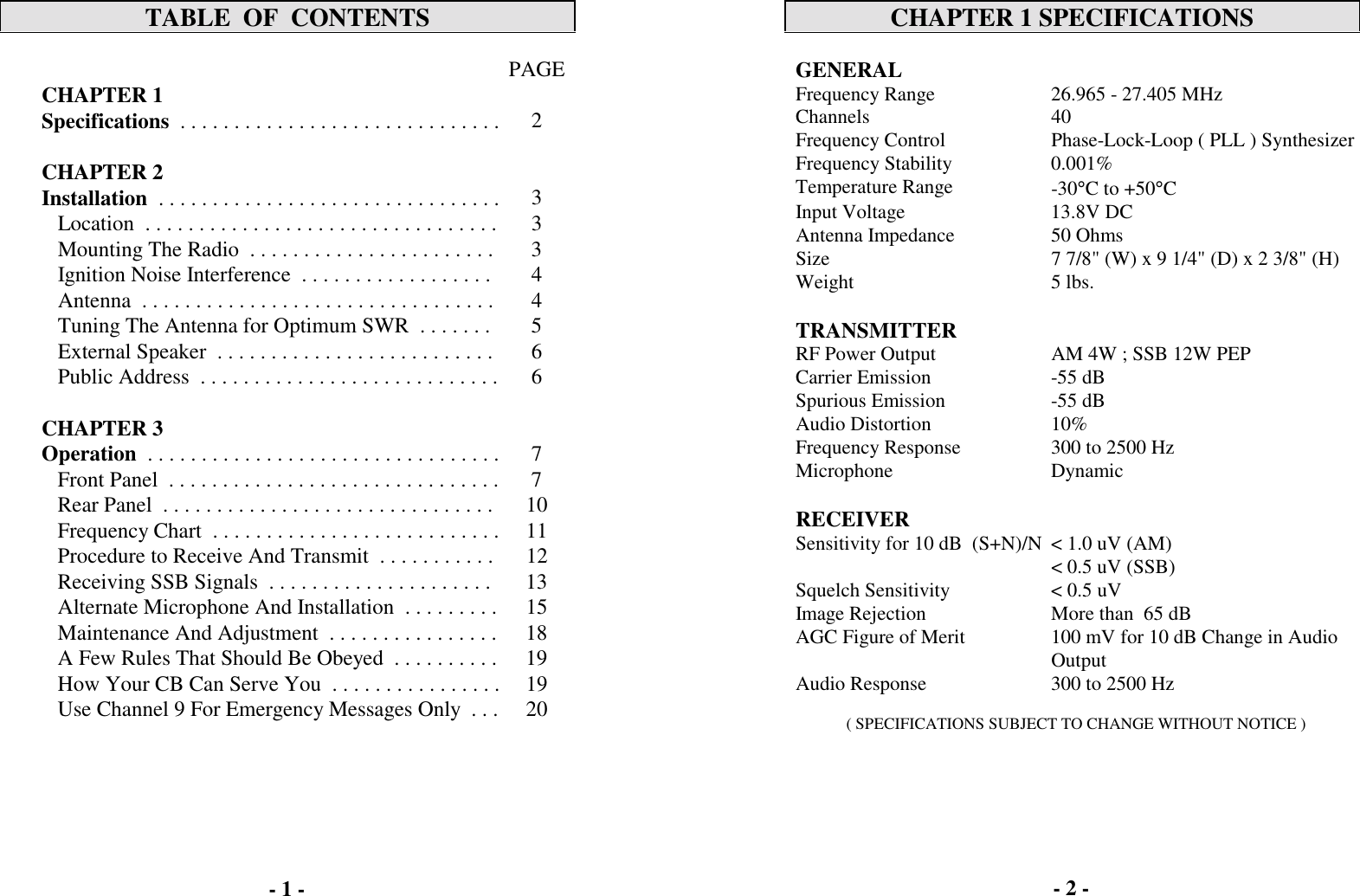
TABLE  OF  CONTENTSPAGECHAPTER 1  Specifications  . . . . . . . . . . . . . . . . . . . . . . . . . . . . . . 2CHAPTER 2Installation  . . . . . . . . . . . . . . . . . . . . . . . . . . . . . . . . 3   Location  . . . . . . . . . . . . . . . . . . . . . . . . . . . . . . . . . 3   Mounting The Radio  . . . . . . . . . . . . . . . . . . . . . . . 3   Ignition Noise Interference  . . . . . . . . . . . . . . . . . . 4   Antenna  . . . . . . . . . . . . . . . . . . . . . . . . . . . . . . . . . 4   Tuning The Antenna for Optimum SWR  . . . . . . . 5   External Speaker  . . . . . . . . . . . . . . . . . . . . . . . . . . 6   Public Address  . . . . . . . . . . . . . . . . . . . . . . . . . . . . 6CHAPTER 3  Operation  . . . . . . . . . . . . . . . . . . . . . . . . . . . . . . . . . 7   Front Panel  . . . . . . . . . . . . . . . . . . . . . . . . . . . . . . . 7   Rear Panel  . . . . . . . . . . . . . . . . . . . . . . . . . . . . . . . 10   Frequency Chart  . . . . . . . . . . . . . . . . . . . . . . . . . . . 11   Procedure to Receive And Transmit  . . . . . . . . . . . 12   Receiving SSB Signals  . . . . . . . . . . . . . . . . . . . . . 13   Alternate Microphone And Installation  . . . . . . . . . 15   Maintenance And Adjustment  . . . . . . . . . . . . . . . . 18   A Few Rules That Should Be Obeyed  . . . . . . . . . . 19   How Your CB Can Serve You  . . . . . . . . . . . . . . . . 19   Use Channel 9 For Emergency Messages Only  . . . 20CHAPTER 1 SPECIFICATIONSGENERALFrequency Range 26.965 - 27.405 MHzChannels 40Frequency Control Phase-Lock-Loop ( PLL ) SynthesizerFrequency Stability 0.001%Temperature Range -30°C to +50°CInput Voltage 13.8V DCAntenna Impedance 50 OhmsSize 7 7/8" (W) x 9 1/4" (D) x 2 3/8" (H)Weight 5 lbs.TRANSMITTERRF Power Output AM 4W ; SSB 12W PEPCarrier Emission -55 dBSpurious Emission -55 dBAudio Distortion 10%Frequency Response 300 to 2500 HzMicrophone DynamicRECEIVERSensitivity for 10 dB  (S+N)/N < 1.0 uV (AM)< 0.5 uV (SSB)Squelch Sensitivity < 0.5 uVImage Rejection More than  65 dBAGC Figure of Merit 100 mV for 10 dB Change in AudioOutputAudio Response 300 to 2500 Hz( SPECIFICATIONS SUBJECT TO CHANGE WITHOUT NOTICE )- 1 - - 2 -
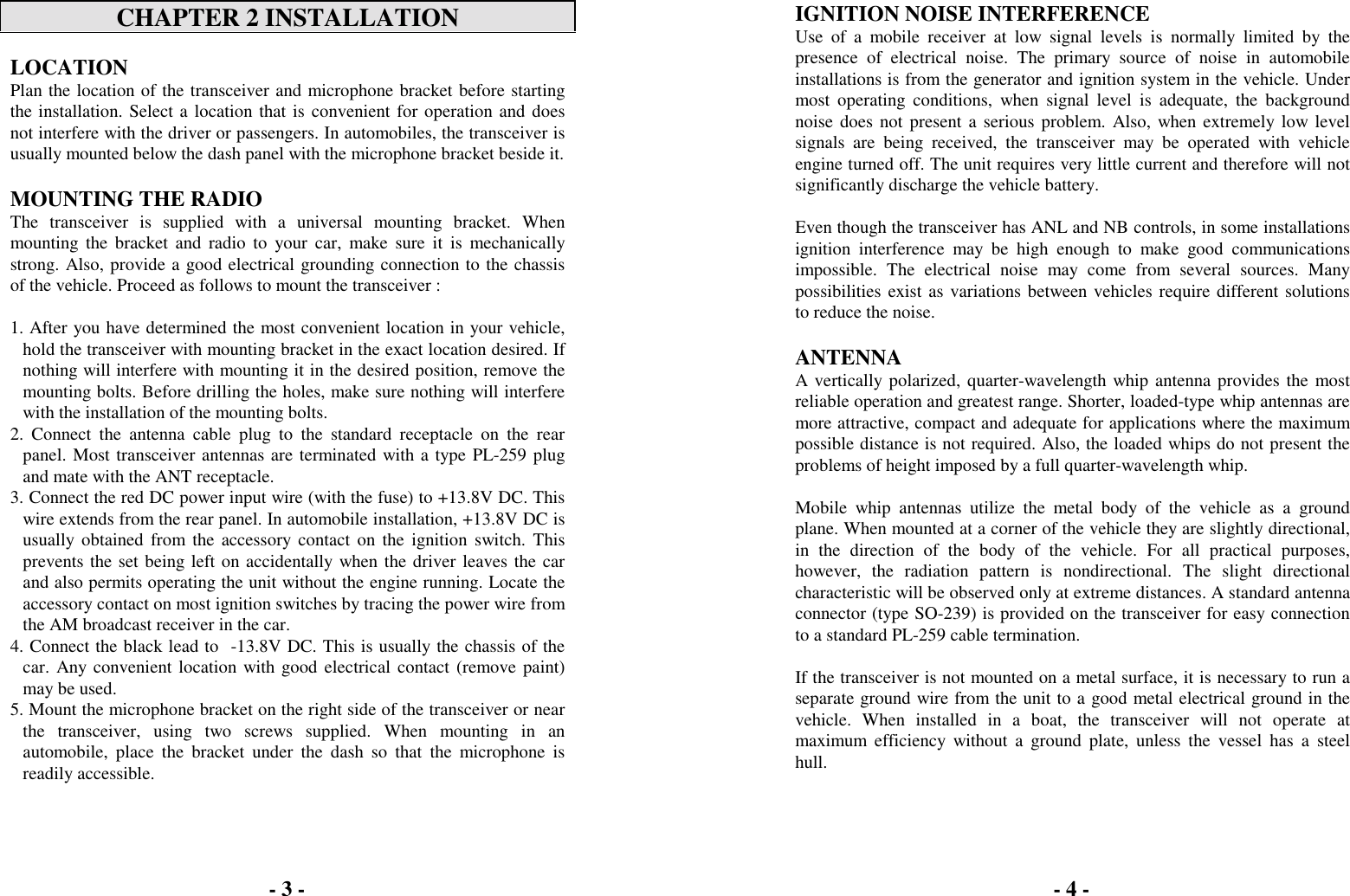
CHAPTER 2 INSTALLATIONLOCATIONPlan the location of the transceiver and microphone bracket before startingthe installation. Select a location that is convenient for operation and doesnot interfere with the driver or passengers. In automobiles, the transceiver isusually mounted below the dash panel with the microphone bracket beside it.MOUNTING THE RADIOThe transceiver is supplied with a universal mounting bracket. Whenmounting the bracket and radio to your car, make sure it is mechanicallystrong. Also, provide a good electrical grounding connection to the chassisof the vehicle. Proceed as follows to mount the transceiver :1. After you have determined the most convenient location in your vehicle,hold the transceiver with mounting bracket in the exact location desired. Ifnothing will interfere with mounting it in the desired position, remove themounting bolts. Before drilling the holes, make sure nothing will interferewith the installation of the mounting bolts.2. Connect the antenna cable plug to the standard receptacle on the rearpanel. Most transceiver antennas are terminated with a type PL-259 plugand mate with the ANT receptacle.3. Connect the red DC power input wire (with the fuse) to +13.8V DC. Thiswire extends from the rear panel. In automobile installation, +13.8V DC isusually obtained from the accessory contact on the ignition switch. Thisprevents the set being left on accidentally when the driver leaves the carand also permits operating the unit without the engine running. Locate theaccessory contact on most ignition switches by tracing the power wire fromthe AM broadcast receiver in the car.4. Connect the black lead to  -13.8V DC. This is usually the chassis of thecar. Any convenient location with good electrical contact (remove paint)may be used.5. Mount the microphone bracket on the right side of the transceiver or nearthe transceiver, using two screws supplied. When mounting in anautomobile, place the bracket under the dash so that the microphone isreadily accessible.IGNITION NOISE INTERFERENCEUse of a mobile receiver at low signal levels is normally limited by thepresence of electrical noise. The primary source of noise in automobileinstallations is from the generator and ignition system in the vehicle. Undermost operating conditions, when signal level is adequate, the backgroundnoise does not present a serious problem. Also, when extremely low levelsignals are being received, the transceiver may be operated with vehicleengine turned off. The unit requires very little current and therefore will notsignificantly discharge the vehicle battery.Even though the transceiver has ANL and NB controls, in some installationsignition interference may be high enough to make good communicationsimpossible. The electrical noise may come from several sources. Manypossibilities exist as variations between vehicles require different solutionsto reduce the noise.ANTENNAA vertically polarized, quarter-wavelength whip antenna provides the mostreliable operation and greatest range. Shorter, loaded-type whip antennas aremore attractive, compact and adequate for applications where the maximumpossible distance is not required. Also, the loaded whips do not present theproblems of height imposed by a full quarter-wavelength whip.Mobile whip antennas utilize the metal body of the vehicle as a groundplane. When mounted at a corner of the vehicle they are slightly directional,in the direction of the body of the vehicle. For all practical purposes,however, the radiation pattern is nondirectional. The slight directionalcharacteristic will be observed only at extreme distances. A standard antennaconnector (type SO-239) is provided on the transceiver for easy connectionto a standard PL-259 cable termination.If the transceiver is not mounted on a metal surface, it is necessary to run aseparate ground wire from the unit to a good metal electrical ground in thevehicle. When installed in a boat, the transceiver will not operate atmaximum efficiency without a ground plate, unless the vessel has a steelhull.- 3 - - 4 -
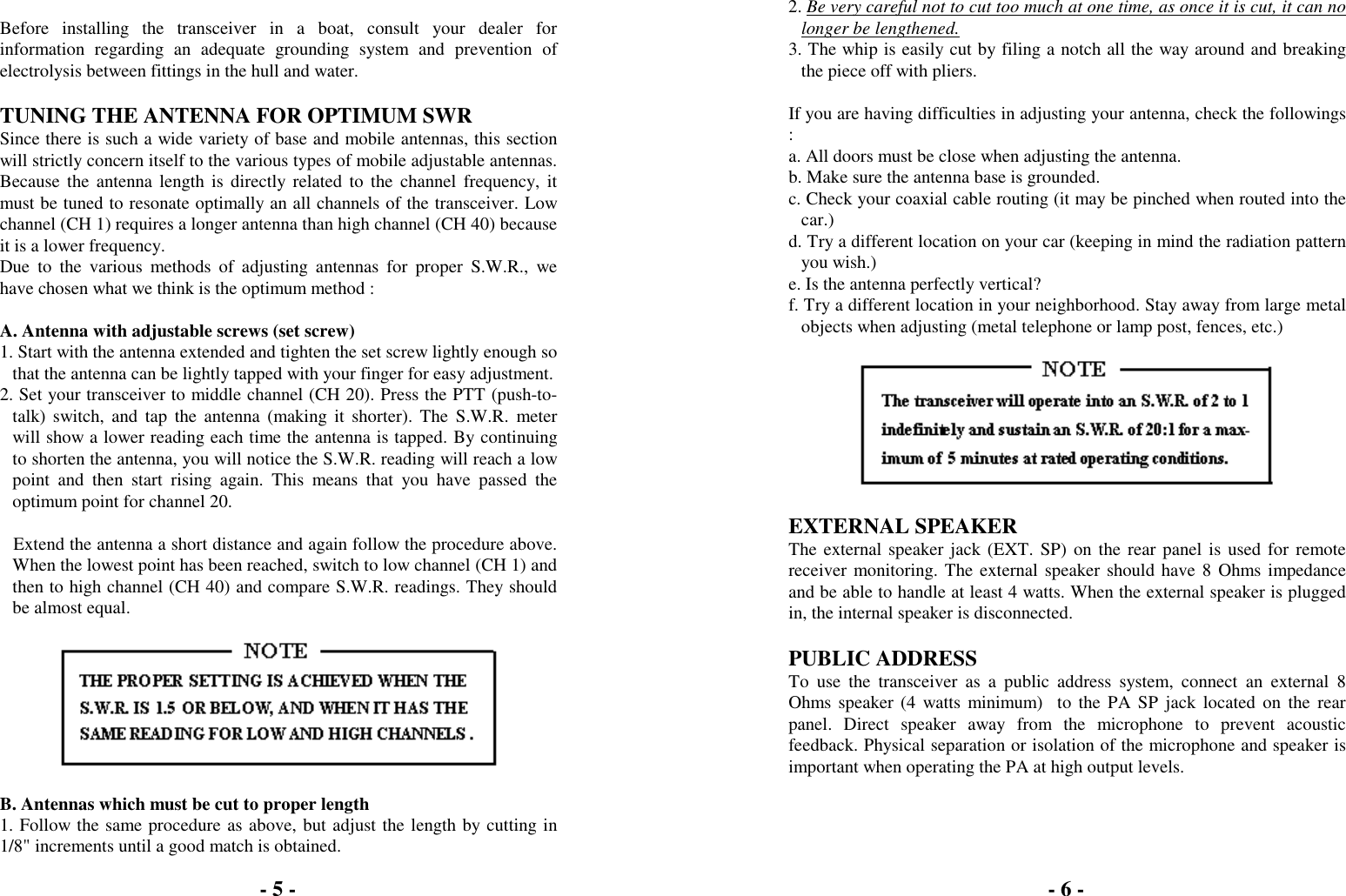
Before installing the transceiver in a boat, consult your dealer forinformation regarding an adequate grounding system and prevention ofelectrolysis between fittings in the hull and water.TUNING THE ANTENNA FOR OPTIMUM SWRSince there is such a wide variety of base and mobile antennas, this sectionwill strictly concern itself to the various types of mobile adjustable antennas.Because the antenna length is directly related to the channel frequency, itmust be tuned to resonate optimally an all channels of the transceiver. Lowchannel (CH 1) requires a longer antenna than high channel (CH 40) becauseit is a lower frequency.Due to the various methods of adjusting antennas for proper S.W.R., wehave chosen what we think is the optimum method :A. Antenna with adjustable screws (set screw)1. Start with the antenna extended and tighten the set screw lightly enough sothat the antenna can be lightly tapped with your finger for easy adjustment.2. Set your transceiver to middle channel (CH 20). Press the PTT (push-to-talk) switch, and tap the antenna (making it shorter). The S.W.R. meterwill show a lower reading each time the antenna is tapped. By continuingto shorten the antenna, you will notice the S.W.R. reading will reach a lowpoint and then start rising again. This means that you have passed theoptimum point for channel 20.   Extend the antenna a short distance and again follow the procedure above.When the lowest point has been reached, switch to low channel (CH 1) andthen to high channel (CH 40) and compare S.W.R. readings. They shouldbe almost equal.B. Antennas which must be cut to proper length1. Follow the same procedure as above, but adjust the length by cutting in1/8" increments until a good match is obtained.2. Be very careful not to cut too much at one time, as once it is cut, it can nolonger be lengthened.3. The whip is easily cut by filing a notch all the way around and breakingthe piece off with pliers.If you are having difficulties in adjusting your antenna, check the followings:a. All doors must be close when adjusting the antenna.b. Make sure the antenna base is grounded.c. Check your coaxial cable routing (it may be pinched when routed into thecar.)d. Try a different location on your car (keeping in mind the radiation patternyou wish.)e. Is the antenna perfectly vertical?f. Try a different location in your neighborhood. Stay away from large metalobjects when adjusting (metal telephone or lamp post, fences, etc.)EXTERNAL SPEAKERThe external speaker jack (EXT. SP) on the rear panel is used for remotereceiver monitoring. The external speaker should have 8 Ohms impedanceand be able to handle at least 4 watts. When the external speaker is pluggedin, the internal speaker is disconnected.PUBLIC ADDRESSTo use the transceiver as a public address system, connect an external 8Ohms speaker (4 watts minimum)  to the PA SP jack located on the rearpanel. Direct speaker away from the microphone to prevent acousticfeedback. Physical separation or isolation of the microphone and speaker isimportant when operating the PA at high output levels.- 5 - - 6 -
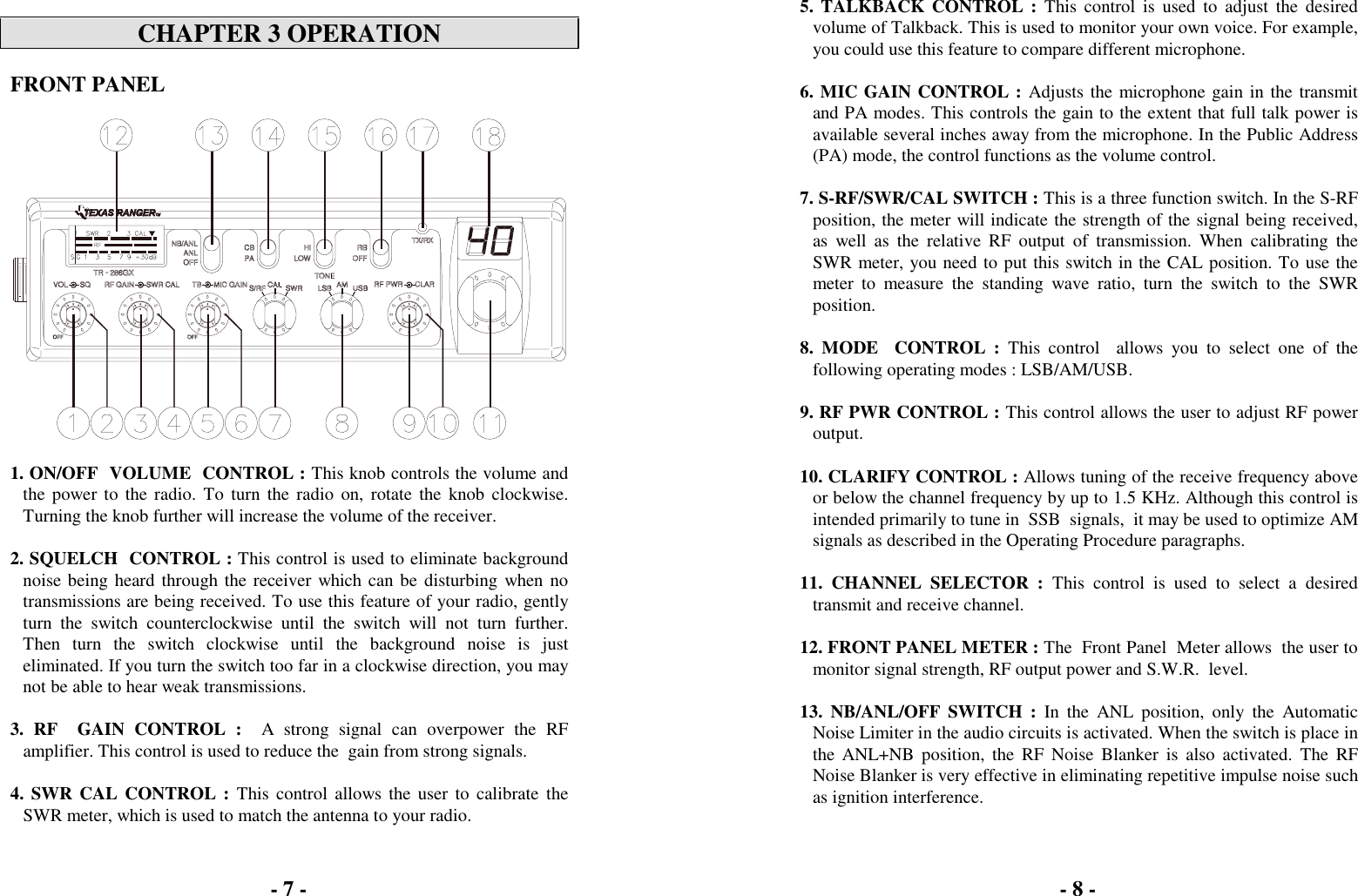
CHAPTER 3 OPERATIONFRONT PANEL1. ON/OFF  VOLUME  CONTROL : This knob controls the volume andthe power to the radio. To turn the radio on, rotate the knob clockwise.Turning the knob further will increase the volume of the receiver.2. SQUELCH  CONTROL : This control is used to eliminate backgroundnoise being heard through the receiver which can be disturbing when notransmissions are being received. To use this feature of your radio, gentlyturn the switch counterclockwise until the switch will not turn further.Then turn the switch clockwise until the background noise is justeliminated. If you turn the switch too far in a clockwise direction, you maynot be able to hear weak transmissions.3. RF  GAIN CONTROL :  A strong signal can overpower the RFamplifier. This control is used to reduce the  gain from strong signals.4. SWR CAL CONTROL : This control allows the user to calibrate theSWR meter, which is used to match the antenna to your radio.5. TALKBACK CONTROL : This control is used to adjust the desiredvolume of Talkback. This is used to monitor your own voice. For example,you could use this feature to compare different microphone.6. MIC GAIN CONTROL : Adjusts the microphone gain in the transmitand PA modes. This controls the gain to the extent that full talk power isavailable several inches away from the microphone. In the Public Address(PA) mode, the control functions as the volume control.7. S-RF/SWR/CAL SWITCH : This is a three function switch. In the S-RFposition, the meter will indicate the strength of the signal being received,as well as the relative RF output of transmission. When calibrating theSWR meter, you need to put this switch in the CAL position. To use themeter to measure the standing wave ratio, turn the switch to the SWRposition.8. MODE  CONTROL : This control  allows you to select one of thefollowing operating modes : LSB/AM/USB.9. RF PWR CONTROL : This control allows the user to adjust RF poweroutput.10. CLARIFY CONTROL : Allows tuning of the receive frequency aboveor below the channel frequency by up to 1.5 KHz. Although this control isintended primarily to tune in  SSB  signals,  it may be used to optimize AMsignals as described in the Operating Procedure paragraphs.11. CHANNEL SELECTOR : This control is used to select a desiredtransmit and receive channel.12. FRONT PANEL METER : The  Front Panel  Meter allows  the user tomonitor signal strength, RF output power and S.W.R.  level.13. NB/ANL/OFF SWITCH : In the ANL position, only the AutomaticNoise Limiter in the audio circuits is activated. When the switch is place inthe ANL+NB position, the RF Noise Blanker is also activated. The RFNoise Blanker is very effective in eliminating repetitive impulse noise suchas ignition interference.- 7 - - 8 -
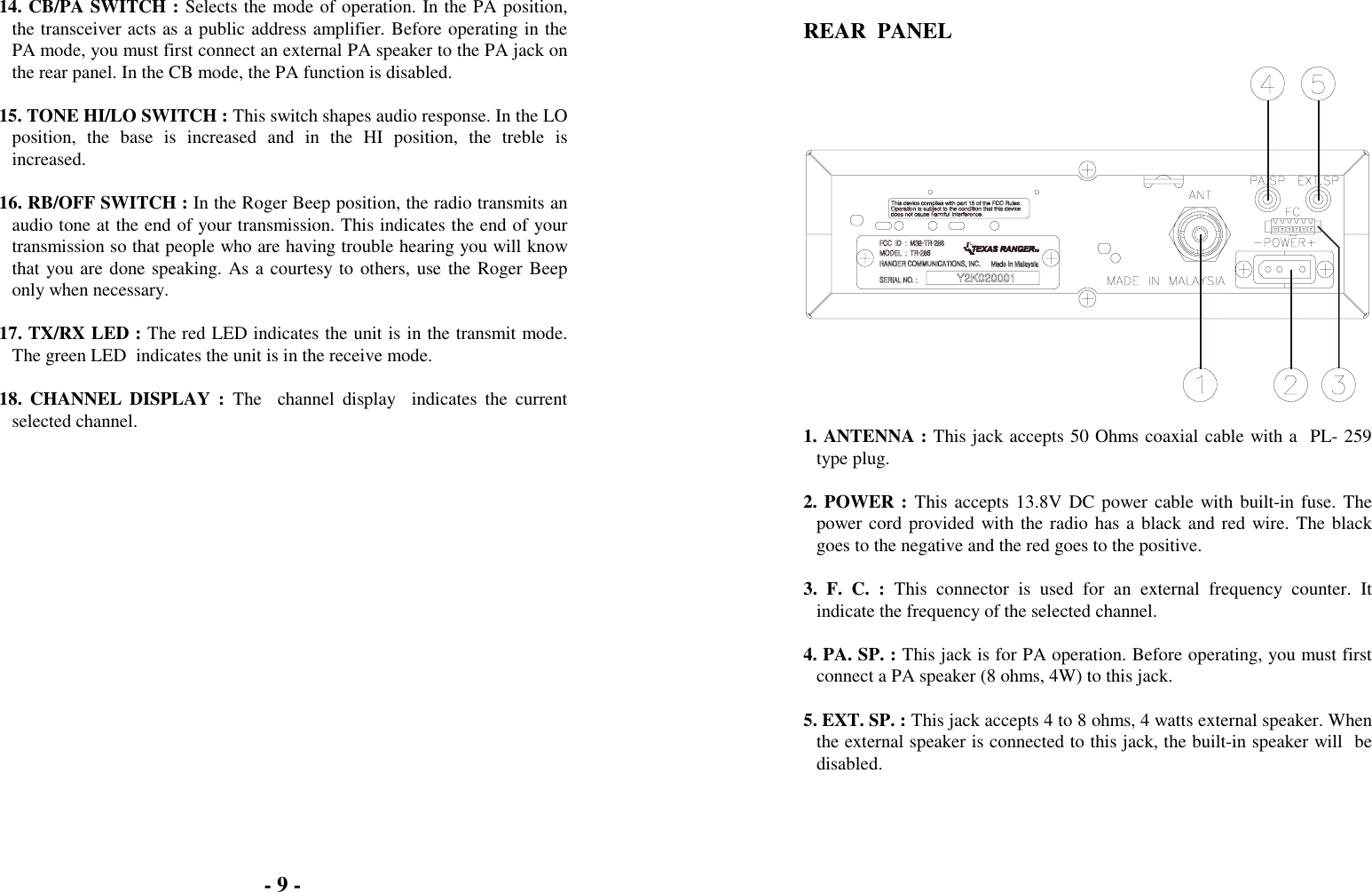
14. CB/PA SWITCH : Selects the mode of operation. In the PA position,the transceiver acts as a public address amplifier. Before operating in thePA mode, you must first connect an external PA speaker to the PA jack onthe rear panel. In the CB mode, the PA function is disabled.15. TONE HI/LO SWITCH : This switch shapes audio response. In the LOposition, the base is increased and in the HI position, the treble isincreased.16. RB/OFF SWITCH : In the Roger Beep position, the radio transmits anaudio tone at the end of your transmission. This indicates the end of yourtransmission so that people who are having trouble hearing you will knowthat you are done speaking. As a courtesy to others, use the Roger Beeponly when necessary.17. TX/RX LED : The red LED indicates the unit is in the transmit mode.The green LED  indicates the unit is in the receive mode.18. CHANNEL DISPLAY : The  channel display  indicates the currentselected channel.REAR  PANEL1. ANTENNA : This jack accepts 50 Ohms coaxial cable with a  PL- 259type plug.2. POWER : This accepts 13.8V DC power cable with built-in fuse. Thepower cord provided with the radio has a black and red wire. The blackgoes to the negative and the red goes to the positive.3. F. C. : This connector is used for an external frequency counter. Itindicate the frequency of the selected channel.4. PA. SP. : This jack is for PA operation. Before operating, you must firstconnect a PA speaker (8 ohms, 4W) to this jack.5. EXT. SP. : This jack accepts 4 to 8 ohms, 4 watts external speaker. Whenthe external speaker is connected to this jack, the built-in speaker will  bedisabled.- 9 -
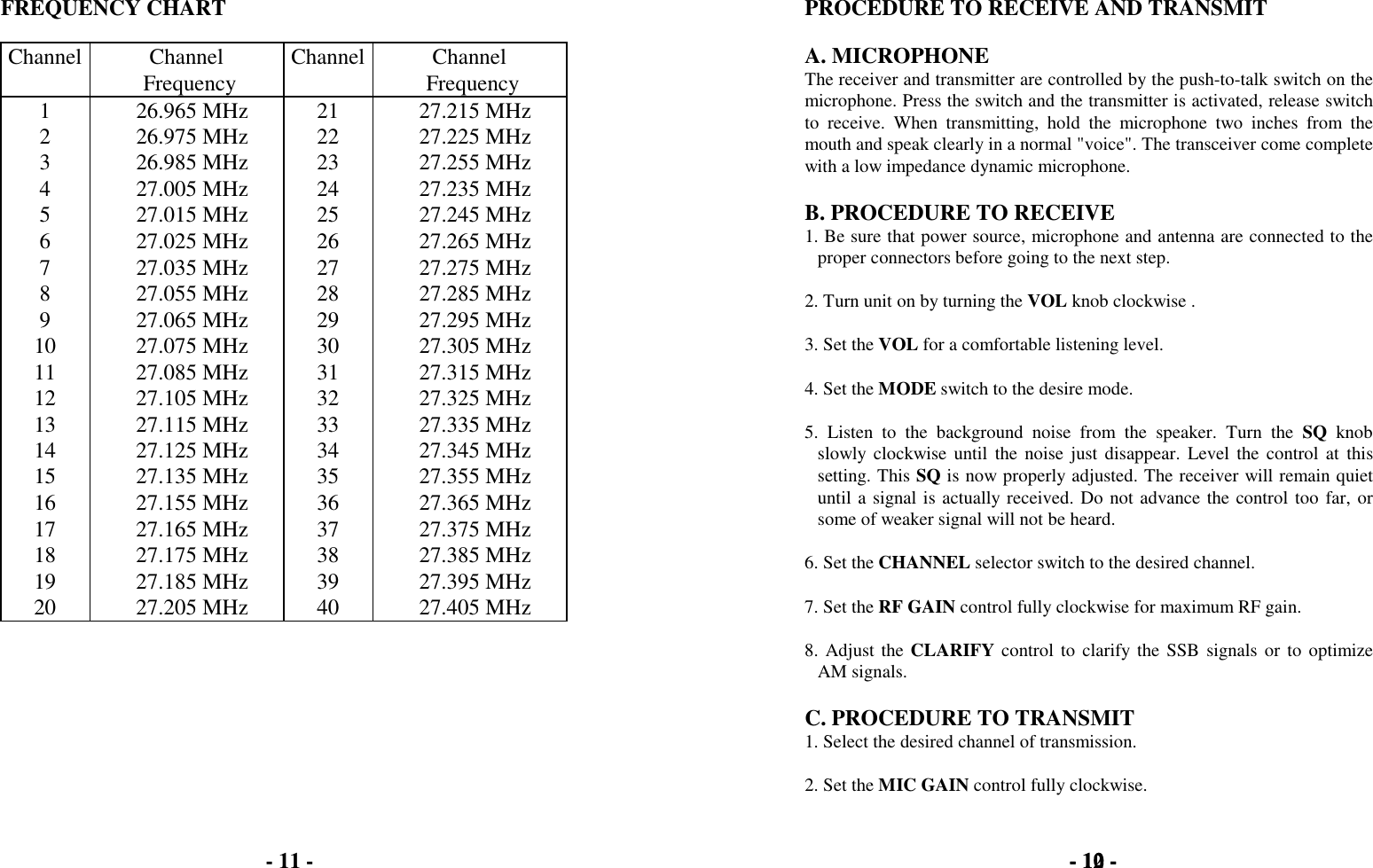
FREQUENCY CHARTChannel Channel Frequency Channel Channel Frequency1   26.965 MHz 21   27.215 MHz2   26.975 MHz 22   27.225 MHz3   26.985 MHz 23   27.255 MHz4   27.005 MHz 24   27.235 MHz5   27.015 MHz 25   27.245 MHz6   27.025 MHz 26   27.265 MHz7   27.035 MHz 27   27.275 MHz8   27.055 MHz 28   27.285 MHz9   27.065 MHz 29   27.295 MHz10   27.075 MHz 30   27.305 MHz11   27.085 MHz 31   27.315 MHz12   27.105 MHz 32   27.325 MHz13   27.115 MHz 33   27.335 MHz14   27.125 MHz 34   27.345 MHz15   27.135 MHz 35   27.355 MHz16   27.155 MHz 36   27.365 MHz17   27.165 MHz 37   27.375 MHz18   27.175 MHz 38   27.385 MHz19   27.185 MHz 39   27.395 MHz20   27.205 MHz 40   27.405 MHzPROCEDURE TO RECEIVE AND TRANSMITA. MICROPHONEThe receiver and transmitter are controlled by the push-to-talk switch on themicrophone. Press the switch and the transmitter is activated, release switchto receive. When transmitting, hold the microphone two inches from themouth and speak clearly in a normal "voice". The transceiver come completewith a low impedance dynamic microphone.B. PROCEDURE TO RECEIVE1. Be sure that power source, microphone and antenna are connected to theproper connectors before going to the next step.2. Turn unit on by turning the VOL knob clockwise .3. Set the VOL for a comfortable listening level.4. Set the MODE switch to the desire mode.5. Listen to the background noise from the speaker. Turn the SQ knobslowly clockwise until the noise just disappear. Level the control at thissetting. This SQ is now properly adjusted. The receiver will remain quietuntil a signal is actually received. Do not advance the control too far, orsome of weaker signal will not be heard.6. Set the CHANNEL selector switch to the desired channel.7. Set the RF GAIN control fully clockwise for maximum RF gain.8. Adjust the CLARIFY control to clarify the SSB signals or to optimizeAM signals.C. PROCEDURE TO TRANSMIT1. Select the desired channel of transmission.2. Set the MIC GAIN control fully clockwise.- 10 -- 11 - - 12 -
3. If the channel is clear, depress the push-to-talk switch on the microphoneand speak in a normal voice.RECEIVING SSB SIGNALSThere are three types of signals presently used for communications in theCitizens Band : AM, USB, LSB. When the MODE switch on your unit isplaced in the AM position, only standard double-sideband, full carriersignals will be detected. An SSB signal may be recognized while in the AMmode by its characteristic "Donald Duck" sound and the inability of thedetector to produce an intelligible output. The USB and LSB modes willdetect upper sideband and lower sideband respectively, and standard AMsignals.SSB reception differs from standard AM reception in that SSB receiver doesnot require a carrier or opposite sideband to produce an intelligible signal. Asingle-sideband transmitted signal consists only of the upper or the lowersideband and no carrier is transmitted. The elimination of the carrier fromthe AM signal helps to eliminate the biggest cause of whistles and tonesheard on channels which make even moderately strong AM signalsunreadable. Also, SSB takes only half of an AM channel, therefore two SSBconversations will fit into each channel, expanding the 40 AM channels to80 SSB channels. The reduction in channel space required also helps in thereceiver because only half of the noise and interference can be received with100% of the SSB signal.An SSB signal may be received only when the listening receiver isfunctioning in the same mode. In other words, an upper sideband signal(USB) may be made intelligible only if the receiver is functioning in theUSB position.If a lower sideband (LSB) signal is heard when the receiver is in the USBmode, no amount of tuning will make the signal intelligible. The reason forthis may be understood if you consider that when the modulation is appliedto the transmitter's microphone in the USB mode, the transmitter outputfrequency is increased whereas in the LSB mode the transmitter's outputfrequency is decreased.The result in listening to the receiver is that when the MODE switch is in theproper position (either USB or LSB), a true reproduction of single tone ofmodulation will result, and if the tone is increased in frequency (such as alow-pitched whistle or a high-pitched whistle) you will hear the increase inthe output tone of the receiver. If the incorrect mode is selected, an increasein tone of a whistle applied to the transmitter will cause a decrease in theresultant tone from the receiver.Thus when a voice is used in place of a whistle or tone, in the properlistening mode the voice will be received correctly whereas in the incorrectmode, the voice will be translated backwards and cannot be made intelligibleby the CLARIFY control. When listening to an AM transmission, a correctsideband is heard in either mode since both upper and lower sideband arereceived.Once the desired SSB mode has been selected, frequency adjustment may benecessary in order to make the incoming signal intelligible. The CLARIFYcontrol allows the operator to vary frequency above and below the exact-center frequency of the received signal. If the sound of the incoming signal ishigh or low pitched, adjust the operation of the CLARIFY.Consider it as performing the same function as a phonograph speed control.When the speed is set too high, voices will be high-pitched and if set toolow, voice will be low-pitched. Also, there is only one correct speed that willmake a particular record is played on a turntable that rotated in the wrongdirection (opposite sideband) no amount of speed control (CLARIFY) willproduce an intelligible sound.An AM signal received while listening in one of the SSB modes willproduce a steady tone (carrier) in addition to the intelligence, unless the SSBreceiver is tuned to exactly the same frequency by the CLARIFY control.For simplicity, it is recommended that the AM modes be used to listen toAM signals.- 13 -
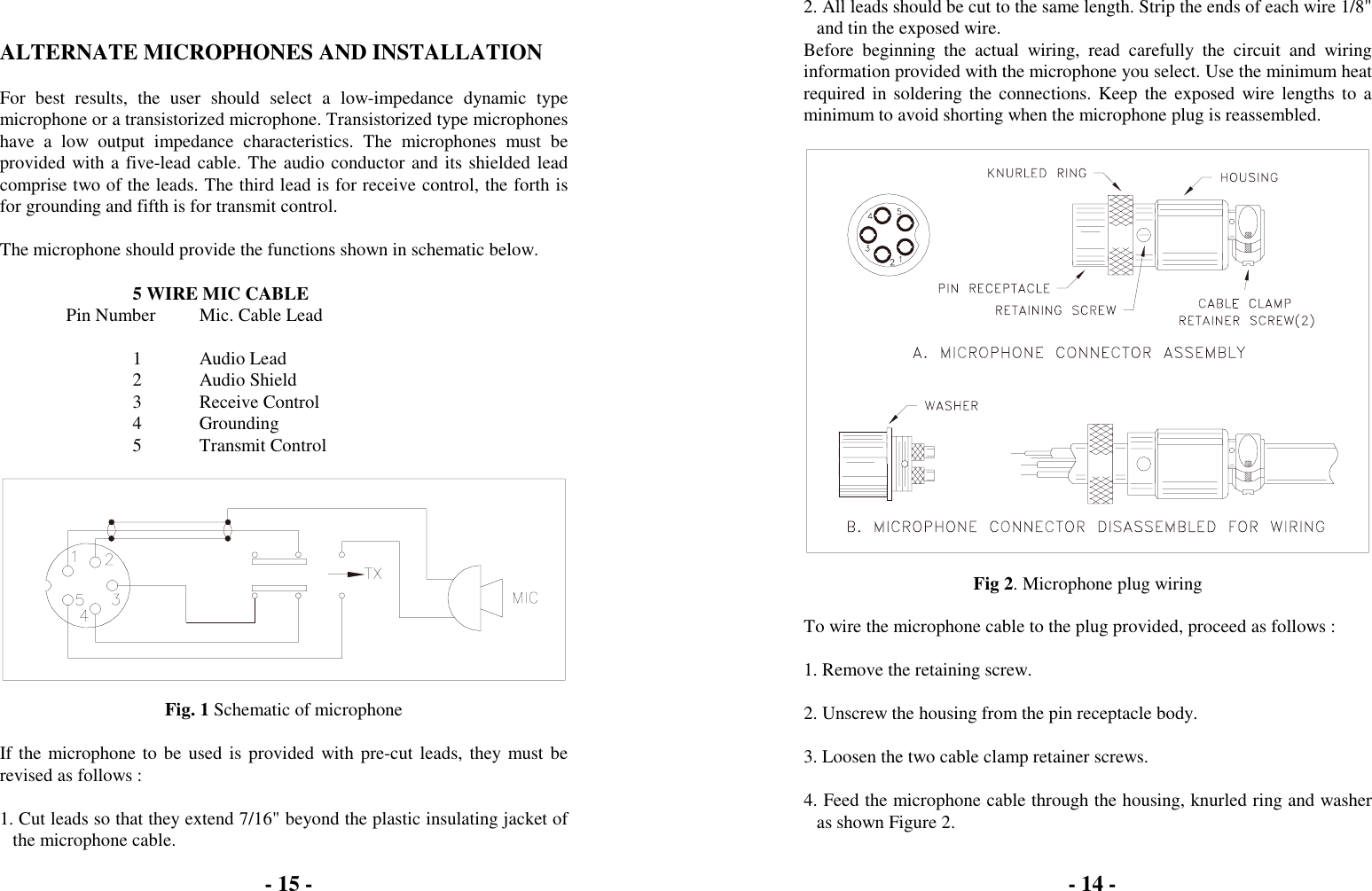
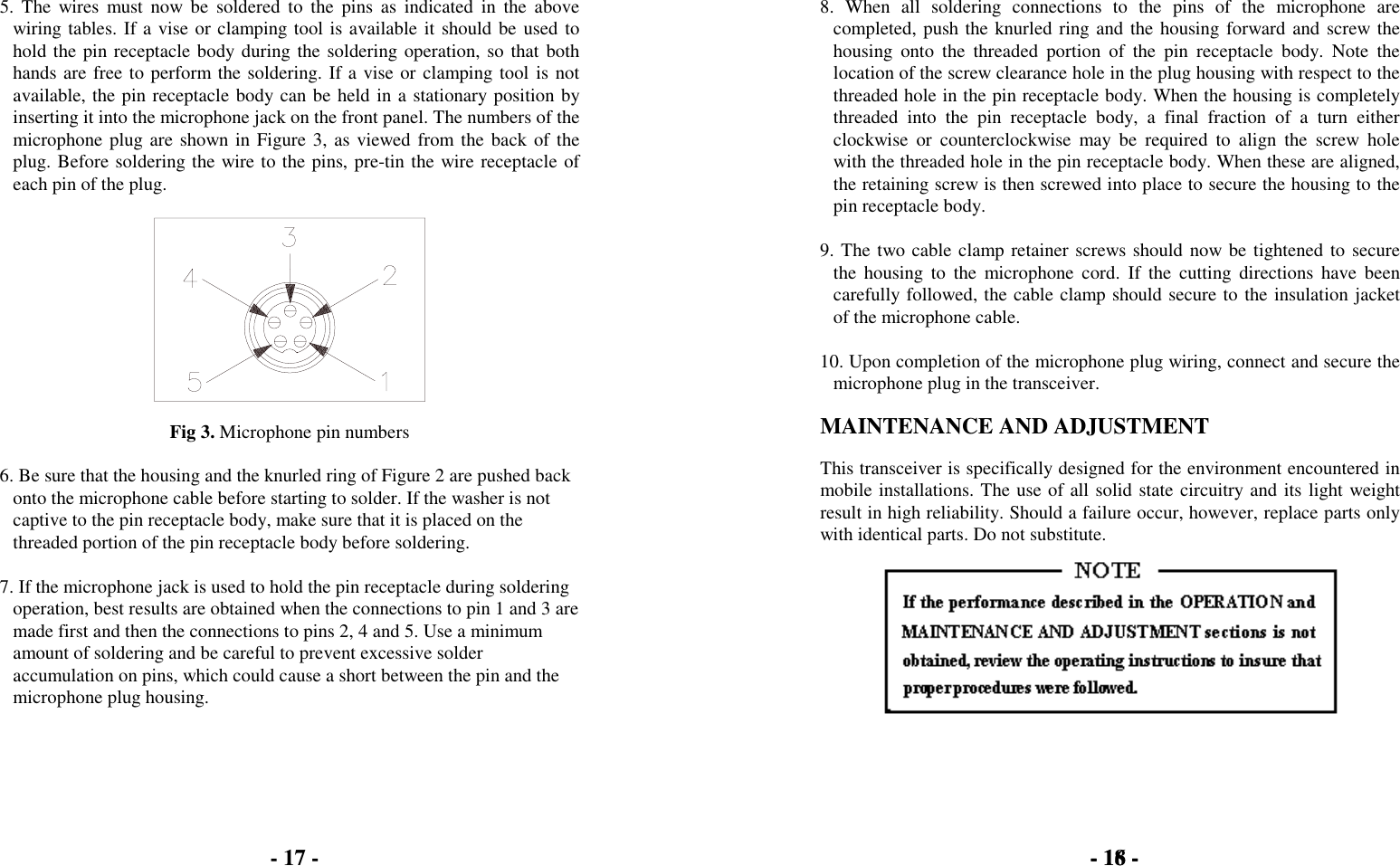
ALTERNATE MICROPHONES AND INSTALLATIONFor best results, the user should select a low-impedance dynamic typemicrophone or a transistorized microphone. Transistorized type microphoneshave a low output impedance characteristics. The microphones must beprovided with a five-lead cable. The audio conductor and its shielded leadcomprise two of the leads. The third lead is for receive control, the forth isfor grounding and fifth is for transmit control.The microphone should provide the functions shown in schematic below.5 WIRE MIC CABLEPin Number Mic. Cable Lead1 Audio Lead2 Audio Shield3 Receive Control4 Grounding5 Transmit ControlFig. 1 Schematic of microphoneIf the microphone to be used is provided with pre-cut leads, they must berevised as follows :1. Cut leads so that they extend 7/16" beyond the plastic insulating jacket ofthe microphone cable.2. All leads should be cut to the same length. Strip the ends of each wire 1/8"and tin the exposed wire.Before beginning the actual wiring, read carefully the circuit and wiringinformation provided with the microphone you select. Use the minimum heatrequired in soldering the connections. Keep the exposed wire lengths to aminimum to avoid shorting when the microphone plug is reassembled.Fig 2. Microphone plug wiringTo wire the microphone cable to the plug provided, proceed as follows :1. Remove the retaining screw.2. Unscrew the housing from the pin receptacle body.3. Loosen the two cable clamp retainer screws.4. Feed the microphone cable through the housing, knurled ring and washeras shown Figure 2.- 14 -- 15 -
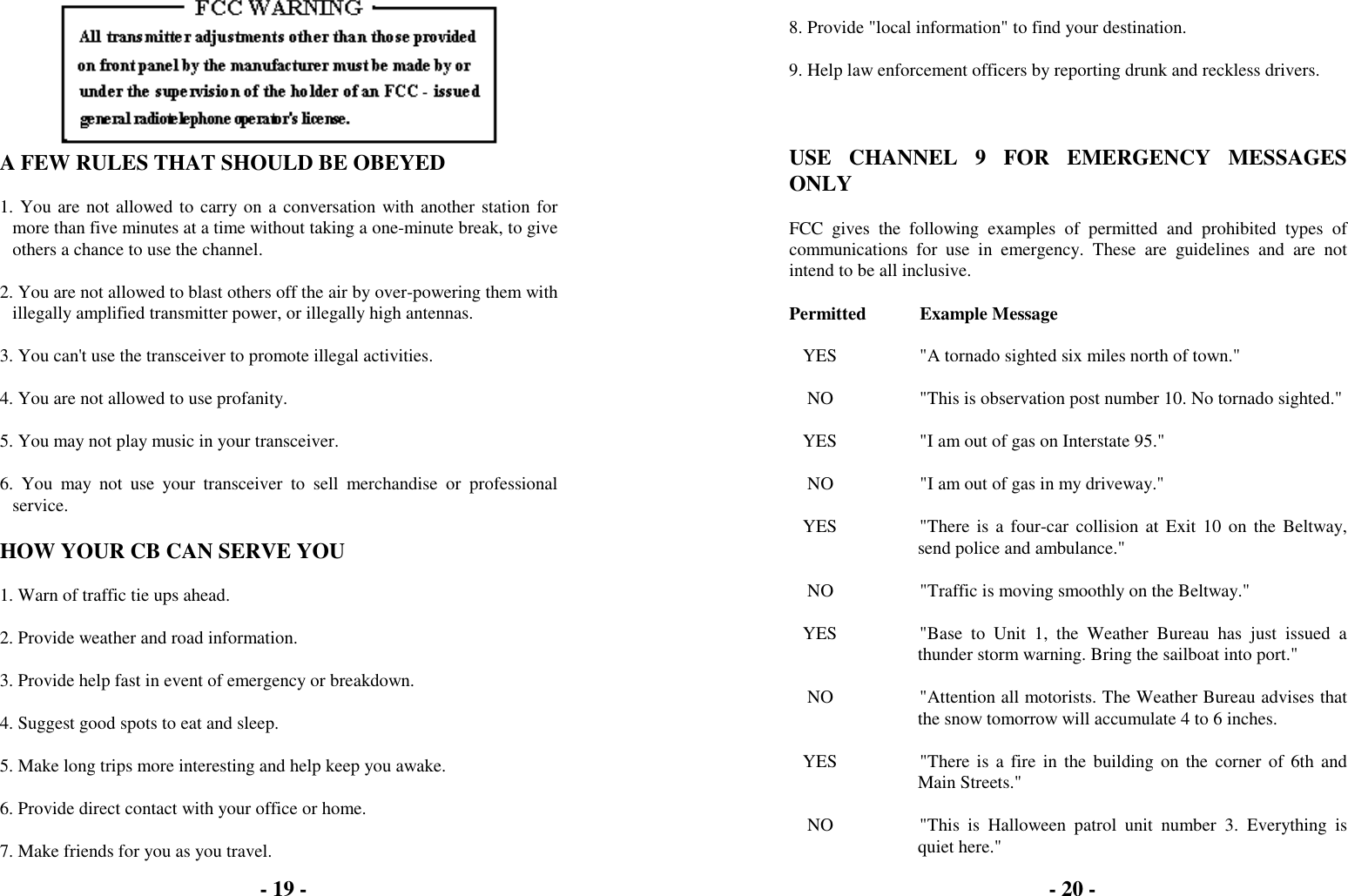
5. The wires must now be soldered to the pins as indicated in the abovewiring tables. If a vise or clamping tool is available it should be used tohold the pin receptacle body during the soldering operation, so that bothhands are free to perform the soldering. If a vise or clamping tool is notavailable, the pin receptacle body can be held in a stationary position byinserting it into the microphone jack on the front panel. The numbers of themicrophone plug are shown in Figure 3, as viewed from the back of theplug. Before soldering the wire to the pins, pre-tin the wire receptacle ofeach pin of the plug.Fig 3. Microphone pin numbers6. Be sure that the housing and the knurled ring of Figure 2 are pushed backonto the microphone cable before starting to solder. If the washer is notcaptive to the pin receptacle body, make sure that it is placed on thethreaded portion of the pin receptacle body before soldering.7. If the microphone jack is used to hold the pin receptacle during solderingoperation, best results are obtained when the connections to pin 1 and 3 aremade first and then the connections to pins 2, 4 and 5. Use a minimumamount of soldering and be careful to prevent excessive solderaccumulation on pins, which could cause a short between the pin and themicrophone plug housing.8. When all soldering connections to the pins of the microphone arecompleted, push the knurled ring and the housing forward and screw thehousing onto the threaded portion of the pin receptacle body. Note thelocation of the screw clearance hole in the plug housing with respect to thethreaded hole in the pin receptacle body. When the housing is completelythreaded into the pin receptacle body, a final fraction of a turn eitherclockwise or counterclockwise may be required to align the screw holewith the threaded hole in the pin receptacle body. When these are aligned,the retaining screw is then screwed into place to secure the housing to thepin receptacle body.9. The two cable clamp retainer screws should now be tightened to securethe housing to the microphone cord. If the cutting directions have beencarefully followed, the cable clamp should secure to the insulation jacketof the microphone cable.10. Upon completion of the microphone plug wiring, connect and secure themicrophone plug in the transceiver.MAINTENANCE AND ADJUSTMENTThis transceiver is specifically designed for the environment encountered inmobile installations. The use of all solid state circuitry and its light weightresult in high reliability. Should a failure occur, however, replace parts onlywith identical parts. Do not substitute.- 16 -- 17 - - 18 -
A FEW RULES THAT SHOULD BE OBEYED1. You are not allowed to carry on a conversation with another station formore than five minutes at a time without taking a one-minute break, to giveothers a chance to use the channel.2. You are not allowed to blast others off the air by over-powering them withillegally amplified transmitter power, or illegally high antennas.3. You can't use the transceiver to promote illegal activities.4. You are not allowed to use profanity.5. You may not play music in your transceiver.6. You may not use your transceiver to sell merchandise or professionalservice.HOW YOUR CB CAN SERVE YOU1. Warn of traffic tie ups ahead.2. Provide weather and road information.3. Provide help fast in event of emergency or breakdown.4. Suggest good spots to eat and sleep.5. Make long trips more interesting and help keep you awake.6. Provide direct contact with your office or home.7. Make friends for you as you travel.8. Provide "local information" to find your destination.9. Help law enforcement officers by reporting drunk and reckless drivers.USE CHANNEL 9 FOR EMERGENCY MESSAGESONLYFCC gives the following examples of permitted and prohibited types ofcommunications for use in emergency. These are guidelines and are notintend to be all inclusive.Permitted Example Message   YES "A tornado sighted six miles north of town."    NO "This is observation post number 10. No tornado sighted."   YES "I am out of gas on Interstate 95."    NO "I am out of gas in my driveway."   YES "There is a four-car collision at Exit 10 on the Beltway,send police and ambulance."    NO "Traffic is moving smoothly on the Beltway."   YES "Base to Unit 1, the Weather Bureau has just issued athunder storm warning. Bring the sailboat into port."    NO "Attention all motorists. The Weather Bureau advises thatthe snow tomorrow will accumulate 4 to 6 inches.   YES "There is a fire in the building on the corner of 6th andMain Streets."    NO "This  is  Halloween  patrol  unit  number  3.  Everything  isquiet here."- 19 - - 20 -

Navigation menu