SALUS North America AKL06PRF Zigbee Pump Wiring Centre User Manual

SALUS North America, Inc. Zigbee Pump Wiring Centre

User manual

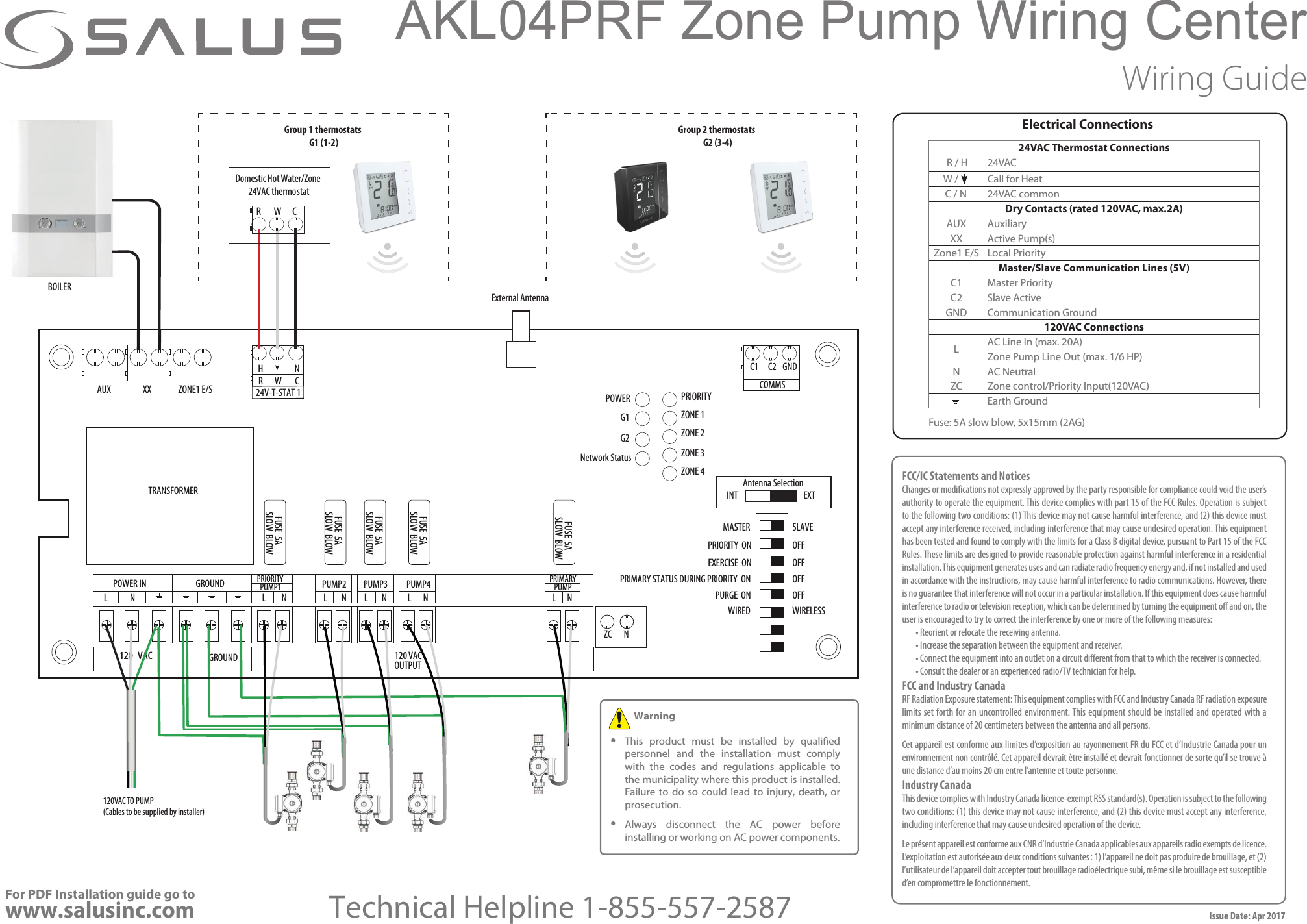
AKL04PRF Zone Pump Wiring Center Wiring GuideAUX XX ZONE1 E/STRANSFORMERL NGROUNDL NPUMP2L NPUMP3L NPUMP4L NPRIMARYPUMPL N120 VAC OUTPUTMASTERPRIORITY  ONEXERCISE  ONPRIMARY STATUS DURING PRIORITY  ONPURGE  ONSLAVEOFFOFFOFFOFFGroup 1 thermostatsG1 (1-2)120   VAC120VAC TO  PUMP Cables will be supplied by the installer.H NH NR W CC1 C2COMMSBOILERFUSE  5A SLOW  BLOWFUSE  5A SLOW  BLOWFUSE  5A SLOW  BLOWFUSE  5A SLOW  BLOWFUSE  5A SLOW  BLOWPOWER IN GROUND PRIORITYPUMP1Group 2 thermostatsG2 (3-4)ZC NGND24V-T-STAT 1R CWDomestic Hot Water/Zone 24VAC thermostatGroup 1 thermostatsG1 (1-2)Group 2 thermostatsG2 (3-4)120VAC TO PUMP(Cables to be supplied by installer)WIRED WIRELESSExternal AntennaINT EXTAntenna Selection24VAC Thermostat ConnectionsR / H 24VACW /  Call for HeatC / N 24VAC commonDry Contacts (rated 120VAC, max.2A)AUX AuxiliaryXX Active Pump(s)Zone1 E/S Local PriorityMaster/Slave Communication Lines (5V)C1 Master PriorityC2 Slave ActiveGND Communication Ground120VAC ConnectionsLAC Line In (max. 20A)Zone Pump Line Out (max. 1/6 HP)N AC NeutralZC Zone control/Priority Input(120VAC)Earth GroundFuse: 5A slow blow, 5x15mm (2AG)BOILERElectrical ConnectionsFCC/IC Statements and NoticesChanges or modifications not expressly approved by the party responsible for compliance could void the user’s authority to operate the equipment. This device complies with part 15 of the FCC Rules. Operation is subject to the following two conditions: (1) This device may not cause harmful interference, and (2) this device must accept any interference received, including interference that may cause undesired operation. This equipment has been tested and found to comply with the limits for a Class B digital device, pursuant to Part 15 of the FCC Rules. These limits are designed to provide reasonable protection against harmful interference in a residential installation. This equipment generates uses and can radiate radio frequency energy and, if not installed and used in accordance with the instructions, may cause harmful interference to radio communications. However, there is no guarantee that interference will not occur in a particular installation. If this equipment does cause harmful interference to radio or television reception, which can be determined by turning the equipment off and on, the user is encouraged to try to correct the interference by one or more of the following measures:• Reorient or relocate the receiving antenna.• Increase the separation between the equipment and receiver.• Connect the equipment into an outlet on a circuit different from that to which the receiver is connected.• Consult the dealer or an experienced radio/TV technician for help.FCC and Industry CanadaRF Radiation Exposure statement: This equipment complies with FCC and Industry Canada RF radiation exposure limits set forth for an uncontrolled environment. This equipment should be installed and operated with a minimum distance of 20 centimeters between the antenna and all persons.Cet appareil est conforme aux limites d’exposition au rayonnement FR du FCC et d’Industrie Canada pour un environnement non contrôlé. Cet appareil devrait être installé et devrait fonctionner de sorte qu’il se trouve à une distance d’au moins 20 cm entre l’antenne et toute personne.Industry CanadaThis device complies with Industry Canada licence-exempt RSS standard(s). Operation is subject to the following two conditions: (1) this device may not cause interference, and (2) this device must accept any interference, including interference that may cause undesired operation of the device.Le présent appareil est conforme aux CNR d’Industrie Canada applicables aux appareils radio exempts de licence. L’exploitation est autorisée aux deux conditions suivantes : 1) l’appareil ne doit pas produire de brouillage, et (2) l’utilisateur de l’appareil doit accepter tout brouillage radioélectrique subi, même si le brouillage est susceptible d’en compromettre le fonctionnement.Issue Date: Apr 2017   For PDF Installation guide go towww.salusinc.com Technical Helpline 1-855-557-2587WarningThis  product  must  be  installed  by  qualified personnel  and  the  installation  must  comply with  the  codes  and  regulations  applicable  to the municipality where this product is installed. Failure  to  do  so  could  lead  to  injury,  death,  or prosecution.Always  disconnect  the  AC  power  before installing or working on AC power components.AUX XX ZONE1 E/STRANSFORMERL NGROUNDL NPUMP2L NPUMP3L NPUMP4L NPUMP5L NPUMP6L NPRIMARYPUMPL N120 VAC OUTPUT24V - T-STAT 1120 VAC120VAC TO PUMP Cables will be supplied by the installer.H NH NR W CC1 C2COMMSBOILERFUSE  5A SLOW  BLOWFUSE  5A SLOW  BLOWFUSE  5A SLOW  BLOWFUSE  5A SLOW  BLOWFUSE  5A SLOW  BLOWFUSE  5A SLOW  BLOWFUSE  5A SLOW  BLOWPOWER IN GROUND PRIORITYPUMP1ZC/ZRGroup 1 thermostatsG1 (1-2)Group 2 thermostatsG2 (3-6)AHTR5024 AHTR3024 AHTR3024 AHTR3024 AHTR3024 AHTR3024MASTERPRIORITY ONEXERCISE ONPRIMARY STATUS DURING PRIORITY ONPURGE ONSLAVEOFFOFFOFFOFFWired WirelessAntenna SelectionINT EXTPOWER PRIORITYZONE 1ZONE 2ZONE 3ZONE 4ZONE 6G1G2Network Status••
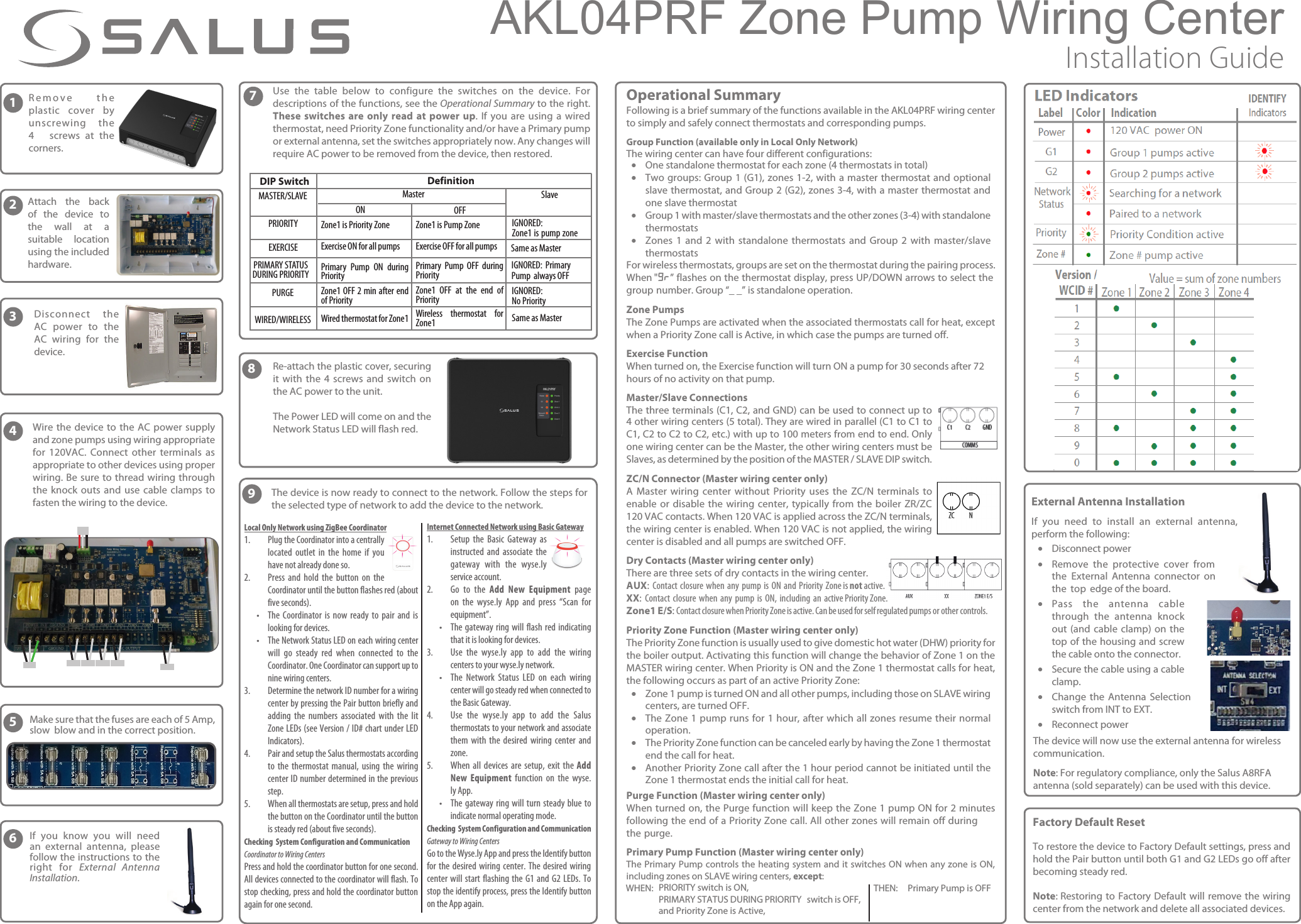
1Remove theplastic cover by unscrewing the 4   screws at the corners.2 Attach  the  back of  the  device  to the  wall  at  a suitable  location using the included hardware.Make sure that the fuses are each of 5 Amp, slow  blow and in the correct position.5AKL04PRF Zone Pump Wiring Center Installation Guide4Wire the device to the AC power supplyand zone pumps using wiring appropriate for 120VAC. Connect other terminals as appropriate to other devices using proper wiring. Be sure to thread wiring through the knock outs and use cable clamps to fasten the wiring to the device.3Disconnect theAC power to the AC wiring for the device.If you know you will need an external antenna, please follow the instructions to the right for External Antenna Installation.67Use the table below to configure the switches on the device. Fordescriptions of the functions, see the Operational Summary to the right. These switches are only read at power up. If you are using a wired thermostat, need Priority Zone functionality and/or have a Primary pump or external antenna, set the switches appropriately now. Any changes will require AC power to be removed from the device, then restored.8Re-attach the plastic cover, securing it with the 4 screws and switch on the AC power to the unit. The Power LED will come on and the Network Status LED will flash red.The device is now ready to connect to the network. Follow the steps for the selected type of network to add the device to the network.Local Only Network using ZigBee Coordinator1. Plug the Coordinator into a centrally located outlet in the home if youhave not already done so.2. Press and hold the button on theCoordinator until the button flashes red (about five seconds).•  The Coordinator is now ready to pair and islooking for devices.•  The Network Status LED on each wiring center will go steady red when connected to theCoordinator. One Coordinator can support up to nine wiring centers.3. Determine the network ID number for a wiring center by pressing the Pair button briefly and adding the numbers associated with the litZone LEDs (see Version / ID# chart under LED Indicators).4. Pair and setup the Salus thermostats according to the thermostat manual, using the wiringcenter ID number determined in the previousstep.5. When all thermostats are setup, press and hold the button on the Coordinator until the button is steady red (about five seconds).Checking  System Configuration and CommunicationCoordinator to Wiring CentersPress and hold the coordinator button for one second. All devices connected to the coordinator will flash. To stop checking, press and hold the coordinator button again for one second.9Internet Connected Network using Basic Gateway1. Setup the Basic Gateway asinstructed and associate thegateway with the wyse.lyservice account.2. Go to the Add New Equipment pageon the wyse.ly App and press “Scan forequipment”.•  The gateway ring will flash red indicatingthat it is looking for devices.3. Use the wyse.ly app to add the wiringcenters to your wyse.ly network.•  The Network Status LED on each wiringcenter will go steady red when connected to the Basic Gateway.4. Use the wyse.ly app to add the Salusthermostats to your network and associate them with the desired wiring center andzone.5. When all devices are setup, exit the Add New Equipment function on the wyse.ly App.•  The gateway ring will turn steady blue toindicate normal operating mode.Checking  System Configuration and CommunicationGateway to Wiring CentersGo to the Wyse.ly App and press the Identify button for the desired wiring center. The desired wiring center will start flashing the G1 and G2 LEDs. To stop the identify process, press the Identify button on the App again.Operational SummaryFollowing is a brief summary of the functions available in the AKL04PRF wiring center to simply and safely connect thermostats and corresponding pumps.Group Function (available only in Local Only Network)The wiring center can have four different configurations:•One standalone thermostat for each zone (4 thermostats in total)•Two groups: Group 1 (G1), zones 1-2, with a master thermostat and optional slave thermostat, and Group 2 (G2), zones 3-4, with a master thermostat and one slave thermostat•Group 1 with master/slave thermostats and the other zones (3-4) with standalone thermostats•Zones 1 and 2 with standalone thermostats and Group 2 with master/slave thermostats For wireless thermostats, groups are set on the thermostat during the pairing process. When "gr” flashes on the thermostat display, press UP/DOWN arrows to select the group number. Group “_ _” is standalone operation.Zone PumpsThe Zone Pumps are activated when the associated thermostats call for heat, except when a Priority Zone call is Active, in which case the pumps are turned off.Exercise FunctionWhen turned on, the Exercise function will turn ON a pump for 30 seconds after 72 hours of no activity on that pump.Master/Slave ConnectionsThe three terminals (C1, C2, and GND) can be used to connect up to 4 other wiring centers (5 total). They are wired in parallel (C1 to C1 to C1, C2 to C2 to C2, etc.) with up to 100 meters from end to end. Only one wiring center can be the Master, the other wiring centers must be Slaves, as determined by the position of the MASTER / SLAVE DIP switch.ZC/N Connector (Master wiring center only)A Master wiring center without Priority uses the ZC/N terminals to enable or disable the wiring center, typically from the boiler ZR/ZC 120 VAC contacts. When 120 VAC is applied across the ZC/N terminals, the wiring center is enabled. When 120 VAC is not applied, the wiring center is disabled and all pumps are switched OFF.Dry Contacts (Master wiring center only)There are three sets of dry contacts in the wiring center.AUX: Contact closure when any pump is ON and Priority Zone is not active.XX: Contact closure when any pump is ON, including an active Priority Zone.Zone1 E/S: Contact closure when Priority Zone is active. Can be used for self regulated pumps or other controls.Priority Zone Function (Master wiring center only)The Priority Zone function is usually used to give domestic hot water (DHW) priority for the boiler output. Activating this function will change the behavior of Zone 1 on the MASTER wiring center. When Priority is ON and the Zone 1 thermostat calls for heat, the following occurs as part of an active Priority Zone:•Zone 1 pump is turned ON and all other pumps, including those on SLAVE wiring centers, are turned OFF.•The Zone 1 pump runs for 1 hour, after which all zones resume their normal operation.•The Priority Zone function can be canceled early by having the Zone 1 thermostatend the call for heat.•Another Priority Zone call after the 1 hour period cannot be initiated until the Zone 1 thermostat ends the initial call for heat. Purge Function (Master wiring center only)When turned on, the Purge function will keep the Zone 1 pump ON for 2 minutes following the end of a Priority Zone call. All other zones will remain off during the purge.Primary Pump Function (Master wiring center only)The Primary Pump controls the heating system and it switches ON when any zone is ON, including zones on SLAVE wiring centers, except:PRIORITY switch is ON,PRIMARY STATUS DURING PRIORITY   switch is OFF, and Priority Zone is Active,WHEN: THEN: Primary Pump is OFFExternal Antenna Installation  If you need to install an external antenna, perform the following:•Disconnect power•Remove the protective cover fromthe External Antenna connector onthe top edge of the board.•Pass the antenna cablethrough the antenna knockout (and cable clamp) on thetop of the housing and screwthe cable onto the connector.•Secure the cable using a cable clamp.•Change the Antenna Selectionswitch from INT to EXT.•Reconnect powerFactory Default ResetTo restore the device to Factory Default settings, press and hold the Pair button until both G1 and G2 LEDs go off after becoming steady red. Note: Restoring to Factory Default will remove the wiring center from the network and delete all associated devices.DefinitionDIP SwitchMasterON OFFSlaveMASTER/SLAVEPRIORITYEXERCISEPRIMARY STATUS DURING PRIORITYPURGEWIRED/WIRELESSZone1 is Priority ZoneExercise ON for all pumpsPrimary Pump ON during PriorityZone1 OFF 2 min after end of PriorityWired thermostat for Zone1Zone1 is Pump ZoneExercise OFF for all pumpsPrimary Pump OFF during PriorityZone1 OFF at the end of PriorityWireless thermostat for Zone1IGNORED:Zone1 is pump zoneSame as MasterIGNORED: Primary Pump always OFFIGNORED:No PrioritySame as MasterThe device will now use the external antenna for wireless communication.Note: For regulatory compliance, only the Salus A8RFA antenna (sold separately) can be used with this device.

Navigation menu