SAMSUNG Plasma Television Manual L0411407
User Manual: SAMSUNG SAMSUNG Plasma Television Manual SAMSUNG Plasma Television Owner's Manual, SAMSUNG Plasma Television installation guides
Open the PDF directly: View PDF  .
.
Page Count: 99
PLASMA DISPLAY
Owner's Instructions
SPP4251
@ @
Wide screen format PDP Displays (16:9,the aspect ratio of the screen width to height) are primarily
designed to view wide screen format fuji-motion video. The images displayed on them should primarily be
in the wide screen 16:9 ratio format, or expanded to fill the screen if your model offers this feature and the
images are constantly moving_ Displaying stationary graphics and images on screen, such as the dark
side-bars on nonexpanded standard format television video and programming, should be limited to no
more than 5% of the total television viewing per week.
Additionally, viewing other stationary images and text such as stock market reports, video game
displays,station Iogos,web sites or computer graphics and patterns,should be limited as described above
for aJJtelevisions. DispJaying stationary images that exceed the above guideJines can
cause uneven aging of PDP Disptays that Jeove subtJe, but permanent burned-in
ghost images in the PDPpictureo To avoid this, vary the programming and images,
and primariJy dispJay furls€teen moving images, not stationary pa_erns or dark bars.
On PDP models that offer picture sizing features, use these controls to view different formats as a full screen
picture.
Be careful in the selection and duration of television formats used for viewing_ Uneven PDPaging as a
result of format selection and use,as well as burned-in images, are not covered by your Samsung limited
warranty.
@ScreenJ_ageretention
Do not display a still image (such as on a video game or when hooking up a PC to this PDP)on the plasma
display panel for more than,several minutes as it can cause screen image retention. This image retention is
also known as screen burn _To avoid such image retention, refer to page 40 of this manual to reduce the
degree of brightness and contrast of this screen when displaying a still image.
@ CdJJ)efect
The plasma display panel consists of fine cells. Although the panels are produced with more than 99.9
percent active cells, there may be some cells that do not produce light or remain lit.
@ Altitude
The PDP wiJJnot operate normally at altitudes above 6500 ft.
@Warranty
Warranty does not cover any damage caused by image retention.
Burndn is not covered by the warranty.
i i 0 ¸¸¸¸..................
Generd N{ormation
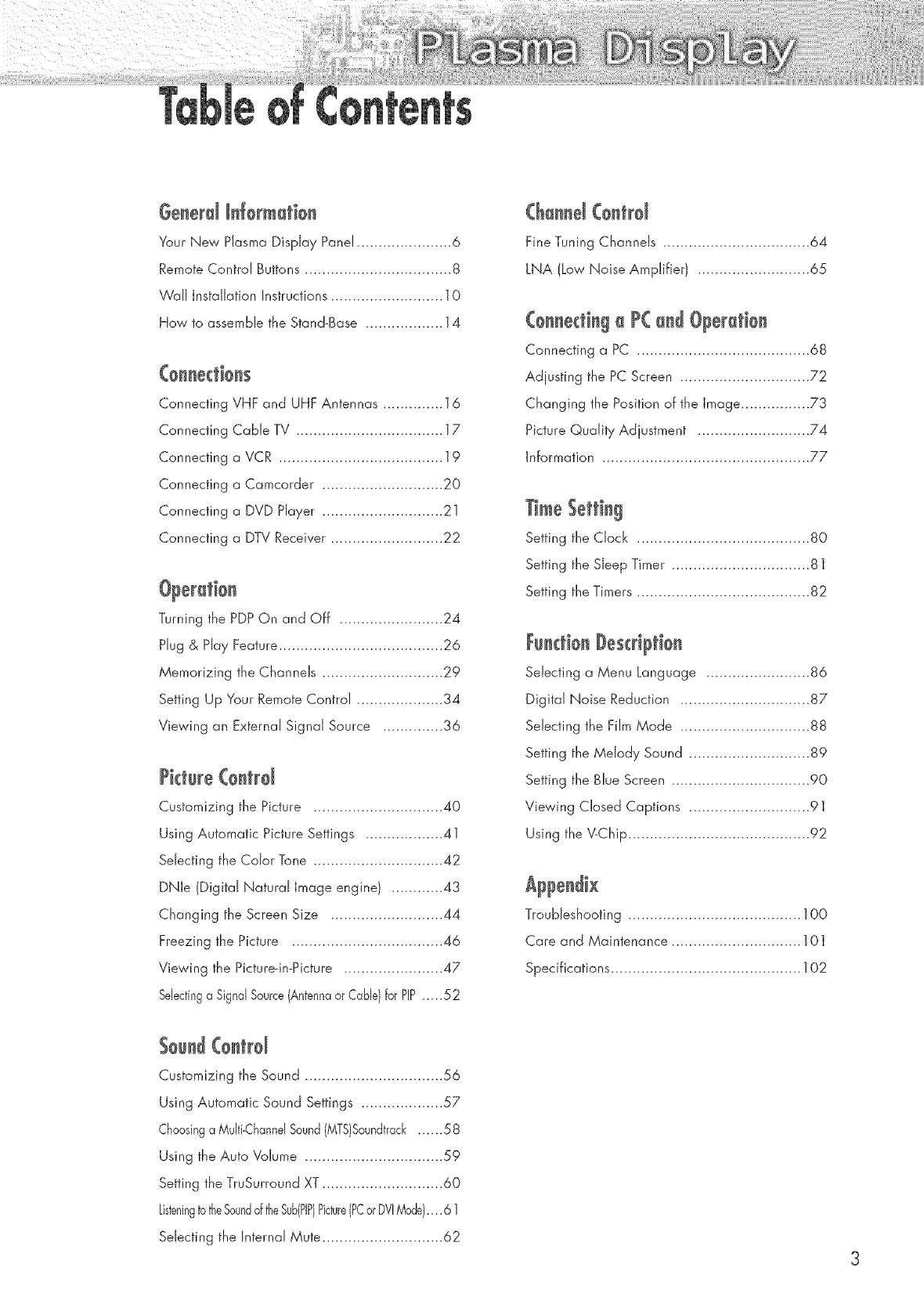
Your New Plasma Display Panel ...................... 6
Remote Control Buttons .................................. 8
V'/all Installation Instructions .......................... 10
How to assemble the Stand-Base .................. 14
Connecting VHF and UHF Antennas .............. 16
Connecting Cable TV .................................. 17
Connecting a VCR ...................................... 19
Connecting a Camcorder ............................ 20
Connecting a DVD Hayer ............................ 21
Connecting a DTV Receiver .......................... 22
Turning the PDP On and Off ........................ 24
Hug & Hay Feature ...................................... 26
Memorizing the Channels ............................ 29
Setting Up Your Remote Control .................... 34
Viewing an External Signal Source .............. 36
?ictsr÷ (#ntrd
Customizing the Picture .............................. 40
Using Automatic Picture Settings .................. 41
Selecting the Color Tone .............................. 42
DNJe (Digital Natural Image engine) ............ 43
Changing the Screen Size .......................... 44
Freezing the Picture ................................... 46
Viewing the Picture-in-Picture ....................... 47
Selectinga SignalSource(Antennaor Cable)for PIP ..... 52
Sound(ontrd
Customizing the Sound ................................ 56
Using Automatic Sound Settings ................... 57
Choosinga Multi-ChanndSound(MTS}Soundtrack...... 58
Using the Auto Volume ................................ 59
Setting the TruSurround XT ............................ 60
ListeningtotheSoundoftheSub(PiP)Picture(PCorDVIMode)....61
Selecting the Internal Mute ............................ 62
(ha#rid (o#trd
Fine Tuning Channels .................................. 64
LNA (Low Noise Amplifier} .......................... 65
(ennectinga ?( undOperatien
Connecting a PC ........................................ 68
Adjusting the PC Screen .............................. 72
Changing the Position of the Image ................ 73
Picture Quality Adjustment .......................... 74
information ................................................ 77
_meSetting
Setting the Clock ........................................ 80
Setting the Sleep Timer ................................ 81
Setting the Timers ........................................ 82
Functien#esc@tien
Selecting a Menu Language ........................ 86
Digital Noise Reduction .............................. 87
Selecting the Film Mode .............................. 88
Setting the Melody Sound ............................ 89
Setting the Blue Screen ................................ 90
Viewing Closed Captions ............................ 91
Using the %Chip .......................................... 92
Troubleshooting ........................................ 1O0
Care and Maintenance .............................. 101
Specifications ............................................ 102
3
Your New Plasma Display Panel ...................................................... 6
Remote Control Buttons .................................................................. 8
Wall Installation instructions .......................................................... 10
How to assemble the Stand-Base .................................................... 14
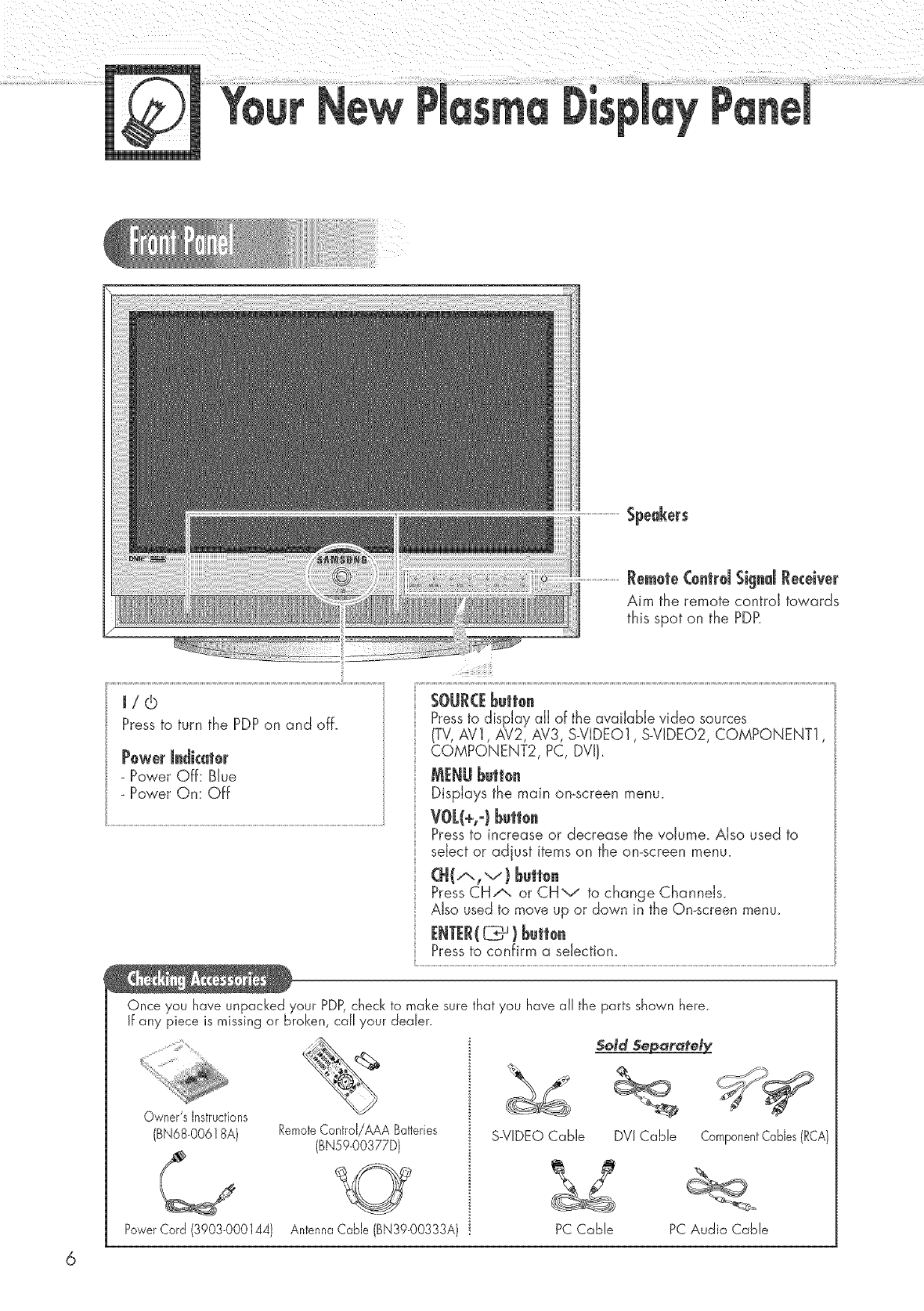
Pressto turn the PDPon and off.
Power Jedicator
-Power Off: Blue
Power On: Off
Speakers
Remete(oetrd $iged Receiver
Aim the remote control towards
this spot on the PDR
SOUR([Button
Pressto display all of the available video sources
(TV,AV1, AV2, AV3, S-VIDEO1, S_VIDEO2,COMPONENT1,
COMPONENT2, PC, DVJ).
MENU be||oe
Displays the main on-screen menu.
VOL(+,o)button
Pressto increase or decrease the voJume_Also used to
select or adjust items on the on-screen menu.
(H(..-,,v) Better
PressCH/", or CHv to change Channels.
Also used to move up or down in the On-screen menu.
ENTER(C_ )button
Pressto confirm a selection
Once you have unpacked your PDP,check to make sure that you have all the parts shown here.
Jfany piece is missing or broken, call your dealer.
Owner'sInstructions
(BN68-00618A)
0
PowerCord(3903-000144)
RemoteControJ/A,S,ABatteries
(BNSg-00377D/
AntennaCaNe(BN39-00333A)
S-ViDEO Cable
Sotd Separafet_
DVICable ComponentCables(RCA)
PC Cable PC Audio Cable
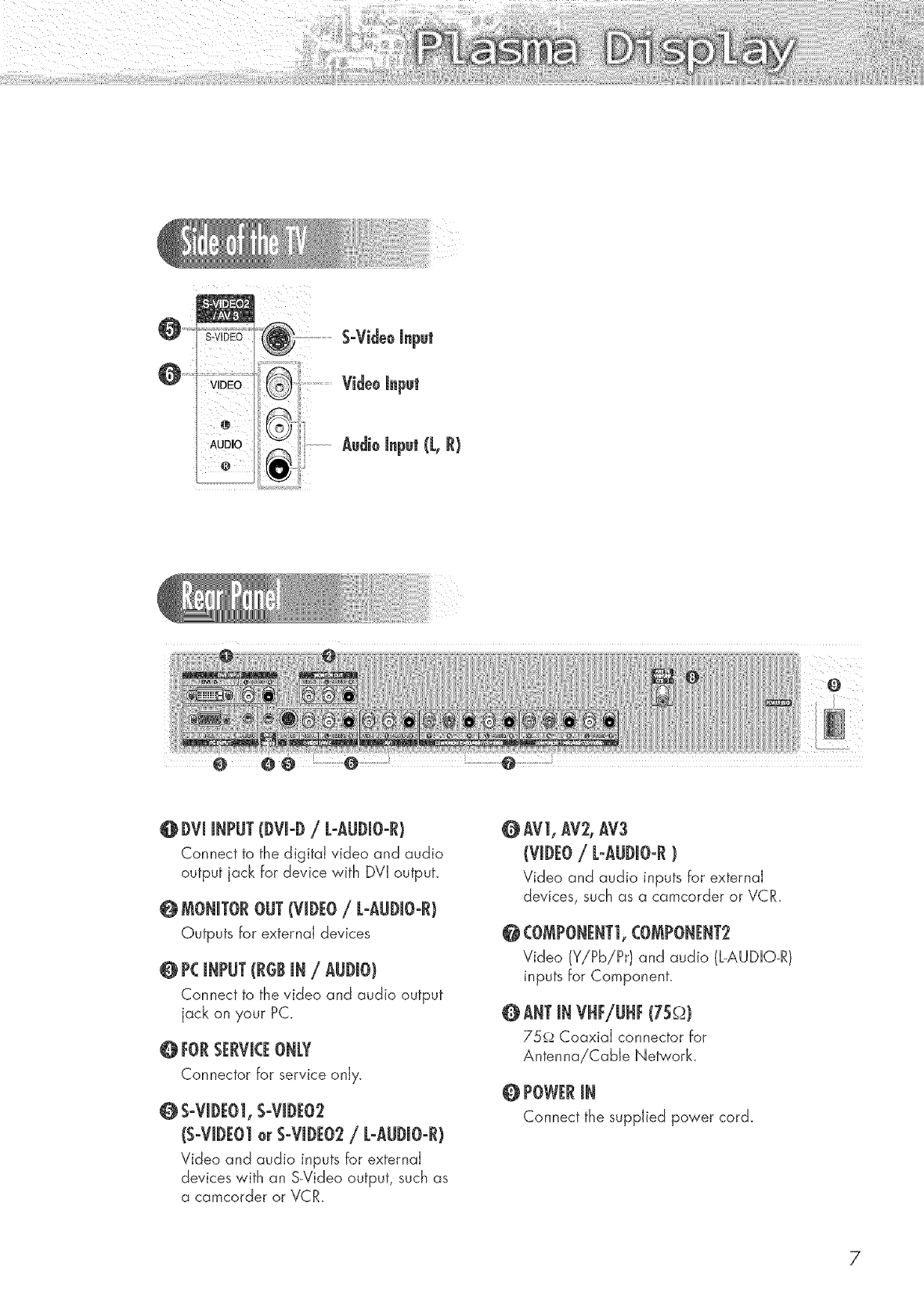
@DVJiNPUT(DVFD/L-AUDiO-R)
Connect to the digital video and audio
output jack for device with DVI output.
@ MONITOROUT(VIDEO/L°AUgJO-R)
Outputs for external devices
@ P( JNPgT(RGgJN/AUgJO}
Connect to the video and audio output
jack on your PC.
@ FORSERVJ(EONlY
Connector for service only.
@ S°VJDE01,S°VJDE02
(S°VJDE01or S-ViDE02/L-AUDJO°R}
Video and audio inputs for external
devices with an S-Video output, such as
a camcorder or VCR.
@Avl, Av2,Av3
(VmDEO/L-AUDmO-R)
Video and audio inputs for external
devices, such as a camcorder or VCR.
@ (OMPONENI"I,(:OMPONENI"2
Video (Y/Pb/Pr) and audio (L-AUDIO-R)
inputs for Component.
@ ANTmNVHFiUHF(75£_}
75£-2Coaxial connector for
Antenna/Cable Network.
0 POWERiN
Connect the supplied power cord.
7
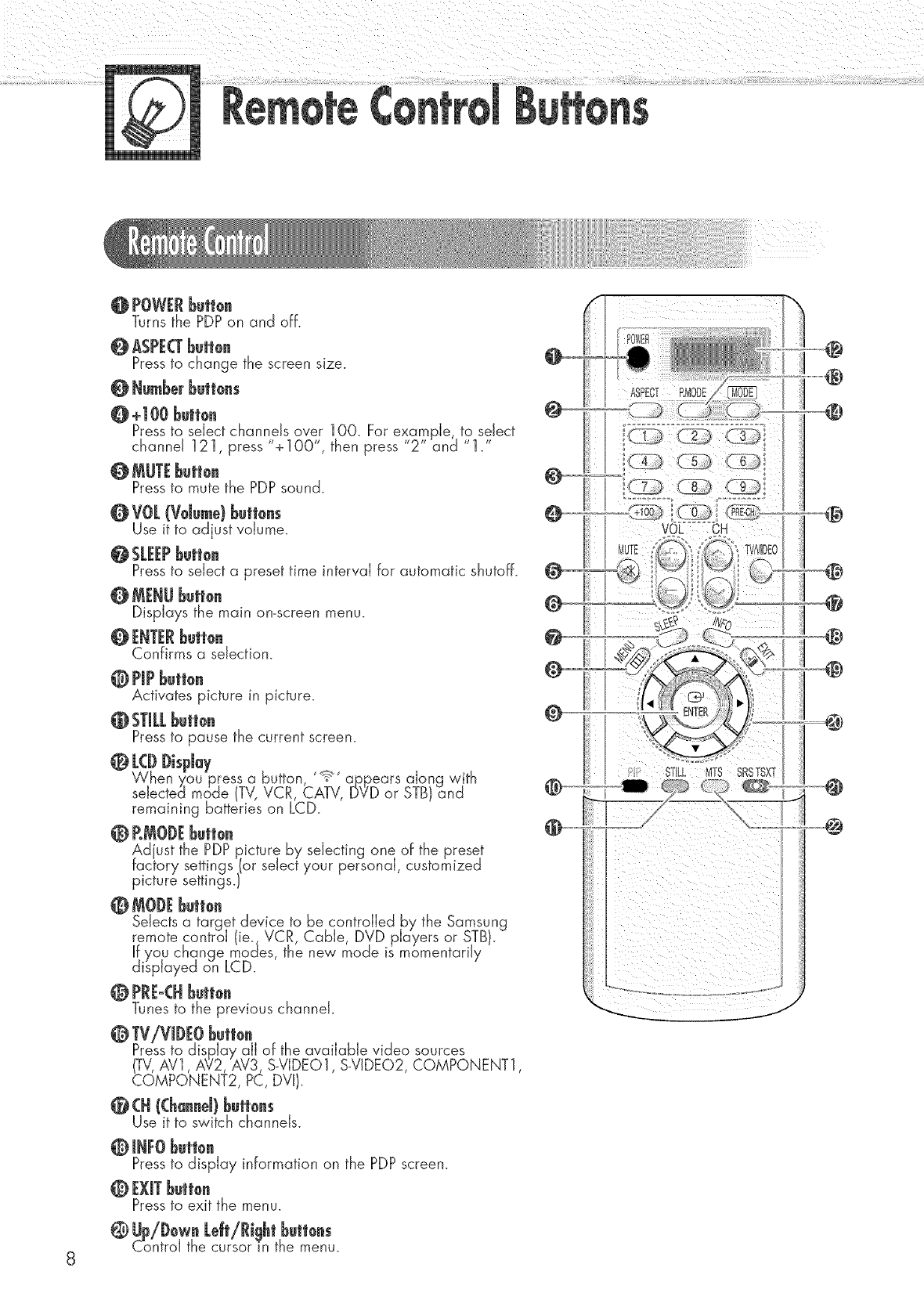
@POWERbutton
Turns the PDP on and off.
@ASPECTbutten
Pressto change the screen size.
@ Numberbuttons
@ +100 butl0n
Pressto select channels over 1OO. For example, to select
channel 121, press "+1OO", then press 2 and 1.
Pressto mute the PDPsound.
@VOL(Vdu_u} buttous
Use it to adjust volume.
Pressto select a preset time interval for automatic shutoff.
@ MENUbutton
Displays the main on-screen menu.
Confirms a selection.
0PiPbutton
Activates picture in picture.
@ STILLbuttou
Pressto pause the current screen.
L@ J)ispJay
When you press a button, '_>' appears along with
selected mo'de (TV,VCR, CATV, DV"Dor STB}and
remaining batteries on LCD.
@ BMOJ)Ebutt0u
Adjust the PDP picture by selecting one of the preset
factory settings (or select your personal, customized
picture settings.)
@ MOJ)Ebutlou
Selects a target device to be controlled by the Samsung
remote control ie, VCR, Cable, DVD players or STB.
If you change modes, the new mode is momentarily
displayed on LCD.
@PRE-CHbutlou
Tunes to the previous channel.
@ TViVJDEObultou
Pressto display alJ of the available video sources
TV AV1 AV2 AV3 S_VIDEO1 S-ViDEO2 COMPONENT1
COMPONENT2, PC, DV ,
_]_(H ((hauueJ}butt0us
Use it to switch channels.
@ JHFObutteu
Pressto display information on the PDPscreen.
@ EXiTbutt0u
Pressto exit the menu.
@L_p/J)_wuLdt/Rightbutteus
Control the cursor in the menu.
@
@
@
@
@
i i_ i i
@
@
iii!il÷
@
@
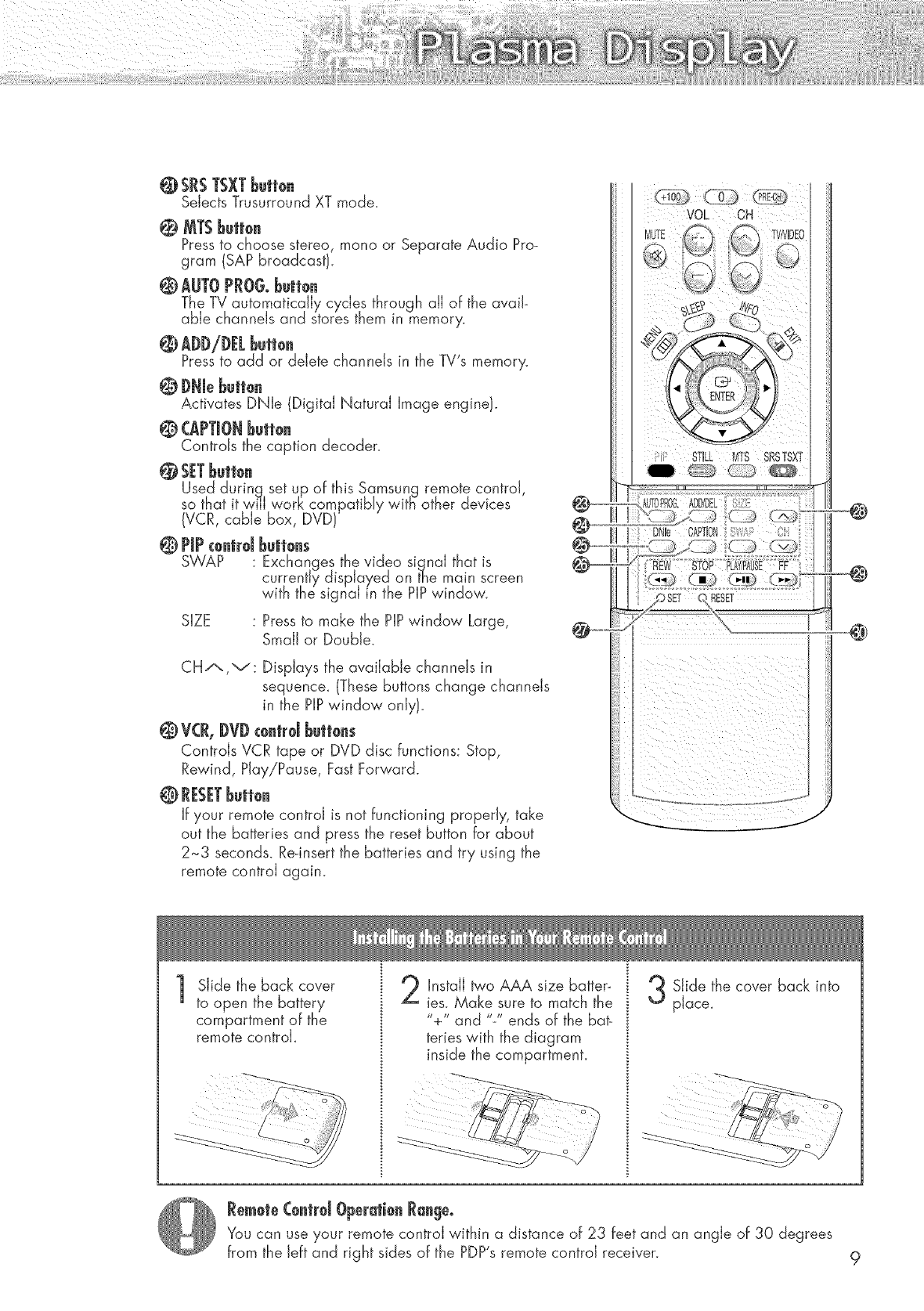
@SRS TSXTbBtto.
Selects Trusurround XT mode.
0 MTS bBttoe
Pressto choose stereo, mona or Separate Audio Pro-
gram (SAP broadcast).
@ AUTO PRO& Bett0e
The TV automatically cycles through aJJof the avail-
able channels and stores them in memory.
@ADDiDELBett0e
Pressto add or delete channels in the TV's memory.
@DNb Bett0e
Activates DNle (Digital Natural Image engine).
@(APTIONBeit0e
Controls the caption decoder.
@ SETbett0e
Used durinq set up of this Samsung remote control,
so that it will work compatibly witB other devices
(VCR, cable box, DVD}
©PiPc0.trd bett0es
SWAP : Exchanges the video signal that is
currently displayed on the main screen
with the signal in the PIPwindow.
SIZE : Pressto make the PIPwindow Large,
Small or Double.
CH,A,,\J : Displays the available channels in
sequence_ (These buttons change channels
in the HP window only).
©V(R,DVD €oetrdbettoes
Controls VCR tape or DVD disc functions: Stop,
Rewind, Play/Pause, Fast Forward.
VOL CH
i!i ÷:!%
:} STILL MTS SRSTSXT
[f your remote control is not functioning properly, take
out the batteries and press the reset button for about
2_-3 seconds. Rednsert the batteries and try using the
remote control again.
1Slide the back cover
to open the battery
compartment of the
remote controk
Install _'o AAA size batter-
ies. Make sure to match the
"+" and "-" ends of the bat-
teries with the diagram
inside the compartment.
Slide the cover back into
place_
Remote (0etrd Operati0e Range°
You can use your remote control within a distance of 23 feet and an angle of 30 degrees
from the Jeff and right sides of the PDP's remote control receiver. 9
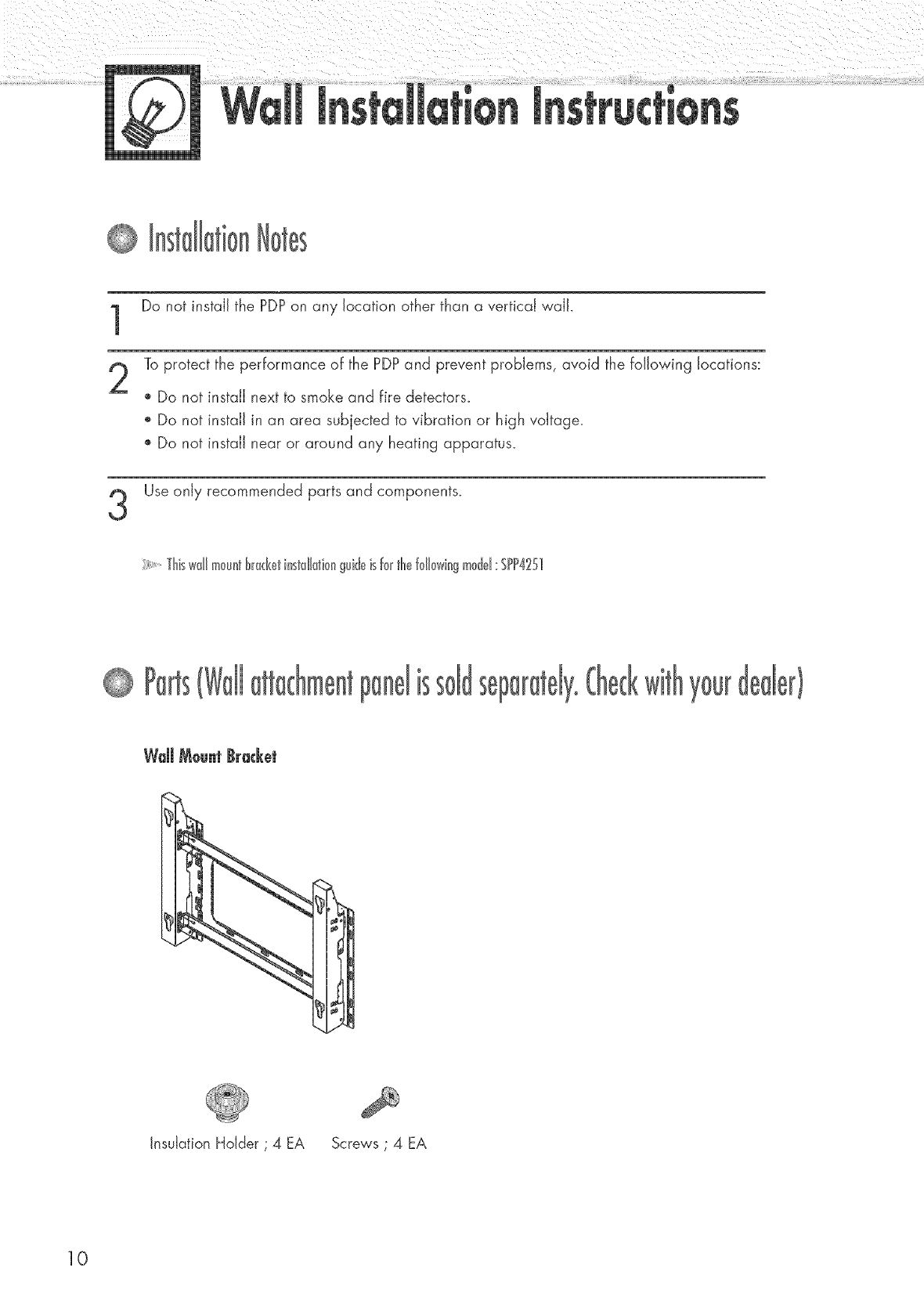
Do not install the PDPon any location other than a vertical walk
To protect the performance of the PDPand prevent problems, avoid the following locations:
" Do not install next to smoke and fire detectors.
', Do not install in an area subjected to vibration or high voltage.
o Do not install near or around any heating apparatus.
Use only recommended parts and components.
i Thiswdl mountbracketinstdl_ti0nguideisforthefollowingmodel:SPP4251
WdJ Meunt Bracket
Insulation Holder ; 4 EA Screws ; 4 EA
10
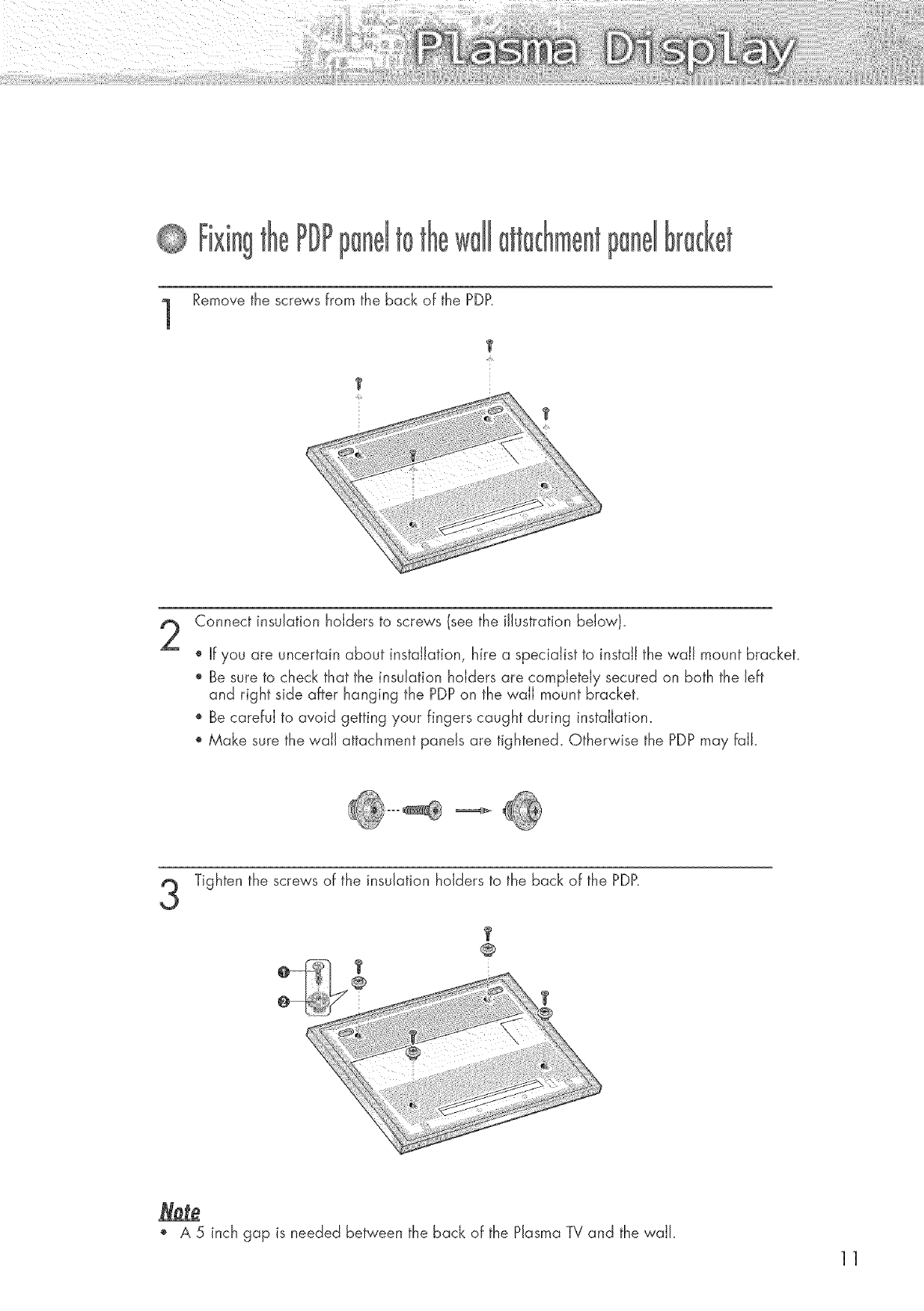
PDP to
1Remove the screws from the back of the PDP.
T
Connect insulation holders to screws (see the illustration below}.
• If you are uncertain about installation, hire a specialist to install the waJJmount bracket.
,, Be sure to check that the insulation holders are completely secured on both the left
and right side after hanging the PDP on the wail mount bracket.
o Be careful to avoid getting your fingers caught during installation.
', Make sure the wail attachment panels are tightened. Otherwise the PDP may faik
3Tighten the screws of the insulation holders to the back of the PDP.
T
@
" A 5 inch gap is needed between the back of the Plasma TV and the waik
11
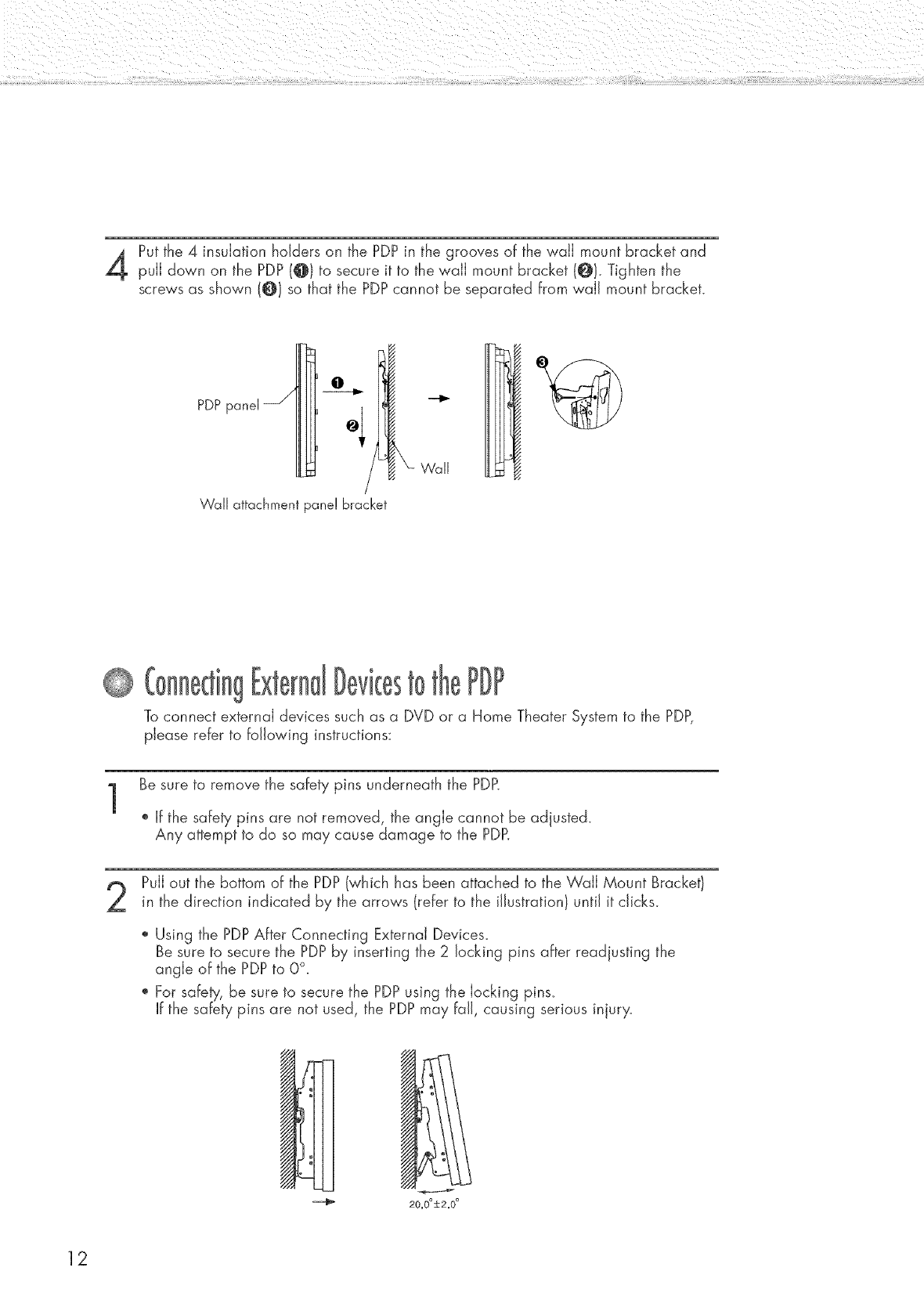
Put the 4 insulation holders on the PDP in the grooves of the wall mount bracket and
pull down on the PDP(@) to secure it to the wall mount bracket (@1- Tighten the
screws as shown (@1 so that the PDP cannot be separated from wall mount bracket.
PDPpanel _// O--_, I_.
i
O
Wall attachment panel bracket
Wall
to PDP
To connect external devices such as a DVD or a Home Theater System to the PDP,
please refer to following instructions:
Be sure to remove the safety pins underneath the PDP.
o If the safety pins are not removed, the angle cannot be adjusted.
Any attempt to do so may cause damage to the PDP.
Pull out the bottom of the PDP(which has been attached to the Wall Mount Bracket)
in the direction indicated by the arrows (refer to the illustration/until it clicks.
Using the PDPAfter Connecting External Devices.
Be sure to secure the PDPby inserting the 2 locking pins after readjusting the
angle of the PDPto 0°.
For safety, be sure to secure the PDPusing the locking pins.
If the safety pins are not used, the PDP may fall, causing serious injury.
20.0°+2.0 °
12
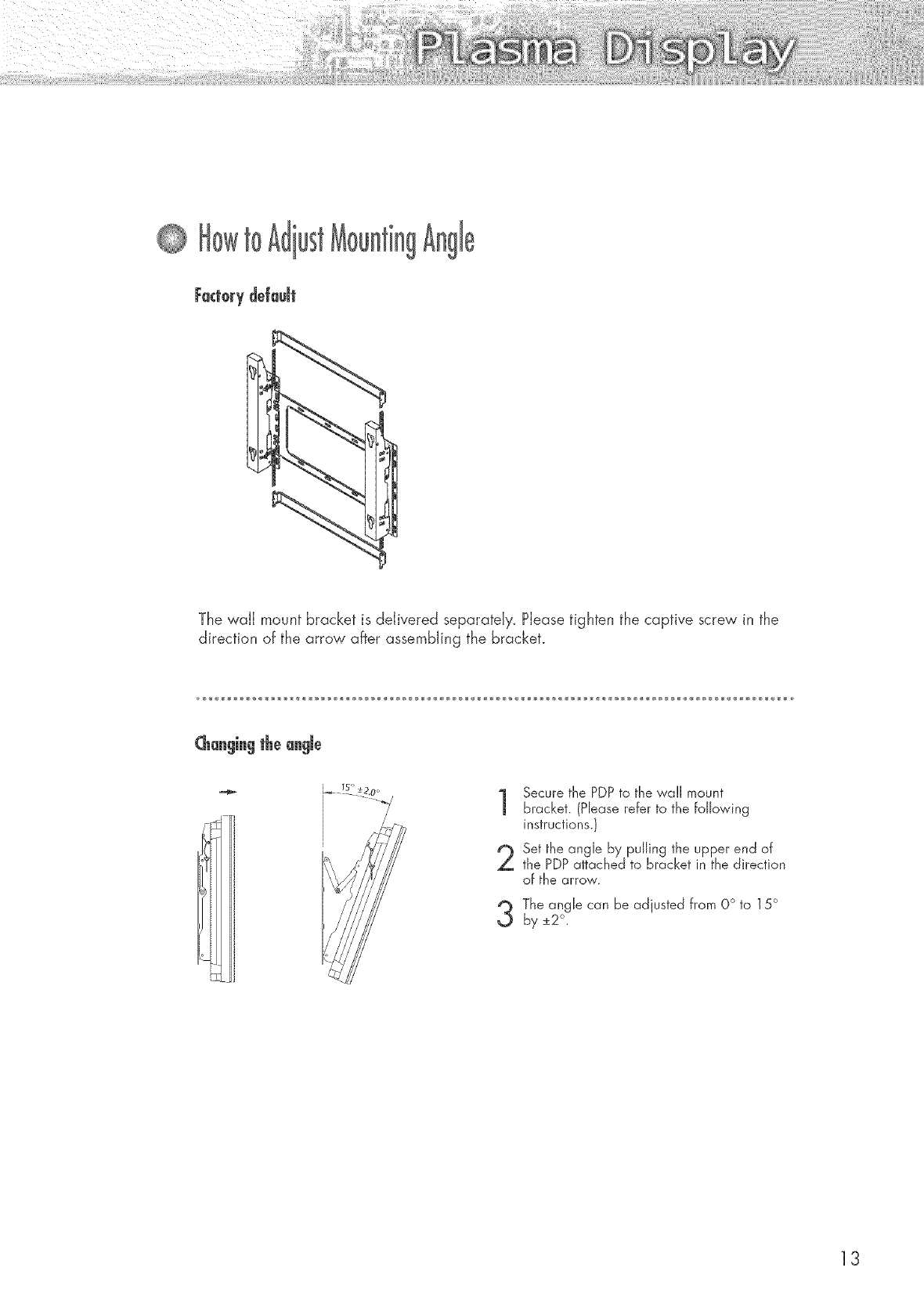
to ust
Facterydda@
The wall mount bracket is delivered separately_ Please tighten the captive screw in the
direction of the arrow after assembling the bracket.
Changingthe angle
Secure the PDP to the wall mount
bracket. (Please refer to the following
instructions.)
Set the angle by pulling the upper end of
the PDP attached to bracket in the direction
of the arrow.
The angle can be adjusted from 0 ° to 15°
÷ o
by _2.
13
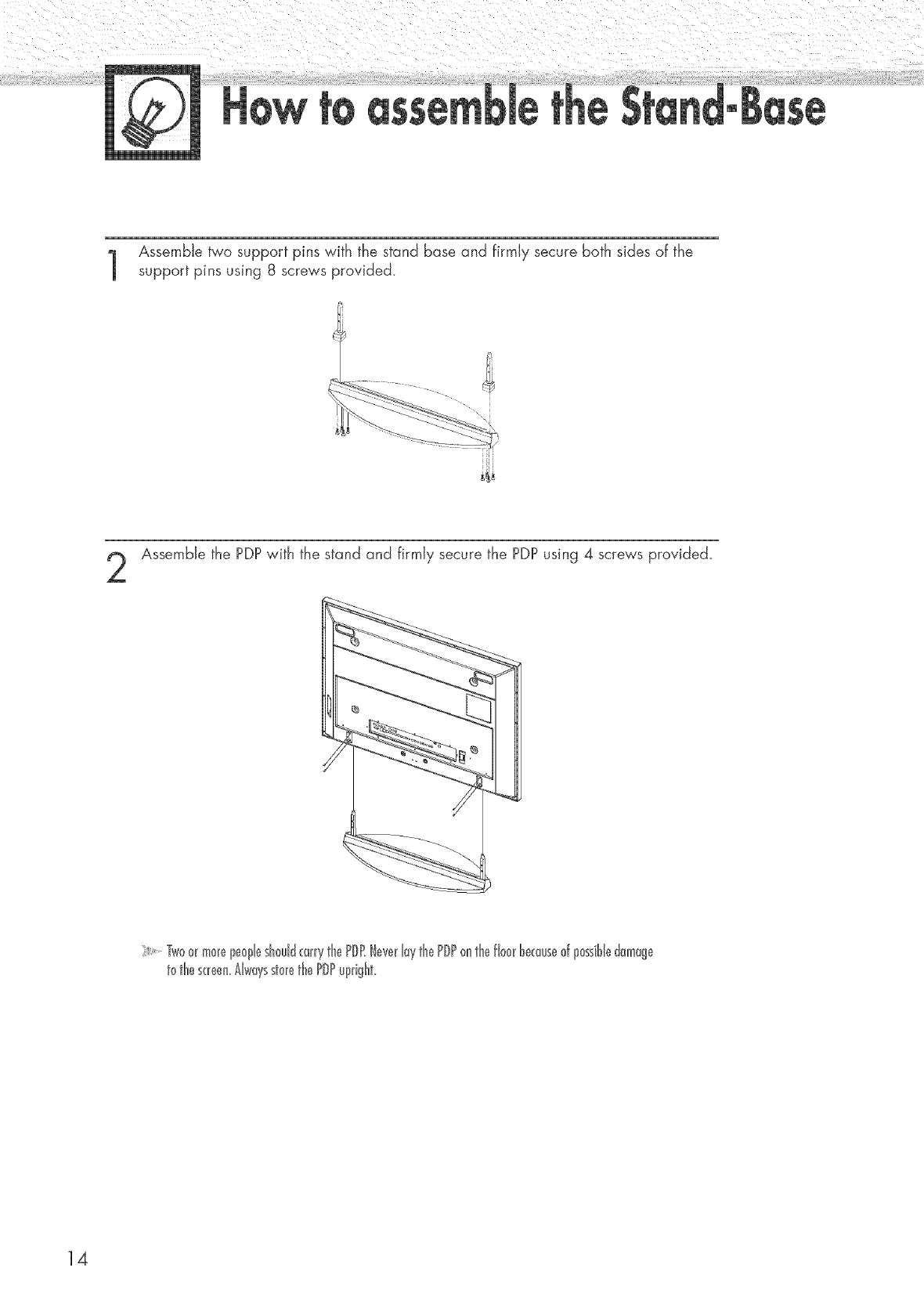
Assemble two support pins with the stand base and firmly secure both sides of the
support pins using 8 screws provided.
Assemble the PDPwith the stand and firmly secure the PDP using 4 screws provided.
Twoormorepeopleshould_orrytirePBRNeverlaythePBPontirefloorbecauseofpossibledamage
tothescreenAlwaysstorethePBPupright
14
iiiiiiiiiiiiiiiiii!!iii
Connecting VHF and UHF Antennas .............................................. 16
Connecting Cable TV.................................................................... 17
Connecting a VCR........................................................................ 19
Connecting a Camcorder .............................................................. 20
Connecting a DVD Hayer .............................................................. 21
Connecting a DTV Receiver .......................................................... 22
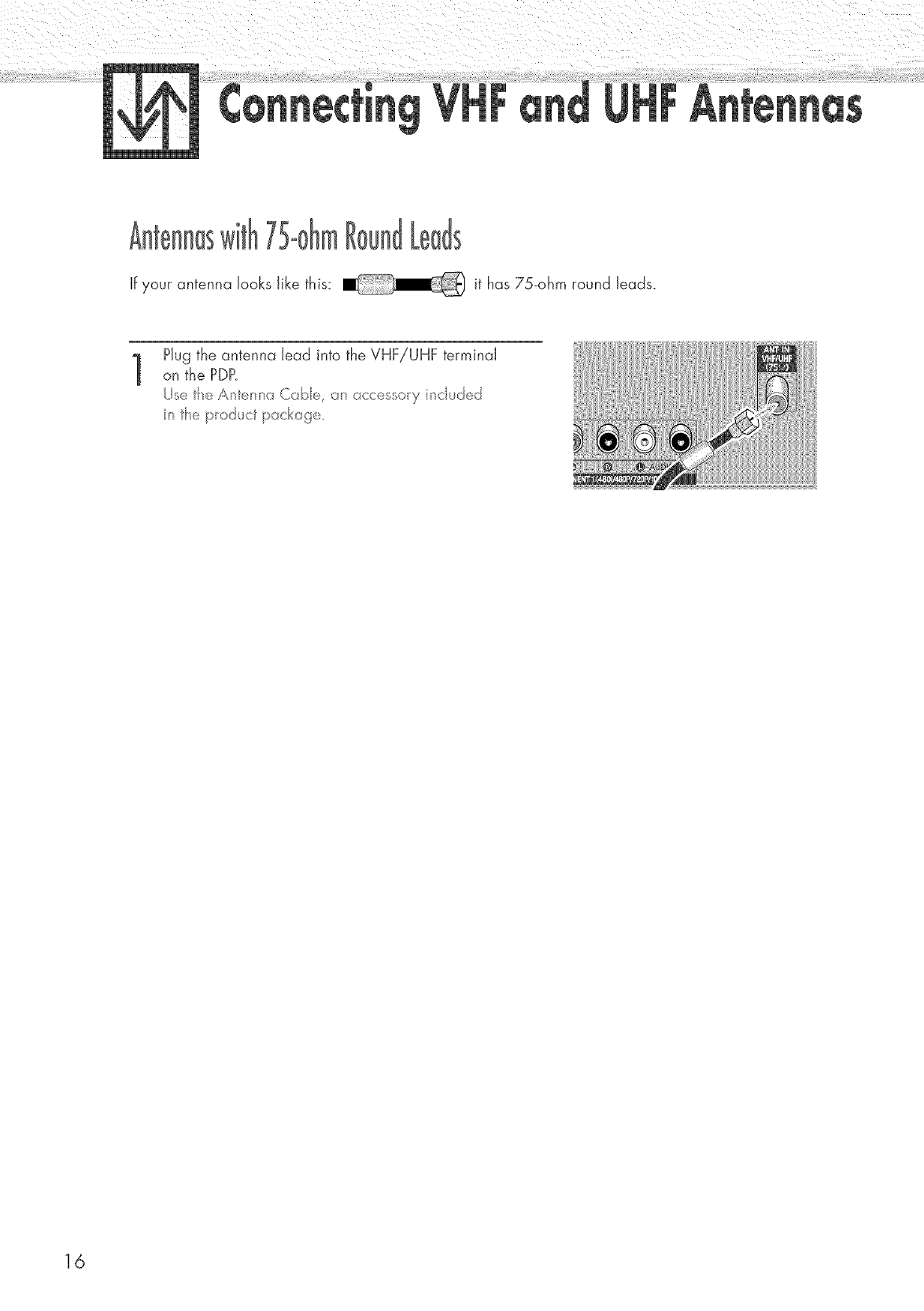
If your antenna Jooks Jikethis: it has 75-ohm round Jeads.
1Hug the antenna Jead into the VHF/UHF terminaJ
on the PDP.
Use the Anter na Cabe, an accesso/y nc uded
n the p/oduct package,
16
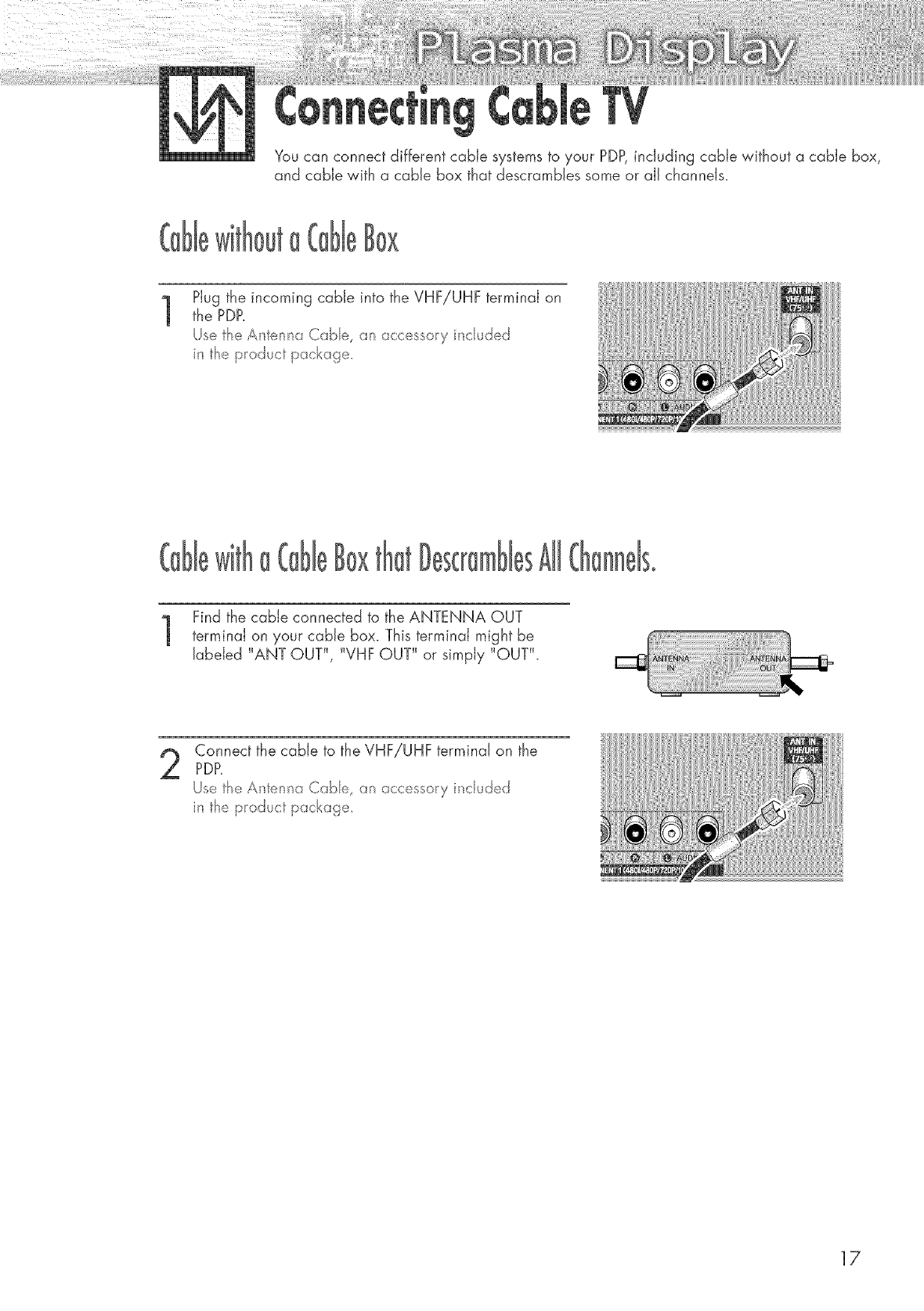
You can connect different cable systems to your PDP,including cable without a cable box,
and cable with a cable box that descrambles some or all channels.
1Plug the incoming cable into the VHF/UHF terminal on
the PDff
Use fl_e Anterma Cabe, an acces o/y _c uded
fl_e p/oduct package.
Find the cable connected to the ANTENNA OUT
terminal on your cable box. This terminal might be
labeled _ANT OUT_, _VHF OUT _ or simply _OUT_L
Connect the cable to the VHF/UHF terminal on the
PDP.
Uetf_eAnternaCa:_e, anacc_., /y': ncud_d
n tf_e p/cduct package.
17
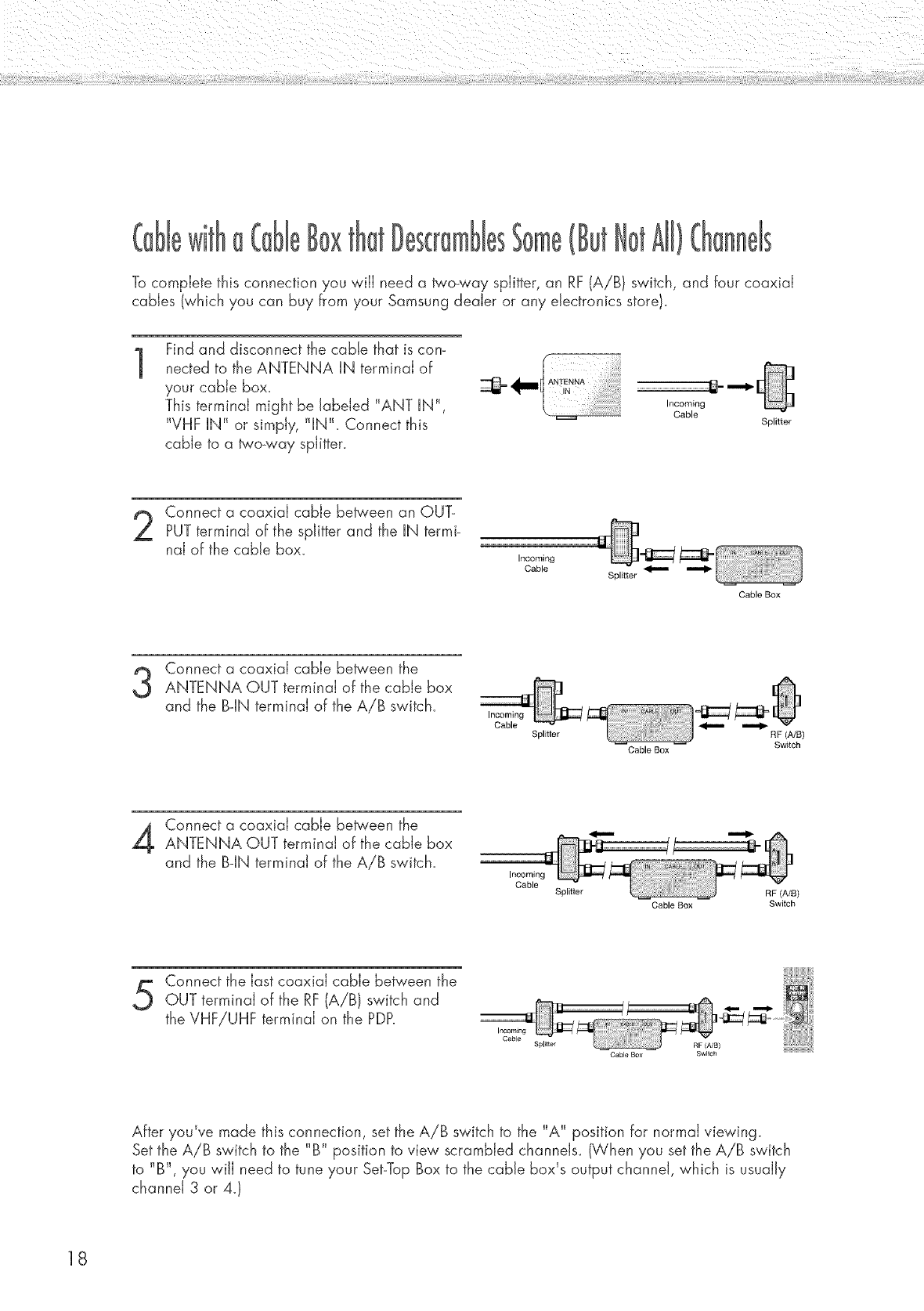
To complete this connection you will need a _'o-way splitter, an RF(A/BI switch, and four coaxial
cables (which you can buy from your Samsung dealer or any electronics store).
1Find and disconnect the cable that is con-
nected to the ANTENNA IN terminal of
your came box.
This terminal might be labeled "ANT IN",
"VHF IN" or simply, "IN". Connect this
cable to a two-way splitter.
ANTENNA .................................................._-- nn_b-_"
,ooom,o0
Cable
Connect a coaxial cable between an OUT-
PUTterminal of the splitter and the IN termi-
nal of the cable box. Incoming
Cable Splitter
Splitter
Cable Box
Connect a coaxial cable between theANTENNA OUT terminal of the cable box
and the B-IN terminal of the AiB switch. Incoming
Cable Splitter
Cable Box
RF (A/B)
Switch
Connect a coaxial cable be_'een the
ANTENNA OUT terminal of the cable box
and the B-IN terminal of the A/B switch.
Incoming
Cable
Splitter RF (A/B)
Cable Box Switch
Spl_tter RF (AJB)
Cable Box Switch
Connect the last coaxial cable between the
OUT terminal of the RF(A/B) switch and
the VHF!UHF terminal on the PDP.
Incoming
Cable
After you've made this connection, set the A/B switch to the "A" position for normal viewing.
Set the A/B switch to the "B" position to view scrambled channels. (When you set the A/B switch
to "B", you will need to tune your Set-TopBox to the cable box's output channel, which is usually
channel 3 or 4.}
18
PDP
OF
Power Plug
or
?
Audio Cable
S_VideoCabk
Video Cable
J
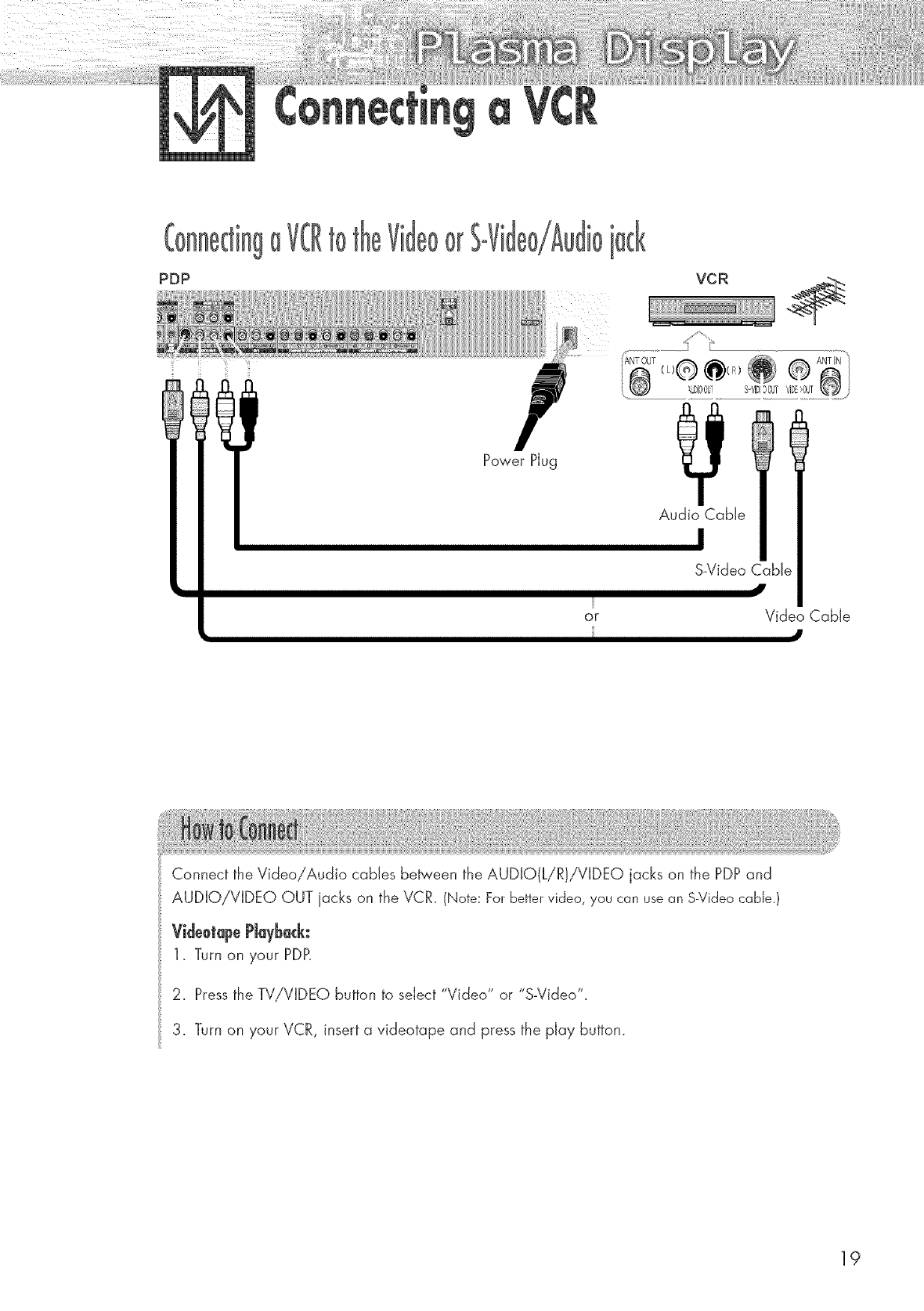
Connect the Video/Audio cables between the AUDIO(L/R)/VIDEQ jacks on the PDPand
AUDIO!VIDEO OUT jacks on the VCR. (Note: For bettervideo, you can usean S-Videocable.)
VideotapePJayback:
1. Turn on your PDP.
2. Pressthe TV!VIDEO button to select "Video" or "S-Video
3. Turn on your VCR, insert a videotape and press the play button.
19
PDP
iPower Plug
Camcorder
Video Cable
Audio Cable
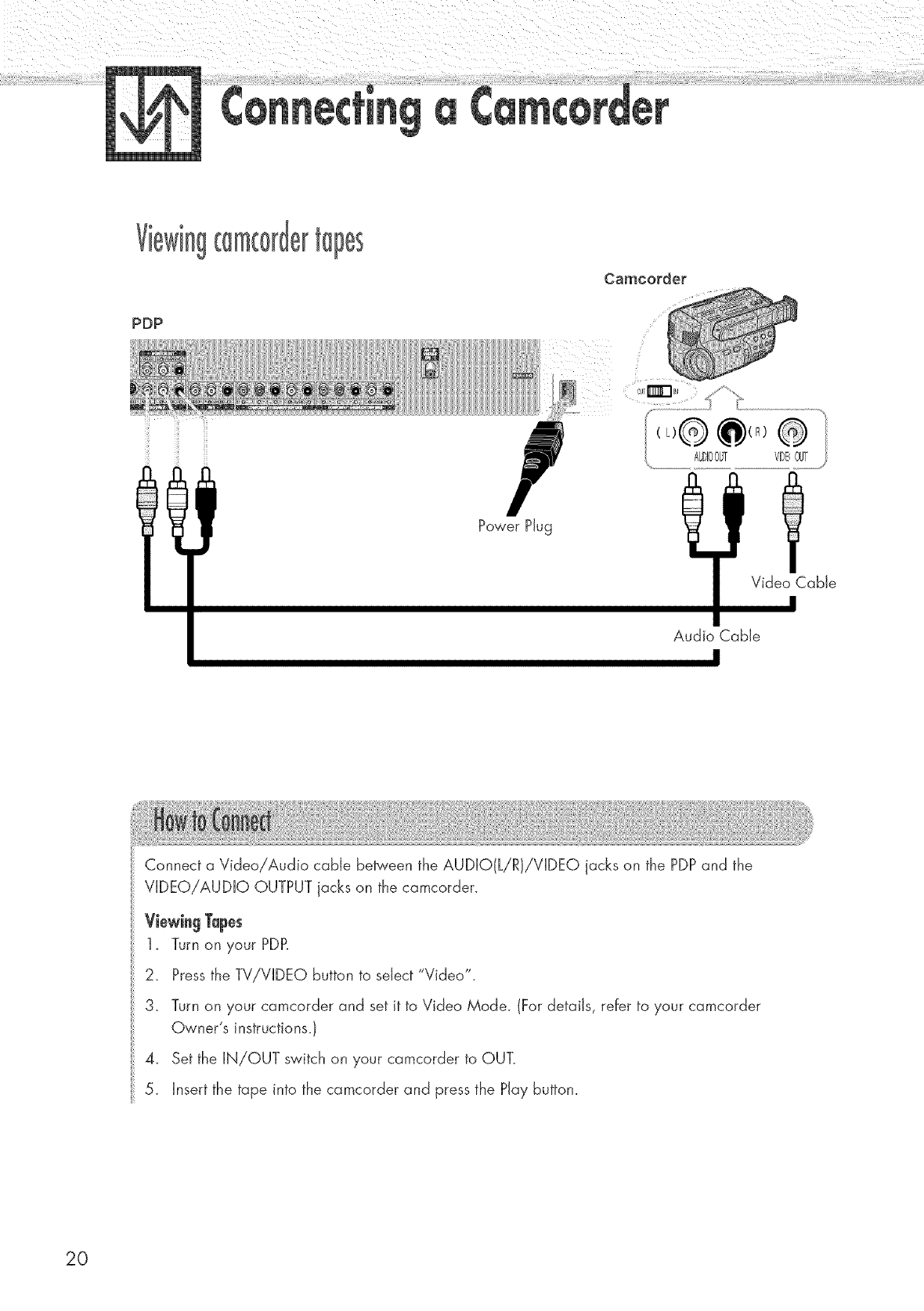
Connect a Video!Audio cable be_'een the AUDIO(L/R)/VIDEO jacks on the PDP and the
VIDEO!AUDIO OUTPUT jacks on the camcorder.
ViewingTapes
1. Turn on your PDP.
2. Pressthe TV!VIDEO button to select "Video".
3. Turn on your camcorder and set it to Video Mode. (For details, refer to your camcorder
Owner's instructions.)
4. Set the IN/OUT switch on your camcorder to OUT.
5. Insert the tape into the camcorder and press the Play button.
20
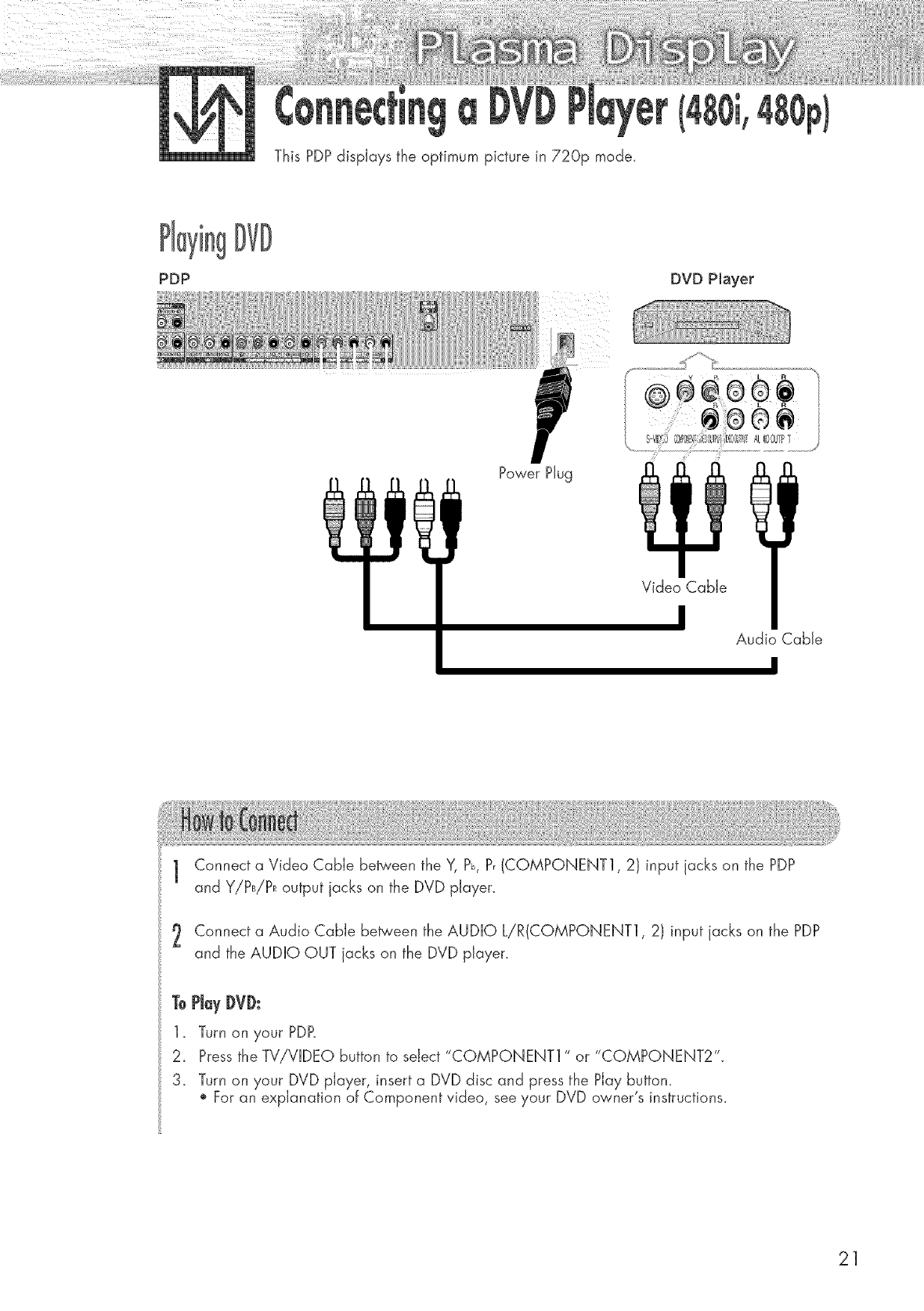
This PDP displays the optimum picture in 720p mode.
PDP DVD P{ayer
Power Plug
..............._.;!j"'_ _:.....................................................
®®e®®¢
.........] . ......
Audio Cable
1 Connect a Video Cable between the Y, Pb, P, (COMPONENT1,2) input jacks on the PDP
and Y!PB!PRoutput jacks on the DVD player.
2 Connect a Audio Cable between the AUDIO L/R(COMPQNENT1, 2) input jacks on the PDP
and the AUDIO OUT jacks on the DVD player.
ToPJayDVD:
1_ Turn on },our PDP.
2. Pressthe TV!VIDEO button to select "COMPONENT1 " or "COMPONENT2".
3. Turn on your DVD player, insert a DVD disc and press the Play button.
For an explanation of Component video, see your DVD owner's instructions.
21
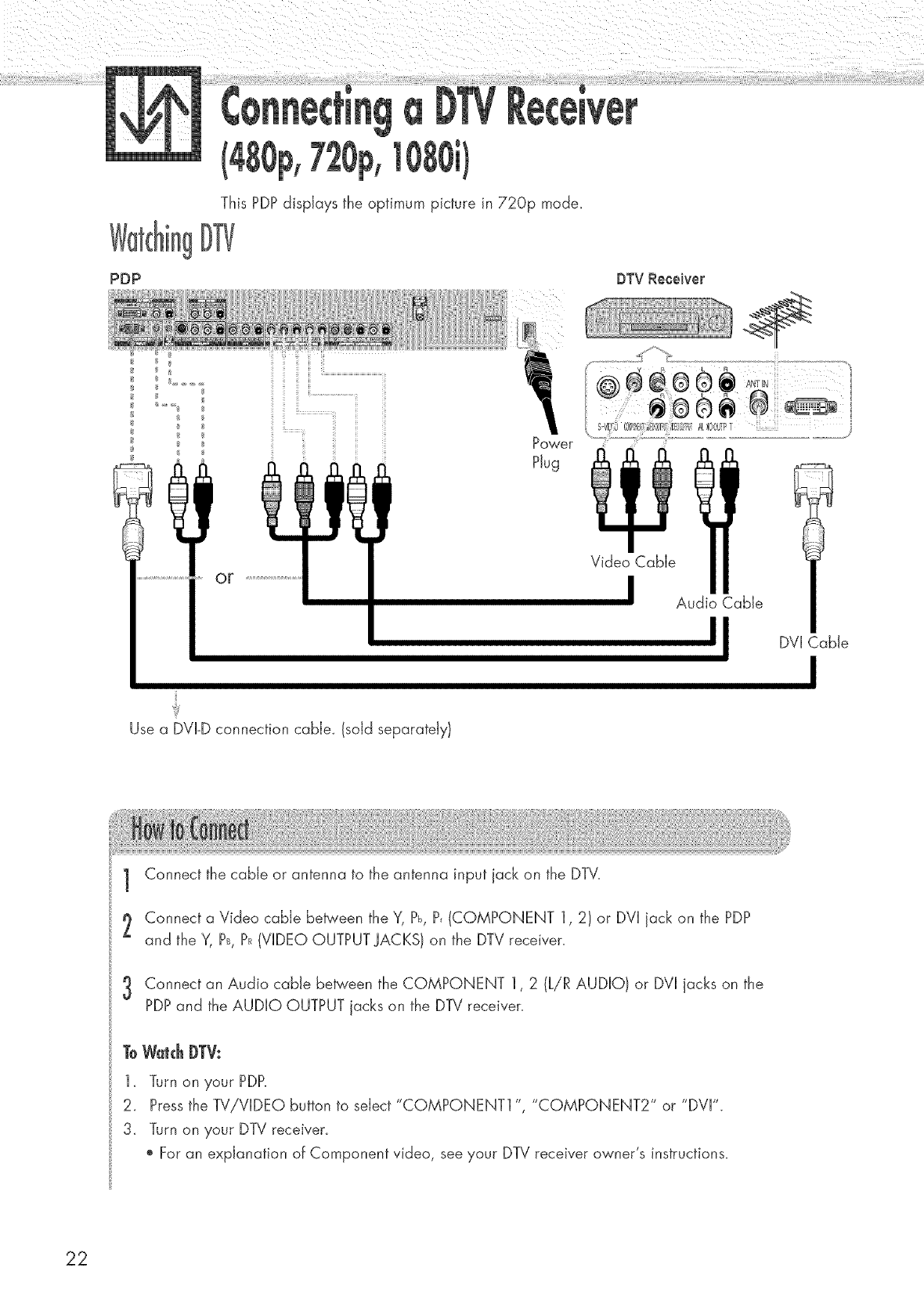
1
This PDPdisplays the optimum picture in 720p mode.
PDP
®
OF
DTV Re0eJver
O@@
Audio Cable
DVi Cable
Use a DVi-D connection cable. (said separately}
1 Connect the cable or antenna to the antenna input jack on the DTV.
2 Connect a Video cable between the Y, P_,,P, (COMPONENT 1,2] or DVI jack on the PDP
and the Y, P_,PR(VIDEO OUTPUT JACKS) on the DTV receiver.
3 Connect an Audio came between the COMPONENT 1,2 (LiR AUDIO] or DVI jacks on the
PDPand the AUDIO OUTPUT jacks on the DTV receiver.
ToWatchDTY:
1. Turn on your PDP.
2. Pressthe TV!VIDEO button to select "COMPONENT1 ", "COMPONENT2" or "DVI".
3. Turn on your DTV receiver.
For an explanation of Component video, see your DTV receiver owner's instructions.
Turning the PDPOn and Off .......................................................... 24
Hug & Hay Feature ...................................................................... 26
Memorizing the Channels .............................................................. 29
Setting Up Your Remote Control .................................................... 34
Viewing an External Signal Source ................................................ 36
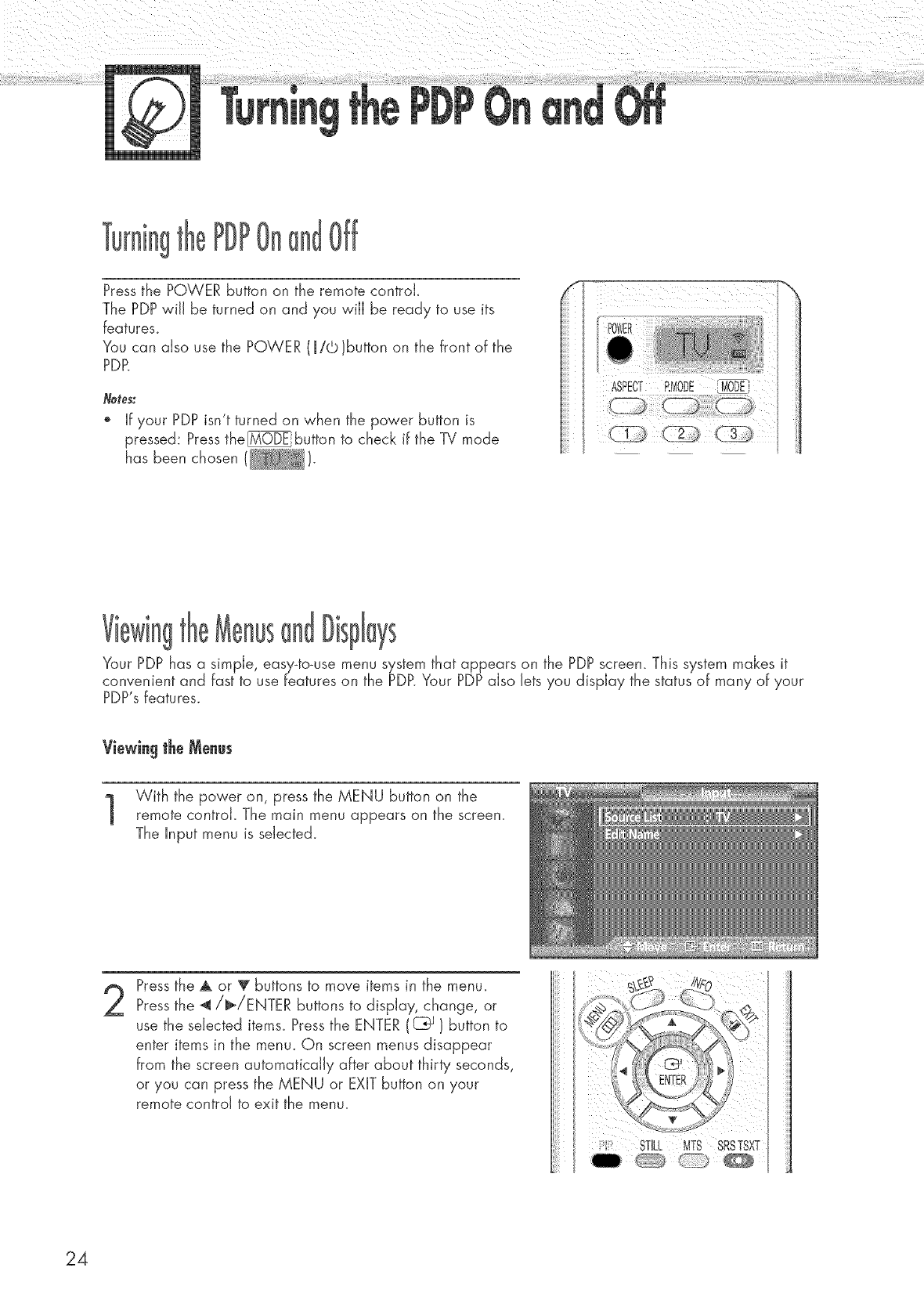
PDP Off
Pressthe POWER button on the remote controk
The PDPwill be turned on and you will be ready to use its
features_
You can also use the POWER (R/O)button on the front of the
PDR
Notes:
If your PDP isn't turned on when the power button is
pressed: Pressthe_button to check if the TV mode
has been chosen ( ).
Your PDP has a simple, easy_to_usemenu system that appears on the PDP screem This system makes it
convenient and fast to use features on the PDP.Your PDPalso Jetsyou display the status of many of your
PDP'sfeatures.
Viewing the Menus
With the power on, press the MENU button on the
remote control The main menu appears on the screen.
The Input menu is selected.
2Pressthe A or T buttons to move items in the menu_
Pressthe 4/I_/ENTER buttons to display, change, or
use the selected items_ Pressthe ENTER ( (Z_ / button to
enter items in the menu_ On screen menus disappear
from the screen automatically after about thirty seconds,
or you can press the MENU or EXITbutton on your
remote control to exit the menu.
STILLMTS SRSTSXT
24
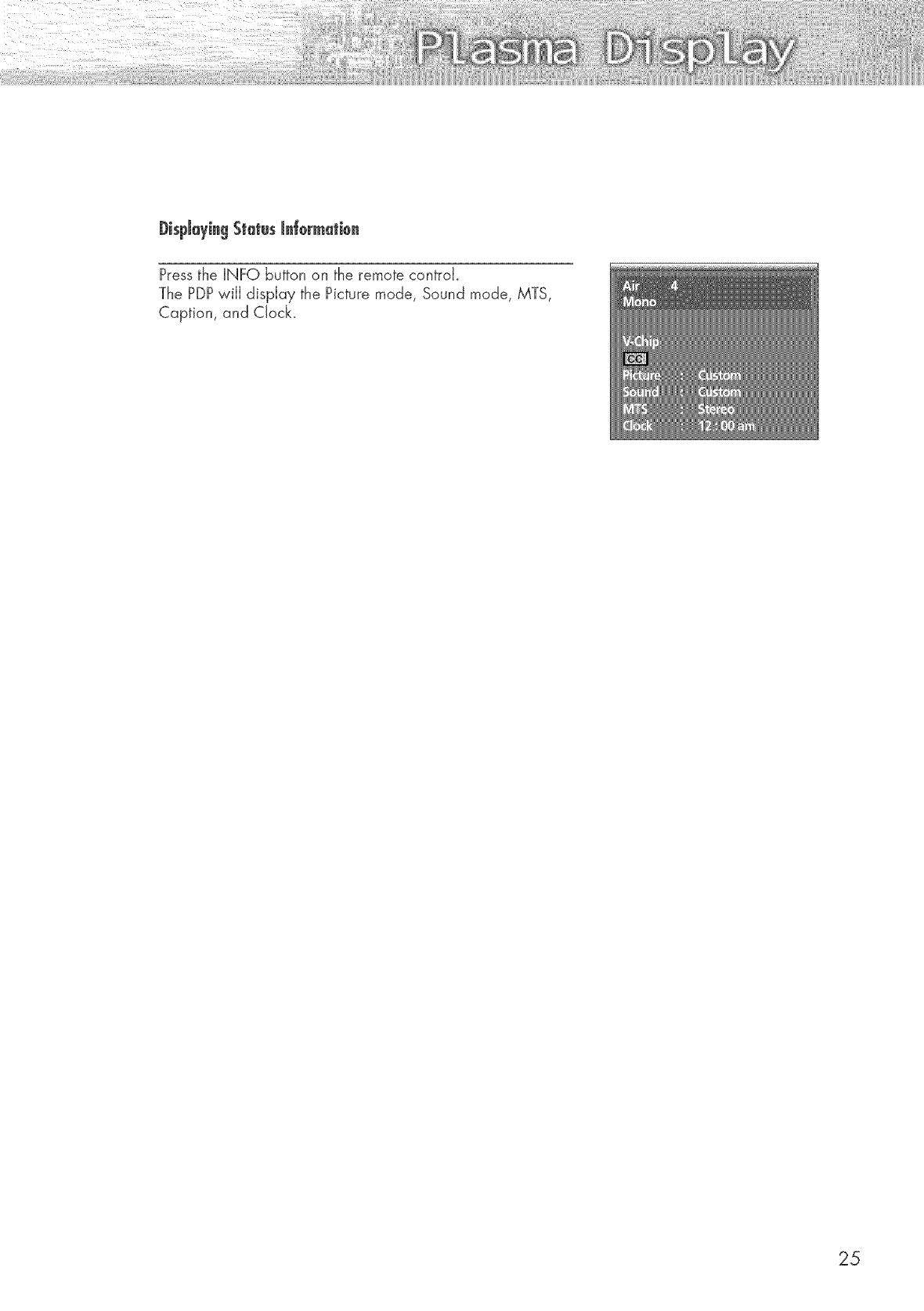
DispJeyieg Status Je[ermetiee
Pressthe INFO button on the remote controk
The PDPwiJJdisplay the Picture mode, Sound mode, MTS,
Caption, and Clock.
25
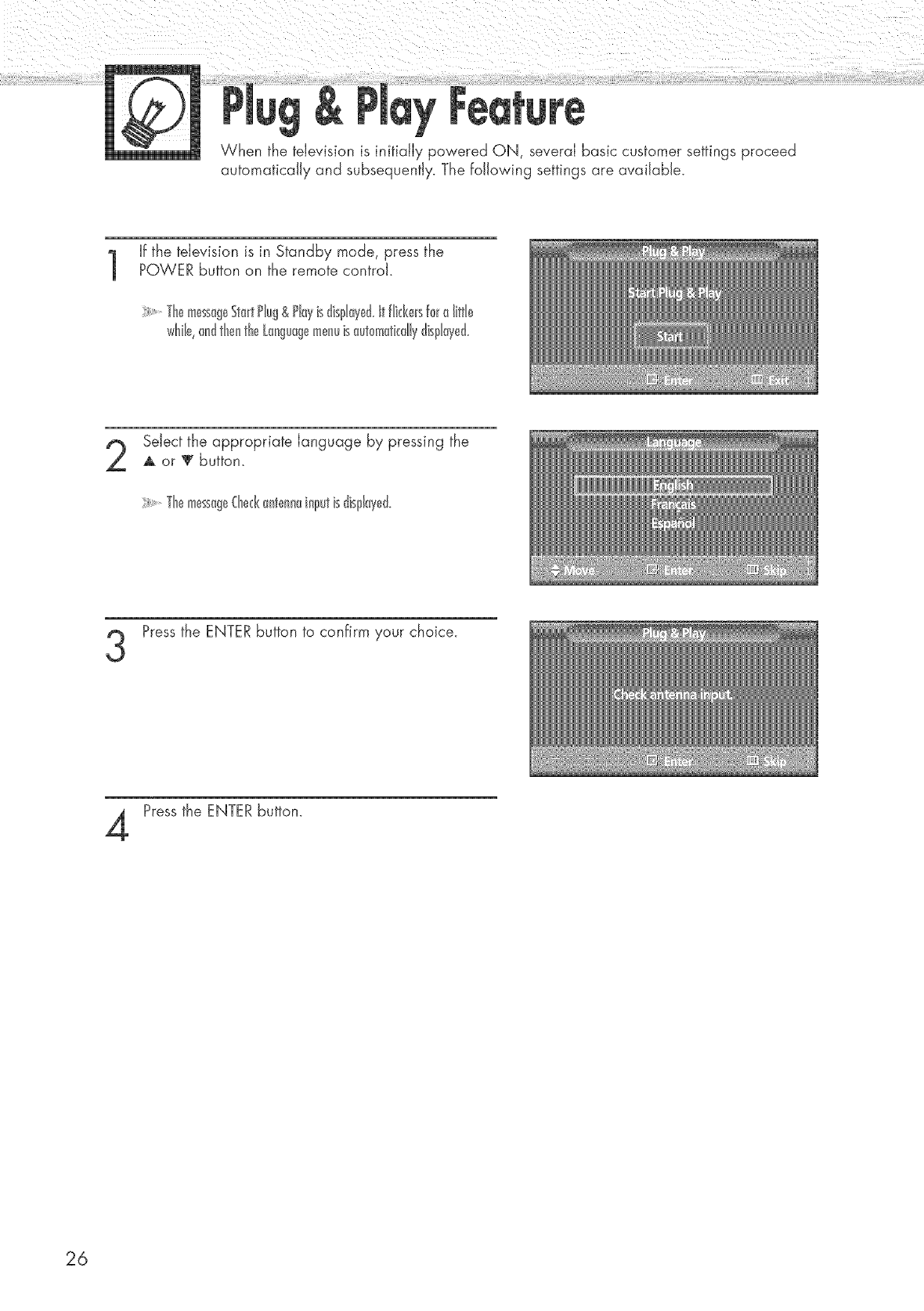
When the television is initially powered ON, several basic customer settings proceed
automatically and subsequently. The following settings are available.
If the television is in Standby mode, press the
POWER button on the remote controk
++++++++Themess+goStortPlug&P[oy+sd+sploye&itfl++kersforo l+tt[+
wh++++0ndthentheL0ngu0g+menu+s0utom0tkd+yd+sp[0t,ed+
Select the appropriate language by pressing the
A or ++ button+
++++++++Themessog+€he&0ntenn0inputisdispl0yed+
Pressthe ENTER button to confirm your choice+
Pressthe ENTER button+
26
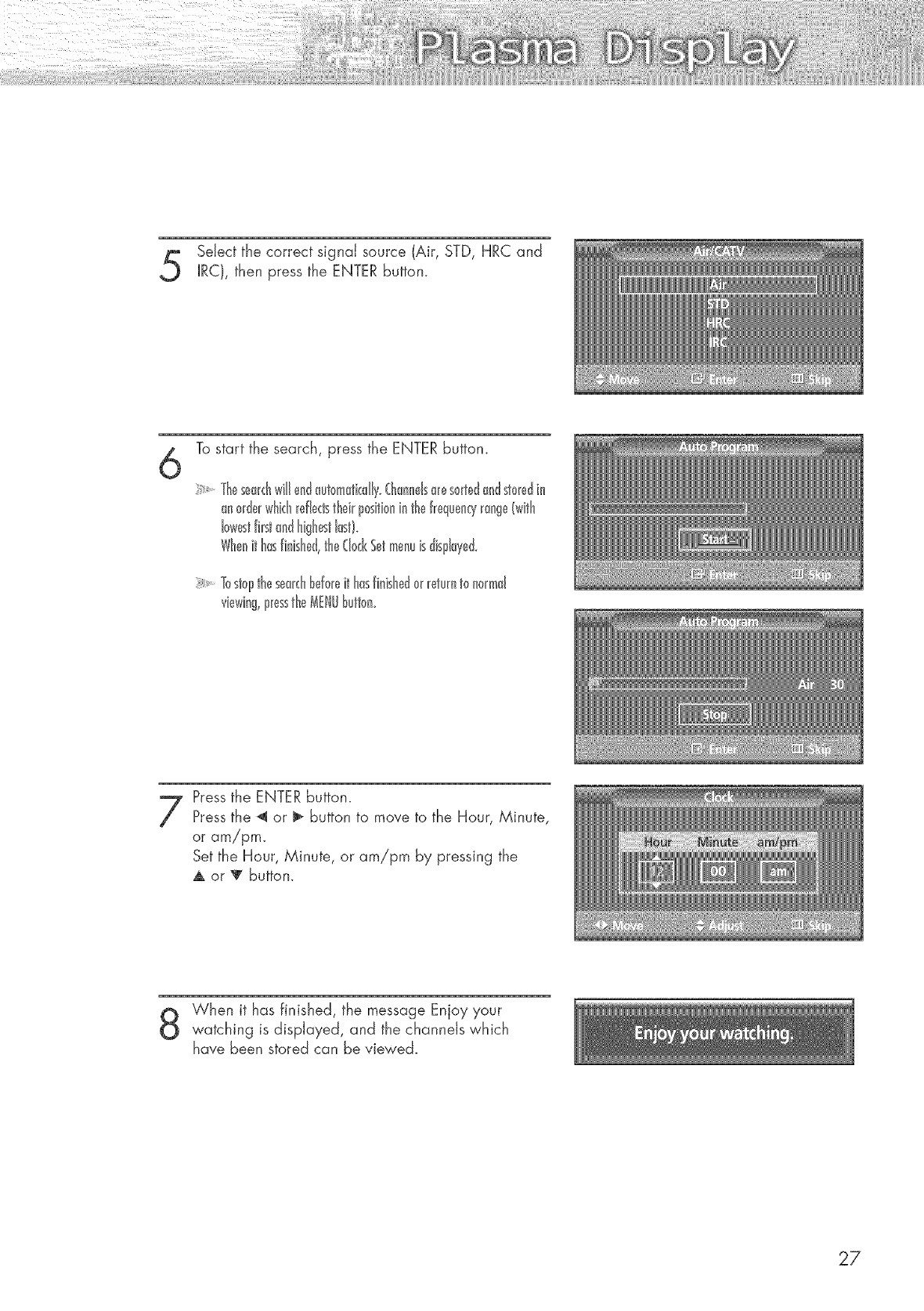
Select the correct signal source (Air, STD, HRC and
[RC}, then press the ENTER button.
6To start the search, press the ENTER button.
Theseor_hwillendoutomotkdly.{honndsaresortedondstoredin
onorderwhkhrefle_stheirpositioninthefrequency'ronge(with
lowestfirstandhighestlost)+
Whenit hosfinished,the@_&Setmenuisdisplayed
TostoptheseorChbeforeit hosfinishedorreturnto normal
viewing,presstheMEHUbutton_
Pressthe ENTER button.
Pressthe _ or m button to move to the Hour, Minute,
or am/pm.
Set the Hour, Minute, or am!pm by pressing the
,L or T button.
When it has finished, the message Enjoy your
watching is displayed, and the channels which
have been stored can be viewed.
27
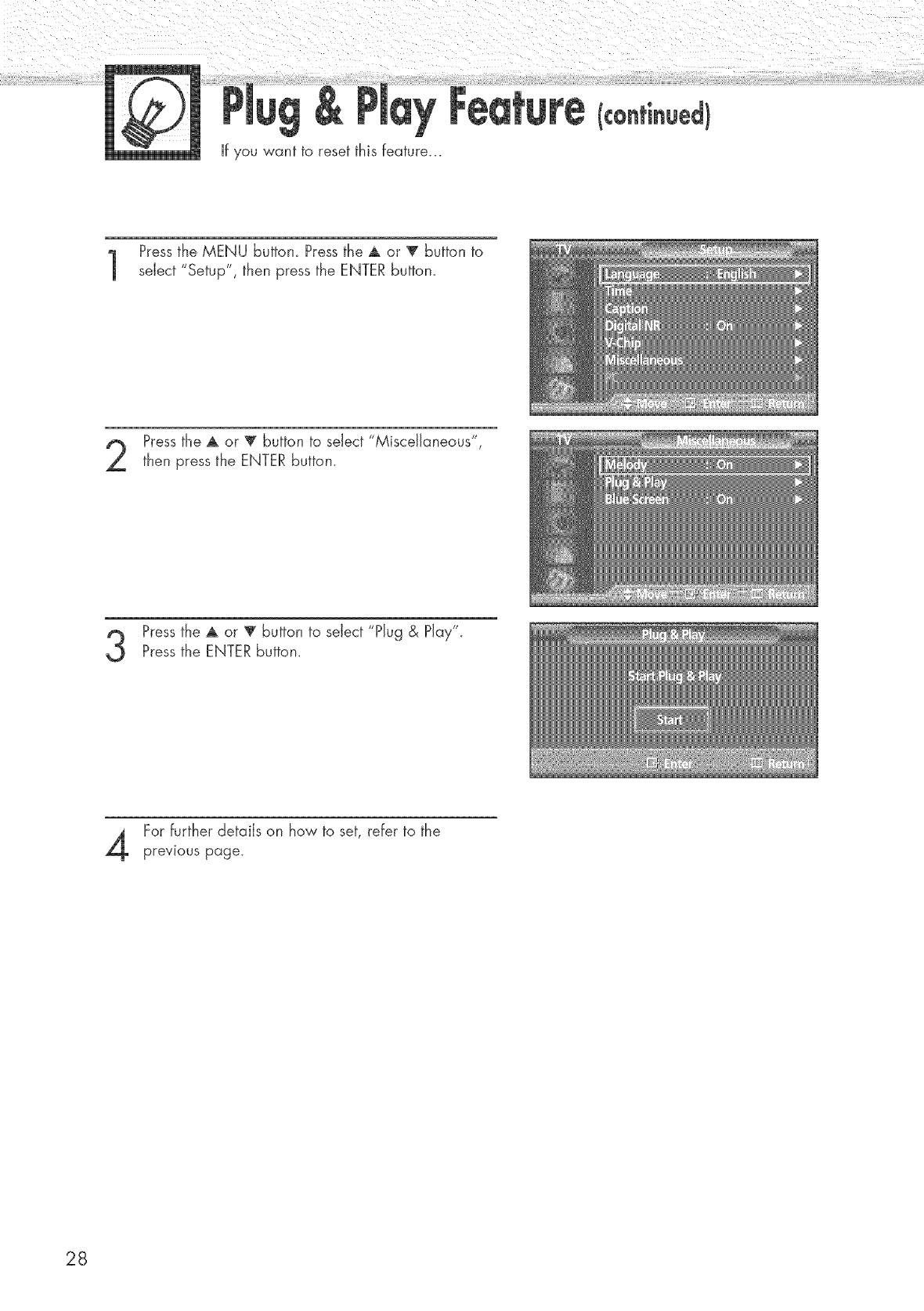
If you want to reset this feature...
Pressthe MENU buttom Pressthe A or T button to
select "Setup", then press the ENTERbutton.
Pressthe A or T button to select "Miscellaneous",
then press the ENTER button.
Pressthe A or _' button to select "Plug & Play".
Pressthe ENTER button.
For further details on how to set, refer to the
previous page.
28
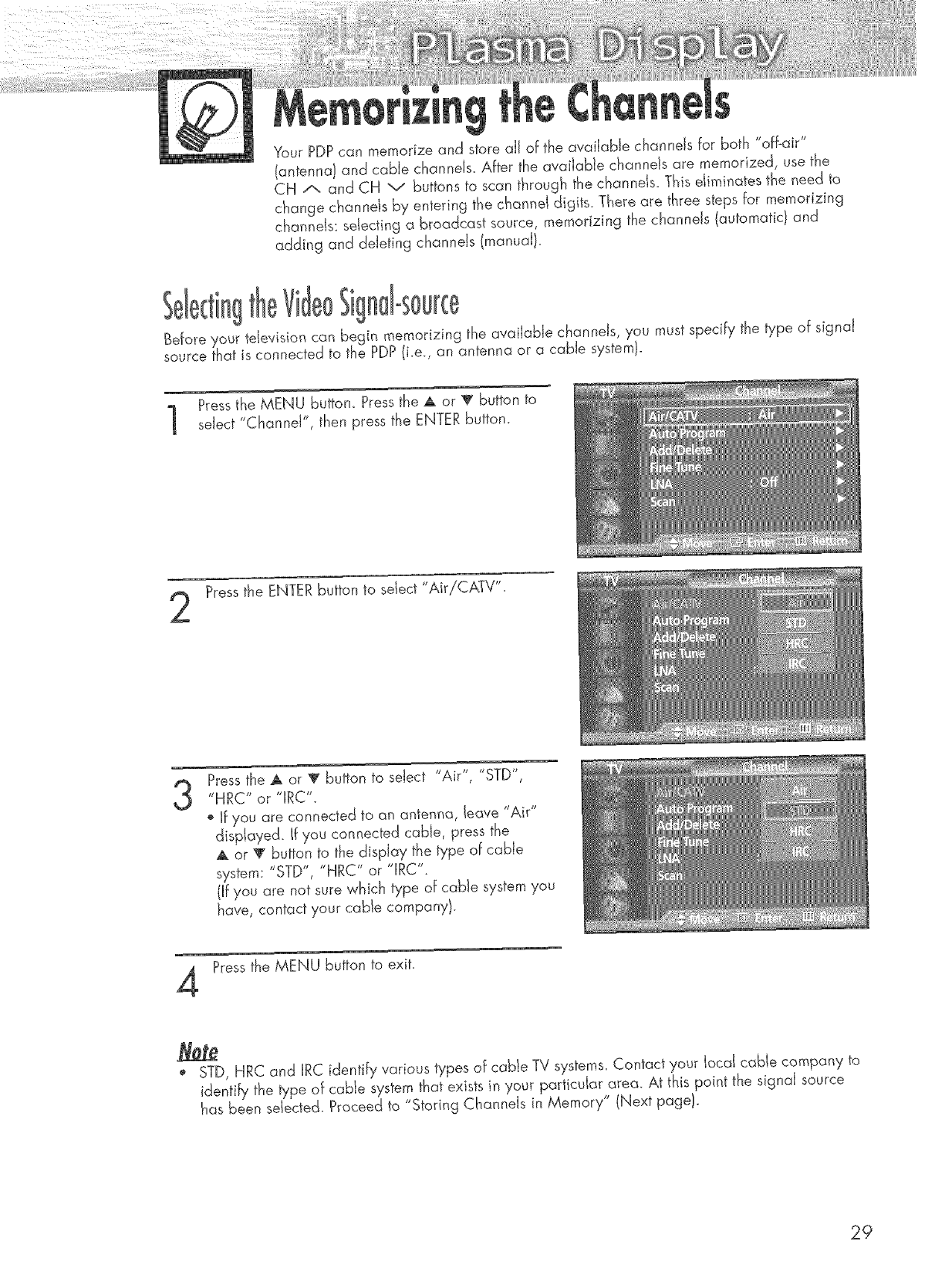
Your PDP can memorize and store alJ of the availab[e channels for both "off-air"
(antenna} and cane channels. After the available channels are memorized, use the
CH ,_ and CH v buttons to scan through the channels. This eliminates the need to
change channels by entering the channel digits. There are three steps for memorizing
channels: selecting a broadcast source, memorizing the channels (automatic / and
adding and de)eting channe)s (manua)).
Before your tdevision can begin memorizing the available channels, you must specify the type of signat
source that is connected to the PDP (i.e., an antenna or a cable system}.
Pressthe MENU button_ Pressthe _ or V button to
select "Channel", then press the ENTER button.
Pressthe ENTERbutton to select "Air/CATV'.
3Pressthe A or T button to select "Air", "STD",
"HRC" or "IRC'L
o If you are connected to an antenna, leave "Air"
displayed. If you connected cable, press the
A or Ir button to the display the type of cable
system: "STD", "HRC" or "IRC".
(If you are nat sure which type of cable system you
have, contact your cable company !.
Pressthe MENU button to exit.
e STD, HRC and IRC identify various types of cable TV systems. Contact your IocaJ cable company to
identify the type of cable system that exists in your particuIar area. At this point the signaI source
has been selected. Proceed to "Storing Channds in Memory" (Next page}.
29
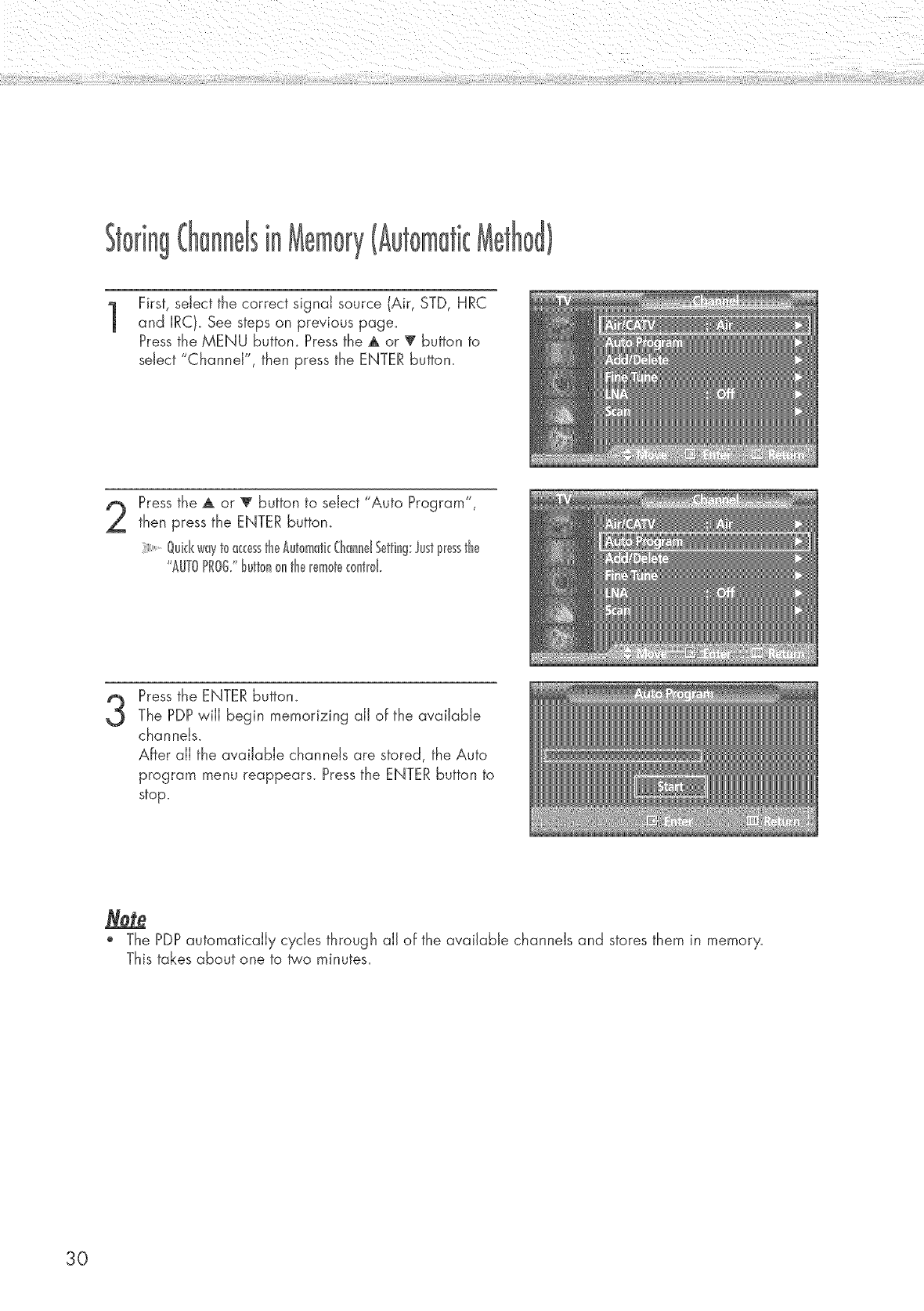
1First, select the correct signal source (Air, STD, HRC
and IRC)_See steps on previous page_
Pressthe MENU button. Press the A or T button to
select "Channel", then press the ENTER button.
2Press the A or T button to select "Auto Program",
then press the ENTER button.
i Qui_kw_ytoa_esstheAut0m_tkCh_nndSetting:_ustpressthe
"AUTOPROG"buttonontheremotec0ntrd
3Press the ENTER button.
The PDPwill begin memorizing all of the available
channels.
After all the available channels are stored, the Auto
program menu reappears. Pressthe ENTER button to
stop.
'_ The PDPautomatically cycles through all of the available channels and stores them in memory.
This takes about one to _o minutes.
30
,g g
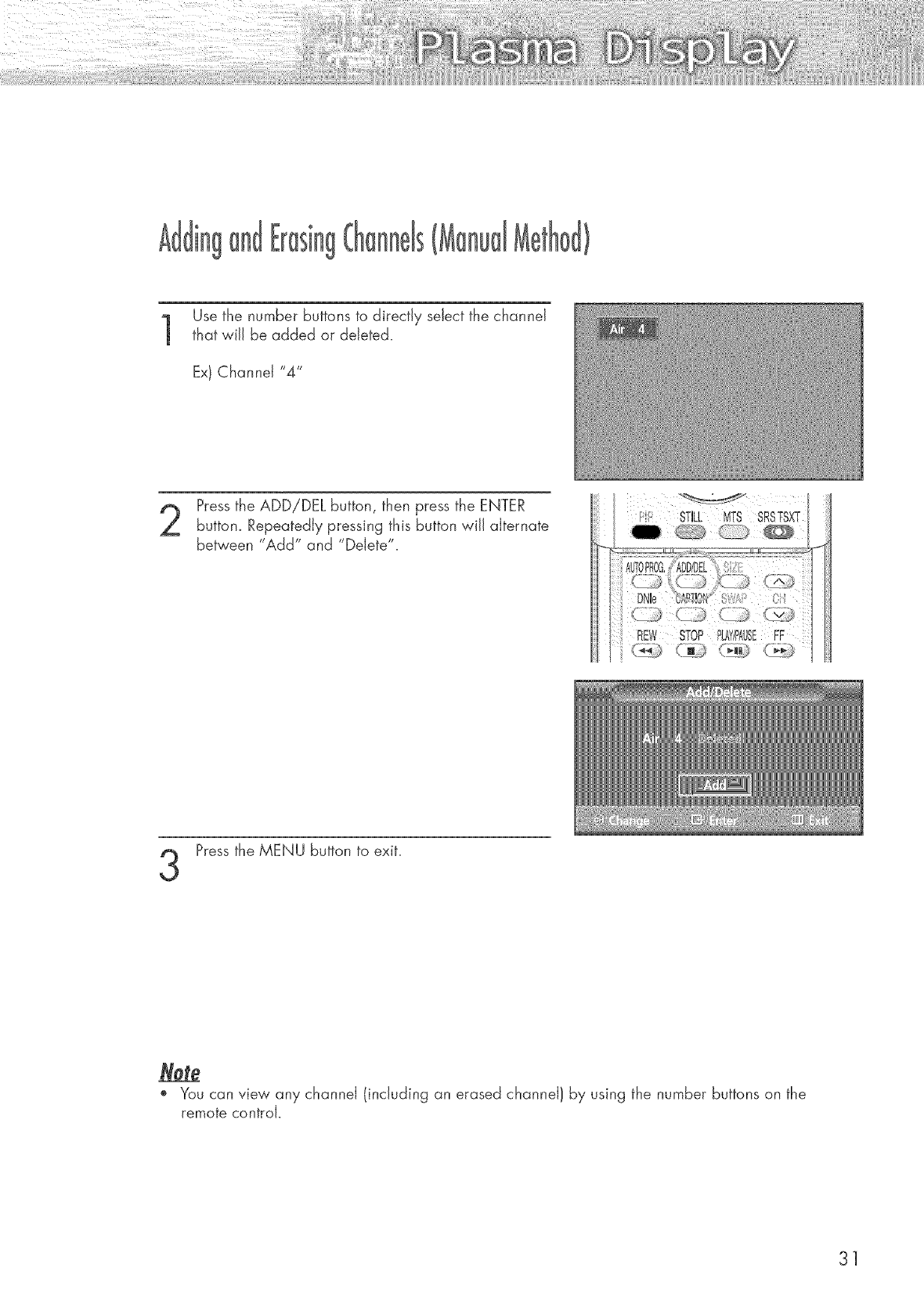
Use the number buttons to directly select the channel
that wiJJ be added or deleted.
Ex} Channel "4"
Pressthe ADDiDEL button, then press the ENTER
button. Repeatedly pressing this button wiJJalternate
between "Add" and "Delete".
Pressthe MENU button to exit.
', You can view any channel (including an erased channel} by using the number buttons on the
remote control.
31
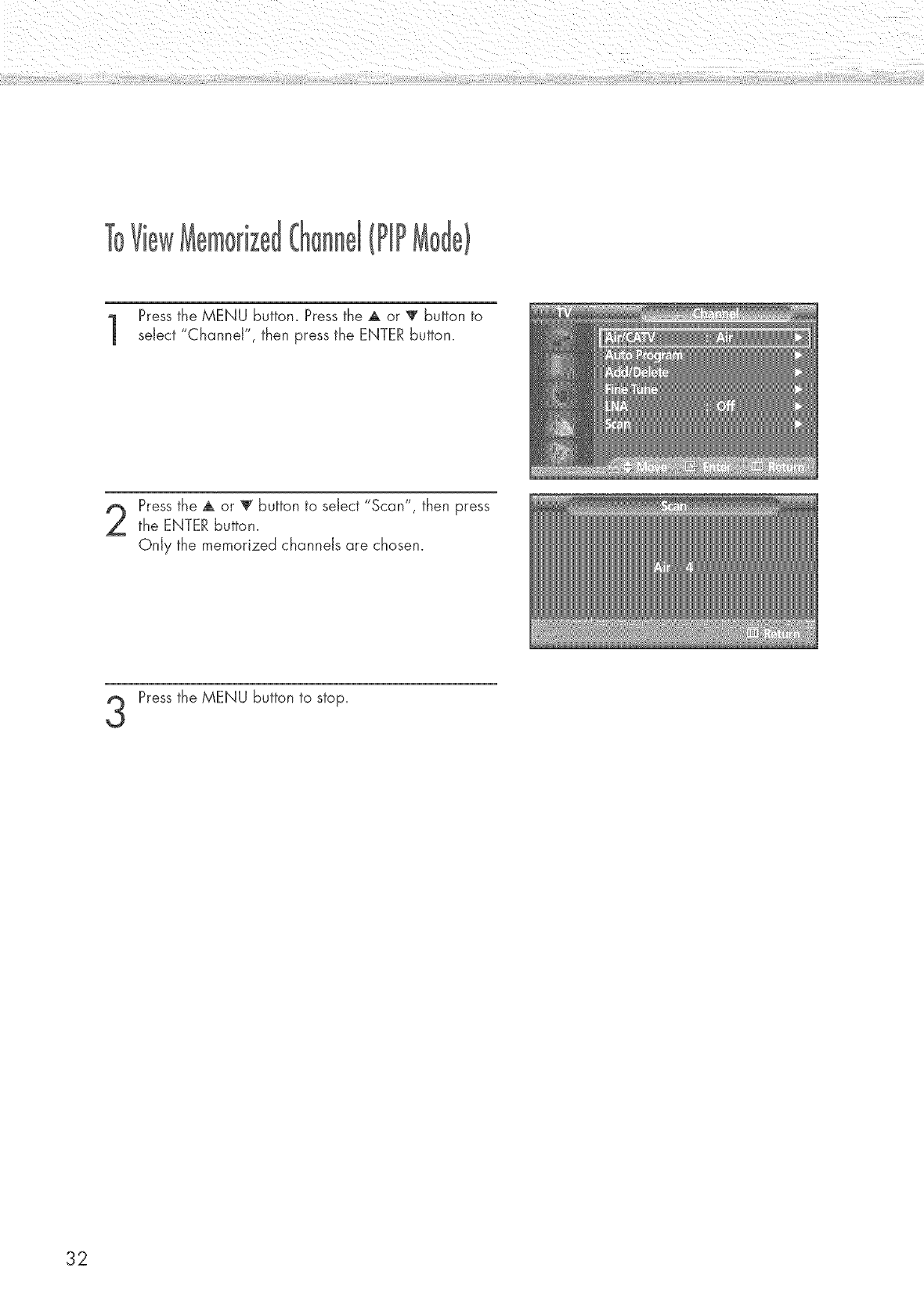
(Prop
Press the MENU buttom Press the A or _' button to
sdect "ChanneJ", then press the ENTER button.
Press the A or T button to seJect"Scan", then press
the ENTER button.
Only the memorized channeJs are chosen.
Press the MENU button to stop.
32
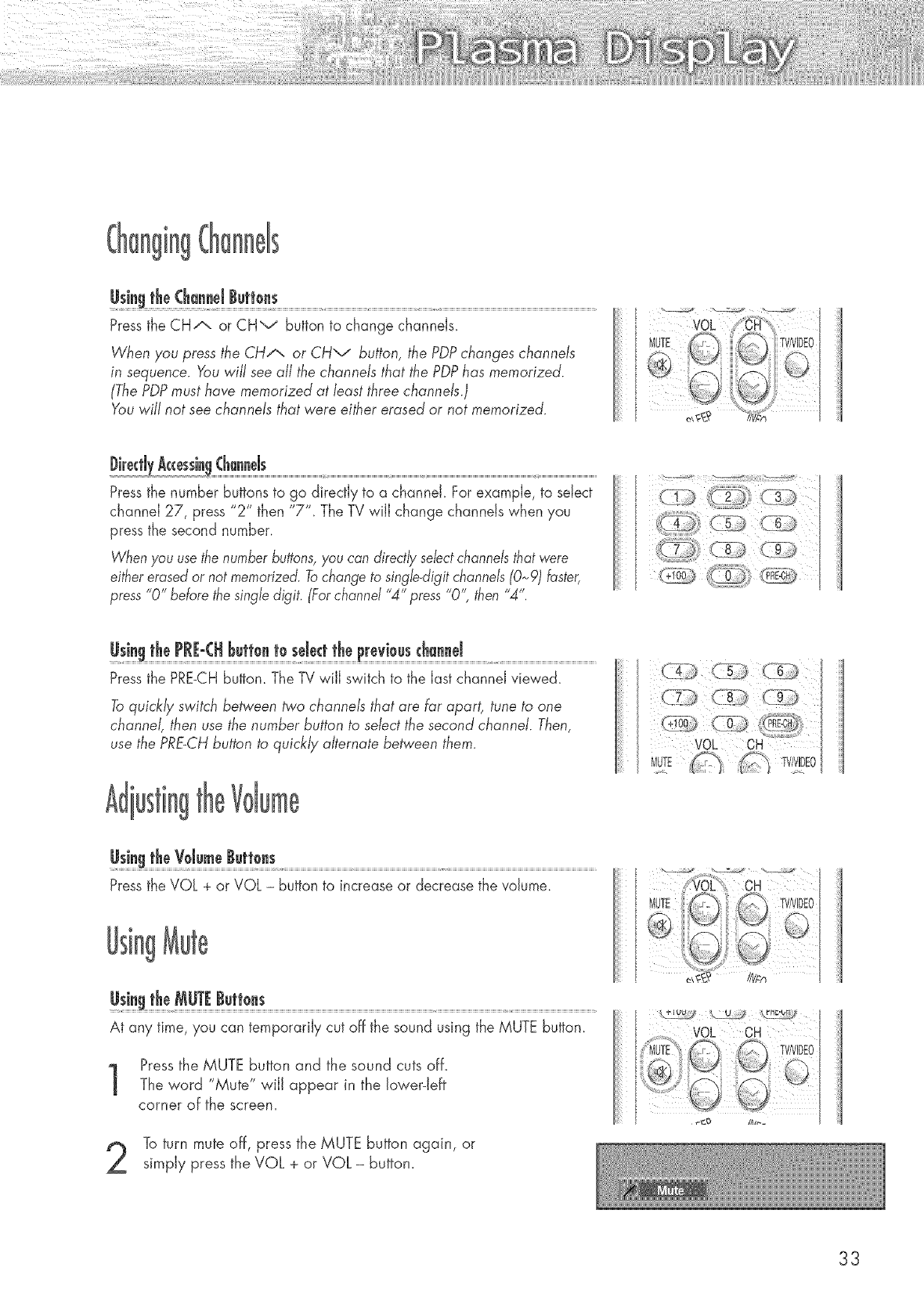
Pressthe CHA or CHv button to change channels.
When you press the CHA or CHv button, the PDPchanges channels
in sequence. Youwill see all the channels that the PDPhas memorized.
(The PDPmust have memorized at least three channels.)
Youwilt not see channels that were either erased or not memorized.
Pressthe number buttons to go directly to a channek For example, to select
channel 27, press "2" then "7". The TV will change channels when you
press the second number.
When you usethe numberbuttons,you can directly sebct channelsthatwere
either erasedor not memorized.Tochange to singbdigit channels(0_9) bster_
press"0" bebre thesingle digit. (Forchannel "4" press "0", then "4".
Pressthe PRE-CHbutton. The TV wiJJswitch to the last channel viewed.
Toquickly switch between two channels that are far apart, tune to one
channel, then use the number button to select the second channel. Then,
use the PRECH button to quickly alternate between them.
Pressthe VOL + or VOL - button to increase or decrease the volume.
At any time, you can temporarily cut off the sound using the MUTE button.
Pressthe MUTE button and the sound cuts off_
The word "Mute" wiJJappear in the lower-left
corner of the screen.
To turn mute off, press the MUTE button again, or
simply press the VOL + or VOL - button.
33
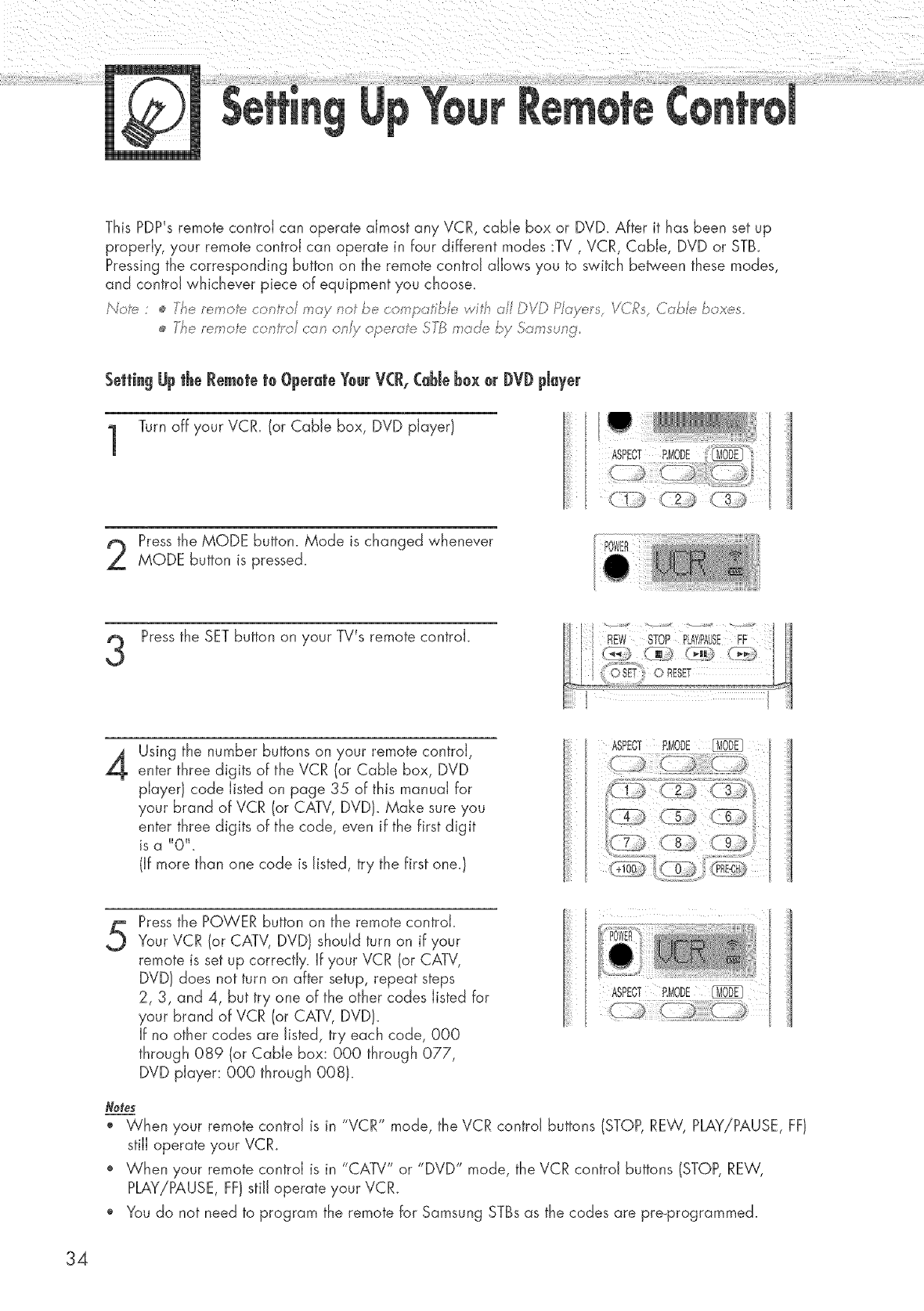
This PDVs remote control can operate almost any VCR, cable box or DVD. After it has been set up
properly, your remote control can operate in four different modes :TV, VCR, Cable, DVD or STB_
Pressing the corresponding button on the remote control allows you to switch be_'een these modes,
and control whichever piece of equipment you choose.
N>lc, : _ i_fl_:, female, _':o _'poJ racy _o Je _':o_pa b/e w i'h a// D VD P/c/e_s, VCRs,Cable loxes
7/e remot_ co_'l;oJ can o_f}_ope ate S)'}_:imade by Samsung
Setting Upthe Remetete Operate YeurV(R, Cablebex er DVD player
Turn off your VCR. (or Cable box, DVD player}
Press the MODE button. Mode is changed whenever
MODE button is pressed.
3Pressthe SETbutton on your TV's remote control.
_osz
4Using the number buttons on your remote control,
enter three digits of the VCR (or Cable box, DVD
player) code listed on page 35 of this manual for
your brand of VCR (or CATV, DVD). Make sure you
enter three digits of the code, even if the first digit
Js a _0 _.
(If more than one code is listed, try the first one.}
5Press the POWER button on the remote controk
Your VCR (or CATV, DVD) should turn on if your
remote is set up correctly. If your VCR (or CATV,
DVD} does not turn on after setup, repeat steps
2, 3, and 4, but try one of the other codes listed for
your brand of VCR (or CATV, DVD).
If no other codes are listed, try each code, 000
through 089 (or Cable box: 000 through OZZ,
DVD player: 000 through 008}.
Nofe_
When your remote control is in "VCR" mode, the VCR control buttons (STOP,REW, PLAY!PAUSE_FF)
still operate your VCR.
When your remote control is in "CATV" or "DVD" mode, the VCR control buttons (STOP, REW,
PLAY!PAUSE, FF)still operate your VCR.
You do not need to program the remote for Samsung STBsas the codes are pre-programmed.
34
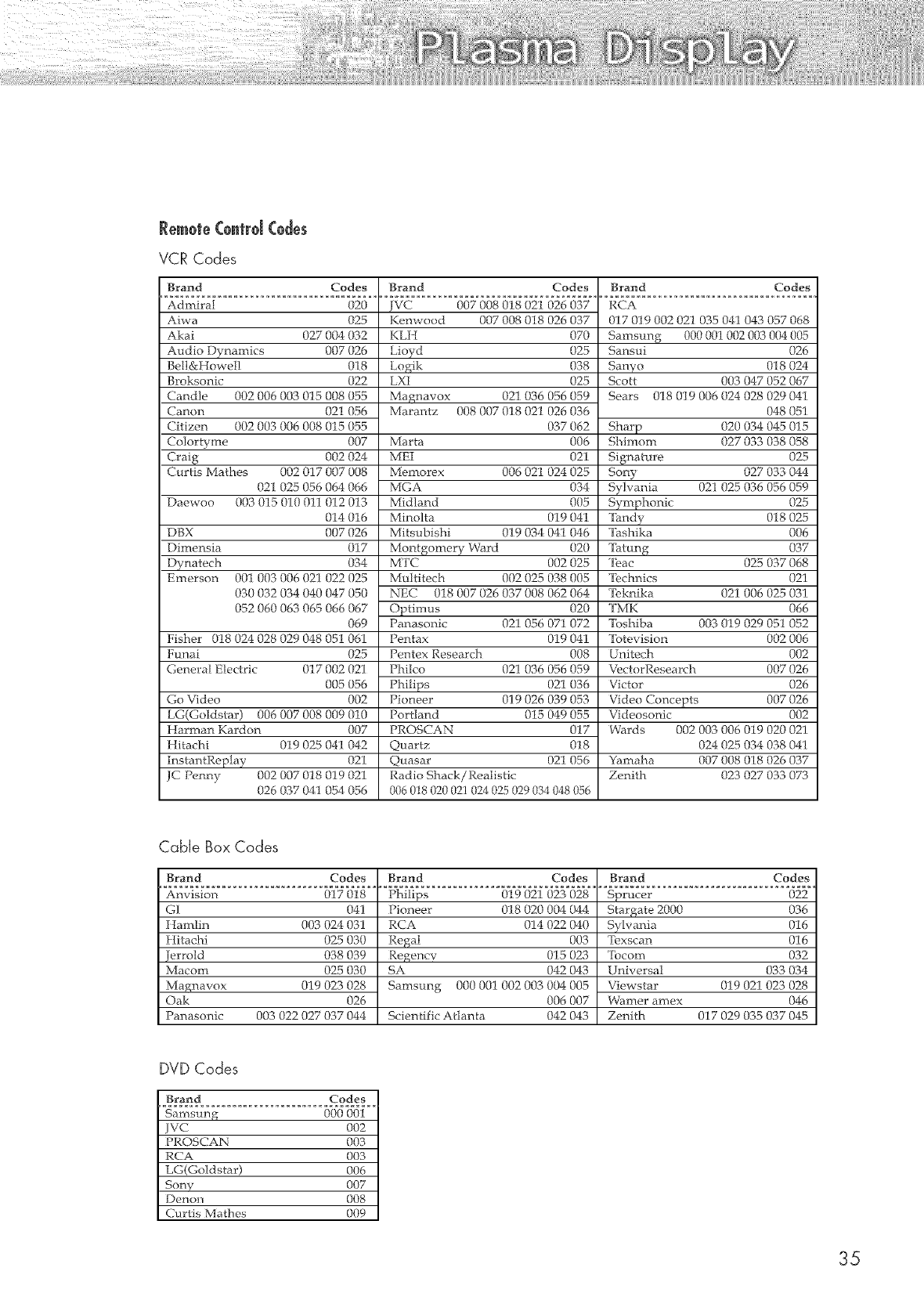
Remote{ontrd Codes
VCR Codes
Brand Codes Brand Codes Brand Codes
Admiral 020 JVC 007 008 018 021 026 037 RCA
Aiwa 025
Akai 027 004 032
Audio Dynamics 007 026
Bell &Howet! 018
Broksonic 022
Candle 002 006 003 015 008 055
Canon 021 056
Citizen 002 003 006 008 015 055
Co!ortyme 007
Craig 002 024
Curtis Mathes 002 017 007 008
021 025 056 064 066
Daewoo 003 015 010 011 {)!2 013
014 016
DBX 007 026
Dimensia 017
Dynatech 034
Emerson 001 003 006 021 022 025
030 032 034 040 047 050
052 060 063 065 066 067
069
Fisher 018 024 028 029 048 051 061
Funai 025
General Electric 017 002 021
005 056
Go Video 002
LG(Goldstar) 006 007 008 009 010
Harman Kardon 007
Hitachi 019 025 041 042
InstantReplay 021
]C Penny 002 007 018 019 021
026 037 041 054 056
Kenwood 007 008 018 026 037
KLH 070
Lloyd 025
Logik 038
LXI 025
Magnavox 021 036 056 059
Marantz 008 007 018 021 026 036
037 062
Marta 006
MEI 021
Memorex 006 021 024 025
MGA 034
Midland 005
Minolta 019 041
Mitsubishi 019 034 041 046
Montgomery Ward 020
MPC 002 025
Multitech 002 025 038 005
NEC 018 007 026 037 008 062 064
Optimus 020
Panasonic 021 056 071 072
Pentax 019 041
Pentex Research 008
Philco 021 036 056 059
Philips 021 036
Pioneer 019 026 039 053
Portland 015 049 055
PROSCA N 017
Quartz 018
Quasar 021 056
Radio Shack/Realistic
006 018 020 021 024 025 029 034 048 056
017 019 002 021 035 041 043 057 068
Samsung 000 001 002 003 004 005
Sansui 026
Sanyo 018 024
Scott 003 047 052 067
Sears 018 0!9 006 024 028 029 041
048 051
Sharp 020 034 045 015
Shimom 027 033 038 058
Signature, 025
Sony 027 033 044
Sylvania 021 025 036 056 059
Symphonic 025
-Iandy 018 025
_lhshika 006
Tatung 037
Teac 025 037 068
7bchnics 021
TPknika 021 006 025 031
TMK 066
_bshiba 003 019 029 051 052
-Ibtevision 002 006
Unitech 002
VectorResearch 007 026
Victor 026
Video Concepts 007 026
Videosonic 002
Wards 002 003 006 019 020 021
024 025 034 038 041
Yamaha 007 008 018 026 037
Zenith 023 027 033 073
CaMe Box Codes
Brand Codes grand Codes Brand Codes
Anvision 017 018 Philips 019 021 023 {)28 Sprucer {)22
GI 041
Hamlin 003 024 031
Hitachi 025 030
Jerrold 038 039
Macom 025 030
Magnavox 019 023 028
Oak 026
Panasonic 003 022 027 037 044
Pioneer 0!8 020 004 044
RCA 014 022 040
Regal 003
Regency 015 023
SA 042 043
Samsung 000 001 002 003 004 005
006 007
Scientific Atlanta 042 043
Stargate 2000 036
Sylvania 016
_lbxscan 016
Tncom 032
Universal 033 034
Viewstar 019 021 023 028
Warner amex 046
Zenith 017 029 035 037 045
DVD Codes
Brand Codes
Samsung 000 001
JVC 002
PROSCAN 003
RCA 003
LG(Goldstar) 006
Sony 007
Denon 008
Curtis Mathos 009
35
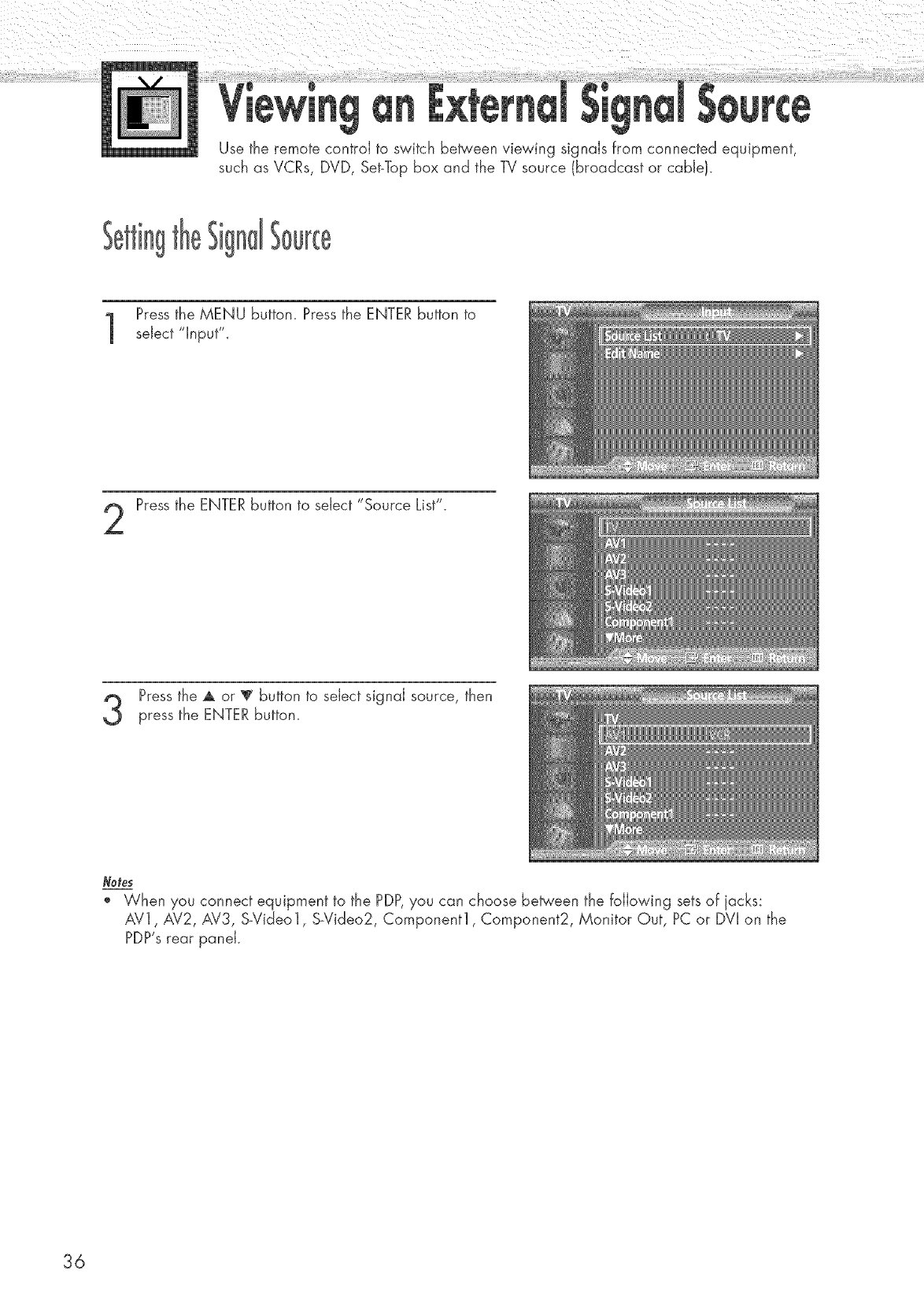
Use the remote control to switch between viewing signals from connected equipment,
such as VCRs, DVD, Set-Topbox and the TV source (broadcast or cable}.
Press the MENU button. Press the ENTER button to
select "Input".
Press the ENTER button to select "Source List".
Pressthe A or _ button to select signal source, then
press the ENTERbutton.
Notes
oWhen you connect equipment to the PDP,you can choose between the following sets of jacks:
AV1, AV2, AV3, S-Video1, S_Video2, Component1, Component2, Monitor Out, PC or DVI on the
PDP'srear panel.
36
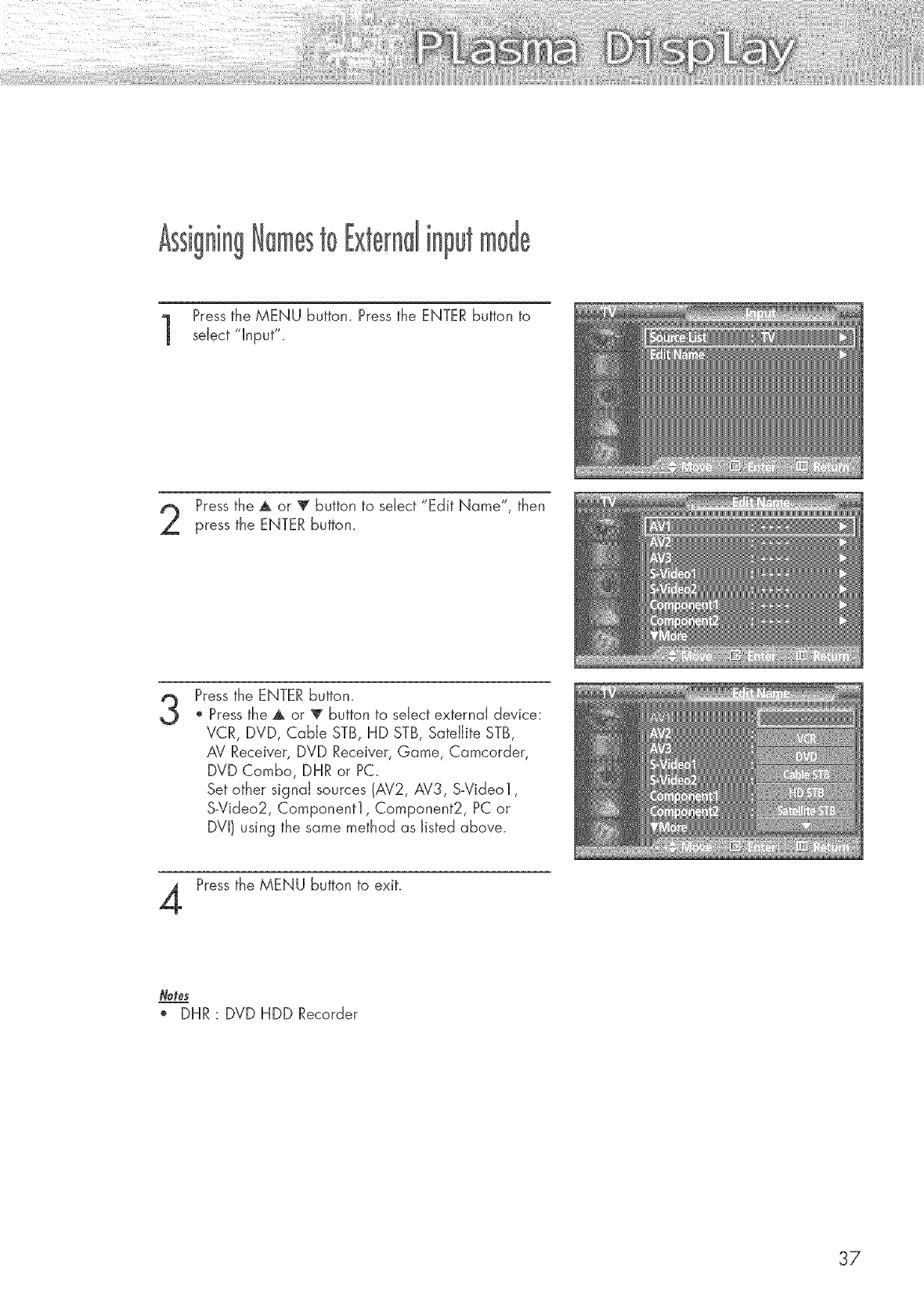
t0 put
Pressthe MENU button. Pressthe ENTER button to
select 'qnput'.
Pressthe A or _ button to select "Edit Name", then
press the ENTER button.
3Press the ENTER button.
o Press the A or T button to select external device:
VCR, DVD, Cable STB, HD STB, Satellite STB,
AV Receiver, DVD Receiver, Game, Camcorder,
DVD Combo, DHR or PC_
Set other signal sources (AV2, AV3, S_Videol,
S_Video2, Component1, Component2, PC or
DVI) using the same method as listed above.
Press the MENU button to exit.
_te_
o DHR : DVD HDD Recorder
37
Customizing the Picture ................................................................ 40
Using Automatic Picture Settings .................................................... 4]
Selecting the Color Tone................................................................ 42
DNIe (Digital Natural Image engine) ............................................ 43
Changing the Screen Size ............................................................ 44
Freezing the Picture ...................................................................... 46
Viewing the Picture-in-Picture .......................................................... 47
Selecting a Signal Source (Antenna or Cable 1for PIP........................ 52
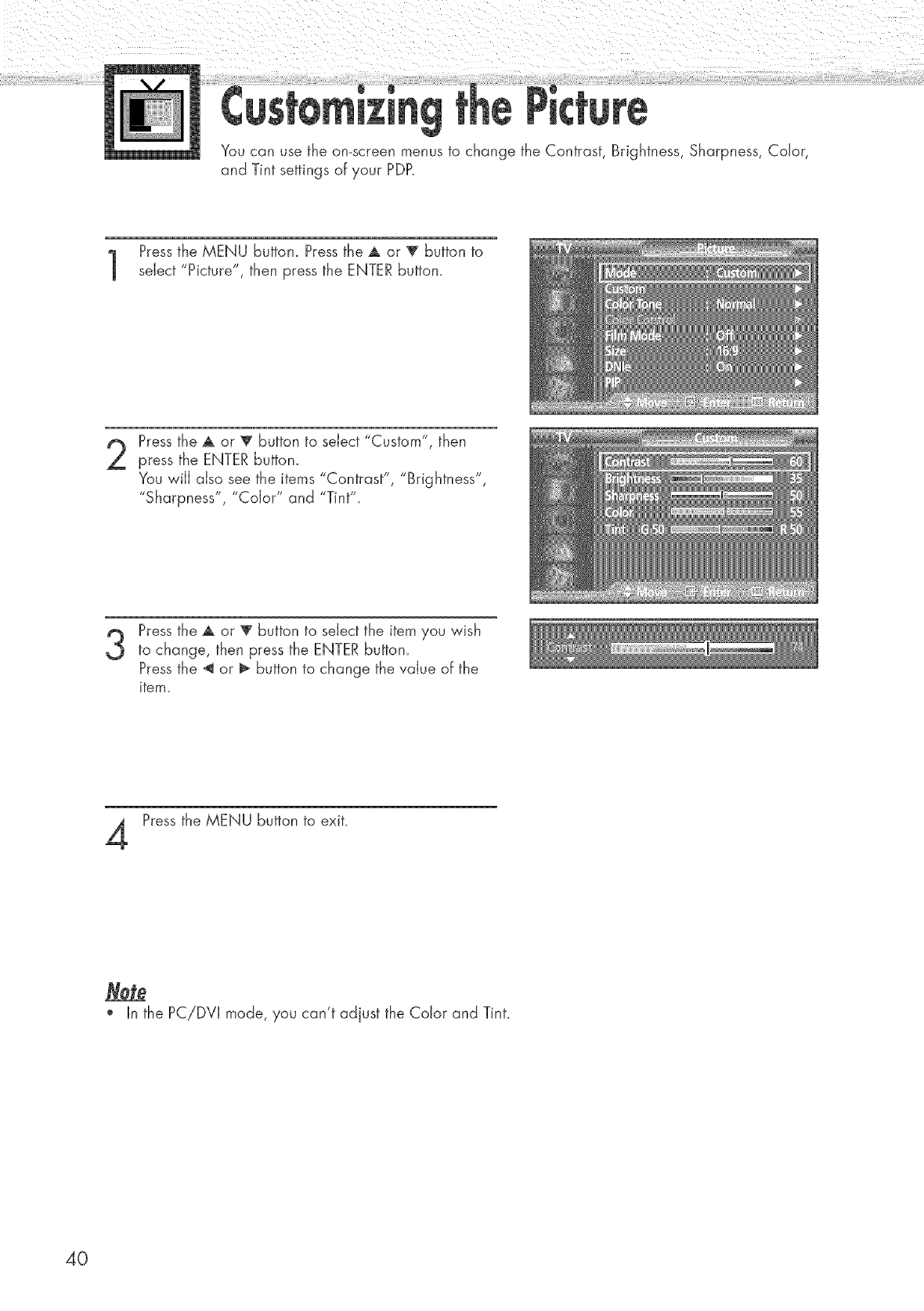
You can use the on-screen menus to change the Contrast, Brightness, Sharpness, Color,
and Tint settings of your PDP.
Pressthe MENU button. Pressthe A or T button to
select "Picture", then press the ENTER button.
2Press the A or _ button to select "Custom", then
press the ENTER buttom
You wiJJaJso see the items "Contrast", "Brightness",
"Sharpness", "Color" and "Tint".
3Press the A or T button to select the item you wish
to change, then press the ENTERbutton.
Pressthe _ or _ button to change the value of the
item.
Pressthe MENU button to exit.
o In the PC!DVI mode, you can't adjust the Color and Tint.
40
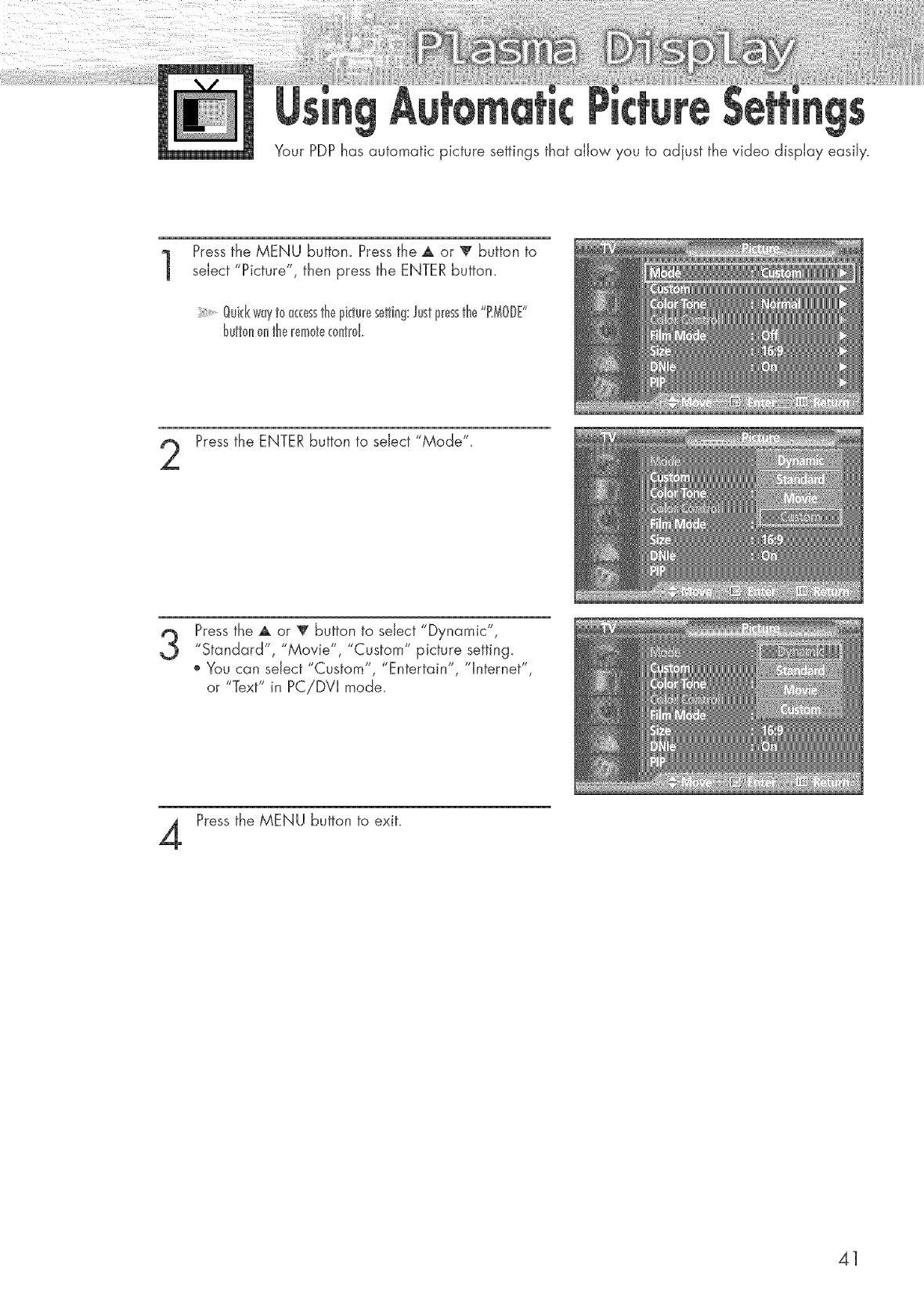
Your PDP has automatic picture settings that allow you to adjust the video display easily.
Pressthe MENU button. Pressthe A or T button to
select "Picture", then press the ENTER button.
i Quirkw0yto 0_essthepktur÷setHng:Justpresstl_÷"RMODE"
tJuttonontheremoter0ntrd.
Pressthe ENTER button to select "Mode".
3Press the _ or T button to select "Dynamic",
"Standard", "Movie", "Custom" picture setting.
o You can select "Custom", "Entertain", qnternet",
or "Text" in PC!DVI mode.
Press the MENU button to exit.
41
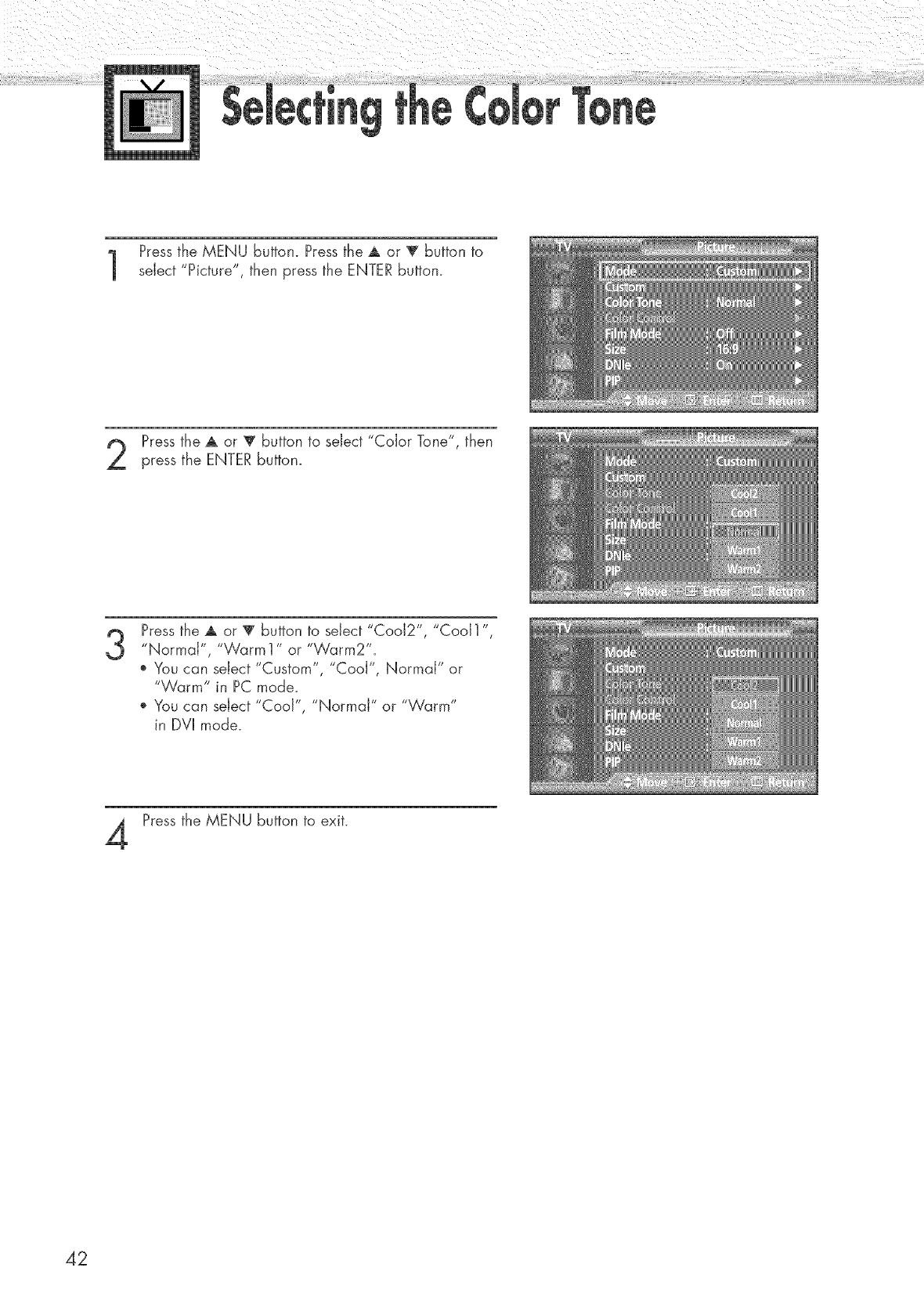
Pressthe MENU button. Pressthe A or T button to
select "Picture", then press the ENTER button.
Pressthe A or _ button to select "Color Tone", then
press the ENTER button.
3Pressthe A or T button to select "Cool2", "Cool1",
"Normal", "Warm 1" or "Warm2".
o You can select "Custom", "Cool", Normal" or
"Warm" in PC mode_
o You can select "Cool", "Normal" or "Warm"
in DVI mode.
Pressthe MENU button to exit.
42
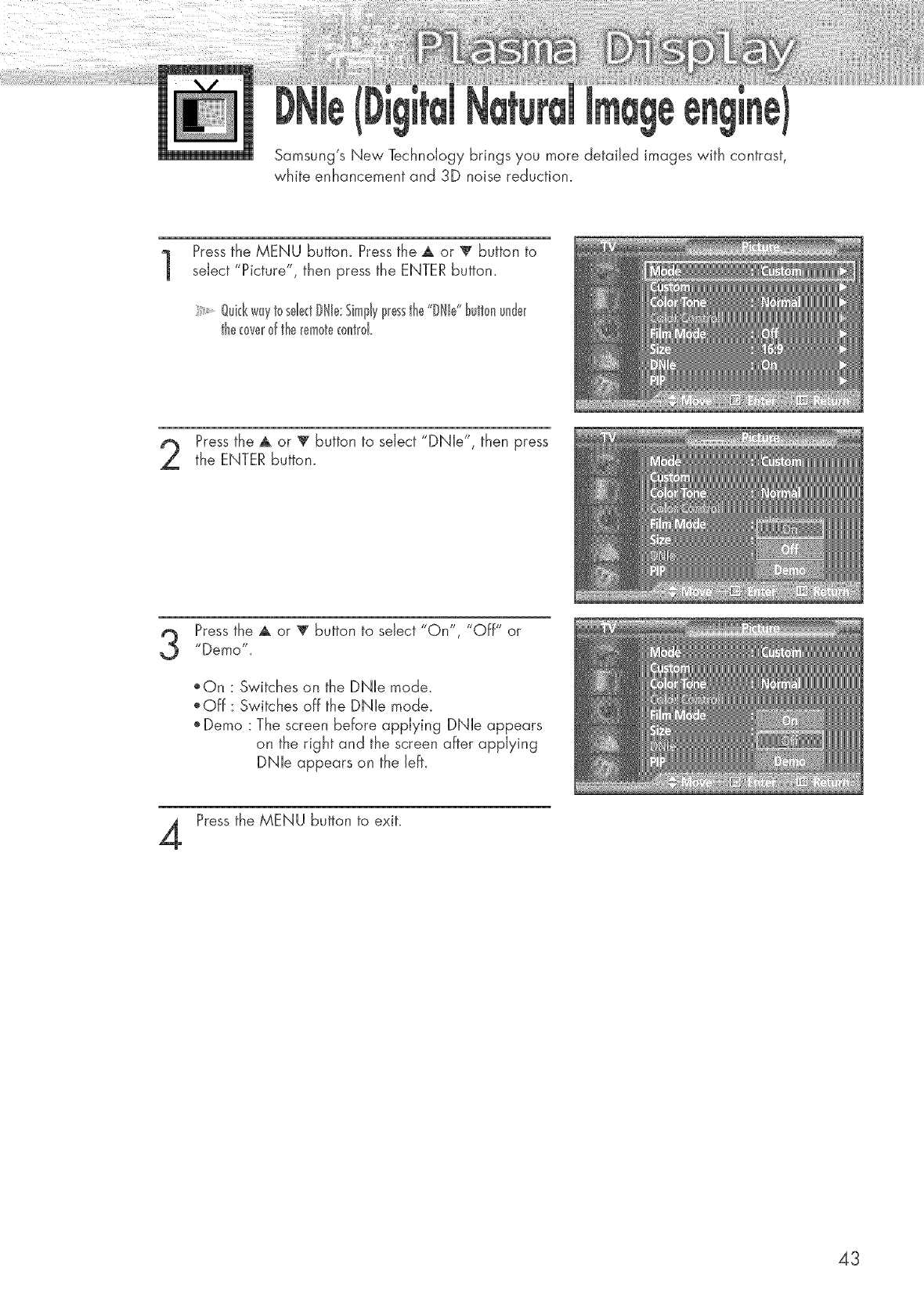
Samsung's New Technology brings you more detailed images with contrast,
white enhancement and 3D noise reduction.
Pressthe MENU button. Pressthe A or T button to
select "Picture", then press the ENTER button.
Qukk,_v_yt0sdedl/le: SimplyIressthe"llld' tutt0nund÷r
thec0verofthe_em0tec0ntrd.
Pressthe A or T button to select "DNle', then press
the ENTER button.
Press the ,L or _ button to select "On", "Off" or
"Demo".
oOn : Switches on the DNle mode.
',Off: Switches off the DNle mode.
', Demo : The screen before applying DNle appears
on the right and the screen after applying
DNle appears on the left.
Press the MENU button to exit.
43
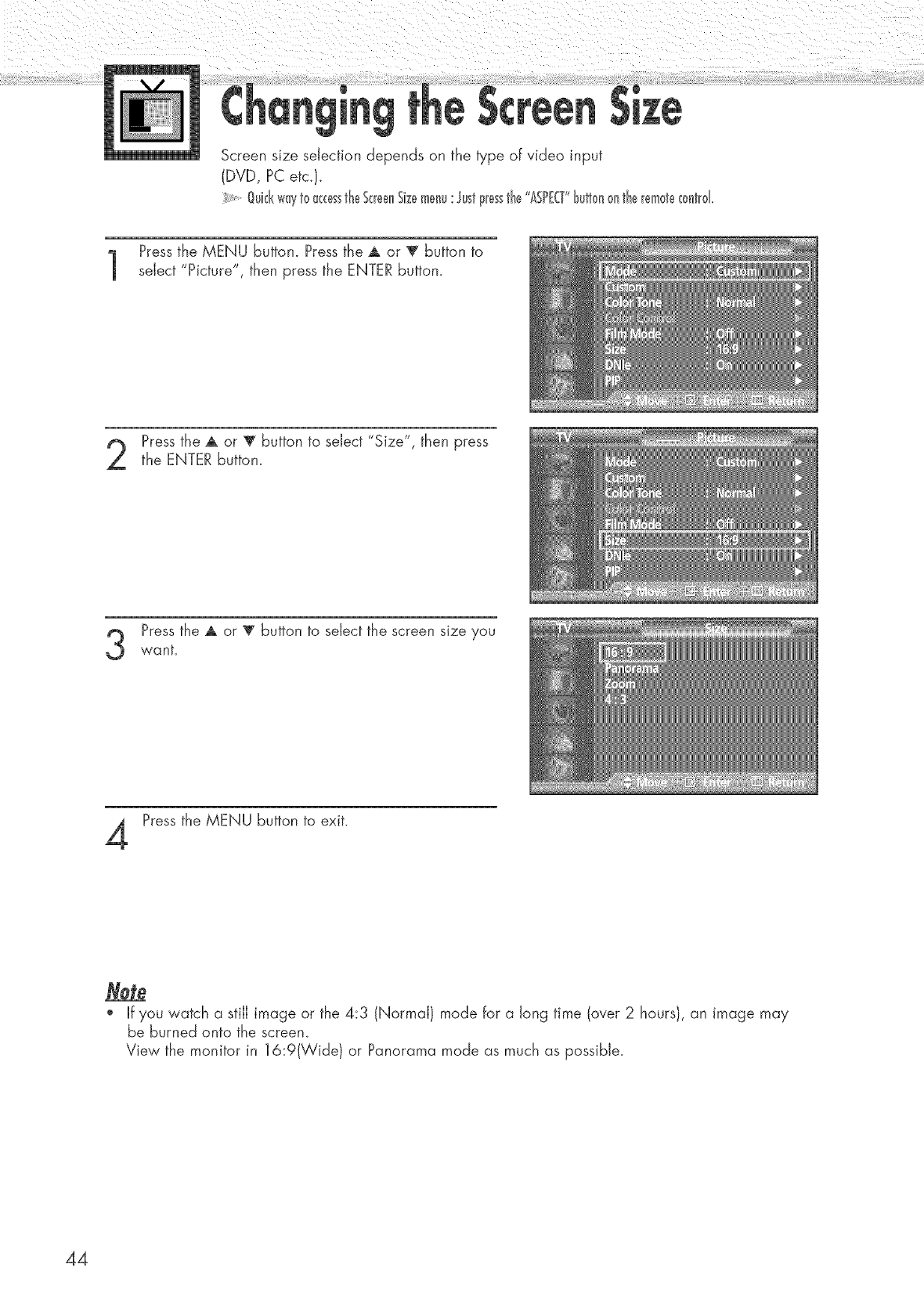
Pressthe MENU button. Pressthe A or T button to
select "Picture", then press the ENTER button.
Pressthe A or T button to select "Size", then press
the ENTER button.
Pressthe ,L or _" button to select the screen size youwant.
Pressthe MENU button to exit.
', If you watch a still image or the 4:3 (Normal} mode for a long time (over 2 hours}, an image may
be burned onto the screen.
View the monitor in 16:9(Wide} or Panorama mode as much as possible.
44
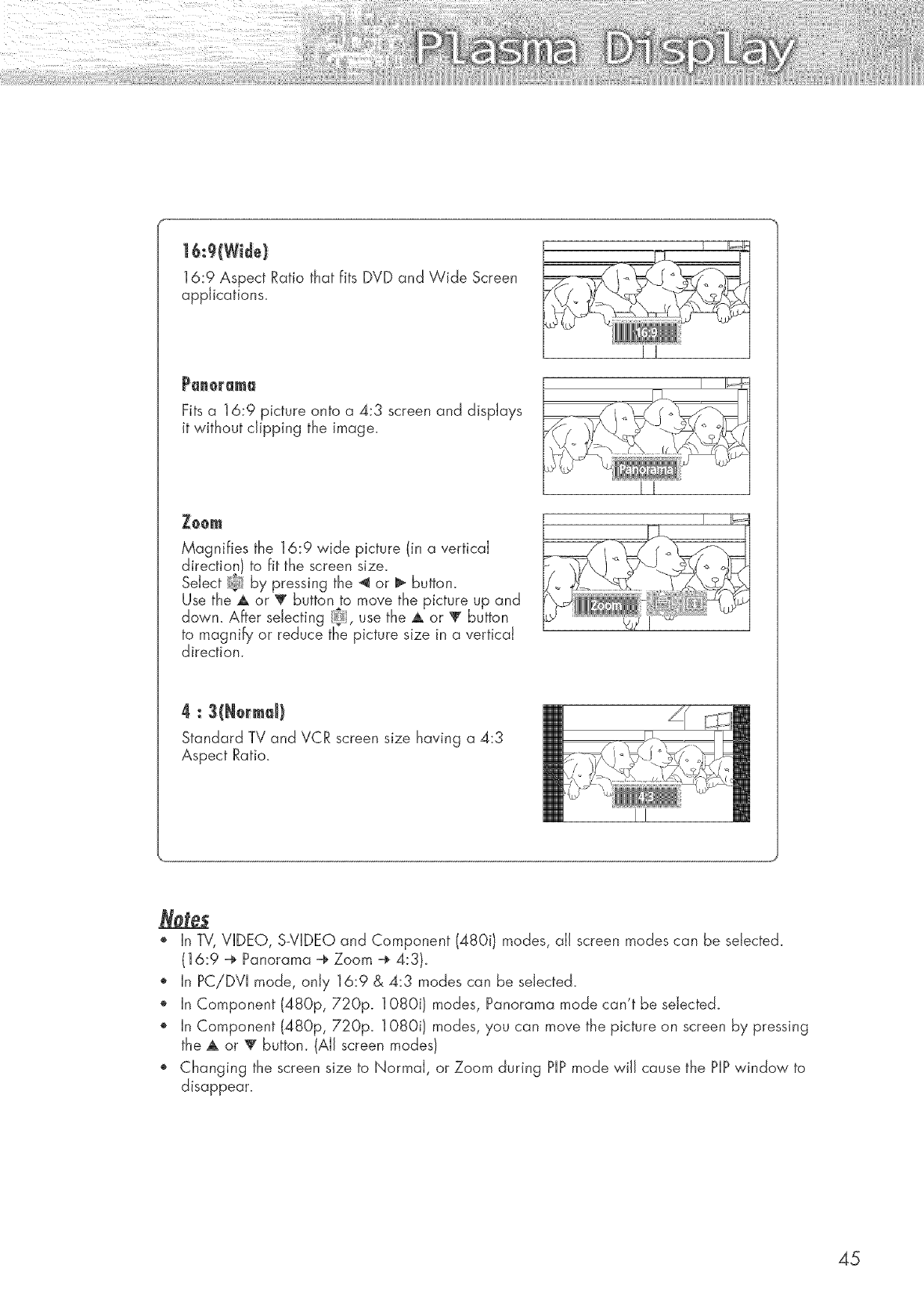
16:q(Wide)
16:9 Aspect Ratio that fits DVD and Wide Screen
applications.
PanlQFa Jn_u
Fits a 16:9 picture onto a 4:3 screen and displays
it without clipping the image.
ZQQm
Magnifies the 16:9 wide picture (in a vertical
direction/to fit the screen size_
Select _S_by pressing the _ or _ buttom
Use the A or _r button to move the picture up and
down. After selecting use the A or T button
to magnify or reduce the picture size in a vertical
direction.
JU
JJ
4:3(NQr d)
Standard TV and VCR screen size having a 4:3
Aspect Ratio_
o In TV, VIDEO, S_VIDEOand Component (480i) modes, aJJscreen modes can be selected.
(16:9 -_ Panorama -_ Zoom _ 4:3)_
o In PC/DVI mode, only 16:9 & 4:3 modes can be selected_
In Component (480p, 72%. 1080i) modes, Panorama mode can't be selected_
In Component (480p, 720p_ 1080i) modes, you can move the picture on screen by pressing
the A or T button. (All screen modes)
Changing the screen size to Normal, or Zoom during PIP mode wiJJcause the PIPwindow to
disappear.
45
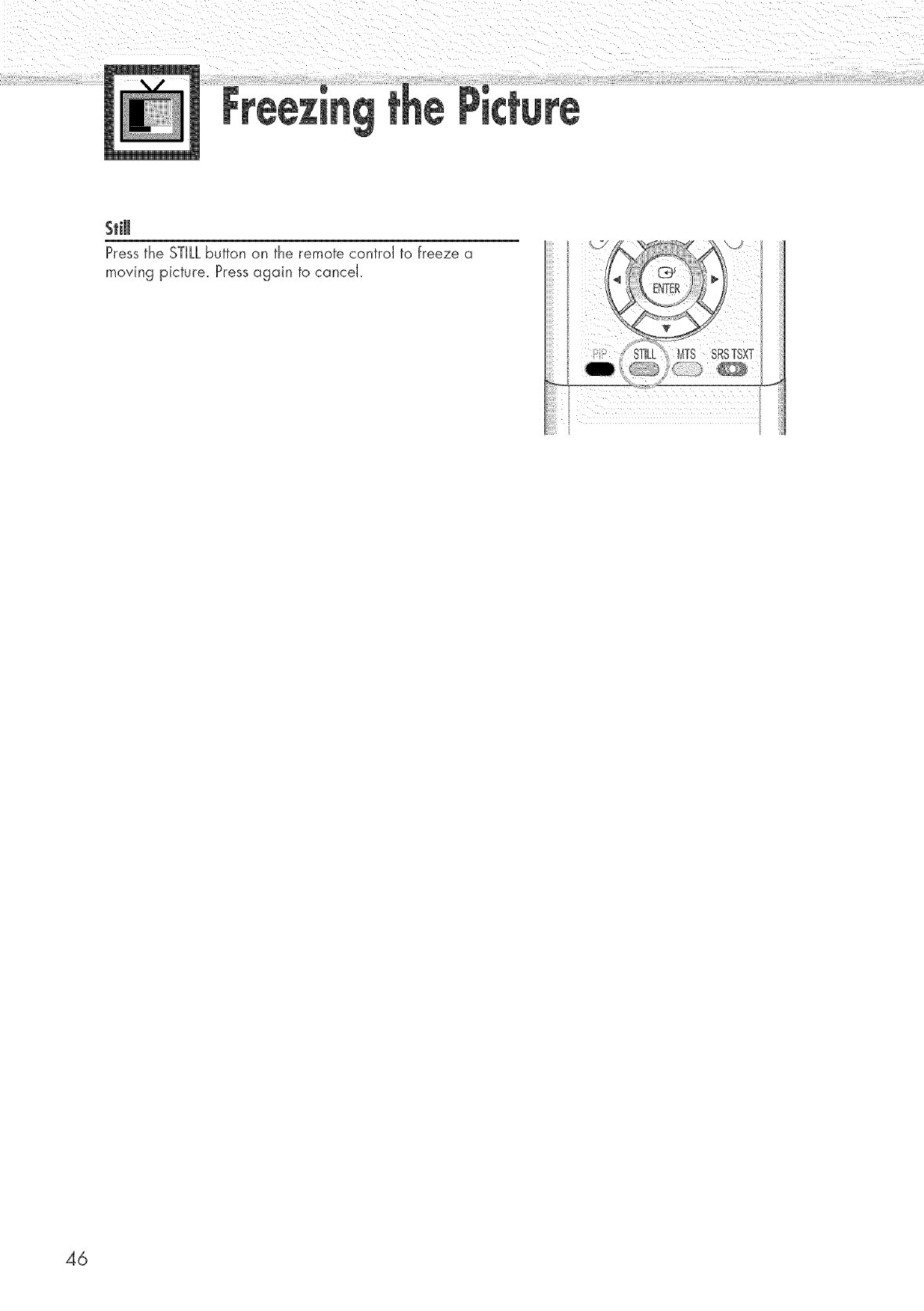
Sti{{
Pressthe STILLbutton on the remote control to freeze a
moving picture. Pressagain to cancel.
46
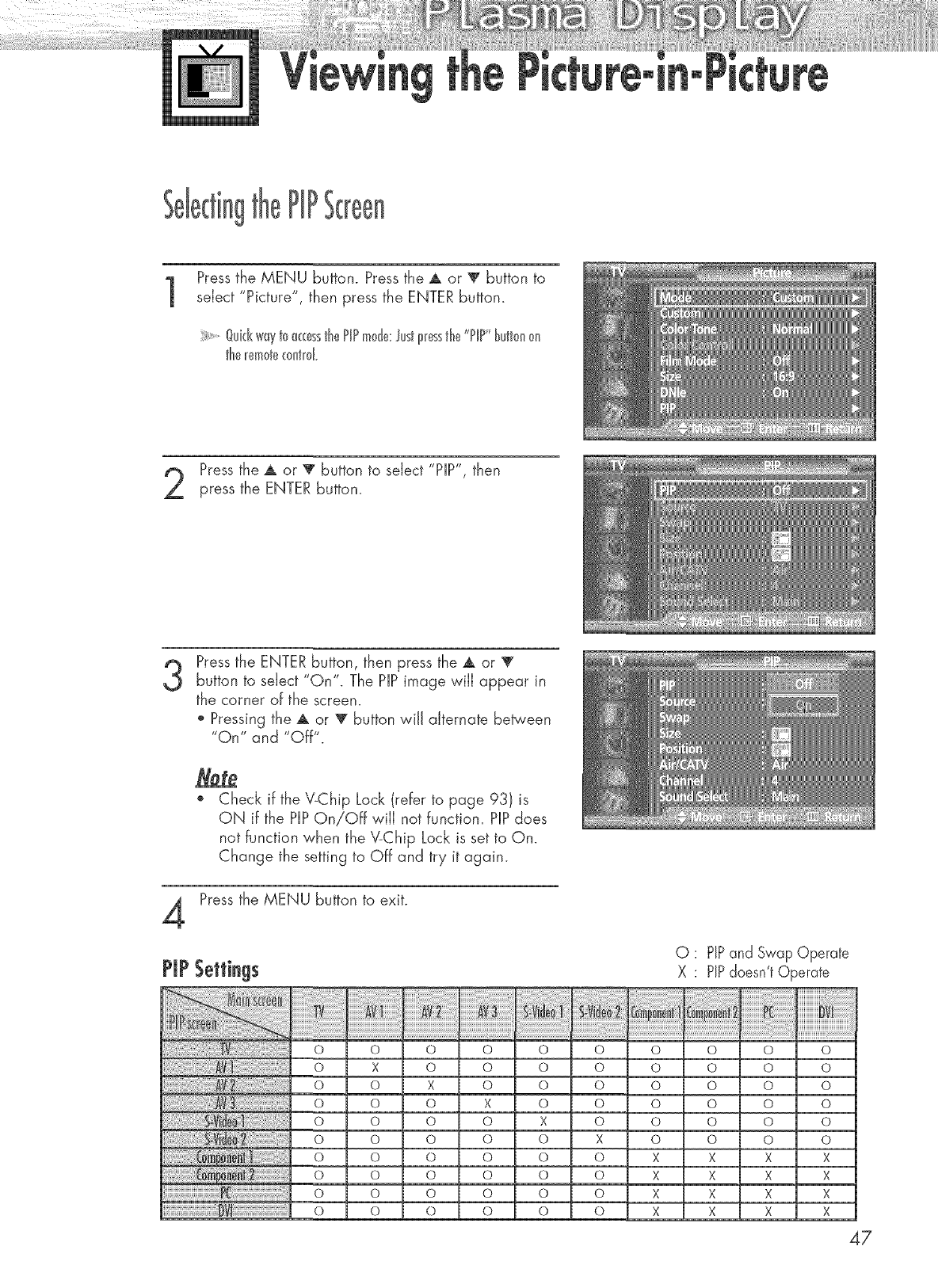
Pressthe MENU button. Pressthe A or T button to
select "Picture", then press the ENTER button.
Qui_kwsyt_ _÷ssthePIPmode:lustpresstl_÷"PIP"tJutt0n0n
theremotecontrol.
Pressthe A or _' button to select "PIP", then
press the ENTER button.
3Pressthe ENTER button, then press the A or T
button to select "On". The PIPimage will appear in
the corner of the screen.
', Pressing the A or T button will alternate between
"On" and "Off".
Check if the V-Chip Lock (refer to page 93/is
ON if the PIPOn/Off wiJJ not function. PIPdoes
not function when the V-Chip Lock is set to On.
Change the setting to Off and try it again.
Pressthe MENU button to exit.
PiPSettings O : PIPand Swap Operate
X :PtP doesn'tOperate
O O O O O O O O O O
O X O O O O O O O O
O O X O O O O O O O
O O O X O O O O O O
O O O O X O O O O O
O O O O O X O O O O
O O O O O O X X X X
O O O O O O X X X X
O O O O O O X X X X
O O O O O O X X X X
47
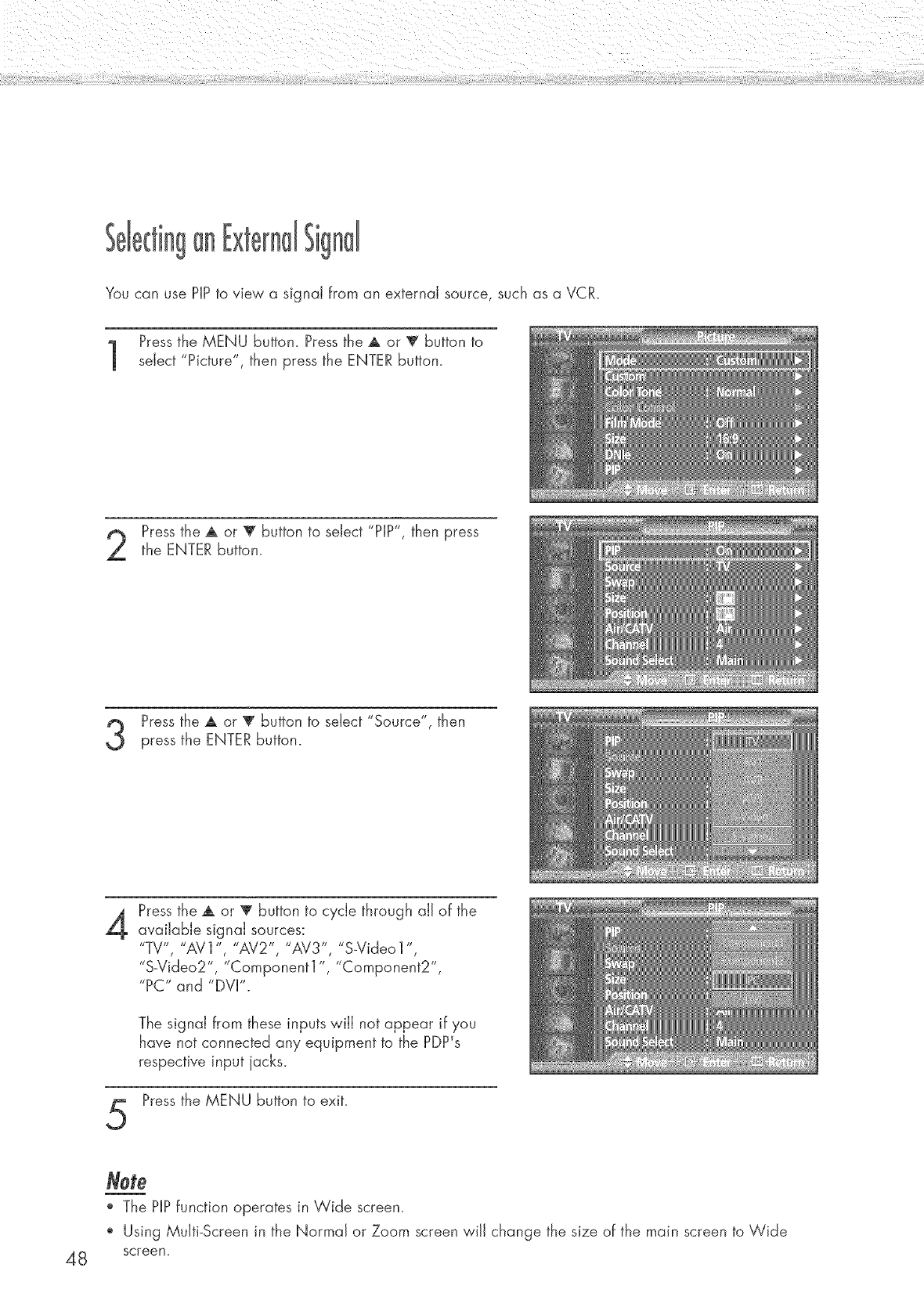
gan
You can use PIPto view a signal from an external source, such as a VCR.
Pressthe MENU button. Pressthe A or T button to
select "Picture", then press the ENTER button.
Pressthe A or T button to select "PIP", then press
the ENTER button.
Pressthe _. or T button to select "Source", then
press the ENTERbutton.
4Press the A or 'V' button to cycle through aJJof the
available signal sources:
"TV", "AV 1", "AV2", "AV3", "S_Video1",
"S_Video2", "Component1 ", "Component2",
"PC" and "DVI".
The signal from these inputs wiJJnot appear if you
have not connected any equipment to the PDP's
respective input jacks.
Pressthe MENU button to exit.
48
Note
oThe PIPfunction operates in Wide screen.
Using Multi-Screen in the Normal or Zoom screen wiJJchange the size of the main screen to Wide
screen.
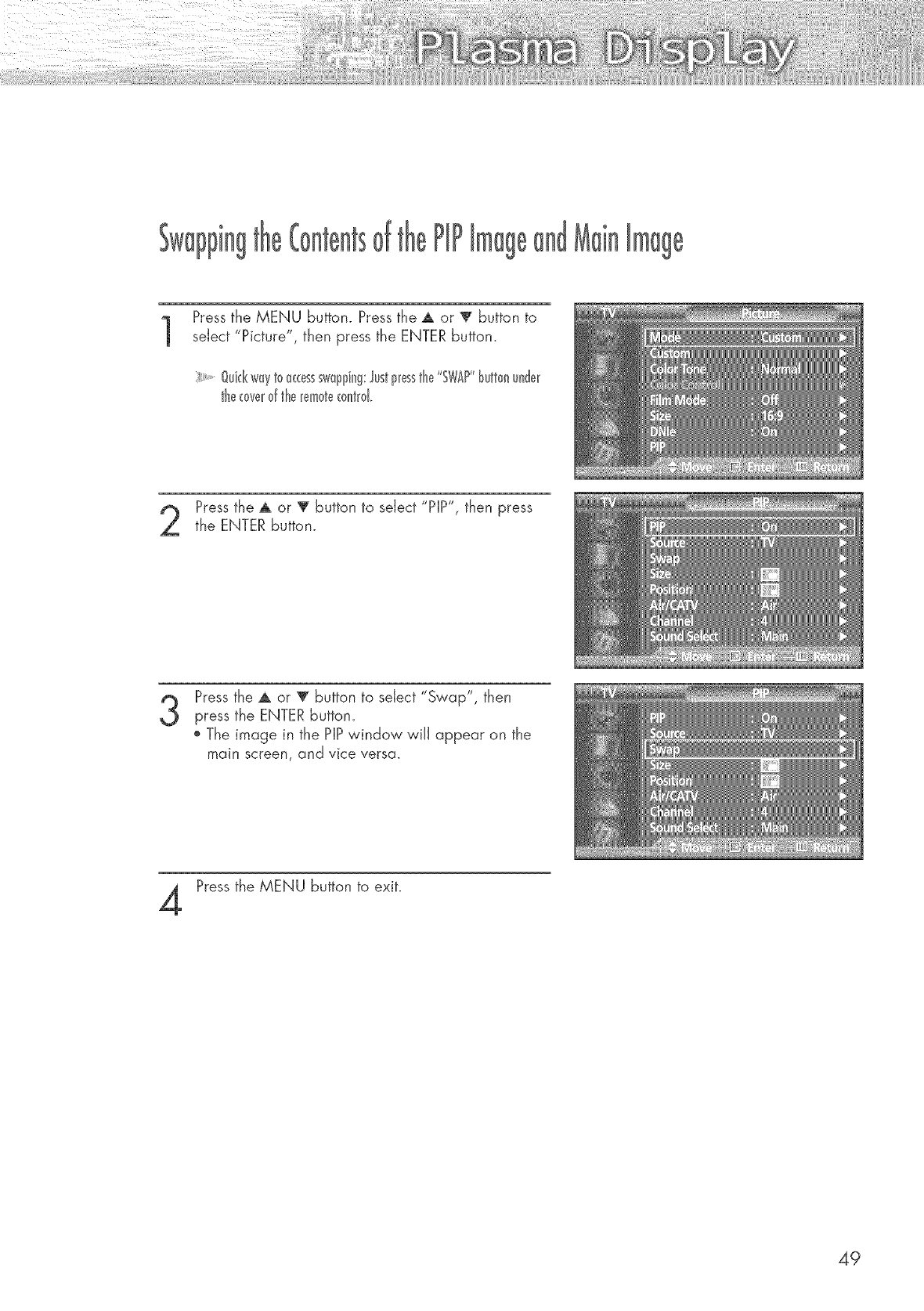
Prop
Pressthe MENU button. Pressthe A or T button to
select "Picture", then press the ENTER button.
Qukkw_yto_ess swapping:lustpressthe"SWAP"buttonunder
thecoveroftheremotecontrd.
Pressthe A or T button to select "PIP", then press
the ENTER button.
3Press the A or T button to select "Swap", then
press the ENTER button.
o The image in the PiPwindow will appear on the
main screen, and vice versa.
Press the MENU button to exit.
49
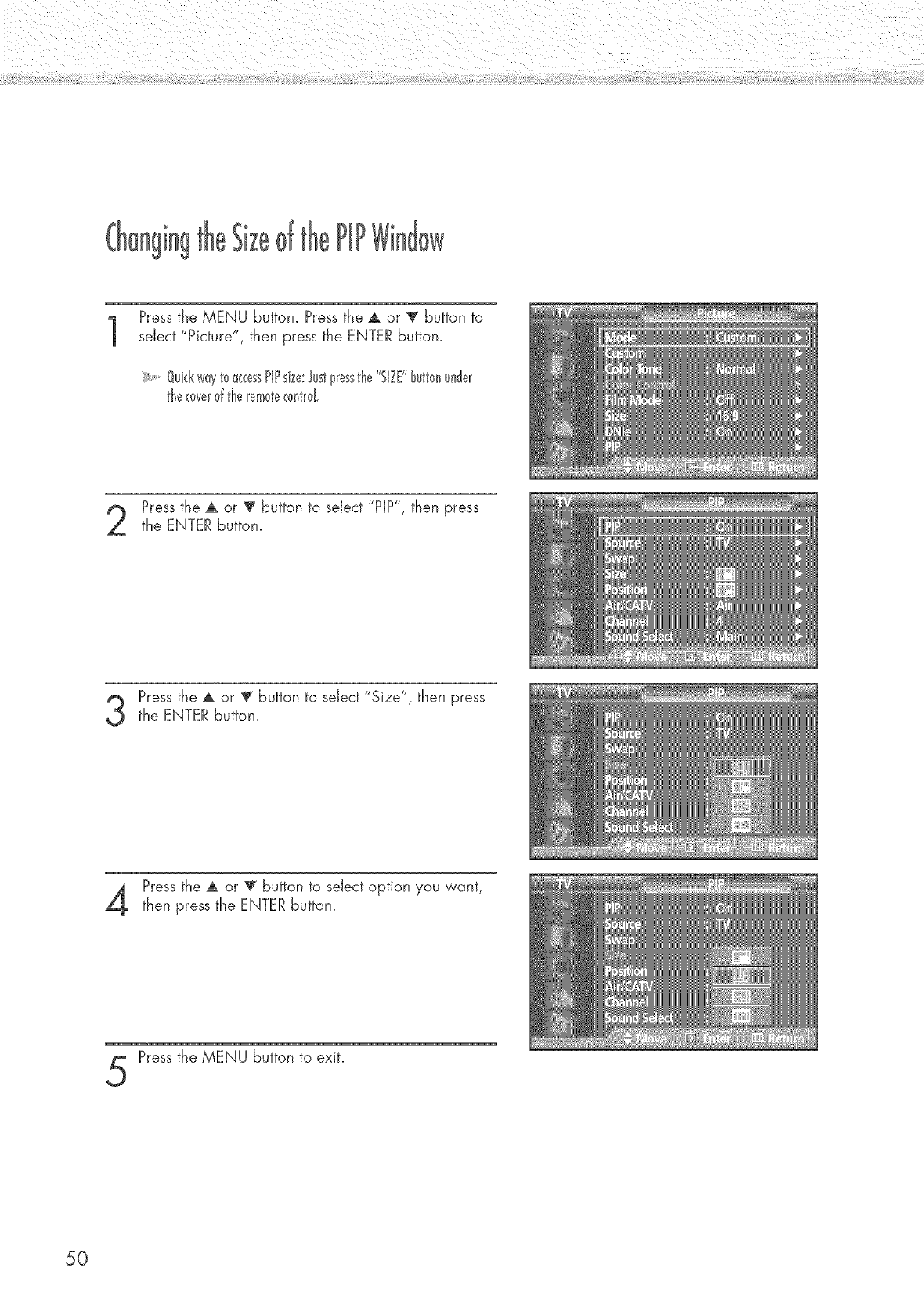
Prop
Pressthe MENU button. Pressthe A or T' button to
select "Picture", then press the ENTER button.
Qukkw_yto_ess PIPsize:Justpressthe"SIZE"buttonunder
thec0veroftheremotec0ntrd
Pressthe A or T button to select "PIP", then press
the ENTER button.
Press the A or T button to seiect "Size", then pressthe ENTER button.
Pressthe A or T button to select option you want,
then press the ENTER button.
Press the MENU button to exit.
50
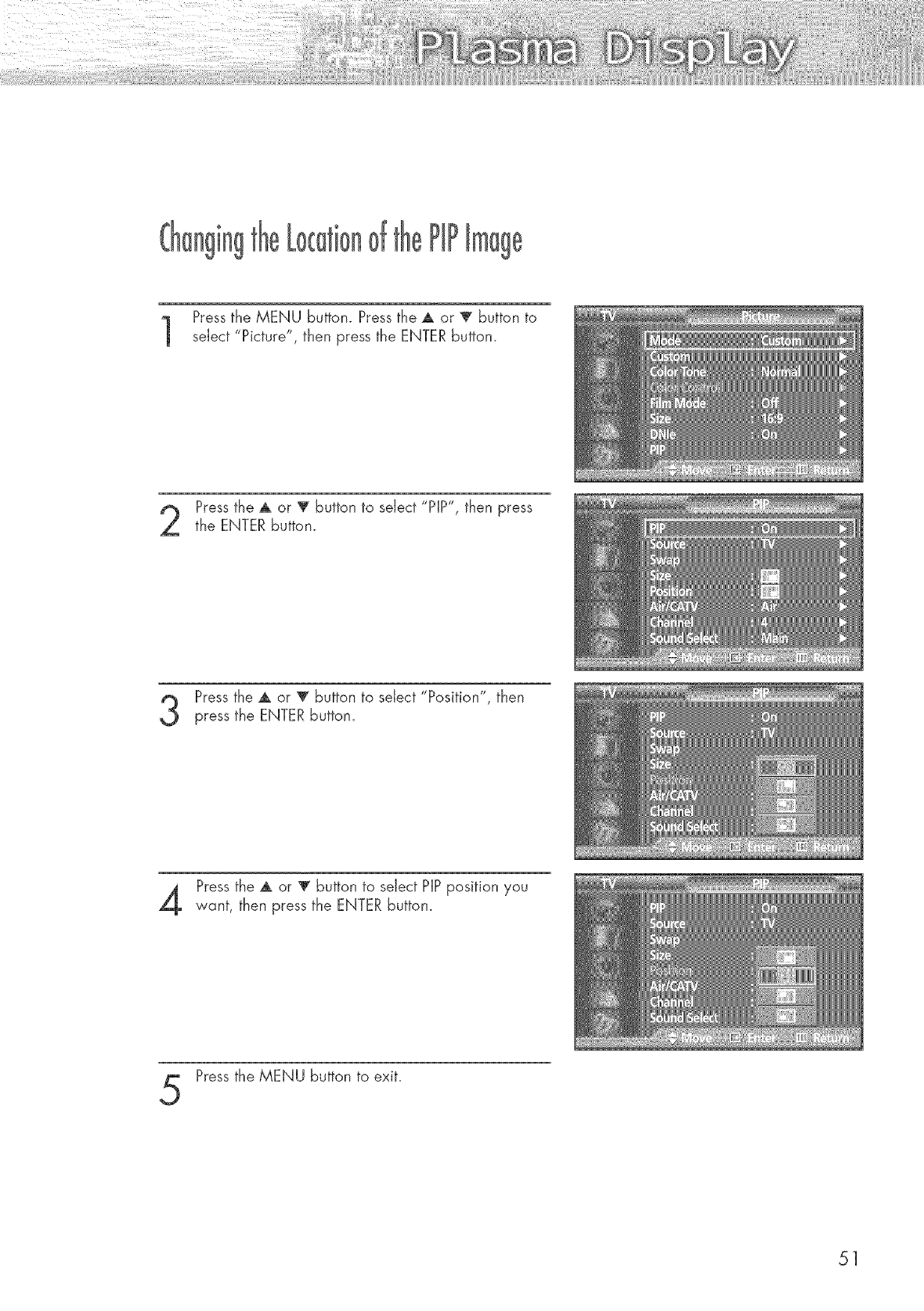
PiP
Pressthe MENU button. Pressthe A or T button to
select "Picture", then press the ENTER button.
Pressthe A or T button to select "PIP", then press
the ENTER button.
Press the A or T button to select "Position", then
press the ENTER button.
Press the A or T button to select HP position you
want, then press the ENTER button.
Pressthe MENU button to exit.
51
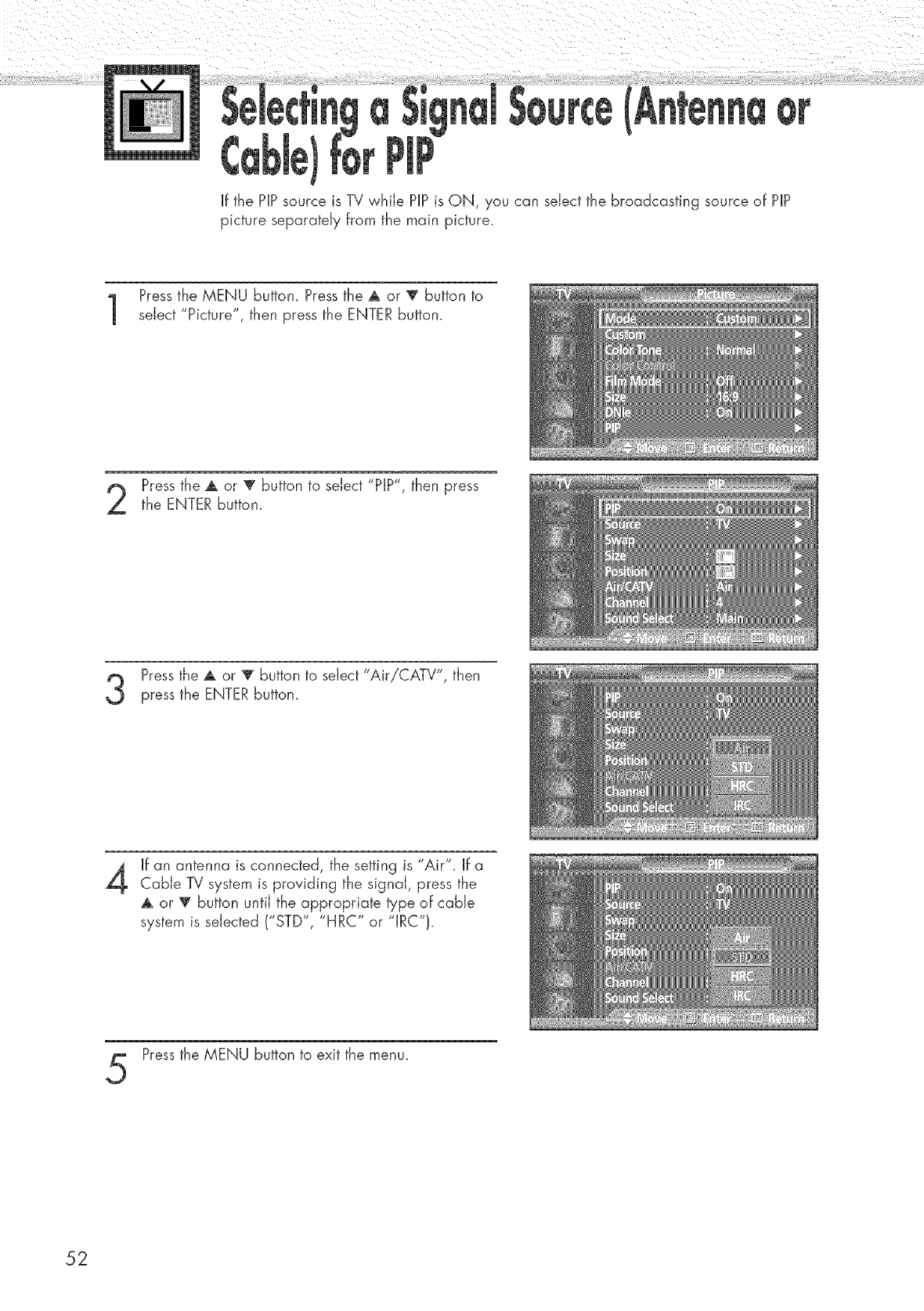
r
if the PiPsource is TV while PiPis ON, you can select the broadcasting source of PiP
picture separately from the main picture.
Pressthe MENU button. Pressthe A or T button to
select "Picture", then press the ENTER button.
Pressthe A or _r button to select "PIP", then press
the ENTER button.
Pressthe A or _ button to select "AiriCATV", then
press the ENTERbutton.
4If an antenna is connected, the setting is "Air". If a
Cable TV system is providing the signal, press the
A or '_' button until the appropriate type of cable
system is selected ("STD", "HRC" or "IRC").
Pressthe MENU button to exit the menu.
52
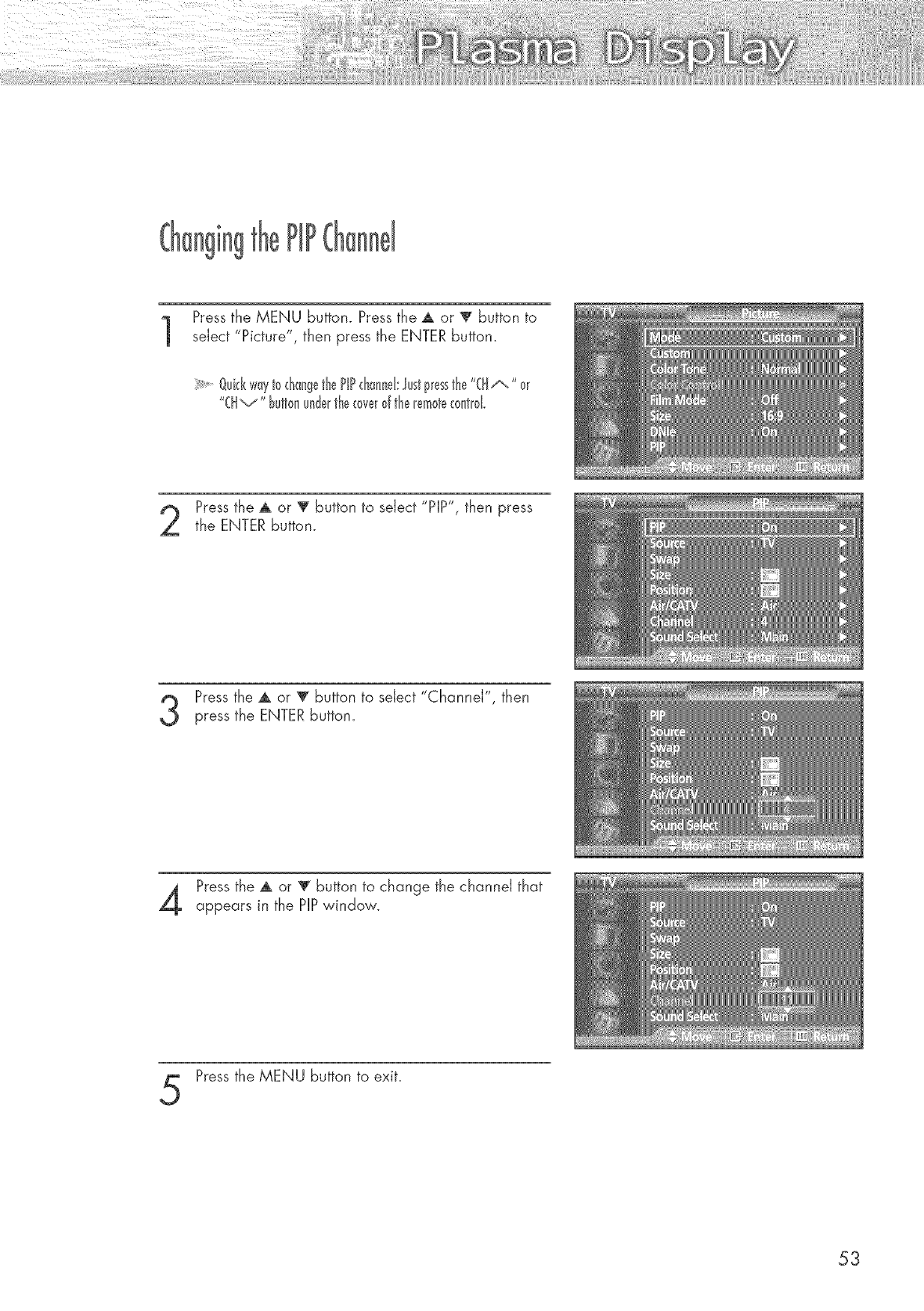
PiP
Pressthe MENU button. Pressthe A or V button to
select "Picture", then press the ENTER button.
Quid<w0yto d_0ngethePIP@nnd:gustpressthe CH or
"{Iv" buttonunderthecoveroftheremotecontrol
Pressthe A or T button to select "PIP", then press
the ENTER button.
Press the A or T button to seiect "Channel", then
press the ENTER button.
Press the A or T button to change the channel that
appears in the PiPwindow.
Pressthe MENU button to exit.
53
Customizing the Sound ................................................................ 56
Using Automatic Sound Settings .................................................... 57
Choosing a Multi-Channel Sound (MTS1Soundtrack .......................... 58
Using the Auto Volume .................................................................. 59
Setting the TruSurround XT ............................................................ 60
Listening to the Sound of the Sub(PiP/ Picture (PC or DVI Mode / .......... 61
Selecting the internal Mute ............................................................ 62
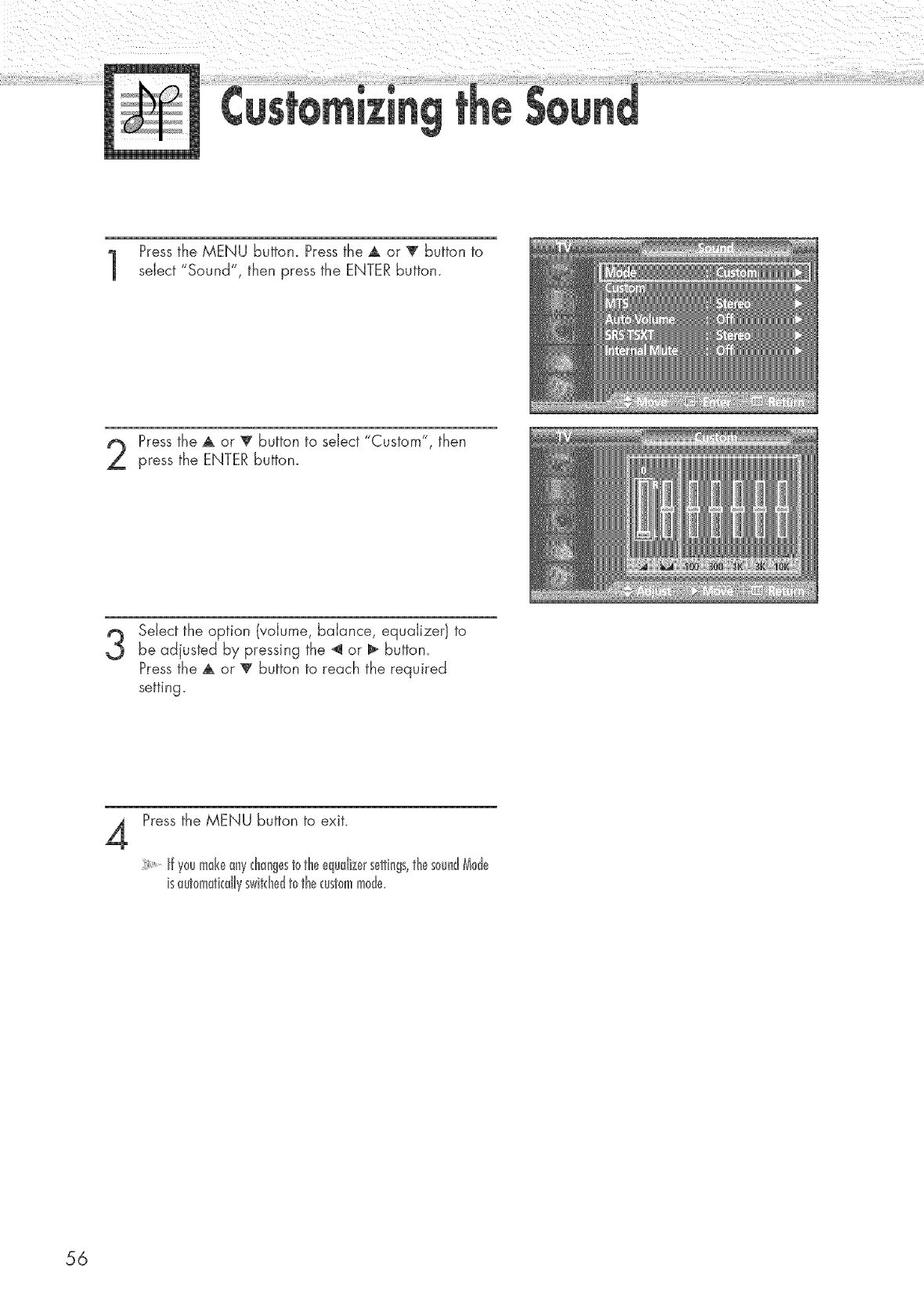
Pressthe MENU button. Pressthe A or T button to
select "Sound", then press the ENTER button.
Press the A or _ button to select "Custom", then
press the ENTER button.
3Select the option (volume, balance, equalizer) to
be adjusted by pressing the _ or _ button.
Pressthe A or T button to reach the required
setting.
4Pressthe MENU button to exit.
i Ifyoum@em_y_h0ngestotheequdize_seflings,thesoundMode
is0utom0ti¢011yswitch÷dtothecustommode
56
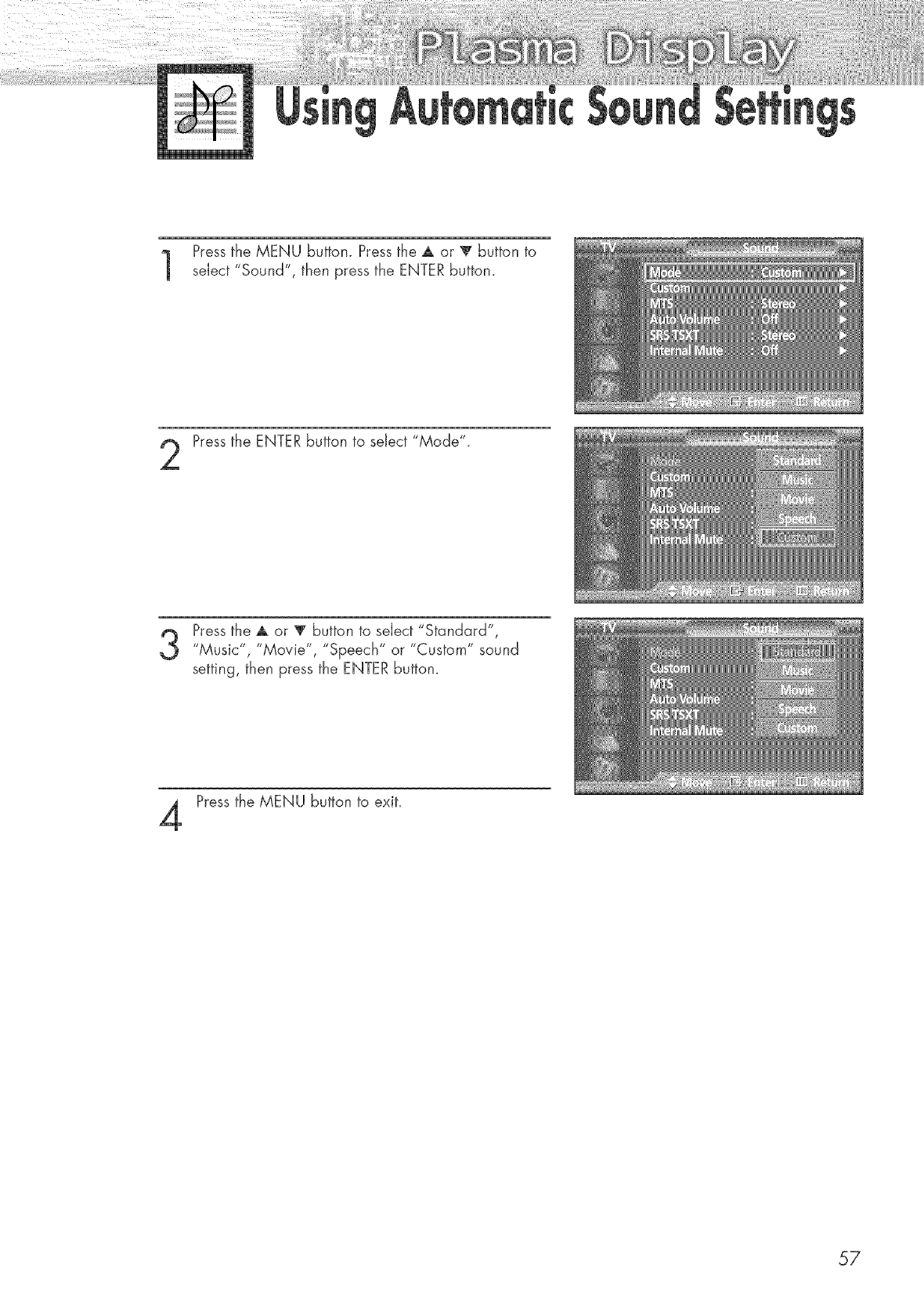
Pressthe MENU button. Pressthe A or T button to
select "Sound", then press the ENTER button.
Pressthe ENTER button to select "Mode".
Pressthe A or _r button to select "Standard",
"Music", "Movie", "Speech" or "Custom" sound
setting, then press the ENTER button.
Press the MENU button to exit.
57
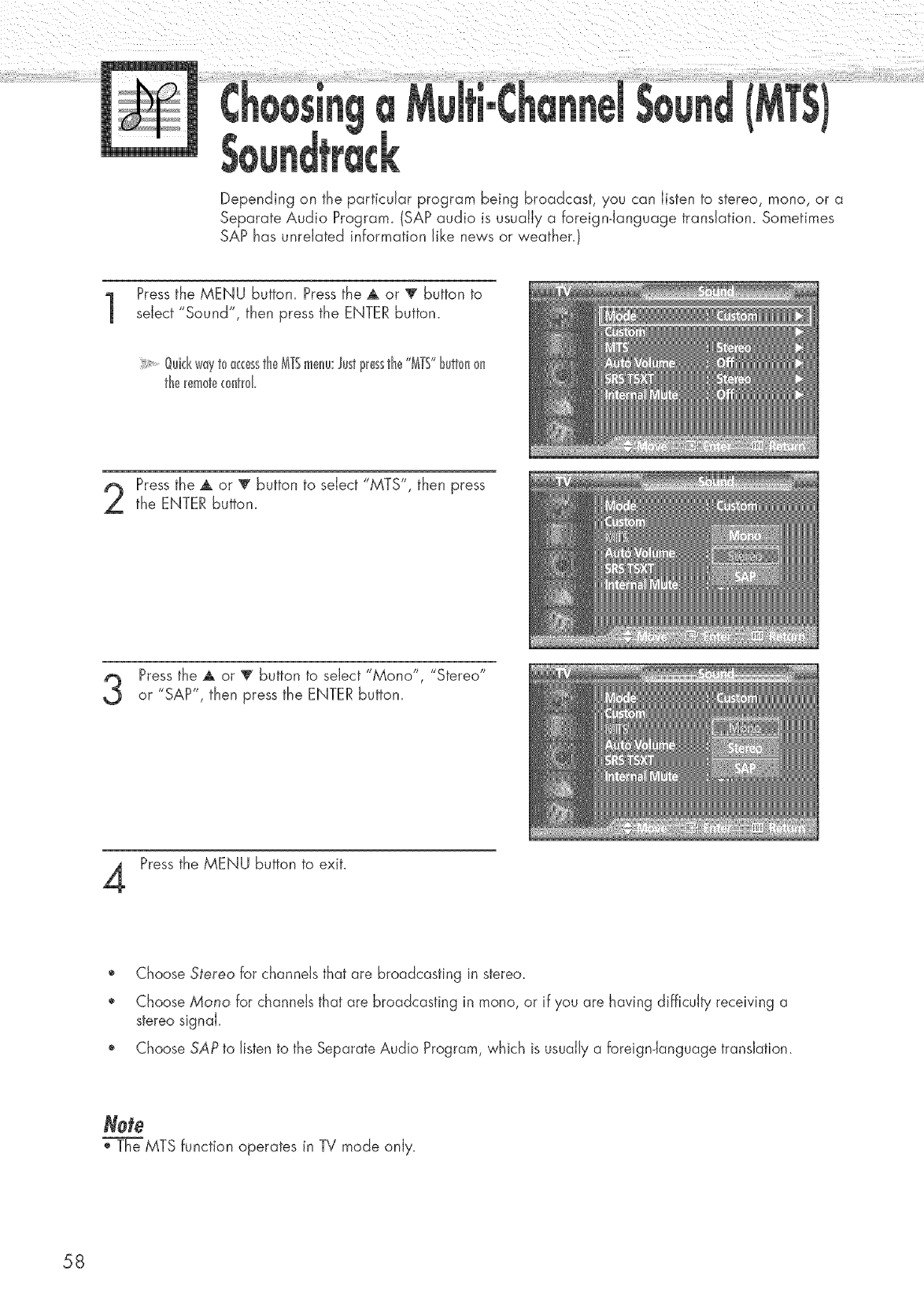
Depending on the particular program being broadcast, you can listen to stereo, mono, or a
Separate Audio Program_ (SAP audio is usually a foreignJanguage translation. Sometimes
SAP has unrelated information like news or weather.}
Pressthe MENU button. Pressthe A or T button to
select "Sound", then press the ENTER button.
Qukkw0yto0_esstheMTSmenu:Justpressthe"MTS"_utt0non
theremotec0ntrd
Press the A or _r button to select "MTS", then pressthe ENTER button.
Pressthe A or T button to select "Mono", "Stereo"
or "SAP", then press the ENTER button.
Pressthe MENU button to exit.
, Choose Stereo for channels that are broadcasting in stereo,
, Choose Mono for channels that are broadcasting in mono, or if you are having difficulty receiving a
stereo signal.
_, Choose SAP to listen to the Separate Audio Program, which is usually a foreign-language translation,
Note
_T'T_e MTS function operates in TV mode only.
58
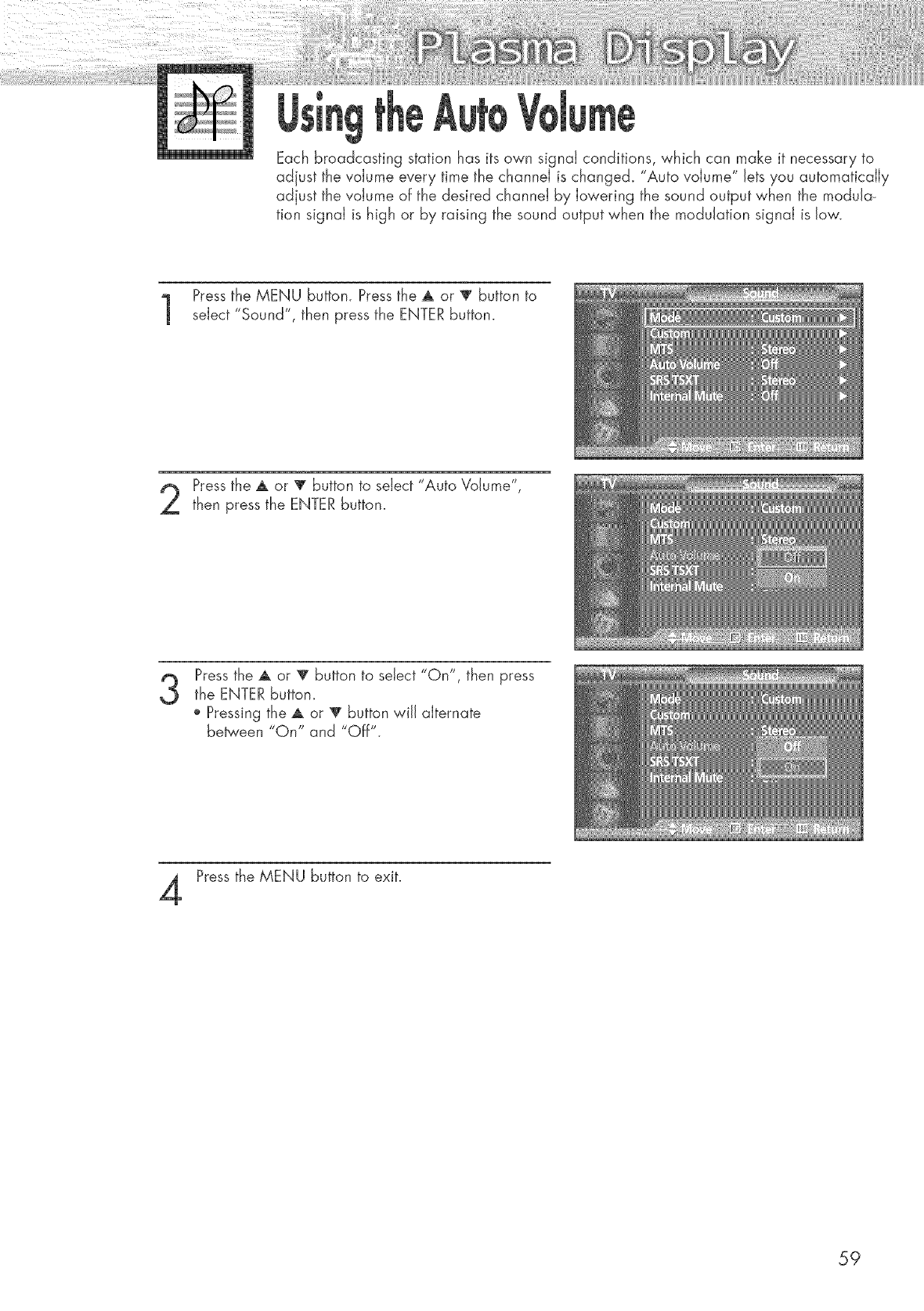
Each broadcasting station has its own signal conditions, which can make it necessary to
adjust the volume every time the channel is changed_ "Auto volume" Jetsyou automatically
adjust the volume of the desired channel by lowering the sound output when the modula-
tion signal is high or by raising the sound output when the modulation signal is low.
Pressthe MENU button. Pressthe A or _ button to
select "Sound", then press the ENTER button.
Pressthe A or _' button to select "Auto Volume",
then press the ENTER button.
3Press the A or T button to select "On", then press
the ENTERbuttom
o Pressing the A or T button wiJJalternate
between "On" and "Off".
Press the MENU button to exit.
59
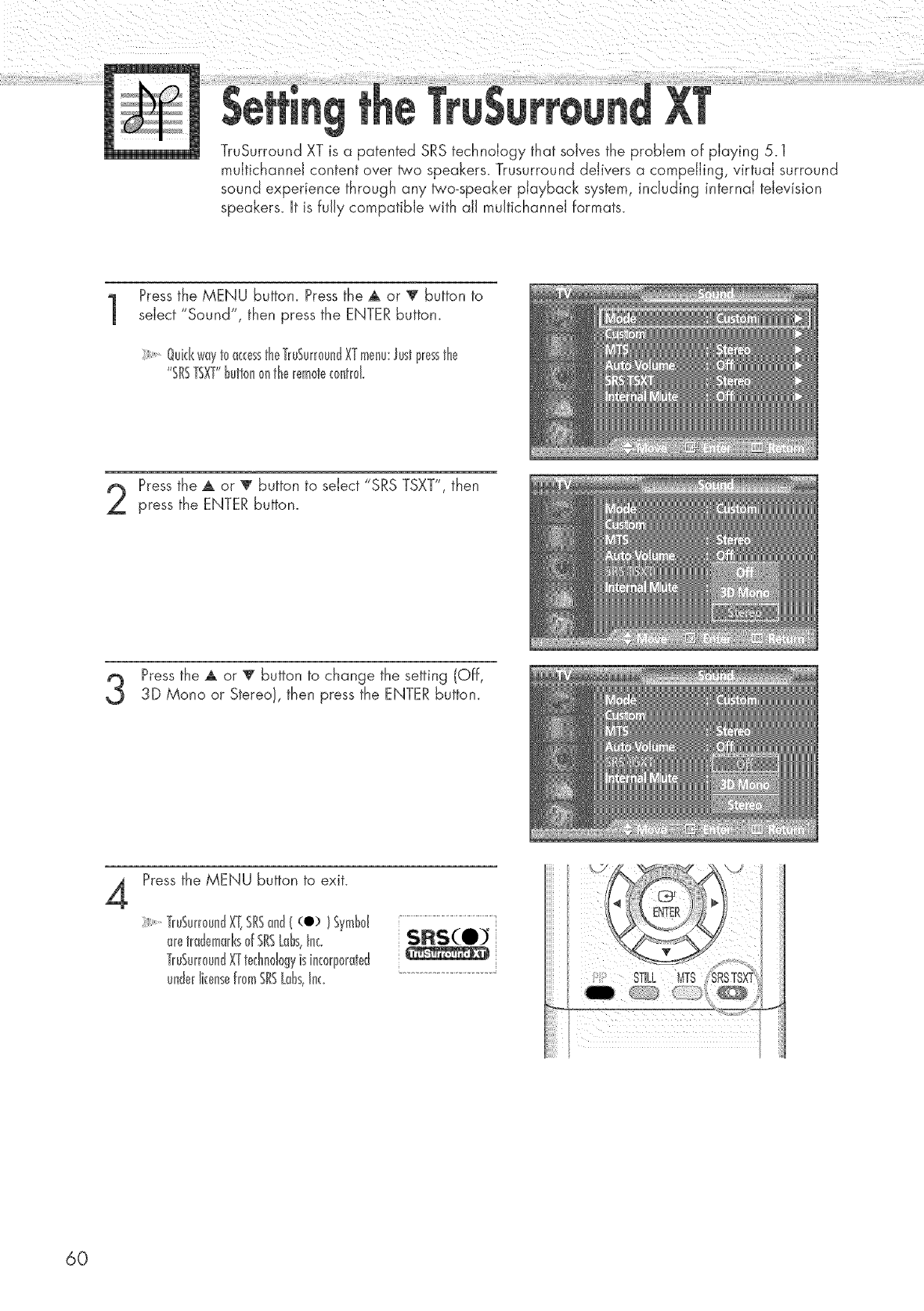
TruSurround XT is a patented SRStechnology that solves the problem of playing 5.1
muItichannet content over two speakers. Trusurround delivers a compelling, virtual surround
sound experience through any two-speaker playback system, including internal television
speakers. It is fully compatible with aJJmuJtichannei formats.
Pressthe MENU button. Pressthe A or T button to
select "Sound", then press the ENTER button.
Qukkw_yto_¢esstheTruSurr0undXTmenu:Justpressthe
"SRSTSXT"buttonontheremotec0ntrd
Press the A or _' button to select "SRS TSXT", then
press the ENTER button.
Pressthe A or T button to change the setting (Off,
3D Mono or Stereo), then press the ENTER button.
4Pressthe MENU button to exit.
?ruSurr0undXT,SRSmrd((e)) Symbol
r_retrademarksofSRSL@s,Inc
TruSurr0und×Tte_hnd0gyisin_0rp0r@d
underlicensefromSR5LdJs,Inc.
60
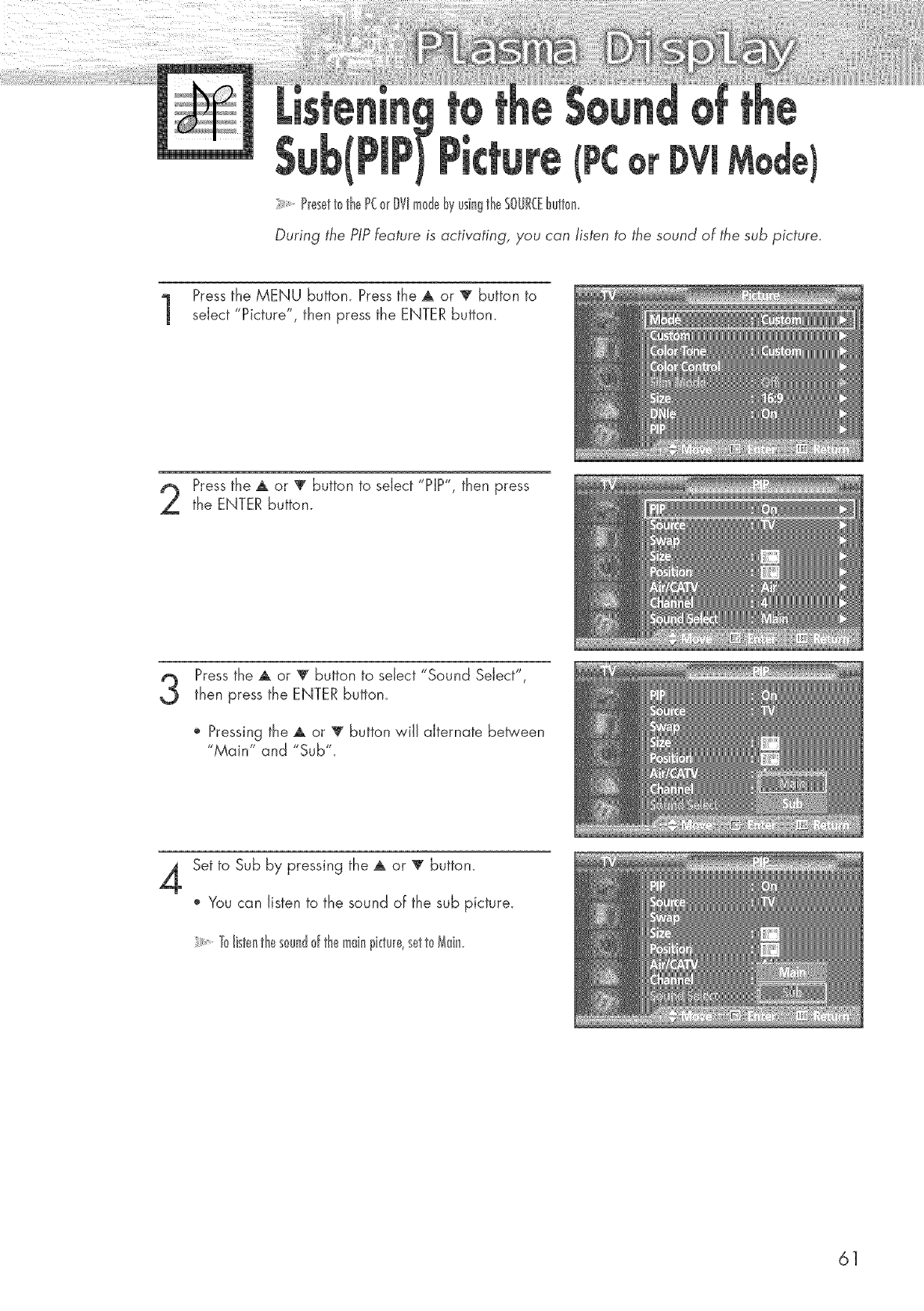
P_nsnttofl_nPCorDVImodebyusingtheSOURCEbutton
During the PIPfeature is activating, you can listen to the sound of the sub picture.
Pressthe MENU button. Pressthe A or T button to
select "Picture", then press the ENTER button.
Pressthe A or T' button to select "PIP", then pressthe ENTER button.
Press the A or T button to select "Sound Select",
then press the ENTER button.
o Pressing the A or V button wiJJalternate between
"Main" and "Sub".
Set to Sub by pressing the A or _' button.
" You can listen to the sound of the sub picture.
Tolistenthesoundofthemainpidurn,settoMain.
61
i
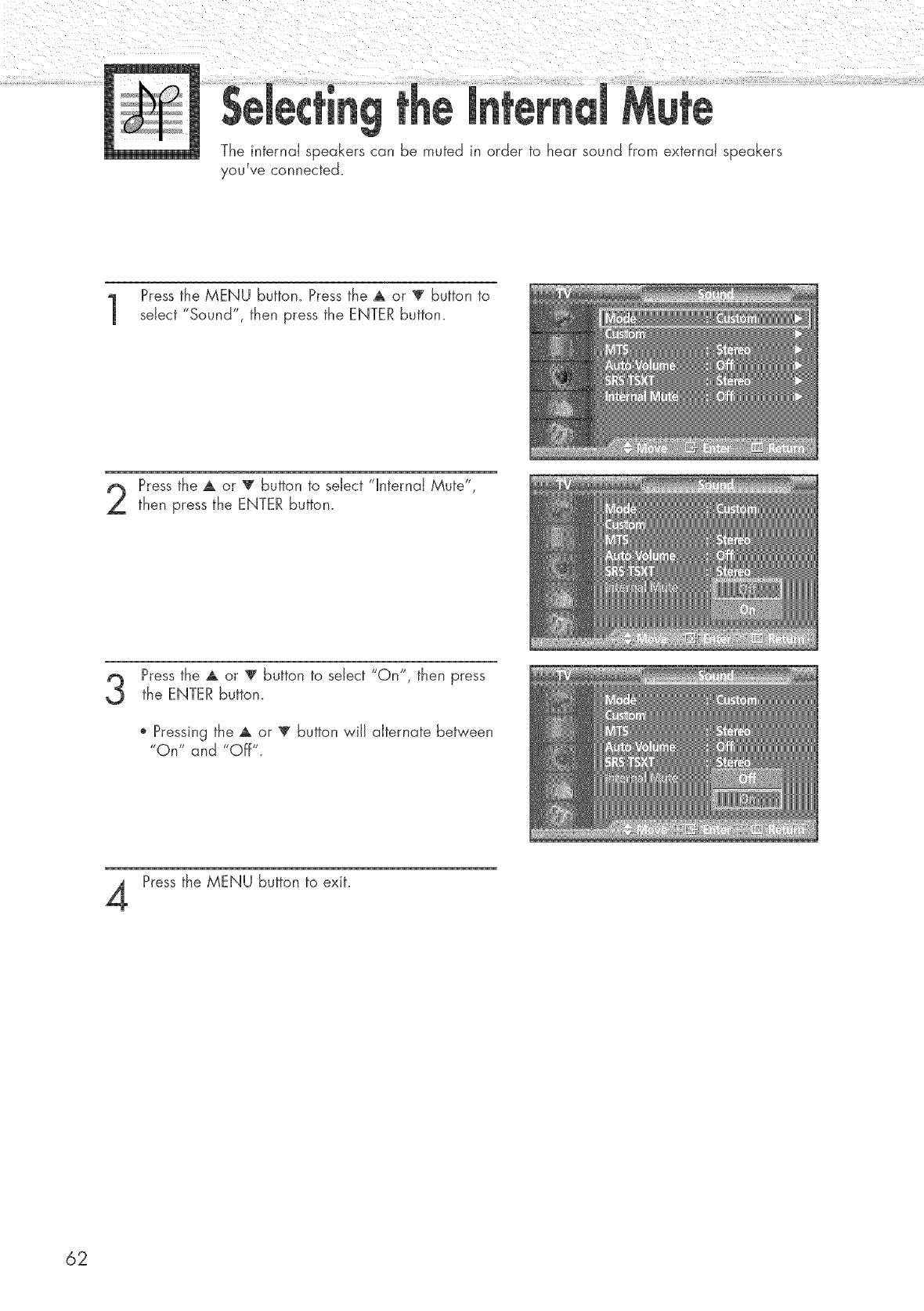
The internal speakers can be muted in order to hear sound from external speakers
you've connected.
Pressthe MENU buttom Press the A or _ button to
select "Sound", then press the ENTER button.
Press the A or _r button to select "Internal Mute",
then press the ENTER button.
Press the A or T button to select "On", then pressthe ENTER button.
o Pressing the A or V button wiJJalternate between
"On" and "Off".
Press the MENU button to exit.
62
!i ii¸¸¸¸¸ ii
Fine Tuning Channels .................................................................... 64
LNA (Low Noise Amplifier) ............................................................ 65
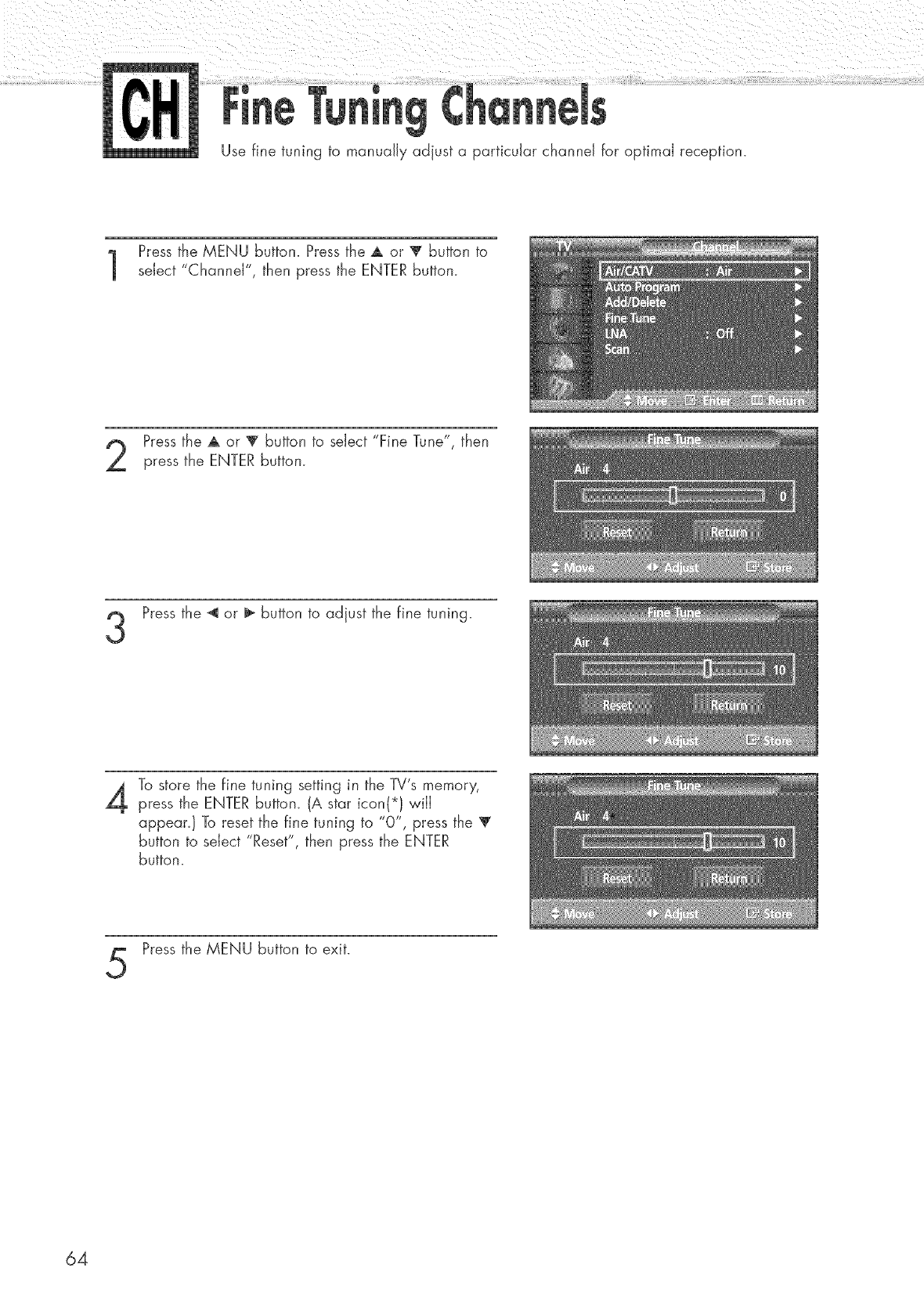
Use fine tuning to manually adjust a particular channel for optimal reception.
Press the MENU button. Pressthe A or T button to
select "Channel", then press the ENTER button.
Press the A or _r button to select "Fine Tune", then
press the ENTER button.
Pressthe _ or _ button to adjust the fine tuning.
To store the fine tuning setting in the TV's memory,
press the ENTER buttom (A star icon(*) will
appean) To reset the fine tuning to "0", press the T
button to select "Reset", then press the ENTER
button.
Pressthe MENU button to exit.
64
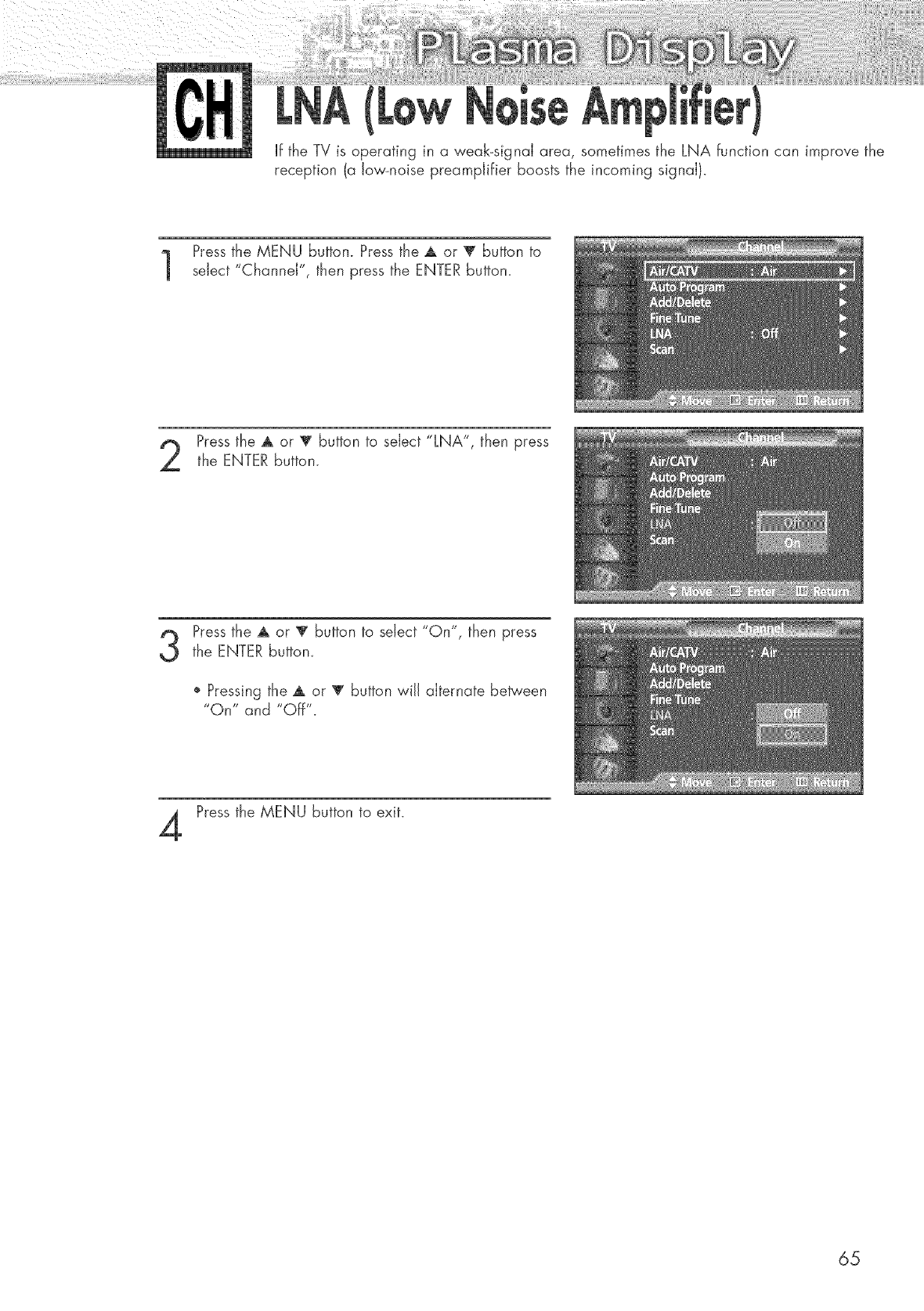
If the TV is operating in a weak-signal area, sometimes the LNA function can improve the
reception (a low-noise preamplifier boosts the incoming signal}.
Pressthe MENU button. Pressthe A or T' button to
select "Channel", then press the ENTER button.
Pressthe ,L or _ button to select "LNA", then press
the ENTER button.
3Pressthe A or T button to select "On", then press
the ENTER button.
o Pressing the A or V button wiJJalternate be_'een
"On" and "Off".
Press the MENU button to exit.
65
ii¸¸¸¸¸ ii
Connecting a PC.......................................................................... 68
Adjusfing the PC Screen ................................................................ 72
Changing _he Position of fhe Image ................................................ 73
Picfure ©uali_y Adius_ment ............................................................ 74
Information .................................................................................. 77
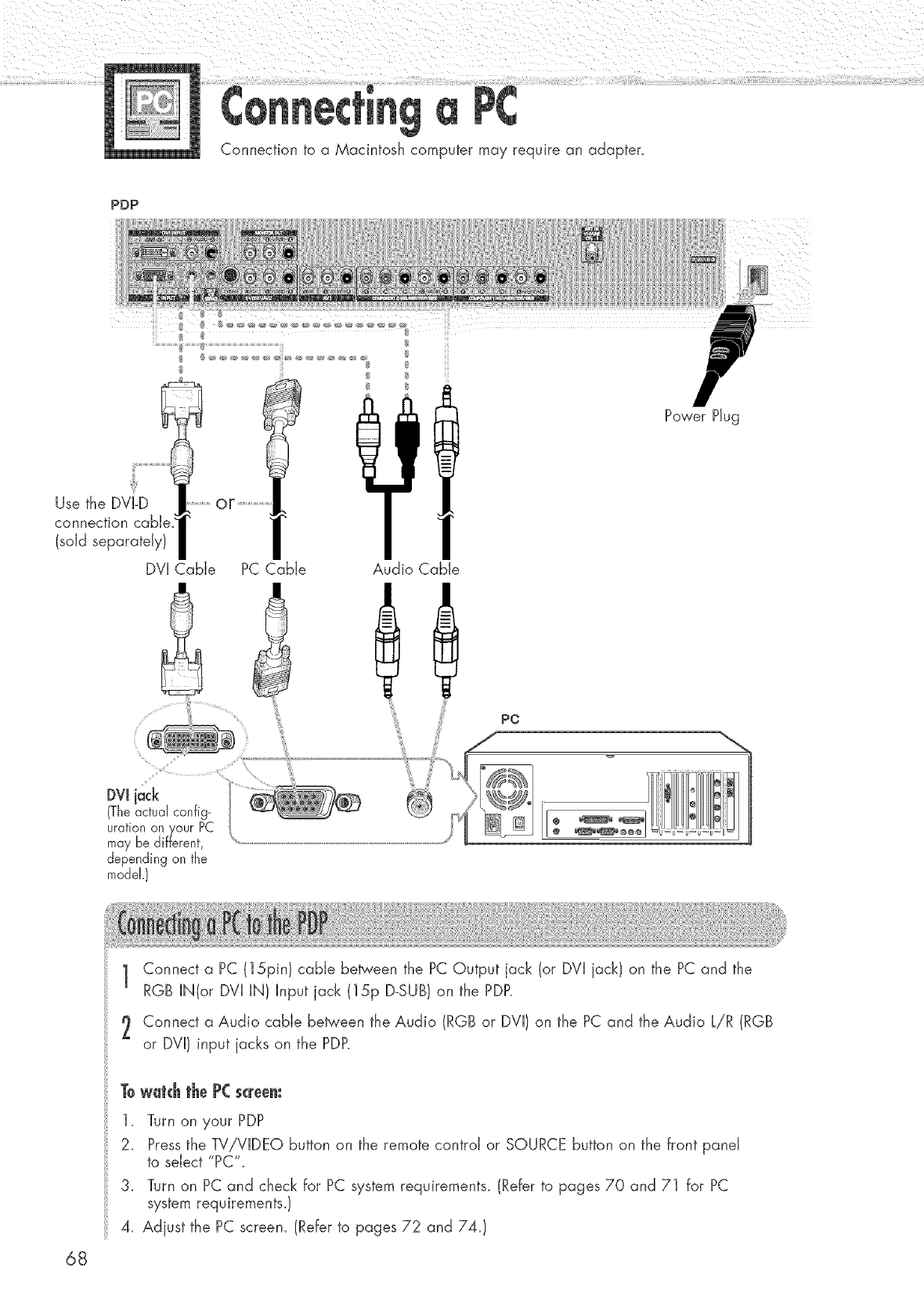
Connection to a Macintosh computer may require an adapter.
POP
Use the DVI-D
connection cable;"
(sold separately!
DVl CaMe PC CaNe Audio Cable
PC
Power Plug
DVIj_ck
(Theactualconfig-
urationonyour PC
maybe different,
dependingonthe
model.)
] Connect a PC (15pinl cable between the PC Output jack (or DVI jack/on the PC and the
RGB IN(or DVI IN! Input jack (15p D-SUB) on the PDP.
2 Connect a Audio cable be_'een the Audio (RGB or DVI! on the PC and the Audio LiR (RGB
or DVIt input jacks on the PDP.
68
To_td_ the PCs_reem
1. Turn on your PDP
2. Pressthe TV/VIDEO button on the remote control or SOURCE button on the front panel
to select "PC"_
3. Turn on PC and check for PC system requirements. (Refer to pages 70 and 71 for PC
system requirements.!
4. Adjust the PC screen. (Refer to pages 72 and 74.1
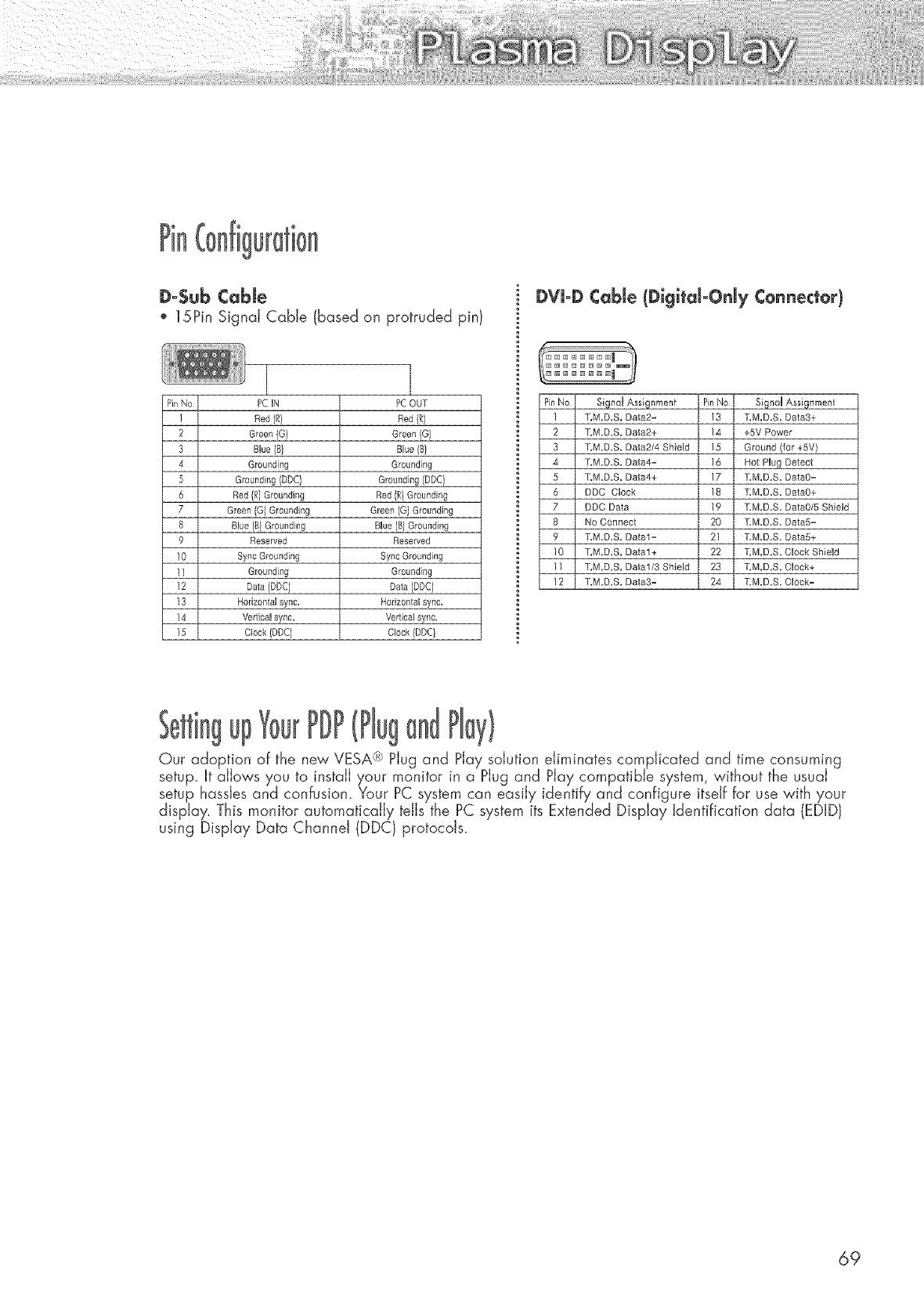
Pin
DoSubCable
o15Pin Signal Cable (based on protruded pin}
Pin No PC iN
1 Red (RI
2 Green {G}
3 Blue (B)
4 Grounding
5 Grounding (DDC)
6 Red (R) Grounding
7Green (G) Grounding
8 Blue (B} Grounding
9 Reserved
l0 Sync Grounding
1] Grounding
12 Data (DDC)
13 Horizontal sync.
14 Vertical syne.
15 Clock (DDC)
PC-!UT
Red (R)
Green (G)
Blue (B}
Grounding
Grounding (DDC)
Red (R) @aunding
Green (G) Grounding
Blue (B) Grounding
Reserved
Syne Grounding
Grounding
Data (DDC)
Horizontal sync.
Vertical sync.
Clock (DDC)
DVbD Cable (DigitaJoOnJy Connector)
Pin No Signal Assignmenf PinNo Signal Assignment
1 T.M.D.S. Data2_ 13 T.M.D.S. Data3+
2 T.M.D.B. Data2+ 14 +5V Power
3 T.M.D.S. Data2/4 Shield 15 Ground (for +5V)
4 T.M.D.S. Data41 18 Hot Hug Detect
5 T.M.D.S. Data4+ 17 T.M.D.S. Data0=
6 DDC CUoek 18 T.M.D.S. DataO+
7 DDC Data 19 T.M.D.S. Data0/5 Shield
8 No Connect 20 T.M.D.S. Data5=
9 T.M.D.S. Data1= 21 T.M.D.S. DataS+
10 T.M.D.S. Data1+ 22 T.M.D.S. Clock Shield
11 T.M.D.S. Data1/3 Shield 23 T.M.D.S. Cbck+
J2 T.M.D.S. Data3= 24 T.M.D.S. Clock=
up PDP(
Our adoption of the new VESA® Plug and Play solution eliminates complicated and time consuming
setup. It aJiow's you to install your monitor in a Plug and Play compatible system, without the usual
setup hassles and confusion. Your PC system can easily identify and configure itself for use with your
display. This monitor automatically telis the PC system its Extended Display Identification data (EDID)
using Display Data Channel (DDC) protocols.
69
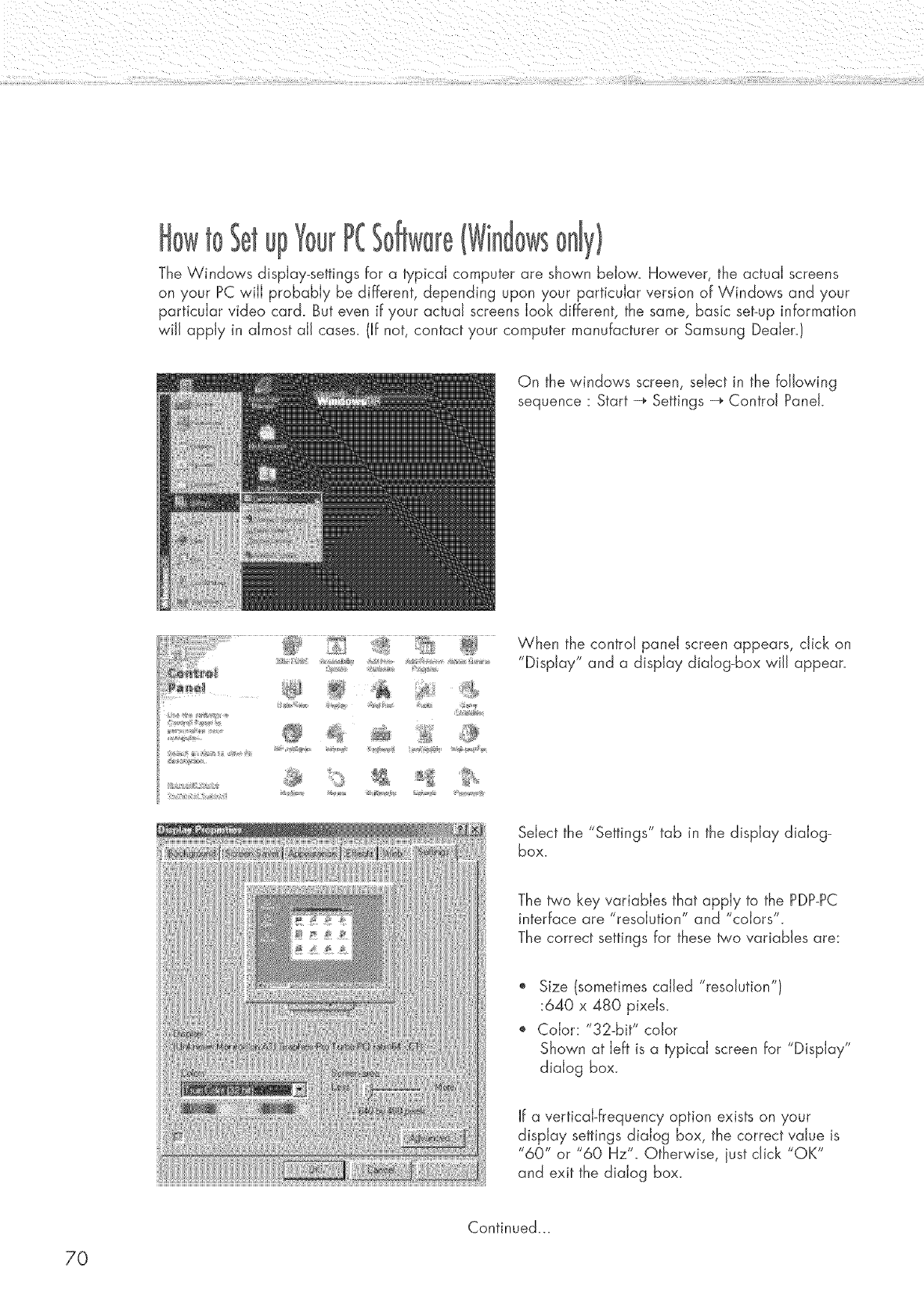
The Windows display-settings for a typical computer are shown beiow_ However, the actual screens
on your PC will probably be different, depending upon your particular version of Windows and your
particular video card. But even if your actual screens look different, the same, basic set-up information
wiJJapply in almost all cases. (If not, contact your computer manufacturer or Samsung Dealer.}
On the windows screen, select in the following
sequence : Start _ Settings _ Control Panek
When the control panel screen appears, click on
"Display" and a display dialog-box v,,'iJJappear.
Select the "Settings" tab in the display diaiog-
box.
The two key variables that apply to the PDP-PC
interface are "resolution" and "colors".
The correct settings for these _'o variables are:
', Size (sometimes called "resolution'}
:640 x 480 pixeis.
', Color: "32-bit" color
Shown at left is a typical screen for "Display"
dialog box.
If a verticaJ_frequency option exists on your
display settings dialog box, the correct value is
"60" or "60 Hz". Otherwise, just dick "OK"
and exit the diaiog box.
Continued...
7O
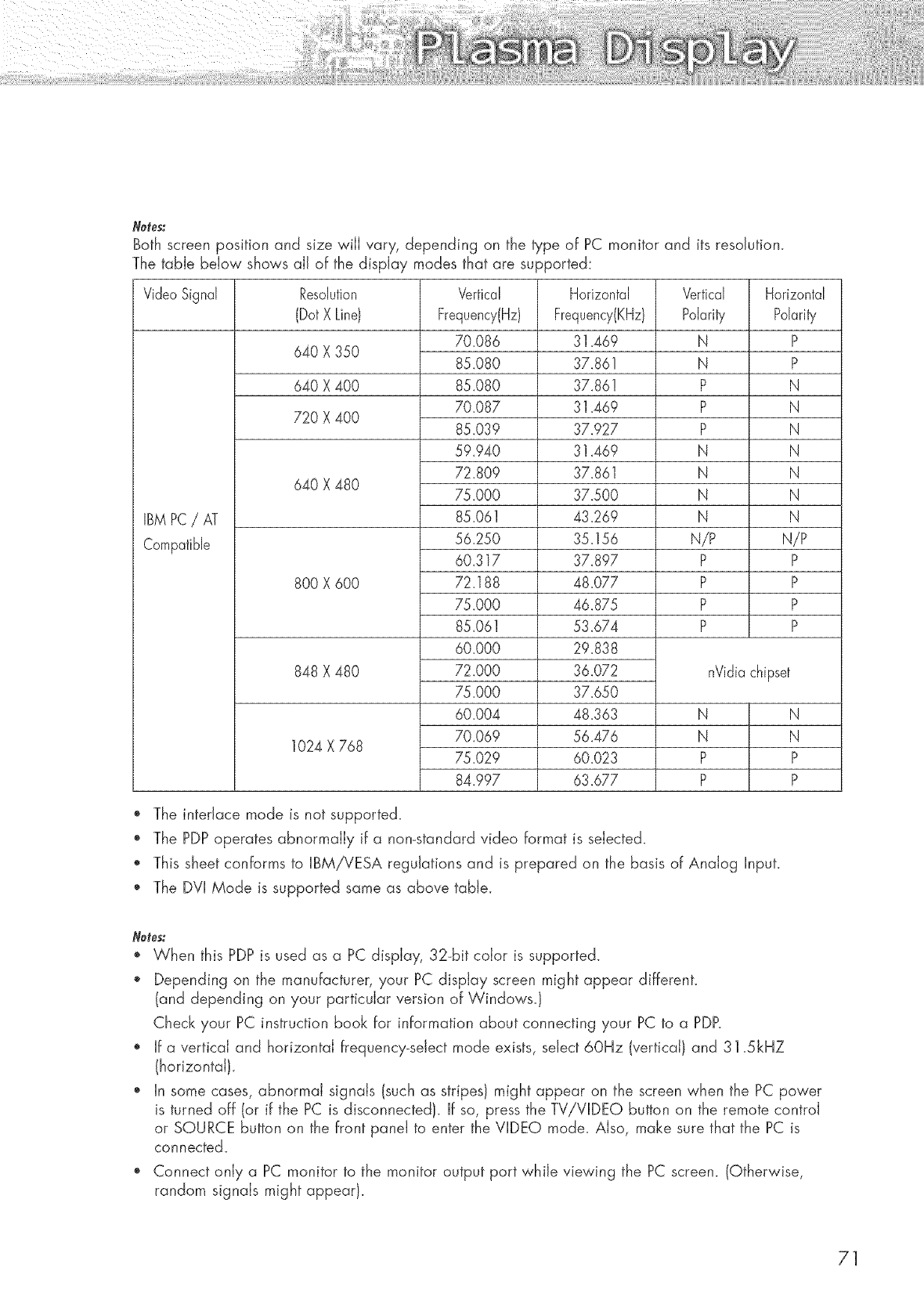
Notes_
Both screen position and size will vary, depending on the type of PC monitor and its resolution.
The table below shows aiJ of the display modes that are supported:
Video Signal Resolution
(DotX Line}
640 X 350
640 X400
720 X400
640 X480
800 X 600
848 X480
1024 X 768
BM PC/AT
Compatible
Vertical
Frequency(Hz)
70.086
85.080
85.080
70.087
85.039
59.940
72.809
75.000
85.061
56.250
60.317
72.188
75.000
85.061
60_000
72.000
75.000
60.004
70.069
75.029
84.997
Horizon_l
Frequency(KHz)
31.469
37.861
37.86!
31.469
37.927
31.469
37.861
37.500
43.269
35_156
37.897
48.077
46.875
53.674
29.838
36.072
37.650
48.363
56.476
60.023
63.677
Vertical Horizontal
Polarity Polarity
N P
N P
P N
P N
P N
N N
N N
N N
N N
N/P N/P
P P
P P
P P
P P
nVidia chipset
N N
N N
P P
P P
oThe interlace mode is not supported.
o The PDPoperates abnormally if a non-standard video format is selected.
', This sheet conforms to IBM/VESA regulations and is prepared on the basis of Analog Input.
', The DVI Mode is supported same as above table.
Notes:
', When this PDP is used as a PC display, 32-bit color is supported.
" Depending on the manufacturer, your PC display screen might appear different.
(and depending on your particular version of Windows.}
Check your PC instruction book for information about connecting your PC to a PDP.
', If a vertical and horizontal frequency-select mode exists, select 6OHz (vertical} and 31.5kHZ
(horizontal}.
', In some cases, abnormal signals (such as stripes} might appear on the screen when the PC power
is turned off (or if the PC is disconnected}. If so, press the TV/VIDEO button on the remote control
or SOURCE button on the front panel to enter the VIDEO mode. Also, make sure that the PC is
connected.
o Connect only a PC monitor to the monitor output port while viewing the PC screen. (Otherwise,
random signals might appear}.
71
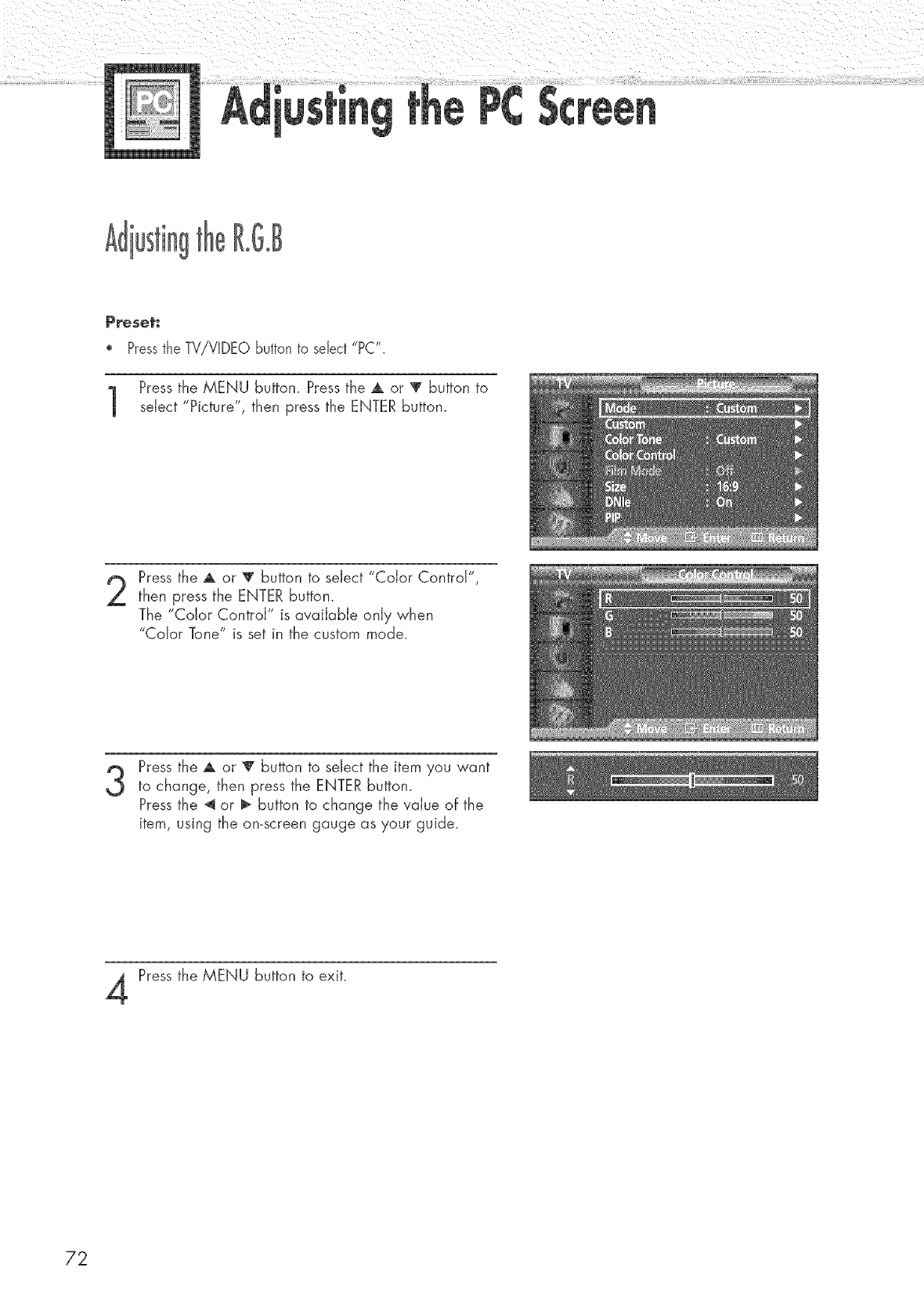
P_ese_:
Pressthe TV/VDEO button to select"PC".
Pressthe MENU button. Pressthe A or V button to
select "Picture", then press the ENTER button.
Press the _. or _ button to select "Color Control",
then press the ENTER button.
The "Color Control" is available only when
"Color Tone" is set in the custom mode.
3Press the A or T button ta select the item you want
to change, then press the ENTER button.
Pressthe _l or _ button to change the value of the
item, using the on-screen gauge as your guide.
Press the MENU button to exit.
72
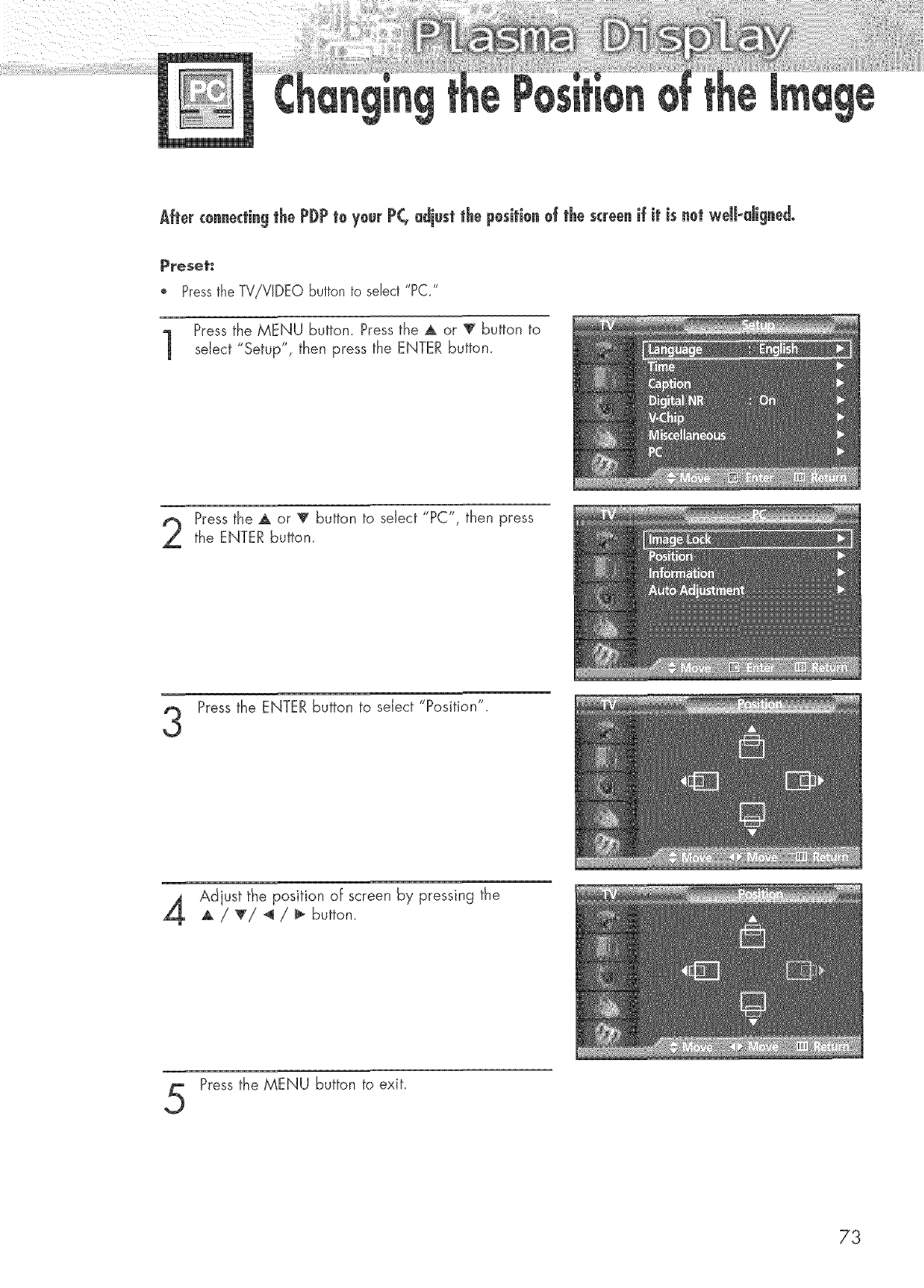
After connectingthe PDPte yourPC,adjust the pesitiendthe screenif it is net weH-dignedo
Preset:
,, Pressthe TV/VIDEO buttonto select "PC"
Press the MENU button. Pressthe ,L or _' button to
select "Setup", then press the ENTER button.
Pressthe A or T button to select "PC", then press
the ENTER button.
Press the ENTER button to select "Position".
Adjust the position oJ:screen by pressing the
,L / _'/_ /_ button.
Pressthe MENU button to exit.
73
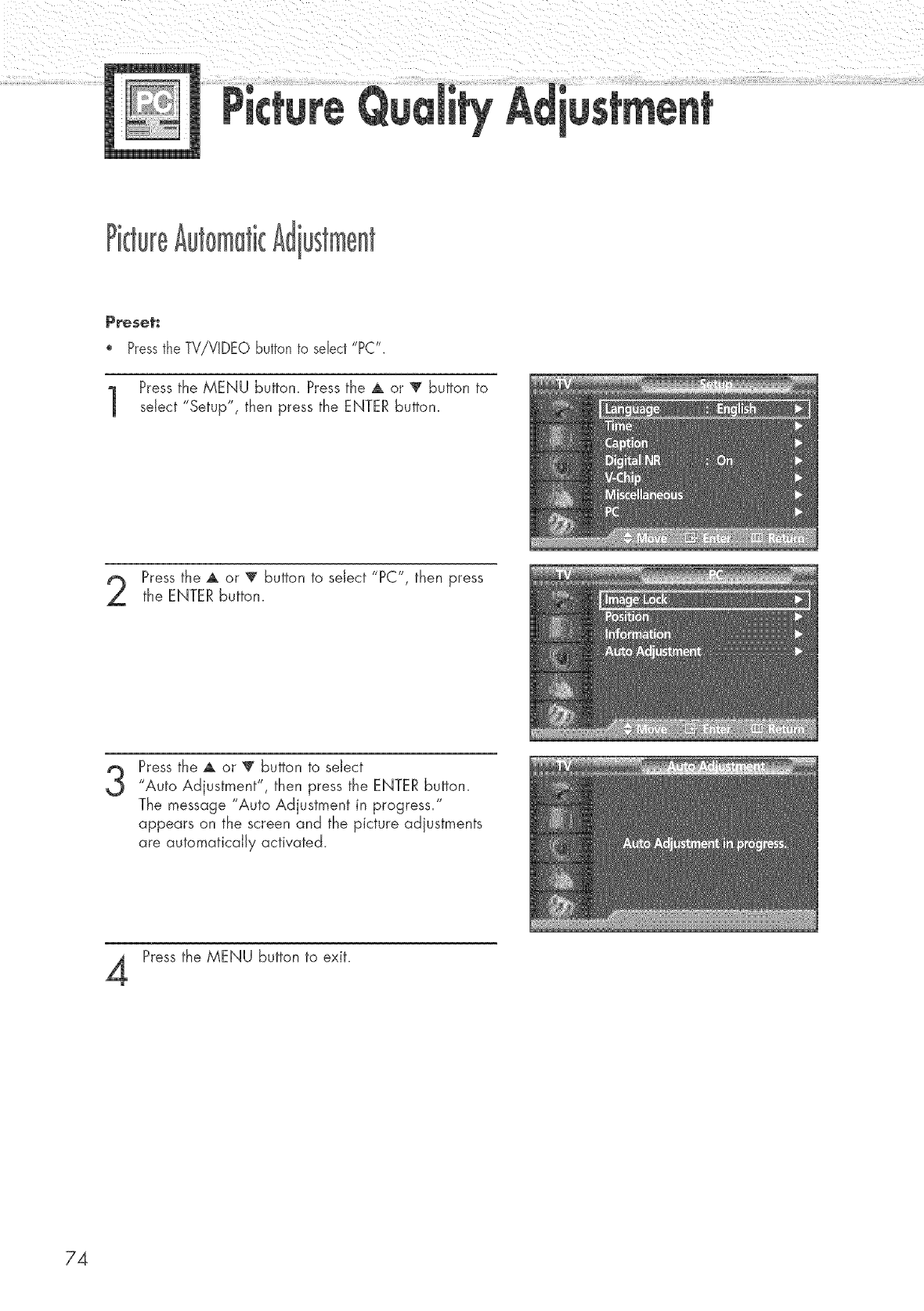
P_ese_:
Pressthe TV/VDEO button to select"PC".
Pressthe MENU button. Pressthe ,L or V button to
select "Setup", then press the ENTER button.
Pressthe A or T button to select "PC", then press
the ENTER button.
3Press the A or T button to select
"Auto Adjustment", then press the ENTER button.
The message "Auto Adjustment in progress."
appears on the screen and the picture adjustments
are automaticaiJy activated.
Press the MENU button to exit.
74
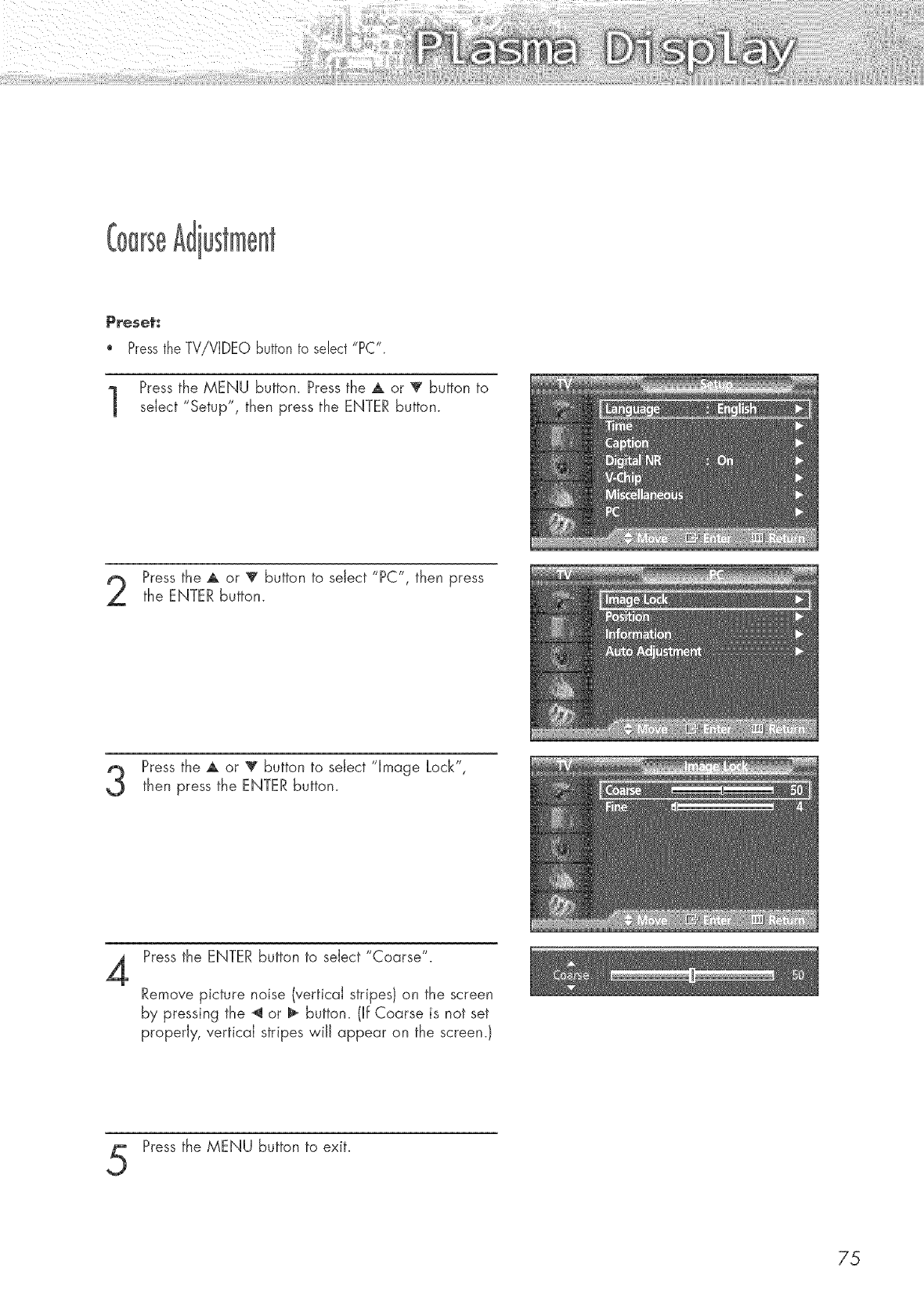
Pressthe TV/VIDEO button to select "PC".
Pressthe MENU button. Pressthe A or _ button to
seiect "Setup", then press the ENTER button.
Pressthe A or T button to select "PC", then press
the ENTER button.
Pressthe A or T button to select 'qmage Lock",
then press the ENTER button.
4Press the ENTER button to select "Coarse".
Remove picture noise (vertical stripes/on the screen
by pressing the _ or _ button. (If Coarse is not set
properly, vertical stripes wiJJappear on the screen.)
Press the MENU button to exit.
75
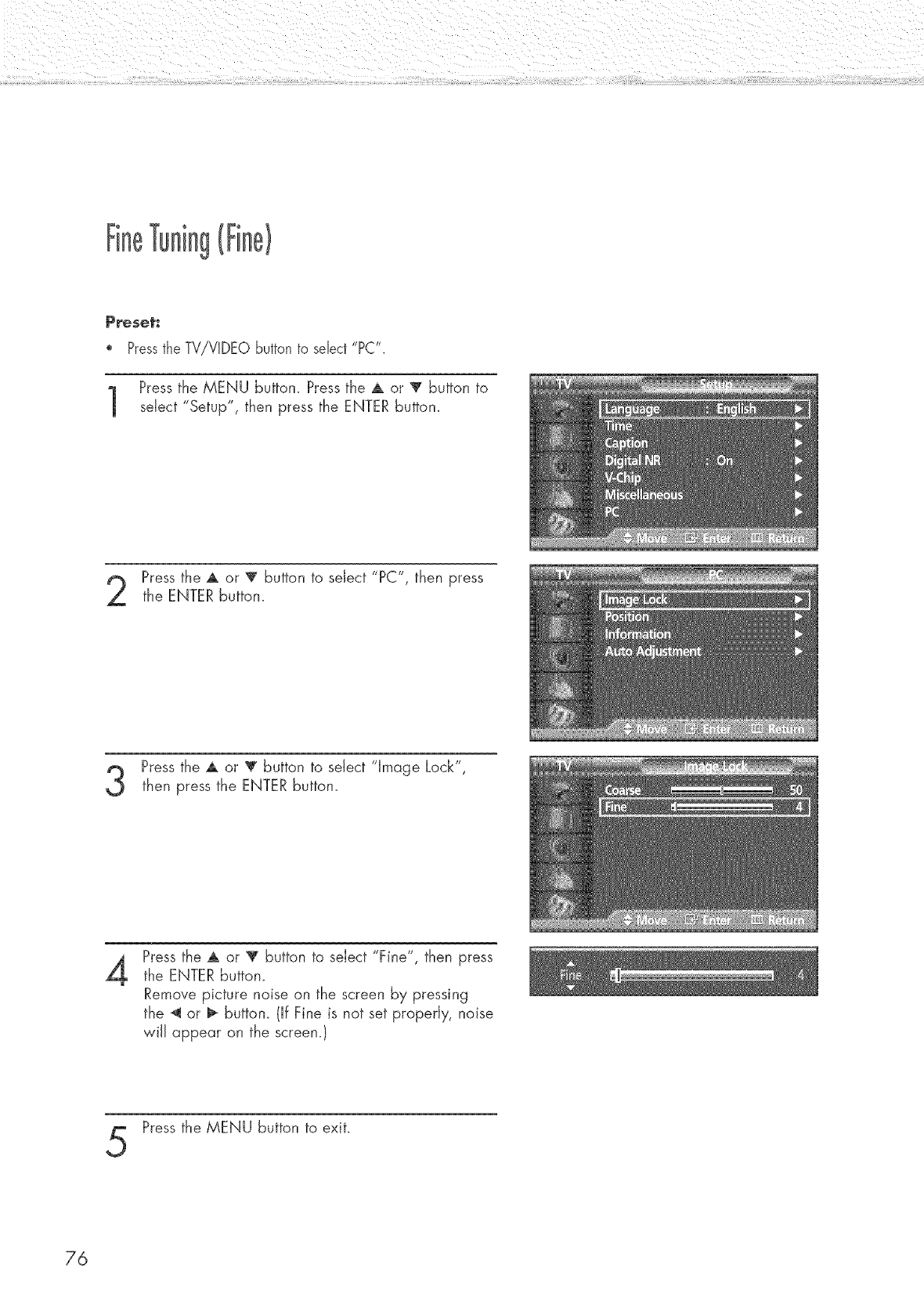
Fine g(Fine)
Preset:
Pressthe TV/VIDEO button to select"PC".
Pressthe MENU button. Pressthe ,L or V button to
select "Setup", then press the ENTER button.
Pressthe A or T button to select "PC", then press
the ENTER button.
Press the _ or _ button to select "Image Lock",
then press the ENTER button.
4Press the _ or _ button to select "Fine", then press
the ENTER button.
Remove picture noise on the screen by pressing
the _ or _,-button. (If Fine is not set properly, noise
wiJJ appear on the screen.)
Pressthe MENU button to exit.
76
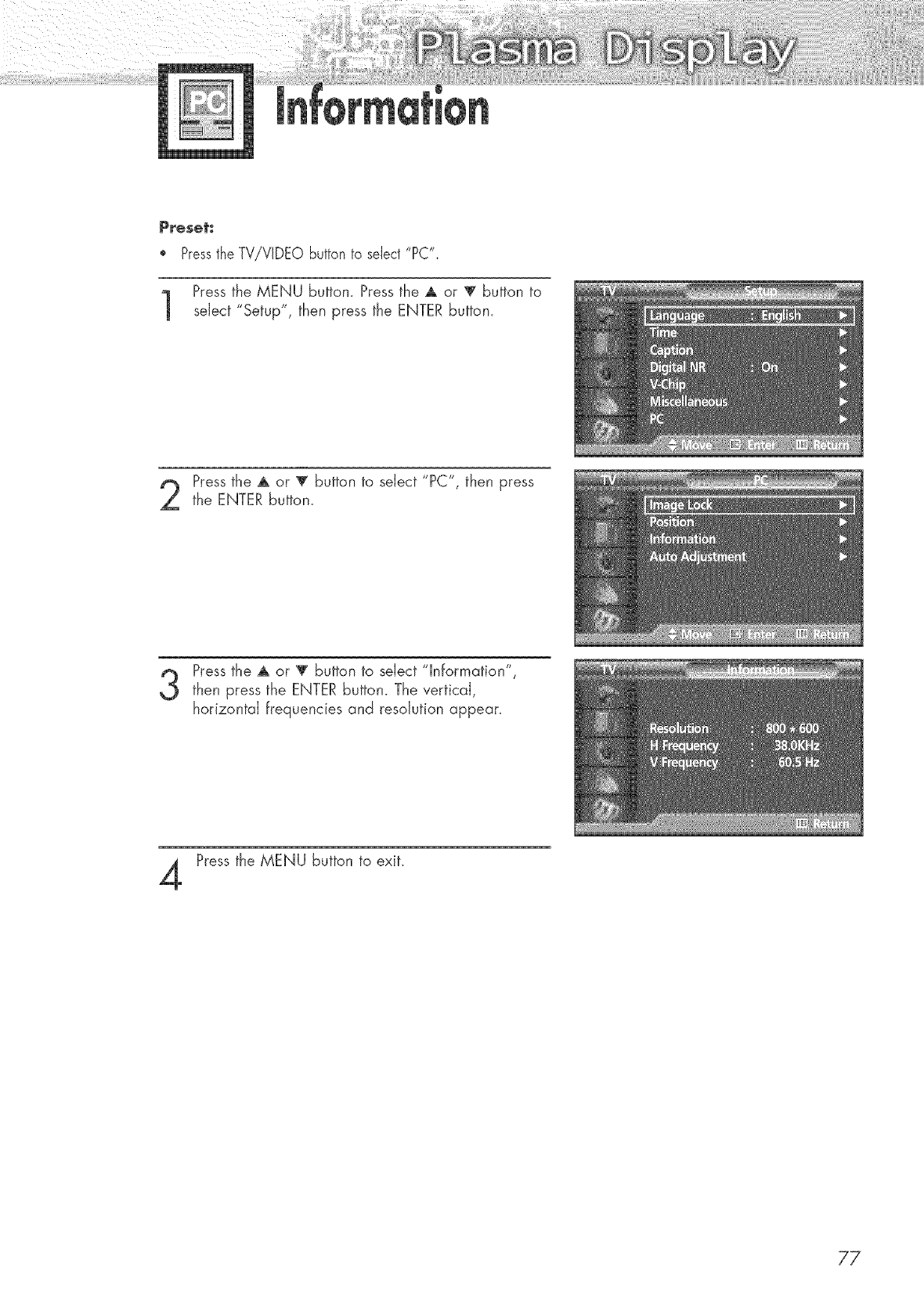
P_ese_:
*Pressthe TViVDEO button to select "PC".
Press the MENU button. Pressthe ,L or _ button to
select "Setup", then press the ENTER button.
Pressthe A or T button to select "PC", then pressthe ENTER button.
Pressthe A or T button to select 'qnformation
then press the ENTER button. The vertical,
horizontal frequencies and resolution appear.
Press the MENU button to exit.
77
TI °
Setting the Clock .................. 80
Setting the Sleep Timer ............................................................... 81
Setting the Timers ...................................................................... 82
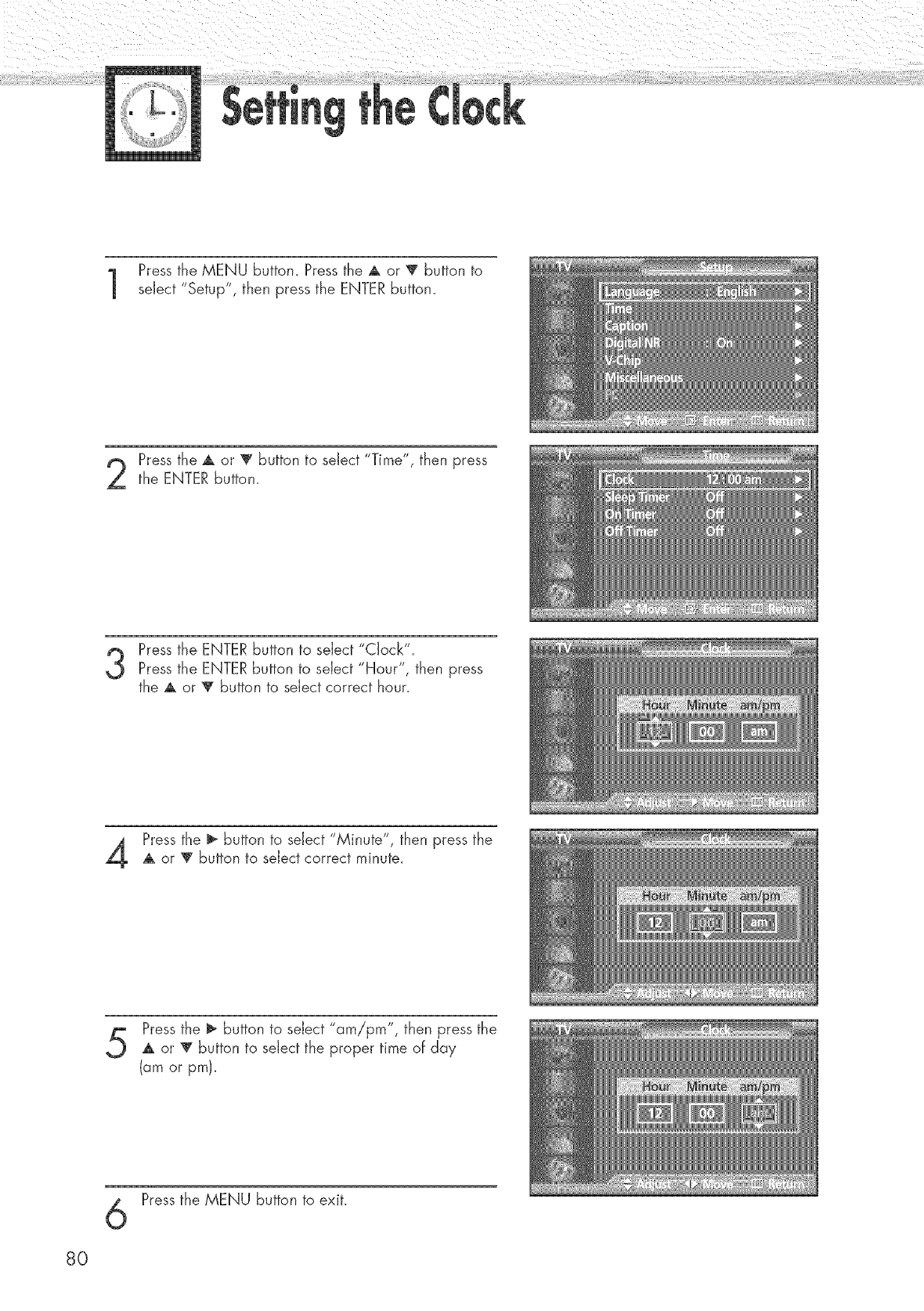
Press the MENU buttom Press the A or T button to
select "Setup", then press the ENTERbutton.
Press the A or T button to select "Time", then press
the ENTER button.
Press the ENTER button to select "Clock".
Press the ENTER button to select "Hour", then press
the A or T button to select correct hour.
Pressthe _ button to select "Minute", then press theA or T button to select correct minute.
Pressthe _ button to select "am/pro", then press the
A or T button to select the proper time of day
(am or pm!.
Pressthe MENU button to exit.
80
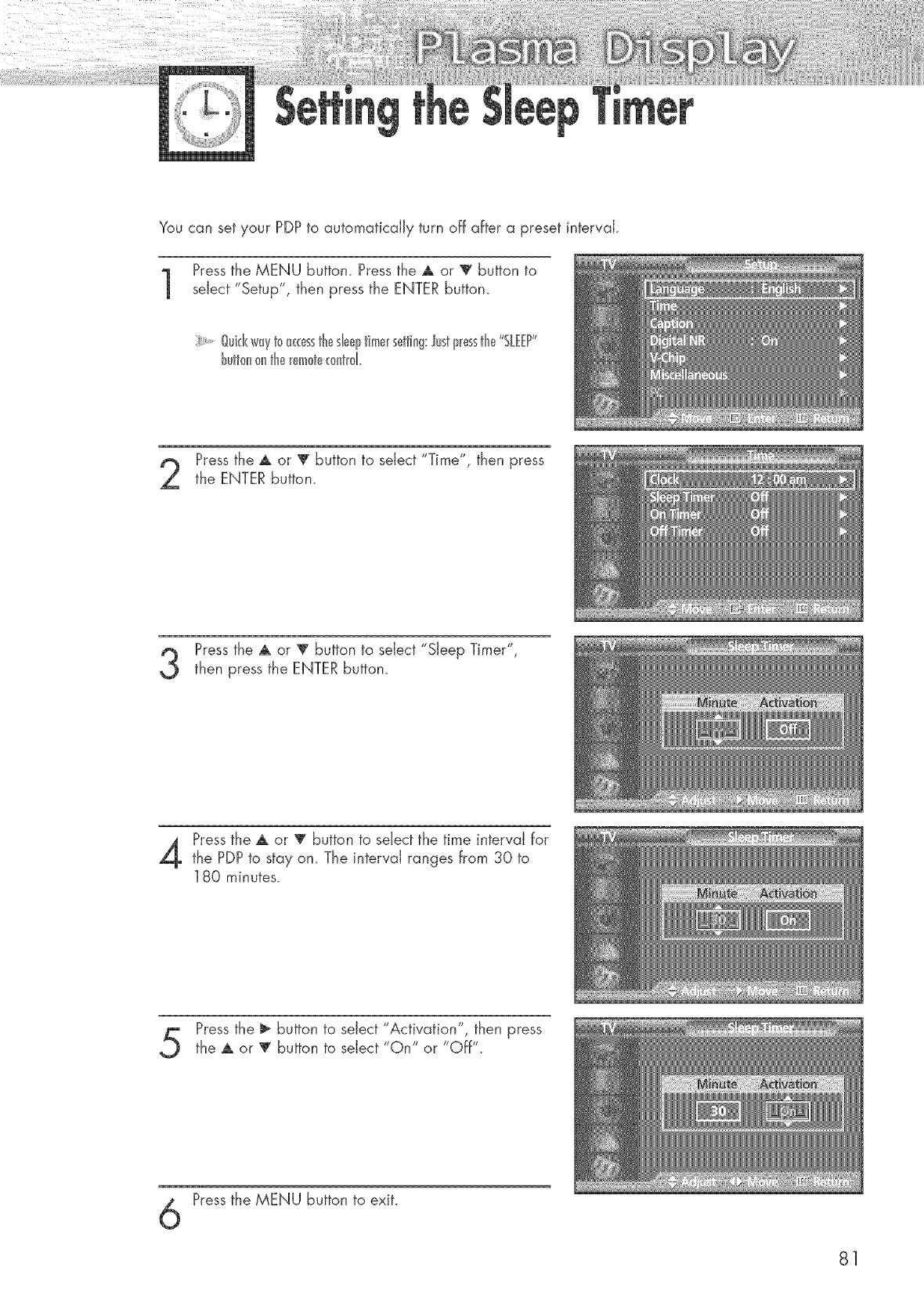
You can set your PDPto automatically turn off after a preset intervak
Pressthe MENU button. Pressthe A or _' button to
select "Setup", then press the ENTER buttom
Qukkw_yt0r_essthesle÷ptimersetting:_ustpresstl_÷"SLEEP"
_utt0nontheremote_0ntrd.
Pressthe A or _ button to select "Time", then press
the ENTER button.
Press the A or T button to select "Sleep Timer",
then press the ENTER button.
Pressthe A or T button to select the time interval for
the PDPto stay on. The interval ranges from 30 to
180 minutes.
Pressthe I_ button to select "Activation", then press
the A or _' button to select "On" or "Off".
Pressthe MENU button to exit.
81
1'
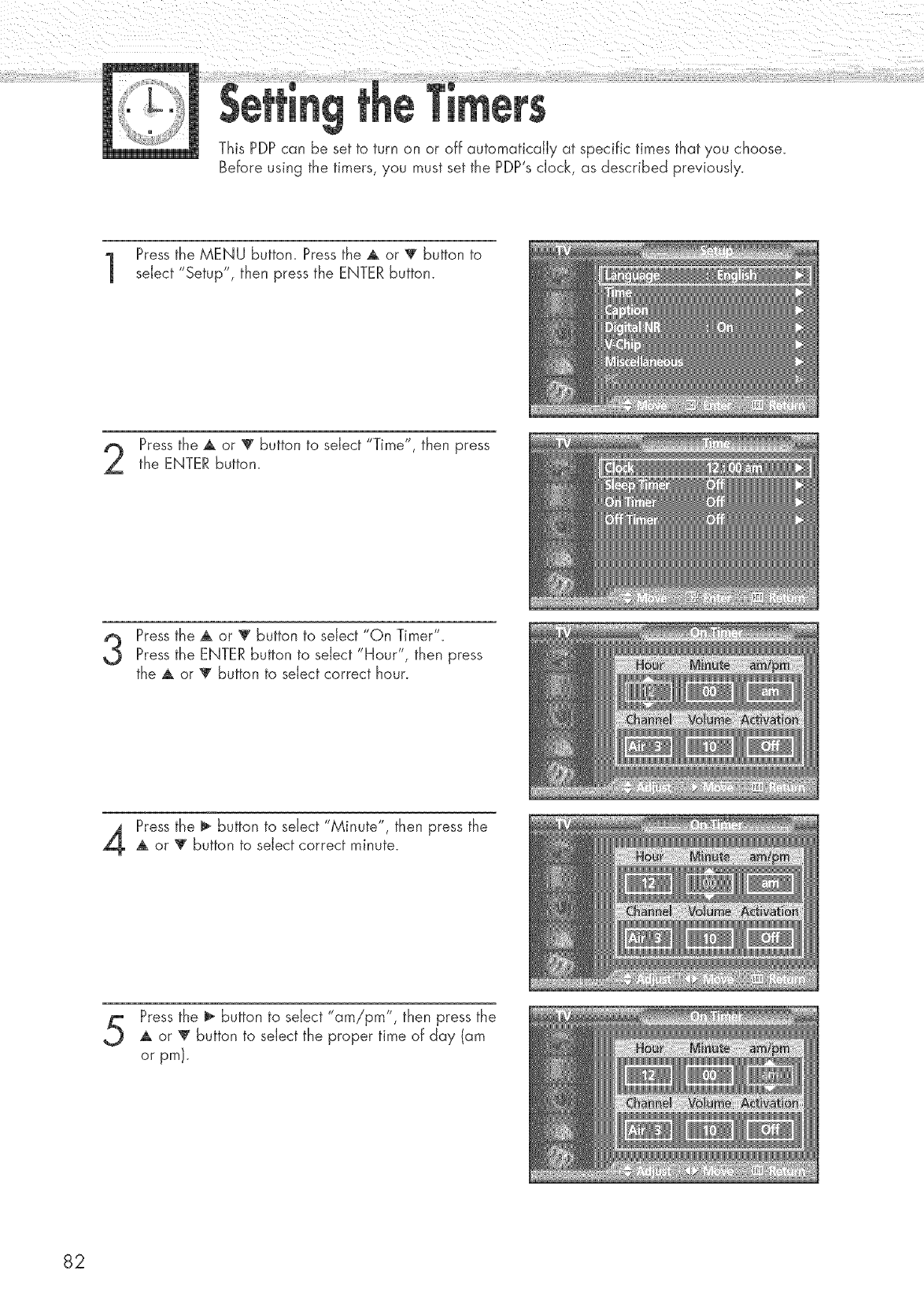
This PDPcan be set to turn on or off automatically at specific times that you choose.
Before using the timers, you must set the PDP'sclock, as described previously.
Press the MENU button. Press the A or T button to
select "Setup", then press the ENTER button.
Press the A or _r button to select "Time", then press
the ENTER button.
Press the A or T button to select "On Timer".
Press the ENTER button to select "Hour", then press
the A or _ button to select correct hour.
Press the _ button to select "Minute", then press theA or T button to select correct minute.
Pressthe _ button to select "am/pro", then press the
A or T button to select the proper time of day (am
or pm}.
82
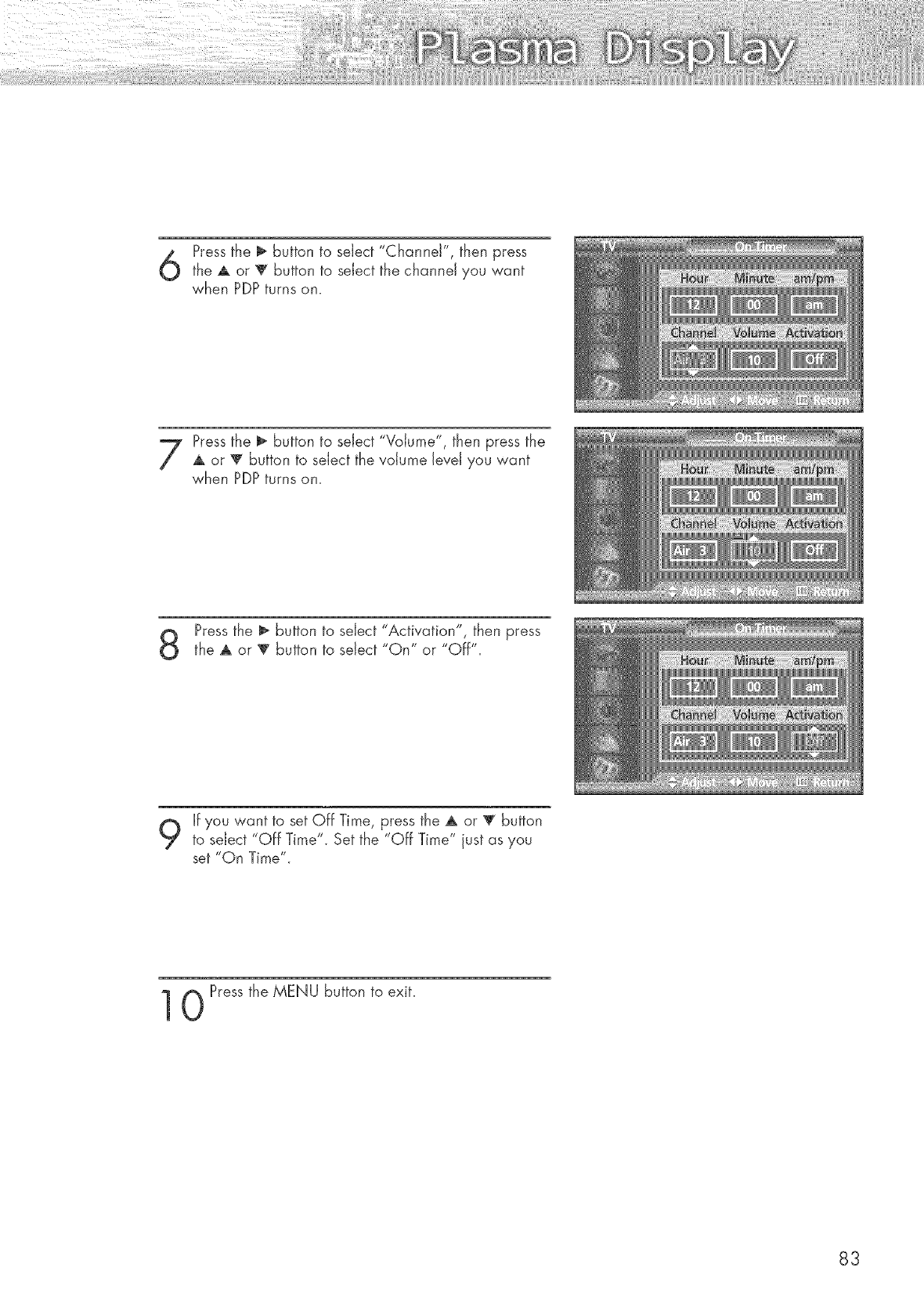
Pressthe _ button to select "Channel", then press
the A or T button to select the channel you want
when PDP turns on.
Pressthe _ button to select "Volume", then press the
A or T button to select the volume level you want
when PDP turns on.
Pressthe ll_ button to select 'Activation ", then press
the A or T button to select "On" or "Off".
If you want to set Off Time, press the A or T button
to select "Off Time". Set the "Off Time" just as you
set "On Time".
0 Pressthe MENU button to exit.
83
Selecting a Menu Language ..................................................... 86
Digital Noise Reduction ........................................................... 87
Selecting the Film Mode ........................................................... 88
Setting the Melody Sound ........................................................ 89
Setting the Blue Screen ............................................................. 90
Viewing Closed Captions ......................................................... 91
Using the V-Chip ..................................................................... 92
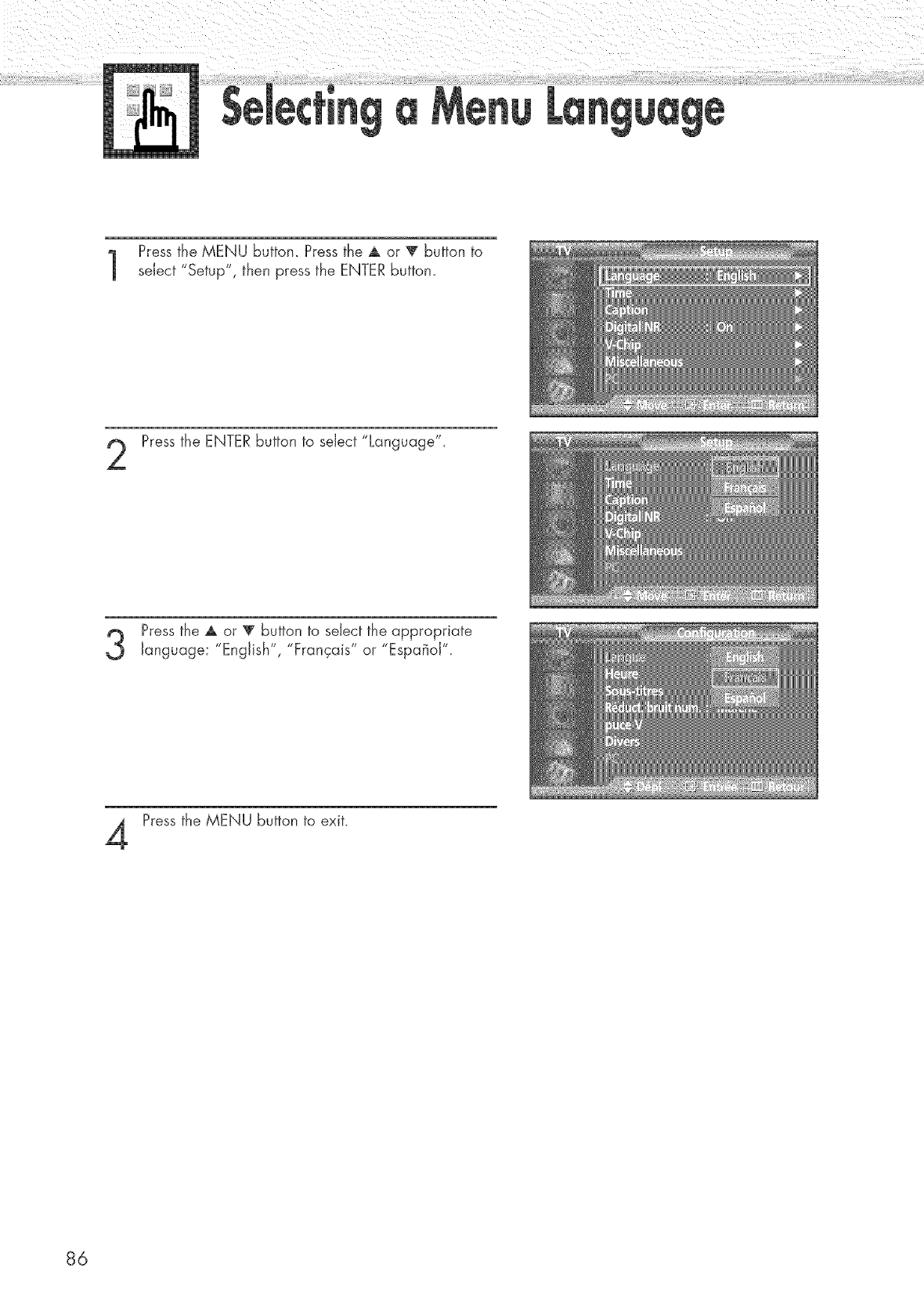
Press the MENU button. Press the ,L or T' button to
select "Setup", then press the ENTERbutton.
Pressthe ENTER button to select "Language".
Pressthe A or 'V button to select the appropriate
language: "English", "Franc ais" or "EspaBol".
Pressthe MENU button to exit.
86
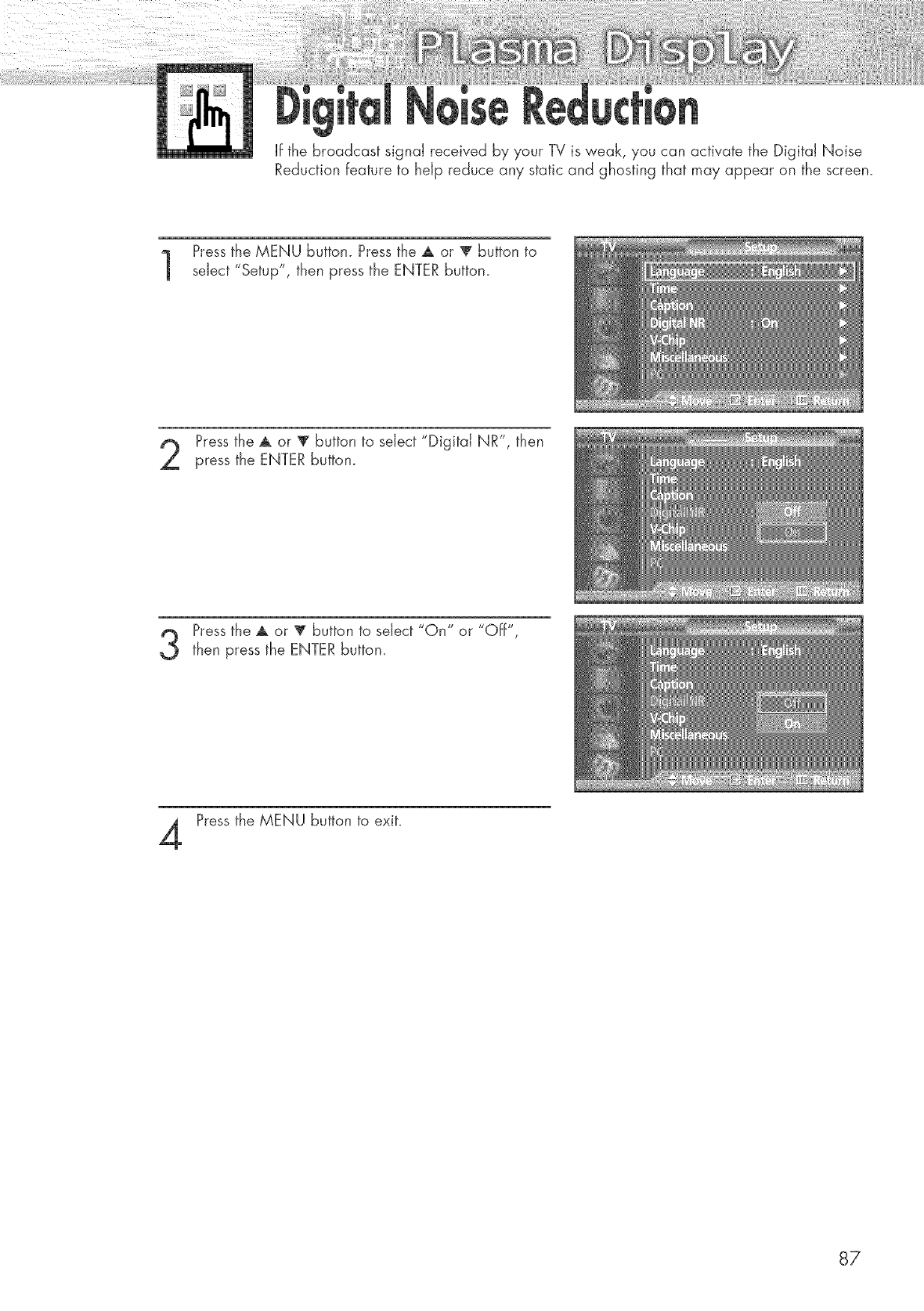
If the broadcast signal received by your TV is weak, you can activate the Digital Noise
Reduction feature to help reduce any static and ghosting that may appear on the screen.
Pressthe MENU button. Pressthe A or T button to
select "Setup", then press the ENTER button.
Pressthe A or T button to select "Digital NR", then
press the ENTER button.
Pressthe A or T button to select "On" or "Off",
then press the ENTER button.
Press the MENU button to exit.
87
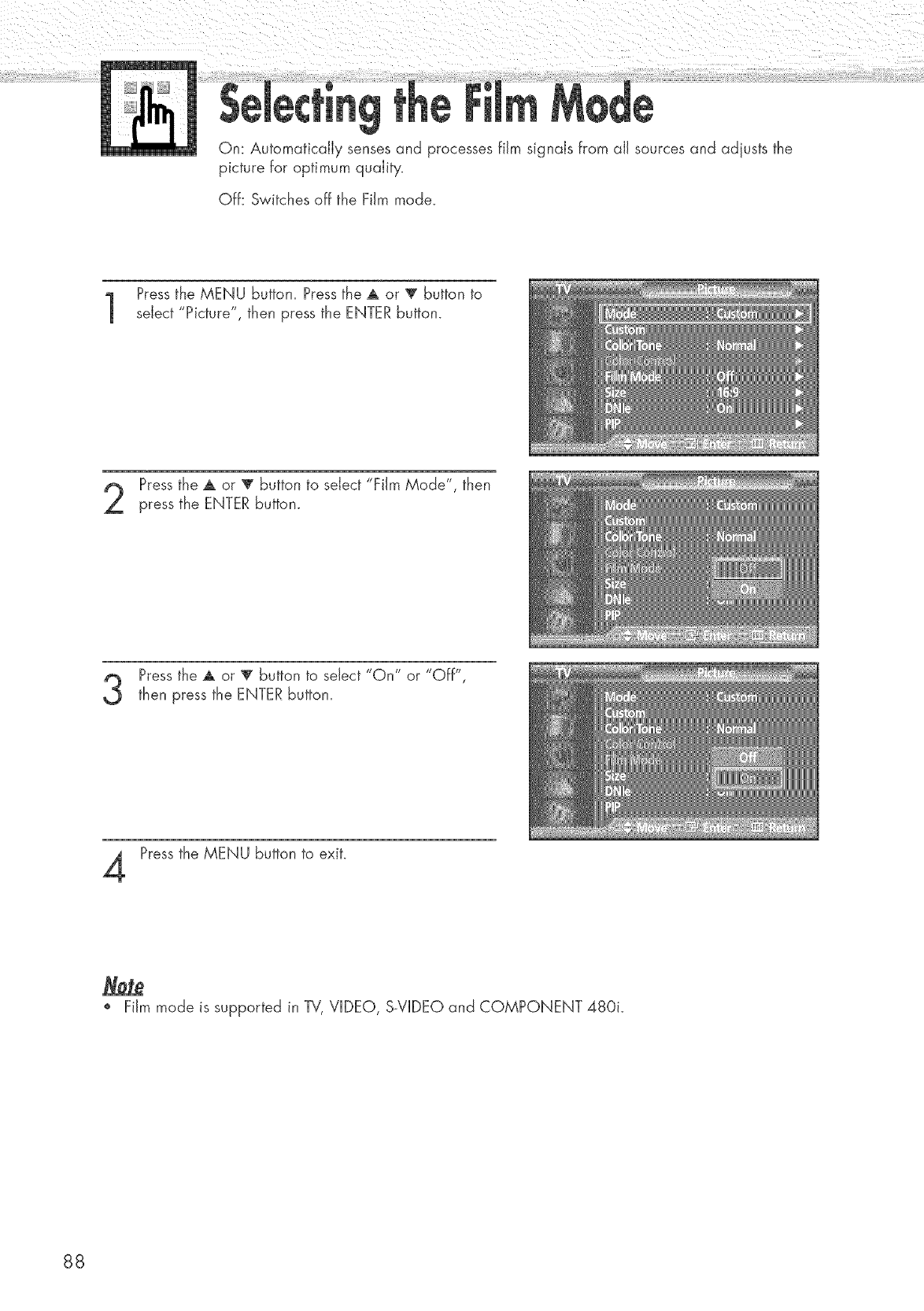
On: AutomaticaJiy senses and processes film signals from all sources and adjusts the
picture for optimum quality.
Off: Switches off the Film mode.
Pressthe MENU button. Pressthe A or T button to
select "Picture", then press the ENTER button.
Press the A or _' button to select "Film Mode", then
press the ENTER button.
Pressthe A or _ button to select "On" or "Off",
then press the ENTER button.
Pressthe MENU button to exit.
', Film mode is supported in TV, VIDEO, S_VIDEOand COMPONENT 480i.
88
! i i! !iiili_i_!!i_!i_il¸iiiii;''_q
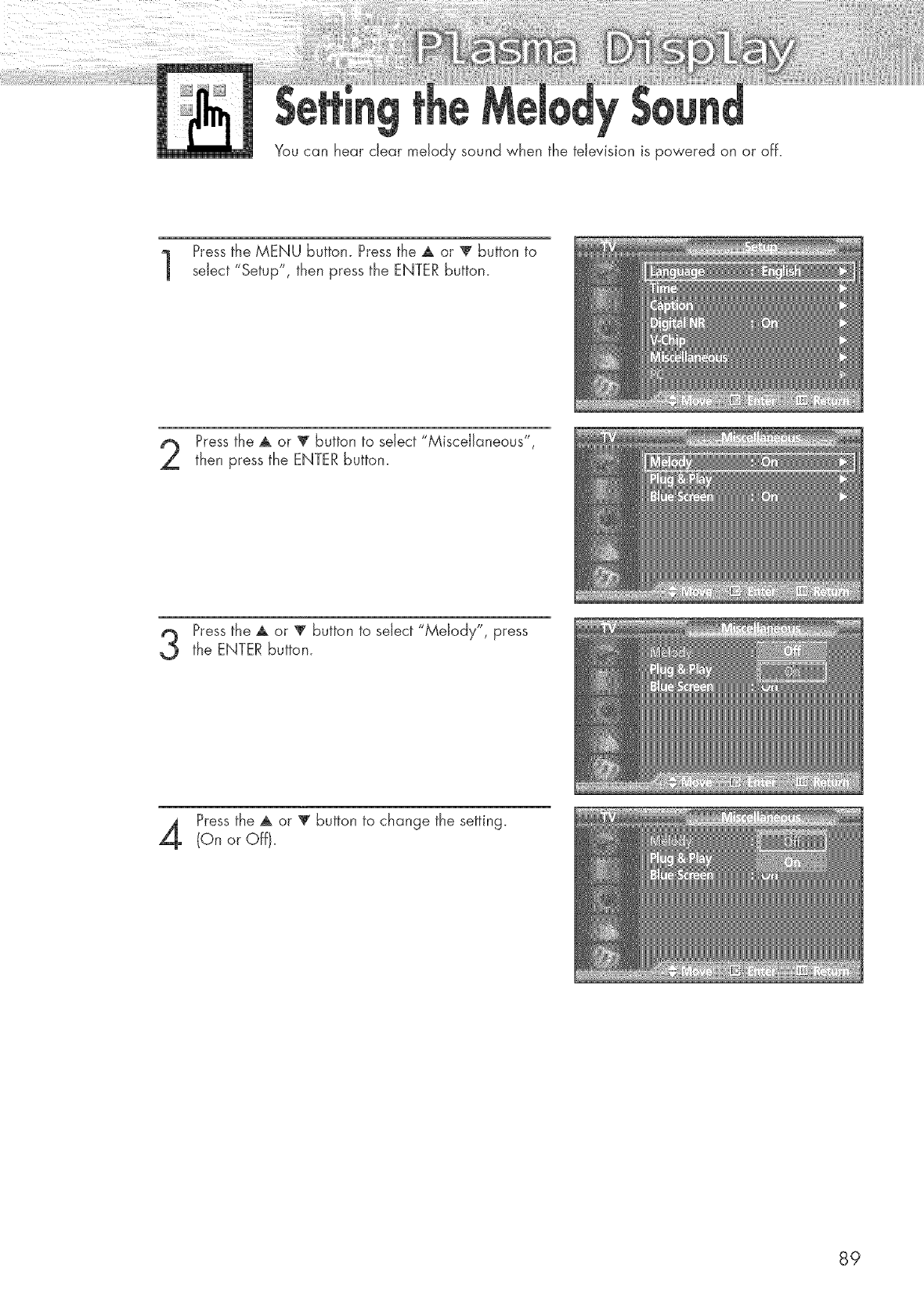
You can hear clear melody sound when the television is powered on or off.
Pressthe MENU button. Pressthe A or T button to
select "Setup", then press the ENTER button.
Pressthe A or T button to select "Miscellaneous",
then press the ENTERbutton.
Pressthe A or T button to select "Melody", pressthe ENTER button.
Press the A or T button to change the setting.
(On or Off).
89
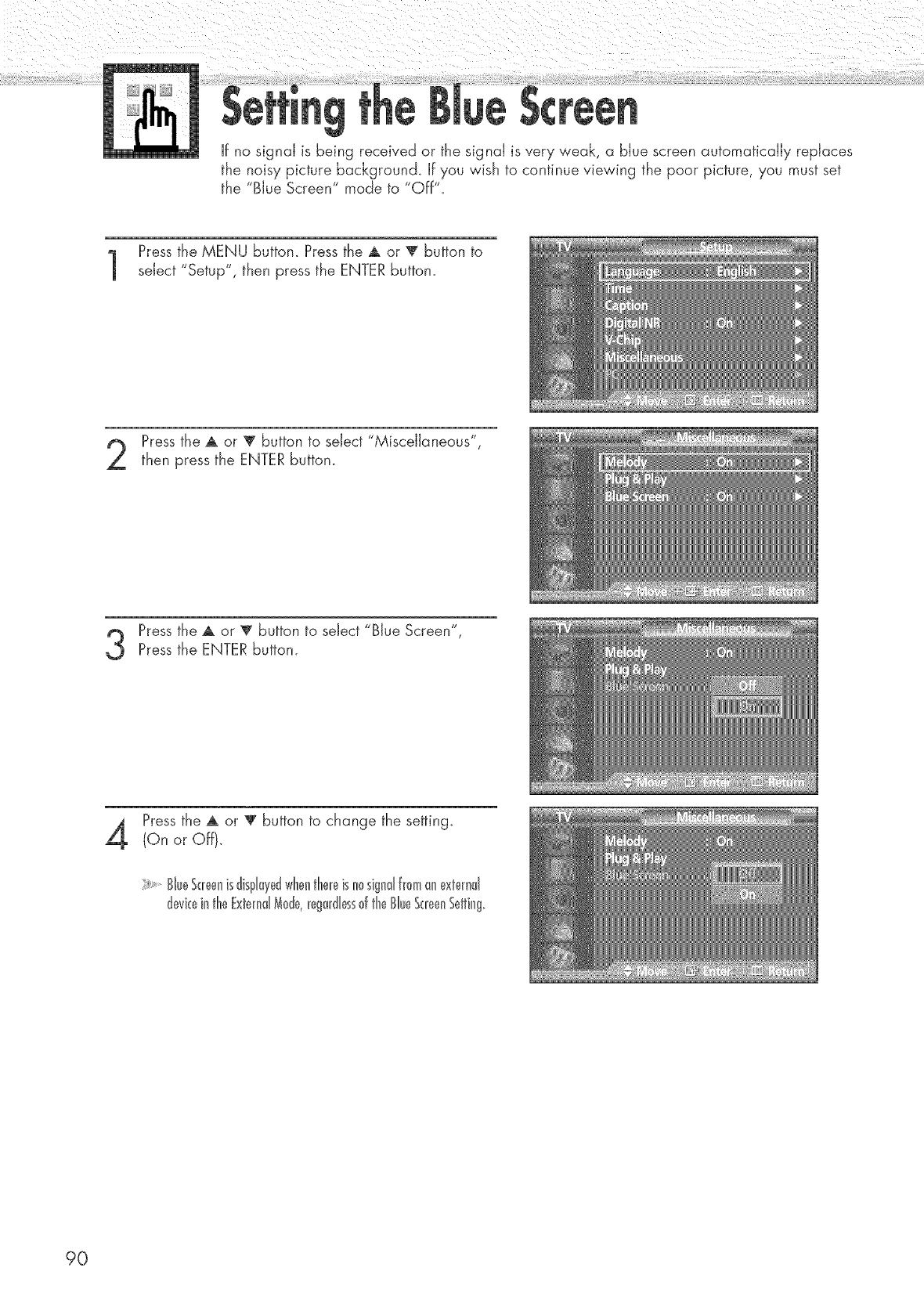
If no signaJ is being received or the signaJ is very weak, a bJue screen automaticaJJy repJaces
the noisy picture background_ If you wish to continue viewing the poor picture, you must set
the "BJue Screen" mode to "Off".
Press the MENU button. Press the A or T button to
seiect "Setup", then press the ENTERbutton.
Pressthe A or T button to seJect"MisceJJaneous",
then press the ENTER button.
Press the A or T button to seJect"BJue Screen",Press the ENTER button.
Pressthe _ or _' button to change the setting_
(On or Off).
BlueS_reenisd]spl_,,edwhenthereisn0signalfrommrexternal
devk÷intheExternalMode,regardlessoftheBlueS_reenS÷H]ng.
90
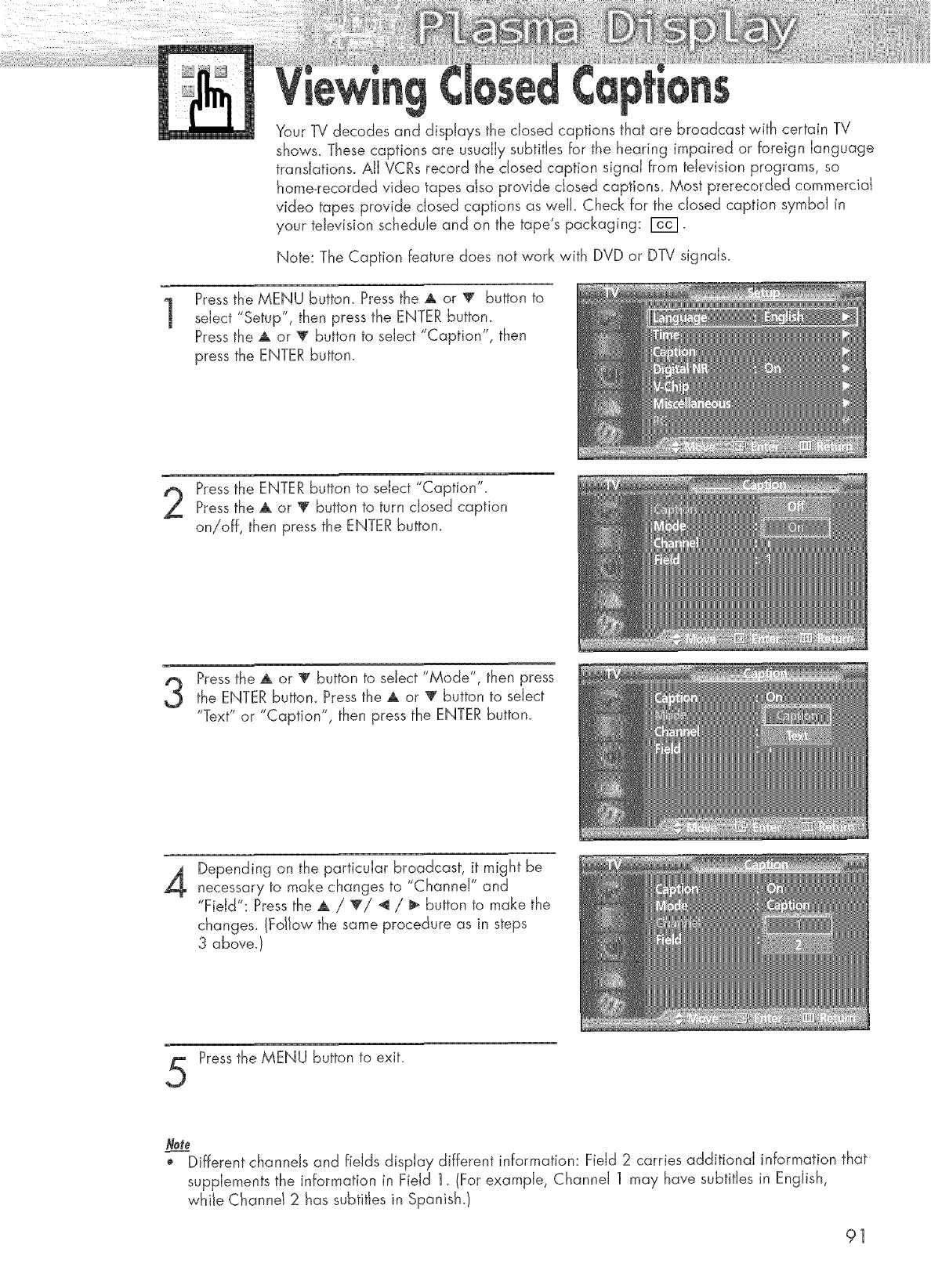
1
Your 1%/decodes and displays the closed captions that are broadcast with certain TV
shows. These captions are usually subtitles for the hearing impaired or foreign language
translations. All VCRs record the closed caption signal from television programs, so
home-recorded video tapes also provide closed captions. Most prerecorded commercial
video tapes provide closed captions as weJk Check for the closed caption symbol in
your television schedule and on the tape's packaging: IT6q.
Note: The Caption feature does not work with DVD or D1%/signals.
Pressthe MENU button. Pressthe ,L or T button to
select "Setup", then press the ENTER button
Pressthe A or _ button to select "Caption", then
press the ENTER button.
Pressthe ENTER button to select "Caption".
Pressthe A or T button to turn dosed caption
on/off, then press the ENTER button.
Pressthe A or T button to select "Mode", then pressthe ENTER button. Pressthe A or T button to select
"Text" or "Caption", then press the ENTER button.
4Depending on the particular broadcast, it might be
necessary to make changes to "Channel" and
"Field": Pressthe ,L / T/_ /_ button to make the
changes. (Follow the same procedure as in steps
3 above.}
Pressthe MENU button to exit.
_te
o Different channels and fields display different information: Field 2 carries additional information that
supplements the information in Field 1. (For example, Channel 1 may have subtitles in English,
while Channel 2 has subtitles in Spanish.}
91
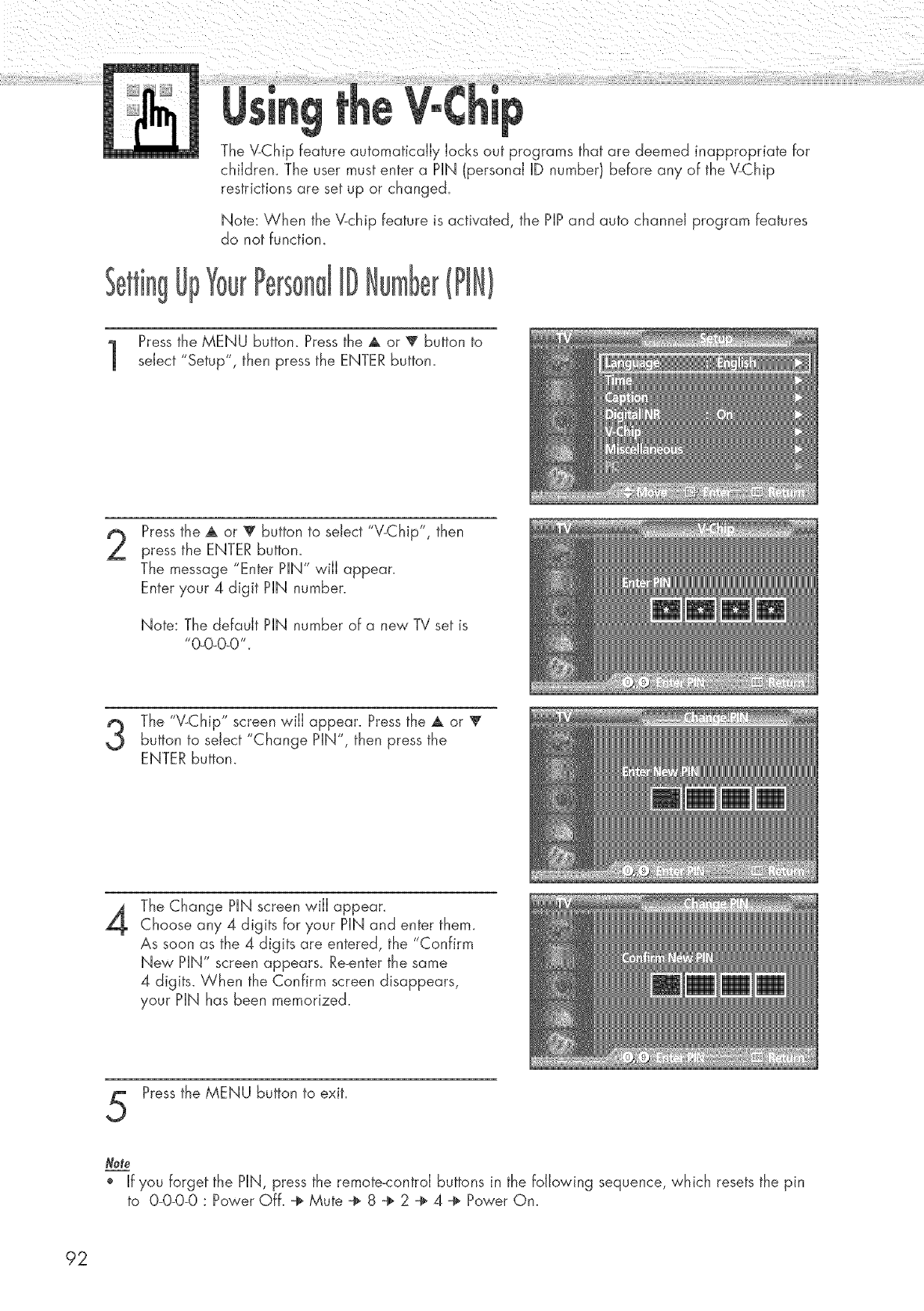
The V-Chip feature automatically locks out programs that are deemed inappropriate for
children. The user must enter a PIN (personal ID number) before any of the V-Chip
restrictions are set up or changed.
Note: When the V-chip feature is activated, the PIPand auto channel program features
do not functiom
Press the MENU button. Press the ,L or T button to
select "Setup", then press the ENTERbutton.
Pressthe A or T button to select "V-Chip", then
press the ENTER button.
The message "Enter PIN" will appear.
Enter your 4 digit PIN number.
Note: The default PIN number of a new TV set is
"0-0-0-0".
The "V-Chip" screen wiJJappear. Pressthe A or T
button to select "Change PIN", then press the
ENTER button.
4The Change PIN screen wiJJappean
Choose any 4 digits for your PIN and enter them_
As soon as the 4 digits are entered, the "Confirm
New PIN" screen appears_ Re-enter the same
4 digits. When the Confirm screen disappears,
your PIN has been memorized.
Pressthe MENU button to exit.
Not_
o if you forget the PiN, press the remote-control buttons in the following sequence, which resets the pin
to 0-0-0-0 : Power Off. ÷ Mute ÷ 8 ÷ 2 ÷ 4 ÷ Power On.
92
l0
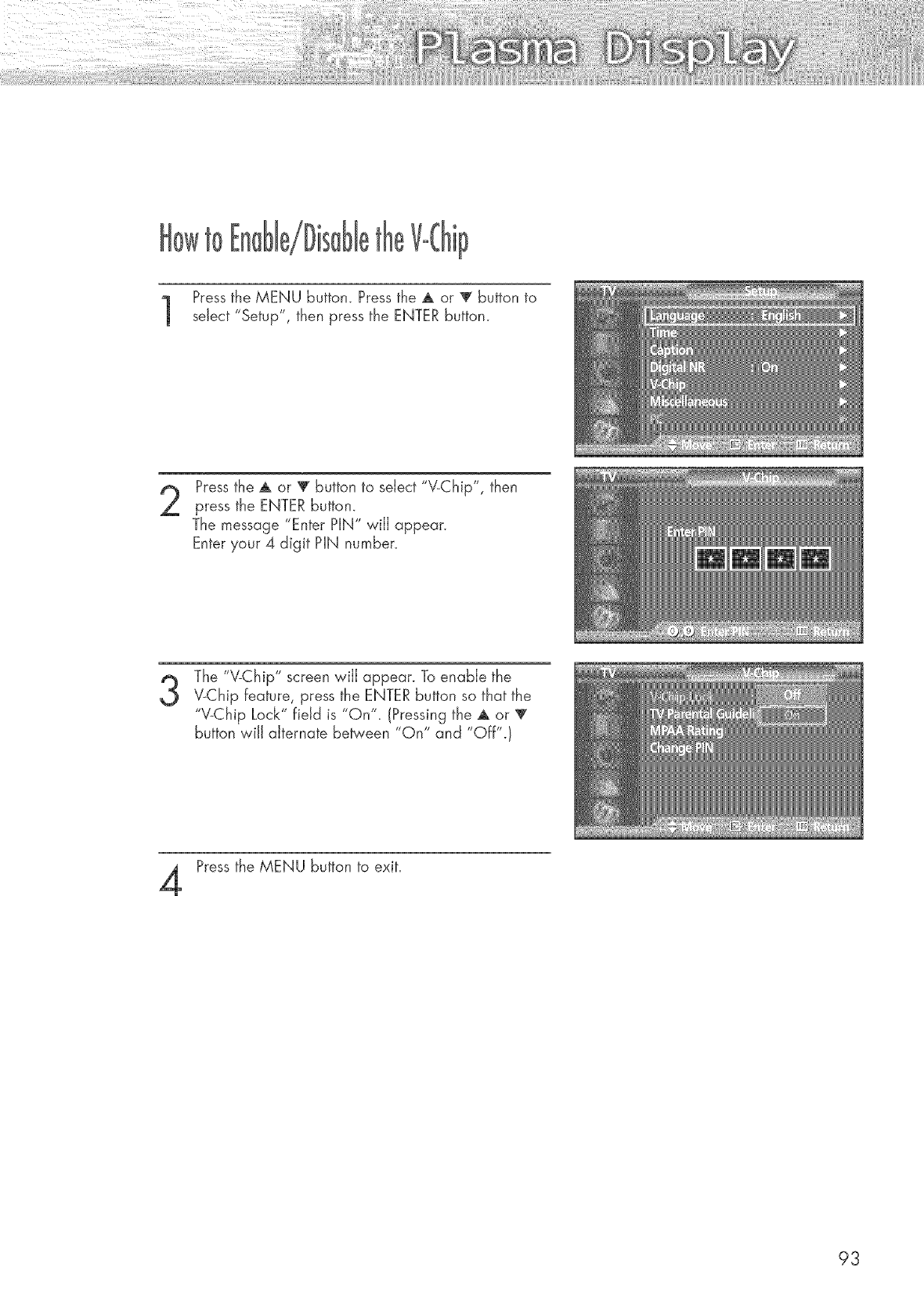
Pressthe MENU button. Pressthe A or T button to
select "Setup", then press the ENTER button.
Pressthe A or T button to select "V-Chip", then
press the ENTER button.
The message "Enter PIN" will appear.
Enter your 4 digit PIN number.
3The "V-Chip" screen wiJJappear. To enable the
V-Chip feature, press the ENTER button so that the
"V-Chip Lock" field is "On". (Pressing the A or T
button wiJJalternate between "On" and "Off".)
Press the MENU button to exit.
93
toSetup qV '
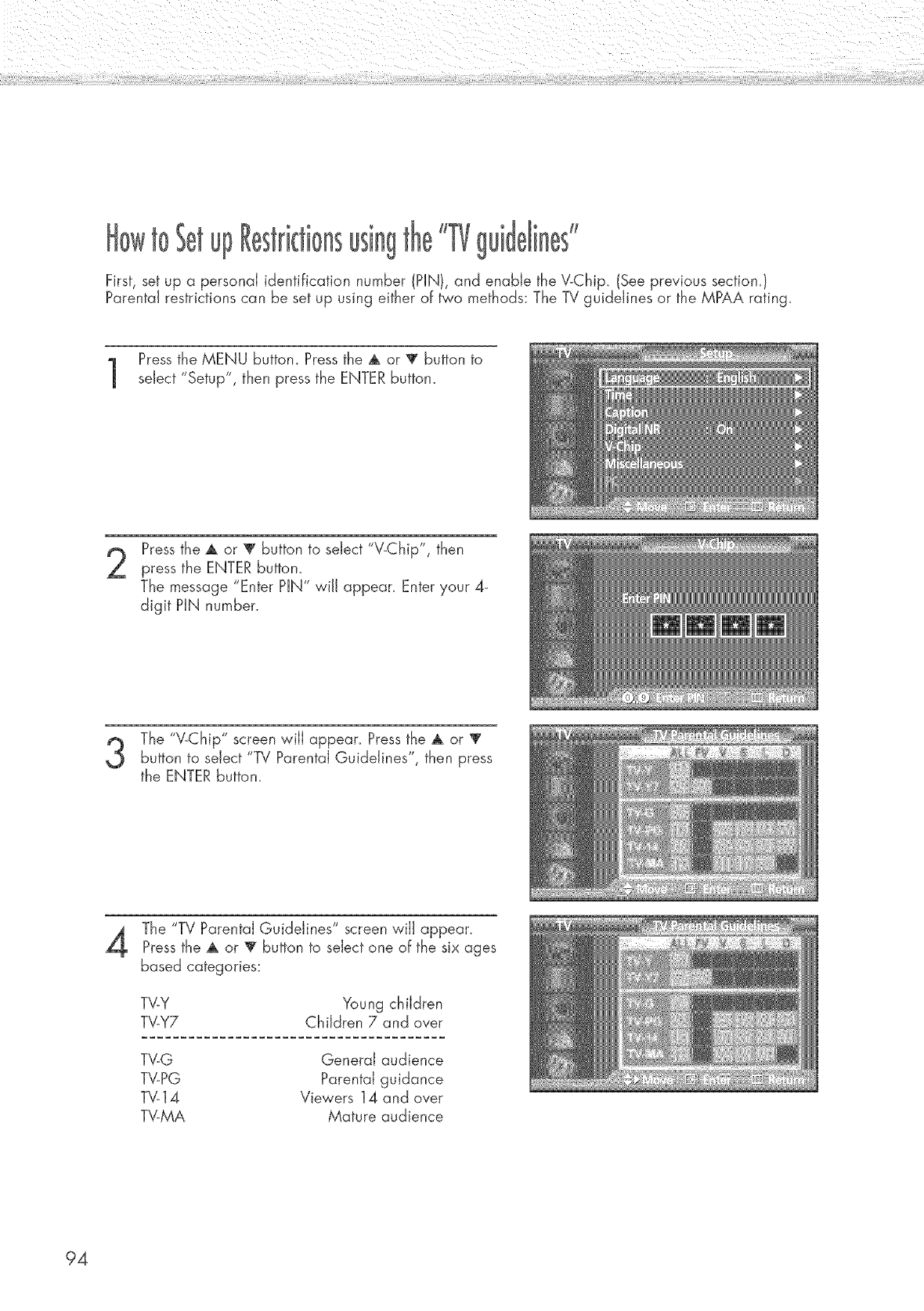
First, set up a personal identification number (PIN}, and enable the V-Chip. (See previous section.}
Parental restrictions can be set up using either of two methods: The TV guidelines or the MPAA rating.
Press the MENU buttom Press the A or _' button to
select "Setup", then press the ENTERbutton.
Pressthe A or T button to select "V-Chip", then
press the ENTER button_
The message "Enter PIN" wiJJappear. Enter your 4-
digit PIN number.
The "V-Chip" screen wiJJappean Pressthe A or _'
button to select "TV Parental Guidelines", then press
the ENTER button.
The "TV Parental Guidelines" screen wiJJappean
Pressthe A or _' button to select one of the six ages
based categories:
TV-Y Young children
TV-Y7 Children 7and over
TV-G General audience
TV-PG Parental guidance
TV-14 Viewers 14 and over
TV-MA Mature audience
94
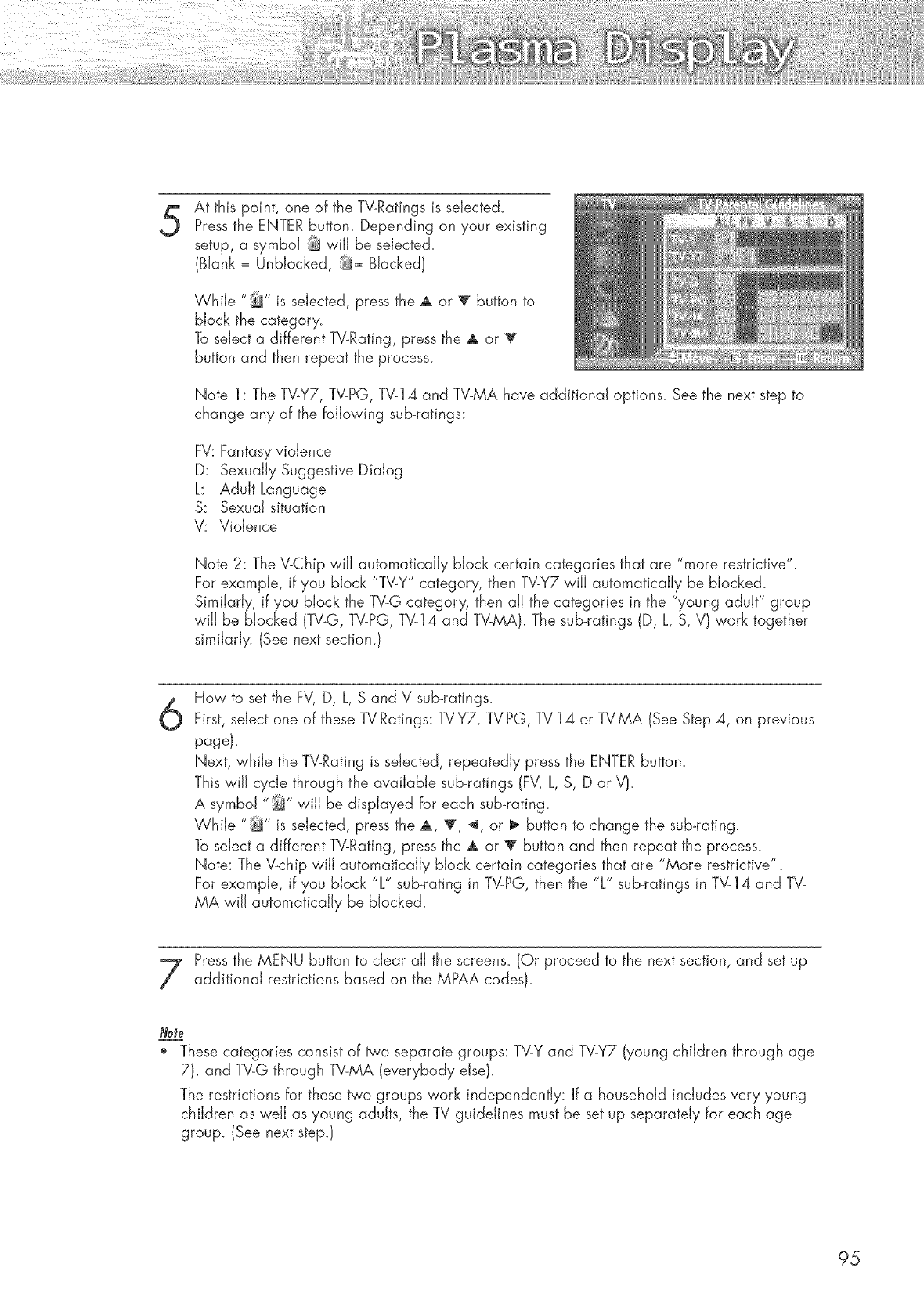
At this point, one of the TV-Ratings is selected.
Pressthe ENTER button. Depending on your existing
setup, a symbol will be selected.
(Blank = UnbJocked, = Blocked/
While "_" is selected, press the ,L or _ button to
block the category.
To select a different TV-Rating, press the ,L or T
button and then repeat the process.
Note 1: The 1MY7, TV-PG,TV-14 and TV-MA have additional options. See the next step to
change any of the following sub-ratings:
FV: Fantasy violence
D: Sexually Suggestive Dialog
L: Adult Language
S: Sexual situation
V: Violence
Note 2: The V-Chip wiJJautamaticaJiy block certain categories that are "more restrictive".
For example, if you block "TV-Y" category, then TV-Y7 will automatically be blocked.
Similarly, if you block the TV-G category, then aii the categories in the "young adult" group
will be blocked (TV-G, TV-PG, TV-14 and TV-MA/. The sub-ratings (D, L, S, V} work together
similarly. (See next section.}
6How to set the FV, D, L, S and V sub-ratings.
First, select one of these TV-Ratings: TV-Y7, TV-PG, TV-14 or TV-MA (See Step 4, on previous
page)_
Next, while the TV-Rating is selected, repeatedly press the ENTER button.
This wiJJcycle through the available sub-ratings (FV, L, S, D or V}.
A symbol "" will be displayed for each sub-rating.
While "_" is selected, press the A T, 4, or _ button to change the sub-rating.
To select a different W-Rating, press the A or T button and then repeat the process.
Note: The V-chip wiJJautomatically block certain categories that are "More restrictive".
For example, if you Mock "L" sub-rating in TV-PG, then the "L" sub-ratings in TV-14 and TV-
MA wiJJautomatically be blocked.
Pressthe MENU button to clear all the screens. (Or proceed to the next section, and set up
additional restrictions based on the MPAA codes}.
', These categories consist of _'o separate groups: T\Ly and TV-Y7 (young children through age
7}, and TV-G through TV-MA (everybody else}.
The restrictions for these two groups work independently: if a household includes very young
children as well as young adults, the TV guideiines must be set up separately for each age
group. (See next step.}
95
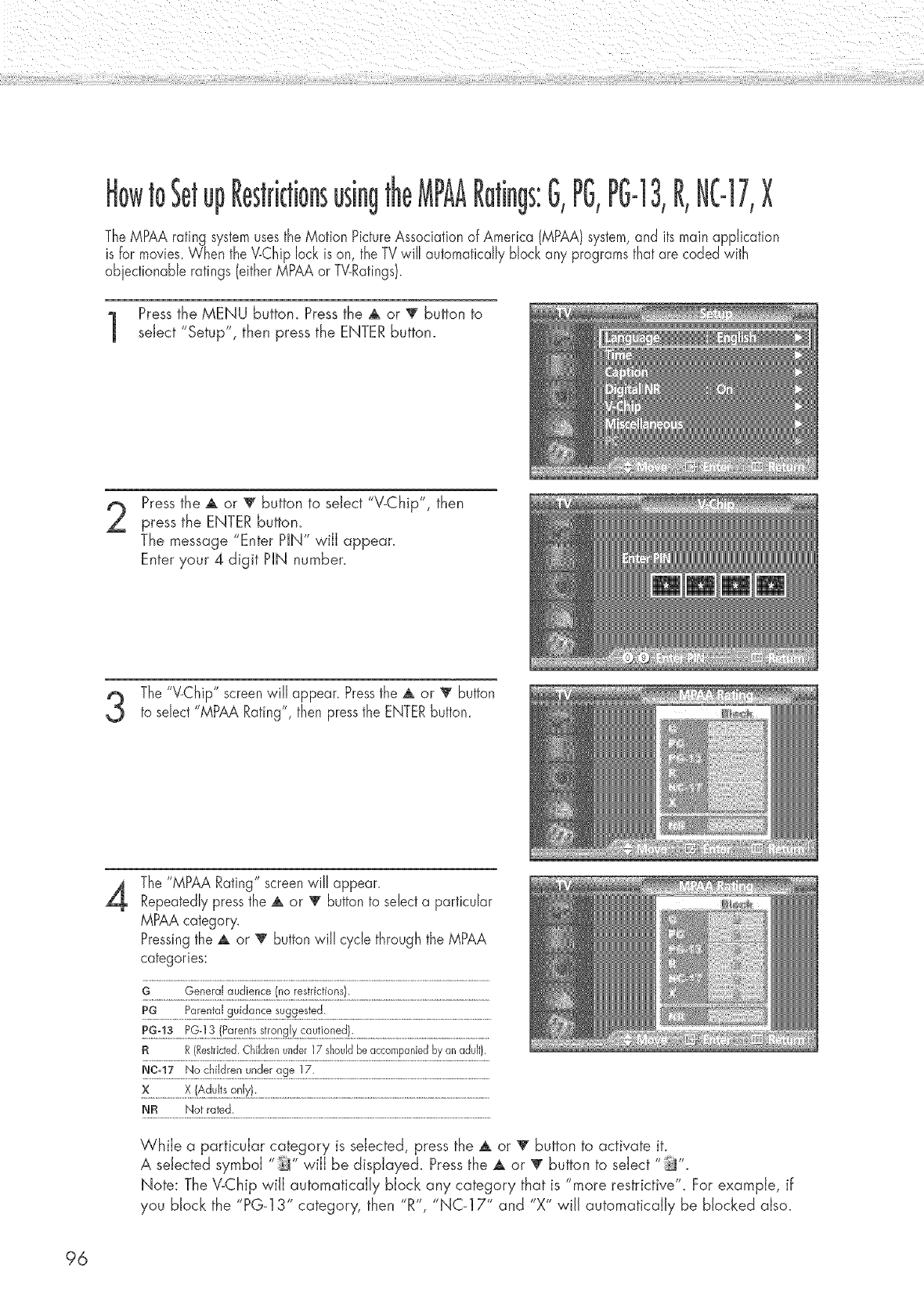
to up u@g gs:G,PG,PG 13,R,NC°17,X
TheMPAA rating systemusesthe Motion PictureAssociationof America (MPAA)system,and its main application
is for movies.When the V-Chiplock is on, theTV will automaticallyblock any programsthat are coded with
objectionable ratings(eitherMPAA or TV-Ratings).
Press the MENU button. Press the ,,L or T' button to
select "Setup", then press the ENTERbutton.
Pressthe A or T button to seiect "',,"-Chip", then
press the ENTER button.
The message "Enter PIN" will appear.
Enter your 4 digit PIN number.
The "V-Chip" screenwill appear Pressthe A. or '_ button
to sdect "MPAA Rating", then pressthe ENTERbutton.
4The "MPAA Rating" screenwill appear
Repeatedlypressthe A or '_ buttonto selecta particular
MPAA category.
Pressingthe ,,Lor '_ buttonwiJ!cycle through the MPAA
categories:
G General audience (no restrictions}.
PG....................P'_en!;_!.g_!d__g_.e_tt_:..................................................................................................................
R R(Restricted.Childrenunder 17 shouldbe accompaniedbyan adult}.
NR Not rated.
While a particular category is selected, press the A or _ button to activate it.
A selected symbol "_" will be displayed. Pressthe _. or _ buttan to select "_".
Note: The V-Chip will automatically block any category that is "more restrictive". For example, if
you block the "PG-13" category, then "R', "NC-1 7" and "X" wiJJ automatically be blocked aiso.
96
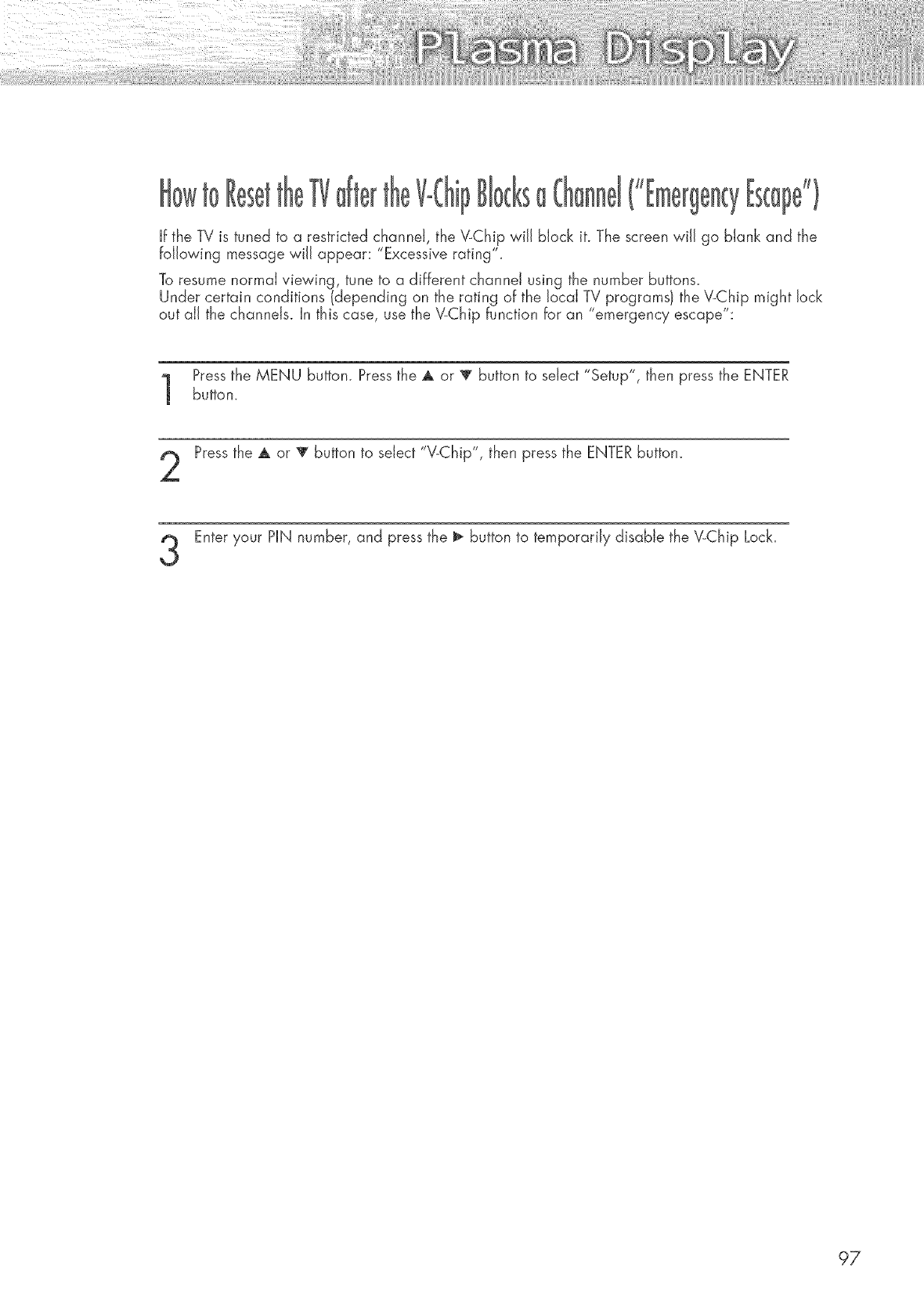
to TV a
If the TV Js tuned to a restricted channeJ, the V-Chip wiJJ block it. The screen wiJJ go bJank and the
foJJowing message wiJJ appear: "Excessive rating".
To resume normaJ viewing, tune to o dJf{erent chonneJ using the number buttons.
Under certain conditions (depending on the rating of the JocaJ TV programs I the V-Chip might Jock
out aJJ the channds. In this case, use the V-Chip function for an "emergency escape":
Pressthe MENU button. Pressthe ,L or T button to seJect"Setup", then press the ENTER
button.
Pressthe ,L or T button to seJect"V-Chip", then press the ENTER button.
Enter your PIN number, and press the _ button to temporariJy disabJe the V-Chip Lock.
97
iil_ iii _!i i-_ ii_iii _!i ..................................
Troubleshooting .......................................................................... 1O0
Care and Maintenance .............................................................. 101
Specifications ............................................................................ 102
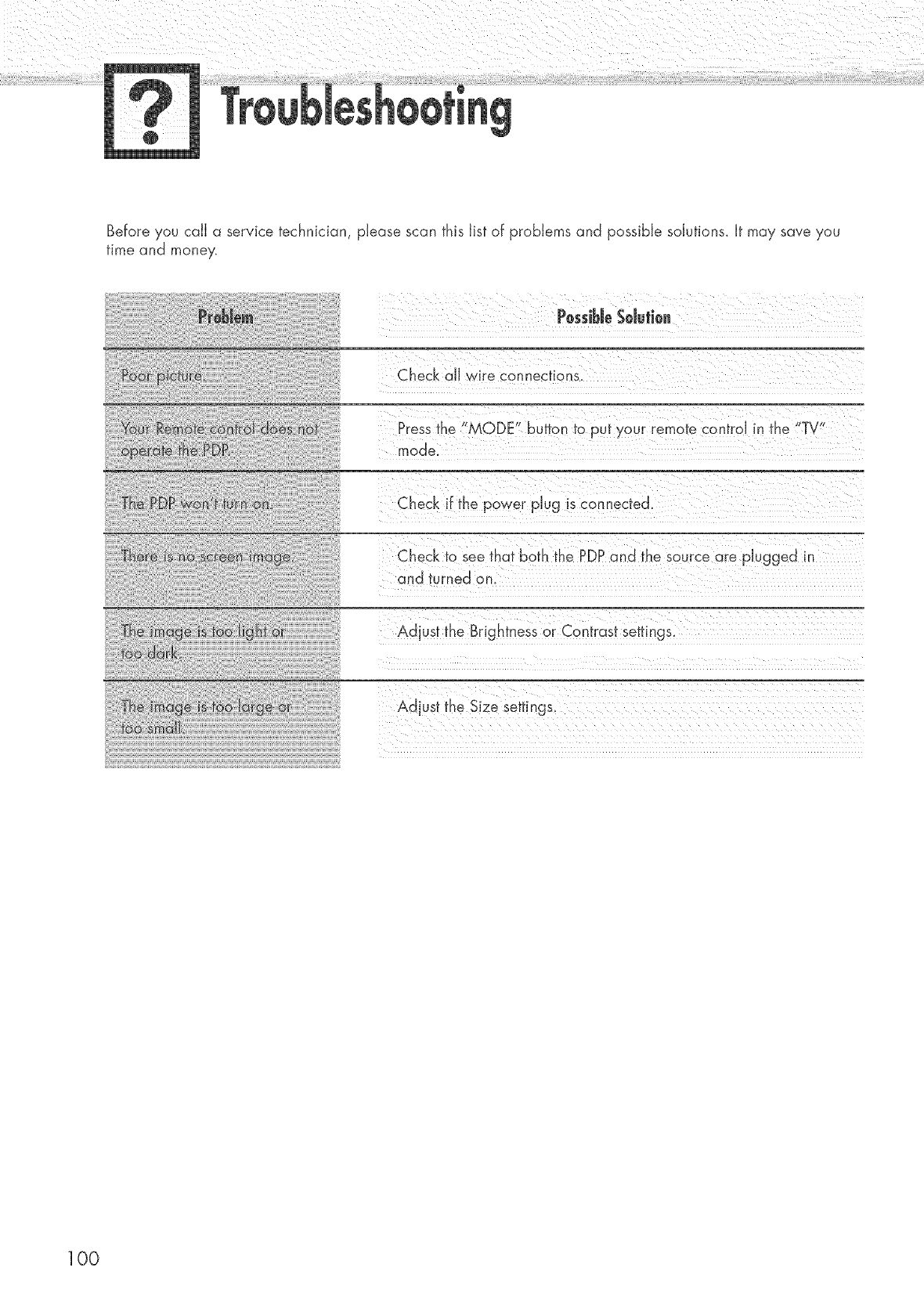
Before you caJi a service technician
time and money. please scan this list of problems and possible solutions. It may save you
P0ssibJeSdut[on
Check aJJwire connections.
hess the "MODE" button Toput your remaYecontrol in the "TV'
mode.
Cl_eck if the power plug is connected.
€.3heckto see that both the PDPand the source are plugged in
and turned on.
Adlust the Bric htness or Contrast setting s,
Adjust the Size settings.
100
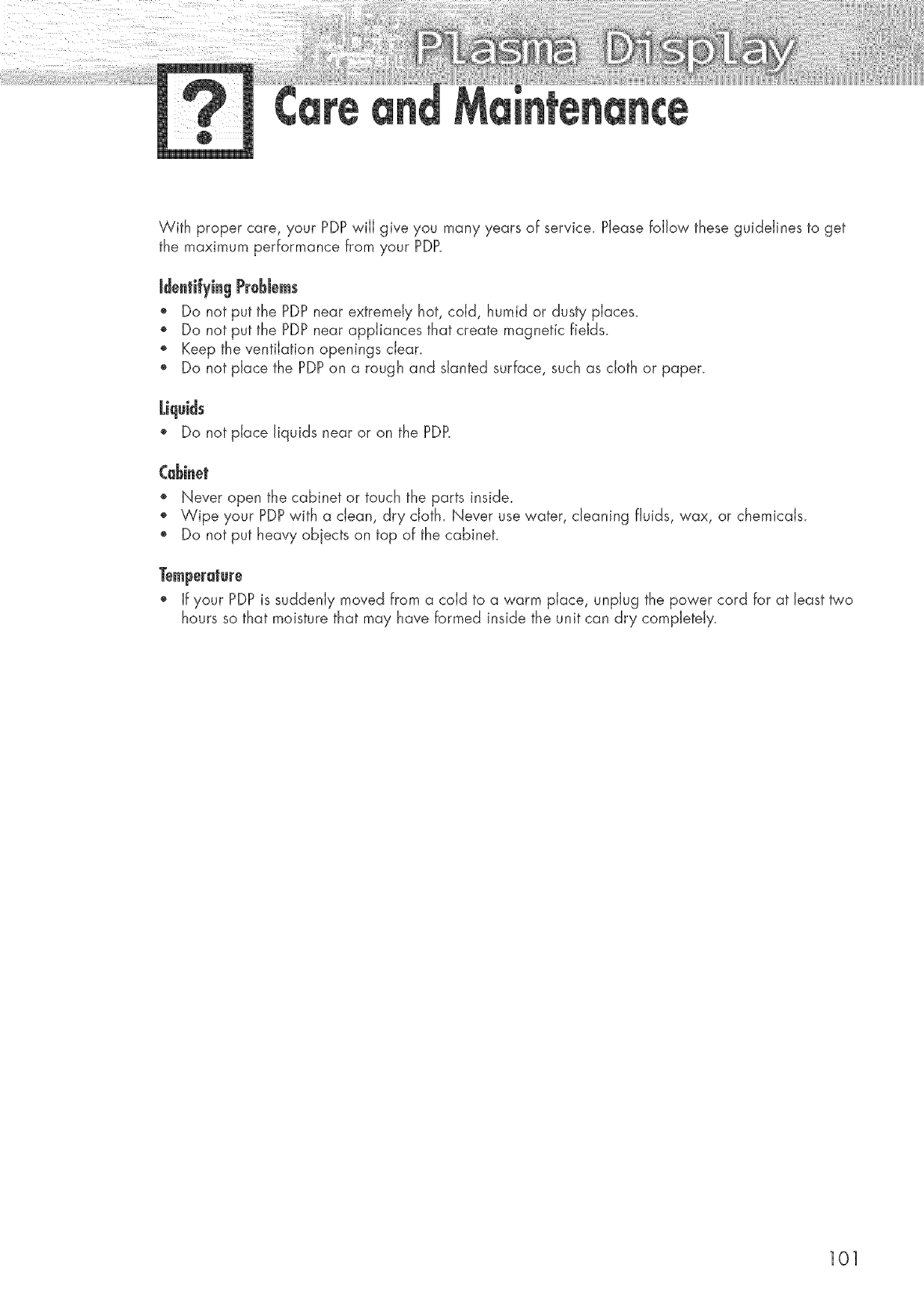
With proper care, your PDPwiJJgive you many years of service. Please follow these guidelines to get
the maximum performance from your PDP.
JdentiJyingPr0bJems
o Do not put the PDP near extremely hot, cold, humid or dusty places.
Do not put the PDP near appliances that create magnetic fields.
Keep the ventilation openings dean
Do not place the PDP on a rough and slanted surface, such as cloth or paper.
Liquids
Do not place liquids near or on the PDR
Cabinet
Never open the cabinet or touch the parts inside.
Wipe your PDP with a dean, dry cloth. Never use water, cleaning fluids, wax, or chemicals.
Do not put heavy objects on top of the cabinet.
Temperature
,If },our PDP is suddenly moved from a cold to a warm place, unplug the power cord for at least _o
hours so that moisture that may have formed inside the unit can dry completely.
101
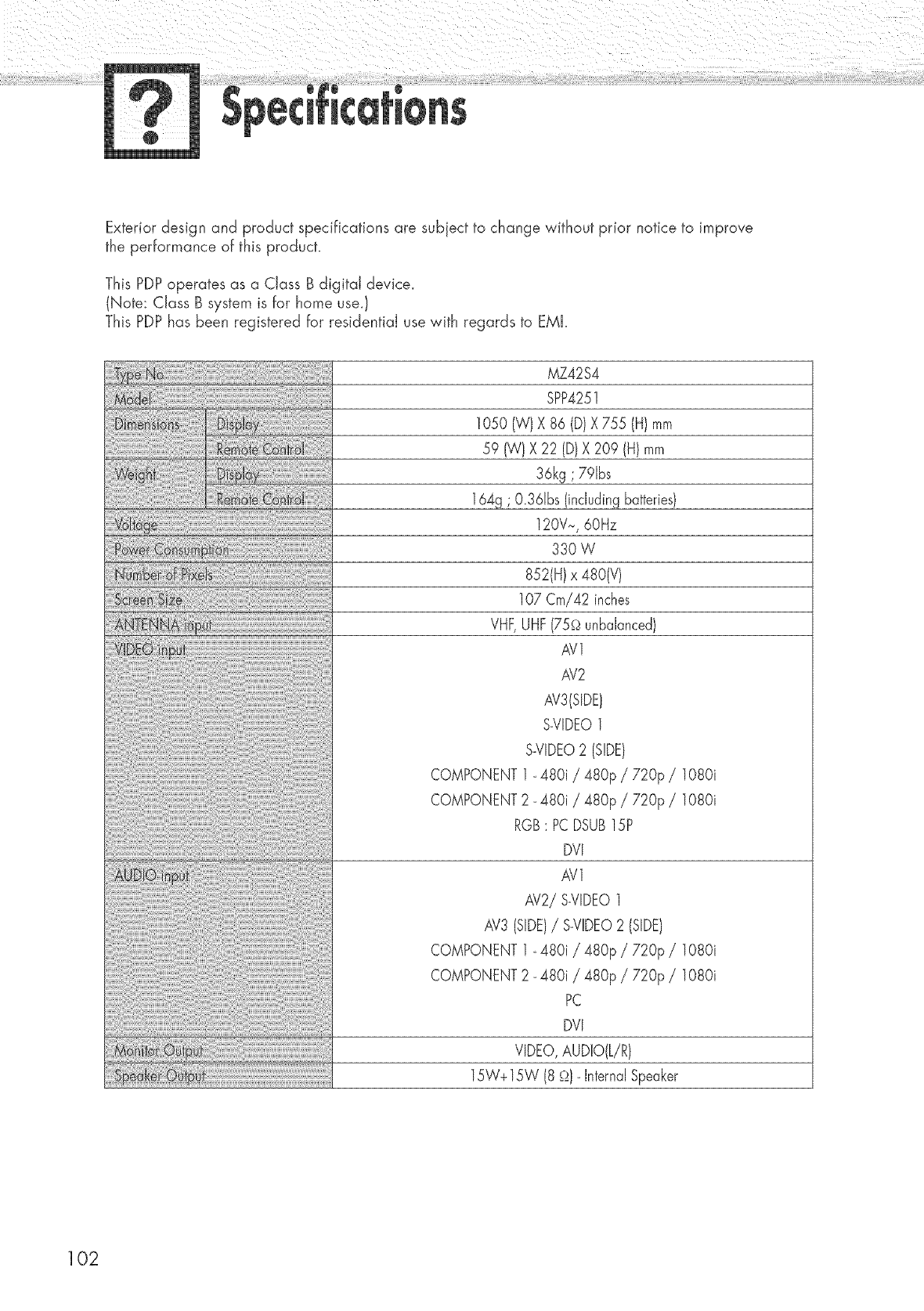
Exterior design and product specifications are subject to change without prior notice to improve
the performance of this product.
This PDPoperates as a Class B digital device.
(Note: Class B system is for home use.}
This PDP has been registered for residential use with regards to EMk
MZ42S4
SPP4251
1050 (W/ X 86 (D)X755 (H) mm
59 (W} X22 (DIX 209 (H)mm
36kg ; 791bs
164g ; 0.361bs(includingbatteries)
120V_, 60HE
330W
852(H)x 4801V)
107 Cm/42 inches
VHF,UHF(75£2unbalanced)
AV1
AV2
A\,"3(SIDE}
SVIDEO1
S:v'IDEO2 (SIDE}
COMPONENT1-480i/48% / 72% / 1080i
COMPONENT2- 480i /48% / 72% / 1080i
RGB: PCDSUB15P
DV_
AV1
AV2/S-VIDEO I
AV3 (SIDE}/S-VIDEO2 (SIDE}
COMPONENTl-480_/48% /72% /1080i
COMPONENT2-480i/48% /72% /1080i
PC
DV_
VIDEO,AUDIO(L/R}
15W+15W (8 [2)-Internal Speaker
102

! i IU dl; ¸ ,,
103

104

105
1-800-SAMSUNG (1-809-726-7864)
Samsung Electronics America
Service Division
400 Valley Road, Suite 201
Mount Arlington, NJ 07856
www_samsungusa_conl
Samsung Electronics Canada Inc.
Samsung Customer Care
7037 Financial Drive
Mississauga, Ontario
L5N 6R3
www.samsung.ca
BN68=00618A-01
