SKYPINE ELECTRONICS CNE6923A Car Navigation & Entertainment System User Manual 1
SKYPINE ELECTRONICS (SHEN ZHEN) CO., LTD. Car Navigation & Entertainment System 1
User Manual
Contents
Precautions …………………………………………… 1
Opening Logo ………………………………………… 2
System Setup Menu, Controls and Indicators ……. 3
Main Menu
Controls and Indicators
TFT Monitor Operation Instruction...………………... 4
Image setting
Power ON/OFF (Radio Panel)
Playing source selection
Volume adjustment (Radio Panel)
Aux-In Mode
Camera Mode
System Reset………………………………….… 5
Mute……………………………………………… 5
Audio Control Menu ……………………………….… 5
Accessing the Equalizer setting
Setup Audio Adjustment
Accessing the General Setup Menu…………... 6
Accessing the Video Setup Menu
Accessing the Miscellaneous Menu……...…... 7
Accessing the Navigation Menu
Tuner (FM/AM) Operation ………………………….. 7
Select FM/AM Band………………...………….. 8
Auto Tuning
Manual Tuning
Storing Station
Recalling a Station
Auto Store (AS)…………………………………… 8
Program Scan (PS)………………………………. 9
DX and LOC Station Seeking (LOC)
DVD Player Operation ………………….……………… 9 - 11
Insert/Eject Disc (Radio Panel)
Reset the Loading Mechanism
Accessing DVD Mode
Using the touch Screen Controls
Stopping and Pausing Playback
Fast Forward/Fast Reverse
Disc Setting
Changing Subtitle Language
DVD Playback Information
Disc Symbol and General Disc Information
CD/MP3/WMA/JPEG Operation ………………………… 11 - 12
CD player user interface
Playing CD files
MP3/WMA Disc
iPod Operation …………………………………………... 12 - 13
Accessing iPod Mode
Playback of Video on iPod
USB Operation ……………………………………………. 13
Bluetooth Operation ………………………………………. 13 - 17
Accessing Bluetooth Mode
Bluetooth user interface
Phonebook
Bluetooth Setup
Auto Connect
Making a phone call
Incoming Call and End Call
Telephone and Information
Specifications …………………………………………….. 18
Multi – Information ……………………………………….. 18 - 23
Functional Icons
Digital Clock
Warning Display
Outside Temperature
Barometer
Elevation
Adjustment setting
Fuel Economy
Compass
Range
Speed
Notes and Information
Tire Pressure Monitor System (TPMS) ………………… 24 - 28
Normal Mode Display
Abnormal Mode Display
Warning Indicator
Pressure High/Low First Stage
Pressure High/Low Second Stage
Accessing the Tire Exchange Mode
Front and Rear Tire Exchange Mode (Parallel Change)
Front and Rear Tire Exchange Mode (Cross Change)
Spare Tire Exchange Mode
Signal Loss
System Check Mode
Information
Periodic Maintenance ………………………………….. 28
Steering Wheel Remote Control ………………………. 29
Navigation ……………………………………………….. 30 - 42
Understanding Map Page
Acquiring Satellites
About GPS Satellite Signals
Finding your Destination using Address
Finding your Destination using Intersection
Finding your Destination using Recent Destination
Finding your Destination using POI Nearby
Finding your Destination using POI
Using Longitude / Latitude
Using Quick Menu
Using My Favorite
Using Route Info
Voice Setting
Volume Setting
GPS Status
Track Up / North Up Setting
Auto / Day / Night Mode Setting\
POI Display Setting
About
Using Detail
2D / 3D View
Quick Menu
Alternative Route
Scale
Notes………………………………………………………..43
Foreword
Thank you for selecting Multi–Media System as your new entertainment system.
This owner’s manual will add to your understanding and full enjoyment of the numerous
fine features of this system.
It contains information prepared to acquaint you with the proper way to operate and
maintain your Multi-Media System for most pleasure.
This system reserves the right to make changes in design and specifications.
This owner’s manual has been written in compliance with existing laws and regulations,
but some contents may contradict with recent / new amendments of the laws and
regulations.
This device complies with Part 15 of the FCC Rules.
Operation is subject to the following two conditions:
(1) this device may not cause harmful interference, and
(2) this device must accept any interference received, including interference that
may cause undesired operation.
Statement:
The changes or modifications not expressly approved by the party responsible for compliance
could void the user's authority to operate the equipment.
This equipment complies with FCC RF radiation exposure limits set forth for an uncontrolled
environment. This equipment should be installed and operated with a minimum distance of
20 centimeters between the radiator and your body.
Throughout this owner’s manual the words WARNING and
CAUTION appear.
These serve as reminders for utmost care. Failure to follow
instructions could result in damage to your Multi-Media System
or to your vehicle.
WARNING
Indicates a strong possibility of severe personal injury or death
if instructions are not followed.
CAUTION
Means hazards or unsafe practice that could cause minor
personal injury or damage to your vehicle.
You will also see other important symbols:
Note Information
Gives helpful information
Precautions
To avoid the risk of injury or accident, read the following precautions before operating the unit.
On safety
Comply with your local traffic rules and regulations.
• While driving
)Do not use the System Setup feature while driving, or perform any other function
which could divert your attention from the road.
)avoid watching or operating the monitor. Park your car in a safe place to watch the
monitor and operate the unit.
• While operating avoid
)avoid inserting your hands, fingers or foreign object into the unit while the monitor is
functioning. It may cause injury or damage to the unit.
)Keep small articles out of the reach of children.
• If your car was parked in direct sunlight resulting in a considerable rise in temperature inside
the car, allow the unit to cool off before operating it.
• When you connect the back camera:
)When you drive, watch the surroundings carefully for your safety. Do not depend
on the back camera exclusively.
• When backing up you car, be sure to look back for your safety.
Do not touch the liquid crystal fluid if the LCD is damaged or broken. The liquid crystal
fluid may be hazardous to your health or fatal. If the liquid crystal fluid from the LCD
contacts your body or clothing, wash it off with soap immediately
Moisture condensation
When the unit’s temperature falls (as in winter), the liquid crystal display will become
darker than usual. Normal brightness will return after using the monitor for a while.
To maintain high sound quality
Avoid contact of Liquid materials ( juice, soft drinks, coffee ) onto the unit or discs unless
permitted by the manufacturer of the system.
Playable discs
The following types of discs/files are compatible:
• CD-ROM (ISO), CD-R, CD-RW, DVD+R/RW, DVD-R/RW
• CD-DA, DVD Video
• MP3 data
• WMA data
• JPG images
• WMV format
• AVI format
• MPG format
The following types of discs/files are not compatible:
• WMA files that are protected by DRM (Digital Rights Management)
• WMA lossless format
• Discs recorded with Track At Once or packet writing
• MP3 PRO format
• MP3 playlists
• WAV format
Some recordable DVDs and CDs may be incompatible with this unit, depending on media
type and recording method.
NOTE:
It is especially important that you read the WARNINGS and NOTES in this manual.
1
DVD Region Management
Some DVD discs can be played only in certain playback modes according to the format of
the software. As the unit plays discs according to their formats, some functions may not work
as intended. Be sure to read the instructions provided with each disc. This player has been
designed to play back DVD software that has been encoded for specific region areas. It
cannot play back DVD software encoded for other region areas than the region areas for
which it has been designed.
Features
• TFT Panel, all-in-one highly integrated entertainment system
• Built-in DVD Player, Radio automotive specification slot loading mechanism
• Built-in FM/AM Tuner Radio
• Digital 6.95”(16:9) TFT color monitor, contrast and brightness adjustment
• Built-in 40W X 4 output amplifier, 4.1 channel surround sound output.
• All functions can be operated via Smart Touch screen.
• Built-in iPod Control and Navigation system
• Powerful Graphic User Interface and software update ability.
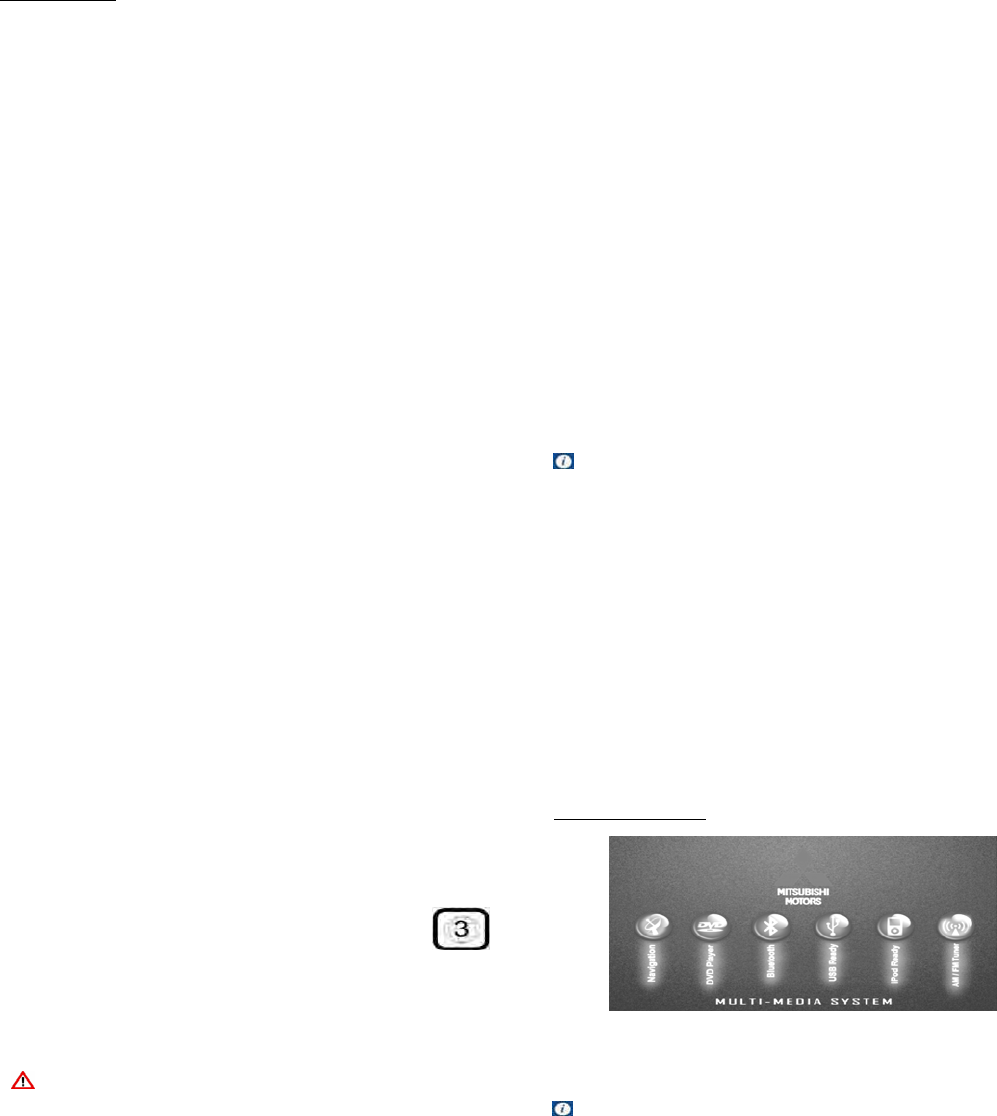
Opening LOGO
fig. 1
LOGO will appear 5 seconds after ignition “ON” and standby for about 15 seconds
before the Car Info display or Multi – Information display shows.
NOTE:
•After displaying the opening logo, Car info is the default display on the screen. Even if
the last source selected is Disc (MP3/DVD), Navigation (NAVI), Radio Menu or iPod /
USB.
)Reminders:
• Multi-Info will display automatically when you turn the radio panel “OFF”
• Touch the clock on the upper center to enter STANDBY MODE.( When the Radio is ON )
• The Multi-Media System can also be controlled via the steering wheel remote control.
2
WARNING!
1. Connect the unit to a 12-volt negative ground system only.
2. Never install this unit during vehicle operation it could interfere with safe
driving conditions.
3. To reduce the risk of a traffic accident (except when using for rear view video
camera) never use the video display function while driving the vehicle. This
may be in violation of local laws.
4. Never disassemble or adjust the unit without the assistance of a professional.
For details, please consult your local car stereo specialty shop.
5. To prevent injury from shock or fire, never expose this unit to moisture or
water.
6. Never use irregular discs, the only recommended disc size is a 12cm round
disc.
7. To prevent damage to the mechanism inside this unit, avoid impact to the
TFT monitor.
8. Do not change the fuse on the power wire without professional guidance / assistance.
Using an improper fuse may damage the unit and result in a fire.
NOTE:
Touch screen operations and SRC button on Radio panel are all useable to select
menu and adjust settings. The following instructions will show the different ways to
access menu and adjustments.
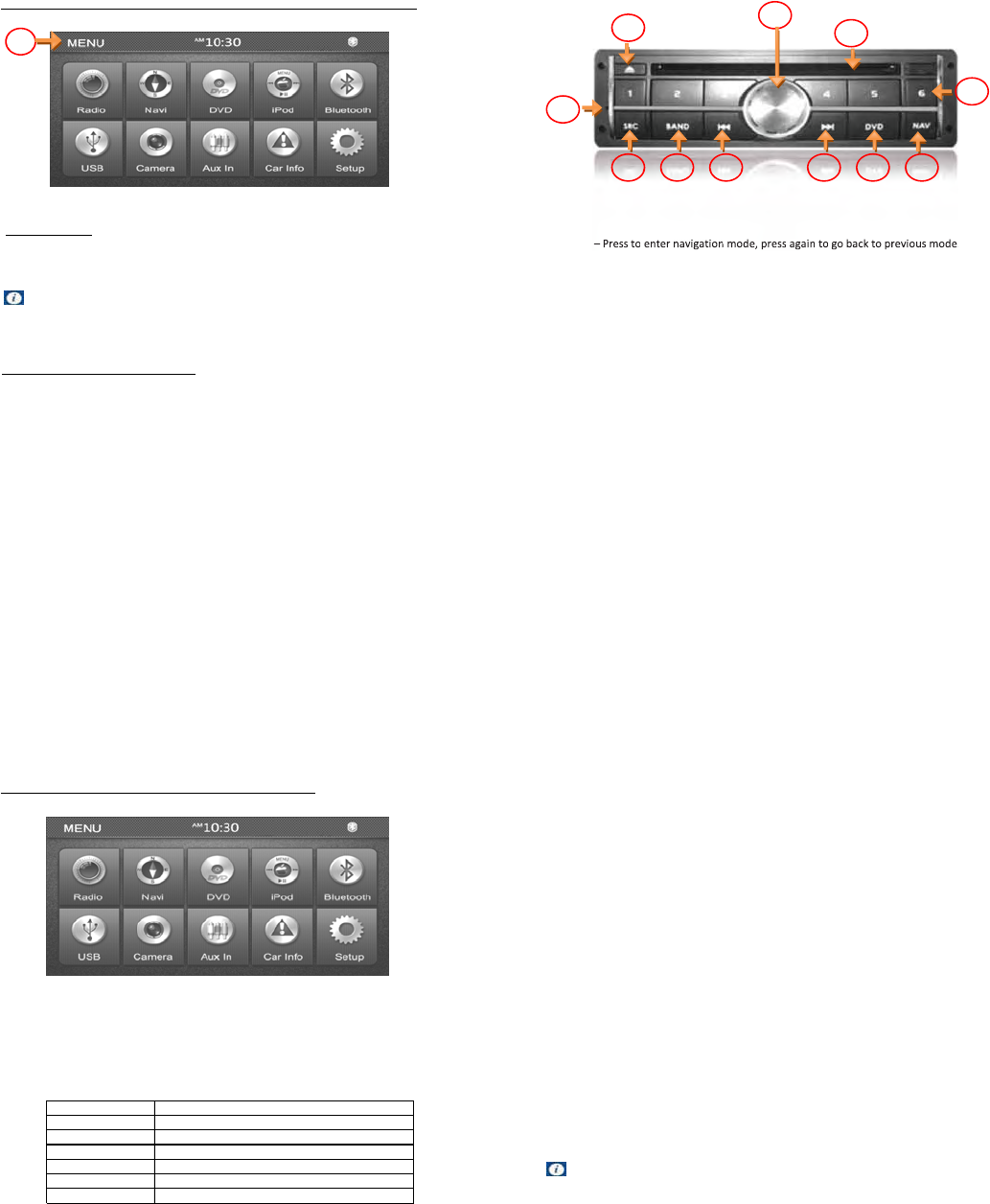
System Setup Menu, Controls and Indicators
fig. 2
MAIN Menu
There are two methods to access the MAIN menu
• Pressing the SRC button on the Radio panel to select desired source.
• Touching the upper Left corner on the touch-screen.
CONTROLSANDINDICATORS
1.EJECT–PressfordiscInsertion/Ejection.
2.POWEROFF/ON,VOLandMUTE
ͲPressthedialtoturn“ON” theunit.
ͲPressandholdthedialtoturn“OFF” theunit.
ͲRotatethedialtoadjustthevolume.
ͲQuickpresswhentheunitisONtoactivate“MUTE”.
3.SRC–Presstoselectdesiredsource.
4. NAV–Presstoenternavigationmode,pressagaintogobacktopreviousmode.
5. BAND–PresstoselectFM/AMmode.
6. DISCSLOT
7. SEEKUP(
)– Selectthenextchapter/trackforplayback.Searchanavailable radiostations
byincreasingtuningfrequencyontunermode.
8. SEEKDOWN(
)– Selectthepreviouschapter/trackforplayback.Searchanavailableradio
stationsbydecreasingtuningfrequencyontunermode.
9. DVD–PresstoaccessDVDmode.
10. RESETBUTTON– Restoretofactorysetting.
11. PRESETSTATION–6numberedpresetbuttonstoreandrecallstationsforeachband.
12. TFTMONITOR(TouchScreen)–TouchtoNavigatebetweenMainmenuandCarInfoDisplay.
Itisalsousedtogobacktopreviousmode.
12
3 45
6
78 9
10
11
12
3
fig. 3
PlayingSource VideoOutputFormat
FM/AMTuner RGBMode
DVD RGBMode
NAVI RGBMode
AUXIN CVBSMode
CAMERA CVBSMode
iPod(Video)CVBSMode
TFT Monitor Operation Instruction
Image Setting
Video Output Format
The table below shows the video output format for each source.
Video Output Format
*CVBS – Composite Video Base band Signal
Power ON / OFF ( Radio Panel )
Press the POWER / VOL to turn the unit ON.
Press and hold the POWER / VOL on the radio panel to turn the unit OFF.
Playing Source Selection
Press the upper left of the TFT Monitor or Press the SRC button on the Radio Panel
to change among available playing sources: Tuner, Disc, iPod, Aux In, Camera ( rear
camera ), Navi, Bluetooth and USB. The playing mode is displayed on the TFT
monitor.
Volume Adjustment ( Radio Panel )
To Increase or decrease the volume level, turn the POWER / VOL on the radio panel.
The volume ranges from 0 to 40.
Aux In Mode
An external audio/video device can be connected to this unit via USB / Aux In cable.
Camera Mode ( Optional Device )
“ CAMERA “ Mode is only available when the camera is connected and when
backing-up. To install a rear view video camera, connect the CAMERA video input
cable to the rear view camera output cable.
NOTE:
If you have not connected a device to the unit, the source cannot be selected.
Example: If you have not connected an iPod to the unit, the iPod source will not be
available.
4
fig. 4
Table 1.
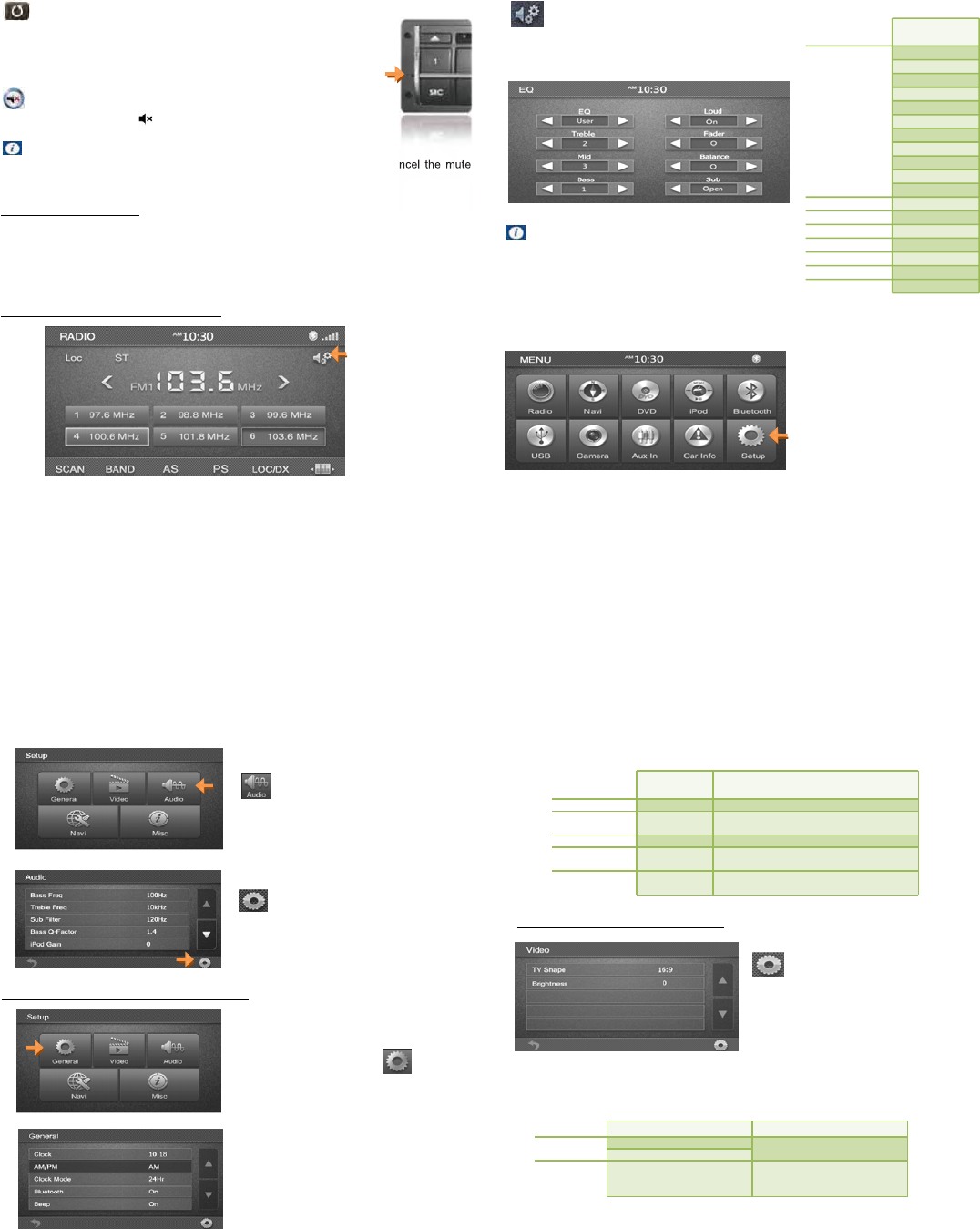
System Reset
To correct a system halt or other unusual operation, use the tip of a pen to
Press the RESET button located on the front mid-left of the Radio Panel.
After a system reset, the unit restores the setting before last power off.
Mute
The volume will be muted when pressing the knob or rotate the knob of
Power / Volume it reduces the volume to “0”.
NOTE :
Adjusting the volume knob or using any of the audio set-up features will cancel the mute
function.
Audio Control Menu
The Audio Control feature allows you to easily adjust your audio system to meet the
acoustical characteristics of your vehicle, which vary depending on the type of vehicle and
its measurements. To get the best possible sound quality from your new system, be sure to
adjust the setting for the speakers as well. Proper setting of the Fader and Balance boosts
the effects of the cabin equalizer.
Accessing the Equalizer Setting
SelectinganAudioFeaturefor
EqualizerAdjustment
PresstheEqualizericontoselectanaudiofeaturetobe
adjusted.Touchadjustingicon(/)Left/Rightto
adjusttheselectedfeaturetothedesiredsetting.
3. Exiting the Audio Control Menu, press upper left of TFT Monitor to exit the
Equalizer Setting.
Setup Audio Adjustment
FromtheMainmenu,
TouchtheSETUP icon.
Audio
Function
Adjustable
Range
User
Flat
Jazz
Pop
Classical
Rock
News
Urban
Rave
Techno
EQ
Movie
Bass -7 to +7
Treble -7 to +7
Fader R9 to F9
Balance L9 to R9
Sub -7 to +7
Loud Off, or ON
Mid -7 to +7
NOTE:
1.The Bass, Treble, Mid and Loud are only
adjustable when EQ is on “ User” mode.
2.The Loud function compensates for deficiencies
in sound ranges at low levels.
5
fig. 5
fig. 6
fig. 7
fig. 8
Table 2.
Accessing the General Setup Menu
Selecting a Feature for General
Adjustment
ٓTouch the SETUP Icon on the
Main
Menu screen.
ٓSelect GENERAL Icon
TouchtheAudioiconto
adjusttheselectedfeatureto
thedesiredsetting.
Setting Options Function
Clock (HH:MM) Touch to adjust clock
AM/PM -Choose AM/PM format when setting the
clock
Clock Mode 12H/24H Choose clock mode 12H/24H
Bluetooth On/Off Activation/deactivation of the integrated
Bluetooth function
Beep On/Off Beep sound ON/OFF option every touch or
button press.
Setting Options Function
16:9TV Shape
4:3
Change screen size (16:9/4.3)
Brightness ---- Touch the desired video
brightness displayed, on scale
from -5 to +5
6
TouchlowerrighticonofTFT
Monitortoreturntosetup
menu. AccessingtheVideoSetupMenu
PresslowerrighticonofTFT
Monitortoreturntosetupmenu.
fig. 9
fig. 10
fig. 11
Table 3.
fig. 13
Table 4.
fig. 12
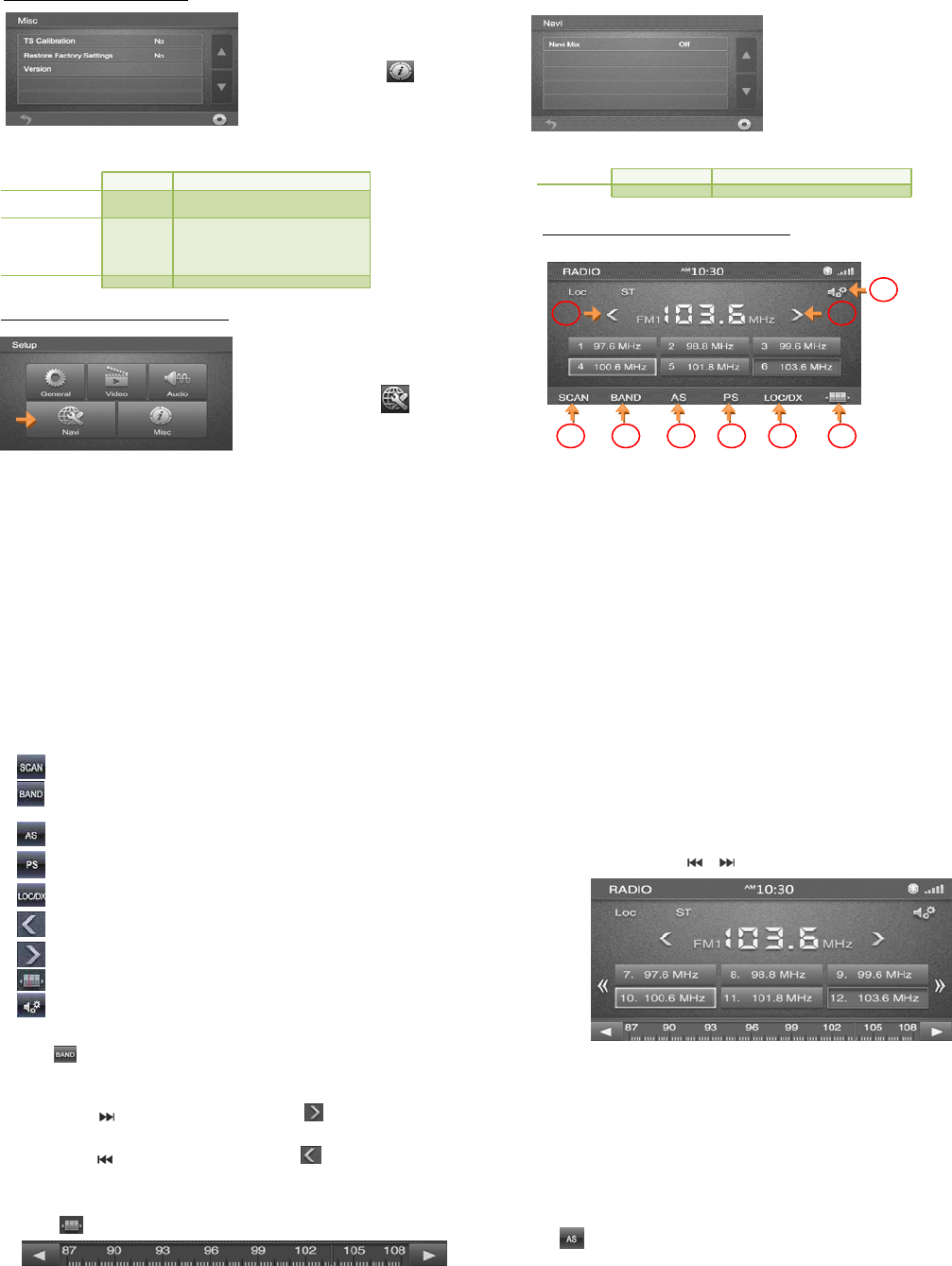
ٓTouch the SETUP icon on the
Main menu screen.
ٓSelect MISC icon
ٓTouch the option directly on the
screen to select a feature to be
adjusted.
Accessing the Misc Menu
Setting Options Function
Touch Screen
Calibration No / Yes Touch “Yes” to enter the touch screen
calibration mode.
Restore factory
Settings Yes / No
Select “Yes” to restore the factory
settings of the multimedia system
(except for password and parental
control).
Version Version display
Accessing the Navigation Menu
ٓTouch the SETUP icon on the
Main menu screen.
ٓSelect NAVI icon
Selecting a Feature for General Adjustment
ٓTouch the option directly on the
screen to select a feature to be
adjusted.
Setting Options Function
Navi Mix On/Off
Tuner ( FM/AM ) Operation
ƽTuner TFT Display
1 2 3 4 5 8
6 7
9
7
fig. 14
Table 5.
fig. 15
fig. 16
Table 6.
fig. 17
Select FM/AM Band
Touch the icon on the screen to change among the following bands: FM-1, FM-2, FM-3,
AM-1 and AM-2.
Auto Tuning
Press the button ( ) on the Radio panel or touch the seek-up icon on the screen to
seek the next available channel by increasing the tuning frequency.
Press the button ( ) on the Radio panel or touch the seek-down icon on the screen
to seek the next available channel by decreasing the tuning frequency.
Manual Tuning
Touch the icon to display Manual tuning.
1. - Touch to activate / deactivate Scan Mode.
2. - Touch TFT Panel or press Band button on the Radio Panel FM-1, FM-2, FM-3
and AM-1, AM-2.
3. - Auto Store.
4. - Program Scan.
5. - Radio stations with a strong signal are tuned.
6. - Touch to seek down.
7. - Touch to seek Up.
8. - Touch to Manual tuning.
9. - Touch to display EQ setting.
ƽPress the icon ( ٓ) to increase the tuning frequency one step at a time.
ƽPress the icon (ٝ) to decrease the tuning frequency one step at a time.
ƽOr touch directly on the Manual tuning display to locate your desired stations.
Using Preset Stations
Six(6) numbered preset buttons stored and recall stations for each band. Six(6) stored
stations for the current band appear on the screen, touch the channel directly for use.
You can press the buttons ( or ) on the Radio panel to see the other 6 stations.
StoringaStation
1. Selectaband(Ifneeded),thenselectastation.
Example:FM1103.6MHz
2. TouchandHoldfor3secondsthedesiredpresetnumbertostoreRadiostation.
RecallingaStation
1. SelectaBand(Ifneeded).
2. TouchOnͲscreenpresetbuttonstoselectthecorrespondingstoredstationsorpressthe
numberbuttonontheRadiopanel.
AutoStore(AS)
Pressicononthescreentoautomaticallyscanandstoreallstationsincurrentband.
8
fig. 18
fig. 19
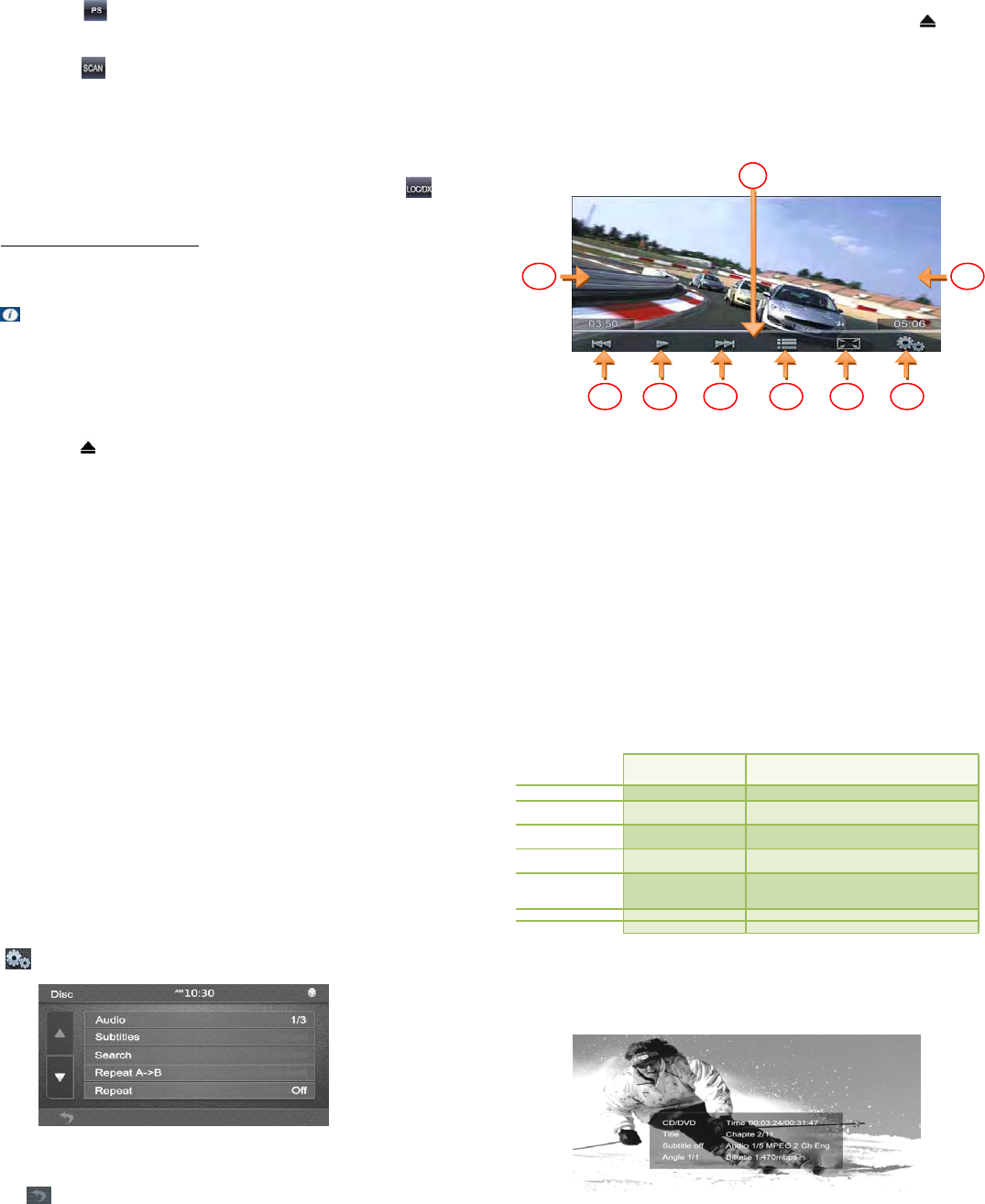
Reset the Loading Mechanism
If the disc does not load or does not play properly, press and hold the button on the unit
to reset the loading mechanism. The disc will be ejected and normal operation will resume.
Accessing DVD mode
To switch to DVD mode when the disc is already inserted, press the SRC button on the
Radio panel until DVD appears on the screen or press the upper left of TFT monitor to locate
Main menu, and then select DVD mode.
Using the Touch-Screen Controls
A. Touch to go to the previous chapter or touch and hold to fast reverse.
B. Touch to Play / Pause.
C. Touch to go to the next chapter or touch and hold to fast forward.
D. Press to go to Root menu.
E. Touch to Exit Function bar.
F. Touch to Enter Setup.
A B C D E F
G G
I
Program Scan ( PS )
Touch the icon on the screen for scan the stations in the 6 preset channels in the
current band.
Scan
1. Touch the icon on the screen to automatically scan all stations in current band to
preview stations.
2. Press any to stop scanning and listen to the selected stations.
DX and Loc Stations Seeking (LOC)
When the Local function is ON, only radio stations with strong signal are tuned. When
the Local function is active, “LOC” appears on the screen.
To activate / deactivate the local function in AM/FM tuner mode, touch the icon on
the screen.
DVD Player Operation
Insert / Eject Disc ( Radio Panel )
Inserting a Disc – When Inserting a DVD disc, DVD mode is entered and disc play
begins.
NOTE:
1. If Parental Lock ( Rating ) is activated and the disc inserted is not authorized, the 4-digit
code must be entered and/or the must be authorized ( see “RATING menu “).
2. You cannot insert a disc if there is already a disc in the Unit or if the power is OFF.
3. CD-R/RW, DVD-R/RW, DVD+R/RWs will not play unless the recording session is
closed.
Ejecting a Disc ( Radio Panel )
Press the button on the Radio panel to eject the disc. The unit automatically reverts
to Tuner mode at the same time.
9
fig. 20
G. Touch to view Playback Information.
H. Touch to Select Chapter.
I. Touch this Area to access Function Bar.
Pausing Playback
Touch the play/pause button fon the function bar to suspend or resume disc play.
Fast Forward/Fast Reverse
Touch the on the screen to fast forward. Keep pressing or touching and releasing
the button to increase the rate from “X 2”, “X 4” and “X 8”.
Touch the on the screen to fast reverse. Keep pressing or touching and releasing
the button to increase the rate from “X 2” , “X 4” and “X 8”.
Disc Setting
• Press the (c/d) arrow on the screen. Select a feature to be adjusted.
• Touch the option directly on the screen to select a feature to be adjusted.
• Press the lower left of TFT monitor to exit.
Setting Options Function
Subtitle Yes/NO Language Selection.
Search Chapter/Title/Time Go to specific Title, Chapter and Time on the
disc.
Repeat A>B Yes/NO Use the A-B function to define a specific Time of
a disc to repeat.
Repeat Chapter/Title/Time For VCD play, the repeat function is not
available
Playback Yes/NO Display playback information on the screen,
including the media playing and current playback
time.
Angle -Change Angle view
Audio -Change Audio setup
Changing Subtitle Language
If you are watching a disc recorded in multiple languages with subtitles, select the Subtitle
to choose the language in which you would like the subtitles to appear
DVD Playback Information
The following information is displayed at the middle of the screen during DVD playback:
10
fig. 21
fig. 22
Table 7.
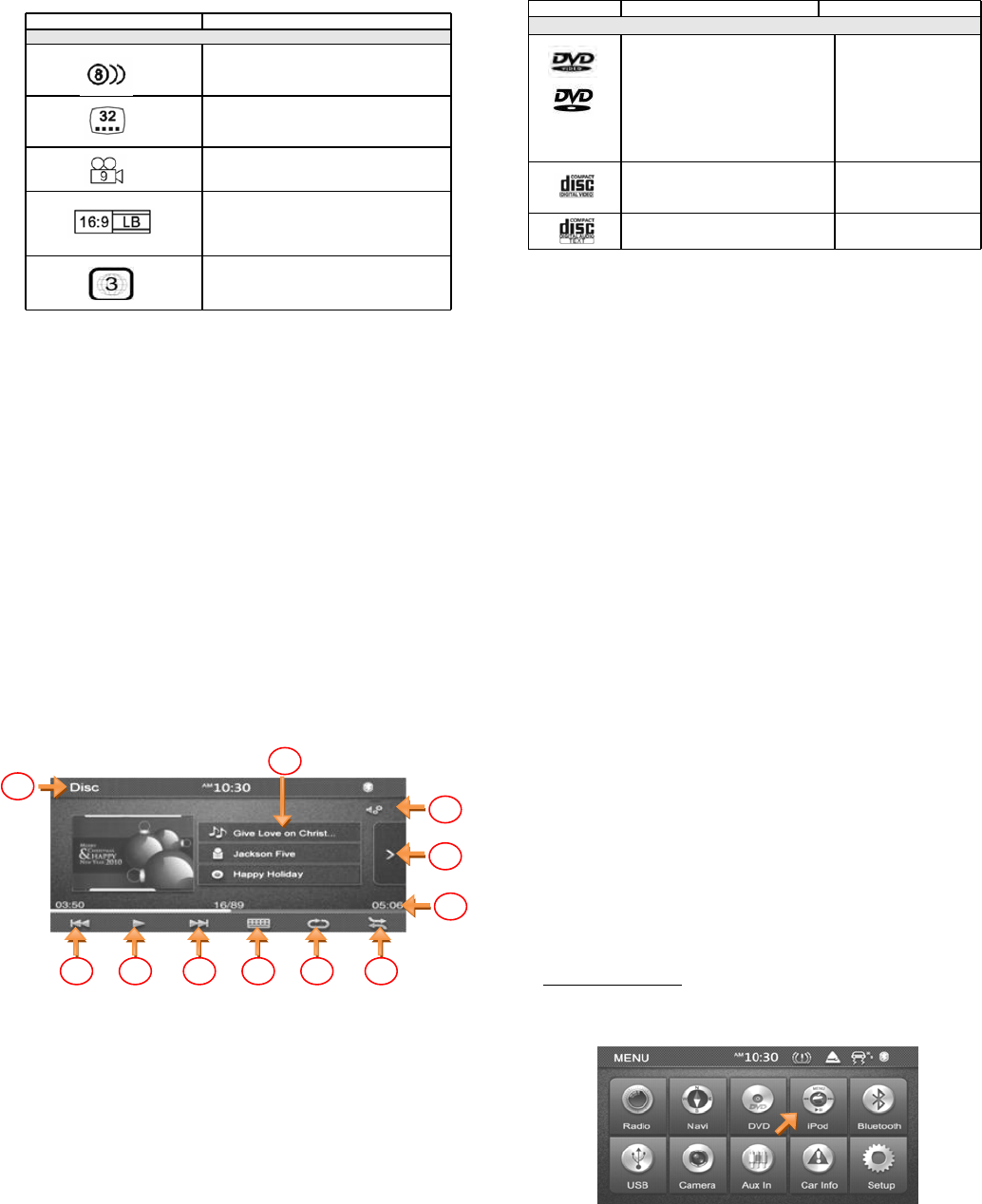
Symbol Meaning
Number of voice languages recorded. The number
inside the icon indicates the number languages on
the disc (maximum of 8).
Number of subtitle languages available on the disc
(maximum of 32).
Number of angles provided (maximum of 9).
Aspect ratios available. “LB” stands for Letter Box
and “PS” stands for Pan/Scan. In the example on
the left, the 16:9 video can be converted to Letter
Box video.
Region 3: Taiwan, Hong Kong, South Korea,
Thailand, Indonesia, South-East Asia.
Disc Symbols
Symbol 12cm Disc Properties Max Play Time
Single side single layer (DVD-5)
Single side double layer (DVD-9)
Double side single layer (DVD-10)
Double side double layer (DVD-18)
(MPEG 2 Method)
133 minutes
242 minutes
266 minutes
484 minutes
Single side single layer (VCD)
(MPEG 1 Method)
74 minutes
Single side single layer 74 minutes
General Disc Information
CD/MP3/WMA/JPEG Operation
Instructions for Insert/Eject, Play/Pause, Stopping Playback, Track Selection, Fast
Forward / Fast Reverse, Scan, and Random Play are the same for DVD, CD and MP3
operation. Please see the DVD Player Operation section for information about these
topics.
The file naming formats listed below are compatible with this unit:
• ISO 9660 – file name: 12 characters, file extension: 3 characters
• ISO 9660 – file name: 31 characters, file extension: 3 characters
• Joliet – 64 characters
If the file or folder name does not conform to ISO 9660 file system standards, it may not be
displayed or played back correctly.
11
Table 7. Table 9.
CD player User Interface
A. Touch () to play the Previous track or press the Radio panel.
B. Touch (f) to Play / Pause
C. Touch to () to play the Next track or press the Radio panel.
D. Touch to display the numeric keypad on the screen and then use the numeric
keypad to access a track directly.
E. Touch to Repeat tracks.
F. Touch to Random play.
G. Touch to view track list page.
H. Total playing time.
I. TFT Display ( Title, Artist, Album ) * Depends on the Disc your playing
J. Touch to go to Equalizer ( EQ ) setting.
K. Touch to return to Main menu.
A B C D E F
G
H
I
J
K
Playing CD Files
After inserting a CD disc, files will play in the sequence of the directory. In playing back,
touch a track on the onscreen directly to play.
MP3/WMA Discs
This player allows you to playback MP3/WMA files recorded on CDROM, CD-R, CD-RW,
DVD+R/RW and DVD-R/RW. For CD-RW discs, please make sure they are formatted
using the full method and not the quick method to prevent improper disc operation. Use
the following settings when compressing audio data for your MP3 disc:
• Transfer Bit Rate: 320kbps
• Sampling Frequency: 48kHz
When recording MP3 up to the maximum disc capacity, disable additional writing. For
recording on an empty disc up to maximum disc capacity, use the "Disc at once" setting.
The touch keys for MP3/WMA CD/DVD playback are described below.
iPod Operation
Accessing iPod Mode:
12
1. To switch to iPod® mode go to the Main menu and touch the iPod® icon on the
TFT Screen or press the SRC button on the Radio panel.
fig. 23
fig. 24
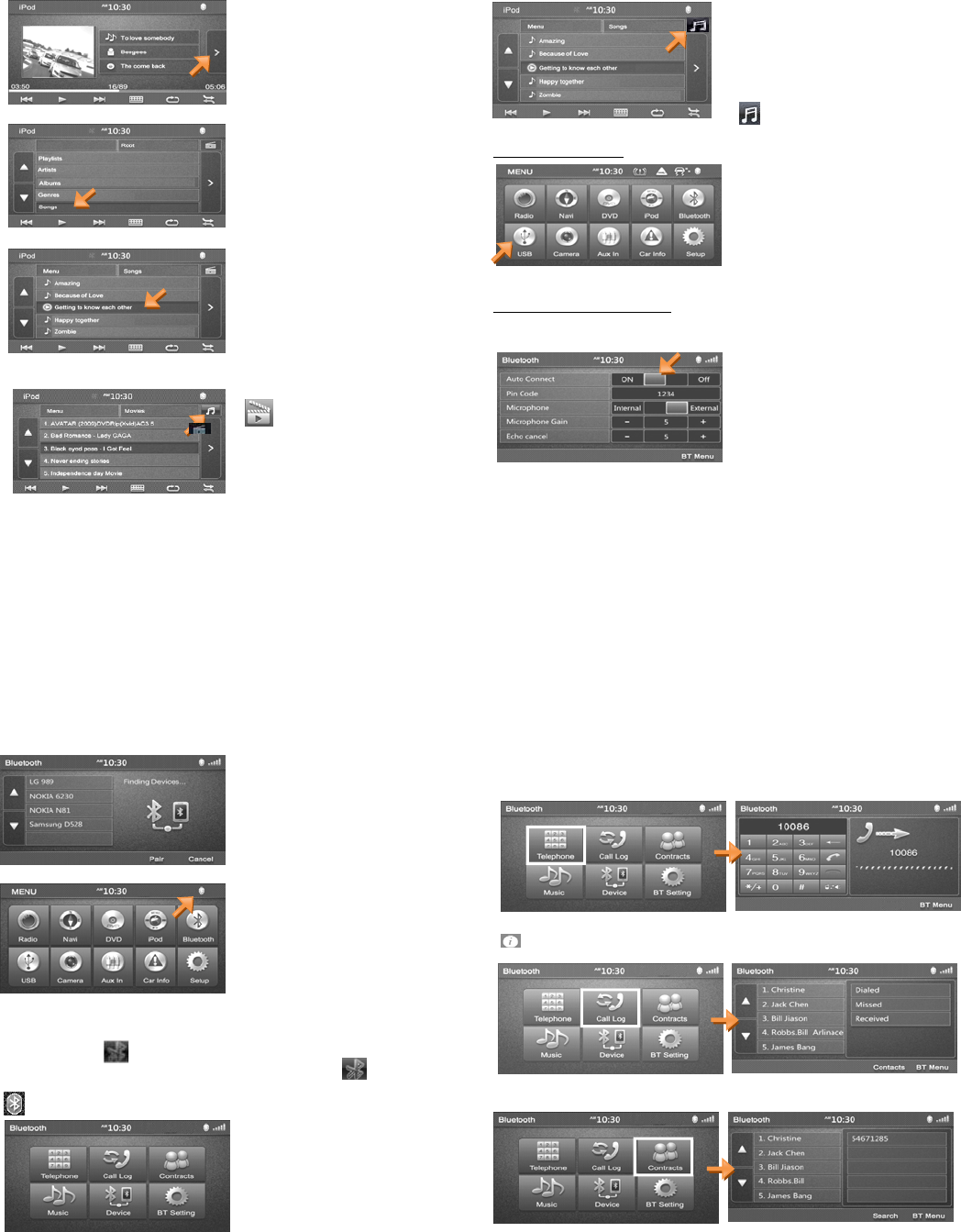
( If there are videos on iPod, you can
play them by selecting them on the
screen. They will start to play,
otherwise there will be nothing on the
display.) However, you can return to
listen to your music by pressing the
icon.
1.TouchtoviewRootDisplay.
2.Touchsongstodisplaytracks.
3.Touchtoselectasong.
Playback of video on iPod
ForplaybackofVideooniPod,
presstheicon
USB operation
Accessing USB mode:
Touch the USB icon on the TFT
monitor or press the SRC button on
the Radio panel as your source.
Bluetooth Operation
Before using the Bluetooth, it’s necessary to perform the following steps. For
more operating details, refer to each section below.
1. Select the “Bluetooth” option in the
General setup and select the “On”
option to activate the Bluetooth
feature.
13
fig. 28
fig. 27
fig. 26
fig. 25
fig. 29
fig. 30
fig. 31
2. Pair your mobile phone to this unit
(refer to the “Pairing” operation). It
is necessary to pair your phone to
the unit. Without pairing, Bluetooth
function will not be available.
Bluetooth Indicator
There is a Bluetooth indicator at
the top right portion of the touch
screen.
• When the Bluetooth function is “Off”, there is no Indicator
• When the Bluetooth function is “On” and no phone is connected to the unit, the
indicator is gray
• If a phone has been connected to the unit, the indicator is blue
AccessingBluetoothMode
Touch the button at the top of the
touch screen to access Bluetooth
mode directly. 00
BluetoothUserInterface
DialInterface
1.TouchtoaccessDialInterface
2.TouchtonavigateCallLog(Dialed,Missed,Received).
NOTE:Wait until synchronization is completed.
3.TouchtoaccessContacts.
14
fig. 32
fig. 33
fig. 34
fig. 35 fig. 36
fig. 37 fig. 38
fig. 39 fig. 40
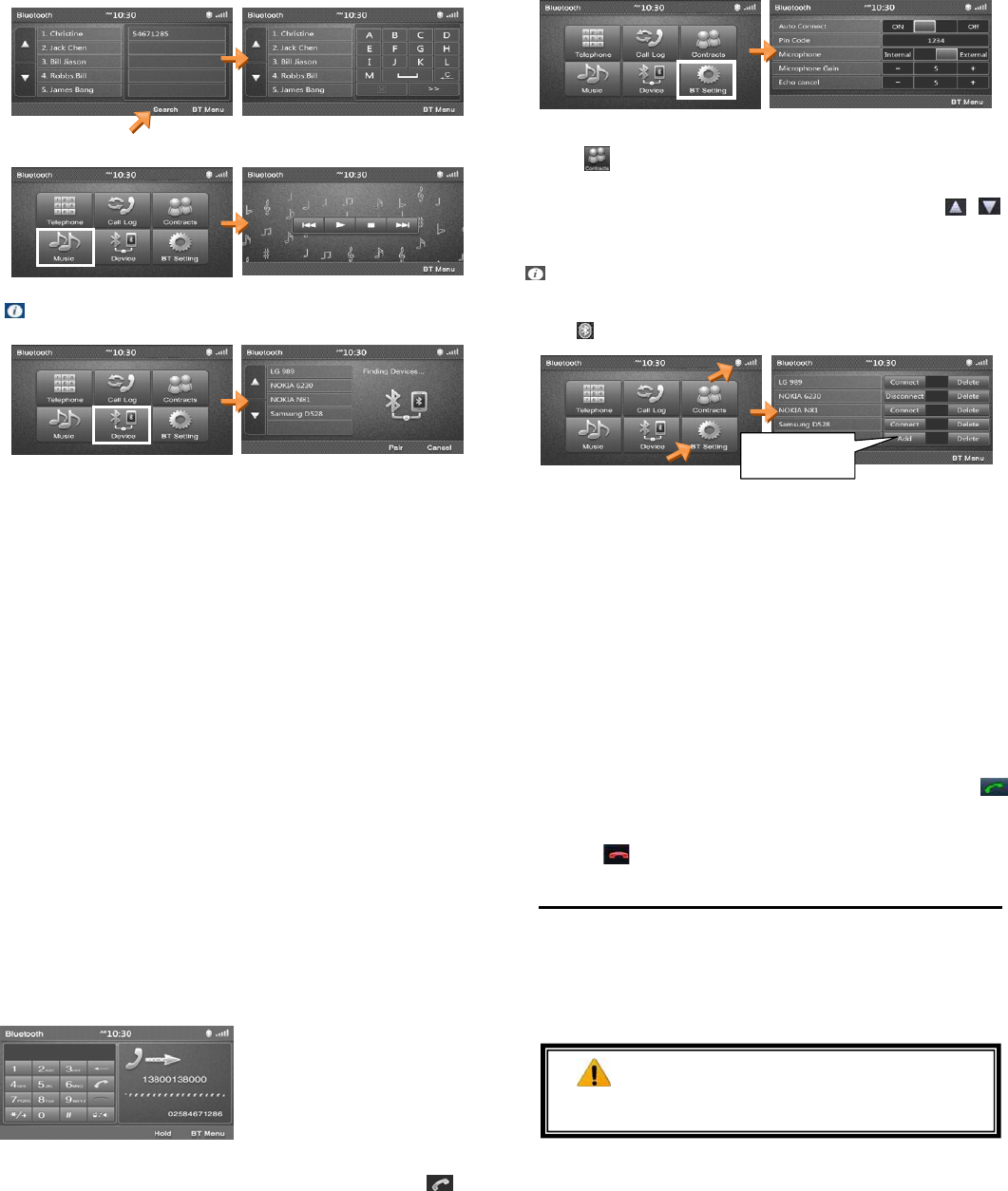
4. Touch the search icon to locate names registered.
5. Touch to access Music control menu.
NOTE: You can play music from your mobile phone thru A2DP function.
6. Touch to access Device menu.
7.TouchtoaccessBTSettingmenu.
Contacts
Touch the icon to access the Contacts.
You can see phone book list, SIM book list, dialed call list, received call list, missed call
list.
If the number has been stored in the Contacts, it can be accessed by touching or
on the screen to navigate through the Contact entries.
Then, touch the number to initiate the phone call.
NOTE:Not all Bluetooth enabled phones support this feature.
: A2DP function is not available on Navi mode.
Bluetooth setup
Touch Bluetooth indicator or go to main menu, touch the Bluetooth icon on the TFT
screen, then touch Add Device display on the screen.
When pairing a
new device, touch
ADD icon
fig. 41 fig. 42
fig. 43 fig. 44
15
fig. 45 fig. 46
fig. 47 fig. 48
fig. 49 fig. 50
Telephone and Information
Telephone (Hands free system for cellular phone)
Hands free system allows you to make or receive a call without taking your hands off
the steering wheel by connecting your cellular / mobile phone to the unit via Bluetooth.
Bluetooth is a wireless data system by which you can call without your cellular phone
being connected with a cable or placed on a cradle. If your cellular phone does not
support Bluetooth, this system cannot function. The operating procedure of the phone
is explained here.
Now you can pair a phone with the unit.
This unit can be paired with 5 mobile phones, but only one can be active at a time.
The Default phone will be retained only if all other paired phones are deleted. (Default
Phone: The phone that was first paired with the unit.)
When maximum pairing has been completed, that is, four mobile phones have been
connected with the unit, and you want to still pair a new one, then the system will retain
the default phone and last used phone used. The phone least used (except the default
phone) will be deleted and the new paired phone will become the last used phone. (Last
Used Phone: The phone connected with the unit that was used last.)
If you want to pair your phone with the unit, use the password 1234 to complete the
pairing. When asked, enter this password in the phone you are pairing with this unit.
Auto Connect
If the unit has been set to auto connect, it will attempt to connect to the last used phone
first. If Auto Connect is not activated, the unit will return to the previous operating mode.
When the phone connects to the unit successfully, all of the cell phone’s Bluetooth
enabled options will be active.
Making a phone call
There are four ways to make a phone call
from this unit:
1. Make use of the Number dial on the screen to make a call.
2. You can Enter the phone number using the numeric keypad and touch the icon
to make a call. ( must be in the Bluetooth mode )
3. You can open the phone book and select one to make a call directly. ( your mobile
phone must support this option )
4. If your phone supports voice dial, access this mode on your phone instead of using
the phonebook.
Answering an incoming call
You can answer an incoming call manually using your handset or by touching this
icon.
End a call
Touch the icon to end a call.
NOTICE :
Do not leave your cellular phone in the car. The temperature indoor
may be high and damage the phone.
16
fig. 51
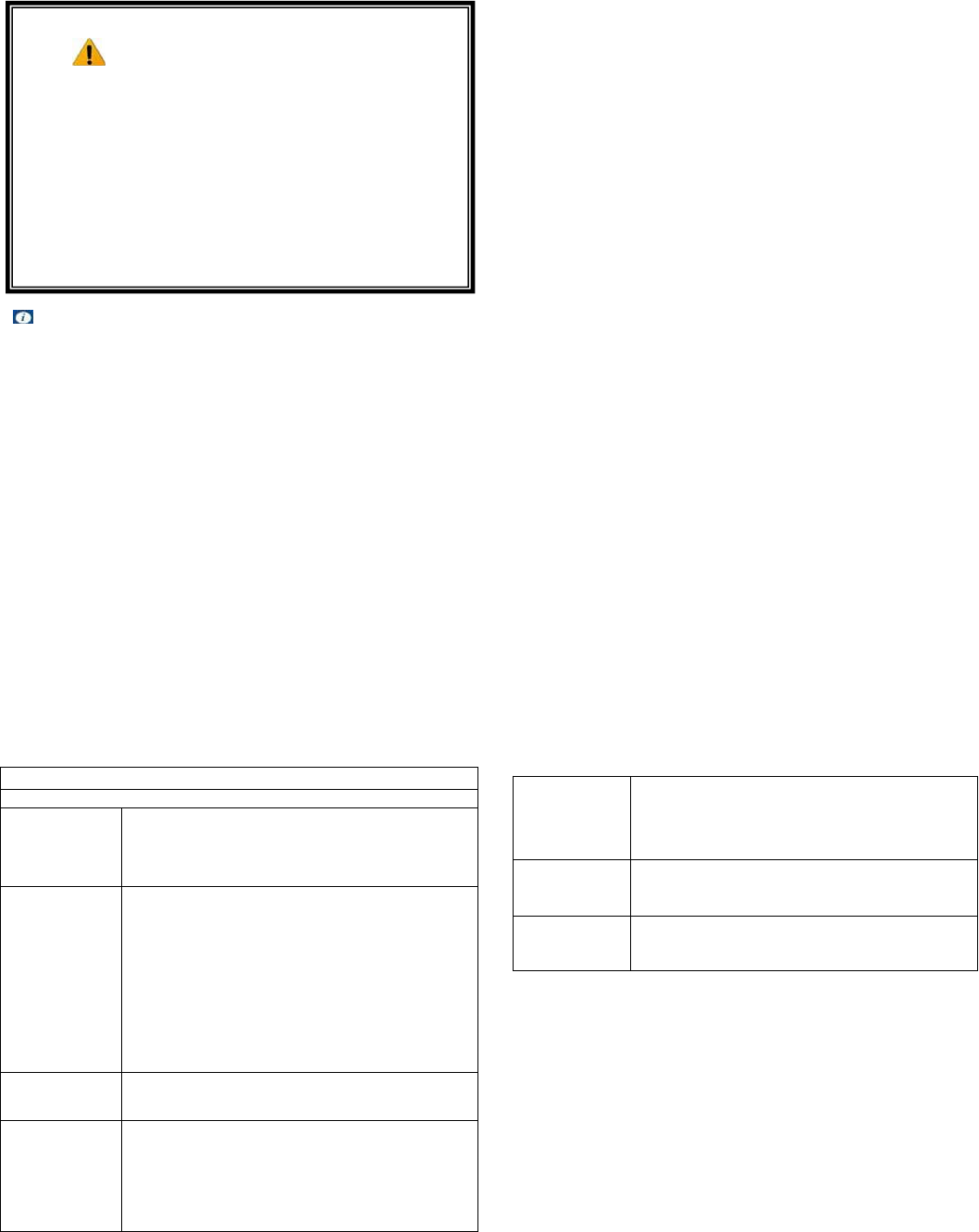
Although Bluetooth® is intended to be a standard protocol, Bluetooth®
device manufacturers may incorporate certain changes within this
standard protocol over the course of the product lifecycle of the device
(especially mobile phones). These changes are outside the control of
this product and may result in the Bluetooth® functionality becoming
impaired.
The types of Bluetooth® devices (including mobile phones) that can be
connected to the hands-free system are limited and, even among
compliant devices; some may not operate reliably with this product.
Prior to operation, check the compatibility of your device with it’s
manufacturer.
BLUETOOTH DISCLAIMER
INFORMATION
In the following conditions, the system may not function :
• The cellular phone is turned off.
• The current position is outside the communication area.
• The cellular phone is not connected.
• The cellular phone has a low battery.
• Even if your cellular phone supports both hands free and audio
• Bluetooth connections, it may not be able to connect to the hands free connection at
the same time.
• When using Bluetooth audio and hands free at the same time, the following problems
may occur.
• The Bluetooth connection may be cut.
• Noise may be heard on the Bluetooth audio playback.
• Talk alternately with the other party on the phone. If you talk at the same time, the
voice may not reach each other. (It is not a malfunction.)
• Keep the volume of the receiving voice down. Otherwise, an echo will be heard and
receiving voice can be heard outside of the vehicle. When you talk on the phone,
speak clearly towards the microphone.
• In the following situations, your voice may not reach the other party.
• Driving on unpaved road. (Making a traffic noise.)
• Driving at high speed.
• The window is open.
• Turning the air-conditioning vents towards the microphone.
• The sound of the air-conditioning fan is loud.
• There is an effect from the network of the cellular phone
• It may take time, the phone connection is carried out during Bluetooth audio play.
17
CEA Power Ratings
Specifications
Tuning Range: 87.5MHz - 107.9MHz
Mono Sensitivity ( -30dB ): 10dBu
Quieting Sensitivity ( -50dB ): 15dBu
Alternate Channel Selectivity: 70dB
Signal to Noise Ratio @ 1kHz: 58dB
Image Rejection: 60dB
Stereo Separation @ 1kHz: 30dB
Frequency Response: 30Hz - 15kHz, -3dB
FM Tuner Section
Pow er Output: 20 w atts RMS X 4 channels into 4-ohms @ < 10% THD+N
Signal to Noise Ratio: 70dBA below reference. ( Ref erence: 1 w att, 4-ohms )
MAX Pow er : 40 X 4 w atts into 4-ohms, all channels driven
Frequency Response: 20Hz to 20kHz. -3dB Aux input used as source
ref erence Ref erence Supply Voltage: 14.4VDC
Compatible f or mats : DV D-R, DV D-RW, DV D+R, DV D+RW, CD-R, CD-RW, CD-
DA, MP3, WMA, HDCD, SVCD, VCD, MPEG, JPEG, MP3/WMA files burned onto
a DVD+R/W or DVD-RW and CD-R/RW
Signal to Noise Ratio: 85dBA
Dynamic Range: >95dB
Frequency Response: 20Hz to 20kHz, -3dB
Channel Separation: > 60dB @ 1kHz
D/A Converter(s): 6-channels high performance 24-bit, 192kHz, multi-bit Sigma
Delta modulation. DAC supports sample rates from 8~192kHz.
Electronic Skip Protection (ESP): DVD: 2-3 sec, CD-DA: 10 sec, MP3: 100 sec,
WMA: 200 sec
( ESP time approximate )
Mechanical anti vibration ability: 10~200Hz, X/Y/Z direction: 1.0G
Format: NTSC, PAL ( auto-detection )
Output: 1Vp-p ( 75-ohm ), buffered
Input: 1Vp-p ( 75-ohm )
Main Am plifier
DV D/CD Playe r
Video Section
AM Tuner Section
Monitor Section
Ge ne r al
Tuning Range:530kHz - 1710kHz
Sensitivity ( -20dB ): 20dBu
Signal to Noise Ratio @ 1kHz: 50dB
Image Rejection: 60dB
Frequency Response: 50Hz - 2kHz, -3dB
Integrated SD Card Reader
Screen Size: 6.95" ( Measured diagonally ).
Screen Type: TFT Digital Display active matrix
Response Time: 30mSec rise time, 50mSec f all time resolution, DV D/Composite
Video in: 280,280 sub pixels, 1200 (W) X 234 (H)
Auxilliary Input impedanc e: 10k
Pow er Supply: 10.5 to 16V DC, negative ground
Fuse: 10-amp, mini ATM type
DIN chassis dimensions: 7" X 7" X 2" ( 178mm x 178mm x 100mm )
* Specifications subject to change without notice.
18
Table 10.
Periodic Maintenance Required
ZOutside Temperature ^Compass
[Barometer _Range
\Elevation `Speed
]Adjust (Adjustment) aFuel Economy
Multi-Information Display
10
9
8
76
5
4
3
2
1
After the display of the opening LOGO for about 15 seconds, Vehicle Information replaces
it as the DEFAULT display, the last source will have audio only.
XDigital Clock
YWarning Display
Tire Pressure Monitor System
Functional icon: You can Select Functions to adjust / set, exiting and return to
previous selection.
Digital Clock:Indicates the time.
Changing the clock settings, from main menu touch the Setup icon to display general
setup menu. ¼Page 8
Warning Display (See Page 29 - 31)
•NOTE :
Outside Temperature: The outside temperature is read every five (5) minutes.
Barometer: This display shows the atmospheric pressure at the present location,
values are read every five(5) minutes.
Touching the RESET function will not reset the indication hPa
Elevation: The current elevation in units is 100m (400ft) as shown. The
elevation is read every five(5) minutes.
To adjust the elevation: Touch the elevation icon on the screen, then adjust
by touching icon or .
The adjusment icon increases by 100m (400ft) every time you lightly touch the
icon. Continuous touching of the icon for about two (2) seconds or more, will result in the
indication to fast-forward. Then the setting changes to the elevation selected.
The adjustment icon decreases by 100m (400ft) every time you lightly touch the
icon. Continuous touching of the icon for about two (2) seconds or more, will result in the
indication to fast-forward. Then the setting changes to the elevation selected.
19
fig. 52
fig. 53
NOTE:
• The elevation is determined from changes in atmospheric pressure. Depending on
weather conditions, the indicated elevation may differ from the actual elevation.
Variations in atmospheric pressure can cause different elevation to be shown even in
the same location. Use the indication as a guide only.
Fuel Economy: The average value of the fuel consumption is read every 5
minutes.
Resetting the average fuel consumption:
• Touch the icon on the
screen.
• Touch the “RESET” icon on the
screen.
• Value shown “ --,- “ km/L.
NOTE :
• When the average fuel consumption cannot be calculated, “- -,-“will be shown.
• The average and momentary fuel consumption change will depend on the driving
condition (road condition, driving behavior, etc.). The indication may differ from the
actual fuel consumption. Therefore, it is recommended to use the indication only as
reference.
Compass: This compass shows the direction of the vehicle.
NOTE:
• This system uses the earth’s magnetic field, and so may not show the correct direction
depending on the traffic condition or in the following places where the earth’s magnetic
field is disrupted.
¾Car parks located in buildings and tunnels.
¾Expressways and undergrounds cables.
¾Areas along railroads
Adjust (adjustment)
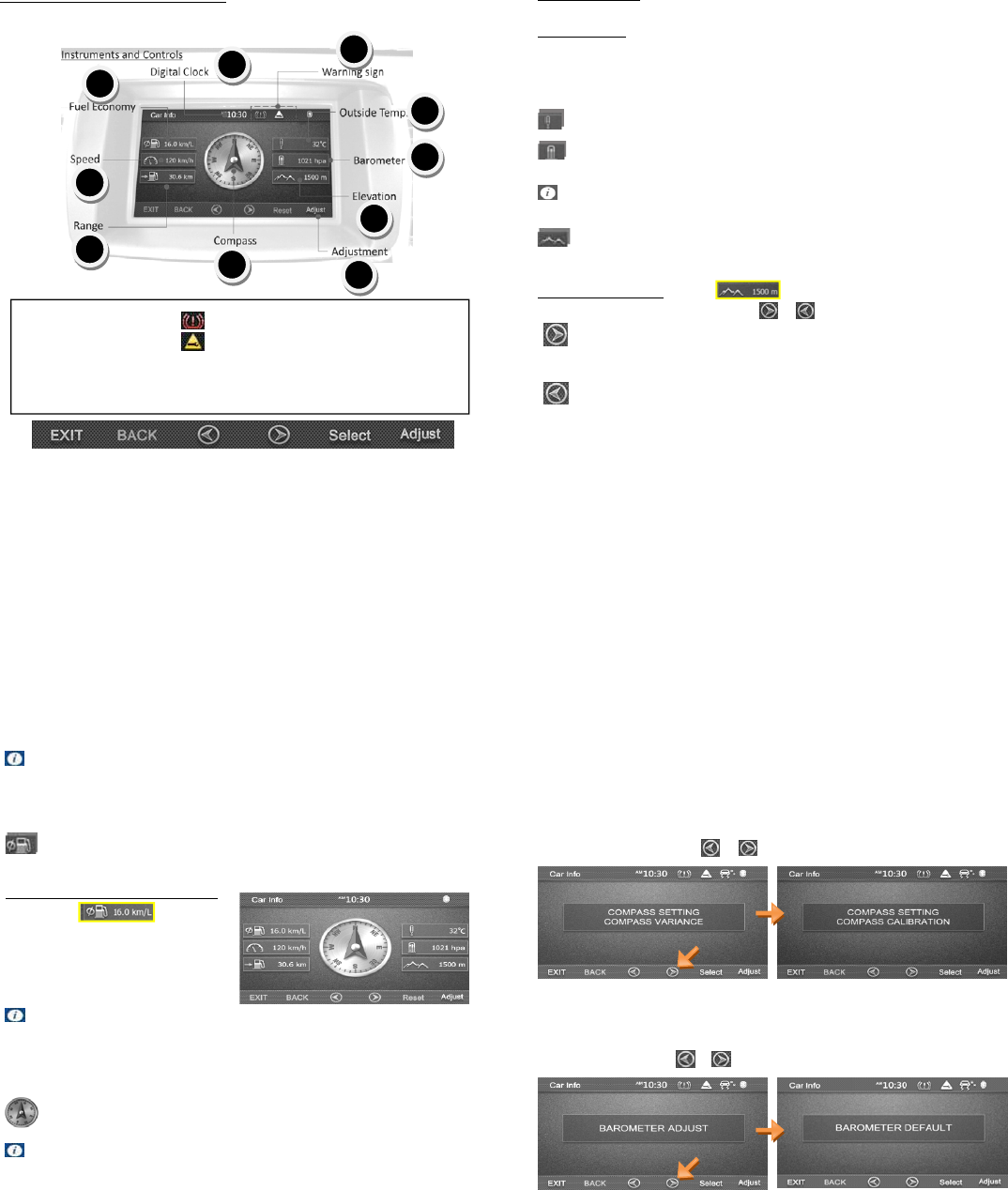
Every time the “Adjust” icon is touched lightly, the display will change into two selections :
Touching the ADJUST icon will display compass VARIANCE as default, to search
CALIBRATION, touch the icon or .
1. COMPASS SETTING
2. BAROMETER SETTING
Touching the ADJUST icon will display Barometer ADJUST, to search Barometer
DEFAULT, touch the icon or .
20
fig. 54
fig. 55 fig. 56
fig. 57 fig. 58
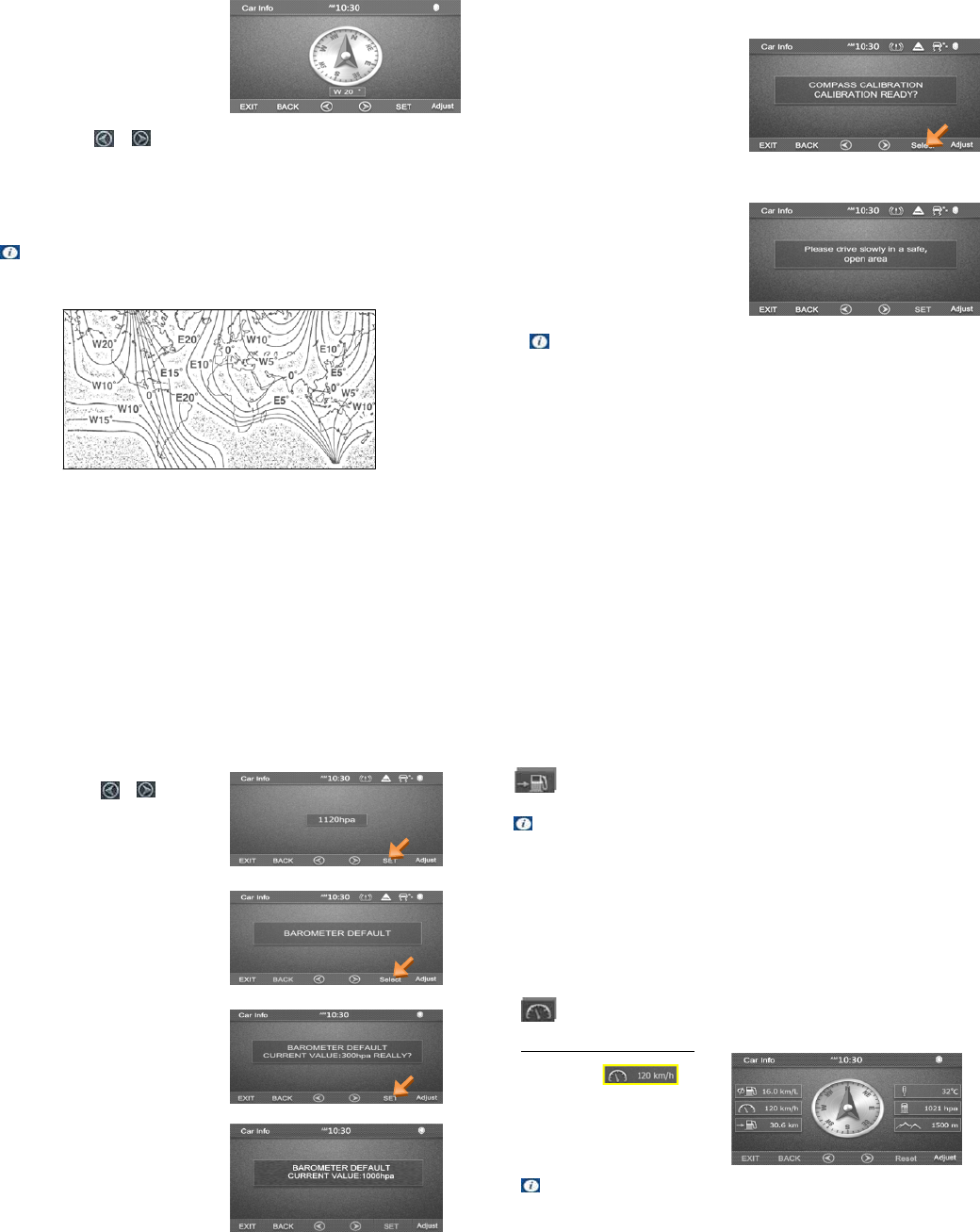
Compass Variance
To adjust compass variance, touch
the SELECT icon to display
adjustment data.
• Touch the icon or to set the desired declination.
• When the declination has been completed, touch the “SET” function icon.
Setting the Declination
The declination is the difference between true north (the direction of the geographic
north pole) and where a compass needle points to. Since the declination varies from
place to place, it needs to be for each region. Otherwise the compass will not show the
declination by the following steps:
NOTE:
• The default declination setting is 0 degrees. In accordance with the illustration, set the
declination setting to the declination contour nearest to a region where you drive the
vehicle.
• The declination can be set at intervals of 1 degrees, from 28 degrees west (W28) to 28
degrees east (E28).
Compass Calibration
touch the SELECT icon to display
“CALIBRATION READY”
• Touch the SELECT icon again to
display “Please drive slowly in a
safe open area”
• Turn the vehicle slowly through
360 degrees in a safe open field
with no buildings and other
vehicles.
• If you wish to stop calibration the compass part-way through the procedure, the
compass may not be properly calibrated in this case, you must turn the vehicle
through 360 degrees.
NOTE:
Barometer Adjust
This display shows the atmospheric pressure at the present location. The atmospheric
pressure values are read every 5 minutes.
fig. 59
To Calibrate compass:
fig. 61
fig. 62
fig. 60
21
• Touch the icon or to set
the desired value.
• Touch the “SET“ icon to complete
the input date.
Barometer Default
To Set Barometer Default, touch the
SELECT icon to display “Current
Value: ___hPa REALLY?”
• Touch the “SET” icon to display the
default Barometer Value “CURRENT
VALUE:1006hpa”
• To return to Car info, touch EXIT
Range: This shows the distance (in km) that can be driven on the fuel
remaining in the fuel tank. The driving range is read every 5 minutes.
NOTE:
• When the vehicle is fueled, the driving range will be updated. However, if the amount of
fueling is small, the indication may not be correct. It is recommended to fill the tank as
much as possible.
• The driving range is shown based on the accumulated fuel consumption data, However,
it may change depending on the driving condition (road condition, driving behavior,
etc.). If the battery terminals are disconnected, the accumulated fuel consumption data
will be erased. It is recommended to use the indication as reference.
• When the vehicle is stopped on a steep slope, the value of the driving range may
increase. This is caused by the fuel movement inside the tank on the slope and is not
deemed as a failure. ( malfunction )
Speed: The average value of the speed is read every 5 minutes.
Resetting the average speed:
• Touch the icon
on the screen.
• Touch the “RESET” icon on the
screen.
NOTE:
• When you turn the ignition switch to the “ON” position about 4 hours (or more) after
turning it from the “ON” position to the “ACC” or LOCK” position, the average speed
indication will automatically be reset.
fig. 63
fig. 64
fig. 65
fig. 66
fig. 67
22

NOTE:
If you using other source like Radio or DVD, you can also locate Car Info by touching
the upper left of TFT Monitor. Then, from Main menu select the icon to display
two selections:
¾Directly touch the screen to select
information display. The selected
info will turn yellow.
¾Then show the information you
want to see.
TPMS
Display
Multi – Info
Display
Tire Pressure Monitor System (TPMS)
This advanced system will provide you peace-of-mind while it helps you monitor the
pressure and temperature level of your vehicle’s tires. Properly inflated tires provide
improved safety, fuel economy and extend tire life over those that are operated either
under, or over-inflated. You will need to refer to your vehicle’s specific tire pressure
requirements for the size and types of tires you are using. Carefully follow the instruction
in the manual while installing Tire Pressure Monitoring System. Failure to do so may
result in system malfunction, non-operation or damage of system components. If you are
not qualified to perform these installations, we suggest you consider having a qualified
technician from an auto repair shop or tire installation facilities to install this system for
you. Make sure they have access to this manual prior to installation of your Tire Pressure
Monitor System.
fig. 71
fig. 68
fig. 69
23
fig. 70
NORMAL MODE DISPLAY
This display shows a normal condition.
ABNORMAL MODE DISPLAY
This display shows an abnormal condition.
NOTE:
All sensors are pre-programmed at the factory for a specific wheel location, which is used
for the first installed on your vehicle positions are indicated on a label attached to the
front of the sensor body.
Sensor Label:
• FL = Front Left
• FR = Front Right
• RR = Rear Right
• RL = Rear Left
• ST = Spare Tire
In case of change in wheel’s locations due to tire’s rotation on your vehicle, please follow
the Tire Exchange Mode procedure to change wheel’s location on your vehicle.
Tire Exchange Mode
• Touch the Front Left Tire for 5
seconds to enter the Tire Exchange
mode.
• The Front Left tire will turn yellow.
• The Rear tires will turn to Green.
24
fig. 76
fig. 72
fig. 74
fig. 75
fig. 73
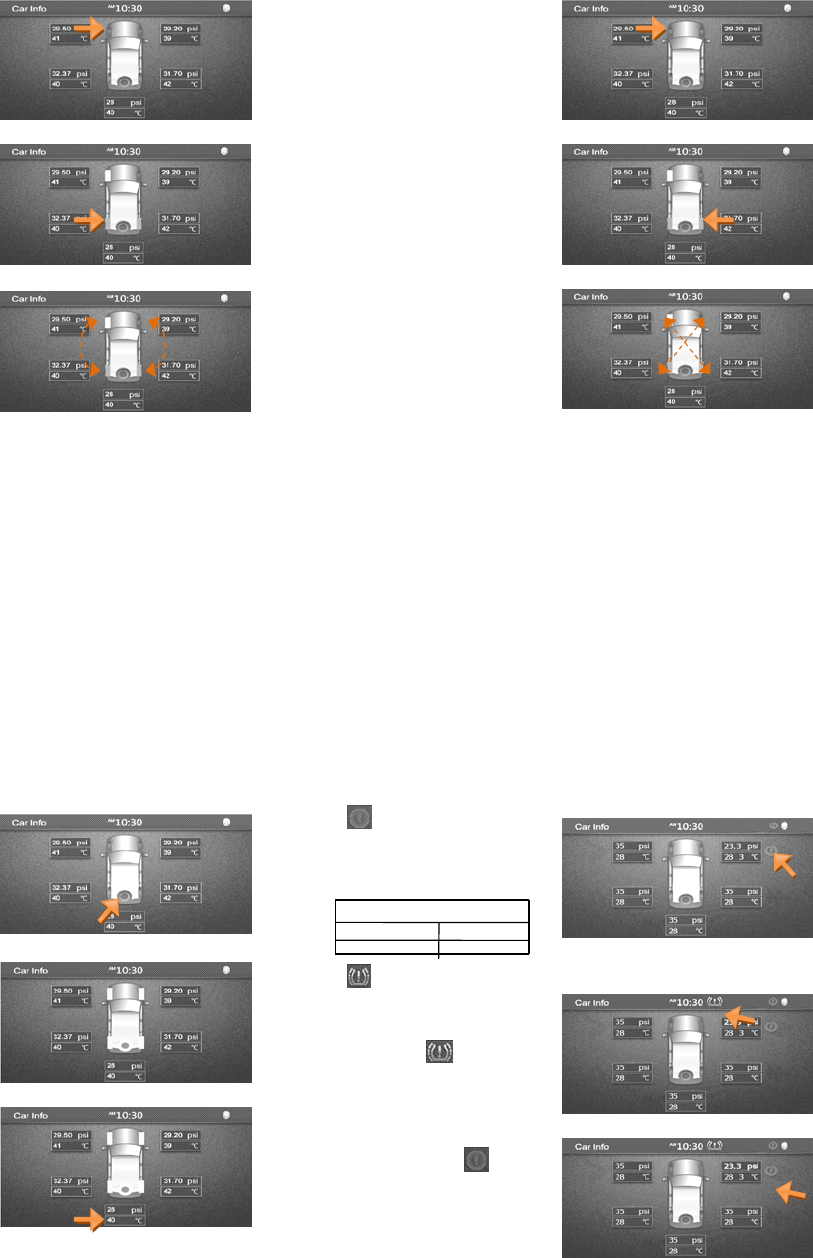
Procedure Mode:
Front and Rear Tire Exchange Mode ( Parallel Change )
1. Touch the Front left tire for five(5)
seconds to enter Tire Exchange
Mode.
2. Touch the Rear left tire, the front
tires will exchange with the Rear
Tires.
• After the data has been transmitted, tire exchange mode will automatically exit and
return to normal mode.
Procedure Mode:
Front and Rear Tire Exchange Mode ( Cross Change )
1. Touch the Front Left tire for five(5)
seconds to enter Tire Exchange
Mode.
2. Touch the Rear Right tire. The
Front tire will exchange with the
Rear tire across.
• After the data has been transmitted, tire exchange mode will automatically exit and
return to normal mode.
fig. 77
fig. 78
fig. 79
fig. 80
fig. 81
fig. 82
25
Procedure Mode:
Spare Tire Exchange Mode
1. Touch the Front left tire for five(5)
seconds to enter Spare Tire
Exchange Mode.
2. Front and rear tires will turn green
and spare tire will turn to yellow.
3. Touch any of the green tire that will
be exchanged with the spare tire.
• After the data has been transmitted, tire exchange mode will automatically exit and
return to normal mode.
In-Case of Abnormal Mode Display
1. Warning Indicator
This icon will appear when the
default value change.
When the Pressure become:
Low Pressure 24psi
High Pressure 34psi
2. Pressure High/Low First Stage
• First stage alert will show icons
when the values change.
• Alert indicator will appear on
the top portion of the screen and the
module beeps every two(2) minutes
interval. These icons will disappear
only when inflated/deflated required
pressure values.
• The Warning indicator will
appear.
26
fig. 83
fig. 84
fig. 85
fig. 86
fig. 87
fig. 88
Table 11.
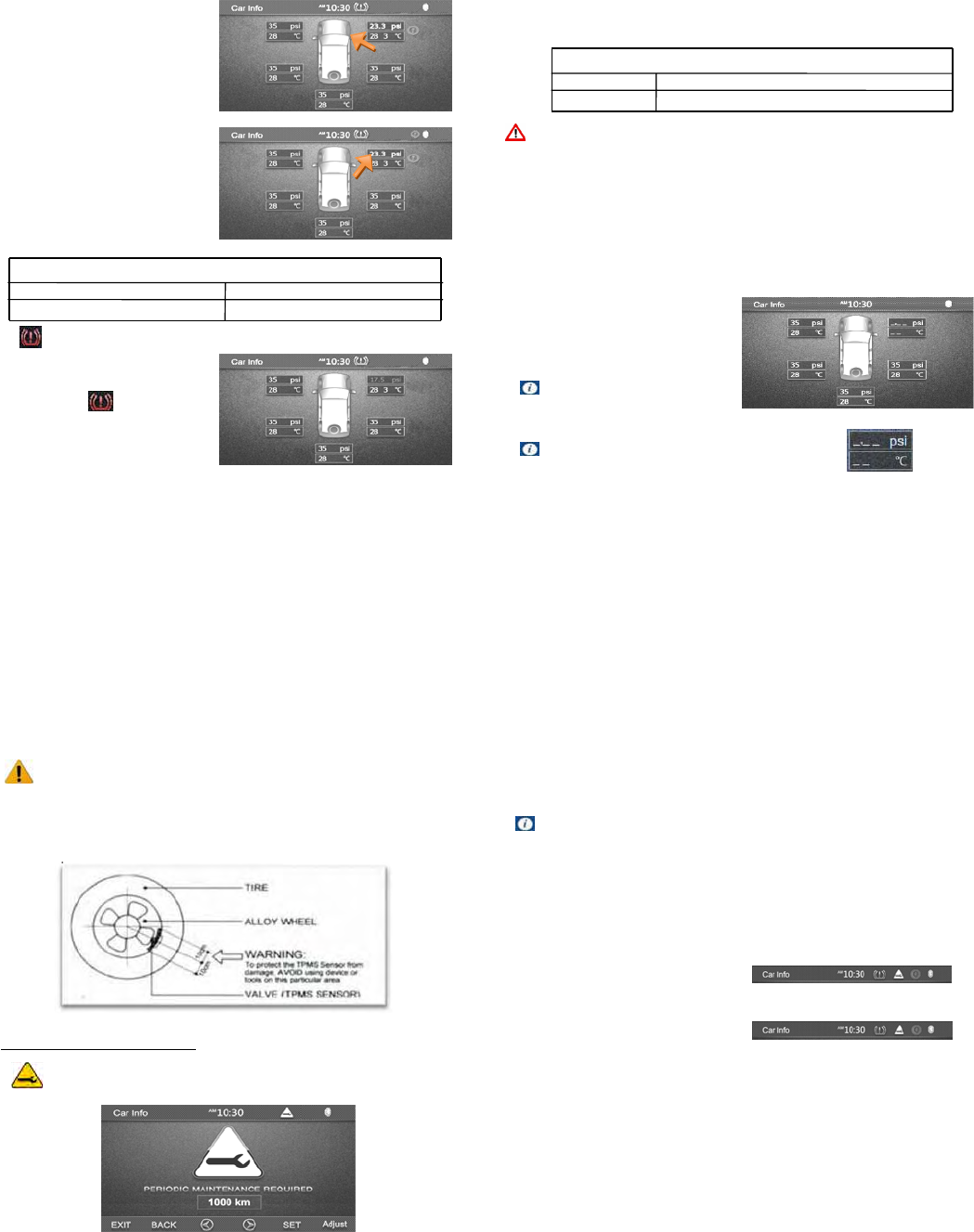
• Tire symbol will turn color “RED”.
• Tire pressure value turned “YELLOW”.
Pressure Range:
Low Pressure 24psi up to 19psi
High Pressure 34psi up to 41psi
3. Pressure High/Low Second Stage
• Second stage alert will show icons
when the value change.
• Alert indicator will appear on
the top portion of the screen and the
module beeps every 2 minutes.
These icon will disappear only when
inflated/deflated to required pressure
values.
• Tire symbol will turn RED.
• Tire pressure value will also turn RED.
Pressure Range:
Low 18psi below “ALERT PRESSURE”
High 42psi Above “ALERT PRESSURE”
WARNING!
¾Always adapt the tire pressure accordingly when the vehicle load changes.
¾If the Tire Pressure Monitor System (TPMS) indicator icons appear on the screen,
slow down immediately and avoid any severe braking or steering maneuvers. As soon
as you do so safely, stop and check the tires.
¾It is the driver’s responsibility to ensure that the tire pressures are correct. Check the
tires regularly.
¾Under certain conditions (poor road surface) the tire pressure indication may not light
up immediately.
¾Please ask your nearest MITSUBISHI dealer or workshop whether run flat tires can be
used on your vehicle.
SIGNAL LOSS
Loss of signal = the system does not
receive the signal of a sensor.
NOTE:
in case of loss signal, you will see
the tire pressure and temperature
is blank.
The display will update Twenty(20) minutes after the
system experiences signal loss.
27
fig. 91
fig. 89
fig. 90
Table 12.
fig. 92
Table 13.
Service reminder: After a certain mileage, a Periodic Maintenance Required
reminder will appear in the screen each time the ignition is switched ON.
Precaution:1
Please be careful when replacing tires, carelessness might cause damage to your
TPMS SENSOR located inside.
When servicing please be guided the service center staff, they may not familiar with
tire pressure monitor system (TPMS) except MITSUBISHI DEALER and Qualified
Workshop.
Periodic Maintenance
Resetting the display
Your dealer or qualified workshop resets the “Periodic Maintenance Required” after each
service.
NOTE:
Only Mitsubishi Dealers and qualified workshop are authorized to disable the
PERIODIC MAINTENANCE REQUIRED display.
The first service maintenance warning will display after the 1st
1000km and the next service interval display will be every 5000km.
If the PERIODIC MAINTENANCE REQUIRED appears on the screen and you want to
proceed in any menu source.
¾Touch the icons on top of the screen,
select your desired icon (TPMS,
Bluetooth and Clock)
¾To go to other Menu, touch the upper
left portion of the screen to enter the
Main menu or press the SRC button
on the Radio panel to select your
desired menu.
28
fig. 93
fig. 95
fig. 96
fig. 94
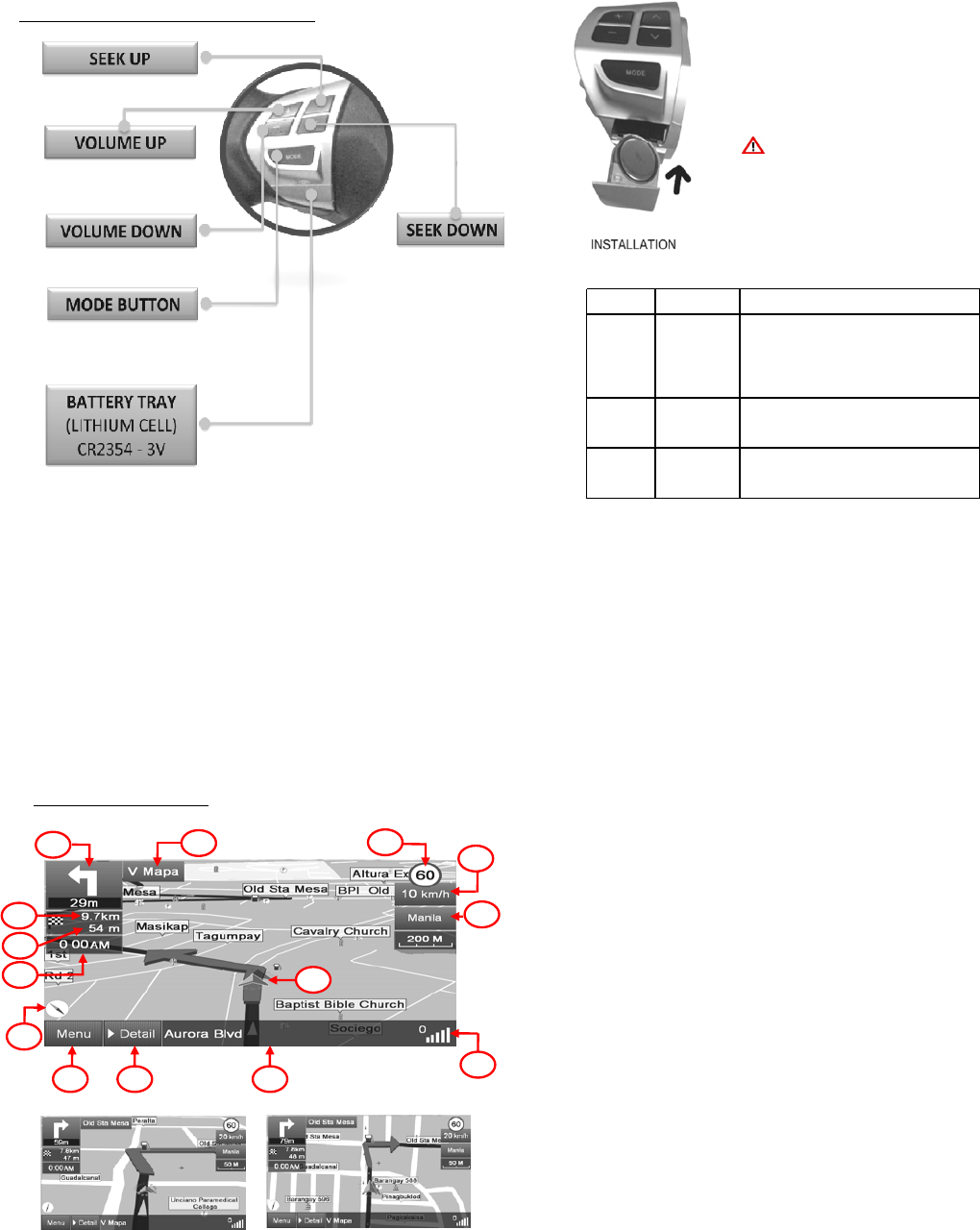
Steering Wheel Remote Control
Button Function Operation
Mode
iPod or USB
Disc
AUX
Radio
Navi
Single Press to select source
Seek
Radio
iPod or USB
Disc
Single Press = Select PRESET Station
and Tracks
Volume
Radio
iPod or USB
Disc
Single Press = Increase and Decrease
Volume
29
fig. 97
fig. 98
Table 14.
Replacing the Lithium Battery of Remote
Control
When the operation of the Steering Remote stops
prematurely or permanently, replace the battery
with a new lithium battery. Make sure the battery
polarity replacement is correct.
WARNING:
• Store the battery where children cannot reach.
• Do not recharge, short circuit, disassemble or
heat the battery.
• Do not expose or bring into contact the battery
with other metallic materials. Doing this may
start a fire.
3DVIEW 2DVIEW
10
1
23
4
5
8
6
7
9
11
12
13
14
UNDERSTANDING THE MAP PAGE
fig. 99
Navigation System
1. GPS satellite signal – Represents the satellite signals being received by
your navigation system. When you see green bars with a number greater
than three(3), you have a strong signal.
2. Distance turn – Shows the distance and next turning point.
3. Speed – Shows the speed of your driving.
4. Distance – Shows your current / present distance to your destination.
5. Time to Finish – Shows the remaining time to reach your destination.
6. Time – Shows current time.
7. Menu – Select to access the functions on menu.
8. Turning Point – Shows the name of the street of your next turning point.
9. North Up / Track Up – Shows North Up or Track Up view.
10. Street – Shows current street name.
11. City – Shows the current name of the city.
12. Detail – Select to access the following functions:
13. Car Position - Shows car’s location relative to the map.
14. Speed Limit - Shows the speed limit.
•2D /3D – Sets to change the view of the map.
•Quick Menu – Sets the systems default functions for Gasoline
stations, Hospitals and Alternative Routes.
•Alternative Route – Sets category to your waypoint.
•Scale – Sets to scale the map.
30
fig. 100 fig. 101
Acquiring Satellites
Before the navigation system can find your current location and navigate a route, you must
do the following:
1. Go outdoors to open area, away from tall buildings
and trees.
2. GPS antenna should be located on the dashboard,
so that it is parallel to the ground.
3. Turn on the navigation system. Acquiring satellite can
take a few minutes.
The bars indicate satellite strength. When the bars are Red
With a number beside it (should be greater than 3), the navigation system
has acquired satellite signals; you can now select a destination or POI and navigate to it.
About GPS Satellite Signals
Your navigation system must acquire GPS (Global Positioning System) satellite signals to
operate.
If you are indoors, near tall buildings or trees, or in a parking garage, the navigation
system might not acquire satellites. Go outside to an area free from tall obstructions to
use your navigation system.
When the navigation acquires satellite signals, the signal strength bars on the Map page
are Red. When it loses satellite signals, the bars disappear. Touch the signals
strength bars in the lower right corner of the Map page or go to Setting menu – GPS info to
view GPS information. Touch anywhere on the screen to return to the Map page.
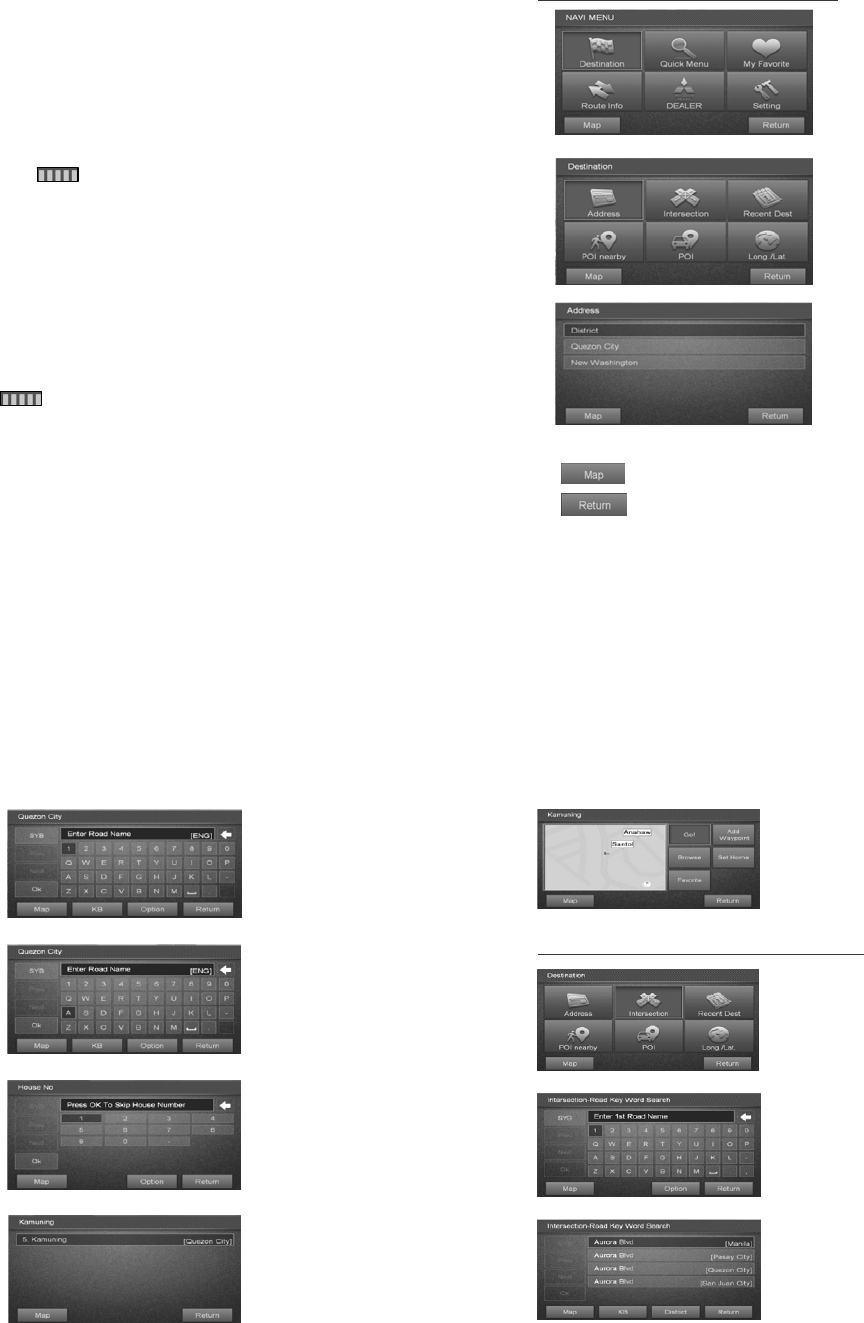
Finding your Destination using Address
1. On the Menu page, Select
Destination.
2. Select Address.
3. Select the City you want
to visit on the list. Or if
there is no data on your
list try to select District.
Select to go back to map.
Select to return to previous page.
fig. 102
fig. 103
fig. 104
31
4. Enter the name of the
City you want to visit.
5. Enter the name of the
Road.
6. Enter the House Number
and press OK or if you want
to skip this process press
OK only.
7. Select the road name.
Select option:
• Go – Guides you to the
destination.
•Add Waypoint .
• Browse – Browses routing
to destination.
• Set as Home
• Set as Favorite
Finding your Destination using Intersection
2. Enter 1st Road name.
3. Select from the list the
road and the city you
desired to go.
1. Select Intersection.
fig. 105
fig. 106
fig. 107
fig. 108
fig. 109
fig. 110
fig. 111
fig. 112
32
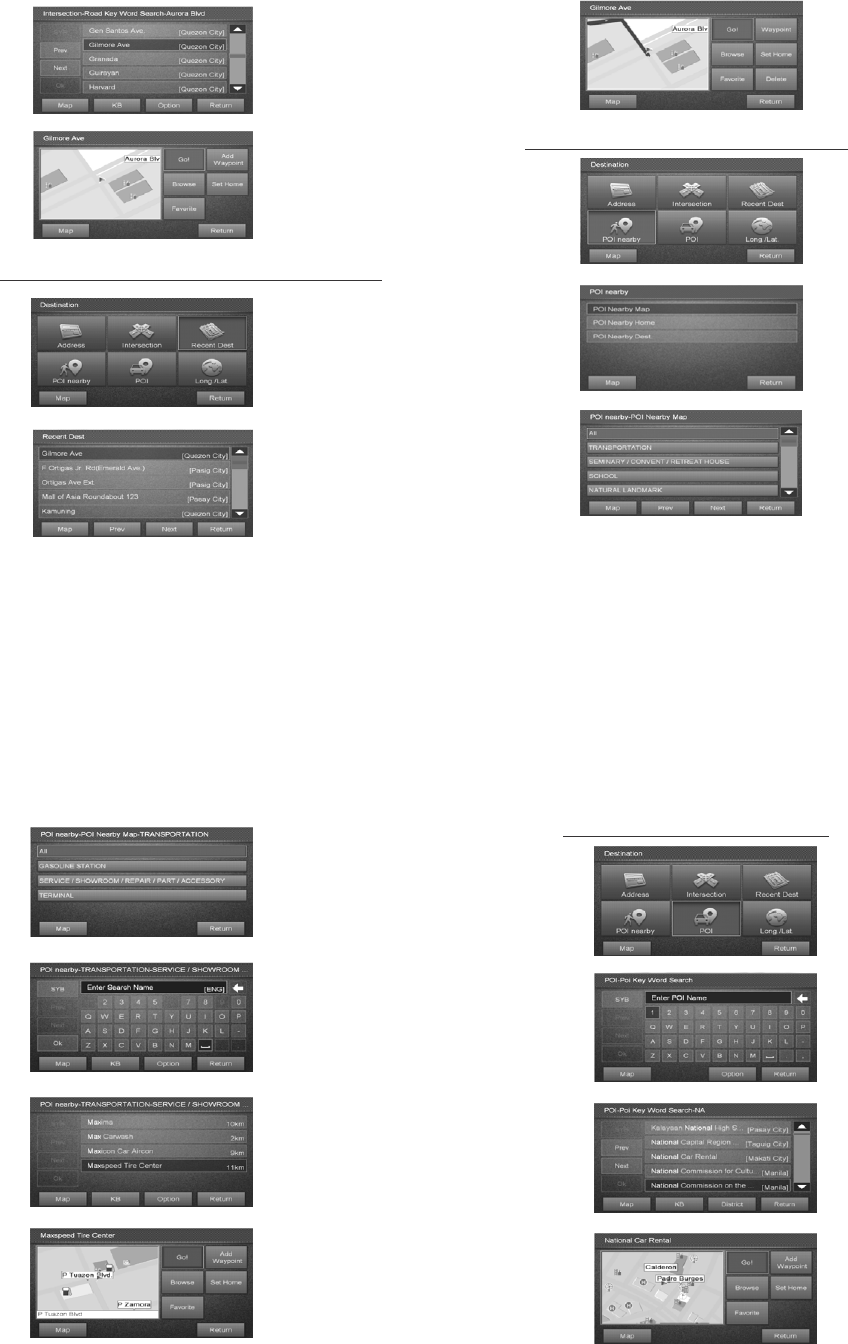
Finding your Destination using Recent Destination
Finding your Destination using POI nearby
fig. 113
fig. 114
fig. 115
fig. 116
fig. 117
fig. 118
fig. 119
Select option:
• Go – Guides you to the
destination.
• Add Waypoint .
• Browse – Browses routing
to destination.
• Set as Home
• Set as Favorite
1. Select Recent Destination.
Select option:
• Go – Guides you to the
destination.
• Add Waypoint .
• Browse – Browses routing
to destination.
• Set as Home
• Set as Favorite
• Delete – Delete recent
destination.
1. Select POI nearby.
fig. 120
4. Then select the street or
roads that crosses on
this road.
2. From the list choose the
places you recently passed by.
2. Select POI category ( POI
nearby map, POI nearby dest.
or POI nearby home. )
3. Select the POI category. For
more choices select next and
previous or use the scroll bar.
Example ( Transportation )
33
fig. 121
fig. 122
fig. 123
fig. 124
Finding your Destination using POI
fig. 125
fig. 126
fig. 127
Select option:
• Go – Guides you to the
destination.
• Add Waypoint .
• Browse – Browses routing to
destination.
• Set as Home
• Set as Favorite
fig. 128
5. Enter the name of the place
you want to visit based on your
categories.
6. Then select the name of the
place.
4. From the list select your
preferred category.
Select option:
• Go – Guides you to the
destination.
• Add Waypoint .
• Browse – Browses routing
to destination.
• Set as Home
• Set as Favorite
2. Enter and search the name of
the place or establishments you
want to visit.
1. Select POI ( Point of Interest ).
3. From the list, select the name
of the place containing the
word you recently entered.
34

Using Longitude / Latitude
fig. 129
fig. 130
Using Quick Menu
fig. 131
Using the on-screen numerical
keyboard, enter the numbers of the
longitude in degrees, min, sec then
latitude in degrees, min, sec
respectively. Select Back tab to
delete the last character entered.
Select Switch tab to move to the
next value to edit i.e. E. Long DEG
to MIN and so on. Select Go tab if
finished to proceed with destination.
1. Select Long. / Lat.
1. Select Quick Menu.
2. Select Gasoline or Hospital
for Quick Access for this
locations and Alternative
Route for fastest route you
desire.
Using My Favorite
2. Select your Favorite
Destination from the list.
Select option:
• Go – Guides you to the
destination.
• Add waypoint
• Browse – Browses
routing to destination.
• Set as Home
• Edit – Edit recent
destination.
• Delete - Delete recent
destination.
fig. 132
fig. 133
fig. 134
fig. 135
1. Select My Favorite.
35
2. Select Browse as Text.
Using Route Info ( Browse as text )
1. Select Route Info.
fig. 136
fig. 137
3. Select from the places you’ve
recently passed through.
Select option:
• Go – Guides you to the
destination.
• Add Waypoint .
• Browse – Browses routing to
destination.
• Set as Home
• Set as Favorite
fig. 138
fig. 139
• The Demo functions shows actual
routing with turn by turn voice
instructions from the car position
to destination. After the
demonstration the system will go
back to the map page
automatically.
Using Route Info ( Demo )
1. Select Demo.
fig. 140
fig. 141
Using Route Info ( Waypoint )
1. Select Waypoint.
fig. 142
36
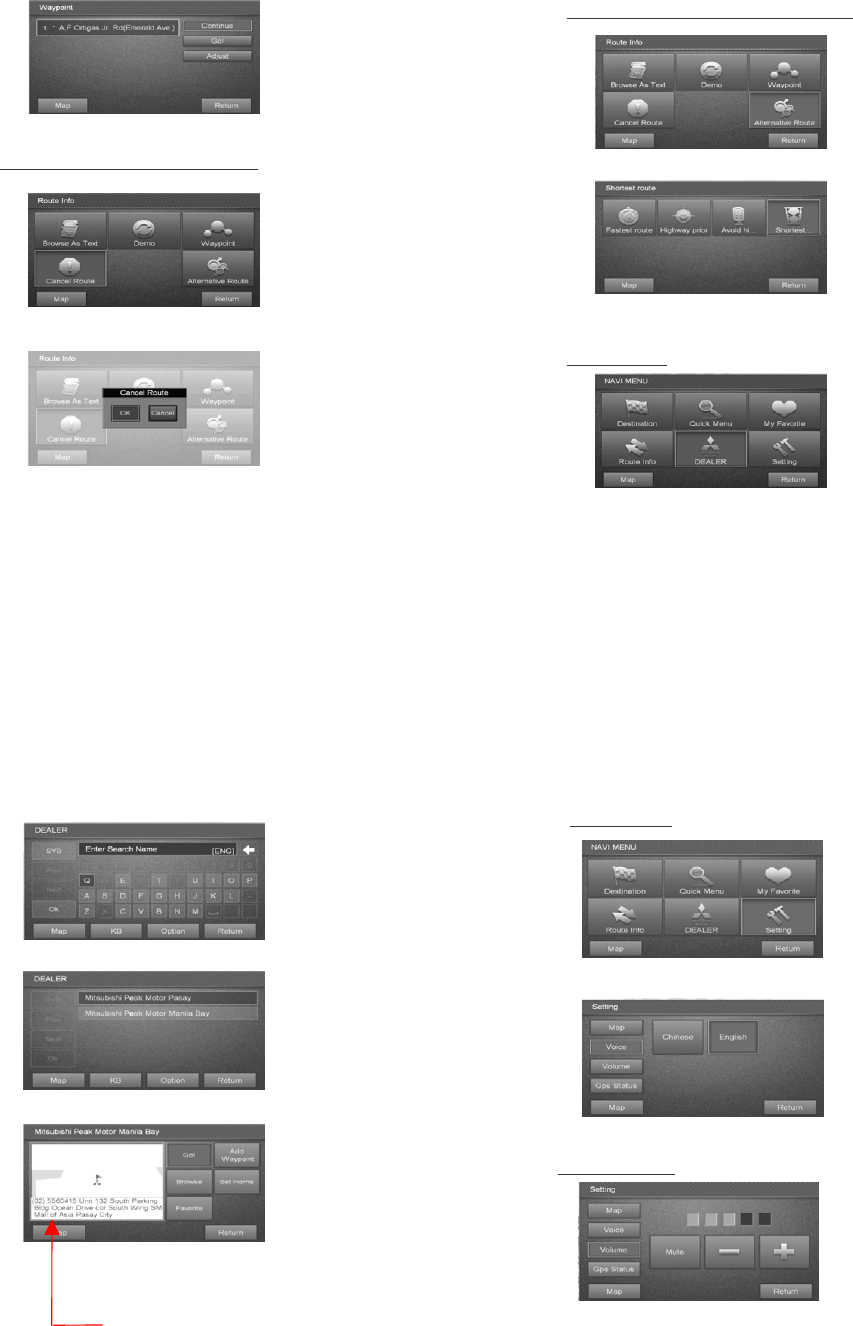
1. Select Cancel Route.
2. Select Ok to cancel route or
Cancel to return to previous
page.
2. Select Go to proceed with the
destination. Choose your
preference route: Fastest
route, Highway priority, Avoid
Highway or Shortest route.
Using Route Info ( Cancel Route )
fig. 143
fig. 144
fig. 145
2. Choose the preferred route:
Fastest route, Highway Priority,
Avoid Highway or Shortest route.
Using Dealer
1. Select Dealer.
Using Route Info ( Alternative Route )
1. Select to set Alternative route.
fig. 146
fig. 147
fig. 148
37
3. Select the name of your
Dealer.
Select option:
• Go – Guides you to the
destination.
• Add Waypoint .
• Browse – Browses routing
to destination.
• Set as Home
• Set as Favorite
Shows the location and
contact number of your
Dealer.
2. Search the name of the Dealer
you want to visit.
fig. 149
fig. 151
2. Select Voice to set the language
you want to use.
Volume Setting
• Select Volume to adjust the
volume of your map.
( Mute / - / + )
fig. 150
Voice Setting
1. Select Setting.
fig. 152
fig. 153
fig. 154
38
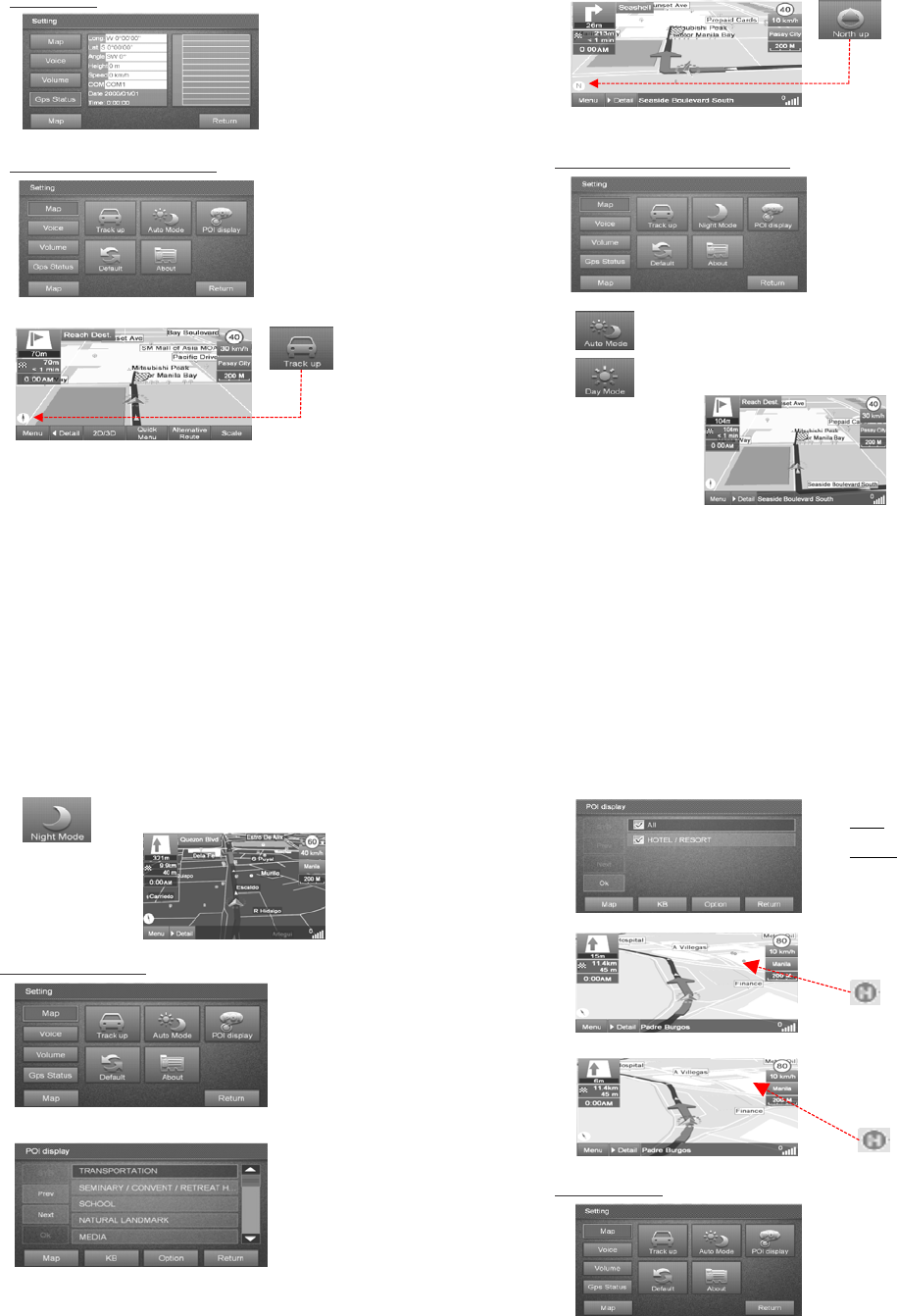
Track Up / North Up Setting
• Select to set map into Track Up or
North Up setting.
• After you select one of the icons.
The icon display change and the
icon that is displayed on your
setting tab will be the one who’ll
take effect on your map.
• Track Up setting - it follows your car position on your navigation system as it turns.
• Selecting GPS Status. It will display
GPS Status Information.
GPS Status
fig. 155
fig. 156
fig. 157
• North Up setting - Displays the North Up position only.
fig. 158
Auto / Day / Night Mode Setting
fig. 159
• Select to set map to Auto, Day
or Night Mode.
• Sets the Background of the map automatically from to 6 am to 6
pm satellite time.
• Set the background of the map into a lighter shade.
fig. 160
39
• Set the background of the map into a Darker shade.
fig. 161
2. Select POI display category . For
Example ( Hotel /Resort )
POI Display Setting
1. Select POI Display to set the
display icon on the map On / Off.
fig. 162
fig. 163
CHECK – you will see
the Hotel / Resort icon
display on the map.
3. Check - Enables Hotel / Resort
icon display on the map.
Uncheck - Disables Hotel /
Resort icon display on the map.
fig. 164
fig. 165 UNCHECK–youwill
notseetheHotel/
Resorticondisplayon
themap.
1. Select Default on the setting
menu.
Default setting
fig. 165
fig. 166
fig. 167
40
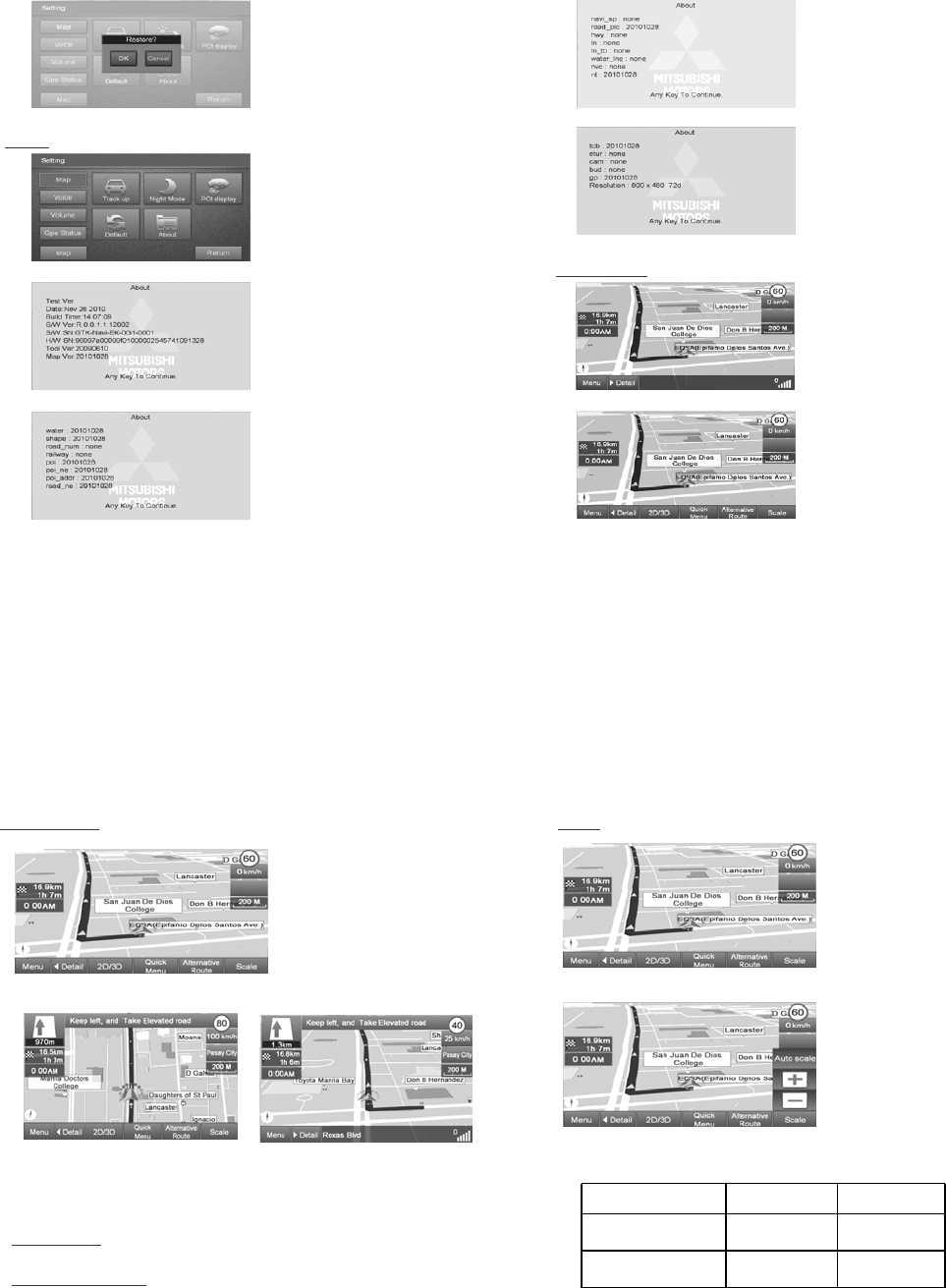
• Select About.
2. Select Ok to restore system
settings or Cancel to exit and
return to previous page.
fig. 168
About
fig. 169
• Display Information about your
Navigation System.
fig. 170
fig. 171
Using Detail
fig. 172
fig. 173
• On the menu bar additional
functions are shown ( 2D/3D,
Quick Menu, Alternative route
and Scale ).
fig. 174
• Select Detail on the menu bar.
fig. 175
41
• Select to set the map into 2D or
3D view.
3D VIEW2D VIEW
fig. 176
fig. 177 fig. 178
Quick Menu –turn to page 5.
Alternative Route –turn to page 10.
Scale2D / 3D View
• Select to set the map scale.
fig. 179
• Select the plus sign ( + ) and
minus sign ( - ) to adjust the
view scale of your map.
• You can use either Manual or
Auto Scale.
2D 3D
Auto Scale 89
Manual Scale 99
Table 15.
42