STONEX SRL S4 S4 Handheld User Manual

STONEX SRL S4 Handheld

User manual

      S4 USER MANUAL (V1.0) 2013.01.28
Table of Contents Chapter 1    Product Introduction ..................................................................................................... 1 1.1 Front Components .............................................................................................................. 1 1.1.1 Keypad ...................................................................................................................... 3 1.2 Back Components ............................................................................................................... 5 1.3 Bottom Components ........................................................................................................... 6 Chapter 2    Basic Operation ............................................................................................................. 7 2.1 Turning on、Suspending、Turning Off、Resetting ............................................................ 7 2.1.1 Turning on ................................................................................................................ 7 2.1.2 Suspending ............................................................................................................... 7 2.1.3 Turning off ................................................................................................................ 8 2.1.4 Resetting................................................................................................................... 8 2.1.4.1 Performing a Hard Reset ............................................................................... 8 2.2 Pull the Stylus out and in ..................................................................................................... 9 2.3 Installing、Uninstalling the SIM、TF Card and Battery ...................................................... 9 2.4 Charging the Battery ......................................................................................................... 10 2.5 Fitting the Hand Strap ....................................................................................................... 11 Chapter 3    Connecting and Synchronizing with Your Computer ................................................... 12 3.1 Installing Connection Management Software ................................................................... 12 3.1.1 Installing the Windows Mobile Device Center ....................................................... 12 3.1.2 Installing ActiveSync ............................................................................................... 13 3.2 Connecting and Synchronizing With Your Computer ........................................................ 13 3.2.1 Managing the Connection and Synchronization Using the Windows Mobile Device Center .............................................................................................................................. 13 3.2.2 Managing the Connection and Synchronization Using the ActiveSync .................. 17 3.2.3 Connecting with U Disk Mode ................................................................................ 20 3.2.4 OTG Connection ..................................................................................................... 21 Chapter 4    Brief Description of the Operating System .................................................................. 22 4.1 System Main Interface and the Start Menu ...................................................................... 22 4.2 Status Indicators ................................................................................................................ 24 4.2.1 Battery Status Indicators ........................................................................................ 24 4.2.2 Speaker Status Indicators ....................................................................................... 24 4.2.3 Network and Modem Status Indicators ................................................................. 25 4.3 Pre-installed Programs ...................................................................................................... 25 4.4 Interacting With the Device .............................................................................................. 26 4.5 Entering Information ......................................................................................................... 27 4.5.1 Using the On-screen Keyboard ............................................................................... 27 4.5.2 Drawing and Writing on the Screen Directly .......................................................... 28 4.5.3 Recording a Message .............................................................................................. 29 4.5.4 Camera (Select Models Only) ................................................................................. 30 4.5.4.1 Taking Pictures ............................................................................................. 30 4.5.4.2 Recording Video Clips .................................................................................. 32 4.6 Personal Settings ............................................................................................................... 34
4.6.1 Buttons ................................................................................................................... 34 4.6.2 Home ...................................................................................................................... 35 4.6.2.1 Appearance ................................................................................................. 35 4.6.2.2 Items ............................................................................................................ 36 4.6.2.3 Set Date and time ........................................................................................ 37 4.6.3 Screen Lock............................................................................................................. 38 4.6.4 Set Passwords ......................................................................................................... 39 4.6.5 Power ..................................................................................................................... 40 4.6.6 Sounds and Notifications ....................................................................................... 41 4.6.7 Screen ..................................................................................................................... 42 4.6.8 Backlight ................................................................................................................. 43 4.6.9 Align Screen ............................................................................................................ 44 4.7 GPRS Network Setting ....................................................................................................... 45 4.7.1 Add New GPRS Connecting .................................................................................... 45 4.8 Bluetooth Connecting ....................................................................................................... 47 4.9 Phone and Text Messages (Select Models Only) ............................................................... 49 4.9.1 Phone ..................................................................................................................... 49 4.9.1.1 About Your Phone ....................................................................................... 49 4.9.1.2 Making a Call ............................................................................................... 52 4.9.1.3 Responding to a Call .................................................................................... 54 4.9.1.4 Operations During a Call ............................................................................. 55 4.9.1.5 Using Call History ........................................................................................ 59 4.9.1.6 Using Speed Dial .......................................................................................... 60 4.9.1.7 Customizing Your Phone .............................................................................. 61 4.9.1.8 Additional Phone Operations ...................................................................... 63 4.9.2 Text Messages ........................................................................................................ 65 4.9.2.1 Reading Text Messages ............................................................................... 65 4.9.2.2 Composing and Sending a Text Message .................................................... 65 4.10 WIFI Connecting .............................................................................................................. 66 4.10.1 Switching On or Off the Wi-Fi Radio .................................................................... 66 4.10.2 Connecting to a Wireless Network ....................................................................... 67 Chapter 5    Software Operation ..................................................................................................... 69 5.1 Installing Programs ............................................................................................................ 69 5.2 Uninstalling Programs ....................................................................................................... 69 Chapter 6    Troubleshooting and Maintenance ............................................................................. 70 6.1 Troubleshooting ................................................................................................................ 70 6.2 Resetting Your Device ........................................................................................................ 71 6.3 Caring for Your Device ....................................................................................................... 72
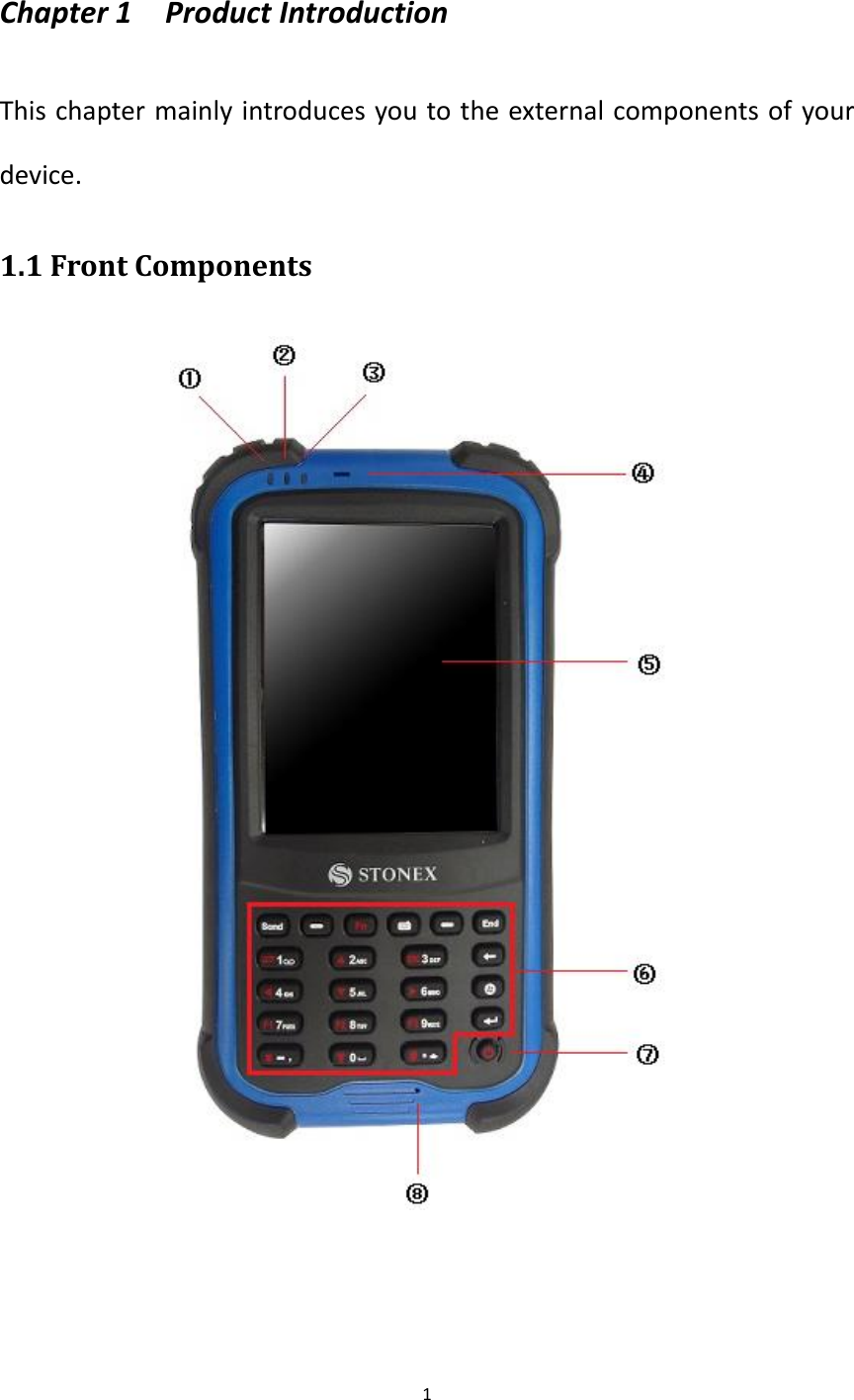
1  Chapter 1    Product Introduction This chapter mainly introduces you to the external components of your device. 1.1 Front Components
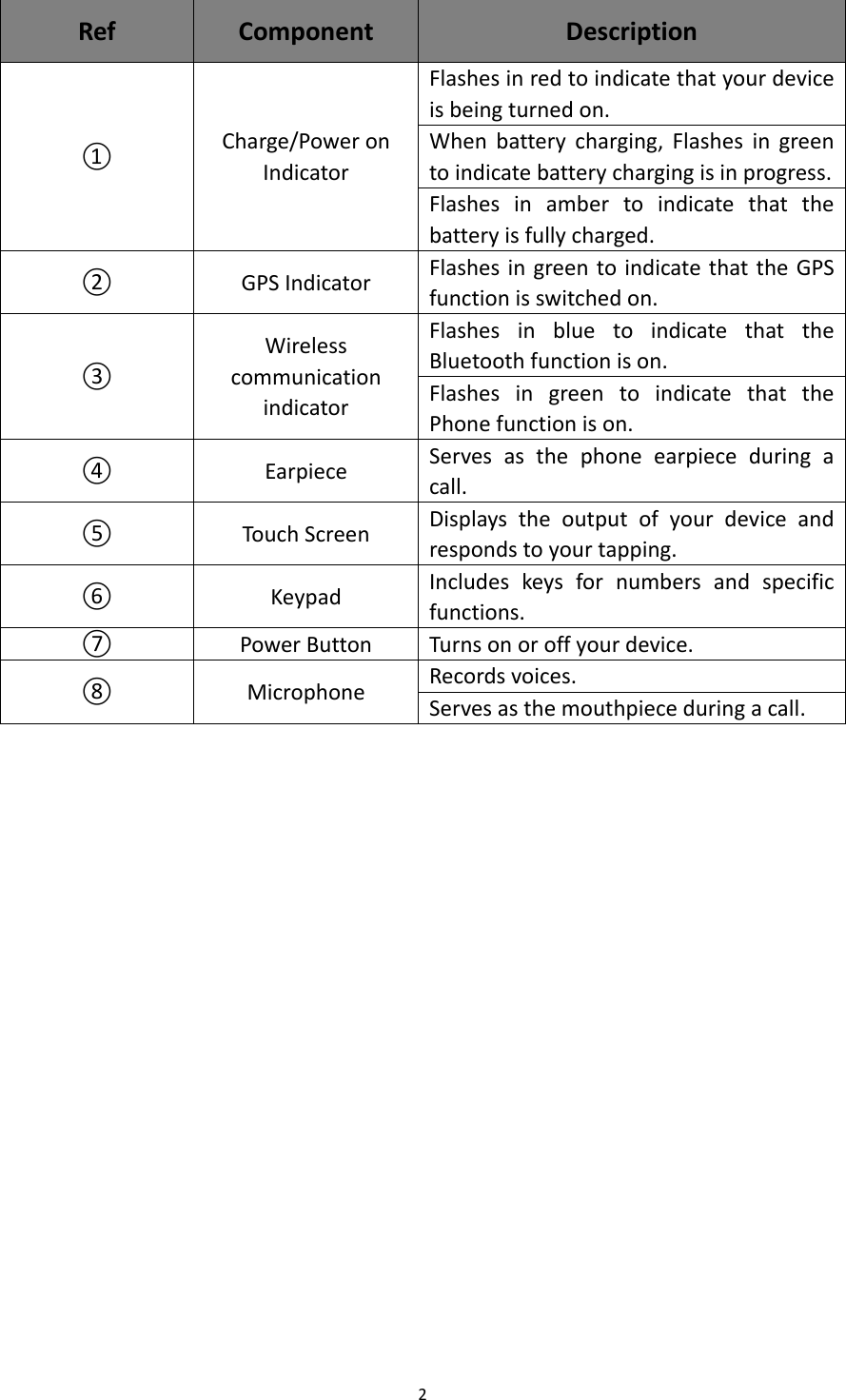
2  Ref Component Description ① Charge/Power on Indicator Flashes in red to indicate that your device is being turned on. When  battery  charging, Flashes  in  green to indicate battery charging is in progress.   Flashes  in  amber  to  indicate  that  the battery is fully charged. ② GPS Indicator Flashes in green to indicate that the GPS function is switched on. ③ Wireless communication indicator Flashes  in  blue  to  indicate  that  the Bluetooth function is on.   Flashes  in  green  to  indicate  that  the Phone function is on. ④ Earpiece Serves  as  the  phone  earpiece  during  a call. ⑤ Touch Screen Displays  the  output  of  your  device  and responds to your tapping. ⑥ Keypad Includes  keys  for  numbers  and  specific functions. ⑦ Power Button Turns on or off your device. ⑧ Microphone Records voices. Serves as the mouthpiece during a call.
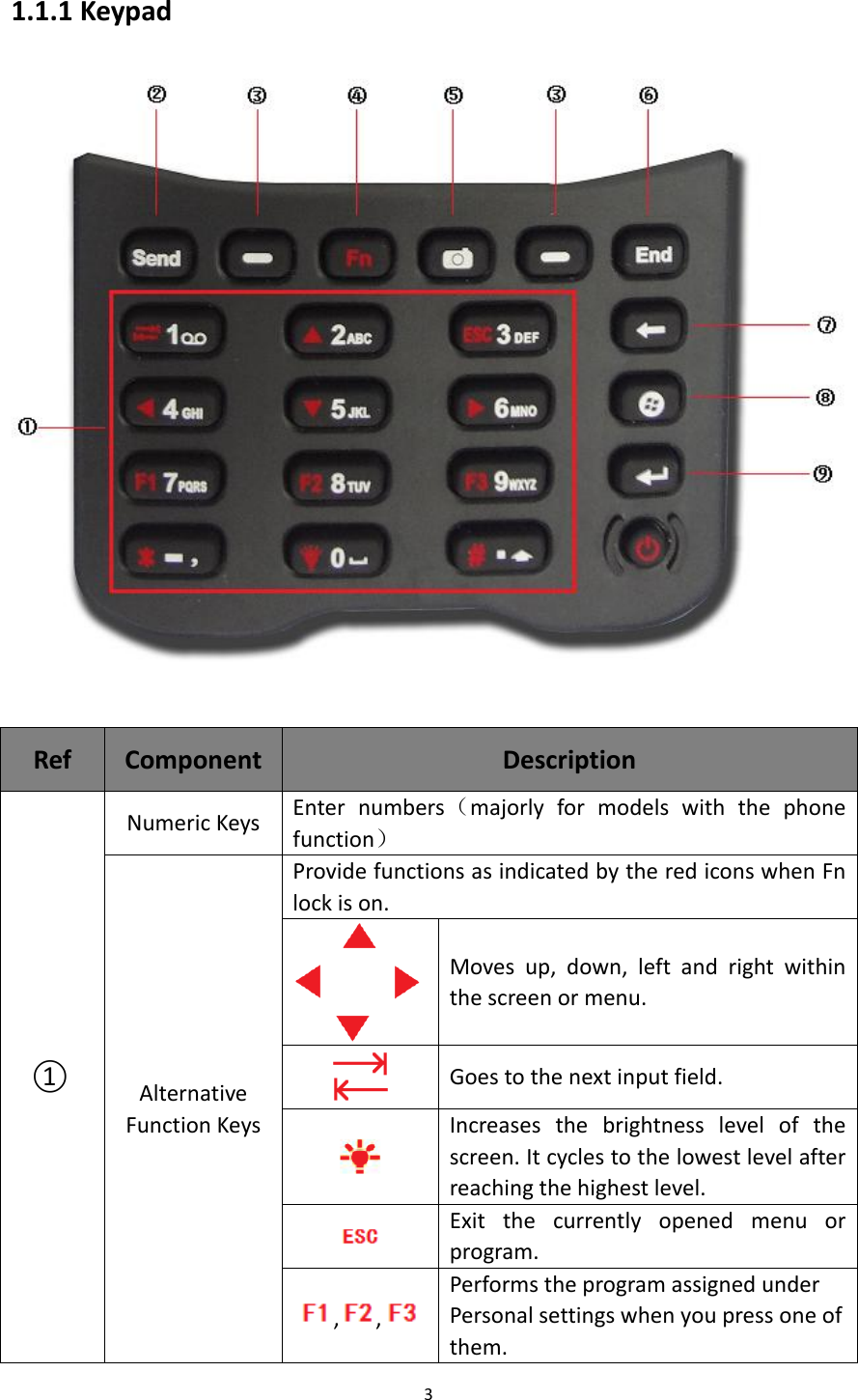
3  1.1.1 Keypad   Ref Component Description ①  Numeric Keys Enter  numbers(majorly  for  models  with  the  phone function) Alternative Function Keys Provide functions as indicated by the red icons when Fn lock is on.           Moves  up,  down,  left  and  right  within the screen or menu.  Goes to the next input field.  Increases  the  brightness  level  of  the screen. It cycles to the lowest level after reaching the highest level.  Exit  the  currently  opened  menu  or program. , ,  Performs the program assigned under Personal settings when you press one of them.
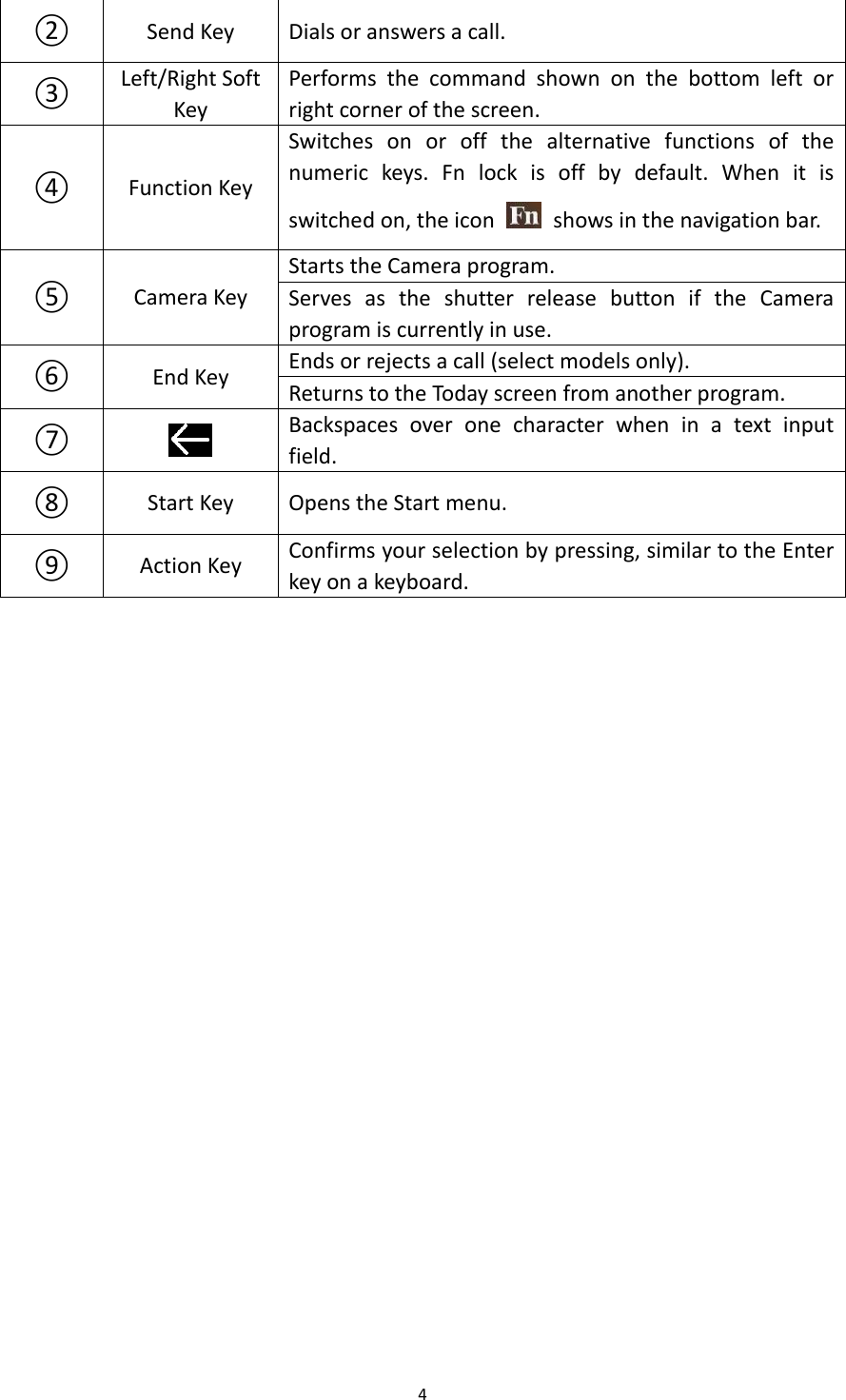
4  ② Send Key Dials or answers a call. ③ Left/Right Soft Key Performs  the  command  shown  on  the  bottom  left  or right corner of the screen. ④ Function Key Switches  on  or  off  the  alternative  functions  of  the numeric  keys.  Fn  lock  is  off  by  default.  When  it  is switched on, the icon    shows in the navigation bar. ⑤ Camera Key Starts the Camera program. Serves  as  the  shutter  release  button  if  the  Camera program is currently in use. ⑥ End Key Ends or rejects a call (select models only). Returns to the Today screen from another program. ⑦  Backspaces  over  one  character  when  in  a  text  input field. ⑧ Start Key Opens the Start menu. ⑨ Action Key Confirms your selection by pressing, similar to the Enter key on a keyboard.
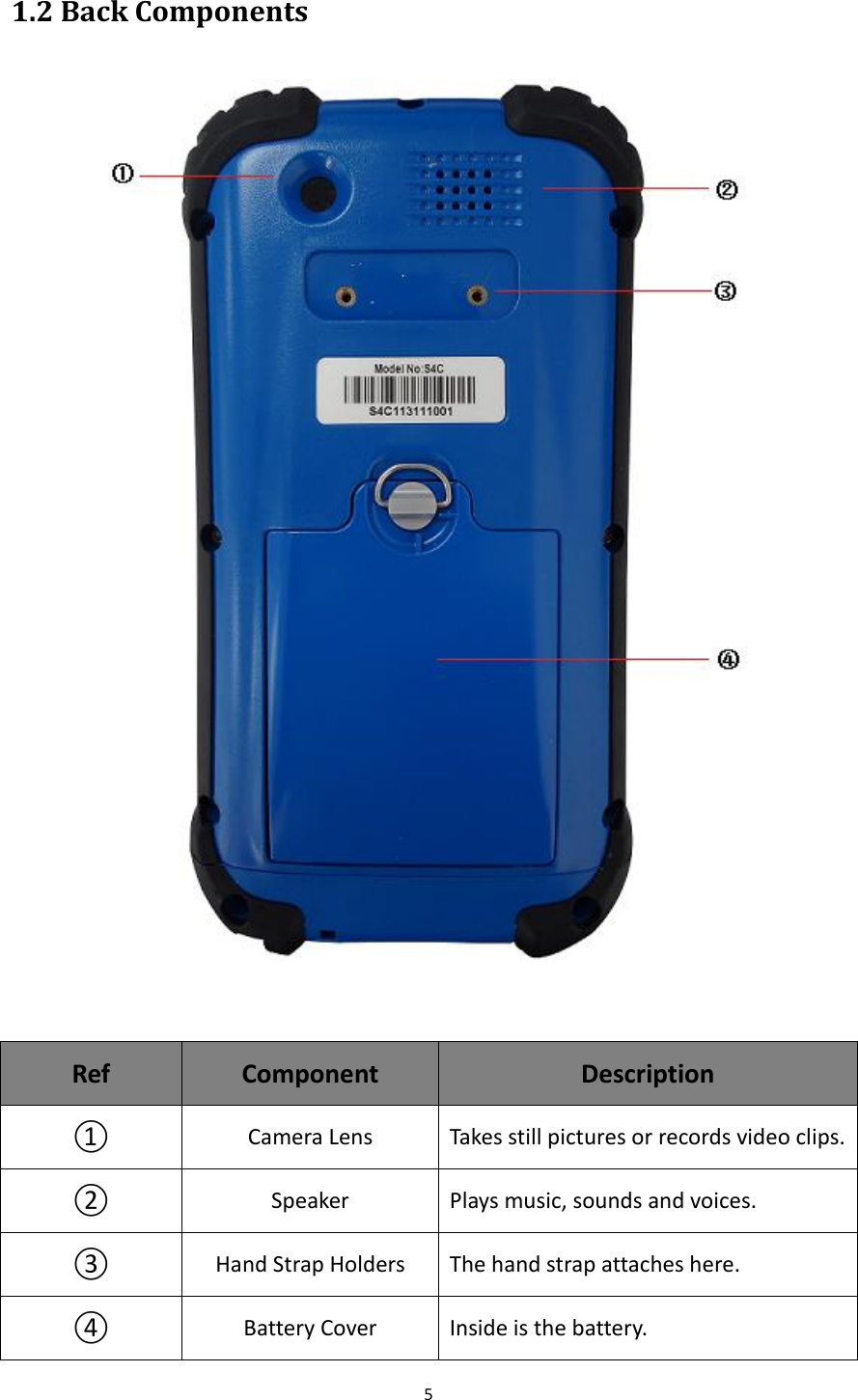
5  1.2 Back Components   Ref Component Description ① Camera Lens Takes still pictures or records video clips. ② Speaker Plays music, sounds and voices. ③ Hand Strap Holders The hand strap attaches here. ④ Battery Cover Inside is the battery.
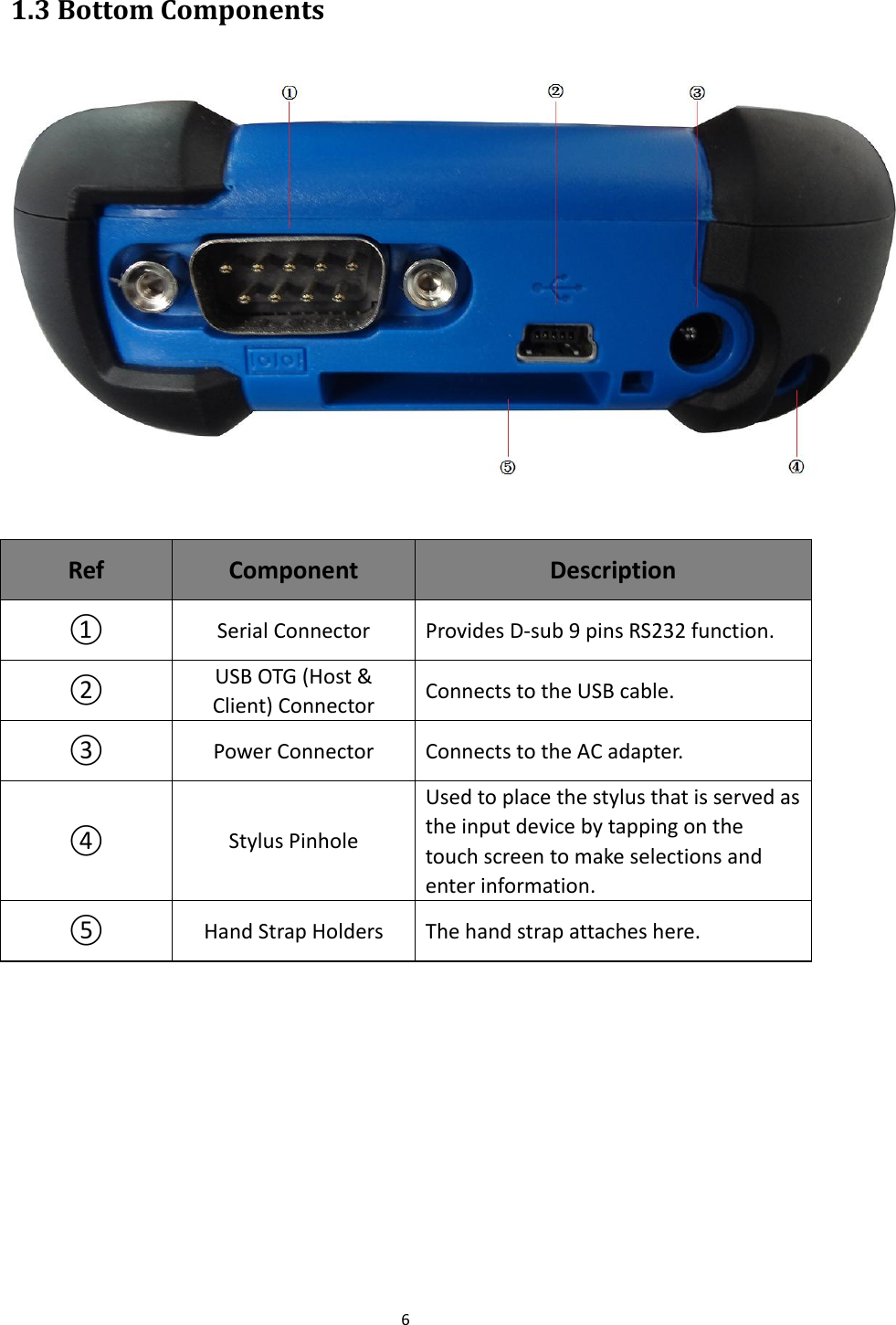
6  1.3 Bottom Components   Ref Component Description ① Serial Connector Provides D-sub 9 pins RS232 function. ② USB OTG (Host & Client) Connector Connects to the USB cable. ③ Power Connector Connects to the AC adapter. ④ Stylus Pinhole Used to place the stylus that is served as the input device by tapping on the touch screen to make selections and enter information. ⑤ Hand Strap Holders The hand strap attaches here.
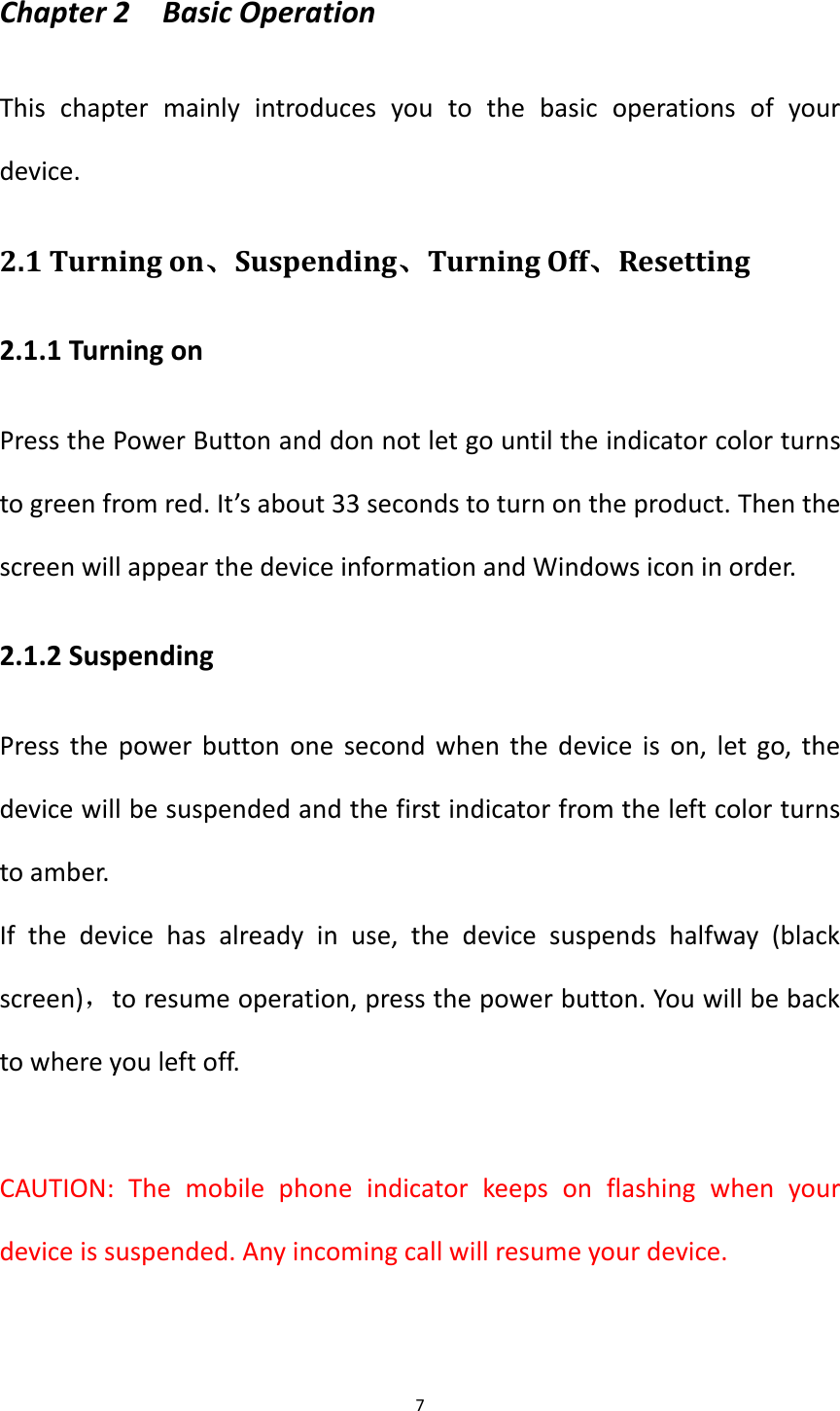
7  Chapter 2    Basic Operation This  chapter  mainly  introduces  you  to  the  basic  operations  of  your device. 2.1 Turning on、Suspending、Turning Off、Resetting 2.1.1 Turning on Press the Power Button and don not let go until the indicator color turns to green from red. It’s about 33 seconds to turn on the product. Then the screen will appear the device information and Windows icon in order. 2.1.2 Suspending Press the power button one second when the device is on,  let go, the device will be suspended and the first indicator from the left color turns to amber. If  the  device  has  already  in  use,  the  device  suspends  halfway  (black screen),to resume operation, press the power button. You will be back to where you left off.  CAUTION:  The  mobile  phone  indicator  keeps  on  flashing  when  your device is suspended. Any incoming call will resume your device.
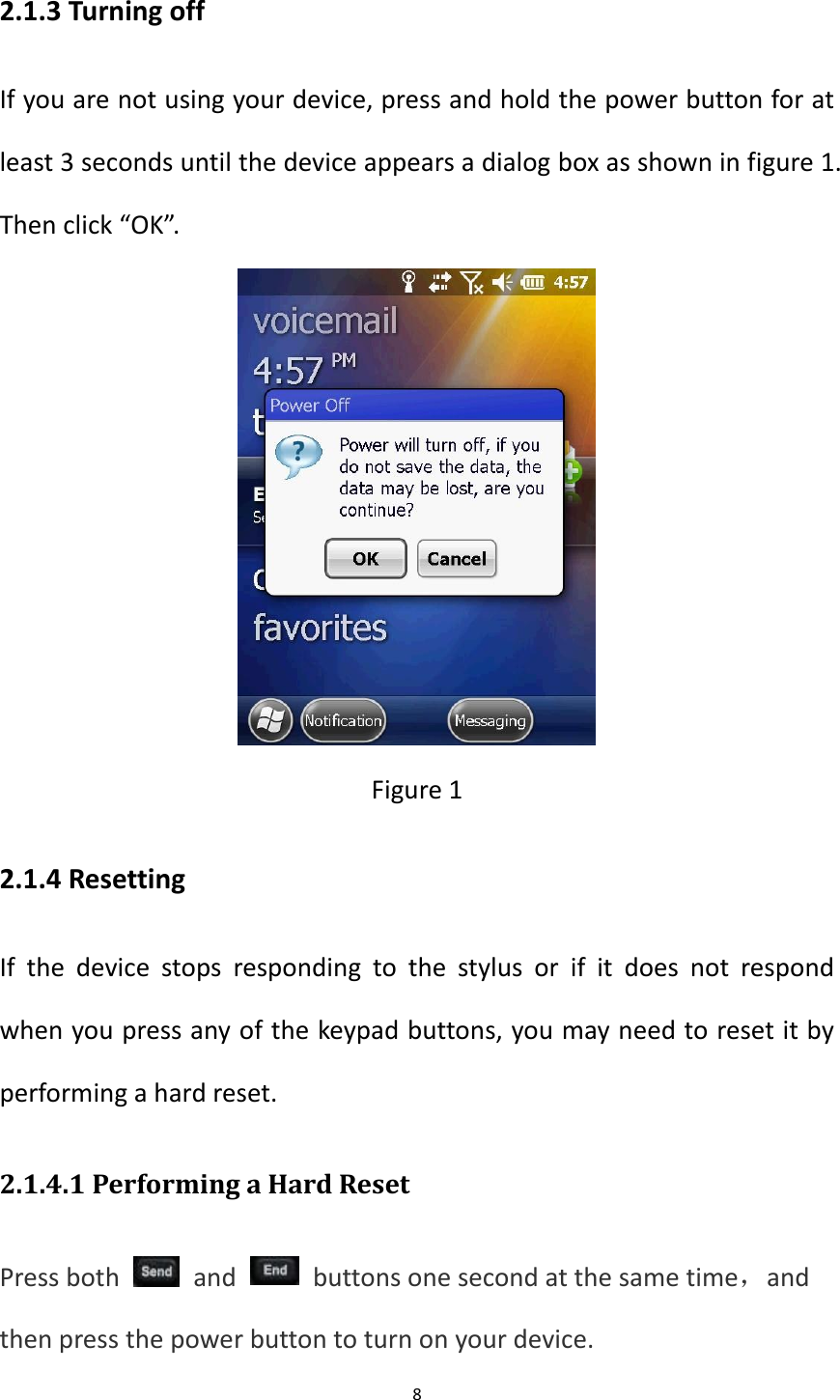
8  2.1.3 Turning off If you are not using your device, press and hold the power button for at least 3 seconds until the device appears a dialog box as shown in figure 1. Then click “OK”.  Figure 1 2.1.4 Resetting If  the  device  stops  responding  to  the  stylus  or  if  it  does  not  respond when you press any of the keypad buttons, you may need to reset it by performing a hard reset. 2.1.4.1 Performing a Hard Reset Press both    and    buttons one second at the same time,and then press the power button to turn on your device.
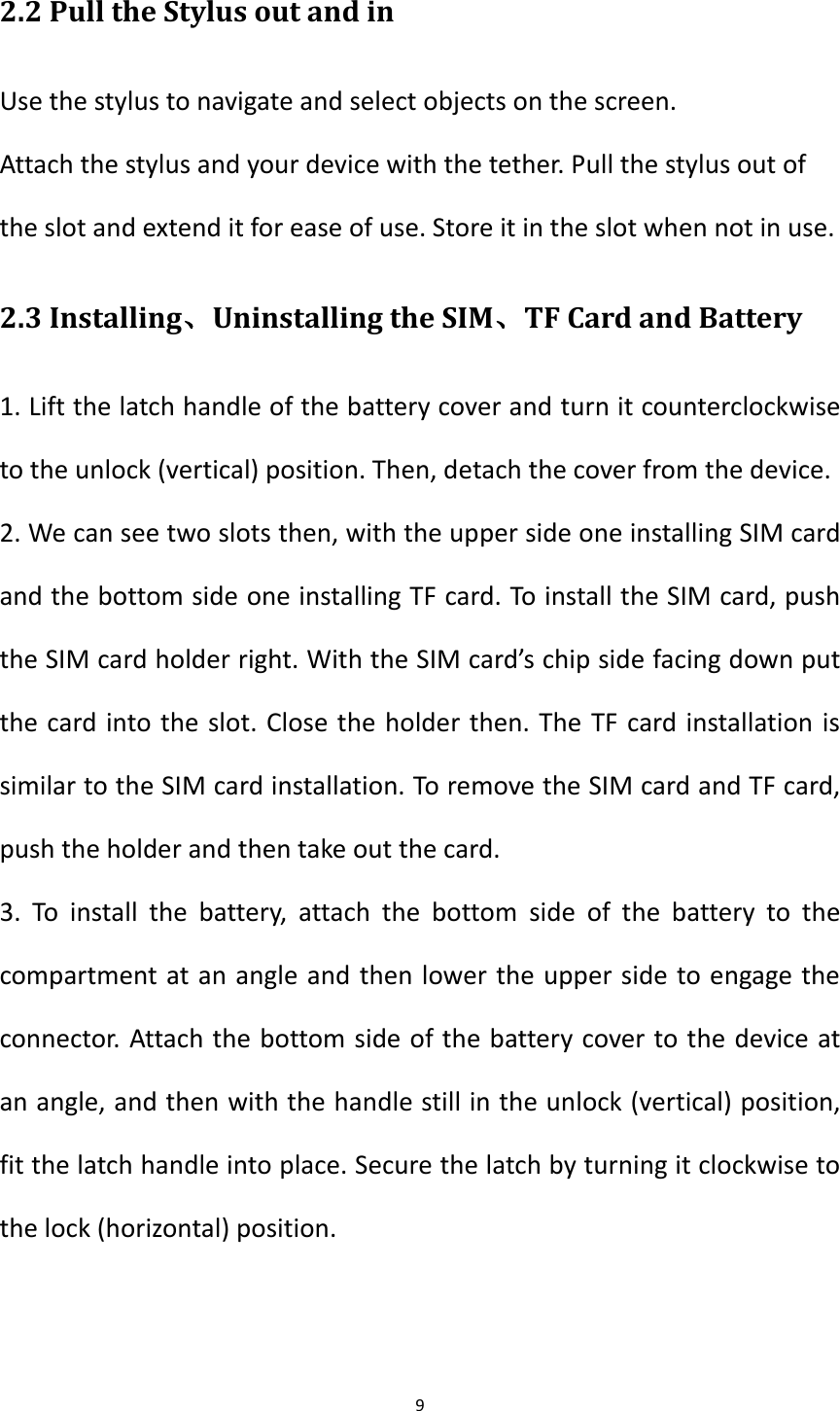
9  2.2 Pull the Stylus out and in Use the stylus to navigate and select objects on the screen.   Attach the stylus and your device with the tether. Pull the stylus out of the slot and extend it for ease of use. Store it in the slot when not in use.   2.3 Installing、Uninstalling the SIM、TF Card and Battery 1. Lift the latch handle of the battery cover and turn it counterclockwise to the unlock (vertical) position. Then, detach the cover from the device. 2. We can see two slots then, with the upper side one installing SIM card and the bottom side one installing TF card. To install the SIM card, push the SIM card holder right. With the SIM card’s chip side facing down put the card into the slot. Close the holder then. The TF card installation is similar to the SIM card installation. To remove the SIM card and TF card, push the holder and then take out the card. 3.  To  install  the  battery,  attach  the  bottom  side  of  the  battery  to  the compartment at an angle and then lower the upper side to engage the connector. Attach the bottom side of the battery cover to the device at an angle, and then with the handle still in the unlock (vertical) position, fit the latch handle into place. Secure the latch by turning it clockwise to the lock (horizontal) position.
10  CAUTION RISK OF EXPLOSION IF BATTERY IS REPLACED BY AN INCORRECT TYPE. DISPOSE OF USED BATTERIES ACCORDING TO THE INSTRUCTIONS  CAUTION: it’s easy to cause damage to the battery when installing the battery,  if  we  lower  the  upper  side  of  the  battery  to  engage  the connector  first  in  an  angle  and  then  attach  the  bottom  side  of  the battery to the compartment.   2.4 Charging the Battery The battery isn’t charging when factory. So we must charge the battery completely before using it for the first time. Charging lasts for two and a half hours, the charger has overcharge protection function.  CAUTION: For optimal performance of the lithium battery, take note of the following:  Use the included AC adapter and charger only.  There is no need to fully discharge the battery before charging. You can charge the battery before it is discharged.  Do not charge the battery where the temperature is high(higher than 50℃) or low(less than 0℃).  If you will not use the product for a long period of time, be sure to fully  charge  the  battery  at  least  once  every  two  weeks,  over discharge of the battery can affect the charging performance.
11  2.5 Fitting the Hand Strap Align the upper hand strap bracket with the two mounting holes behind the device and then use a screwdriver to tighten the screws. The other side is fixed to the hand strap holders at the bottom of the device. We can see it after the installation is complete as shown in figure 2.  Figure 2
12  Chapter  3    Connecting  and  Synchronizing  with  Your Computer 3.1 Installing Connection Management Software To  install  software  onto  a  device  powered  by  the  Windows  Mobile operating system or to copy files between your device and a PC you must connect the device to a PC. If the computer is running: •  Windows  7  or  Windows  Vista  operating  system,  use  the  Windows Mobile Device Center (WMDC) to manage the connection. • Windows XP or 2000 operating system, use ActiveSync to manage the connection.  CAUTION:  You  must  install  the  Windows  Mobile  Device  Center  or ActiveSync  technology  onto  the  computer  before  you  connect  the handheld. 3.1.1 Installing the Windows Mobile Device Center The Windows 7 and the Windows Vista operating system include a basic connectivity driver for devices powered by a Windows Mobile operating system.  This  driver  allows  you  to  transfer  files  from  the  device  to  an office computer. To  install  software  onto  a  device  powered  by  a  Windows  Mobile
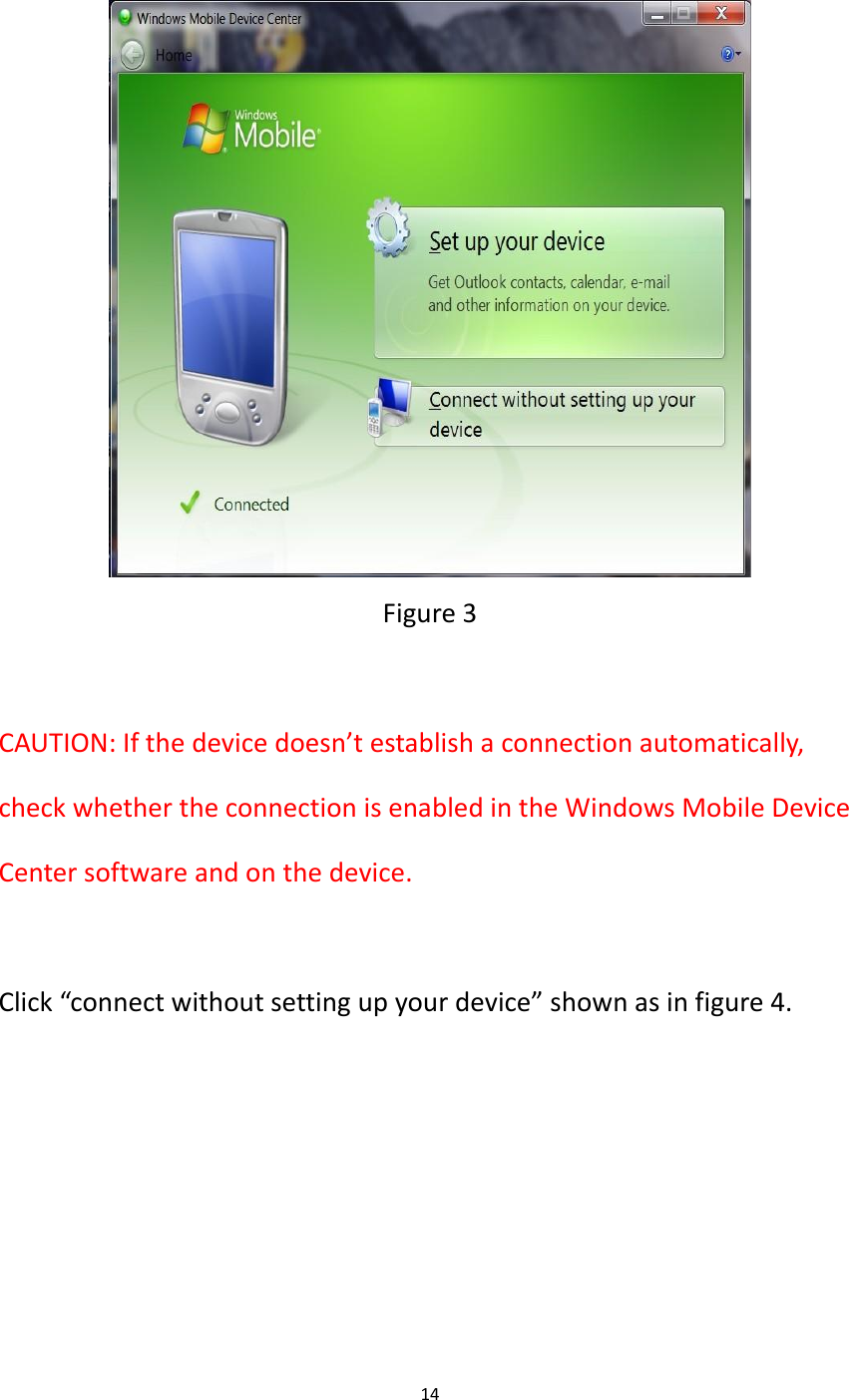
13  operating  system,  you  must  install  Windows Mobile  Device  Center  6.5 onto a PC. 3.1.2 Installing ActiveSync Search the ActiveSync 4.5 version to download. Alternatively, visit http://www.microsoft.com/en-us/download/details.aspx?id=15 to download the latest version from the Microsoft website. 3.2 Connecting and Synchronizing With Your Computer To connect the device to a PC: 1. Make sure that the device and the PC are switched on. 2. Make sure you have installed the appropriate connection management software onto the PC. 3. To form a connection, do one of the following: ① Use the device's integrated Bluetooth radio to establish a wireless serial link to a Bluetooth-enabled computer. ② Use a USB connection: Plug the USB cable into the USB port on the device. Plug the other end of the USB cable into a USB port on the PC. 3.2.1  Managing  the  Connection  and  Synchronization  Using  the Windows Mobile Device Center Connect the device to the PC. It will appear a dialog box shown as in figure 3 if the device successfully connects to the PC.
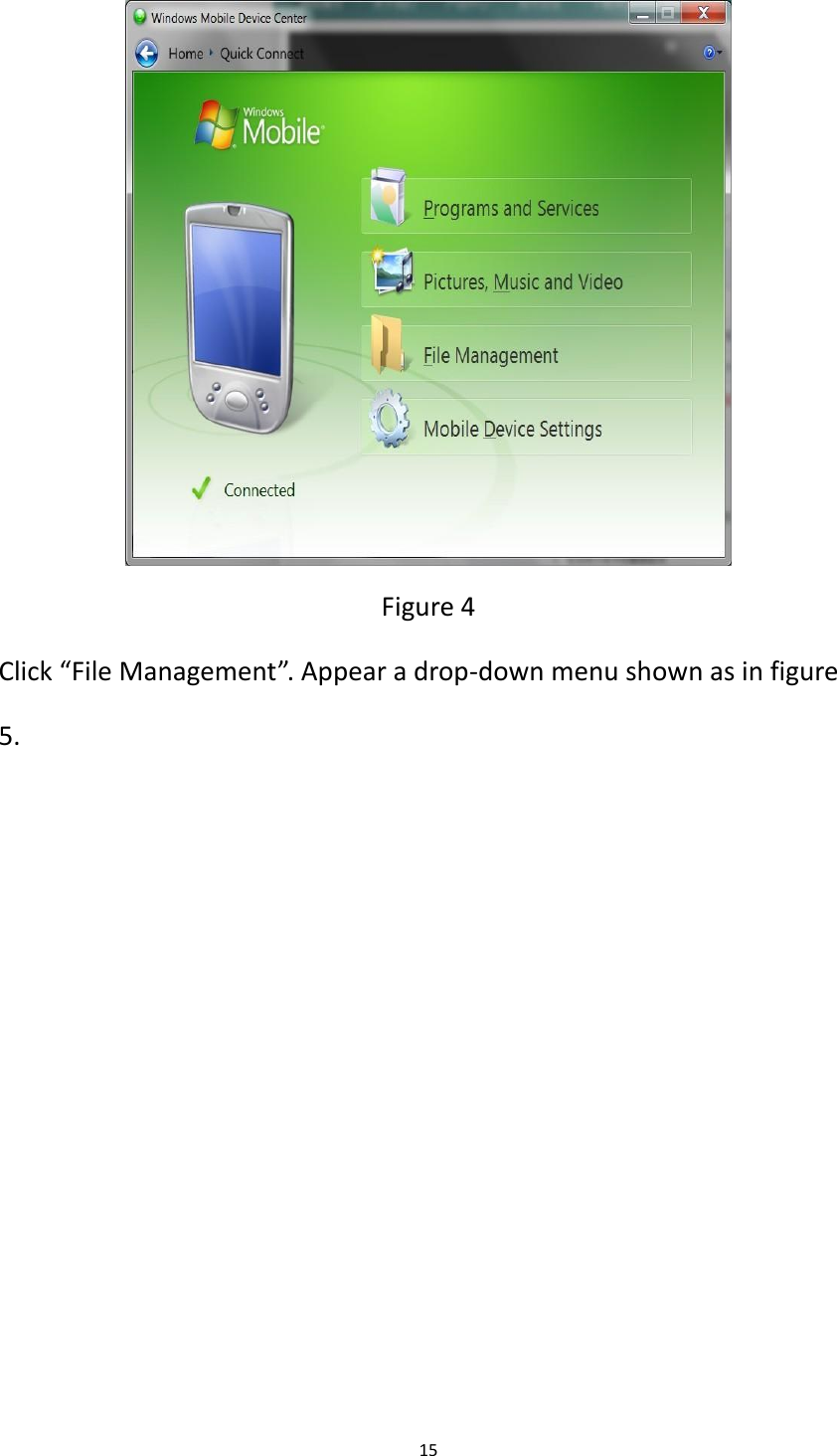
14    Figure 3  CAUTION: If the device doesn’t establish a connection automatically, check whether the connection is enabled in the Windows Mobile Device Center software and on the device.  Click “connect without setting up your device” shown as in figure 4.
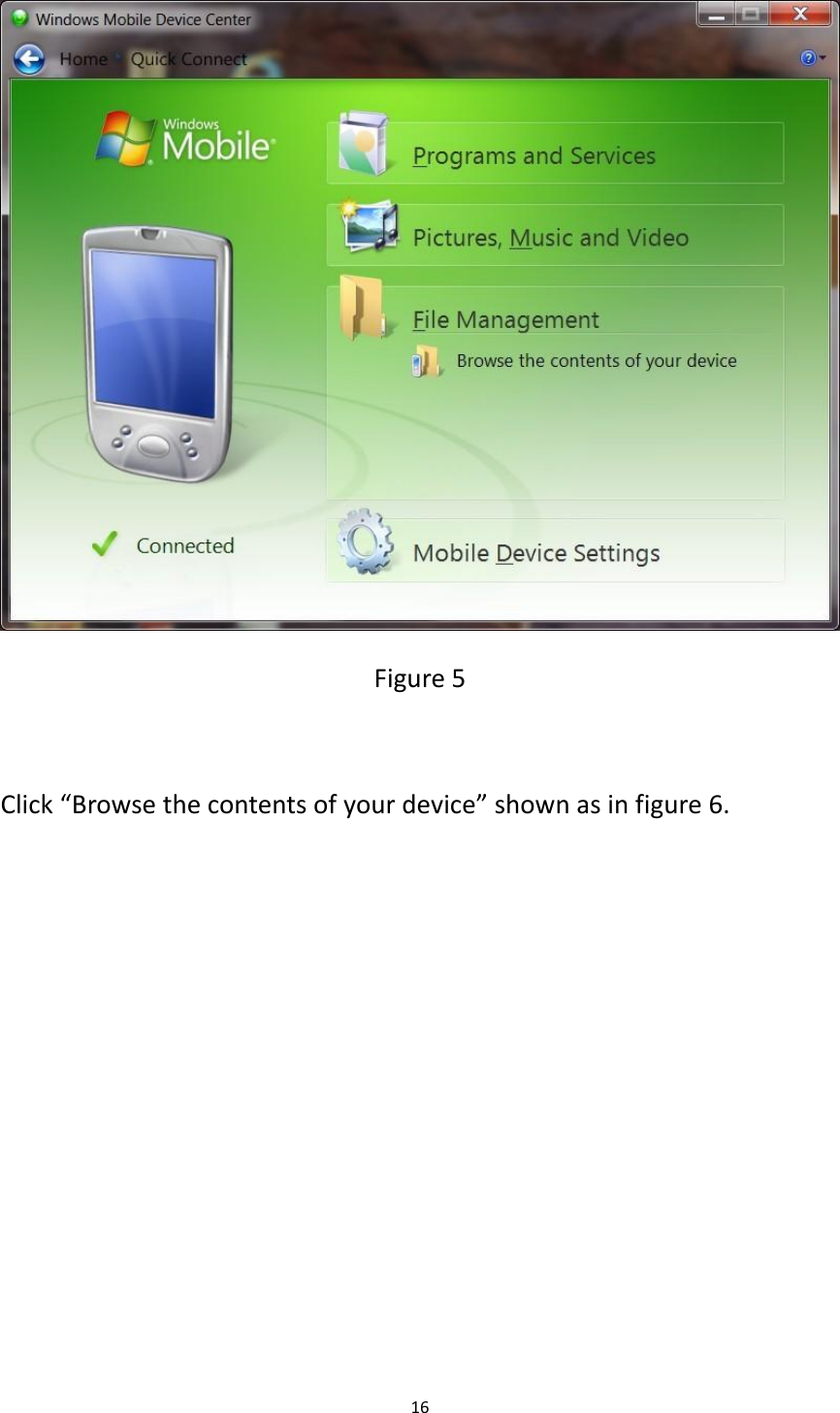
15   Figure 4 Click “File Management”. Appear a drop-down menu shown as in figure 5.
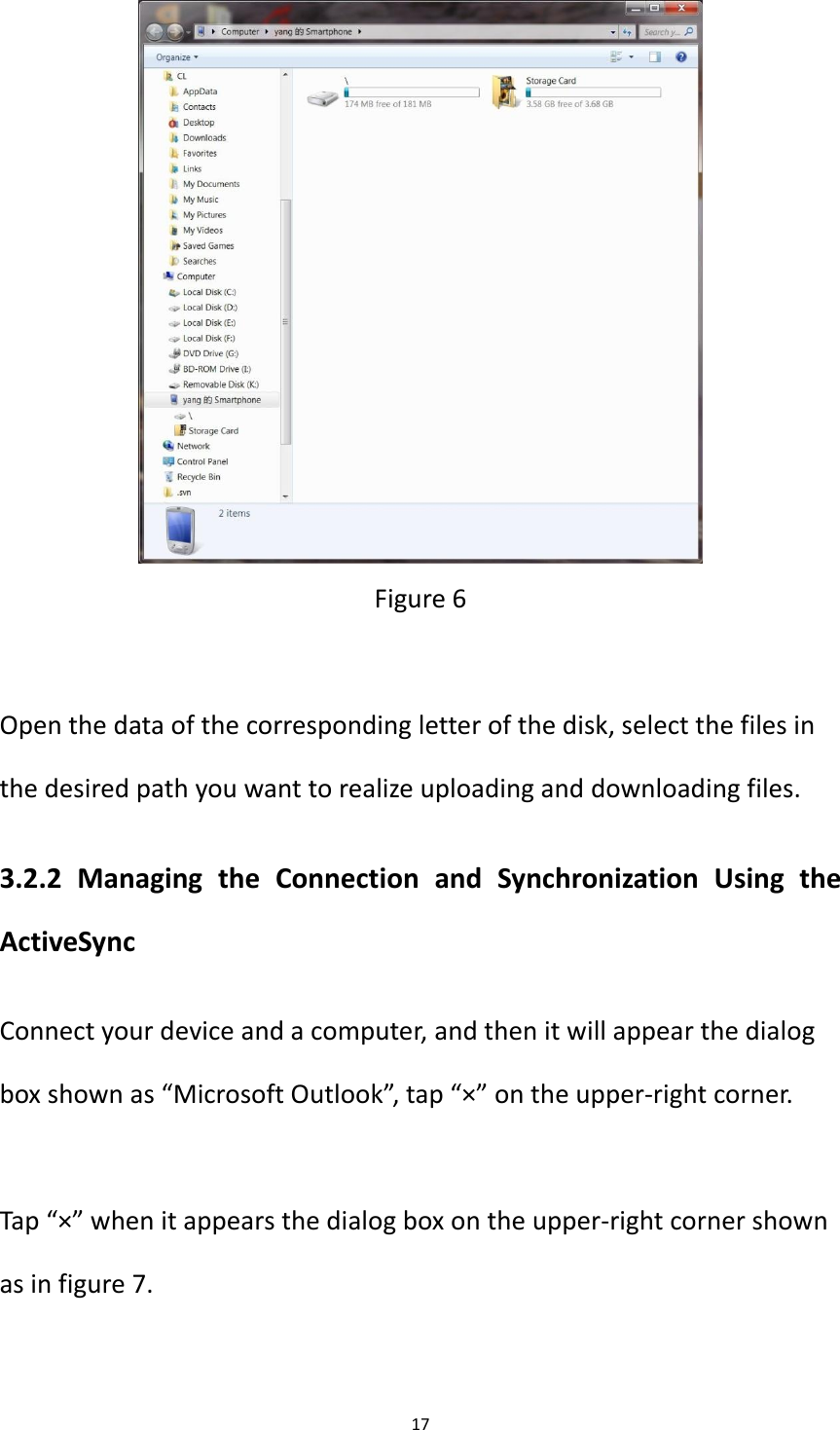
16   Figure 5  Click “Browse the contents of your device” shown as in figure 6.
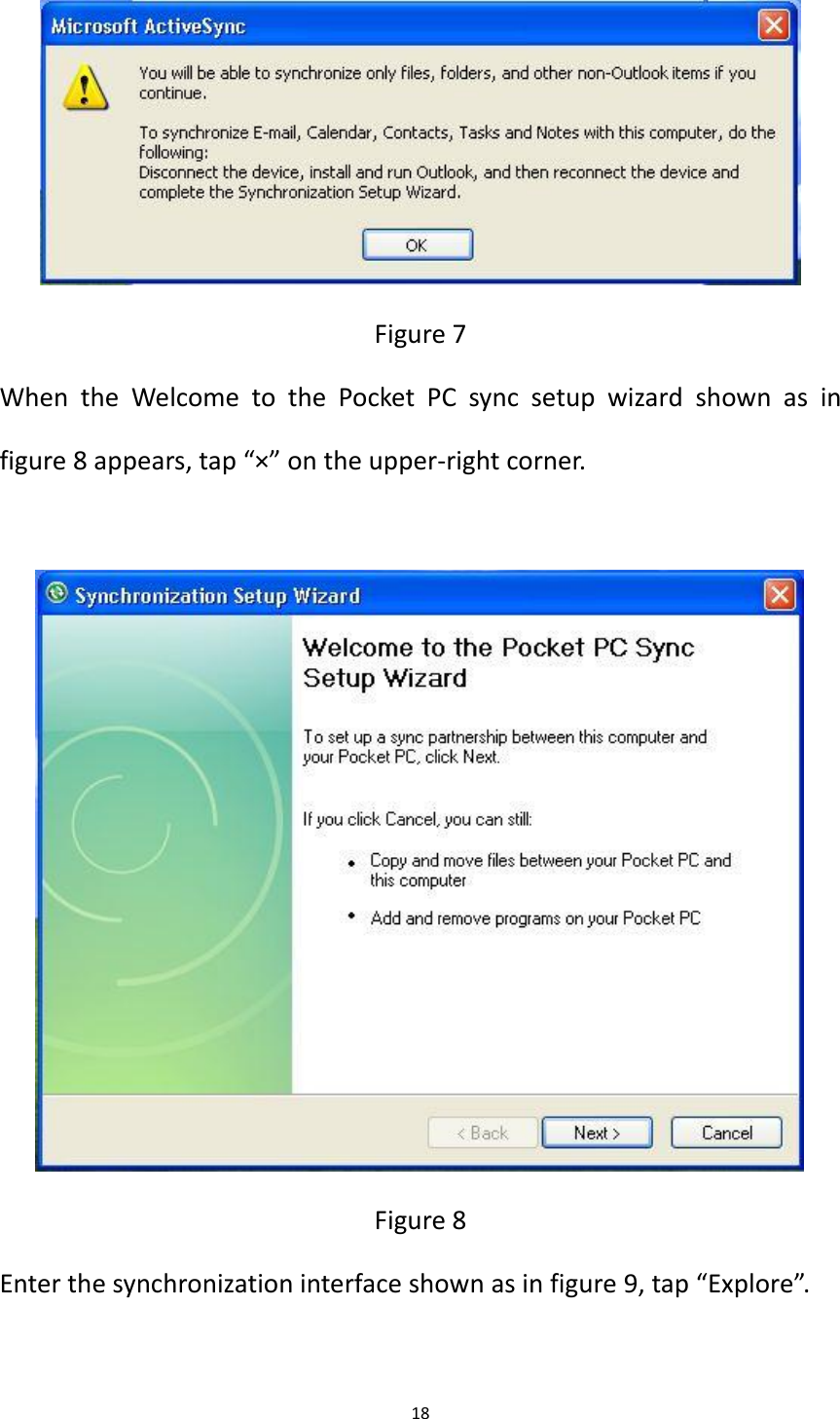
17   Figure 6  Open the data of the corresponding letter of the disk, select the files in the desired path you want to realize uploading and downloading files. 3.2.2  Managing  the  Connection  and  Synchronization  Using  the ActiveSync Connect your device and a computer, and then it will appear the dialog box shown as “Microsoft Outlook”, tap “×” on the upper-right corner.  Tap “×” when it appears the dialog box on the upper-right corner shown as in figure 7.
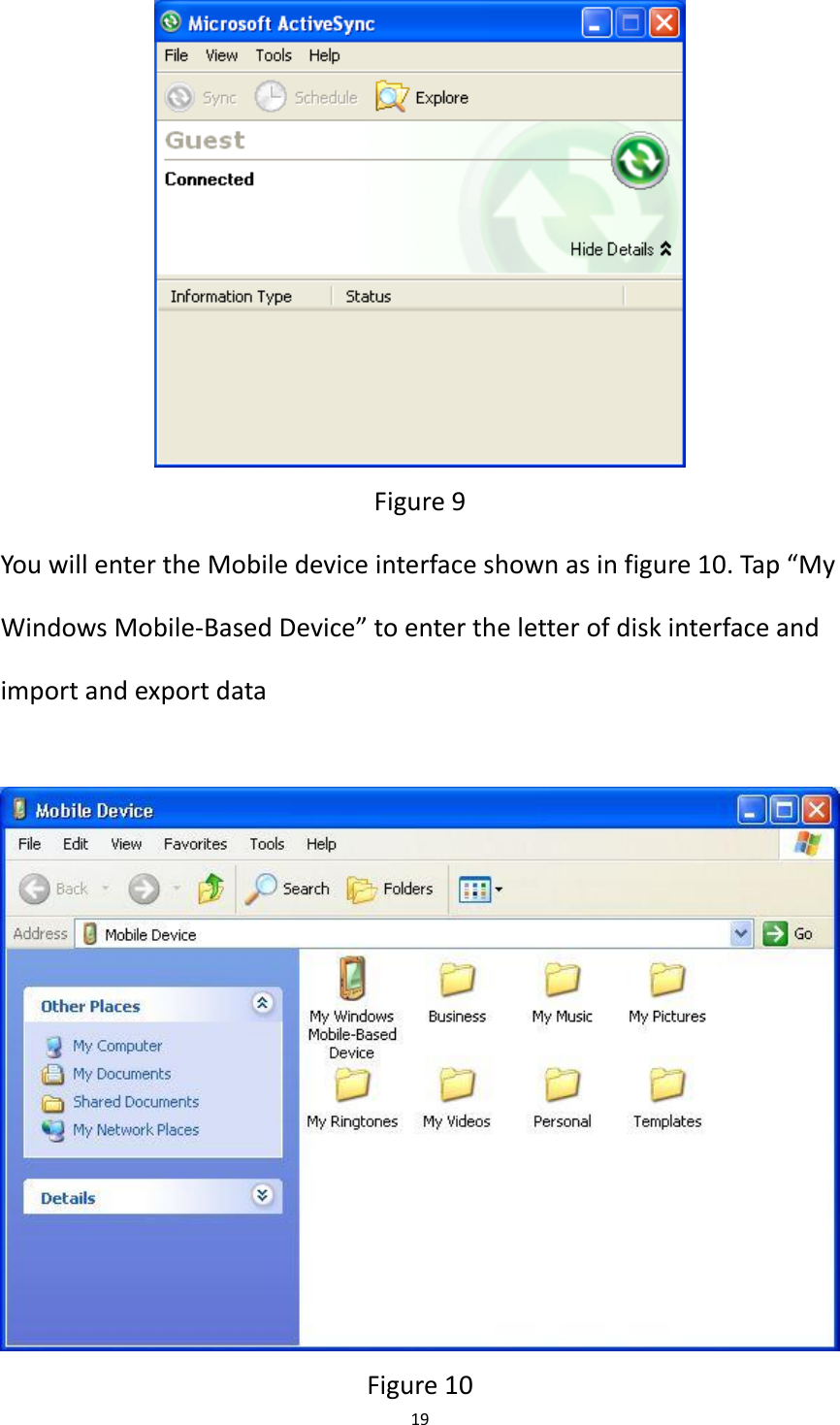
18   Figure 7 When  the  Welcome  to  the  Pocket  PC  sync  setup  wizard  shown  as  in figure 8 appears, tap “×” on the upper-right corner.   Figure 8 Enter the synchronization interface shown as in figure 9, tap “Explore”.
19   Figure 9 You will enter the Mobile device interface shown as in figure 10. Tap “My Windows Mobile-Based Device” to enter the letter of disk interface and import and export data     Figure 10
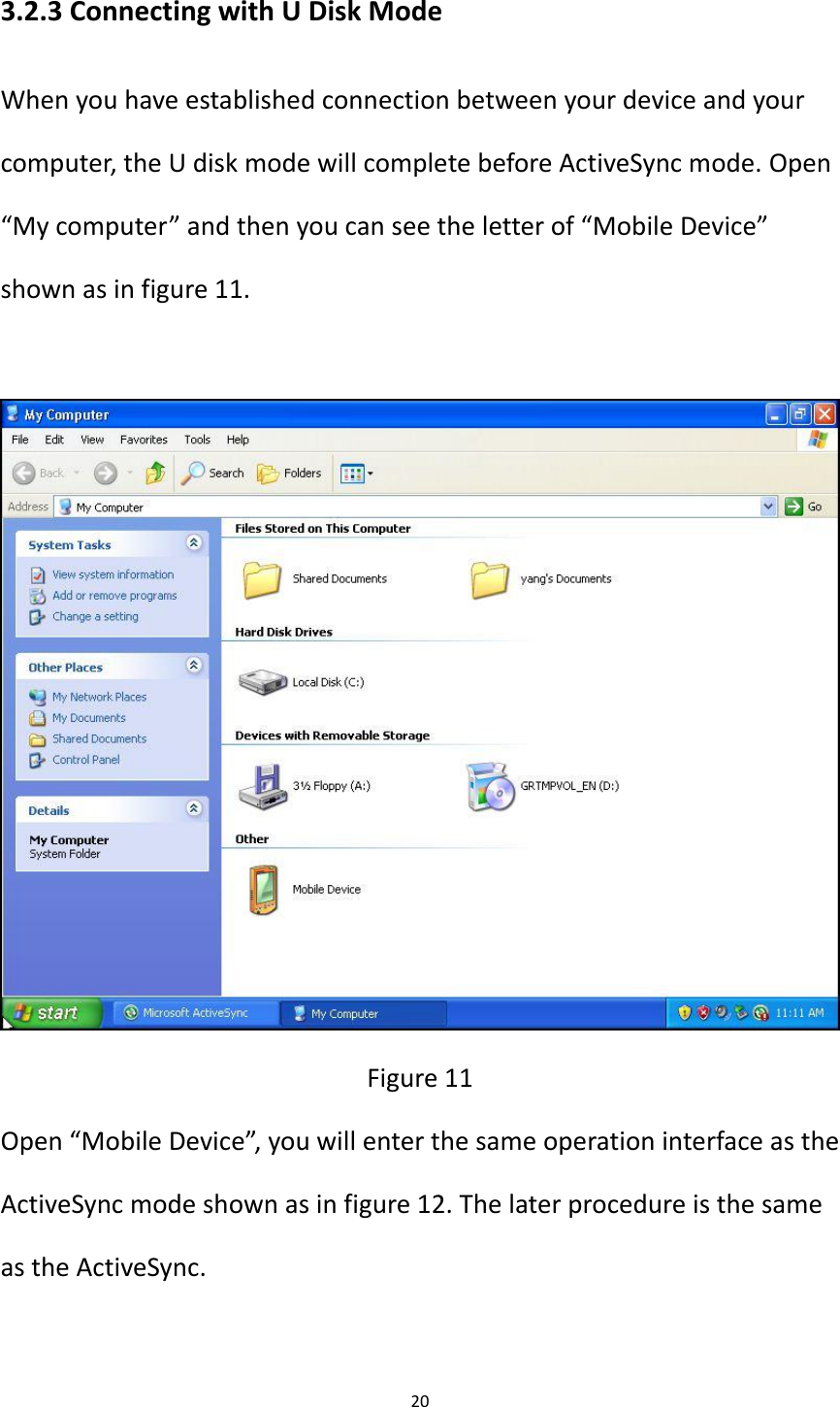
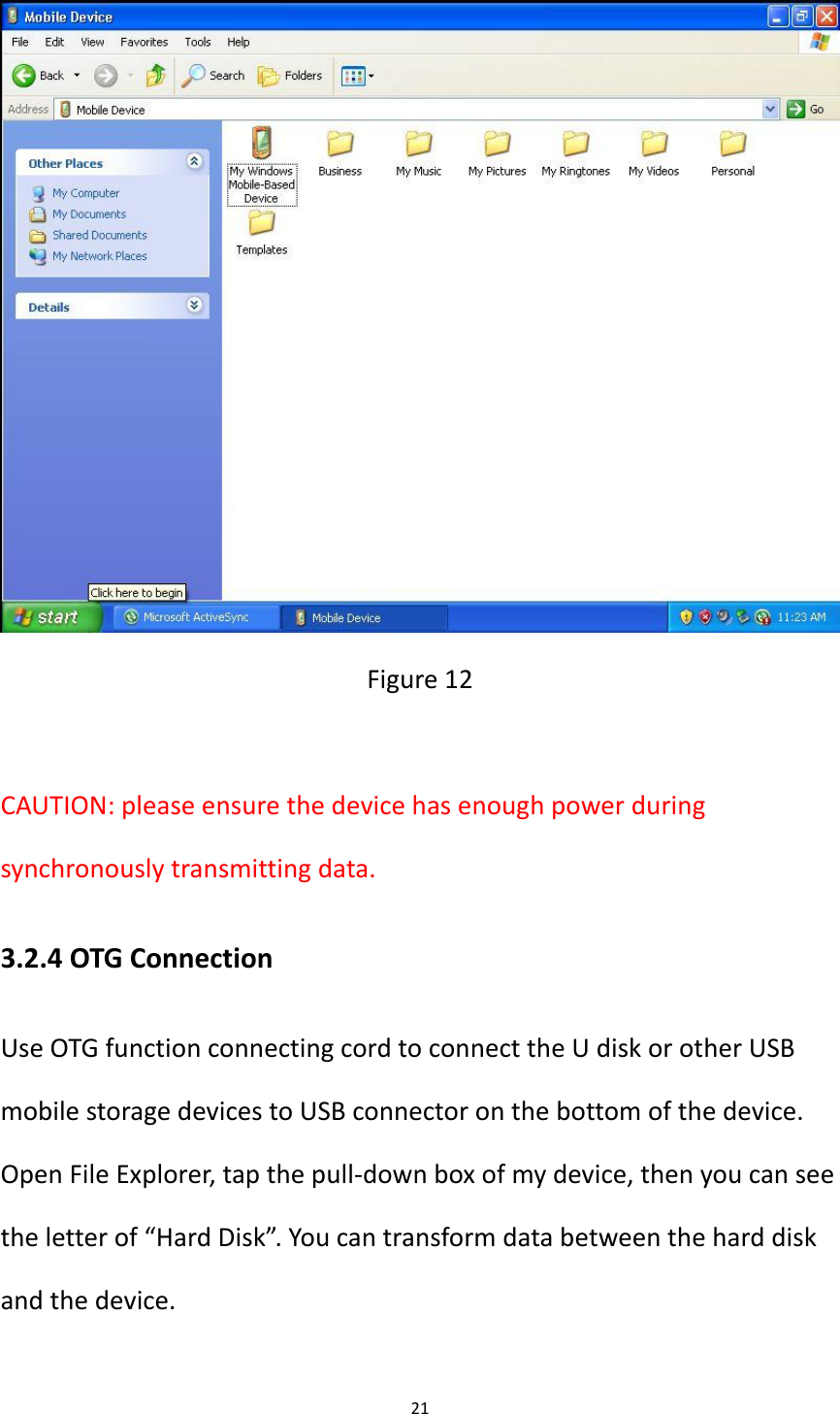
20  3.2.3 Connecting with U Disk Mode When you have established connection between your device and your computer, the U disk mode will complete before ActiveSync mode. Open “My computer” and then you can see the letter of “Mobile Device” shown as in figure 11.   Figure 11 Open “Mobile Device”, you will enter the same operation interface as the ActiveSync mode shown as in figure 12. The later procedure is the same as the ActiveSync.
21   Figure 12  CAUTION: please ensure the device has enough power during synchronously transmitting data. 3.2.4 OTG Connection Use OTG function connecting cord to connect the U disk or other USB mobile storage devices to USB connector on the bottom of the device. Open File Explorer, tap the pull-down box of my device, then you can see the letter of “Hard Disk”. You can transform data between the hard disk and the device.
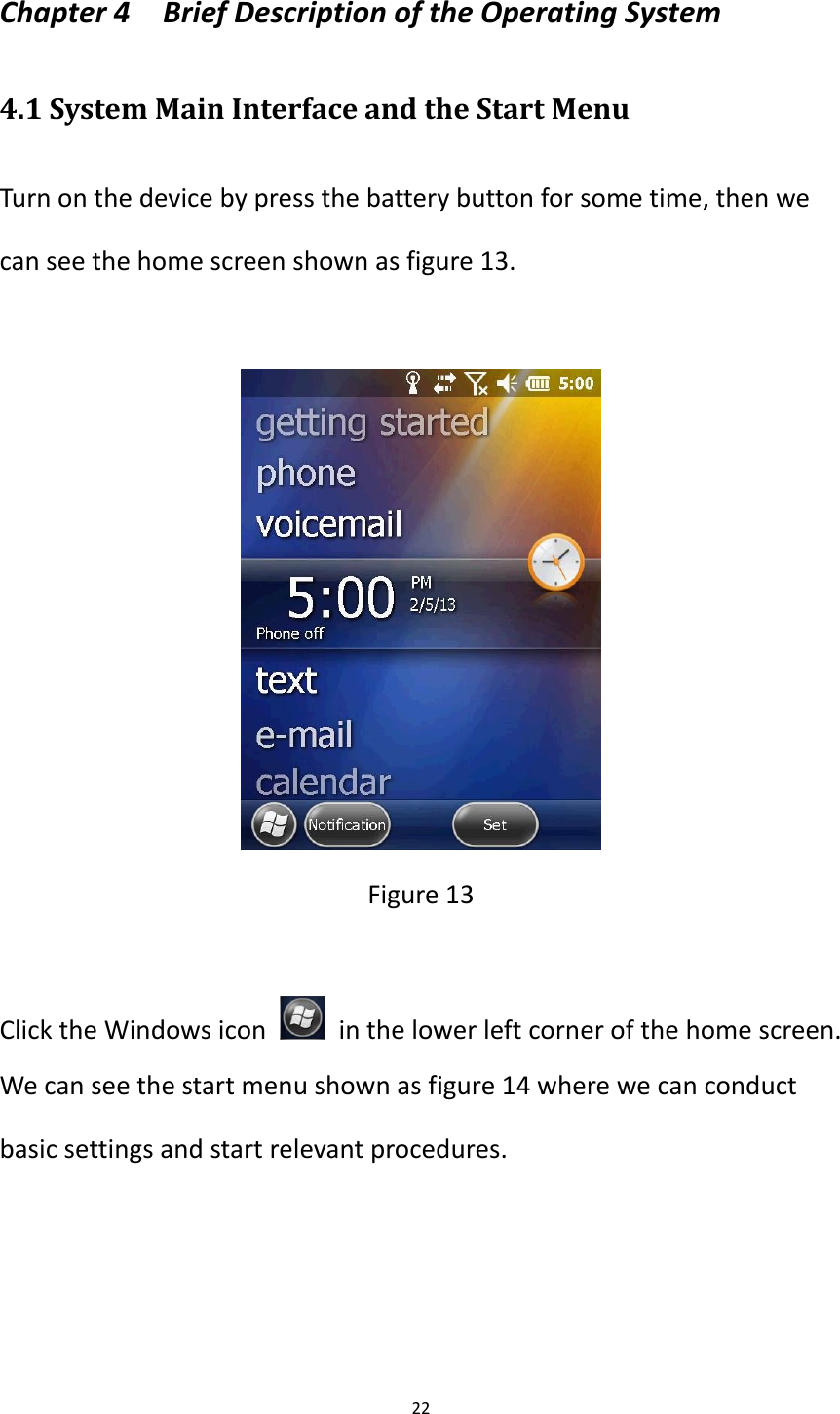
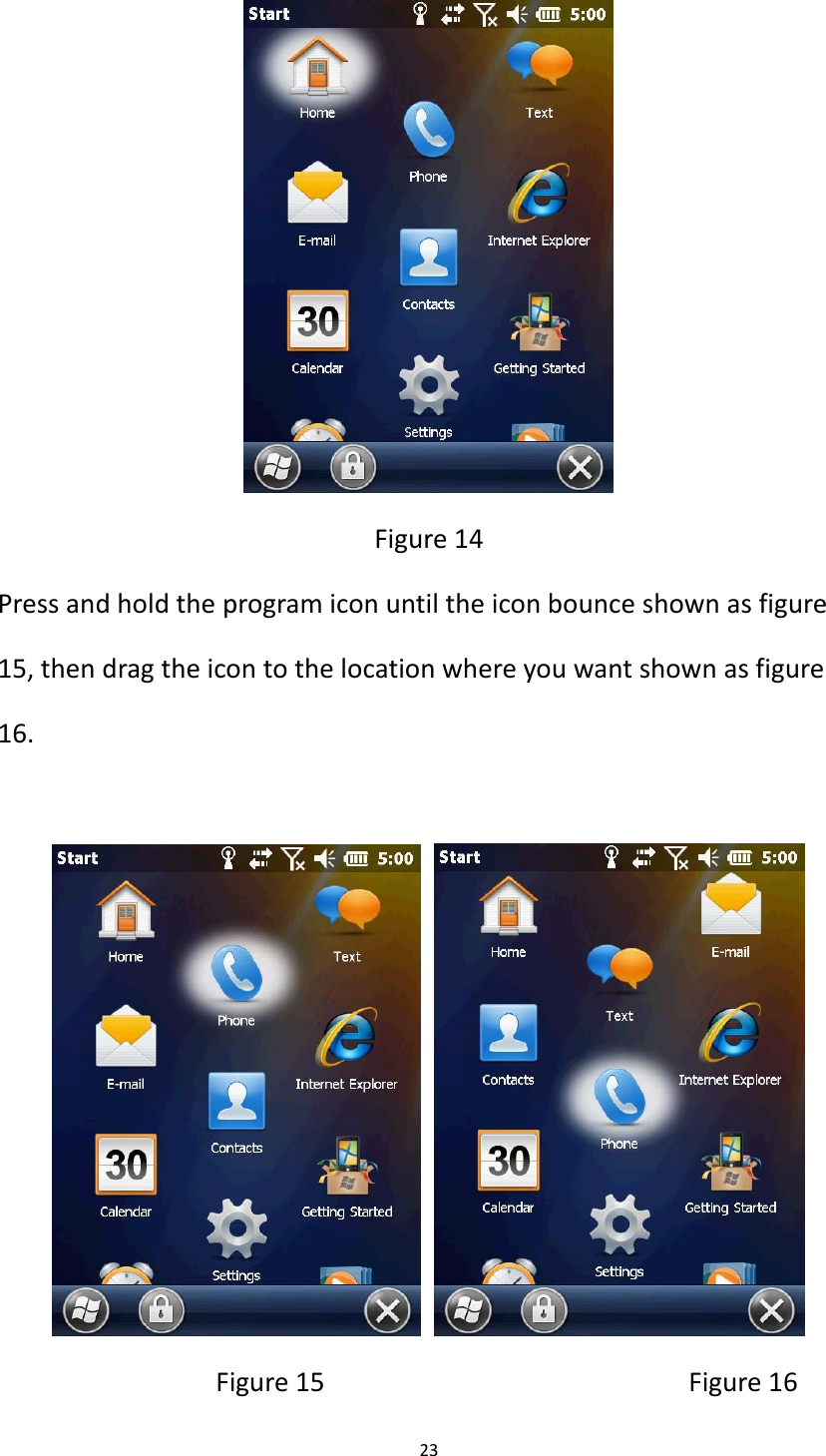
22  Chapter 4    Brief Description of the Operating System   4.1 System Main Interface and the Start Menu Turn on the device by press the battery button for some time, then we can see the home screen shown as figure 13.   Figure 13  Click the Windows icon    in the lower left corner of the home screen. We can see the start menu shown as figure 14 where we can conduct basic settings and start relevant procedures.
23   Figure 14 Press and hold the program icon until the icon bounce shown as figure 15, then drag the icon to the location where you want shown as figure 16.                                   Figure 15                                                  Figure 16
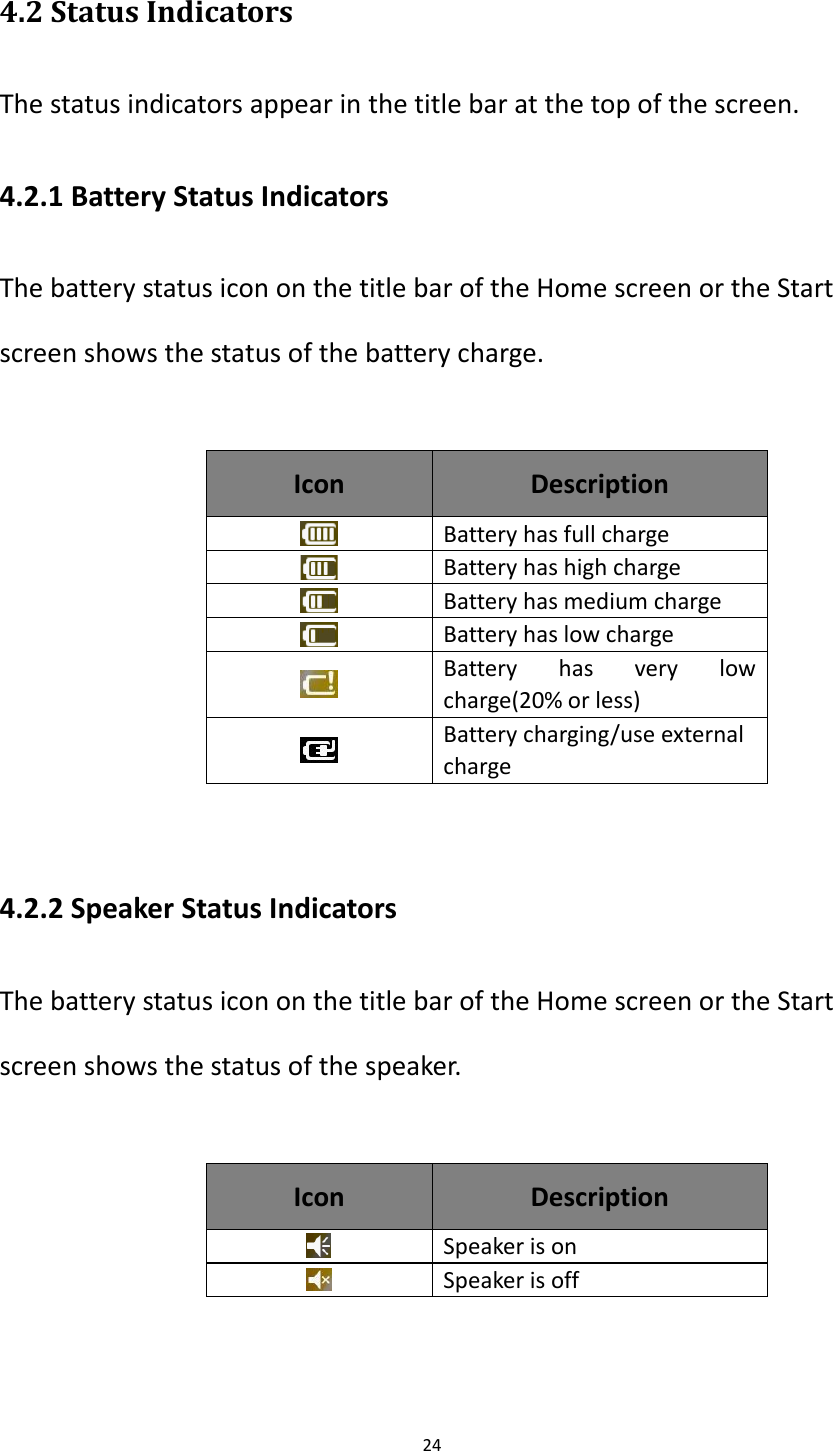
24  4.2 Status Indicators The status indicators appear in the title bar at the top of the screen. 4.2.1 Battery Status Indicators The battery status icon on the title bar of the Home screen or the Start screen shows the status of the battery charge.    Icon Description  Battery has full charge  Battery has high charge  Battery has medium charge  Battery has low charge  Battery  has  very  low charge(20% or less)  Battery charging/use external charge  4.2.2 Speaker Status Indicators The battery status icon on the title bar of the Home screen or the Start screen shows the status of the speaker.  Icon Description  Speaker is on  Speaker is off
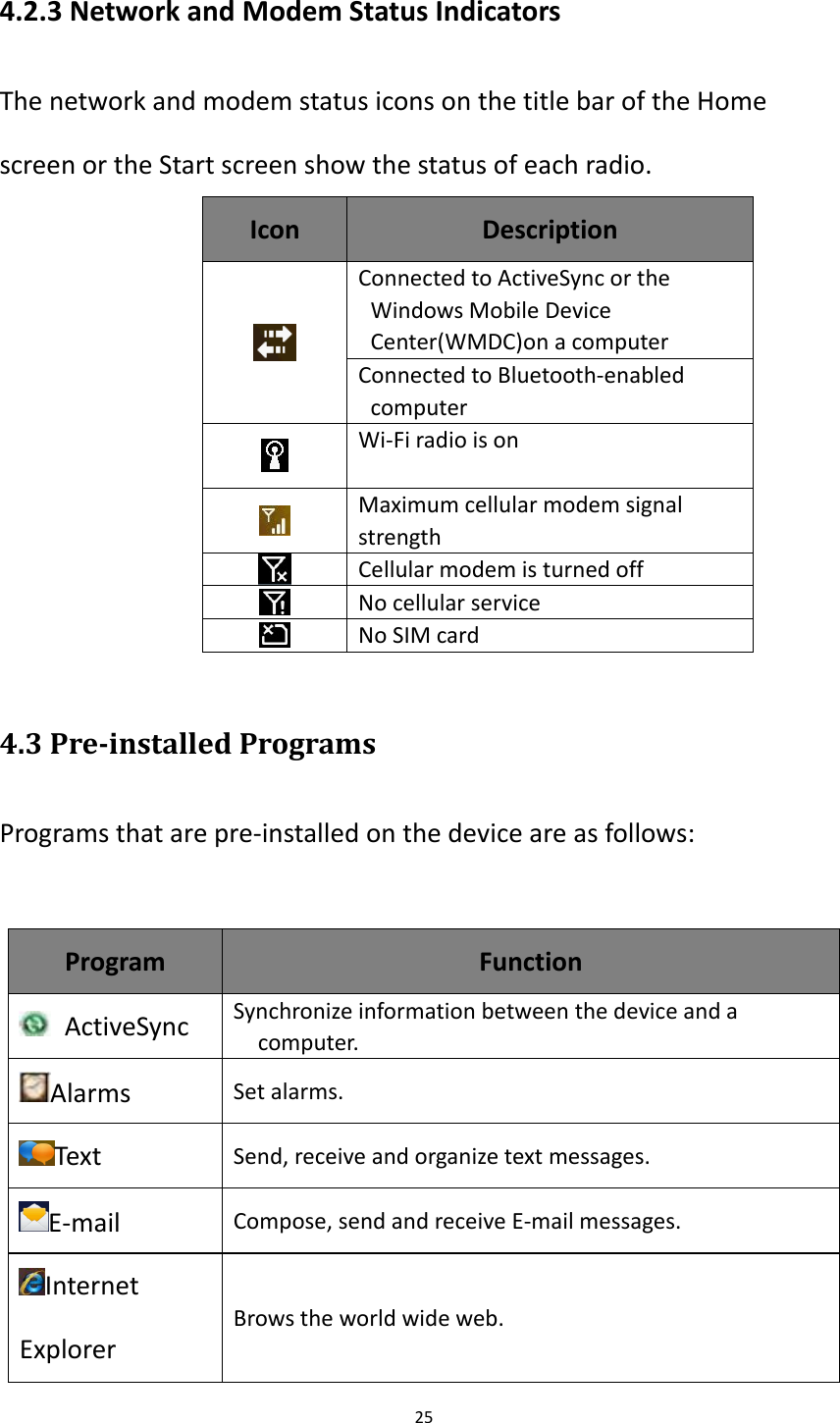
25  4.2.3 Network and Modem Status Indicators The network and modem status icons on the title bar of the Home screen or the Start screen show the status of each radio.   Icon Description  Connected to ActiveSync or the Windows Mobile Device Center(WMDC)on a computer Connected to Bluetooth-enabled computer  Wi-Fi radio is on  Maximum cellular modem signal strength  Cellular modem is turned off  No cellular service  No SIM card  4.3 Pre-installed Programs Programs that are pre-installed on the device are as follows:  Program Function   ActiveSync Synchronize information between the device and a computer. Alarms Set alarms. Text Send, receive and organize text messages. E-mail Compose, send and receive E-mail messages. Internet Explorer Brows the world wide web.
26  Calendar Keep track of appointments and arrange meetings. Contacts Keep track of your friends and colleagues.   Windows Live Access Windows Live services, including: E-mail, instant messenger and Internet search.   Windows Media Play Windows Media or MP3 audio and video files. Notes Create handwritten, typed or recorded notes.   Calculator Perform basic arithmetic functions. Tasks Keep track of your tasks. Pictures & Videos Take, view, and edit pictures, or record and launch video clips. Search Phone Search for a file or item stored on the device  4.4 Interacting With the Device To interact with the handheld use the stylus or your finger to tap items on the touch screen or to scroll up or down.  Action Definition Tap   Touch the screen once to open the items and select options. Press and hold Press and hold an item to see a list of actions available for that item. On the pop-up menu that appears, tap the action you want to perform. Drag Hold the stylus on the screen and drag across the screen to select text and images. Drag in a list to select multiple
27  items. Flick Flick the stylus or your finger to scroll a page or a list up and down.  4.5 Entering Information Depending on the program you are using, you can enter information in several ways, as described below:  Input method Description   Synchronizing Use  Microsoft  connection  management  software  to exchange information between the device and a PC. Typing Use  the  Keyboard  input  panel  to  enter  typed  text  by clicking keys on the on- screen keyboard. Drawing   Use the stylus (like using a pen) to draw (or write) directly on the screen. Recording   Create a stand-alone recording or embed a recording into a note.    4.5.1 Using the On-screen Keyboard Tap the input panel button    to show the input panel as shown in figure 17.
28                              Figure 17                                                        Figure 18 To show special characters containing numbers and symbols shown as in figure 18, tap . When you use the Input panel, your device anticipates the word you are typing or writing and displays it above the Input panel. When you tap the displayed word, it is inserted into your text at the insertion point. The more you use your device, the more words it learns to anticipate. To hide the input panel, tap the input panel button    again. 4.5.2 Drawing and Writing on the Screen Directly In some applications, for example Notes, you can directly draw (or write) on the screen using the stylus. Tap    / Notes shown as in figure 19, tap menu, select Draw, and then you can write or draw directly on the screen.
29   Figure 19 4.5.3 Recording a Message Tap    / Notes, then tap . To create a stand-alone recording, in the screen displaying the list of Notes, tap View Recording Toolbar in figure 19,  and  then  tap  Record  button    to  begin  recording.  To  add  a recording  to  a  Note,  create  or  open  a  Note  and  then  tap  the  Record button    to begin recording. When you finish recording, tap the Stop button . If you are recording in an open Note an icon appears in the Note. Tap “OK” to return to the Note list. To play a recording tap the recording in the Note list or open the Note and then tap the icon    in the Note.
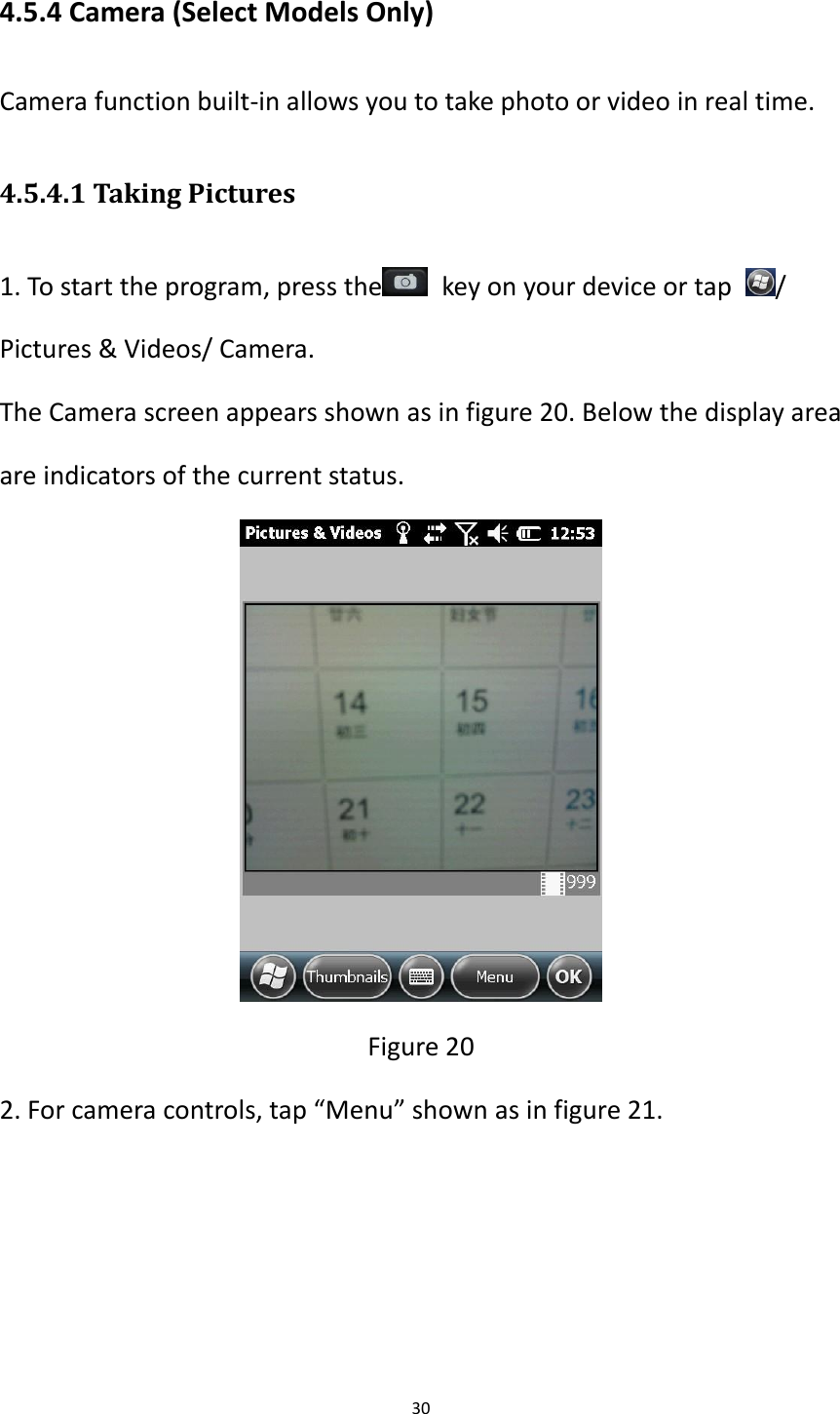
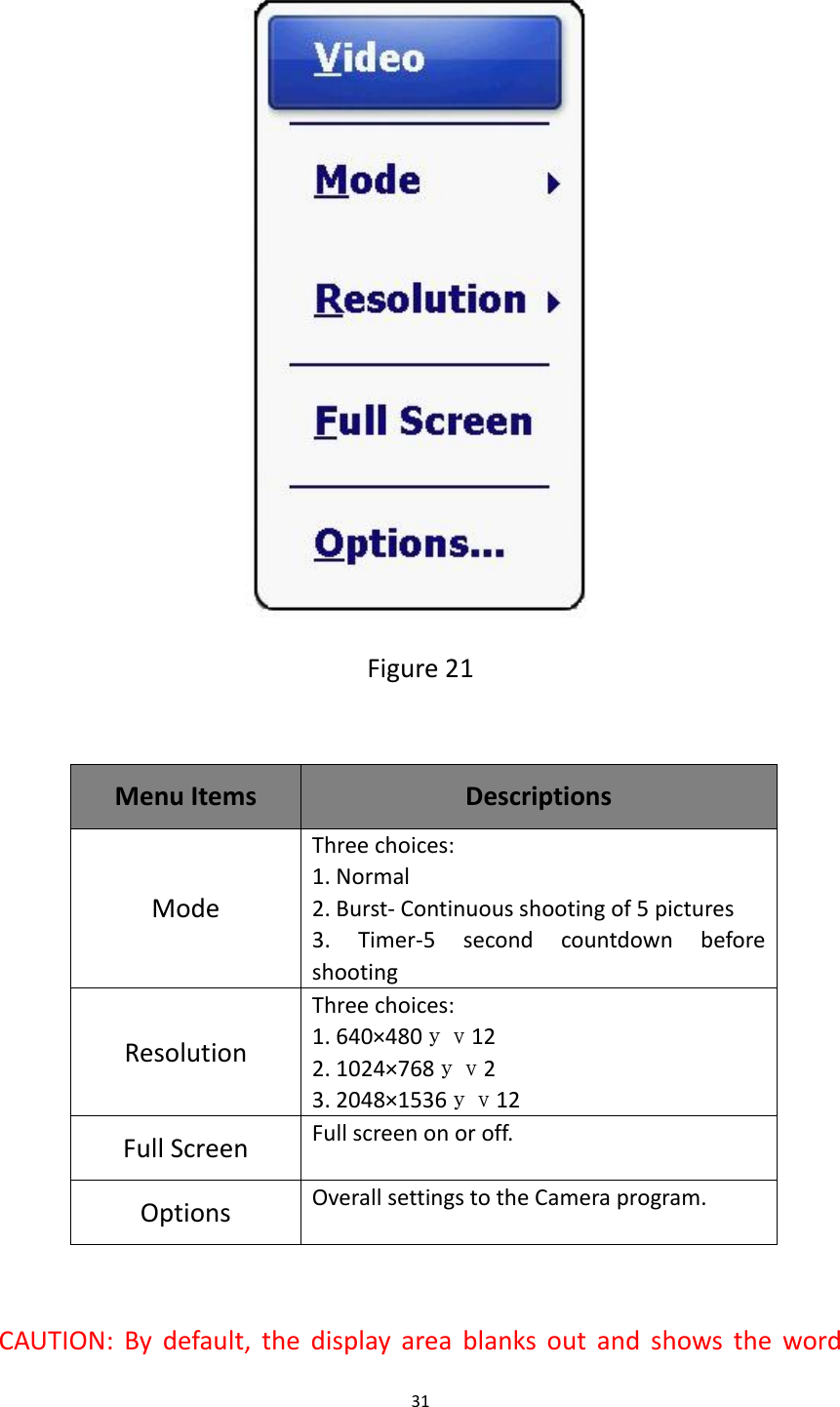
30  4.5.4 Camera (Select Models Only) Camera function built-in allows you to take photo or video in real time. 4.5.4.1 Taking Pictures 1. To start the program, press the   key on your device or tap  / Pictures & Videos/ Camera. The Camera screen appears shown as in figure 20. Below the display area are indicators of the current status.  Figure 20 2. For camera controls, tap “Menu” shown as in figure 21.
31   Figure 21  Menu Items Descriptions Mode Three choices:   1. Normal   2. Burst- Continuous shooting of 5 pictures   3.  Timer-5  second  countdown  before shooting Resolution Three choices: 1. 640×480yv12 2. 1024×768yv2 3. 2048×1536yv12 Full Screen Full screen on or off. Options Overall settings to the Camera program.  CAUTION:  By default,  the  display area blanks  out and  shows the word
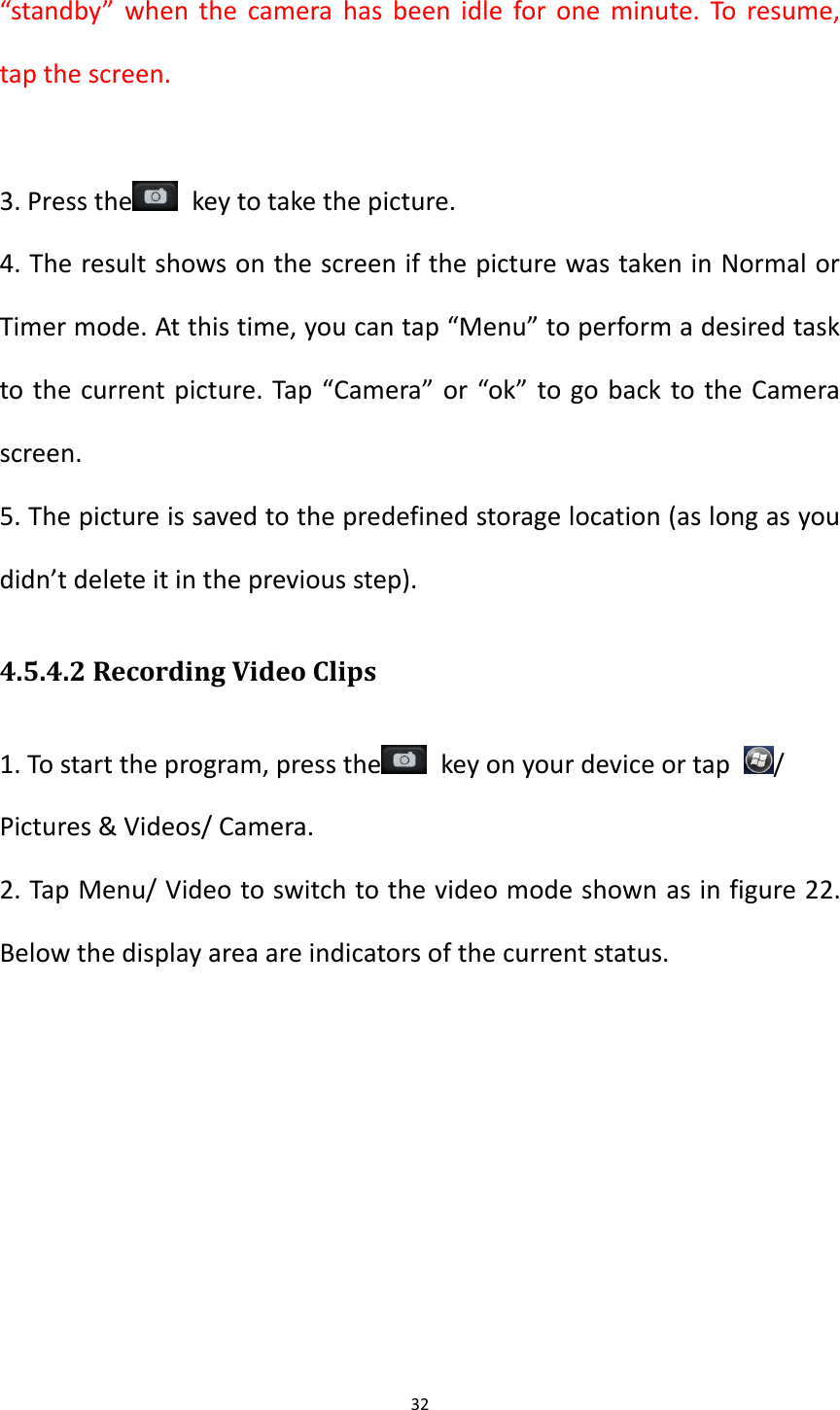
32  “standby”  when the camera has  been idle for one minute. To resume, tap the screen.  3. Press the   key to take the picture. 4. The result shows on the screen if the picture was taken in Normal or Timer mode. At this time, you can tap “Menu” to perform a desired task to the current picture. Tap “Camera” or “ok” to go back to the Camera screen. 5. The picture is saved to the predefined storage location (as long as you didn’t delete it in the previous step). 4.5.4.2 Recording Video Clips 1. To start the program, press the   key on your device or tap  / Pictures & Videos/ Camera. 2. Tap Menu/ Video to switch to the video mode shown as in figure 22. Below the display area are indicators of the current status.
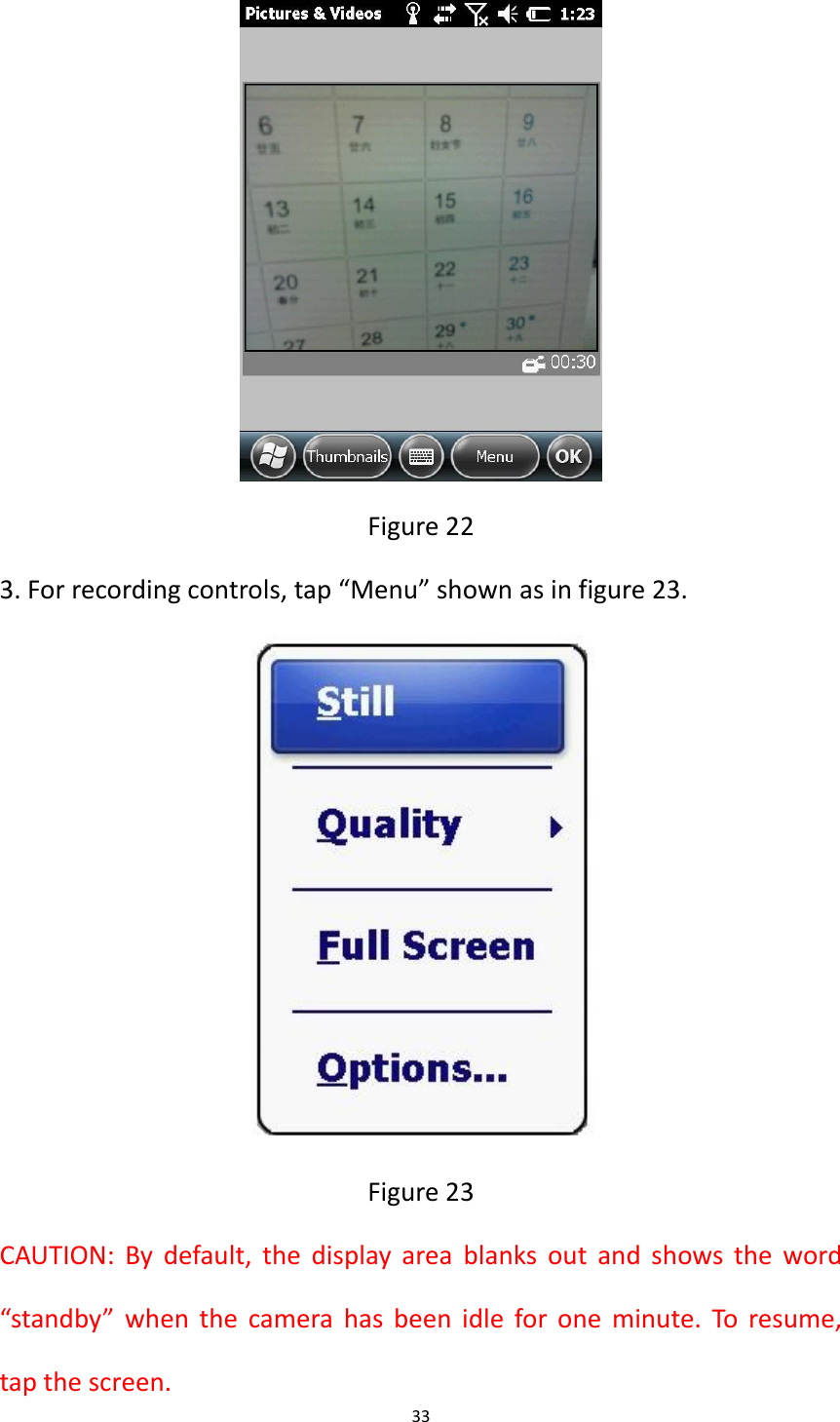
33   Figure 22 3. For recording controls, tap “Menu” shown as in figure 23.  Figure 23 CAUTION:  By default,  the  display area  blanks out  and shows the  word “standby”  when the camera has  been idle for one minute. To resume, tap the screen.
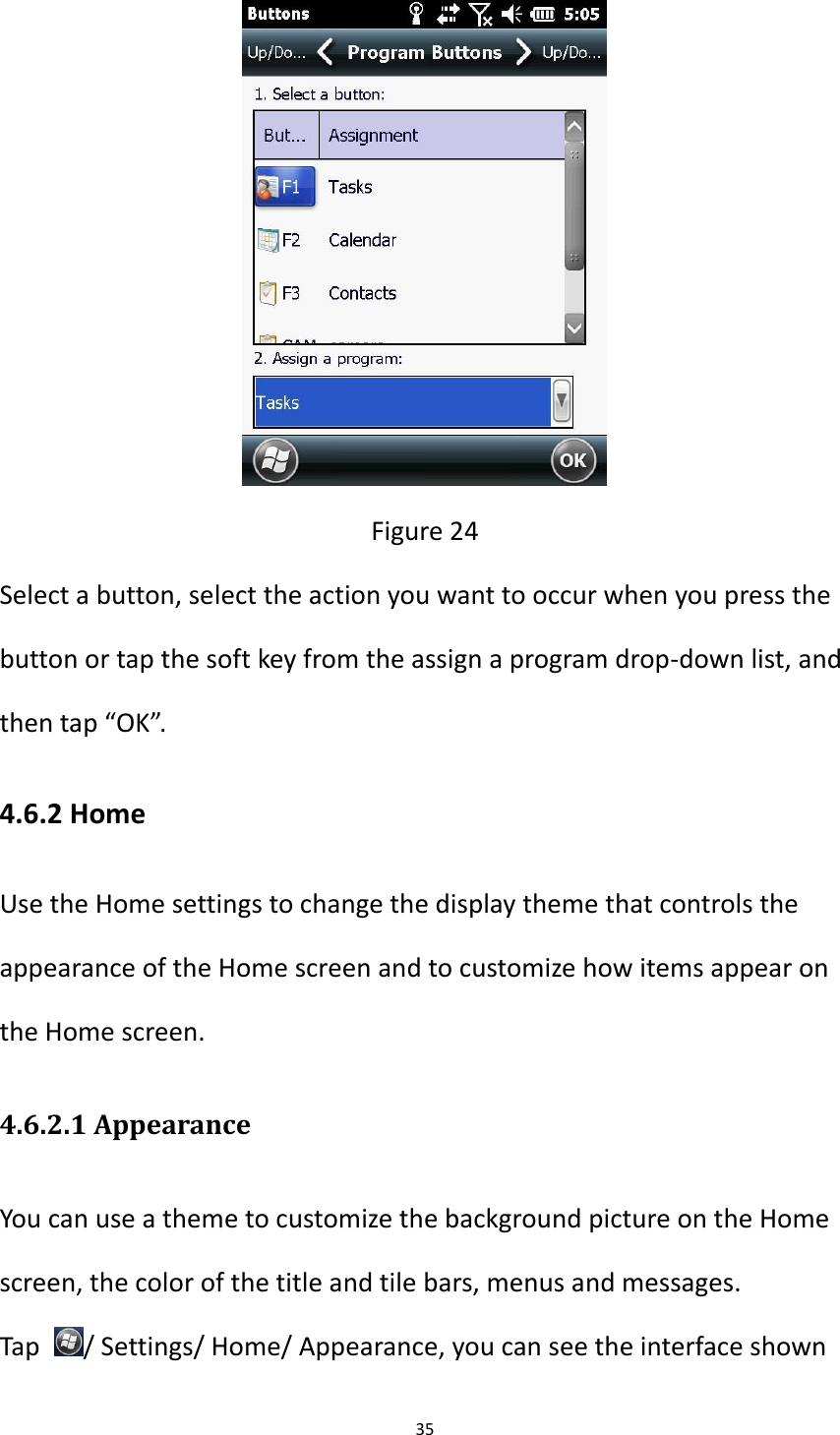
34   4. Press the   key to start recording. If needed, you can tap “Pause” to temporarily pause the recording and then tap “Resume” to continue. 5.  To  stop,  press  the   key  or  tap  “Stop”.  Or,  the  recording  will automatically stop when the  length reaches the  pre-defined maximum value (30 seconds by default). 6. The video clip is saved to the predefined storage location. To view the video clip, tap “Thumbnails” and choose the video you want to view. 4.6 Personal Settings Use the controls in the Settings area to customize the device. The following examples describe controls that are available. 4.6.1 Buttons Use the Buttons control under Personal settings to assign the action you want to be performed when you press theF1, F2 or F3. By default, these keys perform the same action as the left and right tiles in the tile bar. Tap    / Settings/ Personal/ Buttons, open the button interface shown as in figure 24.
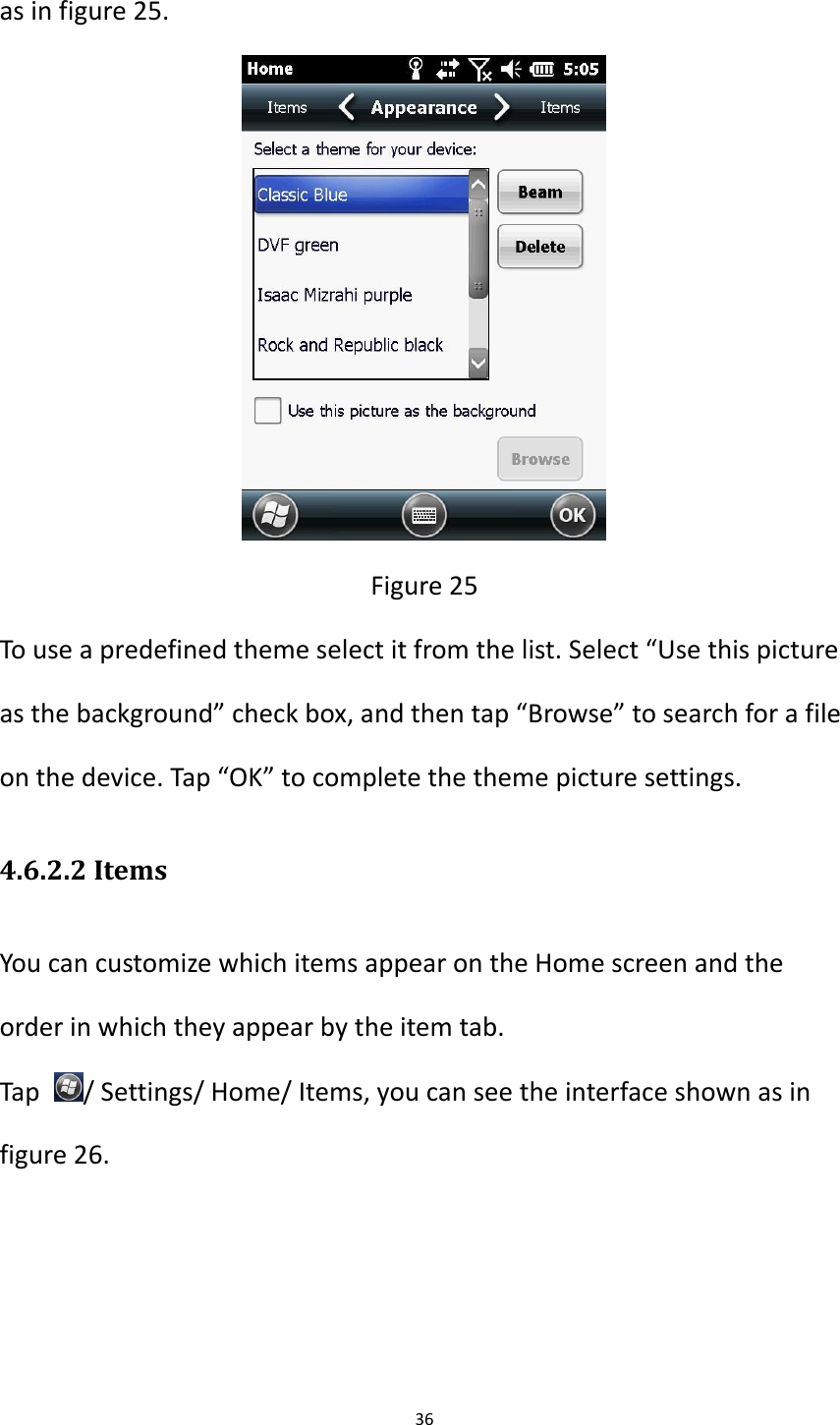
35   Figure 24 Select a button, select the action you want to occur when you press the button or tap the soft key from the assign a program drop-down list, and then tap “OK”. 4.6.2 Home   Use the Home settings to change the display theme that controls the appearance of the Home screen and to customize how items appear on the Home screen. 4.6.2.1 Appearance You can use a theme to customize the background picture on the Home screen, the color of the title and tile bars, menus and messages. Tap  / Settings/ Home/ Appearance, you can see the interface shown
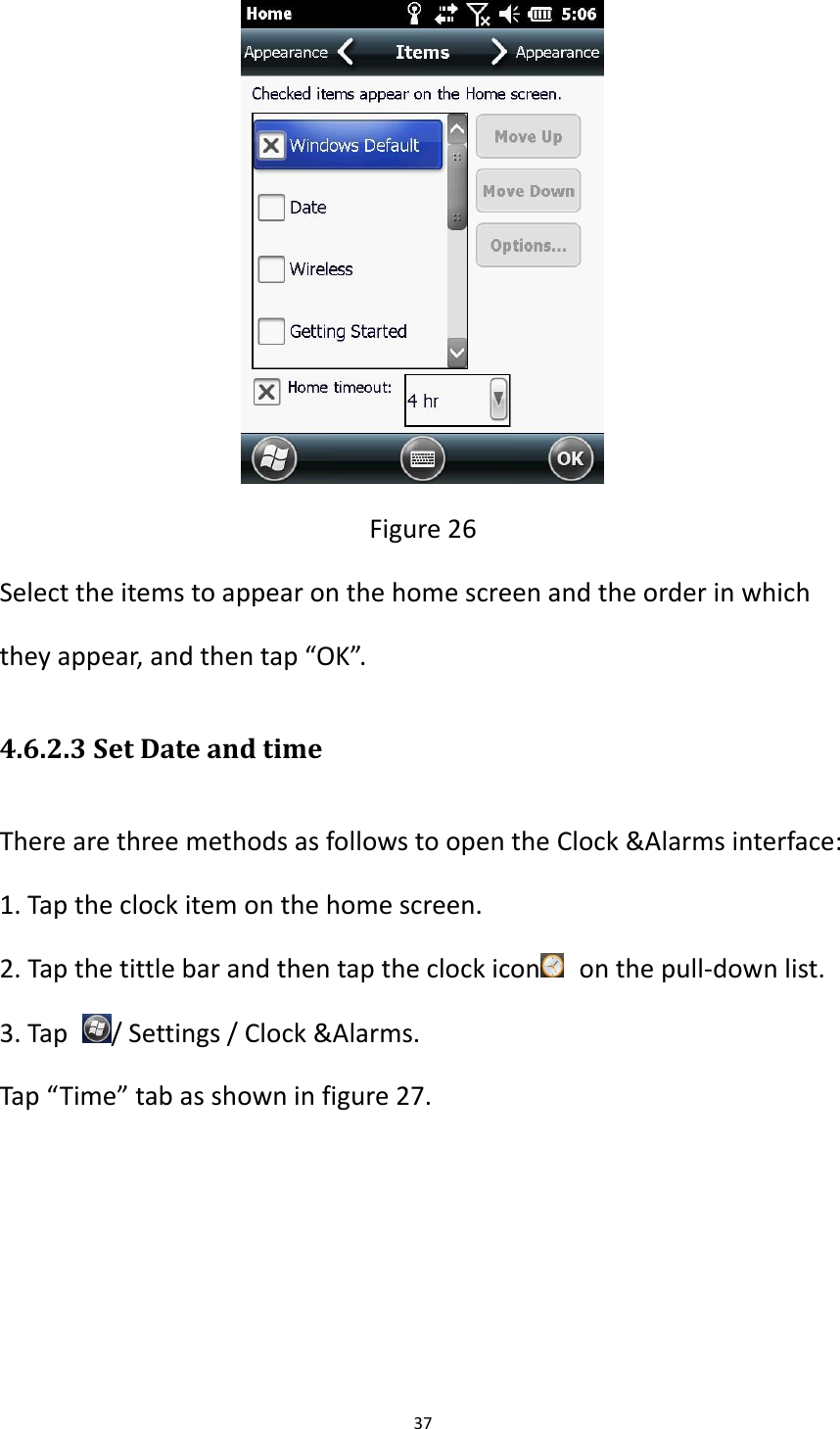
36  as in figure 25.  Figure 25 To use a predefined theme select it from the list. Select “Use this picture as the background” check box, and then tap “Browse” to search for a file on the device. Tap “OK” to complete the theme picture settings. 4.6.2.2 Items You can customize which items appear on the Home screen and the order in which they appear by the item tab. Tap  / Settings/ Home/ Items, you can see the interface shown as in figure 26.
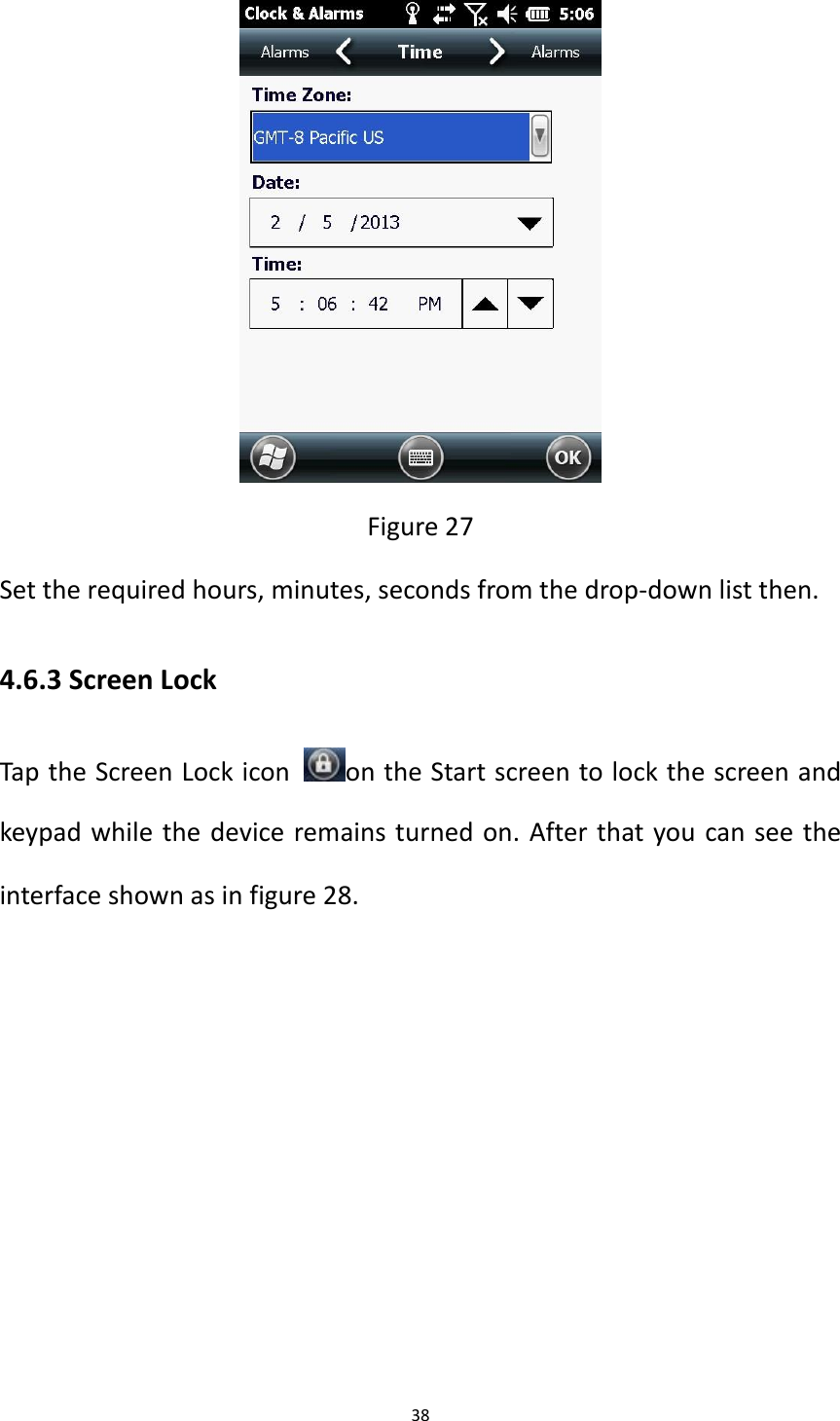
37   Figure 26 Select the items to appear on the home screen and the order in which they appear, and then tap “OK”. 4.6.2.3 Set Date and time There are three methods as follows to open the Clock &Alarms interface: 1. Tap the clock item on the home screen. 2. Tap the tittle bar and then tap the clock icon   on the pull-down list. 3. Tap  / Settings / Clock &Alarms. Tap “Time” tab as shown in figure 27.
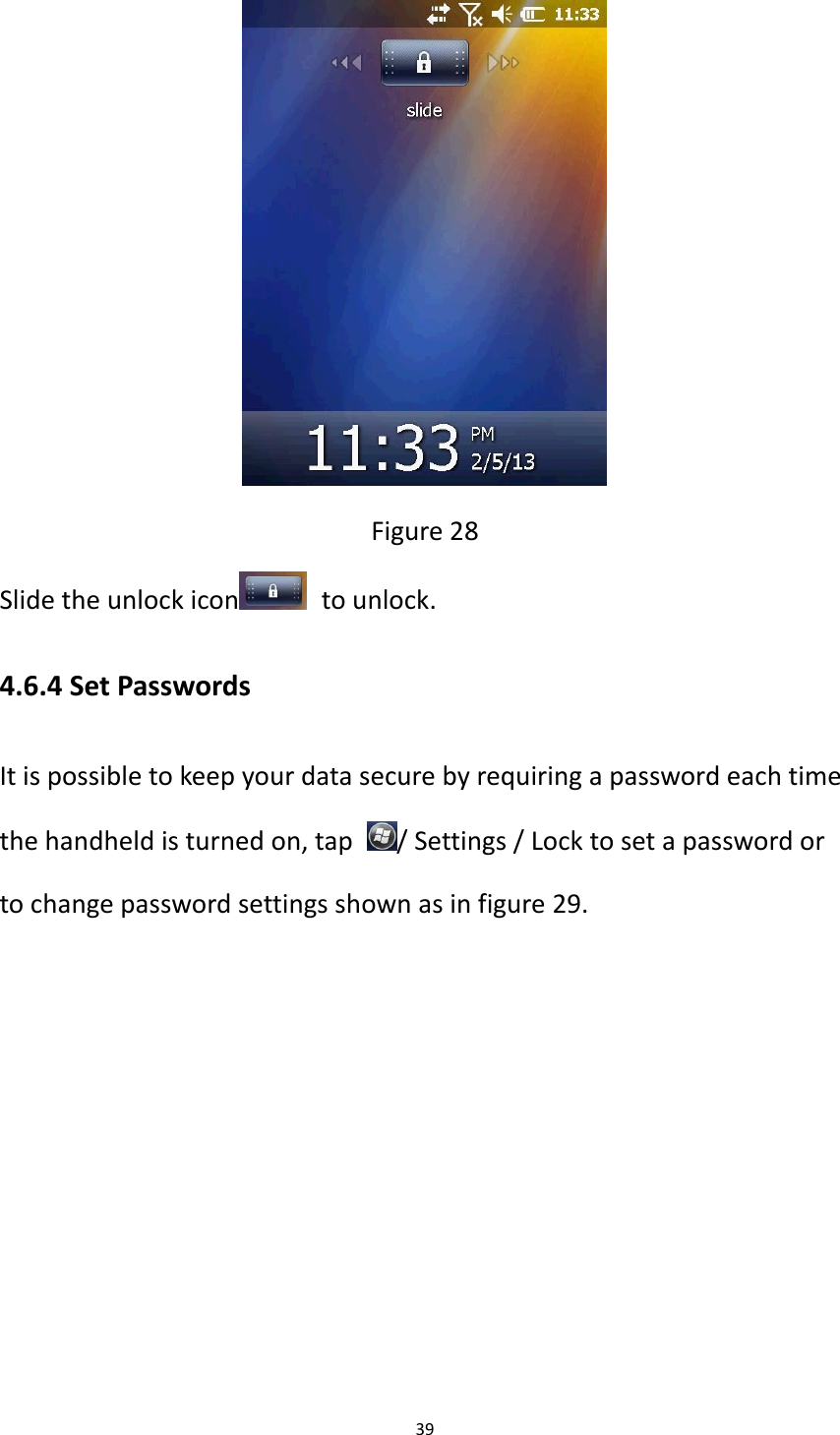
38   Figure 27 Set the required hours, minutes, seconds from the drop-down list then. 4.6.3 Screen Lock Tap the Screen Lock icon  on the Start screen to lock the screen and keypad while the device remains turned on. After that you can see the interface shown as in figure 28.
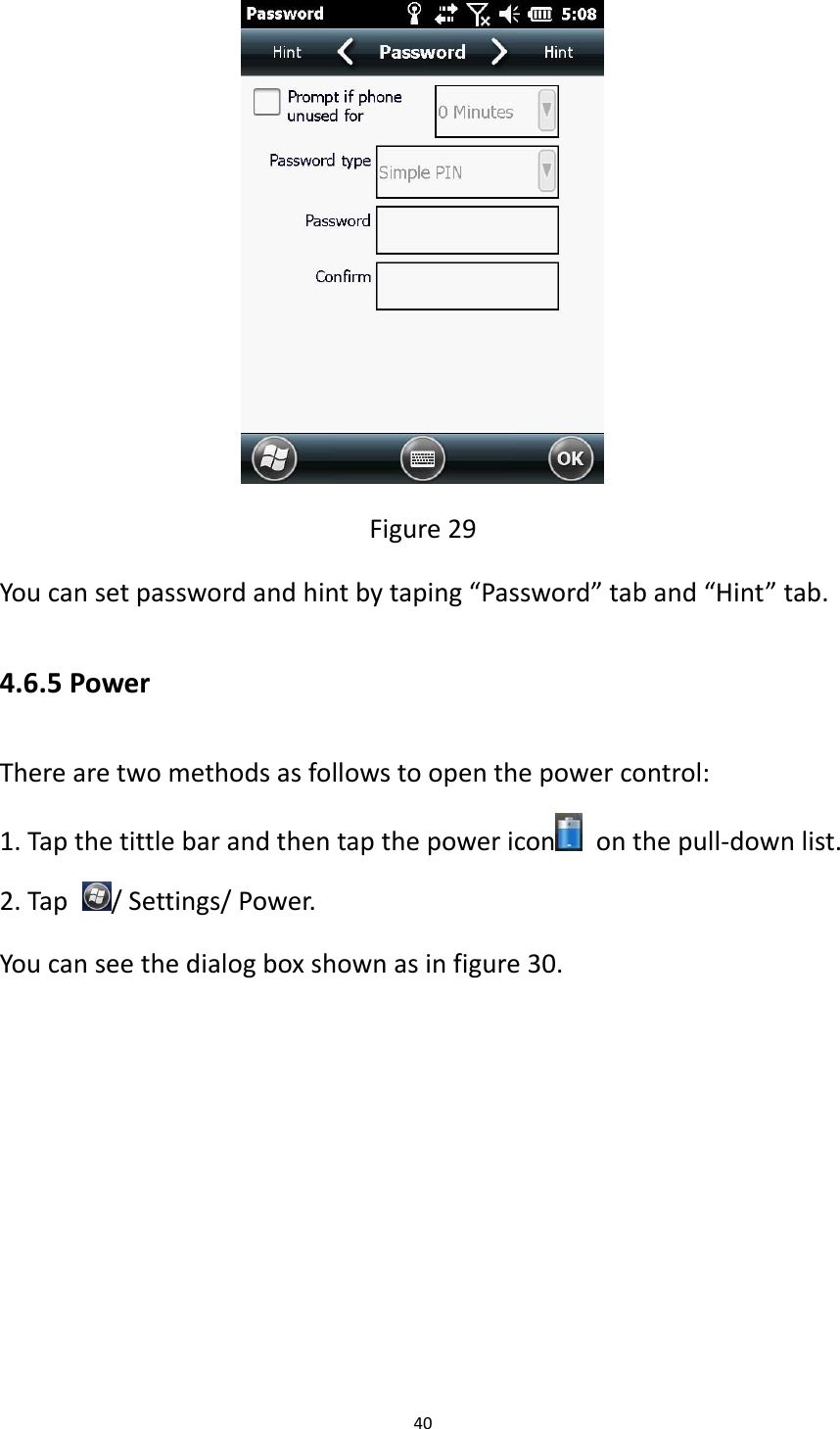
39   Figure 28 Slide the unlock icon   to unlock. 4.6.4 Set Passwords It is possible to keep your data secure by requiring a password each time the handheld is turned on, tap  / Settings / Lock to set a password or to change password settings shown as in figure 29.
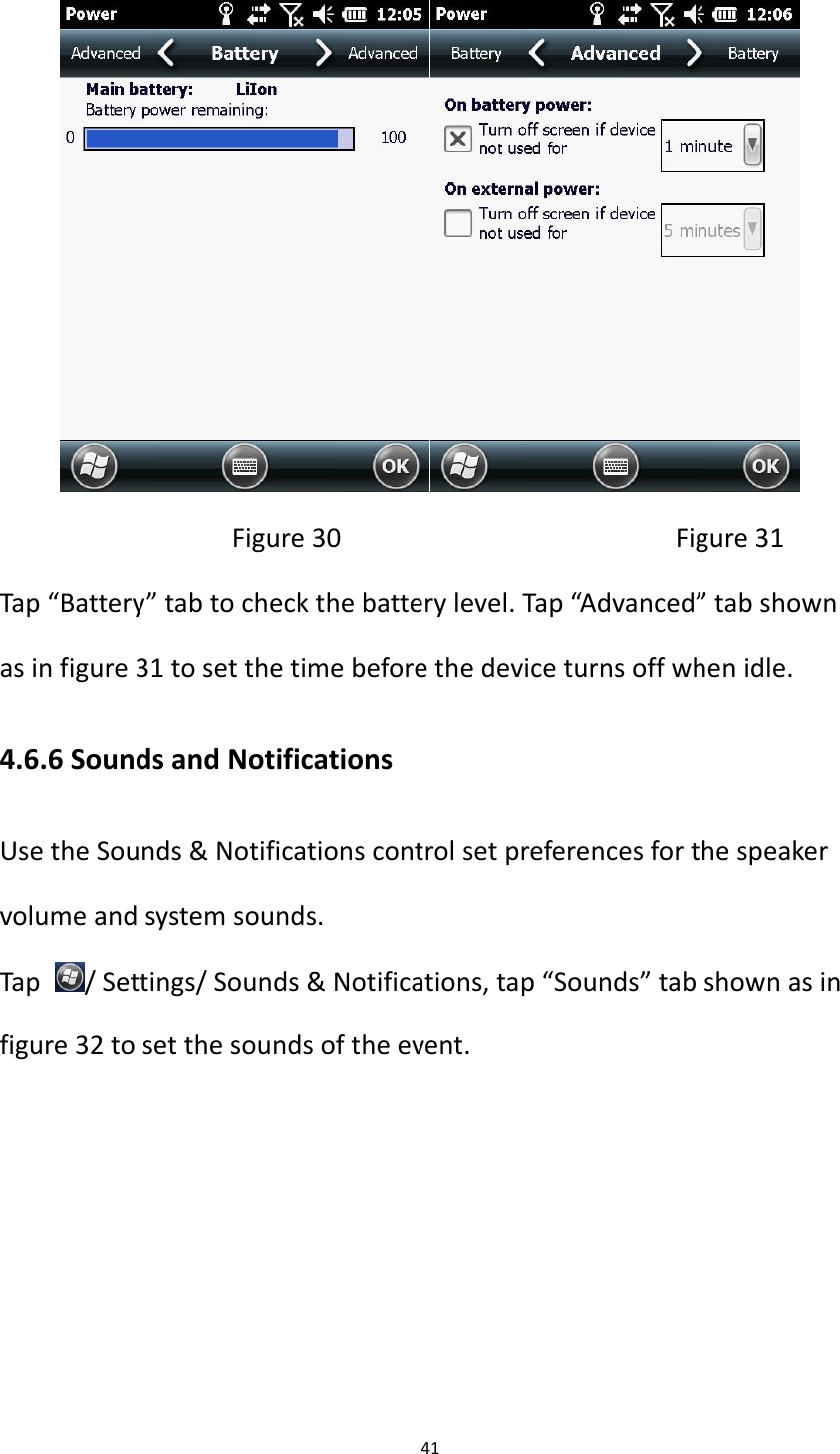
40   Figure 29 You can set password and hint by taping “Password” tab and “Hint” tab. 4.6.5 Power There are two methods as follows to open the power control: 1. Tap the tittle bar and then tap the power icon   on the pull-down list. 2. Tap  / Settings/ Power. You can see the dialog box shown as in figure 30.
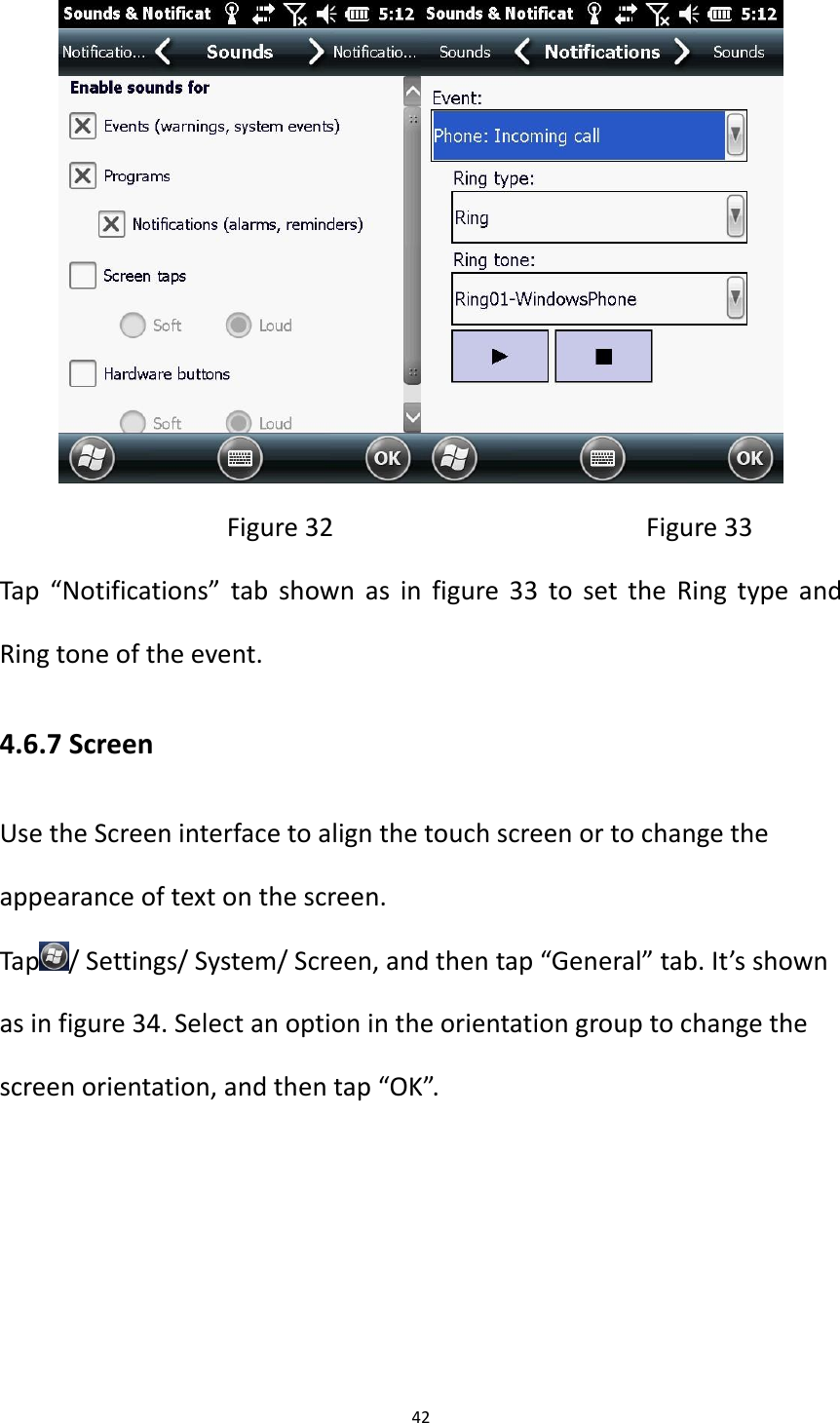
41                                   Figure 30                                              Figure 31 Tap “Battery” tab to check the battery level. Tap “Advanced” tab shown as in figure 31 to set the time before the device turns off when idle. 4.6.6 Sounds and Notifications Use the Sounds & Notifications control set preferences for the speaker volume and system sounds. Tap  / Settings/ Sounds & Notifications, tap “Sounds” tab shown as in figure 32 to set the sounds of the event.
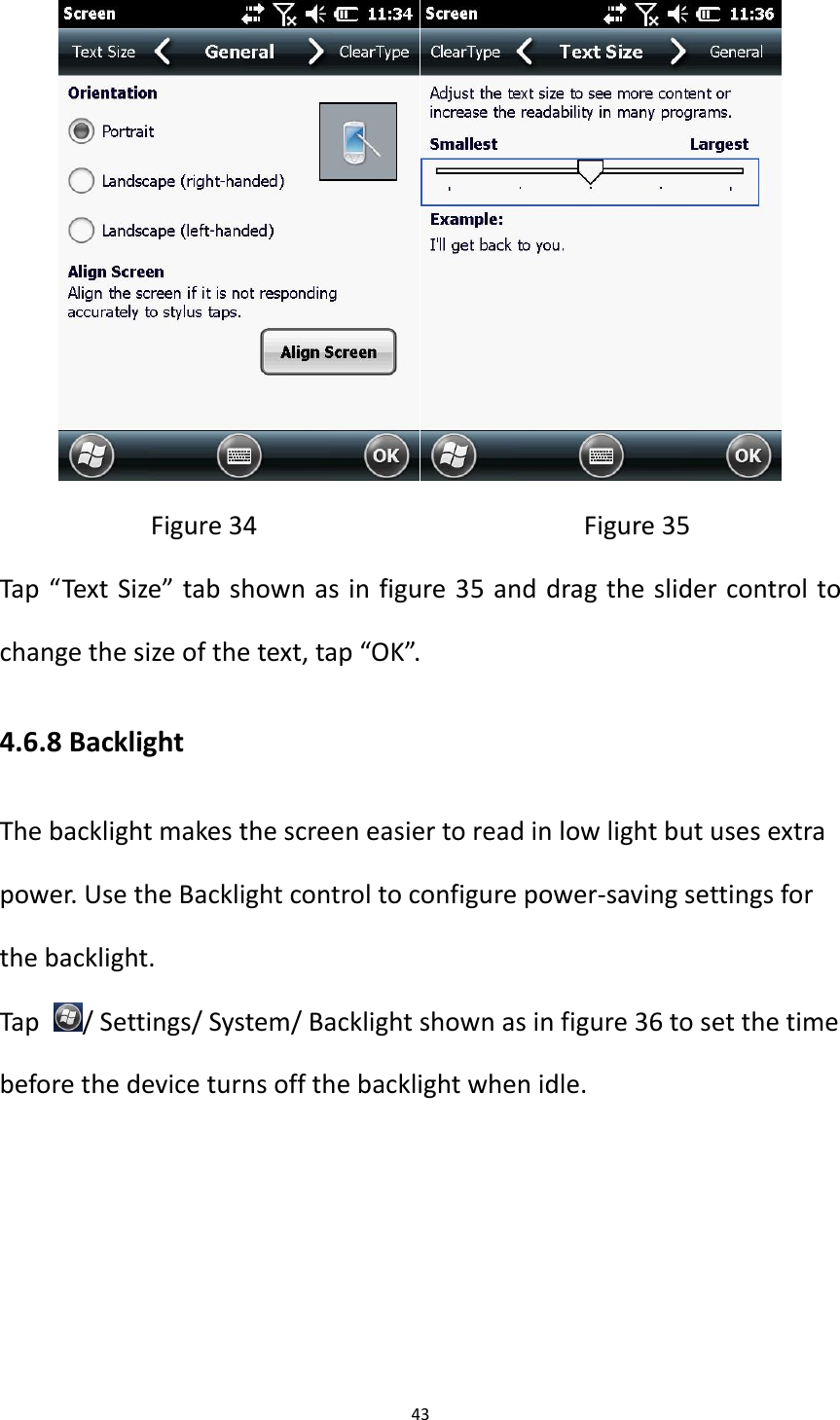
42                                   Figure 32                                          Figure 33 Tap  “Notifications” tab shown as  in figure 33 to set the  Ring type and Ring tone of the event. 4.6.7 Screen Use the Screen interface to align the touch screen or to change the appearance of text on the screen. Tap / Settings/ System/ Screen, and then tap “General” tab. It’s shown as in figure 34. Select an option in the orientation group to change the screen orientation, and then tap “OK”.
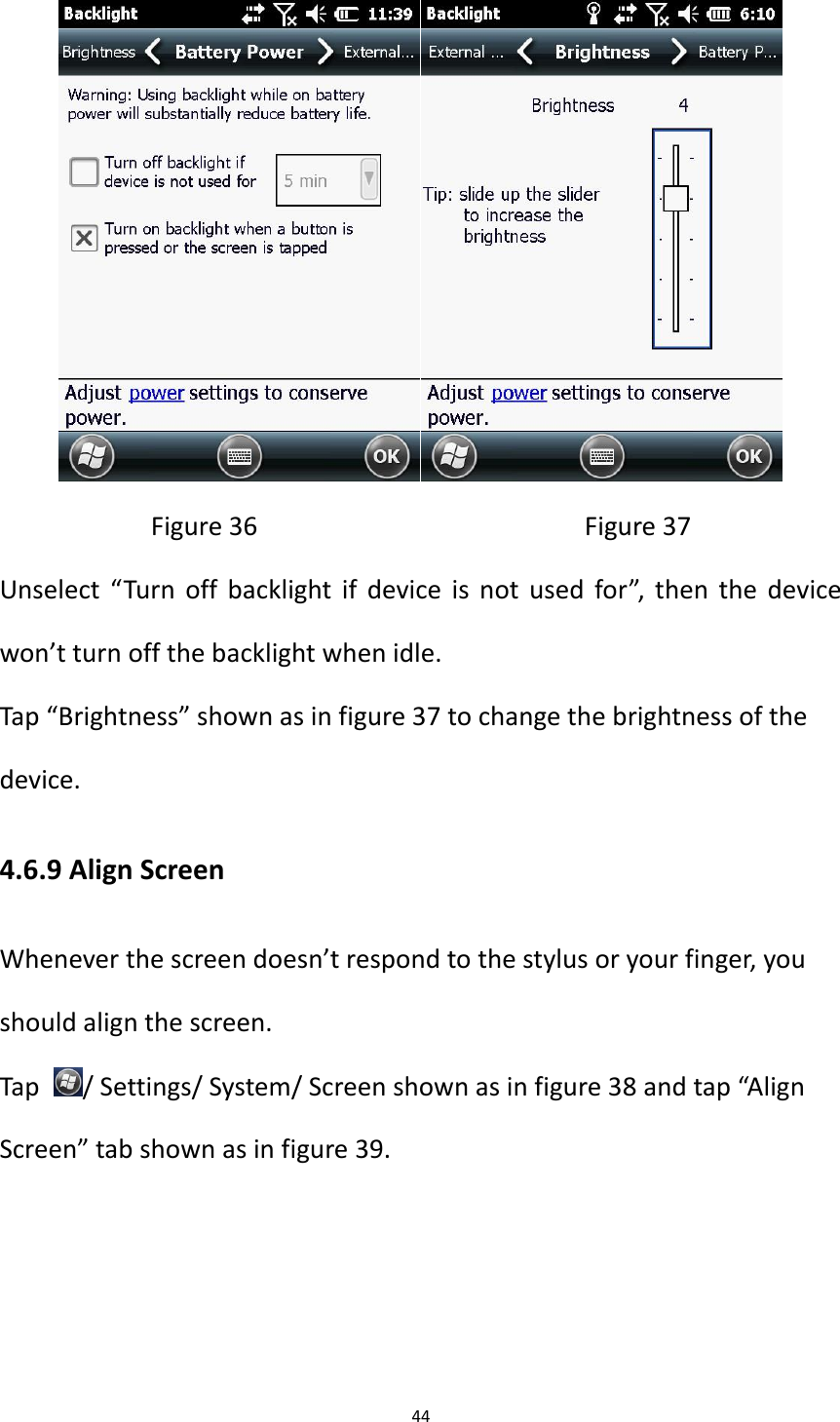
43   Figure 34                                            Figure 35 Tap “Text Size” tab shown as in figure 35 and drag the slider control to change the size of the text, tap “OK”. 4.6.8 Backlight The backlight makes the screen easier to read in low light but uses extra power. Use the Backlight control to configure power-saving settings for the backlight. Tap  / Settings/ System/ Backlight shown as in figure 36 to set the time before the device turns off the backlight when idle.
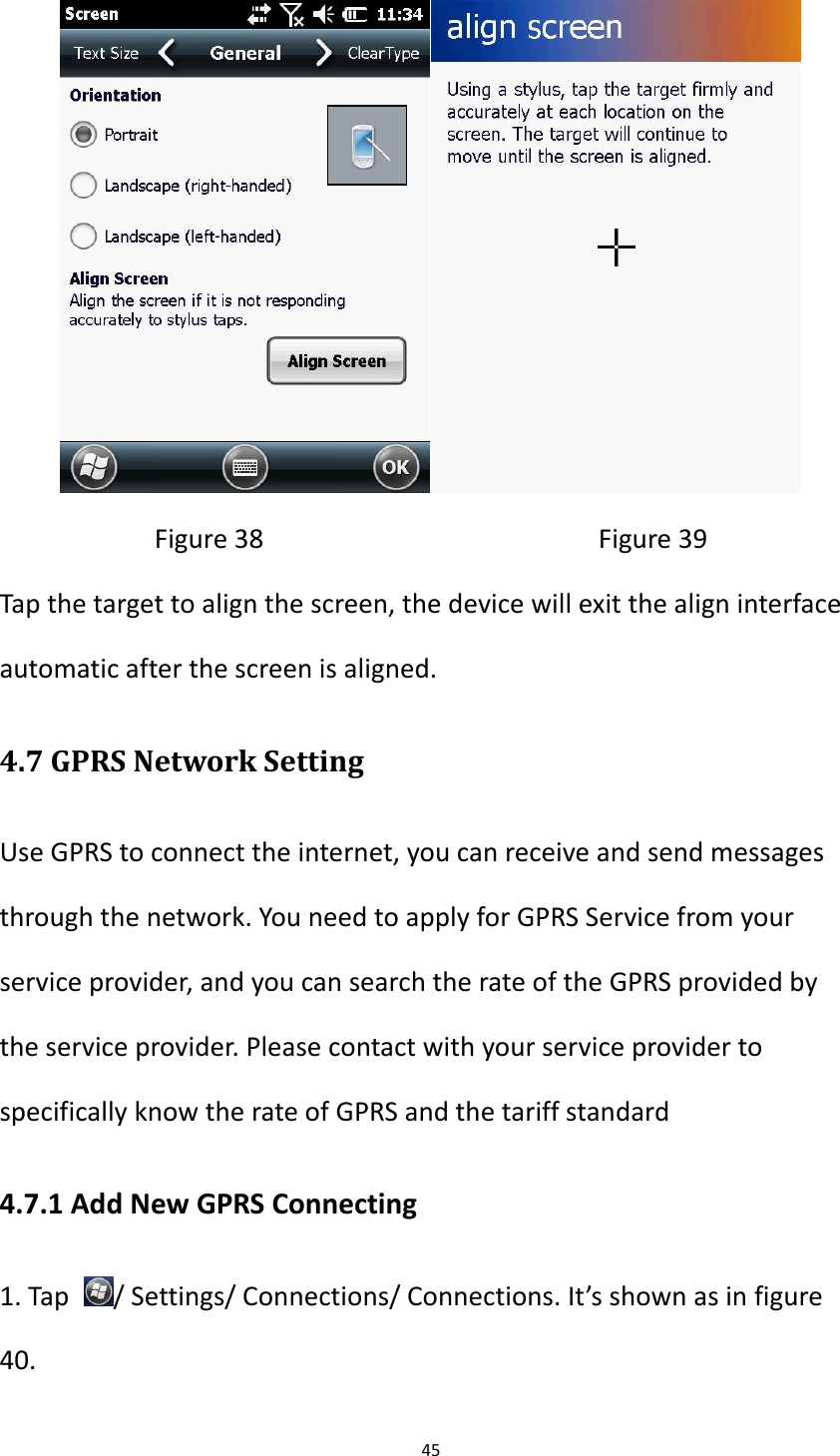
44   Figure 36                                              Figure 37 Unselect “Turn off backlight if  device is  not  used for”, then the device won’t turn off the backlight when idle. Tap “Brightness” shown as in figure 37 to change the brightness of the device. 4.6.9 Align Screen Whenever the screen doesn’t respond to the stylus or your finger, you should align the screen. Tap  / Settings/ System/ Screen shown as in figure 38 and tap “Align Screen” tab shown as in figure 39.
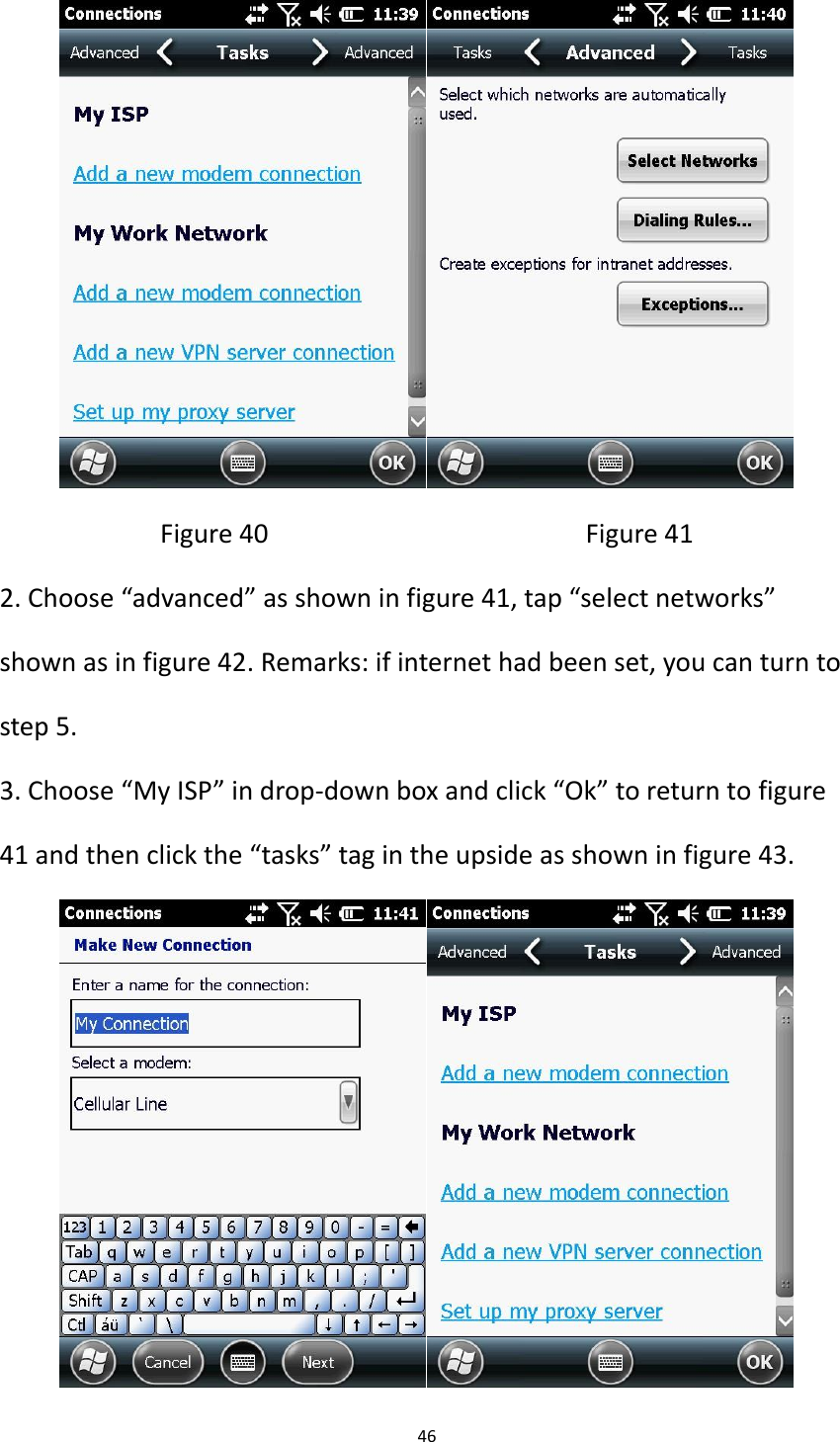
45   Figure 38                                              Figure 39 Tap the target to align the screen, the device will exit the align interface automatic after the screen is aligned. 4.7 GPRS Network Setting Use GPRS to connect the internet, you can receive and send messages through the network. You need to apply for GPRS Service from your service provider, and you can search the rate of the GPRS provided by the service provider. Please contact with your service provider to specifically know the rate of GPRS and the tariff standard 4.7.1 Add New GPRS Connecting 1. Tap  / Settings/ Connections/ Connections. It’s shown as in figure 40.
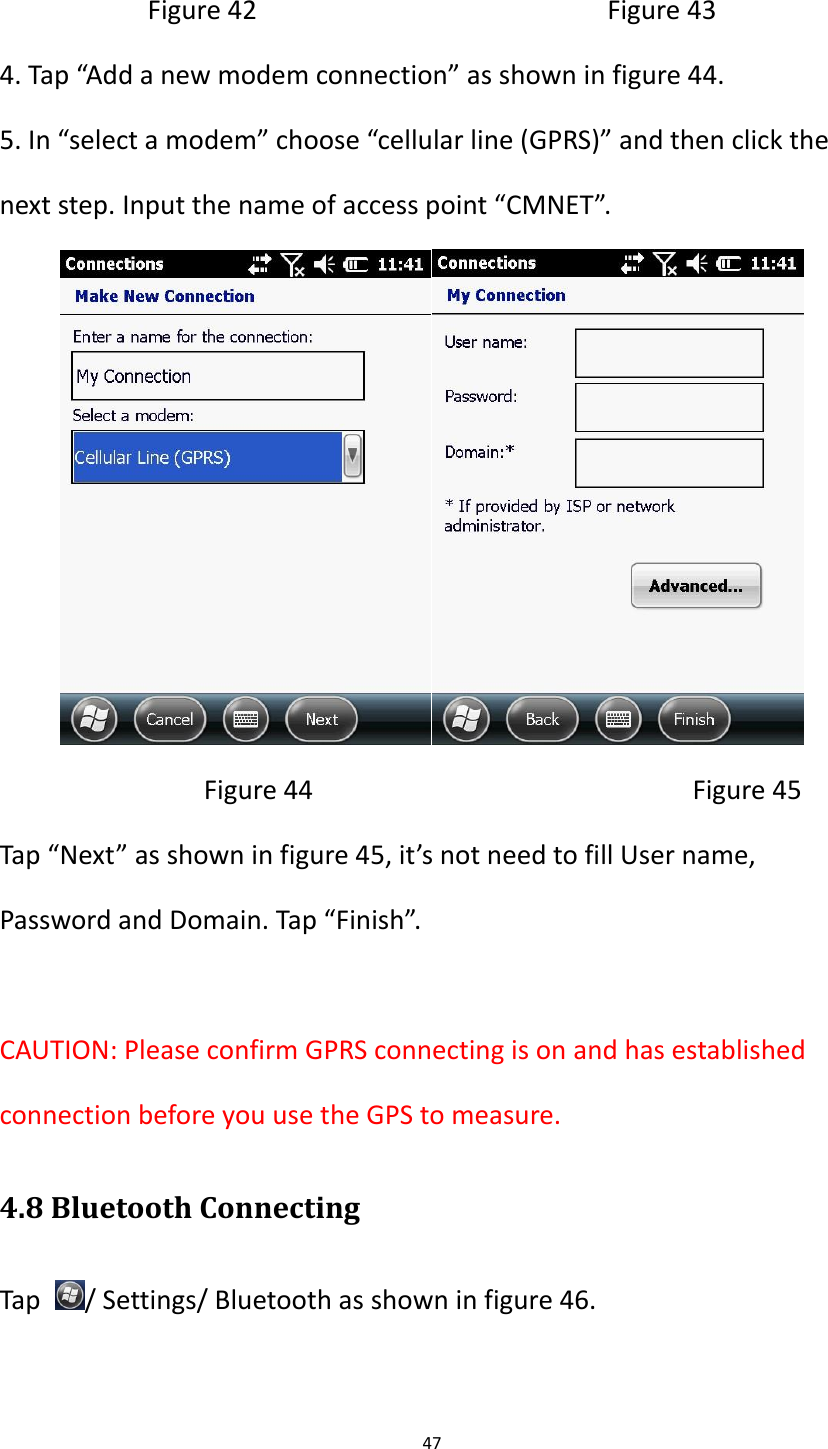
46   Figure 40                                            Figure 41 2. Choose “advanced” as shown in figure 41, tap “select networks” shown as in figure 42. Remarks: if internet had been set, you can turn to step 5. 3. Choose “My ISP” in drop-down box and click “Ok” to return to figure 41 and then click the “tasks” tag in the upside as shown in figure 43.
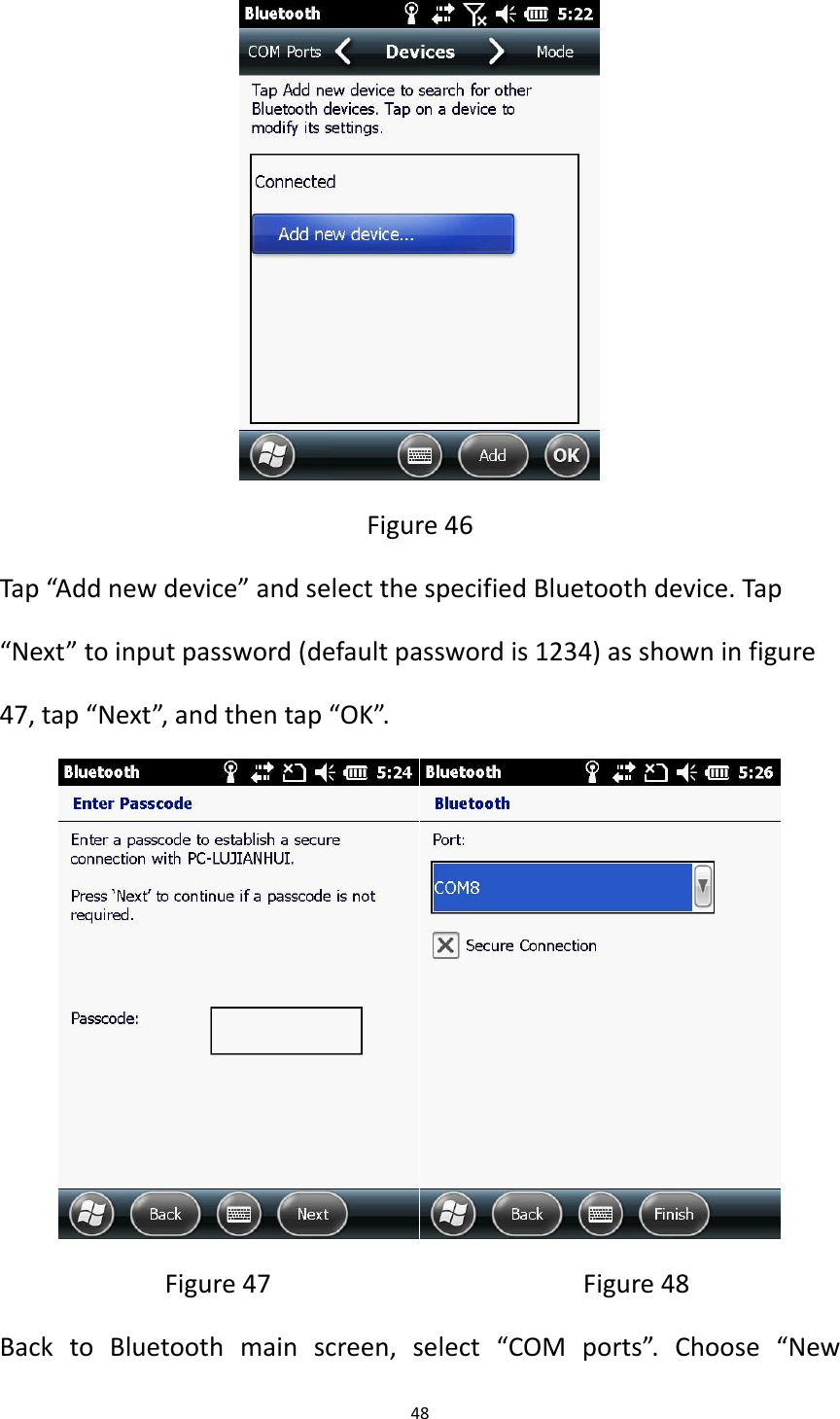
47  Figure 42                                                Figure 43 4. Tap “Add a new modem connection” as shown in figure 44. 5. In “select a modem” choose “cellular line (GPRS)” and then click the next step. Input the name of access point “CMNET”.                              Figure 44                                                    Figure 45 Tap “Next” as shown in figure 45, it’s not need to fill User name, Password and Domain. Tap “Finish”.  CAUTION: Please confirm GPRS connecting is on and has established connection before you use the GPS to measure. 4.8 Bluetooth Connecting Tap  / Settings/ Bluetooth as shown in figure 46.
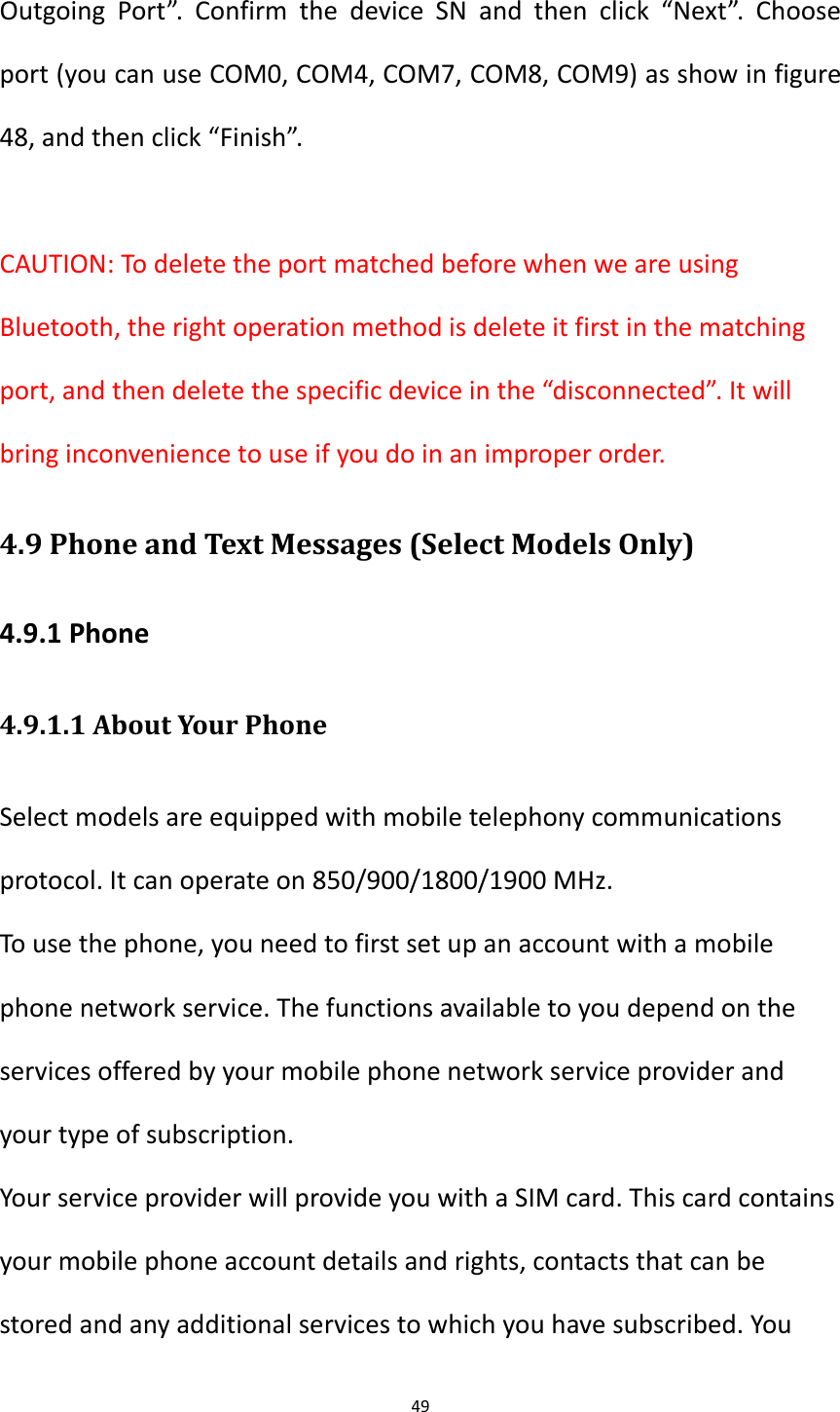
48   Figure 46 Tap “Add new device” and select the specified Bluetooth device. Tap “Next” to input password (default password is 1234) as shown in figure 47, tap “Next”, and then tap “OK”.    Figure 47                                            Figure 48 Back  to  Bluetooth  main  screen,  select  “COM  ports”.  Choose  “New
49  Outgoing  Port”.  Confirm  the  device  SN  and  then  click  “Next”.  Choose port (you can use COM0, COM4, COM7, COM8, COM9) as show in figure 48, and then click “Finish”.  CAUTION: To delete the port matched before when we are using Bluetooth, the right operation method is delete it first in the matching port, and then delete the specific device in the “disconnected”. It will bring inconvenience to use if you do in an improper order. 4.9 Phone and Text Messages (Select Models Only) 4.9.1 Phone 4.9.1.1 About Your Phone Select models are equipped with mobile telephony communications protocol. It can operate on 850/900/1800/1900 MHz. To use the phone, you need to first set up an account with a mobile phone network service. The functions available to you depend on the services offered by your mobile phone network service provider and your type of subscription. Your service provider will provide you with a SIM card. This card contains your mobile phone account details and rights, contacts that can be stored and any additional services to which you have subscribed. You
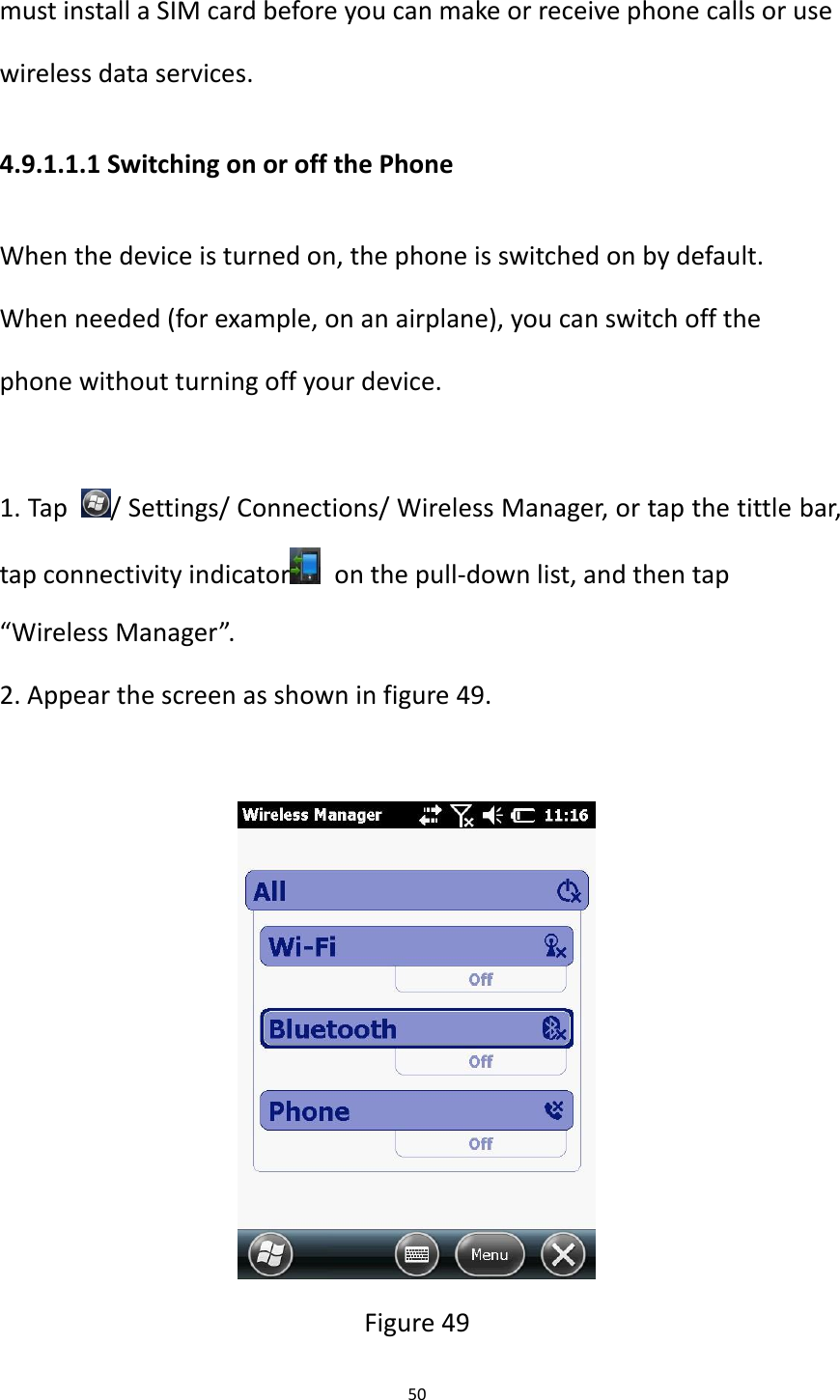
50  must install a SIM card before you can make or receive phone calls or use wireless data services.   4.9.1.1.1 Switching on or off the Phone When the device is turned on, the phone is switched on by default. When needed (for example, on an airplane), you can switch off the phone without turning off your device.  1. Tap  / Settings/ Connections/ Wireless Manager, or tap the tittle bar, tap connectivity indicator   on the pull-down list, and then tap “Wireless Manager”. 2. Appear the screen as shown in figure 49.   Figure 49
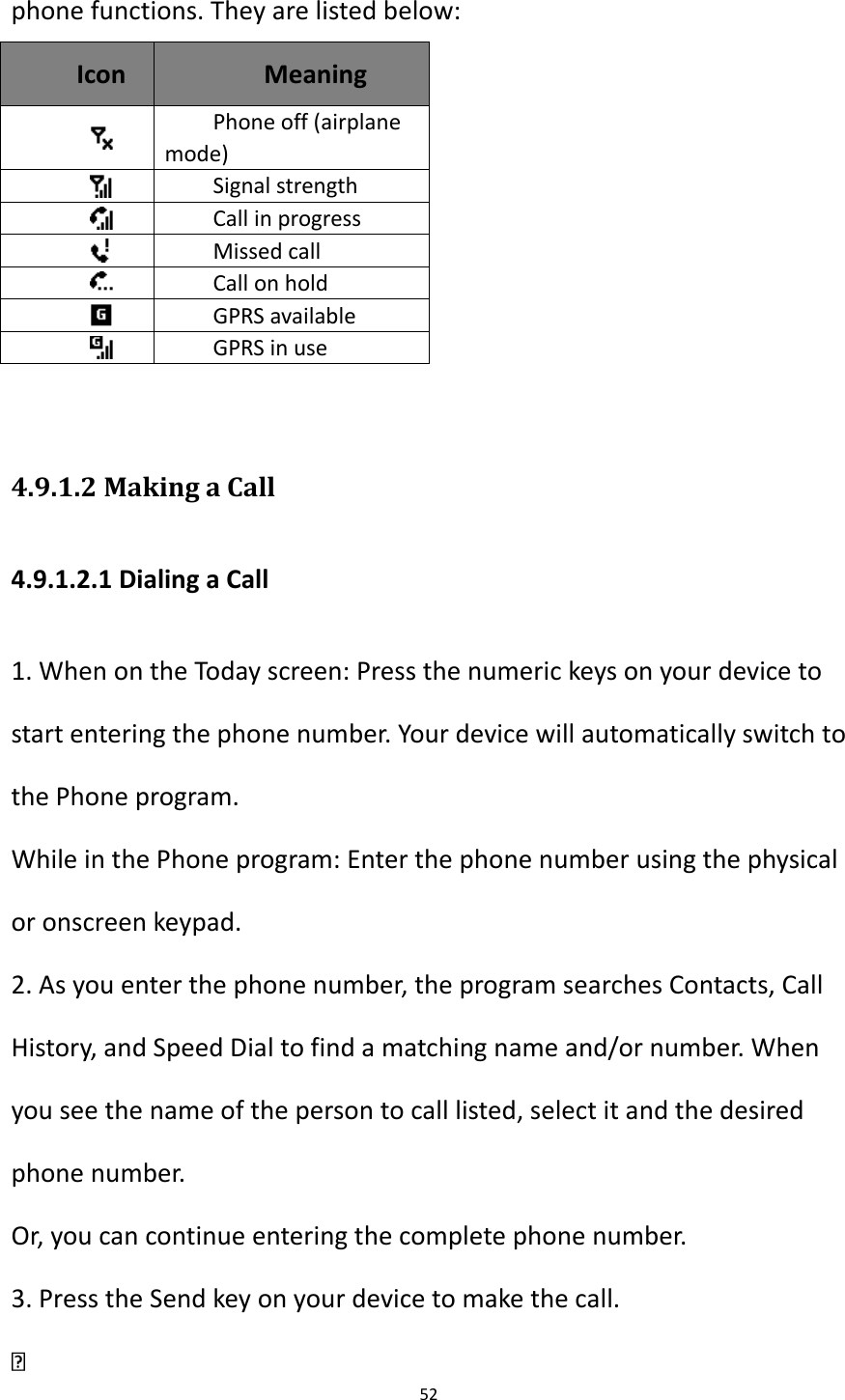
51  Tap “Phone” to switch it from off to on. 3. When the phone is switched on, you may be requested to enter the PIN (Personal Identification Number) code if it has been set. Then, your device will search for the mobile phone network service and show the name in the Wireless Manager section on the Today screen.   Tap “Phone” again if you want to turn it off, then the Phone section displays Phone off.   4.9.1.1.2 Starting the Phone Program Start the Phone program by any of the three methods: 1. Press the Send key on the device. 2. Tap Phone (left soft key) on the Today screen. 3. Tap  / Phone.  CAUTION: if the phone is currently off, you will be asked to turn it on. Whenever you start Phone, the Phone screen displays the soft keypad. You can tap Hide Keypad (left soft key). You can use other programs during a call. To quickly switch back to Phone, press the Send key on your device. 4.9.1.1.3 Phone Status Icons Icons will be displayed on the navigation bar to indicate the status of the
52  phone functions. They are listed below: Icon Meaning  Phone off (airplane mode)  Signal strength  Call in progress  Missed call  Call on hold  GPRS available  GPRS in use  4.9.1.2 Making a Call 4.9.1.2.1 Dialing a Call 1. When on the Today screen: Press the numeric keys on your device to start entering the phone number. Your device will automatically switch to the Phone program. While in the Phone program: Enter the phone number using the physical or onscreen keypad. 2. As you enter the phone number, the program searches Contacts, Call History, and Speed Dial to find a matching name and/or number. When you see the name of the person to call listed, select it and the desired phone number. Or, you can continue entering the complete phone number. 3. Press the Send key on your device to make the call.
53  CAUTION:    If you enter a wrong number, use the Backspace key to eraser individual numbers one at a time.  If you are making an international call, tap and hold on the number key 0 until + sign appears. The + sign replaces the international prefix of the country from where you are calling. 4.9.1.2.2 Making a Call From the Onscreen List Whenever you start the Phone program, the screen lists all recent calls, speed dials, and contacts. If the list contains the number you want to call, you can conveniently select from the list and press the Send key on your device.  CATION: To view a different list on the phone screen, tap menu/ view and select one of the options. 4.9.1.2.3 Making a Call From Contacts Microsoft Contacts displays your contact information stored both in your device’s memory and on your SIM card.   1. Start the Contacts program. 2. Do one of the followings to call a person in the contact list: ① Tap the contact to call. Then tap the number to call; or move to
54  the number to call and then tap Call or press the Send key. ② Tap and hold on the contact to call, and then tap the number to call in the shortcut menu. 4.9.1.2.4 Making a Call From the Call History List The Call History list displays the calls you made, received or missed. 1. While in the Phone program, tap “Call History”. If have hidden the keypad, tap Keypad to see the Call History key. 2. Do one of the followings to call a person in the Call History list: ① Select the number to call and then tap “Call” or press the Send key on your device. ② Tap and hold on the number to call and then tap “Call” in the shortcut menu. 4.9.1.2.5 Making a Call From Speed Dial If you have created speed dial entries, you can call a person quickly.   When on the Today screen or in the Phone program, press and hold the numeric key of the assigned speed dial number to make the call. 4.9.1.3 Responding to a Call When an incoming call is received, your device rings or vibrates according to the options you have set for the phone. The name and
55  number of the caller are displayed on the pop-up window. If the name of the caller is not in your contact list, only the caller’s phone number is displayed. 4.9.1.3.1 Answering a Call To answer an incoming call, press the Send key on your device or tap Answer (left soft key). 4.9.1.3.2 Rejecting a Call To reject an incoming call, press the End key on your device or tap Ignore (right soft key). 4.9.1.3.3 Ending a Call To end a call, press the End key on your device or tap End on the screen. 4.9.1.4 Operations During a Call 4.9.1.4.1 Adjusting the Phone Volume To adjust the volume during a call, tap the icon on the navigation bar and select a volume level. 4.9.1.4.2 Using the Mute Function During a call, you can mute your microphone so that the person with
56  whom you are speaking cannot hear you, but you can still hear him or her. On the Phone keypad, tap “Mute” to switch on the mute function. The icon will appear on the upper-right corner. To switch off the mute function, tap “Unmute”. 4.9.1.4.3 Using the Speakerphone Tap “Speaker” On to switch on the speakerphone function. The icon will appear on the navigation bar. To switch off the speakerphone function, tap “Speaker Off”. 4.9.1.4.4 Managing More Than One Call CAUTION: You may need to register for the “call waiting” service with your mobile phone network service and set your device accordingly. The exact number of people you can talk at the same time depends on your mobile phone network service. During a call, you can make or take a second call while putting the current call on hold. Then, you can choose to swap between the two callers or set up a conference call between all three parties. Holding a Call to Take a Second Call 1. If there is another incoming call when you are talking on your device, a pop-up window appears to notify you.
57  2. Tap “Answer” to place the first call on hold, and answer the second call. 3. To end the second call and go back to the first, tap “End”.  Rejecting the Second Call To reject the second call and keep your current call in progress, tap Ignore. Be careful not to tap End; doing so will end the current call.  Placing a Call on Hold to Make a Second Call 1. During a call, tap “Hold” to place the first call on hold. 2. Dial a second number or the first few letters of the second contact’s name by using the numeric keypad on your device. Then press the Send key to connect. Wait for it to be picked up. 3. To end the second call and go back to the first, tap “End”.  Swapping Between Calls When you have put a call on hold and made or taken another call as described earlier, you can swap between the two calls by tapping “Swap”.  Setting up a Conference Call
58  CAUTION: You may need to consult your mobile phone network service for the availability and subscription of the conference call function. 1. When you have put a call on hold and made or taken another call as described earlier, you can set up conference calling by tapping Menu/ Conference. 2. To add additional people to your conference, tap Hold. Dial a second number and press the Send key to connect. Wait for it to be picked up. Then tap Menu/ Conference. 3. If you want to talk to one of the parties privately during the call, tap Menu/ Private. Select a number, and tap “Private”. 4.9.1.4.5 Taking a Note During a Call You can take a note during a call. 1. Tap “Notes”. 2. Enter your note and tap “ok”. To access a note you created during a call: 1. While in the Phone program, tap “Call History”. 2. The icon indicates that the phone call entry contains a note. Tap and hold the name or number for that entry, and tap “View Note” in the shortcut menu.
59   CAUTION: You can also tap “Programs”, “Notes”, and access the note in the Calls folder. 4.9.1.5 Using Call History Call History provides the time and duration of all incoming, outgoing, and missed calls, and a summary of total calls. Call History also provides easy access to any notes taken during a call. To access Call History while in the Phone program, tap “Call History”. 4.9.1.5.1 Viewing Call History You can tap Menu/ Filter to change the Call History view (All Calls by default). All Calls: Displays all calls made to and from your device in a chronological order. Missed: Displays only calls that were not answered. Outgoing: Displays only calls made from your device. Incoming: Displays only calls made to your device. To see the time, date and duration of a call, tap the item on the list to view details. To clear all items on the list, tap Menu/ Delete All Calls.
60  4.9.1.5.2 Adding an Entry to Contacts Using Call History You can add a phone number in the Call History to Outlook Contacts or SIM Contact. 1. Tap and hold the entry you wish to transfer, and tap Save to Contacts in the shortcut menu. 2. Tap New Contact and select a contact type. 3. Enter the contact’s name, and select the proper number type. Using the Phone is selected Models Only. 4. Tap “Save” to save the entry. 4.9.1.6 Using Speed Dial You can create Speed Dials for frequently-called phone numbers so you can dial a number with a single key press. 4.9.1.6.1 Creating a Speed Dial Entry Speed dials can only be created for numbers stored in Contacts. 1. While in the Phone program, tap “Speed Dial”. 2. Tap Menu/ New. 3. Tap the desired contact. 4. In Name, accept the current name or change it if you want to. 5. In Number, select the phone number if there is more than one number for the contact.
61  6. If Location, accept the current speed dial number or change the number if you want to. 7. Tap “ok” to save the setting. The new Speed Dial entry is now on the Speed Dial list. The letter on the lower-right corner of the entry indicates the assigned phone number. For example, ‚m‛ indicates the mobile phone number. 4.9.1.6.2 Editing or Deleting a Speed Dial Entry 1. While in the Phone program, tap “Speed Dial”. 2. Tap the desired entry and tap Delete or Tap and hold on the desired entry, and tap “Delete” in the shortcut menu. (Select Models Only) 3. Tap “Yes”. 4.9.1.7 Customizing Your Phone To access the Phone Settings, start the Phone program and tap Menu/ Options. 4.9.1.7.1 Changing Phone Settings Tap “Phone” tab. You can customize phone settings, such as the ring type and ring tone to be used for incoming calls, and the keypad tone to be used when entering phone numbers.
62  CAUTION: To use custom .mp3, .wav or .mid files as ring tones for incoming calls, copy the files to the Application data/ Sounds folder on your device or to the inserted storage card. Then, select the sound from the Ring Tone list.       4.9.1.7.2 Changing Security Settings Tap “Security” tab. You can protect your phone from unauthorized use. You might be prompted to enter the PIN2 code for specific functions (such as the pre-paid card’s charging counters). Consult your mobile phone network service to check if your SIM card supports PIN2-related functions and services.  CAUTION: Emergency call can be placed at any time without requiring a PIN code. 4.9.1.7.3 Changing Services Settings Tap “Services” tab. You can access and configure settings for the phone services you subscribed to through your mobile phone network service. For example, you may want to block certain types of incoming and/or outgoing calls, forward incoming calls to a different phone number based on your
63  situation, be notified of incoming calls when you are already in a call, or let others know your identity when making calls. Services available to you depend on your mobile phone network service and the type of your subscription. To view your services settings, tap a service and then tap “Get Settings”. 4.9.1.7.4 Changing Network Settings Tap “Network” tab. You can view available wireless networks, determine the order in which your phone accesses another network if the current one is unavailable, and specify whether you want to change networks manually or automatically. The current network will remain active until you change it, lose your signal, or change your SIM card. 4.9.1.8 Additional Phone Operations 4.9.1.8.1 Using Text Messages Text messages are automatically received when your phone is switched on. The Today screen shows if there are new text messages. You can tap the section to open the message list. To send a text message, you can do one of the followings: ① Select a phone number from a program such as Phone or Contacts at first. Then select “Send Text Message” from the shortcut menu or soft
64  key. ② Start the Messaging program at first. Then select the phone number. 4.9.1.8.2 Setting up an Internet Connection You can set up an Internet connection using the mobile network. 4.9.1.8.3 Checking Your Voice Mail The first position in your speed dial list defaults as your voice mailbox. When you insert your SIM card, your device automatically detects your voice mailbox number and sets it to the first position in your speed dial list. 4.9.1.8.4 Making an Emergency Call You can use your device to dial the international emergency number 112. This number can normally be used to make an emergency call in any country with or without a SIM card inserted, as long as you are within a mobile phone network. Some mobile phone network services may require that a SIM card be inserted, and in some cases that the PIN be entered. There may be other emergency numbers available. Your mobile phone network service may save additional local emergency numbers in the
65  SIM card. 4.9.1.8.5 Dialing an International Call When you are manually dialing a number, tap and hold on the number key 0 until the + sign appears. The + sign replaces the international prefix of the country from where you are calling. Enter the full phone number you want to dial including country code, area code (without the leading area code zero) and local phone number. 4.9.2 Text Messages 4.9.2.1 Reading Text Messages Text messages are automatically received when your phone is switched on. The Today screen shows if there are new text messages. You can tap the section to open the message list. To manually open the message list: 1. Tap / Text.   2. The message list appears. Select the item you want to read. 4.9.2.2 Composing and Sending a Text Message 1. Tap  / Text. 2. Tap Menu/ New.
66  CAUTION: You can also send a text message by selecting a phone number from another program such as Contacts or Phone. Then select “Send text message” from the shortcut menu or soft key. 3. Enter the phone number of one or more recipients, separating them with a semicolon. To select phone numbers from Contacts, tap “To”. 4. Enter your message. To quickly add common messages, tap Menu/ My Text, and tap a desired message. 5. Tap “Send”. 4.10 WIFI Connecting 4.10.1 Switching On or Off the Wi-Fi Radio By default, the Wi-Fi radio is switched off. To switch on or off the Wi-Fi radio: 1. Tap the Wireless Manager section on the Today screen or tap the connectivity indicator on the navigation bar and tap “Wireless Manager”. 2. In the Wireless Manager screen, tap Wi-Fi to change the Wi-Fi radio status. When switched on, your device will display the word Available if wireless networks are detected. If you have previously connected to a wireless network, your device will
67  try to connect to the same network and display the name of the network after the connection. 4.10.2 Connecting to a Wireless Network 1. Switch on the Wi-Fi radio. (See ‚Switching On or Off the Wi-Fi Radio‛ previously.) 2. Your device will detect available Wi-Fi networks. If more than one network is detected, the screen will display a network list. Select the network you want to connect to, and tap “OK”. 3. Select to connect to the Internet or the private network, and then tap “Connect”. 4. If the selected network requires a network key, enter the key and tap “Connect”. The WIFI icon  appears on the navigation bar. CAUTION: You can also search for a network to connect by tapping  / Settings/ Connections/ Wi-Fi. Once you have connected to a network, the shortcut is created in Settings. Tap  / Settings/ Connections/ Wi-Fi to change the network settings. Tap the desired network and change the settings. 5. When you have finished using the wireless network, end the Wi-Fi connection by switching off its radio.
68  CAUTION: Leaving the radio on will consume more power.
69  Chapter 5    Software Operation You can install programs you need on the device except Pre-installed programs. 5.1 Installing Programs 1. Download the programs you need or copy them directly from the CD to your computer. 2. Connect your device and computer, and copy the installation program to your device when you have established the connection between your device and your computer. Find the program you want in the File Explorer and run it. Install the program following the instruction and select the installation path customizing. The system will automatically generate a shortcut when the installation has successfully completed. Click the shortcut to run the program.  CAUTION: If the system prompts to restart the device when the installation has successfully completed, follow the prompts.   5.2 Uninstalling Programs Tap  / Settings/ System/ Remove Programs and select the program you want to uninstall, tap “Remove” to accomplish the operation.
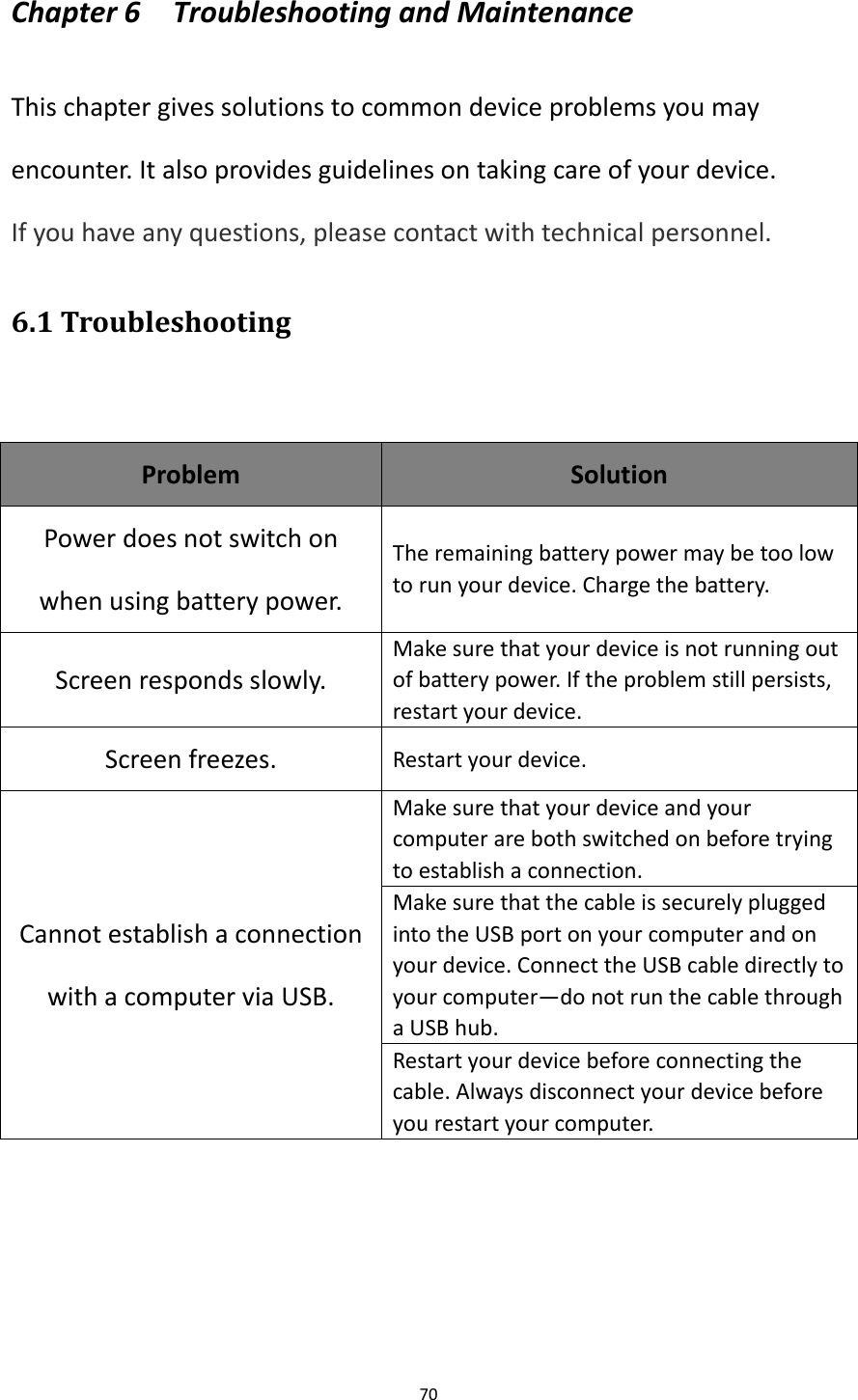
70  Chapter 6    Troubleshooting and Maintenance This chapter gives solutions to common device problems you may encounter. It also provides guidelines on taking care of your device. If you have any questions, please contact with technical personnel. 6.1 Troubleshooting  Problem Solution Power does not switch on when using battery power. The remaining battery power may be too low to run your device. Charge the battery. Screen responds slowly. Make sure that your device is not running out of battery power. If the problem still persists, restart your device. Screen freezes. Restart your device. Cannot establish a connection with a computer via USB. Make sure that your device and your computer are both switched on before trying to establish a connection. Make sure that the cable is securely plugged into the USB port on your computer and on your device. Connect the USB cable directly to your computer—do not run the cable through a USB hub. Restart your device before connecting the cable. Always disconnect your device before you restart your computer.
71  In some specific cases, your device may experience connection problems when it is connected to a Windows computer running ActiveSync. To resolve the problems, please tap  / Settings/ Connections/ USB to PC, and then clear “Enable advanced network” functionality. A warning message of not enough memory appears. Delete files you no longer need. Remove programs you no longer need. Delete all files and clear history in Internet Explorer. Stop programs you are not currently using. To check the state of your active programs, tap / Settings/ System/ Task Manager. Restart your device.  6.2 Resetting Your Device In some cases, you may need to restore your device to the factory default state by clearing the memory. For example, you should clear the memory when the device can’t be turned off, start or when you forget your password. Clearing the memory means all data you have entered in your device’s memory, including all files, system settings and additional programs you have installed, will be erased. (Programs installed to ROM at the factory are not affected.)  CAUTION: To ensure the integrity of your data should it be necessary to clear the memory, you are advised to regularly back up your data.
72  You can do one of the followings to upgrade: 1. Please consult the aftermarket Technical support or factory technician to ensure the upgrade files are correct and latest. 2. Upgrade BOOT: Press and hold the power button, number keys 4 and 7 when your device is off until the screen appears upgrade BOOT. Restart your device when the upgrade has successfully completed. 3. Upgrade OS: Press and hold the Power button, number key 4 and “*” until the screen appears upgrade OS. The upgrade process takes a few minutes, please be patient. 6.3 Caring for Your Device Taking good care of your device will ensure trouble-free operation and reduce the risk of damage to your device.  Keep your device away from extreme temperatures and excessive moisture.  Avoid exposing your device to direct sunlight or strong ultraviolet light for extended periods of time.  Do not place anything on top of your device or drop objects on your device.  Never privately attempt to disassemble, repair or make any modifications to your device.  Do not store or carry flammable liquids, gases or explosive materials
73  in the same compartment as your device, its parts or accessories.  FCC warning Statements:  1. This device complies with Part 15 of the FCC Rules. Operation is subject to the following two conditions: (1) This device may not cause harmful interference. (2) This device must accept any interference received, including interference that may cause undesired operation.  Changes or modifications not expressly approved by the party responsible for compliance could void the user’s authority to operate the equipment.  This equipment has been tested and found to comply with the limits for a Class B digital device, pursuant to Part 15 of the FCC Rules. These limits are  designed  to  provide  reasonable  protection  against  harmful interference in a residential installation. This equipment generates, uses and can radiate radio frequency energy and, if not installed and used in accordance  with  the  instructions,  may  cause  harmful  interference  to radio communications. However, there is no guarantee that interference will not occur in a particular installation.
74   If this equipment does cause harmful interference to radio or television reception, which can be determined by turning the equipment off and on, the user is encouraged to try to correct the interference by one or more of the following measures: -- Reorient or relocate the receiving antenna. -- Increase the separation between the equipment and receiver. -- Connect the equipment into an outlet on a circuit different from that to which the receiver is connected.    -- Consult the dealer or an experienced radio/TV technician for help.  SAR Information Statement Your  device  is  a  radio  transmitter  and  receiver.  It  is  designed  and manufactured  not  to  exceed  the  emission  limits  for  exposure  to radiofrequency  (RF)  energy  set  by  the  Federal  Communications Commission  of  the  U.S.  Government.  These  limits  are  part  of comprehensive guidelines and establish permitted levels of RF energy for the general population. The guidelines are based on standards that were developed by independent scientific organizations through periodic and thorough  evaluation  of  scientific  studies.  The  standards  include  a substantial  safety  margin  designed  to  assure  the  safety  of  all  persons, regardless of age and health. The exposure standard for wireless mobile
75  phones  employs  a  unit  of  measurement  known  as  the  Specific Absorption Rate, or SAR. The SAR limit set by the FCC is 1.6 W/kg. * Tests for  SAR  are  conducted  with  the  phone  transmitting  at  its  highest certified power level in all tested frequency bands. Although the SAR is determined at the highest certified power level, the actual SAR level of the phone while operating can be well below the maximum value. This is because the phone is designed to operate at multiple power levels so as to  use  only  the  power  required  to  reach  the  network.  In  general,  the closer you are to a wireless base station antenna, the lower the power output. Before a phone model is available for sale to the public, it must be  tested  and  certified  to  the  FCC  that  it  does  not  exceed  the  limit established by the government adopted requirement for safe exposure. The tests are performed in positions and locations (e.g., at the ear and worn on the body) as required by the FCC for each model. The highest SAR value for this device when tested for use at the ear is 0.169 W/Kg and  when  worn on  the  body,  as  described  in  this  user  guide,  is  0.365 W/Kg(Body-worn measurements differ among phone models, depending upon available accessories and FCC requirements.) The FCC has granted an Equipment Authorization for this model phone with all reported SAR levels evaluated as in compliance with the FCC RF exposure guidelines. SAR information on this model phone is on file with the FCC and can be found under the Display Grant section of http://www.fcc.gov/ oet/fccid
76  after  searching  on  FCC  ID:  Y44-S4,  Additional  information  on  Specific Absorption Rates (SAR) can be found on the Cellular Telecommunications Industry Asso-ciation (CTIA) web-site at http://www.wow-com.com. * Third-party  belt-clips,  holsters,  and  similar  accessories  used  by  this device  should  not  contain  any  metallic  components.  Body-worn accessories that do not meet these requirements may not comply with RF exposure requirements and should be avoided. Use only the supplied or an approved antenna.

Navigation menu