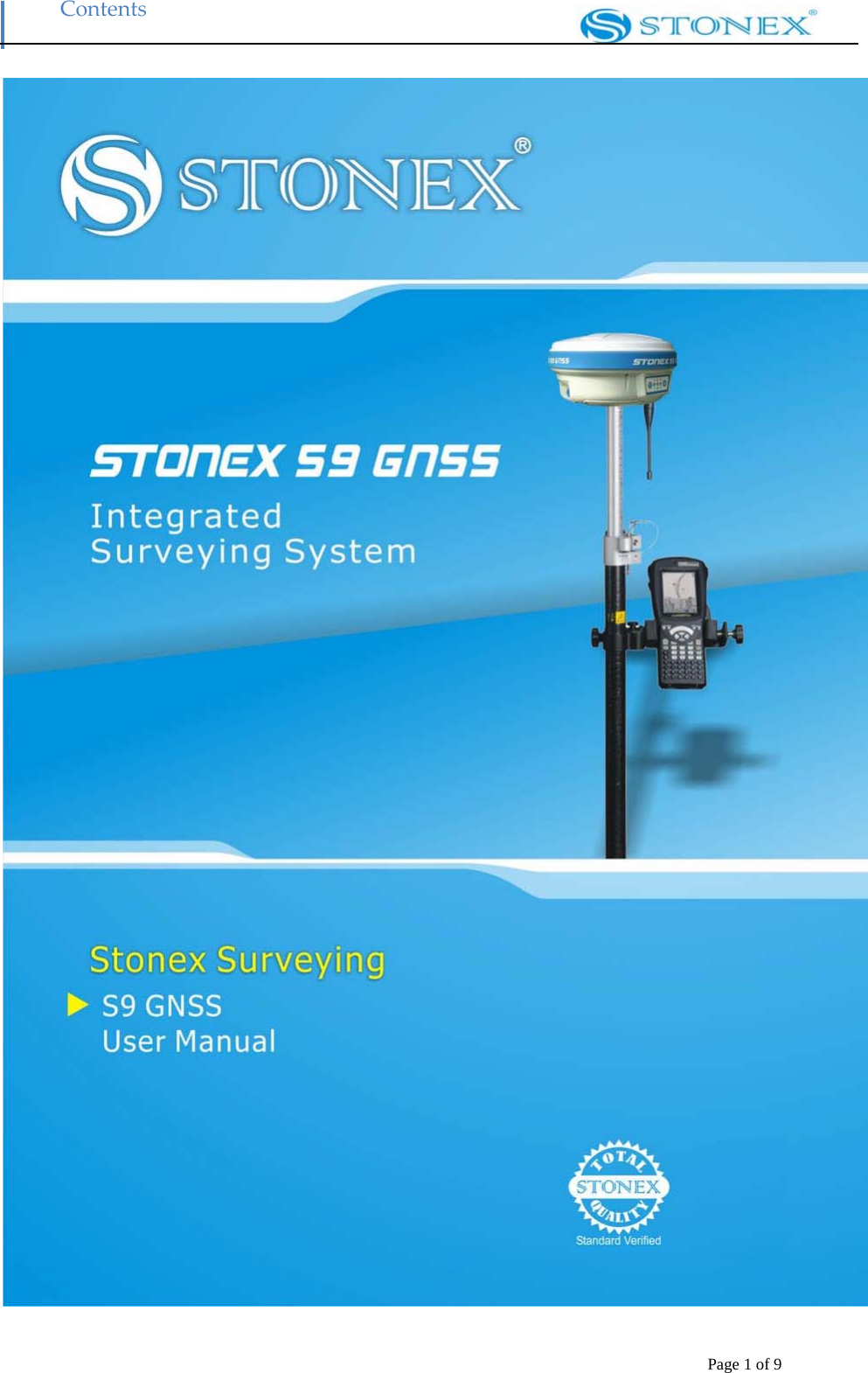
STONEX SRL STN21 GPS SURVEYING EQUIPMENT User Manual

STONEX SRL GPS SURVEYING EQUIPMENT Users Manual

Users Manual

Contents Page 1 of 9 
Contents Page 2 of 9 ContentsChapter I : A brief introduction of S9 ...................................................................................... 3Chapter II :  S9 mainframe ..........................................................................................................6II.1 The outlook of mainframe........................................................................................................... 6II.2 Indicator lights and instrument setup....................................................................................... 6
Contents Page 3 of 9  Chapter I : A brief introduction of S9STONEX®  devoted itself to offer to surveyors the most advanced GPS tools they need.   GPS RTK  surveying  technology  plays  an  important  role  in  surveying  work  and  its  use  is getting   more   and   more   widespread.   As   a   leading   GPS   RTK   instrument   produced, STONEX®   guarantees  the  S9,  its  latest  RTK  GPS  receiver,  is  suited  for  the  requests  of precision, reliability and user friendliness of nowadays. S9  is  able  to  receive  both  frequencies  of  GPS  signal,  but  also  satellite    signals    from GLONASS and GALILEO, so we must correctly speak of “GNSS” receiver.  S9 mainframe is integrated with GNSS antenna, GNSS module, Bluetooth  device  and  battery.  S9  is  totally  integrated:  that means that the surveyor only needs the handheld to start its job. The  exquisite  outlook  and the  amazing  color bring you  a  fashioned surveying situation. The  design  has  a  higher  stability,  less  power  losing,  smaller  volume  and  lighter  weight than the previous STONEX®  receivers. S9 has a special design which makes it waterproof, dustproof  and  quakeproof.  The  batteries  and  built‐in  radio  are  set  in  the  bottom  of mainframe,  giving  more  effective  dustproof  and  waterproof  qualities,  and  making  S9  a better performer in field surveying. Wireless receiver unit weights 1.2 kg: the rover is light and easy to carry. The low power losing of receiver allows the single battery to meet a long time workability. Integrated  design  and  anti‐jamming  property  are  combined  perfectly:  the  former  avoids the problem of a cumbersome external antenna, and the mainframe design can resolve the jamming problem effectively. The  performance  of  data‐transfer  radio  technology  is  at  the  same  level  of  international advanced  technology:  the  bit  error  rate  (BER)  is  10‐7  and  the  radio  collision  problem  is reduced.
Contents Page 4 of 9 The S9 receiver mount a GPS/GLONASS antenna with a four feed technology.    This design is able to reduce the electrical phase center error ellipsoid and in addiction it improves the Right  Hand  Circular  Polarization  Characteristics  (RHCP)  of  the  antenna,  resulting  in enhanced  GPS  signal  tracking  and  improved  multipath  rejection,  in  case  a  polarization reversal has taken place as a result of the signal reflection. The  embedded  receiver  firmware  can  customize  different  RTK  software  for  different  applications. The data transfer is easy and fast, like a Plug and Play USB drive. STONEX®  provide S9 receivers with a two year complete international warranty . to   the   operational   temperatures,   limits   which   should not   be   exceeded  for  a  correct functioning. It is also important to point out that in each weather case after coming back from the field.  you should keep open the container in a warm and dry place and in the same time taking  out the controller and receiver out from the container, in order to make them dry. Anyway we recommend you to treat the instrument with reasonable care.   Even if you have used other GPS or GNSS products before, we recommend that you spend some time reading this manual to learn about the special features of this product. If you are not familiar with GNSS technology, we suggest to read a specific book in order to better understand the contents of this manual. Anyway you can ask for any technical support to our address support@stonexesurveying.com or contact your local dealer.
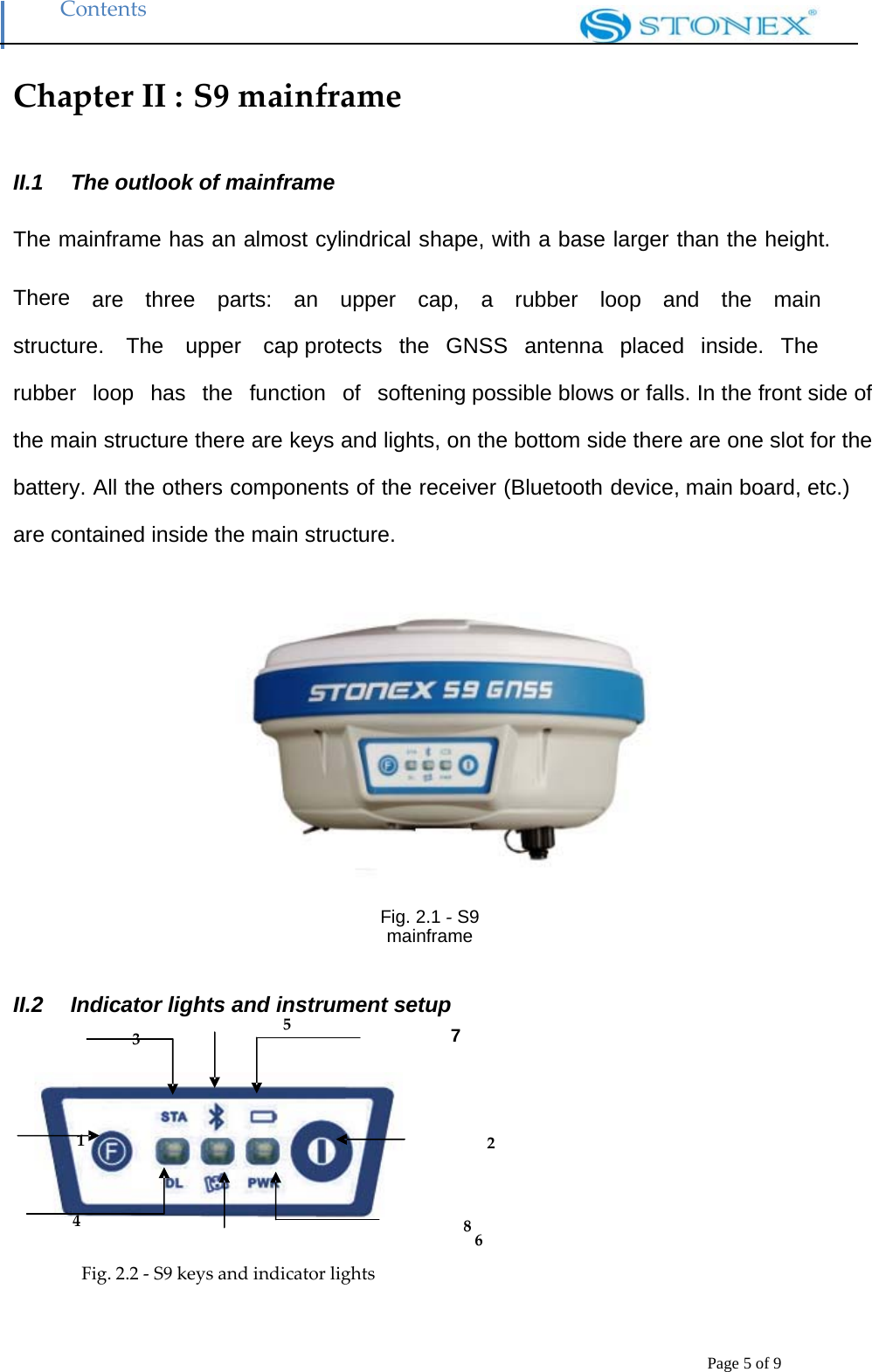
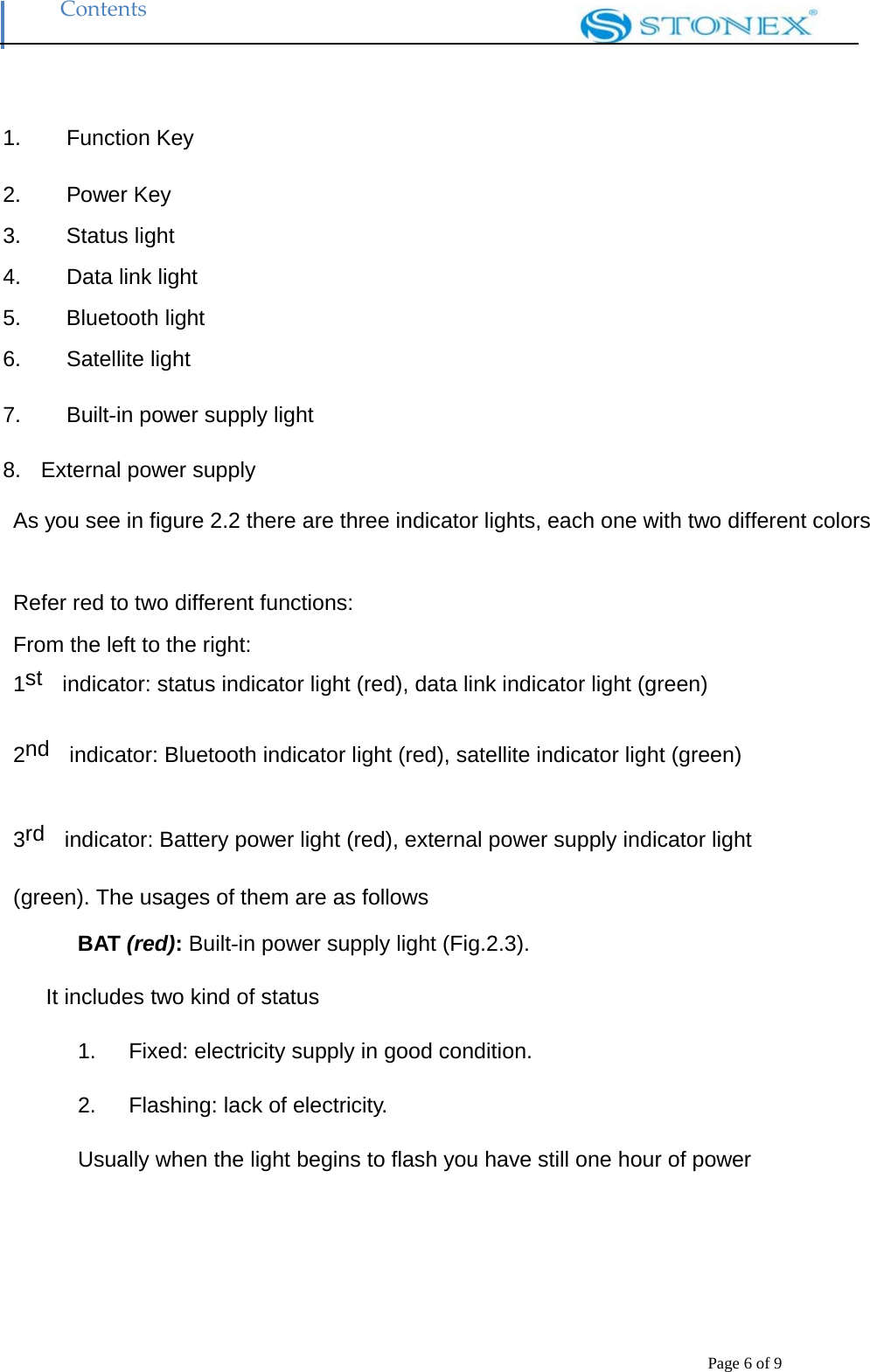
Contents Page 5 of 9 Chapter II : S9 mainframeII.1   The outlook of mainframe   The mainframe has an almost cylindrical shape, with a base larger than the height.    There  are  three  parts:  an  upper  cap,  a  rubber  loop  and  the  main  structure.  The  upper  cap protects  the  GNSS  antenna  placed  inside.  The  rubber  loop  has  the  function  of  softening possible blows or falls. In the front side of the main structure there are keys and lights, on the bottom side there are one slot for the battery. All the others components of the receiver (Bluetooth device, main board, etc.) are contained inside the main structure.    Fig. 2.1 ‐ S9 mainframe II.2   Indicator lights and instrument setup 3 5 7     1 24 86Fig. 2.2 ‐ S9 keys and indicator lights
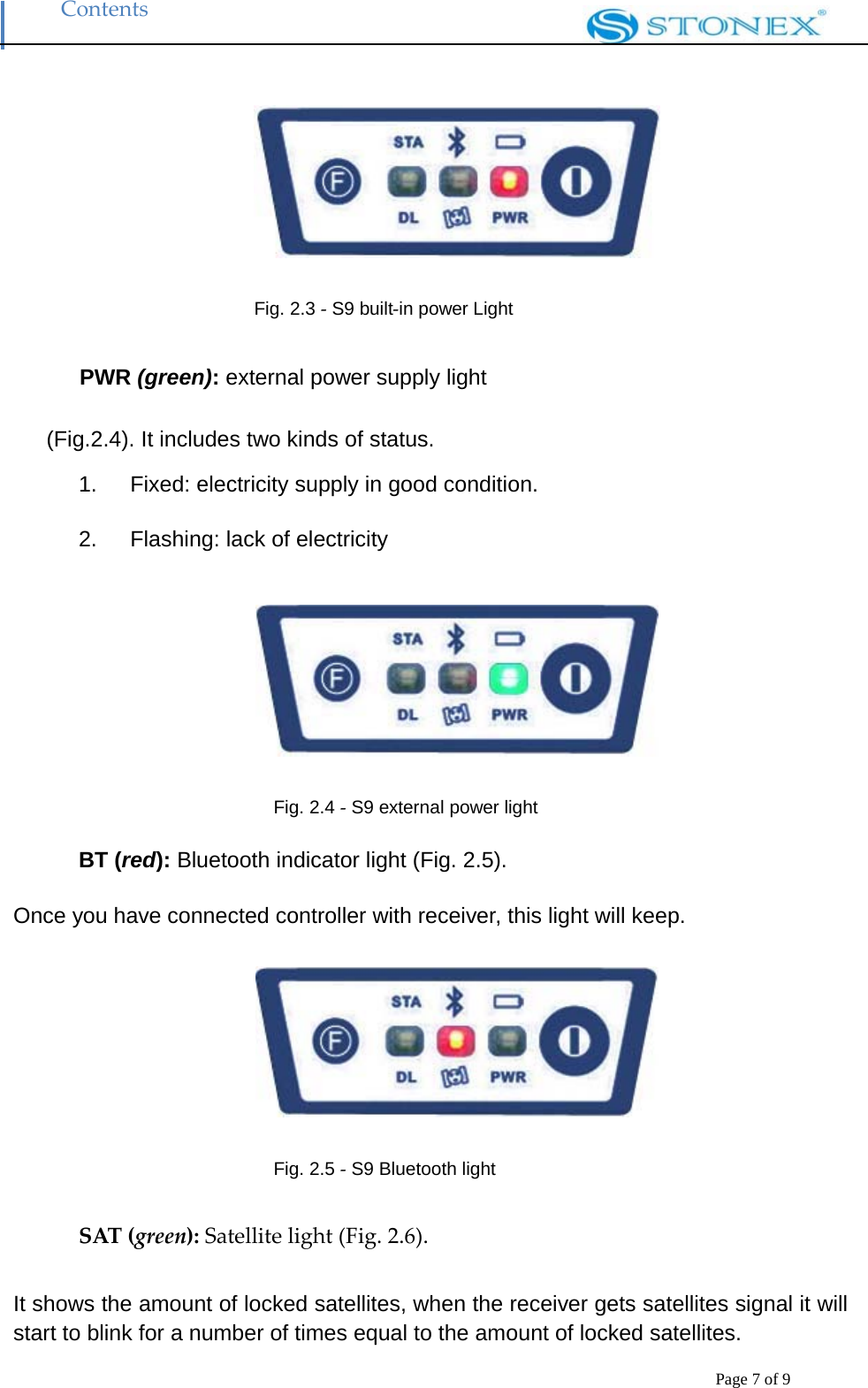
Contents Page 6 of 9   1. Function Key  2. Power Key  3. Status light  4. Data link light  5. Bluetooth light  6. Satellite light  7. Built‐in power supply light  8.  External power supply  As you see in figure 2.2 there are three indicator lights, each one with two different colors  Refer red to two different functions: From the left to the right: 1st  indicator: status indicator light (red), data link indicator light (green)  2nd  indicator: Bluetooth indicator light (red), satellite indicator light (green)  3rd  indicator: Battery power light (red), external power supply indicator light (green). The usages of them are as follows BAT (red): Built‐in power supply light (Fig.2.3). It includes two kind of status  1.      Fixed: electricity supply in good condition.  2.   Flashing: lack of electricity.  Usually when the light begins to flash you have still one hour of power
Contents Page 7 of 9    Fig. 2.3 ‐ S9 built‐in power Light PWR (green): external power supply light (Fig.2.4). It includes two kinds of status. 1.      Fixed: electricity supply in good condition.  2.   Flashing: lack of electricity   Fig. 2.4 ‐ S9 external power light BT (red): Bluetooth indicator light (Fig. 2.5).   Once you have connected controller with receiver, this light will keep.   Fig. 2.5 ‐ S9 Bluetooth light SAT (green): Satellite light (Fig. 2.6).It shows the amount of locked satellites, when the receiver gets satellites signal it will start to blink for a number of times equal to the amount of locked satellites.
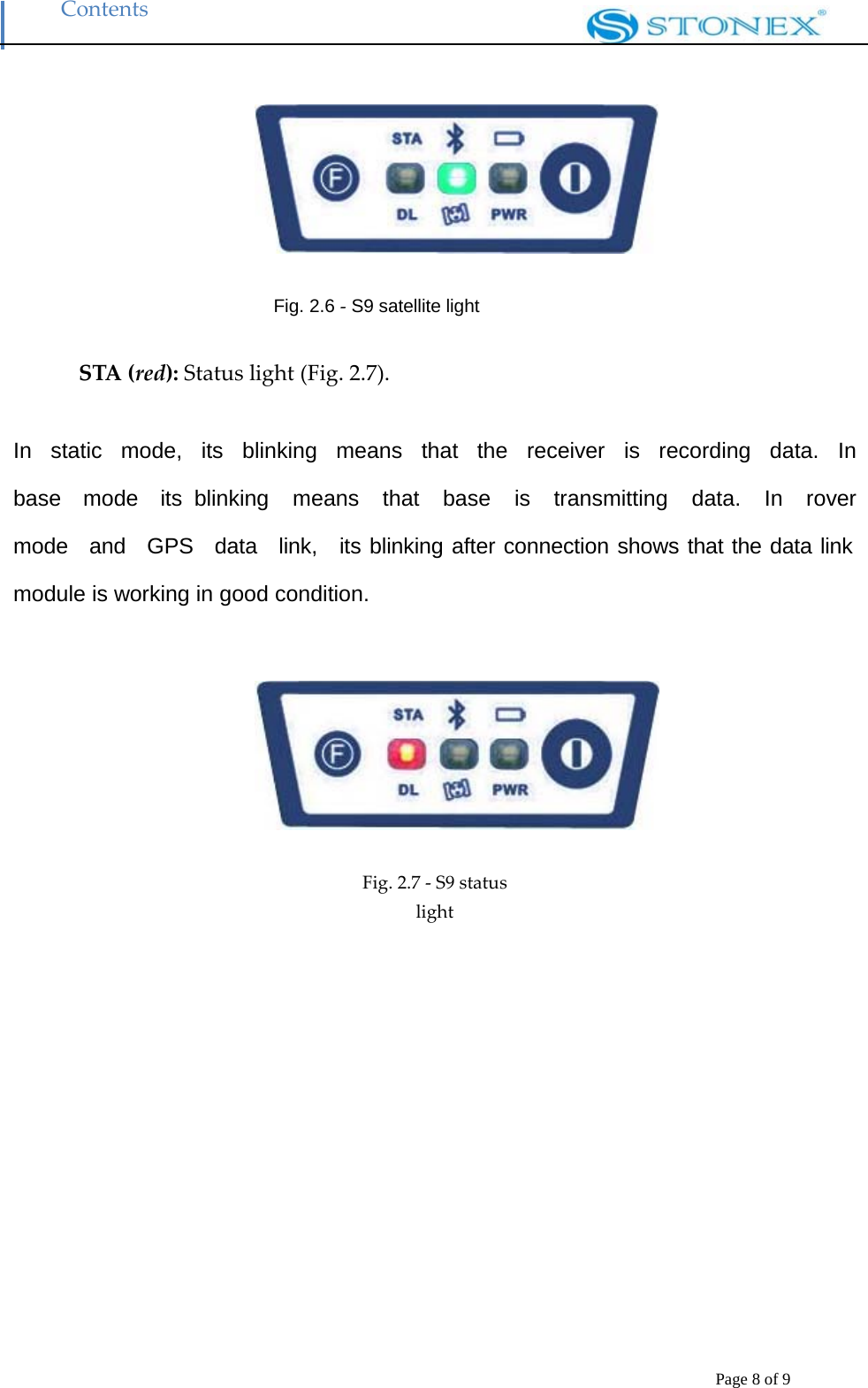
Contents Page 8 of 9   Fig. 2.6 ‐ S9 satellite light STA (red): Status light (Fig. 2.7).In  static  mode,  its  blinking  means  that  the  receiver  is  recording  data.  In  base  mode  its blinking  means  that  base  is  transmitting  data.  In  rover  mode  and  GPS  data  link,  its blinking after connection shows that the data link module is working in good condition.    Fig. 2.7 ‐ S9 status light
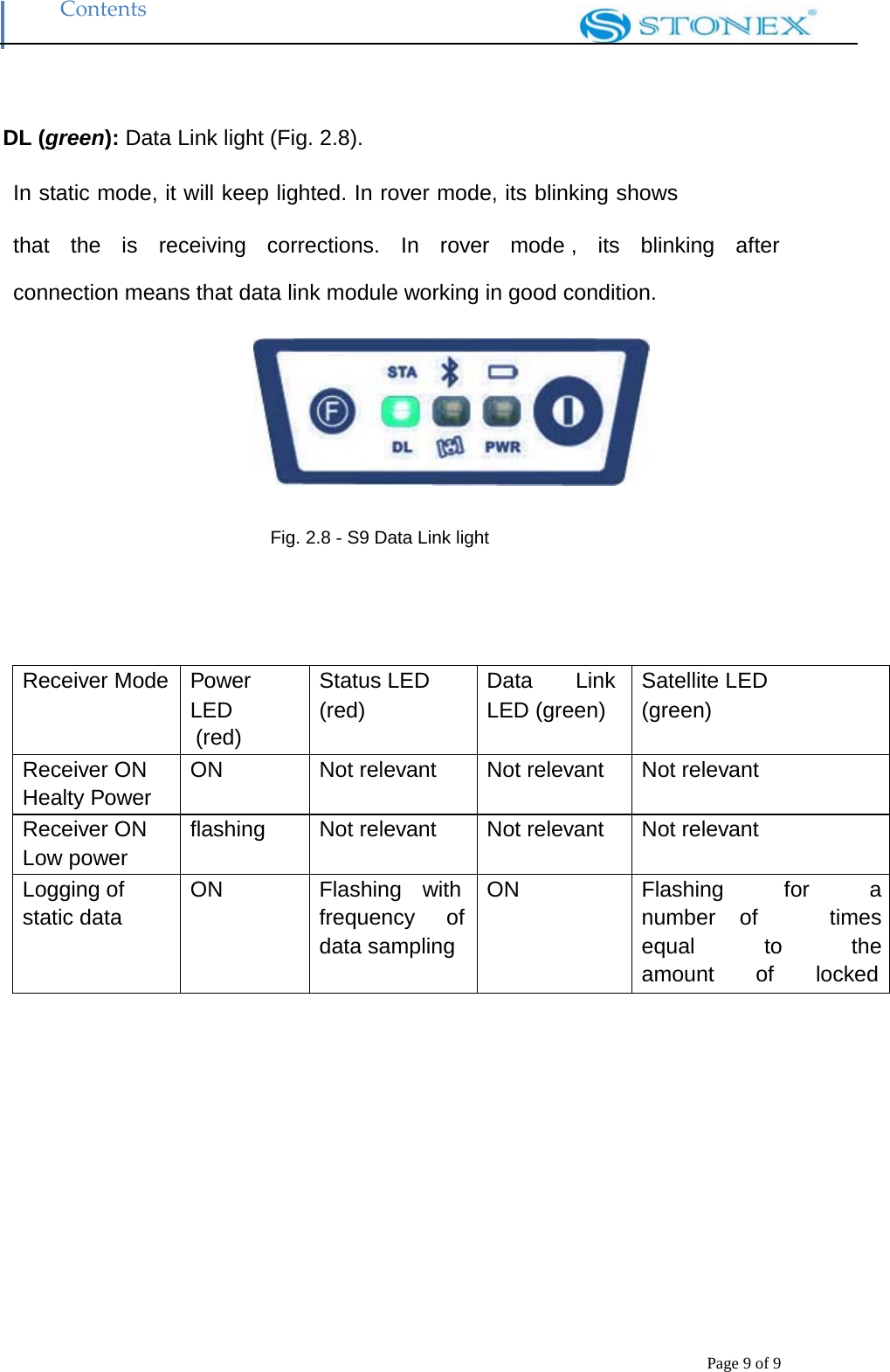
Contents Page 9 of 9   DL (green): Data Link light (Fig. 2.8). In static mode, it will keep lighted. In rover mode, its blinking shows  that  the  is  receiving  corrections.  In  rover  mode ,  its  blinking  after connection means that data link module working in good condition.    Fig. 2.8 ‐ S9 Data Link light     Receiver Mode Power LED (red) Status LED (red) Data Link LED (green) Satellite LED (green) Receiver ON Healty Power ON  Not relevant  Not relevant  Not relevant Receiver ON Low power flashing  Not relevant  Not relevant  Not relevant Logging of static data ON Flashing with frequency   of data sampling ON  Flashing  for  a number of   times equal   to   the amount of locked
FCC WARNING  This device complies with Part 15 of the FCC Rules. Operation is subject to the following two conditions: (1) this device may not cause harmful interference, and (2) this device must accept any interference received, including interference that may cause undesired operation.  NOTE 1: Any changes or modifications not expressly approved by the manufacturer could void the user’s authority to operate the equipment.  NOTE 2: The manufacturer is not responsible for any radio or TV interference caused by unauthorized modifications to this equipment. Such modifications could void the user’s authority to operate the equipment.

Navigation menu