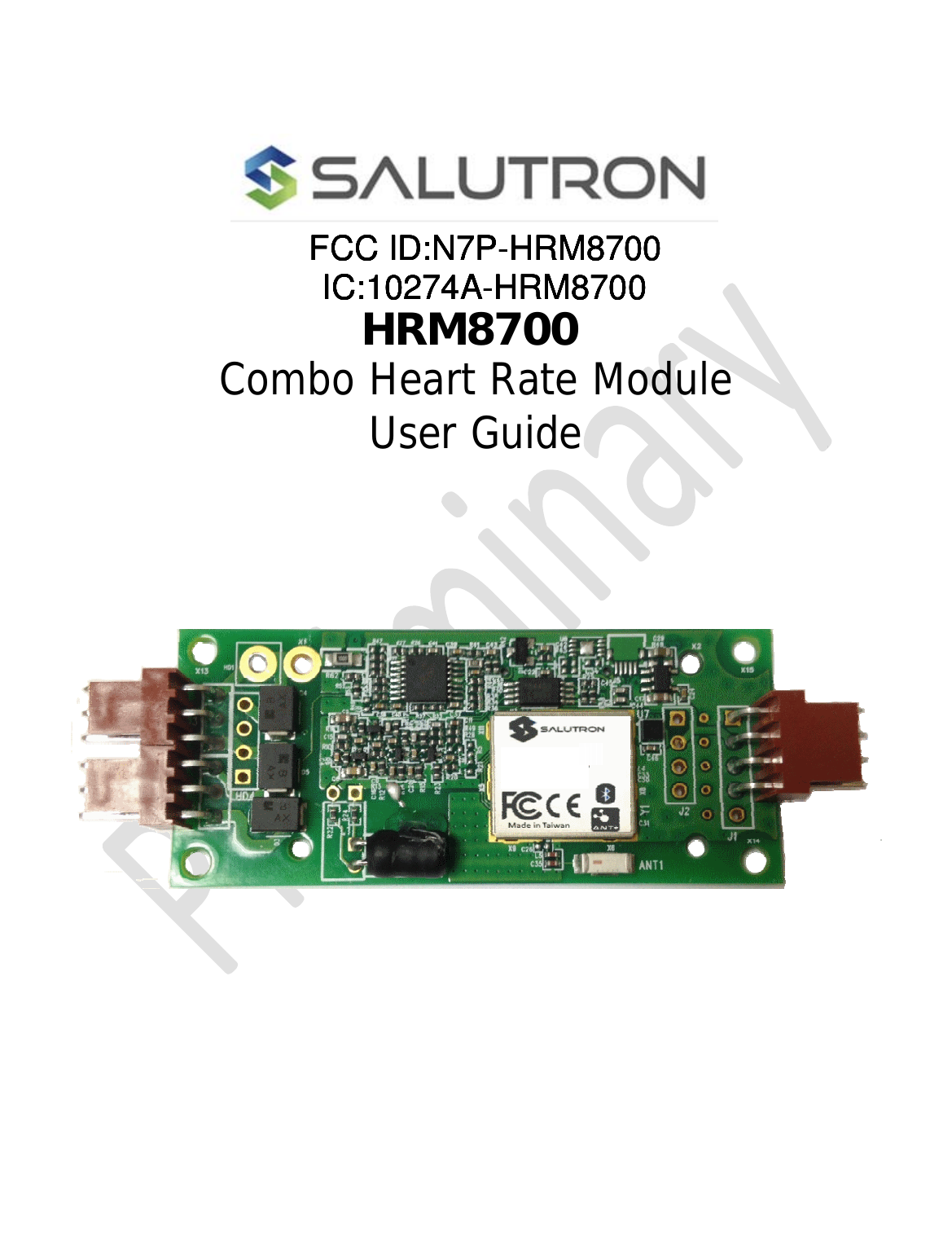
Salutron HRM8700 Heart rate module User Manual

Salutron Inc. Heart rate module

User Manual

 HRM8700 Combo Heart Rate Module  User Guide FCC ID:N7P-HRM8700IC:10274A-HRM8700FCC ID:N7P-HRM8700FCC ID:N7P-HRM8700FCC ID:N7P-HRM8700FCC ID:N7P-HRM8700IC:10274A-HRM8700IC:10274A-HRM8700IC:10274A-HRM8700IC:10274A-HRM8700
                   CONFIDENTIAL  Copyright 2017, Salutron, Inc.             Revision 0.1              Revision Date: 07/23//17           Page: 2 of 21 Revision History:  Revision  Release date  Description By0.1 07/23/17 Preliminary Draft BC                            
                   CONFIDENTIAL  Copyright 2017, Salutron, Inc.             Revision 0.1              Revision Date: 07/23//17           Page: 3 of 21 Contents  General Description .............................................................................................................................. 4Features: ............................................................................................................................................. 4Physical Dimensions: Inches (mm) ......................................................................................................... 5Connection Diagram: (Typical) .............................................................................................................. 6Electrical Characteristics: ...................................................................................................................... 7ECG Measurement: ............................................................................................................................... 75KHZ Wireless Specification: ................................................................................................................. 7BLE/ANT+ Specification: ....................................................................................................................... 71. UART COMMUNICATION PROTOCOL: ................................................................................................. 91.2.Block Diagram .......................................................................................................................................... 92. OPERATION ..................................................................................................................................... 92.1. Description............................................................................................................................................... 92.2. UART Specification .................................................................................................................................. 92.3. Equipment Assomptions ........................................................................................................................ 102.4. HRM8700 default configuration ............................................................................................................. 102.5. Equipment and HRM8700 Operations ................................................................................................... 112.6. HRM8700 OTA. ...................................................................................................................................... 123. UART COMMUNICATION PROTOCOL PACKETS ................................................................................... 133.1. Packets .................................................................................................................................................. 133.2. Example of Sending Packets Equipment Console .................................................................................. 133.3. Example of Sending Packet to HRM8700 .............................................................................................. 14Appendix A : Grounding and ESD Recommendations .............................................................................. 15Appendix B: HRM8700 Placement Guideline ........................................................................................... 18FCC/IC statement ................................................................................................................................ 20FCC statement .............................................................................................................................................. 20IC statement ................................................................................................................................................. 20 
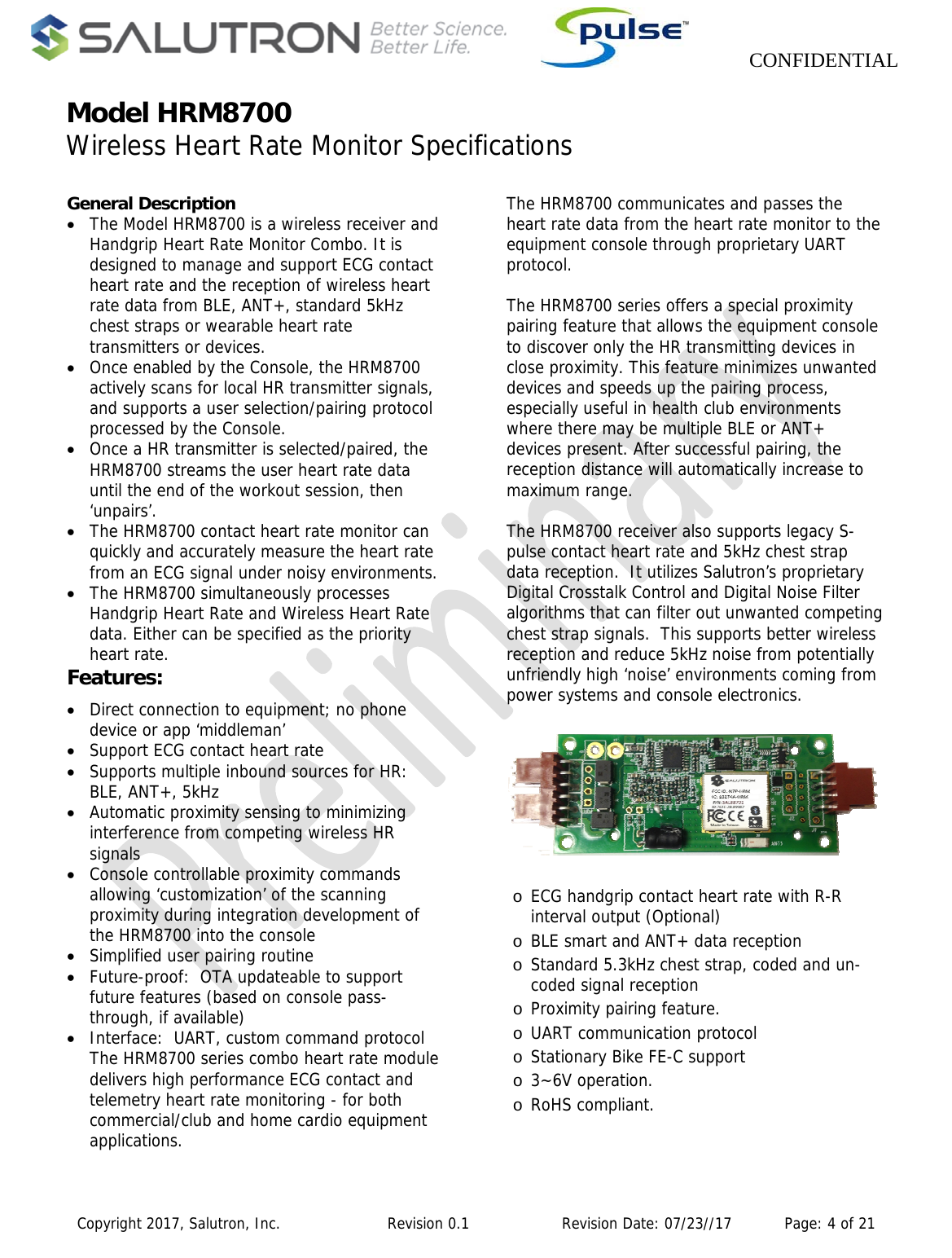
                   CONFIDENTIAL  Copyright 2017, Salutron, Inc.             Revision 0.1              Revision Date: 07/23//17           Page: 4 of 21 Model HRM8700Wireless Heart Rate Monitor Specifications                                                    General Description  The Model HRM8700 is a wireless receiver and Handgrip Heart Rate Monitor Combo. It is designed to manage and support ECG contact heart rate and the reception of wireless heart rate data from BLE, ANT+, standard 5kHz chest straps or wearable heart rate transmitters or devices.    Once enabled by the Console, the HRM8700 actively scans for local HR transmitter signals, and supports a user selection/pairing protocol processed by the Console.    Once a HR transmitter is selected/paired, the HRM8700 streams the user heart rate data until the end of the workout session, then ‘unpairs’.  The HRM8700 contact heart rate monitor can quickly and accurately measure the heart rate from an ECG signal under noisy environments.   The HRM8700 simultaneously processes Handgrip Heart Rate and Wireless Heart Rate data. Either can be specified as the priority heart rate. Features:  Direct connection to equipment; no phone device or app ‘middleman’  Support ECG contact heart rate  Supports multiple inbound sources for HR:  BLE, ANT+, 5kHz  Automatic proximity sensing to minimizing interference from competing wireless HR signals  Console controllable proximity commands allowing ‘customization’ of the scanning proximity during integration development of the HRM8700 into the console  Simplified user pairing routine  Future-proof:  OTA updateable to support future features (based on console pass-through, if available)  Interface:  UART, custom command protocol The HRM8700 series combo heart rate module delivers high performance ECG contact and telemetry heart rate monitoring - for both commercial/club and home cardio equipment applications.    The HRM8700 communicates and passes the heart rate data from the heart rate monitor to the equipment console through proprietary UART protocol.  The HRM8700 series offers a special proximity pairing feature that allows the equipment console to discover only the HR transmitting devices in close proximity. This feature minimizes unwanted devices and speeds up the pairing process, especially useful in health club environments where there may be multiple BLE or ANT+ devices present. After successful pairing, the reception distance will automatically increase to maximum range.   The HRM8700 receiver also supports legacy S-pulse contact heart rate and 5kHz chest strap data reception.  It utilizes Salutron’s proprietary Digital Crosstalk Control and Digital Noise Filter algorithms that can filter out unwanted competing chest strap signals.  This supports better wireless reception and reduce 5kHz noise from potentially unfriendly high ‘noise’ environments coming from power systems and console electronics.   o ECG handgrip contact heart rate with R-R interval output (Optional) o BLE smart and ANT+ data reception  o Standard 5.3kHz chest strap, coded and un-coded signal reception o Proximity pairing feature. o UART communication protocol o Stationary Bike FE-C support o 3~6V operation. o RoHS compliant.
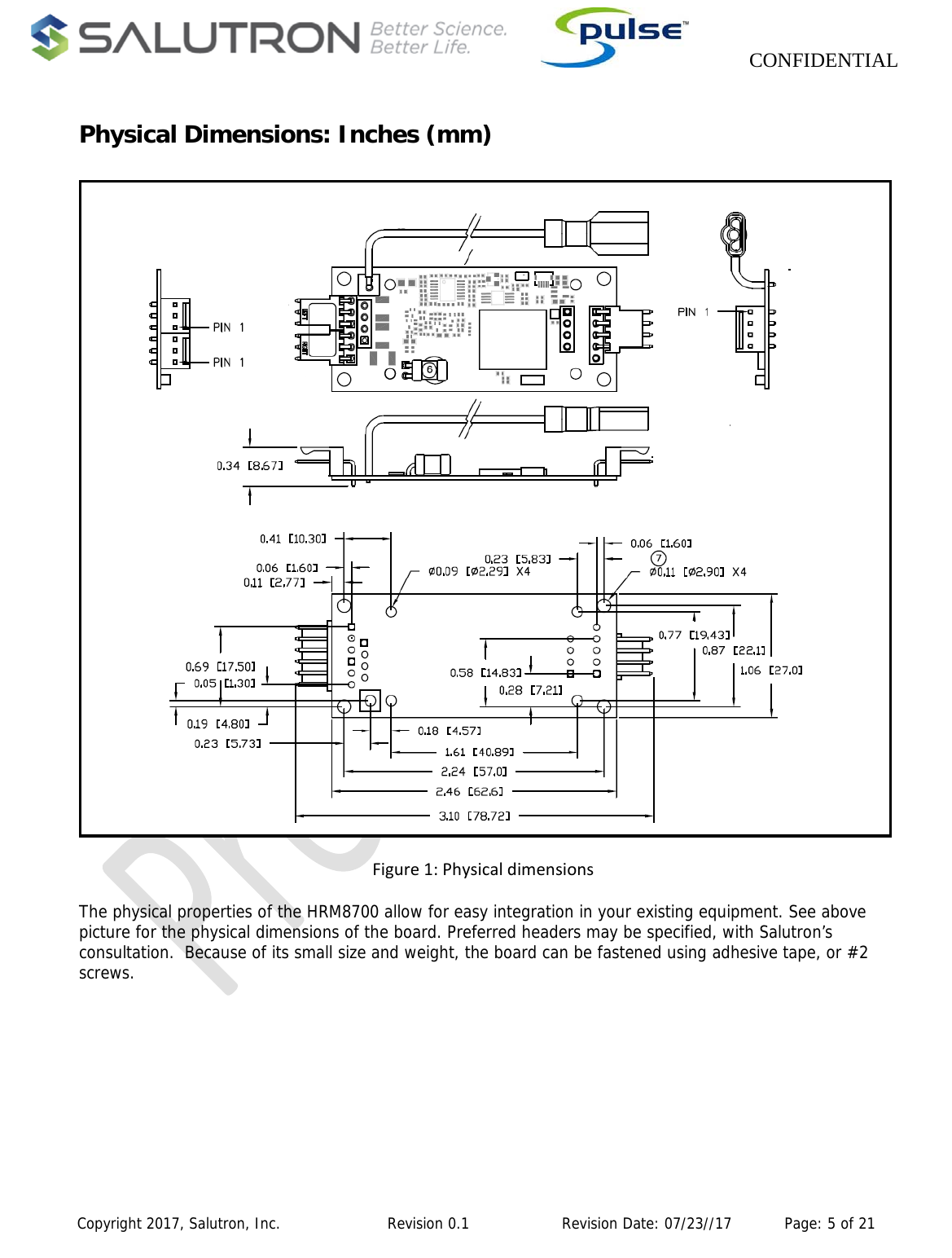
                   CONFIDENTIAL  Copyright 2017, Salutron, Inc.             Revision 0.1              Revision Date: 07/23//17           Page: 5 of 21  Physical Dimensions: Inches (mm) Figure1:PhysicaldimensionsThe physical properties of the HRM8700 allow for easy integration in your existing equipment. See above picture for the physical dimensions of the board. Preferred headers may be specified, with Salutron’s consultation.  Because of its small size and weight, the board can be fastened using adhesive tape, or #2 screws.  
                   CONFIDENTIAL  Copyright 2017, Salutron, Inc.             Revision 0.1              Revision Date: 07/23//17           Page: 6 of 21  Connection Diagram: (Typical)  Figure 2: Connection Diagram  TYPE PIN No. DESCRIPTION HD1 – Ground Strap  1  Earth Ground HD2 – Right Sensor 1  RA, right primary sensor 2  LL, common sensor 3 Shield HD3 – Left Sensor 1  LA, left primary sensor 2  LL, common sensor 3 Shield J1 – Main 1 GND 2 +5V 3 TXD 4 RXD
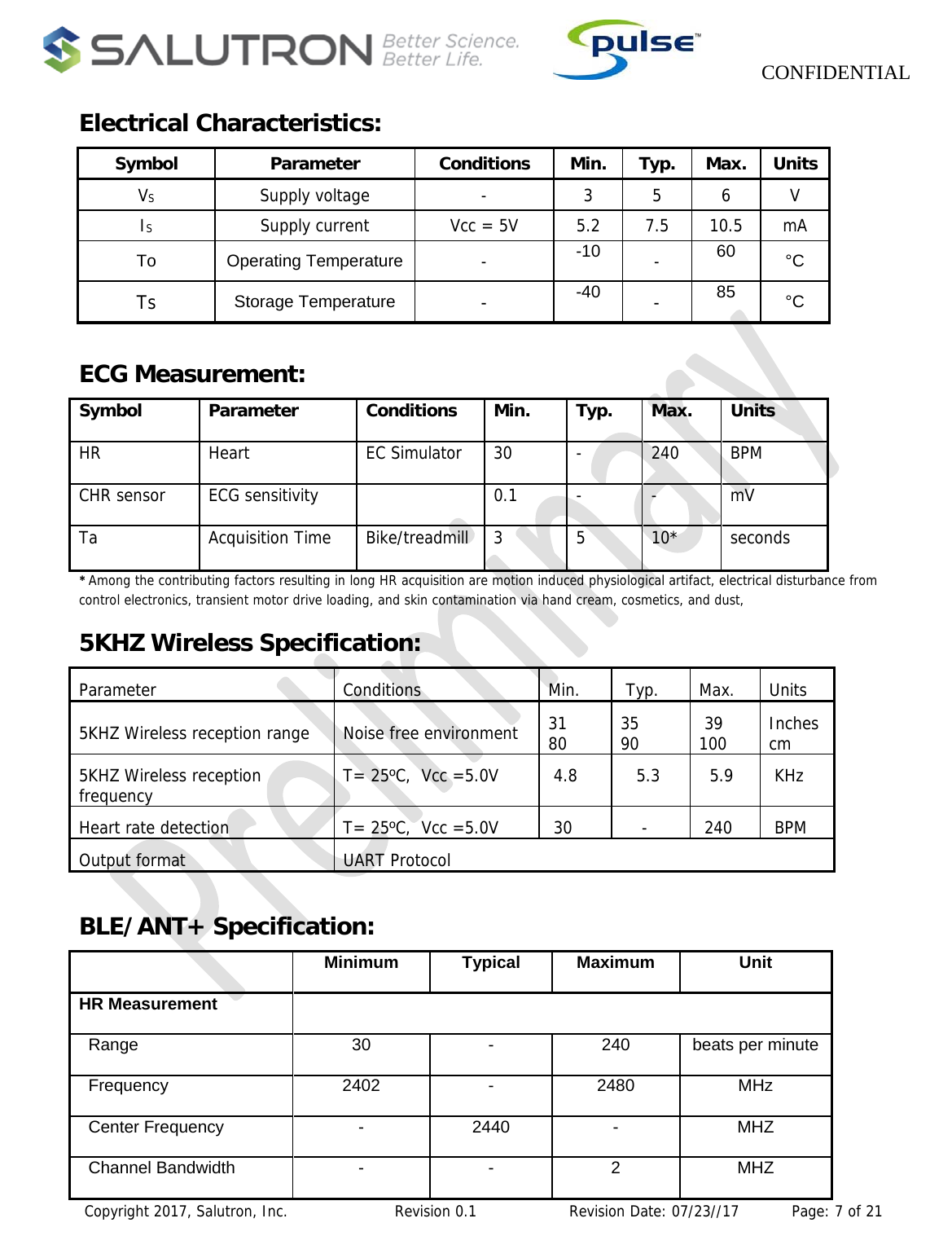
                   CONFIDENTIAL  Copyright 2017, Salutron, Inc.             Revision 0.1              Revision Date: 07/23//17           Page: 7 of 21 Electrical Characteristics:  Symbol Parameter Conditions Min. Typ. Max. Units VS  Supply voltage  -  3 5 6 V IS  Supply current  Vcc = 5V  5.2  7.5  10.5  mA To Operating Temperature -  -10  -  60  °C Ts  Storage Temperature -  -40  -  85  °C  ECG Measurement: Symbol Parameter Conditions Min. Typ. Max. Units HR Heart  EC Simulator 30 - 240 BPM CHR sensor  ECG sensitivity    0.1  -  -  mV Ta Acquisition Time Bike/treadmill 3 5 10* seconds *Among the contributing factors resulting in long HR acquisition are motion induced physiological artifact, electrical disturbance from control electronics, transient motor drive loading, and skin contamination via hand cream, cosmetics, and dust,5KHZ Wireless Specification: Parameter Conditions Min.  Typ. Max. Units 5KHZ Wireless reception range  Noise free environment  31      80  35      90   39  100  Inches cm 5KHZ Wireless reception frequency  T= 25ºC,  Vcc =5.0V   4.8     5.3    5.9   KHz Heart rate detection  T= 25ºC,  Vcc =5.0V   30      -    240   BPM Output format  UART Protocol    BLE/ANT+ Specification:                                                                                           Minimum Typical Maximum UnitHR Measurement    Range  30  -  240  beats per minute  Frequency  2402  -  2480  MHz  Center Frequency  -  2440  -  MHZ  Channel Bandwidth  -  -  2  MHZ
                   CONFIDENTIAL  Copyright 2017, Salutron, Inc.             Revision 0.1              Revision Date: 07/23//17           Page: 8 of 21   Low speed Crystal Freq  -  32.768  -  KHZ  High speed Crystal Freq  -  32  -  MHZ  Channel Spacing  -  2  -  MHZ  No. of channels used  -  -  40  Channels  Modulation          GFSK  Output power  -20  -  4  dBm  Open Air range  -  -  10  MeterPower Consumption Vdd=5.0V @ 25°C   Standby mode  -  5  -  mAOperation Modes  Device Searching Mode   -  10  10.5  mAHeart rate Data transfer  -  5  5.5  mA  2.4GHZ Transmission distance (line of sight)* 65 20 - - - - Feet Meter *Note:thenatureofphysicalobstructionsand/or2.4GHzradiointerferenceinthesurroundingareacouldaffectthereceptionandtransmissionrange.    
                   CONFIDENTIAL  Copyright 2017, Salutron, Inc.             Revision 0.1              Revision Date: 07/23//17           Page: 9 of 21 1. UART COMMUNICATION PROTOCOL:  The following section describes the communication protocol between the HRM8700 and Equipment console. The protocol is intended to provide a reliably link between the HRM8700 and Equipment console. The UART protocol supports the two way link communication between the two devices.   1.2.Block Diagram 2. OPERATION  2.1. Description  The Equipment console and HRM8700 uses standard UART protocol to transmit and receive custom packets. The Equipment console controls the HRM8700 operation. The HRM8700 operations are:  Start and stop 5Khz, BLE and ANT+ scanning    Connect and disconnect to a heart rate transmitter using 5khz, BLE and ANT+.  On-demand scanning  Stationary bike FE-C broadcast is activated with user selected ID at the start of workout  HRM display profile is broadcasted with user selected ID at the start of workout  HRM display profile and Stationary bike have the same ID  At the start of a workout session, the Contact Heart rate is enabled and it will stream heart rate data if active. Contact heart rate will override the wireless data if “contact override” option is enabled  2.2. UART Specification  Baudrate: 9600 (default), 4800, 2400, 115200
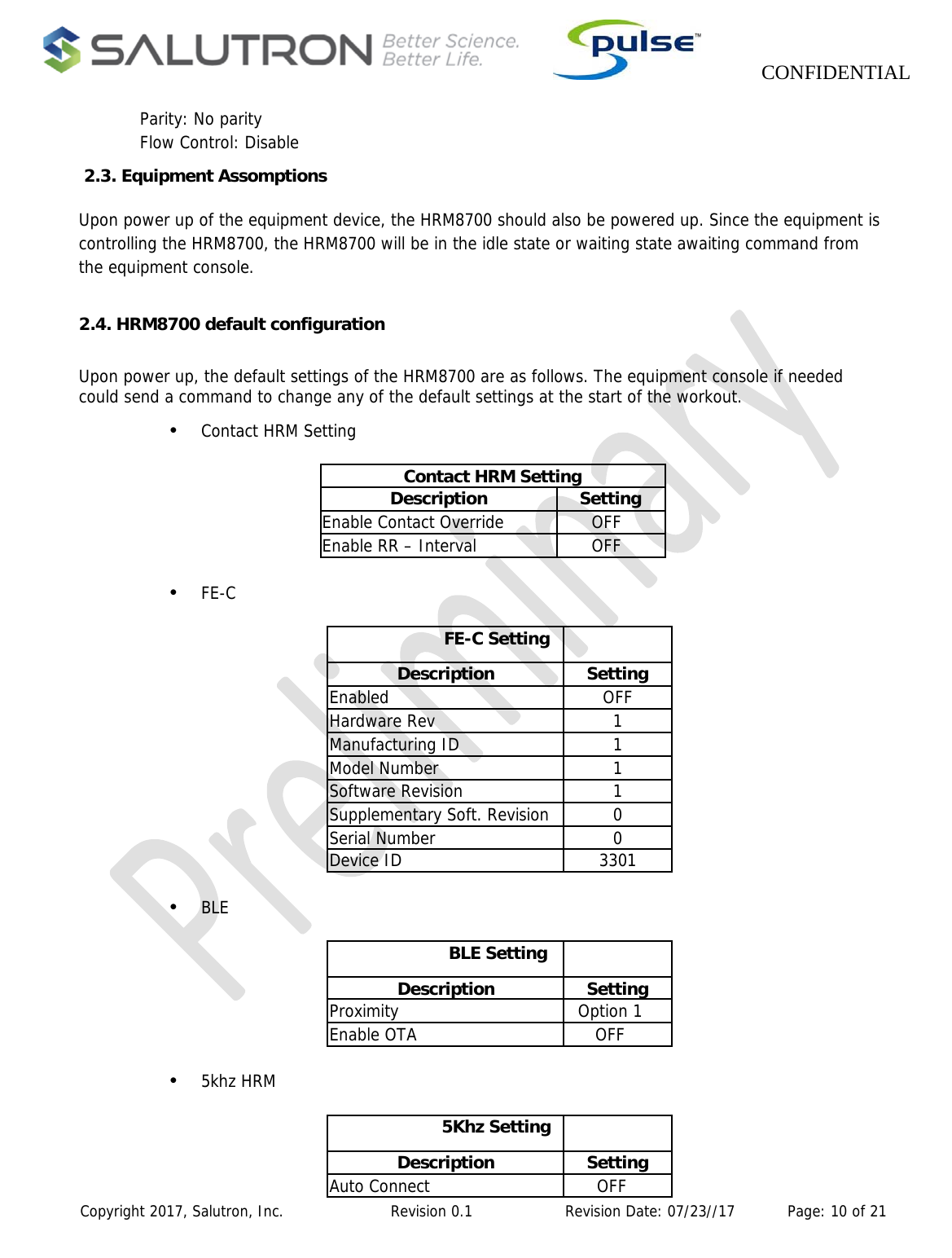
                   CONFIDENTIAL  Copyright 2017, Salutron, Inc.             Revision 0.1              Revision Date: 07/23//17           Page: 10 of 21 Parity: No parity Flow Control: Disable  2.3. Equipment Assomptions  Upon power up of the equipment device, the HRM8700 should also be powered up. Since the equipment is controlling the HRM8700, the HRM8700 will be in the idle state or waiting state awaiting command from the equipment console.  2.4. HRM8700 default configuration  Upon power up, the default settings of the HRM8700 are as follows. The equipment console if needed could send a command to change any of the default settings at the start of the workout.  •  Contact HRM Setting  Contact HRM Setting Description Setting Enable Contact Override  OFF Enable RR – Interval  OFF  •  FE-C   FE-C Setting  Description Setting Enabled OFF Hardware Rev  1 Manufacturing ID  1 Model Number  1 Software Revision  1 Supplementary Soft. Revision  0 Serial Number  0 Device ID  3301  •  BLE   BLE Setting  Description Setting Proximity Option 1 Enable OTA  OFF  •  5khz HRM  5Khz Setting  Description Setting Auto Connect  OFF
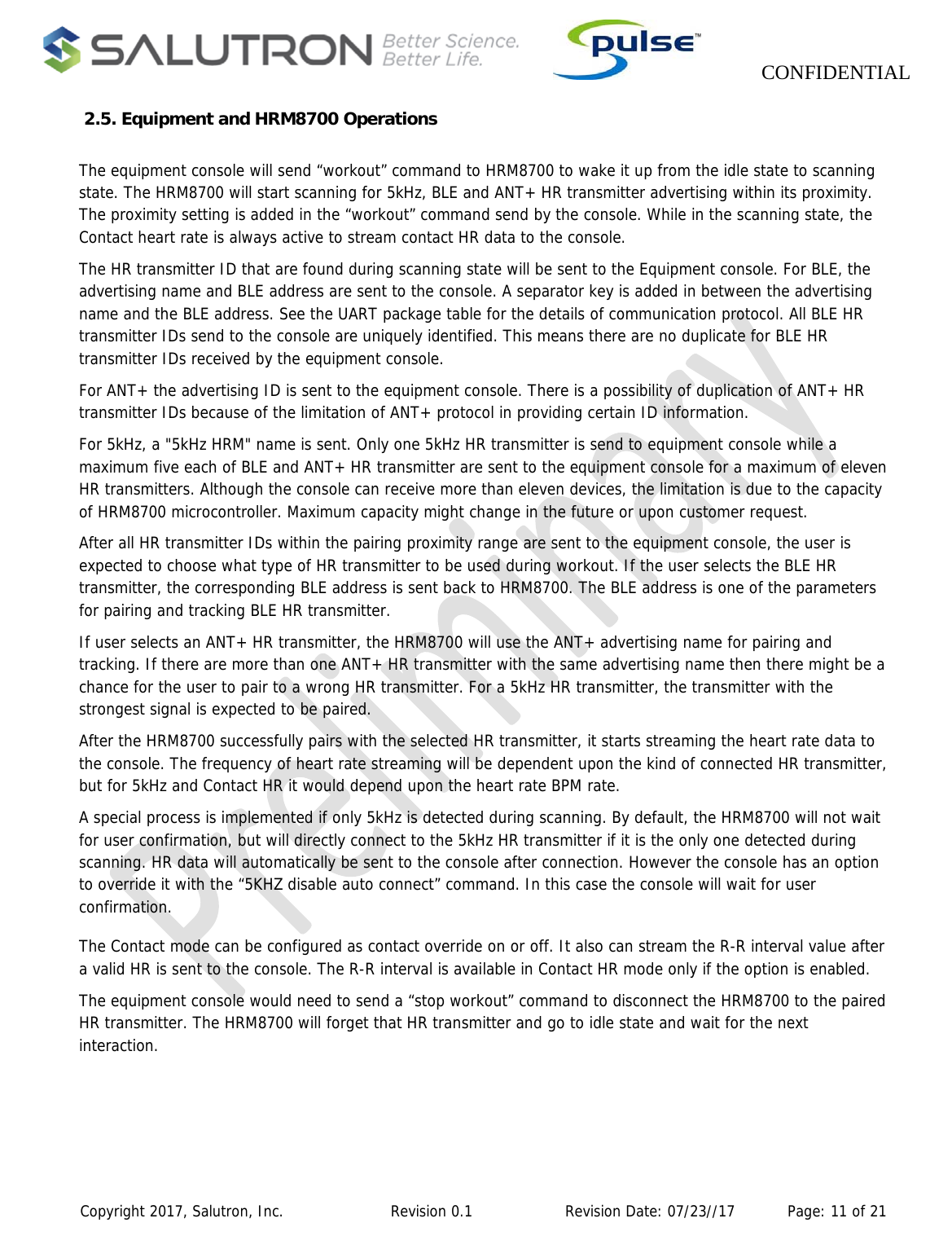
                   CONFIDENTIAL  Copyright 2017, Salutron, Inc.             Revision 0.1              Revision Date: 07/23//17           Page: 11 of 21  2.5. Equipment and HRM8700 Operations  The equipment console will send “workout” command to HRM8700 to wake it up from the idle state to scanning state. The HRM8700 will start scanning for 5kHz, BLE and ANT+ HR transmitter advertising within its proximity. The proximity setting is added in the “workout” command send by the console. While in the scanning state, the Contact heart rate is always active to stream contact HR data to the console. The HR transmitter ID that are found during scanning state will be sent to the Equipment console. For BLE, the advertising name and BLE address are sent to the console. A separator key is added in between the advertising name and the BLE address. See the UART package table for the details of communication protocol. All BLE HR transmitter IDs send to the console are uniquely identified. This means there are no duplicate for BLE HR transmitter IDs received by the equipment console.  For ANT+ the advertising ID is sent to the equipment console. There is a possibility of duplication of ANT+ HR transmitter IDs because of the limitation of ANT+ protocol in providing certain ID information. For 5kHz, a "5kHz HRM" name is sent. Only one 5kHz HR transmitter is send to equipment console while a maximum five each of BLE and ANT+ HR transmitter are sent to the equipment console for a maximum of eleven HR transmitters. Although the console can receive more than eleven devices, the limitation is due to the capacity of HRM8700 microcontroller. Maximum capacity might change in the future or upon customer request.  After all HR transmitter IDs within the pairing proximity range are sent to the equipment console, the user is expected to choose what type of HR transmitter to be used during workout. If the user selects the BLE HR transmitter, the corresponding BLE address is sent back to HRM8700. The BLE address is one of the parameters for pairing and tracking BLE HR transmitter. If user selects an ANT+ HR transmitter, the HRM8700 will use the ANT+ advertising name for pairing and tracking. If there are more than one ANT+ HR transmitter with the same advertising name then there might be a chance for the user to pair to a wrong HR transmitter. For a 5kHz HR transmitter, the transmitter with the strongest signal is expected to be paired. After the HRM8700 successfully pairs with the selected HR transmitter, it starts streaming the heart rate data to the console. The frequency of heart rate streaming will be dependent upon the kind of connected HR transmitter, but for 5kHz and Contact HR it would depend upon the heart rate BPM rate. A special process is implemented if only 5kHz is detected during scanning. By default, the HRM8700 will not wait for user confirmation, but will directly connect to the 5kHz HR transmitter if it is the only one detected during scanning. HR data will automatically be sent to the console after connection. However the console has an option to override it with the “5KHZ disable auto connect” command. In this case the console will wait for user confirmation.  The Contact mode can be configured as contact override on or off. It also can stream the R-R interval value after a valid HR is sent to the console. The R-R interval is available in Contact HR mode only if the option is enabled. The equipment console would need to send a “stop workout” command to disconnect the HRM8700 to the paired HR transmitter. The HRM8700 will forget that HR transmitter and go to idle state and wait for the next interaction.
                   CONFIDENTIAL  Copyright 2017, Salutron, Inc.             Revision 0.1              Revision Date: 07/23//17           Page: 12 of 21 2.6. HRM8700 OTA. For the HRM8700 a new code update can be flashed by using over the air programming.  The BLE DFU feature of the HRM8700 can be triggered using the activation command from the console. Once triggered the HRM8700 function as BLE peripheral and will broadcast “HRM_8700”.  Using the Nordic NRF Connect application installed in the iphone/Android phone and an OAD zip file (released by Salutron), the HRM8700 firmware can be updated. For more information and procedure on how to OTA, please refer to the HRM8700 OAD procedure document.  
                   CONFIDENTIAL  Copyright 2017, Salutron, Inc.             Revision 0.1              Revision Date: 07/23//17           Page: 13 of 21 3. UART COMMUNICATION PROTOCOL PACKETS  3.1. Packets  The uart protocol packets contain data that will be used as an interface between the HRM8700 and the equipment console. A maximum of twenty four bytes and a minimum of eight bytes are used during UART communication.  Fletcher checksum reference:  https://en.wikipedia.org/wiki/Fletcher%27s_checksum  For 5kHz analog strap, the name to be transmitted will be “5kHz HRM”.  Below is the UART packet:  A response bit when set means the receiver is obliged to response acknowledgement when package is received from the transmitting UART port  START COMMAND  PACKET LEN  CHECK SUM  RESPONSE BIT  CLASS  SUB  DATAx  Type  Size in bytes Description START COMMAND  1  Start byte  PACKET LEN  1  Number of bytes in a packet CHECK SUM  2  Fletcher checksum RESPONSE BIT  1  Response bit CLASS  1  Packet Class type SUB CLASS  1  Packet sub-class type DATA XX Data   3.2. Example of Sending Packets Equipment Console Usage: Sending packet name to equipment console   Format: [Start Command] [Packet Size] [Fletcher check sum low byte] [Fletcher check sum high byte] [Response bit] [Class] [Sub Class] [Name 1st byte] [Name … byte] [Name xth byte] Packet:  ex. 5Khz advertising name = “5kHz HRM” [0x0A] [0x0F]
                   CONFIDENTIAL  Copyright 2017, Salutron, Inc.             Revision 0.1              Revision Date: 07/23//17           Page: 14 of 21 [0xYY] [0xZZ] [0x0C] [0x00] [0x01] [0x35] [0x6B] [0x48] [0x7A] [0x20] [0x48] [0x52] [0x4D]   3.3. Example of Sending Packet to HRM8700 Usage: Sending selected packet name to HRM8700   Format: [Start Command] [Packet Size] [Fletcher check sum low byte] [Fletcher check sum high byte] [Response bit] [Class] [Sub Class] [Name 1st byte] [Name … byte] [Name xth byte]    Packet:  ex. 5Khz advertising name = “5kHz HRM” [0x0B] [0x0F] [0xYY] [0xZZ]  [0x00] [0x1C] [0x01] [0x35] [0x6B] [0x48] [0x7A] [0x20] [0x48] [0x52] [0x4D]
                   CONFIDENTIAL  Copyright 2017, Salutron, Inc.             Revision 0.1              Revision Date: 07/23//17           Page: 15 of 21 Appendix A : Grounding and ESD Recommendations  Overview For accuracy and performance, the HRM8700 wireless receiver and heart rate monitor (HRM) combo must be properly grounded. Improper grounding introduces unwanted noise that can overwhelm the ECG signals and compromise the signal-to-noise ratio. Improper grounding can also leave the system vulnerable to problems from electrostatic discharge (ESD), which can cause the console to reset. In order to provide a stable ground for the HRM8700 and to protect from ESD, the ground needs to be free of noise and have very low impedance.  This application note provides grounding and ESD recommendations based on common installations of the HRM8700. The recommended method provides a dedicated ground for this board.   The above solution requires as a prerequisite a good regulated power supply. This is because when the ESD current causes transient on the ground wire, the power supply can regulate and absorb the energy to a certain extent so that it is not propagated to the rest of the system to cause resets.  If flat ribbon cable is used as the inter-connect between HRM and Client console, multiple circuits are required for +5V and Return to ensure low impedance.  It is also a good practice to use a reliable supervisory integrated circuit for power up and power down management to avoid undesired resets to the microcomputers when ESD occurs.  For treadmills, the motor drive design is also critical to ensure an electrically quiet system to meet FCC Class A and Class B compliance.  The inductive load creates radiated noise with wide band characteristics that will compromise heart rate performance in acquisition time. (See footnote of ECG Measurement on page 7)
                   CONFIDENTIAL  Copyright 2017, Salutron, Inc.             Revision 0.1              Revision Date: 07/23//17           Page: 16 of 21 Wire Return Figure A1: Wire return grounding recommendation  A wire return is an effective solution for grounding and ESD protection. However, the impedance in the wire can limit the effectiveness in conducting ESD current. Therefore, it is recommended that a return wire of 16 gauge is used. The wire should be made as short as possible, not to exceed 12 inches.  In Figure A1, a return wire is attached directly to HRM at HD1 hole.  Because of unwanted noise, do not tie the return wire to the ground (indicated RTN above) from the power supply but to earth ground directly.   The return wire connected to the earth ground can be ordered pre-assembled with the HRM8700. See the “Order Information“ section for order details.   Console  Power Supply Plastic Back PanelHRM +5V RTN Interconnect  Earth Ground  Attach return wire (attached to HRM at HD1)  directly to earth ground. VccRTNReturn wire
                   CONFIDENTIAL  Copyright 2017, Salutron, Inc.             Revision 0.1              Revision Date: 07/23//17           Page: 17 of 21 ESD Protection The independent return wire described earlier also serves as an ESD return path when electrostatic discharge occurs. The high voltage protection circuit in the HRM will cause the discharging current to pass through this independent ground path. Therefore, the console is less likely to latch up due to the incomplete reset caused by unpredictable ESD current.  The return ground does not conduct current unless ESD occurs. However, when ESD occurs, the ground must have low impedance to discharge the ESD energy.  To ensure low impedance, a 16 gauge copper wire is recommended for ESD protection.  The length of the wire should not be made longer than 12 inches.  The wire should be bolted to the closest spot in the equipment where a reliable chassis ground is available.  A dedicated ground plane in the console PCB may help to reduce the chance of latch-up when ESD fires.  A good supervisory IC is highly recommended to reduce possibilities of resetting the console, too.  The HRM8700 Wireless Receiver and HRM product was tested by HAEFELY PESD3010 system that is certified for IEC 61000-4-2 level 4 for both air and contact ESD tests.
                   CONFIDENTIAL  Copyright 2017, Salutron, Inc.             Revision 0.1              Revision Date: 07/23//17           Page: 18 of 21 Appendix B: HRM8700 Placement Guideline The electrical noise generates from the machine could affect the reception range of 5KHZ wireless receiver. It is better to avoid any noise frequency near 5KHZ or harmonics get near the module. Although not all electrical noise can be avoided, the following sources could contribute to the interference. It is recommended to position the HR wireless module as far from these sources as possible.  LED display  Electrical fan  Audio speaker  Magnetic field  Piezo buzzer/beeper   Magnetic brake (Bike)  External/ internal CD player  Excessive ripple noise on power supply  Switching power supply  Motor controller  Sound or noise source in audio band (20HZ~20KHZ)  Cell phone  An incorrect wireless coil orientation placement will affect the range. The orientation of the receiving coil on the HRM wireless module should be in horizontal or parallel with the transmitter’s coil to obtain the optimal performance.
                   CONFIDENTIAL  Copyright 2017, Salutron, Inc.             Revision 0.1              Revision Date: 07/23//17           Page: 19 of 21  The ideal placement location of the HR wireless module would be at the center, toward the front that is closer to the user, and away from the noise sources.  In case the wireless module has to place off to the left or right side from the center of the console, then try to keep the offset distance within 12 inches (30cm) or less, otherwiseThe reception distance of the HRM will be shorten if it is placed too far off from the center.             
                              CONFIDENTIAL  Order Information Salutron’s commitment to customer satisfaction is the driving force behind our product offerings.  Contact us to discuss any specific connector options, preloaded features, and specific application information that you may need.   Life Support Policy Salutron’s products are not authorized for use as critical components in life support devices or systems.  Contact Information  SALUTRON, INC. 8371 Central Avenue, Unit A Newark, CA 94560 Office:  510-795-2876  http://www.salutron.com 
Hardware Revision:  PCB8740-4L Rev B Software Revision:  V3302C Frequency Band(s):   Bluetooth 4.2+BLE: Frequency Bands:2402-2480 MHz ANT+: Frequency Bands:2457 MHz Transmit Power Range(s):   Bluetooth 4.2+BLE: Max power:-6.88 dBm ANT+: Max power:-3.60 dBm Modulation Type(s):   Bluetooth 4.2+BLE: Modulation Mode: GFSK ANT+: Modulation Mode: GFSK Antenna type(s) and Gain(s):   BT&ANT+: Ceramic Antenna, Antenna gain:0 dBi
CE Maintenance 1.EUT Operating temperature range: -10° C to 40° C . 2. Power Rating: 3.The device complies with RF specifications when the device used less than 20cm from your body.  Declaration of Conformity     Salutron,  Inc  hereby  declares  that  this  Heart  rate  module  is  in compliance with the essential requirements and other relevant provisions of  Directive 2014/53/EU. In accordance with  Article  10(2)  and  Article 10(10),This product is allowed to be used in all EU member states.
FCC Statement This device complies with part 15 of the FCC Rules. Operation is subject to the following two conditions:   (1) This device may not cause harmful interference, and   (2) this device must accept any interference received, including interference that may cause undesired operation.  Any Changes or modifications not expressly approved by the party responsible for compliance could void the user's authority to operate the equipment.     If the FCC identification number is not visible when the module is installed inside another device, then the outside of the device into which the module is installed must also display a label referring to the enclosed module. This exterior label can use wording such as the following: “Contains Transmitter Module FCC ID: N7P-HRM8700 Or Contains FCC ID: N7P-HRM8700”  When the module is installed inside another device, the user manual of the host must contain below warning statements; 1. This device complies with Part 15 of the FCC Rules. Operation is subject to the following two conditions: (1) This device may not cause harmful interference. (2) This device must accept any interference received, including interference that may cause undesired operation.  2. Changes or modifications not expressly approved by the party responsible for compliance could void the user's authority to operate the equipment.  The devices must be installed and used in strict accordance with the manufacturer's instructions as described in the user documentation that comes with the product.  Any company of the host device which install this modular with Single modular approval should perform the test of radiated emission and spurious emission according to FCC part 15C : 15.247 and 15.209 requirement, Only if the test result comply with FCC part 15C : 15.247 and 15.209 requirement,then the host can be sold legally.     The device has been evaluated to meet general RF exposure requirement. The device can be used in portable exposure condition without restriction.
IC Warning     This device complies with Industry Canada licence-exempt RSS standard(s). Operation is subject to the following two conditions: (1) This device may not cause interference, and   (2) This device must accept any interference, including interference that may cause undesired operation of the device.   Le présent appareil est conforme aux CNR d'Industrie Canada applicables aux appareils radio exempts de licence. L'exploitation est autorisée aux deux conditions suivantes:    (1) l'appareil ne doit pas produire de brouillage, et    (2) l'utilisateur de l'appareil doit accepter tout brouillage radioélectrique subi, même si le brouillage est susceptible d'en compromettre le fonctionnement  The device has been evaluated to meet general RF exposure requirement. The device can be used in portable exposure condition without restriction.      Le dispositif a été conçu pour rencontrer le général RF. Le dispositif peut être utilisé dans des conditions de détention sans effet.  For a host manufacture's using a certified modular, if (1) the module's IC number is not visible when installed in the host, or (2) if the host is marketed so that end users do not have straightforward commonly used methods for access to remove the module so that the IC number of the module is visible; then an additional permanent label referring to the enclosed module: "Contains Transmitter Module IC: " 10274A-HRM8700 " or "Contains IC: 10274A-HRM8700" must be used.  Pour un hôte, on utilise un modular, si (1) le numéro de module est non visible Quand on est installé dans le serveur, or (2) si le propriétaire est commercialisé Straightforward commonly used for the access to remove travail so that the number IC en vue Le module est visible;Ensuite, le label permanent a été attribué au module: "Contient le Module IC:" 10274A-HRM8700" ou "le contenu IC: 10274A-HRM8700" doit être utilisé.

Navigation menu