Samsung Electronics Co CLX3305FW Laser Multi-funtion Printer User Manual Violet english
Samsung Electronics Co Ltd Laser Multi-funtion Printer Violet english
Contents
- 1. Users Manual 1
- 2. Users Manual 2
- 3. Users Manual 3
Users Manual 2
Using USB memory device
71
2. Menu Overview and Basic Setup
3 Select the folder or file you want and press OK.
If you see [+] or [D] in the front of a folder name, there are one or more
files or folders in the selected folder.
4 Select the number of copies to be printed or enter the number.
5 Press OK, Start or Print to start printing the selected file.
After printing the file, the display asks if you want to print another job.
6 Press OK when Yes appears to print another job, and repeat from step 2.
Otherwise, press the left/right arrow to select No and press OK.
7 Press (Stop/Clear) to return to ready mode.
26
Managing USB memory
You can delete image files stored on a USB memory device one by one or all at
once by reformatting the device.
If you see [+] or [D] in the front of a folder name, there are one or more files
or folders in the selected folder.
After deleting files or reformatting a USB memory device, files cannot be
restored. Therefore, confirm that you no longer need the data before
deleting it.
Deleting an image file
1Insert a USB memory device into the USB memory port on your machine,
and then press Direct USB.
2 Select File Manage > Delete and press OK.
3 Select the file you want to delete and press OK.
4 Select Yes.
5 Press (Stop/Clear) to return to ready mode.
Formatting a USB memory device
1Insert a USB memory device into the USB memory port on your machine,
and then press Direct USB.
2 Select File Manage > Format and press OK.
3 Select Yes.

Using USB memory device
72
2. Menu Overview and Basic Setup
4 Press (Stop/Clear) to return to ready mode.
Viewing the USB memory status
You can check the amount of memory space available for scanning and saving
documents.
1Insert a USB memory device into the USB memory port on your machine,
and then press Direct USB.
2 Select Check Space .
3 The available memory space appears on the display.
4 Press (Stop/Clear) to return to ready mode.

3. Maintenance
This chapter provides information about purchasing supplies, accessories and maintenance parts available for your
machine.
• Ordering supplies and accessories 74
• Available supplies 75
• Available maintenance parts 76
• Storing the toner cartridge 77
• Redistributing toner 79
• Replacing the toner cartridge 81
• Replacing the waste toner container 83
• Monitoring the supplies life 87
• Setting the toner low alert 88
• Cleaning the machine 89
• Tips for moving & storing your machine 94
74
3. Maintenance
Ordering supplies and accessories
Available accessories may differ from country to country. Contact your sales representatives to obtain the list of available supplies, and maintenance parts.
To order Samsung-authorized supplies, accessories, and maintenance parts, contact your local Samsung dealer or the retailer where you purchased your machine.
You can also visit www.samsung.com/supplies, and then select your country/region to obtain the contact information for service.
75
3. Maintenance
Available supplies
When supplies reach the end of their life spans, you can order the followings of supplies for your machine:
Depending on the options, percentage of image area and job mode used, the toner cartridge’s lifespan may differ.
When purchasing new toner cartridges or other supplies, these must be purchased in the same country as the machine you are using. Otherwise, new toner
cartridges or other supplies will be incompatible with your machine due to different configurations of toner cartridges and other supplies according to the specific
country conditions.
Samsung does not recommend using non-genuine Samsung toner cartridge such as refilled or remanufactured toner. Samsung cannot guarantee non-genuine
Samsung toner cartridge's quality. Service or repair required as a result of using non-genuine Samsung toner cartridges will not be covered under the machine’s
warranty.
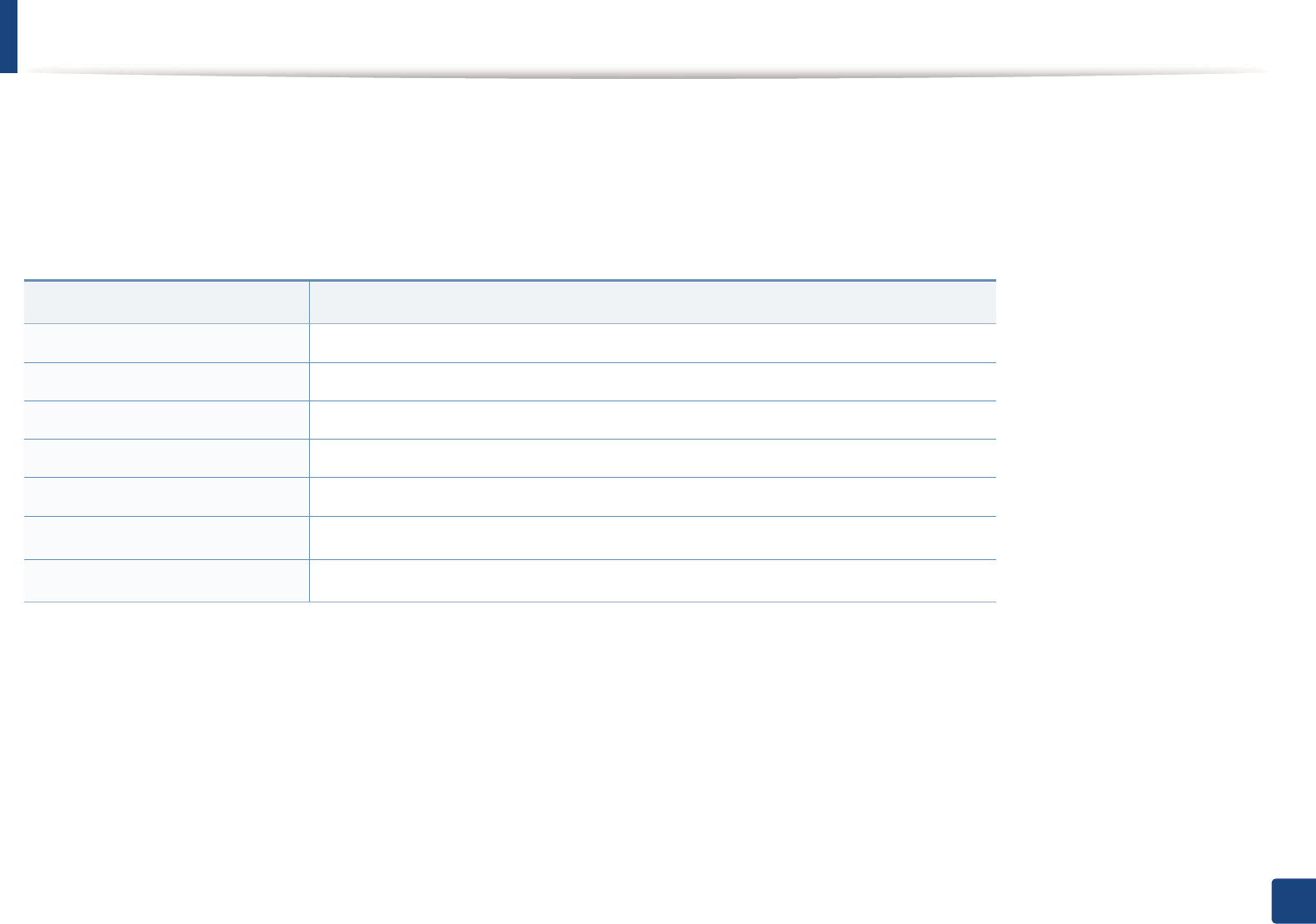
Type Average yielda
a. Declared yield value in accordance with ISO/IEC 19798. The number of pages may be affected by operating environment, printing interval, graphics, media type and media size.
Part name
Toner cartridge • Average continuous black cartridge yield: Approx. 1,500 standard pages (Black)
• Average continuous color cartridge yield: Approx. 1,000 standard pages (Yellow/Magenta/Cyan)
• K406 (CLT-K406S): Black
• C406 (CLT-C406S): Cyan
• M406 (CLT-M406S): Magenta
• Y406 (CLT-Y406S): Yellow
Imaging unit Approx. 16,000 imagesb
b. Image counts based on one color on each page. If you print documents in full color (Cyan, Magenta, Yellow, Black), the life of this item will be reduced by 25%.
CLT-R406
Waste toner container Approx. 7,000 imagesbCLT-W406
76
3. Maintenance
Available maintenance parts
To purchase maintenance parts, contact the source where you bought the machine. Replacing maintenance parts can be performed only by an authorized service
provider, dealer, or the retailer where you bought the machine. The warranty does not cover the replacement of any maintenance parts once it has reached its
“Average yield”.
Maintenance parts are replaced at specific intervals to avoid print quality and paper feed problems resulting from worn parts, see table below. The purpose of which
is to maintain your machine in top working condition. The maintenance parts below should be replaced when the life span of each item has been met.
Parts Average yielda
a. It will be affected by the operating system used, computing performance, application software, connecting method, media type, media size and job
complexity.
Fuser unit Approx. 20,000 black pages or 5,000 color pages
Transfer roller Approx. 20,000 pages
Feed roller Approx. 20,000 pages
Pickup roller Approx. 20,000 pages
Intermediate Transfer Belt (ITB) Approx. 20,000 pages for black and white mode or 5,000 pages for color mode
ADF Feed rollerb
b. CLX-330xFN Series/ CLX-330xFW Series only
Approx. 20,000 pages
ADF Rubber PadbApprox. 20,000 pages
77
3. Maintenance
Storing the toner cartridge
Toner cartridges contain components that are sensitive to light, temperature
and humidity. Samsung suggests users follow these recommendations to
ensure optimal performance, highest quality, and longest life from your new
Samsung toner cartridge.
Store this cartridge in the same environment in which the printer will be used.
This should be in controlled temperature and humidity conditions. The toner
cartridge should remain in its original and unopened package until installation
– if original packaging is not available, cover the top opening of the cartridge
with paper and store in a dark cabinet.
Opening the cartridge package prior to use dramatically shortens its useful shelf
and operating life. Do not store on the floor. If the toner cartridge is removed
from the printer, follow the instructions below to store the toner cartridge
properly.
• Store the cartridge inside the protective bag from the original package.
• Store lying flat (not standing on end) with the same side facing up as if it
were installed in the machine.
• Do not store consumables in any of the following conditions:
- Temperature greater than 40°C (104°F).
- Humidity range less than 20% or greater than 80%.
- An environment with extreme changes in humidity or temperature.
- Direct sunlight or room light.
- Dusty places.
- A car for a long period of time.
- An environment where corrosive gases are present.
- An environment with salty air.
1
Handling instructions
• Do not expose the cartridge to unnecessary vibrations or shock.
2
Toner cartridge usage
Samsung Electronics does not recommend or approve the use of non-Samsung
brand toner cartridges in your printer including generic, store brand, refilled, or
remanufactured toner cartridges.
Samsung’s printer warranty does not cover damage to the machine caused
by the use of a refilled, remanufactured, or non-Samsung brand toner
cartridges.

Storing the toner cartridge
78
3. Maintenance
3
Estimated cartridge life
Estimated cartridge life (the life of the toner cartridge yield) depends on the
amount of toner that print jobs require. The actual print yield may vary
depending on the print density of the pages you print on, operating
environment, percentage of image area, printing interval, media type and/or
media size. For example, if you print a lot of graphics, the consumption of the
toner is higher and you may need to change the cartridge more often.
79
3. Maintenance
Redistributing toner
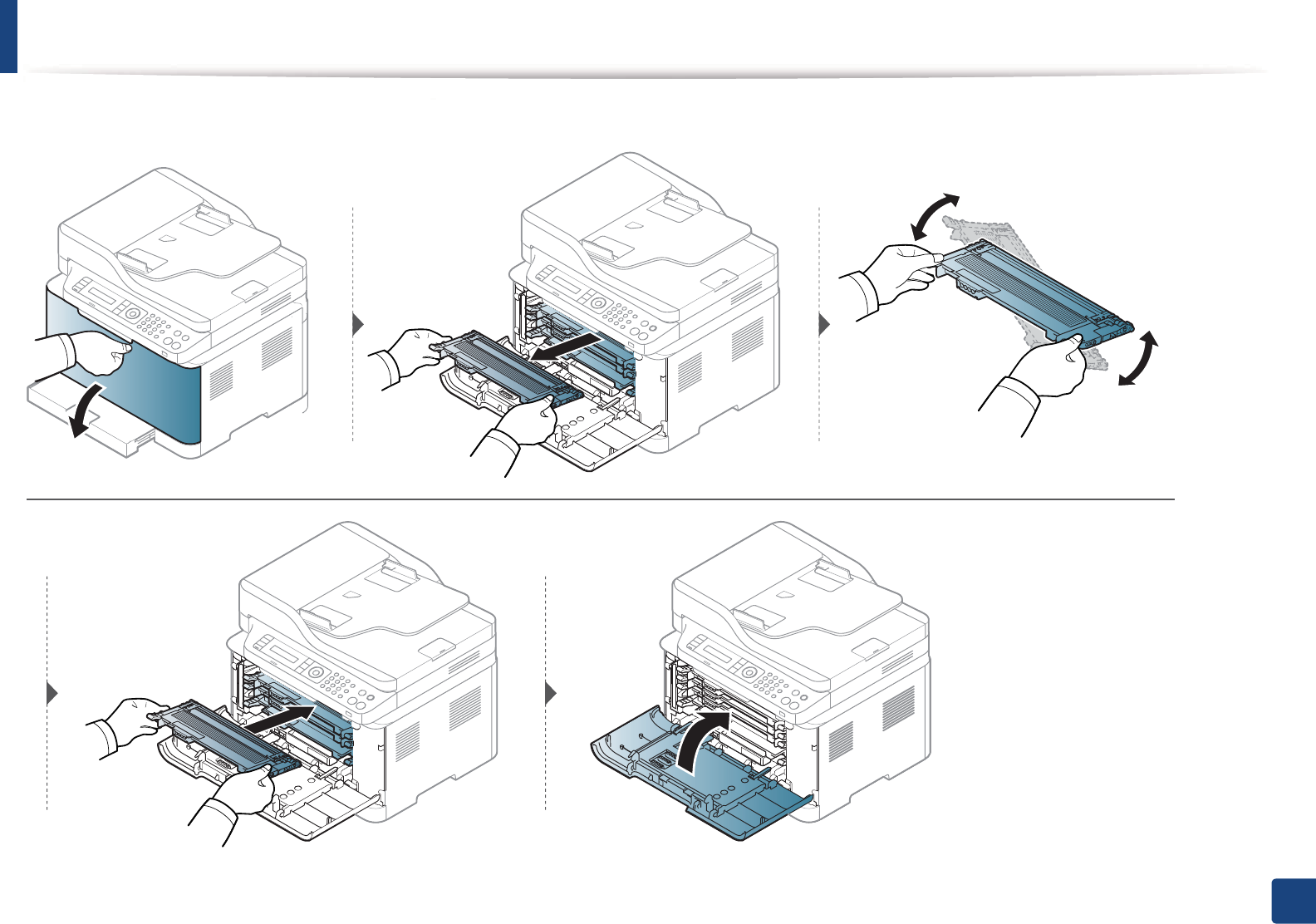
When the toner cartridge is near the end of its life:
• White streaks or light printing occurs and/or density variation side to side.
• The Status LED blinks red. The toner-related message saying that the toner
is low may appear on the display.
• The computers’s Samsung Printing Status program window appears on the
computer telling you which color cartridge is low on tonerG(see "Using
Samsung Printer Status" on page 269).
If this happens, you can temporarily improve print quality by redistributing the
remaining toner in the cartridge. In some cases, white streaks or light printing
will still occur even after you have redistributed the toner.
Illustrations on this user’s guide may differ from your machine depending
on its options or models. Check your machine type (see "Front view" on
page 20).
• Do not use sharp objects such as a knife or scissors to open the toner
cartridge package. They might scratch the drum of the cartridge.
• If toner gets on your clothing, wipe it off with a dry cloth and wash
clothing in cold water. Hot water sets toner into fabric.
• When opening a scan unit, hold the document feeder and scan unit
together.
Redistributing toner
80
3. Maintenance
81
3. Maintenance
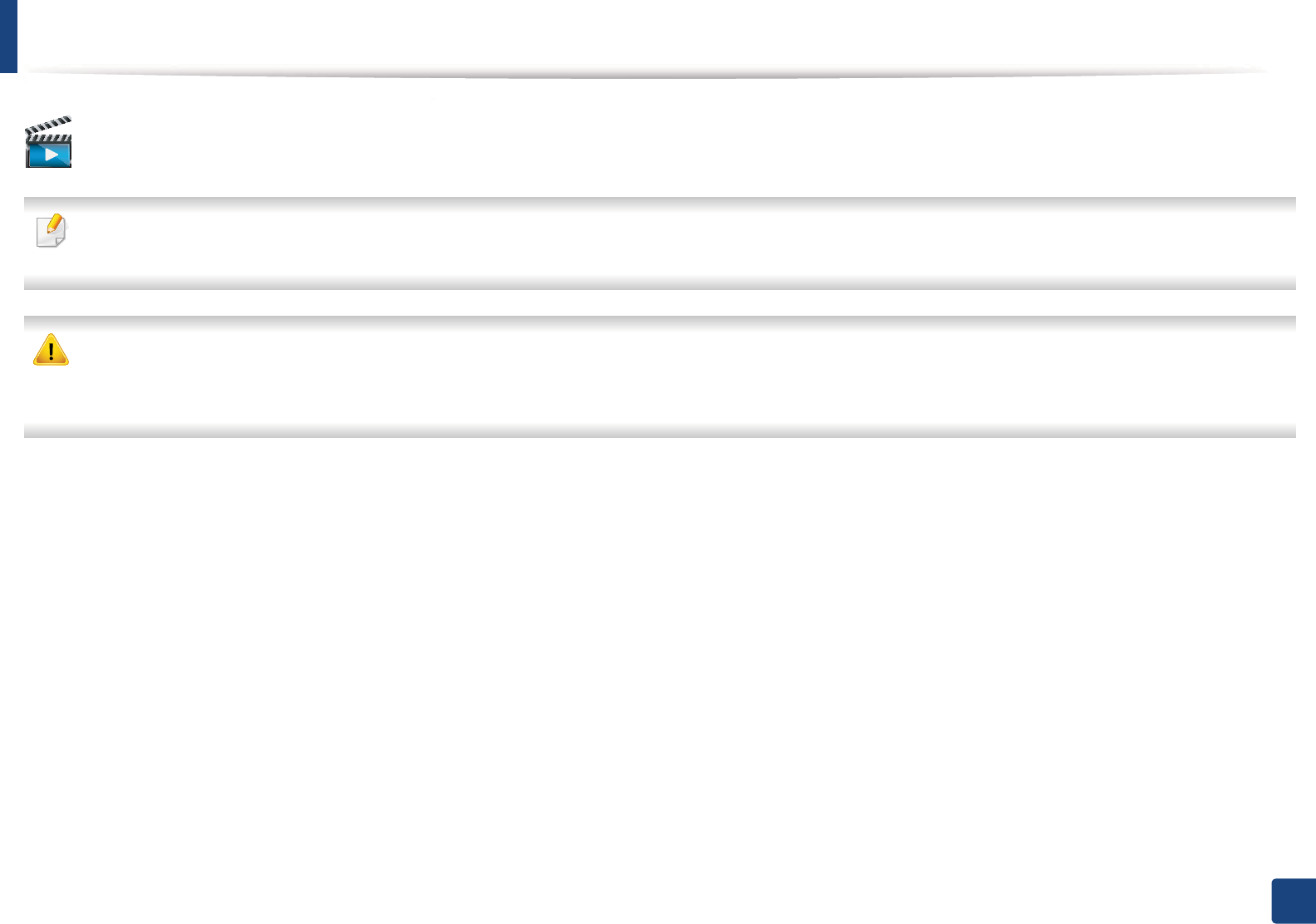
Replacing the toner cartridge
Click this link to open an animation about replacing a toner cartridge.
• Shake the toner cartridge thoroughly, it will increase the initial print quality.
• Illustrations on this user’s guide may differ from your machine depending on its options or models. Check your machine type (see "Front view" on page 20).
• Do not use sharp objects such as a knife or scissors to open the toner cartridge package. They might scratch the drum of the cartridge.
• If toner gets on your clothing, wipe it off with a dry cloth and wash clothing in cold water. Hot water sets toner into fabric.
• When opening a scan unit, hold the document feeder and scan unit together.
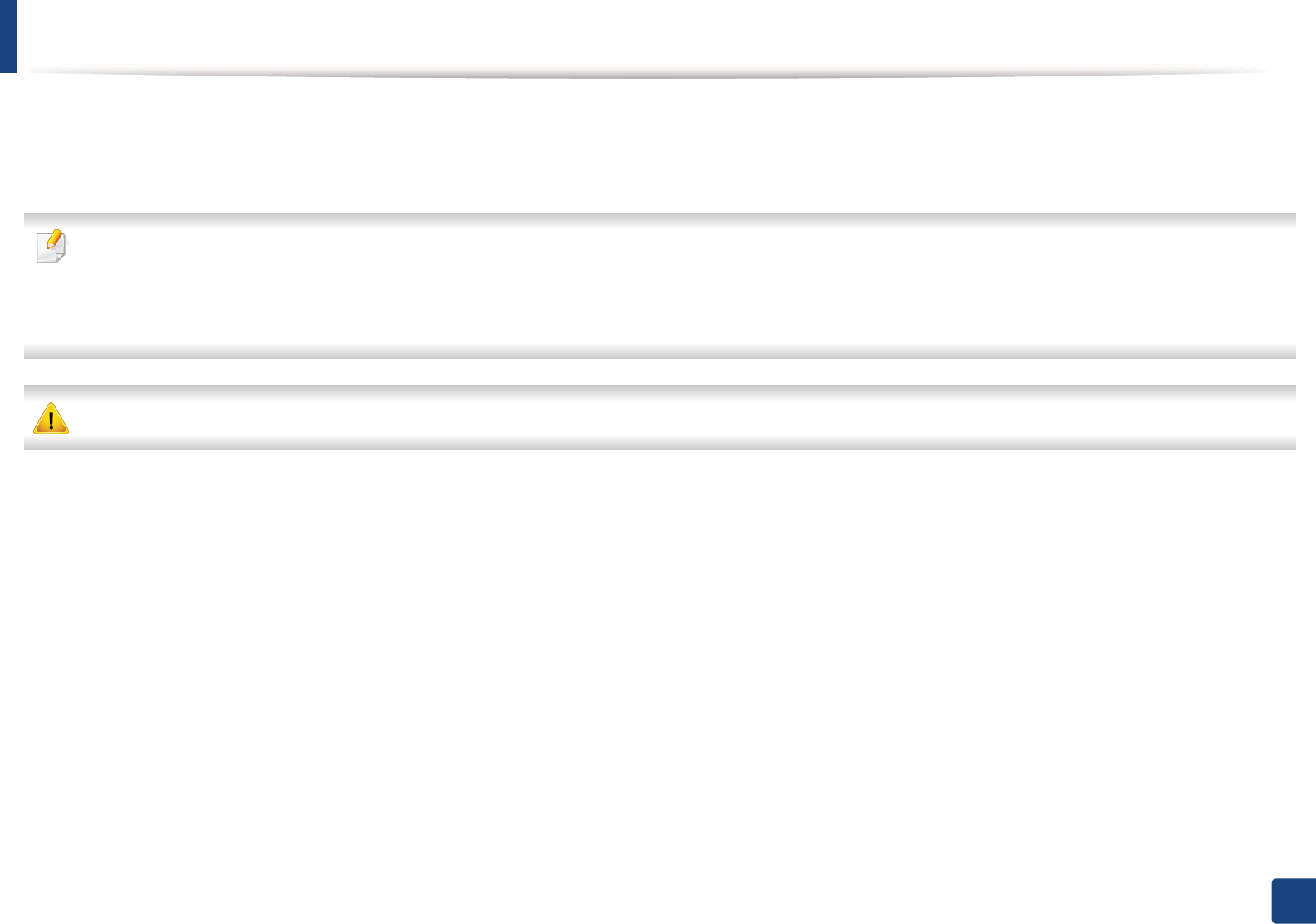
When a toner cartridge has reached the end of life, the Printing Status window appears on the computer, indicating the toner cartridge needs to be placed.
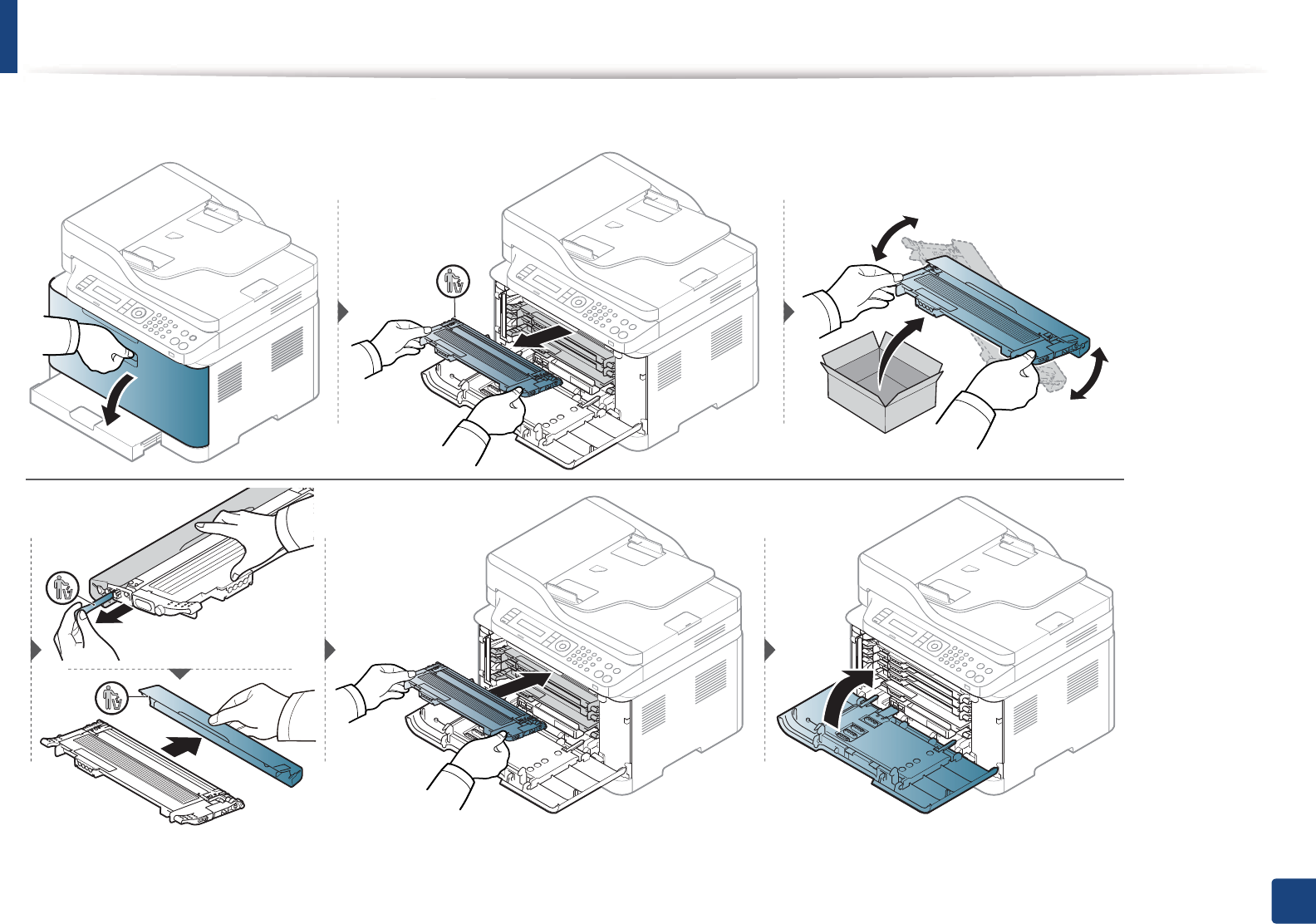
Replacing the toner cartridge
82
3. Maintenance
83
3. Maintenance
Replacing the waste toner container
When the life span of the waste toner container has expired, waste toner container-related message appears on the screen display of the control panel, indicating
the waste toner container needs to be replaced. Check the waste toner container for your machine (see "Available supplies" on page 75). For information about
installing the waste toner container, refer to the waste toner container installation guide included on the package.
• Toner particles can be released inside the machine but it does not mean the machine is damaged. Contact a service representative when print quality problems
occur.
• When you pull out the waste toner container out of the machine, move the container carefully not to drop it from your hands.
• Make sure that you lay the waste toner container on a flat surface so that the toner does not spill.
Do not tilt or turn over the container.
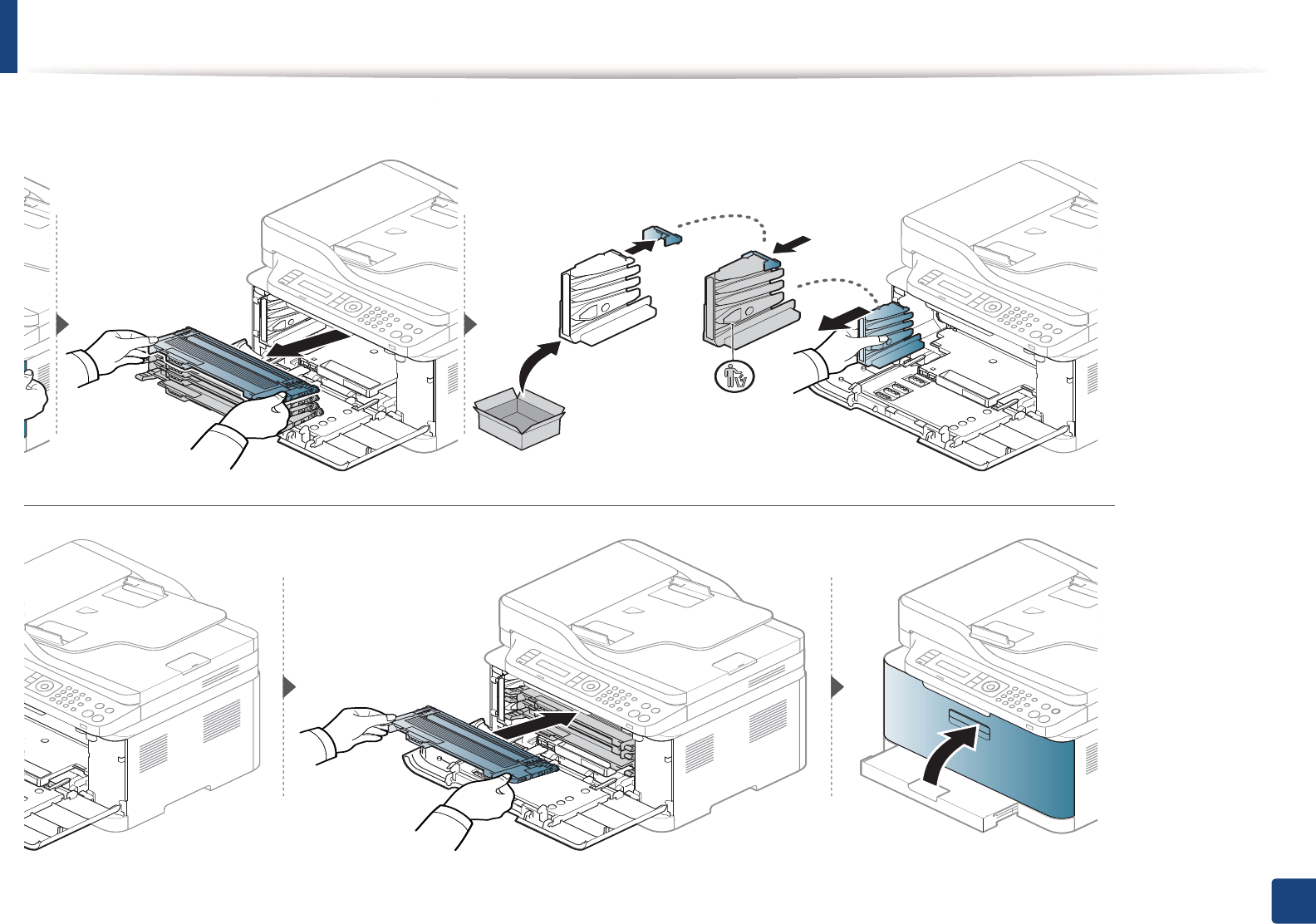
Replacing the waste toner container
84
3. Maintenance
85
3. Maintenance
Replacing the imaging unit
When the life span of the imaging unit has expired, the Printing Status window appears on the computer, indicating the imaging unit needs to be placed. Otherwise,
your machine stops printing.
• Don’t use sharp objects such as a knife or scissors to open the imaging unit package. You could damage the surface of the imaging unit.
• Be careful not to scratch the surface of the imaging unit.
• To prevent damage, do not expose the imaging unit to light for more than a few minutes. Cover it with a piece of paper to protect it if necessary.
• Before closing the front cover, make sure all toner cartridges are installed properly.
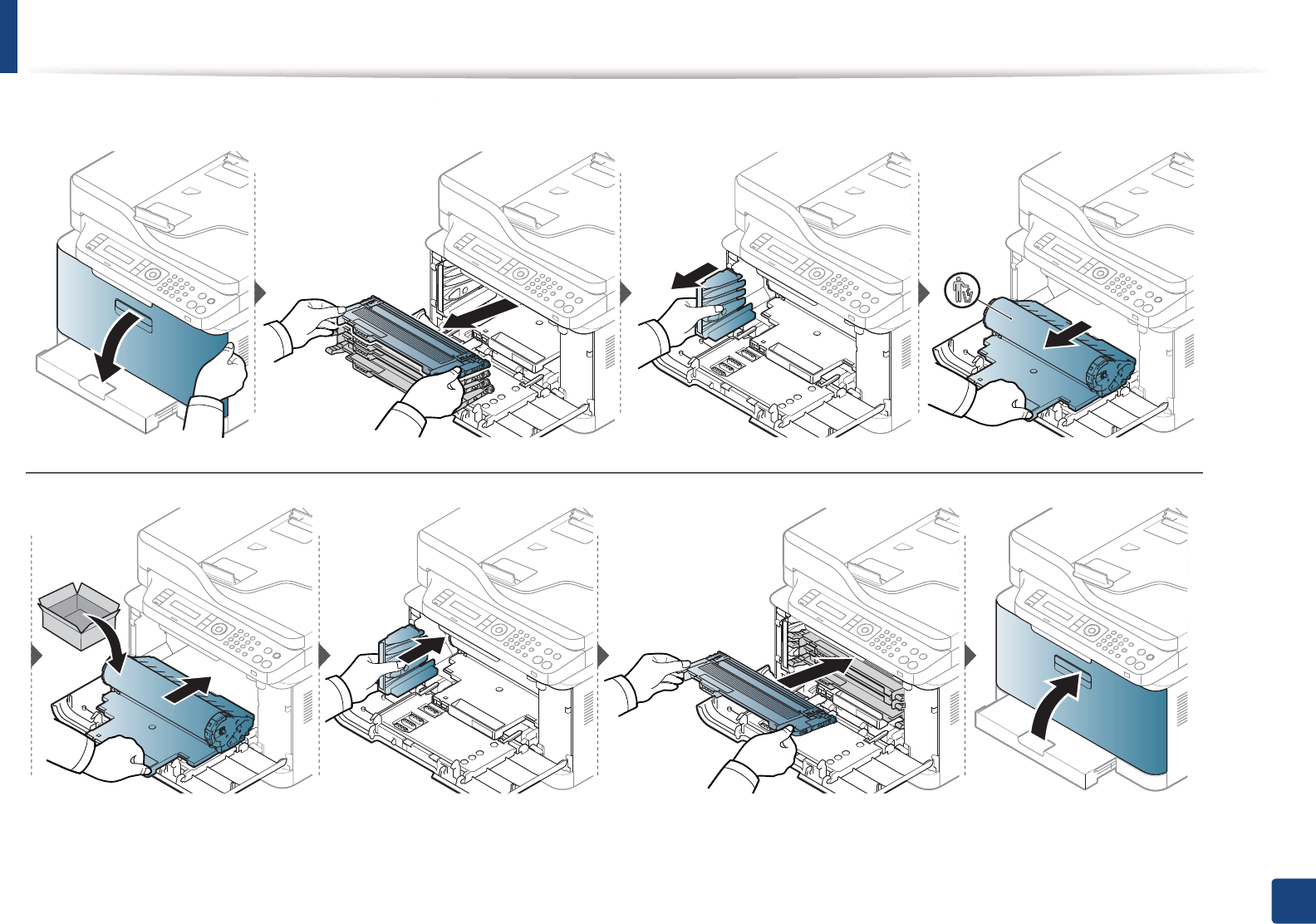
Replacing the imaging unit
86
3. Maintenance
87
3. Maintenance
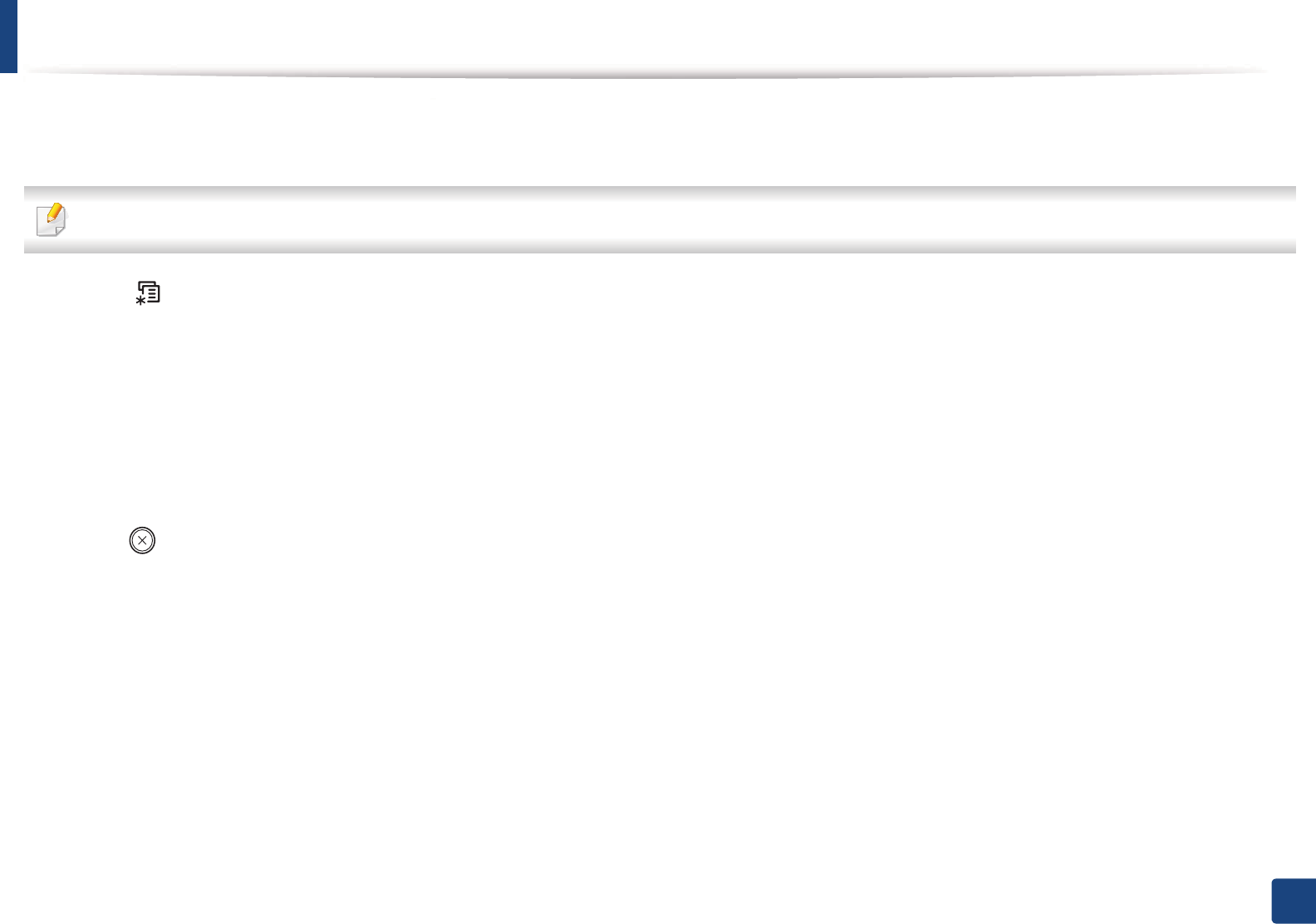
Monitoring the supplies life
If you experience frequent paper jams or printing problems, check the number of pages the machine has printed or scanned. Replace the corresponding parts, if
necessary.
It may be necessary to press OK to navigate to lower-level menus for some models.
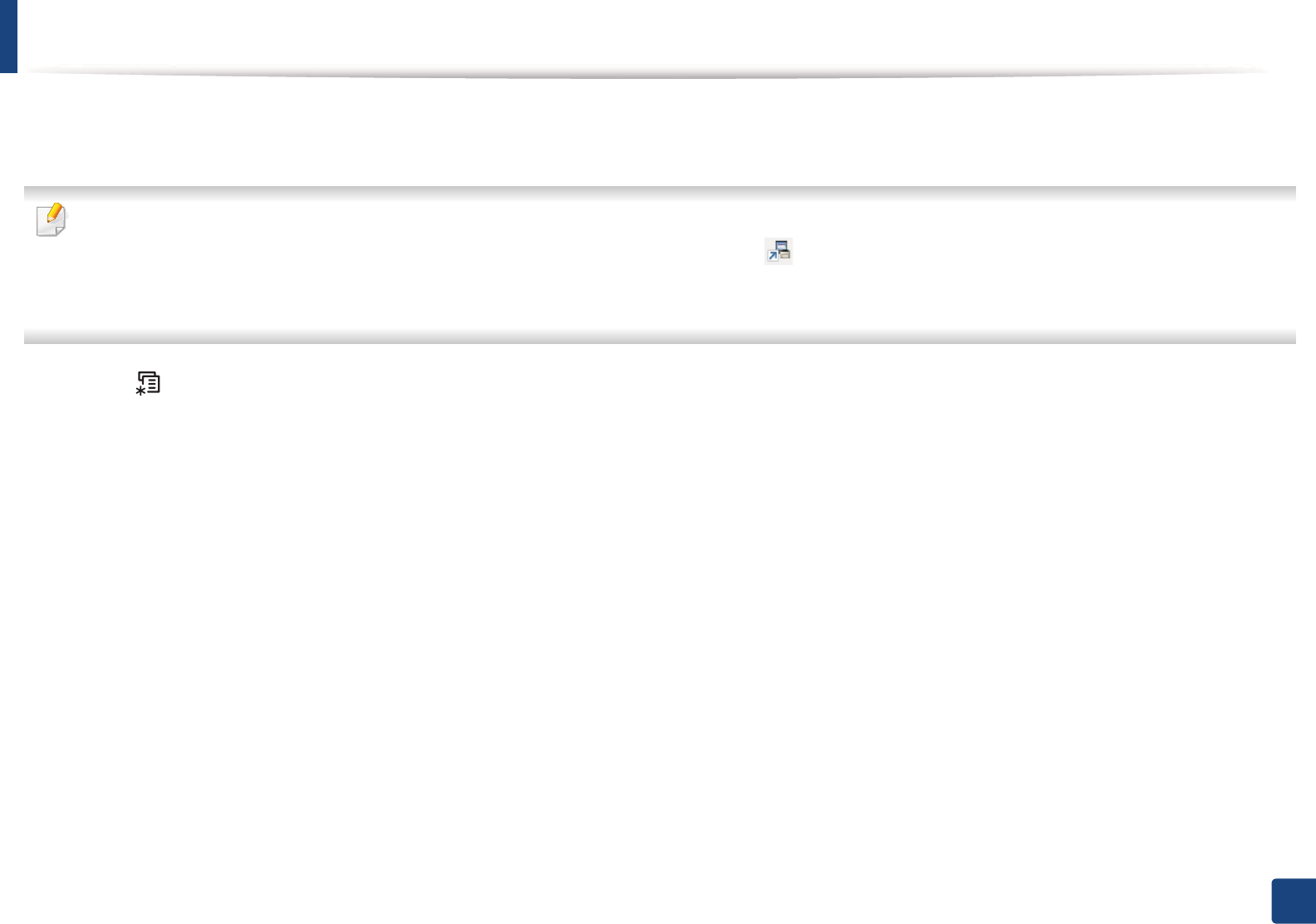
1Select (Menu) > System Setup > Maintenance > Supplies Life on the control panel.
2 Select the option you want and press OK.
•Total: Displays the total number of pages printed.
•ADF Scan: Displays the number of pages printed by using the document feeder.
•Platen Scan: Displays the number of pages scanned by using scanner glass.
•Supplies Info.: Prints the supply information page.
3 Press (Stop/Clear) to return to ready mode.
88
3. Maintenance
Setting the toner low alert
If the amount of toner in the cartridge is low, a message or LED informing the user to change the toner cartridge appears. You can set the option for whether or not
this message or LED appears.
• You can set the machine’s settings by using the Device Settings in 6DPVXQJ(DV\3ULQWHU0DQDJHUprogram.
- For Windows and Macintosh users, you set from Samsung Easy Printer Manager! (Switch to advanced mode)!Device Settings, see "Device
Settings" on page 263.
• It may be necessary to press OK to navigate to lower-level menus for some models.
1Select (Menu) > System Setup > Maintenance > TonerLow Alert on the control panel.
2 Select the option you want.
3 Press OK to save the selection.
89
3. Maintenance
Cleaning the machine
If printing quality problems occur or if you use your machine in a dusty environment, you need to clean your machine regularly to keep it in the best printing
condition and use your machine longer.
• Cleaning the cabinet of the machine with cleaning materials containing large amounts of alcohol, solvents, or other strong substances can discolor or distort the
cabinet.
• If your machine or the surrounding area is contaminated with toner, we recommend you use a cloth or tissue dampened with water to clean it. If you use a vacuum
cleaner, toner blows in the air and might be harmful to you.
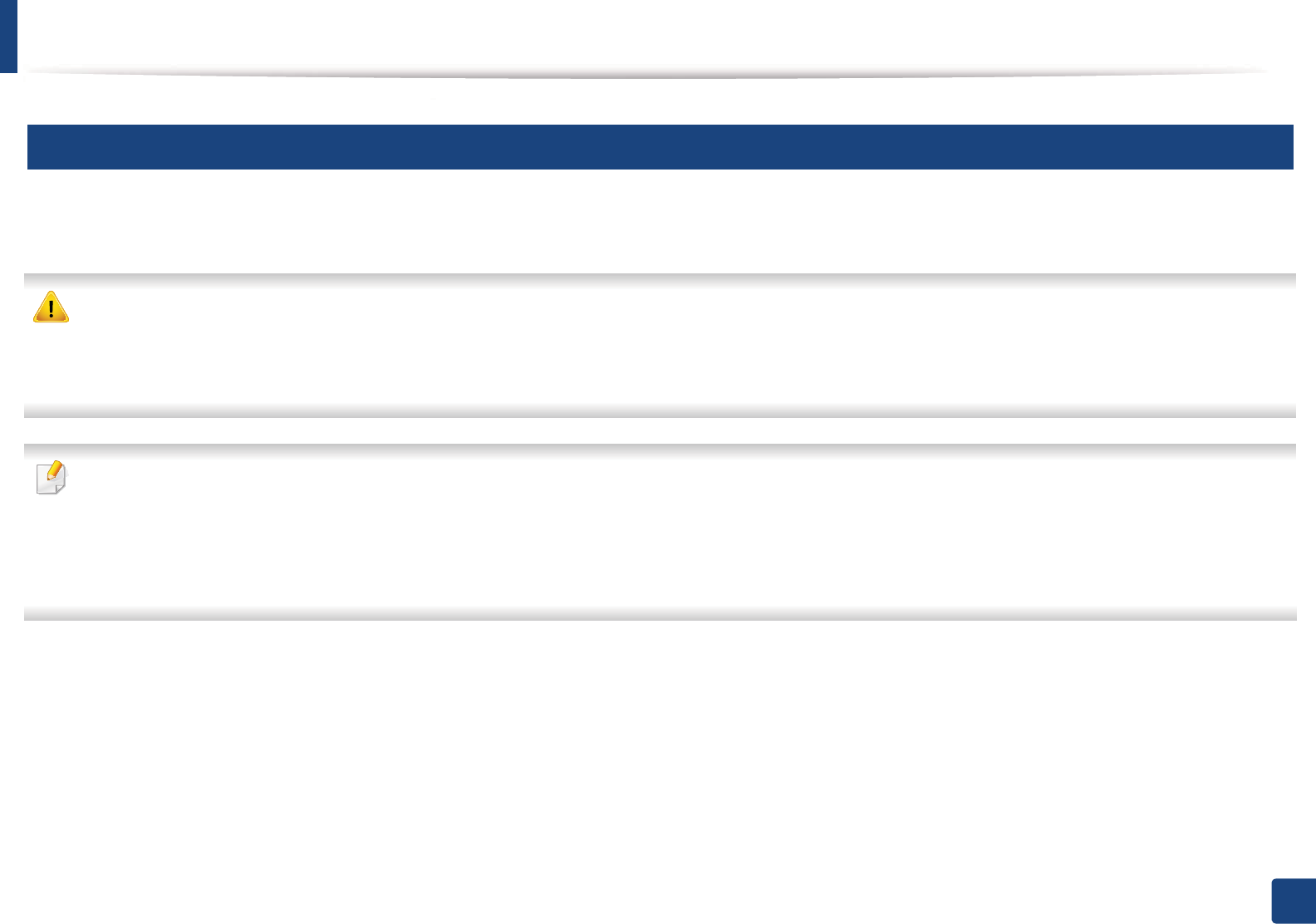
4
Cleaning the outside
Clean the machine cabinet with a soft, lint-free cloth. Dampen the cloth slightly with water, but be careful not to let any water drip onto or into the machine.
Cleaning the machine
90
3. Maintenance
5
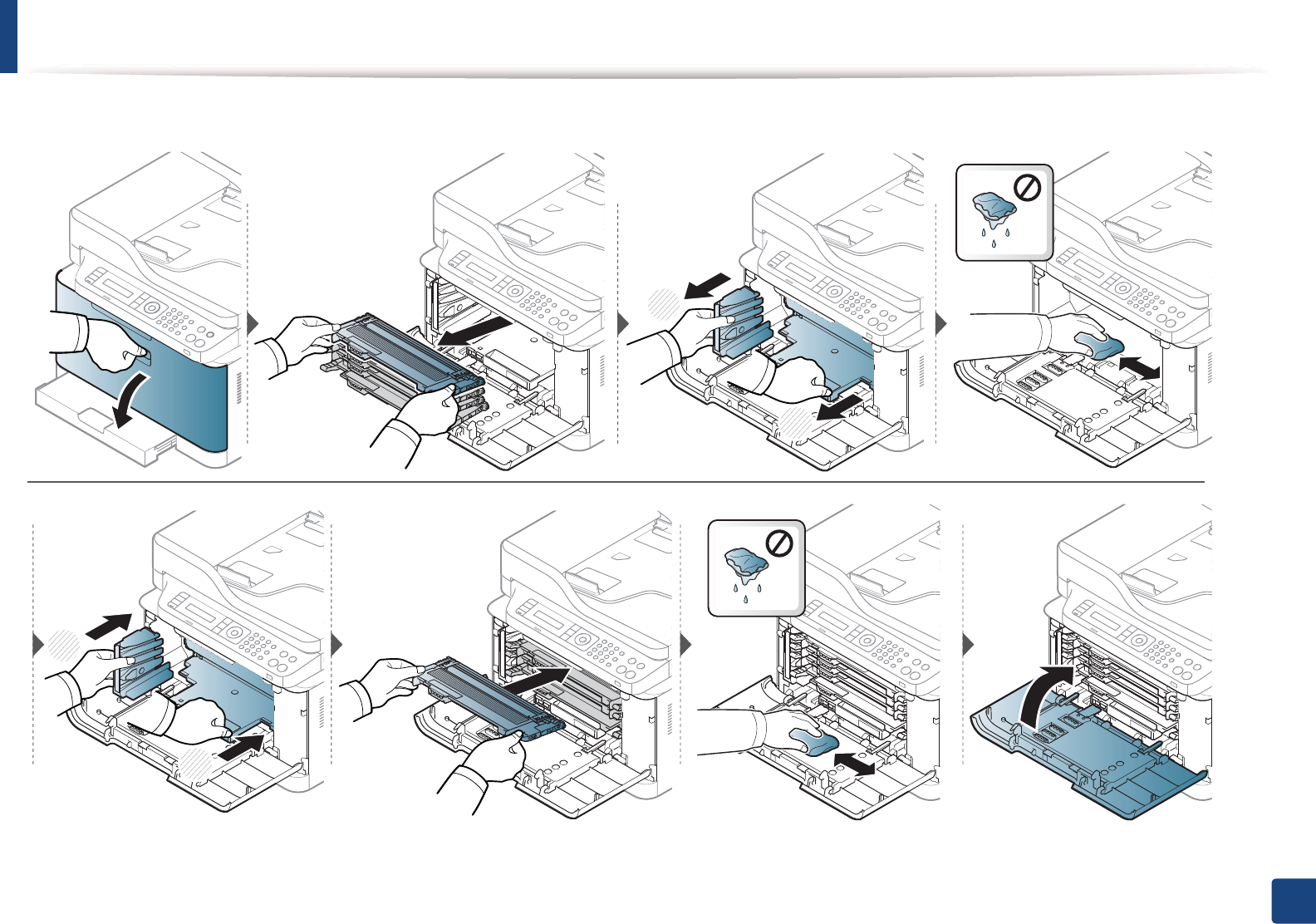
Cleaning the inside
During the printing process, paper, toner, and dust particles can accumulate inside the machine. This buildup can cause print quality problems, such as toner specks
or smearing. Cleaning the inside of the machine clears and reduces these problems.
• To prevent damage to the imaging unit, do not expose it to light for more than a few minutes. Cover it with a piece of paper, if necessary.
• Do not touch the green area of the imaging unit. Use the handle on the imaging unit to avoid touching this area.
• Use a dry lint free cloth when cleaning the inside of the machine, be careful not to damage the transfer roller or any other inside parts. Do not use solvents such
as benzene or thinner. Printing quality problems can occur and cause damage to the machine.
• Use a dry lint-free cloth to clean the machine.
• Turn the machine off and unplug the power cord. Wait for the machine to cool down. If your machine has a power switch, turn the power switch off before
cleaning the machine.
• Illustrations on this user’s guide may differ from your machine depending on its options or models. Check your machine type (see "Front view" on page 20).
• When opening a scan unit, hold the document feeder and scan unit together.
Cleaning the machine
91
3. Maintenance
1
2
1
2
Cleaning the machine
92
3. Maintenance
6
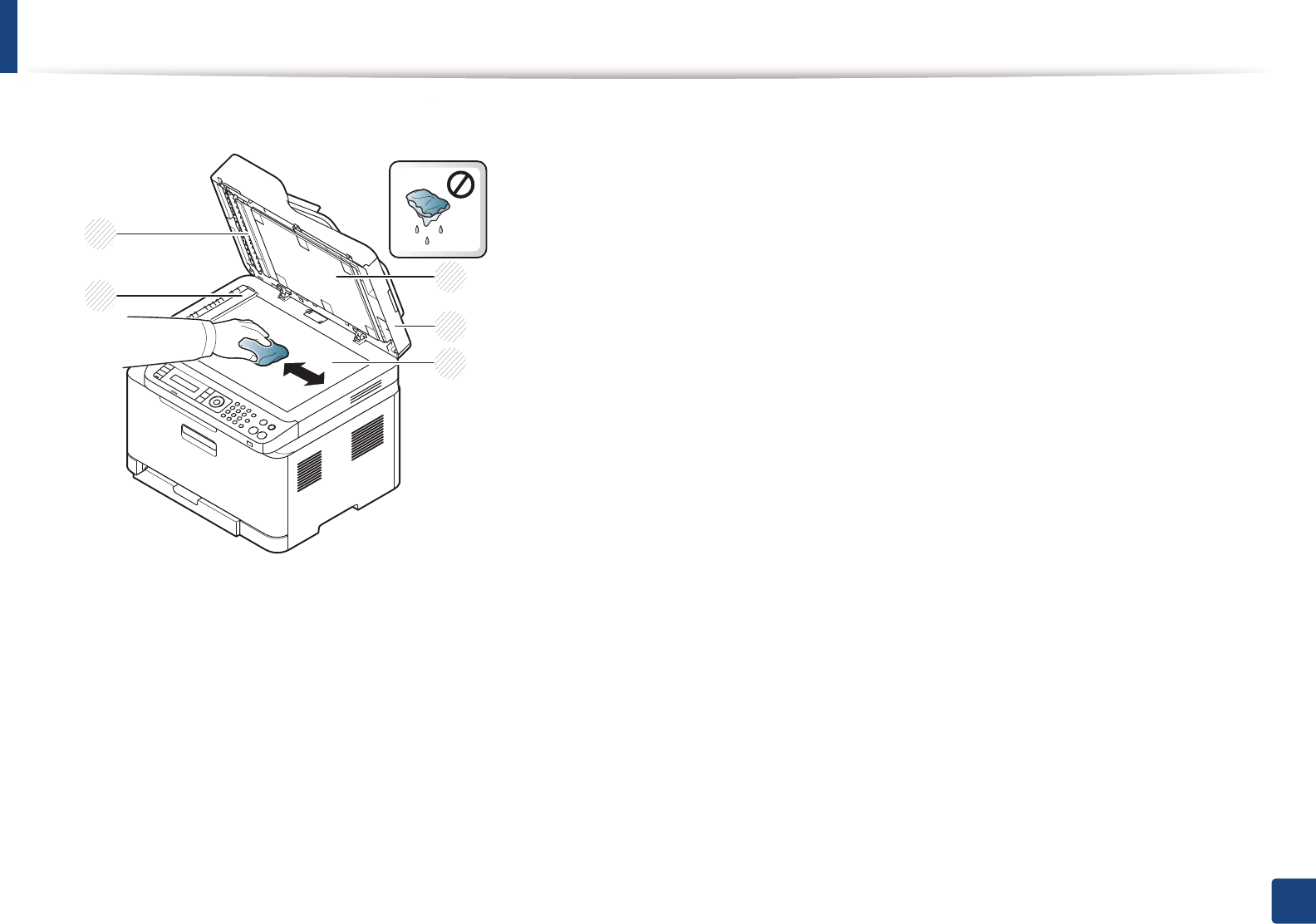
Cleaning the scan unit
Keeping the scan unit clean helps ensure the best possible copies. We suggest that you clean the scan unit at the start of each day and during the day as needed.
• Turn the machine off and unplug the power cord. Wait for the machine to cool down. If your machine has a power switch, turn the power switch off before
cleaning the machine.
• Illustrations on this user’s guide may differ from your machine depending on its options or models. Check your machine type (see "Front view" on page 20).
1Slightly dampen a soft, lint-free cloth or paper towel with water.
2 Lift and open the scanner lid.
Cleaning the machine
93
3. Maintenance
3 Wipe the surface of the scanner until it is clean and dry.
1White bar
2Document feeder glass
3White sheet
4Scanner lid
5Scanner glass
4 Close the scanner lid.
2
3
4
1
5

94
3. Maintenance
Tips for moving & storing your machine
• When moving the machine, do not tilt or turn it upside down. Otherwise, the inside of the machine may be contaminated by toner, which can cause damage to
the machine or reduce print quality.
• When moving the machine, make sure at least two people are holding the machine securely.
4. Troubleshooting
This chapter gives helpful information for what to do if you encounter an error.
• Tips for avoiding paper jams 96
• Clearing original document jams 97
• Clearing paper jams 102
• Understanding the status LED 106
• Understanding display messages 108
This chapter gives helpful information for what to do if you encounter an error. If your machine
has a display screen, check the message on the display screen first to solve the error.
If you cannot find a solution to your problem in this chapter, refer to the Troubleshooting
chapter in the Advanced Guide (see "Troubleshooting" on page 275).
If you cannot find a solution in the User's Guide or the problem persists, call for service.

96
4. Troubleshooting
Tips for avoiding paper jams
By selecting the correct media s, most paper jams can be avoided. To avoid paper jams, refer to the following guidelines:
• Ensure that the adjustable guides are positioned correctly (see "Tray overview" on page 41).
• Do not remove paper from the tray while your machine is printing.
• Flex, fan, and straighten paper before loading.
• Do not use creased, damp, or highly curled paper.
• Do not mix papers in a tray.
• Use only recommended print media (see "Print media specifications" on page 117).
97
4. Troubleshooting
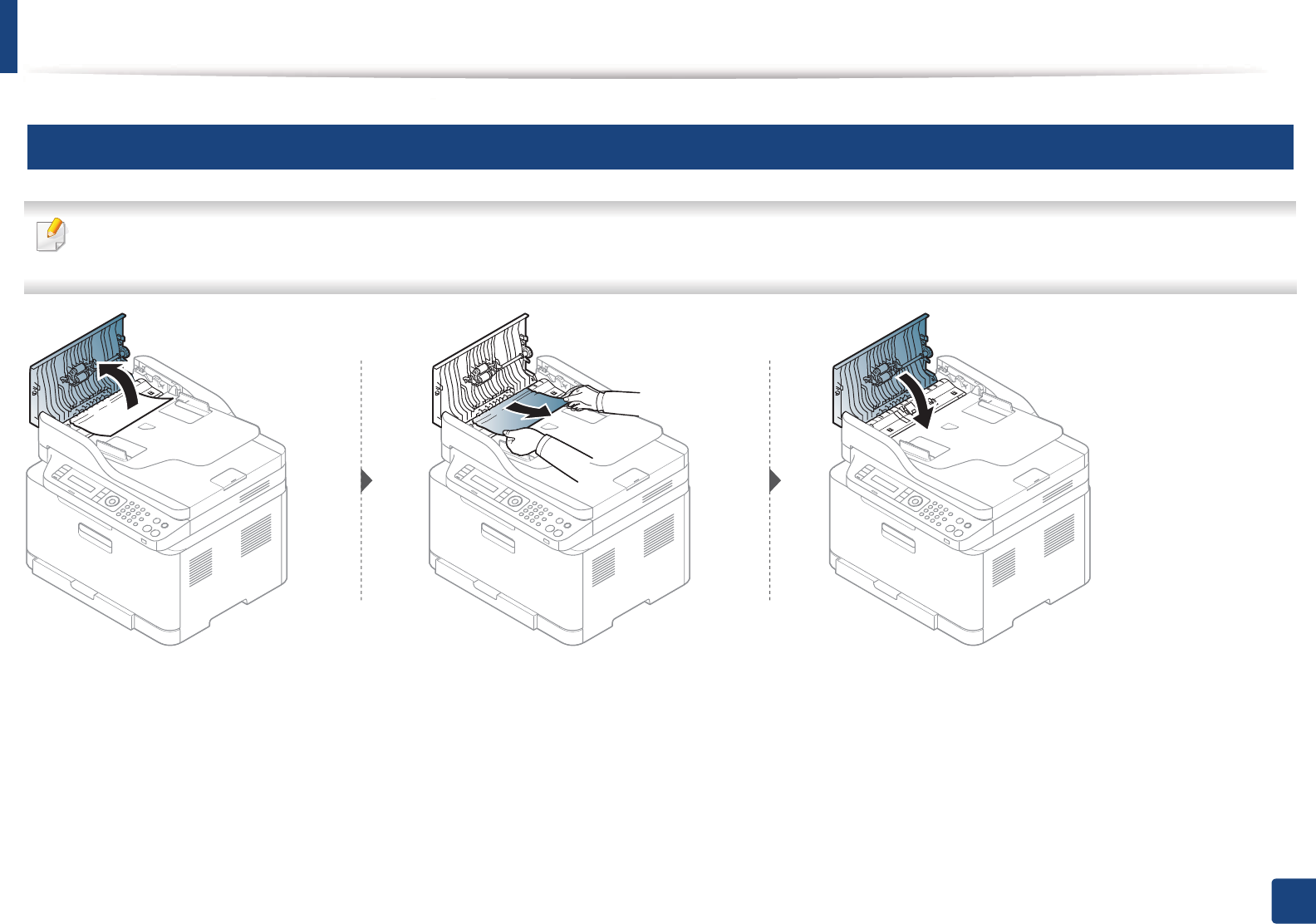
Clearing original document jams
When an original document jams in the document feeder, a warning message appears on the display.
To avoid tearing the document, remove the jammed document slowly and carefully.
To prevent document jams, use the scanner glass for thick, thin or mixed paper- originals.
Clearing original document jams
98
4. Troubleshooting
1
Original paper jam in front of scanner
• Illustrations on this user’s guide may differ from your machine depending on its options or models. Check your machine type (see "Front view" on page 20).
• This troubleshooting may not be available depending on model or optional goods (see "Variety feature" on page 9).
Clearing original document jams
99
4. Troubleshooting
2
Original paper jam inside of scanner
• Illustrations on this user’s guide may differ from your machine depending on its options or models. Check your machine type (see "Front view" on page 20).
• This troubleshooting may not be available depending on model or optional goods (see "Variety feature" on page 9).
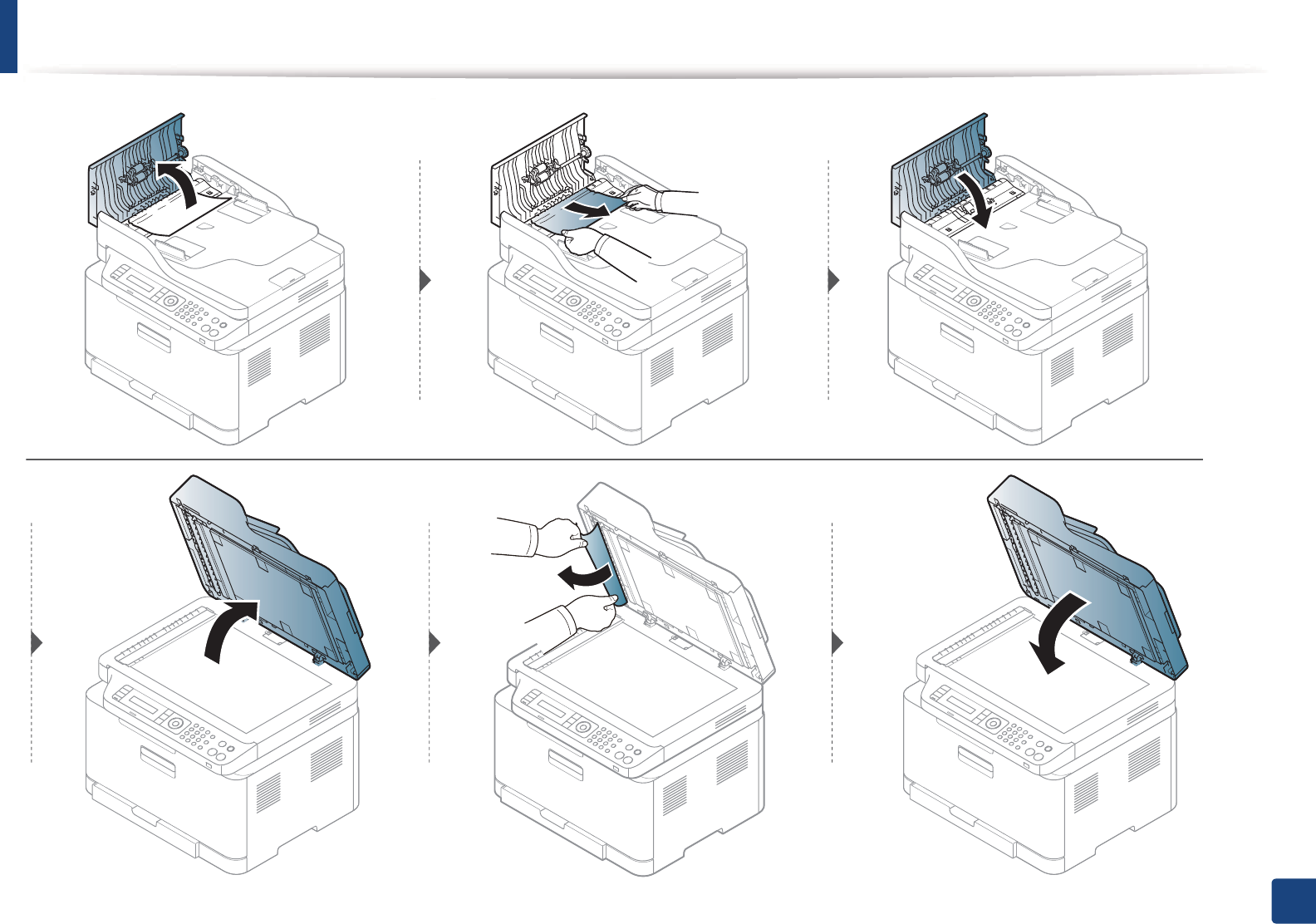
Clearing original document jams
100
4. Troubleshooting
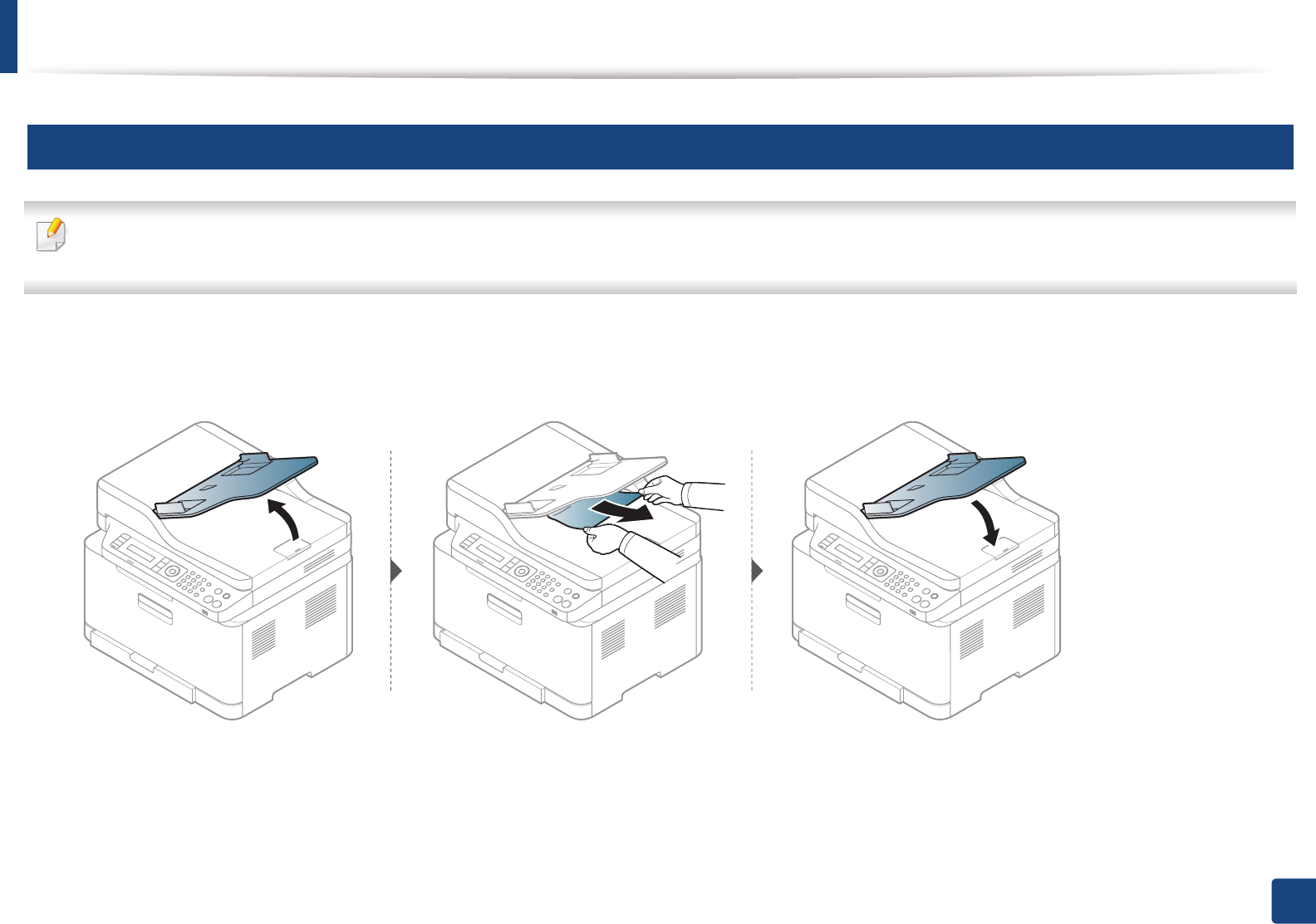
Clearing original document jams
101
4. Troubleshooting
3
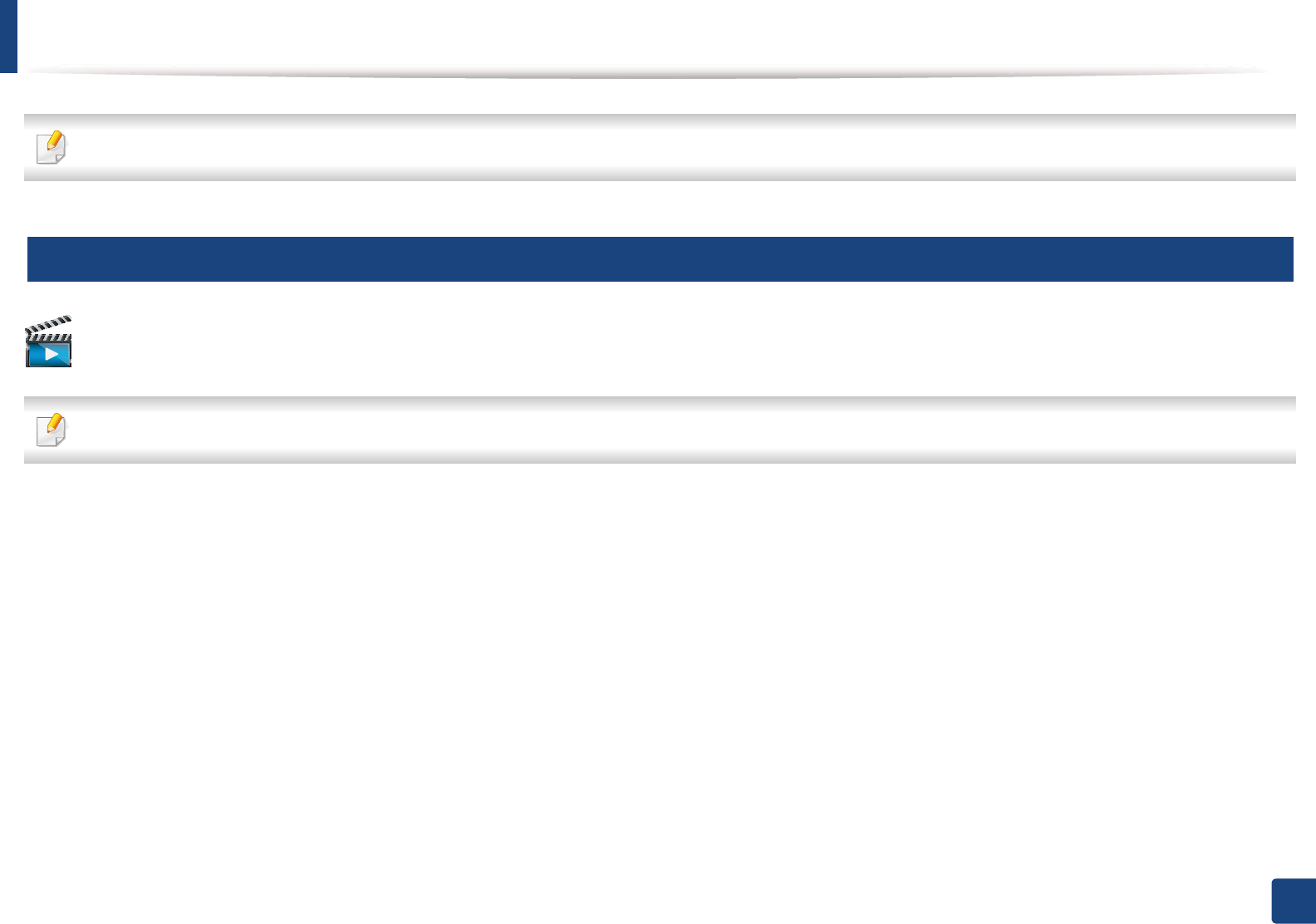
Original paper jam in exit area of scanner
• Illustrations on this user’s guide may differ from your machine depending on its options or models. Check your machine type (see "Front view" on page 20).
• This troubleshooting may not be available depending on model or optional goods (see "Front view" on page 20).
1Remove any remaining pages from the document feeder.
2 Gently remove the jammed paper from the document feeder.
102
4. Troubleshooting
Clearing paper jams
To avoid tearing the paper, pull the jammed paper out slowly and gently.
4
In tray
Click this link to open an animation about clearing a jam.
Illustrations on this user’s guide may differ from your machine depending on its options or models. Check your machine type (see "Front view" on page 20).
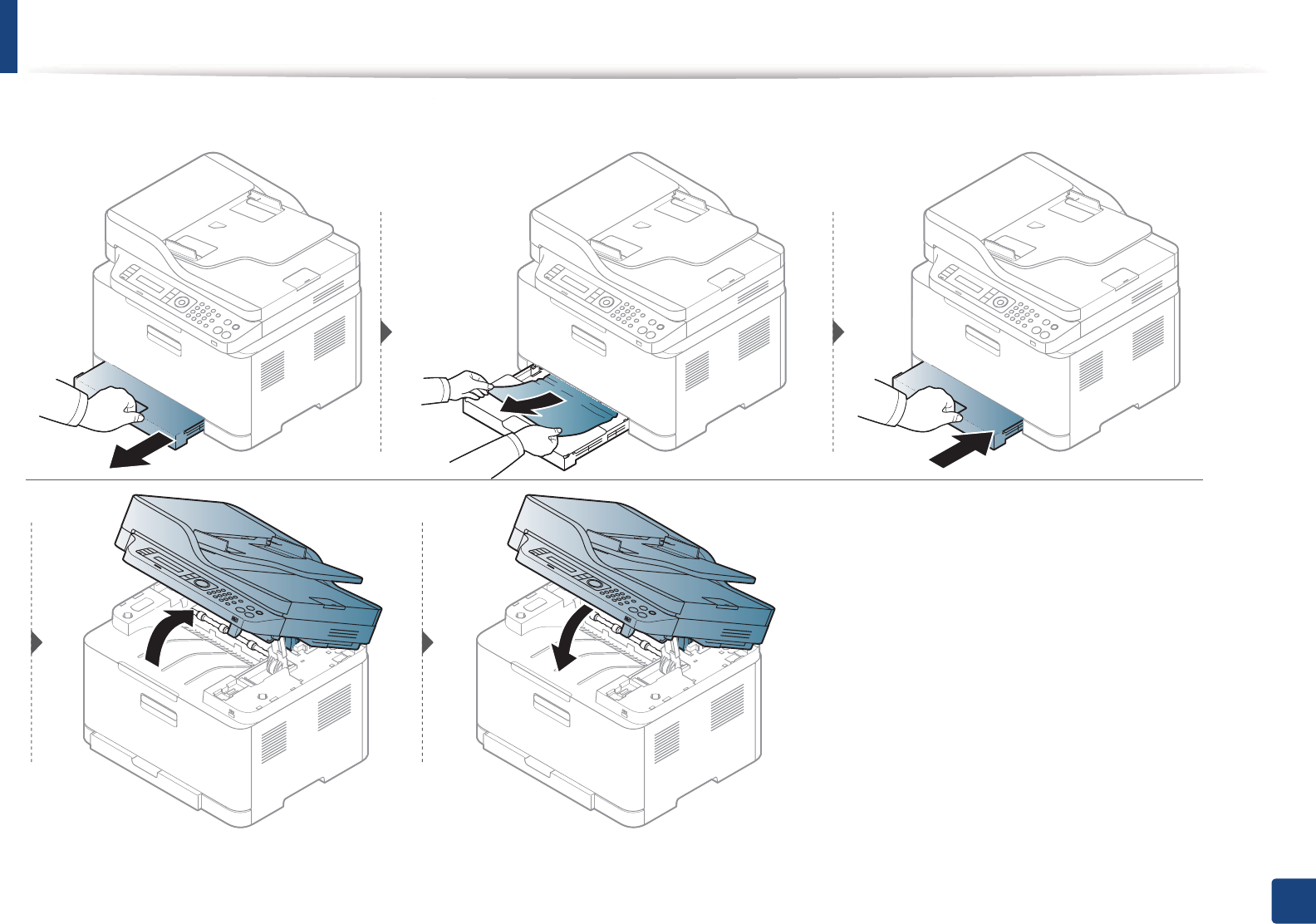
Clearing paper jams
103
4. Troubleshooting
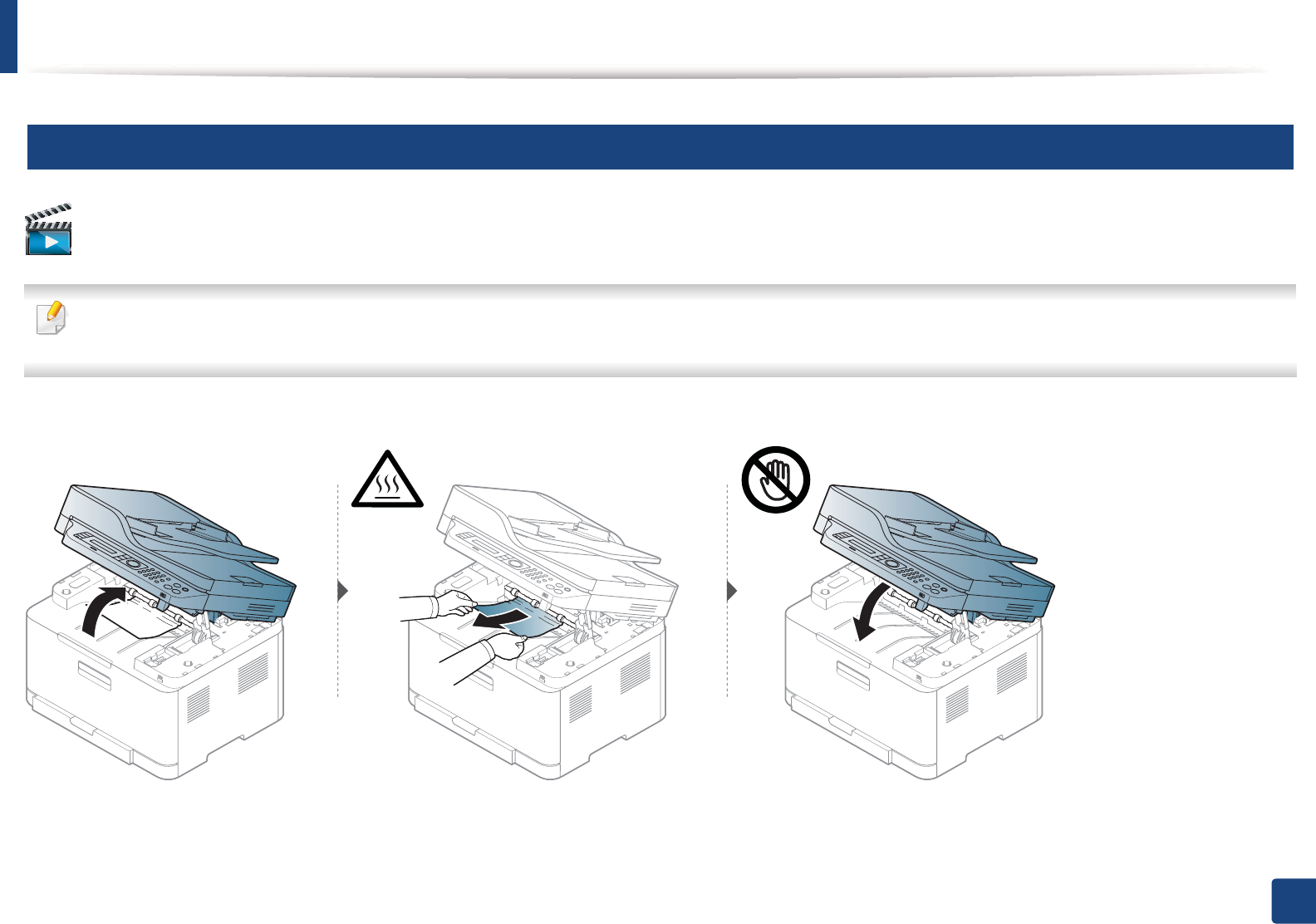
Clearing paper jams
104
4. Troubleshooting
5
Inside the machine
Click this link to open an animation about clearing a jam.
• The fuser area is hot. Take care when removing paper from the machine.
• Illustrations on this user’s guide may differ from your machine depending on its options or models. Check your machine type (see "Front view" on page 20).
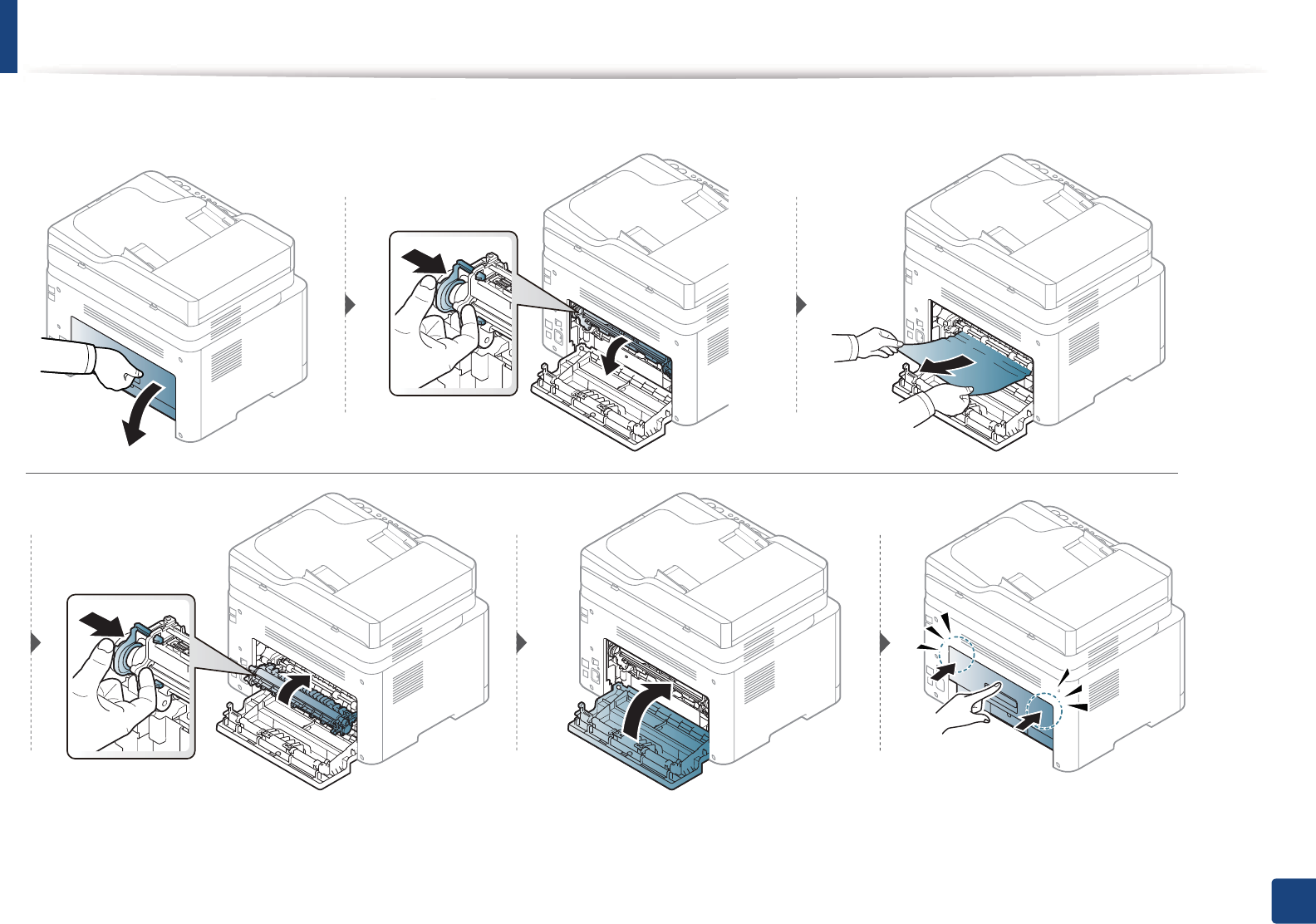
Clearing paper jams
105
4. Troubleshooting
If you do not see the paper in this area, stop and go to next step:
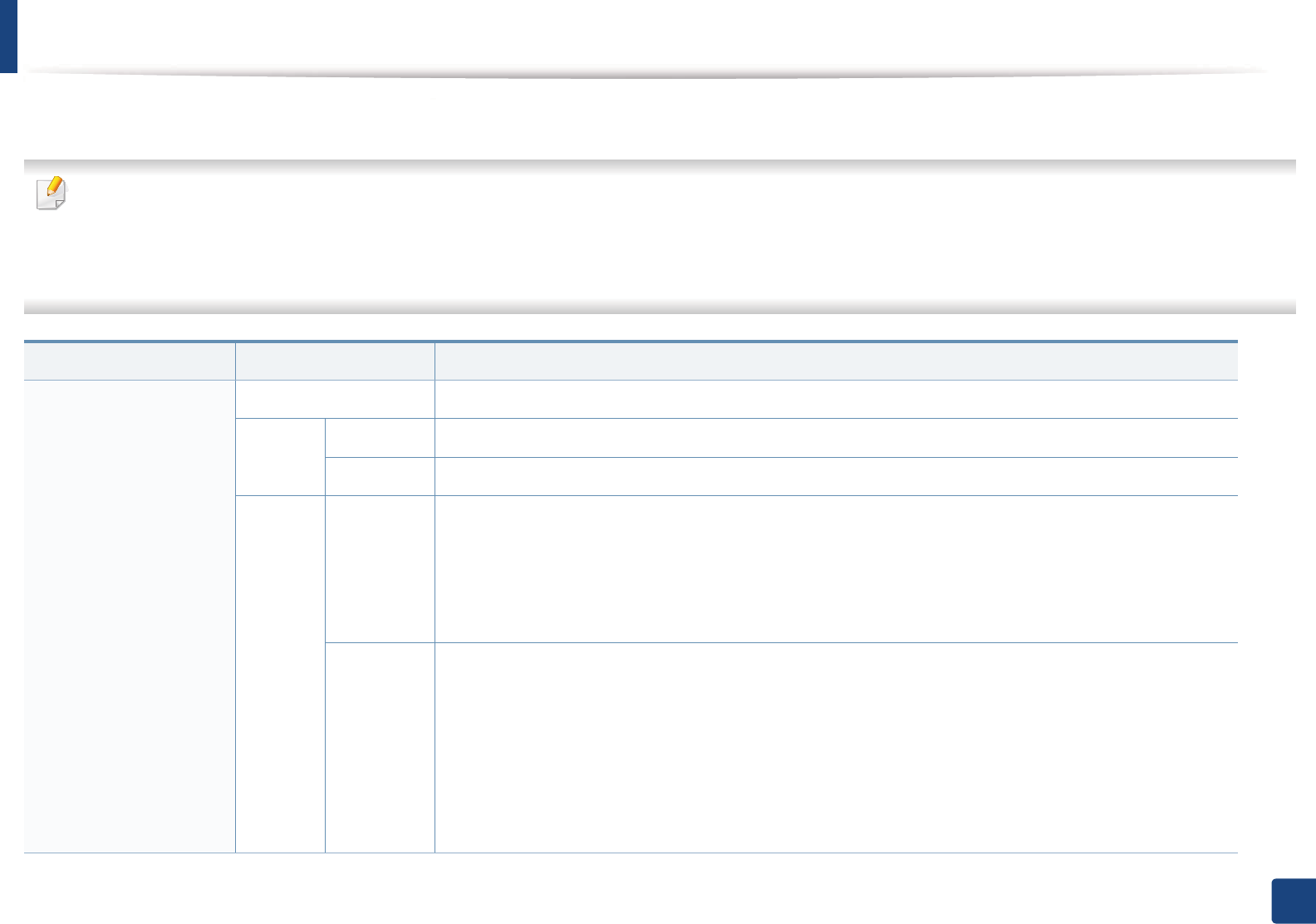
106
4. Troubleshooting
Understanding the status LED
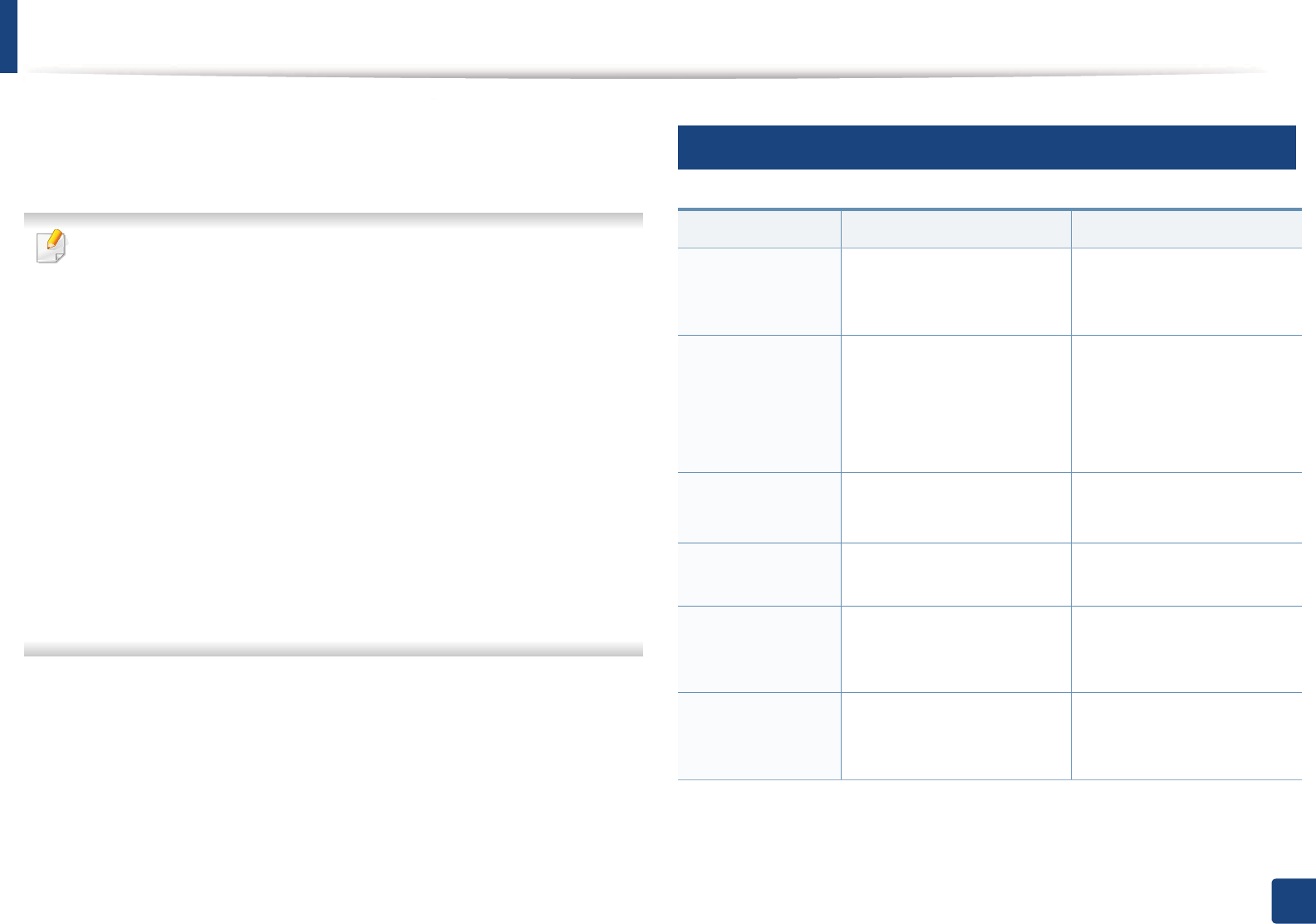
The color of the LED indicates the machine's current status.
• Some LEDs may not be available depending on model or country (see "Control panel overview" on page 23).
• To resolve the error, look at the error message and its instructions from the troubleshooting part (see "Understanding display messages" on page 108).
• You also can resolve the error with the guideline from the computers’s Samsung Printing Status window (see "Using Samsung Printer Status" on page 269).
• If the problem persists, call a service representative.
LED Status Description
Status
Off The machine is off-line.
Green
Blinking When the backlight blinks, the machine is receiving or printing data.
On • The machine is on-line and can be used.
Red
Blinking
• A minor error has occurred and the machine is waiting for the error to be cleared. Check the display
message. When the problem is cleared, the machine resumes.
• Small amount of toner is left in the cartridge. The estimated cartridge lifea of toner is close. Prepare a
new cartridge for replacement. You may temporarily increase the printing quality by redistributing the
toner (see "Redistributing toner" on page 79).b
On
• A toner cartridge has almost reached its estimated cartridge lifea. It is recommended to replace the
toner cartridge (see "Replacing the toner cartridge" on page 81).
• The cover is opened. Close the cover.
• There is no paper in the tray when receiving or printing data. Load paper in the tray.
• The machine has stopped due to a major error. Check the display message (see "Understanding display
messages" on page 108).
• A paper jam has occurred (see "Clearing paper jams" on page 102).
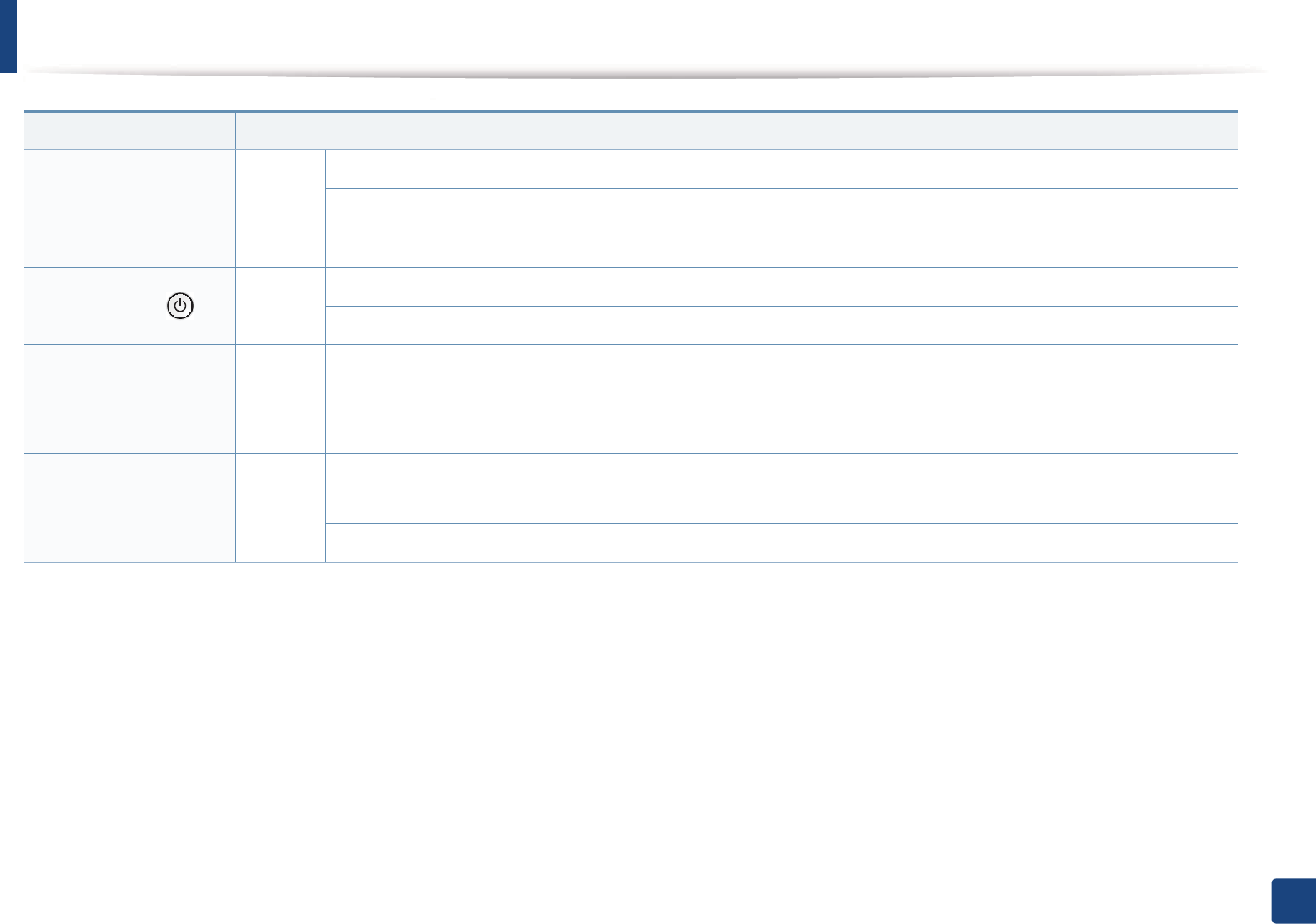
Understanding the status LED
107
4. Troubleshooting
WirelessbBlue
Blinking The machine is connecting to a wireless network.
On The machine is connected to a wireless networkG(see "Wireless network setup" on page 160).
Off The machine is disconnected from a wireless network.
Power/Wakeup ( ) Blue
On The machine is in power save mode.
Off The machine is in ready mode or machine’s power is off.
Eco Green
On Eco mode is on.
The default setting of Eco mode is 2-up and toner save.
Off Eco mode is off.
Scan to Green
On Eco mode is on.
The default setting of Eco mode is 2-up and toner save.
Off Eco mode is off.
a. Estimated cartridge life means the expected or estimated toner cartridge life, which indicates the average capacity of print-outs and is designed pursuant to ISO/IEC 197`_. The number
of pages may be affected by operating environment, percentage of image area, printing interval, graphics, media and media size. Some amount of toner may remain in the cartridge even
when red LED is on and the printer stops printing.
b. Some LEDs may not be available depending on model or country (see "Control panel overview" on page 23).
LED Status Description
108
4. Troubleshooting
Understanding display messages
Messages appear on the control panel display to indicate the machine’s status
or errors. Refer to the tables below to understand the messages’ and their
meaning, and correct the problem, if necessary.
• This function is not supported for the devices which has a control panel
display. You can resolve the error with the guideline from the
computers’s Printing Status window (see "Using Samsung Printer Status"
on page 269).
• If a message is not in the table, reboot the power and try the printing job
again. If the problem persists, call a service representative.
• When you call for service, provide the service representative with the
contents of display message.
• Some messages may not appear on the display depending on the
options or models.
• [error number] indicates the error number.
• [tray type] indicates the tray number.
• [media type] indicates the media type.
• [media size] indicates the media size.
• [color] indicates the color of toner.
6
Paper Jam-related messages
Message Meaning Suggested solutions
Document jam.
Remove jam
The loaded original
document has jammed in
the document feeder.
Clear the jam (see "Clearing
original document jams" on
page 97).
Jam or empty
Door open&close
• Paper has jammed in the
paper feed area.
• There is no paper in tray.
• Clear the jam (see "In tray"
on page 102).
• Load paper in tray (see
"Loading paper in the
tray" on page 42).
Paper Jam
inside machine
Paper has jammed in the
inside machine.
Clear the jam (see "Inside the
machine" on page 104).
Paper Jam in [tray
type]
Paper has jammed in the
paper tray.
Clear the jam (see "In tray" on
page 102).
Paper Jam
in exit area
Paper has jammed in the exit
area.
Clear the jam (see "Original
paper jam in exit area of
scanner" on page 101).
Paper Empty in
[tray type]
There is no paper in tray. Load paper in tray (see
"Loading paper in the tray"
on page 42).

Understanding display messages
109
4. Troubleshooting
7
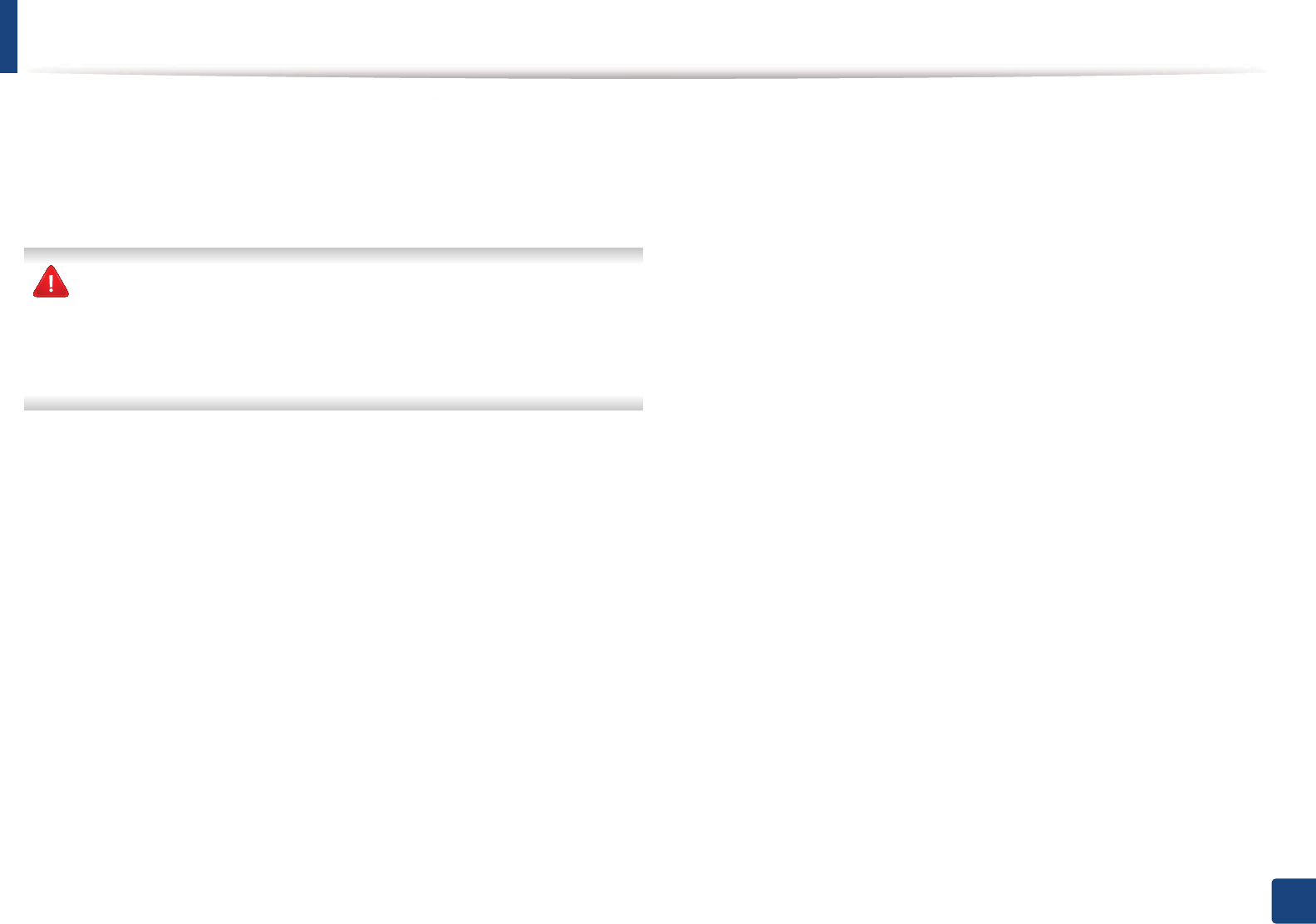
Toner-related messages
Message Meaning Suggested solutions
•Install Toner
•Install toner
cartridge
A toner cartridge is not
installed.
Install a toner cartridge.
• Not Compatible
[color] toner
• Not Compatible
toner cartridge
The toner cartridge is not
suitable for your machine.
Install the corresponding
toner cartridge with
aSamsung-genuine
cartridge.
Not original
[color] toner
The toner cartridge is not a
Samsung-genuine toner
cartridge.
Install the corresponding
toner cartridge with a
Samsung-genuine
cartridge.
•Prepare toner
•Prepare new
cartridge
Small amount of toner is left in
the indicated cartridge. The
estimated cartridge life of
toner is close.
Prepare a new cartridge
for a replacement. You
may temporarily increase
the printing quality by
redistributing the toner
(see "Redistributing toner"
on page 79).
•Replace toner
•Replace new
cartridge
The indicated toner cartridge
has almost reached its
estimated cartridge life. a
• You can choose Stop or
Continue as shown on
the control panel. If you
select Stop, the printer
stops printing and you
cannot print any more
without changing the
cartridge. If you select
Continue, the printer
keeps printing but the
printing quality cannot
be guaranteed.
• Replace the toner
cartridge for the best
print quality when this
message appears.
Using a cartridge
beyond this stage can
result in printing
quality issues (see
"Replacing the toner
cartridge" on page 81).
The indicated toner cartridge
has reached its estimated
cartridge life.a The machine
might stop printing.
Replace the toner
cartridge (see "Replacing
the toner cartridge" on
page 81).
Message Meaning Suggested solutions
Understanding display messages
110
4. Troubleshooting
Samsung does not recommend using a non-genuine Samsung toner
cartridge such as refilled or remanufactured. Samsung cannot guarantee a
non-genuine Samsung toner cartridge's quality. Service or repair required
as a result of using non-genuine Samsung toner cartridges will not be
covered under the machine warranty.
a. Estimated cartridge life means the expected or estimated toner cartridge life, which indicates
the average capacity of print-outs and is designed pursuant to ISO/IEC 19752 (see "Available
supplies" on page 75). The number of pages may be affected by operating environment,
percentage of image area, printing interval, media, percentage of image area, and media size.
Some amount of toner may remain in the cartridge even when replace new cartridge appears
and the machine stops printing.

Understanding display messages
111
4. Troubleshooting
8
Tray-related messages
9
Network-related messages
10
Misc. messages
Message Meaning Suggested solutions
Jam or empty
Door open&close
• Paper has jammed in the
paper feed area.
• There is no paper in tray.
• Clear the jam (see "In
tray" on page 102).
• Load paper in tray (see
"Loading paper in the
tray" on page 42).
Message Meaning Suggested solutions
Network Problem:
IP Conflict
The network IP address you
have set is being used by
someone else.
Check the IP address and
reset it if necessary (see
"Printing a network
configuration report" on
page 148).
Wireless
Network Error
Wireless module is not
installed.
Reboot the power and try
the printing job again. If
the problem persists,
please call for service.
•BOOTP problem:
Auto IP Run
•DHCP problem:
Auto IP Run
There is a problem with the
network.
Change the Auto IPU
•BOOTP problem:
Reconfigure
DHCP
•DHCP problem:
Reconfigure
DHCP
The IP address assignment is
failed. This happens, when
Auto IP for BOOTP/DHCP is
set in SyncThru™ Web
Service.
Change the IP address
assignment method to
DHCP/BOOTP or Static. If
you do not change this
option, the BOOTP/DHCP
server continually asks to
assign the IP Address.
802.1x
Network Error
Fail to authenticate. Check the network
authentication protocol.
If the problem persists,
contact your network
administrator.
Message Meaning Suggested solutions
Adjusting Color
Registration
The machine is adjusting the
color registration.
Wait a few minutes.
Message Meaning Suggested solutions

Understanding display messages
112
4. Troubleshooting
Calibrating
image density…
The machine is calibrating
the image density.
Wait a few minutes.
Door Open
Close it
The cover is not securely
latched.
Close the cover until it
locks into place.
Scanner open
Close it
The document feeder cover
is not securely latched.
Close the cover until it
locks into place.
Door of scanner is
open.
The cover of scanner is not
securely latched.
Close the cover until it
locks into place.
Error [error number]
Install [color] toner
The indicated toner
cartridge is installed
improperly, or the connector
is polluted.
Reinstall the Samsung-
genuine toner cartridge
two or three times to
confirm it is seated
properly. Or clean the
connector. If the problem
persists, contact the
service representatives.
Error [error number]
Turn off then on
The machine unit cannot be
controlled.
Reboot the power and try
the printing job again. If
the problem persists,
please call for service.
Error [error number]
Call for service
Scanner Locked The scanner is locked. Reboot the power. If the
problem persists, please
call for service.
Message Meaning Suggested solutions
Install TR.
belt unit.
The transfer belt is not
installed.
Install a Samsung-
genuine transfer belt.
Not compatible
transfer belt
The transfer belt of the
machine is not for your
machine.
Install the a Samsung-
genuine part designed
for your machine.
Not installed
Waste tank
The is waste toner container
not installed.
Install a Samsung-
genuine waste toner
container.
Not proper room
temp. Move set
The machine is in a room
with improper room
temperature.
Move the machine to a
room with proper room
temperature.
Output bin Full
Remove paper
The output tray is full. Or the
sensor is not facing down.
Remove papers from the
output tray, the machine
resumes printing. Or
make sure the sensor is
facing down. If the
problem persists, call for
service.
Prepare new
Transfer belt
The life of the transfer belt
will expired soon.
Replace the transfer belt
with a new one. Contact
the service
representatives.
Message Meaning Suggested solutions

Understanding display messages
113
4. Troubleshooting
Replace new
Transfer belt
The life of the transfer belt
has expired.
Replace the transfer belt
with a new one. Contact
the service
representatives.
Transfer Belt Error The transfer belt cannot be
controlled.
Reboot the power and try
the printing job again. If
the problem persists,
please call for service.
Prepare new
Transfer roller
The life of the transfer belt
will expired soon.
Replace the transfer belt
with a new one. Contact
the service
representatives.
Replace new
Transfer roller
The life of the transfer belt
has expired.
Replace the transfer belt
with a new one. Contact
the service
representatives.
Replace
Fuser Soon
The life of the fuser unit will
be expired soon.
Replace the fuser unit
with a new one. Contact
the service
representatives.
Replace new
Fuser unit
The life of the fuser unit will
be expired.
Message Meaning Suggested solutions
Replace/Install
Waste Toner Tank
The life span of the waste
toner container has expired
and the printer will stop
printing until a new waste
toner container is placed
into the printer.
Replace a waste toner
container with a
Samsung-genuine waste
toner container.
Prepare new
Imaging unit
The life of the imaging unit
will be expired soon.
Replace the imagingunit
with a new one. Contact
the service
representatives.
Replace with
new imaging unit
The life of the imaging unit
will be expired.
Install
imaging unit
The imaging unit is not
installed
Error [error number]
Door open/close
The imaging unit is installed
improperly, or the cover is
not securely latched.
Reinstall the imaging unit
to confirm it is seated
properly. Close the cover
until it locks into place.
Message Meaning Suggested solutions

5. Appendix
This chapter provides product specifications and information concerning applicable regulations.
• Specifications 115
• Regulatory information 124
• Copyright 137
115
5. Appendix
Specifications
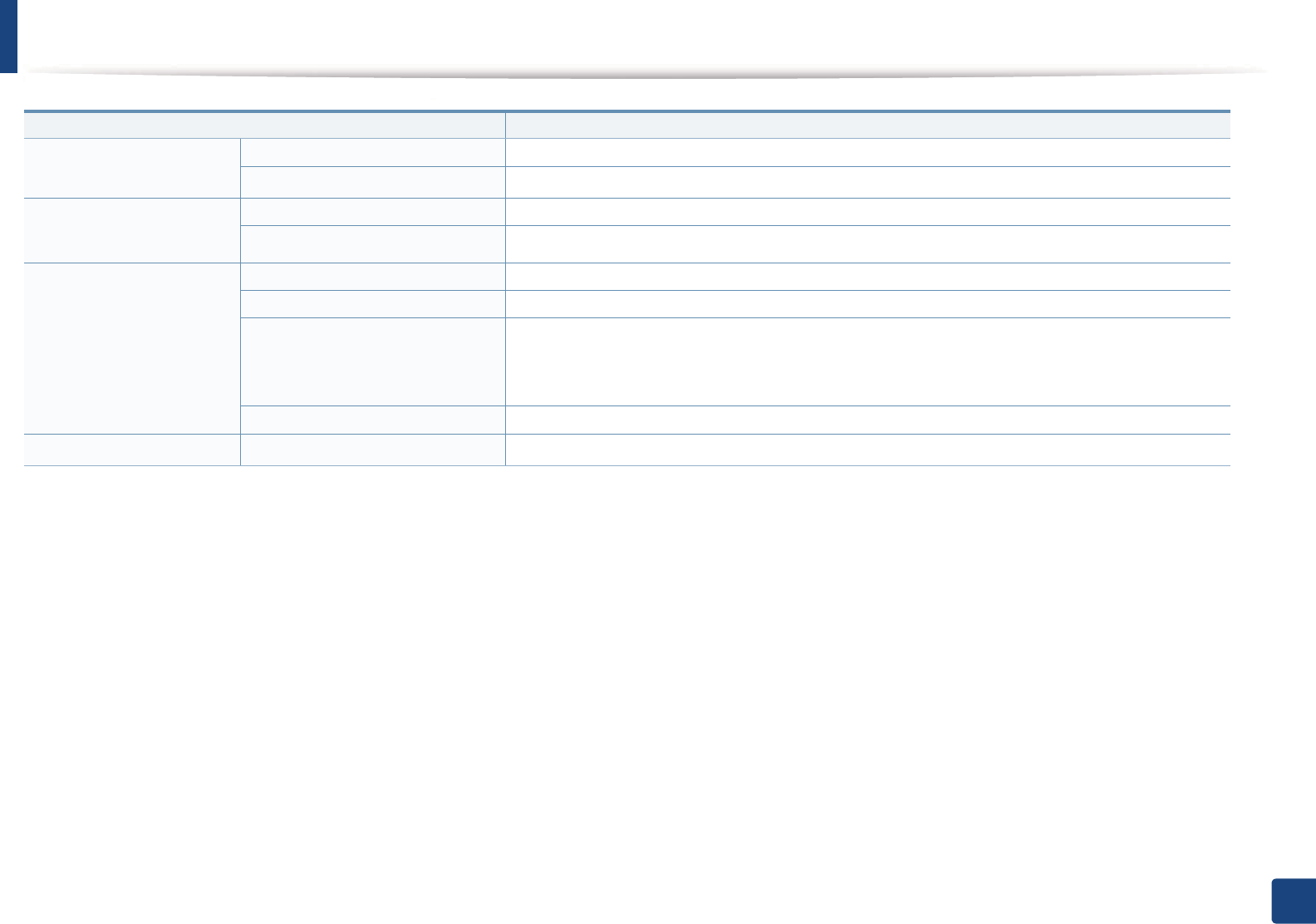
1
General specifications
The specification values listed below are subject to change without notice. See www.samsung.com for possible changes in information.
Items Description
Dimension Width x Length x Height CLX-330x Series
CLX-330xW Series
406 x 362 x 293.5 mm (16 x 14.3 x 11.6 inches)
CLX-330xFN Series
CLX-330xFW Series
406 x 362 x 333.5 mm (16 x 14.3 x 13.1 inches)
Weight Machine with consumables CLX-330x Series
CLX-330xW Series
14.5 Kg (32 lbs)
CLX-330xFN Series
CLX-330xFW Series
15.4 Kg (34 lbs)
Noise LevelaReady mode Less than 26 dB (A)
Print mode Less than 50 dB (A)
Copy mode Scanner glass Less than 50 dB (A)
Document feeder Less than 52 dB (A)
Scan mode Scanner glass Less than 52 dB (A)
Document feeder Less than 54 dB (A)
Temperature Operation 10 to 32°C (50 to 89.6°F)
Storage (packed) -20 to 40°C (-4 to 104°F)
Specifications
116
5. Appendix
Humidity Operation 20 to 80% RH
Storage (packed) 10 to 90% RH
Power ratingb110 volt models AC 110 - 127 V
220 volt models AC 220 - 240 V
Power consumption Average operating mode Less than 290 W
Ready mode Less than 60 W
Power save mode •CLX-330x Series: Less than 1.2 W
•CLX-330xFN Series: Less than 1.6 W
•CLX-330xW/CLX-330xFW Series: Less than 2.1 W
Power off mode Less than 0.45 W
WirelesscModule T77H262/SPW-B4319S
a. Sound Pressure Level, ISO 7779. Configuration tested: basic machine installation, A4 paper, simplex printing.
b. See the rating label on the machine for the correct voltage (V), frequency (hertz) and of current (A) for your machine.
c. Wireless models only (see "Features by models" on page 7).
Items Description
Specifications
117
5. Appendix
2
Print media specifications
Type Size Dimensions
Print media weight/Capacitya
Tray Manual feeding in trayb
Plain paper
Letter 216 x 279 mm (8.5 x 11 inches) 60 to 85 g/m2 (16 to 23 lbs
bond)
• 130 sheets of 80 g/m2 (21 lbs
bond)
60 to 85 g/m2 (16 to 23 lbs bond)
• 1 sheet
Legal 216 x 356 mm (8.5 x 14 inches)
US Folio 216 x 330 mm (8.5 x 13 inches)
A4 210 x 297 mm (8.27 x 11.69 inches)
Oficio 216 x 343 mm (8.5 x 13.5 inches)
JIS B5 182 x 257 mm (7.17 x 10.12 inches)
ISO B5 176 x 250 mm (6.93 x 9.84 inches)
Executive 184 x 267 mm (7.25 x 10.5 inches)
A5 148 x 210 mm (5.83 x 8.27 inches)
A6 105 x 148 mm (4.13 x 5.83 inches)
Thick paper Refer to the Plain
paper section
Refer to the Plain paper section 86 to 120 g/m2 (23 to 32 lbs
bond)
• 50 sheets of 120 g/m2 (32 lbs
bond)
86 to 120 g/m2 (23 to 32 lbs bond)
• 1 sheet
Specifications
118
5. Appendix
Thin paper Refer to the Plain
paper section
Refer to the Plain paper section 60 to 70 g/m2 (16 to 19 lbs bond)
• 150 sheets of 60 g/m2 (16 lbs
bond)
60 to 70 g/m2 (16 to 19 lbs bond)
• 1 sheet
Cotton Refer to the Plain
paper section
Refer to the Plain paper section 75 to 90 g/m2 (20 to 24 lbs bond)
• 130 sheets of 80 g/m2 (21 lbs
bond)
75 to 90 g/m2 (20 to 24 lbs bond)
• 1 sheet
Colored,
Pre-printed,
Recycled
Refer to the Plain
paper section
Refer to the Plain paper section 60 to 85 g/m2 (16 to 24 lbs bond)
• 130 sheets of 80 g/m2 (21 lbs
bond)
60 to 85 g/m2 (16 to 24 lbs bond)
• 1 sheet
Labelsc
Letter, Legal, Oficio,
US Folio, A4, JIS B5,
ISO B5, Executive,
A5
Refer to the Plain paper section 120 to 150 g/m2 (32 to 40 lbs
bond)
• 5 sheets
120 to 150 g/m2 (32 to 40 lbs bond)
• 1 sheet
Card stock
Letter, Legal, Oficio,
US Folio, A4, JIS B5,
ISO B5, Executive,
A5,
Postcard 4x6
Refer to the Plain paper section 121 to 163 g/m2 (32 to 43 lbs
bond)
• 5 sheets
121 to 163 g/m2 (32 to 43 lbs bond)
• 1 sheet
Bond paper Refer to the Plain
paper section
Refer to the Plain paper section 105 to 120 g/m2 (28 to 32 lbs
bond)
• 10 sheets
• 1 sheet
Type Size Dimensions
Print media weight/Capacitya
Tray Manual feeding in trayb
Specifications
119
5. Appendix
If media weight is over 120 g/m2 (32 lbs bond), load a paper into the tray one by one.
Archive Refer to the Plain
paper section
Refer to the Plain paper section 70 to 90 g/m2 (18.6 to 24 lbs
bond)
• 100 sheets
• 1 sheet
Glossy Photo,
Matte Photo
Letter, A4,
Postcard 4x6
Refer to the Plain paper section 111 to 220 g/m2 (30 to 58 lbs
bond)
• 1 sheets
111 to 220 g/m2 (30 to 58 lbs bond)
• 1 sheet
Minimum size (custom) 76 x 152 mm (3 x 6 inches) 60 to 120 g/m2 (16 to 32 lbs bond)
Maximum size (custom) 216 x 356 mm (8.5 x 14 inches)
a. Maximum capacity may differ depending on media weight, thickness, and environmental conditions.
b. Feed one sheet at a time.
c. The smoothness of the labels used in this machine is 100 to 250 (sheffield). This means the numeric level of smoothness.
Type Size Dimensions
Print media weight/Capacitya
Tray Manual feeding in trayb
Specifications
120
5. Appendix
3
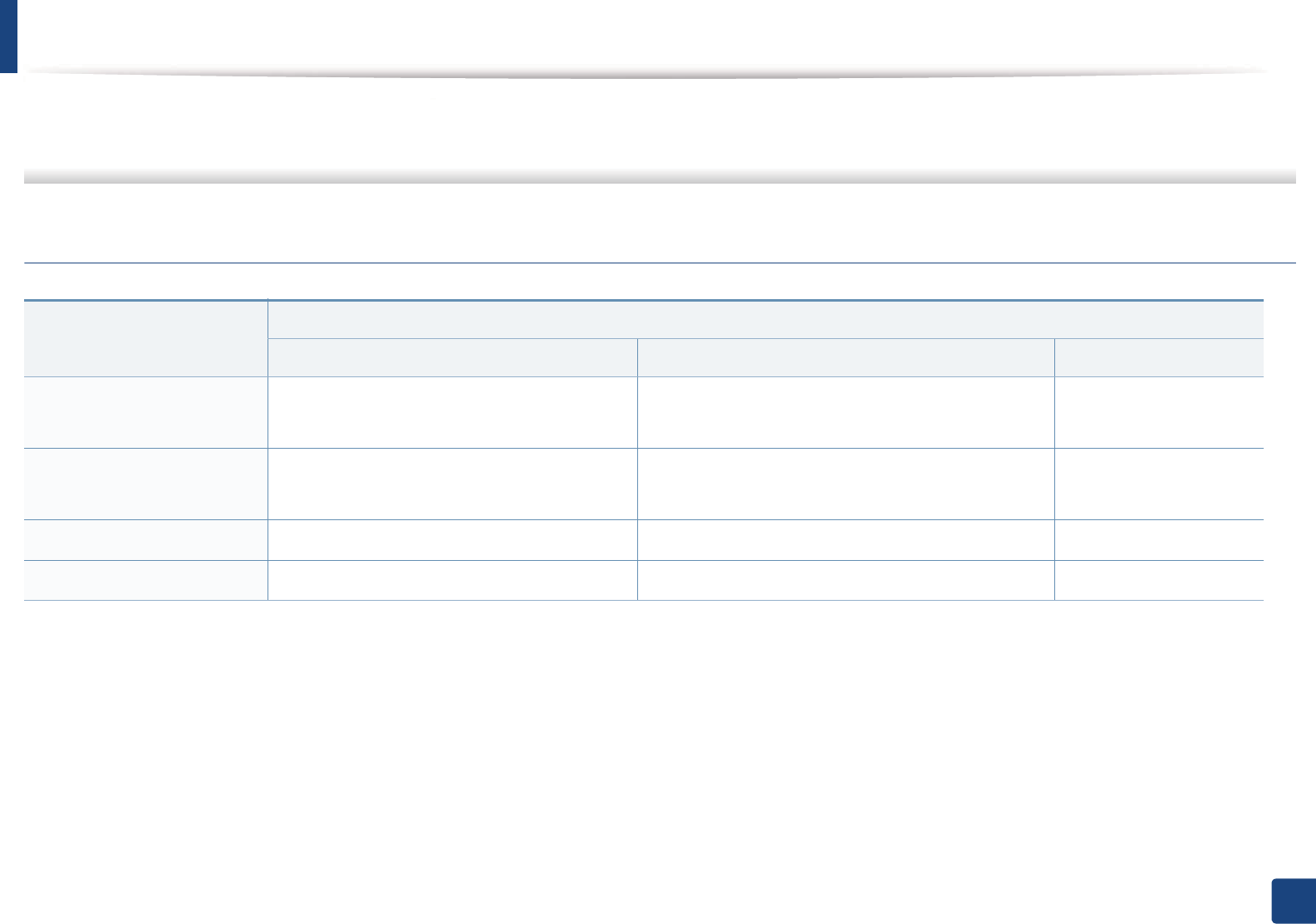
System requirements
Microsoft® Windows®
• Internet Explorer 6.0 or higher is the minimum requirement for all Windows operating systems.
• Users who have administrator rights can install the software.
Operating system
Requirement (recommended)
CPU RAM free HDD space
Windows® 2000 Intel® Pentium® II 400 MHz (Pentium III 933 MHz) 64 MB (128 MB) 600 MB
Windows® XP Intel® Pentium® III 933 MHz (Pentium IV 1 GHz) 128 MB (256 MB) 1.5 GB
Windows Server® 2003 Intel® Pentium® III 933 MHz (Pentium IV 1 GHz) 128 MB (512 MB) 1.25 GB to 2 GB
Windows Server® 2008 Intel® Pentium® IV 1 GHz (Pentium IV 2 GHz) 512 MB (2 GB) 10 GB
Windows Vista®Intel® Pentium® IV 3 GHz 512 MB (1 GB) 15 GB
Windows® 7 Intel® Pentium® IV 1 GHz 32-bit or 64-bit processor or higher 1 GB (2 GB) 16 GB
• Support for DirectX® 9 graphics with 128 MB memory (to enable the Aero theme).
•DVD-R/W Drive
Windows Server® 2008 R2 Intel® Pentium® IV 1 GHz (x86) or 1.4 GHz (x64) processors (2 GHz or faster) 512 MB (2 GB) 10 GB
Specifications
121
5. Appendix
•Windows Terminal Services is compatible with your machine.
•For Windows 2000, Services Pack 4 or higher is required.
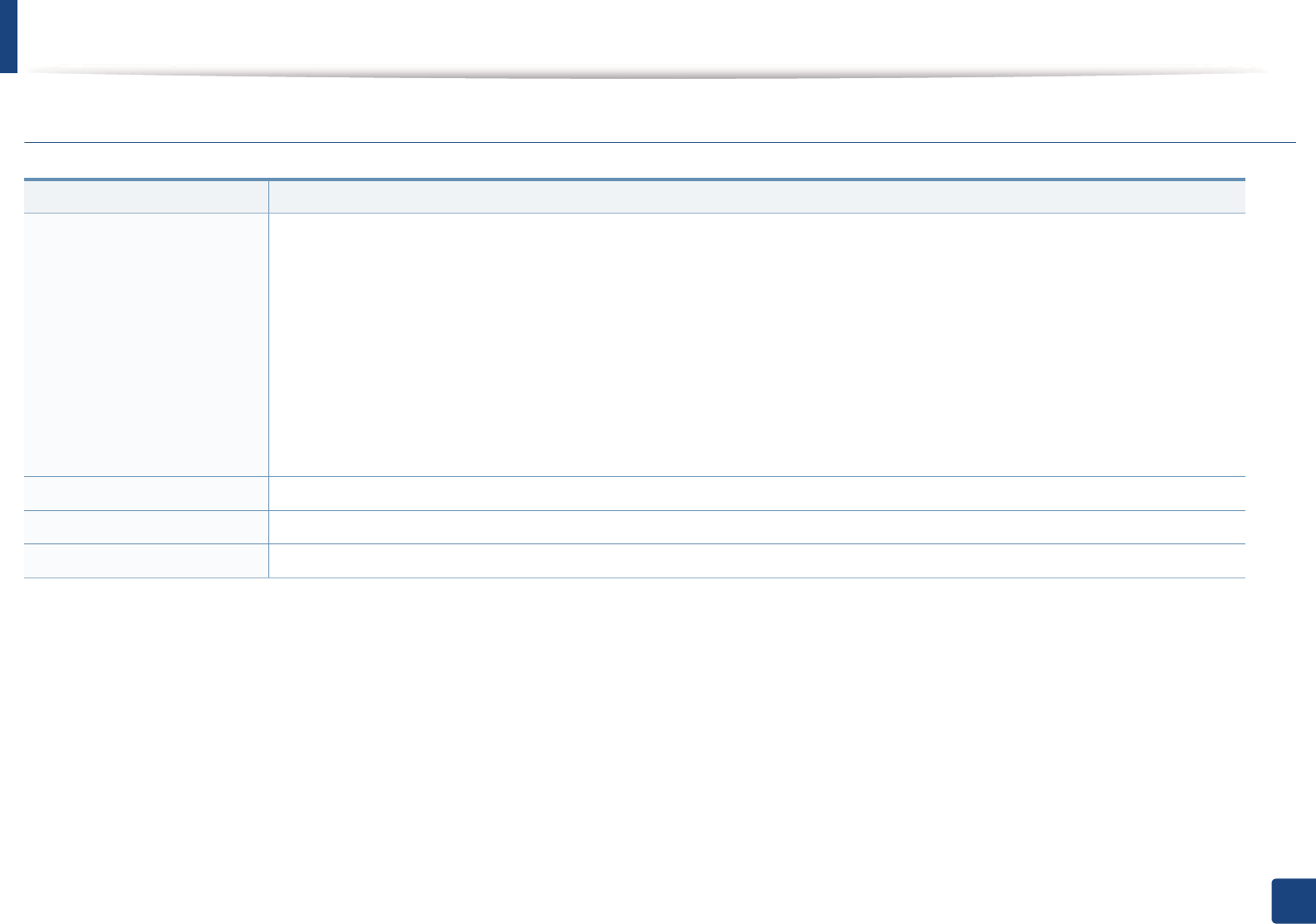
Macintosh
Operating system
Requirements (Recommended)
CPU RAM Free HDD space
Mac OS X 10.4 •Intel
® processors
•PowerPC G4/G5
• 128 MB for a powerPC based Mac (512 MB)
• 512 MB for an Intel-based Mac (1 GB)
1 GB
Mac OS X 10.5 •Intel
® processors
• 867 MHz or faster Power PC G4/G5
512 MB (1 GB) 1 GB
Mac OS X 10.6 •Intel
® processors 1 GB (2 GB) 1 GB
Mac OS X 10.7 •Intel
® processors 2 GB 4 GB
Specifications
122
5. Appendix
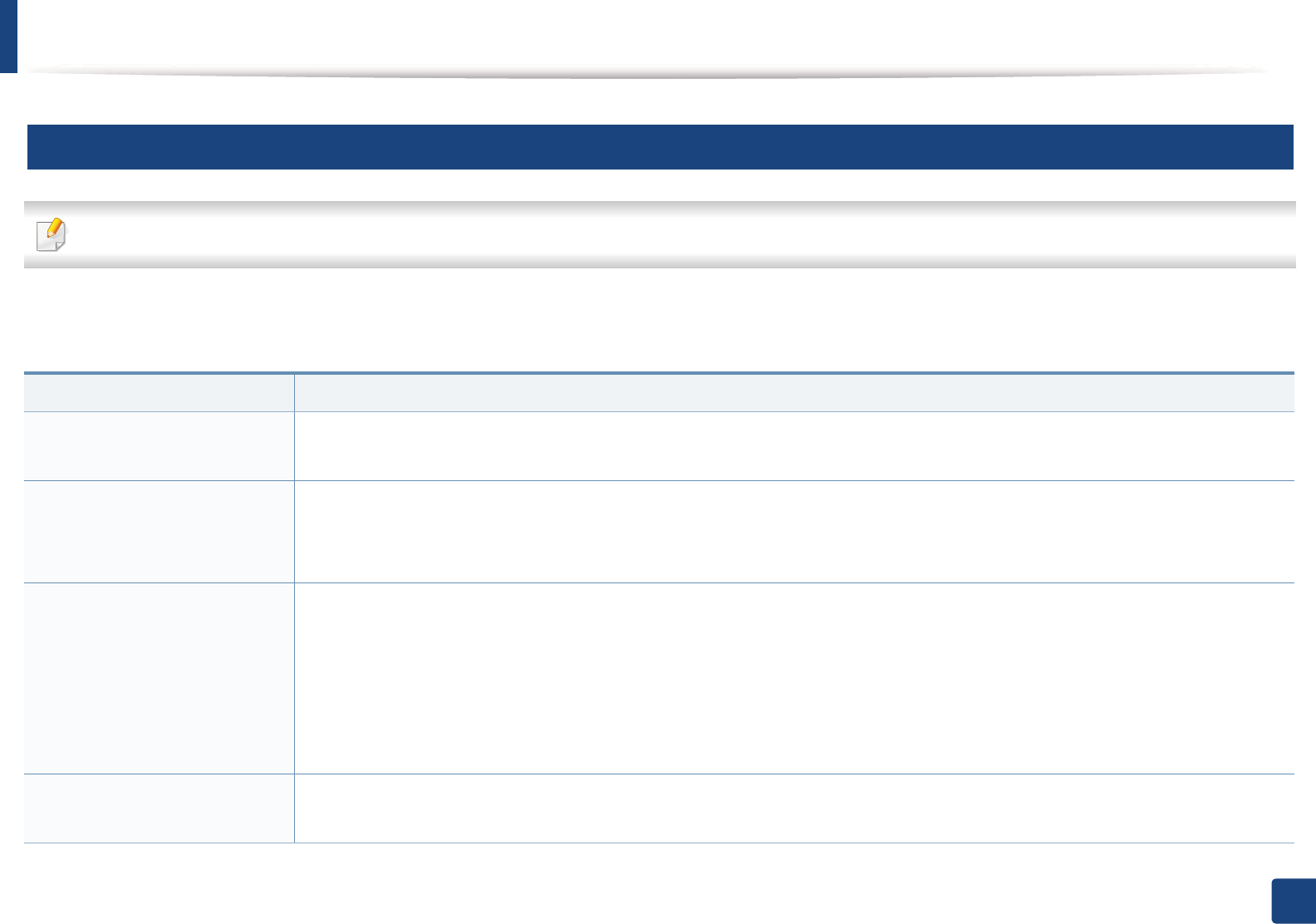
Linux
Items Requirements
Operating system Redhat® Enterprise Linux WS 4, 5 (32/64 bit)
Fedora 5 ~ 13 (32/64 bit)
SuSE Linux 10.1 (32 bit)
OpenSuSE® 10.2, 10.3, 11.0, 11.1, 11.2 (32/64 bit)
Mandriva 2007, 2008, 2009, 2009.1, 2010 (32/64 bit)
Ubuntu 6.06, 6.10, 7.04, 7.10, 8.04, 8.10, 9.04, 9.10, 10.04 (32/64 bit)
SuSE Linux Enterprise Desktop 10, 11 (32/64 bit)
Debian 4.0, 5.0 (32/64 bit)
CPU Pentium IV 2.4GHz (Intel Core™2)
RAM 512 MB (1 GB)
Free HDD space 1 GB (2 GB)
Specifications
123
5. Appendix
4
Network environment
Network and wireless models only (see "Features by models" on page 7).
You need to set up the network protocols on the machine to use it as your network machine. The following table shows the network environments supported by the
machine.
Items Specifications
Network interface • Ethernet 10/100 Base-TX Wired Lan
•802.11b/g/n Wireless LAN
Network operating system •Windows
® 2000, Windows® XP, Windows Server® 2003, Windows Vista®, Windows® 7, Windows Server® 2008 R2
•Various Linux OS
• Mac OS X 10.4 ~10.7
Network protocols •TCP/IPv4
• DHCP, BOOTP
• DNS, WINS, Bonjour, SLP, UPnP
• Standard TCP/IP Printing (RAW), LPR, IPP, WSD
• SNMPv 1/2/3, HTTP
• TCP/IPv6 (DHCP, DNS, RAW, LPR, SNMPv 1/2/3, HTTP)
Wireless security • Authentication: Open System, Shared Key, WPA Personal, WPA2 Personal (PSK)
• Encryption: WEP64, WEP128, TKIP, AES
124
5. Appendix
Regulatory information
This machine is designed for a normal work environment and certified with
several regulatory statements.
5
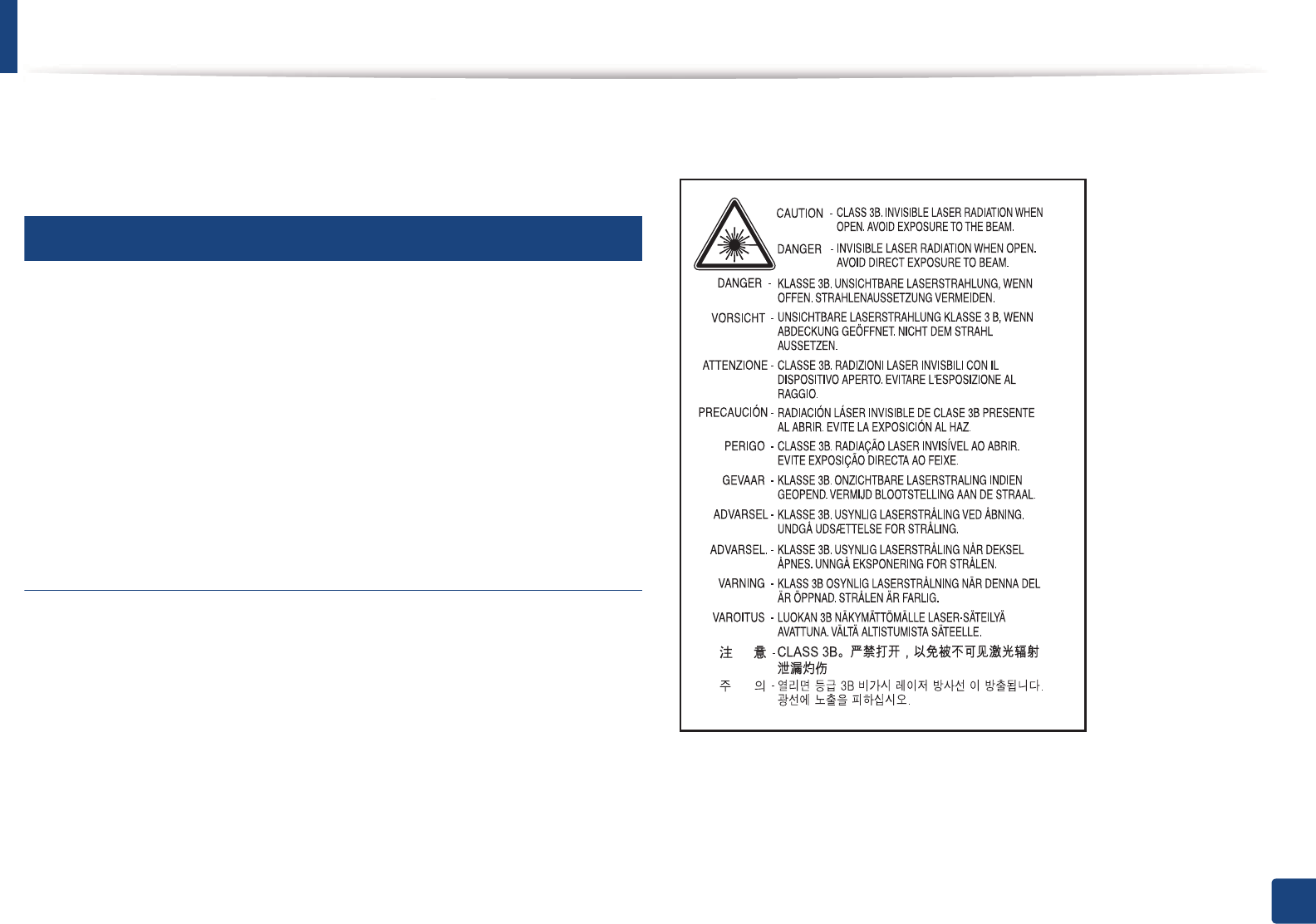
Laser safety statement
The printer is certified in the U.S. to conform to the requirements of DHHS 21
CFR, chapter 1 Subchapter J for Class I(1) laser products, and elsewhere is
certified as a Class I laser product conforming to the requirements of IEC 60825-
1 : 2007.
Class I laser products are not considered to be hazardous. The laser system and
printer are designed so there is never any human access to laser radiation above
a Class I level during normal operation, user maintenance or prescribed service
condition.
Warning
Never operate or service the printer with the protective cover removed from
laser/scanner assembly. The reflected beam, although invisible, can damage
your eyes.
When using this product, these basic safety precautions should always be
followed to reduce risk of fire, electric shock, and injury to persons:
Regulatory information
125
5. Appendix
6
Ozone safety
7
Mercury Safety
8
Power saver
9
Recycling
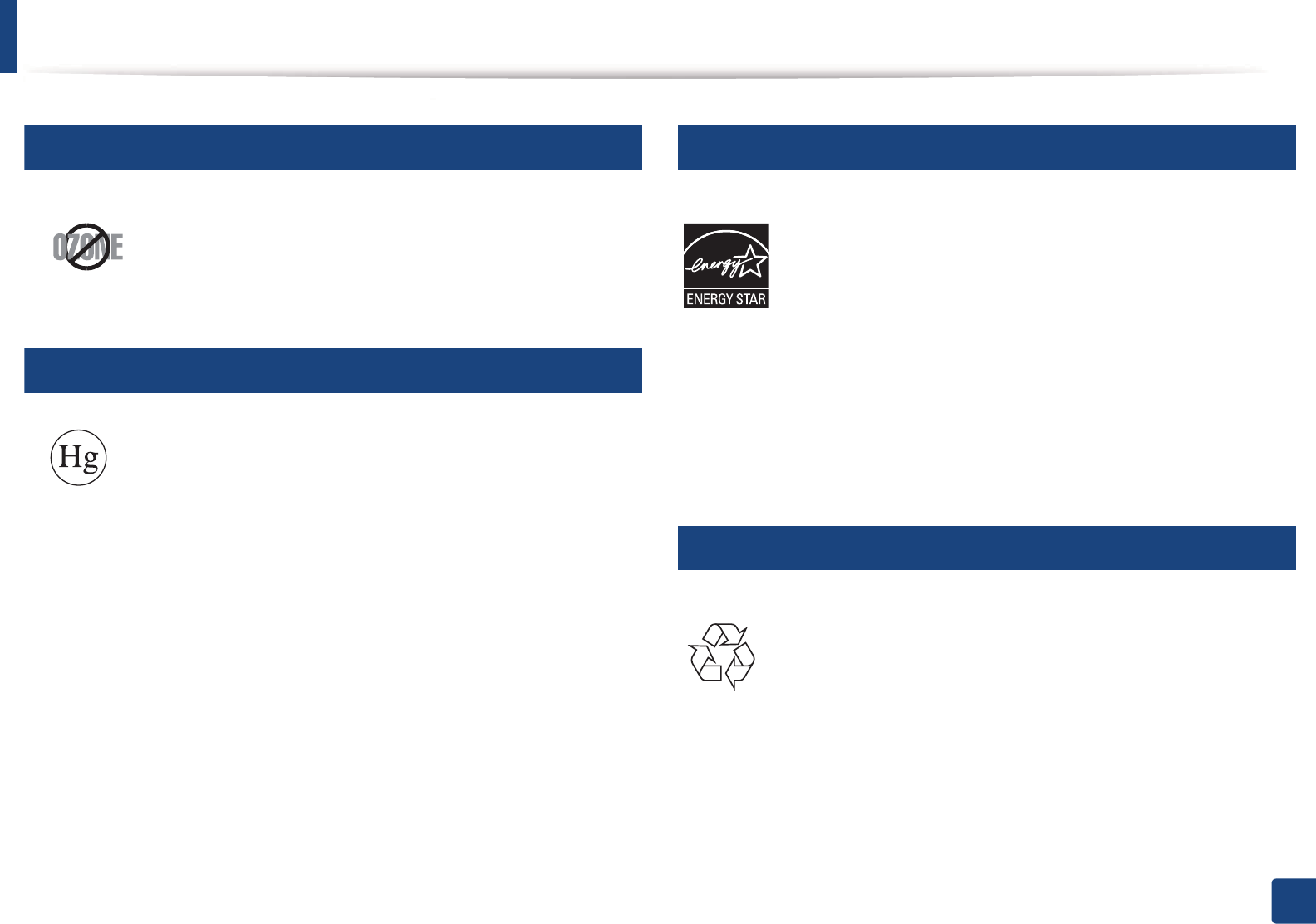
This product’s ozone emission rate is under 0.1 ppm. Because
ozone is heavier than air, keep the product in a place with good
ventilation.
Contains Mercury, Dispose According to Local, State or Federal
Laws.(U.S.A. only)
This printer contains advanced energy conservation technology that
reduces power consumption when it is not in active use.
When the printer does not receive data for an extended period of
time, power consumption is automatically lowered.
ENERGY STAR and the ENERGY STAR mark are registered U.S. marks.
For more information on the ENERGY STAR program see http://
www.energystar.gov
For ENERGY STAR certified models, the ENRGY STAR label will be on
your machine. Check if your machine is ENERGY STAR certified.
Recycle or dispose of the packaging material for this product in an
environmentally responsible manner.
Regulatory information
126
5. Appendix
10
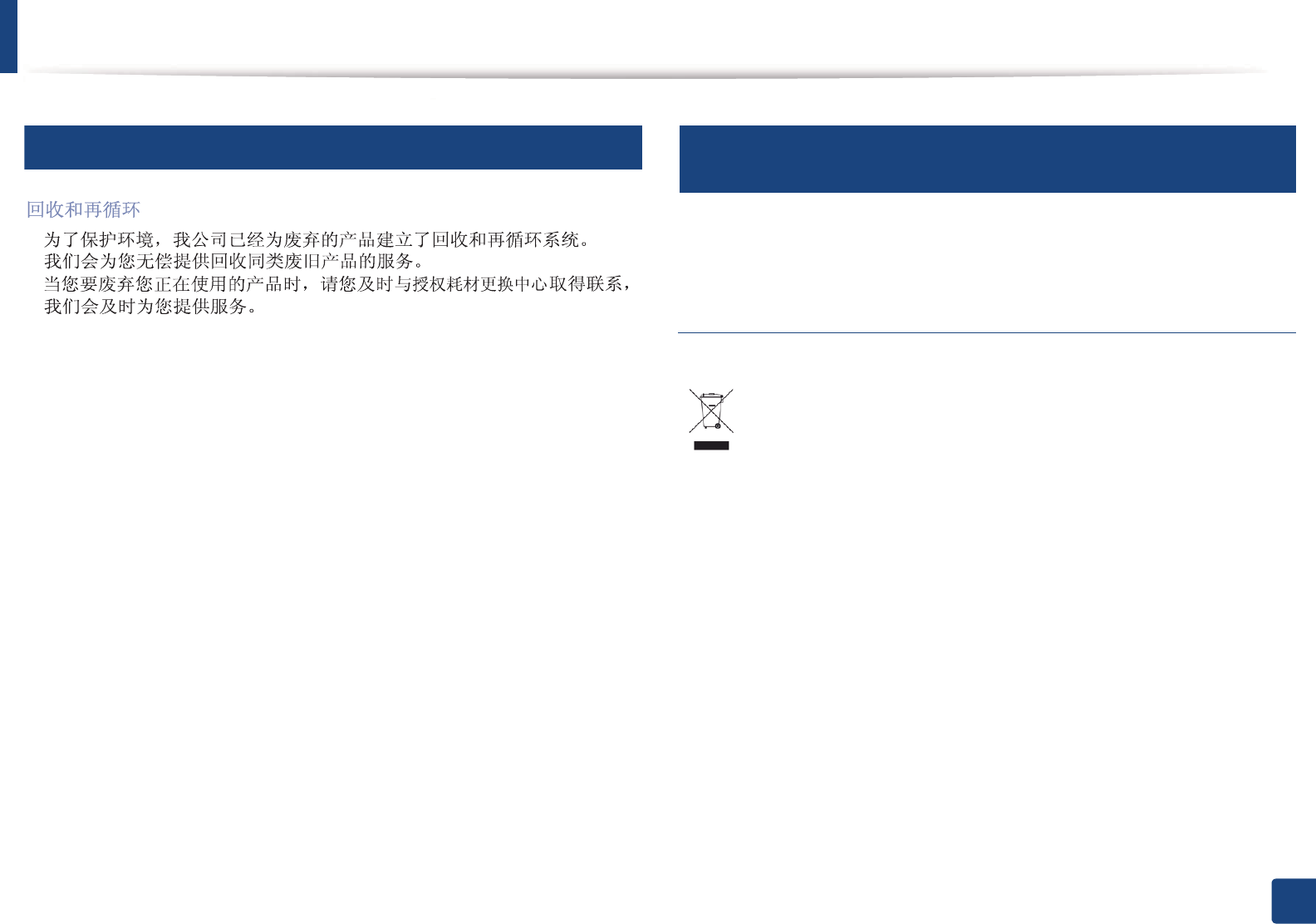
China only
11
Correct disposal of this product (Waste electrical &
electronic equipment)
(Applicable in the european union and other
european countries with separate collection
systems)
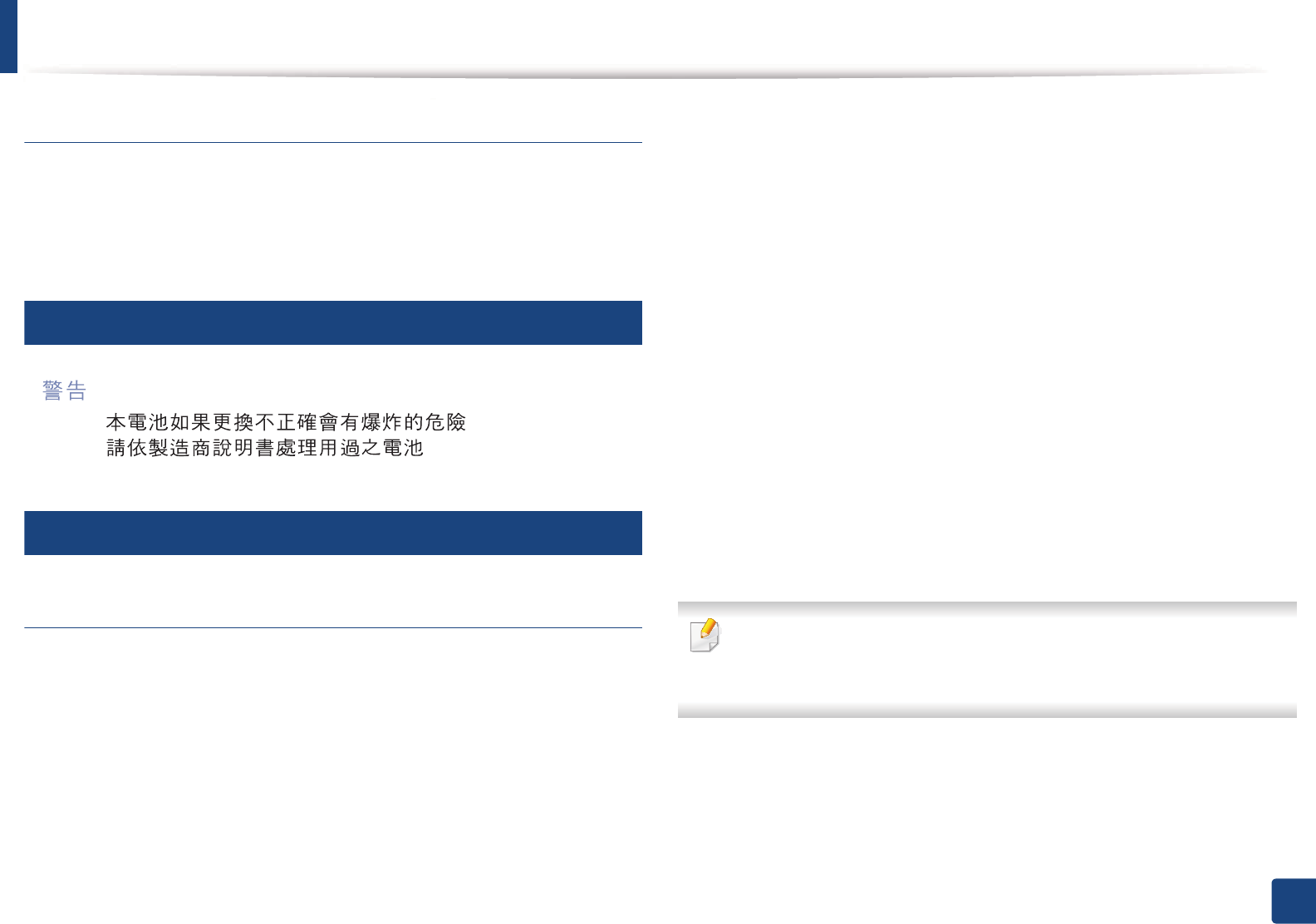
This marking on the product, accessories or literature indicates that the
product and its electronic accessories (e.g. charger, headset, USB cable)
should not be disposed of with other household waste at the end of
their working life. To prevent possible harm to the environment or
human health from uncontrolled waste disposal, please separate these
items from other s of waste and recycle them responsibly to promote the
sustainable reuse of material resources.
Household users should contact either the retailer where they
purchased this product, or their local government office, for details of
where and how they can take these items for environmentally safe
recycling.
Business users should contact their supplier and check the terms and
conditions of the purchase contract. This product and its electronic
accessories should not be mixed with other commercial wastes for
disposal.
Regulatory information
127
5. Appendix
(The United States of America only)
Dispose unwanted electronics through an approved recycler. To find the nearest
recycling location, go to our website: www.samsung.com/recyclingdirect Or
call, (877) 278 - 0799
12
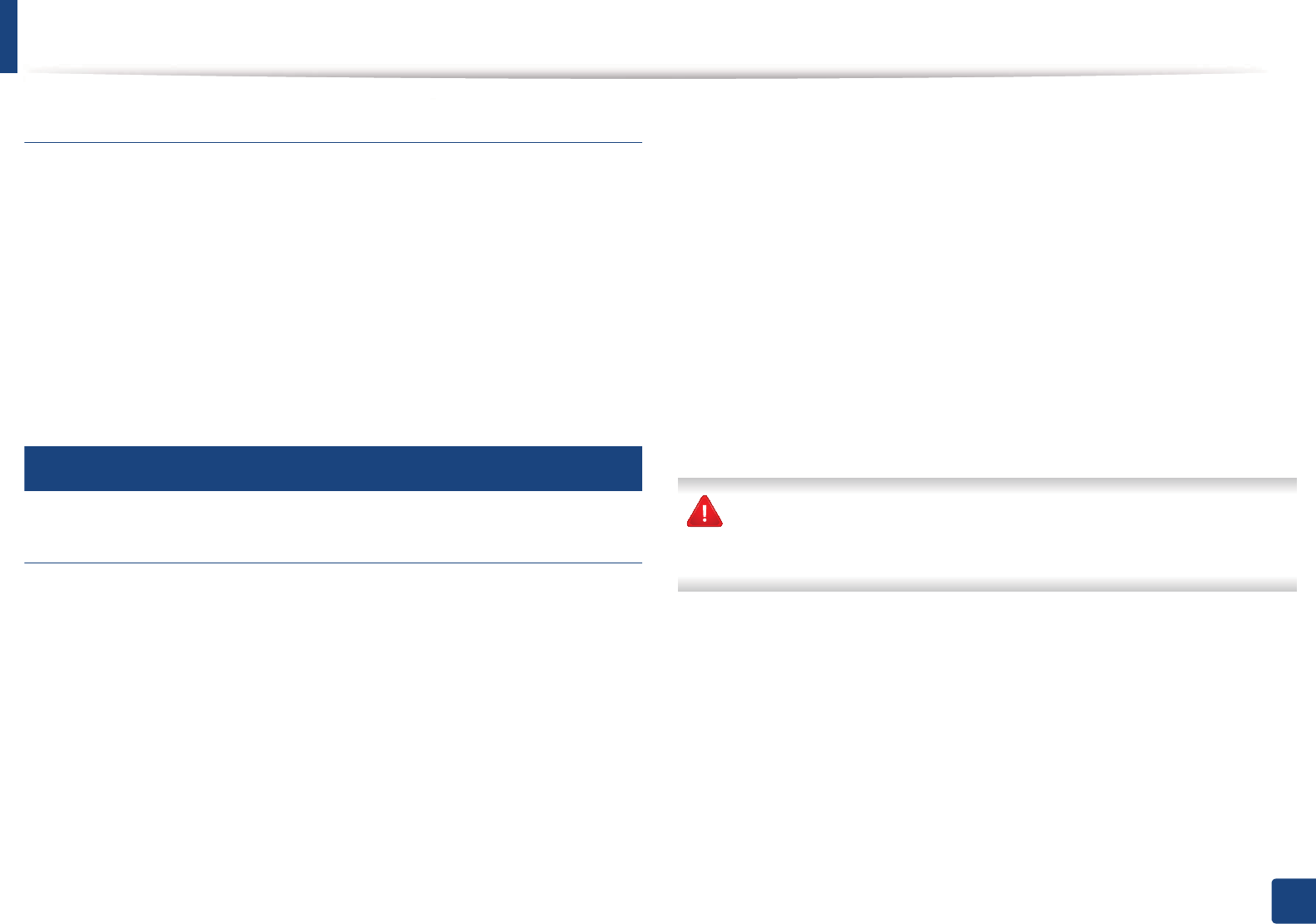
Taiwan only
13
Radio frequency emissions
FCC information to the user
This device complies with Part 15 of the FCC Rules. Operation is subject to the
following two conditions:
• This device may not cause harmful interference, and
• This device must accept any interference received, including interference
that may cause undesired operation.
This equipment has been tested and found to comply with the limits for a Class
B digital device, pursuant to Part 15 of the FCC Rules. These limits are designed
to provide reasonable protection against harmful interference in a residential
installation. This equipment generates, uses and can radiate radio frequency
energy and, if not installed and used in accordance with the instructions, may
cause harmful interference to radio communications. However, there is no
guarantee that interference will not occur in a particular installation. If this
equipment does cause harmful interference to radio or television reception,
which can be determined by turning the equipment off and on, the user is
encouraged to try to correct the interference by one or more of the following
measures:
• Reorient or relocate the receiving antenna.
• Increase the separation between the equipment and receiver.
• Connect the equipment into an outlet on a circuit different from that to
which the receiver is connected.
• Consult the dealer or experienced radio TV technician for help.
Change or modifications not expressly approved by the manufacturer
responsible for compliance could void the user's authority to operate the
equipment.
Regulatory information
128
5. Appendix
Canadian radio interference regulations
This digital apparatus does not exceed the Class B limits for radio noise
emissions from digital apparatus as set out in the interference-causing
equipment standard entitled “Digital Apparatus”, ICES-003 of the Industry and
Science Canada.
Cet appareil numérique respecte les limites de bruits radioélectriques
applicables aux appareils numériques de Classe B prescrites dans la norme sur le
matériel brouilleur: “Appareils Numériques”, ICES-003 édictée par l’Industrie et
Sciences Canada.
14
United States of America
Federal Communications Commission (FCC)
Intentional emitter per FCC Part 15
Low power, Radio LAN devices (radio frequency (RF) wireless communication
devices), operating in the 2.4 GHz/5 GHz Band, may be present (embedded) in
your printer system. This section is only applicable if these devices are present.
Refer to the system label to verify the presence of wireless devices.
Wireless devices that may be in your system are only qualified for use in the
United States of America if an FCC ID number is on the system label.
The FCC has set a general guideline of 20 cm (8 inches) separation between the
device and the body, for use of a wireless device near the body (this does not
include extremities). This device should be used more than 20 cm (8 inches)
from the body when wireless devices are on. The power output of the wireless
device (or devices), which may be embedded in your printer, is well below the
RF exposure limits as set by the FCC.
This transmitter must not be collocated or operation in conjunction with any
other antenna or transmitter.
Operation of this device is subject to the following two conditions: (1) This
device may not cause harmful interference, and (2) this device must accept any
interference received, including interference that may cause undesired
operation of the device.
Wireless devices are not user serviceable. Do not modify them in any way.
Modification to a wireless device will void the authorization to use it.
Contact manufacturer for service.
Regulatory information
129
5. Appendix
FCC Statement for Wireless LAN use:
While installing and operating this transmitter and antenna combination
the radio frequency exposure limit of 1m W/cm2 may be exceeded at
distances close to the antenna installed. Therefore, the user must maintain
a minimum distance of 20cm from the antenna at all times. This device
cannot be colocated with another transmitter and transmitting antenna.
15
Russia only
16
Germany only
17
Turkey only
18
Canada only
This product meets the applicable Industry Canada technical specifications. / Le
present materiel est conforme aux specifications techniques applicables
d’Industrie Canada.

Regulatory information
130
5. Appendix
The Ringer Equivalence Number (REN) is an indication of the maximum number
of devices allowed to be connected to a telephone interface. The termination of
an interface may consist of any combination of devices subject only to the
requirement that the sum of the RENs of all the devices not exceed five. / L’indice
d’equivalence de la sonnerie (IES) sert a indiquer le nombre maximal de
terminaux qui peuvent etre raccordes a une interface telephonique. La
terminaison d’une interface peut consister en une combinaison quelconque de
dispositifs, a la seule condition que la somme d’indices d’equivalence de la
sonnerie de tous les dispositifs n’excede pas cinq.
19
Fax Branding
The Telephone Consumer Protection Act of 1991 makes it unlawful for any
person to use a computer or other electronic device to send any message via a
telephone facsimile machine unless such message clearly contains in a margin
at the top or bottom of each transmitted page or on the first page of the
transmission the following information:
1 the date and time of transmission
2 identification of either business, business entity or individual sending the
message; and
3 telephone number of either the sending machine, business, business entity
or individual.
The Telephone Company may make changes in its communications facilities,
equipment operations or procedures where such action is reasonably required
in the operation of its business and is not inconsistent with the rules and
regulations in FCC Part 68. If such changes can be reasonably expected to render
any customer terminal equipment incompatible with telephone company
communications facilities, or require modification or alteration of such terminal
equipment, or otherwise materially affect its use or performance, the customer
shall be given adequate notice in writing, to allow the customer an opportunity
to maintain uninterrupted service
20
Ringer Equivalence Number
The Ringer Equivalence Number and FCC Registration Number for this machine
may be found on the label located on the bottom or rear of the machine. In some
instances you may need to provide these numbers to the telephone company.
The Ringer Equivalence Number (REN) is a measure of the electrical load placed
on the telephone line, and is useful for determining whether you have
“overloaded” the line. Installing several s of equipment on the same telephone
line may result in problems making and receiving telephone calls, especially
ringing when your line is called. The sum of all Ringer Equivalence Numbers of
the equipment on your telephone line should be less than five in order to assure
proper service from the telephone company. In some cases, a sum of five may
not be usable on your line. If any of your telephone equipment is not operating
properly, you should immediately remove it from your telephone line, as it may
cause harm to the telephone network.
Regulatory information
131
5. Appendix
The equipment complies with Part 68 of the FCC rules and the requirements
adopted by the ACTA. On the rear of this equipment is a label that contains,
among other information, a product identifier in the format US:AAAEQ##TXXXX.
If requested, this number must be provided to the telephone company.
FCC Regulations state that changes or modifications to this equipment not
expressly approved by the manufacturer could void the user’s authority to
operate this equipment. In the event that terminal equipment causes harm
to the telephone network, the telephone company should notify the
customer that service may be stopped. However, where prior notice is
impractical, the company may temporarily cease service, providing that
they:
a promptly notify the customer.
b give the customer an opportunity to correct the equipment problem.
c inform the customer of the right to bring a complaint to the Federal
Communication Commission pursuant to procedures set out in FCC
Rules and Regulations Subpart E of Part 68.
You should also know that:
• Your machine is not designed to be connected to a digital PBX system.
• If you intend to use a computer modem or fax modem on the same phone
line as your machine, you may experience transmission and reception
problems with all the equipment. It is recommended that no other
equipment, except for a regular telephone, share the line with your
machine.
• If your area experiences a high incidence of lightning or power surges, we
recommend that you install surge protectors for both the power and the
telephone lines. Surge protectors can be purchased from your dealer or
telephone and electronic specialty stores.
• When programming emergency numbers and/or making test calls to
emergency numbers, use a non-emergency number to advise the
emergency service dispatcher of your intentions. The dispatcher will give
you further instructions on how to actually test the emergency number.
• This machine may not be used on coin service or party lines.
• This machine provides magnetic coupling to hearing aids.
You may safely connect this equipment to the telephone network by means of
a standard modular jack, USOC RJ-11C.
21
Replacing the Fitted Plug (for UK Only)
Important
The mains lead for this machine is fitted with a standard (BS 1363) 13 amp plug
and has a 13 amp fuse. When you change or examine the fuse, you must re-fit
the correct 13 amp fuse. You then need to replace the fuse cover. If you have lost
the fuse cover, do not use the plug until you have another fuse cover.
Contact the people from you purchased the machine.
Regulatory information
132
5. Appendix
The 13 amp plug is the most widely used in the UK and should be suitable.
However, some buildings (mainly old ones) do not have normal 13 amp plug
sockets. You need to buy a suitable plug adaptor. Do not remove the moulded
plug.
If you cut off the moulded plug, get rid of it straight away.
You cannot rewire the plug and you may receive an electric shock if you
plug it into a socket.
Important warning:
If the wires in the mains lead do not match the colors marked in your plug, do
the following:
You must connect the green and yellow wire to the pin marked by the letter “E”
or by the safety ‘Earth symbol’ or colored green and yellow or green.
You must connect the blue wire to the pin which is marked with the letter “N” or
colored black.
You must connect the brown wire to the pin which is marked with the letter “L”
or colored red.
You must have a 13 amp fuse in the plug, adaptor, or at the distribution board.
22
Declaration of conformity (European countries)
Approvals and Certifications
January 1, 1995: Council Directive 2006/95/EC Approximation of the laws of
the member states related to low voltage equipment.
January 1, 1996: Council Directive 2004/108/EC, approximation of the laws of
the Member States related to electromagnetic compatibility.
You must earth this machine.
The wires in the mains lead have the following color code:
•Green and Yellow: Earth
•Blue: Neutral
•Brown: Live
Hereby, Samsung Electronics, declares that this [CLX-330x Series] is in
compliance with the essential requirements and other relevant
provisions of Low Voltage Directive (2006/95/EC), EMC Directive (2004/
108/EC).
Hereby, Samsung Electronics, declares that this [CLX-330xFN Series/
CLX-330xW Series/CLX-330xFW Series] is in compliance with the
essential requirements and other relevant provisions of R&TTE
Directive 1999/5/EC.
The declaration of conformity may be consulted at
www.samsung.com, go to Support > Download center and enter
your printer (MFP) name to browse the EuDoC.
Regulatory information
133
5. Appendix
March 9, 1999: Council Directive 1999/5/EC on radio equipment and
telecommunications terminal equipment and the mutual recognition of their
conformity. A full declaration, defining the relevant Directives and referenced
standards can be obtained from your Samsung Electronics Co., Ltd.
representative.
EC Certification
Certification to 1999/5/EC Radio Equipment & Telecommunications Terminal
Equipment Directive (FAX)
This Samsung product has been self-certified by Samsung for pan-European
single terminal connection to the analogue public switched telephone network
(PSTN) in accordance with Directive 1999/5/EC. The product has been designed
to work with the national PSTNs and compatible PBXs of the European
countries:
In the event of problems, you should contact the Euro QA Lab of Samsung
Electronics Co., Ltd. in the first instance.
The product has been tested against TBR21. To assist in the use and application
of terminal equipment which complies with this standard, the European
Telecommunication Standards Institute (ETSI) has issued an advisory document
(EG 201 121) which contains notes and additional requirements to ensure
network compatibility of TBR21 terminals. The product has been designed
against, and is fully compliant with, all of the relevant advisory notes contained
in this document.
European radio approval information (for products
fitted with EU-approved radio devices)
Low power, Radio LAN type devices (radio frequency (RF) wireless
communication devices), operating in the 2.4 GHz/5 GHz band, may be present
(embedded) in your printer system which is intended for home or office use. This
section is only applicable if these devices are present. Refer to the system label
to verify the presence of wireless devices.
The power output of the wireless device or devices that may be embedded in
you printer is well below the RF exposure limits as set by the European
Commission through the R&TTE directive.
European states qualified under wireless approvals:
EU countries
European states with restrictions on use:
EU
In France, the frequency range is restricted to 2454-2483.5 MHz for devices
above 10 mW transmitting power such as wireless
EEA/EFTA countries
Wireless devices that may be in your system are only qualified for
use in the European Union or associated areas if a CE mark with a
Notified Body Registration Number and the Alert Symbol is on the
system label.
Regulatory information
134
5. Appendix
No limitations at this time
23
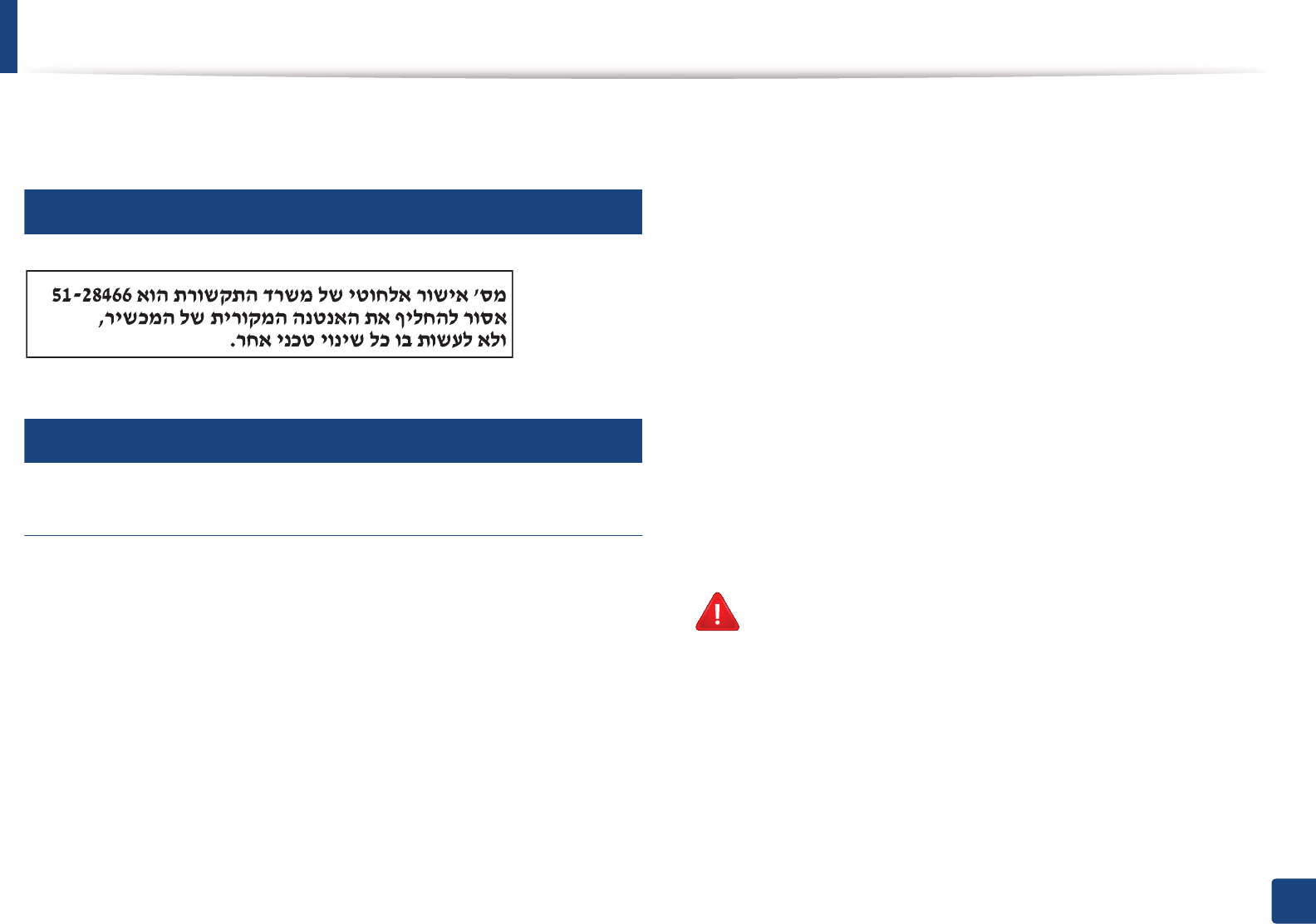
Israel only
24
Regulatory compliance statements
Wireless guidance
Low power, Radio LAN devices (radio frequency (RF) wireless communication
devices), operating in the 2.4 GHz/5 GHz Band, may be present (embedded) in
your printer system. The following section is a general overview of
considerations while operating a wireless device.
Additional limitations, cautions, and concerns for specific countries are listed in
the specific country sections (or country group sections). The wireless devices in
your system are only qualified for use in the countries identified by the Radio
Approval Marks on the system rating label. If the country you will be using the
wireless device in, is not listed, contact your local Radio Approval agency for
requirements. Wireless devices are closely regulated and use may not be
allowed.
The power output of the wireless device or devices that may be embedded in
your printer is well below the RF exposure limits as known at this time. Because
the wireless devices (which may be embedded into your printer) emit less
energy than is allowed in radio frequency safety standards and
recommendations, manufacturer believes these devices are safe for use.
Regardless of the power levels, care should be taken to minimize human contact
during normal operation.
As a general guideline, a separation of 20 cm (8 inches) between the wireless
device and the body, for use of a wireless device near the body (this does not
include extremities) is typical. This device should be used more than 20 cm (8
inches) from the body when wireless devices are on and transmitting.
This transmitter must not be collocated or operation in conjunction with any
other antenna or transmitter.
Some circumstances require restrictions on wireless devices. Examples of
common restrictions are listed below:
Radio frequency wireless communication can interfere with
equipment on commercial aircraft. Current aviation regulations
require wireless devices to be turned off while traveling in an airplane.
IEEE 802.11 (also known as wireless Ethernet) and Bluetooth
communication devices are examples of devices that provide wireless
communication.

Regulatory information
135
5. Appendix
In environments where the risk of interference to other devices or
services is harmful or perceived as harmful, the option to use a wireless
device may be restricted or eliminated. Airports, Hospitals, and
Oxygen or flammable gas laden atmospheres are limited examples
where use of wireless devices may be restricted or eliminated. When in
environments where you are uncertain of the sanction to use wireless
devices, ask the applicable authority for authorization prior to use or
turning on the wireless device.
Every country has different restrictions on the use of wireless devices.
Since your system is equipped with a wireless device, when traveling
between countries with your system, check with the local Radio
Approval authorities prior to any move or trip for any restrictions on
the use of a wireless device in the destination country.
If your system came equipped with an internal embedded wireless
device, do not operate the wireless device unless all covers and shields
are in place and the system is fully assembled.
Wireless devices are not user serviceable. Do not modify them in any
way. Modification to a wireless device will void the authorization to
use it. Contact manufacturer for service.
Only use drivers approved for the country in which the device will be
used. See the manufacturer System Restoration Kit, or contact
manufacturer Technical Support for additional information.
Regulatory information
136
5. Appendix
25
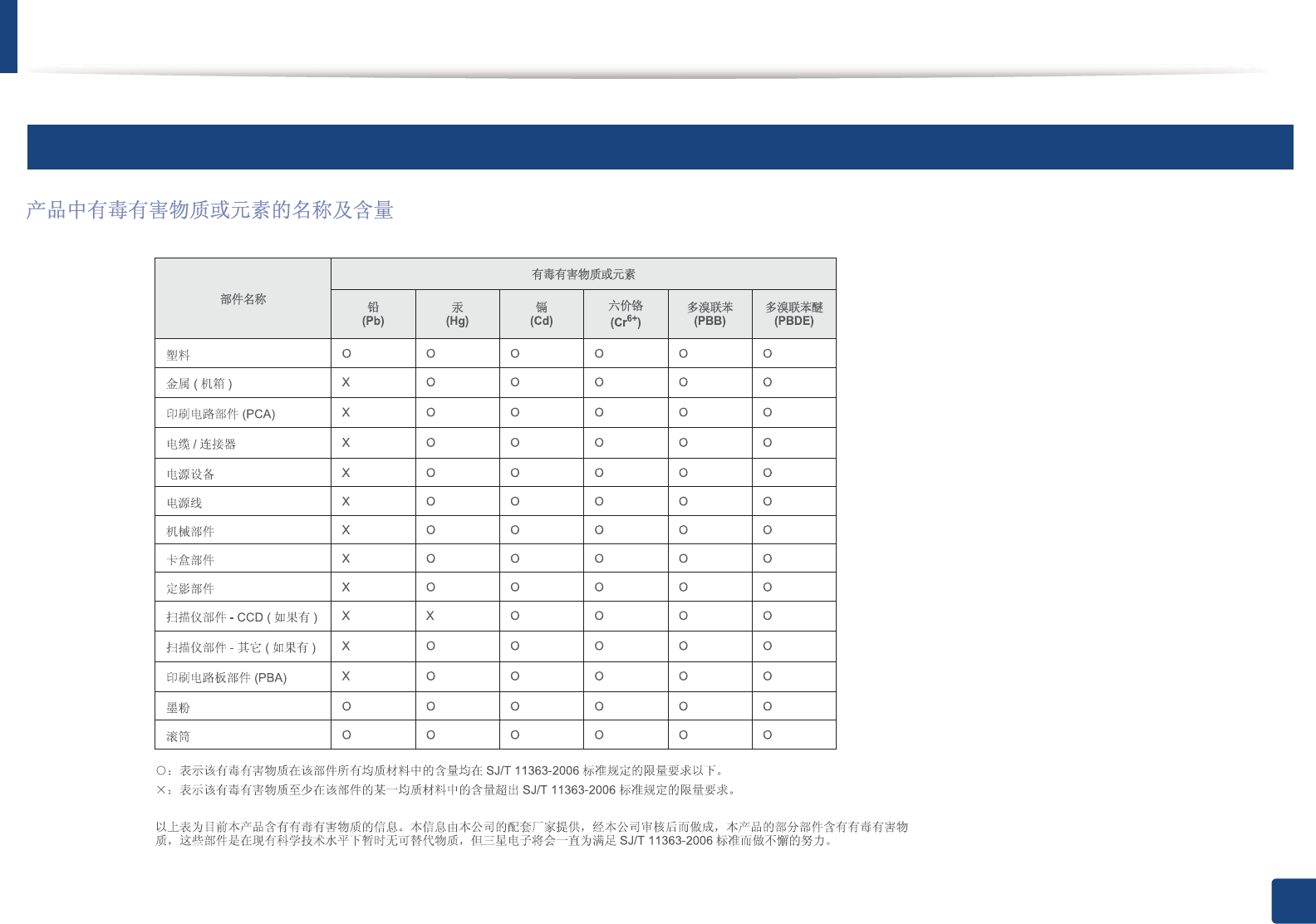
China only

137
5. Appendix
Copyright
© 2012 Samsung Electronics Co., Ltd. All rights reserved.
This user’s guide is provided for information purposes only. All information included herein is subject to change without notice.
Samsung Electronics is not responsible for any direct or indirect damages, arising from or related to use of this user’s guide.
• Samsung and the Samsung logo are trademarks of Samsung Electronics Co., Ltd.
• Microsoft, Windows, Windows Vista, Windows 7, and Windows Server 2008 R2 are either registered trademarks or trademarks of Microsoft Corporation.
• Microsoft, Internet Explorer, Excel, Word, PowerPoint, and Outlook are either registered trademarks or trademarks of Microsoft Corporation in the United States
and other countries.
• Google, Picasa, Google Docs, Android and Gmail are either registered trademarks or trademarks of Google Inc.
• Google Cloud Print is a trademark of Google Inc.
• iPad, iPhone, iPod touch, TrueType, Mac and Mac OS are trademarks of Apple Inc., registered in the U.S and other countries.
• AirPrint and the AirPrint logo are trademarks of Apple Inc.
• True, LaserWriter, and Macintosh are trademarks of Apple Computer, Inc.
• All other brand or product names are trademarks of their respective companies or organizations.
Refer to the 'LICENSE.txt' file in the provided CD-ROM for the open source license information.
REV. 0.70