Samsung Electronics Co SGHP500 Single-Band PCS GSM Phone User Manual 2

Samsung Electronics Co Ltd Single-Band PCS GSM Phone Users Manual 2

Contents

Users Manual 2

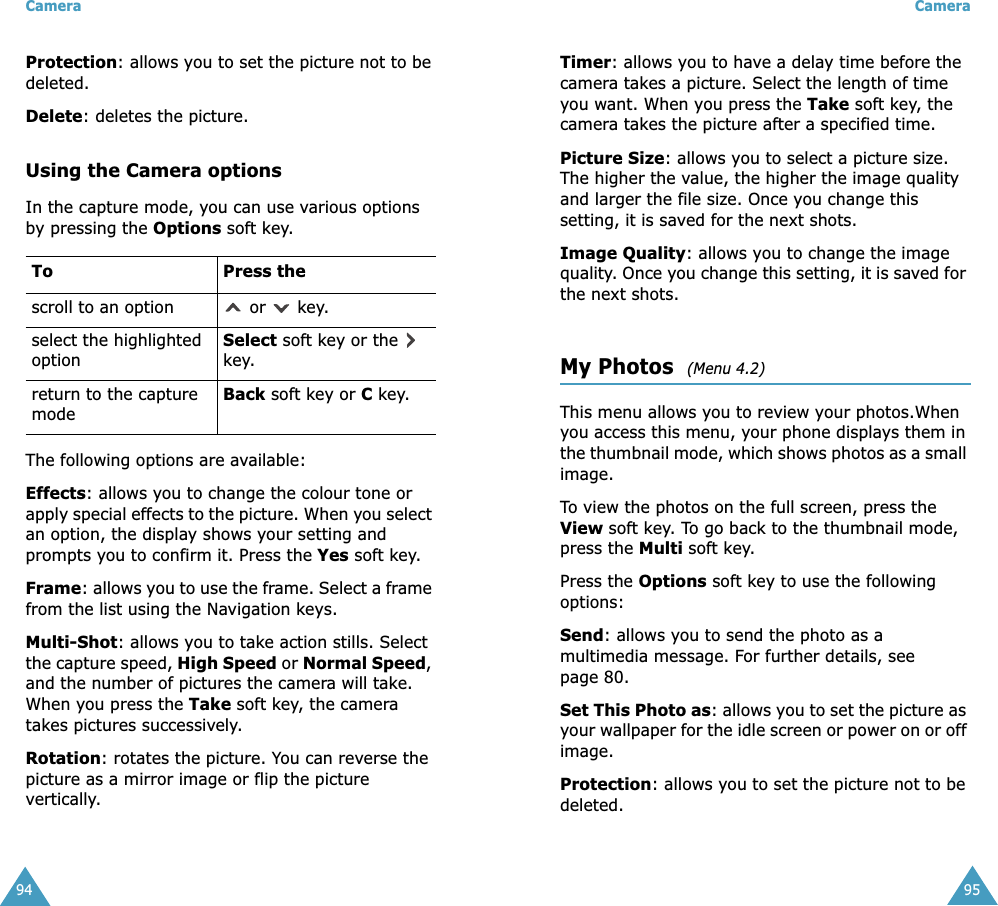
Camera94Protection: allows you to set the picture not to be deleted.Delete: deletes the picture.Using the Camera optionsIn the capture mode, you can use various options by pressing the Options soft key. The following options are available:Effects: allows you to change the colour tone or apply special effects to the picture. When you select an option, the display shows your setting and prompts you to confirm it. Press the Yes soft key.Frame: allows you to use the frame. Select a frame from the list using the Navigation keys.Multi-Shot: allows you to take action stills. Select the capture speed, High Speed or Normal Speed, and the number of pictures the camera will take. When you press the Take soft key, the camera takes pictures successively.Rotation: rotates the picture. You can reverse the picture as a mirror image or flip the picture vertically.To Press thescroll to an option  or   key.select the highlighted optionSelect soft key or the   key.return to the capture modeBack soft key or C key.Camera95Timer: allows you to have a delay time before the camera takes a picture. Select the length of time you want. When you press the Take soft key, the camera takes the picture after a specified time.Picture Size: allows you to select a picture size. The higher the value, the higher the image quality and larger the file size. Once you change this setting, it is saved for the next shots.Image Quality: allows you to change the image quality. Once you change this setting, it is saved for the next shots.My Photos  (Menu 4.2)This menu allows you to review your photos.When you access this menu, your phone displays them in the thumbnail mode, which shows photos as a small image.To view the photos on the full screen, press the View soft key. To go back to the thumbnail mode, press the Multi soft key.Press the Options soft key to use the following options:Send: allows you to send the photo as a multimedia message. For further details, see page 80.Set This Photo as: allows you to set the picture as your wallpaper for the idle screen or power on or off image.Protection: allows you to set the picture not to be deleted.
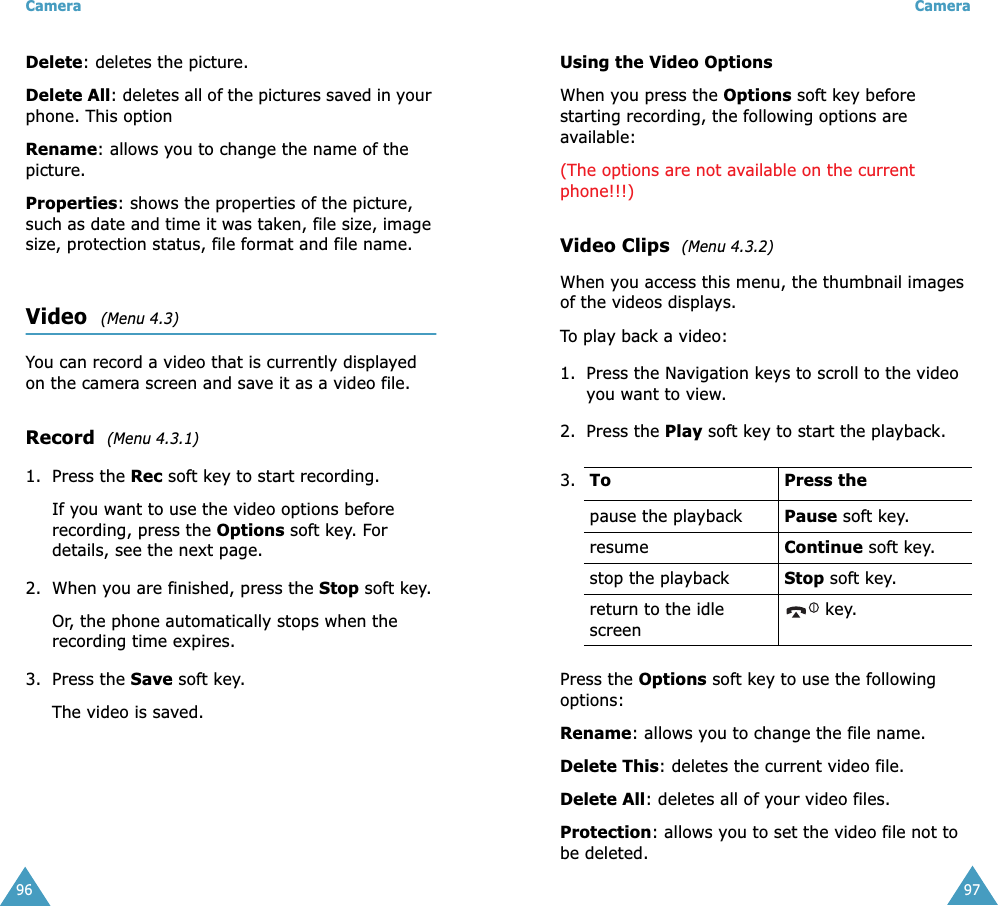
Camera96Delete: deletes the picture.Delete All: deletes all of the pictures saved in your phone. This optionRename: allows you to change the name of the picture.Properties: shows the properties of the picture, such as date and time it was taken, file size, image size, protection status, file format and file name.Video  (Menu 4.3)You can record a video that is currently displayed on the camera screen and save it as a video file.Record  (Menu 4.3.1)1. Press the Rec soft key to start recording.If you want to use the video options before recording, press the Options soft key. For details, see the next page.2. When you are finished, press the Stop soft key.Or, the phone automatically stops when the recording time expires.3. Press the Save soft key.The video is saved.Camera97Using the Video OptionsWhen you press the Options soft key before starting recording, the following options are available:(The options are not available on the current phone!!!)Video Clips  (Menu 4.3.2)When you access this menu, the thumbnail images of the videos displays. To play back a video:1. Press the Navigation keys to scroll to the video you want to view.2. Press the Play soft key to start the playback.Press the Options soft key to use the following options:Rename: allows you to change the file name.Delete This: deletes the current video file.Delete All: deletes all of your video files.Protection: allows you to set the video file not to be deleted.3. To Press thepause the playback Pause soft key.resume Continue soft key.stop the playback Stop soft key.return to the idle screen key.
98Sound SettingsYou can use the Sound Settings feature to customise various settings, such as the:• ring melody, volume and type.• sounds made when you press a key, receive a message, open/close the folder or switch your phone on/off.•alert tone made every minute during a call, when you make an error or when your call is connected to the system.Note: When the phone is in Silent Mode (see page 28), you cannot change the sound settings.Ring Tone  (Menu 5.1) This menu allows you to select a ring melody. You can choose between many different melodies. Each time you select a melody, it plays for a few seconds. If you have downloaded sounds from the Internet or EasyGPRS programme, you can use them in this menu. Ring Volume  (Menu 5.2) This menu allows you to adjust the ring volume to one of five levels. Use the   and   keys or the volume keys on the left side of the phone to increase or decrease the volume. Sound Settings99Alert Type  (Menu 5.3) This menu allows you to specify how you are to be informed of incoming calls. The following options are available:Light Only: the service light flashes; the phone neither rings nor vibrates.Melody: the phone rings using the ring melody selected in the Ring Tone menu (Menu 5.1); see page 98.Vibration: the phone vibrates but does not ring. Vibra+Melody: the phone first vibrates three times and then starts ringing.Keypad Tone  (Menu 5.4) This menu allows you to select a tone that the phone sounds when you press a key. To turn the sound off, select Off.
Sound Settings100Message Tone  (Menu 5.5) This menu allows you to select how the phone informs you that a new message has been received.SMS Tone  (Menu 5.5.1)This menu allows you to select how the phone informs you that a new SMS message has been received.The following options are available:Off: the phone does not use the SMS tone.Light Only: the service light flashes.Vibration: the phone vibrates.Single Beep: the phone beeps once. SMS Tonex: the phone uses one of several SMS tones. SMS-CB Tone  (Menu 5.5.2)This menu allows you to select how the phone informs you that a new cell broadcast (CB) message has been received.The following options are available:Off: the phone does not use the CB tone.Light Only: the service light flashes.Vibration: the phone vibrates.Single Beep: the phone beeps once. SMS-CB Tonex: the phone uses one of several CB tones.Sound Settings101Folder Tone  (Menu 5.6)This menu allows you to select a tone that the phone sounds when you open or close the folder. To turn the sound off, select Off. Power On/Off  (Menu 5.7)This menu allows you to select a melody that the phone sounds when it is switched on and off. To turn the sound off, select Off. Extra Tones  (Menu 5.8) You can customise additional tones used for the phone. To turn a given tonePress the on On soft key.A check mark displays in front of the option. off Off soft key again.The check mark no longer displays.
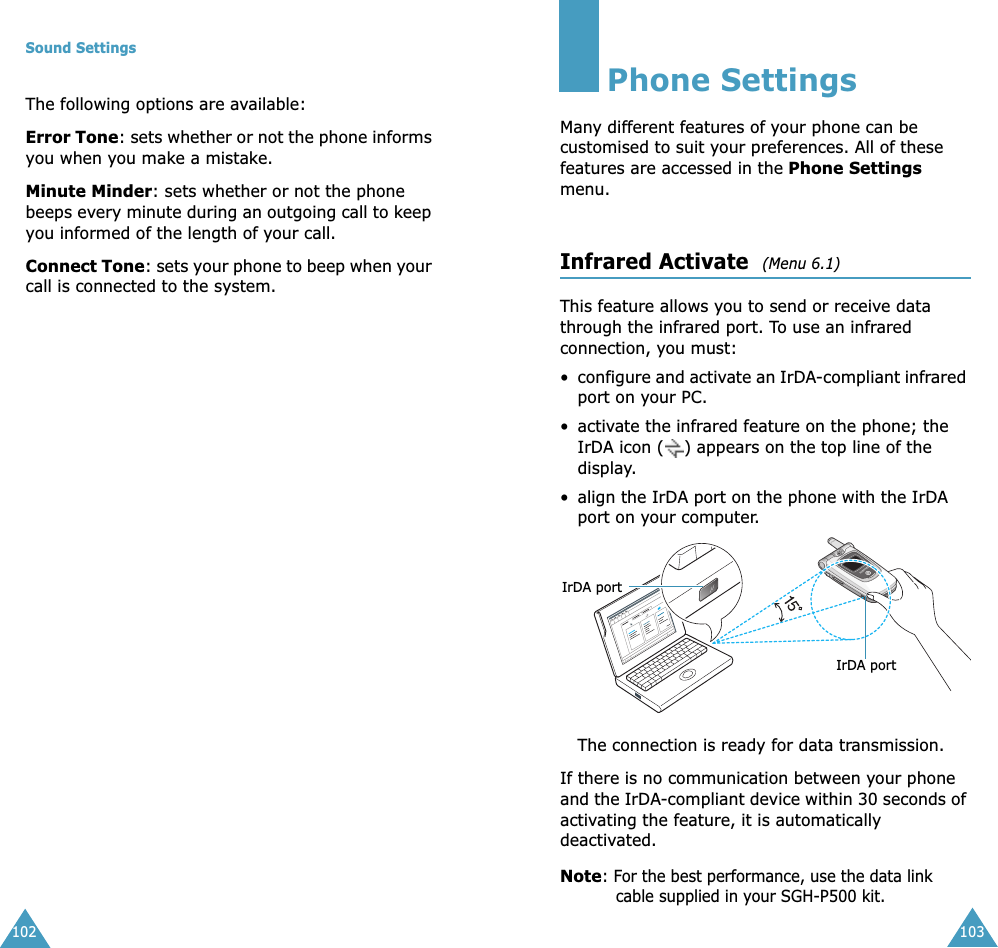
Sound Settings102The following options are available:Error Tone: sets whether or not the phone informs you when you make a mistake. Minute Minder: sets whether or not the phone beeps every minute during an outgoing call to keep you informed of the length of your call.Connect Tone: sets your phone to beep when your call is connected to the system.103Phone SettingsMany different features of your phone can be customised to suit your preferences. All of these features are accessed in the Phone Settings menu.Infrared Activate  (Menu 6.1) This feature allows you to send or receive data through the infrared port. To use an infrared connection, you must:•configure and activate an IrDA-compliant infrared port on your PC.• activate the infrared feature on the phone; the IrDA icon ( ) appears on the top line of the display.• align the IrDA port on the phone with the IrDA port on your computer.The connection is ready for data transmission.If there is no communication between your phone and the IrDA-compliant device within 30 seconds of activating the feature, it is automatically deactivated.Note: For the best performance, use the data link cable supplied in your SGH-P500 kit.IrDA portIrDA port
Phone Settings104Display Settings  (Menu 6.2) In this menu, you can change various settings for the display or backlight.Wallpaper (Menu 6.2.1)This menu allows you to change the background image or the colour of the text to be displayed in Idle Mode.The following options are available:Wallpaper List: you can select a background image to be displayed on the idle screen.To change the background image:1. Scroll through the list by pressing the   or   key.You have various preset images available. You can also select the blank background and any images downloaded from the Internet and the EasyGPRS programme or received by messages. Once you have set a photo as the wallpaper, it displays as My Photo.icn on this list.2. Press the Select soft key when the image you want highlights.3. When the image displays, press the Select soft key to display it on the idle screen. Text Display: you can specify whether or not the phone displays the text, such as the date and time and the service provider’s name.Text Color: you can select a colour of the text to be displayed on the idle screen.Phone Settings105Menu Style (Menu 6.2.2)This menu allows you to select the menu display style. You can choose either Film Style or Page Style. Brightness  (Menu 6.2.3) This menu allows you to adjust the brightness of the display screen to see it better in different lighting conditions.Adjust the brightness by using the   and   keys or the   and   keys on the left side of the phone.Back Light  (Menu 6.2.4) You can select whether or not the phone uses the backlight. A marginal increase in standby/talk time can be achieved by turning the backlight off.Select the length of time the backlight is on. The backlight turns on when you press a key or receive a call or message and remains on for the specified length of time. If you do not want to use the backlight, select Off.
Phone Settings106Auto Light  (Menu 6.2.5) This feature helps you to conserve your battery power by allowing you to set the backlight to be used at certain times.The following options are available:Disable: the backlight is used according to your setting in the Back Light menu (Menu 6.2.4); see page 105.Enable: the backlight is used only during the specified period of time. Enter the time when the phone turns the light on and then turns it off, using the appropriate number keys.Service Light  (Menu 6.2.6) This menu allows you to select whether or not the service light is used or in which colour it flashes. Select one of the seven colour settings. When the phone is ready for use, the service light flashes in the appropriate colour.If you do not wish to use the service light, select Off.Graphic Logo  (Menu 6.2.7) This menu allows you to display your service provider’s logo instead of its name.Off: the service provider’s name displays in Idle Mode.On: the service provider’s logo stored in your phone displays in Idle Mode; if no logo has been stored, the service provider’s name displays.Phone Settings107Greeting Message  (Menu 6.3) This menu allows you to set a greeting to be displayed briefly when the phone is switched on.For further details about how to enter characters, see page 42. Own Number  (Menu 6.4) This feature allows you to:• assign a name to each of your own phone numbers registered on your SIM card.• edit the names and numbers.This function is a memory aid, which you can use to check your own phone numbers if you need to do so.Any changes made here do not in any way affect the actual subscriber numbers on your SIM card.To Press the clear the existing messageC key and hold it down until the message is cleared. enter a new messageappropriate alphanumeric keys. change the text input moderight soft key.
Phone Settings108Language  (Menu 6.5) You can select a display language. When the language option is set to Automatic, the language is automatically selected according to the language of the SIM card used.Security  (Menu 6.6) The Security feature enables you to restrict the use of your phone to the people and the types of calls of your choice.Various codes and passwords are used to protect the features of your phone. They are described in the following sections. Also see pages 149-152.PIN Check  (Menu 6.6.1) When the PIN Check feature is enabled, you must enter your PIN each time you switch the phone on. Consequently, any person who does not have your PIN cannot use your phone without your approval.Note: Before disabling the PIN Check feature, you must enter your PIN.To change your PIN, see the Change PIN menu (Menu 6.6.2) on the following page.The following options are available:Disable: the phone connects directly to the network when you switch it on.Enable: you must enter the PIN each time the phone is switched on.Phone Settings109Change PIN  (Menu 6.6.2) This feature allows you to change your current PIN to a new one, provided that the PIN Check feature is enabled. You must enter the current PIN before you can specify a new one.Once you have entered a new PIN, you are asked to confirm it by entering it again.Phone Lock  (Menu 6.6.3) When the Phone Lock feature is enabled, the phone is locked and you must enter the 8-digit phone password each time the phone is switched on.The password is preset to “00000000” at the factory. To change the phone password, see the Change Password menu (Menu 6.6.4) below.Once the correct password has been entered, you can use the phone until you switch it off.The following options are available:Disable: you are not asked to enter the phone password when you switch the phone on.Enable: you are required to enter the phone password when you switch the phone on.Change Password  (Menu 6.6.4) The Change Password feature allows you to change your current phone password to a new one. You must enter the current password before you can specify a new one.The password is preset to “00000000” at the factory. Once you have entered a new password, you are asked to confirm it by entering it again.
Phone Settings110SIM Lock  (Menu 6.6.5) When the SIM Lock feature is enabled, your phone only works with the current SIM. You must enter the SIM lock code.Once you have entered the lock code, you are asked to confirm it by entering it again.To unlock the SIM, you must enter the SIM lock code.FDN Mode  (Menu 6.6.6) The FDN (Fixed Dial Number) mode, if supported by your SIM card, allows you to restrict your outgoing calls to a limited set of phone numbers.The following options are available:Disable: you can call any number.Enable: you can only call phone numbers stored in Phonebook. You must enter your PIN2.Note: Not all SIM cards have a PIN2. If your SIM card does not, this menu is not displayed.To change your PIN2, see the Change PIN2 menu (Menu 6.6.7) below.Change PIN2  (Menu 6.6.7) The Change PIN2 feature allows you to change your current PIN2 to a new one. You must enter the current PIN2 before you can specify a new one.Once you have entered a new PIN2, you are asked to confirm it by entering it again.Note: Not all SIM cards have a PIN2. If your SIM card does not, this menu is not displayed.Phone Settings111Extra Settings  (Menu 6.7) You can turn the automatic redialling or answering features on or off. The following options are available:Auto Redial: when this option is checked, the phone makes up to ten attempts to redial a phone number after an unsuccessful call.Note: The interval between two call attempts varies.Active Folder: when this option is checked, you can simply open the folder to answer a call.When it is unchecked, you must open the folder and press a key, depending on the setting of the Anykey Answer option. See below.Anykey Answer: when this option is checked, you can answer an incoming call by pressing any key, except the   key and the Reject soft key. To reject the call, press the   key or the Reject soft key. When this option is unchecked, you can only press the   key or Accept soft key.To turn a feature Press the on On soft key.A check mark displays in front of the option. off Off soft key.The check mark no longer displays.
Phone Settings112Reset Settings  (Menu 6.9) You can easily reset your phone to its default settings. To reset your phone:1. Select the Reset Settings menu.2. Enter the 8-digit phone password and press the OK soft key.Note: The password is preset to “00000000.” To change this password, see page 109.113OrganiserThe Organiser feature enables you to:•set an alarm so that the phone rings at a specific time, such as to remind you of an appointment.• view the calendar and organise your schedule.• set the current date and time.• define a list of things to do.• record voice memos.• use the phone as a calculator for basic mathematical equations or currency exchange operations. Alarm  (Menu 7.1) This feature allows you to:• set the alarm to ring at a specific time.•set the phone to switch on automatically and ring the alarm even if the phone is switched off.The following options are available:Once Alarm: the alarm rings only once and is then deactivated.Daily Alarm: the alarm rings every day at the same time.Morning Call: the alarm rings to wake you up in the morning.
Organiser114To set an alarm:1. Choose the type of alarm to be set and press the Select soft key.2. Enter the time for the alarm to sound.Note: Your phone is preset to use 24-hour format. To change the format, see page 118.If you want to use the alarm options, press the Options soft key. The following options are available:• Remove Alarm: deactivates the current alarm. • Alarm Sound Set: allows you to select the alarm melody.3. Press the OK soft key.4. If you select Morning Call in Step 1, choose the repeat option, Monday to Friday or Monday to Saturday, and press the Select soft key.To stop the alarm when it rings, open the folder and press the Exit soft key.Remove Alarm: deactivates all alarm settings.Autopower: when this option is set to Enable, the alarm rings at the specified time, even if the phone is switched off. If the menu option is set to Disable and the phone is switched off at the specified time, the alarm does not ring.Organiser115Calendar  (Menu 7.2) With the Calendar feature, you can:• consult the calendar to check your memos.•write memos to keep track of your schedule.• trigger an alarm, if necessary.Consulting the CalendarWhen you select the Calendar menu (Menu 7.2), the calendar displays. The following options are available when you press the Options soft key:Search All: displays all of the memos, starting with the oldest regardless of the day. To scroll through the memos, press the   or   key.Delete All: allows you to delete all of the memos. You are asked to confirm your action.Go to Date: allows you to go to a specific date.Exit: exits the Calendar feature and returns to Idle Mode.Writing a MemoYou can make up to 30 memos for one day.To write or edit a memo on a specific date:1. Select a date on the calendar, using the navigation keys.Note: To skip to the previous or next month, press the   or   key on the left side of the phone.
Organiser1162. Press the Select soft key. An empty memo screen displays allowing you to enter your memo.3. Enter your memo and then press the OK soft key.Note: For further details about how to enter characters, see page 42.You are asked if you wish to set an alarm.4. If you want an alarm to ring on the chosen day, press the Yes soft key. Otherwise, press the No soft key. The memo is saved.5. If you pressed the Yes soft key, enter the time for the alarm and press the OK soft key.You can also select the melody for the alarm by pressing the Melody soft key. The colour of the date on the calendar changes to green to indicate that a memo exists.Viewing a MemoWhen you select a day for which a memo already exists on the calendar, the latest memo for the day displays. If more than one memo is stored, press the   or  key to scroll to the previous or next memo. Press the New soft key to add a new memo to the day.Organiser117You can use the following options by pressing the Options soft key:Edit: allows you to change the memo text.Alarm: allows you to set an alarm to ring at the specified time to inform you of the memo. If you set the alarm earlier, you can change or delete it.Delete: allows you to delete the memo.Copy to: allows you to copy the memo to another date.Move to: allows you to change the date of the memo.Time & Date  (Menu 7.3) This menu allows you to change the current time and date displayed. You can also use this option to find out what time it is in another part of the world.The following options are available:Set Time: allows you to enter the current time. You can choose the time format in the Time Format menu (Menu 7.3.4). See below.Note: Before setting the time, you must specify your time zone, in the World Time menu (Menu 7.3.3).Set Date: allows you to enter the day, month and year.
Organiser118World Time: allows you to find out what time it is in another part of the world, using the   and   keys.The screen shows the:• city name.• current date and time.• time difference between the selected city and your city if you have set the local time (see below for further details) or GMT (by default).To select your time zone:1. Select the city corresponding to your time zone by pressing the   or   key one or more times.The local date and time display.2. Press the Set soft key.Time Format: allows you to change the time format to 24 Hours or 12 Hours.Calculator  (Menu 7.4) With this feature, you can use the phone as a calculator. The calculator provides the basic arithmetic functions; addition, subtraction, multiplication and division.1. Enter the first number using the numeric keys.Notes: • To delete mistakes or clear the display, press the C key.• To include a decimal point or a bracket, press the left soft key until the symbol you want displays.Organiser1192. Press the right soft key until the required arithmetic symbol appears: + (addition), - (subtraction),   (multiplication), / (division).3. Enter the second number.4. To view the result, press the   key.5. Repeat steps 1 to 4 as many times as required.To Do List  (Menu 7.5) This feature allows you to:• enter a list of tasks to be done.• assign a priority and a deadline to each task.• sort the tasks by priority and status mark.Creating the To Do List1. Press the New soft key.2. Enter the first task.Note: For further details about how to enter characters, see page 42.3. Press the OK soft key.4. Select high, normal or low priority using the   and   keys and press the Select soft key.5. Enter your deadline and press the OK soft key.If you do not want to set a deadline, press the Skip soft key.
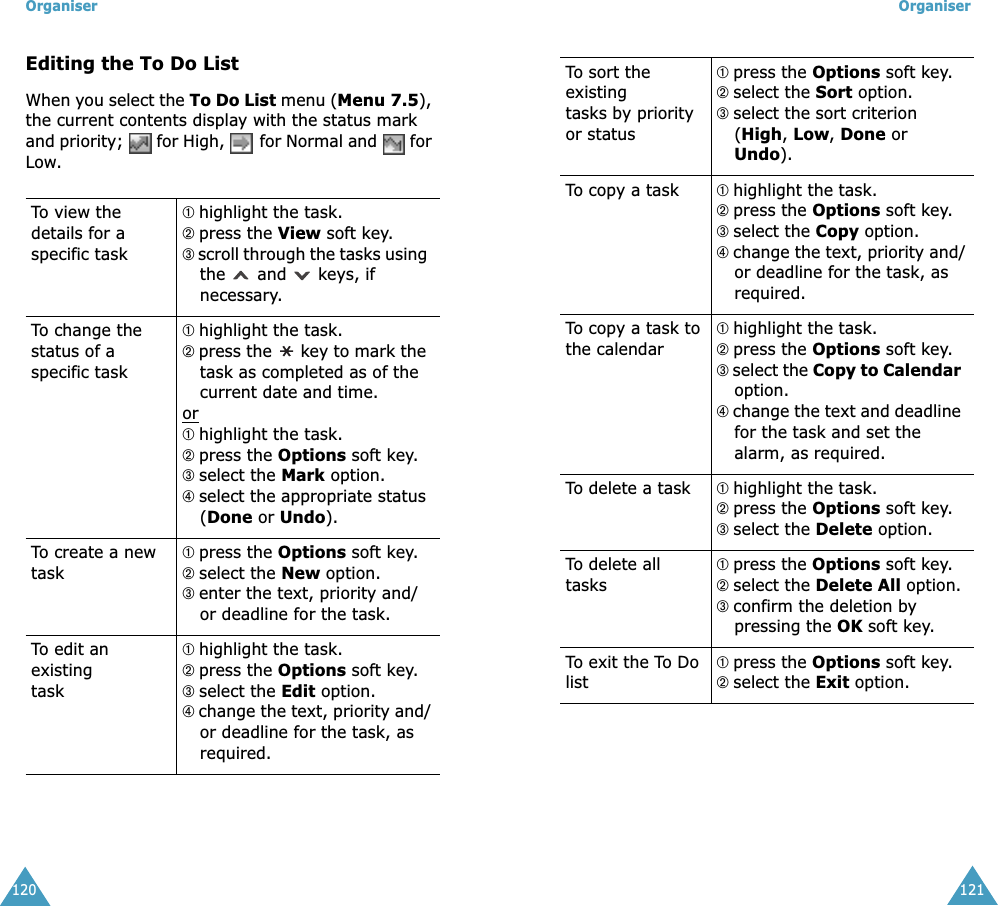
Organiser120Editing the To Do ListWhen you select the To Do List menu (Menu 7.5), the current contents display with the status mark and priority;   for High,   for Normal and   for Low.  To view the details for a specific task➀ highlight the task.➁ press the View soft key.➂ scroll through the tasks using the   and   keys, if necessary. To change the  status of a  specific task➀ highlight the task.➁ press the   key to mark the task as completed as of the current date and time.or➀ highlight the task. ➁ press the Options soft key.➂ select the Mark option.➃ select the appropriate status (Done or Undo). To create a new  task➀ press the Options soft key.➁ select the New option.➂ enter the text, priority and/or deadline for the task.  To edit an existing  task➀ highlight the task.➁ press the Options soft key.➂ select the Edit option.➃ change the text, priority and/or deadline for the task, as required. Organiser121 To sort the existing tasks by priority  or status➀ press the Options soft key.➁ select the Sort option.➂ select the sort criterion (High, Low, Done or Undo). To copy a task ➀ highlight the task.➁ press the Options soft key.➂ select the Copy option.➃ change the text, priority and/or deadline for the task, as required. To copy a task to the calendar➀ highlight the task.➁ press the Options soft key.➂ select the Copy to Calendar option.➃ change the text and deadline for the task and set the alarm, as required. To delete a task ➀ highlight the task.➁ press the Options soft key.➂ select the Delete option. To delete all tasks➀ press the Options soft key.➁ select the Delete All option.➂ confirm the deletion by pressing the OK soft key. To exit the To Do list➀ press the Options soft key.➁ select the Exit option.
Organiser122Voice Memo  (Menu 7.6) You can record up to 5 voice memos of 30 seconds each. After recording, you can send a memo to other people using the multimedia message service.Record  (Menu 7.6.1)This menu allows you to record a new memo. When you select this option, the display shows the 30-second timer. 1. To start recording, press the Record soft key. 2. Record a memo by speaking into the microphone.3. When you press the Stop soft key or the recording time expires, the following options display:• Replay: plays back your memo.• Re-record: discards the memo and enables you to record another one.• Save: allows you to save the memo.• Quit: cancels your recording and exits the Record menu.4. To save the memo, choose Save from the options and press the Select soft key.5. Press the C key to clear the default name, if necessary, and enter a name for the memo. For further details about how to enter characters, see page 42.Organiser1236. Press the OK soft key.The memo is saved and then the display shows the memo information.7. Press the Options soft key to use the following memo options:• Send: allows you to send the memo to other people by using the MMS feature. Follow the procedure on page 80.• Rename: allows you to change the memo’s name.• Delete: deletes the memo.8. To exit, press the C or  key.Memo List  (Menu 7.6.2)This menu shows your voice memo list. Scroll to a memo and press the Options soft key. The following options are available:Play: plays back the memo.Send: allows you to send the memo to other people by using the MMS feature. See page 80 for further details about sending a message.Rename: allows you to change the memo’s name.Information: displays information about the memo, such as name, recording duration, and date and time when the memo was made.Delete: deletes the memo.
Organiser124Delete All  (Menu 7.6.3)In this menu, you can delete all of your voice memos. When the confirming message appears, press the Yes soft key. To cancel the deletion, press the No soft key.Currency Exchange  (Menu 7.7) Using this menu, you can make currency conversions.1. Enter the current exchange rate of your source currency and press the OK soft key.You can insert a decimal point by pressing the  key.2. Enter the amount to convert and press the OK soft key.The amount you entered and its equivalent value display.3. Press the Exit soft key to exit the currency convertor.
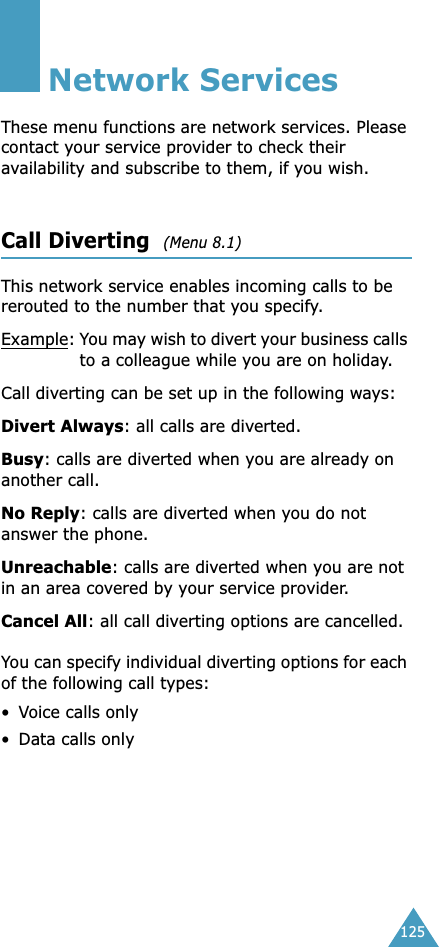
125Network ServicesThese menu functions are network services. Please contact your service provider to check their availability and subscribe to them, if you wish.Call Diverting  (Menu 8.1) This network service enables incoming calls to be rerouted to the number that you specify.Example:You may wish to divert your business calls to a colleague while you are on holiday.Call diverting can be set up in the following ways:Divert Always: all calls are diverted.Busy: calls are diverted when you are already on another call.No Reply: calls are diverted when you do not answer the phone.Unreachable: calls are diverted when you are not in an area covered by your service provider.Cancel All: all call diverting options are cancelled.You can specify individual diverting options for each of the following call types:•Voice calls only• Data calls only
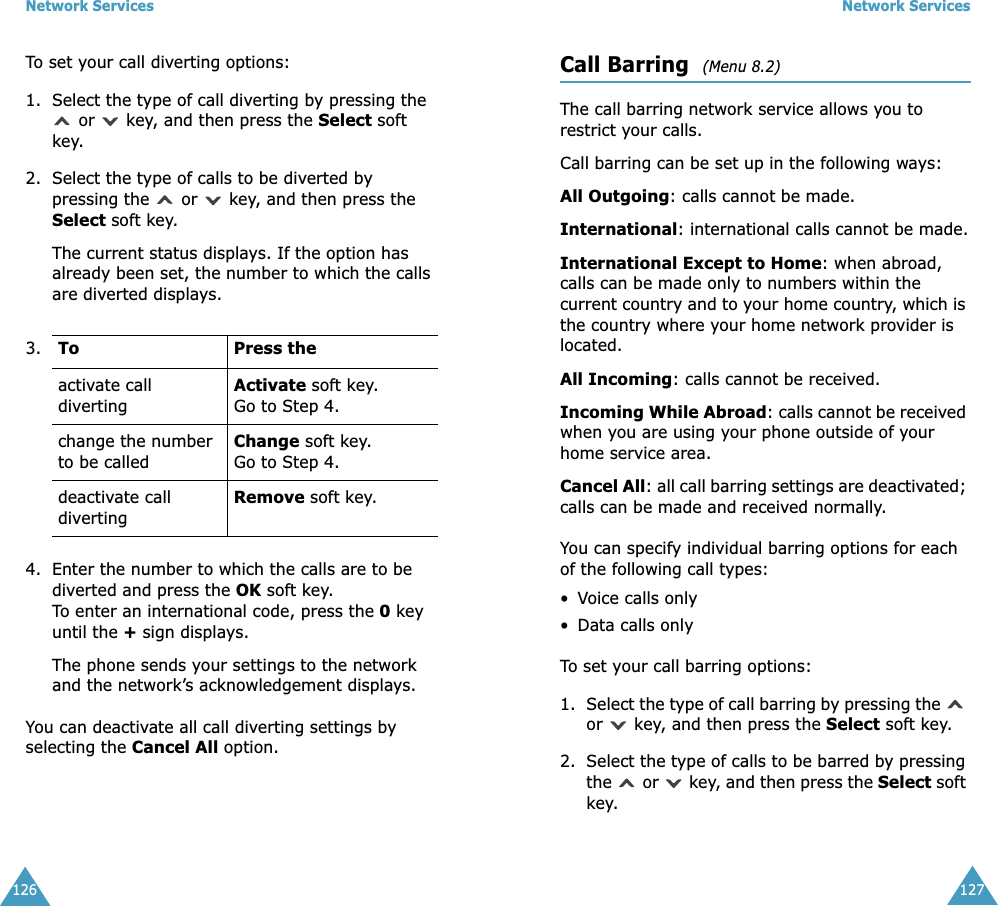
Network Services126To set your call diverting options:1. Select the type of call diverting by pressing the  or   key, and then press the Select soft key.2. Select the type of calls to be diverted by pressing the   or   key, and then press the Select soft key.The current status displays. If the option has already been set, the number to which the calls are diverted displays.4. Enter the number to which the calls are to be diverted and press the OK soft key.To enter an international code, press the 0 key until the + sign displays.The phone sends your settings to the network and the network’s acknowledgement displays.You can deactivate all call diverting settings by selecting the Cancel All option.3. To Press theactivate call divertingActivate soft key.Go to Step 4.change the number to be calledChange soft key.Go to Step 4. deactivate call divertingRemove soft key.Network Services127Call Barring  (Menu 8.2) The call barring network service allows you to restrict your calls.Call barring can be set up in the following ways:All Outgoing: calls cannot be made.International: international calls cannot be made.International Except to Home: when abroad, calls can be made only to numbers within the current country and to your home country, which is the country where your home network provider is located.All Incoming: calls cannot be received.Incoming While Abroad: calls cannot be received when you are using your phone outside of your home service area.Cancel All: all call barring settings are deactivated; calls can be made and received normally.You can specify individual barring options for each of the following call types:•Voice calls only• Data calls onlyTo set your call barring options:1. Select the type of call barring by pressing the   or   key, and then press the Select soft key.2. Select the type of calls to be barred by pressing the   or   key, and then press the Select soft key.
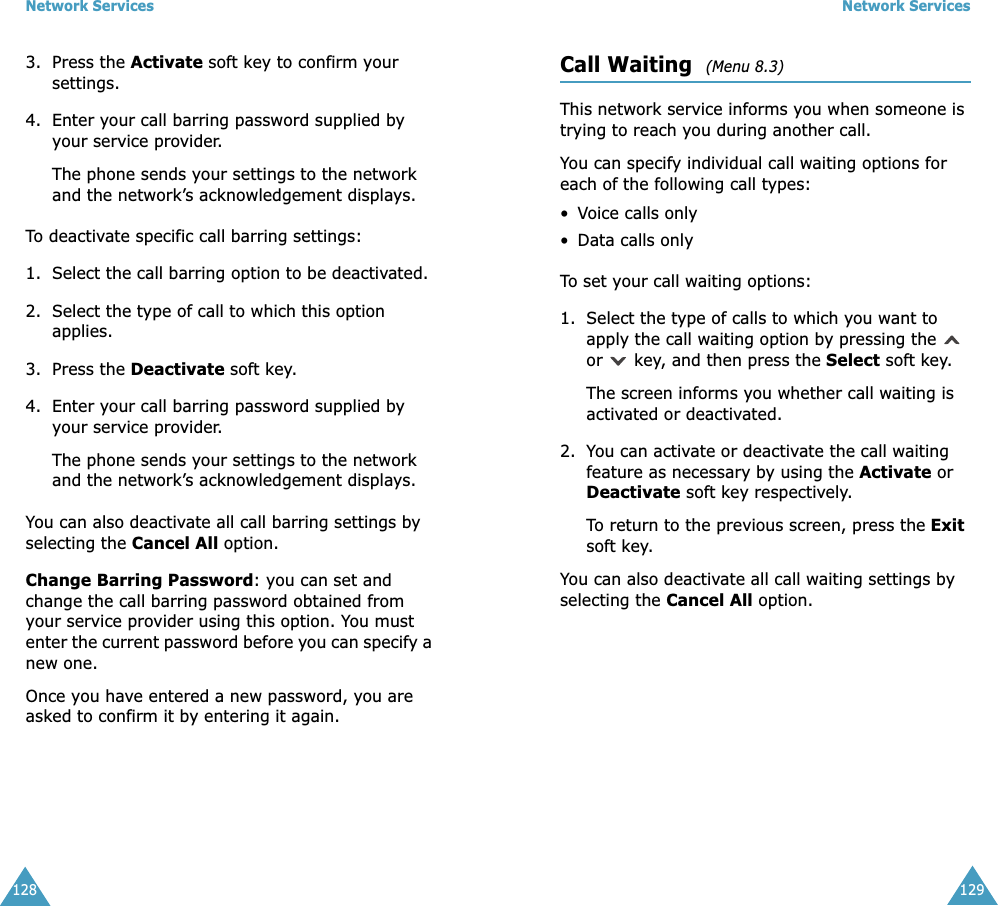
Network Services1283. Press the Activate soft key to confirm your settings.4. Enter your call barring password supplied by your service provider.The phone sends your settings to the network and the network’s acknowledgement displays.To deactivate specific call barring settings:1. Select the call barring option to be deactivated.2. Select the type of call to which this option applies.3. Press the Deactivate soft key.4. Enter your call barring password supplied by your service provider.The phone sends your settings to the network and the network’s acknowledgement displays.You can also deactivate all call barring settings by selecting the Cancel All option.Change Barring Password: you can set and change the call barring password obtained from your service provider using this option. You must enter the current password before you can specify a new one.Once you have entered a new password, you are asked to confirm it by entering it again.Network Services129Call Waiting  (Menu 8.3) This network service informs you when someone is trying to reach you during another call.You can specify individual call waiting options for each of the following call types:•Voice calls only• Data calls onlyTo set your call waiting options:1. Select the type of calls to which you want to apply the call waiting option by pressing the   or   key, and then press the Select soft key.The screen informs you whether call waiting is activated or deactivated. 2. You can activate or deactivate the call waiting feature as necessary by using the Activate or Deactivate soft key respectively. To return to the previous screen, press the Exit soft key.You can also deactivate all call waiting settings by selecting the Cancel All option.
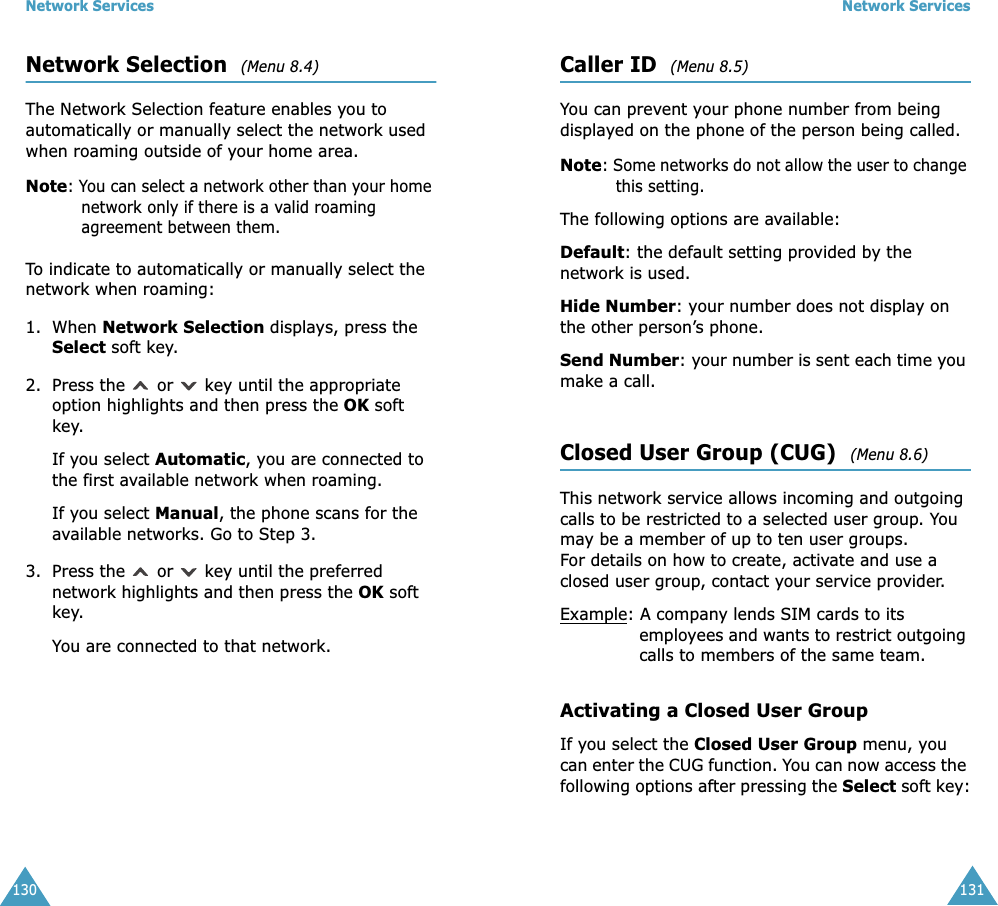
Network Services130Network Selection  (Menu 8.4) The Network Selection feature enables you to automatically or manually select the network used when roaming outside of your home area.Note: You can select a network other than your home network only if there is a valid roaming agreement between them.To indicate to automatically or manually select the network when roaming:1. When Network Selection displays, press the Select soft key.2. Press the   or   key until the appropriate option highlights and then press the OK soft key.If you select Automatic, you are connected to the first available network when roaming.If you select Manual, the phone scans for the available networks. Go to Step 3.3. Press the   or   key until the preferred network highlights and then press the OK soft key.You are connected to that network.Network Services131Caller ID  (Menu 8.5) You can prevent your phone number from being displayed on the phone of the person being called.Note: Some networks do not allow the user to change this setting.The following options are available:Default: the default setting provided by the network is used.Hide Number: your number does not display on the other person’s phone.Send Number: your number is sent each time you make a call.Closed User Group (CUG)  (Menu 8.6) This network service allows incoming and outgoing calls to be restricted to a selected user group. You may be a member of up to ten user groups.For details on how to create, activate and use a closed user group, contact your service provider.Example: A company lends SIM cards to its employees and wants to restrict outgoing calls to members of the same team.Activating a Closed User GroupIf you select the Closed User Group menu, you can enter the CUG function. You can now access the following options after pressing the Select soft key:
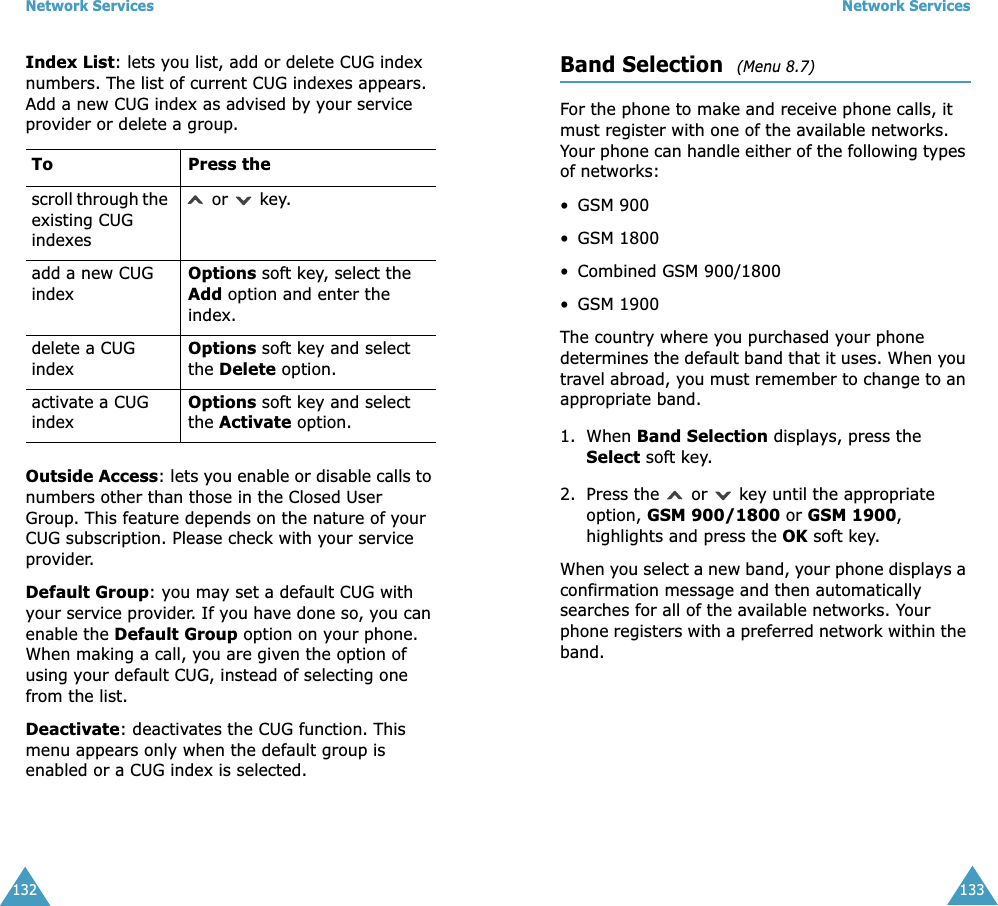
Network Services132Index List: lets you list, add or delete CUG index numbers. The list of current CUG indexes appears. Add a new CUG index as advised by your service provider or delete a group.Outside Access: lets you enable or disable calls to numbers other than those in the Closed User Group. This feature depends on the nature of your CUG subscription. Please check with your service provider.Default Group: you may set a default CUG with your service provider. If you have done so, you can enable the Default Group option on your phone. When making a call, you are given the option of using your default CUG, instead of selecting one from the list.Deactivate: deactivates the CUG function. This menu appears only when the default group is enabled or a CUG index is selected.To Press thescroll through the existing CUG indexes  or  key.add a new CUG indexOptions soft key, select the Add option and enter the index.delete a CUG indexOptions soft key and select the Delete option.activate a CUG indexOptions soft key and select the Activate option.Network Services133Band Selection  (Menu 8.7) For the phone to make and receive phone calls, it must register with one of the available networks. Your phone can handle either of the following types of networks: •GSM 900•GSM 1800• Combined GSM 900/1800•GSM 1900The country where you purchased your phone determines the default band that it uses. When you travel abroad, you must remember to change to an appropriate band. 1. When Band Selection displays, press the Select soft key.2. Press the   or   key until the appropriate option, GSM 900/1800 or GSM 1900, highlights and press the OK soft key.When you select a new band, your phone displays a confirmation message and then automatically searches for all of the available networks. Your phone registers with a preferred network within the band.
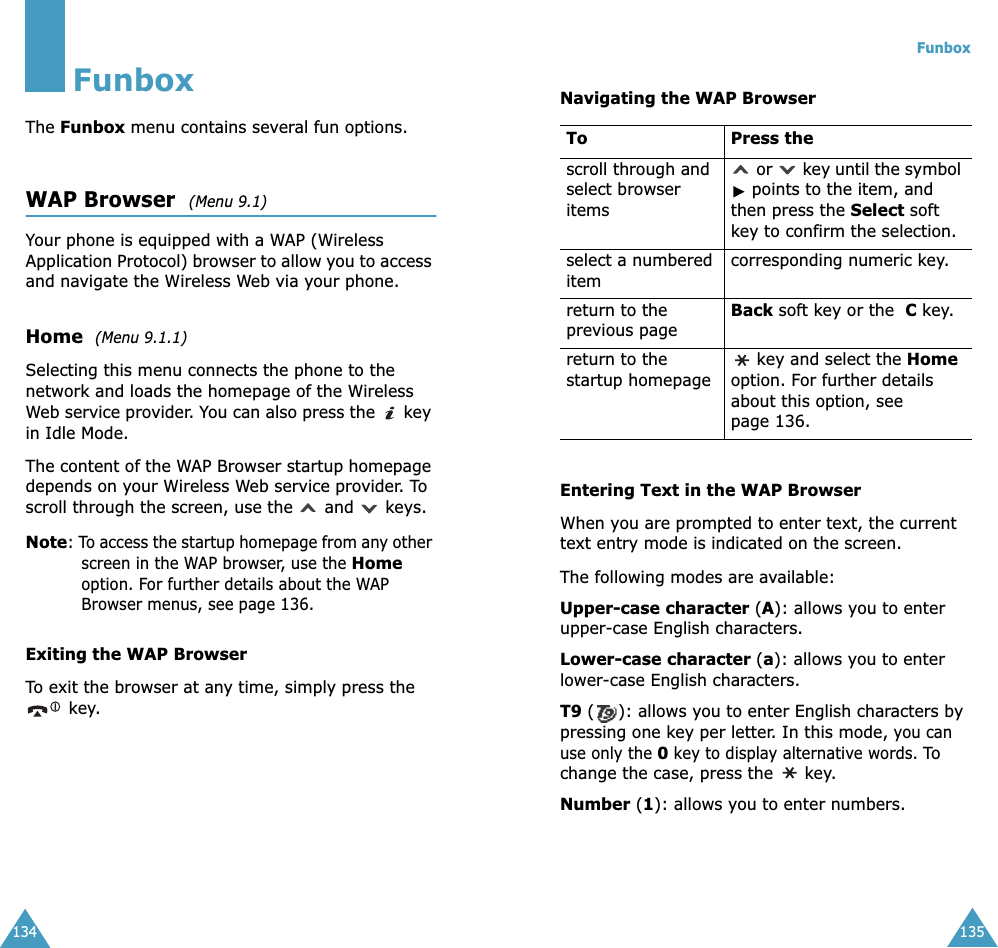
134FunboxThe Funbox menu contains several fun options.WAP Browser  (Menu 9.1) Your phone is equipped with a WAP (Wireless Application Protocol) browser to allow you to access and navigate the Wireless Web via your phone.Home  (Menu 9.1.1)Selecting this menu connects the phone to the network and loads the homepage of the Wireless Web service provider. You can also press the   key in Idle Mode.The content of the WAP Browser startup homepage depends on your Wireless Web service provider. To scroll through the screen, use the   and   keys.Note: To access the startup homepage from any other screen in the WAP browser, use the Home option. For further details about the WAP Browser menus, see page 136.Exiting the WAP BrowserTo exit the browser at any time, simply press the   key.Funbox135Navigating the WAP BrowserEntering Text in the WAP BrowserWhen you are prompted to enter text, the current text entry mode is indicated on the screen. The following modes are available:Upper-case character (A): allows you to enter upper-case English characters.Lower-case character (a): allows you to enter lower-case English characters.T9 ( ): allows you to enter English characters by pressing one key per letter. In this mode, you can use only the 0 key to display alternative words. To change the case, press the   key.Number (1): allows you to enter numbers.To Press thescroll through and select browser items or   key until the symbol  points to the item, and then press the Select soft key to confirm the selection.select a numbered itemcorresponding numeric key.return to the previous pageBack soft key or the  C key.return to the startup homepage key and select the Home option. For further details about this option, see page 136.
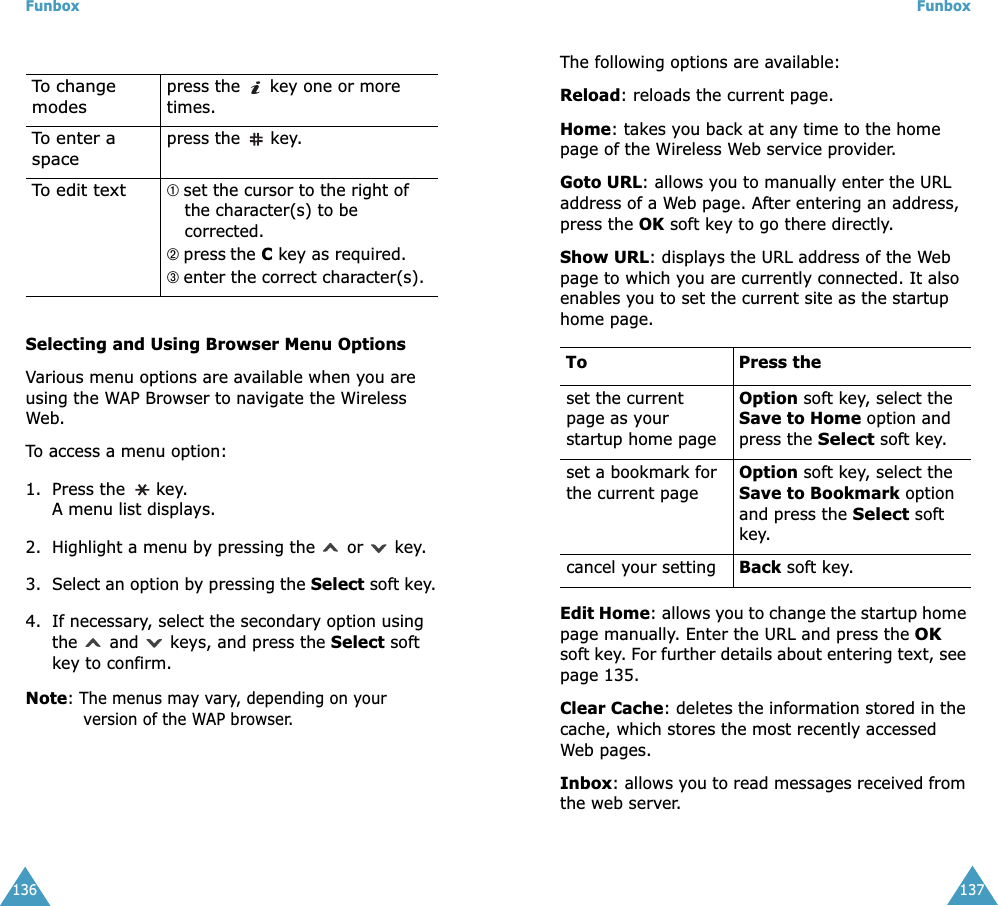
Funbox136Selecting and Using Browser Menu OptionsVarious menu options are available when you are using the WAP Browser to navigate the Wireless Web.To access a menu option:1. Press the   key. A menu list displays.2. Highlight a menu by pressing the   or   key.3. Select an option by pressing the Select soft key.4. If necessary, select the secondary option using the   and   keys, and press the Select soft key to confirm.Note: The menus may vary, depending on your version of the WAP browser.To change modespress the   key one or more times.To enter a spacepress the  key.To edit text➀ set the cursor to the right of the character(s) to be corrected.➁ press the C key as required.➂ enter the correct character(s).Funbox137The following options are available: Reload: reloads the current page.Home: takes you back at any time to the home page of the Wireless Web service provider.Goto URL: allows you to manually enter the URL address of a Web page. After entering an address, press the OK soft key to go there directly.Show URL: displays the URL address of the Web page to which you are currently connected. It also enables you to set the current site as the startup home page. Edit Home: allows you to change the startup home page manually. Enter the URL and press the OK soft key. For further details about entering text, see page 135.Clear Cache: deletes the information stored in the cache, which stores the most recently accessed Web pages.Inbox: allows you to read messages received from the web server.To Press theset the current page as your startup home pageOption soft key, select the Save to Home option and press the Select soft key.set a bookmark for the current pageOption soft key, select the Save to Bookmark option and press the Select soft key.cancel your setting Back soft key.
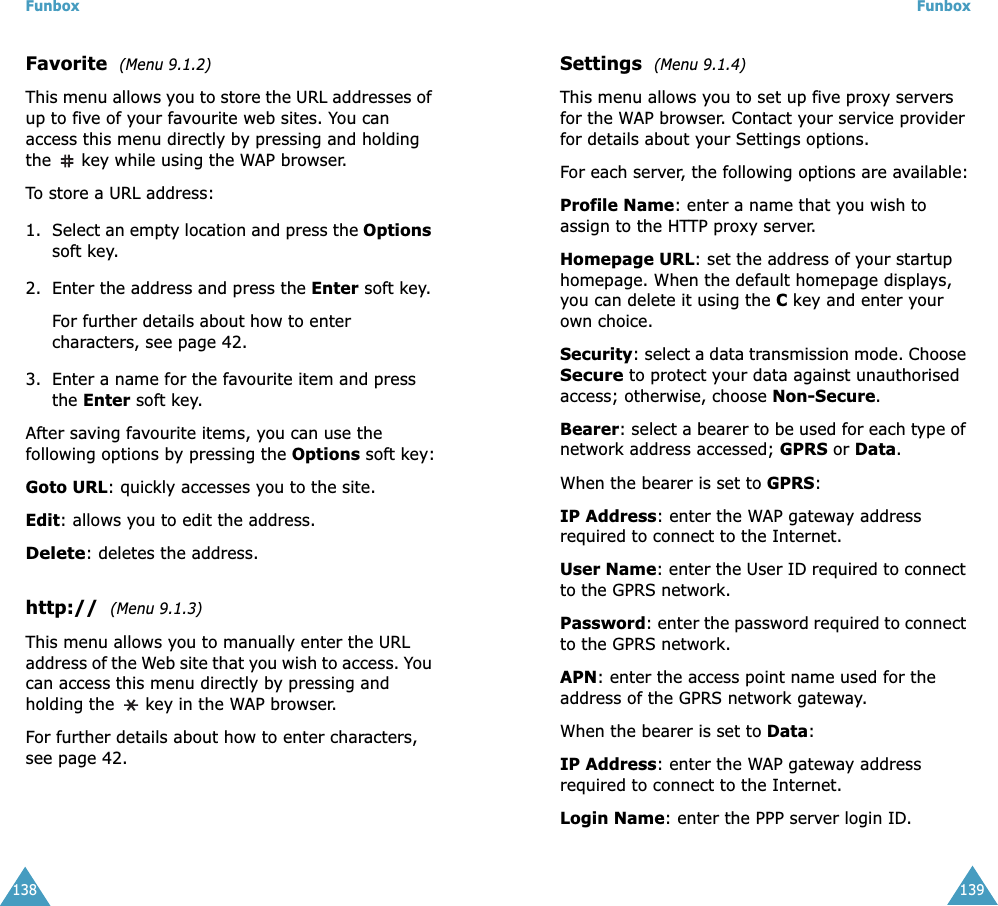
Funbox138Favorite  (Menu 9.1.2)This menu allows you to store the URL addresses of up to five of your favourite web sites. You can access this menu directly by pressing and holding the  key while using the WAP browser.To store a URL address:1. Select an empty location and press the Options soft key. 2. Enter the address and press the Enter soft key.For further details about how to enter characters, see page 42. 3. Enter a name for the favourite item and press the Enter soft key.After saving favourite items, you can use the following options by pressing the Options soft key:Goto URL: quickly accesses you to the site. Edit: allows you to edit the address.Delete: deletes the address.http://  (Menu 9.1.3)This menu allows you to manually enter the URL address of the Web site that you wish to access. You can access this menu directly by pressing and holding the   key in the WAP browser.For further details about how to enter characters, see page 42. Funbox139Settings  (Menu 9.1.4)This menu allows you to set up five proxy servers for the WAP browser. Contact your service provider for details about your Settings options.For each server, the following options are available:Profile Name: enter a name that you wish to assign to the HTTP proxy server. Homepage URL: set the address of your startup homepage. When the default homepage displays, you can delete it using the C key and enter your own choice. Security: select a data transmission mode. Choose Secure to protect your data against unauthorised access; otherwise, choose Non-Secure.Bearer: select a bearer to be used for each type of network address accessed; GPRS or Data.When the bearer is set to GPRS:IP Address: enter the WAP gateway address required to connect to the Internet.User Name: enter the User ID required to connect to the GPRS network. Password: enter the password required to connect to the GPRS network.APN: enter the access point name used for the address of the GPRS network gateway.When the bearer is set to Data:IP Address: enter the WAP gateway address required to connect to the Internet.Login Name: enter the PPP server login ID.
Funbox140Password: enter the PPP server password.Dial-up Number: enter the PPP server phone number.Data Call Type: select a data call type; Analogue or ISDN.Note: The WAP browser settings may vary, depending on the service provider. Contact your service provider for further details.Clear Cache  (Menu 9.1.5)You can clear the information stored in the cache, the phone’s temporary memory which stores the most recently accessed Web pages.Press the Yes soft key to confirm the deletion. Otherwise, press the No soft key.Push Message  (Menu 9.1.6)In this menu, you can receive and access web messages from the server.The following options are available:Inbox: allows you to read the messages received from the web server.Receive: allows you to set whether or not your phone receives web messages.Delete All: allows you to delete all of the web messages.Funbox141Games  (Menu 9.2) You can download MIDlets (Java applications running on mobile phones) from various sources using the WAP Browser and store them in your phone. When you access the Games menu, the list of the default games appears. Once you have downloaded games, they are added to the list.Note: Java services may be unavailable depending upon the service provider.Launching a MIDlet1. Scroll to the MIDlet you want on the Games list and press the Launch soft key.2. On the startup screen of the MIDlet, scroll to an option using the Navigation keys.The following options are available:• START GAME: starts a new game.• CONTINUE: allows you to continue the last game you played.• HIGH SCORE: shows the high score table. This option may not be available for some games.• HOW TO PLAY: shows how to play the game and the key functions for the game. • OPTION: allows you to switch the game sound on or off.3.  Press the   key to confirm your selection.
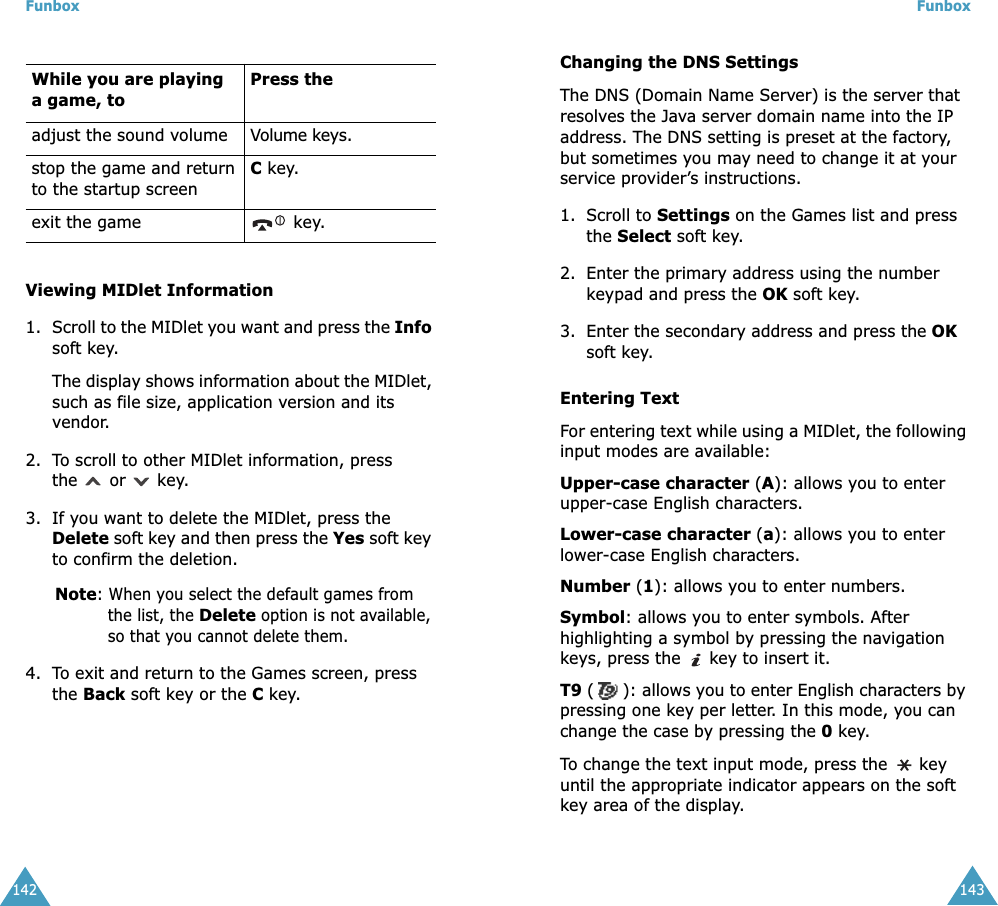
Funbox142Viewing MIDlet Information1. Scroll to the MIDlet you want and press the Info soft key. The display shows information about the MIDlet, such as file size, application version and its vendor.2. To scroll to other MIDlet information, press the   or   key.3. If you want to delete the MIDlet, press the Delete soft key and then press the Yes soft key to confirm the deletion.Note: When you select the default games from the list, the Delete option is not available, so that you cannot delete them.4. To exit and return to the Games screen, press the Back soft key or the C key.While you are playing a game, toPress theadjust the sound volume Volume keys.stop the game and return to the startup screenC key.exit the game  key.Funbox143Changing the DNS SettingsThe DNS (Domain Name Server) is the server that resolves the Java server domain name into the IP address. The DNS setting is preset at the factory, but sometimes you may need to change it at your service provider’s instructions.1. Scroll to Settings on the Games list and press the Select soft key.2. Enter the primary address using the number keypad and press the OK soft key.3. Enter the secondary address and press the OK soft key.Entering TextFor entering text while using a MIDlet, the following input modes are available:Upper-case character (A): allows you to enter upper-case English characters.Lower-case character (a): allows you to enter lower-case English characters.Number (1): allows you to enter numbers.Symbol: allows you to enter symbols. After highlighting a symbol by pressing the navigation keys, press the   key to insert it.T9 (): allows you to enter English characters by pressing one key per letter. In this mode, you can change the case by pressing the 0 key.To change the text input mode, press the   key until the appropriate indicator appears on the soft key area of the display.
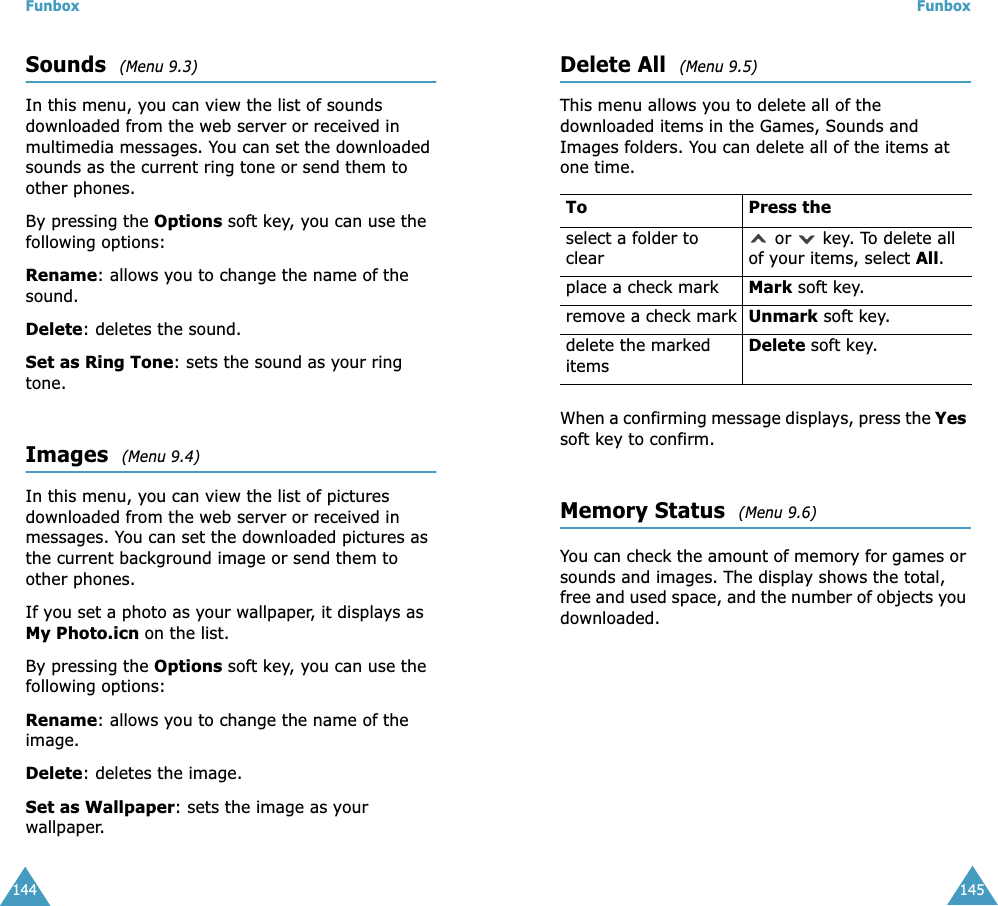
Funbox144Sounds  (Menu 9.3)In this menu, you can view the list of sounds downloaded from the web server or received in multimedia messages. You can set the downloaded sounds as the current ring tone or send them to other phones. By pressing the Options soft key, you can use the following options: Rename: allows you to change the name of the sound.Delete: deletes the sound.Set as Ring Tone: sets the sound as your ring tone.Images  (Menu 9.4)In this menu, you can view the list of pictures downloaded from the web server or received in messages. You can set the downloaded pictures as the current background image or send them to other phones.If you set a photo as your wallpaper, it displays as My Photo.icn on the list.By pressing the Options soft key, you can use the following options: Rename: allows you to change the name of the image.Delete: deletes the image.Set as Wallpaper: sets the image as your wallpaper. Funbox145Delete All  (Menu 9.5)This menu allows you to delete all of the downloaded items in the Games, Sounds and Images folders. You can delete all of the items at one time.When a confirming message displays, press the Yes soft key to confirm.Memory Status  (Menu 9.6)You can check the amount of memory for games or sounds and images. The display shows the total, free and used space, and the number of objects you downloaded.To Press theselect a folder to clear or   key. To delete all of your items, select All.place a check mark Mark soft key.remove a check mark Unmark soft key.delete the marked itemsDelete soft key.
146Solving ProblemsBefore contacting the after-sales service, perform the following simple checks. They may save you the time and expense of an unnecessary service call.When you switch your phone on, the following messages may appear:Insert SIM Card• Check that the SIM card is correctly installed.Phone Locked Enter Password•The automatic locking function has been enabled. You must enter the phone’s password before you can use the phone.Enter PIN•You are using your phone for the first time. You must enter the Personal Identification Number (PIN) supplied with the SIM card.•The PIN Check feature is enabled. Every time the phone is switched on, the PIN has to be entered. To disable this feature, use the PIN Check menu (Menu 6.6.1).Enter PUK•The PIN code was entered incorrectly three times in succession and the phone is now blocked. Enter the PUK supplied by your network operator.Solving Problems147“No service,” “Network failure” or “Not done” displays•The network connection was lost. You may be in a weak signal area (in a tunnel or surrounded by buildings). Move and try again.•You are trying to access an option for which you have not taken out a subscription with your service provider. Contact the service provider for further details.You have entered a number but it was not dialled•Have you pressed the   key?• Are you accessing the right cellular network?•You may have set an outgoing call barring option.Your correspondent cannot reach you•Is your phone switched on (the   key pressed for more than one second)?• Are you accessing the right cellular network?•You may have set an incoming call barring option.Your correspondent cannot hear you speaking•Have you switched off the microphone?• Are you holding the phone close enough to your mouth? The microphone is located at the bottom of the phone.
Solving Problems148The phone starts beeping and “**Warning** Low Battery” flashes on the display•Your battery is insufficiently charged. Recharge the battery.The audio quality of the call is poor•Check the signal strength indicator on the display ( ); the number of bars indicates the signal strength from strong ( ) to weak ( ).•Try moving the phone slightly or moving closer to a window if you are in a building.No number is dialled when you recall a Phonebook entry•Check that the number has been stored correctly, by using the Phonebook Search feature.•Re-store the number, if necessary.If the above guidelines do not help you to solve the problem, take note of:• the model and serial numbers of your phone• your warranty details• a clear description of the problemThen contact your local dealer or Samsung after-sales service.149Access CodesThere are several access codes that are used by your phone and its SIM card. These codes help you protect the phone against unauthorised use.When requested for any of the codes explained below, enter the appropriate code (displayed as asterisks) and press the OK soft key. If you make a mistake, press the C key one or more times until the incorrect digit is cleared and then continue entering the correct code.The access codes, except for the PUK and PUK2 codes, can be changed using the Security menu (Menu 6.6). See page 108 for further details.Important!  Avoid using access codes resembling emergency numbers, such as 112, so that you do not accidentally dial an emergency number.Phone PasswordThe Phone Lock feature uses the phone password to protect your phone against unauthorised use. The phone password is supplied with the phone and is preset to “00000000” at the factory.To Seeactivate/deactivate the Phone Lock featurepage 109(Menu 6.6.3).change the phone passwordpage 109(Menu 6.6.4).
Access Codes150PINThe Personal Identification Number or PIN (4 to 8 digits) protects your SIM card against unauthorised use. It is usually supplied with the SIM card.If you enter an incorrect PIN three times in succession, the code is disabled and cannot be used until you re-enable it by entering the PUK (see below).PUKThe 8-digit PUK (PIN Unblocking Key) is required to change a disabled PIN. The PUK may be supplied with the SIM card. If not, or you have lost it, contact your service provider.To re-enable your PIN:1. Enter the PUK and press the OK soft key.2. Enter a new PIN of your choice and press the OK soft key.3. When the Confirm New PIN message displays, enter the same code again and press the OK soft key.If you enter an incorrect PUK ten times in succession, the SIM card becomes invalid. Contact your service provider for a new card.To Seeactivate/deactivate the PIN Check featurepage 108 (Menu 6.6.1).change the PIN page 109 (Menu 6.6.2).Access Codes151PIN2The PIN2 (4 to 8 digits), supplied with some SIM cards, is required to access specific functions, such as setting the maximum cost of a call. These functions are available if supported by your SIM card.If you enter an incorrect PIN2 three times in succession, the code is disabled and you cannot access the functions until you re-enable it by entering the PUK2.To change the PIN2, see page 110 (Menu 6.6.7).PUK2The 8-digit PUK2 (PIN Unblocking Key 2), supplied with some SIM cards, is required to change a disabled PIN2. If you lose the code, contact your service provider.To re-enable your PIN2:1. Enter the PUK2 and press the OK soft key.2. Enter a new PIN2 of your choice and press the OK soft key.3. When the Confirm PIN2 message displays, enter the same code again and press the OK soft key.If you enter an incorrect PUK2 ten times in succession, you will not be able to access the functions requiring the PIN2. Contact your service provider for a new card.
Access Codes152Barring PasswordA 4-digit barring password is required when you use the Call Barring function. You can obtain the password from your service provider when you subscribe to this function. You can change this password in the Call Barring menu (Menu 8.2). See page 128 for further details.153Health and Safety InformationExposure to Radio-Frequency Energy(SAR Information)This phone meets European Union (EU) requirements concerning exposure to radio waves.Your mobile phone is a radio transmitter and receiver. It is designed and manufactured so as not to exceed the limits for exposure to radio-frequency (RF) energy, as recommended by the EU Council. These limits are part of comprehensive guidelines and establish permitted levels of RF energy for the general population. The guidelines were developed by independent scientific organisations through the periodic and thorough evaluation of scientific studies. The limits include a substantial safety margin designed to ensure the safety of all persons, regardless of age and health.The exposure standard for mobile phones employs a unit of measurement known as SAR (Specific Absorption Rate). The SAR limit recommended by the EU Council is 2.0W/kg.** The SAR limit for mobile phones used by the public is 2.0 watts/kilogram (W/kg) averaged over ten grams of body tissue. The limit incorporates a substantial margin of safety to give additional protection for the public and to account for any variations in measurements. The SAR values may vary depending on national reporting requirements and the network band.
154Health and Safety InformationExposure to Radio Frequency (RF) SignalsYour wireless phone is a radio transmitter and receiver.It is designed and manufactured not to exceed theemission limits for exposure to radio frequency (RF)energy set by the Federal Communications Commission(FCC) of the U.S. Government. These limits are part ofcomprehensive guidelines and establish permittedlevels of RF energy for the general population. Theguidelines are based on the safety standards that weredeveloped by independent scientific organizationsthrough periodic and through evaluation of scientificstudies.The standards include a substantial safety margindesigned to assure the safety of all persons, regardlessof age and health.The exposure standard for wireless phones employs aunit of measurement known as Specific AbsorptionRate (SAR). The SAR limit set by the FCC is 1.6W/kg *.*In the U.S. and Canada, the SAR limit for mobile phones used by the public is 1.6 watts/kg (W/kg)averaged over one gram of tissue. The standard incorporates a substantial margin of safety to giveadditional protection for the public and to account for any variations in measurements.
155HHeeaalltthh  aanndd  SSaaffeettyy  IInnffoorrmmaattiioonn156HHeeaalltthh  aanndd  SSaaffeettyy  IInnffoorrmmaattiioonnSAR tests are conducted using standard operatingpositions specified by the FCC with the phonetransmitting at its highest certified power level in alltested frequency bands. Although the SAR isdetermined at the highest certified power level, theactual SAR level of the phone while operating can bewell below the maximum value. This is because thephone is designed to operate at multiple powerlevels so as to use only the power required to reachthe network. In general, the closer you are to awireless base station antenna, the lower the poweroutput of the phone. Before a new model phone is available for sale tothe public, it must be tested and certified to the FCCthat it does not exceed the limit established by thegovernment-adopted requirement for safe exposure.The tests are performed in positions and locations(e.g., at the ear and worn on the body) as required bythe FCC for each model. While there may bedifferences between the SAR levels of variousphones and at various positions, they all meet thegovernment requirement.The FCC has granted an Equipment Authorization forthis model phone with all reported SAR levelsevaluated as in compliance with the FCC RF exposureguidelines. SAR information on this model phone is onfile with the FCC and can be found under the DisplayGrant section of http://www.fcc.gov/oet/fccid aftersearching on FCC ID printed in the label on the phone.FCC certification information for this model phone is            attached separation paper.For Body OperationThis device was tested for typical body-worn operationswith the back of the phone kept 1.5 cm from the body. To maintain compliance with FCC RF exposure requirements,use only belt-clips, holsters or similar accessories that maintain a 1.5 cm separation distance between the  user'sbody and the back of the phone,including the antenna.  The use of belt-clips, holsters, and similar accessories  should not contain metallic components. The use of accessoriesthat do not satisfy these requirements may not comply withFor more Information concerning exposure to radiofrequency signals, see the following websites:Federal Communications Commission (FCC) http://www.fcc.gov/rfsafetyCellular Telecommunications Industry Association (CTIA):http://www.wow-com.comU.S.Food and Drug Administration (FDA) http://www.fda.gov/cdrh/consumerWorld Health Organization (WHO) http://www.who.int/peh-emf/enFCC RF exposure requirements, and should be avoided.
Health and Safety Information157SAR tests are conducted using standard operating positions with the phone transmitting at its highest certified power level in all tested frequency bands. Although the SAR is determined at the highest certified power level, the actual SAR level of the phone while operating can be well below the maximum value. This is because the phone is designed to operate at multiple power levels so as to use only the power required to reach the network. In general, the closer you are to a base station, the lower the power output of the phone. Before a new model phone is available for sale to the public, compliance with the European R&TTE Directive must be shown. This directive includes as one of its essential requirements the protection of the health and safety of the user and any other person.Precautions When Using Batteries•Never use any charger or battery that is damaged in any way.• Use the battery only for its intended purpose.• If you use the phone near the network’s base station, it uses less power; talk and standby time are greatly affected by the signal strength on the cellular network and the parameters set by the network operator.• Battery charging time depends on the remaining battery charge and the type of battery and charger used. The battery can be charged and discharged hundreds of times, but it will gradually wear out. When the operation time (talk time and standby time) is noticeably shorter than normal, it is time to buy a new battery.Health and Safety Information158• If left unused, a fully charged battery will discharge itself over time.• Use only Samsung-approved batteries and recharge your battery only with Samsung-approved chargers. When a charger is not in use, disconnect it from the power source. Do not leave the battery connected to a charger for more than a week, since overcharging may shorten its life.• Extreme temperatures will affect the charging capacity of your battery: it may require cooling or warming first.• Do not leave the battery in hot or cold places, such as in a car in summer or winter conditions, as you will reduce the capacity and lifetime of the battery. Always try to keep the battery at room temperature. A phone with a hot or cold battery may temporarily not work, even when the battery is fully charged. Li-ion batteries are particularly affected by temperatures below 0 °C (32 °F).•Do not short-circuit the battery. Accidental short- circuiting can occur when a metallic object (coin, clip or pen) causes a direct connection between the + and – terminals of the battery (metal strips on the battery), for example when you carry a spare battery in a pocket or bag. Short-circuiting the terminals may damage the battery or the object causing the short-circuiting.•Dispose of used batteries in accordance with local regulations. Always recycle. Do not dispose of batteries in a fire.
Health and Safety Information159Road SafetyYour wireless phone gives you the powerful ability to communicate by voice, almost anywhere, anytime. But an important responsibility accompanies the benefits of wireless phones, one that every user must uphold.When driving a car, driving is your first responsibility. When using your wireless phone behind the wheel of a car, practice good common sense and remember the following tips:1. Get to know your wireless phone and its features, such as speed dial and redial. If available, these features help you to place your call without taking your attention off the road.2. When available, use a hands-free device. If possible, add an extra layer of convenience and safety to your wireless phone with one of the many hands-free accessories available.3. Position your wireless phone within easy reach. Be able to access your wireless phone without removing your eyes from the road. If you get an incoming call at an inconvenient time, let your voice mail answer it for you.4. Let the person you are speaking with know you are driving; if necessary, suspend the call in heavy traffic or hazardous weather conditions. Rain, sleet, snow, ice and even heavy traffic can be hazardous.5. Do not take notes or look up phone numbers while driving. Jotting down a To Do list or flipping through your Phonebook takes your attention away from your primary responsibility-driving safely.Health and Safety Information1606. Dial sensibly and assess the traffic; if possible, place calls when you are not moving or before pulling into traffic. Try to plan calls when your car will be stationary. If you need to make a call while moving, dial only a few numbers, check the road and your mirrors, then continue.7. Do not engage in stressful or emotional conversations that may be distracting. Make the people with whom you are talking aware that you are driving and suspend conversations that have the potential to divert your attention from the road.8. Use your wireless phone to call for help. Dial an emergency number in case of fire, traffic accident or medical emergencies. Remember, it is a free call on your wireless phone!9. Use your wireless phone to help others in emergencies. If you see a car accident, crime in progress or other serious emergency where lives are in danger, call an emergency number, as you would want others to do for you.10. If you see a broken-down vehicle posing no serious hazard, a broken traffic signal, a minor traffic accident where no one appears injured, or a vehicle you know to be stolen, call roadside assistance or any other special non-emergency wireless number.
Health and Safety Information161Operating EnvironmentRemember to follow any special regulations in force in any area and always switch off your phone whenever it is forbidden to use it, or when it may cause interference or danger.When connecting the phone or any accessory to another device, read its user’s guide for detailed safety instructions. Do not connect incompatible products.As with other mobile radio transmitting equipment, users are advised that for the satisfactory operation of the equipment and for the safety of personnel, it is recommended that the equipment should only be used in the normal operating position (held to your ear with the antenna pointing over your shoulder).Electronic DevicesMost modern electronic equipment is shielded from radio frequency (RF) signals. However, certain electronic equipment may not be shielded against the RF signals from your wireless phone. Consult the manufacturer to discuss alternatives.PacemakersPacemaker manufacturers recommend that a minimum distance of 15 cm (6 inches) be maintained between a wireless phone and a pacemaker to avoid potential interference with the pacemaker. These recommendations are consistent with the independent research and recommendations of Wireless Technology Research.Health and Safety Information162Persons with pacemakers:• Should always keep the phone more than 15 cm (6 inches) from their pacemaker when the phone is switched on• Should not carry the phone in a breast pocket• Should use the ear opposite the pacemaker to minimise potential interferenceIf you have any reason to suspect that interference is taking place, switch your phone off immediately.Hearing AidsSome digital wireless phones may interfere with some hearing aids. In the event of such interference, you may wish to consult your hearing aid manufacturer to discuss alternatives.Other Medical DevicesIf you use any other personal medical devices, consult the manufacturer of your device to determine if it is adequately shielded from external RF energy. Your physician may be able to assist you in obtaining this information. Switch your phone off in health care facilities when any regulations posted in these areas instruct you to do so. Hospitals or health care facilities may be using equipment that could be sensitive to external RF energy.VehiclesRF signals may affect improperly installed or inadequately shielded electronic systems in motor vehicles. Check with the manufacturer or its representative regarding your vehicle.You should also consult the manufacturer of any equipment that has been added to your vehicle.
Health and Safety Information163Posted FacilitiesSwitch off your phone in any facility where posted notices require you to do so.Potentially Explosive EnvironmentsSwitch your phone off when in any area with a potentially explosive atmosphere and obey all signs and instructions. Sparks in such areas could cause an explosion or fire resulting in bodily injury or even death.Users are advised to switch the phone off while at a refuelling point (service station). Users are reminded of the need to observe restrictions on the use of radio equipment in fuel depots (fuel storage and distribution areas), chemical plants or where blasting operations are in progress.Areas with a potentially explosive atmosphere are often but not always clearly marked. They include below deck on boats, chemical transfer or storage facilities, vehicles using liquefied petroleum gas, such as propane or butane, areas where the air contains chemicals or particles, such as grain, dust or metal powders, and any other area where you would normally be advised to turn off your vehicle engine.Health and Safety Information164Emergency CallsThis phone, like any wireless phone, operates using radio signals, wireless and landline networks as well as user-programmed functions, which cannot guarantee connection in all conditions. Therefore, you should never rely solely on any wireless phone for essential communications (medical emergencies, for example).Remember, to make or receive any calls the phone must be switched on and in a service area with adequate signal strength. Emergency calls may not be possible on all wireless phone networks or when certain network services and/or phone features are in use. Check with local service providers.To make an emergency call, proceed as follows.1. If the phone is not on, switch it on.2. Key in the emergency number for your present location (for example, 112 or any other official emergency number). Emergency numbers vary by location.3. Press the   key.If certain features are in use (call barring, for example), you may first need to deactivate those features before you can make an emergency call. Consult this document and your local cellular service provider.When making an emergency call, remember to give all the necessary information as accurately as possible. Remember that your phone may be the only means of communication at the scene of an accident; do not cut off the call until given permission to do so.
Health and Safety Information165Other Important Safety Information•Only qualified personnel should service the phone or install the phone in a vehicle. Faulty installation or service may be dangerous and may invalidate any warranty applicable to the device.• Check regularly that all wireless phone equipment in your vehicle is mounted and operating properly.•Do not store or carry flammable liquids, gases or explosive materials in the same compartment as the phone, its parts or accessories.•For vehicles equipped with an air bag, remember that an air bag inflates with great force. Do not place objects, including both installed or portable wireless equipment in the area over the air bag or in the air bag deployment area. If wireless equipment is improperly installed and the air bag inflates, serious injury could result.•Switch your phone off before boarding an aircraft. The use of wireless phones in aircraft may be dangerous to the operation of the aircraft, and is illegal.•Failure to observe these instructions may lead to the suspension or denial of telephone services to the offender, or legal action, or both.Health and Safety Information166Care and MaintenanceYour phone is a product of superior design and craftsmanship and should be treated with care. The suggestions below will help you fulfill any warranty obligations and allow you to enjoy this product for many years. •Keep the phone and all its parts and accessories out of the reach of small children.•Keep the phone dry. Precipitation, humidity and liquids contain minerals that corrode electronic circuits.• Do not use the phone with a wet hand. Doing so may cause an electric shock to you or damage to the phone. • Do not use or store the phone in dusty, dirty areas, as its moving parts may be damaged.• Do not store the phone in hot areas. High temperatures can shorten the life of electronic devices, damage batteries, and warp or melt certain plastics.• Do not store the phone in cold areas. When the phone warms up to its normal operating temperature, moisture can form inside the phone, which may damage the phone’s electronic circuit boards.• Do not drop, knock or shake the phone. Rough handling can break internal circuit boards.• Do not use harsh chemicals, cleaning solvents or strong detergents to clean the phone. Wipe it with a soft cloth slightly dampened in a mild soap-and-water solution.
Health and Safety Information167•Do not paint the phone. Paint can clog the device’s moving parts and prevent proper operation.•Do not put the phone in or on heating devices, such as a microwave oven, a stove or a radiator. The phone may explode when overheated.• Use only the supplied or an approved replacement antenna. Unauthorised antennas or modified accessories may damage the phone and violate regulations governing radio devices.•If the phone, battery, charger or any accessory is not working properly, take it to your nearest qualified service facility. The personnel there will assist you, and if necessary, arrange for service.168GlossaryTo help you understand the main technical terms and abbreviations used in this booklet and take full advantage of the features of your mobile phone, here are a few definitions:Active FolderAbility to answer a call simply by opening the phone.Call BarringAbility to restrict outgoing and incoming calls.Call DivertingAbility to reroute calls to another number.Call HoldingAbility to put one call on standby while answering or making another call; you can then switch between the two calls, as required.Call WaitingInforms you that you have an incoming call when you are engaged on another call.Caller Line Identification Services (Caller ID)Services allowing subscribers to view or block the telephone numbers of callers.
Glossary169EMS (Enhanced Message Service)An adaptation of the Short Message Service (SMS) that allows you to send and receive ring tones and service provider’s logo, as well as combinations of simple media to and from EMS-compliant handsets. Because EMS is based on SMS, it can use SMS centres the same way that SMS does. EMS works on all Global System for Mobile communications (GSM) networks. EMS senders can use text, melodies, pictures, sounds, and animations to enhance the expressive power of messages that are limited by the display constraints of mobile devices.GPRS (General Packet Radio Service)New non-voice value-added service that allows information to be sent and received across a mobile telephone network. GPRS provides continuous connection to the Internet for mobile phone and computer users. It is based on the Global System for Mobile Communication (GSM) circuit-switched cellular phone connections and the Short Message Service (SMS).GSM (Global System for Mobile Communication)International standard for cellular communication, guaranteeing compatibility between the various network operators. GSM covers most European countries and many other parts of the world.Glossary170JavaProgramming language generating applications that can run on all hardware platforms, whether small, medium or large, without modification. It has been promoted for and geared heavily to the Web, both for public Web sites and Intranets. When a Java program runs from a Web page, it is called a Java applet. When it is run on a mobile phone or pager, it is called a MIDlet.MMS (Multimedia Message Service)A message service for the mobile environment, standardized by the WAP Forum and the 3rd Generation Partnership Program (3GPP). For phone users, MMS is similar to Short Message Service (SMS)-it provides automatic, immediate delivery of user-created content from phone to phone. The message addressing used is primarily phone numbers, thus the traffic goes from phone to phone. MMS also provides support for e-mail addressing, so that messages can be sent by e-mail. In addition to the text content of SMS, MMS messages can contain still images, voice or audio clips, and also video clips and presentation information.Multi-party CallingAbility to establish a conference call involving up to five additional parties.Phone PasswordSecurity code used to unlock the phone when you have selected the option to lock it automatically each time it switches on.
Glossary171PIN (Personal Identification Number)Security code that protects the phone against unauthorised use. The PIN is supplied by the service provider with the SIM card. It may be a four to eight-digit number and can be changed, as required.PUK (PIN Unblocking Key)Security code used to unlock the phone when an incorrect PIN has been entered three times in succession. The eight-digit number is supplied by the service provider with the SIM card.RoamingUse of your phone when you are outside your home area (when travelling for example).SDN (Service Dialling Numbers)Telephone numbers supplied by your network provider and giving access to special services, such as voice mail, directory inquiries, customer support and emergency services.SIM (Subscriber Identification Module)Card containing a chip with all the information required to operate the phone (network and memory information, as well as the subscriber’s personal data). The SIM card fits into a small slot on the back of the phone and is protected by the battery.Glossary172SMS (Short Message Service)Network service sending and receiving messages to and from another subscriber without having to speak to the correspondent. The message created or received can be displayed, received, edited or sent.Soft KeysTwo keys marked  and  on the phone, the purpose of which:•varies according to the function that you are currently using.•is indicated on the bottom line of the display just above the corresponding key.Tri BandAbility to handle any of the following types of network; GSM 900, GSM 1800, combined GSM 900/ 1800 and GSM 1900 MHz bands, for greater call success and wider roaming.Your phone automatically searches for the last network used. If, for any reason, this network is unavailable, your phone will attempt to register with a different network. Voice MailComputerised answering service that automatically answers your calls when you are not available, plays a greeting (optionally in your own voice) and records a message.
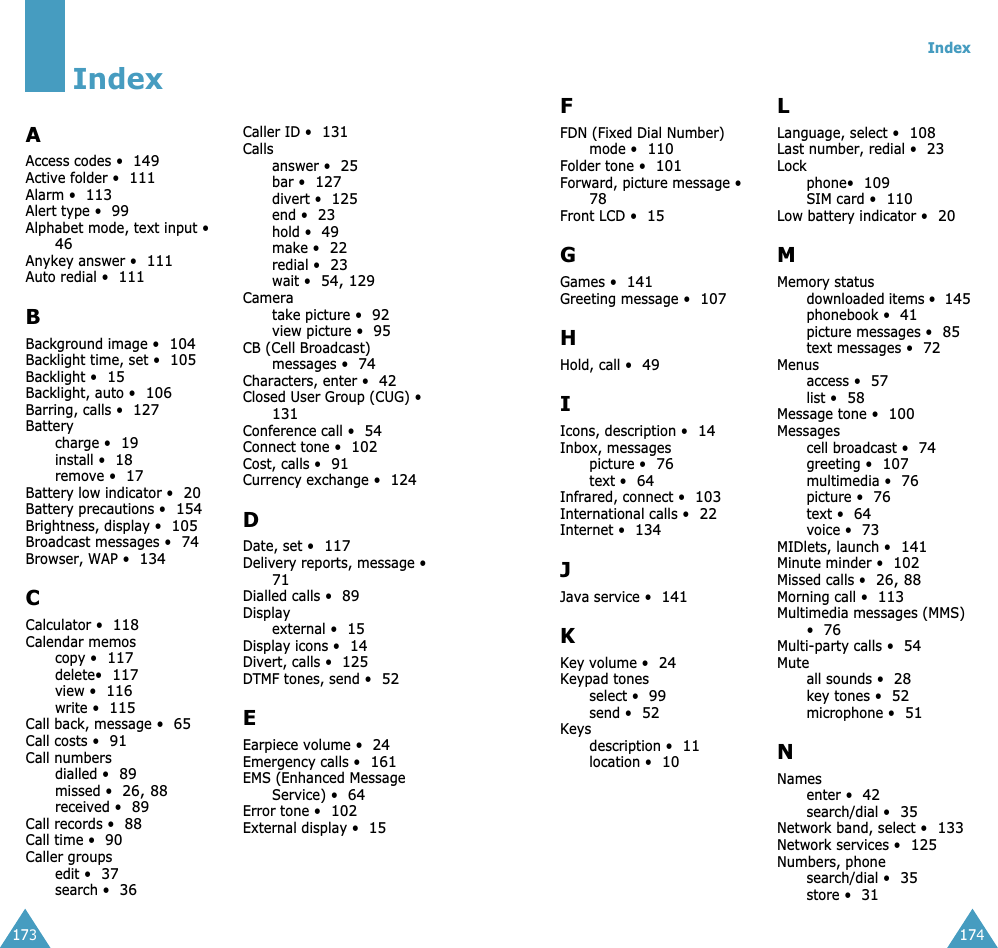
 173 Index A Access codes • 149 Active folder • 111 Alarm • 113 Alert type • 99 Alphabet mode, text input • 46 Anykey answer • 111 Auto redial • 111 B Background image • 104 Backlight time, set • 105 Backlight • 15 Backlight, auto • 106 Barring, calls • 127 Batterycharge • 19 install • 18 remove • 17 Battery low indicator • 20 Battery precautions • 154 Brightness, display • 105 Broadcast messages • 74 Browser, WAP • 134 C Calculator • 118 Calendar memoscopy • 117 delete• 117 view • 116 write • 115 Call back, message • 65 Call costs • 91 Call numbersdialled • 89 missed • 26, 88 received • 89 Call records • 88 Call time • 90 Caller groupsedit • 37 search • 36 Caller ID • 131 Callsanswer • 25 bar • 127 divert • 125 end • 23 hold • 49 make • 22 redial • 23 wait • 54, 129 Cameratake picture • 92 view picture • 95 CB (Cell Broadcast) messages • 74 Characters, enter • 42 Closed User Group (CUG) • 131 Conference call • 54 Connect tone • 102 Cost, calls • 91 Currency exchange • 124 D Date, set • 117 Delivery reports, message • 71 Dialled calls • 89 Displayexternal • 15 Display icons • 14 Divert, calls • 125 DTMF tones, send • 52 E Earpiece volume • 24 Emergency calls • 161 EMS (Enhanced Message Service) • 64 Error tone • 102 External display • 15 Index 174 F FDN (Fixed Dial Number) mode • 110 Folder tone • 101 Forward, picture message • 78 Front LCD • 15 G Games • 141 Greeting message • 107 H Hold, call • 49 I Icons, description • 14 Inbox, messagespicture • 76 text • 64 Infrared, connect • 103 International calls • 22 Internet • 134 J Java service • 141 K Key volume • 24 Keypad tonesselect • 99 send • 52 Keysdescription • 11 location • 10 L Language, select • 108 Last number, redial • 23 Lockphone• 109 SIM card • 110 Low battery indicator • 20 M Memory statusdownloaded items • 145 phonebook • 41 picture messages • 85 text messages • 72 Menusaccess • 57 list • 58 Message tone • 100 Messagescell broadcast • 74 greeting • 107 multimedia • 76 picture • 76 text • 64 voice • 73MIDlets, launch •141Minute minder •102Missed calls •26, 88Morning call •113Multimedia messages (MMS) •76Multi-party calls •54Muteall sounds •28key tones •52microphone •51NNamesenter •42search/dial •35Network band, select •133Network services •125Numbers, phonesearch/dial •35store •31
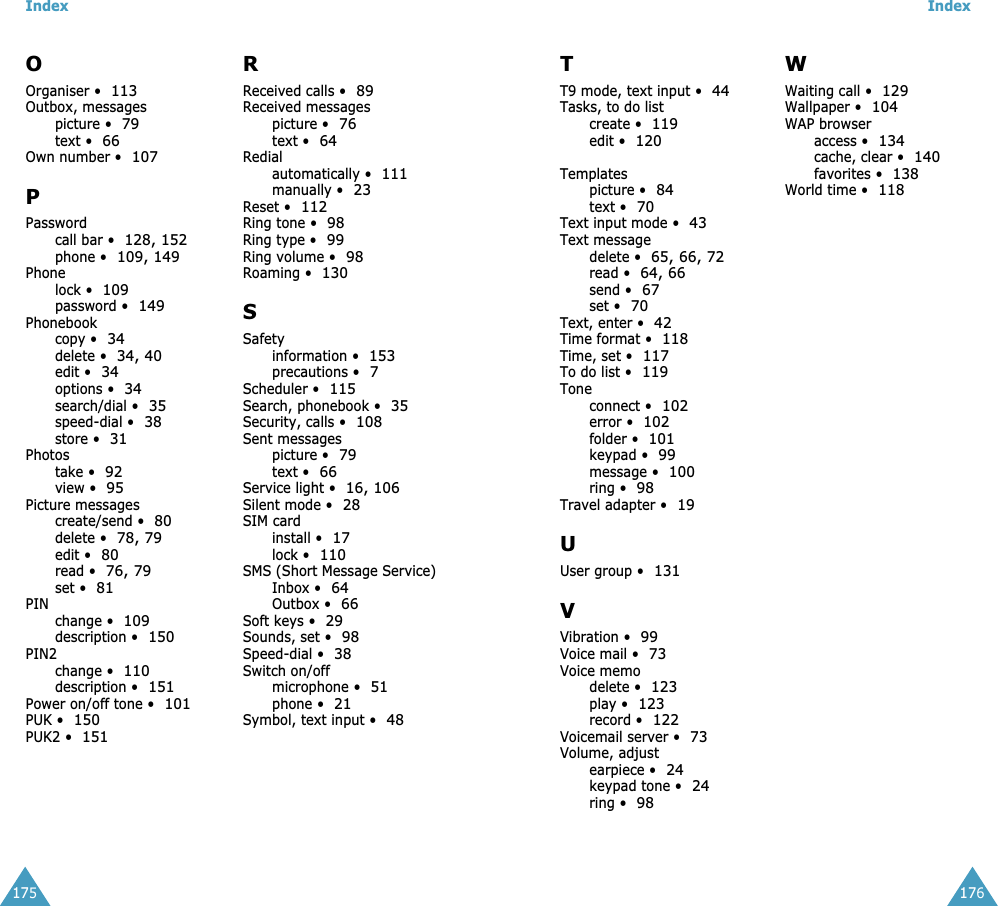
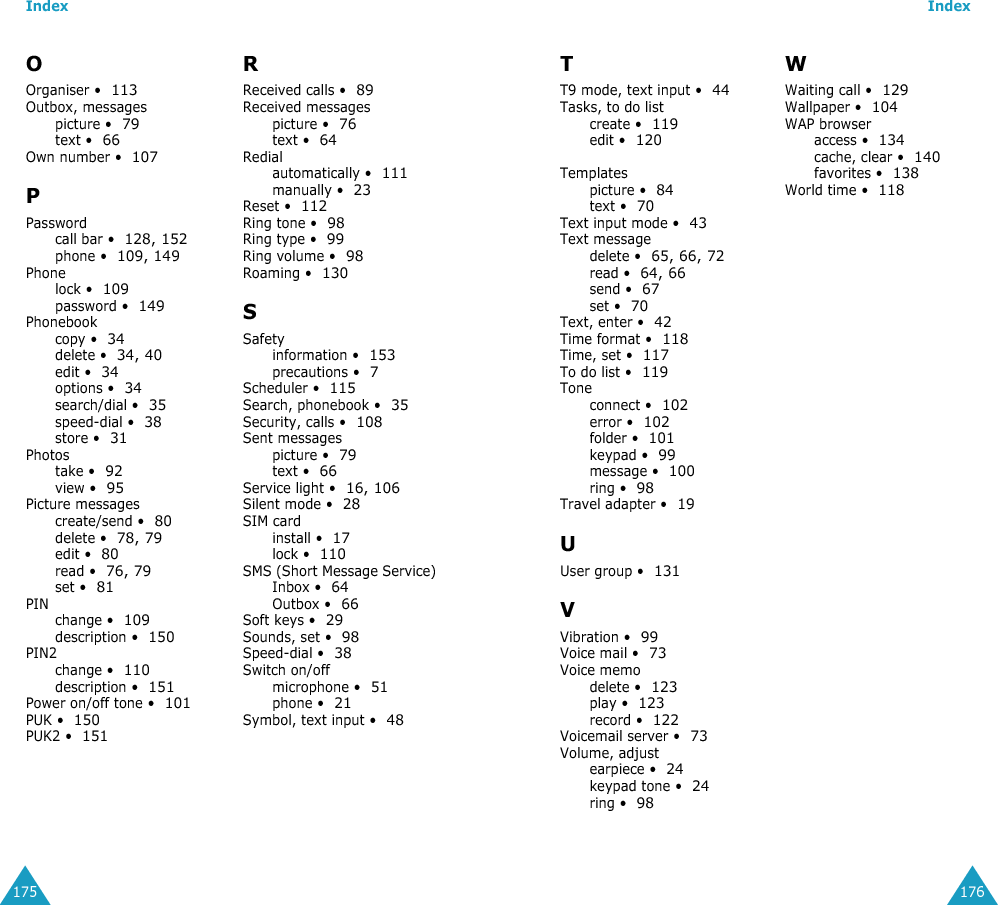
Index175OOrganiser •113Outbox, messagespicture •79text •66Own number •107PPasswordcall bar •128, 152phone •109, 149Phonelock •109password •149Phonebookcopy •34delete •34, 40edit •34options •34search/dial •35speed-dial •38store •31Photostake •92view •95Picture messagescreate/send •80delete •78, 79edit •80read •76, 79set •81PINchange •109description •150PIN2change •110description •151Power on/off tone •101PUK •150PUK2 •151RReceived calls •89Received messagespicture •76text •64Redialautomatically •111manually •23Reset •112Ring tone •98Ring type •99Ring volume •98Roaming •130SSafetyinformation •153precautions •7Scheduler •115Search, phonebook •35Security, calls •108Sent messagespicture •79text •66Service light •16, 106Silent mode •28SIM cardinstall •17lock •110SMS (Short Message Service)Inbox •64Outbox •66Soft keys •29Sounds, set •98Speed-dial •38Switch on/offmicrophone •51phone •21Symbol, text input •48Index176TT9 mode, text input •44Tasks, to do listcreate •119edit •120Templatespicture •84text •70Text input mode •43Text messagedelete •65, 66, 72read •64, 66send •67set •70Text, enter •42Time format •118Time, set •117To do list •119Toneconnect •102error •102folder •101keypad •99message •100ring •98Travel adapter •19UUser group •131VVibration •99Voice mail •73Voice memodelete •123play •123record •122Voicemail server •73Volume, adjustearpiece •24keypad tone •24ring •98WWaiting call •129Wallpaper •104WAP browseraccess •134cache, clear •140favorites •138World time •118
177
178Access the Menu Functions➀Press the Menu soft key.➁Scroll with the   and   keys through the list of the menus until you reach the menu you want.➂Press the Select soft key.➃Scroll with the   and   keys through the list of the options until the one you want is selected.➄Press the Select soft key.Each of the two soft keys ( and  ) perform the function indicated by the text above it, on the bottom line of the display.Switch On/Off Press and hold the   key.Make a Call ➀Enter the number.➁Press the   key.End a Call Briefly press the   key.View Missed Calls Immediately After Missing Them➀Open the phone and press the View soft key.➁Scroll with the   and  keys through the missed calls.➂To return the call, press the   key.Tri Band SGH-P500 GPRS TelephoneQuick Reference Card
179Answer a CallOpen the phoneorPress the   key.Adjust the VolumePress the   or   key on the left side of the phone.Choose the Alert Type➀Select the Alert Type menu (Menu 5.3).➁Select an option: •Light Only•Melody•Vibration•Vibra+Melody➂Press the Select soft key.Store Numbers in Phonebook➀Enter the number and press the Save soft key.➁Select an icon.➂Press the Select soft key.➃Select a memory.➄Press the Select soft key.Store Numbers in Phonebook(continued)➅Enter the name.➆Press the OK soft key.➇If necessary, change the location number.➈Press the OK soft key.➉Press the   key to return to Idle Mode.Search for a Number in Phonebook➀Press the Name soft key.➁Select the Search option.➂Enter the first few letters of the name.➃To scroll through the names, press the   or  key.➄Press the View soft key.➅To scroll through the numbers, press the   or    key.➆Press the   key to dial.Declaration of Conformity (R&TTE) For the following product :TRI BAND GSM TELEPHONE (Product Name)SGH-P500(Model Number)Manufactured at :Samsung Electronics,   94-1  Imsu-Dong,  Gumi City,  Kyung Buk,  Korea,  730-350(factory name, address*)to which this declaration relates, is in conformity with the following standards and/or other normative documents.Safety : EN 60950:2000EMC : EN 301 489-1:2000  EN 301 489-7:2000SAR : EN 50360:2001  OET Bulletin 65, Supplement  C:2001Network : EN 301 511 V7.0.1We hereby declare the [all essential radio test suites have been carried out and that] the above named product is in conformity to all the essential requirements of Directive 1999/5/EC.The conformity assessment procedure referred to in Article 10 and detailed in Annex[IV] of Directive 1999/5/EC has been followed with the involvement of the following Notified Body(ies):BABT, Claremont House, 34 Molesey Road, Walton-on-Thames, KT12 4RQ, UK Identification mark: 168The technical documentation kept at:Samsung Electronics Euro QA Lab.which will be made available upon request.(Representative in the EU)Samsung Electronics Euro QA Lab.Blackbushe Business Park, Saxony Way, Yateley, Hampshire, GU46 6GG, UK2003.  3. 26 In-Seop Lee / S. Manager(place and date of issue)                         (name and signature of authorised person)* This is not the address of the Samsung Service Centre. For the address or the phone number of the Samsung Service Centre, see the warranty card or contact the retailer where you purchased your phone.
Index180
181Access the Menu Functions➀Press the Menu soft key.➁Scroll with the Up and Down keys through the list of the menus until you reach the menu you want.➂Press the Select soft key.➃Scroll with the Up and Down keys through the list of the options until the one you want is selected.➄Press the Select soft key.Each of the two soft keys ( and  ) perform the function indicated by the text above it, on the bottom line of the display.Switch On/Off Press and hold the   key.Make a Call ➀Key in the number.➁Press the   key.End a Call Briefly press the   key.View Missed Calls Immediately After Missing Them➀Open the phone and press the View soft key.➁Scroll with the Up and Down keys through the missed calls.➂To return the call, press the  key.Tri Band SGH-E715 GPRS TelephoneQuick Reference Card
182Answer a CallOpen the phoneorPress the   key.Adjust the VolumePress the   or   key on the left side of the phone.Choose the Alert Type➀Select the Alert Type menu (Menu 5.3).➁Select an option: •Light Only•Melody•Vibration•Vibra+Melody➂Press the Select soft key.Store Numbers in Phonebook➀Enter the number and press the Save soft key.➁Select an icon.➂Press the Select soft key.➃Select a memory.➄Press the Select soft key.Store Numbers in Phonebook(continued)➅Enter the name.➆Press the OK soft key.➇If necessary, change the location number.➈Press the OK soft key.➉Press the   key to return to Idle Mode.Search for a Number in Phonebook➀Press the Name soft key.➁Select the Search option.➂Enter the first few letters of the name.➃To scroll through the names, press the Up or Down key.➄Press the View soft key.➅To scroll through the numbers, press the Up or Down key.➆Press the   key to dial.Declaration of Conformity (R&TTE) For the following product :TRI BAND GSM TELEPHONE (Product Name)SGH-E715(Model Number)Manufactured at :Samsung Electronics,   94-1  Imsu-Dong,  Gumi City,  Kyung Buk,  Korea,  730-350(factory name, address*)to which this declaration relates, is in conformity with the following standards and/or other normative documents.Safety : EN 60950:2000EMC : EN 301 489-1:2000  EN 301 489-7:2000SAR : EN 50360:2001  OET Bulletin 65, Supplement  C:2001Network : EN 301 511 V7.0.1We hereby declare the [all essential radio test suites have been carried out and that] the above named product is in conformity to all the essential requirements of Directive 1999/5/EC.The conformity assessment procedure referred to in Article 10 and detailed in Annex[IV] of Directive 1999/5/EC has been followed with the involvement of the following Notified Body(ies):BABT, Claremont House, 34 Molesey Road, Walton-on-Thames, KT12 4RQ, UK Identification mark: 168The technical documentation kept at:Samsung Electronics Euro QA Lab.which will be made available upon request.(Representative in the EU)Samsung Electronics Euro QA Lab.Blackbushe Business Park, Saxony Way, Yateley, Hampshire, GU46 6GG, UK2003.  3. 26 In-Seop Lee / S. Manager(place and date of issue)                         (name and signature of authorised person)* This is not the address of the Samsung Service Centre. For the address or the phone number of the Samsung Service Centre, see the warranty card or contact the retailer where you purchased your phone.

Navigation menu