Samsung Electronics Co STHA225 Dual-Mode Cellular Phone (AMPS/TDMA) User Manual Users Manual
Samsung Electronics Co Ltd Dual-Mode Cellular Phone (AMPS/TDMA) Users Manual
Users Manual
Printed in Korea
Code No. : GH68-xxxxxA
English. 6/2001. Rev. 1.0
ELECTRONICS
World Wide Web
http://www.samsungmobile.com
TDMA MOBILE
TELEPHONE
STH-A225
2
C
ABC
4
GHI
13
DEF
5
JKL
6
MNO
7
PQRS
8
TUV
0
9
WXYZ
July. 27. 2001
* Some contents in this manual may differ from your phone depending on
the software of the phone or your service provider.
Please, be sure to read this
manual before using your phone.
And keep the manual after
reading it and use any time you
have a question.

ii
FCC RF EXPOSURE INFORMATION
In August 1996 the Federal Communications Commission (FCC) of
the United States with its action in Report and Order FCC 96-326
adopted an updated safety standard for human exposure to radio
frequency electromagnetic energy emitted by FCC regulated
transmitters. Those guidelines are consistent with the safety
standard previously set by both U.S. and international standards
bodies. The design of this phone complies with the FCC
guidelines and these international standards.
Use only the supplied or an approved antenna. Unauthorized
antennas, modifications, or attachments could impair call quality,
damage the phone, or result in violation of FCC regulations.
Do not use the phone with a damaged antenna. If a damaged
antenna comes into contact with the skin, a minor burn may
result. Please contact your local dealer for replacement antenna.
Body-worn Operation
This device was tested for typical body-worn operations using
the optional belt-clip/holster placed 1.0 inch (2.5cm) from the
body. To comply with FCC RF exposure requirements, a minimum
separation distance of 1.0 inch (2.5cm) must be maintained
between the user’s body and the phone, including the antenna,
whether extended or retracted. The use of third-party belt-clips/
holsters with no metallic components that provide the minimum
separation distance of 1.0 inch (2.5cm) can be used to satisfy
FCC RF exposure requirements. The use of non-tested
accessories or other body-worn operations may not comply with
FCC RF exposure requirements and should be avoided. Contact
your local dealer for optional accessory items.
Vehicle Mounted External Antenna (optional, if available.)
A minimum separation distance of 7.9 inches (20cm) must be
maintained Between a person and the vehicle mounted external
antenna to satisfy FCC RF exposure requirements.
For more information about RF exposure, please visit the FCC
website at www.fcc.gov
i
SAR Information & FCC ID Labeling
THIS MODEL PHONE MEETS THE GOVERNMENT’S REQUIREMENTS
FOR EXPOSURE TO RADIO WAVES.
Your wireless phone is a radio transmitter and receiver. It is designed
and manufactured not to exceed the emission limits for exposure to
radiofrequency (RF) energy set by the Federal Communications
Commission of the U.S. Government. These limits are part of
comprehensive guidelines and establish permitted levels of RF
energy for the general population. The guidelines are based on
standards that were developed by independent scientific
organizations through periodic and thorough evaluation of scientific
studies. The standards include a substantial safety margin designed
to assure the safety of all persons, regardless of age and health.
The exposure standard for wireless mobile phones employs a unit of
measurement know as the Specific Absorption Rate, or SAR. The
SAR limit set by the FCC is 1.6W/kg.* Tests for SAR are conducted
using standard operating positions specified by the FCC with the
phone transmitting at its highest certified power level in all tested
frequency bands. Although the SAR is determined at the highest
certified power level, the actual SAR level of the phone while
operating can be well below the maximum value. This is because the
phone is designed to operate at multiple power levels so as to use
only the power required to reach the network. In general, the closer
you are to a wireless base station antenna, the lower the power
output.
Before a phone model is available for sale to the public, it must be
tested and certified to the FCC that it does not exceed the limit
established by the government-adopted requirement for safe
exposure. The tests are performed in positions and locations (e.g., at
the ear and worn on the body) as required by the FCC for each
model. The highest SAR value for this model phone when tested for
use at the ear is XXXXX and when worn on the body, as described in
this user guide, is XXXXX . (Body-worn measurements differ among
phone models, depending upon available accessories and FCC
requirements). While there may be differences between the SAR
levels of various phones and at various positions, they all meet the
government requirement for safe exposure.

iii 1
Contents
Unpacking. . . . . . . . . . . . . . . . . . . . . . . . . . . . . . . . . . 7
Your Phone
Phone Layout. . . . . . . . . . . . . . . . . . . . . . . . . . . . . . . . . 8
Display. . . . . . . . . . . . . . . . . . . . . . . . . . . . . . . . . . . . . 11
Service Light . . . . . . . . . . . . . . . . . . . . . . . . . . . . . . . . 13
Getting Started
Installing the Battery . . . . . . . . . . . . . . . . . . . . . . . . . . 14
Charging a Battery. . . . . . . . . . . . . . . . . . . . . . . . . . . . 16
Switching the Phone On/Off . . . . . . . . . . . . . . . . . . . . . 18
Locking Your Phone . . . . . . . . . . . . . . . . . . . . . . . . . . . 19
General Functions
Making a Call. . . . . . . . . . . . . . . . . . . . . . . . . . . . . . . . 20
Adjusting the Volume . . . . . . . . . . . . . . . . . . . . . . . . . . 22
Answering a Call . . . . . . . . . . . . . . . . . . . . . . . . . . . . . 22
Viewing Missed Calls. . . . . . . . . . . . . . . . . . . . . . . . . . 23
Quick-switching to Silent Mode . . . . . . . . . . . . . . . . . . . . 25
Selecting Functions and Options
Using the Soft Keys . . . . . . . . . . . . . . . . . . . . . . . . . . . . . . 26
Selecting Functions and Options . . . . . . . . . . . . . . . . . . . 27
Example: Setting the Display Language . . . . . . . . . . . . 28
Phonebook
Storing a Phone Number with a Name . . . . . . . . . . . . . 30
Speed Dialing by Memory Location . . . . . . . . . . . . . . . 32
Phonebook Options . . . . . . . . . . . . . . . . . . . . . . . . . . . 33
Searching for and Dialing
a Number in the Phonebook. . . . . . . . . . . . . . . . . 35
Name Options . . . . . . . . . . . . . . . . . . . . . . . . . . . . . . . 36
The FCC has granted an Equipment Authorization for this model
phone with all reported SAR levels evaluated as in compliance
with the FCC RF emission guidelines. SAR information on this
model phone is on file with the FCC and can be found under the
Display Grant section of http://www.fcc.gov/oet/fccid after
searching on FCC ID XXX XXXX.
Additional information on Specific Absorption Rates (SAR) can
be found on the Cellular Telecommunications Industry
Association (CTIA) web-site at http://www.wow-com (see note).
* In the United States and Canada, the SAR limit for mobile
phones used by the public is 1.6 watts/kg (W/kg) averaged over
one gram of tissue. The standard incorporates a substantial
margin of safety to give additional protection for the public and
to account for any variations in measurements.
Note: The URL http://phonefacts.net may be used in place
of http://www.wow-com for direct access to SAR
information.

In-Call Options
Putting a Call on Hold. . . . . . . . . . . . . . . . . . . . . . . . . . 39
Switching the Microphone Off (Mute). . . . . . . . . . . . . . 40
Muting/Sending Key Tones. . . . . . . . . . . . . . . . . . . . . . 40
Searching for a Number in the Phonebook . . . . . . . . . . 41
Making a Calling Card Call . . . . . . . . . . . . . . . . . . . . . . 41
Using the SMS Service . . . . . . . . . . . . . . . . . . . . . . . . 42
Answering a Second Call . . . . . . . . . . . . . . . . . . . . . . . 42
Making a Conference Call . . . . . . . . . . . . . . . . . . . . . . 43
Using the Menus
Accessing a Menu Function by scrolling . . . . . . . . . . . 44
Accessing a Menu Function by Using its Shortcut . . . . 45
List of Menu Functions. . . . . . . . . . . . . . . . . . . . . . . . . 46
Call Records
Missed Calls (Menu 1.1). . . . . . . . . . . . . . . . . . . . . . . . 50
Incoming Calls (Menu 1.2) . . . . . . . . . . . . . . . . . . . . . . 50
Outgoing Calls (Menu 1.3). . . . . . . . . . . . . . . . . . . . . . . 51
Call Time (Menu 1.4). . . . . . . . . . . . . . . . . . . . . . . . . . . 51
Messages
Voice Mail (Menu 2.1). . . . . . . . . . . . . . . . . . . . . . . . . . 52
Read Messages (Menu 2.2) . . . . . . . . . . . . . . . . . . . . . 53
Write Messages (Menu 2.3) . . . . . . . . . . . . . . . . . . . . . 55
Preset Message List (Menu 2.4) . . . . . . . . . . . . . . . . . . 56
Setup (Menu 2.5) . . . . . . . . . . . . . . . . . . . . . . . . . . . . . 56
Sound Settings
Ring Volume (Menu 3.1) . . . . . . . . . . . . . . . . . . . . . . . . 58
Ring Tone (Menu 3.2) . . . . . . . . . . . . . . . . . . . . . . . . . . 58
Alert Type (Menu 3.3) . . . . . . . . . . . . . . . . . . . . . . . . . . 59
Tone Length (Menu 3.4) . . . . . . . . . . . . . . . . . . . . . . . . 59
Message Tone (Menu 3.5) . . . . . . . . . . . . . . . . . . . . . . 60
Error Tone (Menu 3.6). . . . . . . . . . . . . . . . . . . . . . . . . . 60
Minute Minder (Menu 3.7) . . . . . . . . . . . . . . . . . . . . . . 61
Connect Tone (Menu 3.8) . . . . . . . . . . . . . . . . . . . . . . . 61
Melody Composer . . . . . . . . . . . . . . . . . . . . . . . . . . . . 61
3
2
Phone Settings
Greeting Message (Menu 4.1). . . . . . . . . . . . . . . . . . . . 64
LCD Control (Menu 4.2). . . . . . . . . . . . . . . . . . . . . . . . . 64
Service Light (Menu 4.3). . . . . . . . . . . . . . . . . . . . . . . . 65
Auto Redial (Menu 4.4). . . . . . . . . . . . . . . . . . . . . . . . . 66
Answer Mode (Menu 4.5). . . . . . . . . . . . . . . . . . . . . . . 66
Slide Menu (Menu 4.6) . . . . . . . . . . . . . . . . . . . . . . . . . 67
Language (Menu 4.7) . . . . . . . . . . . . . . . . . . . . . . . . . . 67
Reset Settings (Menu 4.8). . . . . . . . . . . . . . . . . . . . . . . 67
Calling Card (Menu 4.10). . . . . . . . . . . . . . . . . . . . . . . . 68
ShortCut (Menu 4.9) . . . . . . . . . . . . . . . . . . . . . . . . . . . 70
Organizer
Calendar (Menu 5.1). . . . . . . . . . . . . . . . . . . . . . . . . . . 71
To Do List (Menu 5.2) . . . . . . . . . . . . . . . . . . . . . . . . . . 73
Time & Date (Menu 5.3) . . . . . . . . . . . . . . . . . . . . . . . . 75
Alarm (Menu 5.4) . . . . . . . . . . . . . . . . . . . . . . . . . . . . . 77
Calculator (Menu 5.5). . . . . . . . . . . . . . . . . . . . . . . . . . 78
Security
Change Lock code (Menu 6.1) . . . . . . . . . . . . . . . . . . . 79
Change Security code (Menu 6.2). . . . . . . . . . . . . . . . . 79
Call Restriction (Menu 6.3) . . . . . . . . . . . . . . . . . . . . . . 80
SOS Call List (Menu 6.4) . . . . . . . . . . . . . . . . . . . . . . . . 81
Network Services
Call Diverting (Menu 7.1) . . . . . . . . . . . . . . . . . . . . . . . 82
Call Waiting (Menu 7.2) . . . . . . . . . . . . . . . . . . . . . . . . 83
Network Selection (Menu 7.3) . . . . . . . . . . . . . . . . . . . 83
Voice Privacy (Menu 7.4) . . . . . . . . . . . . . . . . . . . . . . . 84
NAM Selection(Menu 7.5) . . . . . . . . . . . . . . . . . . . . . . 84
Set Service Code(Menu 7.6) . . . . . . . . . . . . . . . . . . . . . 86
Games . . . . . . . . . . . . . . . . . . . . . . . . . . . . . . . . . . . . 87
Voice Memo Pad
Record . . . . . . . . . . . . . . . . . . . . . . . . . . . . . . . . . . . . 88
Replay & Delete. . . . . . . . . . . . . . . . . . . . . . . . . . . . . . 89
Edit Title . . . . . . . . . . . . . . . . . . . . . . . . . . . . . . . . . . . 91

5
4
Important Safety Precautions
Read these simple guidelines. Failure to comply with
them may be dangerous or illegal.
For more detailed safety information, see Safety
Information on page 96.
Road safety comes first
Do not use a hand-held phone while driving; park the
vehicle first. Remember that in some countries, it is
illegal to use a hand-held phone while driving.
Switch off when refueling
Do not use the phone at a refueling point (service
station) or near fuels or chemicals.
Switch off in aircraft
Mobile phones can cause interference. Using them
on aircraft is both illegal and dangerous.
Respect special regulations
Follow any special regulations in force in any area
and always switch off your phone whenever it is
forbidden to use it, or when it may cause interference
or danger (in a hospital for example).
Interference
All mobile phones may be subject to radio
interference, which may affect their performance.
Qualified service
Only qualified service personnel should repair
cellular equipment. Use only approved accessories
and batteries.
Solving Problems. . . . . . . . . . . . . . . . . . . . . . . . . . . 91
Using the Batteries
Precautions When Using Batteries. . . . . . . . . . . . . . . . 94
Safety Information
Road Safety . . . . . . . . . . . . . . . . . . . . . . . . . . . . . . . . . 96
Operating Environment. . . . . . . . . . . . . . . . . . . . . . . . . 96
Care and Maintenance. . . . . . . . . . . . . . . . . . . . . . . . . 98
Emergency Calls . . . . . . . . . . . . . . . . . . . . . . . . . . . . . 99
Glossary. . . . . . . . . . . . . . . . . . . . . . . . . . . . . . . . . . 100
Index . . . . . . . . . . . . . . . . . . . . . . . . . . . . . . . . . . . . 103
Quick Reference Card . . . . . . . . . . . . . . . . . . . . . . 107
FDA Consumer Update. . . . . . . . . . . . . . . . . . . . . . 109
In addition, you can obtain the following accessories for
your phone from your local SAMSUNG dealer:
• Desktop charger
• Hands-free kit
• Standard/Extended battery
• Cigarette lighter adapter
• Earphone
• Leather case
7
6
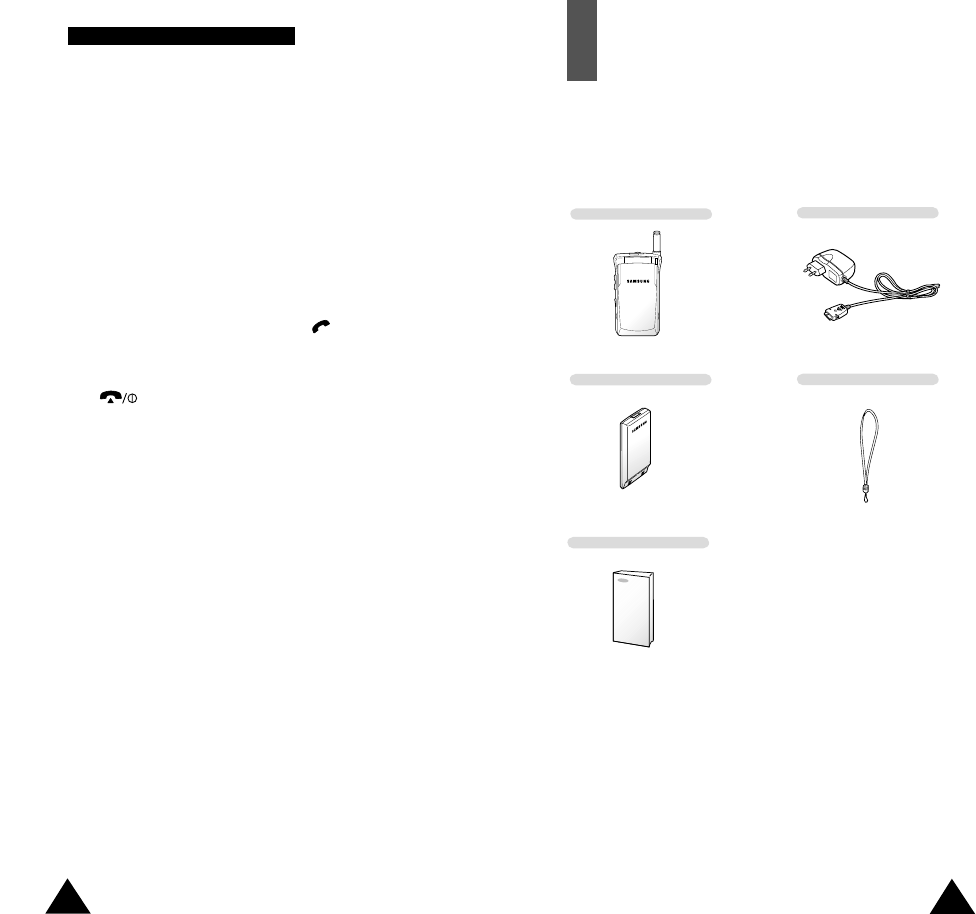
Travel Charger
Handset
Battery Hand Strap
User’s Manual
Use sensibly
Use only in the normal position (held to the ear).
Avoid unnecessary contact with the antenna when the
phone is switched on.
Emergency calls
Ensure the phone is switched on and in service.
Enter the emergency number (100 or other official
emergency number) and press the key. Give your
location. Do not end the call until given permission to
do so. End the call by closing the phone or pressing
the key.
IMPORTANT! Use only SAMSUNG-approved
accessories.
The use of any other power-supplying accessory will
invalidate any approval or warranty applying to the
phone, and may be dangerous.
When you disconnect the power cord of any accessory,
grasp and pull the connector, not the cord.
Unpacking
Your package contains the following items.
IImmppoorrttaanntt SSaaffeettyy PPrreeccaauuttiioonnss
2
C
ABC
4
GHI
13
DEF
5
JKL
6
MNO
7
PQRS
8
TUV
0
9
WXYZ
Key Description
Perform the functions indicated by the text
above them (in the bottom line of the
display).
In the menu facility, scroll through the
menu options and phonebook memory.
When pressed in idle mode, access your
favorite menu options directly (for more
information on shortcuts, see page 68).
In the menu facility, return to the previous
menu level and select the current menu,
respectively.
When entering a name, move the cursor
left and right, respectively.
When pressed in idle mode, the key
enters your favorite menu options directly
(for more information on shortcuts, see
page 70). The key records a voice
memo when held down in idle mode and
the phone conversation during a call.
Deletes characters from the display.
In the menu facility, returns to the
previous menu level.
When held down for more than two
seconds in idle mode, quickly enters or
exits the silent mode.
98
YYoouurr PPhhoonnee
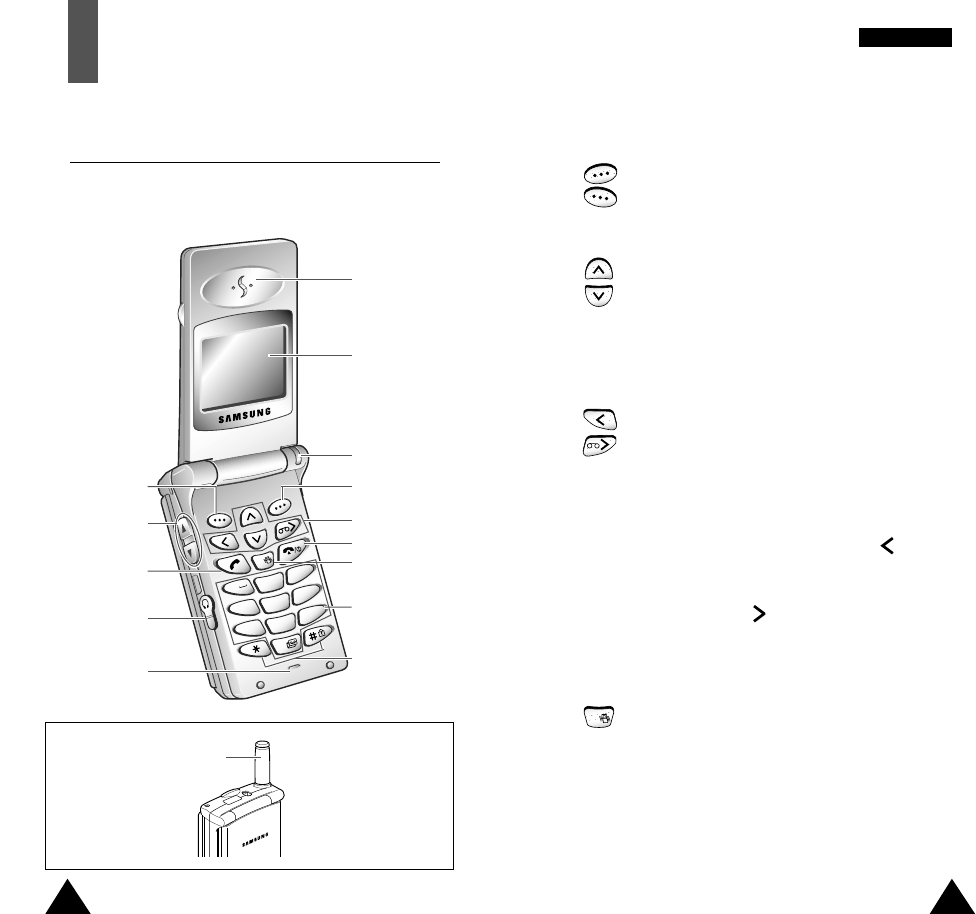
Earpiece
Service light
Soft key (left)
Volume/menu
browse keys Navigation keys
Display
Soft key (right)
Cancel/
correction key
Power on/off key
Alphanumeric
keys
Special function
keys
Dial/menu
confirmation key
Earphone jack
Microphone
Top Antenna
C
(soft keys)
Your Phone
Phone Layout
The following illustrations show the main elements
of your phone.
Display
Display Layout
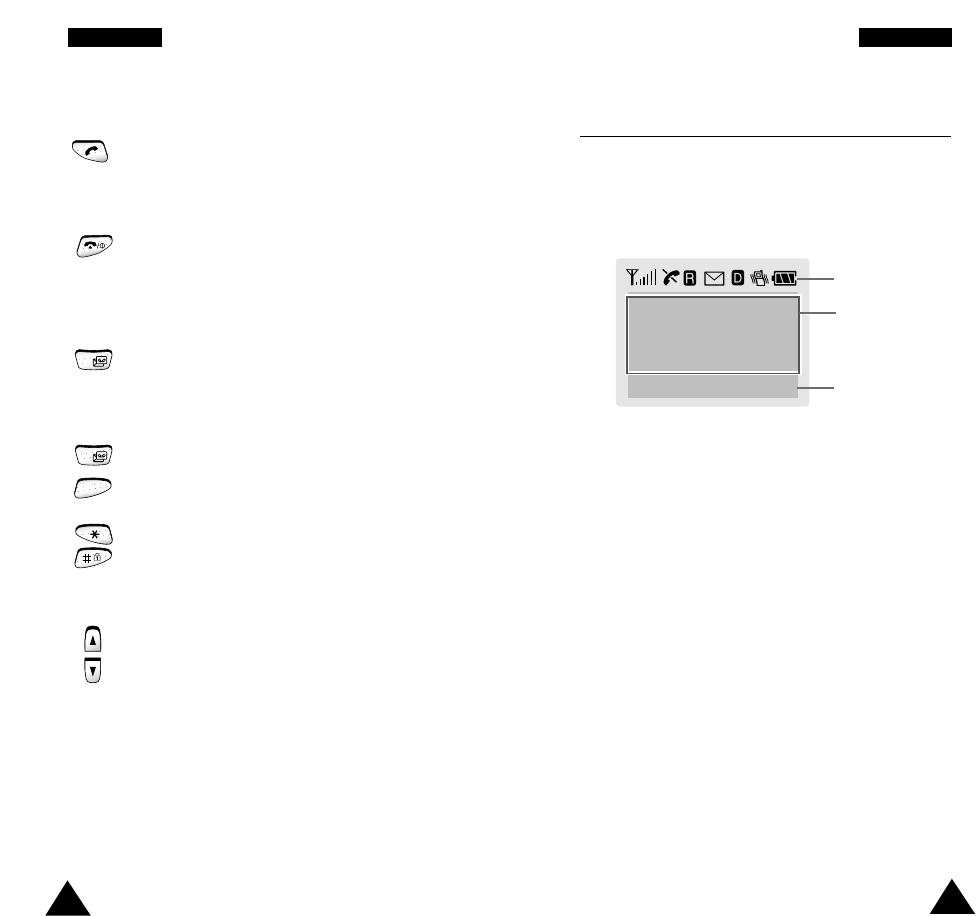
The display comprises three areas.
Area Description
First line Displays various icons (see page 12).
Middle lines Display messages, instructions and
any information that you enter
(number to be dialed, for example).
Last line Shows the functions currently
assigned to the two soft keys.
11
10
YYoouurr PPhhoonneeYYoouurr PPhhoonnee
Key Description
Makes or answers a call.
In idle mode, recalls the last number
dialed.
Ends a call. Also switches the phone on
and off when pressed and held.
In the menu facility, returns to the idle
mode and cancels your input.
When held down for more than two
seconds in idle mode, accesses your voice
mailbox.
Enter numbers, letters and some special
characters.
Enter special dial characters. Also use
these keys for various purposes in
different functions.
(on the side of the phone)
During a call, adjusts the earpiece volume.
In idle mode with the phone open, adjusts
the key volume.
In the menu facility, scrolls through the
menu options and phonebook memory.
0
0
9
WXYZ
~
Icons
Text and
graphic area
Soft key indications
MMeennuu NNaammeess
13
12
YYoouurr PPhhoonnee
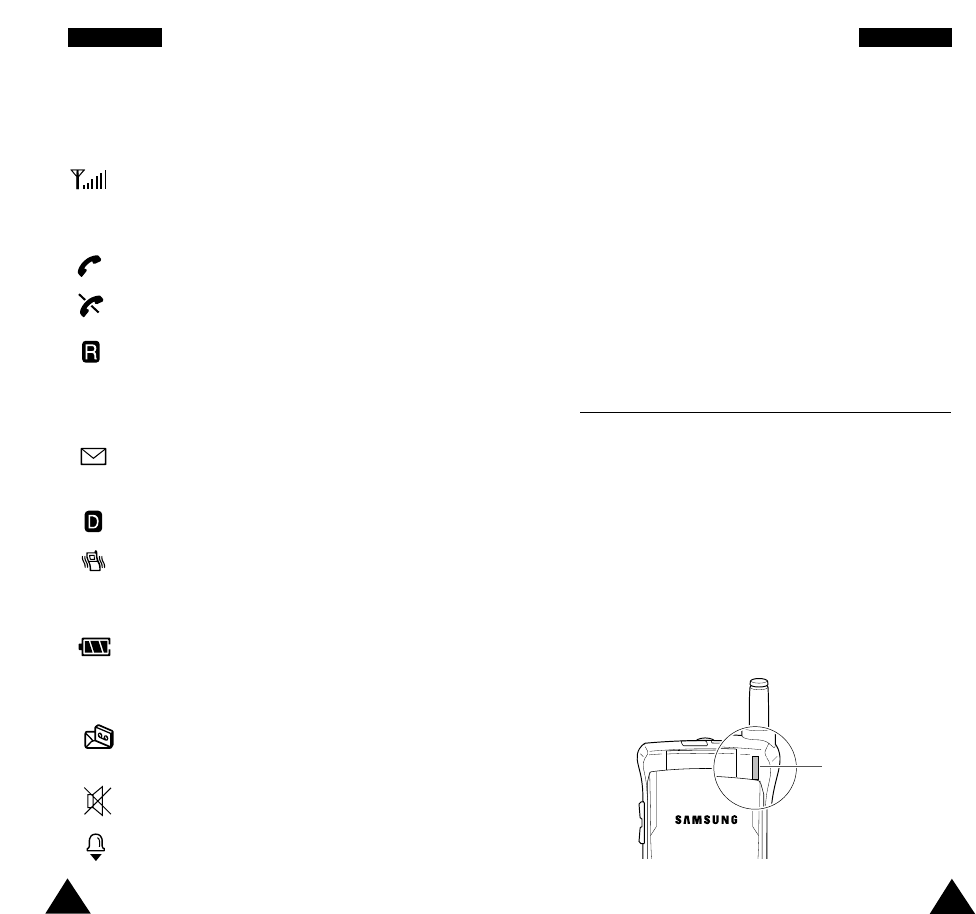
Icons
Icon Description
Shows the received signal strength. The
greater the number of bars, the better the
signal strength.
Appears when a call is in progress.
Appears when you are out of service area.
Appears when you are out of your home
area and have registered with a different
network (when travelling in other cities and
countries, for example).
Appears when a new text message has
been received.
Appears when the phone is in digital mode.
Appears when the silent mode is activated
and when the Alert Type menu option (3.3)
is set to Vibration.
Shows the level of your battery. The more
bars you see, the more power you have
left.
Appears when a new voice mail message
has been received.
Appears when you set the mute mode.
Appears when you set an alarm.
Backlight
The display is illuminated by a backlight. When you
press any key, the backlight illuminates. It turns off if
no key is pressed within a given period of time,
depending on the Backlight option set in the
Phone Settings menu.
To specify the length of time for which the backlight
is active, set the Backlight menu option (4.2.1); see
page 64 for further details.
Service Light
The service light is in the top right-hand corner of the
phone. It flashes to indicate phone status: When the
the phone is ready for use, it flashes in green. When
a call or message comes in, and you are recording a
voice memo, it flashes in red.
To activate or deactivate use of the service light, set
the Service Light menu option (4.3); see page 64 for
further details.
Service light
YYoouurr PPhhoonnee
14 15
GGeettttiinngg SSttaarrtteedd
13
Getting Started
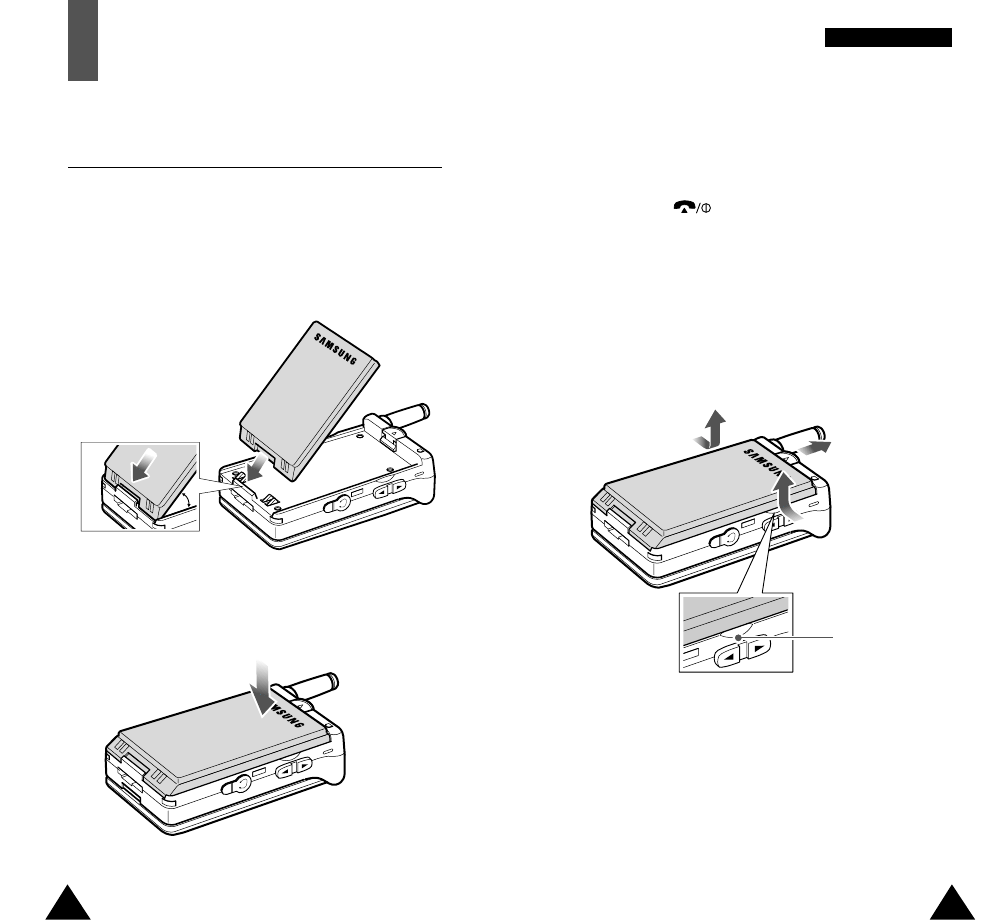
Installing the Battery
To Install the Battery
1. Insert the tabs on the base of the battery into the
notches on the base of the phone, as shown.
30¡
2. Push the battery down until it snaps into place,
To Remove the Battery
1. If necessary, switch off the phone by holding
down the key until the the power off
graphic begins to play.
2. Remove the battery. To do so:
➀Push up and hold the catch above the battery
on the back of the phone
➁Lift the battery away
➀
➁
➁
Use the grooves on
both sides of the phone
when you lift the
battery away.
16 17
GGeettttiinngg SSttaarrtteeddGGeettttiinngg SSttaarrtteedd
Charging a Battery
Your phone is powered by a rechargeable Li-Ion
battery. A travel charger is provided with your phone.
Use only approved batteries and chargers. Ask your
local SAMSUNG dealer for further details.
The phone can be used while the battery is charging.
Note: You must fully charge the battery before using
your phone for the first time. A discharged
battery is fully recharged in approximately
200 minutes.
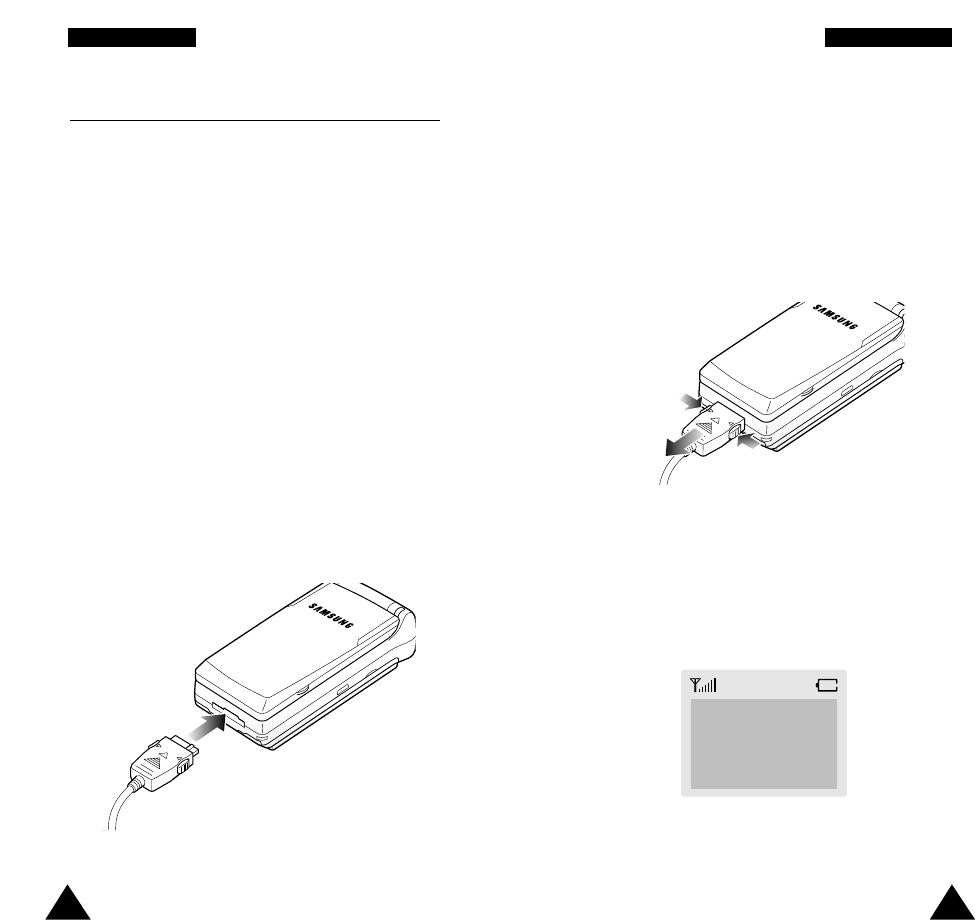
Charging a Battery by a Travel Charger
1. With the battery in position on the phone, connect
the lead from the travel charger to the jack on the
bottom of the phone.
2. Connect the charger to a standard AC wall outlet.
3. When charging is finished (the lamp on the
charger turns green), disconnect the charger from
the power outlet and remove it from the phone by
squeezing the two tabs on the lead (➀) and unplug
the lead(➁).
➀
➀
➁
Low Battery Indicator
When the battery is weak and only a few minutes of
talk time remain, you will hear a warning tone and
the following message will be repeated at regular
intervals on the display:
When the battery becomes too weak for the phone
to operate, it switches off automatically.
**Warning**
Low Battery
18 19
GGeettttiinngg SSttaarrtteeddGGeettttiinngg SSttaarrtteedd
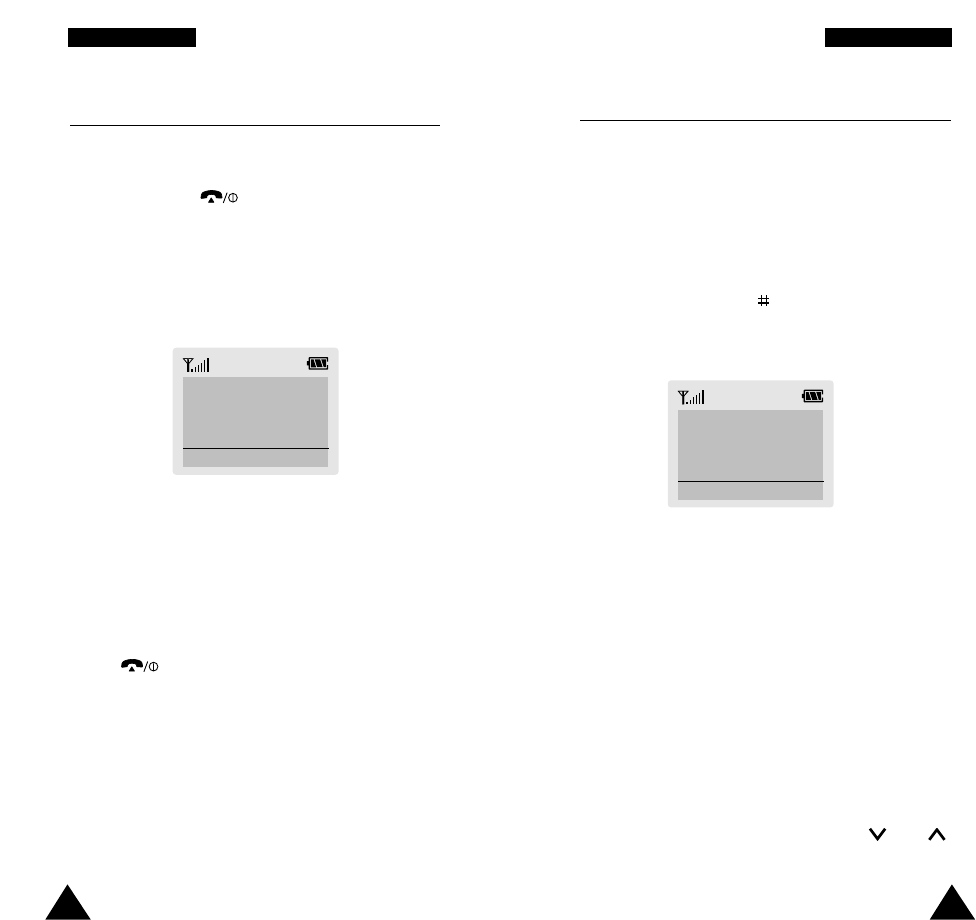
Locking Your Phone
You can lock your phone to protect the phone against
unauthorized use. When the phone is locked, you
cannot operate the phone until you enter the lock
code.
To lock your phone:
Press and hold down the key for more than two
seconds in idle mode. “Phone Locked” appears on
the idle screen.
To unlock the phone:
Press the Unlock soft key and enter the lock code,
then press the OK soft key. Your phone’s lock code is
preset at the factory to 00000000. For further details,
see page 79.
Even when the phone is locked, you can place an
SOS call to one of the emergency numbers stored in
the SOS Call List (6.4). See page 81 for further
details.
To place an SOS call, press the SOS soft key, select
the desired emergency number using the and
key and press the Yes soft key.
Switching the Phone On/Off
1. Open the phone.
2. Hold down the key for more than one
second to switch the phone on.
3. The phone searches for your network and when
it finds it, the idle screen, illustrated below, is
displayed.
Note: The display language is factory set to English.
To change the language, use the Language
menu option (4.7); for further details, refer to
page 67.
4.
When you wish to switch the phone off, hold down
the key for more than two seconds.
<SERVICE PROVIDER>
12:57
Sat 14 Mar
Menu Names
<SERVICE PROVIDER>
12:57
Phone Locked
Unlock SOS

20 21
GGeenneerraall FFuunnccttiioonnss
Ending a Call
When you have finished your call, briefly press and
release the key.
Making a Call from the Phonebook
You can store the names and phone numbers called
regularly in the phone memory, called the phonebook.
You then simply select the required name to recall
the associated number. For further details on the
Phonebook feature, refer to page 30.
Redialing the Last Number
The phone stores the last 10 numbers dialed. To
recall any of these numbers, proceed as follows.
1. If you have typed any characters on the display,
clear the display by holding down the Ckey for
more than one second.
2.
Press the key to display the last number dialed.
3. Use the and keys to scroll through the
numbers until the required number is displayed.
4. To... Then...
Dial the number Press the key.
displayed
Edit the number • Press the Edit soft key.
displayed •
Change the number as
required, referring to
Correcting the Number for
further details (see previous
page).
General Functions
Making a Call
When the idle screen is displayed, key in the area
code and phone number and press the key.
Note:
If you have set the Auto Redial menu option (4.6)
to ON (see page 66) and the person called does
not answer or is already on the phone, the
number is redialed automatically up to ten times.
If the network answers the call (by voice mail
greeting, for example), the phone does not redial.
Correcting the Number
To clear... Then...
The last digit Press the Ckey.
displayed
Any other digit Press the or key until
in the number the cursor is immediately to the
right of the digit to be cleared.
Press the Ckey. You can also
insert a missing digit simply by
pressing the appropriate key.
The whole display Hold down the Ckey for more
than one second.
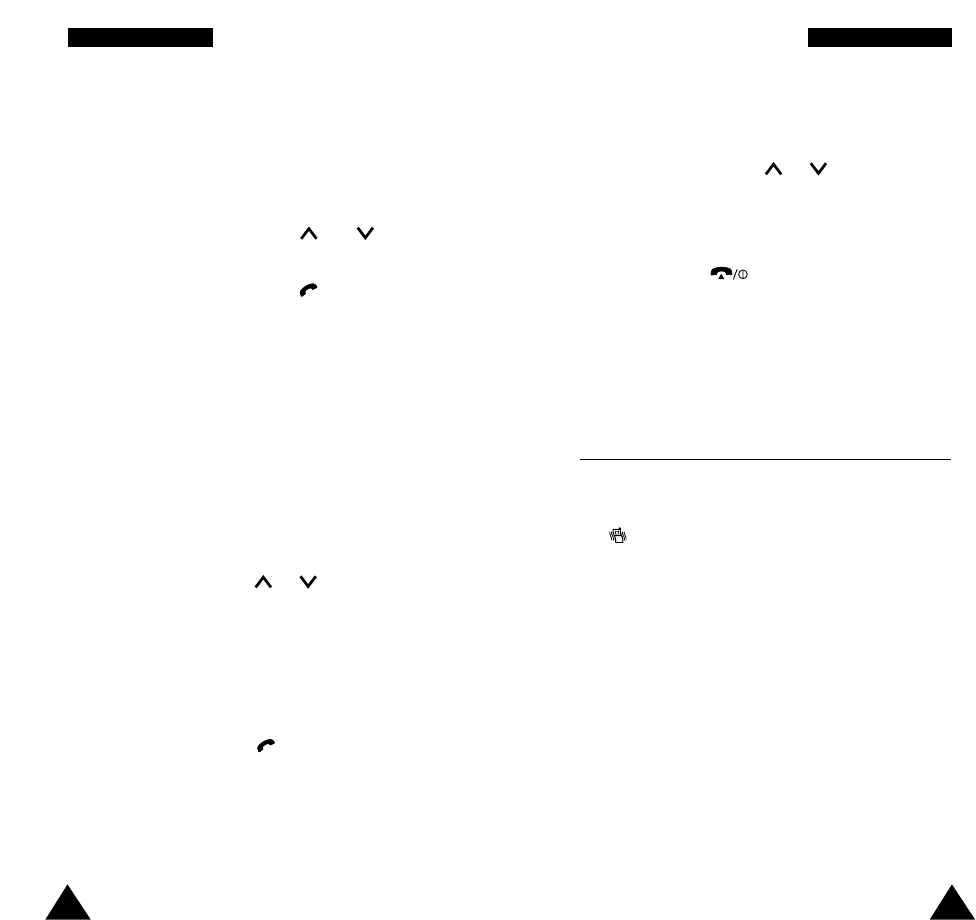
If the caller can be identified, the caller’s phone
number (or name if stored in your phonebook) is
displayed. If the caller cannot be identified, only the
phone animation plays.
1. If necessary, open the phone. Press the key or
the Accept soft key to answer the incoming call.
Note: If the Answer Mode menu option (4.5) is set
to Open Answer, you do not need to press
any key. You can answer the call simply by
opening the phone (see page 66).
2. End the call by closing the phone or pressing the
key.
Note: You can answer a call while using the
phonebook or menu features. The current
operation will be interrupted.
Viewing Missed Calls
If you are unable to answer a call for any reason, you
can find out who was calling you, provided that this
service is available. In this way, you can call the
person back, if necessary.
The number of missed calls is displayed on the idle
screen immediately after the call was missed.
To view the missed call immediately, proceed as
follows.
1. If the phone is closed, open it.
22 23
GGeenneerraall FFuunnccttiioonnssGGeenneerraall FFuunnccttiioonnss
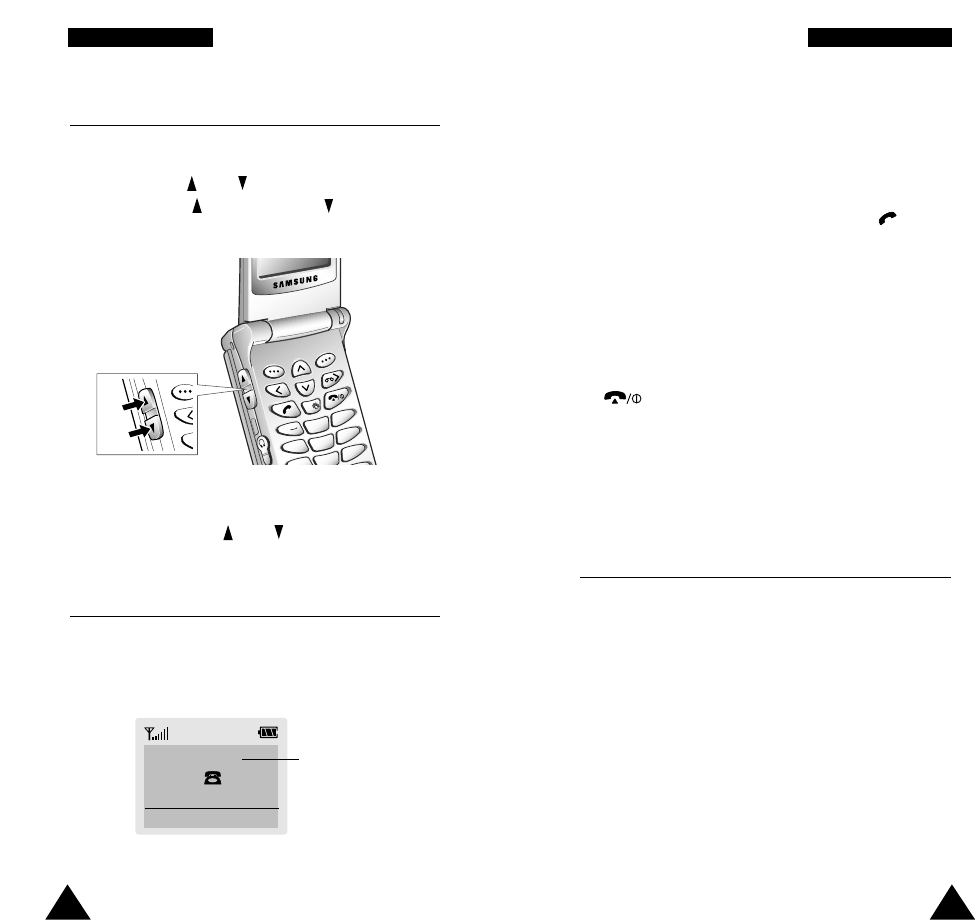
Adjusting the Volume
During a call, if you want to adjust the earpiece
volume, use the and keys on the left side of
the phone. Press to increase and to decrease
the volume.
Answering a Call
When somebody calls you, the phone rings and the
phone animation plays in the middle of the screen.
In idle mode with the phone open, you can adjust the
key volume using the and keys .
2
C
ABC
4
GHI
13
DEF
5
JKL
6
MNO
7
PQRS
8
TUV
9
WXYZ
Caller’s name or
number (if available)
nnnnn
(( ))
Accept
24 25
GGeenneerraall FFuunnccttiioonnssGGeenneerraall FFuunnccttiioonnss
Deleting a Missed Call
1. Press the Options soft key.
2. If necessary, press the or key to highlight
the Delete option.
3. Press the Select soft key.
You can press the key at any time to exit the
Missed Call feature.
Note: You can access the Missed Call feature at
any time by selecting the Missed Calls menu
option (1.1); for further details, see page 50 .
Quick-switching to Silent Mode
You can quickly switch your phone to silent mode
with a touch of a key. Press and hold the Ckey until
the icon and Silent Mode appears in display.
Your phone goes to silent mode immediately.
In silent mode, your phone switches the sound
settings as follows:
alert type (3.3) vibration + light
message tone (3.5) vibration + light
error tone (3.6) off
keypad tone off
Press and hold the Ckey again to exit silent mode.
This feature is convenient when you are in a hurry to
mute the phone sound, such as when in a theater.
2. Press the View soft key.
The number corresponding to the most recent
missed call is displayed, if available.
3. To... Then press the...
Scroll through the and keys.
missed calls
Call the number displayed key.
Edit or delete a missed Options soft key
call number (see next page).
Editing a Missed Call Number
Note: If the caller’s number associated with the
missed call is not available, the Edit option is
not displayed.
1. Press the Options soft key.
2. If necessary, press the or key to highlight
the Edit Number option.
3. Press the Select soft key.
4. Change the number as required.
5. To... Then press the...
Call the number key.
Store the number Save soft key and enter
the name and location
required (for further
details, refer to page 30).
Selecting Functions and Options
To view the various functions/options available and
select the one required, proceed as follows.
1. Press the appropriate soft key.
2. To... Then press the...
Select the: Select soft key or
• Function displayed key.
or
• Option highlighted
View the next function key or key on
or highlight the next the left side of the
option in a list phone.
Move back to the key or key on
previous function or the left side of the
option in a list phone.
Move back up one key, soft key
level in the structure or C key.
Exit the structure key.
without changing
the settings
In some functions, you may be asked for a lock code
or security code. Enter the required code and press
the OK soft key.
Note: When you access a list of options, your phone
highlights the current option. If, however, there
are only two options, such as On/Off or
Enable/Disable, your phone highlights the
option that is not currently active, so that you
can select it directly.
26 27
SSeelleeccttiinngg FFuunnccttiioonnss aanndd OOppttiioonnss
Selecting Functions
and Options
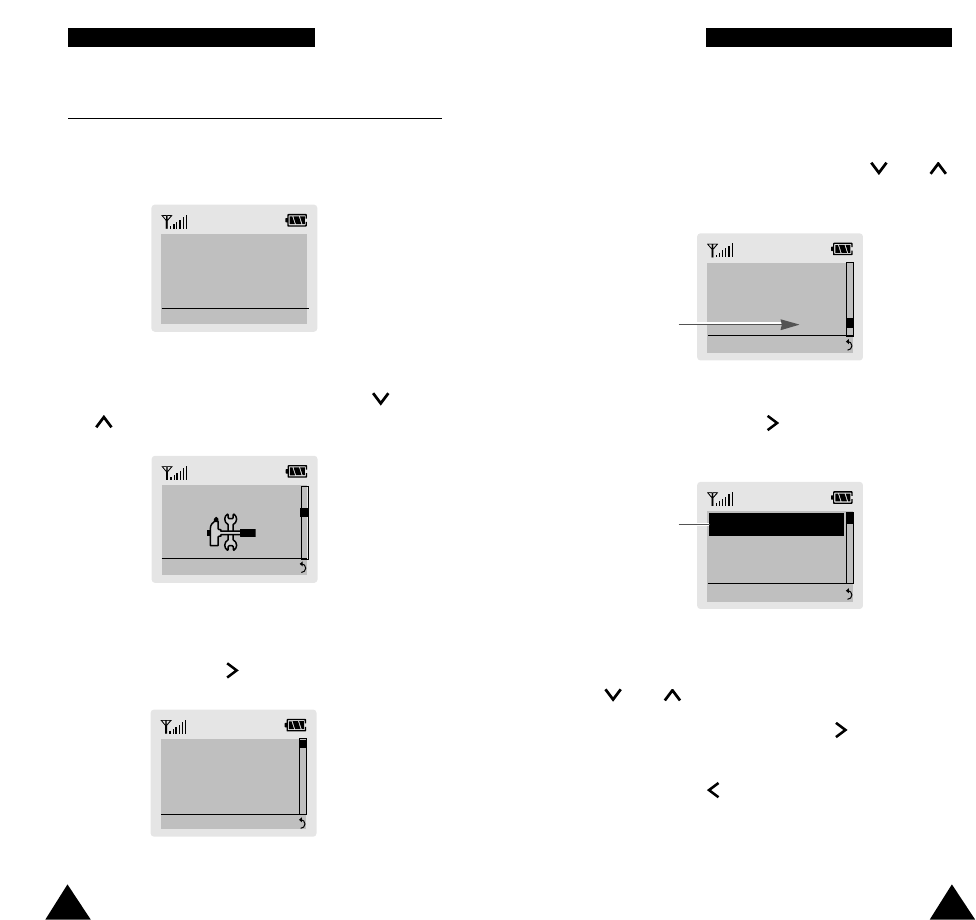
Using the Soft Keys
Your phone offers a set of functions that allow
you to customize your phone. These functions are
arranged in menus and sub-menus, accessed via the
two soft keys marked . Each menu and sub-menu
allows you to view and alter the settings of a
particular function.
The roles of the soft keys vary according to the
current context; the label on the bottom line of the
display just above each key indicates its current role.
Example:
Press the left soft
key to save the
name entered.
Press the right soft key to
select the text input mode
(upper case, lower case
and numeric characters).
Enter Name
l
OK
A
Greeting Message
Select 4. 1
Phone Settings
Select 4
28 29
SSeelleeccttiinngg FFuunnccttiioonnss aanndd OOppttiioonnssSSeelleeccttiinngg FFuunnccttiioonnss aanndd OOppttiioonnss
Example: Setting the Display Language
1. When the idle screen is displayed, press the
Menu soft key to enter the menu facility.
<SERVICE PROVIDER>
10:30
Fri 15 May
Menu Names
2. Scroll through the menus until you reach the
Phone Settings menu, by pressing the and
keys.
4. Scroll through the sub-menus until you reach the
Language sub-menu, by pressing the and
keys.
5. To view the languages available, press the
Select soft key or the key. The current setting
is highlighted.
6. Scroll through the list of languages until the
appropriate one is highlighted, by pressing the
and keys.
7. Press the Select soft key or the key to
confirm your selection.
8. Press the Cor key twice to exit the menu
structure.
3. To select the Phone Settings menu, press the
Select soft key or key.
Current
language
Language
English
Select 4.7
Current
language
Français
Español
Select 4. 7.1
English
6. Enter your preferred location by pressing the
number keys.
7. Press OK to store the name and number.
8. Press to return to the idle screen.
If you want to make a call to the number, press
the Call soft key. And if you want to access the
Phonebook options, press the Options soft key.
Entering a Name
1. To select... Then press the
soft key until...
Upper case characters is displayed.
Lower case characters is displayed.
Numbers only is displayed.
2. Press the key labeled with the required letter:
• Once for the first letter
• Twice for the second letter
• And so on
1
a
A
30 31
PPhhoonneebbooookk
Phonebook
The Phonebook allows you to store frequently used
phone numbers and the associated names in your
phone to make it easy for you to make a call without
having to remember or enter the phone number. You
can store up to 250 (1 ~ 250) numbers.
Storing a Phone Number with a Name
As soon as you start to enter a number, Save appears
above the left soft key to allow you to store the
number in the phonebook.
1. Key in the number to be stored.
Note: If you make a mistake while entering a
number, correct it using the Ckey. For
further details, refer to page 20.
2. When you are sure that it is correct, press the
Save soft key.
3. Select a label by pressing the or key, and
press the Save soft key.
The available labels are: Home, Office, Mobile,
Pager, Fax, E-mail and No label.
4. Enter the corresponding name. For information on
how to enter a name, see next page.
5. When you are satisfied, press the OK soft key.
The phone now prompts you to select a location in
the phone memory for you to save the number and
name.
Key
1
2
3
4
5
6
7
8
9
0
*
1
ABC2
DEF3
GHI 4
JKL5
MNO 6
PQRS7
TUV8
WXYZ
0
*/+-=<>()
%& Φ Θ Ψ Π Σ Ξ
1
abc2
def3
ghi 4
jkl5
mno6
pqrs7
†uv8
wxyz9
0
#.,:;!?@‘
“¿§£$¥¤ßΩ
Characters in the Order Displayed
Upper Case Lower Case
Space Space
32 33
PPhhoonneebbooookkPPhhoonneebbooookk
3. Select the other letters in the same way.
Note: The cursor moves to the next available
space when you press a different key.
When entering the same letter twice (or a
different letter on the same key), just wait
for a few seconds for the cursor to move
automatically, and then select the next
letter.
You can also move the cursor by using the
and keys.
Speed Dialing by Memory Location
Once you have stored phone numbers in the phone
book memory, you can dial them easily whenever you
want.
To speed dial the desired number:
For the 1-digit memory location number (1 through 9),
press and hold down the appropriate digit.
For the 2 or more-digit memory location number (10
through 250), press first digit(s) briefly and hold
down the last digit.
Note: If you enter the location number and then
press the key, your phone displays the
details on the entry, such as name, number,
location number and label. If you have stored
more than one number for a name, scroll
through the entry by pressing and keys.
Phonebook Options
When storing or viewing a number in the phonebook,
Options appears above the right soft key to allow
you to access the phonebook options, described in
the following paragraphs.
Accessing the Options
To access the various phonebook options, proceed as
follows.
1. Press the Options soft key. The first available
option is highlighted.
2. To... Then press the...
Select the Select soft key or key.
highlighted option
Highlight a or key one or more
different option times until the required
option is highlighted.
Add Number
This option allows you to place up to 4 numbers in
one Phonebook location by labeling each of the
numbers.
Note that you can only use each label one time for
each stored name. For example, you can only have
one number labeled Work for a name entry.

Change Name
This option allows you to change the name for the
number. Clear the old name by pressing the C key and
enter a new name. For information on entering a
name, see page 31.
Change Number
This option allows you to change the number. Clear the
old number by pressing the C key and enter a new
number.
Change Type
This option allows you to change the label type of a
stored number. Note that you can only use each label
one time for each stored name. For example, you can
only have one number labeled Work for a name entry.
Caller Group
This option allows you to include the number as a
member of the desired caller group. For more details
on Caller Group, see page 37.
Erase Number
This option allows you to erase a stored number. If you
saved two numbers under a name, only the currently
selected number will be erased. You are asked to
confirm that you wish to erase the number by pressing
the Yes soft key.
Erase Name
This option allows you to erase a name stored in the
phonebook so that all numbers under the name are
erased. You are asked to confirm that you wish to
erase the name by pressing the Yes soft key.
Move
This option allows you to move a phonebook entry to
another location. When prompted, enter the location
number which you are moving the number to, and
press the OK soft key.
Set Priority No.
This option allows you to set the selected number as
a speed dial number for the entry if it has more than
one number. Press the Set soft key.
Searching for and Dialing a Number in
the Phonebook
1. When the idle screen is displayed, press the
Names soft key. You are asked to enter a name.
2. Enter the starting characters of the name that you
want to find and press the Search soft key.
Note: You can also scroll through all phonebook
entries by pressing the Search soft key
directly.
The phonebook entries are listed, starting with
the first entry matching your input. This entry is
also highlighted.
34 35
PPhhoonneebbooookkPPhhoonneebbooookk

37
PPhhoonneebbooookk
36
PPhhoonneebbooookk
3. To... Then press the...
View the View soft key.
highlighted entry
Select a or key one or more
different entry times until the required
entry is highlighted.
Look for a name Key labeled with the
starting with a required letter.
different letter
4. Once you have found the required entry, press the
key to dial the number.
Name Options
While entering a name for searching, you can see
the Option soft key with the Search soft key. This
key allows you to enter the various options.
Accessing the Options
To access the various phonebook options, proceed as
follows.
1. While entering a name, press the Options soft
key. The first available option is highlighted.
2. To... Then press the...
Select the Select soft key or key.
highlighted option
Highlight a or key one or more
different option times until the required
option is highlighted.
New Entry
This option allows you to create a new entry in the
Phonebook. For details on storing a phone number,
see page 30.
Caller Group
You can set the phone to ring in a specific way and
display a preselected graphic icon when a particular
person calls you. To do so, you must:
• Define your caller groups
• Assign the numbers in the phonebook to the
appropriate group
Defining a caller group
Select the group to be defined and set the
appropriate options. The following options are
available.
Call ring tone: allows you to select the ring tone to
be used when you receive a voice phone call from a
person in the group.
SMS tone: allows you to select the ring tone to be
used when you receive a text message from a person
in the group.
Graphic: allows you to select the graphic icon to be
displayed when you receive a call from a person in
the group.
Group Name: allows you to assign a name to the
group; for further details on how to enter characters,
refer to page 31.

3938
PPhhoonneebbooookk
Assigning numbers to a group
1. View the required number in the phonebook.
2. Press the Options soft key.
3. Select the Caller Group option.
4. Select the required group.
To remove a number from a group, select the No
Group option.
Own Number
This function is a memory aid, which you can use to
check your own phone number if you need to do so.
Memory Status
You can check how many names and numbers are
stored in the Phonebook.
Erase All
This option allows you to erase all of the Phonebook
entries.
When a confirmation appears, press the OK soft key
to erase all Phonebook entries. If you do not want to
erase, press the Cancel soft key.
When prompted, enter the lock code. All entries in
the Phonebook are then erased.
In-Call Options
Your phone provides a number of control functions
that you can use during a call.
Putting a Call on Hold
You can make another call while you have a call in
progress if this service is supported by the network.
Of these two calls, one is active and the other is on
hold and you can swap between the calls.
Note: The procedure to put a call on hold may vary
depending on the service provider. For further
details, contact your service provider.
1. Key in the phone number that you wish to dial or
look it up in the Phonebook.
2. Press the key to dial the second call. The first
call is automatically put on hold.
To swap between the two calls, simply press the
Swap soft key.
When you have finished, end each call normally by
pressing the
key.

40 41
IInn--CCaallll OOppttiioonnss
IInn--CCaallll OOppttiioonnss
Switching the Microphone Off (Mute)
You can temporarily switch your phone’s microphone
off, so that the other party cannot hear you.
Example: You wish to say something to another
person in the room but do not want the
other party to hear you.
To switch the microphone off temporarily, press the
Mute soft key.
The other party can no longer hear you. To indicate
this, the mute icon ( ) displays.
To switch the microphone back on, press the Unmute
soft key.
The other party can hear you again. The mute icon
disappears.
Muting/Sending Key Tones
These options allow you to turn the key tones off or
on. If the Mute keys option is selected, your phone
does not transmit the key tones. It allows you to
press keys without hearing annoying key tones during
a call.
Note: To communicate with answering machines or
computerized telephony systems, the Send
keys option must be selected.
Searching for a Number in the Phonebook
You can search for a number in the phonebook during
a call.
1. Press the Options soft key.
2. Press the key to highlight the Phonebook
option.
3. Press the OK soft key.
The phonebook entries are listed.
4. Enter the name that you wish to find.
If you enter the start of the name, the phonebook
entries are listed, starting with the first entry
matching your input. The entry is also highlighted.
5. To view the highlighted entry, press the View soft
key.
For a more detailed description of the Phonebook
feature, refer to page 30.
Making a Calling Card Call
When you make a call using the prepaid calling card,
if you save the calling card information in the Calling
Card menu option (4.9), you can send automatically
the code number required for the service without
entering them manually each time you are prompted.
For further details on making a calling card call, refer
page 68.
Making a Conference Call
You can conduct conference calls with two separate
parties at the same time. A conference call is a
network service. For more information, contact your
service provider.
Note: The procedure may vary depending on your
service provider. Contact the service provider
for details.
1. Call the first participant in the normal way.
2. Call the second participant in the normal way.
3. When the second person answer, press the
key to merge the calls.
Note: The first call remains held until you press
the key.
4. End the conference call by closing the phone or
pressing the
key
.
42 43
PPhhoonneeBBooookkPPhhoonneeBBooookkIInn--CCaallll OOppttiioonnssIInn--CCaallll OOppttiioonnss
Using the SMS Service
If you receive an SMS (Short Message Service)
message during a call, the message icon ( ) lights
in the display. The SMS Service option enables you
to use this feature.
Read Messages: allows you to read the messages
that you have received.
Write Messages: allows you to write a message.
For further details on the SMS service, refer to
page 52.
Answering a Second Call
You can answer an incoming call while you have a
call in progress, if this service is supported by the
network and you have set the Call Waiting menu
option (7.2) to Activate (see page 83). You will be
notified of an incoming call by a call waiting tone.
To answer a call while you have a call in progress,
proceed as follows.
1. Press the key to answer the incoming call.
The first call is automatically put on hold.
2. To switch between the two calls, press the
key.
3. To end the current call, press the key.
Accessing a Menu Function by Using its
Shortcut
The menu items (menu, submenus and setting
options) are numbered and can be accessed quickly
by using their shortcut number. The shortcut number
is shown in the bottom right next to the soft key
on the display.
1. In idle mode, press the Menu soft key.
2. Within three seconds, key in the first digit of the
shortcut number. Repeat this for each digit of the
shortcut number.
Example: Setting the Backlight option to Short
Press the Menu soft key, and key in 4, 2, 1, 2.
Menu for entering the menu, 4for Phone
Settings, 2 for LCD Control, 1for Backlight, 2
for Short.
Note: The numbers assigned to each menu function
are indicated on the list on page 46.
44 45
Using the Menus
The phone offers a range of functions that allows
you to customize the phone to your needs. These
functions are arranged in menus and submenus.
The menus and submenus can be accessed by
scrolling or by using the shortcuts.
Accessing a Menu Function by Scrolling
1. In idle mode, press the Menu soft key to access
the menu facility. Scroll with the or key
(or the or key on the left side of the phone)
to reach the desired main menu, e.g. Phone
Settings. Press the Select soft key to enter the
menu.
2. If the menu contains any submenus: for example,
Language, find the one you want by scrolling
with the or key (or the or key on the
left side of the phone). Press the Select soft key
to enter the submenu.
If the menu you selected has submenus, repeat
this step.
3. Scroll with the or key (or the or key
on the left side of the phone) to find the setting of
your choice. Press the OK soft key to confirm the
chosen setting.
Notes:
• You can return the previous menu level by pressing
the Cor key.
• You can exit the menu without changing the menu
settings by pressing the key.
UUssiinngg tthhee MMeennuuss
Shortcut number
Backlight
Short
Select 4.2.1
46 47
PPhhoonneeBBooookkUUssiinngg tthhee MMeennuussUUssiinngg tthhee MMeennuuss
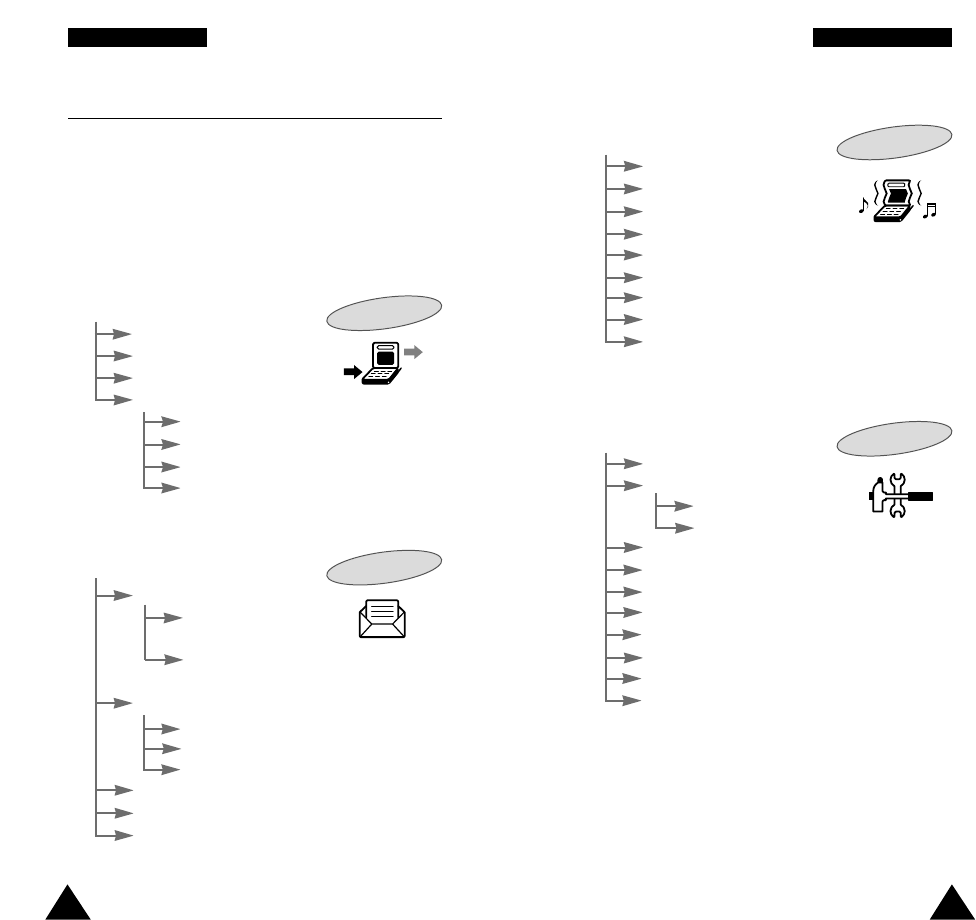
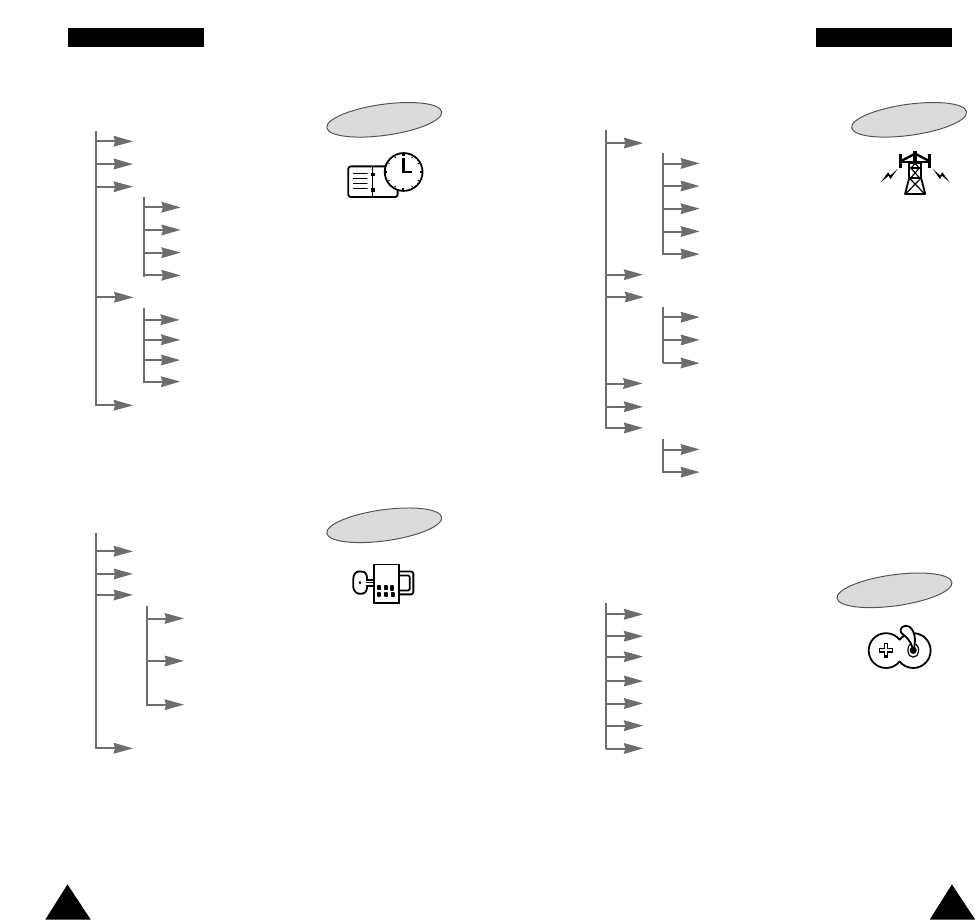
List of Menu Functions
The following illustration shows the menu structure
available and indicates the:
• Number assigned to each option
• Page on which you can find a description of each
feature
1.1 Missed Calls
1.2 Incoming Calls
1.3 Outgoing Calls
1.4 Call Time
1.4.1 Last Call Time
1.4.2 Total Call Time
1.4.3 Display Call Time
1.4.4 Reset Timers
1. Call Records
Page 50
2. Messages
2.1 Voice Mail
2.1.1 Connect to
Voice Server
2.1.2 Voice Server
Number
2.2 Read Messages
2.2.1 New Inbox
2.2.2 Old Inbox
2.2.3 Outbox
2.3 Write Messages
2.4 Preset Message List
2.5 Setup
Page 52
3. Sound Settings
3.1 Ring Volume
3.2 Ring Tone
3.3 Alert Type
3.4 Tone Length
3.5 Message Tone
3.6 Error Tone
3.7 Minute Minder
3.8 Connect Tone
3.9 Melody Composer
4. Phone Settings
4.1 Greeting Message
4.2 LCD Control
4.2.1 Back Light
4.2.2 Contrast
4.3 Service Light
4.4 Auto Redial
4.5 Answer Mode
4.6 Slide Menu
4.7 Language
4.8 Reset Setting
4.9 ShortCut
4.10 Calling Cards
Page 58
Page 64
48 49
UUssiinngg tthhee MMeennuussUUssiinngg tthhee MMeennuuss
5. Organizer
6. Security
6.1 Change Lock code
6.2 Change Security code
6.3 Call Restriction
6.3.1 restrict all
outgoing call
6.3.2 restrict all
incoming call
6.3.3 restrict
outgoing call
6.4 SOS Call List
5.1 Calendar
5.2 To Do List
5.3 Time & Date
5.3.1 Set Time
5.3.2 Set Date
5.3.3 World Time
5.3.4 Format
5.4 Alarm
5.4.1 Once Alarm
5.4.2 Daily Alarm
5.4.3 Weekly Alarm
5.4.4 Remove Alarm
5.5 Calculator
Page 71
Page 79
7. Network Services
7.1 Call Diverting*
7.1.1 Divert Always
7.1.2 Busy
7.1.3 No Reply
7.1.4 Unreachable
7.1.5 Cancel All
7.2 Call Waiting*
7.3 Network Selection
7.3.1 Automatic
7.3.2 Manual
7.3.3 New Search
7.4 Voice Privacy
7.5 NAM Selection
7.6 Set Service Code
7.6.1 Call Diverting
7.6.2 Call Waiting
* : available when you set the service code in the Set Service Code
menu option (7.6).
8. Games
8.1 Casino
8.2 Roulette
8.3 Black Jack
8.4 Sniper
8.5 Snake
8.6 Mole
8.7 Othello
Page 82
Page 87

51
CCaallll RReeccoorrddss
50
Call Records
Via this menu, you can view the following phone
calls:
• Missed
• Incoming
• Outgoing
The number and name (if available) are displayed,
together with the date and time at which the call was
made.
Note: Your phone can keep up to ten numbers in
each list.
Missed Calls Menu 1.1
This option lets you view the last 10 unanswered
calls. You can also:
• Edit the number (if available) and dial it or save it
in the phonebook
• Delete the call from the list
Incoming Calls Menu 1.2
This option lets you view the last 10 calls received.
You can also:
• Edit the number (if available) and dial it or save it
in the phonebook
• Delete the call from the list
Outgoing Calls Menu 1.3
This option lets you view the last 10 numbers dialed.
You can also:
• Delete the number
• Edit the number and save it in the phonebook
Call Time Menu 1.4
Your phone records the amount of call time used.
Using this option, you can view the timers for calls
made and received. The following options are
available.
Last Call Time: shows the duration of the last call.
Total Call Time: shows the total duration of all calls
made from or received to your phone since the timer
was last reset.
Display Call Time: allows you to set the phone to
display the call time when the call is made or
received. Select Enable to display the call time and
Disable not to display it.
Reset Timers: allows you to reset the call timers;
you must first enter the phone’s lock code (see
page 79) and then press the OK soft key.
Note: The actual time invoiced for calls by your
service provider may vary, depending on
network features, rounding-off for billing
purposes and so forth.

5352
Voice Server Number: allows you to change the
voice mail server number.
To... Then press the...
Enter the server number Corresponding numeric
keys.
Correct a digit Ckey.
Save the entered number OK soft key
Read Messages Menu 2.2
Three message boxes are available:
New Inbox: used to store the messages that you
have received but not read.
Old Inbox: used to store the messages that you have
received and read.
Outbox: used to store the messages that you have
already sent or will send.
Select the required box. The header of the first
message in the box is displayed:
• Message number
• Message status: New, Old, Not Sent, Sent
•
Date and time at which the message was received
(inbox only)
To view this message, press the View soft key. The
screen shows the:
• Sender’s phone number (if sent with the message)
or recipient’s phone number
• Message text
Messages
The SMS (Short Message Service) function is a
network service and may not be supported by your
network. Messages can be sent by text, E-mail and
paging messaging systems, provided that these
services are supported by your network.
When the Message icon appears, you have
received new text messages. If the message memory
is full, an error message is displayed and you cannot
receive any new messages. Use the Delete option in
the Read Messages menu (2.2) to delete obsolete
messages.
Voice Mail Menu 2.1
This menu provides you with a quick way of accessing
your voice mailbox (if provided by your network).
Note: Voice Mail is a network feature. Contact your
service provider for more information.
Depending on the service provider, you may
be charged for accessing the voice server.
Connect to Voice Server: Before using this
feature, you must enter the voice server number
obtained from your service provider (see menu
option 2.1.2). You can then select this option and
simply press the Save soft key to listen to your
messages.
Note: You can connect to the Voice Sever of the
service provider directly by pressing and
holding down the 0key in idle mode .
MMeessssaaggeess

55
MMeessssaaggeess
54
MMeessssaaggeess
Write Messages Menu 2.3
Via this menu, you can write text messages of up to
160 alphanumeric characters. For further information
on how to enter the characters in your message,
refer to page 31.
Note: While writing a message, pressing the key
inserts a carriage return.
After you complete the message and press the OK
key, you can select the following options.
Send Only: Enter the destination and select a
setting group in which you set up default information
on the SMS feature via the Setup menu (see the
following page).
Save and Send: allows you to save a copy of the
message and then send the message to the required
destination. You are also required to select a setting
group. You can read the message in your outbox using
the Read Messages option. Sent is displayed when
you read the message to indicate the message status.
Save Only: allows you to save the message so that
it can be sent later. When you read the message in
your outbox, Not sent is displayed.
To scroll through the message, press the and
keys.
You can choose the following options, by pressing
the Options soft key.
Delete: allows you to delete obsolete messages.
Text Reply: allows you to reply by sending a text
message.
Call Back: allows you to call the sender back.
Cut Number: allows you to extract a number from
the message text, so that you can call the number or
save it in the phonebook.
Send: allows you to send a message that you have
received or saved. You can:
• Send the message
• Save and send the message
• Save but not send the message
Edit Message: allows you to edit a message.
Note: The available options may vary, depending on
the message status (New/Old, Not Sent or
Sent for example).

57
MMeessssaaggeess
56
MMeessssaaggeess
Callback Number: allows you to set the phone
number to which the recipient of your SMS message
may send you a reply message via your message
center, if the service is provided by the network.
Manual Ack: allows you to activate or deactivate
the manual acknowledgement function. When this
function is activated, the recipient can send you an
answer to your message by one touch of a number
key.
Delivery Ack: allows you to activate or deactivate
the delivery acknowledgement function. When this
function is activated, the network informs you
whether your message has been read or not by the
recipient.
Privacy: allows you to set the restriction feature.
When this option is set to Restricted, the recipient
must have the password which you have set when
writing a message to read the message. If you do not
want to use the feature, select Not Restricted.
Urgency: allows you to set the urgency status of the
messages. Bulk, Normal, Urgent, and Very Urgent
are available.
Type: allows you to set the type of messages. Text
and E-mail are available.
Preset Message List Menu 2.4
Using this menu, you can preset up to five messages
that you use most frequently. This menu shows the
preset message list. Scroll through the list using the
and keys. When the required message
number appears, press the Options soft key.
Edit: allows you to write a new message or edit the
selected preset message.
Note: For further information on how to enter the
characters in your message, refer to page 31.
Send Message: allows you to recall the selected
message. Once you have completed the message, you
can send, save and send, or simply save it.
Delete: allows you to delete the selected message.
Setup Menu 2.5
Via this menu, you can set up default information for
the SMS feature. A setting group is a collection of
settings required to send messages. Five setting
groups are available.
Select the desired number using the and key,
press the Select soft key and then set up the
options for the group. The available options are:
Setting Name: allows you to give a name to the
setting group currently being defined.

5958
Alert Type Menu 3.3
This option allows you to indicate how you are to be
informed of any incoming calls. The following options
are available.
Light only: only the backlight is switched on; the
phone neither rings nor vibrates.
Melody: the phone rings using the ringing tone
selected via the Ring Tone menu option (3.2).
Vibration: the phone vibrates but does not ring.
Note: In idle mode, you can set the phone to vibrate
only (silent mode) or to start ringing again,
simply by pressing the Ckey (for further
details, see page 25).
Vibra+Melody: the phone first vibrates three times
and then starts ringing.
Step Melody: the phone rings using the selected
ringing tone, but the volume becomes louder and
louder from the minimum. Reaching to the maximum,
the phone restarts from the minimum.
Tone Length Menu 3.4
The tone length setting enables you to select short
or long DTMF (dual-tone multi-frequency) tones.
DTMF tones are what your phone transmits to access
teleservices (such as a bank account). The system
used by the bank or other service determines if you
need short or long DTMF. If the service is digital
(which most are these days), short DTMF will almost
always work. However, some new systems and
almost all older (analog) system require you to use
long DTMF tones.
Sound Settings
You can use the Sound Settings feature to customize
various settings, such as the:
• Ringing tone or melody, volume and type
• Sounds made when you press a key, make an
error or receive a message
Ring Volume Menu 3.1
This option allows you to adjust the ringing volume
to one of five levels.
Press the key to increase and the key to
decrease the volume. The greater the number of
bars, the greater the volume.
Note: You can also use the and keys on the left
side of the phone to adjust the volume.
Ring Tone Menu 3.2
This option allows you to select the required ringing
tone. You can choose between 20 different tones.
Each time you select a tone, it is played for a few
seconds. Tones 19 and 20 correspond to the melodies
that you can compose, using the Melody Composer
menu option (3.9).
SSoouunndd SSeettttiinnggss

61
SSoouunndd SSeettttiinnggssSSoouunndd SSeettttiinnggss
60
Minute Minder Menu 3.7
This option allows you to specify whether the phone
must beep every minute during an outgoing call to
keep you informed of the length of your call.
The following options are available.
OFF: the phone does not beep.
ON: the phone beeps every minute.
Connect Tone Menu 3.8
You can set your phone to beep when your call is
connected to the system.
The following options are available.
OFF: the phone does not beep.
ON: the phone beeps when your call is connected.
Melody Composer Menu 3.9
This option allows you to compose your own melody
to be used as the ring tone.
Three octaves are available. A maximum of 100
notes can be entered. You can adjust the length of
the notes and add rests, as required.
Message Tone Menu 3.5
This option allows you to select how the phone
informs you that a new message has been received.
The following options are available.
Light Only: the service light in the top right-hand
corner of the phone flashes.
Single Beep: the phone beeps once.
SMS Tone1~10: the phone uses an SMS tone. You
are provided with ten SMS tones.
Error Tone Menu 3.6
This option allows you to select how the phone
informs you that you have made a mistake.
The following options are available.
OFF: the phone does not beep.
ON: the phone beeps to indicate an invalid entry.
63
SSoouunndd SSeettttiinnggss
62
SSoouunndd SSeettttiinnggss
Saving a Melody
When you are satisfied with your melody, you can
save it and indicate that you wish to use it as the
ring tone.
1. Press the Save soft key.
2. Enter a title for the melody.
Note: For further details on how to enter
characters, refer to page 31.
You are asked if the melody is to be set as the
ring tone.
3. To use the melody as the ring tone, press the Yes
soft key.
The melody is saved and is played each time your
phone rings. You can also select the melodies
composed via the Ring Tone menu option (3.2);
they are tones 19 and 20 respectively.
Otherwise, press the No soft key. The melody is
saved only.
Composing a Melody
You can compose two melodies. When you access
the menu, the names of any melodies created are
displayed. Otherwise, Melody 1 and Melody 2 appear.
Select the melody that you wish to create or edit.
To... Then press the...
Compose a Edit soft key.
melody
Insert a note Next soft key.
Move a note a key.
semitone up
Move a note a key.
semitone down
Change the
key one or more times until
length of a note the note is of the required length.
Delete a note Ckey.
Enter a rest key repeatedly for the
required length of time.
Listen to your Listen soft key.
melody
Modify your Modify soft key.
melody

6564
Short: the backlight comes on when you press a key
or receive a call and switches off 10 seconds after
the last key is pressed.
Long: the backlight comes on when you press a key
or receive a call and switches off 20 seconds after
the last key is pressed.
Contrast
This option allows you to adjust the contrast of the
LCD screen by pressing the and keys. Each
time you press the key, you can see the LCD screen
changing according to the current value.
Service Light Menu 4.3
This option allows you to select whether or not the
service light in the top right-hand corner of the phone
is used.
The following options are available.
OFF: the service light is not used.
ON: the service light flashes when the phone is ready
for use.
Phone Settings
Many different features of your phone can be
customized to suit your preferences. All of these
features are accessed via the Phone Settings menu.
Greeting Message Menu 4.1
This option allows you to set a greeting message to
be displayed briefly when the phone is switched on.
The current message is displayed.
To... Then press the...
Clear the existing Ckey and hold it down until
message the message is cleared.
Enter a new message Appropriate alphanumeric
keys.
For further details on how to enter characters, refer to
page 31.
LCD Control Menu 4.2
Back Light
You can select whether or not the phone uses the
backlight. A marginal increase in standby/talk time
can be achieved by turning the backlight off.
The following options are available.
OFF: the backlight is not used.
PPhhoonnee SSeettttiinnggss

67
PPhhoonnee SSeettttiinnggss
PPhhoonnee SSeettttiinnggss
66
Slide Menu Menu 4.6
With the Slide Menu feature, you can determine
how the menus are displayed. If the feature is
enabled, the menus seem to slide into position from
the top, bottom, left or right, as applicable.
Language Menu 4.7
You can select a display language. The available
language options are: English, Español, and
Português.
Reset Settings Menu 4.8
You can easily reset your phone to its default
configuration.
Enter the 8-digit phone lock code and press the OK
soft key. The phone resets all settings to default.
Note: The lock code is preset to 00000000. To change
this code, refer to page 79.
Auto Redial Menu 4.4
With the Auto Redial function, the phone makes up
to ten attempts to redial a phone number after an
unsuccessful call.
Note: The interval between two call attempts varies.
The following options are available.
OFF: the number is not redialed.
ON: the number is redialed automatically.
Answer Mode Menu 4.5
This option allows you to select how incoming calls
are to be answered.
The following options are available.
Open Answer: to answer a call, you can simply open
the phone. With the phone open, pressing the volume
keys answers the call.
Any Key Answer: to answer a call, you can press
any key except the key. Pressing the key
mutes the ringer.
Send Key Answer: to answer a call, you must press
the key. Pressing the key mutes the ringer.

69
PPhhoonnee SSeettttiinnggss
68
PPhhoonnee SSeettttiinnggss
Calling Cards Menu 4.9
When you use a calling card for long distance calls,
you must send the service code and the card number
to the service system. Using this menu, you can save
these calling card information to send them
automatically when you make calling card calls. You
can store up to five calling cards.
Enter 8-digit phone lock code and press the OK soft
key to access the Calling Card menu.
Saving Calling Card Information
1. Scroll to the desired calling card using the and
keys and press the Select soft key.
2. If you want to set the card name, press the Select
soft key. Enter the name as needed. For further
details on entering a name, see page 31.
3. When entering name is finished, press the OK soft
key. The name is saved.
4. Press the key to select the Card Number menu
and press the Select soft key.
5. Enter the card number (and/or PIN if required) as
listed on the back of the calling card.
To enter a pause, “P” before the second number,
press and hold the key. the number after “P”
will be sent only by pressing the key when
you make a calling call.
Note: The order of the numbers which you must
enter may vary depending on the dialing
sequence your card uses.
6. When entering the number is finished, press the
OK soft key.
7. To return to idle mode, press the key.
Selecting a Calling Card
1. Scroll to the desired calling card using the and
keys and press the Select soft key.
2. Select Set Default using the and keys
and press the Select soft key.
3. The display shows the number saved for the
calling card. If you are satisfied, press the Set soft
key.
4. To return to idle mode, press the key.
Making Calling Card Calls
1. Make a call to the calling card service system.
2. When you are connected, press the Options soft
key and select Card Call using the and
keys.
3. Press the OK soft key.
4. When you hear the tone from the calling card
service, press the key to transmit the card
numbers.
5. Dial the number of the designated phone.
Note: The procedure may not apply to all calling
cards. Please look at the back of your calling
card or contact your phone company for
instructions.

7170
PPhhoonnee SSeettttiinnggssOrganizer
The Organizer feature enables you to:
• View the calendar and organize your schedule
• Define a list of things to do
• Set the current date and time
•
Set the alarm so that the phone rings at a specific
time (to remind you of an appointment for example)
• Use the phone as a calculator
• Assign functions to the navigation keys so that
they can be used as shortcuts giving direct access
to your favorite menus
Calendar Menu 5.1
With the Calendar feature, you can:
• Consult the calendar
• Write memos to keep track of your schedule and
trigger an alarm if necessary
Consulting the Calendar
When you select the Calendar menu option (5.1), the
calendar is displayed. The following options are
available when you press the Options soft key.
Search all: displays all memos set, regardless of the
day and starting with the oldest. To scroll through the
memos, press the and keys.
Delete all: allows you to delete all memos. You are
asked to confirm your action.
Go to date: allows you to jump to a specific date.
ShortCut Menu 4.10
The four navigation keys can also be used as shortcut
keys. When held down in idle mode, they allow you
to access specific menu options directly.
Using the ShortCut menu option (5.6), the following
menu options can be assigned to the shortcut keys:
• None
• Calendar (menu option 5.1)
• Calculator (menu option 5.5)
• Messages (menu option 2)
• Sound Settings (menu option 3)
• Games (menu option 8)
• To Do List (menu option 5.2)
• Phonebook
• New Inbox (menu option 2.2.1)
1. Select the key to be used as a shortcut key:
• Key up ( )
• Key down ( )
• Key left ( )
2. Select the menu option to be assigned to the key.
Note: To deactivate a shortcut key, select the None
option.

7372
Once you have finished editing the memo, press the
OK soft key. The following options are then available
when you press the Options soft key.
Alarm: allows you to set the alarm to ring on the
chosen day.
Erase: allows you to delete the memo.
Copy to: allows you to copy the memo to another
date.
Move to: allows you to change the date and time of
the memo.
To Do List Menu 5.2
This feature allows you to:
• Draw up a list of tasks to be done
• Assign a priority and deadline to each task
• Sort the tasks by priority and status mark ( for
tasks to be done, ✓for completed tasks)
Creating the To Do List
To create the To Do List, proceed as follows.
1. Press the New soft key.
2. Enter the first task.
Note: You can enter up to 48 characters. For
further details on how to enter characters,
see page 31.
3. Press the OK soft key.
Writing a Memo
To write or edit a memo on a specific date, proceed
as follows.
1. Select the required date in the calendar, using the
navigation keys.
Note: To skip to the previous or next month, press
the or key on the left side of the
phone.
2. Press the Select soft key.
An empty memo screen is displayed to allow you
to enter your memo.
3. Enter your memo and then press the OK soft key.
Note: For further details on how to enter
characters, refer to page 31.
You are asked if you wish to set the alarm.
4. If you want the alarm to ring on the chosen day,
press the Yes soft key.
Otherwise, press the No soft key.
5. If you pressed Yes, set the time for the alarm and
press OK.
A check mark is displayed in front of the date in
the calendar to indicate that a memo exists.
Editing a Memo
If you select a day for which a memo already exists,
you can press the Edit soft key to edit the memo
displayed.
Note: For further details on how to enter characters,
refer to page 31.
OOrrggaanniizzeerrOOrrggaanniizzeerr

75
OOrrggaanniizzeerrOOrrggaanniizzeerr
To... Then...
Sort the existing • Press the Options soft key.
tasks by priority • Select the Sort option.
or status • Select the sort criterion (high,
low, done, undo).
Copy a task • Highlight the task.
• Press the Options soft key.
• Select the Copy option.
• Change the text, priority and
deadline for the task as
required.
Delete a task • Highlight the task.
• Press the Options soft key.
• Select the Delete option.
Delete all tasks • Press the Options soft key.
• Select the Delete all option.
• Confirm the deletion by
pressing OK.
Time & Date Menu 5.3
This option allows you to change the current time
and date displayed. You can also check the current
time for Greenwich Mean Time (GMT) and 21 major
cities around the world.
Set Time: allows you to enter the current time. You
can choose the time format via the Format menu
option (5.3.4).
Note: Before setting the time, you must specify your
time zone, via the World Time menu option
(5.3.3).
4.
Select high or low priority using the or
keys and the Select soft key.
5. Enter your deadline.
6. Press the OK soft key.
Editing the To Do List
If tasks are already defined in the To Do List when you
select the To Do List menu option (5.2), the current
contents are displayed with the associated priority
and status mark. The following options are available.
To... Then...
View the details • Highlight the task.
for a specific task • Press the View soft key.
Change the status • Highlight the task.
of a specific task • Press the key to mark the
task as completed as of the
current date and time.
( or ✓)or
• Highlight the task.
• Press the Options soft key.
• Select the Mark option.
• Select the appropriate status.
Create a new task • Press the Options soft key.
• Select the New option.
• Enter the text, priority and
deadline for the task.
Edit an existing • Highlight the task.
task • Press the Options soft key.
• Select the Edit option.
• Change the text, priority and
deadline for the task.
74
77
OOrrggaanniizzeerr
76
OOrrggaanniizzeerr
Alarm Menu 5.4
You can set the alarm to ring at a specific time.
Note: To meet FAA safety guidelines, the alarm does
not function when the phone is off.
In the Alarm menu, the following frequency options
are available.
Once Alarm: the alarm rings only once and is then
deactivated.
Daily Alarm: the alarm rings every day at the same
time.
Weekly Alarm: the alarm rings every week on the
same day and at the same time.
To set the alarm, proceed as follows.
1. Choose the alarm frequency option.
2.
Enter the required time and day of the week (if
applicable).
Once you have set the alarm, you can see the alarm
icon next to the current time.
To stop the alarm when it rings, open the phone and
press the Exit soft key.
Remove Alarm: deactivates the alarm.
Set Date: allows you to enter the day, month and
year. You can change the date format via the Format
menu option (5.3.4).
World Time: allows you to check the current time
for Greenwich Mean Time (GMT) and 21 major cities
around the world, using the and keys.
The screen shows the:
• City name
• Current date and time
• Time difference between the selected city and
your city if you have set the local time (see below
for further details) or GMT (by default)
To select the time zone in which you are located,
proceed as follows.
1. Select the city corresponding to your time zone by
pressing the or key one or more times.
The local date and time are displayed.
2. Press the Set soft key.
Format: allows you to change the time and date
formats.
Time format: 24 hours
12 hours
Date format: YYYY/MM/DD (year/month/day)
DD/MM/YYYY (day/month/year)
MM/DD/YYYY (month/day/year)

7978
OOrrggaanniizzeerrSecurity
The Security feature enables you to restrict the use
of your phone to:
• The people of your choice
• The types of calls of your choice
Change Lock code Menu 6.1
The lock code is a password for locking or unlocking
the phone. This feature allows you to change your
current lock code to a new one. You must enter the
current code before you can specify a new one.
The lock code is factory set to 00000000. Once you
have entered a new lock code, you are asked to
confirm it by entering it again.
Change Security code Menu 6.2
The security code is used for restriction of the use of
your phone. This menu allows you to change your
current security code to a new one. You must enter
the current code before you can specify a new one.
The security code is factory set to 00000000. Once
you have entered a new password, you are asked to
confirm it by entering it again.
Calculator Menu 5.5
Using this feature, you can use the phone as a
calculator. The calculator provides the basic arithmetic
functions: addition, subtraction, multiplication and
division.
1. Enter the first number using the numeric keys.
2. Press the right soft key until the required
arithmetic symbol appears: + (add), - (subtract),
*(multiply), / (divide).
3. Enter the second number.
4. Repeat Steps 1 to 3 as many times as required.
Notes:
• To erase any mistakes and clear the display,
press the Ckey.
•
To include a decimal point or a bracket, press the
left soft key until the required symbol is displayed.
5. To calculate the result, press the key.
80 81
SSeeccuurriittyySSeeccuurriittyy
2. Enter your security code and press OK.
3. Select the location by pressing the or key
and press Options.
4. Select Edit, then the OK soft key. If a number has
already been saved, this option allows you to edit
the number.
If you want to erase a saved number, select
Erase. When a confirmation displays, press Yes.
5. Enter the phone number and press OK. The phone
number is saved and now you cannot make a call
to the number.
SOS Call List Menu 6.4
Your phone provides three emergency numbers for
SOS calls programmed by the service provider. Three
numbers can be manually dialed at any time even
when the phone is locked.
To make an SOS call when the phone is locked, press
the SOS soft key, select the desired number saved in
the SOS call list, and then press the Call soft key.
Call Restriction Menu 6.3
The call restriction feature allows you to restrict your
calls.
Call restriction can be set up in the following ways.
Restrict all outgoing call: calls cannot be made.
Restrict all Incoming call: calls cannot be
received.
Restrict outgoing call: calls to the phone numbers
which you have specified cannot be made. You can
set up to 10 phone numbers.
To restrict the all outgoing or all incoming calls,
proceed as follows.
1. Select Restrict all outgoing call or Restrict all
incoming call by pressing the or key until
the appropriate option is highlighted and then
press Select.
2. Select Enable to the feature on, and press
Select.
If you want to set the restriction off, select
Disable.
3. Enter your security code and press OK.
To set the phone numbers to be restricted, proceed as
follows.
1. Select Restrict outgoing call by pressing the
or key, and then press Select .

8382
The following options are available.
Activate: activates the Call Diverting feature.
Cancel: deactivates the Call Diverting feature.
You can deactivate all call diverting settings by
selecting the Cancel All option.
Call Waiting Menu 7.2
This network service enables you to be informed when
someone is trying to reach you during another call.
Note: For using the Call Waiting service, you must
set the service code for it. Depending on the
Set Service Code setting, this menu may not
appear. For details, see page 86.
The following options are available.
Activate: activates the Call Waiting feature. You can
answer an incoming call while you have a call in
progress. See page 42 for answering a waiting call.
Cancel: deactivates the Call Waiting feature.
Network Selection Menu 7.3
The Network Selection feature enables you to
indicate whether the network used when roaming
(outside your home area) is selected automatically
or manually.
Network Services
These menu functions are network services.
Please contact your service provider to check their
availability and subscribe to them, if you so wish.
Call Diverting Menu 7.1
This network service enables incoming calls to be
rerouted to the number that you specify.
Example: You may wish to divert your business calls
to a colleague while you are on holiday.
Note: For using the Call Diverting service, you must
set the service code for it. Depending on the
Set Service Code setting, this menu may not
appear For details, see page 86.
Call diverting can be set up in the following ways.
• Divert Always: all calls are diverted.
• Busy: calls are diverted if you are already making
another call.
• No Reply: calls are diverted if you do not answer
the phone.
• Unreachable: calls are diverted if you are not in
an area covered by your service provider.
• Cancel All: all call diverting options are cancelled.
NNeettwwoorrkk SSeerrvviicceess
Note: You can select a network other than your
home network only if it has a valid roaming
agreement with your home network.
To indicate whether the network is to be selected
automatically or manually when roaming, proceed as
follows.
1. When Network Selection is displayed, press the
Select soft key.
2. Press the or key until the appropriate
option is highlighted and then press the OK soft
key.
• If you select Automatic, your phone
automatically searches for a network available
to you and chooses the appropriate one. Every
time you switch your phone on, this menu resets
to Automatic.
• If you select Manual, your phone searches for
available networks, then displays them. Press
the or key until the preferred network is
highlighted and then press the OK soft key.
• If you select New Search, your phone begins a
new search for new Private and Residential
systems. When finding the best new system, the
phone displays it. Then you can confirm by
pressing Select or start another search by
pressing Next.
3. You are connected to that network.
8584
NNeettwwoorrkk SSeerrvviicceessNNeettwwoorrkk SSeerrvviicceess
Voice Privacy Menu 7.4
Voice Privacy encrypts the voice channel so that
people cannot eavesdrop on your conversation. If you
turn this feature on and voice privacy becomes
inactive for any reason your phone displays “Voice
privacy not active” and beeps. This feature is used
only in digital networks.
The following options are available.
Activate: turns this feature on.
Deactivate: turns this feature off.
Note: This feature may not be available in all areas.
Contact your service provider for details and
availability.
NAM Selection Menu 7.5
The service provider programs your phone with the
phone number and system information when your
phone is first activated. This is called a Number
Assignment Module (NAM).
For example, your phone can be activated in up to 4
different service areas each giving your phone a
different phone number or account.
Only one number can be active at a time. When you
select a phone number, you are also selecting which
system to be used as your home system. The first
phone number displayed with this menu is the
currently selected number.

Notes:
• It may not be necessary to have four NAMs for
your phone if your service provider has service or
roaming agreements for each area in which you
wish to use your phone. Contact your service
provider for details.
• You need at least one active number to make a
call. You cannot change from one NAM to another
during a call.
Set Service Code Menu 7.6
For using the network services, such as the Call
Diverting and Call Waiting, you must set the service
codes supplied by your service provider with this
menu. For more information on the service code,
contact your service provider.
The following options are available.
Call Diverting: allows you to set the codes for using
each of the options (Divert Always, Busy, No
Reply, Unreachable and Cancel All) in the Call
Diverting.
Call Waiting: allows you to set the codes for using
each of the options (Activate and Cancel ) in the
Call Waiting.
After selecting the desired option, enter the service
code and press the OK soft key. The service code is
saved.
8786
Games
Using this feature, you can play seven different
games with the phone:
• Casino • Roulette
• Black Jack • Sniper
• Snake • Mole
• Othello
Once you have selected a game, the following
options are available.
Play: allows you to start a game.
Level: allows you to select the level of difficulty.
Select the required level using the and keys
and press the OK soft key. This option is only available
in games with several levels (Sniper, Snake).
Configuration: allows you to configure the phone
for the chosen game (backlight and sound settings).
To adjust each setting, highlight the Backlight or
Sound option by pressing the and keys and
then toggle between ON and OFF by pressing the
On/Off soft key.
Instructions: describes the buttons used by the
game. If necessary, press the and keys to see
a more detailed description.
High Score: enables you to view the highest score
recorded for the selected game. You can also reset
this score by pressing the Reset soft key.
If you break the current record for the game, the
phone displays the High Score screen.
To stop playing a game, press the Cor key.
NNeettwwoorrkk SSeerrvviicceess
88 89
Voice Memo Pad
With the key, you can use the phone as a recorder.
In idle mode, it records a voice memo, and while you
are on the phone, it records the phone conversation
during a call.
Notes:
• Your phone can record up to 10 items, and the
maximum recording time for each item is 1 minute.
• Closing the phone while recording cancels the
recording.
• If you have an incoming call while recording a voice
memo, or the call is disconnected while recording
phone conversation, the memo recorded up to that
point is saved with the current date and time stamp.
• When you are out of the service area(‘No Service’ is
displayed)or in analog mode, a voice memo is not
correctly recorded. It is recommended that you use
this feature in digital mode in the service area.
Record
To record a voice memo, select this menu or press and
hold the key in idle mode.
To record a phone conversation, press the key while
you are on the phone.
1. The message “Recording” displays, along with the
timer.
2. Record a memo by speaking to the micro phone or
talking to the remote person.
3. To stop recording, press the Stop soft key.
4. If you ar recording a phone conversation, it is
automatically saved by the title of the current date
and time.
If you are recording a voice memo, you are asked
to enter the title for the recorded message. Go to
step 5.
5. Enter the desired title up to 16 digits using the
keypad, then press the Save key to save the
recording. For details on entering characters, see
page 31.
If you do not enter a title, Untitled is saved as the
label.
Note: Recording voice conversations is illegal in
some countries. Make sure the other party has
stated its consent to being recorded.
Replay & Delete
Using this menu, you can play back a recorded
message and delete it if you want.
1. When the display shows the title of the currently
selected memo, press the or key to display
the memo you want to play.
2. Press the Play soft key to play back the recorded
message currently displayed.
3. When you have finished reviewing, press the Stop
soft key.
VVooiiccee MMeemmoo PPaadd

9190
VVooiiccee MMeemmoo PPaaddVVooiiccee MMeemmoo PPaadd
4. If you want to delete the memo, press Delete
soft key.
5. When the phone confirms your selection, press
the Yes soft key.
If you do not want to delete the memo, press the
No soft key.
6. Repeat step 2 through 5 as necessary.
7. When you have finished, press the key to
return to idle mode.
Edit Title
You can change the title of the selected memo .
1. The display shows the title of the currently
selected memo. Press the or key to scroll
to the memo whose title you want to edit.
2. Press the Edit soft key.
3. Enter the desired title up to 16 digits using the
keypad. For details on entering characters, see
page 31.
4. When entering is done, press the Save soft key to
save the new title.
5. When you have finished, press the key to
return the idle mode.
93
SSoollvviinngg PPrroobblleemmss
Your correspondent cannot hear you speaking
• Have you switched off the microphone (mute)?
• Are you holding the phone close enough to your
mouth? The microphone is located in the bottom
center of the phone.
The phone starts beeping and “**Warning**
Low Battery” flashes in the display
• The battery power is weak. Replace the battery
and recharge it.
The audio quality of the call is poor
• Check the signal strength indicator in the display
( ); the number of bars after it indicates the
signal strength from strong ( ) to weak ( ).
• Try moving the phone slightly or moving closer to
a window if you are in a building.
No number is dialed when you recall a phonebook
entry
• Check that the numbers have been stored
correctly, by using the Phonebook Search feature.
• Re-store number, if necessary.
If the above guidelines do not enable you to solve
the problem, take a note of:
• The model and serial numbers of your phone
• Your warranty details
• A clear description of the problem
Then contact your local dealer or SAMSUNG
after-sales service.
92
Solving Problems
Before contacting the after-sales service, perform the
following simple checks. They may save you the time
and expense of an unnecessary service call.
“No service”, “Network failure” or “Not done”
is displayed
• The network connection was lost. You may be in a
weak reception area (in a tunnel or surrounded by
buildings). Move and try again.
• You are trying to access an option for which you
have not taken out a subscription with your
service provider. Contact the service provider for
further details.
You have entered a number but it was not dialed
• Have you pressed the key?
• Are you accessing the right cellular network?
• You may have chosen to restrict outgoing calls.
Your correspondent cannot reach you
• Is your phone switched on ( pressed for
more than one second)?
• Are you accessing the right cellular network?
• You may have chosen to restrict incoming calls.
• You may be in a weak signal area. Move and try
again.

95
UUssiinngg tthhee BBaatttteerriieess
94
Using the Batteries
Your phone is powered by a rechargeable Li-ion
standard battery.
Precautions When Using Batteries
• Never use any charger or battery that is damaged
in any way.
• Use the battery only for its intended purpose.
• If you use the phone near the network’s base
station, it uses less power; talk and standby times
are greatly affected by the signal strength on the
cellular network and the parameters set by the
network operator.
• Battery charging times depend on the remaining
battery charge and the type of battery and charger
used. The battery can be charged and discharged
hundreds of times, but it will gradually wear out.
When the operation time (talk time and standby
time) is noticeably shorter than normal, it is time
to buy a new battery.
• If left unused, a fully charged battery will
discharge itself over time.
• Use only Samsung-approved batteries and
recharge your battery only with Samsung-approved
chargers. When a charger is not in use, disconnect
it from the power source. Do not leave the battery
connected to a charger for more than a week,
since overcharging may shorten its life.
• Extreme temperatures will affect the charging
capacity of your battery: it may require cooling or
warming first.
• Do not leave the battery in hot or cold places, such
as in a car in summer or winter conditions, as you
will reduce the capacity and life-time of the
battery. Always try to keep the battery at room
temperature. A phone with a hot or cold battery
may temporarily not work, even when the battery
is fully charged. Li-ion batteries are particularly
affected by temperatures below 0 °C (32 °F).
• Do not short-circuit the battery. Accidental short
circuiting can occur when a metallic object (coin,
clip or pen) causes a direct connection between
the + and – terminals of the battery (metal strips
on the battery), for example when you carry a
spare battery in a pocket or bag. Short-circuiting
the terminals may damage the battery or the
object causing the short-circuit.
• Dispose of used batteries in accordance with local
regulations. Always recycle. Do not dispose of
batteries in a fire.

9796
Safety Information
Road Safety
• Remember, road safety always comes first!
• Do not use a hand-held phone while driving a
vehicle. Always park the vehicle before having a
conversation.
• Make sure that the phone is stored safely and will
not fall or be broken in the event of a collision or
emergency stop.
• The use of an alert device to operate a vehicle’s
lights or horn on public roads is not permitted.
• Only qualified personnel should install or service
the phone in a vehicle. Faulty installation or service
may be dangerous and may invalidate any warranty
applicable to the unit.
• Electronic fuel injection, anti-skid braking,
electronic cruise control or any other electronic
systems may malfunction due to the lack of
protection from radio signals. Check regularly that
all cellular phone equipment in your vehicle is
mounted and operating correctly.
Operating Environment
• Remember to follow any special regulations in
force in any area and always switch off your
phone whenever it is forbidden to use it, or when
it may cause interference or danger (in a hospital
for example).
• Operation of any radio-transmitting equipment,
including cellular phones, may interfere with
inadequately protected medical devices. Consult
a doctor or the manufacturer of the medical
device if you have any questions. Other electronic
equipment may also be subject to interference.
• As with other mobile radio-transmitting equipment,
you are advised that for satisfactory operations
and personal safety, the equipment should only be
used in the normal operating position.
• Always switch off the phone when at a refuelling
point (service station). You are reminded of the
need to observe restrictions on the use of radio
equipment in fuel depots (fuel storage and
distribution areas), chemical plants or where
blasting operations are in progress.
• Do not store or carry flammable liquids, gases or
explosive materials in the same compartment as
the phone, its parts or accessories.
• Switch off your cellular phone when in an aircraft.
The use of cellular phones in an aircraft is illegal
and may be dangerous to the operation of the
aircraft or disrupt the cellular network. Failure
to observe these instructions may lead to the
suspension or denial of cellular telephone services
to the offender, legal action or both.
SSaaffeettyy IInnffoorrmmaattiioonn

99
SSaaffeettyy IInnffoorrmmaattiioonnSSaaffeettyy IInnffoorrmmaattiioonn
98
Care and Maintenance
Your phone is a product of superior design and
craftsmanship and should be treated with care. The
suggestions below will help you fulfill the warranty
obligations and enjoy this product for many years.
• Keep the phone and all its parts and accessories
out of the reach of small children.
• Keep the phone dry. Precipitation, humidity and
liquids containing minerals will corrode the
electronic circuits.
• Do not use or store the phone in dusty, dirty areas
as its components may be damaged.
• Do not store the phone in hot areas. High
temperatures can shorten the life of electronic
devices, damage batteries and warp or melt
certain plastics.
• Do not store the phone in cold areas. When the
phone warms up to its normal temperature,
moisture can form inside the phone, which may
damage the electronic circuits.
• Do not attempt to open the phone’s casing.
Non-expert handling of the phone may damage it.
• Do not drop or knock the phone. Rough handling
may damage the internal circuits.
• Do not use harsh chemicals, cleaning solvents or
strong detergents to clean the phone. Wipe it with
a soft cloth slightly dampened in mild, soapy water.
• If the phone or any of its accessories are not
working properly, take them to your nearest
qualified service center. The personnel there will
assist you, and if necessary, arrange for the phone
to be repaired.
Emergency Calls
Important! This phone, like any cellular phone, uses
radio signals, cellular and landline
networks, as well as user-programmed
functions that cannot guarantee
connection in all conditions. Therefore,
you should never rely solely on any
cellular phone for essential
communications (medical emergencies
for example).
Remember: to make or receive any calls, the phone
must be switched on and in a service area with
adequate cellular signal strength.
Emergency calls may not be possible on all cellular
phone networks or when certain network services
and/or phone features are in use. Check with local
cellular service providers.

101100
Glossary
To help you understand the main technical terms and
abbreviations used in this booklet and take full
advantage of the features on your mobile phone,
here are a few definitions.
Antenna
A device for transmitting or receiving signals. The
size and shape of antennas is determined, in part, by
the frequency of the signal they receive. Wireless
phones and the base station must have antennas.
Call Diverting
Ability to reroute calls to another mobile or fixed
line.
Call Holding
Ability to put one call on standby while answering or
making another call; you can then switch between
the two calls, as required.
Call Waiting
Ability to inform users that they have an incoming
call when engaged on another call.
Conference Calling
Ability to establish a conference call involving up to
two additional parties.
Hands-Free
A feature that permits a driver to use a wireless
phone without lifting or holding the handset - an
important safety feature for automobiles, tractors
and most other motorized vehicles.
LCD (Liquid Crystal Display)
Commonly used to refer to the screen display on the
wireless phone.
Calling Line Identification Services (Caller-ID)
Services allowing subscribers to view or block the
telephone numbers of callers.
Phone Password
Lock code used to unlock the phone when you have
selected the option to lock it automatically each time
it switches on, and security code used to restrict the
use of your phone.
Roaming
Use of your phone when you are outside your home
area (when travelling for example).
SMS (Short Message Service)
Network service for sending and receiving messages
to and from another subscriber without having to
speak to the correspondent. The message created or
received (up to 160 characters long) can be displayed,
received, edited or sent.
GGlloossssaarryy

103
GGlloossssaarryy
102
Soft Keys
Keys marked .on the phone, the purpose of
which:
• Varies according to the function that you are
currently using
• Is indicated on the bottom line of the display just
above the corresponding key
TDMA
Time division multiple access (TDMA) is a digital
transmission technology that allows a number of
users to access a single radio-frequency (RF) channel
without interference by allocating unique time slots
to each user within each channel. The TDMA digital
transmission scheme multiplexes three signals over a
single channel. The current TDMA standard for
cellular divides a single channel into six time slots,
with each signal using two slots, providing a 3 to 1
gain in capacity over advanced mobile-phone service
(AMPS). Each caller is assigned a specific time slot
for transmission.
Voice Mail
A computerized answering service that answers a
call, plays a greeting and records a message.
Index
A
Accessories • 7
Adjusting volume • 22
Alarm (5.4) • 75
Alert Type (3.3) • 59
Answering
a call • 22
a second call • 42
Answer mode (4.5) • 66
Auto Redial (4.4) • 66
B
Backlight • 13; 64
contrast • 65
Batteries
charging • 16
installing • 14
low battery indicator • 17
precautions • 94
removing • 15
C
Calculator (5.5) • 78
Calendar (5.1) • 71
Caller
group • 36
ID • 23
Calling card (4.9) •68
Calls
answering • 22
a second call • 42
calling card • 68
conference • 43
diverting (7.1) • 82
ending • 21
holding • 39
incoming (1.2) • 51
international • 20
making • 20
missed • 23; 50
outgoing (1.3) • 51
records (1) • 50
redialing automatically • 66
restriction (6.3) • 80
SOS (6.4)• 81
time (1.4) • 51
via the phonebook • 21
waiting (7.3) • 42, 81
Care • 96
Changing
lock code
(6.1)
• 79
security code (6.2) • 79
Characters
entering • 31
Charging batteries • 16
Composer
Melody (3.9) • 61
Conference calls • 43
Connect
to Voice Mail (2.1) • 52
tone (3.8) • 61
Contrast • 65
Correcting numbers • 20
D
Date
format (5.3.4) • 76
setting (5.3.2) • 76
Deleting
memos • 73
missed calls • 25
phonebook numbers • 34
tasks • 73
voice memo • 88
Display • 11
contrast • 69
icons • 12
setting the
language (4.7) • 67
Diverting calls (7.1) • 82

105104
IInnddeexxIInnddeexx
E
Earphone • 7
Earpiece
adjusting the volume • 20
Editing
memos • 72
messages • 54
missed calls• 24
phonebook numbers • 34
To Do List • 74
Voice memo title • 91
Erasing
memos • 73
missed calls • 25
phonebook numbers • 34
tasks • 75
voice memo • 89
Error Tone (3.6) • 60
F
Functions
selecting • 26
G
Games (8) • 87
Greeting Message (4.1) • 64
Groups
caller • 36
H
Holding calls • 39
I
Icons
description • 12
ID, caller • 23
Identifying a caller • 23
Incoming Calls (1.2) • 50
K
Key tones
adjusting the volume • 22
muting • 41
selecting • 59
sending • 41
Keys
description • 9
location • 8
navigation • 27
shortcut • 70
L
Language (4.7) • 67
Last number redialing • 21
Length of calls • 51
Letters
entering • 31
Light
backlight • 13; 64
service • 13; 65
Lock code • 79
Locking phone • 19
Low battery indicator • 17
M
Maintenance • 96
Melody Composer (3.9) • 61
Memory status • 38
Memos
editing • 72
writing • 72
Menus
by scrolling • 44
by shortcut • 45
list • 46
using • 44
Message Tone (3.5) • 60
Messages
greeting (4.1) • 64
preset (2.4) • 56
reading (2.2) • 53
setup (2.5) • 56
voice mail (2.1) • 52
writing (2.3) • 55
M
(continued)
Microphone mute • 40
Minute Minder (3.7) • 61
Missed calls (1.1) • 50
deleting • 25
editing the number • 24
viewing • 23; 50
Mute
key tones • 41
microphone • 40
N
NAM, selecting (7.5) • 85
Names
entering • 31
options • 36
searching/dialing • 35
storing in the
phonebook • 30
Network Selection (7.3) • 83
Network Services (7) • 82
Number
correcting • 20
editing
missed call • 24; 50
phonebook • 34
erasing phonebook • 34
moving phonebook • 35
own • 38
redialing • 21
automatically • 66
searching/dialing •
35
storing in the
phonebook • 30
O
Options
selecting • 26
Organizer (5) • 71
Outgoing Calls (1.3) • 51
Own Number • 38
P
Phone
locking • 19
Settings (4) • 64
switching on/off • 18
Phonebook • 30
dialing • 35
editing numbers • 34
erasing numbers • 34
making calls • 20
moving numbers • 34
options • 33
searching • 35; 41
storing numbers/names • 30
Playing, voice memo • 89
Preset Message List (2.4) • 56
Problem solving • 92
R
Read Messages (2.2) • 52
Recording,
voice memo •88
Redialing
automatically • 66
last number • 21
Replaying,
voice memo • 89
Reset Settings (4.8) • 67
Restriction, call • 80
Ring
Tone (3.2) • 58
type • 59
Volume (3.1) • 58
Roaming • 83
S
Safety
batteries • 94
information • 96
precautions • 5
Security (6) • 79
Schedule •69
Searching for names/numbers •
35; 41
Security code • 79
Selecting functions/options
• 26
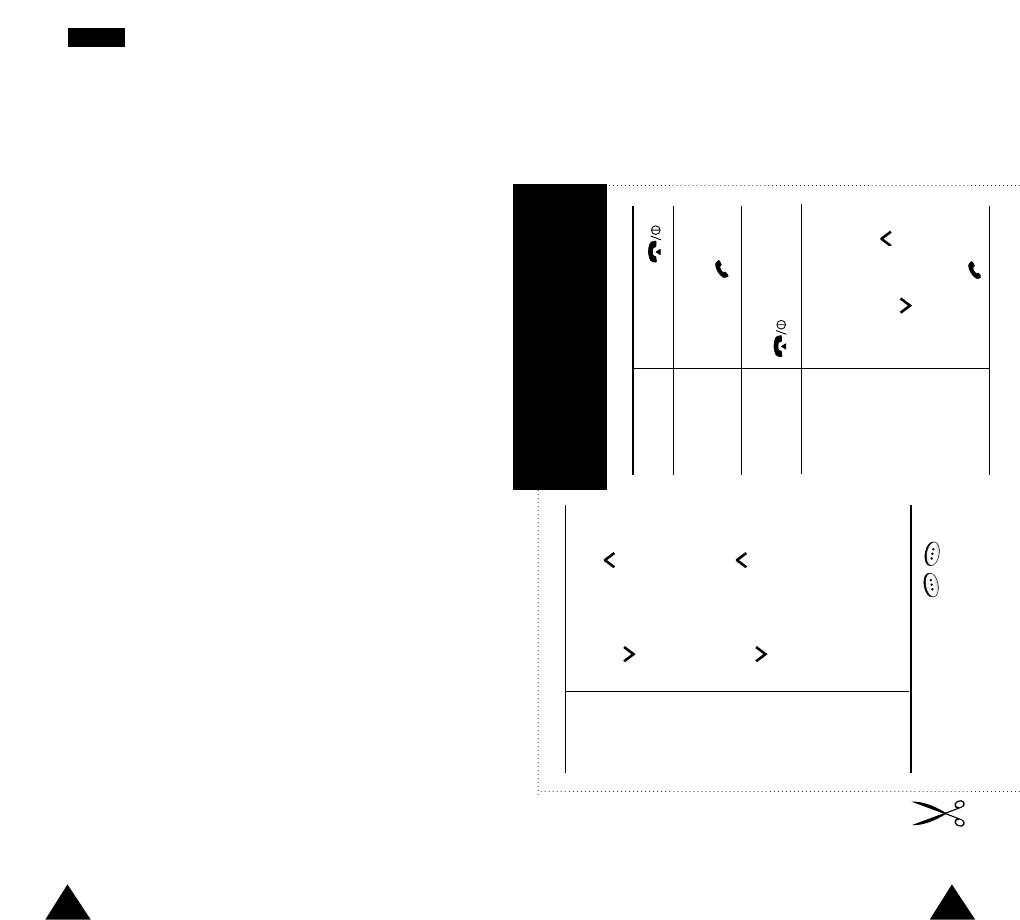
Index
106
TDMA Mobile Telephone STH-A225
Quick Reference Card
Press and hold .
Switch On/Off
➀Key in the number.
➁Press the key.
Make a Call
➀Open the phone and
press the View soft
key.
➁Scroll with the
and keys through
the missed calls.
➂To return the call,
press the key.
End a Call
View Missed
Calls right
after they
were missed
Briefly press the
key.
➀Press the Menu soft key.
➁Scroll with the and
keys through the list
of menus until you reach
the required menu.
➂Press the Select soft
key.
➃Scroll with the and
keys through the list
of options until the
required one is selected.
➄Press the Select soft key
to confirm.
Access
the Menu
Function
• Each of the two soft keys ( )
performs the function indicated by the
text above it (bottom line in the display).
S
(continued)
Sending
key tones • 41
messages • 55
Service code (7.6) • 86
Service light • 13; 65
Setting
alarm (5.4) • 77
date (5.3.2) • 76
display language • 67
time (5.3.1) • 75
Settings
resetting (4.8) • 67
Setup (2.5) • 56
ShortCut (4.9) • 68
Silent mode • 25
Slide Menu (4.6) • 67
SMS
setup (2.5) • 56
text message icon • 52
using • 42; 52
Soft keys, using • 26
Solving problems • 92
Sound Settings (3) • 58
Speed Dialing • 32
Switching on/off
microphone • 40
phone • 18
T
Tasks
defining• 73
deleting • 75
editing • 73
sorting • 75
Text messages • 52
icon • 52
preset (2.4) • 56
reading (2.2) • 53
setup (2.5) • 56
writing (2.3) • 55
Time
calls (1.4) • 51; 61
format (5.3.4) • 76
setting (5.3.1) • 75
world (5.3.3) • 76
To Do List (5.2) • 73
Tone
connect (3.8) • 61
error (3.6) • 60
length (3.4) • 59
melody •58
message (3.5) • 60
ring (3.2) • 58
Travel charger • 16
V
Vibration • 59
Voice mail (2.1) • 52
Voice memo pad • 88
Voice privacy (7.4) • 85
Voice Server Number
(2.1.2) • 53
Volume
adjusting • 22
selecting the ring (3.1) • 58
W
Waiting
call • 42; 81
World Time (5.3.3) • 76
Write Messages (2.3) • 55
Writing memos • 72
107
109108
➀Key in the number.
➁Press the Save soft key.
➂Enter the name.
➃Press the OK soft key.
➄If necessary, change the
location.
➅Press the OK soft key.
Store
Numbers
in the
Phonebook
➀Press the Name soft key.
➁Enter the start of the
name.
➂
Press the Search soft key.
➃To scroll through the
names, press the
and keys.
➄To make a call, press the
.
Search for
a Number
in the
Phonebook
Press the or key.
Adjust the
Volume
➀Select the Alert Type
menu option (3.3).
➁Select an option:
Light only,Melody,
Vibration,Vibra+
Melody and Step
Melody.
➂Press the Select soft
key to confirm.
Choose the
Alert Type
Open the phone
or
Press the key.
Answer a
Call
FDA Consumer Update
The U.S.Food and Drug Administration’s Center
for Devices and Radiological Health Consumer
Update on Mobile Phones
FDA has been receiving inquiries about the safety of mobile
phones, including cellular phones and PCS phones. The
following summarizes what is known-and what remains
unknown-about whether these products can pose a hazard to
health, and what can be done to minimize any potential risk.
This information may be used to respond to questions.
Why the concern?
Mobile phones emit low levels of radiofrequency energy
(i.e.,radiofrequency radiation) in the microwave range while
being used. They also emit very low levels of radiofrequency
energy (RF), considered non-significant, when in the stand-by
mode. It is well known that high of RF can produce biological
damage through heating effects (this is how your microwave
oven is able to cook food). However, it is not known whether,
to what extent, or through what mechanism, lower levels of
RF might cause adverse health effects as well. Although
some research has been done to address these questions, no
clear picture of the biological effects of this type of radiation
has emerged to date. Thus, the available science does not
allow us to conclude that mobile phones are absolutely safe,
or that they are unsafe. However, the available scientific
evidence does not demonstrate any adverse health effects
associated with the use of mobile phones.
What kinds of phones are in question?
Questions have been raised about hand-held mobile phones,
the kind that have a built-in antenna that is positioned close
to the user’s head during normal telephone conversation.
These types of mobile phones are of concern because of the

111110
short distance between the phone’s antenna-the primary
source of the RF-and the person’s head. The exposure to RF
from mobile phones in which the antenna is located at
greater distances from the user(on the outside of a car, for
example) is drastically lower than that from hand-held
phones, because a person’s RF exposure decreases rapidly
with distance from the source. The safety of so-called
“cordless phones,” which have a base unit connected to the
telephone wiring in a house and which operate at far lower
power levels and frequencies, has not been questioned.
How much evidence is there that hand-held
mobile phones might be harmful?
Briefly, there is not enough evidence to know for sure, either
way; however, research efforts are on-going. The existing
scientific evidence is conflicting and many of the studies that
have been done to date have suffered from flaws in their
research methods. Animal experiments investigating the
effects of RF exposures characteristic of mobile phones have
yielded conflicting results. A few animal studies, however,
have suggested that low levels of RF could accelerate the
development of cancer in laboratory animals. In one study,
mice genetically altered to be predisposed to developing one
type of cancer developed more than twice as many such
cancers when they were exposed to RF energy compared to
controls. There is much uncertainty among scientists about
whether results obtained from animal studies apply to the
use of mobile phones. First, it is uncertain how to apply the
results obtained in rats and mice to humans. Second, many
of the studies that showed increased tumor development
used animals that had already been treated with cancer-
causing chemicals, and other studies exposed the animals to
the RF virtually continuously-up to 22 hours per day.
For the past five years in the United States, the mobile phone
industry has supported research into the safety of mobile
phones. This research has resulted in two findings in
particular that merit additional study:
1. In a hospital-based, case-control study, researchers looked
for an association between mobile phone use and either
glioma (a type of brain cancer) or acoustic neuroma (a
benign tumor of the nerve sheath). No statistically
significant association was found between mobile phone
use and acoustic neuroma. There was also no association
between mobile phone use and gliomas when all types of
types of gliomas were considered together. It should be
noted that the average length of mobile phone exposure in
this study was less than three years.
When 20 types of glioma were considered separately,
however, an association was found between mobile phone
use and one rare type of glioma, neuroepithelliomatous
tumors. It is possible with multiple comparisons of the same
sample that this association occurred by chance. Moreover,
the risk did not increase with how often the mobile phone
was used, or the length of the calls. In fact, the risk actually
decreased with cumulative hours of mobile phone use.
Most cancer causing agents increase risk with increased
exposure. An ongoing study of brain cancers by the National
Cancer Institute is expected to bear on the accuracy and
repeatability of these results.1
2. Researchers conducted a large battery of laboratory tests to
assess the effects of exposure to mobile phone RF on
genetic material. These included tests for several kinds of
abnormalities, including mutations, chromosomal
aberrations, DNA strand breaks, and structural changes in
the genetic material of blood cells called lymphocytes.
None of the tests showed any effect of the RF except for
the micronucleus assay, which detects structural effects on
the genetic material. The cells in this assay showed
changes after exposure to simulated cell phone radiation,
but only after 24 hours of exposure. It is possible that
exposing the test cells to radiation for this long resulted in
heating. Since this assay is known to be sensitive to
heating, heat alone could have caused the abnormalities to
occur. The data already in the literature on the response of
the micronucleus assay to RF are conflicting. Thus, follow-
up research is necessary.2

113112
FDA is currently working with government, industry, and
academic groups to ensure the proper follow-up to these
industry-funded research findings. Collaboration with the
Cellular Telecommunications Industry Association(CTIA) in
particular is expected to lead to FDA providing research
recommendations and scientific oversight of new CTIA-
funded research based on such recommendations.
Two other studies of interest have been reported recently in
the literature:
1. Two groups of 18 people were exposed to simulated
mobile phone signals under laboratory conditions while
they performed cognitive function tests. There were no
changes in the subjects’ ability to recall words, numbers,
or pictures, or in their spatial memory, but they were
able to make choices more quickly in one visual test
when they were exposed to simulated mobile phone
signals. This was the only change noted among more
than 20 variables compared.3
2 . In a study of 209 brain tumor cases and 425 matched
controls, there was no increased risk of brain tumors
associated with mobile phone use. When tumors did
exist in certain locations, however, they were more
likely to be on the side of the head where the mobile
phone was used. Because this occurred in only a small
number of cases, the increased likelihood was too small
to be statistically significant.4
In summary, we do not have enough information at this
point to assure the public that there are, or are not, any
low incident health problems associated with use of mobile
phones. FDA continues to work with all parties, including
other federal agencies and industry, to assure that research
is undertaken to provide the necessary answers to the
outstanding questions about the safety of mobile phones.
What is known about cases of human cancer
that have been reported in users of hand-held
mobile phones?
Some people who have used mobile phones have been
diagnosed with brain cancer. But it is important to
understand that this type of cancer also occurs among
people who have not used mobile phones. In fact, brain
cancer occurs in the U.S. population at a rate of about 6
new cases per 100,000 people each year. At that rate,
assuming 80 million users of mobile phones (a number
increasing at a rate of about 1 million per moth), about
4800 cases of brain cancer would be expected each year
among those 80 million people, whether or not they used
their phones. Thus it is not possible to tell whether any
individual’s cancer arose because of the phone, or whether
it would have happened anyway. A key question is whether
the risk of getting a particular form of cancer is greater
among people who use mobile phones than among the rest
of the population. One way to answer that question is to
compare the usage of mobile phones among people with
brain cancer with the use of mobile phones among
appropriately matched people without brain cancer. This is
called a case-control study. The current case-control study
of brain cancers by the National Cancer Institute, as well
as the follow-up research to be sponsored by industry, will
begin to generate this type of information.
What is FDA’s role concerning the safety of
mobile phones?
Under the law, FDA does not review the safety of radiation-
emitting consumer products such as mobile phones before
marketing, as it does with new drugs or medical devices.
However, the agency has authority to take action if mobile
phones are shown to emit radiation at a level that is
hazardous to the user. In such a case, FDA could require the
manufacturers of mobile phones to notify users of the
health hazard and to repair, replace or recall the phones so
that the hazard no longer exists.

115114
Although the existing scientific data do not justify FDA
regulatory actions at this time, FDA has urged the mobile
phone industry to take a number of steps to assure public
safety. The agency has recommended that the industry:
• support needed research into possible biological effects of
RF of the type emitted by mobile phones:
• design mobile phones in a way that minimizes any RF
exposure to the user that is not necessary for device
function; and
• cooperate in providing mobile phone users with the best
possible information on what is known about possible
effects of mobile phone use on human health.
At the same time, FDA belongs to an interagency working
group of the federal agencies that have responsibility for
different aspects of mobile phone safety to ensure a
coordinated effort at the federal level. These agencies are:
• National Institute for Occupational Safety and Health
• Environmental Protection Agency
• Federal Communication Commission
• Occupational Health and Safety Administration
• National Telecommunications and Information
Administration
The National Institutes of Health also participates in this
group.
In the absence of conclusive information about
any possible risk, what can concerned
individuals do?
If there is a risk from these products-and at this point we do
not know that there is-it is probably very small. But if people
are concerned about avoiding even potential risks, there are
simple steps they can take to do so. For example, time is a
key factor in how much exposure a person receives. Those
persons who spend long periods of time on their hand-held
mobile phones could consider holding lengthy conversations
on conventional phones and reserving the hand-held models
for shorter conversations for for situations when other
types of phones are not available.
Phone who must conduct extended conversations in their
cars every day could switch to a type of mobile phone that
places more distance between their bodies and the source
of the RF, since the exposure level drops off dramatically
with distance. For example, they could switch to:
• a mobile phone in which the antenna is located outside
the vehicle,
• a hand-held phone with a built-in antenna connected to a
different antenna mounted on the outside of the car or
built into a separate package, or
• a headset with a remote antenna to a mobile phone
carried at the waist.
Again, the scientific data do not demonstrate that mobile
phones are harmful. But if people are concerned about the
radiofrequency energy from these products, taking the
simple precautions outlined above can reduce any possible
risk.
Where can I find additional information?
For additional information, see the following websites:
Federal Communications Commission (FCC) RF Safety
Program (select “Information on Human Exposure to RF
Fields from Cellular and PCS Radio Transmitters”):
http://www.fcc.gov/oet/rfsafety
World Health Organization (WHO) International
Commission on Non-Ionizing Radiation Protection (select Qs
& As): http://www.who.int/emf
United Kingdom, National Radiological Protection
Board: http://www.nrpb.org.uk
Cellular Telecommunications Industry Association
(CTIA): http://www.wow-com.com

117116
Wireless Phone Safety Tips
Your Samsung wireless telephone gives you the powerful
ability to communicate by voice-almost anywhere, anytime.
But an important responsibility accompanies the benefits of
wireless phones, one that every user must uphold.
When driving a car, driving is your first responsibility. When
using your wireless phone behind the wheel of a car,
practice good common sense and remember the following
tips:
1. Get to know your Samsung wireless phone and its
features such as speed dial and redial. If available,
these features help you to place your call without taking
your attention off the road.
2. When available, use a hands-free device. If possible,
add an additional layer of convenience and safety to your
wireless phone with one of the many hands-free accessories
available today.
3. Position your wireless phone within easy reach. Be
able to access your wireless phone without removing your
eyes from the road. If you get an incoming call at an
inconvenient time, if possible, let your voice mail answer it
for you.
4. Let the person you are speaking with know you are
driving; if necessary, suspend the call in heavy traffic
or hazardous weather conditions. Rain, sleet, snow, ice,
and even heavy traffic can be hazardous.
5. Do not take notes or look up phone numbers while
driving. Jotting down a “to do” list or flipping through your
address book takes attention away from your primary
responsibility, driving safely.
6. Dial sensibly and assess the traffic; if possible, place
calls when you are not moving or before pulling into
traffic. Try to plan calls when your car will be stationary. If
you need to make a call while moving, dial only a few
numbers, check the road and your mirrors, then continue.
U.S Food and Drug Administration (FDA) Center for
Devices and Radiological Health:
http://www.fda.gov/cdrh/consumer/
1 Muscat et al. Epidemiological Study of Cellular Telephone Use and
Malignant Brain Tumors. In: State of the Science Symposium;1999
June 20; Long Beach, California.
2Tice et al. Tests of mobile phone signals for activity in genotoxicity and
other laboratory assays. In: Annual Meeting of the Environmental
Mutagen Society; March 29, 1999, Washington, D.C.; and personal
communication, unpublished results.
3Preece, AW, Iwi, G, Davies-Smith, A, Wesnes, K, Butler, S, Lim, E, and
Varey, A. Effect of a 915-MHz simulated mobile phone signal on
cognitive function in man. Int. J. Radiat. Biol., April 8, 1999
4Hardell, L, Nasman, A, Pahlson, A, Hallquist, A and Mild, KH. Use of
cellular telephones and the risk for brain tumors: a case-control study.
Int. J. Oncol., 15:113-116, 1999.

118
7. Do not engage in stressful or emotional conversations
that may be distracting. Make people you are talking with
aware you are driving and suspend conversations which
have the potential to divert your attention from the road.
8. Use your wireless phone to call for help. Dial 100 or
other local emergency number in the case of fire, traffic
accident or medical emergencies. Remember, it is a free call
on your wireless phone!*
9. Use your wireless phone to help others in
emergencies. If you see an auto accident, crime in
progress or other serious emergency where lives are in
danger, call 100 or other local emergency number, as you
would want others to do for you.*
10. Call roadside assistance or a special non-
emergencies wireless assistance number when
necessary. If you see a broken-down vehicle posing no
serious hazard, a broken traffic signal, a minor traffic
accident where no one appears injured, or a vehicle you
know to be stolen, call roadside assistance or other special
non-emergency wireless number.*
Check the laws and regulations on the use of wireless
telephones and their accessories in the areas where you
drive. Always obey them. The use of these devices may be
prohibited or restricted in certain areas.
For more information, please call 1-888-901-SAFE, or
visit our website www.wow-com.comTM.
* Wherever wireless phone service is available.