Samsung Electronics Co WB850F Digital Camera User Manual
Samsung Electronics Co Ltd Digital Camera
Contents
- 1. Manual
- 2. User Manual
User Manual
This user manual includes detailed usage
instructions for your camera. Please read
this manual thoroughly.
Basic troubleshooting
Quick reference
Contents
Basic functions
Extended functions
Shooting options
Playback/Editing
Wireless network
(WB850F only)
Settings
Appendixes
Index
User Manual
WB850/WB850F
Click a topic
1
Keep your camera away from small children and pets.
Keep your camera and all accessories out of the reach of small
children and animals. Small parts may cause choking or serious
injury if swallowed. Moving parts and accessories may present
physical dangers as well.
Do not expose the camera to direct sunlight or high
temperatures for an extended period of time.
Prolonged exposure to sunlight or extreme temperatures can
cause permanent damage to your camera’s internal components.
Avoid covering the camera or charger with blankets or clothes.
The camera may overheat, which may distort the camera or
cause a fire.
If liquid or foreign objects enter your camera, immediately
disconnect all power sources, such as the battery or charger,
and then contact a Samsung service center.
Health and safety information
Always comply with the following precautions and usage tips to avoid dangerous situations and ensure peak performance of your camera.
Warning—situations that could cause injury to yourself or
others
Do not disassemble or attempt to repair your camera.
This may result in electric shock or damage to the camera.
Do not use your camera near flammable or explosive gases and
liquids.
This may cause a fire or explosion.
Do not insert flammable materials into the camera or store these
materials near the camera.
This may cause a fire or electric shock.
Do not handle your camera with wet hands.
This may result in electric shock.
Prevent damage to subjects’ eyesight.
Do not use the flash in close proximity (closer than 1 m/3 ft) to
people or animals. If you use the flash too close to your subject’s
eyes, this can cause temporary or permanent eyesight damage.
2
Comply with any regulations that restrict the use of a camera in
a certain area.
• Avoid interference with other electronic devices.
• Turn off the camera when in an aircraft. Your camera can cause
interference with aircraft equipment. Follow all airline regulations
and turn off your camera when directed by airline personnel.
• Turn off the camera near medical equipment. Your camera can
interfere with medical equipment in hospitals or health care
facilities. Follow all regulations, posted warnings, and directions
from medical personnel.
Avoid interference with pacemakers.
Maintain a minimum of 15 cm (6 inches) between this
camera and all pacemakers to avoid potential interference,
as recommended by the manufacturer and the independent
research group, Wireless Technology Research. If you have
any reason to suspect that your camera is interfering with
a pacemaker or other medical device, turn off the camera
immediately and contact the manufacturer of the pacemaker or
medical device for guidance.
Caution—situations that could cause damage to your camera
or other equipment
Remove the batteries from your camera when storing it for an
extended period of time.
Installed batteries may leak or corrode over time and cause
serious damage to your camera.
Use only authentic, manufacturer-recommended, Lithium-ion
replacement batteries. Do not damage or heat the battery.
Inauthentic, damaged, or heated batteries may cause a fire or
personal injury.
Use only Samsung-approved batteries, chargers, cables and
accessories.
• Using unauthorized batteries, chargers, cables or accessories
can cause batteries to explode, damage your camera, or cause
injury.
• Samsung is not responsible for damages or injuries caused by
unauthorized batteries, chargers, cables or accessories.
Use the battery only for its intended purpose.
Misusing the battery may cause a fire or electric shock.
Health and safety information

3
Health and safety information
Do not touch the flash while it fires.
The flash is very hot when fired and may burn your skin.
When you use AC charger, turn off the camera before you
disconnect the power to the AC charger.
Failing to do so may result in fire or electric shock.
Disconnect the charger from the wall socket when not in use.
Failing to do so may result in fire or electric shock.
Do not use a damaged power supply cord, plug, or loose outlet
when you charge batteries.
These may cause a fire or electric shock.
Do not allow the AC charger to come in contact with the +/-
terminals on the battery.
This may cause a fire or electric shock.
Do not force the camera’s parts or apply pressure to the
camera.
This may cause your camera to malfunction.
Exercise caution when you connect cables or adapters and
install batteries and memory cards.
If you force the connectors, improperly connect cables, or
improperly install batteries and memory cards, you can damage
ports, connectors, and accessories.
Keep cards with magnetic strips away from the camera case.
Information stored on the card may be damaged or erased.
Never use a damaged charger, battery, or memory card.
This may result in electric shock or camera malfunction or cause
a fire.

4
Health and safety information
Check that the camera is operating properly before use.
The manufacturer takes no responsibility for any loss of files or
damage that may result from camera malfunction or improper
use.
When connecting the USB cable to the camera, be sure to insert
the correct USB cable connector into the camera.
If the cable is reversed, it may damage your files. The
manufacturer is not responsible for any loss of data.
Avoid interference with other electronic devices.
Your camera emits radio frequency (RF) signals that may interfere
with unshielded or improperly shielded electronic equipment,
such as pacemakers, hearing aids, medical devices, and
other electronic devices in homes or vehicles. Consult the
manufacturers of your electronic devices to solve any interference
problems you experience. To prevent unwanted interference, use
only Samsung-approved devices or accessories.
Use your camera in the normal position.
Avoid contact with your camera’s internal antenna.
Data transference and your responsibilities
• Data transferred via WLAN could be leaked, so avoid
transferring sensitive data in public areas or on open networks.
• The camera manufacturer is not liable for any data transfers that
infringe on copyrights, trademarks, intellectual property laws, or
public decency ordnances.
5
Copyright information
• Microsoft Windows and the Windows logo are
registered trademarks of the Microsoft Corporation.
• Mac is a registered trademark of the Apple Corporation.
• HDMI, the HDMI logo and the term "High Definition
Multimedia Interface" are trademarks or registered
trademarks of HDMI Licensing LLC.
• Wi-Fi®, the Wi-Fi CERTIFIED logo, and the Wi-Fi logo
are registered trademarks of the Wi-Fi Alliance.
• Trademarks and trade names used in this manual are
the property of their respective owners.
• Camera specifications or contents of this manual may
be changed without prior notice due to upgrade of
camera functions.
• You are not allowed to reuse or distribute any part of
this manual without prior permission.
• We recommend using your camera within the country
where you purchase it.
• For Open Source License information, refer to the
‘OpenSourceInfo.pdf’ in the provided CD-ROM.
Outline of the User Manual
Basic functions 14
Learn about your camera’s layout, icons, and basic
functions for shooting.
Extended functions 35
Learn how to capture a photo and record a video by
selecting a mode.
Shooting options 58
Learn how to set the options in Shooting mode.
Playback/Editing 85
Learn how to play back photos or videos, and edit
photos or videos. Also, learn how to connect your
camera to your computer, photo printer, TV, HDTV, or
3D TV.
Wireless network (WB850F only) 112
Learn to connect to wireless local area networks
(WLANs) and use functions.
Settings 132
Refer to options to configure your camera’s settings.
Appendixes 138
Get information about error messages, specifications,
and maintenance.
6
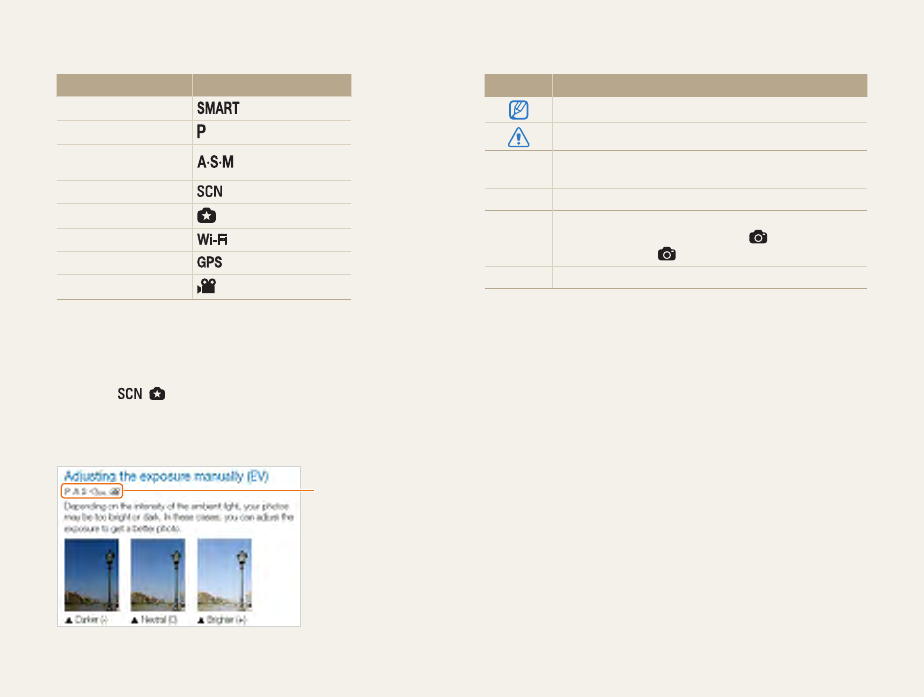
Indicators used in this manual
Shooting mode Indicator
Smart Auto
Program
Aperture Priority,
Shutter Priority, Manual
Scene
Magic Plus
Wi-Fi
GPS
Movie
Shooting mode icons
These icons appear in the text when a function is available in a
mode. See the example below.
Note: The , mode may not support functions for all
scenes.
For example:
Available in Program,
Aperture Priority,
Shutter Priority,
DUAL IS, and Movie
modes
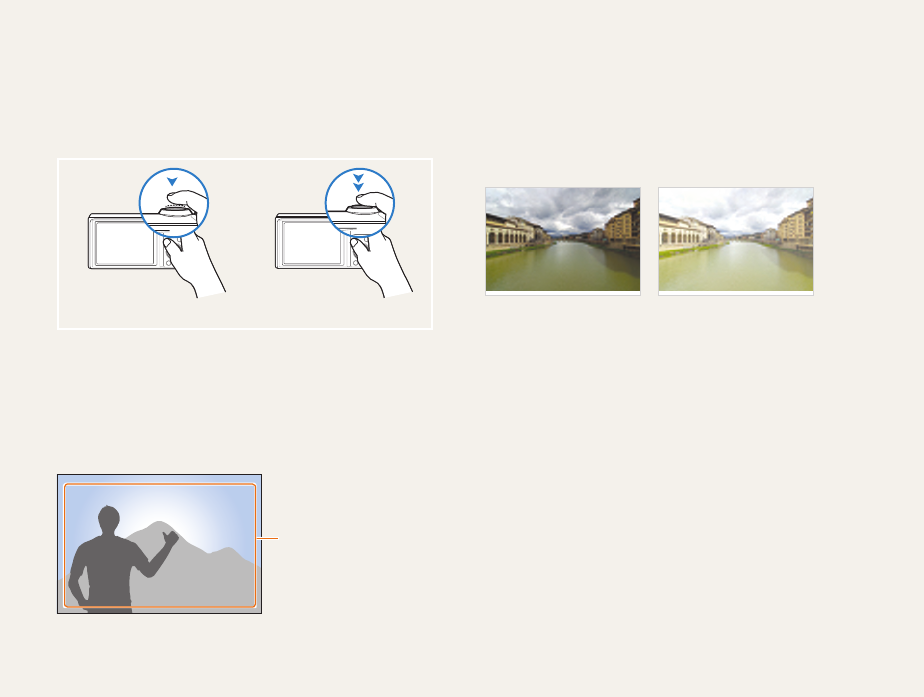
Icons used in this manual
Icon Function
Additional information
Safety warnings and precautions
[ ] Camera buttons. For example, [Shutter] represents the
shutter button.
( ) Page number of related information
→
The order of options or menus you must select to
perform a step; for example: Select → Photo Size
(represents Select , and then select Photo Size).
*Annotation
7
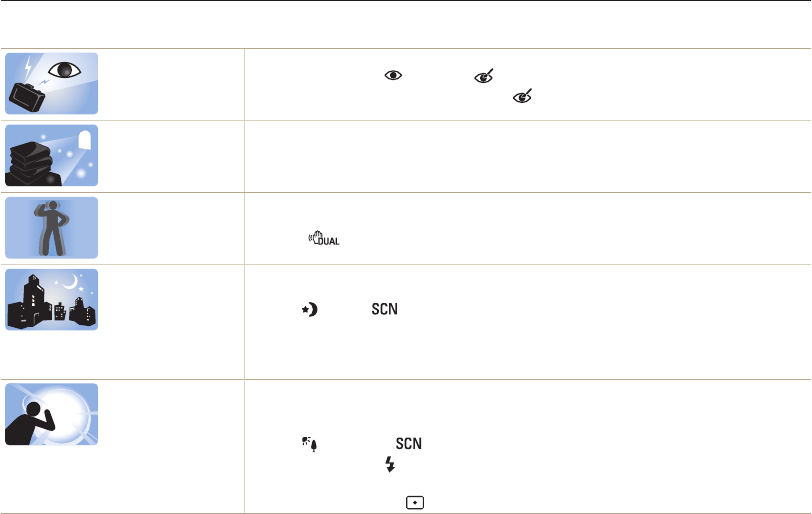
Pressing the shutter
• Half-press [Shutter]: press the shutter halfway down
• Press [Shutter]: press the shutter all the way down
Half-press [Shutter] Press [Shutter]
Subject, background, and composition
• Subject: the main object in a scene, such as a person, animal,
or still life
• Background: the objects around the subject
• Composition : the combination of a subject and background
Composition
Background
Subject
Exposure (Brightness)
The amount of light that enters your camera determines the
exposure. You can alter the exposure with shutter speed,
aperture value, and ISO sensitivity. By altering the exposure, your
photos will be darker or lighter.
Normal exposure
Overexposure (too bright)
Expressions used in this manual
8
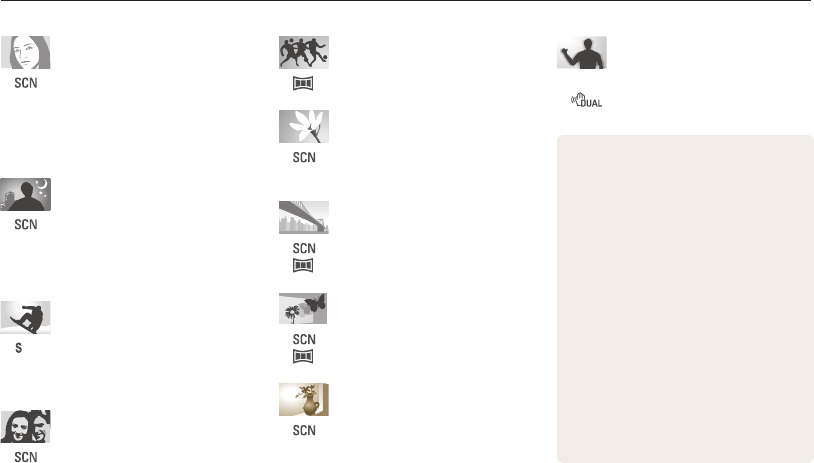
Basic troubleshooting
Learn to solve common problems by setting shooting options.
The subject’s eyes
appear red.
Red eye occurs when the subject's eyes reflect light from the camera flash.
•
Set the flash option to Red-eye or Red-eye Fix. (p. 60)
•
If the photo has already been captured, select Red-eye Fix in the edit menu. (p. 97)
Photos have dust
spots.
If dust particles are present in the air, you may capture them in photos when you use the flash.
•
Turn off the flash or avoid capturing photos in a dusty place.
•
Set ISO sensitivity options. (p. 62)
Photos are blurred. Blurring can occur if you capture photos in low light conditions or hold the camera incorrectly.
•
Use the OIS function or half-press [Shutter] to ensure the subject is focused. (p. 31)
•
Use the mode. (p. 46)
Photos are blurred
when shooting at
night.
As the camera tries to let in more light, the shutter speed slows. This can make it difficult to hold the
camera steady long enough to take a clear picture and may result in camera shake.
•
Select Night in mode. (p. 36)
•
Turn on the flash. (p. 60)
•
Set ISO sensitivity options. (p. 62)
•
Use a tripod to prevent your camera from shaking.
Subjects come out
too dark because of
backlighting.
When the light source is behind the subject or when there is a high contrast between light and dark
areas, the subject may appear too dark.
•
Avoid shooting toward the sun.
•
Select Backlight in mode. (p. 36)
•
Set the flash option to Fill in. (p. 60)
•
Adjust the exposure. (p. 72)
•
Set the metering option to Spot if a subject is in the center of the frame. (p. 73)
9
Quick reference
Capturing photos of people
•
mode > Beauty Shot
39
•
Red-eye/Red-eye Fix (to prevent or correct
red-eye)
60
•
Face Detection
67
•
Self-Portrait
68
Capturing photos at night or in
the dark
•
mode > Night, Sunset, Dawn
36
•
Flash options
60
•
ISO sensitivity (to adjust the sensitivity to light)
62
Capturing action photos
•
mode
44
•
High-speed burst mode
77
•
Precapture
78
Adjusting the exposure
(brightness)
•
mode > HDR
37
•
ISO sensitivity(to adjust the sensitivity to light)
62
•
EV (to adjust exposure)
72
•
Metering
73
•
Bracket
78
Capturing panoramic action
photos
•
mode > Action Panorama
49
Capturing photos of text,
insects, or flowers
•
mode > Text
36
•
Macro
63
Capturing photos of scenery
•
mode > Landscape
36
•
mode
47
Capturing 3D photos
•
mode > 3D Photo
37
•
mode > 3D Panorama
47
Applying effects to photos
•
mode > Zooming Shot
40
•
Smart Filter effects
80
•
Image Adjust (to adjust Contrast, Sharpness,
or Saturation)
82
Reducing camera shake
•
Optical Image Stabilization (OIS)
30
•
mode
46
•
Viewing files by category in Smart Album
87
•
Viewing files as thumbnails
88
•
Deleting all files on the memory card
89
•
Viewing files as a slide show
92
•
Viewing files on a TV, HDTV, or 3D TV
100
•
Connecting your camera to a computer
103
•
Using photo or video sharing websites
(WB850F only)
103
•
Sending photos via email
(WB850F only)
103
•
Adjusting sound and volume
112
•
Adjusting the brightness of the display
112
•
Changing the display language
113
•
Setting the date and time
113
•
Before contacting a service center
127

10
Contents
Extended functions
.........................................................35
Using the Smart Auto mode ......................................... 36
Using the Scene mode ................................................. 38
Using the 3D Photo mode ............................................39
Using the HDR mode ..................................................39
Using the Magic Frame mode ......................................40
Using the Beauty Shot mode ........................................ 41
Using the Zooming Shot mode .....................................42
Using the Program mode ............................................. 43
Using the Aperture Priority, Shutter Priority, or
Manual mode ................................................................ 44
Using the Aperture Priority mode ...................................45
Using the Shutter Priority mode .....................................46
Using the Manual mode ............................................... 47
Using the DUAL IS mode ............................................. 48
Using the Panorama mode ..........................................49
Using the 2D or 3D Panorama mode ............................49
Using the Action Panorama mode .................................51
Using the Movie mode .................................................52
Recording high-speed videos ....................................... 54
Using the Smart Scene Detection mode .......................55
Using the Creative Movie Maker mode .......................56
Making a movie with the Creative Movie Maker ..............56
View a movie made in Creative Movie Maker mode ........ 57
Basic functions
................................................................ 14
Unpacking .................................................................... 15
Camera layout ..............................................................16
Inserting the battery and memory card ........................ 19
Charging the battery and turning on your camera ....... 20
Charging the battery .................................................... 20
Turning on your camera ...............................................20
Performing the initial setup ..........................................21
Learning icons .............................................................. 23
Selecting options or menus .........................................24
Using [MENU] ............................................................. 24
Using [Fn] ................................................................... 26
Setting the display and sound ..................................... 27
Setting the display type ................................................ 27
Setting the sound ........................................................ 28
Capturing photos ..........................................................29
Zooming ..................................................................... 30
Reducing camera shake (OIS) ...................................... 32
Tips for getting a clearer photo .................................... 33

11
Contents
Shooting options
............................................................. 58
Selecting a resolution and quality ................................ 59
Selecting a resolution ................................................... 59
Setting the photo quality ............................................... 60
Using the timer ............................................................. 61
Shooting in the dark ..................................................... 62
Preventing red-eye ...................................................... 62
Using the flash ............................................................ 62
Adjusting the ISO sensitivity .......................................... 64
Changing the camera’s focus ......................................65
Using macro ............................................................... 65
Using auto focus .........................................................65
Focusing on a selected area ........................................ 67
Using tracking auto focus ............................................. 67
Adjusting the focus area ............................................... 68
Using Face Detection ................................................... 69
Detecting faces ...........................................................69
Capturing a self portrait shot .........................................70
Capturing a smile shot ................................................. 70
Detecting eye blinking .................................................. 71
Using Smart Face Recognition ..................................... 71
Registering faces as your favorites (My Star) .................. 72
Adjusting brightness and color .................................... 74
Adjusting the exposure manually (EV) ............................ 74
Changing the metering option ....................................... 75
Selecting a White Balance setting ................................. 76
Using burst modes ....................................................... 79
Capturing photos in the High-speed burst mode ............ 79
Capturing photos in the Precapture mode ..................... 80
Capturing bracketed photos ......................................... 80
Applying effects/Adjusting images ...............................82
Applying Smart Filter effects ......................................... 82
Adjusting your photos .................................................. 84

12
Contents
Playback/Editing
.............................................................. 85
Viewing photos or videos in Playback mode ............... 86
Starting Playback mode ............................................... 86
Viewing photos ........................................................... 92
Playing a video ............................................................95
Editing a photo ............................................................. 97
Resizing photos .......................................................... 97
Rotating a photo .......................................................... 97
Applying Smart Filter effects ......................................... 98
Adjusting your photos .................................................. 99
Creating a print order (DPOF) ......................................100
Viewing files on a TV, HDTV, or 3D TV ........................ 102
Transferring files to your Windows computer ............ 105
Transferring files with Intelli-studio ................................ 106
Transferring files by connecting the camera as a
removable disk ..........................................................108
Disconnecting the camera (for Windows XP) ................109
Transferring files to your Mac computer .................... 110
Printing photos with a PictBridge photo printer ........ 111
Wireless network (WB850F only)
.................................112
Connecting to a WLAN and configuring
network settings ......................................................... 113
Connecting to a WLAN ..............................................113
Setting network options .............................................114
Manually setting the IP address ..................................114
Network connection tips ............................................115
Sending photos via email ...........................................116
Changing email settings ............................................. 116
Sending photos via email ........................................... 118
Entering text ..............................................................119
Using photo or video sharing websites ..................... 120
Accessing a website ................................................. 120
Uploading photos or videos ........................................120
Using a smart phone as a remote shutter release ..... 121
Viewing photos or videos on a AllShare-enabled TV
..123
Viewing photos or videos on a TV I ..............................123
Viewing photos or videos on a TV II ............................. 125
Sending or receiving photos or videos with
another camera .......................................................... 126
Sending photos or videos to another camera ............... 126
Receiving photos or videos from another camera ......... 126
Using Auto Backup to send photos or videos ........... 128
Installing the program for Auto Backup on your PC ....... 128
Sending photos or videos to a PC .............................. 128
Sending photos or videos to a Blu-ray disc Player ........ 129
About the Wakeup on LAN (WOL) feature .................130

13
Contents
Settings
.......................................................................... 132
Settings menu ............................................................ 133
Accessing the settings menu ..................................... 133
Sound ...................................................................... 134
Display ..................................................................... 134
Settings ....................................................................135
Appendixes
....................................................................138
Error messages .......................................................... 139
Camera maintenance ................................................. 140
Cleaning your camera ................................................140
Using or storing the camera ....................................... 141
About memory cards .................................................142
About the battery ....................................................... 145
Before contacting a service center ............................ 149
Camera specifications ................................................ 152
Glossary ......................................................................156
FCC notice ..................................................................161
Index ........................................................................... 162

Unpacking
………………………………… 15
Camera layout
……………………………… 16
Inserting the battery and memory card
… 19
Charging the battery and turning on
your camera
………………………………… 20
Charging the battery
……………………… 20
Turning on your camera
………………… 20
Performing the initial setup
……………… 21
Learning icons
……………………………… 23
Selecting options or menus
……………… 24
Using [MENU]
…………………………… 24
Using [Fn]
………………………………… 26
Setting the display and sound
…………… 27
Setting the display type
…………………… 27
Setting the sound
………………………… 28
Capturing photos
………………………… 29
Zooming
………………………………… 30
Reducing camera shake (OIS)
…………… 32
Tips for getting a clearer photo
…………… 33
Basic functions
Learn about your camera’s layout, icons, and basic functions for shooting.
Basic functions
15
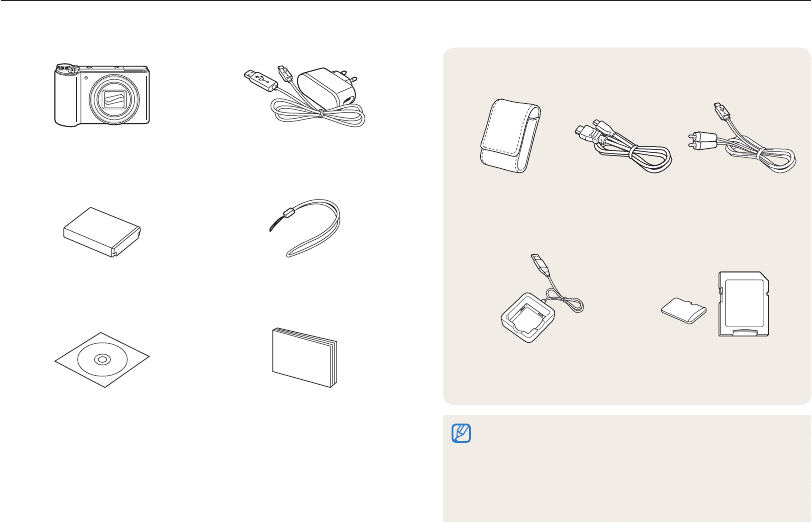
Unpacking
The following items are included in your product box.
Camera AC adapter/
USB cable
Rechargeable battery Strap
User Manual CD-ROM Quick Start Guide
Optional accessories
Camera case HDMI cable A/V cable
Battery charger Memory card/
Memory card adapter
•
The illustrations may differ slightly from the items shipped with
your product.
•
The items included in the box may differ depending on the model.
•
You can purchase optional accessories at a retailer or a Samsung
service center. Samsung is not responsible for any problems
caused by using unauthorized accessories.
Basic functions
16
Camera layout
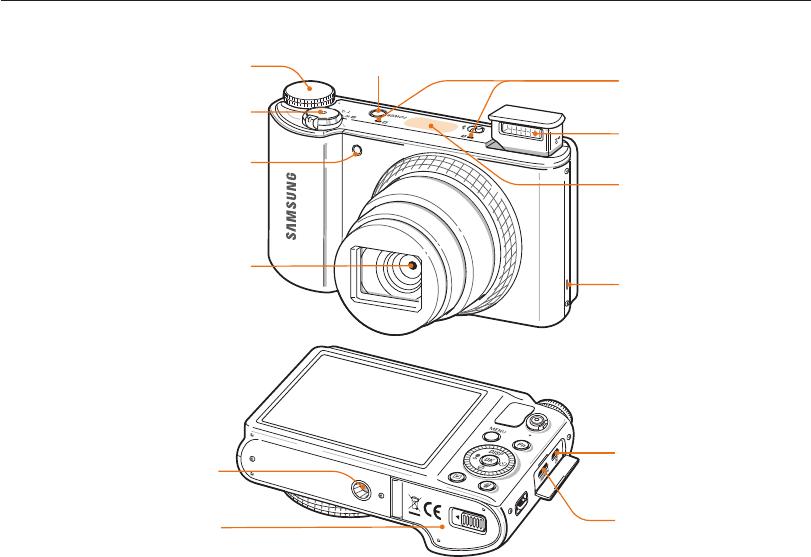
Before you start, familiarize yourself with your camera’s parts and their functions.
Battery chamber cover
Insert a memory card and battery
Tripod mount
USB and A/V port
Accepts USB cable and A/V cable
HDMI port
Accepts HDMI cable
Speaker
Lens
Microphone
Flash
Shutter button
AF-assist light/Timer lamp
POWER button
Mode dial
(p. 16)
Internal antenna*
* Avoid contact with the
internal antenna while using
the wireless network.
(WB850F only)
Basic functions
17
Camera layout
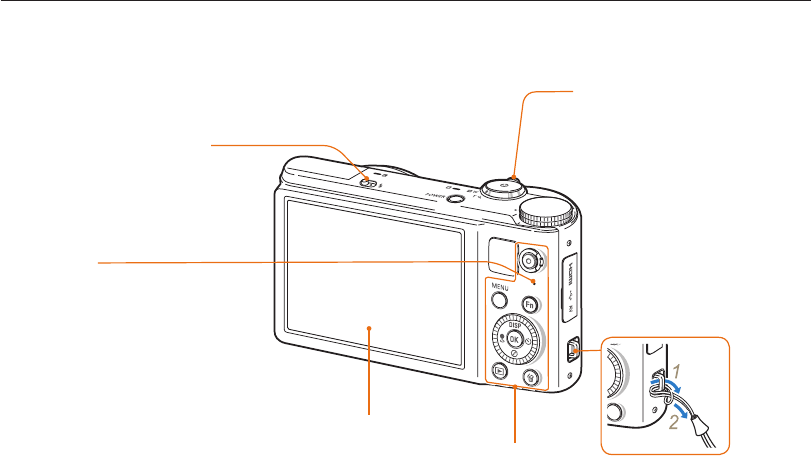
Buttons
(p. 16)
Status lamp
•
Blinking: When the camera is saving a
photo or video, being read by a computer
or printer, when the image is out of
focus, or there is a problem charging the
battery (On WB850F, when the camera is
connecting to WLAN or sending a photo)
•
Steady: When the camera is connected
to a computer, charging the battery, or
when the image is in focus
Display
Zoom button
•
In Shooting mode: Zoom in or out
•
In Playback mode: Zoom in on part of
a photo or view files as thumbnails, or
adjust the volume
Attaching the strap
Flash release
Basic functions
18
Camera layout
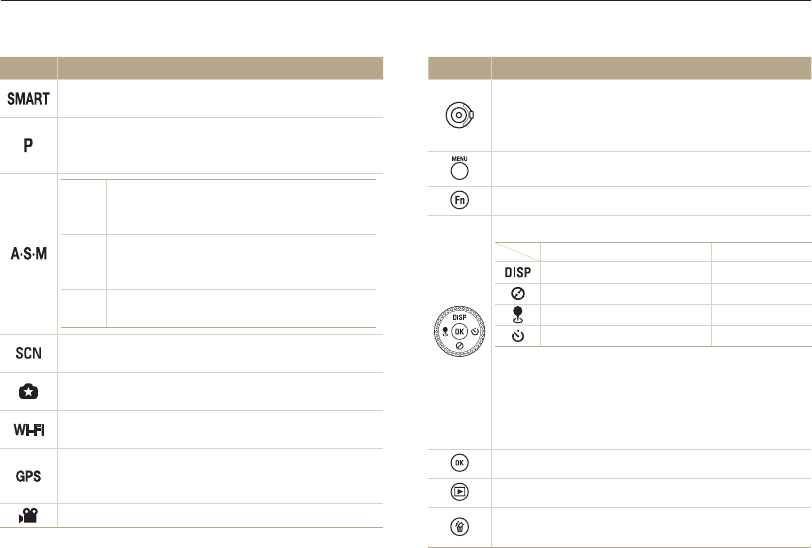
Mode dial
Icon Description
Smart Auto: Capture a photo with a scene mode selected
automatically by the camera.
Program: Capture a photo by setting options except the
shutter speed and aperture value which the camera sets
automatically.
Aperture Priority: The camera selects a shutter
speed based on the aperture value you have
set manually.
Shutter Priority: The camera selects an
aperture value based on the shutter speed you
have set manually.
Manual: Adjust various camera settings
including shutter speed and aperture value.
Scene: Capture a photo with options preset for a specific
scene.
Magic Plus: Capture a photo, record a video, or edit an
image with various effects.
Wi-Fi: Connect to wireless local area networks and use
functions. (WB850F only)
GPS: Using the GPS information, you can check the
current location data, and find the shooting location of the
picture, recorded with location data.
Movie: Customize settings to record a video.
Buttons
Button Description
When pressing the video recording button:
Start recording a video.
When rotating the video recording button:
Access burst options.
Access options or menus.
Access options in Shooting mode.
When pressing the navigation button:
Basic functions Other functions
Change the display option. Move up
Change the compass option. Move down
Change the live landmark option.
Move left
Change the timer option. Move right
When rotating the navigation button:
•
Scroll to an option or menu.
•
Adjust the shutter speed, aperture, or exposure value in
Shooting mode.
•
Scroll through files in Playback mode.
Confirm the highlighted option or menu.
Enter Playback mode.
•
Close the help instruction.
•
Delete files in Playback mode.
Basic functions
19
Inserting the battery and memory card
Learn how to insert the battery and an optional memory card into the camera.
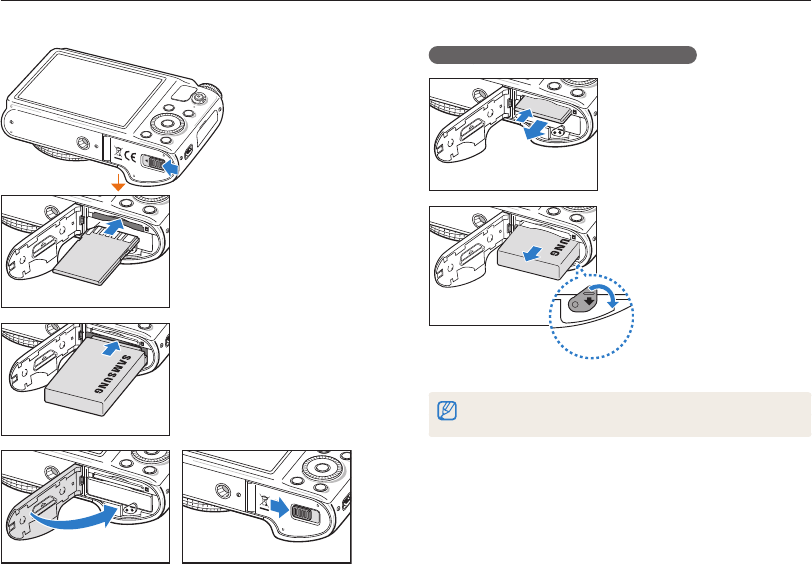
Removing the battery and memory card
Memory card
Push the card gently until it
disengages from the camera,
and then pull it out of the slot.
Battery lock
Rechargeable
battery
Slide the lock down to release
the battery.
You can use the internal memory for temporary storage if a memory card is
not inserted.
Memory card
Insert a memory card with the
gold-colored contacts facing
up.
Rechargeable battery
Insert the battery with the
Samsung logo facing up.
Basic functions
20
Charging the battery and turning on your camera
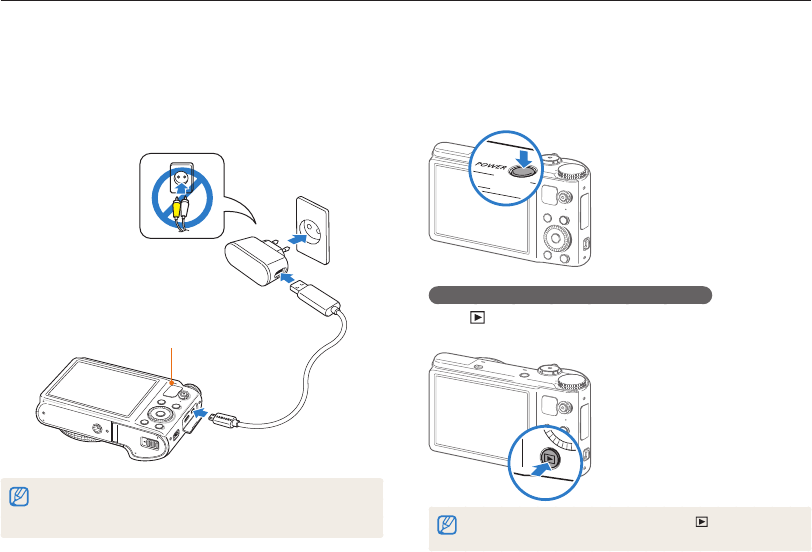
Turning on your camera
Press [POWER] to turn your camera on or off.
• The initial setup screen appears when you turn on the camera
for the first time. (p. 19)
Turning on your camera in Playback mode
Press [ ]. The camera turns on and immediately accesses
Playback mode.
If you turn on your camera by pressing and holding [ ] for about 5
seconds, the camera does not emit any sounds.
Charging the battery
Before you use the camera for the first time, you must charge the
battery. Plug the small end of the USB cable into your camera,
and then plug the other end of the USB cable into the AC
adapter.
Indicator light
•
Red light on: Charging
•
Red light off: Fully charged
•
Red light blinking: Error
Use only the AC adapter and USB cable supplied with your camera. If you
use another AC adapter (such as SAC-48), the camera battery may not
charge or work properly.
Basic functions
21
Performing the initial setup
When you turn on your camera for the first time, the initial setup screen appears. Follow the steps below to configure the camera’s basic
settings.
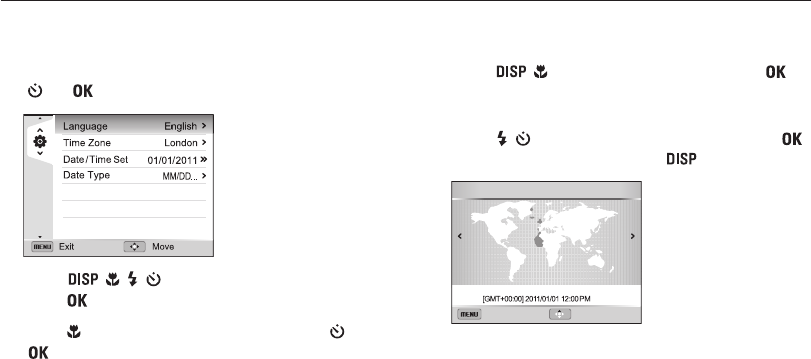
4
Press [ / ] to select Home, and then press [ ].
•
When you travel to another country, select Visit, and then
select a new time zone.
5
Press [ / ] to select a time zone, and then press [ ].
•
To set daylight-savings time, press [ ].
Back DST
Time Zone : Home
London
1
Verify that Language is highlighted, and then press
[] or [ ].
2
Press [ / / / ] to select a language, and then
press [ ].
3
Press [ ] to select Time Zone, and then press [ ] or
[].
Basic functions
22
Performing the initial setup
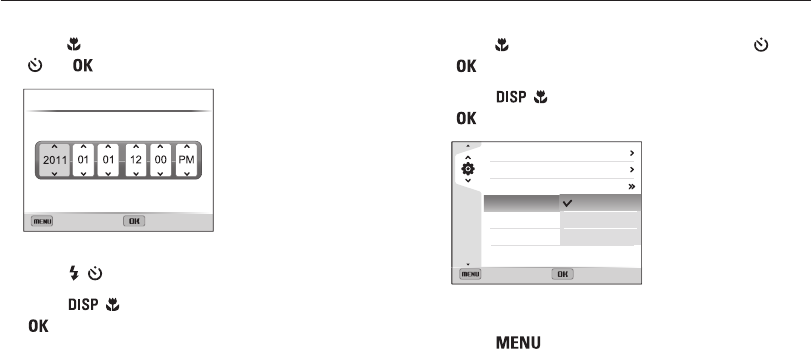
6
Press [ ] to select Date/Time Set, and then press
[] or [ ].
Exit Set
Date/Time Set
Year Month Day Hour Min
•
The screen may differ depending on the language selected.
7
Press [ / ] to select an item.
8
Press [ / ] to set the date and time, and then press
[].
9
Press [ ] to select Date Type, and then press [ ] or
[].
10
Press [ / ] to select a date type, and then press
[].
Language
Time Zone
Date/Time Set
Date Type
English
London
2011/01/01
Back Set
YYYY/MM/DD
MM/DD/YYYY
DD/MM/YYYY
•
The default date type may differ depending on the language
selected.
11
Press [ ] to switch to Shooting mode.
Basic functions
23
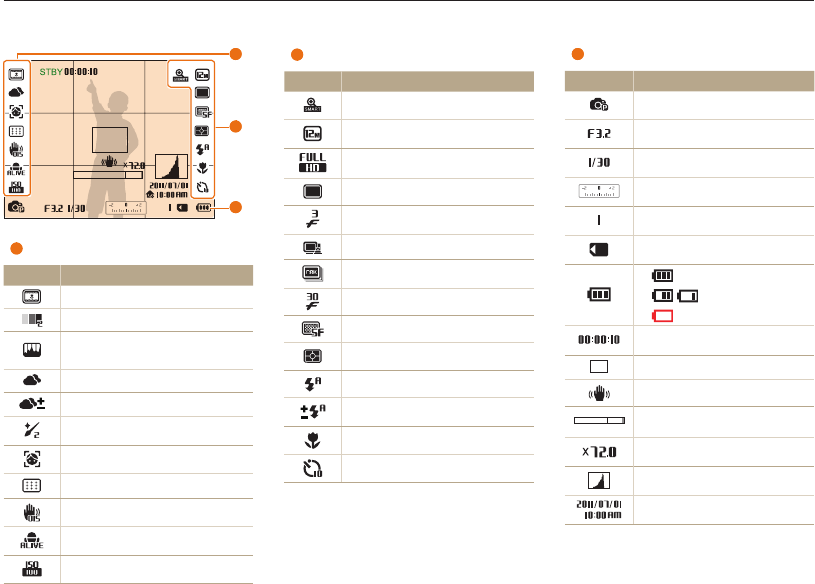
3 Shooting information
Icon Description
Shooting mode
Aperture value
Shutter speed
Exposure value
Available number of photos
Memory card inserted
•
: Fully charged
•
: Partially charged
•
: Empty (Recharge)
Available recording time
Auto focus frame
Camera shake
Zoom indicator
Zoom ratio
Histogram (p. 25)
Current time and date
Learning icons
The icons the camera displays on the screen change according to the mode you select or the options you set.
2 Shooting options (right)
Icon Description
Smart zoom on
Photo resolution
Video resolution
Single shot mode
High-speed burst mode
Precapture mode
Bracket mode
Frame rate
Photo quality
Metering
Flash
Flash intensity adjusted
Auto focus option
Timer
1 Shooting options (left)
Icon Description
Smart filter
Face tone
Image adjustment (contrast,
sharpness, and saturation)
White balance
White balance adjusted
Face retouch
Face detection
Focus area
Optical Image Stabilization (OIS)
Sound Alive on
ISO sensitivity
1
2
3
Basic functions
24
Selecting options or menus
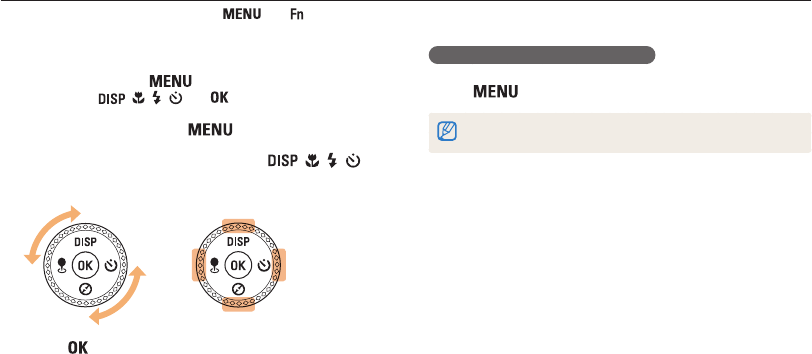
To select an option or a menu, press [ ] or [ ].
Going back to the previous menu
Press [ ] again to go back to the previous menu.
Half-press [Shutter] to return to Shooting mode.
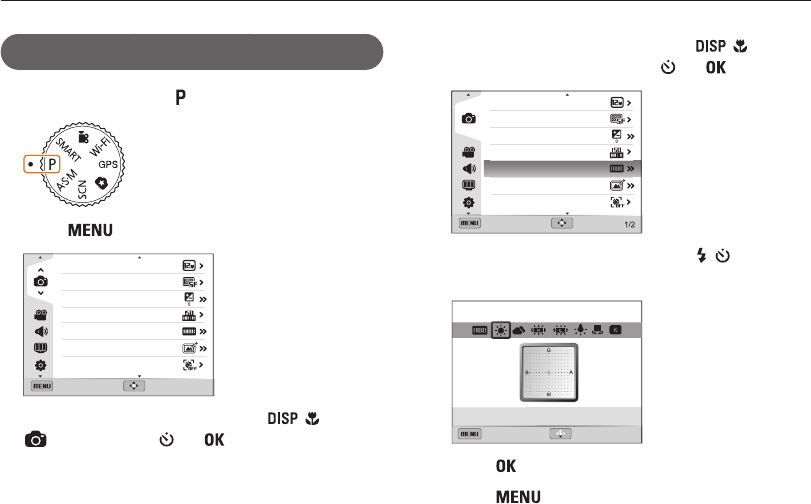
Using [MENU]
To select options, press [ ], and then rotate the navigation
button or press [ / / / ] or [ ].
1
In Shooting mode, press [ ].
2
Rotate the navigation button or press [ / / / ] to
scroll to a menu or an option.
or
3
Press [ ] to confirm the highlighted option or menu.
Basic functions
25
Selecting options or menus
4
Rotate the navigation button or press [ / ] to select
White Balance, and then press [ ] or [ ].
Photo Size
Quality
EV
ISO
White Balance
Smart Filter
Face Detection
Exit Move
5
Rotate the navigation button or press [ / ] to select a
White Balance option.
Back Adjust
White Balance : Daylight
6
Press [ ] to save your settings.
7
Press [ ] to return to Shooting mode.
For example, to select a White Balance option
in Program mode:
1
Rotate the mode dial to .
2
Press [ ].
Exit Move
Photo Size
Quality
EV
ISO
White Balance
Smart Filter
Face Detection
3
Rotate the navigation button or press [ / ] to select
, and then press [ ] or [ ].
Basic functions
26
Selecting options or menus
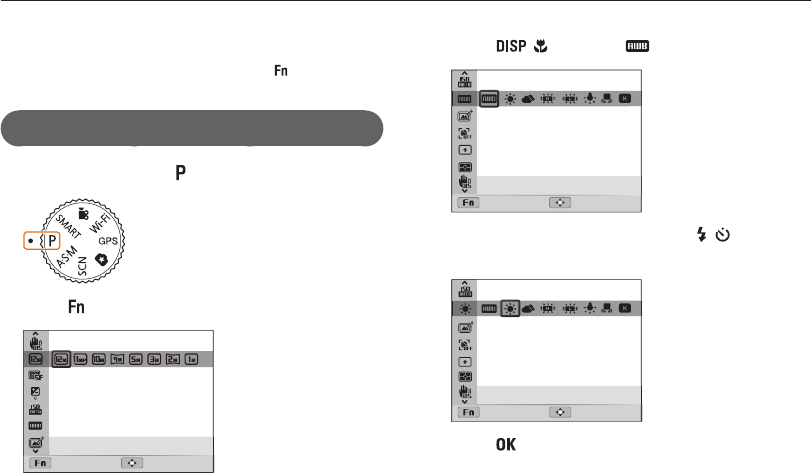
Using [Fn]
You can access shooting options by pressing [ ], but some
options are not available.
For example, to select a White Balance option
in Program mode:
1
Rotate the mode dial to .
2
Press [ ].
Photo Size : 4096X3072
Exit Move
3
Press [ / ] to scroll to .
White Balance : Auto WB
Exit Move
4
Rotate the navigation button or press [ / ] to select a
White Balance option.
White Balance : Daylight
Exit Move
5
Press [ ] to save your settings.
Basic functions
27
Setting the display and sound
Learn how to change the basic display information and sound settings.
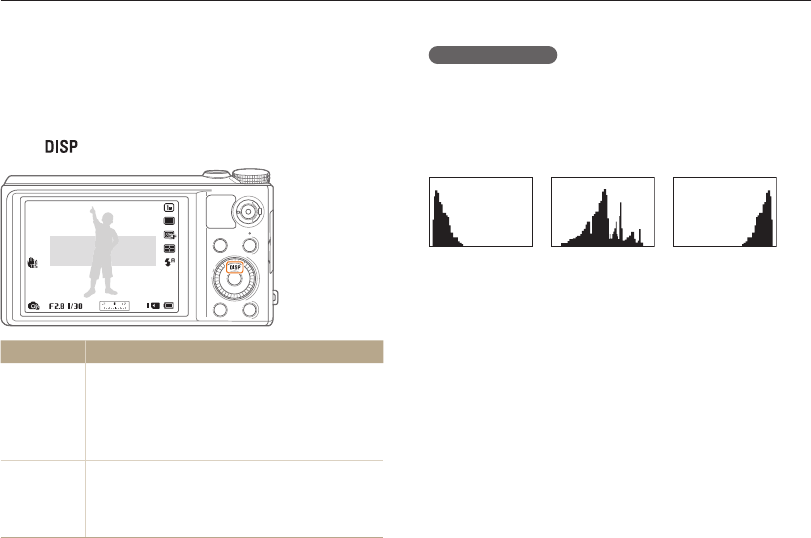
About histograms
A histogram is a graph that illustrates how light is distributed
in your photo. If the histogram has a high peak on the left, the
photo is underexposed and will appear dark. A peak on the
right of the graph means that the photo is overexposed and will
appear washed out. The height of the peaks is related to color
information. The more of a particular color, the taller the peak.
Under-exposed
Well-exposed
Over-exposed
Setting the display type
You can select a display type for the Shooting or Playback mode.
Each type displays different shooting or playback information.
See the table below.
Press [ ] repeatedly to change the display type.
Show all photographic
information.
Mode Description
Shooting
•
Hide all information about shooting.
•
Hide information about shooting, except the
information on the bottom line.
•
Display all information about shooting.
•
Display histogram.
Playback
•
Hide all information about the current file.
•
Display information about the current file, except
the shooting settings and histogram.
•
Display all information about the current file.

Basic functions
28
Setting the display and sound
Setting the sound
Turn on or off the sound your camera emits when you perform
functions.
1
In Shooting or Playback mode, press [ ].
2
Select → Beep Sound.
3
Select an option.
Option Description
Off The camera does not emit any sounds.
On The camera emits sounds.
Basic functions
29
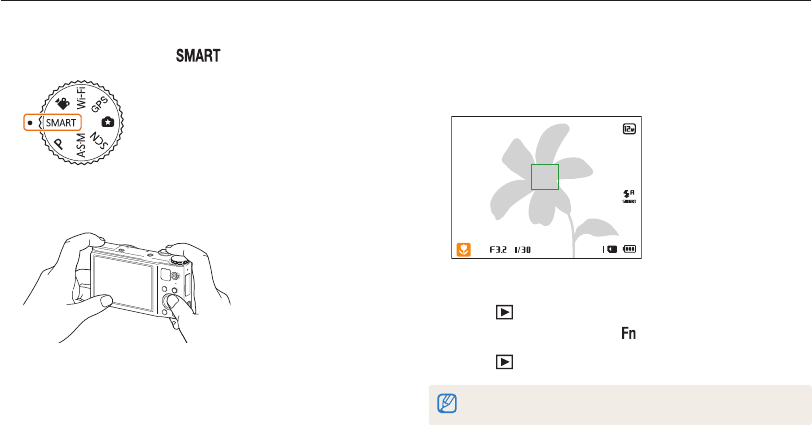
Capturing photos
Learn how to capture photos easily and quickly in Smart Auto mode.
3
Half-press [Shutter] to focus.
•
A green frame means the subject is in focus.
•
A red frame means the subject is out of focus.
4
Press [Shutter] to capture a photo.
5
Press [ ] to view the captured photo.
•
To delete the photo, press [ ], and then select Yes.
6
Press [ ] to return to Shooting mode.
See page 31 for tips to get clearer photos.
1
Rotate the mode dial to .
2
Align your subject in the frame.
Basic functions
30
Capturing photos
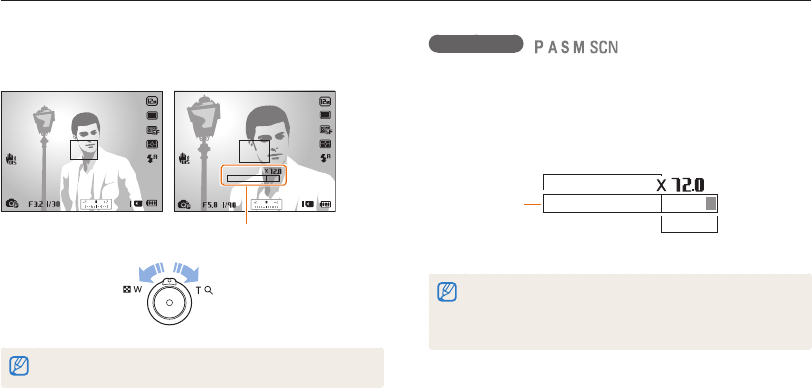
Digital zoom
The Digital zoom is supported by default in Shooting mode. If you
zoom in on a subject in Shooting mode and the zoom indicator
is in the digital range, your camera is using the Digital zoom. By
using both the 18X Optical zoom and 4X Digital zoom, you can
zoom in up to 72 times.
Digital range
Zoom indicator
Optical range
•
The Digital zoom is not available with the Face detection option,
Smart Filter effect, Tracking AF option, Burst option, or Manual Focus.
•
If you capture a photo with the Digital zoom, the photo quality may be
lower than normal.
Zooming
You can capture close-up photos by adjusting the zoom.
Zoom out Zoom in
Zoom ratio
The wider you rotate the zoom button, the faster the camera zooms in or out.
Basic functions
31
Capturing photos
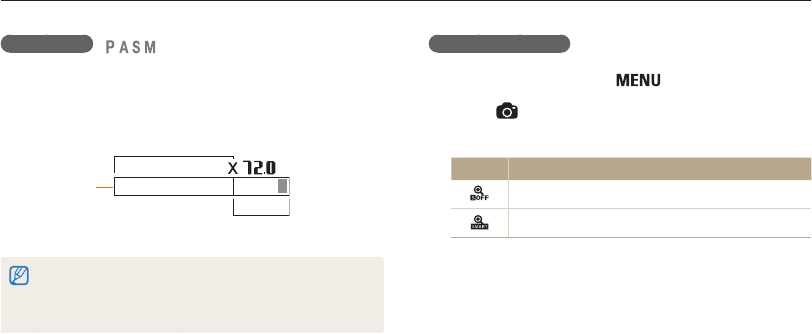
Smart zoom
You can use 24X Smart zoom which lets you zoom in with less
degradation of picture quality than the Optical zoom and Digital
zoom. By using both the Smart zoom and Digital zoom, you can
zoom in up to 72 times.
Smart range
Digital range
Zoom indicator
•
Smart zoom is not available with the Face detection option, Smart
Filter effect, Tracking AF option, Burst option, or Manual Focus.
•
If you capture a photo with the Smart zoom, the photo quality may be
lower than normal.
Setting Smart zoom
1
In Shooting mode, press [ ].
2
Select → Smart Zoom.
3
Select an option.
Icon Description
Off: The Smart zoom is deactivated.
On: The Smart zoom is activated.
Basic functions
32
Capturing photos
Reducing camera shake (OIS)
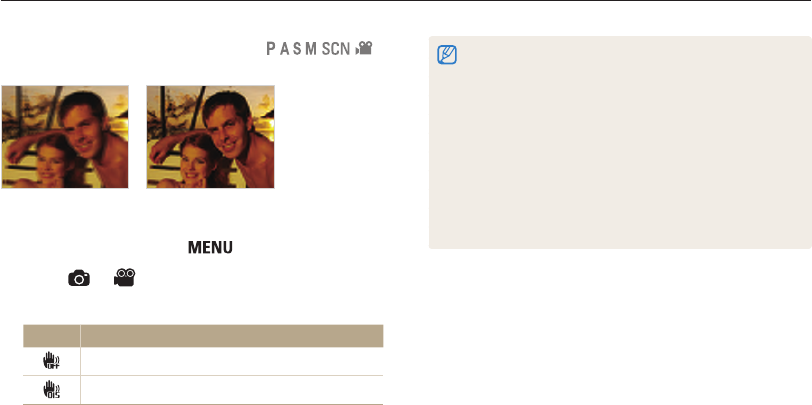
Reduce camera shake optically in Shooting mode.
Before correction
After correction
1
In Shooting mode, press [ ].
2
Select or → OIS.
3
Select an option.
Icon Description
Off: OIS is deactivated.
On: OIS is activated.
•
OIS may not function properly when:
- you move your camera to follow a moving subject
- you use the Digital zoom
- there is too much camera shake
- the shutter speed is slow (for example, when you capture night
scenes)
- the battery is low
- you capture a close-up shot
•
If you use the OIS function with a tripod, your images may be blurred
by the vibration of the OIS sensor. Deactivate the OIS function when
you use a tripod.
•
If the camera is hit or dropped, the display will be blurry. If this
occurs, turn off the camera, and then turn it on again.
Basic functions
33
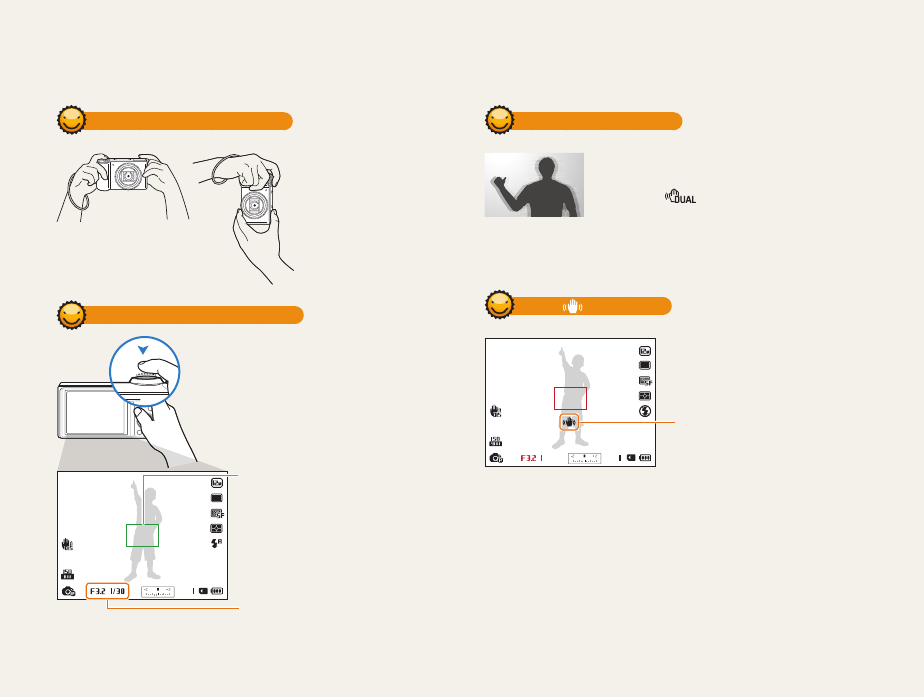
Holding your camera correctly
Ensure nothing is
blocking the lens,
flash, or microphone.
Half-pressing the shutter button
Half-press [Shutter] and adjust the
focus. The camera adjusts the focus and
exposure automatically.
The camera sets the aperture value
and shutter speed automatically.
Focus frame
•
Press [Shutter] to capture the photo
if the focus frame appears in green.
•
Change the composition and
half-press [Shutter] again if the
focus frame appears in red.
Reducing camera shake
•
Set the Optical Image Stabilization option to
reduce camera shake optically. (p. 30)
•
Select the mode to reduce camera shake
both optically and digitally. (p. 46)
When is displayed
Camera shake
When you shoot in the dark, avoid setting the flash option to Slow
Sync or Off. The aperture remains open longer and it may be harder to
hold the camera steady long enough to capture a clear photo.
•
Use a tripod or set the flash option to Fill in. (p. 60)
•
Set ISO sensitivity options. (p. 62)
Tips for getting a clearer photo
Basic functions
34
Preventing your subject from being out of focus
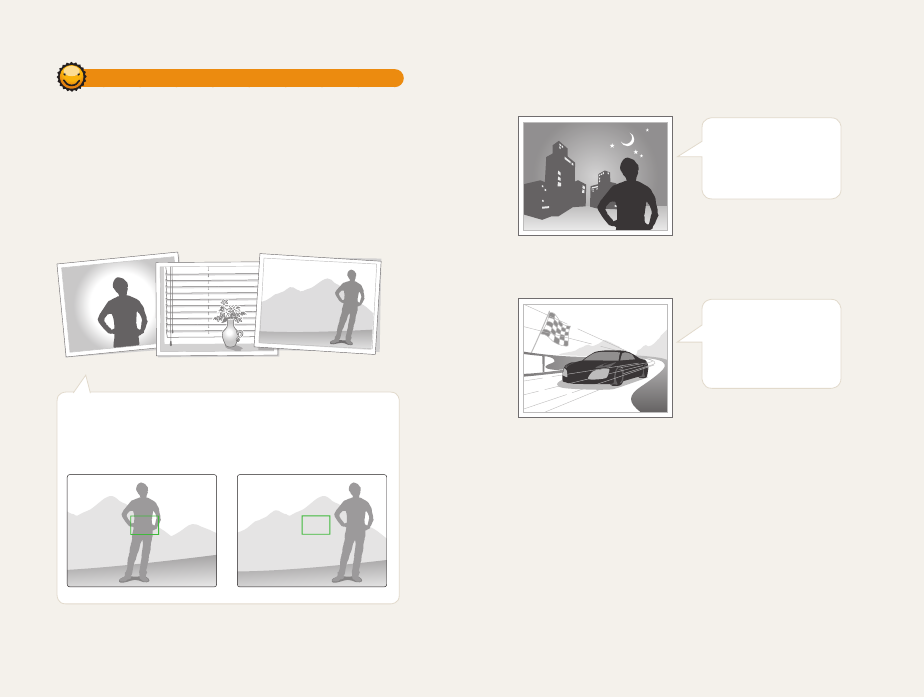
It may be difficult to get your subject in focus when:
-
there is little contrast between the subject and background (for
example, when your subject is wearing clothing that is similar in color
to the background)
-
the light source behind the subject is too bright
-
the subject is shiny or reflective
-
the subject includes horizontal patterns, such as blinds
-
the subject is not positioned in the center of the frame
•
When you capture photos in low light
Turn on the flash.
(p. 60)
•
When subjects are moving rapidly
Use the High-speed
burst mode or
Precapture function.
(p. 77)
Using the focus lock
Half-press [Shutter] to focus. When the subject is in focus,
you can reposition the frame to change the composition.
When you are ready, press [Shutter] to capture your photo.

Extended functions
Learn how to capture a photo and record a video by selecting a mode.
Using the Smart Auto mode
……………… 36
Using the Scene mode
…………………… 38
Using the 3D Photo mode
……………… 39
Using the HDR mode
…………………… 39
Using the Magic Frame mode
…………… 40
Using the Beauty Shot mode
…………… 41
Using the Zooming Shot mode
…………… 42
Using the Program mode
………………… 43
Using the Aperture Priority, Shutter Priority,
or Manual mode
…………………………… 44
Using the Aperture Priority mode
………… 45
Using the Shutter Priority mode
………… 46
Using the Manual mode
………………… 47
Using the DUAL IS mode
………………… 48
Using the Panorama mode
……………… 49
Using the 2D or 3D Panorama mode
…… 49
Using the Action Panorama mode
……… 51
Using the Movie mode
…………………… 52
Recording high-speed videos
…………… 54
Using the Smart Scene Detection mode
… 55
Using the Creative Movie Maker mode
… 56
Making a movie
with the Creative Movie Maker
…………… 56
View a movie made
in Creative Movie Maker mode
…………… 57
36
Using the Smart Auto mode
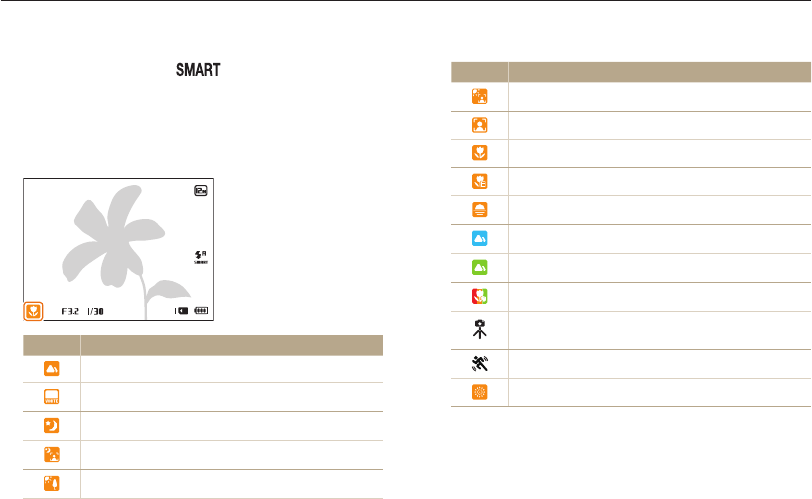
In Smart Auto mode, your camera automatically chooses the appropriate camera settings based on the type of scene it detects.
The Smart Auto mode is helpful if you are not familiar with the camera settings for various scenes.
Icon Description
Portraits with backlighting
Portraits
Close-up photos of objects
Close-up photos of text
Sunsets
Blue skies
Forested areas
Close-up photos of colorful subjects
Camera is stabilized or on a tripod (when shooting in
the dark)
Actively moving subjects
Fireworks (when using a tripod)
3
Half-press [Shutter] to focus.
4
Press [Shutter] to capture the photo.
1
Rotate the mode dial to .
2
Align your subject in the frame.
•
The camera automatically selects a scene. An appropriate
scene icon appears at the bottom left of the screen.
The icons are listed below.
Icon Description
Landscapes
Scenes with bright white backgrounds
Landscapes at night (when the flash is off)
Portraits at night
Landscapes with backlighting

37
Using the Smart Auto mode
•
If the camera does not recognize an appropriate scene mode, it uses
the default settings for the mode.
•
Even if it detects a face, the camera may not select a portrait mode
depending on the subject's position or lighting.
•
The camera may not select the correct scene depending on the
shooting conditions, such as camera shake, lighting, or distance to
the subject.
•
Even if you use a tripod, the camera may not detect the mode if
the subject is moving.
•
In mode, the camera consumes more battery power,
because it changes settings often to select appropriate scenes.
38
Using the Scene mode
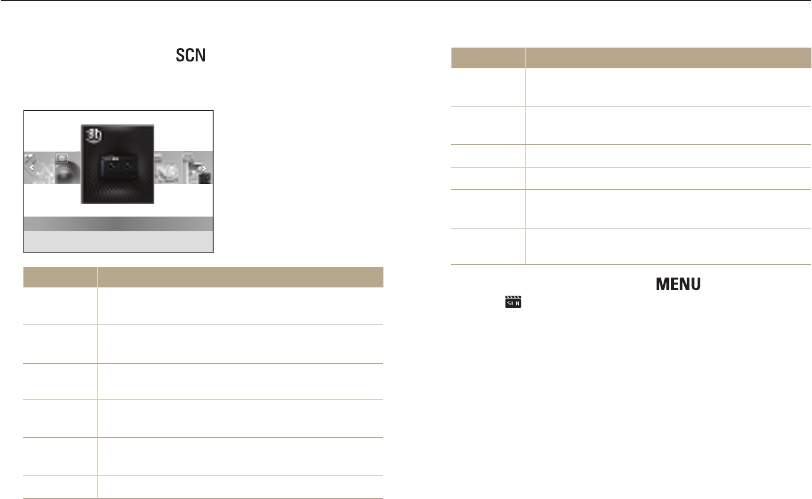
In Scene mode, you can capture a photo with options that are preset for a specific scene.
Option Description
Text Clearly capture text from printed or electronic
documents.
Sunset Capture scenes at sunset, with natural-looking reds
and yellows.
Dawn Capture scenes at sunrise.
Backlight Capture backlit subjects.
Beach &
Snow
Reduce underexposure of subjects caused by
sunlight reflected from sand or snow.
Zooming
Shot Capture scenes with blurred edges.
•
To change a scene mode, press [ ], and then
select . You can select any of the scenes listed.
3
Align your subject in the frame, and then half-press
[Shutter] to focus.
4
Press [Shutter] to capture the photo.
1
Rotate the mode dial to .
2
Select a scene.
3D Photo
Option Description
3D Photo Capture scenes with a 3D effect (the 3D effect
works only on a 3D TV or 3D monitor).
HDR Capture scenes with emphasis on mid-tones, by
minimizing the dark and bright areas.
Magic
Frame Capture scenes with various frame effects.
Beauty
Shot
Capture a portrait with options to hide facial
imperfections.
Night Capture scenes at night or in low lighting (using a
tripod is recommended).
Landscape Capture still-life scenes and landscapes.
39
Using the Scene mode
Using the HDR mode
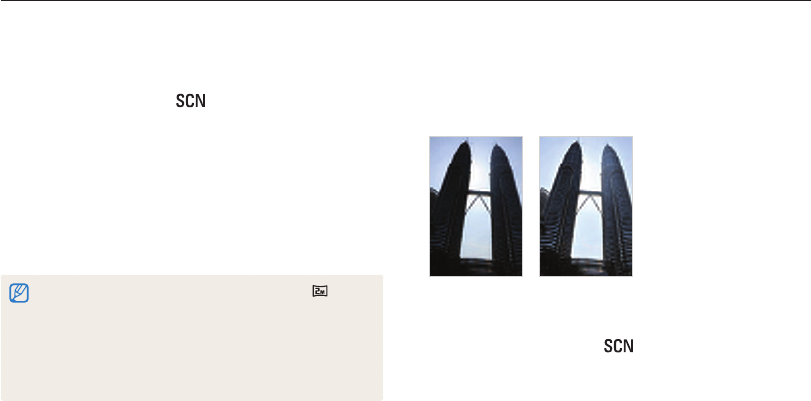
In HDR(High Dynamic Range) mode, your camera captures two
photos with different exposures, and then overlays the bright area
of the underexposed photo and the dark area of the overexposed
photo. You can capture photos with soft, rich colors.
Without HDR
effect
With HDR
effect
1
Rotate the mode dial to .
2
Select HDR.
3
Align your subject in the frame, and then half-press
[Shutter] to focus.
4
Press [Shutter] to capture the photo.
•
The camera captures 2 photos, and then automatically
merges them into a single photo.
Using the 3D Photo mode
In 3D Photo mode, you can capture scenes with a 3D effect.
1
Rotate the mode dial to .
2
Select 3D Photo.
3
Align your subject in the frame, and then half-press
[Shutter] to focus.
4
Press [Shutter] to capture the photo.
•
The camera captures 2 photos in both JPEG and MPO file
formats.
•
In 3D Photo mode, the resolution is automatically set to .
•
In 3D Photo mode, some shooting options are not available.
•
You can view an MPO file that supports the 3D effect only on an
MPO-compatible display, such as a 3D TV or 3D monitor. On your
camera's display, you can view only JPEG files.
•
Use proper 3D glasses when you view an MPO file on a 3D TV or
3D monitor.
40
Using the Scene mode
•
The HDR effect may be affected by camera shake, lighting,
movement of the subject, and the shooting environment.
•
You cannot use the flash when you use the HDR mode.
•
It may take longer to save a photo using the HDR mode.
•
When you use the HDR mode, the preview image on the screen and
the captured photo may appear slightly larger than a photo captured
without this effect.
•
When you capture a moving subject using the HDR mode, an
afterimage may appear.
Using the Magic Frame mode
In Magic Frame mode, you can apply various frame effects to
your photos. The shape and the feel of the photos will change
according to the frame you select.
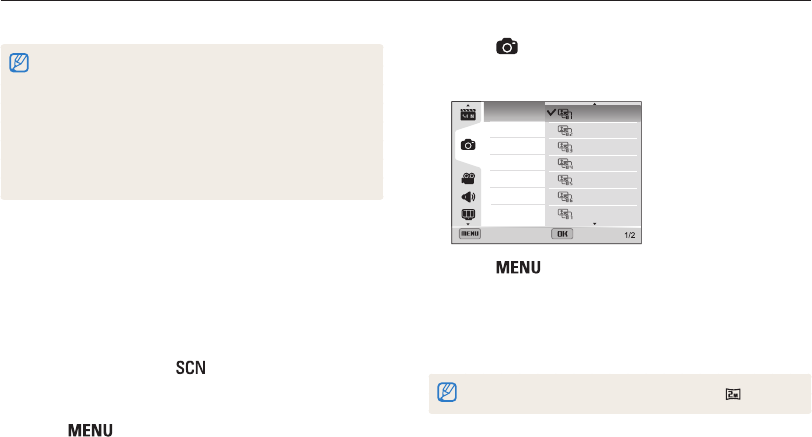
1
Rotate the mode dial to .
2
Select Magic Frame.
3
Press [ ].
4
Select → Frame.
5
Select an option.
Frame
Quality
OIS
Wall Art
Old Film
Ripple
Full Moon
Old Record
Magazine
Sunny Day
Back Set
6
Press [ ] to return to Shooting mode.
7
Align your subject in the frame, and then half-press
[Shutter] to focus.
8
Press [Shutter] to capture the photo.
In Magic Frame mode, the resolution is automatically set to .
41
Using the Scene mode
Using the Beauty Shot mode
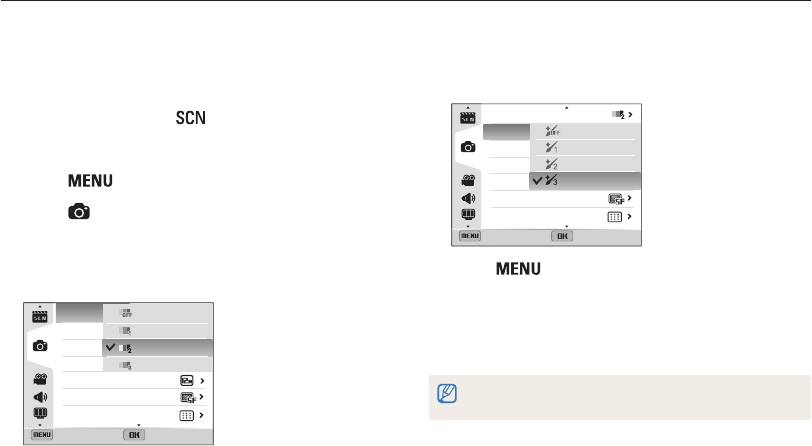
In Beauty Shot mode, you can capture a portrait with options to
hide facial imperfections.
1
Rotate the mode dial to .
2
Select Beauty Shot.
3
Press [ ].
4
Select → Face Tone.
5
Select an option.
•
For example, increase the face tone setting to make skin
appear lighter.
Back Set
Face Tone
Face Retouch
Face Detection
Smart FR Edit
Photo Size
Quality
Focus Area
Off
Level 1
Level 2
Level 3
6
Select Face Retouch.
7
Select an option.
•
For example, increase the face retouch setting to hide more
imperfections.
Back Set
Face Tone
Face Retouch
Face Detection
Smart FR Edit
Photo Size
Quality
Focus Area
Off
Level 1
Level 2
Level 3
8
Press [ ] to return to Shooting mode.
9
Align your subject in the frame, and then half-press
[Shutter] to focus.
10
Press [Shutter] to capture the photo.
When you use the Beauty Shot mode, the focus distance will be set to
Auto Macro.
42
Using the Scene mode
Using the Zooming Shot mode
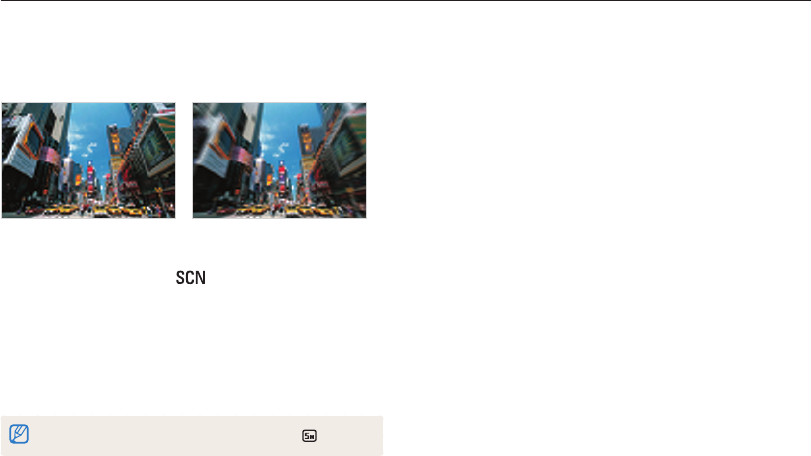
In Zooming Shot mode, you can emphasize the center of a photo
by blurring the edges.
Without Zooming Shot effect
With Zooming Shot effect
1
Rotate the mode dial to .
2
Select Zooming Shot.
3
Align your subject in the frame, and then half-press
[Shutter] to focus.
4
Press [Shutter] to capture the photo.
In Zooming Shot mode, the resolution is automatically set to or below.
43
Using the Program mode
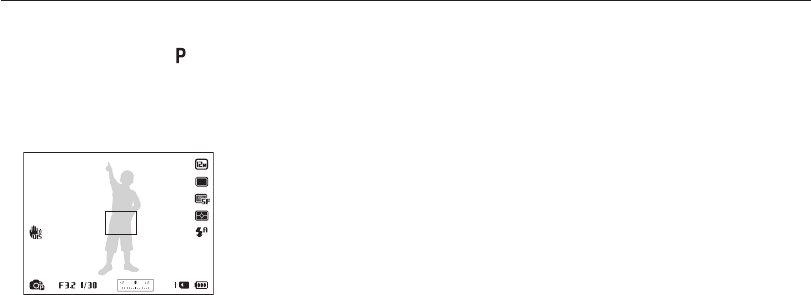
In Program mode, you can set most options, except the shutter speed and aperture value, which the camera sets automatically.
1
Rotate the mode dial to .
2
Set the desired options.
(For a list of options, refer to "Shooting options" starting
on page 56.)
3
Align your subject in the frame, and then half-press
[Shutter] to focus.
4
Press [Shutter] to capture the photo.
44
Using the Aperture Priority, Shutter Priority, or Manual mode
Adjust the aperture value or shutter speed to control the exposure of your photos. You can use these options in the Aperture Priority,
Shutter Priority, and Manual modes.
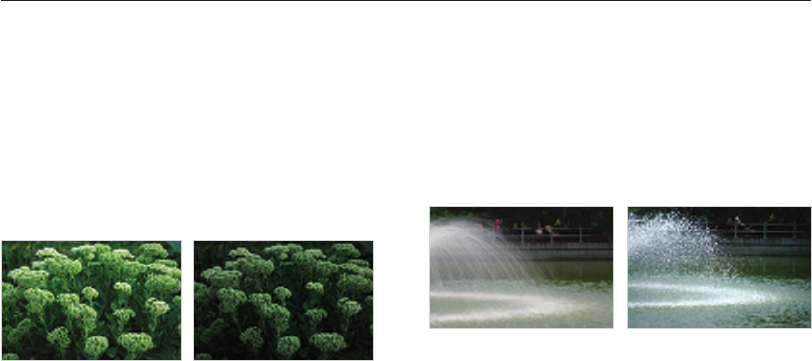
Shutter speed
Shutter speed, which is an important factor in the brightness of a
photo, refers to the amount of time it takes to open and close the
shutter. A slow shutter speed allows more time to let light in.
All things being equal, photos are brighter, but fast moving
objects tend to blur. On the other hand, a fast shutter speed
allows less time to let light in. Photos are darker, but objects in
motion are captured more clearly.
Slow shutter speed
Fast shutter speed
Aperture value
The aperture is a hole that lets light into the camera. The aperture
housing contains thin, metal plates that open and close, widening
or narrowing the aperture, and controlling the amount of light that
enters the camera. The size of the aperture is closely related to
the brightness of a photo: the larger the aperture, the brighter the
photo; the smaller the aperture, the darker the photo.
Note that the larger the aperture value, the smaller the aperture
size. For example, an aperture set to 5.6 is larger than an
aperture set to 11.
Small aperture value (The size
of the aperture is large.)
Large aperture value (The size
of the aperture is small.)
45
Using the Aperture Priority, Shutter Priority, or Manual mode
4
Set options.
(For a list of options, refer to “Shooting options” starting
on page 56.)
5
Align your subject in the frame, and then half-press
[Shutter] to focus.
6
Press [Shutter] to capture the photo.
Using the Aperture Priority mode
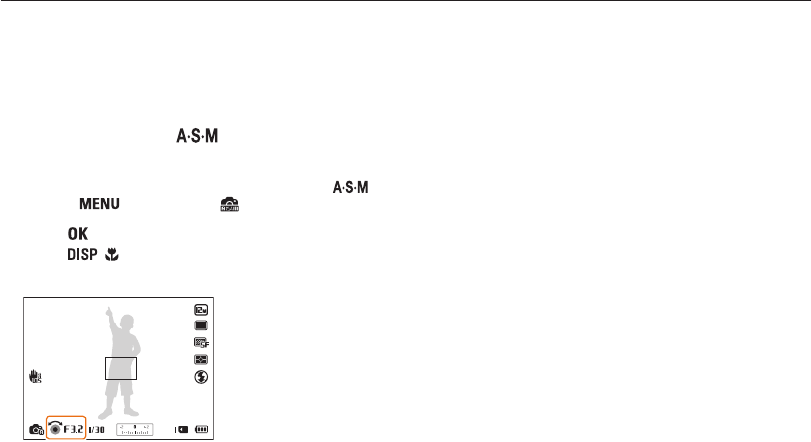
The Aperture Priority mode allows you to set the aperture value
manually while the camera automatically selects an appropriate
shutter speed.
1
Rotate the mode dial to .
2
Select Aperture Priority.
•
To select another mode when the mode dial is set to ,
press [ ], and then select → a mode.
3
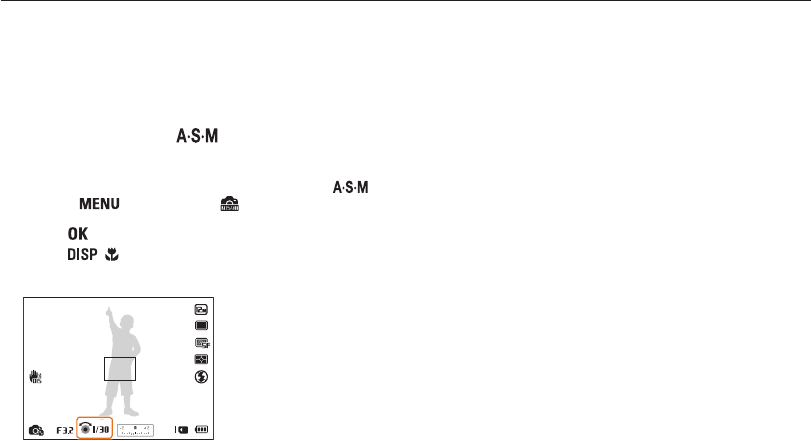
Press [ ], and then rotate the navigation button or
press [ / ] to adjust the aperture value.
•
See page 42 for more information about the aperture value.
46
Using the Aperture Priority, Shutter Priority, or Manual mode
4
Set options.
(For a list of options, refer to “Shooting options” starting
on page 56.)
5
Align your subject in the frame, and then half-press
[Shutter] to focus.
6
Press [Shutter] to capture the photo.
Using the Shutter Priority mode
The Shutter Priority mode allows you to set the shutter speed
manually while the camera automatically selects an appropriate
aperture value.
1
Rotate the mode dial to .
2
Select Shutter Priority.
•
To select another mode when the mode dial is set to ,
press [ ], and then select → a mode.
3
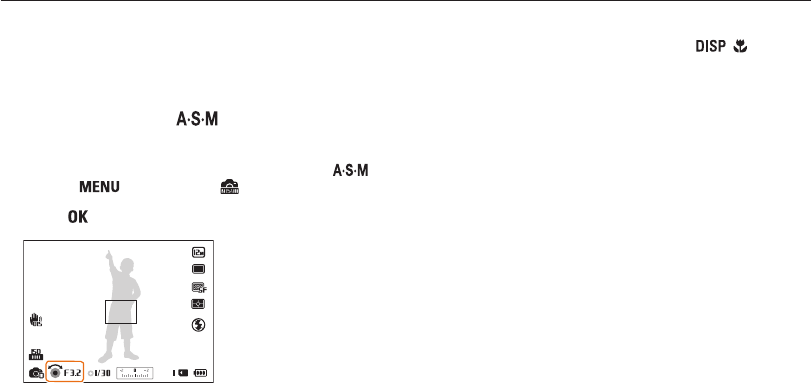
Press [ ], and then rotate the navigation button or
press [ / ] to adjust the shutter speed.
•
See page 42 for more information about the shutter speed.
47
Using the Aperture Priority, Shutter Priority, or Manual mode
Using the Manual mode
The Manual mode allows you to adjust both the aperture value
and the shutter speed manually.
1
Rotate the mode dial to .
2
Select Manual.
•
To select another mode when the mode dial is set to ,
press [ ], and then select → a mode.
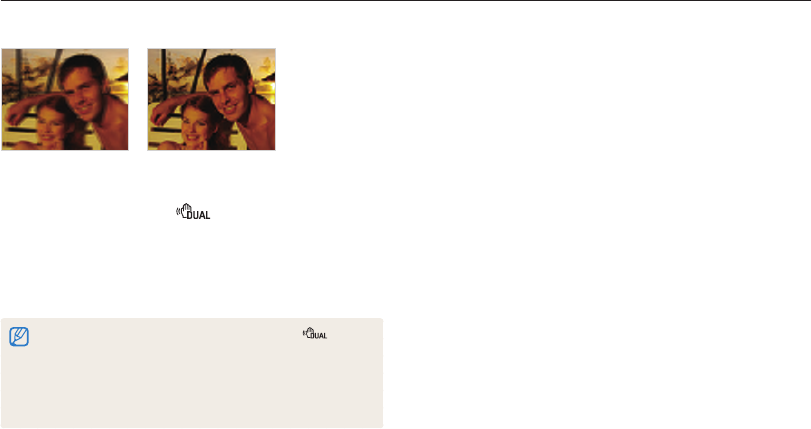
3
Press [ ] to select the aperture value or shutter speed.
4
Rotate the navigation button or press [ / ] to adjust
the aperture value or shutter speed.
5
Set options.
(For a list of options, refer to “Shooting options” starting
on page 56.)
6
Align your subject in the frame, and then half-press
[Shutter] to focus.
7
Press [Shutter] to capture the photo.
48
Using the DUAL IS mode
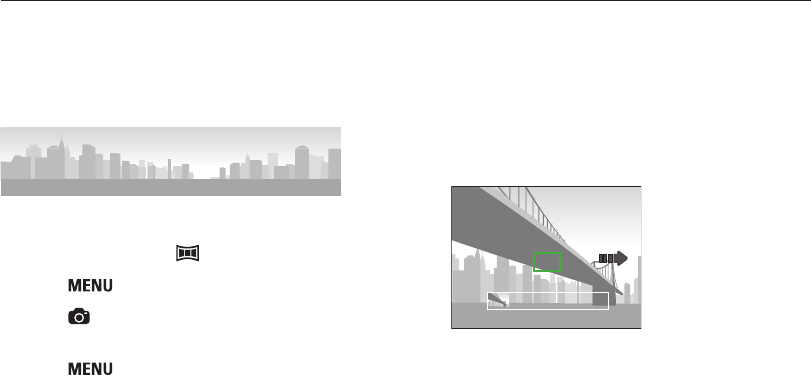
Reduce camera shake and prevent blurred photos with Optical and Digital Image Stabilization functions.
Before correction
After correction
1
Rotate the mode dial to .
2
Align your subject in the frame, and then half-press
[Shutter] to focus.
3
Press [Shutter] to capture the photo.
•
The Digital zoom and Smart zoom are not available in mode.
•
The camera will correct photos optically only when the light source is
brighter than fluorescent light.
•
If your subject is moving rapidly, the photo may be blurry.
•
Set the Optical Image Stabilization option to reduce camera shake in
different shooting modes. (p. 30)
49
Using the Panorama mode
In Panorama mode, you can capture a wide panoramic scene in a single photo. Capture and combine a series of photos to create a
panoramic image.
7
With [Shutter] pressed, slowly move the camera in the
direction that will let it capture the rest of the panorama.
•
In 3D Panorama mode, you can capture a scene only in
horizontal directions.
•
When the viewfinder is aligned with the next scene, the
camera captures the next photo automatically.
8
When you are finished, release [Shutter].
•
When you have captured all the necessary shots, the camera
combines them into one panoramic photo.
Using the 2D or 3D Panorama mode
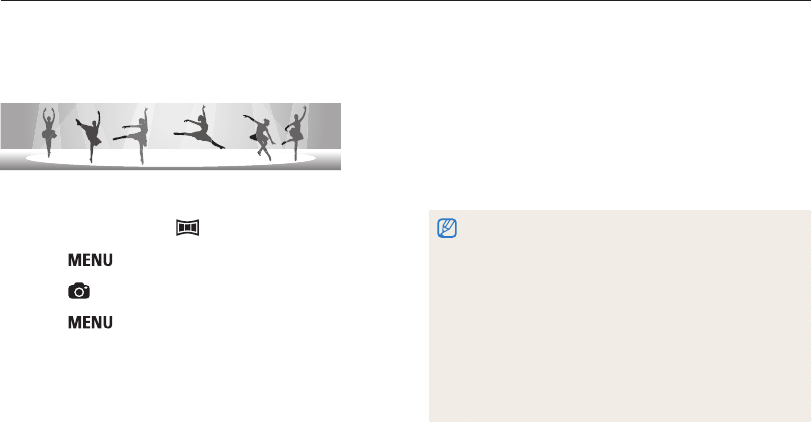
In Panorama mode, you can capture a normal or 3D panoramic
photo.
Shooting example
1
Rotate the mode dial to .
2
Press [ ].
3
Select → Panorama → Live Panorama or
3D Panorama.
4
Press [ ] to return to Shooting mode.
5
Align your subject in the frame, and then half-press
[Shutter] to focus.
•
Align the camera with the far left or the far right, or very top or
bottom, of the scene you want to capture.
6
Press and hold [Shutter] to start shooting.
50
Using the Panorama mode
•
For best results when capturing panoramic photos, avoid the
following:
- moving the camera too quickly or too slowly
- moving the camera too little to capture the next image
- moving the camera at irregular speeds
- shaking the camera
- changing the camera direction while capturing a photo
- shooting in dark places
- capturing moving subjects nearby
- shooting conditions where the brightness or color of light is
changing
•
Selecting Panorama mode will disable the digital and optical zoom
functions. If you select Panorama mode while the lens is zoomed in,
the camera automatically zooms out to the default position.
•
In Panorama mode, some shooting options are not available.
•
The camera may stop shooting due to the shooting composition or
movement within the scene.
•
In Panorama mode, your camera may not capture the last scene in
its entirety if you stop moving the camera exactly where you want the
scene to end. To capture the entire scene, move your camera slightly
beyond the point where you want the scene to end.
•
In 3D Panorama mode, your camera may not capture the very
beginning or end of a scene due to the nature of the 3D effect. To
capture the entire scene, move slightly beyond the beginning and
end points you want to capture.
•
In 3D Panorama mode, photos are captured in both JPEG and MPO
file formats.
•
You can view an MPO file that supports the 3D effect only on an
MPO-compatible display, such as 3D TV or 3D monitor. On your
camera's display, you can view only JPEG files.
•
Use proper 3D glasses when you view an MPO file on a 3D TV or
3D monitor.
51
Using the Panorama mode
Using the Action Panorama mode
In Action Panorama mode, you can capture and combine a series
of photos of a moving subject.
Shooting example
1
Rotate the mode dial to .
2
Press [ ].
3
Select → Panorama → Action Panorama.
4
Press [ ] to return to Shooting mode.
5
Align your subject in the frame, and then half-press
[Shutter] to focus.
•
Align the camera with the far left or the far right side of the
scene you want to capture.
6
Press and hold [Shutter] to start shooting.
7
With [Shutter] pressed, slowly move the camera in the
direction that will let it capture the rest of the panorama.
•
If there is more than one moving subject, the camera may not
recognize the correct subject.
•
If subjects are outside of the guide frame while capturing, the
camera does not capture the movement of the subjects.
8
When you are finished, release [Shutter].
•
The camera automatically combines the shots into one photo.
•
For best results when capturing panoramic photos, avoid the
following:
- moving the camera too quickly or too slowly
- moving the camera too little to capture the next image
- moving the camera at irregular speeds
- shaking the camera
- changing the camera direction while capturing a photo
- shooting in dark places
- capturing moving subjects nearby
- shooting conditions where the brightness or color of light is
changing
•
The camera may take time to save panoramic photos.
•
In Action Panorama mode, some shooting options are not available.
52
Using the Movie mode
In Movie mode, you can customize settings to record full HD videos of up to 20 minutes in length. The camera saves recorded videos as
MP4 (H.264) files.
•
H.264 (MPEG-4 part10/AVC) is a high-compression video format established by the international standards organizations ISO-IEC and ITU-T.
•
Some memory cards may not support high definition recording. If your card does not, set a lower resolution.
•
Memory cards with slow writing speeds will not support high-resolution videos and high-speed videos. To record high-resolution or high-speed videos, use
memory cards with faster write speeds.
•
If you activate the OIS function while recording a video, the camera may record the operating sound of the OIS function.
•
If you use the zoom function when recording a video, the camera may record the noise of the zoom operating. To decrease zoom noise, use the Sound Alive
function. See Steps 3 and 4 below.
5
Set desired options. (For a list of options, refer to
"Shooting options" starting on page 56.)
6
Press (Video recording) to start recording.
7
Press (Video recording) again to stop recording.
•
You can start recording a video in some modes by pressing
(Video recording) without having to rotate the mode dial to .
•
The video frame size may appear smaller while you are recording a
video depending on the video resolution and frame rate.
•
If you perform no operations for approximately 3 minutes while
recording a video, the screen will become dim. To activate the
screen, perform any camera operation. If you operate POWER,
Zoom, Shutter, or Video recording button, the camera will carry out
the assigned function, even when the screen is dim.
1
Rotate the mode dial to .
2
Press [ ].
3
Select → Voice.
4
Select a Sound Alive option.
Icon Description
Sound Alive Off: Turn off the Sound Alive function to
record the zoom noise.
Sound Alive On: Turn on the Sound Alive function to
reduce the zoom noise.
Mute: Do not record sounds.
•
Do not block the microphone when you use the Sound Alive
function.
•
Recordings made with Sound Alive may differ from actual
sounds.
53
Using the Movie mode
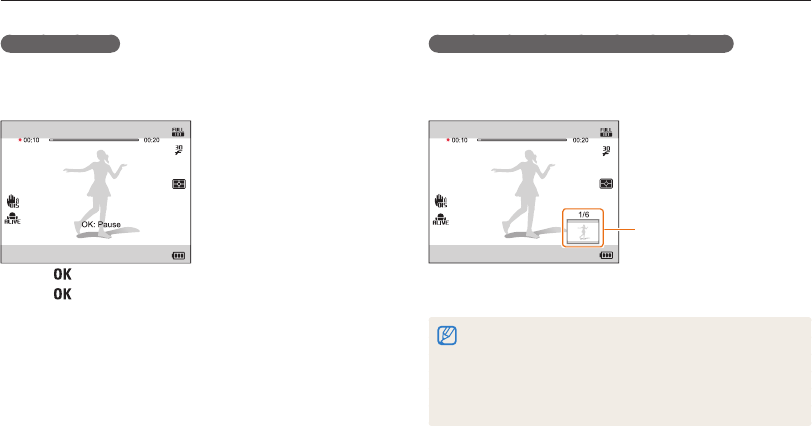
Pause recording
The camera allows you to temporarily pause a video while
recording. With this function, you can record separate scenes as
a single video.
• Press [ ] to pause while recording.
• Press [ ] to resume.
Capturing still images while recording a video
You can capture still images while recording a video without
switching to the photo shooting modes (up to 6 photos). This
feature is available only when you use a memory card.
Images captured while
recording a video
• Press [Shutter] to capture images while recording a video.
• Captured images will be saved automatically.
•
Captured images will be automatically resized, depending on the size
of the recorded video.
•
You cannot capture still images while recording high-speed videos.
•
You cannot capture still images when you pause the video recording.
•
The quality of images captured while recording a video may be lower
than those captured normally.
54
Using the Movie mode
Recording high-speed videos
You can record high-speed videos by setting frame rates.
High-speed videos will be played in slow motion at 30 FPS,
regardless of the frame rate of the video.
•
Memory cards with slow write speeds do not support high-speed
videos.
•
You cannot set Smart Filter effects or Smart Scene Detection mode
when recording high-speed videos.
•
The camera does not record audio when recording high-speed
videos.
•
The image quality of high-speed video may be lower than normal
speed video.
1
Rotate the mode dial to .
•
mode only allows you to record a high-speed video.
2
Press [ ], and then select a frame rate.
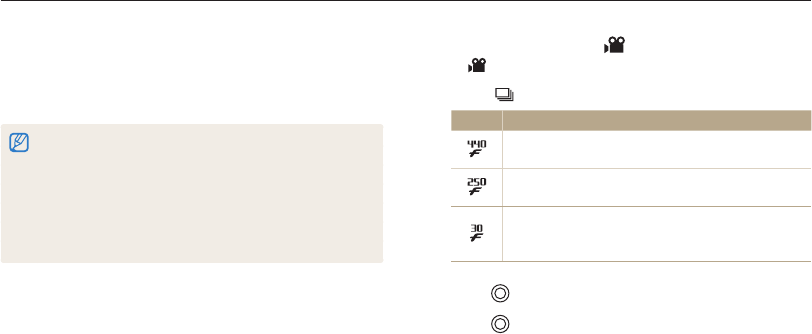
Icon Descripion
440fps: Record 440 frames per second
(for up to 10 seconds).
250fps: Record 250 frames per second
(for up to 10 seconds).
30fps: Record 30 frames per second
(for up to 20 minutes). 30fps is not a high-speed
recording option.
3
Press (Video recording) to start recording.
4
Press (Video recording) again to stop recording.
55
Using the Movie mode
Using the Smart Scene Detection mode
In Smart Scene Detection mode, your camera automatically
chooses the appropriate camera settings based on the scene it
has detected.
1
Rotate the mode dial to .
2
Press [ ].
3
Select → Smart Scene Detection → On.
4
Press [ ] to return to Shooting mode.
5
Align your subject in the frame.
•
The camera automatically selects a scene. An appropriate
scene icon will appear at the bottom left of the screen.
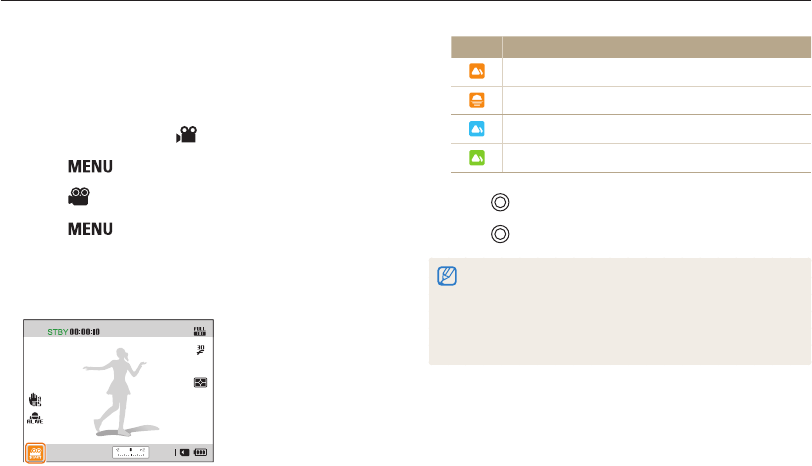
Icon Description
Landscapes
Sunsets
Blue skies
Forested areas
6
Press (Video recording) to start recording.
7
Press (Video recording) again to stop recording.
•
If the camera does not recognize an appropriate scene mode, it uses
the default settings for the Smart Scene Detection mode.
•
The camera may not select the correct scene depending on the
shooting conditions, such as camera shake, lighting, and distance
to the subject.
•
Smart Filter effects are not available in Smart Scene Detection mode.
56
Making a movie with the Creative Movie
Maker
1
Rotate the mode dial to .
2
Select + Movie Creation.
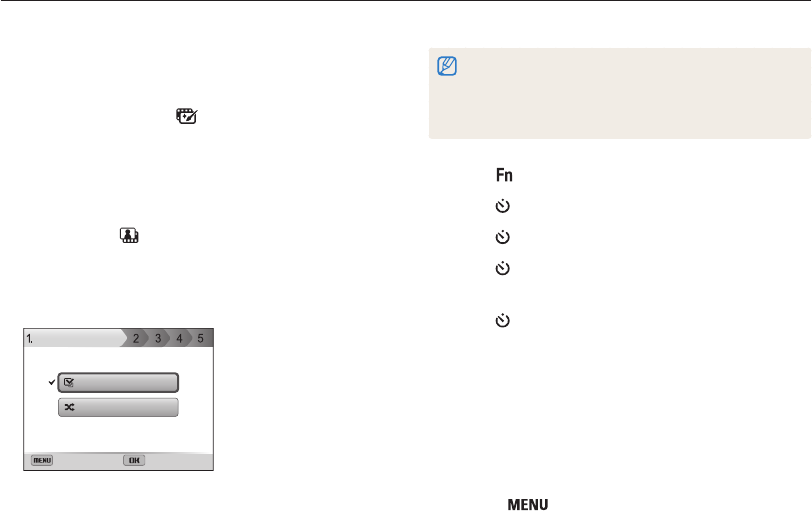
3
Select Select, and then select files.
•
You must select at least 2 files.
•
If you select a folder, every photo in the folder will be selected.
•
If you select a video, every photo captured while recording
the video will be selected.
•
Select Shuffle to let the camera select photos and videos
randomly. The movie cannot exceed 2 minutes 30 seconds
in length.
Select
Shuffle
Back Set
Select image
•
You cannot select photos captured in Panorama mode, videos made
in Creative Movie Maker mode, videos recorded with some Smart
Filter effects (Miniature, Vignetting, Half Tone Dot, Sketch, or
Fish-eye), or some high-speed videos (440fps).
•
You can select up to 60 photos and 10 videos.
4
Press [ ] to confirm the selection.
5
Press [ ] to select Theme, and then select a theme.
6
Press [ ] to select Music, and then select music.
7
Press [ ] to select Movie Size, and then select a movie
size.
8
Press [ ] to select Creation, and then select Creation
Start.
•
If your camera does not have enough available memory to
store the movie, you cannot select Creation Start. Delete
files from the memory card to make more memory available.
(p. 89)
•
If the pop-up message appears when you select Creation
Start, select a smaller movie size in the Movie Size option.
•
The video rendering may take longer depending on the
number and size of the selected files.
•
Press [ ] to cancel the video rendering.
Using the Creative Movie Maker mode
In the Creative Movie Maker mode, you can easily make movies from the photos and videos stored on your memory card.

57
Using the Creative Movie Maker mode
View a movie made in Creative Movie Maker
mode
1
Rotate the mode dial to .
2
Press [ / ] to select a movie.
3
Press [ ] to play the movie.
To view the movie in Playback mode, press [ ]. (p. 84)

Selecting a resolution and quality
………… 59
Selecting a resolution
…………………… 59
Setting the photo quality
………………… 60
Using the timer
……………………………… 61
Shooting in the dark
……………………… 62
Preventing red-eye
……………………… 62
Using the flash
…………………………… 62
Adjusting the ISO sensitivity
……………… 64
Changing the camera’s focus
…………… 65
Using macro
……………………………… 65
Using auto focus
………………………… 65
Focusing on a selected area
……………… 67
Using tracking auto focus
………………… 67
Adjusting the focus area
………………… 68
Using Face Detection
……………………… 69
Detecting faces
…………………………… 69
Capturing a self portrait shot
……………… 70
Capturing a smile shot
…………………… 70
Detecting eye blinking
…………………… 71
Using Smart Face Recognition
…………… 71
Registering faces as your favorites
(My Star)
………………………………… 72
Adjusting brightness and color
…………… 74
Adjusting the exposure manually (EV)
…… 74
Changing the metering option
…………… 75
Selecting a White Balance setting
………… 76
Using burst modes
………………………… 79
Capturing photos in the High-speed burst
mode
……………………………………… 79
Capturing photos in the Precapture mode
… 80
Capturing bracketed photos
……………… 80
Applying effects/Adjusting images
……… 82
Applying Smart Filter effects
……………… 82
Adjusting your photos
…………………… 84
Shooting options
Learn how to set the options in Shooting mode.
Shooting options
59
Selecting a resolution and quality
Learn how to change the image resolution and quality settings.
Setting the video resolution
1
In Shooting mode, press [ ].
2
Select → Movie Size.
3
Select an option.
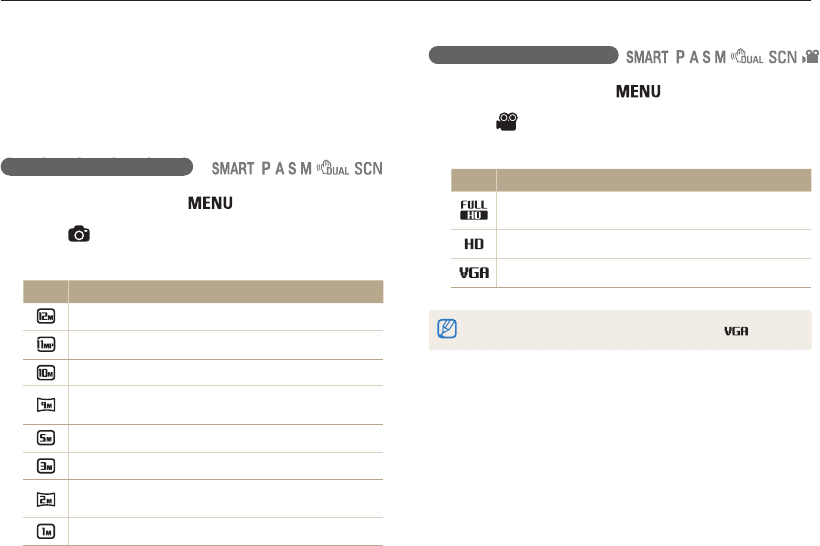
Icon Description
1920X1080: High-quality HD files to play back on an
HDTV.
1280X720: HD files to play back on an HDTV.
640X480: SD files to play back on an analog TV.
If a memory card is not inserted, the camera supports only .
Selecting a resolution
As you increase the resolution, your photo or video will include
more pixels, so it can be printed on larger paper or displayed on
a larger screen. When you use a high resolution, the file size will
also increase.
Setting the photo resolution
1
In Shooting mode, press [ ].
2
Select → Photo Size.
3
Select an option.
Icon Description
4096X3072: Print on an A1 paper.
4096X2736: Print on an A2 paper in wide ratio (3:2).
3648X2736: Print on an A2 paper.
4096X2304: Print on an A2 paper in panorama ratio
(16:9) or play back on an HDTV.
2592X1944: Print on an A4 paper.
1984X1488: Print on an A5 paper.
1920X1080: Print on an A5 paper in panorama ratio
(16:9) or play back on an HDTV.
1024X768: Attach to an email.
Shooting options
60
Selecting a resolution and quality
Setting the photo quality
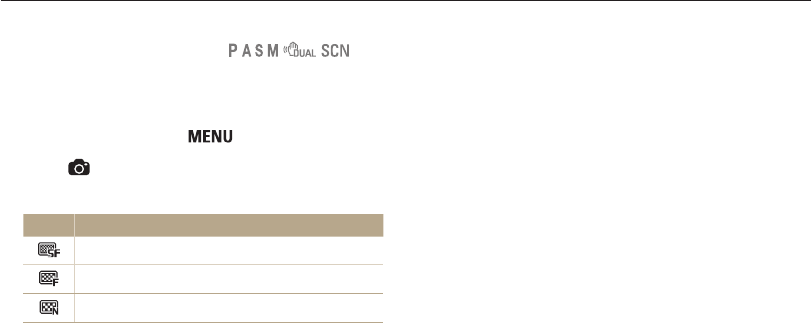
Set the photo quality setting. Higher image quality settings will
result in larger file sizes. The camera compresses and saves the
photos you capture in the JPEG format.
1
In Shooting mode, press [ ].
2
Select → Quality.
3
Select an option.
Icon Description
Super Fine: Capture photos in super high quality.
Fine: Capture photos in high quality.
Normal: Capture photos in normal quality.
Shooting options
61
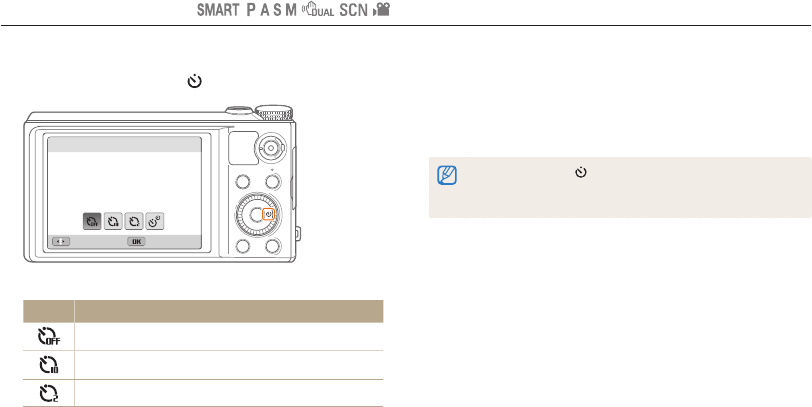
Using the timer
Learn how to set the timer to delay shooting.
3
Press [Shutter] to start the timer.
•
The AF-assist light/timer lamp blinks. The camera will
automatically capture a photo after the specified time has
elapsed.
•
Press [Shutter] or [ ] to cancel the timer.
•
Depending on the Face Detection options you selected, the timer
function may not be available.
1
In Shooting mode, press [ ].
Timer : Off
Back Set
2
Select an option.
Icon Description
Off: The timer is not active.
10 Sec: Capture a photo after a 10-second delay.
2 Sec: Capture a photo after a 2-second delay.
Shooting options
62
Shooting in the dark
Learn how to capture photos at night or in low light conditions.
Using the flash
Use the flash when you capture photos in the dark or when you
need more light in your photos.
1
In Shooting mode, press [ ].
Move Adjust
Flash : Auto
2
Select an option.
Icon Description
Off:
•
The flash will not fire.
•
The camera will display the shake warning when
you are shooting in low light.
Auto: In Smart Auto mode, the camera will select a
proper flash setting for the scene it detects.
Auto: The flash will fire automatically when the subject or
background is dark.
Preventing red-eye
If the flash fires when you capture a photo of a person in the dark,
a red glow may appear in the person’s eyes. To prevent this,
select Red-eye or Red-eye Fix. Refer to flash options in
“Using the flash.”
Before correction
After correction
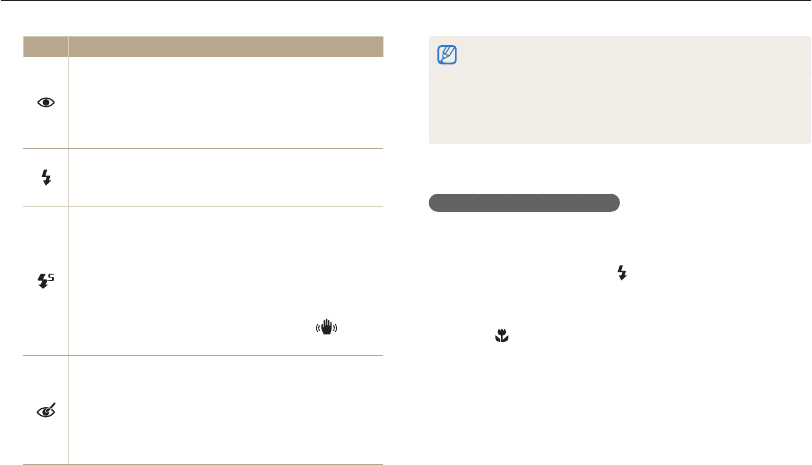
Shooting options
63
Shooting in the dark
•
Flash options are not available if you set Burst options or select
Self-Portrait or Blink Detection.
•
Make sure that your subjects are within the recommended distance
from the flash. (p. 131)
•
If light from the flash is reflected or there is a substantial amount of
dust in the air, tiny spots may appear in your photo.
Adjusting the flash intensity
Adjust the flash intensity to avoid over-exposed or under-exposed
photos.
1
In Shooting mode, press [ ].
2
Scroll to an option.
3
Press [ ].
Icon Description
Red-eye:
•
The flash will fire twice when the subject or
background is dark to reduce the red-eye effect.
•
There is an interval between the 2 bursts of the flash.
Do not move until the flash fires a second time.
Fill in:
•
The flash always fires.
•
The camera automatically adjusts light intensity.
Slow Sync:
•
The flash fires and the shutter stays open longer.
•
This option is recommended when you want to
capture more ambient light to reveal more details in
the background.
•
Use a tripod to prevent your photos from blurring.
•
The camera will display the shake warning when
you are shooting in low light.
Red-eye Fix:
•
The flash fires twice when the subject or background
is dark. The camera corrects red-eyes through its
advanced software analysis.
•
There is an interval between the 2 bursts of the flash.
Do not move until the flash fires a second time.
Available options may differ depending on the shooting conditions.
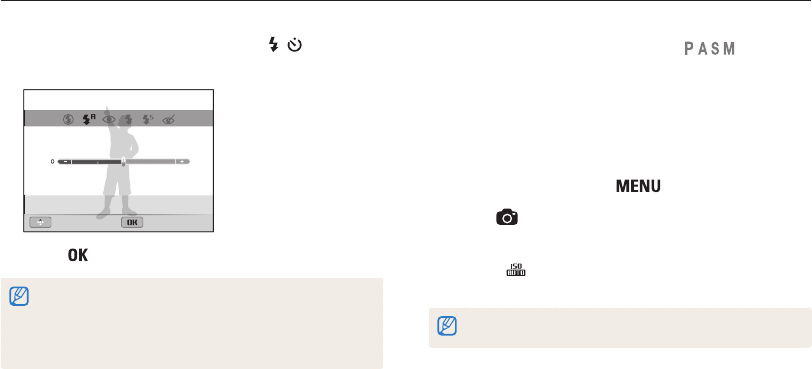
Shooting options
64
Shooting in the dark
4
Rotate the navigation button or press [ / ] to adjust
the intensity.
Back Set
Flash : Auto
Flash Strength
5
Press [ ] to save your settings.
•
Adjusting the flash intensity may not be effective if:
- the subject is too close to the camera
- you set a high ISO sensitivity
- the exposure value is too big or too small
•
In some shooting modes, you cannot use this function.
Adjusting the ISO sensitivity
The ISO sensitivity is the measure of a film’s sensitivity to light as
defined by the International Organization for Standardization (ISO).
The higher ISO sensitivity you select, the more sensitive to light
your camera becomes. Use a higher ISO sensitivity to capture
better photos and reduce camera shake when not using the
flash.
1
In Shooting mode, press [ ].
2
Select → ISO.
3
Select an option.
•
Select to use an appropriate ISO sensitivity based on the
brightness of the subject and lighting.
Higher ISO sensitivities may result in more image noise.
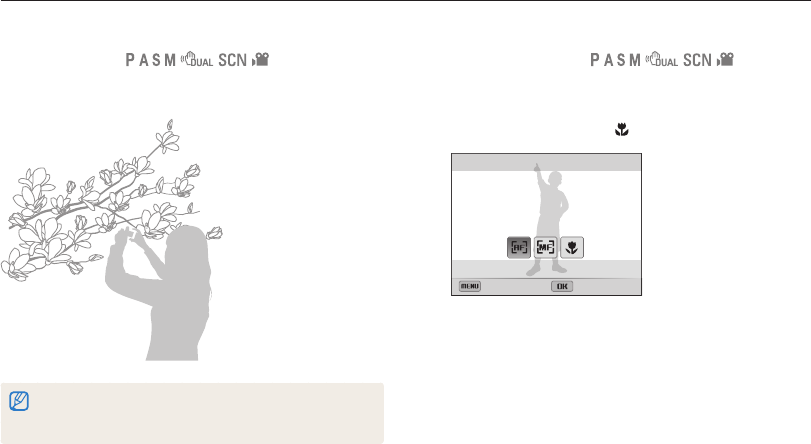
Shooting options
65
Changing the camera’s focus
Learn how to adjust the camera’s focus to suit the subject and the shooting conditions.
Using auto focus
To capture sharp photos, select the appropriate focus option
according to your distance from the subject.
1
In Shooting mode, press [ ].
Back Set
Focus : Auto Focus (Normal)
Using macro
Use macro to capture close-up photos of subjects, such as
flowers or insects.
•
Try to hold the camera firmly to prevent blurry photos.
•
Turn off the flash if the distance to the subject is less than 16 in.
(40 cm)
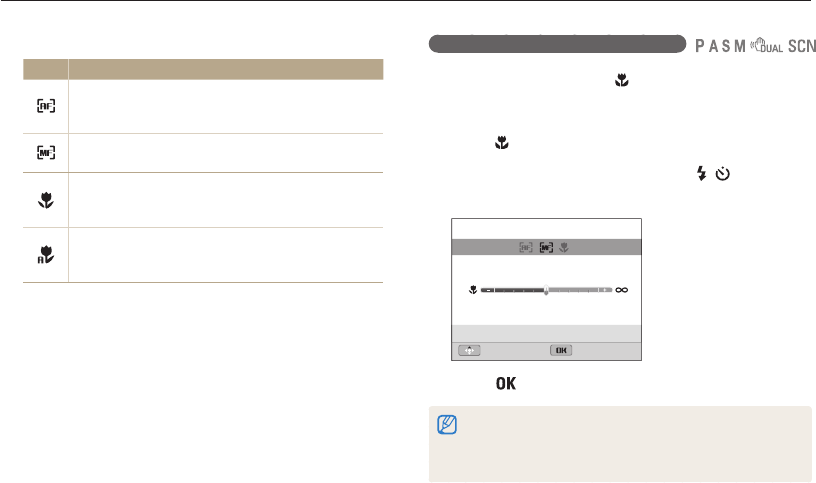
Shooting options
66
Changing the camera’s focus
Adjusting the focus distance manually
1
In Shooting mode, press [ ].
2
Scroll to Manual Focus.
3
Press [ ].
4
Rotate the navigation button or press [ / ] to adjust
the focus distance.
Back Set
Focus : Manual Focus
5
Press [ ] to save your settings.
•
When you adjust the focus distance manually and the subject is out
of focus, the photo may become blurry.
•
If you use this function, you cannot set focus area options and Face
Detection options.
2
Select an option.
Icon Description
Auto Focus (Normal): Focus on a subject farther than
31 in. (80 cm) away. Farther than 138 in. (350 cm) away
when you use the zoom.
Manual Focus: Focus on a subject by adjusting the
focus distance manually. (p. 64)
Macro: Manually focus on a subject that is 2-31 in.
(5-80 cm) from the camera. 71-138 in. (180-350 cm)
when you use the zoom.
Auto Macro: Focus on a subject farther than 2 in.
(5 cm) away. Farther than 71 in. (180 cm) away when
you use the zoom.
Available options may differ depending on the shooting conditions.
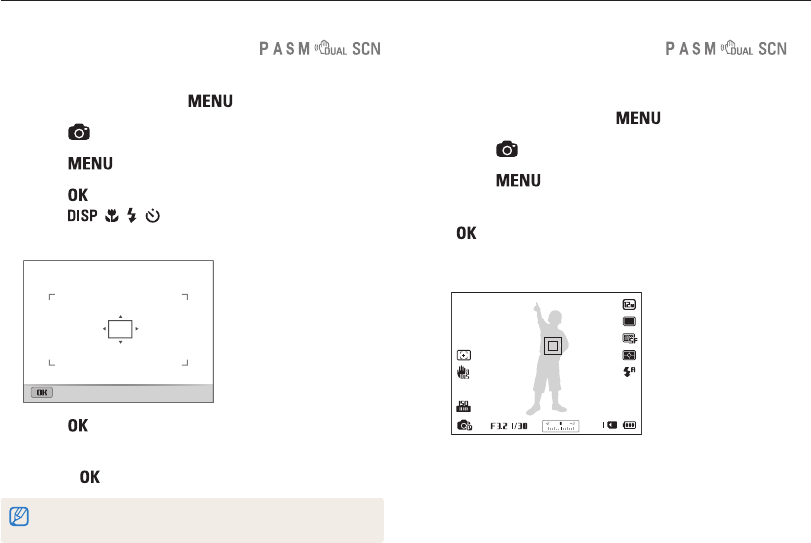
Shooting options
67
Changing the camera’s focus
Using tracking auto focus
Tracking AF allows you to track and auto focus on your subject,
even when you are moving.
1
In Shooting mode, press [ ].
2
Select → Focus Area → Tracking AF.
3
Press [ ] to return to Shooting mode.
4
Focus on the subject you want to track, and then press
[].
•
A focus frame appears on the subject and follows the subject
as you move the camera.
•
The white frame means that your camera is tracking the
subject.
•
When you half-press [Shutter], the green frame means that
your subject is in focus.
5
Press [Shutter] to capture the photo.
Focusing on a selected area
You can focus on an area that you have selected.
1
In Shooting mode, press [ ].
2
Select → Focus Area → Selection AF.
3
Press [ ] to return to Shooting mode.
4
Press [ ], and then rotate the navigation button or
press [ / / / ] to move the frame to a desired
area.
Set
5
Press [ ].
6
Press [Shutter] to capture the photo.
•
Press [ ] to change the focus area.
If you use this function, you cannot set Face Detection options, Burst
options, Smart zoom options, and Smart Filter effects.
Shooting options
68
Changing the camera’s focus
•
If you do not select a focus area, the focus frame will appear in the
center of the screen.
•
Tracking a subject may fail when:
- the subject is too small
- the subject moves excessively
- the subject is backlit or you are shooting in a dark place
- colors or patterns on the subject and the background are the
same
- the subject includes horizontal patterns, such as blinds
- the camera shakes excessively
•
When tracking a subject fails, the focus frame will appear as a white
single-line frame ( ).
•
If the camera fails to track the subject, you must reselect the subject
to track.
•
If the camera fails to focus, the focus frame will change to a red
single-line frame ( ).
•
If you use this function, you cannot set Face Detection options, Burst
options, Smart zoom, and Smart Filter effects.
Adjusting the focus area
You can get clearer photos by selecting an appropriate focus
area according to your subject's location in the scene.
1
In Shooting mode, press [ ].
2
Select → Focus Area.
3
Select an option.
Icon Description
Center AF: Focus on the center of the frame (suitable
when subjects are located at or near the center).
Multi AF: Focus on one or more of 9 possible areas.
Selection AF: Focus on the area that you select. (p. 65)
Tracking AF: Focus on and track the subject. (p. 65)
Available shooting options may differ depending on the shooting mode.
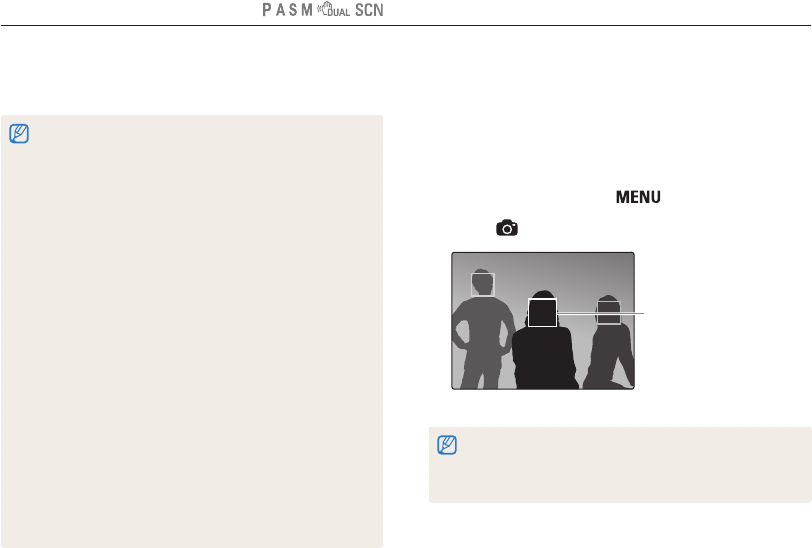
Shooting options
69
Using Face Detection
If you use Face Detection options, your camera can automatically detect a human face. When you focus on a human face, the camera
adjusts the exposure automatically. Use Blink Detection to detect closed eyes or Smile Shot to capture a smiling face. You can also use
Smart Face Recognition to register faces and prioritize the focus on them.
Detecting faces
Your camera automatically detects up to 10 human faces in one
scene.
1
In Shooting mode, press [ ].
2
Select → Face Detection → Normal.
The face nearest the camera
or nearest the center of the
scene appears in a white
focus frame and the rest
of the faces appear in gray
focus frames.
•
The closer you are to the subjects, the quicker your camera will
detect faces.
•
If you have set Burst options, the camera may not register detected
faces.
•
When your camera detects a face, it tracks the detected face
automatically.
•
Face Detection may not be effective when:
- the subject is far from the camera (The focus frame will appear
orange for Smile Shot and Blink Detection.)
- it is too bright or too dark
- the subject is not facing the camera
- the subject is wearing sunglasses or a mask
- the subject’s facial expression changes drastically
- the subject is backlit or the lighting conditions are unstable
•
Face Detection is not available when you set Smart Filter effects,
Image adjustment, Selection AF, Tracking AF, or Manual Focus.
•
Depending on the shooting options you selected, available Face
Detection options may differ.
•
Depending on the Face Detection options you selected, the timer
function may not be available.
•
When you set Face Detection options, the AF area is automatically
set to Multi AF.
•
Depending on the Face Detection options you selected, Burst
options may not be available.
•
When you capture photos of detected faces, they will be registered
in the face list.
•
You can view registered faces in order of priority in Playback mode.
(p. 85) Even though faces are registered successfully, they may not
be classified in Playback mode.
•
A face detected in Shooting mode may not appear in the face list or
Smart Album.
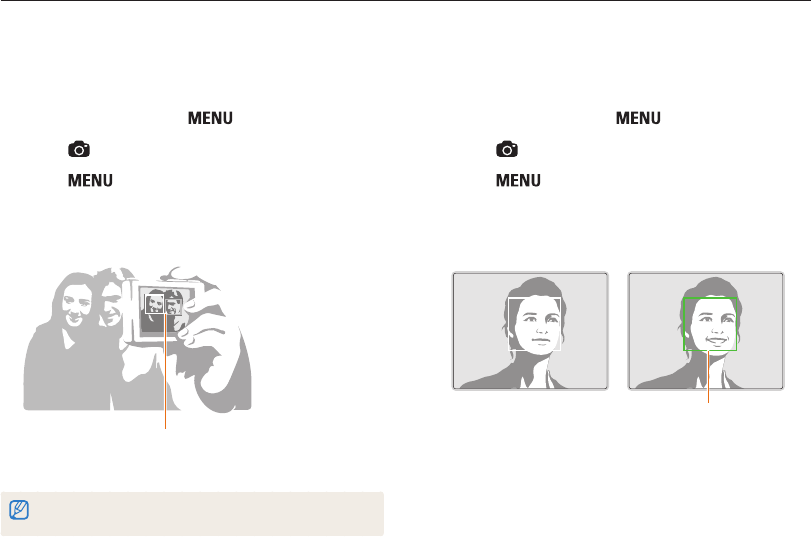
Shooting options
70
Using Face Detection
Capturing a self portrait shot
Capture photos of yourself. The camera sets the focus distance
to close-up, and then emits a beep when ready.
1
In Shooting mode, press [ ].
2
Select → Face Detection → Self-Portrait.
3
Press [ ] to return to Shooting mode.
4
Compose your shot with the lens facing you.
5
When you hear a quick beep, press [Shutter].
When faces are located in the center,
the camera beeps rapidly.
If you turn Volume off in the sound settings, the camera will not emit a beep.
(p. 112)
Capturing a smile shot
The camera automatically releases the shutter when it detects a
smiling face.
1
In Shooting mode, press [ ]].
2
Select → Face Detection → Smile Shot.
3
Press [ ] to return to Shooting mode.
4
Compose your shot.
•
The camera automatically releases the shutter when it detects
a smiling face.
When your subject smiles
broadly, your camera can detect
the smile more easily.
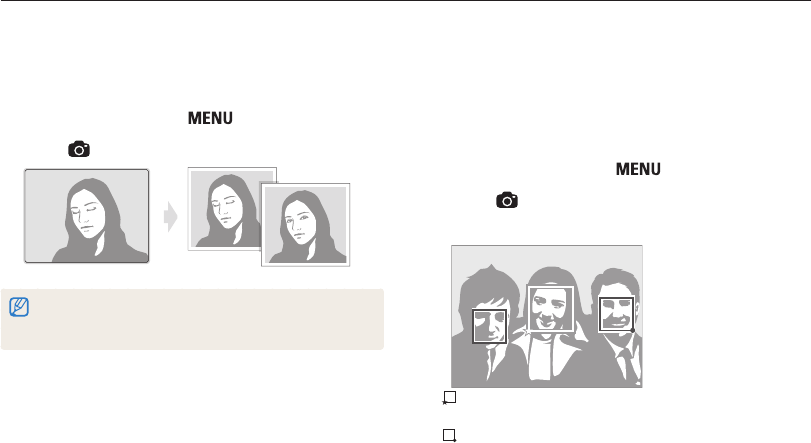
Shooting options
71
Using Face Detection
Using Smart Face Recognition
The camera automatically registers faces that you frequently
photograph. The Smart Face Recognition feature will
automatically prioritize the focus on those faces and on favorite
faces. The Smart Face Recognition feature is available only when
you use a memory card.
1
In Shooting mode, press [ ].
2
Select → Face Detection → Smart Face
Recognition.
• : Faces that you have registered as favorites.
(To register faces as favorites, refer to page 70.)
• : Faces that the camera has automatically registered.
Detecting eye blinking
If your camera detects closed eyes, it will automatically capture
2 photos in succession.
1
In Shooting mode, press [ ].
2
Select → Face Detection → Blink Detection.
•
Hold your camera still while “Capturing” is displayed on the screen.
•
If Blink Detection fails, the “Picture taken with eyes closed.”
message appears. Capture another photo.
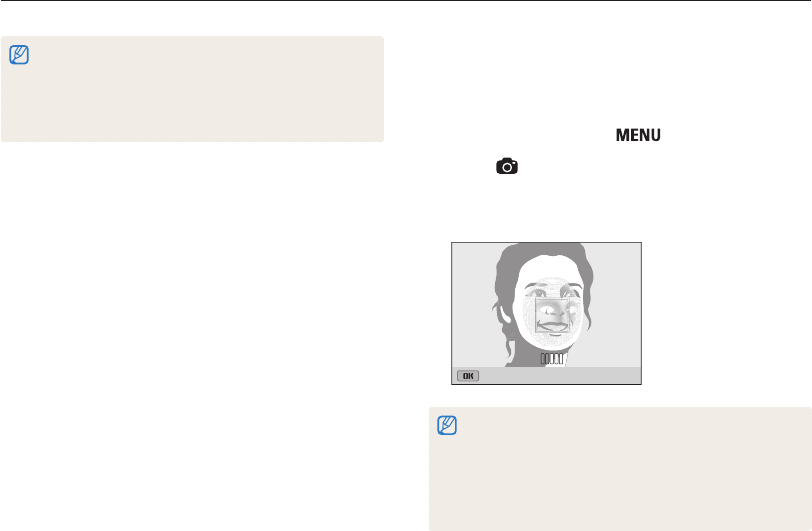
Shooting options
72
Using Face Detection
Registering faces as your favorites (My Star)
You can register your favorite faces to prioritize the focus and
exposure on those faces. This feature is available only when you
use a memory card.
1
In Shooting mode, press [ ].
2
Select → Smart FR Edit → My Star.
3
Align your subject’s face with the oval guideline, and then
press [Shutter] to register the face.
Set
•
Capture photos of one person at a time when registering faces.
•
Capture 5 photos of the subject’s face for best results: one each
from the front, left, right, above, and below.
•
When capturing photos from the left, right, above, and below, instruct
the subject not to turn his or her face more than 30 degrees.
•
You can register a face even if you capture only one photo of the
subject's face.
•
The camera may recognize and register faces incorrectly depending
on lighting conditions, drastic changes in the subject's pose or face,
and whether or not the subject is wearing glasses.
•
The camera can automatically register up to 12 faces. If the camera
recognizes a new face when 12 faces have already been registered,
it will replace the lowest priority face with the new one.
Shooting options
73
Using Face Detection
4
When you are finished capturing the photos, the face list
appears.
•
Your favorite faces are indicated with a on the face list.
•
You can register up to 8 favorite faces.
•
The flash will not fire when you register a favorite face.
•
If you register the same face twice, you can delete one of the faces
in the face list.
Viewing your favorite faces
1
In Shooting mode, press [ ].
2
Select → Smart FR Edit → Face List.
•
To change the ranking of your favorite faces, press [ ], and then
select Edit Ranking. (p. 85)
•
To delete a favorite face, press [ ], and then select Delete. (p. 86)
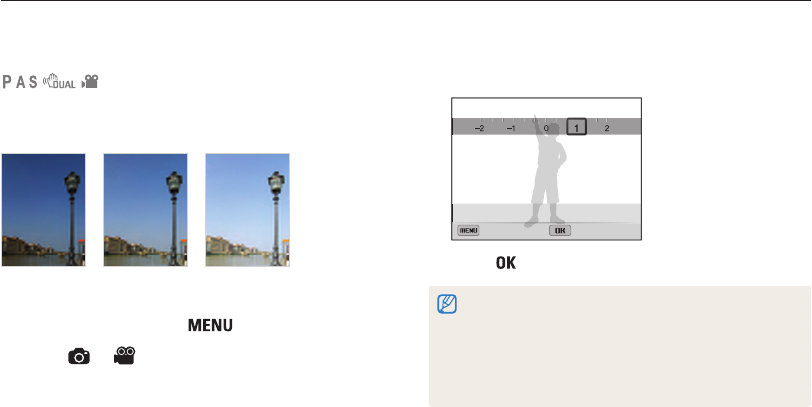
Shooting options
74
Adjusting brightness and color
Learn how to adjust the brightness and color for better image quality.
3
Select a value to adjust the exposure.
•
The photo will be brighter as the exposure value increases.
Back Set
EV : 1
4
Press [ ] to save your settings.
•
Once you adjust the exposure, the setting will be stored
automatically. You may need to change the exposure value later to
avoid overexposure or underexposure.
•
If you cannot decide on an appropriate exposure, select the AE BKT
(Auto Exposure Bracket) option (p. 79), and then capture bracketed
photos. The camera will capture 3 consecutive photos, each with a
different exposure: normal, underexposed, and overexposed. (p. 78)
Adjusting the exposure manually (EV)
Depending on the intensity of the ambient light, your photos
may be too bright or dark. In these cases, you can adjust the
exposure to get a better photo.
Darker (-)
Neutral (0)
Brighter (+)
1
In Shooting mode, press [ ].
2
Select or → EV.
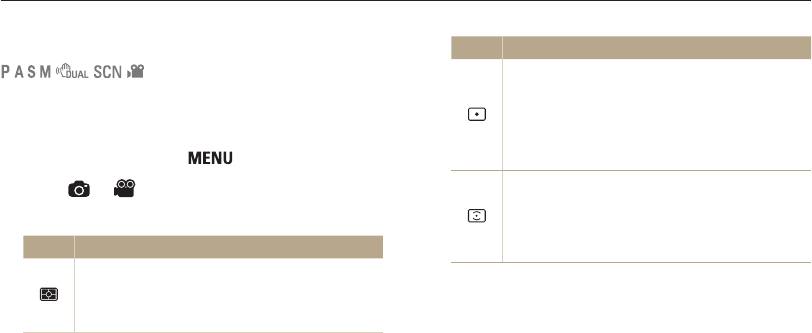
Shooting options
75
Adjusting brightness and color
Icon Description
Spot:
•
Your camera measures only the light intensity at the
very center of the frame.
•
If a subject is not in the center of the frame, your
photo may be improperly exposed.
•
Suitable for a subject with backlighting.
Center-weighted:
•
Your camera averages the meter reading of the entire
frame with emphasis placed on the center.
•
Suitable for photos with subjects in the center of the
frame.
Changing the metering option
The metering mode refers to the way in which a camera
measures the quantity of light. The brightness and lighting of your
photos will vary depending on the metering mode you select.
1
In Shooting mode, press [ ].
2
Select or → Metering.
3
Select an option.
Icon Description
Multi:
•
Your camera divides the frame into several areas,
and then measures the light intensity of each area.
•
Suitable for general photos.
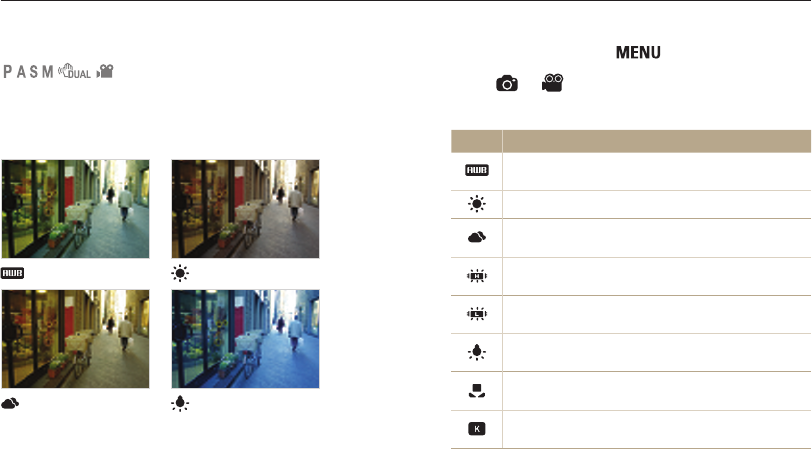
Shooting options
76
Adjusting brightness and color
Selecting a White Balance setting
The color of your photo depends on the type and quality of the
light source. If you want the color of your photo to be realistic,
select a White Balance setting that is appropriate for the lighting
conditions, such as Auto WB, Daylight, Cloudy, or Tungsten.
Auto WB Daylight
Cloudy Tungsten
1
In Shooting mode, press [ ].
2
Select or → White Balance.
3
Select an option.
Icon Description
Auto WB: Automatically set the White Balance based
on the lighting conditions.
Daylight: For outdoor photos on a sunny day.
Cloudy: For outdoor photos on a cloudy day or in
shadows.
Fluorescent_H: For shooting under a daylight
fluorescent or 3-way fluorescent light.
Fluorescent_L: For shooting under white fluorescent
light.
Tungsten: For shooting indoor photos under
incandescent bulbs or halogen lamps.
Custom Set: To use White Balance settings that you
define. (p. 75)
Color Temp.: To adjust the color temperature of the
light source. (p. 76)
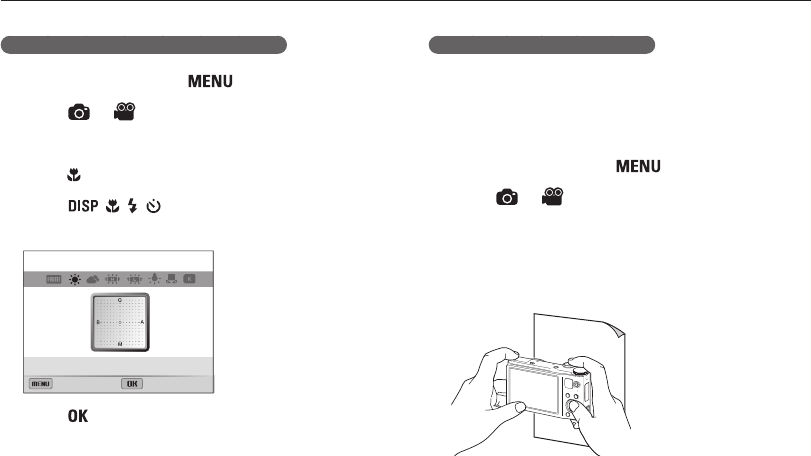
Shooting options
77
Adjusting brightness and color
Customizing preset White Balance options
1
In Shooting mode, press [ ].
2
Select or → White Balance.
3
Scroll to a desired option.
4
Press [ ].
5
Press [ / / / ] to adjust the value on the
coordinates.
•
G: Green
•
A: Amber
•
M: Magenta
•
B: Blue
Back Set
White Balance : Daylight
6
Press [ ] to save your settings.
Defining your own White Balance
You can customize the White Balance by capturing a photo of
a white surface, such as a piece of paper, under the lighting
conditions in which you intend to capture a photo. The White
Balance feature will help you to match the colors in your photo
with the actual scene.
1
In Shooting mode, press [ ].
2
Select or → White Balance.
3
Scroll to Custom Set.
4
Aim the lens at a piece of white paper, and then press
[Shutter].
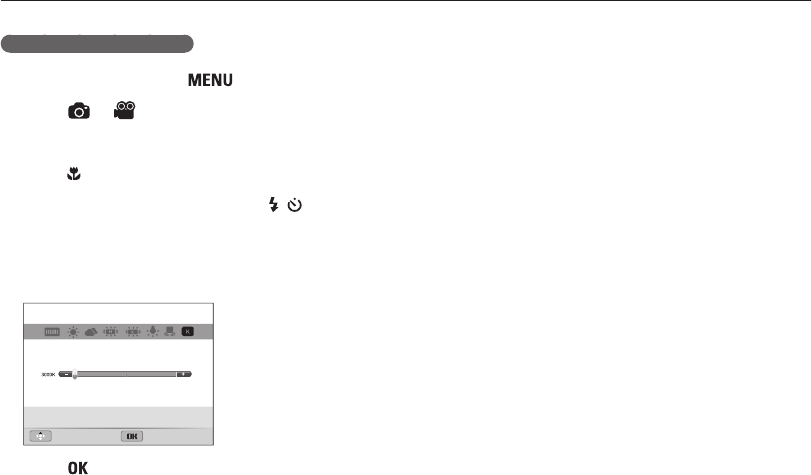
Shooting options
78
Adjusting brightness and color
Adjusting color temperature
1
In Shooting mode, press [ ].
2
Select or → White Balance.
3
Scroll to Color Temp..
4
Press [ ].
5
Rotate the navigation button or press [ / ] to adjust
the color temperature to match your light source.
•
You can capture a warmer photo with a higher color
temperature setting (more yellow/red), and a cooler photo with
a lower color temperature setting (more blue).
Back Set
White Balance : Color Temp.
6
Press [ ] to save your settings.
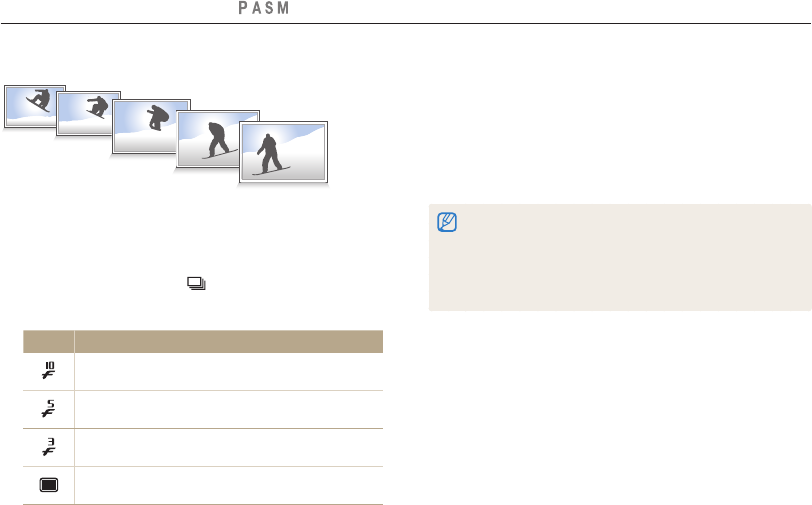
Shooting options
79
Using burst modes
It can be difficult to capture photos of fast-moving subjects or capture natural facial expressions and gestures of your subjects in photos.
Also, it can be difficult to adjust the exposure correctly and select a proper light source. In these cases, select one of the burst modes.
3
Align your subject in the frame, and then half-press
[Shutter] to focus.
4
Press and hold [Shutter].
•
While you are pressing [Shutter], the camera captures photos
continuously.
•
You can use the flash, Smart Zoom, Face Detection options, and
Smart Filter options only when you select Single.
•
It may take longer to save the photos depending on the memory card
capacity and performance.
•
The camera always displays captured photos before returning to
Shooting mode.
Capturing photos in the High-speed burst
mode
1
In Shooting mode, press [ ].
2
Select an option.
Icon Description
10fps: Capture 10 photos per second continuously.
(You can capture up to 8 photos in one burst.)
5fps: Capture 5 photos per second continuously.
(You can capture up to 8 photos in one burst.)
3fps: Capture 3 photos per second continuously.
(You can capture up to 8 photos in one burst.)
Single: Capture a single photo. Single is not a
high-speed burst option.

Shooting options
80
Using burst modes
Capturing photos in the Precapture mode
In Precapture mode, the camera starts shooting before you even
press the shutter all the way down. If you do not want to miss the
first couple of important shots, simply use this mode and select
the photo with the best results after shooting.
1
In Shooting mode, press [ ].
2
Select Precapture.
3
Align your subject in the frame, and then half-press
[Shutter] to focus.
•
The camera captures 7 photos continuously. If you release
[Shutter] too fast, the camera captures less than 7 photos.
4
Press [Shutter].
•
The camera capture the last photo and then saves all of the
captured photos while you are half-pressing [Shutter].
•
If you do not press [Shutter] all the way down, the photos
captured while you are half-pressing [Shutter] will not be
saved.
Capturing bracketed photos
You can use the automatic bracketing feature to capture multiple
photos of the same subject with different setting values slightly
modified, such as exposure or white balance.
1
In Shooting mode, press [ ].
2
Select Bracket.
3
Align your subject in the frame, and then half-press
[Shutter] to focus.
4
Press [Shutter].
•
The camera captures 3 photos continuously.
Use a tripod to prevent blurry photos.