ShenZhen ART TECH R C Hobby ETB4SP 2.4GHz Radio Control system User Manual

ShenZhen ART-TECH R/C Hobby Co., Ltd 2.4GHz Radio Control system Users Manual

user manual

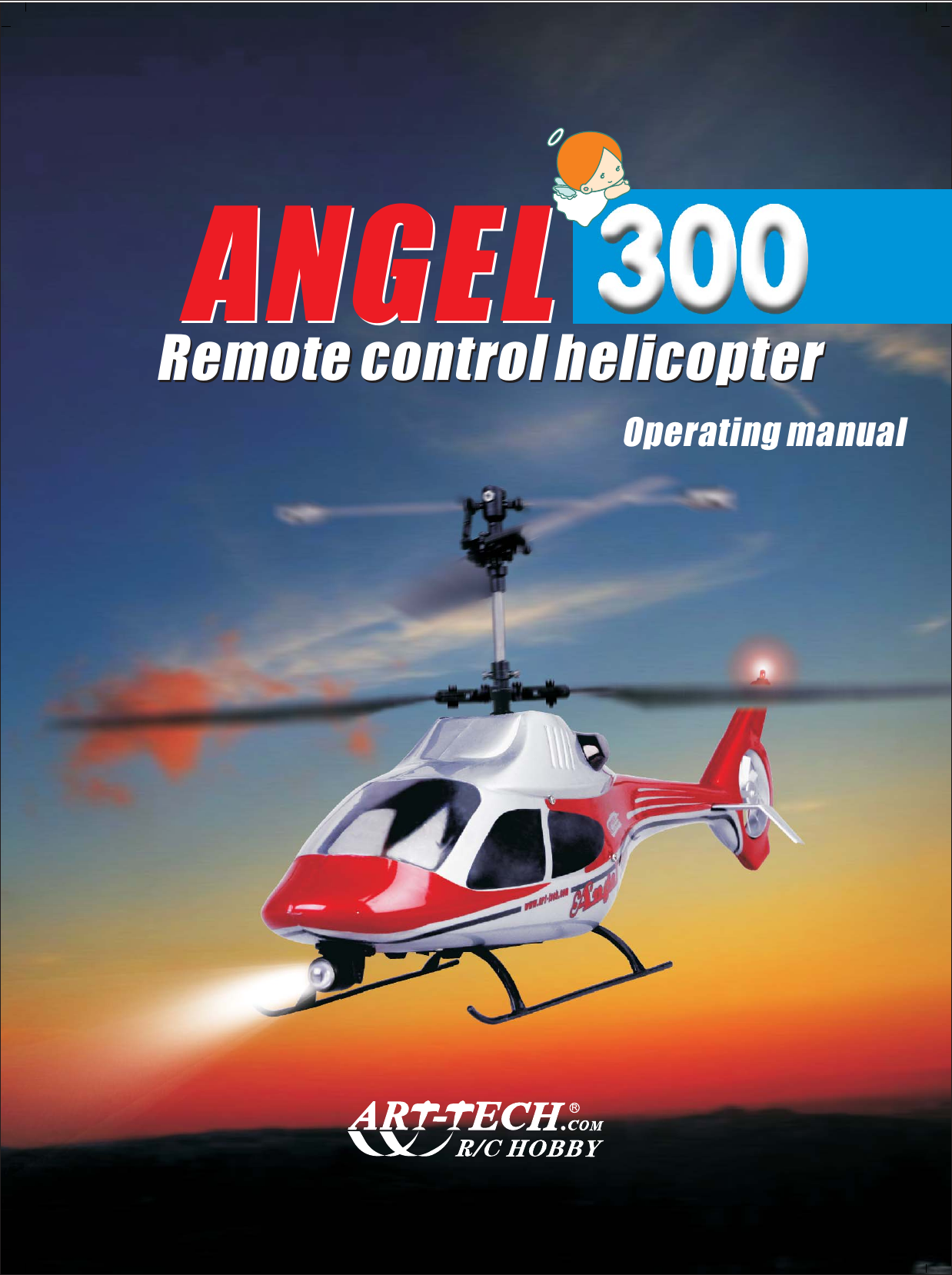
Remote control helicopterRemote control helicopterANGELANGELOperating manualR
★SPARE PARTS LIST 15★SAFETY INSTRUCTIONS FOR LI-POLY BATTERIES 06★CHARGE MODE AND WARNING 05★TIPS FOR SAFETY 03★CAUTION 03★SPECIFICATIONS 02★INSTALLATION 11★NORMAL  FLIGHT 1008★ ADJUST THE SPEED OF THE ROTOR BLADES BY THE PCB BOARD★MAIN ROTOR BLADE ADJUSTMENT 09★THE POSSIBLE PROBLEMS AND SOLUTIONS14★PARTS LIST 07★FUNCTIONS FOR CONTROL SET  08★PARTS REPLACING 13CATALOG ★GROUND EFFECT 09www.art-tech.com1★中文说明部分 17-31★SWASHPLATE  ADJUSTMENT 09★OPERATION MANUAL METHOD STARTING PROCEDURE 07
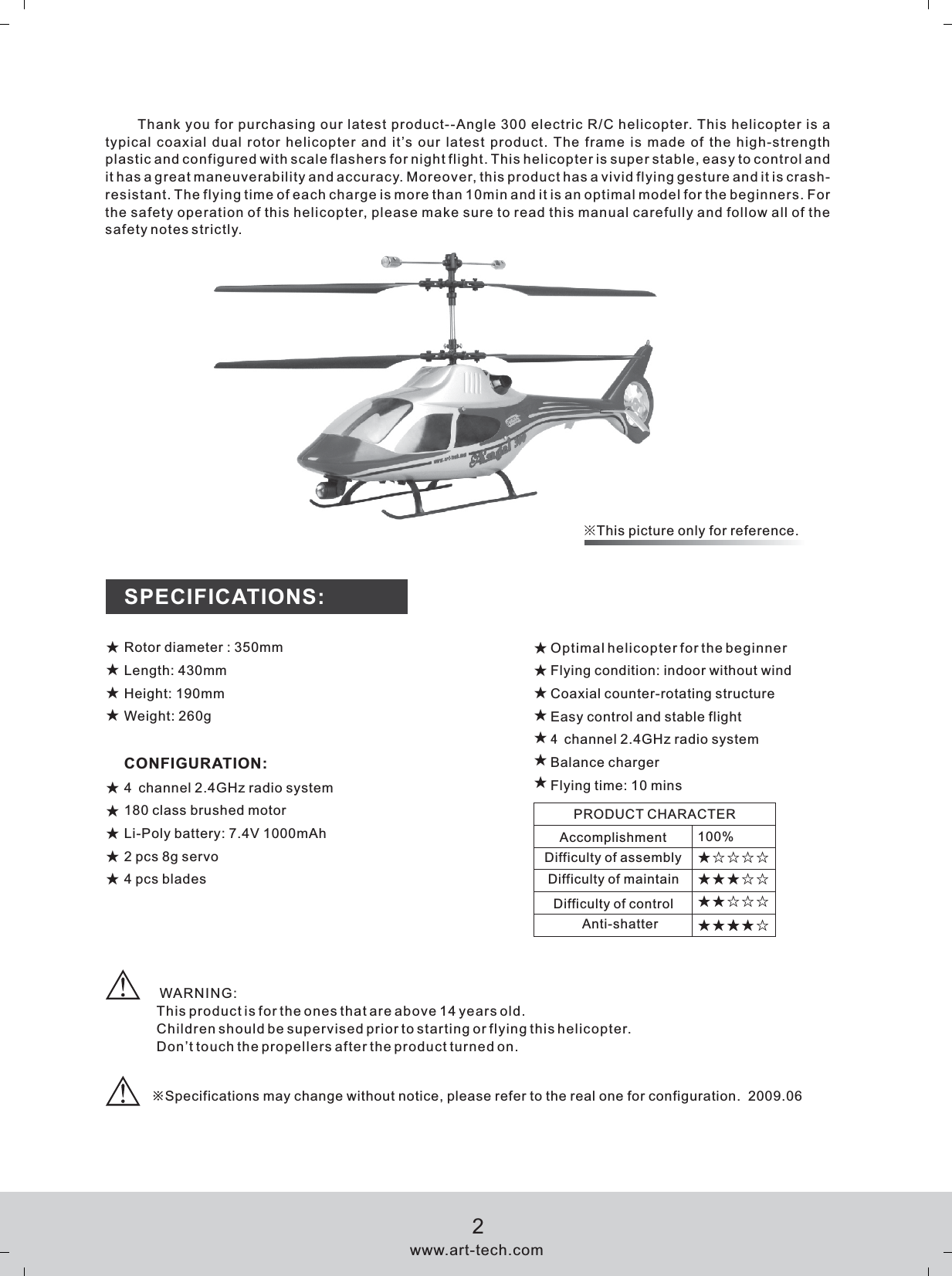
※This picture only for reference.Thank you for purchasing our latest product--Angle 300 electric R/C helicopter. This helicopter is a typical coaxial dual rotor helicopter and it’s our latest product. The frame is made of the high-strength plastic and configured with scale flashers for night flight. This helicopter is super stable, easy to control and it has a great maneuverability and accuracy. Moreover, this product has a vivid flying gesture and it is crash-resistant. The flying time of each charge is more than 10min and it is an optimal model for the beginners. For the safety operation of this helicopter, please make sure to read this manual carefully and follow all of the safety notes strictly.☆Rotor diameter : 350mmLength: 430mmHeight: 190mmWeight: 260gCONFIGURATION:4 channel 2.4GHz radio system180 class brushed motorLi-Poly battery: 7.4V 1000mAh2 pcs 8g servo4 pcs bladesSPECIFICATIONS:100%★★☆☆☆★★★★☆★★☆ ☆★☆☆☆☆PRODUCT CHARACTERAccomplishment Difficulty of assemblyDifficulty of maintainDifficulty of controlAnti-shatter※Specifications may change without notice, please refer to the real one for configuration.  2009.06Optimal helicopter for the beginnerFlying condition: indoor without windCoaxial counter-rotating structureEasy control and stable flight4 channel 2.4GHz radio systemBalance chargerFlying time: 10 mins ★★★★★★★★★★★★★★★★ WARNING:This product is for the ones that are above 14 years old.Children should be supervised prior to starting or flying this helicopter.Don’t touch the propellers after the product turned on.★www.art-tech.com2
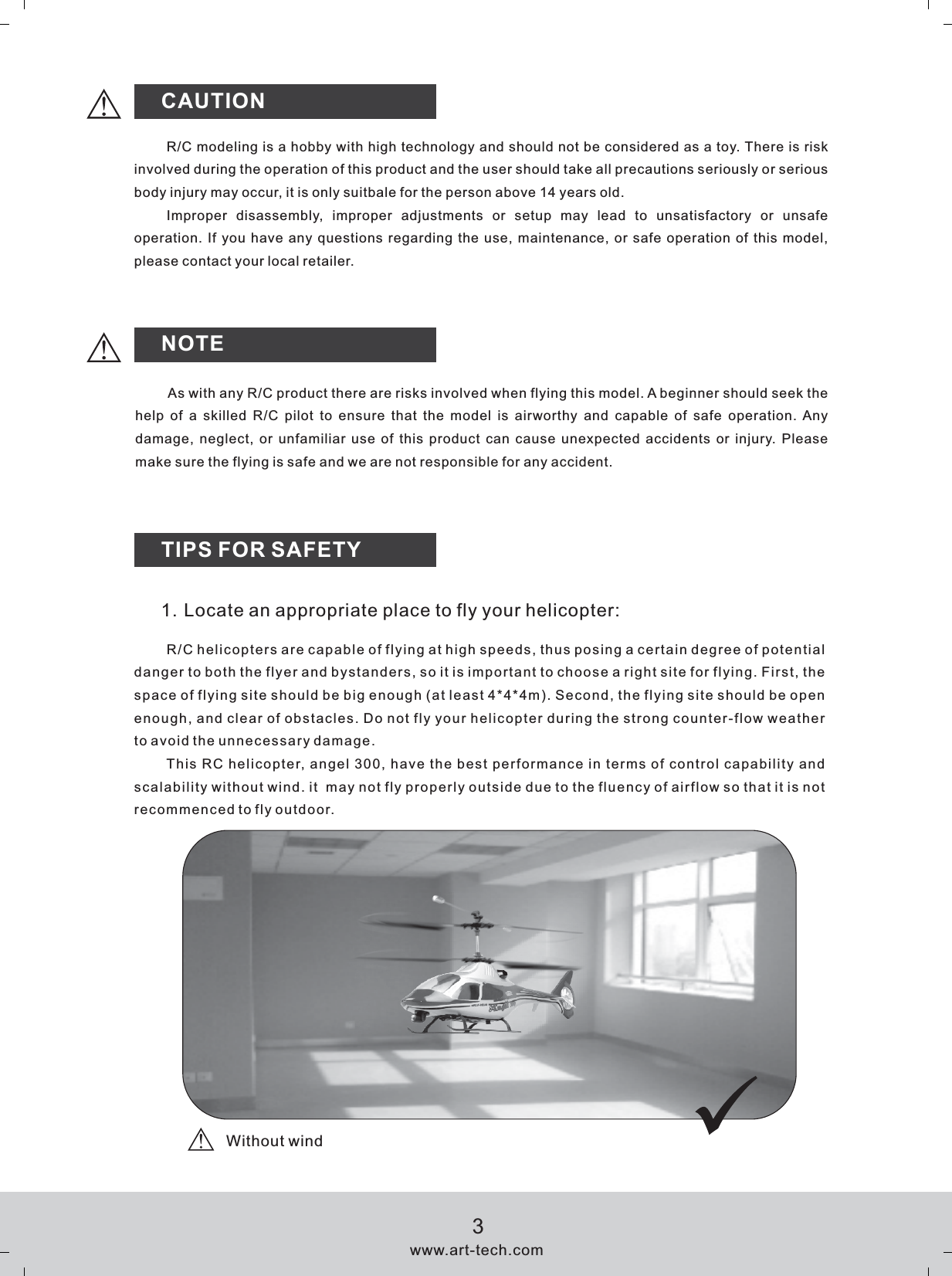
CAUTIONNOTETIPS FOR SAFETYR/C modeling is a hobby with high technology and should not be considered as a toy. There is risk involved during the operation of this product and the user should take all precautions seriously or serious body injury may occur, it is only suitbale for the person above 14 years old.Improper  disassembly,  improper  adjustments  or  setup  may  lead  to  unsatisfactory  or  unsafe operation. If you have any questions regarding the use, maintenance, or safe operation of this model, please contact your local retailer.As with any R/C product there are risks involved when flying this model. A beginner should seek the help  of  a  skilled  R/C  pilot  to  ensure  that  the  model  is  airworthy  and  capable  of  safe  operation. Any damage, neglect, or unfamiliar use of this product can cause unexpected accidents or injury. Please make sure the flying is safe and we are not responsible for any accident.1. Locate an appropriate place to fly your helicopter:R/C helicopters are capable of flying at high speeds, thus posing a certain degree of potential danger to both the flyer and bystanders, so it is important to choose a right site for flying. First, the space of flying site should be big enough (at least 4*4*4m). Second, the flying site should be open enough, and clear of obstacles. Do not fly your helicopter during the strong counter-flow weather to avoid the unnecessary damage.This RC helicopter, angel 300, have the best performance in terms of control capability and scalability without wind. it  may not fly properly outside due to the fluency of airflow so that it is not recommenced to fly outdoor.www.art-tech.com3Without wind
TIPS FOR SAFETYThe help of an experienced pilot will ensure that you will havea well trimmed, correctly functioning helicopter for the first flight. It is strongly advised that you first practice on the simulator priorto making a fli ght wit h your new heli copte r.2. Obtain the assistance of an experienced pilot.3. Always be away from the running parts         4. Keep your helicopter away from humidity.        5. Operate your helicopter gentlyDuring  the  operation  of  your  helicopter  the  rotor  will  be spinning at a high rate of speed. Don’t touch any running parts and please  keep  a  proper  distance  with  them.  Be  conscious  of  your actions and  be careful  to keep  your hands,  face, eyes,  and loose clothing away from the blades and gears to avoid being hurt or any damage to the model.Your new Angle 300 helicopter is a hi-tech electronic device, so try to keep the model away from the humidity condition which may result in the operation errors or some other unrespectable faults to the model.Never subject your model to severe weather, such as raining, thunder.The  helicopter  will  give  a  prompt  response  to  the  controlling action,so  try  to  operate  the  helicopter  gently.  Try  to  avoid  the excessive operation as this may lead to the helicopter to be out  of control. NoviceNovice Expertwww.art-tech.com4
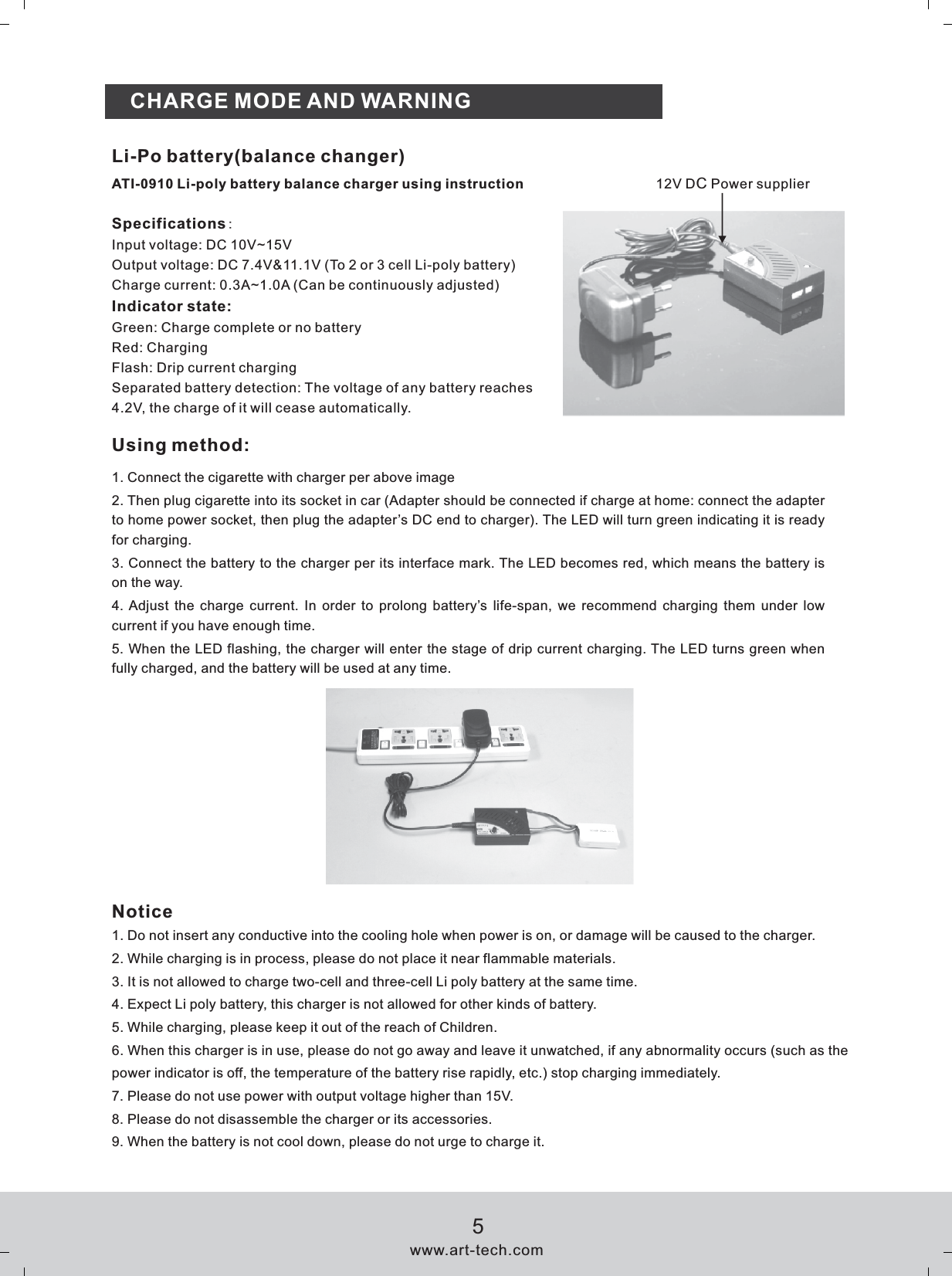
CHARGE MODE AND WARNINGSpecifications:Input voltage: DC 10V~15VOutput voltage: DC 7.4V&11.1V (To 2 or 3 cell Li-poly battery)Charge current: 0.3A~1.0A (Can be continuously adjusted)Indicator state:Green: Charge complete or no batteryRed: ChargingFlash: Drip current chargingSeparated battery detection: The voltage of any battery reaches 4.2V, the charge of it will cease automatically.Li-Po battery(balance changer)ATI-0910 Li-poly battery balance charger using instruction 12V DC Power supplierUsing method:1. Connect the cigarette with charger per above image2. Then plug cigarette into its socket in car (Adapter should be connected if charge at home: connect the adapter to home power socket, then plug the adapter’s DC end to charger). The LED will turn green indicating it is ready for charging.3. Connect the battery to the charger per its interface mark. The LED becomes red, which means the battery is on the way.4. Adjust  the charge current. In  order  to prolong  battery’s  life-span,  we recommend charging  them under low current if you have enough time.5. When the LED flashing, the charger will enter the stage of drip current charging. The LED turns green when fully charged, and the battery will be used at any time.Notice1. Do not insert any conductive into the cooling hole when power is on, or damage will be caused to the charger.2. While charging is in process, please do not place it near flammable materials.3. It is not allowed to charge two-cell and three-cell Li poly battery at the same time.4. Expect Li poly battery, this charger is not allowed for other kinds of battery.5. While charging, please keep it out of the reach of Children.6. When this charger is in use, please do not go away and leave it unwatched, if any abnormality occurs (such as the power indicator is off, the temperature of the battery rise rapidly, etc.) stop charging immediately.7. Please do not use power with output voltage higher than 15V.8. Please do not disassemble the charger or its accessories.9. When the battery is not cool down, please do not urge to charge it.www.art-tech.com5
CAUTIONSAFETY INSTRUCTIONS FOR LI-POLY BATTERIES01.Do not disassemble or reconstruct the battery.02.Do not short-circuit the battery.03.Do not use or leave the battery nearby the fire, stove or heated place.04.Do not immerse the battery in water or sea water, do not get it wet.05.Do not charge the battery nearby the fire or under the blazing sunlight.06.Do not drive a nail into the battery, strike it by hammer or tread on it.07.Do not  impact or throw the battery.08.Do not use the battery with conspicuous damage or deformation.09.Do not make the direct soldering on the battery.10.Do not reverse charge or over discharge the battery.11.Do not reverse charge or reverse connect.12.Do not connect the battery to the ordinary charger socket or car cigarette jack.13.Do not use the battery for unspecified equipment.15.Do not mix the Li-Poly battery with other un-chargeable batter y .16.Do not continue charging the battery over the   time.prescribed17.Do not put the battery into the microwave oven or high-pressure container.18.Do not use the abnormal battery.19.Do not use or keep the battery under the sunlight.20.Do not use the battery nearby the place where generates static electricity (over 64V).21.Do not charge the battery when the environmental temperature is under 0℃ or over 45℃.22.If you find the battery leaking, smelling or abnormal, stop using it .23.Keep the battery away from the children.24.Use the specified charger and observe charging requirement (under 1A).25.When using by minors, parents should show them the correct way to charge.14.Do not touch the leaking battery directly, please wash your skin or clothes with water      if they are bedewed by liquid leaking from the battery.1. Use the original charger. Never charge the battery at more than 1 amp.2. Never discharge the battery at more than 5C. Do not discharge too long as this will damage the battery.3. For full flight time to be achieved please cycle the cells through three flights.4. Never charge the battery on a carpet floor, this can cause a fire!www.art-tech.com6
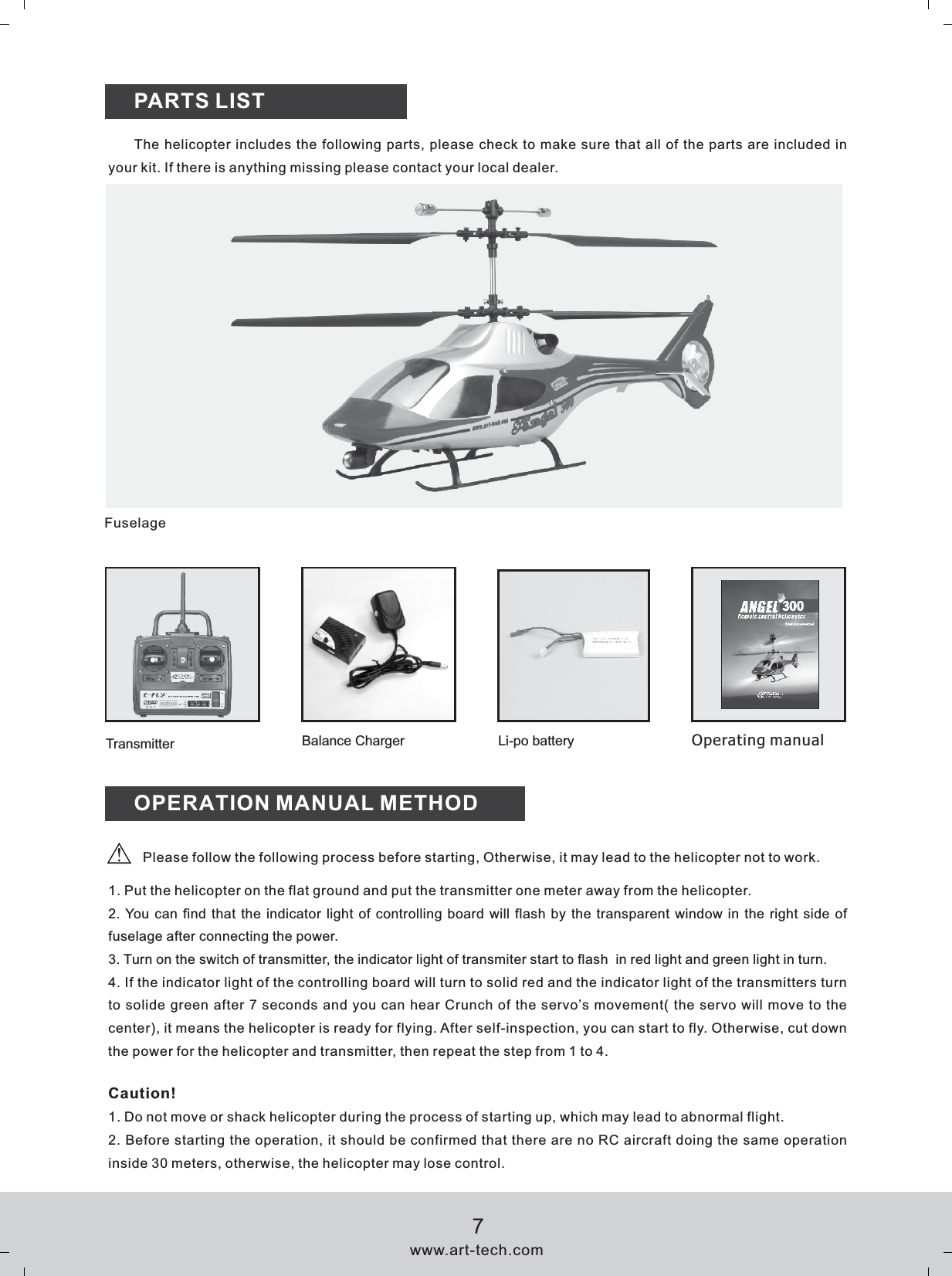
PARTS LISTFuselageThe helicopter includes the following parts, please check to make sure that all of the parts are included in your kit. If there is anything missing please contact your local dealer.OPERATION MANUAL METHOD1. Put the helicopter on the flat ground and put the transmitter one meter away from the helicopter.2. You can find that the indicator light of controlling board will flash by the transparent window in the right side of fuselage after connecting the power.3. Turn on the switch of transmitter, the indicator light of transmiter start to flash  in red light and green light in turn.4. If the indicator light of the controlling board will turn to solid red and the indicator light of the transmitters turn to solide green after 7 seconds and you can hear Crunch of the servo’s movement( the servo will move to the center), it means the helicopter is ready for flying. After self-inspection, you can start to fly. Otherwise, cut down the power for the helicopter and transmitter, then repeat the step from 1 to 4. Caution!1. Do not move or shack helicopter during the process of starting up, which may lead to abnormal flight.2. Before starting the operation, it should be confirmed that there are no RC aircraft doing the same operation inside 30 meters, otherwise, the helicopter may lose control.Balance Charger Li-po battery Operating manualTransmitterPlease follow the following process before starting, Otherwise, it may lead to the helicopter not to work. www.art-tech.com7
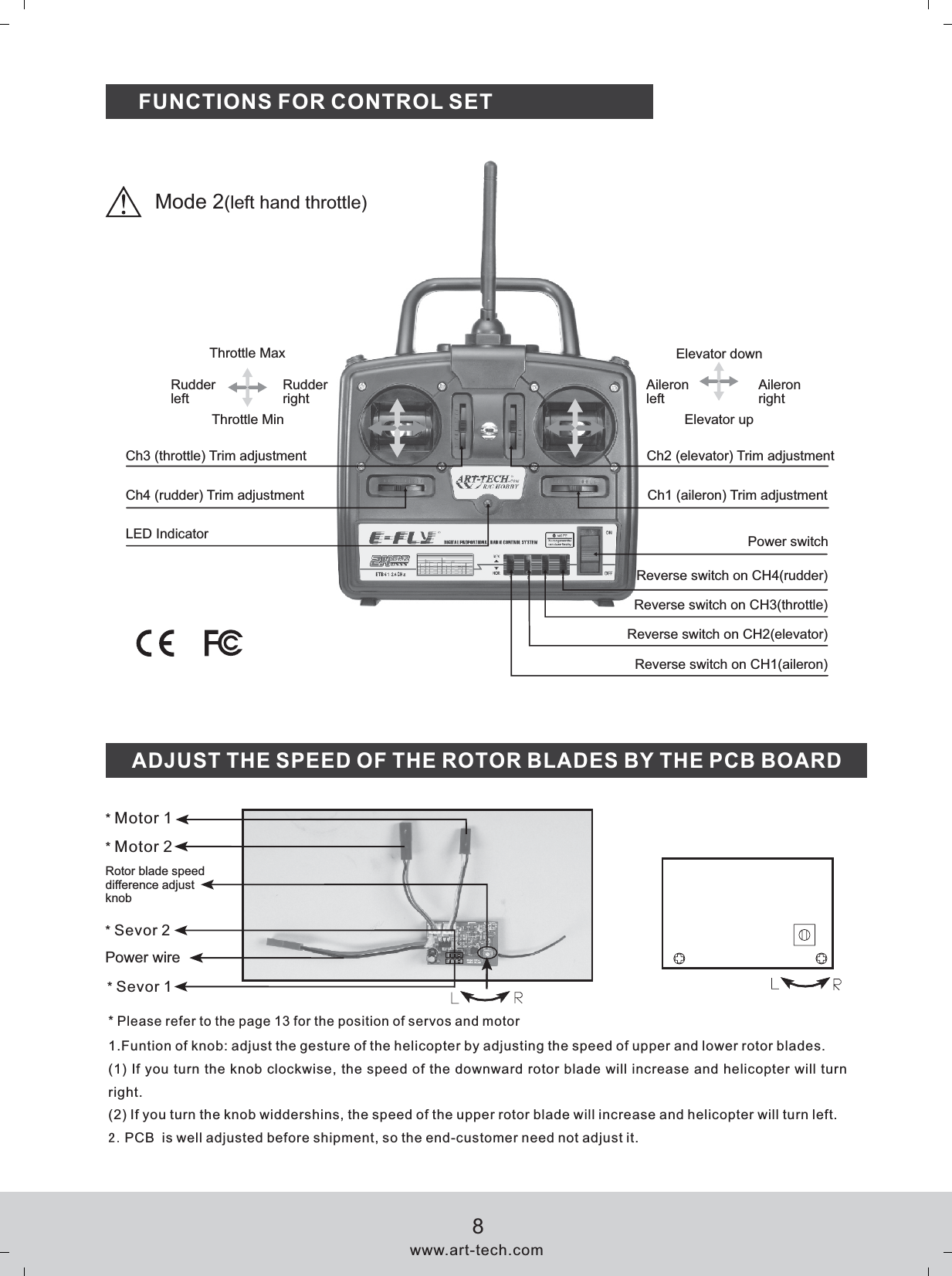
FUNCTIONS FOR CONTROL SET Mode 2(left hand throttle) Throttle Max Elevator downRudderleftAileron leftRudderrightAileron rightElevator upThrottle MinCh2 ( ) Trim adjustmentelevatorPower switchReverse switch on CH4(rudder)Reverse switch on CH3(throttle)Reverse switch on CH2(elevator)Reverse switch on CH1(aileron)Ch1 (aileron) Trim adjustmentCh3 ( ) Trim adjustmentthrottleCh4 (rudder) Trim adjustmentADJUST THE SPEED OF THE ROTOR BLADES BY THE PCB BOARD              Power wire* Motor 1* Sevor 2* Motor 2* Sevor 11.Funtion of knob: adjust the gesture of the helicopter by adjusting the speed of upper and lower rotor blades.(1) If you turn the knob clockwise, the speed of the downward rotor blade will increase and helicopter will turn right.(2) If you turn the knob widdershins, the speed of the upper rotor blade will increase and helicopter will turn left.2.PCB  is well adjusted before shipment, so the end-customer need not adjust it.www.art-tech.com8LED Indicator * Please refer to the page 13 for the position of servos and motorRotor blade speed difference adjust knob
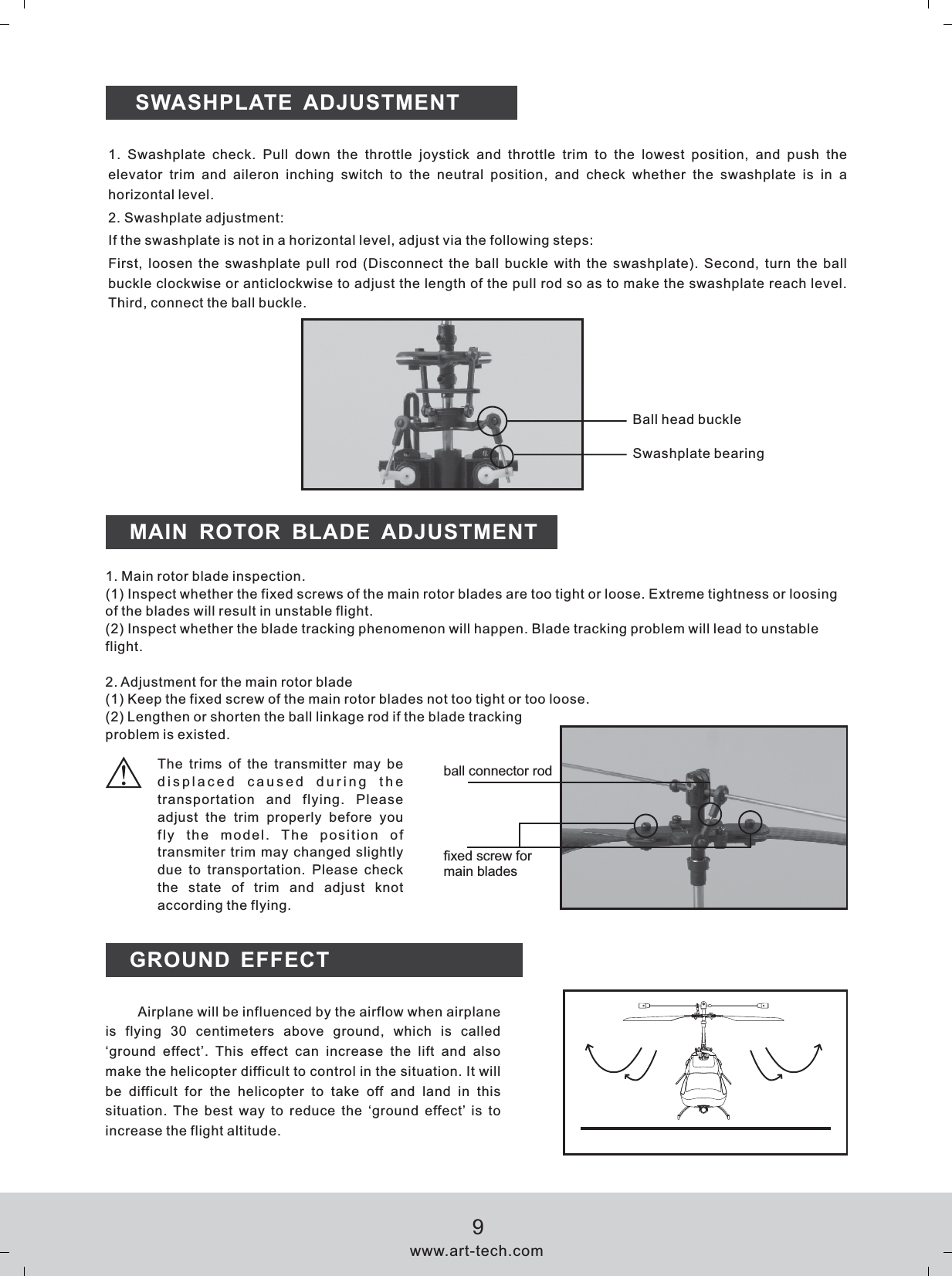
MAIN  ROTOR  BLADE  ADJUSTMENT1. Main rotor blade inspection.(1) Inspect whether the fixed screws of the main rotor blades are too tight or loose. Extreme tightness or loosing of the blades will result in unstable flight.(2) Inspect whether the blade tracking phenomenon will happen. Blade tracking problem will lead to unstable flight.2. Adjustment for the main rotor blade(1) Keep the fixed screw of the main rotor blades not too tight or too loose.(2) Lengthen or shorten the ball linkage rod if the blade tracking problem is existed.GROUND EFFECT displaced  caused  during  the transportation  and  flying.  Please adjust  the  trim  properly  before  you fly  the  model.  The  position  of transmiter trim may changed slightly due  to  transportation.  Please  check the  state  of  trim  and  adjust  knot according the flying.The  trims  of  the  transmitter  may  be Airplane will be influenced by the airflow when airplane is  flying  30  centimeters  above  ground,  which  is  called ‘ground  effect’.  This  effect  can  increase  the  lift  and  also make the helicopter difficult to control in the situation. It will be  difficult  for  the  helicopter  to  take  off  and  land  in  this situation. The  best  way  to  reduce  the  ‘ground effect’ is  to increase the flight altitude.SWASHPLATE  ADJUSTMENT1.  Swashplate  check.  Pull  down  the  throttle  joystick  and  throttle  trim  to  the  lowest  position,  and  push  the elevator  trim  and  aileron  inching  switch  to  the  neutral  position,  and  check  whether  the  swashplate  is  in  a horizontal level.2. Swashplate adjustment:If the swashplate is not in a horizontal level, adjust via the following steps:First, loosen the swashplate pull rod (Disconnect the ball buckle with the swashplate).  Second, turn the ball buckle clockwise or anticlockwise to adjust the length of the pull rod so as to make the swashplate reach level. Third, connect the ball buckle.Ball head buckleSwashplate bearingball connector rodfixed screw for main bladeswww.art-tech.com9
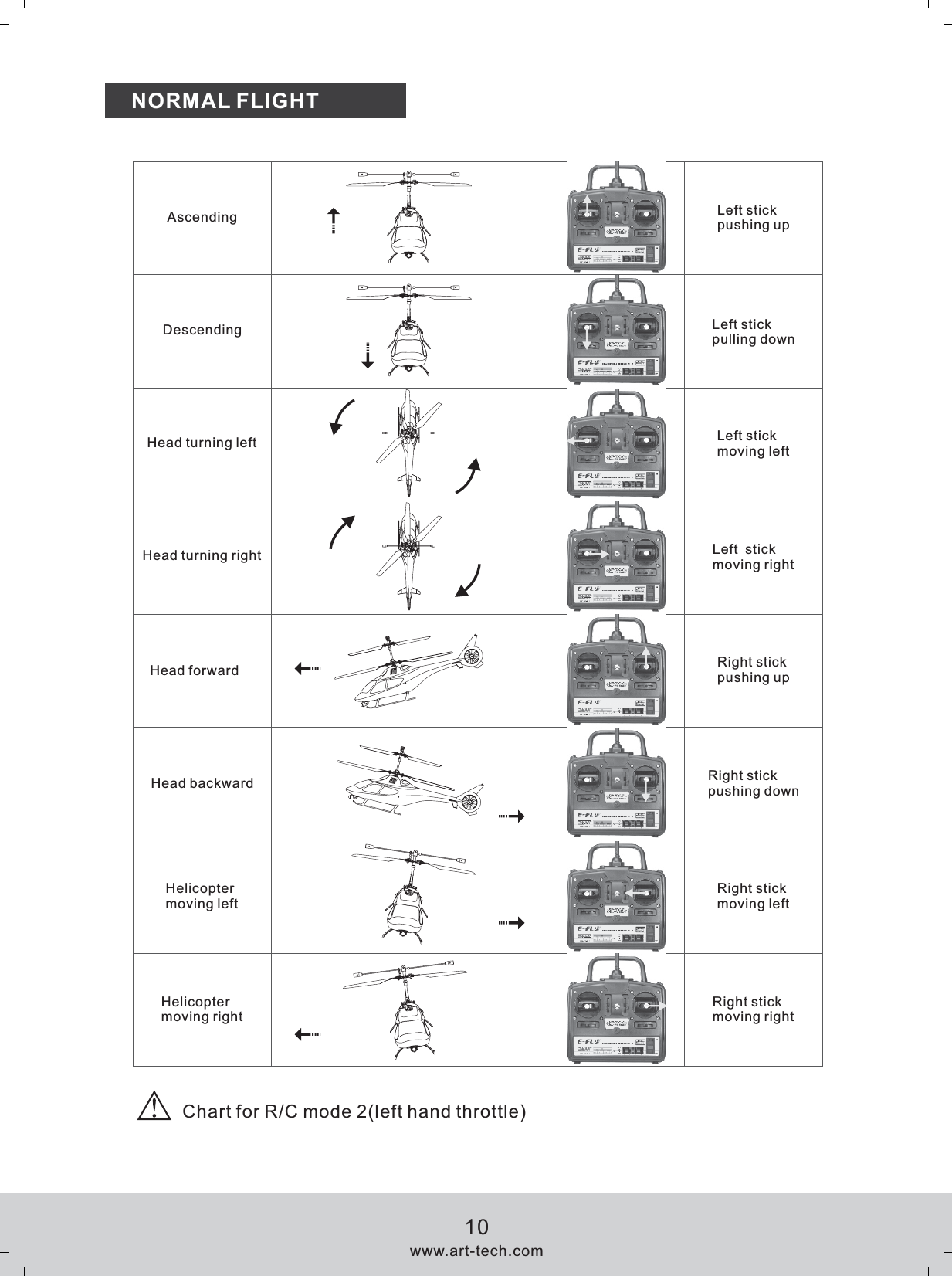
NORMAL FLIGHTChart for R/C mode 2(left hand throttle) AscendingDescendingHead turning leftHead turning rightHead forwardHead backwardLeft stick pushing upLeft stickpulling down Left moving leftstick Left moving right stick Right stick pushing upRightpushing down stick Rightmoving left stick Rightmoving right stick Helicoptermoving leftHelicoptermoving rightwww.art-tech.com10
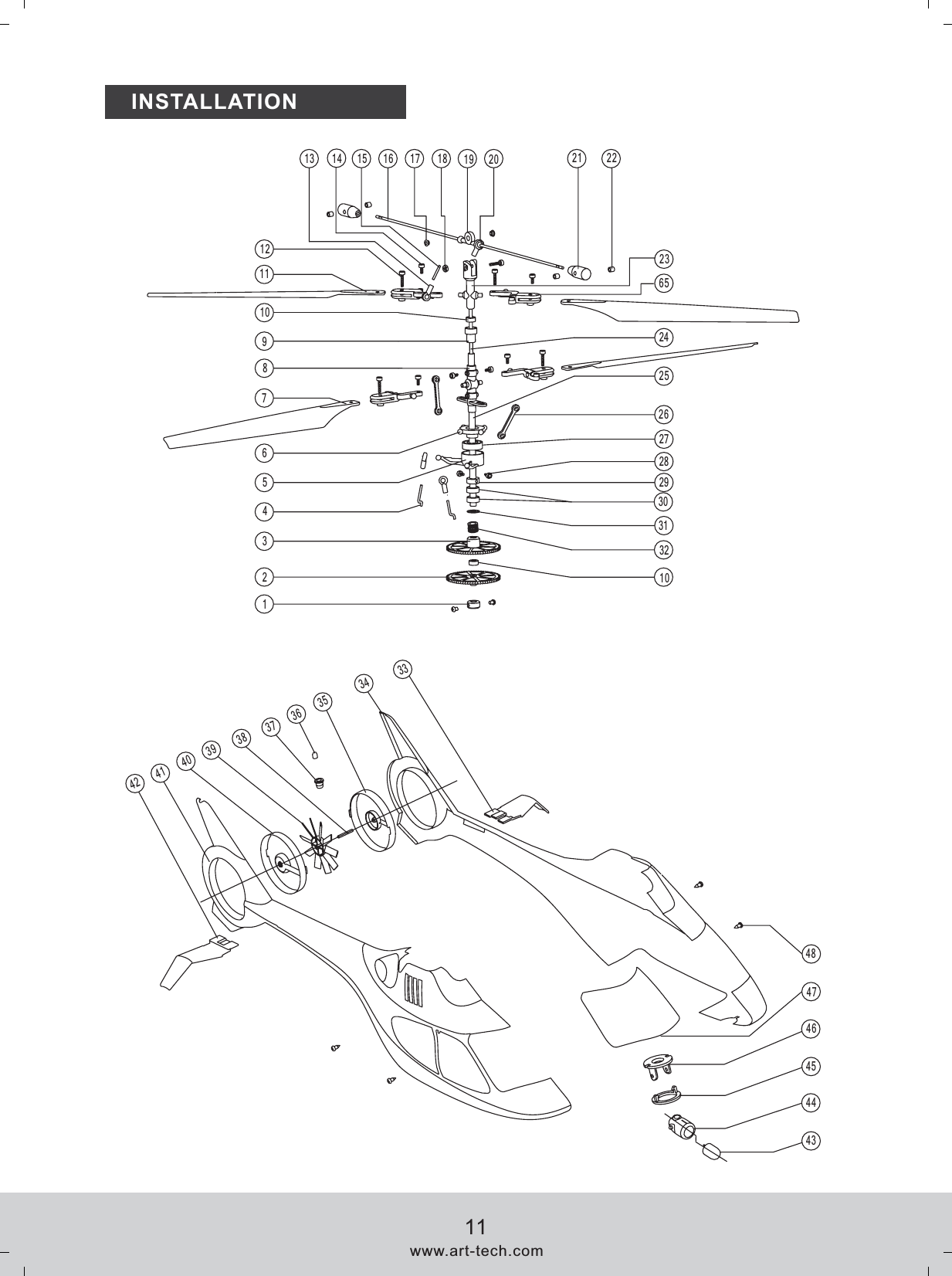
INSTALLATION333435363738394041424344454647481345678910111213 14 15 16 17 18 19 20 21 222324252261027282930313265www.art-tech.com11
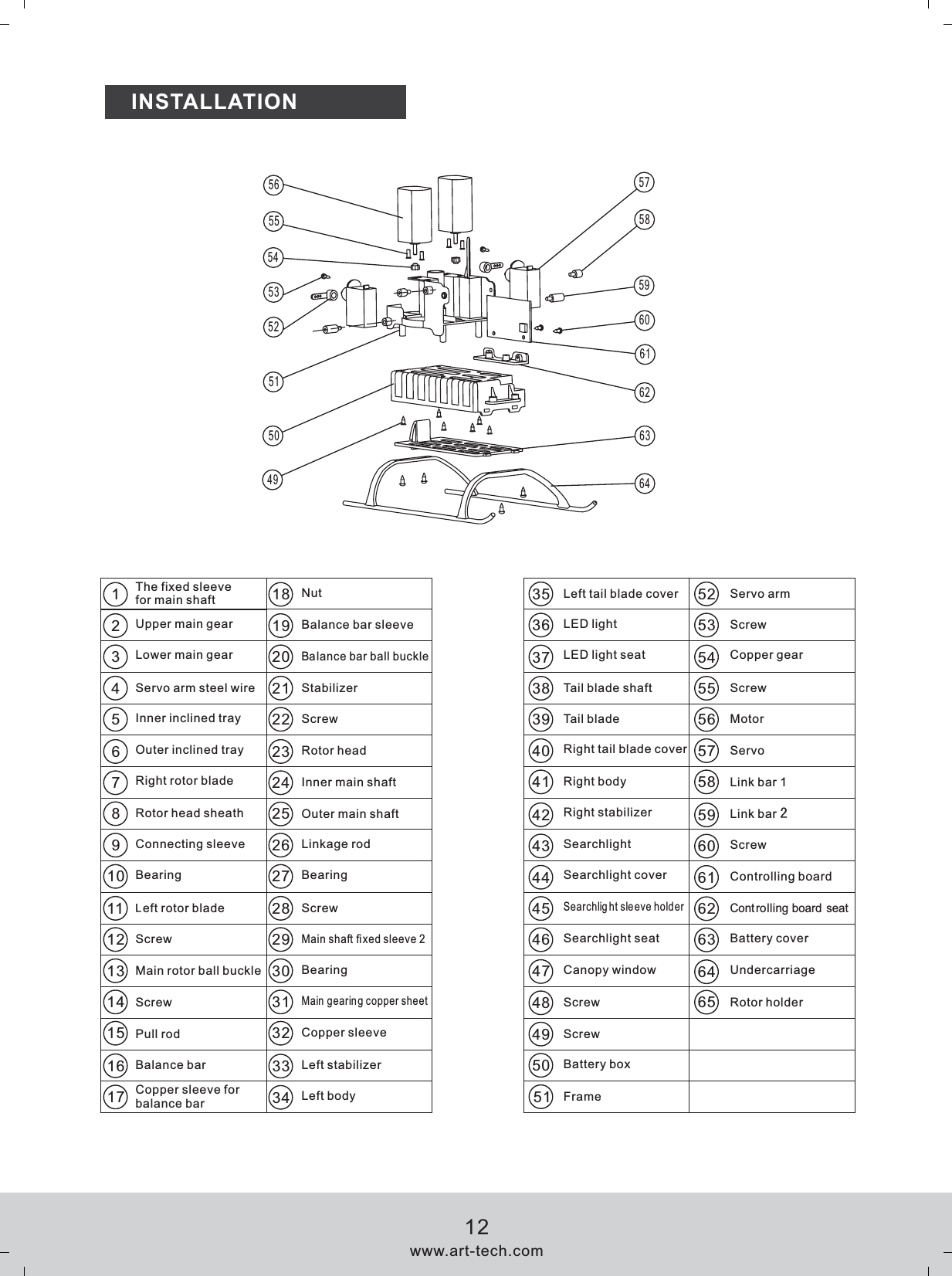
INSTALLATION18192021221234552535455565758596061626364353637383940414243444546484950474950515253545556 575859606162636467910111213141516172324252627282930313233348The fixed sleeve for main shaft Servo armScrewCopper gearMotorServoLink bar 1Controlling boardControlling board seatBattery coverUndercarriage51NutBalance bar sleeveBalance bar ball buckleStabilizerRotor headInner main shaft Outer main shaftLinkage rodBearingMain shaft fixed sleeve 2Main gearing copper sheetCopper sleeveLeft stabilizerLeft bodyLeft tail blade coverLED lightLED light seatTail blade shaftTail bladeRight tail blade coverRight bodyRight stabilizerSearchlightSearchlight coverSearchlight sleeve holderSearchlight seatCanopy windowScrewBattery boxFrame65 Rotor holderUpper main gearLower main gearServo arm steel wireInner inclined trayOuter inclined trayRight rotor bladeRotor head sheathConnecting sleeveBearingLeft rotor bladeScrewMain rotor ball buckleScrewPull rodBalance barCopper sleeve for balance barScrewScrewBearingScrewScrewLink bar 2Screwwww.art-tech.com12
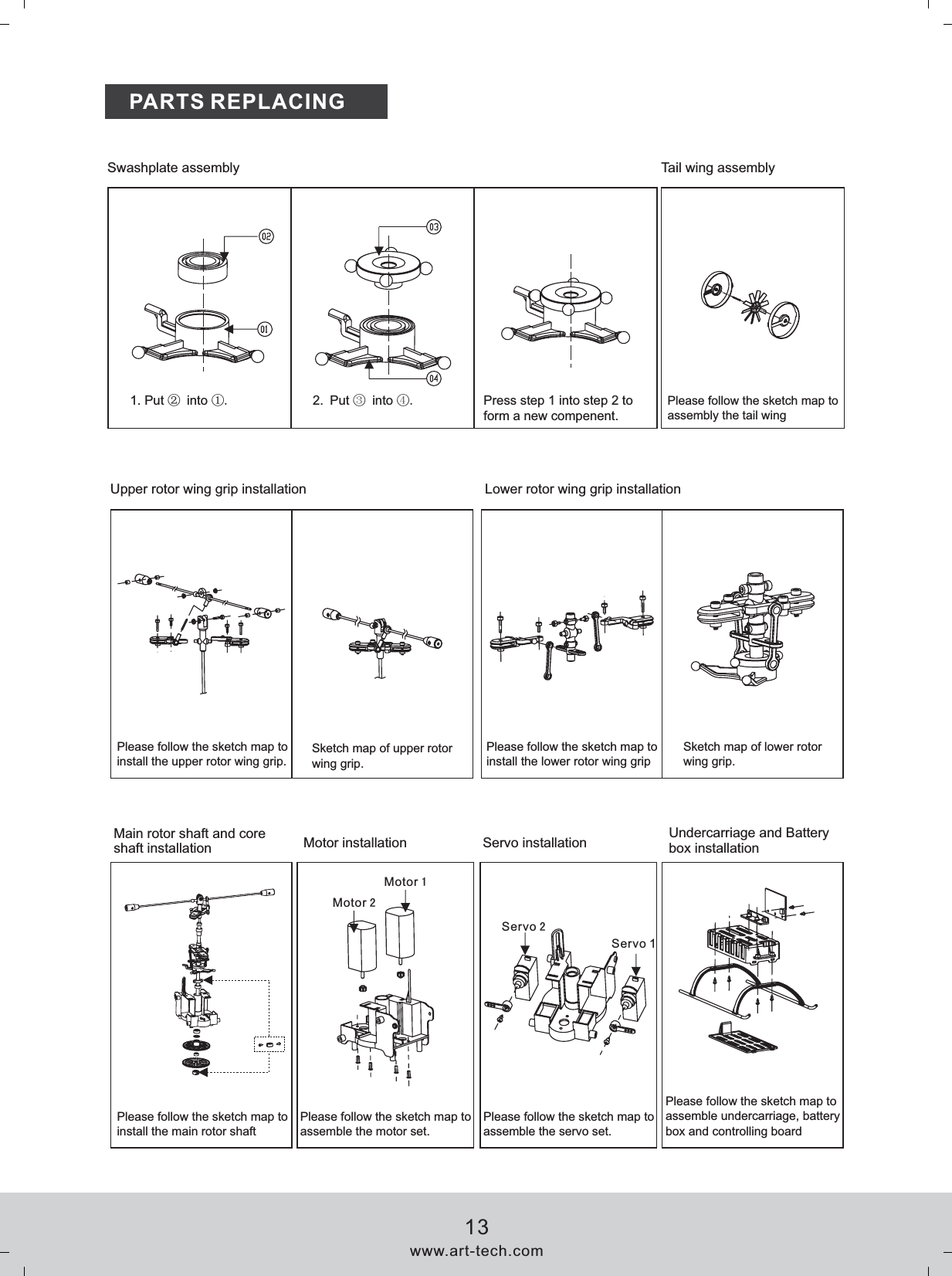
PARTS REPLACING1. Put ② into ①.Sketch map of upper rotor wing grip.Sketch map of lower rotor wing grip.Upper rotor wing grip installation Lower rotor wing grip installationMain rotor shaft and core shaft installation Motor installation Servo installation Undercarriage and Battery box installationSwashplate assembly Tail wing assemblyServo 22. ③ ④Put   into  .Press step 1 into step 2 to form a new compenent. Please follow the sketch map to assembly the tail wingPlease follow the sketch map to install the upper rotor wing grip.Please follow the sketch map to install the lower rotor wing gripPlease follow the sketch map to install the main rotor shaftPlease follow the sketch map to assemble the motor set.Please follow the sketch map to assemble the servo set.Please follow the sketch map to assemble undercarriage, battery box and controlling boardwww.art-tech.com13Servo 1Motor 2Motor 1
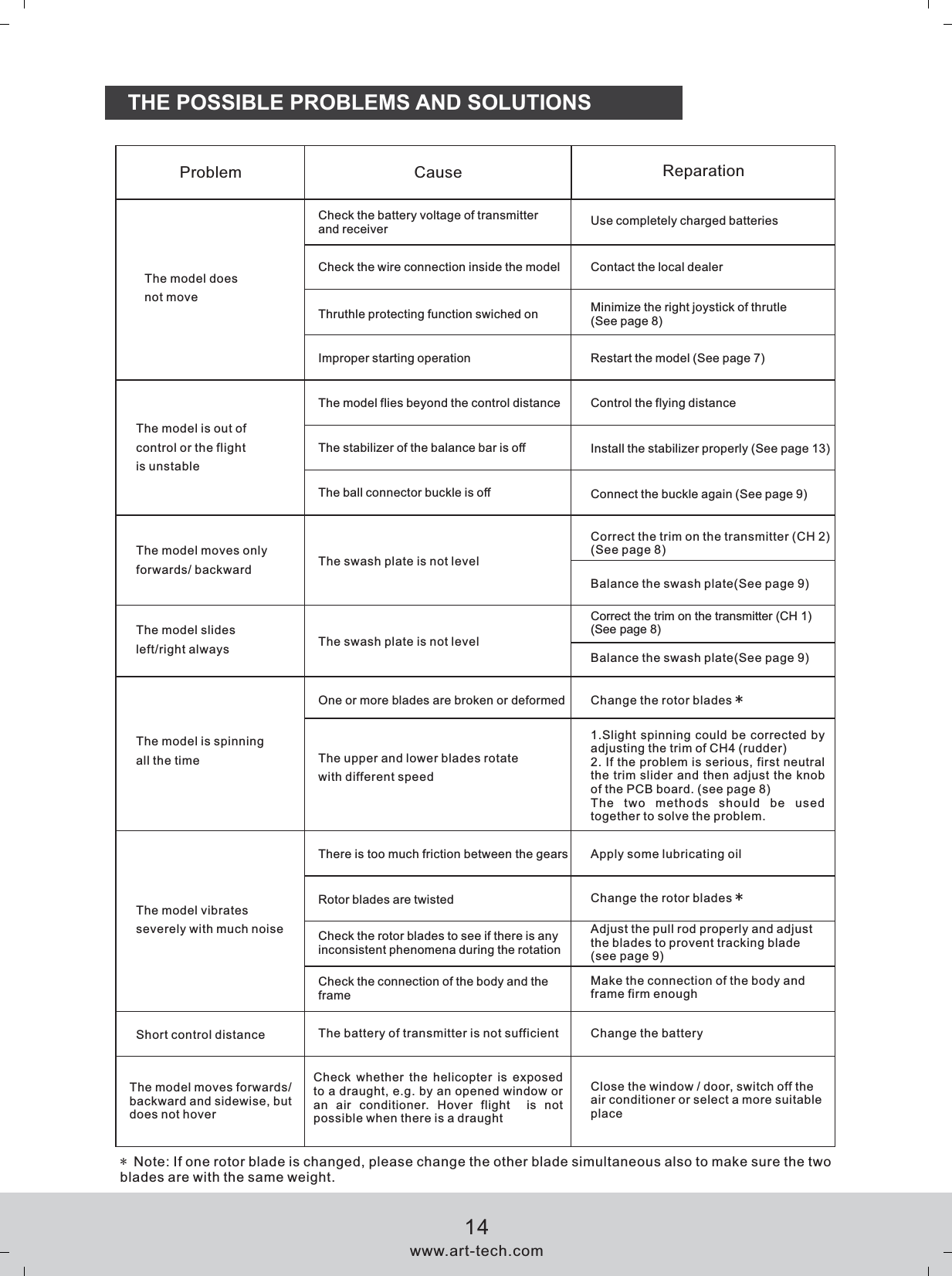
1.Slight spinning could be corrected by adjusting the trim of CH4 (rudder)2. If the problem is serious, first neutral the trim slider and then adjust the knob of the PCB board. (see page 8)The  two  methods  should  be  used together to solve the problem. Problem Cause ReparationThe model does not moveCheck the battery voltage of transmitter and receiverCheck the wire connection inside the modelImproper starting operationThruthle protecting function swiched onUse completely charged batteriesContact the local dealerRestart the model (See page 7)Minimize the right joystick of thrutle (See page 8)The model is out of control or the flight is unstableThe model flies beyond the control distanceThe stabilizer of the balance bar is offThe ball connector buckle is offControl the flying distanceInstall the stabilizer properly (See page 13)Connect the buckle again (See page 9) The model moves only forwards/ backward The swash plate is not levelCorrect the trim on the transmitter (CH 2)(See page 8) Balance the swash plate(See page 9)The model slides left/right alwaysCorrect the trim on the transmitter (CH 1)(See page 8)The swash plate is not levelThe model is spinning all the time The upper and lower blades rotate with different speedOne or more blades are broken or deformed Change the rotor blades *The model vibrates severely with much noiseThere is too much friction between the gears  Apply some lubricating oilRotor blades are twistedCheck the rotor blades to see if there is any inconsistent phenomena during the rotationCheck the connection of the body and the frameAdjust the pull rod properly and adjust the blades to provent tracking blade(see page 9)Make the connection of the body and frame firm enoughChange the batteryThe battery of transmitter is not sufficientShort control distanceThe model moves forwards/backward and sidewise, but does not hoverCheck  whether the  helicopter  is  exposed to a draught, e.g. by an opened window or an  air  conditioner.  Hover  flight    is  not possible when there is a draughtClose the window / door, switch off the air conditioner or select a more suitable placeChange the rotor blades ** Note: If one rotor blade is changed, please change the other blade simultaneous also to make sure the two blades are with the same weight.THE POSSIBLE PROBLEMS AND SOLUTIONSwww.art-tech.com14Balance the swash plate(See page 9)
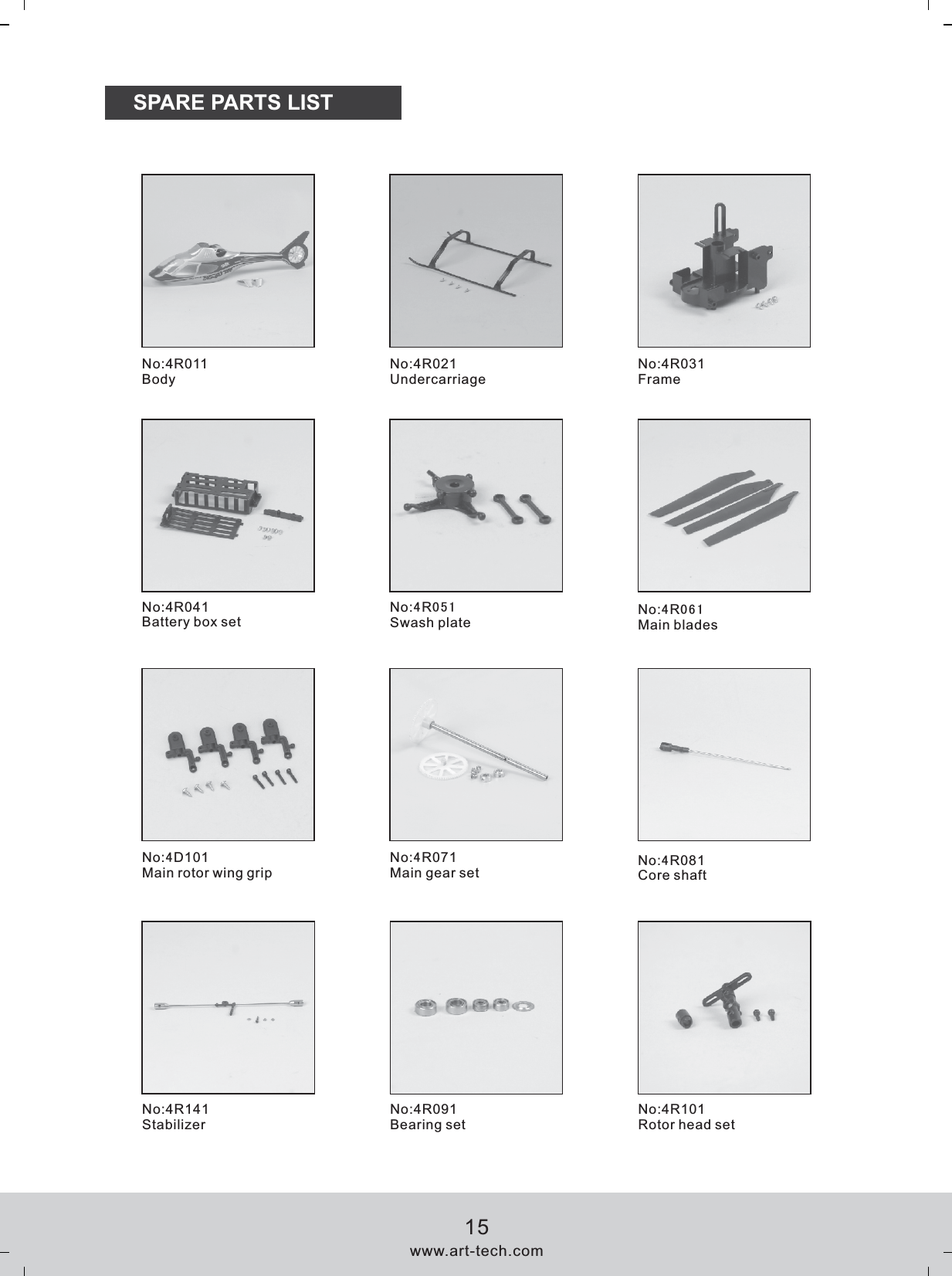
SPARE PARTS LISTNo:4R011BodyNo:4R021UndercarriageNo:4R031FrameNo:4R041Battery box setNo:4R051Swash plate  No:4R061Main bladesNo:4D101Main rotor wing gripNo:4R071Main gear set  No:4R081Core shaftNo:4R141StabilizerNo:4R091Bearing set No:4R101Rotor head setwww.art-tech.com15
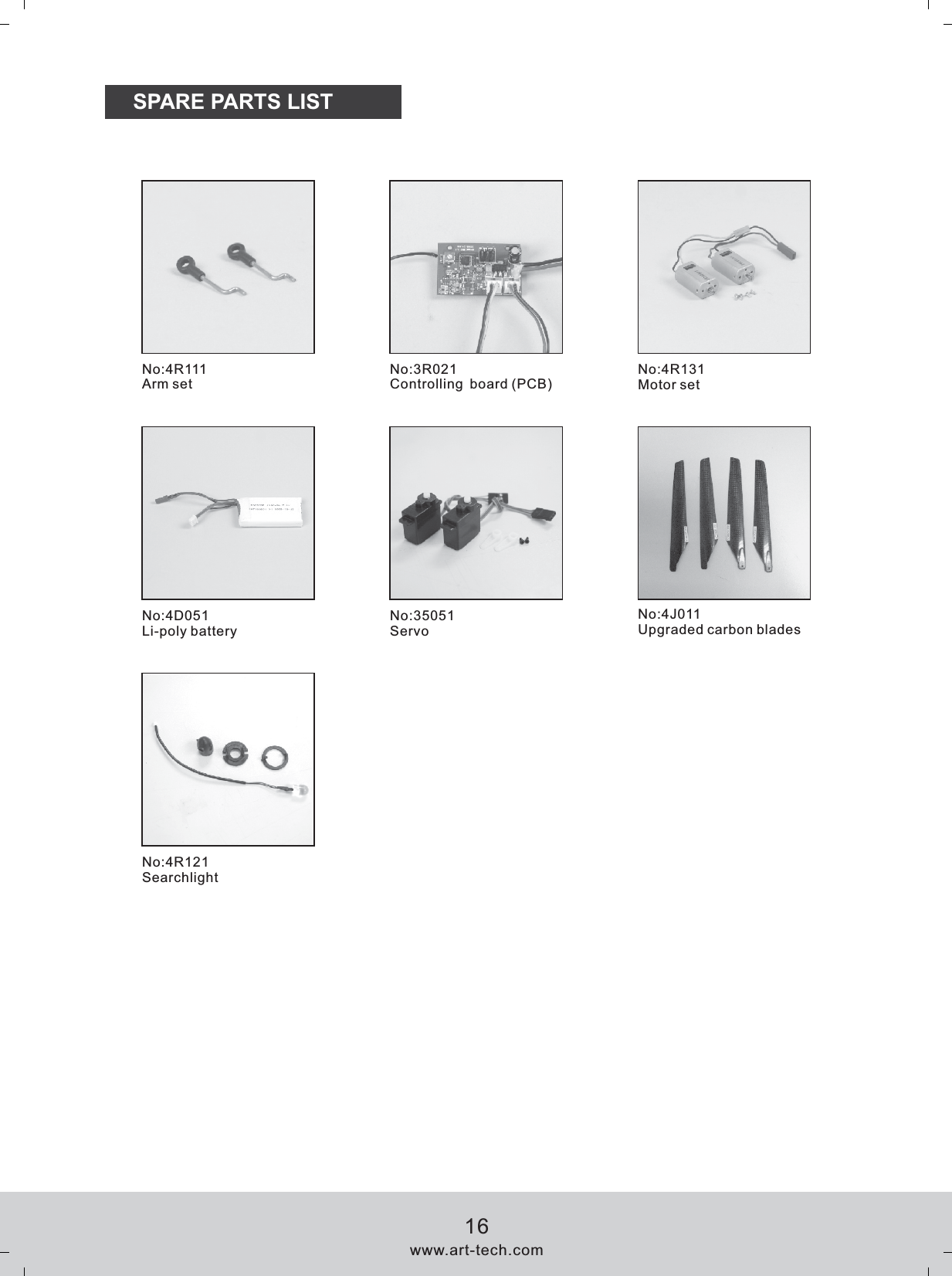
SPARE PARTS LISTNo:4R111Arm setNo:3R021Controlling board (PCB)No:4R131Motor setNo:35051Servo  No:4D051Li-poly batteryNo:4J011Upgraded carbon bladesNo:4R121Searchlightwww.art-tech.com16
FCC Statement This equipment has been tested and found to comply with the limits for a Class B digital device, pursuant to part 15 of the FCC rules. These limits are designed to provide reasonable protection against harmful interference in a residential installation. This equipment generates, uses and can radiate radio frequency energy and, if not installed and used in accordance with the instructions, may cause harmful interference to radio communications. However, there is no guarantee that interference will not occur in a particular installation. If this equipment does cause harmful interferenceto radio or television reception, which can be determined by turning the equipment off and on, the user is encouraged to try to correct the interference by one or more of the following measures: -Reorient or relocate the receiving antenna. -Increase the separation between the equipment and receiver. -Connect the equipment into an outlet on a circuit different from that to which the receiver is connected.-Consult the dealer or an experienced radio/TV technician for help. To assure continued compliance, any changes or modifications not expressly approved by the party responsible for compliance could void the user’s authority to operate this equipment. (Example- use only shielded interface cables when connecting to computer or peripheral devices). FCC Radiation Exposure Statement This equipment complies with FCC radiation exposure limits set forth for an uncontrolled environment and it also complies with Part 15 of FCC RF Rules. Operation is subject to the following two conditions: 1) This device may not cause interference and 2) This device must accept any interference, including interference that may cause undesired operation of the device. Caution!The manufacturer is not responsible for any radio or TV interference caused by unauthorized modifications to this equipment. Such modifications could void the user authority to operate the equipment. Declaration of Conformity Hereby, ShenZhen ART-TECH R/C Hobby Co., Ltd. declares that this device is in compliancewith the essential requirements and other relevant provisions of Directive 1999/5/EC.  We also declared that the medium access protocol has been implemented.

Navigation menu