SmartBridges AIRNIC USB LAN Adapter with CD & Cable User Manual

SmartBridges Pte Ltd USB LAN Adapter with CD & Cable

User Manual

  User manualTable of contentsContents of the PackageGetting Started      Introduction      Minimum PC Configuration required      About "One-Click" simpleConnectInstalling airNICConfiguring the Wireless Network AdapterUnderstanding Wireless Networking      airNIC      Wireless LANsTroubleshooting      FAQs
      Common Problems and SolutionsService and Support Appendices      Appendix A - Technical Specifications      Appendix B- Warranty information      Appendix C- Declarations of Conformity and Regulatory Information
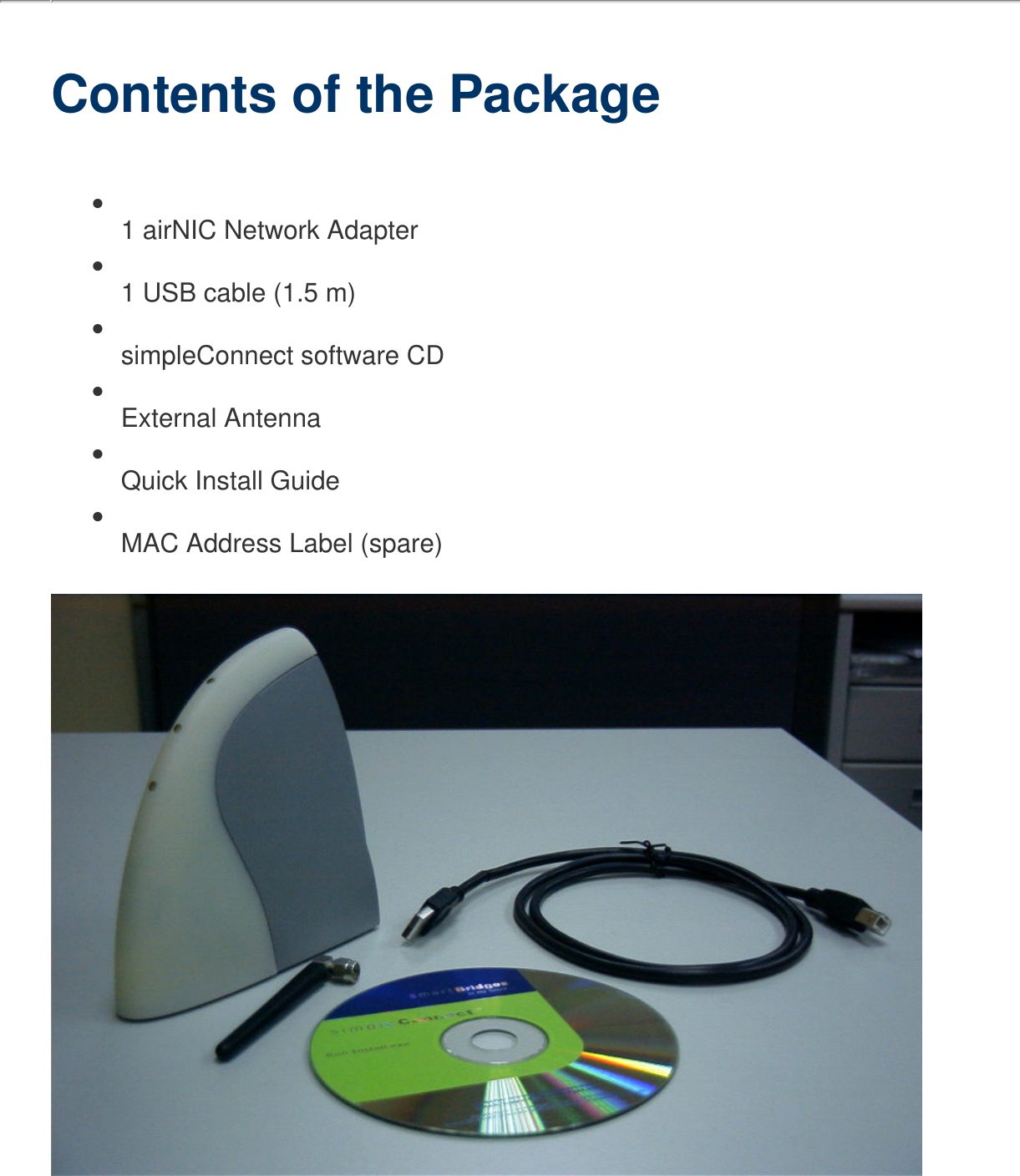
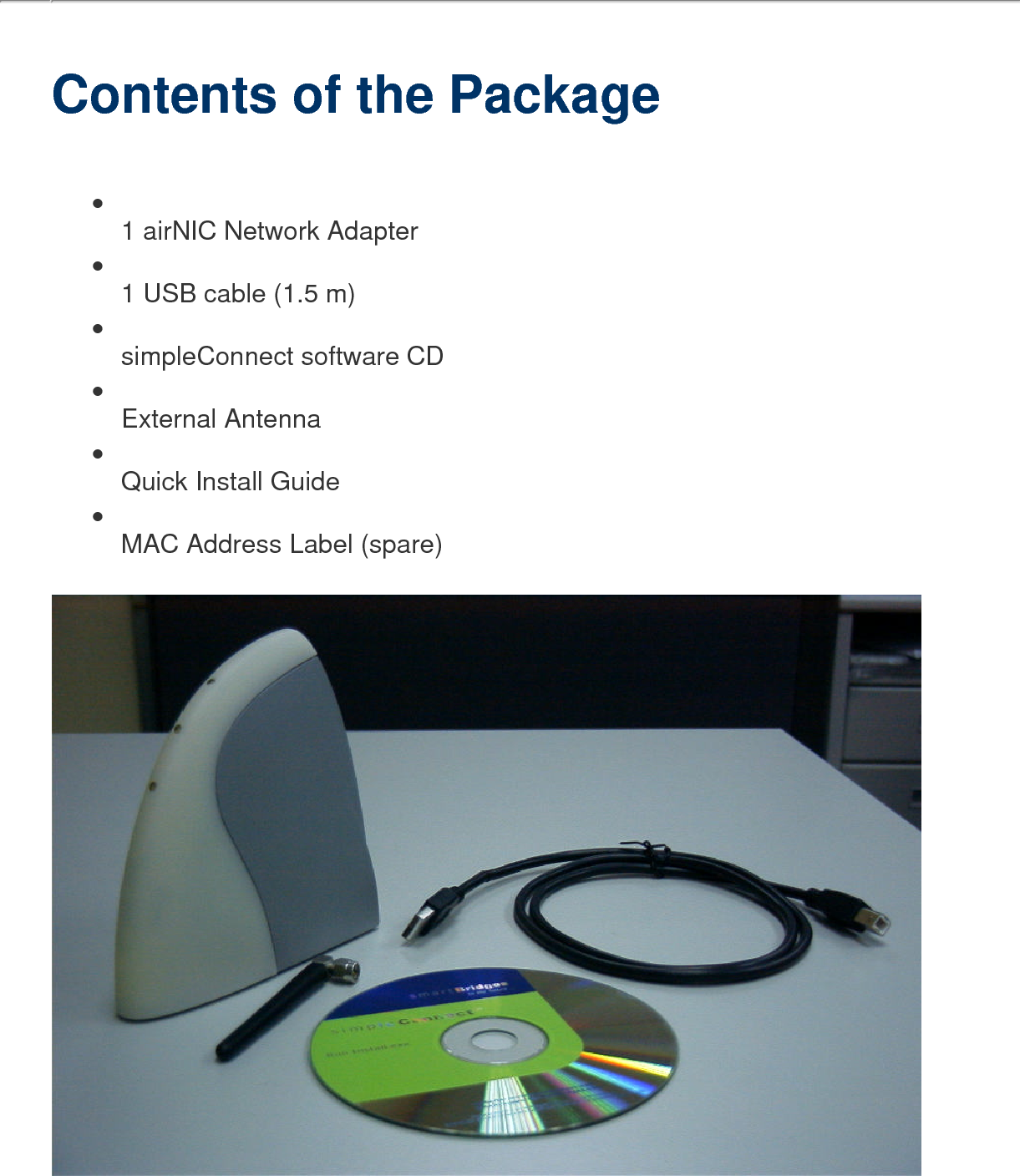
  Contents of the Package●     1 airNIC Network Adapter●     1 USB cable (1.5 m)●     simpleConnect software CD●     External Antenna●     Quick Install Guide●     MAC Address Label (spare)
Unpack the airNIC kit and make sure that all the items are present. Please contact your supplier if any item is found damaged/missing.
  Getting StartedIntroductionThank you for purchasing smartBridges’ airNIC Wireless USB Network Adapter.airNIC provides instant, high-speed wireless network connectivity. The Adapter delivers a complete solution to customers who require mobility and freedom in a Wireless Local Area Network (WLAN).The external Plug-and-Play Adapter connects directly to the USB port of the PC. The state of the art hot Plug-and-Play USB technology eliminates IRQ conflicts and ensures easy installation. The Adapter draws its power from the USB port of the computer. The airNIC allows you to:●     Connect your computer to other computers around you ●     Connect your computer to a standalone wireless network●     Connect your computer to a wireless LAN connected to a wired LAN infrastructureMinimum PC Configuration required ●     An IBM compatible PC●     Pentium processor (166 MHz or above recommended)●     Microsoft Windows 98 (Second Edition), Windows 2000, Windows ME and Windows XP●     Memory - Windows 98SE / ME — at least 16 MB RAM                 - Windows 2000 / XP — at least 64 MB RAM●     Free space on Hard Disk Drive — 50 MB recommended●     SVGA display (minimum 800 x 600 resolution with 256 colours)●     A CD-ROM drive●     Spare USB port for the airNIC Wireless USB Adapter
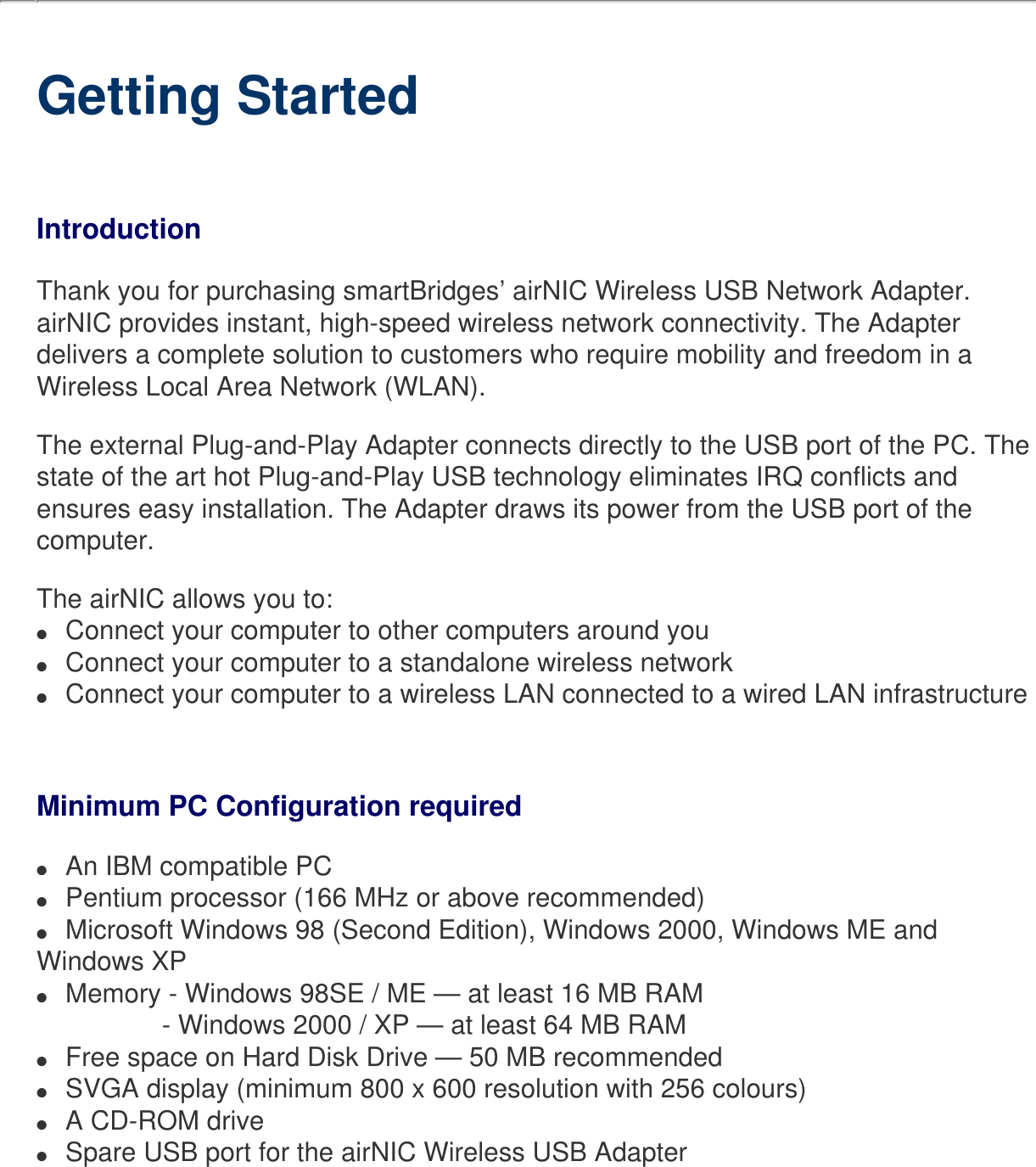
"One-Click" simpleConnect™ software         simpleConnect is a proprietary software, developed by      smartBridges, which simplifies the airNIC installation       process. The “One-Click Installation” technology built       into simpleConnect makes it the simplest solution       available today. The software automatically installs and       configures the device. This makes the entire installation       process as simple as 1-2-3.v
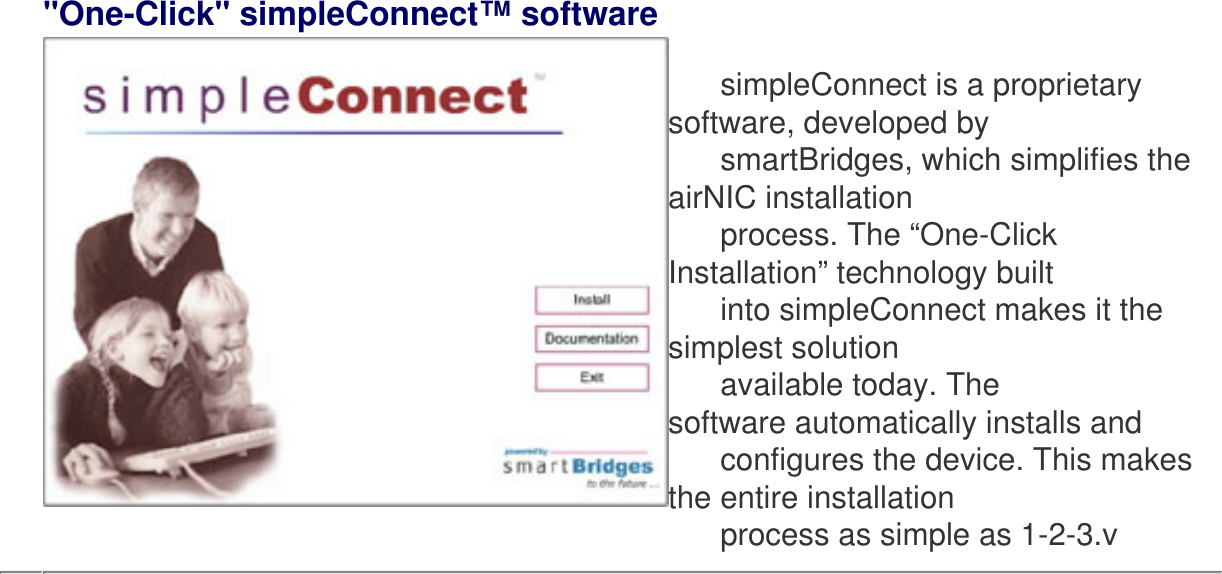
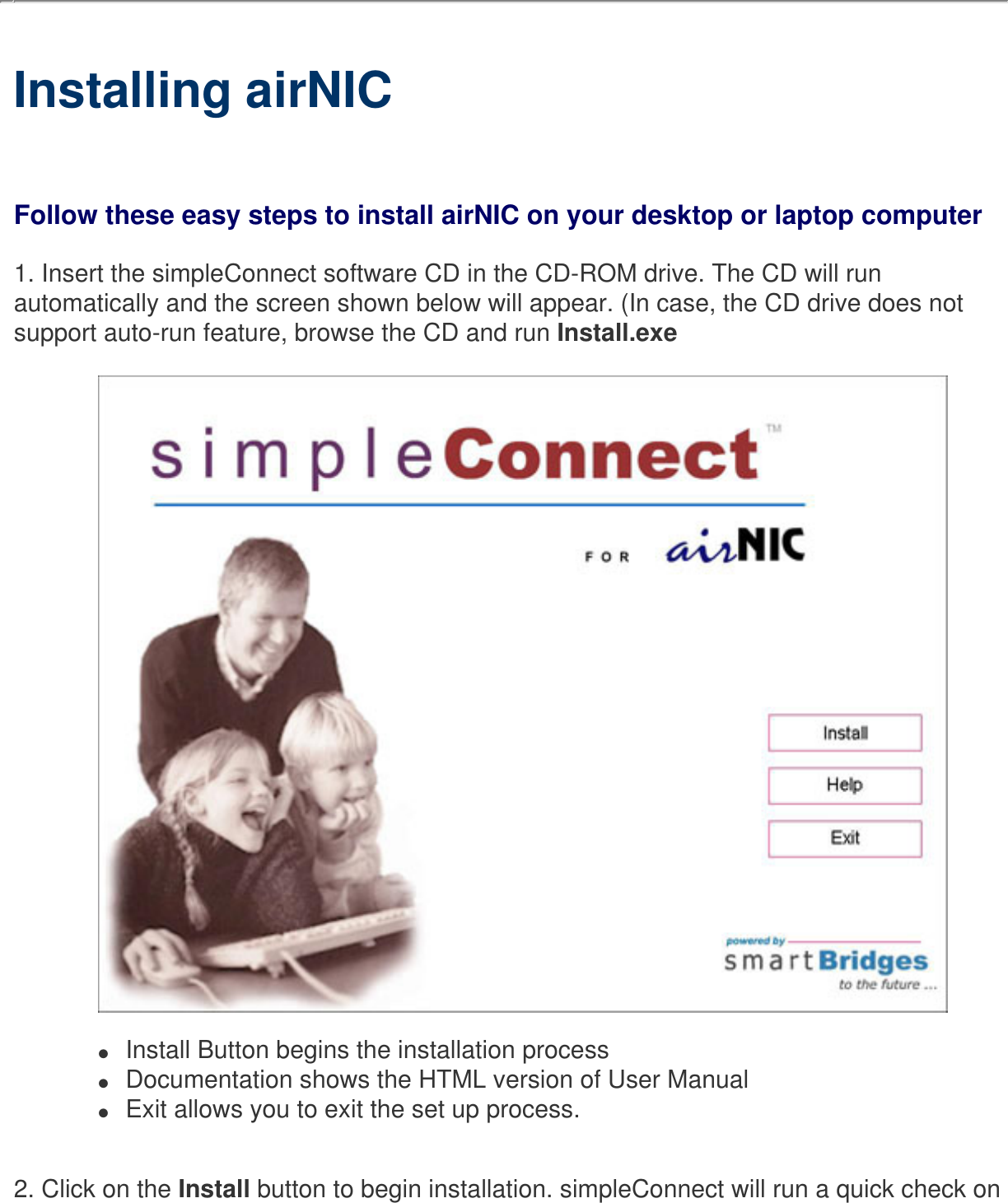
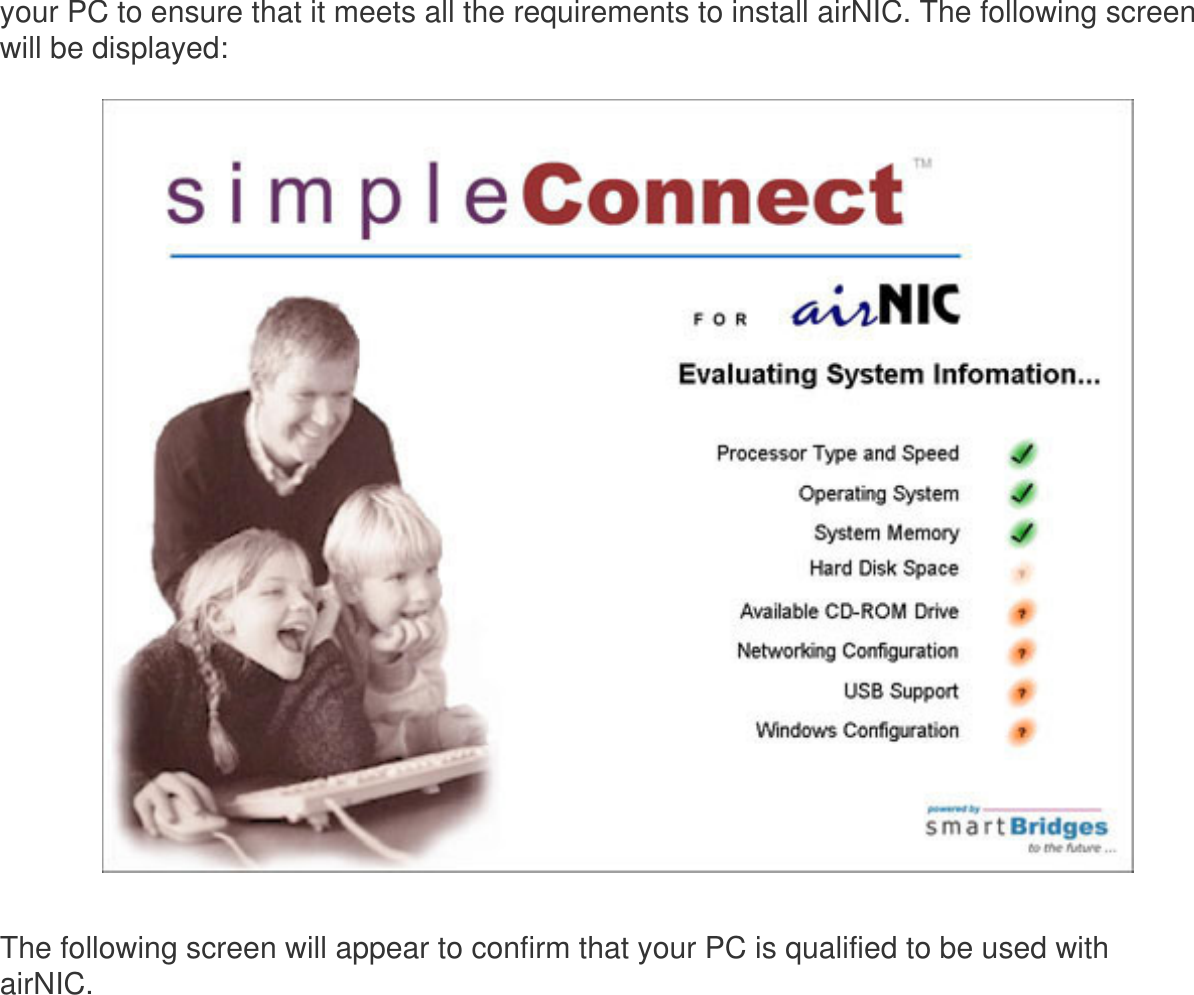
    Installing airNICFollow these easy steps to install airNIC on your desktop or laptop computer1. Insert the simpleConnect software CD in the CD-ROM drive. The CD will run automatically and the screen shown below will appear. (In case, the CD drive does not support auto-run feature, browse the CD and run Install.exe   ●     Install Button begins the installation process●     Documentation shows the HTML version of User Manual●     Exit allows you to exit the set up process.2. Click on the Install button to begin installation. simpleConnect will run a quick check on
your PC to ensure that it meets all the requirements to install airNIC. The following screen will be displayed:  The following screen will appear to confirm that your PC is qualified to be used with airNIC.
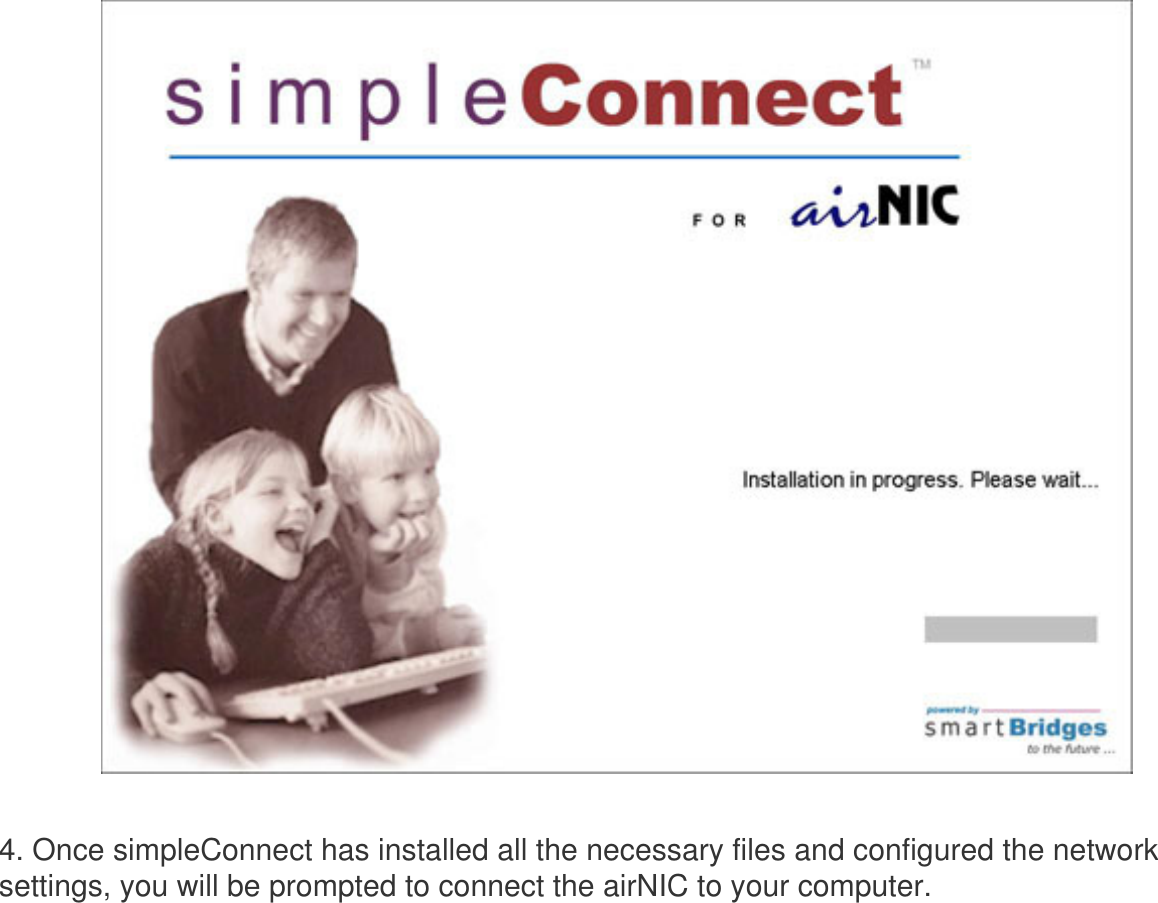
3. Click on Continue. simpleConnect will begin to install the drivers, the Client Monitor Utility and configure the network settings. The following screen will show simpleConnect installation in progress.
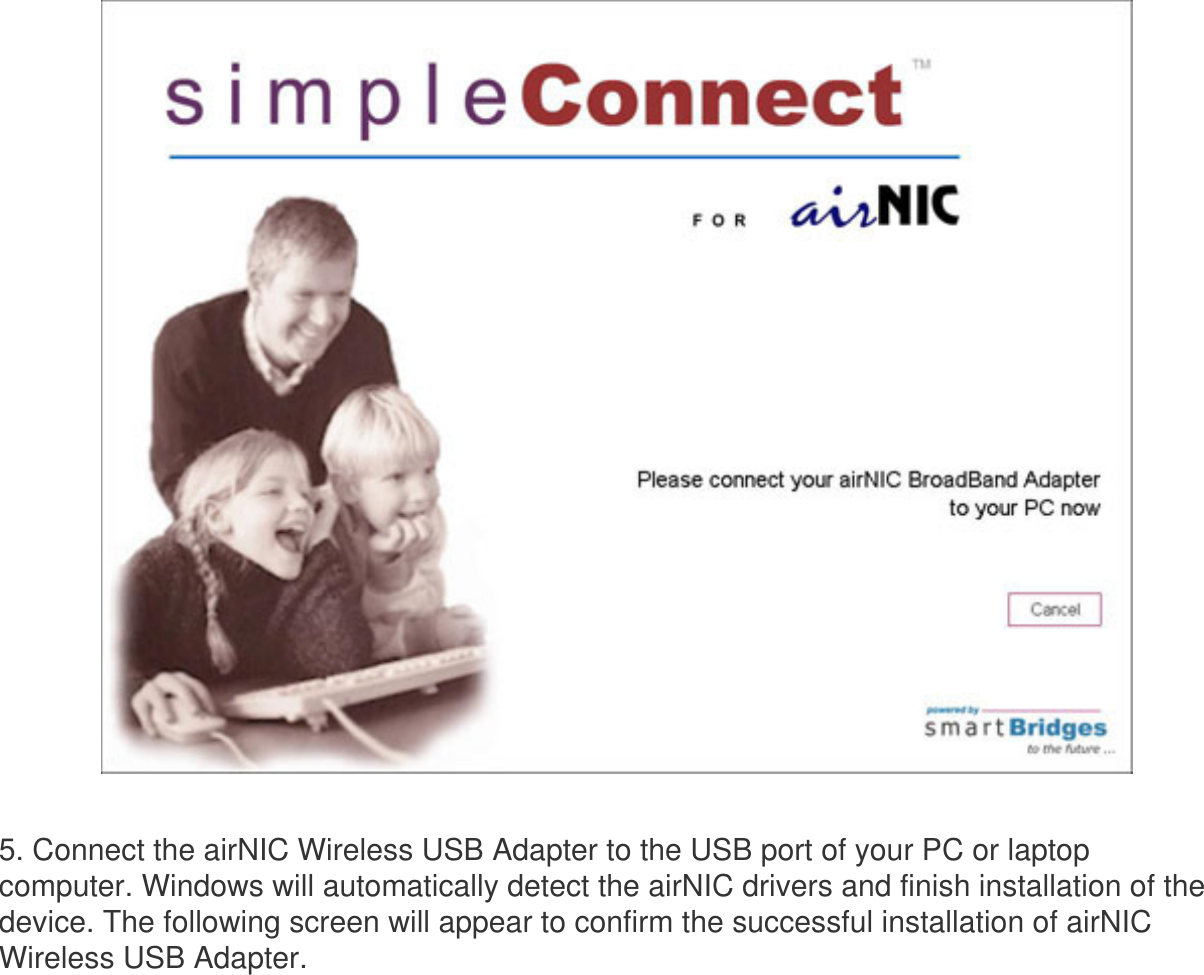
4. Once simpleConnect has installed all the necessary files and configured the network settings, you will be prompted to connect the airNIC to your computer.
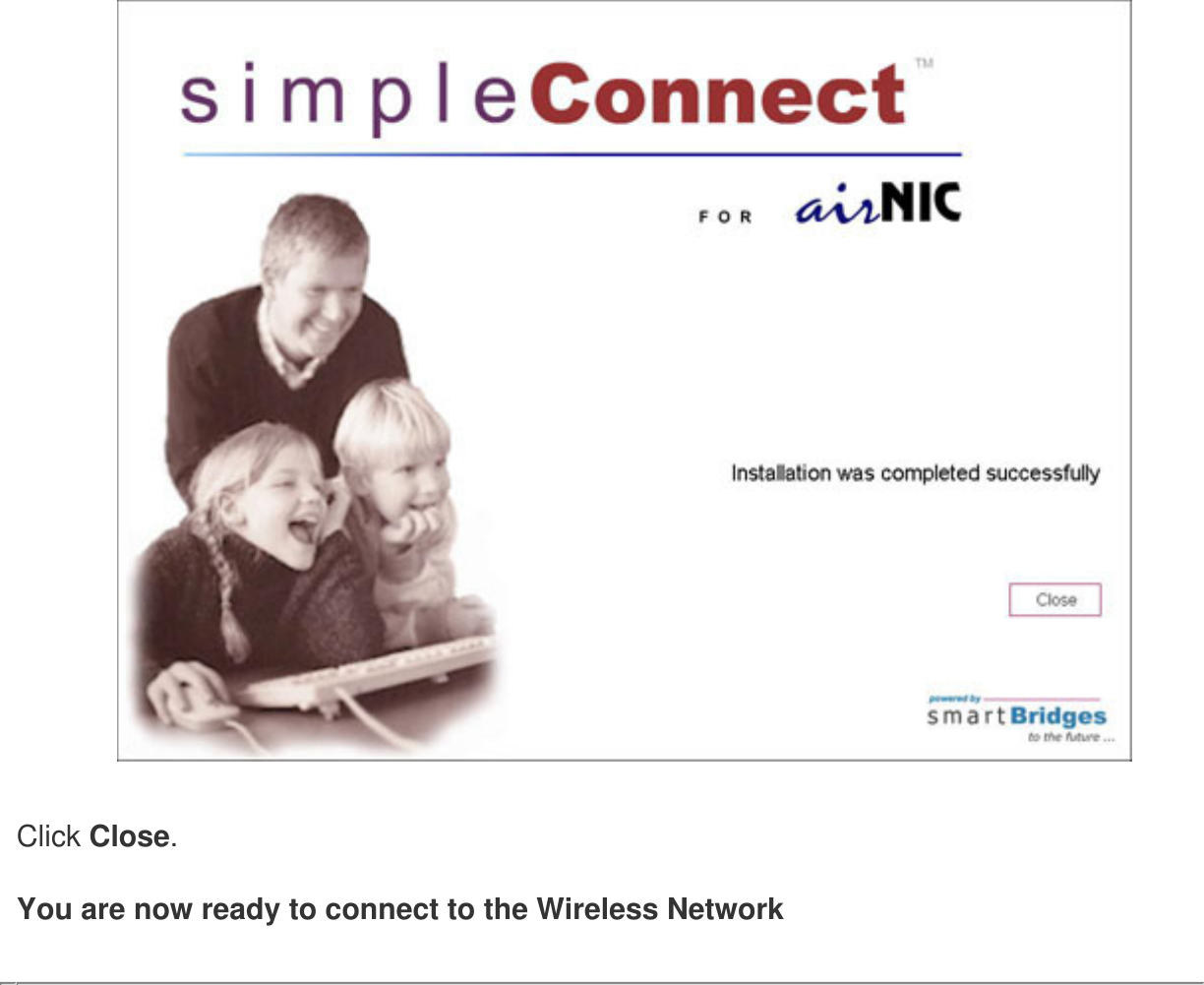
5. Connect the airNIC Wireless USB Adapter to the USB port of your PC or laptop computer. Windows will automatically detect the airNIC drivers and finish installation of the device. The following screen will appear to confirm the successful installation of airNIC Wireless USB Adapter.
Click Close.  You are now ready to connect to the Wireless Network
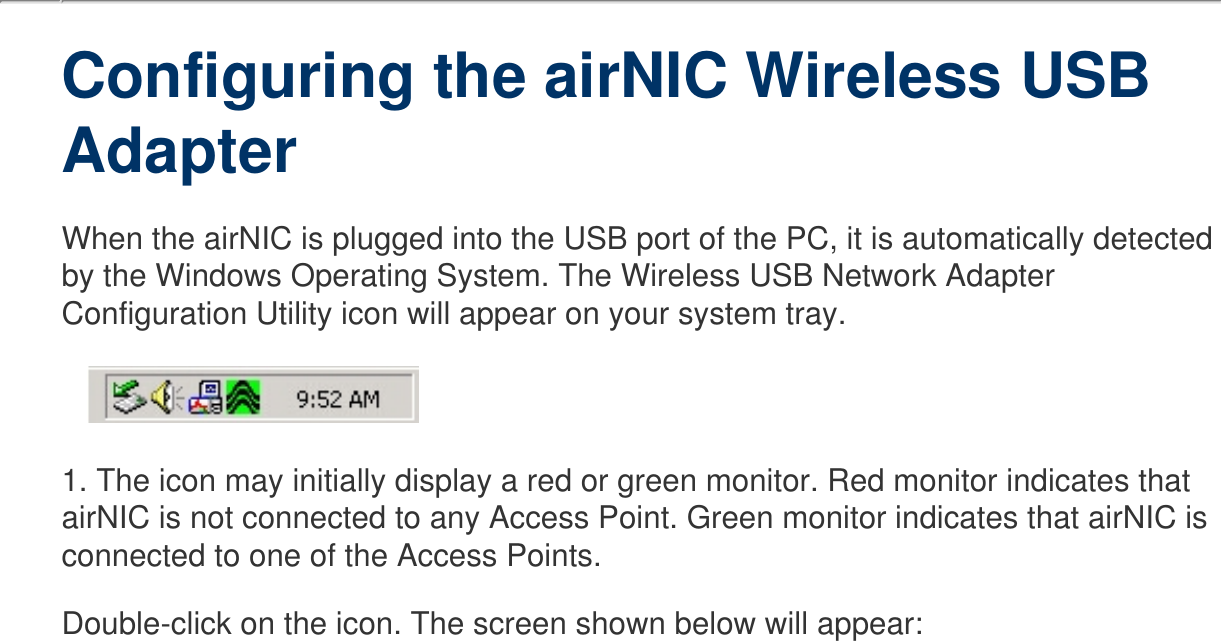
  Configuring the airNIC Wireless USB Adapter  When the airNIC is plugged into the USB port of the PC, it is automatically detected by the Windows Operating System. The Wireless USB Network Adapter Configuration Utility icon will appear on your system tray.   1. The icon may initially display a red or green monitor. Red monitor indicates that airNIC is not connected to any Access Point. Green monitor indicates that airNIC is connected to one of the Access Points. Double-click on the icon. The screen shown below will appear:
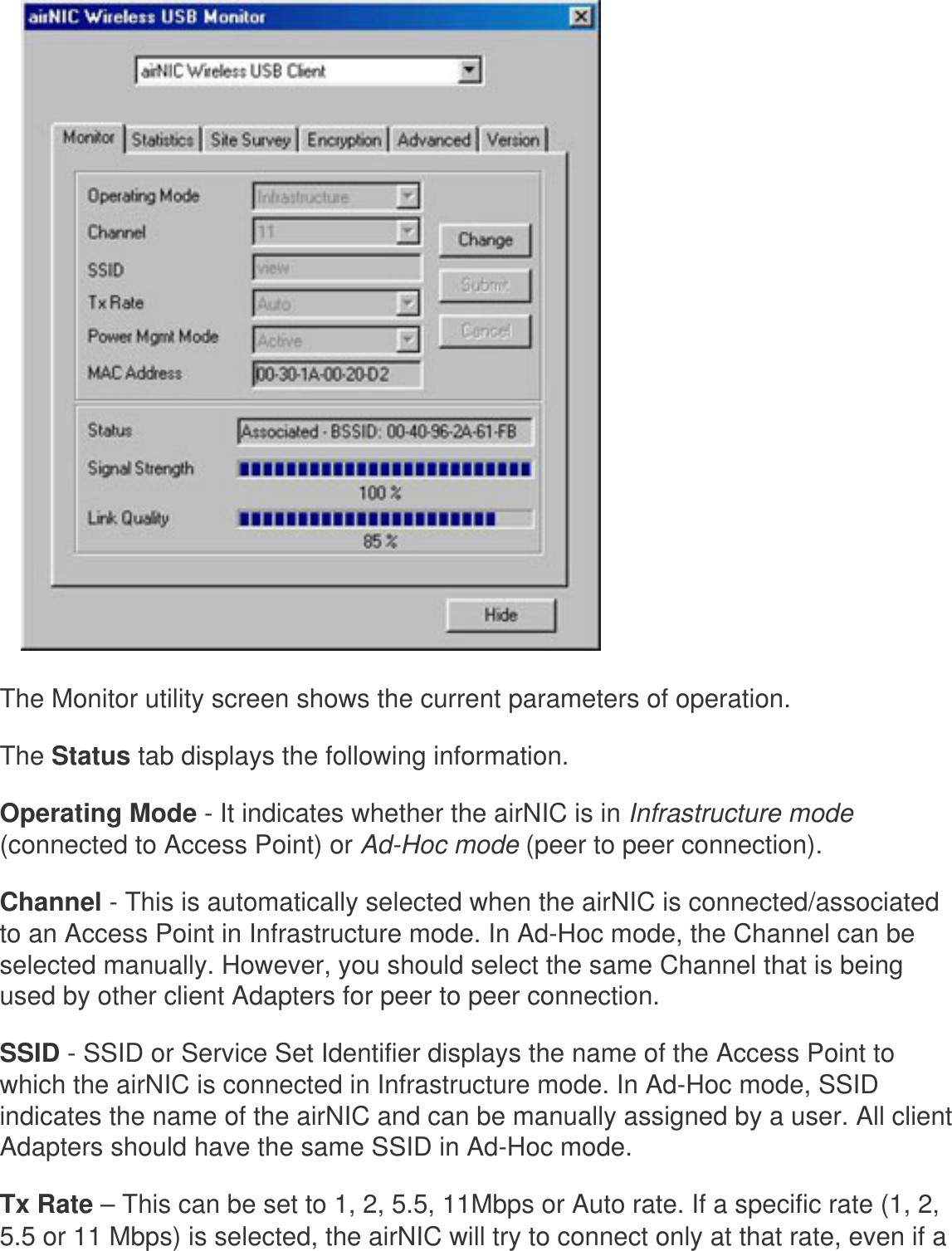
   The Monitor utility screen shows the current parameters of operation. The Status tab displays the following information.Operating Mode - It indicates whether the airNIC is in Infrastructure mode (connected to Access Point) or Ad-Hoc mode (peer to peer connection). Channel - This is automatically selected when the airNIC is connected/associated to an Access Point in Infrastructure mode. In Ad-Hoc mode, the Channel can be selected manually. However, you should select the same Channel that is being used by other client Adapters for peer to peer connection. SSID - SSID or Service Set Identifier displays the name of the Access Point to which the airNIC is connected in Infrastructure mode. In Ad-Hoc mode, SSID indicates the name of the airNIC and can be manually assigned by a user. All client Adapters should have the same SSID in Ad-Hoc mode. Tx Rate – This can be set to 1, 2, 5.5, 11Mbps or Auto rate. If a specific rate (1, 2, 5.5 or 11 Mbps) is selected, the airNIC will try to connect only at that rate, even if a
better transfer rate is available. It is, therefore, highly recommended that the user set this to Auto, so that the highest data rate is selected based on the link signal quality. Power Mgmt Mode – The Active mode is used for typical operating condition. Choosing the Power Save mode allows the unit to enter “sleep” mode. However, Active mode is recommended for normal operation. MAC Address – MAC Address (Media Access Controller Address) field indicates the unique MAC ID assigned to your airNIC Adapter. Status – This field indicates the current association status of airNIC. In Infrastructure mode, it shows the MAC ID of the Access Point. In Ad-Hoc mode, it shows the MAC ID of the client Adapter it is connected to in peer to peer connection. Signal Strength – This field indicates strength of the signal received from the Access Point, in the Infrastructure mode. User should position the unit such that this field displays the maximum signal strength. Link Quality – This shows the quality of wireless link. The higher is the number in this field, the better is the signal quality. When you click on the Change button, you will be able to change the various parameters. For example, you can change from Infrastructure mode to Ad-Hoc mode and vice-versa, change the transmission rate, etc. Click on Submit to apply the new settings. The Hide button will hide the Monitor utility. Double-click the green icon on your system tray to display the Monitor utility again.
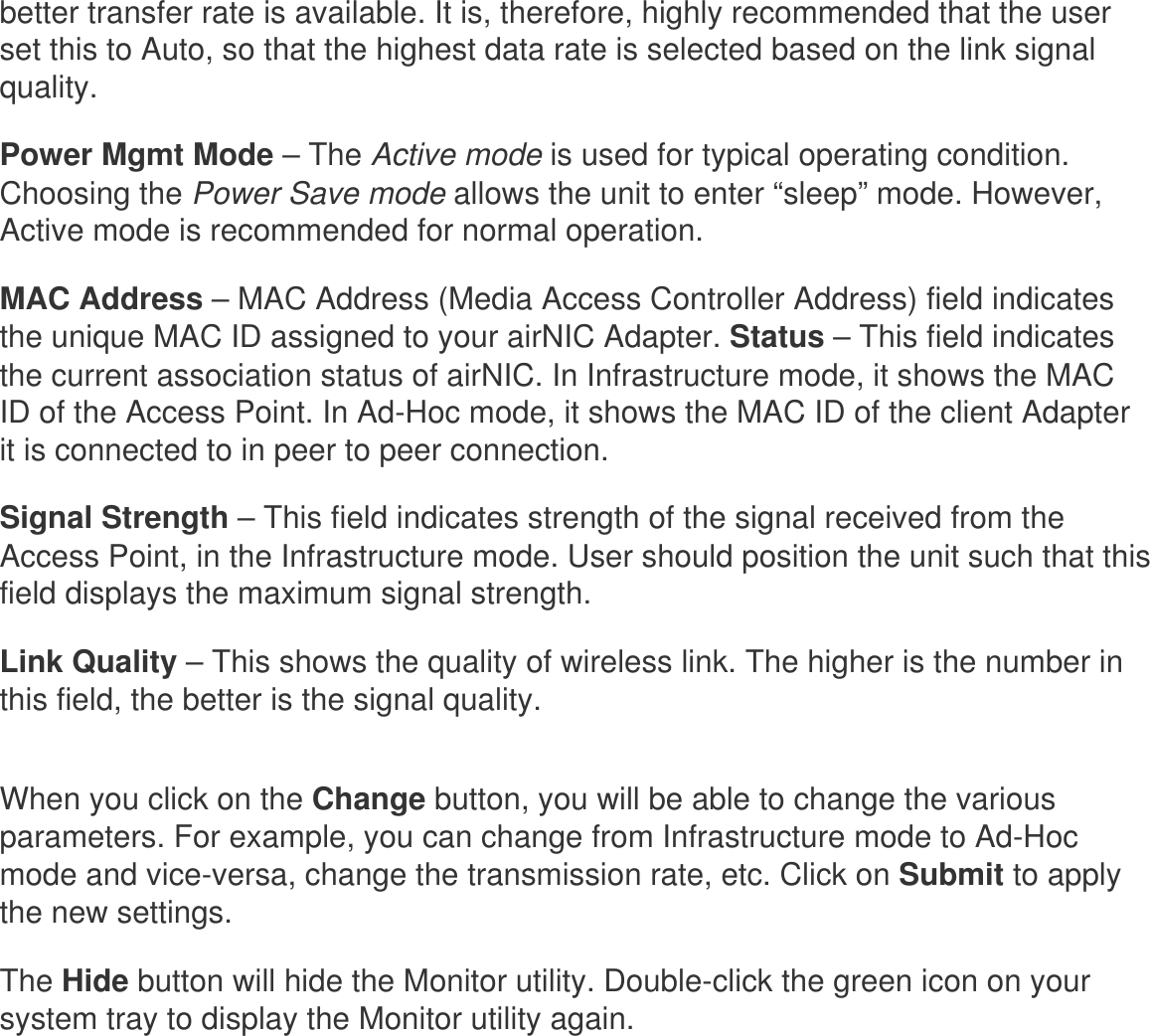
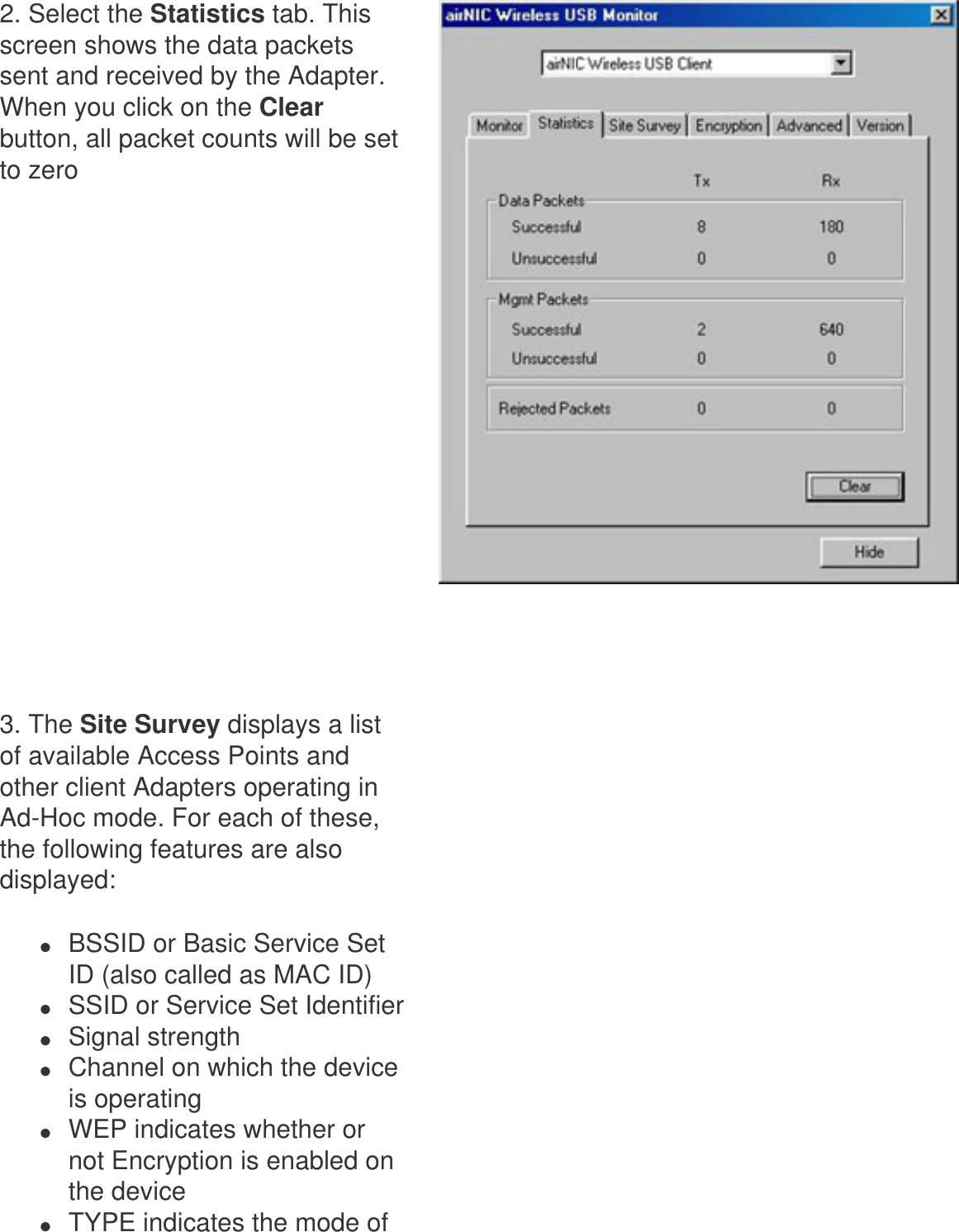
2. Select the Statistics tab. This screen shows the data packets sent and received by the Adapter. When you click on the Clear button, all packet counts will be set to zero      3. The Site Survey displays a list of available Access Points and other client Adapters operating in Ad-Hoc mode. For each of these, the following features are also displayed: ●     BSSID or Basic Service Set ID (also called as MAC ID) ●     SSID or Service Set Identifier●     Signal strength●     Channel on which the device is operating●     WEP indicates whether or not Encryption is enabled on the device●     TYPE indicates the mode of
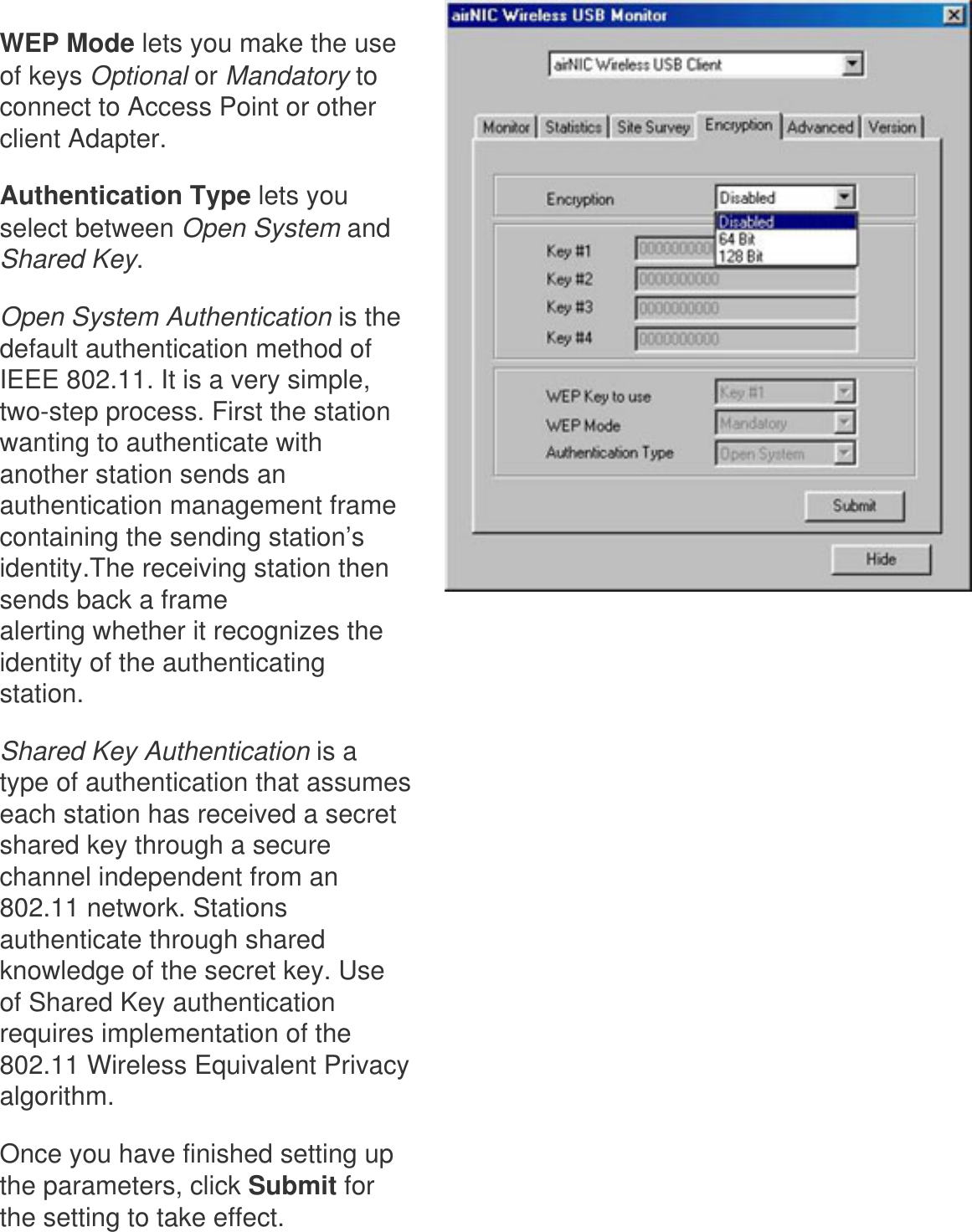
operation. Infrastructure indicates Access Point while Ad-Hoc indicates client Adapter.When the Re-Scan button is clicked, the Adapter will scan the wireless media for available Access Points & Adapters operating in Ad-Hoc mode. You can connect to an Access Point (or a client Adapter) on the list by double clicking on its BSSID (MAC ID).      4. Select the Encryption tab. This screen lets you enable or disable WEP encryption on your airNIC Adapter. Using the drop-box, you can choose to disable WEP or choose between 64-bit and 128-bit encryption. Once you have selected 64-bit or 128-bit encryption, you can enter 4 keys in the Key fields 1-4. However, you need to ensure that these keys match the ones set on the Access Point.WEP Key to use lets you choose the key you want to use from among the 4 keys you entered.
WEP Mode lets you make the use of keys Optional or Mandatory to connect to Access Point or other client Adapter. Authentication Type lets you select between Open System and Shared Key. Open System Authentication is the default authentication method of IEEE 802.11. It is a very simple, two-step process. First the station wanting to authenticate with another station sends an authentication management frame containing the sending station’s identity.The receiving station then sends back a frame alerting whether it recognizes the identity of the authenticating station. Shared Key Authentication is a type of authentication that assumes each station has received a secret shared key through a secure channel independent from an 802.11 network. Stations authenticate through shared knowledge of the secret key. Use of Shared Key authentication requires implementation of the 802.11 Wireless Equivalent Privacy algorithm.Once you have finished setting up the parameters, click Submit for the setting to take effect.
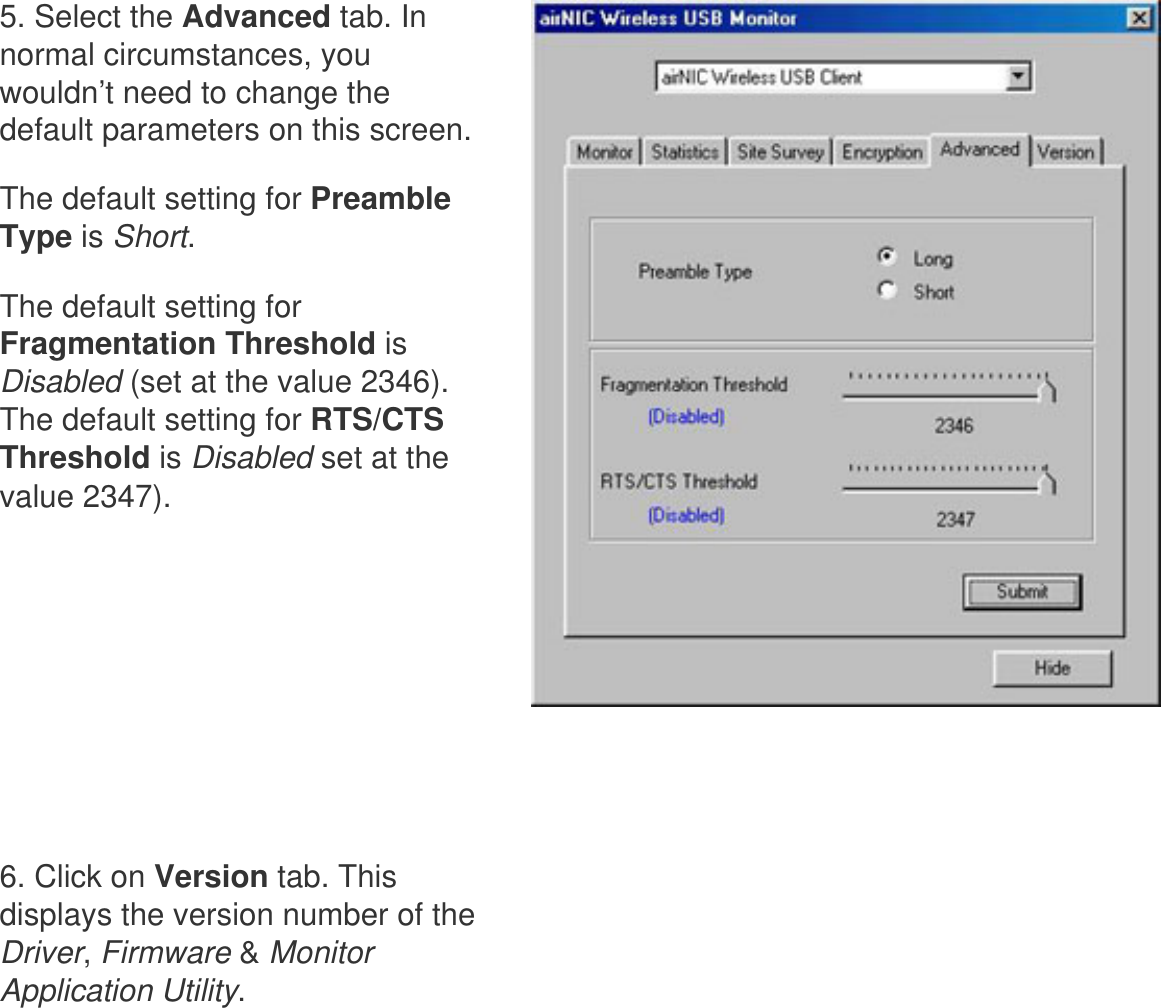
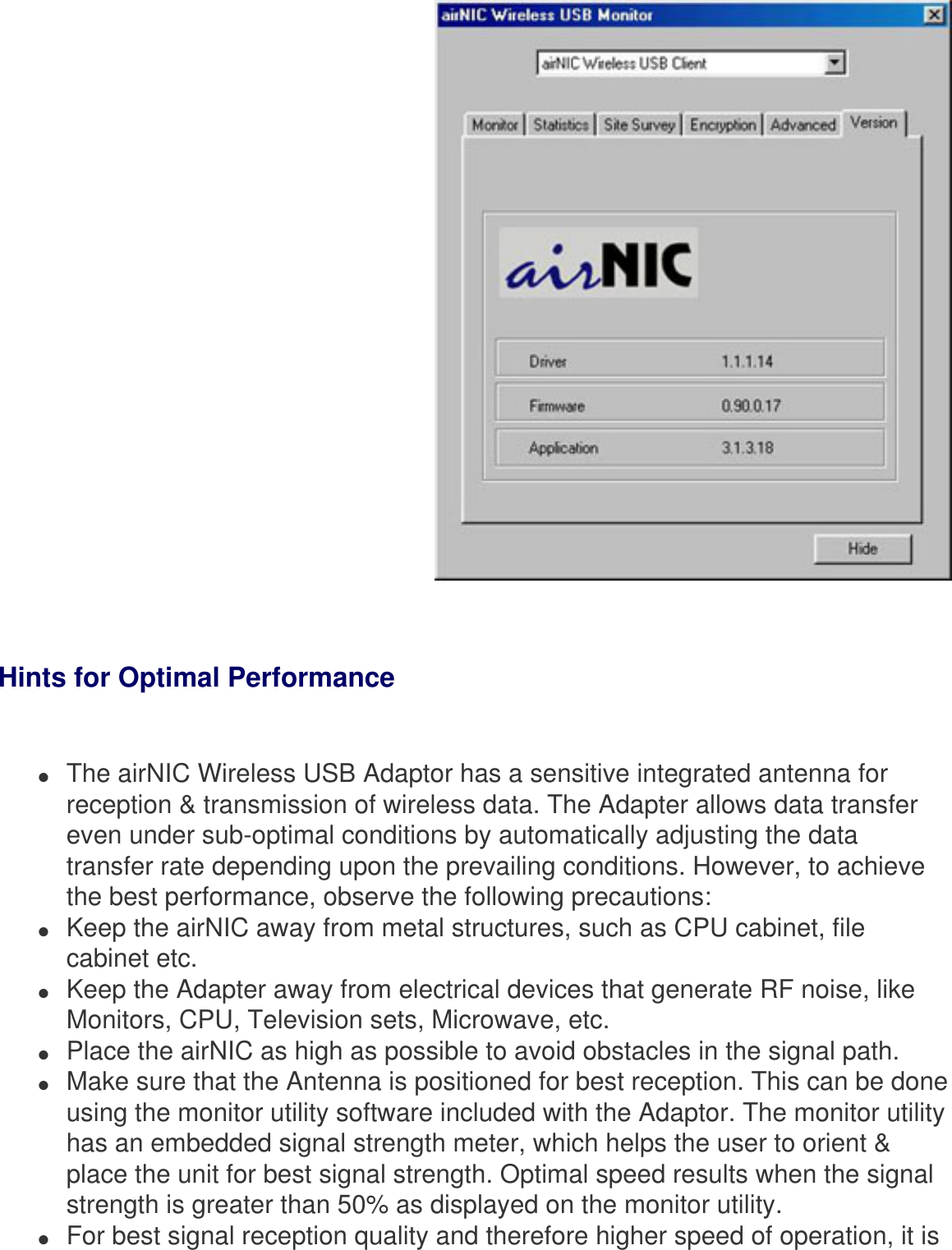
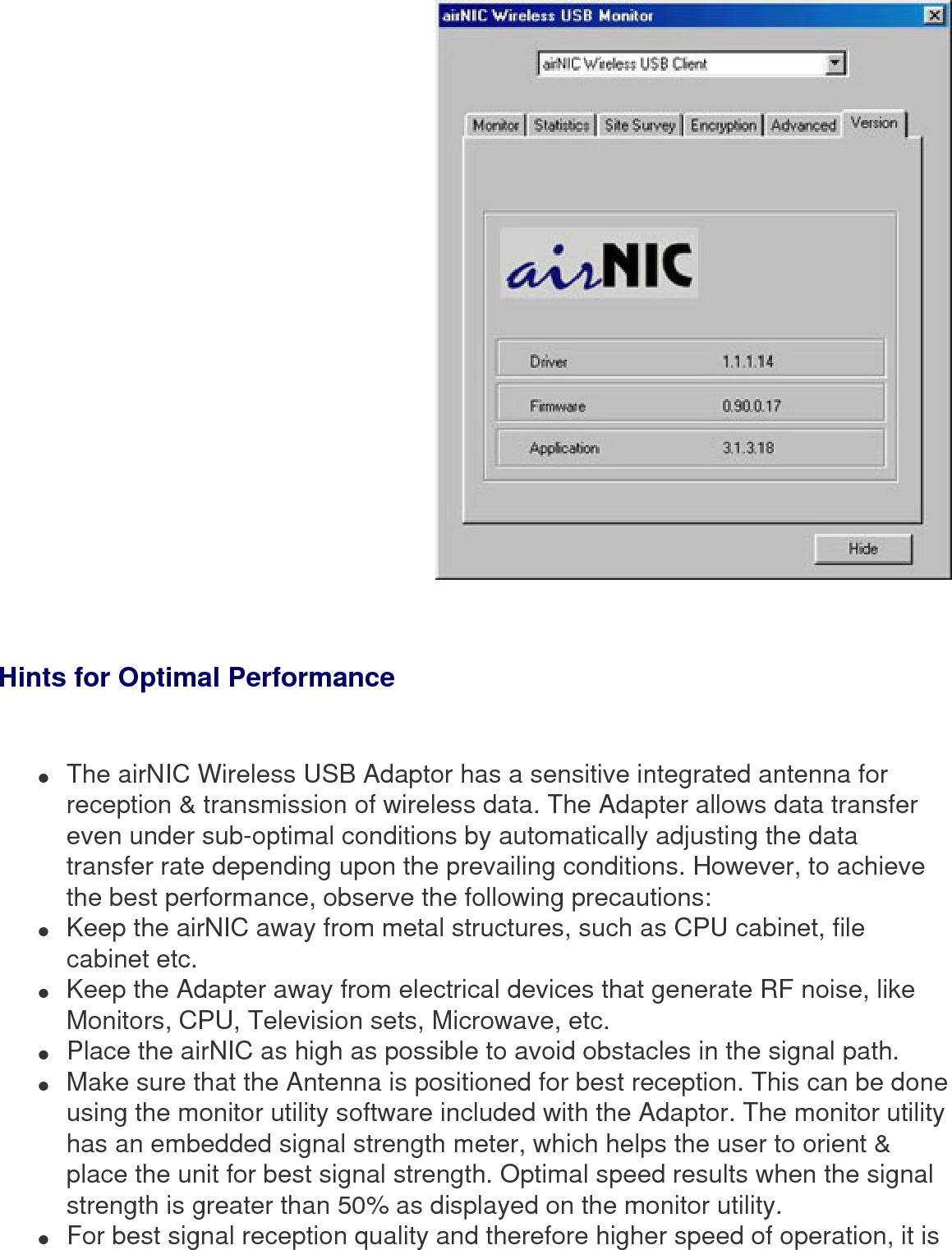
     5. Select the Advanced tab. In normal circumstances, you wouldn’t need to change the default parameters on this screen. The default setting for Preamble Type is Short. The default setting for Fragmentation Threshold is Disabled (set at the value 2346). The default setting for RTS/CTS Threshold is Disabled set at the value 2347).      6. Click on Version tab. This displays the version number of the Driver, Firmware & Monitor Application Utility.
 Hints for Optimal Performance  ●     The airNIC Wireless USB Adaptor has a sensitive integrated antenna for reception & transmission of wireless data. The Adapter allows data transfer even under sub-optimal conditions by automatically adjusting the data transfer rate depending upon the prevailing conditions. However, to achieve the best performance, observe the following precautions:●     Keep the airNIC away from metal structures, such as CPU cabinet, file cabinet etc.●     Keep the Adapter away from electrical devices that generate RF noise, like Monitors, CPU, Television sets, Microwave, etc.●     Place the airNIC as high as possible to avoid obstacles in the signal path.●     Make sure that the Antenna is positioned for best reception. This can be done using the monitor utility software included with the Adaptor. The monitor utility has an embedded signal strength meter, which helps the user to orient & place the unit for best signal strength. Optimal speed results when the signal strength is greater than 50% as displayed on the monitor utility.●     For best signal reception quality and therefore higher speed of operation, it is
recommended that the (optional) external Antenna be used with the unit.
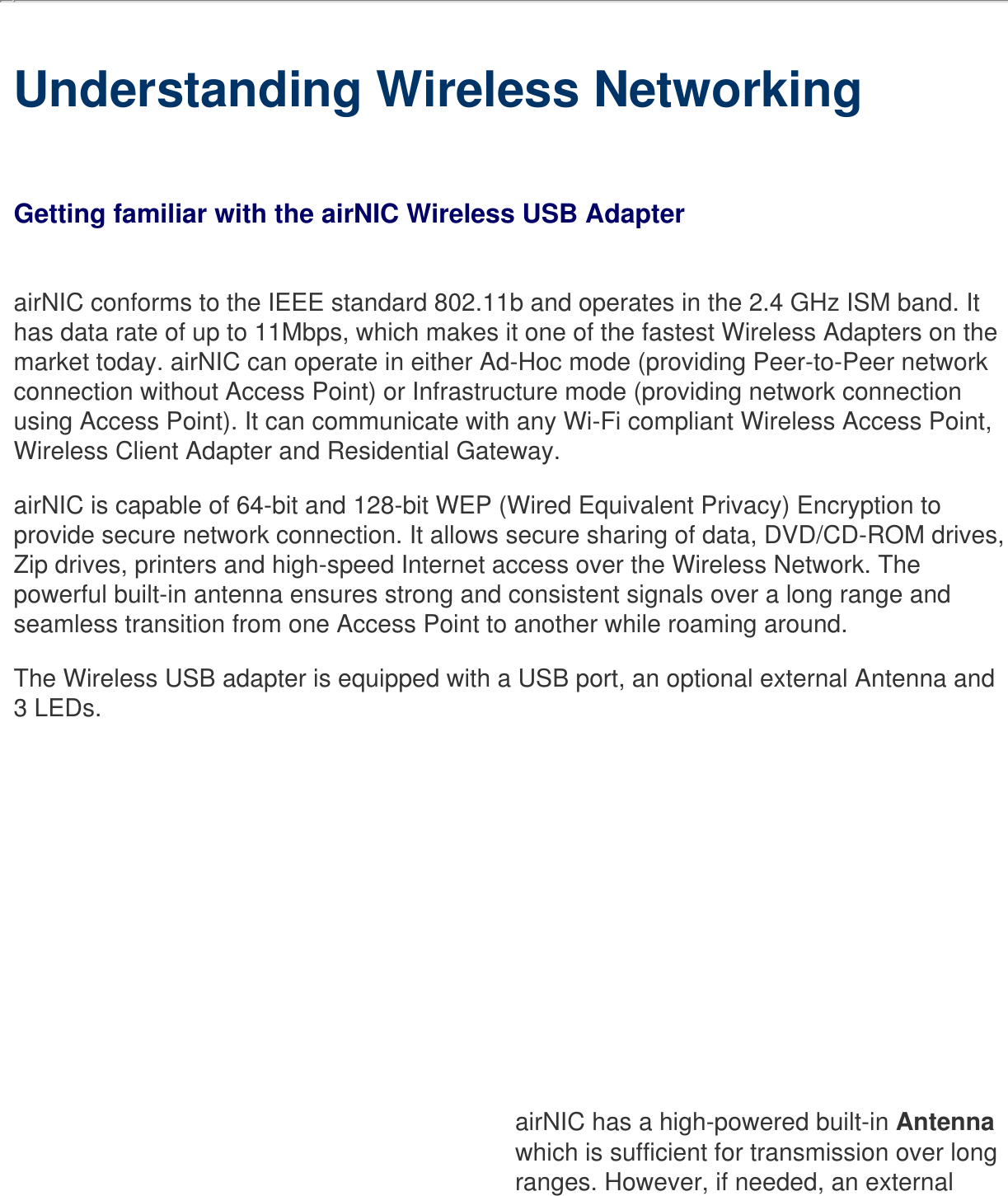
    Understanding Wireless NetworkingGetting familiar with the airNIC Wireless USB AdapterairNIC conforms to the IEEE standard 802.11b and operates in the 2.4 GHz ISM band. It has data rate of up to 11Mbps, which makes it one of the fastest Wireless Adapters on the market today. airNIC can operate in either Ad-Hoc mode (providing Peer-to-Peer network connection without Access Point) or Infrastructure mode (providing network connection using Access Point). It can communicate with any Wi-Fi compliant Wireless Access Point, Wireless Client Adapter and Residential Gateway.airNIC is capable of 64-bit and 128-bit WEP (Wired Equivalent Privacy) Encryption to provide secure network connection. It allows secure sharing of data, DVD/CD-ROM drives, Zip drives, printers and high-speed Internet access over the Wireless Network. The powerful built-in antenna ensures strong and consistent signals over a long range and seamless transition from one Access Point to another while roaming around.The Wireless USB adapter is equipped with a USB port, an optional external Antenna and 3 LEDs.airNIC has a high-powered built-in Antenna which is sufficient for transmission over long ranges. However, if needed, an external
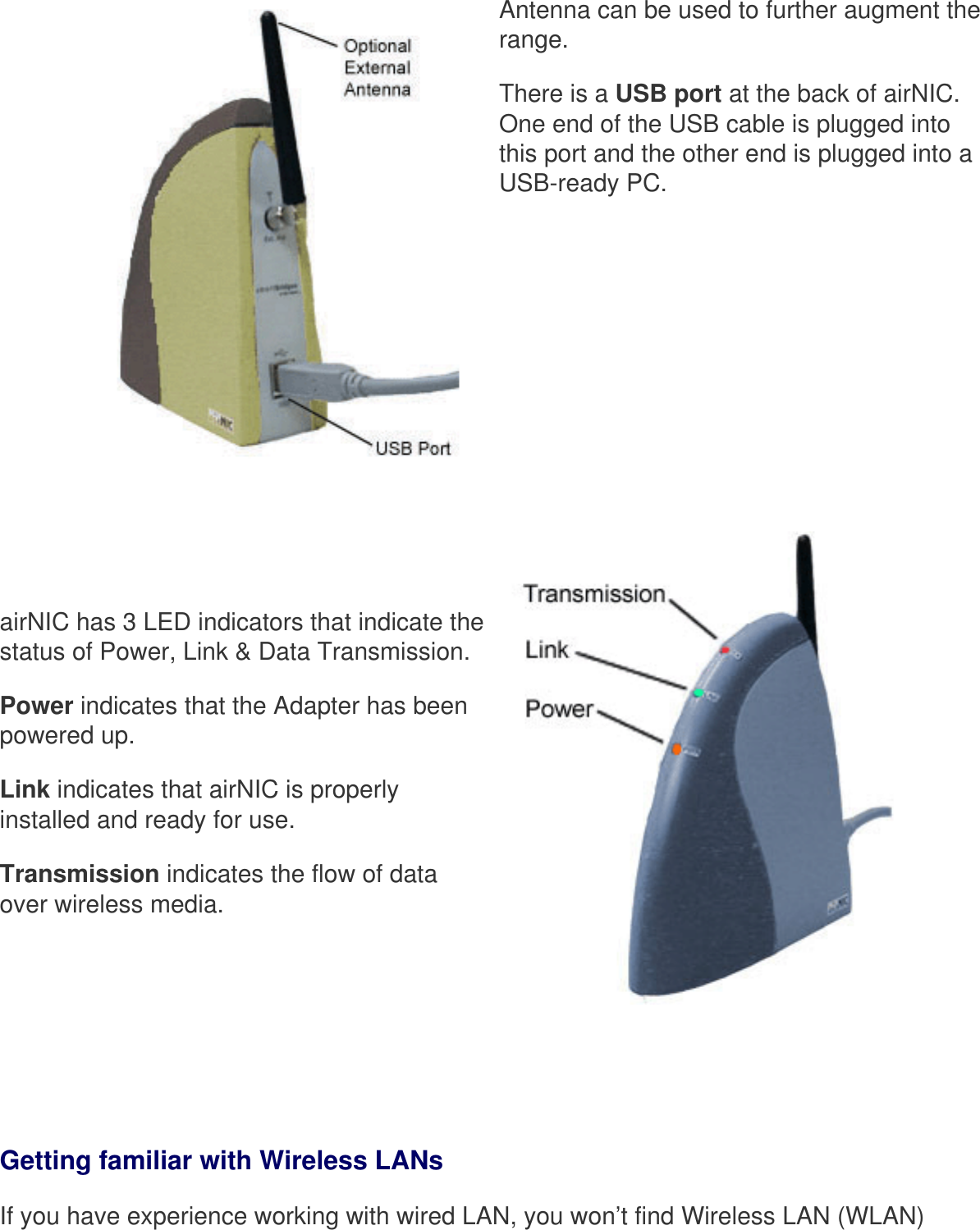
 Antenna can be used to further augment the range. There is a USB port at the back of airNIC. One end of the USB cable is plugged into this port and the other end is plugged into a USB-ready PC.    airNIC has 3 LED indicators that indicate the status of Power, Link & Data Transmission. Power indicates that the Adapter has been powered up.Link indicates that airNIC is properly installed and ready for use. Transmission indicates the flow of data over wireless media.  Getting familiar with Wireless LANsIf you have experience working with wired LAN, you won’t find Wireless LAN (WLAN)
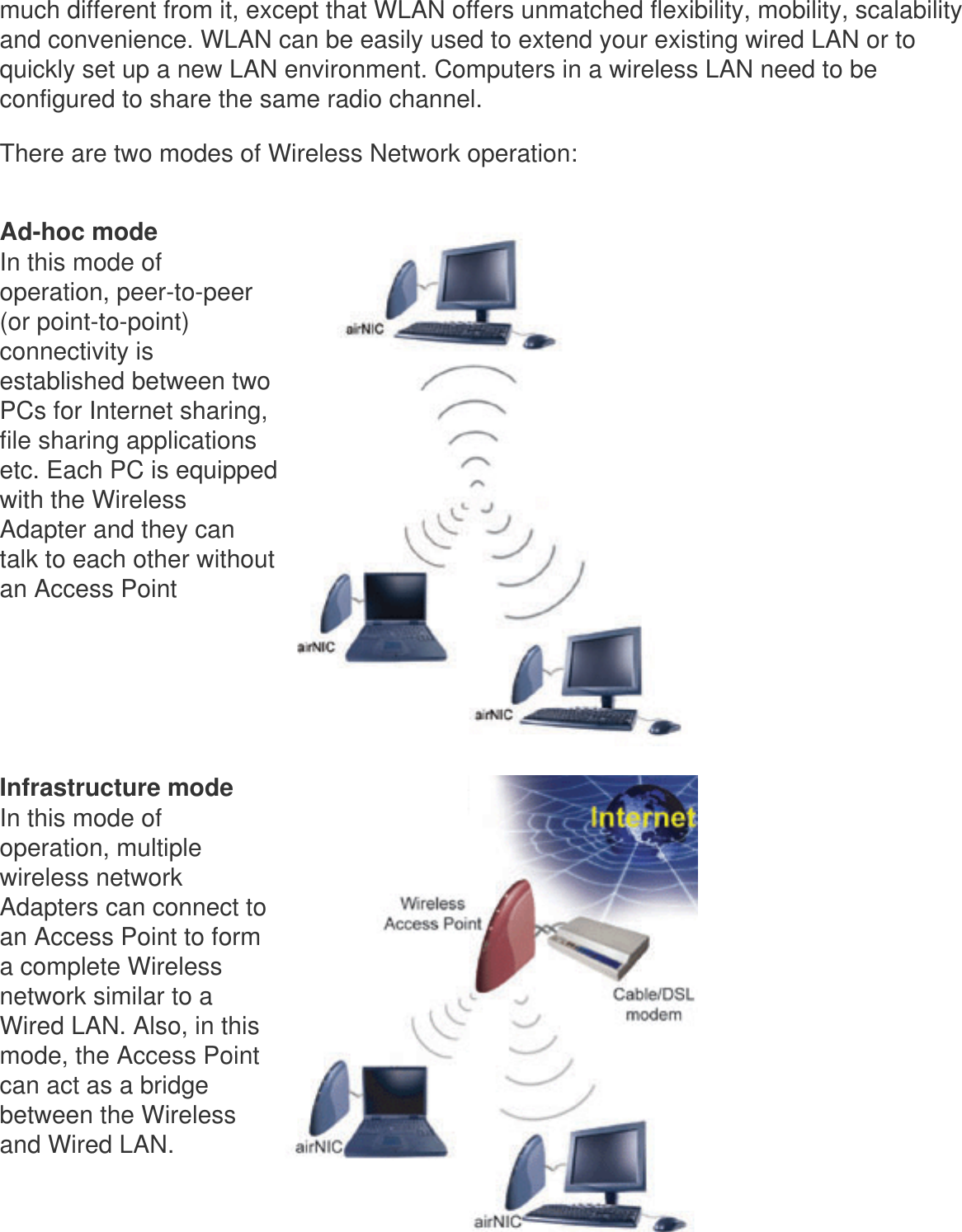
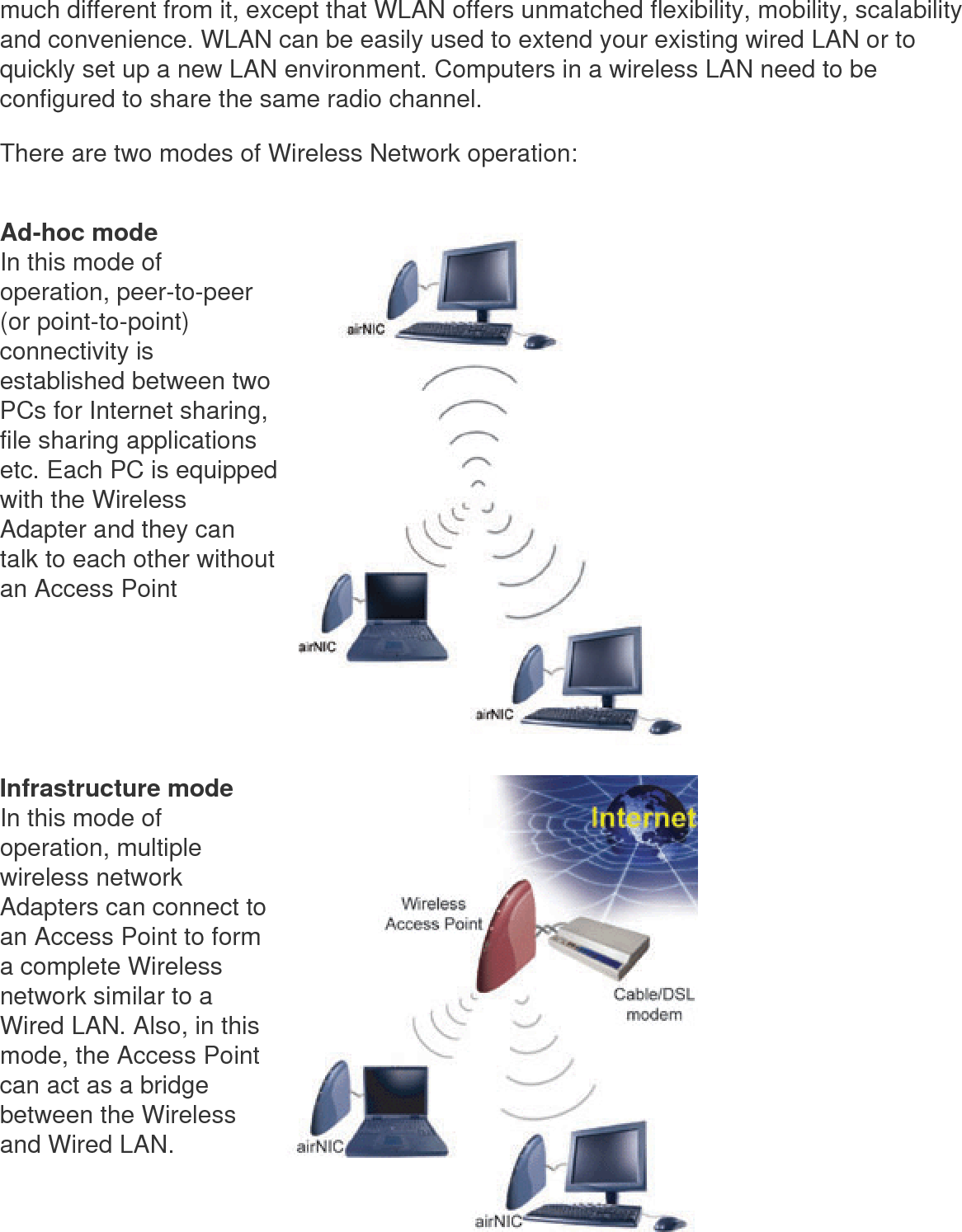
much different from it, except that WLAN offers unmatched flexibility, mobility, scalability and convenience. WLAN can be easily used to extend your existing wired LAN or to quickly set up a new LAN environment. Computers in a wireless LAN need to be configured to share the same radio channel.There are two modes of Wireless Network operation: Ad-hoc modeIn this mode of operation, peer-to-peer (or point-to-point) connectivity is established between two PCs for Internet sharing, file sharing applications etc. Each PC is equipped with the Wireless Adapter and they can talk to each other without an Access Point      Infrastructure modeIn this mode of operation, multiple wireless network Adapters can connect to an Access Point to form a complete Wireless network similar to a Wired LAN. Also, in this mode, the Access Point can act as a bridge between the Wireless and Wired LAN.
  TroubleshootingFrequently Asked Questions About airNICQ: How fast is airNIC ?A: airNIC is capable of a data rate of up to 11Mbps.Q: How do I connect airNIC to my PC ?It is connected to the USB port of the PC. Please refer the user guide for detailed installation procedure.Q: Can I use airNIC with my laptop ?Yes. airNIC can be used with any USB-ready computer.Q: What standard does airNIC conform to ?A: IEEE802.11b for wireless.Q: Where can I find additional information about airNIC ? A: You can refer to the manual on the simpleConnect CD, or check out our online User Guide.Q: Can it work with any Wireless Access Point ?A: Yes. It can work with any IEEE802.11b compliant Wireless Access Point.Q: Would the Internet connection speed be affected if I connect more than one PC at the same time ?A: There might be a slight loss in the speed but it will be very insignificant.Q: What do the different lights (LEDs) on the airNIC case indicate ?A: Red indicates Device Power On, USB cable connected.    Green indicates Link is OK, Channel is clear for use.    Yellow indicates Device is in Wireless Transmit mode.
Q: What operating systems are supported by airNIC ?A: Windows 98SE, 2000, ME, XPQ: Will I be able to see other computers on LAN ?A: Yes. airNIC allows you to connect to other computers on your network.Q: Is the Wireless Connection secure ?A: Yes. airNIC is capable of providing 128-bit WEP encryption.Q: How can I find out if my PC supports USB?●     Right-click on "My Computer" on your desktop ●     Click "Properties" ●     Click "Device Manager" ●     Click "Universal Serial Bus Controller". If USB is enabled on your PC, you will see the entry for PCI Universal Open Host Controller.Q: What are the minimum computer requirements for the proper operation of airNIC?●     An IBM compatible PC●     Pentium processor (166 MHz or above)●     Microsoft Windows 98SE/2000/Me/XP●     CD-ROM drive●     A Spare USB portQ: How do I uninstall airNIC from my PC ?A: In order to uninstall airNIC from your computer, follow the following steps:●     Click on Start -> Programs -> smartBridges●     Select and click on “Uninstall Wireless Tools”. A dialog box will pop up to confirm that you want to uninstall simpleConnect. Click "Yes". GeneralQ: What is WEP ?A: Wired Equivalent Privacy (WEP) is an encryption scheme used to protect
wireless data communication. It is part of the system security behind the wireless IEEE 802.11 protocol, and its goals are to provide confidentiality and data integrity, and to protect access to the network infrastructure by rejecting all non-WEP packets. Q: What is an Access Point ?A: It is a hardware device that converts a wired LAN port/outlet to a wireless port typically for Infrastructure mode.Q: What is AdHoc mode ?A: Peer-to-Peer networking mode usually used for sharing local resources between wireless Networked PCs.Q: What is Infrastructure mode ?A: Infrastructure Mode allows a wireless network to be integrated into an existing, wired network through an Access Point, permitting roaming between Access Points while maintaining a connection to all network resources.Q: What is IEEE 802.11 standard ?A: It is a standard set by Institution of Electrical Electronics & Engineers for standardizing the wireless networking hardware so that they are interoperable.Q: What is ISM band ?A: The FCC and their counterparts outside of the U.S. have set aside bandwidth for unlicensed use in the ISM (Industrial, Scientific and Medical) band. The ISM band comprises of frequencies in the vicinity of 2.4 GHz.Q: What is Direct-Sequencing Spread Spectrum (DSSS) ?A: Wireless LAN products are available in three different technologies – Direct Sequencing Spread Spectrum (DSSS), Frequency Hopping Spread-Spectrum (FHSS) and Infrared. DSSS and FHSS are spread-spectrum techniques that operate over the radio airwaves in the unlicensed ISM band (Industrial, Scientific, and Medical). DSSS uses radio transmitter to spread data packets over a fixed range of frequency band.Q: How does the Wireless LAN connect the PCs ?A: The Wireless LAN uses Radio Frequency (RF) to transmit data. In this respect, it is similar to radio stations and cordless phones. Devices "tune in" to different signals on specific frequency bands and ignore others, allowing the devices to co-exist and PCs to communicate securely over the Wireless LAN.Q: Will Wireless LAN interfere with other RF devices like cordless phones?
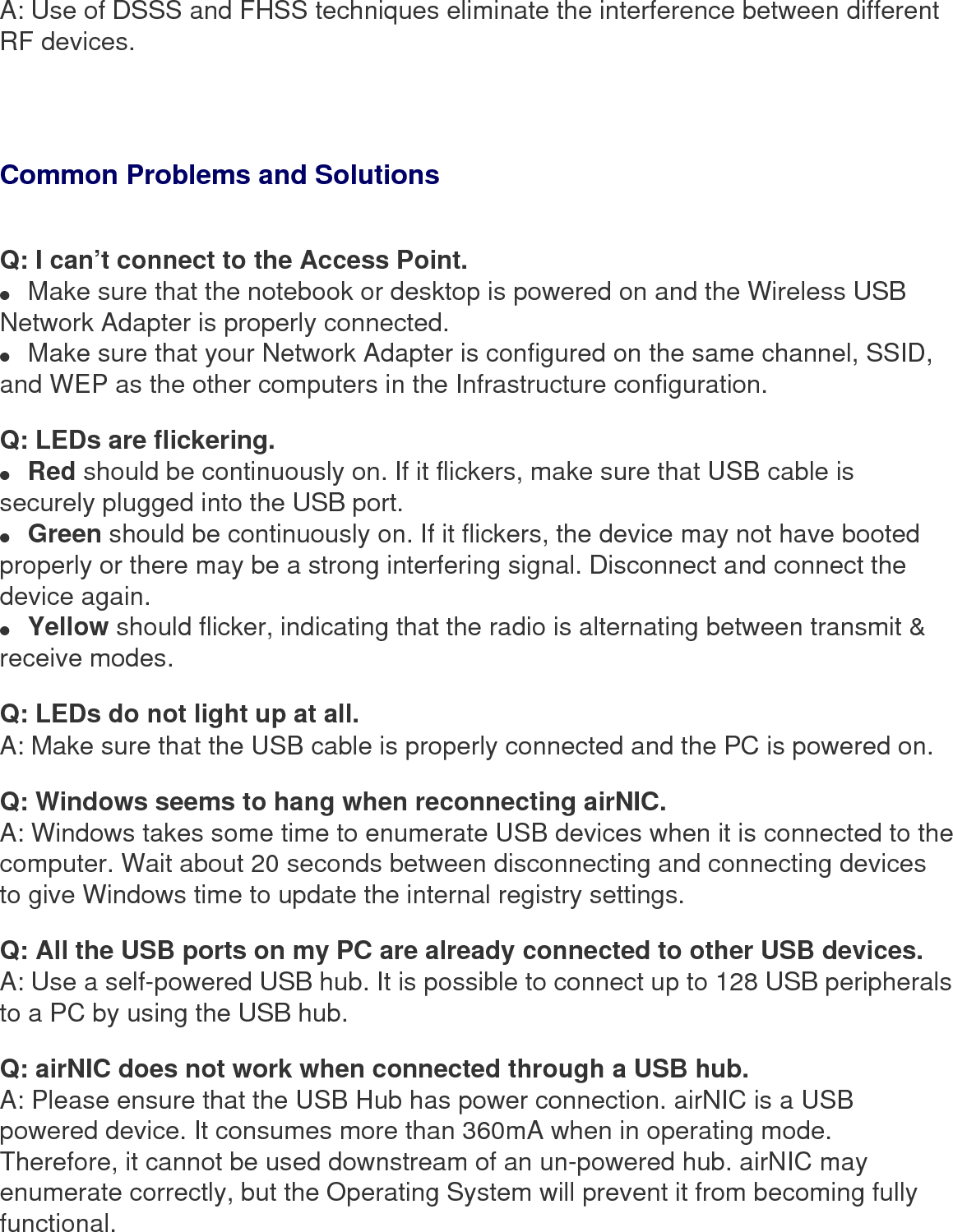
A: Use of DSSS and FHSS techniques eliminate the interference between different RF devices.Common Problems and Solutions Q: I can’t connect to the Access Point.●     Make sure that the notebook or desktop is powered on and the Wireless USB Network Adapter is properly connected.●     Make sure that your Network Adapter is configured on the same channel, SSID, and WEP as the other computers in the Infrastructure configuration. Q: LEDs are flickering.●     Red should be continuously on. If it flickers, make sure that USB cable is securely plugged into the USB port.●     Green should be continuously on. If it flickers, the device may not have booted properly or there may be a strong interfering signal. Disconnect and connect the device again.●     Yellow should flicker, indicating that the radio is alternating between transmit & receive modes.Q: LEDs do not light up at all.A: Make sure that the USB cable is properly connected and the PC is powered on.Q: Windows seems to hang when reconnecting airNIC.A: Windows takes some time to enumerate USB devices when it is connected to the computer. Wait about 20 seconds between disconnecting and connecting devices to give Windows time to update the internal registry settings.Q: All the USB ports on my PC are already connected to other USB devices.A: Use a self-powered USB hub. It is possible to connect up to 128 USB peripherals to a PC by using the USB hub.Q: airNIC does not work when connected through a USB hub.A: Please ensure that the USB Hub has power connection. airNIC is a USB powered device. It consumes more than 360mA when in operating mode. Therefore, it cannot be used downstream of an un-powered hub. airNIC may enumerate correctly, but the Operating System will prevent it from becoming fully functional.
  Service and SupportThis User Manual provides comprehensive information on Installation and Configuration of airNIC. If, however, you still have problems or need further support, you can get in touch with us at:10 Anson Road, #22-14 International Plaza, Singapore 079903 Tel: +65-324 0210 Fax: +65-324 0607 Web: http://www.smartbridges.com You can also send your queries to support@smartbridges.com
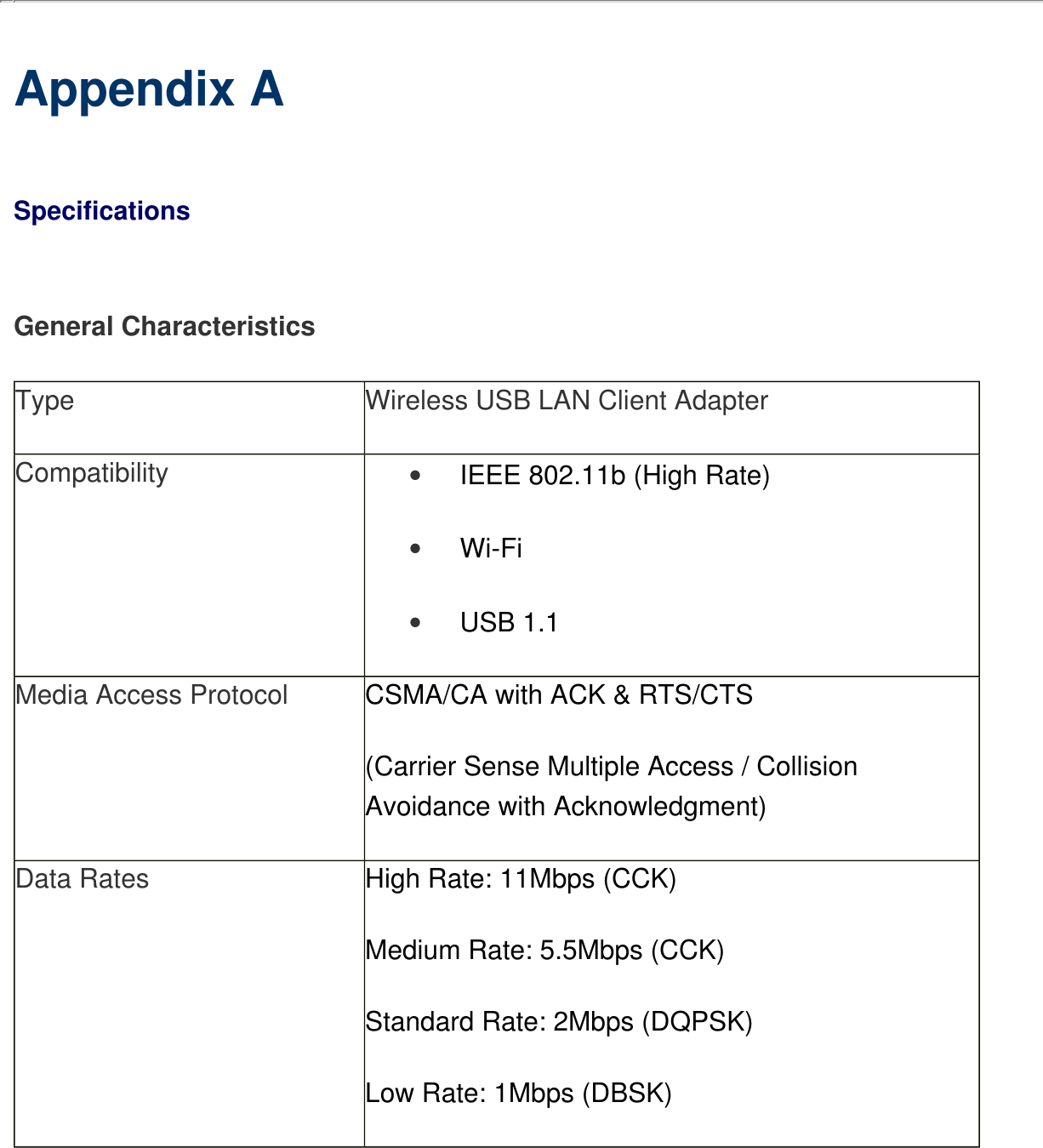
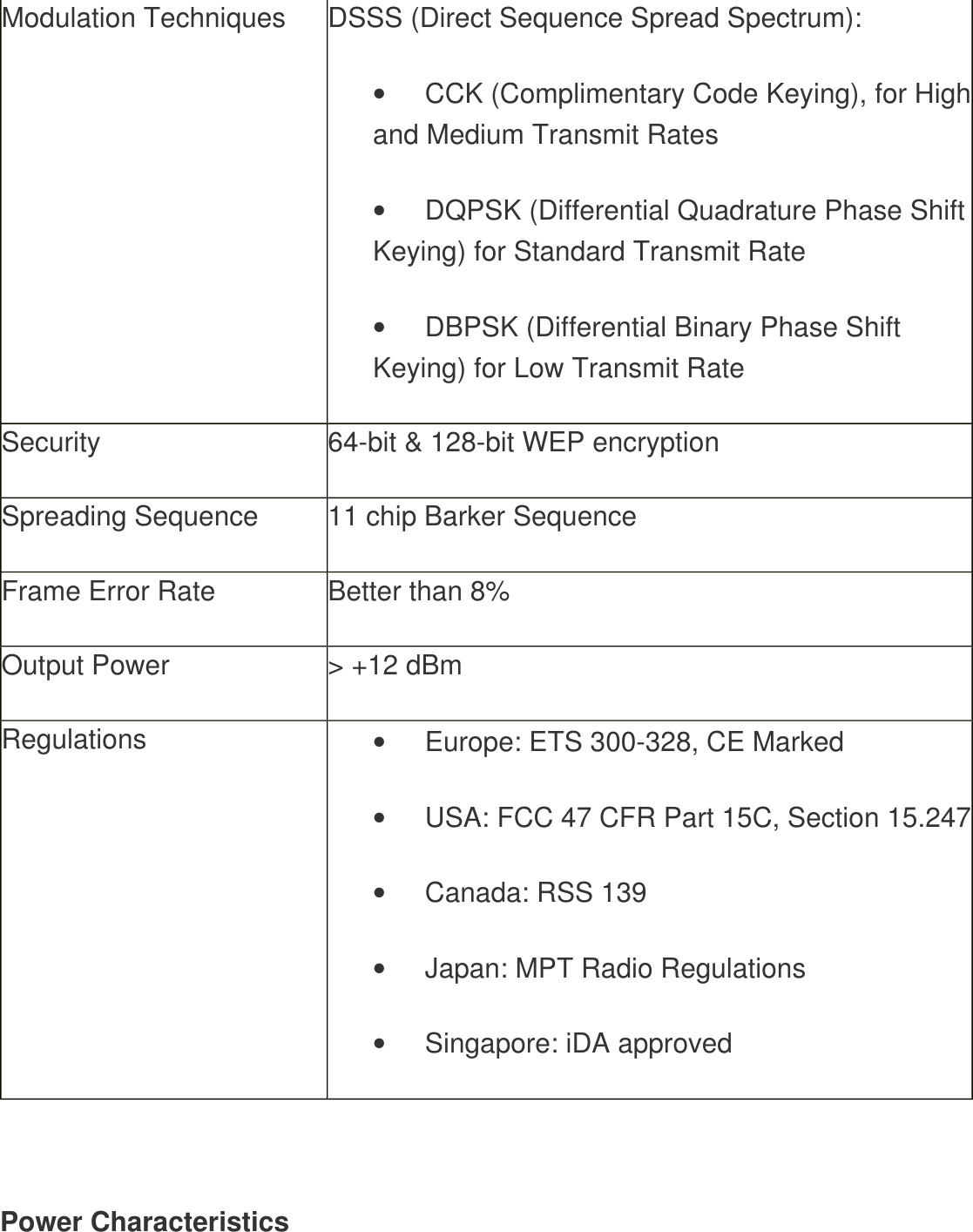
    Appendix A  SpecificationsGeneral CharacteristicsType  Wireless USB LAN Client Adapter Compatibility  •         IEEE 802.11b (High Rate) •         Wi-Fi •         USB 1.1 Media Access Protocol  CSMA/CA with ACK & RTS/CTS (Carrier Sense Multiple Access / Collision Avoidance with Acknowledgment) Data Rates  High Rate: 11Mbps (CCK) Medium Rate: 5.5Mbps (CCK) Standard Rate: 2Mbps (DQPSK) Low Rate: 1Mbps (DBSK)
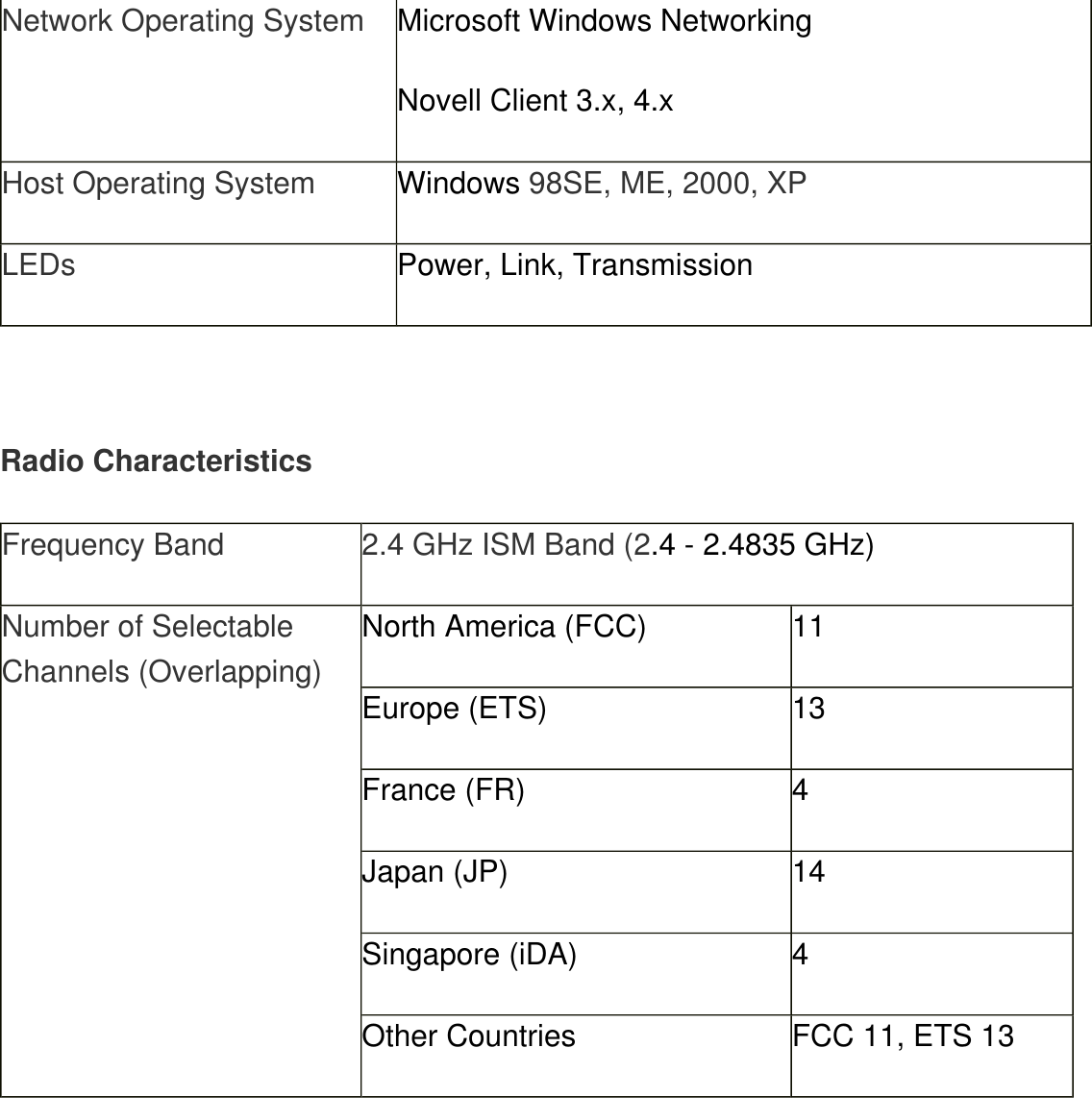
Network Operating System  Microsoft Windows Networking Novell Client 3.x, 4.x Host Operating System  Windows 98SE, ME, 2000, XP LEDs  Power, Link, Transmission  Radio CharacteristicsFrequency Band  2.4 GHz ISM Band (2.4 - 2.4835 GHz) Number of Selectable Channels (Overlapping) North America (FCC)  11 Europe (ETS)  13 France (FR)  4 Japan (JP)  14 Singapore (iDA)  4 Other Countries  FCC 11, ETS 13
Modulation Techniques  DSSS (Direct Sequence Spread Spectrum): •         CCK (Complimentary Code Keying), for High and Medium Transmit Rates •         DQPSK (Differential Quadrature Phase Shift Keying) for Standard Transmit Rate •         DBPSK (Differential Binary Phase Shift Keying) for Low Transmit Rate Security  64-bit & 128-bit WEP encryption Spreading Sequence  11 chip Barker Sequence Frame Error Rate  Better than 8% Output Power  > +12 dBm Regulations  •         Europe: ETS 300-328, CE Marked •         USA: FCC 47 CFR Part 15C, Section 15.247 •         Canada: RSS 139 •         Japan: MPT Radio Regulations •         Singapore: iDA approved  Power Characteristics
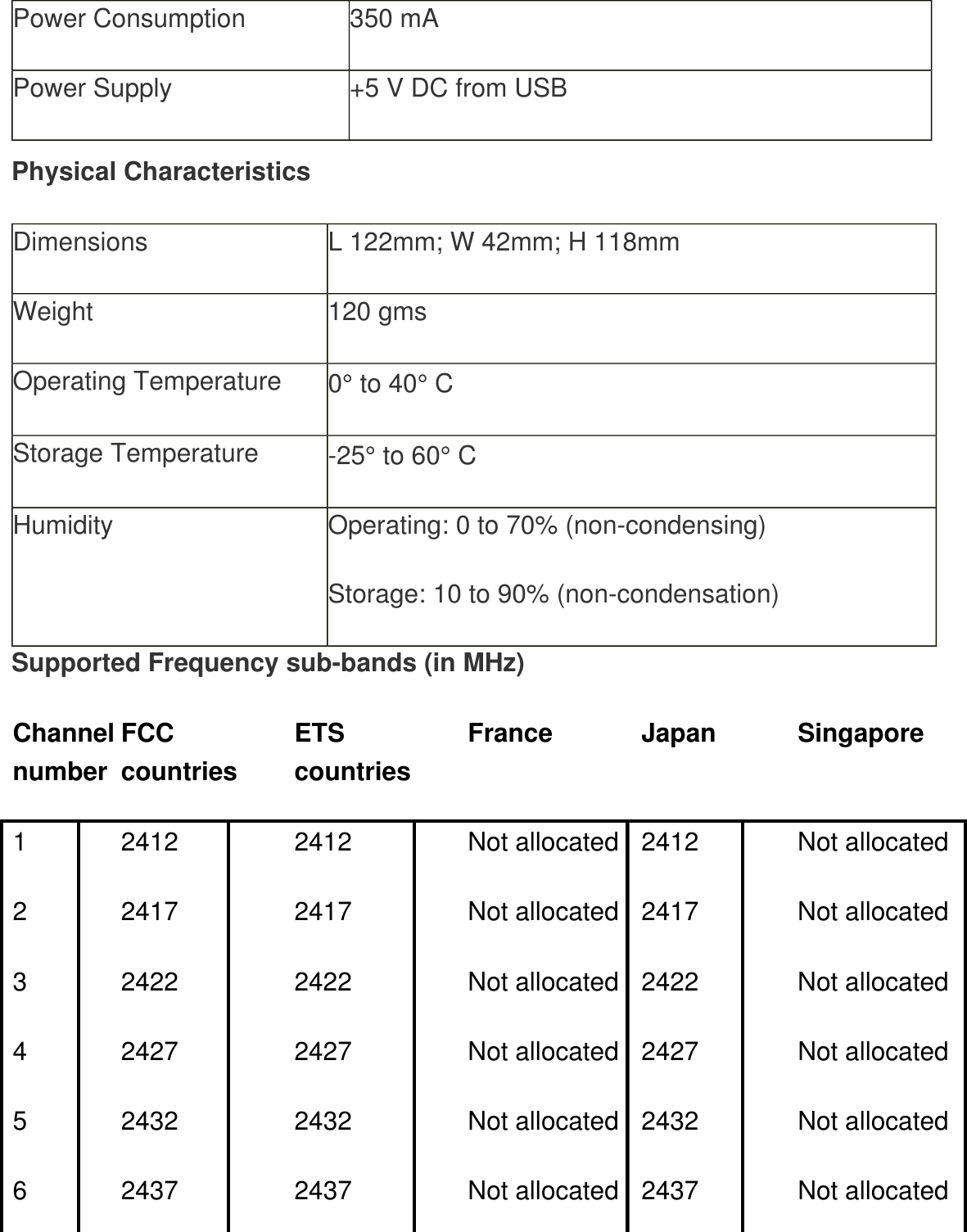
Power Consumption  350 mA Power Supply  +5 V DC from USB   Physical CharacteristicsDimensions  L 122mm; W 42mm; H 118mm Weight  120 gms Operating Temperature  0° to 40° C Storage Temperature  -25° to 60° C Humidity  Operating: 0 to 70% (non-condensing) Storage: 10 to 90% (non-condensation)       Supported Frequency sub-bands (in MHz)Channel number FCC countries ETS countries France  Japan  Singapore 1  2412  2412  Not allocated  2412  Not allocated 2  2417  2417  Not allocated  2417  Not allocated 3  2422  2422  Not allocated  2422  Not allocated 4  2427  2427  Not allocated  2427  Not allocated 5  2432  2432  Not allocated  2432  Not allocated 6  2437  2437  Not allocated  2437  Not allocated
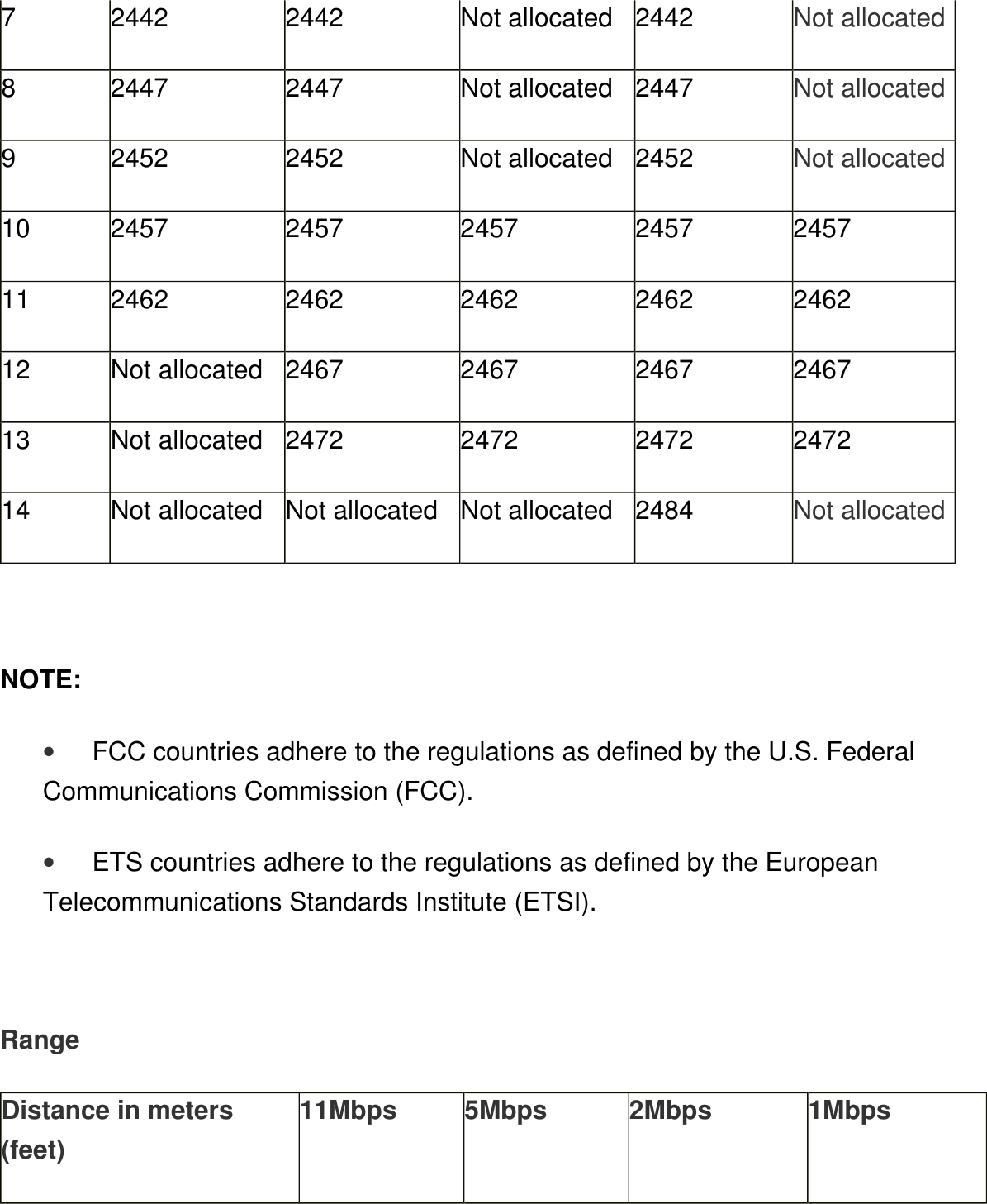
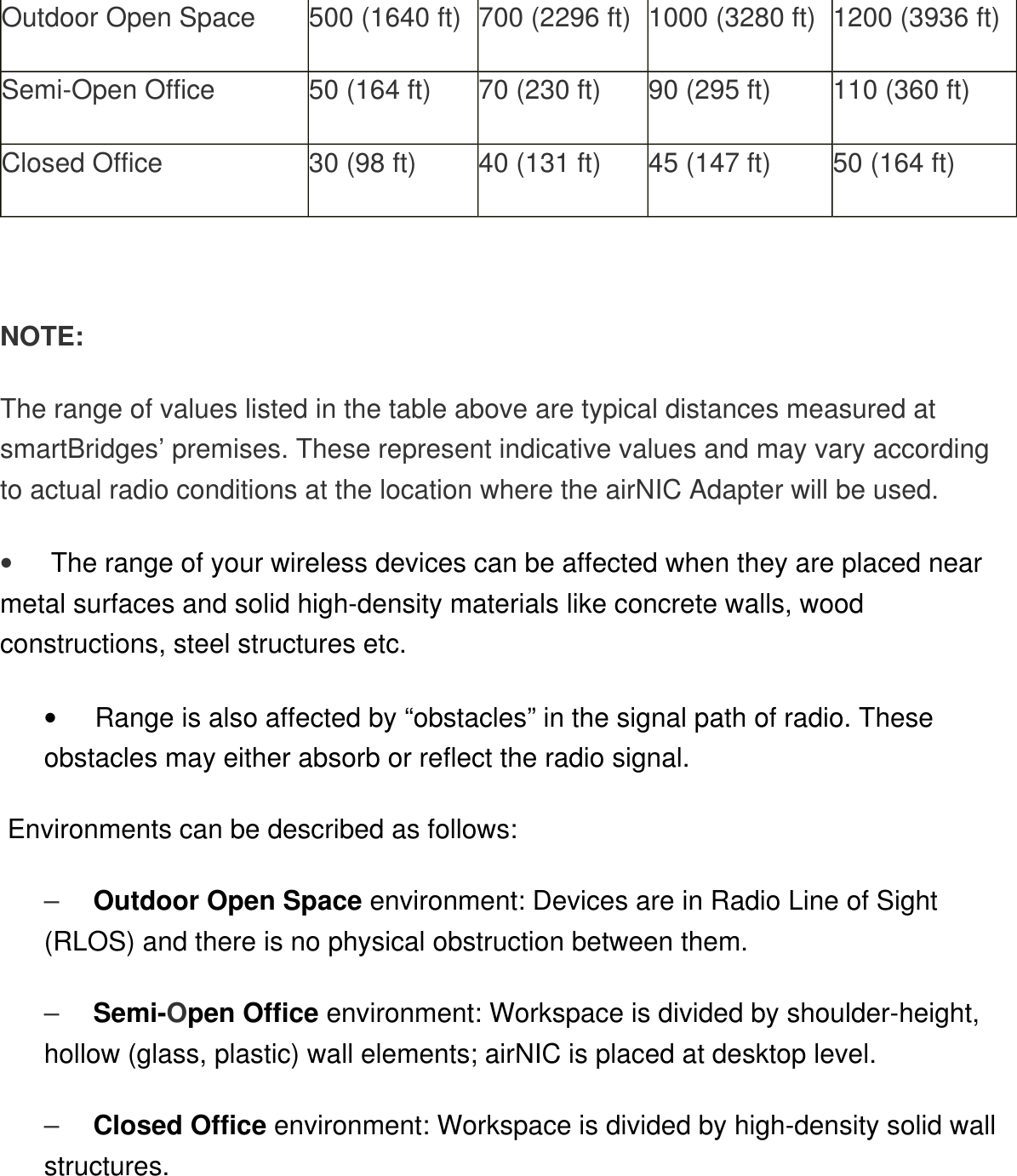
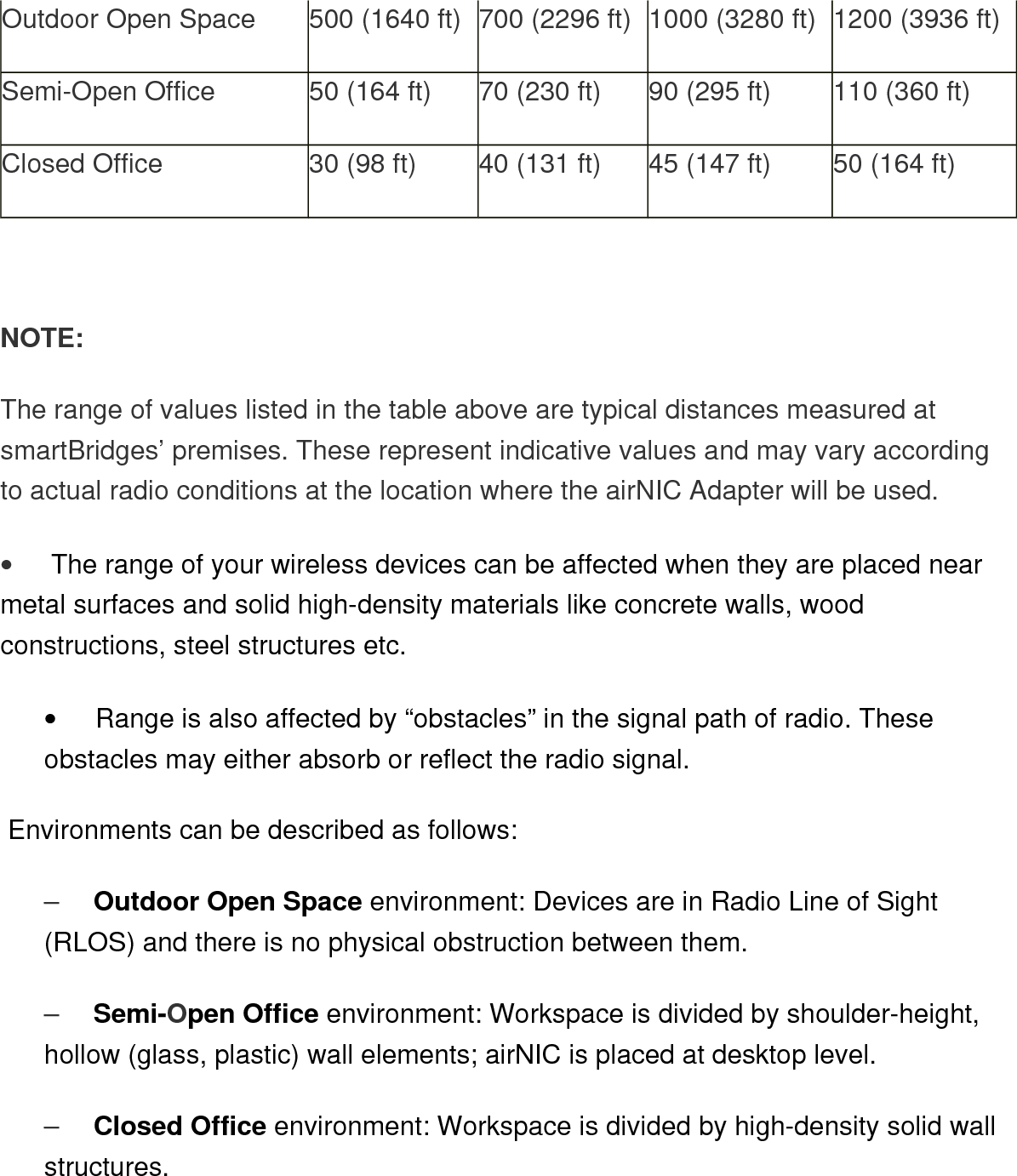
7  2442  2442  Not allocated  2442  Not allocated 8  2447  2447  Not allocated  2447  Not allocated 9  2452  2452  Not allocated  2452  Not allocated 10  2457  2457  2457  2457  2457 11  2462  2462  2462  2462  2462 12  Not allocated  2467  2467  2467  2467 13  Not allocated  2472  2472  2472  2472 14  Not allocated  Not allocated  Not allocated  2484  Not allocated  NOTE: •         FCC countries adhere to the regulations as defined by the U.S. Federal Communications Commission (FCC). •         ETS countries adhere to the regulations as defined by the European Telecommunications Standards Institute (ETSI).  RangeDistance in meters (feet) 11Mbps  5Mbps  2Mbps  1Mbps
Outdoor Open Space  500 (1640 ft)  700 (2296 ft)  1000 (3280 ft)  1200 (3936 ft) Semi-Open Office  50 (164 ft)  70 (230 ft)  90 (295 ft)  110 (360 ft) Closed Office  30 (98 ft)  40 (131 ft)  45 (147 ft)  50 (164 ft)  NOTE:  The range of values listed in the table above are typical distances measured at smartBridges’ premises. These represent indicative values and may vary according to actual radio conditions at the location where the airNIC Adapter will be used.•         The range of your wireless devices can be affected when they are placed near metal surfaces and solid high-density materials like concrete walls, wood constructions, steel structures etc. •         Range is also affected by “obstacles” in the signal path of radio. These obstacles may either absorb or reflect the radio signal. Environments can be described as follows:–        Outdoor Open Space environment: Devices are in Radio Line of Sight (RLOS) and there is no physical obstruction between them.–        Semi-Open Office environment: Workspace is divided by shoulder-height, hollow (glass, plastic) wall elements; airNIC is placed at desktop level.–        Closed Office environment: Workspace is divided by high-density solid wall structures.
     Appendix BWarranty InformationsmartBridges warrants product to be free of defects, and agrees to repair or replace the product that proves defective. airNIC is warranted for one year from date of purchase. This warranty does not cover accidents, misuse, neglect, unauthorized product modification, or acts of nature.Please visit customer support area of smartBridges web site for making warranty claims. smartBridges may elect to exchange the product or refund the full purchase price of the unit.Except as expressly provided above, smartBridges makes no warranties or conditions, express, implied, or statutory, including without limitation, the implied warranties of merchantability and fitness for a particular purpose or infringement of any patent, copyright or other intellectual property right. smartBridges shall not be liable for damage to other property caused by any defects in this product, damages based upon inconvenience, loss of use of the product, loss of time or data, commercial loss, or any other damages, whether special, incidental, consequential, or otherwise, whether under theory of contract, tort (including negligence), indemnity, product liability, or otherwise. smartBridges products are not intended for use in medical, life saving, or life sustaining applications. In no event shall smartBridges' liability exceed the normal purchase price for this product. Software LicenseNo license, express or implied, by estoppels or otherwise, to any intellectual property rights is granted by this document. The simpleConnect software is licensed for use with the airNIC Wireless USB Network Adapter only. The software may be copied only for backup purpose.
Copyright & TrademarksCopyright © 2001 smartBridges. All Rights Reserved. airNIC and simpleConnect are trademarks of smartBridges. Microsoft Windows 98SE, Windows ME, Windows 2000, and Windows XP are trademarks of Microsoft Corporation. All other trademarks and brand names mentioned in this Manual are registered trademarks or trademarks of their respective owners.
     Appendix CDeclaration of Conformity and Regulatory InformationDECLARATION OF CONFORMITY TO FCC REGULATIONS, Part 15smartBridges declares that the equipment described in this document is within the requirements of the Code of Federal Regulations - Title 47 Part 15, Subpart B, Class B for a digital device. This declaration is based upon the compliance of the airNIC plug and play Network Adapter to the above standards. smartBridges has determined that airNIC has been shown to comply with the applicable technical standards if no unauthorized changes are made to the equipment and if the equipment is properly maintained and operated. These units are identical to the units tested and found acceptable with the applicable standards. Records maintained by smartBridges continue to reflect that the units being produced under this Declaration of Conformity, within the variation that can be expected due to quantity production and tested on a statistical basis, continue to comply with the applicable technical standards. FCC Rules and Regulations - Part 15 This device complies with Part 15 of the FCC rules. Operation is subject to the following two conditions: 1. This device may not cause harmful interference and, 2. This device must accept any interference received, including interference that may cause undesired operation. This equipment has been tested and found to comply with the limits for a Class B digital device pursuant to Part 15 of the FCC rules. These limits are designed to provide reasonable protection against harmful interference in a residential installation. This equipment generates, uses, and can radiate radio frequency energy and, if not installed and used in accordance with the instructions, may cause harmful interference to radio communications. However, there is no guarantee that interference will not occur in a particular installation. If this equipment does cause harmful interference to radio or television reception,
which can be determined by turning the equipment off and on, the user is encouraged to try to correct the interference by one or more of the following measures: ●     Reorient or relocate the receiving antenna.●     Increase the separation between the equipment and the receiver.●     Connect the equipment into an outlet on a circuit different from that to which the receiver is connected.●     Consult the dealer or an experienced radio/TV technician for help.Changes or modifications not expressly approved by the manufacturer or registrant of this equipment can void your authority to operate this equipment under Federal Communications Commission rules. In order to maintain compliance with FCC regulations, standard network cables must be used with this equipment. Operation with non-approved equipment or non-standard cables is likely to result in interference to radio and TV reception. This equipment has been tested and found to comply with the limits for a Class B digital device, pursuant to Part 15 of the FCC Rules. These limits are designed to provide reasonable protection against harmful interference in a residential installation. CANADIAN DEPARTMENT OF COMMUNICATION, INDUSTRY CANADA STATEMENT This digital apparatus does not exceed the Class B limits for radio noise emissions from digital apparatus set out in the Radio Interference Regulations of the Canadian Department of Communications. Le présent appareil numérique n'émet pas de bruits radioélectriques dépassant les limites applicables aux appareils numériques de Classe B prescrites dans le règlement sur le brouillage radioélectrique édicté par le Ministère des Commu-nications du Canada.EUROPEAN COMMUNITY CE MARK, DECLARATION OF CONFORMITYsmartBridges Pte. Ltd. declares that the equipment described in this document is in conformance with the requirements of the European Council Directives -
73/23/EEC, Low Voltage Directive with Amendment 93/68/EEC and 89/336/EEC, EMC Directive with Amendments 92/31/EEC and 93/68/EEC. This declaration is based upon compliance of the product to the following standards: EN 55022 (CISPR 22B), RF Emissions Control and EN 50082-1 (IEC 801-2, 3, 4) Immunity to Electromagnetic Disturbance.SAFETY NOTICE This product is intended for use with UL 1950/EN60950/IEC950 (or other NRTL) listed ITE computer that contains operator-accessible USB ports.

Navigation menu