SmartStuff SSI-CTRLR VirtualZone CONTROLLER SSC User Manual

SmartStuff, Inc. VirtualZone CONTROLLER SSC Users Manual

Users Manual

VirtualZone®                    USER MANUAL    SmartStuff Inc.  7001 Sassfrass Court  Summerville, SC 29485 Tel. 860-202-1845 Fax. zzz-xxx-yyyy www.smartstff.com
Table of Contents  1 INTRODUCTION ...................................................................................................... 3 2 EQUIPMENT SAFETY COMPLIANCE .................................................................... 9 3 GENERAL SAFETY GUIDELINES ........................................................................ 11 4 UNPACKING AND PARTS LIST ............................................................................ 13 5 INTELLIGENT ZONE CONTROLLER INSTALLATION ......................................... 14 6 SmartDamper Installation ....................................................................................... 19 7 SmartSensor  ......................................................................................................... 23 8 VirtualZone Smart Application  ............................................................................... 24  Appendix A  PIPE WALL MEASUREMENT SYSTEM SPECIFICATIONS ............... 27
24000-01 Rev 01  Page 3  1  INTRODUCTION 1.1 Introduction VirtualZone® is an intelligent zone temperature control system consisting of an array of by SmartSensorTM devices and SmartDamperTM devices coordinated by an Intelligent Zone Controller (SmartController™). VirtualZone® converts a traditional heating/cooling zone into up to four separate intelligent “sub zones” to provide unprecedented room-by-room climate control, enery efficiency, and occupant comfort. VirtualZone® allows the temperature in each room to be individually and automatically controlled, ensuring every room is the right temperature at the right time. Temperatures can even be monitored and controlled from the convenience of your smartphone. VirtualZone® leverages Bluetooth® SMART technology, for efficient Low Energy wireless communication between components. The VirtualZone®  system  consists of an Intelligent Zone Controller, which connects to the HVAC system, SmartSensorTM devices, which monitor temperature in each separate “sub-zone”, and SmartDamperTM vents, which control air flow to individual heat/cool vents. This manual covers the basic installation and setup of the VirtualZone® system. In all cases, local safety and operating practices take precedence over the information contained within this document.
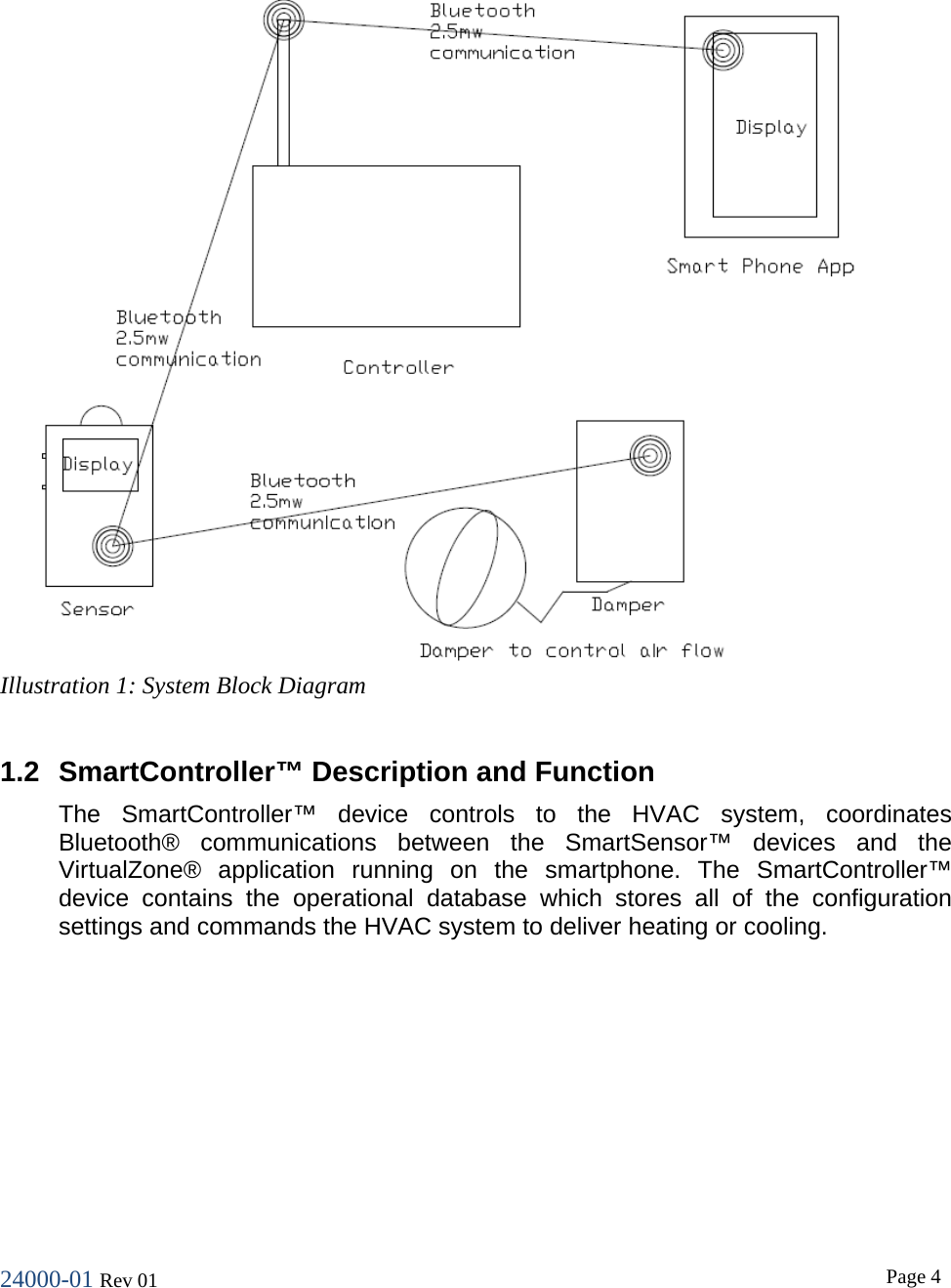
24000-01 Rev 01  Page 4      1.2 SmartController™ Description and Function The SmartController™ device controls to the HVAC system, coordinates Bluetooth® communications between the SmartSensor™ devices and the VirtualZone® application running on the smartphone. The SmartController™ device contains the operational database which stores all of the configuration settings and commands the HVAC system to deliver heating or cooling. Illustration 1: System Block Diagram
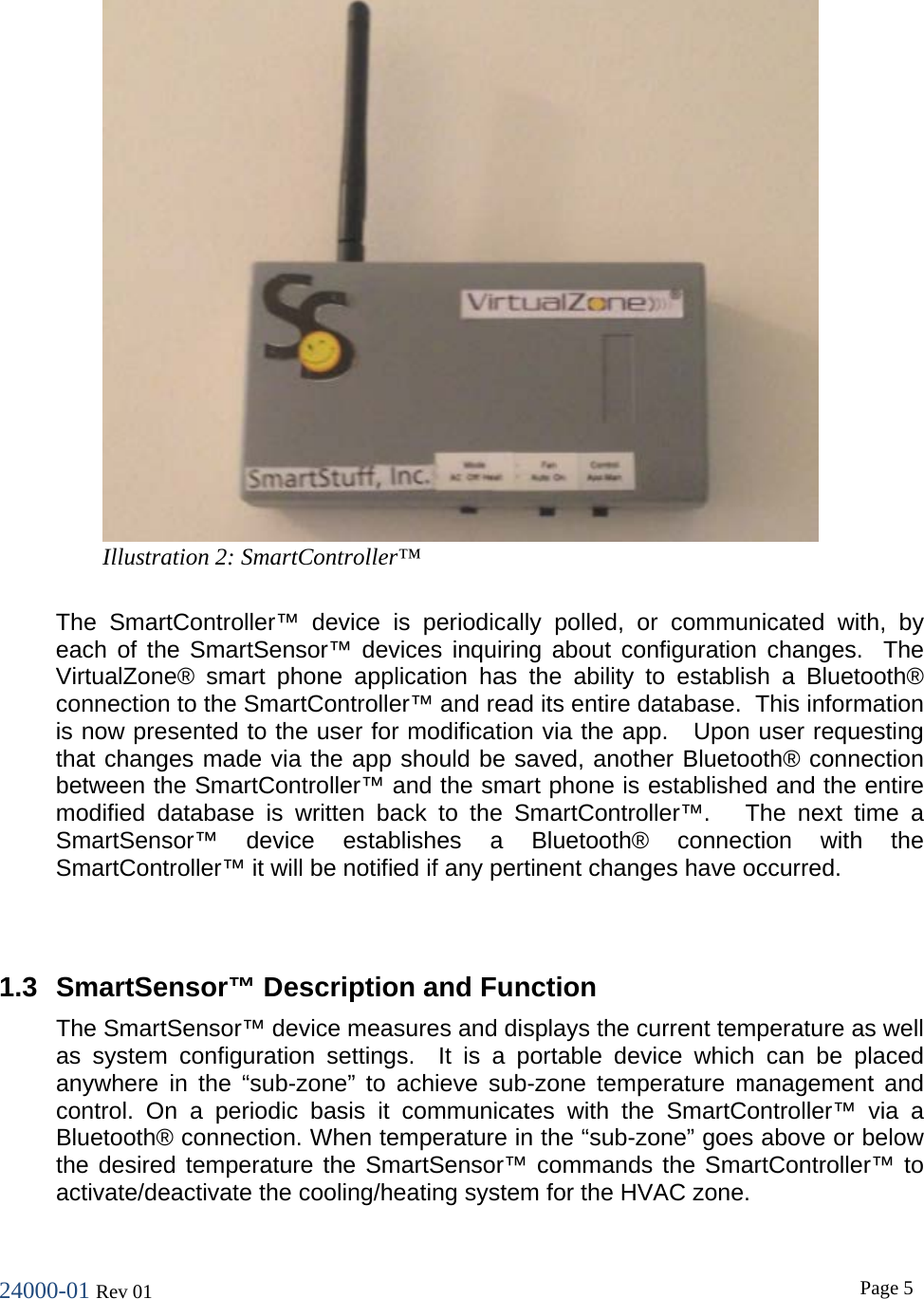
24000-01 Rev 01  Page 5   The SmartController™ device is periodically polled, or communicated with, by each of the SmartSensor™ devices inquiring about configuration changes.  The VirtualZone® smart phone application has the ability to establish a Bluetooth® connection to the SmartController™ and read its entire database.  This information is now presented to the user for modification via the app.   Upon user requesting that changes made via the app should be saved, another Bluetooth® connection between the SmartController™ and the smart phone is established and the entire modified database is written back to the SmartController™.   The next time a SmartSensor™ device establishes a Bluetooth® connection with the SmartController™ it will be notified if any pertinent changes have occurred.   1.3 SmartSensor™ Description and Function The SmartSensor™ device measures and displays the current temperature as well as system configuration settings.  It is a portable device which can be placed anywhere in the “sub-zone” to achieve sub-zone temperature management and control. On a periodic basis it communicates with the SmartController™ via a Bluetooth® connection. When temperature in the “sub-zone” goes above or below the desired temperature the SmartSensor™ commands the SmartController™ to activate/deactivate the cooling/heating system for the HVAC zone.  Illustration 2: SmartController™
24000-01 Rev 01  Page 6    1.4 SmartDamper™ Description and Function The SmartDamper™ is a duct insert and plastic enclosure that controls operation of the damper. It is placed in-line in the duct work and controls the airflow into its designated sub-zone. The SmartDamper™ can, on command, restrict or allow airflow to the “sub-zone”. On a needed basis it communicated with by the SmartSensor™ over Bluetooth®.  When the SmartSensor™ device determines that airflow is needed into the sub-zone, it commands the SmartDamper™ to open which allows airflow into the “sub-zone”.  Conversely, when the SmartSensor™ device determines that airflow is no longer necessary in the sub-zone, it commands the SmartDamper™ to close thus preventing airflow into the “sub-zone”.    Illustration 3: SmartSensor™
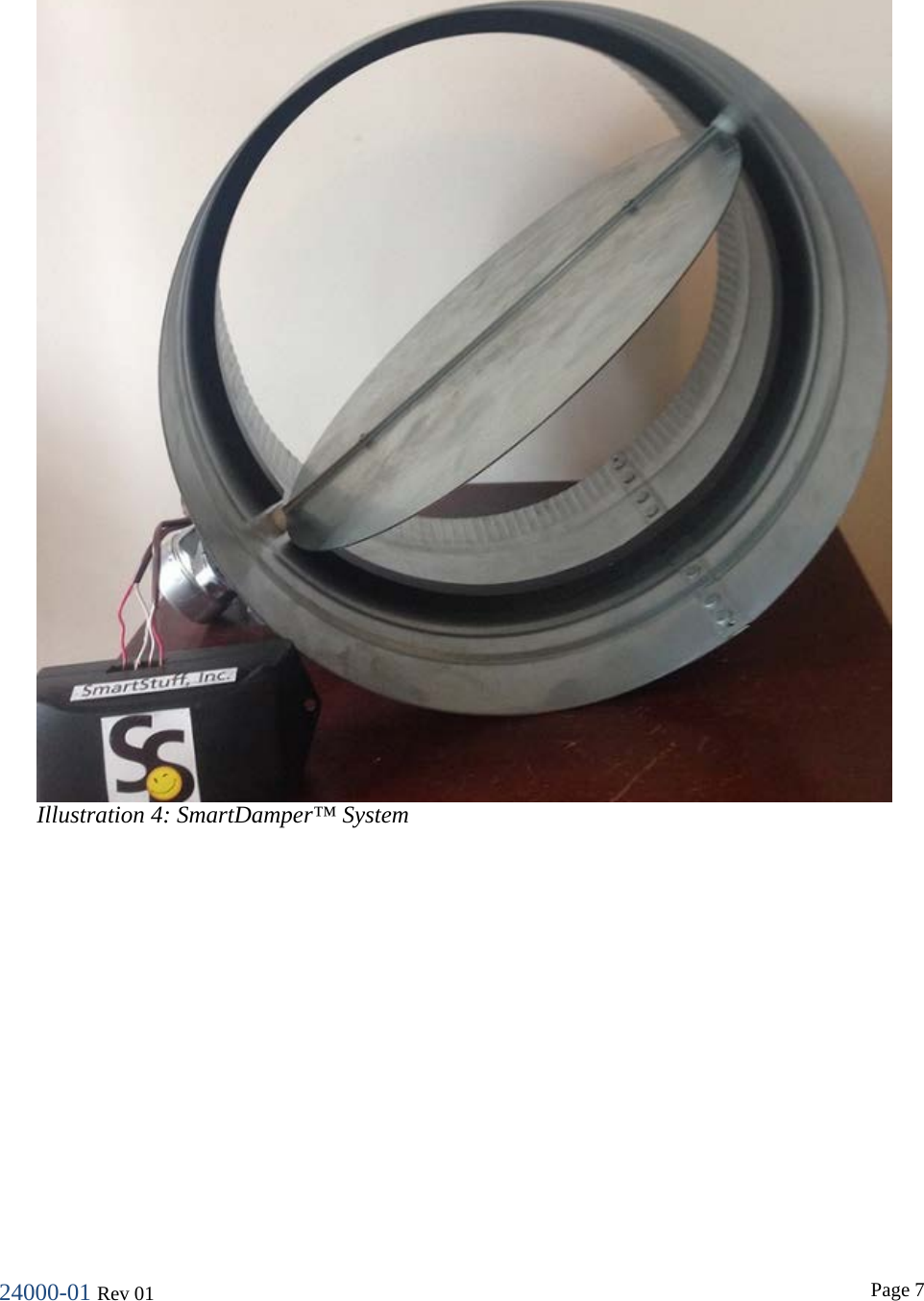
24000-01 Rev 01  Page 7    Illustration 4: SmartDamper™ System
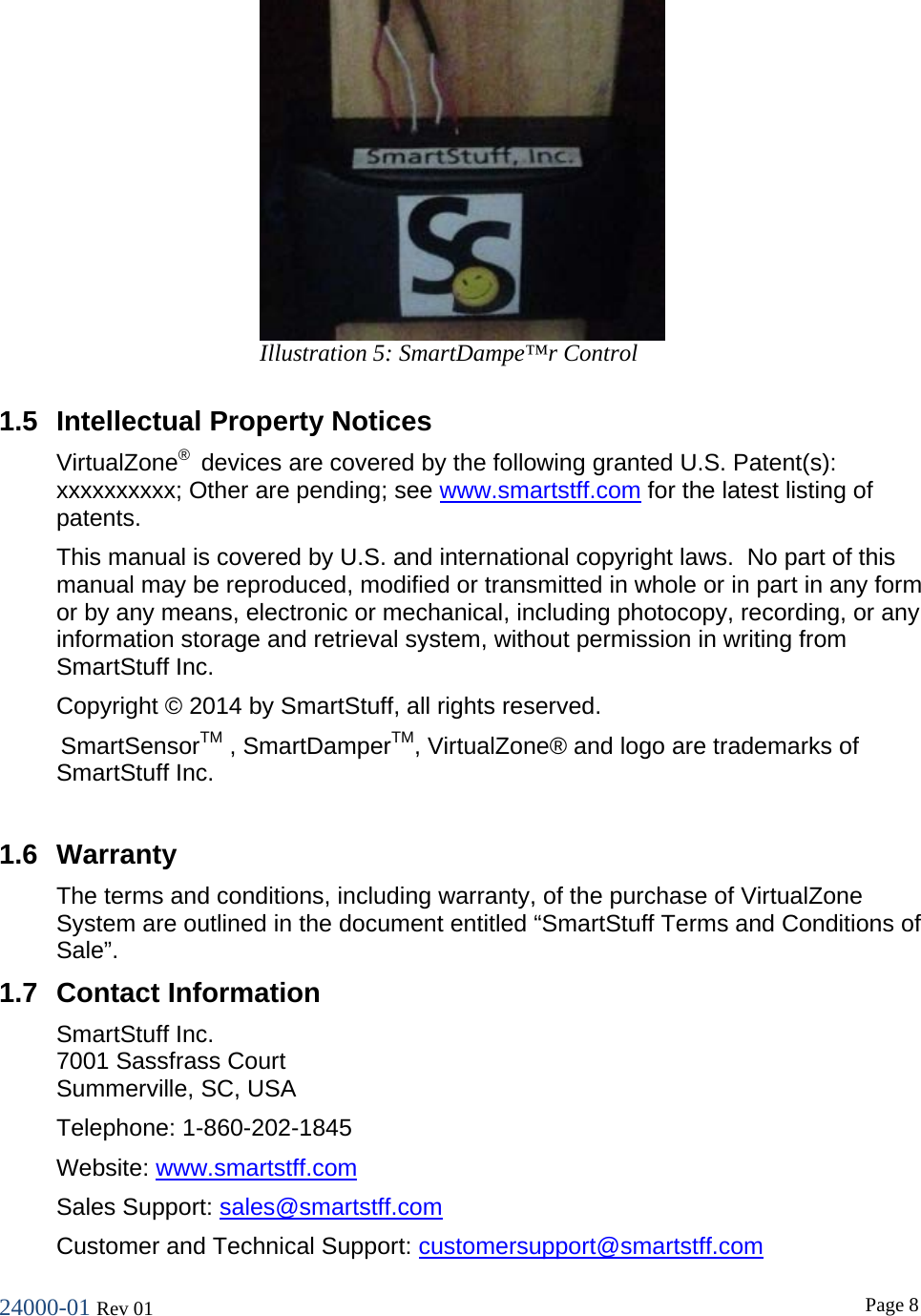
24000-01 Rev 01  Page 8   1.5 Intellectual Property Notices VirtualZone®  devices are covered by the following granted U.S. Patent(s): xxxxxxxxxx; Other are pending; see www.smartstff.com for the latest listing of patents. This manual is covered by U.S. and international copyright laws.  No part of this manual may be reproduced, modified or transmitted in whole or in part in any form or by any means, electronic or mechanical, including photocopy, recording, or any information storage and retrieval system, without permission in writing from SmartStuff Inc. Copyright © 2014 by SmartStuff, all rights reserved.  SmartSensorTM , SmartDamperTM, VirtualZone® and logo are trademarks of SmartStuff Inc.  1.6 Warranty The terms and conditions, including warranty, of the purchase of VirtualZone System are outlined in the document entitled “SmartStuff Terms and Conditions of Sale”. 1.7 Contact Information SmartStuff Inc. 7001 Sassfrass Court Summerville, SC, USA  Telephone: 1-860-202-1845 Website: www.smartstff.com Sales Support: sales@smartstff.com Customer and Technical Support: customersupport@smartstff.com Illustration 5: SmartDampe™r Control
24000-01 Rev 01  Page 9   2  EQUIPMENT SAFETY COMPLIANCE 2.1 North American Emissions This equipment is compliant with Class B limits for radiated and conducted radio noise emissions, as defined in Subpart B of Part 15 of the FCC rules.  FCC Radiation Exposure Statement  This equipment complies with FCC RF radiation exposure limits set forth for an uncontrolled environment. This transmitter must not be co-located or operating in conjunction with any other antenna or transmitter.  This device complies with Part 15 of the FCC Rules, operation is subject to the following two conditions: (1) This device may not cause harmful interference, and (2) this device must accept any interference received, including interference that may cause undesired operation  • Warning: Changes or modifications to this unit not expressly approved by the party responsible for compliance could void the user’s authority to operate the equipment. • NOTE: This equipment has been tested and found to comply with the limits for a Class B digital device, pursuant to Part 15 of the FCC Rules. These limits are designed to provide reasonable protection against harmful interference in a residential installation. This equipment generates, uses and can radiate radio frequency energy and, if not installed and used in accordance with the instructions, may cause harmful interference to radio communications.  However, there is no guarantee that interference will not occur in a particular installation. If this equipment does cause harmful interference to radio or television reception, which can be determined by turning the equipment off and on, the user is encouraged to try to correct the interference by one or more of the following measures: • Reorient or relocate the SmartSensorTM.  • Increase the separation between the equipment and SmartSensorTM.
24000-01 Rev 01  Page 10   3  GENERAL SAFETY GUIDELINES 3.1 Introduction This manual is intended to be a general installation guide for the VirtualZone® Zone Temperature Control System.  It is not intended to cover the installation details for every application due to the wide variety of installations on which the system can be used.  In all cases, local safety and operating practices should take precedence over instructions contained within this manual. The installer must fully read this manual prior to installing and operating the VirtualZone® Climate Control System. 3.2 Safety Precautions The following style of Warnings and Cautions are used throughout the manual to draw attention to information regarding personnel safety and equipment care.  They are intended to supplement but not replace local or plant safety procedures.  WARNING Situation has the potential to cause bodily injury.   CAUTION Situation has the potential to cause damage to property or equipment.  3.3 Definitions of Symbols The following terms and symbols are used in this document and on the passive sonar meter where safety related issues occur. 3.3.1 General Warning or Caution    Figure 1 General Warning or Caution Symbol The Exclamation Symbol in Figure 1 appears in Warning and Caution tables throughout this document.  This symbol designates an area where personal injury or damage to the equipment is possible.
24000-01 Rev 01  Page 11  3.3.2 General Warnings and Cautions Observe these rules when operating or servicing this equipment:  • Prior to operation of this equipment, read the instruction manual thoroughly. • Follow all warnings on the unit and in the operating instructions. • This product should only be powered as described in the manual.  Read the instructions for proper input voltage range selection. • Ensure all power cords, and interface cables are properly routed to eliminate damage to them.  Cable conduit may be desirable to minimize potential damage. • Use only manufacturer specified replacement parts. • Follow static sensitive device precautions when installing.
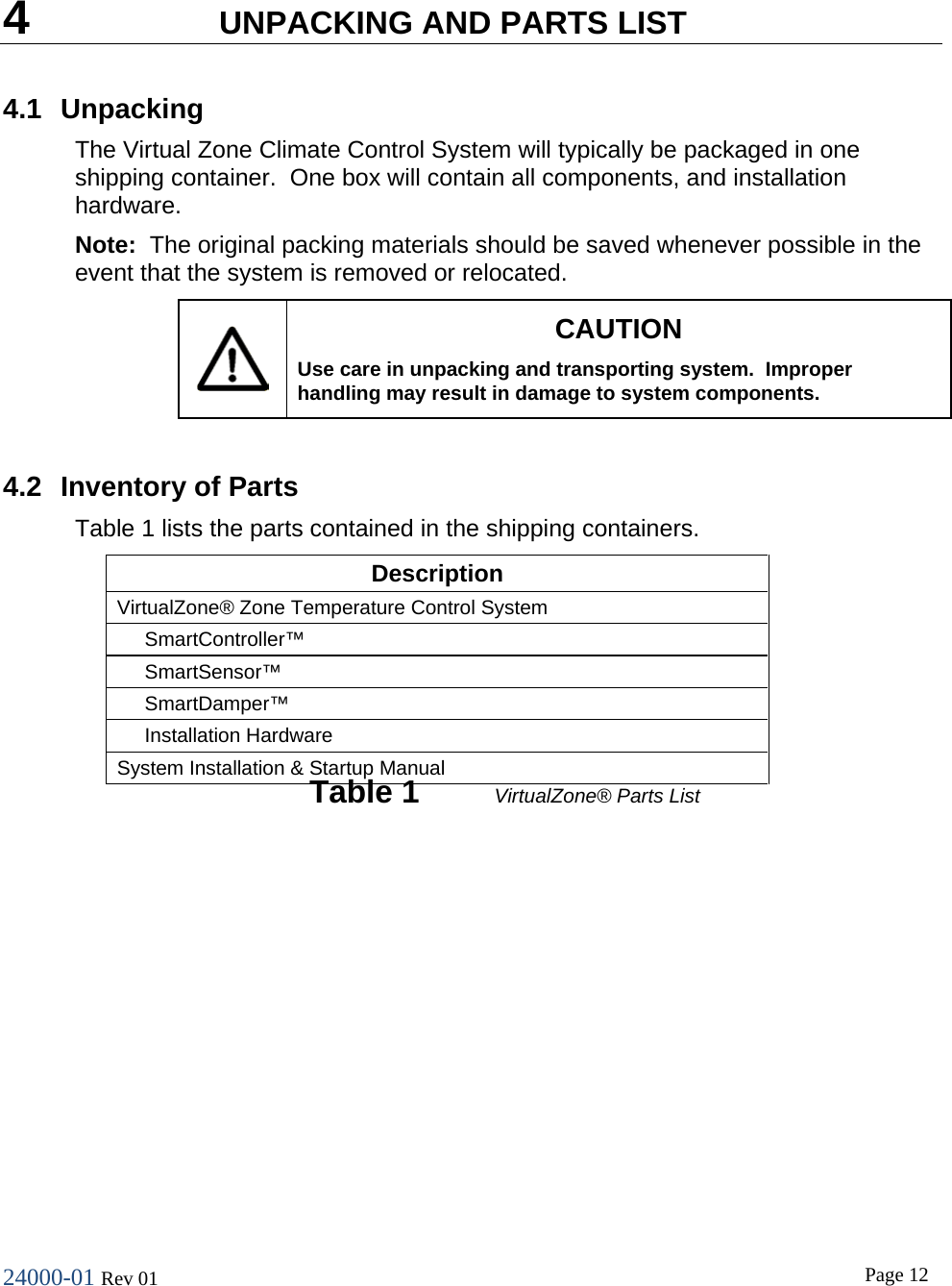
24000-01 Rev 01  Page 12   4  UNPACKING AND PARTS LIST 4.1 Unpacking The Virtual Zone Climate Control System will typically be packaged in one shipping container.  One box will contain all components, and installation hardware. Note:  The original packing materials should be saved whenever possible in the event that the system is removed or relocated.  CAUTION Use care in unpacking and transporting system.  Improper handling may result in damage to system components.  4.2 Inventory of Parts Table 1 lists the parts contained in the shipping containers. Description VirtualZone® Zone Temperature Control System      SmartController™      SmartSensor™      SmartDamper™      Installation Hardware System Installation & Startup Manual  Table 1 VirtualZone® Parts List
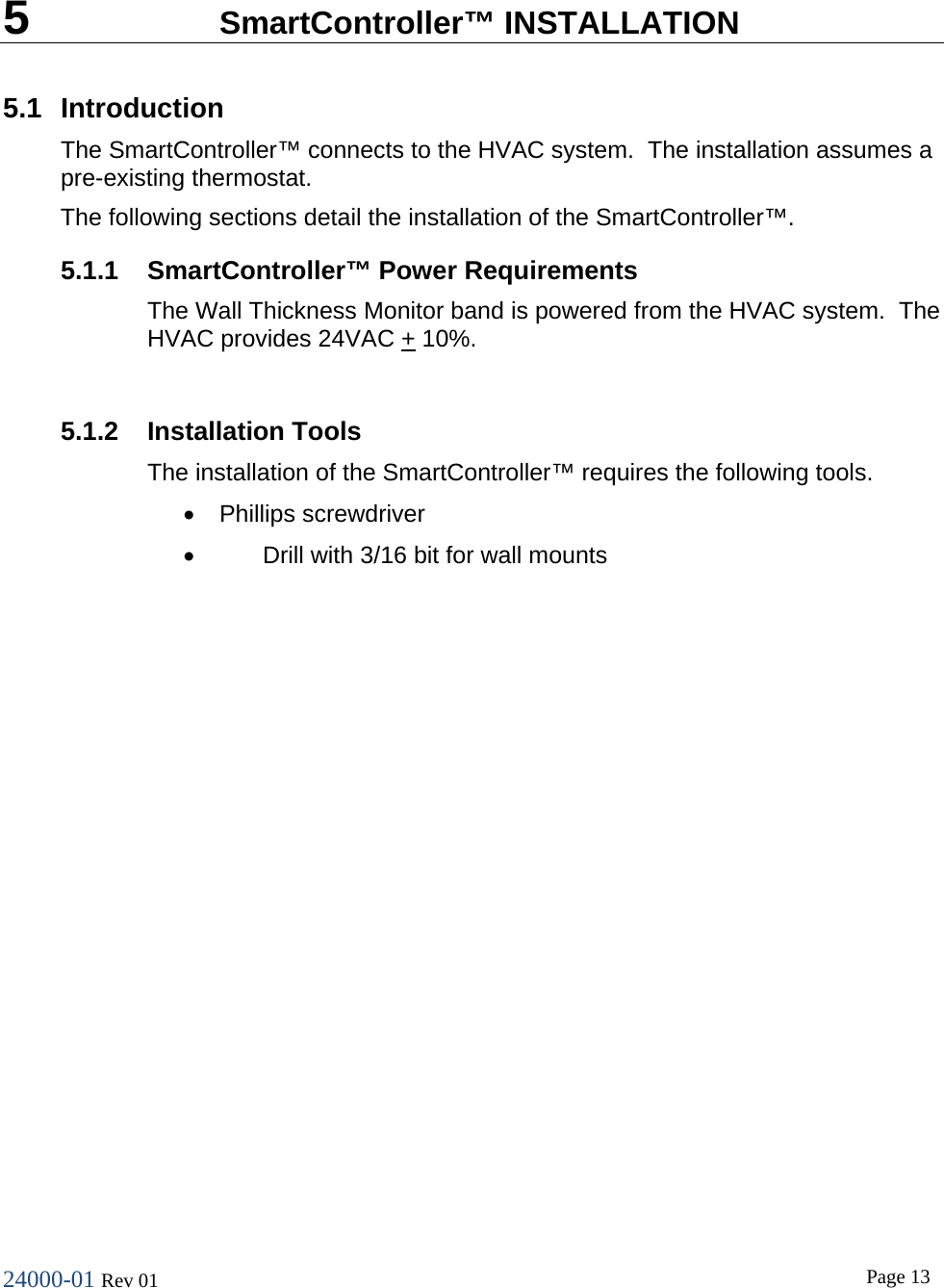
24000-01 Rev 01  Page 13   5  SmartController™ INSTALLATION 5.1 Introduction The SmartController™ connects to the HVAC system.  The installation assumes a pre-existing thermostat. The following sections detail the installation of the SmartController™. 5.1.1 SmartController™ Power Requirements The Wall Thickness Monitor band is powered from the HVAC system.  The HVAC provides 24VAC + 10%.  5.1.2 Installation Tools The installation of the SmartController™ requires the following tools. • Phillips screwdriver • Drill with 3/16 bit for wall mounts
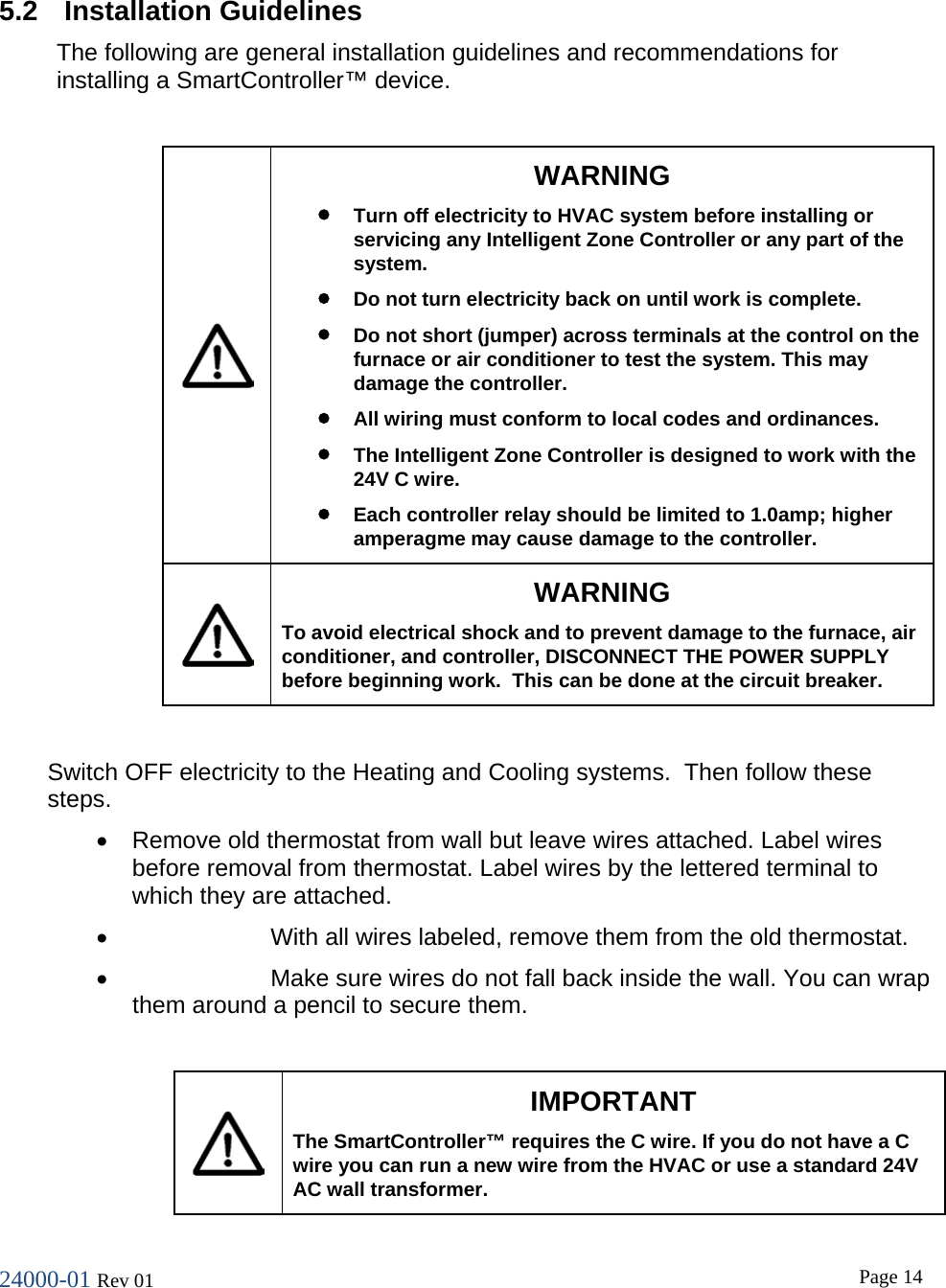
24000-01 Rev 01  Page 14   5.2   Installation Guidelines The following are general installation guidelines and recommendations for installing a SmartController™ device.   WARNING • Turn off electricity to HVAC system before installing or servicing any Intelligent Zone Controller or any part of the system. • Do not turn electricity back on until work is complete. • Do not short (jumper) across terminals at the control on the furnace or air conditioner to test the system. This may damage the controller. • All wiring must conform to local codes and ordinances. • The Intelligent Zone Controller is designed to work with the 24V C wire. • Each controller relay should be limited to 1.0amp; higher amperagme may cause damage to the controller.   WARNING To avoid electrical shock and to prevent damage to the furnace, air conditioner, and controller, DISCONNECT THE POWER SUPPLY before beginning work.  This can be done at the circuit breaker.  Switch OFF electricity to the Heating and Cooling systems.  Then follow these steps. • Remove old thermostat from wall but leave wires attached. Label wires before removal from thermostat. Label wires by the lettered terminal to which they are attached. • With all wires labeled, remove them from the old thermostat. • Make sure wires do not fall back inside the wall. You can wrap them around a pencil to secure them.   IMPORTANT The SmartController™ requires the C wire. If you do not have a C wire you can run a new wire from the HVAC or use a standard 24V AC wall transformer.
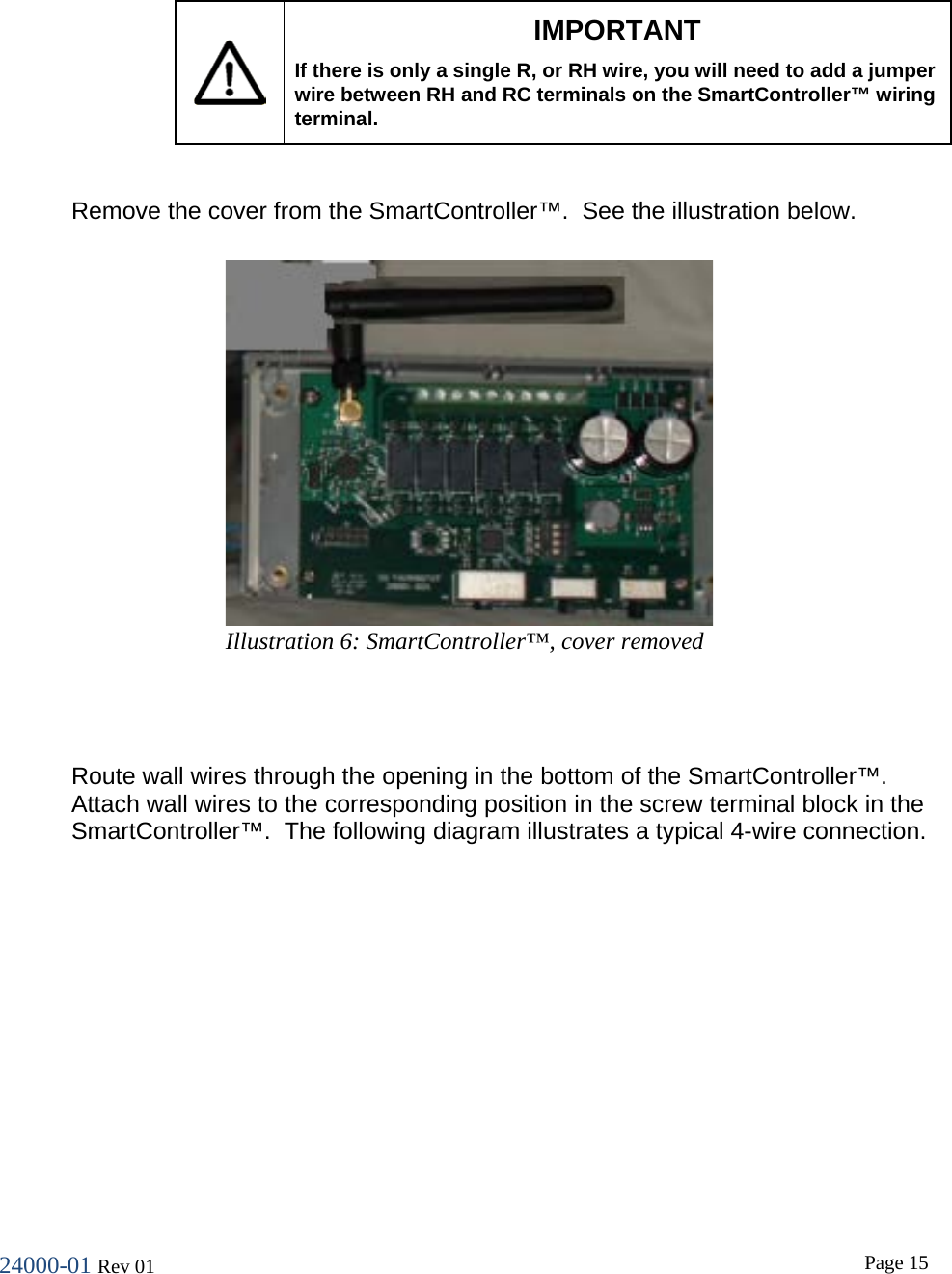
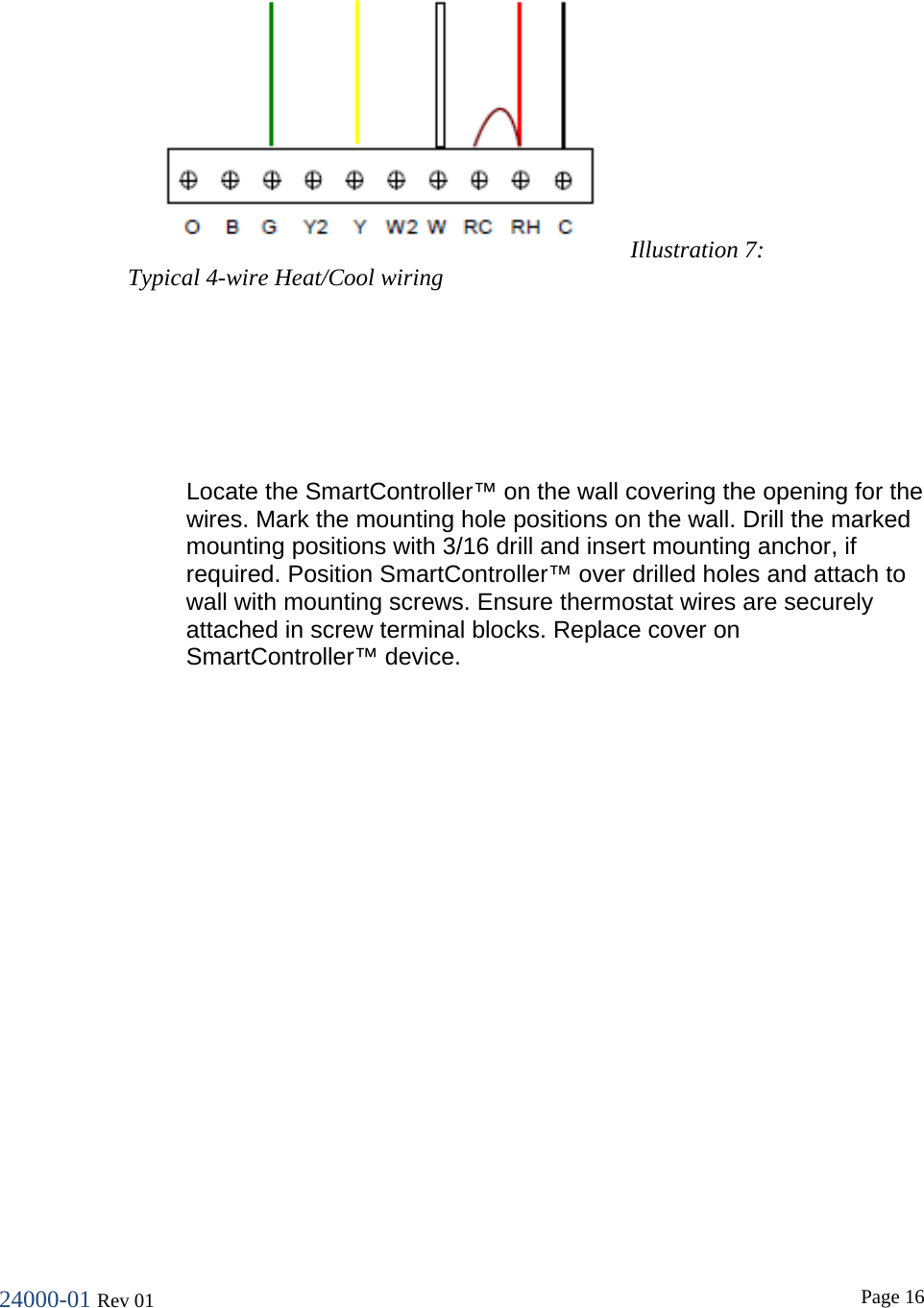
24000-01 Rev 01  Page 15     IMPORTANT If there is only a single R, or RH wire, you will need to add a jumper wire between RH and RC terminals on the SmartController™ wiring terminal.  Remove the cover from the SmartController™.  See the illustration below.   Route wall wires through the opening in the bottom of the SmartController™. Attach wall wires to the corresponding position in the screw terminal block in the SmartController™.  The following diagram illustrates a typical 4-wire connection.  Illustration 6: SmartController™, cover removed
24000-01 Rev 01  Page 16    Locate the SmartController™ on the wall covering the opening for the wires. Mark the mounting hole positions on the wall. Drill the marked mounting positions with 3/16 drill and insert mounting anchor, if required. Position SmartController™ over drilled holes and attach to wall with mounting screws. Ensure thermostat wires are securely attached in screw terminal blocks. Replace cover on SmartController™ device. Illustration 7: Typical 4-wire Heat/Cool wiring
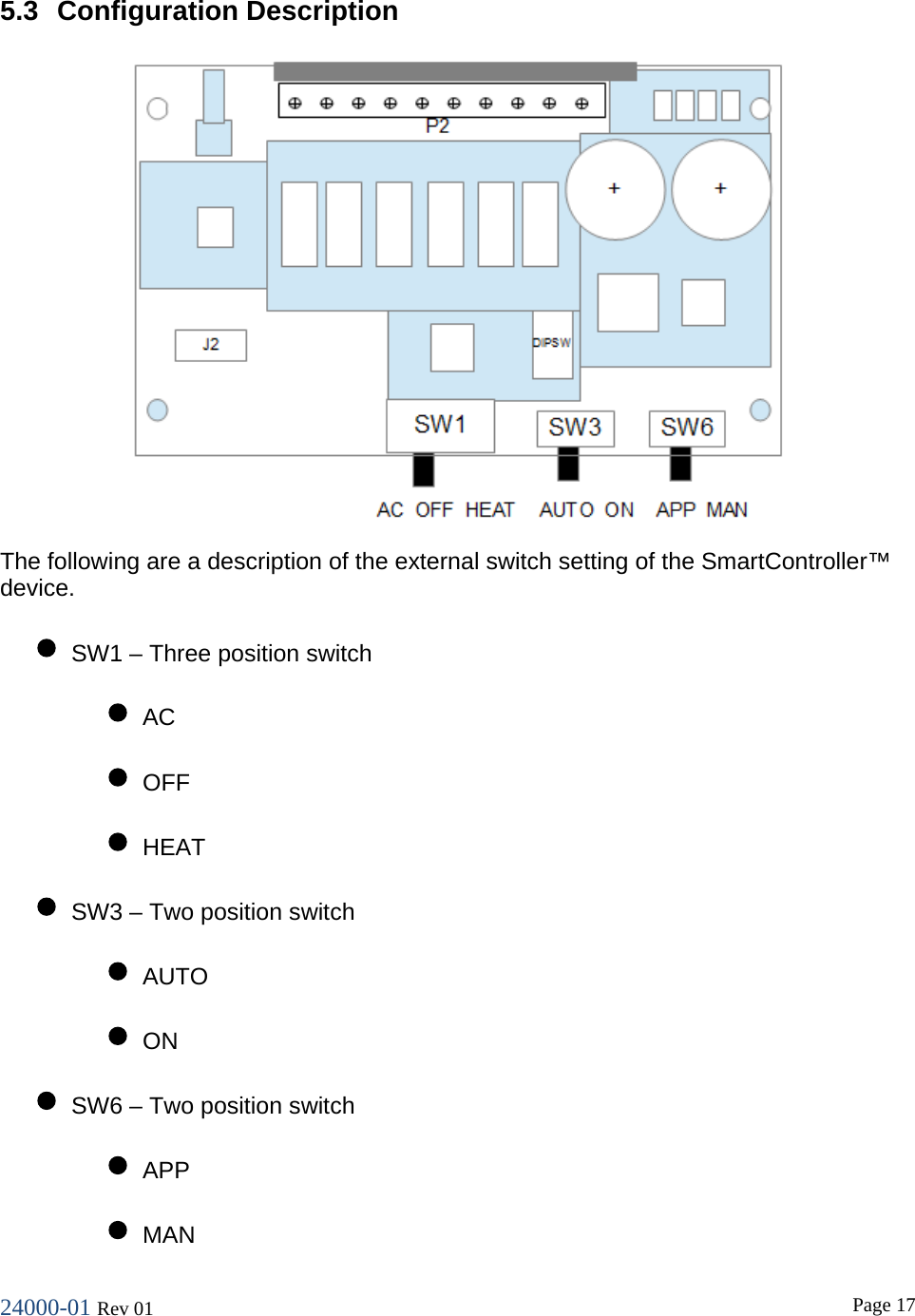
24000-01 Rev 01  Page 17  5.3 Configuration Description The following are a description of the external switch setting of the SmartController™ device. • SW1 – Three position switch • AC • OFF • HEAT • SW3 – Two position switch • AUTO • ON • SW6 – Two position switch • APP • MAN
24000-01 Rev 01  Page 18    6  SmartDamper™ Installation 6.1 Introduction The SmartDamper™ consists of two elements, Duct Insert and Damper Controller.  The electronics in the Damper Controller communicates with the SmartSensor™, which command open or close of the Damper, and energizes the motor on the Duct Insert to open or close the damper. 6.1.1 SmartDamper™ Power Requirements The Duct Insert and Damper Controller are powered from a standard 110V AC line which is connected to the included low voltage transformer.  The transformer low voltage AC output voltage is +24VAC + 20%.  The Duct Insert and Damper Controller require less than 100mA. 6.1.2 Required Tools The required tools for Smart Damper Installation. • Phillips screwdriver
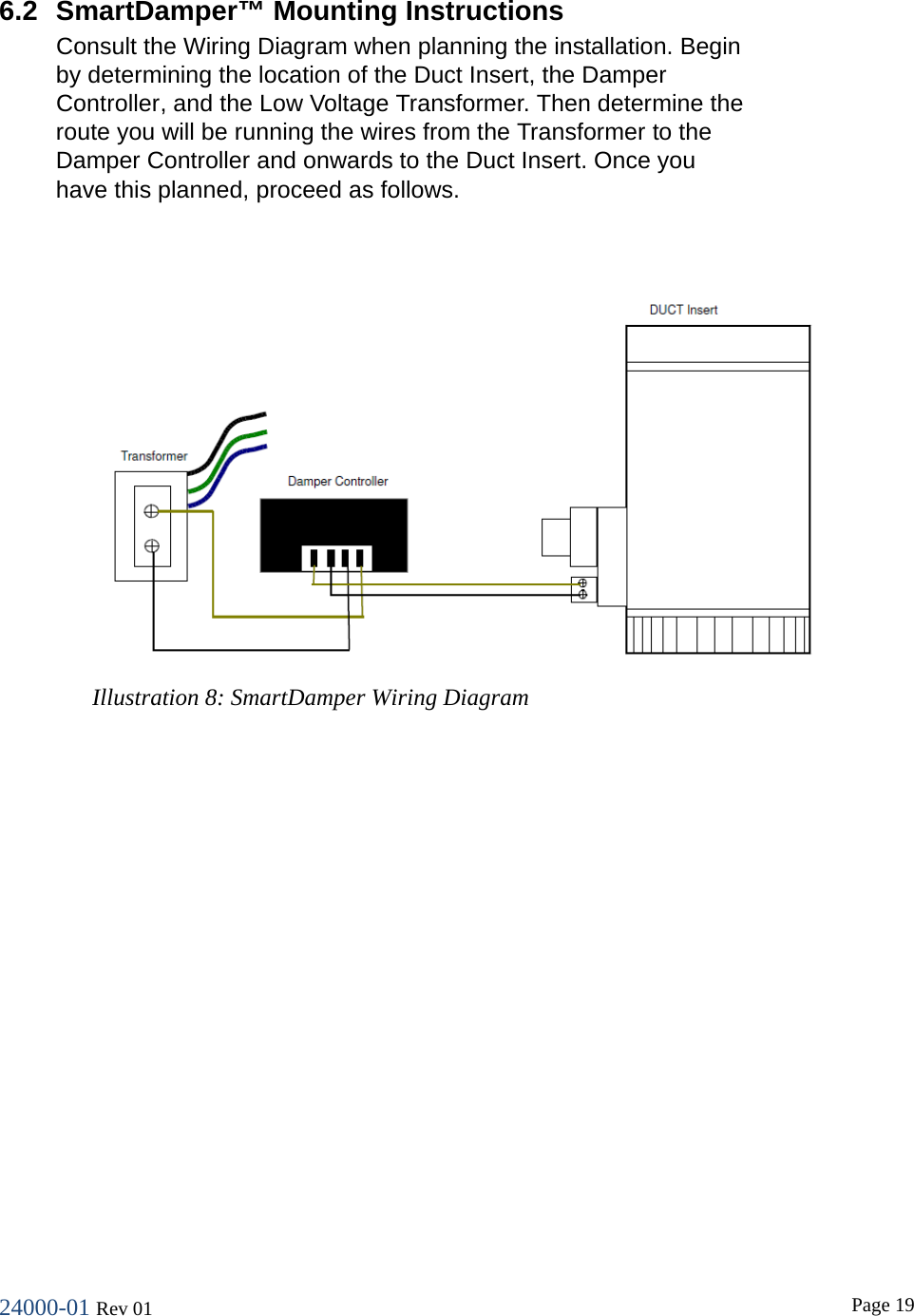
24000-01 Rev 01  Page 19  6.2 SmartDamper™ Mounting Instructions Consult the Wiring Diagram when planning the installation. Begin by determining the location of the Duct Insert, the Damper Controller, and the Low Voltage Transformer. Then determine the route you will be running the wires from the Transformer to the Damper Controller and onwards to the Duct Insert. Once you have this planned, proceed as follows.                Illustration 8: SmartDamper Wiring Diagram
24000-01 Rev 01  Page 20   6.2.1 Duct Insert Installation For metal duct, remove a 6” (15 cm) section of duct at an existing joint so you will have one crimped duct end and one straight duct end. Slide the Duct Insert unit in place so that the ends are inserted at least 1” (2.5 cm) at each end. The Duct Insert is  non-directional so it  may be installed facing either direction of the airflow. Rotate the Duct Insert so that you can easily access the electric terminal block. Complete the installation by securing the Duct Insert with the #6 sheet metal screws  supplied. Finish the  installation  by covering the seams in the duct with a good quality aluminum foil duct tape.  For flexible duct, cut the flexible duct and slide the ends over the ends of the Damper unit. You will need to support the Damper with a couple of standard duct supports available at Home Centers. Complete the installation by securing the Damper to the flexible duct with a good quality aluminum foil duct tape or nylon cable ties. 6.2.2 Damper Controller Installation Locate the Damper Controller at a convenient mounting location within 5’ (1.5 m) from the Duct Insert.  6.2.3  Transformer installation: IMPORTANT WARNING: Locate the breaker on your house power panel that controls the 110/120 Volt AC supply to the wires in the junction box that you selected to mount the Transformer on. Use a voltage detector, Volt Meter or other suitable instrument to make sure that all power to that junction box is OFF. Identify an existing wiring junction box near the location desired. Verify that the correct wires are available in this box. There needs to be: Black wire (line or hot), White wire (neutral) and a Green or bare copper wire (ground). The cover plate of that junction box must have a “knockout”. This “knockout” must be removed to make the hole for the stud of the Transformer to mount through. Thread the Transformer leads through the hole and securely mount the Transformer to the cover plate. Tighten the nut snug only. WARNING: Over-
24000-01 Rev 01  Page 21  tightening will break the plastic stud of the Transformer. DO NOT connect the Transformer wires at this time. 6.2.4  Low voltage wiring: Refer to the wiring diagram in Illustration: 9  for electrical connections. It is recommended that you leave at least 1’ (30 cm) of slack wire at each component wired to ease future servicing. 1. Run one wire from either Transformer low voltage terminal to either of the two right most screw terminal positions  on the Damper Controller. 2. Run one wire from the other Transformer low voltage terminal to the other of the 2 right most screw terminal positions on the Damper Controller. 3. Run one wire from the one of the two left most screw  terminal positions on the Damper Controller to one of the  terminals on the Duct Insert. 4. Run one wire from the other of the two left most screw terminal positions on the Dampe Controller to the remaining therminal on the Duct Insert.  THE WIRING IS NOT POLARITY SENSITIVE CONNECT EITHER SCREW ON TERMINAL BLOCK OR TRANSFORMER.  6.2.5  The final steps: 1. Connect the Transformer 110/120 Volt wires inside the junction box. See IMPORTANT WARNINGS above! 2. Connect the GREEN wire from the Transformer to the GREEN or bare copper wire inside the junction box. 3. Connect either of the BLACK wires of the Transformer to the WHITE wire inside the junction box. 4. Connect the remaining BLACK wire of the Transformer to the BLACK wire inside the junction box. 5. Place the cover (with the Transformer mounted to it) on the junction box, making sure that no wires are pinched between the cover and the junction box. 6. Now review your installation. If you are positive that everything has been installed safely and securely, you may turn on the breaker on your house power panel.
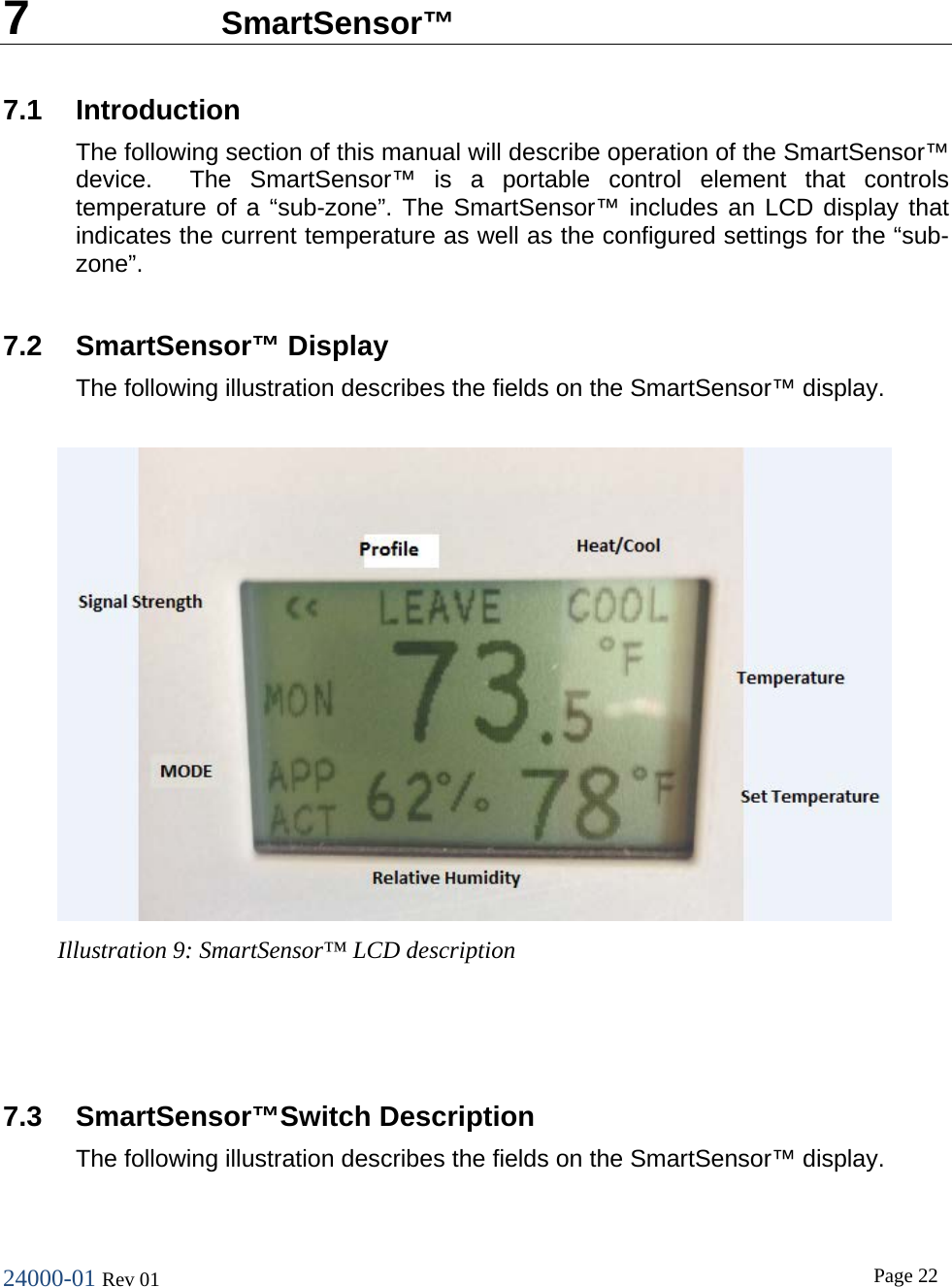
24000-01 Rev 01  Page 22   7  SmartSensor™ 7.1 Introduction The following section of this manual will describe operation of the SmartSensor™ device.  The SmartSensor™ is a portable control element that controls temperature of a “sub-zone”. The SmartSensor™ includes an LCD display that indicates the current temperature as well as the configured settings for the “sub-zone”.  7.2 SmartSensor™ Display The following illustration describes the fields on the SmartSensor™ display.    7.3 SmartSensor™Switch Description The following illustration describes the fields on the SmartSensor™ display.  Illustration 9: SmartSensor™ LCD description
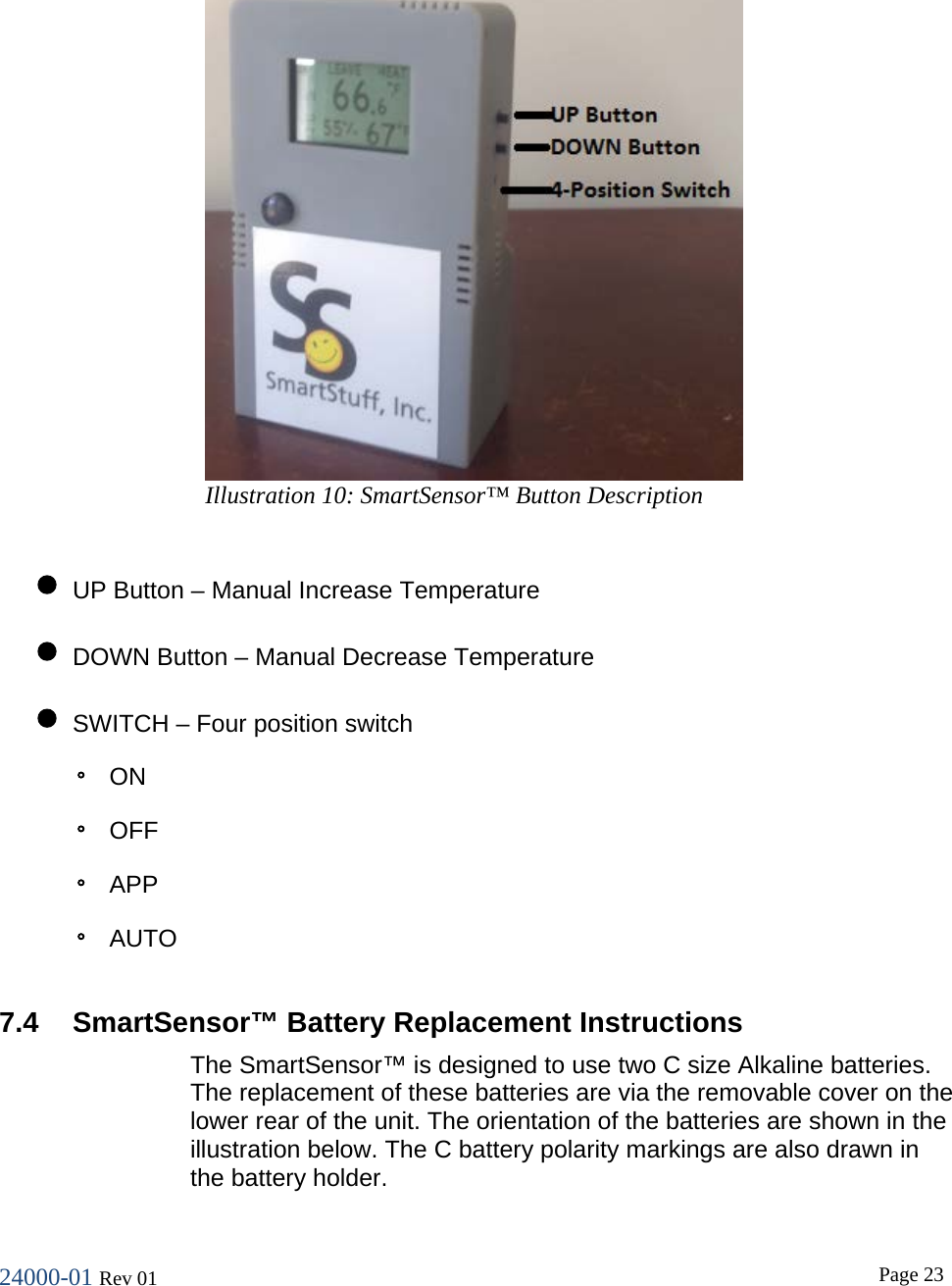
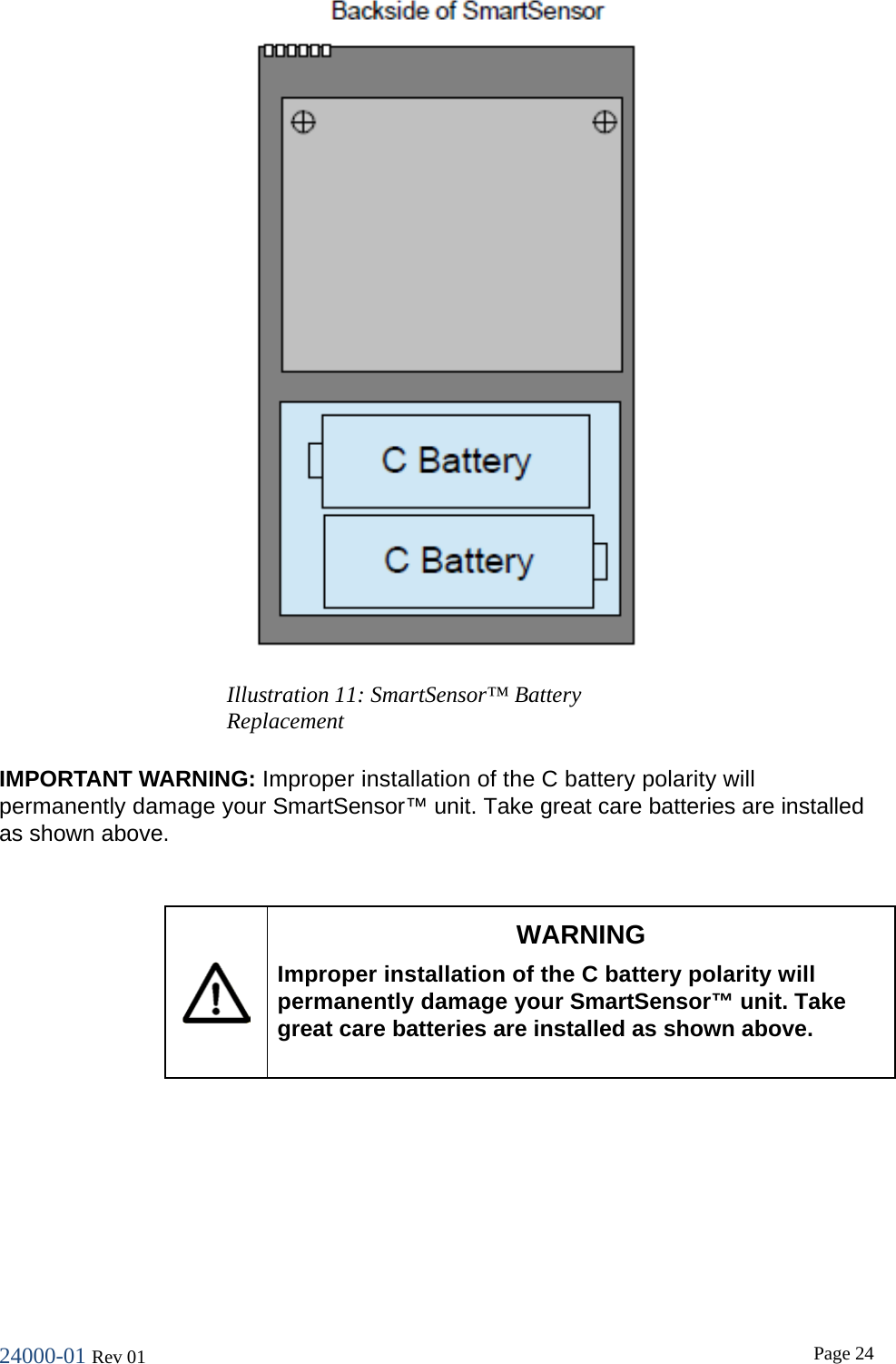
24000-01 Rev 01  Page 23   • UP Button – Manual Increase Temperature • DOWN Button – Manual Decrease Temperature • SWITCH – Four position switch ◦ ON ◦ OFF ◦ APP ◦ AUTO  7.4 SmartSensor™ Battery Replacement Instructions The SmartSensor™ is designed to use two C size Alkaline batteries. The replacement of these batteries are via the removable cover on the lower rear of the unit. The orientation of the batteries are shown in the illustration below. The C battery polarity markings are also drawn in the battery holder. Illustration 10: SmartSensor™ Button Description
24000-01 Rev 01  Page 24   IMPORTANT WARNING: Improper installation of the C battery polarity will permanently damage your SmartSensor™ unit. Take great care batteries are installed as shown above.    WARNING Improper installation of the C battery polarity will permanently damage your SmartSensor™ unit. Take great care batteries are installed as shown above.       Illustration 11: SmartSensor™ Battery Replacement
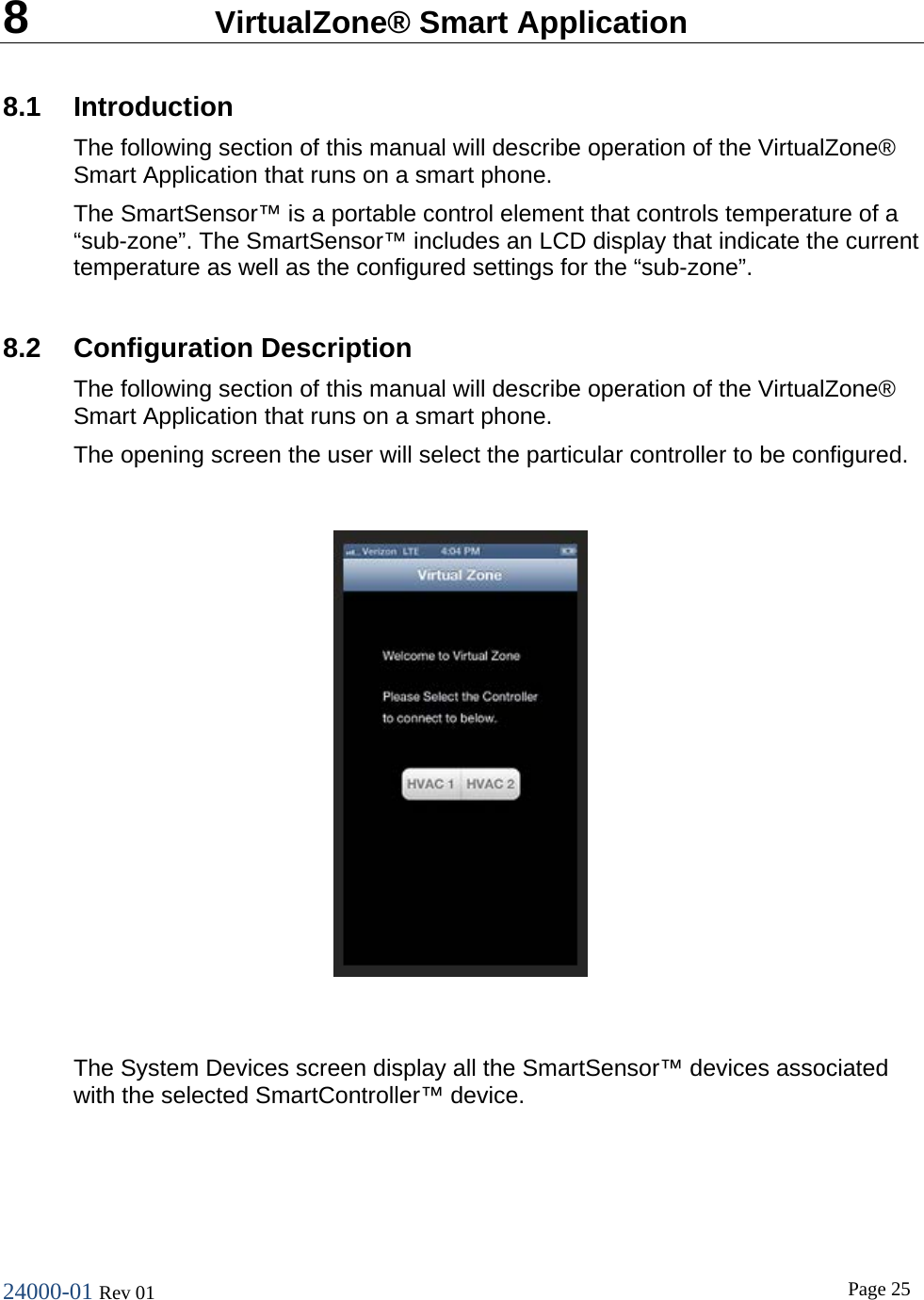
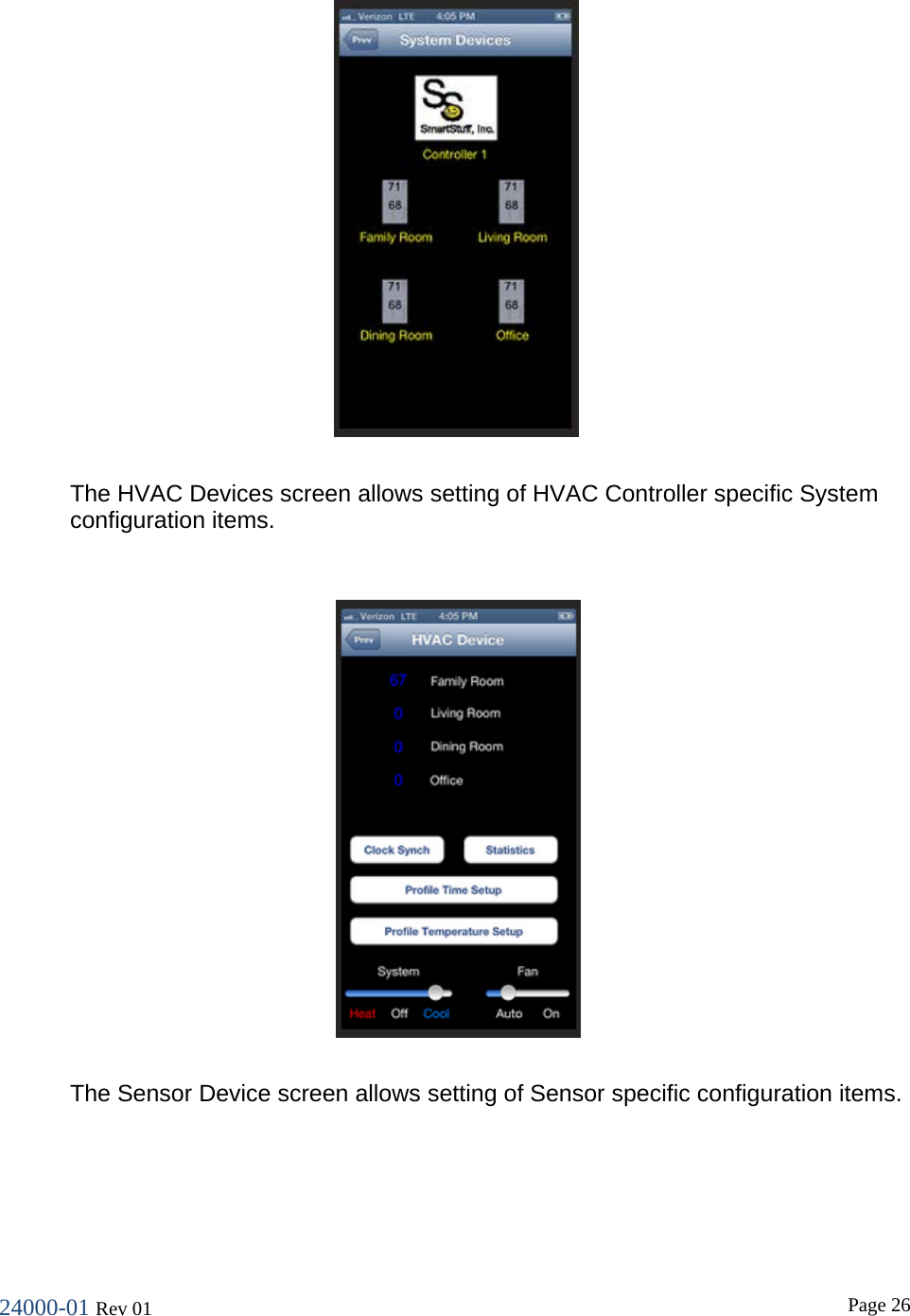
24000-01 Rev 01  Page 25  8  VirtualZone® Smart Application  8.1 Introduction The following section of this manual will describe operation of the VirtualZone® Smart Application that runs on a smart phone. The SmartSensor™ is a portable control element that controls temperature of a “sub-zone”. The SmartSensor™ includes an LCD display that indicate the current temperature as well as the configured settings for the “sub-zone”.  8.2 Configuration Description The following section of this manual will describe operation of the VirtualZone® Smart Application that runs on a smart phone. The opening screen the user will select the particular controller to be configured.    The System Devices screen display all the SmartSensor™ devices associated with the selected SmartController™ device.
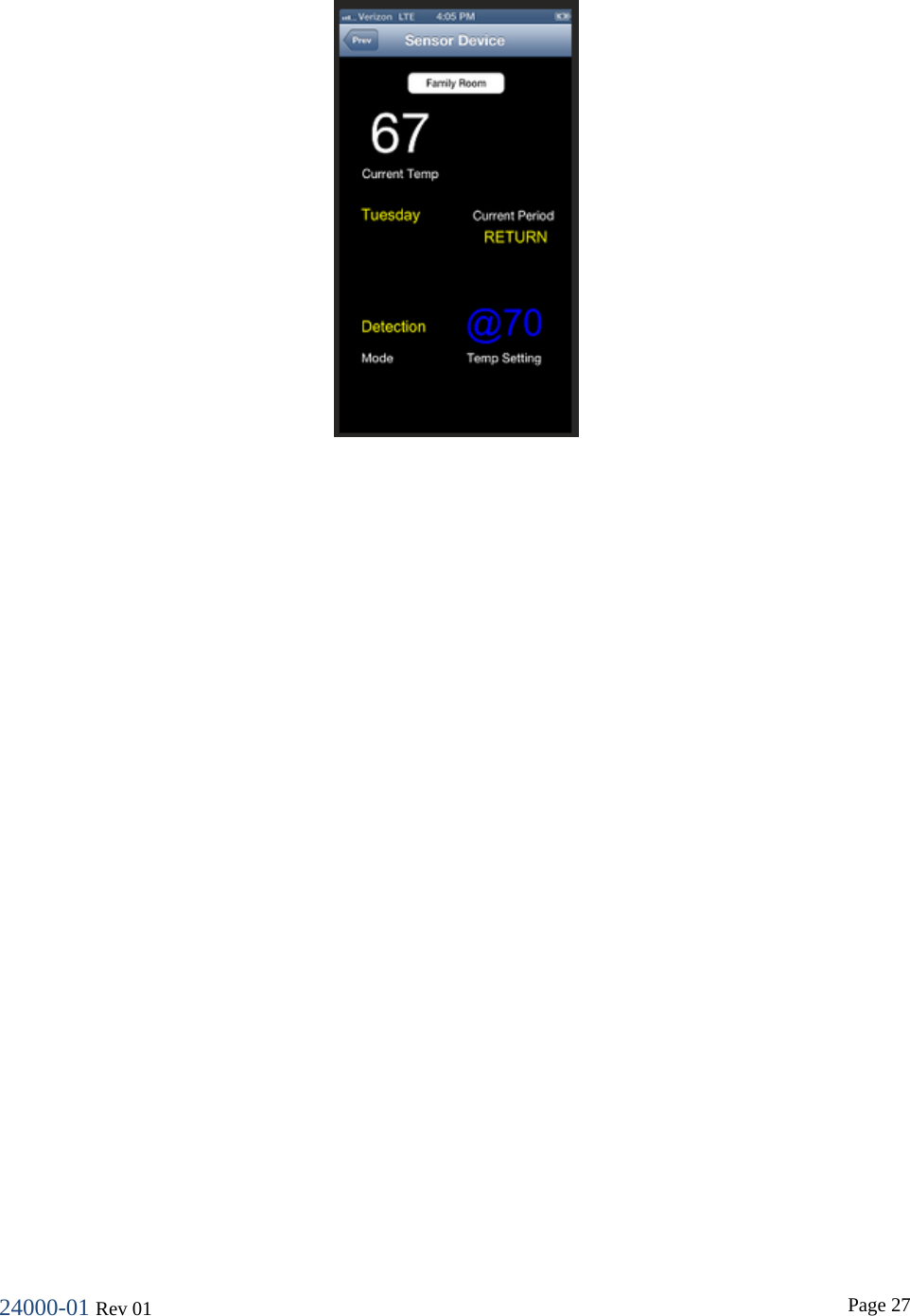
24000-01 Rev 01  Page 26   The HVAC Devices screen allows setting of HVAC Controller specific System configuration items.   The Sensor Device screen allows setting of Sensor specific configuration items.
24000-01 Rev 01  Page 27
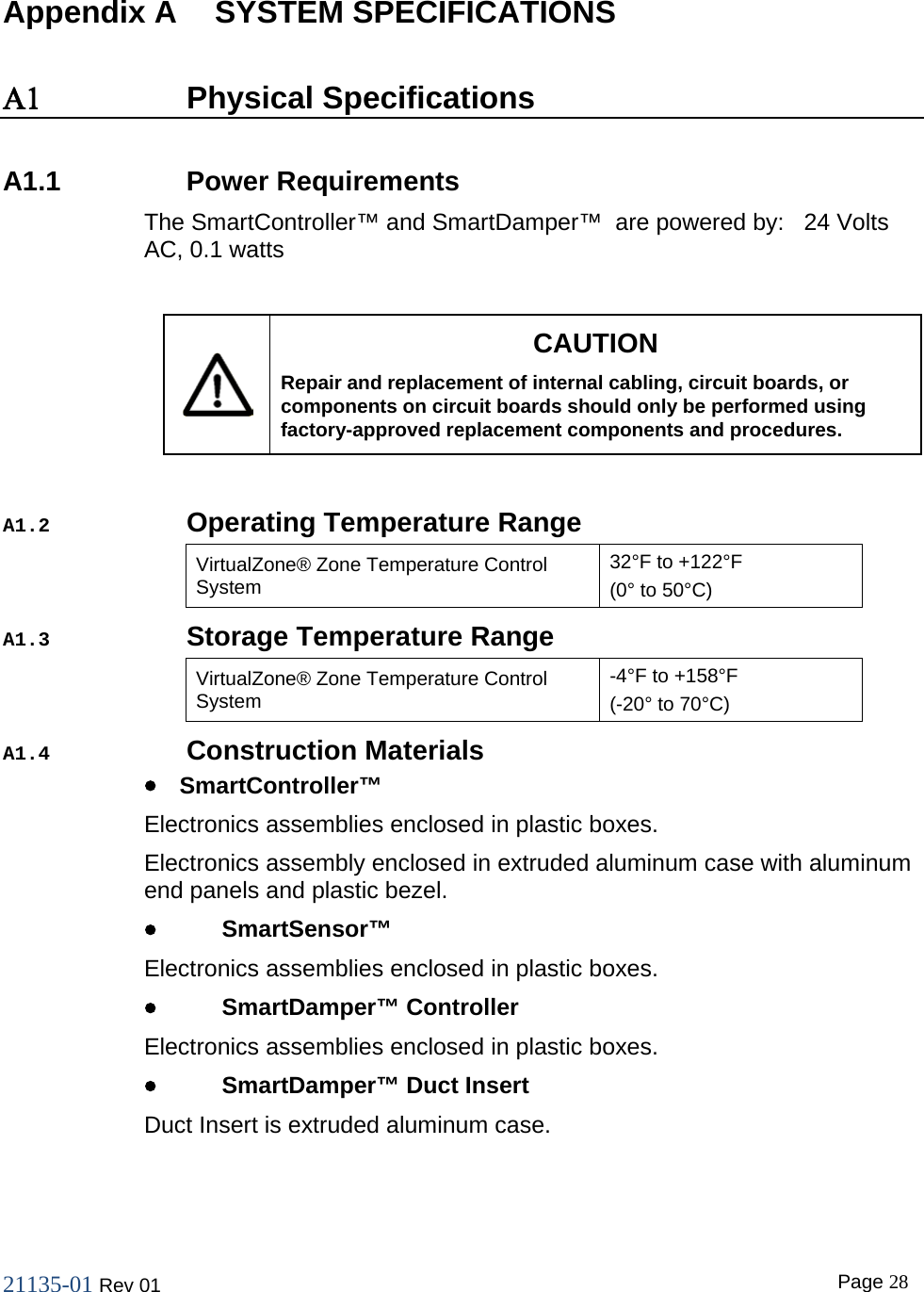
21135-01 Rev 01  Page 28  Appendix A   SYSTEM SPECIFICATIONS Α1 Physical Specifications A1.1 Power Requirements The SmartController™ and SmartDamper™  are powered by:   24 Volts AC, 0.1 watts   CAUTION Repair and replacement of internal cabling, circuit boards, or components on circuit boards should only be performed using factory-approved replacement components and procedures.   A1.2 Operating Temperature Range VirtualZone® Zone Temperature Control System 32°F to +122°F (0° to 50°C) A1.3 Storage Temperature Range VirtualZone® Zone Temperature Control System -4°F to +158°F  (-20° to 70°C) A1.4 Construction Materials • SmartController™ Electronics assemblies enclosed in plastic boxes. Electronics assembly enclosed in extruded aluminum case with aluminum end panels and plastic bezel. • SmartSensor™ Electronics assemblies enclosed in plastic boxes. • SmartDamper™ Controller Electronics assemblies enclosed in plastic boxes. • SmartDamper™ Duct Insert Duct Insert is extruded aluminum case.

Navigation menu