Starix Technology RTU7105-MOD-V3 Wireless USB Module User Manual RTU7105 Module V3 User s Manual
Realtek Semiconductor Corp. - Wionics Research Wireless USB Module RTU7105 Module V3 User s Manual
Users Guide
Wireless USB Module_User’sManual_Rev1.doc
Wireless USB Module User’s Manual
Rev 1
Hak C. Sok
1
All Rights Reserved by Realtek Semiconductor Corp.
Wireless USB Module_User’sManual_Rev1.doc
1 Introduction
This document describes the system operation of a Wireless USB Module, as well as driver
installation and the use of control software.
2 System Operation
2.1 General Description
Wireless USB Module is a UWB module. It can be used in various UWB applications, such as 4-
port HWA and WUSB docking station.
2.2 System Block Diagram (with a Carrier Board)
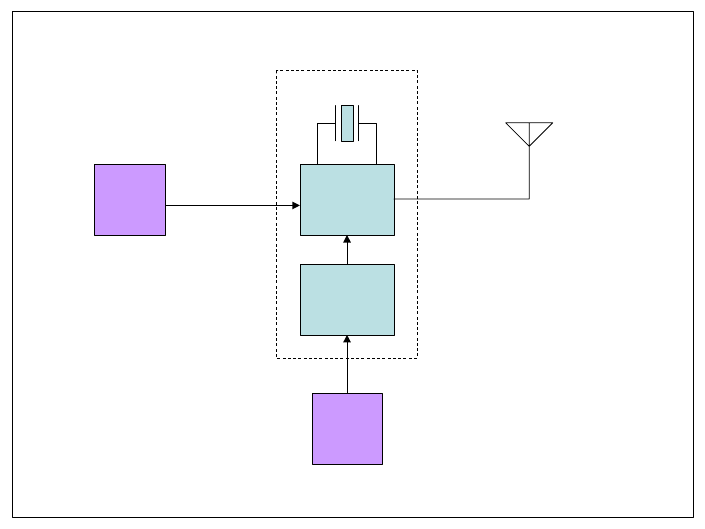
The following figure shows the system block diagram of a Wireless USB Module and a carrier
board. It accepts +5V from a power adapter or +5V from USB device and converts it to various
voltages required by the MAC-PHY chip.
Only one crystal is used in the system, which is 66MHz. The system is designed to support both
BG1 and BG3 UWB bands as defined in the WiMedia standard.
MAC-
PHY
Chip
66MHz
External
USB
Device
USB connector
External
Power
Adapter
Power socket
BG 1 & 3
Antenna
Antenna connector
Power
Management
2
All Rights Reserved by Realtek Semiconductor Corp.
Wireless USB Module_User’sManual_Rev1.doc
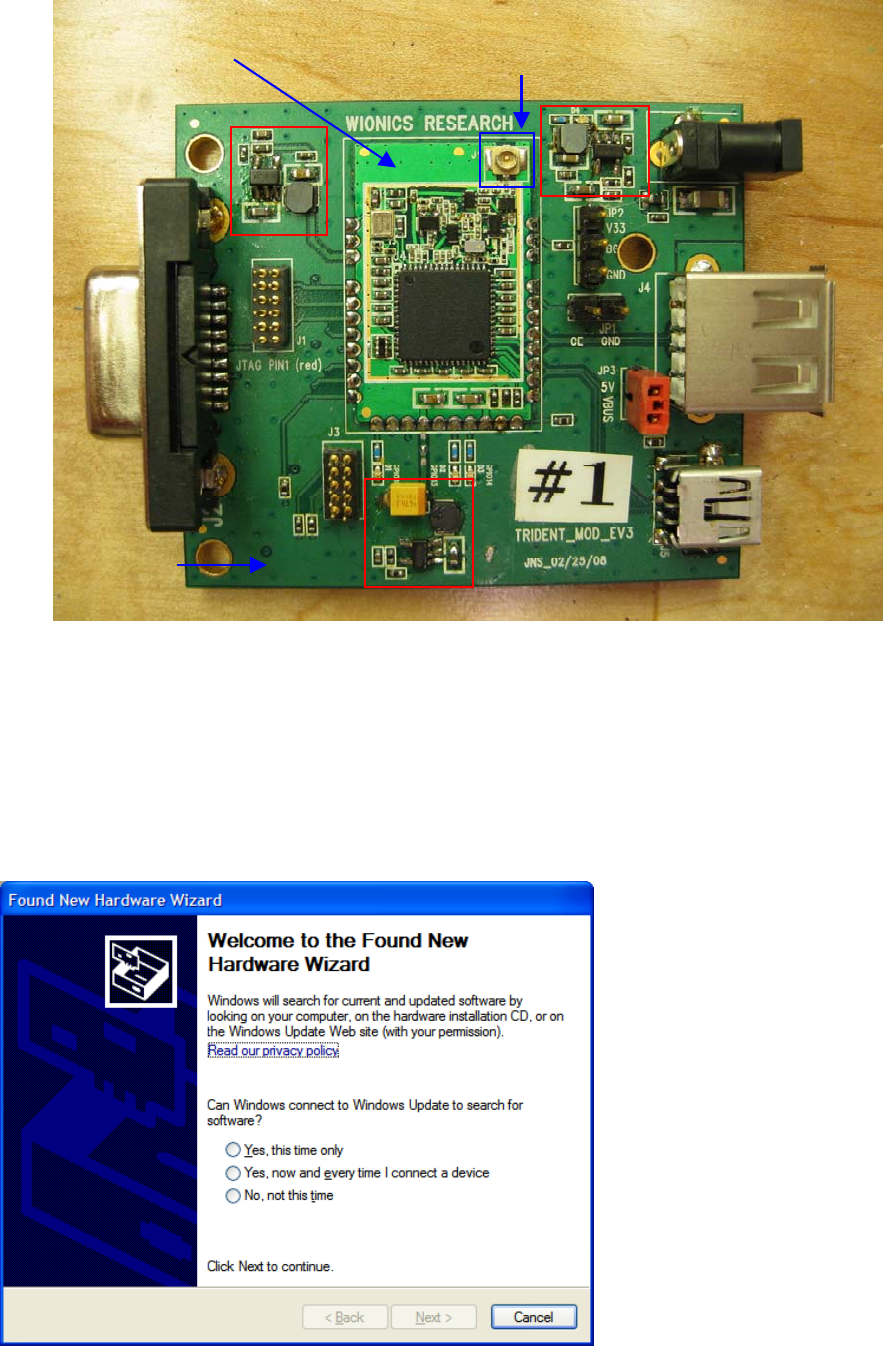
2.3 Connector Location
Wireless
USB
Module
Carrier Board
3.3 V Regulator
Micro Coaxial
connector
RTU7105
1.8 V Regulator DC Power Jack
Not Used
Mini-USB
Receptacle
Type- B
1.2 V Regulator
3 Driver Installation
3.1.Setup the USB connection between the PC and Wireless USB Module.
3.2.Power up Wireless USB Module by inserting the connection between the mini-USB
receptacle and the PC. The mini-USB supplies the +5Vdc to the three regulators on the
carrier board, which then convert it to various voltages required by the MAC-PHY chip.
3.3.Follow the steps below for the driver installation process.
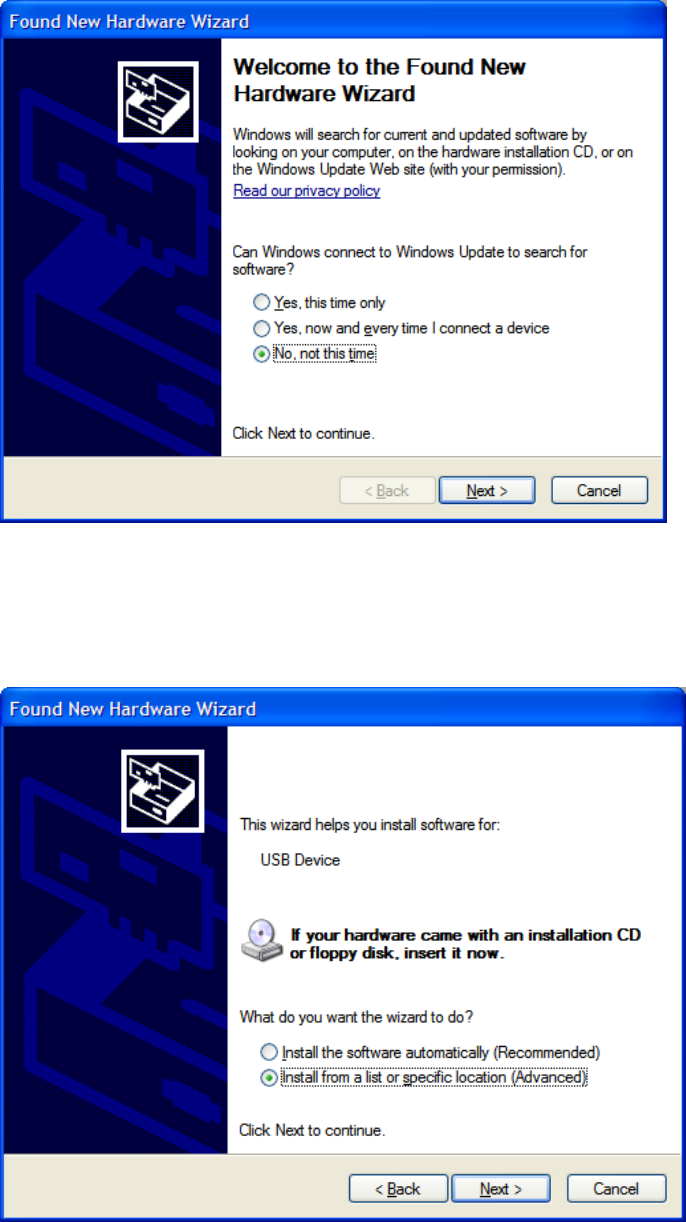
STEP 1. After plugged in the mini-USB connector, Windows will prompt to install driver for the
Found New Hardware Wizard.
3
All Rights Reserved by Realtek Semiconductor Corp.
Wireless USB Module_User’sManual_Rev1.doc
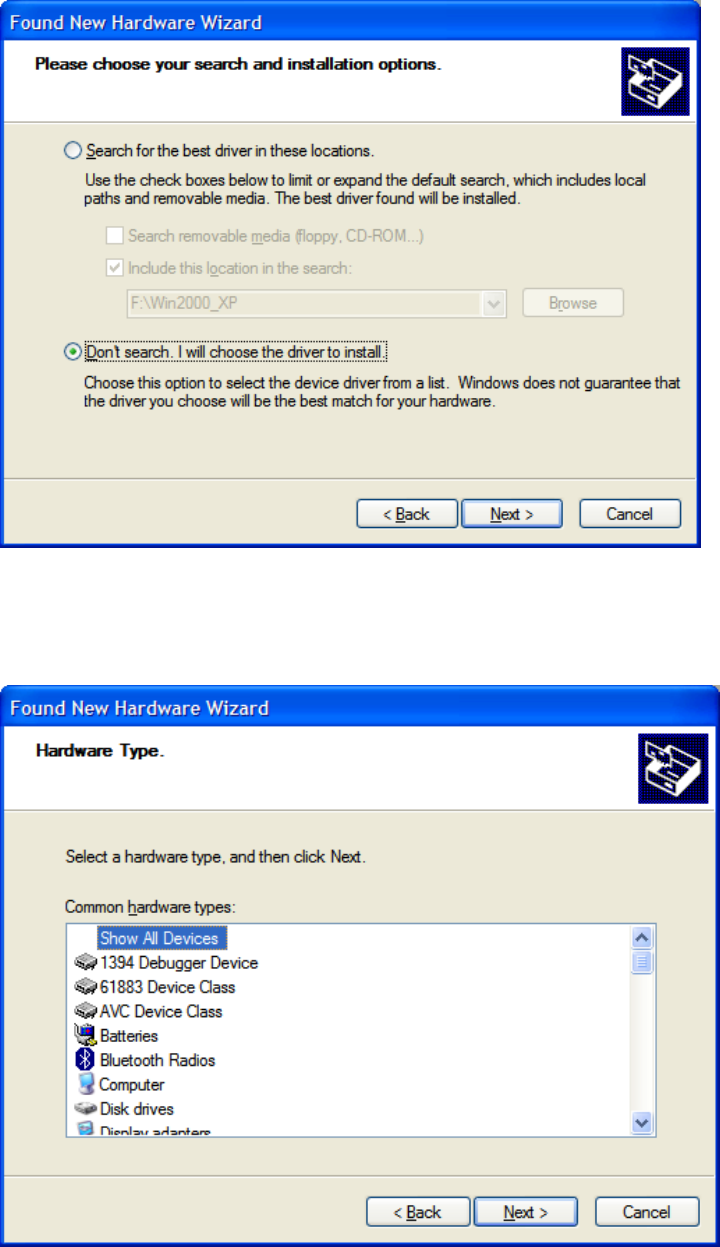
STEP 2. Select, “No, not this time”, then “Next”.
STEP 3. Select, “Install from a list or specific location (Advanced)”, then “Next”.
4
All Rights Reserved by Realtek Semiconductor Corp.
Wireless USB Module_User’sManual_Rev1.doc
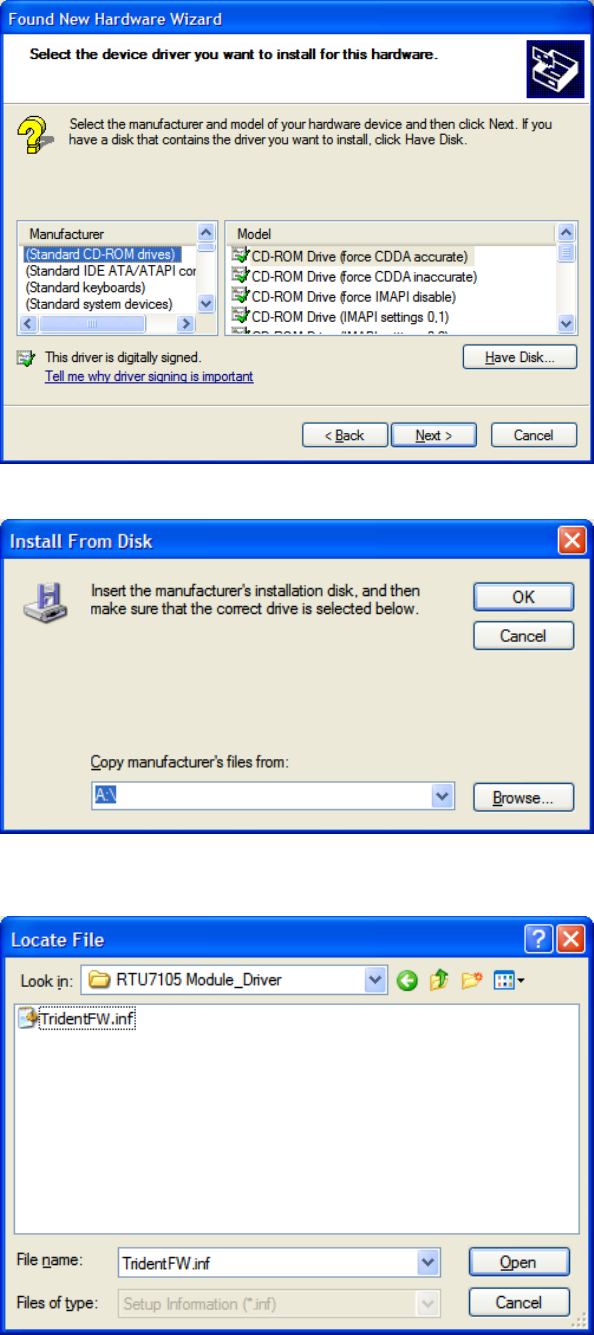
STEP 4. Select, “Don’t search, I will choose the driver to install”, then “Next”.
STEP 5. Select, “Next”.
5
All Rights Reserved by Realtek Semiconductor Corp.
Wireless USB Module_User’sManual_Rev1.doc
STEP 6. Select, “Have Disk”.
STEP 7. Select “Browse” to search for the driver in a specific folder.
STEP 8. Select “TridentFW.inf”, then “Open”.
6
All Rights Reserved by Realtek Semiconductor Corp.
Wireless USB Module_User’sManual_Rev1.doc
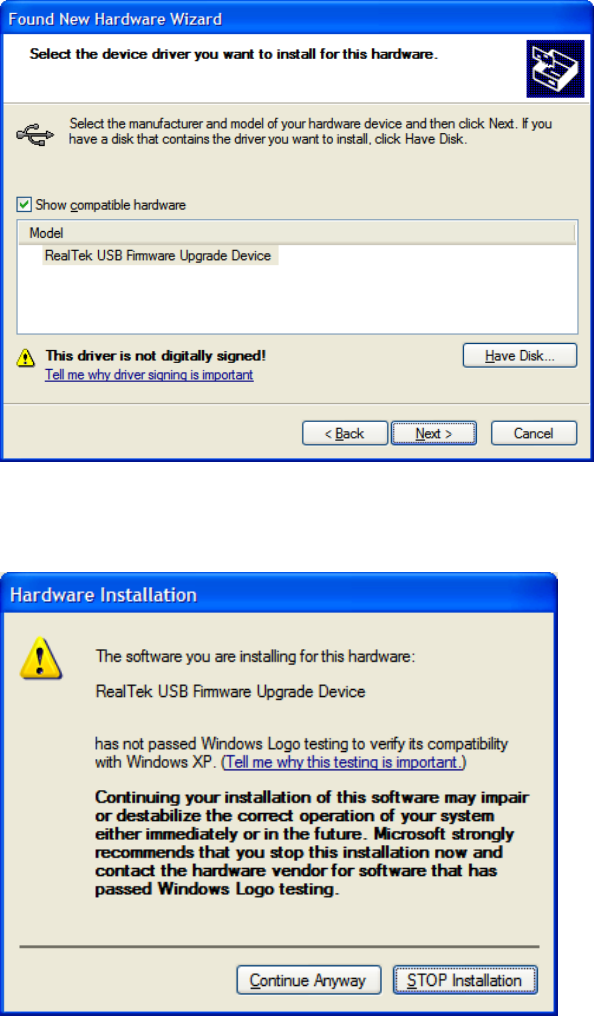
STEP 9. After selecting “TridentFW.inf” it shows the driver name call “RealTek USB Firmware
Upgrade Device”, then “Next”.
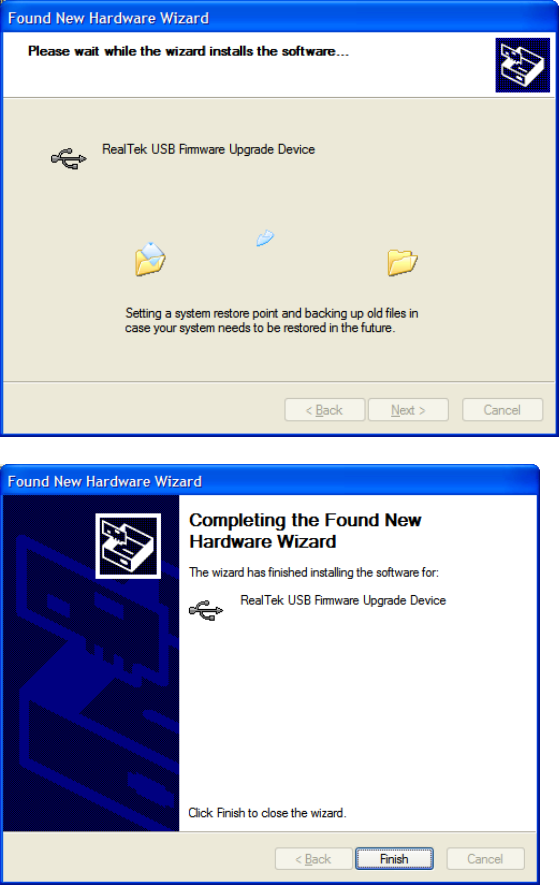
STEP 10. Please ignore all the warning messages generated by Windows and keep installing the
driver by selecting the button, “Continue Anyway”.
7
All Rights Reserved by Realtek Semiconductor Corp.
Wireless USB Module_User’sManual_Rev1.doc
3.4.Once the previous driver has been installed, Windows will prompt to install another
driver for “Generic Cable Association Device for WUSB”. Please cancel the installation
of this driver. It is not required for the control software.
4 The Control Software
4.1 Startup procedure of the control software – Wireless USB Module
1. Setup the USB connection between the PC and Wireless USB Module.
2. Power up Wireless USB Module by connecting mini-USB receptacle to PC.
3. Complete the USB driver installation process.
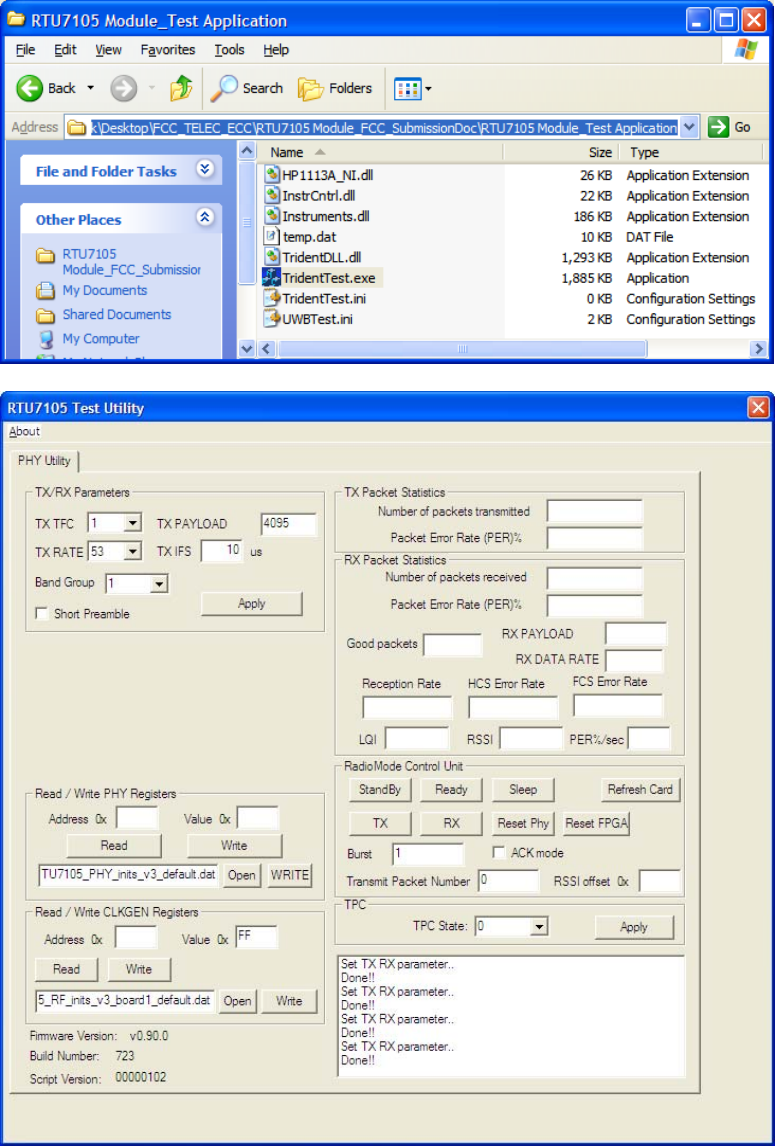
4. Activate Wireless USB Module by double-clicking the “TridentTest.exe” icon. The
following window called “RTU7105 Test Utility” should pop up showing the proper
execution of Wireless USB Module.
8
All Rights Reserved by Realtek Semiconductor Corp.
Wireless USB Module_User’sManual_Rev1.doc
4.2 Control procedure for BG1 or BG3
1. Set “TX PAYLOAD” to 4095.
2. Set “TX IFS” to 10.
3. Select proper options for “TX TFC” (Valid: 1~10) and “TX RATE”.
4. Click “TX/RX Parameters” field’s “Apply” button to activate the above settings.
5. Select “Band Group 1”/ “Band Group 3” option, depending on which BG is being tested,
and proper EUT number (according to the marking on the EUT) in the “Band Group”
field.
9
6. Click “TX” button once to start the transmission.
All Rights Reserved by Realtek Semiconductor Corp.