Sun Microsystems 2500 Users Manual StorageTek Series Array Hardware Installation Guide
2500 to the manual 0c1ef620-6d90-4fd8-806d-71d9e4d701f2
2015-02-02
: Sun-Microsystems Sun-Microsystems-Sun-Microsystems-2500-Users-Manual-489714 sun-microsystems-sun-microsystems-2500-users-manual-489714 sun-microsystems pdf
Open the PDF directly: View PDF  .
.
Page Count: 128 [warning: Documents this large are best viewed by clicking the View PDF Link!]
- Sun StorageTek™ 2500 Series Array Hardware Installation Guide
- Contents
- Figures
- Tables
- Tray Overviews
- Installing Trays
- Connecting the Management Host and Data Hosts
- Powering On the Array
- Data Hosts, HBAs, and Other Software
- Configuring IP Addressing
- Configuring a DHCP Server
- Using DC Power
- Glossary
- Index

Sun Microsystems, Inc.
www.sun.com
Submit comments about this document at: http://www.sun.com/hwdocs/feedback
Sun StorageTek™2500 Series Array
Hardware Installation Guide
Part No. 820-0015-10
March 2007

Please
Recycle
Copyright 2007 Sun Microsystems, Inc., 4150 Network Circle, Santa Clara, California 95054, U.S.A. All rights reserved.
Sun Microsystems, Inc. has intellectual property rights relating to technology that is described in this document. In particular, and without
limitation, these intellectual property rights may include one or more of the U.S. patents listed at http://www.sun.com/patents and one or
more additional patents or pending patent applications in the U.S. and in other countries.
This document and the product to which it pertains are distributed under licenses restricting their use, copying, distribution, and
decompilation. No part of the product or of this document may be reproduced in any form by any means without prior written authorization of
Sun and its licensors, if any.
Third-party software, including font technology, is copyrighted and licensed from Sun suppliers.
Parts of the product may be derived from Berkeley BSD systems, licensed from the University of California. UNIX is a registered trademark in
the U.S. and in other countries, exclusively licensed through X/Open Company, Ltd.
Sun, Sun Microsystems, the Sun logo, Java, AnswerBook2, docs.sun.com, Sun Fire, Sun StoragEdge, Sun StorageTek, and Solaris are
trademarks or registered trademarks of Sun Microsystems, Inc. in the U.S. and in other countries.
All SPARC trademarks are used under license and are trademarks or registered trademarks of SPARC International, Inc. in the U.S. and in other
countries. Products bearing SPARC trademarks are based upon an architecture developed by Sun Microsystems, Inc.
The OPEN LOOK and Sun™ Graphical User Interface was developed by Sun Microsystems, Inc. for its users and licensees. Sun acknowledges
the pioneering efforts of Xerox in researching and developing the concept of visual or graphical user interfaces for the computer industry. Sun
holds a non-exclusive license from Xerox to the Xerox Graphical User Interface, which license also covers Sun’s licensees who implement OPEN
LOOK GUIs and otherwise comply with Sun’s written license agreements.
U.S. Government Rights—Commercial use. Government users are subject to the Sun Microsystems, Inc. standard license agreement and
applicable provisions of the FAR and its supplements.
DOCUMENTATION IS PROVIDED "AS IS" AND ALL EXPRESS OR IMPLIED CONDITIONS, REPRESENTATIONS AND WARRANTIES,
INCLUDING ANY IMPLIED WARRANTY OF MERCHANTABILITY, FITNESS FOR A PARTICULAR PURPOSE OR NON-INFRINGEMENT,
ARE DISCLAIMED, EXCEPT TO THE EXTENT THAT SUCH DISCLAIMERS ARE HELD TO BE LEGALLY INVALID.
Copyright 2007 Sun Microsystems, Inc., 4150 Network Circle, Santa Clara, Californie 95054, États-Unis. Tous droits réservés.
Sun Microsystems, Inc. possède les droits de propriété intellectuels relatifs à la technologie décrite dans ce document. En particulier, et sans
limitation, ces droits de propriété intellectuels peuvent inclure un ou plusieurs des brevets américains listés sur le site
http://www.sun.com/patents, un ou les plusieurs brevets supplémentaires ainsi que les demandes de brevet en attente aux les États-Unis et
dans d’autres pays.
Ce document et le produit auquel il se rapporte sont protégés par un copyright et distribués sous licences, celles-ci en restreignent l’utilisation,
la copie, la distribution, et la décompilation. Aucune partie de ce produit ou document ne peut être reproduite sous aucune forme, par quelque
moyen que ce soit, sans l’autorisation préalable et écrite de Sun et de ses bailleurs de licence, s’il y en a.
Tout logiciel tiers, sa technologie relative aux polices de caractères, comprise, est protégé par un copyright et licencié par des fournisseurs de
Sun.
Des parties de ce produit peuvent dériver des systèmes Berkeley BSD licenciés par l’Université de Californie. UNIX est une marque déposée
aux États-Unis et dans d’autres pays, licenciée exclusivement par X/Open Company, Ltd.
Sun, Sun Microsystems, le logo Sun, Java, AnswerBook2, docs.sun.com, Sun Fire, Sun StoragEdge, Sun StorageTek, et Solaris sont des marques
de fabrique ou des marques déposées de Sun Microsystems, Inc. aux États-Unis et dans d’autres pays.
Toutes les marques SPARC sont utilisées sous licence et sont des marques de fabrique ou des marques déposées de SPARC International, Inc.
aux États-Unis et dans d’autres pays. Les produits portant les marques SPARC sont basés sur une architecture développée par Sun
Microsystems, Inc.
L’interface utilisateur graphique OPEN LOOK et Sun™ a été développée par Sun Microsystems, Inc. pour ses utilisateurs et licenciés. Sun
reconnaît les efforts de pionniers de Xerox dans la recherche et le développement du concept des interfaces utilisateur visuelles ou graphiques
pour l’industrie informatique. Sun détient une license non exclusive de Xerox sur l’interface utilisateur graphique Xerox, cette licence couvrant
également les licenciés de Sun implémentant les interfaces utilisateur graphiques OPEN LOOK et se conforment en outre aux licences écrites de
Sun.
LA DOCUMENTATION EST FOURNIE "EN L’ÉTAT" ET TOUTES AUTRES CONDITIONS, DÉCLARATIONS ET GARANTIES EXPRESSES
OU TACITES SONT FORMELLEMENT EXCLUES DANS LA LIMITE DE LA LOI APPLICABLE, Y COMPRIS NOTAMMENT TOUTE
GARANTIE IMPLICITE RELATIVE À LA QUALITÉ MARCHANDE, À L’APTITUDE À UNE UTILISATION PARTICULIÈRE OU À
L’ABSENCE DE CONTREFAÇON.

iii
Contents
Preface xiii
1. Tray Overviews 1
Front-Access Components of the Trays 2
LEDs on the Front of the Trays 3
Rear-Access Components of the Trays 5
Controllers 6
Sun StorageTek 2540 Array 6
SFP Transceivers 7
Sun StorageTek 2530 Array 8
Controller Tray and Drive Expansion Tray Power-Fan Assembly 9
Sun StorageTek 2501 Array 10
Drive Expansion Tray IOM 10
Drive Expansion Tray IOM Connectors 10
LEDs on the Rear of the Trays 11
Controller LEDs on the Sun StorageTek 2540 Array 11
Controller LEDs on the Sun StorageTek 2530 Array 12
Controller Tray and Drive Expansion Tray Power-Fan Assembly LEDs 13
IOM LEDs on the Sun StorageTek 2501 Array 15
Disk Drives 16

iv Sun StorageTek 2500 Series Array Hardware Installation Guide • March 2007
LEDs on the Disk Drives 18
Common Array Manager Software 19
Service Advisor and Customer-Replaceable Units 19
Overview of the Installation Process 20
2. Installing Trays 23
Preparing for the Installation 24
Preparing the Universal Rail Kit 24
Unpacking the Universal Rail Kit 24
Loosening the Rail Adjustment Screws 24
Preparing the Tray 25
Preparing the Cabinet 26
Planning the Order of the Tray Installation 26
Attaching the Rails to a Cabinet 27
Attaching the Universal Rail Kit to a Standard Sun or 19-Inch Cabinet With
Threaded Cabinet Rails 27
Attaching the Universal Rail Kit to a Standard
19-Inch Cabinet With Unthreaded Cabinet Rails 31
Installing a Tray in a Cabinet 37
Connecting the Power Cables 42
Intertray Cabling 42
Array Configuration Naming Convention 43
Connecting Expansion Trays 44
Cabling an Expansion Tray to a Controller Tray 45
Cabling an Expansion Tray to Another Expansion Tray 45
Drive Module Cable Labeling 47
Example Label Abbreviation 47
Simplex Configurations 47
Next Steps 48

Contents v
3. Connecting the Management Host and Data Hosts 49
Connecting the Management Host 49
Attaching the Ethernet Ports to the LAN of the Management Host 50
Attaching the Ethernet Ports to the Management Host Using an Ethernet
Hub 51
Attaching the Ethernet Ports Directly to the Management Host With a Cross-
Over Cable 51
Connecting Data Hosts to the 2540 Array 51
2540 Array Data Host Connection Topologies 52
2540 Array Data Host Connections 54
▼To Connect Data Hosts Using Fibre Channel 55
Connecting Data Hosts to the 2530 Array 56
▼To Connect Data Hosts to a 2530 Array 58
Host Cable Labeling 59
Example Label Abbreviation 59
Next Steps 59
4. Powering On the Array 61
Before Powering On 61
Powering On the Array 62
Powering Off the Array 63
Next Steps 64
5. Data Hosts, HBAs, and Other Software 65
Data Host Software 65
HBAs and Drivers 65
Multipathing 66
Setting Up a Data Host On a Solaris System 66
▼To Obtain Sun Solaris 8 and 9 Data Host Software 67
▼To Install the SAN 4.4 Data Host Software 67

vi Sun StorageTek 2500 Series Array Hardware Installation Guide • March 2007
▼To Obtain Traffic Manager for Operating Systems Other Than Solaris 68
Installing Data Host Software for Operating Systems Other Than Solaris 69
About Data Host Software For Non-Solaris Platforms 69
Downloading and Installing Sun RDAC Software 69
Enabling Multipathing Software 70
▼Enabling Multipathing Software for Solaris 8 or 9 OS 70
▼Enabling Multipathing Software for Solaris 10 OS 71
Next Steps 71
6. Configuring IP Addressing 73
About IP Addressing 73
Configuring the IP Address of the Array Controllers 74
Configuring Dynamic (DHCP) IP Addressing 74
Configuring Static IP Addressing 75
Using the Serial Port Interface to Assign IP Addresses 75
▼To Connect a Terminal to the Serial Port 75
▼To Set Up the Terminal Emulation Program 76
▼To Establish a Connection With the Serial Port 77
▼To Configure the IP Addresses 78
A. Configuring a DHCP Server 81
Before You Begin 81
Setting Up a Solaris DHCP Server 81
Setting Up a Windows 2000 Advanced Server 86
Installing the DHCP Server 87
Configuring the DHCP Server 87
B. Using DC Power 91
DC Power Overview 91
Installation Notes for DC Power 92


viii Sun StorageTek 2500 Series Array Hardware Installation Guide • March 2007

ix
Figures
FIGURE 1-1 Sun StorageTek 2500 Series Array Product Overview 2
FIGURE 1-2 Tray Front-Access Components 3
FIGURE 1-3 Location of the LEDs on the Front of the Trays 4
FIGURE 1-4 Controller Tray Rear-Access Components 5
FIGURE 1-5 Drive Expansion Tray Rear-Access Components 6
FIGURE 1-6 Sun StorageTek 2540 Array Connectors 7
FIGURE 1-7 SFP Transceiver for the Sun StorageTek 2540 Array 8
FIGURE 1-8 Sun StorageTek 2530 Array Controller Connectors 9
FIGURE 1-9 SAS Connectors on the Drive Expansion Tray IOM 10
FIGURE 1-10 Locations of the Controller LEDs on the Sun StorageTek 2540 Array 11
FIGURE 1-11 Locations of the Controller LEDs on the Sun StorageTek 2530 Array 12
FIGURE 1-12 Locations of the Power-Fan Assembly LEDs 14
FIGURE 1-13 Locations of the IOM LEDs 15
FIGURE 1-14 Disk Drives 17
FIGURE 1-15 Locations of the Disk Drive LEDs 18
FIGURE 2-1 Loosening the Rail Screws to Adjust the Rail Length 25
FIGURE 2-2 Positioning the Front of the Left Rail Behind the Left Front Cabinet Rail 28
FIGURE 2-3 Securing the Left Rail to the Front of the Cabinet 29
FIGURE 2-4 Adjusting the Length of the Left Rail at the Back of the Cabinet 30
FIGURE 2-5 Securing the Left Rail to the Back of the Cabinet 31

xSun StorageTek 2500 Series Array Hardware Installation Guide • March 2007
FIGURE 2-6 Inserting the Cabinet Rail Adapter Plate on the Cabinet Rail 32
FIGURE 2-7 Adapter plate in place on the Cabinet Rail. 33
FIGURE 2-8 Slide the flange of the rail behind the cabinet rail and between that and the hook of the rail
adapter plat.e, as shown. 34
FIGURE 2-9 Securing the Rail to the Front left of the Cabinet 35
FIGURE 2-10 Adjusting the Length of the Rail at the Back of the Cabinet 36
FIGURE 2-11 Securing the Rail to the Back of the Cabinet 37
FIGURE 2-12 Positioning the Tray in the Cabinet 38
FIGURE 2-13 Array Controller Tray Installed 39
FIGURE 2-14 Rail clip and rear mounting hole on rear of array tray. 40
FIGURE 2-15 Securing the Tray to the Front of a Sun Rack 900/1000 Cabinet 41
FIGURE 2-16 Expansion Ports on the Controller Tray 42
FIGURE 2-17 Expansion Ports on an Expansion Tray 43
FIGURE 2-18 1x2 Array Configuration Cabling Example 45
FIGURE 2-19 1x3 Array Configuration Cabling 46
FIGURE 3-1 Ethernet Ports for Controller A and Controller B 50
FIGURE 3-2 Direct connection from a single data host server 53
FIGURE 3-3 Direct Connection from two data host servers 53
FIGURE 3-4 Data host connection through a Fibre Channel switch 53
FIGURE 3-5 Mixed topology of data hosts connected directly and through FC switches 54
FIGURE 3-6 Connecting the SFP and Fiber-optic Cable to a 2540 Controller 55
FIGURE 3-7 FC host connectors on the 2540 controller. 55
FIGURE 3-8 Direct Connection From a Single Host With Dual HBAs 56
FIGURE 3-9 Direct connections from two data hosts with dual HBAs. 57
FIGURE 3-10 Direct connections from three data hosts with dual HBAs. 57
FIGURE 3-11 SAS Data Host Ports (on back of tray). 58
FIGURE 4-1 Tray Power Connectors and Switches 62
FIGURE B-1 Power Fan Assembly Locations. 92
FIGURE B-2 DC Power Connector Cable and Source Wires 92
FIGURE B-3 DC Power Module LEDs, Power Switch, and Power Cable Receptacle. 93

xi
Tables
TABLE 1-1 Description of the LEDs on the Front of the Trays 4
TABLE 1-2 Descriptions of the Controller LEDs on the Sun StorageTek 2540 Array 11
TABLE 1-3 Descriptions of the Controller LEDs on the Sun StorageTek 2530 Array 12
TABLE 1-4 Descriptions of the Power-Fan Assembly LEDs 14
TABLE 1-5 Descriptions of the IOM LEDs 15
TABLE 1-6 Descriptions of the Disk Drive LEDs 18
TABLE 1-7 Disk Drive States Represented by the LEDs 19
TABLE 1-8 Sun StorageTek 2500 Series Array Hardware Installation Checklist 20
TABLE 2-1 Controller and Expansion Tray Configurations 43
TABLE 6-1 RJ45 to DIN Serial Cable Pinouts 76
TABLE B-1 DC Power Module LEDs. 94

xii Sun StorageTek 2500 Series Array Hardware Installation Guide • March 2007

xiii
Preface
The Sun StorageTek 2500 Series Array Hardware Installation Guide describes how to
install rack-mounting rails and array modules on the Sun StorageTek 2500 Series
array.
Host management, data host management, and remote command line interface (CLI)
functions are performed by the Sun StorageTek Common Array Manager software.
For installation and initial configuration of the Sun StorageTek 2500 Series array,
including firmware upgrades, initial array setup, partitioning domains, configuring
storage, and configuring IP addressing, see the Sun StorageTek Common Array
Manager Software Installation Guide.
Before You Read This Book
Before you begin to install the Sun StorageTek 2500 Series array, you must have
already prepared the site as described in these books:
■Sun StorageTek 2500 Series Array Regulatory and Safety Compliance Manual
■Sun StorageTek 2500 Series Array Site Preparation Guide

xiv Sun StorageTek 2500 Series Array Hardware Installation Guide • March 2007
How This Book Is Organized
Chapter 1 provides an overview of the Sun StorageTek 2500 Series array and the
hardware installation process.
Chapter 2 describes how to install rack-mounting rails, controller modules, and
expansion cabinets in three Sun cabinets.
Chapter 3 describes how to connect the management host and data hosts to enable
access to the array.
Chapter 4 describes tray power-on procedures.
Chapter 5 describes data host software and what you need to do to acquire and
install it.
Chapter 6 describes how to configure IP addressing on the local management host
and the array controllers.
Appendix A describes how to set up a DHCP server.
Related Documentation
Application Title Part Number
Site planning information Sun StorageTek 2500 Series Array Site
Preparation Guide
820-0024-nn
Late-breaking information
not included in the
information set
Sun StorageTek 2500 Series Array Release
Notes
820-0031-nn
Sun StorageTek Common Array Manager
Release Notes
820-0030-nn
Instructions for installing
the Common Array
Manager host
management software
Sun StorageTek Common Array Manager
Software Installation Guide
819-7035-nn
Quick reference
information for the CLI
Sun StorageTek 6130, 2500 Series, and
6540 Arrays sscs(1M) CLI Quick
Reference
820-0029-nn

Preface xv
In addition, the Sun StorageTek 2500 Series Array includes the following online
documentation:
■Sun StorageTek Common Array Manager online help
Contains system overview and configuration information.
■Service Advisor
Provides guided FRU replacement procedures with system feedback. You can
access Service Advisor from the Sun StorageTek Common Array Manager
software.
■sscs man page commands for the CLI
Provides help on man page commands available on a management host or on a
remote CLI client.
Accessing Sun Documentation
You can obtain Sun network storage documentation at:
http://www.sun.com/products-n-
solutions/hardware/docs/Network_Storage_Solutions
You can also view, print, or purchase a broad selection of other Sun documentation,
including localized versions, at:
http://www.sun.com/documentation
Regulatory and safety
information
Sun StorageTek 2500 Series Array
Regulatory and Safety Compliance Manual
820-0025-nn
Instructions for installing
the Sun StorageTek
Expansion cabinet
Sun StorageTek Expansion Cabinet
Installation and Service Manual
805-3067-nn
Instructions for installing
the Sun Rack 900/1000
cabinets
Sun Rack Installation Guide 816-6386-nn
Application Title Part Number

xvi Sun StorageTek 2500 Series Array Hardware Installation Guide • March 2007
Third-Party Web Sites
Sun is not responsible for the availability of third-party web sites mentioned in this
document. Sun does not endorse and is not responsible or liable for any content,
advertising, products, or other materials that are available on or through such sites
or resources. Sun will not be responsible or liable for any actual or alleged damage
or loss caused by or in connection with the use of or reliance on any such content,
goods, or services that are available on or through such sites or resources.
Contacting Sun Technical Support
If you have technical questions about this product that are not answered in this
document, go to:
http://www.sun.com/service/contacting
Sun Welcomes Your Comments
Sun is interested in improving its documentation and welcomes your comments and
suggestions. You can submit your comments by going to:
http://www.sun.com/hwdocs/feedback
Please include the title and part number of your document with your feedback:
Sun StorageTek 2500 Series Array Hardware Installation Guide, part number 820-0015-10.

1
CHAPTER 1
Tray Overviews
The Sun StorageTek 2540 Array, the Sun StorageTek 2530 Array, and the Sun
StorageTek 2501 Array are a family of storage products that provide high-capacity,
high-reliability storage in a compact configuration.
The Sun StorageTek 2540 Array is a modular, rackmountable controller tray. It is
scalable from a single dual-controller tray (1x1) configuration to a maximum
configuration of 1x3 with two additional drive expansion trays behind one controller
tray.
All three of the trays can be installed in the following cabinets:
■Sun Rack 900/1000 cabinet
■Sun StorageTek Expansion cabinet
■Any 19-inch wide, 4-post, EIA-compatible rack or cabinet with a front-to-back
depth between vertical cabinet rails of 61 cm to 91 cm (24 in. to 36 in.). The
cabinet can have threaded or unthreaded cabinet rails.
The Sun StorageTek 2540 Array and the Sun StorageTek 2530 Array contain disk
drives for storing data and controllers that provide the interface between a
management and/or data host and the disk drives. The Sun StorageTek 2540 Array
provides a Fibre Channel connection from the data host to the controller. The Sun
StorageTek 2530 Array provides a Serial Attached SCSI (SAS) connection from the
data host to the controller.
The Sun StorageTek 2501 Array drive expansion tray provides additional storage.
You can attach the drive expansion tray to either the Sun StorageTek 2540 Array or
the Sun StorageTek 2530 Array.
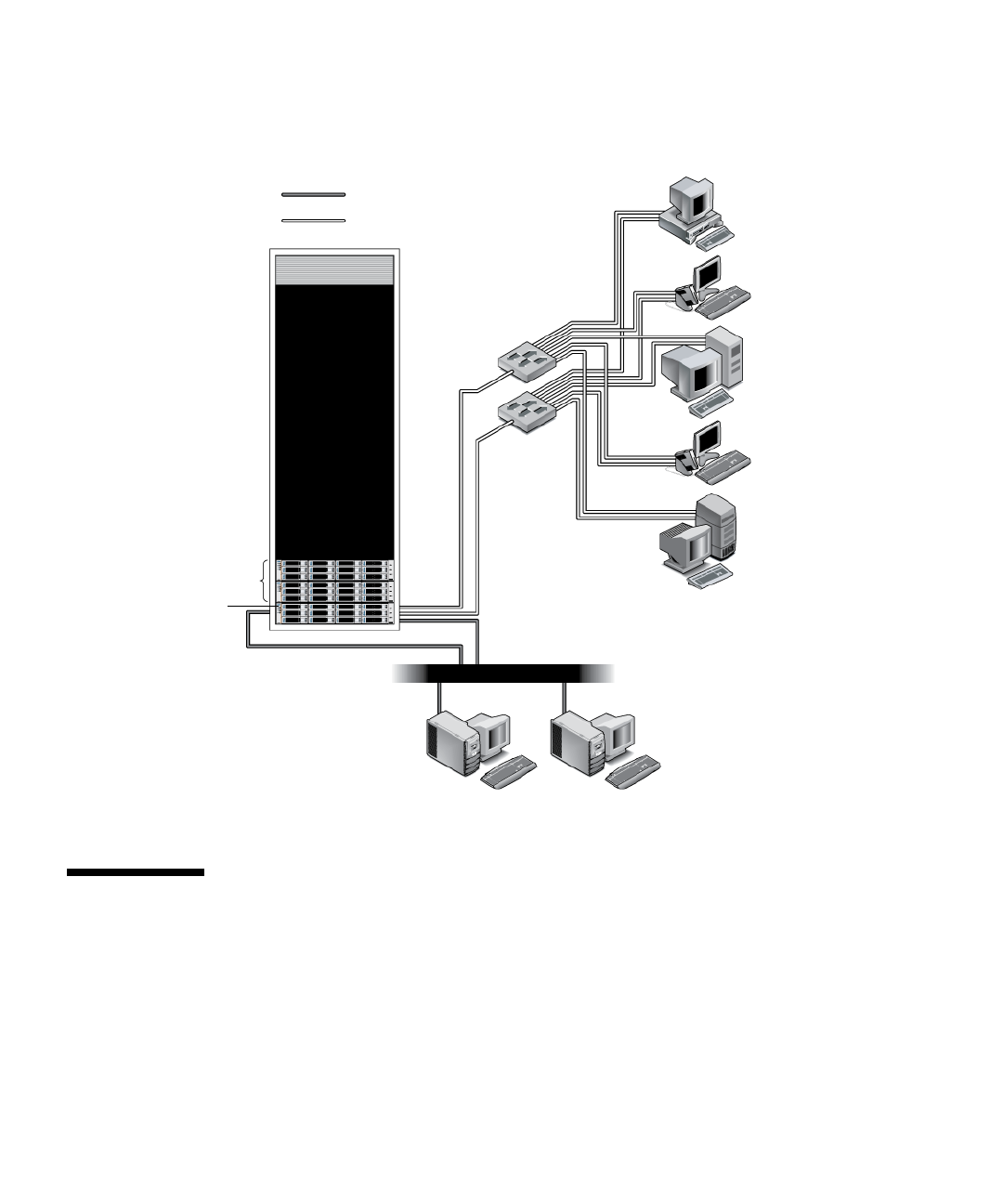
2Sun StorageTek 2500 Series Array Hardware Installation Guide • March 2007
FIGURE 1-1 Sun StorageTek 2500 Series Array Product Overview
Front-Access Components of the Trays
Components that are accessed through the front of the Sun StorageTek 2540 Array,
the Sun StorageTek 2530 Array, and the Sun StorageTek 2500 Array are identical in
appearance. The disk drives in your controller tray might differ in appearance from
those shown in FIGURE 1-2. The variation does not affect the function of the disk
drives.
Expansion trays
Controller tray
Local
management host
Remote
management host
Host 1
Host 2
Host 3
Host 4
Redundant Fibre Channel
FC switch
FC switch
Ethernet out-of-band
Data hosts
Host 5
Chapter 1 Tray Overviews 3
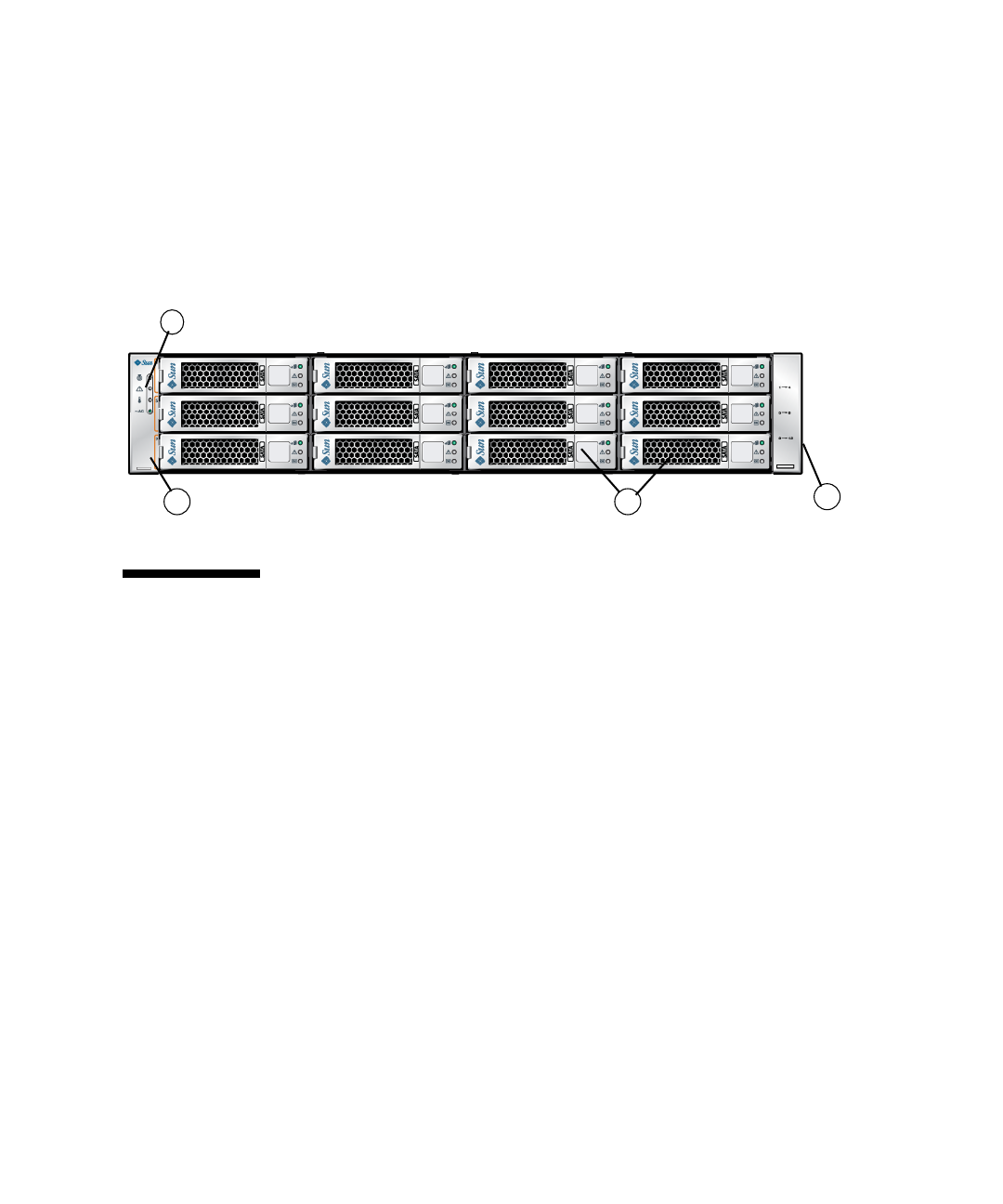
The front-access components include the following:
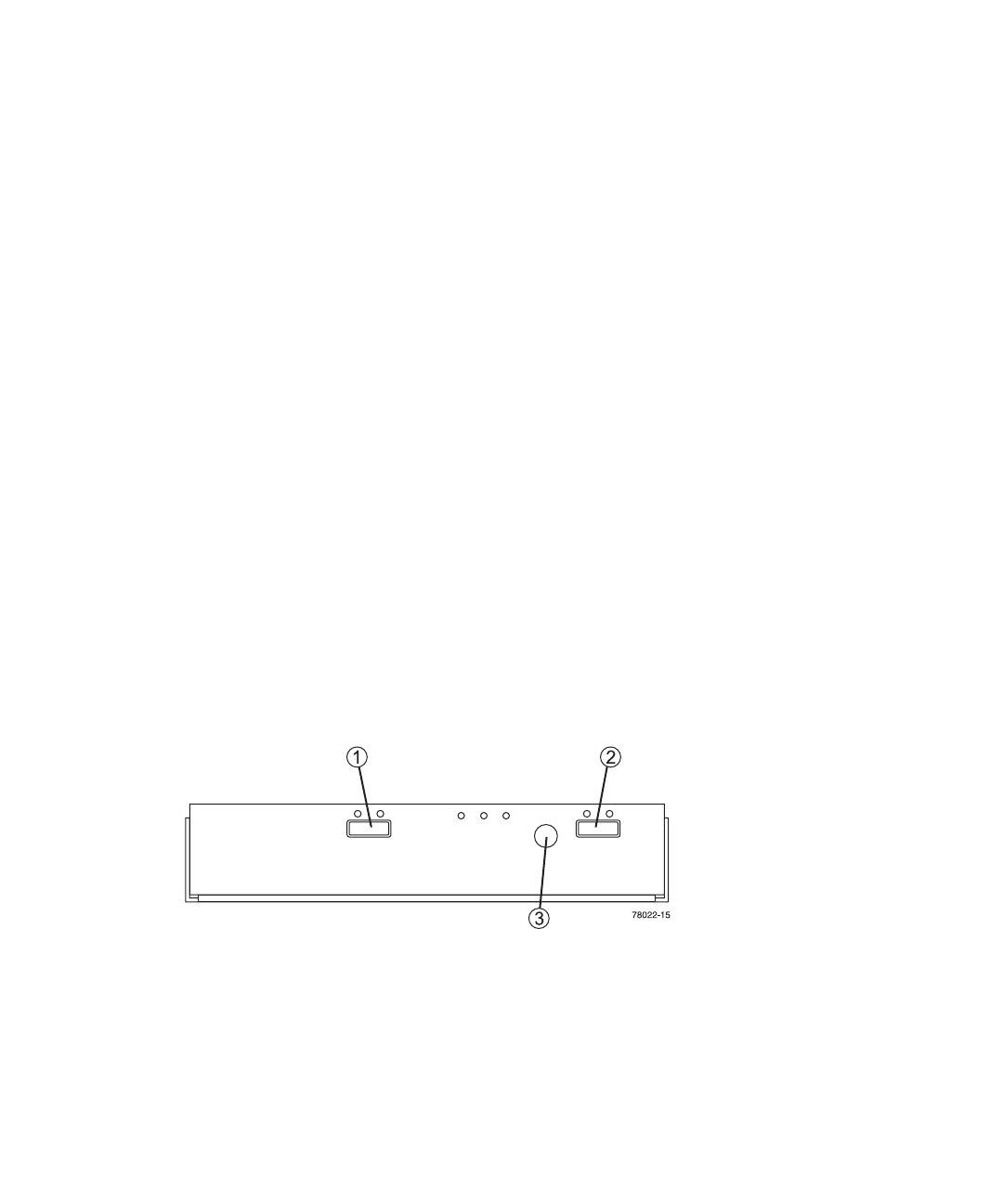
■End caps – Plastic, removable caps on the right and left side of the tray. Numbers
on the side of the right end cap indicate the numbering of the drives.
■LEDs (light emitting diodes) – Four LEDs located on the on the left-side end cap
■Disk drives – Twelve removable disk drives
FIGURE 1-2 Tray Front-Access Components
LEDs on the Front of the Trays
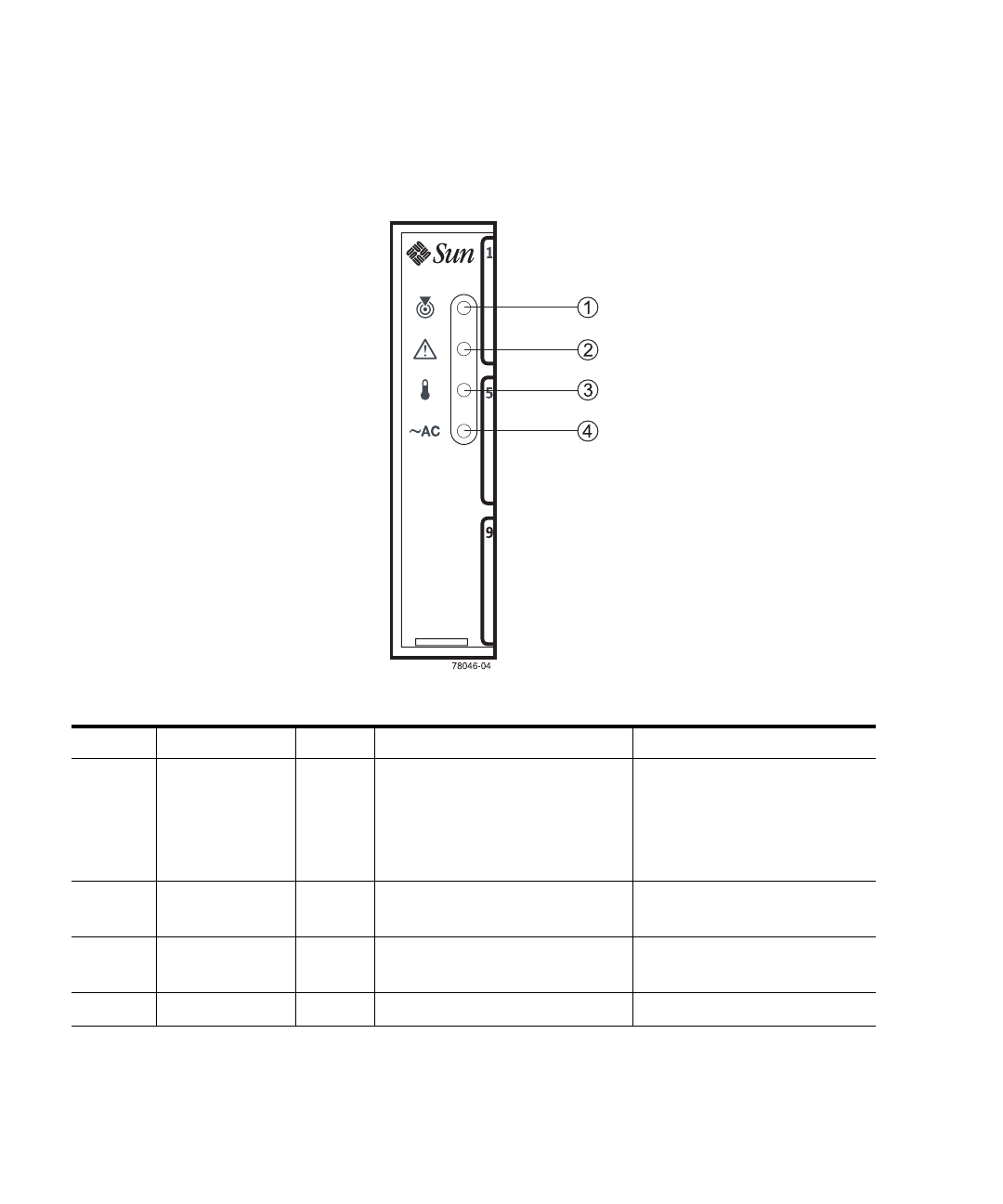
The four LEDs on the front of the Sun StorageTek 2540 Array, the Sun StorageTek
2530 Array, and the Sun StorageTek 2501 Array are identical in appearance and
function. The LEDs are located on the left-side endcap of the tray.
1. End Caps
2. Disk Drives
3. Tray LEDs
1
1
2
3
4Sun StorageTek 2500 Series Array Hardware Installation Guide • March 2007
FIGURE 1-3 Location of the LEDs on the Front of the Trays
TABLE 1-1 Description of the LEDs on the Front of the Trays
Location LED Color On Off
1 Locate White Indicates a failed component on
this tray. The locate light is
turned on manually by CAM to
help you find the tray that
requires attention.
Normal condition
2 Service Action
Required (Fault)
Amber A component within the tray
requires attention.
The components in the tray are
operating normally.
3Over
Temperature
Amber The tray temperature has
reached an unsafe level.
The tray temperature is within
operational range.
4 Power Green Power is present. Power is not present.
Chapter 1 Tray Overviews 5
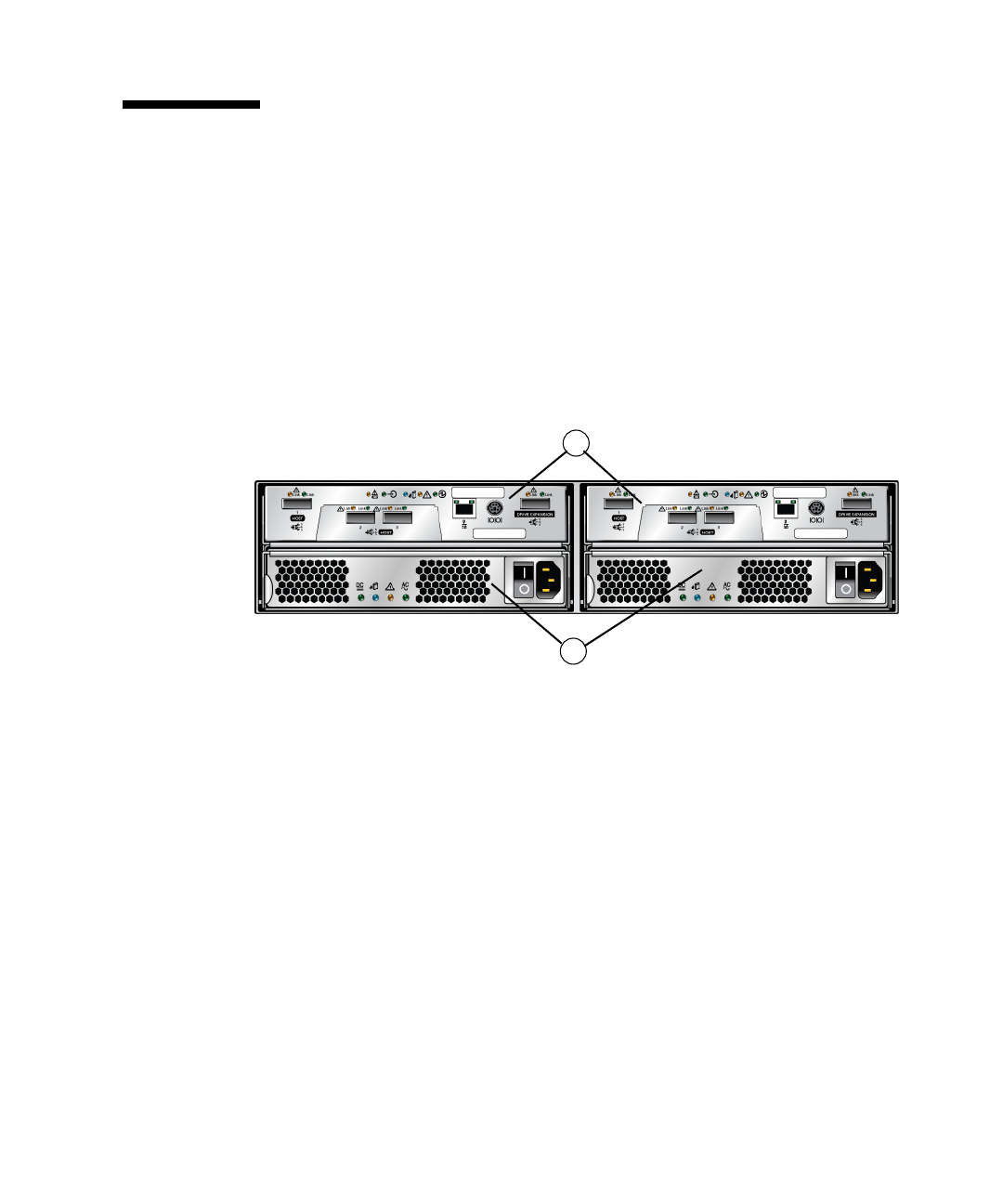
Rear-Access Components of the Trays
Components that are accessed from the rear of the Sun StorageTek 2540 Array and
the Sun StorageTek 2530 Array controller trays include:
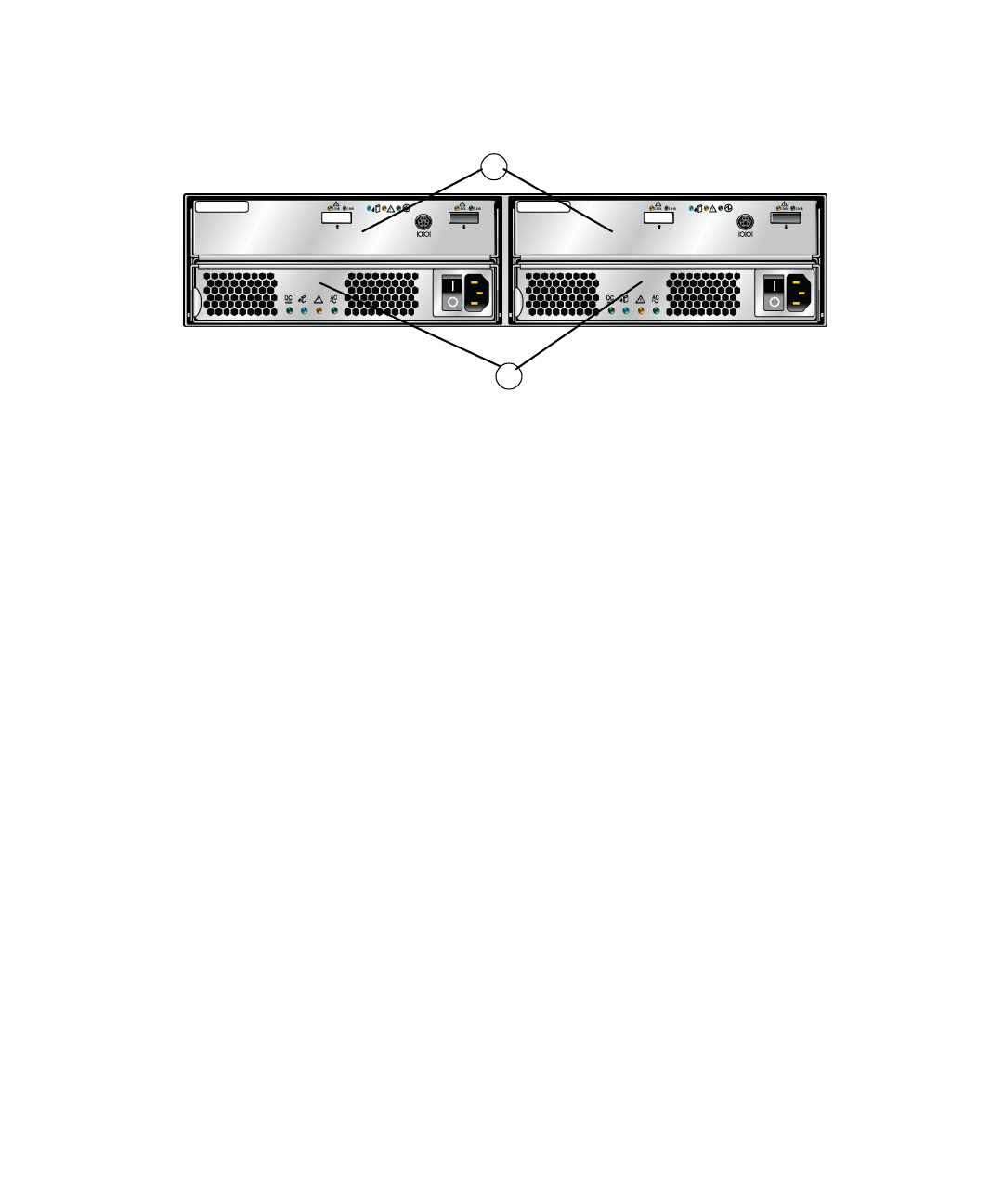
■Controller Modules – Two removable controller modules.
■Power-fan assembly – Two removable power supply modules with cooling fans.
The power-fan assembly is identical and interchangeable to the power-fan
assemblies used for Sun StorageTek 2501 Array drive expansion tray.
FIGURE 1-4 Controller Tray Rear-Access Components
Components that are accessed from the rear of the Sun StorageTek 2501 Array drive
expansion tray are:
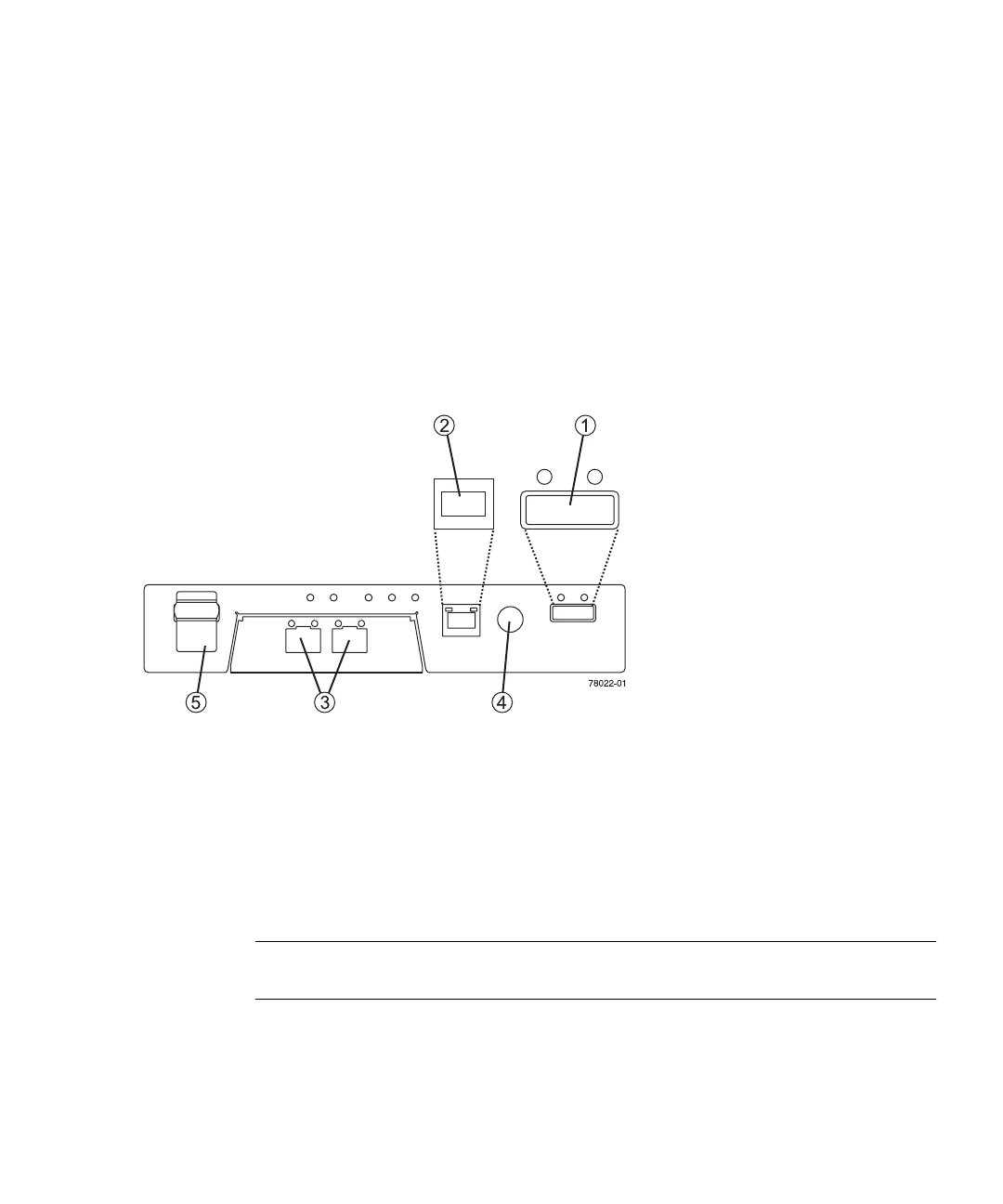
■I/O Modules (IOMs) – Two removable input/output modules
■Power-fan assemblies – Two removable power supply modules with cooling
fans. The power-fan assembly is identical and interchangeable to the power-fan
assemblies used for Sun StorageTek 2540 Array and the Sun StorageTek 2540
Array.
1. Controller Modules
2. Power-Fan Assembly
Modules
1
2
6Sun StorageTek 2500 Series Array Hardware Installation Guide • March 2007
FIGURE 1-5 Drive Expansion Tray Rear-Access Components
Controllers
The Sun StorageTek 2540 Array and the Sun StorageTek 2530 Array have two
controllers. The controllers manage the input/output (I/O) between the volumes
and the data host. The controllers have an Ethernet connection to the management
host for out-of-band management and contain a battery that provides backup power
to the 1 GB DIMM cache memory for up to three days in the event of a power loss.
Because each controller tray contains two controllers, the data path through one
controller can fail and the other controller provides a redundant data path to all of
the disk drives. If a controller fails, you can replace the failed controller while the
power is applied and the storage array is processing data (a hot swap). The system
automatically updates the firmware for the new controller so that it matches the
configuration database.
Each controller has a media access control (MAC) address that identifies it on the
network. The MAC address for a controller is on a label on the controller. The MAC
address label is attached to the controller in two places: at the top of the tray and at
the rear of the tray.
The tray ID numbers are set by the trays themselves on first power on. However,
you can change the setting through the Common Array Manager software. The tray
ID numbers on both of the controllers in one controller tray are identical under
optimal operating conditions.
Sun StorageTek 2540 Array
This Fibre Channel (FC) controller tray provides the following capabilities:
1. IOM Modules
2. Power-Fan
Assembly Modules
1
2
Chapter 1 Tray Overviews 7
■Two data host connectors per controller that can support either a fiber-optic
interface or a copper interface with 1, 2, or 4 Gb/s data host connection speed
■One drive expansion tray Serial Attached SCSI (SAS) connector with 3 Gb/s drive
expansion tray connection speed
■512-MB or 1-GB mirrored cache
■Maximum connection of 36 disk drives (one controller tray and two drive
expansion trays)
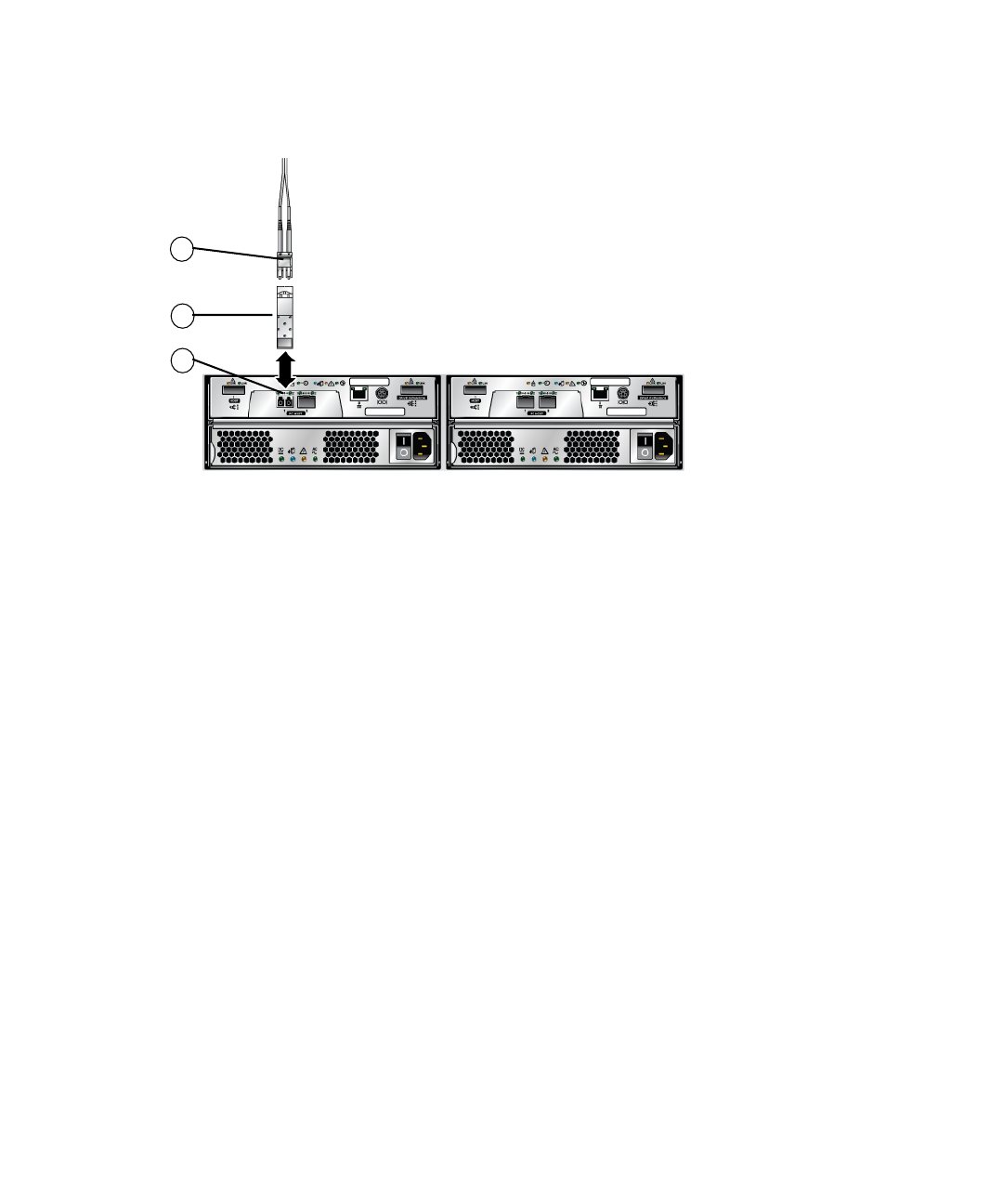
When fiber-optic cables are used to connect to the data host, a Small Form-factor
Pluggable (SFP) transceiver is required to make the connection.
FIGURE 1-6 Sun StorageTek 2540 Array Connectors
SFP Transceivers
You can connect the Sun StorageTek 2540 Array to either copper host interface cables
or fiber-optic host interface cables. If you use fiber-optic cables, you must install an
SFP transceiver in each interface connector on the controller where a fiber-optic cable
is to be installed. The SFP transceiver is required to translate the optical signals from
the fiber-optic cable into digital signals for the controller.
Note – The SFP transceiver shown might look different from those that are shipped
with your controller tray. The difference does not affect transceiver performance.
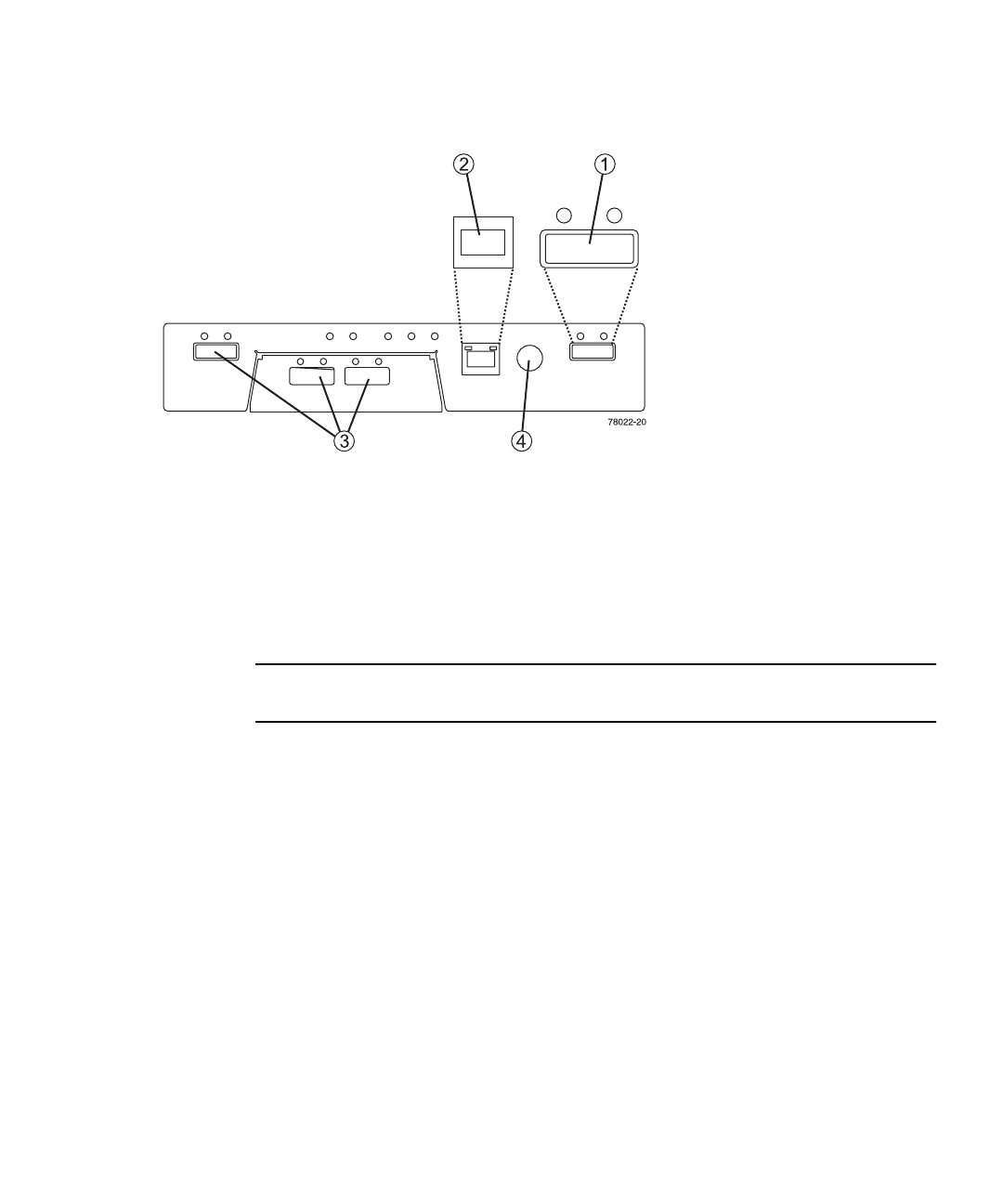
1. Drive Expansion Tray Connector
(SAS Out)
2. Ethernet Management Host
Connector
3. Fibre Channel Data Host
Connectors or Copper Data Host
Connectors
4. RS-232 Connector (Diagnostics
Port)
5. Not Used
8Sun StorageTek 2500 Series Array Hardware Installation Guide • March 2007
FIGURE 1-7 SFP Transceiver for the Sun StorageTek 2540 Array
Sun StorageTek 2530 Array
This SAS controller tray provides the following capabilities:
■Three SAS host connectors with 3 Gb/s host connection speed
■One drive expansion tray SAS connector for the drive channel with 3 Gb/s drive
expansion tray connection speed
■512-MB or 1-GB mirrored cache
■Maximum connection of 36 disk drives (one controller tray and two drive
expansion trays)
1. Data Host Connector
2. SFP Transceiver
3. Fiber-Optic Cable
3
2
1
Chapter 1 Tray Overviews 9
FIGURE 1-8 Sun StorageTek 2530 Array Controller Connectors
Controller Tray and Drive Expansion Tray Power-
Fan Assembly
The power-fan assembly for the Sun StorageTek 2540 Array, the Sun StorageTek 2530
Array, and the Sun StorageTek 2501 Array is identical and interchangeable.
Note – A minimum of two disk drives must be operating in a controller tray or a
drive expansion tray to avoid generating a power-fan assembly error.
The power-fan assembly contains an integrated cooling fan. The power supply
provides power to the internal components by converting incoming AC voltage to
DC voltage. The fan circulates air inside of the tray by pulling air in through the
vents on the front of the assembly and pushing the air out of the vents on the back
of each fan.
Each tray contains two power-fan assemblies. If one power supply is turned off or
malfunctions, the other power supply maintains electrical power to the tray.
Likewise, the fans provide redundant cooling. If one of the fans in either fan housing
fails, the remaining fan continues to provide sufficient cooling to operate the tray.
The remaining fan runs at a higher speed until the failed fan is replaced. Replace the
failed fan as soon as possible.
1. Drive Expansion Tray
Connector (SAS Out)
2. Ethernet Management Host
Connector
3. SAS Data Host Connectors
4. RS-232 Connector
(Diagnostics Port)
10 Sun StorageTek 2500 Series Array Hardware Installation Guide • March 2007
Sun StorageTek 2501 Array
The drive expansion tray expands the storage capacity of a storage array. The
controllers in the controller tray can connect to the drive expansion tray and access
the disk drives in the drive expansion tray for additional storage. A drive expansion
tray contains both physical components (disk drives, IOMs, and power-fan
assemblies) and logical components (virtual disks and volumes).
Drive Expansion Tray IOM
The drive expansion tray contains two IOMs that provide the interface between the
disk drives in the drive expansion tray and the controllers in the controller tray. The
IOM also monitors sub-system parameters. Each controller in the controller tray
connects to an IOM.
If one IOM fails, the other IOM provides a redundant data path to the disk drives.
You can replace a failed IOM while the power to the storage array is turned on and
the storage array is processing data (a hot swap).
Drive Expansion Tray IOM Connectors
The IOM connects to the controller tray and drive expansion trays with SAS cables.
Each IOM in a drive expansion tray has two SAS expansion connectors. One
connector shows an up arrow, and the other connector shows a down arrow.
FIGURE 1-9 SAS Connectors on the Drive Expansion Tray IOM
When connecting the SAS cable from an IOM in one drive expansion tray to an IOM
in another drive expansion tray, connect from a down arrow to an up arrow. If the
cable is plugged into two connectors with arrows of the same direction,
communication between the two drive expansion trays is lost.
1. SAS Connector (Up
Arrow)
2. SAS Connector
(Down Arrow)
3. Serial Connector
Chapter 1 Tray Overviews 11
LEDs on the Rear of the Trays
Controller LEDs on the Sun StorageTek 2540
Array
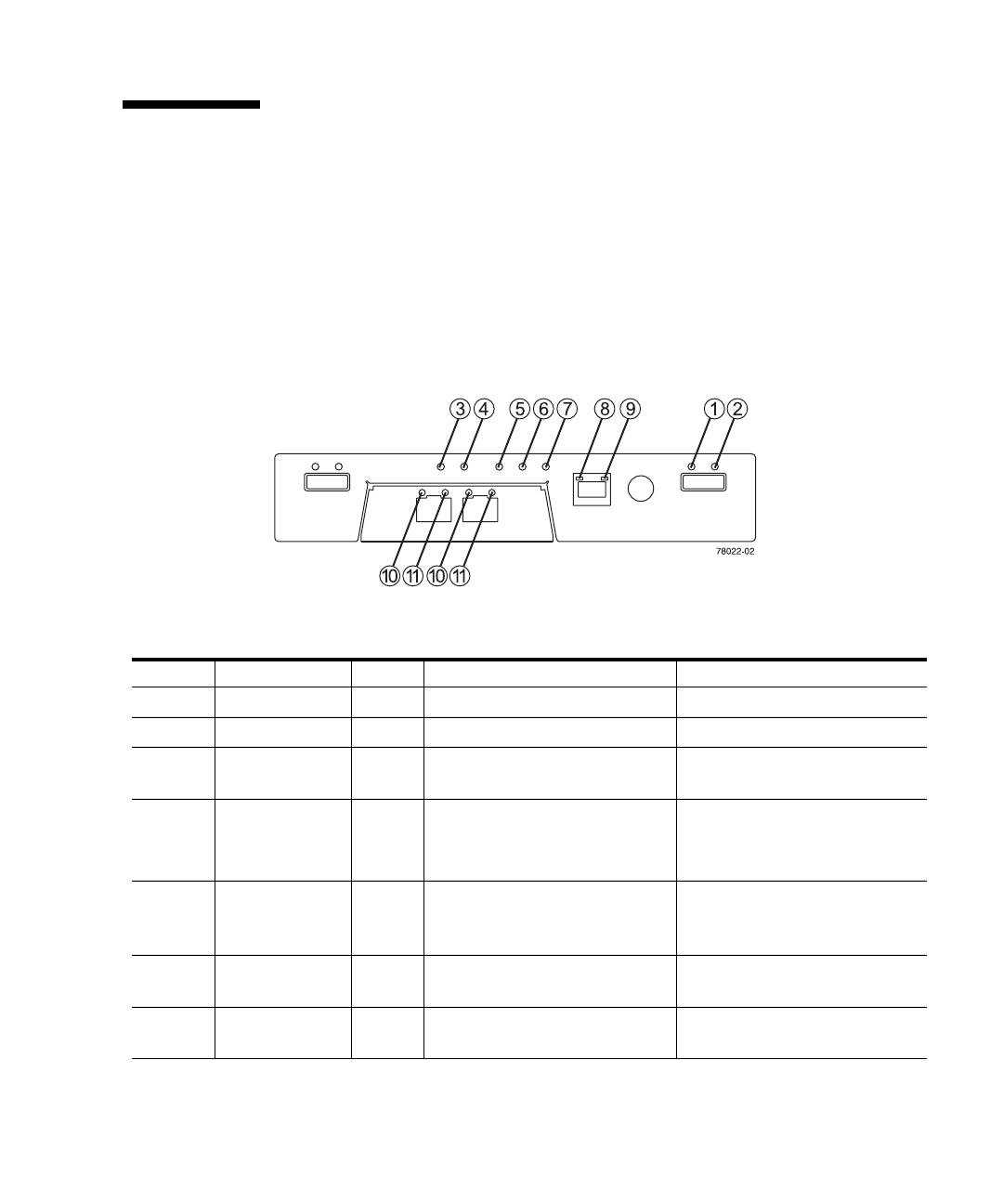
FIGURE 1-10 Locations of the Controller LEDs on the Sun StorageTek 2540 Array
TABLE 1-2 Descriptions of the Controller LEDs on the Sun StorageTek 2540 Array (1 of
2)
Location LED Color On Off
1 Link Fault Amber At least one link has an error. Normal condition
2 Drive Link Green At least one link is active. At least one link has an error
3 Battery Fault Amber Indicates a fault within the
battery backup unit.
Normal condition
4 Cache Active Green Caching is enabled.
When blinking, the cache has
data.
Indicates a problem if caching is
enabled.
5 Service Action
Allowed
Blue The controller can be removed
from the controller tray.
The controller cannot be
removed from the controller
tray.
6 Service Action
Required (Fault)
Amber Indicates a fault within the
controller.
Normal condition
7 Power Green Power is present. No power is applied to the
controller tray.
12 Sun StorageTek 2500 Series Array Hardware Installation Guide • March 2007
Controller LEDs on the Sun StorageTek 2530
Array
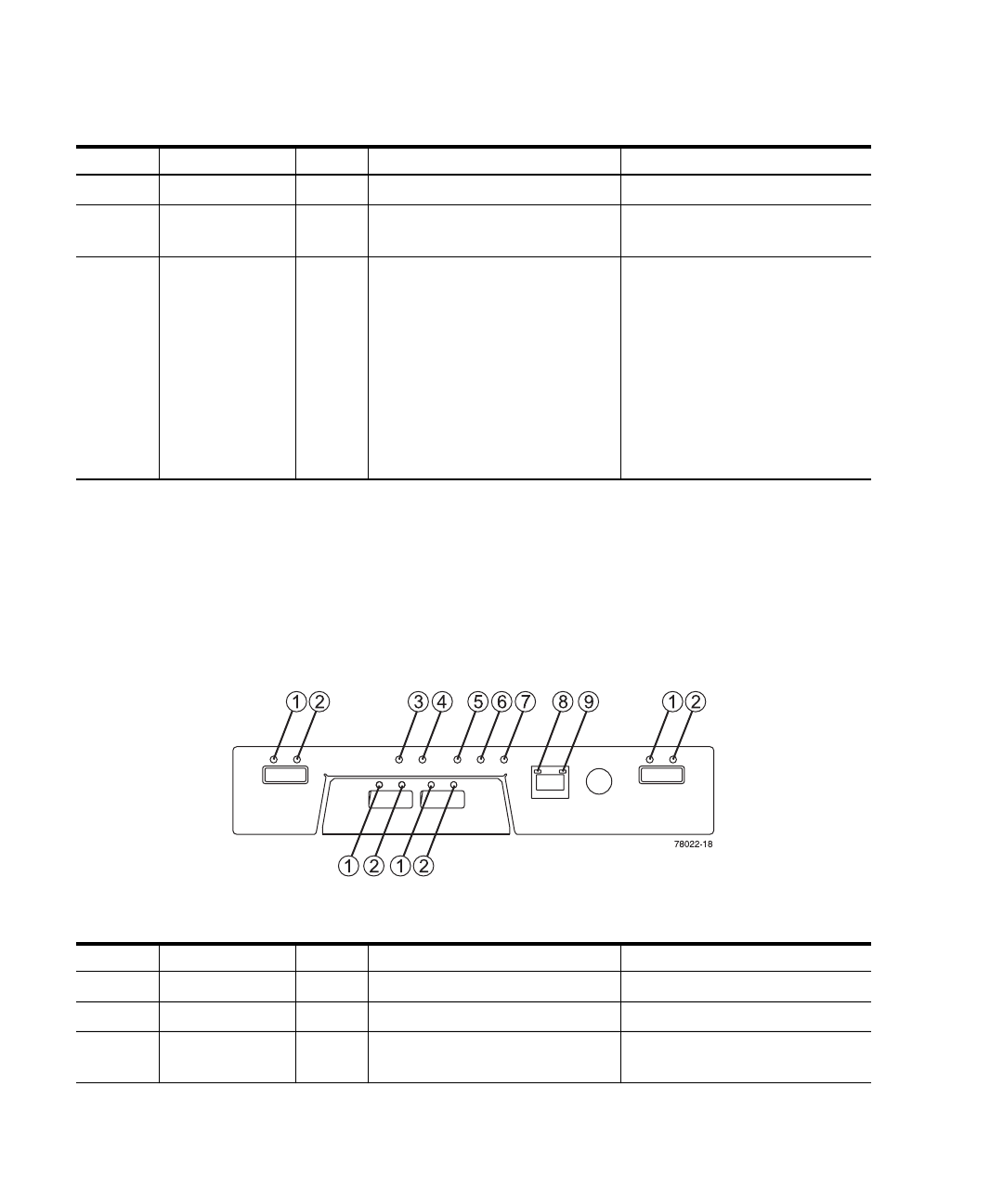
FIGURE 1-11 Locations of the Controller LEDs on the Sun StorageTek 2530 Array
8 Ethernet Link Green The connection is active. The connection is not active.
9 Ethernet
100BASE-TX
Green 100BASE-TX connection is
active.
The 100BASE-TX connection is
not active.
10 and 11 Host Link Green Both LEDs on indicate a 4-Gb/s
data rate from the management
software host.
Left LED on and right LED off
indicate a 1-Gb/s data rate from
the management software host.
Right LED on and left LED off
indicate a 2-Gb/s data rate from
the management software host.
Both LEDs off indicate no link
to the management software
host.
TABLE 1-3 Descriptions of the Controller LEDs on the Sun StorageTek 2530 Array (1 of
2)
Location LED Color On Off
1 Link Green At least one link is active. All links have failed.
2 Link Fault Amber At least one link has an error. Normal condition.
3 Battery Fault Amber Indicates a fault within the
battery backup unit.
Normal condition.
TABLE 1-2 Descriptions of the Controller LEDs on the Sun StorageTek 2540 Array (2 of
2)
Location LED Color On Off

Chapter 1 Tray Overviews 13
Controller Tray and Drive Expansion Tray Power-
Fan Assembly LEDs
The power-fan assembly LEDs for the Sun StorageTek 2540 Array, the Sun
StorageTek 2530 Array, and the Sun StorageTek 2501 Array are identical.
4 Cache Active Green Caching is enabled.
When blinking, the cache has
data.
Indicates a problem if caching is
enabled.
5 Service Action
Allowed
Blue The controller can be removed
from the controller tray.
The controller cannot be
removed from the controller
tray.
6 Service Action
Required (Fault)
Amber Indicates a fault within the
controller.
Normal condition
7 Power Green Power is present. No power is applied to the
controller tray.
8 Ethernet Link Green The connection is active. The connection is not active.
9 Ethernet
100BASE-TX
Green 100BASE-TX connection is
active.
The 100BASE-TX connection is
not active.
TABLE 1-3 Descriptions of the Controller LEDs on the Sun StorageTek 2530 Array (2 of
2)
Location LED Color On Off
14 Sun StorageTek 2500 Series Array Hardware Installation Guide • March 2007
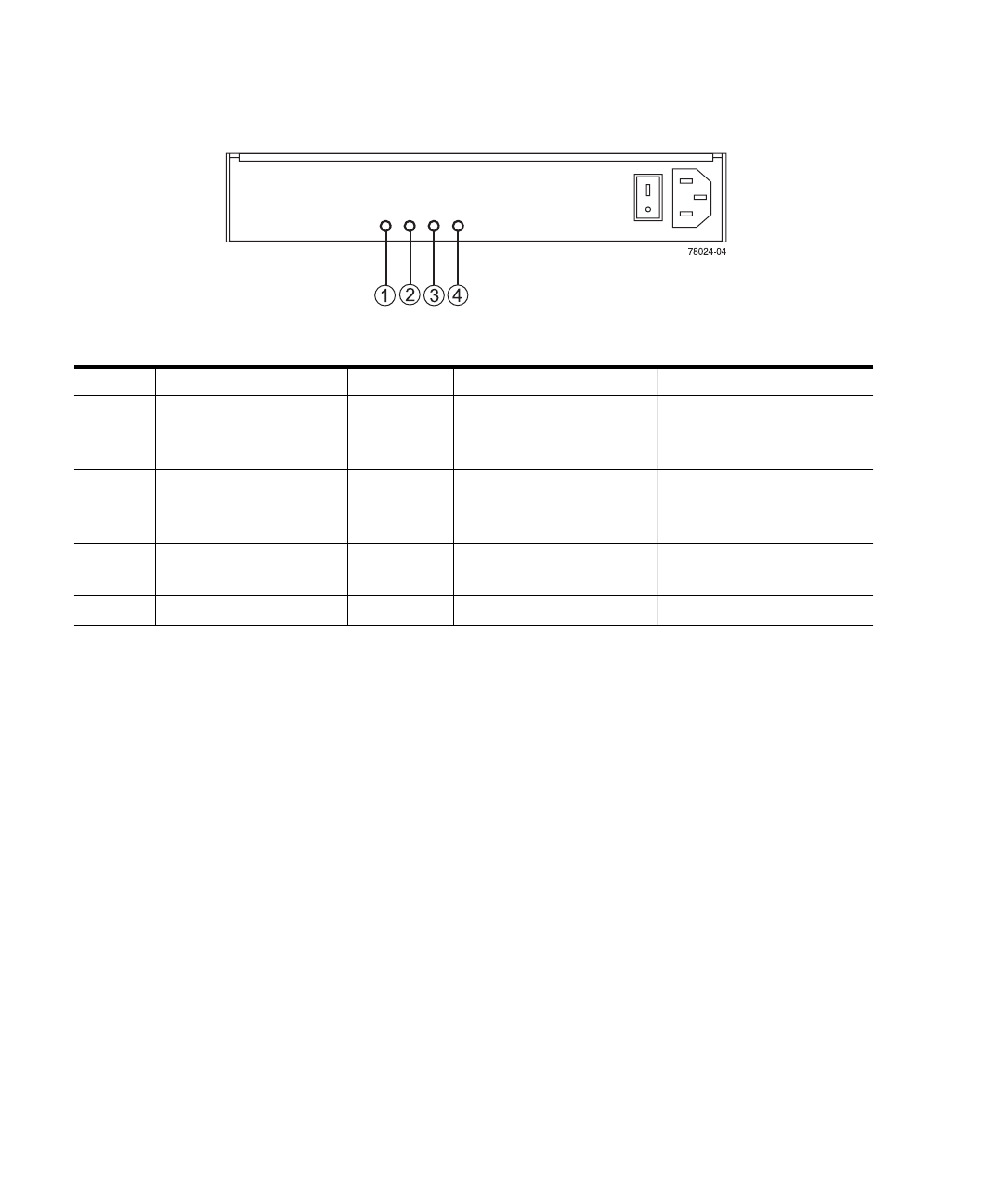
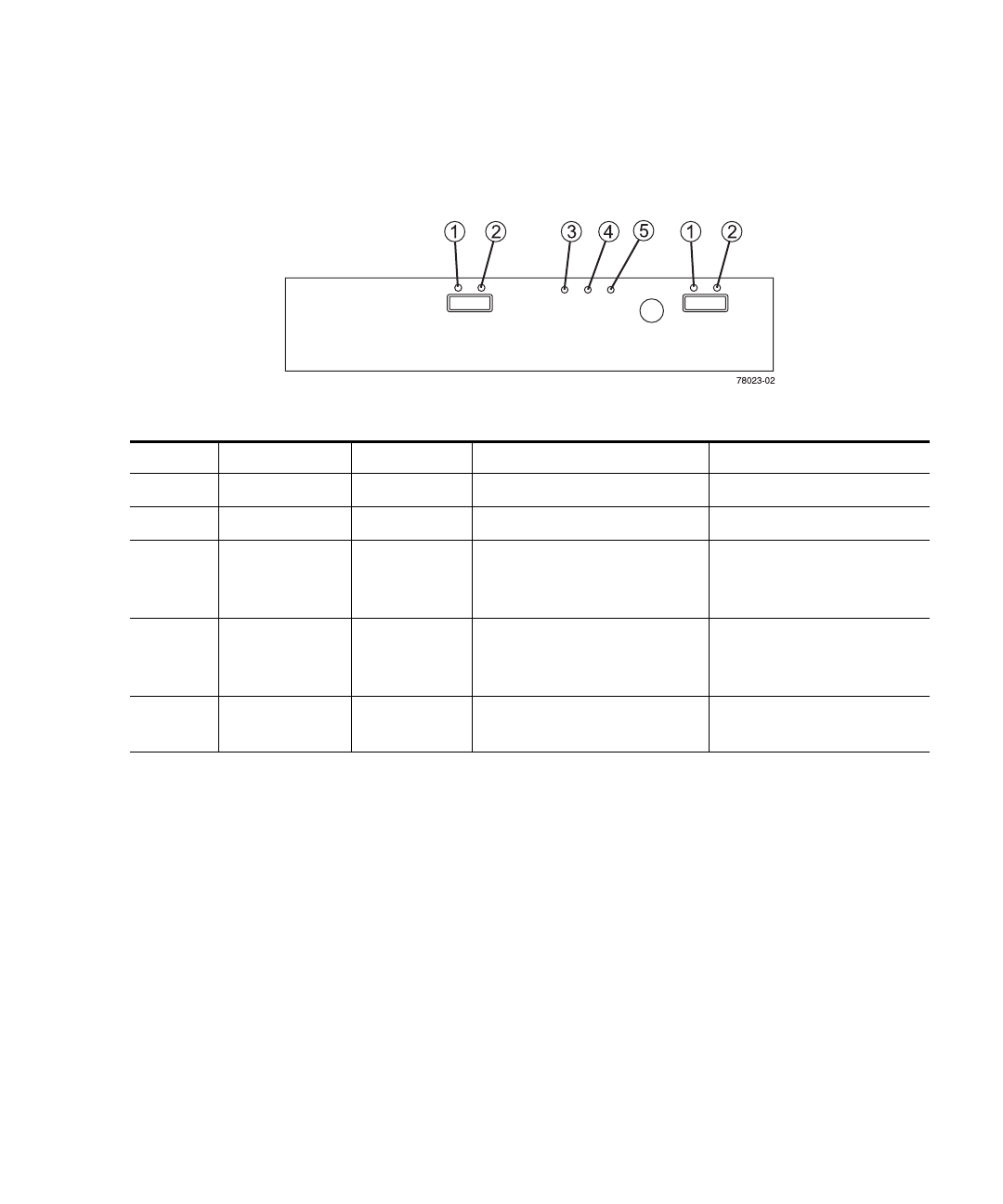
FIGURE 1-12 Locations of the Power-Fan Assembly LEDs
TABLE 1-4 Descriptions of the Power-Fan Assembly LEDs
Location LED Color On Off
1 DC Power (DC Good) Green DC power from the
power-fan assembly is
available.
DC power from the power-
fan assembly is not
available.
2 Service Action Allowed Blue The power-fan assembly
can be removed from the
tray.
The power-fan assembly
cannot be removed from the
tray.
3 Fault Amber A fault exists within the
power-fan assembly.
Normal condition
4 Power (AC Good) Green Power is present Power is not present
Chapter 1 Tray Overviews 15
IOM LEDs on the Sun StorageTek 2501 Array
FIGURE 1-13 Locations of the IOM LEDs
Service Action LEDs
Each controller, power-fan assembly, IOM, and disk drive has a Service Action
Allowed LED. The Service Action Allowed LED indicates when you can remove a
component safely. See the “LEDs on the Rear of the Trays” section on page 1-11 for
the locations and descriptions of the Service Action Allowed LEDs on a controller
tray and a drive expansion tray, and see “LEDs on the Disk Drives” on page 1-18 for
disk drive Service Allowed LEDs.
TABLE 1-5 Descriptions of the IOM LEDs
Location LED Color On Off
1 IOM Link Fault Amber A link error occurred. No errors have occurred.
2 IOM Link Green The link is active. A link error occurred.
3
Service Action
Allowed
Blue The IOM can be removed
from the drive expansion tray.
The IOM cannot be
removed from the drive
expansion tray.
4
Service Action
Required
(Fault)
Amber A fault exists within the IOM. Normal condition
5Power Green Power is present in the drive
expansion tray.
No power is applied to the
drive expansion tray.

16 Sun StorageTek 2500 Series Array Hardware Installation Guide • March 2007
Caution – Potential loss of data access – Never remove a power-fan assembly, a
controller module, or a disk drive unless the Service Action Allowed LED is turned
on or you are given specific instructions to do so by the Common Array Manager
software Service Advisor.
If a module fails and must be replaced, the Service Action Required LED on that
module turns on to indicate that a service action is required. The Service Action
Allowed LED also will turn on if it is safe to remove the module. If there are data
availability dependencies or other conditions that dictate that a module should not
be removed, the Service Action Allowed LED remains off.
The Service Action Allowed LED automatically turns on or turns off as conditions
change. In most cases, the Service Action Allowed LED turns on when the Service
Action Required (Fault) LED is turned on for a module.
Note – If the Service Action Required (Fault) LED is turned on but the Service
Action Allowed LED is turned off for a particular module, you might have to service
another component first. Check the Common Array Manager software Service
Advisor to determine the action you should take.
Disk Drives
Disk drives for the Sun StorageTek 2500 Series Array have three components: a hard
drive, a hard drive carrier, and an adapter card for connecting the disk drive to the
midplane. The disk drives can be Serial Advance Technology Attachment (SATA)
disk drives, Fibre Channel (FC) disk drives, or SAS disk drives.
Controller trays or drive expansion trays hold up to 12 disk drives, for a maximum
of 36 disk drives in a storage array. To reach the maximum of 36 disk drives, the
storage array must consist of one controller tray and two drive expansion trays.
Access to disk drives is from the front of the tray.
Refer to the storage array release notes for supported drives.
Note – The disk drives in your tray might differ in appearance from those shown
here. The variation does not affect their function.
Chapter 1 Tray Overviews 17
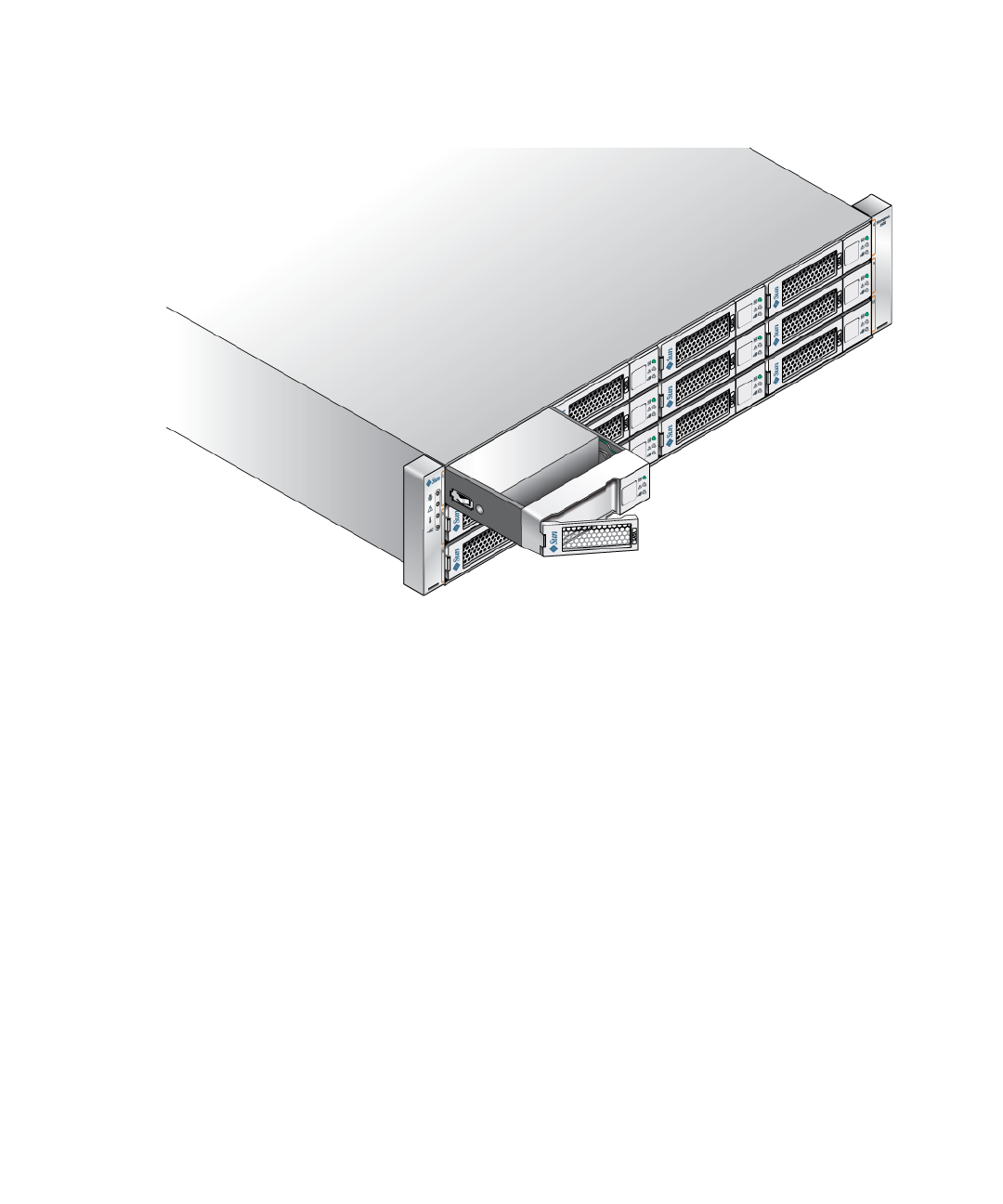
FIGURE 1-14 Disk Drives
The physical locations of the disk drives are numbered 1 through 12, from left to
right, and from top to bottom. The right end cap has numbers on the side showing
the numbers of the adjacent drives. The Common Array Manager Service Advisor
software automatically detects a disk drive’s tray ID and slot designation.
18 Sun StorageTek 2500 Series Array Hardware Installation Guide • March 2007
LEDs on the Disk Drives
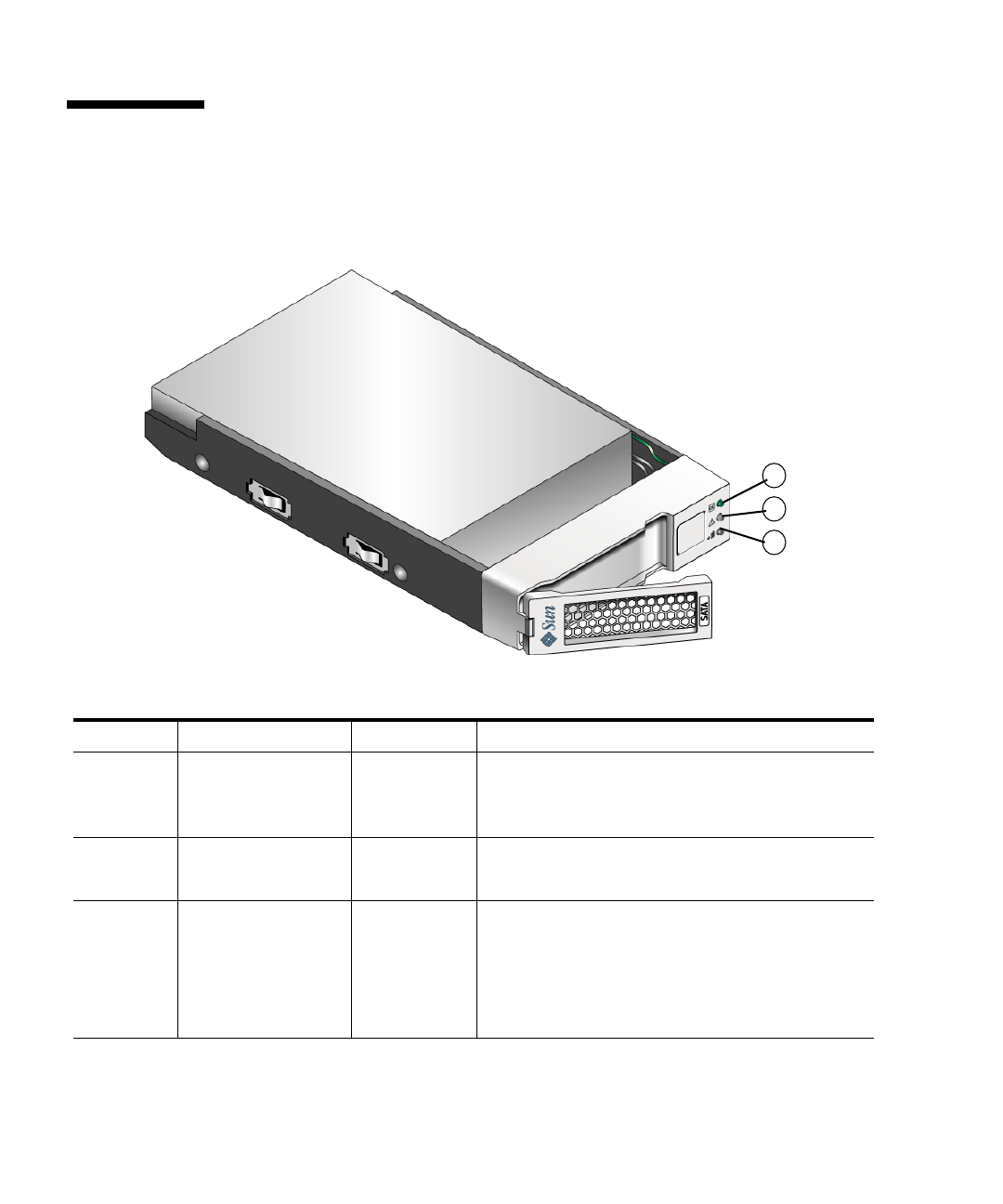
FIGURE 1-15 Locations of the Disk Drive LEDs
TABLE 1-6 Descriptions of the Disk Drive LEDs
Location LED Color General Behavior
1
Service Action
Allowed
Blue On – The disk drive can be removed from the tray.
Off – The disk drive cannot be removed from the
tray.
2Fault Amber On – The disk drive has a problem.
Off – Normal condition.
3
Power Green Off – The power is turned off.
On – The power is on and the disk drive is
operating normally.
On and blinking (0.5 s on, 0.5 s off) –Disk drive
I/O activity is taking place.
1
2
3

Chapter 1 Tray Overviews 19
Common Array Manager Software
The Sun StorageTek 2500 Series Array is managed by the Sun StorageTek Common
Array Manager software. The Common Array Manager provides web browser–
based management and configuration from an external management host, data host
software that controls the data path between the data host and the array, and a
remote command-line interface (CLI) client that provides the same control and
monitoring capability as the web browser, and is scriptable for running frequently
performed tasks.
The Common Array Manager software includes Service Advisor, an online reference
full of hardware and software configuration and troubleshooting information and
procedures.
For information about installing the Common Array Manager software and
configuring and managing the array, see the Sun StorageTek Common Array Manager
Software Installation Guide.
Service Advisor and Customer-
Replaceable Units
Customer-replaceable units (CRUs) are designed to be replaceable by customers.
TABLE 1-7 Disk Drive States Represented by the LEDs
Disk Drive State Power
(Green LED)
Fault
(Amber
LED)
Power is not applied. Off Off
Normal operation, power is turned on, no disk drive I/O activity is
occurring.
On, solid Off
Normal operation, disk drive I/O activity is occurring. On, blinking Off
Service action required, a fault condition exists, and the disk drive is
offline.
On, solid On, solid

20 Sun StorageTek 2500 Series Array Hardware Installation Guide • March 2007
To see a list of the hardware components that can be replaced at the customer site
refer to Service Advisor in the Sun StorageTek Common Array Manager software.
The Service Advisor also provides information and procedures for replacing array
components.
Overview of the Installation Process
Before you begin to install the array, you must do the following:
■Read the Sun StorageTek 2500 Series Array Release Notes for any late-breaking
information related to the installation of the array.
■Prepare the site as described in these books:
■Sun StorageTek 2500 Series Array Regulatory and Safety Compliance Manual
■Sun StorageTek 2500 Series Array Site Preparation Guide
The following checklist (TABLE 1-8) outlines all of the tasks required for installing the
Sun StorageTek 2500 Array hardware and tells you where you can find detailed
procedures. To ensure a successful installation, perform the tasks in the order in
which they are presented.
TABLE 1-8 Sun StorageTek 2500 Series Array Hardware Installation Checklist
Step Installation Task Where to Find Procedure
1. Unpack the cabinet and move it into
position.
Unpacking guide attached to the outside of
the shipping carton
2. Install and secure the cabinet. • Sun StorageTek Expansion Cabinet Installation
and Service Manual
• Sun Rack Installation Guide
3. Unpack the rackmounting kit and
check its contents.
“Preparing the Universal Rail Kit” on page 24
4. Unpack the tray box and check its
contents.
“Preparing the Tray” on page 25
5. Prepare the cabinet for installation. “Preparing the Cabinet” on page 26
6. Attach the rails to the cabinet. “Attaching the Rails to a Cabinet” on page 27
7. Mount the controller tray and
expansion trays in the cabinet.
“Installing a Tray in a Cabinet” on page 37
8. Attach the power cables. “Connecting the Power Cables” on page 42
9. Cable the controller tray and
expansion trays.
“Intertray Cabling” on page 42

Chapter 1 Tray Overviews 21
When the tasks in TABLE 1-8 are complete, you can install the Common Array
Manager software on an external management host, install and upgrade firmware
from the management host, and perform initial array setup and system
configuration. See the Sun StorageTek Common Array Manager Software Installation
Guide for complete information on software-related tasks.
10. Connect the management host. “Connecting the Management Host” on
page 49
11. Attach the host interface cables. “Connecting Data Hosts to the 2540 Array” on
page 51
12. Turn on the power. “Powering On the Array” on page 62
TABLE 1-8 Sun StorageTek 2500 Series Array Hardware Installation Checklist
Step Installation Task Where to Find Procedure

22 Sun StorageTek 2500 Series Array Hardware Installation Guide • March 2007

23
CHAPTER 2
Installing Trays
Use the procedures in this chapter to install trays in a cabinet. The number of trays
you need to install depends on your overall storage requirements. You can install a
maximum of three trays, one controller tray and up to two expansion trays for each
array.
This chapter describes the process of installing the Sun StorageTek 2500 Series Array.
It contains the following sections:
■“Preparing for the Installation” on page 24
■“Attaching the Rails to a Cabinet” on page 27
■“Installing a Tray in a Cabinet” on page 37
■“Connecting the Power Cables” on page 42
■“Intertray Cabling” on page 42
■“Drive Module Cable Labeling” on page 47
■“Next Steps” on page 48
The installation procedures in this chapter require the following items:
■#2 Phillips screwdriver (minimum 4-inch length recommended)
■#3 Phillips screwdriver (minimum 4-inch length recommended)
■Antistatic protection
Caution – Electrostatic discharge can damage sensitive components. Touching the
array or its components without using a proper ground might damage the
equipment. To avoid damage, use proper antistatic protection before handling any
components.

24 Sun StorageTek 2500 Series Array Hardware Installation Guide • March 2007
Preparing for the Installation
Use the following procedures to prepare for installation:
■“Preparing the Universal Rail Kit” on page 24
■“Preparing the Tray” on page 25
■“Preparing the Cabinet” on page 26
Preparing the Universal Rail Kit
Use the universal rail kit to mount the Sun StorageTek 2500 Series Array trays in any
of the following cabinets:
■Any standard Sun cabinet, such as the Sun Rack 900/1000 cabinet
■Any 19-inch wide, 4-post, EIA-compatible rack or cabinet with a front-to-back
depth between vertical cabinet rails of 24-36 inches (with threaded or unthreaded
cabinet rails).
■The Sun StorageTek Expansion cabinet
Unpacking the Universal Rail Kit
Unpack the universal rail kit and check the contents.
The universal rail kit (part number 594-2489-02) comes with pre-assembled rails and
contains the following items:
■Left rail assembly
■Right rail assembly
■10 8-32x3/8” panhead screws with lockwashers
■4 M4 flathead screws
■4 cabinet rail adapter plates (used for unthreaded cabinet rails only)
Loosening the Rail Adjustment Screws
To loosen the adjustment screws on the left and right rails:
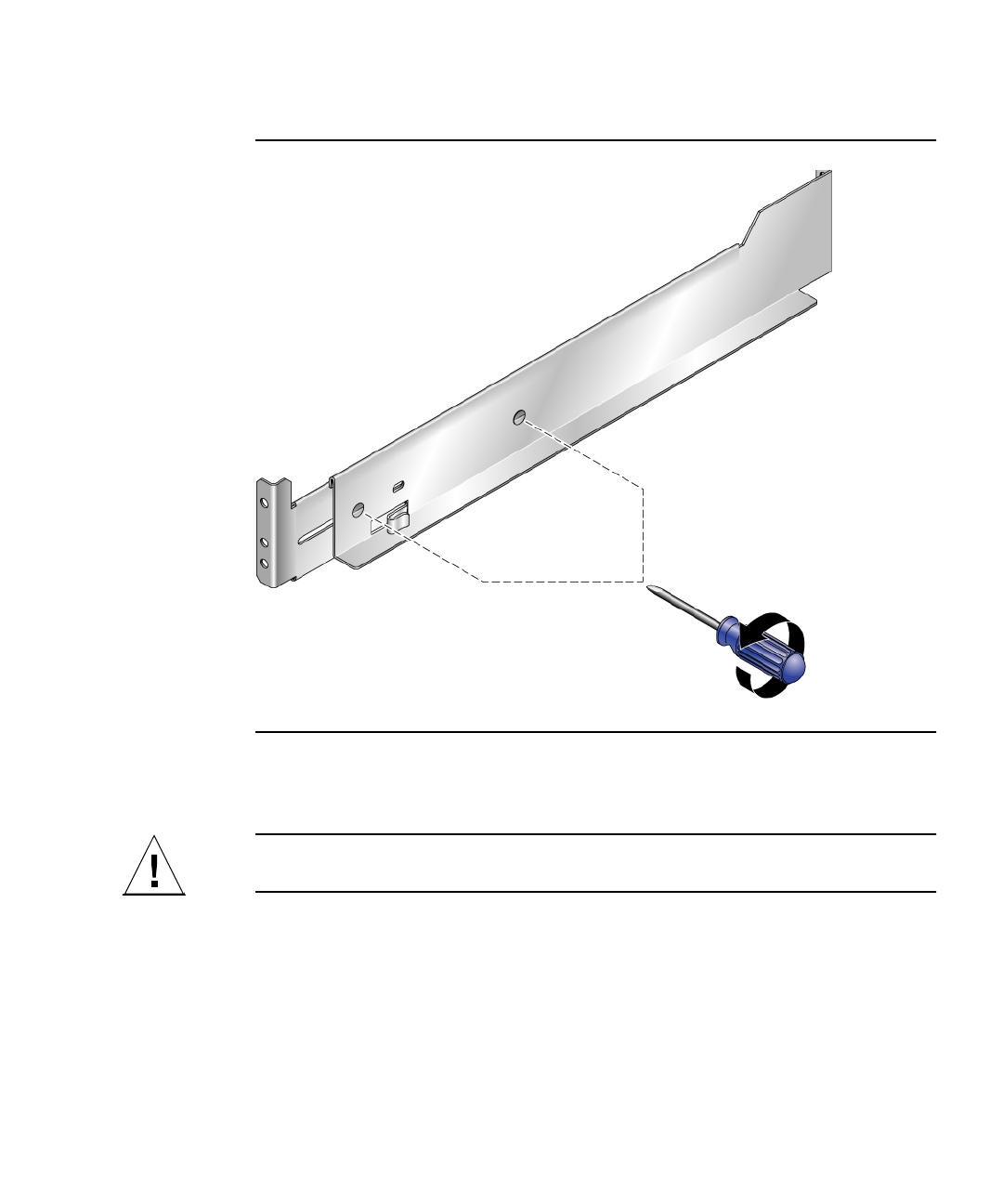
Use a flathead screwdriver to loosen the two rail adjustment screws on each rail to
allow adjustment of each rail length (FIGURE 2-1).
Chapter 2 Installing Trays 25
FIGURE 2-1 Loosening the Rail Screws to Adjust the Rail Length
Note – The rails are preconfigured to adjust to cabinet rail depths of between 24
inches (609.6 mm) and 34 inches (863.6 mm).
Preparing the Tray
Caution – Two people are needed to lift and move the tray. Use care to avoid injury.
A traycan weigh up to 54.3 pounds (24.6 kg).
1. Unpack the tray.
2. Check the contents of the box for the following items:
■Sun StorageTek 2500 Series Arraytrays (controller or expansion)
■Ship kit for the controller tray
■One pair left and right end caps (plastic bezels)
■Four 4 Gbps FC SFPs (2 per FC Controller module)

26 Sun StorageTek 2500 Series Array Hardware Installation Guide • March 2007
■Two 6-meter RJ45 -RJ45 Ethernet cables (one per controller module)
■One RJ45-DIN9 cable
■One RJ45-DB9 adapter
■Sun StorageTek Common Array Manager Software CD
■Sun StorageTek Common Array Manager Software Installation Guide (on the
software CD)
■Common Array Manager sscs CLI Quick Reference Card
■Sun StorageTek 2500 Series Array Hardware Installation Guide (Hardcopy)
■Accessing Documentation guide
■Premium feature license cards (ordered optionally)
■Ship kit for each expansion tray
■Two 1-meter copper SAS cables (one per I/O module)
■Accessing Documentation guide
AC power cords are shipped separately with each tray.
Preparing the Cabinet
Select the cabinet in which you will be installing the array. Be sure the cabinet is
installed as described in the installation instructions provided with it.
1. Stabilize the cabinet as described in the cabinet documentation.
2. If the cabinet has casters, make sure the casters are locked to prevent the
cabinet from rolling.
3. Remove or open the front panel.
4. Remove or open the vented back panel.
Planning the Order of the Tray Installation
Install the trays starting with the controller tray at the lowest available 2RU tray slot
in the cabinet. Next, install the expansion trays for the first controller tray. If room
remains in the cabinet, repeat for the next controller and expansion trays.
Starting at the bottom distributes the weight correctly in the cabinet.

Chapter 2 Installing Trays 27
Attaching the Rails to a Cabinet
Depending on the type of cabinetin which you will install the tray, use one of the
following procedures to attach the rails:
■“Attaching the Universal Rail Kit to a Standard Sun or 19-Inch Cabinet With
Threaded Cabinet Rails” on page 27
■“Attaching the Universal Rail Kit to a Standard 19-Inch Cabinet With Unthreaded
Cabinet Rails” on page 31
Each tray requires two standard mounting rack units (2RU) of vertical space in the
cabinet. Each standard mounting rack unit (RU) has three mounting holes in the left
and right cabinet rails. The top mounting hole of the lower RU is always closest to
the bottom mounting hole of the upper RU, hence the divsion between RUs on a
cabinet rail is between the two closeest mounting holes in a grouping.
The universal rails have an adjustable depth of 24” to 34”.
Attaching the Universal Rail Kit to a Standard
Sun or 19-Inch Cabinet With Threaded Cabinet
Rails
This procedure describes the steps to attach the universal rail kit to:
■All standard Sun cabinets, including the Sun Rack 900/1000 cabinets
■Sun StorageTek Expansion cabinets
■All 19-inch wide, 4-post EIA-compatible racks and cabinets with the following
cabinet rail types:
■M5 threaded
■M6 threaded
■10-32 threaded
■12-24 threaded
■circular unthreaded
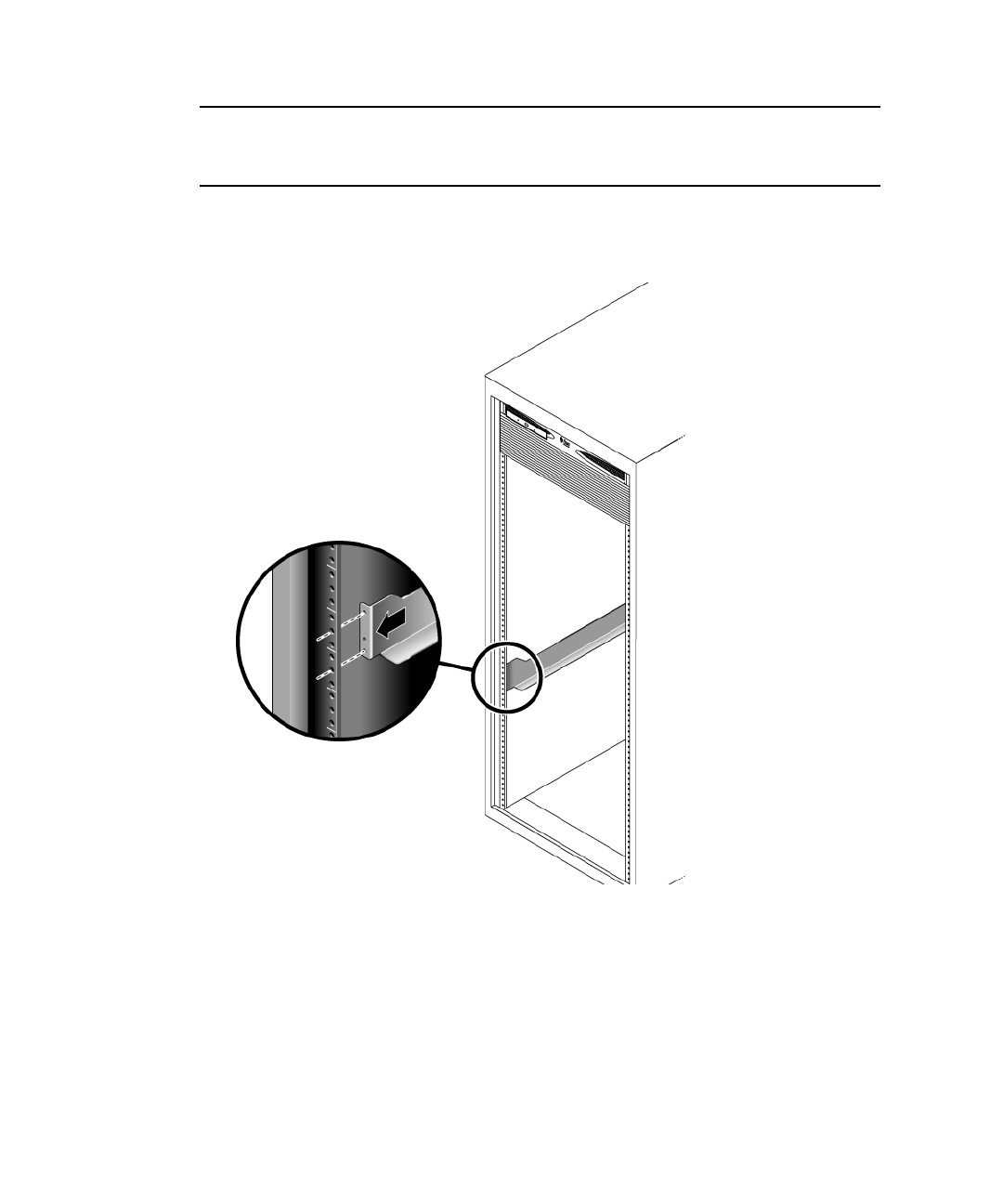
1. To attach the universal rail kit to a cabinet withthese cabinet rail typesPosition
the front flange of the left universal rail behind the left front cabinet rail
(FIGURE 2-2).
28 Sun StorageTek 2500 Series Array Hardware Installation Guide • March 2007
Note – The RUs are not labeled on all racks, as they are on the Sun cabinets. The
rule of thumb to remember is that the division of RUs passes between the two
closest rail holes in each set of holes (see FIGURE 2-2).
FIGURE 2-2 Positioning the Front of the Left Rail Behind the Left Front Cabinet Rail
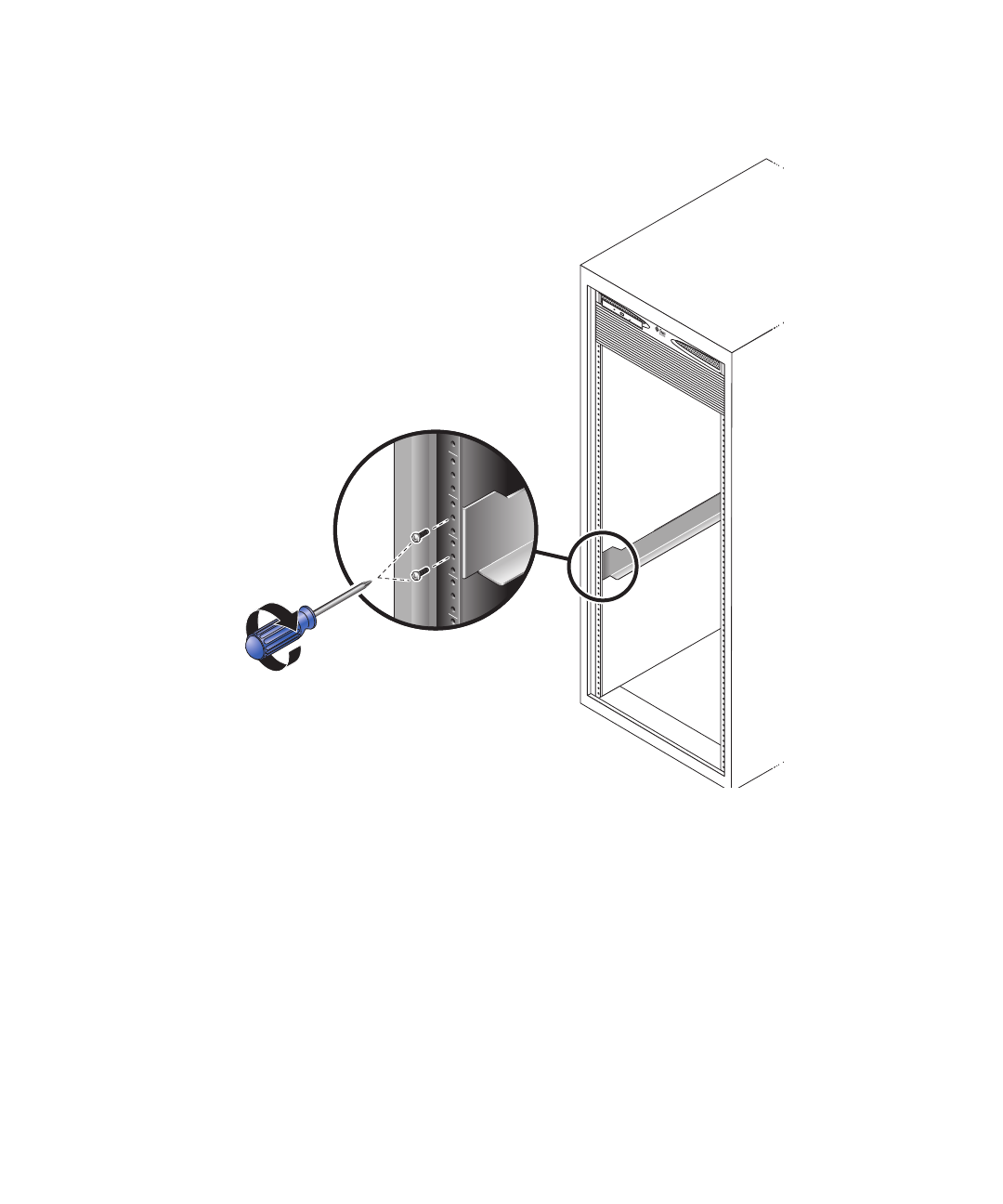
2. Insert the 8-32 screws through the center holes in each RU of the rack into the
top and bottom holes in the Universal rail (FIGURE 2-3).
These screws pass through the cabinet rail holes and screw into threaded holes in
the Universal rail.
Chapter 2 Installing Trays 29
FIGURE 2-3 Securing the Left Rail to the Front of the Cabinet
3. Repeat Step 1 and Step 2 for the right rail.
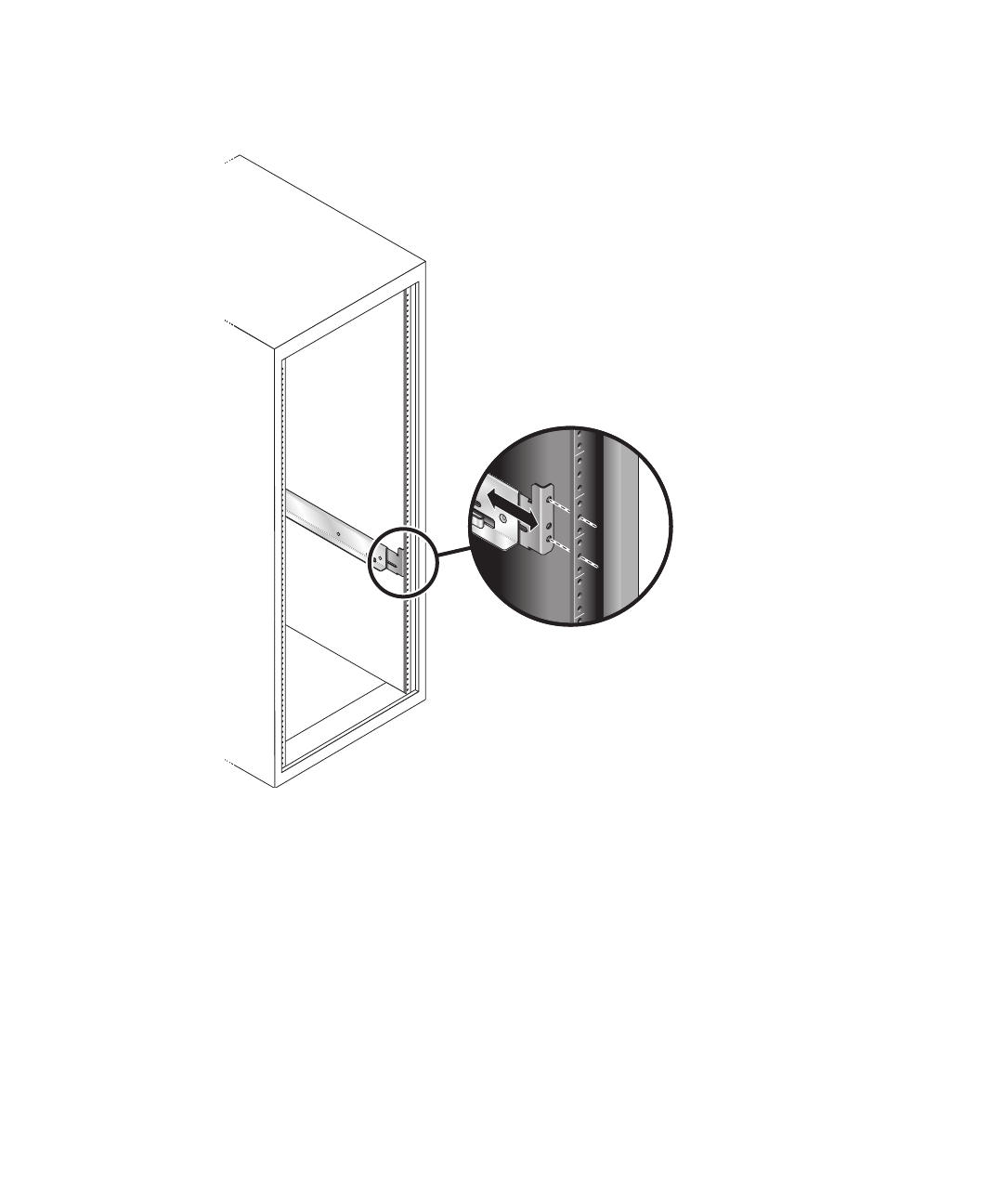
4. At the back of the cabinet, adjust the length of the left rail as needed to fit the
cabinet, and position the rail flange behind the face of the cabinet rail
(FIGURE 2-4).
30 Sun StorageTek 2500 Series Array Hardware Installation Guide • March 2007
FIGURE 2-4 Adjusting the Length of the Left Rail at the Back of the Cabinet
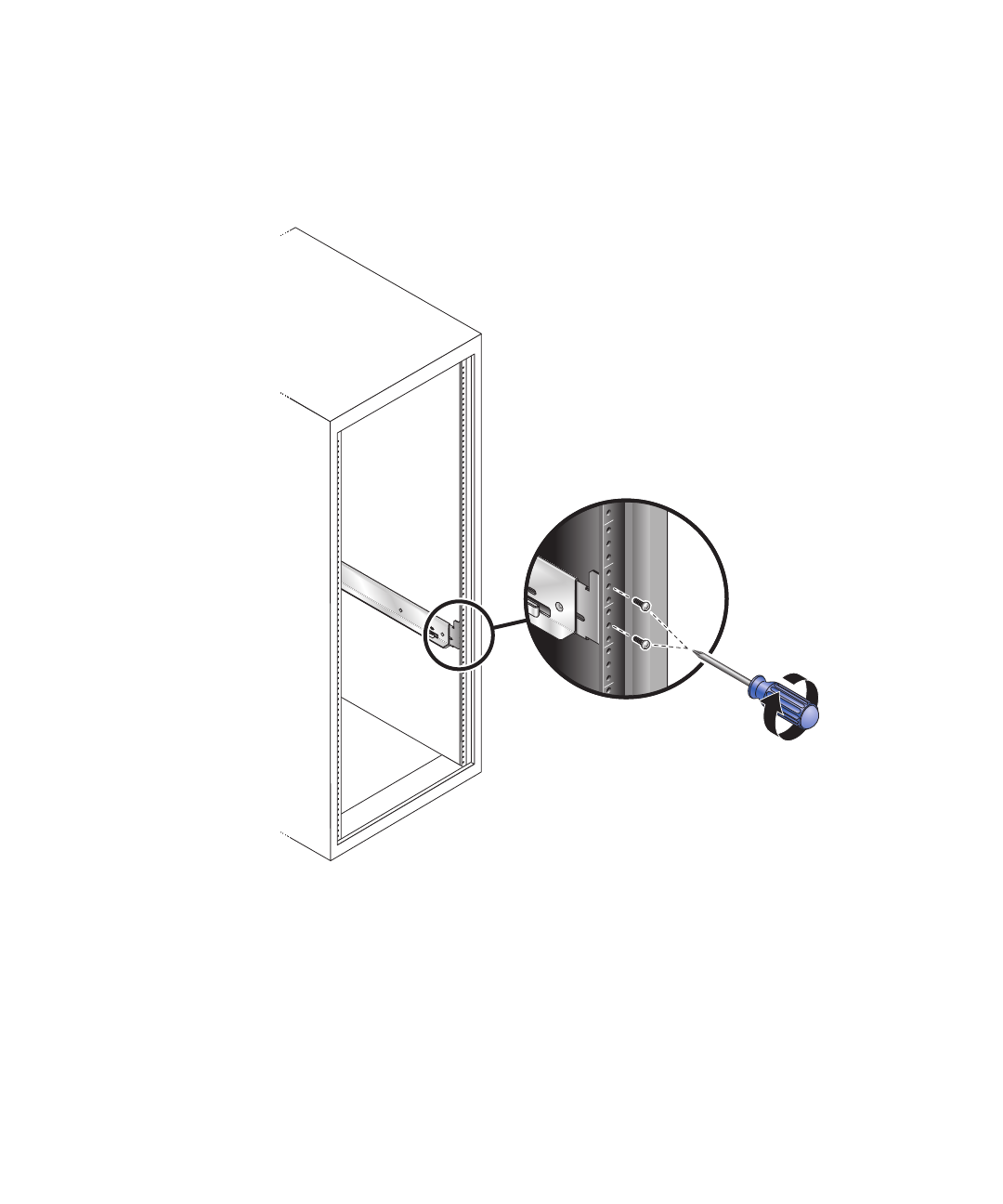
5. Align the rail flange so that the top and bottom mounting holes match the
center holes in the RUs corresponding to those used on the front of the cabinet.
Chapter 2 Installing Trays 31
6. Insert the 8-32 screws through the center holes of the rack into the top and
bottom mounting holes on the universal rail (FIGURE 2-5).
FIGURE 2-5 Securing the Left Rail to the Back of the Cabinet
7. Repeat Step 4,Step 5, and Step 6 for the right rail.
Attaching the Universal Rail Kit to a Standard
19-Inch Cabinet With Unthreaded Cabinet Rails
This procedure describes the steps to attach the universal rail kit to:
32 Sun StorageTek 2500 Series Array Hardware Installation Guide • March 2007
■All 19-inch wide, 4-post EIA-compatible racks and cabinets with unthreaded
cabinet rails (square hole racks).
To attach the universal rail kit to a cabinet with unthreaded cabinet rails, follow
these steps first for the left rail and then for the right rail:
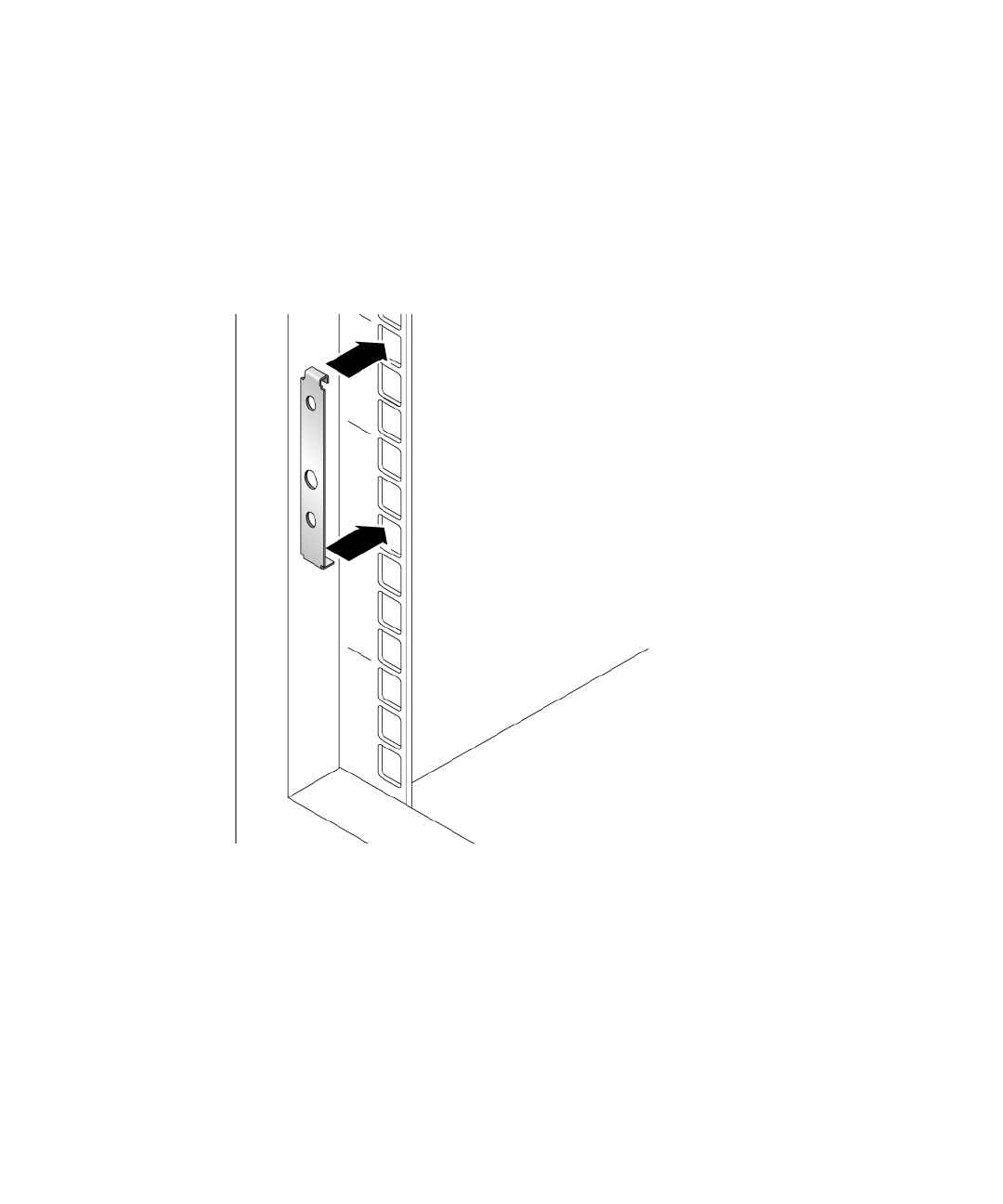
1. Hook a cabinet rail adapter plate over the front of the cabinet rail. (FIGURE 2-6)
FIGURE 2-6 Inserting the Cabinet Rail Adapter Plate on the Cabinet Rail
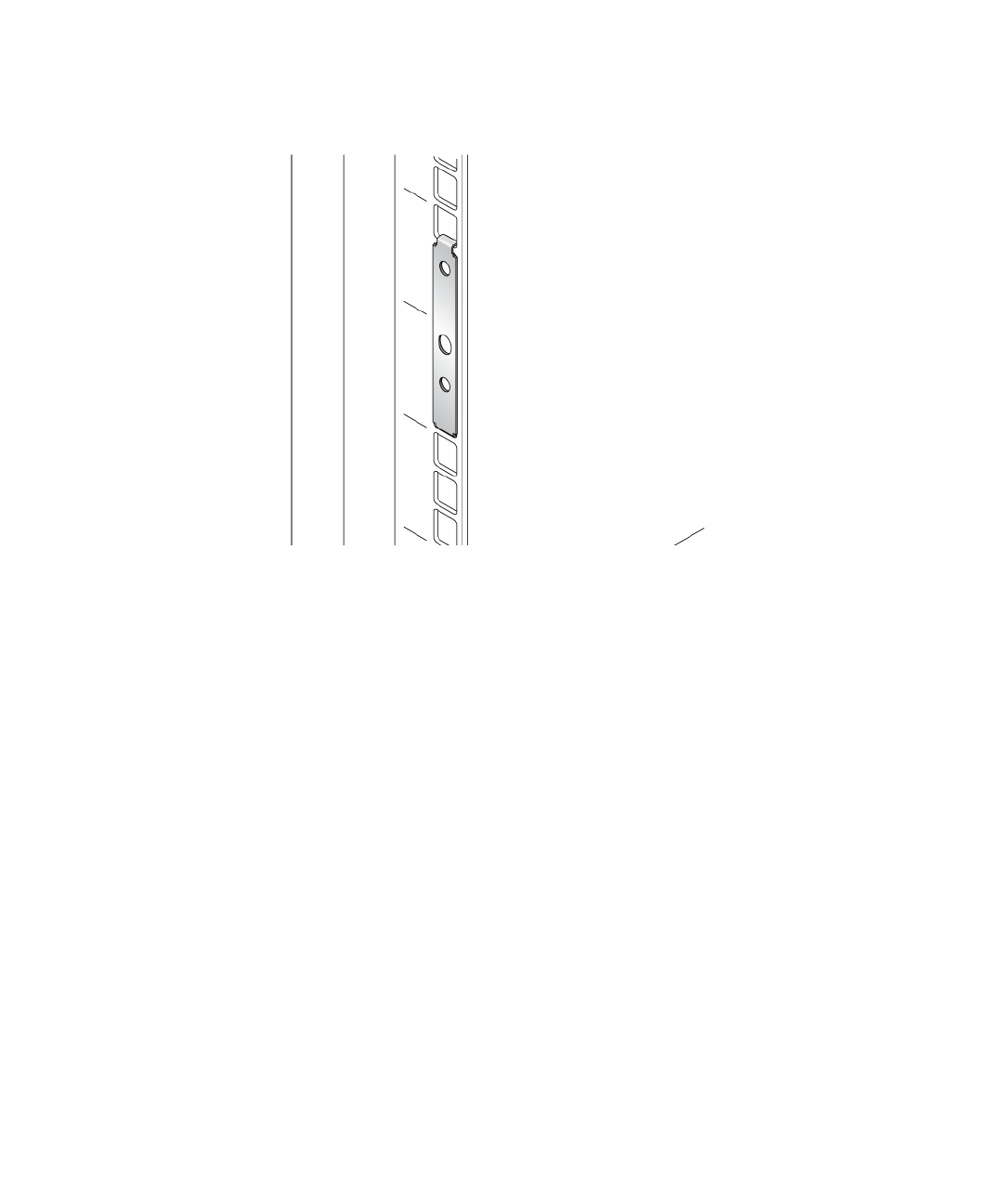
Position the adapter plate over of the 2RU slot in which the tray is to be
mounted. The hook on the top of the adapter plate hooks into the top hole of the
upper RU. The flat flange on the bottom of the adapter plate fits into the bottom
hole of the lower RU (FIGURE 2-7).
34 Sun StorageTek 2500 Series Array Hardware Installation Guide • March 2007
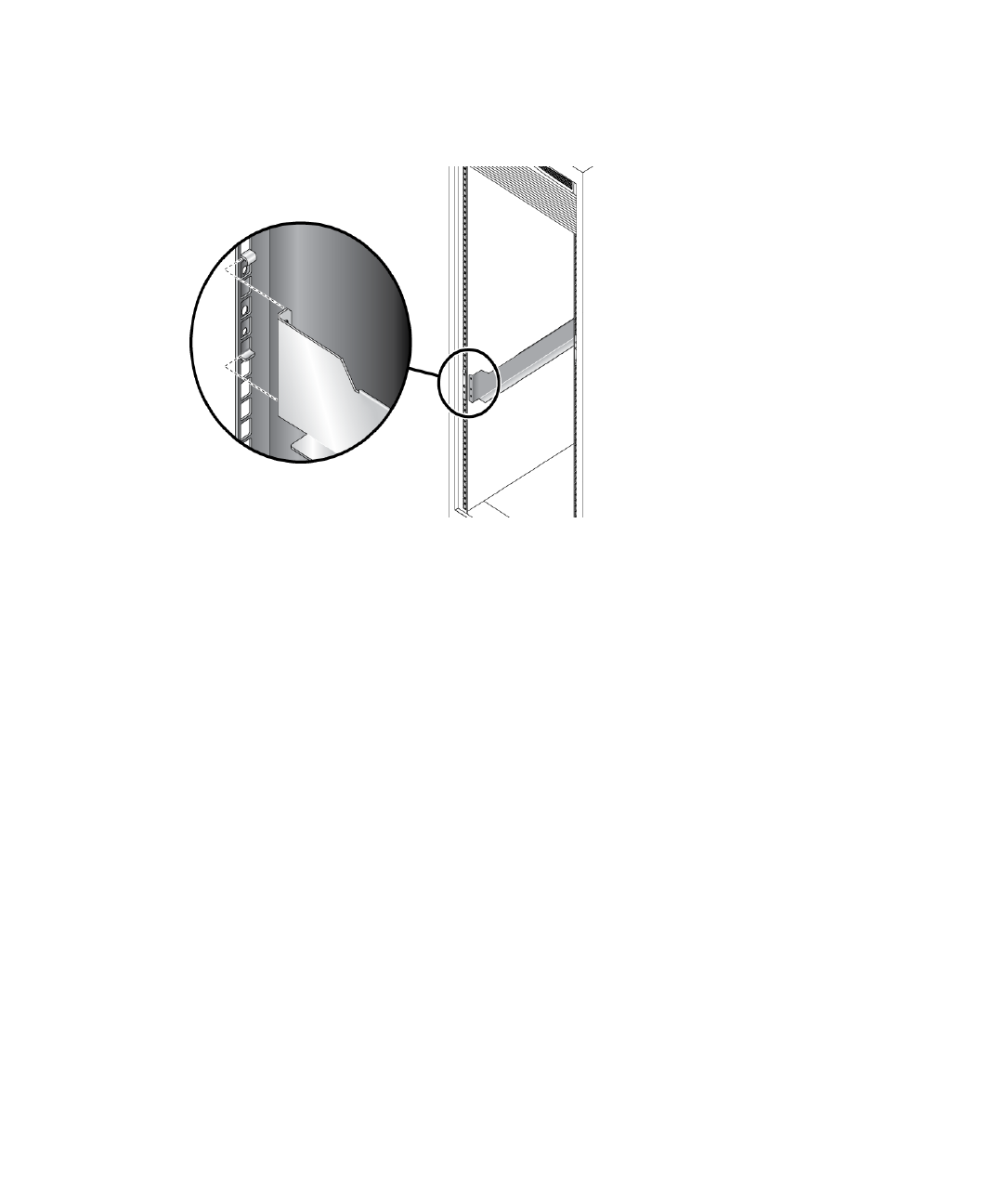
FIGURE 2-8 Slide the flange of the rail behind the cabinet rail and between that and the
hook of the rail adapter plat.e, as shown.
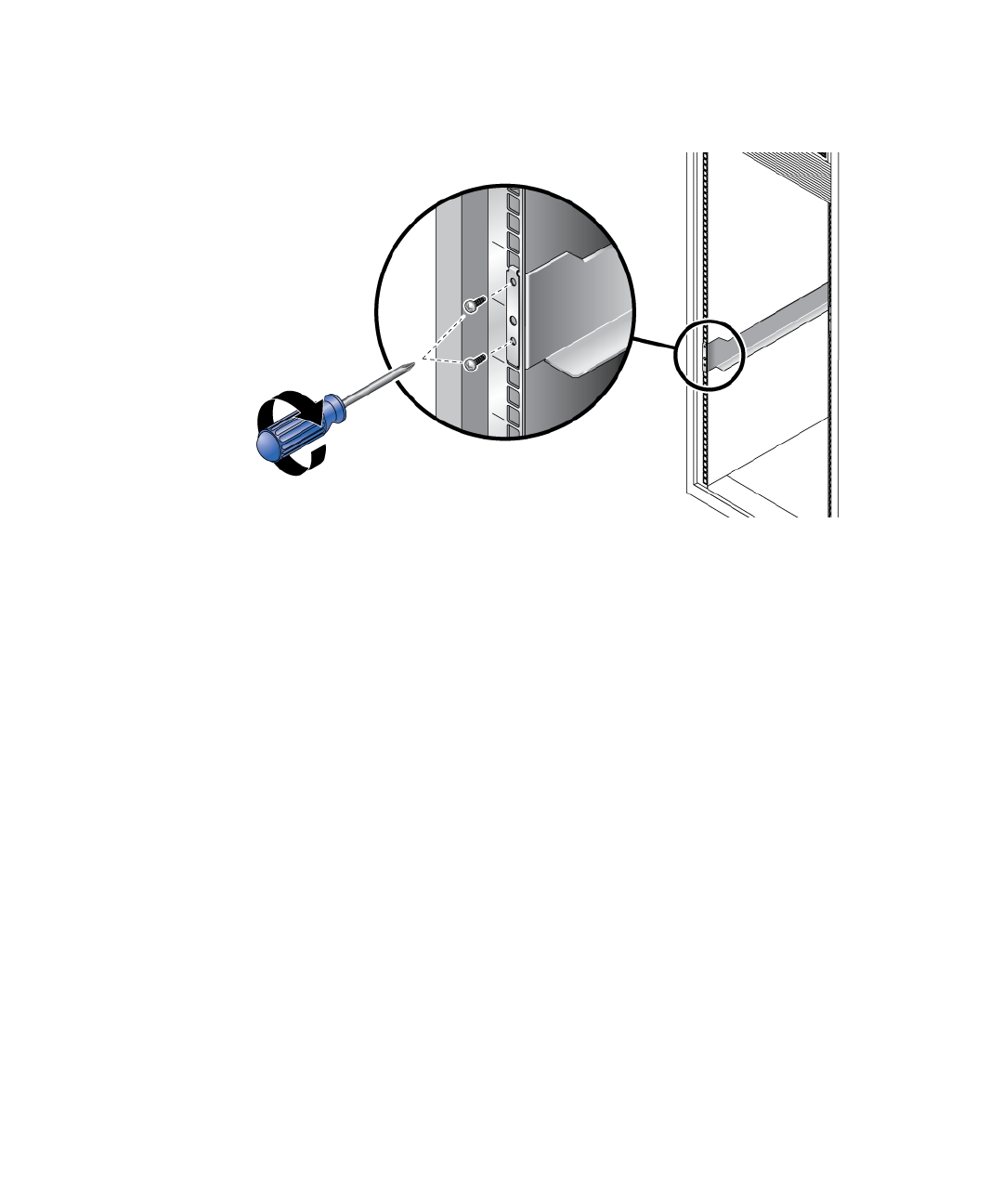
3. Insert and tighten two 8-32 screws through the top and bottom holes in the
adapter plate, through the cabinet rail, and into the top and bottom threaded
holes in the universal rail mounting flange (FIGURE 2-9).
Chapter 2 Installing Trays 35
FIGURE 2-9 Securing the Rail to the Front left of the Cabinet
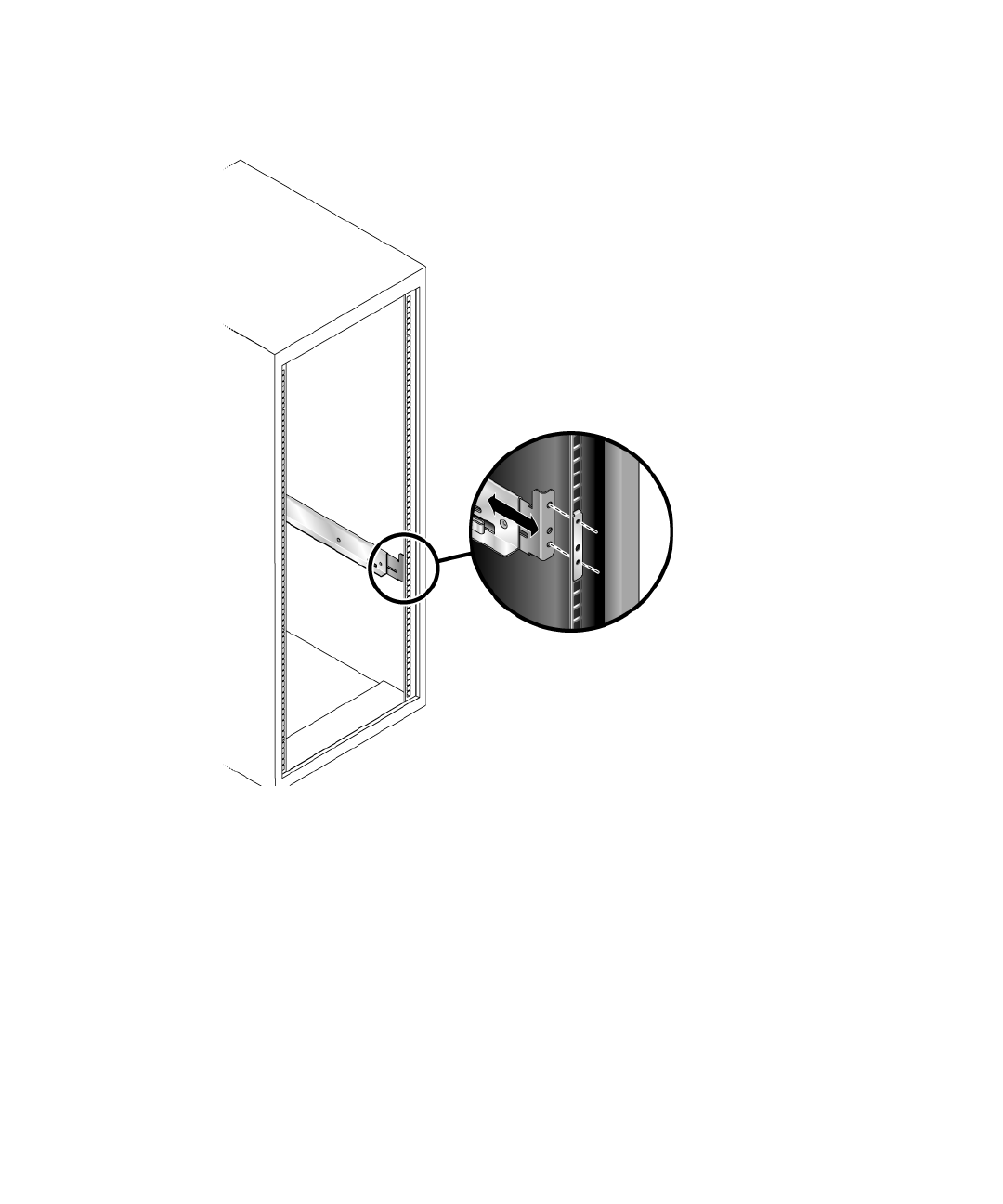
4. Repeat Step 1 through Step 3 on the corresponding cabinet rail at the back of
the cabinet (FIGURE 2-10).
Mounting the rail on the back of the cabinet is the same as mounting it to the
front, after you extend the rail the necessary length to reach the rear cabinet rail.
36 Sun StorageTek 2500 Series Array Hardware Installation Guide • March 2007
FIGURE 2-10 Adjusting the Length of the Rail at the Back of the Cabinet
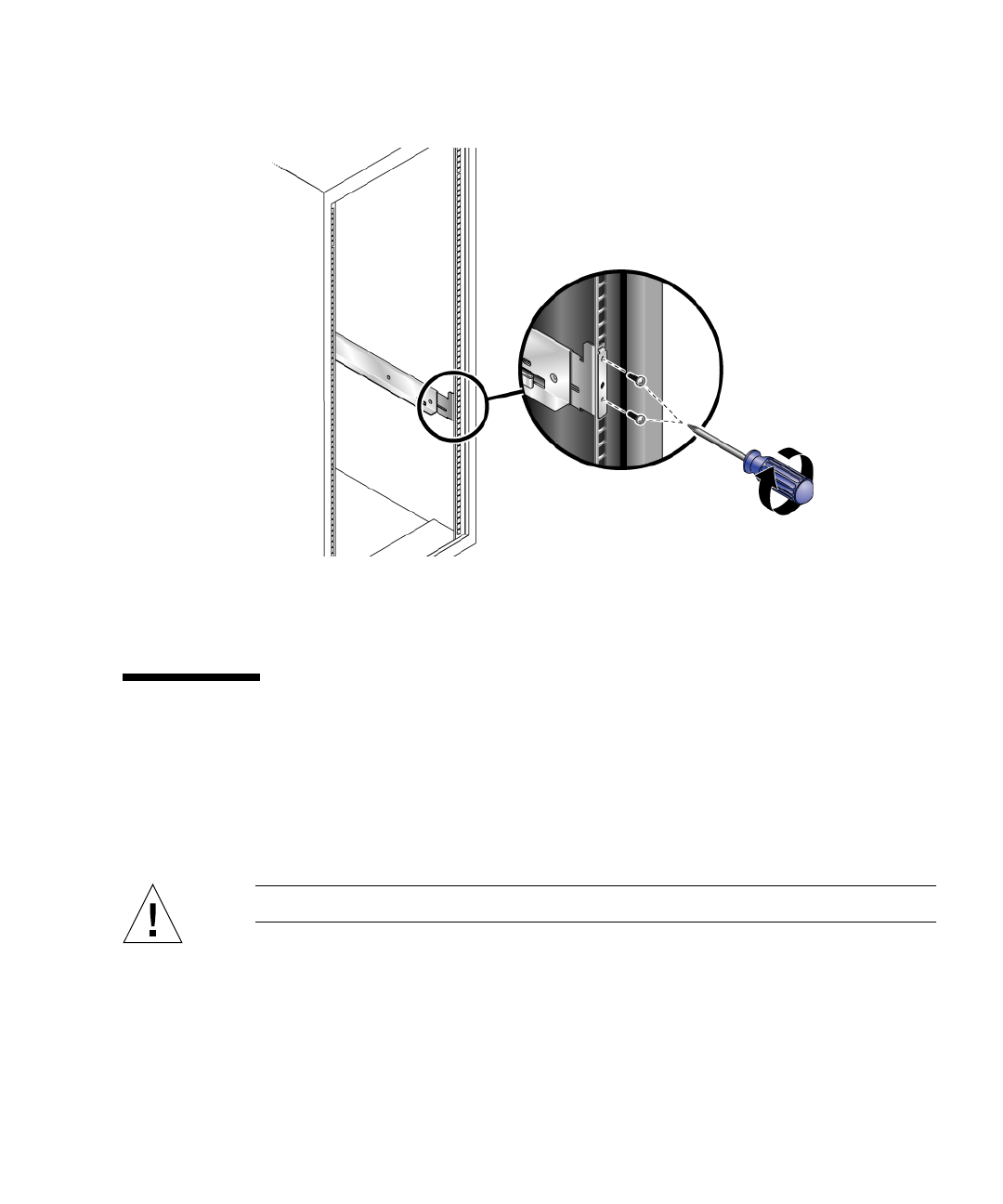
5. Insert and tighten two 8-32 screws through the top and bottom holes in the
adpater plate, back cabinet rail, and universal rail mounting flange
(FIGURE 2-11).
The screws passes through the unthreaded holes of the adapter plate and cabinet
rail mounting rail and screw into the threaded holes of the rail mounting flange.
Chapter 2 Installing Trays 37
FIGURE 2-11 Securing the Rail to the Back of the Cabinet
For extra stability, you can tighten the rail screws as in FIGURE 2-1.
6. Repeat Step 1 through Step 5 to install the right rail.
Installing a Tray in a Cabinet
Install the controller tray in the first empty 2RU slot at the bottom of the cabinet. If
you are installing expansion trays, continue installing the trays from the bottom up.
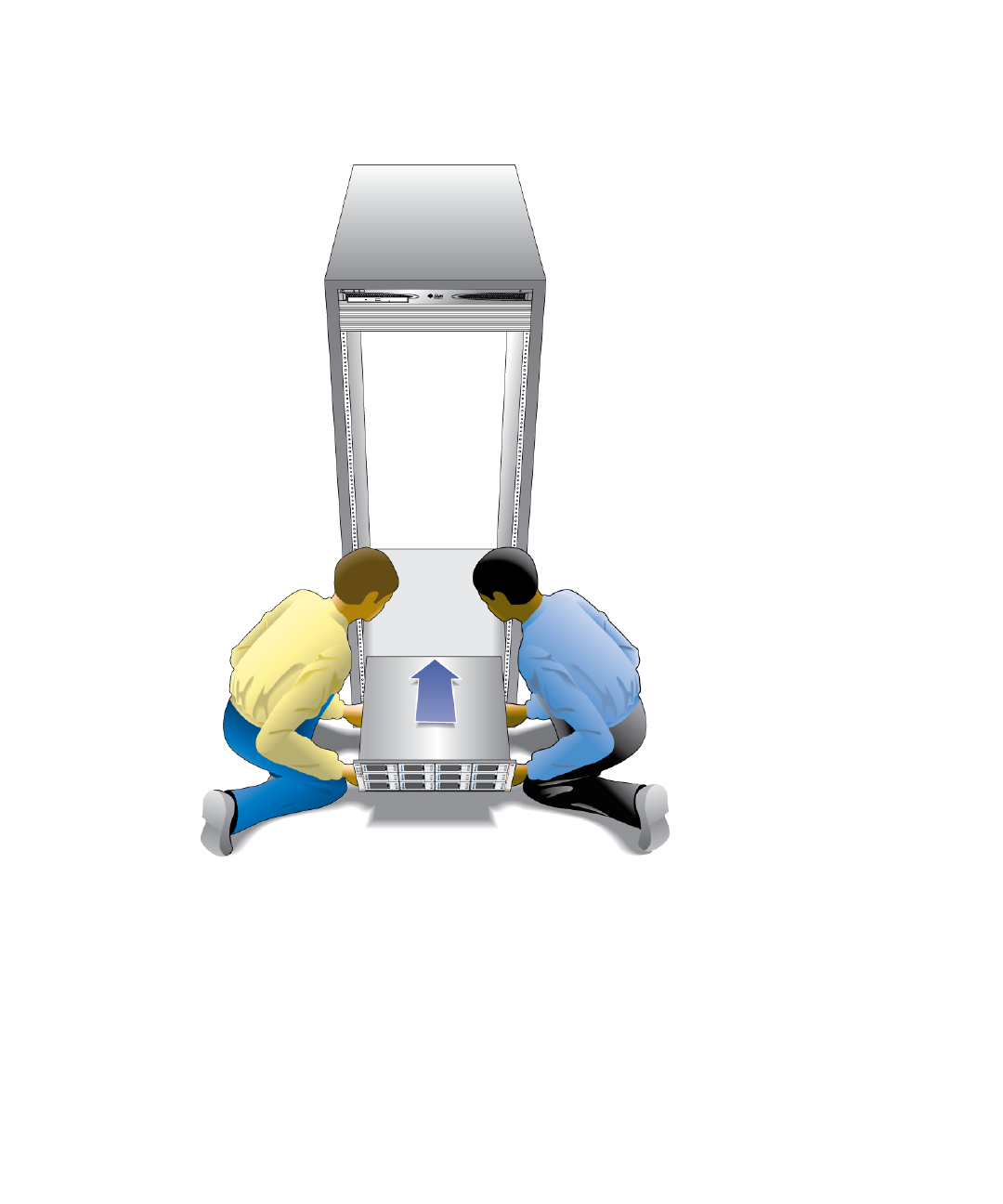
1. Using two people, one at each side of the tray, carefully lift and rest the tray on
the bottom ledge of the left and right rails (FIGURE 2-12).
Caution – Use care to avoid injury. A tray can weigh up to 55 pounds (25 kg).
Chapter 2 Installing Trays 39
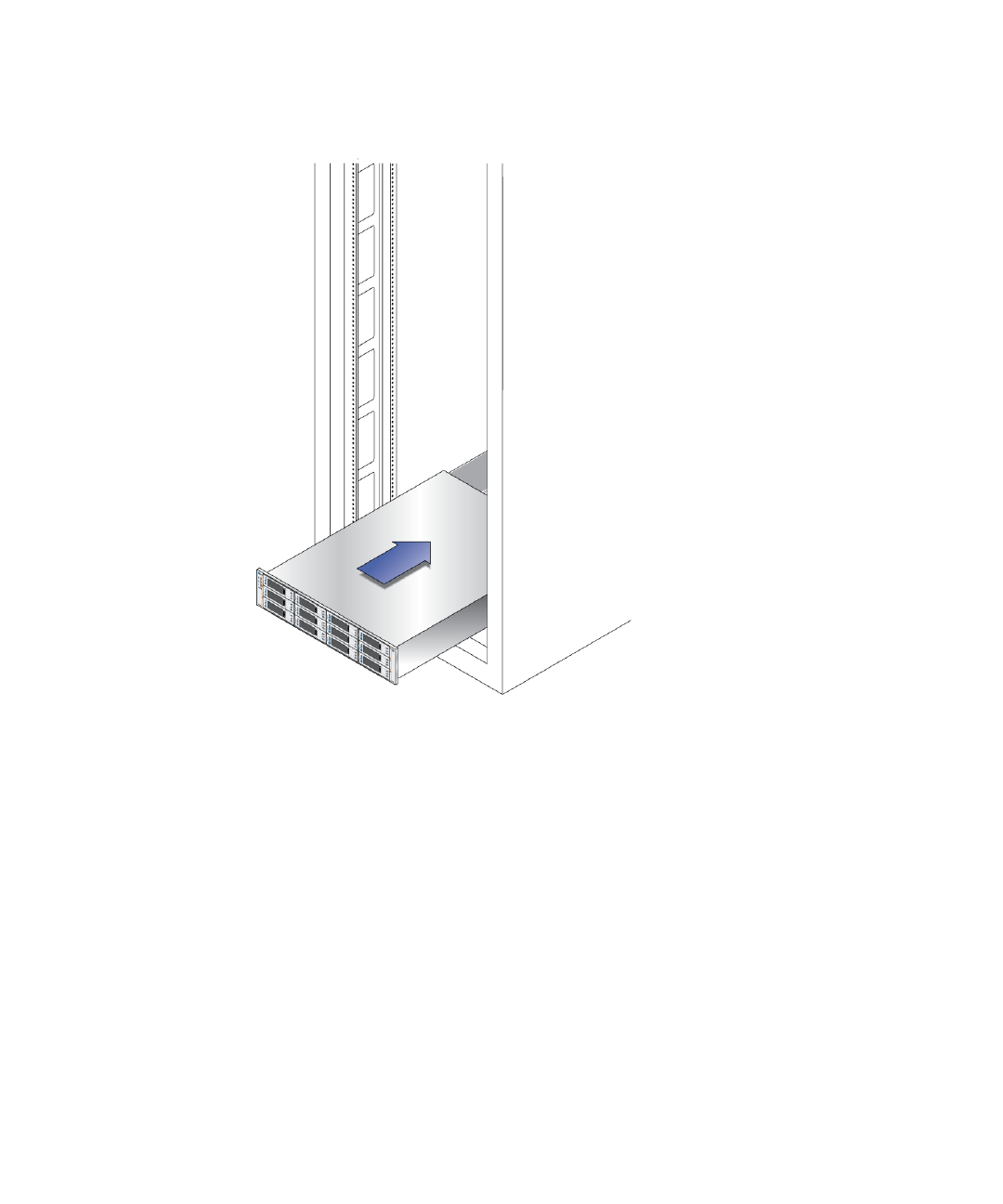
FIGURE 2-13 Array Controller Tray Installed
The tray has mounting flanges on both sides with three mounting holes in them. The
top and bottom holes are large enough to fit over the heads of the screws already in
the cabinet rails used to mount the universal rails. If the tray was shipped with end
caps (bezels) clipped on the tray mounting flanges, remove them before sliding the
tray all the way in over the mounting screw heads.
To remove an end cap , place your thumb on the lower front face of the cap and
reach your forefinger underneath to the back bottom edge of the cap, then pull
the cap towards you and slightly upwards.
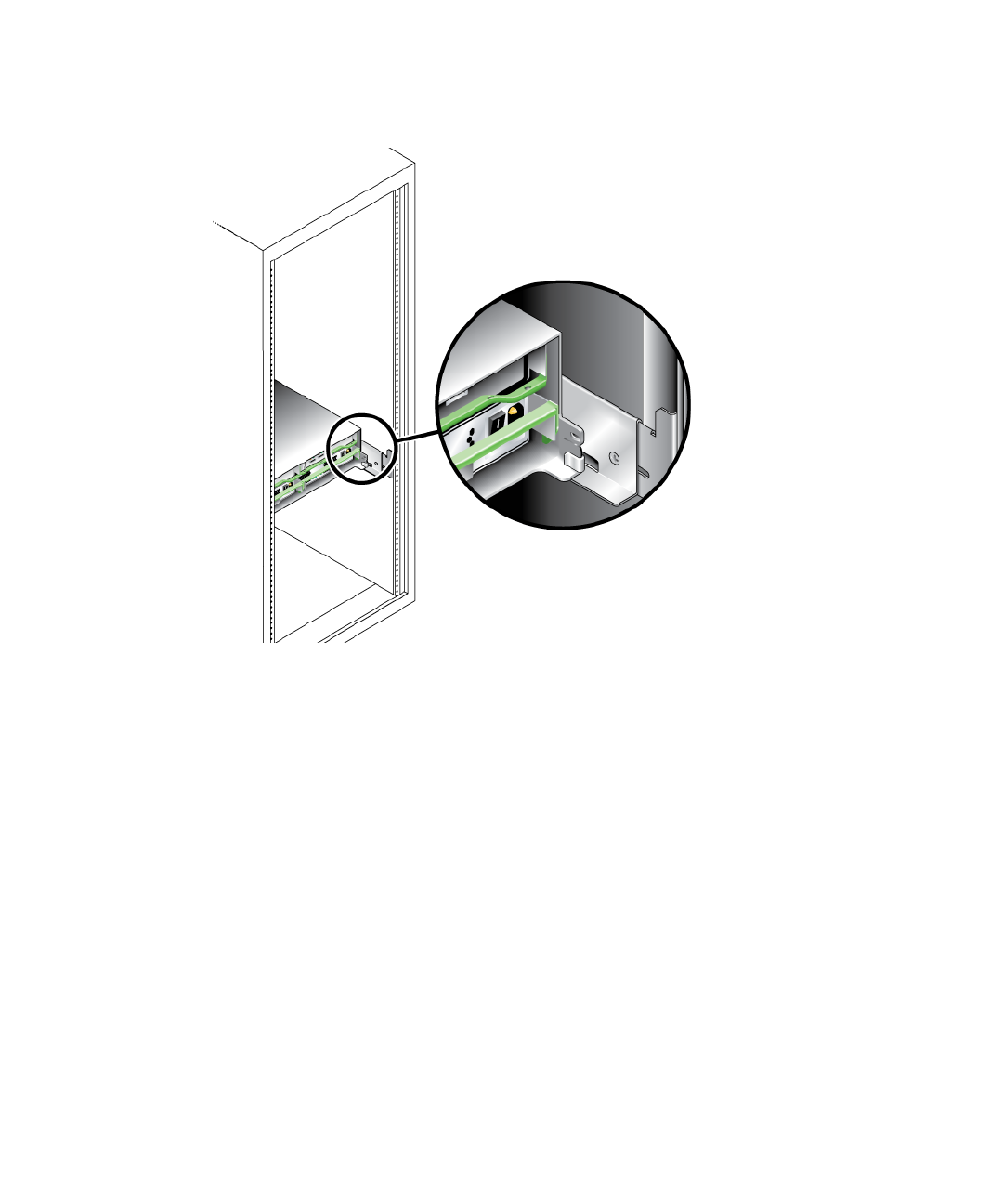
On the rear of the array tray, a flat metal tab on each side corner slides into a special
mounting clip on the rear of each universal rail, securing the back of the array tray.
This makes the use of rear mounting screws to secure the tray in the rail
unnecessary, especially in locations where the rack and trays are not likely to be
moved. For racks that will be moved or shipped, Sun recommends that you install
M4 screws through the hole in the tab and into the corresponding threaded hole in
the rail as shown in FIGURE 2-14.
Chapter 2 Installing Trays 41
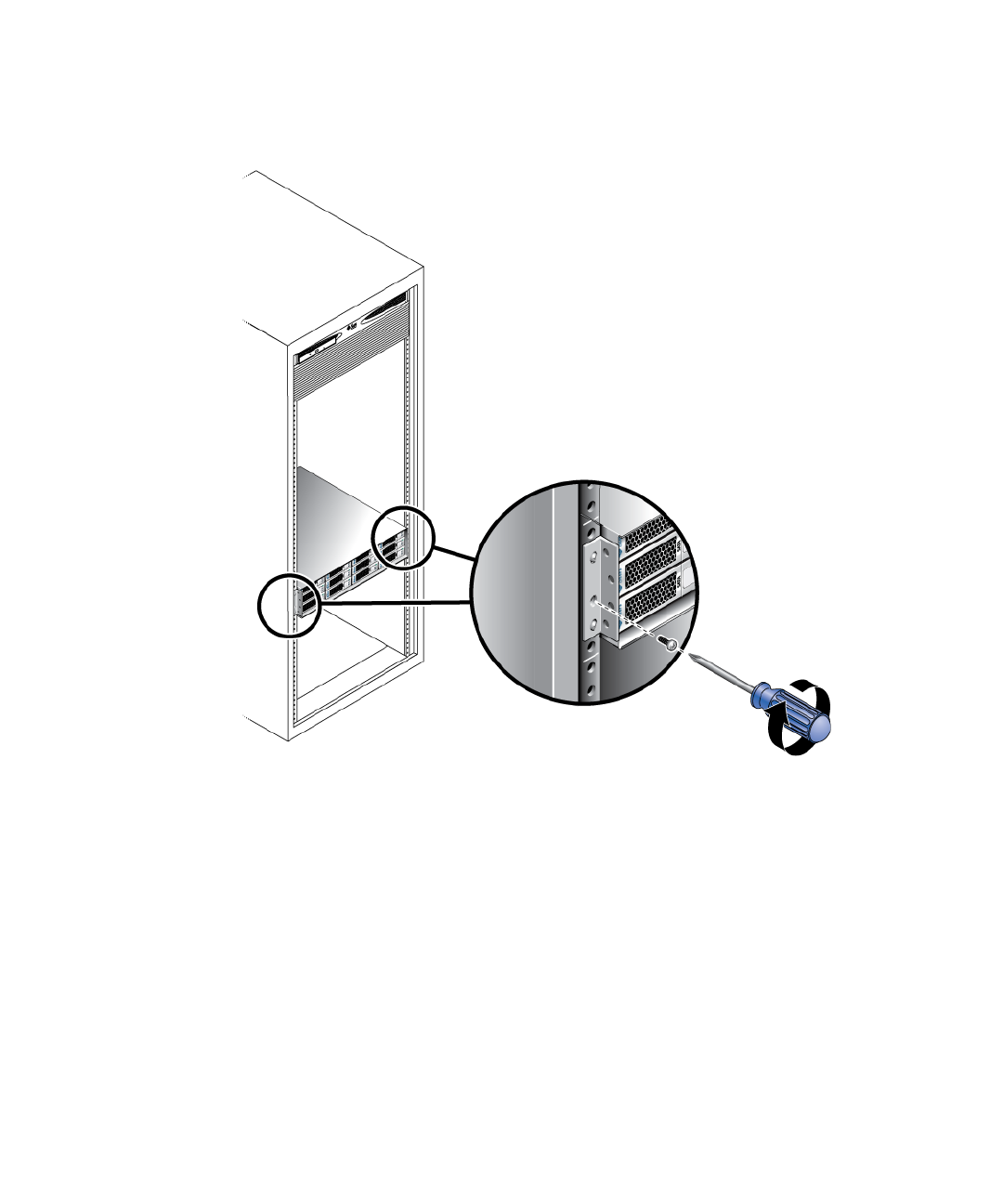
FIGURE 2-15 Securing the Tray to the Front of a Sun Rack 900/1000 Cabinet
4. Replace the end caps (bezels) that cover the mounting flanges on the front of
the array tray.
On each front mounting flange, there is a small tab over which the end caps fit.
The end caps have a slot on top for this tab.
a. Place the end cap over the tab so the tab can go into the slot.
b. Snap the bottom of the end cap into place.
42 Sun StorageTek 2500 Series Array Hardware Installation Guide • March 2007
Connecting the Power Cables
1. Verify that both power switches are turned off.
2. Verify that the circuit breakers in the cabinet are turned off.
3. Connect each power supply in the tray to a separate power source in the
cabinet.
4. Connect the primary power cables from the cabinet to the external power
source.
Note – Do not power on the array until you complete the procedures in this chapter.
The power-on sequence is described in detail in Chapter 4.
Intertray Cabling
This section describes how to cable a controller tray to expansion trays for several
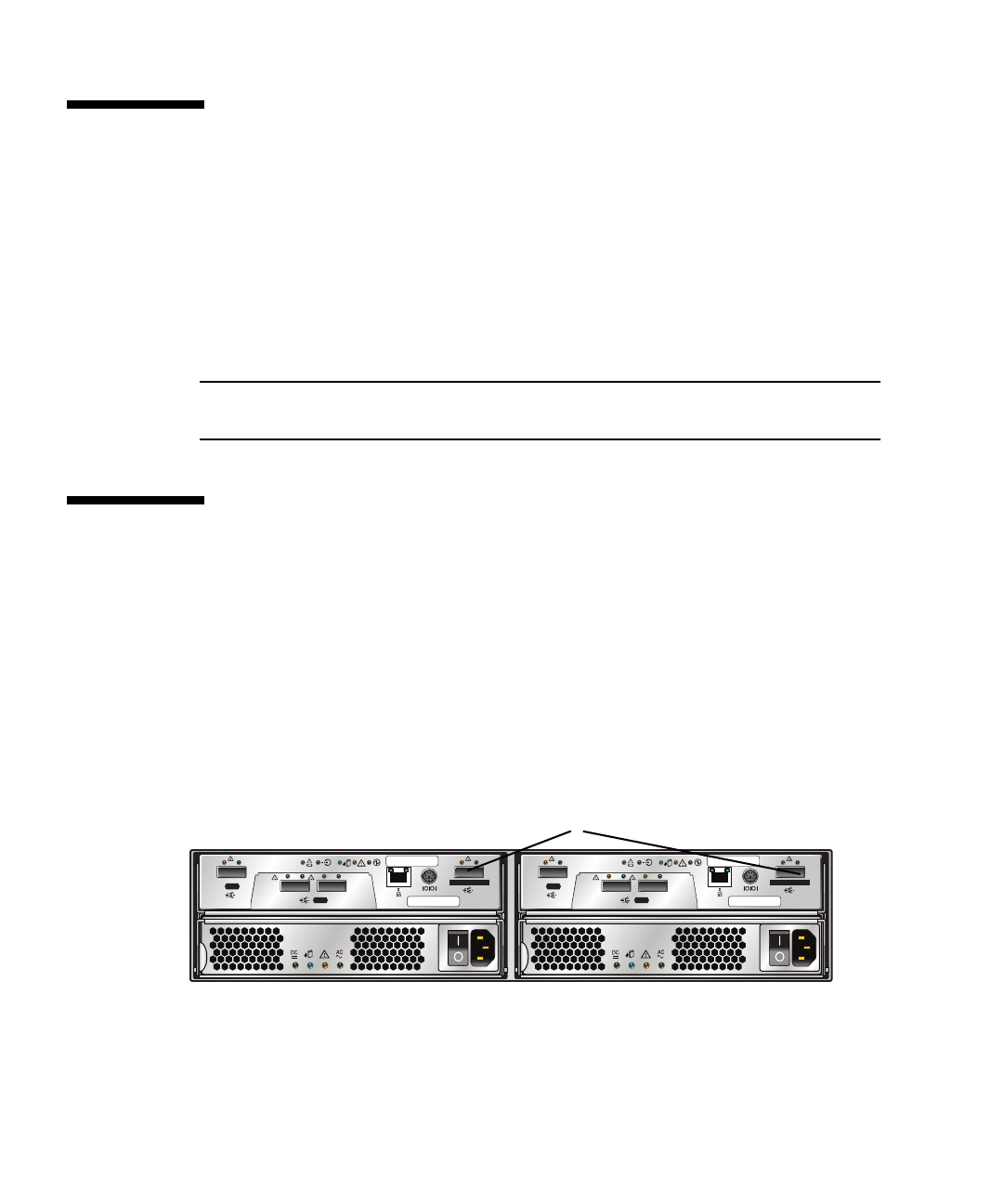
different configurations. Each controller has one expansion port (FIGURE 2-16).
Controller A controls drive channel 1 through the A-side drive modules; Controller
B controls drive channel 2 through the B-side modules. Each drive channel provides
a separate path for data transfer from the controller tray to the expansion trays; the
two channels provide redundancy.
FIGURE 2-16 Expansion Ports on the Controller Tray
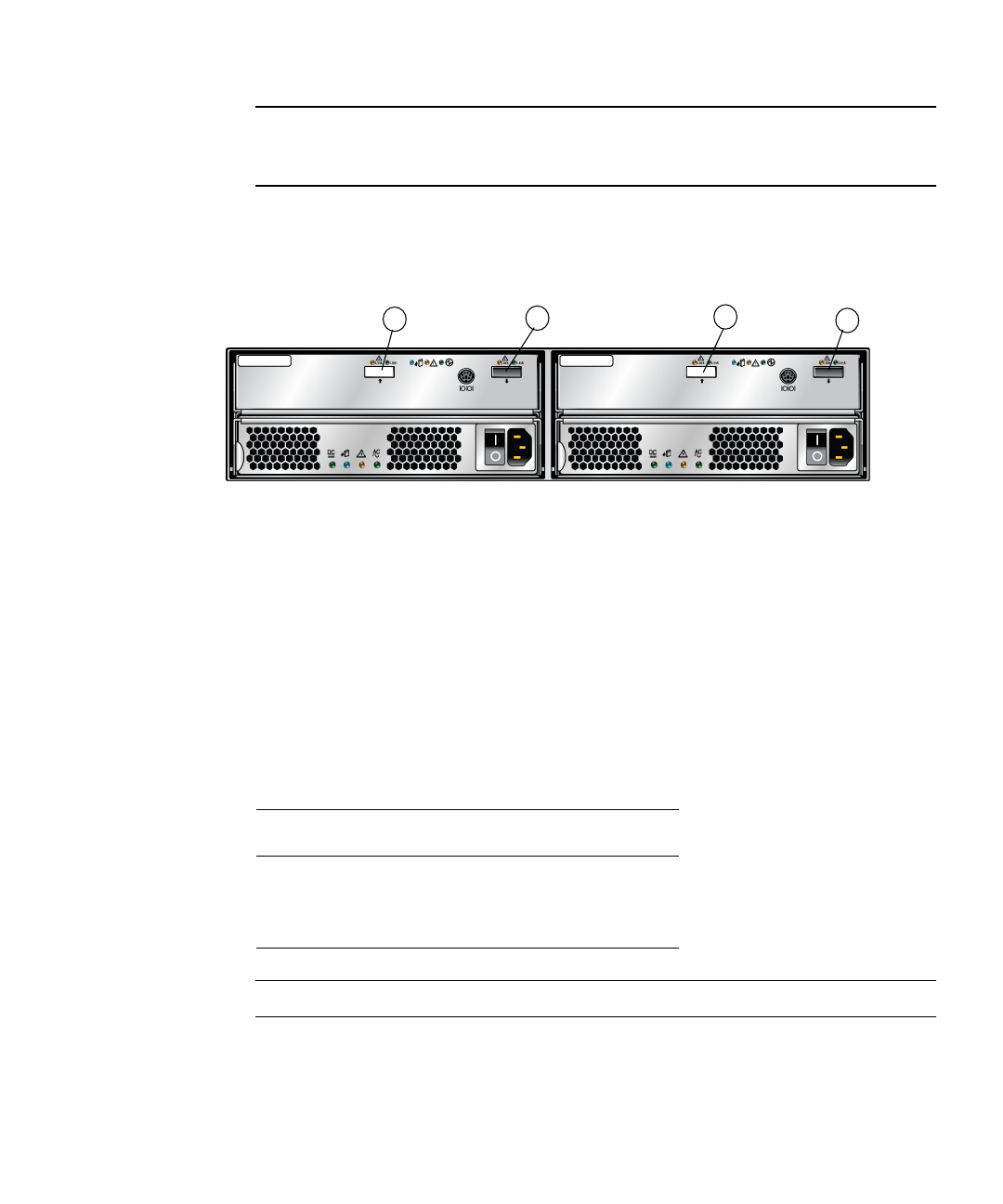
Each expansion tray has two SAS port connectors, one marked with an up arrow
and the other marked with a down arrow (FIGURE 2-17). You use SAS cables to
connect expansion trays to controllers.
Link Link
HOST
1
S
A
S
LinkLink LinkLink
HOST
23
S
A
S
Link Link
DRIVE EXPANSION
S
A
S
Link Link
HOST
1
S
A
S
LinkLink LinkLink
HOST
23
S
A
S
Link Link
DRIVE EXPANSION
S
A
S
SAS Expansion Ports to the Expansion Tray
Chapter 2 Installing Trays 43
Note – Perform all SAS connections from an Out (down arrow) port to an In (up
arrow) port. If the cable is connected to two connectors with the same arrows,
communication between the two drive modules will be lost.
FIGURE 2-17 Expansion Ports on an Expansion Tray
Array Configuration Naming Convention
The configuration naming convention is “controllers x trays” where the first number
is the controller tray and the second is the sum of the controller tray and the number
of expansion trays. For example, 1x1 is a standalone controller tray, 1x2 is the
controller tray and one expansion tray, 1x is the controller tray and 2expansion trays
(TABLE 2-1).
Note – Do not add more expansion trays than the array supports.
Use the following instructions to connect the dual-RAID controller tray to one or
more expansion trays.
TABLE 2-1 Controller and Expansion Tray Configurations
Configuration
Identifier Controller Tray
Number of Expansion
Trays
1x1 1 0
1x2 1 1
1x3 1 2
1. SAS Expansion In Port
2.SAS Expansion Out Port
1
2
2
22 2
2
22
1

44 Sun StorageTek 2500 Series Array Hardware Installation Guide • March 2007
Connecting Expansion Trays
Keep the following points in mind when adding expansion trays to your storage
array:
■Expansion trays must be added with power to the array and I/O data transfer
turned off. If you need to add an expansion tray to an array that cannot be taken
off-line, contact your Sun Technical Support representative before attempting to
connect the new tray.
■Controller and expansion trays are shipped with protective plastic plugs in the
SAS expansion ports. You must remove these before connecting cables.
■Expansion trays are added serially, in a chain (actually two chains: channel one
through the A-side controller and modules, and channel two through the B-side
controller and modules). The SAS cable from the expansion port on a controller
connects to the In port (Up arrow) on an expansion tray drive module. The SAS
cable from a drive module on expansion tray 1 to a corresponding drive module
on expansion tray 2 connects from the Out port on expansion tray 1 to the
corresponding In port on expansion tray 2. This pattern repeats for each
additional drive module on a channel. See FIGURE 2-19 for an illustration of this
reverse cabling pattern.
■To connect cables for maximum redundancy, controller B must be cabled to the
expansion tray B-side modules in the opposite order as the expansion tray A-side
modules. That means the last drive module in the A-side chain from controller A
must be the first drive module in the B-side chain from controller B. See
FIGURE 2-19 for an illustration of cabling for maximum tray level redundancy.
■On all SAS cables, affix a label to each end of the cable. See “Drive Module Cable
Labeling” on page 47 for labeling tips.
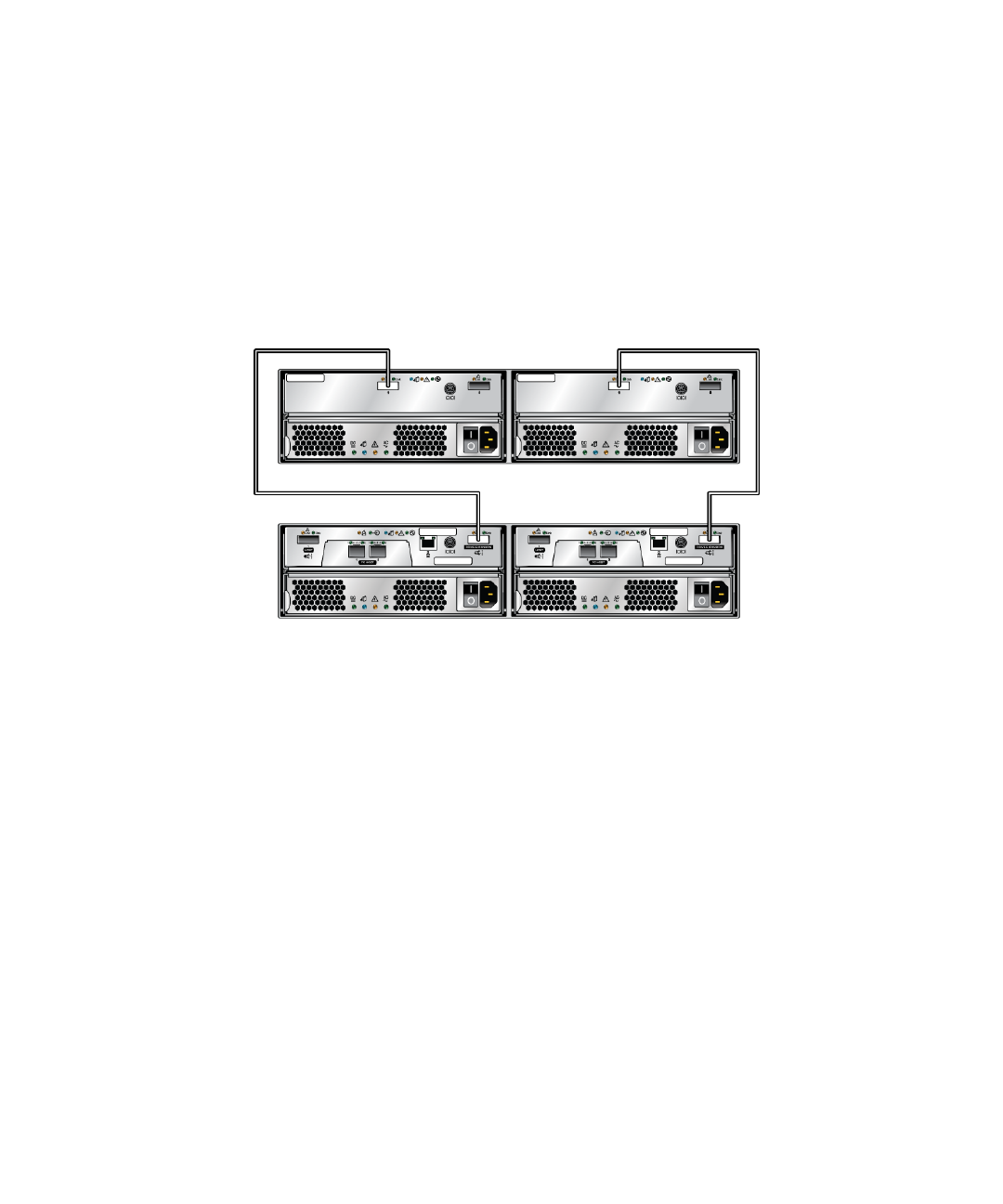
Chapter 2 Installing Trays 45
Cabling an Expansion Tray to a Controller Tray
A Controller tray has two expansion ports, one on the Controller A module and one
on the Controller B module. To connect an expansion tray, connect an SAS cable
from each expansion port on the controller to each In port on the expansion tray.
FIGURE 2-18 shows a 1x2 array configuration consisting of one controller tray and one
expansion tray. Two SAS cables are required.
FIGURE 2-18 1x2 Array Configuration Cabling Example
To cable a 1x2 array configuration:
1. Locate the Controller A and Controller B expansion ports at the back of the
controller tray (FIGURE 2-16).
2. Locate the In and Out expansion ports at the A-side and B-side back of the
expansion tray (FIGURE 2-17).
3. Connect one SAS cable between the Controller A expansion port and the A-
side In port on the expansion tray (FIGURE 2-18).
4. Connect one SAS cable between the Controller B expansion port and the B-
side In port on the expansion tray (FIGURE 2-18).
Cabling an Expansion Tray to Another Expansion
Tray
Each additional expansion tray is added to the preceding expansion tray by
connecting SAS cables from the Out ports of the first tray to the In ports of the next
tray. FIGURE 2-19 illustrates a 1x3 array configuration consisting of one controller tray
AB
Controller Tray
Expansion Tray
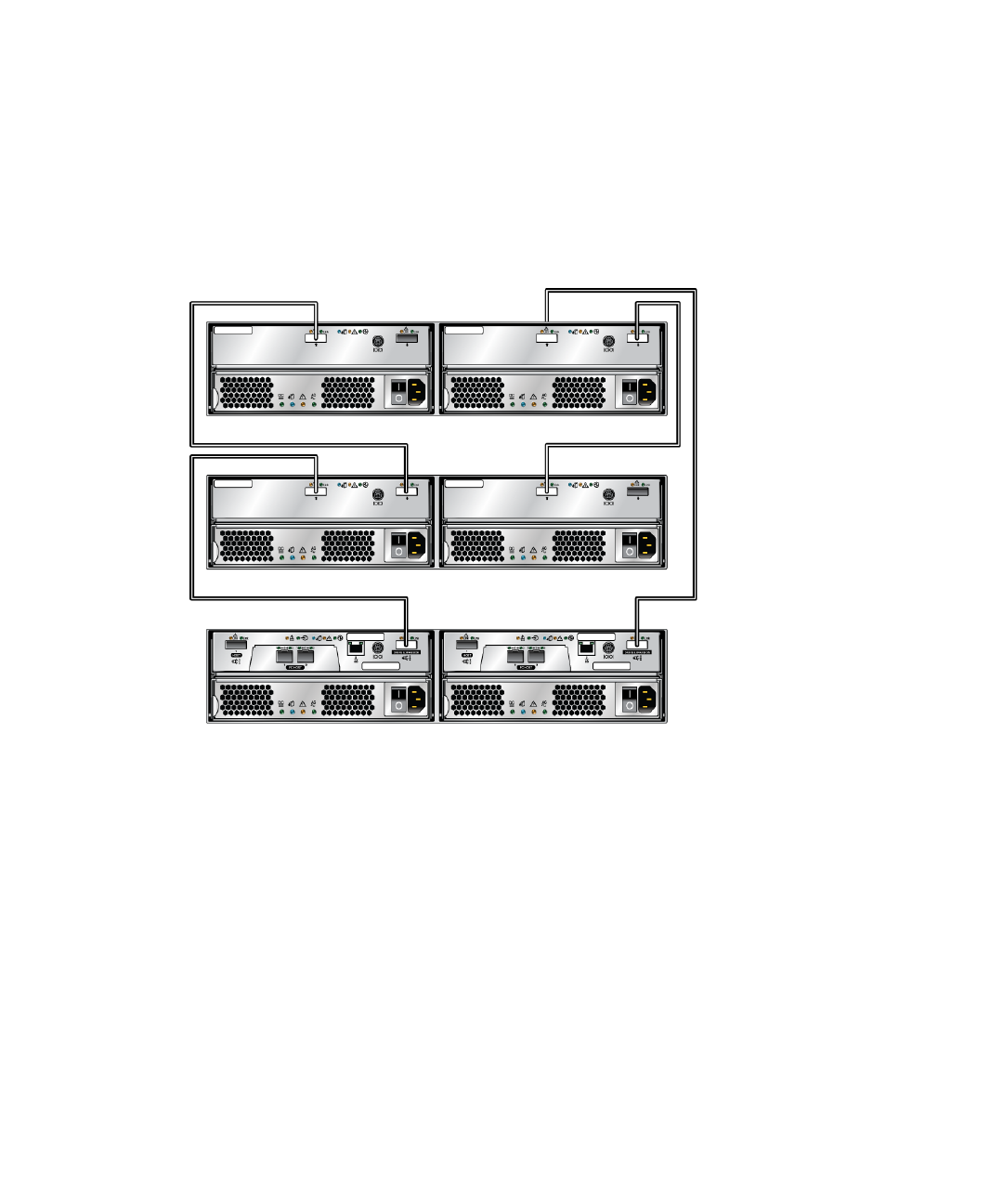
46 Sun StorageTek 2500 Series Array Hardware Installation Guide • March 2007
and two expansion trays. The cable connections on the B-side are reversed (the cable
from the controller A expansion port goes to the In port of expansion tray 1; the
cable from the controller B expansion port goes to the In port on expansion tray 2)
for maximum redundancy. This pattern continues for each additional tray you add.
Two more SAS cables are required for each additional tray.
FIGURE 2-19 1x3 Array Configuration Cabling
To cable a 1x3 array configuration for maximum redundancy:
1. Locate the Controller A and Controller B expansion ports at the back of the
controller tray (FIGURE 2-16).
2. Locate In and Out expansion ports at the A-side and B-side back of the
expansion tray (FIGURE 2-17).
3. Connect one SAS cable between the Controller A expansion port and the A-
side expansion In port of expansion tray 1 (FIGURE 2-19).
4. Connect one SAS cable between the Controller B expansion Out port and the
B-side expansion In port of expansion tray 2 (FIGURE 2-19).
5. Connect one SAS cable between the expansion tray 1 Out port and the A-side
expansion In port of expansion tray 2 (FIGURE 2-19).
AB
Controller Tray
Expansion Tray 1
Expansion Tray 2

Chapter 2 Installing Trays 47
6. Connect one SAS cable between the expansion tray 2 B-side Out port and the
B-side In port of expansion tray 2 (FIGURE 2-19).
Drive Module Cable Labeling
Labels for the drive cables identify which controller ports and which expansion
connections in an expansion tray you use when you attach cables between a
controller and the drive modules on an expansion tray. Cable labels are useful if you
need to disconnect cables to service a controller. Attach a label to each end of the
cable. Use this design to create labels for drive cables:
■Controller ID (for example, Controller A)
■Expansion tray ID (for example, Tray A)
■Expansion port ID (for example, In or Out)
■Drive module ID
Example Label Abbreviation
In this example, the storage configuration has the following characteristics:
■Drive channel 1
■Controller A, drive channel 1
■Drive module 1
■Expansion Tray A (which is the left drive module), Out port
Using this design, the label includes the following information:
CtA-Dch1, Dm1-Tray_A (left), Out
Simplex Configurations
A simplex configuration is a 2530 Array with a single controller and a single
backend channel. By definition, there is a single path SAS connection to the data
host, and no redundancy is available. There can be expansion modules on the single
backend channel.

48 Sun StorageTek 2500 Series Array Hardware Installation Guide • March 2007
Simplex cabling is the same as the cabling on a single channel of an ordinary array,
such as that shown on the A-side in FIGURE 2-18. CRU removal and replacement
procedures in a simplex configuration are the same as those for a duplex
configuration with a failed controller (with the exception of the service procedures
targeted at the failed controller). These procedures are available in Service Advisor.
Maintenance procedures such as firmware updates or servicing of the controller or
expansion modules will cause loss of access to the array during the performing of
the procedure, since there is no backup channel.
Performance and default behavior are the same as a duplex configuration with a
failed or missing controller. Write cache is by nature in write-through mode because
there is no cache mirroring possible.
Next Steps
Now you are ready to connect the management and data hosts, as described in
Chapter 3.

49
CHAPTER 3
Connecting the Management Host
and Data Hosts
This chapter describes Sun StorageTek 2500 Series Array cable connections for hosts.
It contains the following sections:
■“Connecting the Management Host” on page 49
■“Connecting Data Hosts to the 2540 Array” on page 51
■“Connecting Data Hosts to the 2530 Array” on page 56
■“Host Cable Labeling” on page 59
■“Next Steps” on page 59
Connecting the Management Host
The management host directly manages Sun StorageTek 2500 Series Arrays over an
out-of-band network. This section describes how to setup a connection between the
Ethernet port of a controller (FIGURE 3-1)and the management host.
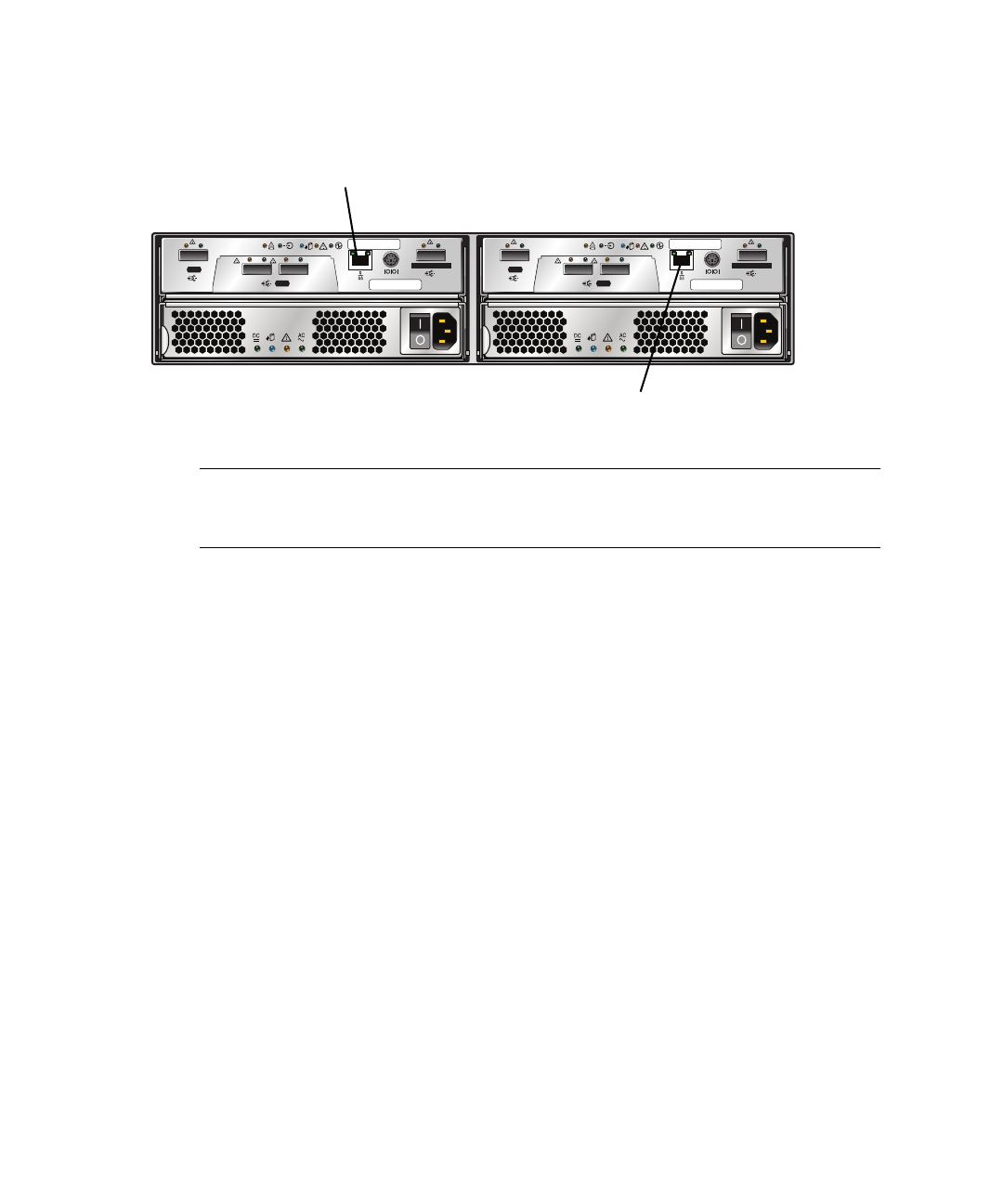
50 Sun StorageTek 2500 Series Array Hardware Installation Guide • March 2007
FIGURE 3-1 Ethernet Ports for Controller A and Controller B
Note – Before you begin, ensure that the tworequired Ethernet cables are available.
These requirements are outlined in the StorageTek 2500 Series Array Site Preparation
Guide.
There are three ways to establish a connection between the management host and
Ethernet port 1 of an array controller:
■“Attaching the Ethernet Ports to the LAN of the Management Host” on page 50
■“Attaching the Ethernet Ports to the Management Host Using an Ethernet Hub”
on page 51
■“Attaching the Ethernet Ports Directly to the Management Host With a Cross-
Over Cable” on page 51
Attaching the Ethernet Ports to the LAN of the
Management Host
To attach the Ethernet ports to the local area network (LAN) of the management host:
1. Locate the Ethernet port for Controller A and Controller B at the back of the
controller tray (FIGURE 3-1).
2. Connect Ethernet cables to the Ethernet ports of each controller.
3. Connect the other end of each Ethernet cable to the LAN on which your
management host resides (preferably on the same subnet).
Link Link
HOST
1
S
A
S
LinkLink LinkLink
HOST
23
S
A
S
Link Link
DRIVE EXPANSION
S
A
S
Link Link
HOST
1
S
A
S
LinkLink LinkLink
HOST
23
S
A
S
Link Link
DRIVE EXPANSION
S
A
S
Controller B
Controller A
Ethernet port
Ethernet port

Chapter 3 Connecting the Management Host and Data Hosts 51
Attaching the Ethernet Ports to the Management
Host Using an Ethernet Hub
To attach the Ethernet ports and the management port Ethernet interface to an
Ethernet hub on a private subnet:
1. Locate Ethernet ports on Controller A and Controller B at the back of the
controller tray (FIGURE 3-1).
2. Connect Ethernet cables to the Ethernet ports of each controller module.
3. Connect the other end of each Ethernet cable to an Ethernet hub.
4. Connect an Ethernet port on the management host to the Ethernet hub.
Attaching the Ethernet Ports Directly to the
Management Host With a Cross-Over Cable
Note – This method would typically be used only to establish temporary IP
connectivity between the management host and the controller’s Ethernet ports.
To attach the Ethernet ports directly to the management host using cross-over cables:
1. Locate the Ethernet ports for Controller A and Controller B at the back of the
controller tray (FIGURE 3-1).
2. Obtain and connect Ethernet cross-over cables to the Ethernet port of each
controller module.
3. Connect the other end of each Ethernet cable directly to your management host
Ethernet ports.
Connecting Data Hosts to the 2540 Array
The Sun StorageTek 2540 Array connects to data hosts through Fibre Channel (FC)
cables.

52 Sun StorageTek 2500 Series Array Hardware Installation Guide • March 2007
Note – For maximum hardware redundancy, you must install a minimum of two
HBAs in each host. Dual-port HBAs give you two paths into the storage array but do
not ensure redundancy if the HBA fails.
2540 Array Data Host Connection Topologies
You can connect data hosts to access the Sun StorageTek 2540 Array directly to the
array, or through Fibre Channel (FC) switches to the array. The following figures
illustrate four possible host connection topologies for the 2540 Array:
■Direct connection from a single data host server (FIGURE 3-2)
■Direct connection from two data host servers (FIGURE 3-3)
■Data host connection through Fiber Channel switch fabric (FIGURE 3-4)
■Mixed connection, direct and through switch (FIGURE 3-5)
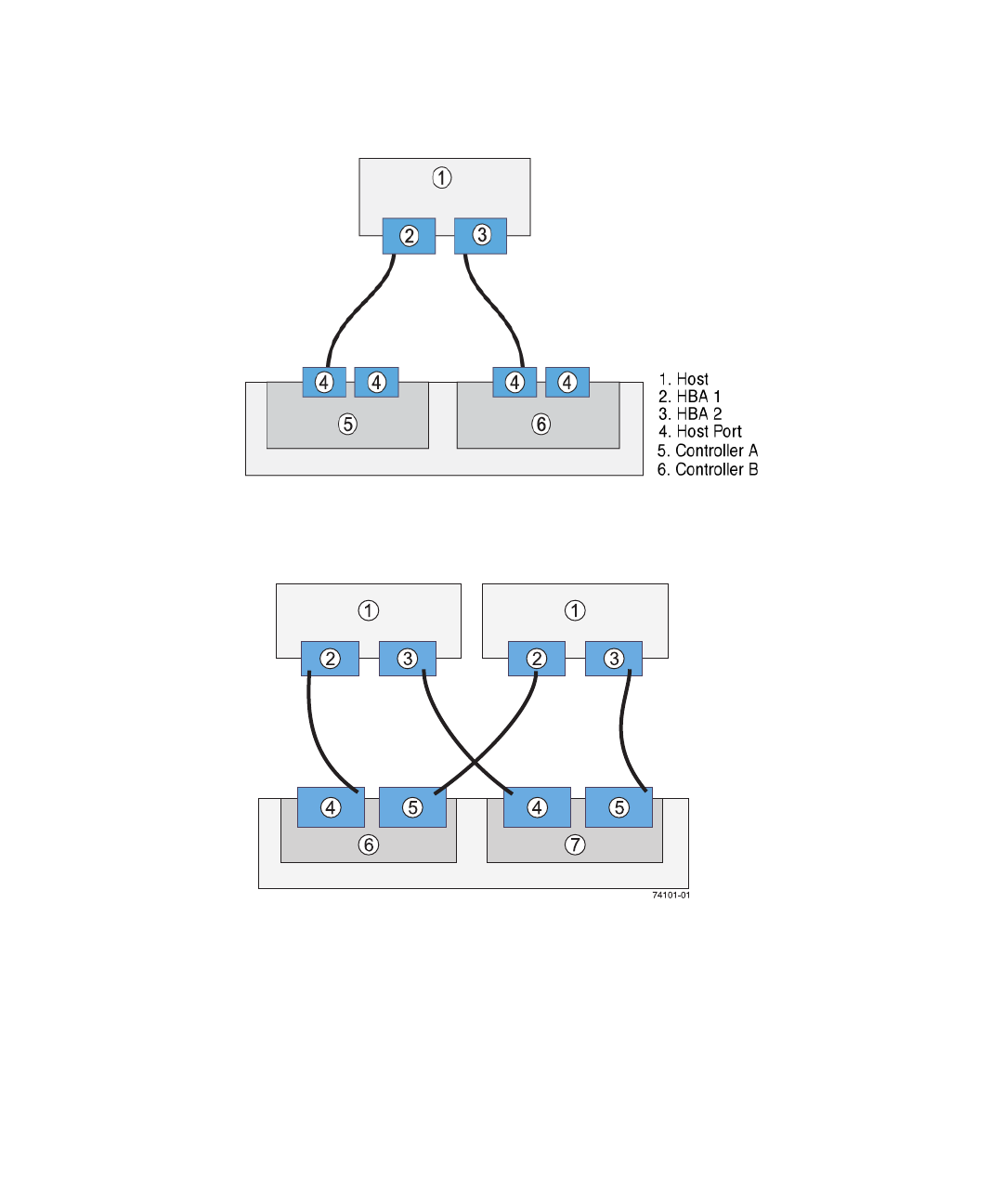
Chapter 3 Connecting the Management Host and Data Hosts 53
FIGURE 3-2 Direct connection from a single data host server
FIGURE 3-3 Direct Connection from two data host servers
FIGURE 3-4 Data host connection through a Fibre Channel switch
1. Host
2. HBA 1
3. HBA 2
4. Host Port 1
5. Host Port 2
6. Controller A
7. Controller B
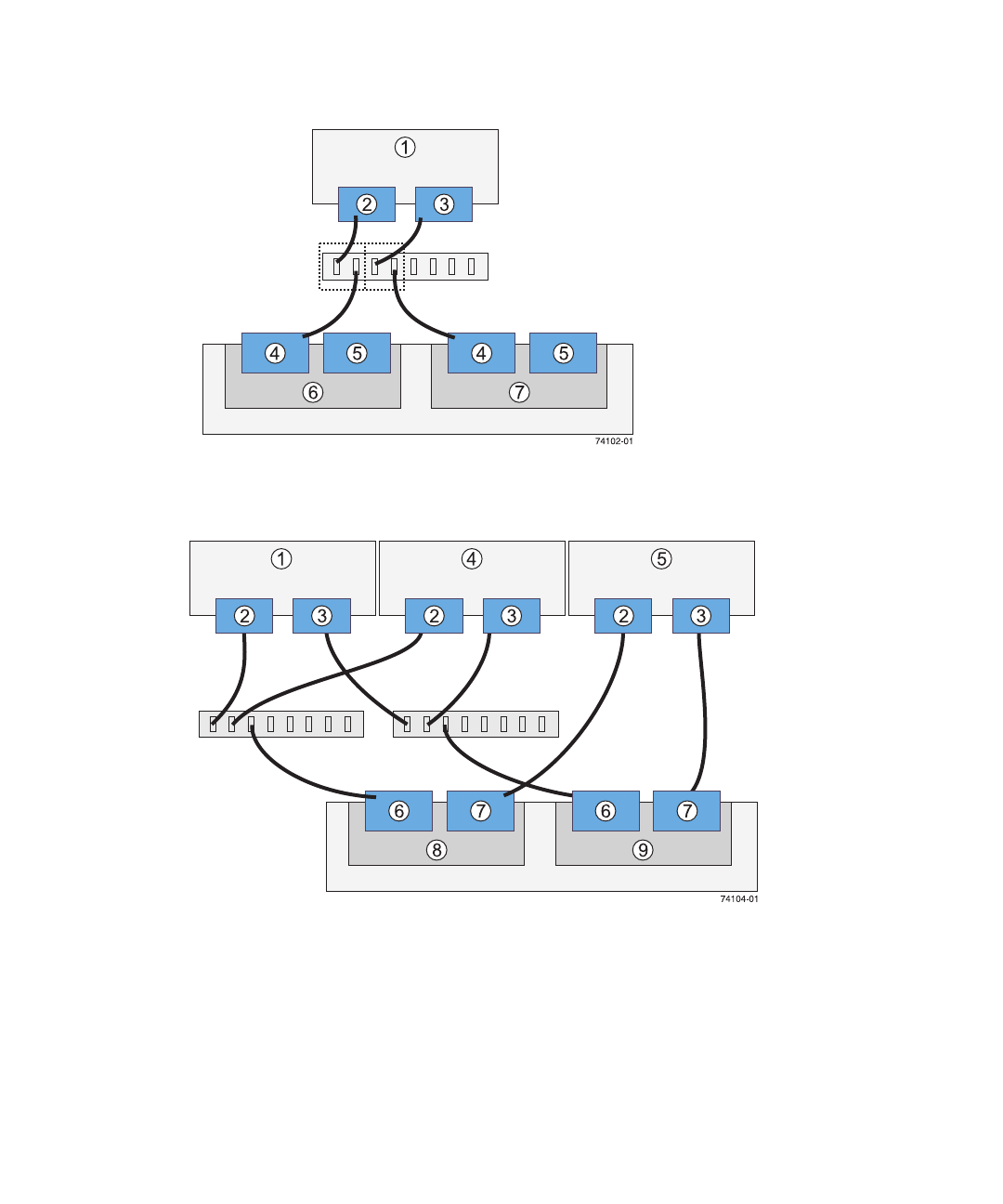
54 Sun StorageTek 2500 Series Array Hardware Installation Guide • March 2007
FIGURE 3-5 Mixed topology of data hosts connected directly and through FC switches
2540 Array Data Host Connections
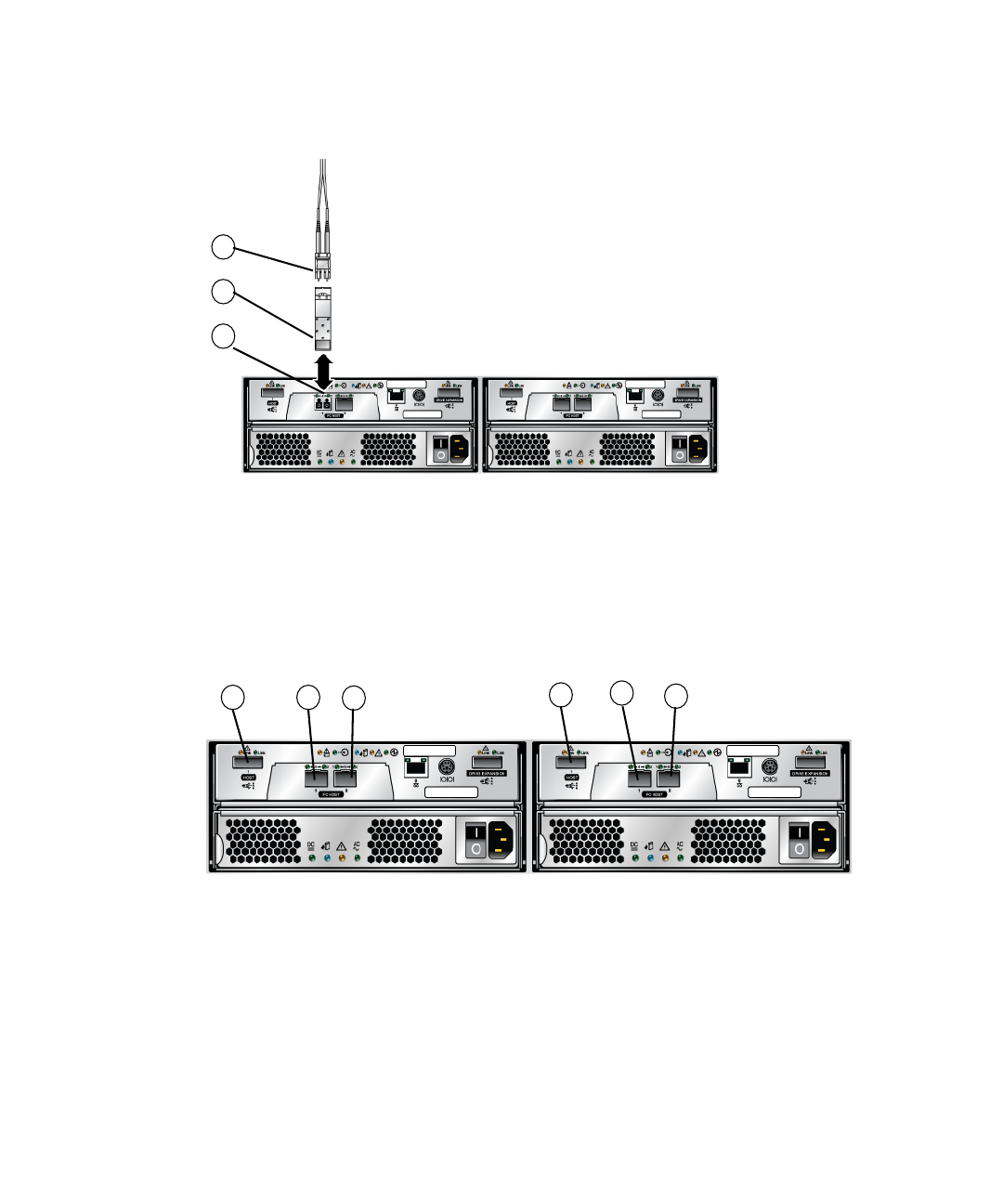
Data transmission from the host to the array controller modules is through fiber-
optic cables. The fiber-optic cables connect to the controllers through Small Form-
factor Pluggable (SFP) transceivers (FIGURE 3-6).
1. Host
2. HBA 1
3. HBA 2
4. Host Port 1
5. Host Port 2
6. Controller A
7. Controller B
1. Host 1
2. HBA 1
3. HBA 2
4. Host 2
5. Host 3
6. Host Port 1
7. Host Port 2
8. Controller A
9. Controller B
Chapter 3 Connecting the Management Host and Data Hosts 55
FIGURE 3-6 Connecting the SFP and Fiber-optic Cable to a 2540 Controller
The Sun StorageTek 2540 Array controller tray has fourFC host connector ports, two
per controller module. To maintain redundancy, connect two data paths from each
host, one to each controller.
FIGURE 3-7 FC host connectors on the 2540 controller.
▼To Connect Data Hosts Using Fibre Channel
1. Locate the host ports at the back of the controller tray (FIGURE 3-7).
If the host port has a plastic protection plug, remove it.
2. Plug one SFP transceiver into a host port.
1. Fibre Channel Host Port
2. SFP is Inserted
3. Fiber-optic Cable is
into the SFP
into the Host Port
inserted
1
2
3
1. not used
2. Fibre Channel data
port 1host
11
223. Fibre Channel data
host port 2
3
3
56 Sun StorageTek 2500 Series Array Hardware Installation Guide • March 2007
3. Plug one end of the fiber-optic cable into the SFP transceiver.
4. Plug the other end of the fiber-optic cable into one of the HBAs in the
host (direct topology) or into a switch (fabric topology).
5. Affix a label to each end of the cable. See “Host Cable Labeling” on
page 59 for labeling tips.
6. Repeat these steps for each host-to-controller connection.
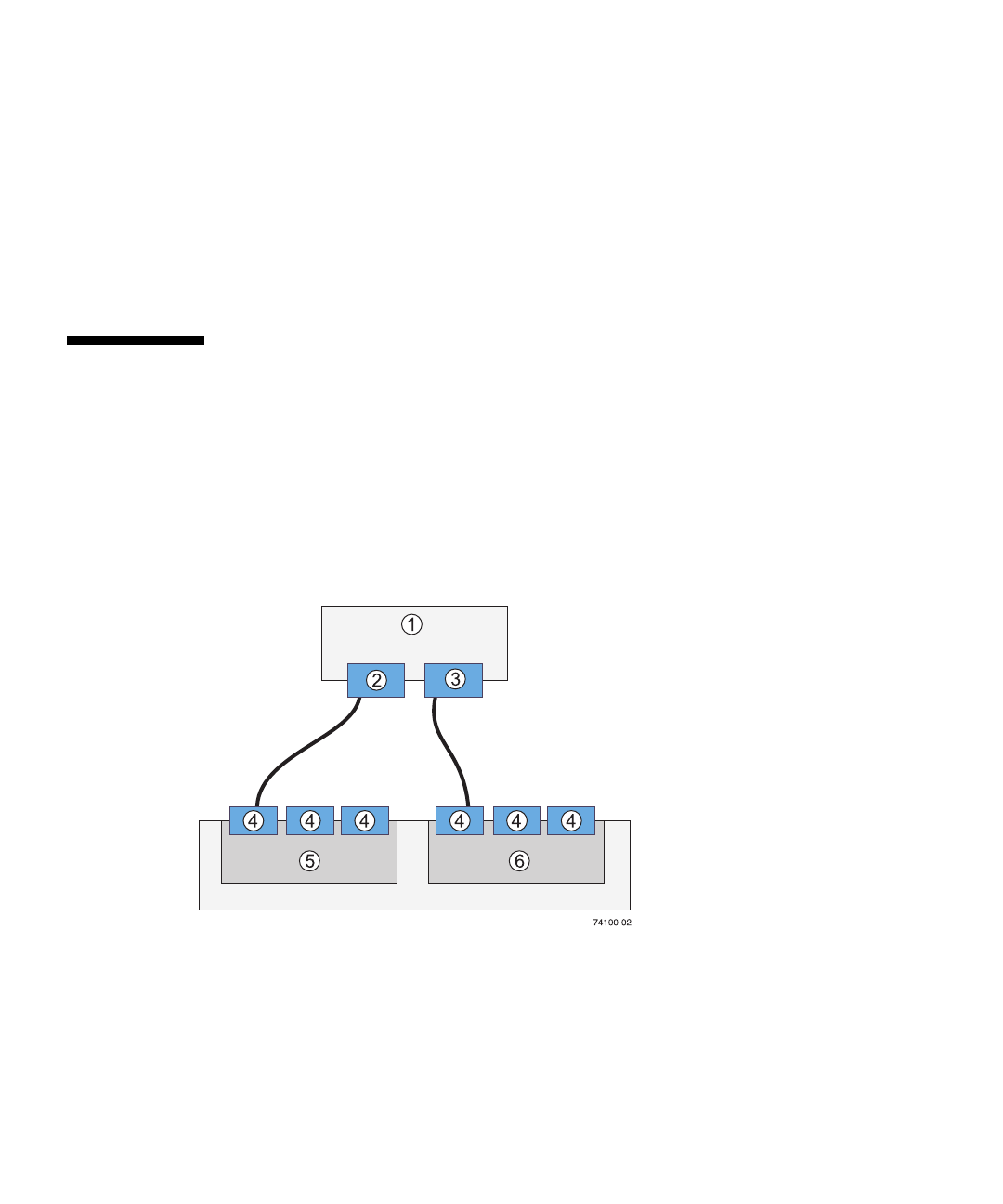
Connecting Data Hosts to the 2530 Array
Data transmission from the host to the controllers in the array module is through
Serial Attached SCSI (SAS) cables. All connections from the host to the controllers
are direct connections (with no intermediate switches). FIGURE 3-8 shows an
example of a direct host connection from a single data host with dual HBAs.
FIGURE 3-8 Direct Connection From a Single Host With Dual HBAs
FIGURE 3-9 shows an example of direct host connections from two data hosts, each
with dual HBAs.
1. Host
2. HBA 1
3. HBA 2
4. Host Connectors on the
5. Controller A
6. Controller B
Controllers
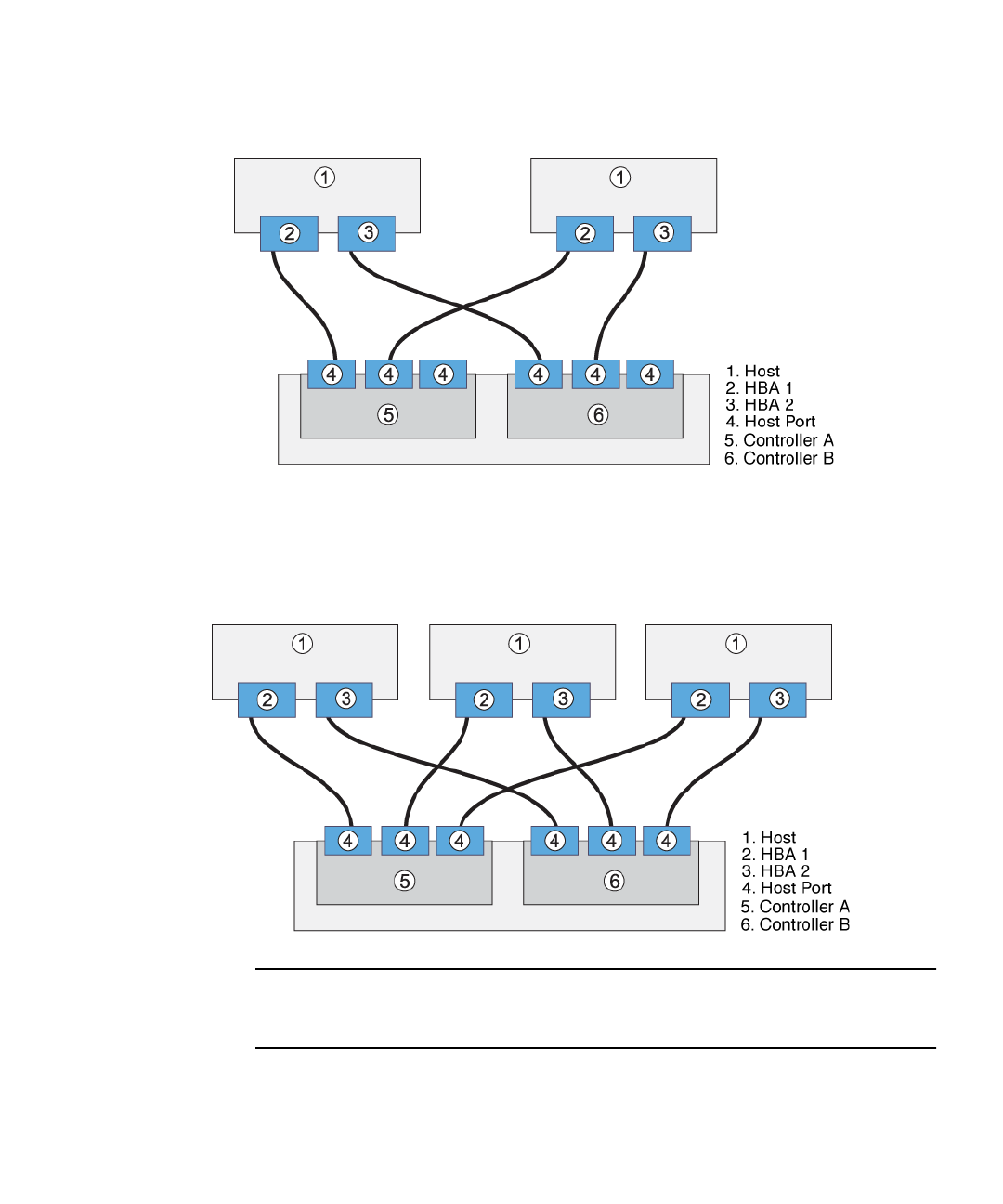
Chapter 3 Connecting the Management Host and Data Hosts 57
FIGURE 3-9 Direct connections from two data hosts with dual HBAs.
FIGURE 3-10 shows an example of direct host connections from three data hosts, each
with dual HBAs.
FIGURE 3-10 Direct connections from three data hosts with dual HBAs.
Note – For maximum hardware redundancy, you must install a minimum of two
HBAs in each host. Dual-port HBAs give you two paths into the storage array but do
not ensure redundancy if the HBA fails.
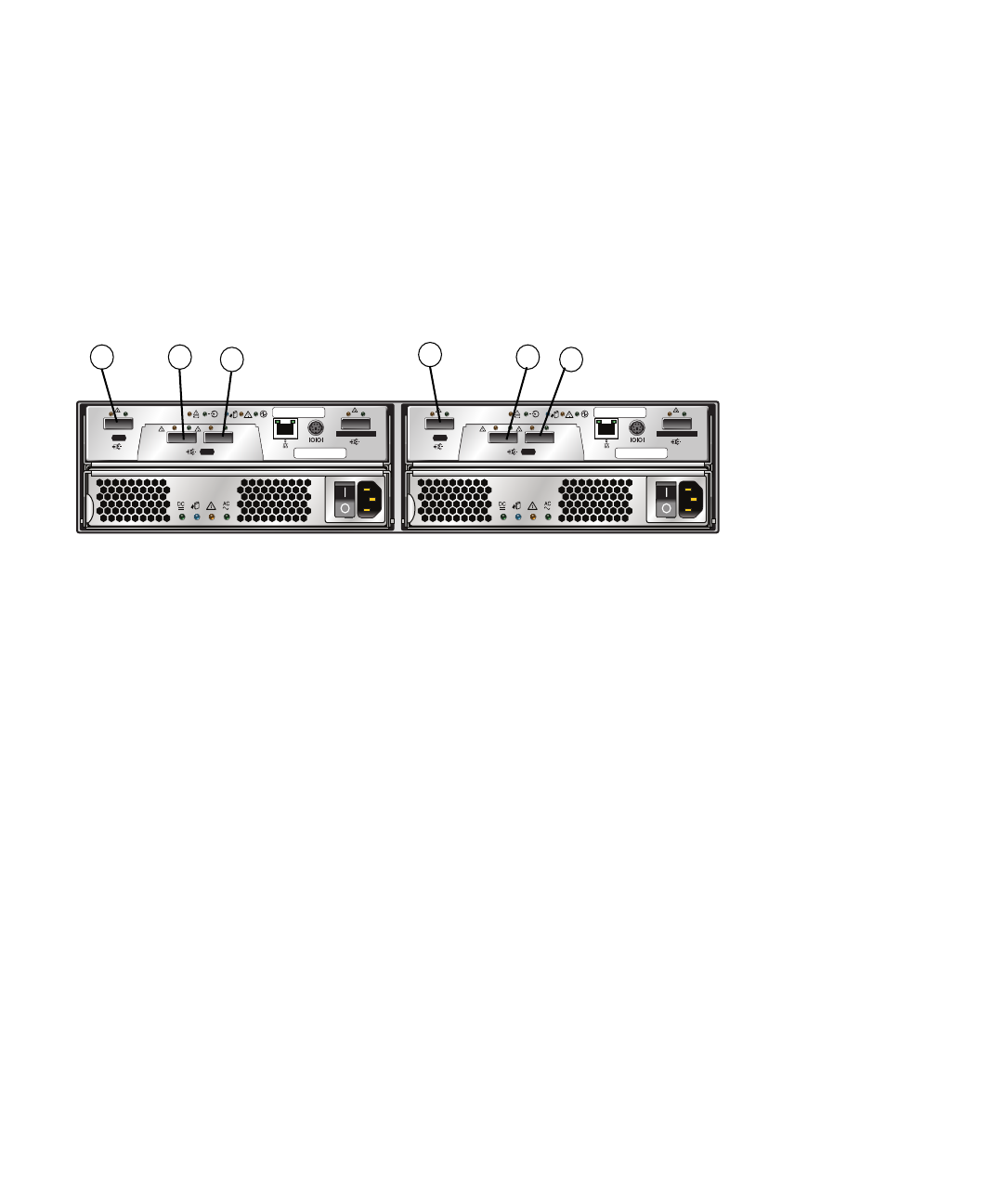
58 Sun StorageTek 2500 Series Array Hardware Installation Guide • March 2007
Before you connect data hosts directly to the array, check that the following
prerequisites have been met:
■Interface cables are connected and between the HBAs and the array controllers.
■SAS cables (1-, 3-, or 6-meters) are available to connect the array host ports to the
data host HBAs.
Each controller module on a controller tray has three SAS host ports (FIGURE 3-11).
FIGURE 3-11 SAS Data Host Ports (on back of tray).
▼To Connect Data Hosts to a 2530 Array
1. Locate the host ports at the back of the controller tray (FIGURE 3-11).
If the host port has a plastic protection plug, remove it.
2. Connect one end of the SAS cable to a host port on a controller module.
Host ports are numbered from left to right: host port 1, host port 2, and host
port 3.
3. Connect the other end of each SAS cable to a data host HBA.
4. Affix a label to each end of the cable. See “Host Cable Labeling” on page 59 for
information about cable labels.
5. Repeat these steps for each host-to-controller connection.
Controller B
Controller A
1. SAS Host Port 1
2. SAS Host Port 2
3. SAS Host Port 3
Link Link
HOST
1
S
A
S
LinkLink LinkLink
HOST
23
S
A
S
Link Link
DRIVE EXPANSION
S
A
S
Link Link
HOST
1
S
A
S
LinkLink LinkLink
HOST
23
S
A
S
Link Link
DRIVE EXPANSION
S
A
S
11
22
3 3

Chapter 3 Connecting the Management Host and Data Hosts 59
Host Cable Labeling
Labels for host cabling identify which host HBA ports and which controller ports
you use when you attach cables between the host and the controller. Cable labels are
useful if you need to disconnect cables to service a controller. Attach a label to each
end of the cable. Use this design to create labels for host cables:
■Host name and HBA port
■Controller ID (for example, Controller A)
■Host channel ID (for example, Host channel 1)
Example Label Abbreviation
In this example, the storage configuration has the following characteristics:
■Host name is “Engineering”
■Host HBA 1, port 1
■Controller A, channel 1
Using this design, the label includes the following information:
Heng-HBA1/P1, CtA-Hch1
Next Steps
After you connected the management and data hosts, you can power on the trays, as
described in Chapter 4.

60 Sun StorageTek 2500 Series Array Hardware Installation Guide • March 2007

61
CHAPTER 4
Powering On the Array
This chapter describes initial tray power-on procedures. Perform the following
procedures in the order listed:
■“Before Powering On” on page 61
■“Powering On the Array” on page 62
■“Powering Off the Array” on page 63
■“Next Steps” on page 64
Before Powering On
You can set up a Dynamic Host Configuration Protocol (DHCP) server to issue the IP
address to each controller. If a DHCP server is not available, the controller tray
defaults to internal static IP addresses. (See the Sun StorageTek Common Array
Manager Software Installation Guide for information about configuring IP addresses on
array controllers.)
For instructions on configuring IP addresses on the array controllers, see
“Configuring the IP Address of the Array Controllers” on page 74. For instructions
on how to set up the DHCP server, see “Configuring a DHCP Server” on page 81.
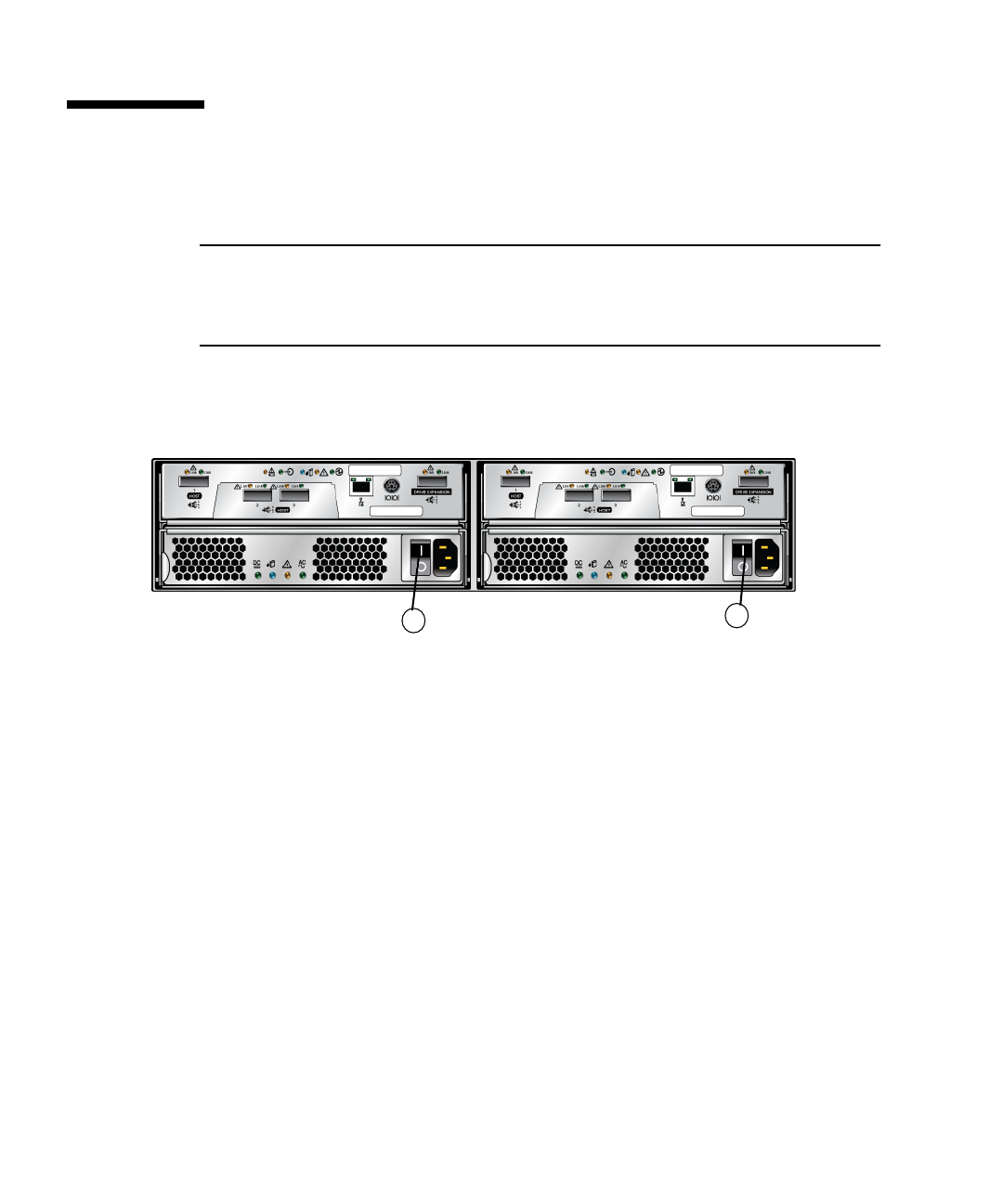
62 Sun StorageTek 2500 Series Array Hardware Installation Guide • March 2007
Powering On the Array
Use this procedure to turn power on for all trays installed in the cabinet (FIGURE 4-1).
Note – The order in which you power up the trays is important. Be sure to power
on the controller tray last in order to ensure that the disks in the expansion trays
have enough time to spin completely before being scanned by the redundant array
of independent disks (RAID) controllers in the controller tray.
FIGURE 4-1 Tray Power Connectors and Switches
1. Prepare the power cables as specified in “Connecting the Power Cables” on
page 42.
2. Turn on the cabinet circuit breakers, if applicable.
3. Press the power switches at the back of each expansion tray to the On position.
While the tray powers on, the green and amber LEDs on the front and back of the
controller tray turn on and off intermittently. Depending on your configuration, it
can take several minutes for the tray to power on. When the power-on sequence
is complete, the LEDs are steady green.
Wait until all the disk drive indicator lights on the expansion trays are steady
green before proceding to the next step.
4. Press each power switch at the back of the controller tray to the On position.
5. Check the status of each tray.
After the power-on sequence is complete, confirm the following:
■The green OK/Power LEDs on each drive in the tray are steady on.
Controller B
Controller A
1. Controller A power switch
2. Controller B power switch
1
2

Chapter 4 Powering On the Array 63
■The green OK/Power LED on the tray is steady on.
If all tray and drive Ok/Power LEDs are steady green and the amber Service
Required LEDs are off, the power-on sequence is complete and no faults have
been detected.
Powering Off the Array
The array rarely needs to be powered off. You remove power only when you plan to
physically move the array to another location or are adding additional trays to a
controller.
To power off the array, do the following:
1. Stop all I/O from the hosts, if connected, to the storage system.
2. Wait approximately 2 minutes until all disk drive LEDs have stopped flashing.
Note – If Disk Scrubbing is enabled, the disk drive LEDs will continue to flash after
the 2-minute period has elapsed. By waiting the 2-minute period, you ensure that
the data residing in cache has been written to disk. The LED flash rate during disk
scrubbing (slow, periodic blink) is different from the flash rate of I/O (fast, random).
After the 2-minute period, data residing in cache is written to disk and the
battery mechanisms are disengaged.
3. Check the Cache Active LED on the controller (FIGURE 1-10) to determine if any
outstanding cache needs to be written.
If the LED is on, there is still data that needs to be flushed and written to disk.
4. Ensure that the Cache Active LED is no longer flashing before powering off the
array.
5. Press each power switch at the back of the controller tray to the Off position.
6. Press the power switches at the back of each expansion tray to the Off position.

64 Sun StorageTek 2500 Series Array Hardware Installation Guide • March 2007
Next Steps
After you have connected the management host and data hosts, you are ready to
install the management host software as described in the Sun StorageTek Common
Array Manager Software Installation Guide and the data host software as described in
Chapter 5.

65
CHAPTER 5
Data Hosts, HBAs, and Other
Software
This chapter describes how to install data host software, HBAs, and other software
on different host platforms. It contains the following sections:
■“Data Host Software” on page 65
■“Setting Up a Data Host On a Solaris System” on page 66
■“Installing Data Host Software for Operating Systems Other Than Solaris” on
page 69
■“Enabling Multipathing Software” on page 70
■“Next Steps” on page 71
Data Host Software
The data host software contains tools that manage the data path I/O connections
between the data host and the array. This includes drivers and utilities that enable
array management hosts to connect to, monitor, and transfer data in a storage area
network (SAN).
Note – Some management hosts can also be used as data hosts.
HBAs and Drivers
A Host Bus Adapter (HBA) is a network interface card that manages all data I/O on
your data host. The specific HBAs you need depend on the data host server
platform, operating system, data transport (SAS or FC), and data transfer rates used

66 Sun StorageTek 2500 Series Array Hardware Installation Guide • March 2007
in your storage area network. HBAs must be ordered separately, from Sun or their
respective manufacturers. Sun HBAs can be ordered from:
/www.sun.com/storagetek/storage_networking/hba/
The required versions of HBAdrivers must be installed on the data host before you
can set up a data host. The Sun StorageTek 2500 Series Array Release Notes lists the
data host requirements for HBAs and drivers. Refer to the specific vendor HBA
documentation for instructions on installing HBA drivers.
Multipathing
Data host software controls the data path between the data host and the array. Since
there can be more than one path between the host and the array for redundancy, this
function is called multipathing.
You must install data host software (including multipathing) on each data host that
communicates with the Sun StorageTek 2500 Series Array. The multipathing
software you need depends on the host platform, HBA, and the data transport (SAS
or FC) in your storage area network. This information is listed in the latest version of
the Sun StorageTek 2500 Series Array Release Notes.
Setting Up a Data Host On a Solaris
System
The Sun StorageTek 2500 Series Array provides data path support for data hosts
running Solaris, Windows 2000, Windows Server 2003, Red Hat Linux, HP-UX,
NetWare, and IBM AIX operating systems. This section applies to hosts running
Solaris OS 8, 9, and 10.
See the Sun StorageTek 2500 Series Array Release Notes for the latest supported
operating system versions.
Note – To install data host software on systems that are not running the Solaris OS, see
“Installing Data Host Software for Operating Systems Other Than Solaris” on
page 69.
You must install data host software (including multipathing) on each data host that
communicates with the Sun StorageTek 2500 Series Array. Multipathing is included
in the Solaris 10 OS. For Solaris OS 8 and 9 data hosts, you need the SAN
Foundation Kit software (which includes the multipathing software).

Chapter 5 Data Hosts, HBAs, and Other Software 67
To install data host software on Solaris OSs, see the following sections:
■“To Obtain Sun Solaris 8 and 9 Data Host Software” on page 67
■“To Install the SAN 4.4 Data Host Software” on page 67
▼To Obtain Sun Solaris 8 and 9 Data Host
Software
Obtain Sun Solaris OS 8 and 9 data host software as follows:
1. Go to the Sun Microsystems web page (sun.com).
The Sun home page is displayed.
2. Select Downloads from the home page navigation bar.
The Downloads page is displayed (it is not labeled).
3. On the View by Category tab, select System Administration>Storage
Management.
The Storage Management page is displayed, showing a list of downloadable
storage-related products.
4. Select the SAN 4.4 product.
The login page is displayed.
5. Login using your Sun account ID.
The SAN 4.4.x Download page is displayed.
6. Accept the License Agreement and select the SAN 4.4 version required for your
operating system.
The data host software version you need depends on your operating system. See
the Sun StorageTek 2500 Series Array Release Notes for the current data host
software requirements. Download the Solaris x(8 or 9) Base Package (if you do
not already have it installed), and then the Install_it Script SAN 4.4.x version as
recommended in the release notes.
There is a README file available on the SAN 4.4.x Download page with
instructions for unpacking and installing the download file on your data host
computer.
▼To Install the SAN 4.4 Data Host Software
To launch the host software installer:

68 Sun StorageTek 2500 Series Array Hardware Installation Guide • March 2007
1. Log in to the host as root.
2. Change to the SAN_4.4.xx_install_it directory in which the compressed
installation file was unpacked:
cd <user-specified location>/SAN_4.4.xx_install_it
3. where xx is the software version number of the installed files.Start the host
software installer by typing the following command:
./install_it
When the installation is complete, the root prompt returns.
4. Enable the Sun StorageTek Traffic Manager multipathing software (see
“Enabling Multipathing Software” on page 70).
▼To Obtain Traffic Manager for Operating
Systems Other Than Solaris
1. Go to the Sun Microsystems web page (sun.com).
The Sun home page is displayed.
2. Select Downloads from the home page navigation bar.
The Downloads page is displayed (it is not labeled).
3. On the View by Category tab, select System Administration>Storage
Management.
The Storage Management page is displayed, showing a list of downloadable
storage-related products.
4. Scroll down and select the Traffic Manager version for the operating system
you have.
The login page is displayed.
5. Login using your Sun account ID.
The Traffic Manager product Download page is displayed.
6. Accept the License Agreement and select the Traffic Manager version required
for your operating system.
The data host software version you need depends on your operating system. See
the Sun StorageTek 2500 Series Array Release Notes for the current data host
software requirements.
There is a README file available on the download page with instructions for
unpacking and installing the download file on your data host computer.

Chapter 5 Data Hosts, HBAs, and Other Software 69
Installing Data Host Software for
Operating Systems Other Than Solaris
To install data host software for operating systems other than Solaris, see the
following sections:
■“About Data Host Software For Non-Solaris Platforms” on page 69
■“Downloading and Installing Sun RDAC Software” on page 69
Note – To dowload software from the Sun Download Center, you must register as a
Sun customer. The first time you click Download to download a software product,
click the Register Now link on the Login page, complete the required fields, and
click Register.
About Data Host Software For Non-Solaris
Platforms
The data host software for Red Hat Linux, HP-UX, AIX, and Windows platforms is
Sun Redundant Dual Array Controller (RDAC), also known as MPP, and is available
from the Sun Download Center (SDLC).
See the Sun StorageTek 2500 Series Array Release Notes for a list of supported operating
systems, patches, and HBAs.
Downloading and Installing Sun RDAC Software
1. To download the latest version of Sun RDAC software (support for Windows
and Linux multipathing), go to:
http://www.sun.com/download/index.jsp
and select Hardware Drivers>Storage.
2. Select the link for the RDAC driver for the Operating System you have.
An RDAC Driver download page is displayed.
3. Click Download.
4. Log in using your SDLC user name and password.
5. Read and accept the license agreement.

70 Sun StorageTek 2500 Series Array Hardware Installation Guide • March 2007
6. Select the link for the data host platform that you want to install.
7. Save the install package to a temporary directory.
8. Uncompress and untar the install package.
9. When the download is finished, log out of the SDLC.
Areadme file is provided as part of the installation package. To install the software,
refer to the readme file for platform-specific instructions.
Enabling Multipathing Software
Sun StorageTek SAN Foundation software includes the Sun StorageTek Traffic
Manager multipathing software.
The procedure you use to enable multipathing software depends on the version of
Solaris OS running on the host:
■“Enabling Multipathing Software for Solaris 8 or 9 OS” on page 70
■“Enabling Multipathing Software for Solaris 10 OS” on page 71
▼Enabling Multipathing Software for Solaris 8 or
9OS
To enable the multipathing software on hosts running Solaris OS 8 or 9:
1. Open the /kernel/drv/scsi_vhci.conf file with a text editor.
2. Set mpxio-disable=”no”; in the file.
3. Set load-balance=”round-robin”; in the file.
4. Set auto-failback=”enable”; in the file.
5. Save the updated file.
6. Reboot the host.

Chapter 5 Data Hosts, HBAs, and Other Software 71
7. Use the cfgadm command to configure HBA paths.
How you configure paths depends on how you are using your arrays in a SAN or
direct attach environment. See the Sun StorageEdge SAN Foundation Software 4.4
Configuration Guide (www.sun.com/products-n-solutions/hardware
/docs/Network_Storage_Solutions/SAN/san_software/) for information
about configuring paths.
▼Enabling Multipathing Software for Solaris 10
OS
To enable multipathing software for all Fibre Channel (FC) ports on hosts running
Solaris OS 10:
1. Type the following command:
# stmsboot -e
Note – See the stmsboot(1M) man page for complete details.
You are prompted to confirm the command:
WARNING: This operation will require a reboot.
Do you want to continue ? [y/n] (default: y)
2. Press Return to reboot the host.
Next Steps
After you have installed and enabled multipathing on the data hosts, configure IP
addressing on the array controllers as described in Chapter 6.

72 Sun StorageTek 2500 Series Array Hardware Installation Guide • March 2007

73
CHAPTER 6
Configuring IP Addressing
In order for there to be an out-of-band Ethernet connection between the local
management host and the array controllers, the management host and the array
controllers must have valid IP addresses.
This chapter describes how to configure IP addressing on the local management host
and the array controllers. It contains the following sections:
■“About IP Addressing” on page 73
■“Configuring the IP Address of the Array Controllers” on page 74
About IP Addressing
The Sun StorageTek 2500 Series Array is managed out-of-band by way of a standard
Ethernet connection between the redundant array of independent disk (RAID)
controllers and your management host.
Perform the following procedures to ensure that the local management host and the
array controllers have valid IP addresses:
■Configure IP addresses for the array controllers (see “Configuring the IP Address
of the Array Controllers” on page 74)
■Configure an IP address for the management host (see the Sun StorageTek Common
Array Manager Software Installation Guide)

74 Sun StorageTek 2500 Series Array Hardware Installation Guide • March 2007
Configuring the IP Address of the Array
Controllers
You can configure two types of IP addressing for the Ethernet port of each array
controller:
■Dynamic Host Configuration Protocol (DHCP) IP addressing – IP addresses for
the Ethernet port are assigned dynamically from a DHCP server running
bootstrap protocol (BOOTP) services. An IP address assigned to an Ethernet port
is held only as long as needed. By default, DHCP is not enabled at initial power-
on, so you must connect to it using a serial console or the Common Array
Manager and the controller’s static IP address, and then enable DHCP.
■Static IP Addressing – You assign a specific IP address to the Ethernet port of each
controller. Static IP addresses remain in effect until you modify or remove them or
you change the method of IP addressing for the Ethernet port to DHCP.
By default, if the array controllers cannot find a DHCP server upon initial power-
on, an internal IP address is assigned to Ethernet port 1 of each controller:
■The Ethernet port of Controller A is assigned IP address 192.168.128.101
■The Ethernet port of Controller B is assigned IP address 192.168.128.102
■The default subnet mask for each port is 255.255.255.0
To configure the Ethernet port on a controller with either dynamic or static IP
addressing, see one of the following sections:
■“Configuring Dynamic (DHCP) IP Addressing” on page 74
■“Configuring Static IP Addressing” on page 75
Configuring Dynamic (DHCP) IP Addressing
If BOOTP services are available on the DHCP server at initial array power on, this
server assigns a dynamic IP address for the Ethernet port on each controller.
If a DHCP server is not available, the controller tray defaults to internal static IP
addresses as described in “Configuring the IP Address of the Array Controllers” on
page 74.
If you want to set up a DHCP server, refer to Appendix A for a description of how to
configure BOOTP services in Sun Solaris or Microsoft Windows environments.
You can restore DHCP IP addressing to Ethernet port 1 of either controller in either
of three ways:
■Start a DHCP server on the same subnet, then reboot the 2500 Series Array.

Chapter 6 Configuring IP Addressing 75
■Using the serial port interface (see “Using the Serial Port Interface to Assign IP
Addresses” on page 75)
■Using the Sun StorageTek Common Array Manager (see the Sun StorageTek
Common Array Manager Software Installation Guide)
Configuring Static IP Addressing
There are two methods of assigning static IP addresses to the Ethernet ports of a
controller:
■The serial port interface (see “Using the Serial Port Interface to Assign IP
Addresses” on page 75)
■The Common Array Manager (see the Sun StorageTek Common Array Manager
Software Installation Guide)
Note – It is recommended that you use the serial port interface to assign IP
addresses to the Ethernet port of each controller, if possible.
Using the Serial Port Interface to Assign IP Addresses
You can use the serial port interface on a controller to set the IP address for the
Ethernet port on the controller.
To use the serial port interface to configure IP addressing for the Ethernet port of
each controller, you must complete the tasks described in the following sections:
■“To Connect a Terminal to the Serial Port” on page 75
■“To Set Up the Terminal Emulation Program” on page 76
■“To Establish a Connection With the Serial Port” on page 77
■“To Configure the IP Addresses” on page 78
▼To Connect a Terminal to the Serial Port
You will establish a serial connection to each controller, Controller A and Controller
B. Two mini-DIN to RJ45 serial port cables are supplied with each controller tray.

76 Sun StorageTek 2500 Series Array Hardware Installation Guide • March 2007
To connect a terminal to the serial port of a controller:
1. Connect the 6-pin mini-DIN connector of the serial cable to the serial port
connector (diagnostic port) on the controller (FIGURE 1-3 on page 6).
2. Connect the RJ-45 connector of the serial cable to the serial port connector on
the terminal. It may be necessary to use an RJ45-DB9 adapter between the
serial cable RJ-45 connector and the serial port of the terminal.
3. For PC and laptop serial connections, you will also need to use a null modem.
Connect the null modem between the serial cable or RJ45-DB9 adapter and the
PC serial port.
Note – If your PC does not have a serial port, you can use a USB–Serial Port adapter
(separately available from third-party vendors; not included with 2500 Series Array
ship kits).
Serial Cable Pinouts
TABLE 6-1 shows the pinouts for the RJ45-DIN serial cable (Sun part number 530-
3544) included with the 2500 Series Array shipkit.
▼To Set Up the Terminal Emulation Program
To set up a terminal emulation program to connect to the serial port:
1. Select VT100 emulation.
2. Remove any modem strings from the connection profile.
3. Set up the connection profile with the following communication settings:
TABLE 6-1 RJ45 to DIN Serial Cable Pinouts
RJ45 ----------> PS2-miniDin
1Tx 6Rx
2
3Rx 1Rx
4,5,7 3, 5 GRD
6Rx 2Tx
84

Chapter 6 Configuring IP Addressing 77
■Data Rate: 38400
■Data Bits: 8
■Parity: None
■Stop Bits: 1
■Flow Control: None
▼To Establish a Connection With the Serial Port
To establish a connection with the serial port and display the Service Interface menu:
1. Press Break.
Note – The array serial port requires that the break character be received. Use the
appropriate escape sequence for your terminal setup to send the required break
character to the array controller, For example, you generate the Break character on
some terminals by pressing the Control and Break keys simultaneously.
The serial port responds with a request to synchronize with the baud rate of the
terminal:
Set baud rate: press <space> within 5 seconds
2. Press the space bar within five seconds.
The serial port confirms the established baud rate for the connection:
Baud rate set to 38400
3. Press Break (see Note above)
The serial port responds with the following message:
Press within 5 seconds: <S> for Service Interface, <BREAK>
for baud rate
4. Press S to access the Service Interface menu.
Note – Send Break to synchronize the serial port to a different terminal port rate
(see Note above).
The serial port requests the serial port password:
Enter Password to access Service Interface (60 sec timeout):
->
5. Type the serial port password, kra16wen, and press Enter.
The Service Interface menu is displayed.
78 Sun StorageTek 2500 Series Array Hardware Installation Guide • March 2007
▼To Configure the IP Addresses
The serial port Service Interface menu enables you to set up the IP address
configuration for the Ethernet port on the controller.
To set up the IP address configuration for the Ethernet port on each controller:
1. Select option 2, Change IP Configuration:
2. Specify that you do not want dynamic IP addressing, using a DHCP server,
used for this port:
The current or default IP configuration for the selected Ethernet port is displayed.
3. Enter the static IP address and, optionally, a subnet mask for the Ethernet port:
Note – If you are not using DHCP IP addressing and have a gateway IP address on
your subnet, you must also specify a gateway IP address for the Ethernet port. This
option displays only if the serial interface detects a gateway.
Service Interface Main Menu
==============================
1) Display IP Configuration
2) Change IP Configuration
3) Reset Storage Array (SYMbol) Password
Q) Quit Menu
Enter Selection:
Service Interface Main Menu
==============================
1) Display IP Configuration
2) Change IP Configuration
3) Reset Storage Array (SYMbol) Password
Q) Quit Menu
Enter Selection: 2
Configure using DHCP ? (Y/N): n

Chapter 6 Configuring IP Addressing 79
4. When prompted, confirm the specified IP addressing.
The Service Interface menu is redisplayed.
5. Select option 1, Display IP Configuration, to confirm the IP address changes.
The IP address configuration of the Ethernet port is displayed, and the Service
Interface menu is redisplayed.
6. Press Q to quit the Service Interface menu.
7. Switch the serial cable to the Ethernet port on the other controller and repeat
these steps to set the IP address on that controller as well.
8. Power cycle the controllers off and on again to reset them with the new IP
address.
When you have completed the IP address configuration for the Ethernet port on
both array controllers and power cycled them, see the Sun StorageTek Common Array
Manager Software Installation Guide for instructions on registering and configuring the
array.
Press '.' to clear the field;
Press '-' to return to the previous field;
Press <ENTER> and then ^D to quit (Keep Changes)
Current Configuration New Configuration
IP Address if1 : 192.168.128.101 IP-address
Subnet Mask if1 : 255.255.255.0 <ENTER>
Gateway IP Address if1: <ENTER>
Service Interface Main Menu
==============================
1) Display IP Configuration
2) Change IP Configuration
3) Reset Storage Array (SYMbol) Password
Q) Quit Menu
Enter Selection: 1

80 Sun StorageTek 2500 Series Array Hardware Installation Guide • March 2007

81
CHAPTER A
Configuring a DHCP Server
This appendix describes how to configure bootstrap protocol (BOOTP) services in a
Sun Solaris and Microsoft Windows environment. It contains the following sections:
■“Before You Begin” on page 81
■“Setting Up a Solaris DHCP Server” on page 81
■“Setting Up a Windows 2000 Advanced Server” on page 86
Dynamic IP addresses are assigned through dynamic host control protocol (DHCP)
server BOOTP services.
Before You Begin
You need each controller’s media access control (MAC) address to configure the
DHCP server. The MAC address is located on the bar code label at the back of each
redundant array of independent disks (RAID) controller. Since there are two
controllers per array, you need two MAC addresses.
Setting Up a Solaris DHCP Server
The following procedure provides an example of how to set up a DHCP server with
the BOOTP option for the Solaris 8, 9, and 10 Operating Systems. Your environment
may require different steps.
1. Modify the netmasks line of the /etc/nsswitch.conf file as shown here:
#netmasks: nis [NOTFOUND=return] files
netmasks: files nis [NOTFOUND=return]
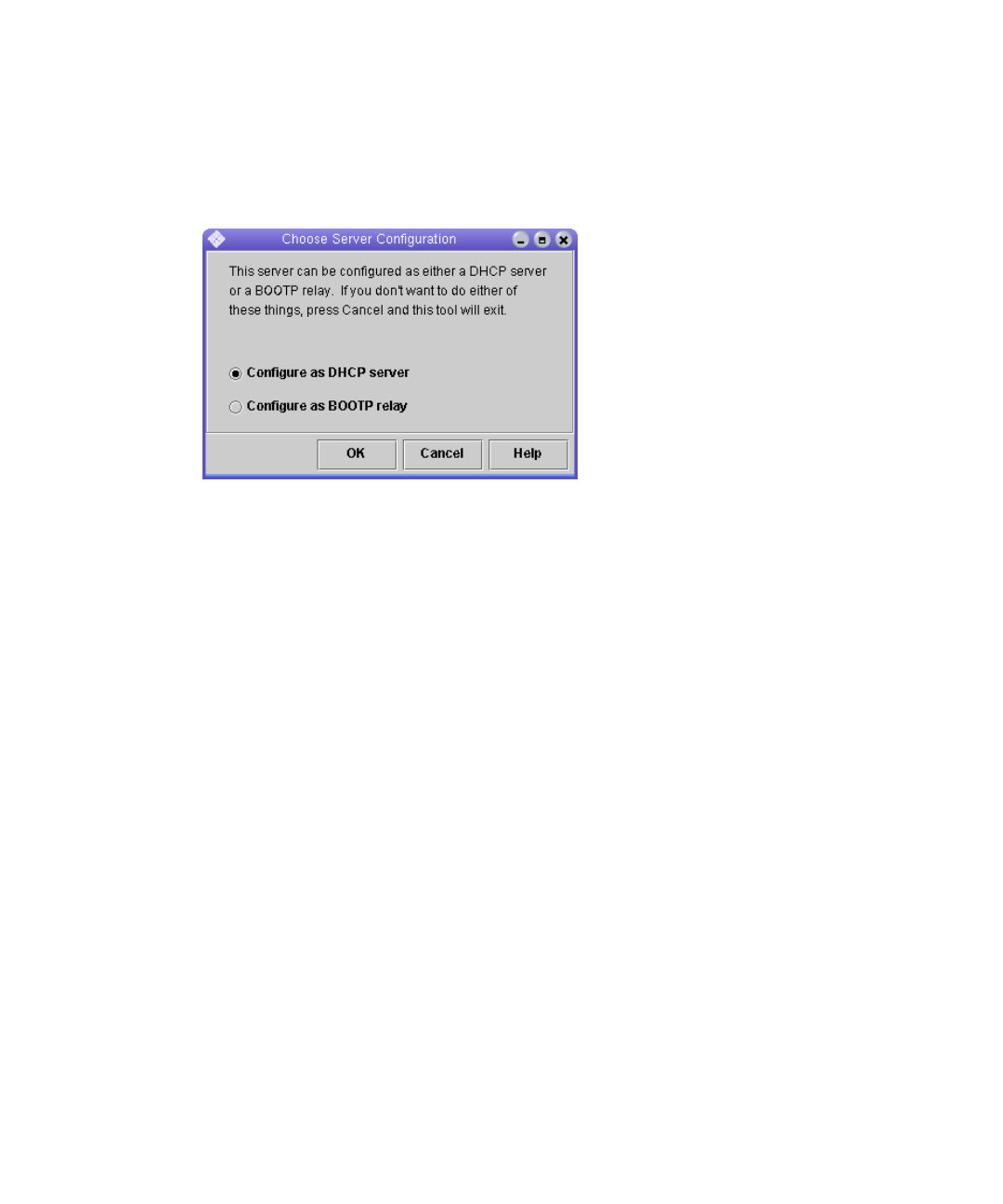
82 Sun StorageTek 2500 Series Array Hardware Installation Guide • March 2007
2. Start the DHCP wizard by issuing the following command at the command
line:
/usr/sadm/admin/bin/dhcpmgr &
The following window is displayed:
The wizard will prompt you for information related to the configuration, network
address, and subnet mask of the controller tray. Select or enter the following
information:
■Data storage format: Text files
■Nameservice to store host records: Do not manage hosts records
■Length of lease:
■Network Address: Network address of Controller A
■Subnet Mask: For example, 255.255.255.0
■Network Type: Local-Area (LAN)
■Router: Use router discovery protocol
Your summary page should look similar to the following example:
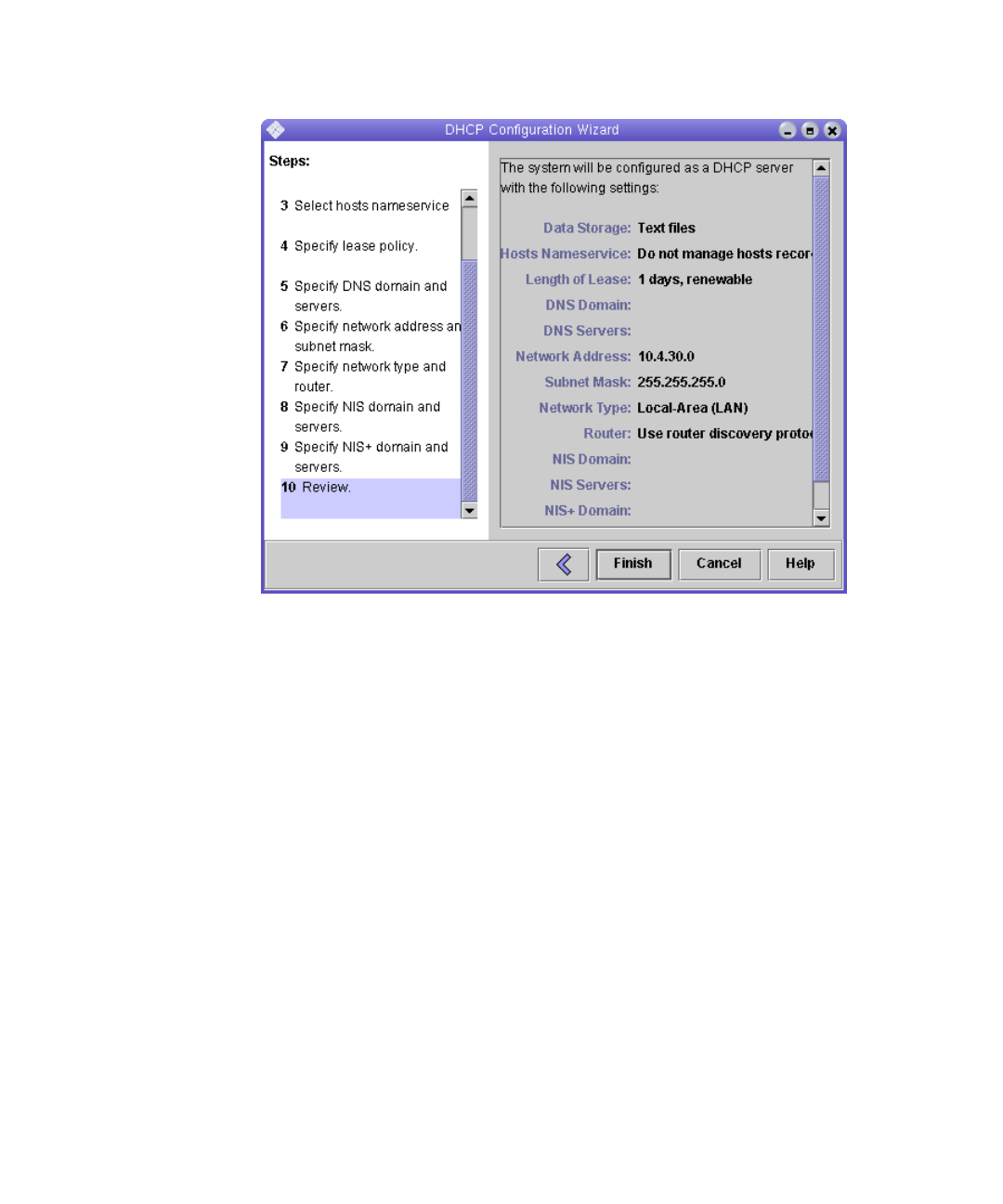
Chapter A Configuring a DHCP Server 83
3. Verify your configuration information and click Finish.
4. When you are prompted to configure addresses for the server, click Yes.
The Add Address to Network wizard is displayed.
5. Enter the following information:
■Number of IP addresses
■Name of managing server
■Starting IP address
■Configuration macro to be used for configuring the clients
■Lease type
Your summary page should look similar to the following example:
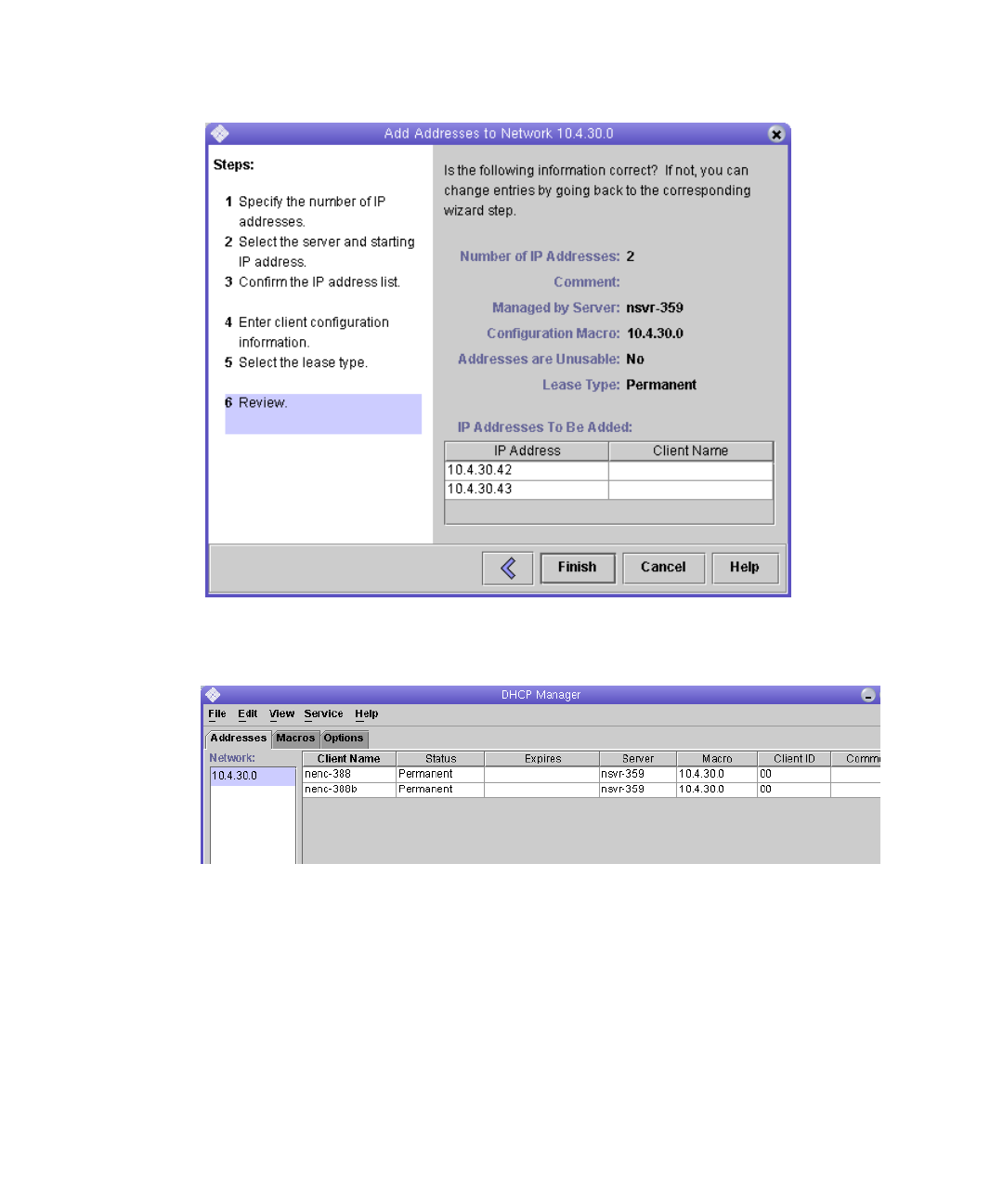
84 Sun StorageTek 2500 Series Array Hardware Installation Guide • March 2007
6. Verify your configuration information and click Finish.
The DHCP Manager displays the following:
7. In the Address Properties window, do the following:
a. In each Client ID field, enter 01 followed by the MAC address that is
printed on the back of the RAID controller. For example:
0100A0E80F924C
b. Toward the bottom of the window, select “Assign only to BOOTP clients.”
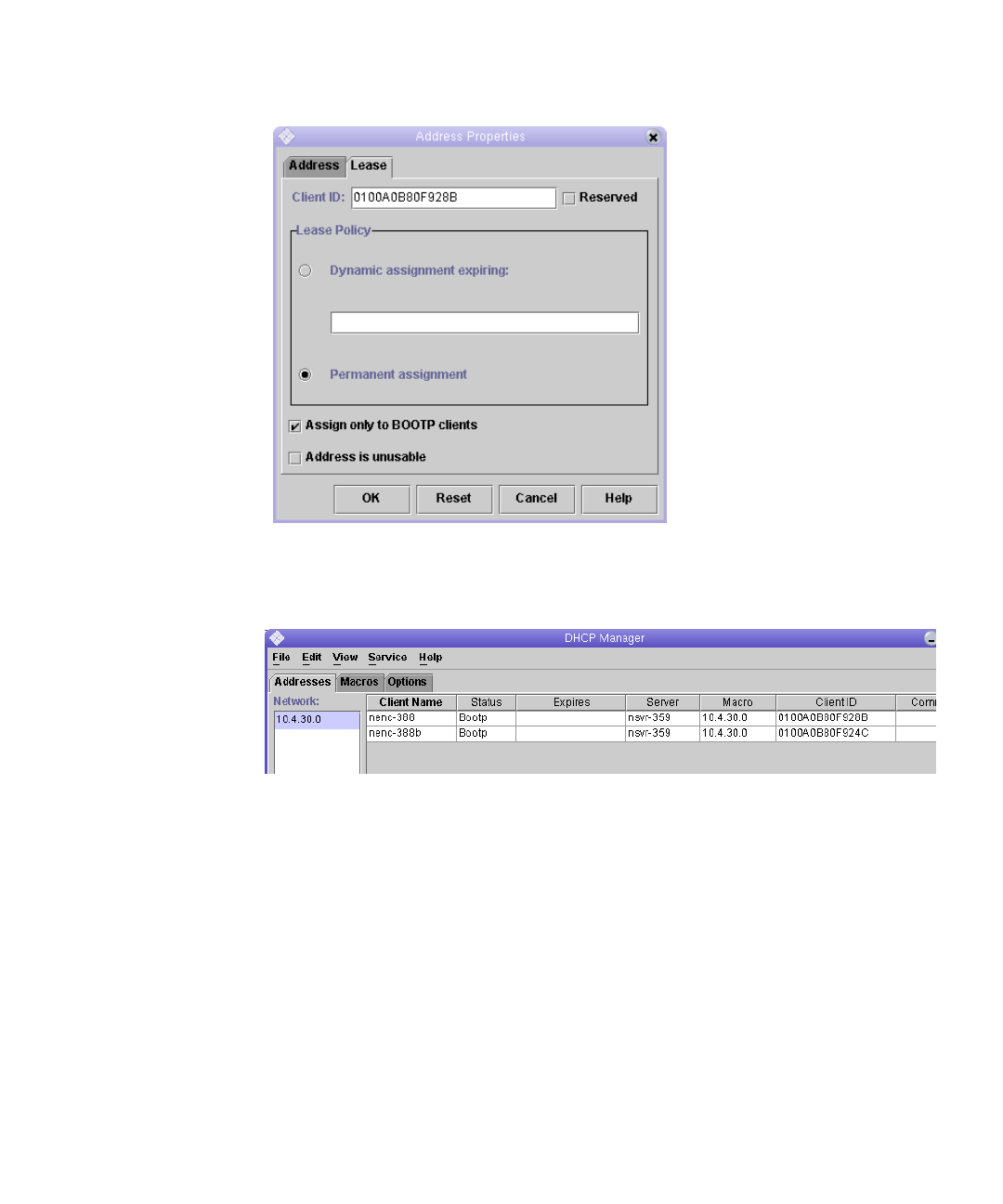
Chapter A Configuring a DHCP Server 85
c. Click OK.
The DHCP manager updates the status and client ID, as shown in the
following example:
8. Go to Modify Service Options and do the following:
a. Select Detect Duplicate IP addresses.
b. Under BOOTP Compatibility, select Automatic.
c. Select Restart Server, as shown in the following example.
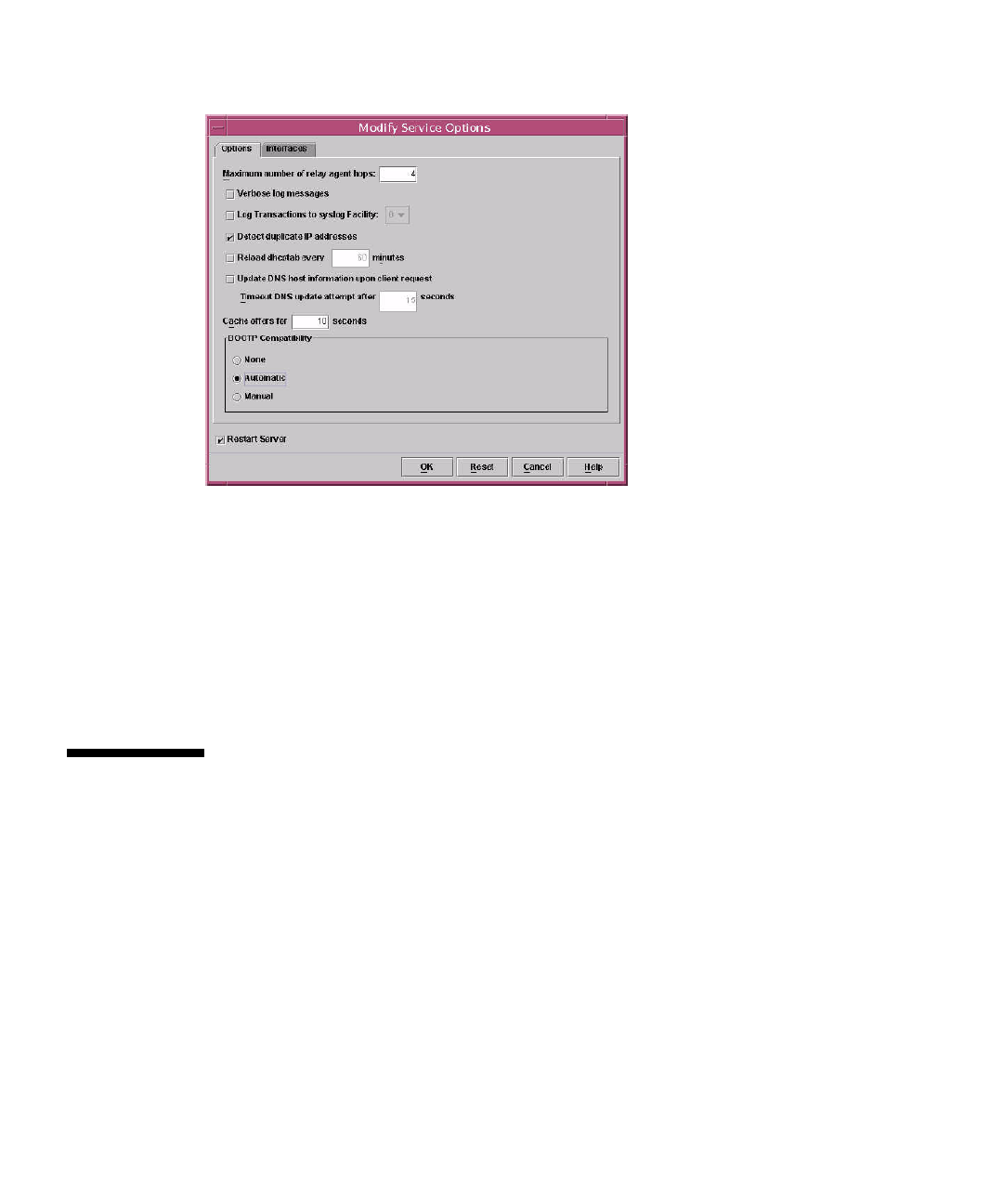
86 Sun StorageTek 2500 Series Array Hardware Installation Guide • March 2007
d. Click OK.
After the configuration process has finished, the DHCP server provides BOOTP
services to the MAC address you entered for each RAID controller.
9. To verify that the BOOTP service is running, go to Service > Restart.
10. After you power on the array, ping the address.
If the ping responds with ‘alive’, the DHCP server BOOTP operation was
successful.
Setting Up a Windows 2000 Advanced
Server
Before you begin, make sure the following requirements are met:
■Windows 2000 server and the array are on the same subnet.
■IP addresses that are assigned to the RAID controllers do not conflict.
■The array is in BOOTP IP addressing mode (the default setting for a new array).
■The Windows 2000 Server setup CD is available.

Chapter A Configuring a DHCP Server 87
The following procedure provides an example of how to set up DHCP with the
BOOTP option on the Windows 2000 Advanced Server. Your environment may
require different steps.
Installing the DHCP Server
To install DHCP server on the Windows 2000 Advanced Server:
1. From the Control Panel, go to Administrative Tools > Configure Your Server.
2. Select DHCP from the Networking drop-down menu on the left.
The wizard instructs you to use the Windows Components wizard to add the
DHCP component.
3. Start the Windows Components wizard and double-click Networking Services.
4. Select Dynamic Host Configuration Protocol (DHCP), click the check box to its
left, and click OK.
The Windows Components wizard is displayed.
5. Click Next.
6. If Terminal Services Setup is displayed, select Remote administration mode.
Click Next.
If your server has obtained an address from a DHCP server for its own address,
a warning is displayed.
7. Click OK to accept the warning.
Local Area Connection Properties is displayed.
8. Assign a static IP address to the server, or click Server to keep DHCP
addressing for the server. Click OK.
9. Click Finish to exit the Windows Components wizard.
The DHCP server is now installed. The next step is to configure the server.
Configuring the DHCP Server
To configure the DHCP server:
1. From the Control Panel, go to Administrative Tools > Computer Management >
Services and Application > DHCP.

88 Sun StorageTek 2500 Series Array Hardware Installation Guide • March 2007
2. From the Action menu, select New Scope.
The New Scope wizard is displayed.
3. Enter the following information as prompted:
■Scope name and description:
■IP address range (for example, 192.168.0.170 to 192.168.0.171)
■Subnet mask (for example, 255.255.255.0)
■Add exclusions (do not exclude any IP addresses)
■Lease duration (accept the default of 8 days)
■Router (default gateway) of your subnet (for example, 192.168.0.1)
■Domain name, WINS server (these are not needed)
■Activate Scope? (select “Yes, I want to activate this scope now”)
4. Click Finish to exit the wizard.
The contents of the DHCP server are listed.
5. Right-click Scope [ipaddress]scope-name and select Properties.
6. In the Scope Properties box, click the Advanced tab.
7. Select BOOTP only, set the lease duration to Unlimited, and click OK.
8. Right-click Reservations.
The Controller A Properties box is displayed.
9. Enter the IP address and the MAC address for Controller A. Click Add.
The Controller B Properties box is displayed.
10. Enter the IP address and the MAC address for Controller B. Click Add.
The controllers are added to the right of the Reservations listing.
11. Right-click Scope [ipaddress]scope-name to disable the scope.
12. Click Yes to confirm disabling of the scope.
13. Right-click Scope and select Activate.
The DHCP server is now configured with the BOOTP option for the array
network.
14. Power on or power cycle the array modules.
15. Click Address Leases in the left pane to check the DHCP server leases.
The lease expiration displays the following status for each RAID controller:
Reservation (active)

Chapter A Configuring a DHCP Server 89
If the lease expiration for the controllers is inactive, try refreshing the list. If the
lease is still inactive, check the following:
■Are the IP addresses allocated for BOOTP conflicting?
■Were the correct MAC addresses added to the DHCP server for the array
controllers?
■Are the DHCP server and array on the same subnet?
■Is the gateway configured correctly on the DHCP server?
The RAID controllers can gain a lease and an IP address, but they cannot respond
out of the subnet for the software if the gateway is not configured properly.
■Are the RAID controllers set up for BOOTP access?
It is possible that they were previously configured to have static IP addresses. You
must be sure when you move an array that you change the array’s IP addresses to
IP addresses on the new subnet before setting up BOOTP services.

90 Sun StorageTek 2500 Series Array Hardware Installation Guide • March 2007

91
CHAPTER B
Using DC Power
This appendix describes using the DC Power Unit for the Sun StorageTek 2500 Series
Arrays in the following sections:
■“DC Power Overview” on page 91
■“Installation Notes for DC Power” on page 92
■“Ship Kit Changes” on page 93
■“DC Power LEDS” on page 93
■“Connecting Power Cables” on page 94
■“Turning Off the DC Power During an Emergency” on page 96
■“Relocation Cautions” on page 96
DC Power Overview
The Sun StorageTek 2500 Series Arrays can be ordered with a DC power connection
and connector cables.
Caution – A qualified service person is required to make the DC power connection
per NEC and CEC guidelines. A two-pole 20-amp circuit breaker is required
between the DC power source and the array module for over-current and short-
circuit protection. Before turning off any power switches on a DC-powered module,
you must disconnect the two-pole 20-amp circuit breaker.
Caution – Electrical grounding hazard – This equipment is designed to permit the
connection of the D.C. supply circuit to the earthing conductor at the equipment.
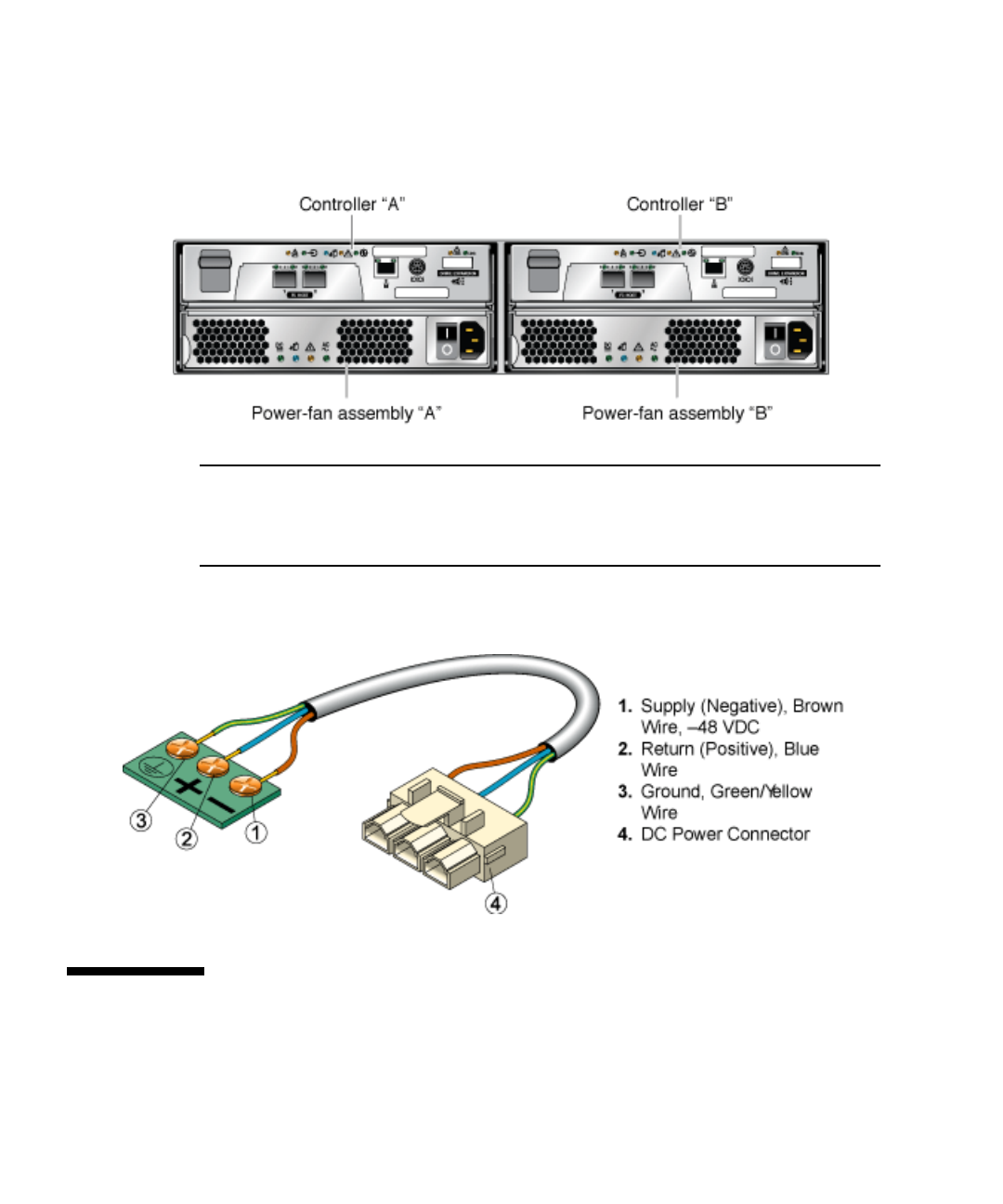
92 Sun StorageTek 2500 Series Array Hardware Installation Guide • March 2007
FIGURE B-1 shows the locations of the power-fan assemblies.
FIGURE B-1 Power Fan Assembly Locations.
Caution – Risk of electrical shock – This unit has more than one power source.
To remove all power from the unit, all DC MAINS must be disconnected by
removing all power connectors (item 4 in Appendix FIGURE B-2) from the power
supplies.
FIGURE B-2 DC Power Connector Cable and Source Wires
Installation Notes for DC Power
The sections that follow provide hardware information about DC power.

Chapter B Using DC Power 93
■“Ship Kit Changes” on page 93
■“DC Power LEDS” on page 93
■“Connecting Power Cables” on page 94
■“Turning Off the DC Power During an Emergency” on page 96
■“Relocation Cautions” on page 96
Ship Kit Changes
If the DC power option is ordered, two DC power connector cables are provided
with each controller tray for connection to centralized DC power plant equipment.
Caution – A qualified service person is required to make the DC power connection
per NEC and CEC guidelines. A two-pole 20-amp circuit breaker is required
between the DC power source and the array module for over-current and short-
circuit protection. Before turning off any power switches on a DC-powered module,
you must disconnect the two-pole 20-amp circuit breaker.
DC Power LEDS
FIGURE B-3 shows the LEDs, on/off power switch, and power cable receptacle on the
back of the DC power module.
FIGURE B-3 DC Power Module LEDs, Power Switch, and Power Cable Receptacle.
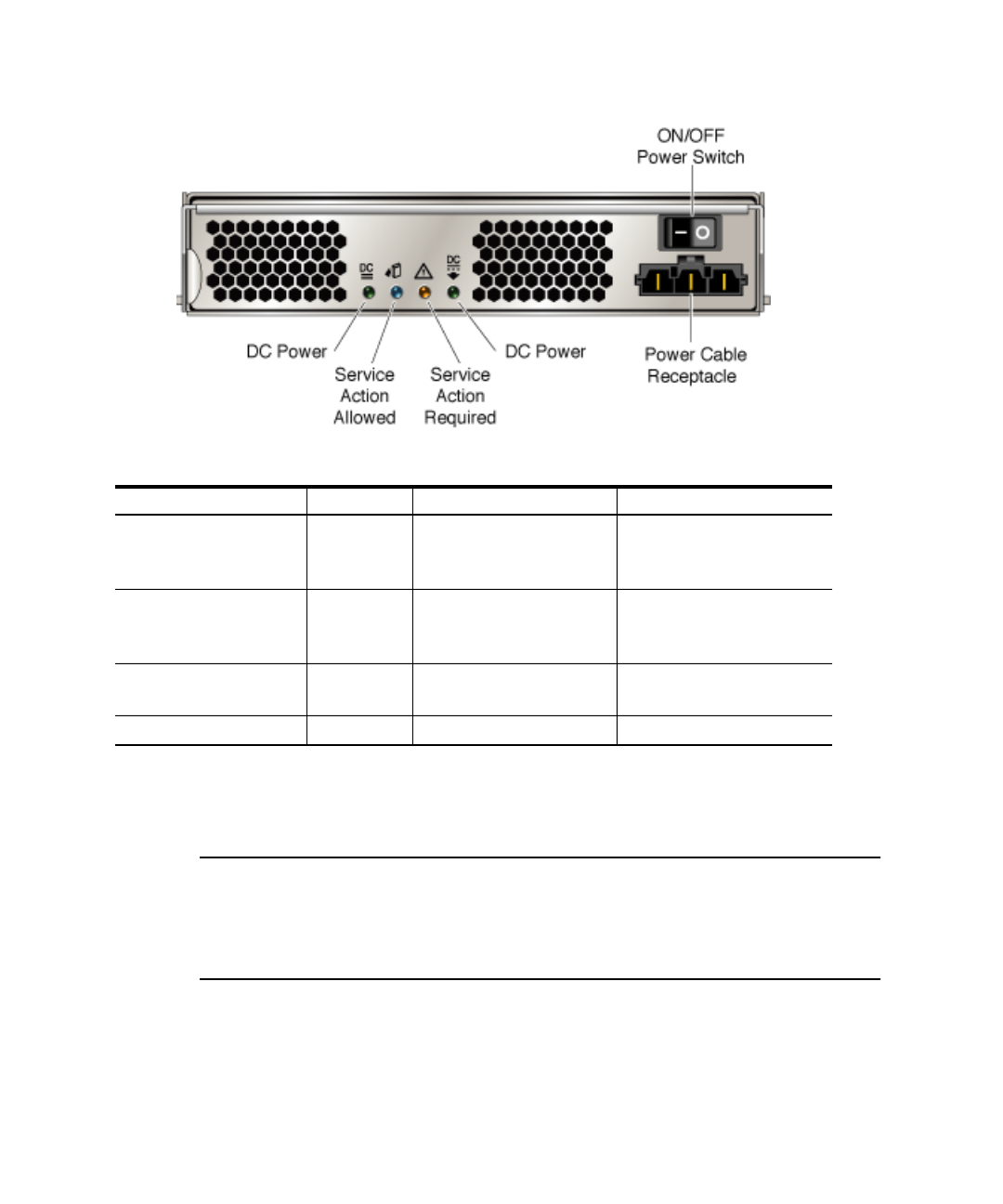
94 Sun StorageTek 2500 Series Array Hardware Installation Guide • March 2007
TABLE B-1 lists the LEDs for DC power.
TABLE B-1 DC Power Module LEDs.
Connecting Power Cables
Caution – A qualified service person is required to make the DC power
connection per NEC and CEC guidelines. A two-pole 20-amp circuit breaker is
required between the DC power source and the array module for over-current and
short-circuit protection. Before turning off any power switches on a DC-powered
module, you must disconnect the two-pole 20-amp circuit breaker.
LED Color On Off
DC Power (DC Good) Green DC power from the
power-fan assembly is
available.
DC power from the power-
fan assembly is not
available.
Service Action Allowed Blue The power-fan assembly
can be removed from the
tray.
The power-fan assembly
cannot be removed from the
tray.
Service Action Required
(Fault)
Amber A fault exists within the
power-fan assembly.
Normal condition
Power (DC Good) Green Power is present Power is not present

Chapter B Using DC Power 95
Caution – Ensure that you do not turn on power to the array module or the
connected drive modules until this guide instructs you to do so. For the proper
procedure for turning on the power, see ““Connecting Power Cables” on page 94.”
Caution – Electrical grounding hazard – This equipment is designed to permit the
connection of the D.C. supply circuit to the earthing conductor at the equipment.
▼Connecting the Cables
1. Disconnect the two-pole 20-amp DC circuit breaker for the storage array.
2. Ensure that all DC power switches on the DC-powered array module and all
DC power switches on any connected, DC-powered drive modules are turned
off.
3. Connect the DC power connector cable to the DC power connector on the back
of the array module.
Caution – The three source wires on the DC power connector cable (–48 VDC)
connect the array module to centralized DC power plant equipment, typically
through a bus bar located above the cabinet.
4. A qualified service person is required to make the DC power connection per
NEC and CEC guidelines. A two-pole 20-amp circuit breaker is required
between the DC power source and DC-powered modules for over-current and
short-circuit protection. Connect the DC power source wires on the other end
of the DC power connector cable to the centralized DC power plant equipment
as follows (see “DC Power Connector Cable and Source Wires” on page 92).
a. Connect the brown –48-VDC supply wire to the negative terminal.
b. Connect the blue return wire to the positive terminal.
c. Connect the green/yellow ground wire to the ground terminal.
5. If applicable, connect a DC power cable to each DC-powered expansion tray in
the storage array.

96 Sun StorageTek 2500 Series Array Hardware Installation Guide • March 2007
Turning Off the DC Power During an Emergency
Caution – Potential loss of data – An emergency shutdown of the storage array
might not allow the server to complete its I/O to the storage array.
Note – Before turning off the power switches on a DC-powered tray you must
disconnect the two-pole 20-amp circuit breaker.
Relocation Cautions
Use the following guidelines when relocating trays or drives from one storage array
to another.
Caution – Potential data loss – Moving a array or array components that are
configured as part of a volume group can result in data loss. To prevent data loss,
always consult a Customer Support representative before relocating configured
drives, controller trays or expansion trays.
Note – Trays in arrays can be connected to the DC power supply (–48 VDC). Before
turning off any power switches on a DC-powered tray, you must disconnect the two-
pole 20-amp circuit breaker.
Do not move controller trays or expansion trays that are part of a volume group
configuration. If you must move array components, contact a Customer Support
representative for procedures. A Customer Support representative might direct you
to complete several tasks prior to undertaking the relocation. These tasks might
include:
■Creating, saving, and printing an array profile of each storage array that is
affected by the relocation of a drive or tray.
■Performing a complete backup of all data on the drives that you intend to move.
■Verifying that the volume group and each of its associated volumes on the
affected array have an Optimal status.
■Determining the location and status of any global hot spares associated with the
affected storage array.

97
Glossary
Definitions obtained from the Storage Networking Industry Association (SNIA)
Dictionary are indicated with “(SNIA)” at the end. For the complete SNIA
Dictionary, go to www.snia.org/education/dictionary.
A
agent
The component of the system monitoring and diagnostic software that collects
health and asset information about the array.
alarm
A type of event that requires service action. See also event.
alert
A subtype of an event that requires user intervention. The term actionable event often
describes an alert. See also event.
array
Multiple disk drives that function as a single storage device. A high-availability
(HA) array configuration has redundant controllers and expansion trays of disk
drives.
array hot-spare
A disk that serves as a hot-spare within an array as part of the storage pool; a
reserve disk that can be made available to all virtual disks within an array. See also
hot-spare.

98 Sun StorageTek 2500 Series Array Hardware Installation Guide • March 2007
B
block
The amount of data sent or received by the host per I/O operation; the size of a data
unit.
C
capacity
The amount of storage you must allocate to storage elements, including volumes,
pools, and virtual disks. Capacity planning should include allocations for volume
snapshots and volume copies.
CLI
Command-line interface. The SSCS command-line interface is available from the
remote CLI client or through an SSCS directory on the Solaris Operating System
management software station.
controller tray
A tray with an installed redundant RAID controller pair. In a Sun StorageTek 2500
Series array, 1x1, 1x2, 1x3, and 1x4 array types are available.
control path
The route used for communication of system management information, usually an
out-of-band connection.
customer LAN
See site LAN.
D
DAS
See direct attached storage (DAS).
data host
Any host that uses the system for storage. A data host can be connected directly to
the array (direct attach storage, or DAS) or can be connected to an external switch
that supports multiple data hosts (storage area network, or SAN). See also host.

Glossary 99
data path
The route taken by a data packet between a data host and the storage device.
direct attached storage (DAS)
A storage architecture in which one or two hosts that access data are connected
physically to a storage array.
disk
A physical drive component that stores data.
E
event
A notification of something that happened on a device. There are many types of
events, and each type describes a separate occurrence. See also alarm and alert.
expansion tray
A tray that does not have a RAID controller, used to expand the capacity of an array.
This type of tray must be attached to a controller tray to function.
extent
A set of contiguous blocks with consecutive logical addresses on a physical or
virtual disk.
F
failover and recovery
The process of changing the data path automatically to an alternate path.
fault coverage
The percentage of faults detected against all possible faults or against all faults of a
given type.
FC
See FibreChannel (FC).
Fibre Channel (FC)
A set of standards for a serial I/O bus capable of transferring data between two
ports at up to 100 megabytes/second, with standards proposals to go to higher
speeds. Fibre Channel supports point to point, arbitrated loop, and switched

100 Sun StorageTek 2500 Series Array Hardware Installation Guide • March 2007
topologies. Fibre Channel was completely developed through industry cooperation,
unlike SCSI, which was developed by a vendor and submitted for standardization
after the fact.
Fibre Channel switch
A networking device that can send packets directly to a port associated with a given
network address in a Fibre Channel storage area network (SAN). Fibre Channel
switches are used to expand the number of servers that can connect to a particular
storage port. Each switch is managed by its own management software.
field-replaceable unit (FRU)
An assembly component that is designed to be replaced on site, without the system
having to be returned to the manufacturer for repair.
FRU
See field-replaceable unit (FRU).
H
HBA
See host bus adapter (HBA).
host
As a function of the Sun StorageTek 2500 Series array configuration, a representation
of a data host that is mapped to initiators and volumes to create a storage domain.
See also data host,initiator.
host bus adapter (HBA)
An I/O adapter that connects a host I/O bus to a computer’s memory system.
Abbreviated HBA. Host bus adapter is the preferred term in SCSI contexts. Adapter
and NIC are the preferred terms in Fibre Channel contexts. The term NIC is used in
networking contexts such as Ethernet and token ring. See also initiator.
host group
A group of hosts with common storage characteristics that can be mapped to
volumes. See also host.
hot-spare
The drive used by a controller to replace a failed disk. See also array hot-spare.

Glossary 101
I
in-band traffic
System management traffic that uses the data path between a host and a storage
device. See also out-of-band traffic.
initiator
A system component that initiates an I/O operation over a Fibre Channel (FC) network.
If allowed by FC fabric zoning rules, each host connection within the FC network has the
ability to initiate transactions with the storage array. Each host in the FC network
represents a separate initiator, so if a host is connected to the system through two host
bus adapters (HBAs), the system identifies two different initiators (similar to multi-
homed, Ethernet-based hosts). In contrast, when multipathing is used in round-robin
mode, multiple HBAs are grouped together, and the multipathing software identifies the
group of HBAs as a single initiator.
IOPS
A measure of transaction speed, representing the number of input and output
transactions per second.
L
LAN
Local area network.
logical unit number (LUN)
The SCSI identifier for a volume as it is recognized by a particular host. The same
volume can be represented by a different LUN to a different host.
LUN
See logical unit number (LUN).
M
MAC address
See media access control (MAC) address.
management host
A Solaris host serving the configuration, management, and monitoring software for
the Sun StorageTek 2500 Series array. The software on the station can be accessed
with a browser to run the browser interface or with a remote scripting command-
line interface (CLI) client to access the SSCS CLI commands.

102 Sun StorageTek 2500 Series Array Hardware Installation Guide • March 2007
master / alternate master
A design for reliability that uses redundant configuration. Array configurations
share master/alternate master configurations: each array configuration has two
controller trays that are grouped as one host. In each case, the master component
uses the IP address and name. If the master fails, the alternate master assumes the IP
address and name and takes over the master’s functions.
media access control (MAC) address
The physical address identifying an Ethernet controller board. The MAC address,
also called an Ethernet address, is set at the factory and must be mapped to the IP
address of the device.
mirroring
A form of storage – also called RAID Level 1, independent copy, and real-time copy –
whereby two or more independent, identical copies of data are maintained on separate
media. Typical mirroring technologies enable the cloning of data sets to provide
redundancy for a storage system.
multipathing
A design for redundancy that provides at least two physical paths to a target.
N
O
out-of-band traffic
System management traffic outside of the primary data path that uses an Ethernet
network. See also in-band traffic.
P
PDU
See power distribution unit (PDU).
pool
See storage pool.
power distribution unit (PDU)
The assembly that provides power management for the system. The redundant
design uses two PDUs in each system so that the system’s data path continues to
function if one of the PDUs fails.

Glossary 103
profile
See storage profile.
provisioning
The process of allocation and assignment of storage to hosts.
R
RAID
An acronym for Redundant Array of Independent Disks, a family of techniques for
managing multiple disks to deliver desirable cost, data availability, and performance
characteristics to host environments. Also, a phrase adopted from the 1988 SIGMOD
paper A Case for Redundant Arrays of Inexpensive Disks.
remote monitoring
Monitoring of the functions and performance of a hardware system from a location
other than where the hardware resides.
remote scripting CLI client
A command-line interface (CLI) that enables you to manage the system from a remote
management host. The client communicates with the management software through a
secure out-of-band interface, HTTPS, and provides the same control and monitoring
capability as the browser interface. The client must be installed on a host that has
network access to the system.
S
SAN
See storage area network (SAN).
site LAN
The local area network at your site. When the system is connected to your LAN, the
system can be managed through a browser from any host on the LAN.
snapshot
An copy of a volume’s data at a specific point in time.
SSCS
Sun Storage Command System. The command-line interface (CLI) that can be used
to manage the array.

104 Sun StorageTek 2500 Series Array Hardware Installation Guide • March 2007
storage area network (SAN)
An architecture in which the storage elements are connected to each other and to a server
that is the access point for all systems that use the SAN to store data.
storage domain
A secure container that holds a subset of the system’s total storage resources. Multiple
storage domains can be created to securely partition the system’s total set of storage
resources. This enables you to organize multiple departments or applications into a single
storage management infrastructure.
storage pool
A container that groups physical disk capacity (abstracted as virtual disks in the
browser interface) into a logical pool of available storage capacity. A storage pool’s
characteristics are defined by a storage profile. You can create multiple storage pools
to segregate storage capacity for use in various types of applications (for example,
high throughput and online transaction-processing applications).
storage profile
A defined set of storage performance characteristics such as RAID level, segment size,
dedicated hot-spare, and virtualization strategy. You can choose a predefined profile
suitable for the application that is using the storage, or you can create a custom profile.
storage tray
An enclosure containing disks. A tray with dual RAID controllers is called a
controller tray; a tray without controllers is called an expansion tray.
stripe size
The number of blocks in a stripe. A striped array’s stripe size is the stripe depth
multiplied by the number of member extents. A parity RAID array’s stripe size is the
stripe depth multiplied by one less than the number of member extents. See also
striping.
striping
Short for data striping; also known as RAID Level 0 or RAID 0. A mapping technique in
which fixed-size consecutive ranges of virtual disk data addresses are mapped to
successive array members in a cyclic pattern. (SNIA).
T
target
The system component that receives a SCSI I/O command. (SNIA).

Glossary 105
thin-scripting client
See remote scripting CLI client.
tray
See storage tray.
U
V
virtual disk
A set of disk blocks presented to an operating environment as a range of
consecutively numbered logical blocks with disk-like storage and I/O semantics.
The virtual disk is the disk array object that most closely resembles a physical disk
from the operating environment’s viewpoint.
volume
A logically contiguous range of storage blocks allocated from a single pool and presented
by a disk array as a logical unit number (LUN). A volume can span the physical devices
that constitute the array, or it can be wholly contained within a single physical disk,
depending on its virtualization strategy, size, and the internal array configuration. The
array controller makes these details transparent to applications running on the attached
server system.
volume snapshot
See snapshot.
W
WWN
World Wide Name. A unique 64-bit number assigned by a recognized naming
authority such as the Institute of Electrical and Electronics Engineers (IEEE) that
identifies a connection (device) or a set of connections to the network. The World
Wide Name (WWN) is constructed from the number that identifies the naming
authority, the number that identifies the manufacturer, and a unique number for the
specific connection.

106 Sun StorageTek 2500 Series Array Hardware Installation Guide • March 2007

107
Index
Numerics
2500 series array product overview, 2
A
about installing data host software for non-Solaris
host, 69
about IP addressing, 73
array
about IP addressing, 73
cabling a 1x2 configuration, 45
cabling a 1x3 configuration, 45
configuration naming convention, 43
configuring controller IP addressing, 74
installation checklist for, 20
powering on, 62
powering-off, 63
pre-installation process for, 20
B
backup power, battery cache memory, 6
battery
backup power, 6
cache memory, 6
book
before you read, xiii
organization, xiv
related documentation, xiv
submitting comments to Sun, xvi
C
cabinet, 1
attaching rails to a standard 19-inch cabinet, 27
attaching rails to a Sun Rack 900/1000, 27
controller tray slot, 26
installing a tray, 37
preparing for tray installation, 26
cabling
1x2 array configuration, 45
1x3 array configuration, 45
Ethernet ports directly to management host, 51
Ethernet ports to a management LAN, 50
Ethernet ports using a hub, 51
intertray connections, 42
power connections, 42
cabling, I/O module, 10
cache memory
battery, 6
ST2530 controller, 8
ST2540 controller, 7
comments
submitting to Sun, xvi
configuration naming convention, 43
Configuration wizard for DHCP, 82
configuring controller IP addressing, 74
configuring DHCP IP addressing, 74
configuring IP addressing using the controller serial
port, 75
configuring static IP addressing, 75
connecting a terminal to a controller serial port, 75
connecting power cables, 42
connecting the management host, 49
connectors
data host, 7
I/O module SAS, 10

108 Sun StorageTek 2500 Series Array Hardware Installation Guide • March 2007
management host, 6
SAS, ST2530, 8
SAS, ST2540, 7
contacting technical support, xvi
contents
universal rail kit, 24
controller
configuring IP addressing, 74
connecting a terminal to the serial port, 75
connecting Ethernet ports to a management
LAN, 50
connecting Ethernet ports to directly to
management host, 51
connecting using an Ethernet hub, 51
establishing communication between a terminal
and the serial port, 77
using the serial port to configure IP
addressing, 75
controller tray
installation slot in cabinet, 26
ship kit contents, 25
controller trays
CRUs, 6
Ethernet connection for out-of-band
management, 6
fiber-optic interface, ST2540, 7
front-access components, 2
LEDs on the front, 3
rear-access components, 5
SAS connectors, ST2540, 7
SFP transceivers, 7
ST1530 model, description of, 8
CRUs
controller trays, 6
power-fan assembly, 9
ST2530 controller, 8
ST2540 controller, 6
D
data host, 6
setting up, 66
data host software
about installing for a non-Solaris host, 69
downloading software for a non-Solaris OS, 69
installing for a non-Solaris host, 67, 69, 70
data path redundancy, 6
DC power option
power source wires, 95
DHCP
Configuration wizard for, 82
server configuration
before you begin, 81
Solaris DHCP server setup, 87
Windows 2000 Advanced Server
installation, 87
Windows 2000 Advanced Server
requirements, 86
DHCP IP addressing
configuring, 74
disk drives
description of
ST2540 controller tray
disk drives,16
maximum connection number, 7, 8
numbering scheme, 17
tray ID and slot designation, 17
documentation
accessing from Sun, xv
related, xiv
downloading data host software for a non-Solaris
host, 69
drive expansion tray
front-access components, 2
I/O module, 10
LEDs on the front, 3
overview, 1
rear-access components, 5
SAS connectors, 10
E
emulation
setting up a terminal, 76
enabling multipathing software, 70
end caps
removing, 39
replacing, 41
establishing communication between a terminal and
a controller serial port, 77
Ethernet connection
controller trays, 6
Ethernet ports
connecting directly to management host, 51
connecting to a management LAN, 50
connecting using a hub, 51

Index 109
expansion tray
ship kit contents, 26
F
fans
power-fan assembly, 9
fault LED, 16
Fibre Channel
ST2540 controller tray, 7
firmware, 6
front-access tray components, 3
H
host
connecting for management, 49
setting up a data host, 66
hot swap
controller CRUs, 6
I/O module, 10
I
I/O module
cabling, 10
ST2501 drive expansion tray, 10
installation process, 20
installing a tray in a cabinet, 37
installing data host for a non-Solaris host, 70
installing data host software for a non-Solaris
host, 70
installing data host software for non-Solaris
host, 67, 69
intertray cabling, 42
1x2 configuration, 45
1x3 configuration, 45
IP addressing
about, 73
configuring DHCP, 74
configuring for array controllers, 74
configuring static, 75
using the controller serial port, 75
L
LEDs
fault, 16
on the front of the trays, 3
on the rear of the ST2540 controller tray, 11
on the rear of the trays, 11
power-fan assembly, 13
Service Action Allowed, 15
M
MAC address, 6
MAC address location, 81
management host
connecting, 49
connector cable types, 7
multipathing software
enabling, 70
N
New Scope wizard, 88
O
organization of book, xiv
out-of-band management, 6
P
part numbers
universal rail kit, 24
planning the tray installation order, 26
power
connecting cables, 42
power-fan assembly
description of, 9
fan, description of, 9
LEDs, 13
powering off the array, 63
power-on procedures
array, 62
before powering-on, 61
preparing the cabinet for tray installation, 26
preparing the tray for installation, 25
product overview
software, 19
R
rackmount kit preparation, 24
rails
attaching to standard 19-inch cabinet, 27
attaching to Sun Rack 900/1000, 27
attaching to unthreaded cabinet
attaching rails to unthreaded cabinet, 31

110 Sun StorageTek 2500 Series Array Hardware Installation Guide • March 2007
loosening length adjustment screws, 24
rear-access components of the controller trays, 5
rear-access components of the drive expansion
tray, 5
redundancy
data path, 6
I/O module, 10
related documentation, xiv
RJ45-DB9 adapter, 76
RJ45-DIN cable, 75
pinouts, 76
S
SAS connector, ST2530, 8
SAS connectors
ST2501 drive expansion tray, 10
serial cable
pinouts, 76
serial connection by USB, 76
serial connection to PC, 76
serial port
connecting a terminal, 75
establishing communication with a terminal, 77
setting up terminal emulation, 76
using to configure IP addressing, 75
serial port cable, 75
Service Action Allowed LED, 15
setting up a data host, 66
setting up terminal emulation, 76
SFP transceivers
description of, 7
ship kit
controller tray, 25
expansion tray, 26
simplex configurations, 47
software
enabling multipathing, 70
installing data host for non-Solaris host, 67, 69
software overview, 19
ST2500 drive expansion tray
disk drives, 16
ST2501 drive expansion tray
I/O module, 10
power-fan assembly, 9
ST2530 controller tray
disk drives, 16
power-fan assembly, 9
ST2540 controller tray
LEDs on the rear, 11
power-fan assembly, 9
static IP addressing
configuring, 75
storage array configuration
2500 Series Array Product Overview, 2
T
technical support
contacting, xvi
terminal
connecting to a controller serial port, 75
establishing communication with a controller
serial port, 77
setting up emulation, 76
third party web sites, xvi
tools
required for tray installation, 23
Traffic Manager
downloading, 68
installing, 68
tray
installation order, 26
installing, 37
intertray cabling, 42
preparing for installation, 25
preparing the cabinet for installation, 26
ship kit contents, 25, 26
tools required for installation, 23
unpacking, 25
tray ID
disk drives, 17
tray installation
preparing the rackmount kit for, 24
trays
front-access components, 2, 3
LEDs on the rear, 11
rear-access components, 5
U
universal rail kit
attaching to a standard 19-inch cabinet, 27
attaching to a Sun Rack 900/1000, 27
attaching to unthreaded cabinet, 31


112 Sun StorageTek 2500 Series Array Hardware Installation Guide • March 2007
