Suzhou Sate Auto Electronic TSB46 Tire Pressure Monitoring System Sensor User Manual

Suzhou Sate Auto Electronic Co., Ltd Tire Pressure Monitoring System Sensor

User manual

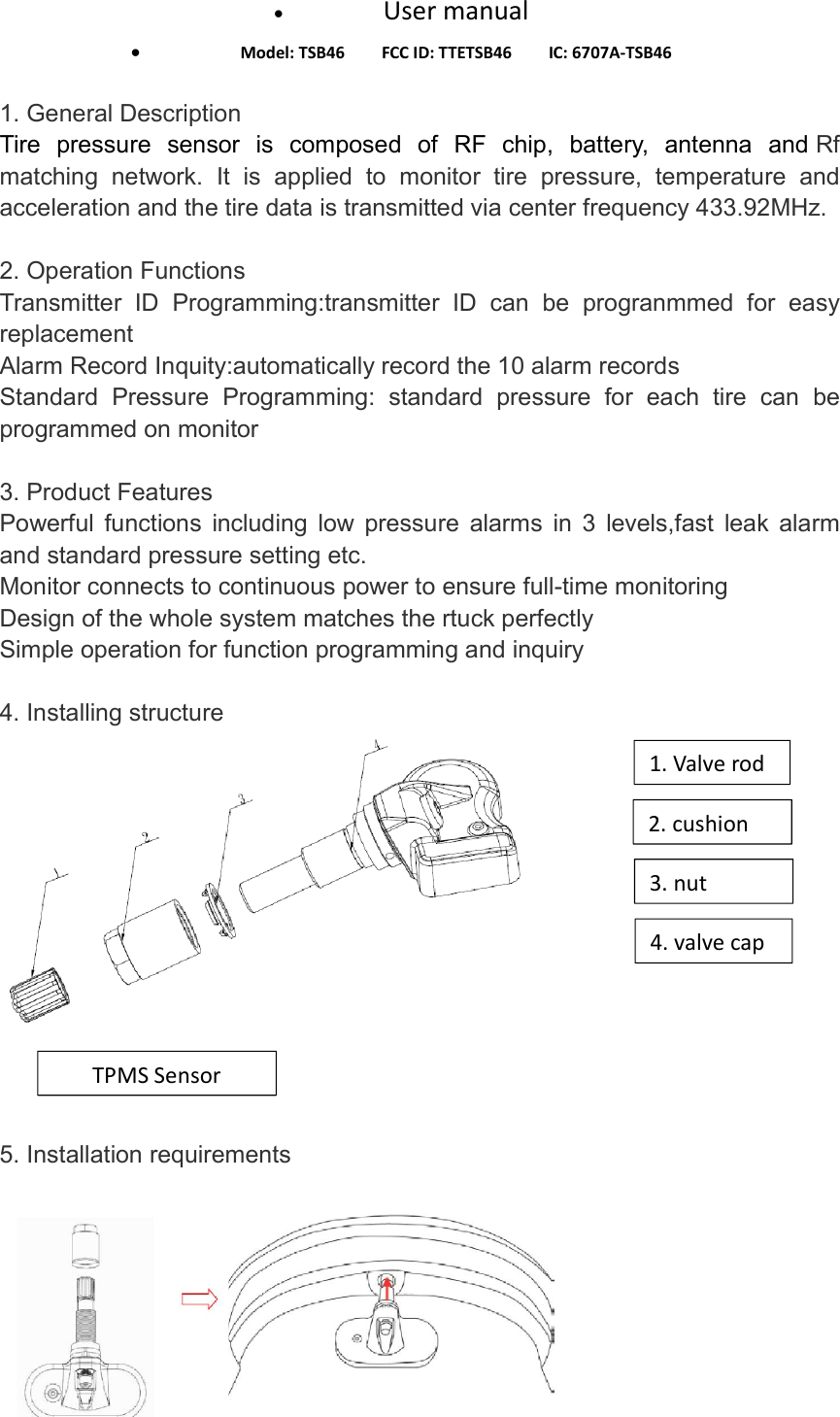
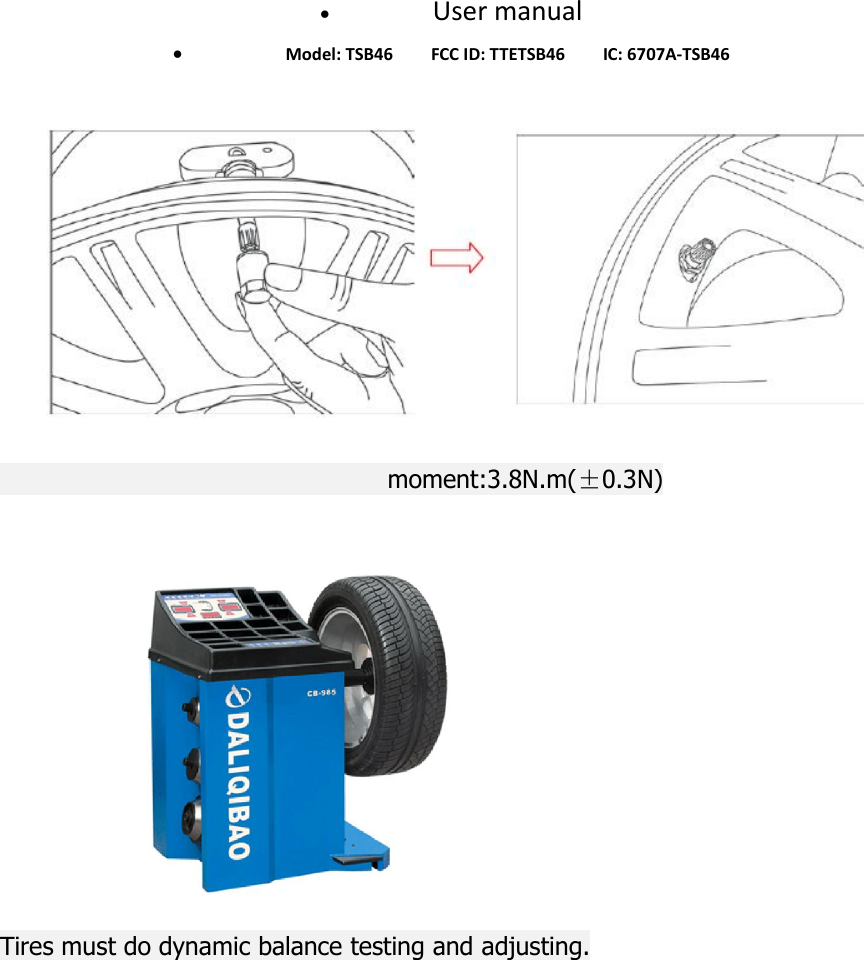
 User manual  Model: TSB46        FCC ID: TTETSB46        IC: 6707A-TSB46  1. General Description Tire  pressure  sensor  is  composed  of  RF  chip,  battery,  antenna  and Rf matching  network.  It  is  applied  to  monitor  tire  pressure,  temperature  and acceleration and the tire data is transmitted via center frequency 433.92MHz.   2. Operation Functions Transmitter  ID  Programming:transmitter  ID  can  be  progranmmed  for  easy replacement   Alarm Record Inquity:automatically record the 10 alarm records Standard  Pressure  Programming:  standard  pressure  for  each  tire  can  be programmed on monitor  3. Product Features Powerful  functions  including  low  pressure  alarms  in  3  levels,fast  leak  alarm and standard pressure setting etc. Monitor connects to continuous power to ensure full-time monitoring   Design of the whole system matches the rtuck perfectly Simple operation for function programming and inquiry  4. Installing structure     5. Installation requirements    4. valve cap 3. nut 2. cushion 1. Valve rod TPMS Sensor
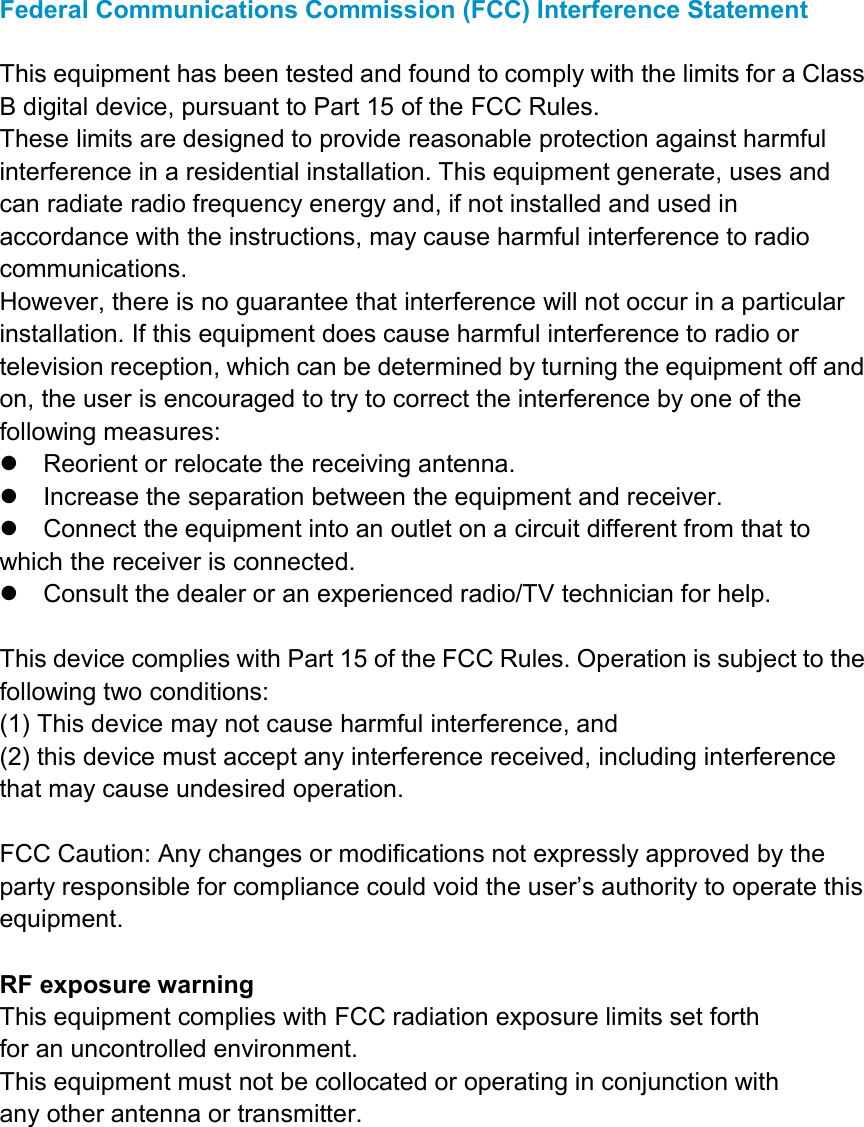
 User manual  Model: TSB46        FCC ID: TTETSB46        IC: 6707A-TSB46                                  moment:3.8N.m(±0.3N)   Tires must do dynamic balance testing and adjusting.
Federal Communications Commission (FCC) Interference Statement  This equipment has been tested and found to comply with the limits for a Class B digital device, pursuant to Part 15 of the FCC Rules. These limits are designed to provide reasonable protection against harmful interference in a residential installation. This equipment generate, uses and can radiate radio frequency energy and, if not installed and used in accordance with the instructions, may cause harmful interference to radio communications. However, there is no guarantee that interference will not occur in a particular installation. If this equipment does cause harmful interference to radio or television reception, which can be determined by turning the equipment off and on, the user is encouraged to try to correct the interference by one of the following measures: Reorient or relocate the receiving antenna. Increase the separation between the equipment and receiver.   Connect the equipment into an outlet on a circuit different from that to which the receiver is connected.   Consult the dealer or an experienced radio/TV technician for help.    This device complies with Part 15 of the FCC Rules. Operation is subject to the following two conditions: (1) This device may not cause harmful interference, and   (2) this device must accept any interference received, including interference that may cause undesired operation.  FCC Caution: Any changes or modifications not expressly approved by the party responsible for compliance could void the user’s authority to operate this equipment.  RF exposure warning This equipment complies with FCC radiation exposure limits set forth for an uncontrolled environment. This equipment must not be collocated or operating in conjunction with any other antenna or transmitter.
Industry Canada (IC) CAN ICES-3 (B)/NMB-3(B)  This device complies with Industry Canada’s licence-exempt RSSs. Operation is subject to the following two conditions: (1) This device may not cause harmful interference, and (2) this device must accept any interference received, including interference that may cause undesired operation.     Cet appareil est conforme à la norme RSS d'Industrie Canada. Son fonctionnementestsujet aux deux conditions suivantes: (1) ledispositif ne doit pas produire de brouillagepréjudiciable, et (2) cedispositifdoit accepter tout brouillagereçu, y compris un brouillage susceptible de provoquer un fonctionnementindésirable.

Navigation menu