Testo SE and KGaA 04404000 testo 400 - Universal IAQ instrument User Manual Users manual 0975 0122 en 01
Testo SE & Co. KGaA testo 400 - Universal IAQ instrument Users manual 0975 0122 en 01
Contents
- 1. Users manual_0975 0111 en 01
- 2. Users manual_0975 0122 en 01
- 3. Users Manual_Ubersetzung Zulassung
Users manual_0975 0122 en 01
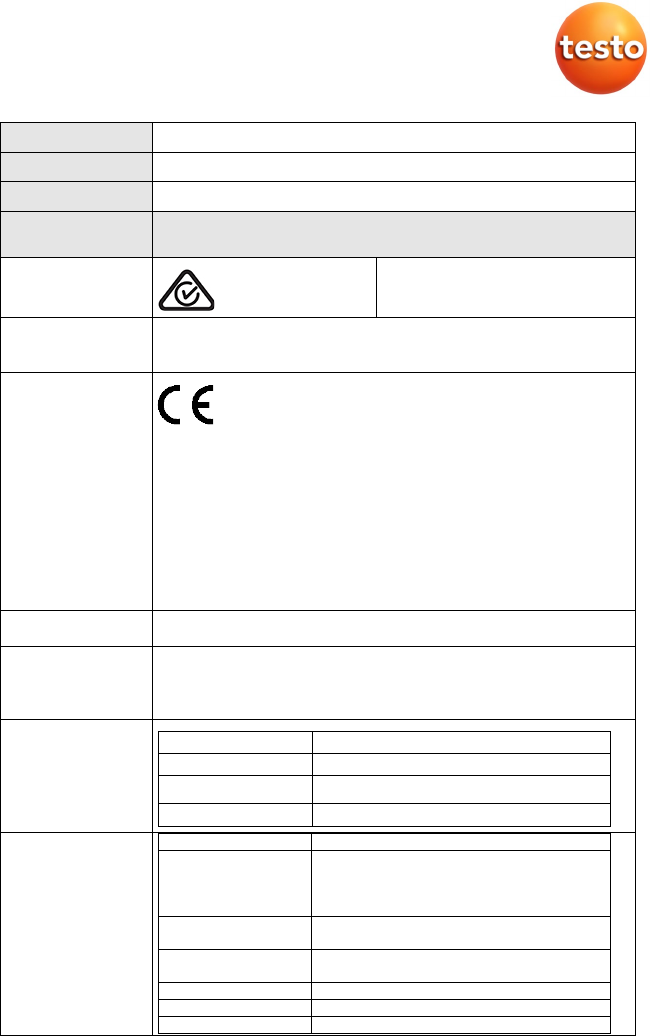
Approval and Certification
Product 0440 4000 (testo 400)
Mat.-No. 0440 4000
Date 07.11.2018
Country Comments
Australia
E 1561
Canada
Product IC: 6127B-04404000
IC Warnings
Europa + EFTA
EU countries:
Belgium (BE), Bulgaria (BG), Denmark (DK), Germany (DE), Estonia (EE),
Finland (FI), France (FR), Greece (GR), Ireland (IE), Italy (IT), Latvia (LV),
Lithuania (LT), Luxembourg (LU), Malta (MT), Netherlands (NL), Austria
(AT), Poland (PL), Portugal (PT), Romania (RO), Sweden (SE), Slovakia
(SK), Slovenia (SI), Spain (ES), Czech Republic (CZ), Hungary (HU), United
Kingdom (GB), Republic of Cyprus (CY).
EFTA countries:
Iceland, Liechtenstein, Norway, Switzerland
Turkey
Authorized
USA
Product FCC ID: WAF-04404000
FCC Warnings
Bluetooth®
Information
Feature
Values
Qualified Design ID
D037513)
Bluetooth radio class
Class 1
Bluetooth® company
Testo SE & Co. KGaA
Bluetooth®-Module
Feature
Values
Bluetooth® Range
(testo Klima-probes
of newest generation
with Bluetooth
®
)
<20 m (free field)
Bluetooth® Range
(Smart-probes)
<20 m (free field)
Bluetooth® type
S25 Series BLE module , based on TI
CC2640 chip
RF Band
2402-2480MHz
Output power
0 dBm
Antenna gain 3 dBi
IC Warrnings
RSS-Gen & RSS-247 statement:
This device complies with Industry Canada licence-exempt RSS standard(s).
Operation is subject to the following two conditions:
(1) this device may not cause interference, and
(2) this device must accept any interference, including interference that may cause undesired operation
of the device.
Le présent appareil est conforme aux CNR d'Industrie Canada applicables aux appareils radio exempts
de licence.
L'exploitation est autorisée aux deux conditions suivantes :
(1) l'appareil ne doit pas produire de brouillage, et
(2) l'utilisateur de l'appareil doit accepter tout brouillage radioélectrique subi, même si le brouillage est
susceptible d'en compromettre le fonctionnement.
Caution: Radio Frequency Radiation Exposure
This equipment complies with IC radiation exposure limits set forth for an uncontrolled environment and
meets the IC radio frequency (RF) Exposure Guidelines. This equipment should be installed and
operated keeping the radiator at least 20 cm or more away from person´s body in normal use position.
Co-Location:
This transmitter must not be co-located or operated in conjunction with any other antenna or
transmitter.
Attention : exposition au rayonnement de radiofréquences
Cet équipement est conforme aux limites d'exposition aux radiofréquences IC fixées pour un
environnement non contrôlé et aux Lignes directrices relatives à l'exposition aux radiofréquences (RF).
Cet équipement devrait être installé et utilisé à une distance d'au moins 20 cm d'un radiateur ou à une
distance plus grande du corps humain en position normale d'utilisation.
Co-location
Ce transmetteur ne peut pas être installé en colocation ou être utilisé avec une autre antenne ou
transmetteur, quel qu'en soit le type..
FCC Warnings
Information from the FCC (Federal Communications Commission)
For your own safety
Shielded cables should be used for a composite interface. This is to ensure continued protection
against radio frequency interference.
FCC warning statement
This equipment has been tested and found to comply with the limits for a Class B digital device,
pursuant to Part 15 of the FCC Rules. These limits are designed to provide reasonable protection
against harmful interference in a residential installation. This equipment generates, uses and can
radiate radio frequency energy and, if not installed and used in accordance with the instructions, may
cause harmful interference to radio communications. However, there is no guarantee that interference
will not occur in a particular installation. If this equipment does cause harmful interference to radio or
television reception, which can be determined by turning the equipment off and on, the user is
encouraged to try to correct the interference by one or more of the following measures:
• Reorient or relocate the receiving antenna.
• Increase the separation between the equipment and receiver.
• Connect the equipment into an outlet on a circuit different from that to which the receiver is
connected.
• Consult the dealer or an experienced radio/TV technician for help.
Caution
Changes or modifications not expressly approved by the party responsible for compliance could void
the user's authority to operate the equipment. Shielded interface cable must be used in order to comply
with the emission limits.