TrackMan A S TMAN Field Disturbance Sensor User Manual ISG Manu 06001i1

TrackMan A/S Field Disturbance Sensor ISG Manu 06001i1

Contents

Users Manual

ISG/MANU/06001i1   TrackMan™ “TMAN II” Hardware Operating Manual     Issue 1, March 2006             Page 1 of 20    TrackMan™ Radar Unit   Model: TMAN II       Installation and Operating Manual Issue 1  Patent pending  ISG A/S                support@isg.dk
ISG/MANU/06001i1   TrackMan™ “TMAN II” Hardware Operating Manual     Issue 1, March 2006             Page 2 of 20                              Information in this document is subject to change without notice.  Copyright © 2004-2006 ISG A/S. All rights reserved.   Reproduction  in  any  manner  what  so  ever  without  the  written  permission  of  ISG  A/S  is strictly prohibited.   TrackMan™  is  a  registered  trademark  by  ISG  A/S.  Other  brands  and  product  names  are trademarks or registered trademarks of their respective holders.  ISG A/S has filed several patent applications which covers both the construction, operation and processing algorithms of the TrackMan™ system.   Model TMAN II  March 2006     ISG/MANU/06001i1    Issue 1
ISG/MANU/06001i1   TrackMan™ “TMAN II” Hardware Operating Manual     Issue 1, March 2006             Page 3 of 20 REGULATORY NOTICE  FCC compliance This  equipment  has  been  tested  and  found  to  comply with  the limits for  a  Class B  digital device, pursuant to part 15 of the FCC Rules. These limits are designed to provide reasonable protection against harmful interference in a residential installation. Operation is subject to the following two conditions:  1. This device may not cause harmful interference, and 2. this  device  must  accept  any  interference  received,  including  interference  that  may cause undesired operation. Patent pending  This equipment generates, uses, and can radiate radio frequency energy and, if not installed and used in accordance with the instruction manual, may cause harmful interference to radio communications.  However,  there  is  no  guarantee  that  interference  will  not  occur  in  a particular installation. If this equipment does cause harmful interference to radio or television reception,  which  can  be  determined  by  turning  the  equipment  off  and  on,  the  user  is encouraged to try to correct the interference by one or more of the following measures: -Reorient or relocate the receiving antenna. -Increase the separation between the equipment and receiver. -Connect the equipment into an outlet on a circuit different from that to which the receiver is connected. -Consult the dealer or an experienced radio/TC technician for help.   Caution Never try to open or repair the device yourself. Any changes or modifications not expressly approved by ISG A/S could void the user’s authority to operate the device.
ISG/MANU/06001i1   TrackMan™ “TMAN II” Hardware Operating Manual     Issue 1, March 2006             Page 4 of 20 WARNING: RADIATION HAZARD  Radiation Safety Warning. This  device  radiates  a  low  level  of  microwave  electromagnetic  radiation  from  the  front window  when  in  use.  The  radiated  power  is  significantly  lower  the  international  safety standards for microwave frequencies. However, the user should maintain a minimum distance of 20 cm from this device during operation.
ISG/MANU/06001i1   TrackMan™ “TMAN II” Hardware Operating Manual     Issue 1, March 2006             Page 5 of 20 CAUTION: SAFETY INSTRUCTIONS  Use the following safety instructions to ensure your own personal safety and to help protect the TrackMan™ radar unit.   General • Do not attempt to service the device yourself. Always follow installation instructions closely. • Only use cables and accessories approved by ISG A/S together with your TrackMan™ Radar Unit. • The AC adaptor may become hot during normal operation of the TrackMan™ system. Use care when handling the adaptor during or immediately after operation. • If the TrackMan™ system has been used in wet weather, clean all items with a dry cloth after use.   Power • Only use the AC adaptor supplied with the TrackMan™ Radar Unit. Use of another adaptor may cause fire or explosion. • Before you connect the TrackMan™ Radar Unit to an electrical outlet, check the AC adaptor  voltage  rating  to  ensure  that  the  required  voltage  and  frequency  match  the available power source. • To  help  prevent  electric  shock,  plug  the  AC  adaptor  and  device  power  cables  into properly grounded power sources. These power cables may be equipped with 3-prong plugs to provide an earth grounding connection. Do not use adaptor plugs or remove the grounding prong from the power cable plug. If you use a power extension cable, use the appropriate type, 2-prong or 3-prong, to mate the AC adaptor power cable. • Make  sure  that  the  computer  and  AC  adaptor  connected  to  the  TrackMan™  Radar Unit are connected to the same power outlet. Failure to comply with this requirement could cause electrical shock and create permanent damage on both the TrackMan™ Radar Unit and the computer. • Place the AC adaptor in a ventilated and dry area. Do not cover the AC adaptor that will reduce cooling. • Be sure that nothing rests on your AC adaptors power cable and that the cable is not located where it can be tripped over or stepped on.   ISG A/S accepts no liability for failure to comply with these requirements.
ISG/MANU/06001i1   TrackMan™ “TMAN II” Hardware Operating Manual     Issue 1, March 2006             Page 6 of 20 WARRANTY COMMENT  The TrackMan™ Radar Unit contains no user serviceable parts inside. In case of defect or malfunctioning TrackMan™  Radar  Unit, the unit must  be  repaired  by  ISG A/S  authorized personal ONLY.   IMPORTANT  The  box  is  sealed  to  prevent  unauthorized  access  to  the  inside  of  the TrackMan™  Radar  Unit.  If  the  sealed  is  broken  any  warranty  agreement  will  terminate immediately. Warranty will also terminate immediately if: -Use of non-approved AC adaptor or incorrect direct applied DC voltage -Use of non-approved cables between the TrackMan™ Radar Unit and the computer -If the TrackMan™ Radar Unit is not installed or operated in compliance with this manual.  For full description of the warranty and the scope hereof, reference is made to the warranty agreement between the user and ISG A/S.
ISG/MANU/06001i1   TrackMan™ “TMAN II” Hardware Operating Manual     Issue 1, March 2006             Page 7 of 20  TABLE OF CONTENTS   1  INTRODUCTION................................................................................................................. 8 2  SYSTEM DESCRIPTION........................................................................................................9 2.1  Technical specifications............................................................................................9 3  SETTING UP THE SYSTEM................................................................................................. 13 3.1  General comments.................................................................................................. 13 3.2  Step-by-step setup .................................................................................................. 14 3.3  Leveling ................................................................................................................. 15 4  END OF USE..................................................................................................................... 16 5  TROUBLESHOOTING........................................................................................................ 17 6  TRANSPORTATION, STORAGE AND MAINTENANCE............................................................. 19 6.1  Transportation ........................................................................................................ 19 6.2  Maintenance........................................................................................................... 19 6.3  Storage ................................................................................................................... 20
ISG/MANU/06001i1   TrackMan™ “TMAN II” Hardware Operating Manual     Issue 1, March 2006             Page 8 of 20 1  Introduction  This document provides instructions on how to setup, operate, maintain, and troubleshoot the TrackMan™ system.  This document does not describe the TrackMan™ application software and how to operate it. This is provided in separate document.
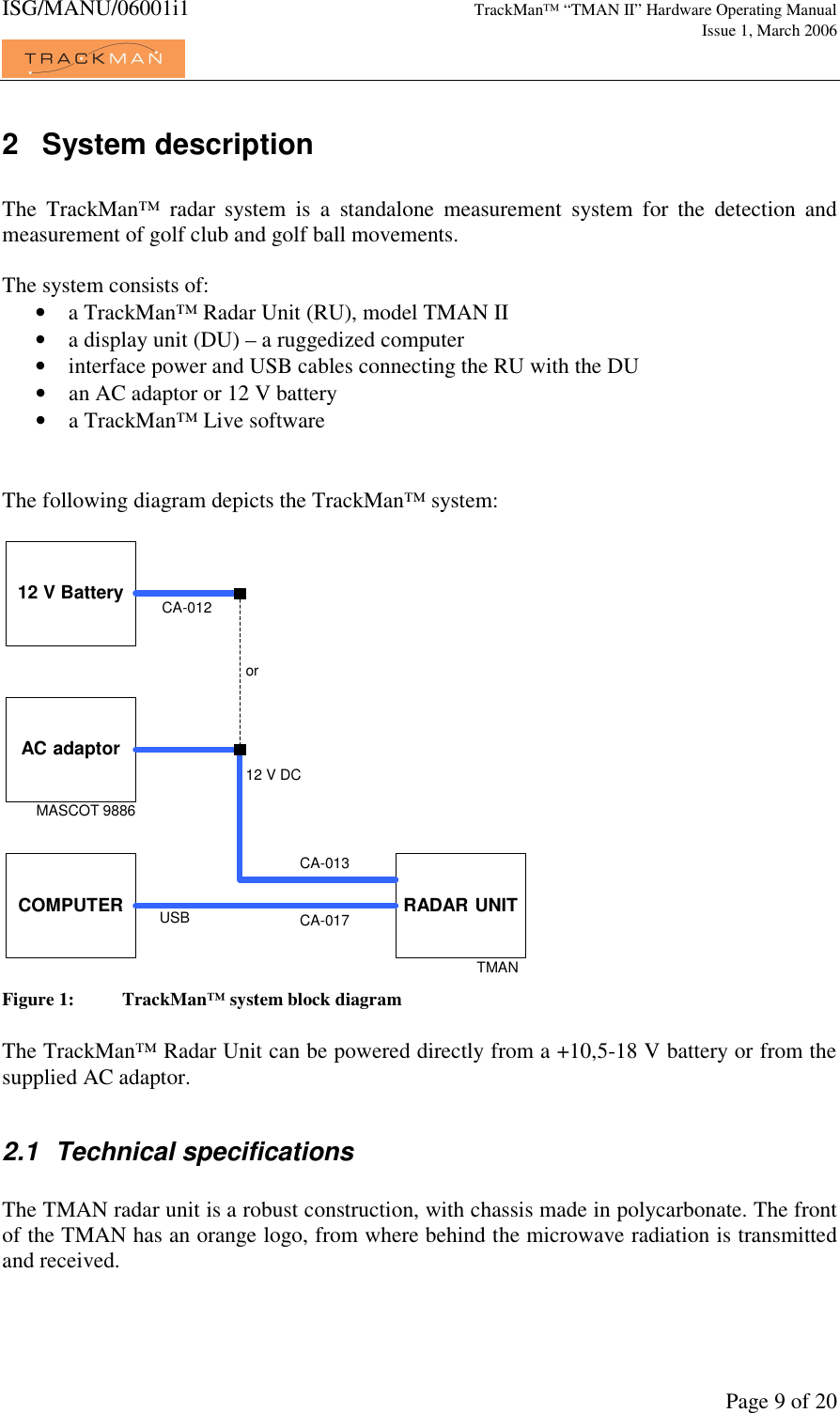
ISG/MANU/06001i1   TrackMan™ “TMAN II” Hardware Operating Manual     Issue 1, March 2006             Page 9 of 20 2  System description  The  TrackMan™  radar  system  is  a  standalone  measurement  system  for  the  detection  and measurement of golf club and golf ball movements.  The system consists of: • a TrackMan™ Radar Unit (RU), model TMAN II • a display unit (DU) – a ruggedized computer • interface power and USB cables connecting the RU with the DU • an AC adaptor or 12 V battery • a TrackMan™ Live software   The following diagram depicts the TrackMan™ system:  AC adaptorRADAR UNITTMANCOMPUTERMASCOT 9886CA-017USB12 V DCCA-01212 V BatteryorCA-013 Figure 1:  TrackMan™ system block diagram  The TrackMan™ Radar Unit can be powered directly from a +10,5-18 V battery or from the supplied AC adaptor.   2.1  Technical specifications  The TMAN radar unit is a robust construction, with chassis made in polycarbonate. The front of the TMAN has an orange logo, from where behind the microwave radiation is transmitted and received.
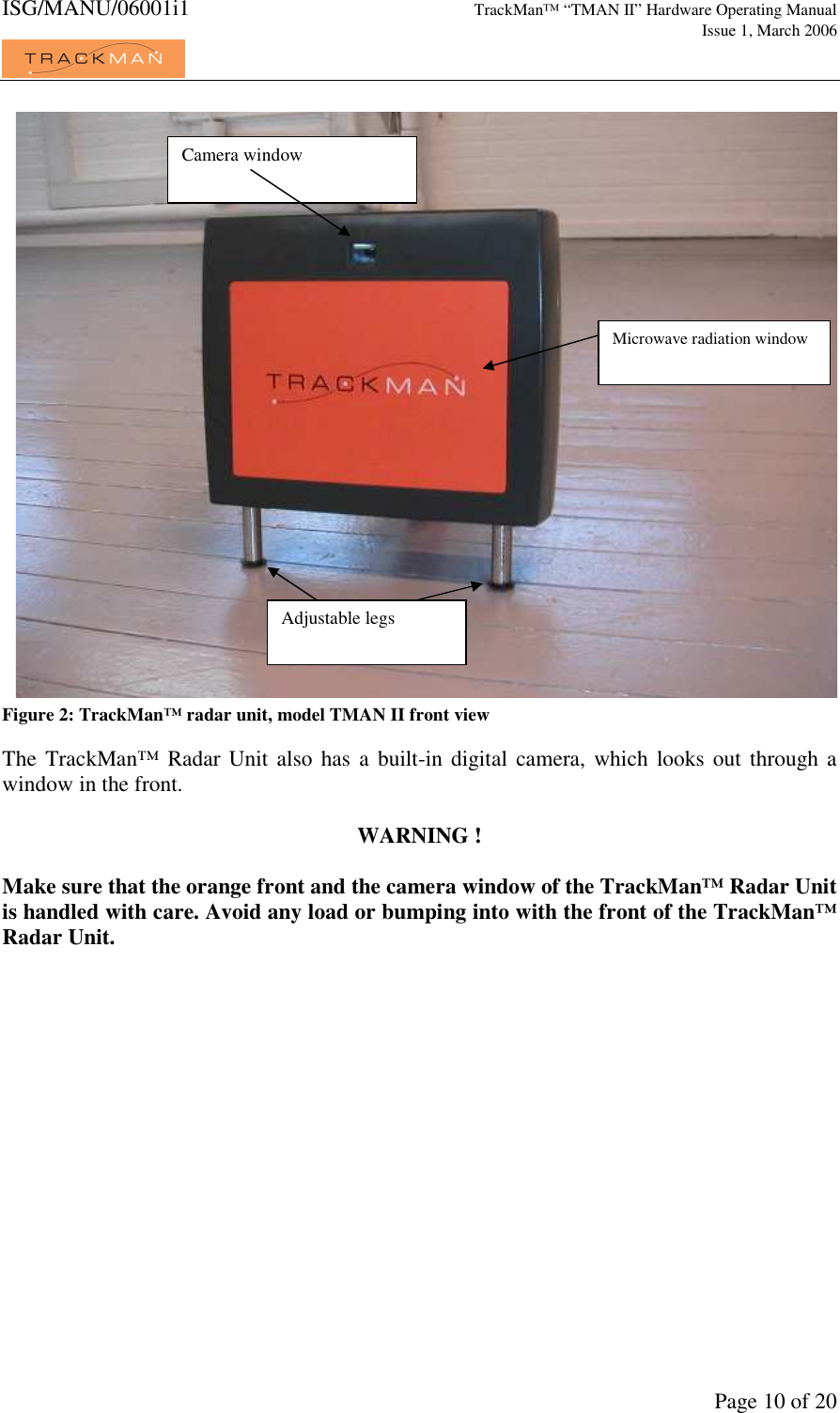
ISG/MANU/06001i1   TrackMan™ “TMAN II” Hardware Operating Manual     Issue 1, March 2006             Page 10 of 20 Figure 2: TrackMan™ radar unit, model TMAN II front view  The  TrackMan™  Radar Unit also has  a built-in digital  camera,  which looks out  through a window in the front.  WARNING !  Make sure that the orange front and the camera window of the TrackMan™ Radar Unit is handled with care. Avoid any load or bumping into with the front of the TrackMan™ Radar Unit.  Camera window Microwave radiation window Adjustable legs
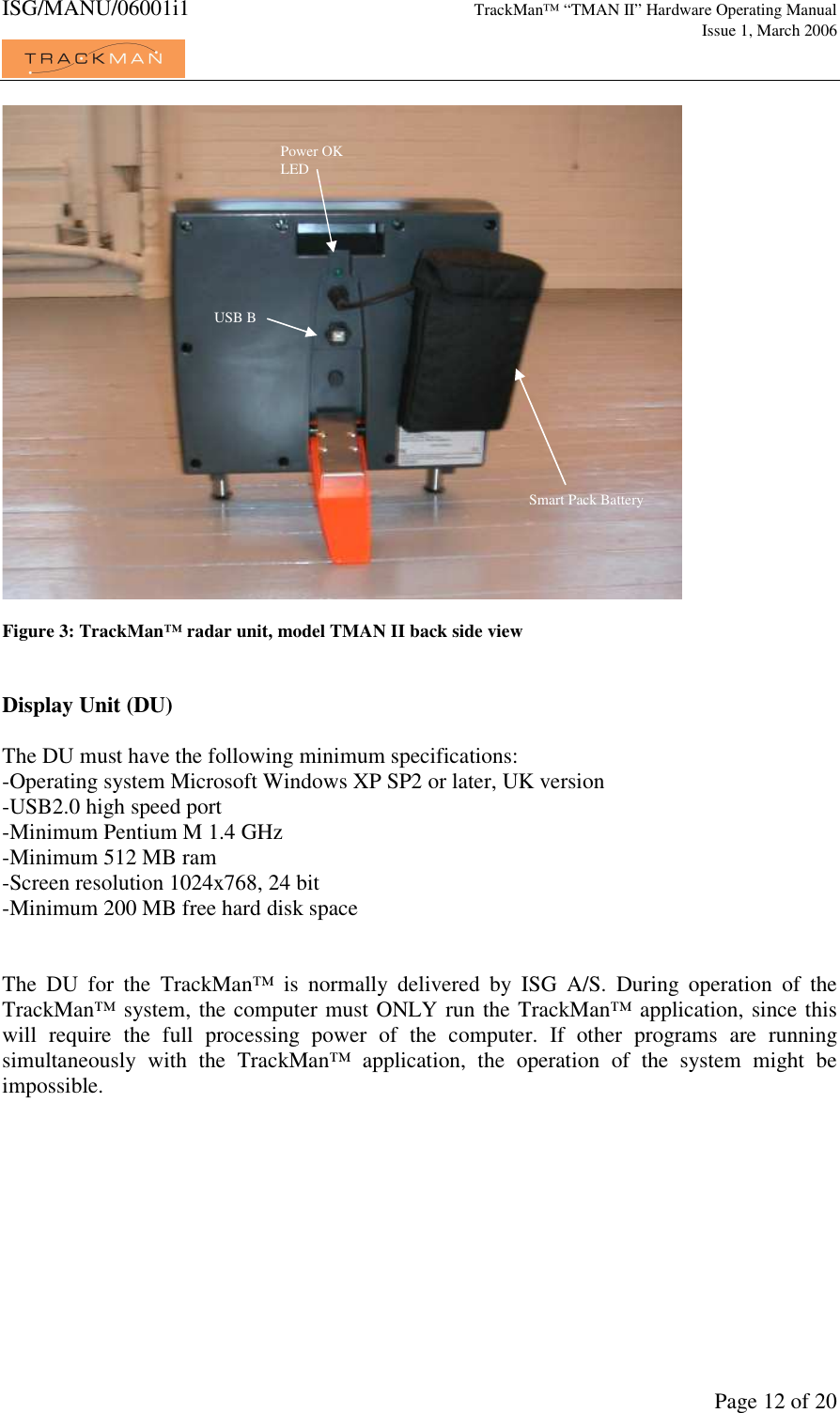
ISG/MANU/06001i1   TrackMan™ “TMAN II” Hardware Operating Manual     Issue 1, March 2006             Page 11 of 20 TrackMan™ Radar Unit , model TMAN II  Operating Frequency  10.500-10.550 GHz, factory fixed Transmitter power  10 mW Antenna gain  17 dB Horizontal beam  65 degrees (± 14 deg) Vertical beam  19 degrees shaped (-5° to +60°) Dimensions  Width:  350 mm (13.8”) Depth:  105 mm (4.2”) Height:  305 mm (12”) Mass  ~6 kg (13,2 lbs) Main power supply  10.5-18 V DC, 25W maximum Data interface  USB2.0 high speed Environmental  -5 degC to +45 degC ambient 100% humidity  The TrackMan™ Radar Unit consists of the following sub-assemblies and/or printed circuit board assemblies: • Microwave transmitter • Microwave receivers with video amplifiers • Antennas for transmitting and receiving • Analog to digital converters • Adjustable legs with motors • Servo board • Digital camera • Power supply  The TrackMan™ Radar Unit is splash proof and is designed to withstand rain showers. When using the TrackMan™ system in very wet weather it might be necessary to dry off water drops at the camera window, in order to get proper pictures of the landing field.   The TrackMan™ Radar Unit has two motorized legs for leveling the radar unit.  The connector inputs and the power LED is covered behind the little orange back “leg” on the back of the TrackMan™ Radar Unit.
ISG/MANU/06001i1   TrackMan™ “TMAN II” Hardware Operating Manual     Issue 1, March 2006             Page 12 of 20   Figure 3: TrackMan™ radar unit, model TMAN II back side view   Display Unit (DU)  The DU must have the following minimum specifications: -Operating system Microsoft Windows XP SP2 or later, UK version -USB2.0 high speed port -Minimum Pentium M 1.4 GHz -Minimum 512 MB ram -Screen resolution 1024x768, 24 bit -Minimum 200 MB free hard disk space   The  DU  for  the  TrackMan™  is  normally  delivered  by  ISG  A/S.  During  operation  of  the TrackMan™ system, the computer must ONLY run the TrackMan™ application, since this will  require  the  full  processing  power  of  the  computer.  If  other  programs  are  running simultaneously  with  the  TrackMan™  application,  the  operation  of  the  system  might  be impossible. Power OK LED USB B Smart Pack Battery
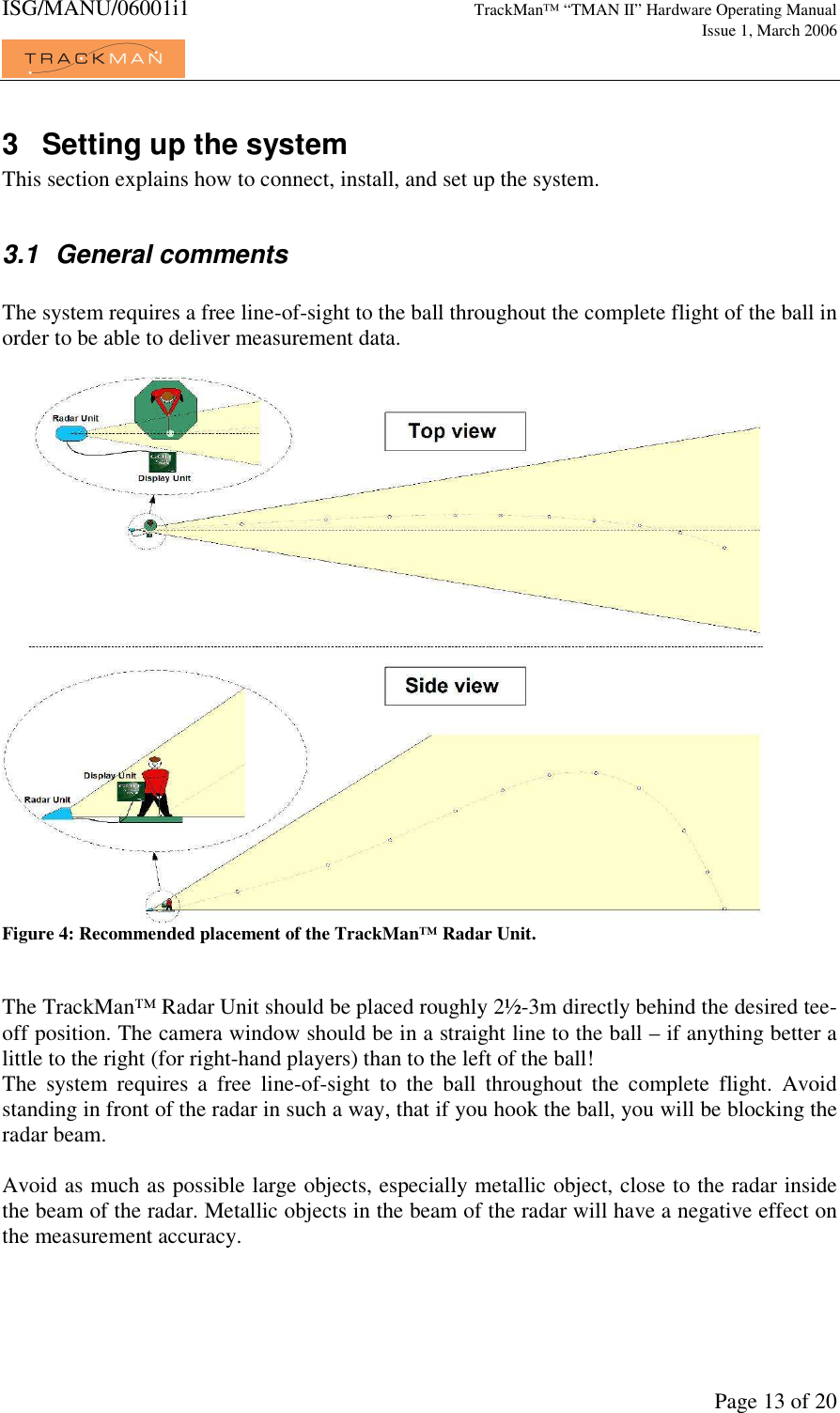
ISG/MANU/06001i1   TrackMan™ “TMAN II” Hardware Operating Manual     Issue 1, March 2006             Page 13 of 20 3  Setting up the system This section explains how to connect, install, and set up the system.   3.1  General comments  The system requires a free line-of-sight to the ball throughout the complete flight of the ball in order to be able to deliver measurement data.   Figure 4: Recommended placement of the TrackMan™ Radar Unit.   The TrackMan™ Radar Unit should be placed roughly 2½-3m directly behind the desired tee-off position. The camera window should be in a straight line to the ball – if anything better a little to the right (for right-hand players) than to the left of the ball! The  system  requires  a  free  line-of-sight  to  the  ball  throughout  the  complete  flight.  Avoid standing in front of the radar in such a way, that if you hook the ball, you will be blocking the radar beam.   Avoid as much as possible large objects, especially metallic object, close to the radar inside the beam of the radar. Metallic objects in the beam of the radar will have a negative effect on the measurement accuracy.
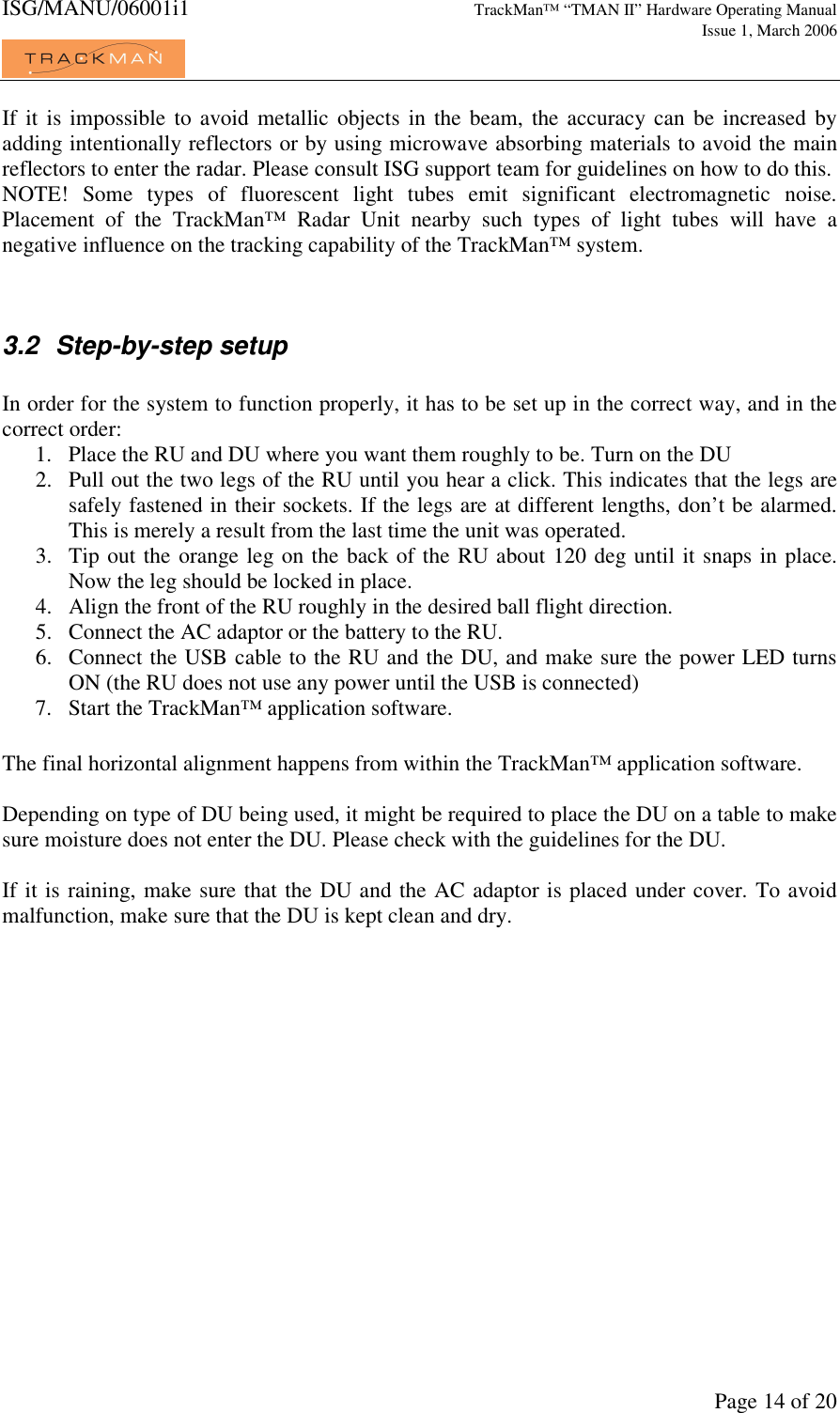
ISG/MANU/06001i1   TrackMan™ “TMAN II” Hardware Operating Manual     Issue 1, March 2006             Page 14 of 20 If it is impossible  to avoid metallic objects  in the beam,  the accuracy can  be increased  by adding intentionally reflectors or by using microwave absorbing materials to avoid the main reflectors to enter the radar. Please consult ISG support team for guidelines on how to do this.  NOTE!  Some  types  of  fluorescent  light  tubes  emit  significant  electromagnetic  noise. Placement  of  the  TrackMan™  Radar  Unit  nearby  such  types  of  light  tubes  will  have  a negative influence on the tracking capability of the TrackMan™ system.    3.2  Step-by-step setup  In order for the system to function properly, it has to be set up in the correct way, and in the correct order: 1. Place the RU and DU where you want them roughly to be. Turn on the DU 2. Pull out the two legs of the RU until you hear a click. This indicates that the legs are safely fastened in their sockets. If the legs are at different lengths, don’t be alarmed. This is merely a result from the last time the unit was operated. 3. Tip out the orange leg on the back of the RU about 120 deg until it snaps in place. Now the leg should be locked in place. 4. Align the front of the RU roughly in the desired ball flight direction. 5. Connect the AC adaptor or the battery to the RU. 6. Connect the USB cable to the RU and the DU, and make sure the power LED turns ON (the RU does not use any power until the USB is connected) 7. Start the TrackMan™ application software.  The final horizontal alignment happens from within the TrackMan™ application software.  Depending on type of DU being used, it might be required to place the DU on a table to make sure moisture does not enter the DU. Please check with the guidelines for the DU.  If it is raining, make sure that the DU and the AC adaptor is placed under cover. To avoid malfunction, make sure that the DU is kept clean and dry.
ISG/MANU/06001i1   TrackMan™ “TMAN II” Hardware Operating Manual     Issue 1, March 2006             Page 15 of 20  3.3  Leveling  In TrackMan  II™  system  the levelling  process is  controlled by the  Software,  The legs are operating at a speed of approximately 5.7 mm/sec.  If the TrackMan II™ Radar Unit is placed on an extremely unleveled ground, the legs might get fully extended or  compressed. This might  cause the legs to  reach  its limits,  this  is not harmful in anyway to the mechanics of the radar unit. The system will detect this and ask the user to move the radar unit to a more leveled surface.  It should be avoided to place the TrackMan™ Radar Unit on a non-solid ground, like wooden terrace or similar. If it is done anyway, vibrations or changes in radar alignment might have a negative influence on the recorded signals. The system will detect this and the measurement will be marked not valid.
ISG/MANU/06001i1   TrackMan™ “TMAN II” Hardware Operating Manual     Issue 1, March 2006             Page 16 of 20 4  End of use  When terminating a session with the TrackMan™ system, please follow these steps:  1. Exit the TrackMan™ application software . 2. Disconnect the USB B connector from the TrackMan™ Radar Unit. 3. Disconnect the power cable to the TrackMan™ Radar Unit. 4. Push  the  two  motorized  legs  into  the  box  by  giving the  TrackMan™  Radar  Unit  a small knock on the top. Push the legs in as far as you can. 5. The backside leg is pulled out and up. Be careful not to get a finger caught when it snaps into place. Now the TrackMan™ Radar Unit is ready for stow.  Make sure that the TrackMan™ Radar Unit and DU are wiped dry, and that any mud and dirt is  removed.  The  system  will  not  be  damaged  by  water,  mud  or  dirt,  but  to  extend  the appearance and life time of the TrackMan™ Radar Unit it is advisable.
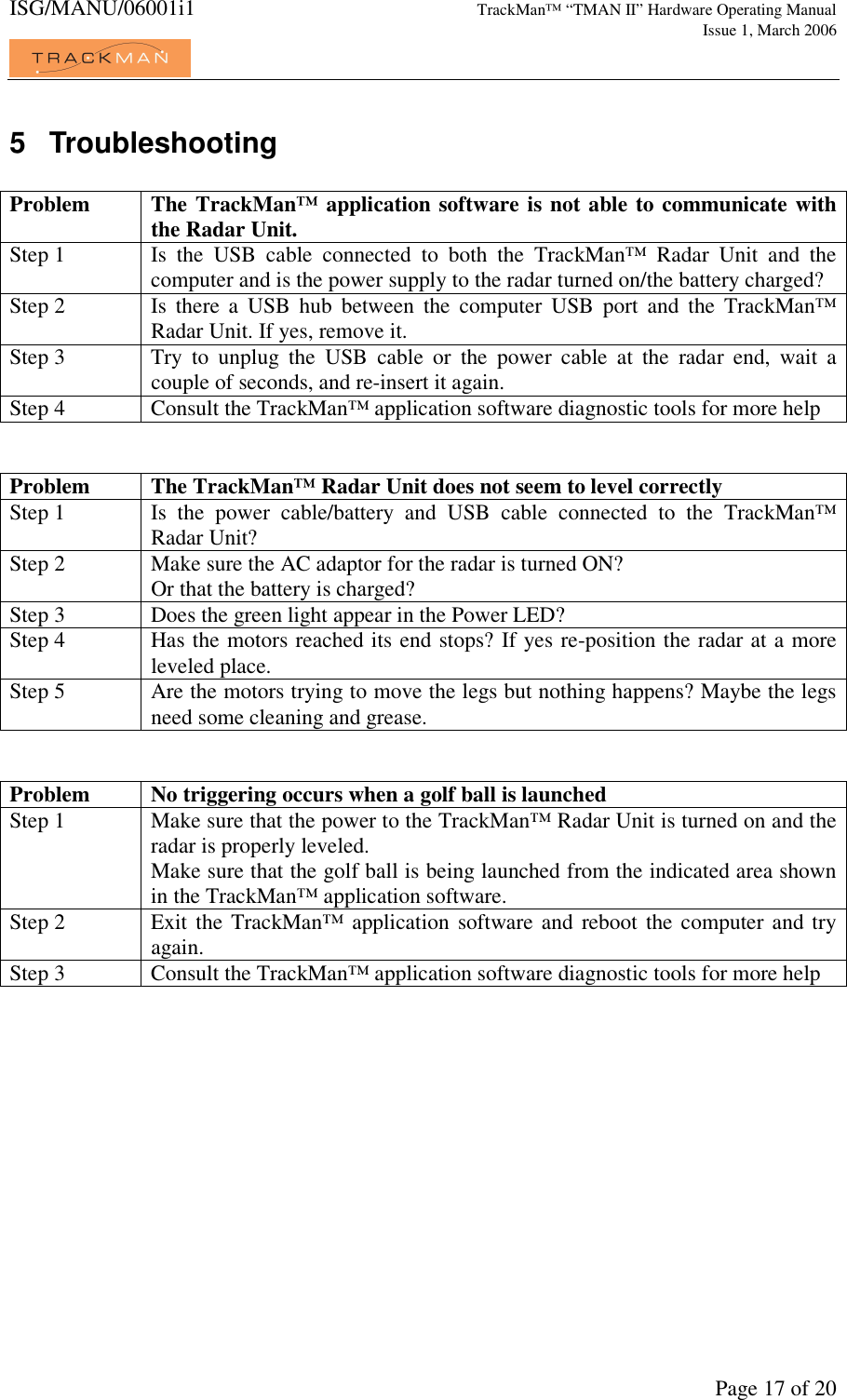
ISG/MANU/06001i1   TrackMan™ “TMAN II” Hardware Operating Manual     Issue 1, March 2006             Page 17 of 20 5  Troubleshooting  Problem  The TrackMan™ application software is not able to communicate with the Radar Unit. Step 1  Is  the  USB  cable  connected  to  both  the  TrackMan™  Radar  Unit  and  the computer and is the power supply to the radar turned on/the battery charged? Step 2  Is  there  a  USB  hub  between  the  computer  USB  port  and  the  TrackMan™ Radar Unit. If yes, remove it. Step 3  Try  to  unplug  the  USB  cable  or  the  power  cable  at  the  radar  end,  wait  a couple of seconds, and re-insert it again. Step 4  Consult the TrackMan™ application software diagnostic tools for more help   Problem  The TrackMan™ Radar Unit does not seem to level correctly Step 1  Is  the  power  cable/battery  and  USB  cable  connected  to  the  TrackMan™ Radar Unit? Step 2  Make sure the AC adaptor for the radar is turned ON? Or that the battery is charged? Step 3  Does the green light appear in the Power LED? Step 4  Has the motors reached its end stops? If yes re-position the radar at a more leveled place. Step 5  Are the motors trying to move the legs but nothing happens? Maybe the legs need some cleaning and grease.   Problem  No triggering occurs when a golf ball is launched Step 1  Make sure that the power to the TrackMan™ Radar Unit is turned on and the radar is properly leveled. Make sure that the golf ball is being launched from the indicated area shown in the TrackMan™ application software. Step 2  Exit the  TrackMan™ application software and  reboot the computer  and try again. Step 3  Consult the TrackMan™ application software diagnostic tools for more help
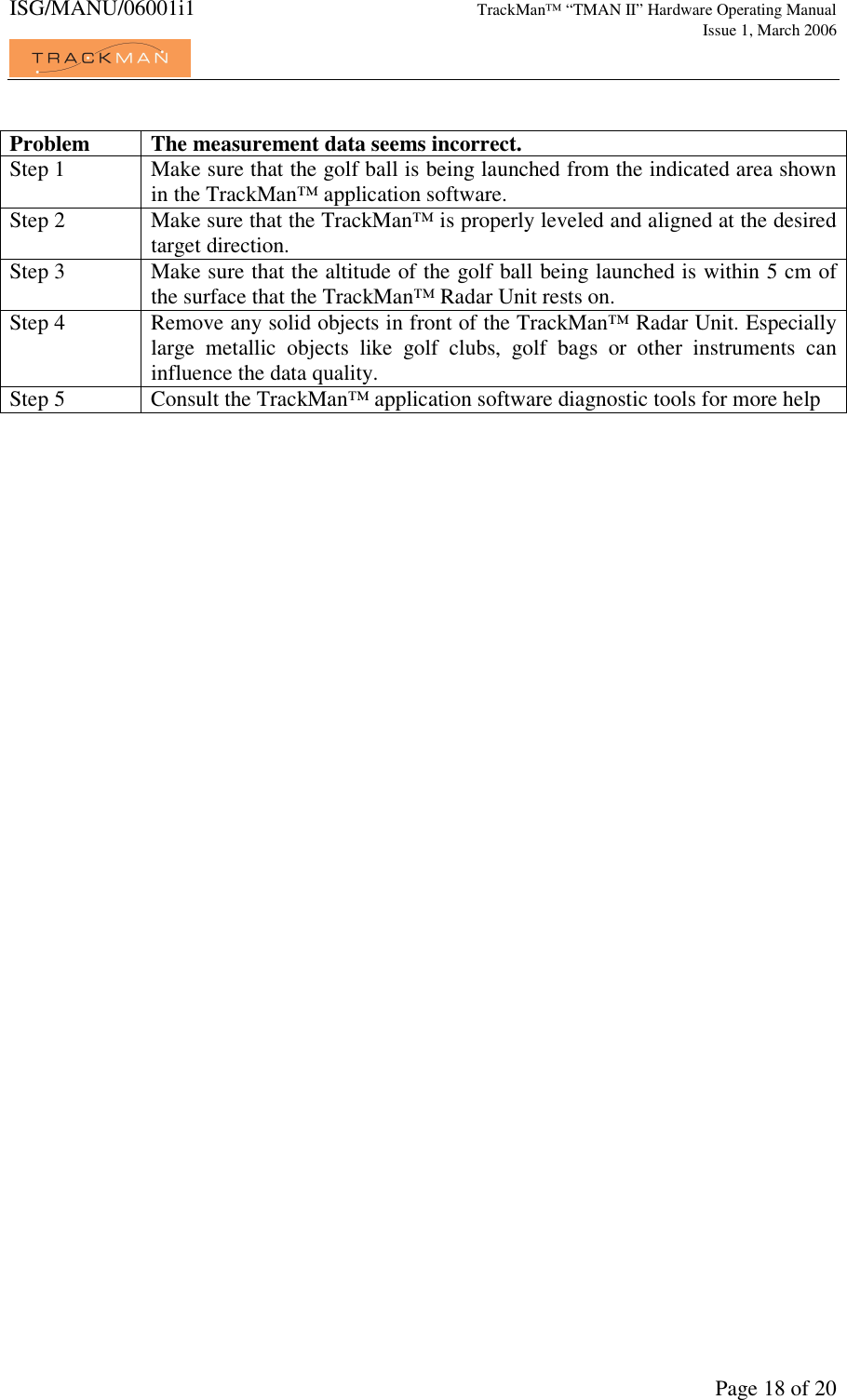
ISG/MANU/06001i1   TrackMan™ “TMAN II” Hardware Operating Manual     Issue 1, March 2006             Page 18 of 20  Problem  The measurement data seems incorrect. Step 1  Make sure that the golf ball is being launched from the indicated area shown in the TrackMan™ application software. Step 2  Make sure that the TrackMan™ is properly leveled and aligned at the desired target direction. Step 3  Make sure that the altitude of the golf ball being launched is within 5 cm of the surface that the TrackMan™ Radar Unit rests on. Step 4  Remove any solid objects in front of the TrackMan™ Radar Unit. Especially large  metallic  objects  like  golf  clubs,  golf  bags  or  other  instruments  can influence the data quality. Step 5  Consult the TrackMan™ application software diagnostic tools for more help
ISG/MANU/06001i1   TrackMan™ “TMAN II” Hardware Operating Manual     Issue 1, March 2006             Page 19 of 20 6  Transportation, storage and maintenance  When unpacking the TrackMan™ Radar Unit from the original shipping box, remember to store the box for future use. The original shipping box must be used in case of return of unit for service or repair.   6.1  Transportation The construction of the TrackMan™ Radar Unit is in general very robust. However, the front of the radar is a bit more sensitive. During transportation the TrackMan™ Radar Unit should be protected from direct shocks and bumps on the front window.   The TrackMan™ Radar Unit is designed to fit into a carrier-on luggage for the airlines. It is recommended  to  enclose  the  TrackMan™  Radar Unit  with  foam  or  other  shock absorbing materials when packed in a box or bag.  If the TrackMan™ Radar Unit is send by cargo, which is not recommended, allow for at least 50 mm of space from the metallic chassis of the TrackMan™ Radar Unit to the shipping box sides, by using heavy duty shock damping materials.   6.2  Maintenance  The  TrackMan™  Radar  Unit  has  been  constructed  in  robust  materials  with  minimum maintenance for years of outdoor usage.  The TrackMan™ Radar Unit contains only highly reliable electronic and mechanical systems that require no user maintenance.   When  the  two  legs  of  the  TrackMan™  Radar  Unit are extended  there  can  be  some  water, mud, or dirt on them after use. To remove this, use a soft cloth to wipe it of. There are two O-rings that make sure that no dirt, water or mud gets inside the TrackMan™ Radar Unit. If the legs are cleaned very thoroughly, a small amount of grease has to be added on the legs in front of the O-rings.   The front of the TrackMan™ Radar Unit can be wiped with a soft damp cloth. Make sure that the front is not damaged. In the case that the front plate is damaged DO NOT try to open the TrackMan™ Radar Unit, nor try to change the front plate.  WARNING! Security screws are mounted on the back of the TrackMan™ Radar Unit. If the seal is broken the warranty agreement will terminate immediately.  The  camera  window  has  to  be  cleaned  once  in  a  while.  Use  regular  window  cleaning detergent. Be careful not to scratch the window glass.
ISG/MANU/06001i1   TrackMan™ “TMAN II” Hardware Operating Manual     Issue 1, March 2006             Page 20 of 20 The connectors on the TrackMan™ Radar Unit as well as the connectors on the cables should be cleaned for dirt. Use compressed air and mild detergents to clean the connectors.  6.3  Storage  When not in use the TrackMan™ Radar Unit should for maximum lifetime be stowed at room temperature in a low humidity room.

Navigation menu