Usafe UBHS-PH1 BLUETOOTH STEREO HEADSET User Manual Microsoft PowerPoint PH1 v 0 2
Usafe Co.,Ltd BLUETOOTH STEREO HEADSET Microsoft PowerPoint PH1 v 0 2
Usafe >
USERS MANUAL

UBHS-PH1 User Manual
Caution
1. Do not put the headset near a fire to avoid danger of explosion.
2. Do not drop or apply excessive force to the headset. It may cause damage.
3. In case of malfunction, do not attempt to repair. Please contact the nearest
service center or the place of purchase immediately.
4. If the headset gets wet, avoid any heat or electrical current, and contact the
nearest service center or the place of purchase immediately.
5. Keep out of children’s reach.
6. Do not use chemical products (example: Bleach) to clean the product.
7. Do not use any unauthorized charging device.
8. When storing the product for an extended period of time, store in a dry place
and avoid extreme temperatures.
9. In order to avoid any danger caused by radio interference, do not use the
headset where its use is forbidden.
10. Your battery and the mobile device may require recycling in accordance with
the local laws. Please contact your local authorities for more information.
11. Do not discard your battery or mobile device in the trash.
12. If you use any medical device (pacemaker, hearing aids etc…), please
consult your medical device manufacturer to make sure that the correct
functioning of your medical device is not affected by RF energy
emitted by the Bluetooth Headset. Your doctor may be able to assist you in
obtaining this information.
13. Our product satisfies Bluetooth Core Specification Version 2.0+EDR. Some
Bluetooth devices may not be compatible with the headset. For further
information about compatibility, please contact the concerned manufacturer,
or our customer service center.
14. Using the headset at full volume may damage your hearing.
15. Strong static electricity may damage the product. Please use your caution
when operating the headset.
16. Modifications not expressly approved by the party responsible for compliance
could void the user’s authority to operate the equipment.
17. In case of malfunction due to electrostatic discharge just reset the product
(ON/OFF of power button may be required) to resume normal operation.
Company’s Indemnification
1. Manufacturers, retailers, agencies are not responsible for any bodily harm,
intentional damages and damages caused by the user’s lack of care.
2. This user manual was written based on present product specification.
3. All specification may be modified without prior notice.
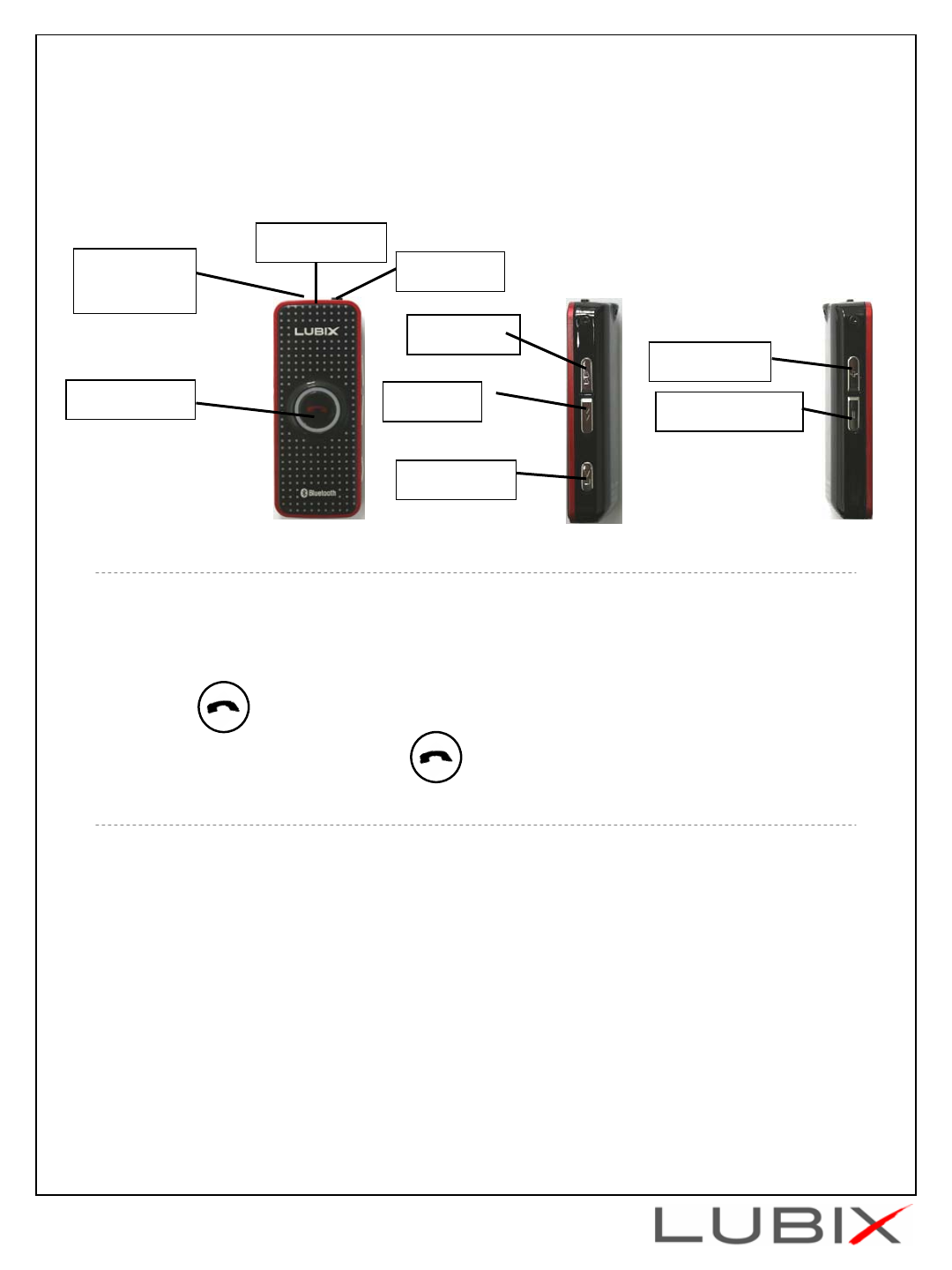
Power On/Off
Press and hold button for 3 seconds to switch the headset on or off.
While the headset is off, press and hold for 5 seconds to start pairing mode.
Talk Button
3.5mm
Audio Jack
Play/Pause
Forward
Backward
Volume up
Volume down
USB Port
Features
Microphone
Connecting the Headset
Connecting from the phone: Among registered Bluetooth devices on the phone,
select ‘Lubix PH1’.
Connecting from the headset: Through auto-connect function, the headset automatically connects
to the last device it was connected to when powered on.
Listening to Music
Play/Pause
1. Press ‘▶■’ button to launch the phone’s MP3 player and to start listening to music.
2. While MP3 player is in use, press ‘▶■’ button to pause or to resume play.
3. Press and hold ‘▶■’ button to end music playback.
Song Selection
While MP3 player is in use, press ‘◀◀’or ‘▶▶’ buttons to select songs.
Rewind/Forward
While music is playing, press and hold ‘◀◀’or ‘▶▶’ buttons to rewind or forward the song.
Answering Call While Listening to Music
1. When receiving a call, press button to answer the call.
2. Press button while on the phone to end the call
3. When receiving a call, press ▶■ button to reject the call.
- Music will resume playing when the call is rejected.
Volume Control
Use ‘+’ / ’-’ buttons to adjust the volume level.
Making Phone Calls
Make a new call: Enter desired number on the phone and double click button on the
headset to start a new call.
Last Number Redial: Double click button to redial last number.
Answer a call: When receiving a call, press button to answer the call.
Ending a call: While talking on the phone, press button to end the call.
Volume Control: Use ‘+’ / ’-’ buttons to adjust the volume level.
Using 3D Sound
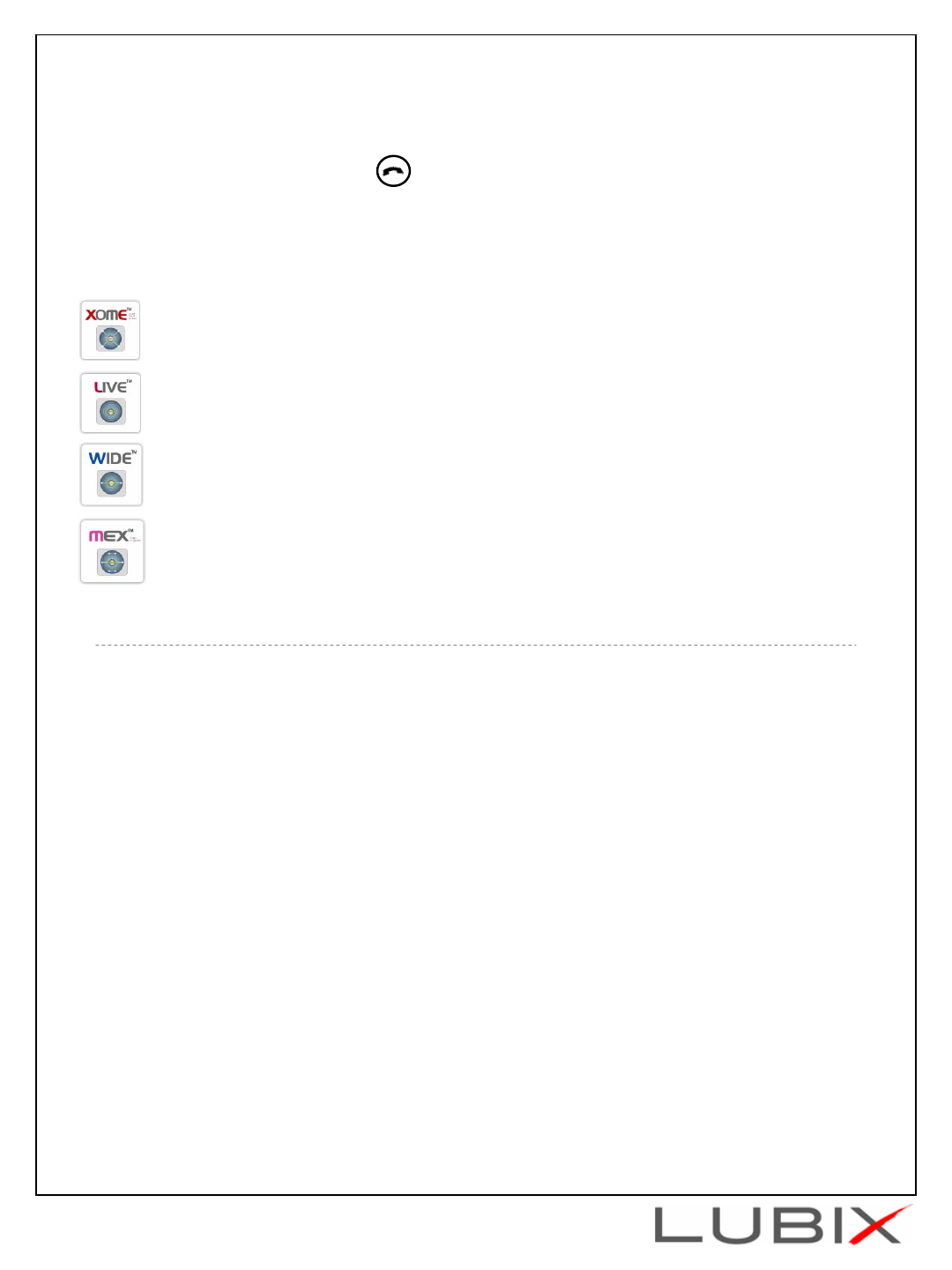
5 types of 3D sound effect are programmed in the order below.
While in Play/Pause mode, press the button to select the 3D sound effect of your choice.
Types of 3D Sound Effect
1. Normal: No 3D sound effect is applied.
※Two beeping sound will indicate that the headset is in Normal mode.
2. Provides comfortable and persistent listening environment by taking distractible sound
away from ears and head when using earphones.
3. Delivers natural and soft 3D sound field effect simulating that of a live performance.
4. Widely spread main vocal and center-placed instruments by providing a panoramic
3D audio image.
5. Not only delivers wide stereo sound image, but also enhances low-frequency sound to
provide rich and deep bass tones.
3D Sound

Headset Specification
Bluetooth Version: Version 2.0 + EDR
Supported Profiles: A2DP, AVRCP, HFP, HSP
Frequency Spectrum: 2.4~2.4835GHz
Working Distance: 10m
Operating Temperature: -20 ~ 50°C
Operating Time: Talk 6 hours / Music 5 hours
Standby Time: 100 hours
Product Size: 59(L) x 25(W) x 11(H) mm
Product weight: 12g (Pendant only)
FCC Compliance Information
This device complies with part 15 of FCC Rules.
Operation is subject to the following two conditions:
1. This device may not cause harmful interference, and
2. This device must accept any interference received.
Including interference that may cause undesired operation.
Information to User
This equipment has been tested and found to comply with the limits for a Class B digital device,
Pursuant to part 15 of the FCC Rules. These limits are designed to provide reasonable
protection against harmful interference in a residential installation.
This equipment generates, uses and can radiate radio Frequency energy and, if not installed and
used in accordance with the instructions, may cause harmful interference to radio
communications. However, there is no guarantee that interference will not occur in a
particular installation. If this equipment does cause harmful interference to radio or
television reception, which can be determined by turning the equipment off and on, the
user is encouraged to try to correct the interference by one or more of the following
measures:
• Reorient or relocate the receiving antenna.
• Increase the separation between the equipment and receiver
• Connect the equipment into an outlet on a circuit different from that to which the receiver is
connected.
Consult the dealer or an experienced radio/TV technician for help.