Westel Wireless Systems CI00063 UHF BASE STATION TRANSCEIVER User Manual CHAPTER 1 INTRODUCTION

Westel Wireless Systems Pty Ltd UHF BASE STATION TRANSCEIVER CHAPTER 1 INTRODUCTION

MANUAL INSTRUCTION

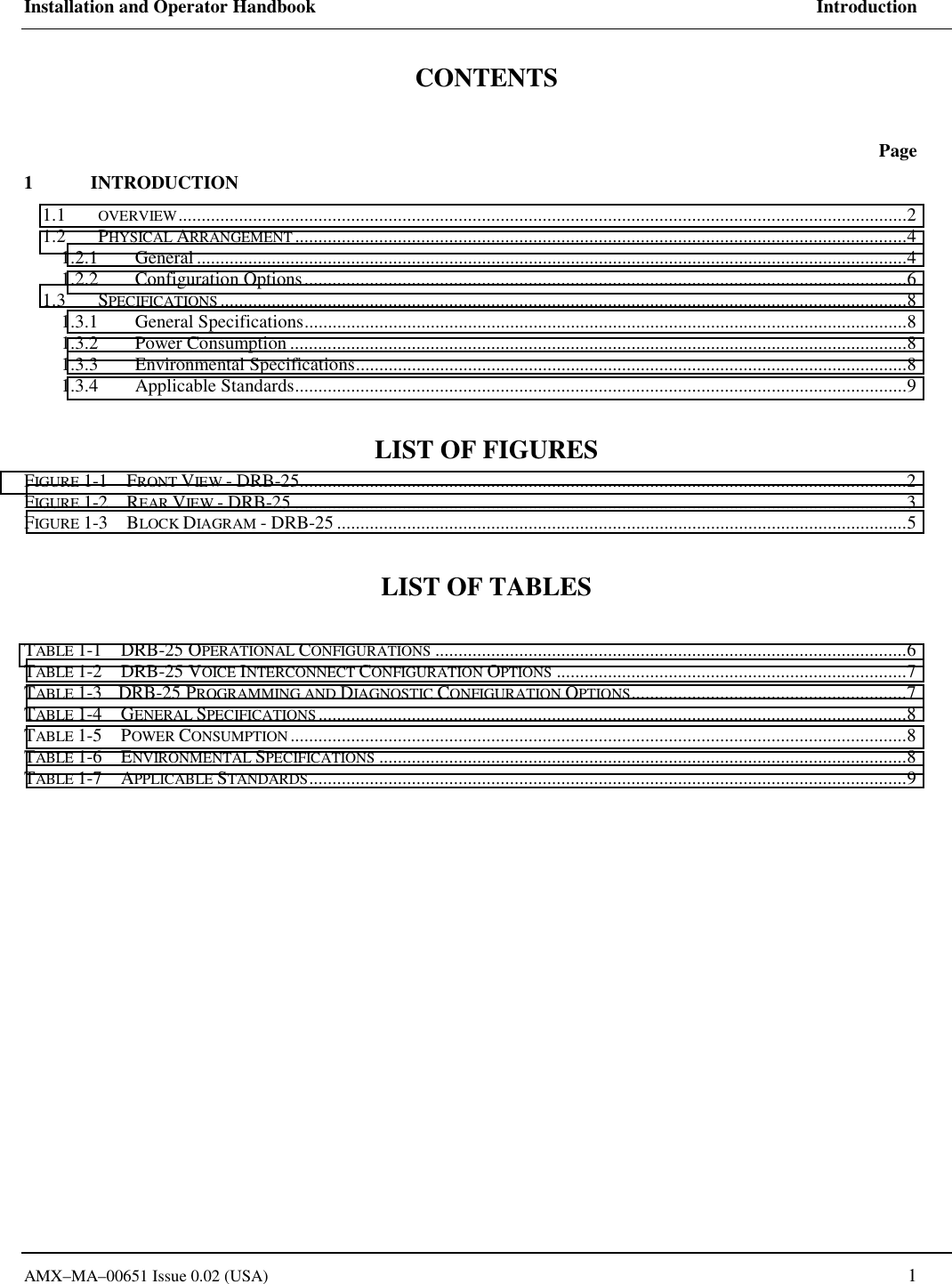
Installation and Operator Handbook     Introduction AMX–MA–00651 Issue 0.02 (USA)   1 CONTENTS   Page 1 INTRODUCTION 1.1  OVERVIEW............................................................................................................................................................2 1.2 PHYSICAL ARRANGEMENT...................................................................................................................................4 1.2.1 General ........................................................................................................................................................4 1.2.2 Configuration Options.................................................................................................................................6 1.3 SPECIFICATIONS ...................................................................................................................................................8 1.3.1 General Specifications.................................................................................................................................8 1.3.2 Power Consumption ....................................................................................................................................8 1.3.3 Environmental Specifications......................................................................................................................8 1.3.4 Applicable Standards...................................................................................................................................9  LIST OF FIGURES FIGURE 1-1    FRONT VIEW - DRB-25..................................................................................................................................2 FIGURE 1-2    REAR VIEW - DRB-25 ...................................................................................................................................3 FIGURE 1-3    BLOCK DIAGRAM - DRB-25 ..........................................................................................................................5  LIST OF TABLES  TABLE 1-1    DRB-25 OPERATIONAL CONFIGURATIONS .....................................................................................................6 TABLE 1-2    DRB-25 VOICE INTERCONNECT CONFIGURATION OPTIONS ...........................................................................7 TABLE 1-3    DRB-25 PROGRAMMING AND DIAGNOSTIC CONFIGURATION OPTIONS...........................................................7 TABLE 1-4    GENERAL SPECIFICATIONS..............................................................................................................................8 TABLE 1-5    POWER CONSUMPTION ....................................................................................................................................8 TABLE 1-6    ENVIRONMENTAL SPECIFICATIONS .................................................................................................................8 TABLE 1-7    APPLICABLE STANDARDS................................................................................................................................9
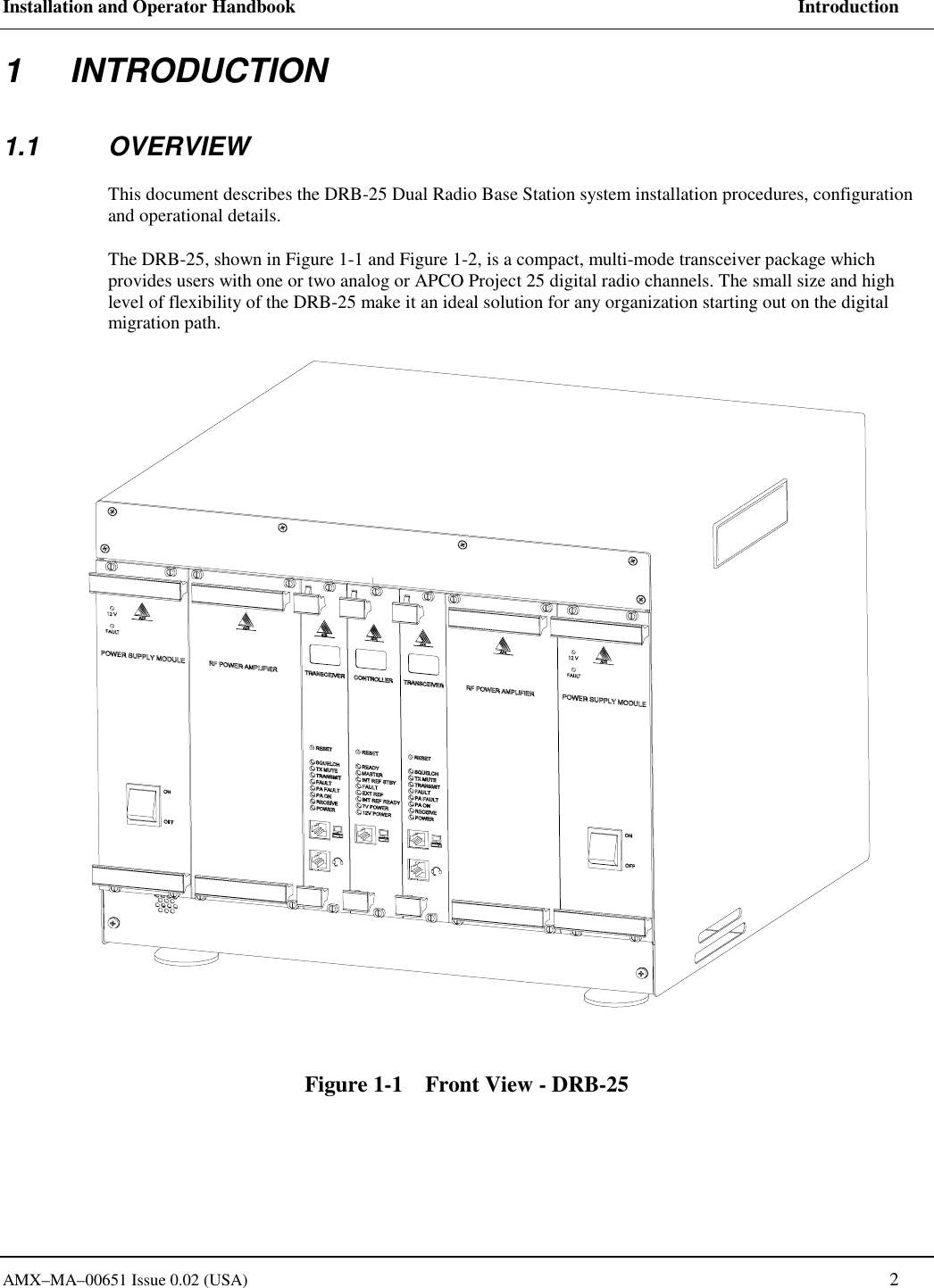
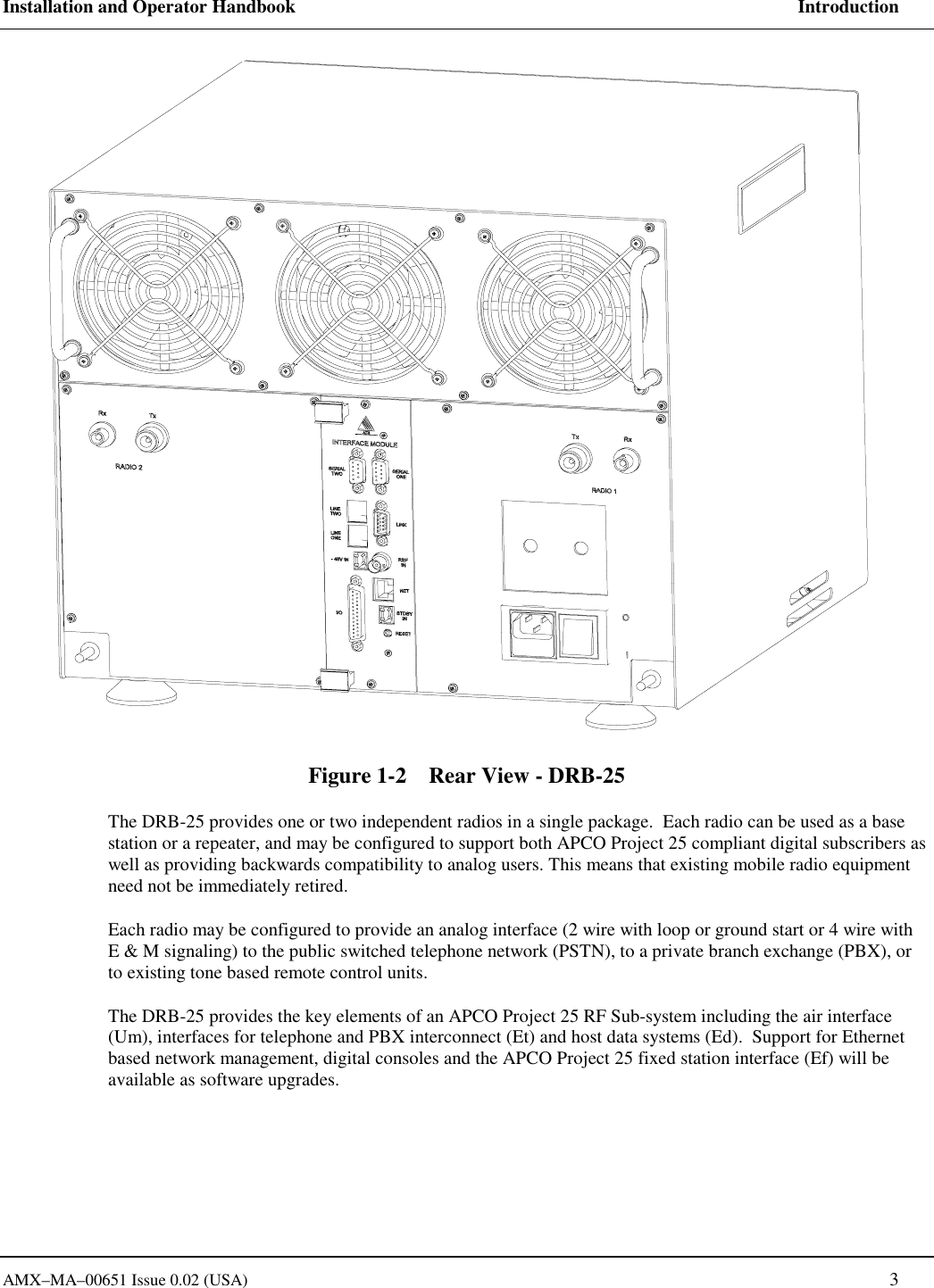
Installation and Operator Handbook     Introduction AMX–MA–00651 Issue 0.02 (USA)   2 1 INTRODUCTION 1.1 OVERVIEW This document describes the DRB-25 Dual Radio Base Station system installation procedures, configuration and operational details. The DRB-25, shown in Figure 1-1 and Figure 1-2, is a compact, multi-mode transceiver package which provides users with one or two analog or APCO Project 25 digital radio channels. The small size and high level of flexibility of the DRB-25 make it an ideal solution for any organization starting out on the digital migration path. Figure 1-1    Front View - DRB-25
Installation and Operator Handbook     Introduction AMX–MA–00651 Issue 0.02 (USA)   3 Figure 1-2    Rear View - DRB-25 The DRB-25 provides one or two independent radios in a single package.  Each radio can be used as a base station or a repeater, and may be configured to support both APCO Project 25 compliant digital subscribers as well as providing backwards compatibility to analog users. This means that existing mobile radio equipment need not be immediately retired.   Each radio may be configured to provide an analog interface (2 wire with loop or ground start or 4 wire with E & M signaling) to the public switched telephone network (PSTN), to a private branch exchange (PBX), or to existing tone based remote control units. The DRB-25 provides the key elements of an APCO Project 25 RF Sub-system including the air interface (Um), interfaces for telephone and PBX interconnect (Et) and host data systems (Ed).  Support for Ethernet based network management, digital consoles and the APCO Project 25 fixed station interface (Ef) will be available as software upgrades.
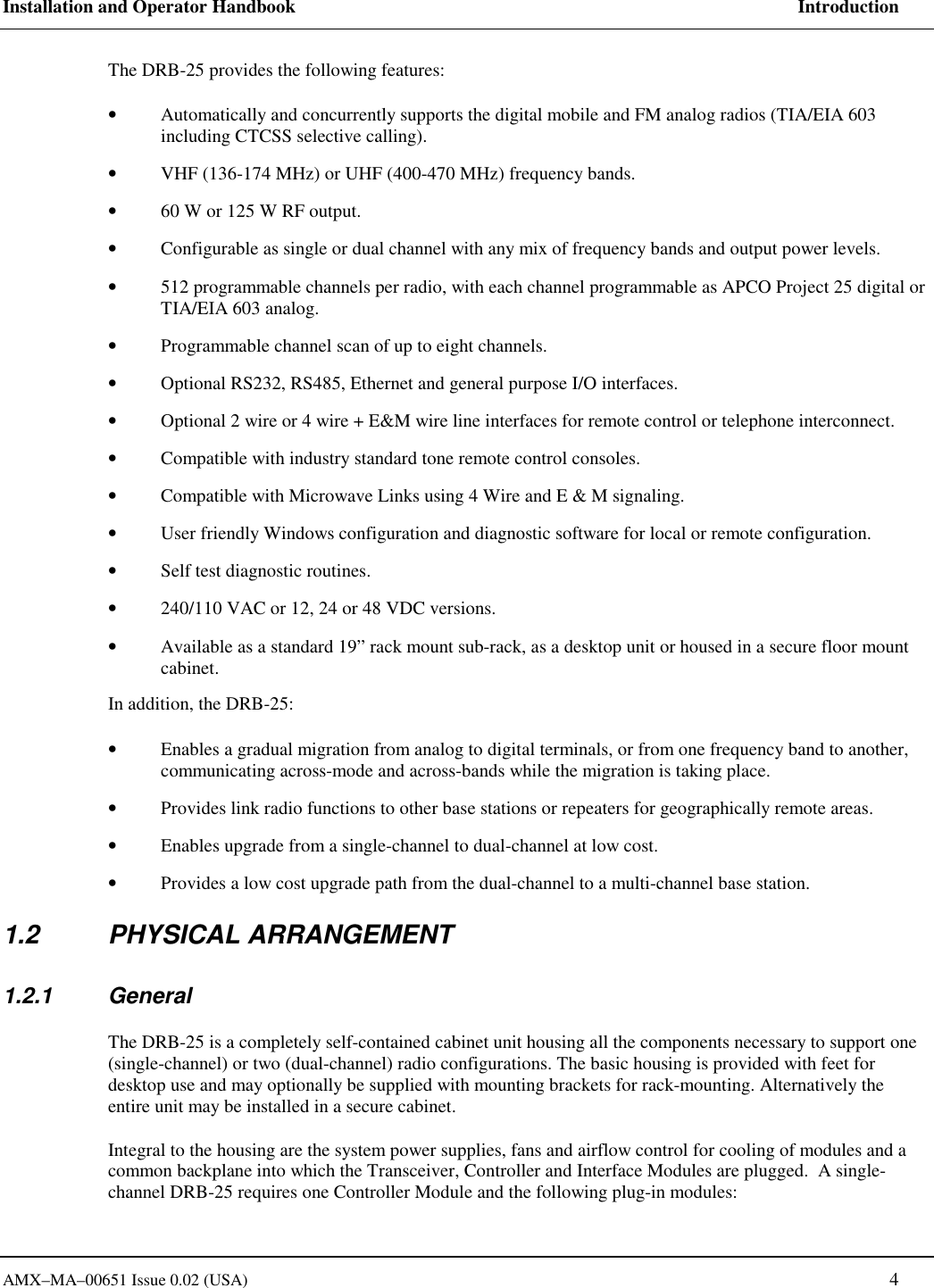
Installation and Operator Handbook     Introduction AMX–MA–00651 Issue 0.02 (USA)   4 The DRB-25 provides the following features: •  Automatically and concurrently supports the digital mobile and FM analog radios (TIA/EIA 603 including CTCSS selective calling). •  VHF (136-174 MHz) or UHF (400-470 MHz) frequency bands. •  60 W or 125 W RF output. •  Configurable as single or dual channel with any mix of frequency bands and output power levels. •  512 programmable channels per radio, with each channel programmable as APCO Project 25 digital or TIA/EIA 603 analog. •  Programmable channel scan of up to eight channels. •  Optional RS232, RS485, Ethernet and general purpose I/O interfaces. •  Optional 2 wire or 4 wire + E&M wire line interfaces for remote control or telephone interconnect. •  Compatible with industry standard tone remote control consoles. •  Compatible with Microwave Links using 4 Wire and E & M signaling.   •  User friendly Windows configuration and diagnostic software for local or remote configuration. •  Self test diagnostic routines. •  240/110 VAC or 12, 24 or 48 VDC versions. •  Available as a standard 19” rack mount sub-rack, as a desktop unit or housed in a secure floor mount cabinet. In addition, the DRB-25: •  Enables a gradual migration from analog to digital terminals, or from one frequency band to another, communicating across-mode and across-bands while the migration is taking place. •  Provides link radio functions to other base stations or repeaters for geographically remote areas. •  Enables upgrade from a single-channel to dual-channel at low cost. •  Provides a low cost upgrade path from the dual-channel to a multi-channel base station. 1.2 PHYSICAL ARRANGEMENT 1.2.1 General The DRB-25 is a completely self-contained cabinet unit housing all the components necessary to support one (single-channel) or two (dual-channel) radio configurations. The basic housing is provided with feet for desktop use and may optionally be supplied with mounting brackets for rack-mounting. Alternatively the entire unit may be installed in a secure cabinet.  Integral to the housing are the system power supplies, fans and airflow control for cooling of modules and a common backplane into which the Transceiver, Controller and Interface Modules are plugged.  A single-channel DRB-25 requires one Controller Module and the following plug-in modules:
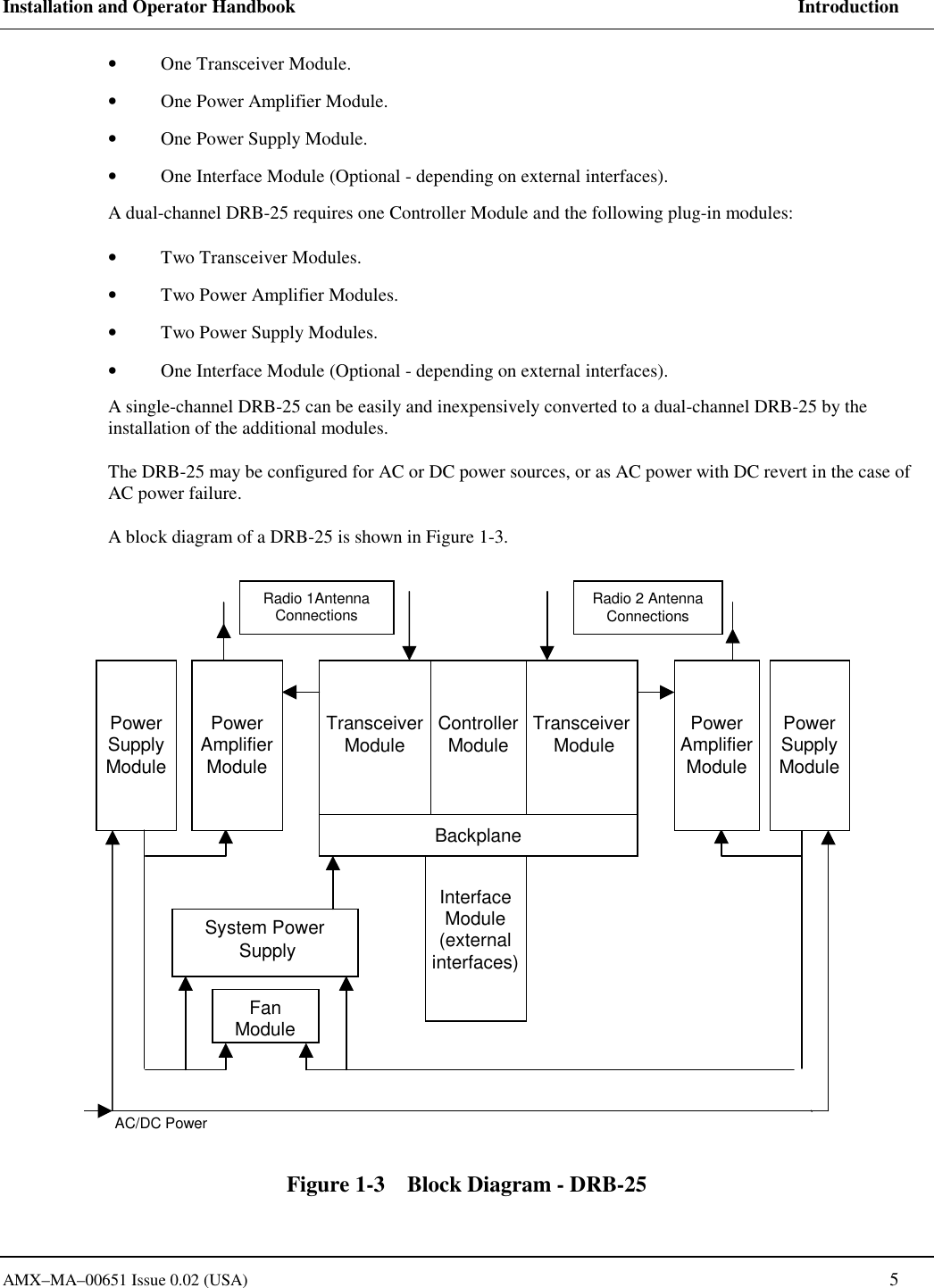
Installation and Operator Handbook     Introduction AMX–MA–00651 Issue 0.02 (USA)   5 •  One Transceiver Module. •  One Power Amplifier Module. •  One Power Supply Module. •  One Interface Module (Optional - depending on external interfaces). A dual-channel DRB-25 requires one Controller Module and the following plug-in modules: •  Two Transceiver Modules. •  Two Power Amplifier Modules. •  Two Power Supply Modules. •  One Interface Module (Optional - depending on external interfaces). A single-channel DRB-25 can be easily and inexpensively converted to a dual-channel DRB-25 by the installation of the additional modules. The DRB-25 may be configured for AC or DC power sources, or as AC power with DC revert in the case of AC power failure. A block diagram of a DRB-25 is shown in Figure 1-3. System Power SupplyBackplaneTransceiverModule Transceiver ModuleControllerModulePowerSupplyModulePowerAmplifierModulePowerSupplyModulePowerAmplifierModuleInterfaceModule(externalinterfaces)FanModuleRadio 1AntennaConnections Radio 2 AntennaConnectionsAC/DC Power  Figure 1-3    Block Diagram - DRB-25
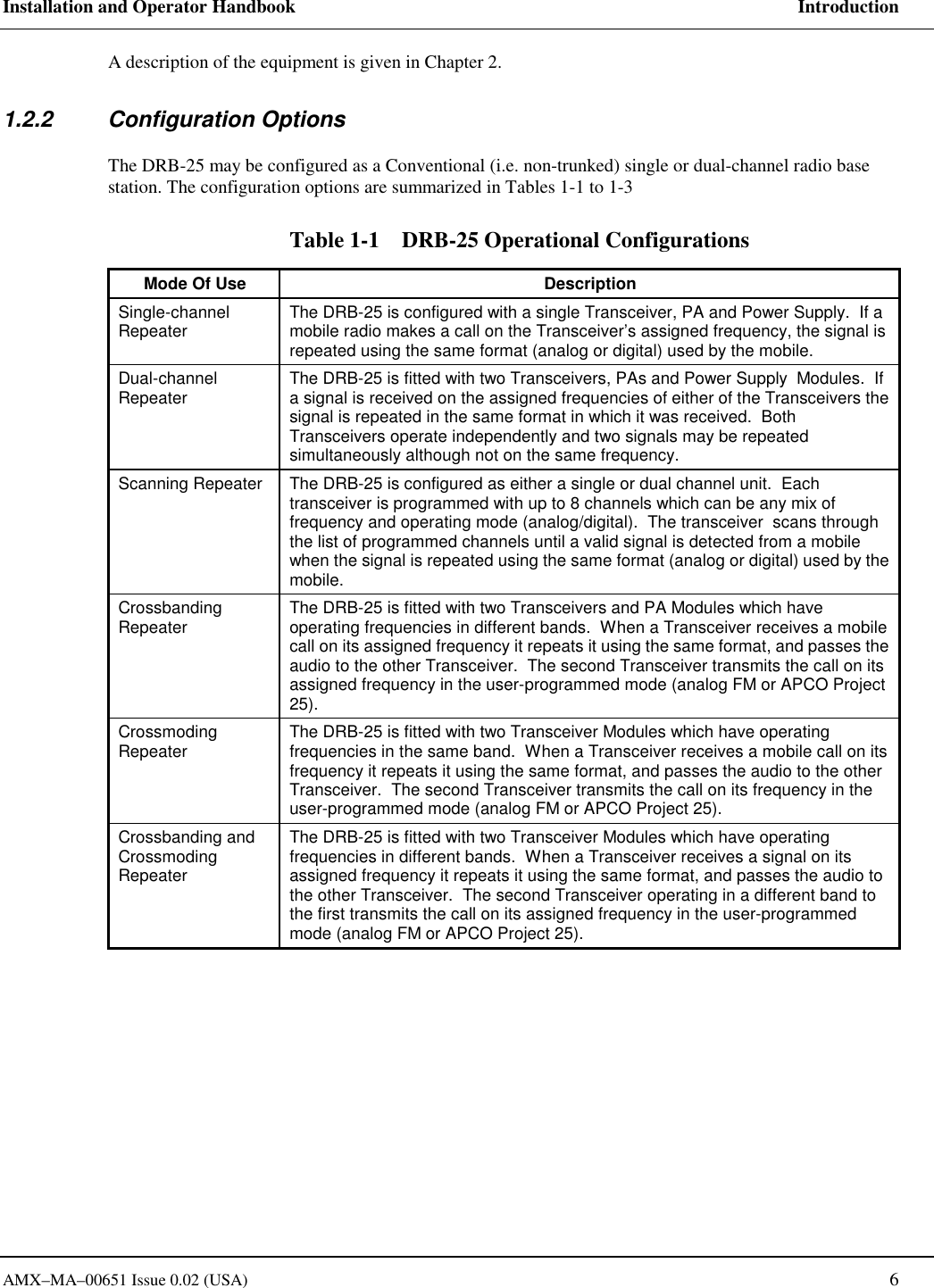
Installation and Operator Handbook     Introduction AMX–MA–00651 Issue 0.02 (USA)   6 A description of the equipment is given in Chapter 2. 1.2.2 Configuration Options The DRB-25 may be configured as a Conventional (i.e. non-trunked) single or dual-channel radio base station. The configuration options are summarized in Tables 1-1 to 1-3 Table 1-1    DRB-25 Operational Configurations Mode Of Use  Description Single-channel Repeater  The DRB-25 is configured with a single Transceiver, PA and Power Supply.  If a mobile radio makes a call on the Transceiver’s assigned frequency, the signal is repeated using the same format (analog or digital) used by the mobile. Dual-channel Repeater  The DRB-25 is fitted with two Transceivers, PAs and Power Supply  Modules.  If a signal is received on the assigned frequencies of either of the Transceivers the signal is repeated in the same format in which it was received.  Both Transceivers operate independently and two signals may be repeated simultaneously although not on the same frequency.   Scanning Repeater  The DRB-25 is configured as either a single or dual channel unit.  Each transceiver is programmed with up to 8 channels which can be any mix of frequency and operating mode (analog/digital).  The transceiver  scans through the list of programmed channels until a valid signal is detected from a mobile when the signal is repeated using the same format (analog or digital) used by the mobile.   Crossbanding Repeater  The DRB-25 is fitted with two Transceivers and PA Modules which have operating frequencies in different bands.  When a Transceiver receives a mobile call on its assigned frequency it repeats it using the same format, and passes the audio to the other Transceiver.  The second Transceiver transmits the call on its assigned frequency in the user-programmed mode (analog FM or APCO Project 25). Crossmoding Repeater  The DRB-25 is fitted with two Transceiver Modules which have operating frequencies in the same band.  When a Transceiver receives a mobile call on its frequency it repeats it using the same format, and passes the audio to the other Transceiver.  The second Transceiver transmits the call on its frequency in the user-programmed mode (analog FM or APCO Project 25). Crossbanding and Crossmoding Repeater The DRB-25 is fitted with two Transceiver Modules which have operating frequencies in different bands.  When a Transceiver receives a signal on its assigned frequency it repeats it using the same format, and passes the audio to the other Transceiver.  The second Transceiver operating in a different band to the first transmits the call on its assigned frequency in the user-programmed mode (analog FM or APCO Project 25).
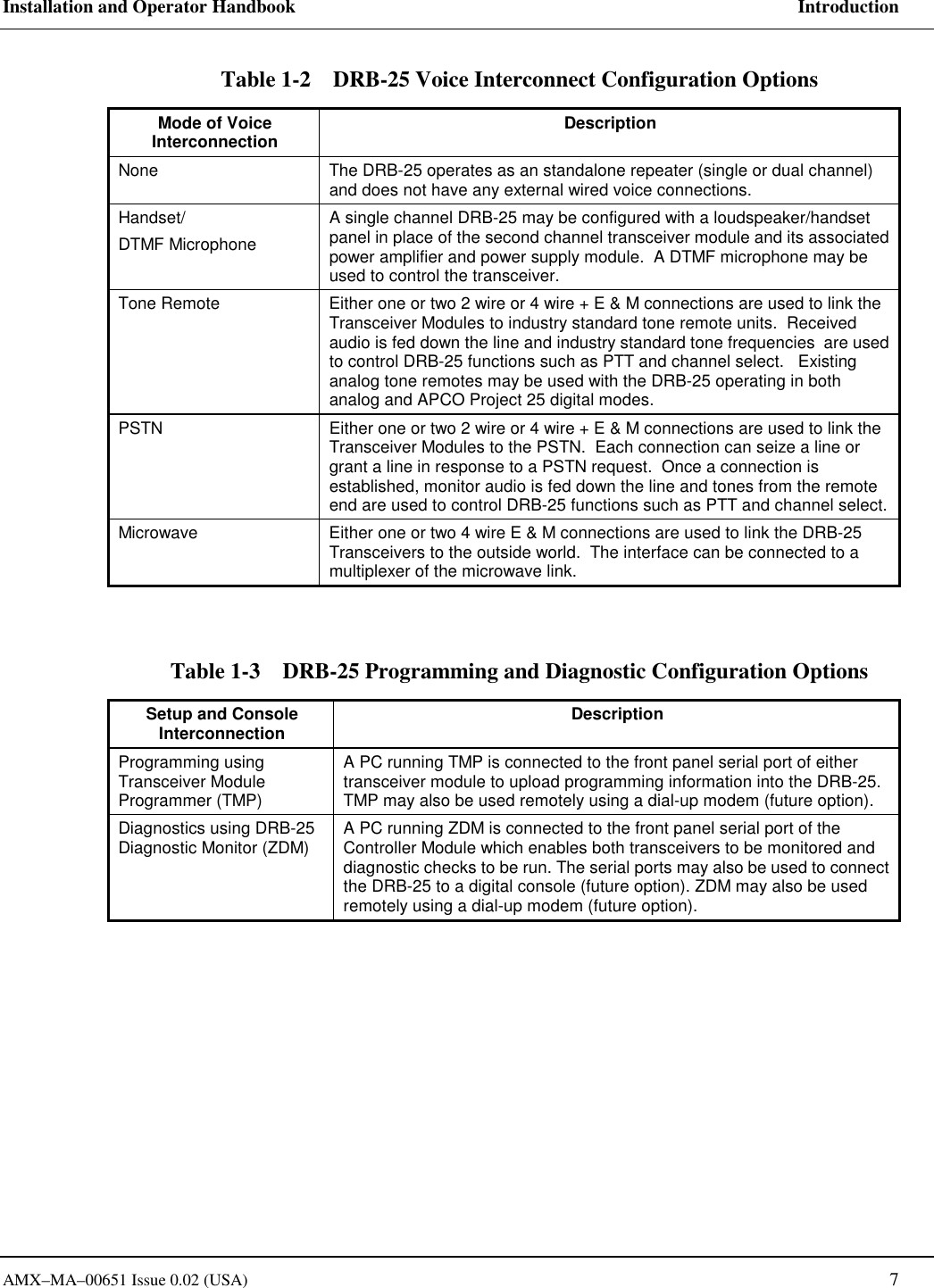
Installation and Operator Handbook     Introduction AMX–MA–00651 Issue 0.02 (USA)   7 Table 1-2    DRB-25 Voice Interconnect Configuration Options Mode of Voice Interconnection  Description None  The DRB-25 operates as an standalone repeater (single or dual channel) and does not have any external wired voice connections.   Handset/ DTMF Microphone A single channel DRB-25 may be configured with a loudspeaker/handset panel in place of the second channel transceiver module and its associated power amplifier and power supply module.  A DTMF microphone may be used to control the transceiver.   Tone Remote  Either one or two 2 wire or 4 wire + E & M connections are used to link the Transceiver Modules to industry standard tone remote units.  Received audio is fed down the line and industry standard tone frequencies  are used to control DRB-25 functions such as PTT and channel select.   Existing analog tone remotes may be used with the DRB-25 operating in both analog and APCO Project 25 digital modes.   PSTN  Either one or two 2 wire or 4 wire + E & M connections are used to link the Transceiver Modules to the PSTN.  Each connection can seize a line or grant a line in response to a PSTN request.  Once a connection is established, monitor audio is fed down the line and tones from the remote end are used to control DRB-25 functions such as PTT and channel select. Microwave  Either one or two 4 wire E & M connections are used to link the DRB-25 Transceivers to the outside world.  The interface can be connected to a multiplexer of the microwave link.    Table 1-3    DRB-25 Programming and Diagnostic Configuration Options Setup and Console Interconnection  Description Programming using Transceiver Module Programmer (TMP) A PC running TMP is connected to the front panel serial port of either  transceiver module to upload programming information into the DRB-25.  TMP may also be used remotely using a dial-up modem (future option).   Diagnostics using DRB-25 Diagnostic Monitor (ZDM)    A PC running ZDM is connected to the front panel serial port of the Controller Module which enables both transceivers to be monitored and diagnostic checks to be run. The serial ports may also be used to connect the DRB-25 to a digital console (future option). ZDM may also be used remotely using a dial-up modem (future option).
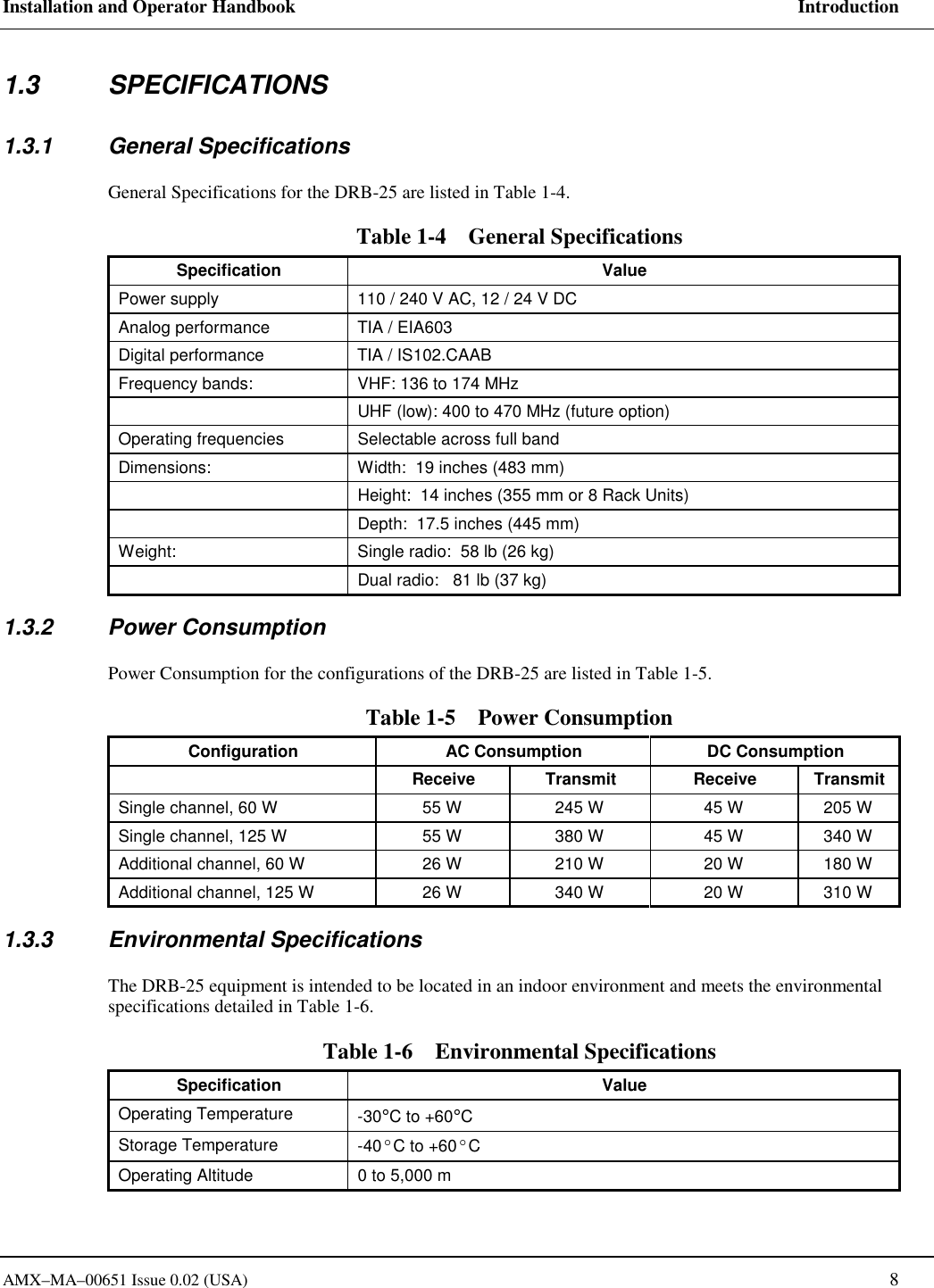
Installation and Operator Handbook     Introduction AMX–MA–00651 Issue 0.02 (USA)   8 1.3 SPECIFICATIONS 1.3.1 General Specifications General Specifications for the DRB-25 are listed in Table 1-4. Table 1-4    General Specifications Specification Value Power supply  110 / 240 V AC, 12 / 24 V DC Analog performance  TIA / EIA603 Digital performance  TIA / IS102.CAAB Frequency bands:  VHF: 136 to 174 MHz   UHF (low): 400 to 470 MHz (future option) Operating frequencies  Selectable across full band Dimensions:  Width:  19 inches (483 mm)   Height:  14 inches (355 mm or 8 Rack Units)   Depth:  17.5 inches (445 mm) Weight:  Single radio:  58 lb (26 kg)   Dual radio:   81 lb (37 kg) 1.3.2 Power Consumption Power Consumption for the configurations of the DRB-25 are listed in Table 1-5. Table 1-5    Power Consumption Configuration  AC Consumption  DC Consumption  Receive Transmit Receive Transmit Single channel, 60 W  55 W  245 W  45 W  205 W Single channel, 125 W  55 W  380 W  45 W  340 W Additional channel, 60 W  26 W  210 W  20 W  180 W Additional channel, 125 W  26 W  340 W  20 W  310 W 1.3.3 Environmental Specifications The DRB-25 equipment is intended to be located in an indoor environment and meets the environmental specifications detailed in Table 1-6. Table 1-6    Environmental Specifications Specification Value Operating Temperature  -30°C to +60°C Storage Temperature  -40ºC to +60ºC Operating Altitude  0 to 5,000 m
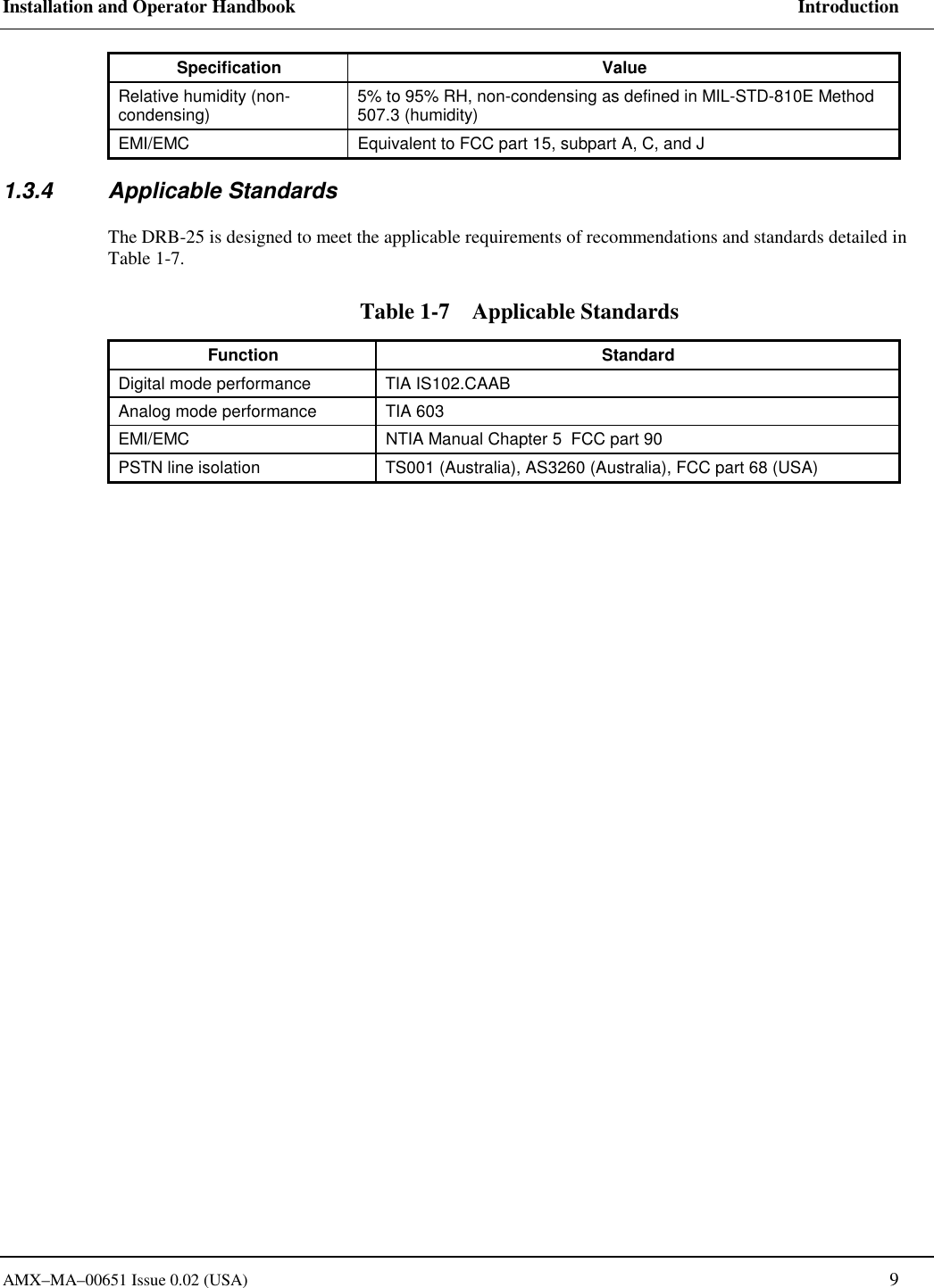
Installation and Operator Handbook     Introduction AMX–MA–00651 Issue 0.02 (USA)   9 Specification Value Relative humidity (non-condensing)  5% to 95% RH, non-condensing as defined in MIL-STD-810E Method 507.3 (humidity) EMI/EMC  Equivalent to FCC part 15, subpart A, C, and J 1.3.4 Applicable Standards The DRB-25 is designed to meet the applicable requirements of recommendations and standards detailed in Table 1-7. Table 1-7    Applicable Standards Function Standard Digital mode performance   TIA IS102.CAAB Analog mode performance   TIA 603 EMI/EMC   NTIA Manual Chapter 5  FCC part 90 PSTN line isolation   TS001 (Australia), AS3260 (Australia), FCC part 68 (USA)

Navigation menu