Williams Sound T27 AUDITORY ASSISTANCE DEVICE User Manual PPAVP mannew

Williams Sound, LLC AUDITORY ASSISTANCE DEVICE PPAVP mannew

USERS MANUAL

Personal PA™Value Pack SystemWide-Band FM Wireless Listening SystemTransmitter Model PPA T27Receiver Model R35QUICK SETUP GUIDEMFRM 010AModel PPA VP
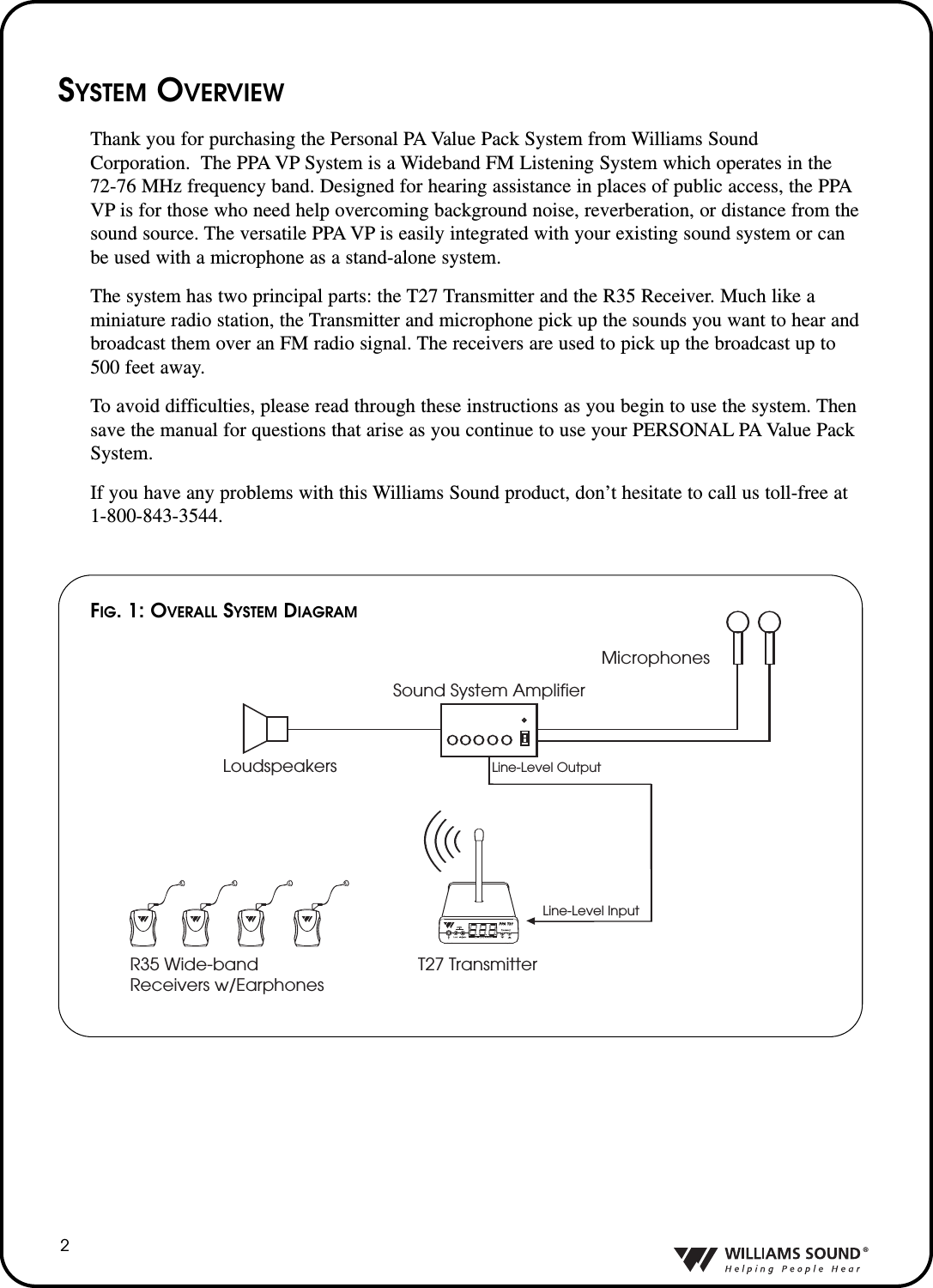
®2SYSTEM OVERVIEWThank you for purchasing the Personal PA Value Pack System from Williams SoundCorporation.  The PPA VP System is a Wideband FM Listening System which operates in the72-76 MHz frequency band. Designed for hearing assistance in places of public access, the PPAVP is for those who need help overcoming background noise, reverberation, or distance from thesound source. The versatile PPA VP is easily integrated with your existing sound system or canbe used with a microphone as a stand-alone system. The system has two principal parts: the T27 Transmitter and the R35 Receiver. Much like aminiature radio station, the Transmitter and microphone pick up the sounds you want to hear andbroadcast them over an FM radio signal. The receivers are used to pick up the broadcast up to500 feet away.To avoid difficulties, please read through these instructions as you begin to use the system. Thensave the manual for questions that arise as you continue to use your PERSONAL PA Value PackSystem.If you have any problems with this Williams Sound product, don’t hesitate to call us toll-free at1-800-843-3544.Sound System AmplifierLoudspeakersMicrophonesLine-Level OutputR35 Wide-band Receivers w/EarphonesLine-Level InputT27 TransmitterFIG.1: OVERALL SYSTEM DIAGRAM
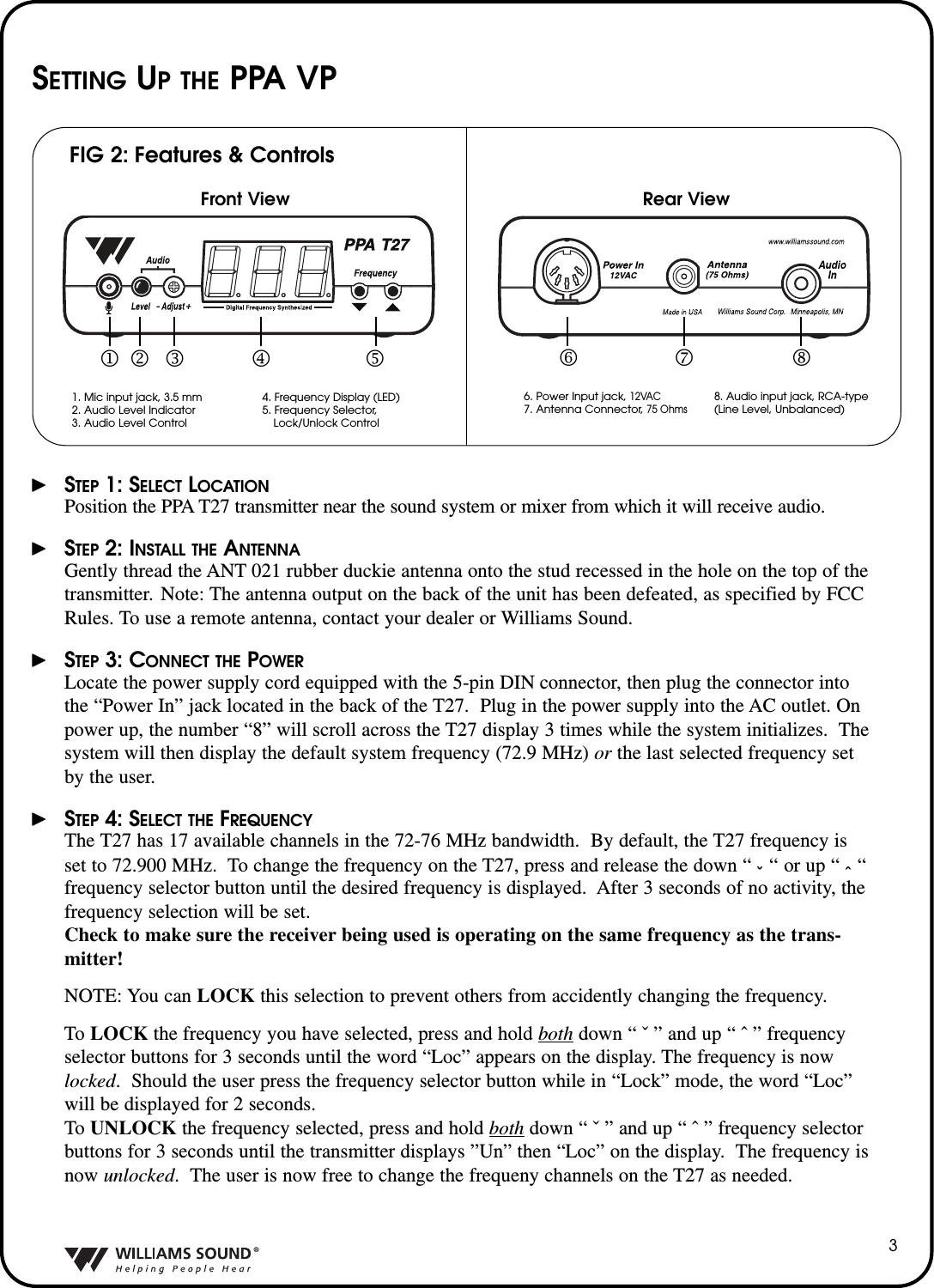
®3SETTING UP THE PPA VPþSTEP 1: SELECT LOCATIONPosition the PPA T27 transmitter near the sound system or mixer from which it will receive audio.þSTEP 2: INSTALL THE ANTENNAGently thread the ANT 021 rubber duckie antenna onto the stud recessed in the hole on the top of thetransmitter. Note: The antenna output on the back of the unit has been defeated, as specified by FCCRules. To use a remote antenna, contact your dealer or Williams Sound.þSTEP 3: CONNECT THE POWERLocate the power supply cord equipped with the 5-pin DIN connector, then plug the connector intothe “Power In” jack located in the back of the T27.  Plug in the power supply into the AC outlet. Onpower up, the number “8” will scroll across the T27 display 3 times while the system initializes.  Thesystem will then display the default system frequency (72.9 MHz) or the last selected frequency setby the user.þSTEP 4: SELECT THE FREQUENCYThe T27 has 17 available channels in the 72-76 MHz bandwidth.  By default, the T27 frequency isset to 72.900 MHz.  To change the frequency on the T27, press and release the down “ ˇ“ or up “ ˆ“frequency selector button until the desired frequency is displayed.  After 3 seconds of no activity, thefrequency selection will be set.  Check to make sure the receiver being used is operating on the same frequency as the trans-mitter!NOTE: You can LOCK this selection to prevent others from accidently changing the frequency.  ToLOCK the frequency you have selected, press and hold both down “ ˇ ” and up “ ˆ ” frequencyselector buttons for 3 seconds until the word “Loc” appears on the display. The frequency is nowlocked.Should the user press the frequency selector button while in “Lock” mode, the word “Loc”will be displayed for 2 seconds.To UNLOCK the frequency selected, press and hold both down “ ˇ ” and up “ ˆ ” frequency selectorbuttons for 3 seconds until the transmitter displays ”Un” then “Loc” on the display.The frequency isnow unlocked.The user is now free to change the frequeny channels on the T27 as needed.FIG 2: Features & ControlsFront View Rear View1. Mic input jack, 3.5 mm2. Audio Level Indicator3. Audio Level Control4. Frequency Display (LED)5. Frequency Selector,Lock/Unlock Control6. Power Input jack, 12VAC7.Antenna Connector, 75Ohms8. Audio input jack, RCA-type(Line Level, Unbalanced)1 2 3  4  5 6 7 8
®4þSTEP 5: CONNECT THE AUDIO SOURCEOn the back of the T27, an RCA-type “Audio In” jack is available for connecting a line-level, unbal-anced audio source.  On the front of the T27, a 3.5mm “Mic Input” jack is available to connect aWilliams Sound electret microphone. Connect the desired audio source to the T27 transmitter and pro-ceed to Step 6.þSTEP 6: ADJUST THE AUDIO LEVELWith the audio source playing, use a small screwdriver or tuning wand to rotate the “Adjust” control onthe front of the T27 1) clockwise to increase the audio level; or 2) counterclockwise to decrease theaudio level.  Refer to the LED audio “Level” indicator on the front of the T27 as you make your adjust-ments:Audio Level LED Indicator1.) Never On =Audio source is TOO LOW.2.) Blinks occassionally =Audio source is OPTIMAL.3.) Always on =Audio source is TOO HIGH.  þSTEP 7: LISTEN WITH AN FM RECEIVERIMPORTANT:The FM receiver being used with the T27 transmitter will need to be on the samefrequency and bandwidth as the transmitter.  To retune the FM receiver, follow the tuning instruc-tions included with that unit.  For R35 tuning instructions, see page 6.Install the receiver batteries, plug in the earphone, turn on the receiver and walk around the listeningarea. The signal should be clear and quite loud when the volume is turned up.  See pages 5-7 for detailedR35 receiver instructions.   FCC Warning Statement      Changes or modifications not expressly approved by the party responsible for compliance could void the       user's authority to operate the equipment.
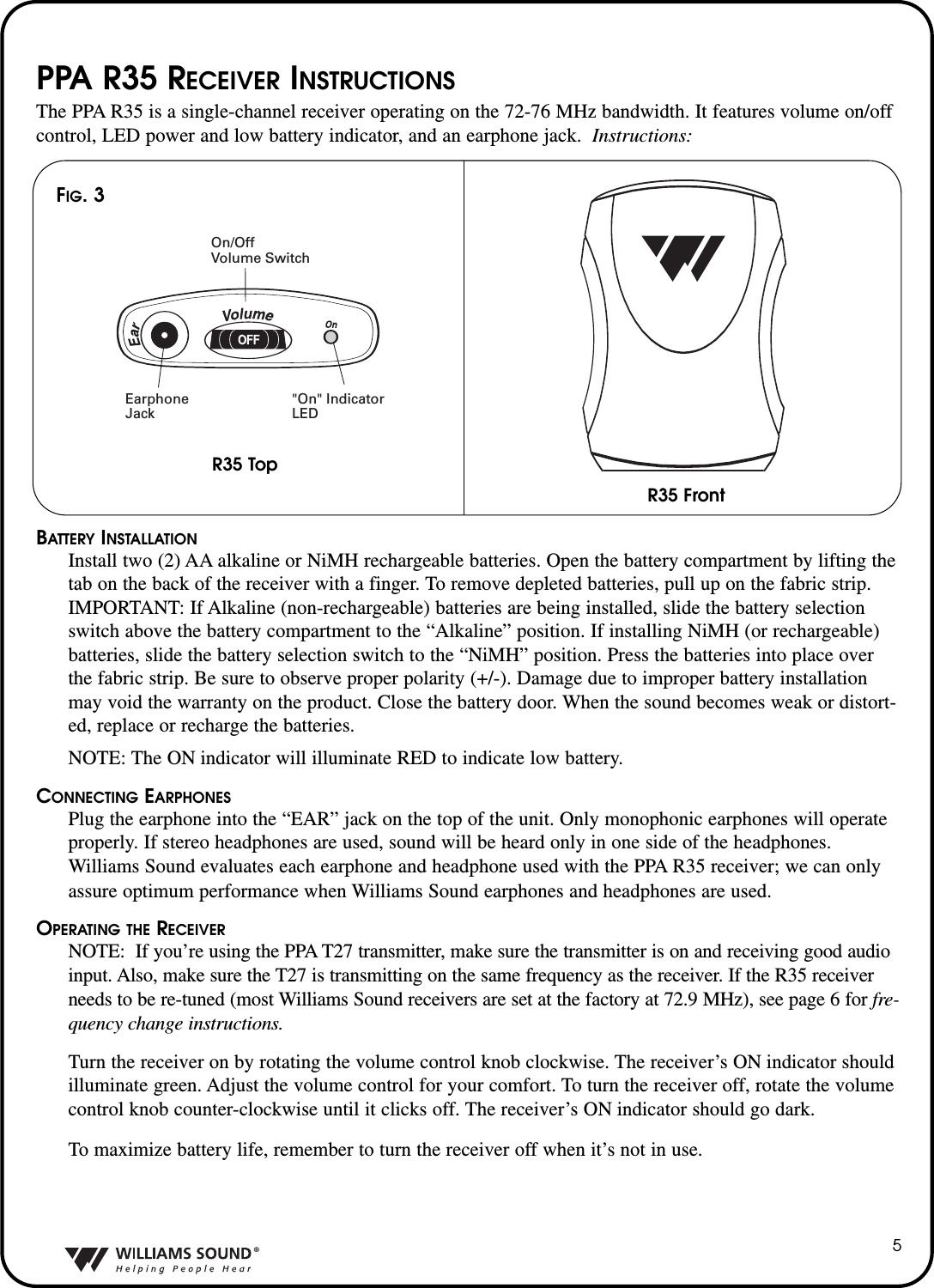
®5PPA R35 RECEIVER INSTRUCTIONSThe PPA R35 is a single-channel receiver operating on the 72-76 MHz bandwidth. It features volume on/offcontrol, LED power and low battery indicator, and an earphone jack.  Instructions:BATTERY INSTALLATIONInstall two (2) AA alkaline or NiMH rechargeable batteries. Open the battery compartment by lifting thetab on the back of the receiver with a finger. To remove depleted batteries, pull up on the fabric strip.IMPORTANT: If Alkaline (non-rechargeable) batteries are being installed, slide the battery selectionswitch above the battery compartment to the “Alkaline” position. If installing NiMH (or rechargeable)batteries, slide the battery selection switch to the “NiMH” position. Press the batteries into place overthe fabric strip. Be sure to observe proper polarity (+/-). Damage due to improper battery installationmay void the warranty on the product. Close the battery door. When the sound becomes weak or distort-ed, replace or recharge the batteries.NOTE: The ON indicator will illuminate RED to indicate low battery.CONNECTING EARPHONESPlug the earphone into the “EAR” jack on the top of the unit. Only monophonic earphones will operateproperly. If stereo headphones are used, sound will be heard only in one side of the headphones.Williams Sound evaluates each earphone and headphone used with the PPA R35 receiver; we can onlyassure optimum performance when Williams Sound earphones and headphones are used.OPERATING THE RECEIVERNOTE:  If you’re using the PPA T27 transmitter, make sure the transmitter is on and receiving good audioinput. Also, make sure the T27 is transmitting on the same frequency as the receiver. If the R35 receiverneeds to be re-tuned (most Williams Sound receivers are set at the factory at 72.9 MHz), see page 6 for fre-quency change instructions.Turn the receiver on by rotating the volume control knob clockwise. The receiver’s ON indicator shouldilluminate green. Adjust the volume control for your comfort. To turn the receiver off, rotate the volumecontrol knob counter-clockwise until it clicks off. The receiver’s ON indicator should go dark. To maximize battery life, remember to turn the receiver off when it’s not in use.R35 FrontR35 TopOn/Off Volume SwitchEarphoneJack"On" IndicatorLEDR35 FrontR35 TopOn/Off Volume SwitchEarphoneJack"On" IndicatorLEDFIG. 3R35 TopR35 Front
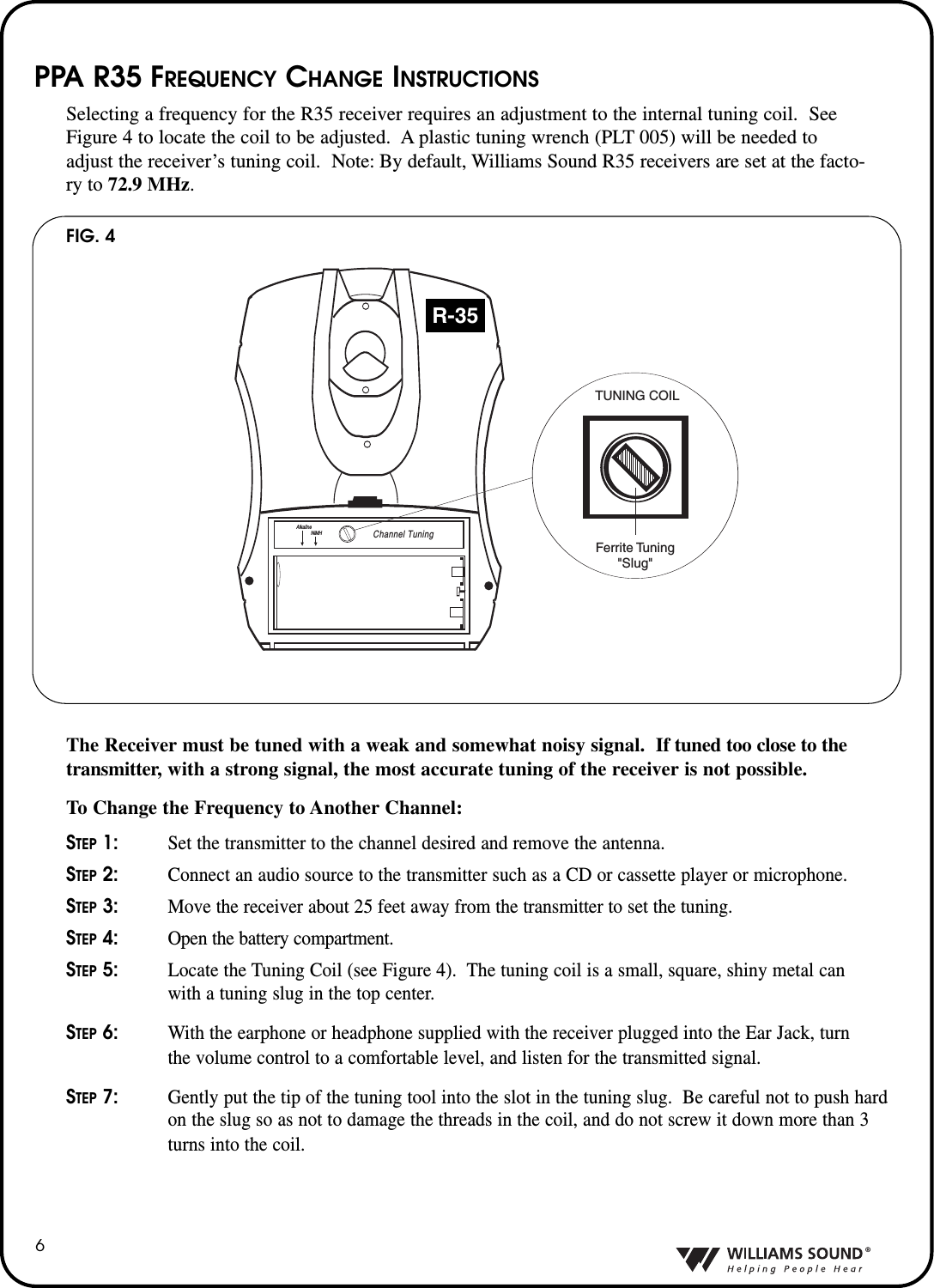
®6PPA R35 FREQUENCY CHANGE INSTRUCTIONSSelecting a frequency for the R35 receiver requires an adjustment to the internal tuning coil.  SeeFigure 4 to locate the coil to be adjusted.  A plastic tuning wrench (PLT 005) will be needed toadjust the receiver’s tuning coil.  Note: By default, Williams Sound R35 receivers are set at the facto-ry to 72.9 MHz.The Receiver must be tuned with a weak and somewhat noisy signal.  If tuned too close to thetransmitter, with a strong signal, the most accurate tuning of the receiver is not possible.To Change the Frequency to Another Channel:STEP1: Set the transmitter to the channel desired and remove the antenna.STEP2: Connect an audio source to the transmitter such as a CD or cassette player or microphone.STEP3: Move the receiver about 25 feet away from the transmitter to set the tuning.STEP4: Open the battery compartment.STEP5: Locate the Tuning Coil (see Figure 4).  The tuning coil is a small, square, shiny metal can with a tuning slug in the top center.  STEP6: With the earphone or headphone supplied with the receiver plugged into the Ear Jack, turn the volume control to a comfortable level, and listen for the transmitted signal.STEP7: Gently put the tip of the tuning tool into the slot in the tuning slug.  Be careful not to push hard on the slug so as not to damage the threads in the coil, and do not screw it down more than 3 turns into the coil.FIG. 4Channel TuningAlkalineNiMHChannel TuningAlkalineNiMHR-35TUNING COILFerrite Tuning"Slug"
®7STEP 8:Turn the tuning slug in a counter-clockwise direction about two turns. Then, slowly turn the tuning slug in the clockwise direction until the signal is heard. There may be two signal points heard. The one which is received first is a false response.  Be sure to continue tuning slightly further to the correct point, which will be much louder.  Tune backand forth to find the center of the point of best response to the audio source being heard.STEP 9: Mark down the date, and if a new frequency has been chosen, mark it down inside the receiver case for future reference.
MFRM 010A ©2006 Williams Sound Corp.®10321 West 70th St., Eden Prairie, MN 55344 U.S.A.  800.843.3544 | 952.943.2252 | FAX:  952.943.2174www.williamssound.com

Navigation menu