Win Accord PD121INCH 12” Digital Photo Frame User Manual
WIN ACCORD LTD., 12” Digital Photo Frame
user manual
Digital Photo Frame
User Guide
PAN1200-1300-1500DWPTFR
Effortlessly Moving Images Out of your Camera and Into your Life
1
Sign up now to enjoy the following benefits…
Qualify to win a FREE
digital photo frame!*
(valid in USA only)
Register your FREE
1-year warranty!**
*For details, go to our website: www.pandigital.net
**The online signup is for the purpose of user and product registration. Failure to register
does not in any way diminish any of your standard warranty rights, as described in the
documentation included with your product.
NOTE: If you must mail your 1-year registration, please send your name, address,
phone number, model & serial number, and when & where purchased to:
Pandigital, P.O. Box 2969, Dublin, CA 94568-2969 USA
1
Year
Sign up now at…
http://www.pandigital.net

2
Table of Contents
Introduction ..................................................................................................4
DPF Key Features ...................................................................................................4
Overview of the 12” and 13.3” DPF .............................................................5
Overview of the 15” DPF ..............................................................................6
Remote Control ............................................................................................6
PanTouch Interface ......................................................................................8
Control Buttons on DPF ..............................................................................9
About Selecting Options .............................................................................9
Getting Started ...........................................................................................10
The HOME Screen ......................................................................................10
SETUP Menu Overview ..............................................................................12
Select Media Source ..................................................................................13
PHOTOS ......................................................................................................14
Display Photo Thumbnails Screen .........................................................................14
Zoom or Rotate Photos ..................................................................................... 14
Import Photos into Internal Memory .......................................................................14
Delete Photos from Internal Memory ..................................................................... 15
Adjust Screen Colors .............................................................................................16
Optimal Image Display ..........................................................................................17
Photo Import Method .............................................................................................17
PHOTO SLIDESHOWS ...............................................................................18
Slideshow of Photos in Internal Memory ...............................................................18
Slideshow of Photos on your Media Source ..........................................................18
Pause a Slideshow ................................................................................................18
Slideshow Background Music ................................................................................18
Adjust the Volume .............................................................................................19
Mute the Background Music ..............................................................................19
Set Slideshow Interval ......................................................................................20
Set Slideshow Transition .................................................................................. 21

3
Set Slideshow Shuffle ....................................................................................... 21
Display Current Time with Photos ..................................................................... 21
Display Photo File Date/Time Stamp with Photos ............................................. 22
MUSIC .........................................................................................................22
Playing Music Only ................................................................................................ 22
Adjust the Volume ............................................................................................. 23
Mute the Music ..................................................................................................23
Set Music Repeat Mode ........................................................................................ 23
Import Music Files into Internal Memory ................................................................ 23
Delete Music Files from the Internal Memory ........................................................ 24
VIDEOS .......................................................................................................25
Watch a Video .......................................................................................................25
Adjust the Volume .............................................................................................25
Mute the Video ..................................................................................................26
Video Repeat Mode ...............................................................................................26
Import Video Files into Internal Memory ................................................................ 26
Delete Video Files from the Internal Memory ........................................................26
CALENDAR/CLOCK ...................................................................................27
Set Date and Time .................................................................................................27
Set Alarm ...............................................................................................................28
Select Media Source for Calendar Slideshow........................................................28
Set Schedule .........................................................................................................28

4
Introduction
Welcome to the Pandigital Multimedia Digital Photo Frame (DPF). Now
you can display your digital photos directly from your memory card, no
computer is necessary. View your photos as slideshows with background
music, or individually. You can even connect wirelessly to online photo
sharing websites to display your uploaded photos directly through the
DPF.
Use the DPF as a calendar/clock with personal photo slideshow, play
your digital videos, and view preloaded recipes.
This DPF also includes the PanTouch Technology, a touch icon-driven
interface allowing you to quickly and easily navigate and manage the
DPF functions without the remote control.
DPF Key Features
PanTouch Technology
Displays digital Photo files
Plays digital Music and Video files
Displays Calendar/Clock with photo slideshow and Alarm function
Includes preloaded Recipes from popular authors
Simple Plug & Play
Does not require a computer
Infrared Remote Control and control buttons on the DPF
1 or 2GB Internal Memory (depending on model)
2 USB 2.0 ports
Compatible Memory Cards
Compatible memory cards include: Secure Digital™ (SD), Compact
Flash (select models), MultiMedia Card™(MMC), xD Card, Memory
Stick™(MS), MemoryStick Pro™, and Memory Stick Pro Duo™*
* The Memory Stick Pro Duo™
requires an additional adaptor to fit
properly into the DPF (not included).
You can purchase the adaptor at retail
outlet stores that sell memory cards.
5
What’s in the Box
Digital Photo Frame (DPF)
AC Power Cord and Adapter
Infrared Remote Control
Decorative Paper Mats
USB Cable
Quick Start Guide
User Guide (on CD)
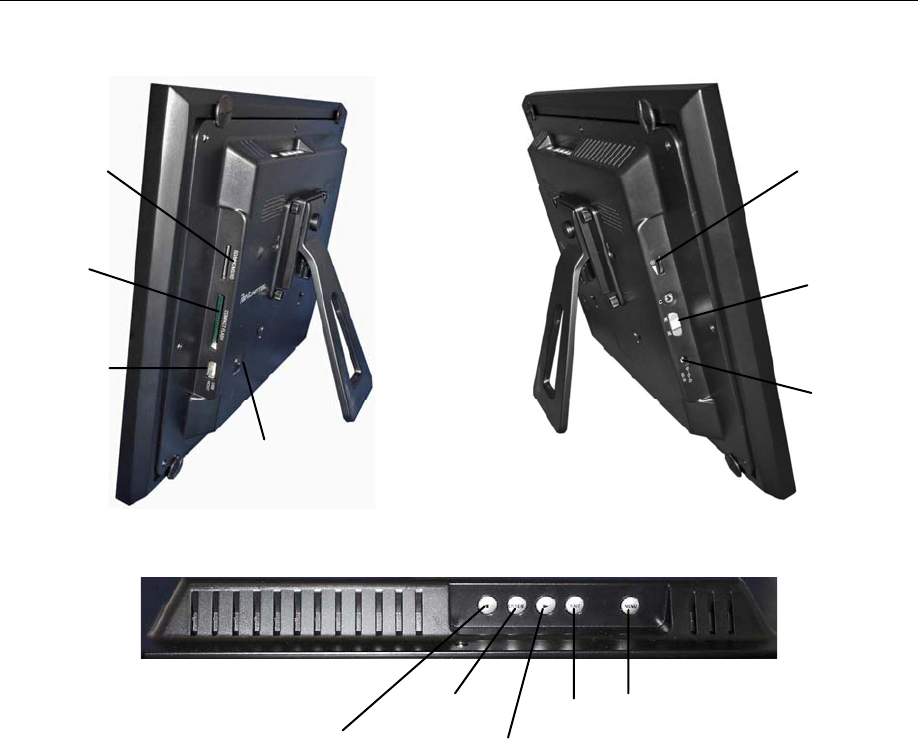
Overview of the 12” and 13.3” DPF
(Note: Your frame, memory card slots, ports, and jacks may be different than those pictured here.)
MENU
EXIT
ENTER
ŹRight arrow
ŻLeft arrow
Multi-Memory
card slot
Mini USB
Device
Compact
Flash slot
Brightness control
Power switch
ON/OFF
DC power jack
USB Host
RIGHT SIDE LEFTSIDE
TOP PANEL CONTROL BUTTONS
6
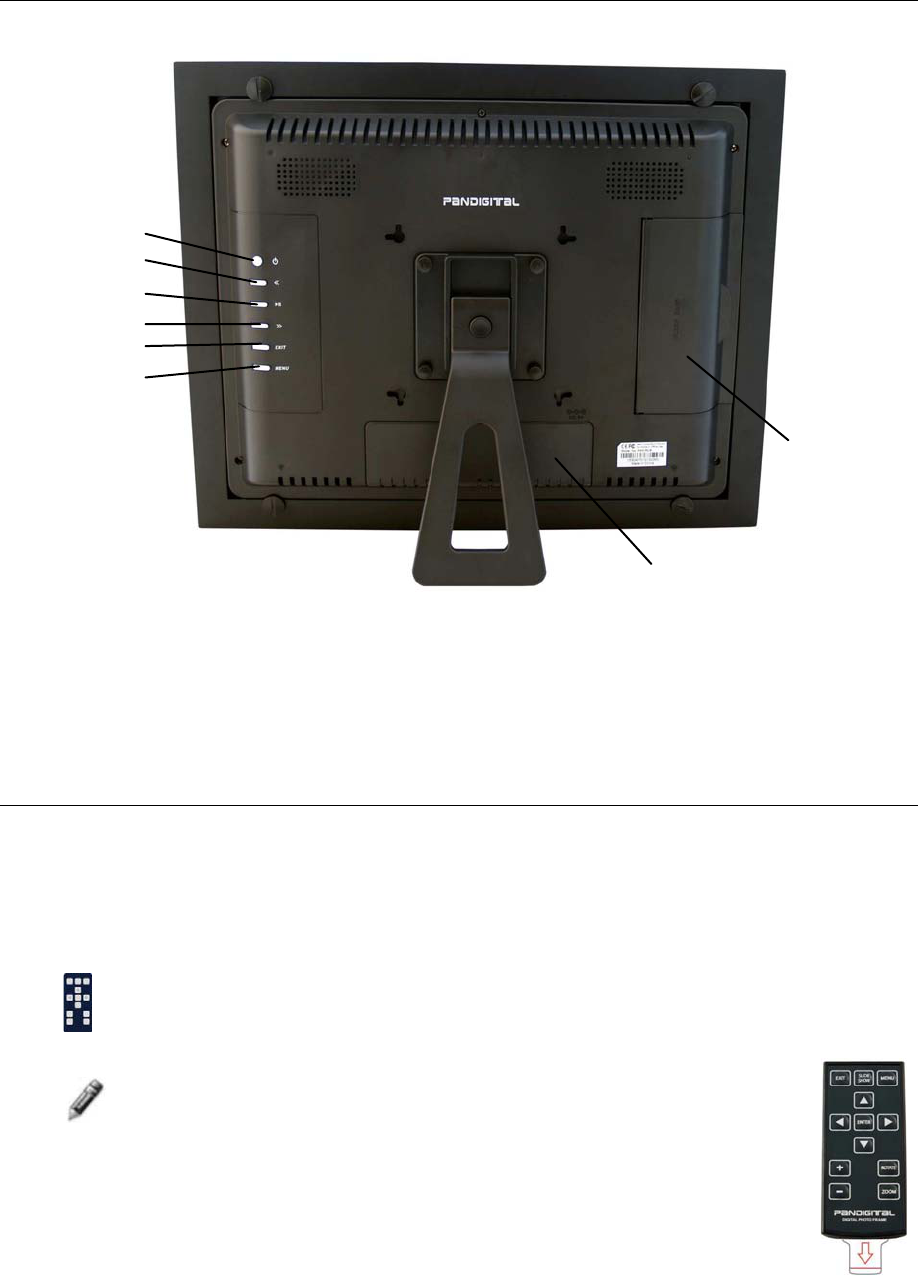
Overview of the 15” DPF
(Note: Your frame, memory card slots, ports, and jacks may be different than those pictured here.)
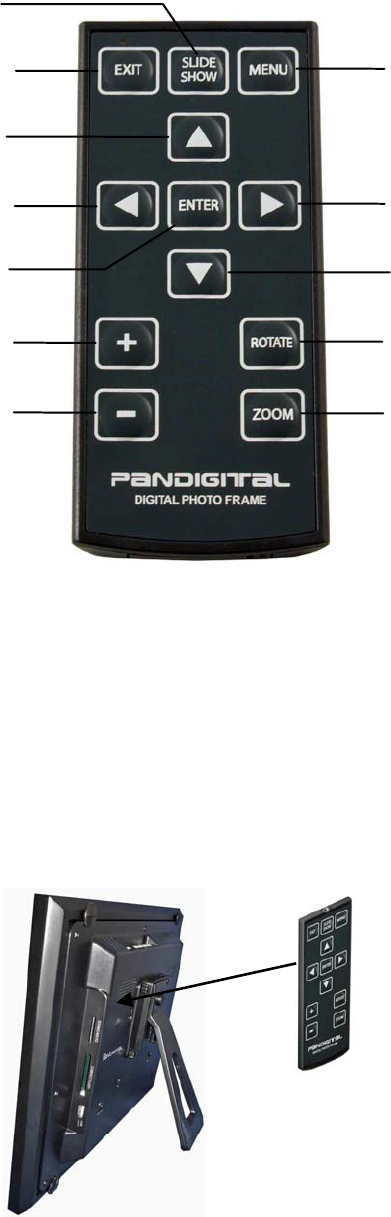
Remote Control
You can access all of the DPF’s features, and perform all of the functions
by using the remote control. You will be able to perform several functions
with the remote control that are not possible with the top-back panel
control buttons.
Throughout this User Guide, this icon depicts the specific use of
the Remote Control.
Note: Before first time use, pull the plastic tab sticking out
of the remote control. It protects the battery and the
remote control will not work unless it is removed.
DC Power in
Memory Card Slots
Power switch
Scroll forward
Play/Pause
Scroll back
Exit
Menu
7
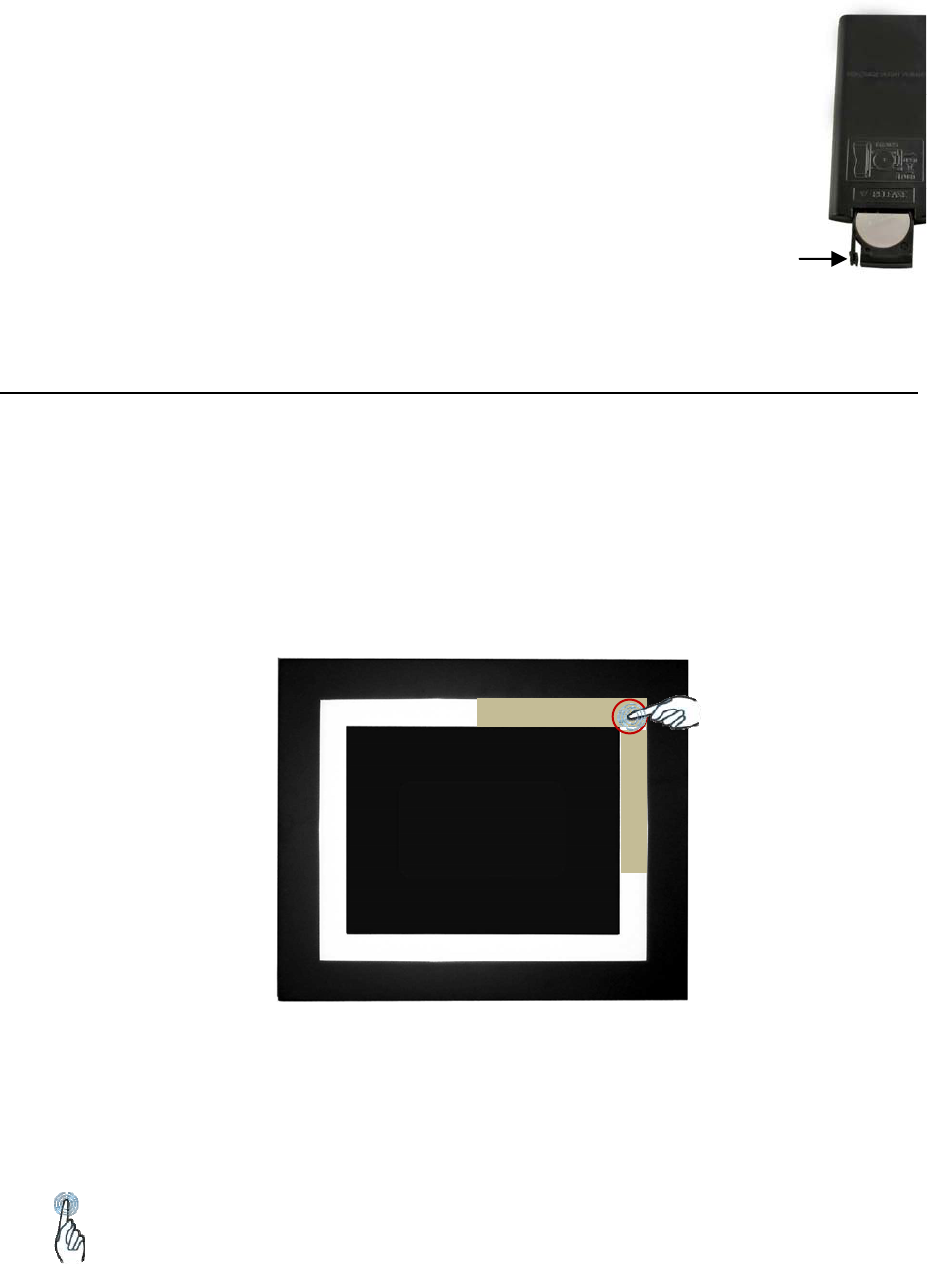
Overview of Remote Control
Store the Remote Control
Avoid misplacing the remote control by safely storing it on the back
of the DPF when not in use.
The back of the remote control has a built-in magnet and the back of
the DPF has a ‘magnetic area’ so you can simply attach the remote
control to the back of the DPF for safe keeping.
Exit or go back
Scroll up
Scroll previous
Play/Pause/Select object
Volume adjust lower
or de-select object Enlarge image
Access Setup screens
Scroll forward
Scroll down
Volume adjust higher
or select object Rotate image
Play Slideshow
8
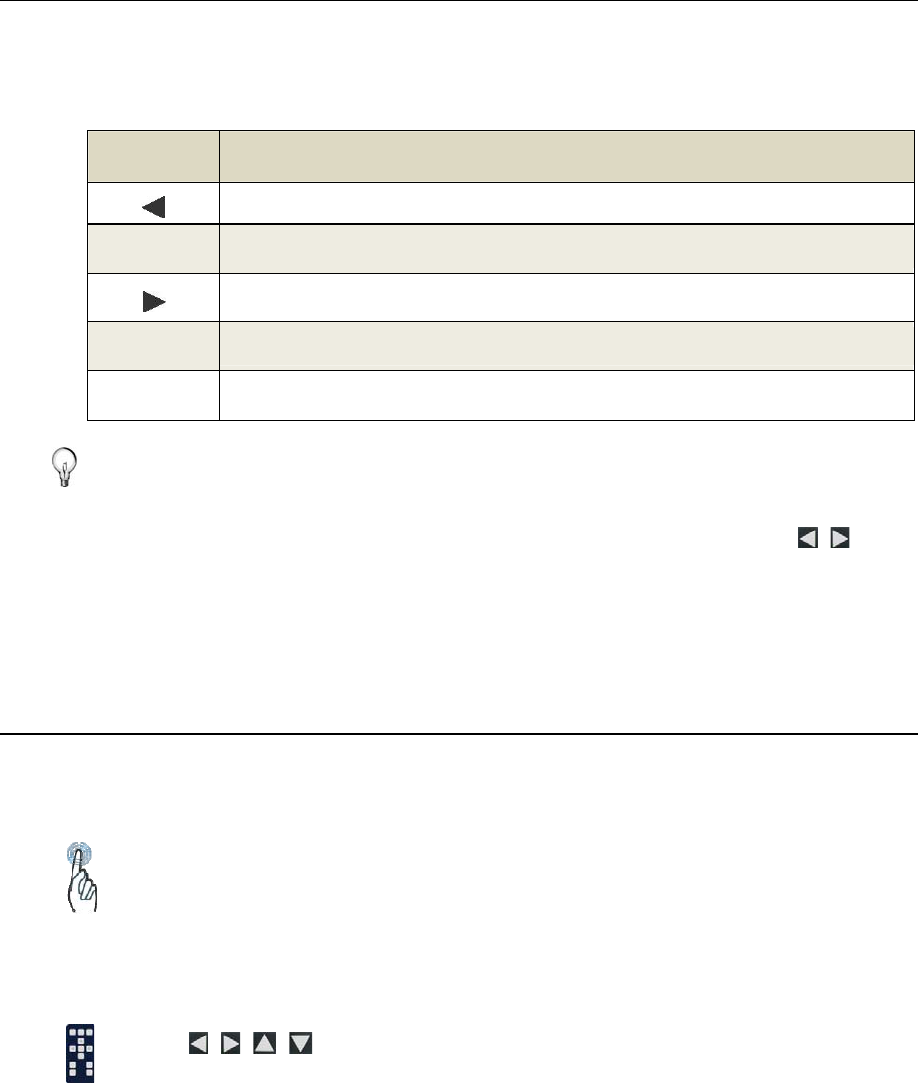
Replace the Remote Control Battery
1. Hold the remote control with the buttons facing down.
2. Push and hold the small release tab while pulling the
battery tray out.
3. Replace the “CR2025” Lithium battery on the tray with
the positive (+) side facing up.
4. Push the tray back in until it clicks into place.
PanTouch Interface
This DPF includes our PanTouch technology, a touch icon-driven
interface allowing you to navigate through all the DPF features and
functions.
The touch sensors are located strategically along the top and right edge
of the frame under the paper mat and are activated by simply touching
the activation point in the upper right corner.
The navigation icons appear for 5 seconds (without any user interaction),
and then disappear until you activate the PanTouch interface again.
While the PanTouch interface is active, the remote control will be
inoperable.
Throughout this User Guide, this hand icon depicts the specific use
of the PanTouch interface.
Release tab
PanTouch Interface
activation point
SENSORS AREA
S
E
N
S
O
R
S
9
Control Buttons on DPF
You can perform many (but not all) of the DPF functions by using the
control buttons located on the back of the DPF. Their basic functions are
the same no matter when you use them.
Button Action
Scroll left
ENTER Select the highlighted option, start a Slideshow, Play and Pause
Scroll right
EXIT Exit the current display, or go back a screen
MENU Access the SETUP Menu screen
TIP: The instructions throughout this User Guide reference the use
of the PanTouch interface and the Remote Control. However,
you could also use the frame control buttons when the ,
ENTER,EXIT, and MENU buttons are referenced.
About Selecting Options
Throughout this User Guide, when you are instructed to simply ‘touch’ or
‘select’ a function option or button, do the following:
Touch the upper right corner of the mat to activate the PanTouch
interface and then touch the desired option button, or use the arrows
to highlight [the referenced option], and then touch ENTER to
select (unless otherwise instructed).
Use to highlight [the referenced option], and then
press ENTER to select (unless otherwise instructed).

10
Getting Started
1. Plug the AC Power Adapter into the DPF’s DC power jack and an
electrical wall outlet.
2. Push the power button on the DPF to the ON position.
3. If prompted, select the desired language for the user interface
display (varies by model).
4. After the initial start up screen is displayed, a slideshow will
automatically begin displaying the photos that are stored in the
internal memory.
5. To view your own photos, insert a memory card or USB flash drive
containing your photos into the appropriate slot/port on the DPF, and
then select PLAY SLIDESHOW on the memory source option screen.
CAUTION: The cards and USB flash drive will only fit in one direction;
do not force them as this will damage the card reader or
USB port.
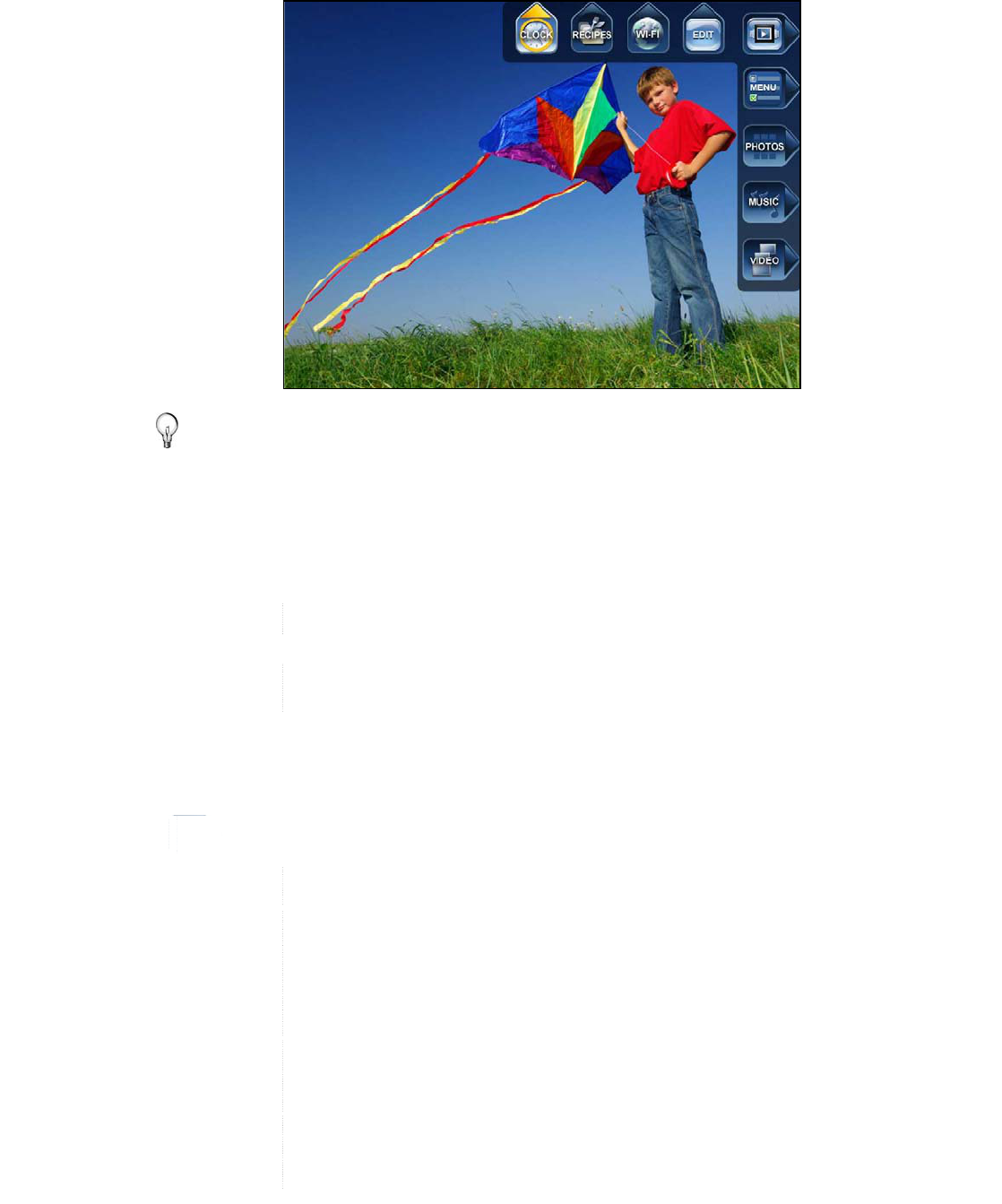
The HOME Screen
The main DPF features, PHOTOS,MUSIC,VIDEO,CLOCK,RECIPES,
and the Setup Menu screen are accessed from the HOME
screen.
To access the HOME screen while a slideshow is playing, press MENU
or activate the PanTouch interface and then touch HOME.
11
TIP: The background photo will change according to the photos
stored on the selected media source.
Clock View clock and calendar with photo slideshow, and manage
the calendar, clock, and alarm settings (page 33)
Recipes View pre-loaded sample recipes and cookbooks (page 37)
Edit Quick access to single photo manage mode for Zooming,
Rotating, Importing, or Deleting currently displayed photo
Play Slideshow of photos on currently selected media source
MENU Access the Setup Menu screen
PHOTOS
Display your photo files (.JPG or .JPEG) individually or as
slideshows. PHOTOS-Manage: set viewing preferences,
assign photos to category folders, import and delete photo
files (page 18)
MUSIC Play your MP3 music files. MUSIC-Manage: set listening
preferences, import and delete music files (page 27)
VIDEO Play motion JPEG AVI video files. VIDEO-Manage: set
viewing preferences, import and delete video files (page 30)
12 12
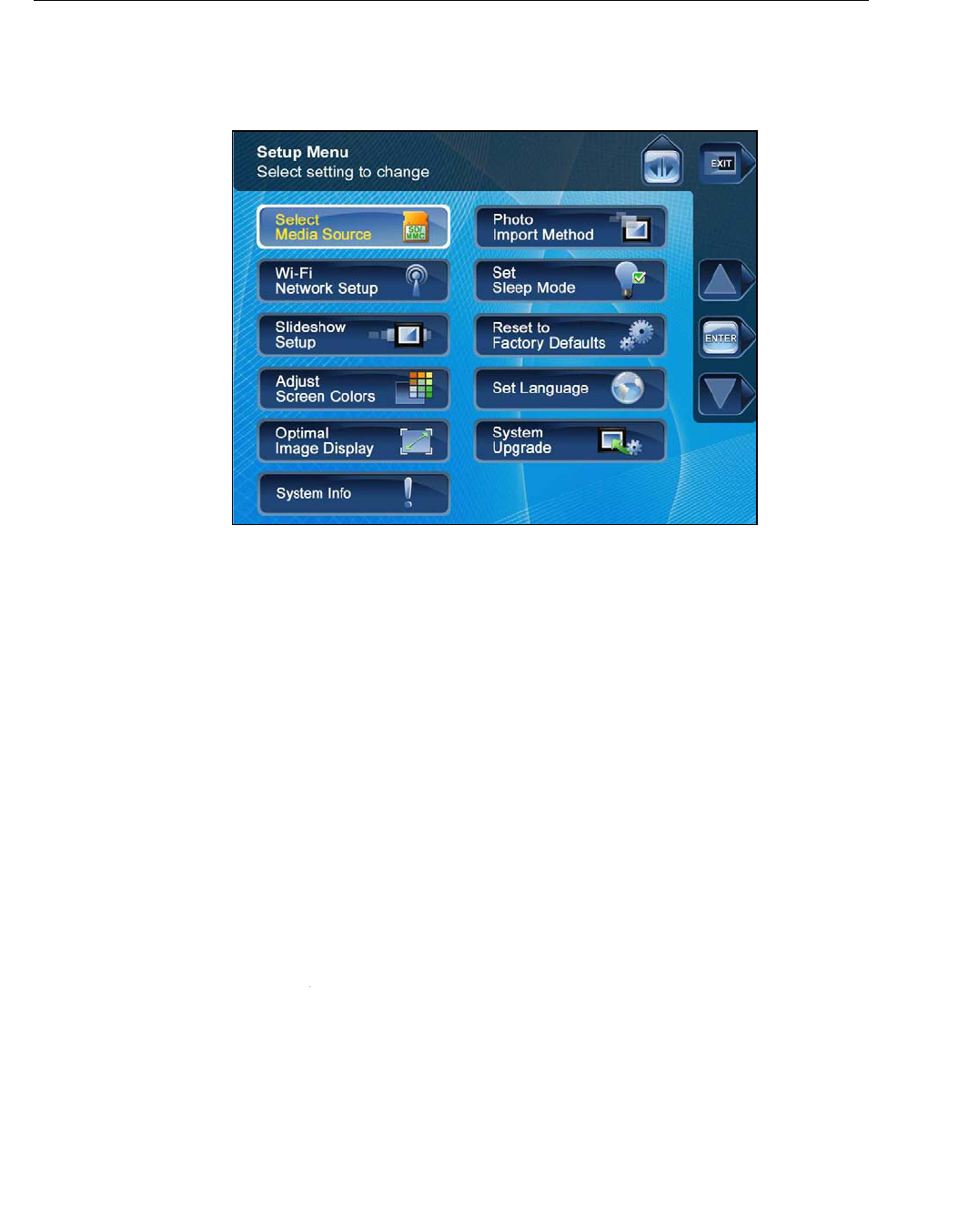
SETUP Menu Overview
Use the Setup Menu for DPF functions to optimize your viewing/listening
preferences. To access the Setup Menu screen, on the HOME screen,
touch or press MENU.
Select Media
Source
Select the media source for current viewing or
listening (page 17)
Slideshow Setup Multiple slideshow functions for optimizing your
viewing preferences (begin on page 22)
Adjust Screen
Colors Adjust LCD screen settings as desired (page 20)
Optimal Image
Display
Set photos to display as original photo size, or
optimized to best fit the screen (page 21)
Photo Import
Method
Set photos to be imported compressed or original
resolution and file size (page 18)
Set Sleep Mode Power saving function (page 54)
Reset to Factory
Defaults
Returns all function settings to the factory defaults
(page 54)

13
Set Language Select desired DPF display language (page 54)
System Info View current settings and assign name to DPF
(page 55)
System Upgrade For firmware upgrades
Select Media Source
If you have inserted one or more external media sources (i.e., memory
card, USB flash drive), you can use the Select Media Source function to
switch between the internal memory and your external media source for
viewing your photos, videos, or listening to music.
You will also use this function to view the contents of the Slideshow
Folders after you assign photos to these folders (page 23).
1. On the
HOME screen, touch or press MENU to display the Setup
Menu screen.
2. Select
Select Media Source, and then select the desired media
source (only present media sources will be available for selection).
Internal Memory = Built-in flash memory
SD/MMC = Secure DigitalTM / Multi MediaTM card
MS = Memory StickTM (Standard, Pro, and Duo)
xD = eXtreme Digital flash memory card
CF = Compact Flash
USB = Standard USB flash drive
Slideshow Folders = View photos after assigning to folders (page 23)
3. The Photo Thumbnails or Slideshow Folders screen will display
the photos found in the selected media source.

14
PHOTOS
The PHOTOS feature includes many functions for playing slideshows,
viewing individual photos, and for optimizing your viewing preferences.
Display Photo Thumbnails Screen
1. On the HOME screen, select PHOTOS to display the Photo
Thumbnails screen.
2. To view a photo in full-screen, use the arrows to highlight the
desired photo, and then touch View or press ENTER.
Zoom or Rotate Photos
With an individual photo displayed (per above instructions),
touch or press ZOOM or ROTATE, multiple times if required to
achieve desired view.
TIP: When a photo is zoomed, you can pan around the
photo by using the arrows to view portions of the photo
that are not currently visible.
Import Photos into Internal Memory
You can import your photo files from external media sources (i.e.,
memory card, USB flash drive) into the DPF’s internal memory. The
number of photo files you can import depends on file size and
available memory.
1. Insert your media source into the DPF. The memory card
option screen will be displayed.
2. To import all photos, touch IMPORT ALL PHOTOS.
To import selected photos:
a) Touch
SELECT PHOTOS TO IMPORT.
b) Touch
MANAGE +.
c) Use the arrows to scroll through the photos, and then
touch to select each photo you want to import.
15
d) Touch IMPORT SEL.
e) Confirm
Yes or No.
1. Insert your media source into the DPF. The memory card
option screen will be displayed.
2. To import all photos, select IMPORT ALL PHOTOS.
To import individual photos:
a) Select
SELECT PHOTOS TO IMPORT.
b) Use to scroll through the photos, and then
press ‘+’ to select the desired photos to import.
c) Press
MENU, and then select IMPORT SEL.
d) Confirm
Yes or No.
TIP: After starting an import, you can touch CANCEL or press
EXIT to stop the import operation. Photos that have
already been imported will not automatically be deleted.
Delete Photos from Internal Memory
You can delete photo files from the DPF’s internal memory, but not
from an external media source (i.e., memory card, USB flash drive).
In order to delete photo files, you must have Internal Memory as
your selected media source.
TIP: It is recommended to make backup copies of the photos
before you delete them from the DPF.
1. On the HOME screen, select PHOTOS.
2. Touch MANAGE +.
3. To delete all photos, select DELETE ALL, and then confirm
Yes or No.
To delete selected photos:
a) Use the arrows to scroll through the photos, and then
use to select each photo you want to delete.
16
b) Select DELETE SEL.
c) Confirm
Yes or No.
1. On the HOME screen, select PHOTOS.
2. To delete all photos, press MENU and then select
DELETE ALL.
To delete selected photos:
a) Use to scroll through the photos, and then
press ‘+’ to select (‘-‘ will deselect).
b) Press
MENU.
c) Select
DELETE SEL.
d) Confirm
Yes or No.
TIP: If, by mistake, you select Yes to delete photos, you can
touch CANCEL or press EXIT to stop the delete operation.
Photos already deleted will not automatically be restored.
Adjust Screen Colors
There are four LCD color level settings that you can adjust for
optimal image viewing.
1. On the HOME screen, select MENU to display the Setup
Menu screen.
2. Select
Adjust Screen Colors.
3. Touch
NEXT PHOTO to view the preferred photo for optimal
balance adjustments.
4. Touch the desired setting option button at the top of the
screen; Brightness,Contrast,Tint, or Color.
5. Use the arrows to adjust the option setting until the desired
view is achieved.
6. Select
DONE to save the settings.

17
1. On the HOME screen, press MENU to display the Setup
Menu screen.
2. Select
Adjust Screen Colors.
3. Use to access the LCD option button.
4. Use to scroll through the LCD options, and use
to adjust the option setting until the desired view
is achieved.
5. Press
ENTER to access the DONE button to save the
settings.
Optimal Image Display
The DPF can display your photos as original size or optimized to fit
the screen size.
1. On the
HOME screen, touch or press MENU to display the
Setup Menu screen.
2. Select
Optimal Image Display, and then select the desired
setting (small green dot indicates selected option).
Original = Displays photos with actual photo size, which may result in part of a
photo not being visible on the screen.
Optimal (default) = Optimizes the size and resolution to best fit the screen.
Photo Import Method
When importing files into the internal memory from an external media
source, the file can be optimized or left as the original file size and
resolution.
1. On the
HOME screen, touch or press MENU to display the
Setup Menu screen.
2. Select
Photo Import Method, and then select the desired
setting (small green dot indicates selected option).
Optimized (default) = The photo file is downscaled in size and compressed
into a smaller sized JPEG, allowing more photos to be stored in the internal
memory.
Original = The photo file is stored keeping its original size and resolution.

18
PHOTO SLIDESHOWS
The DPF can display all of the photos on the selected media source as a
slideshow, or you can select specific photos for a custom slideshow. You
can also have background music with your slideshows simply by storing
music MP3 files on your selected media source.
Slideshow of Photos in Internal Memory
You can play a slideshow of the photos stored in the DPF’s internal
memory by simply powering on the DPF (if no external media source
or is inserted) and then wait for the slideshow to automatically begin.
Slideshow of Photos on your Media Source
Insert an external media source (i.e., memory card) into the DPF; a
memory source option screen is displayed for 15 seconds and then
the slideshow will begin automatically unless you choose one of the
three options.
Pause a Slideshow
To pause a slideshow, touch or press EXIT. The slideshow will pause
for approximately 30 seconds, and then will automatically resume
playing.
To resume the slideshow without waiting for the 30-second timeout,
touch or press ENTER.
Slideshow Background Music
To play background music during a slideshow, simply copy at least
one music MP3 file onto the same media source as your photos. The
music will automatically play as the slideshow is displayed.
If you have multiple MP3 files on your media source, each music file
will play in succession until all have been played, and then will repeat
according to the Music Repeat Mode setting (page 28).

19
Adjust the Volume
While the music is playing, activate the PanTouch interface and
then select the on-screen volume + or - buttons, or press the
remote control ‘+’ or ‘-‘ buttons.
Mute the Background Music
Press ENTER or activate the PanTouch interface and then
touch .
The slideshow will continue to play with the music muted until
you press ENTER again or touch .
Slideshow Folders
There are five category folders in the internal memory into which you
can assign photo files for personalized organization and slideshows
(these folder names cannot be changed):
Family – Friends – Vacation – Events – Others
Only photos stored in the internal memory can be assigned to the
slideshow folders. Assigned photos are not physically moved or
copied into the folders, rather, a link is assigned to the photo so it
appears to be located in the folder. If you delete the actual photo file
from internal memory, the link to the folder will also be deleted.
Copy Photos into Slideshow Folders
1. On the HOME screen, select PHOTOS.
2. Touch
MANAGE +.
3. Use the arrows to highlight the desired photos, select
to select each photo, and then select COPY TO.
4. Use the arrows to highlight the desired slideshow folder
into which you will copy the selected photos, and then
select ENTER.
1. On the HOME screen, select PHOTOS.
2. Press ‘+’ to select desired photos (‘-‘ will deselect).
3. Press
MENU.
20
4. Select COPY TO, and then select the desired folder
into which you will copy the photos.
Play Slideshow from Slideshow Folder
1. On the HOME screen, touch or press MENU to display the
Setup Menu screen.
2. Select
Select Media Source.
3. Select
Slideshow Folders.
4. Select the desired folder containing the photos you want to
view in your slideshow.
5. Touch or press
EXIT to return to the HOME screen, and then
touch or press SLIDESHOW.
Copy or Move Photos to Different Folders
After assigning photos to folders, you can copy or move those
photos to other folders.
1. With the slideshow folders slideshow playing (per
above), touch EXIT twice to display the Folder
Thumbnails screen.
2. Touch
MANAGE +.
3. Use the arrows to scroll through the photos, and then
use to select the photos you want to copy or move.
4. Touch
COPY TO or MOVE TO.
5. Select the desired folder into which you want to copy
or move the selected photos.
1. With the slideshow folders slideshow playing (per
above), press EXIT twice to display the Folder
Thumbnails screen.
2. Use to scroll through the photos, press ‘+’
to select (‘-‘ will deselect).

21
3. Press MENU, and then select COPY TO or MOVE TO.
4. Select the desired folder into which you want to copy
or move the selected photos.
Slideshow Setup Options
You can set multiple options for customizing your slideshow
preferences.
Set Slideshow Music Mode
You can set the slideshow to display without music, even if music
files are present on the selected media source.
1. On the
HOME screen, touch or press MENU to display the
Setup Menu screen.
2. Select
Slideshow Setup.
3. Use the left/right arrows to highlight Slideshow Music, use the
up/down arrows to toggle ON/OFF.
ON (default) = Play background music with slideshow
OFF = Do not play music with slideshow, even if MP3 files are stored on
selected media source
4. Select Done to save all settings.
Set Slideshow Interval
You can set the speed at which the slideshow photos transition from
one to another.
1. On the
HOME screen, touch or press MENU to display the
Setup Menu screen.
2. Select
Slideshow Setup.
3. Use the left/right arrows to highlight Slideshow Interval, use the
up/down arrows to scroll through the options.
5(default), 10, 30, 60 seconds, 30 minutes, 1 hour, or 24 hours
4. Select Done to save all settings.

22
Set Slideshow Transition
You can set the transition ‘special effects’ as photos transition from
one to another during a slideshow.
1. On the
HOME screen, touch or press MENU to display the
Setup Menu screen.
2. Select
Slideshow Setup.
3. Use the left/right arrows to highlight Slideshow Transition, use
the up/down arrows to scroll through the options.
OFF = Photos transition from one photo to the next without special effects.
Random (default) = Photos will transition using all special effects randomly
throughout a slideshow.
Remaining special effects = Choose individual transition effect as desired
4. Select Done to save all settings.
Set Slideshow Shuffle
You can set the slideshow to display your photos in a random
‘shuffle’ order, or display them in the order as stored on the selected
media source.
1. On the
HOME screen, touch or press MENU to display the
Setup Menu screen.
2. Select
Slideshow Setup.
3. Use the left/right arrows to highlight Slideshow Shuffle, use the
up/down arrows to toggle ON/OFF.
ON = Displays photos randomly
OFF (default) = Displays photos in the order found on selected media source
4. Select Done to save all settings.
Display Current Time with Photos
The current time can be displayed in the upper left corner of the
screen with your photos if desired.
1. On the
HOME screen, touch or press MENU to display the
Setup Menu screen.
2. Select
Slideshow Setup.

23
3. Use the left/right arrows to highlight Display Current Time, use
the up/down arrows to toggle ON/OFF,
4. Select
Done to save the setting.
TIP: If the time is incorrect, refer to Set Date and Time on page
33 to set the clock.
Display Photo File Date/Time Stamp with Photos
Most digital cameras typically include a Date/Time stamp when
saving photo files. If your photo files contain this Date/Time
information, you can have it displayed with your photos if desired.
1. On the
HOME screen, touch or press MENU to display the
Setup Menu screen.
2. Select
Slideshow Setup.
3. Use the left/right arrows to highlight Display Photo File
Date/Time, use the up/down arrows to toggle ON/OFF, and
then touch or press ENTER to save the setting.
4. Select
Done.
MUSIC
Note: Music files must be standard MP3 format and not from licensed
music download services.
Playing Music Only
1. On the HOME screen, select MUSIC. All present music files will
be listed.
2. Use the arrows to scroll through the list, and then touch or
press ENTER to play a music file.
3. To play a different music file, simply select a different file name.
4. To stop the music, touch , or press EXIT.

24
Adjust the Volume
While the music is playing, activate the PanTouch interface and
then use the on-screen volume + or - buttons, or press the
remote control ‘+’ or ‘-‘ buttons.
Mute the Music
Press ENTER or activate the PanTouch interface and then
touch .
The music will remain muted until you press ENTER again or
touch .
Set Music Repeat Mode
By default, the Music Repeat Mode is set to continuously play all
music files found on the selected media source until you stop them. If
desired, you can change the repeat mode to play all music files only
once.
Repeat ON (default) = continuously play all music files on the selected media
source until you stop them.
Repeat OFF = play the music files only once.
1. On the MUSIC screen, select REPEAT to toggle ON/OFF
(small green dot indicates ON).
1. On the MUSIC screen, press MENU.
2. Select Repeat to toggle ON/OFF (small green dot
indicates ON).
Import Music Files into Internal Memory
You can import your music files from external media sources (i.e.,
memory card, USB flash drive) into the DPF’s internal memory. The
number of music files you can import depends on file size and
available memory.
25
1. On the HOME screen, select MUSIC.
2. To import all music files, select IMPORT ALL, and then
confirm Yes or No.
To import selected music files, use the arrows to scroll
through the files, touch on each file you want to
import, select IMPORT SEL, and then confirm Yes or No.
1. On the HOME screen, select MUSIC.
2. To import all music files, press MENU, select IMPORT
ALL, and then confirm Yes or No.
To import selected music files, use to
highlight the files you want to import, press ‘+’ to select
(‘-‘ will deselect), press MENU, select IMPORT SEL,
and then confirm Yes or No.
TIP: After starting an import, you can touch CANCEL or press
EXIT to stop the import operation. Music files that have
already been imported will not automatically be deleted.
Delete Music Files from the Internal Memory
You can delete music files only from the DPF’s internal memory. It is
recommended that you make backup copies of the music files before
deleting them.
Note:Internal Memory must be your selected media source.
1. On the HOME screen, select MUSIC.
2. To delete all music files, select DELETE ALL, and then
confirm Yes or No.
To delete selected music files, use the arrows to scroll
through the files, touch on each file you want to
delete, select DELETE SEL, and then confirm Yes or No.
26
1. On the HOME screen, select MUSIC.
2. To delete all music files, press MENU, select DELETE
ALL, and then confirm Yes or No.
To delete selected music files, use to
highlight the files you want to delete, press ‘+’ to select
(‘-‘ will deselect), press MENU, select DELETE SEL, and
then confirm Yes or No.
TIP: If, by mistake, you select Yes to delete, you can touch
CANCEL or press EXIT to stop the delete operation. Music
files already deleted will not automatically be restored.
VIDEOS
The DPF supports motion JPEG AVI video files. If your movie file is not
in AVI format, you may have to convert the file by using a software video
converter which is easily found for purchase on the Internet.
Watch a Video
1. On the
HOME screen, select VIDEO. All present video files will
be listed.
2. Use the arrows to scroll through the list, and then touch or
press ENTER to play a video file.
3. To play a different video file, simply select a different file name.
4. To stop the video, activate the PanTouch interface and then
touch , or press EXIT.
Adjust the Volume
While the video is playing, activate the PanTouch interface and
then use the on-screen volume + or - buttons, or press the
remote control ‘+’ or ‘-‘ buttons.
27
Mute the Video
Press ENTER or activate the PanTouch interface and then
touch .
The video will remain muted until you press ENTER again or
touch .
Video Repeat Mode
By default, the Video Repeat Mode is set to continuously play all
video files found on the selected media source until you stop them. If
desired, you can change the repeat mode to play all video files only
once.
Repeat ON (default) = continuously play all video files on the selected media source
until you stop them.
Repeat OFF = play the video files only once.
1. On the VIDEO screen, select REPEAT to toggle ON/OFF
(small green dot indicates ON).
1. On the VIDEO screen, press MENU.
2. Select
Repeat to toggle ON/OFF
(small green dot indicates ON).
Import Video Files into Internal Memory
You can import your video files from external media sources (i.e.,
memory card) into the DPF’s internal memory. The number of video
files you can import depends on file size and available memory.
1. On the VIDEO screen, touch MANAGE +.
2. To import all video files, select IMPORT ALL, and then
confirm Yes or No.
28
To import selected video files, use the arrows to scroll
through the files, select on each file to import, select
IMPORT SEL, and then confirm Yes or No.
1. On the HOME screen, select VIDEO.
2. To import all video files, press MENU, select IMPORT
ALL, and then confirm Yes or No.
To import selected video files, use to
highlight the files you want to import, press ‘+’ to select
(‘-‘ will deselect), press MENU, select IMPORT SEL, and
then confirm Yes or No.
TIP: After starting an import, you can touch CANCEL or press
EXIT to stop the import operation. Video files that have
already been imported will not automatically be deleted.
Delete Video Files from the Internal Memory
You can delete video files only from the DPF’s internal memory. It is
recommended that you make backup copies of the video files before
deleting them.
Note:Internal Memory must be your selected media source.
1. On the HOME screen, select VIDEO.
2. To delete all video files, select DELETE ALL, and then
confirm Yes or No.
To delete selected video files, use the arrows to scroll
through the files, touch on each file you want to
delete, select DELETE SEL, and then confirm Yes or No.
1. On the HOME screen, select VIDEO.
2. To delete all video files, press MENU, select DELETE
ALL, and then confirm Yes or No.
29
To delete selected video files, use to
highlight the files you want to delete, press ‘+’ to select
(‘-‘ will deselect), press MENU, select DELETE SEL, and
then confirm Yes or No.
TIP: If, by mistake, you select Yes to delete, you can touch
CANCEL or press EXIT to stop the delete operation. Video
files already deleted will not automatically be restored.
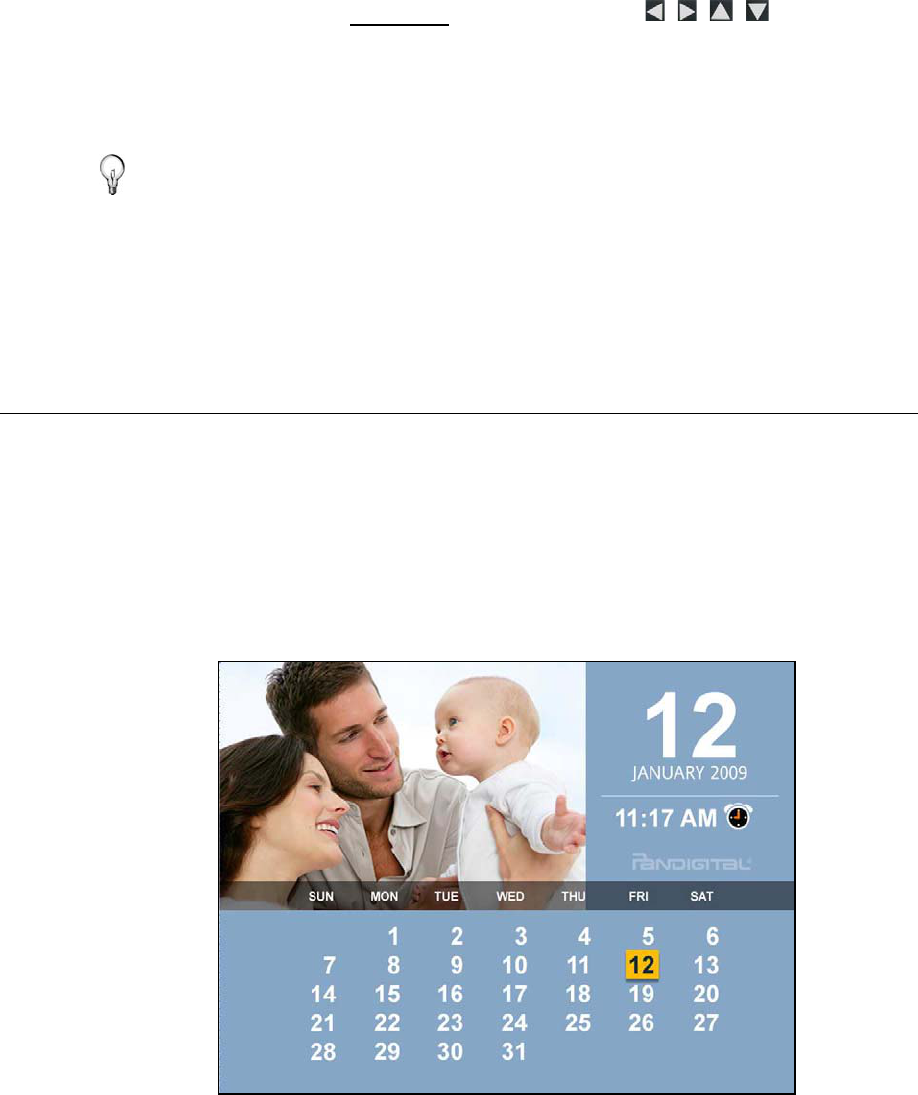
CALENDAR/CLOCK
Your DPF can be used as a personal desk calendar with a real-time
clock and alarm, and also displays a continuous slideshow of photos on
the selected media source.
To display the CALENDAR/CLOCK screen, select CLOCK from the
HOME screen. The slideshow will be displaying photos found on the
currently selected media source.
Set Date and Time
1. On the CALENDAR/CLOCK screen, activate the PanTouch
interface or press MENU, and then select SET DATE/TIME.

30
2. Use the left/right arrows to scroll between the Date and Time
options, and touch or press ENTER to activate the entry fields.
3. Use left/right arrows to scroll through the fields, and the up/down
arrows to change the field values.
4. Select
DONE to save settings.
Set Alarm
You can use your DPF as an alarm clock when desired. You can set
the frequency of the alarm, and set the alert to sound the built-in tone
or play your music file.
1. On the
CALENDAR/CLOCK screen, activate the PanTouch
interface or press MENU, and then select SET ALARM.
2. Use the left/right arrows to scroll between the options, and touch
or press ENTER to activate the entry fields.
Alarm = set the time you want the alarm to alert.
Frequency = set how often you want the alarm to alert (Always, Once, Off)
Alert = set the alert to Music or default Tone (if music, the music file must
reside on the currently selected media when alarm is activated)
3. Use the left/right arrows to scroll through the fields, and the
up/down arrows to change the field values.
4. Select DONE to save settings
When the alarm is set, a small bell or music note will be displayed
indicating the alarm has been set.
Note: At least one MP3 music file must be present on the selected
media source for the alert to play music. If you set the alert to
play music and there is no MP3 music file present, the default
tone will sound instead.
Turn Alarm Off
When the alarm sounds, activate the PanTouch interface or press
any button on the remote control to stop it and return to the
CALENDAR/CLOCK screen.
To cancel the alarm before its scheduled time, follow the previous
instructions for setting the alarm and set the frequency to OFF.
31
Select Media Source for Calendar Slideshow
You can easily change the media source if you want the
calendar/clock slideshow to display photos from a different media
source (i.e., memory card, slideshow folder).
1. On the
CALENDAR/CLOCK screen, activate the PanTouch
interface or press MENU, and then select the Media Source
button in the top of the screen.
2. Select the new media source from the Select Media screen.
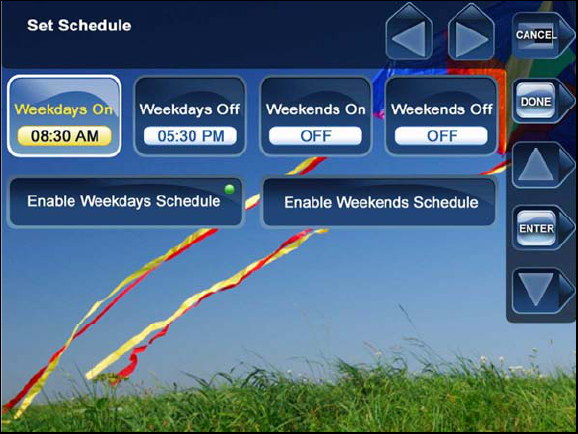
Set Schedule
You can schedule the DPF to automatically go into a “stand-by”
mode and then resume operation according to your weekly schedule.
For example, if you have your DPF on your desk at work, you may
want to display the calendar/clock or play a slideshow from 8:30am
to 5:30pm every weekday, and then set the DPF to remain in stand-
by mode throughout the weekend. The following Monday morning,
the DPF would resume operation at 8:30am.
1. On the CALENDAR/CLOCK screen, activate the PanTouch
interface or press MENU, and then select SET SCHED.
2. Use the left/right arrows to scroll through the Weekdays and
Weekends options.
3. Touch or press
ENTER to activate the entry fields.

32
4. Use the left/right arrows to scroll through the fields, and the
up/down arrows to change the field values.
5. Touch or press
ENTER to enable the Weekdays and/or
Weekends Schedule buttons.
6. Select Done to save the settings.
Disable the Schedule
To disable the schedule, turn both Enable Weekdays/Weekends
Schedule buttons OFF, and the entry fields will display OFF.
Run the Schedule
After the schedule times have been set (per instructions on page 35),
you will use the Run Schedule function whenever you want the
schedule to take effect.
CAUTION: After you select the Run Schedule function, any user
intervention will cancel the activation and the schedule
will not take effect until you select this function again to
re-activate.
At the start of a slideshow, touch RUN SCHED before the
menu times out.
While a slideshow is playing, or on the
CALENDAR/CLOCK screen, activate the PanTouch
interface and touch RUN SCHED.
At the start of a slideshow, press ENTER when the RUN
SCHED button is displayed on the screen (approximately 10
seconds).
While a slideshow is playing, or on the CALENDAR/CLOCK
screen, press MENU, and then select RUN SCHED.
A small timer clock will appear indicating the schedule is active, and
the DPF will go into stand-by mode according to the schedule.

33
RECIPES
The DPF’s Recipes feature allows you to view recipes from popular
authors such as Bon Appétit and Good Housekeeping (sold separately
on our website http://www.pandigital.net).
Sample Bon Appétit seasonal recipes are included with this DPF so you
can experience how the recipe feature works when you purchase and
install the complete seasonal cookbooks.
Note: The Recipes feature is accessible only when the Internal Memory
is the selected media source (page 17.)
You will use these instructions for the pre-loaded sample recipes as well
as the complete cookbook collections.
View Recipes in Cookbook
1. On the HOME screen, select RECIPES to display the Cookbooks
screen.
2. Select a Cookbook to display the Cookbook Thumbnails
screen.
3. Use the arrows to highlight the recipes, and then touch VIEW or
press ENTER to display a recipe in full screen.
While the individual recipe is displayed, you can touch or press
ZOOM to enlarge the recipe. You can also use the arrows to
display the previous/next recipes.
Copy Recipes to ‘My Favorite Recipes’
You can copy recipes from a main Cookbook into six food group
categories for quick and easy retrieval: Hors d’oeuvres, Soups,
Salads, Entrées, Desserts and Others.(The food group category
names are not changeable).
1. On the
HOME screen, select RECIPES.
2. Select a Cookbook to display the Cookbook Thumbnails
screen.

34
3. Use the arrows to scroll through the recipes, touch
on each recipe that you want to copy, and then select
COPY TO.
Use to scroll through the recipes, press ‘+’ on
each recipe that you want to copy, press MENU, and then
select COPY TO.
4. Select the desired food group category into which you want to
copy the recipes.
View the Recipes in ‘My Favorite Recipes’
After you have copied recipes into the food group categories (per
instructions above) you can quickly view them at any time.
1. On the
RECIPES screen, select My Favorite Recipes.
2. Select the desired food group category to view.
3. Use the arrows to highlight the recipes, and then select VIEW or
press ENTER to display a recipe in full screen.
While the individual recipe is displayed, you can touch or press
ZOOM to enlarge the recipe. You can also use the arrows to
display the previous/next recipes.
Delete, Move, or Copy Recipes from Categories
After you have copied recipes into food group categories, you can
delete them from the category, move, or copy them from one
category into another when desired.
1. On the
RECIPES screen, select My Favorite Recipes.
2. Select the desired food group category from which you will
delete, move, or copy recipes.
3. Use the arrows to scroll through the recipes, touch on
each recipe that you want to copy, move, or delete, and
then select COPY TO, MOVE TO, or DELETE.

35
Use to scroll through the recipes, press ‘+’ on
each recipe that you want to copy, move, or delete. Press
MENU, and then select COPY TO,MOVE TO, or DELETE.
4. When applicable, select the desired food group category into
which you will move or copy the recipes.
36
Connect DPF to Windows PC
1. Connect the small end of the USB cable to DPF’s Mini USB port,
and the larger end to an available USB port on your computer.
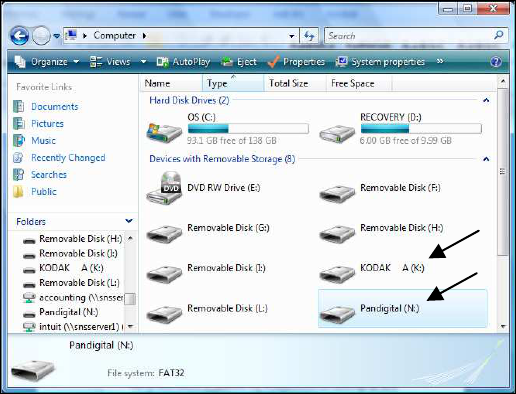
2. A window opens listing all drives connected to your computer,
similar to the following screen:
3. The internal memory (titled Pandigital)and each memory card
present in the DPF will be associated with one disk drive on your
computer.
)IMPORTANT: If your PC is connected to Local Area Network
drives, or if you have multiple drive letters already
assigned to peripheral devices, you will need to
manage your drive settings in Windows to free up
the four drive letters immediately following your
CD-ROM drive so the DPF can assign them to
memory card slots properly.
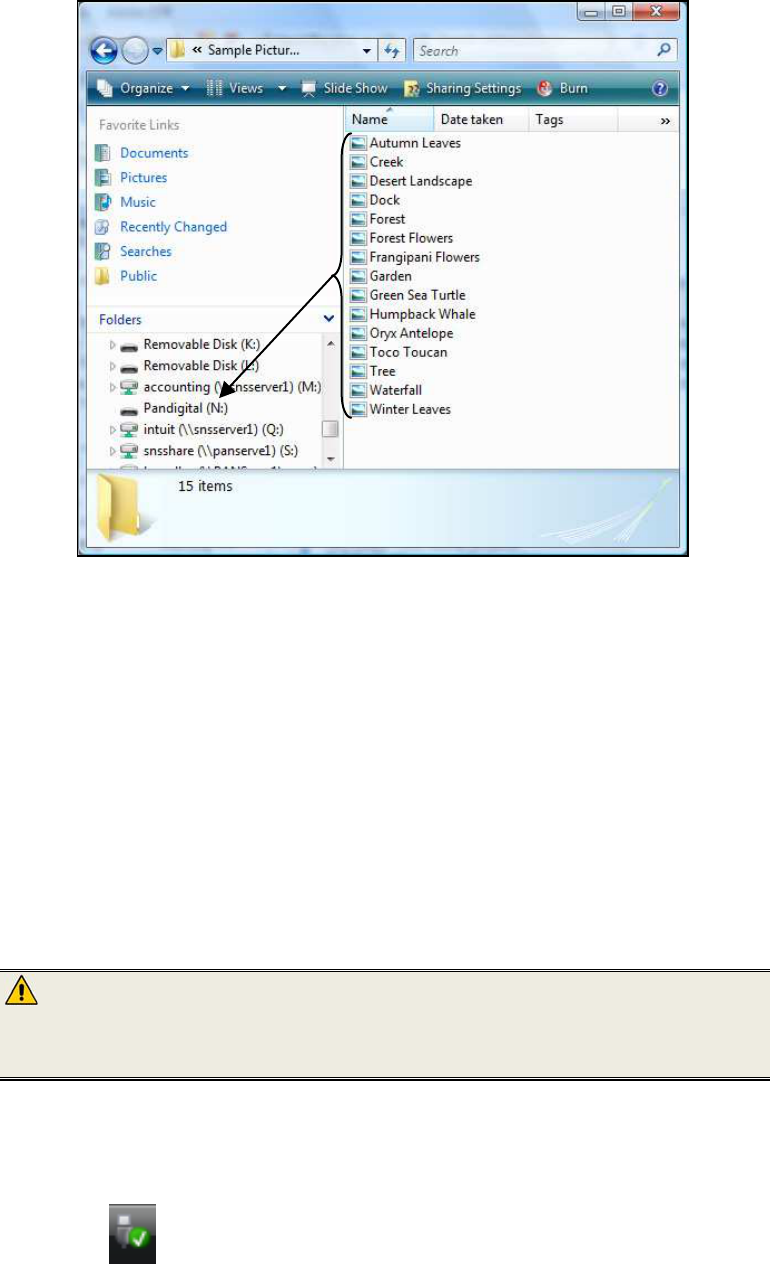
4. Double-click the desired drive to display the files on the card.
The following example shows a card listing several JPG images.
37
5. To copy files from a media source, select and drag them into the
DPF’s internal memory drive (Pandigital).
6. Similarly, to copy files from your computer to the internal
memory, first locate the files on your computer, select the files
you want to copy, and then drag and drop them into the
appropriate folder in the DPF’s internal memory drive.
Disconnect DPF from Windows PC
It is important to always perform a safe PC ‘release’ before
disconnecting the DPF USB cable from the PC.
WARNING: Do not unplug or switch off the DPF when files
are being transferred, as that can seriously
damage the memory.
Windows Vista
1. On the Windows System Tray, click the hardware removal
icon .
2. Click the
Safely remove USB mass Storage device
message corresponding with the DPF device drive.

38
3. When the message “This device can now be safely removed
from the computer” appears, you can disconnect the USB
cable from your computer.
Windows XP
1. On the Windows System Tray, click the hardware removal
icon .
2. Click
Remove Hardware Safely.
3. Select the storage device corresponding with the DPF, and
then click Stop to disconnect. A final dialog box opens.
4. Click
Close.
5. When the message “It is now Safe to Disconnect
Hardware” appears, you can disconnect the USB cable
from your computer.
Connect DPF to Macintosh Computer
1. Use the USB cable (included) to connect the DPF to your
Macintosh computer.
2. Macintosh will recognize the DPF as an external storage device.
3. Drag and drop files between the two devices as you normally
move files.
Disconnect DPF from Macintosh Computer
1. To safely disconnect the DPF from your Macintosh, select
DPF’s icon on your desktop and press Command-e to eject
the disk.
2. When the icon is no longer on the desktop, it is safe to
unplug the USB cable.
USB Flash Drive to DPF Connection
The DPF recognizes a USB Flash Drive the same way it recognizes
external memory cards. When you insert the flash drive, the DPF
automatically recognizes photo, music, and video files stored on it.

39
To import files from your flash drive to the DPF’s internal memory, follow
the file import instructions under each feature section (Photos on page
18, Music on page 28, Video on page 30).

40
Set Sleep Mode
The DPF will stay on until you power it off, however, to save power you
can set it to automatically go into a sleep mode when left idle for a
specific amount of time.
1. On the
HOME screen, touch or press MENU to display the Setup
Menu screen.
2. Select
Set Sleep Mode, and then select the desired setting (small
green dot indicates selected option).
OFF (default) = Power saver is ‘disabled’; DPF will remain on until you power it off
or change the sleep mode setting
2/4/8 Hours = The DPF will automatically go into sleep mode when left idle the
specified amount of time
Reset to Factory Defaults
Use this feature to restore function settings to the factory pre-set
defaults.
Note: Wi-Fi network and photo sharing website connection settings will
not be changed.
1. On the
HOME screen, touch or press MENU to display the Setup
Menu screen.
2. Select
Reset to Factory Defaults.
3. Confirm
Yes or No.
Set Language
Depending on model, this DPF may include multiple languages for the
user interface display. Use this feature to change the language at any
time.
1. On the
HOME screen, touch or press MENU to display the Setup
Menu screen.

41
2. Select Set Language to display the available languages.
3. Select the desired language.
System Info
You can view the current DPF settings, including your internal memory
size, wireless network connection, firmware version, and you can assign
a personal unit name if desired.
1. On the
HOME screen, touch or press MENU to display the Setup
Menu screen.
2. Select
System Info.
3. To assign a different unit name, select EDIT FRAME NAME, and
then use the virtual keyboard to enter the desired name. (Instructions
for navigating the virtual keyboard begin on page 39.)
4. Select
Done to save.
Cleaning the DPF
Treat the screen gently, it is made of glass and can break. To clean
fingerprints or dust from the LCD screen, we recommend using a soft,
non-abrasive cloth such as a camera lens cloth to clean the LCD screen.
If you use a commercial LCD Cleaning Kit, do not apply the cleaning
liquid directly to the LCD screen. Clean the LCD screen with cleaning
cloth moistened with the liquid.
Clean the outer surface of the DPF (excluding the screen) and the
remote control with a soft cloth dampened with water.
Change the Decorative Mat
1. Power off the DPF, and then unplug the power adapter.
2. Remove two of the screws on the back of the frame and lift the unit
from the frame.
3. Remove the mat and insert the replacement mat.

42
4. Place the unit back into the frame, replace the screws and only
finger-tighten.
Frequently Asked Questions
Q: How do I set up my DPF?
A: It is very simple to get your Digital Photo Frame setup. Just plug the
power adapter into the DPF and into a standard wall outlet, and
then power it on. After the welcome screen is displayed, a
slideshow will begin displaying the images pre-loaded in the internal
memory. To view your own photos, insert a memory device into the
appropriate slot or USB port on the side of the DPF. Select PLAY
SLIDESHOW from the memory card option screen.
Q: What memory cards can the Digital Photo Frame Read?
A: Compatible memory cards include: Secure Digital™, Compact Flash
(select models), MultiMedia Card™, xD Card, Memory Stick™,
MemoryStick Pro™, and Memory Stick Pro Duo™.
Q: Can I insert multiple memory cards?
A: Yes, you can insert multiple cards at the same time, depending on
slot availability. Use the Select Media function to select the desired
media source for immediate viewing/listening.
Q: I set up the Digital Photo Frame; why won’t it turn on?
A: The power adapter may not be securely connected to the DPF or
the power switch may not be in the ON position.
Q: I have a memory card in the DPF; why can’t I view my photos?
A: A) Be sure that the memory card is one of the formats listed above
and that the files on the card are JPEG images files. Some digital
cameras save images in other formats. Refer to your camera’s user
guide if your photos are not JPEG files.
B) Make sure the memory card is inserted all the way into the card
slot.

43
C) On the HOME screen, touch or press MENU to display the Setup
Menu screen. Select Select Media Source, and then select the
desired media source. Touch or press EXIT to return to the HOME
screen and then select PHOTOS>Slideshow or press Slideshow .
The slideshow should begin displaying your photos.
Q: Why doesn’t my remote work when the PanTouch interface has
been activated?
A: The PanTouch interface has ‘control’ as long as the navigation
buttons are visible. After 5 seconds of non-user intervention, the
navigation buttons will disappear and release control to the remote
control again.
Q: Why is the photo display slower with some photos than others?
A: Higher resolution photos load more slowly. Try using lower resolution
photos or down scaling your images. Refer to your camera’s operating
user guide for details on down scaling your photos.
Q: Does the DPF have built-in (internal) memory?
A: Yes. The memory size varies by model.
Q: Does the DPF support all JPEG and Motion JPEG files?
A: No. The DPF only supports JPEG and Motion JPEG files taken from a
digital camera. The DPF may not read all image files downloaded
from the Internet or from other software graphic applications.
Q: Can I add my own cookbook or recipes to the Recipes feature?
A: No. If you want to create .jpg files of your recipes using your own
graphics editing software, you can copy the .jpg files to your
memory source and then you could view them on the DPF in
PHOTOS mode.
44
Important Safety Precautions
Always follow these basic safety precautions when using your
Multimedia Digital Photo Frame (DPF). This will reduce the risk of fire,
electric shock, and injury.
WARNING: Do not expose this product to rain or moisture.
Do not remove the cover. There are no user-serviceable
parts inside. Refer all servicing to qualified personnel.
The DPF is for indoor use only.
Unplug the DPF before performing care and maintenance.
Do not block the ventilation holes on the back of the DPF at any time.
Keep your DPF out of direct sunlight and heat sources.
Protect the power cord. Route power cords so that they are not likely to
be walked on or pinched by items placed on or against them. Pay
particular attention to the point where the cord attaches to the DPF.
Only use the AC adapter included with the DPF. Using any other power
adapter will void your warranty.
Unplug the power cord from the power outlet when the unit is not in use.

45
Limited Warranty
The limited warranty set forth below is given by Pandigital with respect to
Pandigital brand electronics products purchased and used in the United States of
America. Pandigital warrants this product against defects in material or
workmanship as follows:
LABOR: For a period of one (1) year from the date of purchase, if this product is
found to be defective, Pandigital will repair or replace the product, at its option, at
no charge. After this one (1) year, labor charges will be charged on a case by
case basis.
PARTS: For a period of one (1) year from the date of purchase, if this product is
found to be defective, Pandigital will supply at no cost, new or rebuilt
replacement parts, at its option, at no charge. After this one (1) year period, parts
will be charged for on a case by case basis. Modifications not approved by the
party responsible for compliance could void user’s authority to operate the
equipment.
This warranty does not cover: (1) customer instruction, installation or setup; (2)
cosmetic damage or damage due to accident, misuse, abuse or negligence; (3)
commercial use of the product; (4) modification of any part of the product; (5)
damage due to improper operation, improper maintenance, or connection to an
improper power supply; (6) loss of data, regardless of value or format, that may
result through proper and/or improper use of the product; (7) damage due to an
attempted repair of the product by anyone other than a facility authorized by
Pandigital to service the product; (8) consumables (such as fuses and batteries).
This warranty is valid only in the United States.
The product must be accompanied by a copy of the original retail purchase
receipt. If no proof of purchase is attached, the warranty will not be honored and
repair costs will be charged. This warranty is only valid with written
documentation detailing the complaint attached to the outside or inside of the
carton. This warranty is invalid if the factory applied serial number has been
altered and or removed from the product. This warranty does not provide
protection for the loss of data, regardless of format. Pandigital reserves the right
to modify and design this product without prior notice, written or otherwise.
To obtain warranty service, you must deliver the product freight prepaid in either
its original packaging or packaging affording an equal degree of protection, plus
proof of purchase.
Repair or replacement as provided under this warranty is the exclusive remedy of
the consumer. Pandigital, its parent company, affiliates or subsidiaries, shall not
be liable for any incidental or consequential damages for breach of any
expressed or implied warranty on this product. Except to the extent prohibited by
applicable law, any implied warranty of merchantability or fitness for a particular
purpose on this product is limited in duration to the duration of this warranty.
Some states do not allow the exclusion or limitation of incidental or consequential
damages, or allow limitation on how long an implied warranty lasts, so the above
46
limitations or exclusions may not apply. This warranty gives you specific legal
rights, and you may have other rights, which vary from state to state.
All content included on the Pandigital website as well as Pandigital products,
including pre-loaded demonstration images, digital media, digital cookbooks, text,
graphics, logos, designs, photographs, button icons, images, audio/video clips,
digital downloads, data compilations, and software, is the property of Pandigital
or its suppliers and is protected by United States and international copyright laws
or other intellectual property laws and treaties. Said content shall not be
reproduced or used without express written permission from Pandigital and its
suppliers respectively.
Use of this product constitutes acceptance of these terms and conditions of
warranty.
Technical support telephone number: 1-800-715-5354.
FCC Statement
FCC Part 15 Information
This equipment has been tested and found to comply with the limits for a Class B
digital device, pursuant to Part 15 of the Federal Communication Commission
(FCC) Rules. These limits are designed to provide reasonable protection against
harmful interference in a residential installation.
This equipment generates, uses, and can radiate radio frequency energy and if
not installed and used in accordance with the instructions, may cause harmful
interference to radio communications. However, there is no guarantee that
interference will not occur in a particular installation.
If this equipment does cause harmful interference to radio or television reception,
which can be determined by turning the equipment off and on, the user is
encouraged to try to correct the interference by one or more of the following
measures:
Reorient or relocate the receiving antenna.
Increase the separation between the equipment and receiver.
Connect the equipment to an outlet on a circuit different from that to
which the receiver is connected.
Consult the dealer or an experienced radio/TV technician for help.
WARNING: Changes or modifications to this unit not expressly
approved by the party responsible for compliance could
void the user’s authority to operate the equipment.