Xi Long Electronics XSJ-87L WIRELESS SMART DOOR/WINDOW SENSOR User Manual of XSJ 87L

Shenzhen Xi Long Electronics Co., Ltd. WIRELESS SMART DOOR/WINDOW SENSOR of XSJ 87L

Users Manual

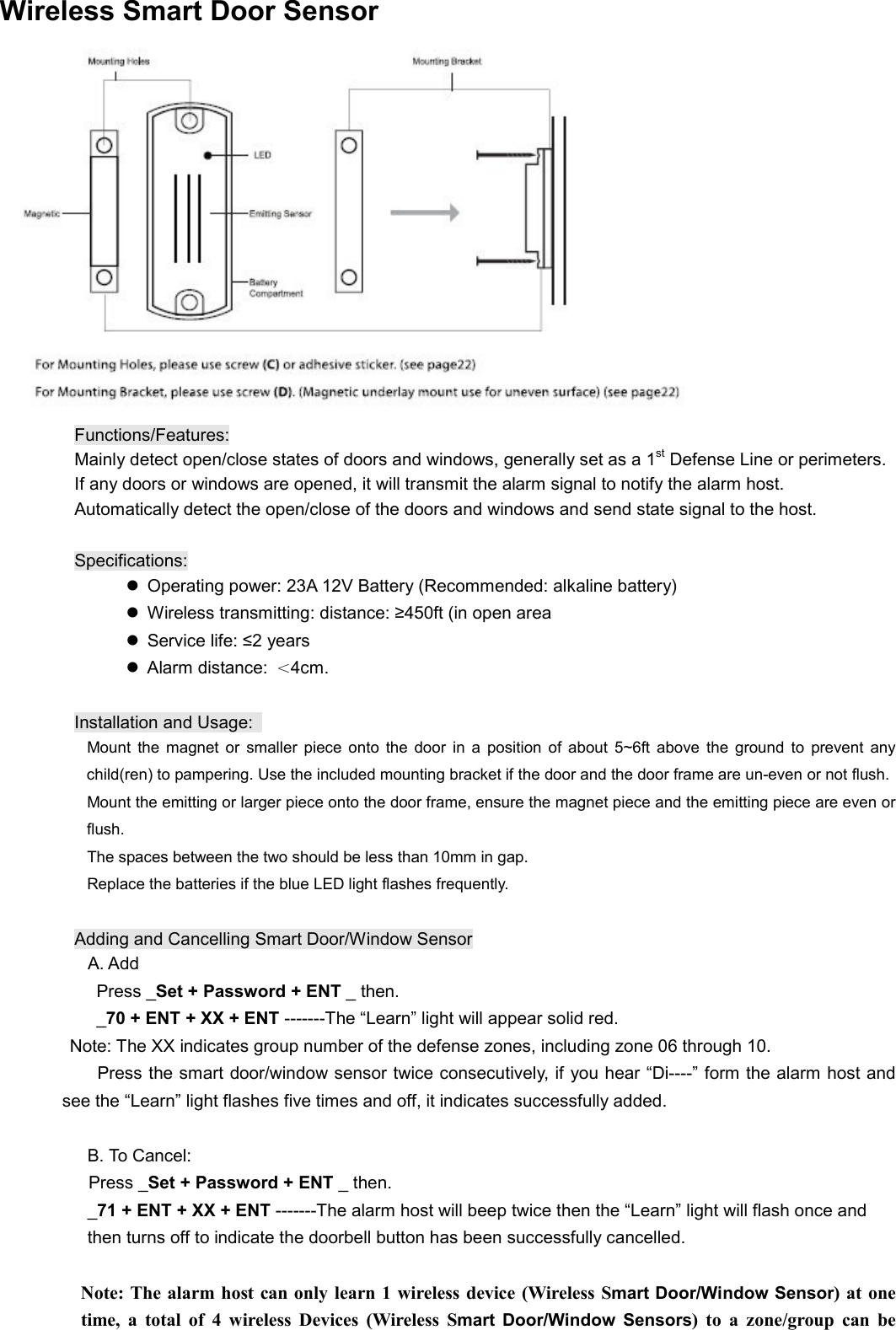
 Wireless Smart Door Sensor  Functions/Features: Mainly detect open/close states of doors and windows, generally set as a 1st Defense Line or perimeters.   If any doors or windows are opened, it will transmit the alarm signal to notify the alarm host.   Automatically detect the open/close of the doors and windows and send state signal to the host.      Specifications:   Operating power: 23A 12V Battery (Recommended: alkaline battery)   Wireless transmitting: distance: ≥450ft (in open area   Service life: ≤2 years   Alarm distance: <4cm.  Installation and Usage:                         Mount  the  magnet  or  smaller  piece  onto the  door  in  a  position  of  about  5~6ft  above  the  ground  to  prevent  any child(ren) to pampering. Use the included mounting bracket if the door and the door frame are un-even or not flush.                       Mount the emitting or larger piece onto the door frame, ensure the magnet piece and the emitting piece are even or flush.                         The spaces between the two should be less than 10mm in gap.                         Replace the batteries if the blue LED light flashes frequently.  Adding and Cancelling Smart Door/Window Sensor                 A. Add                   Press _Set + Password + ENT _ then.          _70 + ENT + XX + ENT -------The “Learn” light will appear solid red. Note: The XX indicates group number of the defense zones, including zone 06 through 10.   Press the smart door/window sensor twice consecutively, if you hear “Di----” form the alarm host and see the “Learn” light flashes five times and off, it indicates successfully added.  B. To Cancel: Press _Set + Password + ENT _ then. _71 + ENT + XX + ENT -------The alarm host will beep twice then the “Learn” light will flash once and   then turns off to indicate the doorbell button has been successfully cancelled.    Note: The alarm host can only learn 1 wireless device (Wireless Smart Door/Window Sensor) at  one time,  a  total  of  4  wireless  Devices  (Wireless  Smart  Door/Window  Sensors)  to  a  zone/group  can  be
added. For example, if 4 sensors were to be added to zone/group 01 through zone/group 15, it total 60 sensors in all. If 1 device is removed from a group that has 4 devices, then all 4 devices in the group will be automatically removed, and each device(s) will have to be added again to the alarm host.        Enabling and Activating Smart Zone Function      (After adding smart door/window sensor successfully) Press _Set + Password + ENT _ then. _91 + ENT + XX + ENT -------The alarm host will beep twice to indicate the smart zone function has been     enabled.( Note: The XX indicates group number of the defense zones, including zone 06 through 10.)   To activate smart zone function by putting the magnet (or smaller piece) and the emitting (or larger piece)   together to get closed when the host is in working status. Note: 1. When arming the host, if the door/window with the smart door/window sensor installed is on, the   LED light of the corresponding zone will appear solid red, at the same time the host will beep   every 2 seconds within 30 seconds.   2. You can arm again to make a force arm.       3. If press “ESC” or wait the host to get out of arm operation automatically in 30 seconds. LED   light turns off to indicate unsuccessful arm.   4. If the smart zone function is not enabled and activated, it can only work as a general   door/window sensor.       FCC Statement  This device complies with Part 15 of the FCC Rules.  Operation is subject to the following two conditions:  (1) This device may not cause harmful interference, and  (2) This device must accept any interference received, including interference that may cause undesired operation.  Note: The manufacturer is not responsible for ANY interference, for example RADIO or TV interference, caused by  unauthorized modifications to this equipment. Such modifications could  void the user’s authority to operate  the equipment.

Navigation menu