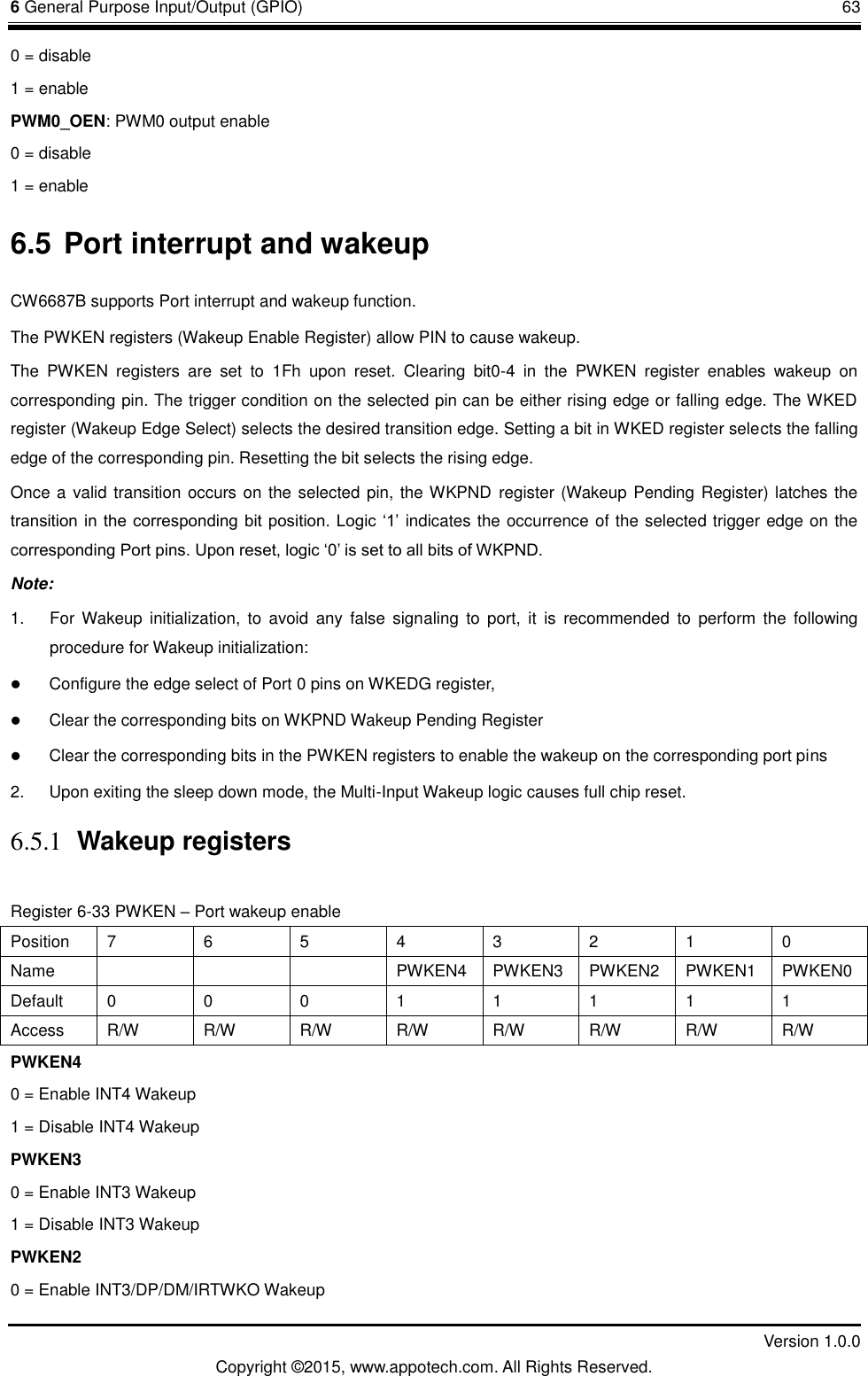
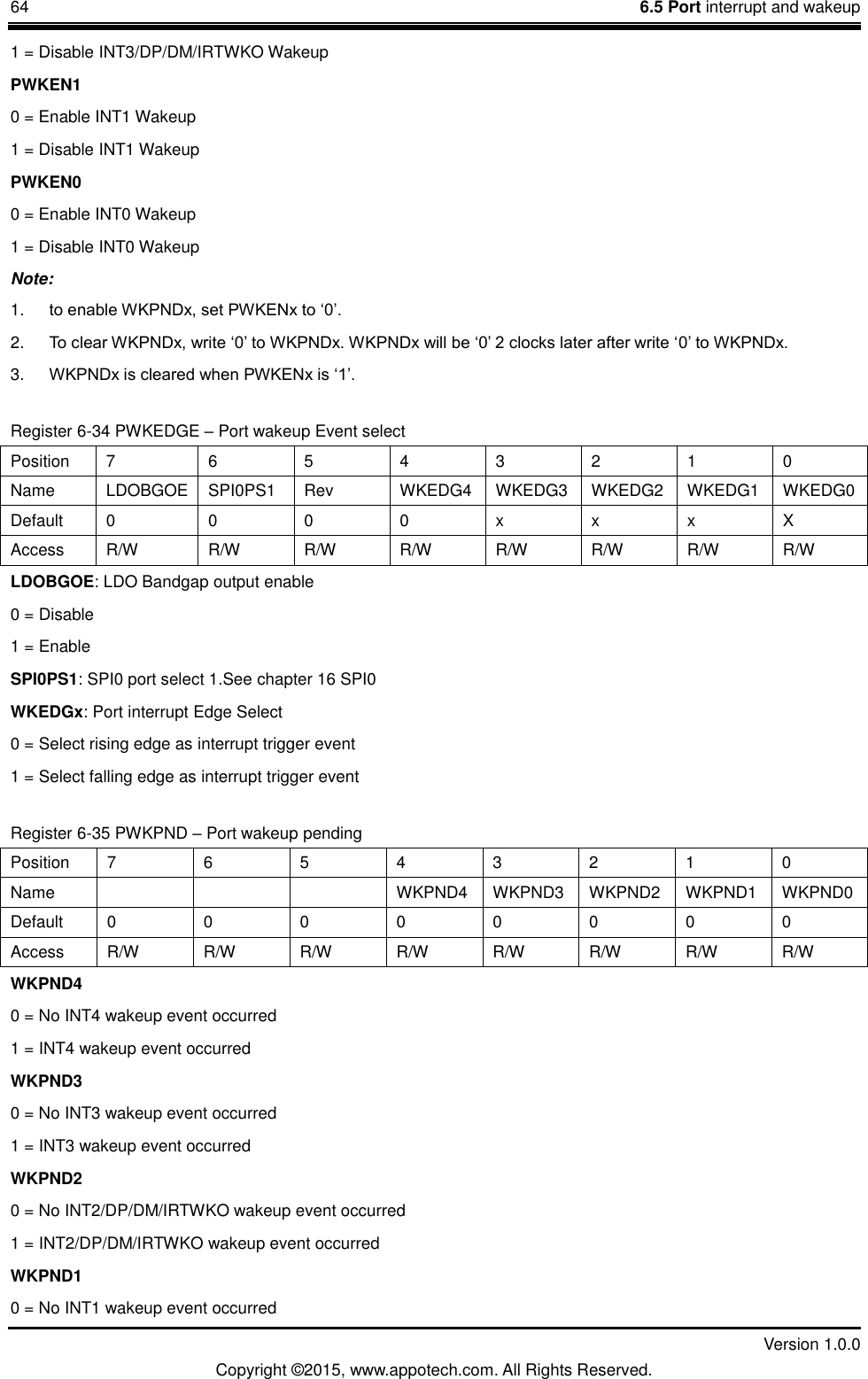
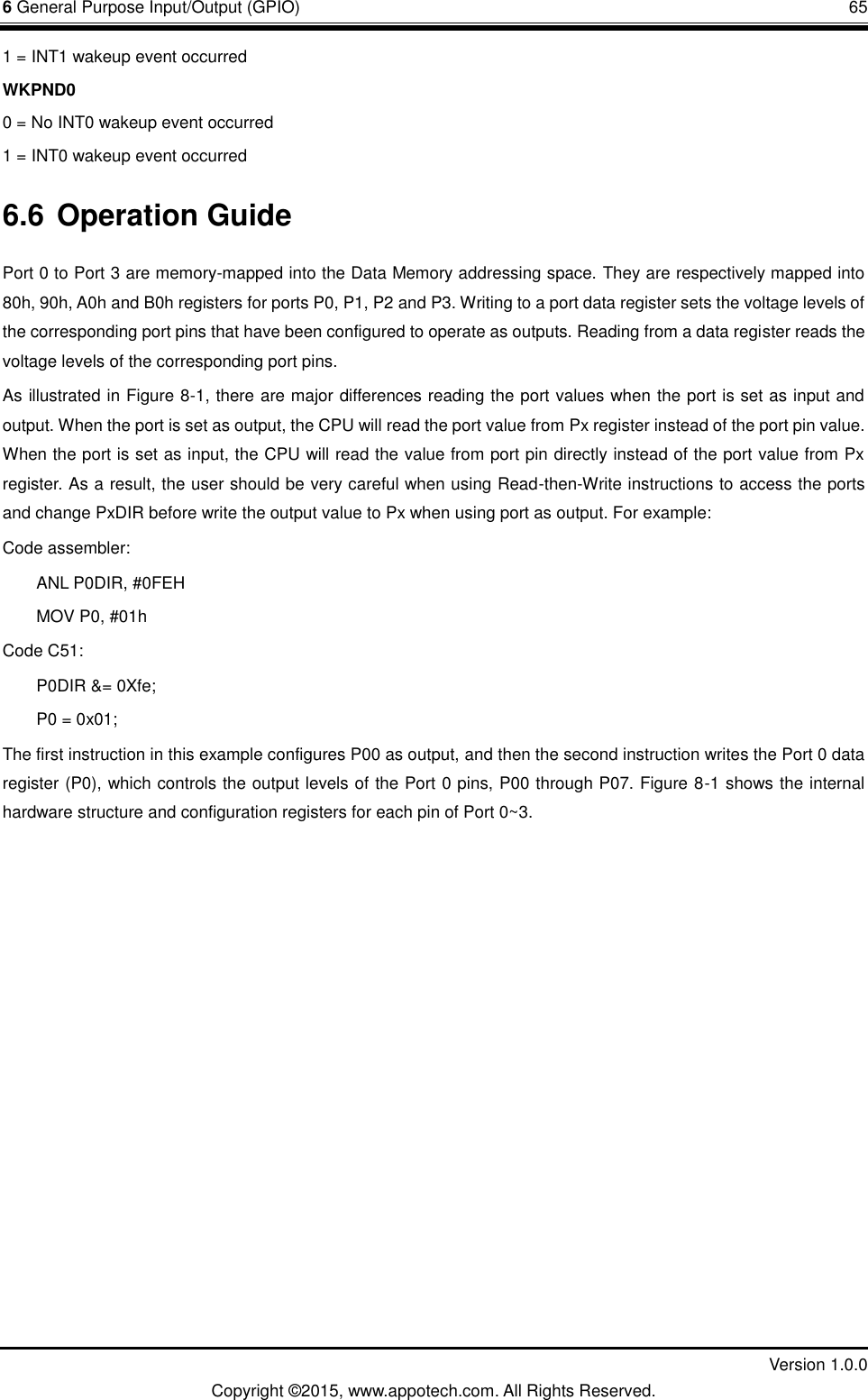
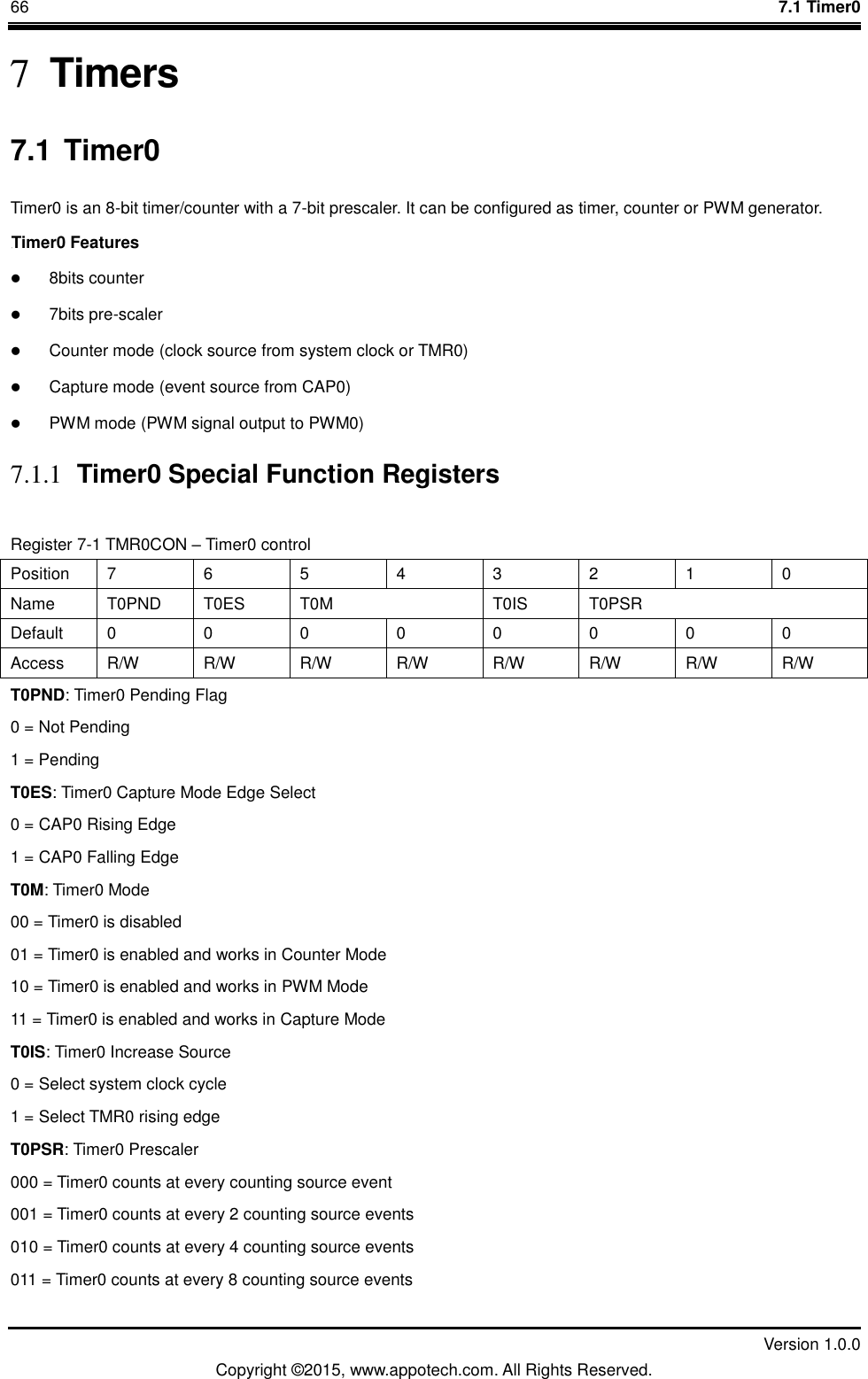
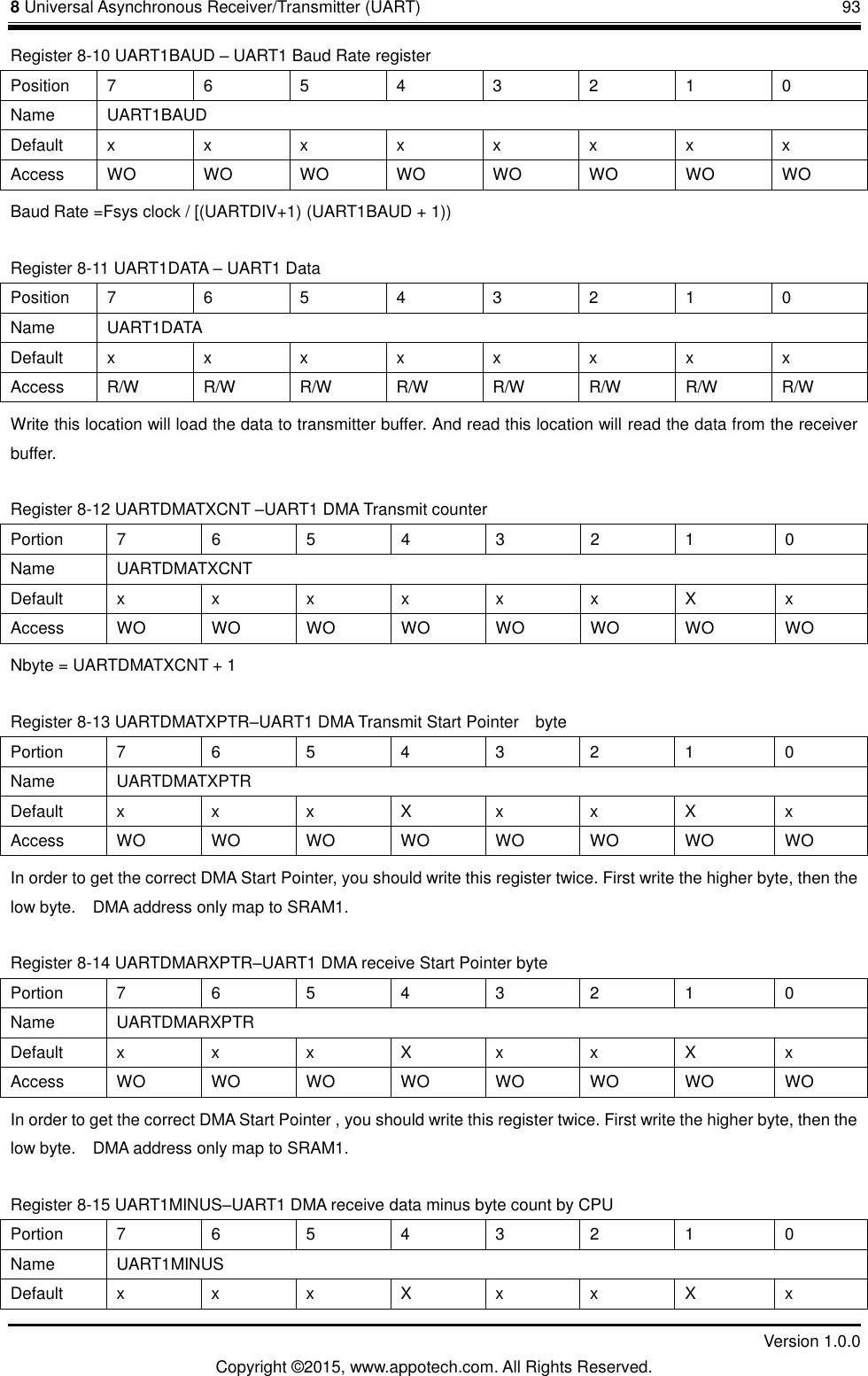
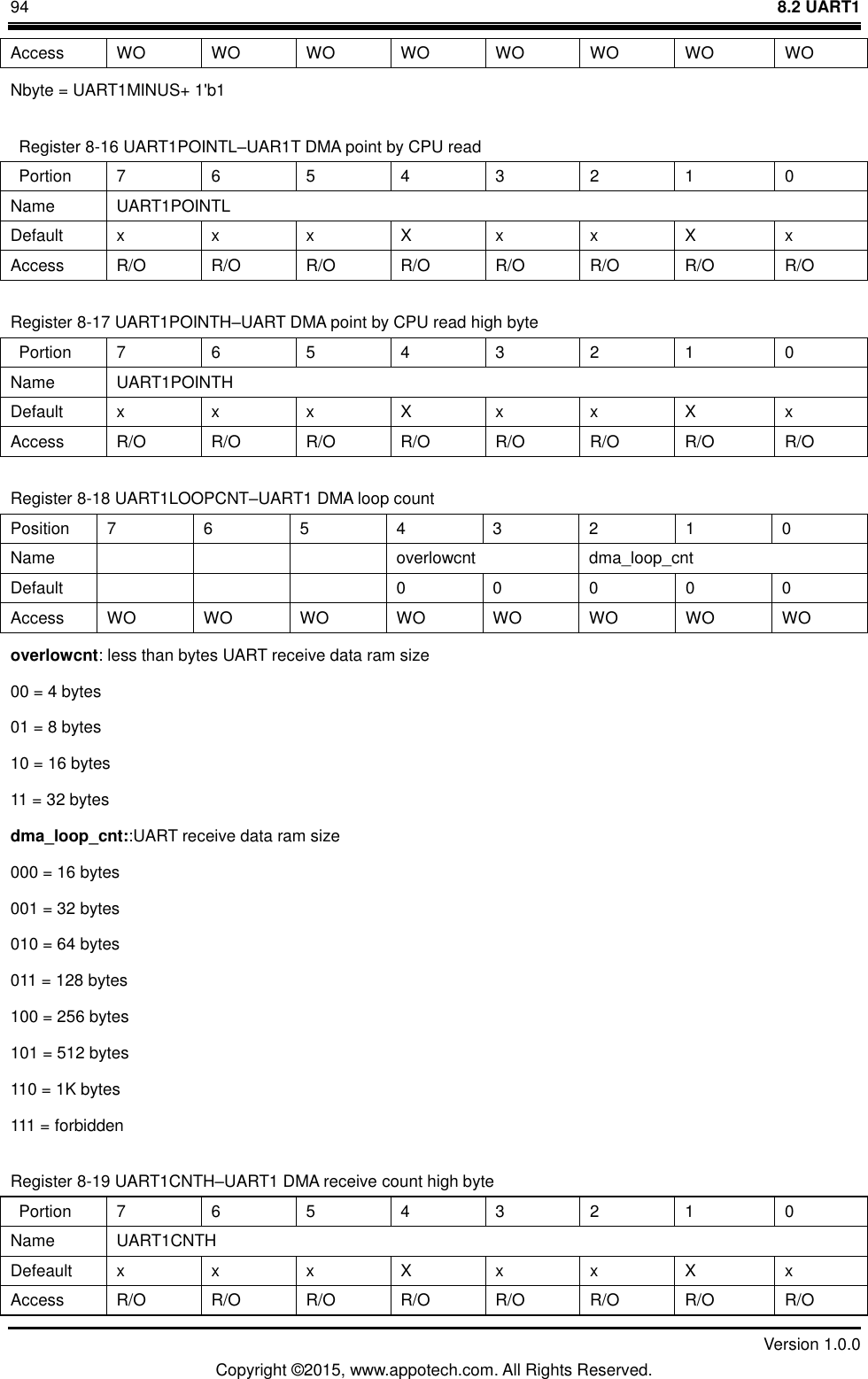
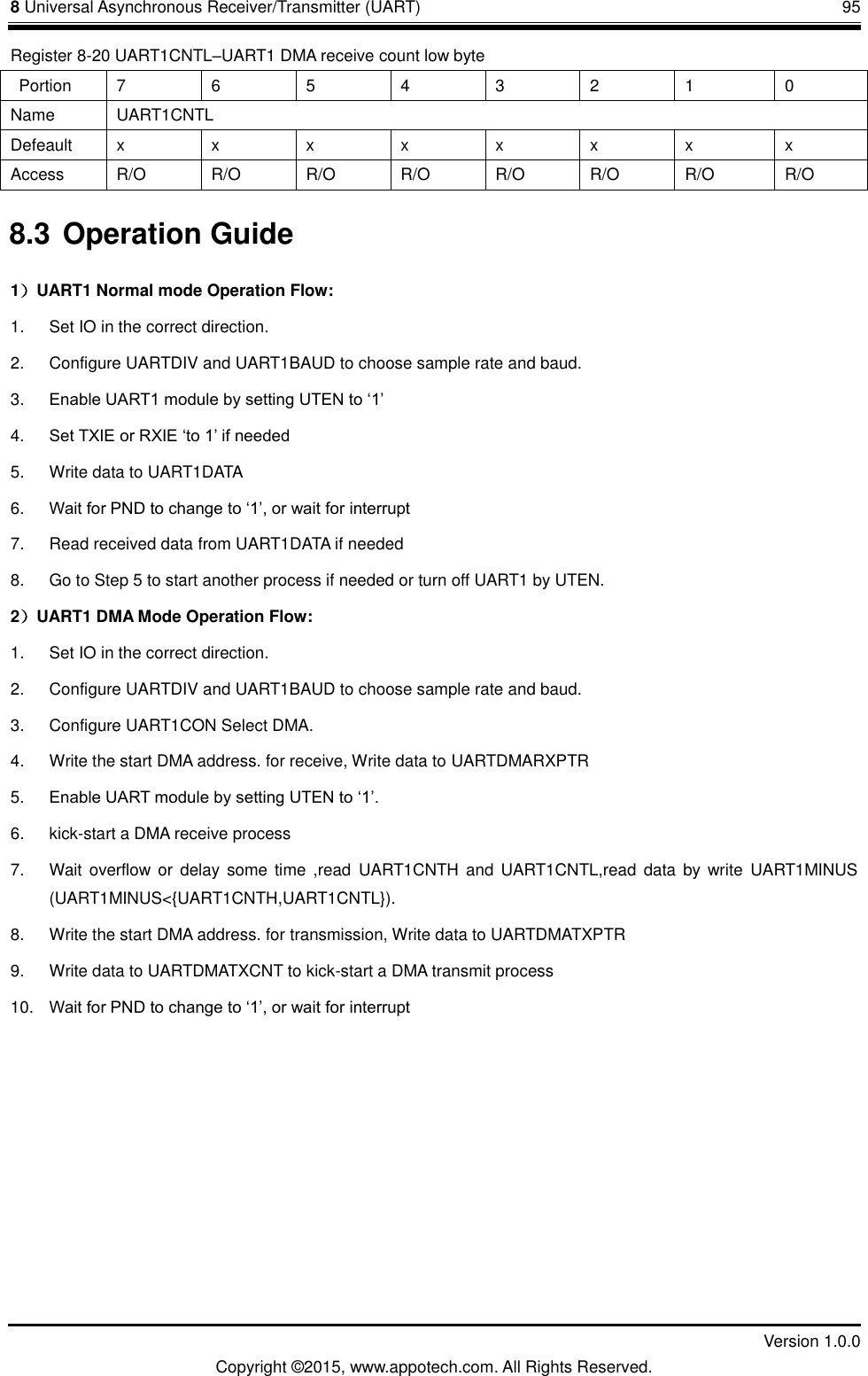
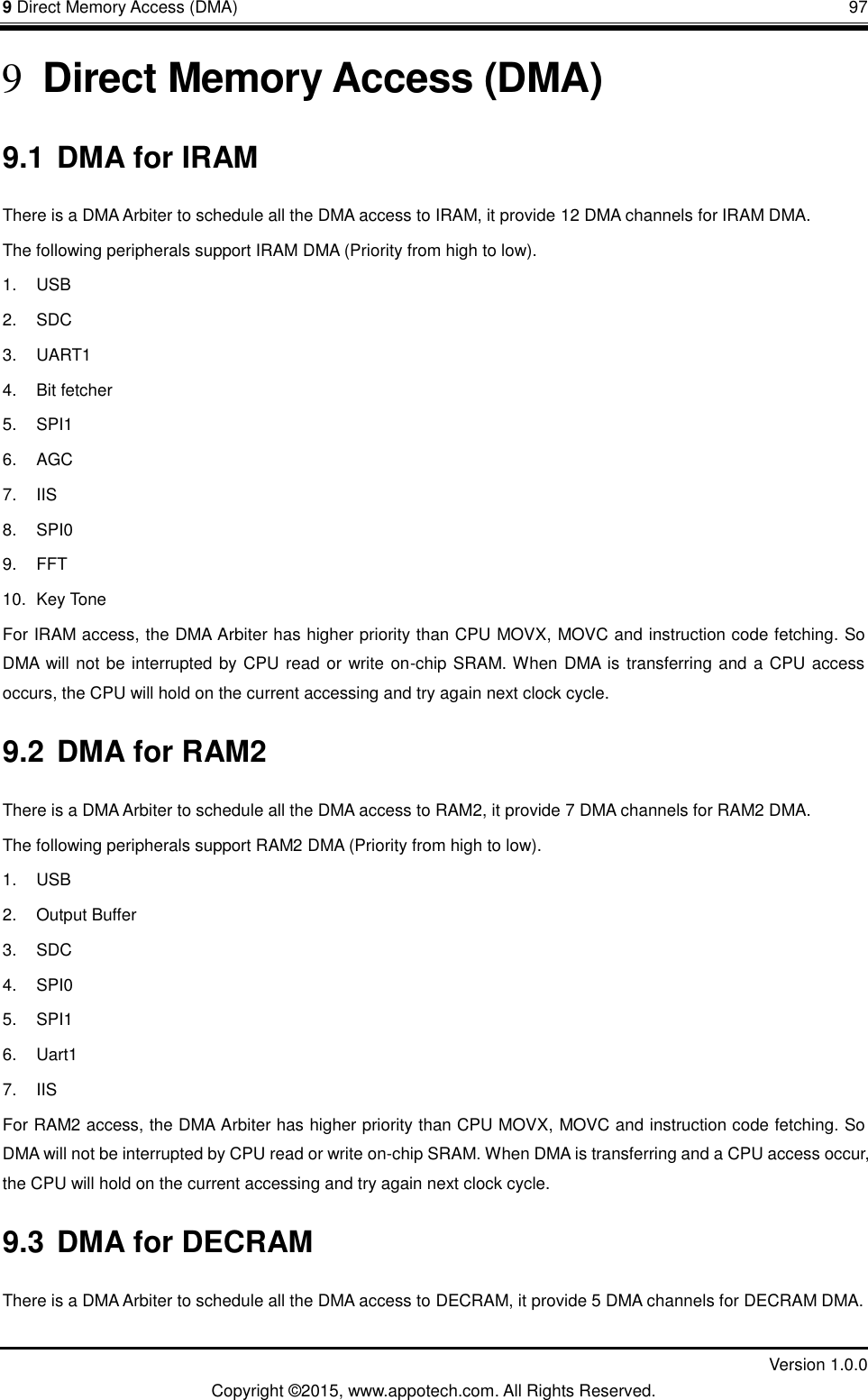
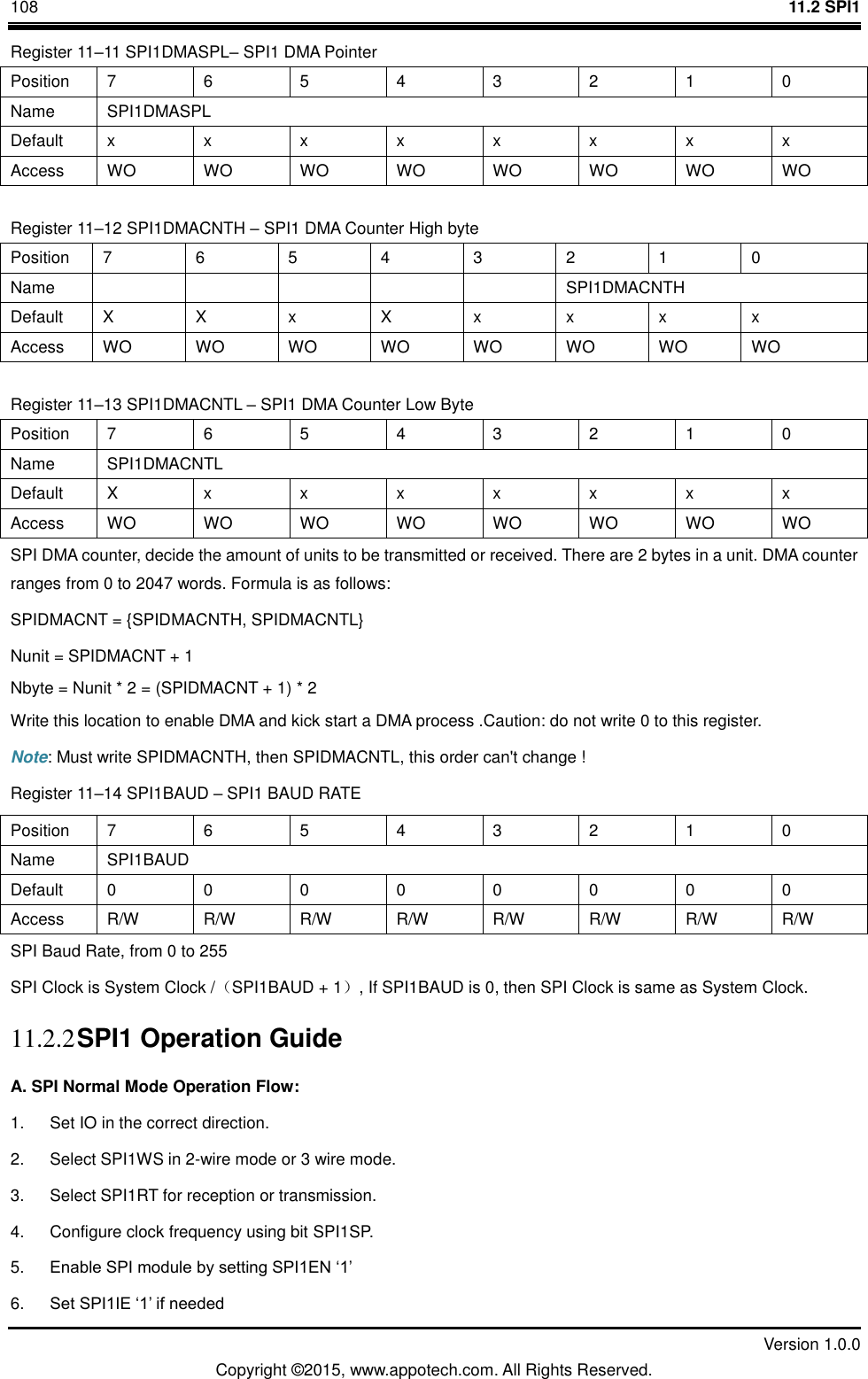
Yale Electronics B922BL Bluetooth Sport Headset User Manual

Shenzhen Yale Electronics Co., Ltd. Bluetooth Sport Headset

User Manual

                     B922BL              Bluetooth Sport HeadsetUser  ManualVersions: 1.0.0Release Date: 2015-10-26
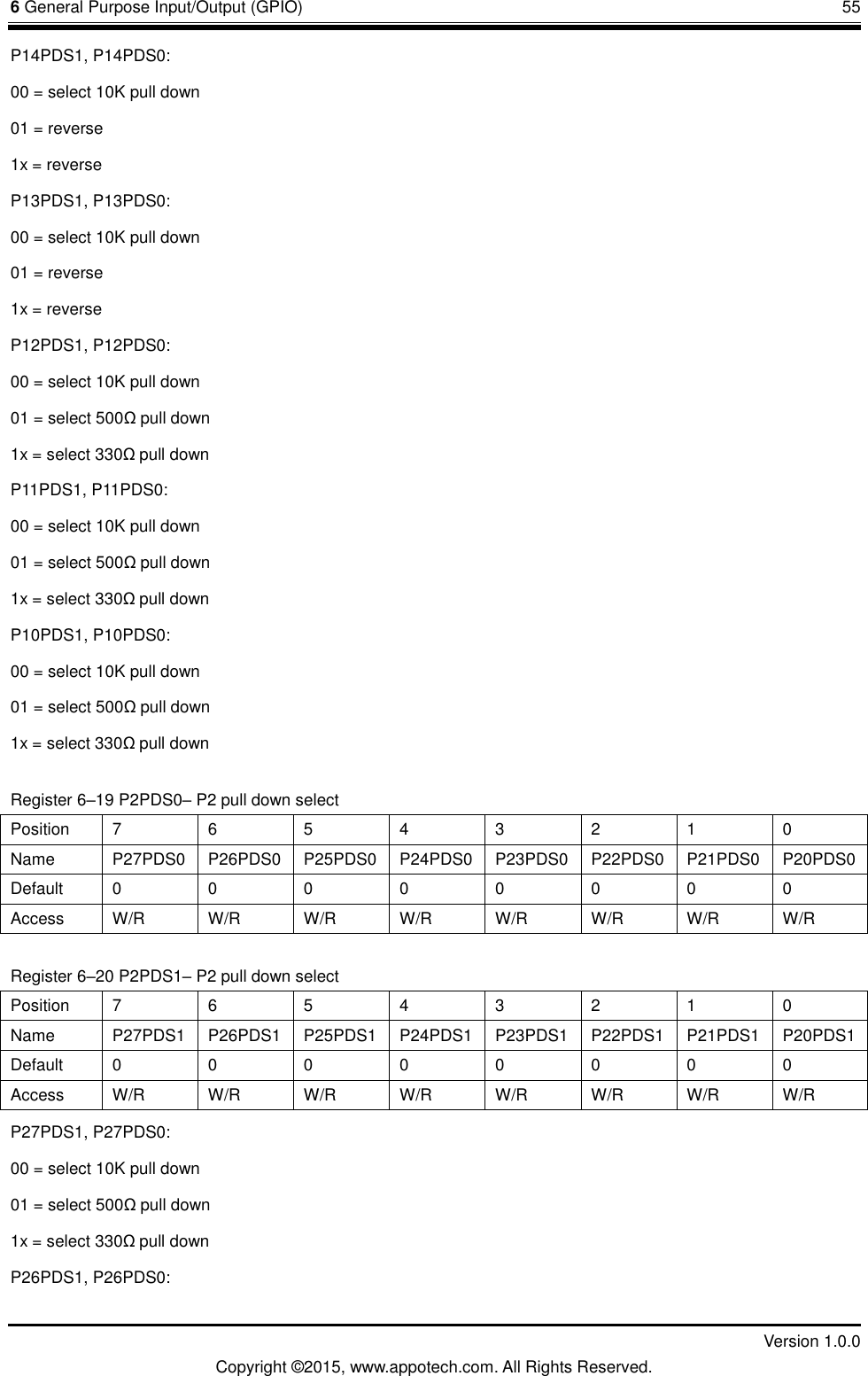
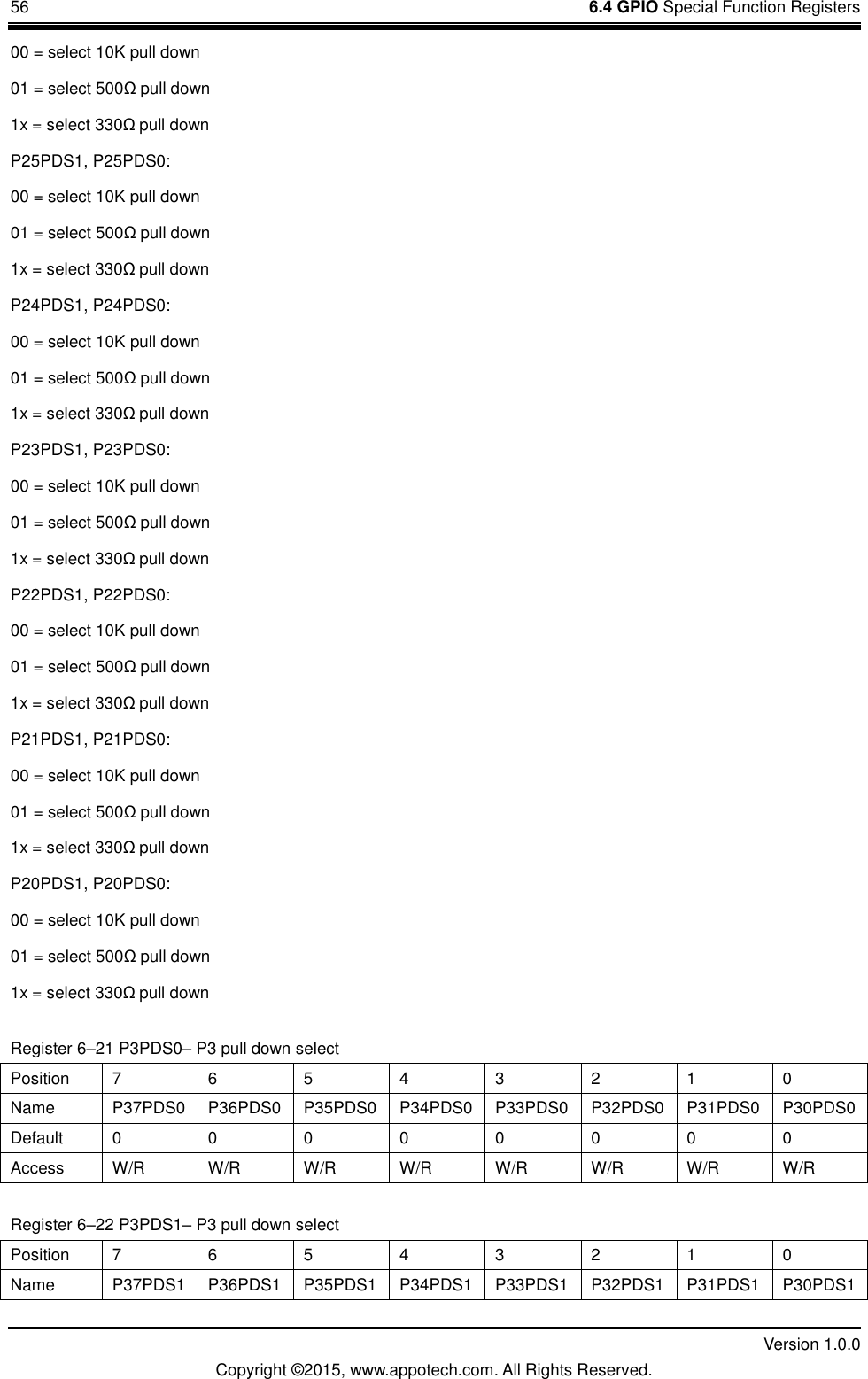
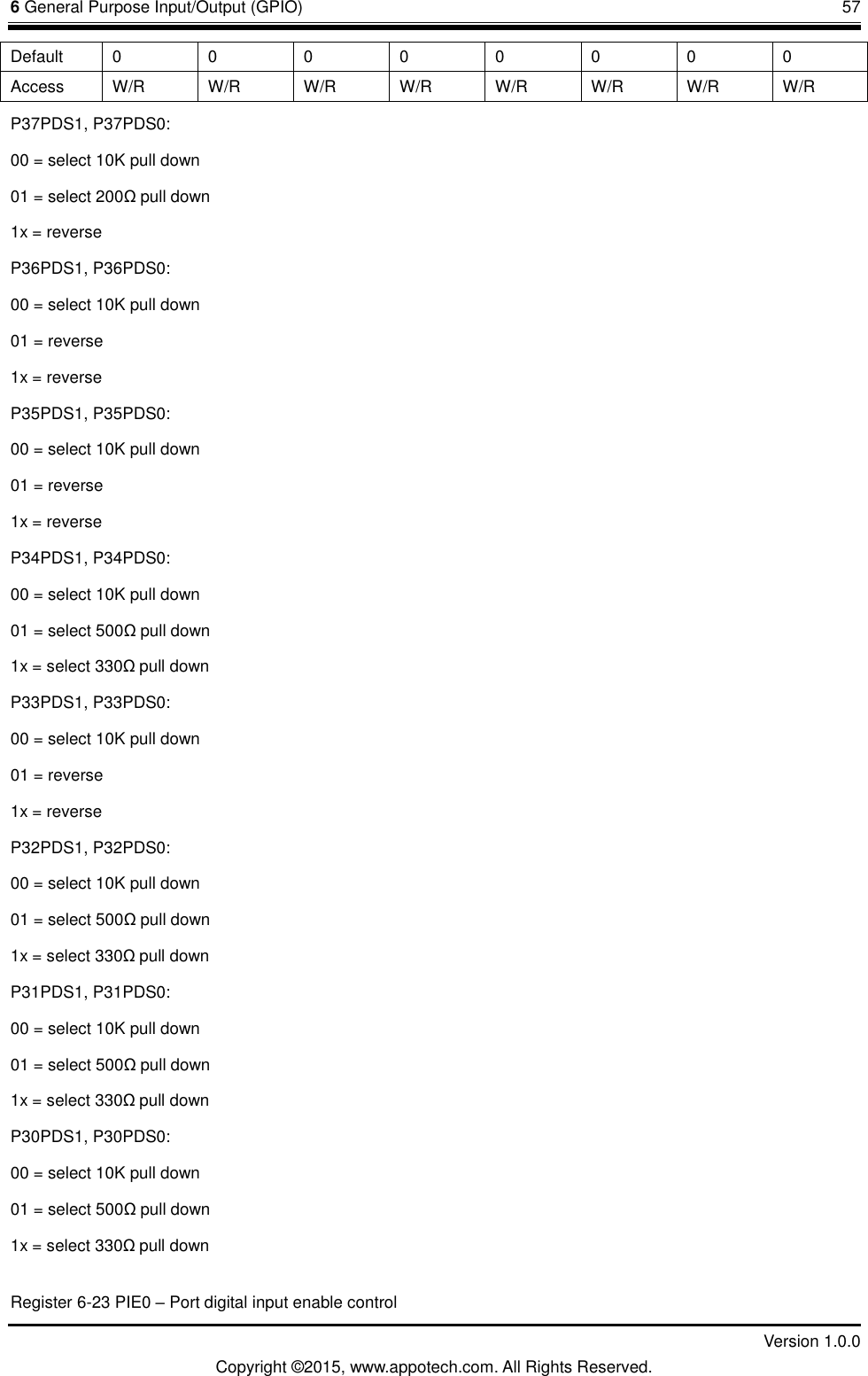
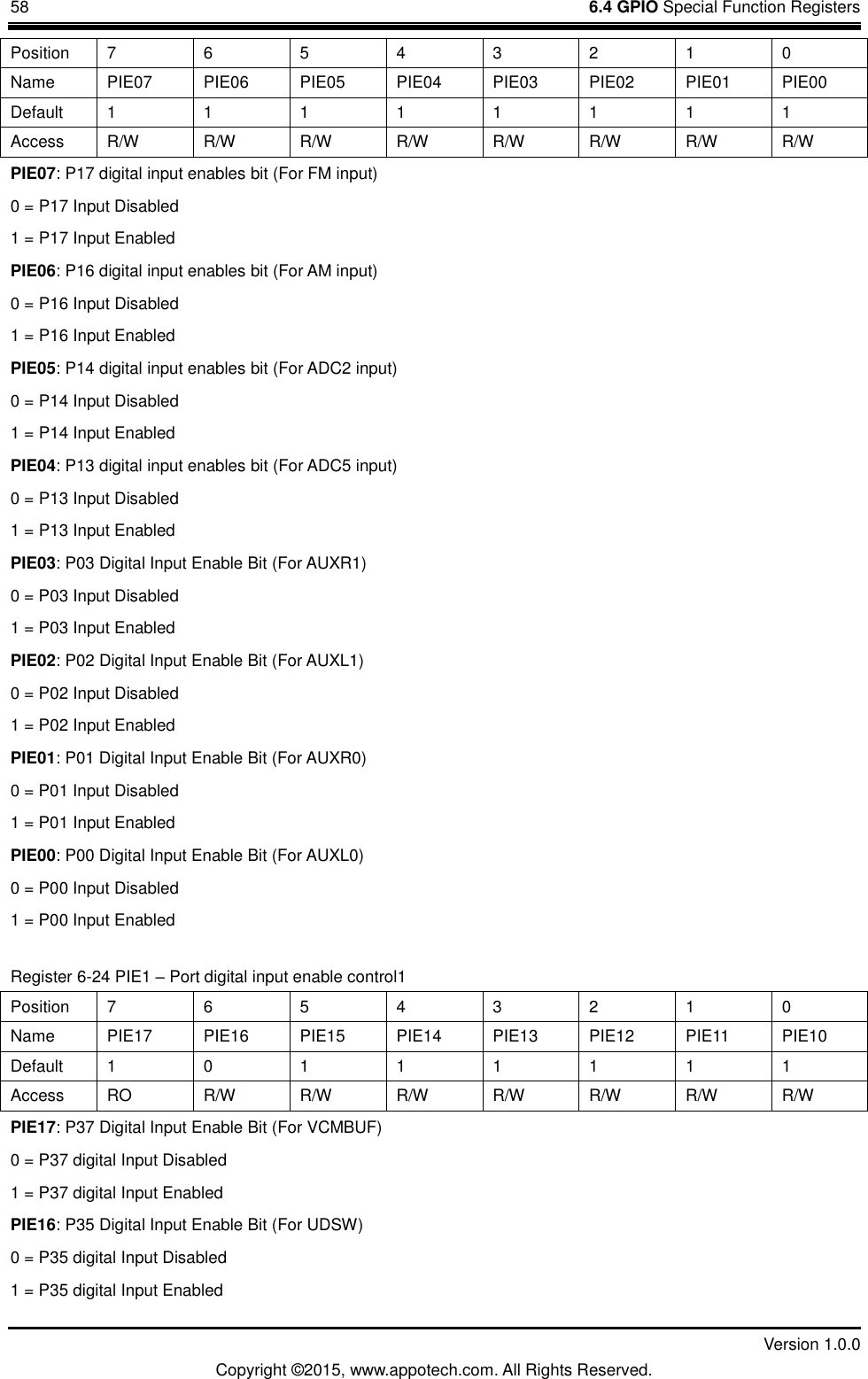
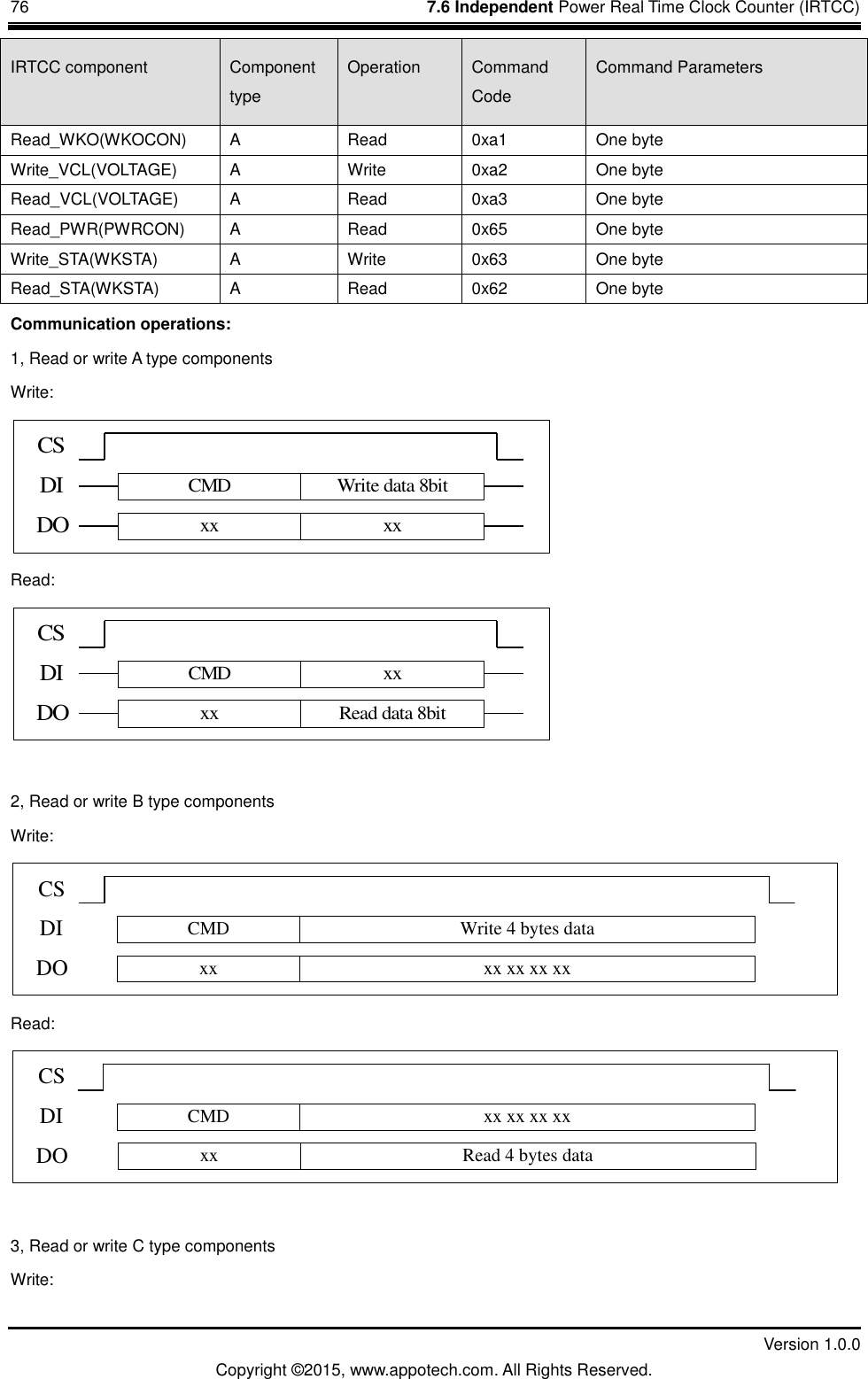
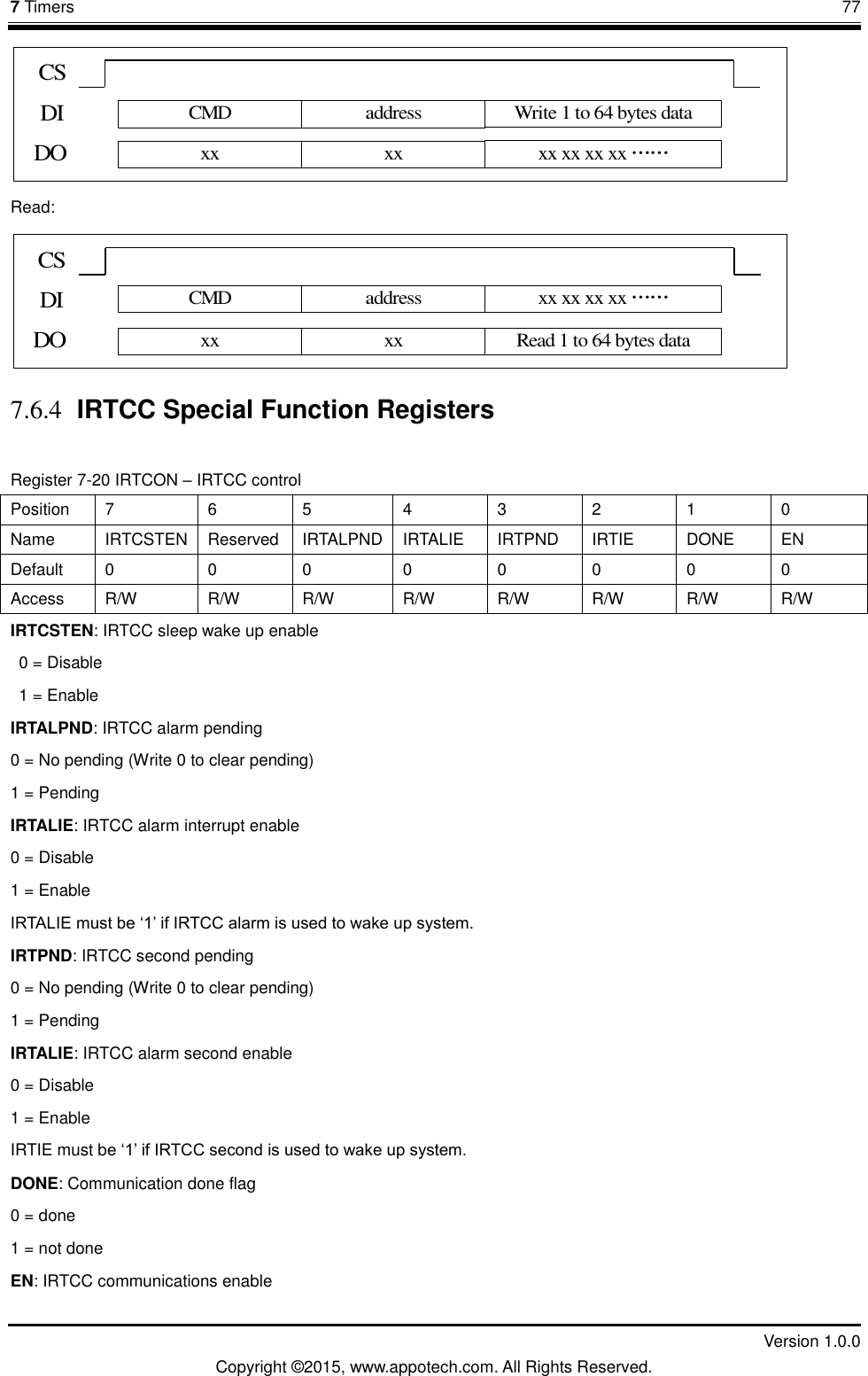
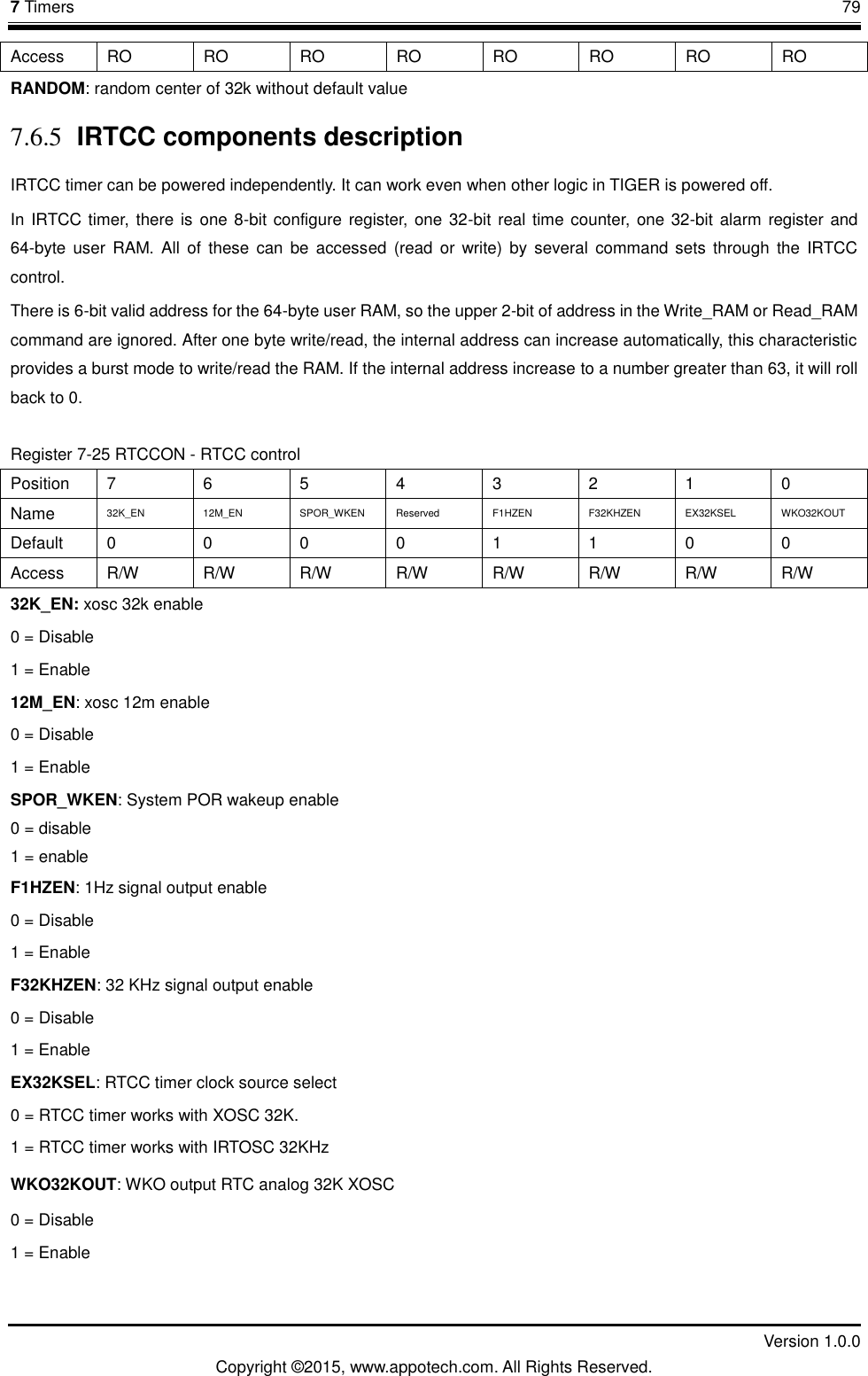
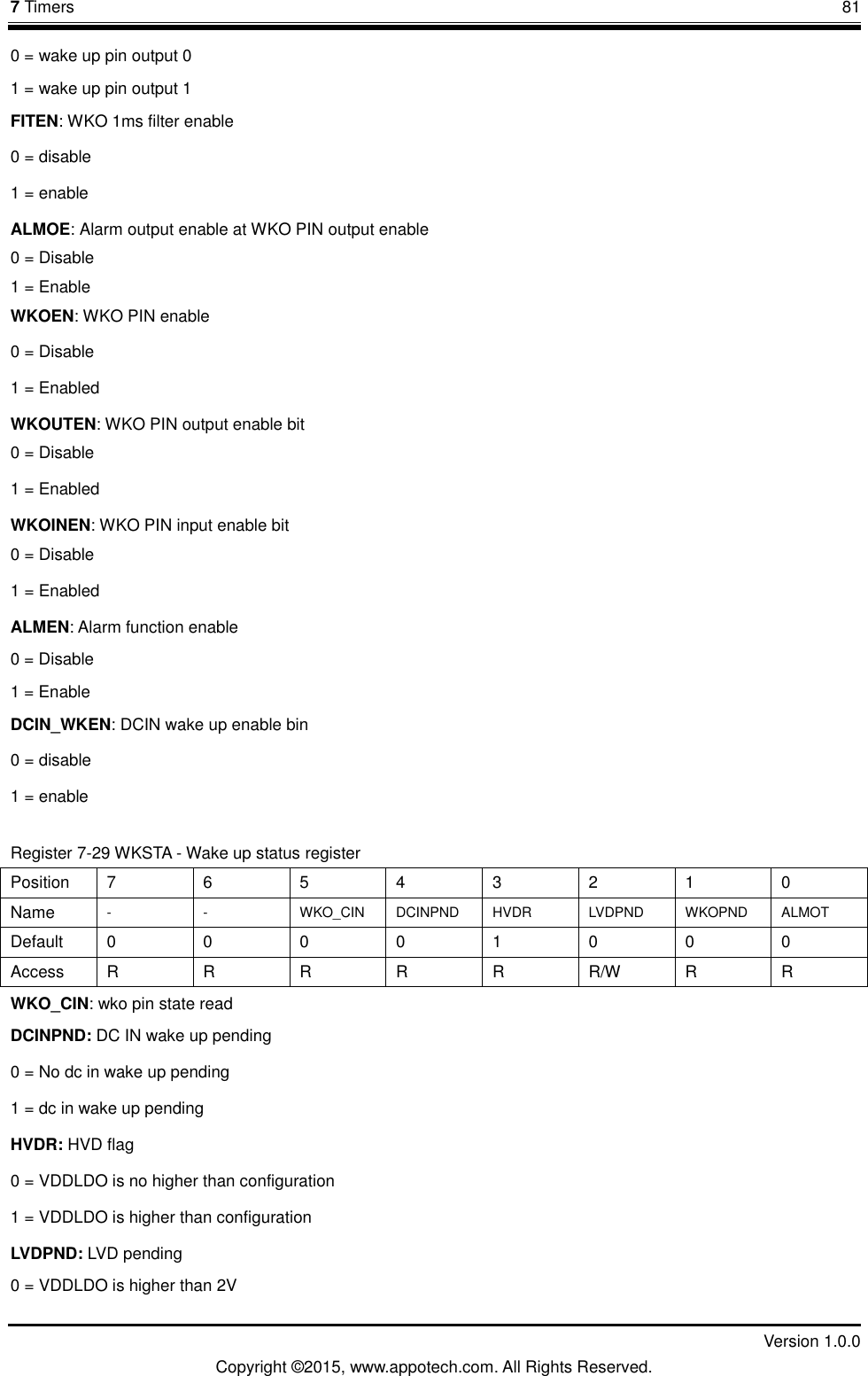
Table of content  I         Version 1.0.0 Copyright © 2015, www.appotech.com. All Rights Reserved.   Table of content  Table of content ......................................................................................................................................... I 1 Product Overview .............................................................................................................................. 1 1.1 General Description ................................................................................................................... 1 1.2 Features ...................................................................................................................................... 1 2 Pin Definitions ................................................................................................................................... 2 2.1 CW6687B .................................................................................................................................... 2 2.1.1 Package ............................................................................................................................... 2 2.1.2 Pin Assignment ................................................................................................................... 2 2.1.3 Pin Descriptions .................................................................................................................. 3 3 CPU Core Information ....................................................................................................................... 5 3.1 Architecture ............................................................................................................................... 5 3.2 Instruction Set ............................................................................................................................ 5 3.3 Memory Mapping ...................................................................................................................... 8 3.3.1 Program Memory Mapping ................................................................................................ 8 3.3.2 External Data Memory Mapping ........................................................................................ 8 3.3.3 Internal Data Memory Mapping ......................................................................................... 9 3.4 Interrupt Processing ................................................................................................................. 10 3.4.1 Interrupt sources .............................................................................................................. 10 3.4.2 Interrupt Priority............................................................................................................... 12 3.5 Special Function Register Mapping (SFR) ................................................................................. 12 3.6 Extend Special Function Registers Mapping (XSFR) ................................................................. 13 3.7 CPU and Memory related SFR Description .............................................................................. 14 3.8 CPU breakpoint ........................................................................................................................ 23 4 Reset Generation ............................................................................................................................. 25 4.1 Power-on Reset (POR) .............................................................................................................. 25 4.2 System Reset ............................................................................................................................ 25 4.2.1 LVD .................................................................................................................................... 26
II                  Table of content         Version 1.0.0 Copyright © 2015, www.appotech.com. All Rights Reserved.   4.2.2 RTCC Reset ........................................................................................................................ 28 4.2.3 Watchdog Reset ............................................................................................................... 28 4.2.4 Port Wakeup Reset ........................................................................................................... 28 4.3 Clock System ............................................................................................................................ 28 4.3.1 Clock Control .................................................................................................................... 28 4.3.2 Operation Guide ............................................................................................................... 35 4.3.3 Clock Gating ...................................................................................................................... 35 4.3.4 Phase Lock Loop (PLL) ....................................................................................................... 35 5 Low Power Management ................................................................................................................ 40 5.1 Power Saving Mode ................................................................................................................. 40 5.1.1 Sleep Mode ....................................................................................................................... 40 5.1.2 Hold Mode ........................................................................................................................ 40 5.1.3 Idle Mode .......................................................................................................................... 40 5.1.4 Power Down Mode ........................................................................................................... 41 5.2 Power Supply............................................................................................................................ 41 6 General Purpose Input/Output (GPIO) ............................................................................................ 46 6.1 Overview .................................................................................................................................. 46 6.2 Features .................................................................................................................................... 46 6.3 Function multiplexing ............................................................................................................... 46 6.4 GPIO Special Function Registers .............................................................................................. 48 6.5 Port interrupt and wakeup ....................................................................................................... 63 6.5.1 Wakeup registers .............................................................................................................. 63 6.6 Operation Guide ....................................................................................................................... 65 7 Timers .............................................................................................................................................. 66 7.1 Timer0 ...................................................................................................................................... 66 7.1.1 Timer0 Special Function Registers .................................................................................... 66 7.2 Timer1 ...................................................................................................................................... 67 7.2.1 Timer1 Special Function Registers .................................................................................... 67 7.3 Timer2 ...................................................................................................................................... 69 7.3.1 Timer2 Features ................................................................................................................ 69
Table of content  III         Version 1.0.0 Copyright © 2015, www.appotech.com. All Rights Reserved.   7.3.2 Timer2 Special Function Registers .................................................................................... 70 7.4 Timer3 ...................................................................................................................................... 71 7.4.1 Timer3 Features ................................................................................................................ 72 7.4.2 Timer3 Special Function Registers .................................................................................... 72 7.5 Watchdog Timer (WDT) ........................................................................................................... 73 7.5.1 Watchdog Wake up .......................................................................................................... 73 7.5.2 Watchdog SFR ................................................................................................................... 74 7.6 Independent Power Real Time Clock Counter (IRTCC) ............................................................ 75 7.6.1 IRTCC Controller ............................................................................................................... 75 7.6.2 IRTCC Timer ...................................................................................................................... 75 7.6.3 Communication with IRTCC Timer .................................................................................... 75 7.6.4 IRTCC Special Function Registers ...................................................................................... 77 7.6.5 IRTCC components description ........................................................................................ 79 7.6.6 IRTCC Operating Guide ..................................................................................................... 82 8 Universal Asynchronous Receiver/Transmitter (UART) .................................................................. 88 8.1 UART0 ....................................................................................................................................... 88 8.1.1 Overview ........................................................................................................................... 88 8.1.2 UART0 Special Function Registers .................................................................................... 89 8.2 UART1 ....................................................................................................................................... 91 8.2.1 Overview ........................................................................................................................... 91 8.2.2 UART1 Special Function Registers .................................................................................... 91 8.3 Operation Guide ....................................................................................................................... 95 8.4 BT Control Register .................................................................................................................. 96 9 Direct Memory Access (DMA) ......................................................................................................... 97 9.1 DMA for IRAM .......................................................................................................................... 97 9.2 DMA for RAM2 ......................................................................................................................... 97 9.3 DMA for DECRAM ..................................................................................................................... 97 9.4 DMA for IROM .......................................................................................................................... 98 10 IR receiver ........................................................................................................................................ 99 10.1 IR frame format ........................................................................................................................ 99
IV                  Table of content         Version 1.0.0 Copyright © 2015, www.appotech.com. All Rights Reserved.   10.2 IR Receiver Control Registers ................................................................................................. 100 10.3 IR Receiver Operation Guide .................................................................................................. 102 11 SPI .................................................................................................................................................. 103 11.1 SPI0 ......................................................................................................................................... 103 11.1.1 SPI0 Special Function Registers ...................................................................................... 103 11.1.2 SPI0 Operation Guide ..................................................................................................... 105 11.2 SPI1 ......................................................................................................................................... 106 11.2.1 SPI1 Special Function Registers ...................................................................................... 106 11.2.2 SPI1 Operation Guide ..................................................................................................... 108 12 External Memory Interface (EMI) .................................................................................................. 110 12.1 EMI Control Registers ............................................................................................................. 110 13 Audio Terminal (DAC) .................................................................................................................... 114 13.1 Features .................................................................................................................................. 114 13.2 DAC Special Function Registers .............................................................................................. 114 13.2.1 DAC Register Mapping .................................................................................................... 114 13.2.2 Function of DAC Control Registers ................................................................................. 115 13.2.3 EQ and DRC Control Register .......................................................................................... 120 13.3 Operation Guide ..................................................................................................................... 124 13.3.1 DAC Operation Guide ..................................................................................................... 124 13.3.2 EQ Operation Guide ........................................................................................................ 124 14 SARADC .......................................................................................................................................... 125 14.1 Features .................................................................................................................................. 125 14.2 ADC Pin Mapping.................................................................................................................... 125 14.3 SARADC Special Function Registers........................................................................................ 125 15 CRC16 /LFSR16/LFSR32 ................................................................................................................. 128 15.1 CRC16 ..................................................................................................................................... 128 15.1.1 Features .......................................................................................................................... 128 15.1.2 CRC16 Special Function Registers ................................................................................... 128 15.2 LFSR16 .................................................................................................................................... 129 15.2.1 Features .......................................................................................................................... 129
Table of content  V         Version 1.0.0 Copyright © 2015, www.appotech.com. All Rights Reserved.   15.2.2 LFSR16 Special Function Register ................................................................................... 129 15.3 LFSR32 .................................................................................................................................... 130 15.3.1 Features .......................................................................................................................... 130 15.3.2 LFSR32 Special Function Registers .................................................................................. 130 16 Characteristics ............................................................................................................................... 131 16.1 PMU Parameters .................................................................................................................... 131 16.2 CORE PLL Parameters ............................................................................................................. 131 16.3 General purpose I/O Parameters ........................................................................................... 131 16.4 Audio ADDA Parameters ........................................................................................................ 132 16.5 RF Analog Blocks .................................................................................................................... 132 17 Package Outline Dimensions ......................................................................................................... 134 17.1 QFN32..................................................................................................................................... 134 Revision History .......................................................................................................................................... i
1 Product Overview       1         Version 1.0.0 Copyright ©2015, www.appotech.com. All Rights Reserved. 1 Product Overview Bluetooth Audio Player Microcontroller 1.1 General Description           CW6687B is a compact, highly integrated system on chip for Bluetooth v4.2 with Enhanced Data Rate applications. This SOC complies with Bluetooth specifications and is backward-compatible with Bluetooth 2.1, 2.0 or 1.2 systems.This  Bluetooth  includes  a  data  rate  of  1M/2M/3Mbps  RF  with  a  performance  of  Tx:  0dBm, Rx: -85dBm,  andfull-duplex UART, SPI, interface with EDR applications.It also integrates a DSP co-processor, a PLL, and a CODEC to provide exceptional voice and audio quality.In addition, to provide easy accessibility and transferability to other auxiliary products,  1.2 Features  Supports Bluetooth v.4.2+EDR; backward-compatible with BT v.1.2, 2.0 and 2.1  SOC supports following versions:   Hands Free v.1.6   Headset v.1.2   A2DP v.1.3   AVCTP v.1.4   AVDTP v.1.3   AVRCP v.1.5  Class 2 power level, RF Performance: Tx:0dBm, Rx: -85dBm;    Supports  26M  crystal  with  independently  powered  real-time  clock  that  supports  32.768kHz  internal  crystal oscillator    Supports MP3/SBC/WMA decoder;    Three Channels 10-bit SARADC;    Watchdog Timer with on-chip RC oscillator  Supports full-duplex UART, SPI interface;  Keypad tone mixer;  Internal LDO regulator : 1.35V to 1.2V, 5V to 3.3V;  Built-in buck converter,DC-DC 5V to 1.35V ;  Power on Reset  Integrated 24bits DSP core that supports:     Noise suppressor to eliminate unwanted noise and hum without altering enhanced audio quality   Echo cancelation   SBC audio format decoding   Automatic volume control for speaker output  16bit Stereo DAC with >90dB SNR, embedded with 2 class A/B headphone amplifier
2    1.2 Features         Version 1.0.0 Copyright ©2015, www.appotech.com. All Rights Reserved.    16bit Stereo ADC with >90dB DR  Internal charger current up to 25mA  Supports dual MIC    Channels 16 levels Low Voltage Detector
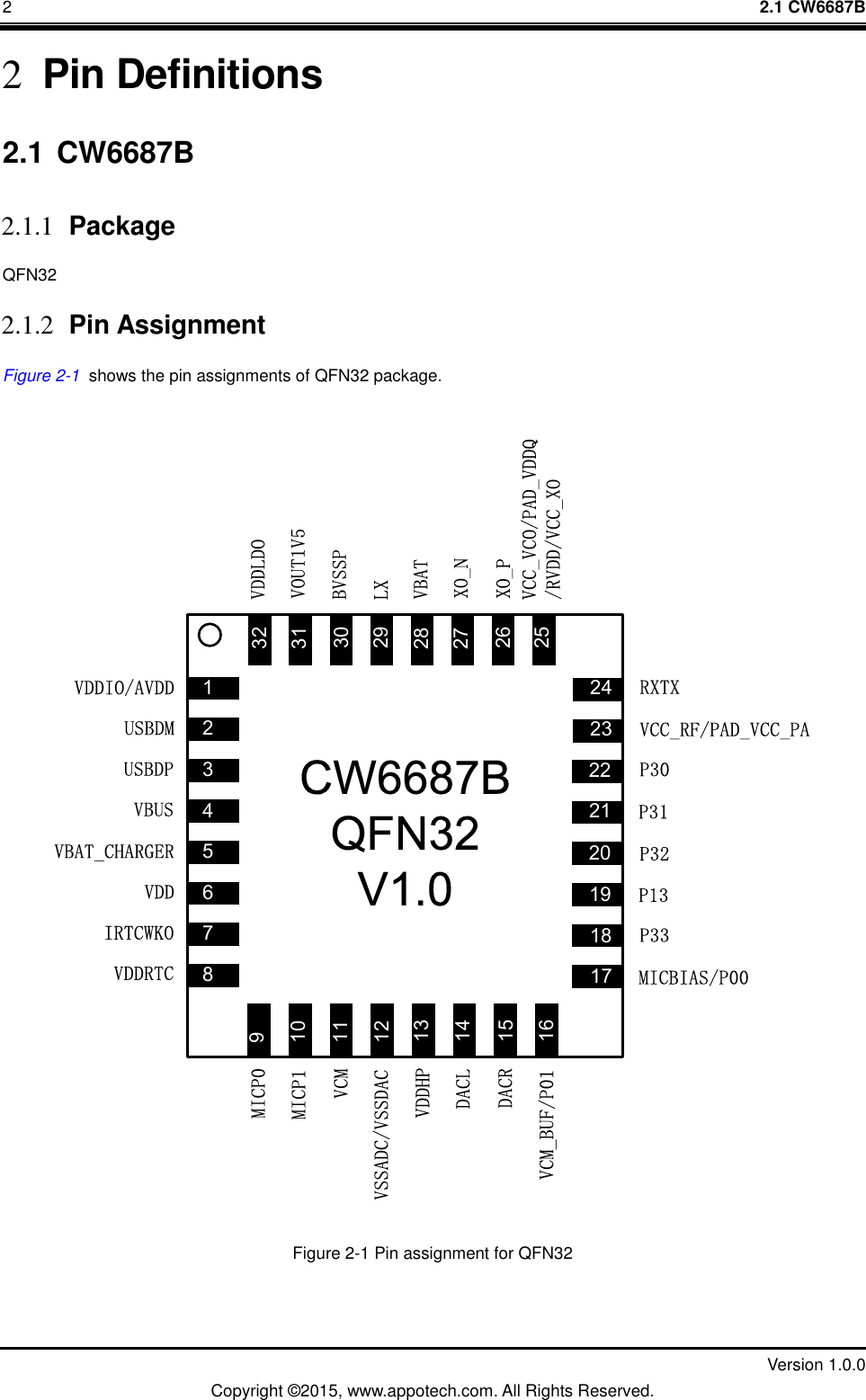
2    2.1 CW6687B         Version 1.0.0 Copyright ©2015, www.appotech.com. All Rights Reserved.   2 Pin Definitions 2.1 CW6687B 2.1.1 Package QFN32 2.1.2 Pin Assignment Figure 2-1 X shows the pin assignments of QFN32 package.   CW6687BQFN32V1.0123456789103132VDDLDOMICP0VDDIO/AVDDUSBDMUSBDPVBUSVBAT_CHARGERVDDIRTCWKOVDDRTC111213141516MICP1VCMVSSADC/VSSDACVDDHPDACLDACRVCM_BUF/P011817201922212423MICBIAS/P00P33P13P32P31P30VCC_RF/PAD_VCC_PARXTX293027282526VOUT1V5BVSSPLXVBATXO_NXO_PVCC_VCO/PAD_VDDQ/RVDD/VCC_XO Figure 2-1 Pin assignment for QFN32
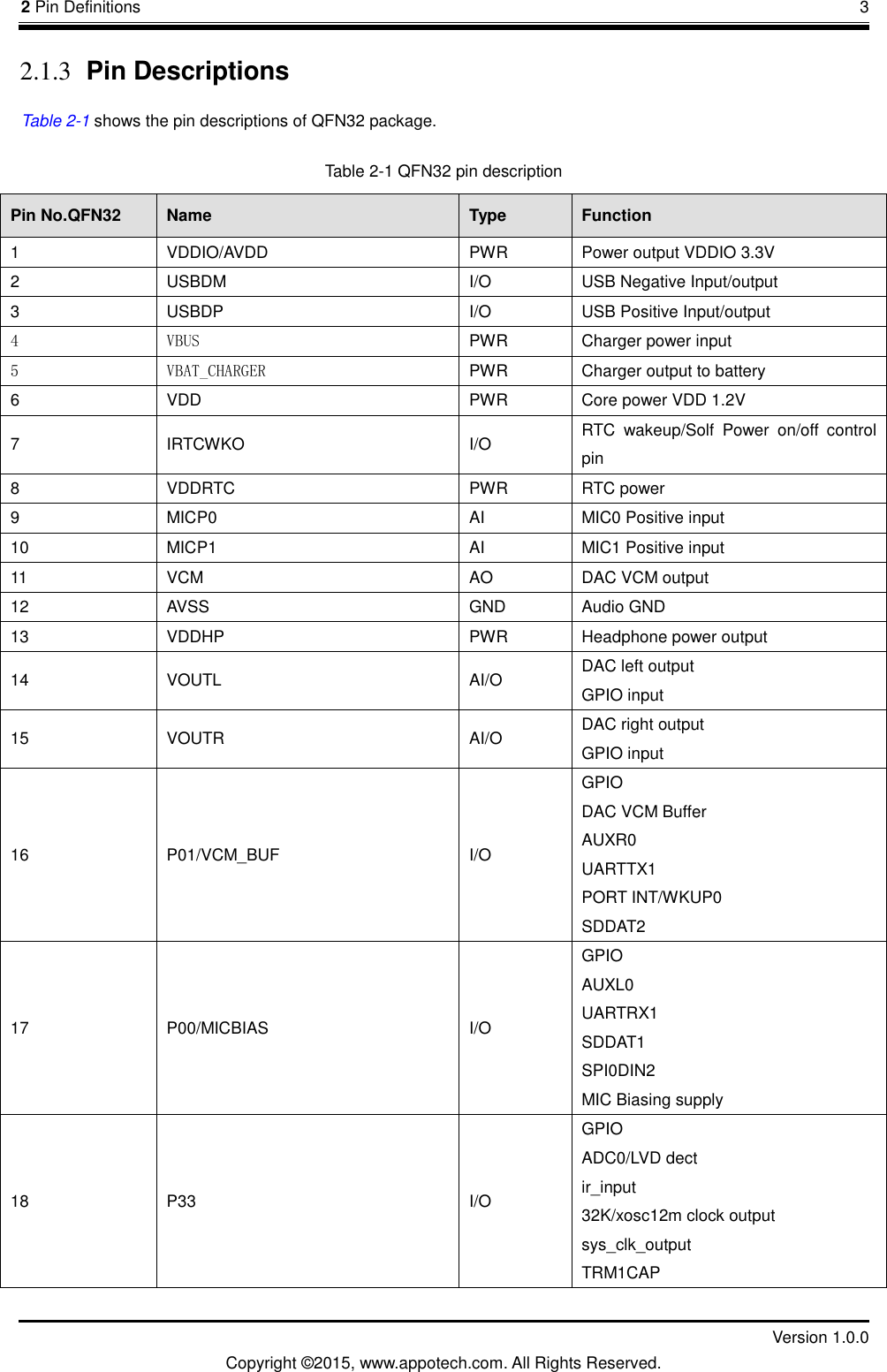
2 Pin Definitions       3         Version 1.0.0 Copyright ©2015, www.appotech.com. All Rights Reserved. 2.1.3 Pin Descriptions XTable 2-1 shows the pin descriptions of QFN32 package.   Table 2-1 QFN32 pin description Pin No.QFN32  Name  Type  Function 1 VDDIO/AVDD      PWR  Power output VDDIO 3.3V 2 USBDM           I/O  USB Negative Input/output 3 USBDP           I/O  USB Positive Input/output 4  VBUS  PWR  Charger power input 5  VBAT_CHARGER  PWR  Charger output to battery 6 VDD       PWR  Core power VDD 1.2V 7 IRTCWKO       I/O RTC  wakeup/Solf  Power  on/off  control pin 8 VDDRTC         PWR  RTC power 9  MICP0  AI  MIC0 Positive input 10  MICP1  AI  MIC1 Positive input 11 VCM               AO  DAC VCM output 12 AVSS GND  Audio GND 13 VDDHP           PWR  Headphone power output   14 VOUTL           AI/O  DAC left output GPIO input 15 VOUTR           AI/O  DAC right output GPIO input 16 P01/VCM_BUF             I/O GPIO DAC VCM Buffer   AUXR0 UARTTX1 PORT INT/WKUP0 SDDAT2 17 P00/MICBIAS               I/O GPIO AUXL0 UARTRX1 SDDAT1 SPI0DIN2 MIC Biasing supply 18 P33               I/O GPIO ADC0/LVD dect ir_input 32K/xosc12m clock output sys_clk_output TRM1CAP
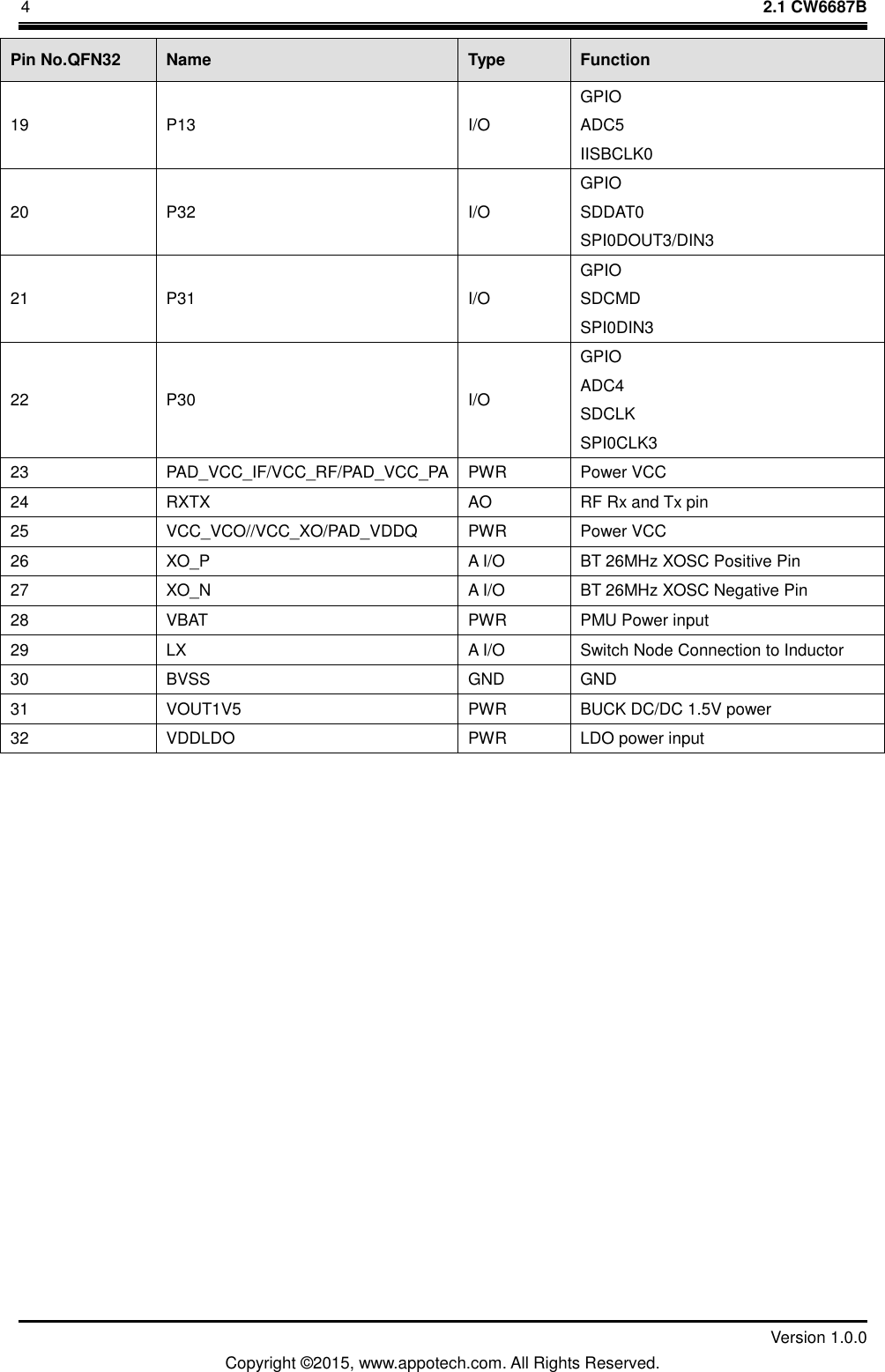
4    2.1 CW6687B         Version 1.0.0 Copyright ©2015, www.appotech.com. All Rights Reserved.   Pin No.QFN32  Name  Type  Function 19 P13               I/O GPIO ADC5 IISBCLK0 20 P32               I/O GPIO SDDAT0 SPI0DOUT3/DIN3 21 P31               I/O GPIO SDCMD SPI0DIN3 22 P30               I/O GPIO ADC4 SDCLK SPI0CLK3 23  PAD_VCC_IF/VCC_RF/PAD_VCC_PA   PWR  Power VCC 24 RXTX             AO  RF Rx and Tx pin 25 VCC_VCO//VCC_XO/PAD_VDDQ    PWR  Power VCC 26 XO_P             A I/O  BT 26MHz XOSC Positive Pin 27 XO_N             A I/O  BT 26MHz XOSC Negative Pin 28 VBAT    PWR  PMU Power input 29 LX      A I/O  Switch Node Connection to Inductor 30 BVSS  GND  GND 31 VOUT1V5    PWR  BUCK DC/DC 1.5V power 32 VDDLDO         PWR  LDO power input
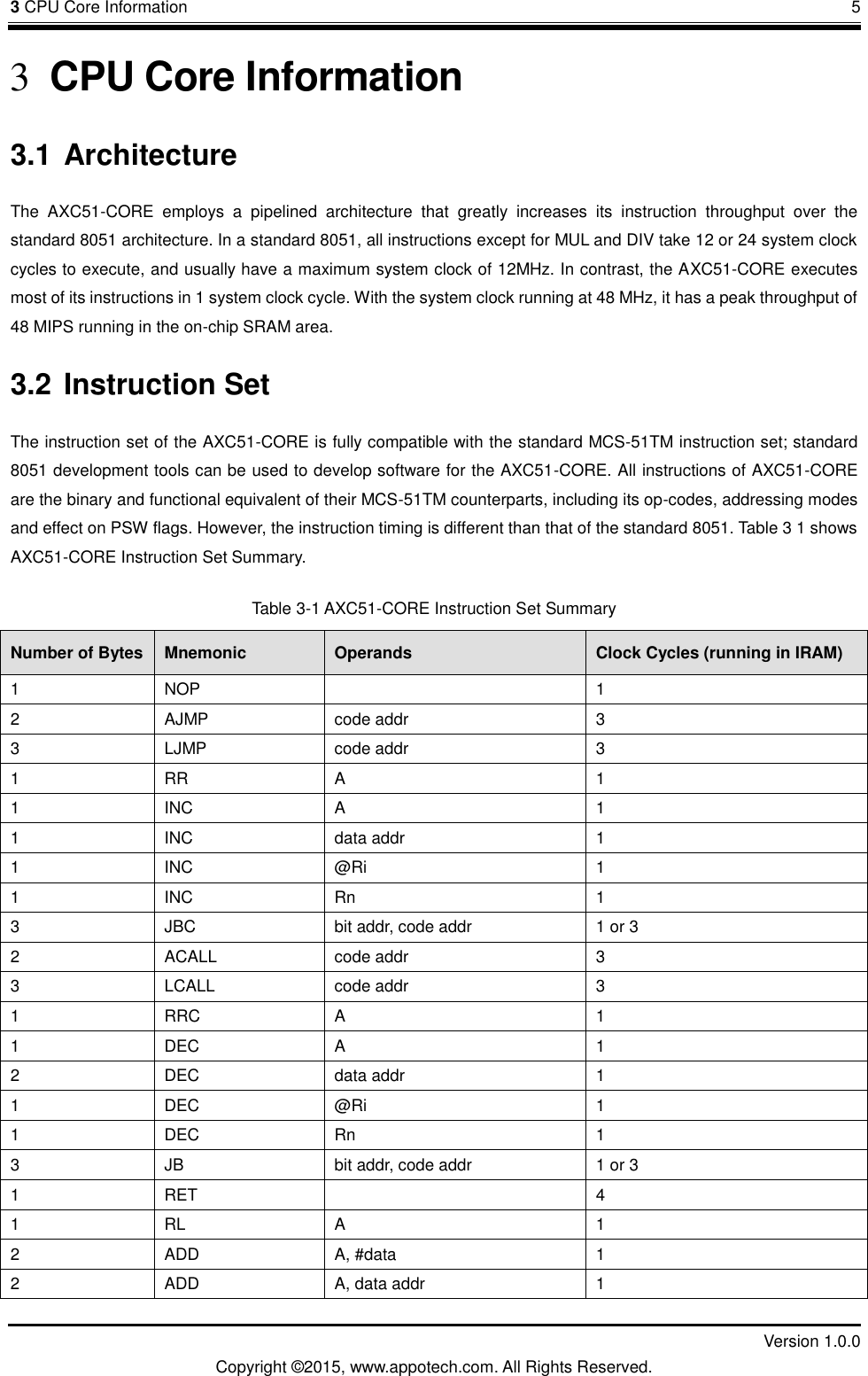
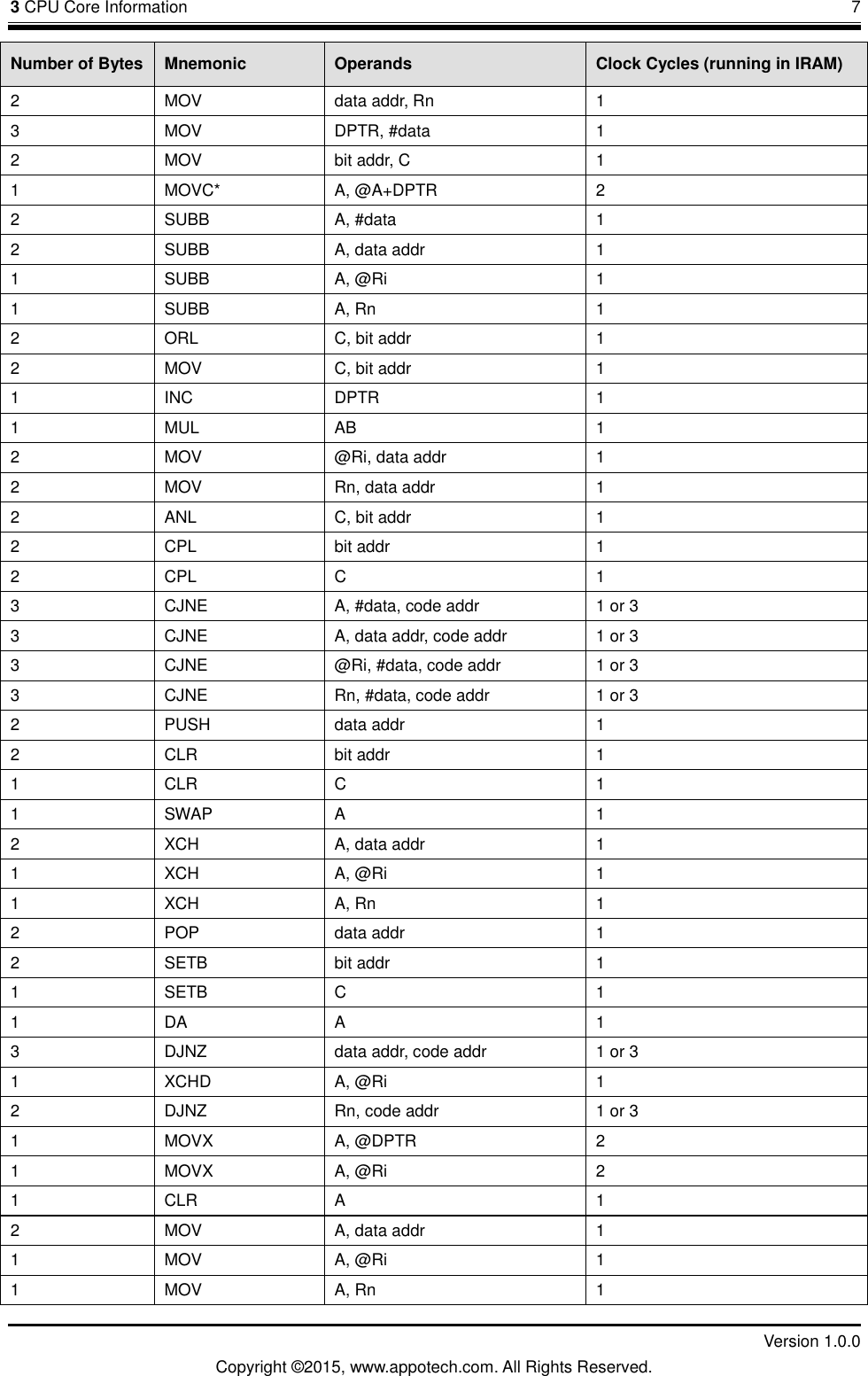
3 CPU Core Information       5         Version 1.0.0 Copyright ©2015, www.appotech.com. All Rights Reserved. 3 CPU Core Information 3.1 Architecture The  AXC51-CORE  employs  a  pipelined  architecture  that  greatly  increases  its  instruction  throughput  over  the standard 8051 architecture. In a standard 8051, all instructions except for MUL and DIV take 12 or 24 system clock cycles to execute, and usually have a maximum system clock of 12MHz. In contrast, the AXC51-CORE executes most of its instructions in 1 system clock cycle. With the system clock running at 48 MHz, it has a peak throughput of 48 MIPS running in the on-chip SRAM area. 3.2 Instruction Set The instruction set of the AXC51-CORE is fully compatible with the standard MCS-51TM instruction set; standard 8051 development tools can be used to develop software for the AXC51-CORE. All instructions of AXC51-CORE are the binary and functional equivalent of their MCS-51TM counterparts, including its op-codes, addressing modes and effect on PSW flags. However, the instruction timing is different than that of the standard 8051. Table 3 1 shows AXC51-CORE Instruction Set Summary. Table 3-1 AXC51-CORE Instruction Set Summary Number of Bytes Mnemonic Operands Clock Cycles (running in IRAM) 1  NOP    1 2  AJMP  code addr  3 3  LJMP  code addr  3 1  RR  A  1 1  INC  A  1 1  INC  data addr  1 1  INC  @Ri  1 1  INC  Rn  1 3  JBC  bit addr, code addr  1 or 3 2  ACALL  code addr  3 3  LCALL  code addr  3 1  RRC  A  1 1  DEC  A  1 2  DEC  data addr  1 1  DEC  @Ri  1 1  DEC  Rn  1 3  JB  bit addr, code addr  1 or 3 1  RET    4 1  RL  A  1 2  ADD  A, #data  1 2  ADD  A, data addr  1
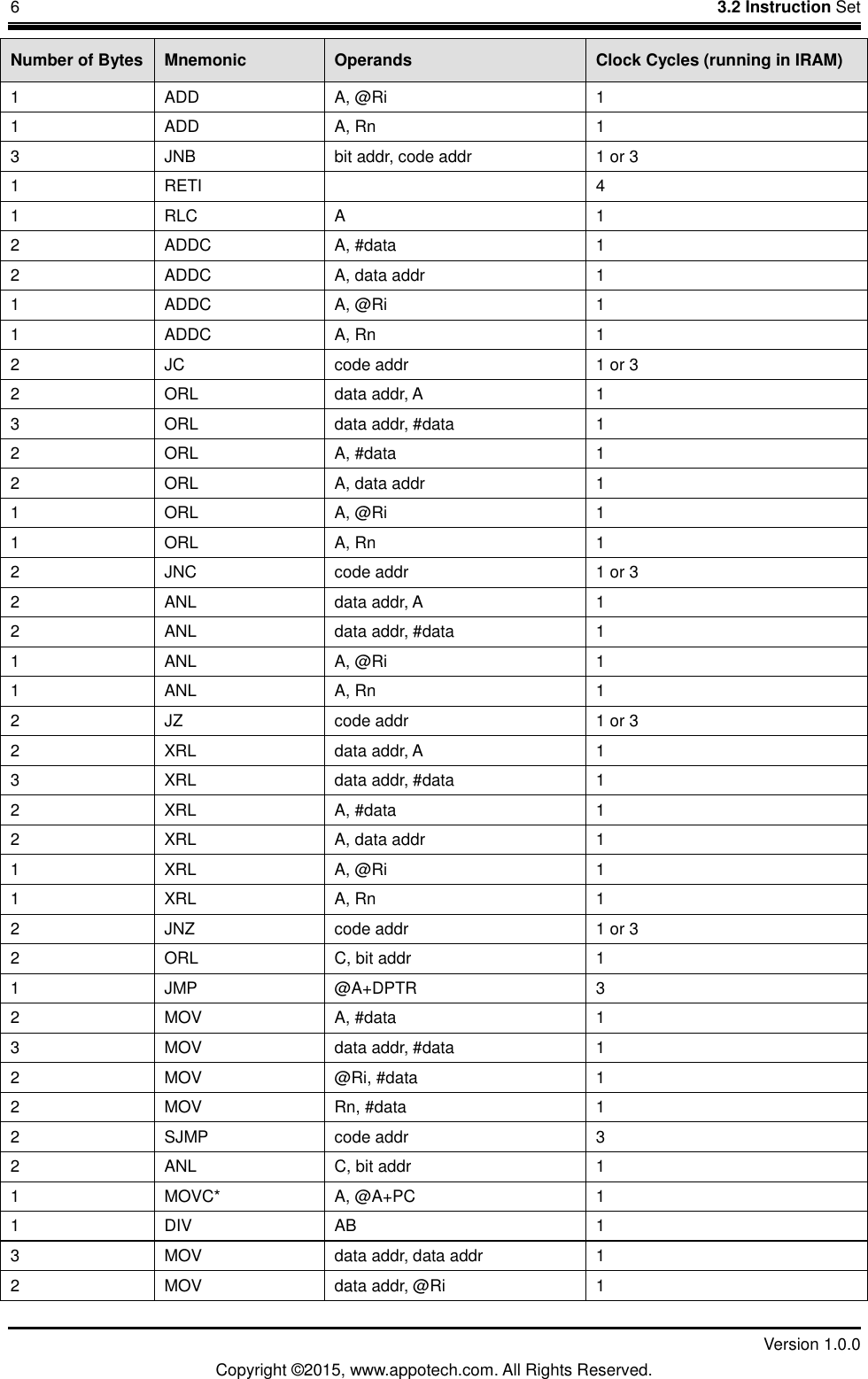
6    3.2 Instruction Set         Version 1.0.0 Copyright ©2015, www.appotech.com. All Rights Reserved.   Number of Bytes Mnemonic Operands Clock Cycles (running in IRAM) 1  ADD  A, @Ri  1 1  ADD  A, Rn  1 3  JNB  bit addr, code addr  1 or 3 1  RETI    4 1  RLC  A  1 2  ADDC  A, #data  1 2  ADDC  A, data addr  1 1  ADDC  A, @Ri  1 1  ADDC  A, Rn  1 2  JC  code addr  1 or 3 2  ORL  data addr, A  1 3  ORL  data addr, #data  1 2  ORL  A, #data  1 2  ORL  A, data addr  1 1  ORL  A, @Ri  1 1  ORL  A, Rn  1 2  JNC  code addr  1 or 3 2  ANL  data addr, A  1 2  ANL  data addr, #data  1 1  ANL  A, @Ri  1 1  ANL  A, Rn  1 2  JZ  code addr  1 or 3 2  XRL  data addr, A  1 3  XRL  data addr, #data  1 2  XRL  A, #data  1 2  XRL  A, data addr  1 1  XRL  A, @Ri  1 1  XRL  A, Rn  1 2  JNZ  code addr  1 or 3 2  ORL  C, bit addr  1 1  JMP  @A+DPTR  3 2  MOV  A, #data  1 3  MOV  data addr, #data  1 2  MOV  @Ri, #data  1 2  MOV  Rn, #data  1 2  SJMP  code addr  3 2  ANL  C, bit addr  1 1  MOVC*  A, @A+PC  1 1  DIV  AB  1 3  MOV  data addr, data addr  1 2  MOV  data addr, @Ri  1
3 CPU Core Information       7         Version 1.0.0 Copyright ©2015, www.appotech.com. All Rights Reserved. Number of Bytes Mnemonic Operands Clock Cycles (running in IRAM) 2  MOV  data addr, Rn  1 3  MOV  DPTR, #data  1 2  MOV  bit addr, C  1 1  MOVC*  A, @A+DPTR  2 2  SUBB  A, #data  1 2  SUBB  A, data addr  1 1  SUBB  A, @Ri  1 1  SUBB  A, Rn  1 2  ORL  C, bit addr  1 2  MOV  C, bit addr  1 1  INC  DPTR  1 1  MUL  AB  1 2  MOV  @Ri, data addr  1 2  MOV  Rn, data addr  1 2  ANL  C, bit addr  1 2  CPL  bit addr  1 2  CPL  C  1 3  CJNE  A, #data, code addr  1 or 3 3  CJNE  A, data addr, code addr  1 or 3 3  CJNE  @Ri, #data, code addr  1 or 3 3  CJNE  Rn, #data, code addr  1 or 3 2  PUSH  data addr  1 2  CLR  bit addr  1 1  CLR  C  1 1  SWAP  A  1 2  XCH  A, data addr  1 1  XCH  A, @Ri  1 1  XCH  A, Rn  1 2  POP  data addr  1 2  SETB  bit addr  1 1  SETB  C  1 1  DA  A  1 3  DJNZ  data addr, code addr  1 or 3 1  XCHD  A, @Ri  1 2  DJNZ  Rn, code addr  1 or 3 1  MOVX  A, @DPTR  2 1  MOVX  A, @Ri  2 1  CLR  A  1 2  MOV  A, data addr  1 1  MOV  A, @Ri  1 1  MOV  A, Rn  1
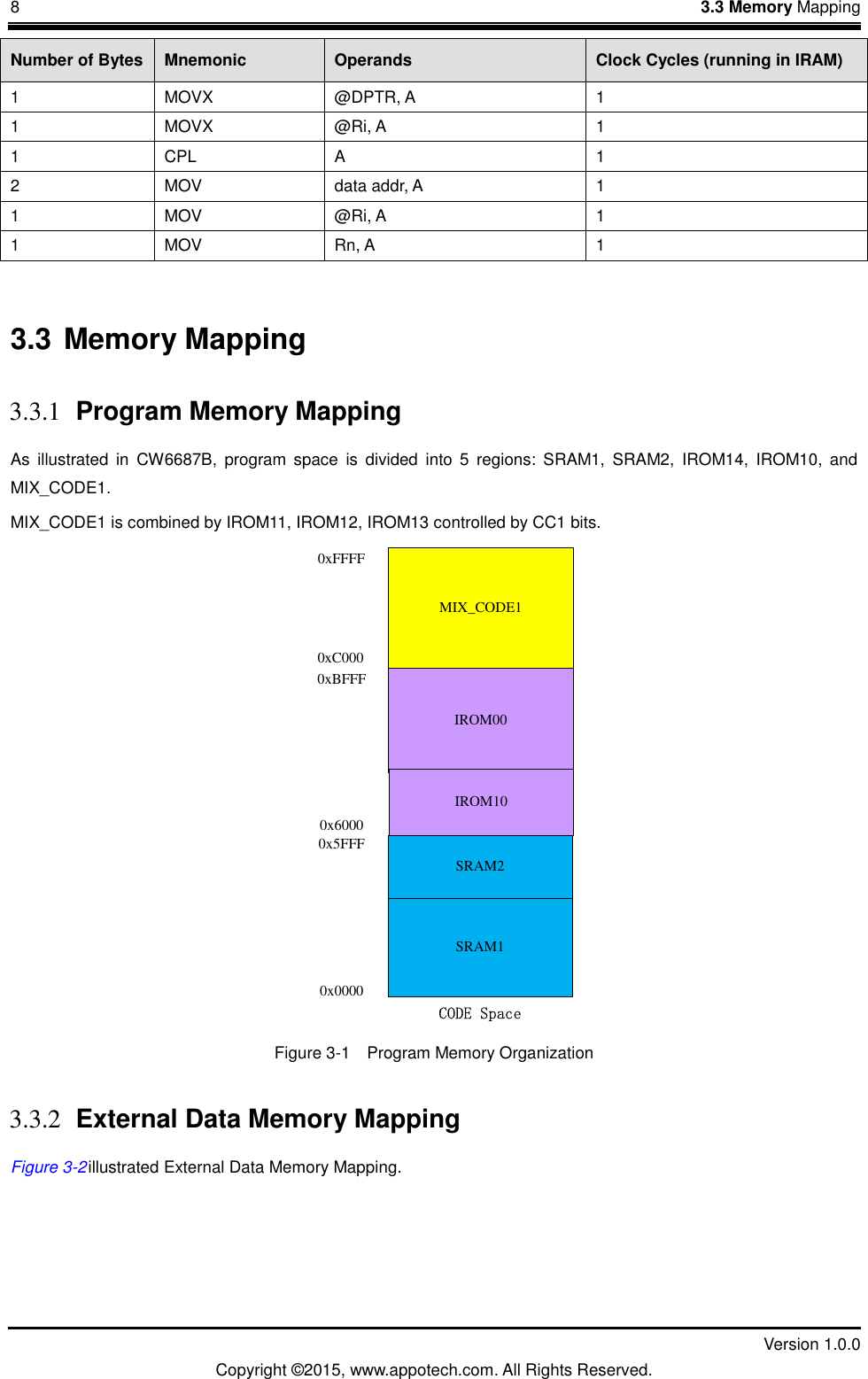
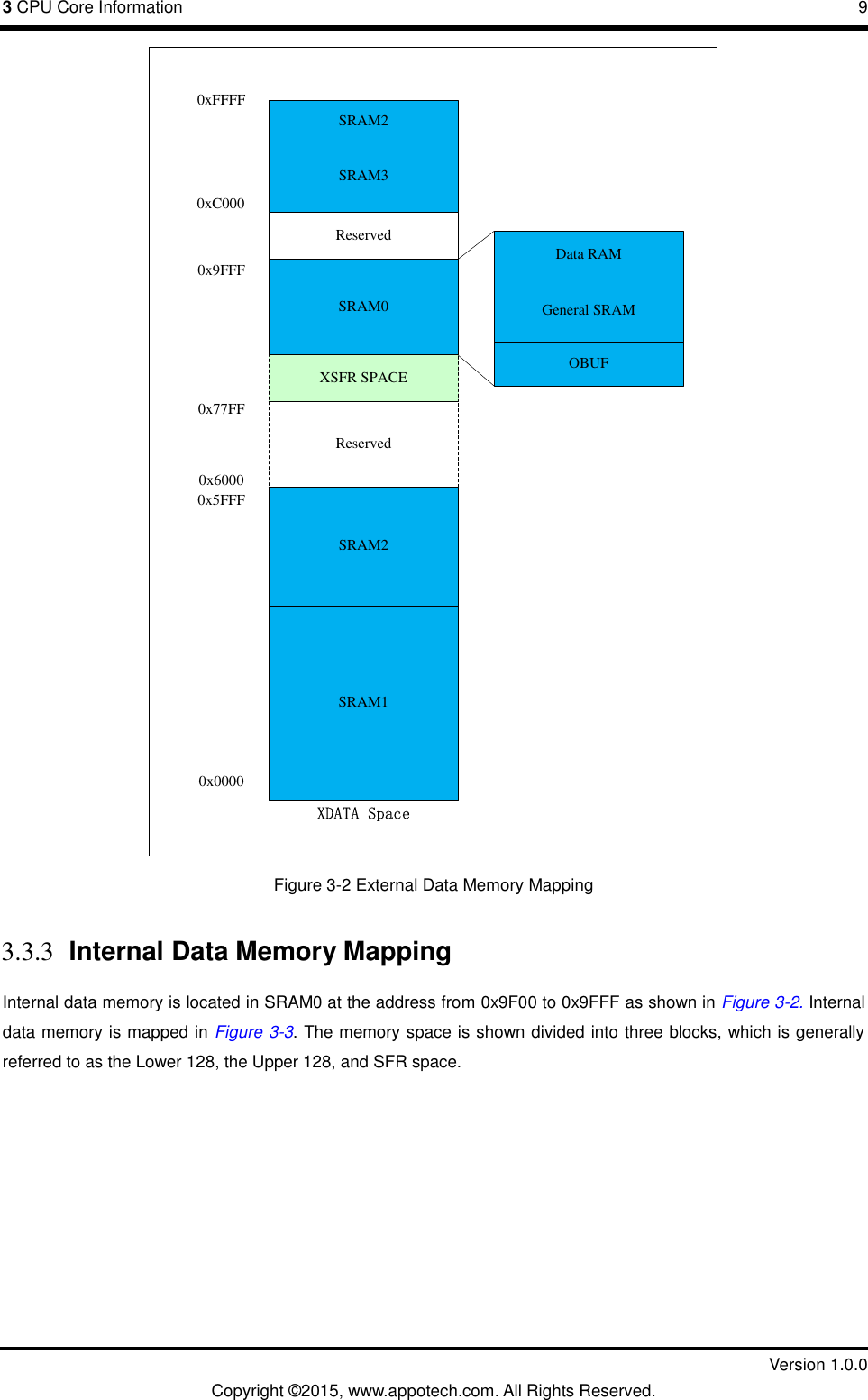
8    3.3 Memory Mapping         Version 1.0.0 Copyright ©2015, www.appotech.com. All Rights Reserved.   Number of Bytes Mnemonic Operands Clock Cycles (running in IRAM) 1  MOVX  @DPTR, A  1 1  MOVX  @Ri, A  1 1  CPL  A  1 2  MOV  data addr, A  1 1  MOV  @Ri, A  1 1  MOV  Rn, A  1  3.3 Memory Mapping 3.3.1 Program Memory Mapping As  illustrated  in CW6687B,  program  space  is  divided  into  5  regions:  SRAM1,  SRAM2,  IROM14,  IROM10,  and MIX_CODE1. MIX_CODE1 is combined by IROM11, IROM12, IROM13 controlled by CC1 bits. 0x00000xBFFFCODE SpaceSRAM2SRAM1IROM000x60000x5FFFMIX_CODE1IROM100xC0000xFFFF Figure 3-1    Program Memory Organization 3.3.2 External Data Memory Mapping XFigure 3-2  illustrated External Data Memory Mapping.
3 CPU Core Information       9         Version 1.0.0 Copyright ©2015, www.appotech.com. All Rights Reserved. XDATA Space0x00000x5FFF0xFFFFXSFR SPACE0x9FFFSRAM1Reserved0x77FF0x6000Data RAMGeneral SRAMOBUFSRAM0Reserved0xC000SRAM3SRAM2SRAM2 Figure 3-2 External Data Memory Mapping 3.3.3 Internal Data Memory Mapping Internal data memory is located in SRAM0 at the address from 0x9F00 to 0x9FFF as shown in Figure 3-2. Internal data memory is mapped in Figure 3-3. The memory space is shown divided into three blocks, which is generally referred to as the Lower 128, the Upper 128, and SFR space.
10    3.4 Interrupt Processing         Version 1.0.0 Copyright ©2015, www.appotech.com. All Rights Reserved.   Indirect addressing onlyDirect and Indirect addressingDirect addressing00H7FH80HFFHUpper128Lower128SFRFFH80H Figure 3-3 Internal data memory mapping As  shown  in  Figure  3-4  the  Lowest  32  bytes  in  Lower  128  are  grouped  into  4  banks  of  8  registers.  Program instructions call out these registers as R0 through R7. Two bits in the PSW select which register bank are in use. 00H 07H08H 0FH10H 1FH18H 1FH20H2FH7FH00011011BANK SELECT BITS IN PSWReset value of SPBit addressable space Figure 3-4 Lowest 32 bytes in Internal data memory Lower 128 3.4 Interrupt Processing 3.4.1 Interrupt sources The  CW6687B  provides  15  interrupt  sources.  All  interrupts  are  controlled  by  a  series  combination  of  individual enable bits and a global enable (EA) in the interrupt-enable register (IE0.7). Setting EA to logic 1 allows individual interrupts to be enabled. Setting EA to logic 0 disables all interrupts regardless of the individual interrupt-enable settings. The interrupt enables and priorities are functionally identical to those of the 80C52. The CW6687B provides 3 sets of vectors entry addresses, starting from 0x0003, 0x4003 and 0x8003. The vector base address is set by DPCON [7:6]. Table 3-2 lists the interrupt summary. Table 3-2 Interrupt Summary
3 CPU Core Information       11         Version 1.0.0 Copyright ©2015, www.appotech.com. All Rights Reserved. Interrupt Sources Interrupt Vector Interrupt Number Natural Order Interrupt Flag Interrupt Enable Bit Priority Control Bit SINT0 0x0003 0x4003   0x8003 0  1  SPMODE.7  IE0.0  IPH0.0  IP0.0 SINT1 AGC 0x000B   0x400B 0x800B 1  2  SPMODE.6 AGCDMACON.0 IE0.1  IPH0.1   IP0.1 Timer 1 0x0013   0x4013 0x8013   2  3  TMR1CON.7 TMR1CON.6  IE0.2  IPH0.2   IP0.2 Timer 2 0x001B   0x401B 0x801B 3  4  TMR2CON.7 TMR2CON.6  IE0.3  IPH0.3   IP0.3 MP3/FFT1 0x0023   0x4023 0x8023 4  5 AUCON7.6 AUCON7.5 AUCON7.4 AUCON7.3 AUCON7.2 AUCON7.1 AUCON7.0 AUCON11.6 FFT1CON1.1 IE0.4  IPH0.4   IP0.4 Huffman/ UART1 (overflow) 0x002B   0x402B   0x802B 5  6 HFMCON.7 HFMCON.6 UART1STA.1 IE0.5  IPH0.5   IP0.5 USBSOF UART1 BTRAM 0x0033   0x4033 0x8033 6  7 USBCON2.1 UART1STA.3&UART1STA2 BTRAM_CON0[6]&         BTRAM_CON1[4] IE0.6  IPH0.6   IP0.6 USBCTL 0x003B   0x403B 0x803B 7  8    IE1.0  IPH1.0   IP1.0 SDC 0x0043   0x4043 0x8043 8  9  SDCON1.5 SDCON1.4  IE1.1  IPH1.1   IP1.1 PORT 0x004B   0x404B 0x804B 9  10  WKPND  IE1.2  IPH1.2   IP1.2 SPI0 0x0053   0x4053 0x8053 10 11 SPI0CON.7  IE1.3  IPH1.3   IP1.3 Timer 3  0x005B    11 12  TMR3CON.7  IE1.4  IPH1.4
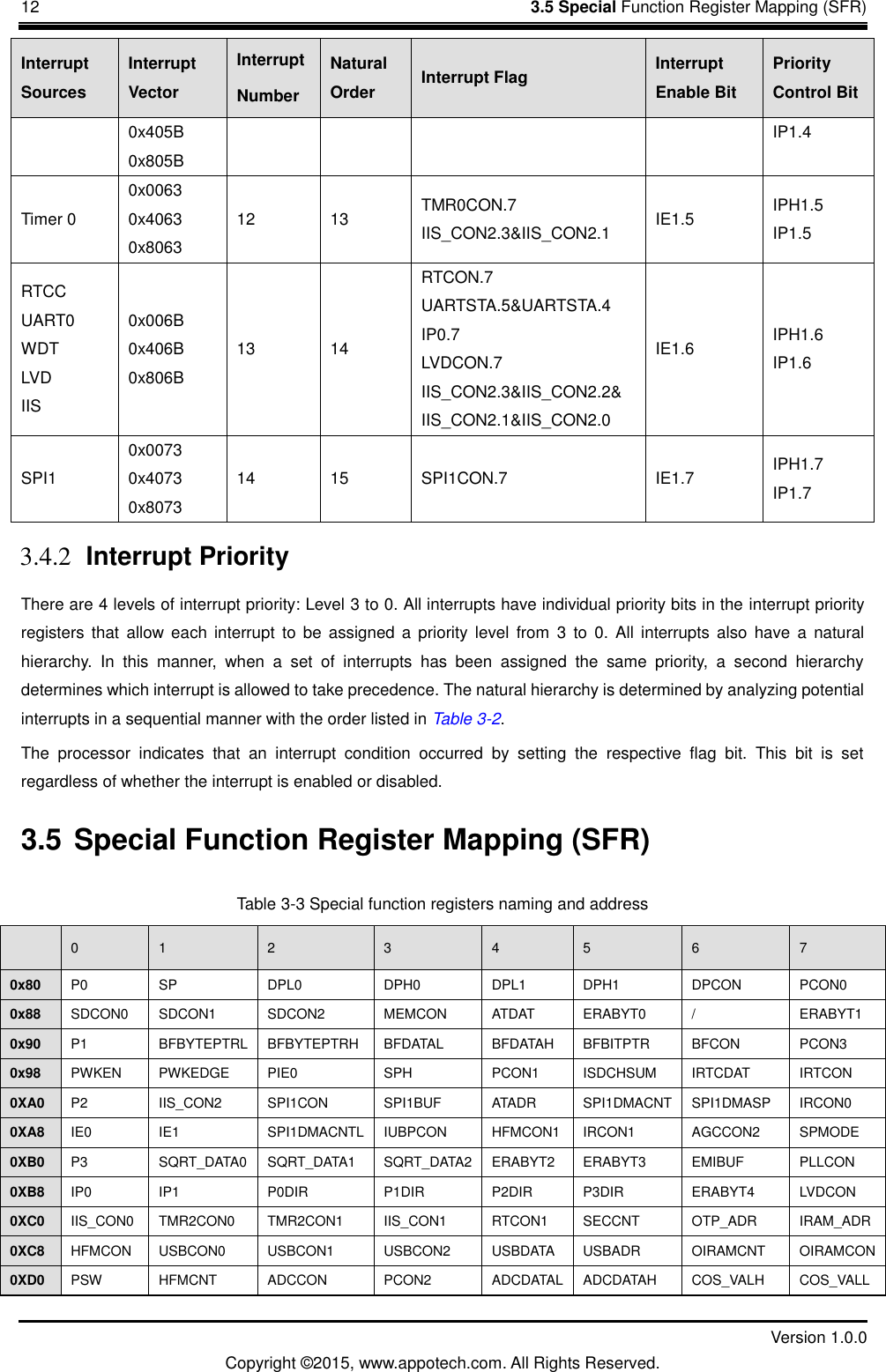
12    3.5 Special Function Register Mapping (SFR)         Version 1.0.0 Copyright ©2015, www.appotech.com. All Rights Reserved.   Interrupt Sources Interrupt Vector Interrupt Number Natural Order Interrupt Flag Interrupt Enable Bit Priority Control Bit 0x405B 0x805B IP1.4 Timer 0 0x0063 0x4063 0x8063 12 13 TMR0CON.7 IIS_CON2.3&IIS_CON2.1  IE1.5  IPH1.5   IP1.5 RTCC UART0 WDT LVD IIS 0x006B   0x406B 0x806B 13 14 RTCON.7 UARTSTA.5&UARTSTA.4 IP0.7 LVDCON.7 IIS_CON2.3&IIS_CON2.2& IIS_CON2.1&IIS_CON2.0 IE1.6  IPH1.6   IP1.6 SPI1 0x0073   0x4073 0x8073 14 15  SPI1CON.7  IE1.7  IPH1.7   IP1.7 3.4.2 Interrupt Priority There are 4 levels of interrupt priority: Level 3 to 0. All interrupts have individual priority bits in the interrupt priority registers  that  allow  each  interrupt  to be  assigned  a  priority  level  from  3  to  0.  All interrupts also  have  a  natural hierarchy.  In  this  manner,  when  a  set  of  interrupts  has  been  assigned  the  same  priority,  a  second  hierarchy determines which interrupt is allowed to take precedence. The natural hierarchy is determined by analyzing potential interrupts in a sequential manner with the order listed in Table 3-2. The  processor  indicates  that  an  interrupt  condition  occurred  by  setting  the  respective  flag  bit.  This  bit  is  set regardless of whether the interrupt is enabled or disabled.   3.5 Special Function Register Mapping (SFR) Table 3-3 Special function registers naming and address  0  1  2  3  4  5  6  7 0x80 P0 SP  DPL0  DPH0  DPL1  DPH1  DPCON  PCON0 0x88 SDCON0  SDCON1  SDCON2  MEMCON  ATDAT  ERABYT0  /  ERABYT1 0x90 P1  BFBYTEPTRL  BFBYTEPTRH  BFDATAL  BFDATAH  BFBITPTR  BFCON  PCON3 0x98 PWKEN  PWKEDGE  PIE0  SPH  PCON1  ISDCHSUM  IRTCDAT  IRTCON 0XA0  P2  IIS_CON2  SPI1CON  SPI1BUF  ATADR  SPI1DMACNT  SPI1DMASP  IRCON0 0XA8  IE0  IE1  SPI1DMACNTL  IUBPCON  HFMCON1  IRCON1  AGCCON2  SPMODE 0XB0  P3  SQRT_DATA0  SQRT_DATA1  SQRT_DATA2  ERABYT2  ERABYT3  EMIBUF  PLLCON 0XB8  IP0  IP1  P0DIR  P1DIR  P2DIR  P3DIR  ERABYT4  LVDCON 0XC0  IIS_CON0  TMR2CON0  TMR2CON1  IIS_CON1  RTCON1  SECCNT  OTP_ADR  IRAM_ADR 0XC8  HFMCON  USBCON0  USBCON1  USBCON2  USBDATA  USBADR  OIRAMCNT  OIRAMCON 0XD0  PSW  HFMCNT  ADCCON  PCON2  ADCDATAL  ADCDATAH  COS_VALH  COS_VALL
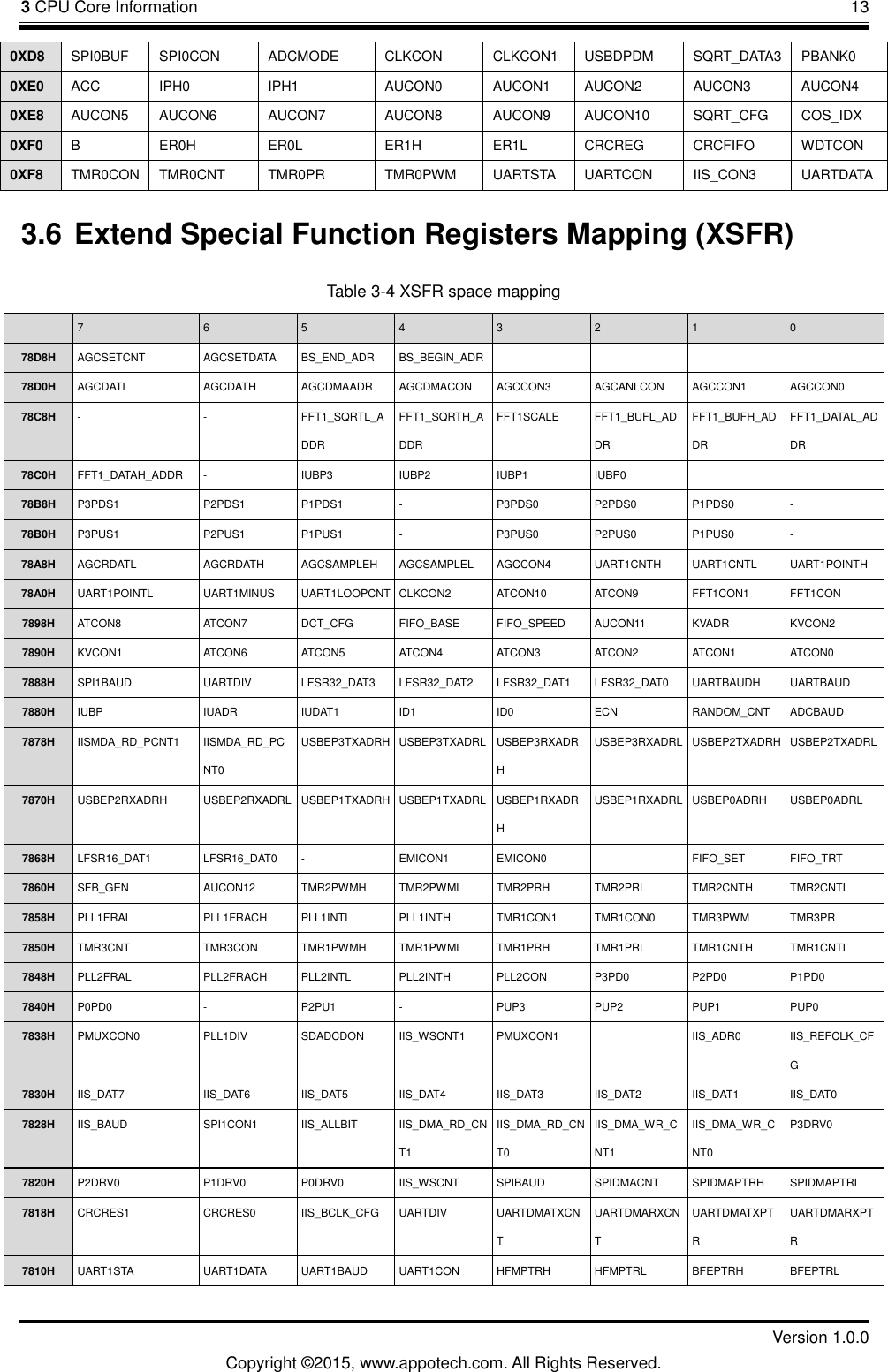
3 CPU Core Information       13         Version 1.0.0 Copyright ©2015, www.appotech.com. All Rights Reserved. 0XD8  SPI0BUF  SPI0CON  ADCMODE  CLKCON  CLKCON1  USBDPDM  SQRT_DATA3  PBANK0 0XE0  ACC  IPH0  IPH1  AUCON0  AUCON1  AUCON2  AUCON3  AUCON4 0XE8  AUCON5  AUCON6  AUCON7  AUCON8  AUCON9  AUCON10  SQRT_CFG  COS_IDX 0XF0  B  ER0H  ER0L  ER1H  ER1L  CRCREG  CRCFIFO  WDTCON 0XF8  TMR0CON  TMR0CNT  TMR0PR  TMR0PWM  UARTSTA  UARTCON  IIS_CON3  UARTDATA 3.6 Extend Special Function Registers Mapping (XSFR) Table 3-4 XSFR space mapping   7  6  5  4  3  2  1  0 78D8H  AGCSETCNT  AGCSETDATA  BS_END_ADR  BS_BEGIN_ADR         78D0H  AGCDATL  AGCDATH  AGCDMAADR  AGCDMACON  AGCCON3  AGCANLCON  AGCCON1  AGCCON0 78C8H  -  -  FFT1_SQRTL_ADDR FFT1_SQRTH_ADDR FFT1SCALE  FFT1_BUFL_ADDR FFT1_BUFH_ADDR FFT1_DATAL_ADDR 78C0H  FFT1_DATAH_ADDR  -  IUBP3  IUBP2  IUBP1  IUBP0     78B8H  P3PDS1  P2PDS1  P1PDS1  -  P3PDS0  P2PDS0  P1PDS0  - 78B0H  P3PUS1  P2PUS1  P1PUS1  -  P3PUS0  P2PUS0  P1PUS0  - 78A8H  AGCRDATL  AGCRDATH  AGCSAMPLEH  AGCSAMPLEL  AGCCON4  UART1CNTH  UART1CNTL  UART1POINTH 78A0H  UART1POINTL  UART1MINUS  UART1LOOPCNT  CLKCON2  ATCON10  ATCON9  FFT1CON1  FFT1CON 7898H ATCON8  ATCON7  DCT_CFG  FIFO_BASE  FIFO_SPEED  AUCON11  KVADR  KVCON2 7890H KVCON1  ATCON6  ATCON5  ATCON4  ATCON3  ATCON2  ATCON1  ATCON0 7888H SPI1BAUD  UARTDIV  LFSR32_DAT3  LFSR32_DAT2  LFSR32_DAT1  LFSR32_DAT0  UARTBAUDH  UARTBAUD 7880H IUBP  IUADR  IUDAT1  ID1  ID0  ECN  RANDOM_CNT  ADCBAUD 7878H IISMDA_RD_PCNT1  IISMDA_RD_PCNT0 USBEP3TXADRH  USBEP3TXADRL  USBEP3RXADRH USBEP3RXADRL  USBEP2TXADRH  USBEP2TXADRL 7870H USBEP2RXADRH  USBEP2RXADRL  USBEP1TXADRH  USBEP1TXADRL  USBEP1RXADRH USBEP1RXADRL  USBEP0ADRH  USBEP0ADRL 7868H LFSR16_DAT1  LFSR16_DAT0  -  EMICON1  EMICON0    FIFO_SET  FIFO_TRT 7860H SFB_GEN  AUCON12  TMR2PWMH  TMR2PWML  TMR2PRH  TMR2PRL  TMR2CNTH  TMR2CNTL 7858H PLL1FRAL  PLL1FRACH  PLL1INTL  PLL1INTH  TMR1CON1  TMR1CON0  TMR3PWM  TMR3PR 7850H TMR3CNT  TMR3CON  TMR1PWMH  TMR1PWML  TMR1PRH  TMR1PRL  TMR1CNTH  TMR1CNTL 7848H PLL2FRAL  PLL2FRACH  PLL2INTL  PLL2INTH  PLL2CON  P3PD0  P2PD0  P1PD0 7840H P0PD0  -  P2PU1  -    PUP3  PUP2  PUP1  PUP0 7838H PMUXCON0  PLL1DIV  SDADCDON  IIS_WSCNT1  PMUXCON1    IIS_ADR0  IIS_REFCLK_CFG 7830H IIS_DAT7  IIS_DAT6  IIS_DAT5  IIS_DAT4  IIS_DAT3  IIS_DAT2  IIS_DAT1  IIS_DAT0 7828H IIS_BAUD  SPI1CON1  IIS_ALLBIT  IIS_DMA_RD_CNT1 IIS_DMA_RD_CNT0 IIS_DMA_WR_CNT1 IIS_DMA_WR_CNT0 P3DRV0 7820H P2DRV0  P1DRV0  P0DRV0  IIS_WSCNT  SPIBAUD  SPIDMACNT  SPIDMAPTRH  SPIDMAPTRL 7818H CRCRES1  CRCRES0  IIS_BCLK_CFG  UARTDIV  UARTDMATXCNT UARTDMARXCNT UARTDMATXPTR UARTDMARXPTR 7810H UART1STA  UART1DATA  UART1BAUD  UART1CON  HFMPTRH  HFMPTRL  BFEPTRH  BFEPTRL
14    3.7 CPU and Memory related SFR Description         Version 1.0.0 Copyright ©2015, www.appotech.com. All Rights Reserved.   7808H IRTADT3  IRDAT2  IRDAT1  IRDAT0  IIS_VALBIT  SPMODE1  PIE1  PWRCON2 7800H PWRCON1  RC_TRIM  IIS_ADR1  RC_TEST  SDDPTR  SDDCNT  SDCPTR  SDBAUD 3.7 CPU and Memory related SFR Description Register 3-1 DPCON – Data Pointer Configure Register Position  7  6  5  4  3  2  1  0 Name  IA  DPID0  DPID1  DPAID  DPTSL  EINSTEN  DPSEL Default  1  0  0  0  0  0  0  0 Access  R/W  R/W  R/W  R/W  R/W  R/W  R/W  R/W IA: Select Interrupt Vector‟s Base Address   00 = Base address is 0x0003 01 = Base address is 0x4003   10 = Base address is 0x8003 11 = Base address is 0xc003 note:interrupt address is determined by SPMODE1[4]   0 = interrupt base address depend on IA 1 = interrupt base address is 0x2000 DPID0: DPTR0 increase direction control   0 = DPTR increase   1 = DPTR decrease DPID1: DPTR1 increase direction control   0 = DPTR increase   1 = DPTR decrease DPAID: DPTR auto increment enables   0 = Auto increment disable 1 = Auto increment enable DPTSL: DPSEL toggle enable   0 = DPSEL toggle disable   1 = DPSEL toggle enable EINSTEN: Extern instruction enables 0 = Disable 1 = Enable DPSEL: DPTR Select   0 = Active DPTR0 1 = Active DPTR1 Data Pointer Register is a 16-bit address pointer,it can split up into two registers,DPL and DPH. Data pointer register is always used as indirect addressing register. Note:Interrupt address is determined by SPMODE1[4]
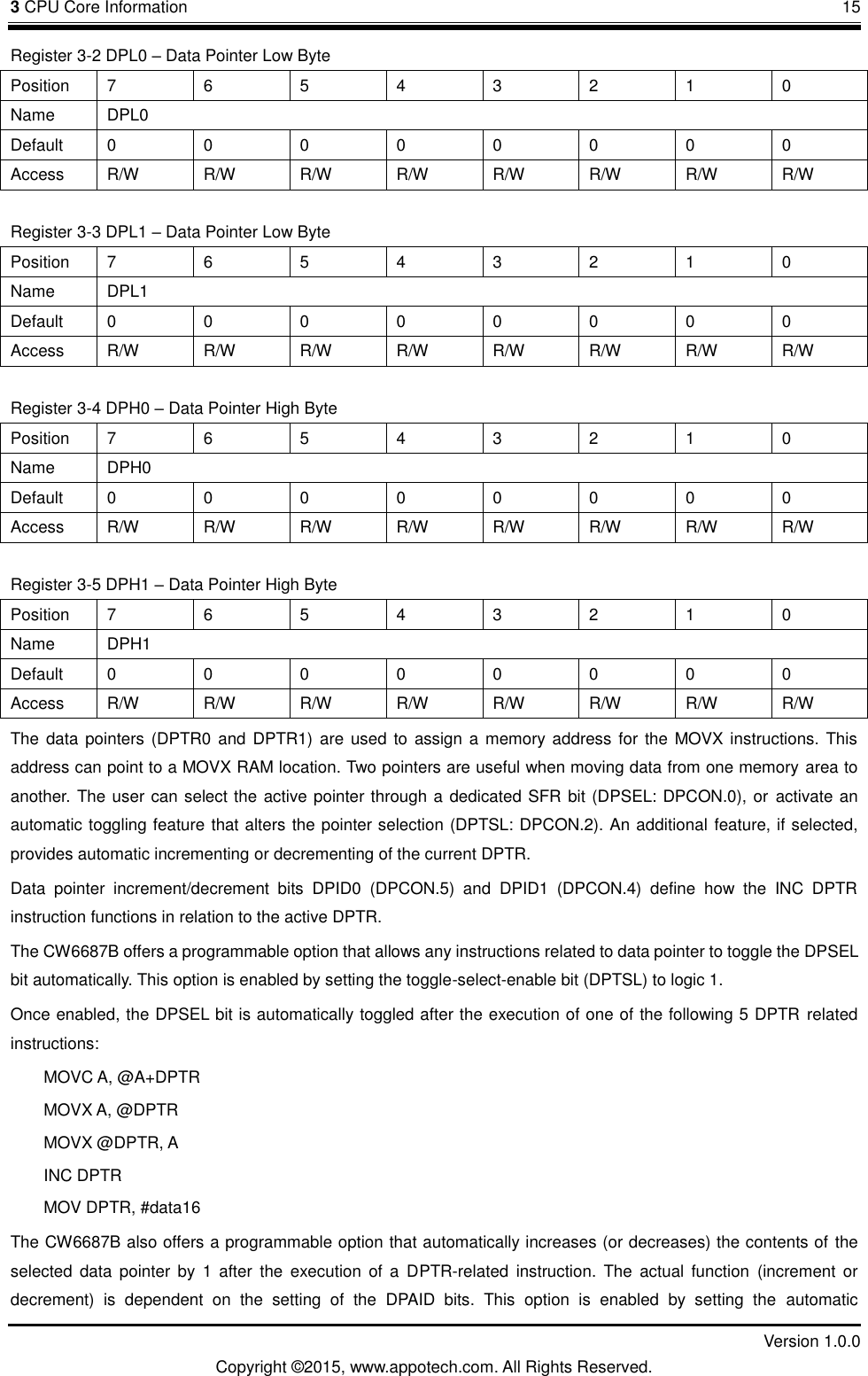
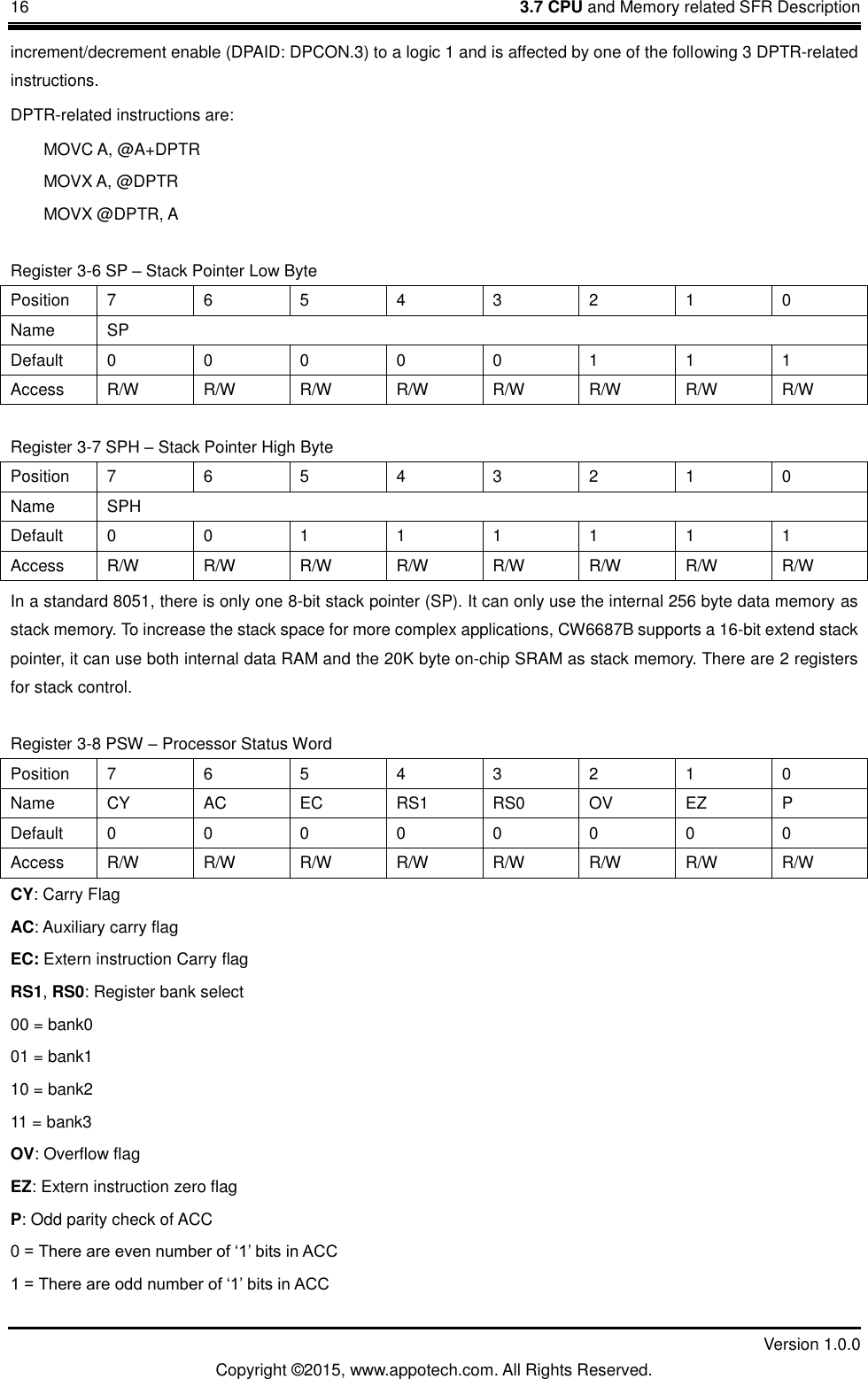
3 CPU Core Information       15         Version 1.0.0 Copyright ©2015, www.appotech.com. All Rights Reserved. Register 3-2 DPL0 – Data Pointer Low Byte Position  7  6  5  4  3  2  1  0 Name  DPL0 Default  0  0  0  0  0  0  0  0 Access  R/W  R/W  R/W  R/W  R/W  R/W  R/W  R/W Register 3-3 DPL1 – Data Pointer Low Byte Position  7  6  5  4  3  2  1  0 Name  DPL1 Default  0  0  0  0  0  0  0  0 Access  R/W  R/W  R/W  R/W  R/W  R/W  R/W  R/W Register 3-4 DPH0 – Data Pointer High Byte Position  7  6  5  4  3  2  1  0 Name  DPH0 Default  0  0  0  0  0  0  0  0 Access  R/W  R/W  R/W  R/W  R/W  R/W  R/W  R/W Register 3-5 DPH1 – Data Pointer High Byte Position  7  6  5  4  3  2  1  0 Name  DPH1 Default  0  0  0  0  0  0  0  0 Access  R/W  R/W  R/W  R/W  R/W  R/W  R/W  R/W The data  pointers (DPTR0 and  DPTR1) are used  to assign a  memory address  for the MOVX instructions. This address can point to a MOVX RAM location. Two pointers are useful when moving data from one memory area to another. The user can select the active pointer through a dedicated SFR bit (DPSEL: DPCON.0), or activate an automatic toggling feature that alters the pointer selection (DPTSL: DPCON.2). An additional feature, if selected, provides automatic incrementing or decrementing of the current DPTR. Data  pointer  increment/decrement  bits  DPID0  (DPCON.5)  and  DPID1  (DPCON.4)  define  how  the  INC  DPTR instruction functions in relation to the active DPTR. The CW6687B offers a programmable option that allows any instructions related to data pointer to toggle the DPSEL bit automatically. This option is enabled by setting the toggle-select-enable bit (DPTSL) to logic 1. Once enabled, the DPSEL bit is automatically toggled after the execution of one of the following 5 DPTR related instructions: MOVC A, @A+DPTR MOVX A, @DPTR MOVX @DPTR, A INC DPTR MOV DPTR, #data16 The CW6687B also offers a programmable option that automatically increases (or decreases) the contents of the selected  data  pointer  by  1  after  the  execution  of  a  DPTR-related  instruction.  The  actual  function  (increment  or decrement)  is  dependent  on  the  setting  of  the  DPAID  bits.  This  option  is  enabled  by  setting  the  automatic
16    3.7 CPU and Memory related SFR Description         Version 1.0.0 Copyright ©2015, www.appotech.com. All Rights Reserved.   increment/decrement enable (DPAID: DPCON.3) to a logic 1 and is affected by one of the following 3 DPTR-related instructions. DPTR-related instructions are: MOVC A, @A+DPTR MOVX A, @DPTR MOVX @DPTR, A Register 3-6 SP – Stack Pointer Low Byte Position  7  6  5  4  3  2  1  0 Name  SP Default  0  0  0  0  0  1  1  1 Access  R/W  R/W  R/W  R/W  R/W  R/W  R/W  R/W Register 3-7 SPH – Stack Pointer High Byte Position  7  6  5  4  3  2  1  0 Name  SPH Default  0  0  1  1  1  1  1  1 Access  R/W  R/W  R/W  R/W  R/W  R/W  R/W  R/W In a standard 8051, there is only one 8-bit stack pointer (SP). It can only use the internal 256 byte data memory as stack memory. To increase the stack space for more complex applications, CW6687B supports a 16-bit extend stack pointer, it can use both internal data RAM and the 20K byte on-chip SRAM as stack memory. There are 2 registers for stack control. Register 3-8 PSW – Processor Status Word Position  7  6  5  4  3  2  1  0 Name  CY AC EC  RS1  RS0  OV EZ  P Default  0  0  0  0  0  0  0  0 Access  R/W  R/W  R/W  R/W  R/W  R/W  R/W  R/W CY: Carry Flag AC: Auxiliary carry flag EC: Extern instruction Carry flag RS1, RS0: Register bank select 00 = bank0 01 = bank1 10 = bank2 11 = bank3 OV: Overflow flag EZ: Extern instruction zero flag P: Odd parity check of ACC 0 = There are even number of „1‟ bits in ACC 1 = There are odd number of „1‟ bits in ACC
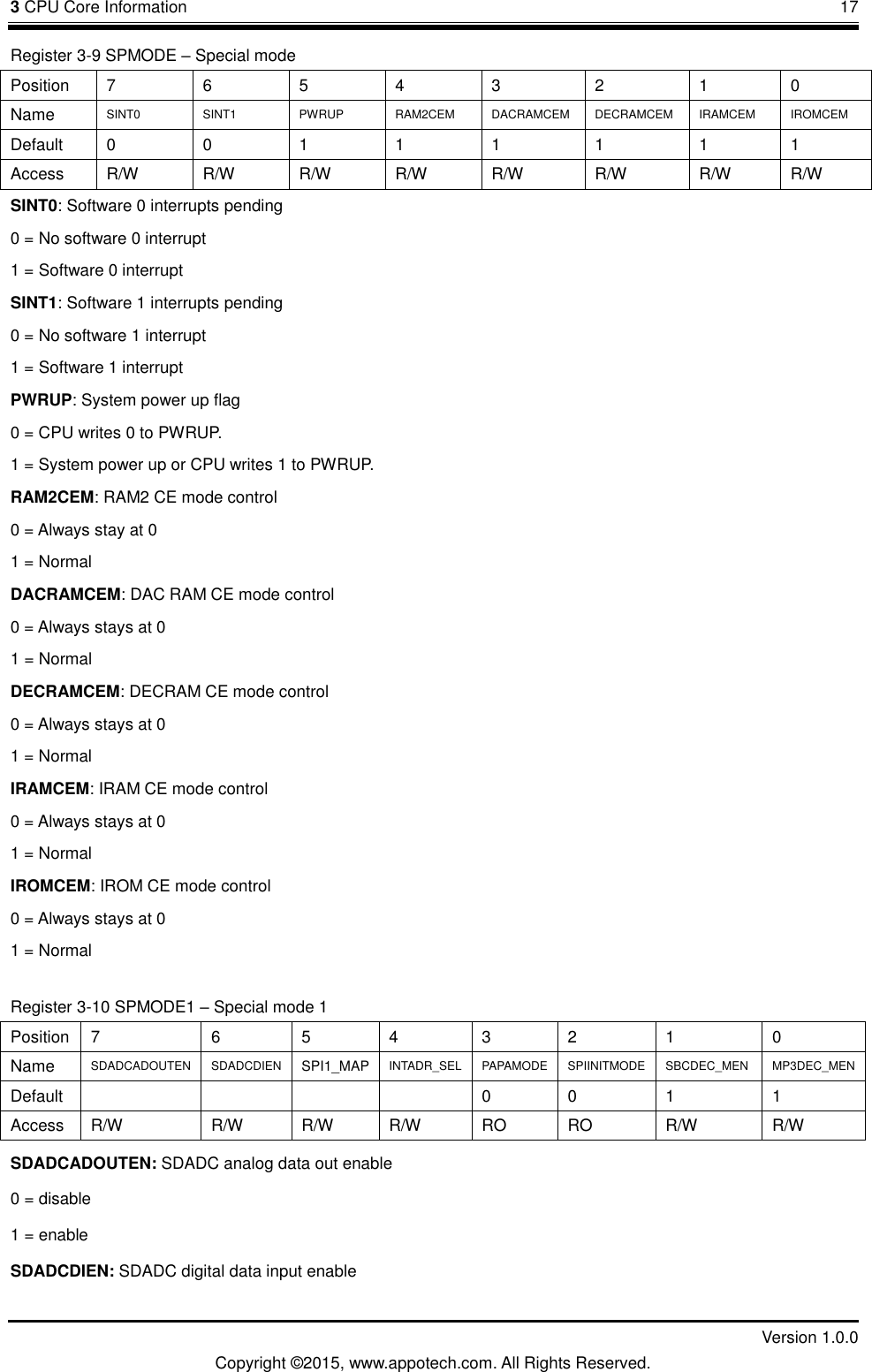
3 CPU Core Information       17         Version 1.0.0 Copyright ©2015, www.appotech.com. All Rights Reserved. Register 3-9 SPMODE – Special mode Position  7  6  5  4  3  2  1  0 Name  SINT0 SINT1  PWRUP  RAM2CEM DACRAMCEM DECRAMCEM IRAMCEM IROMCEM Default  0  0  1  1  1  1  1  1 Access  R/W  R/W  R/W  R/W  R/W  R/W  R/W  R/W SINT0: Software 0 interrupts pending 0 = No software 0 interrupt 1 = Software 0 interrupt SINT1: Software 1 interrupts pending 0 = No software 1 interrupt 1 = Software 1 interrupt PWRUP: System power up flag 0 = CPU writes 0 to PWRUP. 1 = System power up or CPU writes 1 to PWRUP. RAM2CEM: RAM2 CE mode control 0 = Always stay at 0 1 = Normal DACRAMCEM: DAC RAM CE mode control 0 = Always stays at 0 1 = Normal DECRAMCEM: DECRAM CE mode control 0 = Always stays at 0 1 = Normal IRAMCEM: IRAM CE mode control 0 = Always stays at 0 1 = Normal IROMCEM: IROM CE mode control 0 = Always stays at 0 1 = Normal Register 3-10 SPMODE1 – Special mode 1 Position  7  6  5  4  3  2  1  0 Name  SDADCADOUTEN SDADCDIEN SPI1_MAP INTADR_SEL  PAPAMODE  SPIINITMODE SBCDEC_MEN MP3DEC_MEN Default          0  0  1  1 Access  R/W  R/W  R/W  R/W  RO  RO  R/W  R/W SDADCADOUTEN: SDADC analog data out enable 0 = disable 1 = enable SDADCDIEN: SDADC digital data input enable
18    3.7 CPU and Memory related SFR Description         Version 1.0.0 Copyright ©2015, www.appotech.com. All Rights Reserved.   0 = disable 1 = enable SPI1_MAP: SPI1 port mapping 0 = Select P04, P05, P06 1 = Select P30, P31, P32 INTADR_SEL: interrupt address select 0 = depend on DPCON IA 1 = 0x2000 PAPAMODE: papa mode   0 = normal mode 1 = Parallel mode SPIINITMODE: SPI Flash initial mode 0 = normal mode 1 = SPI initial mode SBCDEC_MEN: SBC decoder module enables 0 = Disable 1 = Enable MP3DEC_MEN: MP3 decoder module enables 0 = Disable 1 = Enable Note: SPMODE1[1:0] register can be written to “0”, but can‟t be written to “1” after writing “0”. Register 3-11 MEMCON – Memory Mapping Configure Position  7  6  5  4  3  2  1  0 Name          CC1 CC0 Default  0  0  0  0  0  0  0  0 Access  WO WO RO  R/W  R/W  R/W  R/W  R/W CC1: MIX_CODE3 mapping 000 = IROM01 map to address 0xc000~0xffff 001 = IROM02 map to address 0xc000~0xffff 010 = IROM03 map to address 0xc000~0xffff 011 = IROM11 map to address 0xc000~0xffff 100 = IROM12 map to address 0xc000~0xffff 101 = SRAM3/SRAM2 map to address 0xc000~0xffff Register 3-12 IE0 – Interrupt Enable 0 Position  7  6  5  4  3  2  1  0 Name  EA  IE06  IE05  IE04  IE03  IE02  IE01  IE00 Default  0  0  0  0  0  0  0  0
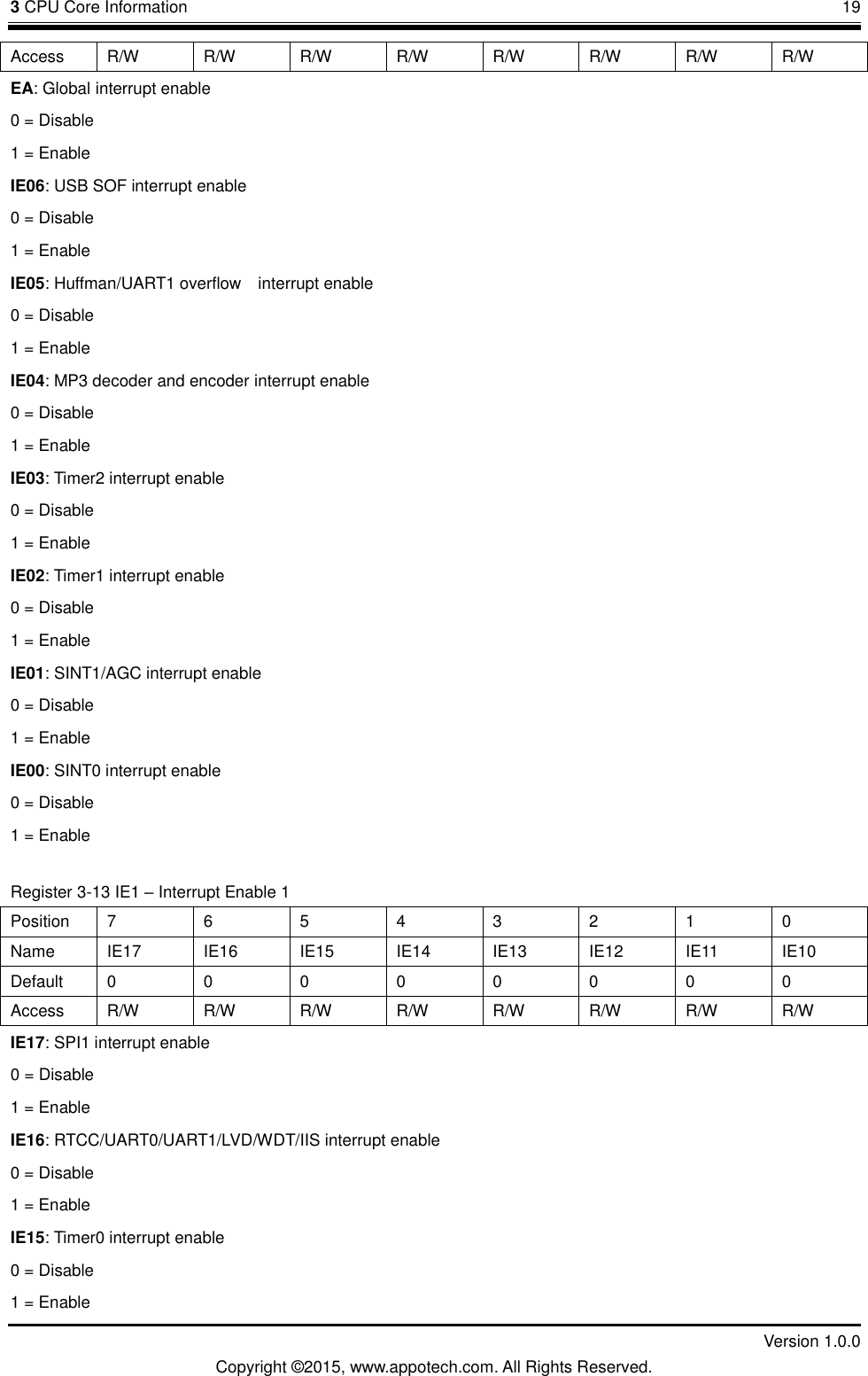
3 CPU Core Information       19         Version 1.0.0 Copyright ©2015, www.appotech.com. All Rights Reserved. Access  R/W  R/W  R/W  R/W  R/W  R/W  R/W  R/W EA: Global interrupt enable 0 = Disable 1 = Enable IE06: USB SOF interrupt enable 0 = Disable 1 = Enable IE05: Huffman/UART1 overflow    interrupt enable 0 = Disable 1 = Enable IE04: MP3 decoder and encoder interrupt enable 0 = Disable 1 = Enable IE03: Timer2 interrupt enable 0 = Disable 1 = Enable IE02: Timer1 interrupt enable 0 = Disable 1 = Enable IE01: SINT1/AGC interrupt enable 0 = Disable 1 = Enable IE00: SINT0 interrupt enable 0 = Disable 1 = Enable Register 3-13 IE1 – Interrupt Enable 1 Position  7  6  5  4  3  2  1  0 Name  IE17  IE16  IE15  IE14  IE13  IE12  IE11  IE10 Default  0  0  0  0  0  0  0  0 Access  R/W  R/W  R/W  R/W  R/W  R/W  R/W  R/W IE17: SPI1 interrupt enable 0 = Disable 1 = Enable IE16: RTCC/UART0/UART1/LVD/WDT/IIS interrupt enable 0 = Disable 1 = Enable IE15: Timer0 interrupt enable 0 = Disable 1 = Enable
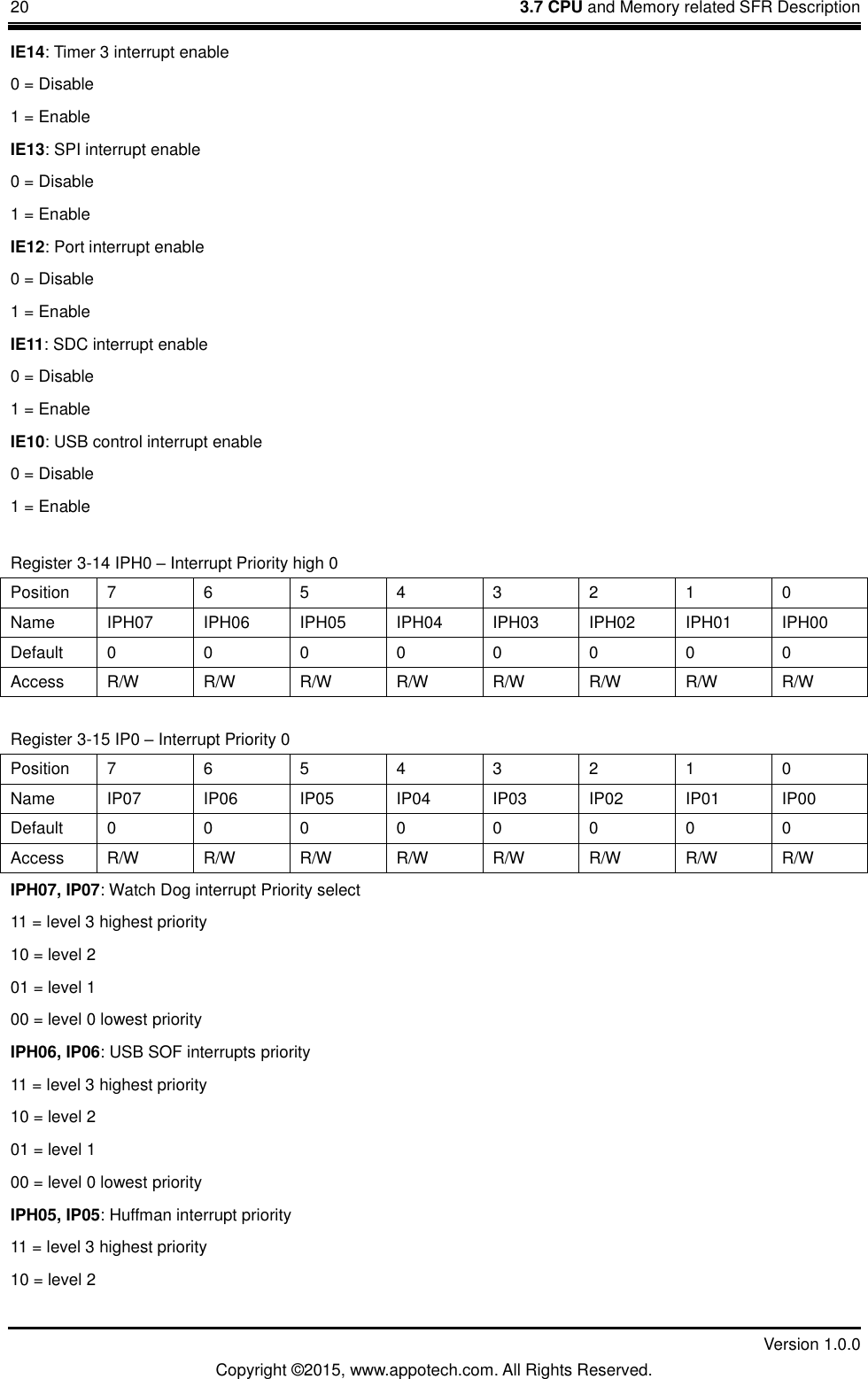
20    3.7 CPU and Memory related SFR Description         Version 1.0.0 Copyright ©2015, www.appotech.com. All Rights Reserved.   IE14: Timer 3 interrupt enable 0 = Disable 1 = Enable IE13: SPI interrupt enable 0 = Disable 1 = Enable IE12: Port interrupt enable 0 = Disable 1 = Enable IE11: SDC interrupt enable 0 = Disable 1 = Enable IE10: USB control interrupt enable 0 = Disable 1 = Enable Register 3-14 IPH0 – Interrupt Priority high 0 Position  7  6  5  4  3  2  1  0 Name  IPH07  IPH06  IPH05  IPH04  IPH03  IPH02  IPH01  IPH00 Default  0  0  0  0  0  0  0  0 Access  R/W  R/W  R/W  R/W  R/W  R/W  R/W  R/W Register 3-15 IP0 – Interrupt Priority 0 Position  7  6  5  4  3  2  1  0 Name  IP07  IP06  IP05  IP04  IP03  IP02  IP01  IP00 Default  0  0  0  0  0  0  0  0 Access  R/W  R/W  R/W  R/W  R/W  R/W  R/W  R/W IPH07, IP07: Watch Dog interrupt Priority select 11 = level 3 highest priority 10 = level 2 01 = level 1 00 = level 0 lowest priority IPH06, IP06: USB SOF interrupts priority 11 = level 3 highest priority 10 = level 2 01 = level 1 00 = level 0 lowest priority IPH05, IP05: Huffman interrupt priority 11 = level 3 highest priority 10 = level 2
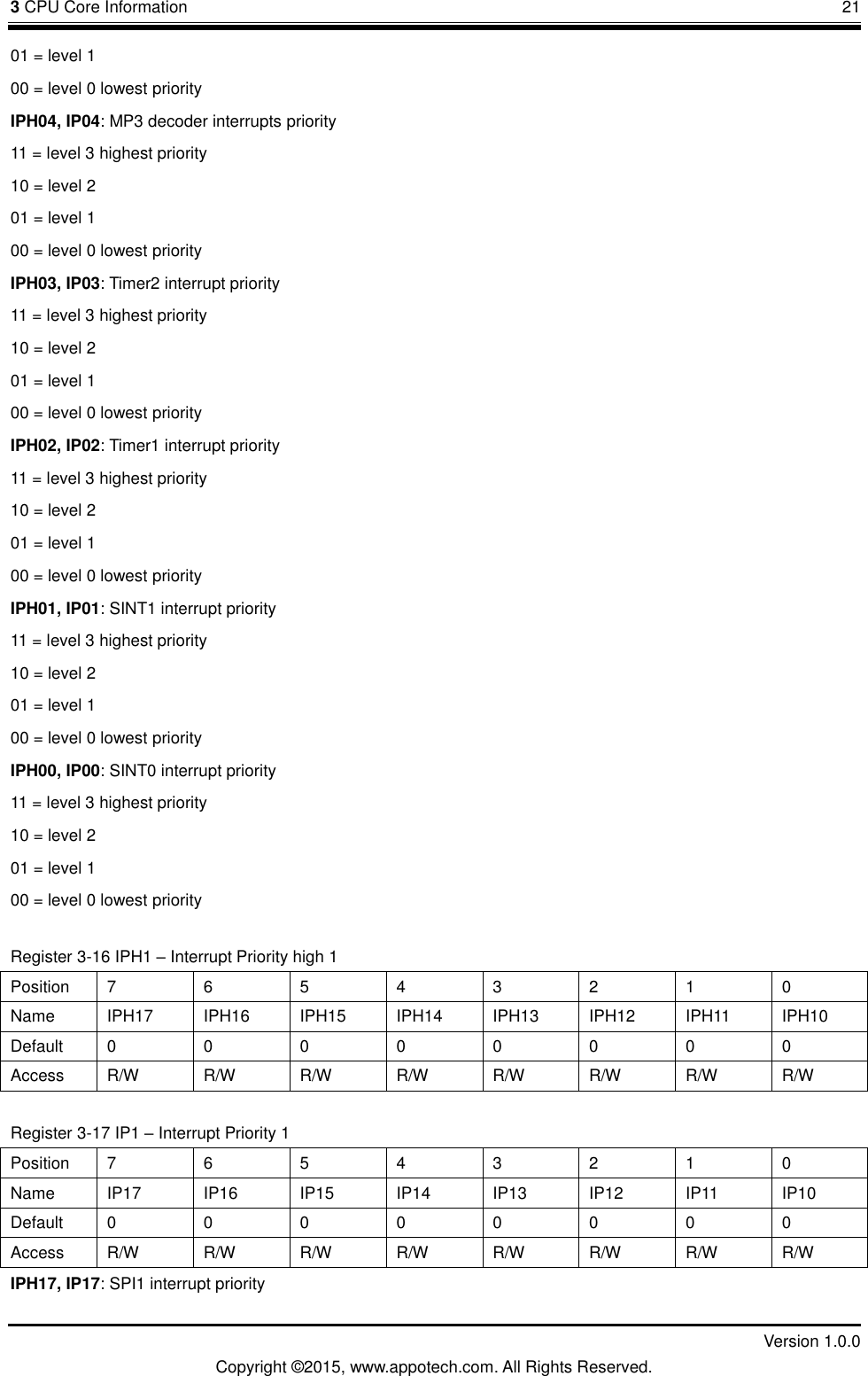
3 CPU Core Information       21         Version 1.0.0 Copyright ©2015, www.appotech.com. All Rights Reserved. 01 = level 1 00 = level 0 lowest priority IPH04, IP04: MP3 decoder interrupts priority 11 = level 3 highest priority 10 = level 2 01 = level 1 00 = level 0 lowest priority IPH03, IP03: Timer2 interrupt priority 11 = level 3 highest priority 10 = level 2 01 = level 1 00 = level 0 lowest priority IPH02, IP02: Timer1 interrupt priority 11 = level 3 highest priority 10 = level 2 01 = level 1 00 = level 0 lowest priority IPH01, IP01: SINT1 interrupt priority 11 = level 3 highest priority 10 = level 2 01 = level 1 00 = level 0 lowest priority IPH00, IP00: SINT0 interrupt priority 11 = level 3 highest priority 10 = level 2 01 = level 1 00 = level 0 lowest priority Register 3-16 IPH1 – Interrupt Priority high 1 Position  7  6  5  4  3  2  1  0 Name  IPH17  IPH16  IPH15  IPH14  IPH13  IPH12  IPH11  IPH10 Default  0  0  0  0  0  0  0  0 Access  R/W  R/W  R/W  R/W  R/W  R/W  R/W  R/W Register 3-17 IP1 – Interrupt Priority 1 Position  7  6  5  4  3  2  1  0 Name  IP17  IP16  IP15  IP14  IP13  IP12  IP11  IP10 Default  0  0  0  0  0  0  0  0 Access  R/W  R/W  R/W  R/W  R/W  R/W  R/W  R/W IPH17, IP17: SPI1 interrupt priority
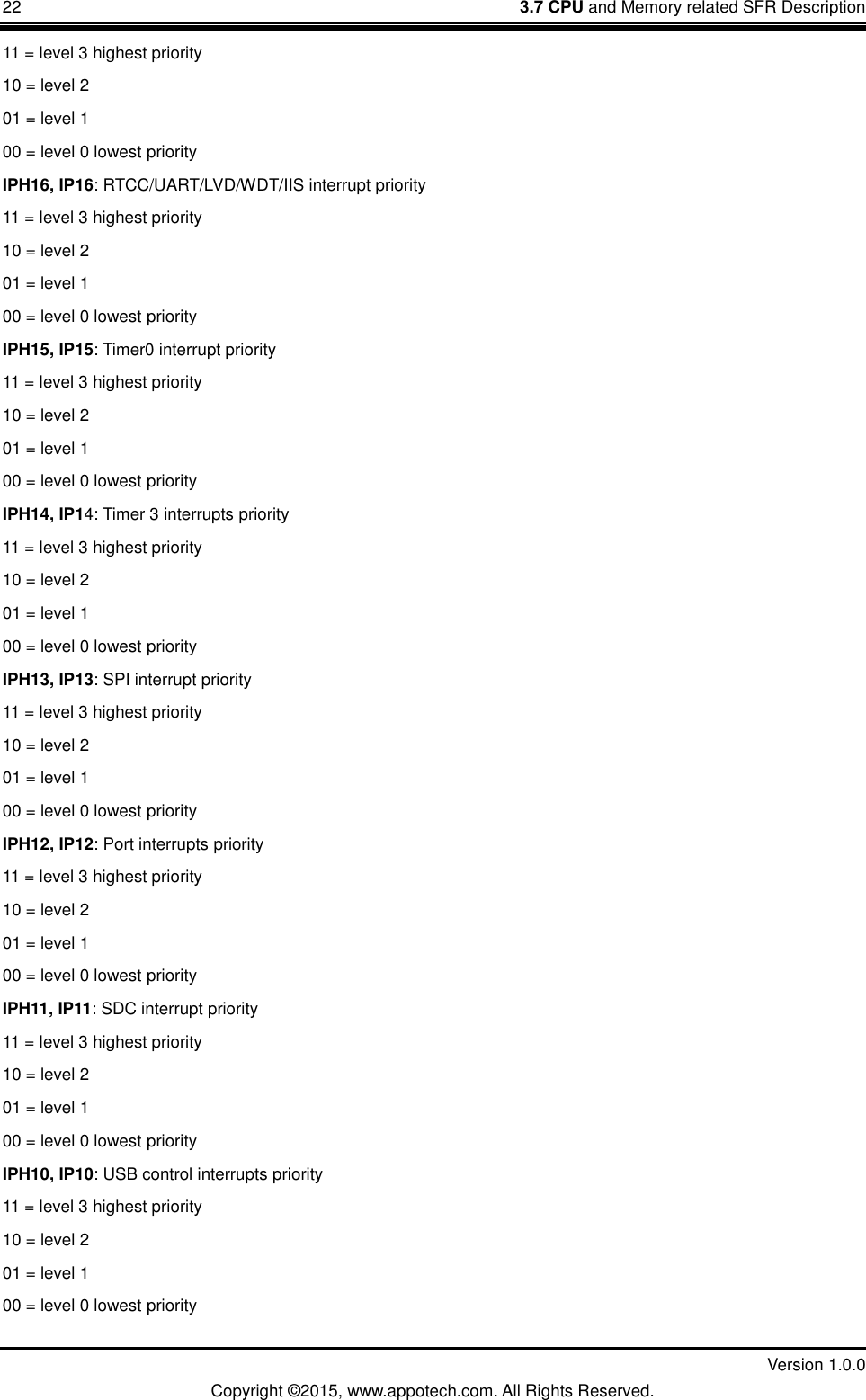
22    3.7 CPU and Memory related SFR Description         Version 1.0.0 Copyright ©2015, www.appotech.com. All Rights Reserved.   11 = level 3 highest priority 10 = level 2 01 = level 1 00 = level 0 lowest priority IPH16, IP16: RTCC/UART/LVD/WDT/IIS interrupt priority 11 = level 3 highest priority 10 = level 2 01 = level 1 00 = level 0 lowest priority IPH15, IP15: Timer0 interrupt priority 11 = level 3 highest priority 10 = level 2 01 = level 1 00 = level 0 lowest priority IPH14, IP14: Timer 3 interrupts priority 11 = level 3 highest priority 10 = level 2 01 = level 1 00 = level 0 lowest priority IPH13, IP13: SPI interrupt priority 11 = level 3 highest priority 10 = level 2 01 = level 1 00 = level 0 lowest priority IPH12, IP12: Port interrupts priority 11 = level 3 highest priority 10 = level 2 01 = level 1 00 = level 0 lowest priority IPH11, IP11: SDC interrupt priority 11 = level 3 highest priority 10 = level 2 01 = level 1 00 = level 0 lowest priority IPH10, IP10: USB control interrupts priority 11 = level 3 highest priority 10 = level 2 01 = level 1 00 = level 0 lowest priority
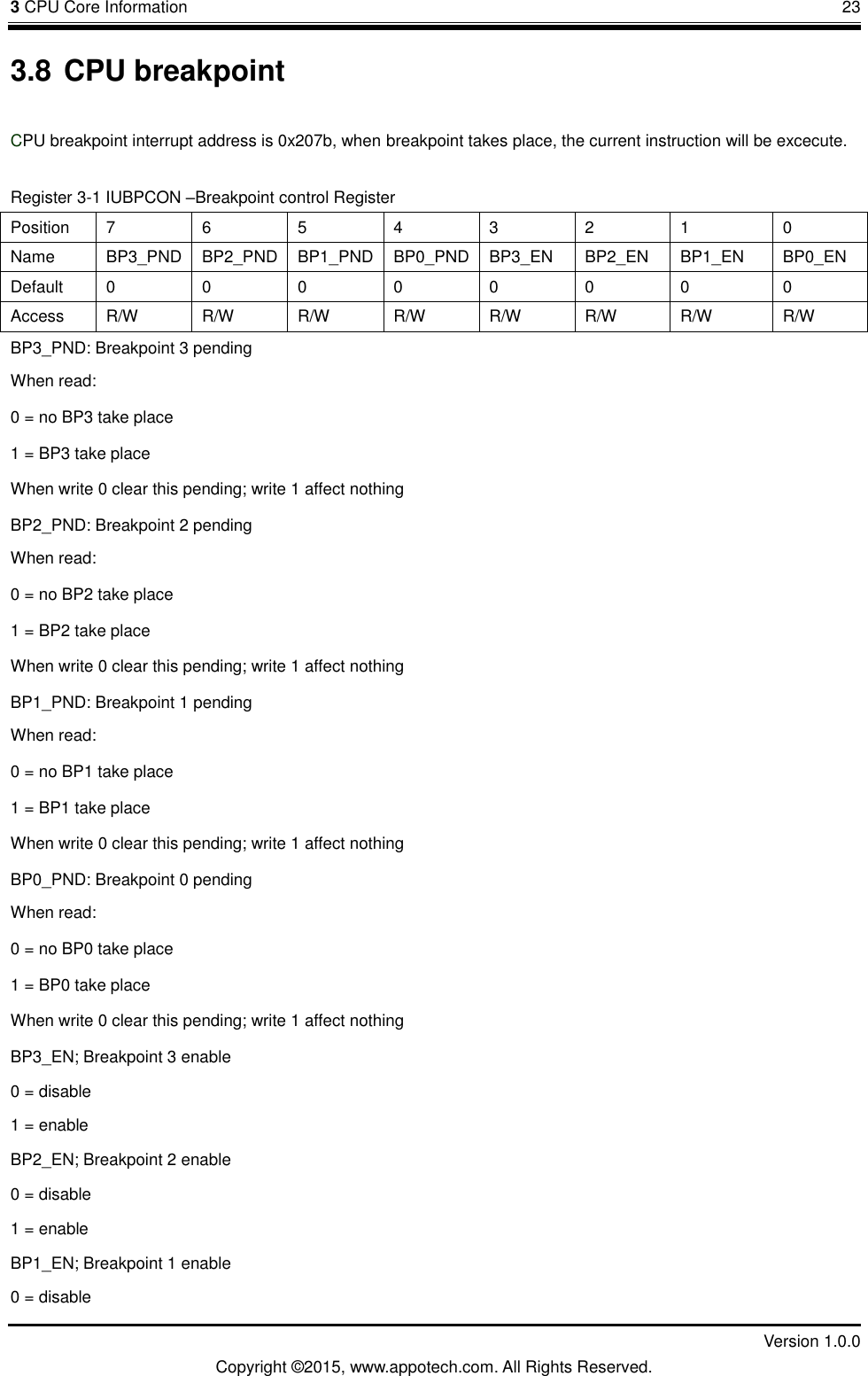
3 CPU Core Information       23         Version 1.0.0 Copyright ©2015, www.appotech.com. All Rights Reserved. 3.8 CPU breakpoint CPU breakpoint interrupt address is 0x207b, when breakpoint takes place, the current instruction will be excecute. Register 3-1 IUBPCON –Breakpoint control Register Position  7  6  5  4  3  2  1  0 Name  BP3_PND  BP2_PND  BP1_PND  BP0_PND  BP3_EN  BP2_EN  BP1_EN  BP0_EN Default  0  0  0  0  0  0  0  0 Access  R/W  R/W  R/W  R/W  R/W  R/W  R/W  R/W BP3_PND: Breakpoint 3 pending When read:   0 = no BP3 take place 1 = BP3 take place When write 0 clear this pending; write 1 affect nothing BP2_PND: Breakpoint 2 pending When read:   0 = no BP2 take place 1 = BP2 take place When write 0 clear this pending; write 1 affect nothing BP1_PND: Breakpoint 1 pending When read:   0 = no BP1 take place 1 = BP1 take place When write 0 clear this pending; write 1 affect nothing BP0_PND: Breakpoint 0 pending When read:   0 = no BP0 take place 1 = BP0 take place When write 0 clear this pending; write 1 affect nothing BP3_EN; Breakpoint 3 enable 0 = disable 1 = enable BP2_EN; Breakpoint 2 enable 0 = disable 1 = enable BP1_EN; Breakpoint 1 enable 0 = disable
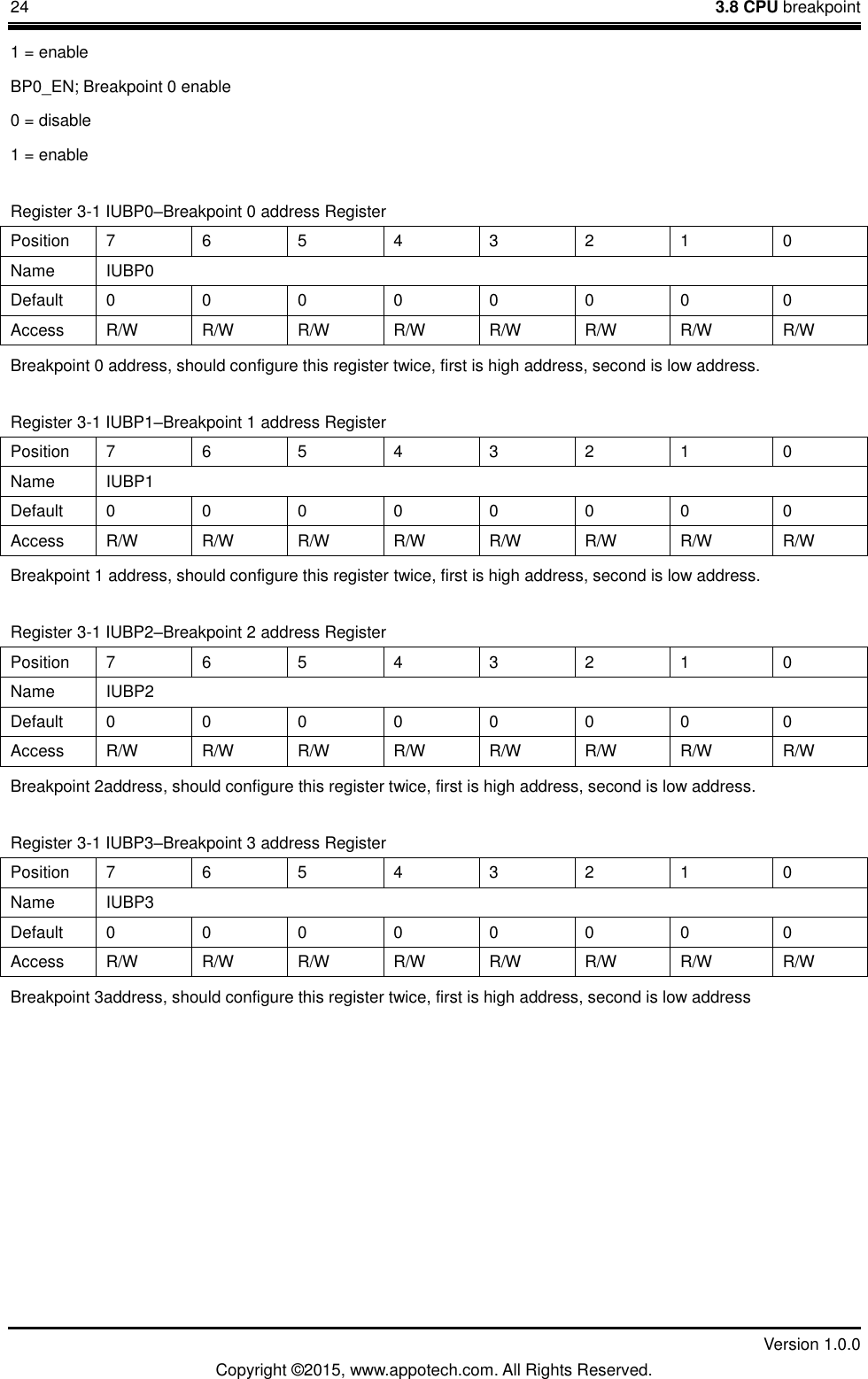
24    3.8 CPU breakpoint         Version 1.0.0 Copyright ©2015, www.appotech.com. All Rights Reserved.   1 = enable BP0_EN; Breakpoint 0 enable 0 = disable 1 = enable Register 3-1 IUBP0–Breakpoint 0 address Register Position  7  6  5  4  3  2  1  0 Name  IUBP0 Default  0  0  0  0  0  0  0  0 Access  R/W  R/W  R/W  R/W  R/W  R/W  R/W  R/W Breakpoint 0 address, should configure this register twice, first is high address, second is low address. Register 3-1 IUBP1–Breakpoint 1 address Register Position  7  6  5  4  3  2  1  0 Name  IUBP1 Default  0  0  0  0  0  0  0  0 Access  R/W  R/W  R/W  R/W  R/W  R/W  R/W  R/W Breakpoint 1 address, should configure this register twice, first is high address, second is low address. Register 3-1 IUBP2–Breakpoint 2 address Register Position  7  6  5  4  3  2  1  0 Name  IUBP2 Default  0  0  0  0  0  0  0  0 Access  R/W  R/W  R/W  R/W  R/W  R/W  R/W  R/W Breakpoint 2address, should configure this register twice, first is high address, second is low address. Register 3-1 IUBP3–Breakpoint 3 address Register Position  7  6  5  4  3  2  1  0 Name  IUBP3 Default  0  0  0  0  0  0  0  0 Access  R/W  R/W  R/W  R/W  R/W  R/W  R/W  R/W Breakpoint 3address, should configure this register twice, first is high address, second is low address
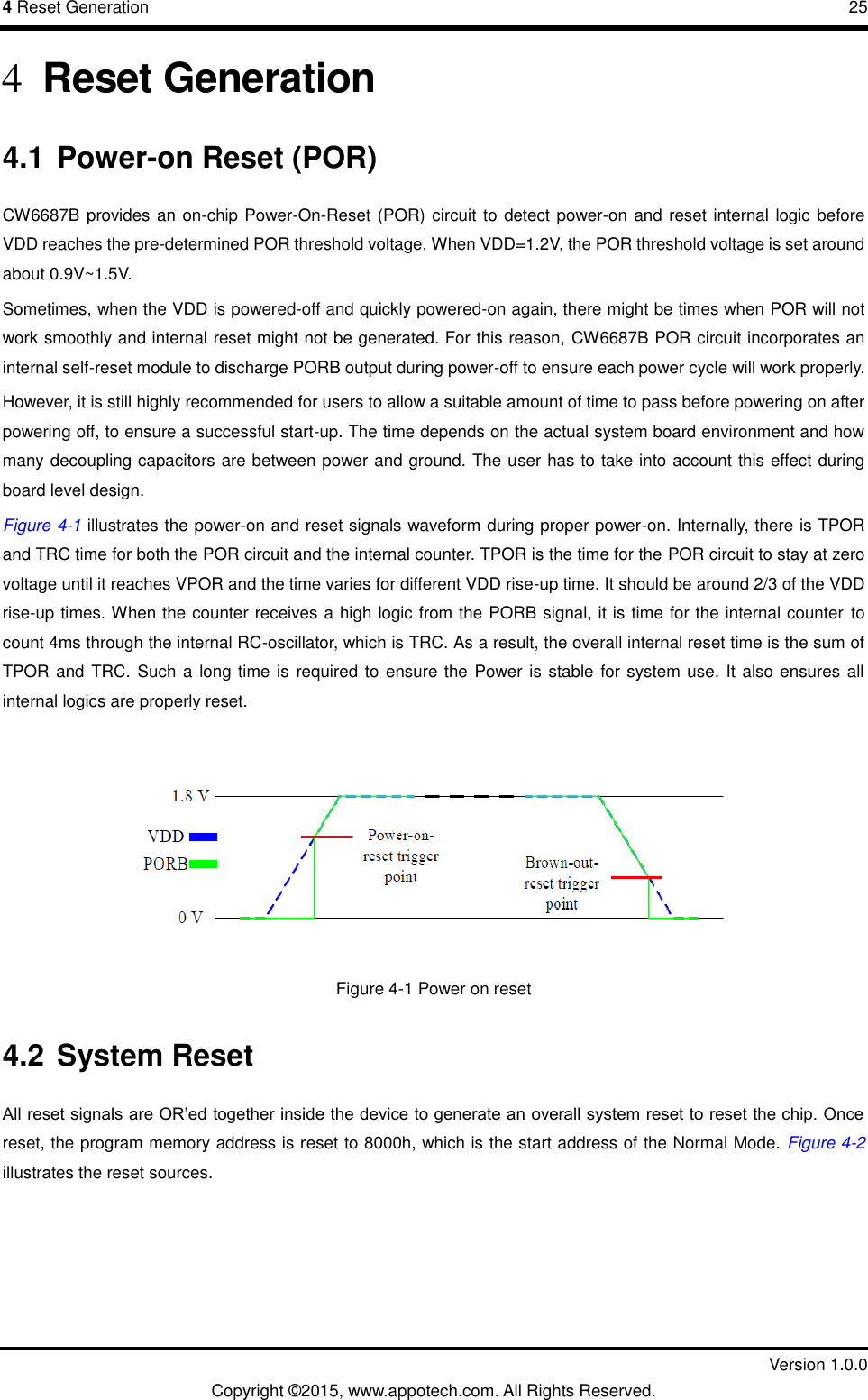
4 Reset Generation       25         Version 1.0.0 Copyright ©2015, www.appotech.com. All Rights Reserved. 4 Reset Generation 4.1 Power-on Reset (POR) CW6687B provides an on-chip Power-On-Reset (POR) circuit to detect power-on and reset internal logic before VDD reaches the pre-determined POR threshold voltage. When VDD=1.2V, the POR threshold voltage is set around about 0.9V~1.5V.   Sometimes, when the VDD is powered-off and quickly powered-on again, there might be times when POR will not work smoothly and internal reset might not be generated. For this reason, CW6687B POR circuit incorporates an internal self-reset module to discharge PORB output during power-off to ensure each power cycle will work properly. However, it is still highly recommended for users to allow a suitable amount of time to pass before powering on after powering off, to ensure a successful start-up. The time depends on the actual system board environment and how many decoupling capacitors are between power and ground. The user has to take into account this effect during board level design. Figure 4-1 illustrates the power-on and reset signals waveform during proper power-on. Internally, there is TPOR and TRC time for both the POR circuit and the internal counter. TPOR is the time for the POR circuit to stay at zero voltage until it reaches VPOR and the time varies for different VDD rise-up time. It should be around 2/3 of the VDD rise-up times. When the counter receives a high logic from the PORB signal, it is time for the internal counter to count 4ms through the internal RC-oscillator, which is TRC. As a result, the overall internal reset time is the sum of TPOR and  TRC. Such a  long time is  required to ensure the Power is stable for system use. It also ensures all internal logics are properly reset.    Figure 4-1 Power on reset 4.2 System Reset All reset signals are OR‟ed together inside the device to generate an overall system reset to reset the chip. Once reset, the program memory address is reset to 8000h, which is the start address of the Normal Mode. Figure 4-2X illustrates the reset sources.
26    4.2 System Reset         Version 1.0.0 Copyright ©2015, www.appotech.com. All Rights Reserved.   Watchdog  resetPOR resetLVD reset System ResetORPort wakeup resetRTCC reset Figure 4-2 Reset Sources 4.2.1 LVD CW6687B provides 4 levels programmable Low Voltage Detector (LVD) for user to detect VDDLDO power supply voltage or external pin voltage multiplexed with GPIO P2.2. This is because VDDLDO is the input voltage source for on-chip Low-Drop-Out regulator (LDO) which supplies power to internal VDDCORE. Hence, users can momentarily monitor the VDDLDO power if it‟s externally connected to some batteries and for detection if the external power source  starts  dropping  to  a  level  that  CW6687B  LDO  can  neither  tolerate  nor  perform  properly  in  the  system program.   LVD can also be used to monitor external voltage source through the GPIO P2.2 to enhance programmability for different voltage levels. One example of this is it can be used to monitor external power sources or batteries voltage or some voltages related to say pressure or temperature. It is there to provide a simple interface compared to ADC since ADC requires more programming space and procedures to detect precise voltage level in detail. If the user requires  general  voltage  detection  without  fine  voltage  range,  LVD  will  be  a  good  choice  compared  to  ADC measurement. XTable 4-1X illustrates different voltage detection levels. Remark:  When LVD_ENB is enabled, there is approximately 100us for the band-gap and the comparator to be stable before the end-user can use it as low voltage detection. During the time, LVD_OEB has to be H in order to disable the LVD output which possibly fluctuates signal level.    Different power supply falling times will affect the voltage detection. It is recommended that the power supply falling time should be larger than 1ms for stable low voltage detection.   When detection occurs, interrupt can be generated if LVD interrupt is enabled, or, CW6687B can undergo reset if interrupt is disabled. Note that the detection is slightly dependent on power supply‟s falling rate and during power drop, noise fluctuation may alter the detection results. For this reason, internally the comparator has about 150mV hysteresis voltage level defined as VHYS = VLVDR-VLVDS  to filter  out any noise that may occur.  Also, the detection level  may have a maximum of 100mV difference compared to the value stated in Table 4-1X Table 4-1 LVD level setting BORS[3:0]  Detected VDDLDO V  BORS[3:0]  Detected VDDLDO V 4'b0000  2.200  4'b1000  3.267
4 Reset Generation       27         Version 1.0.0 Copyright ©2015, www.appotech.com. All Rights Reserved. BORS[3:0]  Detected VDDLDO V  BORS[3:0]  Detected VDDLDO V 4'b0001  2.333  4'b1001  3.400 4'b0010  2.467  4'b1010  3.533 4'b0011  2.600  4'b1011  3.667 4'b0100  2.733  4'b1100  3.800 4'b0101  2.867  4'b1101  3.933 4'b0110  3.000  4'b1110  4.067 4'b0111  3.133  4'b1111  4.200 For an ideal operation, it is recommended to perform the following for LVD.   1.  Select either VDDLDO or external pin to be monitored. Set VD1_ENB = 0 for VDDLDO or VD2_ENB = 0 for external pin   2.  Select the detection voltage by setting bits BORS[3:0]   3.  Enable the LVD by setting LVD_ENB = 0 4.  Wait for at least 30us for the internal band-gap and comparator to become stable   5.  Enable the LVD output by setting LVD_OEB = 0   6.  The EX_PIN detect voltage must be less than VDDIO     Register 4-1 LVDCON– LVD control   Position  7  6  5  4  3  2  1  0 Name  LVDIF  LVDRSTEN    LVDOE       Default  0  1  0  0  1  0  0  0 Access  R/W  R/W  R/W  R/W  R/W  R/W  R/W  R/W LVDIF: LVD interrupt pending bit.   0 = When LVD threshold not detect. Cleared by writing a 0 to it 1 = When LVD threshold is detected LVD_RSTEN: LVD Reset enable bit. Low active 0 = LVD Reset is disabled 1 = LVD is enabled LVD_EN: LVD enable bit. Low active 0 = LVD is enabled 1 = LVD is disabled LVD_OE: LVD output enable bit. Low active 0 = LVD output is enabled 1 = LVD output is disabled VD2_EN: External pin (P0.0) voltage enable bit. Low active 0 = External pin voltage detection is enabled 1 = External pin voltage detection is disabled VD1_EN: VDDLDO voltage enable bit. Low active 0 = VDDLDO voltage detection is enabled 1 = VDDLDO voltage detection is disabled
28    4.3 Clock System         Version 1.0.0 Copyright ©2015, www.appotech.com. All Rights Reserved.   LVDS: Voltage detection level select 00 = 2.2V/1.2V 01 = 2.4V/1.95V 10 = 2.7V/2.2V 11 = 3.1V/2.5V 4.2.2 RTCC Reset CW6687B can be reset by RTCC second and alarm interrupt when IRTRSTEN bit in RTCON is set to 1. 4.2.3 Watchdog Reset If Watchdog timer is enabled, and WDTCON [5] is not written by 1 within watchdog overflow time period, CW6687B will be reset by Watchdog overflow. 4.2.4 Port Wakeup Reset During SLEEP mode, port wakeup event will cause CW6687B to reset. 4.3 Clock System 4.3.1 Clock Control CW6687B embeds 32K/4M/12M/24M OSC internal oscillator circuits. External crystal is needed to generate a clock source.  One internal PLL can  generate  48MHz from the crystal clock source.  One internal  RC oscillator is also embedded. To make sure the USB module operates properly, the USB clock must be set to 48MHz. In this case, system clock can be 48 MHz or 24MHz. Register 4-2 PCON0 – Power control 0 Position  7  6  5  4  3  2  1  0 Name  DRAMCEN  IRAMCEN  IROMCEN  RAM2CEN  IRCEN  IDLE  HOLD  SLEEP Default  0  0  0  0  0  0  0  0 Access  R/W  R/W  R/W  R/W  R/W  R/W  R/W  R/W DRAMCEN: DECRAM clock enable 0 = Enable 1 = Disable IRAMCEN: IRAM clock enable 0 = Enable 1 = Disable IROMCEN: IROM clock enable 0 = Enable 1 = Disable
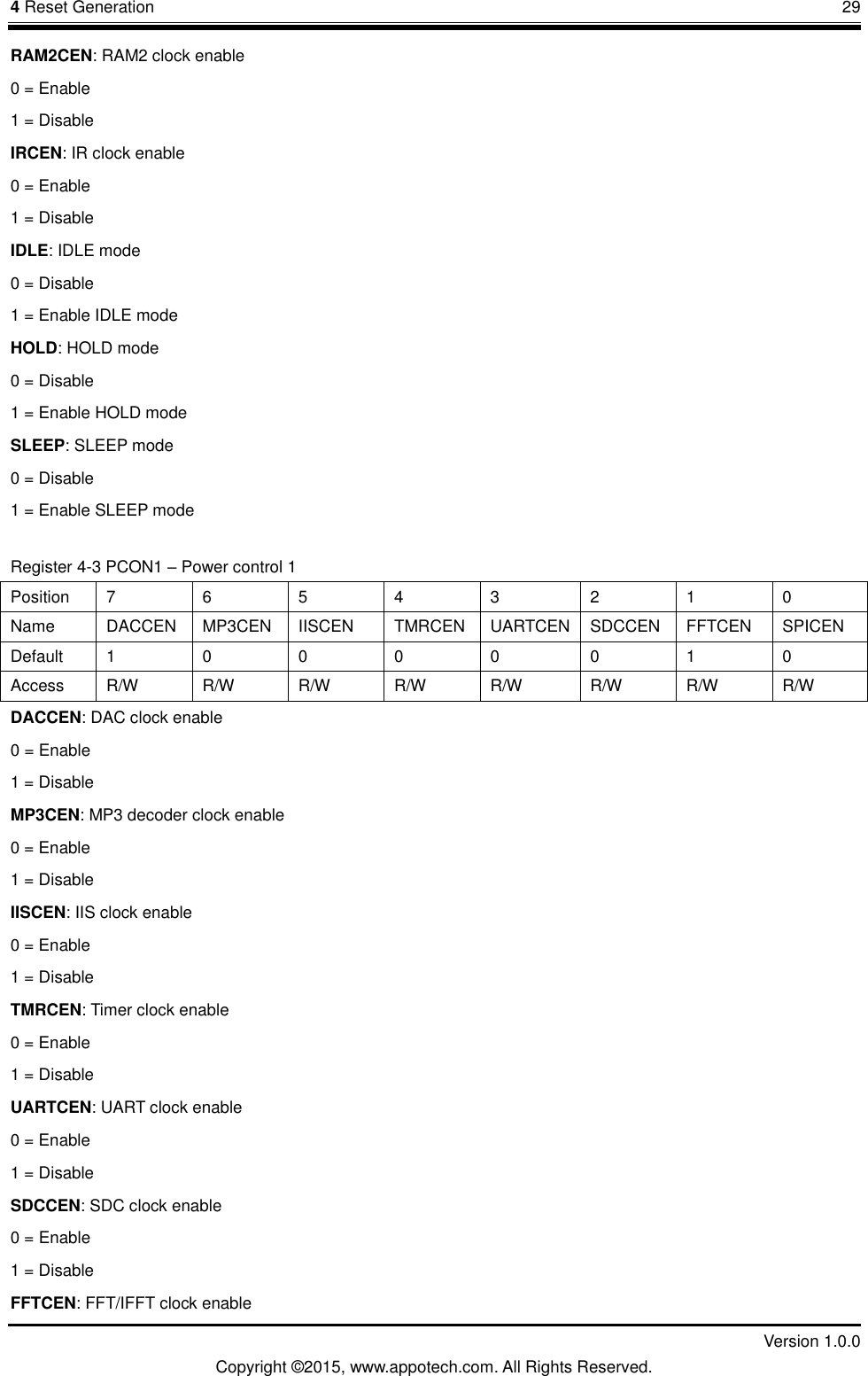
4 Reset Generation       29         Version 1.0.0 Copyright ©2015, www.appotech.com. All Rights Reserved. RAM2CEN: RAM2 clock enable 0 = Enable 1 = Disable IRCEN: IR clock enable 0 = Enable 1 = Disable IDLE: IDLE mode 0 = Disable 1 = Enable IDLE mode HOLD: HOLD mode 0 = Disable 1 = Enable HOLD mode SLEEP: SLEEP mode 0 = Disable 1 = Enable SLEEP mode Register 4-3 PCON1 – Power control 1 Position  7  6  5  4  3  2  1  0 Name  DACCEN  MP3CEN  IISCEN  TMRCEN  UARTCEN  SDCCEN  FFTCEN  SPICEN Default  1  0  0  0  0  0  1  0 Access  R/W  R/W  R/W  R/W  R/W  R/W  R/W  R/W DACCEN: DAC clock enable 0 = Enable 1 = Disable MP3CEN: MP3 decoder clock enable 0 = Enable 1 = Disable IISCEN: IIS clock enable 0 = Enable 1 = Disable TMRCEN: Timer clock enable 0 = Enable 1 = Disable UARTCEN: UART clock enable 0 = Enable 1 = Disable SDCCEN: SDC clock enable 0 = Enable 1 = Disable FFTCEN: FFT/IFFT clock enable
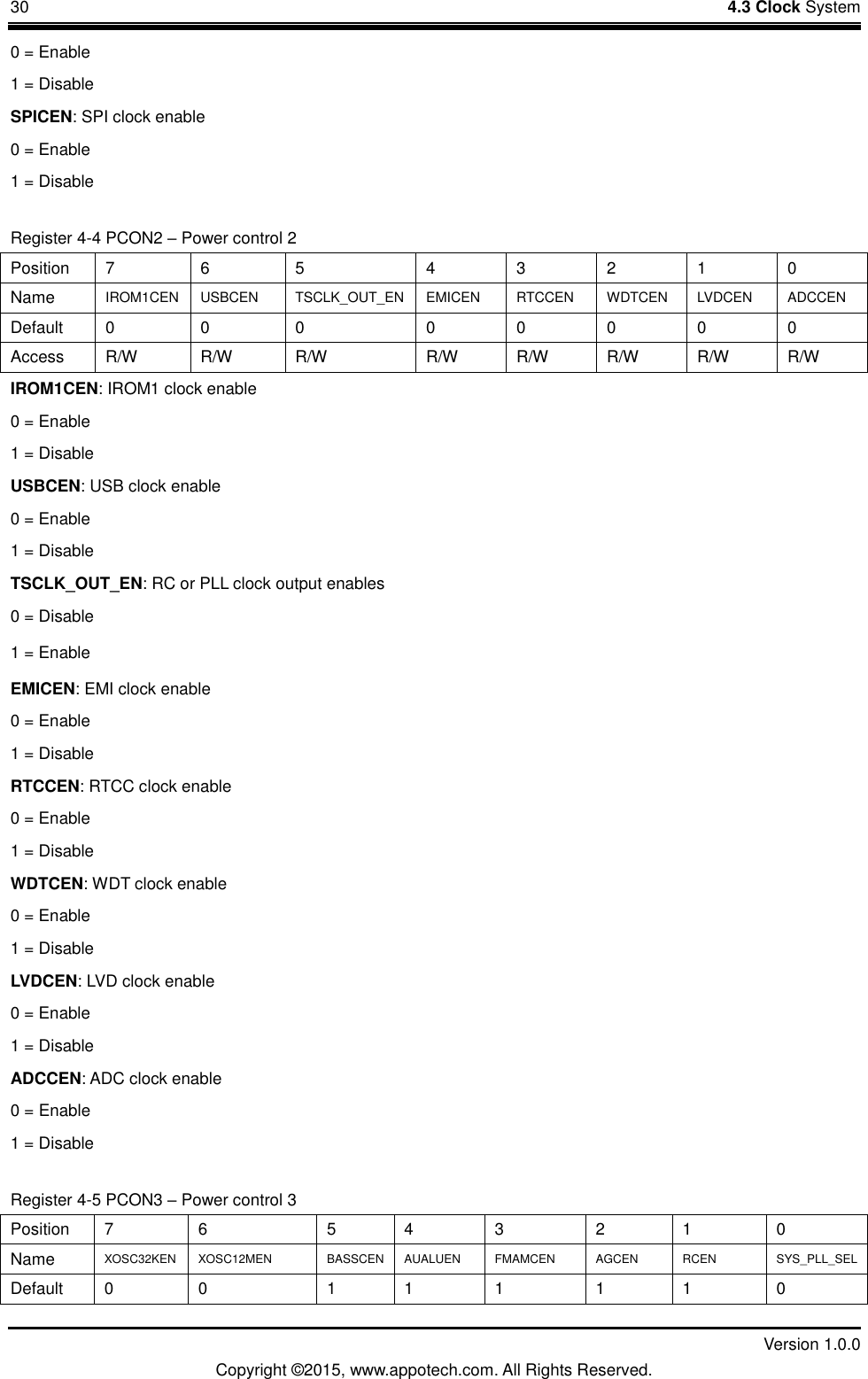
30    4.3 Clock System         Version 1.0.0 Copyright ©2015, www.appotech.com. All Rights Reserved.   0 = Enable 1 = Disable SPICEN: SPI clock enable 0 = Enable 1 = Disable Register 4-4 PCON2 – Power control 2 Position  7  6  5  4  3  2  1  0 Name  IROM1CEN  USBCEN  TSCLK_OUT_EN  EMICEN  RTCCEN  WDTCEN  LVDCEN  ADCCEN Default  0  0  0  0  0  0  0  0 Access  R/W  R/W  R/W  R/W  R/W  R/W  R/W  R/W IROM1CEN: IROM1 clock enable 0 = Enable 1 = Disable USBCEN: USB clock enable 0 = Enable 1 = Disable TSCLK_OUT_EN: RC or PLL clock output enables 0 = Disable 1 = Enable EMICEN: EMI clock enable 0 = Enable 1 = Disable RTCCEN: RTCC clock enable 0 = Enable 1 = Disable WDTCEN: WDT clock enable 0 = Enable 1 = Disable LVDCEN: LVD clock enable 0 = Enable 1 = Disable ADCCEN: ADC clock enable 0 = Enable 1 = Disable Register 4-5 PCON3 – Power control 3 Position  7  6  5  4  3  2  1  0 Name  XOSC32KEN  XOSC12MEN  BASSCEN AUALUEN FMAMCEN AGCEN RCEN  SYS_PLL_SEL Default  0  0  1  1  1  1  1  0
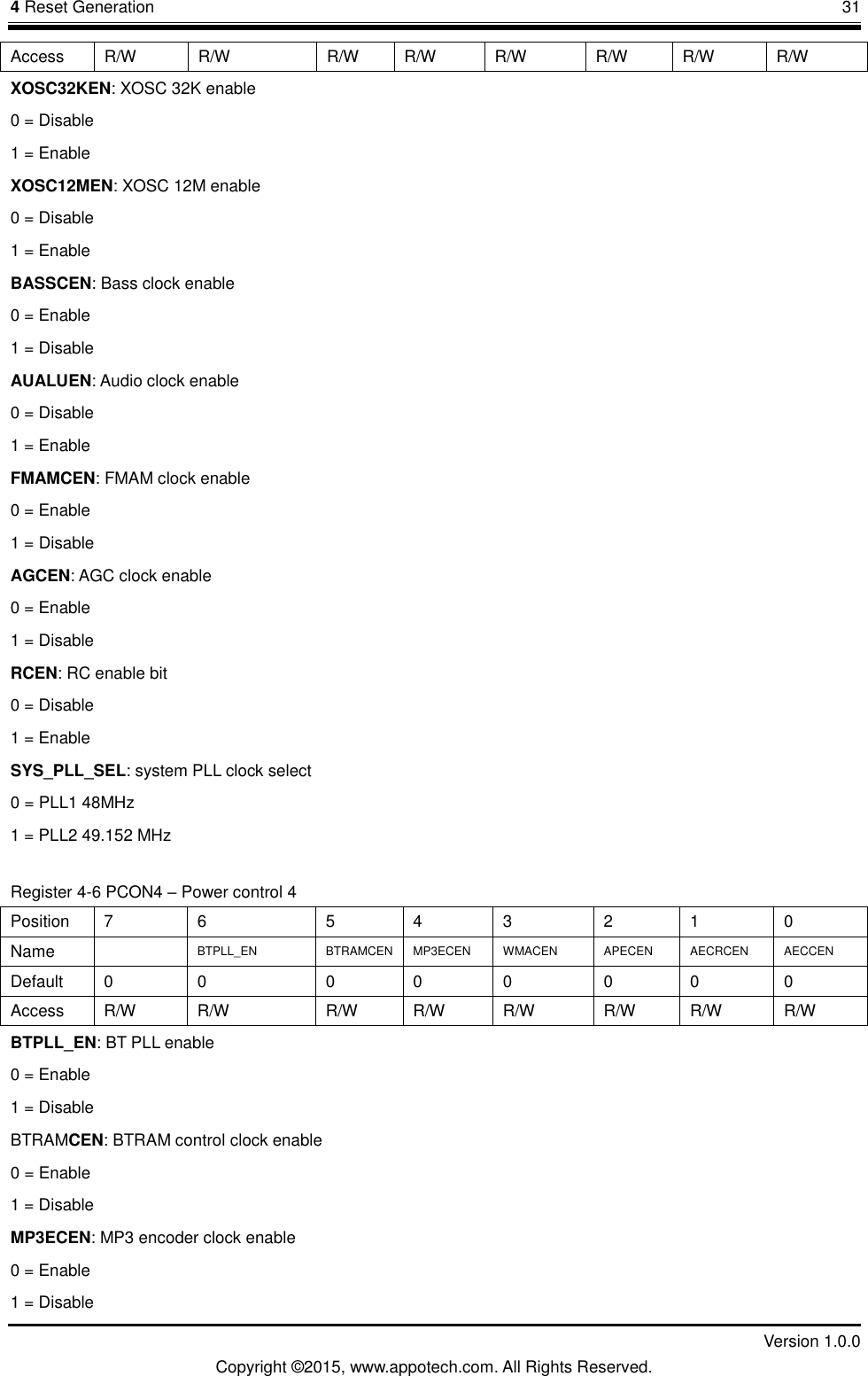
4 Reset Generation       31         Version 1.0.0 Copyright ©2015, www.appotech.com. All Rights Reserved. Access  R/W  R/W  R/W  R/W  R/W  R/W  R/W  R/W XOSC32KEN: XOSC 32K enable 0 = Disable 1 = Enable XOSC12MEN: XOSC 12M enable 0 = Disable 1 = Enable BASSCEN: Bass clock enable 0 = Enable 1 = Disable AUALUEN: Audio clock enable 0 = Disable 1 = Enable FMAMCEN: FMAM clock enable 0 = Enable 1 = Disable AGCEN: AGC clock enable 0 = Enable 1 = Disable RCEN: RC enable bit 0 = Disable 1 = Enable SYS_PLL_SEL: system PLL clock select 0 = PLL1 48MHz 1 = PLL2 49.152 MHz Register 4-6 PCON4 – Power control 4 Position  7  6  5  4  3  2  1  0 Name   BTPLL_EN BTRAMCEN MP3ECEN  WMACEN  APECEN AECRCEN AECCEN Default  0  0  0  0  0  0  0  0 Access  R/W  R/W  R/W  R/W  R/W  R/W  R/W  R/W BTPLL_EN: BT PLL enable 0 = Enable 1 = Disable BTRAMCEN: BTRAM control clock enable 0 = Enable 1 = Disable MP3ECEN: MP3 encoder clock enable 0 = Enable 1 = Disable
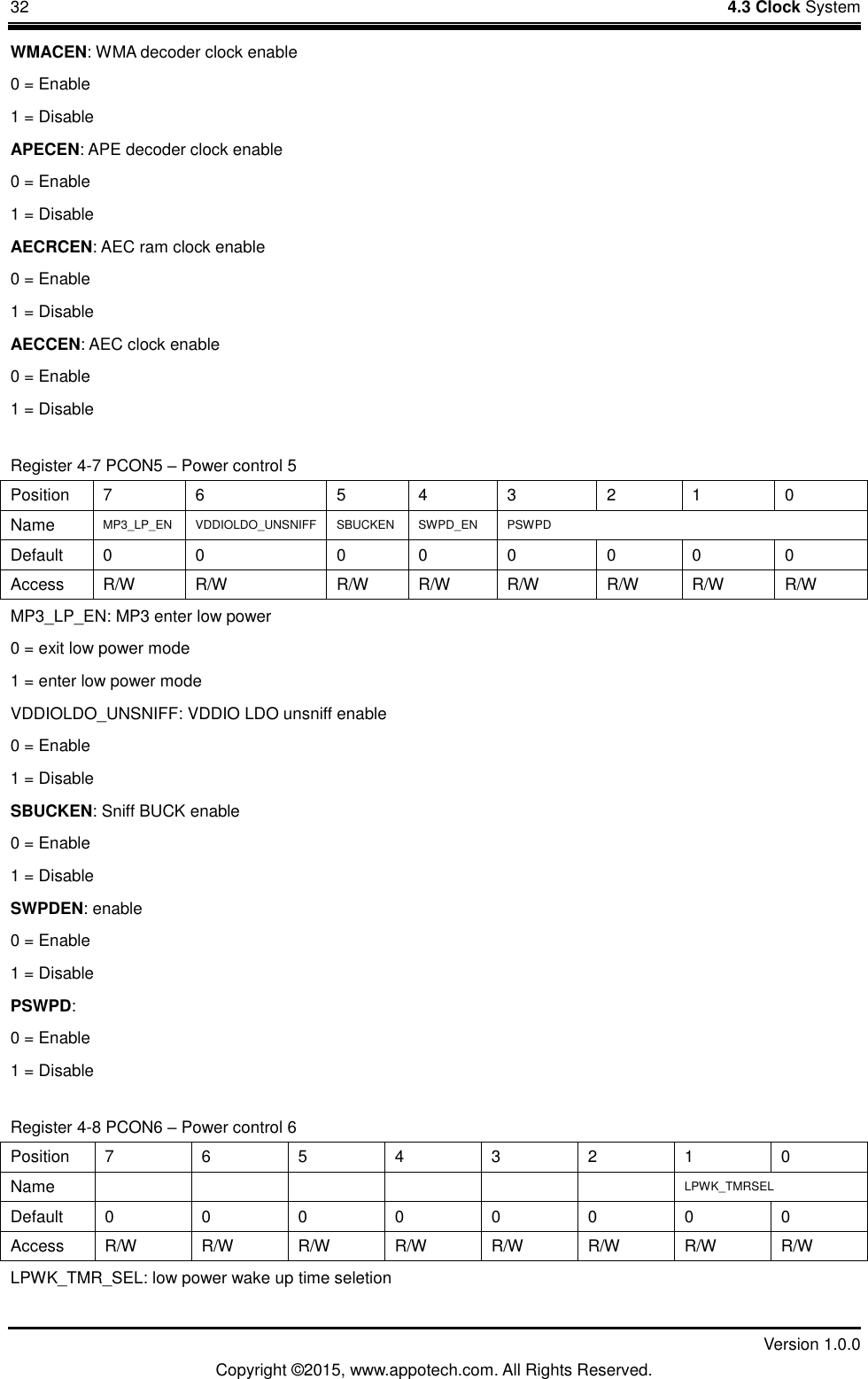
32    4.3 Clock System         Version 1.0.0 Copyright ©2015, www.appotech.com. All Rights Reserved.   WMACEN: WMA decoder clock enable 0 = Enable 1 = Disable APECEN: APE decoder clock enable 0 = Enable 1 = Disable AECRCEN: AEC ram clock enable 0 = Enable 1 = Disable AECCEN: AEC clock enable 0 = Enable 1 = Disable Register 4-7 PCON5 – Power control 5 Position  7  6  5  4  3  2  1  0 Name  MP3_LP_EN VDDIOLDO_UNSNIFF SBUCKEN  SWPD_EN  PSWPD Default  0  0  0  0  0  0  0  0 Access  R/W  R/W  R/W  R/W  R/W  R/W  R/W  R/W MP3_LP_EN: MP3 enter low power 0 = exit low power mode 1 = enter low power mode VDDIOLDO_UNSNIFF: VDDIO LDO unsniff enable 0 = Enable 1 = Disable SBUCKEN: Sniff BUCK enable 0 = Enable 1 = Disable SWPDEN: enable 0 = Enable 1 = Disable PSWPD:   0 = Enable 1 = Disable Register 4-8 PCON6 – Power control 6 Position  7  6  5  4  3  2  1  0 Name              LPWK_TMRSEL Default  0  0  0  0  0  0  0  0 Access  R/W  R/W  R/W  R/W  R/W  R/W  R/W  R/W LPWK_TMR_SEL: low power wake up time seletion
4 Reset Generation       33         Version 1.0.0 Copyright ©2015, www.appotech.com. All Rights Reserved. 00 = 256 X system clock 01 =128 X system clock 10 = 16 X system clock 11 = 2 X system clock 1 = enter low power mode Register 4-9 CLKCON – Clock control Position  7  6  5  4  3  2  1  0 Name  Reserved  RCSEL  WDTCSEL  RTCCS  SCSEL Default  0  0  0  0  0  0  0  0 Access  R/W  R/W  R/W  R/W  R/W  R/W  R/W  R/W RCSEL: RC frequency select 00 = RC 512K 01 = RC 32K 10 = RC 1M 11 = RC 4M or XOSC26M controlled by CLKCON2[3] WDTCSEL: WDT clock section 0 = Internal 32 KHz RC oscillator output 1 = External 32 KHz or 12MHz crystal oscillator controlled by CLKCON2 [6] and CLKCON2 [7] RTCCS: RTCC clock source select 00 = External 32 KHz or 12MHz crystal oscillator controlled by CLKCON2 [6] and CLKCON2 [7] 01 = Internal 32 KHz RC oscillator output 10 = Select 32 KHz clock source derived from external 12MHz crystal oscillator 11 = Reserve SCSEL: System clock select 00 = Internal 512 KHz RC oscillator output 01 = External 32 KHz or 12MHz crystal oscillator controlled by PCON3 [5] 10 = PLL 48/24/16/12 MHz output, controlled by CLKCON1 [1:0] 11 = Reserve Register 4-10 CLKCON1 – Clock control 1 Position  7  6  5  4  3  2  1  0 Name  ATCLKSEL  BTPLL_SEL  DECDIV  SYSDIV  PLLDIVSEL Default  0  0  0  0  0  0  0  0 Access  R/W  R/W  R/W  R/W  R/W  R/W  R/W  R/W ATCLKSEL: Audio clock select 00 = Select external 12MHz crystal oscillator invert 01 = Select external 12MHz crystal oscillator 10 = Select PLL 24MHz output invert 11 = Select PLL 24MHz output
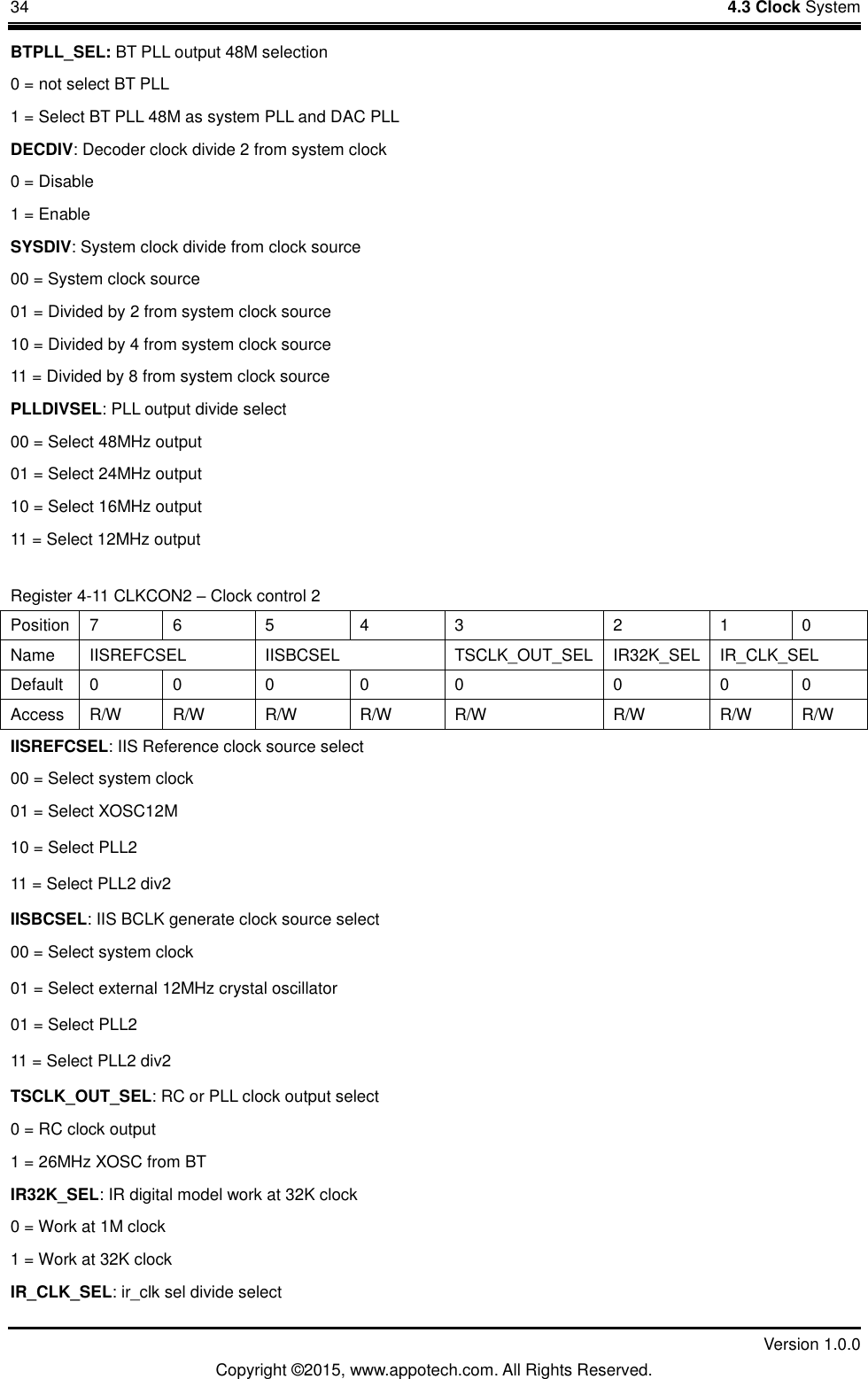
34    4.3 Clock System         Version 1.0.0 Copyright ©2015, www.appotech.com. All Rights Reserved.   BTPLL_SEL: BT PLL output 48M selection 0 = not select BT PLL 1 = Select BT PLL 48M as system PLL and DAC PLL DECDIV: Decoder clock divide 2 from system clock 0 = Disable 1 = Enable SYSDIV: System clock divide from clock source 00 = System clock source 01 = Divided by 2 from system clock source 10 = Divided by 4 from system clock source 11 = Divided by 8 from system clock source PLLDIVSEL: PLL output divide select 00 = Select 48MHz output 01 = Select 24MHz output 10 = Select 16MHz output 11 = Select 12MHz output Register 4-11 CLKCON2 – Clock control 2 Position  7  6  5  4  3  2  1  0 Name  IISREFCSEL  IISBCSEL  TSCLK_OUT_SEL  IR32K_SEL  IR_CLK_SEL Default  0  0  0  0  0  0  0  0 Access  R/W  R/W  R/W  R/W  R/W  R/W  R/W  R/W IISREFCSEL: IIS Reference clock source select 00 = Select system clock 01 = Select XOSC12M 10 = Select PLL2 11 = Select PLL2 div2 IISBCSEL: IIS BCLK generate clock source select 00 = Select system clock 01 = Select external 12MHz crystal oscillator 01 = Select PLL2   11 = Select PLL2 div2 TSCLK_OUT_SEL: RC or PLL clock output select 0 = RC clock output 1 = 26MHz XOSC from BT IR32K_SEL: IR digital model work at 32K clock 0 = Work at 1M clock 1 = Work at 32K clock IR_CLK_SEL: ir_clk sel divide select
4 Reset Generation       35         Version 1.0.0 Copyright ©2015, www.appotech.com. All Rights Reserved. 00 = 1MHz PLL 01 = 1MHz RC 10 = External 32 KHz or 12MHz crystal oscillator controlled by CLKCON2 [6] and CLKCON2 [7] as shown in X 11 = 1MHz div form    XOSC26M 4.3.2 Operation Guide User guide 1: CW6687B integrates a 4M RC clock called RC4M, extern OSC 26MHz, extern OSC 32K or 12MHz   4.3.3 Clock Gating CW6687B  provides  comprehensive  clock  gating  options  for  eliminating  power-wasting  activities.  System  clock supplies clock signal to different clock domains. Every clock can be gated. It allows the user to shut down the clock signal when the function is not needed. 4.3.4 Phase Lock Loop (PLL) CW6687B provides one on-chip Phase Locked Loop (PLL 48M) clock generators. The PLL has a reference clock from external 32 KHz/4M/12 M crystal oscillators to provide a stable reference clock, and the reference clock is multiplied to provide the final PLL output.   Register 4-12 PLLCON – PLL Configuration Position  7  6  5  4  3  2  1  0 Name  SDADCLKEN  PLLTCLKSEL  SDADCCLK_SEL PLL12DREF_SEL  PLL1 DREF_SEL Default  0  0  0  0  0  0  0  0 Access  R/W  R/W  R/W  R/W  R/W  R/W  R/W  R/W PLL1AREF_SEL: PLL1 input reference clock digital select 00 = XOSC 01 = RCOSC 10 = RCOSC div 11 = Reserved PLL2AREF_SEL: PLL2 input reference clock digital select 00 = XOSC 01 = RCOSC 10 = PLL1 div 11 = Reserved SDADCCLK_SEL: SDADC clockl select 00 = XOSC inv 01 = XOSC 10 = PLL2 div2 inv 11 = PLL2
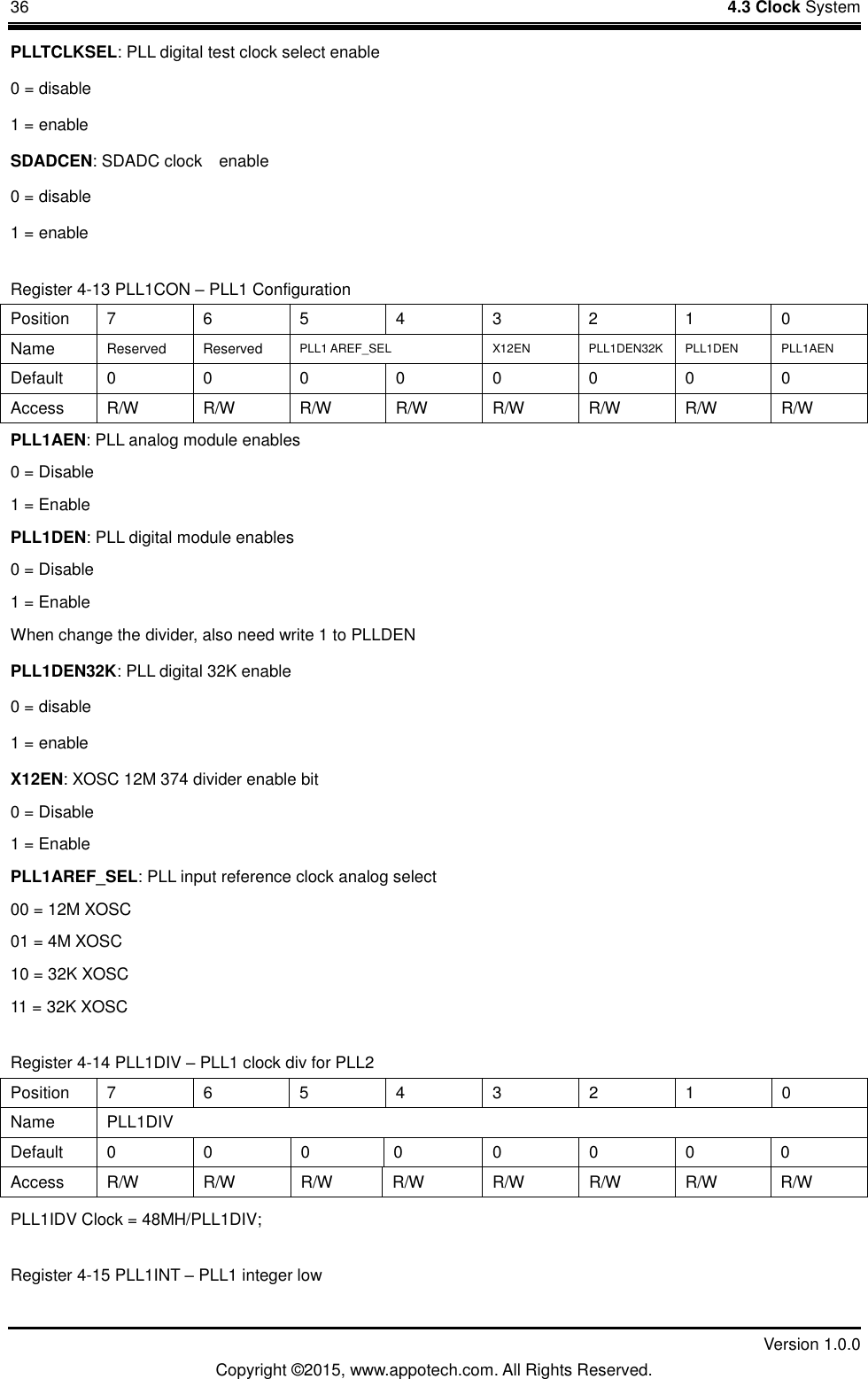
36    4.3 Clock System         Version 1.0.0 Copyright ©2015, www.appotech.com. All Rights Reserved.   PLLTCLKSEL: PLL digital test clock select enable 0 = disable 1 = enable SDADCEN: SDADC clock    enable 0 = disable 1 = enable Register 4-13 PLL1CON – PLL1 Configuration Position  7  6  5  4  3  2  1  0 Name  Reserved  Reserved  PLL1 AREF_SEL  X12EN  PLL1DEN32K PLL1DEN PLL1AEN Default  0  0  0  0  0  0  0  0 Access  R/W  R/W  R/W  R/W  R/W  R/W  R/W  R/W PLL1AEN: PLL analog module enables 0 = Disable 1 = Enable PLL1DEN: PLL digital module enables 0 = Disable 1 = Enable When change the divider, also need write 1 to PLLDEN PLL1DEN32K: PLL digital 32K enable 0 = disable 1 = enable X12EN: XOSC 12M 374 divider enable bit 0 = Disable 1 = Enable PLL1AREF_SEL: PLL input reference clock analog select 00 = 12M XOSC 01 = 4M XOSC 10 = 32K XOSC 11 = 32K XOSC Register 4-14 PLL1DIV – PLL1 clock div for PLL2 Position  7  6  5  4  3  2  1  0 Name  PLL1DIV Default  0  0  0  0  0  0  0  0 Access  R/W  R/W  R/W  R/W  R/W  R/W  R/W  R/W PLL1IDV Clock = 48MH/PLL1DIV; Register 4-15 PLL1INT – PLL1 integer low
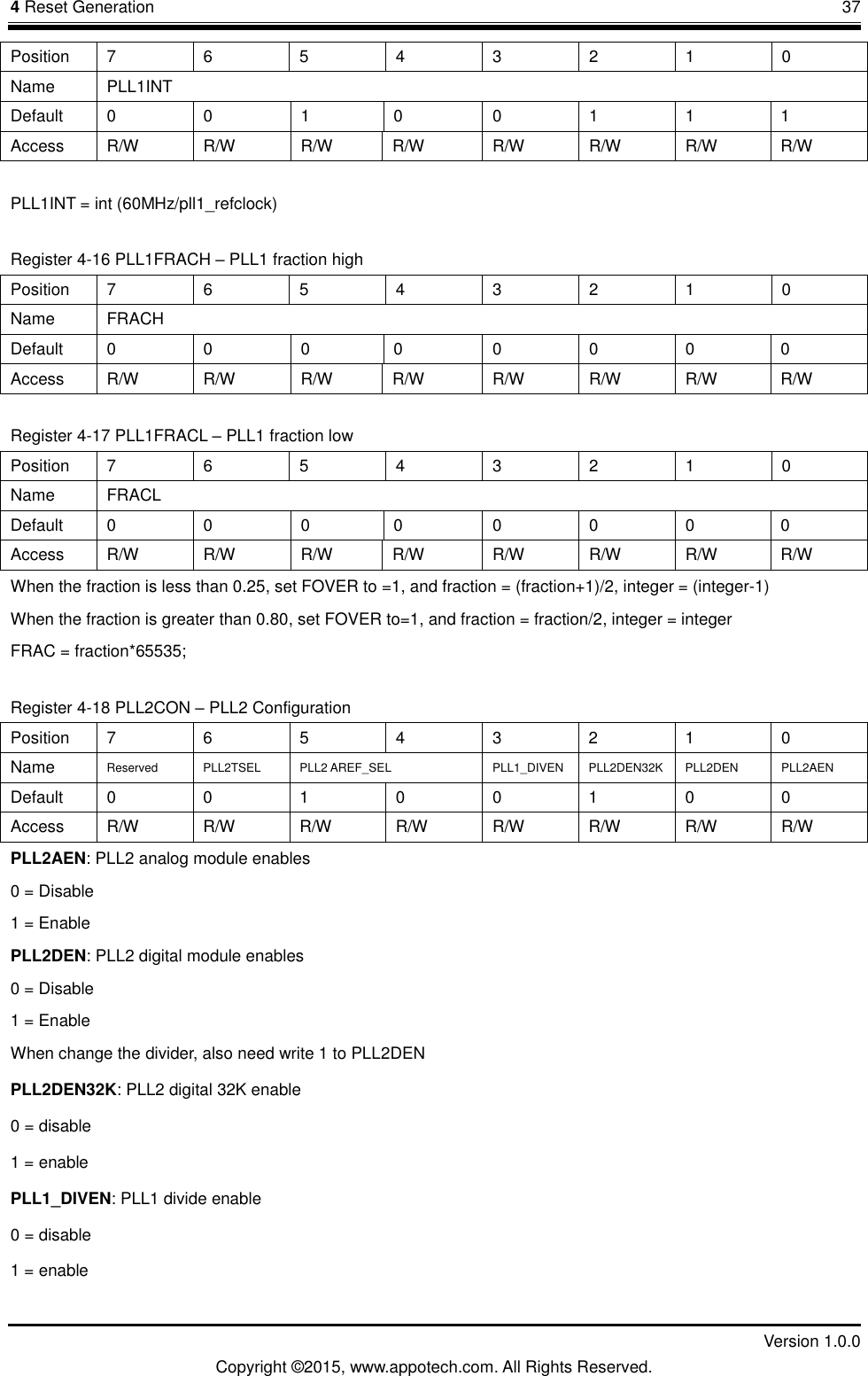
4 Reset Generation       37         Version 1.0.0 Copyright ©2015, www.appotech.com. All Rights Reserved. Position  7  6  5  4  3  2  1  0 Name  PLL1INT Default  0  0  1  0  0  1  1  1 Access  R/W  R/W  R/W  R/W  R/W  R/W  R/W  R/W PLL1INT = int (60MHz/pll1_refclock) Register 4-16 PLL1FRACH – PLL1 fraction high Position  7  6  5  4  3  2  1  0 Name  FRACH Default  0  0  0  0  0  0  0  0 Access  R/W  R/W  R/W  R/W  R/W  R/W  R/W  R/W Register 4-17 PLL1FRACL – PLL1 fraction low Position  7  6  5  4  3  2  1  0 Name  FRACL Default  0  0  0  0  0  0  0  0 Access  R/W  R/W  R/W  R/W  R/W  R/W  R/W  R/W When the fraction is less than 0.25, set FOVER to =1, and fraction = (fraction+1)/2, integer = (integer-1) When the fraction is greater than 0.80, set FOVER to=1, and fraction = fraction/2, integer = integer FRAC = fraction*65535; Register 4-18 PLL2CON – PLL2 Configuration Position  7  6  5  4  3  2  1  0 Name  Reserved PLL2TSEL PLL2 AREF_SEL  PLL1_DIVEN PLL2DEN32K PLL2DEN PLL2AEN Default  0  0  1  0  0  1  0  0 Access  R/W  R/W  R/W  R/W  R/W  R/W  R/W  R/W PLL2AEN: PLL2 analog module enables 0 = Disable 1 = Enable PLL2DEN: PLL2 digital module enables 0 = Disable 1 = Enable When change the divider, also need write 1 to PLL2DEN PLL2DEN32K: PLL2 digital 32K enable 0 = disable 1 = enable PLL1_DIVEN: PLL1 divide enable 0 = disable 1 = enable
38    4.3 Clock System         Version 1.0.0 Copyright ©2015, www.appotech.com. All Rights Reserved.   PLL2AREF_SEL: PLL2 input reference clock analog select 00 = 12M XOSC 01 = 4M XOSC 10 = 32K XOSC 11 = 32K XOSC PLL2TSEL: PLL2 test select   0 = PLL2 refclock output 1 = PLL2 fbclock output Register 4-19 PLL2INTH – PLL2 integer high Position  7  6  5  4  3  2  1  0 Name          PLL2INT[11:8] Default  0  0  0  0  1  0  1  1 Access  R/W  R/W  R/W  R/W  R/W  R/W  R/W  R/W Register 4-20 PLL2INTL – PLL2 integer low Position  7  6  5  4  3  2  1  0 Name  PLL2INT[7:0] Default  1  0  1  0  1  0  0  0 Access  R/W  R/W  R/W  R/W  R/W  R/W  R/W  R/W PLL2INT = int(98.304MHz/pll2_refclock) Register 4-21 PLL2FRACH – PLL2 fraction high Position  7  6  5  4  3  2  1  0 Name  FRACH Default  0  0  0  0  0  0  0  0 Access  R/W  R/W  R/W  R/W  R/W  R/W  R/W  R/W Register 4-22 PLL2FRACL – PLL2 fraction low Position  7  6  5  4  3  2  1  0 Name  FRACL Default  0  0  0  0  0  0  0  0 Access  R/W  R/W  R/W  R/W  R/W  R/W  R/W  R/W When the fraction is less than 0.25, set FOVER=1, and fraction = (fraction+1)/2, integer = (integer-1) When the fraction is more than 0.80, set FOVER=1, and fraction = fraction/2, integer = integer FRAC = fraction*65535 User’s guide: 1.  PLL1 frequency division a) PLL1‟s: -input reference clock is f0 (from RC or OSC)
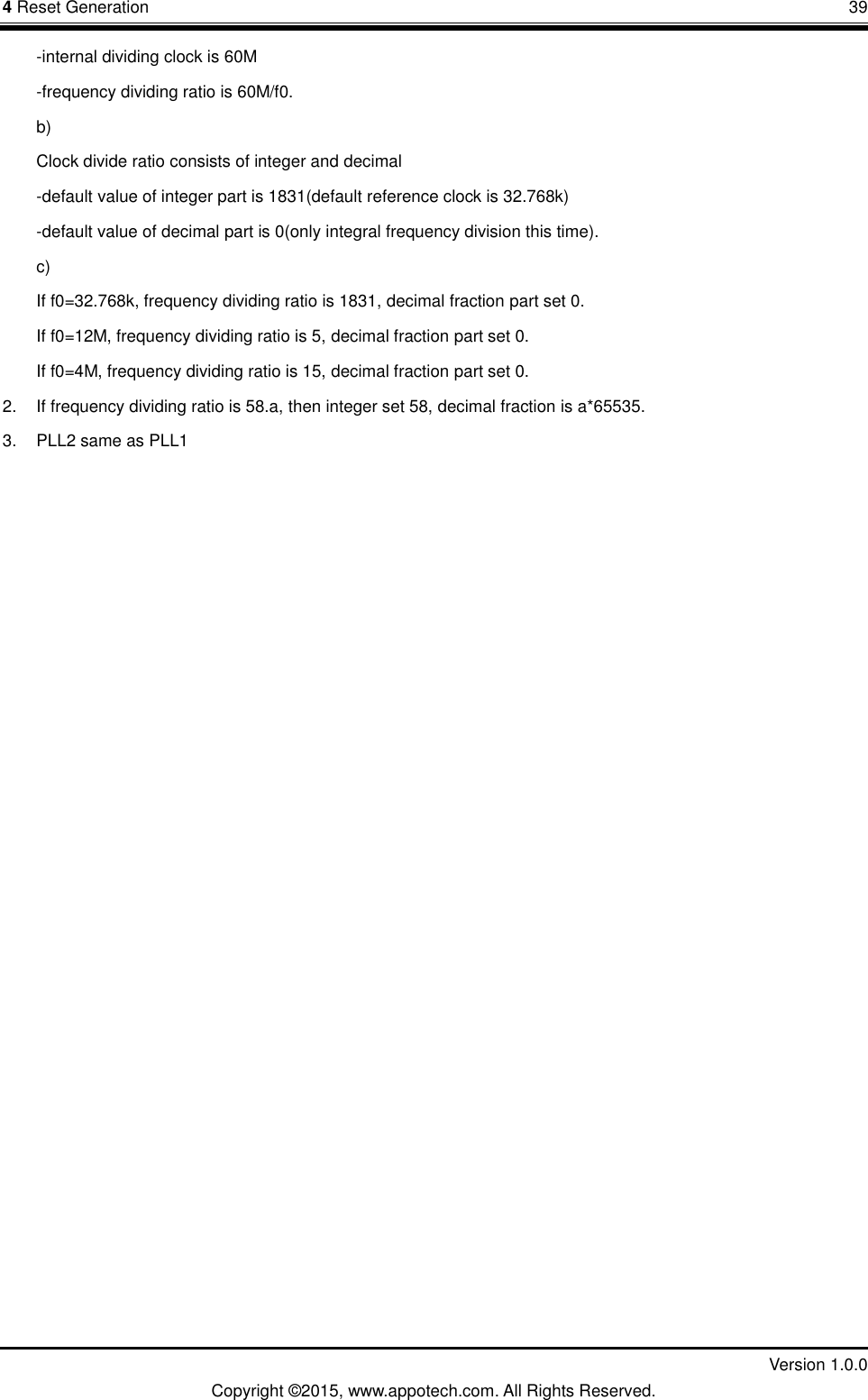
4 Reset Generation       39         Version 1.0.0 Copyright ©2015, www.appotech.com. All Rights Reserved. -internal dividing clock is 60M -frequency dividing ratio is 60M/f0. b) Clock divide ratio consists of integer and decimal -default value of integer part is 1831(default reference clock is 32.768k) -default value of decimal part is 0(only integral frequency division this time). c) If f0=32.768k, frequency dividing ratio is 1831, decimal fraction part set 0. If f0=12M, frequency dividing ratio is 5, decimal fraction part set 0. If f0=4M, frequency dividing ratio is 15, decimal fraction part set 0. 2. If frequency dividing ratio is 58.a, then integer set 58, decimal fraction is a*65535. 3.  PLL2 same as PLL1
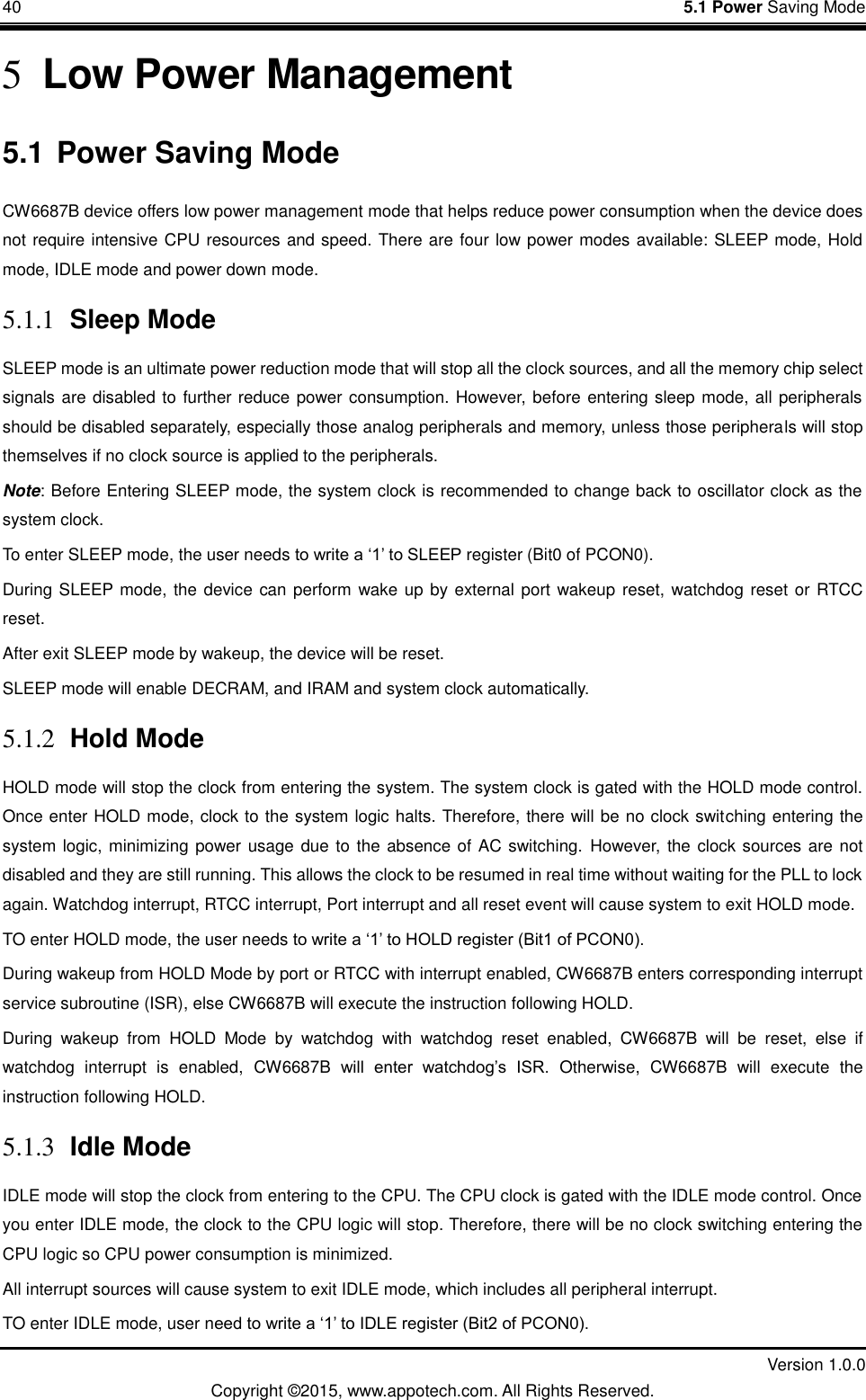
40    5.1 Power Saving Mode         Version 1.0.0 Copyright ©2015, www.appotech.com. All Rights Reserved.   5 Low Power Management 5.1 Power Saving Mode CW6687B device offers low power management mode that helps reduce power consumption when the device does not require intensive CPU resources and speed. There are four low power modes available: SLEEP mode, Hold mode, IDLE mode and power down mode. 5.1.1 Sleep Mode SLEEP mode is an ultimate power reduction mode that will stop all the clock sources, and all the memory chip select signals are disabled to further reduce power consumption. However, before entering sleep mode, all peripherals should be disabled separately, especially those analog peripherals and memory, unless those peripherals will stop themselves if no clock source is applied to the peripherals. Note: Before Entering SLEEP mode, the system clock is recommended to change back to oscillator clock as the system clock. To enter SLEEP mode, the user needs to write a „1‟ to SLEEP register (Bit0 of PCON0).   During SLEEP mode, the device can perform wake up by external port wakeup reset, watchdog reset or RTCC reset. After exit SLEEP mode by wakeup, the device will be reset. SLEEP mode will enable DECRAM, and IRAM and system clock automatically. 5.1.2 Hold Mode HOLD mode will stop the clock from entering the system. The system clock is gated with the HOLD mode control. Once enter HOLD mode, clock to the system logic halts. Therefore, there will be no clock switching entering the system logic, minimizing power usage due to the absence of AC switching.  However,  the clock sources are not disabled and they are still running. This allows the clock to be resumed in real time without waiting for the PLL to lock again. Watchdog interrupt, RTCC interrupt, Port interrupt and all reset event will cause system to exit HOLD mode. TO enter HOLD mode, the user needs to write a „1‟ to HOLD register (Bit1 of PCON0). During wakeup from HOLD Mode by port or RTCC with interrupt enabled, CW6687B enters corresponding interrupt service subroutine (ISR), else CW6687B will execute the instruction following HOLD. During  wakeup  from  HOLD  Mode  by  watchdog  with  watchdog  reset  enabled,  CW6687B  will  be  reset,  else  if watchdog  interrupt  is  enabled,  CW6687B  will  enter  watchdog‟s  ISR.  Otherwise,  CW6687B  will  execute  the instruction following HOLD. 5.1.3 Idle Mode IDLE mode will stop the clock from entering to the CPU. The CPU clock is gated with the IDLE mode control. Once you enter IDLE mode, the clock to the CPU logic will stop. Therefore, there will be no clock switching entering the CPU logic so CPU power consumption is minimized. All interrupt sources will cause system to exit IDLE mode, which includes all peripheral interrupt. TO enter IDLE mode, user need to write a „1‟ to IDLE register (Bit2 of PCON0).
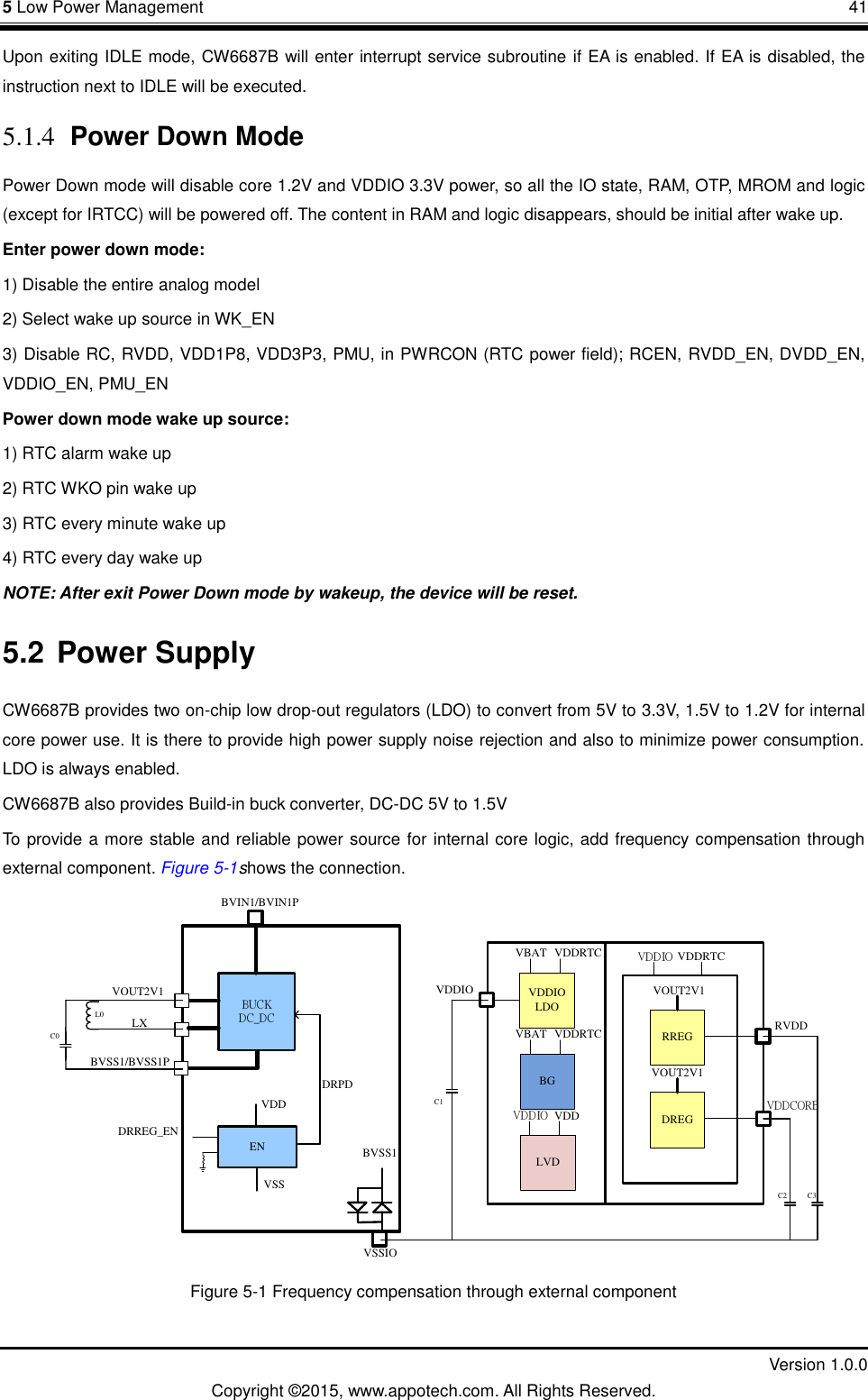
5 Low Power Management       41         Version 1.0.0 Copyright ©2015, www.appotech.com. All Rights Reserved. Upon exiting IDLE mode, CW6687B will enter interrupt service subroutine if EA is enabled. If EA is disabled, the instruction next to IDLE will be executed. 5.1.4 Power Down Mode Power Down mode will disable core 1.2V and VDDIO 3.3V power, so all the IO state, RAM, OTP, MROM and logic (except for IRTCC) will be powered off. The content in RAM and logic disappears, should be initial after wake up.   Enter power down mode: 1) Disable the entire analog model 2) Select wake up source in WK_EN 3) Disable RC, RVDD, VDD1P8, VDD3P3, PMU, in PWRCON (RTC power field); RCEN, RVDD_EN, DVDD_EN, VDDIO_EN, PMU_EN Power down mode wake up source: 1) RTC alarm wake up 2) RTC WKO pin wake up 3) RTC every minute wake up 4) RTC every day wake up NOTE: After exit Power Down mode by wakeup, the device will be reset. 5.2 Power Supply CW6687B provides two on-chip low drop-out regulators (LDO) to convert from 5V to 3.3V, 1.5V to 1.2V for internal core power use. It is there to provide high power supply noise rejection and also to minimize power consumption. LDO is always enabled.   CW6687B also provides Build-in buck converter, DC-DC 5V to 1.5V To provide a more stable and reliable power source for internal core logic, add frequency compensation through external component. XFigure 5-1 shows the connection. BUCK DC_DCBVIN1/BVIN1PVOUT2V1ENLXDRREG_ENVDDVSSBVSS1/BVSS1PDRPDVSSIOBVSS1RREGDREGVOUT2V1RVDDVDDCOREVOUT2V1VDDIOLDOVBATVDDIOVDDRTCBGLVDVDDRTCVBAT VDDRTCVDDIO VDDVDDIOC1C0C2 C3L0 Figure 5-1 Frequency compensation through external component
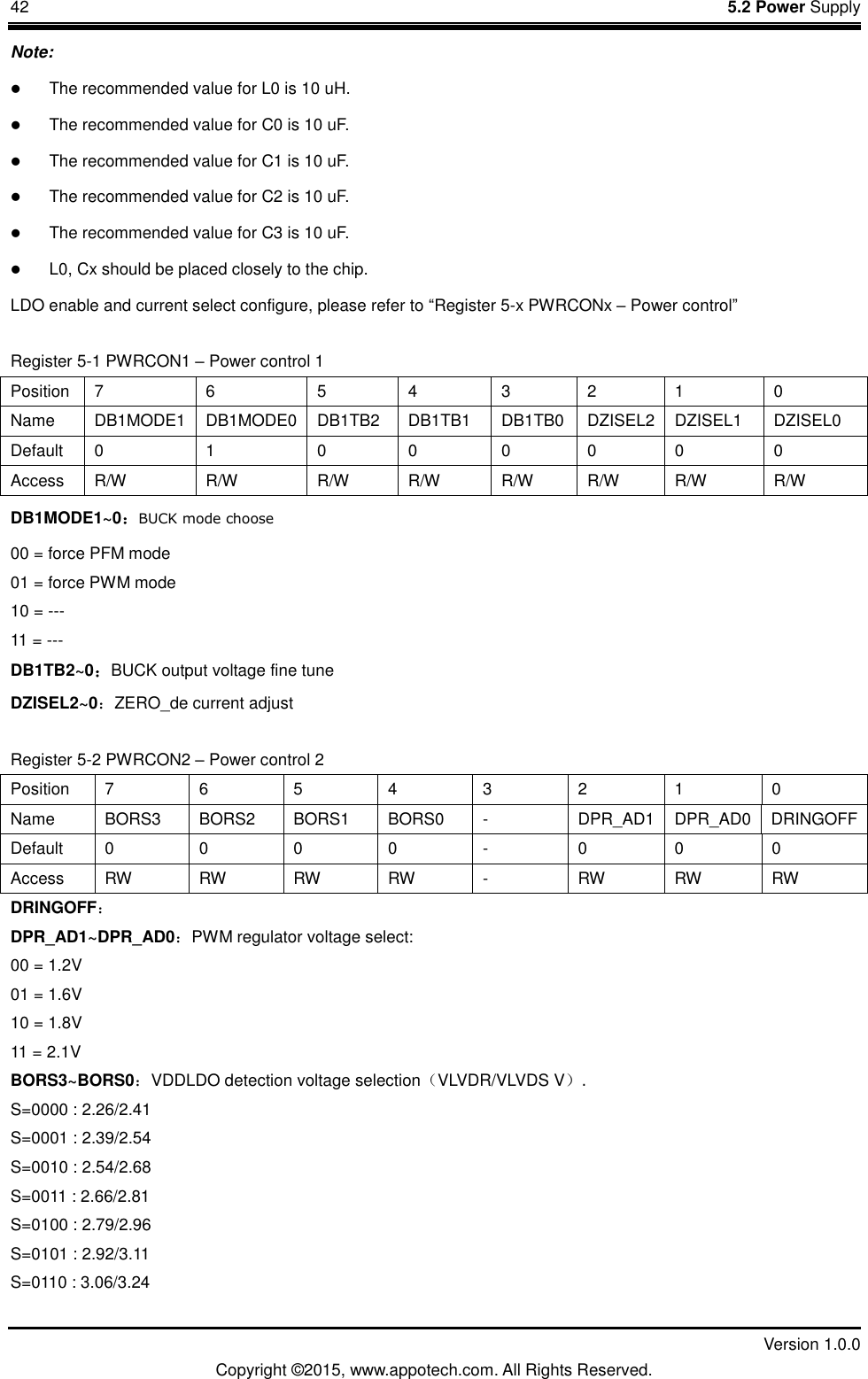
42    5.2 Power Supply         Version 1.0.0 Copyright ©2015, www.appotech.com. All Rights Reserved.   Note:  The recommended value for L0 is 10 uH.  The recommended value for C0 is 10 uF.  The recommended value for C1 is 10 uF.  The recommended value for C2 is 10 uF.  The recommended value for C3 is 10 uF.  L0, Cx should be placed closely to the chip.   LDO enable and current select configure, please refer to “Register 5-x PWRCONx – Power control” Register 5-1 PWRCON1 – Power control 1 Position  7  6  5  4  3  2  1  0 Name  DB1MODE1  DB1MODE0  DB1TB2  DB1TB1  DB1TB0  DZISEL2  DZISEL1  DZISEL0 Default  0  1  0  0  0  0  0  0 Access  R/W  R/W  R/W  R/W  R/W  R/W  R/W  R/W DB1MODE1~0:BUCK mode choose 00 = force PFM mode 01 = force PWM mode 10 = --- 11 = --- DB1TB2~0:BUCK output voltage fine tune DZISEL2~0:ZERO_de current adjust Register 5-2 PWRCON2 – Power control 2 Position  7  6  5  4  3  2  1  0 Name  BORS3  BORS2  BORS1  BORS0  -  DPR_AD1  DPR_AD0  DRINGOFF Default  0  0  0  0  -  0  0  0 Access  RW RW RW RW  -  RW RW RW DRINGOFF: DPR_AD1~DPR_AD0:PWM regulator voltage select: 00 = 1.2V   01 = 1.6V   10 = 1.8V   11 = 2.1V BORS3~BORS0:VDDLDO detection voltage selection(VLVDR/VLVDS V). S=0000 : 2.26/2.41 S=0001 : 2.39/2.54 S=0010 : 2.54/2.68 S=0011 : 2.66/2.81 S=0100 : 2.79/2.96 S=0101 : 2.92/3.11 S=0110 : 3.06/3.24
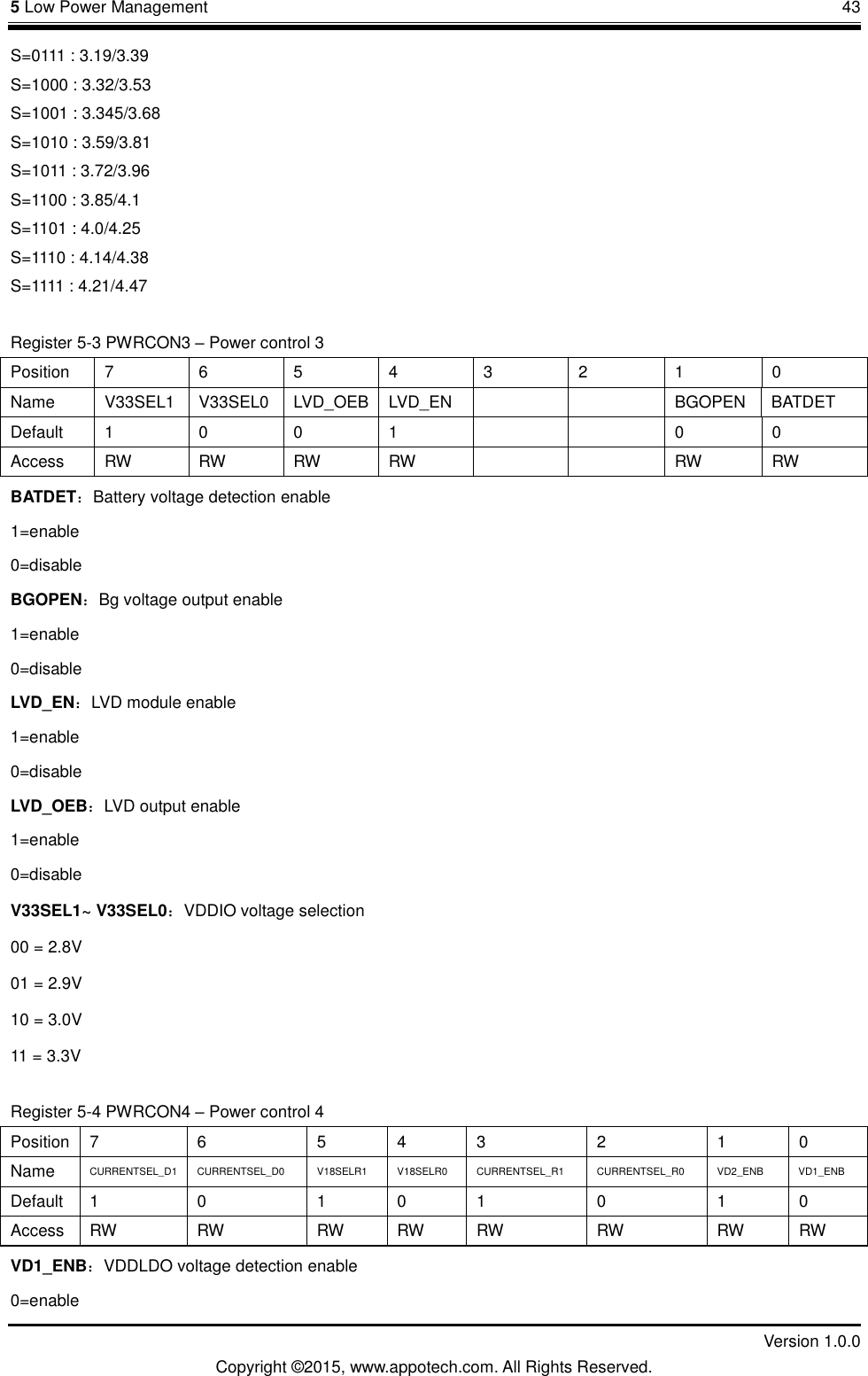
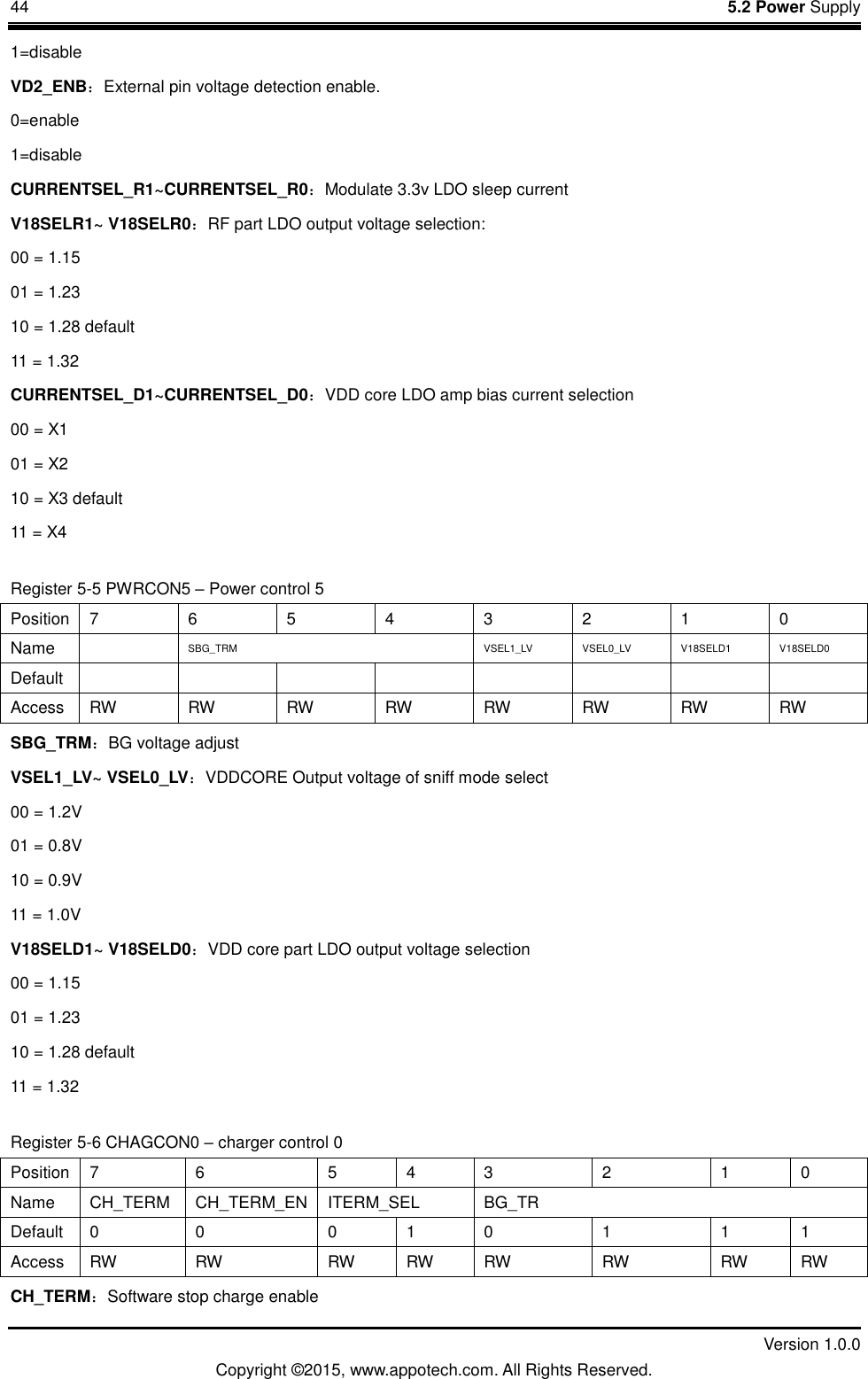
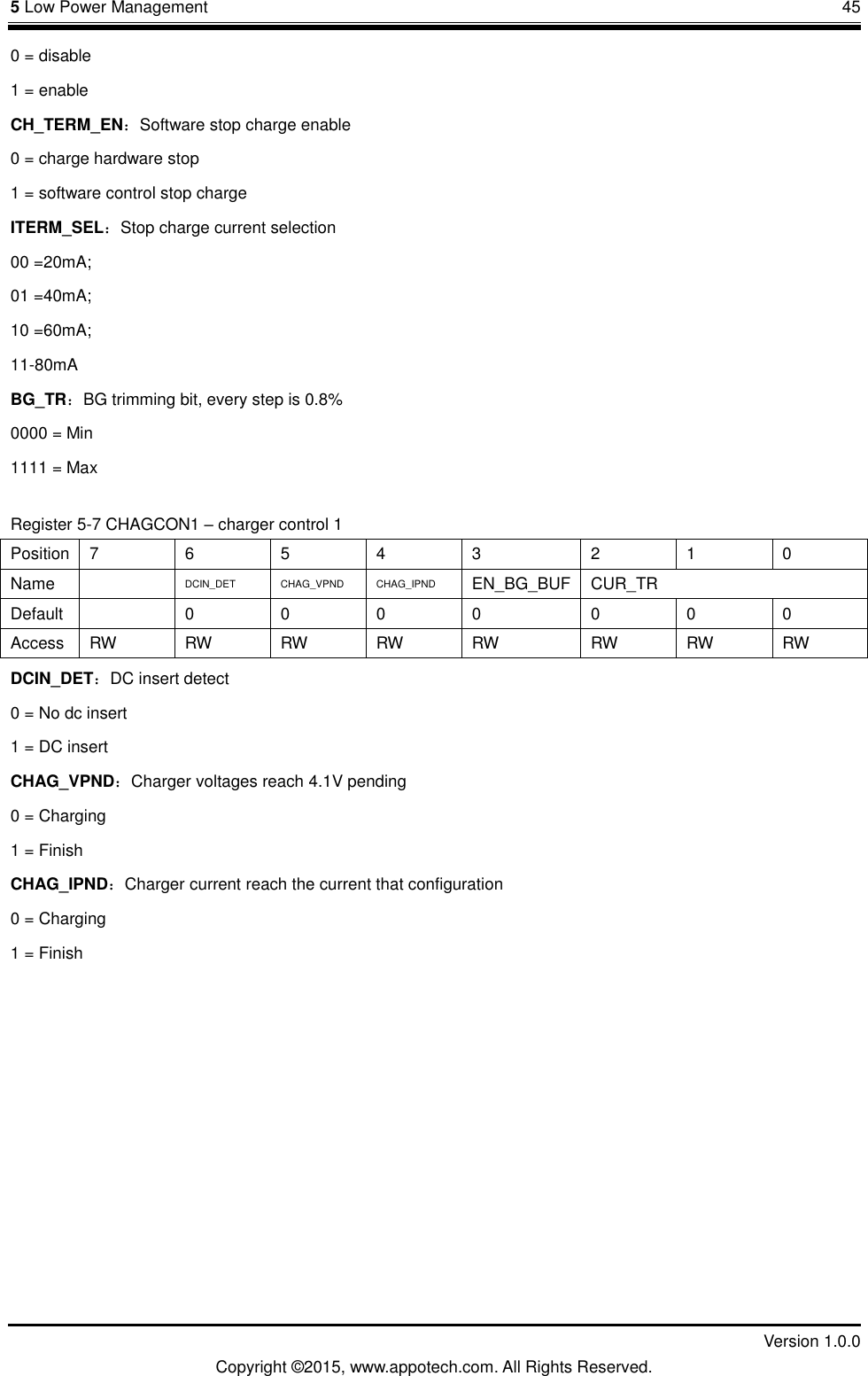
5 Low Power Management       43         Version 1.0.0 Copyright ©2015, www.appotech.com. All Rights Reserved. S=0111 : 3.19/3.39 S=1000 : 3.32/3.53 S=1001 : 3.345/3.68 S=1010 : 3.59/3.81 S=1011 : 3.72/3.96 S=1100 : 3.85/4.1 S=1101 : 4.0/4.25 S=1110 : 4.14/4.38 S=1111 : 4.21/4.47 Register 5-3 PWRCON3 – Power control 3 Position  7  6  5  4  3  2  1  0 Name  V33SEL1  V33SEL0  LVD_OEB  LVD_EN      BGOPEN  BATDET Default  1  0  0  1      0  0 Access  RW RW RW RW      RW RW BATDET:Battery voltage detection enable 1=enable     0=disable   BGOPEN:Bg voltage output enable 1=enable     0=disable   LVD_EN:LVD module enable 1=enable     0=disable   LVD_OEB:LVD output enable 1=enable 0=disable V33SEL1~ V33SEL0:VDDIO voltage selection 00 = 2.8V   01 = 2.9V 10 = 3.0V     11 = 3.3V   Register 5-4 PWRCON4 – Power control 4 Position  7  6  5  4  3  2  1  0 Name  CURRENTSEL_D1  CURRENTSEL_D0  V18SELR1  V18SELR0  CURRENTSEL_R1  CURRENTSEL_R0  VD2_ENB  VD1_ENB Default  1  0  1  0  1  0  1  0 Access  RW RW RW RW RW RW RW RW VD1_ENB:VDDLDO voltage detection enable 0=enable
44    5.2 Power Supply         Version 1.0.0 Copyright ©2015, www.appotech.com. All Rights Reserved.   1=disable   VD2_ENB:External pin voltage detection enable. 0=enable     1=disable   CURRENTSEL_R1~CURRENTSEL_R0:Modulate 3.3v LDO sleep current V18SELR1~ V18SELR0:RF part LDO output voltage selection: 00 = 1.15 01 = 1.23 10 = 1.28 default 11 = 1.32 CURRENTSEL_D1~CURRENTSEL_D0:VDD core LDO amp bias current selection 00 = X1 01 = X2 10 = X3 default 11 = X4 Register 5-5 PWRCON5 – Power control 5 Position  7  6  5  4  3  2  1  0 Name    SBG_TRM  VSEL1_LV  VSEL0_LV  V18SELD1  V18SELD0 Default                 Access  RW RW RW RW RW RW RW RW SBG_TRM:BG voltage adjust VSEL1_LV~ VSEL0_LV:VDDCORE Output voltage of sniff mode select 00 = 1.2V 01 = 0.8V 10 = 0.9V 11 = 1.0V V18SELD1~ V18SELD0:VDD core part LDO output voltage selection 00 = 1.15 01 = 1.23 10 = 1.28 default 11 = 1.32 Register 5-6 CHAGCON0 – charger control 0 Position  7  6  5  4  3  2  1  0 Name  CH_TERM CH_TERM_EN ITERM_SEL BG_TR Default  0  0  0  1  0  1  1  1 Access  RW RW RW RW RW RW RW RW CH_TERM:Software stop charge enable
5 Low Power Management       45         Version 1.0.0 Copyright ©2015, www.appotech.com. All Rights Reserved. 0 = disable 1 = enable CH_TERM_EN:Software stop charge enable 0 = charge hardware stop 1 = software control stop charge ITERM_SEL:Stop charge current selection 00 =20mA;   01 =40mA;   10 =60mA;   11-80mA BG_TR:BG trimming bit, every step is 0.8% 0000 = Min 1111 = Max   Register 5-7 CHAGCON1 – charger control 1 Position  7  6  5  4  3  2  1  0 Name    DCIN_DET  CHAG_VPND  CHAG_IPND  EN_BG_BUF CUR_TR Default    0  0  0  0  0  0  0 Access  RW RW RW RW RW RW RW RW DCIN_DET:DC insert detect 0 = No dc insert 1 = DC insert CHAG_VPND:Charger voltages reach 4.1V pending 0 = Charging 1 = Finish   CHAG_IPND:Charger current reach the current that configuration 0 = Charging 1 = Finish
46    6.1 Overview         Version 1.0.0 Copyright ©2015, www.appotech.com. All Rights Reserved.   6 General Purpose Input/Output (GPIO) 6.1 Overview The general-purpose input/output port (GPIO) provides 30 dedicated general purpose one-bit contacts that can be individually configured as either inputs or outputs. Contacts configured as outputs reflect internal register values, and those configured as inputs can be detected by reading internal registers. All GPIOs are divided into5 groups: Port0, Port1, Port2, Port3 and Port4.   6.2 Features The GPIO includes the following features:    Drive specific data to output using the data register;    Control the direction of the signal using the GPIO direction register;    Enable CPU to sample the status of the corresponding inputs by reading the data register;    Enable internal pull-up resistor using pull-up resistor control register;    Select suitable pull-up resistor value;    Enable internal pull-up resistor using pull-down resistor control register;    Select suitable pull-down resistor value;    Select suitable output driving current capability;   There are 5 types of GPIO that can meet the variation of application requirements. Table 6-1 shows the difference between pad types Table 6-1 Pad types Type  Driving (mA)  Pull-up resistor (Kohm)  Pull-down resistor (Kohm)  Mode A  8  24 10  /  /  10  /  /  /  Normal B  8  24 10  0.2  /  10 0.2  /  /  Normal C  8  24 10  200  0.5  10  3.3  0.5  /  Normal D  8  24 10  /  /  10  /  /  /  MUTE E  /  /  /  /  /  /  /  /  /  Analog 6.3 Function multiplexing In order to provide more flexible port functions and to minimize pin counts, some of the ports are multiplexed with other peripherals or functions. Table 6-2 illustrates the “Ports multiplexed mapping”. Several  GPIO  are  multiplexed  with  analog  module.  GPIO  digital  input  and  output  must  be  disabled  when  the corresponding analog module is enabled. Table 6-2 Ports multiplexed mapping Pins  Func1  Func 2  Func3  Func4  Func5  Func6  Func7  Fun8  Type
6 General Purpose Input/Output (GPIO)       47         Version 1.0.0 Copyright ©2015, www.appotech.com. All Rights Reserved. Pins  Func1  Func 2  Func3  Func4  Func5  Func6  Func7  Fun8  Type P00  AUXL0  UARTRX1     SDDAT1     SPI0DIN2      A P01  AUXR0  UARTTX1  PORTINT/WKUP0  SDDAT2          A P02  AUXL1           SPI0DOUT1  TMR1PWM    A P03  AUXR1           SPI0CLK1  TMR0CAP    A P04             SPI1DOUT/DIN1      A P05             SPI1CLK      A P06       PORTINT/WKUP1       SPI1DIN/SPI0DIN1  TMR0CKI/TMR1CKI  IISDI0  A P07       PORTINT/WKUP3  Ir_input       TRM1CAP    A P10           EMIWR        C P11                  C P12                  C P13  ADC5               IISBCLK0  B P14  ADC2       SDDAT3     SPI0DOUT2  TMR3CAP/TMR3PWM  IISDO0  A P15               TMR3CKI    B P16     BTUART1TX  UARTTX0  Ir_input       TMR2CAP/TMR2PWM  IISREF  A P17    BTUART1RX           TMR2CKI  IISWS0  B P20  AUXL2       SDCMD  EMIDAT0        C P21  AUXR2/ADC1       SDCLK  EMIDAT1        C P22  ADC3/LVDIN         EMIDAT2       IISDO1  C P23           EMIDAT3       IISDI1  C P24           EMIDAT4        C P25           EMIDAT5  SPI0DIN0/DOUT0     IISBCLK1  C P26  ADC6         EMIDAT6  SPI0CLK0     IISWS1  C P27         SDDAT0  EMIDAT7  SPI0DOUT0      C P30  ADC4       SDCLK     SPI0CLK3      C P31         SDCMD     SPI0DIN3      C P32         SDDAT0     SPI0DOUT3/DIN3      C P33  ADC0       Ir_input  32K/xosc12m   SysClk    TRM1CAP    A P34     UARTRX0  PORTINT/WKUP2       SPI0CLK2  TMR0PWM    C P35  MUTE                D P36                  A P37  GPIO                B P40         Ir_input     SPI0CLK4      A P41                  A P42             SPI1DIN1'      A P43                  A P44  DACL                E P45  DACR                E
48    6.4 GPIO Special Function Registers         Version 1.0.0 Copyright ©2015, www.appotech.com. All Rights Reserved.   6.4 GPIO Special Function Registers Register 6-1 P0DIR-P0 direction Register Position  7  6  5  4  3  2  1  0 Name  P0DIR Default  1  1  1  1  1  1  1  1 Access  R/W  R/W  R/W  R/W  R/W  R/W  R/W  R/W P0xDIR: P0x direction control 0 = Output 1 = Input Register 6-2 P1DIR-P1 direction Register Position  7  6  5  4  3  2  1  0 Name  P1DIR Default  1  1  1  1  1  1  1  1 Access  R/W  R/W  R/W  R/W  R/W  R/W  R/W  R/W P1xDIR: P1x direction control 0 = Output 1 = Input Register 6-3 P2DIR-P2 direction Register Position  7  6  5  4  3  2  1  0 Name  P2DIR Default  1  1  1  1  1  1  1  1 Access  R/W  R/W  R/W  R/W  R/W  R/W  R/W  R/W P2xDIR: P2x direction control 0 = Output 1 = Input Register 6-4 P3DIR-P3 direction Register Position  7  6  5  4  3  2  1  0 Name  P3DIR Default  1  1  1  1  1  1  1  1 Access  R/W  R/W  R/W  R/W  R/W  R/W  R/W  R/W P3xDIR: P3x direction control 0 = Output 1 = Input Register 6-5 P4DIR-P4 direction Register Position  7  6  5  4  3  2  1  0 Name  P4DIR
6 General Purpose Input/Output (GPIO)       49         Version 1.0.0 Copyright ©2015, www.appotech.com. All Rights Reserved. Default  -  -  1  1  1  1  1  1 Access  -  -  R/W  R/W  R/W  R/W  R/W  R/W P4xDIR: P4x direction control 0 = Output 1 = Input Register 6-6 P0 – P0 data register Position  7  6  5  4  3  2  1  0 Name  P0 Default  x  x  x  x  x  x  x  x Access  R/W  R/W  R/W  R/W  R/W  R/W  R/W  R/W P0[x]: P0x data. Valid when P0x is used as GPIO 0 = P0x is in low state when read and output low at P0x when write 1 = P0x is in high state when read and output high at P0x when write Register 6-7 P1 – P1 data register Position  7  6  5  4  3  2  1  0 Name  P1 Default  x  x  x  x  x  x  x  x Access  R/W  R/W  R/W  R/W  R/W  R/W  R/W  R/W P1[x]: P1x data. Valid when P1x is used as GPIO 0 = P1x is in low state when read and output low at P1x when write 1 = P1x is in high state when read and output high at P1x when write Register 6-8 P2 – P2 data register Position  7  6  5  4  3  2  1  0 Name  P2 Default  x  x  x  x  x  x  x  x Access  W/R  W/R  W/R  W/R  W/R  W/R  W/R  W/R P2[x]: P2x data. Valid when P2x is used as GPIO 0 = P2x is in low state when read and output low at P2x when write 1 = P2x is in high state when read and output high at P2x when write Register 6-9 P3 – P3 data register Position  7  6  5  4  3  2  1  0 Name  P3 Default    x  x  x  x  x  x  x  x Access  W/R  W/R  W/R  W/R  W/R  W/R  W/R  W/R P3[x]: P3x data. Valid when P3x is used as GPIO 0 = P3x is in low state when read and output low at P3x when write 1 = P3x is in high state when read and output high at P3x when write
50    6.4 GPIO Special Function Registers         Version 1.0.0 Copyright ©2015, www.appotech.com. All Rights Reserved.   Register 6-10 P4 – P4 data register Position  7  6  5  4  3  2  1  0 Name  P4 Default    -  -  x  x  x  x  x  x Access  -  -  RO  RO  W/R  W/R  W/R  W/R P3[x]: P3x data. Valid when P3x is used as GPIO 0 = P3x is in low state when read and output low at P3x when write 1 = P3x is in high state when read and output high at P3x when write Table 6-3 DRVx register setting Register  Address  Set bit “x” of PxDRV0 as “1” Clear bit “x” of PxDRV0 as “0”  Initial value P0DRV0  R/W  Driving is 24mA  Driving is 8mA  00h P1DRV0  R/W  Driving is 24mA  Driving is 8mA  00h P2DRV0  R/W  Driving is 24mA  Driving is 8mA  00h P3DRV0  R/W  Driving is 24mA  Driving is 8mA  00h P4DRV0  R/W  Driving  Driving is 8mA  00h Table 6-4 PUPx register setting Register  Address  Set bit “x” of PxPU0 as “1” Clear bit “x” of PxPU0 as “0”  Initial value P0PU0  R/W  Enable pull-up  Disable pull-up 00h P1PU0  R/W  Enable pull-up  Disable pull-up 00h P2PU0  R/W  Enable pull-up  Disable pull-up 00h P3PU0  R/W  Enable pull-up  Disable pull-up 00h P4PU0  R/W  Enable pull-up  Disable pull-up 00h Table 6-5 PDNx register setting Register  Address  Set bit “x” of PxPD0 as “1” Clear bit “x” of PxPD0 as “0”  Initial value P0PD0  R/W  Enable pull-down  Disable pull-down  00h P1PD0  R/W  Enable pull-down  Disable pull-down  00h P2PD0  R/W  Enable pull-down  Disable pull-down  00h P3PD0  R/W  Enable pull-down  Disable pull-down  00h P4PD0  R/W  Enable pull-down  Disable pull-down  00h Register 6–11 P1PUS0– P1 pull up select Position  7  6  5  4  3  2  1  0 Name  P17PUS0  P16PUS0  P15PUS0  P14PUS0  P13PUS0  P12PUS0  P11PUS0  P10PUS0 Default  0  0  0  0  0  0  0  0 Access  W/R  W/R  W/R  W/R  W/R  W/R  W/R  W/R Register 6–12 P1PUS1– P1 pull up select Position  7  6  5  4  3  2  1  0
6 General Purpose Input/Output (GPIO)       51         Version 1.0.0 Copyright ©2015, www.appotech.com. All Rights Reserved. Name  P17PUS1  P16PUS1  P15PUS1  P14PUS1  P13PUS1  P12PUS1  P11PUS1  P10PUS1 Default  0  0  0  0  0  0  0  0 Access  W/R  W/R  W/R  W/R  W/R  W/R  W/R  W/R P17PUS1, P17PUS0: 00 = select 10K pull up 01 = select 200Ωpull up 1x = reverse P16PUS1, P16PUS0: 00 = select 10K pull up 01 = select 500Ωpull up 1x = select 200K pull up P15PUS1, P15PUS0: 00 = select 10K pull up 01 = select 200Ωpull up 1x = reverse P14PUS1, P14PUS0: 00 = select 10K pull up 01 = reverse 1x = reverse P13PUS1, P13PUS0: 00 = select 10K pull up 01 = reverse 1x = reverse P12PUS1, P12PUS0: 00 = select 10K pull up 01 = select 500Ωpull up 1x = select 200K pull up P11PUS1, P11PUS0: 00 = select 10K pull up 01 = select 500Ωpull up 1x = select 200K pull up P10PUS1, P10PUS0: 00 = select 10K pull up 01 = select 500Ωpull up 1x = select 200K pull up
52    6.4 GPIO Special Function Registers         Version 1.0.0 Copyright ©2015, www.appotech.com. All Rights Reserved.   Register 6–13 P2PUS0– P2 pull up select Position  7  6  5  4  3  2  1  0 Name  P27PUS0  P26PUS0  P25PUS0  P24PUS0  P23PUS0  P22PUS0  P21PUS0  P20PUS0 Default  0  0  0  0  0  0  0  0 Access  W/R  W/R  W/R  W/R  W/R  W/R  W/R  W/R Register 6–14 P2PUS1– P2 pull up select Position  7  6  5  4  3  2  1  0 Name  P27PUS1  P26PUS1  P25PUS1  P24PUS1  P23PUS1  P22PUS1  P21PUS1  P20PUS1 Default  0  0  0  0  0  0  0  0 Access  W/R  W/R  W/R  W/R  W/R  W/R  W/R  W/R P27PUS1, P27PUS0: 00 = select 10K pull up 01 = select 500Ωpull up 1x = select 200K pull up P26PUS1, P26PUS0: 00 = select 10K pull up 01 = select 500Ωpull up 1x = select 200K pull up P25PUS1, P25PUS0: 00 = select 10K pull up 01 = select 500Ωpull up 1x = select 200K pull up P24PUS1, P24PUS0: 00 = select 10K pull up 01 = select 500Ωpull up 1x = select 200K pull up P23PUS1, P23PUS0: 00 = select 10K pull up 01 = select 500Ωpull up 1x = select 200K pull up P22PUS1, P22PUS0: 00 = select 10K pull up 01 = select 500Ωpull up 1x = select 200K pull up P21PUS1, P21PUS0: 00 = select 10K pull up
6 General Purpose Input/Output (GPIO)       53         Version 1.0.0 Copyright ©2015, www.appotech.com. All Rights Reserved. 01 = select 500Ωpull up 1x = select 200K pull up P20PUS1, P20PUS0: 00 = select 10K pull up 01 = select 500Ωpull up 1x = select 200K pull up Register 6–15 P3PUS0– P3 pull up select Position  7  6  5  4  3  2  1  0 Name  P37PUS0  P36PUS0  P35PUS0  P34PUS0  P33PUS0  P32PUS0  P31PUS0  P30PUS0 Default  0  0  0  0  0  0  0  0 Access  W/R  W/R  W/R  W/R  W/R  W/R  W/R  W/R Register 6–16 P3PUS1– P3 pull up select Position  7  6  5  4  3  2  1  0 Name  P37PUS1  P36PUS1  P35PUS1  P34PUS1  P33PUS1  P32PUS1  P31PUS1  P30PUS1 Default  0  0  0  0  0  0  0  0 Access  W/R  W/R  W/R  W/R  W/R  W/R  W/R  W/R P37PUS1, P37PUS0: 00 = select 10K pull up 01 = select 200Ωpull up 1x = reverse P36PUS1, P36PUS0: 00 = select 10K pull up 01 = reverse 1x = reverse P35PUS1, P35PUS0: 00 = select 10K pull up 01 = reverse 1x = reverse P34PUS1, P34PUS0: 00 = select 10K pull up 01 = select 500Ωpull up 1x = select 200K pull up P33PUS1, P33PUS0: 00 = select 10K pull up 01 = reverse
54    6.4 GPIO Special Function Registers         Version 1.0.0 Copyright ©2015, www.appotech.com. All Rights Reserved.   1x = reverse P32PUS1, P32PUS0: 00 = select 10K pull up 01 = select 500Ωpull up 1x = select 200K pull up P31PUS1, P31PUS0: 00 = select 10K pull up 01 = select 500Ωpull up 1x = select 200K pull up P30PUS1, P30PUS0: 00 = select 10K pull up 01 = select 500Ωpull up 1x = select 200K pull up Register 6–17 P1PDS0– P1 pull down select Position  7  6  5  4  3  2  1  0 Name  P17PDS0  P16PDS0  P15PDS0  P14PDS0  P13PDS0  P12PDS0  P11PDS0  P10PDS0 Default  0  0  0  0  0  0  0  0 Access  W/R  W/R  W/R  W/R  W/R  W/R  W/R  W/R Register 6–18 P1PDS1– P1 pull down select Position  7  6  5  4  3  2  1  0 Name  P17PDS1  P16PDS1  P15PDS1  P14PDS1  P13PDS1  P12PDS1  P11PDS1  P10PDS1 Default  0  0  0  0  0  0  0  0 Access  W/R  W/R  W/R  W/R  W/R  W/R  W/R  W/R P17PDS1, P17PDS0: 00 = select 10K pull down 01 = select 200Ωpull down 1x = reverse P16PDS1, P16PDS0: 00 = select 10K pull down 01 = select 500Ωpull down 1x = select 330Ωpull down P15PDS1, P15PDS0: 00 = select 10K pull down 01 = select 200Ωpull down 1x = reverse
6 General Purpose Input/Output (GPIO)       55         Version 1.0.0 Copyright ©2015, www.appotech.com. All Rights Reserved. P14PDS1, P14PDS0: 00 = select 10K pull down 01 = reverse 1x = reverse P13PDS1, P13PDS0: 00 = select 10K pull down 01 = reverse 1x = reverse P12PDS1, P12PDS0: 00 = select 10K pull down 01 = select 500Ωpull down 1x = select 330Ωpull down P11PDS1, P11PDS0: 00 = select 10K pull down 01 = select 500Ωpull down 1x = select 330Ωpull down P10PDS1, P10PDS0: 00 = select 10K pull down 01 = select 500Ωpull down 1x = select 330Ωpull down Register 6–19 P2PDS0– P2 pull down select Position  7  6  5  4  3  2  1  0 Name  P27PDS0  P26PDS0  P25PDS0  P24PDS0  P23PDS0  P22PDS0  P21PDS0  P20PDS0 Default  0  0  0  0  0  0  0  0 Access  W/R  W/R  W/R  W/R  W/R  W/R  W/R  W/R Register 6–20 P2PDS1– P2 pull down select Position  7  6  5  4  3  2  1  0 Name  P27PDS1  P26PDS1  P25PDS1  P24PDS1  P23PDS1  P22PDS1  P21PDS1  P20PDS1 Default  0  0  0  0  0  0  0  0 Access  W/R  W/R  W/R  W/R  W/R  W/R  W/R  W/R P27PDS1, P27PDS0: 00 = select 10K pull down 01 = select 500Ωpull down 1x = select 330Ωpull down P26PDS1, P26PDS0:
56    6.4 GPIO Special Function Registers         Version 1.0.0 Copyright ©2015, www.appotech.com. All Rights Reserved.   00 = select 10K pull down 01 = select 500Ωpull down 1x = select 330Ωpull down P25PDS1, P25PDS0: 00 = select 10K pull down 01 = select 500Ωpull down 1x = select 330Ωpull down P24PDS1, P24PDS0: 00 = select 10K pull down 01 = select 500Ωpull down 1x = select 330Ωpull down P23PDS1, P23PDS0: 00 = select 10K pull down 01 = select 500Ωpull down 1x = select 330Ωpull down P22PDS1, P22PDS0: 00 = select 10K pull down 01 = select 500Ωpull down 1x = select 330Ωpull down P21PDS1, P21PDS0: 00 = select 10K pull down 01 = select 500Ωpull down 1x = select 330Ωpull down P20PDS1, P20PDS0: 00 = select 10K pull down 01 = select 500Ωpull down 1x = select 330Ωpull down Register 6–21 P3PDS0– P3 pull down select Position  7  6  5  4  3  2  1  0 Name  P37PDS0  P36PDS0  P35PDS0  P34PDS0  P33PDS0  P32PDS0  P31PDS0  P30PDS0 Default  0  0  0  0  0  0  0  0 Access  W/R  W/R  W/R  W/R  W/R  W/R  W/R  W/R Register 6–22 P3PDS1– P3 pull down select Position  7  6  5  4  3  2  1  0 Name  P37PDS1  P36PDS1  P35PDS1  P34PDS1  P33PDS1  P32PDS1  P31PDS1  P30PDS1
6 General Purpose Input/Output (GPIO)       57         Version 1.0.0 Copyright ©2015, www.appotech.com. All Rights Reserved. Default  0  0  0  0  0  0  0  0 Access  W/R  W/R  W/R  W/R  W/R  W/R  W/R  W/R P37PDS1, P37PDS0: 00 = select 10K pull down 01 = select 200Ωpull down 1x = reverse P36PDS1, P36PDS0: 00 = select 10K pull down 01 = reverse 1x = reverse P35PDS1, P35PDS0: 00 = select 10K pull down 01 = reverse 1x = reverse P34PDS1, P34PDS0: 00 = select 10K pull down 01 = select 500Ωpull down 1x = select 330Ωpull down P33PDS1, P33PDS0: 00 = select 10K pull down 01 = reverse 1x = reverse P32PDS1, P32PDS0: 00 = select 10K pull down 01 = select 500Ωpull down 1x = select 330Ωpull down P31PDS1, P31PDS0: 00 = select 10K pull down 01 = select 500Ωpull down 1x = select 330Ωpull down P30PDS1, P30PDS0: 00 = select 10K pull down 01 = select 500Ωpull down 1x = select 330Ωpull down Register 6-23 PIE0 – Port digital input enable control
58    6.4 GPIO Special Function Registers         Version 1.0.0 Copyright ©2015, www.appotech.com. All Rights Reserved.   Position  7  6  5  4  3  2  1  0 Name  PIE07  PIE06  PIE05  PIE04  PIE03  PIE02  PIE01  PIE00 Default  1  1  1  1  1  1  1  1 Access  R/W  R/W  R/W  R/W  R/W  R/W  R/W  R/W PIE07: P17 digital input enables bit (For FM input) 0 = P17 Input Disabled 1 = P17 Input Enabled PIE06: P16 digital input enables bit (For AM input) 0 = P16 Input Disabled 1 = P16 Input Enabled PIE05: P14 digital input enables bit (For ADC2 input) 0 = P14 Input Disabled 1 = P14 Input Enabled PIE04: P13 digital input enables bit (For ADC5 input) 0 = P13 Input Disabled 1 = P13 Input Enabled PIE03: P03 Digital Input Enable Bit (For AUXR1) 0 = P03 Input Disabled 1 = P03 Input Enabled PIE02: P02 Digital Input Enable Bit (For AUXL1) 0 = P02 Input Disabled 1 = P02 Input Enabled PIE01: P01 Digital Input Enable Bit (For AUXR0) 0 = P01 Input Disabled 1 = P01 Input Enabled PIE00: P00 Digital Input Enable Bit (For AUXL0) 0 = P00 Input Disabled 1 = P00 Input Enabled Register 6-24 PIE1 – Port digital input enable control1 Position  7  6  5  4  3  2  1  0 Name  PIE17  PIE16  PIE15  PIE14  PIE13  PIE12  PIE11  PIE10 Default  1  0  1  1  1  1  1  1 Access  RO  R/W  R/W  R/W  R/W  R/W  R/W  R/W PIE17: P37 Digital Input Enable Bit (For VCMBUF) 0 = P37 digital Input Disabled 1 = P37 digital Input Enabled PIE16: P35 Digital Input Enable Bit (For UDSW) 0 = P35 digital Input Disabled 1 = P35 digital Input Enabled
6 General Purpose Input/Output (GPIO)       59         Version 1.0.0 Copyright ©2015, www.appotech.com. All Rights Reserved. PIE15: P33 Digital Input Enable Bit (For ADC0/LVDDET) 0 = P33 digital Input Disabled 1 = P33 digital Input Enabled PIE14: P30 Digital Input Enable Bit (For ADC4) 0 = P30 digital Input Disabled 1 = P30 digital Input Enabled PIE13: P23 Digital Input Enable Bit 0 = P23 digital Input Enabled 1 = P23 digital Input Disabled PIE12: P22 Digital Input Enable Bit (For ADC3 input) 0 = P22 digital Input Disabled 1 = P22 digital Input Enabled PIE11: P21 Digital Input Enable Bit (For AUXR2 or ADC1 input) 0 = P21 digital Input Disabled 1 = P21 digital Input Enabled PIE10: P20 Digital Input Enable Bit (For AUXL2) 0 = P20 digital Input Disabled 1 = P20 digital Input Enabled Register 6-25 PIE2– Port digital input enable control2 Position  7  6  5  4  3  2  1  0 Name            PIE22  PIE21  PIE20 Default  0  1  1  1  1  1  1  1 Access  RO  R/W  R/W  R/W  R/W  R/W  R/W  R/W PIE22: P26 Digital Input Enable Bit (For ADC6) 0 = P26 digital Input Enabled 1 = P26 digital Input Disabled PIE21: P11 Digital Input Enable Bit 0 = P11 digital Input Enabled 1 = P11 digital Input Disabled PIE20: P10 Digital Input Enable Bit 0 = P10 digital Input Enabled 1 = P10 digital Input Disabled Register 6-26 PMUXCON0 – Port Function MUX control 0 Position  7  6  5  4  3  2  1  0 Name  Reserved UART1_MAP  SPI0_P4_MAP  SPI0_DO_P25  WKPIN_SEL  SDTWO  P2SDEN Default  0  0  0  0  0  0  0  0 Access  R/W  R/W  R/W  R/W  R/W  R/W  R/W  R/W UART1_MAP: UART1 port mapping
60    6.4 GPIO Special Function Registers         Version 1.0.0 Copyright ©2015, www.appotech.com. All Rights Reserved.   0 = Select P16, P17 1 = Select Chip Bluetooth SPI0_P4_MAP: SPI0 port4 mapping 0 = SPI0 clock pin map to P30 1 = SPI0 clock pin map to P40 SPI0_DO_P25: SPI0 DOUT output at P25 0 = Disable 1 = Enable WKPIN_SEL: Port interrupt/wakeup event 2 sources selection 00 = Select P34 01 = Select DP 10 = Select DM 11 = Select IRTWKO SDTWO: Dual SD card mode control 0 = only support one SD card plugged in at the same time 1 = support two SD cards plugged in at the same time. P30 is SDCLK shared by these two SD cards. P2SDEN: SDCCLK, SDCCMD and SDCDAT0 port mapping control 0 = SDCCLK, SDCCMD and SDCDAT0 are mapped to P30, P31 and P32. 1 = SDCCLK, SDCCMD and SDCDAT0 are mapped to P20, P21 and P27 Register 6-27 PMUXCON1 – Port Function MUX control 1 Position  7  6  5  4  3  2  1  0 Name  P07WK_EN  Reserved WBEDGES  WKPIN0SEL1  Reserved  Reserved  WKPIN1SEL  WKPIN0SEL Default  1  0  0  0  0  0  0  0 Access  R/W  R/W  R/W  R/W  R/W  R/W  R/W  R/W P07WK_EN: P07 wakeup pin3 enable bit 0 = disable 1 = enable WBEDGES: wire less board wake pin edge selection 0 = falling edge 1 = rising edge WKPIN0SEL1: wakeup pin0 select bit1 0 = control by WKPIN0SEL 1 = P30 WKPIN1SEL: wakeup pin1 select bit1 0 = P06 1 = BT_CTS WKPIN0SEL: wakeup pin0 select bit0
6 General Purpose Input/Output (GPIO)       61         Version 1.0.0 Copyright ©2015, www.appotech.com. All Rights Reserved. 0 = P01 1 = BT_CDCLK Register 6-28 PMUXCON2 – Port Function MUX control 2 Position  7  6  5  4  3  2  1  0 Name  PMUXCON2 Default  0  0  0  0  0  0  0  0 Access  R/W  R/W  R/W  R/W  R/W  R/W  R/W  R/W PMUXCON2: PORT 2 Wake up enable 0 = disable 1 = enable Register 6-29 PMUXCON3 – Port Function MUX control 3 Position  7  6  5  4  3  2  1  0 Name  PMUXCON3 Default  0  0  0  0  0  0  0  0 Access  R/W  R/W  R/W  R/W  R/W  R/W  R/W  R/W PMUXCON3: PORT 3 Wake up enable 0 = disable 1 = enable Register 6-30 PMUXCON4 – Port Function MUX control 4 Position  7  6  5  4  3  2  1  0 Name  PMUXCON4_74 PMUXCON4_30 Default  0  0  0  0  0  0  0  0 Access  R/W  R/W  R/W  R/W  R/W  R/W  R/W  R/W PMUXCON4_76: P17/P16/P13P12 Wake up enable 0 = disable 1 = enable PMUXCON4_30: P00/P01/P02/P03 Wake up enable 0 = disable 1 = enable Register 6-31 PMUXCON5 – Port Function MUX control 5 Position  7  6  5  4  3  2  1  0 Name      WK2P_EN  DCIN_WKEN  COSEL  P30CO_EN  P33CO_EN Default  0  0  0  0  0  0  0  0 Access  R/W  R/W  R/W  R/W  R/W  R/W  R/W  R/W WK2P_EN: pre INT2 wakeup enable to INT2 0 = disable 1 = enable
62    6.4 GPIO Special Function Registers         Version 1.0.0 Copyright ©2015, www.appotech.com. All Rights Reserved.   DCIN_WKEN: internal DC IN wakeup enable to INT2 0 = disable 1 = enable 00/11 = XOSCO COSEL: CLKO sources selection 01 = PLL 12MHz 10 = System clock 00/11 = XOSCO P30CO_EN: P30 output clock enable bit (output clock selection by COSEL) 0 = disable 1 = enable P33CO_EN: P33output clock enable bit (output clock selection by COSEL)) 0 = disable 1 = enable Register 6-32 PMUXCON6 – Port Function MUX control 6 Position  7  6  5  4  3  2  1  0 Name  PWM7_OEN  PWM6_OEN  PWM5_OEN  PWM4_OEN  PWM3_OEN  PWM2_OEN  PWM1_OEN  PWM0_OEN Default  0  0  0  0  0  0  0  0 Access  R/W  R/W  R/W  R/W  R/W  R/W  R/W  R/W PWM7_OEN: PWM7 output enable 0 = disable 1 = enable PWM6_OEN: PWM6 output enable 0 = disable 1 = enable PWM5_OEN: PWM5 output enable 0 = disable 1 = enable PWM4_OEN: PWM4 output enable 0 = disable 1 = enable PWM3_OEN: PWM3 output enable 0 = disable 1 = enable PWM2_OEN: PWM2 output enable 0 = disable 1 = enable PWM1_OEN: PWM1 output enable
6 General Purpose Input/Output (GPIO)       63         Version 1.0.0 Copyright ©2015, www.appotech.com. All Rights Reserved. 0 = disable 1 = enable PWM0_OEN: PWM0 output enable 0 = disable 1 = enable 6.5 Port interrupt and wakeup CW6687B supports Port interrupt and wakeup function. The PWKEN registers (Wakeup Enable Register) allow PIN to cause wakeup. The  PWKEN  registers  are  set  to  1Fh  upon  reset.  Clearing  bit0-4  in  the  PWKEN  register  enables  wakeup  on corresponding pin. The trigger condition on the selected pin can be either rising edge or falling edge. The WKED register (Wakeup Edge Select) selects the desired transition edge. Setting a bit in WKED register selects the falling edge of the corresponding pin. Resetting the bit selects the rising edge.   Once a valid transition occurs on the selected pin, the WKPND register (Wakeup Pending Register) latches the transition in the  corresponding bit position. Logic „1‟  indicates the occurrence of the selected trigger edge on the corresponding Port pins. Upon reset, logic „0‟ is set to all bits of WKPND. Note: 1.  For  Wakeup  initialization,  to  avoid  any  false  signaling  to  port,  it  is  recommended  to  perform  the  following procedure for Wakeup initialization:    Configure the edge select of Port 0 pins on WKEDG register,  Clear the corresponding bits on WKPND Wakeup Pending Register  Clear the corresponding bits in the PWKEN registers to enable the wakeup on the corresponding port pins 2.  Upon exiting the sleep down mode, the Multi-Input Wakeup logic causes full chip reset. 6.5.1 Wakeup registers Register 6-33 PWKEN – Port wakeup enable Position  7  6  5  4  3  2  1  0 Name        PWKEN4  PWKEN3  PWKEN2  PWKEN1  PWKEN0 Default  0  0  0  1  1  1  1  1 Access  R/W  R/W  R/W  R/W  R/W  R/W  R/W  R/W PWKEN4 0 = Enable INT4 Wakeup 1 = Disable INT4 Wakeup PWKEN3 0 = Enable INT3 Wakeup 1 = Disable INT3 Wakeup PWKEN2 0 = Enable INT3/DP/DM/IRTWKO Wakeup
64    6.5 Port interrupt and wakeup         Version 1.0.0 Copyright ©2015, www.appotech.com. All Rights Reserved.   1 = Disable INT3/DP/DM/IRTWKO Wakeup PWKEN1 0 = Enable INT1 Wakeup 1 = Disable INT1 Wakeup PWKEN0 0 = Enable INT0 Wakeup 1 = Disable INT0 Wakeup Note:   1.  to enable WKPNDx, set PWKENx to „0‟. 2.  To clear WKPNDx, write „0‟ to WKPNDx. WKPNDx will be „0‟ 2 clocks later after write „0‟ to WKPNDx. 3.  WKPNDx is cleared when PWKENx is „1‟. Register 6-34 PWKEDGE – Port wakeup Event select Position  7  6  5  4  3  2  1  0 Name  LDOBGOE  SPI0PS1  Rev  WKEDG4  WKEDG3  WKEDG2  WKEDG1  WKEDG0 Default  0  0  0  0  x  x  x  X Access  R/W  R/W  R/W  R/W  R/W  R/W  R/W  R/W LDOBGOE: LDO Bandgap output enable 0 = Disable 1 = Enable SPI0PS1: SPI0 port select 1.See chapter 16 SPI0 WKEDGx: Port interrupt Edge Select 0 = Select rising edge as interrupt trigger event 1 = Select falling edge as interrupt trigger event Register 6-35 PWKPND – Port wakeup pending Position  7  6  5  4  3  2  1  0 Name        WKPND4  WKPND3  WKPND2  WKPND1  WKPND0 Default  0  0  0  0  0  0  0  0 Access  R/W  R/W  R/W  R/W  R/W  R/W  R/W  R/W WKPND4 0 = No INT4 wakeup event occurred 1 = INT4 wakeup event occurred WKPND3 0 = No INT3 wakeup event occurred 1 = INT3 wakeup event occurred WKPND2 0 = No INT2/DP/DM/IRTWKO wakeup event occurred 1 = INT2/DP/DM/IRTWKO wakeup event occurred WKPND1 0 = No INT1 wakeup event occurred
6 General Purpose Input/Output (GPIO)       65         Version 1.0.0 Copyright ©2015, www.appotech.com. All Rights Reserved. 1 = INT1 wakeup event occurred WKPND0 0 = No INT0 wakeup event occurred 1 = INT0 wakeup event occurred 6.6 Operation Guide Port 0 to Port 3 are memory-mapped into the Data Memory addressing space. They are respectively mapped into 80h, 90h, A0h and B0h registers for ports P0, P1, P2 and P3. Writing to a port data register sets the voltage levels of the corresponding port pins that have been configured to operate as outputs. Reading from a data register reads the voltage levels of the corresponding port pins. As illustrated in Figure 8-1, there are major differences reading the port values when the port is set as input and output. When the port is set as output, the CPU will read the port value from Px register instead of the port pin value. When the port is set as input, the CPU will read the value from port pin directly instead of the port value from Px register. As a result, the user should be very careful when using Read-then-Write instructions to access the ports and change PxDIR before write the output value to Px when using port as output. For example: Code assembler: ANL P0DIR, #0FEH MOV P0, #01h Code C51: P0DIR &= 0Xfe; P0 = 0x01; The first instruction in this example configures P00 as output, and then the second instruction writes the Port 0 data register (P0), which controls the output levels of the Port 0 pins, P00 through P07. Figure 8-1 shows the internal hardware structure and configuration registers for each pin of Port 0~3.
66    7.1 Timer0         Version 1.0.0 Copyright ©2015, www.appotech.com. All Rights Reserved.   7 Timers 7.1 Timer0 Timer0 is an 8-bit timer/counter with a 7-bit prescaler. It can be configured as timer, counter or PWM generator.  150BTimer0 Features  8bits counter  7bits pre-scaler  Counter mode (clock source from system clock or TMR0)  Capture mode (event source from CAP0)  PWM mode (PWM signal output to PWM0) 7.1.1 Timer0 Special Function Registers Register 7-1 TMR0CON – Timer0 control   Position  7  6  5  4  3  2  1  0 Name  T0PND  T0ES  T0M  T0IS  T0PSR Default  0  0  0  0  0  0  0  0 Access  R/W  R/W  R/W  R/W  R/W  R/W  R/W  R/W T0PND: Timer0 Pending Flag 0 = Not Pending 1 = Pending T0ES: Timer0 Capture Mode Edge Select 0 = CAP0 Rising Edge 1 = CAP0 Falling Edge T0M: Timer0 Mode 00 = Timer0 is disabled 01 = Timer0 is enabled and works in Counter Mode 10 = Timer0 is enabled and works in PWM Mode 11 = Timer0 is enabled and works in Capture Mode T0IS: Timer0 Increase Source 0 = Select system clock cycle 1 = Select TMR0 rising edge T0PSR: Timer0 Prescaler 000 = Timer0 counts at every counting source event 001 = Timer0 counts at every 2 counting source events 010 = Timer0 counts at every 4 counting source events 011 = Timer0 counts at every 8 counting source events
7 Timers       67         Version 1.0.0 Copyright ©2015, www.appotech.com. All Rights Reserved. 100 = Timer0 counts at every 16 counting source events 101 = Timer0 counts at every 32 counting source events 110 = Timer0 counts at every 64 counting source events 111 = Timer0 counts at every 128 counting source events Register 7-2 TMR0CNT – Timer0 Counter   Position  7  6  5  4  3  2  1  0 Name  TMR0CNT Default  0  0  0  0  0  0  0  0 Access  R/W  R/W  R/W  R/W  R/W  R/W  R/W  R/W Note:  Timer0  will  increase  in  proper  condition  while  it  is  enabled.  It  overflows  when  TMR0CNT  =  TMR0PR, TMR0CNT will be clear to 0x00 when overflow occurs, and the interrupt flag will be set „1‟ by hardware. Register 7-3 TMR0PR – Timer0 Period   Position  7  6  5  4  3  2  1  0 Name  TMR0PR Default  1  1  1  1  1  1  1  1 Access  WO WO WO WO WO WO WO WO Note: The overflow period of the timer is: Tinc-source * T0PSR * (T0PR + 1). Register 7-4 TMR0PWM – Timer0 PWM duty Position  7  6  5  4  3  2  1  0 Name  TMR0PWM Default  x  x  x  x  x  x  x  x Access  R/W  R/W  R/W  R/W  R/W  R/W  R/W  R/W Note: TMR0PWM is reserved in timer/counter mode. In PWM mode, it is used as duty cycle setting. In capture mode, the value of TMR0CNT will be captured to TMR0PWM when selected event occurs. 7.2 Timer1 Timer1  is  a  16-bit  timer/counter  with  a  7-bit  prescaler.  It  can  be  configured  as  timer,  counter  or  PWM generator. X155BTimer1 Features  16bits counter  7bits pre-scaler  Counter mode (clock source from system clock or TMR1)  Capture mode (event source from CAP1)  PWM mode (PWM signal output to PWM1) 7.2.1 Timer1 Special Function Registers Register 7-5 TMR1CON0 – Timer1 control 0
68    7.2 Timer1         Version 1.0.0 Copyright ©2015, www.appotech.com. All Rights Reserved.   Position  7  6  5  4  3  2  1  0 Name  T1ES  T1M  T1CPSEL  T1IS Default  0  0  0  0  0  0  0  0 Access  R/W  R/W  R/W  R/W  R/W  R/W  R/W  R/W T1ES: Timer1 Capture Edge Select 00 = CAP1 Rising Edge   01 = CAP1 Falling Edge 1X= CAP1 Rising Edge and Falling Edge T1M: Timer1 Mode Select 00 = Timer1 is disabled 01 = Timer1 is enabled and works in Counter Mode 10 = Timer1 is enabled and works in PWM Mode 11 = Timer1 is enabled and works in Capture Mode T1CPSEL: Timer1 capture input pin select 0 = Capture CAP1 1 = Capture IR1 T1IS: Timer1 Increase Source 000 = TMR1 Rising Edge 001 = TMR1 Falling Edge 010 = TMR1 Rising and Falling Edge 011 = External 32 KHz crystal oscillator 1xx = System clock cycle Register 7-6 TMR1CON1 – Timer1 control 1   Position  7  6  5  4  3  2  1  0 Name  T1TPND  T1CPND  T1TIE  T1CIE  -  T1PSR Default  0  0  0  0  -  0  0  0 Access  R/W  R/W  R/W  R/W  -  R/W  R/W  R/W T1TPND: Timer1 over Flow Pending Bit 0 = Not Pending 1 = Pending T1CPND: Timer1 Capture mode Pending Bit 0 = Not Pending 1 = Pending T1TIE: Timer1 over Flow Interrupt Enable Bit 0 = Interrupt Disable 1 = Interrupt Enable T1CIE: Timer1 Capture mode Interrupt Enable Bit 0 = Disable 1 = Enable
7 Timers       69         Version 1.0.0 Copyright ©2015, www.appotech.com. All Rights Reserved. T1PSR: Timer1 Prescaler 000 = Timer1 counts at every counting source event 001 = Timer1 counts at every 2 counting source events 010 = Timer1 counts at every 4 counting source events 011 = Timer1 counts at every 8 counting source events 100 = Timer1 counts at every 16 counting source events 101 = Timer1 counts at every 32 counting source events 110 = Timer1 counts at every 64 counting source events 111 = Timer1 counts at every 128 counting source events Register 7-7 TMR1CNTH/TMR1CNTL – Timer1 Counter   Position  7  6  5  4  3  2  1  0 Name  TMR1CNTH/TMR1CNTL Default  0  0  0  0  0  0  0  0 Access  R/W  R/W  R/W  R/W  R/W  R/W  R/W  R/W Note:  Timer1  will  increase  in  proper  condition  while  it  is  enabled,  it  overflows  when  TMR1CNT  =  TMR1PR, TMR1CNT will be cleared to 0x0000 when overflow, and the interrupt flag will be set „1‟ by hardware. Register 7-8 TMR1PRH/TMR1PRL – Timer1 Period   Position  7  6  5  4  3  2  1  0 Name  TMR1PRH/TMR1PRL Default  1  1  1  1  1  1  1  1 Access  WO WO WO WO WO WO WO WO The overflow period of the timer is: Tinc-source * T1PSR * (T1PR + 1). Register 7-9 TMR1PWMH/TMR1PWML – Timer1 PWM duty Position  7  6  5  4  3  2  1  0 Name  TMR1PWMH/TMR1PWML Default  x  x  x  x  x  x  x  x Access  R/W  R/W  R/W  R/W  R/W  R/W  R/W  R/W Note: TMR1PWM is reserved in timer/counter mode. In PWM mode, it is used  as duty cycle setting. In capture mode, the value of TMR1CNT will be captured to TMR1PWM when the selected event occurs. 7.3 Timer2 Timer2 is a 16-bit timer/counter with a 7-bit prescaler. It can be configured as timer, counter or PWM generator. 7.3.1  Timer2 Features  16bits counter  7bits pre-scaler  Counter mode (clock source from system clock or TMR2)
70    7.3 Timer2         Version 1.0.0 Copyright ©2015, www.appotech.com. All Rights Reserved.    Capture mode (event source from CAP2)  PWM mode (PWM signal output to PWM2) 7.3.2 Timer2 Special Function Registers Register 7-10 TMR2CON0 – Timer2 control 0 Position  7  6  5  4  3  2  1  0 Name  T2ES  T2M  Reserve  T2IS Default  0  0  0  0  0  0  0  0 Access  R/W  R/W  R/W  R/W  R/W  R/W  R/W  R/W T2ES: Timer2 Capture Edge Select 00 = CAP2 Rising Edge   01 = CAP2 Falling Edge 1X= CAP2 Rising Edge and Falling Edge   T2M: Timer2 Mode Select 00 = Timer2 is disabled 01 = Timer2 is enabled and works in Counter Mode 10 = Timer2 is enabled and works in PWM Mode 11 = Timer2 is enabled and works in Capture Mode T2IS: Timer2 Increase Source 000 = TMR2 Rising Edge 001 = TMR2 Falling Edge 010 = TMR2 Rising and Falling Edge 011 = External 32 KHz crystal oscillator 1xx = System Clock cycle Register 7-11 TMR2CON1 – Timer2 control 1   Position  7  6  5  4  3  2  1  0 Name  T2TPND  T2CPND  T2TIE  T2CIE  -  T2PSR Default  0  0  0  0  -  0  0  0 Access  R/W  R/W  R/W  R/W  -  R/W  R/W  R/W T2TPND: Timer2 over Flow Pending Bit 0 = Not Pending 1 = Pending T2CPND: Timer2 Capture mode Pending Bit 0 = Not Pending 1 = Pending T2TIE: Timer2 over Flow Interrupt Enable Bit 0 = Interrupt Disable 1 = Interrupt Enable
7 Timers       71         Version 1.0.0 Copyright ©2015, www.appotech.com. All Rights Reserved. T2CIE: Timer2 Capture mode Interrupt Enable Bit 0 = Disable 1 = Enable T2PSR: Timer2 Prescaler 000 = Timer2 counts at every counting source event 001 = Timer2 counts at every 2 counting source events 010 = Timer2 counts at every 4 counting source events 011 = Timer2 counts at every 8 counting source events 100 = Timer2 counts at every 16 counting source events 101 = Timer2 counts at every 32 counting source events 110 = Timer2 counts at every 64 counting source events 111 = Timer2 counts at every 128 counting source events Register 7-12 TMR2CNTH/TMR2CNTL – Timer2 Counter   Position  7  6  5  4  3  2  1  0 Name  TMR2CNTH/TMR2CNTL Default  0  0  0  0  0  0  0  0 Access  R/W  R/W  R/W  R/W  R/W  R/W  R/W  R/W Note:  Timer2  will  increase  in  proper  condition  while  it  is  enabled,  it  overflows  when  TMR2CNT  =  TMR2PR, TMR2CNT will be clear to 0x0000 when overflow, and the interrupt flag will be set as „1‟ by hardware. Register 7-13 TMR2PRH/TMR2PRL – Timer2 Period   Position  7  6  5  4  3  2  1  0 Name  TMR2PRH/TMR2PRL Default  1  1  1  1  1  1  1  1 Access  WO WO WO WO WO WO WO WO The overflow period of the timer is: Tinc-source * T2PSR * (T2PR + 1). Register 7-14 TMR2PWMH/TMR2PWML – Timer2 PWM duty Position  7  6  5  4  3  2  1  0 Name  TMR2PWMH/TMR2PWML Default  x  x  x  x  x  x  x  x Access  R/W  R/W  R/W  R/W  R/W  R/W  R/W  R/W Note: TMR2PWM is reserved in timer/counter mode. In PWM mode, it is used as duty cycle setting. In capture mode, the value of TMR2CNT will be captured to TMR2PWM when selected event occurs. 7.4 Timer3 Timer3 is an 8-bit timer/counter with a 7-bit prescaler. It can be configured as timer, counter or PWM generator.
72    7.4 Timer3         Version 1.0.0 Copyright ©2015, www.appotech.com. All Rights Reserved.   7.4.1 Timer3 Features  8bits counter  7bits pre-scaler  Counter mode (clock source from system clock or TMR3)  Capture mode (event source from CAP3)  PWM mode (PWM signal output to PWM3) 7.4.2 Timer3 Special Function Registers Register 7-15 TMR3CON – Timer3 control   Position  7  6  5  4  3  2  1  0 Name  T3PND  T3ES  T3M  T3IS  T3PSR Default  0  0  0  0  0  0  0  0 Access  R/W  R/W  R/W  R/W  R/W  R/W  R/W  R/W T3PND: Timer3 Pending Flag 0 = Not Pending 1 = Pending T3ES: Timer3 Capture Mode Edge Select 0 = CAP3 Rising Edge 1 = CAP3 Falling Edge T3M: Timer3 Mode 00 = Timer3 is disabled 01 = Timer3 is enabled and works in Counter Mode 10 = Timer3 is enabled and works in PWM Mode 11 = Timer3 is enabled and works in Capture Mode T3IS: Timer3 Increase Source 0 = System Clock 1 = TMR3 rising edge T3PSR: Timer3 Prescaler 000 = Timer3 counts at every counting source event 001 = Timer3 counts at every 2 counting source events 010 = Timer3 counts at every 4 counting source events 011 = Timer3 counts at every 8 counting source events 100 = Timer3 counts at every 16 counting source events 101 = Timer3 counts at every 32 counting source events 110 = Timer3 counts at every 64 counting source events 111 = Timer3 counts at every 128 counting source events Register 7-16 TMR3CNT – Timer3 Counter
7 Timers       73         Version 1.0.0 Copyright ©2015, www.appotech.com. All Rights Reserved. Position  7  6  5  4  3  2  1  0 Name  T3CNT Default  0  0  0  0  0  0  0  0 Access  R/W  R/W  R/W  R/W  R/W  R/W  R/W  R/W Note:  Timer3  will  increase  in  proper  condition  while  it  is  enabled.  It  overflows  when  TMR3CNT  =  TMR3PR, TMR3CNT will be clear to 0x00 when overflow occurs, and the interrupt flag will be set „1‟ by hardware. Register 7-17 TMR3PR – Timer3 Period   Position  7  6  5  4  3  2  1  0 Name  TMR3PR Default  1  1  1  1  1  1  1  1 Access  WO WO WO WO WO WO WO WO Note: The overflow period of the timer is: Tinc-source * T3PSR * (T3PR + 1). Register 7-18 TMR3PWM – Timer3 PWM duty Position  7  6  5  4  3  2  1  0 Name  TMR3PWM Default  x  x  x  x  x  x  x  x Access  R/W  R/W  R/W  R/W  R/W  R/W  R/W  R/W Note: TMR3PWM is reserved in timer/counter mode. In PWM mode, it is used as duty cycle  setting. In capture mode, the value of TMR3CNT will be captured to TMR3PWM when selected event occurs. 7.5 Watchdog Timer (WDT) The Watchdog Timer (WDT) logic consists of a 20bit Watchdog Timer. An internal RC oscillator running at 32 KHz clocks the Watchdog  Timer. When device resets,  the WDT is disabled  and user should  enable the WDT if  it is needed. In the default configuration, WDT overflows in 2ms. The application program needs to write a „1‟ into WDTCON [5] at least once 2 ms to prevent WDT time out. The lower 3 bits of the WDTCON register control the selection of overflow time period.   7.5.1 Watchdog Wake up WDT can be used  to  wake up  CW6687B from  Idle,  Hold or  Sleep mode.  RSTEN bit  (WDTCON [3])  is used  to determine the actions after WDT wake up. When RSTEN is set to 0, the watchdog will generate a non-reset wake up after counter overflows. And When RSTEN is set to 1, the watchdog will wake up CW6687B by resetting the whole chip. After non-reset wake up CW6687B will continue to execute next instruction.    During Idle mode, CW6687B can perform wakeup by WDT with interrupt or reset.  During Hold mode, CW6687B perform wakeup by WDT with interrupt or reset or just continue to execute the next instruction.  During Sleep mode, CW6687B perform wakeup by WDT with reset.  During Deep Sleep mode, CW6687B cannot achieve wakeup by WDT.
74    7.5 Watchdog Timer (WDT)     l     Version 1.0.0 Copyright ©2015, www.appotech.com. All Rights Reserved.   7.5.2 Watchdog SFR Register 7-19 WDTCON – Watchdog control Position  7  6  5  4  3  2  1  0 Name  WDTPD  WDTTO  CLRWDT  WDTEN  RSTEN  WDTPS Default  0  0  0  1  1  1  0  1 Access  RO RO WO  R/W  R/W  R/W  R/W  R/W WDTPD: 0 = read „0‟ before sleep operation 1 = read „1‟ after sleep operation WDTTO: 0 = Read „0‟ after clear Watchdog or Power up 1 = Read „1‟ after Watchdog time out   CLRWDT:   1 = Clear WDT counter 0 = No action WDTEN: 0 = Disables the Watchdog timer 1 = Enables the Watchdog timer RSTEN: 0 = Disables the Watchdog reset 1 = Enables the Watchdog reset WDTPS: WDT time out period setting 000 = 2ms 001 = 8ms 010 = 32ms 011 = 128ms 100 = 512ms 101 = 2048ms 110 = 8192ms 111 = 32768ms
7 Timers       75         Version 1.0.0 Copyright ©2015, www.appotech.com. All Rights Reserved. 7.6 Independent Power Real Time Clock Counter (IRTCC) 7.6.1 IRTCC Controller IRTCC control can generate two interrupts: Second interrupt and Alarm interrupt.   IRTCC‟s second interrupt can be enabled by writing „1‟ to IRTIE bit. When IRTCC works and IRTIE = 1, IRTCC second interrupt will be generated every 1 second by setting IRTPND to 1. IRTPND can be cleared by software by writing 0 to IRTPND bit.   IRTCC alarm interrupt can be enabled by writing 1 to IRTALIE bit. When IRTCC works and IRTALIE = 1, IRTCC alarm interrupt will  be  generated  when  the current time is equal  to the pre-set time  by setting IRTALPND  to  1. IRTALPND can be cleared by software by writing 0 to IRTALPND bit. IRTCC is divided to two parts; one part is IRTCC control. The power of IRTCC control is VDDCORE. Another part is IRTCC. The part of IRTCC is VDDRTC. The communication between two parts is used like SPI protocol.  7.6.2 IRTCC Timer IRTCC timer can be powered independently. It can work even when other logic in CW6687B is powered off. There is 6-bit valid address for the 64-byte user RAM, so the upper 2-bit of address in the writing RTC_RAM or reading RTC_RAM command is ignored. After one byte write/read, the internal address can increase automatically; this characteristic provides a burst mode to write/read the RAM. If the internal addresses increase  to a number greater than 63, it will roll back to 0. 7.6.3 Communication with IRTCC Timer   Special commands and corresponding parameters are used to communicate with IRTCC timer‟s internal control or status registers and SRAM. Table 7-1 IRTCC components communication commands IRTCC component  Component type Operation  Command Code Command Parameters Write_CFG(RTCCON)  A  Write    0x55  One byte Read_CFG(RTCCON)  A  Read  0x54  One byte Write_ CFG3(RTCC3)  A  Write    0x59  One byte Write_RTC  B  Write  0xF0  Four byte Read_RTC  B  Read    0xE0  Four byte Write_ALM  B  Write  0x53  Four byte Read_ALM  B  Read  0x52  Four byte Write_RAM  C  Write  0x57  One byte address and N byte data Read_RAM  C  Read  0x56  One byte address and N byte data Write_PWR(PWRCON)  A  Read  0x5a  One byte Write_WKO(WKOCON)  A  Write  0x5b  One byte
76    7.6 Independent Power Real Time Clock Counter (IRTCC)         Version 1.0.0 Copyright ©2015, www.appotech.com. All Rights Reserved.   IRTCC component  Component type Operation  Command Code Command Parameters Read_WKO(WKOCON)  A  Read  0xa1  One byte Write_VCL(VOLTAGE)  A  Write    0xa2  One byte Read_VCL(VOLTAGE)  A  Read  0xa3  One byte Read_PWR(PWRCON)  A  Read  0x65  One byte Write_STA(WKSTA)  A  Write    0x63  One byte Read_STA(WKSTA)  A  Read  0x62  One byte Communication operations: 1, Read or write A type components Write: CMDxxWrite data 8bitxxDIDOCS Read: CMDDIDO xxxxRead data 8bitCS  2, Read or write B type components Write: CMDCSDIDO xxWrite 4 bytes dataxx xx xx xx Read: CMDxxxx xx xx xxRead 4 bytes dataCSDIDO  3, Read or write C type components Write:
7 Timers       77         Version 1.0.0 Copyright ©2015, www.appotech.com. All Rights Reserved. CMDCSDIDO xxWrite 1 to 64 bytes dataxx xx xx xx ……addressxx Read: CMDxxxx xx xx xx ……Read 1 to 64 bytes dataaddressxxCSDIDO 7.6.4 IRTCC Special Function Registers Register 7-20 IRTCON – IRTCC control Position  7  6  5  4  3  2  1  0 Name  IRTCSTEN  Reserved  IRTALPND  IRTALIE  IRTPND  IRTIE  DONE  EN Default  0  0  0  0  0  0  0  0 Access  R/W  R/W  R/W  R/W  R/W  R/W  R/W  R/W IRTCSTEN: IRTCC sleep wake up enable   0 = Disable   1 = Enable IRTALPND: IRTCC alarm pending   0 = No pending (Write 0 to clear pending) 1 = Pending IRTALIE: IRTCC alarm interrupt enable 0 = Disable 1 = Enable IRTALIE must be „1‟ if IRTCC alarm is used to wake up system. IRTPND: IRTCC second pending   0 = No pending (Write 0 to clear pending) 1 = Pending IRTALIE: IRTCC alarm second enable 0 = Disable 1 = Enable IRTIE must be „1‟ if IRTCC second is used to wake up system. DONE: Communication done flag   0 = done 1 = not done EN: IRTCC communications enable
78    7.6 Independent Power Real Time Clock Counter (IRTCC)         Version 1.0.0 Copyright ©2015, www.appotech.com. All Rights Reserved.   0 = Disable 1 = Enable Register 7-21 IRTCDAT – RTCC communication data Position  7  6  5  4  3  2  1  0 Name  IRTCDAT Default  x  x  x  x  x  x  x  x Access  R/W  R/W  R/W  R/W  R/W  R/W  R/W  R/W Write to IRTCDAT will start IRTCC communication and set DONE flag to 1. Read IRTCDAT will return IRTCC data. Register 7-22 SECCNT –IRTCC timer conter Position  7  6  5  4  3  2  1  0 Name  SECCNT7  SECCNT6  SECCNT5  SECCNT4  SECCNT3  SECCNT2  SECCNT1  SECCNT0 Default  x  x  x  x  x  x  x  x Access  WO WO WO WO WO WO WO WO RTCC second counter Register 7-23IRTCON1 – RTCC control1 Position  7  6  5  4  3  2  1  0 Name  -  -  -  -  RTC_POR  IRTC_POR_EN  TIMER  TIMERIE Default  -  -  -  -    0  0  0 Access  -  -  -  -  R/O  R/W  R/W  R/W  RTC_POR: RTCC POR bit   0 = RTCC POR is 0   1 = RTCC POR is 1 NOTE: only design specification can be known. IRTC_POR_EN: IRTCC POR reset system clock enable 0 = Disable 1 = Enable   TIMER: Timer pending   0 = No pending (Write 0 to clear pending) 1 = When SECCNT equal to internal counter TIMERIE: Timer pending interrupt enable 0 = Disable 1 = Enable Register 7-24 RANDOM_CNT – random center regent   Position  7  6  5  4  3  2  1  0 Name  RANDOM_CNT[7:0] Default  -  -  -  -  -  -  -  -
7 Timers       79         Version 1.0.0 Copyright ©2015, www.appotech.com. All Rights Reserved. Access  RO RO RO RO RO RO RO RO RANDOM: random center of 32k without default value   7.6.5 IRTCC components description IRTCC timer can be powered independently. It can work even when other logic in TIGER is powered off. In IRTCC timer, there is one 8-bit  configure register, one 32-bit real time counter, one 32-bit alarm register and 64-byte  user  RAM. All  of  these  can  be  accessed  (read  or  write)  by  several  command sets  through  the  IRTCC control. There is 6-bit valid address for the 64-byte user RAM, so the upper 2-bit of address in the Write_RAM or Read_RAM command are ignored. After one byte write/read, the internal address can increase automatically, this characteristic provides a burst mode to write/read the RAM. If the internal address increase to a number greater than 63, it will roll back to 0. Register 7-25 RTCCON - RTCC control Position  7  6  5  4  3  2  1  0 Name  32K_EN  12M_EN  SPOR_WKEN  Reserved  F1HZEN  F32KHZEN  EX32KSEL  WKO32KOUT Default  0  0  0  0  1  1  0  0 Access  R/W  R/W  R/W  R/W  R/W  R/W  R/W  R/W 32K_EN: xosc 32k enable 0 = Disable 1 = Enable 12M_EN: xosc 12m enable 0 = Disable 1 = Enable SPOR_WKEN: System POR wakeup enable 0 = disable 1 = enable F1HZEN: 1Hz signal output enable 0 = Disable 1 = Enable F32KHZEN: 32 KHz signal output enable 0 = Disable 1 = Enable EX32KSEL: RTCC timer clock source select 0 = RTCC timer works with XOSC 32K. 1 = RTCC timer works with IRTOSC 32KHz WKO32KOUT: WKO output RTC analog 32K XOSC 0 = Disable 1 = Enable
80    7.6 Independent Power Real Time Clock Counter (IRTCC)         Version 1.0.0 Copyright ©2015, www.appotech.com. All Rights Reserved.   Register 7-26 RTCC3 - RTCC configure register3 Position  7  6  5  4  3  2  1  0 Name  -  -  -        DRSEL Default  -  -  -  0  0  0  0  0 Access  -  -  -        WO WO DRSEL: IRTCC OSC drive select Register 7-27 PWRCON - Power control register Position  7  6  5  4  3  2  1  0 Name  PD_FLAG BIAS_SEL BUCK_MODE_SEL  RVDD_EN  DVDD_EN VDDIO_EN PMU_EN Default  1  1  1  0  0  0  0  0 Access  R/W  R/W  R/W  R/W  R/W  R/W  R/W  R/W PD_FLAG: Power down flag BIAS_SEL [1:0]: LDO amp bias current selection 00 = X0 01 = X1 10 = X2, default 11 = X4 BUCK_MODE_SEL: PMU mode select bit 0 = LDO mode 1 = BUCK mode RVDD_EN: RVDD enable bit 0 = enable 1 = disable DVDD_EN: DVDD enable bit 0 = enable 1 = disable VDDIO_EN: VDDIO enable bit 0 = enable 1 = disable PMU_EN: PMU enable bit 0 = enable 1 = disable Register 7-28 WKOCON - WKO control register Position  7  6  5  4  3  2  1  0 Name  WKPIN_STA  FLTEN  ALMOE  WKOEN  WKOUTEN  WKOINEN  ALMEN  DCIN_WKEN Default  0  0  0  0  0  0  0  0 Access  R/W  W/R  W/R  W/R  W/R  W/R  R/W  R/W WKPIN_STA: Wake up pin output state
7 Timers       81         Version 1.0.0 Copyright ©2015, www.appotech.com. All Rights Reserved. 0 = wake up pin output 0 1 = wake up pin output 1 FITEN: WKO 1ms filter enable 0 = disable 1 = enable ALMOE: Alarm output enable at WKO PIN output enable   0 = Disable   1 = Enable WKOEN: WKO PIN enable 0 = Disable 1 = Enabled WKOUTEN: WKO PIN output enable bit 0 = Disable 1 = Enabled WKOINEN: WKO PIN input enable bit   0 = Disable 1 = Enabled ALMEN: Alarm function enable 0 = Disable 1 = Enable DCIN_WKEN: DCIN wake up enable bin 0 = disable 1 = enable Register 7-29 WKSTA - Wake up status register Position  7  6  5  4  3  2  1  0 Name  -  -  WKO_CIN  DCINPND  HVDR  LVDPND  WKOPND  ALMOT Default  0  0  0  0  1  0  0  0 Access  R  R  R  R  R  R/W  R  R WKO_CIN: wko pin state read   DCINPND: DC IN wake up pending 0 = No dc in wake up pending 1 = dc in wake up pending HVDR: HVD flag 0 = VDDLDO is no higher than configuration 1 = VDDLDO is higher than configuration LVDPND: LVD pending 0 = VDDLDO is higher than 2V
82    7.6 Independent Power Real Time Clock Counter (IRTCC)         Version 1.0.0 Copyright ©2015, www.appotech.com. All Rights Reserved.   0 = VDDLDO is lower than 2V Write this bit 0 will clear LVDPND WKOPND: IRTWKO wake up pending 0 = No wakeup 1 = IRTWKO pin wake up pending ALMOT: Alarm match flag. 0 = No alarm match happen 1 = Alarm match This flag is set to „1‟ by hardware when alarm register match real timer counter. It can be clear to „0‟ of ALMEN is set to „0‟ or „Write_ALM‟ is detected. Register 7-30 VCL VOLTAGE configure register Position  7  6  5  4  3  2  1  0 Name  SC_RTC[4]  SC_RTC[3]  SC_RTC[2]  SC_RTC[1]  SC_RTC[0]  HVDS  HVDEN  LVDEN Default  1  1  0  1  0  0  0  0 Access  W/R  W/R  W/R  W/R  W/R  W/R  W/R  W/R SC_RTC [4]: OSCO OSCI capacitance select SC_RTC [3:2]: OSCO capacitance select SC_RTC [1:0]: OSCI capacitance select HVDS: HVD level select   0 = 4.0V   1 = 4.2V LVDEN: LVD enable bit     0 = Disabled   1 = Enabled In IRTCC timer, there is one 32-bit real time counter. The unit of this counter is per second. If display the time on LCD, you should convert to second, minute, hour, date and so on. When use “Write_RTC” command to config this counter,  the  fisrt  byte  is  config  the  highest  counter,  and  the  forth  byte  is  config  the  lowest  counter. When  use “Read_RTC” command to read this counter, the first byte output is the highest counter, and the forth byte output is the lowest counter. In IRTCC timer, there is one 32-bit alarm register. The unit of this counter is per second. If display the time on LCD, you should convert to second, minute, hour, date and so on. When use “Write_ALM” command to config this counter, the fisrt byte is config the highest counter, and the forth byte is config the lowest counter. When use “Read_ALM” command to read this counter, the first byte output is the highest counter, and the forth byte output is the lowest counter. 7.6.6 IRTCC Operating Guide ;-------------------------------- ;  Write RTC Config Write_Cfg:  ORL   IRTCON, #(1<<0)    ;RTC enable
7 Timers       83         Version 1.0.0 Copyright ©2015, www.appotech.com. All Rights Reserved.  MOV   A, #55H  CALL  Send_Dat  MOV   A, #0CCH  CALL  Send_Dat  ANL   IRTCON, #~(1<<0)    ;RTC Disable  RET ;-------------------------------- ;      Read Config Read_Cfg:  ORL   IRTCON, #(1<<0)    ;RTC enable  MOV   A, #54H  CALL  Send_Dat  MOV   A, #00H  CALL  Send_Dat  ANL   IRTCON, #~(1<<0)    ;RTC Disable  RET ;-------------------------------- ;  Write_RTC Write_RTC:  ORL   IRTCON, #(1<<0)    ;RTC enable   MOV   A, #0F0H  CALL  Send_Dat   MOV   A, #98H  CALL  Send_Dat  MOV   A, #76H  CALL  Send_Dat  MOV   A, #54H  CALL  Send_Dat  MOV   A, #32H  CALL  Send_Dat   ANL   IRTCON, #~(1<<0)    ;RTC Disable  RET ;-------------------------------- ;  Read_RTC Read_RTC:
84    7.6 Independent Power Real Time Clock Counter (IRTCC)         Version 1.0.0 Copyright ©2015, www.appotech.com. All Rights Reserved.    ORL   IRTCON, #(1<<0)    ;RTC enable   MOV   A, #0E0H  CALL  Send_Dat   MOV   A, #00H  CALL  Send_Dat  MOV   A, IRTCDAT  MOV   A, #00H  CALL  Send_Dat  MOV   A, IRTCDAT  MOV   A, #00H  CALL  Send_Dat  MOV   A, IRTCDAT  MOV   A, #00H  CALL  Send_Dat  MOV   A, IRTCDAT   ANL   IRTCON, #~(1<<0)    ;RTC Disable  RET ;-------------------------------- ;  Write RTC Alam Write_Alam:  ORL   IRTCON, #(1<<0)    ;RTC enable   MOV   A, #53H  CALL  Send_Dat   MOV   A, #12H  CALL  Send_Dat  MOV   A, #34H  CALL  Send_Dat  MOV   A, #56H  CALL  Send_Dat  MOV   A, #78H  CALL  Send_Dat   ANL   IRTCON, #~(1<<0)    ;RTC Disable  RET
7 Timers       85         Version 1.0.0 Copyright ©2015, www.appotech.com. All Rights Reserved. ;-------------------------------- ;  Read RTC Alam Read_Alam:  ORL   IRTCON, #(1<<0)    ;RTC enable   MOV   A, #52H  CALL  Send_Dat   MOV   A, #00H  CALL  Send_Dat  MOV   A, RTCDAT  MOV   A, #00H  CALL  Send_Dat  MOV   A, RTCDAT  MOV   A, #00H  CALL  Send_Dat  MOV   A, RTCDAT  MOV   A, #00H  CALL  Send_Dat  MOV   A, RTCDAT   ANL   IRTCON, #~(1<<0)    ;RTC Disable  RET ;-------------------------------- ;  Write RTC RAM Write_Ram:  ORL   IRTCON, #(1<<0)    ;RTC enable   MOV   A, #57H  CALL  Send_Dat  MOV   A, #00H        ;Ram Address  CALL  Send_Dat   MOV   R0, #64 Write_Ram_Loop:  MOV   A, #55H  CALL  Send_Dat  DJNZ  R0, Write_Ram_Loop
86    7.6 Independent Power Real Time Clock Counter (IRTCC)         Version 1.0.0 Copyright ©2015, www.appotech.com. All Rights Reserved.    ANL   IRTCON, #~(1<<0)    ;RTC Disable  RET ;-------------------------------- ;  Read RTC RAM Read_Ram:  ORL   IRTCON, #(1<<0)    ;RTC enable   MOV   A, #56H  CALL  Send_Dat  MOV   A, #00H        ;Ram Address  CALL  Send_Dat   MOV   R0, #64 Read_Ram_Loop:  MOV   A, #00H  CALL  Send_Dat  MOV   A, IRTCDAT  DJNZ  R0, Read_Ram_Loop  ANL   IRTCON, #~(1<<0)    ;RTC Disable  RET ;  Write VCL   Write_Vcl:  ORL   IRTCON, #(1<<0)    ;RTC enable  MOV   A, #0A2H  CALL  Send_Dat  MOV   A, #0A7H  CALL  Send_Dat  ANL   IRTCON, #~(1<<0)    ;RTC Disable  RET ;-------------------------------- ;      Read VCL Read_Vcl:  ORL   IRTCON, #(1<<0)    ;RTC enable  MOV   A, #0A3H  CALL  Send_Dat  MOV   A, #00H  CALL  Send_Dat  ANL   IRTCON, #~(1<<0)    ;RTC Disable  RET
7 Timers       87         Version 1.0.0 Copyright ©2015, www.appotech.com. All Rights Reserved.  ;  Write WKO   Write_Wko:  ORL   IRTCON, #(1<<0)    ;RTC enable  MOV   A, #5BH  CALL  Send_Dat  MOV   A, #0A7H  CALL  Send_Dat  ANL   IRTCON, #~(1<<0)    ;RTC Disable  RET ;-------------------------------- ;      Read WKO Read_ Wko:  ORL   IRTCON, #(1<<0)    ;RTC enable  MOV   A, #0A1H  CALL  Send_Dat  MOV   A, #25H  CALL  Send_Dat  ANL   IRTCON, #~(1<<0)    ;RTC Disable  RET ;  Write PWR   Write_Pwr:  ORL   IRTCON, #(1<<0)    ;RTC enable  MOV   A, #5AH  CALL  Send_Dat  MOV   A, #003H  CALL  Send_Dat  ANL   IRTCON, #~(1<<0)    ;RTC Disable  RET ;-------------------------------- ;  Send Data Send_Dat:  MOV   RTCDAT, A Send_Dat_Loop:  MOV   A, IRTCON      JB    ACC.1, Send_Dat_Loop  RET ;--------------------------------
88    8.1 UART0         Version 1.0.0 Copyright ©2015, www.appotech.com. All Rights Reserved.   8 Universal Asynchronous Receiver/Transmitter (UART) 8.1 UART0 8.1.1 Overview UART0 is a serial port capable of asynchronous transmission. The UART0 can function in full duplex mode. Receive data is buffered in a holding register. This allows the UART0 to start reception of a second incoming data byte before software has finished reading the previous data byte. Figure 8-1 illustrates the UART0 Block Diagram. When PSEL = 0    Receive pin (RX) – UART0RX0  Transmit pin (TX) – UART0TX0 When PSEL = 1  Receive pin (RX) – UART0RX1  Transmit pin (TX) – UART0TX1 TX Buffer9 th BitData busMUXUART TX10UTTXDONEUTTXINVTXIEUART RX 10UTRXINVShift RegisterRX BufferData Recovery9 th BitData BusBaud Rate GeneratorControl Logic UTRXDONEINTRXIEBaud Rate GeneratorControl LogicU1IEU1TXIFU1RXIF Figure 8-1 UART0 Block Diagram
8 Universal Asynchronous Receiver/Transmitter (UART)       89         Version 1.0.0 Copyright ©2015, www.appotech.com. All Rights Reserved. 8.1.2 UART0 Special Function Registers Register 8-1 UARTCON – UART0 control Position  7  6  5  4  3  2  1  0 Name  UTSBS  UTTXNB  NBITEN  UTEN  UTTXINV  UTRXINV  TXIE  RXIE Default  0  1  0  0  0  0  0  0 Access  R/W  R/W  R/W  R/W  R/W  R/W  R/W  R/W UTSBS: Stop Bit Select 0 = 1 bit as Stop Bit 1 = 2 bits as Stop Bit UTTXNB: The ninth bit data of transmitter buffer. Write the ninth bit into this location that you want to transmit   NBITEN: Nine-BIT mode Enable Bit 0 = Eight-bit mode 1 = Nine-bit mode UTEN: UART Enable Bit 0 = Disable UART module 1 = Enable UART module UTTXINV: Transmit Invert Selection Bit 0 = Transmitter output without inverted 1 = Transmitter output inverted UTRXINV: Receive Invert Selection Bit 0 = Receiver input without inverted 1 = Receiver input inverted TXIE: Transmit Interrupt Enable 0 = Transmit interrupt disable 1 = Transmit interrupt enable RXIE: Receive Interrupt Enable 0 = Receiver interrupt disable 1 = Receiver interrupt enable Register 8-2 UARTSTA – UART0 status Position  7  6  5  4  3  2  1  0 Name  UTRXNB  FEF  RXIF  TXIF  -  -  -  PSEL Default  x  x  0  1  -  -  -  0 Access  R/W  R/W  R/W  RO  -  -  -  R/W UTRXNB: The ninth bit data of receiver buffer FEF: Frame Error Flag   0 = the stop bit is „1‟ in the last received frame 1 = the stop bit is „0‟ in the last received frame
90    8.1 UART0         Version 1.0.0 Copyright ©2015, www.appotech.com. All Rights Reserved.   RXIF: RX Interrupt Flag 0 = RX not done 1 = RX done TXIF: TX Interrupt Flag 0 = TX not done 1 = TX done Writing data to UTBUF will clear this flag. PSEL: UART0 Port Select 0 = Select UART0RX0 and UART0TX0   UART0RX0: P34   UART0TX0: P16 1 = Select UART0RX1 and UART0TX1   UART0RX1: P00   UART0TX1: P01 Register 8-3 UARTBAUDL – UART0 Baud Rate Low Byte Position  7  6  5  4  3  2  1  0 Name  UARTBAUDL Default  x  x  x  x  x  x  x  x Access  WO WO WO WO WO WO WO WO Register 8-4 UARTBAUDH – UART0 Baud Rate High Byte Position  7  6  5  4  3  2  1  0 Name  UARTBAUDH Default  0  0  0  0  0  0  0  0 Access  WO WO WO WO WO WO WO WO UARTBAUD = {UARTBAUDH, UARTBAUDL} Register 8-5 UARTDIV   Position  7  6  5  4  3  2  1  0 Name  UARTDIV Default  0  0  0  0  0  0  0  0 Access  WO WO WO WO WO WO WO WO Baud Rate =Fsys clock / [(UARTBAUD +1) x (UARTDIV + 1)] Register 8-6 UARTDATA – UART0 Data Position  7  6  5  4  3  2  1  0 Name  UARTDATA Default  x  x  x  x  x  x  x  x Access  R/W  R/W  R/W  R/W  R/W  R/W  R/W  R/W Write this location will load the data to transmitter buffer. And read this location will read the data from the receiver
8 Universal Asynchronous Receiver/Transmitter (UART)       91         Version 1.0.0 Copyright ©2015, www.appotech.com. All Rights Reserved. buffer. 8.2 UART1 8.2.1 Overview UART1 is a serial port capable of asynchronous transmission. The UART1 can function in normal and DMA full duplex mode. Please sees PMUXCON0 bit 6 descriptions when PMUXCON0[6] == 0  Receive pin (RX) – UART1RX0 (P17)  Transmit pin (TX) – UART1TX0 (P16) Or PMUXCON0[6] == 1  Receive pin (RX) – UART1RX1 (BT_TX)  Transmit pin (TX) – UART1TX1 (BT_RX) 8.2.2 UART1 Special Function Registers Register 8-7 UART1CON – UART1 control Position  7  6  5  4  3  2  1  0 Name  UTSBS  UTTXNB  NBITEN  UTEN  TXIE  RXIE  OVERFLOWIE  DMASEL Default  0  1  0  0  0  0  -  0 Access  R/W  R/W  R/W  R/W  R/W  R/W  -  R/W UTSBS: Stop Bit Select 0 = 1 bit as Stop Bit 1 = 2 bits as Stop Bit UTTXNB: The ninth bit data of transmitter buffer. Write the ninth bit into this location that you want to transmit   NBITEN: Nine-BIT mode Enable Bit 0 = Eight-bit mode 1 = Nine-bit mode UTEN: UART Enable Bit 0 = Disable UART module 1 = Enable UART module TXIE: Transmit Interrupt Enable 0 = Transmit interrupt disable 1 = Transmit interrupt enable RXIE: Receive Interrupt Enable 0 = Normal Receive interrupt disable or AUTO DMA mode Receive one word Interrupt disable 1 = Normal Receive interrupt enable or AUTO DMA mode Receive one word Interrupt enable OVERFLOWIE: Receive DMA overflow interrupt enable 0 = overflow Interrupt disable
92    8.2 UART1         Version 1.0.0 Copyright ©2015, www.appotech.com. All Rights Reserved.   1 = overflow Interrupt enable DMASEL:AUTO DMA choose 0 = AUTO DMA mode off 1= AUTO DMA mode on Register 8-8 UART1STA – UART1 status Position  7  6  5  4  3  2  1  0 Name  UART_GIIE  -  UTRXNB  RX_BYTE_HIGH  RXIF  TXIF  OVERFLOWIF  RXKICK Default  0  -  x  0  0  1  0  0 Access  R/W  -  R/W  RO  R/W  R/W  R/W  WO UART_GIE:UART Global Interrupt 15 Enable 0 = UART Global I Interrupt disable 1 = UART Global I Interrupt enable UTRXNB: The ninth bit data of receiver buffer RX_BYTE_HIGH : receive data high byte(only for DMA) 0 = waiting receive data low byte 1 = waiting receive data high byte RXIF: UART RX Interrupt Flag 0 = Normal Receive or AUTO DMA mode Receive one word not done 1 = Normal Receive or AUTO DMA mode Receive one word done In normal mode, it becomes “1” every byte, but in DMA mode, it becomes “1” every word. TXIF: UART TX Interrupt Flag 0 = UART transmit not done 1 = UART transmit done Writing data to UTBUF or Writing UARTDMATXCNT will clear this flag. OVERFLOWIF: UART overflow Interrupt Flag 0 = UART overflow not done 1 = UART overflow done RXKICK: UART DMA receive KICK start 0 = not KICK start 1 = KICK start Register 8-9 UART1DIV – UART1 divide register Position  7  6  5  4  3  2  1  0 Name  UART1DIV Default  0  0  0  0  0  0  0  0 Access  R/W  R/W  R/W  R/W  R/W  R/W  R/W  R/W
8 Universal Asynchronous Receiver/Transmitter (UART)       93         Version 1.0.0 Copyright ©2015, www.appotech.com. All Rights Reserved. Register 8-10 UART1BAUD – UART1 Baud Rate register Position  7  6  5  4  3  2  1  0 Name  UART1BAUD Default  x  x  x  x  x  x  x  x Access  WO WO WO WO WO WO WO WO Baud Rate =Fsys clock / [(UARTDIV+1) (UART1BAUD + 1)) Register 8-11 UART1DATA – UART1 Data Position  7  6  5  4  3  2  1  0 Name  UART1DATA Default  x  x  x  x  x  x  x  x Access  R/W  R/W  R/W  R/W  R/W  R/W  R/W  R/W Write this location will load the data to transmitter buffer. And read this location will read the data from the receiver buffer. Register 8-12 UARTDMATXCNT –UART1 DMA Transmit counter Portion  7  6  5  4  3  2  1  0 Name  UARTDMATXCNT Default  x  x  x  x  x  x  X  x Access  WO WO WO WO WO WO WO WO Nbyte = UARTDMATXCNT + 1   Register 8-13 UARTDMATXPTR–UART1 DMA Transmit Start Pointer    byte Portion  7  6  5  4  3  2  1  0 Name  UARTDMATXPTR Default  x  x  x  X  x  x  X  x Access  WO WO WO WO WO WO WO WO In order to get the correct DMA Start Pointer, you should write this register twice. First write the higher byte, then the low byte.    DMA address only map to SRAM1. Register 8-14 UARTDMARXPTR–UART1 DMA receive Start Pointer byte Portion  7  6  5  4  3  2  1  0 Name  UARTDMARXPTR Default  x  x  x  X  x  x  X  x Access  WO WO WO WO WO WO WO WO In order to get the correct DMA Start Pointer , you should write this register twice. First write the higher byte, then the low byte.    DMA address only map to SRAM1. Register 8-15 UART1MINUS–UART1 DMA receive data minus byte count by CPU Portion  7  6  5  4  3  2  1  0 Name  UART1MINUS Default  x  x  x  X  x  x  X  x
94    8.2 UART1         Version 1.0.0 Copyright ©2015, www.appotech.com. All Rights Reserved.   Access  WO WO WO WO WO WO WO WO Nbyte = UART1MINUS+ 1'b1   Register 8-16 UART1POINTL–UAR1T DMA point by CPU read   Portion  7  6  5  4  3  2  1  0 Name  UART1POINTL Default  x  x  x  X  x  x  X  x Access  R/O  R/O  R/O  R/O  R/O  R/O  R/O  R/O Register 8-17 UART1POINTH–UART DMA point by CPU read high byte   Portion  7  6  5  4  3  2  1  0 Name  UART1POINTH Default  x  x  x  X  x  x  X  x Access  R/O  R/O  R/O  R/O  R/O  R/O  R/O  R/O Register 8-18 UART1LOOPCNT–UART1 DMA loop count   Position  7  6  5  4  3  2  1  0 Name        overlowcnt  dma_loop_cnt Default        0  0  0  0  0 Access  WO  WO  WO  WO  WO  WO  WO  WO overlowcnt: less than bytes UART receive data ram size 00 = 4 bytes 01 = 8 bytes 10 = 16 bytes 11 = 32 bytes dma_loop_cnt::UART receive data ram size 000 = 16 bytes 001 = 32 bytes 010 = 64 bytes 011 = 128 bytes 100 = 256 bytes 101 = 512 bytes 110 = 1K bytes 111 = forbidden Register 8-19 UART1CNTH–UART1 DMA receive count high byte   Portion  7  6  5  4  3  2  1  0 Name  UART1CNTH Defeault  x  x  x  X  x  x  X  x Access  R/O  R/O  R/O  R/O  R/O  R/O  R/O  R/O
8 Universal Asynchronous Receiver/Transmitter (UART)       95         Version 1.0.0 Copyright ©2015, www.appotech.com. All Rights Reserved. Register 8-20 UART1CNTL–UART1 DMA receive count low byte   Portion  7  6  5  4  3  2  1  0 Name  UART1CNTL Defeault  x  x  x  x  x  x  x  x Access  R/O  R/O  R/O  R/O  R/O  R/O  R/O  R/O 8.3 Operation Guide 1)UART1 Normal mode Operation Flow: 1.  Set IO in the correct direction. 2.  Configure UARTDIV and UART1BAUD to choose sample rate and baud. 3. Enable UART1 module by setting UTEN to „1‟ 4. Set TXIE or RXIE „to 1‟ if needed 5.  Write data to UART1DATA 6. Wait for PND to change to „1‟, or wait for interrupt 7.  Read received data from UART1DATA if needed 8.  Go to Step 5 to start another process if needed or turn off UART1 by UTEN. 2)UART1 DMA Mode Operation Flow: 1.  Set IO in the correct direction. 2.  Configure UARTDIV and UART1BAUD to choose sample rate and baud. 3.  Configure UART1CON Select DMA. 4.  Write the start DMA address. for receive, Write data to UARTDMARXPTR   5. Enable UART module by setting UTEN to „1‟. 6.  kick-start a DMA receive process 7.  Wait overflow  or  delay  some time ,read  UART1CNTH and  UART1CNTL,read  data  by  write  UART1MINUS (UART1MINUS<{UART1CNTH,UART1CNTL}). 8.  Write the start DMA address. for transmission, Write data to UARTDMATXPTR   9.  Write data to UARTDMATXCNT to kick-start a DMA transmit process 10. Wait for PND to change to „1‟, or wait for interrupt
96    8.4 BT Control Register         Version 1.0.0 Copyright ©2015, www.appotech.com. All Rights Reserved.   8.4 BT Control Register Register 8-21 BTCON1 – BT control register1 Position  7  6  5  4  3  2  1  0 Name      BTC2RS  BTCDCLKO  BTCDCLKI  BTRSTB  Reserved  XOSC26MEN Default  0  0  0  0  0  0  0  0 Access  R/W  R/W  R/W  RO  R/W  R/W  R/W  R/W BTC2RS: BTCON2 read select 0 = read BTCONT register 1 = read BT output state BTCDCLKO: BT CDCLK output state BTCDCLKI: BT CDCLK input state XOSC26MEN: BT xosc26M enable 0 = disable 1 = enable Register 8-22 BTCON2 – BT control register2 Position  7  6  5  4  3  2  1  0 Name  BTTX  BTRX  BTCTS  BTTESTEN  BTGPIO10  BTGPIO9  BTGPIO5  BTGPIO4 Default  0  0  0  0  0  0  0  0 Access  R/W  R/W  R/W  R/W  R/W  R/W  R/W  R/W write: write date to BT read: depend on BTCON1[5]
9 Direct Memory Access (DMA)       97         Version 1.0.0 Copyright ©2015, www.appotech.com. All Rights Reserved. 9 Direct Memory Access (DMA) 9.1 DMA for IRAM There is a DMA Arbiter to schedule all the DMA access to IRAM, it provide 12 DMA channels for IRAM DMA. The following peripherals support IRAM DMA (Priority from high to low). 1.  USB 2.  SDC 3.  UART1 4.  Bit fetcher 5.  SPI1 6.  AGC 7. IIS 8.  SPI0 9. FFT 10.  Key Tone For IRAM access, the DMA Arbiter has higher priority than CPU MOVX, MOVC and instruction code fetching. So DMA will not be interrupted by CPU read or write on-chip SRAM. When DMA is transferring and a CPU access occurs, the CPU will hold on the current accessing and try again next clock cycle. 9.2 DMA for RAM2 There is a DMA Arbiter to schedule all the DMA access to RAM2, it provide 7 DMA channels for RAM2 DMA. The following peripherals support RAM2 DMA (Priority from high to low). 1.  USB 2.  Output Buffer 3.  SDC 4.  SPI0 5.  SPI1 6.  Uart1 7. IIS For RAM2 access, the DMA Arbiter has higher priority than CPU MOVX, MOVC and instruction code fetching. So DMA will not be interrupted by CPU read or write on-chip SRAM. When DMA is transferring and a CPU access occur, the CPU will hold on the current accessing and try again next clock cycle. 9.3 DMA for DECRAM There is a DMA Arbiter to schedule all the DMA access to DECRAM, it provide 5 DMA channels for DECRAM DMA.
98    9.4 DMA for IROM         Version 1.0.0 Copyright ©2015, www.appotech.com. All Rights Reserved.   The following peripherals support DECRAM DMA (Priority from high to low). 1.  Huffman 2.    Audio decode buffer 3.  SDC 4. SPI0 5. IIS For DECRAM access, the DMA Arbiter has higher priority than CPU MOVX, MOVC and instruction code fetching. So DMA will not be interrupted by CPU read or write on-chip SRAM. When DMA is transferring and a CPU access occur, the CPU will hold on the current accessing and try again next clock cycle. 9.4 DMA for IROM There is a DMA Arbiter to schedule all the DMA access to IROM, it provide 1 DMA channel for IROM DMA. The following peripherals support IROM DMA (Priority from high to low). 1.  Huffman decoder For IROM access, the DMA Arbiter has higher priority than CPU MOVC and instruction code fetching. So DMA will not be interrupted by CPU read IROM. When DMA is transferring and a CPU access occur, the CPU will hold on the current accessing and try again next clock cycle.
10 IR receiver       99         Version 1.0.0 Copyright ©2015, www.appotech.com. All Rights Reserved. 10 IR receiver CW6687B provides a digital IR receiver, it can receive IR data followed by CPU, it also can read IR data from the IR data buffer. 10.1  IR frame format     Figure 10-1 shows the IR data frame format 9ms 45ms 32 bits data Figure 10-1 IR data frame format Figure 10-2 shows the IR repeat frame format 9ms 2.25 0.56 Figure 10-2 IR repeat frame format Figure 10-3 shows the IR bit 0 and bit 1 format 0.56ms1.125ms0.56ms2.25msBIT   0 BIT  1  Figure 10-3 IR bit frame format
100    10.2 IR Receiver Control Registers         Version 1.0.0 Copyright ©2015, www.appotech.com. All Rights Reserved.   10.2 IR Receiver Control Registers Register 10-1 IRCON0 - IR receiver control 0 register Position  7  6  5  4  3  2  1  0 Name  -  -  -  IRPINSEL  IRREPEAT  IRPND  IRIE  IREN Default  0  0  0  0  0  0  0  0 Access  RO RO RO  R/W  RO  R/W  R/W  R/W IRPINSEL: IR input pin select 0 = P07 as IR receiver input 1 = P33 as IR receiver input IRREPEAT: IR receiver repeating data 0 = Not repeat 1 = Repeat IRPND: IR receiver done   0 = Undone 1 = Done IRIE: IR interrupt enable 0 = Disabled 1 = Enabled IREN: IR enable 0 = Disabled 1 = Enabled Register 10-2 IRCON1 - IR receiver control 1 register Position  7  6  5  4  3  2  1  0 Name  IRCON1 Default  0  0  0  0  0  0  0  0 Access  WO WO WO WO WO WO WO WO The IRCON1 is the entrance for five 8-bit control registers: ONEFULL, ZEROCYC, REPEATCNT, ENDCONT and BEGINCNT. And IRCON1 must be written five times to update all the five control registers. First time for the ONEFULL. Position  7  6  5  4  3  2  1  0 Name  ONEFULL Default  1  0  0  1  1  1  0  0 When IR clock is 1 MHz, ONEFULL*16*CLKCYC us is the time of IRDATA error. It is recommended to set ONEFULL to 0x9C. (NOTE: ONEFULL*16 > BIT 1 cycle), When IR clock is 32 KHz, ONEFULL*CLKCYC us is the time of IRDATA error. It is recommended to set ONEFULL to 0x5E(NOTE: ONEFULL*8 > BIT 1 cycle)   Second time for the ZEROCYC. Position  7  6  5  4  3  2  1  0 Name  ZEROCYC
10 IR receiver       101         Version 1.0.0 Copyright ©2015, www.appotech.com. All Rights Reserved. Default  0  1  0  1  0  0  0  0 When IR clock is 1 MHz, ZEROCYC*16*CLKCYC us is the cycle of IR BIT 0 and BIT 1 division. It is recommended to set ZEROCYC to 0x50. (NOTE: BIT 0 cycle < ZEROCYC*8 < BIT 1 cycle ) When IR clock is 32 KHz, ZEROCYC*CLKCYC us is the cycle of IR BIT 0 and BIT 1 division. It is recommended to set ZEROCYC to 0x28 (NOTE: BIT 0 cycle < ZEROCYC < BIT 1 cycle) Third time for the REPEATCNT. Position  7  6  5  4  3  2  1  0 Name  REPEATCNT Default  0  0  0  0  0  1  0  0 When IR clock is 1 MHz, REPEATCNT*512*CLKCYC us is the IR repeat pulse (2.3ms). It is recommended to set REPEATCNT to 0x04. When IR clock is 32 KHz, REPEATCNT*32*CLKCYC us is the IR repeat pulse (2.3ms). It is recommended to set REPEATCNT to 0x02. Fourth time for the ENDCONT. Position  7  6  5  4  3  2  1  0 Name  ENDCONT Default  1  0  0  0  0  0  0  0 When  IR  clock  is  1  MHz,  ENDCONT  *512*CLKCYC  us  is  the  IR  incept  high  (4ms).  It  is  recommended  to  set ENDCONT to 0x08. When  IR  clock  is  32  KHz,  ENDCONT  *32*CLKCYC  us  is  the  IR  incept  high  (4ms).  It  is  recommended  to  set ENDCONT to 0x09. Fifth time for the BEGINCNT. Position  7  6  5  4  3  2  1  0 Name  BEGINCNT Default  0  0  0  1  0  0  0  1 When IR  clock  is  1  MHz, BEGINCNT  *  512*CLKCYC  us  is  the  IR  incept  low  (9ms).  It  is  recommended  to  set BEGINCNT to 0x11. When  IR  clock  is  32  KHz,  BEGINCNT  *32*CLKCYC  us  is  the  IR  incept  low  (9ms).  It  is  recommended  to  set BEGINCNT to 0x08. NOTE: When IR clock is 1 MHz and BEGINCNT or ENDCNT or REPEATCNT is configured to N,the detect range is N*512*cycle ~ (N*512+511)*cycle. NOTE: when IR clock is 32 KHz and BEGINCNT or ENDCNT or REPEATCNT is configured to N,the detect range is N*32*cycle ~ (N*32+31)*cycle Register 10-3 IRDAT0 - IR receiver data buffer0 register Position  7  6  5  4  3  2  1  0 Name  IRDAT0 Default  0  0  0  0  0  0  0  0 Access  RO RO RO RO RO RO RO RO Register 10-4 IRDAT1 - IR receiver data buffer1 register
102    10.3 IR Receiver Operation Guide         Version 1.0.0 Copyright ©2015, www.appotech.com. All Rights Reserved.   Position  7  6  5  4  3  2  1  0 Name  IRDAT1 Default  0  0  0  0  0  0  0  0 Access  RO RO RO RO RO RO RO RO Register 10-5 IRDAT2 - IR receiver data buffer2 register Position  7  6  5  4  3  2  1  0 Name  IRDAT2 Default  0  0  0  0  0  0  0  0 Access  RO RO RO RO RO RO RO RO Register 10-6 IRDAT3 - IR receiver data buffer3 register Position  7  6  5  4  3  2  1  0 Name  IRDAT3 Default  0  0  0  0  0  0  0  0 Access  RO RO RO RO RO RO RO RO 10.3 IR Receiver Operation Guide 1.  Configure IR clock (CLKCON2); 2.  Configure IRCON1 if needed; 3.  Configure IRCON0; 4.  Wait IRPND or IR interrupt; 5.  Read IRDAT0/1/2/3.
11 SPI       103         Version 1.0.0 Copyright ©2015, www.appotech.com. All Rights Reserved. 11 SPI 11.1  SPI0 SPI0 can serve as master or slave. It can operate in normal or DMA mode. SPI0 map to three group ports configured by PWKEDGE[6] and SPICON[3]: Group0 - P27, P25, P26; Group1 - P04, P06, P05; Group2 - P14, P00, P34. Group3 - P30(P40), P31, P32 When PWKEDGE[6]=0 and SPI0CON.3 = 0, Group0 activated   2wire mode: P2.6 as SPI0CLK0, P2.7 as SPI0DIDO0;   3wire mode: P2.6 as SPI0CLK0, P2.7 as SPI0DO2, P2.5 as SPI0DI0. When PWKEDGE[6]=0 and SPI0CON.3 = 1, Group1 activated   2wire mode: P0.5 as SPI0CLK1, P0.4 as SPI0DIDO1;   3wire mode: P0.5 as SPI0CLK1, P0.4 as SPI0DO1, P0.6 as SPI0DI1. When PWKEDGE[6]=1 and SPI0CON.3 = 0 Group2 activated   2wire mode: P3.4 as SPI0CLK2, P1.4 as SPI0DIDO2;   3wire mode: P3.4 as SPI0CLK2, P1.4 as SPI0DO2, P0.0 as SPI0DI2. When PWKEDGE[6]=1 and SPI0CON.3 = 1, Grop3 activated   2wire mode: P3.0 as SPI0CLK3, P3.2 as SPI0DIDO3;   3wire mode: P3.0 as SPI0CLK3, P3.2 as SPI0DO3, P3.1 as SPI0DI3.   when PMUXCON0[5] = 1 P4.0 as SPI0CLK3 11.1.1 SPI0 Special Function Registers Register 11-1 SPI0CON – SPI0 control Position  7  6  5  4  3  2  1  0 Name  SPI0PND  SPI0SM  SPI0RT  SPI0WS  SPI0PS0  SPI0EDGE  SPI0IDST  SPI0EN Default  1  0  0  0  0  0  0  0 Access  RO  R/W  R/W  R/W  R/W  R/W  R/W  R/W SPI0PND: SPI0 Pending bit (read only, writing SPI0BUF will clear this bit) 0 = Transmission is not finish 1 = Transmission finish
104    11.1 SPI0         Version 1.0.0 Copyright ©2015, www.appotech.com. All Rights Reserved.   SPI0SM: SPI0 mode selection 0 = Master mode 1 = Slave mode SPI0RT: SPI0 RX/TX select bit in 2-wire mode or DMA mode 0 = TX 1 = RX In 3-wire mode, SPI0 can both Transmit and receive at the same time. But when using DMA mode or 2-wire mode, just one direction (TX or RX) is allowed. Use this bit to select TX or RX.   SPI0WS: SPI0 2-wire mode/3-wire mode select bit 0 = 3-wire mode 1 = 2-wire mode SPI0PS0: SPI0 Port select 0 0 = Select P27, P25, P26 when SPI0PS1 = 0; Select P14, P00, P34 when SPI0PS1 = 1 1 = Select P04, P06, P05 when SPI0PS1 = 0 SPI0EDGE: SPI0 sampling edge select bit When SPI0IDST = 0: 0 = Sample at falling edge 1 = Sample at rising edge When SPI0IDST = 1: 0 = Sample at rising edge 1 = Sample at falling edge SPI0IDST: SPI0 clock signal idle state 0 = Clock signal stays at 0 when idle 1 = Clock signal stays at 1 when idle SPI0EN: SPI0 enable bit 0 = SPI0 disable 1 = SPI0 enable Register 11-2 SPIBAUD – SPI0 Baud Rate Position  7  6  5  4  3  2  1  0 Name  SPIBAUD Default  x  x  x  x  x  x  x  x Access  WO WO WO WO WO WO WO WO Baud rate = Fsystem_clock / [2(SPIBAUD+1)] Register 11-3 SPI0BUF – SPI0 Data Buffer Position  7  6  5  4  3  2  1  0 Name  SPI0BUF Default  x  x  x  x  x  x  x  X Access  R/W  R/W  R/W  R/W  R/W  R/W  R/W  R/W
11 SPI       105         Version 1.0.0 Copyright ©2015, www.appotech.com. All Rights Reserved. Register 11-4 SPIDMACNT – SPI0 DMA counter Position  7  6  5  4  3  2  1  0 Name  SPIDMACNT Default  x  x  x  x  x  x  x  x Access  WO WO WO WO WO WO WO WO Nunit = SPIDMACNT + 1 Nbyte = Nunit * 2 = (SPIDMACNT + 1) * 2 Register 11-5 SPIDMAPTRH– SPI0 DMA Start Pointer high byte Position  7  6  5  4  3  2  1  0 Name  SPIDMAPTRH Default  x  x  x  x  x  x  x  x Access  WO WO WO WO WO WO WO WO Register 11-6 SPIDMAPTRL– SPI0 DMA Start Pointer low byte Position  7  6  5  4  3  2  1  0 Name  SPIDMAPTRL Default  x  x  x  x  x  x  x  x Access  WO WO WO WO WO WO WO WO 11.1.2 SPI0 Operation Guide When SPI0CON1.1=0, SPI0 Normal Mode Operation Flow: 1.  Set IO in the correct direction. 2.  Select SPI0RT in 2-wire mode if 2-wire mode is selected 3.  Select master mode or slave mode 4.  Configure clock frequency when master mode is selected in step 3 5.  Select one of the four timing modes     6.  Enable SPI0 module by setting SPI0EN to „1‟ 7.  Set SPI0IE to „1‟ if needed 8.  Write data to SPI0BUF to kick-start the process 9. Wait for SPI0PND to change to „1‟, or wait for interrupt 10.  Read received data from SPI0BUF if needed 11.  Go to Step 8 to start another process if needed or turn off SPI0 by clearing SPI0IE and SPI0EN SPI0 DMA Mode Operation Flow: 1.  Set IO in the correct direction. 2.  Select SPI0RT for DMA direction 3.  Select master mode or slave mode 4.  Configure clock frequency when master mode is selected in step 3
106    11.2 SPI1         Version 1.0.0 Copyright ©2015, www.appotech.com. All Rights Reserved.   5.  Select one of the four timing modes 6. Enable SPI0 module by setting SPI0EN to „1‟ 7. Set SPI0IE „1‟ if needed 8.  Write the start address to SPI0DMASP 9.  Write data to SPI0DMACNT to kick-start a DMA process 10. Wait for SPI0PND to change to „1‟, or wait for interrupt 11.  Go to Step 8 to start another DMA process if needed or turn off SPI0 by clearing SPI0IE and SPI0EN 11.2   SPI1 CW6687B SPI1 is an accelerated SPI. It can serve as master only. It can operate in normal or DMA mode. Please see PMUXCON0 bit 5 descriptions SPI1 uses 2 pins for 2 wire mode:    Serial Data (SPIDIDO1)  –  P04  Serial Clock (SPICLK1)  –  P05 SPI1 uses 3 pins for 3 wire mode:   When SPI1_MAP = 0,    Serial Data Out (SPIDO1)  –  P04  Serial Data In (SPIDI1)  –  P06  Serial Clock (SPICLK1)  –  P05 When SPI1_MAP = 1,    Serial Data Out (SPIDO0)  –  P04  Serial Data In (SPIDI0)  –  P42  Serial Clock (SPICLK0)  – 05 11.2.1 SPI1 Special Function Registers Register 11–7 SPI1CON – SPI1 Configure Register   Position  7  6  5  4  3  2  1  0 Name  SPI1PND  DMAERR  SPI1RT  SPI1WS  SPI1DEC    SPI1EN Default  1  0  0  0  0  0  0  0 Access  R/W  R/W  R/W  R/W  R/W  RO  RO  R/W SPI1PND: SPI1 Pending bit (read only, writing SPI1BUF will clear this bit) 0 = Transmission has not finished 1 = Transmission finish DMAERR: SPI1 DMA Error flag 0 = No DMA error 1 = DMA error happened. SPI1RT: SPI1 RX/TX select bit in 2-wire or DMA mode
11 SPI       107         Version 1.0.0 Copyright ©2015, www.appotech.com. All Rights Reserved. 0 = TX 1 = RX In 3-wire mode, SPI1 can both Transmit and receive at the same time. But if we use DMA mode or 2-wire mode, just one direction (TX or RX) is allowed. Use this bit to select TX or RX.   SPI1WS: SPI1 2-wire mode/3-wire mode select bit 0 = 3-wire mode 1 = 2-wire mode SPI1DEC:SPI1 decryption function enables 0 = Disabled 1 = Enabled SPI1EN: SPI1 enable bit 0 = SPI1 disabled 1 = SPI1 enabled Register 11–8 SPI1CON1 – SPI1 Configure Register1 Position  7  6  5  4  3  2  1  0 Name  -  -  -  -  -  -  CRCEN  ENCRYPT Default  -  -  -  -  -  -  0  0 Access  -  -  -  -  -  -  R/W  R/W CRCEN: SPI1 CRC enable when SPI1 receiving data 0 = Disabled 1 = Enabled ENCRYPT: SPI1 output encryption function enable 0 = Disabled 1 = Enabled NOTE: ENCRYPT and SPI1DEC cannot be 1 at the same time. Register 11–9 SPI1BUF – SPI1 Data Buffer   Position  7  6  5  4  3  2  1  0 Name  SPI1BUF Default  X  x  x  x  x  x  x  X Access  R/W  R/W  R/W  R/W  R/W  R/W  R/W  R/W Write this location to load the data to transmitter buffer and kick start the SPI transmission, read this location to read the data from the receiver buffer. Register 11–10 SPI1DMASPH– SPI1 DMA Pointer Position  7  6  5  4  3  2  1  0 Name  -  -  SPI1DMASPH Default  0  0  x  x  x  x  x  x Access  -  -  WO  WO WO WO WO WO SPI DMA start address pointer, point to the start address in IRAM that the data to be transmitted or data to be stored.
108    11.2 SPI1         Version 1.0.0 Copyright ©2015, www.appotech.com. All Rights Reserved.   Register 11–11 SPI1DMASPL– SPI1 DMA Pointer Position  7  6  5  4  3  2  1  0 Name  SPI1DMASPL Default  x  x  x  x  x  x  x  x Access  WO WO WO WO WO WO WO WO Register 11–12 SPI1DMACNTH – SPI1 DMA Counter High byte Position  7  6  5  4  3  2  1  0 Name            SPI1DMACNTH Default  X  X  x  X  x  x  x  x Access  WO WO WO WO WO WO WO WO Register 11–13 SPI1DMACNTL – SPI1 DMA Counter Low Byte Position  7  6  5  4  3  2  1  0 Name  SPI1DMACNTL Default  X  x  x  x  x  x  x  x Access  WO WO WO WO WO WO WO WO SPI DMA counter, decide the amount of units to be transmitted or received. There are 2 bytes in a unit. DMA counter ranges from 0 to 2047 words. Formula is as follows: SPIDMACNT = {SPIDMACNTH, SPIDMACNTL} Nunit = SPIDMACNT + 1 Nbyte = Nunit * 2 = (SPIDMACNT + 1) * 2 Write this location to enable DMA and kick start a DMA process .Caution: do not write 0 to this register. Note: Must write SPIDMACNTH, then SPIDMACNTL, this order can't change !   Register 11–14 SPI1BAUD – SPI1 BAUD RATE   Position  7  6  5  4  3  2  1  0 Name  SPI1BAUD Default  0  0  0  0  0  0  0  0 Access  R/W  R/W  R/W  R/W  R/W  R/W  R/W  R/W SPI Baud Rate, from 0 to 255 SPI Clock is System Clock /(SPI1BAUD + 1), If SPI1BAUD is 0, then SPI Clock is same as System Clock. 11.2.2 SPI1 Operation Guide   A. SPI Normal Mode Operation Flow:         1.  Set IO in the correct direction.   2.  Select SPI1WS in 2-wire mode or 3 wire mode. 3.  Select SPI1RT for reception or transmission.       4.  Configure clock frequency using bit SPI1SP.   5. Enable SPI module by setting SPI1EN „1‟   6. Set SPI1IE „1‟ if needed
11 SPI       109         Version 1.0.0 Copyright ©2015, www.appotech.com. All Rights Reserved. 7.  Write data to SPI1BUF to kick-start the process   8. Wait for SPI1PND change to „1‟, or wait for interrupt   9.  Read received data from SPI1BUF if needed 10.  Go to Step 7 to start another process if needed or turn off SPI1 by clearing SPI1PND and SPI1EN B. SPI DMA Mode Operation Flow:         1.  Set IO in the correct direction.   2.  Select SPI1RT for DMA direction   3.  Select SPI1WS in 2-wire mode or 3 wire mode   4.  Configure clock frequency using bit SPI1SP 5. Enable SPI module by setting SPI1EN „1‟   6. Set SPI1IE „1‟ if needed   7.  Write the start address to SPI1DMASP   8.  Write data to SPI1DMACNT to kick-start the DMA process.   9. Wait for bit SPI1PND to change to „1‟, or wait for interrupt   10.  Go to Step 7 to start another DMA process if needed or turn off SPI by clearing SPI1PND and SPI1EN
110    12.1 EMI Control Registers         Version 1.0.0 Copyright ©2015, www.appotech.com. All Rights Reserved.   12 External Memory Interface (EMI) CW6687B provides External Memory Interface (EMI) to accelerate data transfer. Figure 12-1 shows EMI timing. EMIHTEMIST EMIPWEMI_DATA(P2)EMI_WEN(P3.3) Figure 12-1 EMI timing  12.1  EMI Control Registers Register 12-1 EMICON0 – EMI control0 Position  7  6  5  4  3  2  1  0 Name  EMIEN  EMIPW  EMIHT  EMIST Default  1  0  0  0  0  0  0  0 Access  R/W  R/W  R/W  R/W  R/W  R/W  R/W  R/W EMIEN:   When writing: EMI Enable 0 = Disable 1 = Enable EMIPW: EMI pulse width 000 = 1 system clock cycle 001 = 2 system clock cycles 010 = 3 system clock cycles 011 = 4 system clock cycles 100 = 5 system clock cycles 101 = 6 system clock cycles 110 = 7 system clock cycles 111 = 8 system clock cycles EMIHT: EMI hold time 00 = 1 system clock cycle
12 External Memory Interface (EMI)       111         Version 1.0.0 Copyright ©2015, www.appotech.com. All Rights Reserved. 01 = 2 system clock cycles 10 = 3 system clock cycles 11 = 4 system clock cycles EMIST: EMI setup time 00 = 1 system clock cycle 01 = 2 system clock cycles 10 = 3 system clock cycles 11 = 4 system clock cycles Register 12-2 EMICON1 – EMI control1 Position  7  6  5  4  3  2  1  0 Name  EMIPND    OUTSEL  PWMEN  EMIDMAB  EMIDMAM  EMIM Default  1  0  0  0  0  0  0  0 Access  RO  R/W  R/W  R/W  R/W  R/W  R/W  R/W EMIPND: When Read EMI done flag 0 = EMI is transmitting data 1 = EMI is IDLE When writing “0”, clear write buffer counter; write to “1” affect another OUTSEL: PWM output select 0 = LED anode display 1 = LED cathode display PWMEN: PWM enable 0 = Disable 1 = Enable EMIDMAB: EMI DMA converts byte select 00 = reserved 01 = 1 byte 10 = 2 byte 11 = 3 byte EMIDMAM: EMI DMA mode 0 = no convert 1 = bit convert to byte EMIM: EMI mode 0 = work when CPU kick start 1 = work with SPI1 DMA Register 12-3 EMIBUF – EMI output buffer Position  7  6  5  4  3  2  1  0 Name  EMIBUF Default  x  x  x  x  x  x  x  x Access  WO WO WO WO WO WO WO WO
112    12.1 EMI Control Registers         Version 1.0.0 Copyright ©2015, www.appotech.com. All Rights Reserved.   EMIBUF is the entrance of 6 bytes EMI output buffer. The 6 bytes EMI output buffer is emibuf0, emibuf1, emibuf2, emibuf3, emibuf4 and emibuf5. When CPU writes to EMIBUF, internal counter will add “1”, CPU data is pushed to corresponding buffer. You should clear internal counter by writing “0” to emicon1 bit 7; PWM mode: should write eight times for eight channels PWM of P2 When EMIM = 0, emibuf0 will output to P2. Emibuf0 is updated with CPU write data. When EMIM = 1 and in no convert mode, emibuf0 will output to P2. Emibuf0 is updated with SPI1 DMA data.   When SPI2EMI = 1 and in convert mode, there are 3 output modes: Register 12-4 PMWBUF0/1/2/3/4/5/6/7 – PWM duty buffer0/1/2/3/4/5/6/7 Position  7  6  5  4  3  2  1  0 Name  PWMBUF0/1/2/3/4/5/6/7 Default  x  x  x  x  x  x  x  x Access  WO WO WO WO WO WO WO WO This register confige PWM duty. PWM period is config by EMICON0[3:0] and EMICON0[6:4]. PWM period = pre counter * post counter * system clock EMICON0[6:4]: config pwm output period post counter 000 = 2 001 = 4 010 = 8 011 = 16 100 = 32 101 = 64 110 = 128 111 = 256 EMICON0[3:0]: config pwm output period pre counter 0xxx = 1 1000 = 2 1001 = 4 1010 = 8 1011 = 16 1100 = 32 1101 = 64 1110 = 128 1111 = 256 Corresponding bit  0  1 1 byte mode  emibuf0  emibuf3
12 External Memory Interface (EMI)       113         Version 1.0.0 Copyright ©2015, www.appotech.com. All Rights Reserved. Corresponding bit  0  1 2 byte mode  emibuf0  emibuf1  emibuf3  emibuf4 3 byte mode  emibuf0  emibuf1  emibuf2  emibuf3  emibuf4  emibuf5 When EMIM = 0 and EMIEN = 1, EMI transfer start by writing to EMIBUF. When EMIM = 1 and EMIEN = 1, EMI transfer will be started by SPI DMA. PWM Operation Guide 1.  Configure EMICON1 register; 2.  Read data from FFT output buffer; 3.  Write data to PWMDAT register.
114    13.1 Features         Version 1.0.0 Copyright ©2015, www.appotech.com. All Rights Reserved.   13 Audio Terminal (DAC) 13.1  Features CW6687B provides a high performance stereo 16-bit resolution audio DAC:  Sample Rate 8 / 11.025 / 12 / 16 / 22.05 / 24 / 32 / 44.1 / 48KHz  Low Clock Jitter Sensitivity  Soft Mute and -48Db Attenuator  Class AB headphone amplifier  32 Level analog Gain/attenuation from dB to dB 13.2  DAC Special Function Registers There are 2 SFR to support DAC registers read/write function: Register 13-1 ATADR - audio terminal address Position  7  6  5  4  3  2  1  0 Name  DONE  DIR  ATADR Default  x  x  x  x  x  x  x  x Access  RW RW RW RW RW RW RW RW DONE: read/write operation done flag 0 = read/write operation is done 1 =read/write operation is running DIR: read/write direction select 0 =read register 1 = write register ATADR: Address of DAC registers Register 13-2 ATDAT - audio terminal data Position  7  6  5  4  3  2  1  0 Name  ATDAT Default  x  x  x  x  x  x  x  x Access  RW RW RW RW RW RW RW RW ATDAT:   After read operation, CPU reads this register to get the data. Before write operation, CPU writes data to this register.   13.2.1 DAC Register Mapping Table 13-1 DAC registers address mapping:
13 Audio Terminal (DAC)       115         Version 1.0.0 Copyright ©2015, www.appotech.com. All Rights Reserved. Name  Address  Descriptions DACCFG  0  DAC configuration register DACSM  1  DAC soft mute configuration register DACSPR  2  DAC sample rate register DACVOLL  3  DAC volume setting low byte register DACVOLH  4  DAC volume setting high byte register DACVCON  5  DAC volume control register TRIMCON1  6  DAC trim control register1 TRIMCON2  7  DAC trim control register2 TRREGLL  8  DAC left channel trim data register low byte TRREGLH  9  DAC left channel trim data register high byte TRREGRL  10  DAC right channel trim data register low byte TRREGRH  11  DAC right channel trim data register high byte EQCON1  12  EQ configuration register1 EQCOF  13  EQ coefficient FIFO EQCON2  14  EQ configuration register2 EQVOLIN  15  EQ data input volume configuration register DACLRMIX0  16  DAC L & R channel mixing coefficient 0 DACLRMIX1  17  DAC L & R channel mixing coefficient 1 DACLRMIX2  18  DAC L & R channel mixing coefficient 2 DACLRMIX3  19  DAC L & R channel mixing coefficient 3 13.2.2 Function of DAC Control Registers Register 13-3 DACCFG - DAC configuration register Position  7  6  5  4  3  2  1  0 Name  -  -  -    DIT_SEL  MIX_EN  OSSL  DACEN Default  -  -  -      0  0  0 Access  -  -  -      RW RW RW DIT_SEL: sdm dither signal select 0 = sine wave   1 = white noise     MIX_EN: DAC MIX enable   0 = Disabled 1 = Enabled OSSL: DAC over sample mode select 0 = Normal speed mode 1 = Double speed mode DACEN: DAC digital filter/delta-sigma modulator enable 0 = Disabled 1 = Enabled
116    13.2 DAC Special Function Registers         Version 1.0.0 Copyright ©2015, www.appotech.com. All Rights Reserved.   Register 13-4 DACSM - DAC soft mute configuration register Position  7  6  5  4  3  2  1  0 Name  DACSM Default  0  1  1  1  1  1  1  0 Access  RW RW RW RW RW RW RW RW DAC soft mute configuration, the reset value of DACSM is 126, user should not change it. Register 13-5 DACSPR - DAC sample rate register Position  7  6  5  4  3  2  1  0 Name  -  -  -  -  SRSEL Default  -  -  -  -  0  0  0  1 Access  -  -  -  -  RW RW RW RW SRSEL: DAC/FM sample rate select 0000 = 48 KHz 0001 = 44.1 KHz 0010 = 32 KHz 0011 = Reserved 0100 = 24 KHz 0101 = 22.05 KHz 0110 = 16 KHz 0111 = Reserved 1000 = 12 KHz 1001 = 11.025 KHz 1010 = 8 KHz 1011 = Reserved 1100 = 48K synchronized with OBUF (+-0.8% max) 1101 = 44.1K synchronized with OBUF (+-0.8% max) 1110 = 32K synchronized with OBUF (+-0.8% max) 1111 = 16K synchronized with OBUF (+-0.8% max) 1011 = 8K synchronized with OBUF (+-0.8% max) Register 13-6 DACVOLH - DAC volume setting high byte register Position  7  6  5  4  3  2  1  0 Name  DACVPND  DACVOLH Default  1  0  0  0  0  1  1  1 Access  RW RW RW RW RW RW RW RW DACVPND: DAC volume adjust done pending Read “0”: not done Read “1”: done Write “0” clear pending Write “1” affects nothing
13 Audio Terminal (DAC)       117         Version 1.0.0 Copyright ©2015, www.appotech.com. All Rights Reserved. Register 13-7 DACVOLL– DAC volume setting low byte register Position  7  6  5  4  3  2  1  0 Name  DACVOLL Default  1  1  1  1  1  1  1  1 Access  R/W  R/W  R/W  R/W  R/W  R/W  R/W  R/W Note: When read DACVOLL and DACVOLH, the value isn‟t the setting value, but the actual DAC volume value The DAC Volume multiple is : DACVOL/(2^11) where DACVOL is {DACVOLH,DACVOLL} Example :                       DACVOL = 0x07ff is 0x07ff/(2^11) = 1 = 0 DB                     DACVOL = 0x7fff is 0x7fff/(2^11) = 16 ~= +24 DB Register 13-8 DACVCON– DAC volume control register Position  7  6  5  4  3  2  1  0 Name  -  -  -  DACVSET  DACVSTEP  DACVEN  DACVSTEP Default  -  -  -  0  0  0  0  0 Access  -  -  -  WO  R/W  R/W  R/W  R/W DACVSET: Direct set DAC volume value Write “1” to direct set DAC volume value Write “0” affects nothing DACVEN: DAC volume adjust enable 0 = Disable DAC volume adjust, keep the current volume 1 = Enable DAC volume adjust { DACVSTEP2 , DACVSTEP}: DAC adjust volume steps 000 = Steps is “1” 001 = Steps is “2” 010 = Steps is “4” 011 = Steps is “8” 100 = Steps is “16” 101 = Steps is “32” 110 = Steps is “64” 111 = Steps is “128” Register 13-9 TRIMCON1 - DAC trim control register1   Position  7  6  5  4  3  2  1  0 Name  TRIMSPEED  TRIMSTEP  DITSEL  TRIMSET  DONESEL  TRIMEN Default  0  0  0  0  0  0  0  0 Access  RW RW RW RW RW RW RW RW TRIMSPEED: DAC trim speed control 00 = trim 1 step every 1 sample 01 = trim 1 step every 2 samples
118    13.2 DAC Special Function Registers         Version 1.0.0 Copyright ©2015, www.appotech.com. All Rights Reserved.   10 = trim 1 step every 3 samples 11 = trim 1 step every 4 samples TRIMSTEP: DAC trim step control 00 = Trim Step is 1 01 = Trim Step is 2 10 = Trim Step is 4 11 = Trim Step is 8 DITSEL: DAC trim direction select 0 = Trim direction depend on DAC analog compare out 1 = Trim direction depend on software direction   TRIMSET: DAC trim vale set direct 0 = reserve 1 = set direct DONESEL: trimming done condition select 0 = Depend on DAC analog compare edge 1 = Depend on match data TRIMEN: DAC trimming enable   0 = Disabled 1 = Enabled Register 13-10 TRIMCON2 - DAC trim control register2   Position  7  6  5  4  3  2  1  0 Name  -  -  DIRETR  DIRETL  TRIMMTL  TRIMMTR  TMDONE  TRIMKST Default  -  -  0  0  0  0  0  0 Access  -  -  RW RW RW RW RW RW DIRETR: DAC right trim direction   0 = Trim data decrease one step one sample 1 = Trim data add one step one sample DIRETL: DAC left trim direction   0 = Trim data decrease one step one sample 1 = Trim data add one step one sample TRIMMTL: DAC left channel trimming data match   0 = Not match 1 = Match TRIMMTR: DAC right channel trimming data match   0 = Not match 1 = Match TMDONE: DAC trimming done 0 = Not done
13 Audio Terminal (DAC)       119         Version 1.0.0 Copyright ©2015, www.appotech.com. All Rights Reserved. 1 = Done TRIMKST: DAC trimming kick start Write 1 to kick start DAC trimming Register 13-11 TRREGLL - DAC left channel trim data reg law byte   Position  7  6  5  4  3  2  1  0 Name  TRIMREGLL Default  -  -  -  -  -  -  -  - Access  RW RW RW RW RW RW RW RW TRIMREGLL:   Write: DAC anticipant trimming data reg law byte   Read: DAC real trimming data law byte Register 13-12 TRREGLH - DAC left channel trim data reg high byte   Position  7  6  5  4  3  2  1  0 Name  TRIMREGLH Default  -  -  -  -  -  -  -  - Access  RW RW RW RW RW RW RW RW TRIMREGLL:   Write: DAC anticipant trimming data register high byte   Read: DAC real trimming data high byte Register 13-13 TRREGRL- DAC right channel trim data reg law byte   Position  7  6  5  4  3  2  1  0 Name  TRIMREGRL Default  -  -  -  -  -  -  -  - Access  RW RW RW RW RW RW RW RW TRIMREGRL:   Write: DAC anticipant trimming data register low byte   Read: DAC real trimming data low byte Register 13-14 TRREGRH - DAC right channel trim data reg high byte   Position  7  6  5  4  3  2  1  0 Name  TRIMREGRH Default  -  -  -  -  -  -  -  - Access  RW RW RW RW RW RW RW RW TRIMREGRH:   Write: DAC anticipant trimming data register high byte   Read: DAC real trimming data high byte
120    13.2 DAC Special Function Registers         Version 1.0.0 Copyright ©2015, www.appotech.com. All Rights Reserved.   13.2.3 EQ and DRC Control Register Register 13-15 EQCON1 - EQ configuration register1 Position  7  6  5  4  3  2  1  0 Name  DRCEN  EQEN  PEAKM  COMPONLY  STEREOSHARE  EQBANDCNT Default  0  0  0  0  0  0  0  0 Access  R/W  R/W  R/W  R/W  R/W  R/W  R/W  R/W DRCEN: DRC enable bit 0 = disable 1 = enable EQEN: EQ enable bit 0 = Disabled 1 = Enabled PEAKM: DRC peak level detector mode select 0 = mode 0 (preferred) 1 = mode 1   COMPONLY : DRC Compressor   0 = DRC include Limiter, Compressor, Expander and Noise gate 1 =DRC just Limiter, Compressor only  (preferred) STEREOSHARE: stereo share one DRC select bits 0 = left right channel has respective DRC 1 =left right channel share joint DRC EQBANDCNT: EQ BAND counters Configuration the number of EQ BAND Register 13-16 EQCON2 - EQ configuration register2 Position  7  6  5  4  3  2  1  0 Name  DONE          CFGADRCLR  BUFINIT  EQ_RST Default  0          0  0  0 Access  R/W          WO WO WO EQ_RST: EQ RST   0 = reset EQ   1 = release EQ rst BUFINIT: EQ buffer clear Write 1 kick start buffer initial Write 0 is invalidation CFGADRCLR: EQ cof address clear Write 1 reset EQ cof address
13 Audio Terminal (DAC)       121         Version 1.0.0 Copyright ©2015, www.appotech.com. All Rights Reserved. Write 0 is invalidation DONE: EQ buffer initial done flag 1 = Done 0 = Not done Register 13-17 EQCOF - EQ coefficient FIFO Position  7  6  5  4  3  2  1  0 Name  EQCOF Default  x  x  x  x  x  x  x  x Access  WO WO WO WO WO WO WO WO EQCOF: As the coefficient is 24 bits, so write EQCOF three times low byte first ( = EQCOF*(2^22-1)) DRC coefficient is 24bits, write EQCOF three times low byte first(= DRCCOF*(2^18-1) reference DRC C model ) The order of coefficient as follow: EQ coefficient: EQ BAND0 Gain COF 24 bits EQ BAND 0 COF0 or IIR BAND 0 COF0 EQ BAND 0 COF2 or IIR BAND 0 COF2 EQ BAND 0 COF1 or IIR BAND 0 COF1 EQ BAND 0 negative COF4 or IIR BAND 0 negative COF4 EQ BAND 0 negative COF5 or IIR BAND 0 negative COF5 EQ BAND1 EQ BAND 1 COF0 or IIR BAND 1 COF0 24 bits EQ BAND 1 COF2 or IIR BAND 1 COF2 EQ BAND 1 COF1 or IIR BAND 1 COF1 EQ BAND 1 negative COF4 or IIR BAND 1 negative COF4 EQ BAND 1 negative COF5 or IIR BAND 1 negative COF5 EQ BANDn  …… 24 bits Reservation  0x000000  24 bits DRC at_comexp DRC attack time coefficient for compressor  24 bits DRC rt_comexp DRC release time coefficient for compressor  24 bits DRC at_lim DRC attack time coefficient for limiter  24 bits DRC rt_lim DRC release time coefficient for limiter  24 bits DRC LT  DRC Limiter Thresholds DB          (Limiter exceed LT)  24 bits DRC LS  DRC Limiter slope  24 bits DRC CT  DRC Compressor Thresholds DB (Compressor rang LT to CT)  24 bits DRC CS  DRC Compressor slope  24 bits DRC ET  DRC Expander Thresholds DB      (Expander range ET to NT)  24 bits DRC ES  DRC Expander slope  24 bits DRC NT  DRC Noise Gate Thresholds DB (Attenuate below NT)  24 bits DRC NS  DRC Noise Gate slope  24 bits DRC GAIN  DRC gain offset  24 bits
122    13.2 DAC Special Function Registers         Version 1.0.0 Copyright ©2015, www.appotech.com. All Rights Reserved.   DRC TAV  The averaging coefficient  24 bits Register 13-18 EQVOLIN - EQ data input volume configuration register Position  7  6  5  4  3  2  1  0 Name  EQVOLIN Default  x  x  x  x  x  x  x  x Access  W/R  W/R  W/R  W/R  W/R  W/R  W/R  W/R The input volume of EQ data rang from 0x0000 to 0x7fff, write twice high byte first. 0x7fff represent 0 db 0x000 represent silence Register 13-19 DACLRMIX0: DAC L & R channel mixing coefficient register0 Position  7  6  5  4  3  2  1  0 Name  DACLRMIX0 Default  0  1  1  1  1  1  1  1 Access  RW RW RW RW RW RW RW RW DAC L & R channel mixing coefficient 0 NOTE: DACLRMIX0 and DACLRMIX1 are used to control how L channel is combined with R channel to generate the final L channel output. The content of DACLRMIX0 and DACLRMIX1 each  represents a 8 bit signed number which ranges from -128 ~ 127. the L channel output is calculated from the following equation:     Lout = Lin* DACLRMIX0/128 + Rin* DACLRMIX1/128 Register 13-20 DACLRMIX1 DAC L & R channel mixing coefficient register1 Position  7  6  5  4  3  2  1  0 Name  DACLRMIX1 Default                 Access  RW RW RW RW RW RW RW RW DAC L & R channel mixing coefficient 1 register NOTE: DACLRMIX0 and DACLRMIX1 are used to control how L channel is combined with R channel to generate the final L channel output. The content of DACLRMIX0 and DACLRMIX1 each represents a 8 bit signed number which ranges from -128 ~ 127. the L channel output is calculated from the following equation:     Lout = Lin* DACLRMIX0/128 + Rin* DACLRMIX1/128 Register 13-21 DACLRMIX2 DAC L & R channel mixing coefficient register2 Position  7  6  5  4  3  2  1  0 Name  DACLRMIX2 Default  0  0  0  0  0  0  0  0 Access  RW RW RW RW RW RW RW RW DAC L & R channel mixing coefficient register 2 NOTE: DACLRMIX2 and DACLRMIX3 are used to control how R channel is combined with L channel to generate the final R channel output. The content of DACLRMIX2 and DACLRMIX3 each represents a 8 bit signed number which ranges from -128 ~ 127. the R channel output is calculated from the following equation:
13 Audio Terminal (DAC)       123         Version 1.0.0 Copyright ©2015, www.appotech.com. All Rights Reserved.     Rout = Lin* DACLRMIX2/128 + Rin* DACLRMIX3/128 Register 13-22 DACLRMIX3 DAC L & R channel mixing coefficient 3 Position  7  6  5  4  3  2  1  0 Name  DACLRMIX3 Default  0  1  1  1  1  1  1  1 Access  RW RW RW RW RW RW RW RW DAC L & R channel mixing coefficient register 3 NOTE: DACLRMIX2 and DACLRMIX3 are used to control how R channel is combined with L channel to generate the final R channel output. The content of DACLRMIX2 and DACLRMIX3 each represents a 8 bit signed number which ranges from -128 ~ 127. the R channel output is calculated from the following equation:     Rout = Lin* DACLRMIX2/128 + Rin* DACLRMIX3/128 Register 17-28 KVCCON– Key Voice control Position  7  6  5  4  3  2  1  0 Name  -  -  -  -  -  -  MPEN  KEYEN Default  x  x  x  x  x  x  1  0 Access  x  x  x  x  x  x  R/W  R/W KEY_DMA_ADRH: Key voice DMA high address MPEN: MP3 is playing enable 0 = Disable MP3 play when plays key voice 1 = Enable MP3 play when plays key voice KEYEN: Key Voice enable 0 = Disabled 1 = Enabled Register 17-29 KVCCON2– Key Voice control Position  7  6  5  4  3  2  1  0 Name  KVCCYC[4:0]  KVV[2:0] Default  0  0  0  0  1  1  1  1 Access  R/W  R/W  R/W  R/W  R/W  R/W  R/W  R/W KVCCON2: key voice control KVV [2:0]: key voice volume control 000 = volume div 128 001 = volume div 64 010 = volume div 32 011 = volume div 16 100 = volume div 8 101 = volume div 4 110 = volume div 2 111 = 0db
124    13.3 Operation Guide         Version 1.0.0 Copyright ©2015, www.appotech.com. All Rights Reserved.   KVCCYC [4:0]: key voice plays cycle control The real cycle of key voice play is KVCCYC [4:0] * 8. Register 17-30 KVCADR– Key Voice DMA address Position  7  6  5  4  3  2  1  0 Name  KEY_DMA_ADR Default  x  x  x  x  x  x  x  x Access  WO WO WO WO WO WO WO WO When configure key voice DMA address, should write this register three times. First configure the DMA start high address, second configure the DMA start low address, and third configure the DMA end low address. It can only change between 0 to 0xff 13.3  Operation Guide 13.3.1 DAC Operation Guide 1.  Configure DACVOLL & DACVOLH 2.  Configure DACVCON 3.  Clear DACVPND to kick start adjust volume 13.3.2 EQ Operation Guide 1.  Configure EQCON2 to release The rest of EQ 2.  Configure EQCON1 BIT 6 to kick initiate the buffer ram and wait done 3.  Configure EQVOLIN   4.  Configure EQCOF to initiate coefficient 5.  Configure EQCON1 to enable EQ Notice:   1)  If user wants to change the coefficient of EQ he/she must configure EQCON1 disable EQ, then repeat upwards operation guide flow.
14 SARADC       125         Version 1.0.0 Copyright ©2015, www.appotech.com. All Rights Reserved. 14 SARADC 14.1  Features CW6687B  provides  an  11-channel  moderate  conversion  speed  and  a  moderate  resolution  10-bit  successive approximated  register  Analog  to  Digital  Converter  (SARADC)  for  users  to  develop  applications  in  the  following areas:  Voice grade applications  Audio applications requiring moderate performance  Measurement requiring moderate performance and speed SARADC conversion clock must be slower than 1 MHz 14.2  ADC Pin Mapping Table 14-1 pin used ADC Channel  Function  Description ADC10  TP3   ADC9  TP2   ADC8  P26  Only for PIN detected, Not for ADKEY ADC7  LDO Band GAP  Reference voltage 0.864V ADC6  LDO in  1/2 Battery voltage ADC5  P13  Normal ADC channel ADC4  P30  Normal ADC channel ADC3  P22  Normal ADC channel ADC2  P14  Normal ADC channel ADC1  P21  Normal ADC channel ADC0  P33  Normal ADC channel 14.3  SARADC Special Function Registers Register 14-1 ADCCON– SARADC control Position  7  6  5  4  3  2  1  0 Name  ADCGO  EOC  TMREN  ADCTL  ADCEN  ADCSEL Default  0  0  x  x  0  0  0  0 Access  R/W  RO  R/W  R/W  R/W  R/W  R/W  R/W ADCGO: ADC Conversion Start When read: 0 = Conversion finished 1 = Conversion not finished
126    14.3 SARADC Special Function Registers         Version 1.0.0 Copyright ©2015, www.appotech.com. All Rights Reserved.   When write: 0 = N/A 1 = Start conversion EOC: Check if end of conversion 0 = Finished 1 = Not finished TMREN: Timer Input Enable 0 = Disabled 1 = Enabled ADCTL: Timer Source Select 0 = Timer0 1 = Timer1 ADCEN: ADC Module Enable 0 = Disabled 1 = Enabled ADCS3, ADCSEL: ADC Channel Select 0000 = P3.3 (ADC0) 0001 = P2.1 (ADC1) 0010 = P1.4 (ADC2) 0011 = P2.2 (ADC3) 0100 = P3.0 (ADC4) 0101 = P1.3 (ADC5) 0110 = 1/2 Battery voltage 0111 = LDO_BG. 0.864V 1000 = P26 (ADC8,Only for PIN detected, Not for ADKEY) 1001 = TP2 1010 = TP3 Register 14-2 ADCMODE– SARADC mode control Position  7  6  5  4  3  2  1  0 Name  -  -  -  ADCS3  AUTOS  ADCSEL_SH Default  0  0  0  0  0  0  0  0 Access  RO RO RO  R/W  R/W  R/W  R/W  R/W ADCS3: ADC Channel Select 3 ADCSEL_SH: ADCSEL shadow AUTOS: Auto channel switching mode 0 = Not switch 1 = Auto load ADCSEL_SH into ADCSEL after conversion finished Register 14-3 ADCBAUD– SARADC baud rate control
14 SARADC       127         Version 1.0.0 Copyright ©2015, www.appotech.com. All Rights Reserved. Position  7  6  5  4  3  2  1  0 Name  -  -  ADCBAUD Default  -  -  x  x  x  x  x  x Access  -  -  WO WO WO WO WO WO ADC conversion clock = system clock / (2 x (ADCBAUD + 1)) Register 14-4 ADCDATAL– SARADC Buffer low byte control Position  7  6  5  4  3  2  1  0 Name  ADCDATAL  -  -  -  -  -  - Default  x  x  -  -  -  -  -  - Access  RO RO  -  -  -  -  -  - Register 14-5 ADCDATAH– SARADC Buffer high byte control Position  7  6  5  4  3  2  1  0 Name  ADCDATAH Default  x  x  x  x  x  x  x  x Access  RO RO RO RO RO RO RO RO
128    15.1 CRC16         Version 1.0.0 Copyright ©2015, www.appotech.com. All Rights Reserved.   15 CRC16 /LFSR16/LFSR32 15.1 CRC16 15.1.1 Features Cyclic Redundancy Check (CRC) is an error-checking code that is widely used in data communication systems and other serial data transmission system. CRC is  based on polynomial manipulation using modular arithmetic.  The device supports CRC by a CRC circuit module. The CRC FIFO supports CRC-CCITT.     The CRC-CCITT polynomial is defined as:  Figure 15-1 shows CRC FIFO block diagram. CRC FIFO High ByteCRC FIFO Low ByteCPU Read CRC FIFOCPU Write CRC FIFOCPU data BUS Figure 15-1 CRC FIFO block diagram Write CRCREG to initial CRC register. Write data into CRCFIFO after initialization, and data will be shifted into module from low bit to high bit. Get the results by reading CRCRES0 and CRCRES1. 15.1.2 CRC16 Special Function Registers Register 15-1 CRCREG– CRC initial register   Position  7  6  5  4  3  2  1  0 Name  CRCREG Default  1  1  1  1  1  1  1  1 Access  WO WO WO WO WO WO WO WO Write this location will initial CRC register.   Note: To initialize the CRC register, user needs to write 2 bytes to CRCREG for CRC16 (High byte first).
15 CRC16 /LFSR16/LFSR32       129         Version 1.0.0 Copyright ©2015, www.appotech.com. All Rights Reserved. Register 15-2 CRCFIFO– CRC FIFO control   Position  7  6  5  4  3  2  1  0 Name  CRCFIFO Default  x  x  x  x  x  x  x  x Access  WO WO WO WO WO WO WO WO Write this location will load the data to CRC module; Register 15-3 CRCRES0– CRC result 0 control   Position  7  6  5  4  3  2  1  0 Name  CRCRES0 Default  x  x  x  x  x  x  x  x Access  RO RO RO RO RO RO RO RO Register 15-4CRCRES1– CRC result 1 control   Position  7  6  5  4  3  2  1  0 Name  CRCRES1 Default  x  x  x  x  x  x  x  x Access  RO RO RO RO RO RO RO RO 15.2  LFSR16 15.2.1 Features Software can control lfsr16, or enable CRCEN of SPI1CON1 [1], hardware can auto trigger lfsr16 when spi1 receive data. The LFSR16 polynomial is defined as:  15.2.2 LFSR16 Special Function Register Register 15-5 LFSR16_DAT0– LFSR16 data 0   Position  7  6  5  4  3  2  1  0 Name  LFSR16_DAT0 Default  1  1  1  1  1  1  1  1 Access  W/R  W/R  W/R  W/R  W/R  W/R  W/R  W/R Note: To initiate the LFSR16 register, user needs to write this register 2 times to LFSR16 register for LFSR16 (High byte first). Reading will output LFSR16 data0 Register 15-6 LFSR16_DAT1– LFSR16 data 1 Position  7  6  5  4  3  2  1  0 Name  LFSR16_DAT1
130    15.3 LFSR32         Version 1.0.0 Copyright ©2015, www.appotech.com. All Rights Reserved.   Default  1  1  1  1  1  1  1  1 Access  W/R  W/R  W/R  W/R  W/R  W/R  W/R  W/R Note: Writing this register will trigger a calculation once from lfsr16; Reading will output LFSR16 data 1 15.3  LFSR32 15.3.1 Features The LFSR32 polynomial is defined as:  15.3.2 LFSR32 Special Function Registers Register 15-7 LFSR32_DAT0– LFSR32 data 0   Position  7  6  5  4  3  2  1  0 Name  LFSR32_DAT0 Default  1  1  1  1  1  1  1  1 Access  W/R  W/R  W/R  W/R  W/R  W/R  W/R  W/R Note: To initiate the LFSR32 register, user needs to write this register 4 times to LFSR32 register for LFSR32 (High byte first). Reading will output LFSR32 data0 Register 15-8 LFSR32_DAT1– LFSR32 data 1 Position  7  6  5  4  3  2  1  0 Name  LFSR32_DAT1 Default  1  1  1  1  1  1  1  1 Access  W/R  W/R  W/R  W/R  W/R  W/R  W/R  W/R Note: Write this register, will trigger lfsr32 calculate one time; Reading will output LFSR32 data 1 Register 15-9 LFSR32_DAT2– LFSR32 data 2 Position  7  6  5  4  3  2  1  0 Name  LFSR32_DAT2 Default  1  1  1  1  1  1  1  1 Access  RO RO RO RO RO RO RO RO Note: Reading will output LFSR32 data 2 Register 15-10 LFSR32_DAT3– LFSR32 data 3 Position  7  6  5  4  3  2  1  0 Name  LFSR32_DAT3 Default  1  1  1  1  1  1  1  1 Access  RO RO RO RO RO RO RO RO Note: Reading will output LFSR32 data 3
16 Characteristics       131         Version 1.0.0 Copyright ©2015, www.appotech.com. All Rights Reserved. 16 Characteristics 16.1 PMU Parameters Table 16-1 PMU Parameters Sym  Characteristics  Min  Typ  Max  Unit  Conditions VIN  LDO/buck input voltage  2.2  4.2  4.8  V   VOUT1v5  Buck output voltage  -  1.5  -  V   DVDD  1.2V output voltage  -  1.2  -  V   RVDD  1.2V output voltage  -  1.2  -  V   VDD33  3.3V output voltage  -  3.3  -  V   16.2 CORE PLL Parameters Table 16-2 PLL Parameters Sym  Characteristics  Min  Typ  Max  Unit  Conditions FI1  Frequency input  -  32.768  -  KHz  Low frequency OSC FI2  Frequency input  1  12 15  MHz  High frequency OSC FOUT1  Frequency output  -  48  -  MHz   TLOCK1  PLL locked time  -  2  -  ms Use  low  frequency  OSC as input reference TLOCK2  PLL locked time  -  0.1  -  ms Use  high  frequency  OSC as input reference 16.3 General purpose I/O Parameters Table 16-3 I/O Parameters Symbol  Description  Min  Typ  Max  Units  Conditions VIL Low-Level input voltage  -  -  30% * VDDIO  V  VDDIO = 3.3V VIH  High-level input voltage  70%  * VDDIO  -  -  V  VDDIO = 3.3V RPUP0  Internal pull-up resister 0  2.64  3.3  3.96  KΩ  For PORT2 RPDN0  Internal pull-down resister 0  2.64  3.3  3.96  KΩ  For PORT2 RPUP1  Internal pull-up resister 1  8  10 12-  KΩ  For PORT0/1/3 RPDN1  Internal pull-down resister 1  8  10 12 KΩ  For PORT0/1/3 ILEVEL1  Level1 current driving  8  -  -  mA  For PORT1 ILEVEL2  Level2 current driving  24  -  -  mA  For Port1.1
132    16.4 Audio ADDA Parameters         Version 1.0.0 Copyright ©2015, www.appotech.com. All Rights Reserved.   16.4 Audio ADDA Parameters Table 16-4 Audio DAC Parameters   Sym  Characteristics  Min  Typ  Max  Unit  Conditions DAC SNR&DR    -  92  -  dB  48PIN DAC SNR&DR    -  82  -  dB  28PIN & 20 PIN DAC THD+N    -  -70  -  dB  10Kohm loading PWRAB  ClassAB AMP power output  -  -  16 mW  32ohm loading VPP  Maximum output voltage  -  -  2.8  V  10Kohm loading ADC SNR/DR    -  90  -  dB   ADC THD+N    -  -  -  dB   16.5 RF Analog Blocks Table 16-7 Frequency Synthesizer Parameters   Parameter  CONDITION  MIN  typ  max  Unit Synthesizer     Synthesizer settling time  Within +/- 25 KHz accuracy  -  70  -  us Phase Noise    Fc=2.4GHz F=1 MHz  -  -115  -  dBc/Hz F=2 MHz  -  -120  -  dBc/Hz F3 MHz    -  -130  -  dBc/Hz XTAL Oscillator     Frequency range    -  26  -  MHz Frequency Trimming Range    6 bits  -2  -  +2  kHz  Table 16-8 Receive path Parameters   Parameter  CONDITION  MIN  typ  max  Unit Receiver Channel     Minimum Usable Signal  RX sensitivity  -  -85  -  dBm LNA     Gain     High Gain  -  25  -  dB Mid Gain  -  8  -  dB Low Gain  -  -10  -  dB RFamp     Gain    -  8.7  -  dB Mixer
16 Characteristics       133         Version 1.0.0 Copyright ©2015, www.appotech.com. All Rights Reserved. Parameter  CONDITION  MIN  typ  max  Unit Conversion Gain    -  -2.4  -  dB IFamp   Gain  22/19/16/13 dB  -  16  -   Complex BPF   Band pass -3 dB BW  Figure 1.  -  2  -  MHz Image Rejection    -  30  -  dB VGA   Gain Range    -6  -  +48  dB Gain Step    -  +1/+6  -  dB ADMOD   SNDR  Freq = +- BW  -  >50  -  dB Table 16-9 Transmit path Parameters   Parameter  CONDITION  MIN  typ  max  Unit Transmit Channel     Available output power      -2  0  1.5  dBm Side Band Suppression      -  -30  -  dBm LPF   Low pass -3 dB BW  -  2  -  MHz TXVGA   Gain Step    0.5  -  5  dB PA     Gain Range  Set  paPWR[2:0]  of Control Register #16   GFSK  -12  -  5  dBm DPSK  -15  -  2  dBm Note: For each analog RF block register setting, please refer to "BT_EDR_Register_v11l_BT8201AS.xls"
134    17.1 QFN32         Version 1.0.0 Copyright ©2015, www.appotech.com. All Rights Reserved.   17 Package Outline Dimensions 17.1  QFN32
17 Package Outline Dimensions       135         Version 1.0.0 Copyright ©2015, www.appotech.com. All Rights Reserved.  Figure 17-1 QFN32 Package Outline Dimension
17 Package Outline Dimensions       i         Version 1.0.0 Copyright ©2015, www.appotech.com. All Rights Reserved. Revision History Date  Version  Comments  Revised by 2015-10-23  0.0.1  Initial verison  YX 2015-10-23  0.0.2  Modify Feature,delete IIC/IIS/SD…… CJ 2015-10-26  0.0.3  Modify and check  GAO 2015-10-26  1.0.0  Release  YX
FCC Warning StatementThis equipment has been tested and found to comply with the limits for a ClassB digital device, pursuant to part 15 of the FCC Rules. These limits aredesigned to provide reasonable protection against harmful interference in aresidential installation. This equipment generates, uses and can radiate radiofrequency energy and, if not installed and used in accordance with theinstructions, may cause harmful interference to radio communications.However, there is no guarantee that interference will not occur in a particularinstallation. If this equipment does cause harmful interference to radio ortelevision reception, which can be determined by turning the equipment off andon, the user is encouraged to try to correct the interference by one or more ofthe following measures:•Reorient or relocate the receiving antenna.•Increase the separation between the equipment and receiver.•Connect the equipment into an outlet on a circuit different from that to whichthe receiver is connected.•Consult the dealer or an experienced radio/TV technician for help.Caution: Any changes or modifications to this device not explicitly approved bymanufacturer could void your authority to operate this equipment.This device complies with part 15 of the FCC Rules. Operation is subject to thefollowing two conditions: (1) This device may not cause harmful interference,and (2) this device must accept any interference received, includinginterference that may cause undesired operation.The device has been evaluated to meet general RF exposure requirement. The devicecan be used in portable exposure condition without restriction.

Navigation menu