ZMODO Technology NA04-W NVR User Manual
ZMODO Technology Shenzhen Corp. Ltd. NVR
User manual

NVR User Manual
For further help, please visit www.zmodo.com

1
®

2
®
Preface
This product series is a 4 or 8 channel embedded NVR with pentaplex functionality: the product will perform
live video preview, recording, playback, remote access, and backup simultaneously. This advanced product
series receives a high quality video stream that is transmitted digitally by the IP Camera (IPC). This video
signal is encoded by the NVR and enabled for recording, viewing, conguring, and playback. This document
mainly focuses on the installation and conguration of NVR LAN application system. With high performance
video, user-friendly GUI, and practical industrial designs; this series NVR is suitable for civil applications such
as homes, stores, internet cafes, and small businesses in addition to mainstream security and surveillance
applications.
Declaration
• The content in this manual may be different from the product version you are using. If you experience any
issue that is not mentioned in this manual, please contact our tech-support or Zmodo Knowledge Base at
kb.zmodo.com.
• The software will be updated as necessary. Our company reserves the right to update without notice.
Target Reader
This manual is primarily intended for the following users:
• System planner
• Onsite tech-support and maintenance personnel
• Administrator for system installation
• Users for business operation
Conventions
• Click: Refers to left-click with your mouse
• Double click: Refers to left-double-click with your mouse
• Right Click: Refers to right-click with your mouse
• Square brackets "[ ]" indicates the window name, menu name and data sheet, such as [Download]

3
®
Catalog
1 INTRODUCTION .......................................................................................................................................4
1.1 Brief Introduction .................................................................................................................................4
1.2 Main Functions and Features ..............................................................................................................4
1.3 Installation Instructions ........................................................................................................................4
1.3.1 Device and Accessories list .........................................................................................................4
1.3.2 Front Panel ..................................................................................................................................5
1.3.3 Rear Panel ...................................................................................................................................5
1.3.4 Remote Controller ........................................................................................................................5
1.3.5 Hard Drive Requirements ............................................................................................................6
1.3.6 Hard Drive Installation .................................................................................................................6
1.3.7 Device Connection .......................................................................................................................7
2 NVR INTERFACE INSTRUCTION ............................................................................................................7
2.1 Login ....................................................................................................................................................7
2.2 Shortcut Menu .....................................................................................................................................8
2.3 Main Menu ..........................................................................................................................................13
2.3.1 Playback ......................................................................................................................................13
2.3.2 INFO ...........................................................................................................................................14
2.3.3 Setting ........................................................................................................................................15
2.3.4 IPC MANAGE .............................................................................................................................24
2.3.5 Advanced Setting .......................................................................................................................24
2.3.6 Backup ........................................................................................................................................21
APPENDIX ..................................................................................................................................................29
3.1 SPECIFICATIONS ................................................................................................................................29
3.2 System Default Values ..........................................................................................................................30
4
®
1 Introduction ▇▅▃
1.1 Brief Introduction
This product series is a 4/8 channel embedded NVR with pentaplex functionality: the product will perform live
video preview, recording, playback, remote access, and backup simultaneously. This advanced product series
receives a high quality video stream that is transmitted digitally by the IP Camera (IPC). This video signal is
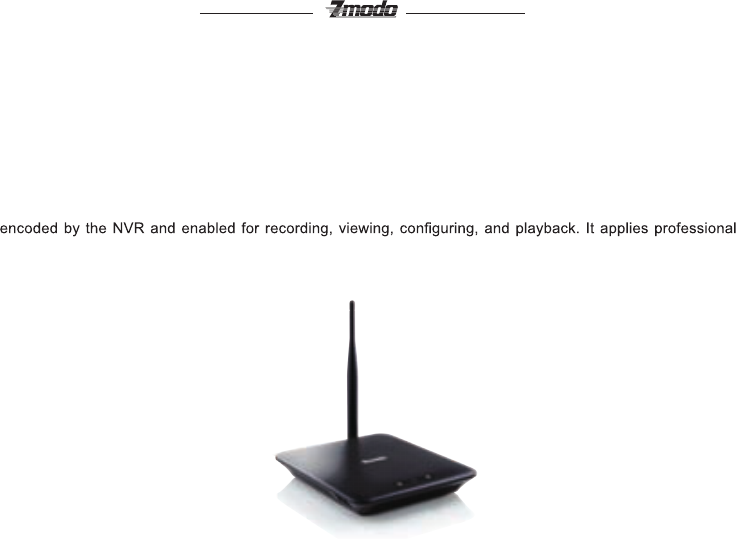
grade, high performance video audio encoding solution, combing with simple, sophisticated UI interface and
practical industry design. Not only for CCTV security which is perfect for home and business. It is simple to
install and operate.
1.2 Main Features
*Supports Mouse & IR Remote Controller;
*Supports Stable Connection with IP camera;
*Supports 4/8-Channel IPC Stream Input and Forwarding;
*Obtain Video Signal from Front-device IP Cameras;
*Supports Multiple Recording Modes;
*Built-in SATA Interface, Supports SATA HDD between 80GB and 2TB of storage;
*Supports USB Backup through USB Flash Disk, and USB Removable Hard Disk;
*Supports Preview & Playback under various Video Resolutions;
*Supports Linkage Channel Audio Alarm, Report to the Alarm Center, and Email Alert;
*Supports TCP/IP Protocol & DDNS;
*Supports Auto Maintain, Software Update and Restore to Factory Defaults.
1.3 Installation Instruction
1.3.1 Device and Accessories List
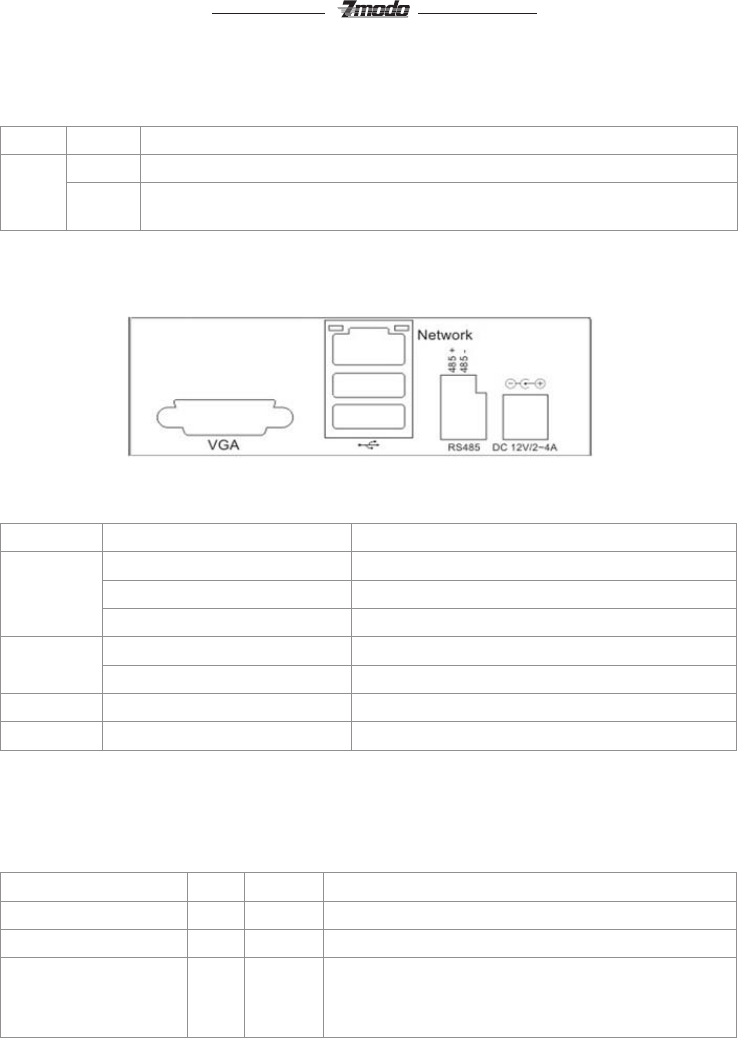
When you receive the product, please check the equipment and accessories according to the packing list in the
package box.
5
®
1.3.2 Front Panel
Table 0-1 Front Panel Description
Type Name Description
LED
POWER Power indicator: Red, lights when the power is on
HDD Hard disk indicator: Blinks red once per 5 seconds when the hard drive is reading and/or writing;
the HDD indicator is dark when the HDD is not reading or writing.
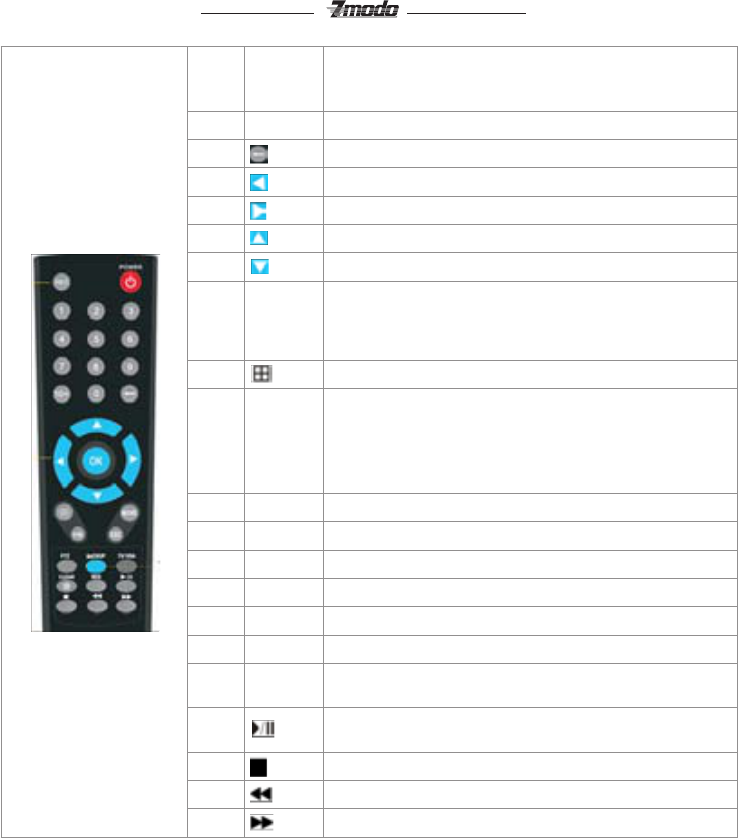
1.3.3 Rear Panel
Table 0-2 Rear Panel Description
NO. Interface Description
1
VGA Output 1: DIN-15
Alarm Input 4 Channel Input
Alarm Output 1 Channel Output
2Network Interface 1 : RJ45 10/100M
USB Interface 2: USB 2.0
3RS485 1: Send & Receive Data, half-duplex interface (+ -)
4 power DC 12V
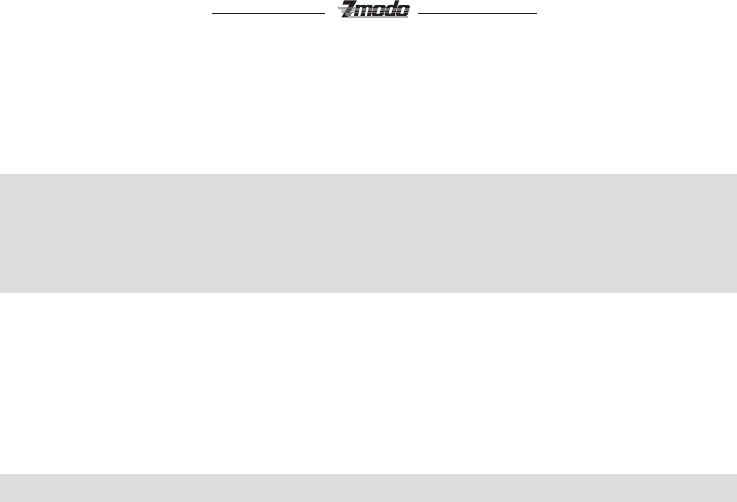
1.3.4 Remote Controller
Table 0- 3 Remote Controller Description
NO. Name Discription
1 Power Turn on/off the device
2 Rec Start/Stop recording
3NO. (1-9)
•Input numbers in the editable box
•One key channel selection in preview mode
•One key channel selection in playback mode, and enlarge the single-
channel screen
6
®
4NO.10+
•Apply for group use to choose channels above 10 in preview mode
•Apply for group use to choose channels above 10 in playback mode,
and enlarge the single-channel screen
5NO.0 Input 0 in the editable box
6Backspace, delete input in the editable box
7Direction: Left
8Direction: Right
9 Direction: Up
10 Direction: Down
11 OK
1) Press to conrm in menu mode
2) Shift key to choose recording type in recording schedule
3) Change the attributes of motion detection area while setting the
areas of motion detection
12 Switch from single screen and multi-screen in preview mode
13 FN
Auxiliary function key:
1)Switch from single screen and multi-screen in preview and playback
mode
2)Enter and exit paste (copy) status in motion detection area setting
and recording mode setting
3)Set the playback start and end points in the video data search
14 MENU Enter the main menu of setting interface
15 ESC Return or exit operations
16 PTZ Enter the PTZ control interface
17 BACKUP Backup video les
18 TV/VGA Switch from TV/VGA Output mode
19 CLEAR Cancel alarm under alarm status
20 SEQ Enable or Disable channel touring according to the touring settings;
Press to pause and restart while touring
21 1. preview mode: pop out playback interface;
2. playback mode: shift between play and pause
22 Playback mode: Stop play
23 Playback mode: 8x, 16x rewind
24 Playback mode: 1x, 2x, 8x, 16x, 1/8, 1/4, 1/2 fast forward
1.3.5 Hard drive Requirements
The hard disk is not included in factory ttings. You may need to purchase SATA hard drive separately. This
NVR only supports SATA hard drive storage between 80G and 2TB.
1.3.6 Hard Drive Installation
1.Open the NVR top cover, take out the damping washers in the screw bag, and then put the 4 damping
washers into the clamping slots (four protruding steps) in the case;
2.Connect the SATA data cable and HDD power cord to HDD;
7
®
3.Lift up the hard drive with your hand, and turn over the case to make sure that the four holes at the bottom
of the case correspond to the hard drive mounting holes, and then x the hard drive using four 4 M3*12 Head
Screws plus plain washers.
4.Connect the SATA data cable and HDD power cord to the backplane.
5.Close the cover, and x the case with screws.
Note1: It is highly recommended to install a DVR-Rate Hard Drive into this NVR in order to ensure that
the Hard Drive can handle continuous use without wearing down and malfunctioning. Please purchase
your Hard Drive from a verified seller to ensure the quality of the hard disk.
Note2: Please format the HDD immediately after installation, or the system will experience a "Hard disk
error" accompanied with an audible alarm.
1.3.7 Device Connection
▲Connect to the Power Supply
You should rst make sure that the AC voltage connected with the NVR power adapter matches with the
requirements. And then connect the power adapter to power input interface of NVR, the power indicator on the
front panel will light on, indicating the power is connected right.
Note: Please use the power adapter included in the package to avoid any damage to the equipment.
▲Network Access
The device provides a standard RJ45 interface, which can easily access the LAN or WAN.
During the network connection, you should provide sufcient bandwidth to ensure the uency and clarity of the
images transmitted over the network.
▲Connect to the Alarm Input and Output Devices
The alarm input device should be the type of GND connected alarm or voltage input alarm, which can be set as
N/O. or N/C.
The requirements of voltage alarm signal input level: low level: 0~2V; high level: 5~15V.
The green angle pins are supplied for access of PTZ and alarm devices. Wiring steps are as below:
1. Pull out the angle pins that inserted in the alarm input and output interfaces;
2. Unscrew the screws using micro Philips screwdriver, insert the signal cable into interface under spring, and
then tighten the screws.
3.Plug in the connected pins into green angle pin socket.
▲Connect to the Video Output Device: VGA Monitor
2. NVR Interface Instruction ▇▅▃
2.1 Login
2.1.1 Starting Up
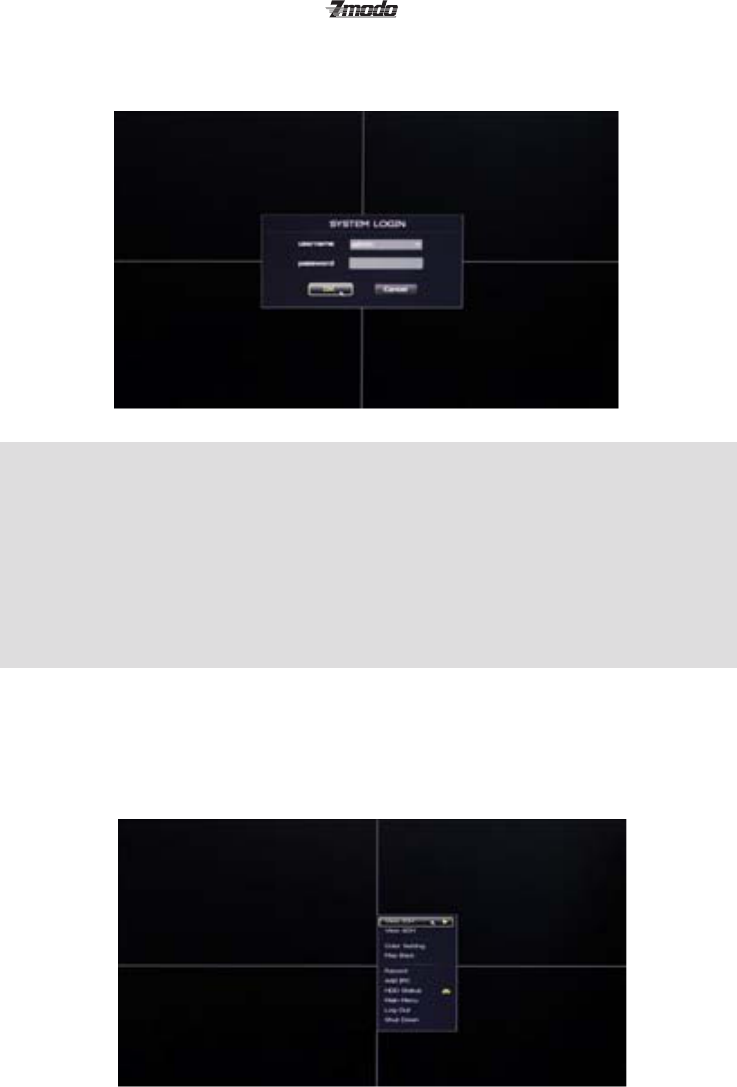
The Power LED on the front panel will light in red after complete the wiring. Press [Power on/off] button to start
up device. System will rst enter preview screen. The login window will pop up by either pressing [ESC] button
®
8
on front panel or remoter, or right clicking the mouse. Select user and input the corresponding password to
login.
Figure 1 Log in
Note1: Please allow the NVR up to 60 seconds to boot up completely.
Note2: The default password for the Admin username is 111111. The default password for the User
username is Admin. The admin password can be restored to factory default by connecting a metal
paper clip or small metal object to the terminals on the internal motherboard JP1 port. The admin user
can modify the user’s password after login. The system supports up to 16 users, the Admin is the
administrator user with all permissions, whose name cannot be deleted or changed. The Admin user
can add and delete all other users and the permissions corresponding.
Note3: Please follow the procedures to install the hard drive. “No Hard Drive” will prompt if you start up
the device without hard drive, please check the connection between NVR and hard drive if you installed
but still pop out "No hard drive" warnings.
2.2 Shortcut Menu
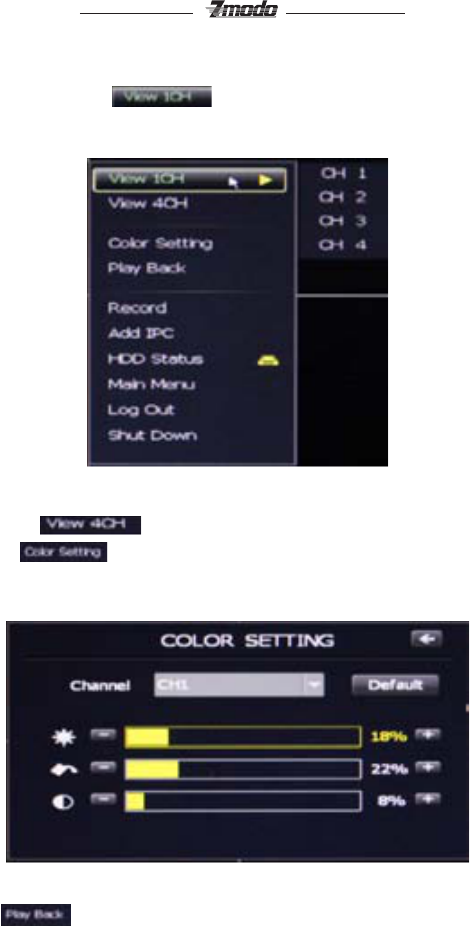
After login, right click the mouse, you will enter the shortcut menu, as gure 2 shows:
9
®
Now the monitor will show 4 channel video and one vertical menu. Here are functions of the buttons of the
shortcut menu:
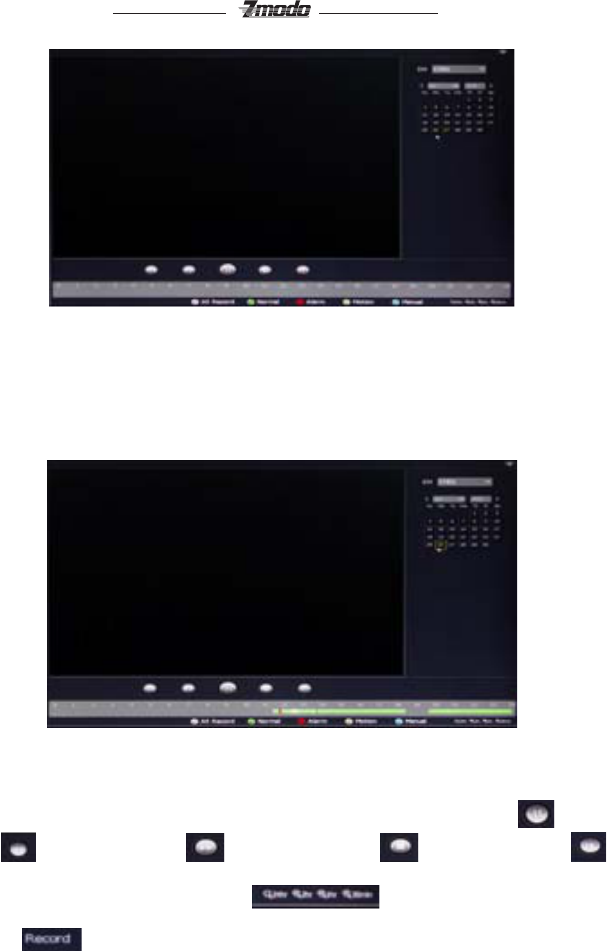
[View 1CH]: Single click the button , The right side displays 4 channels( as gure 3), Choose
one channel to view the full image. Click once again to go back to the 4 channel image.
Figure 3
[View 4CH]: Single Click Display all four channel video footage.
[Color Setting]: Click (Figure 4) to choose a channel to alter the color, then adjust the
parameters of brightness, contrast and gray level. You can adjust by dragging the progress bar or clicking "+", "-".
Figure 4 Color Setting
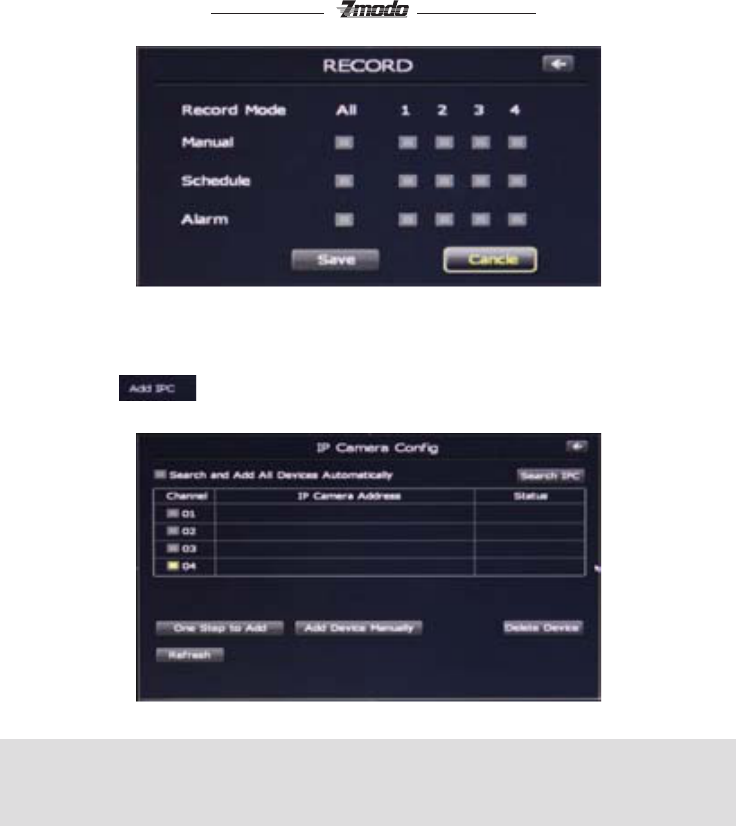
[Play Back]: Click to enter the playback interface as gure 5 shows:
10
®
Figure 5 Playback
Enter the Playback interface, choose channel(CH1, CH2, CH3 or CH4), select correct video time period. You
can search all of the videos in the current month. The date highlighted in yellow indicates that video exists on
this day. Single click the date at which record les exist in order to see the le list. The list below can display all
the video les at this day, as gure 6 shows:
Figure 6 Date Select at Playback Interface
You can choose to display video les per video types (click corresponding video types, the le of this kind will
be displayed, or it will not be displayed). Single click les listed in certain time period, click to play and
pause, click for fast rewind, click for fast forward, click to stop playing, click to
slowplay.
Select the time shift icon at the bottom right corner, , you can set the time period of the
video les displayed: 24hour, 2hour, 1hour, 30minutes
[Record]: Click button to set manual, schedule and alarm recording for single channel or all
channels, as gure 7 shows:
11
®
Figure 7 Record Setting
Choose the record types: Select all to select all the four channels, uncheck all to stop recording of four
channels. You can choose single number to lunch recording of this channel.
[Add IPC]: Click to enter IPC management interface as gure 8 shows:
Figure 8 IP Camera Cong
Note: Please read completely through Part 2: IP Camera Introduction of this manual before adjusting
any settings on the IP Camera Cong Menu. IP Cameras must be connected to the same internet
network as the NVR before any changes can be made to the IP Camera Cong menu. Please read the
2.3.3.4 (network setting) and cong the network setting before cong the IP camera.
You can add IP cameras by manually or automatically.
[1] In order to add an IP camera manually, click on the option that reads .Add Device Manually. Input the IP
address of IP cameras and corresponding listening port, then click OK. If the IP address was input correctly, a
video image of the camera should appear on the screen.
[2] Select blank channel, and click the [search] button to enter IP search interface, now it will list all the IPs of
IP cameras searched by NVR. Click the IP you wish to add to the NVR, then click [Add], if the IP address was
input correctly, a video image of the camera should appear on the screen.
[3] Click [One Step to Add], you can add IP cameras in LAN in one step.
[4] In order to enable to auto-add IP Camera function, click [Search and Add All Devices Automatically] on the
top left corner, then the system will automatically search IP cameras which are at the same segment in LAN. If
the IP address was input correctly, a video image of the camera should appear on the screen.
[5] In order to delete an IP address out of the IP Camera Cong menu, Click the IP , and then click [Dele
12
®
Device], now you can delete IP cameras from the NVR.
Note: The IP of IP cameras and NVR should be in the same network segment and in the same LAN, or
else you will not add IP successfully.
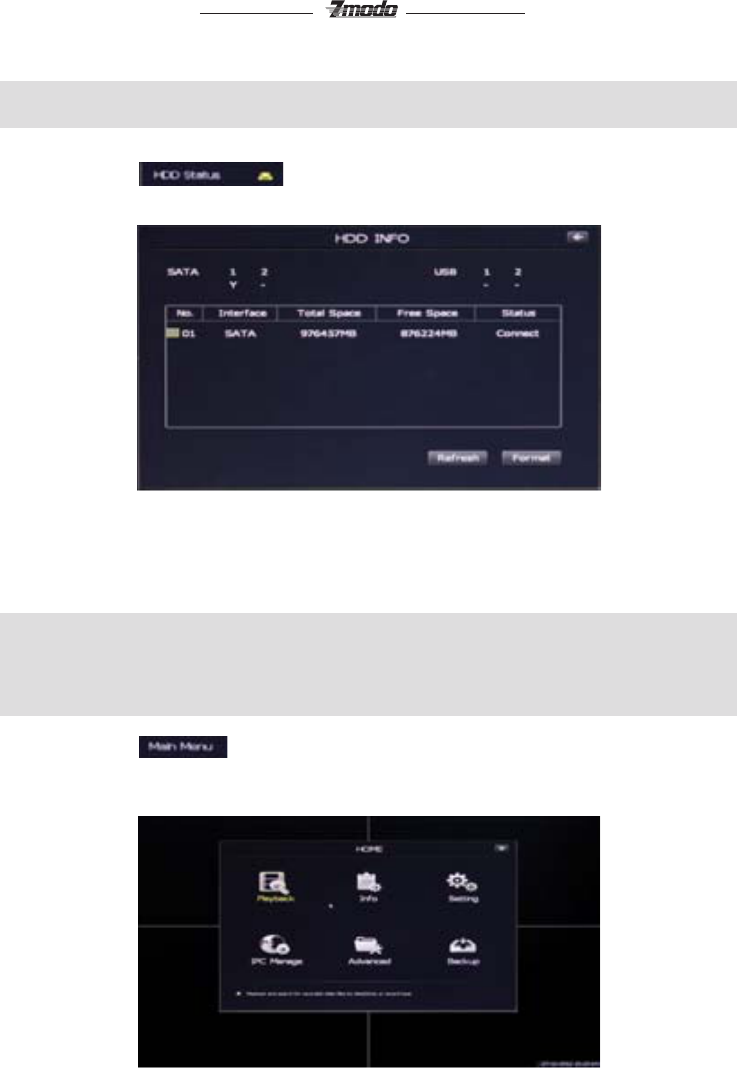
[HDD Status]: Click , into hard drive information interface as gure 9 shows:
Figure 9 Hard Drive Information
HDD INFO shows the status of the hard drive which is connecting to NVR, including total space and free
space, Click [Refresh] to check the remaining storage on the hard drive.
In order to format the Hard Drive, select a hard drive number, then click [Format].
Note:
1. You need to input the password of current user when formatting hard drive, and the system will
reboot after the format is complete.
2. Formatting the Hard Drive will erase all data saved in the hard drive, please back up the important
data before formatting.
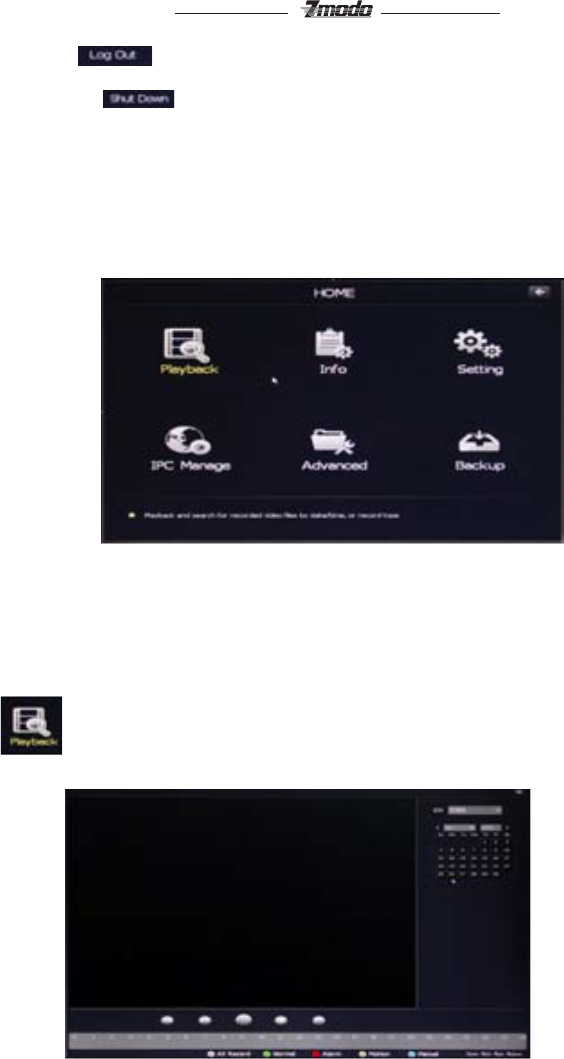
[Main Menu]: Click to enter the main menu interface, Main menu includes playback,
information, Setting, IPC manage, advanced setting and backup. Please refer to menu description .
Figure 10: Main Menu
13
®
[Log Out]: Click , to log out of the NVR interface. To enter the interface once again you only need
to right click the mouse, then login in again with correct user name and password.
[Shut Down]: Click , and a dialog box will prompt you for the password. After inputting the
password, the system will power down.
2.3 Main Menu
Figure 11 Main Menu Display
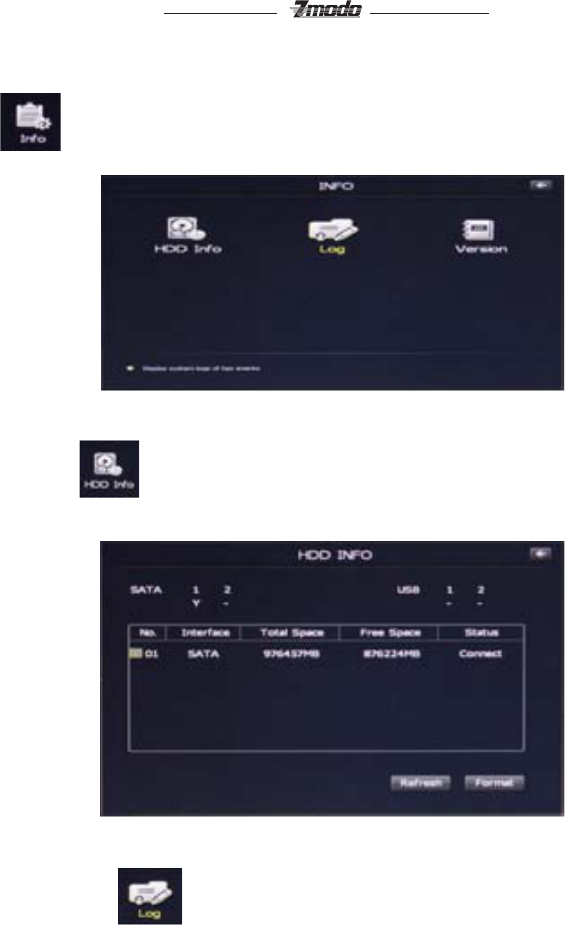
As gure 11 shows, the system main menu can be divided into six parts: video playback, system information,
system setting, IP camera manage, advance setting and video record backup.
2.3.1 Playback
Click to enter the Playback interface, as per gure 12 shows. Please refer to section
[2.2] of this manual to view the introduction of [Playback].
Figure 12 Playback
14
®
2.3.2 Information
Click to enter the system information display, as gure 13 shows:
Figure 13 Information
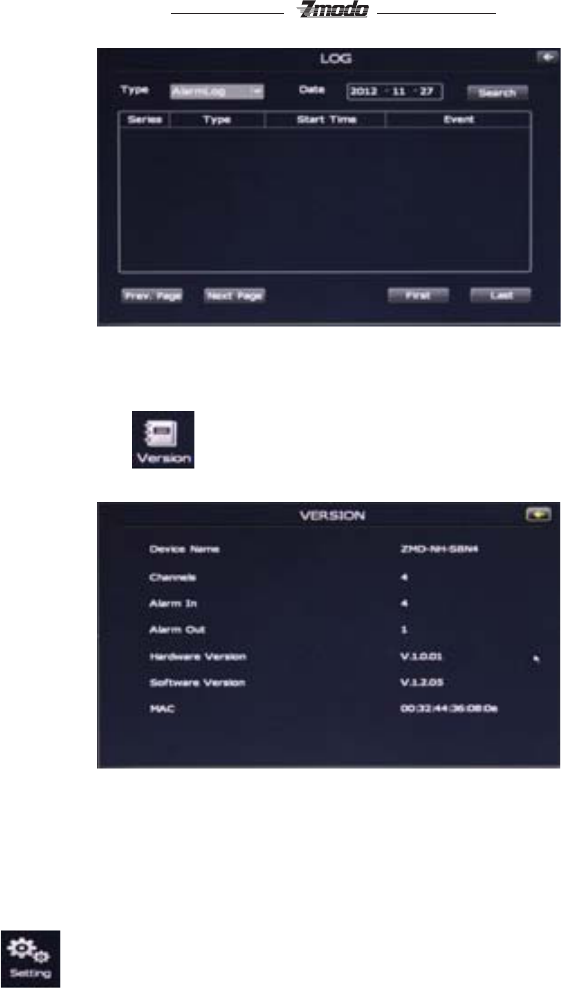
[HDD Info] Click to enter the Hard Drive information menu, as shown in gure 14. Please refer to
section .2.2. of this manual to view the HDD Status steps.
Figure 14 Hard Drive Information
[System Logs]: Click to enter the Log interface as gure 15 shows:
15
®
Figure 15 System Log
User can select alarm log and system log, also choose the time and date, click [Search] it will display the
required logs.
[System Version]: Click to check the system version infromation as gure16 shows:
Figure 16
It will display the current software version, hardware version, device name and MAC address Etc.
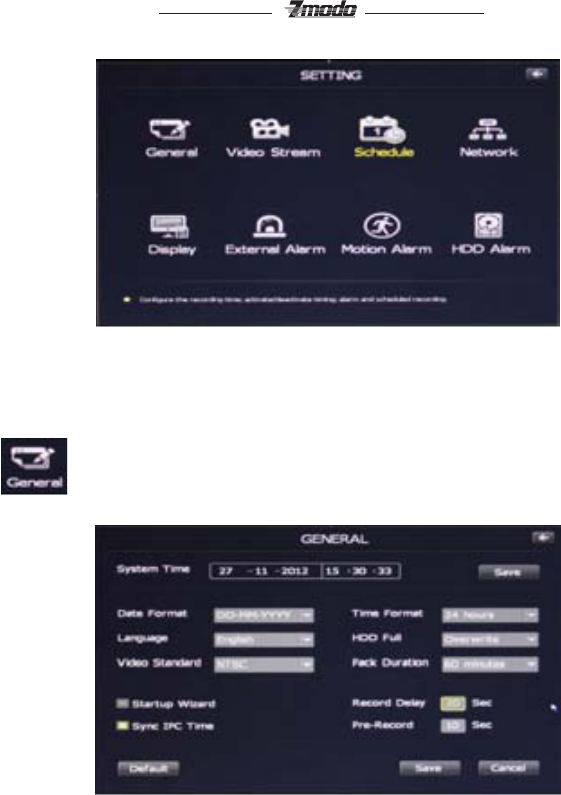
2.3.3 Setting
Click to enter the interface of parameter seeting, as per gure 17 shows:
16
®
Figure 17 Setting
2.3.3.1 General
Click to enter the General Settings interface, as per gure 18 shows:
Figure 18 General Information
User can set parameters such as system time, system language, time format and video pack duration. Etc.
[System Time] You can modify the current system time, click Save to take effect immediately.
[Time, Date Format] You can set the date as year-month-day or day-month-year, also set time format as 24
hours and 12 hours. You can set time and date as your need.
[Language] You can set language as Chinese or English, save and reboot the system. The setting will take
effect immediately.
[HDD Full] When hard drive is full, if you set as [Overwrite], then hard drive will automatically clear the oldest
video les and continue recording. If you set as [Stop Record], the video will stopped recording when hard drive
is full.
[Pack Duration] You can set video record pack time to either 60 minutes, 45 minutes, 30 minutes, or 15
minutes.

17
®
[Record Delay] You can set up to 99s for the record delay time. After you’ve set the record delay time, the
record packing will be restarted after the delay time passed.
[Pre-record] Set up to 29s of the pre-recording time, After you’ve set the pre-recording time, it will start
recording before it triggered alarm, the in advance time is the pre-record time.
[Startup wizard] You can click the check to lunch startup wizard, Then you can set a group of basic setting
when system reboots.
[Sync IPC time] After you modied system time of NVR, the time of IP camera will be in synchronization.
After successfully adding IP cameras, the time on IPC will be synced with NVR’s time.
After you nished the setting, please click [Save] to let the conguration take effect immediately.
2.3.3.2 Video Streams
Click to enter video code setting interface as gure 19 shows:
gure 19
[Video quality] The user can choose the appropriate desired image quality: Best, Very Good, Good, Common,
Low.
[Resolution] Set the image resolution. Main Stream 720P(1280×720=921600 pixel) or VGA(640×480=307200
pixel), Sub stream QVGA(320×240=76800 pixels).
[Frame rate] Set the coding frame rate per second. For weaker network connections, it is recommended to
reduce the frame rate to control the coding bit rate to ensure the smoothness and continuity of the moving
footage.
[Bit Rate Type] Two types: CBR(Constant bit rate)and VBR(Variable bit rate) to choose, CBR enables constant
bit rate coding, VBR enables variable bit rate coding.
After setting parameters, click the [Save] button, the setting will take effect immediately.
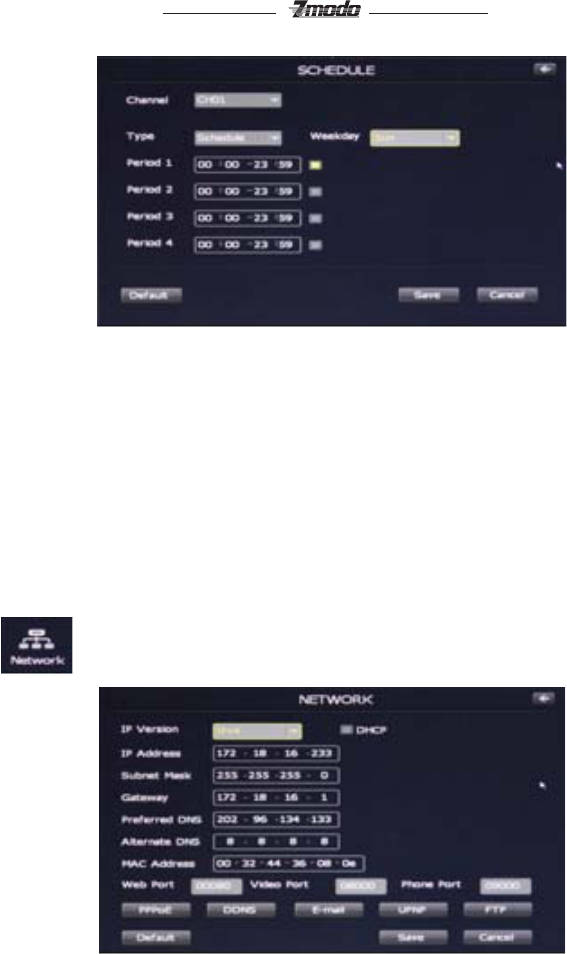
2.3.3.3 Schedule
Click to video schedule setting as per gure 20 shown:
18
®
Figure 20
Following Features can be set::
[1] [Channel] You can choose all to set four channels or set single one channel by selecting from CH01, CH02,
CH03, and CH04.
[2] [Type] Three types of recording types to choose: Schedule recording, alarm triggered recording and motion
triggered recording.
[3] [Week/Time] You can choose one day from Monday to Sunday, or choose everyday in the week. You must
also check the time period for you to choose. You need to click the time check to enable the time selection.
After setting parameters, click the [Save] button, the setting will take effect immediately.
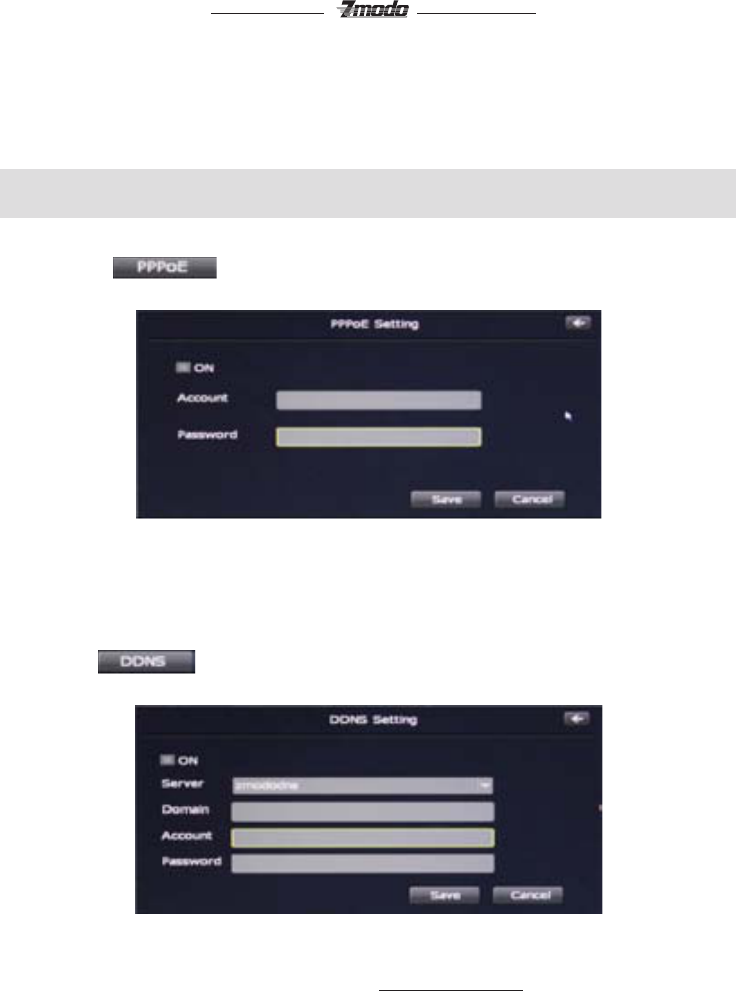
2.3.3.4 Network Setting
Click to enter the Network Parameter conguration menu, as Figure 21 shows:
Figure 21
[DHCP] If the router allows DHCP functionality, select DHCP. The IP Camera will obtain IP address
automatically from the router. If the router does not allow for DHCP functionality, then the IP address must be
obtained manually.
[IP address] Set the wired cable IP address of the NVR. The factory setting IP is 192.168.0.10, network
segment is 192.168.0.1.
19
®
[Subnet mask] Default: 255.255.255.0 (It is highly recommended not to change this section.)
[Gateway] Set gateway IP of the NVR, for example if the NVR accesses the public network through the router,
the gateway IP need to be set as the router IP which has accessed the public network.
[DNS address] If the user has a DDNS account, the DNS address needs to be set as DNS address of the
place where the device is belonging to.
Note: DNS parameters, MAC address and parameters of three ports have been congured in factory,
please do not change it randomly.
After setting parameters, click the [Submit] button, the setting will take effect immediately.
[PPPOE]: Click into PPPOE Setting, as per gure 22 shows:
Figure 22
[ON] Set to enable or disable the PPPOE dial-up function.
[Account] The ADSL dial-up account, obtain from internet service provider.
[Password] Password of ADSL dial-up account, obtain from internet service provider.
After setting all parameters, click the [Save] button, the setting will take effect immediately.
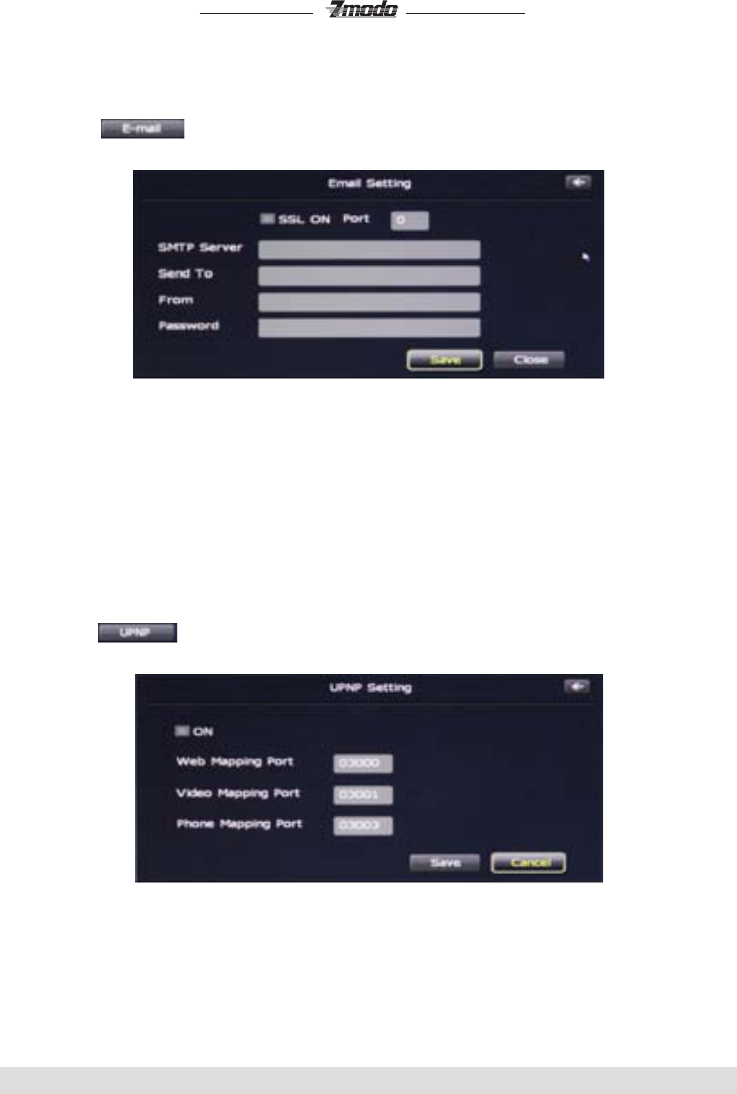
[DDNS] Click into DDNS Setting as gure 23 shows:
Figure 23 DDNS Setting
Dynamic DNS setting allows the user to bond the device with a xed domain name if the user has a dynamic IP
address. The user may register for a free DNS service at http://zmododns.com/
[ON] Check to enable or disable the DDNS function.
[Server] http://zmododns.com/ is highly recommended, as this DNS service is operated and maintained by
Zmodo.
[Domain] The device domain which is set by user, such as mydvr.zmododns.com.
20
®
[Account] The user name which you registered on DDNS server.
[Password] The password which you registered on DDNS server.
After setting all parameters, click the [Save] button, the setting will take effect immediately.
[E-mail] Click enter Email setting interface, see gure 24 shows:
Figure 24 Email Setting
This menu is for enabling email notication upon motion detection or alarm.
[SSL ON] Enable or disable SSL, based on the type of email server
[SMTP port] Port of SMTP Server.
[SMTP server] Email server address, such as smtp.gmail.com.
[Send to] Email address to receive the email.
[From] Email address to send email.
[Password] Log in password for the email box.
After setting all parameters, click the [Save] button, the setting will take effect immediately.
[UPNP] Click to enter UPNP setting interface, as gure 25 shows:
Figure 25
[ON] If in LAN it has server with UPNP functionality, enable this function, the server will automatically forward
the set port to public network.
[Web mapping port] Set the web port which will be mapping to the server.
[Video mapping port] Set the digital video port which will be mapping to the server.
[Mobile phone mapping port] Set the mobile phone port which will be mapping to the server..
After setting all parameters, click the [Save] button, the setting will take effect immediately.
Note: Port mapping can be selectable between 1024~65535. It can't be repeated.
21
®
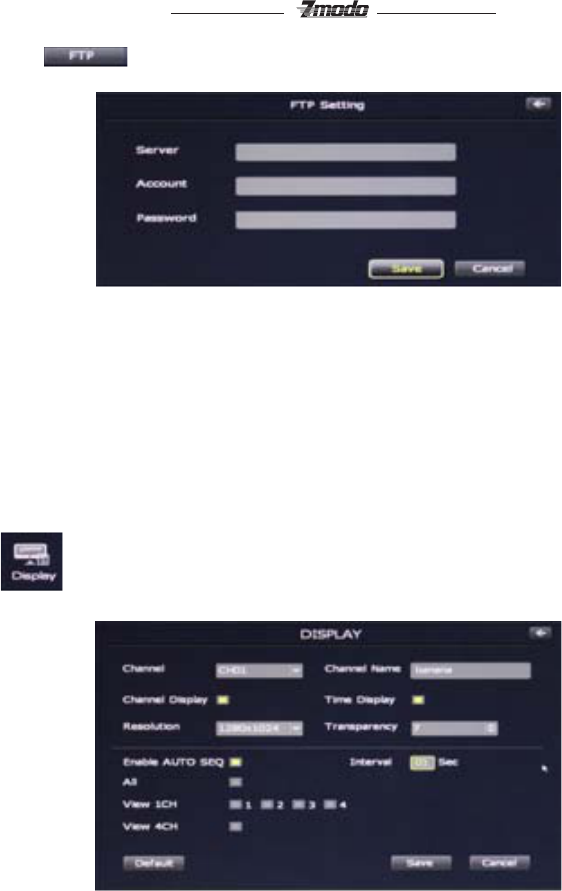
[FTP] Click enter FTP setting interface, see gure 26 shows:
Figure 26 FTP Setting
FTP services will send the alarm triggered recording le or captured photo via FTP to certain FTP server.
[Server] IP address or HTTP network address of FTP server.
[Account] User name of the FTP Server.
[Password] Password of the FTP Server.
After setting all parameters, click the [Save] button, the setting will take effect immediately.
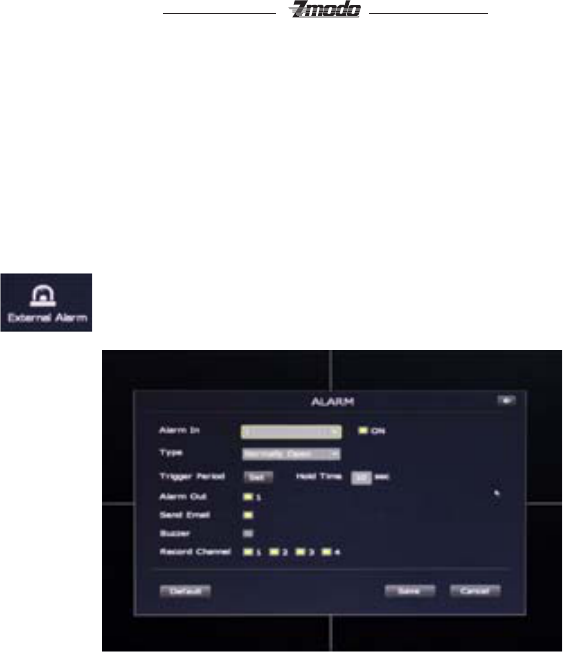
2.3.3.5 [Display]
Click to enter display setting interface as gure 27 shows:
Figure 27
[Channel and time display] When this option is checked, it will display the name and time of channel during
live video, when this option is not checked, it will not display the name and time of channel during live video.
[Channel name] Modify in the pane behind [Channel Name]. The channel name will be shown on the top left
of the video image. It supports maximum 16 characters. Click the [Save] button, the setting will take effect
immediately.
[Resolution] You can congure the display resolution of the monitor.
[Transparency] The transparency of interface can be congured in seven levels from 1 to 7.
22
®
[Enable AUTO SEQ] Choosing channel numbers from 1 to 4 and setting the tour intervals, the system will
display four channels’ video image in full screen in certain sequence, the detailed steps as following:
[1] Set the interval time. It’s the time interval between two channels’ full screen display
[2] Set channels of video tour sequencing. You can set the channel numbers as per your need.
[3] Click whether to go back to quad screen. When the check box is enabled, the system will go back to quad
screen rst and then continue sequencing after one tour of sequencing.
Click [Save], the setting will take effect immediately.
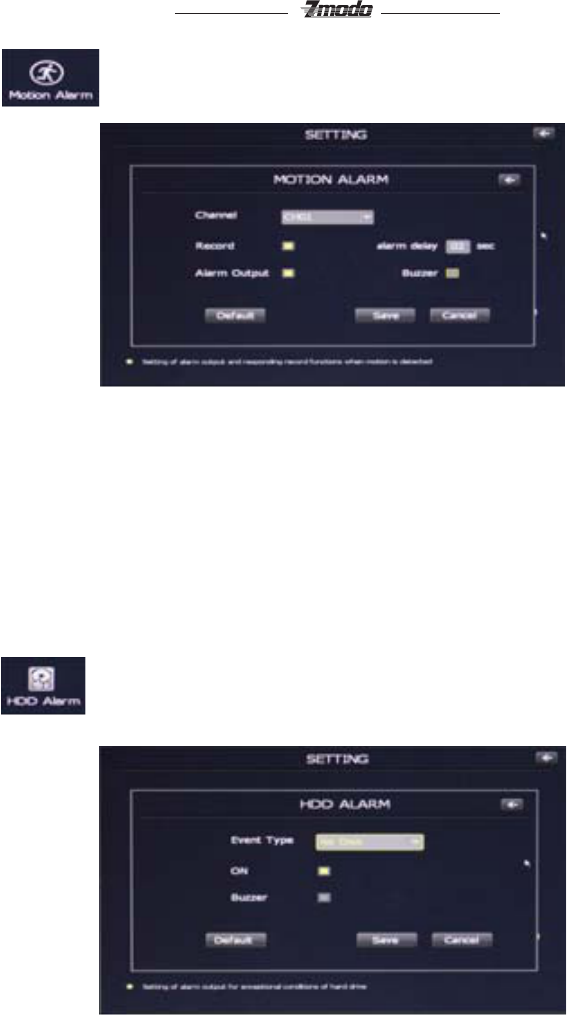
2.3.3.6 External Alarm
Click to enter alarm setting, as shown in gure 28:
Figure 28 External Alarm
Alarm setting steps are as follows:
[1] [Alarm In] Choose the channel number of alarm input from all four channels, users can choose according
to their specic needs, check ON to turn on alarm input channel.
[2] [Type] Choose the type of alarm from two options: Normally Open & Normally Close.
[3] Check [Alarm Out] to set the alarm output, the device only support one channel alarm output, user can
also set the time of alarm delay ( up to 30secs)
[4] [Trigger Period] iis for setting the alarm triggered period. Click [set] to set the alarm triggered period, user
can set the period of alarm triggered according to their specic needs.
[5] [Record Channel] is for setting the channel of alarm triggered recording, the user can choose any channel
or all 4 channels for alarm triggered recording.
[6] Choose the type of alarm, the device supports E-mail Alarm & Buzzer Alarm. Choose E-mail Alarm, then
emails will be sent to appointed email account when alarm is triggered. Choose Buzzer, then there will be
buzzer sound when alarm is triggered.
Click [Save] to save all the above settings.
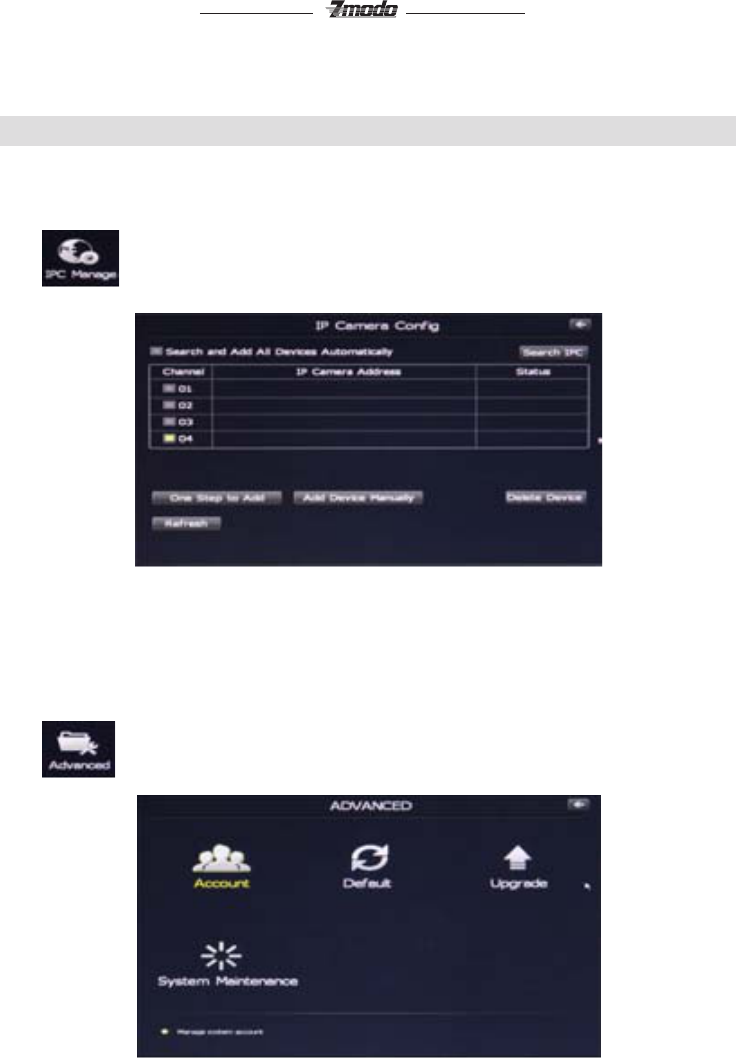
2.3.3.7 Motion Detection Alarm
23
®
Click to enter motion alarm interface, as shown in gure 29:
Figure 29 Motion Alarm
Steps of setting up the motion detection are as follows:
[1] Set the alarm channel, user can choose either one channel or all channels to set alarm;
[2] Check [Record] to turn on motion detected recording;
[3] [Alarm delay] is for user to set the alarm sound duration (Ranges from 2 – 30secs)
[4] Check [Alarm Out] for alarm output
[5] Check [Buzzer] to turn on buzzing sound when motion detected, Click [Save] to save the settings.
2.3.3.8 Hard Drive Alarm
Click to enter hard drive alarm setting interface, as shown in gure 30:
Figure 30
There are three types of HDD alarm: No Disk, HDD Error, and HDD Full. Check [ON], then warning box will
24
®
popup if any of above abnormal situations appears next time when you turn on the device. Check [Buzzer],
then system will alarm buzzer if any of above abnormal situations appear next time when you turn on the
device.
Note: You need to click [Save] to take affect the settings.
2.3.4 IPC Management
Click to enter IPC conguration interface, as shown in gure 31:
Figure 31
Please refer to [Add IPC] at section [3.1] of this manual for the details for adding IP Cameras to the NVR.
2.3.5 Advanced Setting
Click for advanced setting interface, sub-menu interface as shown in gure 32:
Figure 32 Advance Setting
25
®
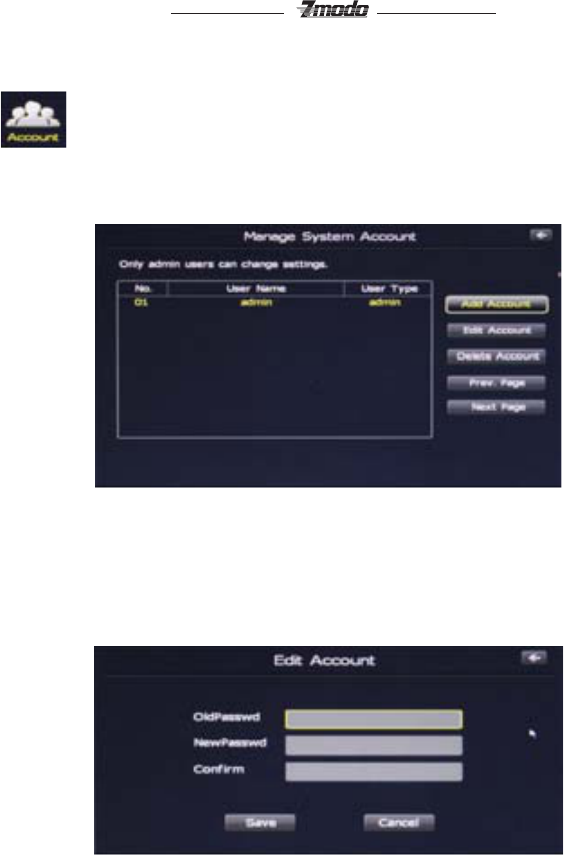
2.3.5.1 Account
Click to enter user management interface, menu interface as shown in gure 33:
Figure 33 System Account
Users can modify the user name, password, and permissions in the user management interface, they can also
add and delete users.
[Change User Password] Left click the user you need to change, and then click [Edit Account], interface as
shown in gure 34 will popup.
Figure 34 Edit Account
Type in the old password, set a new password, and then re-enter the new password, click [Save] to save your
new password. Password changed successfully.
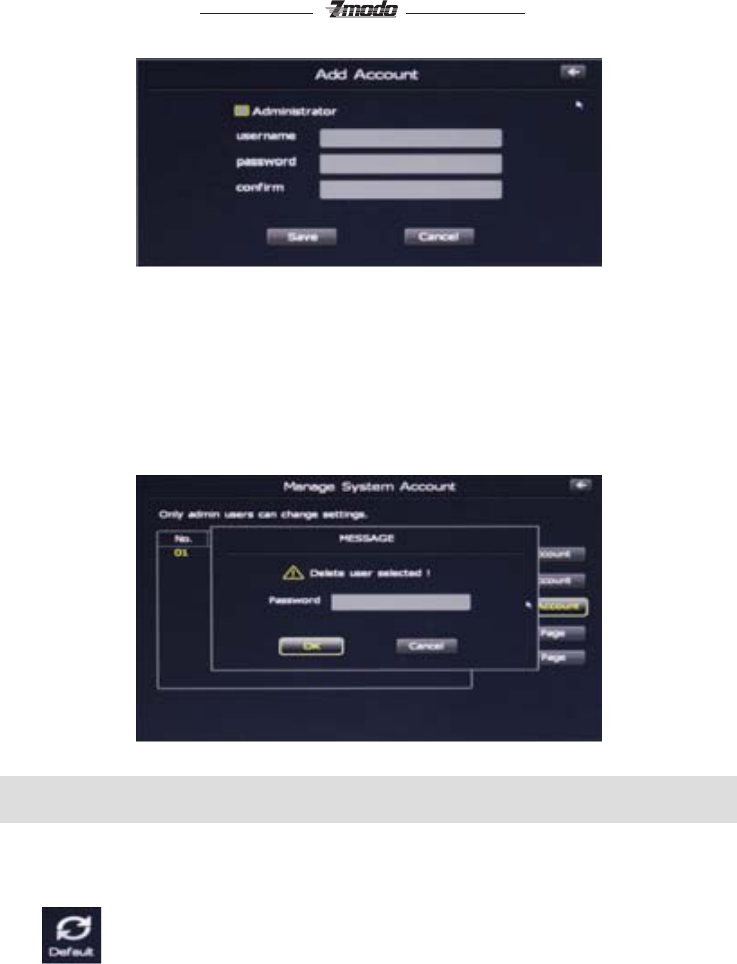
[Add User] Click [Add Account] to enter add user interface, as shown in gure 35:
26
®
Figure 35 Add User
You can add both administrator and ordinary user here. Check [Administrator] at the top left to add
administrator, while uncheck it to add ordinary users. Users can set the username and password according to
their specic needs. After setting, click [Save] to save the settings. User added successfully!
[Delete User] Click [Delete Account] to delete users. Click the user you want to delete, then click [Delete
user] to popup a prompt box to type in the user password, as shown in gure 36, User only need to input the
administrator user password to delete the user you want to.
Figure 36 Delete User
Note: Only the administrator user can delete other user information, ordinary users do not have the
permission.
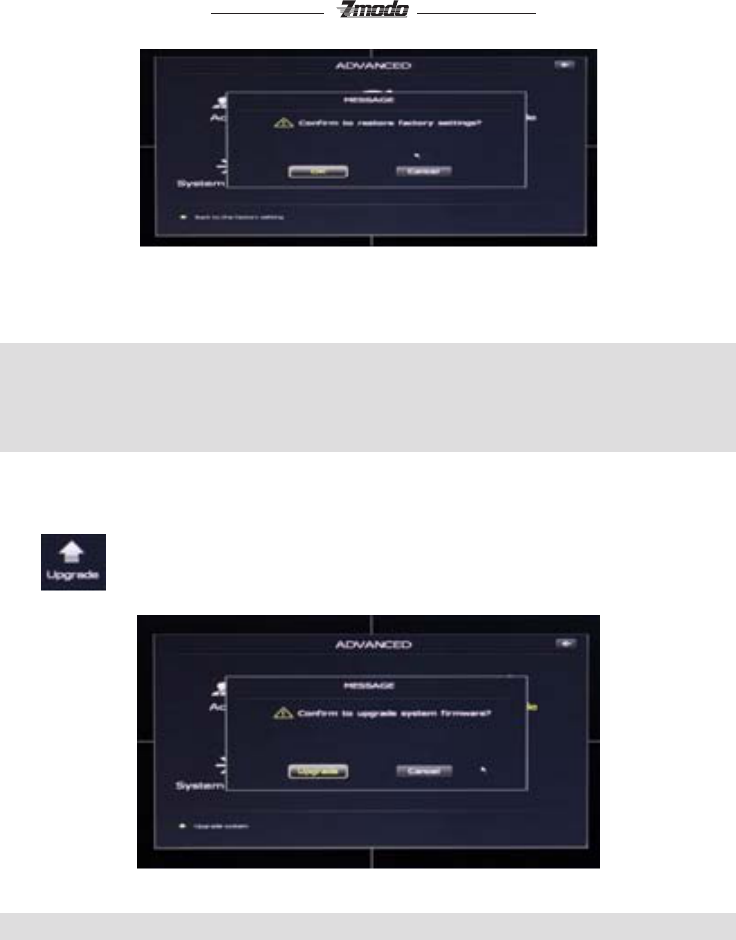
2.3.5.2 Restore Factory Setting
Click to Restore the factory settings, as shown in gure 37.
27
®
Figure 37
System will popup a message interface after clicking default, hit [OK], user will need to input the user password
to restart the system to nish restore the factory settings.
Note:
1. Only administrators have the permission to restore the factory settings, ordinary users do not have
the permission.
2.Parameters will also restore to factory settings after you click restore the factory settings, users can
edit them according to specic needs.
2.3.5.3 Upgrade System
Click to enter system upgrade interface, as shown in gure 38:
Figure 38 Upgrade System
Note: Please have all IP Cameras disconnected from the NVR while attempting a software update.
Users can upgrade the system either under NVR IE interface, or using a USB ash drive. (Before upgrading
the system, users need to copy the upgrade les in the current directory of USB ash drive, and then insert the
USB ash drive to the NVR USB port.) After well insert the USB ash drive, click [Upgrade], system starts to
upgrade.
28
®
Note:
1. Do not cut off the power during system upgrading.
2. If you insert the USB ash drive before turning on the device, system will automatically begin
updrading after device boot. Users do not need to enter system upgrade interface, but make sure that
do not cut off the power.
3. Users can reboot the NVR after an unsuccessful software update to attempt the software update
again.
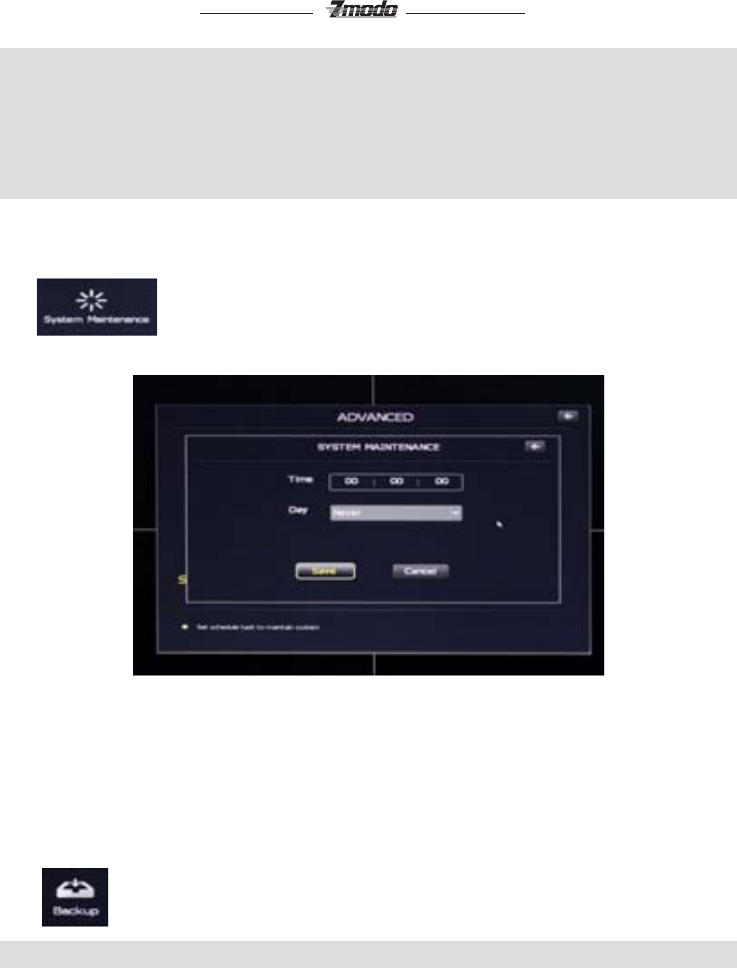
2.3.5.4 System Maintenance
Click to enter system maintenance interface, as shown in gure 39:
Figure 39 System Maintenance
Under system maintenance, users can setup any time point at any date for automatic system maintenance.
Users only need to input a time point, then choose a date from Monday to Friday, and click [Save], system will
automatically restart for maintenance.
2.3.6 Back Up
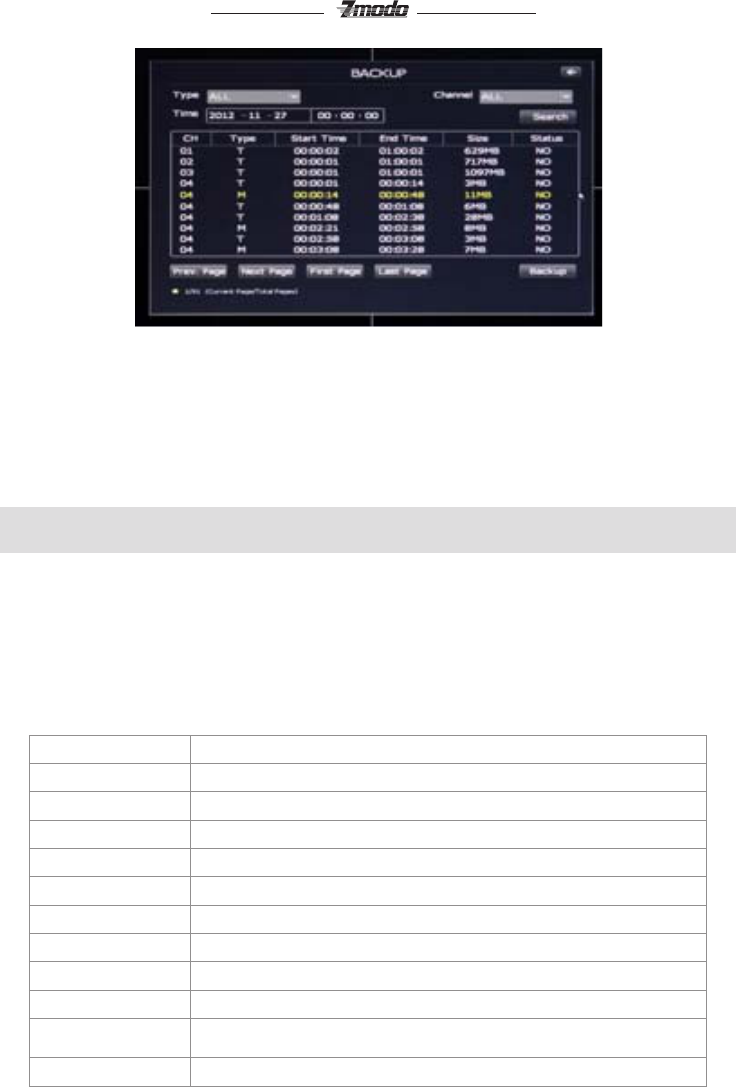
Click to enter the video backup interface, as shown in gure 40.
Note: You must insert a USB ash drive or removable HDD before backup.
29
®
Figure 40 Backup
Video Backup Steps are as follows:
[1] Insert USB ash drive or other removable HDD;
[2] Choose the channel and timeline you want to backup, click [search] to list the corresponding video les. [Prev.
Page] means turn to previous page, [Next Page] means move to the next page, [First Page] means go to the
rst page, while [Last Page] means move to the end page.
[3] Click the video le you want to backup, the status become yes, then click [Backup] to start backup the le.
Note: There is status notication during backup, please do not pull out the USB ash drive under
unnished status.
Appendix:
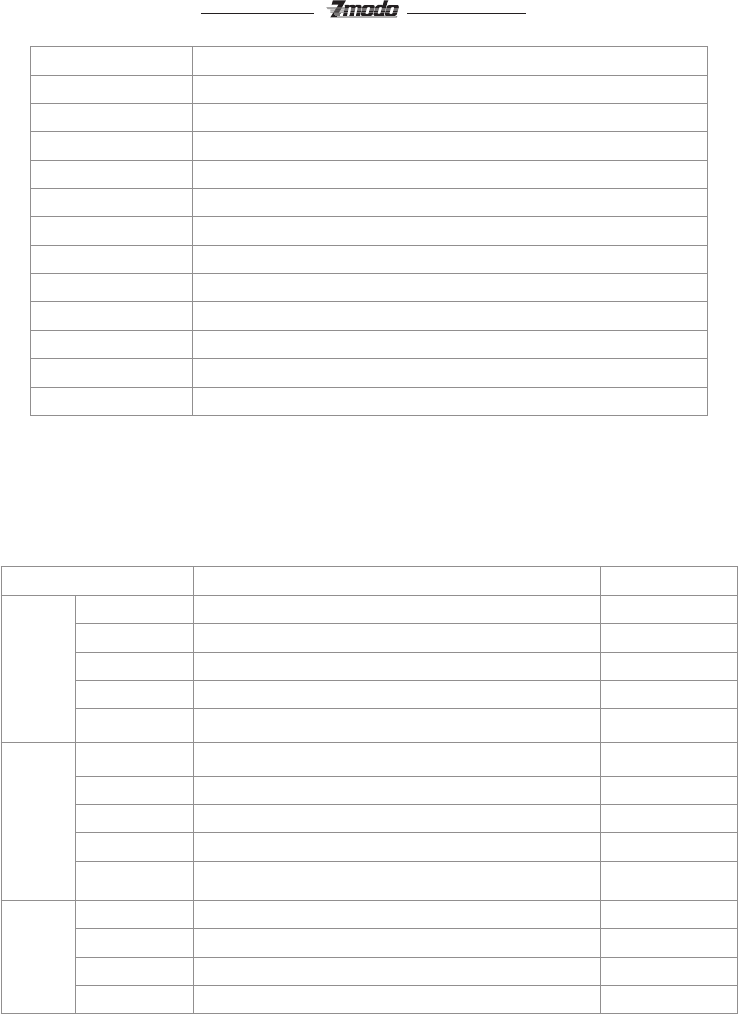
3.1 Product information and default parameter:
Model ZMD-NV-SBN4/ZMD-NV-SBN8/ZMD-NH-SBN4
Video System NTSC
Operation System Linux Based
Video Output VGA/720P
Display Frame Rate 120fps @VGA
Display Resolution 1024×768@60Hz, 1280×1024@60Hz
Recording Frame Rate 120fps @VGA
Record Resolution 120fps @VGA
Record Mode Manual / Time Scheduled / Alarm Triggered/Motion
Playback Mode Normal Play /Fast Forward /Fast Rewind/Slow Play
Network Function Real-time Preview, Record, Playback, Download, NVR Setting, Upgrade, Mobile &
Email Function etc
Network Interface RJ45, 10M/100M
30
®
Net Protocol TCP/IP, PPPoE, DHCP,DDNS
3G Mobile Support mobile phone based on iPhone® 4.3 up, Android™ 2.2 up
Mobile Function 4 Channel Viewer / Channel Switch / Control PTZ
Alarm Mode Trigger Record, Email Alert, Audio Output, Alarm output. etc
Sensor/Alarm 4 CH Sensor Inputs / 1 CH Alarm Output
HDD Interface 1 SATA HD, Support up to 2TB
USB Interface USB 2.0, USB Backup, Mouse
Backup USB Flash Disk, Removable HDD, SATA HD
Remote Control IR Remote Control
Remote Access LAN or Internet Browsing
Power Supply DC12V, 3A
Dimension 8.66"*8.07"*1.57"
Gross Weight 5.65lbs
3.2 Default Values
Items Options in Menu Default
System
Setting
LANGUAGE Simplied Chinese, English, Czech English
Video Standard NTSC NTSC
VGA Setting 1024×768@60Hz, 1280×1024@60Hz 1280×1024@60 Hz
Time Format 12 hours, 24 hours 24 hours
Time Setting No menu options, click directly into sub-menu settings Year-month-day
hour : minute PM
Password Setting No menu options, click directly into sub-menu settings Password: 111111
User: admin
HDD Overwrite ON/OFF ON
Add User No menu options, click directly into sub-menu settings
Delete User No menu options, click directly into sub-menu settings
Authority
Management No menu options for current user, click directly into sub-menu
settings Current User: admin
Record
Settings
Schedule No menu options, click directly into sub-menu settings 24 hours recording
Color Setting brightness, contrast, Chromaticity & saturation: 128\46\128\64 3/35/127
Motion Detection Picture Enlarge, Alarm Output, Buzzer, Upload Center, Email OFF
Channel Title No menu options, click directly into sub-menu settings CH1/2/3/4

31
®
Network
Settings
Network Static IP, Dynamic IP, PPPoE Static IP
IP Address No menu options, click directly into settings 192.168.0.10
Subnet Mask No menu options, click directly into settings 255.255.255.0
Gateway No menu options, click directly into settings 192.168.0.1
HTTP Port No menu options, click directly into settings 80
Media Port No menu options, click directly into settings 8000
PPPoE Setting ON/OFF; No menu options, click directly into settings OFF
PPPoE Address No menu options, display IP address when PPPoE dial-up
successfully 0.0.0.0
DNS address No menu options, click directly into settings 202.96.134.133
Dynamic Domain
Name No menu options, click directly into settings OFF
Email Setting No menu options, check the settings directly
Mobile Port No menu options, click directly into settings 9000
UPnP setting Click directly into sub-menu settings OFF
FTP setting Click directly into sub-menu settings OFF
Client Supported Versions:
iPhone® 4.3 up, Android™ 2.2 up are supported; please choose the smart phone of these version.
FCC Warning Statement
Changes or modifications not expressly approved by the party responsible for compliance could void the user’s
authority to operate the equipment. This equipment has been tested and found to comply with the limits for a
Class B digital device, pursuant to Part 15 of the FCC Rules. These limits are designed to provide reasonable
protection against harmful interference in a residential installation. This equipment generates uses and can
radiate radio frequency energy and, if not installed and used in accordance with the instructions, may cause
harmful interference to radio communications. However, there is no guarantee that interference will not occur
in a particular installation. If this equipment does cause harmful interference to radio or television reception,
which can be determined by turning the equipment off and on, the user is encouraged to try to correct the
interference by one or more of the following measures:
* Reorient or relocate the receiving antenna.
* Increase the separation between the equipment and receiver.
* Connect the equipment into an outlet on a circuit different from that to which the
receiver is connected.
* Consult the dealer or an experienced radio/TV technician for help.
FCC Radiation Exposure Statement
The antennas used for this transmitter must be installed to provide a separation
distance of at least 20 cm from all persons and must be co‐located for operating in
conjunction with any other antenna or transmitter.

Lifetime Customer Support
U S - b a s e d Te c h S u p p o r t : 8 6 6 - 5 5 1 - 6 8 8 1
24/7 Live Support on www.zmodo.com
Mailing Address:
Champaign Ofce: 1401 Interstate Drive, Champaign, IL 61822
Los Angeles Ofce: 17870 Castleton Street, Suite 200, Industry, CA 91748