iKeyless MECJ 300-0247 Keyless Entry Remote User Manual 14 0044 Exhibit Cover

iKeyless, LLC 300-0247 Keyless Entry Remote 14 0044 Exhibit Cover

Manual

5015 B.U. Bowman Drive Buford, GA 30518 USA Voice: 770-831-8048 Fax: 770-831-8598Certification ExhibitFCC ID: X32-MECJIC: 8797A-MECJFCC Rule Part: 15.231IC Radio Standards Specification: RSS-210ACS Project Number: 14-0044Manufacturer: iKeyless, LLCModel: 300-0247Manual
300-0247Draft Programming & Care Manual2/7/2013
ContentsProgramming……………………………..1-6Battery Replacement…………………….7Compliance Statements…………………8-9i
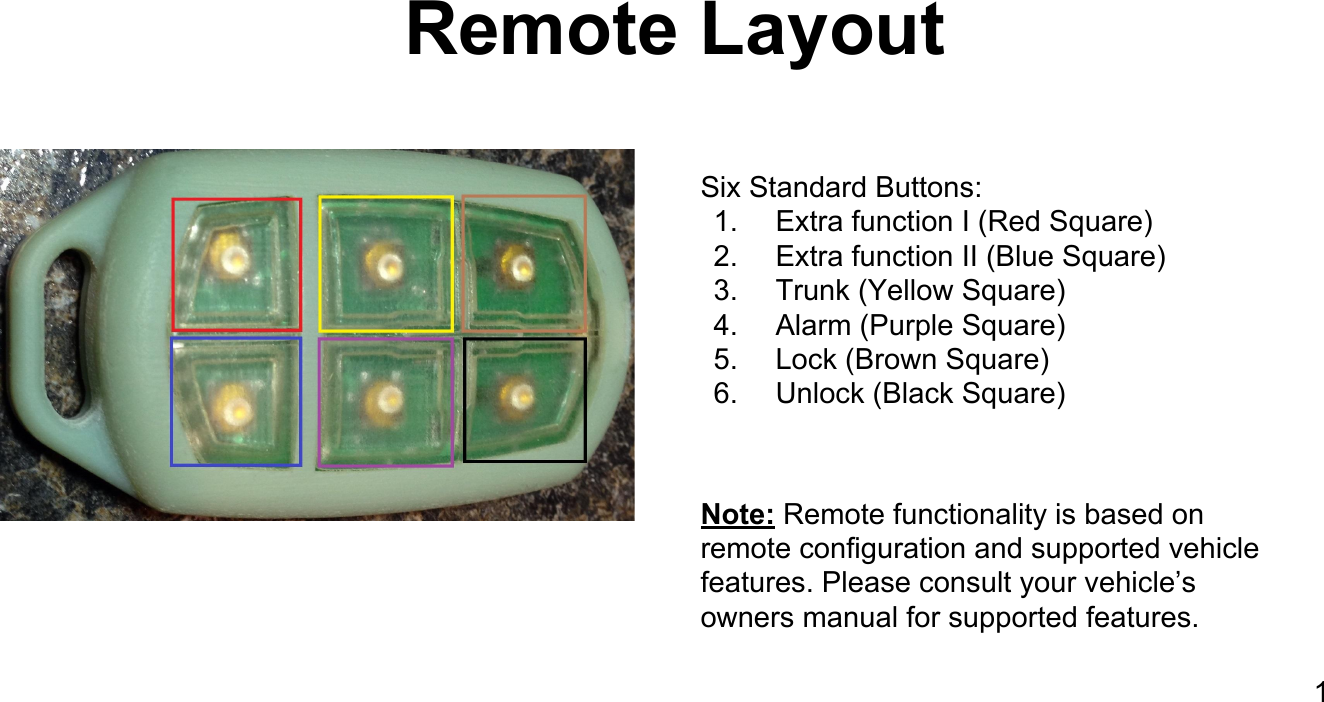
Remote LayoutSix Standard Buttons:1. Extra function I (Red Square)2. Extra function II (Blue Square)3. Trunk (Yellow Square)4. Alarm (Purple Square)5. Lock (Brown Square)6. Unlock (Black Square)Note: Remote functionality is based on remote configuration and supported vehicle features. Please consult your vehicle’s owners manual for supported features.1
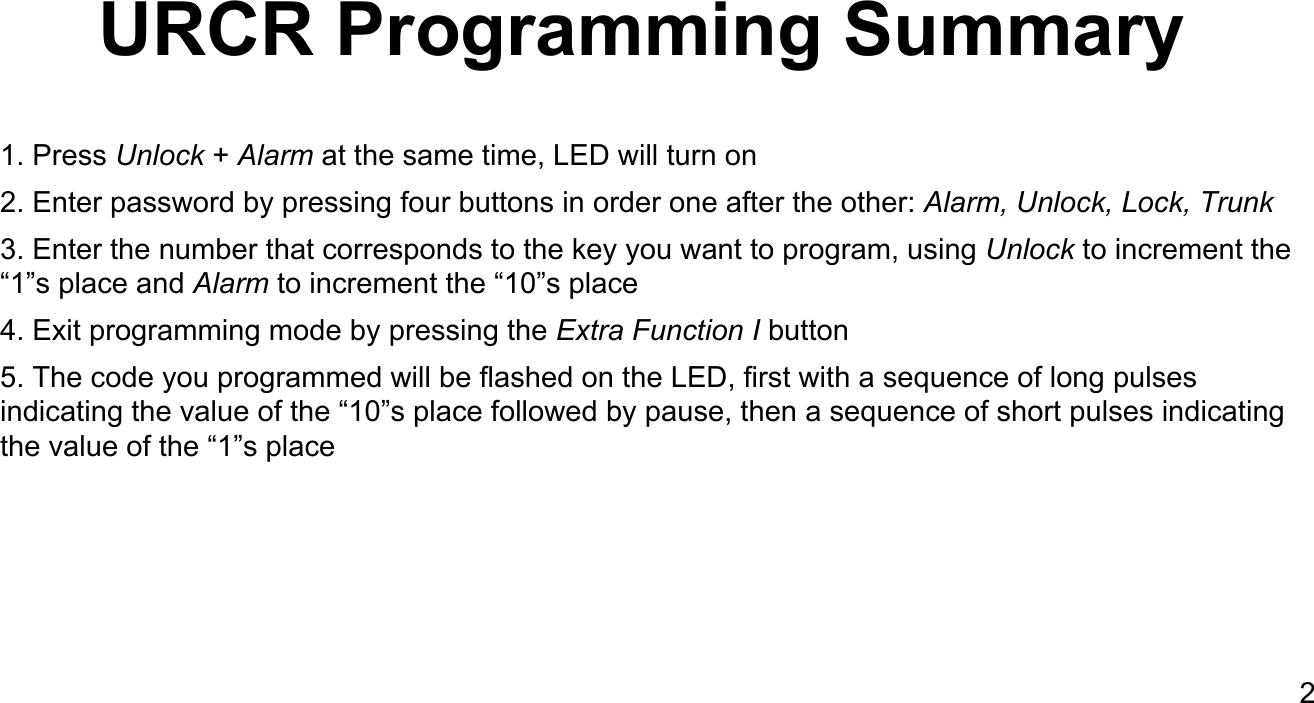
URCR Programming Summary1. Press Unlock + Alarm at the same time, LED will turn on2. Enter password by pressing four buttons in order one after the other: Alarm, Unlock, Lock, Trunk3. Enter the number that corresponds to the key you want to program, using Unlock to increment the    “1”s place and Alarm to increment the “10”s place4. Exit programming mode by pressing the Extra Function I button5. The code you programmed will be flashed on the LED, first with a sequence of long pulses indicating the value of the “10”s place followed by pause, then a sequence of short pulses indicating the value of the “1”s place2
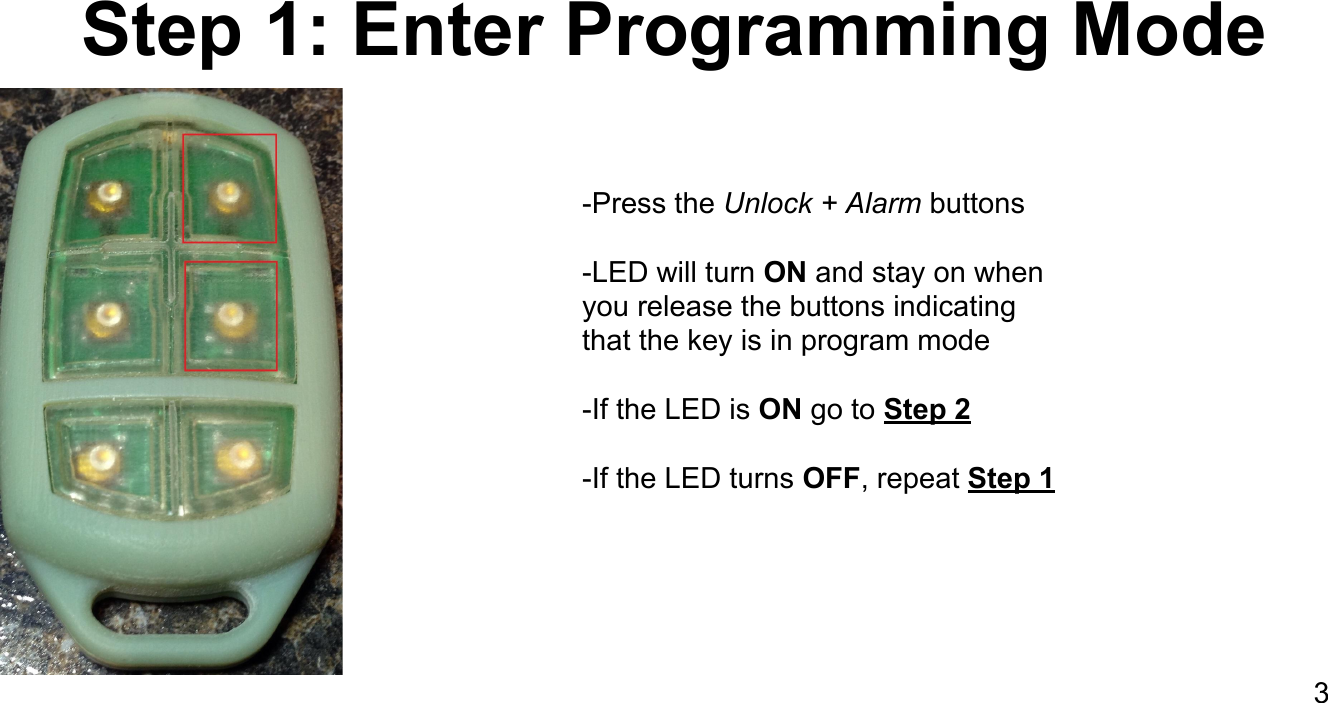
Step 1: Enter Programming Mode-Press the Unlock + Alarm buttons-LED will turn ON and stay on when you release the buttons indicating that the key is in program mode-If the LED is ON go to Step 2-If the LED turns OFF, repeat Step 13
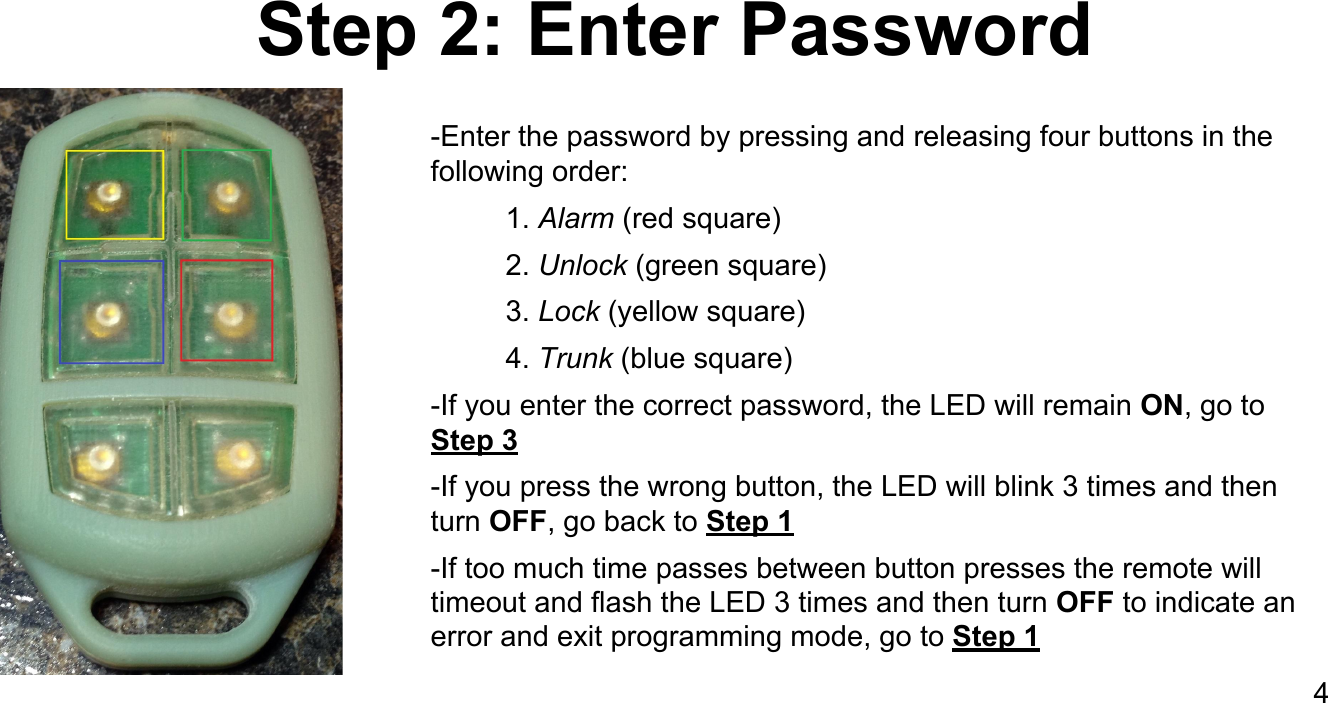
Step 2: Enter Password-Enter the password by pressing and releasing four buttons in the following order:1. Alarm (red square)2. Unlock (green square)3. Lock (yellow square)4. Trunk (blue square)-If you enter the correct password, the LED will remain ON, go to Step 3-If you press the wrong button, the LED will blink 3 times and then turn OFF, go back to Step 1-If too much time passes between button presses the remote will timeout and flash the LED 3 times and then turn OFF to indicate an error and exit programming mode, go to Step 14
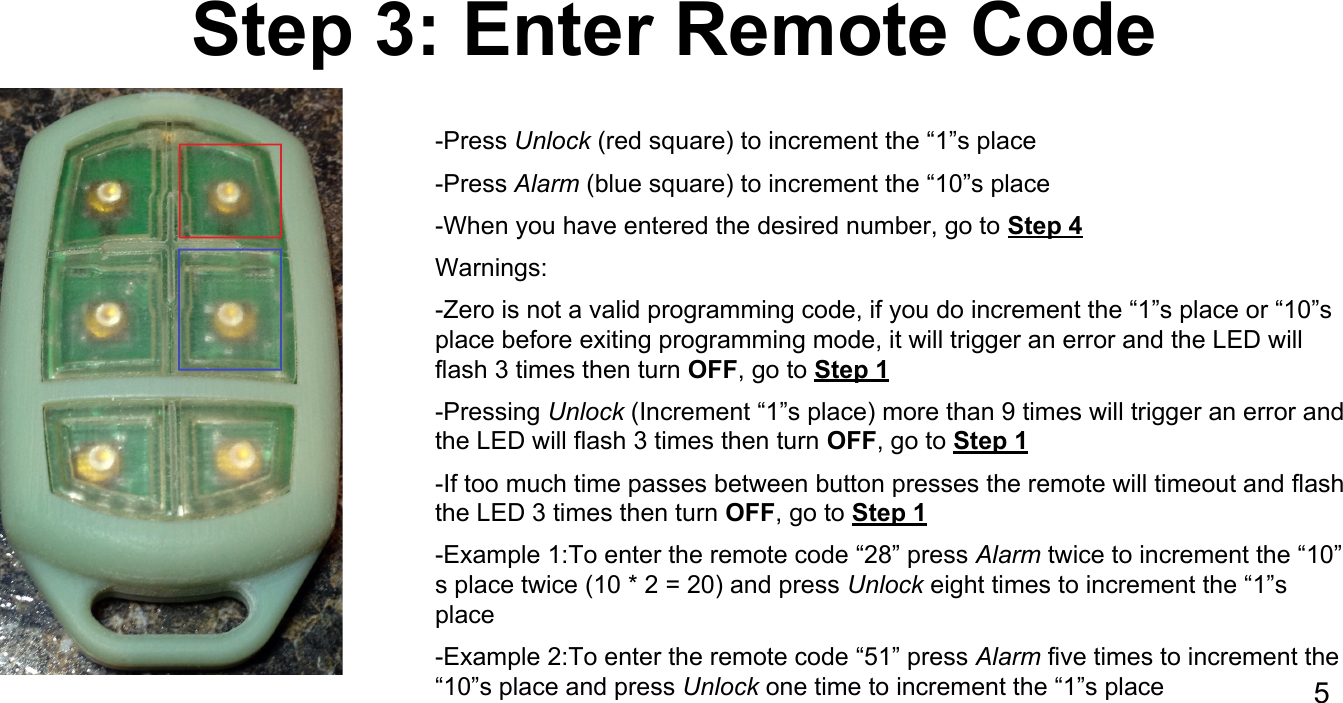
Step 3: Enter Remote Code-Press Unlock (red square) to increment the “1”s place-Press Alarm (blue square) to increment the “10”s place-When you have entered the desired number, go to Step 4Warnings:-Zero is not a valid programming code, if you do increment the “1”s place or “10”s place before exiting programming mode, it will trigger an error and the LED will flash 3 times then turn OFF, go to Step 1-Pressing Unlock (Increment “1”s place) more than 9 times will trigger an error and the LED will flash 3 times then turn OFF, go to Step 1-If too much time passes between button presses the remote will timeout and flash the LED 3 times then turn OFF, go to Step 1-Example 1:To enter the remote code “28” press Alarm twice to increment the “10”s place twice (10 * 2 = 20) and press Unlock eight times to increment the “1”s place-Example 2:To enter the remote code “51” press Alarm five times to increment the “10”s place and press Unlock one time to increment the “1”s place 5
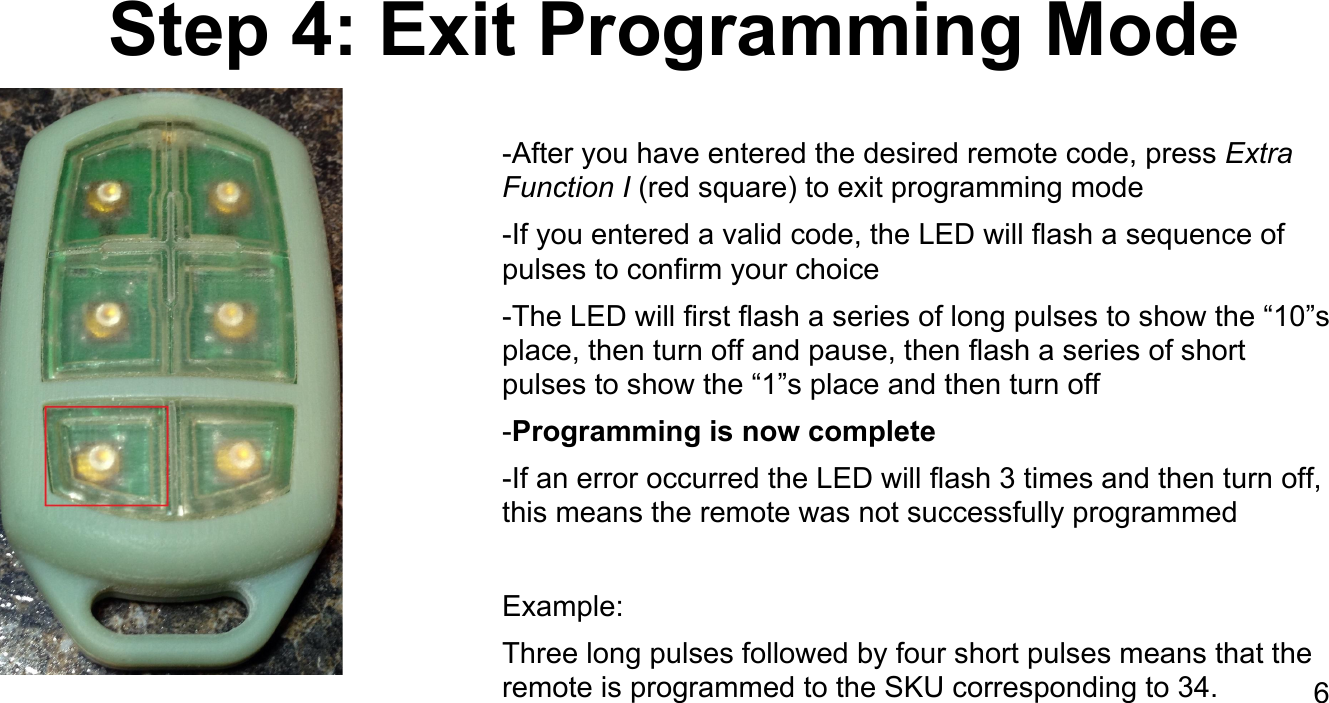
Step 4: Exit Programming Mode-After you have entered the desired remote code, press Extra Function I (red square) to exit programming mode-If you entered a valid code, the LED will flash a sequence of pulses to confirm your choice-The LED will first flash a series of long pulses to show the “10”s place, then turn off and pause, then flash a series of short pulses to show the “1”s place and then turn off-Programming is now complete-If an error occurred the LED will flash 3 times and then turn off, this means the remote was not successfully programmedExample: Three long pulses followed by four short pulses means that the remote is programmed to the SKU corresponding to 34. 6
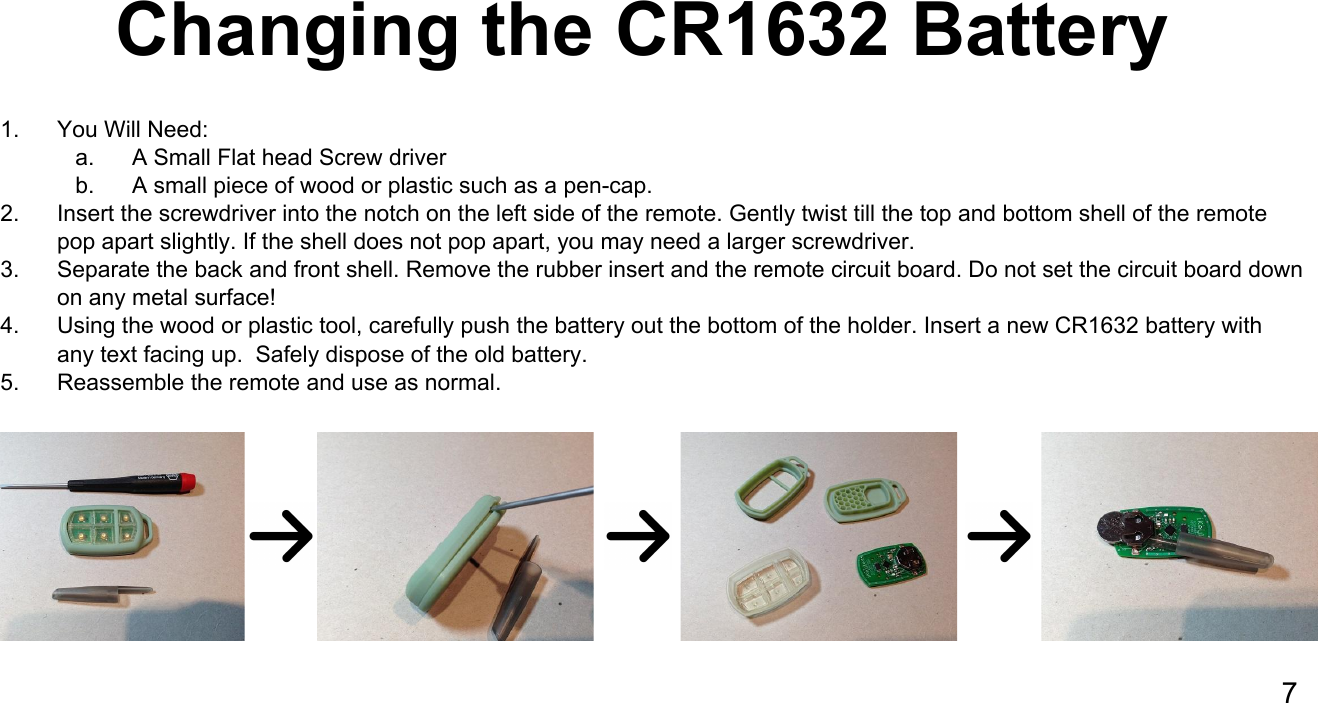
Changing the CR1632 Battery1. You Will Need:a. A Small Flat head Screw driverb. A small piece of wood or plastic such as a pen-cap.2. Insert the screwdriver into the notch on the left side of the remote. Gently twist till the top and bottom shell of the remote pop apart slightly. If the shell does not pop apart, you may need a larger screwdriver.3. Separate the back and front shell. Remove the rubber insert and the remote circuit board. Do not set the circuit board down on any metal surface!4. Using the wood or plastic tool, carefully push the battery out the bottom of the holder. Insert a new CR1632 battery with any text facing up.  Safely dispose of the old battery.5. Reassemble the remote and use as normal.  7
FCC Regulatory StatementModel: 300-0247FCC ID: X32-MECJ“NOTE: This equipment has been tested and found to comply with the limits for a Class B digital device, pursuant to Part 15 of the FCC Rules. These limits are designed to provide reasonable protection  against  harmful  interference  in  a  residential  installation.  This  equipment  generates, uses, and can radiate radio frequency energy and, if not installed and used in accordance with the instructions, may cause harmful interference to radio communications. However, there is no guarantee that interference will not occur in a particular installation. If this equipment does cause harmful interference  to  radio  or  television  reception,  which  can  be  determined  by  turning  the equipment off and on, the user is encouraged to try to correct the interference by one or more of the following measures:  •  Reorient or relocate the receiving antenna.  •  Increase the separation between the equipment and receiver.  •  Connect the equipment into an outlet on a circuit different from that to which the receiver is connected.  •  Consult the dealer or an experienced radio/TV technician for help.Warning: Changes or modifications to this device not expressly approved by (iKeyless LLC) could void the user’s authority to operate the equipment. 8
IC Regulatory StatementModel: 300-0247IC: 8797A-MEJC    Under Industry Canada regulations, this radio transmitter may only operate using an antenna of a type and maximum (or lesser) gain approved for the transmitter by Industry Canada. To reduce potential radio interference to other users, the antenna type and its gain should be so chosen that the equivalent isotropically radiated power (e.i.r.p.) is not more than that necessary for successful communication.    This device complies with Industry Canada licence-exempt RSS standard(s). Operation is subject to the following two conditions: (1) this device may not cause interference, and (2) this device must accept any interference, including interference that may cause undesired operation of the device.    Conformément à la réglementation d'Industrie Canada, le présent émetteur radio peut fonctionner avec une antenne d'un type et d'un gain maximal (ou inférieur) approuvé pour l'émetteur par Industrie Canada. Dans le but de réduire les risques de brouillage radioélectrique à l'intention des autres utilisateurs, il faut choisir le type d'antenne et son gain de sorte que la puissance isotrope rayonnée équivalente (p.i.r.e.) ne dépasse pas l'intensité nécessaire à l'établissement d'une communication satisfaisante.    Le présent appareil est conforme aux CNR d'Industrie Canada applicables aux appareils radio exempts de licence. L'exploitation est autorisée aux deux conditions suivantes : (1) l'appareil ne doit pas produire de brouillage, et (2) l'utilisateur de l'appareil doit accepter tout brouillage radioélectrique subi, même si le brouillage est susceptible d'en compromettre le fonctionnement. 9

Navigation menu