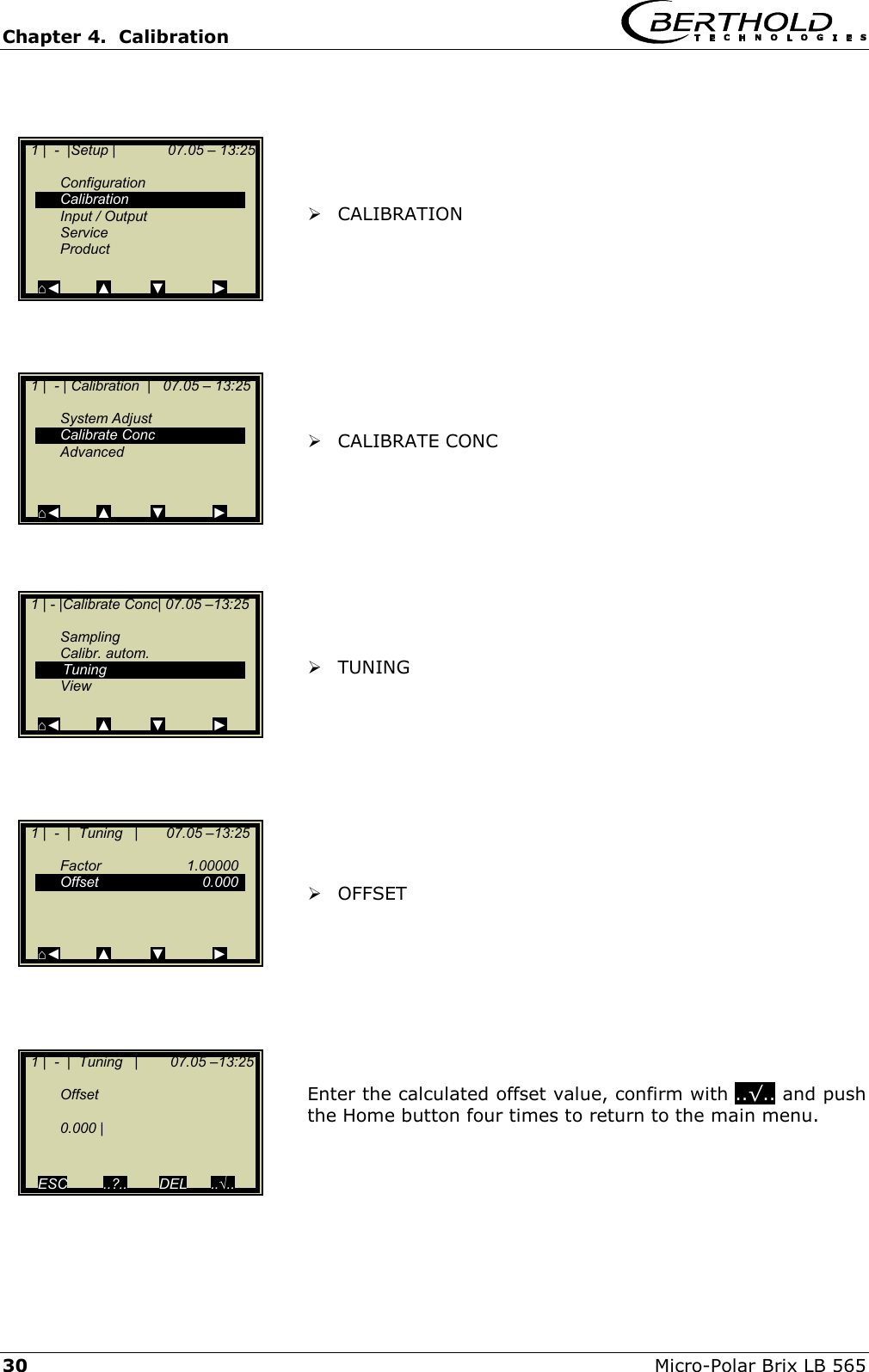
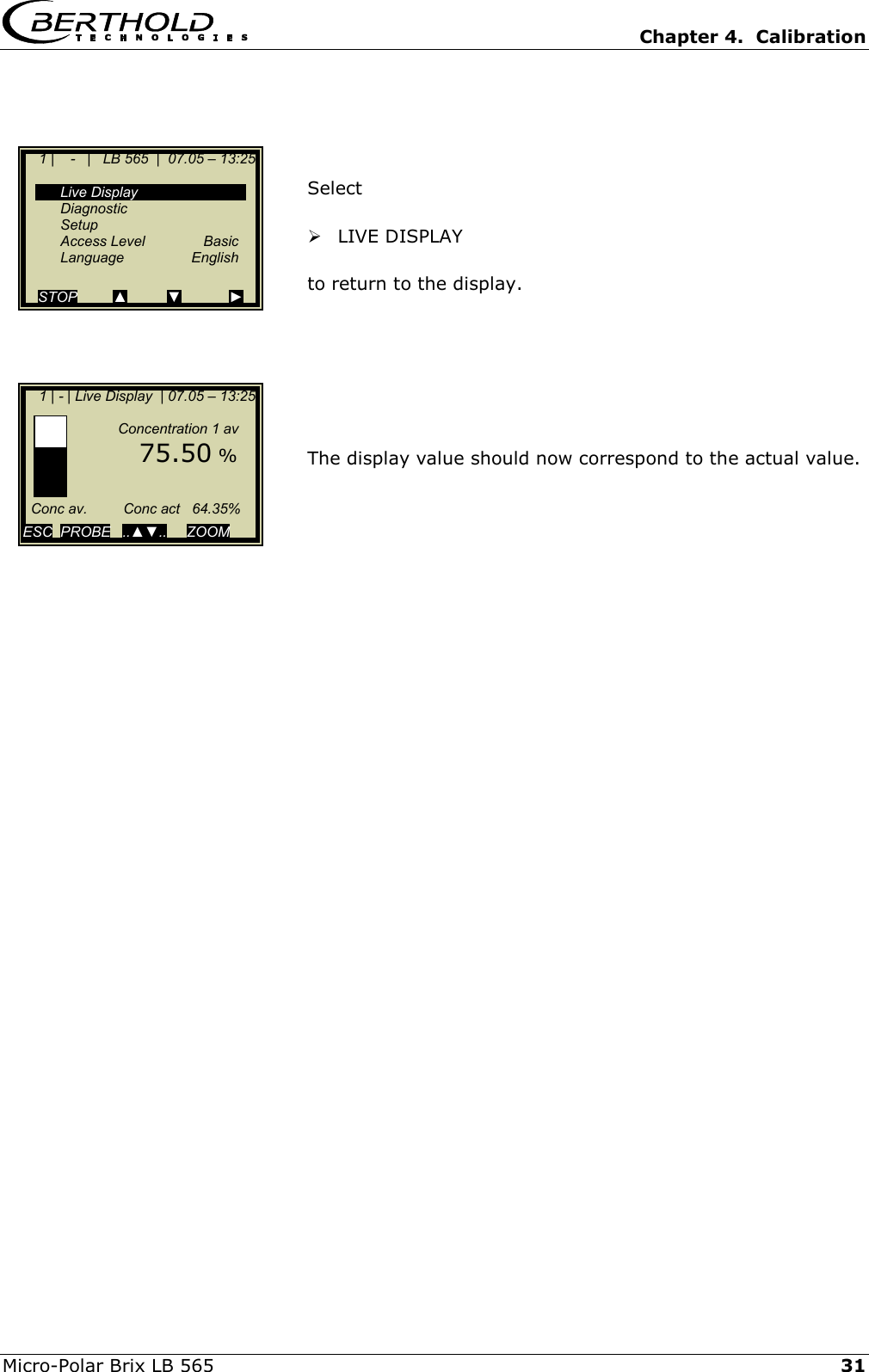
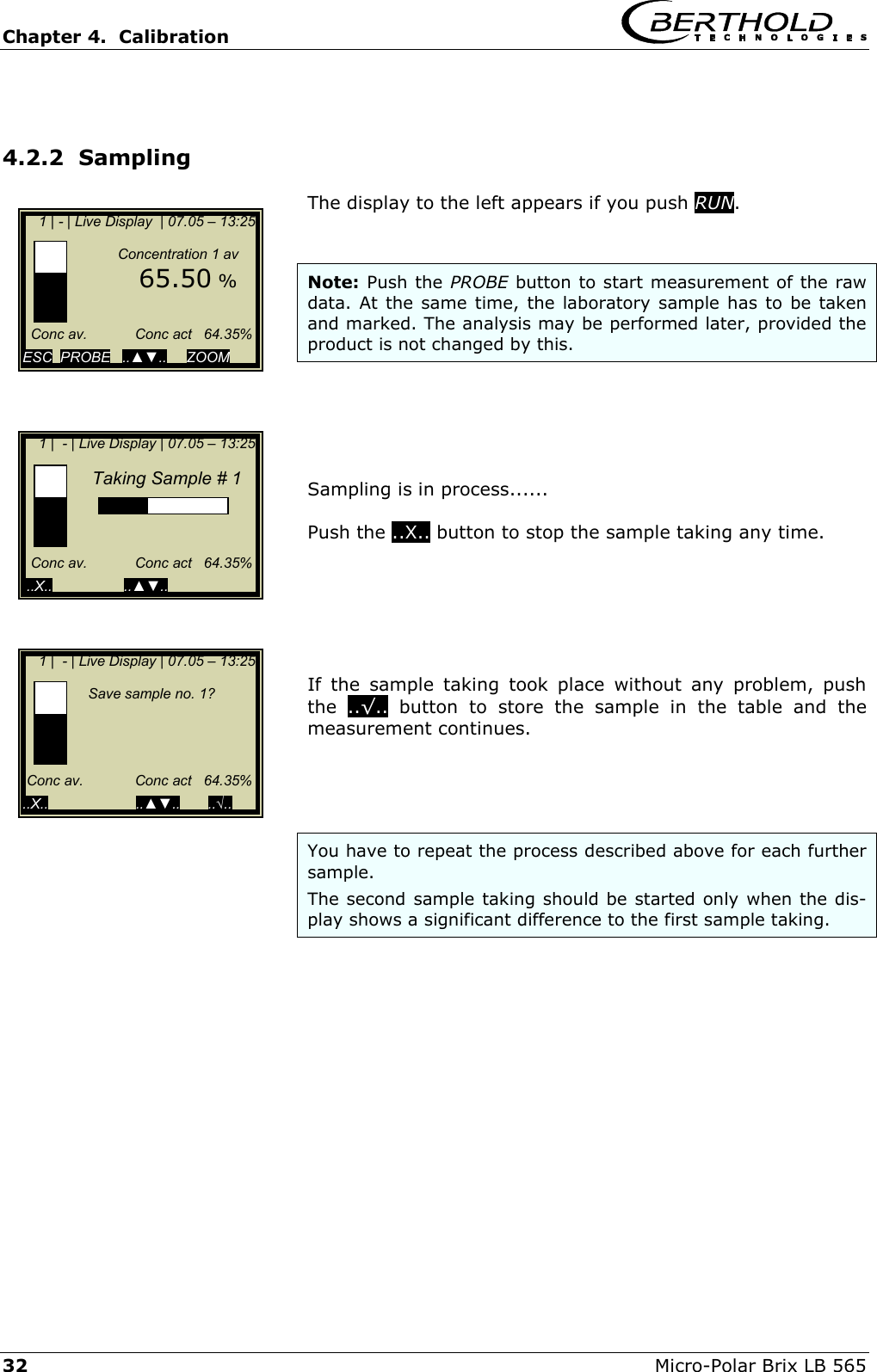
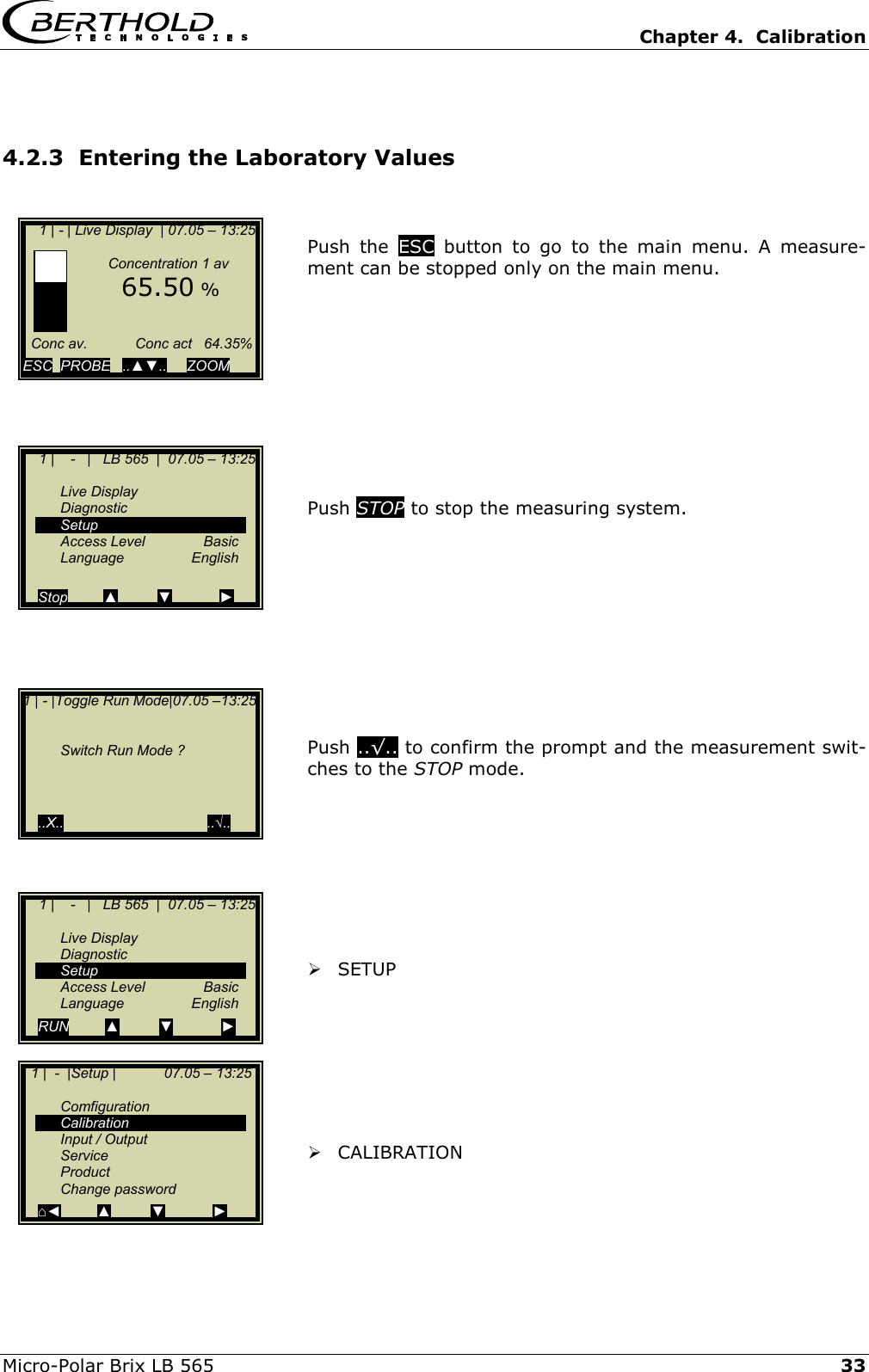
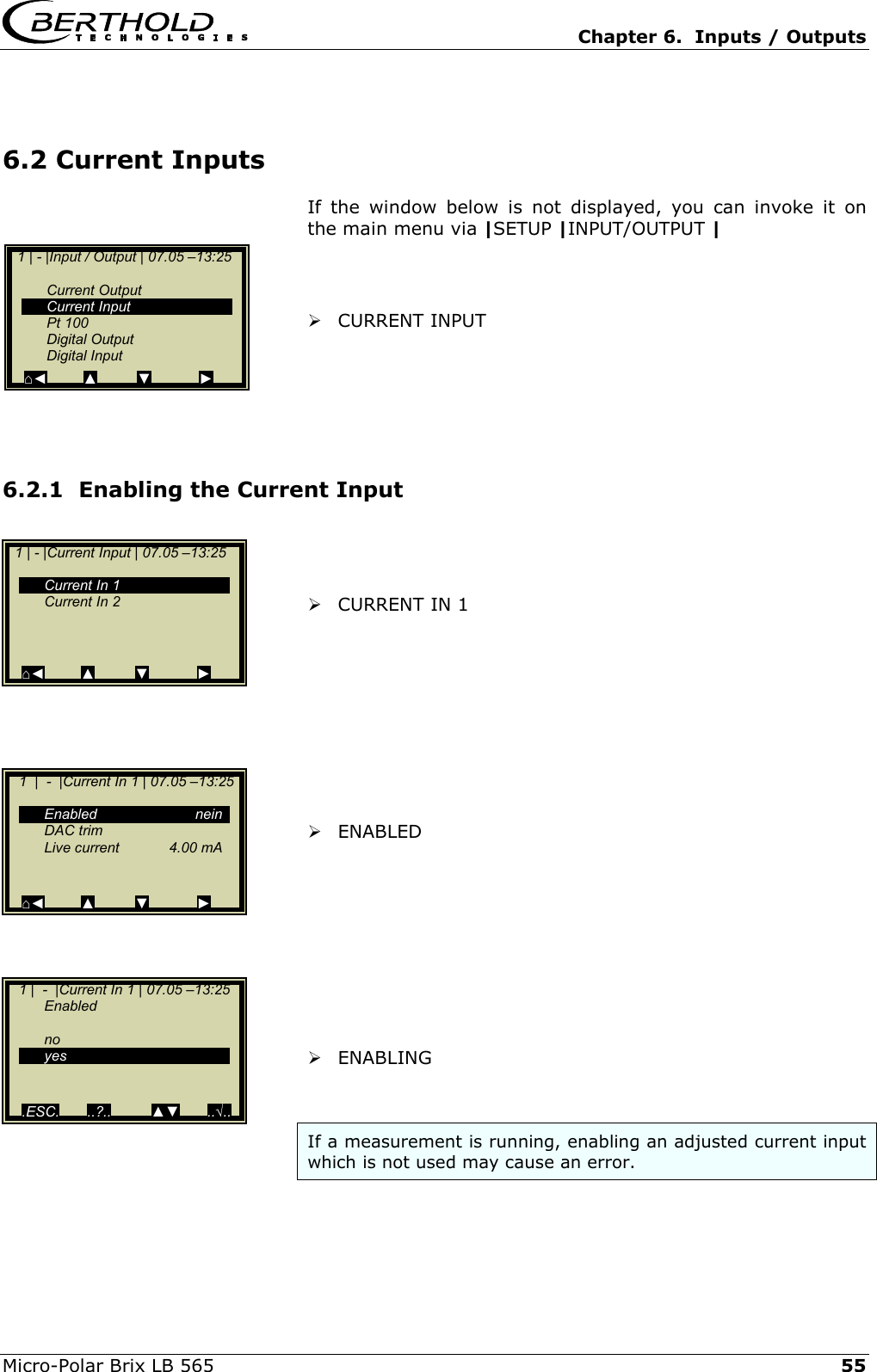
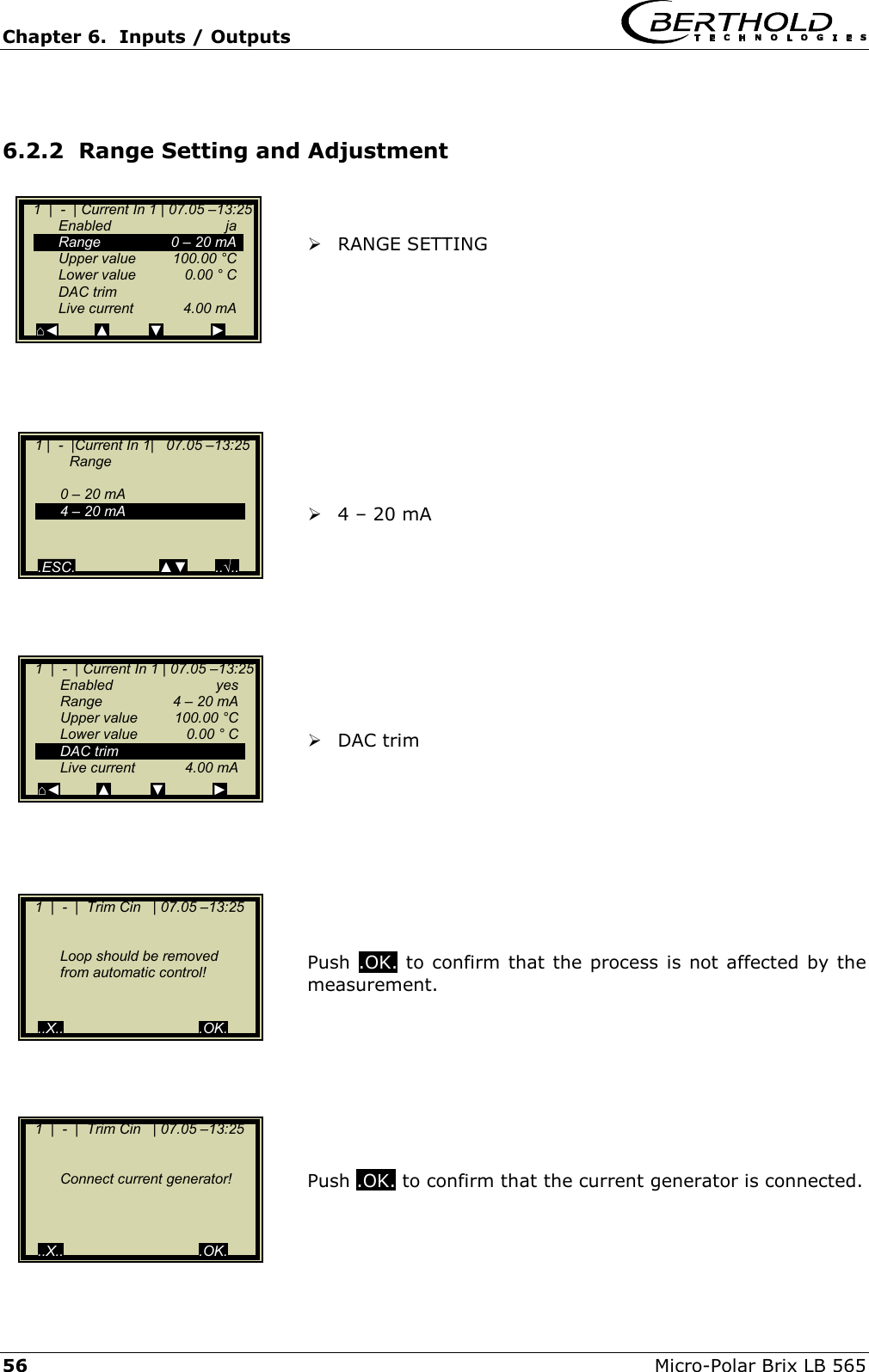
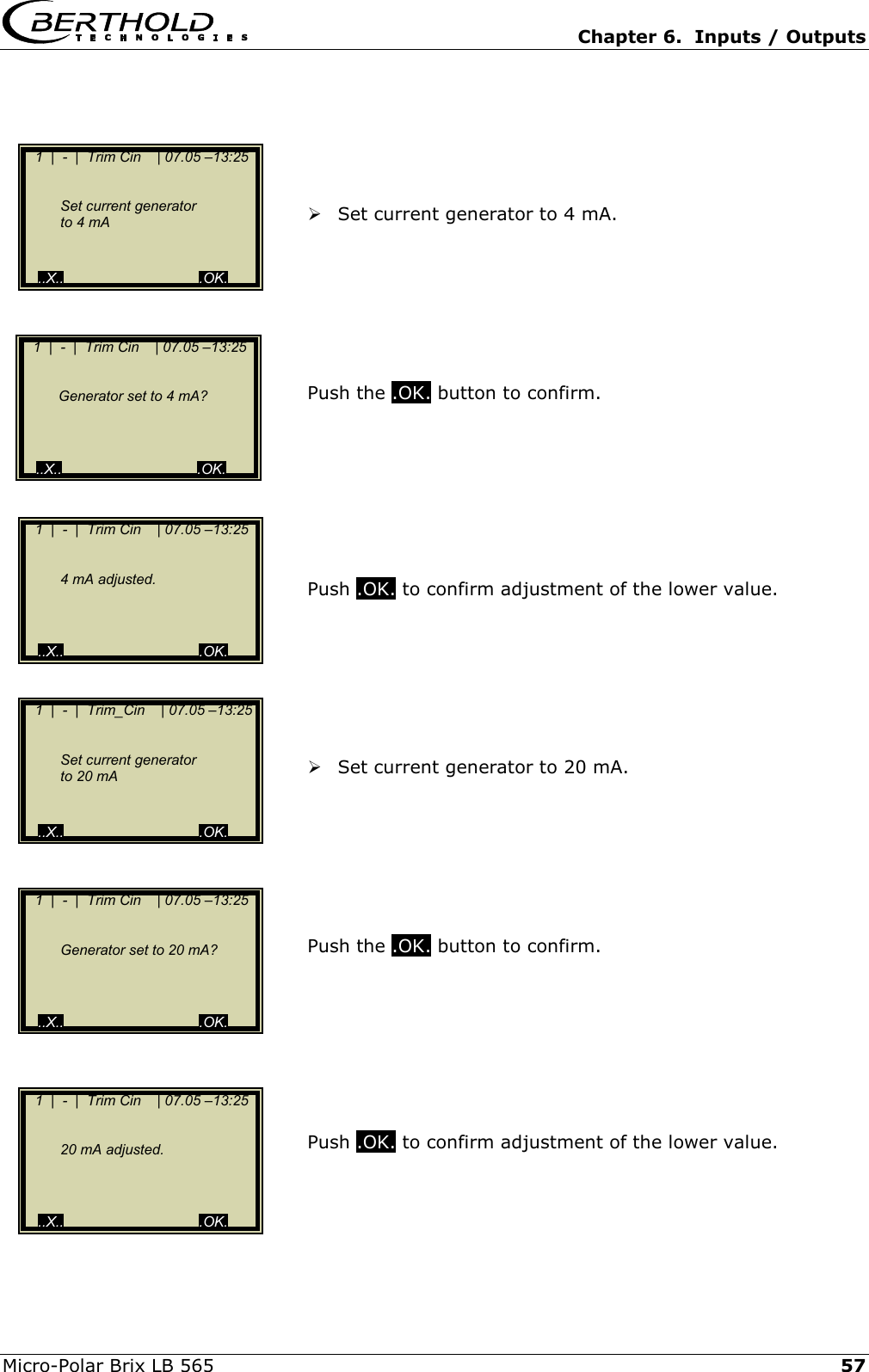
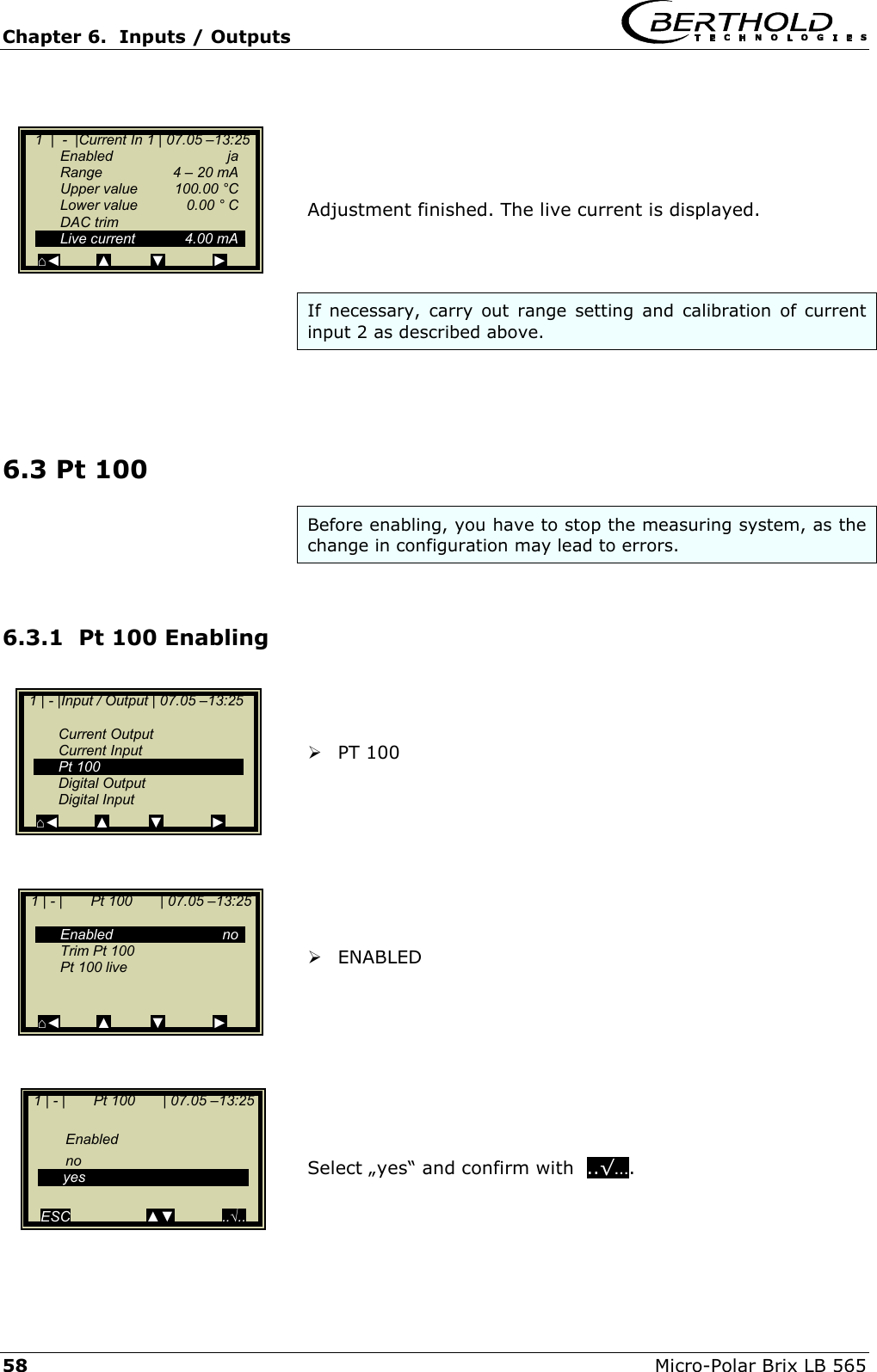
Berthold Technologies FCC01X01 Moisture Measuring System User Manual

Berthold Technologies Moisture Measuring System

User Manual

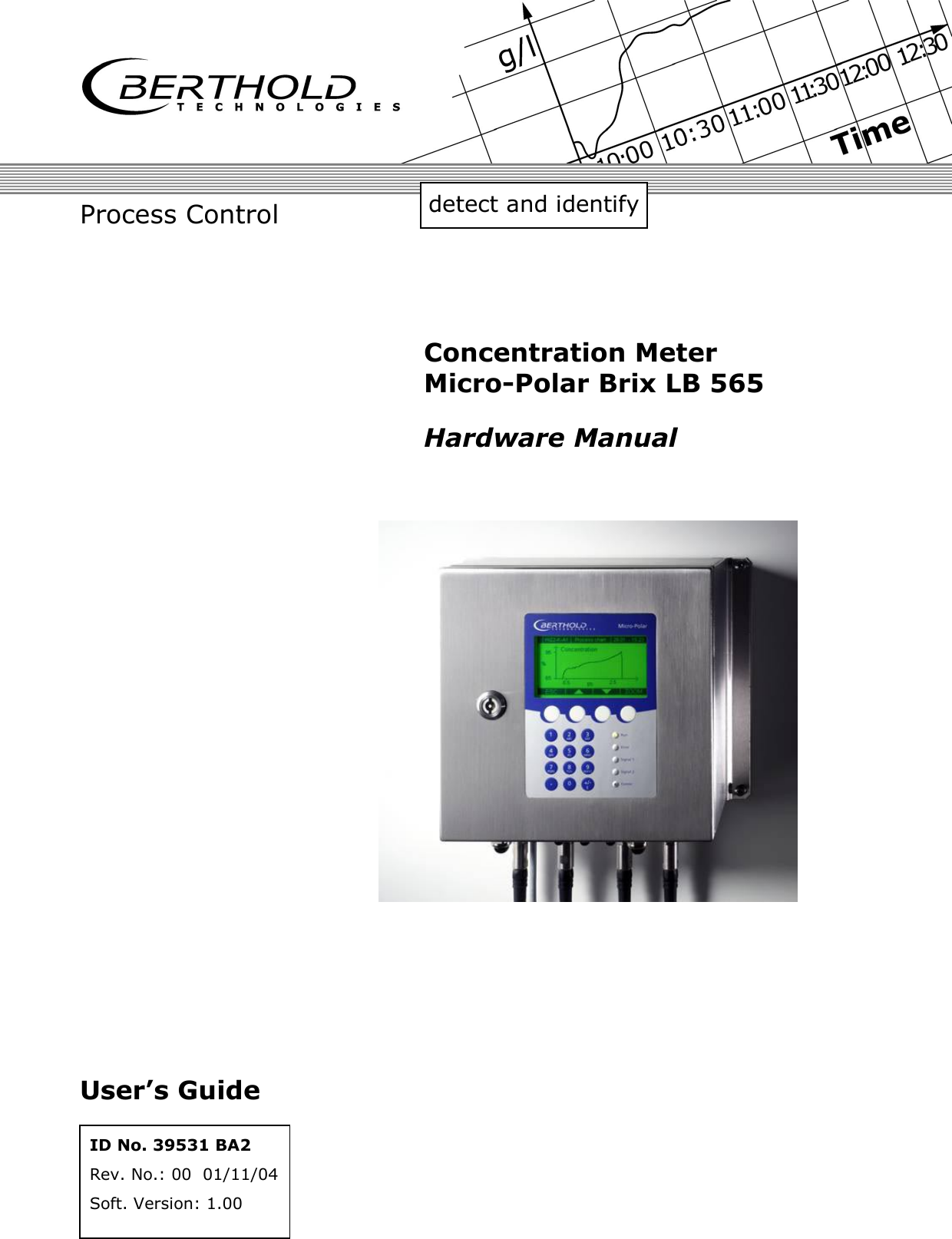
  Process Control Concentration Meter Micro-Polar Brix LB 565 Hardware Manual ID No. 39531 BA2 Rev. No.: 00  01/11/04 Soft. Version: 1.00 detect and identifyUser’s Guide
     The units supplied should not be repaired by anyone other than Berthold Service engineers or technicians authorized by Berthold.  In case of operation trouble, please address our central service department.  The complete user’s guide consists of two manuals, the hardware description and the software description.   The hardware manual comprises:  mechanical components  assembly  electrical installation  technical data  electrical and mechanical drawings   The software manual comprises:  operation of the evaluation unit  parameter description  basic setting  calibration  error messages   The present manual is the hardware description.    Subject to change without prior notice.
 Table of Contents Micro-Polar Brix LB 565  5Table of Contents    Page Chapter 1. Safety Summary  7 1.1 Symbol and Pictograms  7 1.2 Use and Function  8 1.3 General Safety Instructions  10 Chapter 2. General Information  13 2.1 Intended Use  13 2.2 Definitions 14 Chapter 3. System Description  15 3.1 Principle of Measurement  15 3.2 Calculation of Measured Values  16 3.3 Temperature Compensation  17 3.4 Mechanical Components  19 3.4.1 The Evaluation Unit  20 3.4.2 The Microwave Probes  22 3.4.3 High-frequency Cable  25 3.5 Measurement Configuration  26 Chapter 4. Getting Started  27 4.1 Transport to the Installation Site  27 4.2 Installation 27 4.2.1 Pan Probe Installation  27 4.2.2 Setting up the Evaluation Unit  29 4.3 Connecting the Evaluation Unit  30 4.3.1 Connecting the HF Cable  30 4.3.2 Pin Configuration of the Connector Strip  32 4.3.3 Digital Outputs, Relays  37 Chapter 5. Service Instructions  38 5.1 General Information  38 5.2 Instrument Cleaning  38 5.3 Batteries 38 5.4 Fuse Replacement  39 Chapter 6. Technical Data  40 6.1 Evaluation Unit  40 6.2 Probes 43 Chapter 7. Certificate  44 7.1 EC-Declaration of Conformity  44 7.2 Frequency approval  45 Chapter 8. Engineering drawings  47 8.1 Dimensional drawing for housing  47
Table of Contents   Micro-Polar Brix LB 565 68.2 Electrical Wiring Diagram  48 8.3 Dimensional drawings for batch pan probes  49 8.3.1 Type LB 5650-01  49 8.3.2 Type LB 5650-02  50 8.3.3 Type LB 5650-03  51 8.3.4 Type LB 5650-04  52 8.3.5 Type LB 5650-05  53 8.4 Dimensional drawings for continuous pan probes  54 8.4.1 Type LB 5651-01  54 8.4.2 Type LB 5651-02  55 8.4.3 Type LB 5651-03  56 8.4.4 Type LB 5651-04  57 8.4.5 Type LB 5651-05  58 8.5 Installation sheets for LB 5650 (Batch pan probes)  59 8.6 Installation sheets for LB 5651 (Continuous pan probes)  61
  Chapter 1 Safety Summary Micro-Polar Brix LB 565  7Chapter 1. Safety Summary   1.1  Symbol and Pictograms The following symbols identify safety instructions in this user’s guide:  Danger!  Possible danger of life and health hazard  Caution!  Possible hazard Minor personal injuries  Warning!  Possible hazard Property damages  Note!   Tips for application and useful information  The safety instructions are supplemented by explanatory picto-grams, for example:
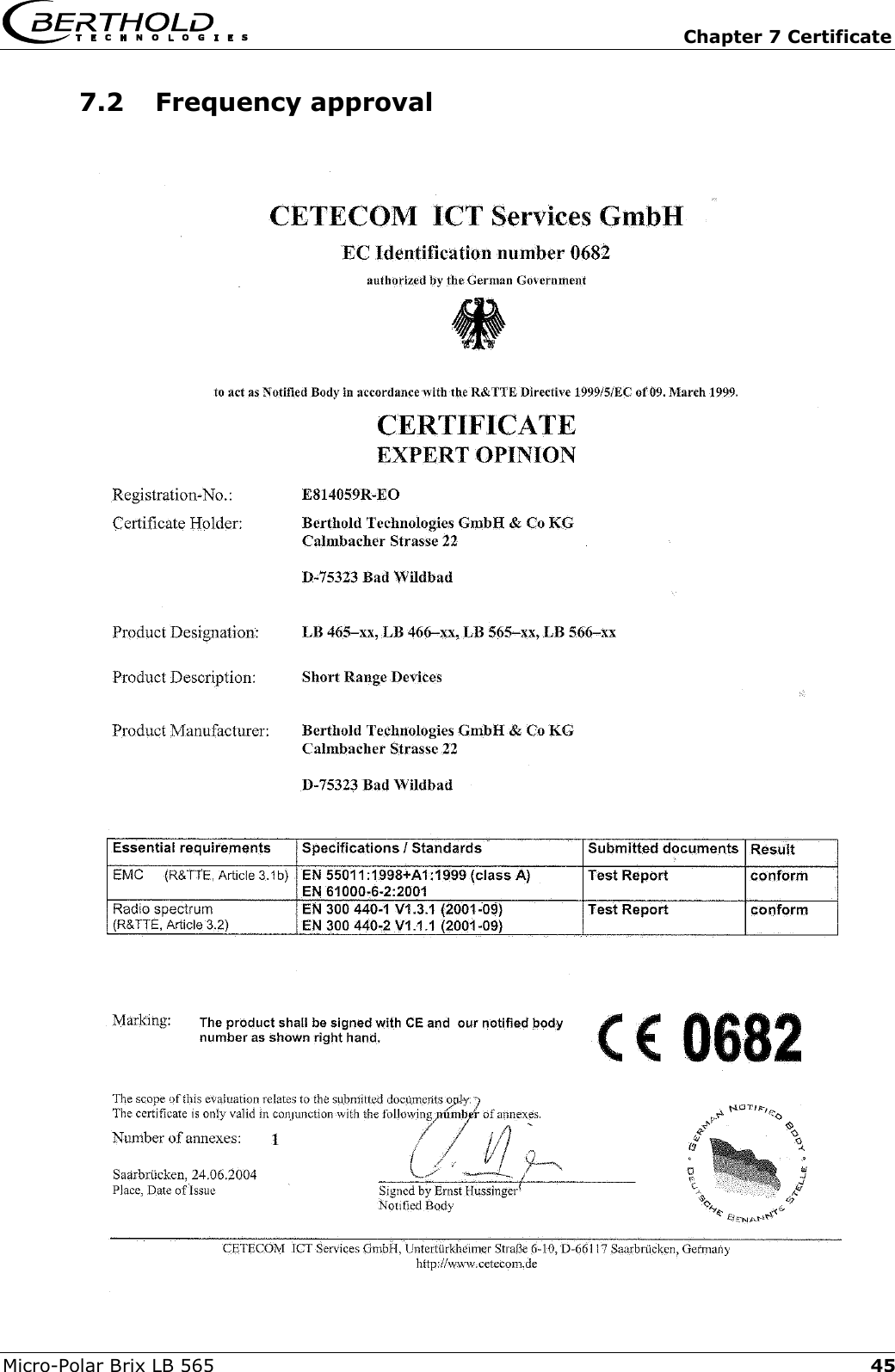
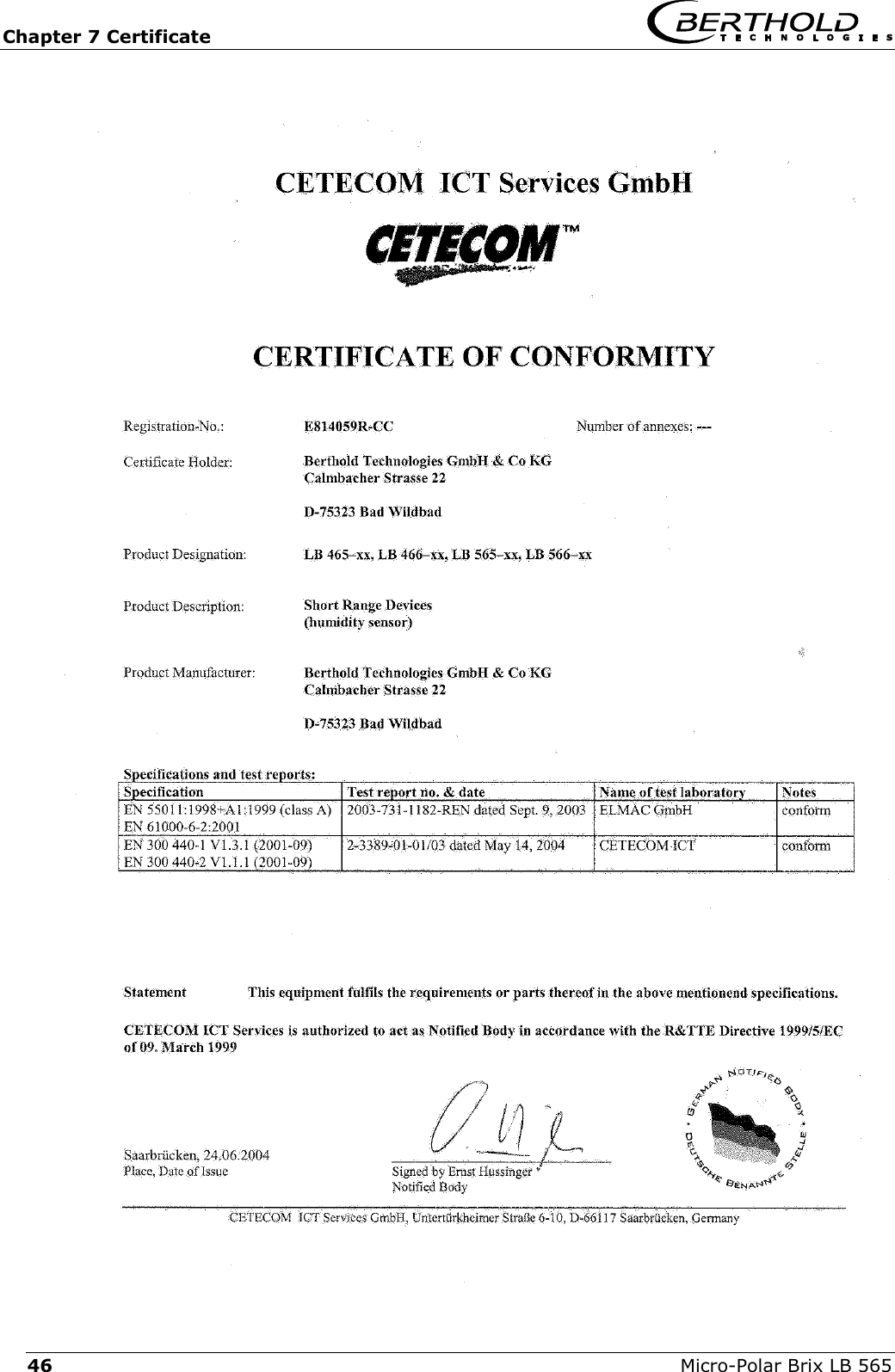
Chapter 1 Safety Summary   Micro-Polar Brix LB 565 81.2  Use and Function The Micro-Polar fulfils the regulations of FCC1, Part 15 and the regulations of the Canadian Industry according to RSS-210. This measuring system complies with interference immunity and radi-ated interference and is permissible for operation.    “IC2:” before the equipment certification number signifies that the Industry Canada technical specifications were met. It does not guarantee that the certified product will operate to the user’s satis-faction.   The Micro-Polar Brix complies with the R&TTE regulations 1999/5/EG and fulfils herein all requirements for such high fre-quency systems. The Micro-Polar Brix contains the identification of conformity according to CE symbol of No. 0682 of the certification office. The certificate can be found in chapter 7.2 Frequency ap-proval.                                             1 FCC … Federal Communications Commission 2 IC ... Industry Canada Frequency- Approvals FCC- Approval Sign
  Chapter 1 Safety Summary Micro-Polar Brix LB 565  9  Note!  The Micro-Polar Brix is a system for concentration measurement using microwave technology. The microwave probe is immersed into the product being measured. The emitted microwaves have a very low power (< 0.1 mW) and are, therefore, not at all hazard-ous to human beings or the environment. Also, the product is not altered at all.     Danger!        The Micro-Polar Brix has been manufactured in compliance with the safety requirements for microwave devices. If special legal provisions exist regarding the use of microwaves, it will be the responsibility of the user to adhere to them. Any change in frequency or any other manipulation on the micro-wave device will result in a loss of the frequency license and will be prosecuted. The microwave modules do not include any replaceable compo-nents and must not be opened.
Chapter 1 Safety Summary   Micro-Polar Brix LB 565 101.3 General Safety Instructions  Note!  The Micro-Polar Brix has been manufactured in accordance with the best available technology and in compliance with acknowl-edged safety rules to ensure the highest level of occupational safety.  The instrument housing is protected according to protection type IP 65 and is suitable for outdoor application. The instrument has been tested by the manufacturer and is delivered in a condition that allows safe and reliable operation.    Caution!  The safety instructions and warnings in this user’s guide have to be observed without fail to ensure safe operation of the instru-ment! The system may only be used in technically good order and only according to regulations! Only authorized persons may work with the system who have been assigned to do this and who have the proper qualification and have received the necessary instructions! Installations and modifications on the system which could affect the operational safety are not permitted!    Warning!  Ambient conditions: All system components require non-corrosive ambient conditions during transport, storage and starting up.
  Chapter 1 Safety Summary Micro-Polar Brix LB 565  11 Danger!  Electrical shock hazard: Disconnect power to ensure that contact with live part is avoided during installation and when servicing. Disconnect power before opening the instrument. Work on open and live instruments is prohibited.   Warning!  Spare fuses must match the rating specified by the device manu-facturer. Short-circuiting or manipulation is not permitted.   Warning!  The LB 565 and all ancillary units have to be connected to mains via grounded connection.   Caution!  If liquid gets inside the instrument, cut off the power supply. The instrument has to be checked and cleaned by an authorized ser-vice center.   Warning!  Never change the installation and the parameter settings without full knowledge of these operating instructions, as well as full knowledge of the behavior of the connected controller and the possible influence on the operating process to be controlled.
   Micro-Polar Brix LB 565 12
  Chapter 2 General Information Micro-Polar Brix LB 565  13Chapter 2. General Information   2.1 Intended Use The measuring system LB 565 can be used to determine the con-centration of nearly all materials which can be dissolved or sus-pended in water using microwave technology. Pan probes with and without rinsing device are available. The pan probes have been designed for installation in pipelines with a nominal width of ≥ 200 mm and in containers, for example, evaporation crystallizers. The probe is installed so that both meas-uring rods (sender and receiver) are immersed into the product being measured.  During operation, the concentration meter Micro-Polar Brix sends out electromagnetic radiation in a frequency range between 2.4 GHz and 2.5 GHz (range restrictions depend on local regulations in your Country). The microwaves emerge only between both meas-uring rods of the probe, and are not dangerous to human beings and the environment (power emission < 0.1 mW). The microwaves are emitted targeted from the microwave window; the product is not altered by the microwaves.  To ensure proper function of the meter, please pay attention to the following:  Note!   The material being measured must not be electrically conduc-tive, i.e. the ohmic resistance is infinite.  The product must not contain any gas bubbles, or gas bubbles have to be compressed with adequate pressure when carrying out measurements in pipelines.  The ion concentration, e.g. salt content, has to be near con-stant.
Chapter 2 General Information   Micro-Polar Brix LB 565 14 2.2 Definitions  Attenuation  Weakening of the microwave signals, microwaves measurement effect. Batch pan probe  Pan probe without rinsing device. Application e.g. in evapora-tion crystallization process. Continuous pan probe Pan probe with rinsing device. Application e.g. in continuous evaporation crystallization process. Factory setting  All parameters have been set by the manufacturer using stan-dard values. In most cases this simplifies calibration of the in-strument significantly. Despite factory setting, calibration al-ways has to be performed. HF cable  High-frequency cable. Microwaves  Term for electromagnetic waves in a certain frequency range. Phase  Phase or phase shift. Microwave measurement effect. Quad cable  Combination of four HF cables of equal length in a corrugated tube. Softkeys  Buttons associated with the software. TC  Temperature compensation.
  Chapter 3 System Description Micro-Polar Brix LB 565  15Chapter 3. System Description   3.1  Principle of Measurement The microwaves that spread between the rods transmit the prod-uct being measured; their propagation speed is slowed down (= phase shift) and their intensity is damped (= attenuation). Figure 1 illustrates the principle of measurement: The propagation speed of microwaves passing through the product being measured is slowed down (phase shift) and their intensity (attenuation) is re-duced, relative to a reference signal.              Prerequisite is that the product being measured shows some di-electric properties. In sugar strike, it is the water which presents a very distinct dielectric fluid. The water or dry mass concentration can therefore be determined by measuring the phase shift and/or attenuation. The concentration to be detected in the product depends in good approximation linear on phase shift and attenuation. For this rea-son we can measure the concentration or the dry mass content of the sugar solution using a linear calibration (see chapter 3.2 Calculation of Measured Values). Figure 1: Schematic diagram:  Change of microwave  by product  Phase shift      ProductPhase comparison --> PhaseAmplitude comp.--> Attenuation Reference pathReference signalMeasurement signalMeasured value:Concentration %TSHF sourcesSenderReceiver
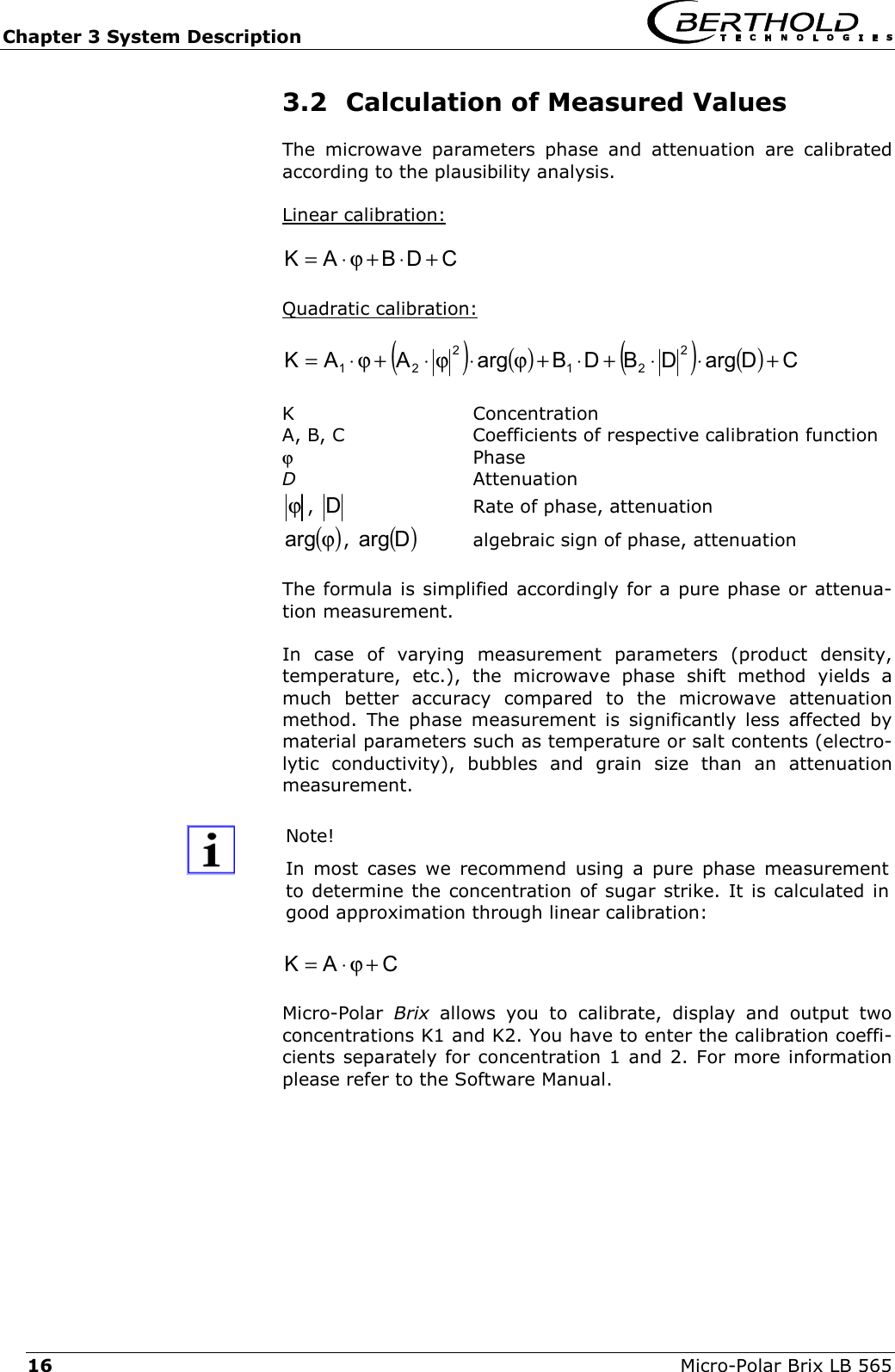
Chapter 3 System Description   Micro-Polar Brix LB 565 16 3.2  Calculation of Measured Values The microwave parameters phase and attenuation are calibrated according to the plausibility analysis.   Linear calibration:  CDBAK +⋅+ϕ⋅=   Quadratic calibration:  ()()()()CDargDBDBargAAK 221221 +⋅⋅+⋅+ϕ⋅ϕ⋅+ϕ⋅=   K  Concentration A, B, C     Coefficients of respective calibration function ϕ  Phase D   Attenuation ϕ,  D    Rate of phase, attenuation ()ϕarg , ()Darg   algebraic sign of phase, attenuation  The formula is simplified accordingly for a pure phase or attenua-tion measurement.  In case of varying measurement parameters (product density, temperature, etc.), the microwave phase shift method yields a much better accuracy compared to the microwave attenuation method. The phase measurement is significantly less affected by material parameters such as temperature or salt contents (electro-lytic conductivity), bubbles and grain size than an attenuation measurement.   Note!  In most cases we recommend using a pure phase measurement to determine the concentration of sugar strike. It is calculated in good approximation through linear calibration: CAK +ϕ⋅=  Micro-Polar  Brix allows you to calibrate, display and output two concentrations K1 and K2. You have to enter the calibration coeffi-cients separately for concentration 1 and 2. For more information please refer to the Software Manual.
  Chapter 3 System Description Micro-Polar Brix LB 565  173.3 Temperature Compensation Temperature compensation (TC) has to be carried out if varying op-erating states are likely to occur, for example vapour pressure and product temperature. TC has to be carried out whenever you are working with cooling crystallizers. The following formulas are used for temperature compensation.   Linear compensation Additive:  θ∆⋅+ϕ=ϕ ϕTCmeascomp   θ∆⋅+= Dmeascomp TCDD  Multiplicative: )TC(meascomp θ∆⋅+ϕ=ϕ ϕ1  )TC(DD Dmeascomp θ∆⋅+= 1  Quadratic compensation Additive: ()θ∆⋅θ∆⋅+θ∆⋅+ϕ=ϕ ϕϕ argTCTCmeascomp221   ()θ∆⋅θ∆⋅+θ∆⋅+= argTCTCDD DDmeascomp221   Multiplicative:  ())argTCTC(meascomp θ∆⋅θ∆⋅+θ∆⋅+ϕ=ϕ ϕϕ2211  ())argTCTC(DD DDmeascomp θ∆⋅θ∆⋅+θ∆⋅+= 2211  Where  ϕmeas   = measured phase [°] ϕcomp  = compensated phase [°] Dmeas   = measured attenuation [dB] Dmeas  = compensated attenuation [dB] TCϕx   = temperature coefficient [° / °C] TCDx   = temperature coefficient [dB/ °C]  ∆θ   = measured temperature (Tmeas ) – reference temp. (TRef) θ∆   = difference temperature  ()θ∆arg  = algebraic sign of difference temperature  Depending on the selected function (additive, multiplicative, quad-ratic, cubic), the required temperature coefficients appear on the Calibration menu. Temperature coefficients that are not used are set to zero.
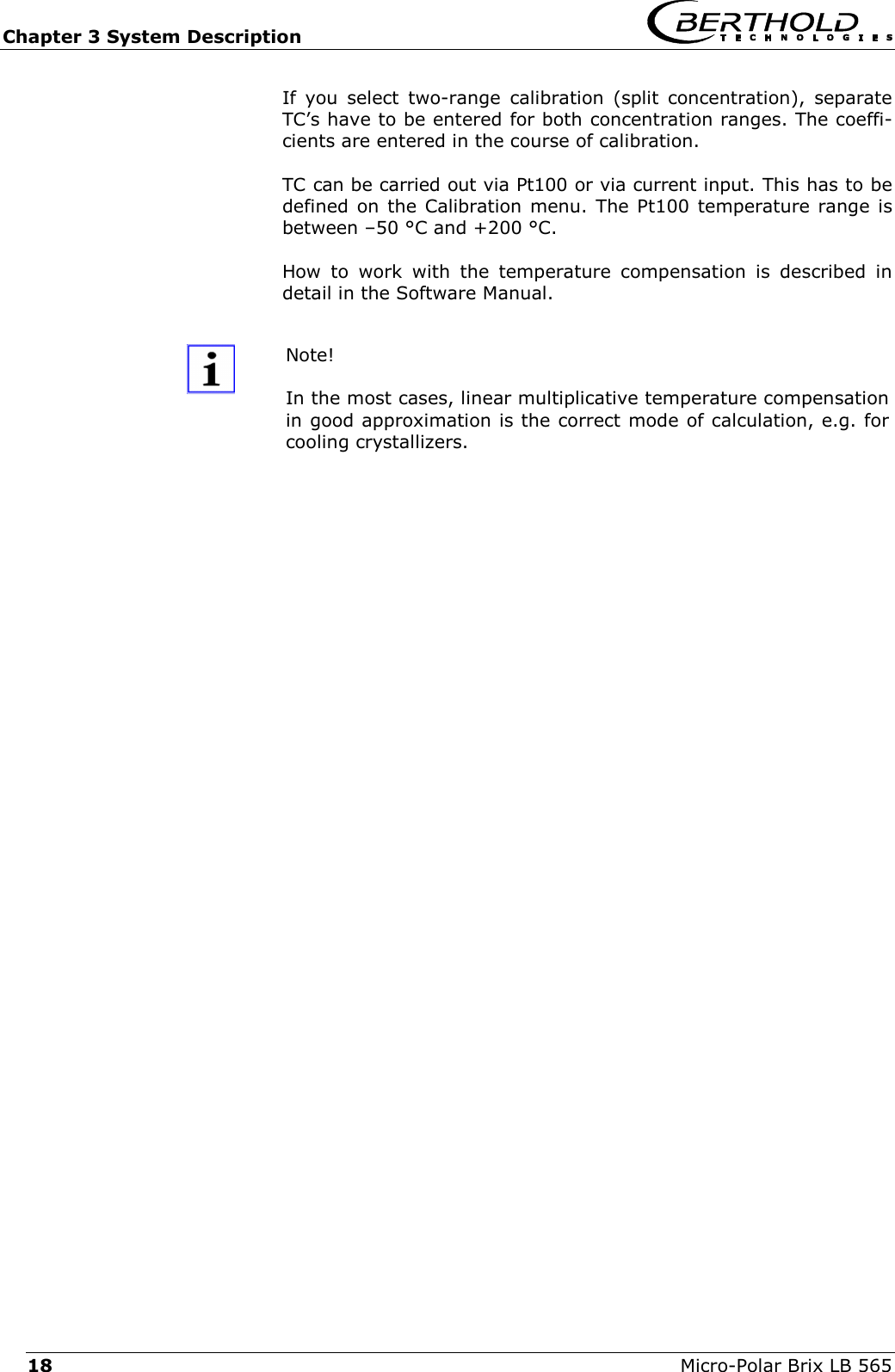
Chapter 3 System Description   Micro-Polar Brix LB 565 18 If you select two-range calibration (split concentration), separate TC’s have to be entered for both concentration ranges. The coeffi-cients are entered in the course of calibration.  TC can be carried out via Pt100 or via current input. This has to be defined on the Calibration menu. The Pt100 temperature range is between –50 °C and +200 °C. How to work with the temperature compensation is described in detail in the Software Manual.  Note!  In the most cases, linear multiplicative temperature compensation in good approximation is the correct mode of calculation, e.g. for cooling crystallizers.
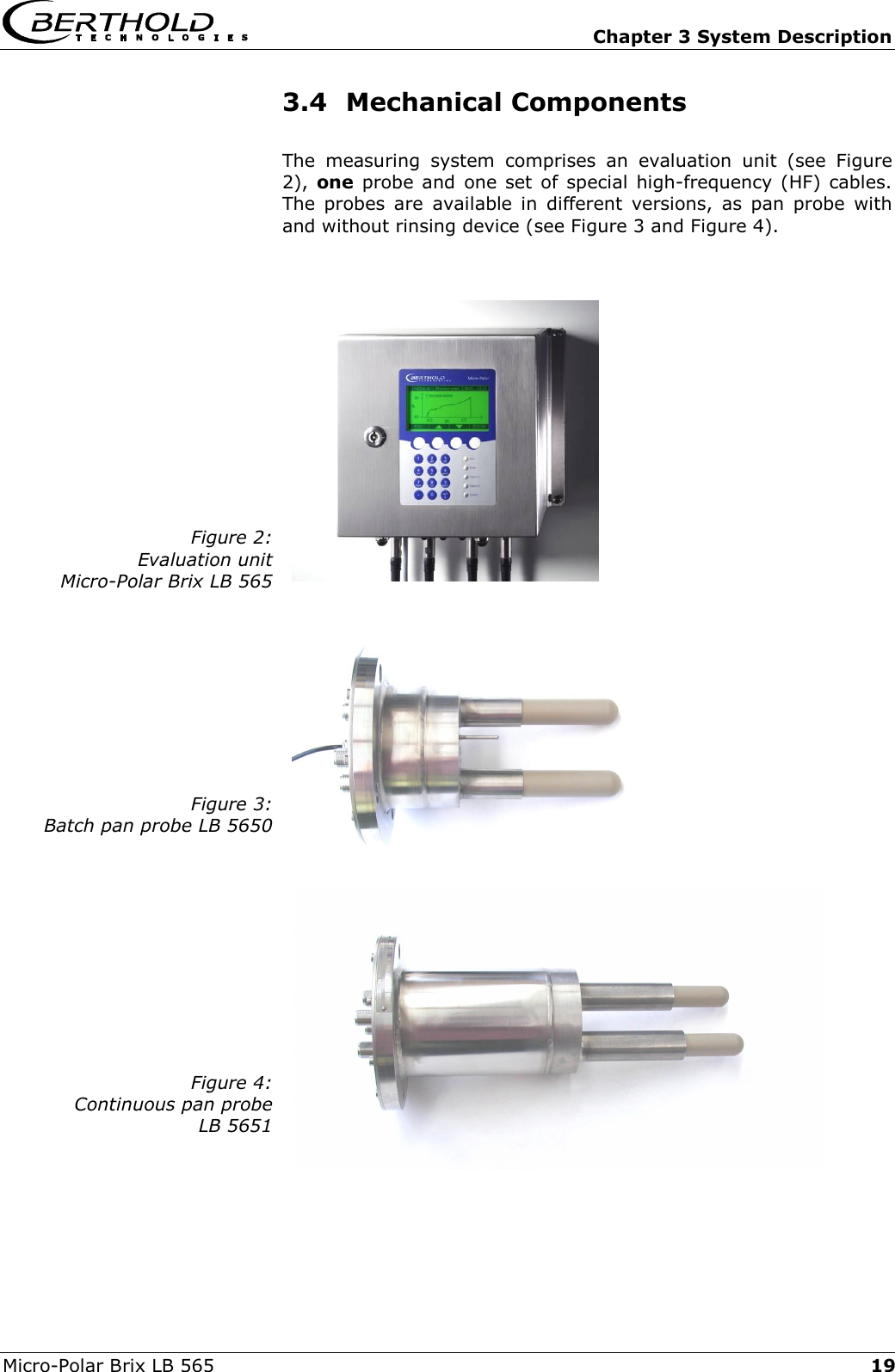
  Chapter 3 System Description Micro-Polar Brix LB 565  193.4 Mechanical Components The measuring system comprises an evaluation unit (see Figure 2), one probe and one set of special high-frequency (HF) cables. The probes are available in different versions, as pan probe with and without rinsing device (see Figure 3 and Figure 4).  Figure 2: Evaluation unit  Micro-Polar Brix LB 565    Figure 3: Batch pan probe LB 5650    Figure 4: Continuous pan probe  LB 5651
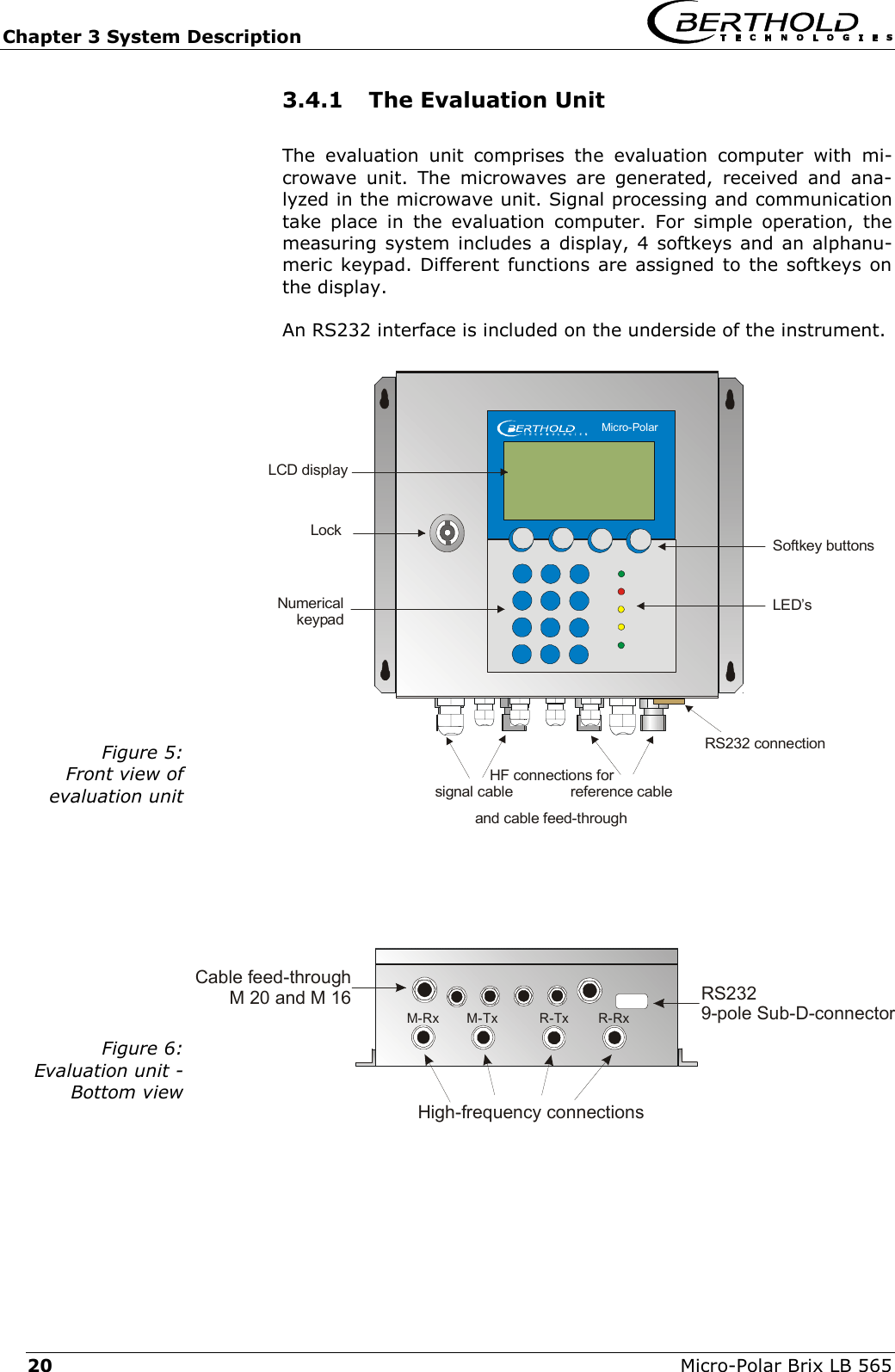
Chapter 3 System Description   Micro-Polar Brix LB 565 20 Cable feed-throughM 20 and M 16High-frequency connectionsRS2329-pole Sub-D-connectorM-TxM-Rx R-Tx R-Rxand cable feed-throughLockNumericalkeypadSoftkey buttonsLED’sLCD displayRS232 connectionHF connections for   signal cable              reference cableMicro-Polar3.4.1  The Evaluation Unit The evaluation unit comprises the evaluation computer with mi-crowave unit. The microwaves are generated, received and ana-lyzed in the microwave unit. Signal processing and communication take place in the evaluation computer. For simple operation, the measuring system includes a display, 4 softkeys and an alphanu-meric keypad. Different functions are assigned to the softkeys on the display. An RS232 interface is included on the underside of the instrument.  Figure 5: Front view of  evaluation unit    Figure 6: Evaluation unit -  Bottom view
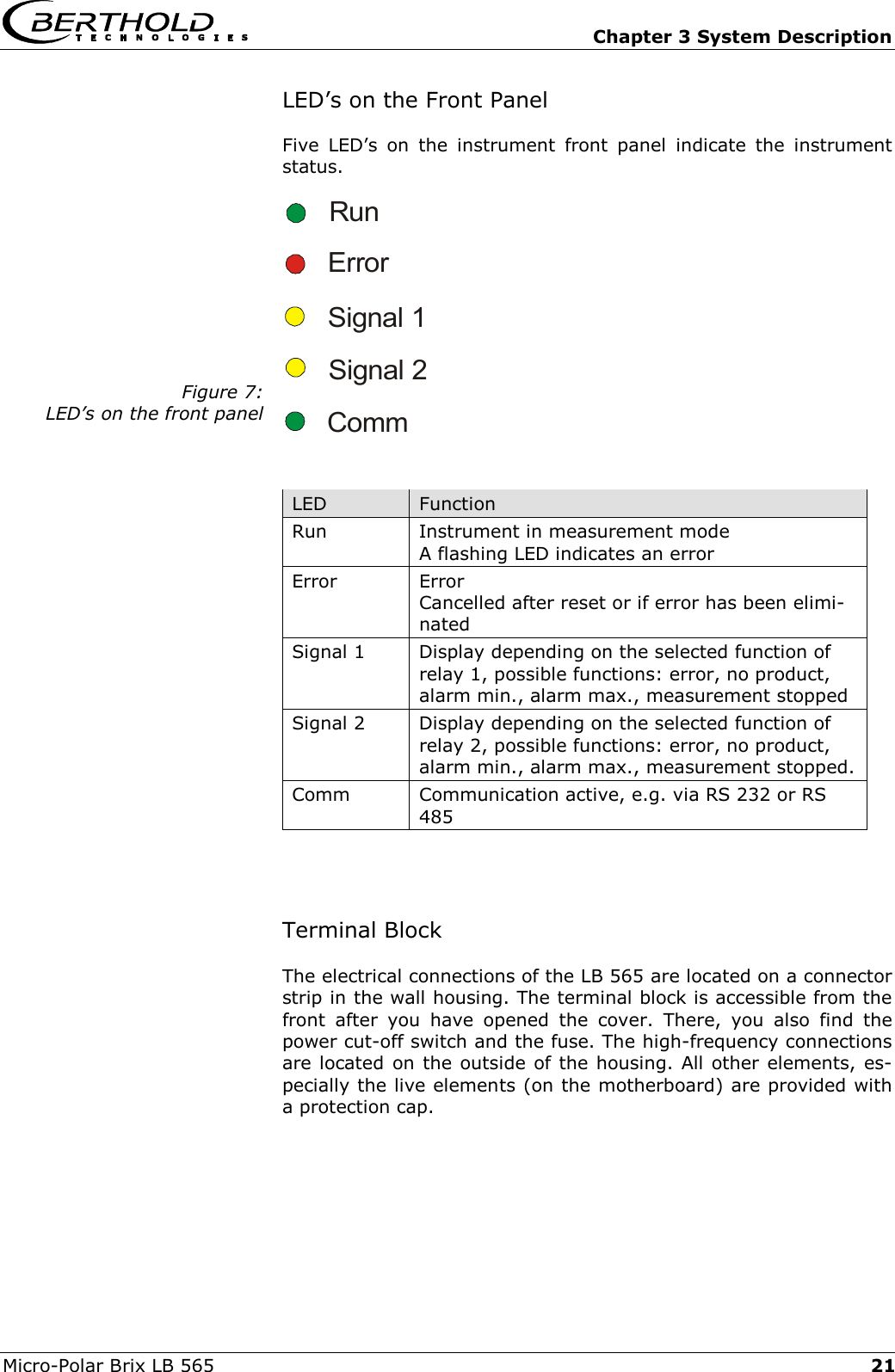
  Chapter 3 System Description Micro-Polar Brix LB 565  21LED’s on the Front Panel Five LED’s on the instrument front panel indicate the instrument status.  Figure 7: LED’s on the front panel   RunErrorSignal 1Signal 2Comm  LED  Function Run  Instrument in measurement mode A flashing LED indicates an error Error Error Cancelled after reset or if error has been elimi-nated Signal 1  Display depending on the selected function of relay 1, possible functions: error, no product, alarm min., alarm max., measurement stopped Signal 2  Display depending on the selected function of relay 2, possible functions: error, no product, alarm min., alarm max., measurement stopped. Comm  Communication active, e.g. via RS 232 or RS 485   Terminal Block The electrical connections of the LB 565 are located on a connector strip in the wall housing. The terminal block is accessible from the front after you have opened the cover. There, you also find the power cut-off switch and the fuse. The high-frequency connections are located on the outside of the housing. All other elements, es-pecially the live elements (on the motherboard) are provided with a protection cap.
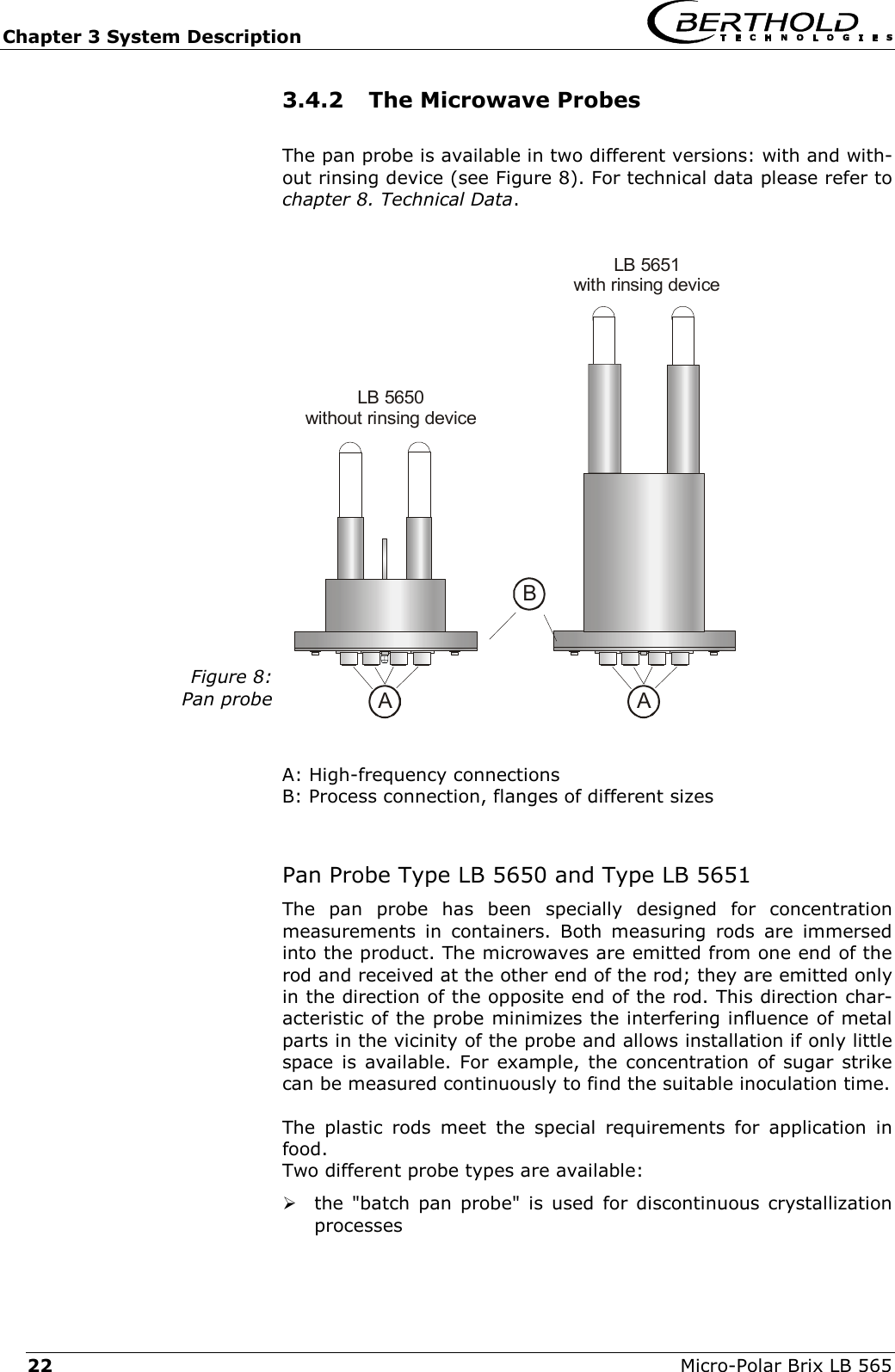
Chapter 3 System Description   Micro-Polar Brix LB 565 22 3.4.2  The Microwave Probes The pan probe is available in two different versions: with and with-out rinsing device (see Figure 8). For technical data please refer to chapter 8. Technical Data.  Figure 8:Pan probeALB 5650without rinsing deviceABLB 5651with rinsing device  A: High-frequency connections B: Process connection, flanges of different sizes  Pan Probe Type LB 5650 and Type LB 5651 The pan probe has been specially designed for concentration measurements in containers. Both measuring rods are immersed into the product. The microwaves are emitted from one end of the rod and received at the other end of the rod; they are emitted only in the direction of the opposite end of the rod. This direction char-acteristic of the probe minimizes the interfering influence of metal parts in the vicinity of the probe and allows installation if only little space is available. For example, the concentration of sugar strike can be measured continuously to find the suitable inoculation time.  The plastic rods meet the special requirements for application in food. Two different probe types are available:  the "batch pan probe" is used for discontinuous crystallization processes
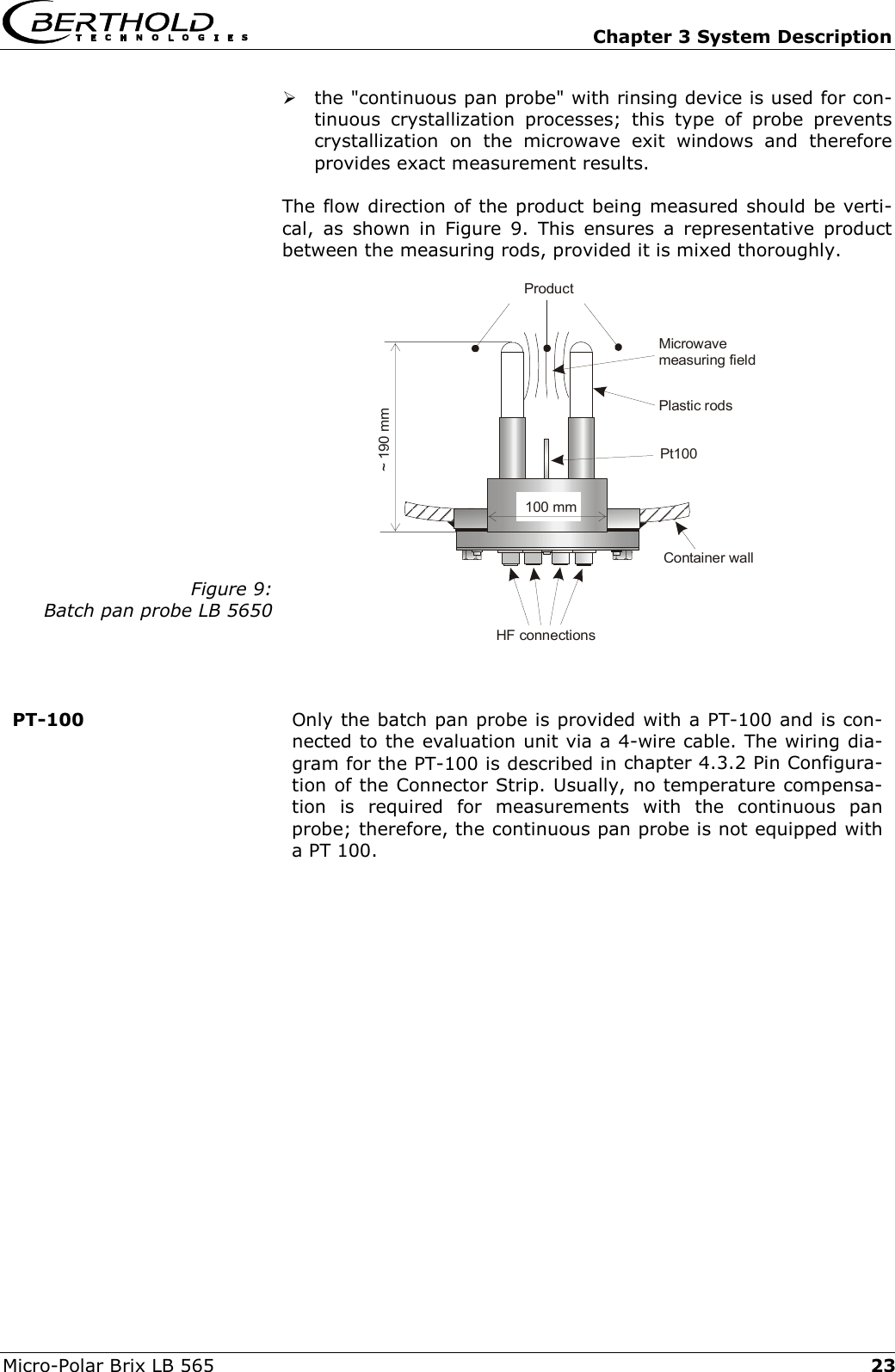
  Chapter 3 System Description Micro-Polar Brix LB 565  23Container wallHF connectionsProductMicrowavemeasuring fieldPlastic rods~ 190 mm100 mmPt100 the "continuous pan probe" with rinsing device is used for con-tinuous crystallization processes; this type of probe prevents crystallization on the microwave exit windows and therefore provides exact measurement results.  The flow direction of the product being measured should be verti-cal, as shown in Figure 9. This ensures a representative product between the measuring rods, provided it is mixed thoroughly.  Figure 9: Batch pan probe LB 5650      PT-100  Only the batch pan probe is provided with a PT-100 and is con-nected to the evaluation unit via a 4-wire cable. The wiring dia-gram for the PT-100 is described in chapter 4.3.2 Pin Configura-tion of the Connector Strip. Usually, no temperature compensa-tion is required for measurements with the continuous pan probe; therefore, the continuous pan probe is not equipped with a PT 100.
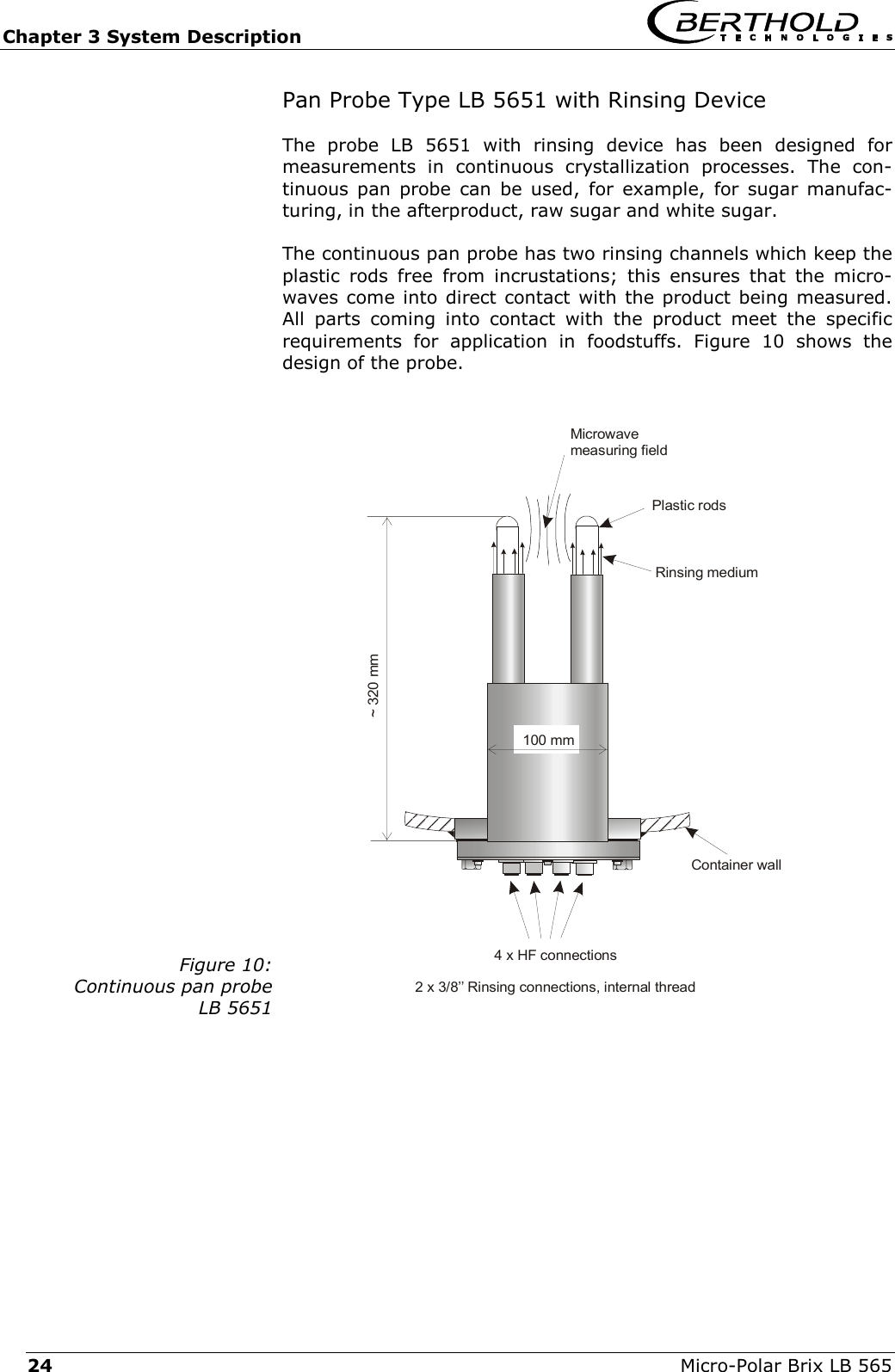
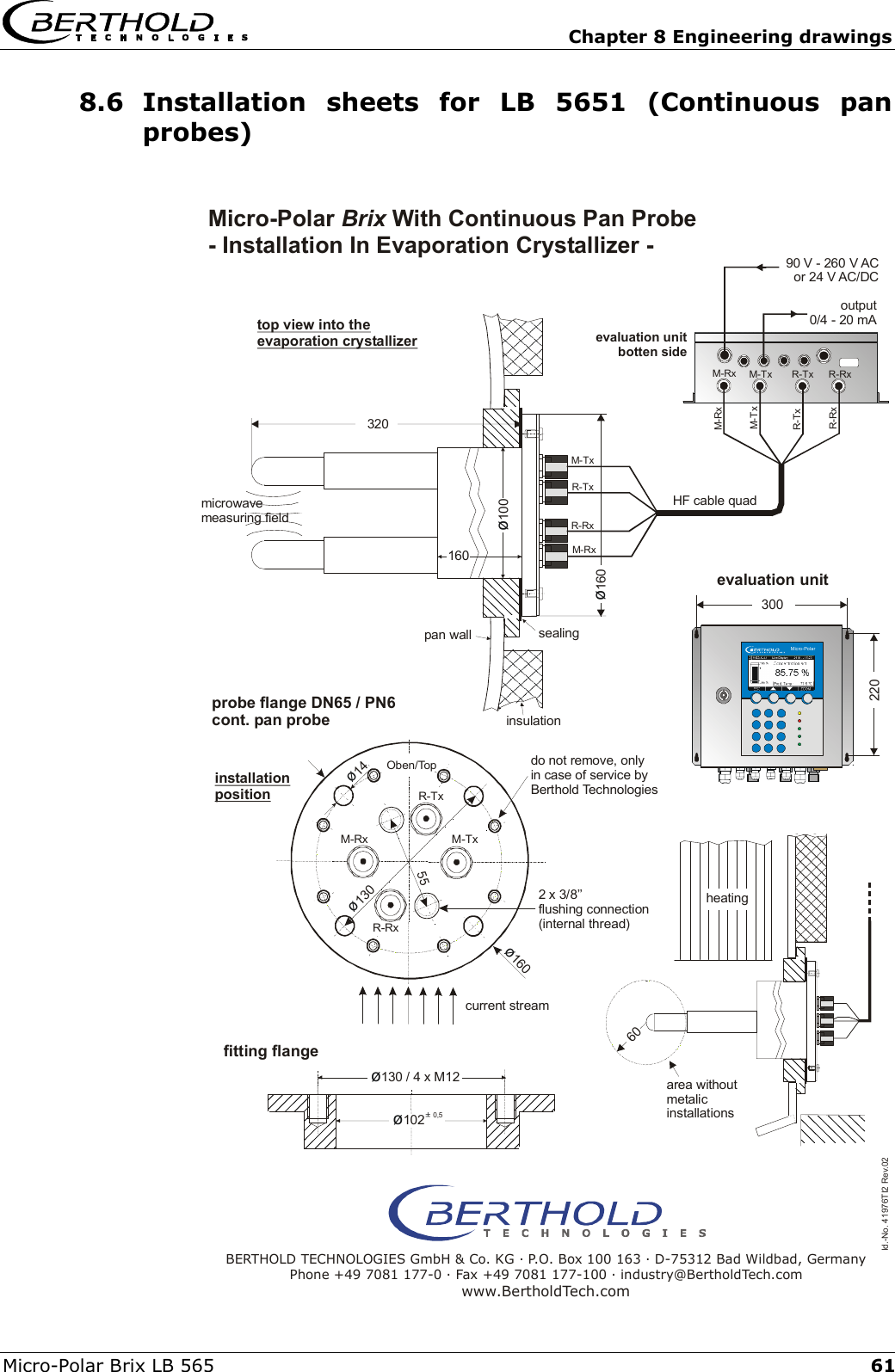
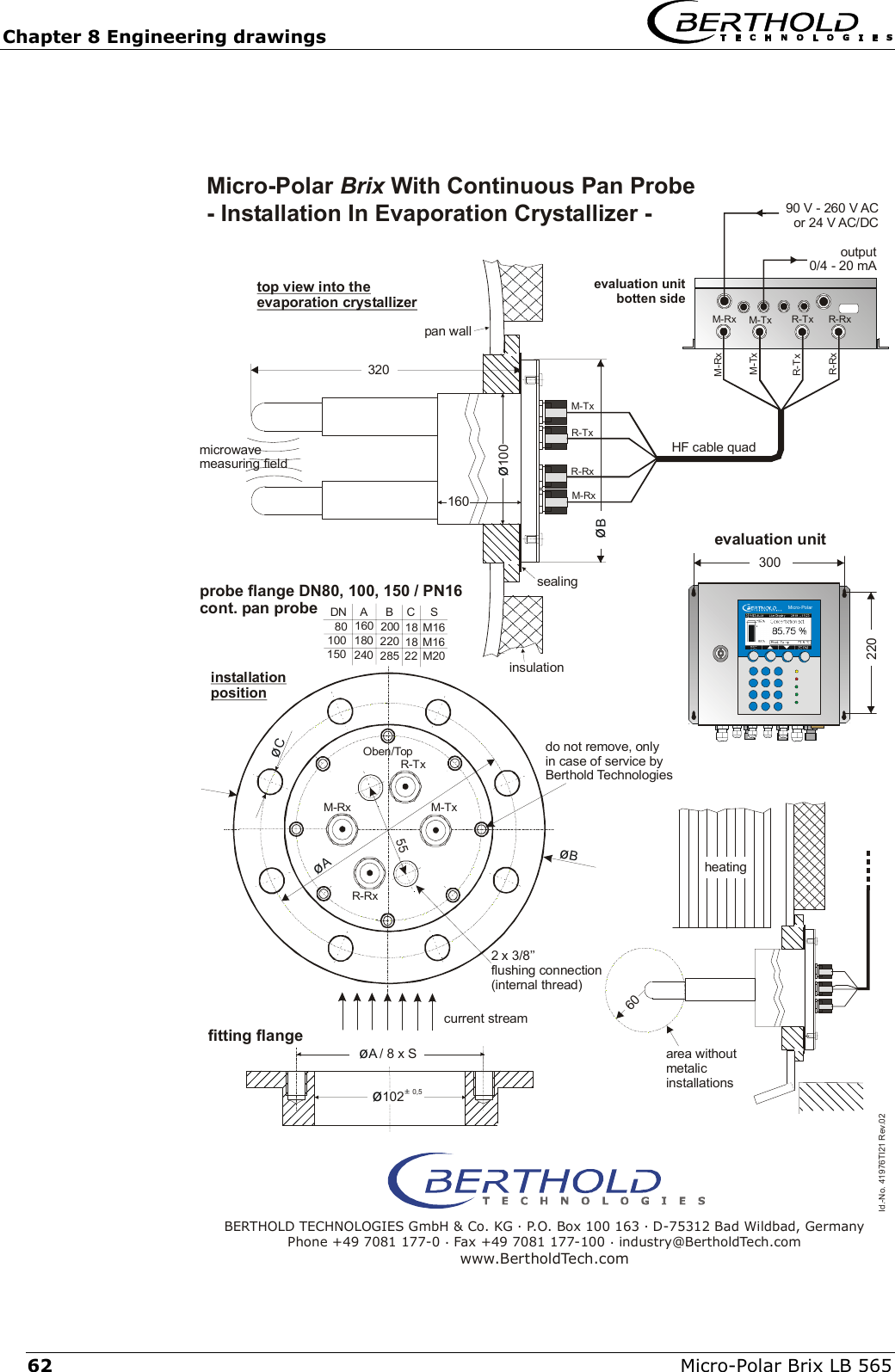
Chapter 3 System Description   Micro-Polar Brix LB 565 24 Pan Probe Type LB 5651 with Rinsing Device The probe LB 5651 with rinsing device has been designed for measurements in continuous crystallization processes. The con-tinuous pan probe can be used, for example, for sugar manufac-turing, in the afterproduct, raw sugar and white sugar. The continuous pan probe has two rinsing channels which keep the plastic rods free from incrustations; this ensures that the micro-waves come into direct contact with the product being measured. All parts coming into contact with the product meet the specific requirements for application in foodstuffs. Figure 10 shows the design of the probe.  Figure 10:Continuous pan probe LB 5651    Container wall4 x HF connections2 x 3/8’’ Rinsing connections, internal threadMicrowavemeasuring fieldPlastic rodsRinsing medium~ 320 mm100 mm
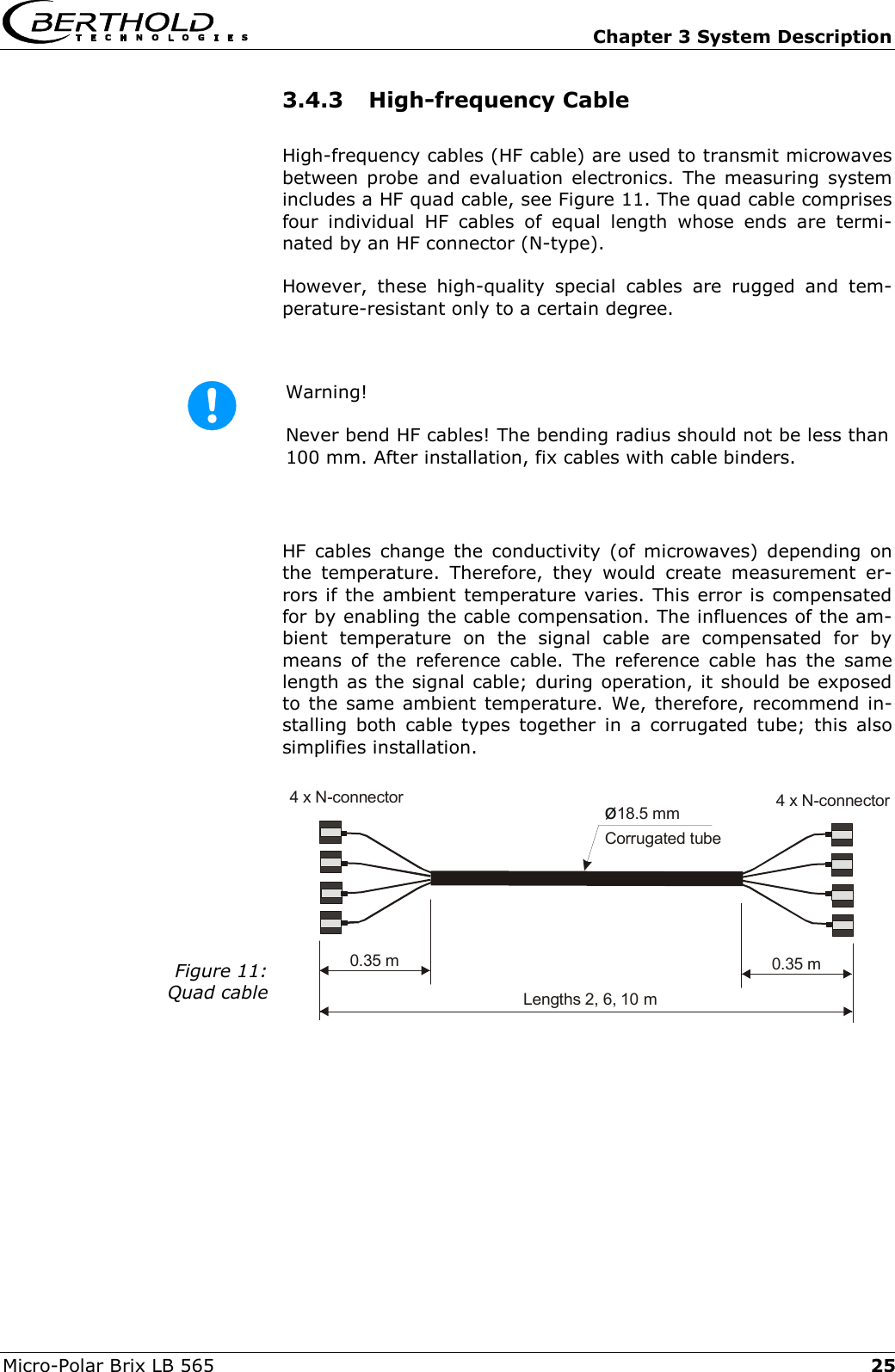
  Chapter 3 System Description Micro-Polar Brix LB 565  25Lengths 2, 6, 10 mCorrugated tubeø18.5 mm0.35 m 0.35 m4 x N-connector4 x N-connector3.4.3 High-frequency Cable High-frequency cables (HF cable) are used to transmit microwaves between probe and evaluation electronics. The measuring system includes a HF quad cable, see Figure 11. The quad cable comprises four individual HF cables of equal length whose ends are termi-nated by an HF connector (N-type). However, these high-quality special cables are rugged and tem-perature-resistant only to a certain degree.  Warning!  Never bend HF cables! The bending radius should not be less than 100 mm. After installation, fix cables with cable binders.  HF cables change the conductivity (of microwaves) depending on the temperature. Therefore, they would create measurement er-rors if the ambient temperature varies. This error is compensated for by enabling the cable compensation. The influences of the am-bient temperature on the signal cable are compensated for by means of the reference cable. The reference cable has the same length as the signal cable; during operation, it should be exposed to the same ambient temperature. We, therefore, recommend in-stalling both cable types together in a corrugated tube; this also simplifies installation.   Figure 11: Quad cable
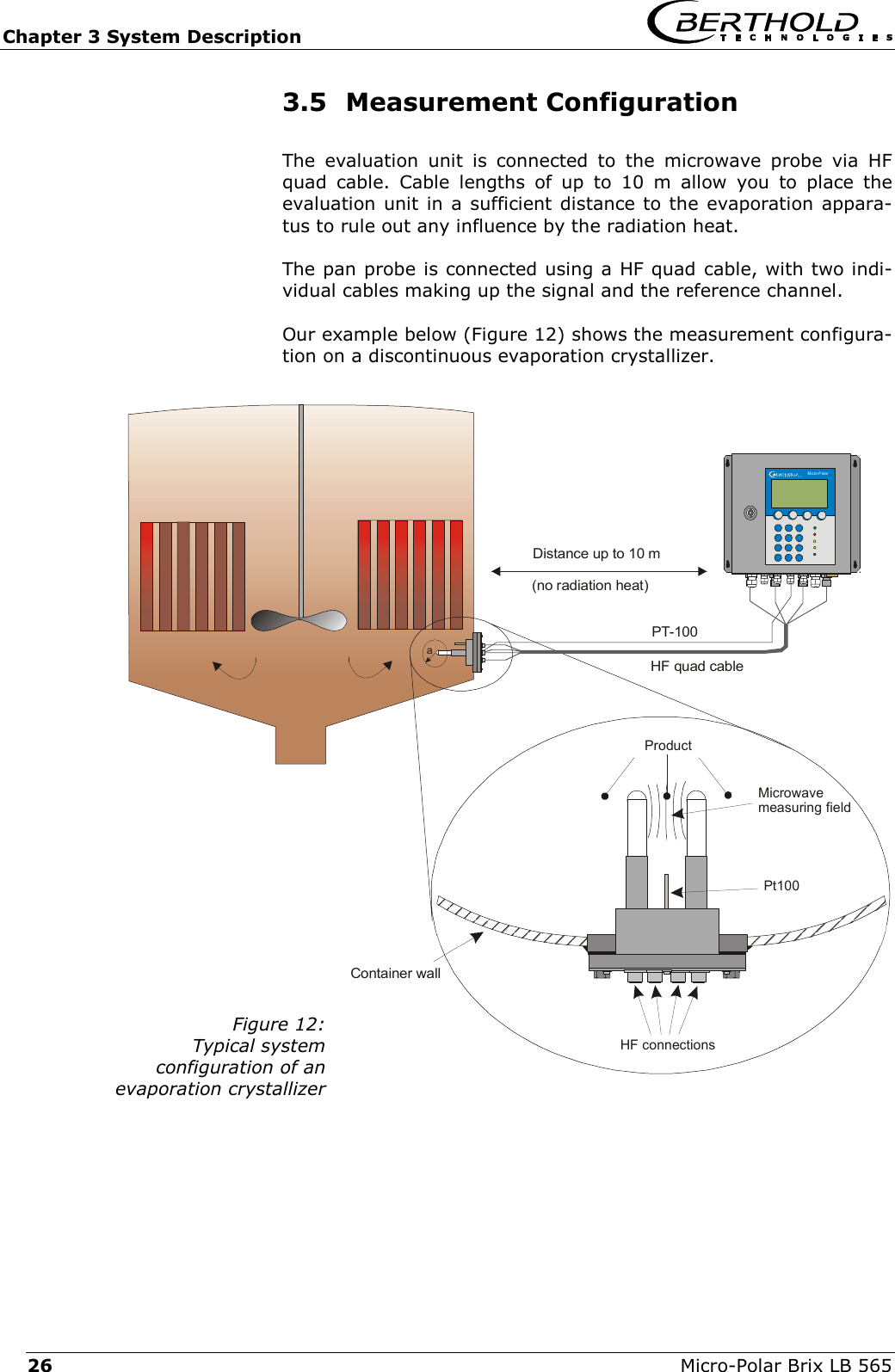
Chapter 3 System Description   Micro-Polar Brix LB 565 26 3.5 Measurement Configuration The evaluation unit is connected to the microwave probe via HF quad cable. Cable lengths of up to 10 m allow you to place the evaluation unit in a sufficient distance to the evaporation appara-tus to rule out any influence by the radiation heat. The pan probe is connected using a HF quad cable, with two indi-vidual cables making up the signal and the reference channel. Our example below (Figure 12) shows the measurement configura-tion on a discontinuous evaporation crystallizer.  Figure 12: Typical system  configuration of an  evaporation crystallizer Container wallDistance up to 10 m(no radiation heat)aMicro-PolarPt100HF connectionsProductMicrowavemeasuring fieldPT-100HF quad cable
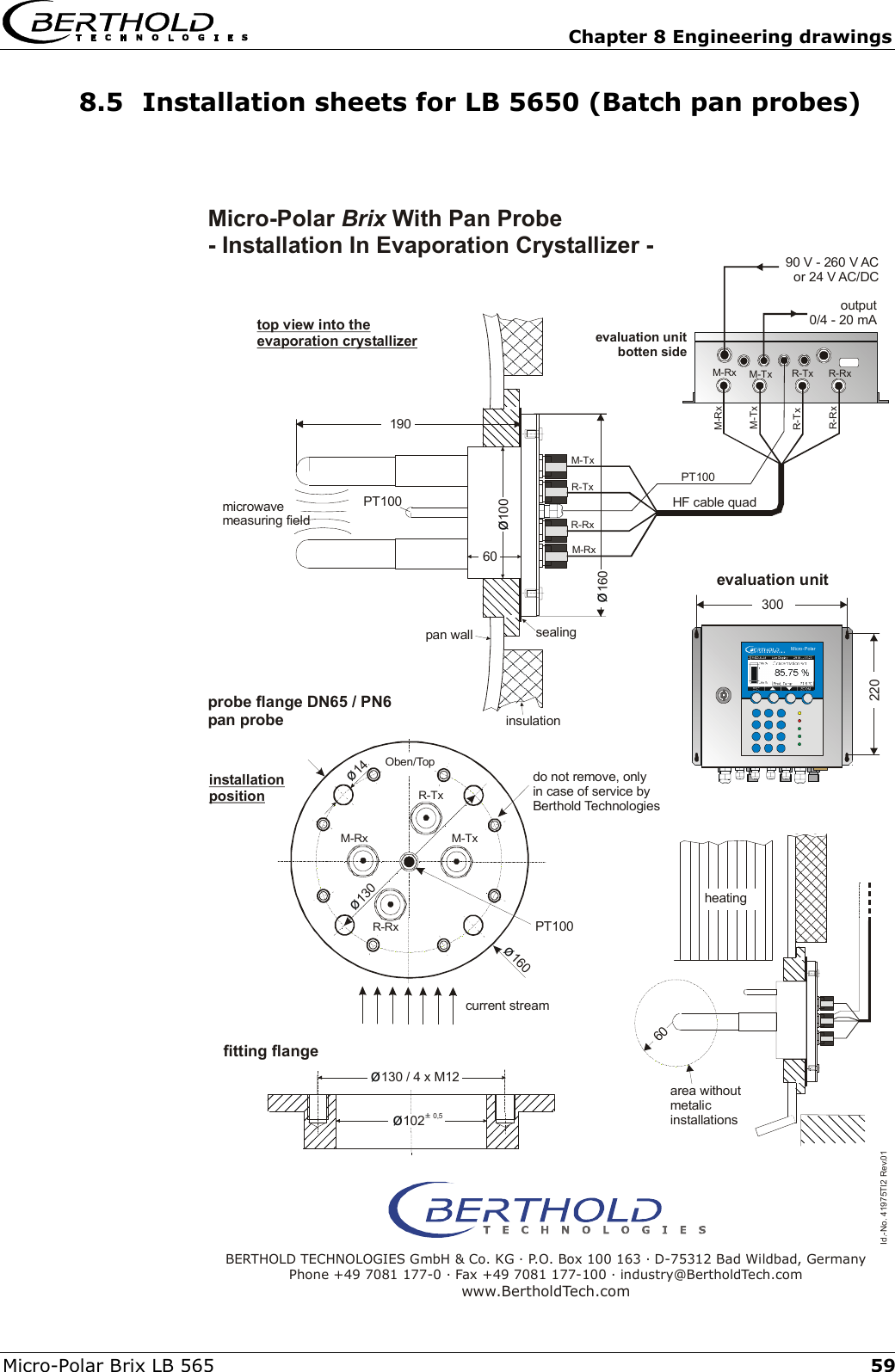
  Chapter 4 Getting Started Micro-Polar Brix LB 565  27Chapter 4. Getting Started     4.1  Transport to the Installation Site  Warning!   Risk of damage! System parts may get damaged during transportation! Transport probe and the evaluation unit in their original packag-ing. Protect parts against shocks. Especially the plastic rods of the pan probes have to be protected against mechanical impact!  After unpacking, make sure all parts listed on the packing list have been delivered and show no sign of damage; if necessary, clean these parts. If you detect any damage, please notify the forwarder and the manufacturer immediately.    4.2 Installation 4.2.1  Pan Probe Installation Figure 12 shows the position of the batch pan probe on the con-tainer. This position is equally valid for the continuous pan probe. The installation sheet in chapter 8 includes all information required for installation. For installation, please keep in mind:  Select the installation site such that good mixing and a homo-geneous product is ensured and the formation of bubbles on the probe is prevented. A tap should be provided in the direct vicinity to allow representative sampling.
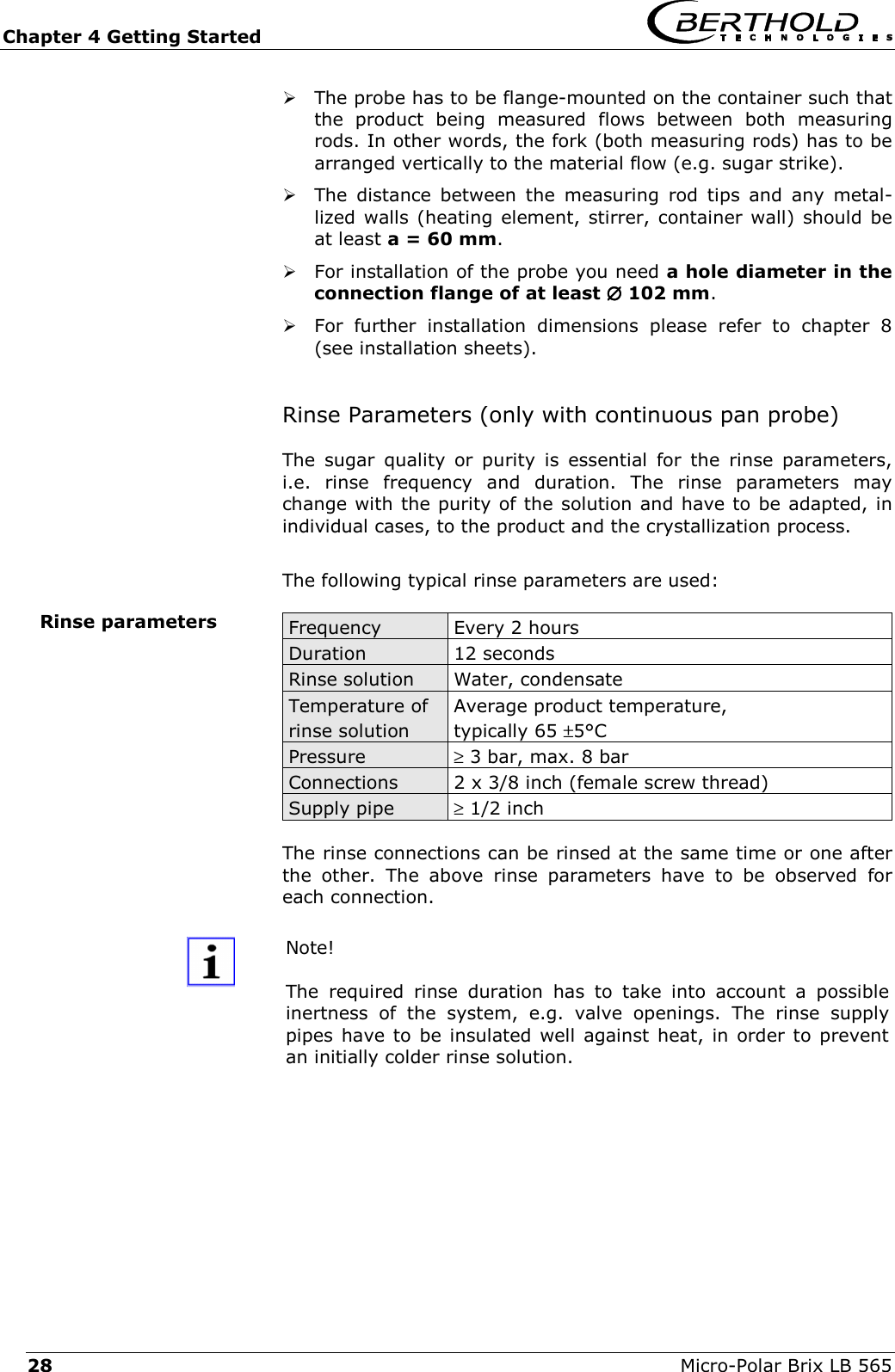
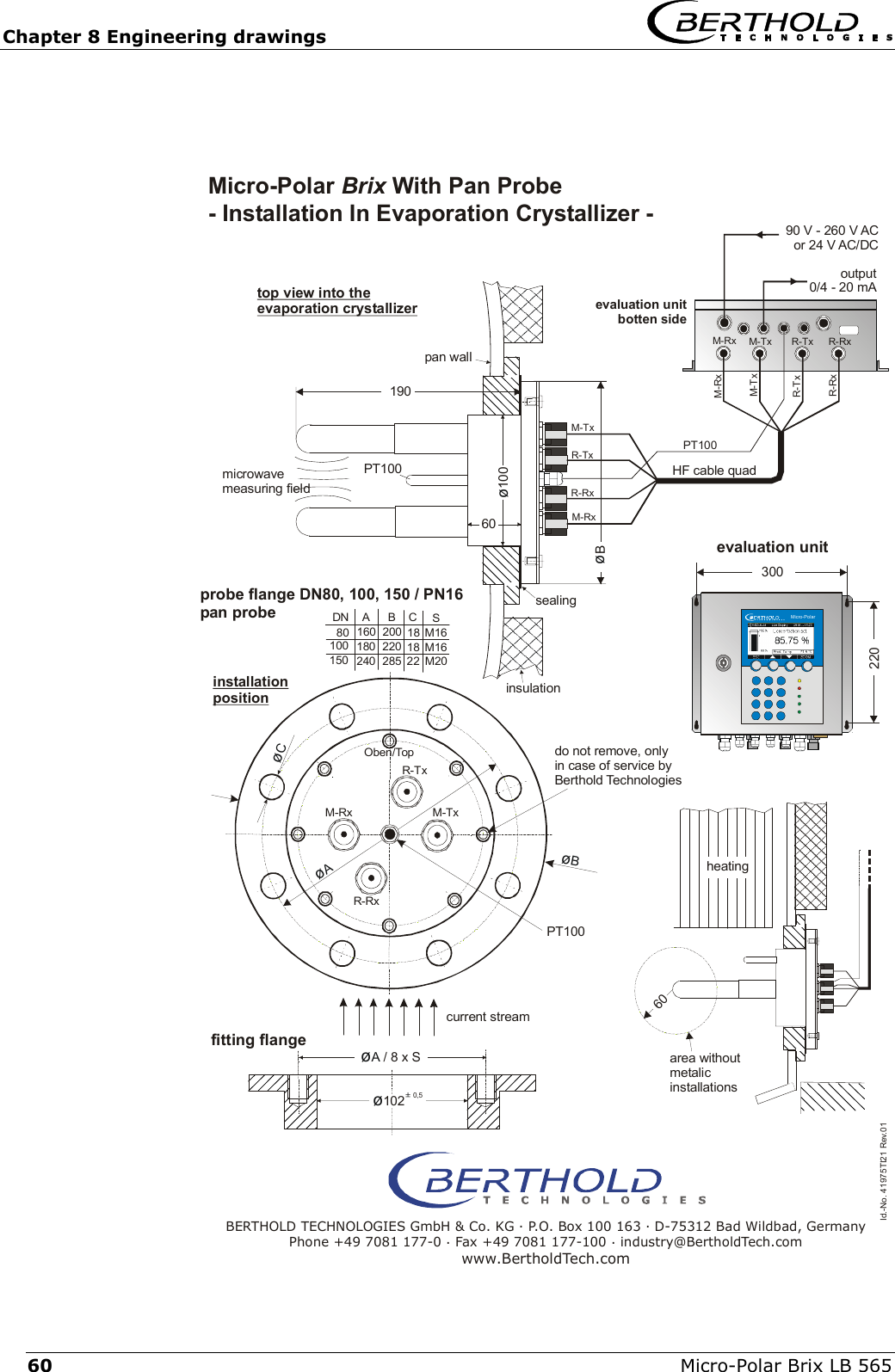
Chapter 4 Getting Started   Micro-Polar Brix LB 565 28  The probe has to be flange-mounted on the container such that the product being measured flows between both measuring rods. In other words, the fork (both measuring rods) has to be arranged vertically to the material flow (e.g. sugar strike).  The distance between the measuring rod tips and any metal-lized walls (heating element, stirrer, container wall) should be at least a = 60 mm.  For installation of the probe you need a hole diameter in the connection flange of at least ∅∅∅∅ 102 mm.  For further installation dimensions please refer to chapter 8 (see installation sheets).  Rinse Parameters (only with continuous pan probe) The sugar quality or purity is essential for the rinse parameters, i.e. rinse frequency and duration. The rinse parameters may change with the purity of the solution and have to be adapted, in individual cases, to the product and the crystallization process.  The following typical rinse parameters are used:  Frequency   Every 2 hours Duration  12 seconds Rinse solution   Water, condensate Temperature of rinse solution Average product temperature,  typically 65 ±5°C Pressure  ≥ 3 bar, max. 8 bar Connections  2 x 3/8 inch (female screw thread) Supply pipe   ≥ 1/2 inch  The rinse connections can be rinsed at the same time or one after the other. The above rinse parameters have to be observed for each connection.  Note!  The required rinse duration has to take into account a possible inertness of the system, e.g. valve openings. The rinse supply pipes have to be insulated well against heat, in order to prevent an initially colder rinse solution.  Rinse parameters
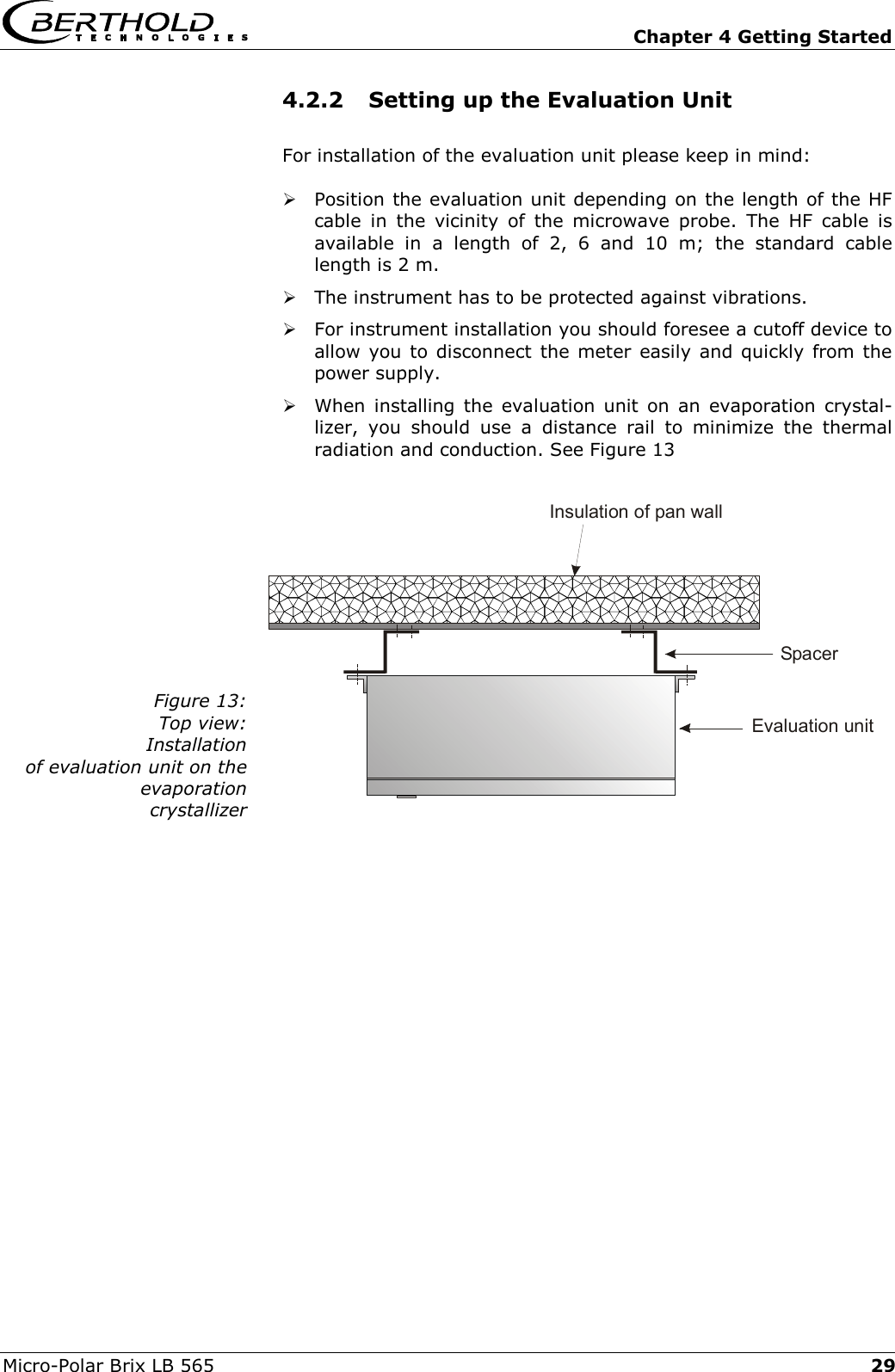
  Chapter 4 Getting Started Micro-Polar Brix LB 565  294.2.2  Setting up the Evaluation Unit For installation of the evaluation unit please keep in mind:  Position the evaluation unit depending on the length of the HF cable in the vicinity of the microwave probe. The HF cable is available in a length of 2, 6 and 10 m; the standard cable length is 2 m.  The instrument has to be protected against vibrations.  For instrument installation you should foresee a cutoff device to allow you to disconnect the meter easily and quickly from the power supply.  When installing the evaluation unit on an evaporation crystal-lizer, you should use a distance rail to minimize the thermal radiation and conduction. See Figure 13  Figure 13: Top view: Installation  of evaluation unit on the  evaporation  crystallizer    Insulation of pan wallSpacerEvaluation unit
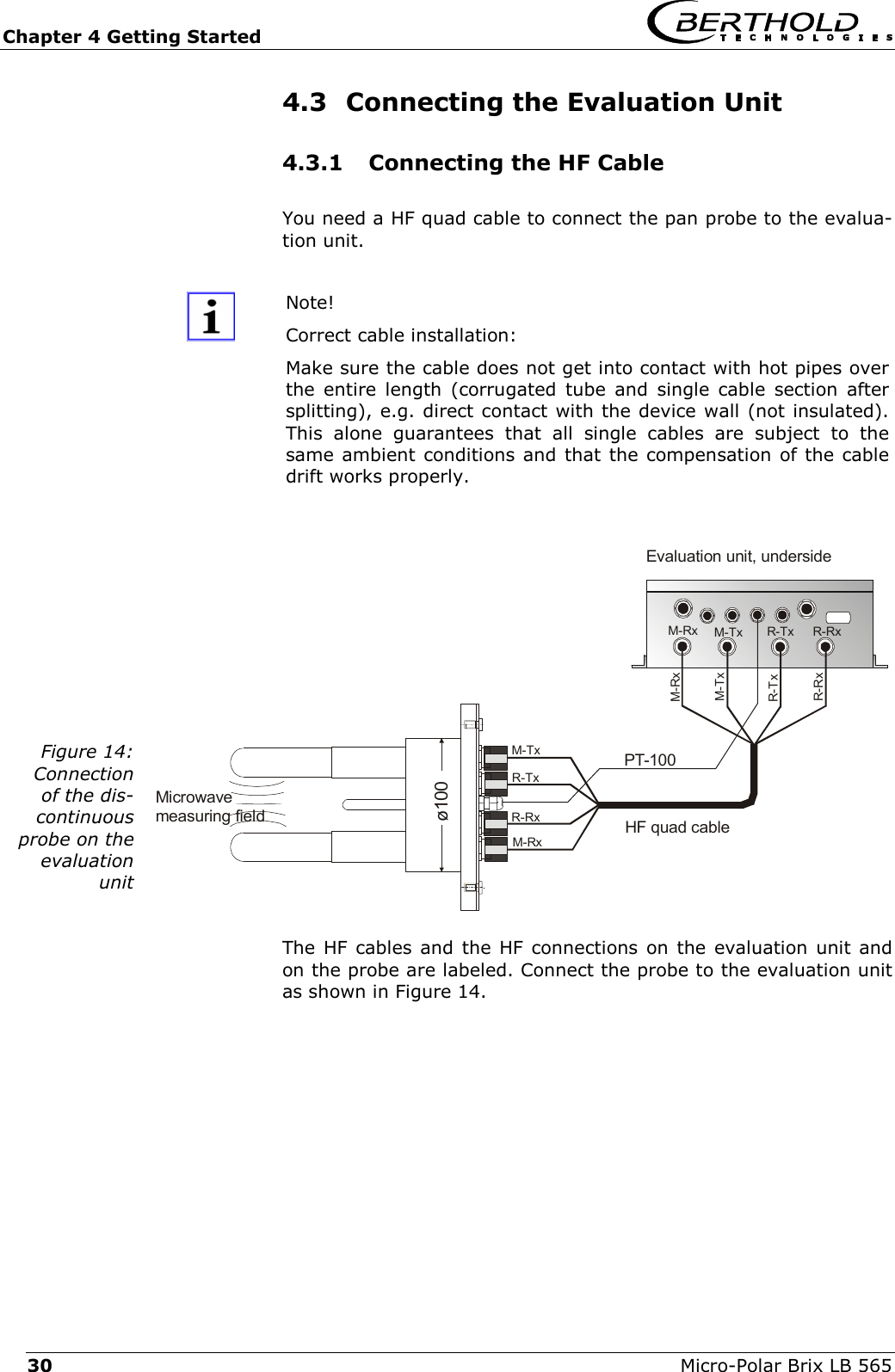
Chapter 4 Getting Started   Micro-Polar Brix LB 565 30 Microwavemeasuring fieldEvaluation unit, undersideø100PT-100HF quad cableM-TxM-TxM-TxM-RxM-RxR-TxR-TxR-RxR-RxM-RxR-TxR-Rx4.3  Connecting the Evaluation Unit 4.3.1  Connecting the HF Cable You need a HF quad cable to connect the pan probe to the evalua-tion unit.  Note!  Correct cable installation: Make sure the cable does not get into contact with hot pipes over the entire length (corrugated tube and single cable section after splitting), e.g. direct contact with the device wall (not insulated). This alone guarantees that all single cables are subject to the same ambient conditions and that the compensation of the cable drift works properly.   Figure 14: Connection of the dis-continuous probe on the evaluation unit    The HF cables and the HF connections on the evaluation unit and on the probe are labeled. Connect the probe to the evaluation unit as shown in Figure 14.
  Chapter 4 Getting Started Micro-Polar Brix LB 565  31 Note!  When tightening the 21 mm screw nut, make sure that the con-nector is not twisted on the cable. If the connector is twisted rela-tive to the cable, the shielding may get damaged and this could result in mismatching and bad sealing.  Hand tighten all screwed connections of the HF cable (2 Nm = 0.2 kg/m)! Before tightening, carefully screw on the cable by hand. Caution! Threaded joint jams easily.  Occasionally you should check if the screwed connection is still properly tightened. If the installation is exposed to vibrations, the screwed connection may come loose and this may result in inaccu-rate measurements or corrosion of the connections. As long as the cables are not connected, the coaxial sockets have to be covered immediately with plastic caps and the cable connec-tors have to be protected by suitable provisions against moisture and dirt.   Note!  Never bend HF cables! The bending radius should not be less than 100 mm. After installation, fix cables with cable binders or other suitable means, so that the cable cannot slip any more!
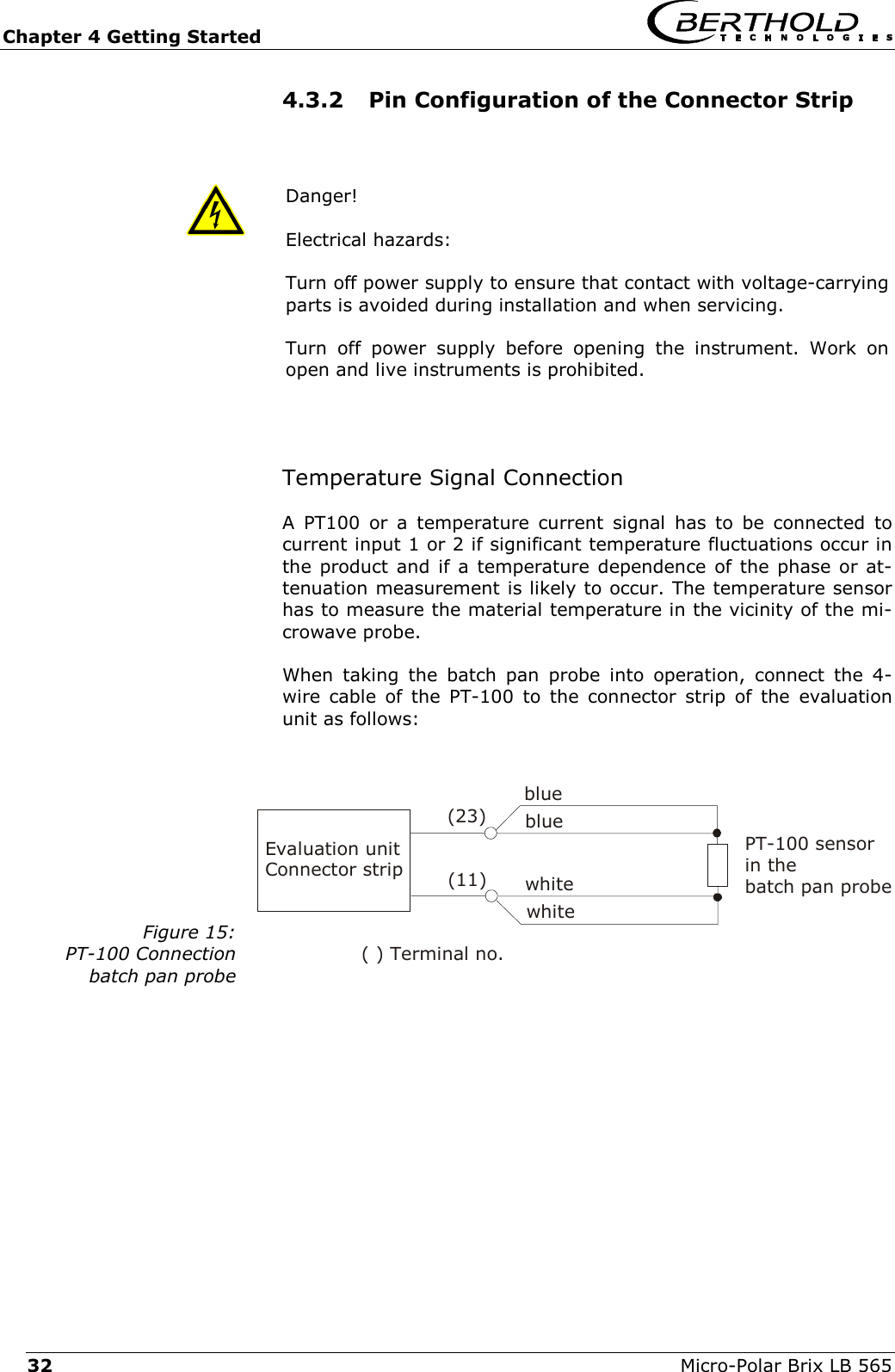
Chapter 4 Getting Started   Micro-Polar Brix LB 565 32 4.3.2  Pin Configuration of the Connector Strip  Danger!  Electrical hazards: Turn off power supply to ensure that contact with voltage-carrying parts is avoided during installation and when servicing. Turn off power supply before opening the instrument. Work on open and live instruments is prohibited.    Temperature Signal Connection A PT100 or a temperature current signal has to be connected to current input 1 or 2 if significant temperature fluctuations occur in the product and if a temperature dependence of the phase or at-tenuation measurement is likely to occur. The temperature sensor has to measure the material temperature in the vicinity of the mi-crowave probe.  When taking the batch pan probe into operation, connect the 4-wire cable of the PT-100 to the connector strip of the evaluation unit as follows:  Figure 15: PT-100 Connection batch pan probe   Evaluation unitConnector strip( ) Terminal no.(23)bluewhitewhitebluePT-100 sensor in the  batch pan probe(11)
  Chapter 4 Getting Started Micro-Polar Brix LB 565  33Other Connections  Connect all desired input and output signals to the terminal strip as shown on the following pages. Use the M feed-through to keep the degree of protection.   Check if the voltage indicated on the type plate matches your local supply voltage.  Connect the line cable to the terminals 3(L1), 2(N) and 1(PE).  Check if the test switch (mains interruption) is in position „on“ (see Figure 17).  Close the instrument housing and turn on the power supply.   The line cross-section for power supply must be at least 1.0 mm2.
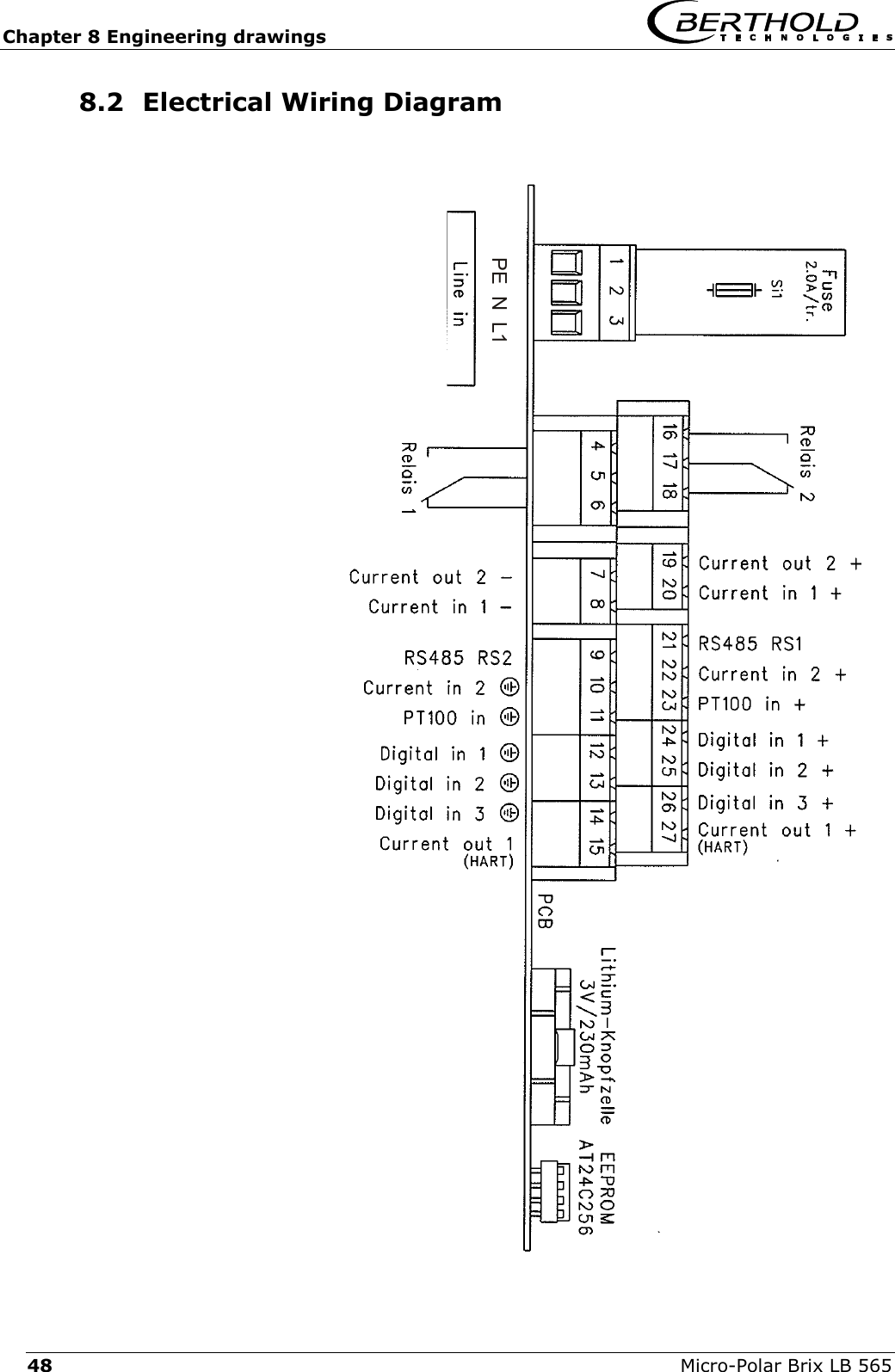
Chapter 4 Getting Started   Micro-Polar Brix LB 565 34 On the connector strip of the evaluation unit you find the following connections:  Figure 16: Wiring diagram LB 565   Power supply: Terminals 3 (L1), 2 (N) and 1 (PE) 90 V - 260 V AC, 45 - 65 Hz or 24 V AC/DC, DC: 18 V … 36 V ; AC: 24 V +5%, -20%; 45…65 Hz Depending on the type of system, see type plate on the outer wall of the housing.  Current input no. 1 (terminals 20+ and 8-), insulated Input as 0/4 - 20 mA signal. For example, for temperature com-pensation or reference signal recording.  Current input no. 2 (terminals 22+ and 10-), not insulated Input as 0/4 - 20 mA signal. For example, for temperature com-pensation or reference signal recording.  Current output no. 1 (terminals 27+ and 15-), insulated Output as 4 - 20 mA signal. Output options: concentrations (1 / 2), current inputs signals (1 / 2) and PT100 signal  PE  N  L1
  Chapter 4 Getting Started Micro-Polar Brix LB 565  35Current output no. 2 (terminals 19+ and 7-), insulated Output as 0/4 - 20 mA signal. Output options: concentrations 1 and 2, current input signals 1 and 2 and PT100 signal  PT100 (terminals 23+ and 11-) Connection for temperature measurement.  Digital input 1: DI1 (terminals 24+ and 12-) Configuration options:  no function  measurement: start (closed) and stop (open)  Digital input 2: DI2 (terminals 25+ and 13-) Configuration options:  no function  average value: hold (closed) and continue averaging (open)  product selection: product 1 (open) and product 2 (closed)  Digital input 3: DI3 (terminals 26+ and 14-) Configuration options:  no function  start sampling, open: no action, closed: unique measurement starts  product selection  Relay 1: (terminals 4, 5 and 6) Changeover contacts, insulated, configuration option:  no function  error message  measurement stopped  limit value min. and max.  no product
Chapter 4 Getting Started   Micro-Polar Brix LB 565 36 Relay 2: (terminals 16, 17 and 18) Changeover contacts, insulated, configuration option:  no function  error message  measurement stopped  limit value min. and max.  no product  RS485 interface (terminals 21 (RS1) and 9 (RS2)) Transfer rate 38400 baud, 8 data bits, 1 stop bit, no parity, no handshake. Bidirectional, serial data interface for communication and protocol output  RS232 interface (on instrument underside) 9-pole D-connectors. Data transfer rate 38400 baud, 8 data bits, 1 stop bit, no parity, no handshake. Bidirectional, serial data inter-face for communication and protocol output.
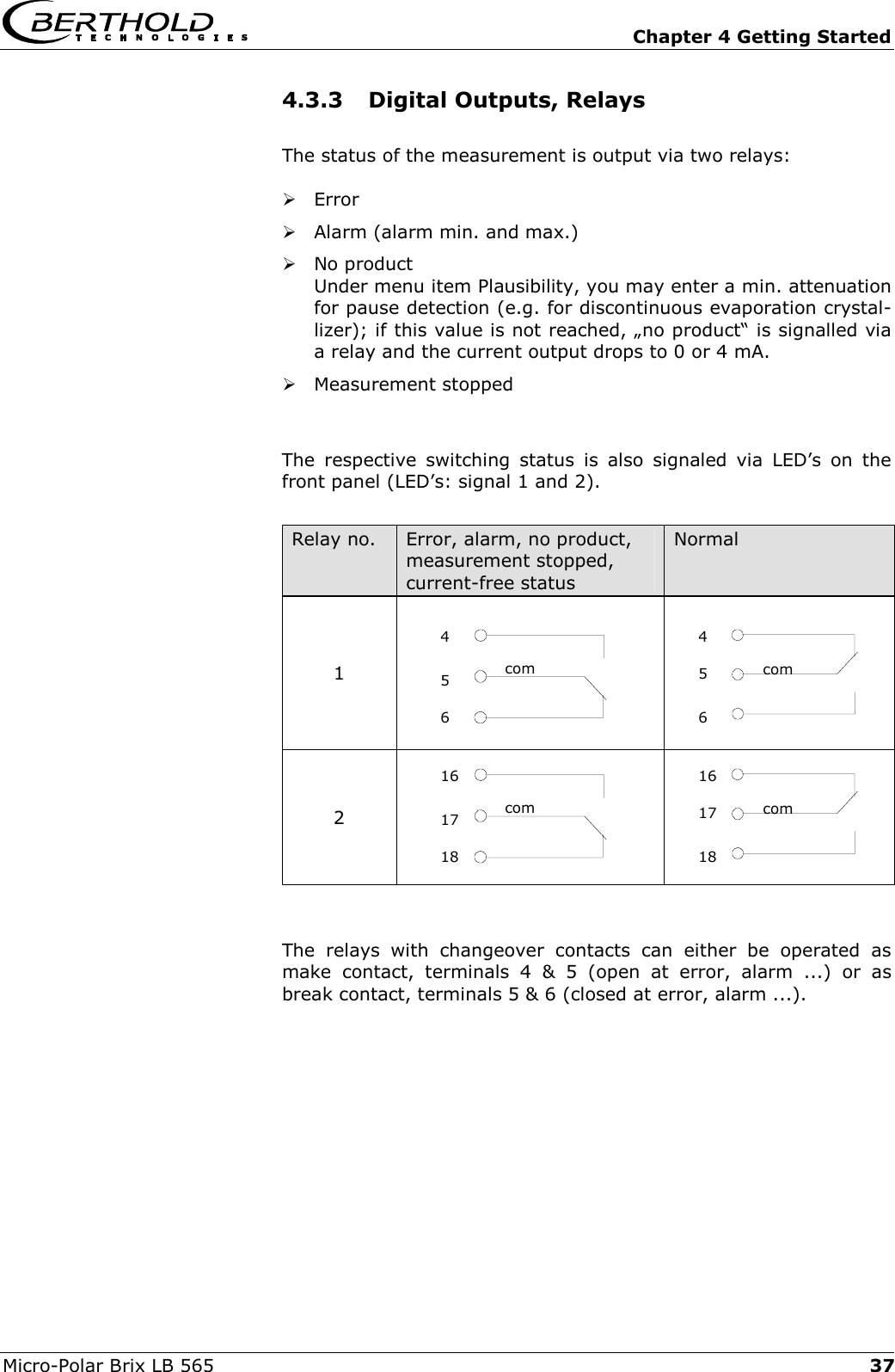
  Chapter 4 Getting Started Micro-Polar Brix LB 565  374.3.3  Digital Outputs, Relays The status of the measurement is output via two relays:  Error  Alarm (alarm min. and max.)  No product Under menu item Plausibility, you may enter a min. attenuation for pause detection (e.g. for discontinuous evaporation crystal-lizer); if this value is not reached, „no product“ is signalled via a relay and the current output drops to 0 or 4 mA.  Measurement stopped  The respective switching status is also signaled via LED’s on the front panel (LED’s: signal 1 and 2).  Relay no.  Error, alarm, no product, measurement stopped, current-free status Normal 1    2    The relays with changeover contacts can either be operated as make contact, terminals 4 & 5 (open at error, alarm ...) or as break contact, terminals 5 & 6 (closed at error, alarm ...).  com456com 161718com4 6 5 com16 18 17
Chapter 5 Service Instructions   Micro-Polar Brix LB 565 38 Chapter 5. Service Instructions   5.1 General Information The evaluation unit has no wearing parts or components requiring any special maintenance. A malfunction of the measuring system is not always due to a de-fect in the instrument. Often the error is caused by incorrect op-eration, wrong installation, or irregularities in the product being measured.  If a malfunction occurs, anyway, the measuring system helps you to identify and eliminate errors by displaying error messages on the LCD, indicating operator errors and defects of the electronics. Moreover, the modular design of the measuring system simplifies the replacement of individual module components. Usually, faulty modules of the evaluation unit cannot be repaired but have to be replaced. The microwave module is fixed with screws to a shielding cover and must not be opened.  5.2 Instrument Cleaning Clean all system components using only a moistened cloth without chemical cleaning agent. Parts coming into contact with the prod-uct (during regular operation) can be cleaned with hot water, tak-ing into account the temperature limits (see chapter 6.2).  5.3 Batteries If the measuring system LB 565 is without power supply (power failure or disconnected from mains), the system clock is supplied with power via the Lithium battery on the CPU. The instrument works correctly even with empty battery, only measured data which are output via one of the serial interfaces may become use-less as a result of the faulty date and time information. The service life of the battery, even under continuous load, is at least 8 years. To replace the battery, you have to disconnect the instrument from mains. Battery data see chapter 8.2 Electrical Wiring Diagram. Battery type: 3 Volt Lithium cell (button cell), type CR2032.
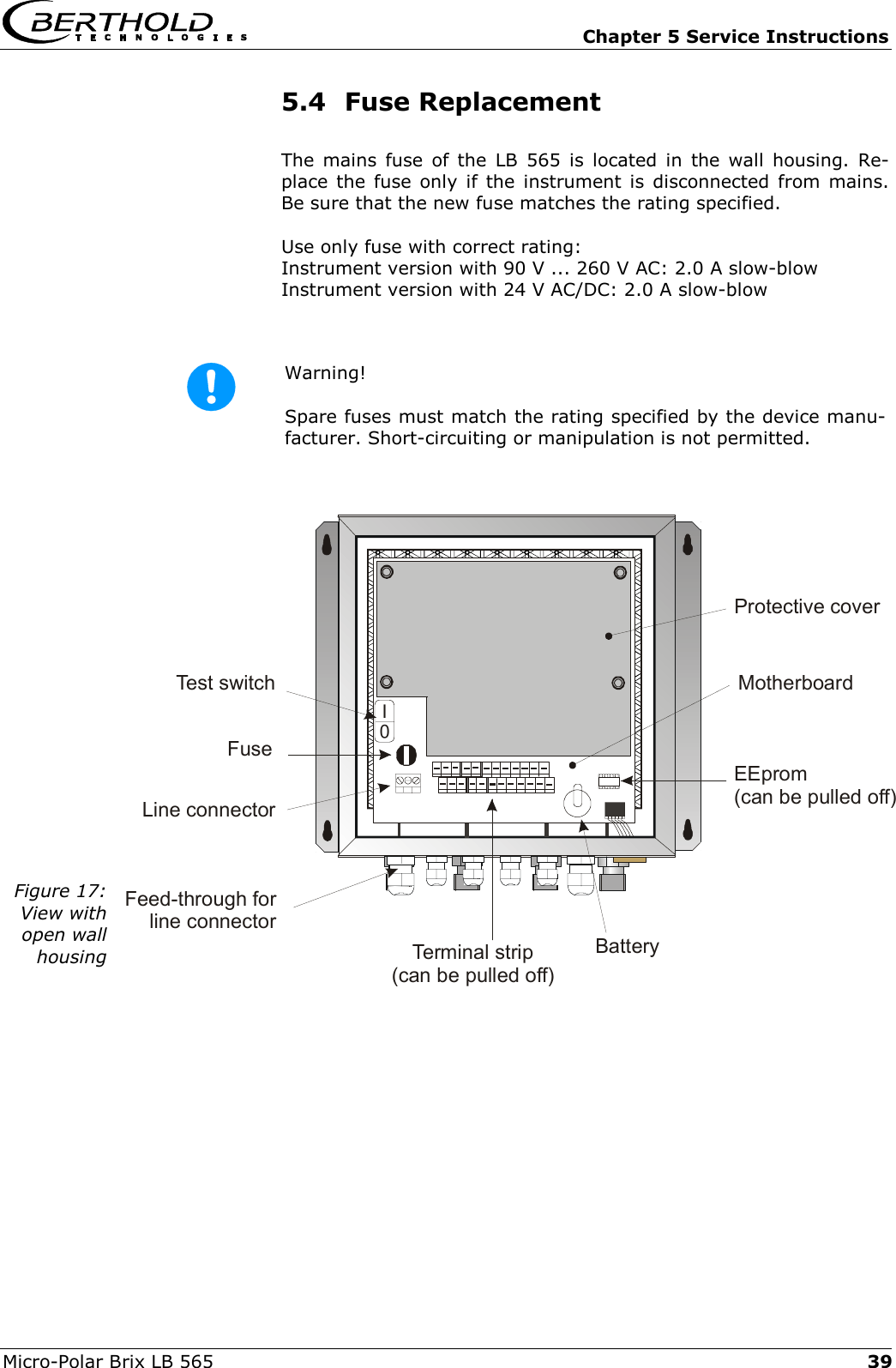
  Chapter 5 Service Instructions Micro-Polar Brix LB 565  39    0INetzteilFuseLine connectorTerminal strip(can be pulled off)BatteryEEprom(can be pulled off)Feed-through forline connectorTest switch MotherboardProtective cover5.4 Fuse Replacement The mains fuse of the LB 565 is located in the wall housing. Re-place the fuse only if the instrument is disconnected from mains. Be sure that the new fuse matches the rating specified. Use only fuse with correct rating: Instrument version with 90 V ... 260 V AC: 2.0 A slow-blow Instrument version with 24 V AC/DC: 2.0 A slow-blow  Warning!  Spare fuses must match the rating specified by the device manu-facturer. Short-circuiting or manipulation is not permitted.  Figure 17: View with open wall housing
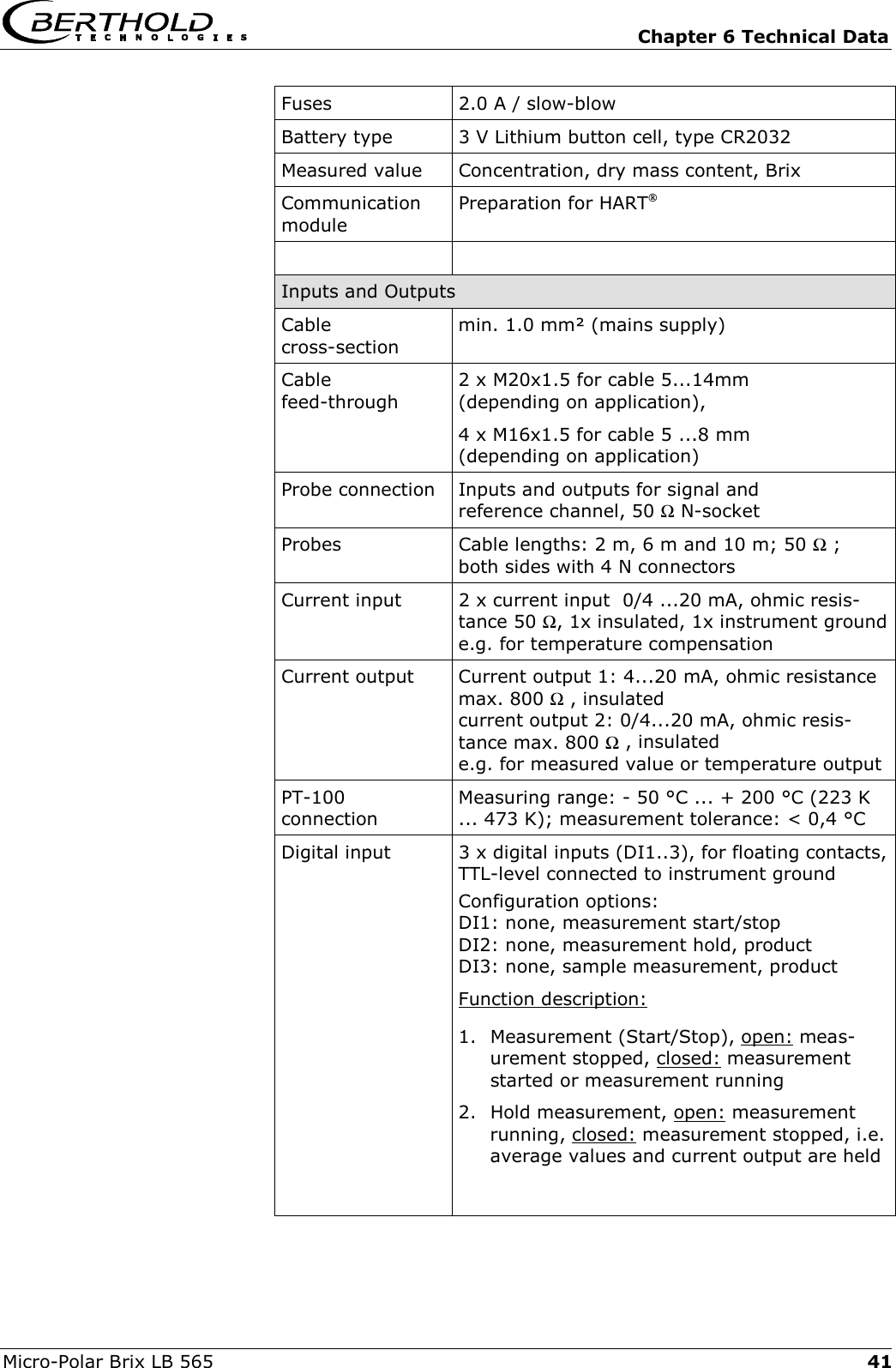
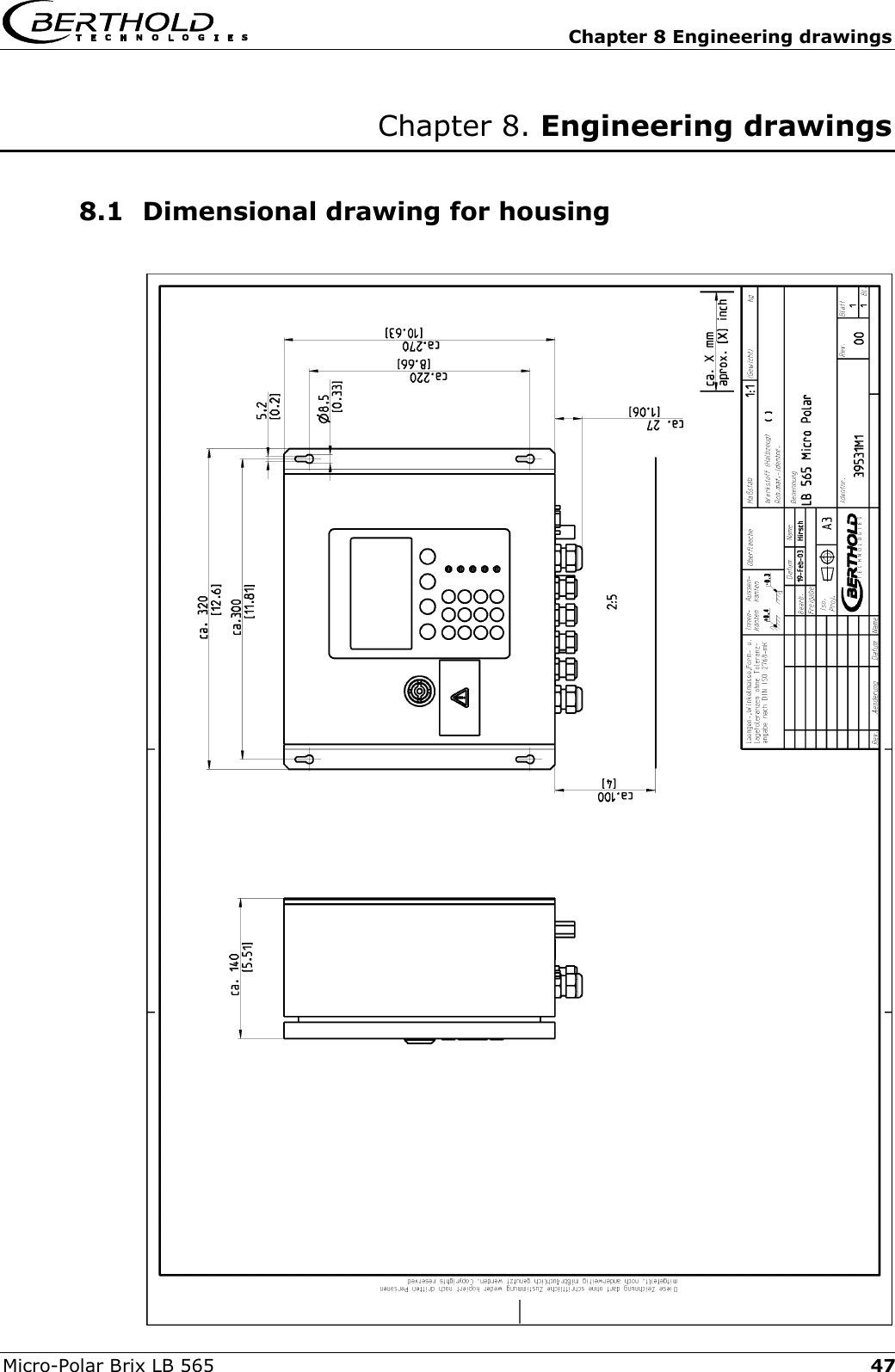
Chapter 6 Technical Data   Micro-Polar Brix LB 565 40 Chapter 6. Technical Data   General Specifications  Method  Microwave transmission measurement   Working frequency 2.4 – 2.5 GHz (ISM band), depending on local regulations  Transmission  power < 0.1 mW (< - 10 dBm), coaxial line power Applications  Concentration measurement in sugar solutions in containers and pipes    6.1 Evaluation Unit  Evaluation Unit Housing Wall housing made of stainless steel, material 1.4571 (~316+Ti), HxWxD: 300 x 323 x 140 mm, see dimensional drawing in chapter 8 Protection type  IP 65 Weight  approx. 6.5 kg Operating temperature 0 °C ... + 60 °C ( 273 K ...333 K ),  no condensation Storage  temperature - 20 °C ... + 80 °C ( 253 K ... 353 K ),  no condensation Display  Dot matrix LC display, 114 mm x 64 mm, 240 x 128 pixels, with back-lighting, automatic con-trast setting Keyboard  Freely accessible foil keypad, light-stable and weatherproof: alphanumeric keyboard and 4 softkeys (software-assigned buttons) Power supply Depending on instrument version: 1.  90 V - 260 V AC, 45 Hz – 65 Hz 2.  24 V AC/DC; DC: 18 V – 36 V; AC: 24 V +5%,  -20%, 45 Hz – 65Hz Power  consumption  max. 30 VA (AC/DC),  depending on configuration
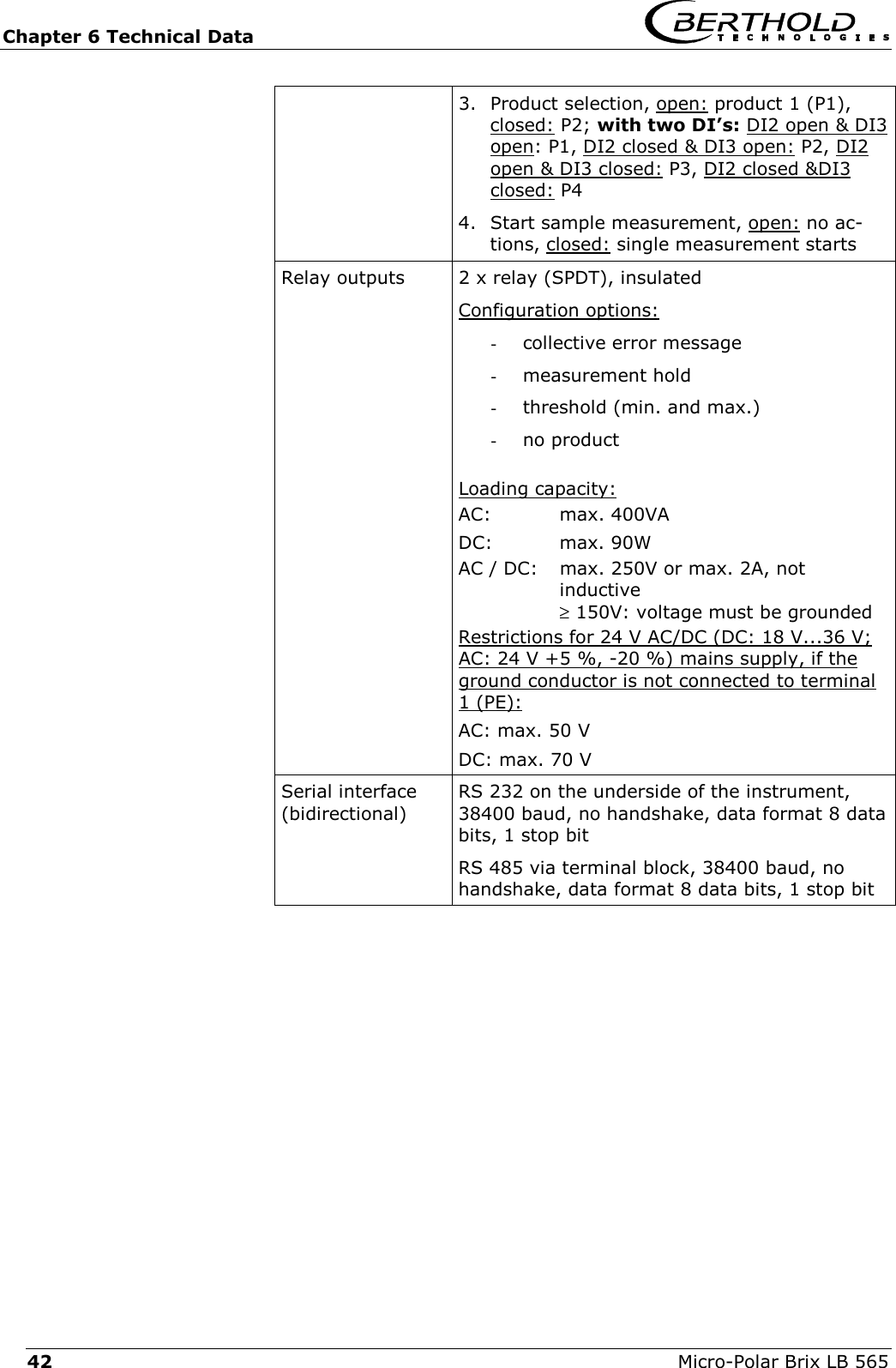
 Chapter 6 Technical Data Micro-Polar Brix LB 565  41Fuses  2.0 A / slow-blow Battery type  3 V Lithium button cell, type CR2032 Measured value  Concentration, dry mass content, Brix Communication module Preparation for HART   Inputs and Outputs Cable  cross-section min. 1.0 mm² (mains supply) Cable  feed-through 2 x M20x1.5 for cable 5...14mm  (depending on application),  4 x M16x1.5 for cable 5 ...8 mm  (depending on application) Probe connection Inputs and outputs for signal and  reference channel, 50 Ω N-socket Probes  Cable lengths: 2 m, 6 m and 10 m; 50 Ω ;  both sides with 4 N connectors  Current input 2 x current input  0/4 ...20 mA, ohmic resis-tance 50 Ω, 1x insulated, 1x instrument grounde.g. for temperature compensation Current output Current output 1: 4...20 mA, ohmic resistance max. 800 Ω , insulated current output 2: 0/4...20 mA, ohmic resis-tance max. 800 Ω , insulated e.g. for measured value or temperature output PT-100  connection Measuring range: - 50 °C ... + 200 °C (223 K ... 473 K); measurement tolerance: < 0,4 °C Digital input   3 x digital inputs (DI1..3), for floating contacts, TTL-level connected to instrument ground  Configuration options: DI1: none, measurement start/stop DI2: none, measurement hold, product DI3: none, sample measurement, product Function description: 1.  Measurement (Start/Stop), open: meas-urement stopped, closed: measurement started or measurement running 2. Hold measurement, open: measurement running, closed: measurement stopped, i.e. average values and current output are held
Chapter 6 Technical Data   Micro-Polar Brix LB 565 42 3.  Product selection, open: product 1 (P1), closed: P2; with two DI’s: DI2 open & DI3 open: P1, DI2 closed & DI3 open: P2, DI2 open & DI3 closed: P3, DI2 closed &DI3 closed: P4 4.  Start sample measurement, open: no ac-tions, closed: single measurement starts Relay outputs  2 x relay (SPDT), insulated Configuration options: -  collective error message -  measurement hold -  threshold (min. and max.) -  no product  Loading capacity: AC: max. 400VA DC: max. 90W AC / DC:  max. 250V or max. 2A, not  inductive  ≥ 150V: voltage must be grounded  Restrictions for 24 V AC/DC (DC: 18 V...36 V; AC: 24 V +5 %, -20 %) mains supply, if the ground conductor is not connected to terminal 1 (PE): AC: max. 50 V DC: max. 70 V Serial interface (bidirectional)RS 232 on the underside of the instrument, 38400 baud, no handshake, data format 8 data bits, 1 stop bit RS 485 via terminal block, 38400 baud, no handshake, data format 8 data bits, 1 stop bit
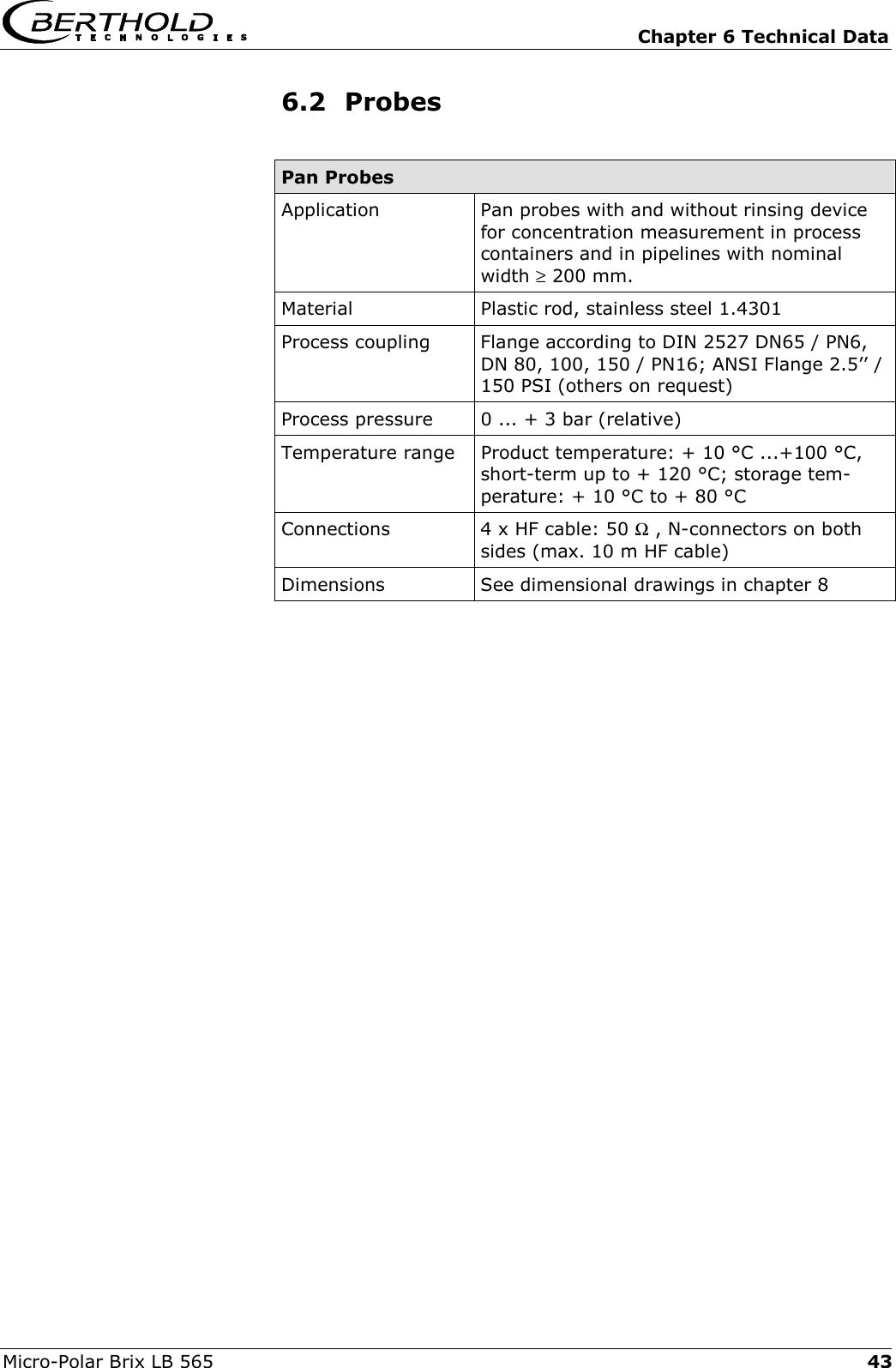
 Chapter 6 Technical Data Micro-Polar Brix LB 565  436.2 Probes  Pan Probes Application  Pan probes with and without rinsing device for concentration measurement in process containers and in pipelines with nominal width ≥ 200 mm. Material  Plastic rod, stainless steel 1.4301 Process coupling  Flange according to DIN 2527 DN65 / PN6, DN 80, 100, 150 / PN16; ANSI Flange 2.5’’ / 150 PSI (others on request) Process pressure  0 ... + 3 bar (relative) Temperature range Product temperature: + 10 °C ...+100 °C, short-term up to + 120 °C; storage tem-perature: + 10 °C to + 80 °C Connections 4 x HF cable: 50 Ω , N-connectors on both sides (max. 10 m HF cable) Dimensions  See dimensional drawings in chapter 8
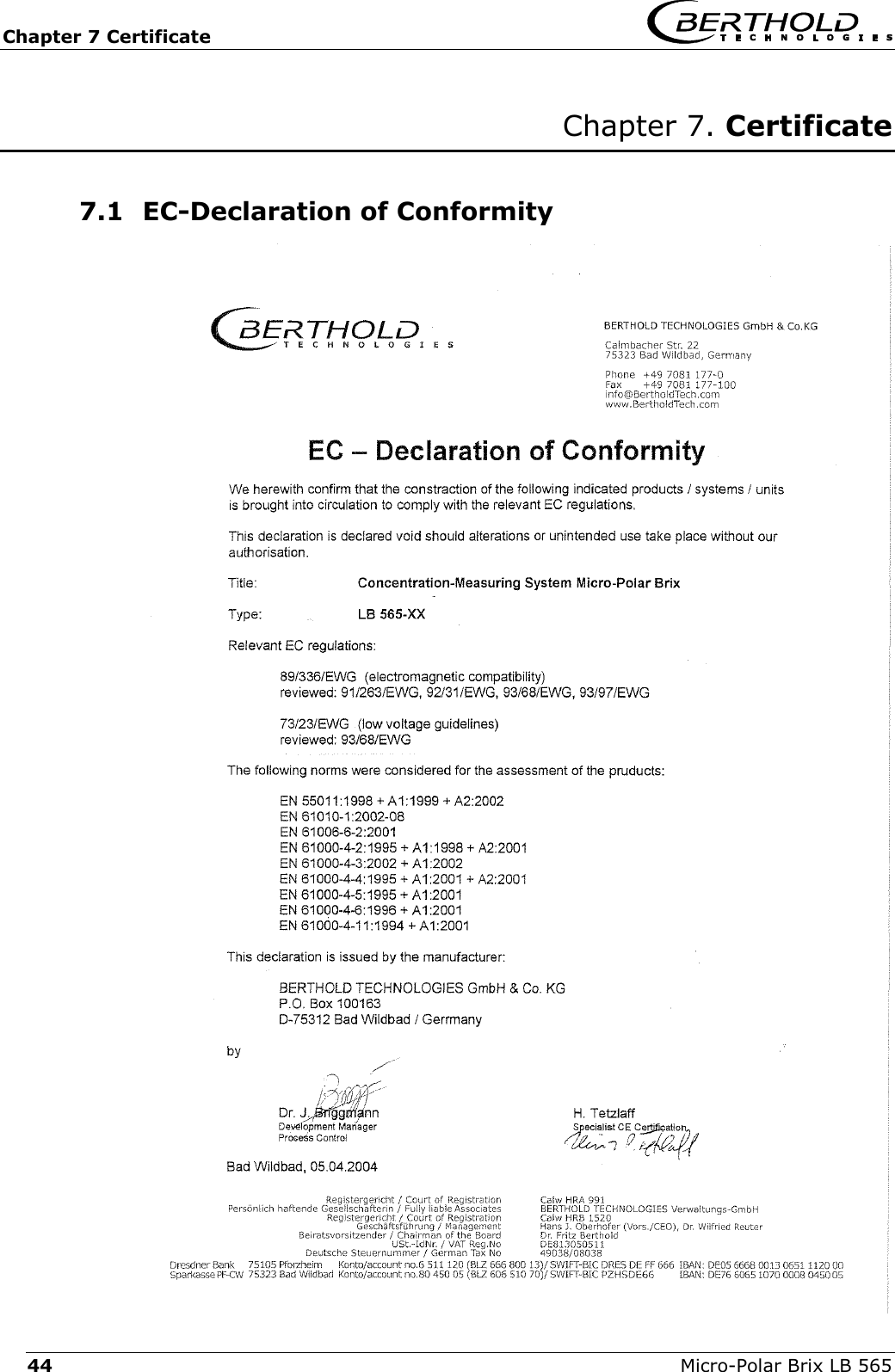
Chapter 7 Certificate   Micro-Polar Brix LB 565 44 Chapter 7. Certificate  7.1 EC-Declaration of Conformity
  Chapter 7 Certificate Micro-Polar Brix LB 565  457.2 Frequency approval
Chapter 7 Certificate   Micro-Polar Brix LB 565 46
  Chapter 8 Engineering drawings Micro-Polar Brix LB 565  47Chapter 8. Engineering drawings  8.1  Dimensional drawing for housing
Chapter 8 Engineering drawings   Micro-Polar Brix LB 565 48 8.2  Electrical Wiring Diagram                 PE  N  L1
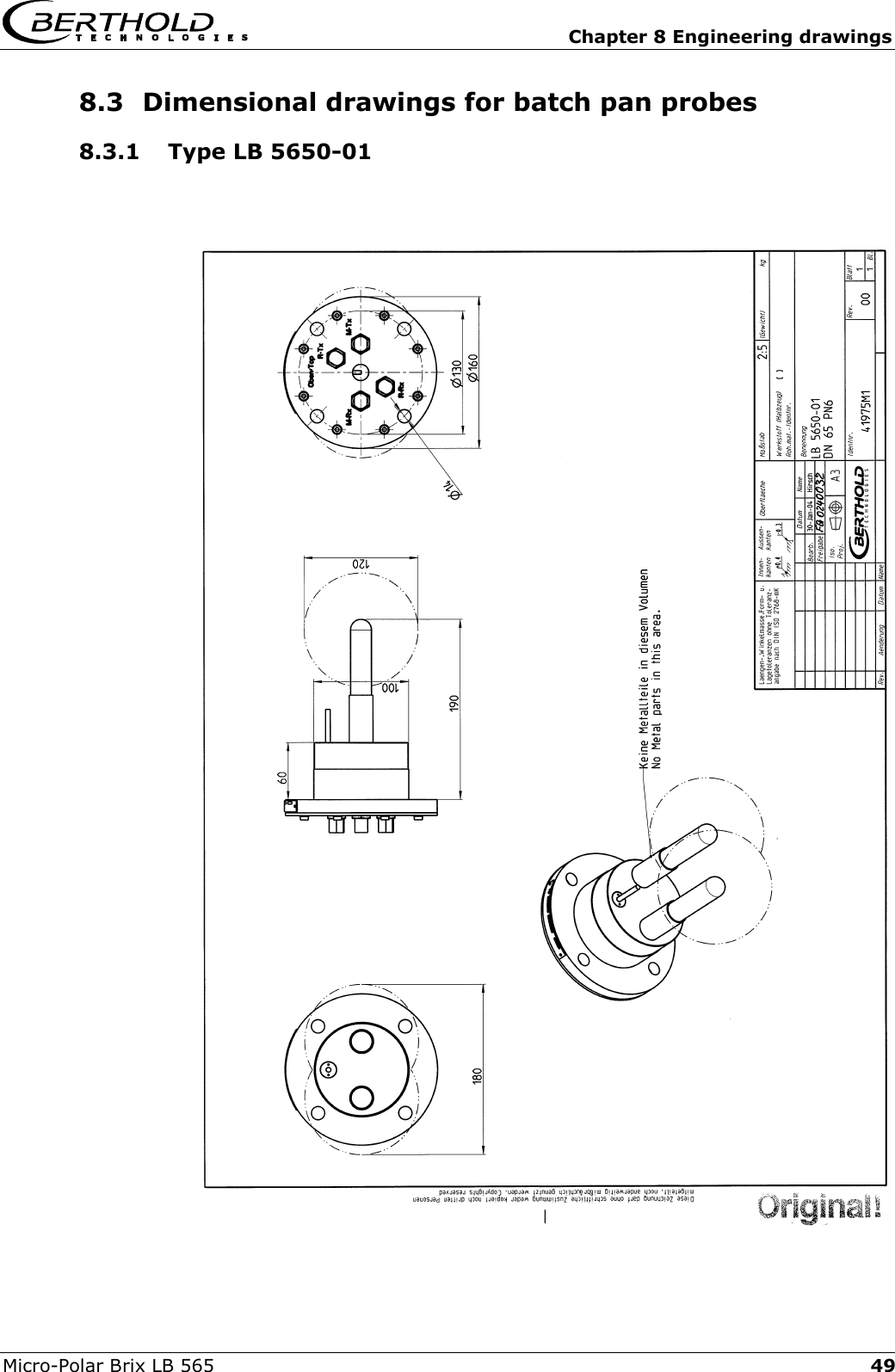
  Chapter 8 Engineering drawings Micro-Polar Brix LB 565  498.3  Dimensional drawings for batch pan probes 8.3.1  Type LB 5650-01
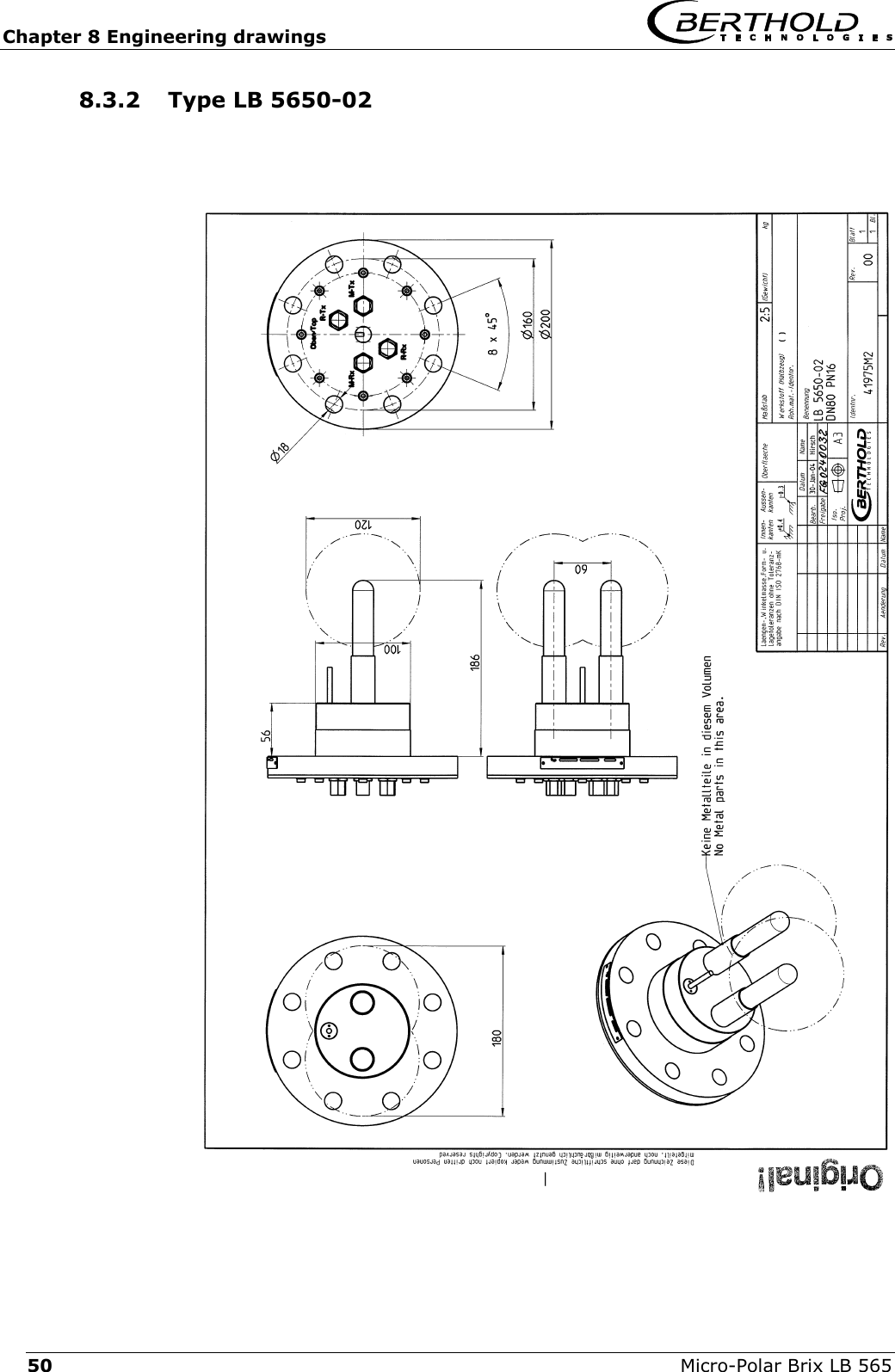
Chapter 8 Engineering drawings   Micro-Polar Brix LB 565 50 8.3.2  Type LB 5650-02
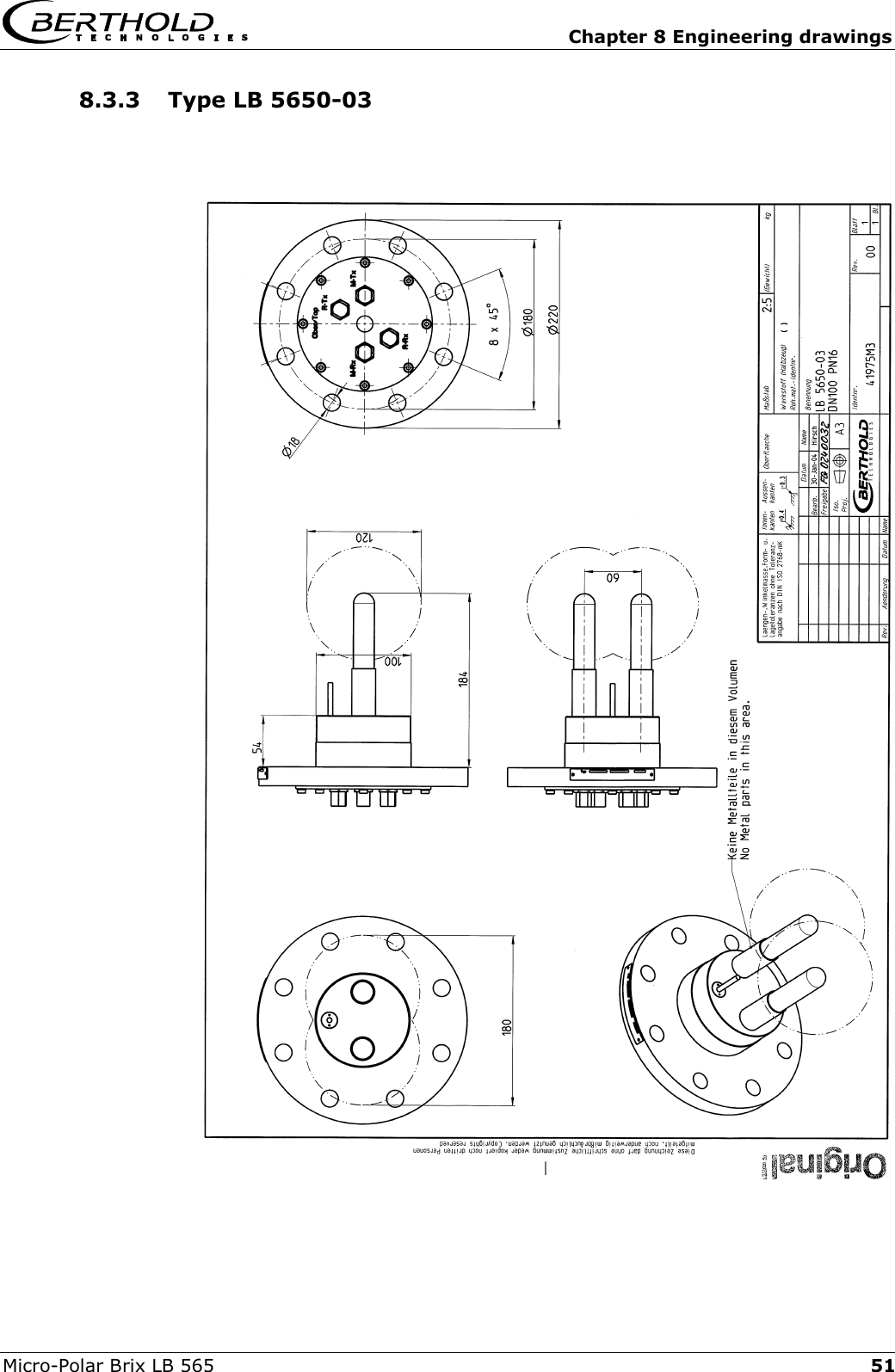
  Chapter 8 Engineering drawings Micro-Polar Brix LB 565  518.3.3  Type LB 5650-03
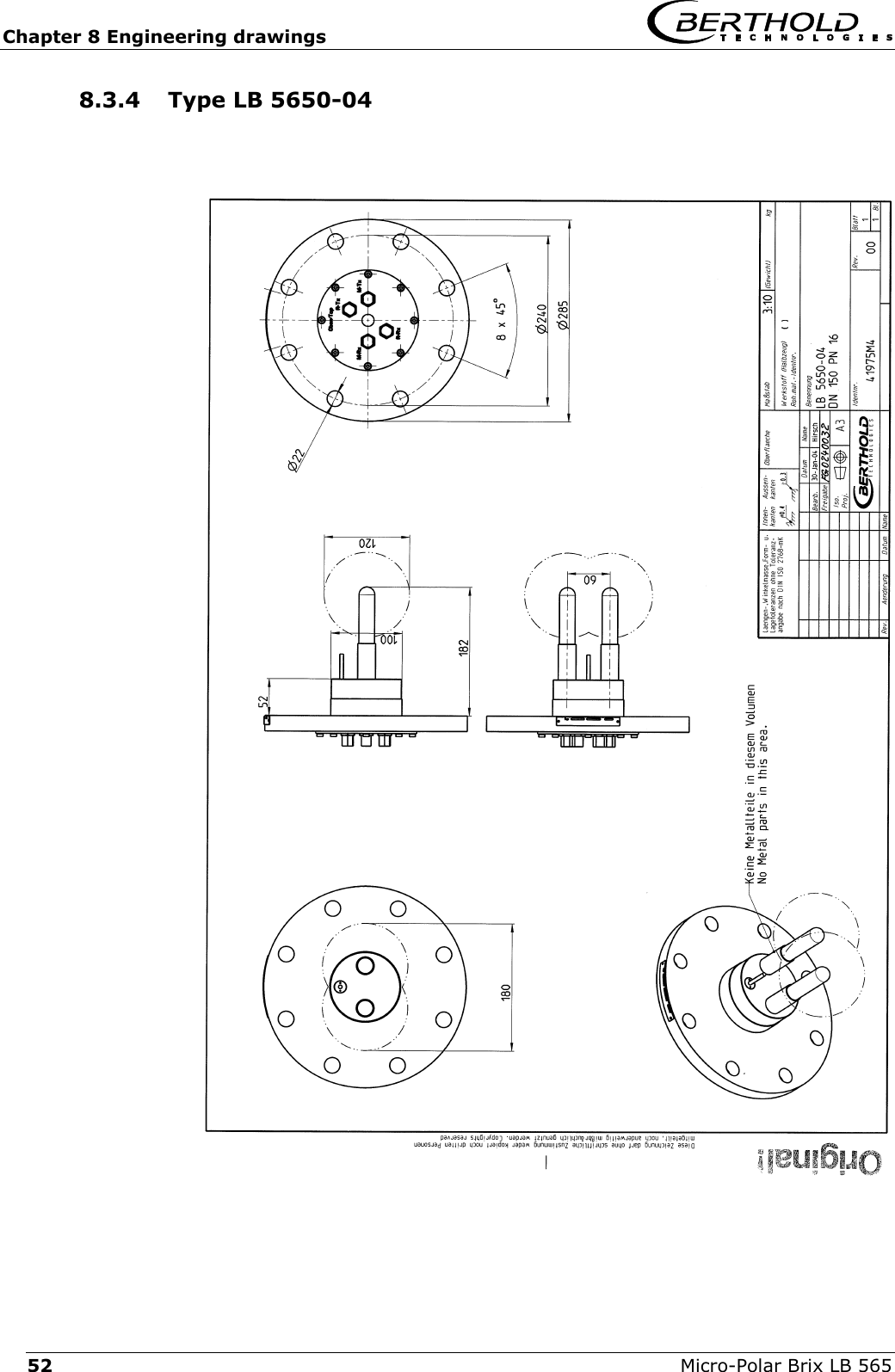
Chapter 8 Engineering drawings   Micro-Polar Brix LB 565 52 8.3.4  Type LB 5650-04
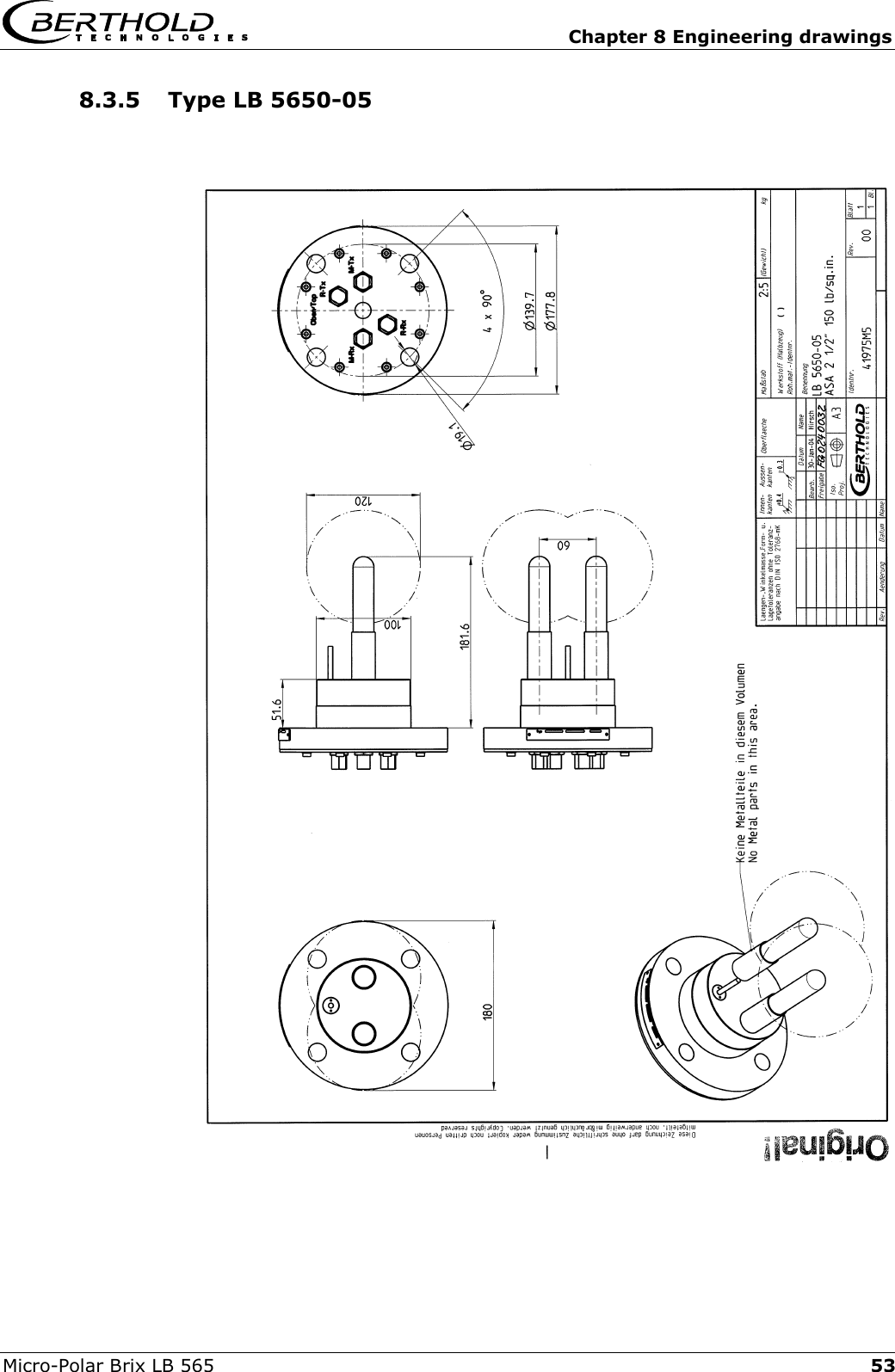
  Chapter 8 Engineering drawings Micro-Polar Brix LB 565  538.3.5  Type LB 5650-05
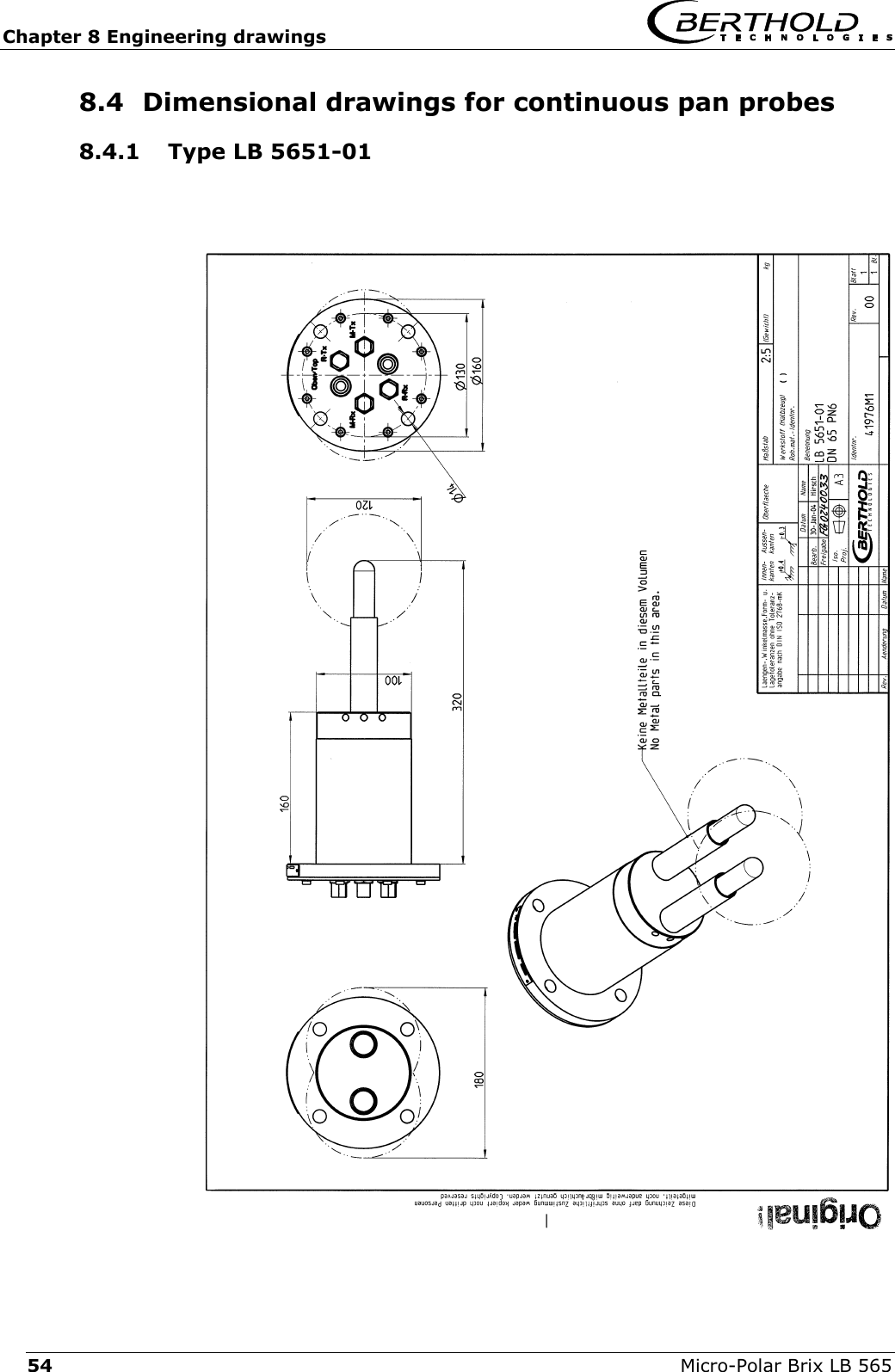
Chapter 8 Engineering drawings   Micro-Polar Brix LB 565 54 8.4  Dimensional drawings for continuous pan probes 8.4.1  Type LB 5651-01
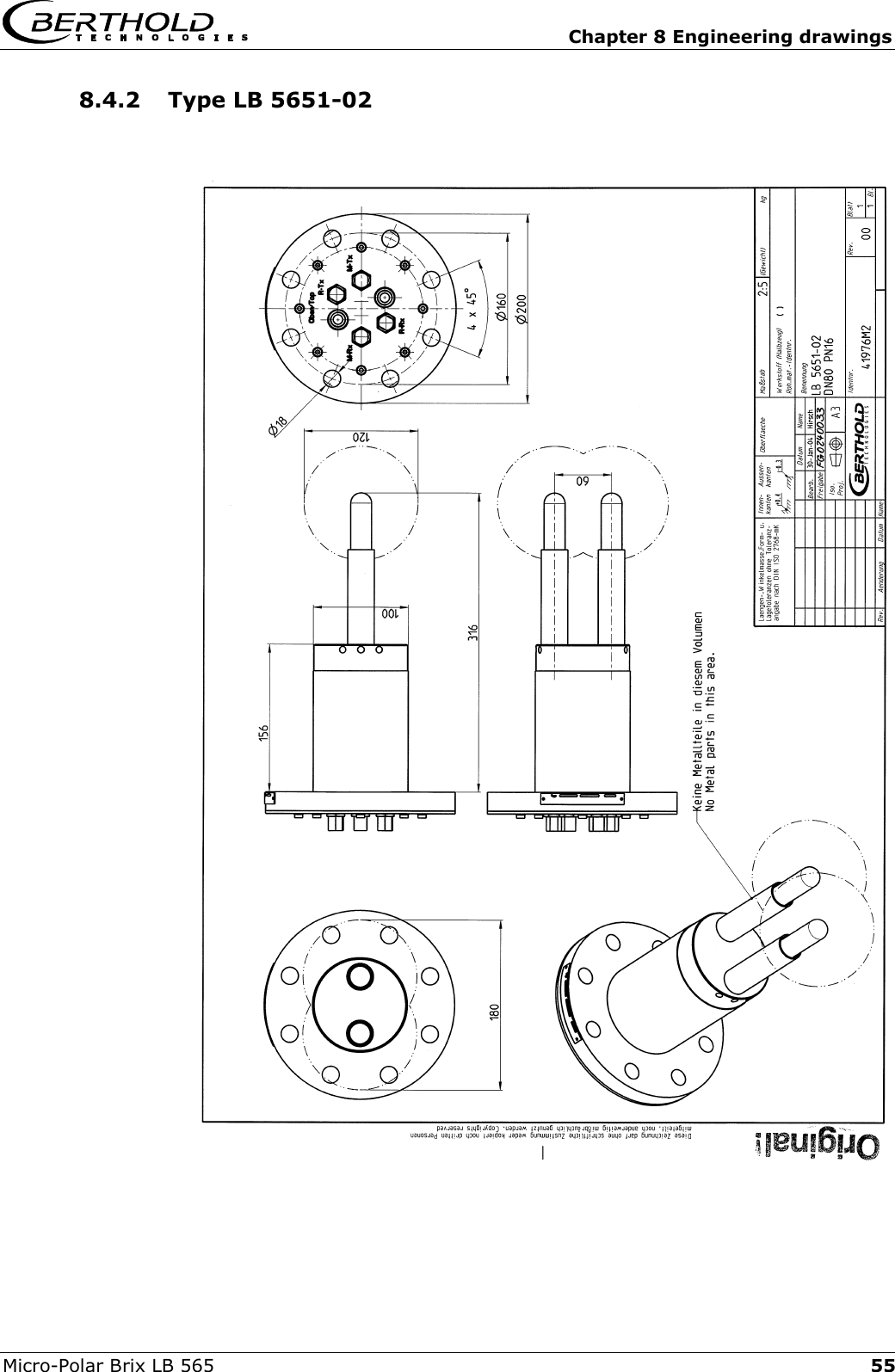
  Chapter 8 Engineering drawings Micro-Polar Brix LB 565  558.4.2  Type LB 5651-02
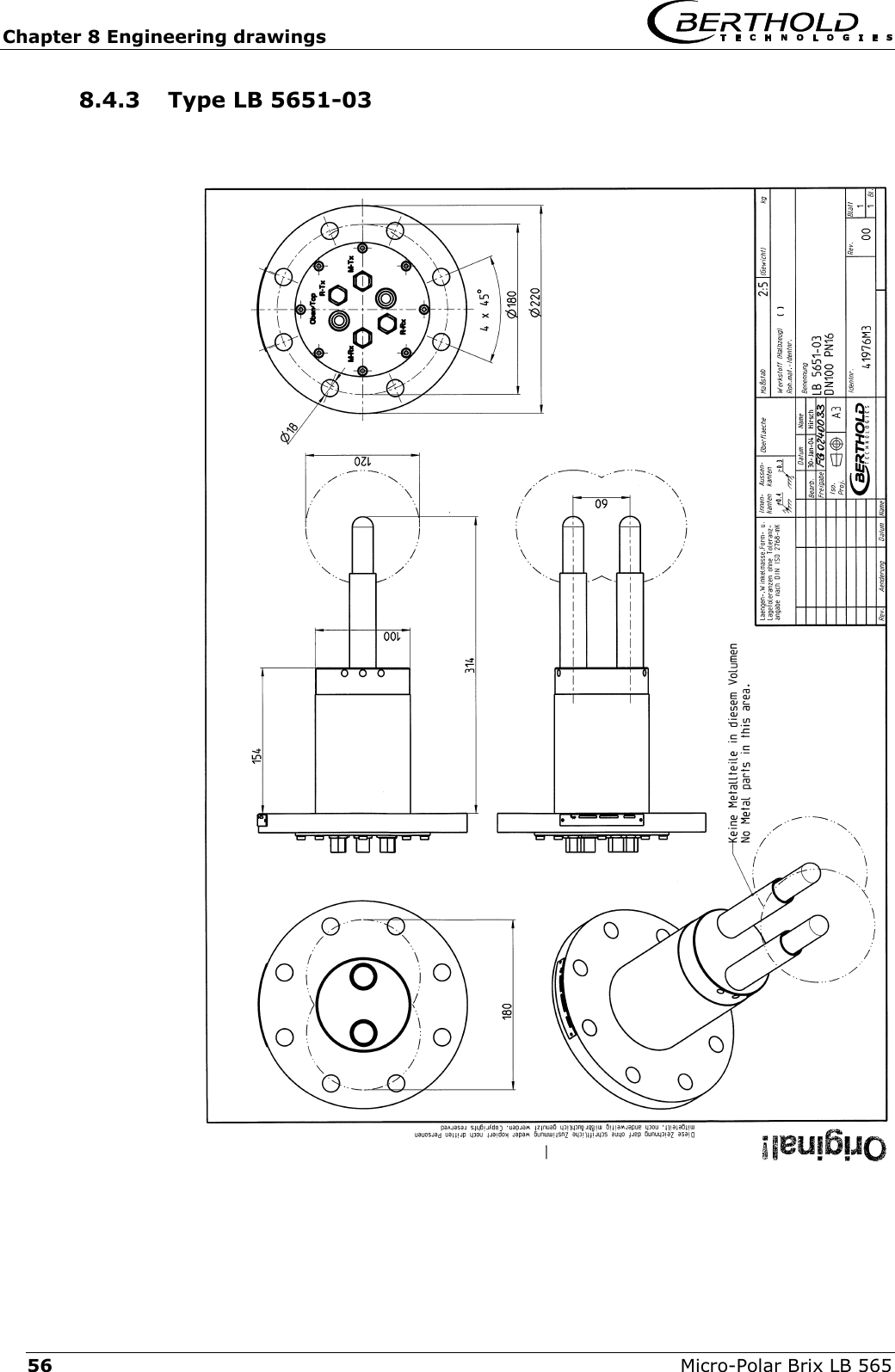
Chapter 8 Engineering drawings   Micro-Polar Brix LB 565 56 8.4.3  Type LB 5651-03
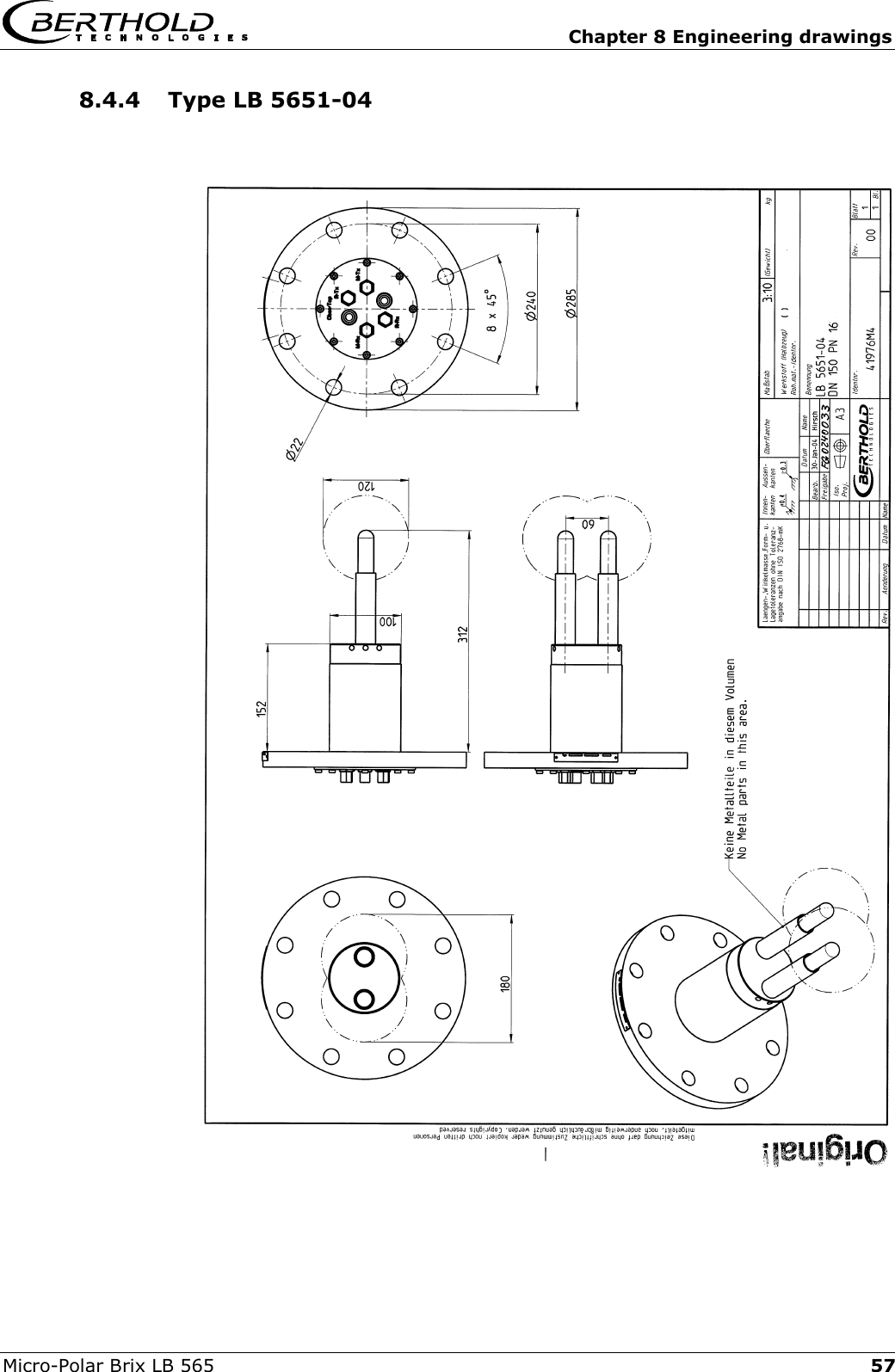
  Chapter 8 Engineering drawings Micro-Polar Brix LB 565  578.4.4  Type LB 5651-04
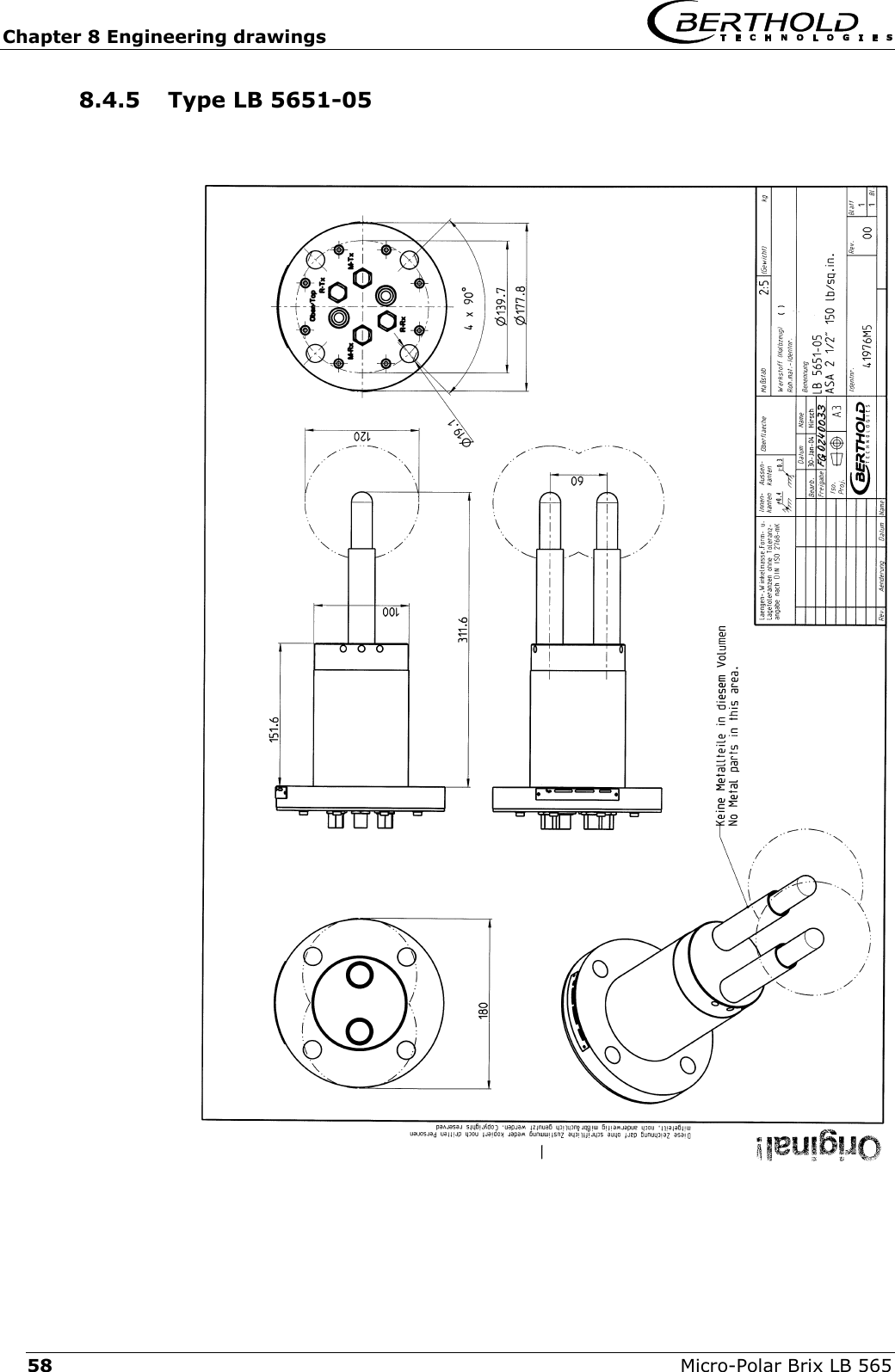
Chapter 8 Engineering drawings   Micro-Polar Brix LB 565 58 8.4.5  Type LB 5651-05
  Chapter 8 Engineering drawings Micro-Polar Brix LB 565  598.5  Installation sheets for LB 5650 (Batch pan probes)   ø14M-RxR-Txdo not remove, onlyin case of service byBerthold TechnologiesR-RxM-Txø160Oben/Topø130microwavemeasuring fieldcurrent streamprobe flange DN65 / PN6pan probeevaluation unitbotten side90 V - 260 V ACor 24 V AC/DCoutput0/4 - 20 mAMicro-Polar  With Pan Probe - Installation In Evaporation Crystallizer - Brixinstallationpositiontop view into the evaporation crystallizersealinginsulationpan wallø130 / 4 x M12190ø100ø16060heatingarea withoutmetalicinstallationsfitting flangeBERTHOLD TECHNOLOGIES GmbH & Co. KG . P.O. Box 100 163 . D-75312 Bad Wildbad, GermanyPhone +49 7081 177-0 . Fax +49 7081 177-100 . industry@BertholdTech.comwww.BertholdTech.com60evaluation unit220300Micro-PolarId.-No. 41975TI2 Rev.01ø± 1020,5PT100PT100PT100M-TxM-TxM-TxM-RxM-RxR-TxR-TxR-RxR-RxM-RxR-TxR-RxHF cable quad
Chapter 8 Engineering drawings   Micro-Polar Brix LB 565 60  90 V - 260 V ACor 24 V AC/DCoutput0/4 - 20 mAsealingId.-No. 41975TI21 Rev.01øA / 8 x S190ø100øB6060220300    Micro-Polarprobe flange DN80, 100, 150 / PN16pan probeinstallationpositionDN ABCS80100160 200 18 M16180 220 18 M16240 28522M20150ø± 1020,5PT100M-TxM-TxM-TxM-RxM-RxR-TxR-TxR-RxR-RxM-RxR-TxR-RxM-RxR-TxR-RxM-TxøCOben/TopøBøAPT100insulationPT100do not remove, onlyin case of service byBerthold Technologiesmicrowavemeasuring fieldpan walltop view into the evaporation crystallizerMicro-Polar  With Pan Probe - Installation In Evaporation Crystallizer - Brixevaluation unitbotten sideHF cable quadevaluation unitheatingarea withoutmetalicinstallationsBERTHOLD TECHNOLOGIES GmbH & Co. KG . P.O. Box 100 163 . D-75312 Bad Wildbad, GermanyPhone +49 7081 177-0 . Fax +49 7081 177-100 . industry@BertholdTech.comwww.BertholdTech.comcurrent streamfitting flange
  Chapter 8 Engineering drawings Micro-Polar Brix LB 565  618.6 Installation sheets for LB 5651 (Continuous pan probes)  ø14M-RxR-Tx90 V - 260 V ACor 24 V AC/DCoutput0/4 - 20 mAinstallationpositionR-RxM-Txø160ø160160ø130 / 4 x M12ø± 1020,5320220300ø100Micro-Polar60Id.-No. 41976TI2 Rev.02M-TxM-TxM-TxM-RxM-RxR-TxR-TxR-RxR-RxM-RxR-TxR-RxOben/Topø13055Micro-Polar  With Continuous Pan Probe - Installation In Evaporation Crystallizer - BrixBERTHOLD TECHNOLOGIES GmbH & Co. KG . P.O. Box 100 163 . D-75312 Bad Wildbad, GermanyPhone +49 7081 177-0 . Fax +49 7081 177-100 . industry@BertholdTech.comwww.BertholdTech.commicrowavemeasuring fieldtop view into the evaporation crystallizerevaluation unitbotten sideHF cable quadevaluation unitsealinginsulationdo not remove, onlyin case of service byBerthold Technologiesheatingarea withoutmetalicinstallationscurrent streamfitting flangeprobe flange DN65 / PN6cont. pan probe2 x 3/8’’flushing connection(internal thread)pan wall
Chapter 8 Engineering drawings   Micro-Polar Brix LB 565 62  M-RxR-TxR-RxM-Tx5590 V - 260 V ACor 24 V AC/DCoutput0/4 - 20 mAøB160øA / 8 x S320ø10060øCinstallationpositionOben/TopøBøADN ABCS80100160 200 18 M16180 220 18 M16240 28522M20150220300    Micro-PolarId.-No. 41976TI21 Rev.02ø± 1020,52 x 3/8’’flushing connection(internal thread)M-TxM-TxM-TxM-RxM-RxR-TxR-TxR-RxR-RxM-RxR-TxR-RxMicro-Polar  With Continuous Pan Probe - Installation In Evaporation Crystallizer - BrixBERTHOLD TECHNOLOGIES GmbH & Co. KG . P.O. Box 100 163 . D-75312 Bad Wildbad, GermanyPhone +49 7081 177-0 . Fax +49 7081 177-100 . industry@BertholdTech.comwww.BertholdTech.comtop view into the evaporation crystallizerpan wallmicrowavemeasuring fieldevaluation unitbotten sideHF cable quadevaluation unitsealinginsulationdo not remove, onlyin case of service byBerthold Technologiesheatingarea withoutmetalicinstallationscurrent streamfitting flangeprobe flange DN80, 100, 150 / PN16cont. pan probe
    Micro-Polar Brix LB 565  63Notes
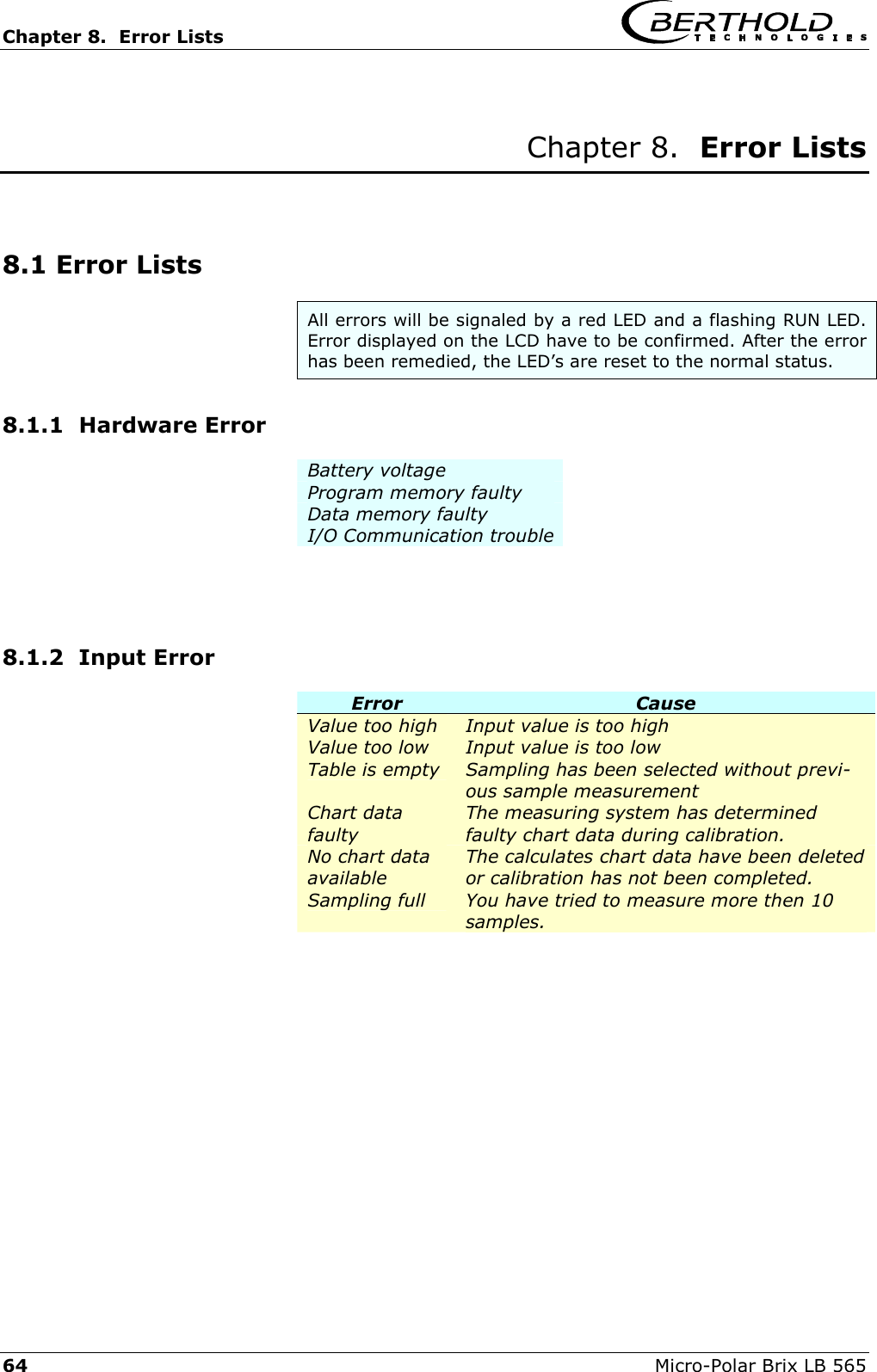
   Micro-Polar Brix LB 565 64Notes
   Micro-Polar Brix LB 565
   Micro-Polar Brix LB 565
         detect and identify Process Control Concentration Meter Micro-Polar Brix LB 565 Software Manual ID No. 39531BA2 Rev. No.: 00 01/07/04 Soft. Version 1.00 User’s Guide
 Micro-Polar Brix LB 565     The units supplied should not be repaired by anyone other than Berthold Service engineers or technicians authorized by Berthold.  In case of operation trouble, please address to our central service department.  The complete user’s guide consists of two manuals, the hardware description and the software description.   The hardware manual comprises:  mechanical components  assembly  electrical installation  radiation protection guidelines  technical data  electrical and mechanical drawings   The software manual comprises:  operation of the evaluation unit  parameter description  basic setting  calibration  error messages  The present manual is the software description.   Subject to change without prior notice.
Table of Contents    Micro-Polar Brix LB 565   Table of Contents    Page  Chapter 1. Communication with Micro-Polar Brix......................7 1.1 Brief Instructions........................................................8 1.2 System Configuration..................................................8 1.3 System Calibration .....................................................8 Chapter 2. Software Functions ..................................................9 2.1 Information on Menu Structure ....................................9 2.2 Menu Structure ........................................................10 2.2.1 Start Menu...............................................................12 2.2.2 Diagnostic................................................................12 2.2.3 Setup ......................................................................13 2.2.4 Access Level.............................................................13 2.2.5 Language.................................................................14 2.2.6 Configuration ...........................................................14 2.2.7 General ...................................................................14 2.2.8 Measurement ...........................................................15 2.2.9 Plausibility ...............................................................15 2.2.10 Microwave..............................................................16 2.2.11 Calibration .............................................................16 2.2.12 System Adjust ........................................................16 2.2.13 Calibrate Concentration ...........................................17 2.2.14 Sample No. ............................................................17 2.2.15 Sample Data (expanded) .........................................18 2.2.16 Advanced Settings ..................................................18 2.2.17 Calibr. manual ........................................................19 2.2.18 Input / Output ........................................................19 2.2.19 Current Output .......................................................20 2.2.20 Current Out 1 .........................................................20 2.2.21 Current Out 2 .........................................................21 2.2.22 Current Input .........................................................21 2.2.23 Current In 1 ...........................................................21 2.2.24 Current In 2 ...........................................................21 2.2.25 Pt 100 ...................................................................22 2.2.26 Digital Output.........................................................22 2.2.27 Digital Input ...........................................................23 Chapter 3. Configuration.........................................................24 3.1 Configuration Setup .................................................. 24 3.1.1 General Data............................................................24 3.1.2 Measurement ...........................................................25 3.1.3 Plausibility ...............................................................26 3.1.4 Microwave ...............................................................26 Chapter 4. Calibration .............................................................27 4.1 System Calibration ................................................... 27 4.2 Start Calibration ....................................................... 29 4.2.1 Tuning.....................................................................29 4.2.2 Sampling .................................................................32
  Table of Contents Micro-Polar Brix LB 565  4.2.3 Entering the Laboratory Values...................................33 4.2.4 Automatic Calibration ................................................35 4.3 Manual Calibration.................................................... 36 4.3.1 Manual Calibration with One Concentration ..................36 4.3.2 Calibration with Two Concentrations............................39 4.3.3 Calibration with Split Value ........................................43 4.3.4 Calibration with Temperature Compensation.................45 Chapter 5. Password .............................................................. 48 5.1 Password................................................................. 48 Chapter 6. Inputs / Outputs ................................................... 49 6.1 Current Outputs ....................................................... 49 6.1.1 Current Output Setup ................................................50 6.1.2 Test and Adjustment .................................................51 6.1.3 Error Current ............................................................53 6.1.4 Current Output 2 ......................................................54 6.2 Current Inputs ......................................................... 55 6.2.1 Enabling the Current Input.........................................55 6.2.2 Range Setting and Adjustment ...................................56 6.3 Pt 100..................................................................... 58 6.3.1 Pt 100 Enabling ........................................................58 6.3.2 Pt 100 Calibration .....................................................59 6.4 Digital Output .......................................................... 60 6.4.1 Digital Output Assignment .........................................60 6.5 Digital Input ............................................................ 61 6.5.1 External Product Switchover.......................................62 Chapter 7. Factory Settings .................................................... 63 Chapter 8. Error Lists ............................................................. 64 8.1 Error Lists ............................................................... 64 8.1.1 Hardware Error.........................................................64 8.1.2 Input Error...............................................................64 8.1.3 Measurement Error ...................................................65 Chapter 9. Calibration Data Sheet .......................................... 66 9.1 Configuration ........................................................... 66 9.1.1 General ...................................................................66 9.1.2 Measurement ...........................................................66 9.1.3 Plausibility ...............................................................66 9.1.4 Microwave................................................................66 9.2 Product ................................................................... 67 9.3 Input / Output ......................................................... 67 9.3.1 Current Output .........................................................67 9.3.2 Current Input ...........................................................67 9.3.3 Pt 100 Input.............................................................68 9.3.4 Digital Output...........................................................68 9.3.5 Digital Input.............................................................68 9.4 Calibration Data ....................................................... 68 9.4.1 Calibration Coefficients ..............................................68 9.4.2 Sampling Table.........................................................69
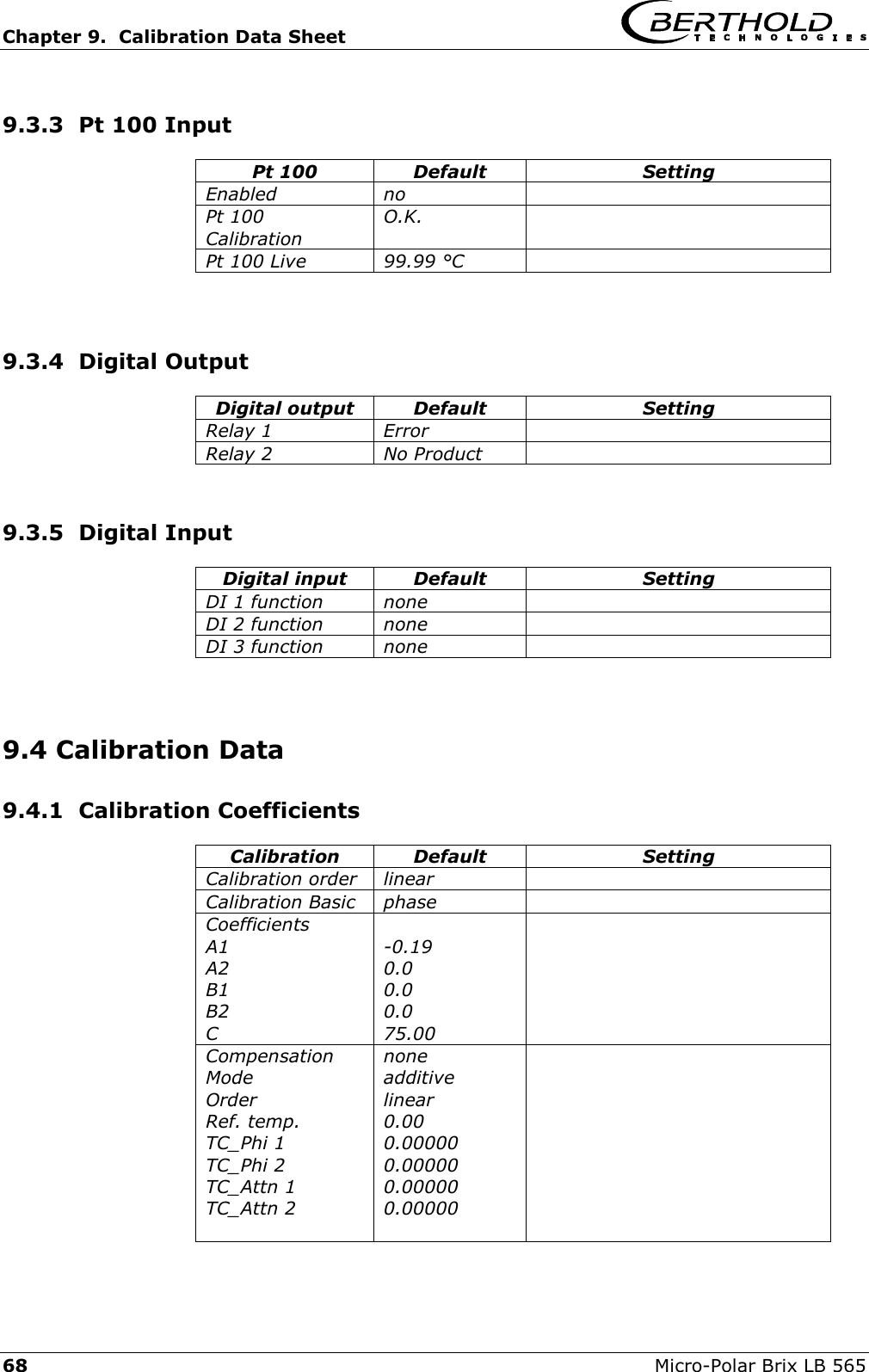
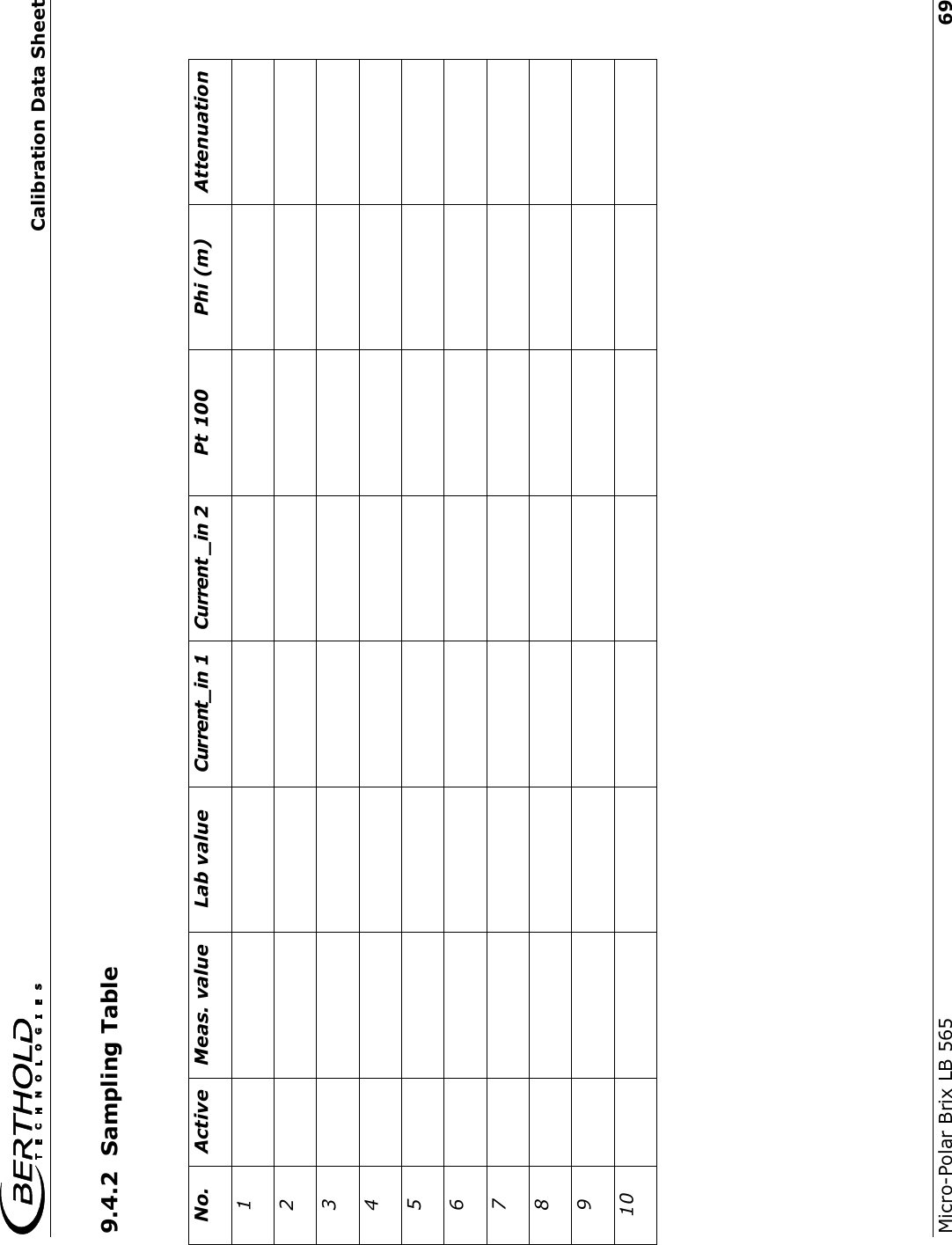
   Micro-Polar Brix LB 565   Safety Summary   GENERAL WARNINGS  Parameter settings Never change the parameter settings without a full knowledge of these operating instructions, as well as a full knowledge of the behavior of the connected controller and the possible influence on the operating process to be controlled.
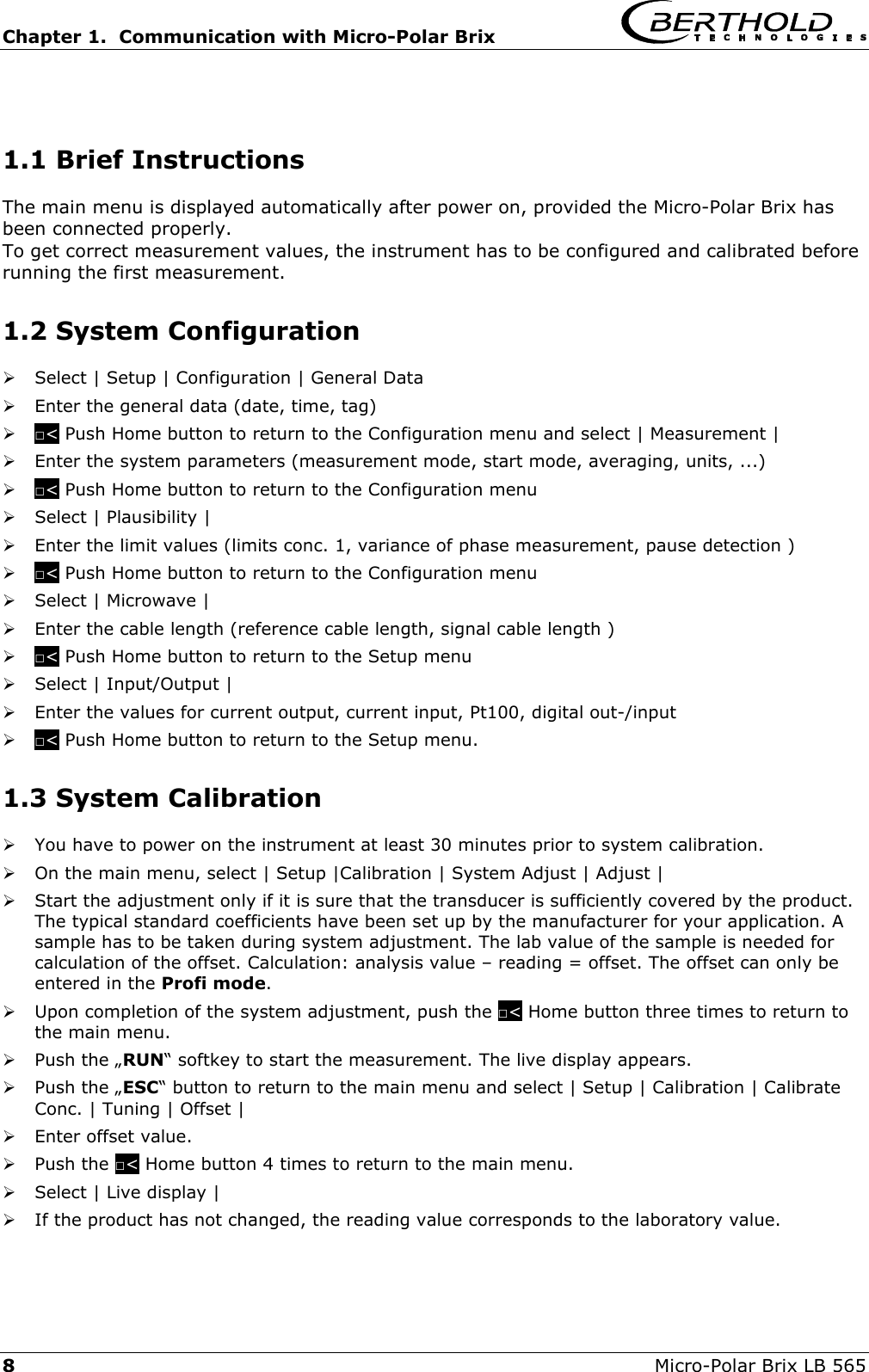
  Chapter 1.  Communication with Micro-Polar Brix Micro-Polar Brix LB 565   7 Chapter 1.  Communication with Micro-Polar Brix  Communication with the Micro-Polar Brix takes place via 4 softkey buttons. The function of the individual buttons changes relative to the position in the menu. Values and texts are entered via an alphanumeric keyboard. The instru-ment status is indicated by 5 LED’s.        and cable feed-throughLockNumericalkeypadSoftkey buttonsLED’sLCD displayRS232 connectionHF connections for   signal cable              reference cable    Micro-Polar
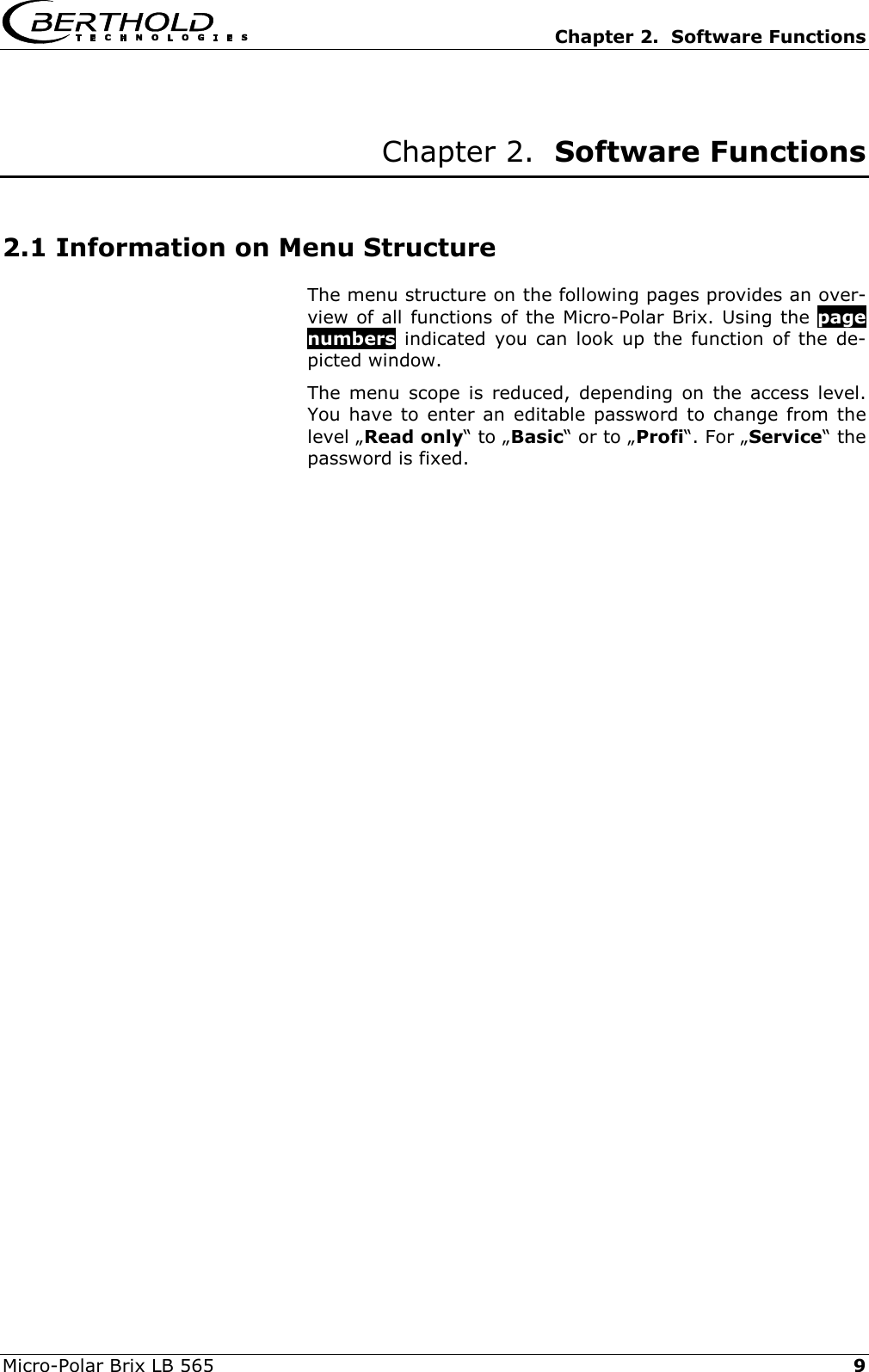
Chapter 1.  Communication with Micro-Polar Brix   8  Micro-Polar Brix LB 565  1.1 Brief Instructions The main menu is displayed automatically after power on, provided the Micro-Polar Brix has been connected properly.  To get correct measurement values, the instrument has to be configured and calibrated before running the first measurement. 1.2 System Configuration    Select | Setup | Configuration | General Data   Enter the general data (date, time, tag)   □< Push Home button to return to the Configuration menu and select | Measurement |   Enter the system parameters (measurement mode, start mode, averaging, units, ...)   □< Push Home button to return to the Configuration menu   Select | Plausibility |    Enter the limit values (limits conc. 1, variance of phase measurement, pause detection )   □< Push Home button to return to the Configuration menu   Select | Microwave |   Enter the cable length (reference cable length, signal cable length )   □< Push Home button to return to the Setup menu   Select | Input/Output |   Enter the values for current output, current input, Pt100, digital out-/input   □< Push Home button to return to the Setup menu. 1.3 System Calibration   You have to power on the instrument at least 30 minutes prior to system calibration.    On the main menu, select | Setup |Calibration | System Adjust | Adjust |   Start the adjustment only if it is sure that the transducer is sufficiently covered by the product. The typical standard coefficients have been set up by the manufacturer for your application. A sample has to be taken during system adjustment. The lab value of the sample is needed for calculation of the offset. Calculation: analysis value – reading = offset. The offset can only be entered in the Profi mode.   Upon completion of the system adjustment, push the □< Home button three times to return to the main menu.   Push the „RUN“ softkey to start the measurement. The live display appears.   Push the „ESC“ button to return to the main menu and select | Setup | Calibration | Calibrate Conc. | Tuning | Offset |   Enter offset value.   Push the □< Home button 4 times to return to the main menu.   Select | Live display |    If the product has not changed, the reading value corresponds to the laboratory value.
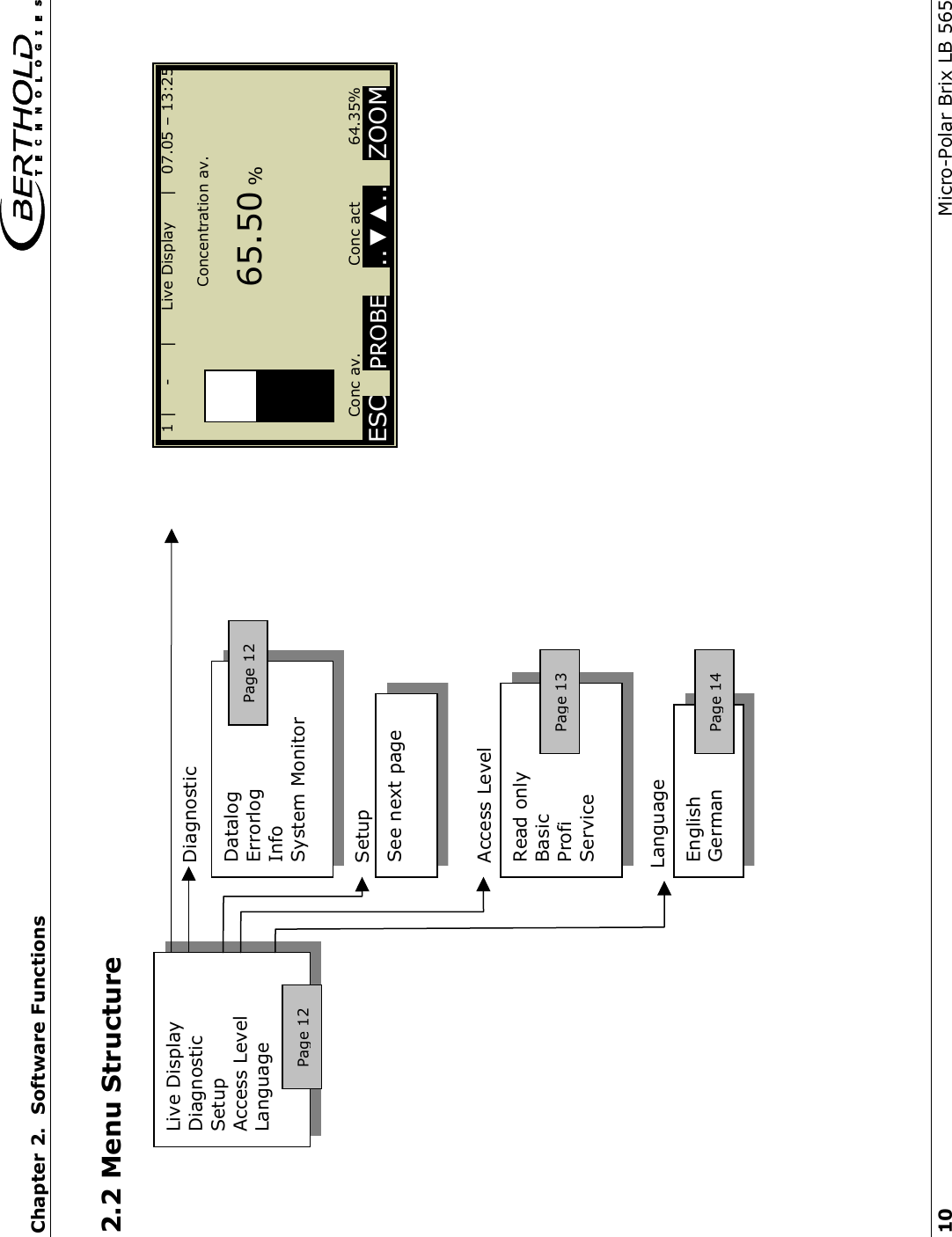
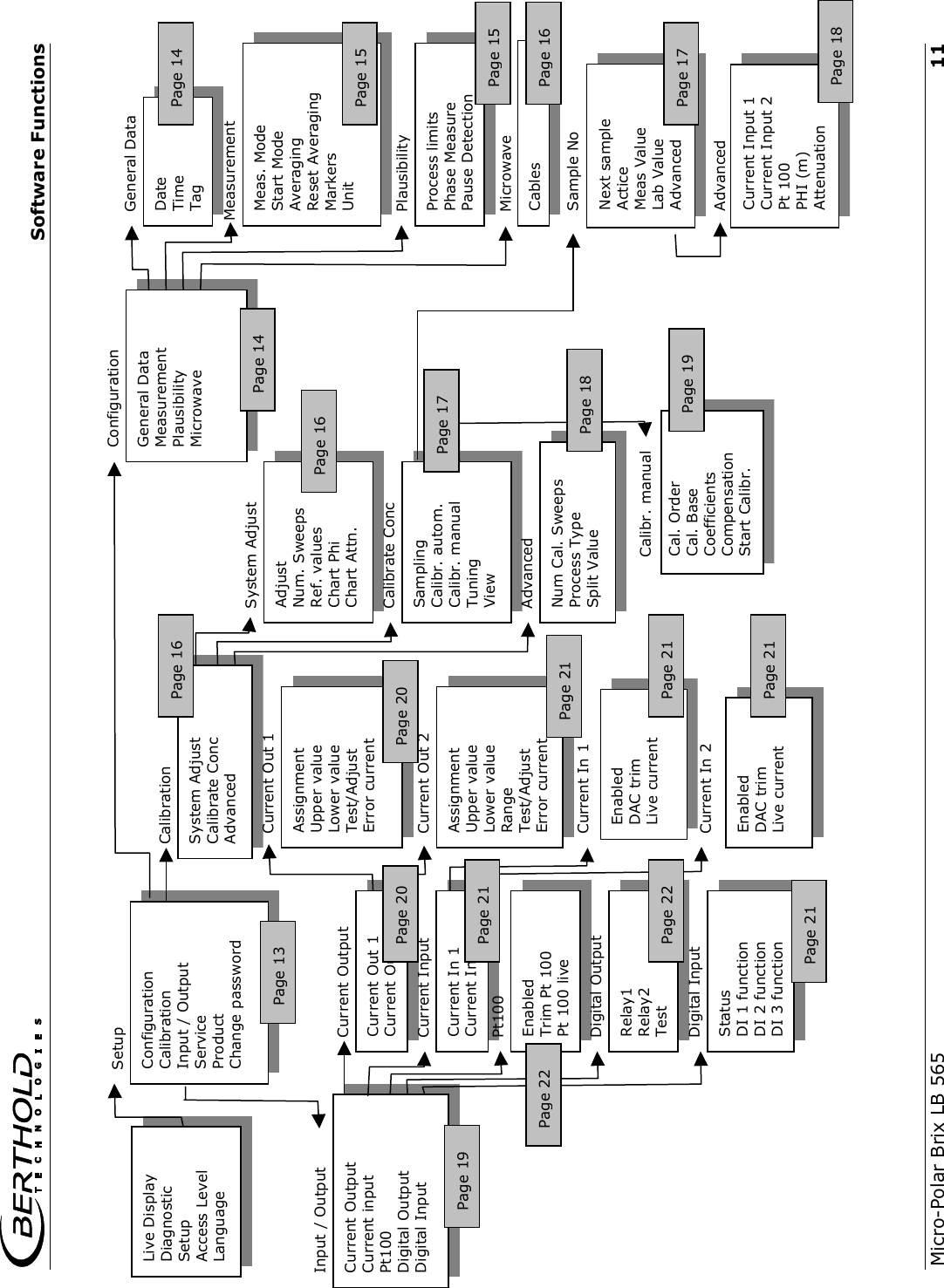
  Chapter 2.  Software Functions Micro-Polar Brix LB 565   9 Chapter 2.  Software Functions  2.1 Information on Menu Structure The menu structure on the following pages provides an over-view of all functions of the Micro-Polar Brix. Using the page numbers indicated you can look up the function of the de-picted window. The menu scope is reduced, depending on the access level. You have to enter an editable password to change from the level „Read only“ to „Basic“ or to „Profi“. For „Service“ the password is fixed.
Chapter 2.  Software Functions   10  Micro-Polar Brix LB 565  Live Display Diagnostic Setup Access Level Language Datalog Errorlog Info  System Monitor DiagnosticEnglish German Language Read only Basic Profi Service Access Level See next page Setup Page 12 Page 13 Page 14   1 |     -      |      Live Display     |   07.05 – 13:25    Concentration av.    65.50 %         Conc av.                 Conc act           64.35% ESC   PROBE   ..▼▲..   ZOOM   Page 122.2 Menu Structure
 Software Functions Micro-Polar Brix LB 565   11 Live Display Diagnostic Setup Access Level Language General Data Measurement Plausibility Microwave  Configuration Configuration Calibration Input / Output Service Product Change password Setup Measurement Meas. Mode Start Mode Averaging Reset Averaging Markers Unit PlausibilityProcess limits Phase Measure Pause Detection Microwave CablesGeneral Data Date Time Tag Calibration System Adjust Calibrate Conc Advanced System Adjust Adjust Num. Sweeps Ref. values Chart Phi Chart Attn. Calibrate Conc Sampling Calibr. autom. Calibr. manual Tuning View AdvancedNum Cal. Sweeps Process Type Split Value Input / Output Current Output Current input Pt100 Digital Output Digital Input Current Output Current Out 1 Current Out 2 Current Input Current In 1 Current In 2 Pt100 Enabled Trim Pt 100 Pt 100 live Digital Output Relay1 Relay2 Test Digital Input Status DI 1 function DI 2 function DI 3 function Current Out 1 Assignment Upper value Lower value Test/Adjust Error current Current Out 2 Assignment Upper value Lower value Range Test/Adjust Error current Current In 2Enabled DAC trim Live current Cal. Order Cal. Base Coefficients Compensation Start Calibr. Calibr. manualCurrent In 1Enabled DAC trim Live current Page 13 Page 14 Page 14 Page 15 Page 15 Page 16 Page 16 Page 16 Page 17 Page 18 Page 19 Page 19 Page 20 Page 21 Page 21 Page 20Page 22 Page 21 Page 21 Page 21Page 22 Next sample Actice Meas Value Lab Value Advanced Current Input 1 Current Input 2 Pt 100 PHI (m) Attenuation Sample No Advanced Page 17 Page 18
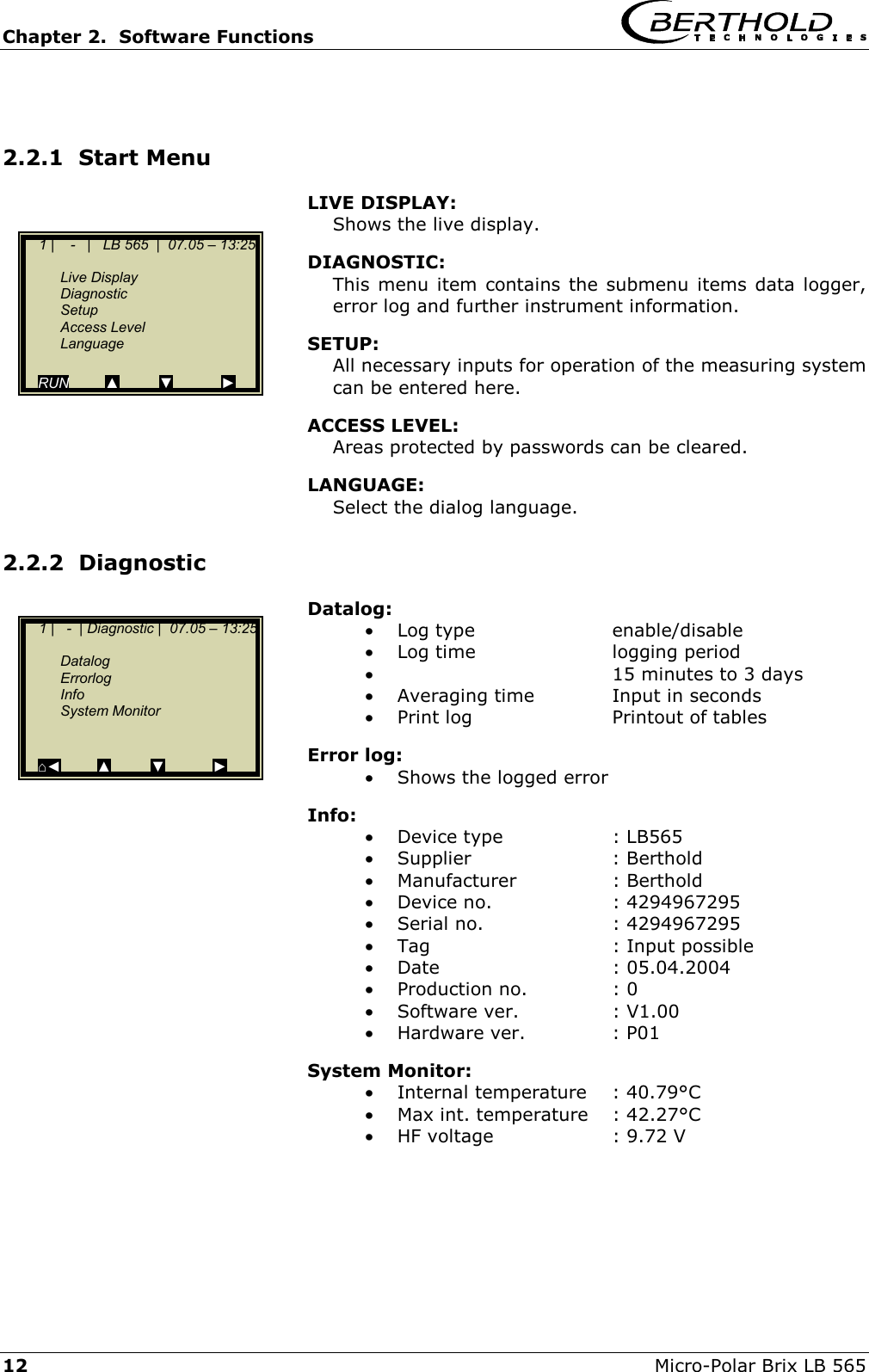
Chapter 2.  Software Functions     12  Micro-Polar Brix LB 565  2.2.1  Start Menu LIVE DISPLAY:  Shows the live display. DIAGNOSTIC:  This menu item contains the submenu items data logger, error log and further instrument information. SETUP:  All necessary inputs for operation of the measuring system can be entered here. ACCESS LEVEL: Areas protected by passwords can be cleared. LANGUAGE: Select the dialog language. 2.2.2  Diagnostic Datalog: •  Log type  enable/disable •  Log time  logging period •    15 minutes to 3 days •  Averaging time  Input in seconds •  Print log  Printout of tables Error log: •  Shows the logged error Info:  •  Device type  : LB565 •  Supplier : Berthold •  Manufacturer : Berthold •  Device no.  : 4294967295 •  Serial no.  : 4294967295 •  Tag  : Input possible  •  Date : 05.04.2004 •  Production no.  : 0 •  Software ver.  : V1.00 •  Hardware ver.  : P01 System Monitor: •  Internal temperature  : 40.79°C •  Max int. temperature  : 42.27°C •  HF voltage  : 9.72 V      1 |    -   |   LB 565  |  07.05 – 13:25    Live Display  Diagnostic  Setup  Access Level  Language  RUN         ▲          ▼            ►     1 |   -  | Diagnostic |  07.05 – 13:25    Datalog  Errorlog  Info  System Monitor    ⌂◄         ▲         ▼            ►
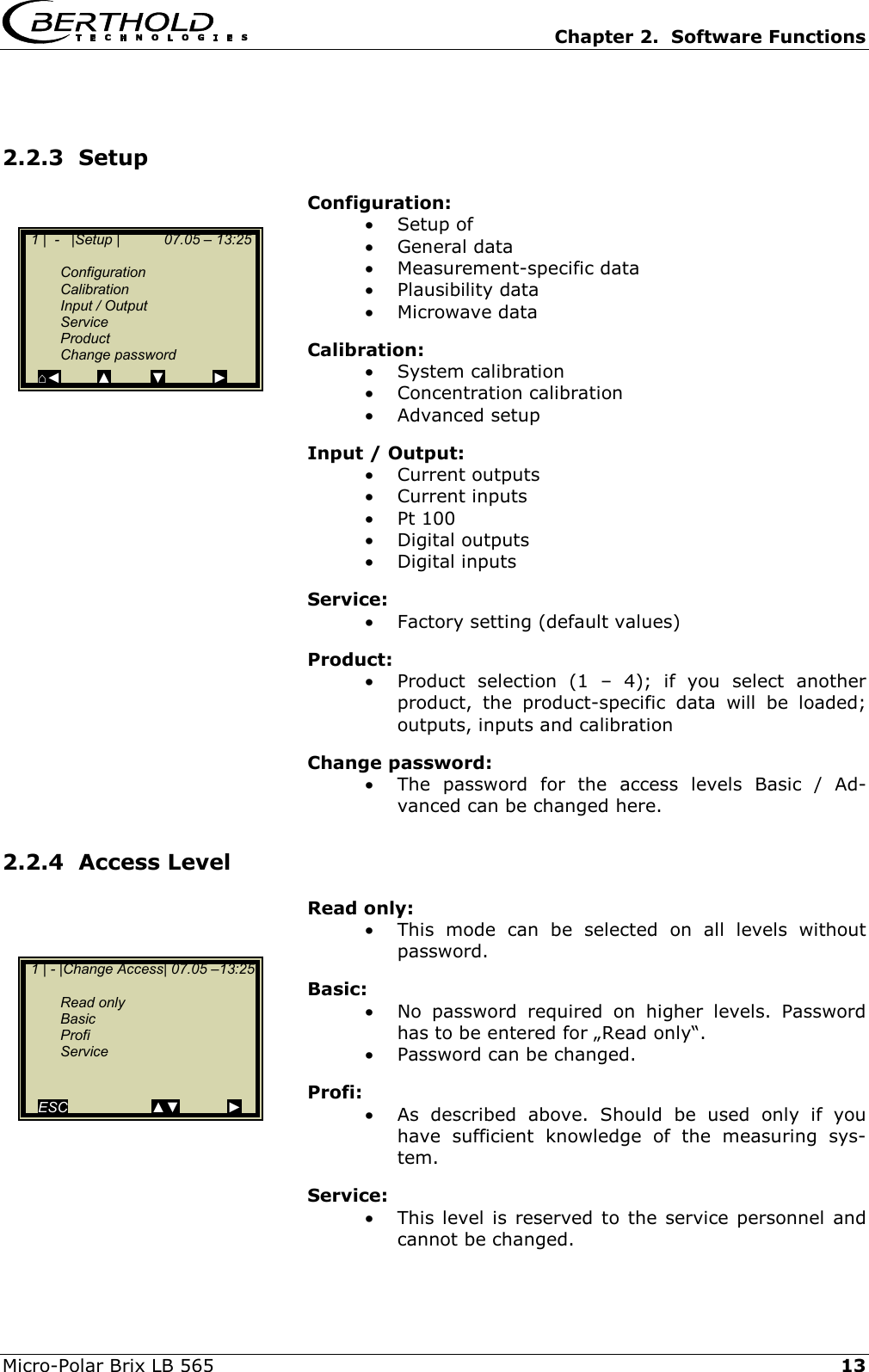
  Chapter 2.  Software Functions  Micro-Polar Brix LB 565   13 2.2.3  Setup Configuration: •  Setup of •  General data •  Measurement-specific data •  Plausibility data •  Microwave data Calibration: •  System calibration •  Concentration calibration •  Advanced setup Input / Output: •  Current outputs •  Current inputs •  Pt 100 •  Digital outputs •  Digital inputs Service: •  Factory setting (default values) Product: •  Product selection (1 – 4); if you select another product, the product-specific data will be loaded; outputs, inputs and calibration Change password: •  The password for the access levels Basic / Ad-vanced can be changed here. 2.2.4  Access Level Read only: •  This mode can be selected on all levels without password. Basic: •  No password required on higher levels. Password has to be entered for „Read only“. •  Password can be changed. Profi: •  As described above. Should be used only if you have sufficient knowledge of the measuring sys-tem. Service: •  This level is reserved to the service personnel and cannot be changed.   1 | - |Change Access| 07.05 –13:25    Read only  Basic  Profi  Service     ESC                     ▲▼            ►   1 |  -   |Setup |           07.05 – 13:25     Configuration  Calibration  Input / Output  Service  Product  Change password ⌂◄         ▲          ▼            ►
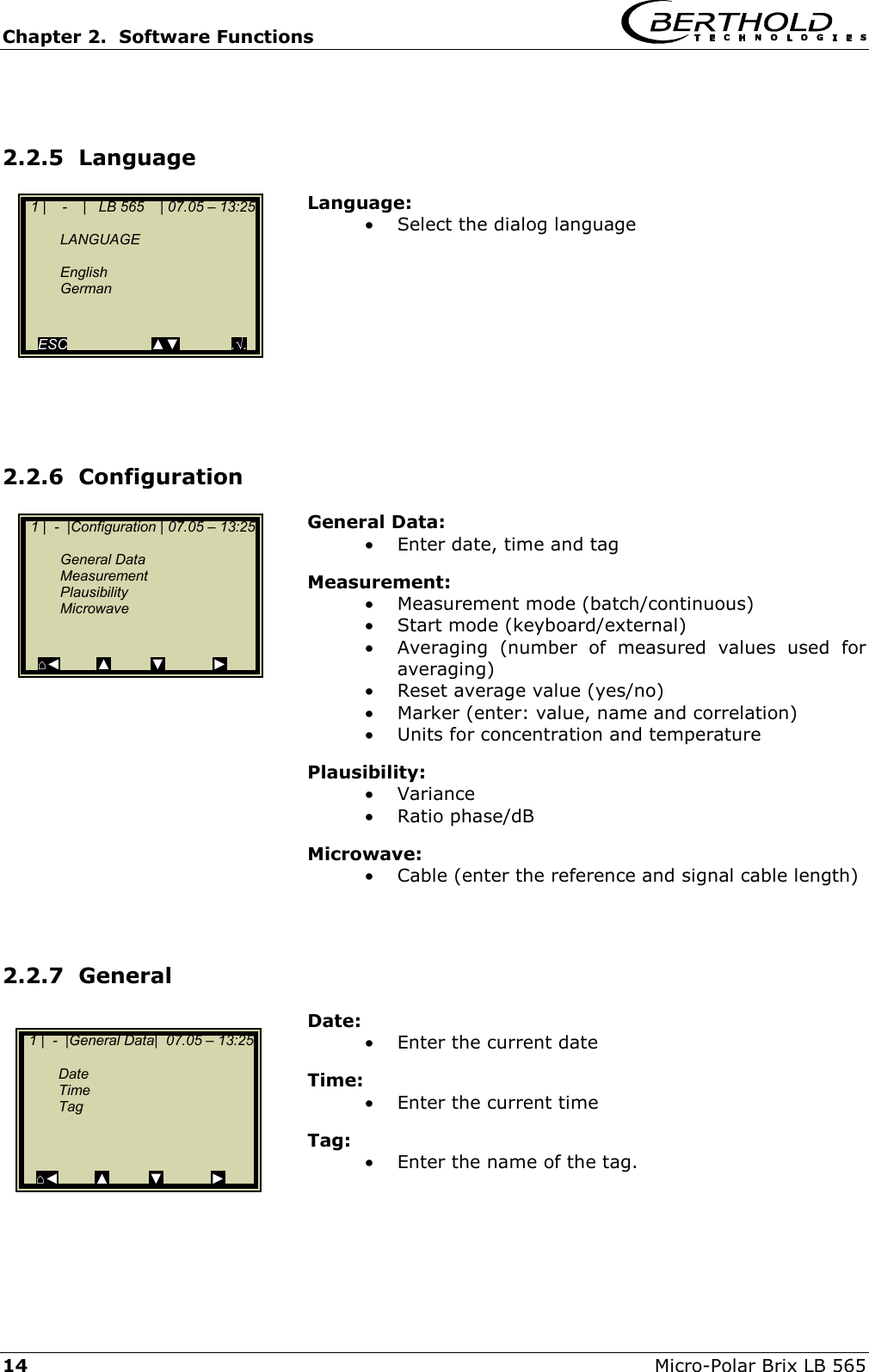
Chapter 2.  Software Functions     14  Micro-Polar Brix LB 565  2.2.5  Language Language: •  Select the dialog language          2.2.6  Configuration General Data: •  Enter date, time and tag Measurement: •  Measurement mode (batch/continuous) •  Start mode (keyboard/external) •  Averaging (number of measured values used for averaging) •  Reset average value (yes/no) •  Marker (enter: value, name and correlation) •  Units for concentration and temperature Plausibility: •  Variance •  Ratio phase/dB  Microwave: •  Cable (enter the reference and signal cable length)   2.2.7  General Date: •  Enter the current date Time: •  Enter the current time Tag: •  Enter the name of the tag.    1 |    -    |   LB 565    | 07.05 – 13:25    LANGUAGE    English  German       ESC                     ▲▼             .√.   1 |  -  |Configuration | 07.05 – 13:25    General Data  Measurement  Plausibility  Microwave     ⌂◄         ▲          ▼            ►   1 |  -  |General Data|  07.05 – 13:25    Date   Time  Tag       ⌂◄         ▲          ▼            ►
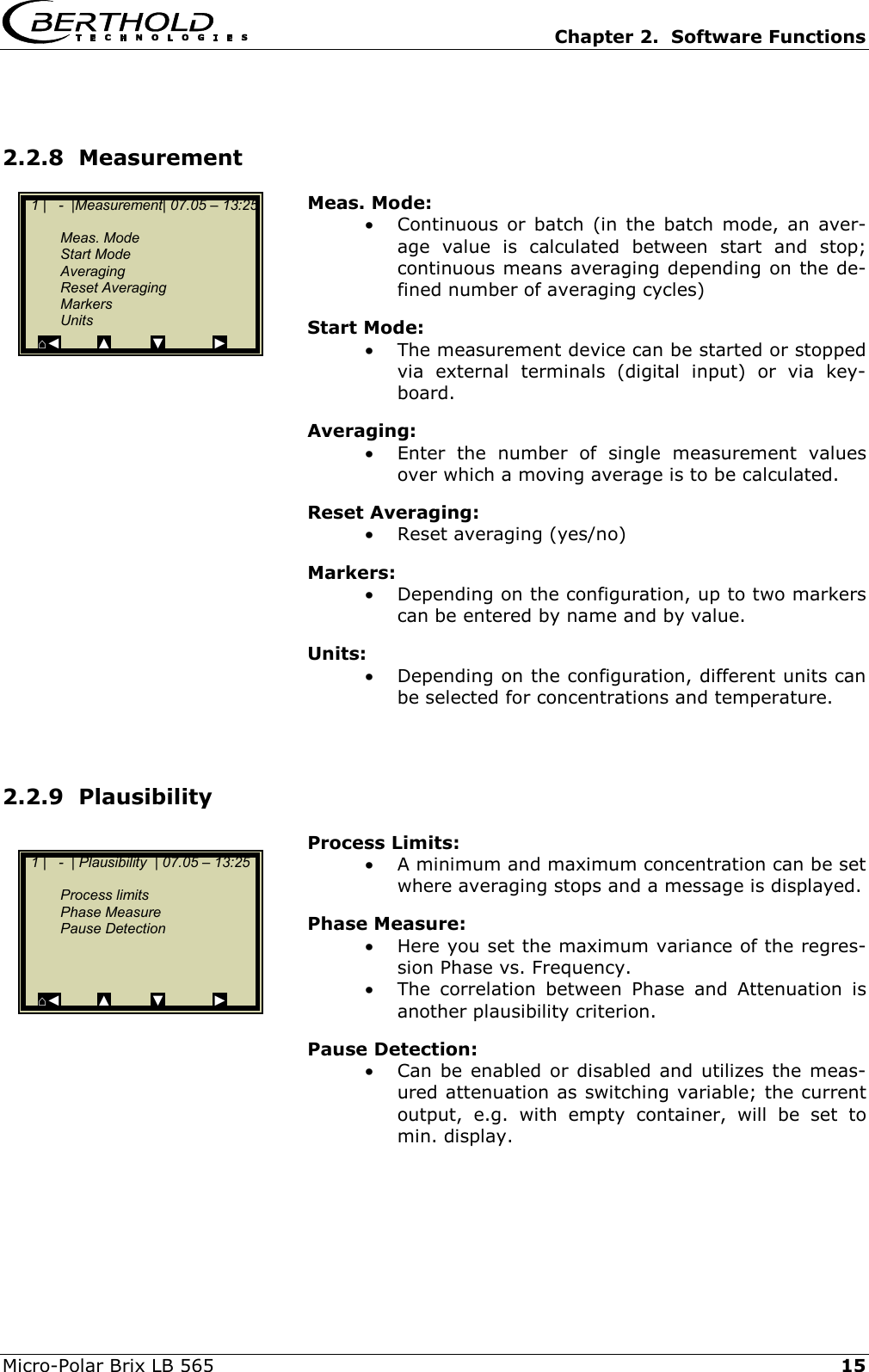
  Chapter 2.  Software Functions  Micro-Polar Brix LB 565   15 2.2.8  Measurement Meas. Mode: •  Continuous or batch (in the batch mode, an aver-age value is calculated between start and stop; continuous means averaging depending on the de-fined number of averaging cycles) Start Mode: •  The measurement device can be started or stopped via external terminals (digital input) or via key-board. Averaging: •  Enter the number of single measurement values over which a moving average is to be calculated. Reset Averaging: •  Reset averaging (yes/no) Markers: •  Depending on the configuration, up to two markers can be entered by name and by value. Units: •  Depending on the configuration, different units can be selected for concentrations and temperature.   2.2.9  Plausibility  Process Limits: •  A minimum and maximum concentration can be set where averaging stops and a message is displayed. Phase Measure: •  Here you set the maximum variance of the regres-sion Phase vs. Frequency.  •  The correlation between Phase and Attenuation is another plausibility criterion. Pause Detection: •  Can be enabled or disabled and utilizes the meas-ured attenuation as switching variable; the current output, e.g. with empty container, will be set to min. display.      1 |   -  |Measurement| 07.05 – 13:25    Meas. Mode  Start Mode  Averaging  Reset Averaging  Markers  Units ⌂◄         ▲          ▼            ►   1 |   -  | Plausibility  | 07.05 – 13:25     Process limits  Phase Measure  Pause Detection     ⌂◄         ▲          ▼            ►
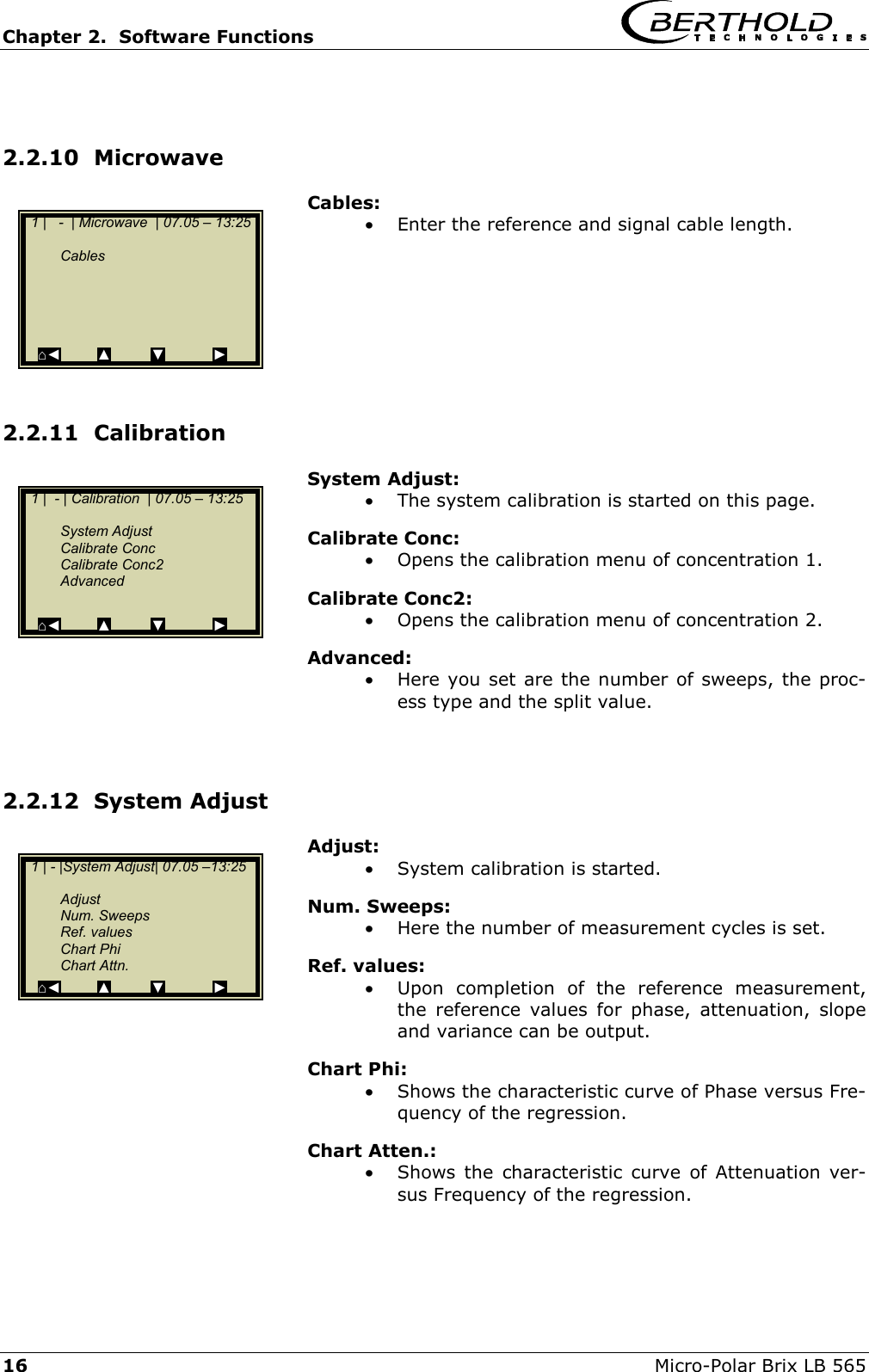
Chapter 2.  Software Functions     16  Micro-Polar Brix LB 565  2.2.10  Microwave Cables: •  Enter the reference and signal cable length.        2.2.11  Calibration System Adjust: •  The system calibration is started on this page. Calibrate Conc: •  Opens the calibration menu of concentration 1. Calibrate Conc2: •  Opens the calibration menu of concentration 2. Advanced: •  Here you set are the number of sweeps, the proc-ess type and the split value.    2.2.12  System Adjust Adjust: •  System calibration is started. Num. Sweeps: •  Here the number of measurement cycles is set. Ref. values: •  Upon completion of the reference measurement, the reference values for phase, attenuation, slope and variance can be output. Chart Phi: •  Shows the characteristic curve of Phase versus Fre-quency of the regression. Chart Atten.: •  Shows the characteristic curve of Attenuation ver-sus Frequency of the regression.   1 |   -  | Microwave  | 07.05 – 13:25     Cables      ⌂◄         ▲          ▼            ►   1 |  - | Calibration  | 07.05 – 13:25     System Adjust  Calibrate Conc  Calibrate Conc2  Advanced  ⌂◄         ▲         ▼            ►   1 | - |System Adjust| 07.05 –13:25     Adjust  Num. Sweeps  Ref. values  Chart Phi  Chart Attn. ⌂◄         ▲         ▼            ►
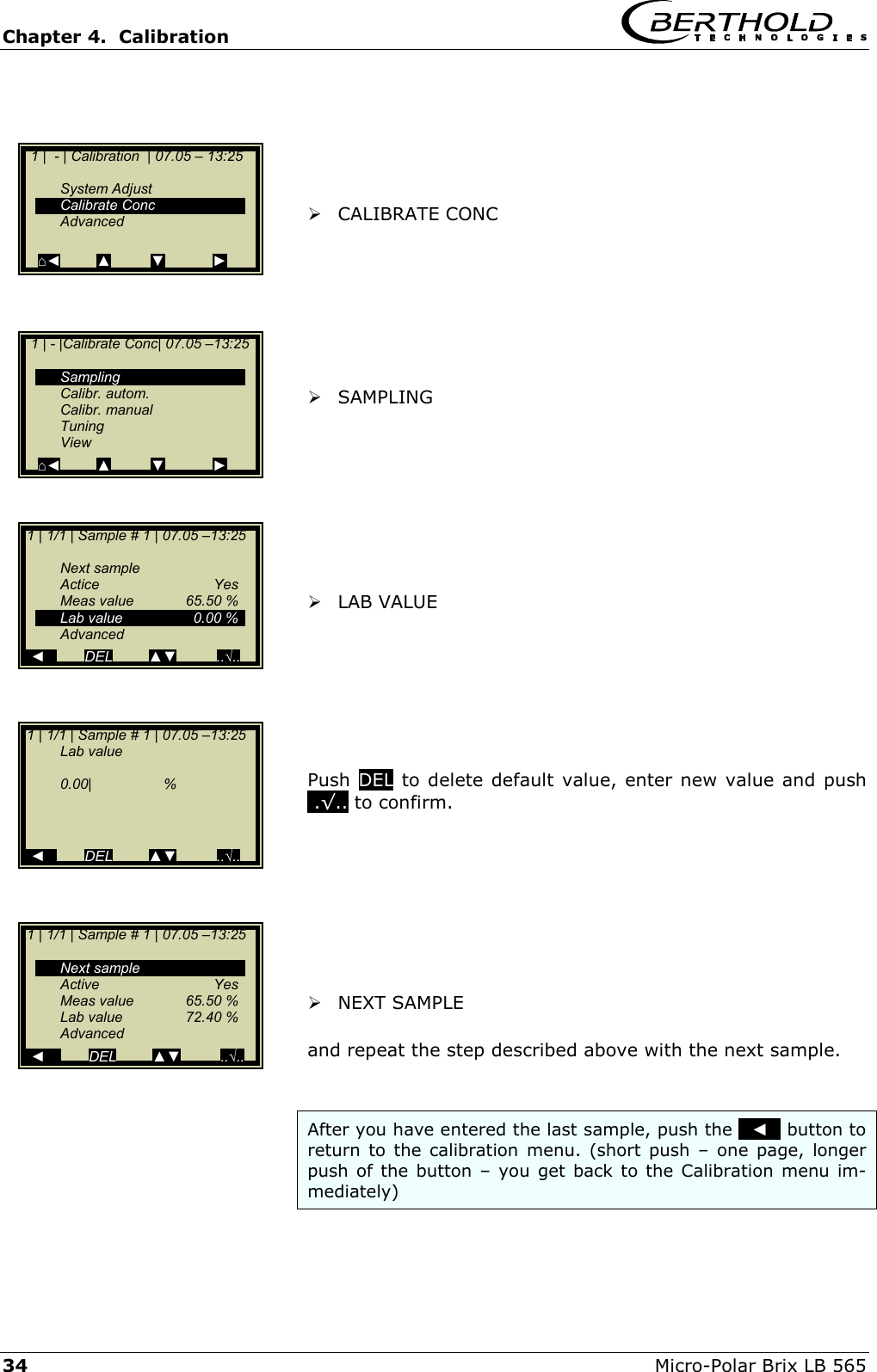
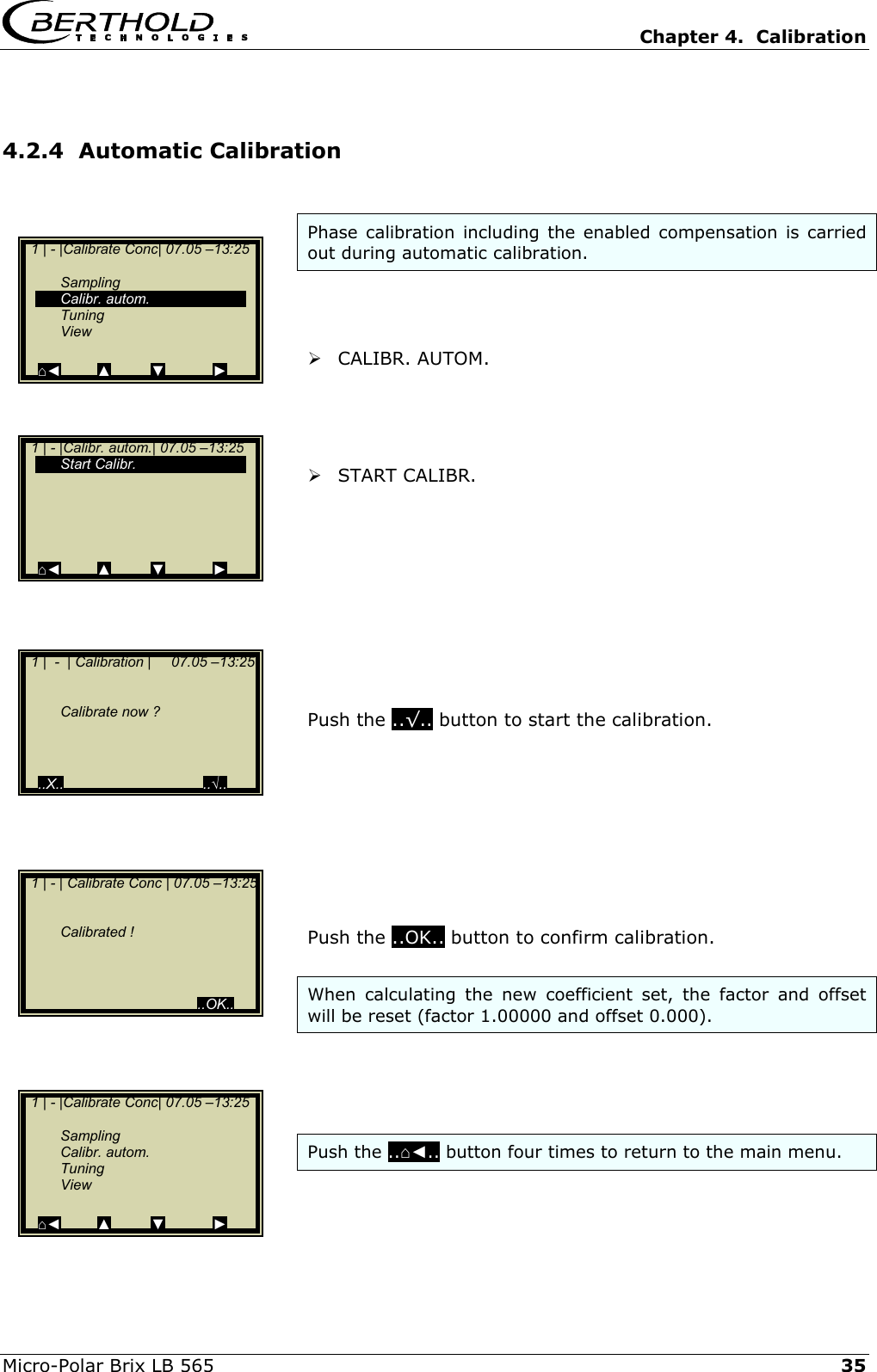
  Chapter 2.  Software Functions  Micro-Polar Brix LB 565   17 2.2.13  Calibrate Concentration  Sampling: •  Shows all measured samples. Calibr. autom.: •  Calibration can be started after measurement of two samples and input of the respective laboratory values.  Calibr. manual: •  Here you can choose the calibration order [lin-ear/quadratic], the basis [phase/attenuation or both] and compensation [temperature]. Tuning: •  Subsequent correction of the reading is possible by entering a factor and an offset. View: •  Presentation of calibration curve, display of correla-tion and coefficients.  2.2.14  Sample No. Sample number, date and time of the sample measurement are displayed in the header. Next sample: •  Continues with the next sample. Active: •  Here you can choose if this sample should be taken into account in the calibration. Measured value: •  Display of the measured values, calculated with the actual coefficient. Lab value: •  Entry position for the laboratory value. Advanced: •  Switches to the next data page.    1 | - |Calibrate Conc| 07.05 –13:25     Sampling  Calibr. autom.  Calibr. manual  Tuning  View ⌂◄         ▲          ▼            ►  1 | 1/1 | Sample # 1 | 07.05 –13:25    Next sample  Active   Yes  Meas value  65.50 %   Lab value  0.00 %  Advanced   ◄          DEL         ▲▼          ..√..
Chapter 2.  Software Functions     18  Micro-Polar Brix LB 565  2.2.15  Sample Data (expanded) Current In 1: •  Editable display of the first compensation input. Current In 2: •  Editable display of the second compensation input. Pt 100: •  Editable display of the Pt 100 input. PHI (m): •  Not editable display of the measured phase. Atten: •  Not editable display of the measured attenuation.     2.2.16  Advanced Settings Number of Calibration Sweeps: •  Freely selectable number of individual measure-ments [Sweeps] used for determination of a cali-bration point. Process Type: •  Select the operation mode: oone concentration [1 measuring range] otwo concentrations [2 measuring ranges] osplit concentration [1 measuring range with switching point (split value) for coefficient switchover].  Split Value: •  Setting of the switching point on a value basis.     1| -    |Advanced |        07.05 –13:25    Num Cal. Sweeps  Process Type  Split Value     ⌂◄         ▲         ▼            ►  1 |  1/1 | Sample # 1 | 07.05 –13:25     Current In 1   Current In 2  Pt 100  PHI (m)  Atten   ◄          DEL         ▲▼          ..√..
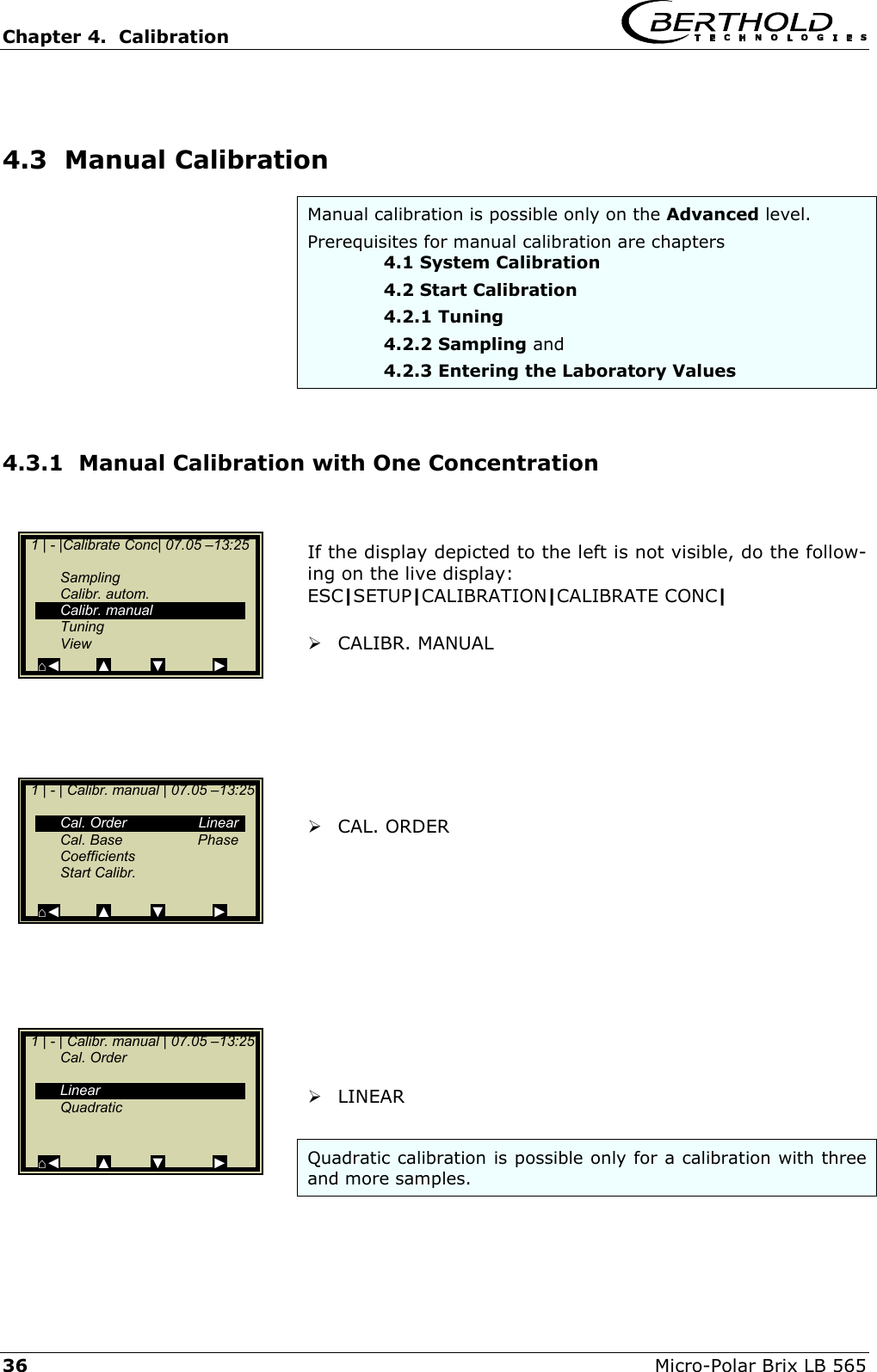
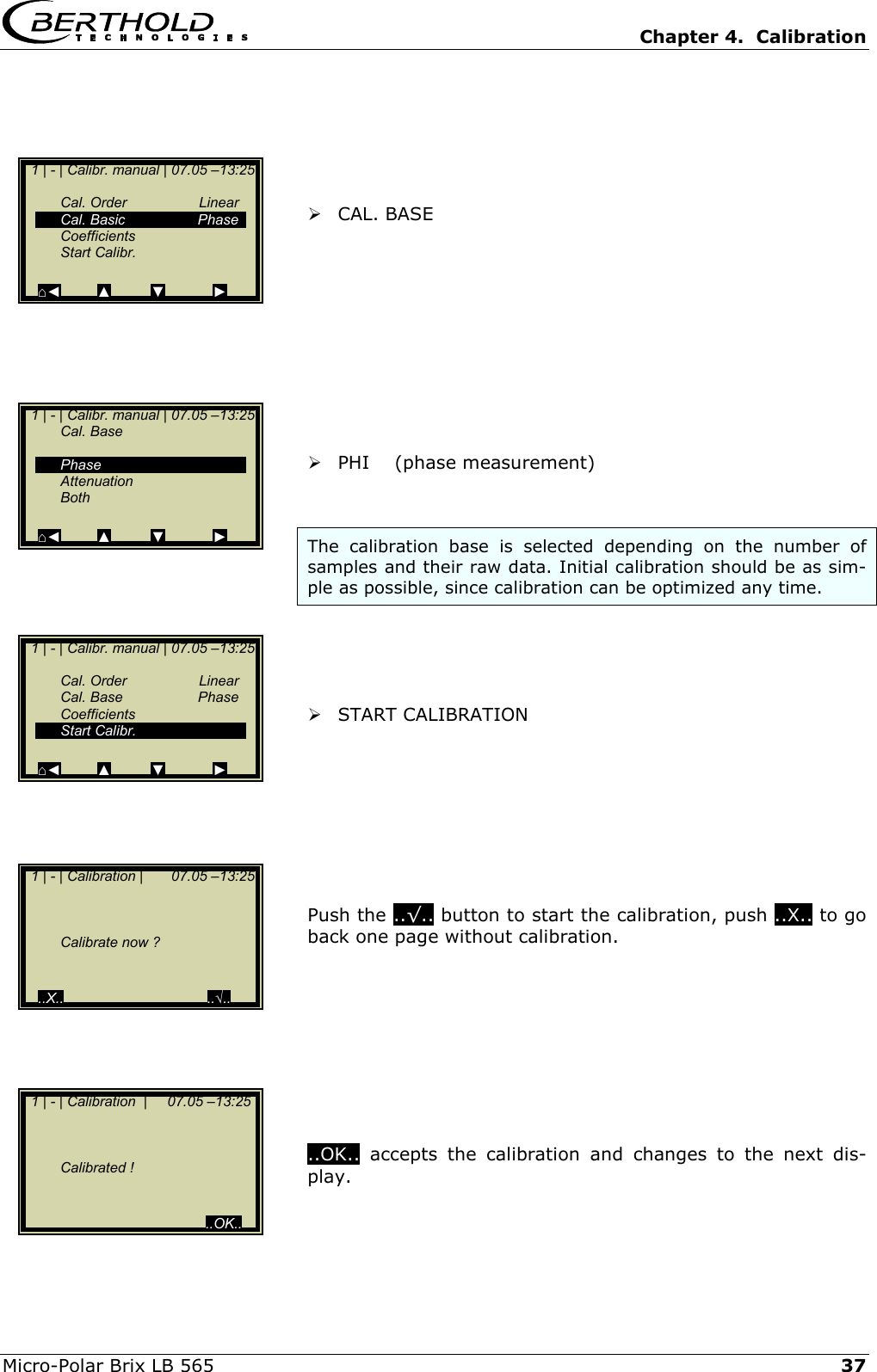
  Chapter 2.  Software Functions  Micro-Polar Brix LB 565   19 2.2.17  Calibr. manual Cal. Order: •  Here you define the calibration order [lin-ear/quadratic] Cal. Base: •  The following parameters can be set: oPhase oAttenuation oPhase and attenuation Coefficients: •  Here you can edit all coefficients for phase and at-tenuation. Start Calibr.: •  Starts the calibration using the parameters you have set earlier.     2.2.18  Input / Output  Current Output: •  Both outputs can be adjusted, assigned and set up on the selected level. Current Input: •  Activation level of current input, calibration and display of the live current signal. Pt 100: •  Here you can enable and adjust a connected Pt 100. Display of the actual temperature signal. Digital Output: •  Allocation of relays 1 and 2 and test function. Digital Input: •  Status control and assignment of the digital inputs.    1 | - | Calibr. manual | 07.05 –13:25    Cal. Order  Cal. Base  Coefficients  Start Calibr.   ⌂◄         ▲          ▼            ►   1 | - |Input / Output | 07.05 –13:25     Current Output  Current Input  Pt 100  Digital Output  Digital Input ⌂◄         ▲          ▼            ►
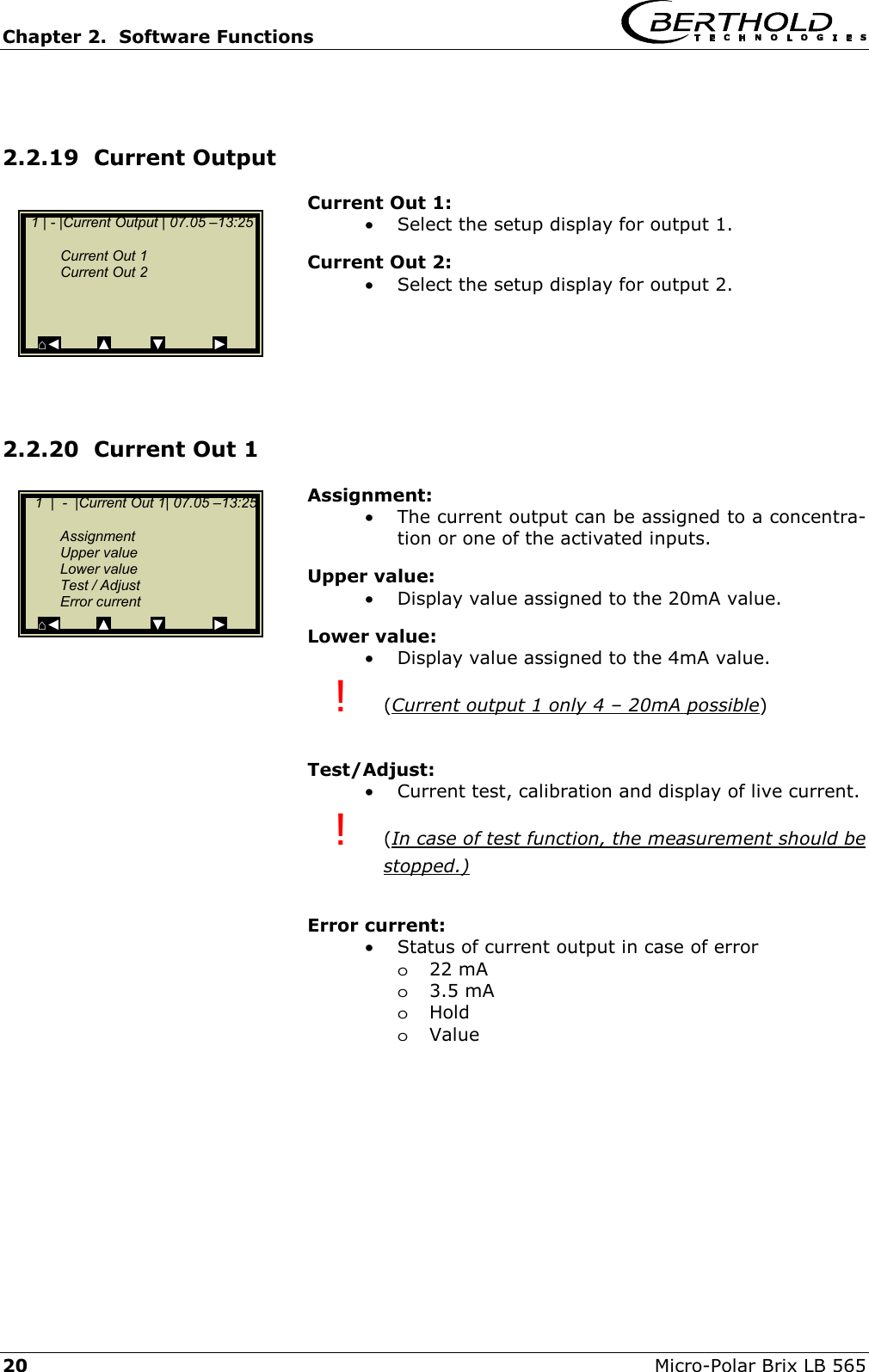
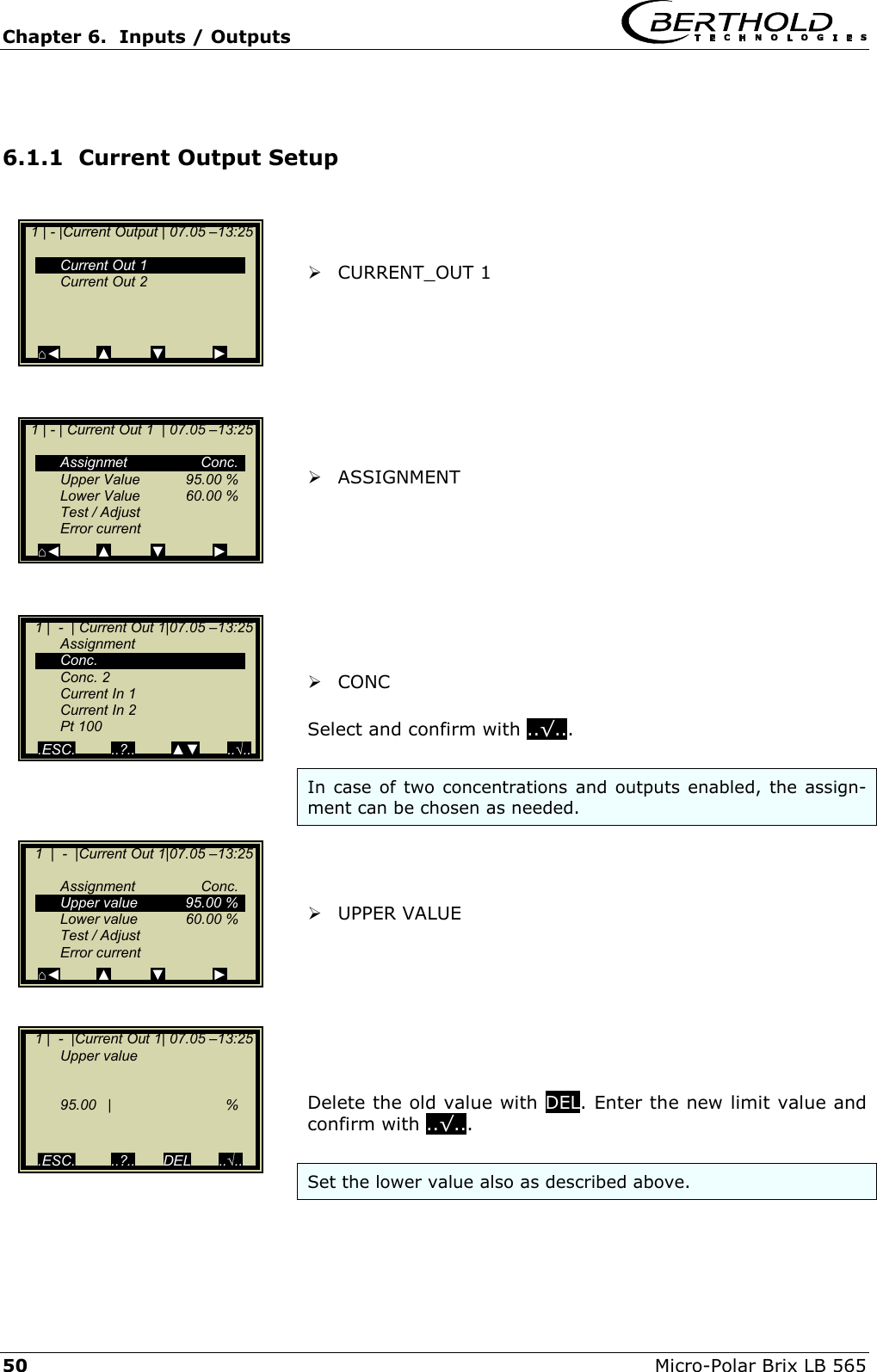
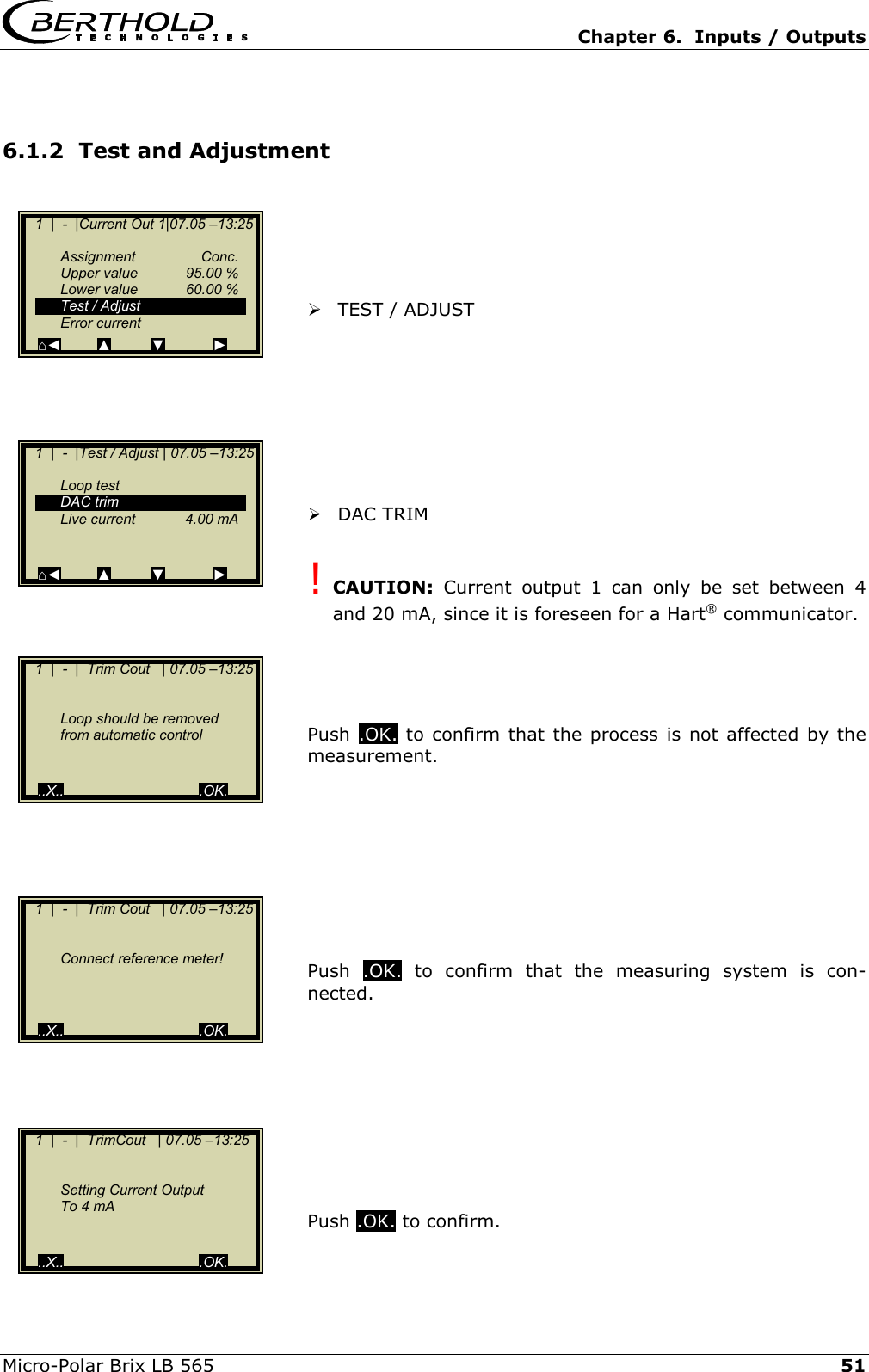
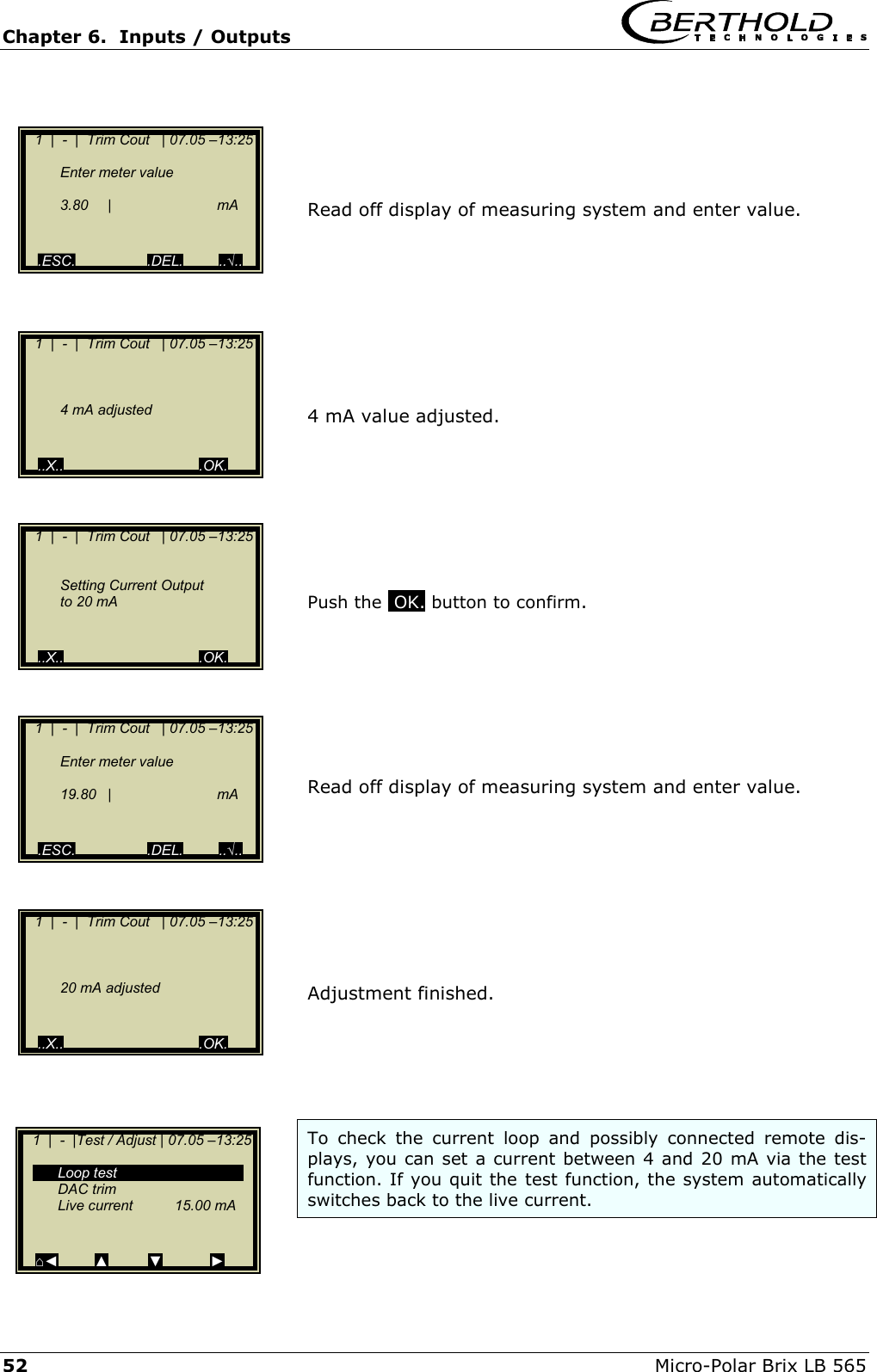
Chapter 2.  Software Functions     20  Micro-Polar Brix LB 565  2.2.19  Current Output  Current Out 1: •  Select the setup display for output 1. Current Out 2: •  Select the setup display for output 2.      2.2.20  Current Out 1 Assignment: •  The current output can be assigned to a concentra-tion or one of the activated inputs. Upper value: •  Display value assigned to the 20mA value. Lower value: •  Display value assigned to the 4mA value. !  (Current output 1 only 4 – 20mA possible)  Test/Adjust: •  Current test, calibration and display of live current. !  (In case of test function, the measurement should be stopped.)  Error current: •  Status of current output in case of error o22 mA o3.5 mA oHold oValue      1 | - |Current Output | 07.05 –13:25      Current Out 1   Current Out 2       ⌂◄         ▲         ▼            ►    1  |  -  |Current Out 1| 07.05 –13:25    Assignment  Upper value  Lower value   Test / Adjust  Error current ⌂◄         ▲          ▼            ►
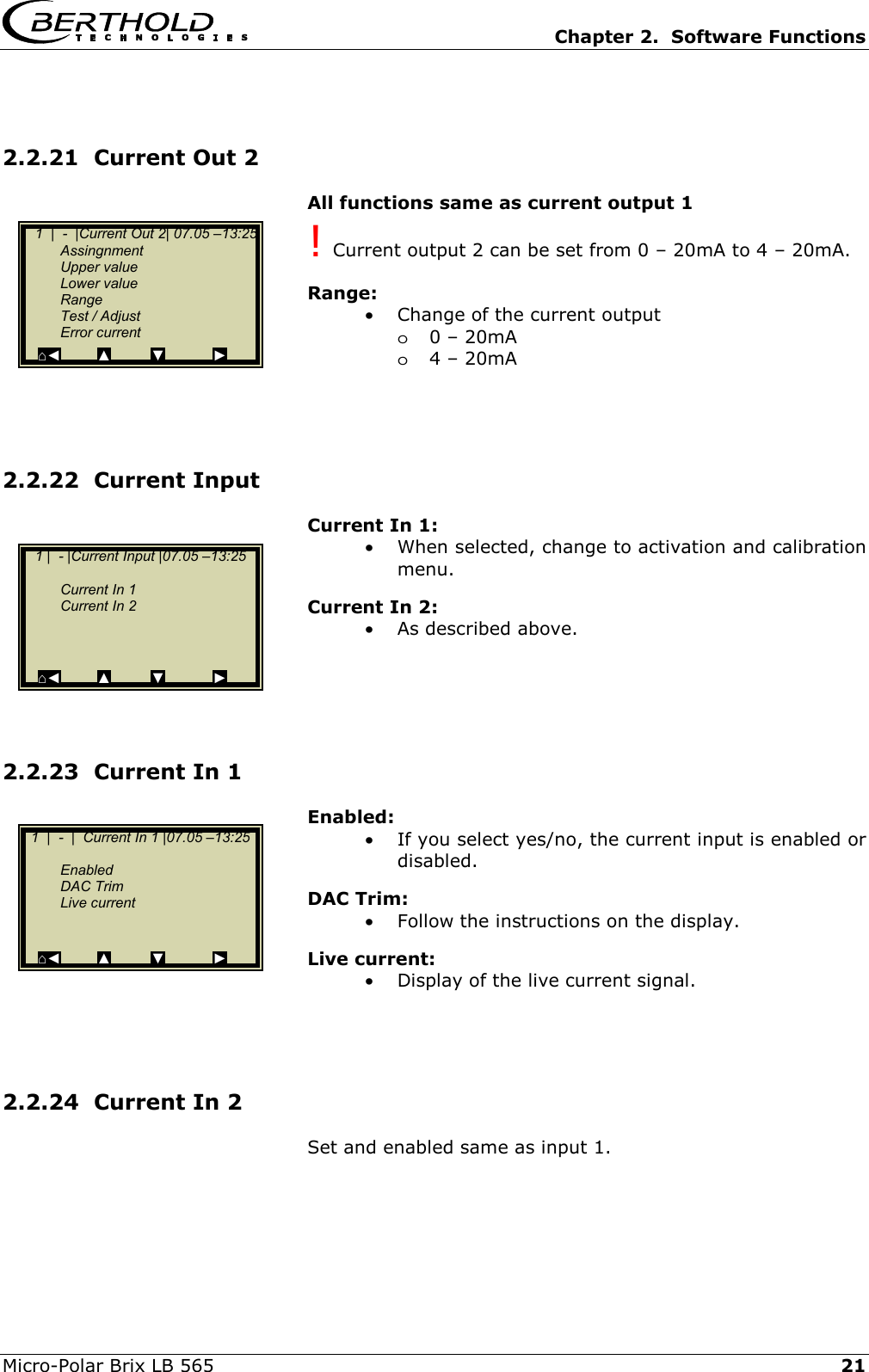
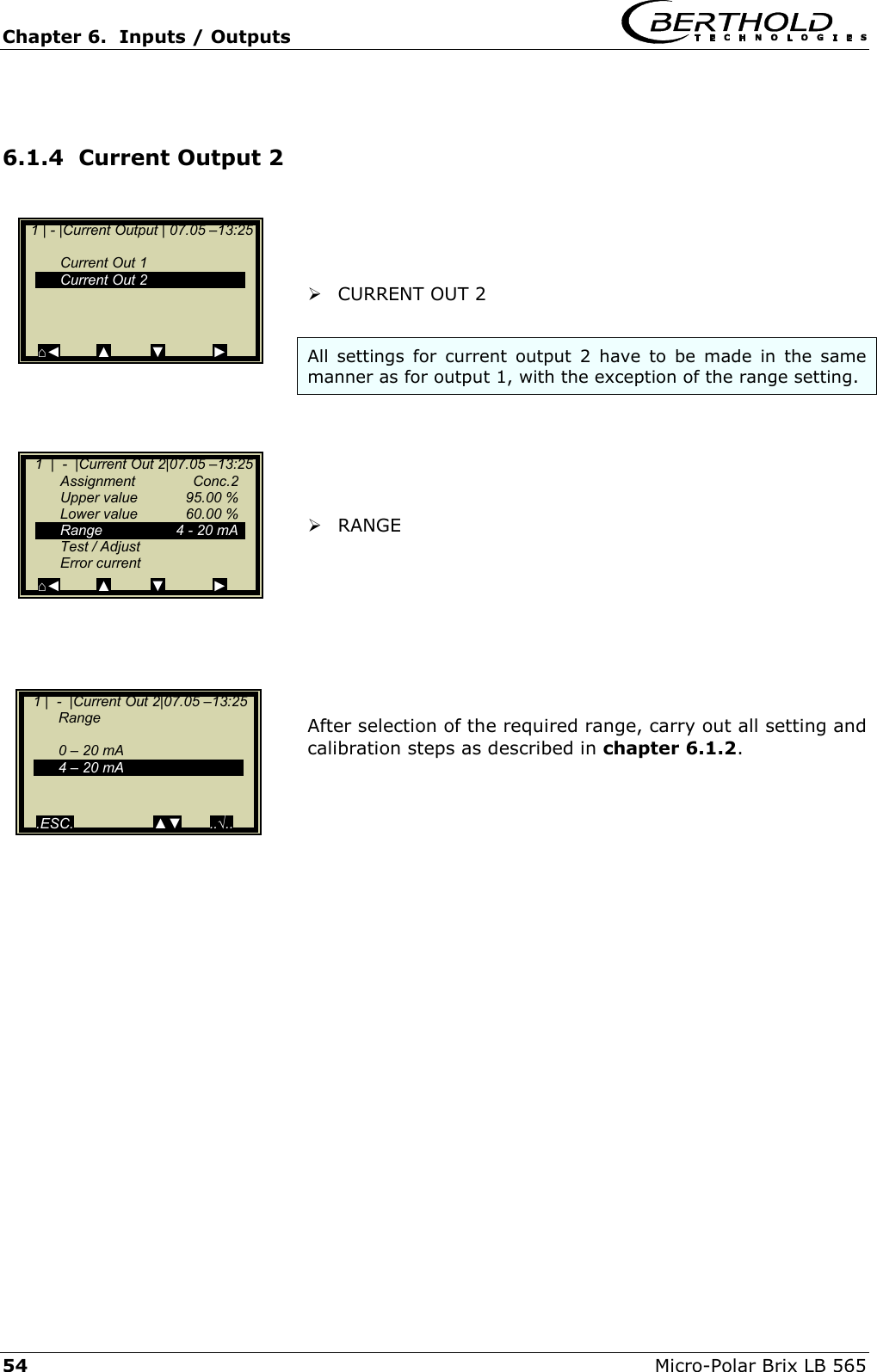
  Chapter 2.  Software Functions  Micro-Polar Brix LB 565   21 2.2.21  Current Out 2 All functions same as current output 1 ! Current output 2 can be set from 0 – 20mA to 4 – 20mA.  Range: •  Change of the current output  o0 – 20mA o4 – 20mA     2.2.22  Current Input Current In 1: •  When selected, change to activation and calibration menu. Current In 2: •  As described above.     2.2.23  Current In 1 Enabled: •  If you select yes/no, the current input is enabled or disabled. DAC Trim: •  Follow the instructions on the display. Live current: •  Display of the live current signal.    2.2.24  Current In 2 Set and enabled same as input 1.    1  |  -  |Current Out 2| 07.05 –13:25  Assingnment  Upper value  Lower value  Range   Test / Adjust  Error current   ⌂◄         ▲          ▼            ►   1  |  -  |  Current In 1 |07.05 –13:25       Enabled  DAC Trim  Live current   ⌂◄         ▲          ▼            ►    1 |  - |Current Input |07.05 –13:25        Current In 1   Current In 2         ⌂◄         ▲          ▼            ►
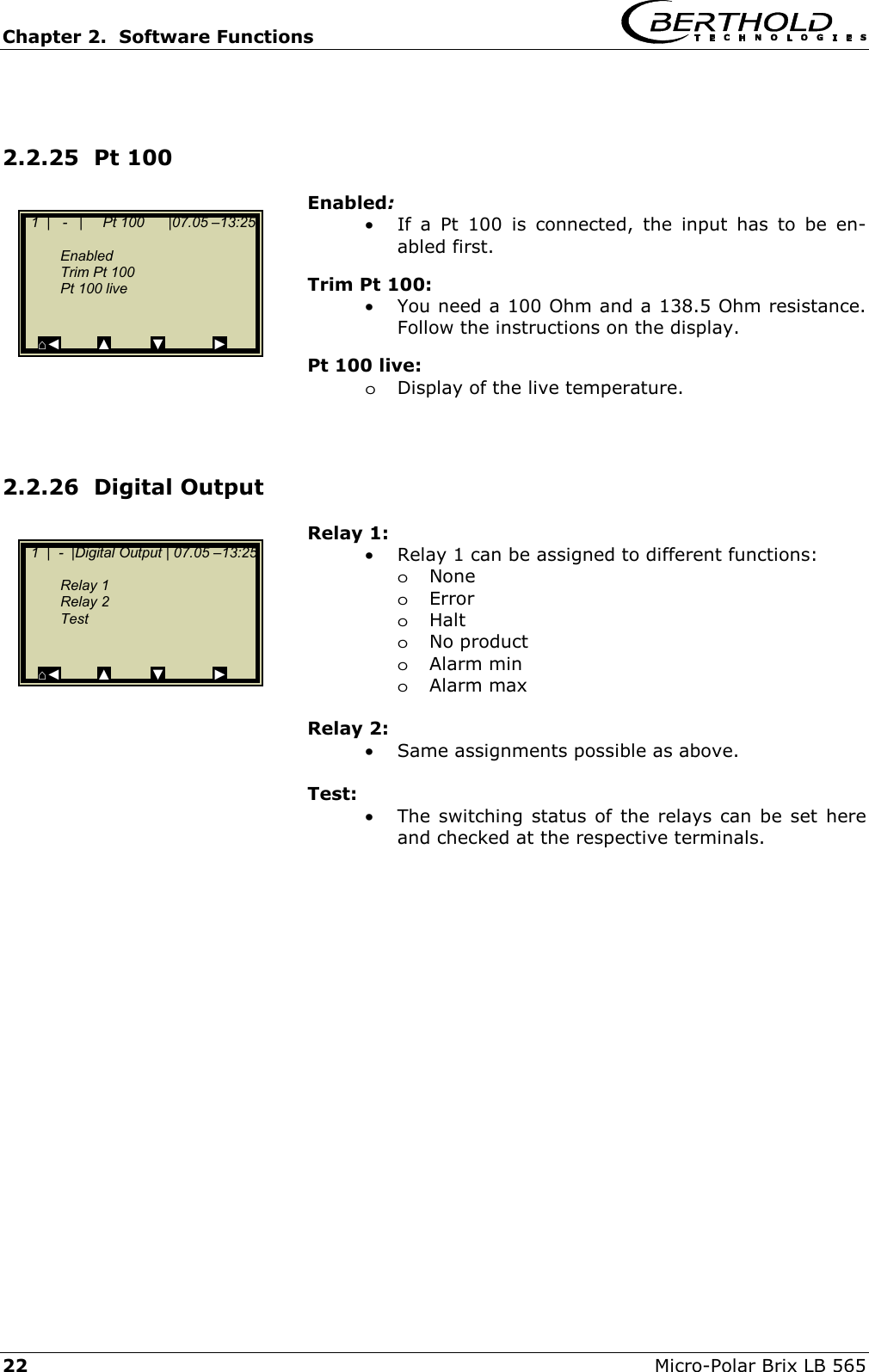
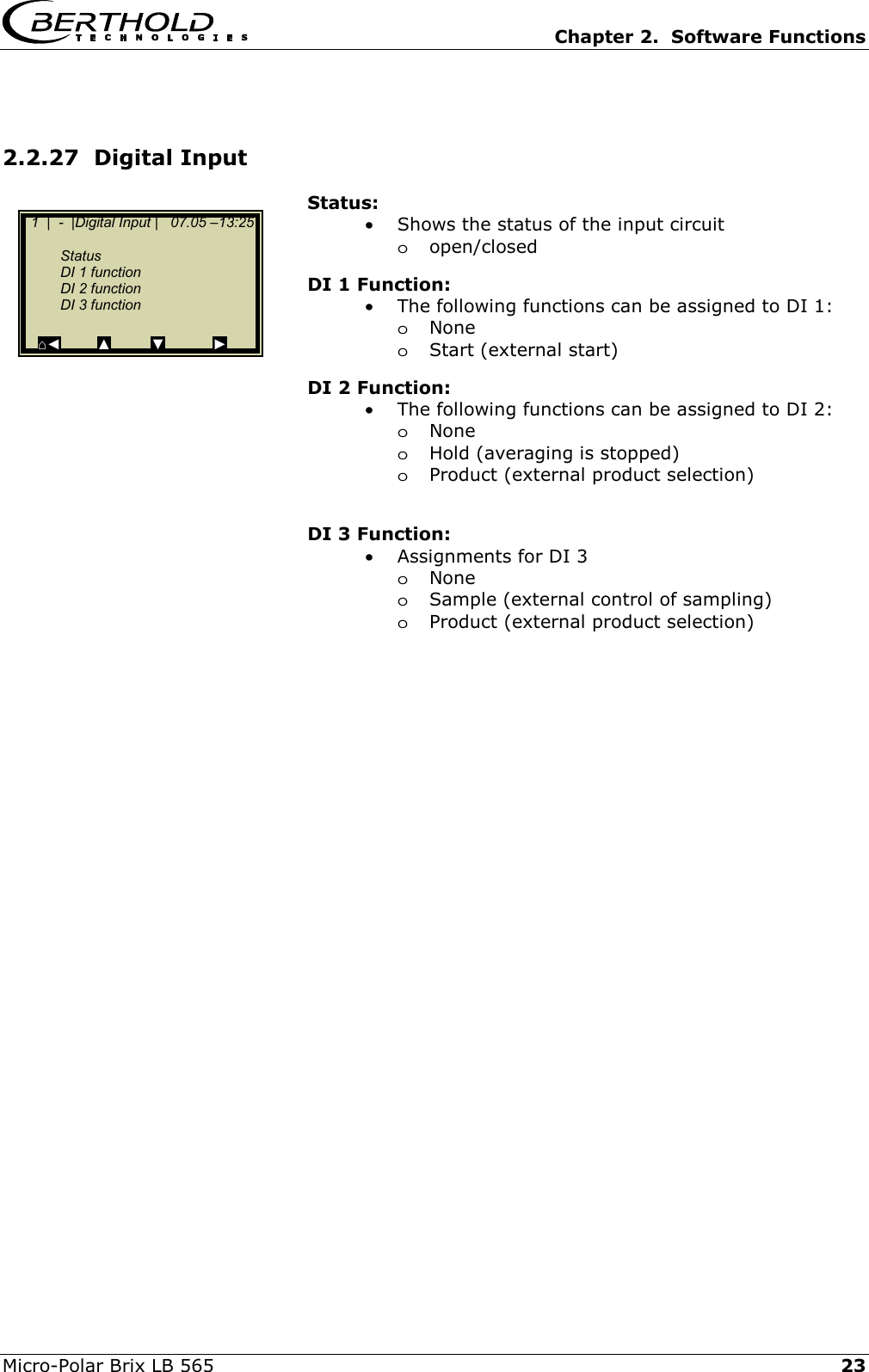
Chapter 2.  Software Functions     22  Micro-Polar Brix LB 565  2.2.25  Pt 100  Enabled: •  If a Pt 100 is connected, the input has to be en-abled first. Trim Pt 100: •  You need a 100 Ohm and a 138.5 Ohm resistance. Follow the instructions on the display. Pt 100 live: oDisplay of the live temperature.   2.2.26  Digital Output Relay 1: •  Relay 1 can be assigned to different functions: oNone oError oHalt oNo product oAlarm min oAlarm max  Relay 2: •  Same assignments possible as above.  Test: •  The switching status of the relays can be set here and checked at the respective terminals.        1  |   -   |     Pt 100      |07.05 –13:25      Enabled   Trim Pt 100   Pt 100 live        ⌂◄         ▲         ▼            ►   1  |  -  |Digital Output | 07.05 –13:25      Relay 1  Relay 2   Test        ⌂◄         ▲         ▼            ►
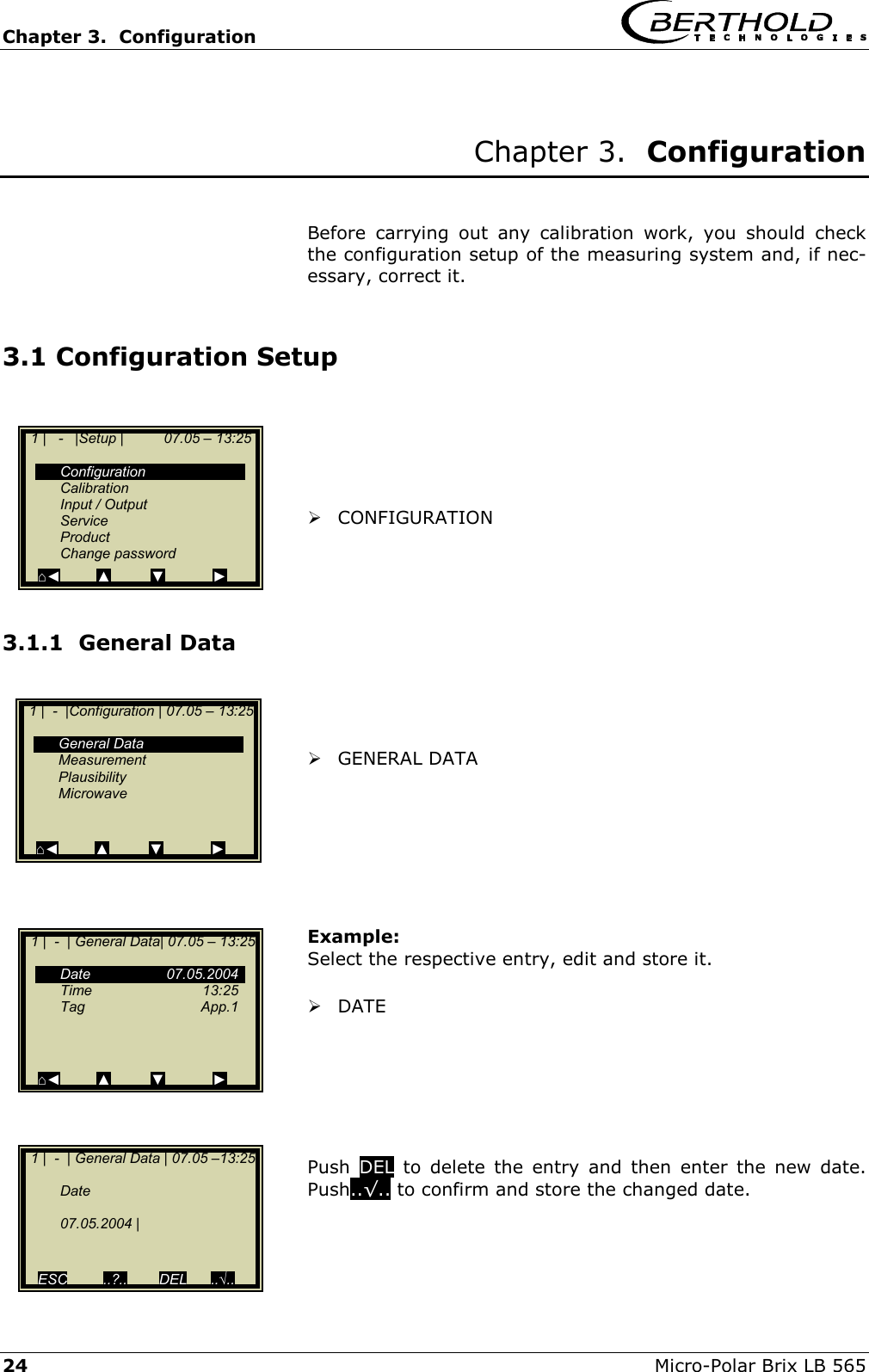
  Chapter 2.  Software Functions  Micro-Polar Brix LB 565   23 2.2.27  Digital Input Status: •  Shows the status of the input circuit  oopen/closed  DI 1 Function: •  The following functions can be assigned to DI 1: oNone oStart (external start) DI 2 Function: •  The following functions can be assigned to DI 2: oNone oHold (averaging is stopped) oProduct (external product selection)  DI 3 Function: •  Assignments for DI 3 oNone oSample (external control of sampling) oProduct (external product selection)      1  |  -  |Digital Input |   07.05 –13:25       Status  DI 1 function   DI 2 function  DI 3 function     ⌂◄         ▲          ▼            ►
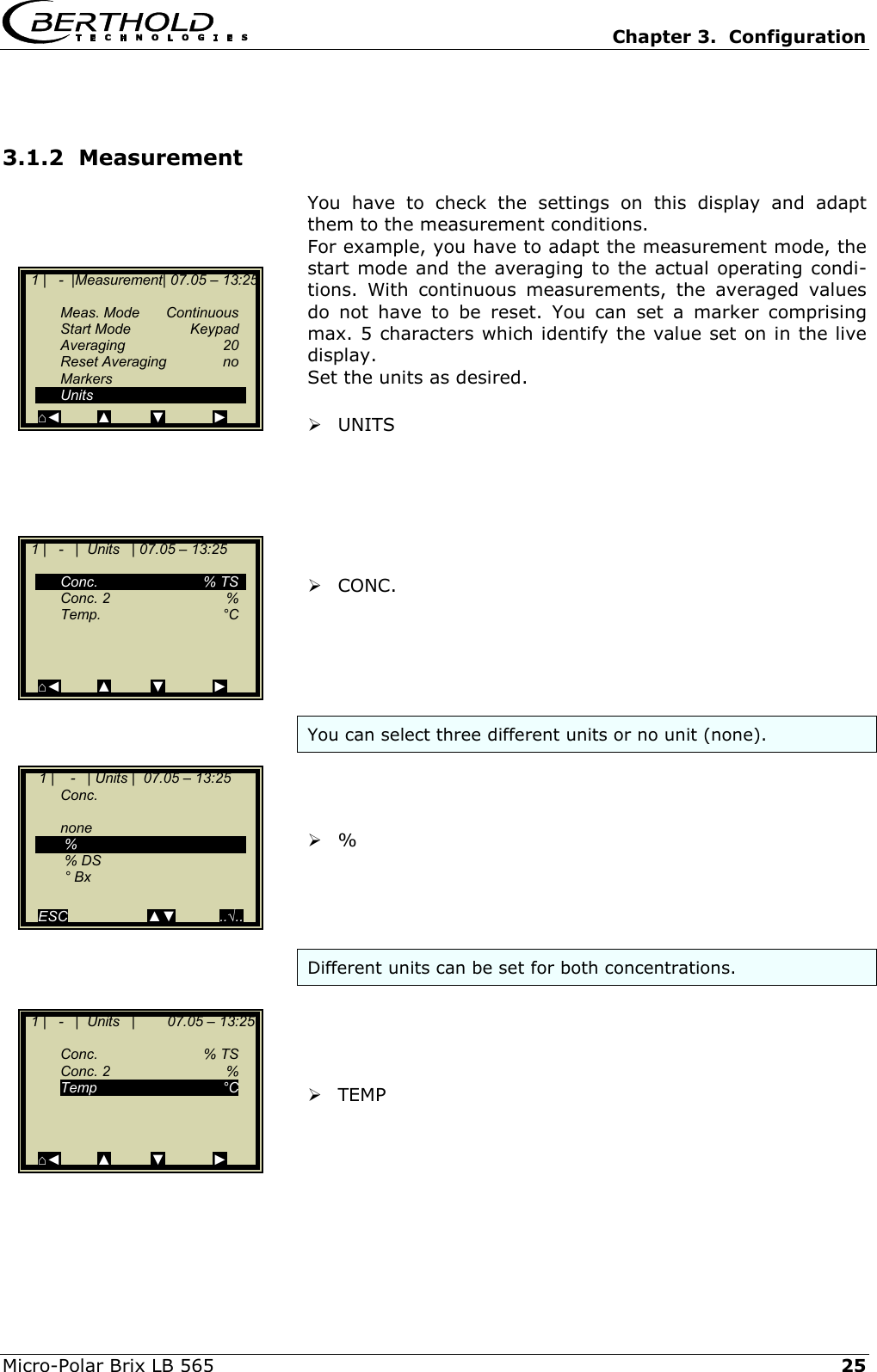
Chapter 3.  Configuration     24  Micro-Polar Brix LB 565  Chapter 3.  Configuration   Before carrying out any calibration work, you should check the configuration setup of the measuring system and, if nec-essary, correct it.  3.1 Configuration Setup       CONFIGURATION    3.1.1  General Data     GENERAL DATA        Example: Select the respective entry, edit and store it.   DATE       Push  DEL to delete the entry and then enter the new date. Push..√.. to confirm and store the changed date.    1 |   -   |Setup |          07.05 – 13:25     Configuration  Calibration  Input / Output  Service  Product  Change password   ⌂◄         ▲          ▼            ►   1 |  -  |Configuration | 07.05 – 13:25    General Data  Measurement  Plausibility  Microwave     ⌂◄         ▲          ▼            ►   1 |  -  | General Data| 07.05 – 13:25    Date   07.05.2004  Time   13:25  Tag   App.1       ⌂◄         ▲          ▼            ►   1 |  -  | General Data | 07.05 –13:25    Date    07.05.2004 |     ESC         ..?..        DEL      ..√..
  Chapter 3.  Configuration  Micro-Polar Brix LB 565   25 3.1.2  Measurement You have to check the settings on this display and adapt them to the measurement conditions.  For example, you have to adapt the measurement mode, the start mode and the averaging to the actual operating condi-tions. With continuous measurements, the averaged values do not have to be reset. You can set a marker comprising max. 5 characters which identify the value set on in the live display. Set the units as desired.   UNITS        CONC.      You can select three different units or no unit (none).     %      Different units can be set for both concentrations.      TEMP      1 |   -  |Measurement| 07.05 – 13:25    Meas. Mode Continuous  Start Mode  Keypad Averaging  20  Reset Averaging  no  Markers  Units ⌂◄         ▲          ▼            ►   1 |   -   |  Units   | 07.05 – 13:25     Conc.   % TS  Conc. 2   % Temp.    °C       ⌂◄         ▲          ▼            ►     1 |    -   | Units |  07.05 – 13:25   Conc.    none   %    % DS   ° Bx  ESC                    ▲▼           ..√..   1 |   -   |  Units   |        07.05 – 13:25    Conc.   % TS  Conc. 2   % Temp     °C       ⌂◄         ▲          ▼            ►
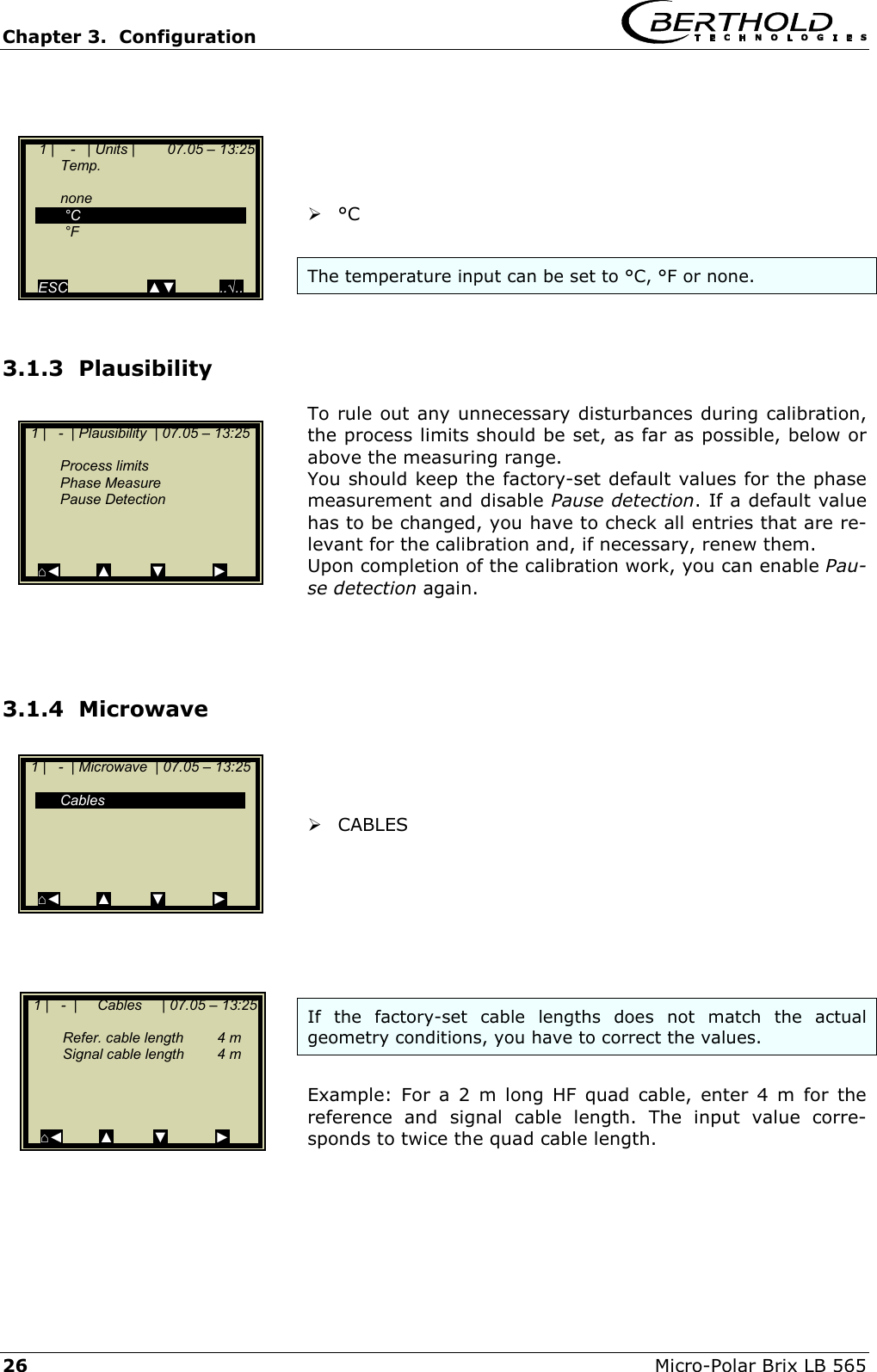
Chapter 3.  Configuration     26  Micro-Polar Brix LB 565       °C   The temperature input can be set to °C, °F or none.  3.1.3  Plausibility  To rule out any unnecessary disturbances during calibration, the process limits should be set, as far as possible, below or above the measuring range. You should keep the factory-set default values for the phase measurement and disable Pause detection. If a default value has to be changed, you have to check all entries that are re-levant for the calibration and, if necessary, renew them. Upon completion of the calibration work, you can enable Pau-se detection again.    3.1.4  Microwave     CABLES        If the factory-set cable lengths does not match the actual geometry conditions, you have to correct the values.  Example: For a 2 m long HF quad cable, enter 4 m for the reference and signal cable length. The input value corre-sponds to twice the quad cable length.      1 |   -  | Plausibility  | 07.05 – 13:25     Process limits  Phase Measure  Pause Detection     ⌂◄         ▲          ▼            ►   1 |   -  | Microwave  | 07.05 – 13:25    Cables       ⌂◄         ▲          ▼            ►   1 |   -  |     Cables     | 07.05 – 13:25     Refer. cable length  4 m   Signal cable length  4 m     ⌂◄         ▲          ▼            ►     1 |    -   | Units |        07.05 – 13:25  Temp.    none   °C   °F     ESC                    ▲▼           ..√..
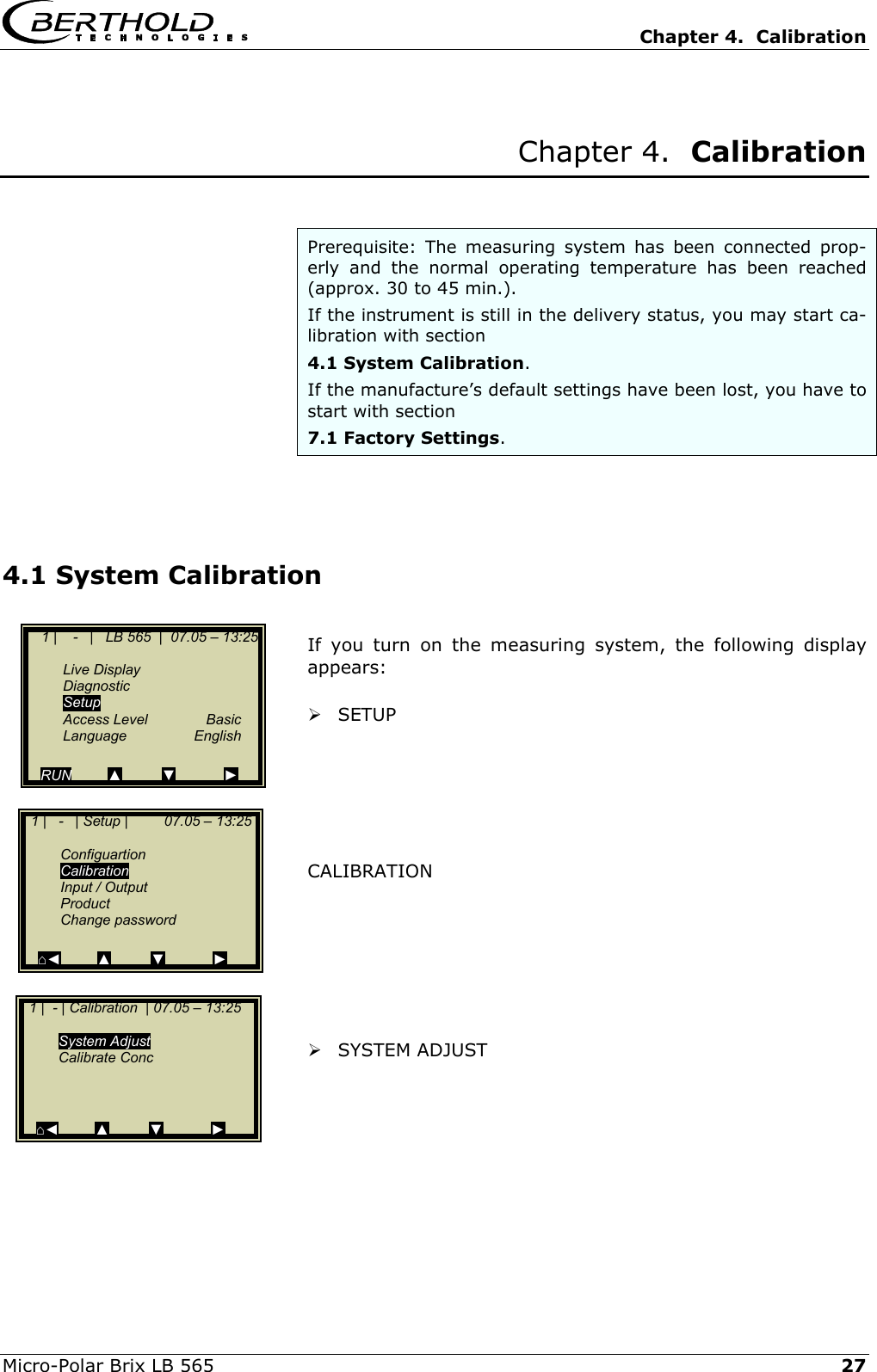
  Chapter 4.  Calibration  Micro-Polar Brix LB 565   27 Chapter 4.  Calibration   Prerequisite: The measuring system has been connected prop-erly and the normal operating temperature has been reached (approx. 30 to 45 min.).  If the instrument is still in the delivery status, you may start ca-libration with section  4.1 System Calibration. If the manufacture’s default settings have been lost, you have to start with section  7.1 Factory Settings.    4.1 System Calibration  If you turn on the measuring system, the following display appears:   SETUP       CALIBRATION          SYSTEM ADJUST       1 |    -   |   LB 565  |  07.05 – 13:25    Live Display  Diagnostic  Setup  Access Level  Basic  Language  English  RUN         ▲          ▼            ►   1 |   -   | Setup |         07.05 – 13:25     Configuartion  Calibration  Input / Output  Product  Change password   ⌂◄         ▲          ▼            ►   1 |  - | Calibration  | 07.05 – 13:25     System Adjust  Calibrate Conc      ⌂◄         ▲          ▼            ►
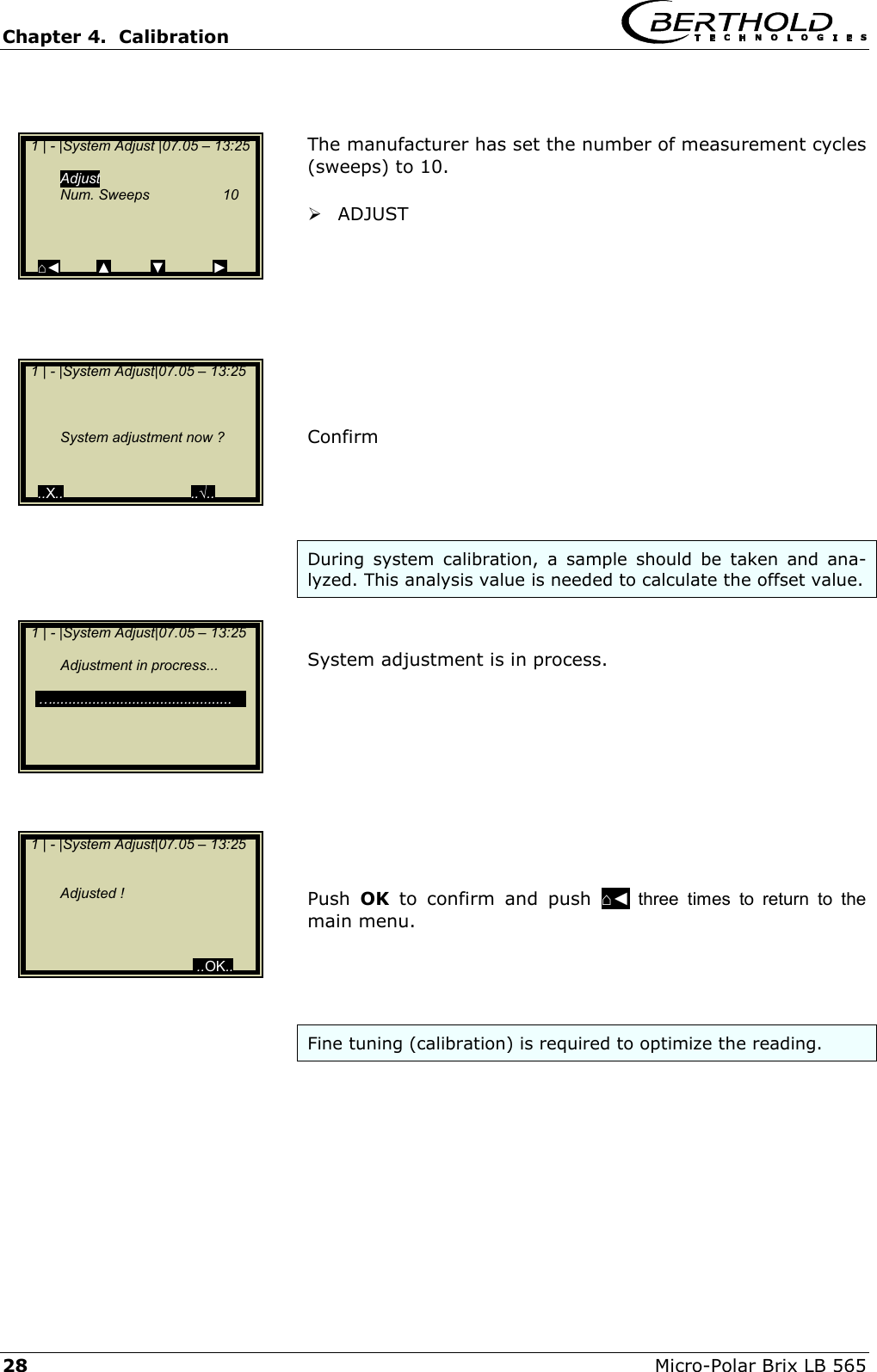
Chapter 4.  Calibration     28  Micro-Polar Brix LB 565   The manufacturer has set the number of measurement cycles (sweeps) to 10.    ADJUST          Confirm      During system calibration, a sample should be taken and ana-lyzed. This analysis value is needed to calculate the offset value.   System adjustment is in process.           Push  OK to confirm and push ⌂◄ three times to return to the main menu.     Fine tuning (calibration) is required to optimize the reading.      1 | - |System Adjust |07.05 – 13:25    Adjust   Num. Sweeps  10      ⌂◄         ▲          ▼            ►   1 | - |System Adjust|07.05 – 13:25              System adjustment now ?    ..X..                                ..√..   1 | - |System Adjust|07.05 – 13:25        Adjustment in procress...     ….............................................                             1 | - |System Adjust|07.05 – 13:25         Adjusted !                         ..OK..
  Chapter 4.  Calibration  Micro-Polar Brix LB 565   29 4.2 Start Calibration   The standard coefficients required for your application have already been set up by the manufacturer. Push RUN to start the measuring system.        Push  ..√.. to confirm this prompt and the instrument swit-ches to the run mode.       4.2.1  Tuning The display to the left appears if you push RUN.  The live display is now compared with the analysis value of the system calibration sample. The difference has to be en-tered with the correct sign character as offset .  Calculation: Analysis value – display = offset   Push ESC to return to the main menu.      SETUP        1 |    -   |   LB 565  |  07.05 – 13:25    Live Diplay  Diagnostic  Setup  Access Level  Basic  Language  English  RUN         ▲          ▼            ► 1 | - |Toggle Run Mode|07.05 –13:25       Switch Run Mode ?        ..X..                                    ..√..    1 | - | Live Display  | 07.05 – 13:25                   Concentration 1 av        65.50 %        Conc av.         Conc act   64.35%  ESC  PROBE   ..▲▼..     ZOOM       1 |    -   |   LB 565  |  07.05 – 13:25    Live Display  Diagnostic  Setup  Access Level  Basic  Language  English  STOP         ▲          ▼            ►
Chapter 4.  Calibration     30  Micro-Polar Brix LB 565       CALIBRATION           CALIBRATE CONC           TUNING           OFFSET         Enter the calculated offset value, confirm with ..√.. and push the Home button four times to return to the main menu.      1 |  -  |Setup |             07.05 – 13:25    Configuration  Calibration  Input / Output  Service  Product   ⌂◄         ▲          ▼            ►   1 |  - | Calibration  |   07.05 – 13:25    System Adjust  Calibrate Conc  Advanced   ⌂◄         ▲          ▼            ►   1 | - |Calibrate Conc| 07.05 –13:25     Sampling  Calibr. autom.   Tuning  View  ⌂◄         ▲          ▼            ►   1 |  -  |  Tuning   |       07.05 –13:25     Factor   1.00000  Offset   0.000       ⌂◄         ▲          ▼            ►   1 |  -  |  Tuning   |        07.05 –13:25     Offset    0.000 |     ESC         ..?..        DEL      ..√..
  Chapter 4.  Calibration  Micro-Polar Brix LB 565   31    Select    LIVE DISPLAY  to return to the display.        The display value should now correspond to the actual value.            1 |    -   |   LB 565  |  07.05 – 13:25    Live Display  Diagnostic  Setup  Access Level  Basic  Language  English  STOP         ▲          ▼            ►     1 | - | Live Display  | 07.05 – 13:25                   Concentration 1 av        75.50 %        Conc av.         Conc act   64.35%  ESC  PROBE   ..▲▼..     ZOOM
Chapter 4.  Calibration     32  Micro-Polar Brix LB 565  4.2.2  Sampling  The display to the left appears if you push RUN.   Note: Push the PROBE button to start measurement of the raw data. At the same time, the laboratory sample has to be taken and marked. The analysis may be performed later, provided the product is not changed by this.      Sampling is in process......  Push the ..X.. button to stop the sample taking any time.       If the sample taking took place without any problem, push the  ..√.. button to store the sample in the table and the measurement continues.      You have to repeat the process described above for each further sample.  The second sample taking should be started only when the dis-play shows a significant difference to the first sample taking.       1 | - | Live Display  | 07.05 – 13:25                   Concentration 1 av        65.50 %        Conc av.            Conc act   64.35%  ESC  PROBE   ..▲▼..     ZOOM       1 |  - | Live Display | 07.05 – 13:25                   Taking Sample # 1                 Conc av.            Conc act   64.35%   ..X..                  ..▲▼..           1 |  - | Live Display | 07.05 – 13:25                          Save sample no. 1?                         Conc av.             Conc act   64.35%  ..X..                      ..▲▼..       ..√..
  Chapter 4.  Calibration  Micro-Polar Brix LB 565   33 4.2.3  Entering the Laboratory Values   Push the ESC  button to go to the main menu. A measure-ment can be stopped only on the main menu.           Push STOP to stop the measuring system.            Push ..√.. to confirm the prompt and the measurement swit-ches to the STOP mode.          SETUP         CALIBRATION       1 | - | Live Display  | 07.05 – 13:25                 Concentration 1 av      65.50 %       Conc av.            Conc act   64.35%  ESC  PROBE   ..▲▼..     ZOOM       1 |    -   |   LB 565  |  07.05 – 13:25    Live Display  Diagnostic  Setup  Access Level  Basic  Language  English  Stop         ▲          ▼            ►1 | - |Toggle Run Mode|07.05 –13:25       Switch Run Mode ?        ..X..                                    ..√..     1 |    -   |   LB 565  |  07.05 – 13:25    Live Display  Diagnostic  Setup  Access Level  Basic  Language  English RUN         ▲          ▼            ►   1 |  -  |Setup |            07.05 – 13:25     Comfiguration  Calibration  Input / Output  Service  Product  Change password ⌂◄         ▲          ▼            ►
Chapter 4.  Calibration     34  Micro-Polar Brix LB 565       CALIBRATE CONC         SAMPLING           LAB VALUE        Push  DEL to delete default value, enter new value and push ..√.. to confirm.          NEXT SAMPLE   and repeat the step described above with the next sample.   After you have entered the last sample, push the   ◄   button to return to the calibration menu. (short push – one page, longer push of the button – you get back to the Calibration menu im-mediately)   1 |  - | Calibration  | 07.05 – 13:25     System Adjust  Calibrate Conc  Advanced   ⌂◄         ▲          ▼            ►   1 | - |Calibrate Conc| 07.05 –13:25     Sampling  Calibr. autom.  Calibr. manual  Tuning  View ⌂◄         ▲          ▼            ►  1 | 1/1 | Sample # 1 | 07.05 –13:25    Next sample  Actice   Yes  Meas value  65.50 %   Lab value  0.00 %  Advanced   ◄          DEL         ▲▼          ..√.. 1 | 1/1 | Sample # 1 | 07.05 –13:25   Lab value     0.00|                  %        ◄          DEL         ▲▼          ..√.. 1 | 1/1 | Sample # 1 | 07.05 –13:25    Next sample  Active   Yes  Meas value  65.50 %   Lab value  72.40 %  Advanced   ◄           DEL         ▲▼          ..√..
  Chapter 4.  Calibration  Micro-Polar Brix LB 565   35 4.2.4  Automatic Calibration  Phase calibration including the enabled compensation is carried out during automatic calibration.     CALIBR. AUTOM.      START CALIBR.           Push the ..√.. button to start the calibration.          Push the ..OK.. button to confirm calibration.  When calculating the new coefficient set, the factor and offset will be reset (factor 1.00000 and offset 0.000).     Push the ..⌂◄.. button four times to return to the main menu.     1 |  -  | Calibration |     07.05 –13:25       Calibrate now ?      ..X..                                   ..√..   1 | - |Calibr. autom.| 07.05 –13:25   Start Calibr.          ⌂◄         ▲          ▼            ►   1 | - |Calibrate Conc| 07.05 –13:25     Sampling  Calibr. autom.  Tuning  View  ⌂◄         ▲          ▼            ►   1 | - | Calibrate Conc | 07.05 –13:25      Calibrated !                                              ..OK..   1 | - |Calibrate Conc| 07.05 –13:25     Sampling  Calibr. autom.  Tuning  View  ⌂◄         ▲          ▼            ►
Chapter 4.  Calibration     36  Micro-Polar Brix LB 565  4.3  Manual Calibration Manual calibration is possible only on the Advanced level.  Prerequisites for manual calibration are chapters    4.1 System Calibration     4.2 Start Calibration    4.2.1 Tuning    4.2.2 Sampling and    4.2.3 Entering the Laboratory Values  4.3.1  Manual Calibration with One Concentration   If the display depicted to the left is not visible, do the follow-ing on the live display: ESC|SETUP|CALIBRATION|CALIBRATE CONC|   CALIBR. MANUAL          CAL. ORDER             LINEAR  Quadratic calibration is possible only for a calibration with three and more samples.   1 | - |Calibrate Conc| 07.05 –13:25     Sampling  Calibr. autom.  Calibr. manual  Tuning  View ⌂◄         ▲          ▼            ►   1 | - | Calibr. manual | 07.05 –13:25    Cal. Order  Linear  Cal. Base  Phase  Coefficients  Start Calibr.   ⌂◄         ▲          ▼            ►   1 | - | Calibr. manual | 07.05 –13:25  Cal. Order      Linear  Quadratic    ⌂◄         ▲          ▼            ►
  Chapter 4.  Calibration  Micro-Polar Brix LB 565   37      CAL. BASE            PHI    (phase measurement)   The calibration base is selected depending on the number of samples and their raw data. Initial calibration should be as sim-ple as possible, since calibration can be optimized any time.      START CALIBRATION         Push the ..√.. button to start the calibration, push ..X.. to go back one page without calibration.          ..OK.. accepts the calibration and changes to the next dis-play.   1 | - | Calibr. manual | 07.05 –13:25    Cal. Order  Linear  Cal. Basic  Phase  Coefficients  Start Calibr.   ⌂◄         ▲          ▼            ►   1 | - | Calibr. manual | 07.05 –13:25  Cal. Base     Phase  Attenuation  Both   ⌂◄         ▲          ▼            ►   1 | - | Calibr. manual | 07.05 –13:25    Cal. Order  Linear  Cal. Base  Phase  Coefficients  Start Calibr.   ⌂◄         ▲          ▼            ►   1 | - | Calibration |       07.05 –13:25         Calibrate now ?     ..X..                                    ..√..  1 | - | Calibration  |     07.05 –13:25        Calibrated !                                               ..OK..
Chapter 4.  Calibration     38  Micro-Polar Brix LB 565      The curve to the left shows the characteristic curve lab / measured value.   ..►..         The correlation shows the average deviation of the curve from the sample series.     ..OK..            As soon as you confirm this prompt, the calibration display appears again; from there you get back to the main menu by pushing .⌂◄. four times and you can start the measurement again.        1 | - | Calibration | 07.05 –13:25                                                        ►   1 | - | Calibration | 07.05 –13:25      Correlation Lab/Meas. value    0.998726                                              ..OK..  1 | - | Calibration | 07.05 –13:25       Calibration OK?      ..X..                                    ..√..
  Chapter 4.  Calibration  Micro-Polar Brix LB 565   39 4.3.2  Calibration with Two Concentrations  Calibration for two concentrations starts with changing the proc-ess type as described below.  Prerequisites for manual calibration are chapters    4.1 System Calibration    4.2.1 Tuning  and    4.2.2 Sampling        ADVANCED          PROCESS TYPE          2 CONC  Push the ..√..  button to accept the selected process type and push the .⌂◄. button once to get to the following dis-play.       CALIBRATE CONCENTRATION 1     1 |  - | Calibration  | 07.05 – 13:25     System Adjust  Calibrate Conc  Calibrate Conc2  Advanced  ⌂◄         ▲          ▼            ►   1 |  - | Calibration  | 07.05 – 13:25     System Adjust  Calibrate Conc   Advanced   ⌂◄         ▲          ▼            ► 1|  -  | Advanced |       07.05 –13:25     Num. Cal. Sweeps  10  Process Type       ⌂◄         ▲          ▼            ► 1|  -  |Advanced |         07.05 –13:25  Process Type  1 Conc.  2 Conc.  Split Conc.     .ESC.         ..?..         ▲▼       ..√..
Chapter 4.  Calibration     40  Micro-Polar Brix LB 565      SAMPLING     There is only one sample table for both calibrations.  The lab values have to be entered for all samples used for cali-bration of concentration 1. All other samples have to be disabled (active.... yes/no).     LAB VALUE         Delete default value with DEL, enter new value and confirm with ..√...          NEXT SAMPLE  with next sample.         ACTIVE  Disable sample.    1 | 1/4 | Sample # 1 | 07.05 – 13:25     Lab value   60.40 |   %   ESC        ..?..         DEL        ..√..    1 | - |Calibrate Conc | 07.05 –13:25     Sampling  Calibr. autom.  Calibr. manual  Tuning  View ⌂◄         ▲          ▼            ►  1 | 1/4 | Sample # 1 | 07.05 –13:25    Next sample  Active   Yes  Meas value  65.50 %   Lab value  0.00 %  Advanced   ◄          DEL         ▲▼          ..√.. 1 |1 /4 | Sample # 1  | 07.05 –13:25    Next sample  Active   Yes   Meas value  65.50  %   Lab value  60.40  %  Advanced   ◄          DEL         ▲▼          ..√.. 1 |2 /4 | Sample # 2  | 07.05 –13:25    Next sample  Active   Yes   Meas value  74.35  %   Lab value  67.80  %  Advanced   ◄          DEL         ▲▼          ..√..
  Chapter 4.  Calibration  Micro-Polar Brix LB 565   41      NO        Make sure that all samples have been processed and only those samples are active which are relevant for this calibration.   Push   ◄   to return to the calibration page.      Automatic as well as manual calibration is possible in this cali-bration mode. For non-professional users we recommend the automatic mode.           START CALIBRATION           Push the ..√.. button to start the calibration; push ..X.. to re-turn one page without calibration.   1 | 2/4 | Sample # 2  | 07.05 – 13:25   Active     No  Yes   ESC        ..?..         DEL        ..√..   1 |2 /4 | Sample # 2  | 07.05 –13:25    Next sample  Active   No   Meas value  74.35  %   Lab value  67.80  %  Advanced   ◄          DEL         ▲▼          ..√..   1 | - |Calibrate Conc | 07.05 –13:25    Sampling  Calibr. autom.  Calibr. manual  Tuning  View ⌂◄         ▲          ▼            ►   1 | - | Calibration |   07.05 –13:25          Calibrate now ?     ..X..                                    ..√..  1 | - |Calibr. autom. |07.05 –13:25     Start Calibr.     ⌂◄         ▲          ▼            ►
Chapter 4.  Calibration     42  Micro-Polar Brix LB 565     Push  ..OK.. to accept the calibration and to change to the next display.           Push .⌂◄. twice to return two pages.            CALIBRATE CONCENTRATION 2     Repeat the steps as described above for concentration 2; all samples have to be enabled again in the sample table. Now you have to disable all samples which are not used for concentration 2.    SAMPLING      1 | - | Calibration  | 07.05 –13:25         Calibrated !                                               ..OK..   1 | - |Calibr. autom. |07.05 –13:25     Start Calibr.     ⌂◄         ▲          ▼            ►   1 |  - | Calibration  | 07.05 – 13:25     System Adjust  Calibrate Conc  Calibrate Conc2  Advanced  ⌂◄         ▲          ▼            ►   1 | - |Calibrate Conc2|07.05 –13:25     Sampling  Calibr. autom.  Calibr. manual  Tuning  View ⌂◄         ▲         ▼            ►
  Chapter 4.  Calibration  Micro-Polar Brix LB 565   43 4.3.3  Calibration with Split Value  With this type of calibration, two characteristic curves (concen-trations) are combined in one measuring range; their point of intersection defines the split value.        ADVANCED           PROCESS TYPE            SPLIT CONC   Push the ..√..  button to accept the selected process type and push the .⌂◄. button once to go to the display depicted below.  The displayed split value has been set by the manufacturer, but has to be adapted to the respective application.  The sample measurement should be selected such that the last sample of the lower concentration is fairly close to the first sam-ple measurement of the upper concentration. Ideally, the last sample of the initial concentration is the first sample of the final concentration.     1 |  -  | Calibration   |  07.05 – 13:25    System Adjust  Calibrate Conc   Advanced    ⌂◄         ▲          ▼            ► 1|  -  | Advanced |         07.05 –13:25     Num Cal. Sweeps  10  Process Type       ⌂◄         ▲          ▼            ► 1|  -  | Advanced |         07.05 –13:25  Process Type  1 Conc.  2 Conc.  Split Conc.     .ESC.         ..?..         ▲▼       ..√.. 1|  -  | Advanced          |07.05 –13:25    Num. Cal. Sweeps  10   Process Type  Split Conc.   Split Value   75.00 %     ⌂◄         ▲          ▼            ►
Chapter 4.  Calibration     44  Micro-Polar Brix LB 565  The sample measurement is carried out continuously over the entire measuring range with the display depicted to the left. See chapter 4.2.2 Sampling.   After completion of sampling, the individual samples will be enabled or disabled during input of the laboratory values, re-lative to the set split values. All samples smaller or equal to the split value will be assigned to the lower concentration range and all samples above to the upper concentration ran-ge.  The split value to be set must correspond to the point of inter-section of both calibration curves.     SPLIT VALUE         Enter the split value and confirm with ..√...      Push the Home button .⌂◄. to return to the calibration page.     CALIBRATE CONC         CALIBR. AUTOM.   The lower concentration is now calibrated. Then select CONC2 and repeat the calibration process. Back to the main menu and start the measurement.     1 | - | Live Display  | 07.05 – 13:25                   Concentration 1 av.        65.50 %        Conc av.            Conc act   64.35%  ESC  PROBE   ..▲▼..     ZOOM   1|  -  |Advanced |         07.05 –13:25    Num. Cal. Sweeps  10   Process Type  Split Conc.   Split Value   75.00 %     ⌂◄         ▲         ▼            ► 1|  -  | Advanced |         07.05 –13:25    Split Value     75.00  |   %     ESC        ..?..        DEL        ..√..   1 |  - | Calibration  |   07.05 – 13:25     System Adjust  Calibrate Conc  Calibrate Conc2  Advanced  ⌂◄         ▲         ▼            ►   1 | - |Calibrate Conc | 07.05 –13:25     Sampling  Calibr. autom.  Calibr. manual  Tuning  View ⌂◄         ▲         ▼            ►
  Chapter 4.  Calibration  Micro-Polar Brix LB 565   45 4.3.4  Calibration with Temperature Compensation  Before running a sample measurement you have to enable the desired compensation input and check the calibration. If all in-puts are enabled, the measured values of all inputs will be stored automatically in the sample table.    From the main menu, you get in the Advanced mode to the display to the left via | SETUP | CALIBRATION | CALIBRATE CONC. |   CALIBR. MANUAL        COMPENSATION          INPUT     If all inputs have been enabled during sample measurement, you have the option to select a compensation from the list, since all input values have been stored in the sample table.    Pt 100      1 | - |Calibrate Conc| 07.05 –13:25     Sampling  Calibr. autom.  Calibr. manual  Tuning  View ⌂◄         ▲          ▼            ►   1 | - | Calibr. manual | 07.05 –13:25    Cal. Order  Linear  Cal. Base  Phase  Coefficients  Compensation  Start Calibr. ⌂◄         ▲          ▼            ►   1 | - |Compensation|  07.05 –13:25  Input  None   Current In 1   Current In 2  Pt 100   ⌂◄         ▲          ▼            ►   1 | - |Compensation | 07.05 –13:25   Input        None  Mode   Additive  Order   Linear  Ref. Temp.  0.00  TC_Phi 1  0.00000  TC_dB 1  0.00000  ESC       ..?..         ▲▼         ..√..
Chapter 4.  Calibration     46  Micro-Polar Brix LB 565   You can select additive or multiplicative mode and set the or-der to linear or quadratic. If you select automatic calibration mode, the above modes will be calculated automatically. This is recommended for non-professional users.     REF TEMP         Enter the average operating temperature and confirm.          The coefficients TC_Phi 1 and TC_dB 1 are automatically cal-culated during calibration.       If you have completed the entries described above and have carried out the steps described in chapters 4.1 System calibration  4.2.1 Tuning 4.2.2 Sampling and  4.2.3 Entering the Lab Values    you may proceed with the calibration as described below.       CALIBR. AUTOM.   1 | - |Compensation  | 07.05 –13:25  Ref. Temp.      80.00 |  °C              ESC        ..?..        DEL         ..√..     1 | - |Compensation | 07.05 –13:25    Input       Pt 100  Mode   Additive  Order   Linear  Ref. Temp.  0.00°C  TC_Phi 1  0.00000  TC_dB 1  0.00000  ESC       ..?..         ▲▼         ..√..    1 | - |Compensation | 07.05 –13:25    Input       Pt 100  Mode   Additive  Order   Linear  Ref.Temp.  80.00°C  TC_Phi 1  0.00000  TC_dB 1  0.00000  ESC       ..?..         ▲▼         ..√..    1 | - |Calibrate Conc1|07.05 –13:25     Sampling  Calibr. autom.  Calibr. manual  Tuning           View ⌂◄         ▲         ▼            ►
  Chapter 4.  Calibration  Micro-Polar Brix LB 565   47     START CALIBR.          Start calibration process.                Push  .O.K. to confirm the calibration. Calibration is finished. Push the Home button .⌂◄. four times to return to the main menu and to start a measurement.      1 | - |Calibr. autom. |07.05 –13:25     Start Calibr.  Compensation  Pt 100    ⌂◄         ▲          ▼            ►   1 | - | Calibr. autom. | 07.05 –13:25          Calibrate now ?     ..X..                                    ..√..  1 | - | Calibr. autom.  | 07.05 –13:25        Calibrating...                                               ..OK..   1 | - | Calibr. autom.  | 07.05 –13:25        Calibrated !                                               ..OK..
Chapter 5.  Password     48  Micro-Polar Brix LB 565  Chapter 5.  Password   The measuring system can be protected by passwords a-gainst unauthorized access.  5.1 Password The following access levels are available. Read only The measuring system cannot be started and stopped. You can only switch from the live display to Diagnostic and to Ac-cess Level. Basic On the Basic level you can make essential entries, and stop and start the system. Profi  The Profi mode allows additional entries in the process type menu, calibration menu and opens the Service menu. Service The Service level is reserved for technical service.     You have to enter a password to change from the access level „Read only“ to „Basic“ or „Profi“. At the time of delivery, this password is       PASS1 Changing from Profi to Basic or vice versa is possible without password. You can change the password on the Profi or Basic level.
  Chapter 6.  Inputs / Outputs  Micro-Polar Brix LB 565   49 Chapter 6.  Inputs / Outputs   The measuring system includes two separate floating current outputs.  6.1 Current Outputs Current outputs 1 and 2 can be assigned to the concentra-tions for calibration with two concentrations.  You get to the setup display as follows.     SETUP           INPUT/OUTPUT         CURRENT OUTPUT       Now you can select the respective current output and assign it to the concentration after calibration.         1 |    -   |   LB 565  |  07.05 – 13:25    Live Diplay  Diagnostic  Setup  Access Level  Basic  Language  English  RUN         ▲          ▼            ►   1 |  -  |Setup |          07.05 – 13:25     Configuration  Calibration  Input / Output  Service  Product   ⌂◄         ▲          ▼            ►   1 | - |Input / Output | 07.05 –13:25     Current Output  Current Input  Pt 100  Digital Output  Digital Input ⌂◄         ▲          ▼            ►   1 | - |Current Output | 07.05 –13:25      Current Out 1   Current Out 2       ⌂◄         ▲          ▼            ►
Chapter 6.  Inputs / Outputs     50  Micro-Polar Brix LB 565  6.1.1  Current Output Setup     CURRENT_OUT 1          ASSIGNMENT          CONC   Select and confirm with ..√...  In case of two concentrations and outputs enabled, the assign-ment can be chosen as needed.     UPPER VALUE        Delete the old value with DEL. Enter the new limit value and confirm with ..√...  Set the lower value also as described above.   1 | - |Current Output | 07.05 –13:25      Current Out 1   Current Out 2       ⌂◄         ▲          ▼            ►   1 | - | Current Out 1  | 07.05 –13:25     Assignmet  Conc.   Upper Value  95.00 %   Lower Value  60.00 %   Test / Adjust  Error current ⌂◄         ▲          ▼            ►    1 |  -  | Current Out 1|07.05 –13:25   Assignment  Conc.  Conc. 2   Current In 1   Current In 2  Pt 100 .ESC.         ..?..         ▲▼       ..√..    1  |  -  |Current Out 1|07.05 –13:25     Assignment  Conc.   Upper value  95.00 %  Lower value  60.00 %   Test / Adjust  Error current ⌂◄         ▲          ▼            ►    1 |  -  |Current Out 1| 07.05 –13:25   Upper value       95.00 |    %     .ESC.         ..?..       DEL       ..√..
  Chapter 6.  Inputs / Outputs  Micro-Polar Brix LB 565   51 6.1.2  Test and Adjustment        TEST / ADJUST          DAC TRIM  ! CAUTION: Current output 1 can only be set between 4 and 20 mA, since it is foreseen for a Hart® communicator.     Push  .OK. to confirm that the process is not affected by the measurement.         Push  .OK. to confirm that the measuring system is con-nected.          Push .OK. to confirm.    1  |  -  |Current Out 1|07.05 –13:25     Assignment  Conc.   Upper value  95.00 %  Lower value  60.00 %   Test / Adjust  Error current ⌂◄         ▲          ▼            ►    1  |  -  |Test / Adjust | 07.05 –13:25     Loop test  DAC trim  Live current  4.00 mA     ⌂◄         ▲          ▼            ►    1  |  -  |  Trim Cout   | 07.05 –13:25        Loop should be removed    from automatic control      ..X..                                  .OK.    1  |  -  |  Trim Cout   | 07.05 –13:25        Connect reference meter!         ..X..                                  .OK.    1  |  -  |  TrimCout   | 07.05 –13:25        Setting Current Output      To 4 mA     ..X..                                  .OK.
Chapter 6.  Inputs / Outputs     52  Micro-Polar Brix LB 565     Read off display of measuring system and enter value.         4 mA value adjusted.        Push the .OK. button to confirm.        Read off display of measuring system and enter value.         Adjustment finished.      To check the current loop and possibly connected remote dis-plays, you can set a current between 4 and 20 mA via the test function. If you quit the test function, the system automatically switches back to the live current.     1  |  -  |  Trim Cout   | 07.05 –13:25     Enter meter value      3.80 |   mA      .ESC.                  .DEL.         ..√..    1  |  -  |  Trim Cout   | 07.05 –13:25            4 mA adjusted     ..X..                                  .OK.    1  |  -  |  Trim Cout   | 07.05 –13:25        Setting Current Output     to 20 mA     ..X..                                  .OK.    1  |  -  |  Trim Cout   | 07.05 –13:25     Enter meter value      19.80 |   mA      .ESC.                  .DEL.         ..√..    1  |  -  |  Trim Cout   | 07.05 –13:25            20 mA adjusted     ..X..                                  .OK.    1  |  -  |Test / Adjust | 07.05 –13:25     Loop test  DAC trim  Live current  15.00 mA     ⌂◄         ▲          ▼            ►
  Chapter 6.  Inputs / Outputs  Micro-Polar Brix LB 565   53 6.1.3  Error Current Different signal effects can be assigned to the output current.      ERROR CURRENT           ALARM MODE      Fixed values, Hold or freely adjustable values between 0 and 24 mA can be assigned.      VALUE  With this setting, you can default any current value for the error case.  ! CAUTION: The current output 1 can only be set between 3.5 mA and 24 mA. [HART®]     Enter value and confirm with ..√...      1  |  -  |Current Out 1|07.05 –13:25     Assignment  Conc.   Upper value  95.00 %  Lower value  60.00 %   Test / Adjust  Error current ⌂◄         ▲          ▼            ►    1  |  - | Error current | 07.05 –13:25    Alarm Mode  Value   22.00 mA      ⌂◄         ▲          ▼            ►   1  |  -  | Error current |07.05 –13:25  Alarm mode    22.00 mA  3.5 mA  Hold  Value ⌂◄         ▲          ▼            ►    1  |  -  |Error current| 07.05 –13:25  Value    3.50   mA       ESC                    DEL            ..√..
Chapter 6.  Inputs / Outputs     54  Micro-Polar Brix LB 565  6.1.4  Current Output 2      CURRENT OUT 2  All settings for current output 2 have to be made in the same manner as for output 1, with the exception of the range setting.       RANGE         After selection of the required range, carry out all setting and calibration steps as described in chapter 6.1.2.        1 | - |Current Output | 07.05 –13:25      Current Out 1   Current Out 2       ⌂◄         ▲          ▼            ►    1  |  -  |Current Out 2|07.05 –13:25   Assignment  Conc.2   Upper value  95.00 %  Lower value  60.00 %   Range      4 - 20 mA   Test / Adjust  Error current ⌂◄         ▲          ▼            ►    1 |  -  |Current Out 2|07.05 –13:25   Range    0 – 20 mA   4 – 20 mA     .ESC.                    ▲▼       ..√..
  Chapter 6.  Inputs / Outputs  Micro-Polar Brix LB 565   55 6.2 Current Inputs If the window below is not displayed, you can invoke it on the main menu via |SETUP |INPUT/OUTPUT |     CURRENT INPUT      6.2.1  Enabling the Current Input     CURRENT IN 1           ENABLED           ENABLING   If a measurement is running, enabling an adjusted current input which is not used may cause an error.   1 | - |Input / Output | 07.05 –13:25     Current Output  Current Input  Pt 100  Digital Output  Digital Input ⌂◄         ▲          ▼            ►  1 | - |Current Input | 07.05 –13:25      Current In 1   Current In 2       ⌂◄         ▲         ▼            ►    1  |  -  |Current In 1 | 07.05 –13:25        Enabled  nein  DAC trim    Live current  4.00 mA    ⌂◄         ▲         ▼            ►    1 |  -  |Current In 1 | 07.05 –13:25   Enabled   no  yes     .ESC.       ..?..          ▲▼       ..√..
Chapter 6.  Inputs / Outputs     56  Micro-Polar Brix LB 565  6.2.2  Range Setting and Adjustment     RANGE SETTING             4 – 20 mA           DAC trim          Push  .OK. to confirm that the process is not affected by the measurement.         Push .OK. to confirm that the current generator is connected.       1  |  -  | Current In 1 | 07.05 –13:25   Enabled  ja   Range     0 – 20 mA   Upper value  100.00 °C   Lower value  0.00 ° C  DAC trim  Live current  4.00 mA ⌂◄         ▲          ▼            ►    1 |  -  |Current In 1|   07.05 –13:25    Range     0 – 20 mA   4 – 20 mA      .ESC.                     ▲▼       ..√..    1  |  -  | Current In 1 | 07.05 –13:25   Enabled  yes   Range    4 – 20 mA   Upper value  100.00 °C   Lower value  0.00 ° C  DAC trim  Live current  4.00 mA ⌂◄         ▲          ▼            ►    1  |  -  |  Trim Cin   | 07.05 –13:25        Loop should be removed   from automatic control!      ..X..                                  .OK.    1  |  -  |  Trim Cin   | 07.05 –13:25       Connect current generator!        ..X..                                  .OK.
  Chapter 6.  Inputs / Outputs  Micro-Polar Brix LB 565   57      Set current generator to 4 mA.        Push the .OK. button to confirm.         Push .OK. to confirm adjustment of the lower value.         Set current generator to 20 mA.        Push the .OK. button to confirm.         Push .OK. to confirm adjustment of the lower value.       1  |  -  |  Trim Cin    | 07.05 –13:25       Set current generator     to 4 mA     ..X..                                  .OK.    1  |  -  |  Trim Cin    | 07.05 –13:25        4 mA adjusted.      ..X..                                  .OK.    1  |  -  |  Trim Cin    | 07.05 –13:25        Generator set to 20 mA?          ..X..                                  .OK.    1  |  -  |  Trim Cin    | 07.05 –13:25        20 mA adjusted.      ..X..                                  .OK.    1  |  -  |  Trim Cin    | 07.05 –13:25        Generator set to 4 mA?          ..X..                                  .OK.    1  |  -  |  Trim_Cin    | 07.05 –13:25       Set current generator     to 20 mA      ..X..                                  .OK.
Chapter 6.  Inputs / Outputs     58  Micro-Polar Brix LB 565      Adjustment finished. The live current is displayed.    If necessary, carry out range setting and calibration of current input 2 as described above.     6.3 Pt 100 Before enabling, you have to stop the measuring system, as the change in configuration may lead to errors.  6.3.1  Pt 100 Enabling     PT 100          ENABLED          Select „yes“ and confirm with  ..√….      1  |  -  |Current In 1 | 07.05 –13:25   Enabled  ja   Range    4 – 20 mA   Upper value  100.00 °C   Lower value  0.00 ° C  DAC trim  Live current  4.00 mA ⌂◄         ▲          ▼            ►   1 | - |Input / Output | 07.05 –13:25     Current Output  Current Input  Pt 100  Digital Output  Digital Input ⌂◄         ▲          ▼            ►   1 | - |       Pt 100       | 07.05 –13:25     Enabled  no   Trim Pt 100    Pt 100 live    ⌂◄         ▲          ▼            ►   1 | - |       Pt 100       | 07.05 –13:25     Enabled    no  yes    ESC                   ▲▼            ..√..
  Chapter 6.  Inputs / Outputs  Micro-Polar Brix LB 565   59 6.3.2  Pt 100 Calibration      TRIM Pt 100            ..OK..    Connect 100 Ohm resistor to the Pt100 terminals [11] [23].    Confirm once more with .O.K..         Adjustment of lower point finished.         After connection of the resistor, confirm with ..OK...     1 | - |       Pt 100       | 07.05 –13:25     Enabled  yes   Trim Pt 100    Pt 100 live    ⌂◄         ▲          ▼            ►    1  |  -  |Trim Pt 100 | 07.05 –13:25        Connect 100 Ohm resistor   to Pt 100 terminals !   (for 0°C / 31.4°F adjustment)   ..X..                                  .OK.    1  |  -  |Trim Pt 100 | 07.05 –13:25        100 Ohm resistor connected?        ..X..                                  .OK.    1  |  -  |Trim Pt 100 | 07.05 –13:25        Lower point adjusted        ..X..                                  .OK.    1  |  -  |Trim Pt 100 | 07.05 –13:25           Connect 138,5 Ohm resistor      to Pt 100 terminals !      (for 100°C / 211.4°F adjustment)
Chapter 6.  Inputs / Outputs     60  Micro-Polar Brix LB 565    1 | - |Digital Output | 07.05 –13:25     Relay 1  Relay 2  Test   ⌂◄         ▲         ▼            ►     Confirm prompt.         Calibration is finished.      6.4 Digital Output The measuring system includes two changeover relay outputs which can be assigned to the respective application.  Relay 1 is associated with LED signal 1 and relay 2 with signal 2.  6.4.1  Digital Output Assignment  From the main menu you get to the display depicted to the left via | Setup | Input/Output | Digital Output    RELAY 2         Select the display with the arrow keys.          1  |  -  |Trim Pt 100 | 07.05 –13:25        Upper point adjusted.        ..X..                                  .OK.    1  |  -  |Trim Pt 100 | 07.05 –13:25            138.5 Ohm resistor connected?        ..X..                                  .OK.   1 | - |      Relay 2      | 07.05 –13:25    Function  No product       ⌂◄         ▲         ▼            ►
  Chapter 6.  Inputs / Outputs  Micro-Polar Brix LB 565   61   Push ▲▼ and then ..√.. to assign a function to the relay.       Function  Description None  Relay and LED function disabled Error  In case of error, relay and LED will be set. Hold meas.  If Hold function is enabled, relay and LED will be set. No product  If Pause detection is enabled, this will be signaled via relay and LED. Alarm min.  The relay switches if the value falls below the limit value to be set. Alarm max.  The relay switches if the value exceeds the limit value to be set.    6.5 Digital Input Different functions can be assigned to the digital inputs. See table below:   Function1  Function2  Function3  Terminals DI 1  None  Start   12/24 DI 2  None  Hold  Product  13/25 DI 3  None  Sample  Product  14/26  For external start function, the start function has to be set to external in the Measurement menu window.  Hold means that averaging is stopped, but the measurement continues to run.  Sample means that sampling is started by closing the con-tact.   1 | - |      Relay 2     | 07.05 –13:25   Function        None  Error  Hold meas.  No product  Alarm min  Alarm max ESC      ..?..          ▲▼       ..√..
Chapter 6.  Inputs / Outputs     62  Micro-Polar Brix LB 565  6.5.1  External Product Switchover   From the main menu you get to the window display depicted to the left via |SETUP |INPUT/OUTPUT |DIGITAL IINPUT.   DI 2 FUNCTION          PRODUCT     DI 3 also has to be set to product. Please take the terminal as-signment from the table below.          Terminals DI 2 13 / 25 DI 3 14 / 26 Product 1  Open  Open Product 2  Closed  Open Product 3  Open  Closed Product 4  Closed  Closed   CAUTION! If you change to another product, the product-specific data will be loaded automatically, including:  Configurations data System calibration Calibration data Input/Output definitions    1  |  -  |Digital Input |07.05 –13:25       Status   DI 1 function   None  DI 2 function  None  DI 3 function  None     ⌂◄         ▲         ▼            ►   1  |  -  |Digital Input |07.05 –13:25   DI 2 function      None   Hold  Product     ESC      DEL          ▲▼     ..√..   1  |  -  |Digital Input |07.05 –13:25       Status   DI 1 function   None  DI 2 function  Produkt  DI 3 function  None     ⌂◄         ▲         ▼            ►
  Chapter 7.  Factory Settings  Micro-Polar Brix LB 565   63 Chapter 7.  Factory Settings   This function allows you to reset the measuring system to its original status.     SETUP         SERVICE           FACTORY SETTINGS        If you confirm this prompt, all parameters and configuration set-tings will be reset to their original status, with the exception of the sampling table and the reference measurement.        1 |    -   |   LB 565  |  07.05 – 13:25    Live Display  Diagnostic  Setup  Access Level  Language  RUN         ▲          ▼            ►     1 |  -  | Setup |        07.05 – 13:25     Configuration  Calibration  Input / Output  Service  Product  Change password     ⌂◄          ▲             ▼            ►     1 |    -   | Service  |  07.05 – 13:25     Factory settings            ⌂◄         ▲          ▼            ►  1| - |Factory Settings| 07.05 – 13:25         Restore now?      ..X..                                  ..√..
Chapter 8.  Error Lists     64  Micro-Polar Brix LB 565  Chapter 8.  Error Lists   8.1 Error Lists All errors will be signaled by a red LED and a flashing RUN LED. Error displayed on the LCD have to be confirmed. After the error has been remedied, the LED’s are reset to the normal status. 8.1.1  Hardware Error Battery voltage Program memory faulty Data memory faulty I/O Communication trouble   8.1.2  Input Error  Error  Cause  Value too high  Input value is too high Value too low  Input value is too low Table is empty  Sampling has been selected without previ-ous sample measurement Chart data faulty  The measuring system has determined faulty chart data during calibration. No chart data available The calculates chart data have been deleted or calibration has not been completed. Sampling full  You have tried to measure more then 10 samples.
  Chapter 8.  Error Lists  Micro-Polar Brix LB 565   65 8.1.3  Measurement Error Error  Possible cause Variance of phase is too large The measured phase exceeds the permissible limit value. Attenuation too high The measured attenuation exceeds the permissible maximum value. Current input 1 out of range The enabled current input has not yet been calibrated or is not occupied. Current input 2 out of range The enabled current input has not yet been calibrated or is not occupied. Pt 100 temperature out of range The enabled Pt 100 input has not yet been calibrated or is not occupied. Concentration out of range The concentration calculated on the basis of the raw data lies outside the valid measuring range. Concentration 2 out of range The concentration calculated on the basis of the raw data lies outside the valid measuring range.     All remedied measurement errors have to be confirmed with O.K. so that the measuring system can return to the live display.
Chapter 9.  Calibration Data Sheet     66  Micro-Polar Brix LB 565  Chapter 9.  Calibration Data Sheet    9.1 Configuration 9.1.1  General General Default  Setting Date  01.06.04                   Time 13:00  Tag -   9.1.2  Measurement Measurement Default  Setting Meas. mode  continuous   Start mode  keyboard   Averaging 20   Reset averaging  no   Marker Mark1  Units %   9.1.3  Plausibility Plausibility Default  Setting Process limits  60.0 – 100.0   Phase measure-ment Variance Ratio Phi/dB   100.00 6.0  Pause detection  yes -15.0 dB   9.1.4  Microwave Microwave Default  Setting Cable Ref. cable length Signal cable length  4.00 m  4.00 m
  Chapter 9.  Calibration Data Sheet  Micro-Polar Brix LB 565   67 9.2 Product Product Default  Setting Product 1    9.3 Input / Output 9.3.1  Current Output Current_out 1  Default  Setup Assignment Conc.   Upper value  95.00   Lower value  60.00   Test/Calibration O.K.   Error current  Hold     Current_out 2  Default  Setting Assignment conc. 2   Upper value  95.00   Lower value  60.00   Range  4 – 20 mA   Test/Calibration O.K.   Error current   Hold    9.3.2  Current Input Current_in 1  Default  Setting Enabled no   Range  4 – 20 mA   Upper value  100.00   Lower value  0.00   Calibration O.K.   Live current  17.05 mA     Current_in 2  Default  Setting Enabled No   Range  4 – 20 mA   Upper value  100.00   Lower value  0.00   Calibration O.K.   Live current  17.05 mA
Chapter 9.  Calibration Data Sheet     68  Micro-Polar Brix LB 565  9.3.3  Pt 100 Input Pt 100  Default  Setting Enabled no   Pt 100  Calibration O.K.  Pt 100 Live  99.99 °C     9.3.4  Digital Output Digital output  Default  Setting Relay 1  Error   Relay 2  No Product    9.3.5  Digital Input Digital input  Default  Setting DI 1 function  none   DI 2 function  none   DI 3 function  none     9.4 Calibration Data 9.4.1  Calibration Coefficients  Calibration Default  Setting Calibration order  linear   Calibration Basic  phase   Coefficients A1 A2 B1 B2 C  -0.19 0.0 0.0 0.0 75.00  Compensation Mode Order  Ref. temp. TC_Phi 1 TC_Phi 2 TC_Attn 1 TC_Attn 2  none additive linear 0.00  0.00000 0.00000 0.00000 0.00000
 Calibration Data Sheet Micro-Polar Brix LB 565   69 9.4.2  Sampling Table   No.  Active  Meas. value  Lab value  Current_in 1  Current _in 2  Pt 100  Phi (m)  Attenuation 1         2         3         4         5         6         7         8         9         10
   70  Micro-Polar Brix LB 565   Notes
 Micro-Polar Brix LB 565   71  Notes

Navigation menu