DSP Group DHANJ DECT Module User Manual DHX91 DHAN Module Datasheet

DSP Group Ltd DECT Module DHX91 DHAN Module Datasheet

Users Manual

  DHAN-J Module DECT-ULE Platform   Datasheet Version: 2.2 March 13 2018
Version 2.1  DHAN-J Module  Worldwide Sites       March 2018  DSP Group Confidential  2/19   Headquarters  USA  DSP Group Inc. 161 S San Antonio Rd Suite 10 Los Altos, CA 94022 Tel: (408)986-4300  Fax:(408)986-4323  Israel DSP Group Ltd. 5 Shenkar Street Herzelia, Israel 4672505 Tel: 972-9-952-9696  Fax: 972-9-954-1234     Europe  Germany DSPG Technologies GmbH Nelson-Mandela-Platz 18  90459 Nurnberg  Tel: +49-911-2001-0 Fax: +49-911-2001-1210  Scotland DSPG Edinburgh Ltd. Geddes House Kirkton North  Livingston EH54 6GU Tel: +44-1223-772200      APAC  China DSP Group (HK) Limited Unit 1-4, 11/F, 909 Cheung Sha Wan Rd. Kowloon  Hong Kong  Tel: +852-(3965)-5888   DSP Group (Shenzhen) Limited Room 1819, 18/F Kerry Centre, Renminnan Road, Shenzhen, China 518001 Tel: +(86 755) 2518 1214  Ascend Technology Inc. Room 1303,  New World Center,  No.6009 Yitian Road,  Futian District, Shenzhen City, China Tel: +86-755-820-24598 Fax: +86-755-239-82986  Ascend Technology Inc. Rm 607,  Hui Huang International Center, 1st Place, Shangdi 10th Road, Haidian District, Beijing City, P.R.  Japan DSP Group (Japan) Inc. 1-29-1 Nishi-Gotanda Shinagawa-Ku Tokyo 141-0031  Tel:+81-(3)-3493-3050   Tomen Electronics  8-27, Kohnan 1 Chome, Minato-ku, Tokyo  108-8510, Japan  Tel: +81-(3)-5462-9619  Fax: +81-(3)-5462-9686   Korea Daesung Semiconductors  140-848, RM 401 Wonhyo BD. 46-1 Wonhyo-ro 3ka, Yongsan-gu, Seoul, Korea  Tel: +82-(2)-3272-7300 Fax: +82-(2)-712-4632-3  India DSP Technology Indian Private Limited Information Technology Park Nagawara Village Kasaba Hobli Bangalore 560045  Tel: +91 80 4024 8399  Taiwan Ascendtek Electronics, Inc 11F-7, No. 77, Sec. 1 Hsin Tai Wu Rd.,  Hsi Chih Taipei Hsien, Taiwan, R.O.C Tel: 886-2-2698-8696  Fax: 886-2-8698-2138           This document is provided by DSP Group, Inc. and/or one or more of its subsidiaries (“DSP Group”). All information and data contained in this document is for informational purposes only, without any commitment on the part of DSP Group, and is not to be considered as an offer for a contract.  DSP Group shall not be liable, in any event, for any claims for damages or any other remedy in any jurisdiction whatsoever, whether in an action in contract, tort (including negligence and strict liability) or any other theory of liability, whether in law or equity including, without limitation, claims for damages or any other remedy in whatever jurisdiction, and shall not assume responsibility for patent infringements or other rights to third parties, arising out of or in connection with this document. Further, DSP Group reserves the right to revise this publication and to make changes to its content, at any time, without obligation to notify any person or entity of such revision changes. These materials are copyrighted and any unauthorized use of these materials may violate copyright, trademark, and other laws. Therefore, no part of this publication may be reproduced, photocopied, stored on a retrieval system, or transmitted without the express written consent of DSP Group. Any new issue of this document invalidates previous issues. DSP Group reserves the right to revise this publication and to make changes to its content, at any time, without obligation to notify any person or entity of such revision changes. © 2018 DSP Group Confidential. All rights reserved.
Version 2.1  DHAN-J Module  Table of Contents  February 27, 2018  DSP Group Confidential  3/19  TABLE OF CONTENTS 1. INTRODUCTION ........................................................................................................................................... 4 General Description ............................................................................................................................................ 4 Features ............................................................................................................................................................... 4 Block Diagram .................................................................................................................................................... 4 2. PIN AND SIGNAL DESCRIPTION ............................................................................................................... 5 3. MODULE ELECTRICAL SPECIFICATIONS .............................................................................................. 7 Absolute Maximum Rating ................................................................................................................................. 7 Recommended Operating Conditions ................................................................................................................. 7 Peak Currents and Hibernation Current .............................................................................................................. 7 Transmitter .......................................................................................................................................................... 8 Receiver .............................................................................................................................................................. 8 4. REFERENCE SCHEMATIC .......................................................................................................................... 9 Module and External Host Interface ................................................................................................................... 9 Power Supply and Optional JTAG ...................................................................................................................... 9 Optional Audio and 32KHz XTAL ................................................................................................................... 10 Interfacing to an external ASIC Sensor or Actuator ......................................................................................... 10 Notes to schematic: ........................................................................................................................................... 11 5. INTERFACING THE DHAN-J WITH AN EXTERNAL MCU .................................................................. 12 RSTN Input ....................................................................................................................................................... 12 Wake Up Input .................................................................................................................................................. 12 Wake Up Output ............................................................................................................................................... 12 6. APPLICATION PCB DESIGN RECOMMENDATIONS ............................................................................ 13 7. ASSEMBLY INFORMATION ..................................................................................................................... 14 Mechanical Drawing ......................................................................................................................................... 14 PCB Metal Land Pattern Recommendation ...................................................................................................... 15 PCB Solder Mask Recommendation ................................................................................................................. 16 PCB Stencil Pattern Recommendation .............................................................................................................. 16 Pick & Place, Reflow ........................................................................................................................................ 16 8. SUPPLEMENTARY INFORMATION ........................................................................................................ 17 Labeling (appended to the module shield) ........................................................................................................ 17 Handling Guidance ........................................................................................................................................... 17 RF Exposure Information and Statement .......................................................................................................... 17 FCC & IC Interference Statement ..................................................................................................................... 18 Declaration of Conformance (DOC) ................................................................................................................. 18 IPEI and EMC ................................................................................................................................................... 18 Ordering Information ........................................................................................................................................ 19 Change Log ....................................................................................................................................................... 19
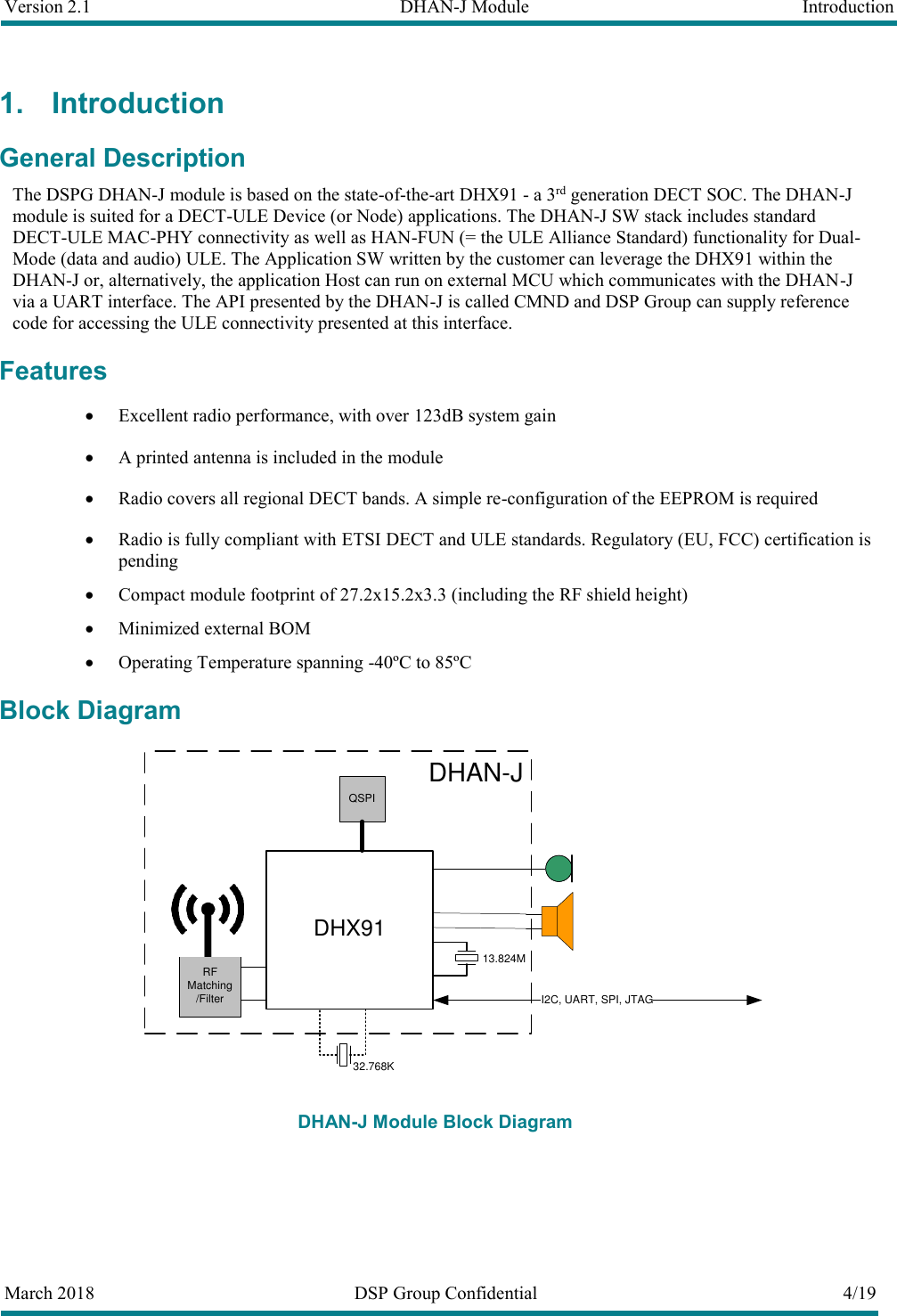
Version 2.1  DHAN-J Module  Introduction       March 2018  DSP Group Confidential  4/19   1. Introduction General Description The DSPG DHAN-J module is based on the state-of-the-art DHX91 - a 3rd generation DECT SOC. The DHAN-J module is suited for a DECT-ULE Device (or Node) applications. The DHAN-J SW stack includes standard DECT-ULE MAC-PHY connectivity as well as HAN-FUN (= the ULE Alliance Standard) functionality for Dual-Mode (data and audio) ULE. The Application SW written by the customer can leverage the DHX91 within the DHAN-J or, alternatively, the application Host can run on external MCU which communicates with the DHAN-J via a UART interface. The API presented by the DHAN-J is called CMND and DSP Group can supply reference code for accessing the ULE connectivity presented at this interface. Features  Excellent radio performance, with over 123dB system gain  A printed antenna is included in the module  Radio covers all regional DECT bands. A simple re-configuration of the EEPROM is required  Radio is fully compliant with ETSI DECT and ULE standards. Regulatory (EU, FCC) certification is pending  Compact module footprint of 27.2x15.2x3.3 (including the RF shield height)  Minimized external BOM  Operating Temperature spanning -40ºC to 85ºC Block Diagram DHX91QSPII2C, UART, SPI, JTAGRF Matching/FilterDHAN-J   13.824M32.768K DHAN-J Module Block Diagram
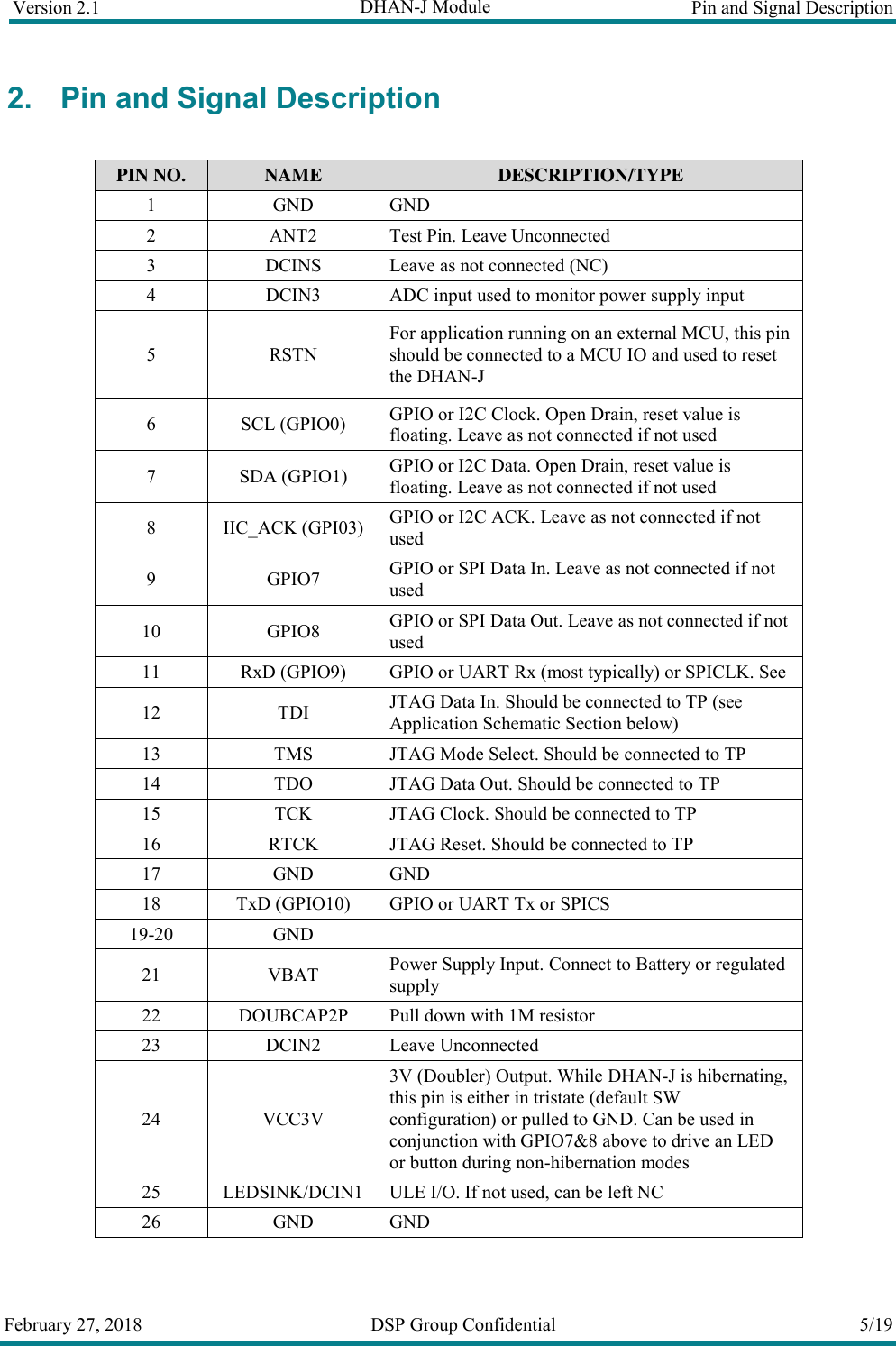
Version 2.1  DHAN-J Module  Pin and Signal Description  February 27, 2018  DSP Group Confidential  5/19  2. Pin and Signal Description  PIN NO.  NAME  DESCRIPTION/TYPE 1  GND GND 2  ANT2  Test Pin. Leave Unconnected 3  DCINS  Leave as not connected (NC) 4  DCIN3  ADC input used to monitor power supply input 5  RSTN For application running on an external MCU, this pin should be connected to a MCU IO and used to reset the DHAN-J 6  SCL (GPIO0)  GPIO or I2C Clock. Open Drain, reset value is floating. Leave as not connected if not used 7  SDA (GPIO1)  GPIO or I2C Data. Open Drain, reset value is floating. Leave as not connected if not used 8  IIC_ACK (GPI03)  GPIO or I2C ACK. Leave as not connected if not used 9  GPIO7  GPIO or SPI Data In. Leave as not connected if not used 10  GPIO8  GPIO or SPI Data Out. Leave as not connected if not used 11  RxD (GPIO9)  GPIO or UART Rx (most typically) or SPICLK. See  12  TDI  JTAG Data In. Should be connected to TP (see Application Schematic Section below) 13  TMS  JTAG Mode Select. Should be connected to TP 14  TDO  JTAG Data Out. Should be connected to TP 15  TCK  JTAG Clock. Should be connected to TP  16  RTCK  JTAG Reset. Should be connected to TP 17  GND GND 18  TxD (GPIO10)  GPIO or UART Tx or SPICS 19-20 GND   21  VBAT  Power Supply Input. Connect to Battery or regulated supply 22  DOUBCAP2P  Pull down with 1M resistor 23  DCIN2  Leave Unconnected 24  VCC3V 3V (Doubler) Output. While DHAN-J is hibernating, this pin is either in tristate (default SW configuration) or pulled to GND. Can be used in conjunction with GPIO7&8 above to drive an LED or button during non-hibernation modes 25  LEDSINK/DCIN1  ULE I/O. If not used, can be left NC 26 GND GND
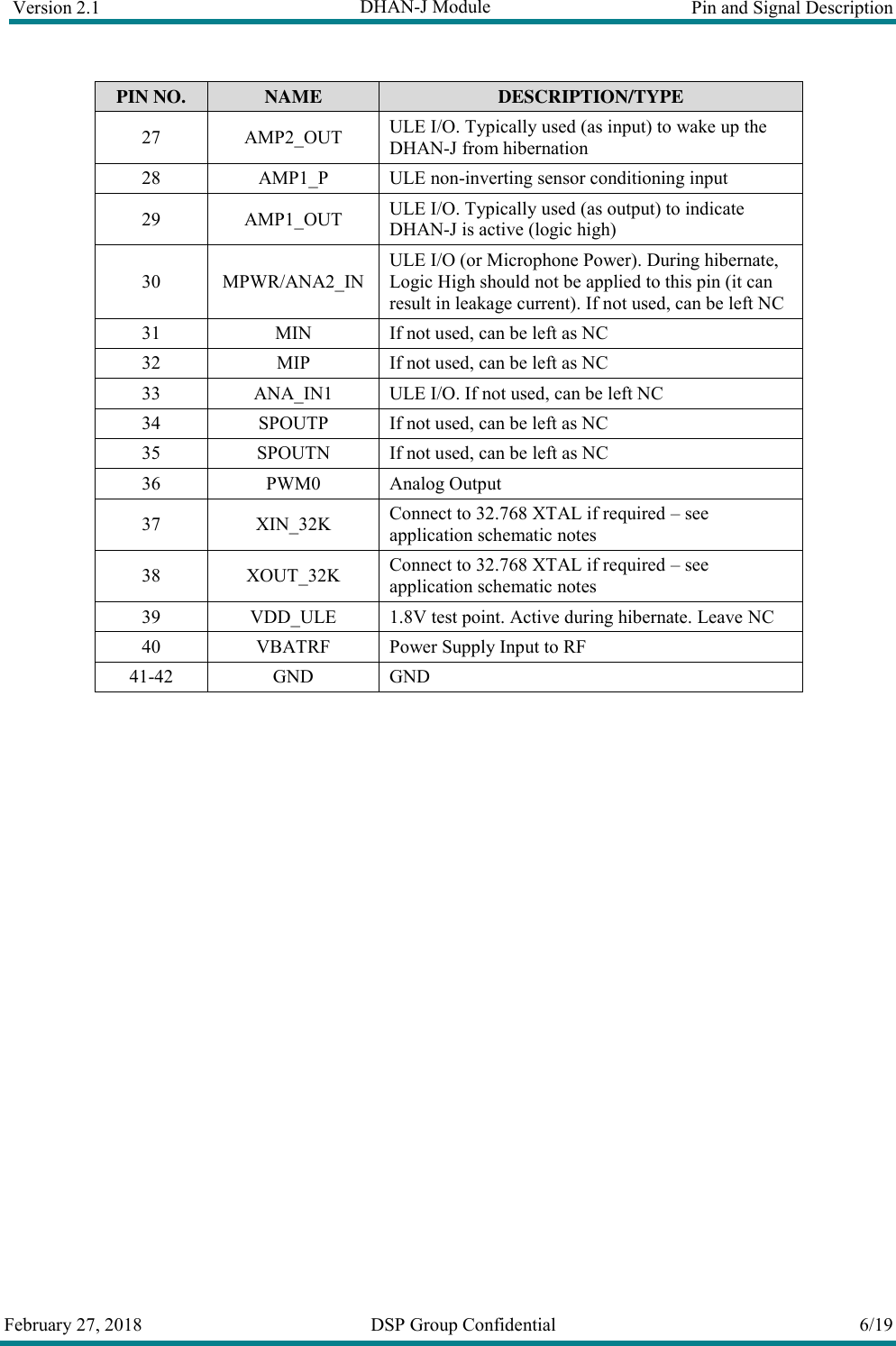
Version 2.1  DHAN-J Module  Pin and Signal Description  February 27, 2018  DSP Group Confidential  6/19  PIN NO.  NAME  DESCRIPTION/TYPE 27  AMP2_OUT  ULE I/O. Typically used (as input) to wake up the DHAN-J from hibernation 28  AMP1_P  ULE non-inverting sensor conditioning input 29  AMP1_OUT  ULE I/O. Typically used (as output) to indicate DHAN-J is active (logic high) 30  MPWR/ANA2_IN ULE I/O (or Microphone Power). During hibernate, Logic High should not be applied to this pin (it can result in leakage current). If not used, can be left NC 31  MIN  If not used, can be left as NC 32  MIP  If not used, can be left as NC 33  ANA_IN1  ULE I/O. If not used, can be left NC 34  SPOUTP  If not used, can be left as NC 35  SPOUTN  If not used, can be left as NC 36  PWM0  Analog Output 37  XIN_32K  Connect to 32.768 XTAL if required – see application schematic notes 38  XOUT_32K  Connect to 32.768 XTAL if required – see application schematic notes 39  VDD_ULE  1.8V test point. Active during hibernate. Leave NC 40  VBATRF  Power Supply Input to RF 41-42 GND GND
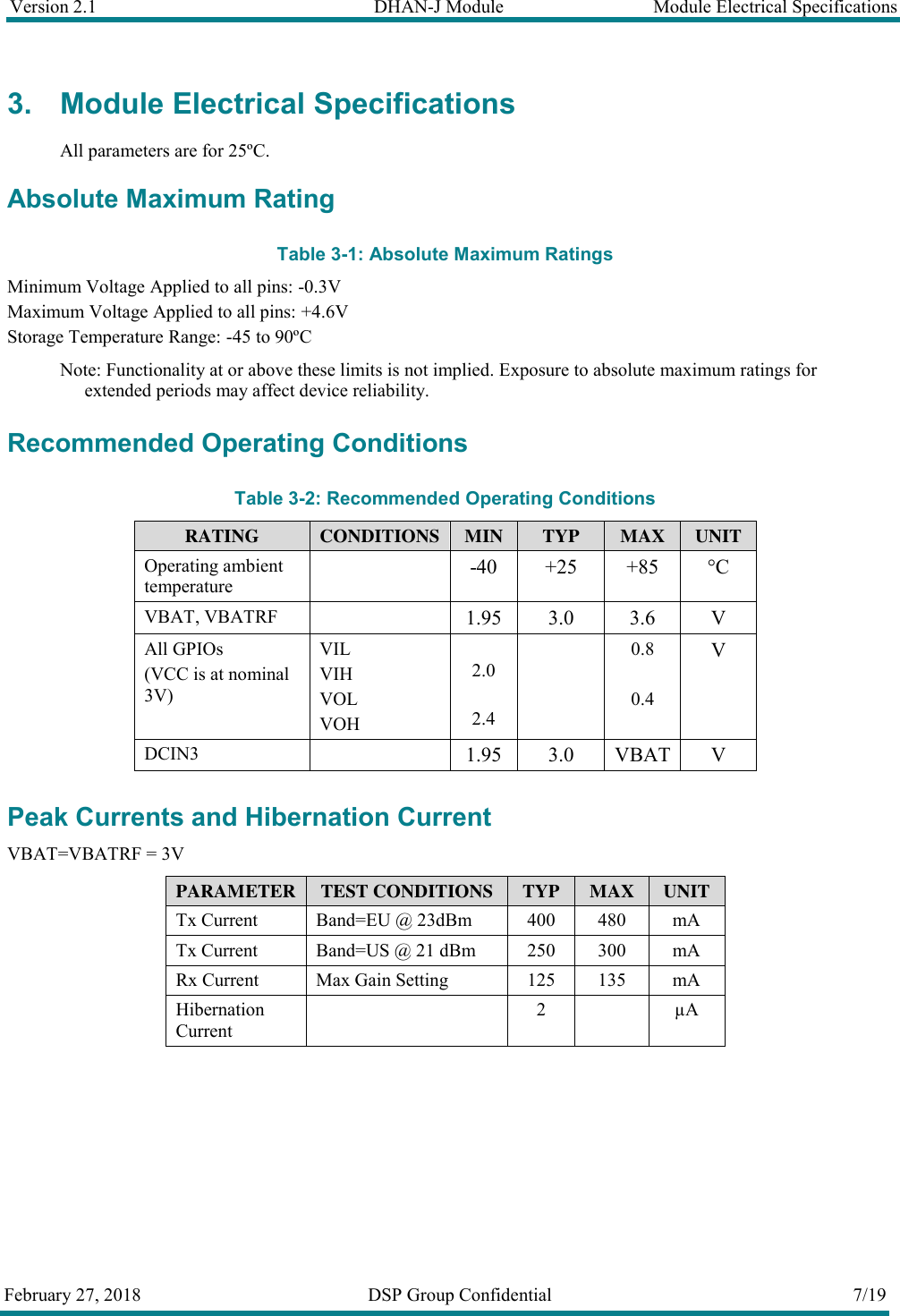
Version 2.1  DHAN-J Module  Module Electrical Specifications  February 27, 2018  DSP Group Confidential  7/19  3. Module Electrical Specifications All parameters are for 25ºC. Absolute Maximum Rating Table 3-1: Absolute Maximum Ratings Minimum Voltage Applied to all pins: -0.3V Maximum Voltage Applied to all pins: +4.6V Storage Temperature Range: -45 to 90ºC Note: Functionality at or above these limits is not implied. Exposure to absolute maximum ratings for extended periods may affect device reliability. Recommended Operating Conditions Table 3-2: Recommended Operating Conditions RATING   CONDITIONS  MIN  TYP  MAX  UNIT Operating ambient temperature  -40  +25  +85  °C VBAT, VBATRF    1.95  3.0  3.6  V All GPIOs (VCC is at nominal 3V)  VIL VIH VOL VOH  2.0  2.4  0.8  0.4 V DCIN3    1.95  3.0  VBAT  V  Peak Currents and Hibernation CurrentVBAT=VBATRF = 3V PARAMETER  TEST CONDITIONS  TYP  MAX  UNIT Tx Current  Band=EU @ 23dBm  400 480 mA Tx Current  Band=US @ 21 dBm  250 300 mA Rx Current  Max Gain Setting  125 135 mA Hibernation Current   2    µA
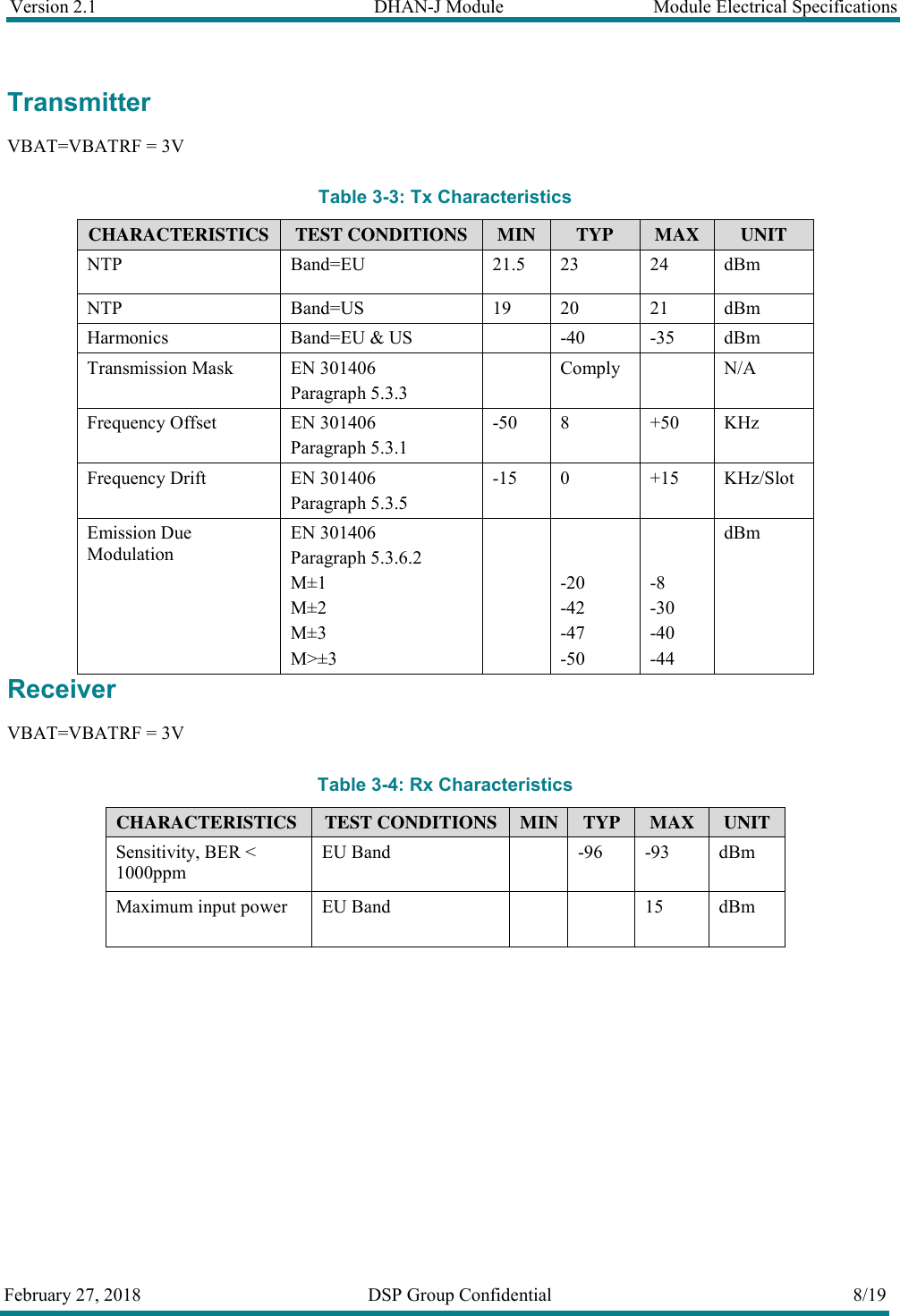
Version 2.1  DHAN-J Module  Module Electrical Specifications  February 27, 2018  DSP Group Confidential  8/19  Transmitter VBAT=VBATRF = 3V Table 3-3: Tx Characteristics CHARACTERISTICS   TEST CONDITIONS  MIN  TYP  MAX  UNIT NTP  Band=EU  21.5  23 24  dBm NTP  Band=US   19 20 21  dBm Harmonics   Band=EU & US    -40  -35  dBm Transmission Mask  EN 301406 Paragraph 5.3.3   Comply    N/A Frequency Offset  EN 301406 Paragraph 5.3.1 -50  8  +50  KHz Frequency Drift  EN 301406 Paragraph 5.3.5 -15  0  +15  KHz/Slot Emission Due Modulation EN 301406 Paragraph 5.3.6.2 M±1 M±2 M±3 M>±3     -20 -42 -47 -50   -8 -30 -40 -44 dBm Receiver VBAT=VBATRF = 3V Table 3-4: Rx Characteristics CHARACTERISTICS   TEST CONDITIONS  MIN  TYP  MAX  UNIT Sensitivity, BER < 1000ppm EU Band    -96  -93  dBm Maximum input power  EU Band      15  dBm
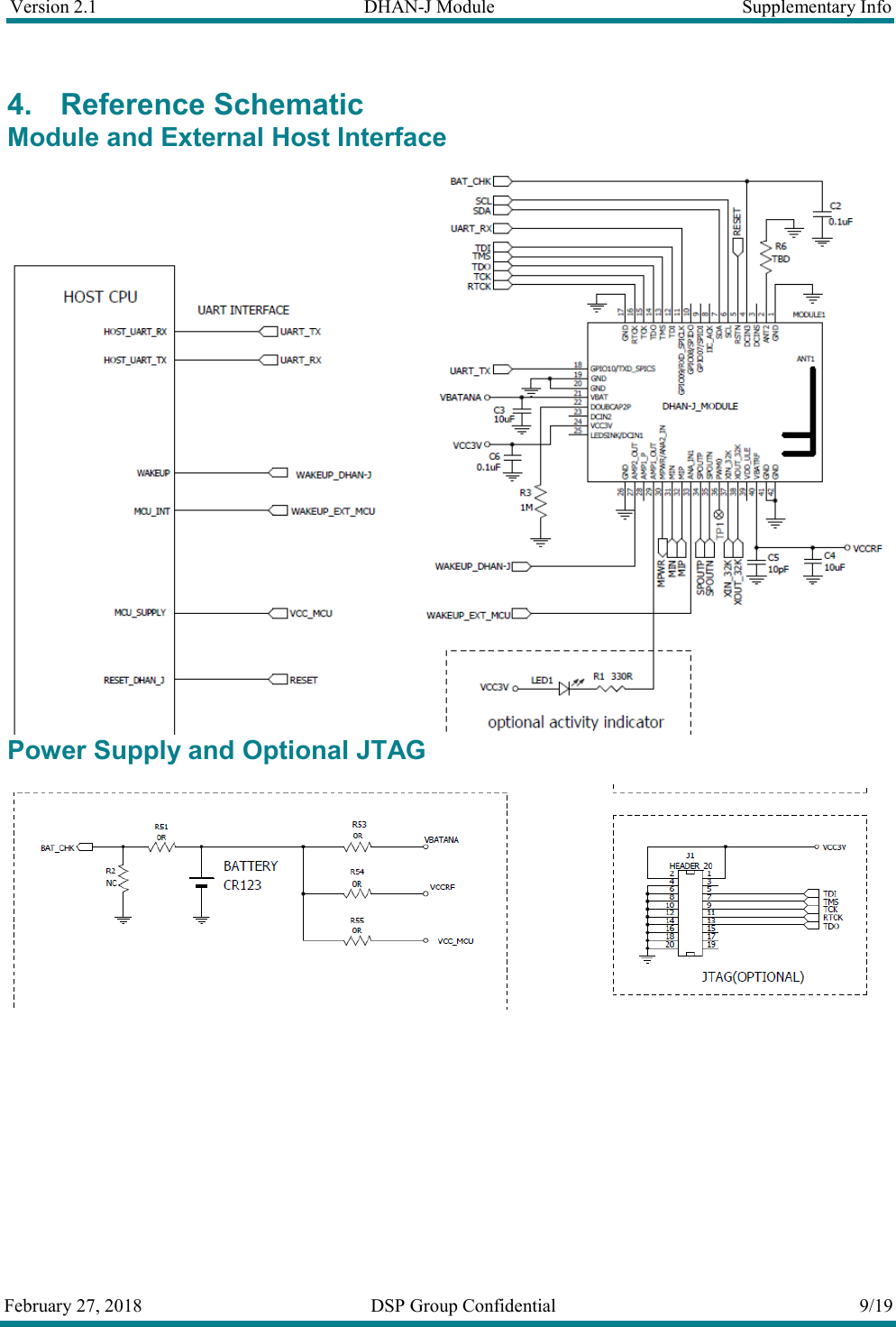
Version 2.1  DHAN-J Module  Supplementary Info  February 27, 2018  DSP Group Confidential  9/19  4. Reference Schematic Module and External Host Interface  Power Supply and Optional JTAG
Version 2.1  DHAN-J Module  Supplementary Info  February 27, 2018  DSP Group Confidential  10/19  Optional Audio and 32KHz XTAL  Interfacing to an external ASIC Sensor or Actuator
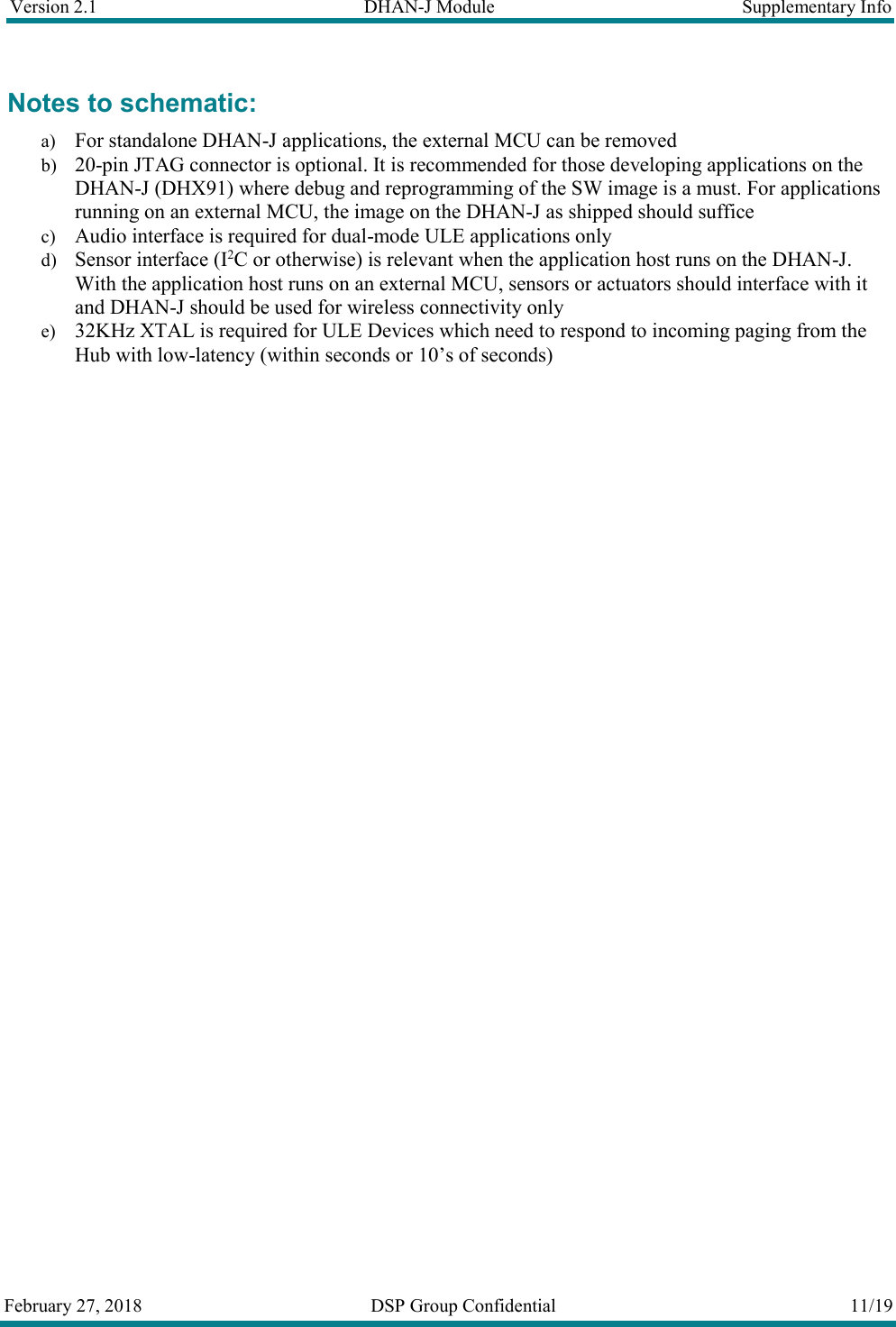
Version 2.1  DHAN-J Module  Supplementary Info  February 27, 2018  DSP Group Confidential  11/19  Notes to schematic: a) For standalone DHAN-J applications, the external MCU can be removed b) 20-pin JTAG connector is optional. It is recommended for those developing applications on the DHAN-J (DHX91) where debug and reprogramming of the SW image is a must. For applications running on an external MCU, the image on the DHAN-J as shipped should suffice c) Audio interface is required for dual-mode ULE applications only d) Sensor interface (I2C or otherwise) is relevant when the application host runs on the DHAN-J. With the application host runs on an external MCU, sensors or actuators should interface with it and DHAN-J should be used for wireless connectivity only e) 32KHz XTAL is required for ULE Devices which need to respond to incoming paging from the Hub with low-latency (within seconds or 10’s of seconds)
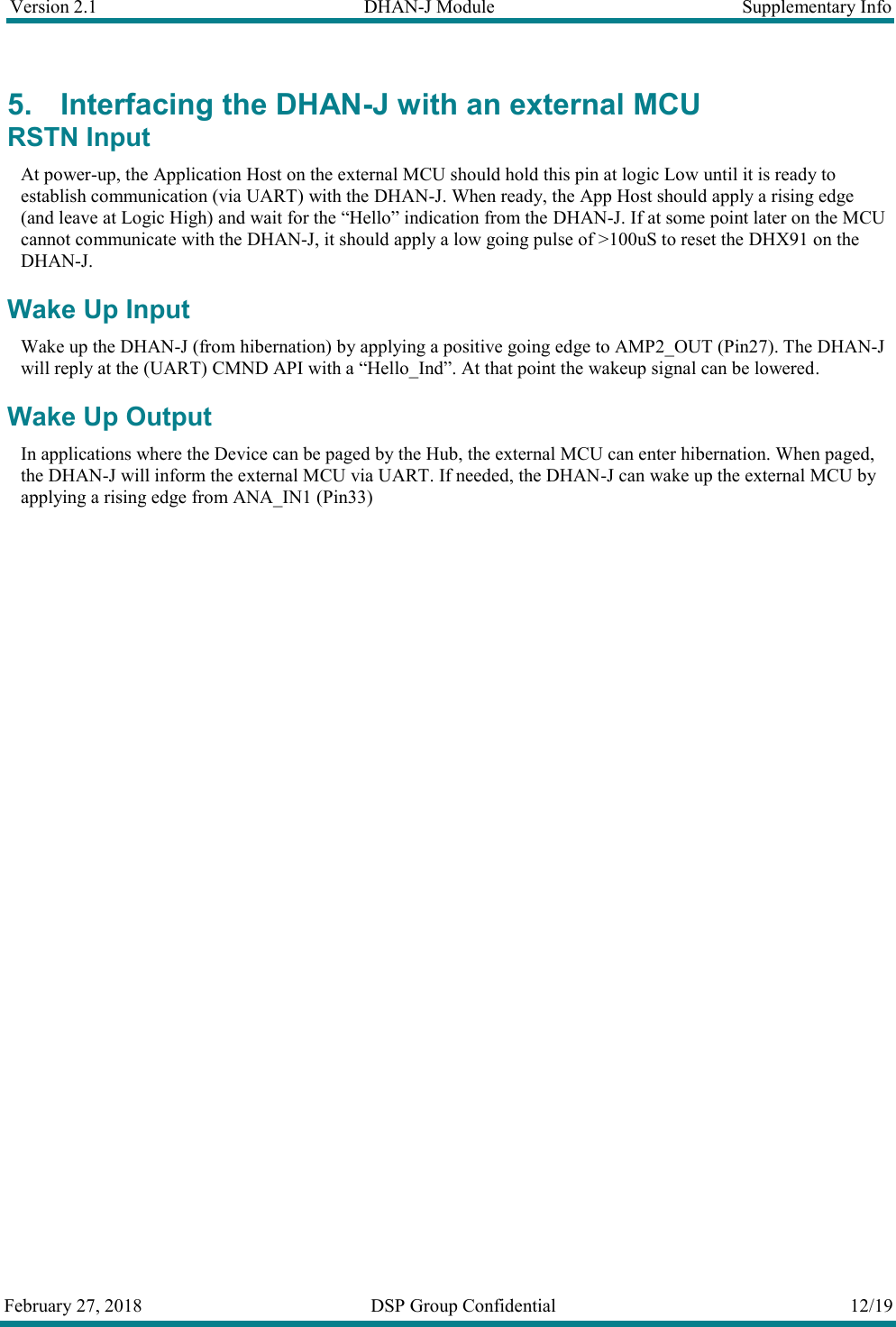
Version 2.1  DHAN-J Module  Supplementary Info  February 27, 2018  DSP Group Confidential  12/19  5. Interfacing the DHAN-J with an external MCU RSTN Input At power-up, the Application Host on the external MCU should hold this pin at logic Low until it is ready to establish communication (via UART) with the DHAN-J. When ready, the App Host should apply a rising edge (and leave at Logic High) and wait for the “Hello” indication from the DHAN-J. If at some point later on the MCU cannot communicate with the DHAN-J, it should apply a low going pulse of >100uS to reset the DHX91 on the DHAN-J. Wake Up Input Wake up the DHAN-J (from hibernation) by applying a positive going edge to AMP2_OUT (Pin27). The DHAN-J will reply at the (UART) CMND API with a “Hello_Ind”. At that point the wakeup signal can be lowered. Wake Up Output In applications where the Device can be paged by the Hub, the external MCU can enter hibernation. When paged, the DHAN-J will inform the external MCU via UART. If needed, the DHAN-J can wake up the external MCU by applying a rising edge from ANA_IN1 (Pin33)
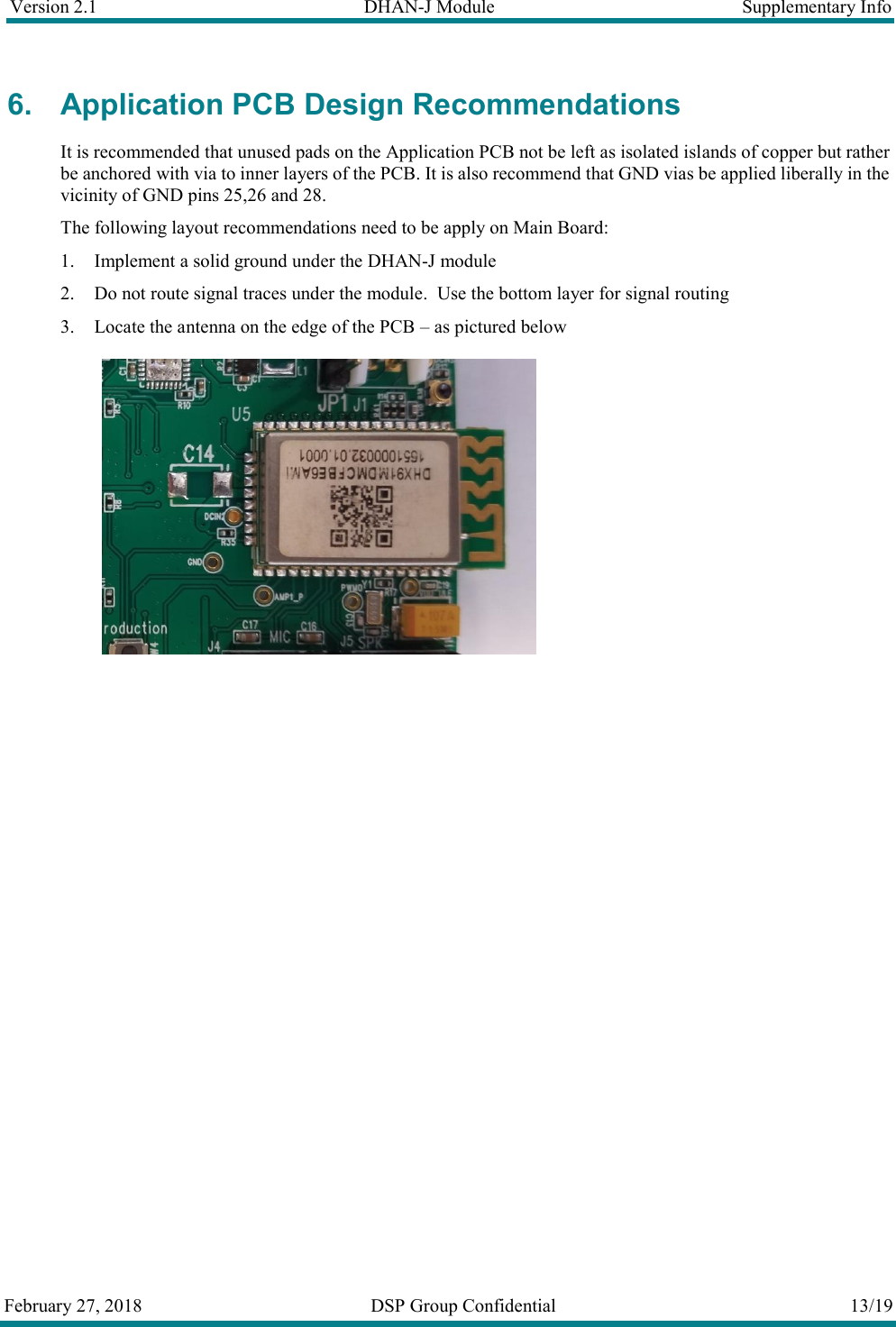
Version 2.1  DHAN-J Module  Supplementary Info  February 27, 2018  DSP Group Confidential  13/19  6. Application PCB Design Recommendations It is recommended that unused pads on the Application PCB not be left as isolated islands of copper but rather be anchored with via to inner layers of the PCB. It is also recommend that GND vias be applied liberally in the vicinity of GND pins 25,26 and 28. The following layout recommendations need to be apply on Main Board:  1. Implement a solid ground under the DHAN-J module 2. Do not route signal traces under the module.  Use the bottom layer for signal routing 3. Locate the antenna on the edge of the PCB – as pictured below
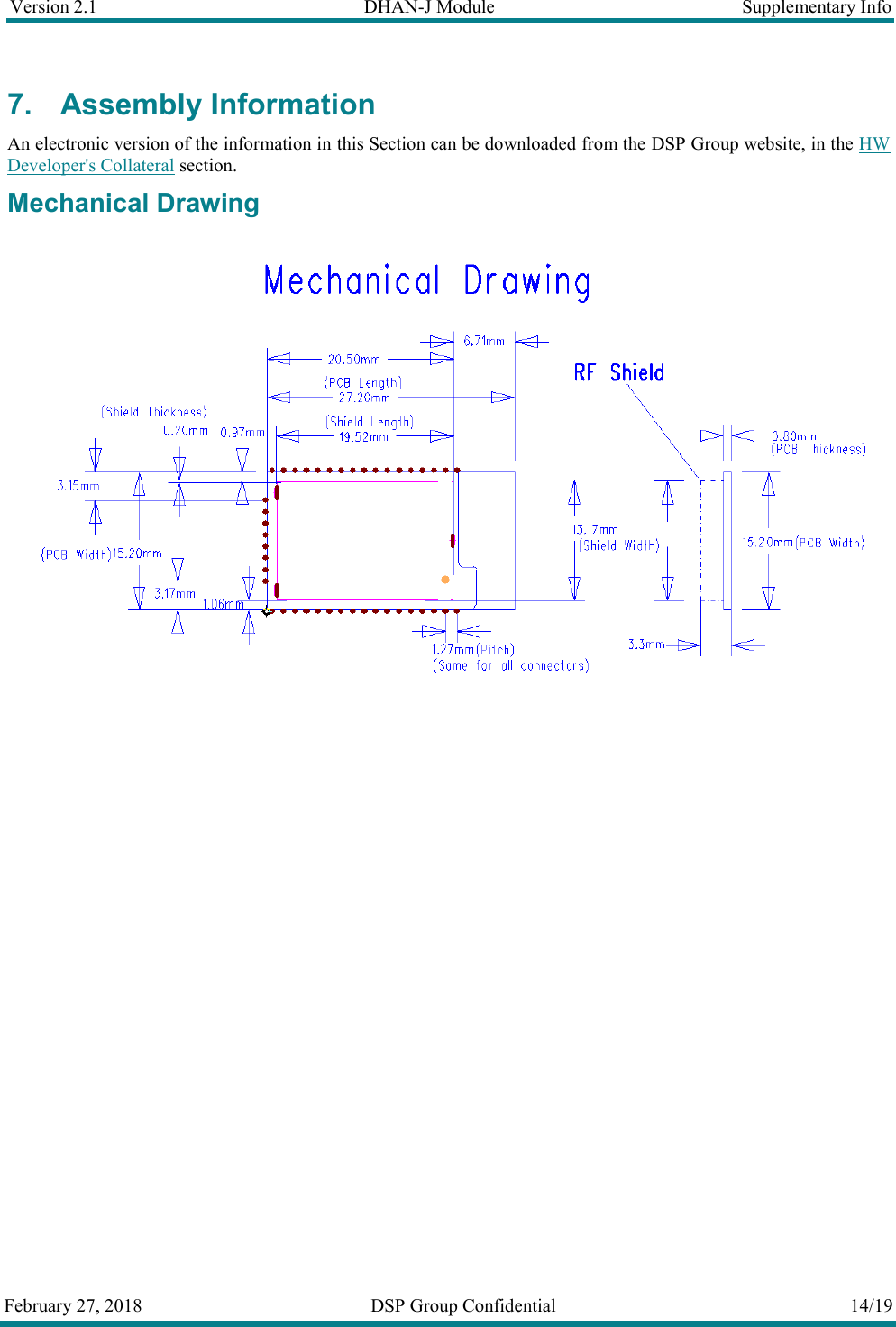
Version 2.1  DHAN-J Module  Supplementary Info  February 27, 2018  DSP Group Confidential  14/19  7. Assembly Information An electronic version of the information in this Section can be downloaded from the DSP Group website, in the HW Developer's Collateral section. Mechanical Drawing
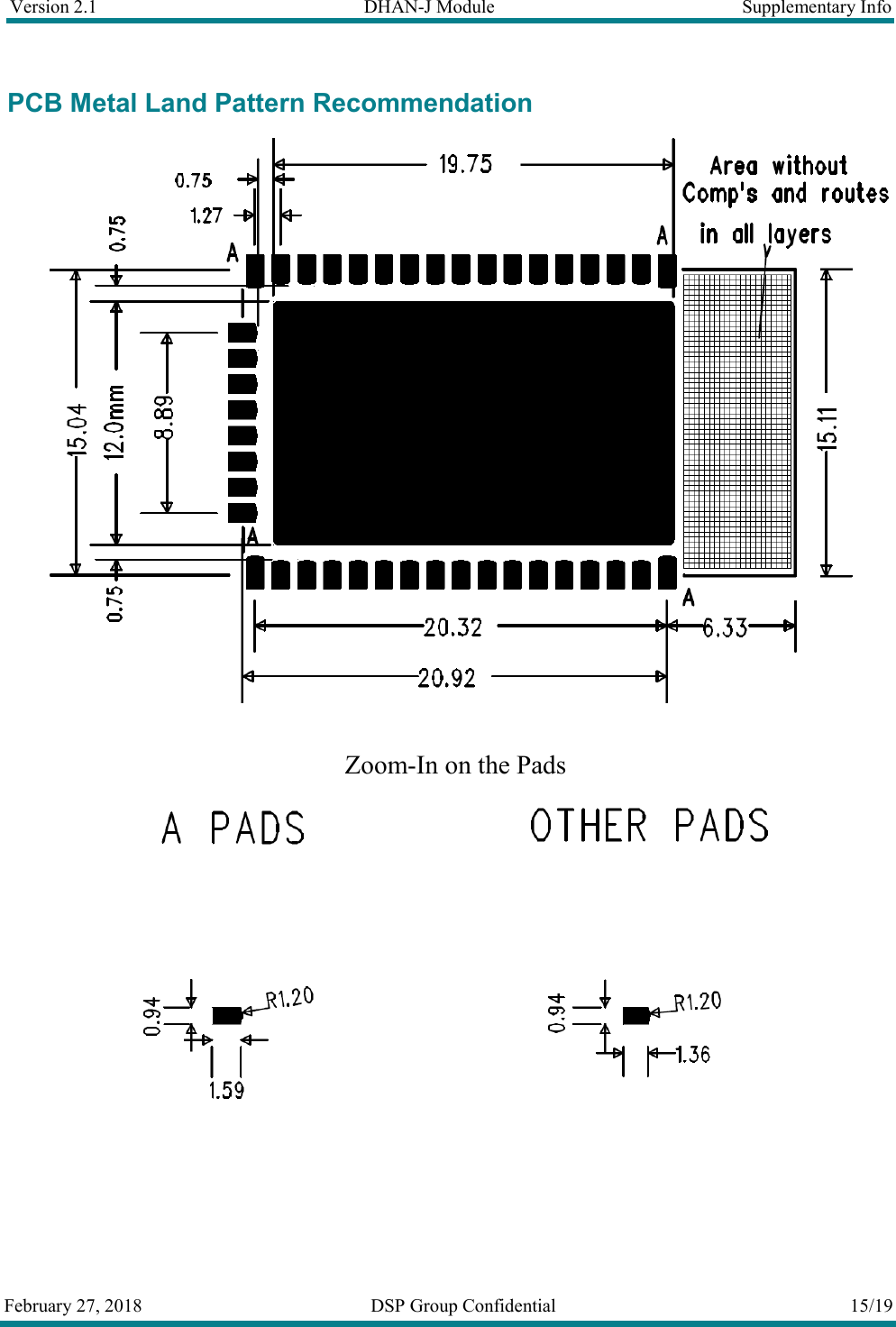
Version 2.1  DHAN-J Module  Supplementary Info  February 27, 2018  DSP Group Confidential  15/19  PCB Metal Land Pattern Recommendation  Zoom-In on the Pads
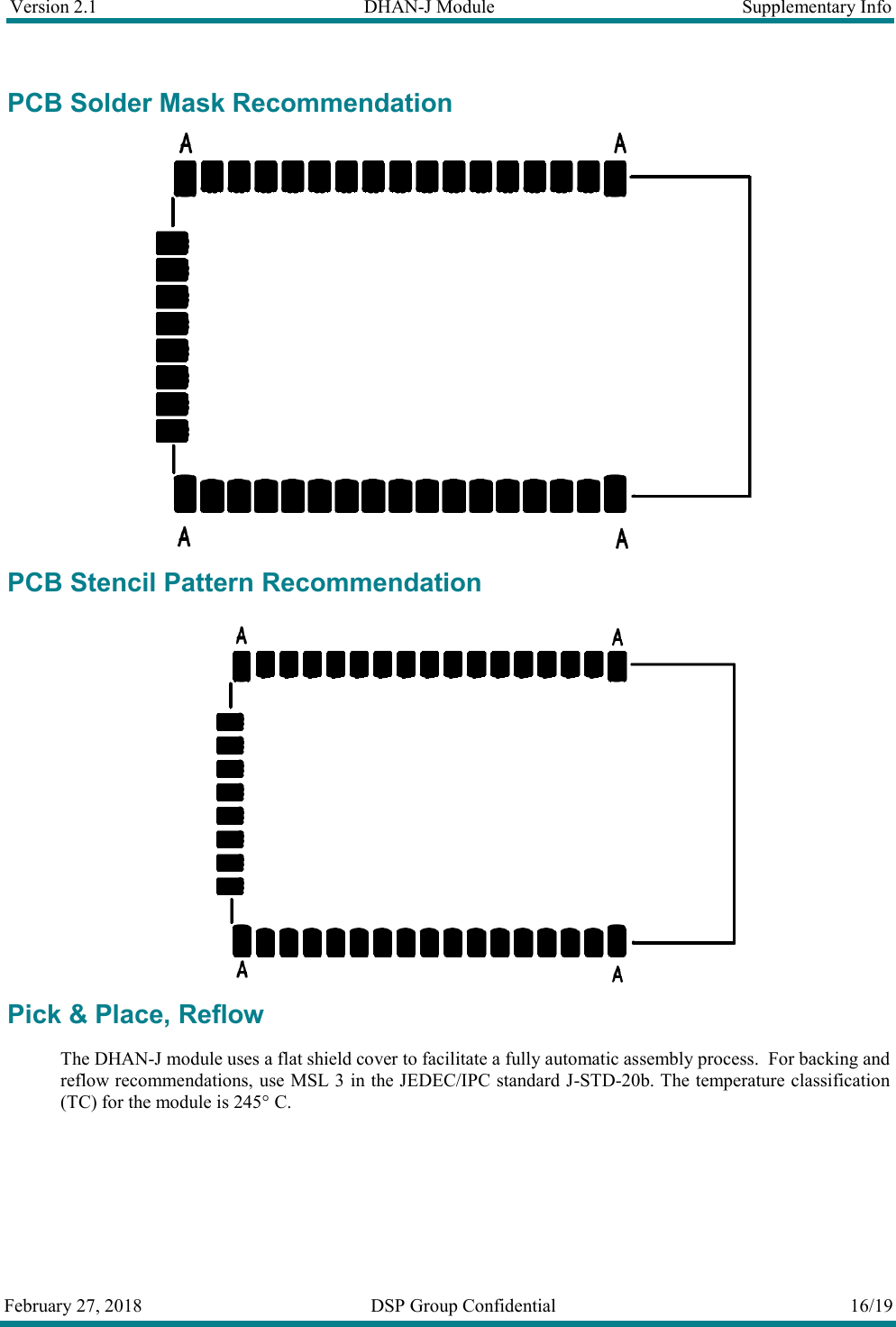
Version 2.1  DHAN-J Module  Supplementary Info  February 27, 2018  DSP Group Confidential  16/19  PCB Solder Mask Recommendation  PCB Stencil Pattern Recommendation  Pick & Place, Reflow The DHAN-J module uses a flat shield cover to facilitate a fully automatic assembly process.  For backing and reflow recommendations, use MSL 3 in the JEDEC/IPC standard J-STD-20b. The temperature classification (TC) for the module is 245° C.
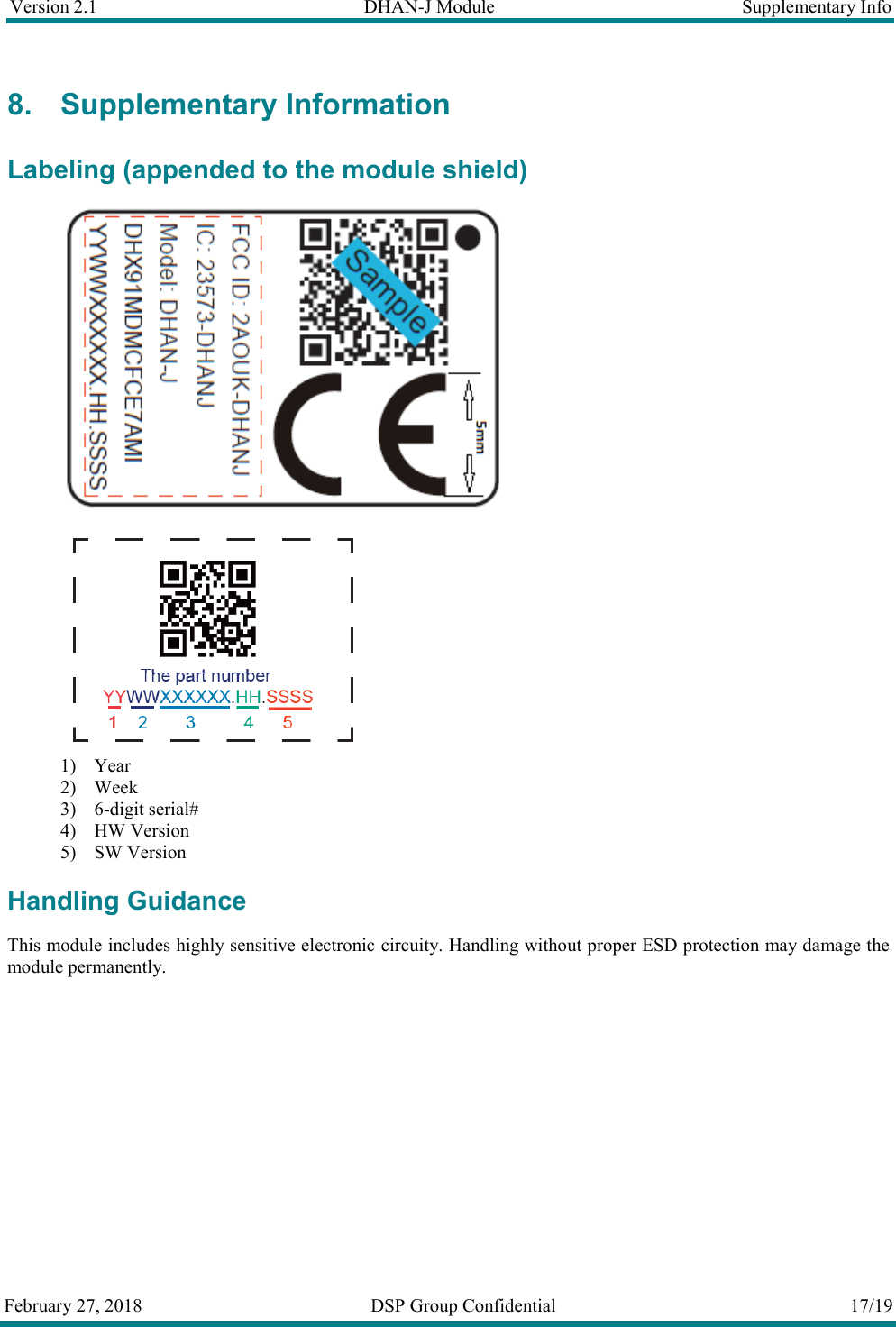
Version 2.1  DHAN-J Module  Supplementary Info  February 27, 2018  DSP Group Confidential  17/19  8. Supplementary Information  Labeling (appended to the module shield)     1) Year 2) Week 3) 6-digit serial# 4) HW Version 5) SW Version Handling Guidance This module includes highly sensitive electronic circuity. Handling without proper ESD protection may damage the module permanently.
Version 2.1  DHAN-J Module  Supplementary Info  February 27, 2018  DSP Group Confidential  18/19  FCC & IC Interference Statement This device complies with part 15 of the FCC rules and RSS-213 of Industry Canada. Operation is subject to the following two conditions: (1) this device may not cause harmful interference, and (2) this device must accept any interference received, including interference that may cause undesired operation. Le présent appareil est conforme aux CNR d'Industrie Canada applicables aux appareils radio exempts de licence. L'exploitation est autorisée aux deux conditions suivantes : (1) l'appareil ne doit pas produire de brouillage, et (2) l'utilisateur de l'appareil doit accepter tout brouillage radioélectrique subi, même si le brouillage est susceptible d'en compromettre le fonctionnement. This Class B digital apparatus complies with Canadian ICES-003.  Cet appareil numérique de la classe B est conforme à la norme NMB-003 du Canada. NOTE: The manufacturer is not responsible for any radio or TV interference caused by unauthorized modifications to this equipment. Such modifications could void the user’s authority to operate the equipment. NOTE: This equipment has been tested and found to comply with the limits for a Class B digital device, pursuant to part 15 of the FCC Rules.  These limits are designed to provide reasonable protection against harmful interference in a residential installation.  This equipment generates uses and can radiate radio frequency energy and, if not installed and used in accordance with the instructions, may cause harmful interference to radio communications.  However, there is no guarantee that interference will not occur in a particular installation.  If this equipment does cause harmful interference to radio or television reception, which can be determined by turning the equipment off and on, the user is encouraged to try to correct the interference by one or more of the following measures: - Reorient or relocate the receiving antenna. - Increase the separation between the equipment and receiver. -Connect the equipment into an outlet on a circuit different from that to which the receiver is connected. -Consult the dealer or an experienced radio/TV technician for help - This device and its antenna(s) must not be co-located or operating in conjunction with any other antenna or transmitter Declaration of Conformance (DOC) The full text of the EU Declaration of Conformity is available at the following internet address: www.dspg.com.hk IPEI and EMC Each DHAN-J Module is shipped to the customer with a unique IPEI – its DECT identity. DHAN-J will ship with an “EMC” of 0xFEB. This is the DSP Group “generic” EMC. The EMC setting identifies a Device as belonging to a specific group of ULE Devices/Hubs that utilize some proprietary signaling. In either case, the customer is free to re-program these parameters.
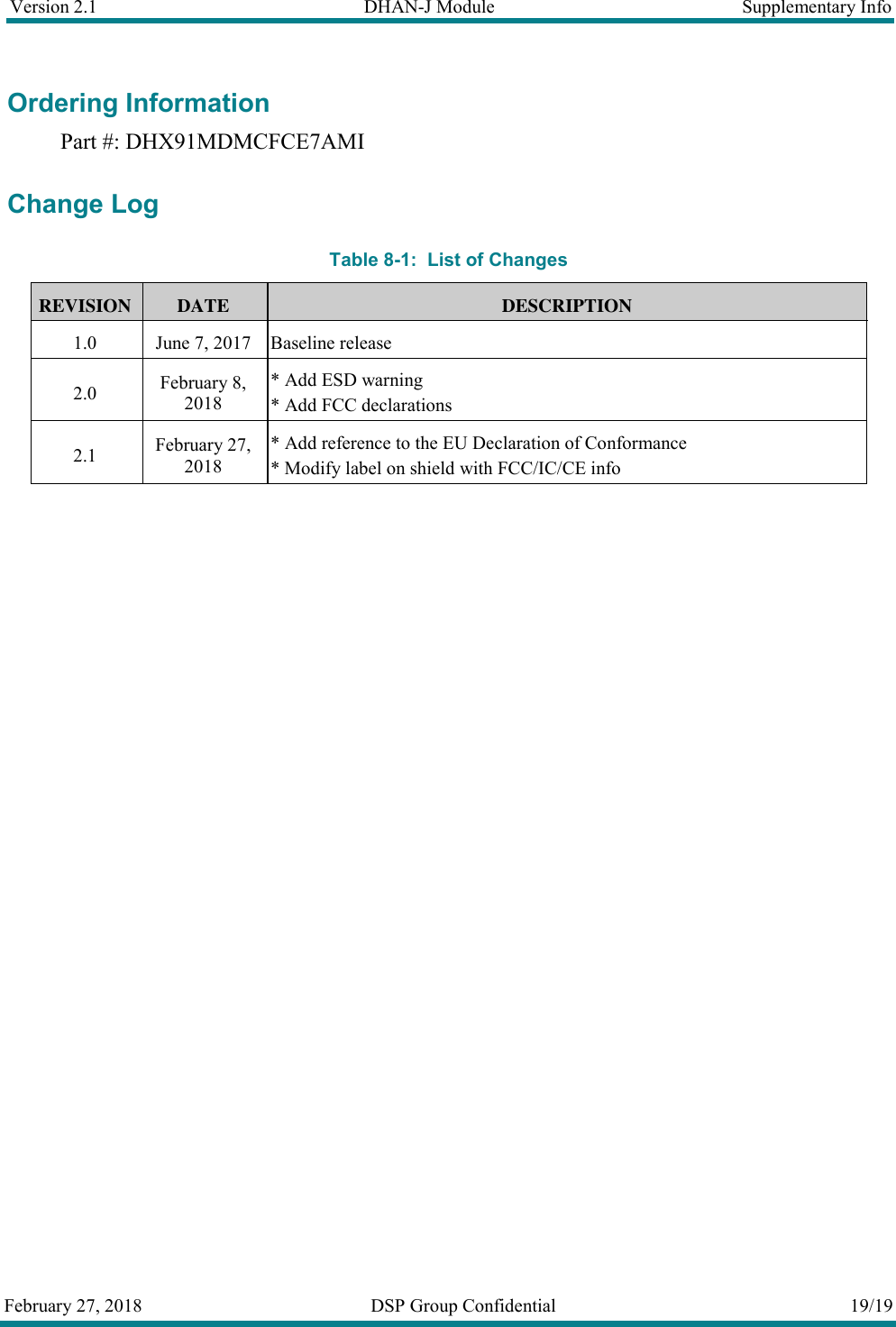
Version 2.1  DHAN-J Module  Supplementary Info  February 27, 2018  DSP Group Confidential  19/19  Ordering Information Part #: DHX91MDMCFCE7AMI Change Log Table 8-1:  List of Changes REVISION  DATE  DESCRIPTION 1.0  June 7, 2017  Baseline release 2.0  February 8, 2018 * Add ESD warning * Add FCC declarations 2.1  February 27, 2018 * Add reference to the EU Declaration of Conformance * Modify label on shield with FCC/IC/CE info
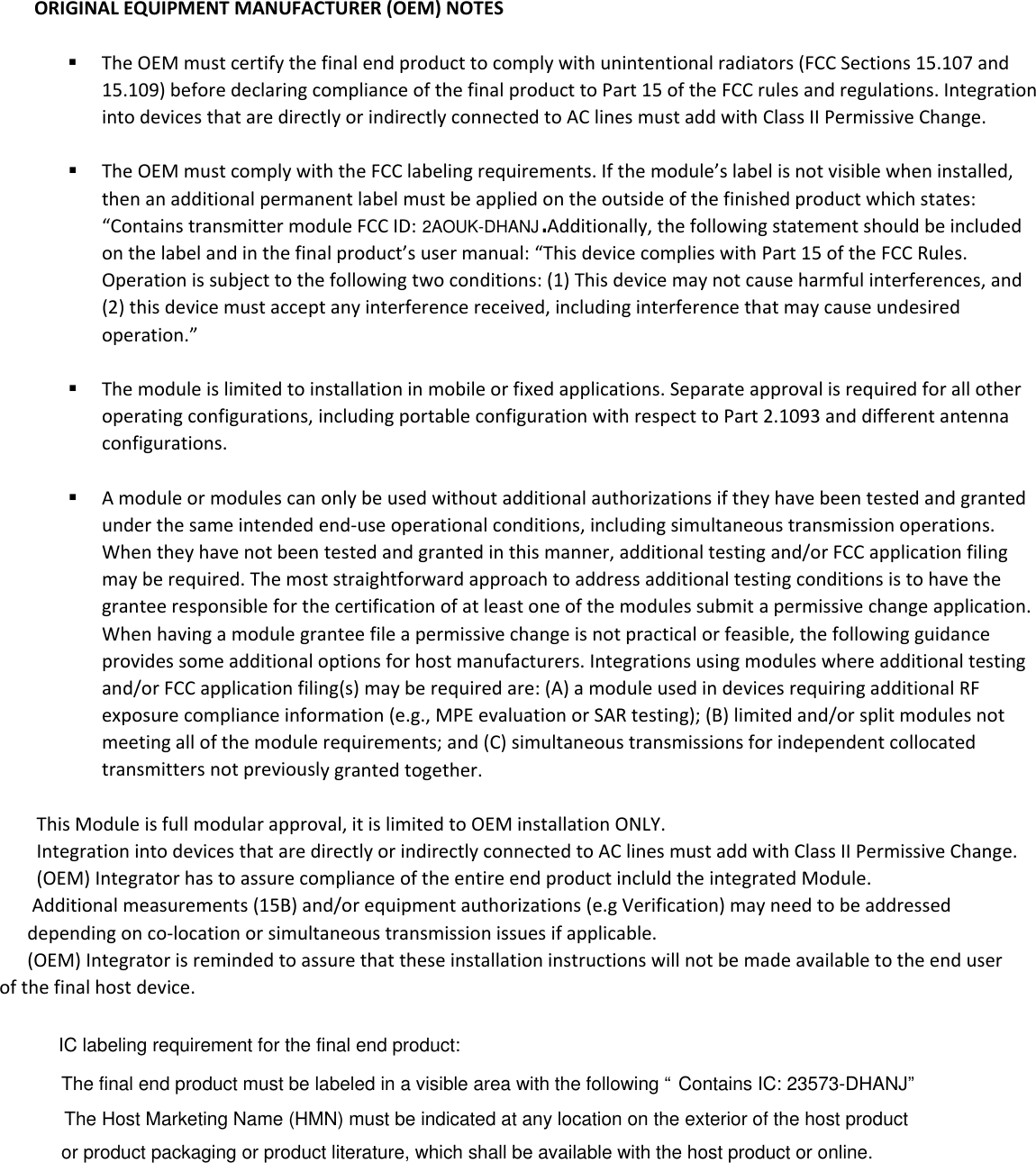
ORIGINALEQUIPMENTMANUFACTURER(OEM)NOTES TheOEMmustcertifythefinalendproducttocomplywithunintentionalradiators(FCCSections15.107and15.109)beforedeclaringcomplianceofthefinalproducttoPart15oftheFCCrulesandregulations.IntegrationintodevicesthataredirectlyorindirectlyconnectedtoAClinesmustaddwithClassIIPermissiveChange. TheOEMmustcomplywiththeFCClabelingrequirements.Ifthemodule’slabelisnotvisiblewheninstalled,thenanadditionalpermanentlabelmustbeappliedontheoutsideofthefinishedproductwhichstates:“ContainstransmittermoduleFCCID: Additionally,thefollowingstatementshouldbeincludedonthelabelandinthefinalproduct’susermanual:“ThisdevicecomplieswithPart15oftheFCCRules.Operationissubjecttothefollowingtwoconditions:(1)Thisdevicemaynotcauseharmfulinterferences,and(2)thisdevicemustacceptanyinterferencereceived,includinginterferencethatmaycauseundesiredoperation.” Themoduleislimitedtoinstallationinmobileorfixedapplications.Separateapprovalisrequiredforallotheroperatingconfigurations,includingportableconfigurationwithrespecttoPart2.1093anddifferentantennaconfigurations. Amoduleormodulescanonlybeusedwithoutadditionalauthorizationsiftheyhavebeentestedandgrantedunderthesameintendedend‐useoperationalconditions,includingsimultaneoustransmissionoperations.Whentheyhavenotbeentestedandgrantedinthismanner,additionaltestingand/orFCCapplicationfilingmayberequired.Themoststraightforwardapproachtoaddressadditionaltestingconditionsistohavethegranteeresponsibleforthecertificationofatleastoneofthemodulessubmitapermissivechangeapplication.Whenhavingamodulegranteefileapermissivechangeisnotpracticalorfeasible,thefollowingguidanceprovidessomeadditionaloptionsforhostmanufacturers.Integrationsusingmoduleswhereadditionaltestingand/orFCCapplicationfiling(s)mayberequiredare:(A)amoduleusedindevicesrequiringadditionalRFexposurecomplianceinformation(e.g.,MPEevaluationorSARtesting);(B)limitedand/orsplitmodulesnotmeetingallofthemodulerequirements;and(C)simultaneoustransmissionsforindependentcollocatedtransmittersnotpreviouslygrantedtogether.                This Module is full modular approval, it is limited to OEM installation ONLY.               Integration into devices that are directly or indirectly connected to AC lines must add with Class II Permissive Change.               (OEM) Integrator has to assure compliance of the entire end product incluld the integrated Module.               Additional measurements (15B) and/or equipment authorizations (e.g Verification) may need to be addressed             depending on co-location or simultaneous transmission issues if applicable.             (OEM) Integrator is reminded to assure that these installation instructions will not be made available to the end user         of the final host device. 2AOUK-DHANJ.IC labeling requirement for the final end product:The final end product must be labeled in a visible area with the following “Contains IC: 23573-DHANJ”The Host Marketing Name (HMN) must be indicated at any location on the exterior of the host product or product packaging or product literature, which shall be available with the host product or online.
This equipment complies with FCC radiation exposure limits set forth for an uncontrolledenvironment. This equipment should be installed and operated with minimum distance of 20 cmbetween the radiator and your body.This equipment complies with IC radiation exposure limits set forth for an uncontrolledenvironment. This equipment should be installed and operated with minimum distance of 20 cmbetween the radiator and your body.Cet équipement est conforme aux limites d’exposition aux rayonnements de la IC établies pour unenvironnement non contrôé. Cet équipement doit être installé et fonctionner à au moins 20 cm dedistance d’un radiateur ou de votre corps.

Navigation menu