Fidelity Comtech FCI3100X Phased Array WLAN Terminal User Manual Phocus 2 1 Beta 3

Fidelity Comtech, Inc. Phased Array WLAN Terminal Phocus 2 1 Beta 3

Contents

User Manual Part Two
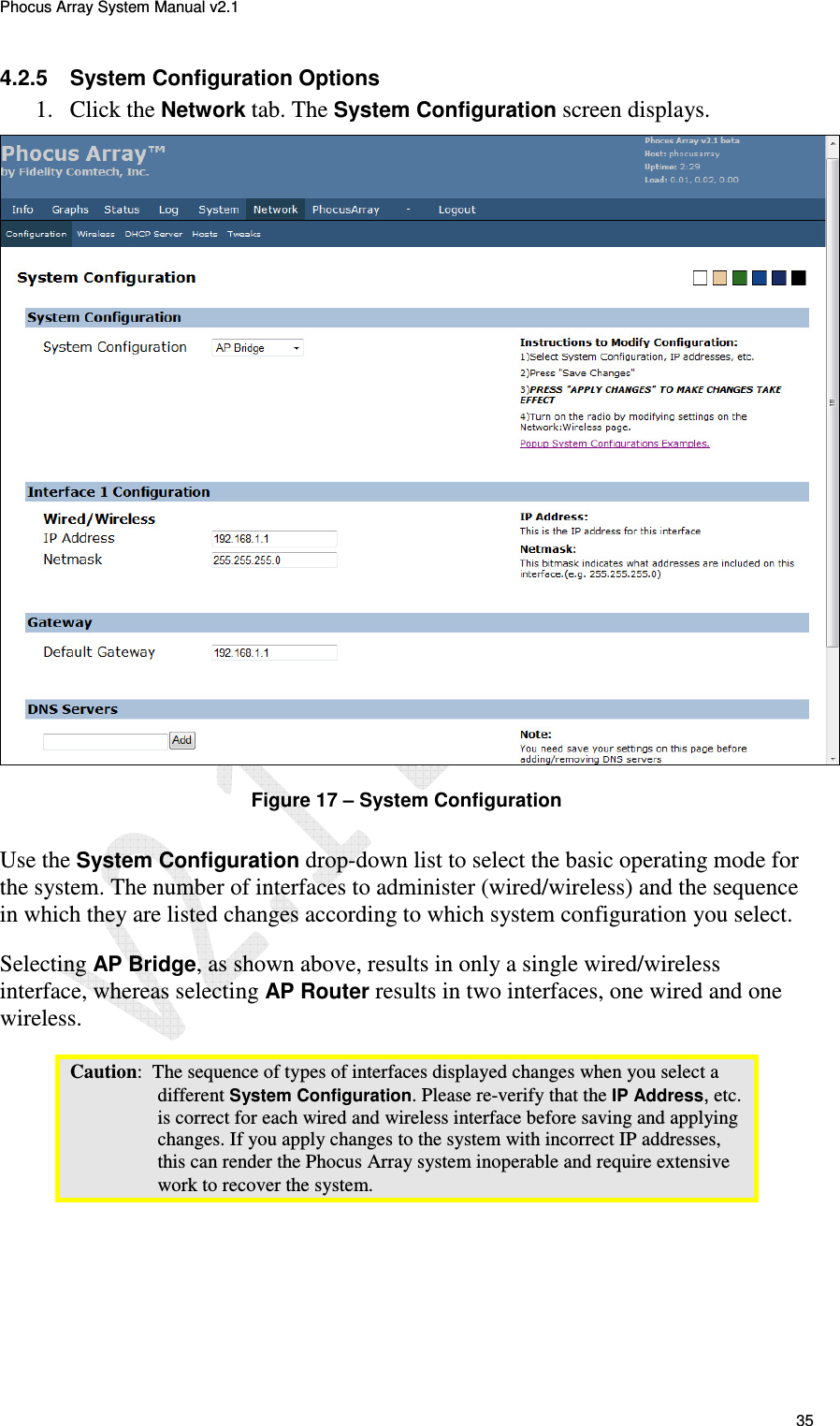
Phocus Array System Manual v2.1 35 4.2.5  System Configuration Options 1. Click the Network tab. The System Configuration screen displays.   Figure 17 – System Configuration Use the System Configuration drop-down list to select the basic operating mode for the system. The number of interfaces to administer (wired/wireless) and the sequence in which they are listed changes according to which system configuration you select. Selecting AP Bridge, as shown above, results in only a single wired/wireless interface, whereas selecting AP Router results in two interfaces, one wired and one wireless.  Caution:  The sequence of types of interfaces displayed changes when you select a different System Configuration. Please re-verify that the IP Address, etc. is correct for each wired and wireless interface before saving and applying changes. If you apply changes to the system with incorrect IP addresses, this can render the Phocus Array system inoperable and require extensive work to recover the system.
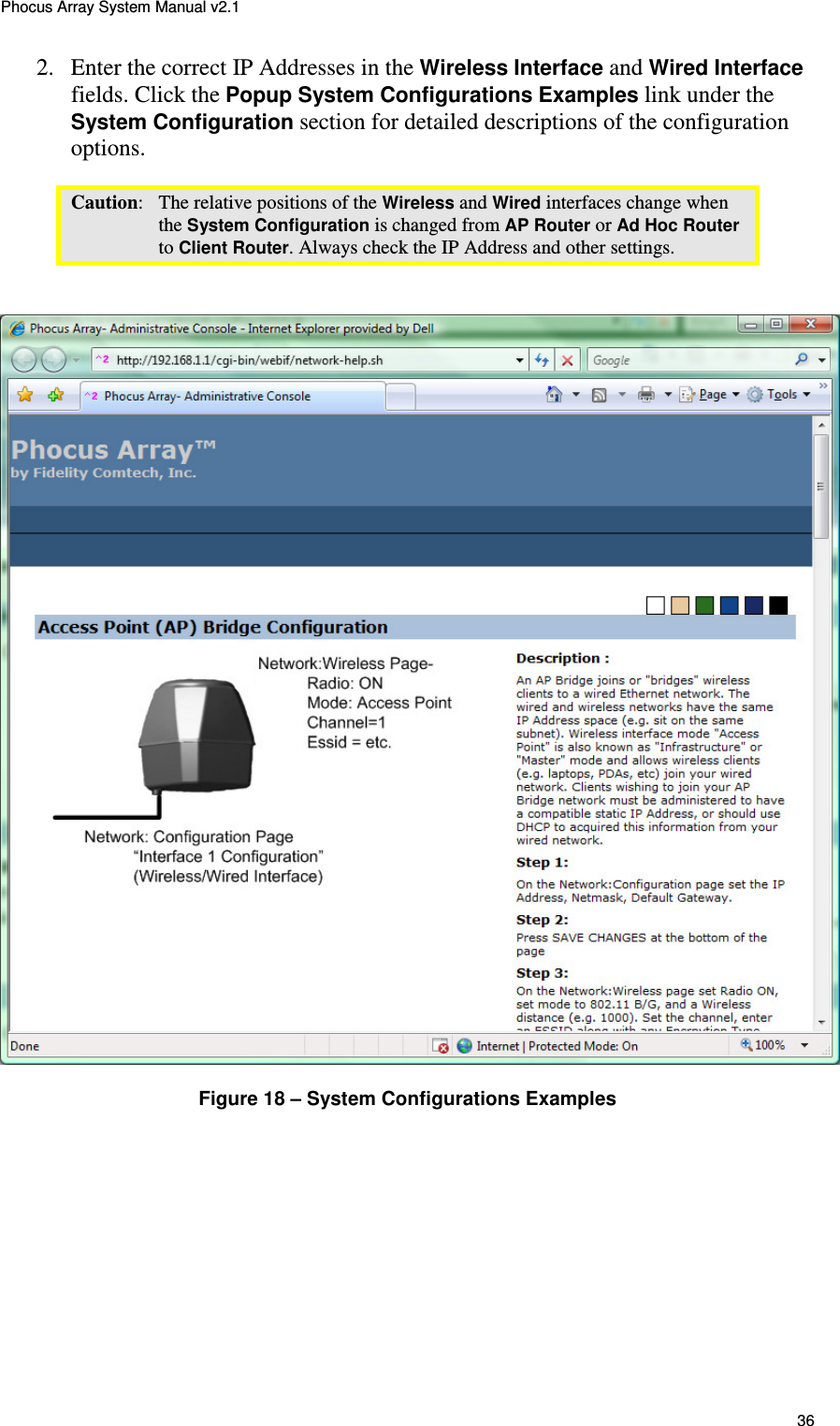
Phocus Array System Manual v2.1 36 2. Enter the correct IP Addresses in the Wireless Interface and Wired Interface fields. Click the Popup System Configurations Examples link under the System Configuration section for detailed descriptions of the configuration options.  Caution:  The relative positions of the Wireless and Wired interfaces change when the System Configuration is changed from AP Router or Ad Hoc Router to Client Router. Always check the IP Address and other settings.    Figure 18 – System Configurations Examples
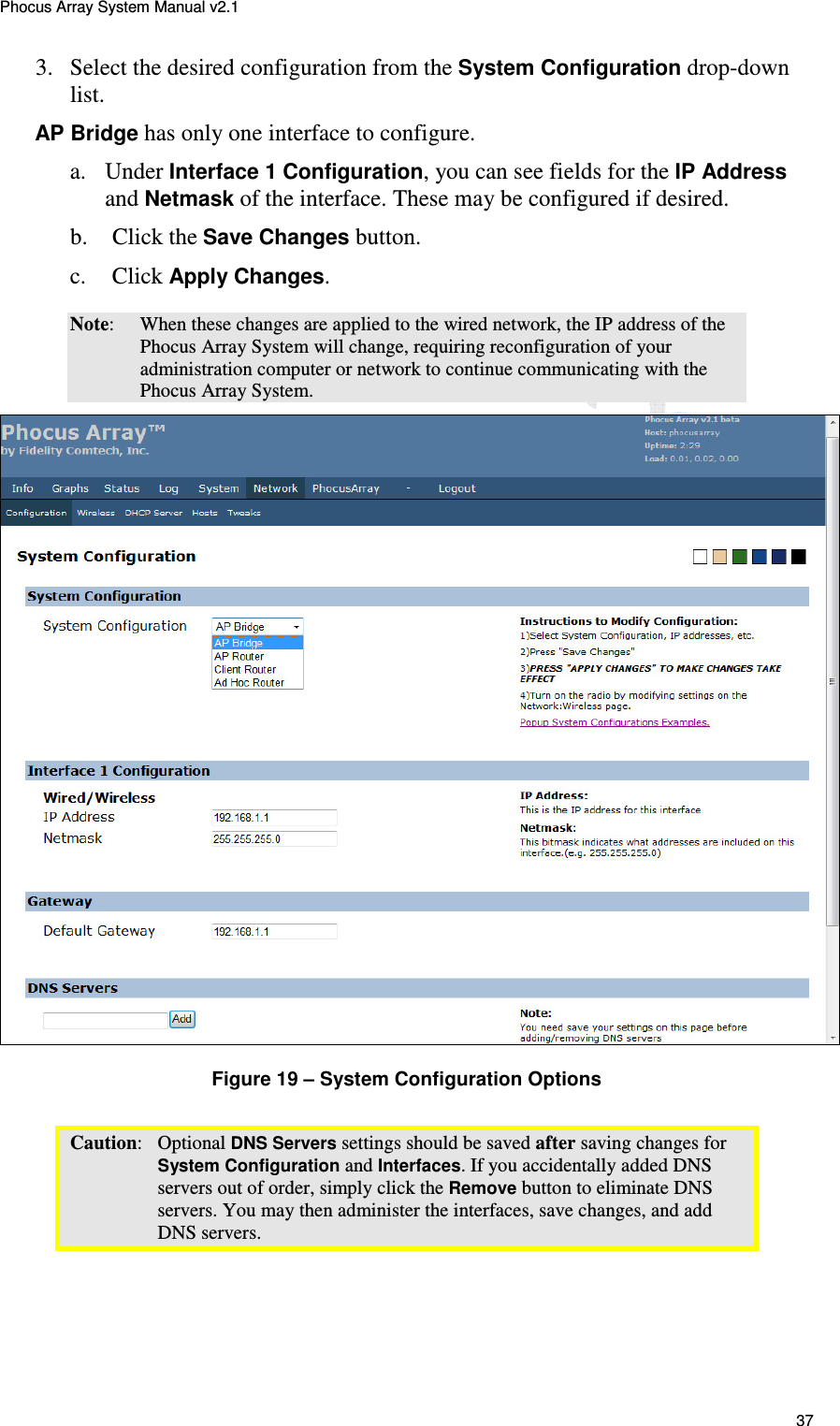
Phocus Array System Manual v2.1 37 3. Select the desired configuration from the System Configuration drop-down list. AP Bridge has only one interface to configure. a.  Under Interface 1 Configuration, you can see fields for the IP Address and Netmask of the interface. These may be configured if desired. b.  Click the Save Changes button.  c.    Click Apply Changes. Note:  When these changes are applied to the wired network, the IP address of the Phocus Array System will change, requiring reconfiguration of your administration computer or network to continue communicating with the Phocus Array System.  Figure 19 – System Configuration Options Caution:   Optional DNS Servers settings should be saved after saving changes for System Configuration and Interfaces. If you accidentally added DNS servers out of order, simply click the Remove button to eliminate DNS servers. You may then administer the interfaces, save changes, and add DNS servers.
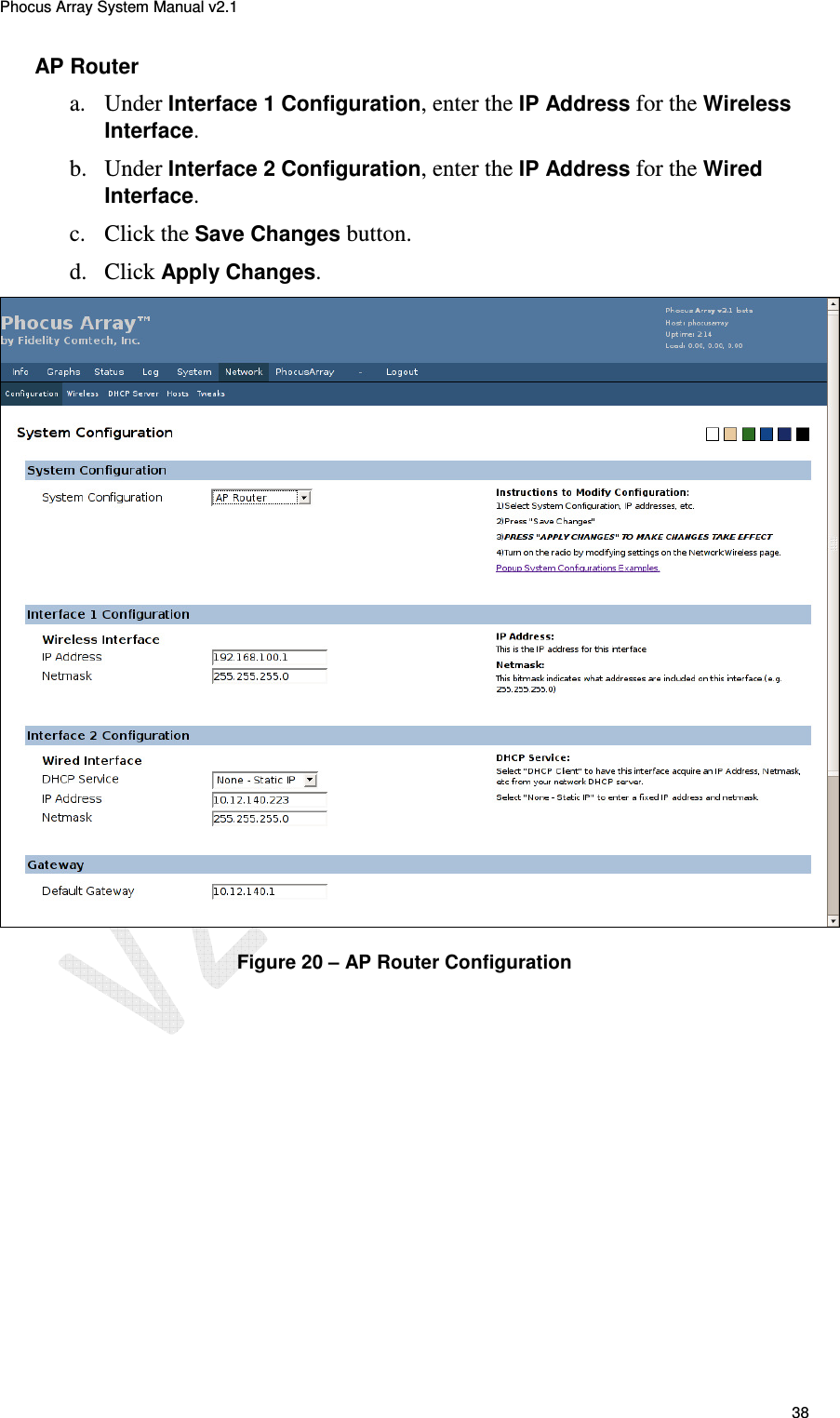
Phocus Array System Manual v2.1 38 AP Router a.  Under Interface 1 Configuration, enter the IP Address for the Wireless Interface. b.  Under Interface 2 Configuration, enter the IP Address for the Wired Interface. c.  Click the Save Changes button. d.  Click Apply Changes.  Figure 20 – AP Router Configuration
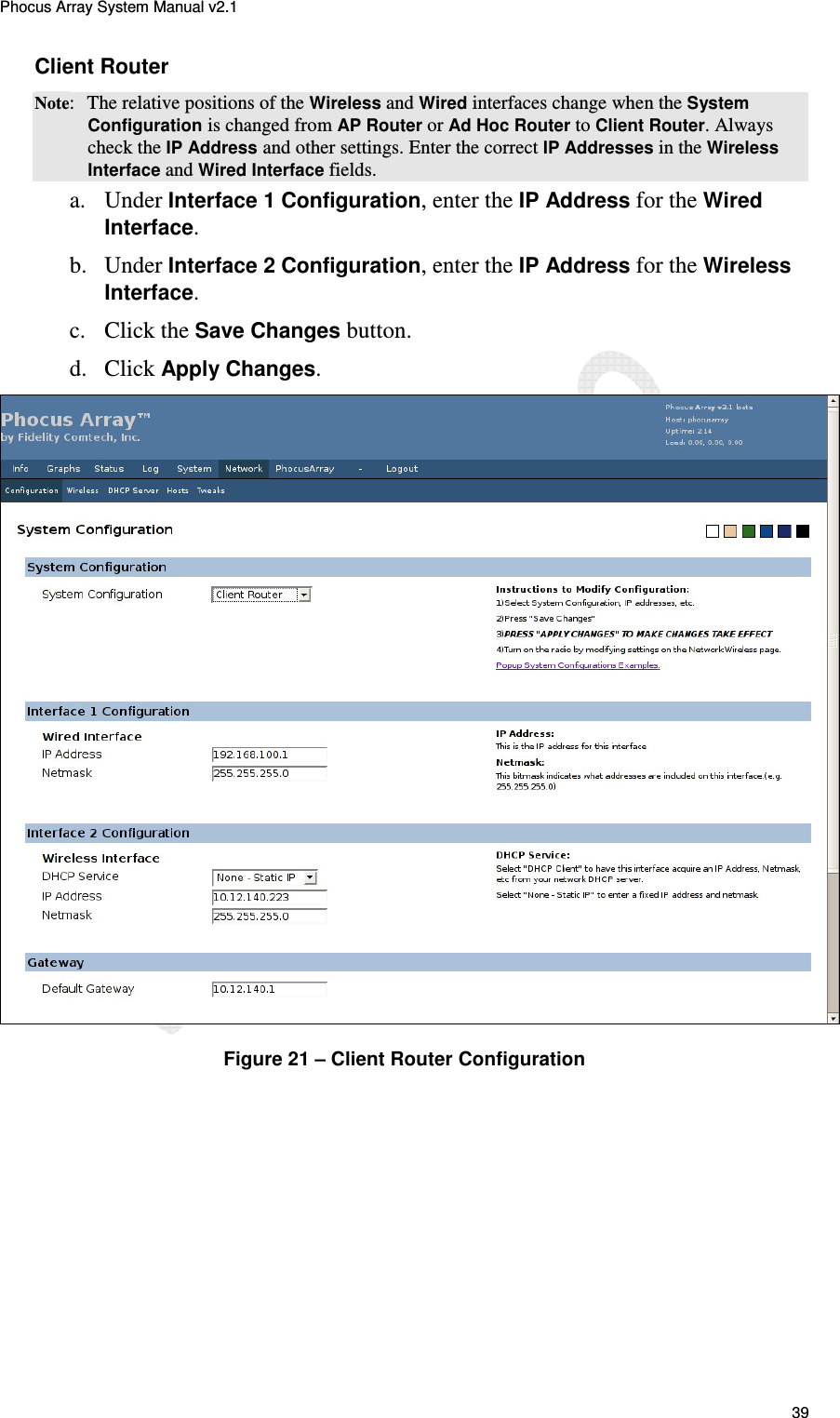
Phocus Array System Manual v2.1 39 Client Router Note:  The relative positions of the Wireless and Wired interfaces change when the System Configuration is changed from AP Router or Ad Hoc Router to Client Router. Always check the IP Address and other settings. Enter the correct IP Addresses in the Wireless Interface and Wired Interface fields. a.  Under Interface 1 Configuration, enter the IP Address for the Wired Interface. b.  Under Interface 2 Configuration, enter the IP Address for the Wireless Interface. c.  Click the Save Changes button. d.  Click Apply Changes.  Figure 21 – Client Router Configuration
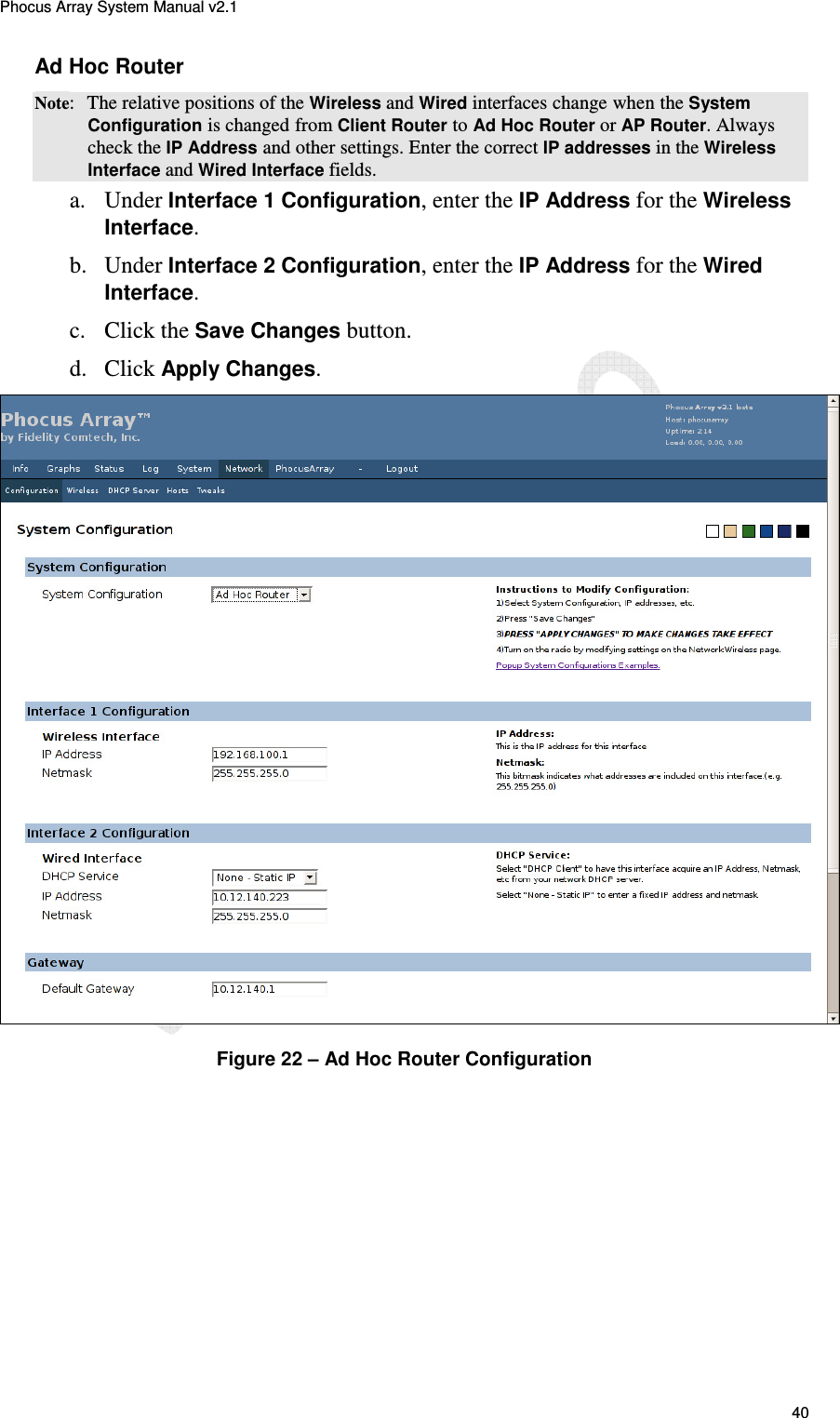
Phocus Array System Manual v2.1 40 Ad Hoc Router Note:  The relative positions of the Wireless and Wired interfaces change when the System Configuration is changed from Client Router to Ad Hoc Router or AP Router. Always check the IP Address and other settings. Enter the correct IP addresses in the Wireless Interface and Wired Interface fields. a.  Under Interface 1 Configuration, enter the IP Address for the Wireless Interface. b.  Under Interface 2 Configuration, enter the IP Address for the Wired Interface. c.  Click the Save Changes button. d.  Click Apply Changes.  Figure 22 – Ad Hoc Router Configuration
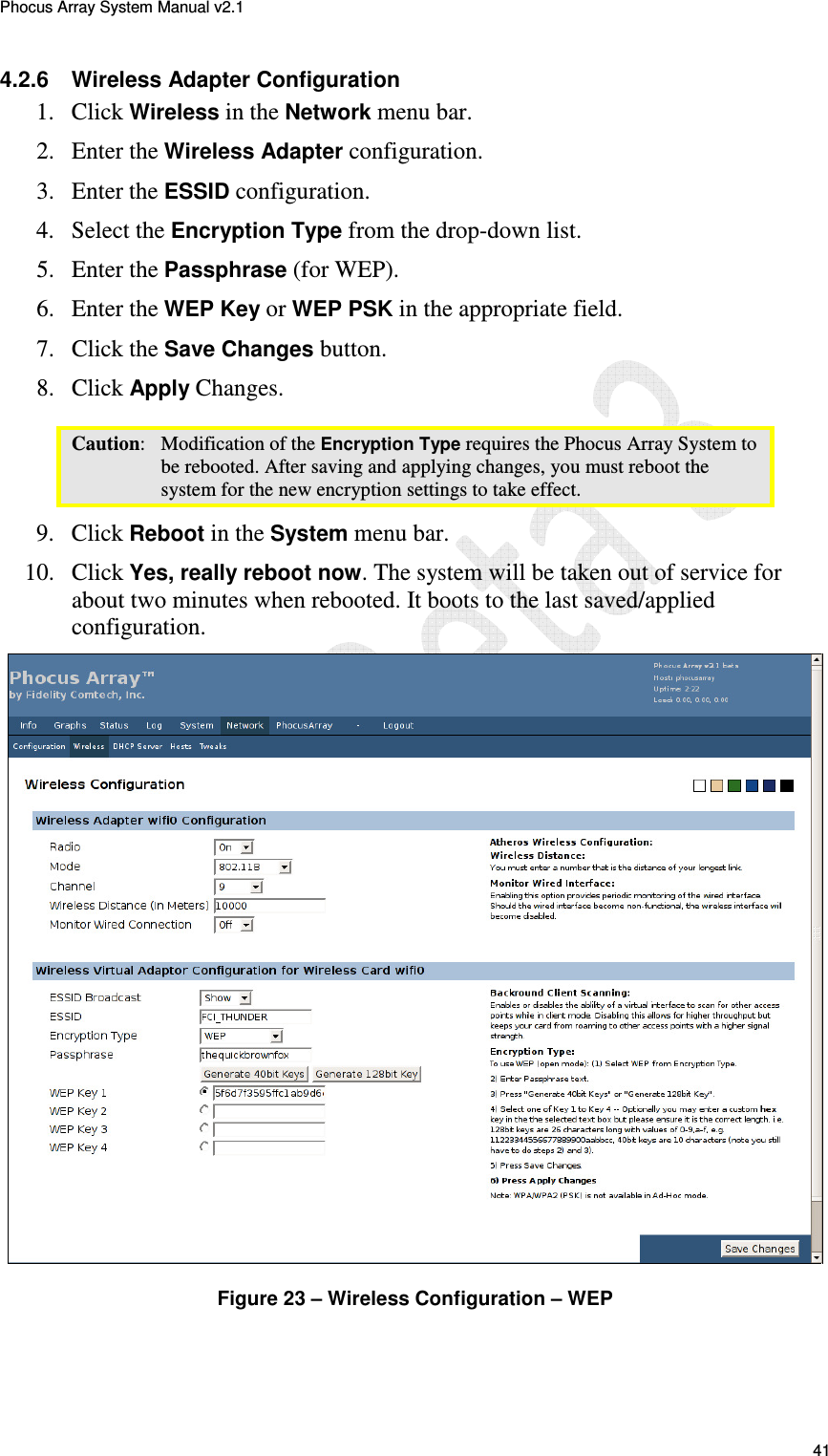
Phocus Array System Manual v2.1 41 4.2.6  Wireless Adapter Configuration 1. Click Wireless in the Network menu bar. 2. Enter the Wireless Adapter configuration. 3. Enter the ESSID configuration. 4. Select the Encryption Type from the drop-down list. 5. Enter the Passphrase (for WEP). 6. Enter the WEP Key or WEP PSK in the appropriate field. 7. Click the Save Changes button. 8. Click Apply Changes. Caution:   Modification of the Encryption Type requires the Phocus Array System to be rebooted. After saving and applying changes, you must reboot the system for the new encryption settings to take effect.  9. Click Reboot in the System menu bar. 10. Click Yes, really reboot now. The system will be taken out of service for about two minutes when rebooted. It boots to the last saved/applied configuration.   Figure 23 – Wireless Configuration – WEP
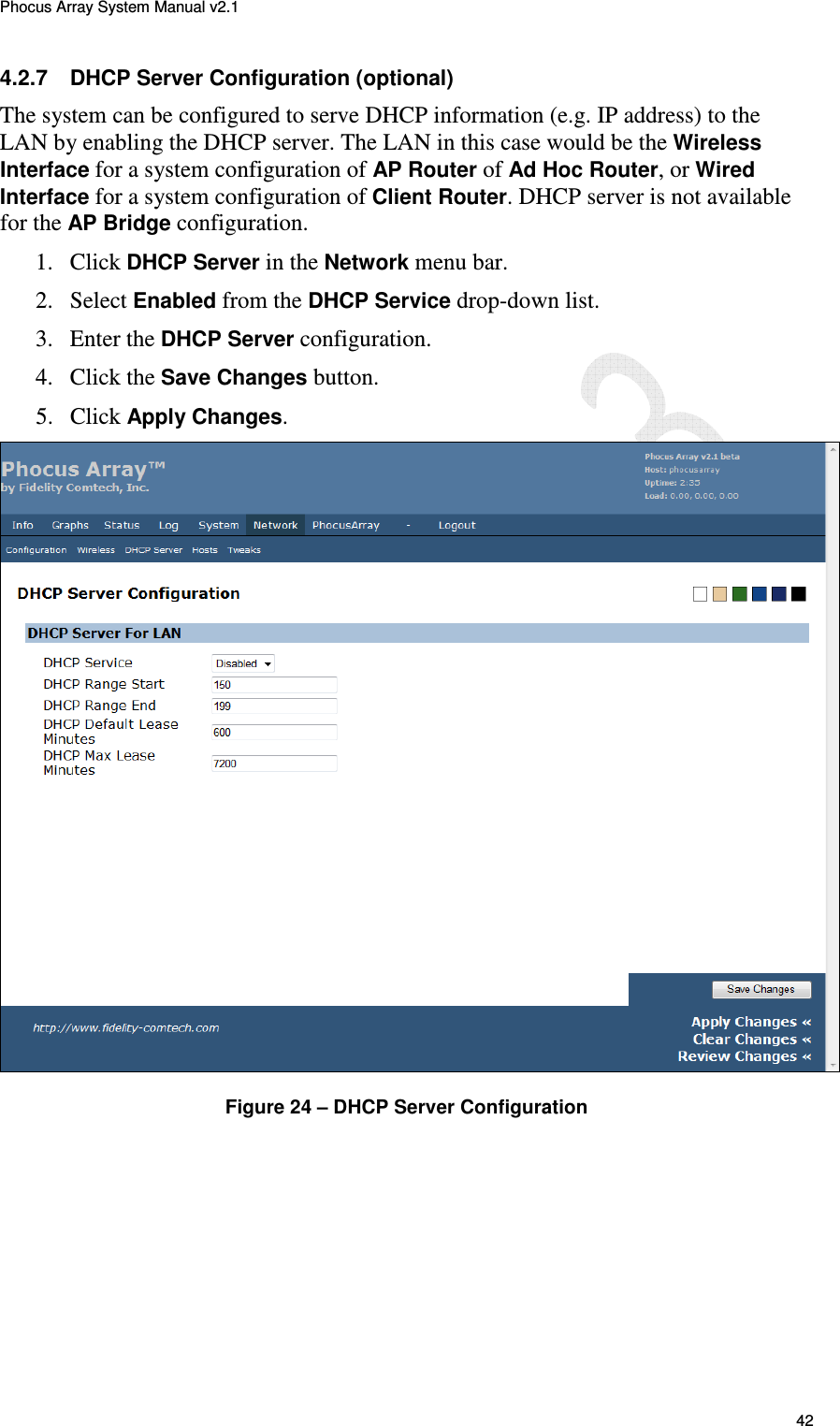
Phocus Array System Manual v2.1 42 4.2.7  DHCP Server Configuration (optional) The system can be configured to serve DHCP information (e.g. IP address) to the LAN by enabling the DHCP server. The LAN in this case would be the Wireless Interface for a system configuration of AP Router of Ad Hoc Router, or Wired Interface for a system configuration of Client Router. DHCP server is not available for the AP Bridge configuration. 1. Click DHCP Server in the Network menu bar. 2. Select Enabled from the DHCP Service drop-down list. 3. Enter the DHCP Server configuration.  4. Click the Save Changes button. 5. Click Apply Changes.  Figure 24 – DHCP Server Configuration
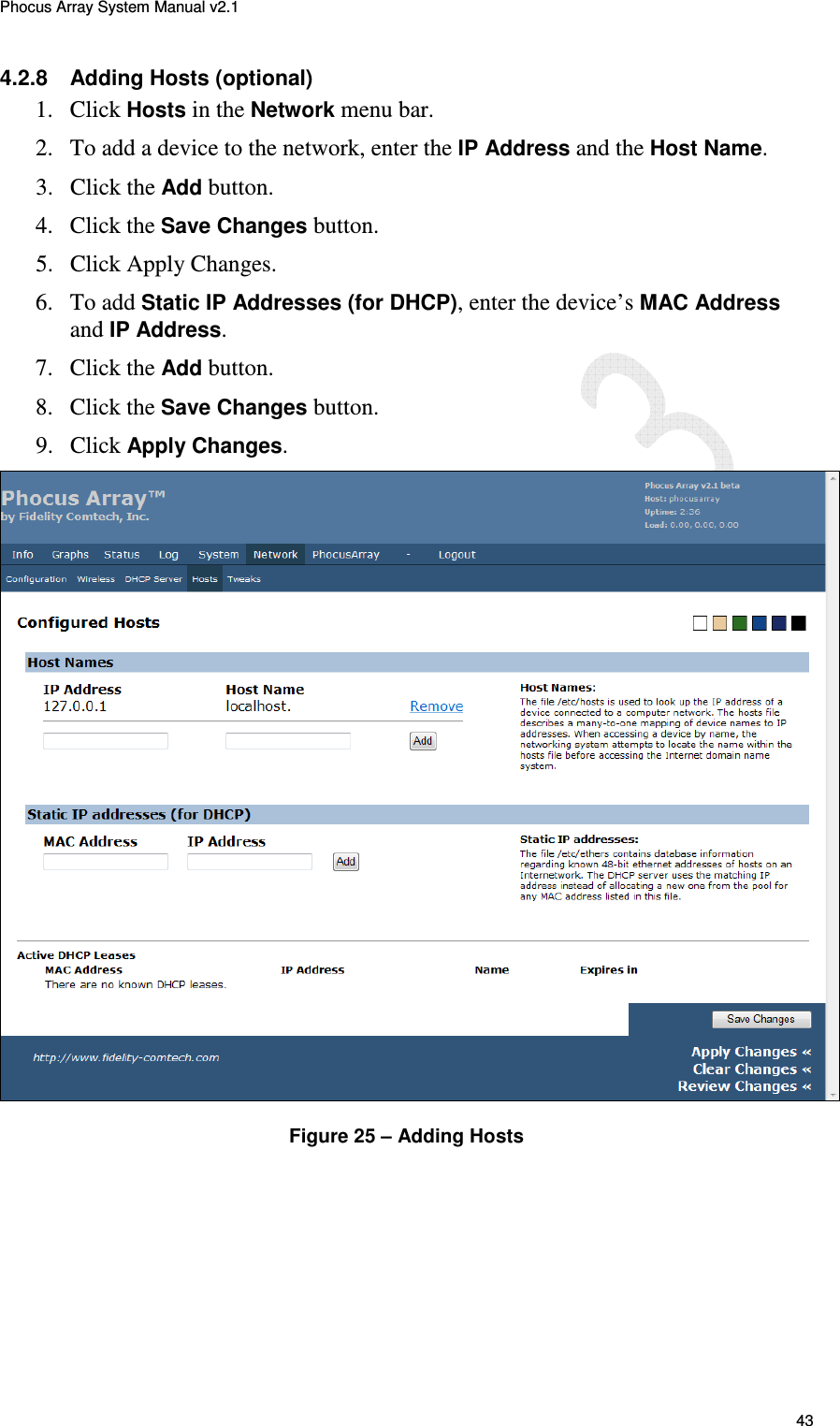
Phocus Array System Manual v2.1 43 4.2.8  Adding Hosts (optional) 1. Click Hosts in the Network menu bar. 2. To add a device to the network, enter the IP Address and the Host Name. 3. Click the Add button. 4. Click the Save Changes button. 5. Click Apply Changes. 6. To add Static IP Addresses (for DHCP), enter the device’s MAC Address and IP Address. 7. Click the Add button. 8. Click the Save Changes button. 9. Click Apply Changes.  Figure 25 – Adding Hosts
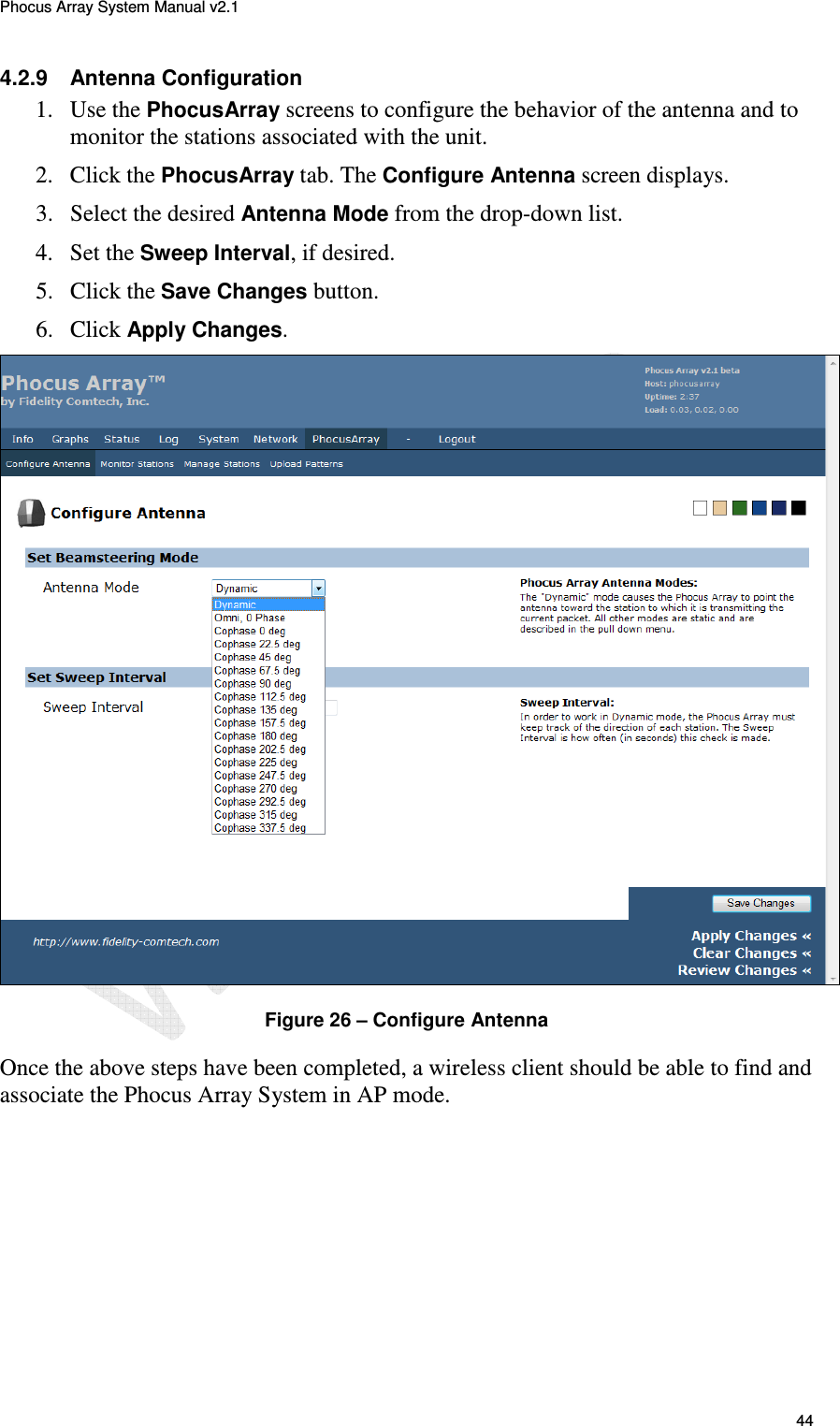
Phocus Array System Manual v2.1 44 4.2.9  Antenna Configuration 1. Use the PhocusArray screens to configure the behavior of the antenna and to monitor the stations associated with the unit. 2. Click the PhocusArray tab. The Configure Antenna screen displays. 3. Select the desired Antenna Mode from the drop-down list.  4. Set the Sweep Interval, if desired. 5. Click the Save Changes button. 6. Click Apply Changes.  Figure 26 – Configure Antenna Once the above steps have been completed, a wireless client should be able to find and associate the Phocus Array System in AP mode.
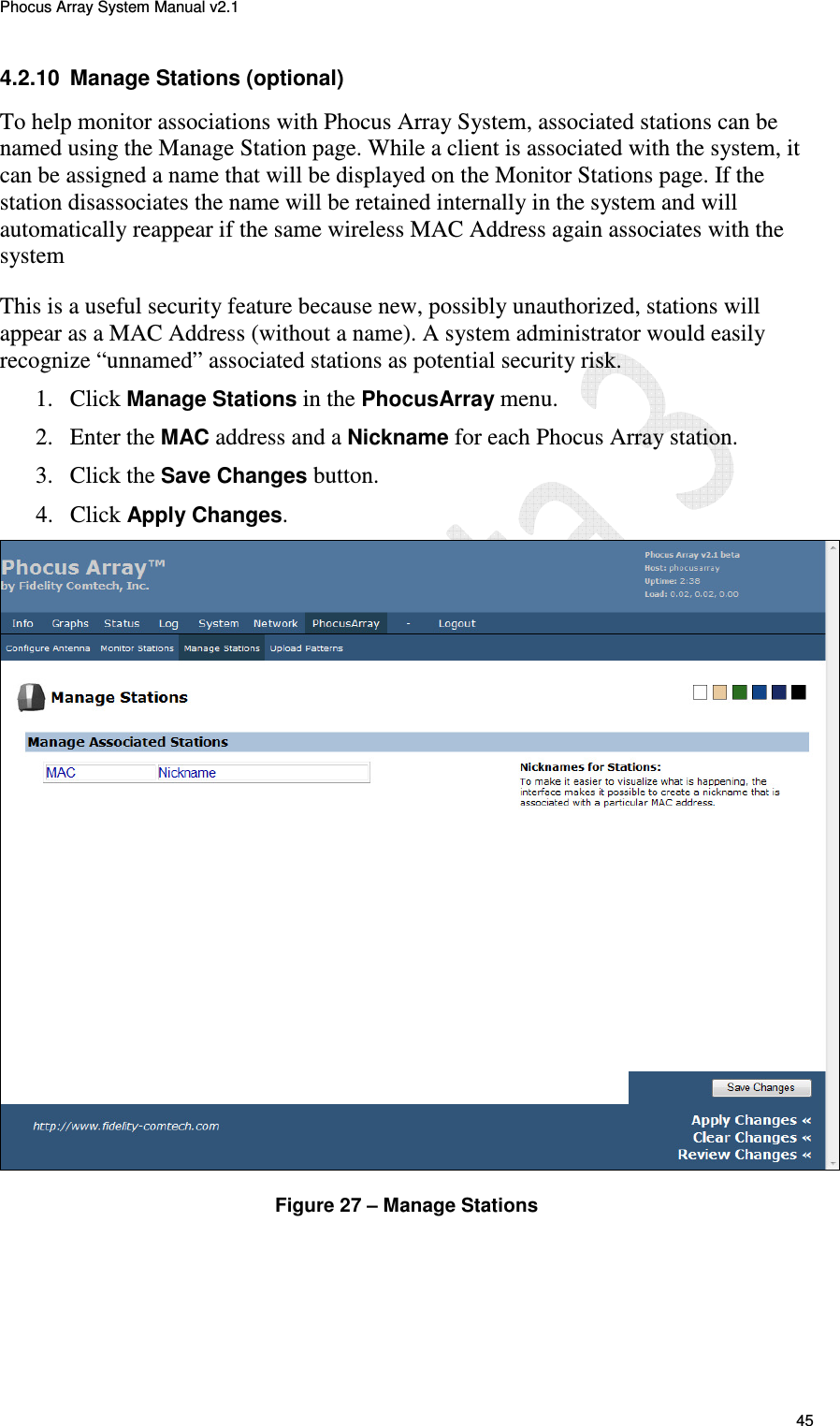
Phocus Array System Manual v2.1 45 4.2.10  Manage Stations (optional) To help monitor associations with Phocus Array System, associated stations can be named using the Manage Station page. While a client is associated with the system, it can be assigned a name that will be displayed on the Monitor Stations page. If the station disassociates the name will be retained internally in the system and will automatically reappear if the same wireless MAC Address again associates with the system  This is a useful security feature because new, possibly unauthorized, stations will appear as a MAC Address (without a name). A system administrator would easily recognize “unnamed” associated stations as potential security risk. 1. Click Manage Stations in the PhocusArray menu. 2. Enter the MAC address and a Nickname for each Phocus Array station. 3. Click the Save Changes button. 4. Click Apply Changes.  Figure 27 – Manage Stations
Phocus Array System Manual v2.1 46 5  Using the Administrative Console This section discusses the Administrative Console for the Phocus Array System. For a quick start guide to simply getting a Phocus Array System up and running on a network, refer to Section 4, Configuration and Software Setup. Most common tasks can be performed using the Administrative Console for the Phocus Array System, making it the preferred method to access the system. Common tasks include: • Installation and setup of the wireless and network parameters • Monitoring client associations 5.1  Using the Administrative Console To access the console, perform steps 1 through 4 in Section 4.2 (pages 30 through 27). There are seven different categories of settings, each accessible from a tab at the top of the page. Most categories have several menu options, accessible from the menu bar just below the tabs. These options are discussed in the following sections. • Info – System, About • Graphs – CPU, Traffic IO, Traffic eth0, Traffic eth1, Traffic br-lan, Traffic wifi0 • Status – System, Processes, Interfaces, DCHP Clients, Netstat, Iptables • Log – Syslog Settings, Syslog, Kernel • System – Settings, Password, Backup and Restore, Upgrade, Reboot • Network – Configuration, Wireless, DHCP Server, Hosts, Tweaks • PhocusArray – Configure Antenna, Monitor Stations, Manage Stations, Upload Patterns • Logout
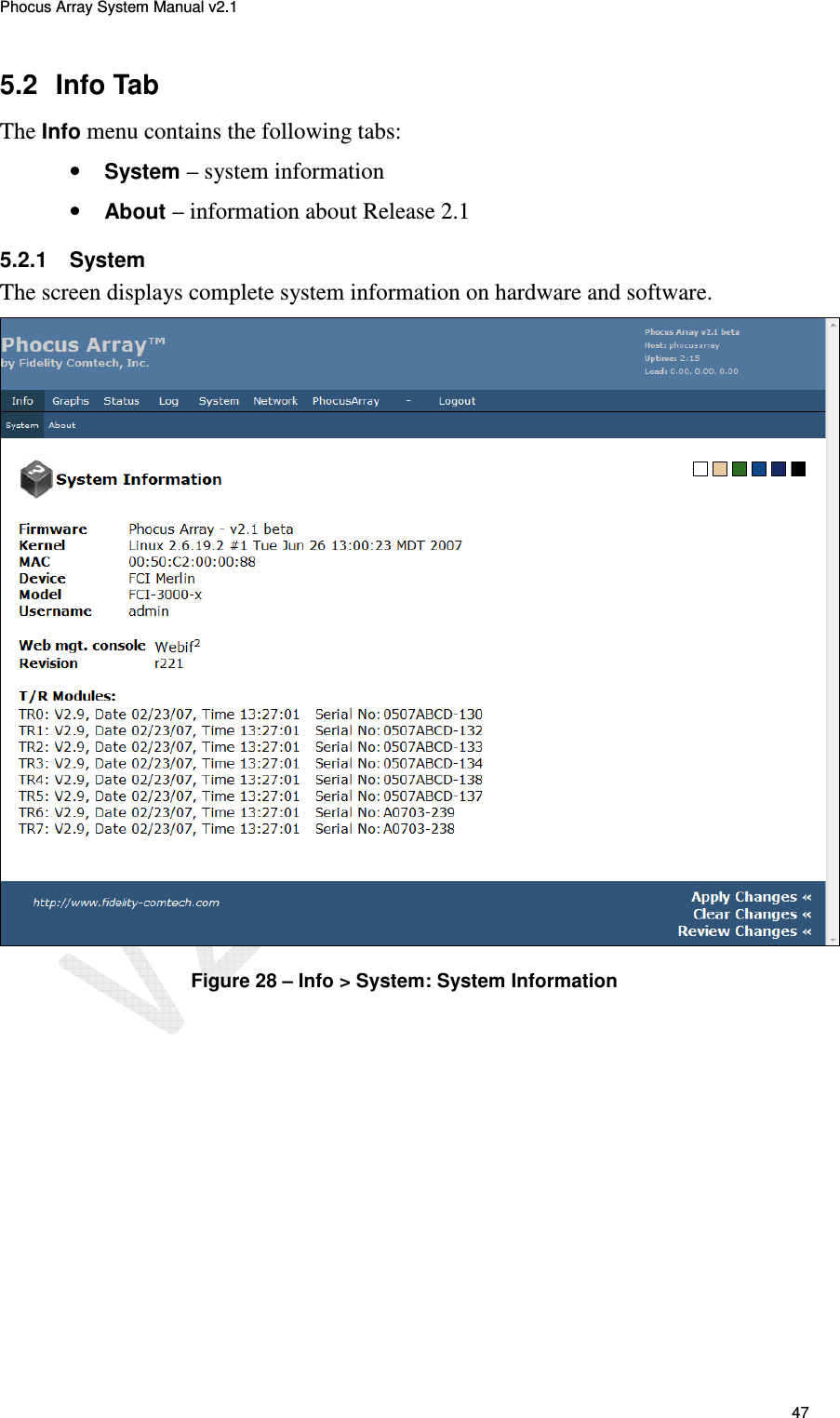
Phocus Array System Manual v2.1 47 5.2  Info Tab The Info menu contains the following tabs: • System – system information • About – information about Release 2.1 5.2.1  System The screen displays complete system information on hardware and software.  Figure 28 – Info > System: System Information
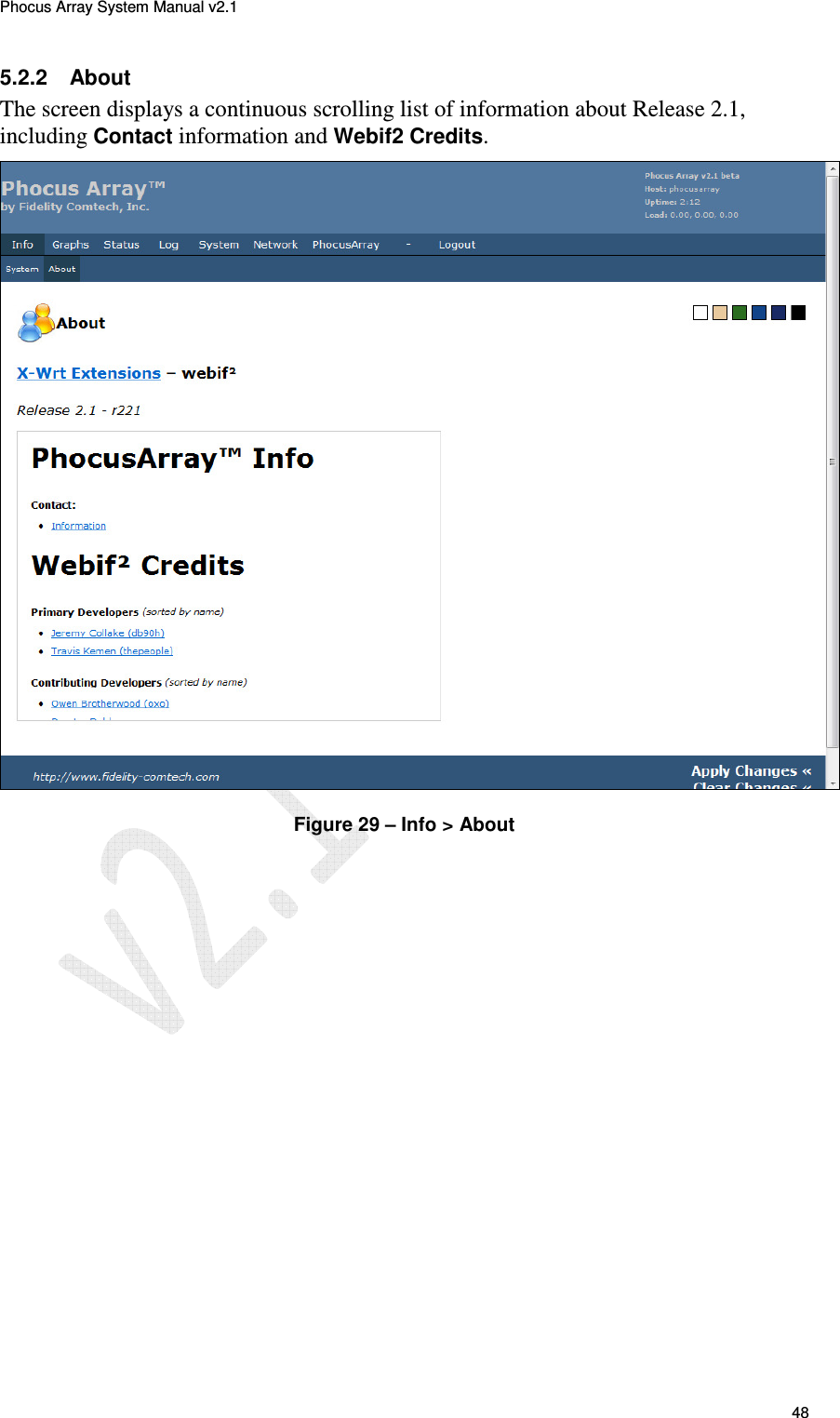
Phocus Array System Manual v2.1 48 5.2.2  About The screen displays a continuous scrolling list of information about Release 2.1, including Contact information and Webif2 Credits.  Figure 29 – Info > About
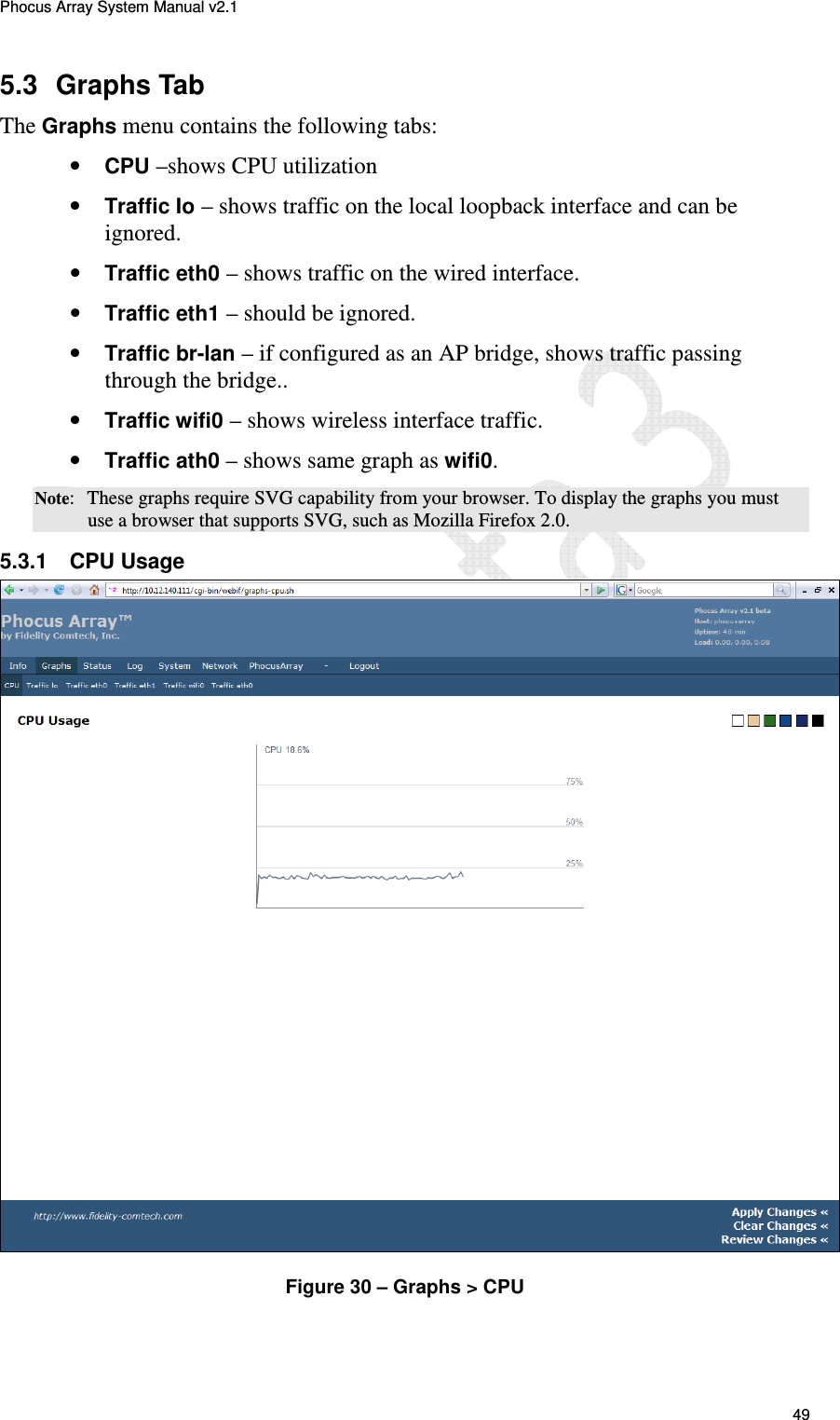
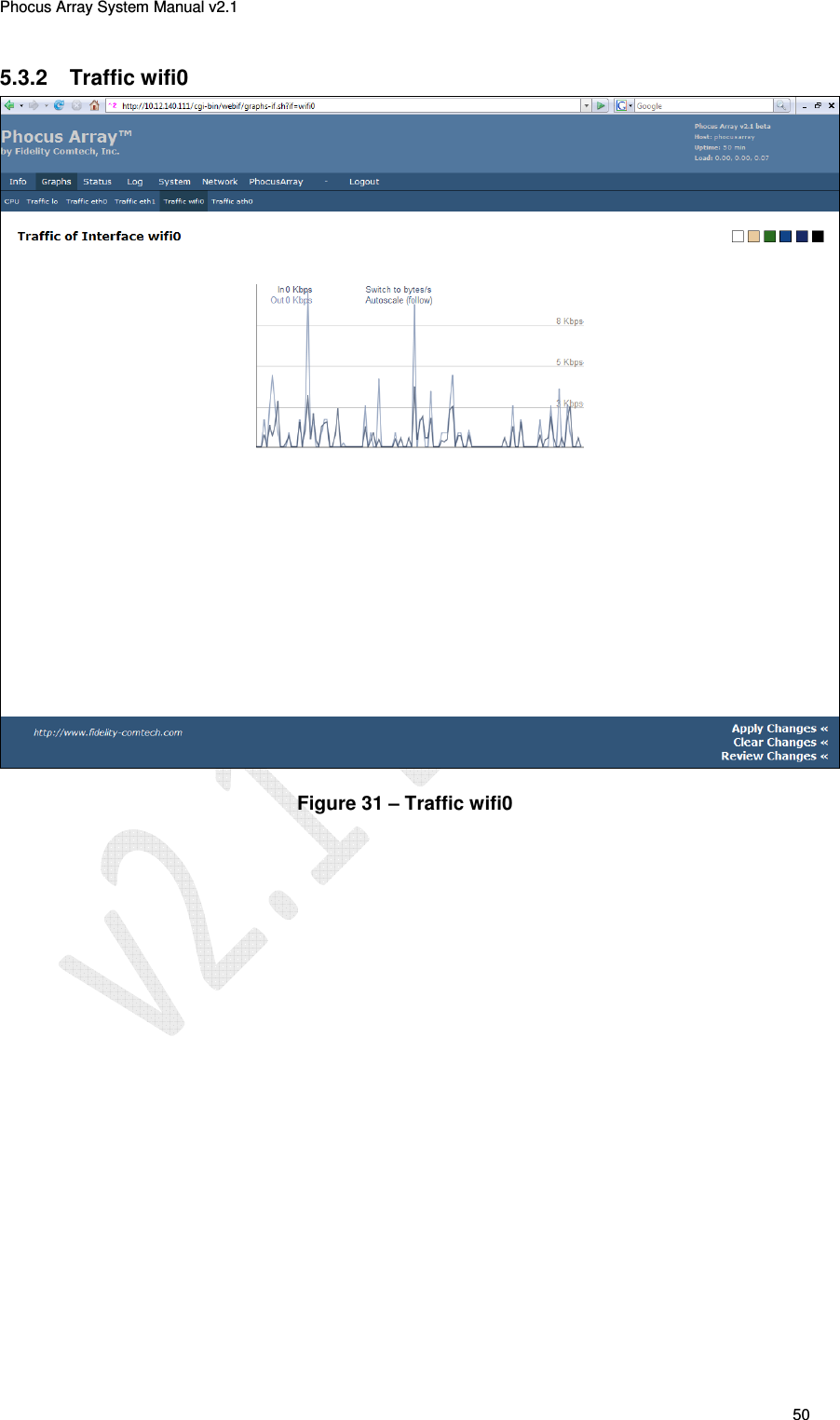
Phocus Array System Manual v2.1 49 5.3  Graphs Tab The Graphs menu contains the following tabs: • CPU –shows CPU utilization • Traffic Io – shows traffic on the local loopback interface and can be ignored. • Traffic eth0 – shows traffic on the wired interface. • Traffic eth1 – should be ignored. • Traffic br-lan – if configured as an AP bridge, shows traffic passing through the bridge.. • Traffic wifi0 – shows wireless interface traffic. • Traffic ath0 – shows same graph as wifi0. Note:  These graphs require SVG capability from your browser. To display the graphs you must use a browser that supports SVG, such as Mozilla Firefox 2.0. 5.3.1  CPU Usage  Figure 30 – Graphs > CPU
Phocus Array System Manual v2.1 50 5.3.2  Traffic wifi0  Figure 31 – Traffic wifi0
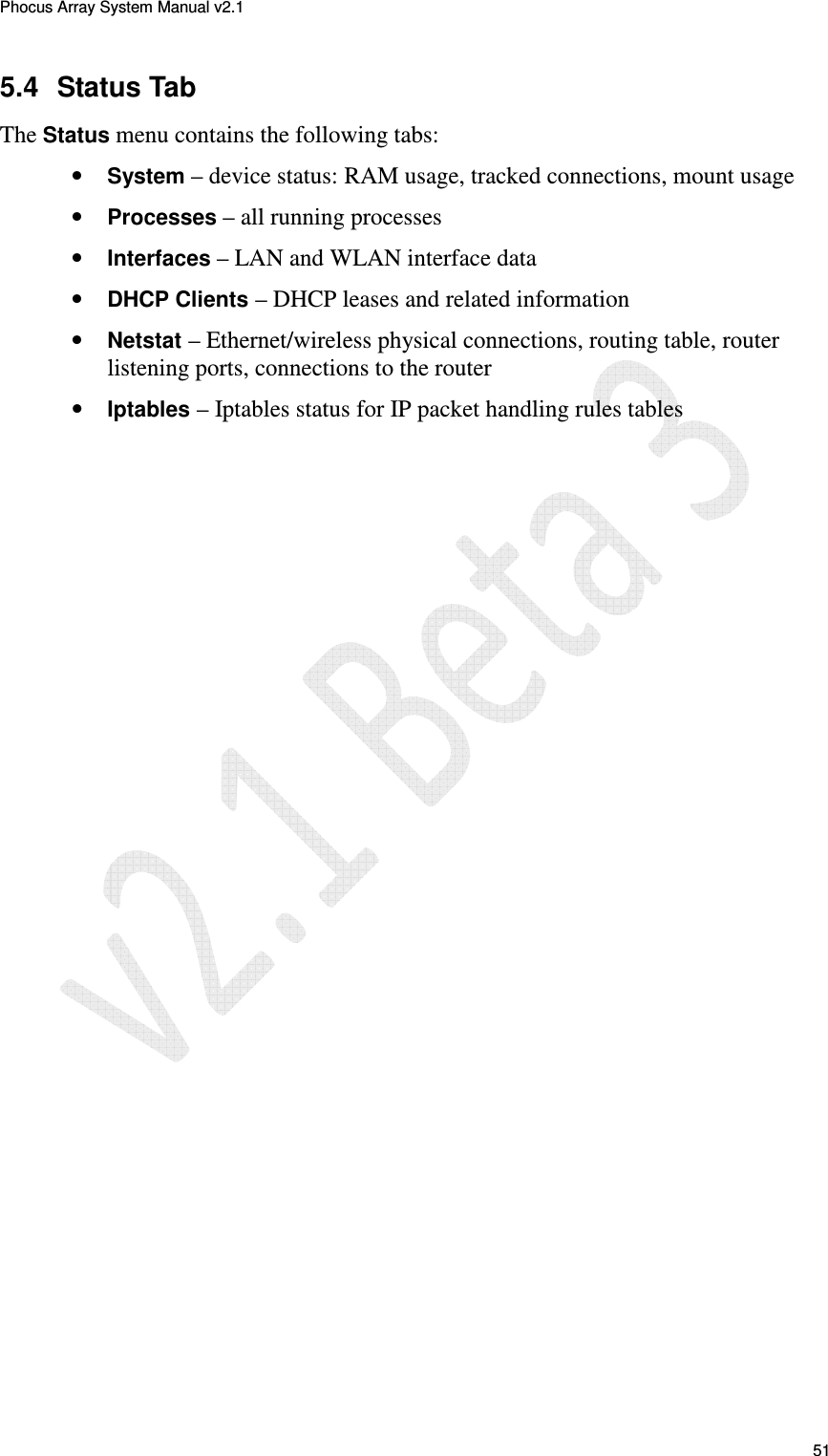
Phocus Array System Manual v2.1 51 5.4  Status Tab The Status menu contains the following tabs: • System – device status: RAM usage, tracked connections, mount usage • Processes – all running processes • Interfaces – LAN and WLAN interface data • DHCP Clients – DHCP leases and related information • Netstat – Ethernet/wireless physical connections, routing table, router listening ports, connections to the router • Iptables – Iptables status for IP packet handling rules tables
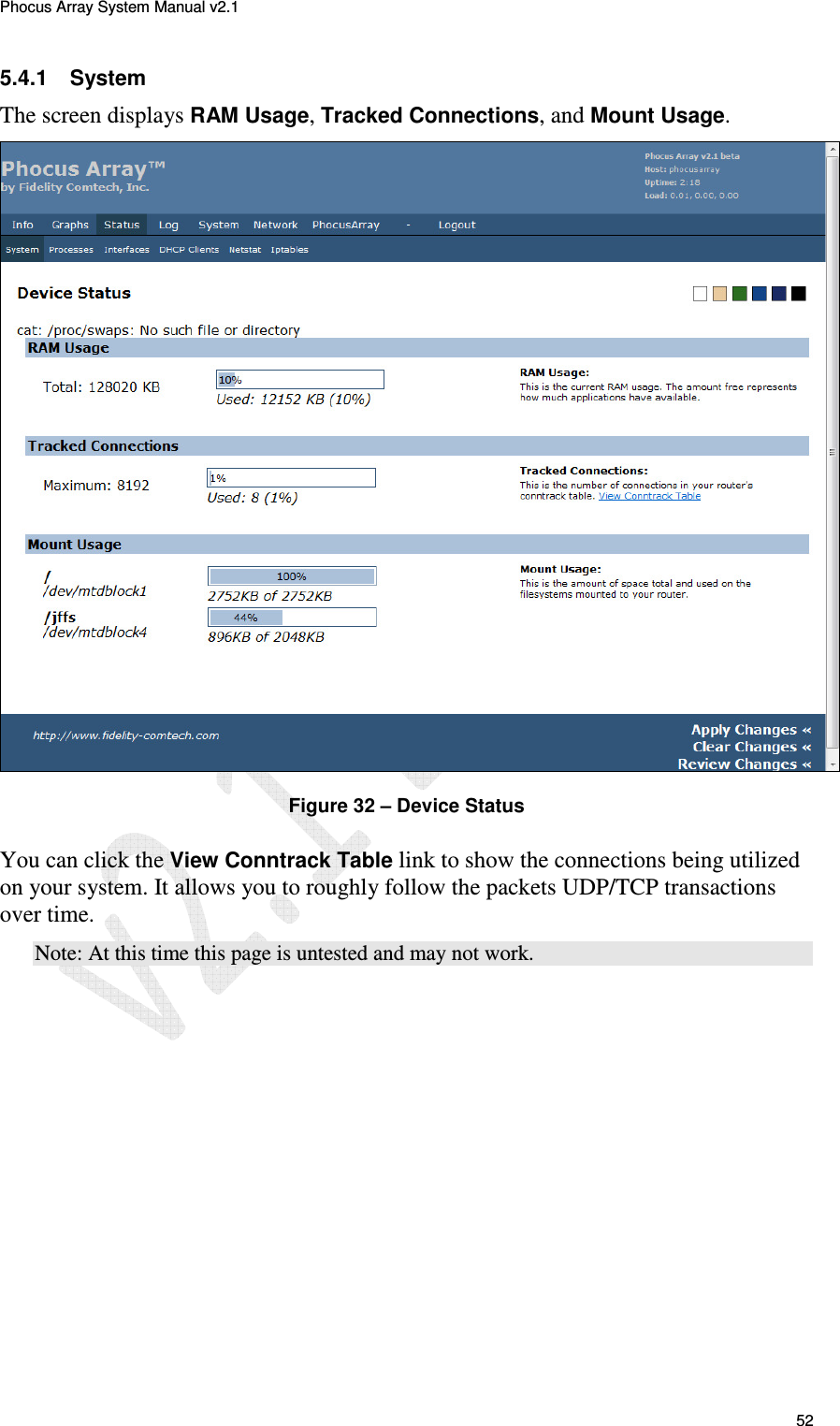
Phocus Array System Manual v2.1 52 5.4.1  System The screen displays RAM Usage, Tracked Connections, and Mount Usage.  Figure 32 – Device Status You can click the View Conntrack Table link to show the connections being utilized on your system. It allows you to roughly follow the packets UDP/TCP transactions over time. Note: At this time this page is untested and may not work.
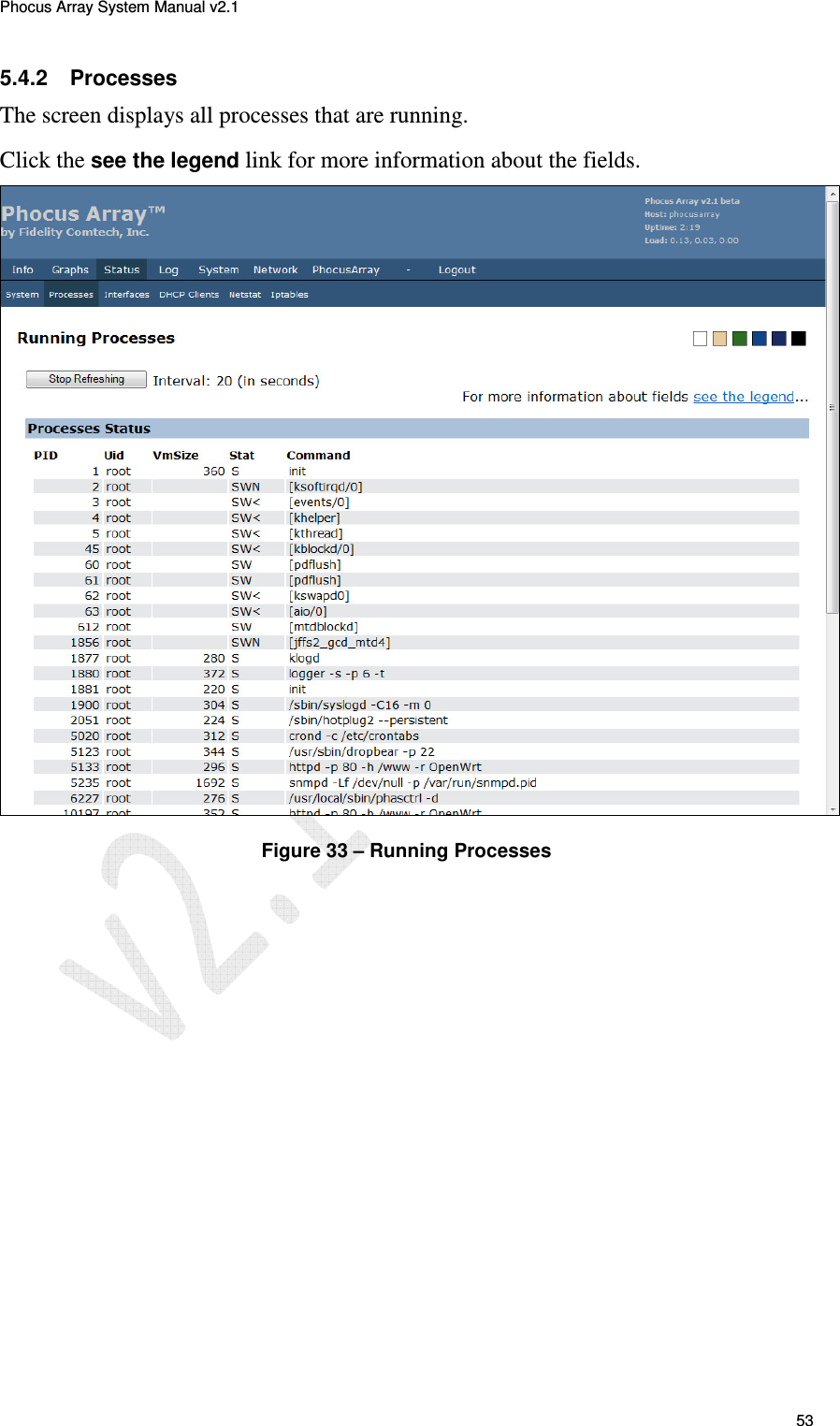
Phocus Array System Manual v2.1 53 5.4.2  Processes The screen displays all processes that are running.  Click the see the legend link for more information about the fields.  Figure 33 – Running Processes
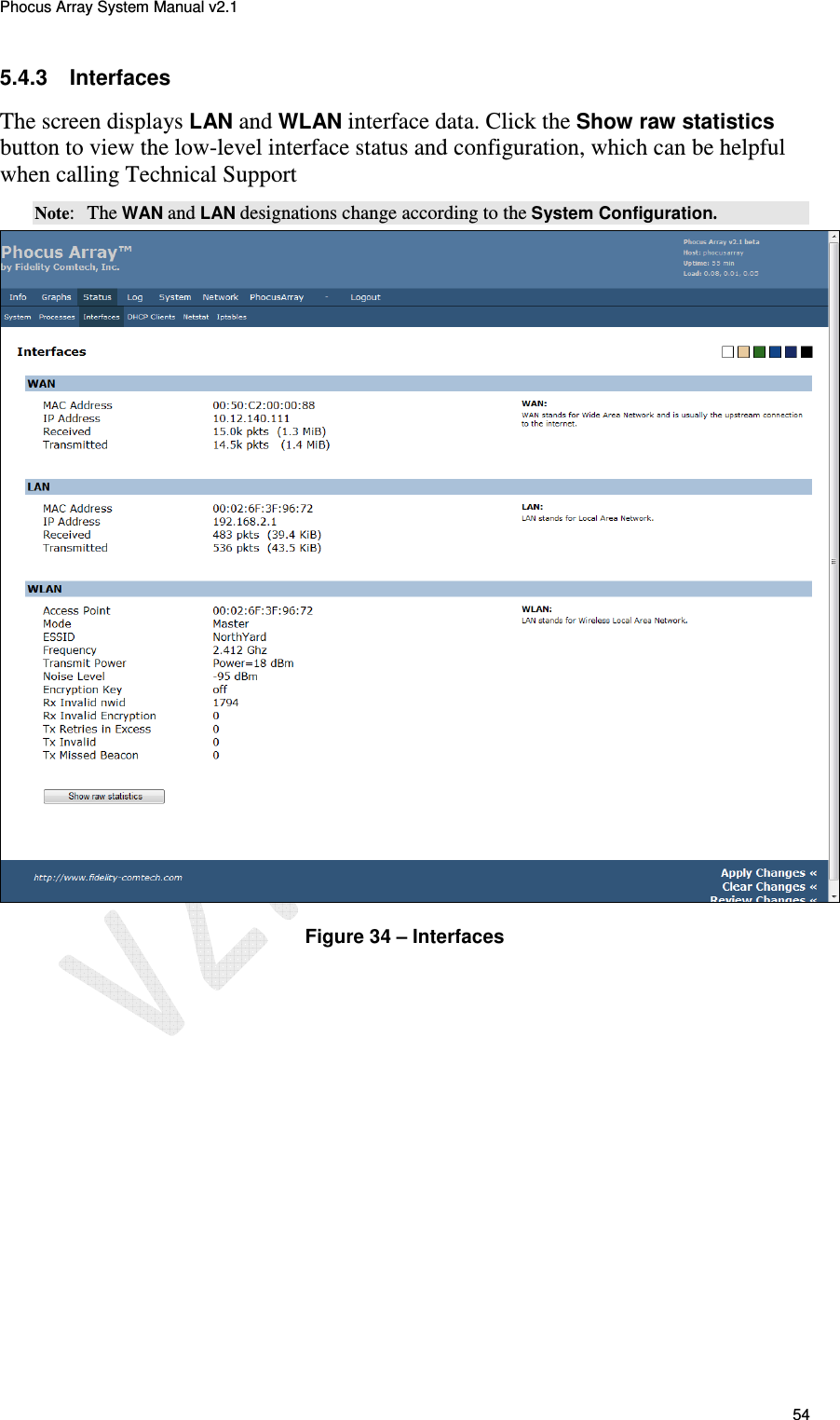
Phocus Array System Manual v2.1 54 5.4.3  Interfaces The screen displays LAN and WLAN interface data. Click the Show raw statistics button to view the low-level interface status and configuration, which can be helpful when calling Technical Support Note:   The WAN and LAN designations change according to the System Configuration.   Figure 34 – Interfaces

Navigation menu