HB Wireless Communication Technology CG757560 RF module User Manual S200 SPEC

HB Wireless Communication Technology RF module S200 SPEC

Users Manual

 1                                           HongBo  HM7601 SIP Module User Manual Product   Version Date
  2 Document History Date Revised Contents Revised by Version Oct. 18th,2015   Preliminary version  Derrick  1.0
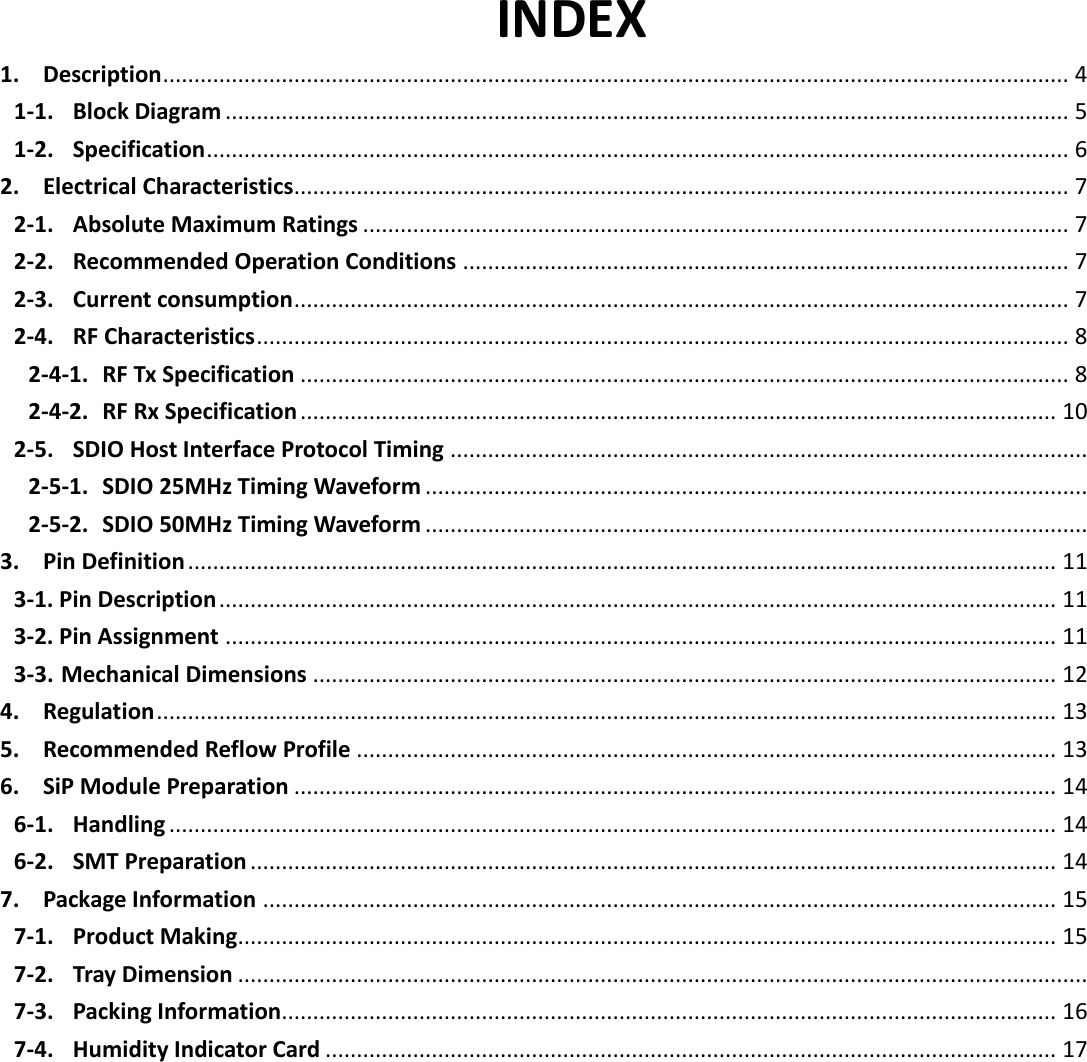
  3 INDEX 1. Description ................................................................................................................................................. 4 1-1. Block Diagram ....................................................................................................................................... 5 1-2. Specification .......................................................................................................................................... 6 2. Electrical Characteristics ............................................................................................................................ 7 2-1. Absolute Maximum Ratings ................................................................................................................. 7 2-2. Recommended Operation Conditions ................................................................................................. 7 2-3. Current consumption ............................................................................................................................ 7 2-4. RF Characteristics .................................................................................................................................. 8 2-4-1. RF Tx Specification ........................................................................................................................... 8 2-4-2. RF Rx Specification ......................................................................................................................... 10 2-5. SDIO Host Interface Protocol Timing ...................................................................................................... 2-5-1. SDIO 25MHz Timing Waveform .......................................................................................................... 2-5-2. SDIO 50MHz Timing Waveform .......................................................................................................... 3. Pin Definition ........................................................................................................................................... 11 3-1. Pin Description ...................................................................................................................................... 11 3-2. Pin Assignment ..................................................................................................................................... 11 3-3. Mechanical Dimensions ....................................................................................................................... 12 4. Regulation ................................................................................................................................................ 13 5. Recommended Reflow Profile ................................................................................................................ 13 6. SiP Module Preparation .......................................................................................................................... 14 6-1. Handling .............................................................................................................................................. 14 6-2. SMT Preparation ................................................................................................................................. 14 7. Package Information ............................................................................................................................... 15 7-1. Product Making ................................................................................................................................... 15 7-2. Tray Dimension ........................................................................................................................................ 7-3. Packing Information............................................................................................................................ 16 7-4. Humidity Indicator Card ..................................................................................................................... 17
  4 1. Description HM7601 is a low-cost Wi-Fi SIP module, which fully supports the features and functional compliance of IEEE 802.11b/g/n  standards.  It  supports  up  to  150Mbps  high-speed  wireless  network  connections.  Also,  it  is designed to provide excellent performance with low power consumption as well as a cost-effective solution. The module is able to be developed for Wi-Fi USB dongle, Wi-Fi camera, wireless module for IoT products..etc.  Feature  Small dimension : 11mm X 11mm X 2.0mm  Host interface : USB 2.0  Support Orthogonal Frequency Division Multiplexing(OFDM), Complementary Code Keying(CCK), and Direct     Sequence Spread Spectrum(DSSS) to provide a variety of data rates  Integrated switching regulator enables direct connection to battery  Support AP /STA / ad-hoc mode / Wi-Fi direct  IEEE 802.11n (HT20 MCS7), IEEE 802.11g(OFDM 54Mbps) and IEEE 802.11b(DSSS 11Mbps)  Support Wi-Fi Direct (WFA P-2-P Standard)  Security: WFA WPA/WPA2 personal, WPS2.0, WAPI  QoS: WFA WMM, WMM PS  Compatible with Windows XP, Vista, W7 32/64, W8 32/64, W8.1 32/64  Linux and MAC OS X  Plug and play, easy set-up installation
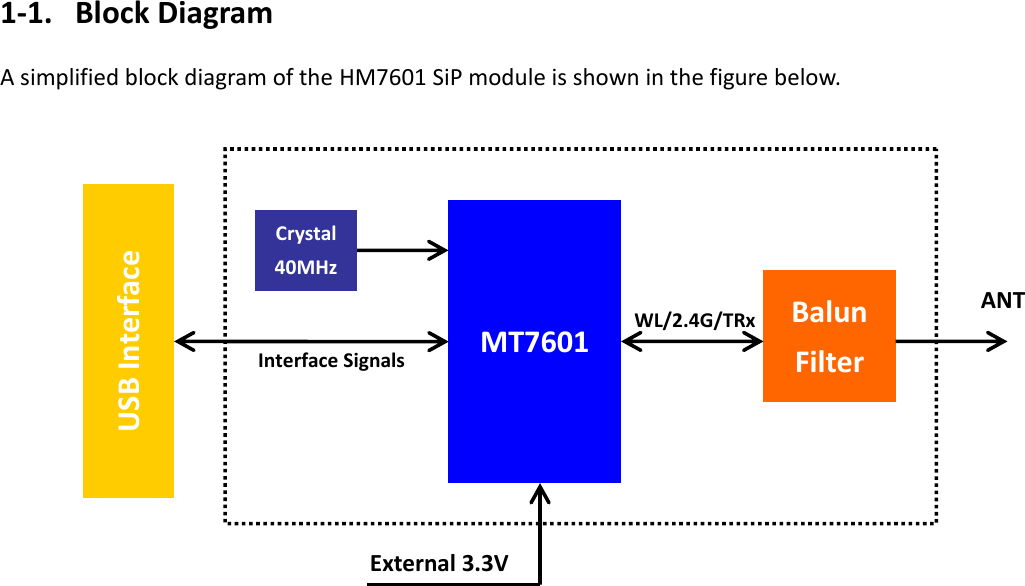
  5 1-1. Block Diagram A simplified block diagram of the HM7601 SiP module is shown in the figure below.                MT7601BalunFilterWL/2.4G/TRxCrystal40MHzUSB InterfaceInterface SignalsExternal 3.3VANTAI7601H
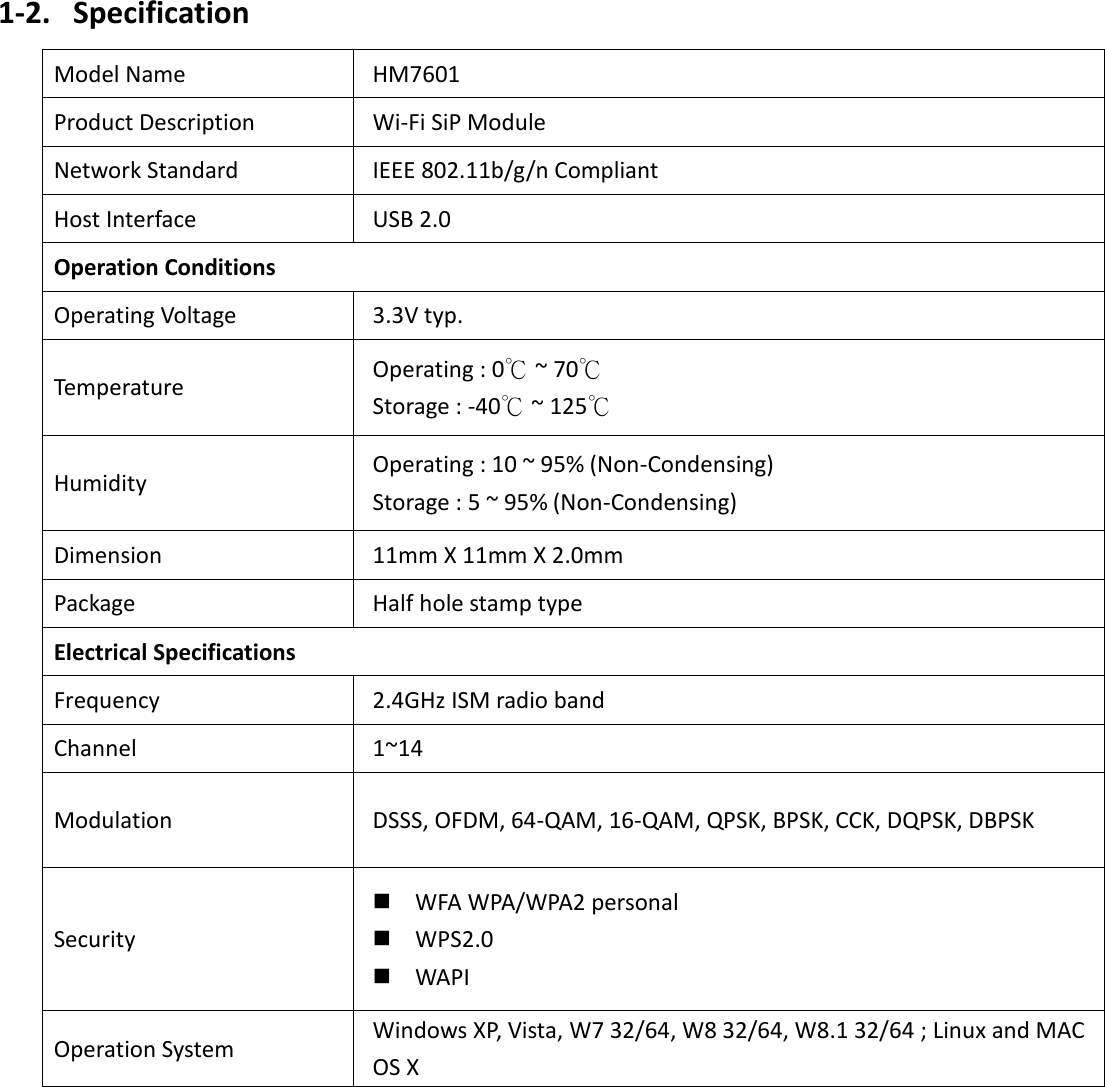
  6 1-2. Specification Model Name HM7601 Product Description Wi-Fi SiP Module Network Standard IEEE 802.11b/g/n Compliant Host Interface USB 2.0 Operation Conditions Operating Voltage 3.3V typ. Temperature Operating : 0℃ ~ 70℃ Storage : -40℃ ~ 125℃ Humidity Operating : 10 ~ 95% (Non-Condensing) Storage : 5 ~ 95% (Non-Condensing) Dimension 11mm X 11mm X 2.0mm Package Half hole stamp type Electrical Specifications Frequency 2.4GHz ISM radio band Channel   1~14 Modulation DSSS, OFDM, 64-QAM, 16-QAM, QPSK, BPSK, CCK, DQPSK, DBPSK Security  WFA WPA/WPA2 personal    WPS2.0    WAPI Operation System Windows XP, Vista, W7 32/64, W8 32/64, W8.1 32/64 ; Linux and MAC OS X
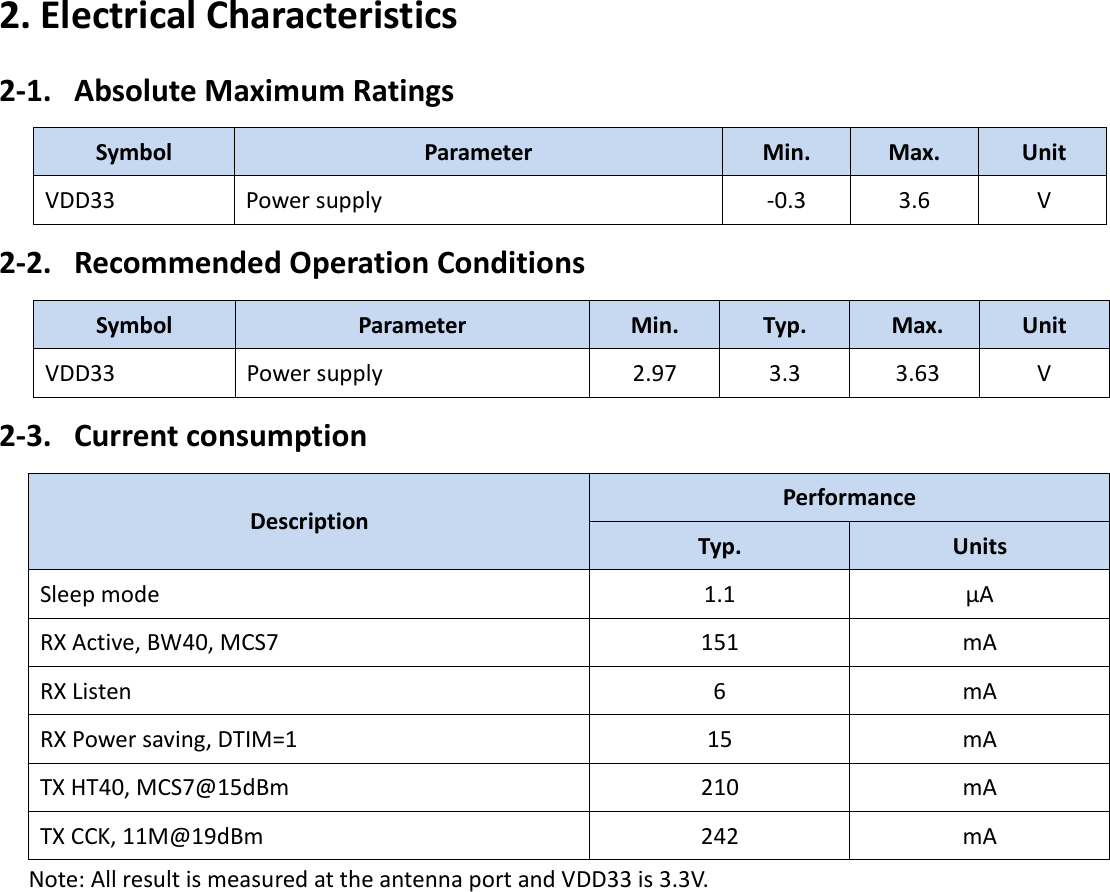
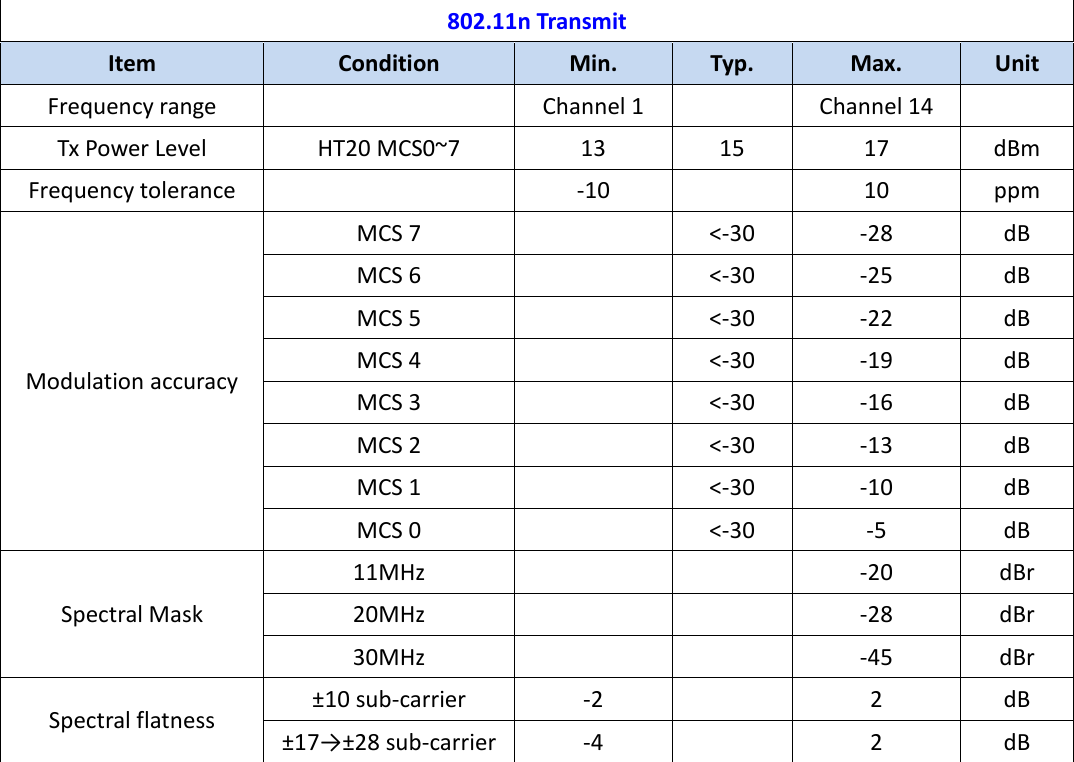
  7 2. Electrical Characteristics 2-1. Absolute Maximum Ratings Symbol Parameter Min. Max. Unit VDD33 Power supply -0.3 3.6 V 2-2. Recommended Operation Conditions Symbol Parameter Min. Typ. Max. Unit VDD33 Power supply 2.97 3.3 3.63 V 2-3. Current consumption Description Performance Typ. Units Sleep mode 1.1 μA RX Active, BW40, MCS7 151 mA RX Listen 6 mA RX Power saving, DTIM=1 15 mA TX HT40, MCS7@15dBm 210 mA TX CCK, 11M@19dBm 242 mA Note: All result is measured at the antenna port and VDD33 is 3.3V.
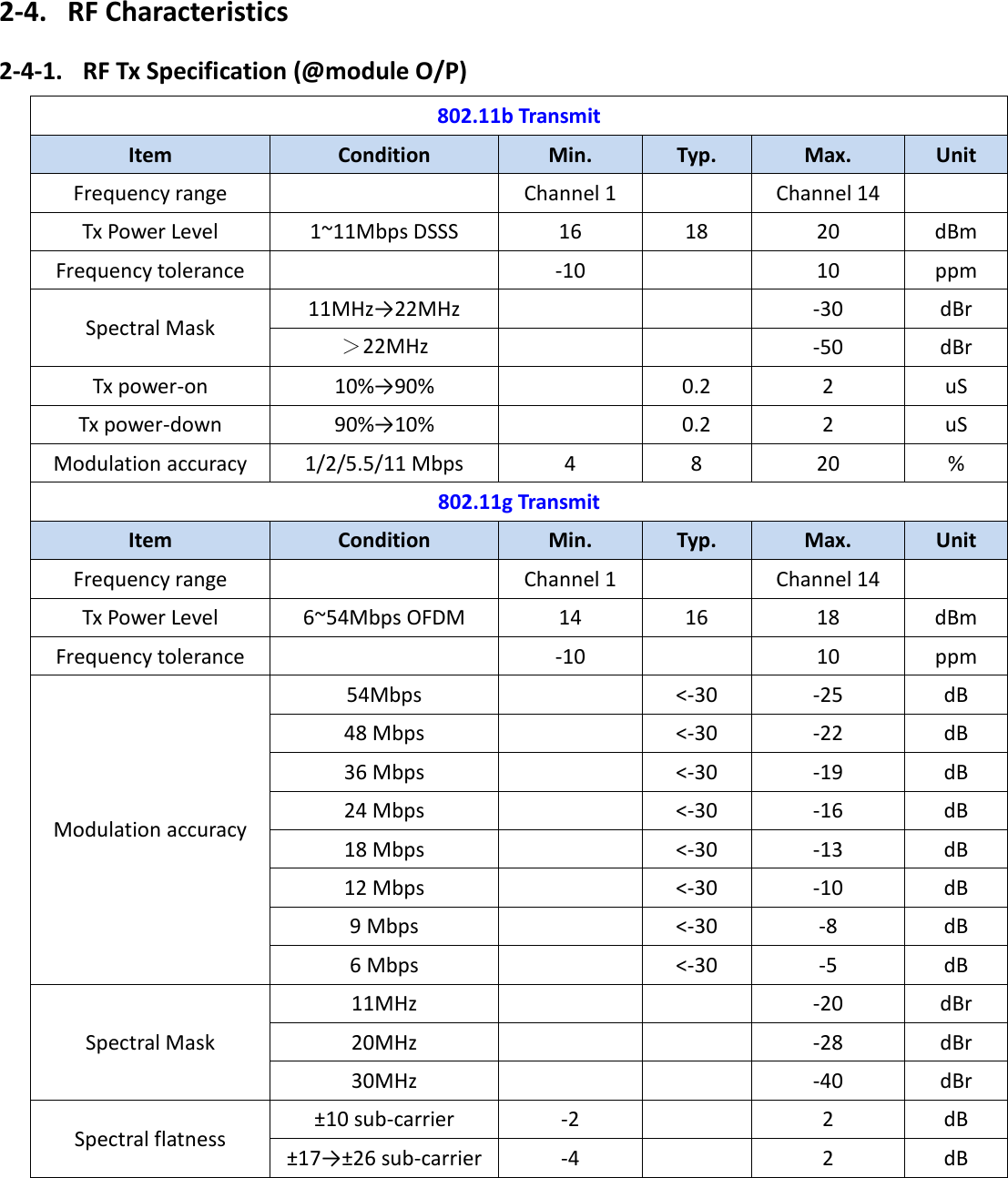
  8 2-4. RF Characteristics 2-4-1. RF Tx Specification (@module O/P) 802.11b Transmit Item Condition Min. Typ. Max. Unit Frequency range  Channel 1  Channel 14  Tx Power Level 1~11Mbps DSSS 16 18 20 dBm Frequency tolerance  -10  10 ppm Spectral Mask 11MHz→22MHz   -30 dBr >22MHz   -50 dBr Tx power-on 10%→90%  0.2 2 uS Tx power-down 90%→10%  0.2 2 uS Modulation accuracy 1/2/5.5/11 Mbps 4 8 20 % 802.11g Transmit Item Condition Min. Typ. Max. Unit Frequency range  Channel 1  Channel 14  Tx Power Level 6~54Mbps OFDM 14 16 18 dBm Frequency tolerance  -10  10 ppm Modulation accuracy 54Mbps  <-30 -25 dB 48 Mbps  <-30 -22 dB 36 Mbps  <-30 -19 dB 24 Mbps  <-30 -16 dB 18 Mbps  <-30 -13 dB 12 Mbps  <-30 -10 dB 9 Mbps  <-30 -8 dB 6 Mbps  <-30 -5 dB Spectral Mask 11MHz   -20 dBr 20MHz   -28 dBr 30MHz   -40 dBr Spectral flatness ±10 sub-carrier -2  2 dB ±17→±26 sub-carrier -4  2 dB
  9 802.11n Transmit Item Condition Min. Typ. Max. Unit Frequency range  Channel 1  Channel 14  Tx Power Level HT20 MCS0~7 13 15 17 dBm Frequency tolerance  -10  10 ppm Modulation accuracy MCS 7  <-30 -28 dB MCS 6  <-30 -25 dB MCS 5  <-30 -22 dB MCS 4  <-30 -19 dB MCS 3  <-30 -16 dB MCS 2  <-30 -13 dB MCS 1  <-30 -10 dB MCS 0  <-30 -5 dB Spectral Mask 11MHz   -20 dBr 20MHz   -28 dBr 30MHz   -45 dBr Spectral flatness ±10 sub-carrier -2  2 dB ±17→±28 sub-carrier -4  2 dB
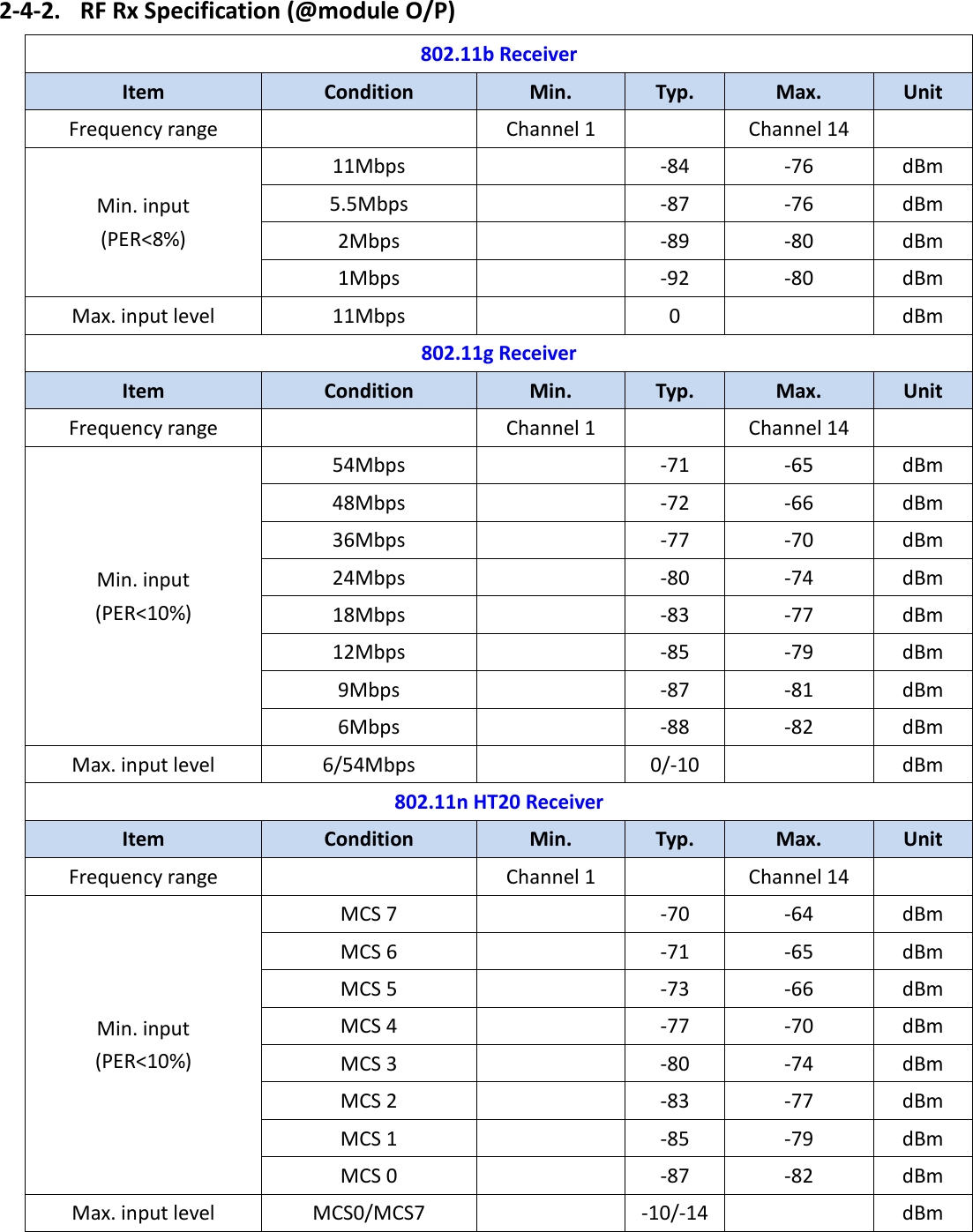
  10 2-4-2. RF Rx Specification (@module O/P) 802.11b Receiver Item Condition Min. Typ. Max. Unit Frequency range  Channel 1  Channel 14  Min. input (PER<8%) 11Mbps  -84 -76 dBm 5.5Mbps  -87 -76 dBm 2Mbps  -89 -80 dBm 1Mbps  -92 -80 dBm Max. input level 11Mbps  0  dBm 802.11g Receiver Item Condition Min. Typ. Max. Unit Frequency range  Channel 1  Channel 14  Min. input (PER<10%) 54Mbps  -71 -65 dBm 48Mbps  -72 -66 dBm 36Mbps  -77 -70 dBm 24Mbps  -80 -74 dBm 18Mbps  -83 -77 dBm 12Mbps  -85 -79 dBm 9Mbps  -87 -81 dBm 6Mbps  -88 -82 dBm Max. input level 6/54Mbps  0/-10  dBm 802.11n HT20 Receiver Item Condition Min. Typ. Max. Unit Frequency range  Channel 1  Channel 14  Min. input (PER<10%) MCS 7  -70 -64 dBm MCS 6  -71 -65 dBm MCS 5  -73 -66 dBm MCS 4  -77 -70 dBm MCS 3  -80 -74 dBm MCS 2  -83 -77 dBm MCS 1  -85 -79 dBm MCS 0  -87 -82 dBm Max. input level MCS0/MCS7  -10/-14  dBm
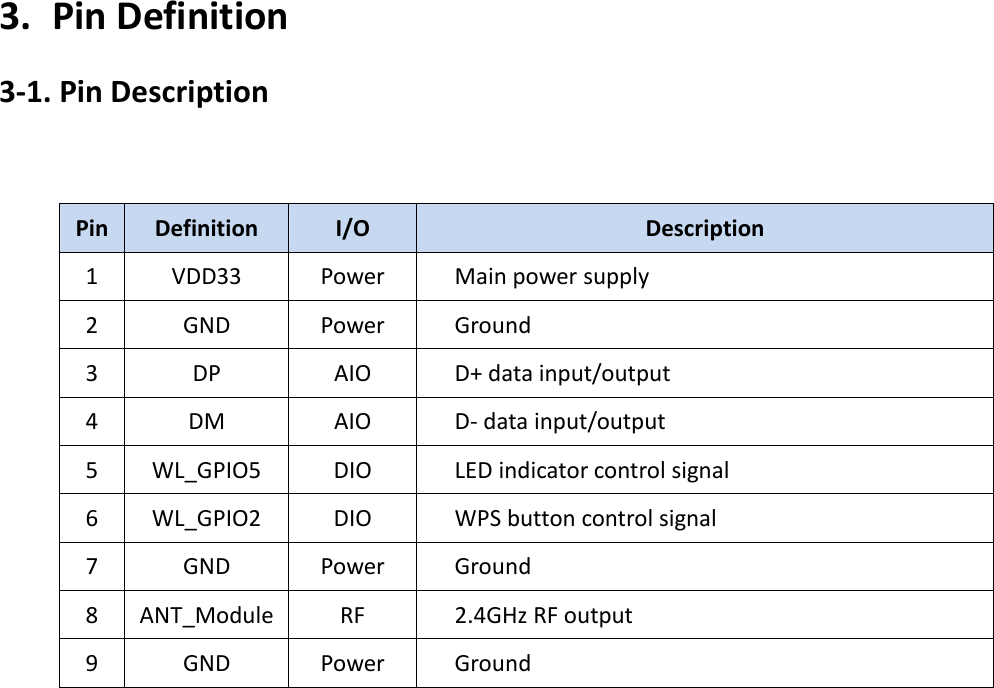
  11 3. Pin Definition 3-1. Pin Description              Pin Definition I/O Description 1 VDD33 Power Main power supply 2 GND Power Ground 3 DP AIO D+ data input/output 4 DM AIO D- data input/output 5 WL_GPIO5 DIO LED indicator control signal 6 WL_GPIO2 DIO WPS button control signal 7 GND Power Ground 8 ANT_Module RF 2.4GHz RF output 9 GND Power Ground
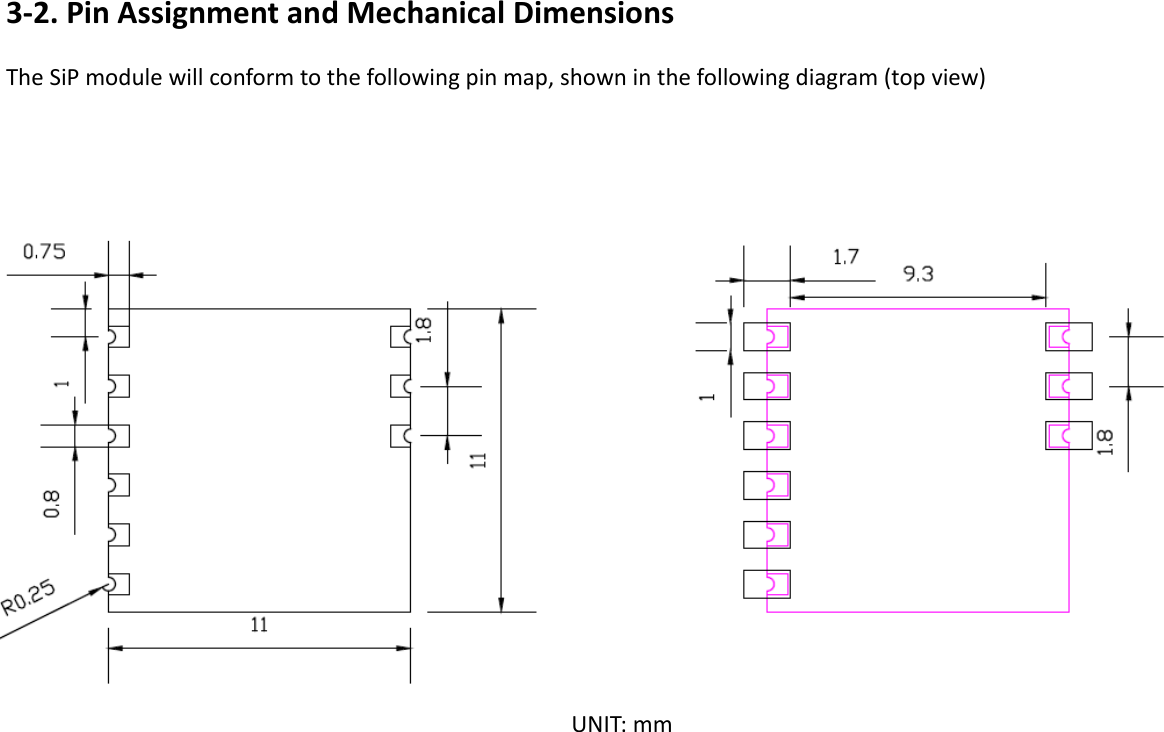
  12 3-2. Pin Assignment and Mechanical Dimensions The SiP module will conform to the following pin map, shown in the following diagram (top view)   UNIT: mm  Pin1 Pin9TOP View
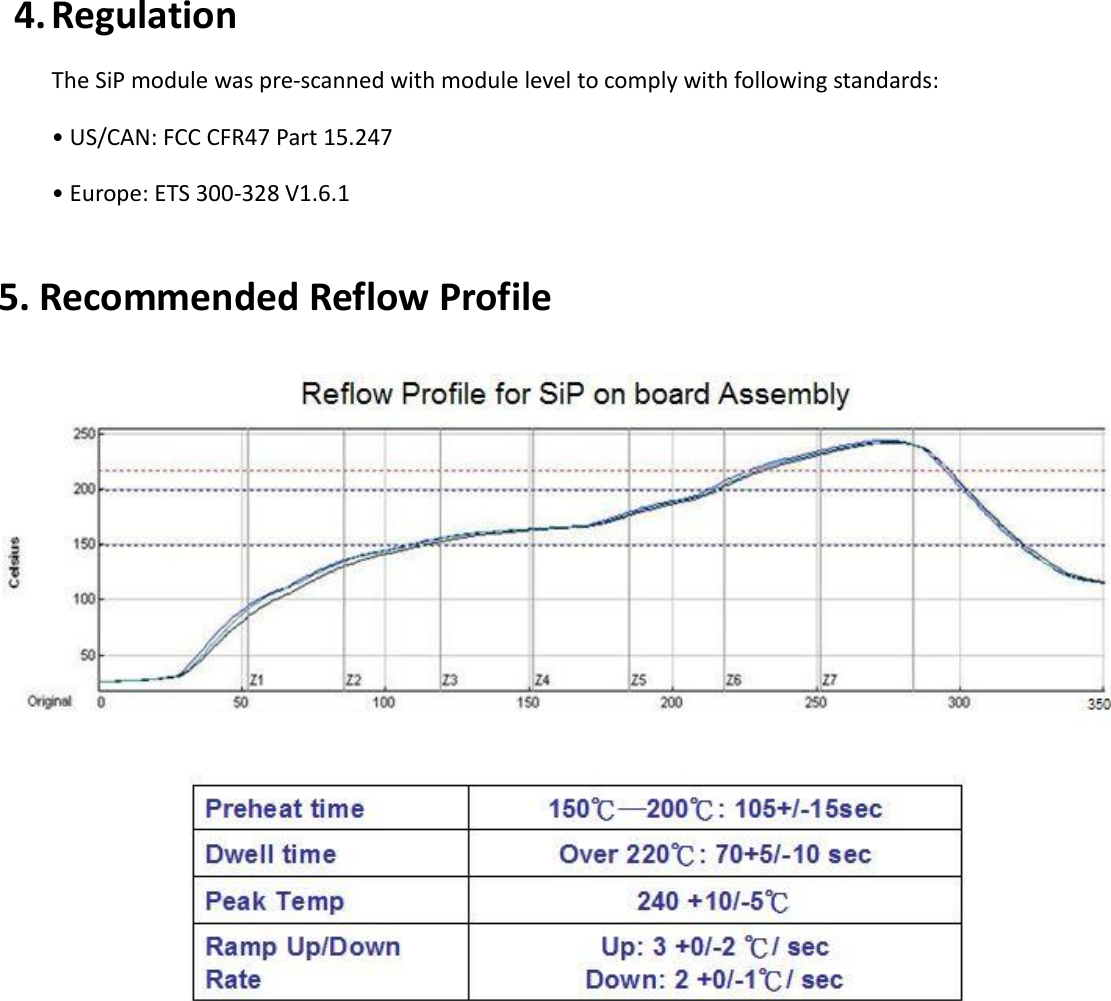
  13 4. Regulation The SiP module was pre-scanned with module level to comply with following standards: • US/CAN: FCC CFR47 Part 15.247 • Europe: ETS 300-328 V1.6.1  5. Recommended Reflow Profile
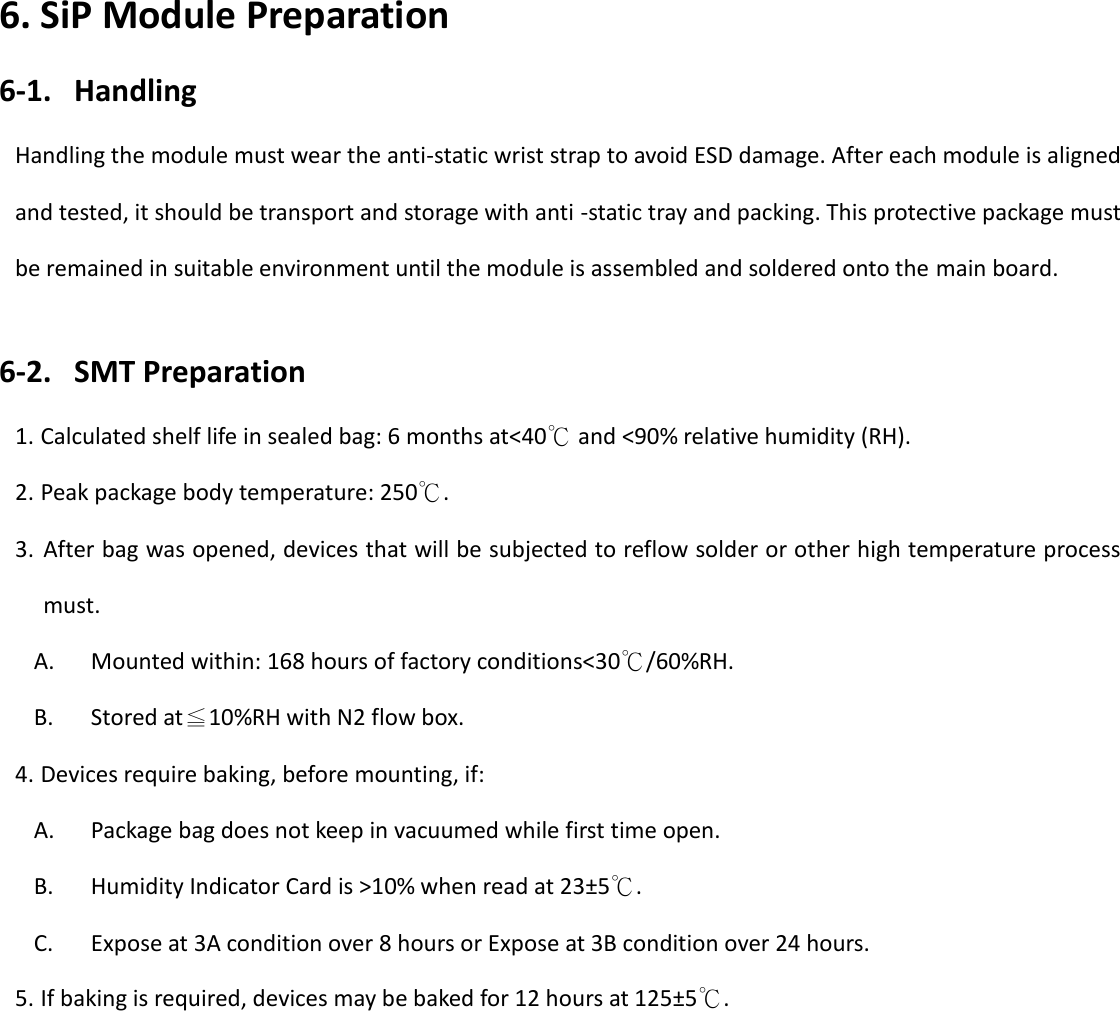
  14 6. SiP Module Preparation 6-1. Handling Handling the module must wear the anti-static wrist strap to avoid ESD damage. After each module is aligned and tested, it should be transport and storage with anti -static tray and packing. This protective package must be remained in suitable environment until the module is assembled and soldered onto the main board.  6-2. SMT Preparation 1. Calculated shelf life in sealed bag: 6 months at<40℃ and <90% relative humidity (RH). 2. Peak package body temperature: 250℃. 3. After bag was opened, devices that will be subjected to reflow solder or other high temperature process must. A. Mounted within: 168 hours of factory conditions<30℃/60%RH. B. Stored at≦10%RH with N2 flow box. 4. Devices require baking, before mounting, if: A. Package bag does not keep in vacuumed while first time open. B. Humidity Indicator Card is >10% when read at 23±5℃. C. Expose at 3A condition over 8 hours or Expose at 3B condition over 24 hours. 5. If baking is required, devices may be baked for 12 hours at 125±5℃.
  15 7. Federal Communications Commission (FCC) Statement This device complies with Part 15 of the FCC Rules. Operation is subject to the following two conditions: (1) This device may not cause harmful interference, and (2) this device must accept any interference received, including interference that may cause undesired operation.  This equipment has been tested and found to comply with the limits for a Class B digital device, pursuant to Part  15  of  the  FCC  Rules.    These  limits  are  designed  to  provide  reasonable  protection  against  harmful interference  in  a  residential  installation.  This  equipment  generates,  uses  and  can  radiate  radio  frequency energy and, if not installed and used in accordance with the instructions, may cause harmful interference to radio  communications.    However,  there  is  no  guarantee  that  interference  will  not  occur  in  a  particular installation.    If this equipment does cause harmful interference to radio or television reception, which can be determined by turning the equipment off and on, the user is encouraged to try to correct the interference by one of the following measures:   Reorient or relocate the receiving antenna.  Increase the separation between the equipment and receiver.  Connect the equipment into an outlet on a circuit different from that to which the receiver is connected.  Consult the dealer or an experienced radio/TV technician for help.  This device complies with Part 15 of the FCC Rules. Operation is subject to the following two conditions: 1) this device may not cause harmful interference and 2)  this  device  must  accept  any  interference  received,  including  interference  that  may  cause  undesired operation of the device.  FCC RF Radiation Exposure Statement: 1. This  Transmitter  must  not  be  co-located  or  operating  in  conjunction  with  any  other  antenna  or
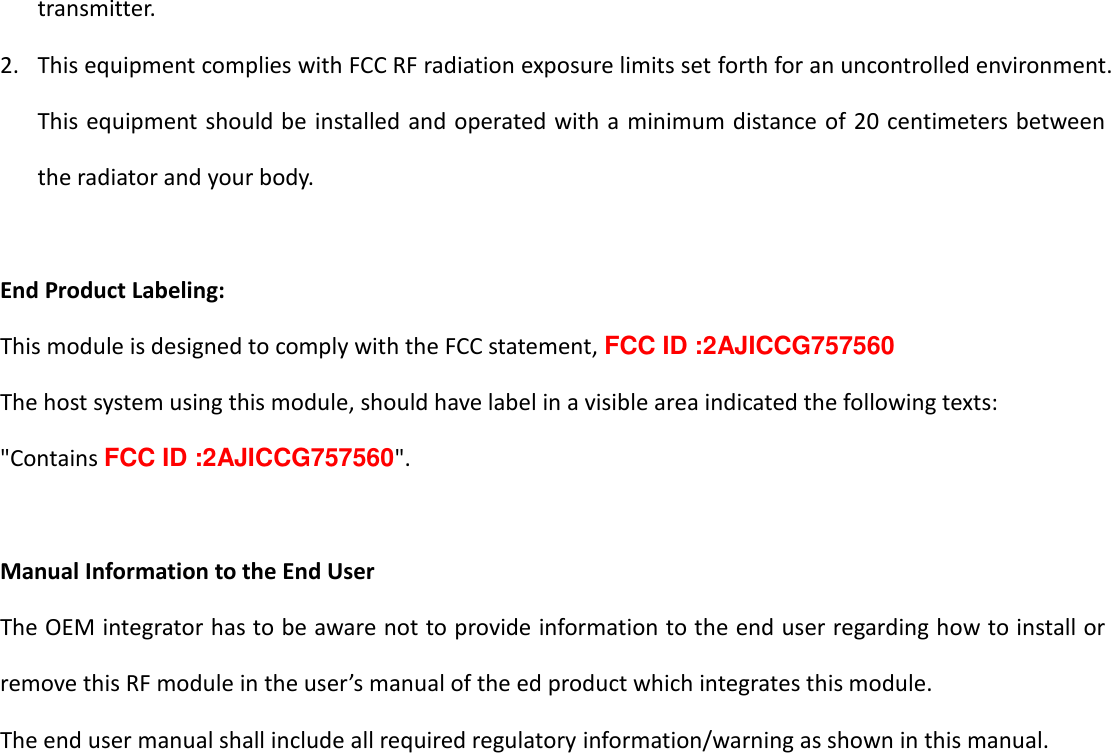
  16 transmitter. 2. This equipment complies with FCC RF radiation exposure limits set forth for an uncontrolled environment. This equipment should be installed and operated with a minimum distance of 20 centimeters between the radiator and your body.  End Product Labeling: This module is designed to comply with the FCC statement, FCC ID :2AJICCG757560 The host system using this module, should have label in a visible area indicated the following texts:   "Contains FCC ID :2AJICCG757560".  Manual Information to the End User The OEM integrator has to be aware not to provide information to the end user regarding how to install or remove this RF module in the user’s manual of the ed product which integrates this module.   The end user manual shall include all required regulatory information/warning as shown in this manual.

Navigation menu