Radiometer analytical TTL090 Titration Workstation User Manual D21T077 ABU62 UsersGuide source

Radiometer analytical S.A.S. Titration Workstation D21T077 ABU62 UsersGuide source

Contents

Manual ABU62

1ABU62ABU62ABU62ABU62ABU62User’s GuideGuide d’Utilisation
2SommairSommairSommairSommairSommaireeeeeContentsContentsContentsContentsContentsIntroduction ............................................................................3General Information ............................................................... 4Setting up the titration system .............................................6Maintenance............................................................................9Cleaning ............................................................................................. 9Transporting the instrument ................................................................ 9Servicing ............................................................................................ 9Replacing the fuses ........................................................................... 10Technical specifications ........................................................11International Standards .........................................................14Introduction ............................................................................17Informations générales..........................................................18Installation du système de titrage ........................................ 20Entretien .................................................................................24Nettoyage .......................................................................................... 24Transport de l'appareil ........................................................................ 24Maintenance ...................................................................................... 24Remplacement des fusibles ............................................................... 25Caractéristiques techniques .................................................26Normes et directives .............................................................. 29D21T077 • Printed by Radiometer Analytical SAS  • France • 2006-07BAll rights reserved. Subject to change without modifications.
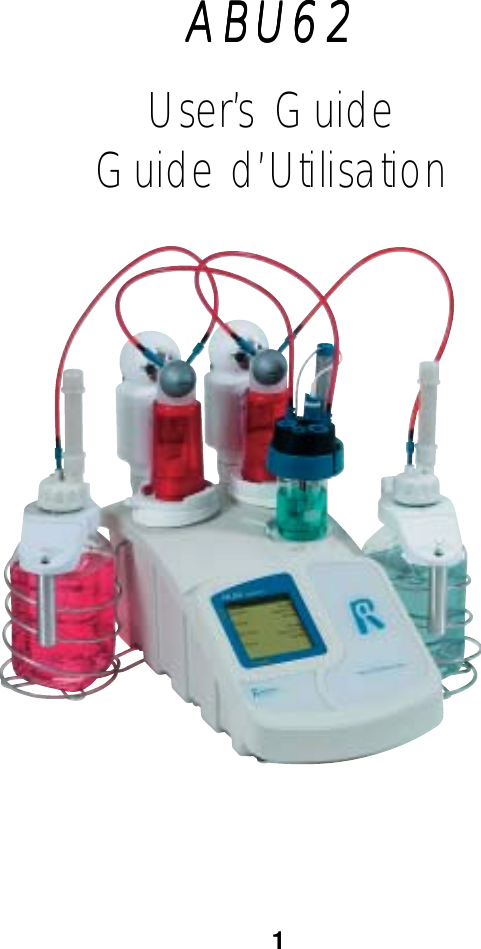
3IntrIntrIntrIntrIntroductionoductionoductionoductionoductionThe ABU62 is a compact unit integrating two motor-driven burettes plus twoelectrode and one temperature inputs on a single platform. Two ABU62s canbe connected to your existing TitraLab system providing up to six motor-driven burettes and six electrode inputs, meeting virtually all applicationneeds. It can also be used as a sample stand or for electrode storage andreconditioning. The ABU62 offers a large screen display, giving you keyinformation at a glance such as the reagent dispensed volume at eachburette position.The mono-block burette stand operating in conjunction with a high-resolutionstep-motor offers more than 18,000 steps to dispense a full burette volumein no more than 20 seconds. It also offers  a resolution for volume additiondown to 0.1 µl for the 1 ml burette. The mono-block burette stands are fittedin no time and come in five sizes: 1, 5, 10, 25 and 50 ml.
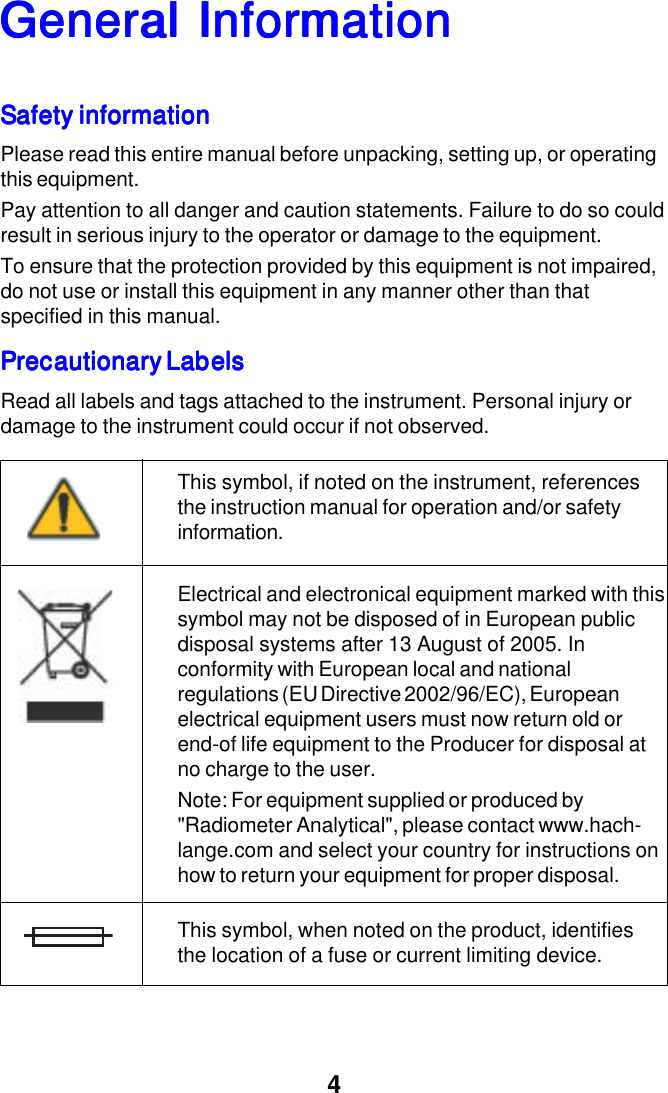
4General InforGeneral InforGeneral InforGeneral InforGeneral InformationmationmationmationmationSafety informationSafety informationSafety informationSafety informationSafety informationPlease read this entire manual before unpacking, setting up, or operatingthis equipment.Pay attention to all danger and caution statements. Failure to do so couldresult in serious injury to the operator or damage to the equipment.To ensure that the protection provided by this equipment is not impaired,do not use or install this equipment in any manner other than thatspecified in this manual.Precautionary LabelsPrecautionary LabelsPrecautionary LabelsPrecautionary LabelsPrecautionary LabelsRead all labels and tags attached to the instrument. Personal injury ordamage to the instrument could occur if not observed.This symbol, if noted on the instrument, referencesthe instruction manual for operation and/or safetyinformation.Electrical and electronical equipment marked with thissymbol may not be disposed of in European publicdisposal systems after 13 August of 2005. Inconformity with European local and nationalregulations (EU Directive 2002/96/EC), Europeanelectrical equipment users must now return old orend-of life equipment to the Producer for disposal atno charge to the user.Note: For equipment supplied or produced by"Radiometer Analytical", please contact www.hach-lange.com and select your country for instructions onhow to return your equipment for proper disposal.This symbol, when noted on the product, identifiesthe location of a fuse or current limiting device.
5Compliance with FCC rules, part 15Compliance with FCC rules, part 15Compliance with FCC rules, part 15Compliance with FCC rules, part 15Compliance with FCC rules, part 15Information to the userInformation to the userInformation to the userInformation to the userInformation to the userNOTE: This equipment has been tested and found to comply with thelimits for a Class B digital device, pursuant to part 15 of the FCC Rules.These limits are designed to provide reasonable protection againstharmful interference in a residential installation. This equipmentgenerates, uses and can radiate radio frequency energy and, if notinstalled and used in accordance with the instruction, may cause harmfulinterference to radio communications. However, there is no guaranteethat interference will not occur in a particular installation. If this equipmentdoes cause harmful interference to radio or television reception which canbe determined by turning the equipment off and on, the user isencouraged to try to correct interference by one or more of the followingmeasures:- Reorient or relocate the receiving antenna.- Increase the separation between the equipment and receiver.- Connect the equipment into an outlet on circuit different from that towhich the receiver is connected.- Consult the dealer or an experienced radio/TV technician for help.Warning!!Changes and modifications that are not expressly approved by the partyresponsible for compliance could void the user's authority to operate theequipment.
6Setting up the titration systemSetting up the titration systemSetting up the titration systemSetting up the titration systemSetting up the titration systemWarning !Warning !Warning !Warning !Warning !The ABU62 have been developed to meet the requirements ofelectrochemical applications. It is therefore aimed at experienced userswho have the knowledge required to operate the instrument andimplement the security instructions enclosed. Please remember that theABU62 must not, under any circumstances, be used to perform tests onliving beings.We accept no responsibility for using the ABU62 and its peripheraldevices under conditions that are not specified in this User’s Guide andits associated TitraLab 9xx Reference manuals (part no. D21T073 for aTitraLab 960/965 or D21T075 for a TitraLab 980).The ABU62 is used in association with the following Titration Managers:TIM960, TIM965 and  TIM980. All Titration Managers or ABU62 in thesystem should have the same version of embedded software installedpreferably from the Radiometer Analytical www.titration.com resourcecentre.1. Set up the instrument in a properly ventilated place. The powersupply connector on the rear panel must remain accessible andclose to the user (2 m maximum) so that you can quicklydisconnect the cables in case of emergency.The room temperature should not exceed 40°C.
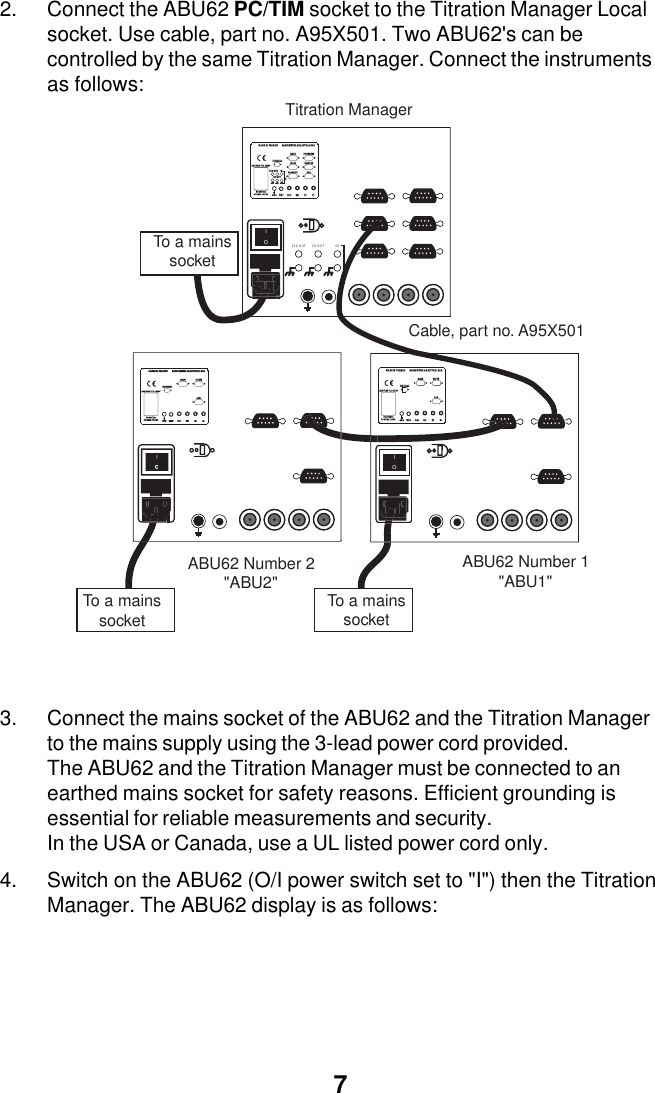
72. Connect the ABU62 PC/TIM socket to the Titration Manager Localsocket. Use cable, part no. A95X501. Two ABU62's can becontrolled by the same Titration Manager. Connect the instrumentsas follows:3. Connect the mains socket of the ABU62 and the Titration Managerto the mains supply using the 3-lead power cord provided.The ABU62 and the Titration Manager must be connected to anearthed mains socket for safety reasons. Efficient grounding isessential for reliable measurements and security.In the USA or Canada, use a UL listed power cord only.4. Switch on the ABU62 (O/I power switch set to "I") then the TitrationManager. The ABU62 display is as follows:IO5V OUT12V OUT INIOTitration ManagerABU62 Number 2         "ABU2"To a mains socketTo a mains socketABU62 Number 1        "ABU1"Cable, part no. A95X501E1E1E2E2TEMPTEMPGNDGNDPROPELLERPROPELLER90-26490-264Vacac47-6347-63Hz 115Hz 115VAVAPC/TIMPC/TIMAUX.AUX.MADE IN FRANCEMADE IN FRANCERADIOMETER ANALYTICAL SASRADIOMETER ANALYTICAL SASREFREFPt-PtPt-PtSLAVESLAVELINE FUSE T1A L250VLINE FUSE T1A L250VE1E2TEMPGNDPROPELLER90-264VacVacVc47-63Hz 115VAPC/TIMAUX.MADE IN FRANCERADIOMETER ANALYTICAL SASREFPt-PtSLAVELINE FUSE T1A L250VE1E1E2E2TEMPTEMPGNDGNDPROPELLERPROPELLER5V OUTV OUT1212V OUTV OUTININTTLTTL90-26490-264Vacac47-6347-63Hz 115Hz 115VAVAPC/PRINTERPC/PRINTERBALANCEBALANCELOCALLOCALSAC80/90SAC80/90AUX.AUX.MADE IN FRANCEMADE IN FRANCERADIOMETER ANALYTICAL SASRADIOMETER ANALYTICAL SASREFREFPt-PtPt-PtSLAVESLAVELINE FUSE T1A L250VLINE FUSE T1A L250VTo a mains socket
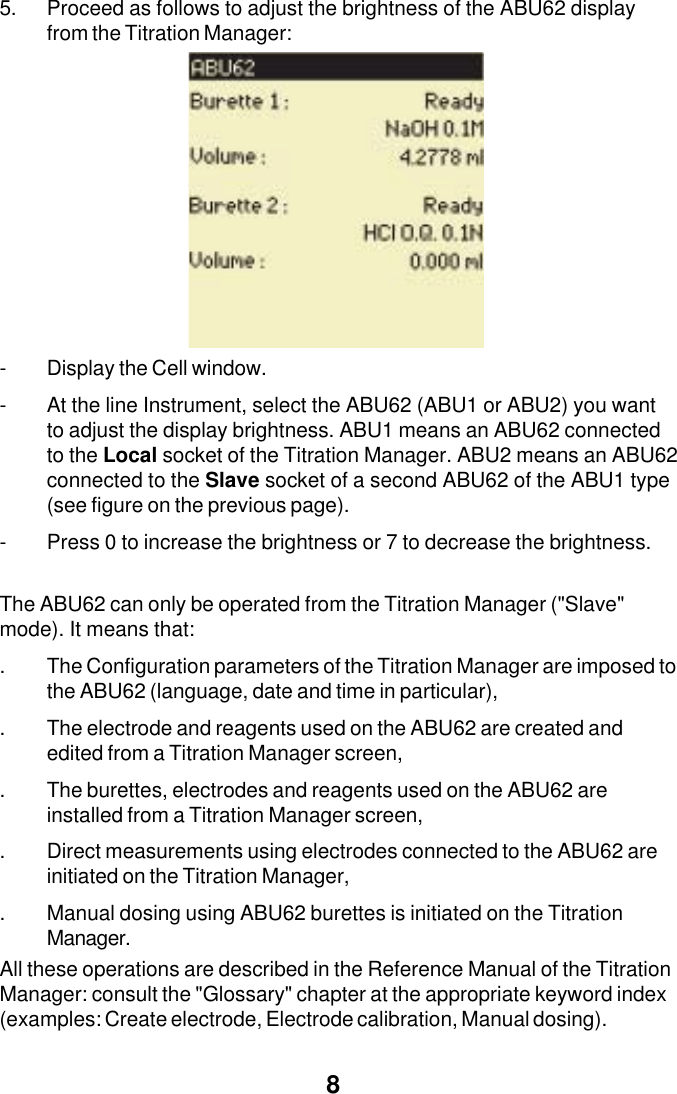
85. Proceed as follows to adjust the brightness of the ABU62 displayfrom the Titration Manager:- Display the Cell window.- At the line Instrument, select the ABU62 (ABU1 or ABU2) you wantto adjust the display brightness. ABU1 means an ABU62 connectedto the Local socket of the Titration Manager. ABU2 means an ABU62connected to the Slave socket of a second ABU62 of the ABU1 type(see figure on the previous page).- Press 0 to increase the brightness or 7 to decrease the brightness.The ABU62 can only be operated from the Titration Manager ("Slave"mode). It means that:. The Configuration parameters of the Titration Manager are imposed tothe ABU62 (language, date and time in particular),. The electrode and reagents used on the ABU62 are created andedited from a Titration Manager screen,. The burettes, electrodes and reagents used on the ABU62 areinstalled from a Titration Manager screen,. Direct measurements using electrodes connected to the ABU62 areinitiated on the Titration Manager,. Manual dosing using ABU62 burettes is initiated on the TitrationManager.All these operations are described in the Reference Manual of the TitrationManager: consult the "Glossary" chapter at the appropriate keyword index(examples: Create electrode, Electrode calibration, Manual dosing).
9MaintenanceMaintenanceMaintenanceMaintenanceMaintenanceCleaningCleaningCleaningCleaningCleaningThe ABU62 requires minimum maintenance. The exterior surface can becleaned with tepid water and wiped dry with a soft cloth. Never useanother solvent unless you have first consulted your RadiometerAnalytical representativeTTTTTransporransporransporransporransporting the instrumentting the instrumentting the instrumentting the instrumentting the instrumentAlways use the packaging supplied by the manufacturer.IMPORTANT!Remove the metal rod before transporting the instrument.Never pick-up or carry the instrument by the metal rod.ServicingServicingServicingServicingServicingDO NOT ATTEMPT TO SERVICE THIS PRODUCT YOURSELF, exceptas noted in the Reference Manual. For servicing, please contact yourRadiometer Analytical service representative at the address givenbelow:RADIOMETER ANALYTICAL SAS72, rue d'Alsace69627 Villeurbanne CEDEX - FranceTel.: +33 (0) 4 78 03 38 38Fax: +33 (0) 4 78 03 38 27E-mail: radiometer@nalytical.comor your local service representative:_____________________________________________________________________________________________________________________________________________________________________
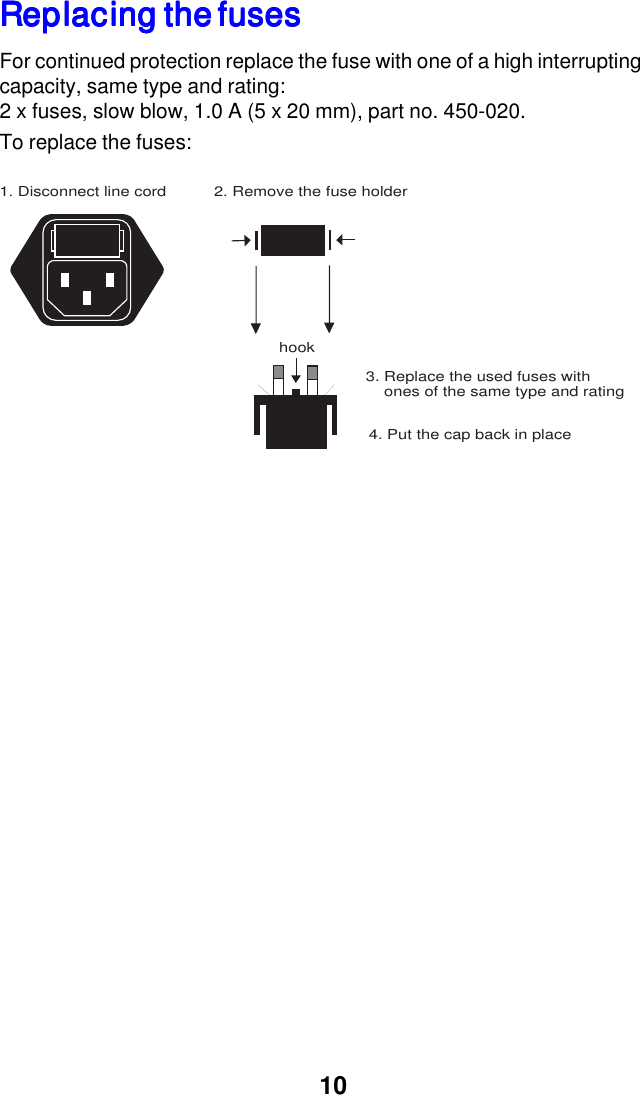
10Replacing the fusesReplacing the fusesReplacing the fusesReplacing the fusesReplacing the fusesFor continued protection replace the fuse with one of a high interruptingcapacity, same type and rating:2 x fuses, slow blow, 1.0 A (5 x 20 mm), part no. 450-020.To replace the fuses:hook2. Remove the fuse holder3. Replace the used fuses with      ones of the same type and rating1. Disconnect line cord4. Put the cap back in place
11TTTTTechnical specificationsechnical specificationsechnical specificationsechnical specificationsechnical specificationsBuretteBuretteBuretteBuretteBurette2 detachable burette stands.Burette volumes available: 1, 5, 10, 25, 50 mlBurette motor: 18,000 steps.Complies with ISO 8655-3UV-protected encapsulated glass syringe.Operating procedures for burette exchange, air bubble removal (Flush),Rinse, Fill, Empty function all controlled from the Titration ManagerSecond burette operational during first burette refillInputs/outputsInputs/outputsInputs/outputsInputs/outputsInputs/outputs2 indicator electrode inputs.1 reference electrode input.Selectable polarised input from -1 mA to 1 mA in 1 µA steps, DC or ACDifferential input.Temperature input.Serial connections to titration workstation/PC and second ABU62Biburette.Measuring rangesMeasuring rangesMeasuring rangesMeasuring rangesMeasuring ranges-9 to 23 pH.±2000 mV.-10 to 100°C.ResolutionResolutionResolutionResolutionResolution0.001 pH.0.1 mV.0.1°C.LanguagesLanguagesLanguagesLanguagesLanguagesEnglish, German, Danish, French, Italian, Spanish and Swedish.
12CasingCasingCasingCasingCasingFully splashproof latene®.Graphic 128x128 dot LCD (TPX®).Dimensions (H x W x D)Dimensions (H x W x D)Dimensions (H x W x D)Dimensions (H x W x D)Dimensions (H x W x D)380 x 230 x 450 mm (excl. tubing).WeightWeightWeightWeightWeight5 kg (excl. reagent bottles).Power requirementsPower requirementsPower requirementsPower requirementsPower requirements100-240V, 50/60Hz, 26W.Environmental operating conditionsEnvironmental operating conditionsEnvironmental operating conditionsEnvironmental operating conditionsEnvironmental operating conditions5 to 40°C temperature.20 to 80% relative humidity.Level of pollution: 2.Transitory overvoltage: level II.Fuses: 2 mains fuses : slow blow 1.0 A (230 V)1 seconary fuse: 4 A.
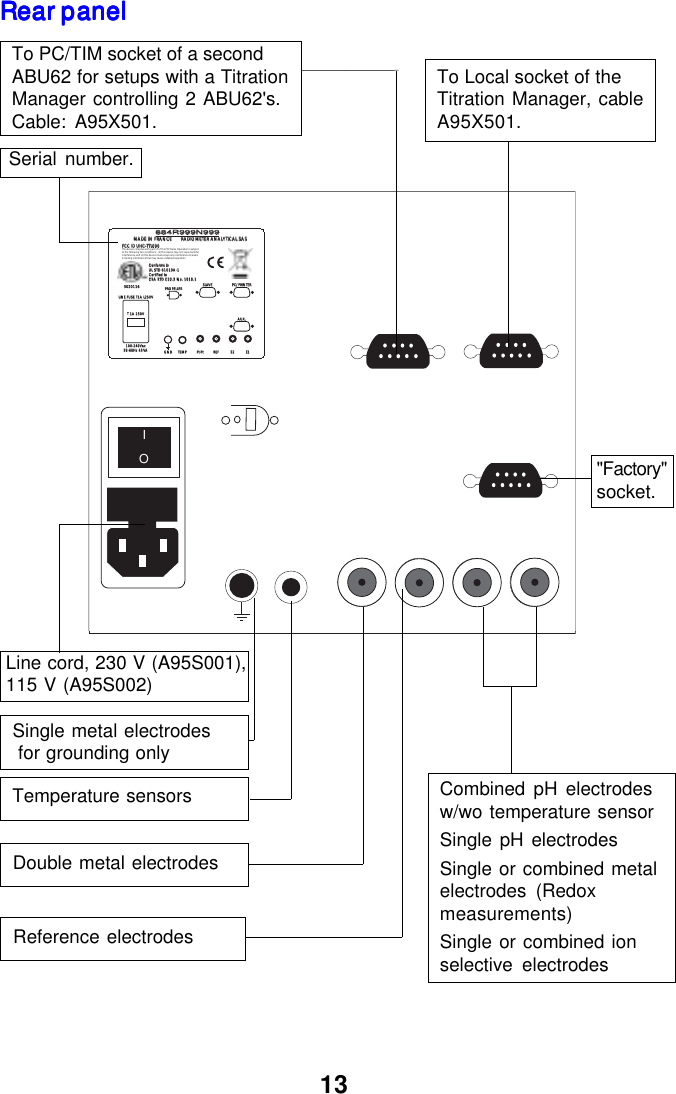
13Combined pH electrodesw/wo temperature sensorSingle pH electrodesSingle or combined metalelectrodes (Redoxmeasurements)Single or combined ionselective electrodes Double metal electrodesIOE1E1E2E2TEMPTEMPGNDGNDPROPELLERPROPELLERT 1A 250VT 1A 250V100-240V100-240Vacac50-60Hz 4550-60Hz 45VAVAPC/PRINTERPC/PRINTERAUX.AUX.MADE IN FRANCEMADE IN FRANCERADIOMETER ANALYTICAL SASRADIOMETER ANALYTICAL SAS684R999N999684R999N999REFREFPt-PtPt-PtSLAVESLAVELINE FUSE T1A L250VLINE FUSE T1A L250V30201163020116Conforms to Conforms to UL STD 61010A-1 UL STD 61010A-1 Certified to Certified to CSA STD C22.2 No. 1010.1CSA STD C22.2 No. 1010.1FCC ID UHC-TTL090FCC ID UHC-TTL090This device complies with part 15 of the FCC Rules. Operation is subject  to the following two conditions:   (1) This device may not cause harmful  interference, and (2) this device must accept any interference received,  including interference that may cause undesired operation Temperature sensors Reference electrodes Single metal electrodes  for grounding onlyTo Local socket of theTitration Manager, cableA95X501.To PC/TIM socket of a secondABU62 for setups with a TitrationManager controlling 2 ABU62's.Cable: A95X501.Line cord, 230 V (A95S001),115 V (A95S002)Serial number."Factory"socket.Rear panelRear panelRear panelRear panelRear panel
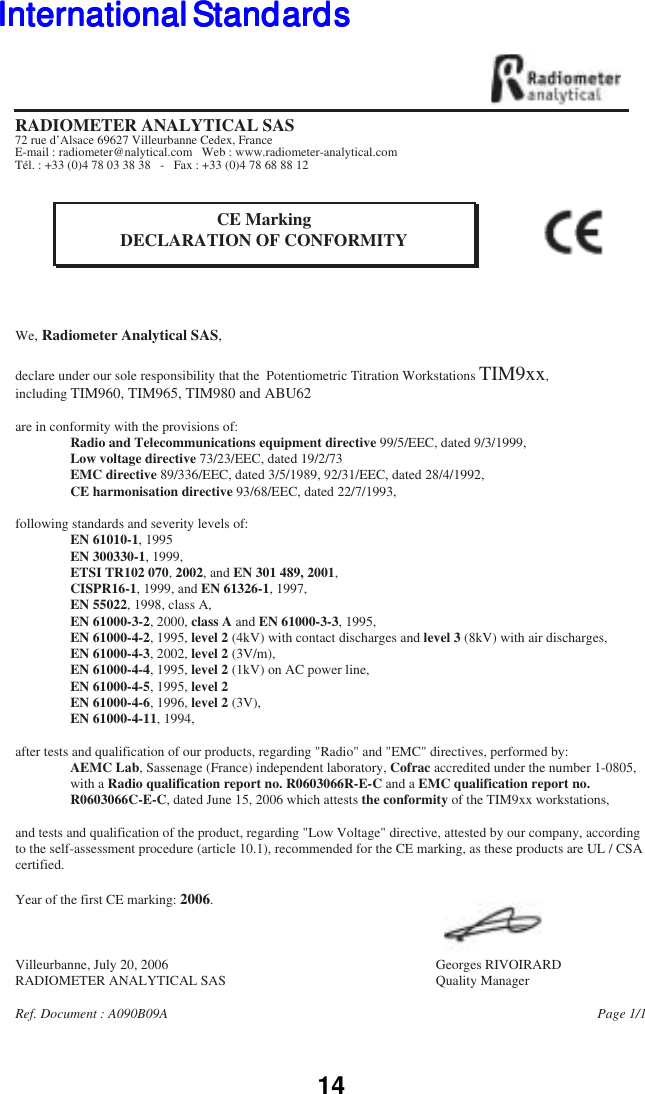
14We, Radiometer Analytical SAS,declare under our sole responsibility that the  Potentiometric Titration Workstations TIM9xx,including TIM960, TIM965, TIM980 and ABU62are in conformity with the provisions of:                Radio and Telecommunications equipment directive 99/5/EEC, dated 9/3/1999,                Low voltage directive 73/23/EEC, dated 19/2/73                EMC directive 89/336/EEC, dated 3/5/1989, 92/31/EEC, dated 28/4/1992,                 CE harmonisation directive 93/68/EEC, dated 22/7/1993,following standards and severity levels of:                EN 61010-1, 1995                EN 300330-1, 1999,                ETSI TR102 070, 2002, and EN 301 489, 2001,                CISPR16-1, 1999, and EN 61326-1, 1997,                EN 55022, 1998, class A,                EN 61000-3-2, 2000, class A and EN 61000-3-3, 1995,                EN 61000-4-2, 1995, level 2 (4kV) with contact discharges and level 3 (8kV) with air discharges,                EN 61000-4-3, 2002, level 2 (3V/m),                 EN 61000-4-4, 1995, level 2 (1kV) on AC power line,                EN 61000-4-5, 1995, level 2                EN 61000-4-6, 1996, level 2 (3V),                 EN 61000-4-11, 1994,after tests and qualification of our products, regarding "Radio" and "EMC" directives, performed by:                AEMC Lab, Sassenage (France) independent laboratory, Cofrac accredited under the number 1-0805,                  with a Radio qualification report no. R0603066R-E-C and a EMC qualification report no.                  R0603066C-E-C, dated June 15, 2006 which attests the conformity of the TIM9xx workstations, and tests and qualification of the product, regarding "Low Voltage" directive, attested by our company, according  to the self-assessment procedure (article 10.1), recommended for the CE marking, as these products are UL / CSA certified.Year of the first CE marking: 2006.Villeurbanne, July 20, 2006        Georges RIVOIRARDRADIOMETER ANALYTICAL SAS        Quality ManagerRef. Document : A090B09A                                                 Page 1/1RADIOMETER ANALYTICAL SAS72 rue d’Alsace 69627 Villeurbanne Cedex, FranceE-mail : radiometer@nalytical.com   Web : www.radiometer-analytical.comTél. : +33 (0)4 78 03 38 38   -   Fax : +33 (0)4 78 68 88 12CE MarkingDECLARATION OF CONFORMITYInternational StandardsInternational StandardsInternational StandardsInternational StandardsInternational Standards
15The Titration Manager complies with the following standards:UL 61010A - 1CAN / CSA C22 2 N° 1010.1 - 92.The ABU62  complies with part 15 of the FCC Rules. Operation is subjectto the following two conditions:(1) This device may not cause harmful interference, and(2) this device must accept any interference received, includinginterference that may cause undesired operation.See "Compliance with FCC rules, part 15 - Information to the user" onpage 5.
16
17IntrIntrIntrIntrIntroductionoductionoductionoductionoductionD'un encombrement minimum, l'ABU62 comprend 2 burettescommandées par des moteurs pas à pas, 2 entrées d'électrodes et uneentrée sonde de température. Deux ABU62 peuvent être connectées àvotre Station de Titrage TitraLab qui peut ainsi commander jusqu'à 6burettes et gérer 6 entrées d'électrodes. L'ABU62 peut également êtreutilisée comme un stand de mesure ou comme appareil de conditionne-ment et de stockage de vos électrodes. L'ABU62 dispose d'un grandafficheur vous permettant de visualiser d'un seul coup d'oeil, des informa-tions comme le volume de réactif délivré et ceci pour chaque position deburette.L'utilisation d'un stand de burette monobloc et les 18 000 pas du moteurhaute résolution vous permettent de délivrer la capacité totale de la buretteen 20 secondes avec une résolution sur les volumes ajoutés atteignant 0,1µl pour la burette de 1 ml. Les stands de burette monobloc sont montésquasi-instantanément. Cinq tailles sont disponibles: 1, 5, 10, 25 et 50 ml.
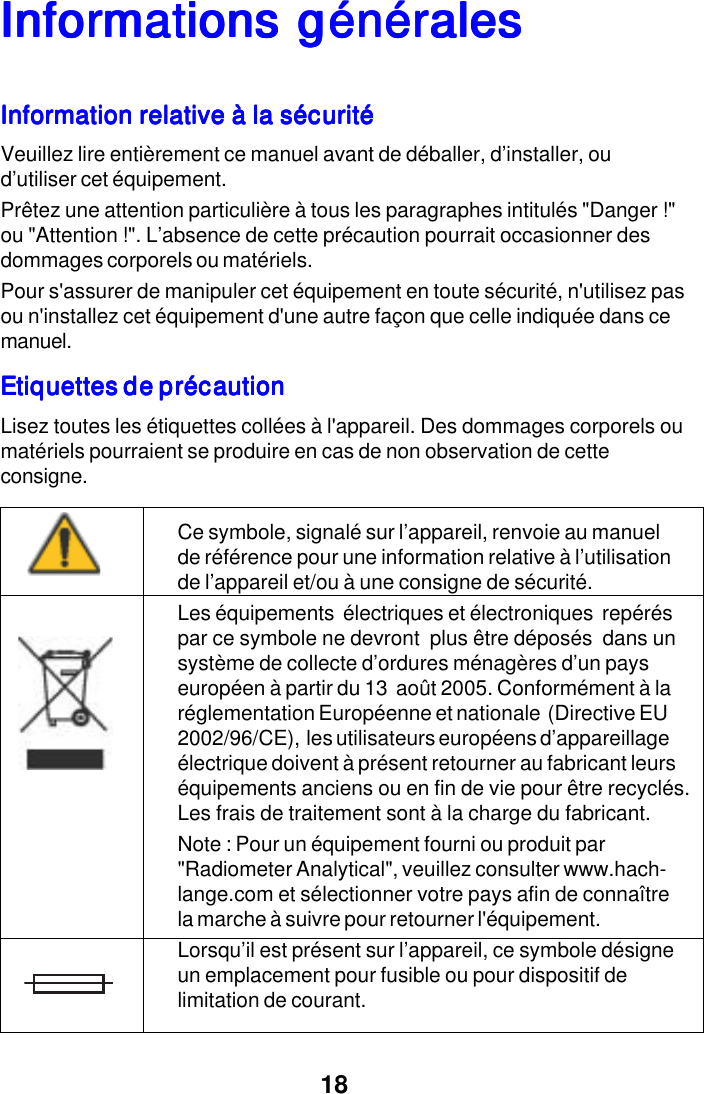
18InforInforInforInforInformations généralesmations généralesmations généralesmations généralesmations généralesInformation relative à la sécuritéInformation relative à la sécuritéInformation relative à la sécuritéInformation relative à la sécuritéInformation relative à la sécuritéVeuillez lire entièrement ce manuel avant de déballer, d’installer, oud’utiliser cet équipement.Prêtez une attention particulière à tous les paragraphes intitulés "Danger !"ou "Attention !". L’absence de cette précaution pourrait occasionner desdommages corporels ou matériels.Pour s'assurer de manipuler cet équipement en toute sécurité, n'utilisez pasou n'installez cet équipement d'une autre façon que celle indiquée dans cemanuel.Etiquettes de précautionEtiquettes de précautionEtiquettes de précautionEtiquettes de précautionEtiquettes de précautionLisez toutes les étiquettes collées à l'appareil. Des dommages corporels oumatériels pourraient se produire en cas de non observation de cetteconsigne.Ce symbole, signalé sur l’appareil, renvoie au manuelde référence pour une information relative à l’utilisationde l’appareil et/ou à une consigne de sécurité.Les équipements  électriques et électroniques  repéréspar ce symbole ne devront  plus être déposés  dans unsystème de collecte d’ordures ménagères d’un payseuropéen à partir du 13  août 2005. Conformément à laréglementation Européenne et nationale  (Directive EU2002/96/CE),  les utilisateurs européens d’appareillageélectrique doivent à présent retourner au fabricant leurséquipements anciens ou en fin de vie pour être recyclés.Les frais de traitement sont à la charge du fabricant.Note : Pour un équipement fourni ou produit par"Radiometer Analytical", veuillez consulter www.hach-lange.com et sélectionner votre pays afin de connaîtrela marche à suivre pour retourner l'équipement.Lorsqu’il est présent sur l’appareil, ce symbole désigneun emplacement pour fusible ou pour dispositif delimitation de courant.
19Conformité aux règles FCC, partie 15Conformité aux règles FCC, partie 15Conformité aux règles FCC, partie 15Conformité aux règles FCC, partie 15Conformité aux règles FCC, partie 15information à l’utilisateurinformation à l’utilisateurinformation à l’utilisateurinformation à l’utilisateurinformation à l’utilisateurNOTE : Après contrôle, cet équipement est déclaré conforme aux limitesfixées par les Règles FCC, partie 15 pour un appareil numérique deClasse B. Ces limites sont conçues pour assurer une protectionraisonnable contre des interférences nuisible en milieu urbain. Cetéquipement génère, utilise et peut émettre des ondes radio qui peuvent,si l'équipement n'a pas été installé selon des instructions particulières,conduire à des interférences nuisibles aux communications radio.Cependant, il n’y a aucune garantie que l’interférence ne se produira pasdans une installation particulière. Si cet équipement est à l'origined'interférences nuisibles à la réception radio ou à l'émission TV,interférences révélées par une mise en marche/arrêt de l'équipement, ilest recommandé d'essayer de supprimer l'interférence par l'une et/oul'autre des mesures suivantes:- réorientez ou trouvez un nouvel emplacement pour l'antenne deréception.- augmentez la distance entre l'équipement et le récepteur.- reliez l'équipement à une sortie du circuit différente de celle àlaquelle est raccordée le récepteur.- demandez de l'aide à un revendeur ou à un technicien expérimentéen radio/TV.Attention!!Les changements et les modifications qui ne sont pas expressémentapprouvés par l'organisme responsable de la conformité pourraientconduire à une interdiction d'utilisation de l'équipement.
20Installation du système deInstallation du système deInstallation du système deInstallation du système deInstallation du système detitragetitragetitragetitragetitrageAttention !Attention !Attention !Attention !Attention !L'ABU62 a été mise au point pour répondre à des applicationsd'électrochimie. De ce fait, elle s'adresse à un opérateur confirmé ayanttoutes les connaissances nécessaires pour mettre en oeuvre sonutilisation et les consignes de sécurité s'y rattachant. Tout usage de cetappareil pouvant compromettre la sécurité de tout être vivant estconsidéré comme abusif, et est donc, de ce fait, formellement interdit.Nous déclinons toute responsabilité quant à l'utilisation de cet ensemble(périphériques compris) pour tout usage autre que celui spécifié dans ceGuide d’Utilisation ainsi que les Manuels de Référence des TitraLab 9xxassociés (n° Réf. D21T074 pour un TitraLab 960/965 ou D21T076 pour unTitraLab 980).L'ABU62 est utilisée avec l'une des stations de titrage suivantes :TIM960, TIM965 et TIM980. Toutes les stations de titrage et les ABU62du système doivent avoir la même version de logiciel embarqué installéde préférence à partir du Centre de Ressources de Radiometer Analyticalwww.titration.com.
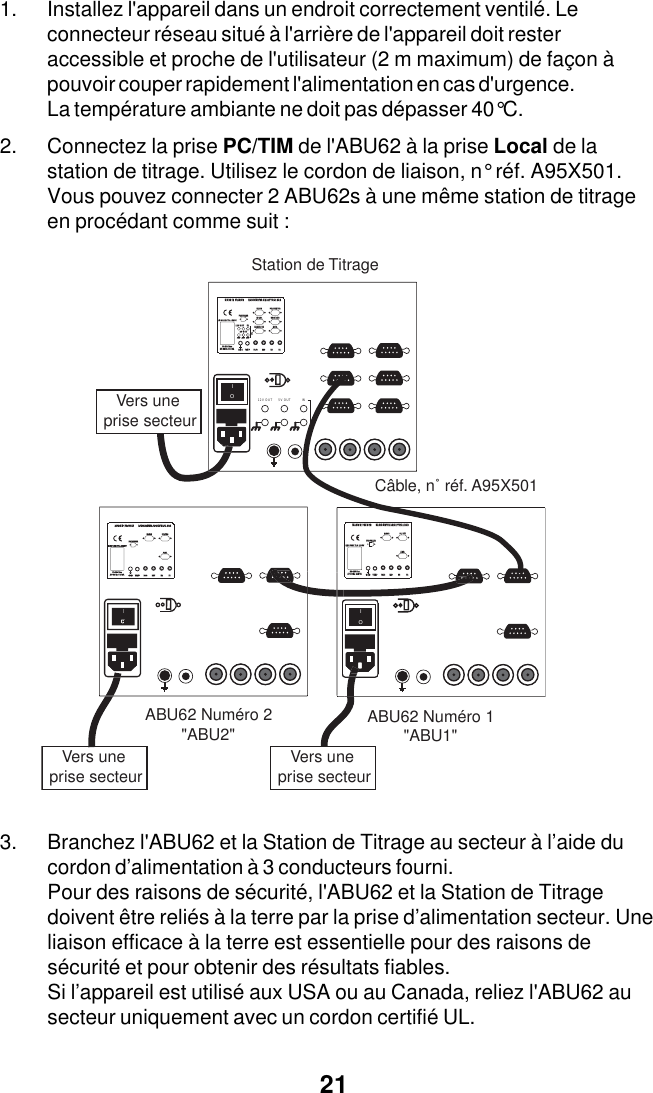
211. Installez l'appareil dans un endroit correctement ventilé. Leconnecteur réseau situé à l'arrière de l'appareil doit resteraccessible et proche de l'utilisateur (2 m maximum) de façon àpouvoir couper rapidement l'alimentation en cas d'urgence.La température ambiante ne doit pas dépasser 40°C.2. Connectez la prise PC/TIM de l'ABU62 à la prise Local de lastation de titrage. Utilisez le cordon de liaison, n° réf. A95X501.Vous pouvez connecter 2 ABU62s à une même station de titrageen procédant comme suit :3. Branchez l'ABU62 et la Station de Titrage au secteur à l’aide ducordon d’alimentation à 3 conducteurs fourni.Pour des raisons de sécurité, l'ABU62 et la Station de Titragedoivent être reliés à la terre par la prise d’alimentation secteur. Uneliaison efficace à la terre est essentielle pour des raisons desécurité et pour obtenir des résultats fiables.Si l’appareil est utilisé aux USA ou au Canada, reliez l'ABU62 ausecteur uniquement avec un cordon certifié UL.IO5V OUT12V OUT INIOStation de TitrageABU62 Numéro 2         "ABU2" ABU62 Numéro 1         "ABU1"Câble, n˚ réf. A95X501E1E1E2E2TEMPTEMPGNDGNDPROPELLERPROPELLER90-26490-264Vacac47-6347-63Hz 115Hz 115VAVAPC/TIMPC/TIMAUX.AUX.MADE IN FRANCEMADE IN FRANCERADIOMETER ANALYTICAL SASRADIOMETER ANALYTICAL SASREFREFPt-PtPt-PtSLAVESLAVELINE FUSE T1A L250VLINE FUSE T1A L250VE1E2TEMPGNDPROPELLER90-264VacVacVc47-63Hz 115VAPC/TIMAUX.MADE IN FRANCERADIOMETER ANALYTICAL SASREFPt-PtSLAVELINE FUSE T1A L250VE1E1E2E2TEMPTEMPGNDGNDPROPELLERPROPELLER5V OUTV OUT1212V OUTV OUTININTTLTTL90-26490-264Vacac47-6347-63Hz 115Hz 115VAVAPC/PRINTERPC/PRINTERBALANCEBALANCELOCALLOCALSAC80/90SAC80/90AUX.AUX.MADE IN FRANCEMADE IN FRANCERADIOMETER ANALYTICAL SASRADIOMETER ANALYTICAL SASREFREFPt-PtPt-PtSLAVESLAVELINE FUSE T1A L250VLINE FUSE T1A L250VVers une  prise secteurVers une  prise secteur Vers une  prise secteur
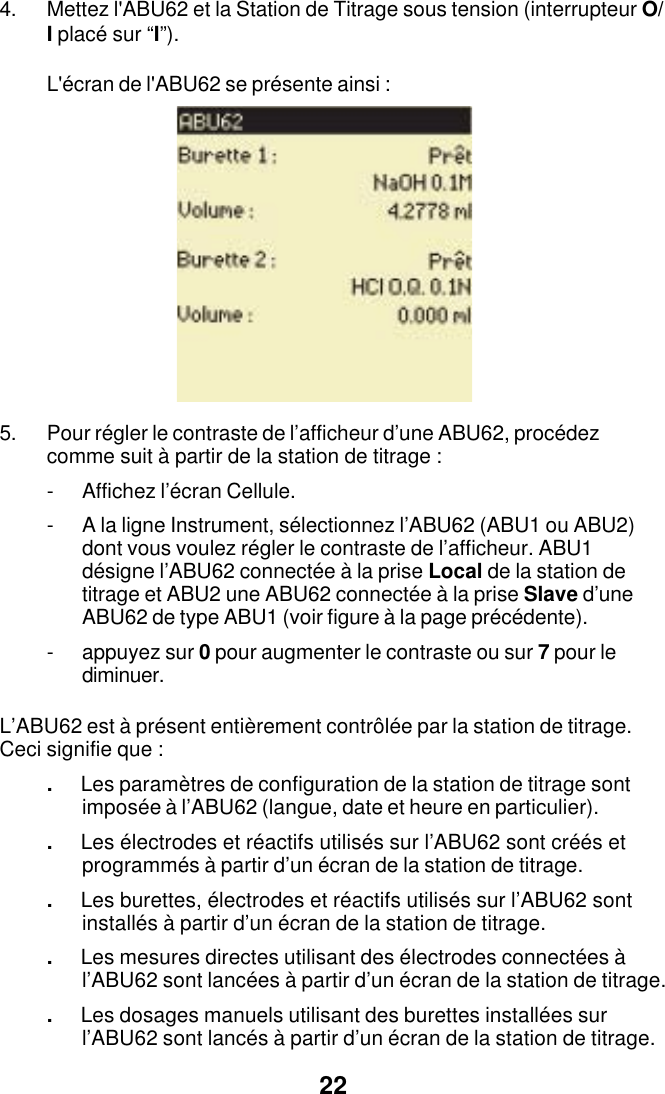
224. Mettez l'ABU62 et la Station de Titrage sous tension (interrupteur O/I placé sur “I”).L'écran de l'ABU62 se présente ainsi :5. Pour régler le contraste de l’afficheur d’une ABU62, procédezcomme suit à partir de la station de titrage :- Affichez l’écran Cellule.- A la ligne Instrument, sélectionnez l’ABU62 (ABU1 ou ABU2)dont vous voulez régler le contraste de l’afficheur. ABU1désigne l’ABU62 connectée à la prise Local de la station detitrage et ABU2 une ABU62 connectée à la prise Slave d’uneABU62 de type ABU1 (voir figure à la page précédente).- appuyez sur 0 pour augmenter le contraste ou sur 7 pour lediminuer.L’ABU62 est à présent entièrement contrôlée par la station de titrage.Ceci signifie que :.Les paramètres de configuration de la station de titrage sontimposée à l’ABU62 (langue, date et heure en particulier)..Les électrodes et réactifs utilisés sur l’ABU62 sont créés etprogrammés à partir d’un écran de la station de titrage..Les burettes, électrodes et réactifs utilisés sur l’ABU62 sontinstallés à partir d’un écran de la station de titrage..Les mesures directes utilisant des électrodes connectées àl’ABU62 sont lancées à partir d’un écran de la station de titrage..Les dosages manuels utilisant des burettes installées surl’ABU62 sont lancés à partir d’un écran de la station de titrage.
23Toutes ces opérations sont décrites dans le Manuel de Référence de lastation de titrage utilisée : consultez la rubrique concernée dans la partie"Dictionnaire de termes" (exemples : Créer une électrode, Etalonnaged'une électrode, Dosage manuel).
24EntrEntrEntrEntrEntretienetienetienetienetienNettoyageNettoyageNettoyageNettoyageNettoyageL'ABU62 requiert un entretien minimal. La surface externe de l'appareildoit être nettoyée régulièrement avec de l'eau et essuyée avec un chiffondoux et sec. Tout autre solvant est à proscrire sans avis préalable d'unreprésentant Radiometer Analytical.TTTTTransporransporransporransporransport de l'appart de l'appart de l'appart de l'appart de l'appareileileileileilLe transport de l'ABU62 doit toujours s'effectuer dans son emballaged'origine.IMPORTANT !Enlevez la tige métallique avant d'emballer l'appareil.Ne jamais prendre ou porter l'ABU62 par sa tige métallique.MaintenanceMaintenanceMaintenanceMaintenanceMaintenanceNE JAMAIS ESSAYER DE DEPANNER VOUS-MEME L'APPAREIL àl'exception des indications fournies dans le Manuel de Référence. Pour lamaintenance de l'appareil, veuillez contacter le Service Après Vente deRadiometer Analytical à l'adresse suivante :RADIOMETER ANALYTICAL SAS72, rue d'Alsace69627 Villeurbanne CEDEX - FranceTel.: +33 (0) 4 78 03 38 38Fax: +33 (0) 4 78 03 38 27E-mail: radiometer@nalytical.comou votre représentant local :_____________________________________________________________________________________________________________________________________________________________________
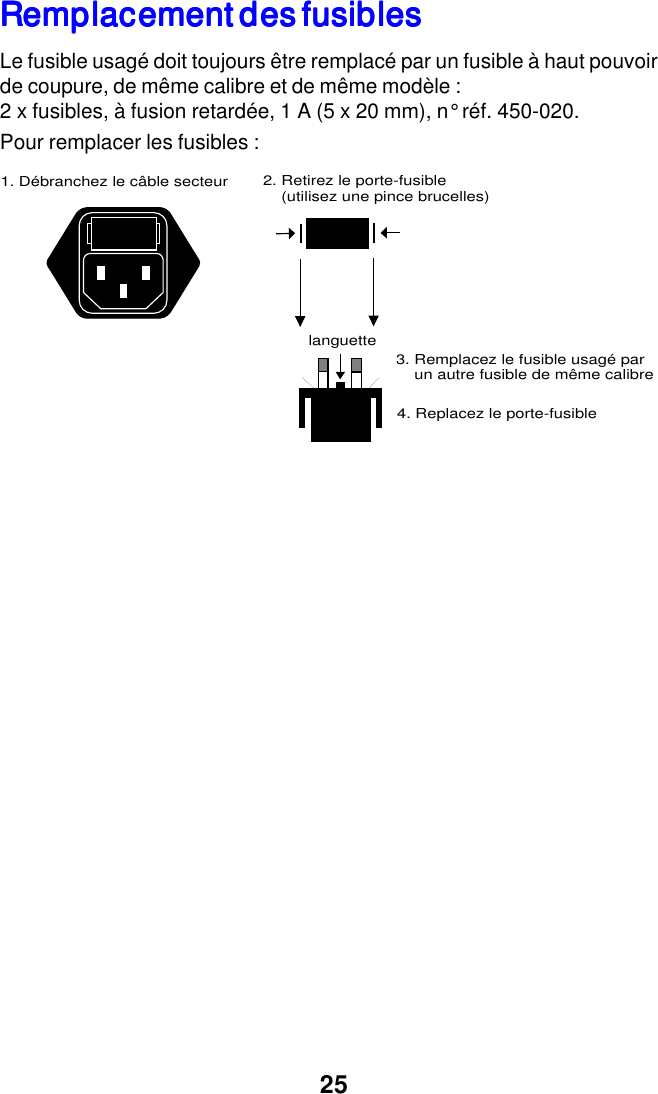
25Remplacement des fusiblesRemplacement des fusiblesRemplacement des fusiblesRemplacement des fusiblesRemplacement des fusiblesLe fusible usagé doit toujours être remplacé par un fusible à haut pouvoirde coupure, de même calibre et de même modèle :2 x fusibles, à fusion retardée, 1 A (5 x 20 mm), n° réf. 450-020.Pour remplacer les fusibles :languette4. Replacez le porte-fusible1. Débranchez le câble secteur 2. Retirez le porte-fusible    (utilisez une pince brucelles) 3. Remplacez le fusible usagé par     un autre fusible de même calibre
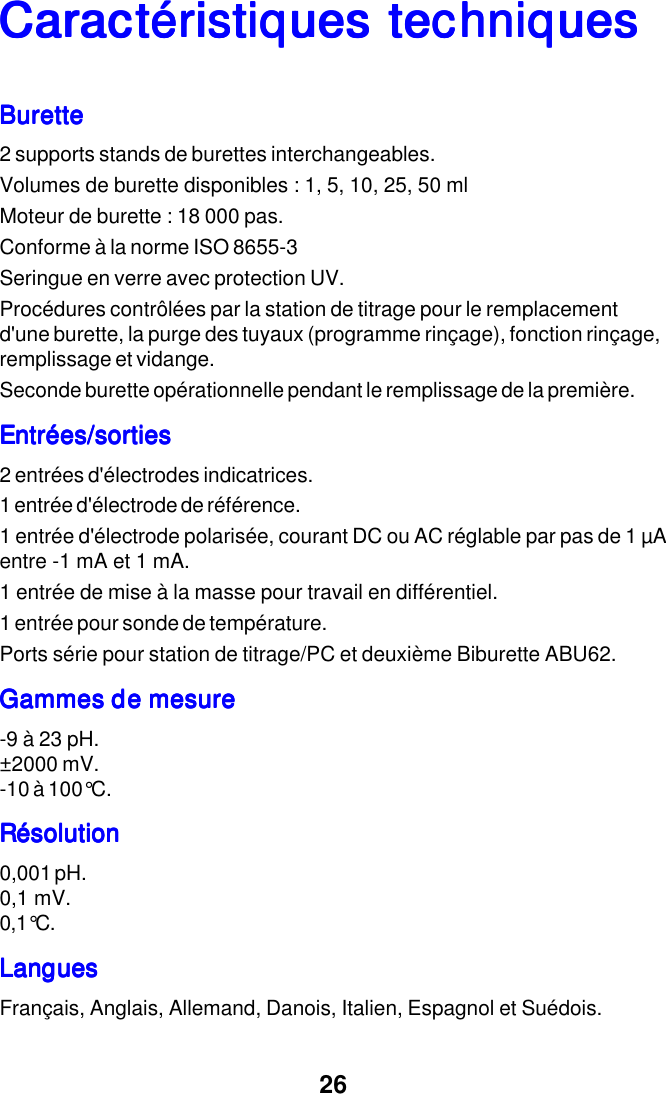
26Caractéristiques techniquesCaractéristiques techniquesCaractéristiques techniquesCaractéristiques techniquesCaractéristiques techniquesBuretteBuretteBuretteBuretteBurette2 supports stands de burettes interchangeables.Volumes de burette disponibles : 1, 5, 10, 25, 50 mlMoteur de burette : 18 000 pas.Conforme à la norme ISO 8655-3Seringue en verre avec protection UV.Procédures contrôlées par la station de titrage pour le remplacementd'une burette, la purge des tuyaux (programme rinçage), fonction rinçage,remplissage et vidange.Seconde burette opérationnelle pendant le remplissage de la première.Entrées/sortiesEntrées/sortiesEntrées/sortiesEntrées/sortiesEntrées/sorties2 entrées d'électrodes indicatrices.1 entrée d'électrode de référence.1 entrée d'électrode polarisée, courant DC ou AC réglable par pas de 1 µAentre -1 mA et 1 mA.1 entrée de mise à la masse pour travail en différentiel.1 entrée pour sonde de température.Ports série pour station de titrage/PC et deuxième Biburette ABU62.Gammes de mesureGammes de mesureGammes de mesureGammes de mesureGammes de mesure-9 à 23 pH.±2000 mV.-10 à 100°C.RésolutionRésolutionRésolutionRésolutionRésolution0,001 pH.0,1 mV.0,1°C.LanguesLanguesLanguesLanguesLanguesFrançais, Anglais, Allemand, Danois, Italien, Espagnol et Suédois.
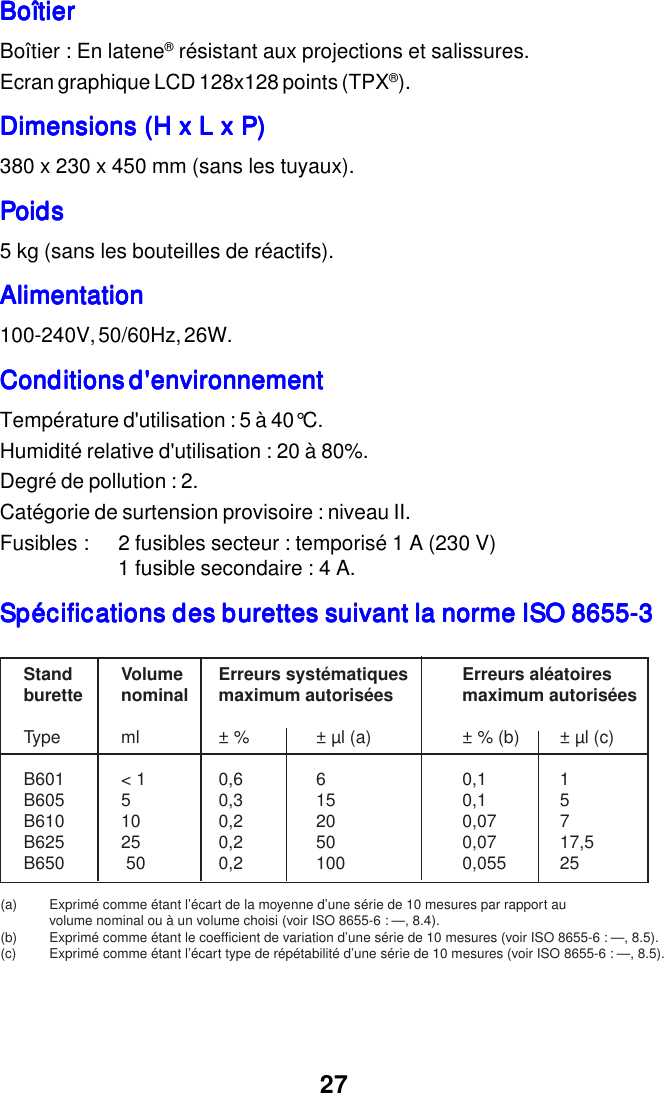
27BoîtierBoîtierBoîtierBoîtierBoîtierBoîtier : En latene® résistant aux projections et salissures.Ecran graphique LCD 128x128 points (TPX®).Dimensions (H x L x P)Dimensions (H x L x P)Dimensions (H x L x P)Dimensions (H x L x P)Dimensions (H x L x P)380 x 230 x 450 mm (sans les tuyaux).PoidsPoidsPoidsPoidsPoids5 kg (sans les bouteilles de réactifs).AlimentationAlimentationAlimentationAlimentationAlimentation100-240V, 50/60Hz, 26W.Conditions d'environnementConditions d'environnementConditions d'environnementConditions d'environnementConditions d'environnementTempérature d'utilisation : 5 à 40°C.Humidité relative d'utilisation : 20 à 80%.Degré de pollution : 2.Catégorie de surtension provisoire : niveau II.Fusibles : 2 fusibles secteur : temporisé 1 A (230 V)1 fusible secondaire : 4 A.Spécifications des burettes suivant la norme ISO 8655-3Spécifications des burettes suivant la norme ISO 8655-3Spécifications des burettes suivant la norme ISO 8655-3Spécifications des burettes suivant la norme ISO 8655-3Spécifications des burettes suivant la norme ISO 8655-3Stand   Volume   Erreurs systématiques    Erreurs aléatoiresburette   nominal   maximum autorisées     maximum autorisées Type    ml     ± %     ± µl (a)    ± % (b)  ± µl (c)B601    < 1     0,6     6       0,1     1B605   5  0,3   15    0,1   5B610   10   0,2   20    0,07   7B625   25  0,2   50    0,07   17,5B650   50  0,2  100   0,055  25(a)   Exprimé comme étant l’écart de la moyenne d’une série de 10 mesures par rapport au    volume nominal ou à un volume choisi (voir ISO 8655-6 : —, 8.4).(b)   Exprimé comme étant le coefficient de variation d’une série de 10 mesures (voir ISO 8655-6 : —, 8.5).(c)   Exprimé comme étant l’écart type de répétabilité d’une série de 10 mesures (voir ISO 8655-6 : —, 8.5).
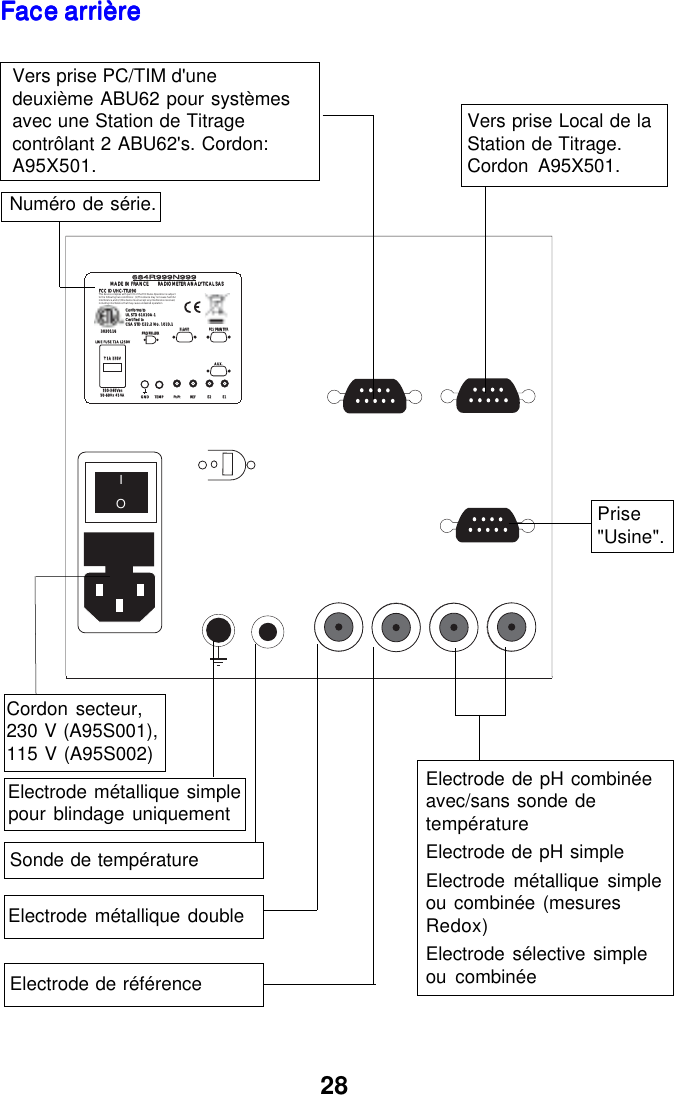
28Face arrièreFace arrièreFace arrièreFace arrièreFace arrièreIOE1E1E2E2TEMPTEMPGNDGNDPROPELLERPROPELLERT 1A 250VT 1A 250V100-240V100-240Vacac50-60Hz 4550-60Hz 45VAVAPC/PRINTERPC/PRINTERAUX.AUX.MADE IN FRANCEMADE IN FRANCERADIOMETER ANALYTICAL SASRADIOMETER ANALYTICAL SAS684R999N999684R999N999REFREFPt-PtPt-PtSLAVESLAVELINE FUSE T1A L250VLINE FUSE T1A L250V30201163020116Conforms to Conforms to UL STD 61010A-1 UL STD 61010A-1 Certified to Certified to CSA STD C22.2 No. 1010.1CSA STD C22.2 No. 1010.1FCC ID UHC-TTL090FCC ID UHC-TTL090This device complies with part 15 of the FCC Rules. Operation is subject  to the following two conditions:   (1) This device may not cause harmful  interference, and (2) this device must accept any interference received,  including interference that may cause undesired operation Electrode métallique double Sonde de température Electrode de référence Electrode métallique simple pour blindage uniquementElectrode de pH combinéeavec/sans sonde detempératureElectrode de pH simpleElectrode métallique simpleou combinée (mesuresRedox)Electrode sélective simpleou combinéeCordon secteur,230 V (A95S001),115 V (A95S002)Vers prise Local de laStation de Titrage.Cordon A95X501.Vers prise PC/TIM d'unedeuxième ABU62 pour systèmesavec une Station de Titragecontrôlant 2 ABU62's. Cordon:A95X501.Numéro de série.Prise"Usine".
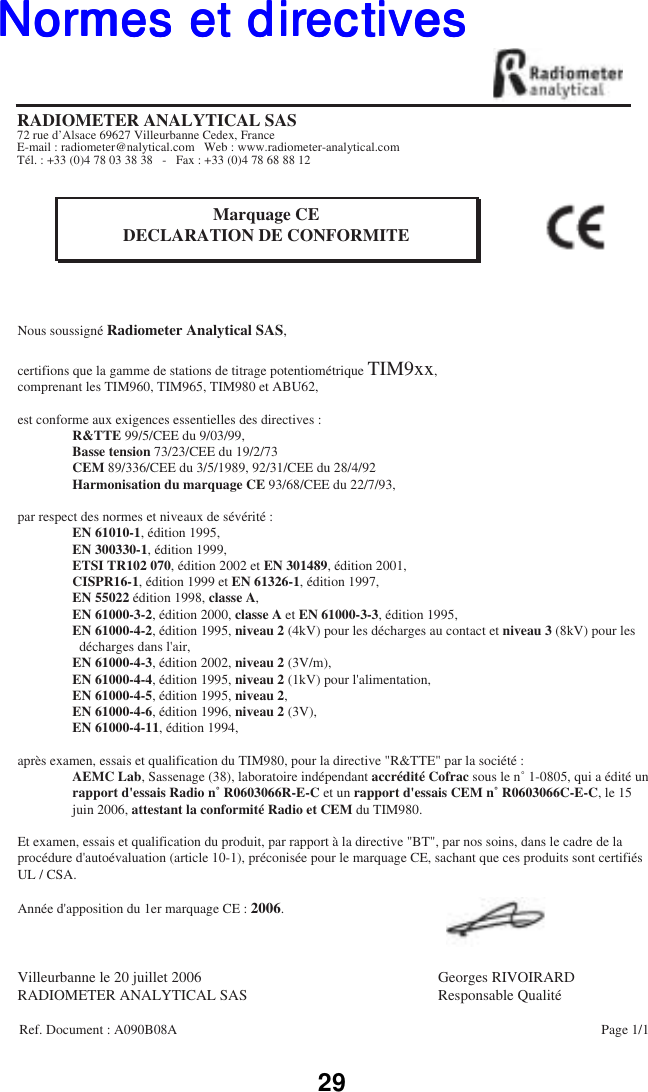
29Nous soussigné Radiometer Analytical SAS,certifions que la gamme de stations de titrage potentiométrique TIM9xx,comprenant les TIM960, TIM965, TIM980 et ABU62,est conforme aux exigences essentielles des directives :                R&TTE 99/5/CEE du 9/03/99,                Basse tension 73/23/CEE du 19/2/73                CEM 89/336/CEE du 3/5/1989, 92/31/CEE du 28/4/92                 Harmonisation du marquage CE 93/68/CEE du 22/7/93,par respect des normes et niveaux de sévérité :                EN 61010-1, édition 1995,                EN 300330-1, édition 1999,                ETSI TR102 070, édition 2002 et EN 301489, édition 2001,                CISPR16-1, édition 1999 et EN 61326-1, édition 1997,                EN 55022 édition 1998, classe A,                EN 61000-3-2, édition 2000, classe A et EN 61000-3-3, édition 1995,                EN 61000-4-2, édition 1995, niveau 2 (4kV) pour les décharges au contact et niveau 3 (8kV) pour les                    décharges dans l'air,                EN 61000-4-3, édition 2002, niveau 2 (3V/m),                 EN 61000-4-4, édition 1995, niveau 2 (1kV) pour l'alimentation,                EN 61000-4-5, édition 1995, niveau 2,                EN 61000-4-6, édition 1996, niveau 2 (3V),                 EN 61000-4-11, édition 1994,après examen, essais et qualification du TIM980, pour la directive "R&TTE" par la société :                AEMC Lab, Sassenage (38), laboratoire indépendant accrédité Cofrac sous le n˚ 1-0805, qui a édité un                 rapport d'essais Radio n˚ R0603066R-E-C et un rapport d'essais CEM n˚ R0603066C-E-C, le 15                  juin 2006, attestant la conformité Radio et CEM du TIM980.Et examen, essais et qualification du produit, par rapport à la directive "BT", par nos soins, dans le cadre de la  procédure d'autoévaluation (article 10-1), préconisée pour le marquage CE, sachant que ces produits sont certifiés  UL / CSA.Année d'apposition du 1er marquage CE : 2006.Villeurbanne le 20 juillet 2006       Georges RIVOIRARDRADIOMETER ANALYTICAL SAS       Responsable QualitéRADIOMETER ANALYTICAL SAS72 rue d’Alsace 69627 Villeurbanne Cedex, FranceE-mail : radiometer@nalytical.com   Web : www.radiometer-analytical.comTél. : +33 (0)4 78 03 38 38   -   Fax : +33 (0)4 78 68 88 12Marquage CE DECLARATION DE CONFORMITERef. Document : A090B08A                                                 Page 1/1NorNorNorNorNormes et dirmes et dirmes et dirmes et dirmes et directivesectivesectivesectivesectives
30Conformité de l'ABU62 aux normes :UL 61010A - 1CAN / CSA C22.2 N° 1010.1 - 92L'ABU62 est conforme à la partie 15 des règles de FCC. Cette conformitéest soumise aux deux conditions suivantes :(1) ce dispositif ne doit pas causer d'interférence nocive, et(2) ce dispositif doit accepter n'importe quelle interférence reçue, ycompris celles pouvant causer des opérations indésirables.Consulter "Conformité aux règles FCC, partie 15 - information àl’utilisateur" à la page 19.

Navigation menu