SHARPVISION DW639 Digital Wireless Video System User Manual
SHARPVISION CO.,LTD. Digital Wireless Video System
Manual
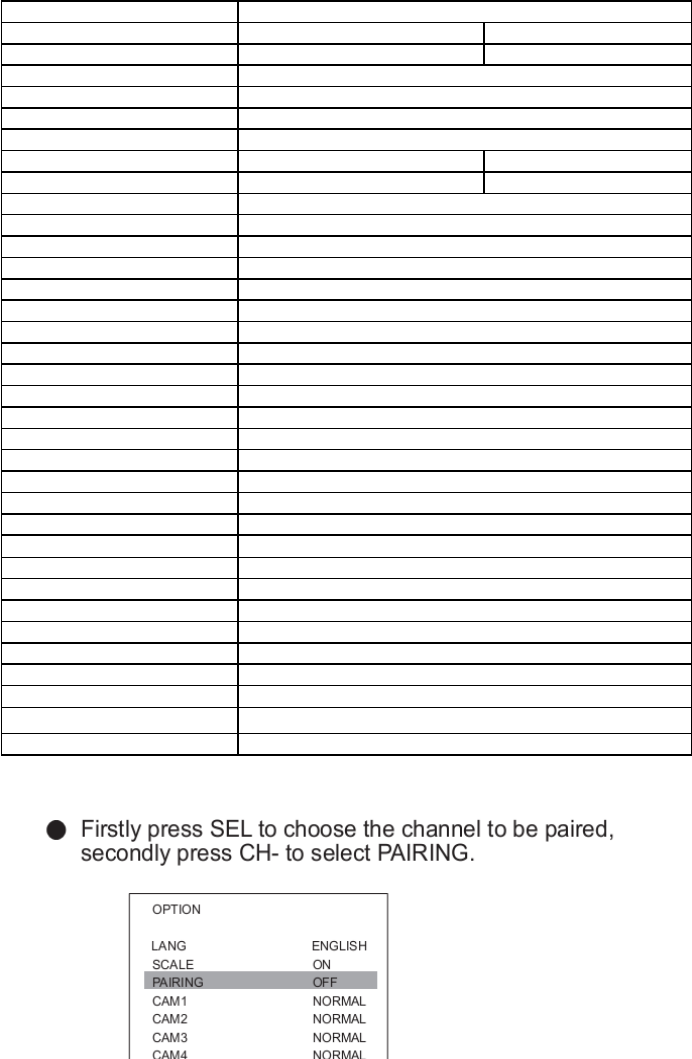
Image Device
TV S
y
stem PAL NTSC
Effective Pixels 512×582pixels 512×492 pixels
Sensin
g
Area
Scannin
g
S
y
stem
S
y
nc. S
y
stem
Resolution
Horizontal Sync Frequency 15.625 kHz 15.734 kHz
Vertical Sync Frequency 50 Hz 60 Hz
Video Output
Gamma Consumption
AGC
S/N Ratio
White Balance
Electronic Shutter
BLC
Operation Frequency:
Line of Sight Range:
Receiving Sensitivity:
V
ideo Codec:
RF Band Width:
Frame Rate:
Spread SPECTRUM:
Delay:
RF Bit Rate:
Storage Temperature
Operatin
g
Temperature
Minimum Illumination
Power Supply
Night vision distance
Waterproof rating
Image mode
Heater
Audio
Viewing Angle
200ms
PAL: 25f/s NTSC: 30f/s
2400-2483.5MHZ
0.45
1/60(NTSC)/1/50(PAL)~1/100,000 Seconds
Auto
–40℃ ~ 80℃, RH95%MAX.
■ 120° □ 92° □ 69° □ 45° □ 25°
■ Mirror □ Normal □ Mirror/Normal image switch
□ Yes ■ No
■ Yes □ No
1.CAMERA SPECIFICATION
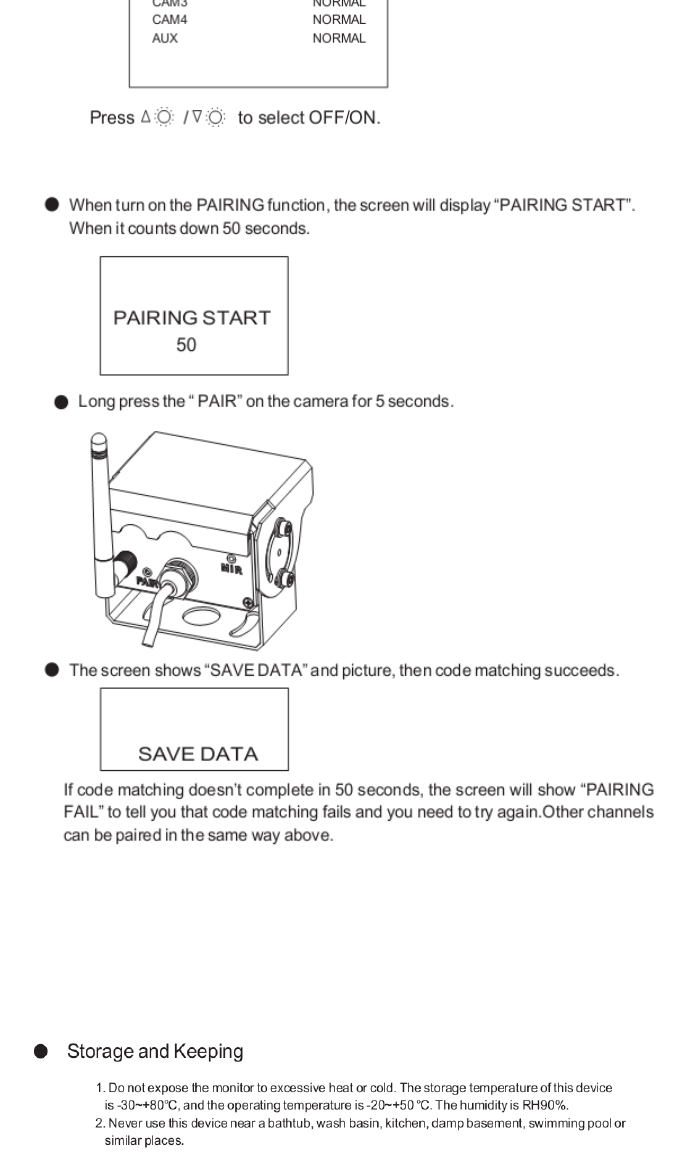
2.SYSTEM OPERATION
Auto
□ 0 Lux ■ 0.1 Lux □ 0.5 Lux
-78dBm
–20℃~70℃, RH95%MAX
1/3” SHARP CCD
Auto
420TV Lines
1.0Vp-p, 75Ohm
FHSS/16QAM
Better than 48dB
120M
4.9mm×3.7mm
2:1 Interlace
Internal
■ IP69K □ IP67 □ NONWATERPROOF
■3~5m □8~10m □12~15m
■DC12V □ DC24V □ DC12V~DC24V
12Mbps
MPEG4
5MHZ
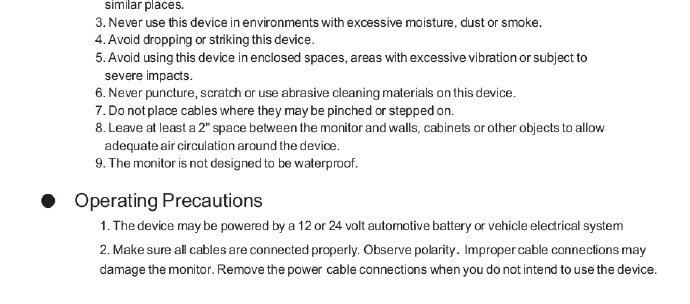
3.PRECAUTIONS
FCC Statement:
This equipment has been tested and found to comply with the limits for Part 15 of the FCC rules.
These limits are designed to provide reasonable protection against harmful interference in a
residential installation. This equipment generates, uses and can radiate radio frequency energy
and, if not installed and used in accordance with the instructions, may cause harmful interference
to radio communications.
However, there is no guarantee that interference will not occur in a particular installation. If this
equipment does
cause harmful interference to radio or television reception, which can be determined by turning
the equipment
off and on, the user is encouraged to try to correct the interference by one or more of the
following measures:
· Reorient or relocate the receiving antenna.
· Increase the separation between the equipment and receiver.
· Connect the equipment to an outlet on a circuit different from that to which the receiver is
connected.
This device complies with part 15 of the FCC rules. Operation is subject to the following two
conditions: (1) This device may not cause harmful interference, and (2) this device must accept a
n
Note: Modifications to this product will void the user's authority to operate this equipment.