SKYPINE ELECTRONICS CNE8215BCL Car Navigation Entertainment System User Manual III
SKYPINE ELECTRONICS (SHEN ZHEN) CO., LTD. Car Navigation Entertainment System III
Contents
- 1. User Manual
- 2. User Manual Part II
- 3. user manual III
- 4. user Manual IV
user manual III
English
NX500/NZ50028
DVD Video Player Operations
Playing MP3 folders
When selected for play, files and folders
(Folder Search, File Search or Folder Select)
are accessed in the order in which they were
written to the media. As a result, the order in
which they are expected to be played may not
match the order in which they are actually
played.
You may be able to set the order in which
MP3/WMA files are to be played by assigning
file names beginning with play sequence
numbers such as “01” to “99”.
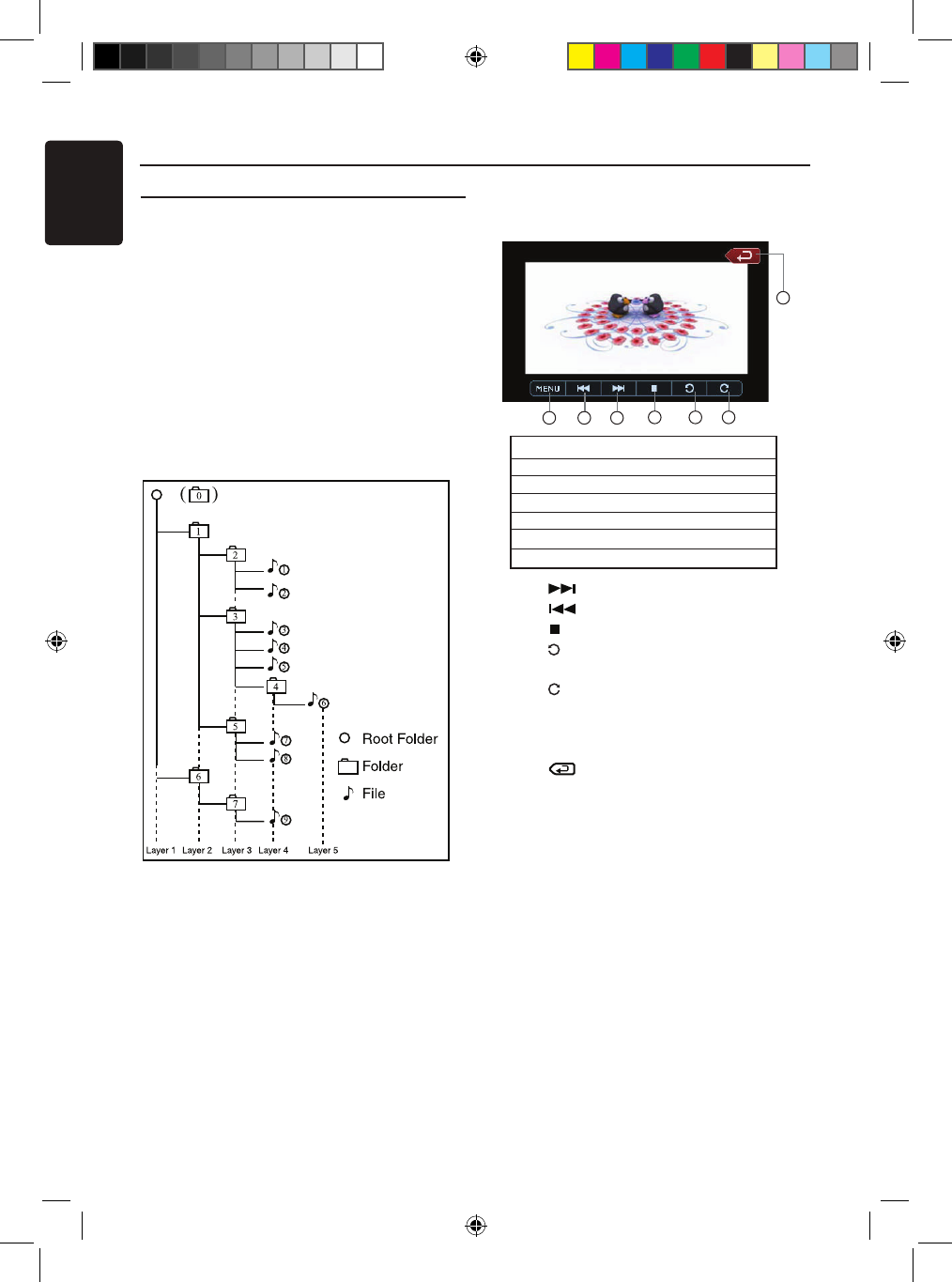
For example, a medium with the following
folder/ file hierarchy is subject to Folder
Search, File Search or Folder Select.
See the diagram below.
The player will only recognize three folder
levels and does not display folders containing
other folders. In the example above, the unit
will display folders 3, 4, 6, and 8, but not 2 and
7 since they do not contain others.
Playback Picture Menu
The picture on the display comes with the
different functions to operate.
• Touch [ ] button to play next picture.
• Touch [ ] button to play previous picture.
• Touch [ ] button to stop playing.
• Touch [ ] button to rotate picture 900
counterclockwise.
• Touch [ ] button to rotate picture 900
clockwise.
• Touch [MENU] button to return to disc root
Menu.
• Touch [ ] button to return to the Main menu.
5
1
3 42 6 7
1.
Back Button
2. Menu Button
3. Previous Picture Button
4. Next Picture Button
5. Stop Button
6. Rotate Picture counterclockwise
7. Rotate Picture clockwise
NX_NZ500 0608.findd 8 6/16/2009 8:05:52 AM
English
NX500/NZ500 29
This function is available when a Sirius Satellite
Radio Receiver is connected through the
dedicated connection. This unit requires the
following receiver:
SIRIUS Satellite Radio Receiver: SC-C1
Note:
SIRIUS satellite radio is a subscription service.
Please contact Sirius Radio to begin or alter
your subscription:
• Internet: www.sirius.com
Telephone: 888-539-SIRIUS (747487)
Selecting a Satellite Radio mode
Press the [SIRIUS] button on Main Menu
display. The system changes to the Sirius
Satellite Radio mode. The Sirius mode screen is
displayed.
Information Displayed During Reception
The following information is displayed when the
satellite radio cannot be received normally.
• When the receiver is turned on the first time or
after a reset: “UPDATING” followed by a
percentage of completion.
• When a channel is being tuned in (no signal is
yet received): “ACQUIRING SIGNAL”
• A channel without a broadcast has been
selected: “INVALID CHANNEL”
• A channel not covered by your contract:
“CALL 888-539-SIRIUS”
Call (888) 539-747487 to activate your radio.
• When a channel is out of air time: “OFF AIR”
• When the antenna is disconnected or has
been damaged: “ANTENNA ERROR”
Confirming Your Radio ID
1. Touch the [ ] keyboard button on the
SIRIUS Menu display to display the keypad.
Enter “0” and press “OK”.
Your SIRIUS ID (12-digit number) will be
displayed.
2. Touch the [Settings] button on the SIRIUS
Menu display to enter Settings menu.
2. Press [SID] button. Your SIRIUS ID (12-digit
number) will be displayed.
Channel Selection
1. Touch the [Channels] button on the
SIRIUS Menu display to enter channel list
preview mode.
2. Select the channel with the [ ] or [ ].
Only channels that can be received are
selected.
Channels that are locked and channels not
covered by the contract will be skipped.
The receiver seeks the next available channel
below or above the current channel.
Channel Selection with the channel number
1. Touch the direct access button on the
SIRIUS Menu display to enter direct channel
selection.
2. Enter the channel number of your desired
station by touching the [0] to [9] keys.
Sirius Satellite Radio Operations
1 3
4 5 6 7 8
2
14 13 12 10 91115
1.
Keyboard Button
2. Previous Channel
Button
3. Store Button
4. Next Channel Button
5. Scan Button
6. Previous Page
Button
7. Next Page Button
8. EQ Button
9. Back Button
10. Time Display
11. Mute Display
12. Satellite Signal
13. Next Category Button
14. Category Name
15. Previous Category
Button
NX_NZ500 0608.findd 9 6/16/2009 8:05:53 AM
English
NX500/NZ50030
Sirius Satellite Radio Operations
If you enter a wrong number, you can cancel
it by touching the [BACK] key.
3. Touch the [OK] key.
The radio channel you entered will be tuned.
Channel Selection with the channel number
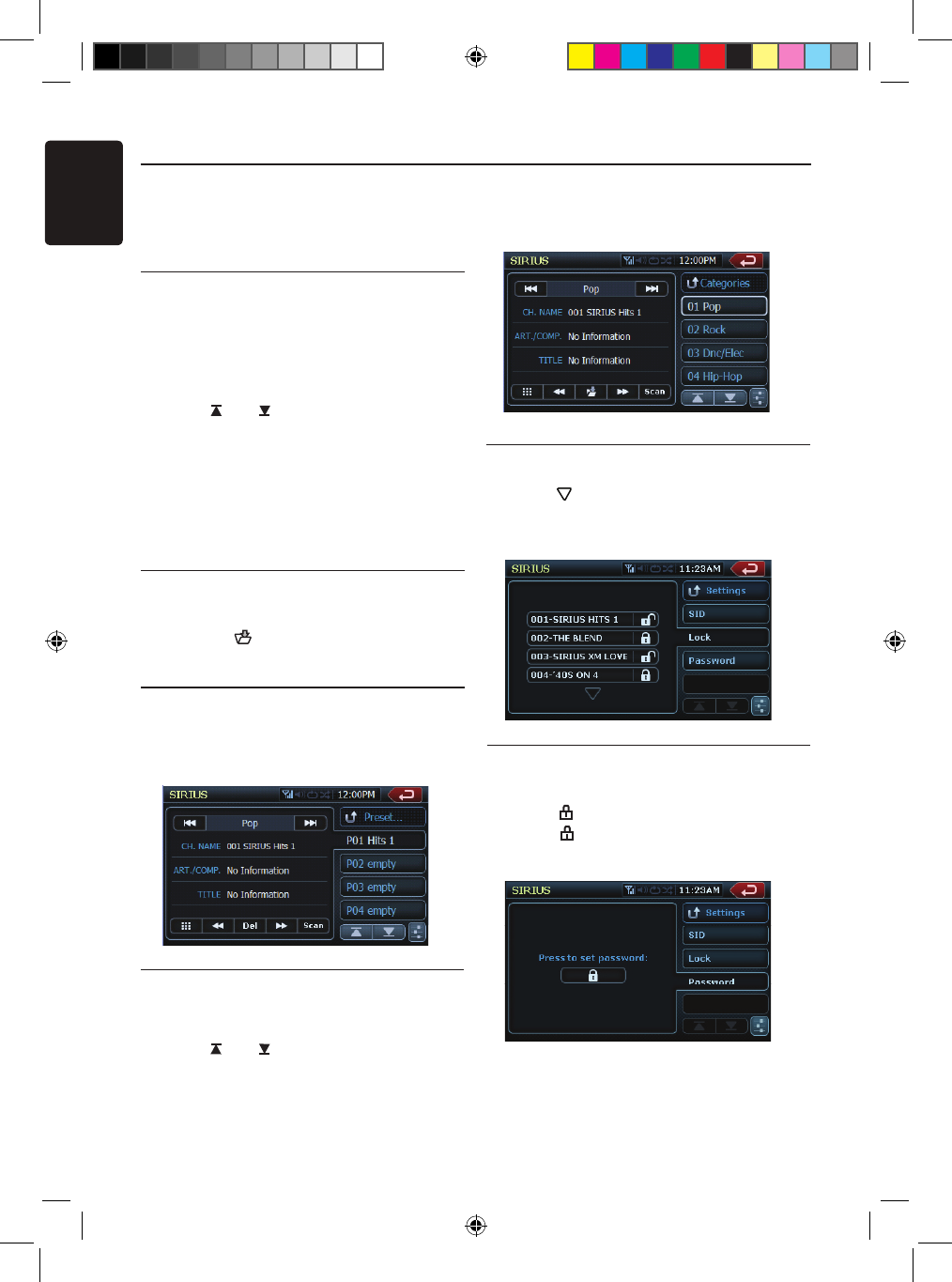
A total of 20 satellite radio stations can be stored
in the receiver’s memory. You can access the
presets by pressing the Presets button.
This allows you to store your favorite satellite
radio stations in the memory for later recall.
1. Touch the [Preset...] button to enter the
preset list to select or save your presets.
2. Touch [ ] or [ ] button to view previous or
next page.
* There are 5 pages of preset memory space
available for your use. You can scroll the
pages using the scroll bar buttons to the right
of the screen.
3. Touch the [Preset...] key to return to the
previous screen.
Auto Preset Store
1. Touch and hold for more than 2 seconds the
corresponding preset key to save the selected
channel.
2. Touch the [ ] button to save the current
channel.
Deleting a Preset
1. Touch [Preset...] button and enter the preset
menu.
2. Touch the preset button you would like to
delete.
3. Touch the [DEL] button to delete it.
Receiving Stations by Category
Satellite Radio allows you to select broadcast
channel category (contents).
1. Touch [Categories] button to enter category
mode.
2. Touch [ ] or [ ] button to view all valid
category.
3. Touch the desired category item key to select
the category.
4. Select the desired channel by touching it
momentarily on the screen.
Note:
When the category selection mode is entered,
the category of the last received channel is
displayed first.
Parental Controls Lock Channels
1. Touch [Settings] button to enter setting list.
2. Touch [Lock] button to enter lock list.
3. Touch [ ] key to view next page in the lock
list.
4. Touch the channel item, and it will be locked
or unlocked altenately.
Setting the password
1. Touch [Settings] button to enter setting list.
2. Touch [Password] button to enter password
mode.
3. Touch [ ] to set password.
4. Touch [ ] button to remove password.
5. Touch [Settings] button to return to Sirius
menu.
Note:
If you set passwords, you must input the correct code
to enter lock list. When you try to locked channel by
keypad, it will dispaly password’s keypad. Only entering
correct code can tune to the channel, or it will be back
to the last channel, if a password is wrong.
NX_NZ500 0608.findd 0 6/16/2009 8:05:54 AM
English
NX500/NZ500 31
Navigation System Operations
Introduction to Navigation Software
Navigation software provides turn-by-turn
visual and voice assistance to direct you to
selected destination. The software quickly
calculates step-by-step directions to any
destination available on the included
navigation map. The navigation software uses
Global Positioning System (GPS) satellites, and
a digital roadway map database to calculate
and display travel directions. The system’s GPS
antenna receives signals from a constellation
of 24 satellites orbiting the earth and uses the
strongest of signals, to determine your position
to within meters.
Vehicle Position
The navigation software’s computer considers
vehicle speed and heading changes, together
with longitude and latitude information, to
accurately determine vehicle heading and
position on a digital map. Signals from GPS
satellites are used to determine the vehicle
location. Three (good) or four (best) satellites
must be received to accurately determine
location. The GPS reception status is indicated
by the GPS symbol on the map.
Map and Information Database
The map database used by navigation software
was created using high-resolution aerial and
land based data collection. Car navigation maps
are frequently updated. While the database
was judged to be as accurate as possible at the
time of its release, a map database can never
be 100% accurate. Road information that is
maintained in the map databases, such as turn
restrictions or road names may change over
time.
Main Menu Screen Operations
1. After the navigation system is activated
by touching “NAVI” button on the Main Menu
screen, the warning screen is displayed.
Press the button to accept it.
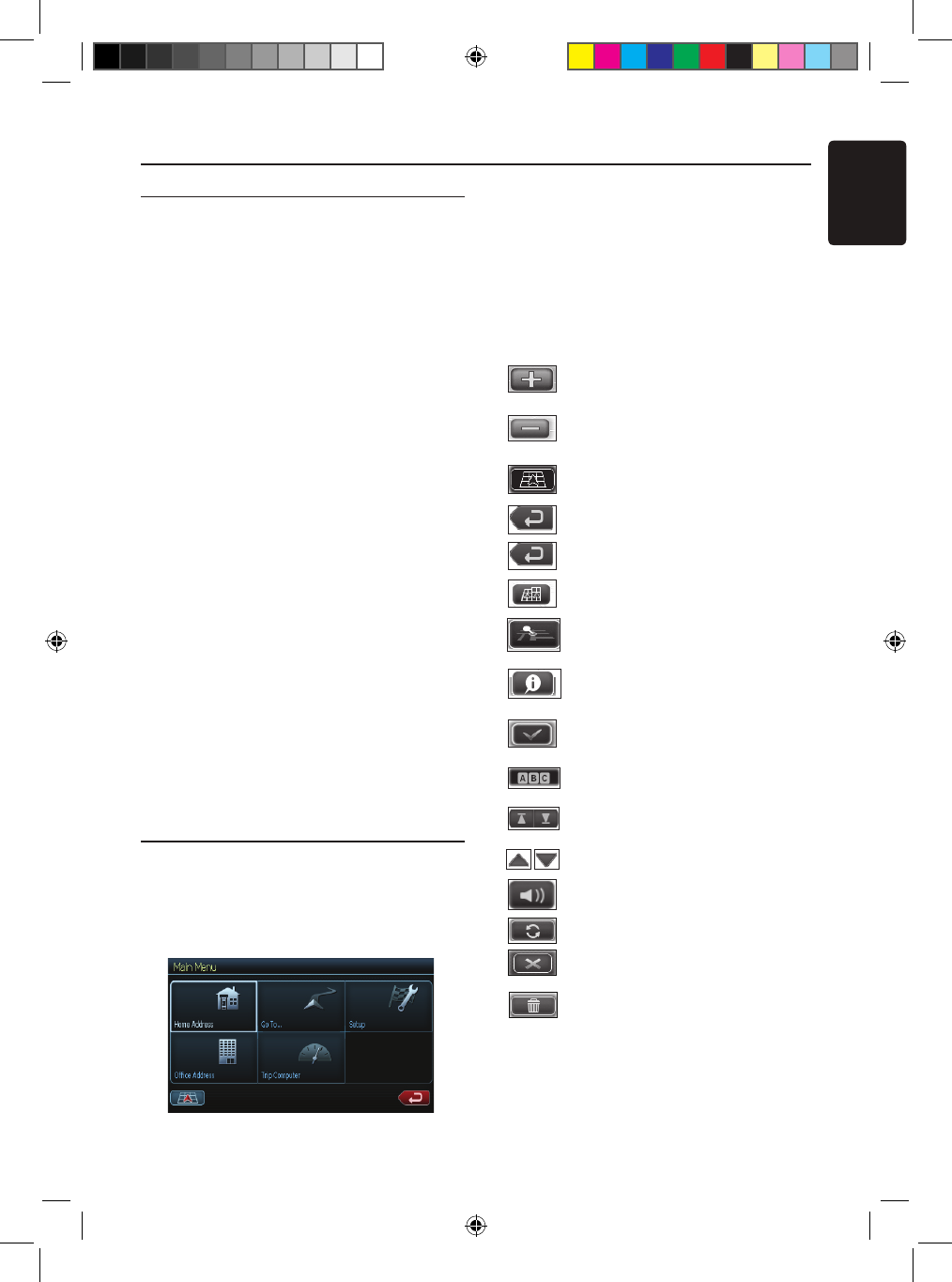
2. The ”Main Menu” navigation screen is
displayed.
3. Main menu screen has different options:
Home Address - Route to home address.
Go To... - Select a destination for navigation.
Setup - Set preferences for routing and
navigation display.
Office Address - Route to office address.
Trip Computer - Display speed, trip,
odometer reading, clock reading.
4. To operate the navigation system use display
function buttons as described below.
Zoom in the map to show a smaller
area
Zoom out the map to show a larger
area
Return to Map mode
Display map in 2D view
Return to the previous screen
Display menu, jump to main menu
Display map in 3D view
Select current panned position,
after panning map.
Information about current location
on the map, mode items
Select (check) currently highlighted
item
Display spell mode
Page up, page down in
displayed list
Step up or step down on menu list
Voice instractions are activated
Reset button
Cancel button
Delete button (Move cell content to
Trash can)
NX_NZ500 0608.findd 1 6/16/2009 8:05:55 AM
English
NX500/NZ50032
Route to home address
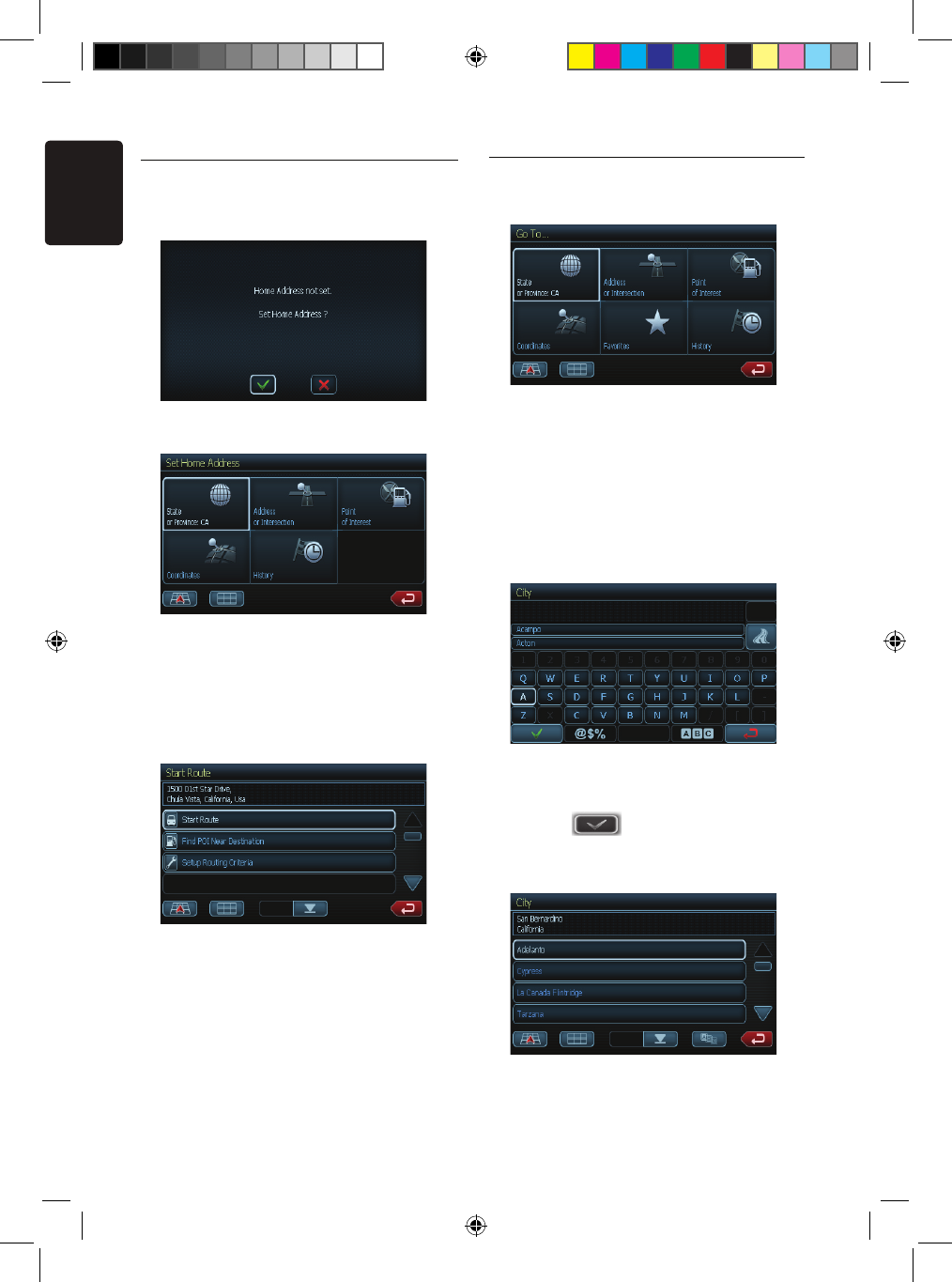
1. Touch the Home Address button on the
screen. If the home address is not set
previously, the following screen will be
displayed.
2. Press the check key to display home address
set up screen.
3. Select one of the option on the screen to set
the address. Once the address is set, it will
be saved in the software memory.
4. If the home address was saved previously,
the screen with address will pop up, after
you touched the Home Address button.
Start your route
Select the destination
To select the destination press Go To... button
on Main Menu screen. The Go To... screen is
displayed.
To start your navigation use one of these modes:
Address or Intersection
Point of Interest
Favorites
History
Adress or Intersection Mode
1. Press Address or Intersection, if you know
the street address. The spelling keyboard
will be dispayed.
2. Touch the first letter of desired city on the
keyboard. The city name will appear on the
screen.
3. Touch the select key. The list of the
cities, which name starts with same letter, will
be displayed. Press the desired city name.
NX_NZ500 0608.findd 6/16/2009 8:05:58 AM
English
NX500/NZ500 33
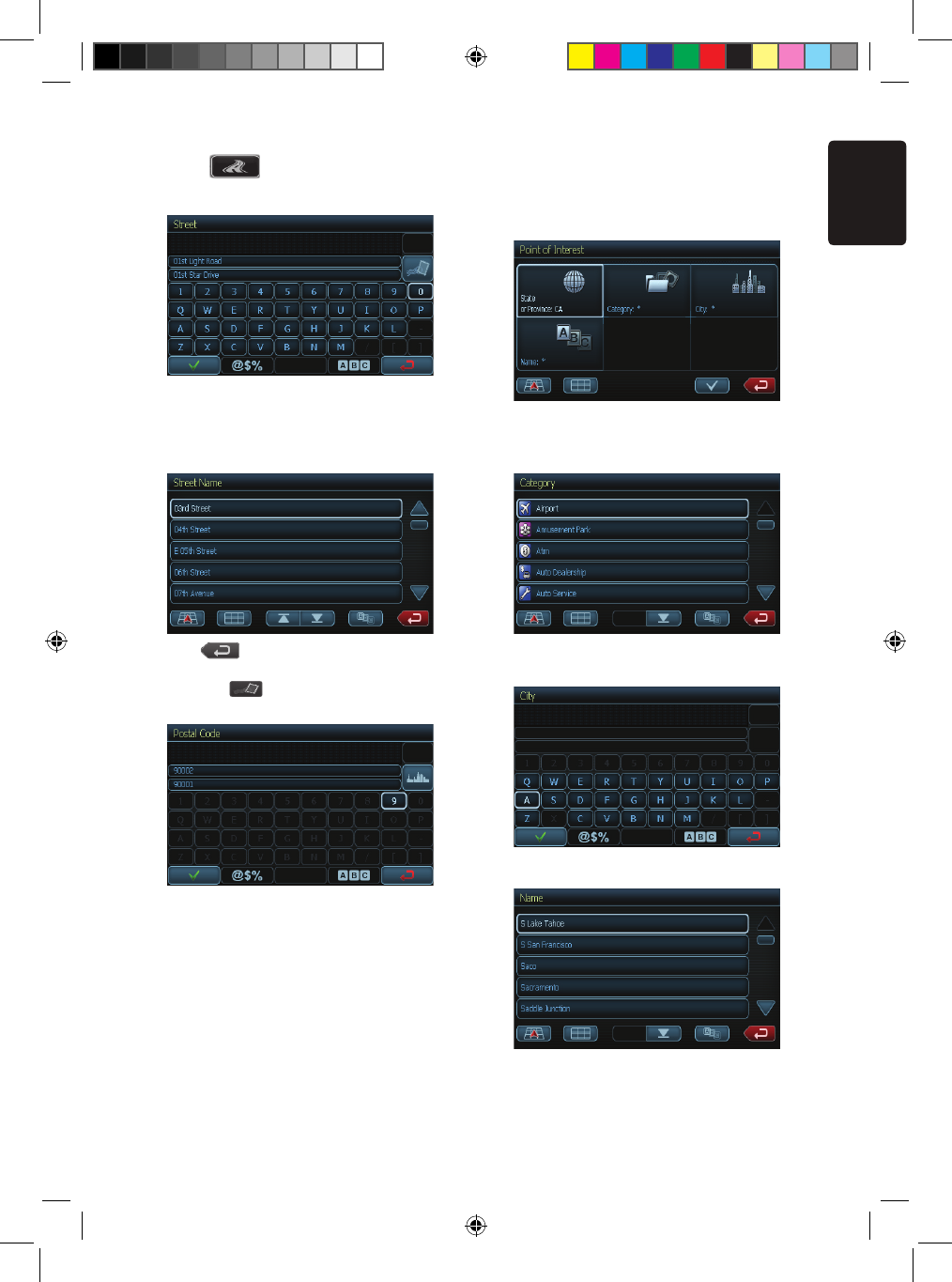
4. Touch street key to dispay street
name.
The street screen is displayed.
5. Choose desired street by typing on the
keyboard. The list of streets under this
letter will be displayed. Press up or down
button to go thru the list. Select your street.
Press button to return to the street
mode screen.
6. Touch the postal code button to
dispay postal code.
Press the select key to dispaly the list
of the postal code. Select the desired code
and press return key.
Point of Interest Mode
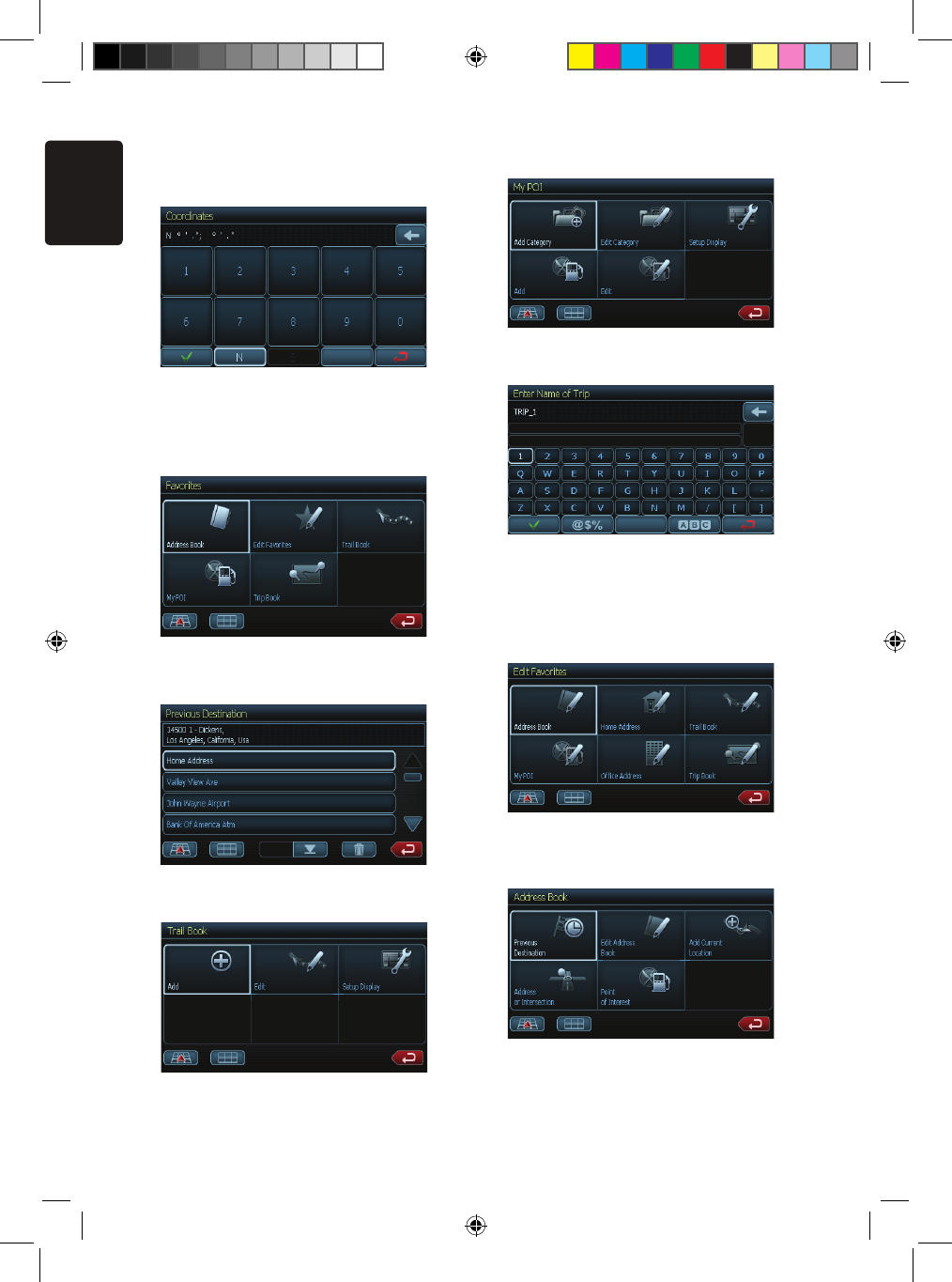
1. Use Point of Interest option when you
are going to a public place or are looking
for some type of facility such as a gasoline
station. After selecting the Point of Interest
option, you must select the State/Province
where the destination is located.
NOTE: The system remembers the last State/
Province selected, so this step is not
necessary every time.
2. Point of Interest may be searched by
Category, City or Name.
• Use Category mode, if you are lookig for a
certain service or business, like nearest gas
station.
• City mode - select the city by spelling it’s
name.
• Name mode - select the name by typing it.
NX_NZ500 0608.findd 6/16/2009 8:06:02 AM
English
NX500/NZ50034
Coordinates Mode
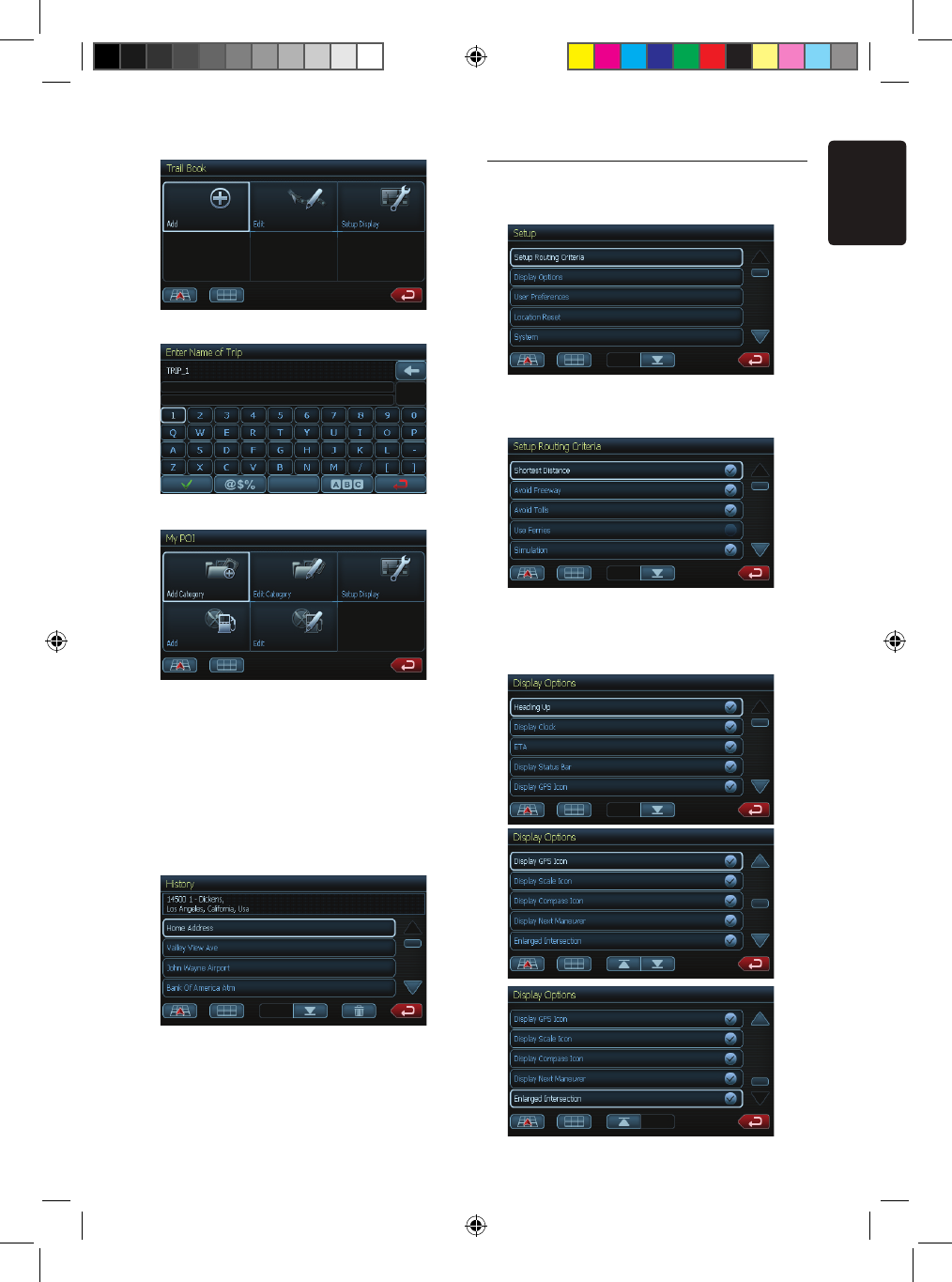
You can route to a destination by directly
inputting latitude and longitude values.
Favorites Mode
You can select your route to a destination by
choosing one of preset favorite places in
the Favorites mode.
1. Address Book is a convenient place to store
frequently visited destinations.
2. Trail Book will allow to create your own
navigation routes.
3. My POI will allow to create and save
your personal points of interest.
4. Trip Book will allow to navigate multiple
destination trip.
Edit Favorites
1. Press this button to edit Address Book, Trail
Book, Trip Book, My POI. The following
screen will pop up.
2. Select the mode, you want to edit.
The editing screen will be displayed.
Address Book editing screen:
NX_NZ500 0608.findd 4 6/16/2009 8:06:06 AM
English
NX500/NZ500 35
Trail Book editing screen:
Trip Book editing screen:
My POI editing screen:
History Mode
Previous destinations entered into your
navigation software are automatically saved into
the memory. This is helpful when you want to
return to a recent destination, such as a hotel
where you may be staying. The Previous Origin
of the last calculated route is also stored for
easy return to your start point.
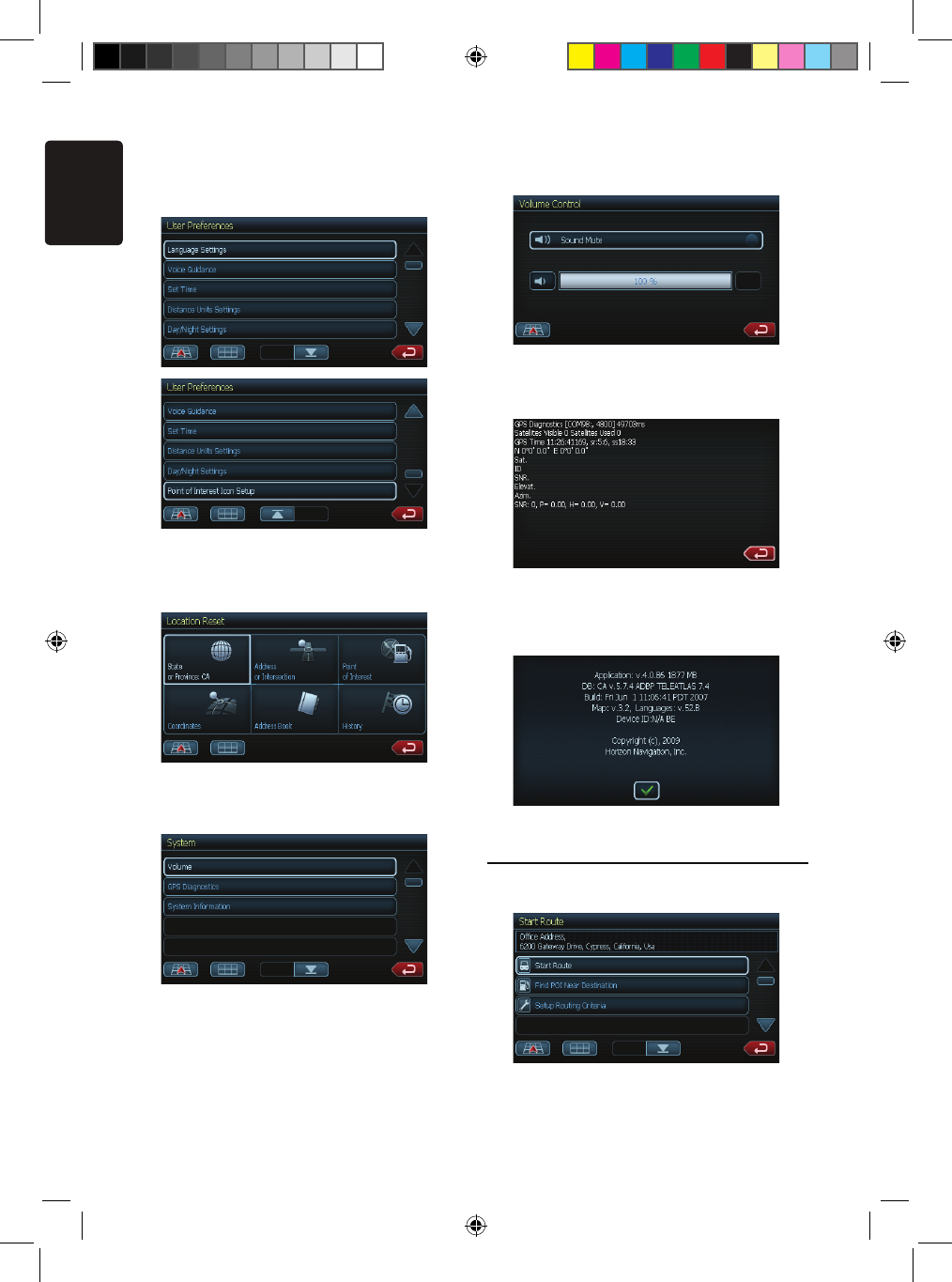
System Preferencies Setup
Press this button to set up your preferences for
routing and navigation. The following screen will
pop up. Select the mode you want to be set.
1. Press Setup Routing Criteria to set up your
driving preferences. Check the preferable
items on pop up screen.
2. Press Display Options to set up your
screen display preferences. All the options
are listed on 3 screens. Check the preferable
items on pop up screen list.
NX_NZ500 0608.findd 5 6/16/2009 8:06:10 AM
English
NX500/NZ50036
3. Press User Preferences to set up your
personal preferences. All the options
are listed on 2 screens. Check the preferable
items on pop up screen list.
4. Press Location Reset to set up your
location preferences. Select the item, you
would like to reset from pop up screen
options.
5. Press System button. The following screen
will pop up.
• Select the Volume mode. The popup screen
will allow to mute or turn on the system
sound.
• Select the GPS Diagnostics mode.
The information about current GPS condition
will be displayed on poup screen.
• Select the System Information mode.
The information about your navigation
system will be displayed on pop up screen.
Office Adress Guidance and Setup
Press this button and the Start Route screen
will pop up.
NX_NZ500 0608.findd 6 6/16/2009 8:06:14 AM
English
NX500/NZ500 37
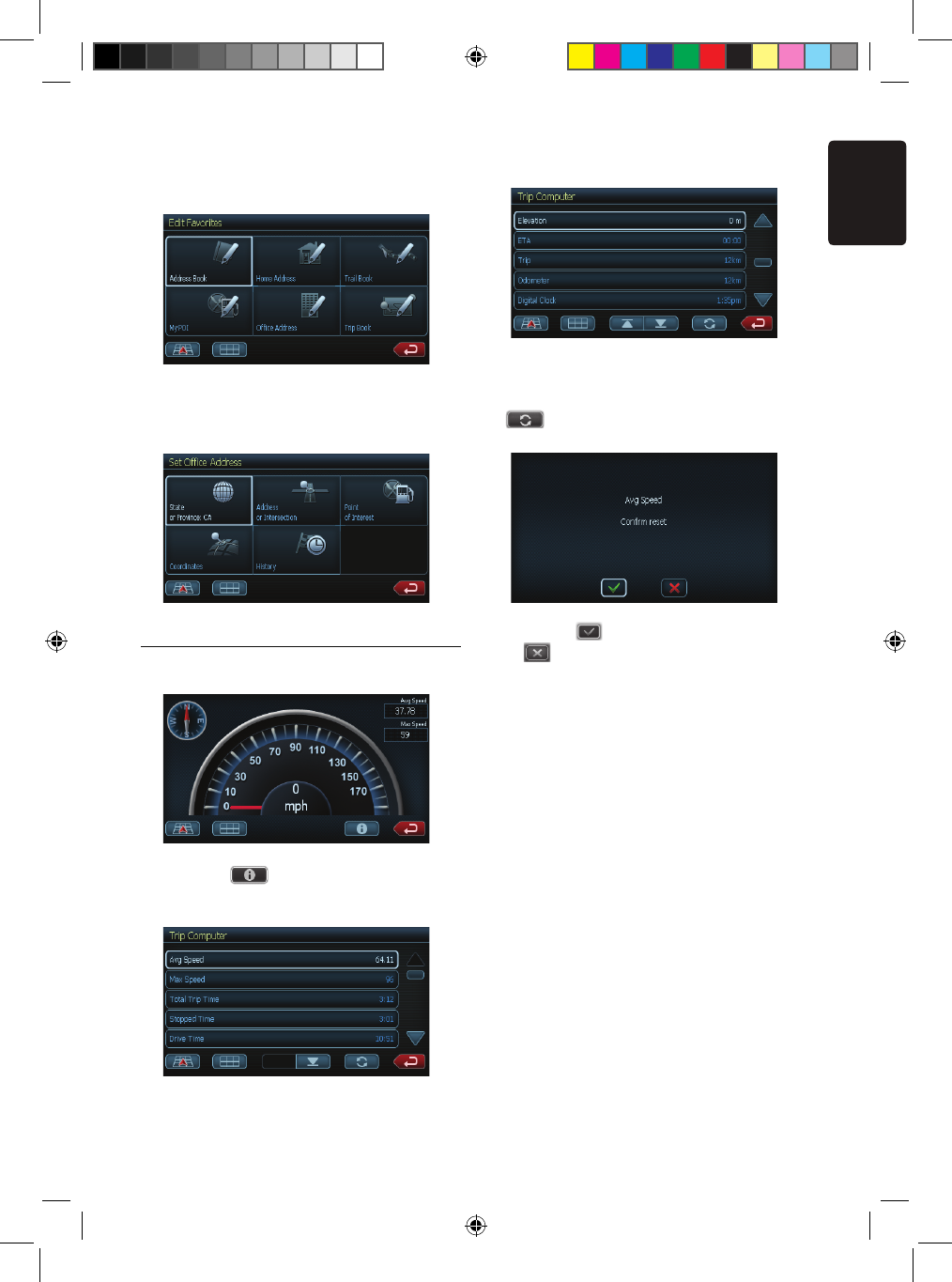
If the office address is not saved:
• Press the Favorites on the Go To screen.
• On pop up screen press Edit Favorites button.
The following screen will pop up.
• Press the Office Address button.
The Set Office Address screen will be
displayed. Fill the information in highlighted
items.
Trip Computer Readings and Resets
Press this button to display speed, trip, odometer
reading, clock reading.
1. Touch the button to display the trip
informaton items.
The following screen will pop up.
Touch the arrow keys down or up the list
or page to display more listed items.
2. Select the item from dispayed list by
touching it.
3. Reset the displayed item by pressing the
reset key. The following screen will
pop up.
4. Touch the check button to accept,
or cancell button to return back to Trip
Computer screen.
NX_NZ500 0608.findd 7 6/16/2009 8:06:17 AM
English
NX500/NZ50038
7. ACCESSORIES
iPod/iPhone Operations
Notes on using Apple iPod/iPhone
• Do not connect an iPod/iPhone to this unit with
a headphone connected to the iPod/iPhone.
• After the iPod/iPhone has been connected
to this unit, the iPod’s buttons are disabled for
operation in the Music mode.
In the Video mode, do not operate the iPod’s
buttons.
• When in the iPod mode, a special iPod/iPhone
control screen is displayed different from the
main screens for other modes.
• When in the iPod mode, the screen image
input from the AUX terminal is output to
the rear monitor.
• When no data is present, the title display will
remain blank.
• The iPod/iPhone is used with the equalizer
function turned OFF.
• Set the iPod/iPhone’s language setting to
English before connecting your iPod/iPhone.
Some characters of the other languages may
not be displayed correctly in this system.
• Precautions on battery consumption:
If the iPod/iPhone is connected to this unit
when the iPod/iPhone’s internal battery has
run down, this function may not operate
correctly. You must connect the iPod/iPhone
after charging the battery if it has run down.
Selecting the iPod mode
1. Connect your iPod/iPhone to the USB
connector. The system will automatically
detect the connected device and change
to the iPod mode. The iPod icon is displayed
on the Main Menu screen.
The playback starts after a while, from where the
iPod/iPhone has been paused.
• When a iPod/iPhone is already connected
Touch the [iPod] key on the Main Menu
screen. The system changes to the iPod mode,
and starts playback from the previous position.
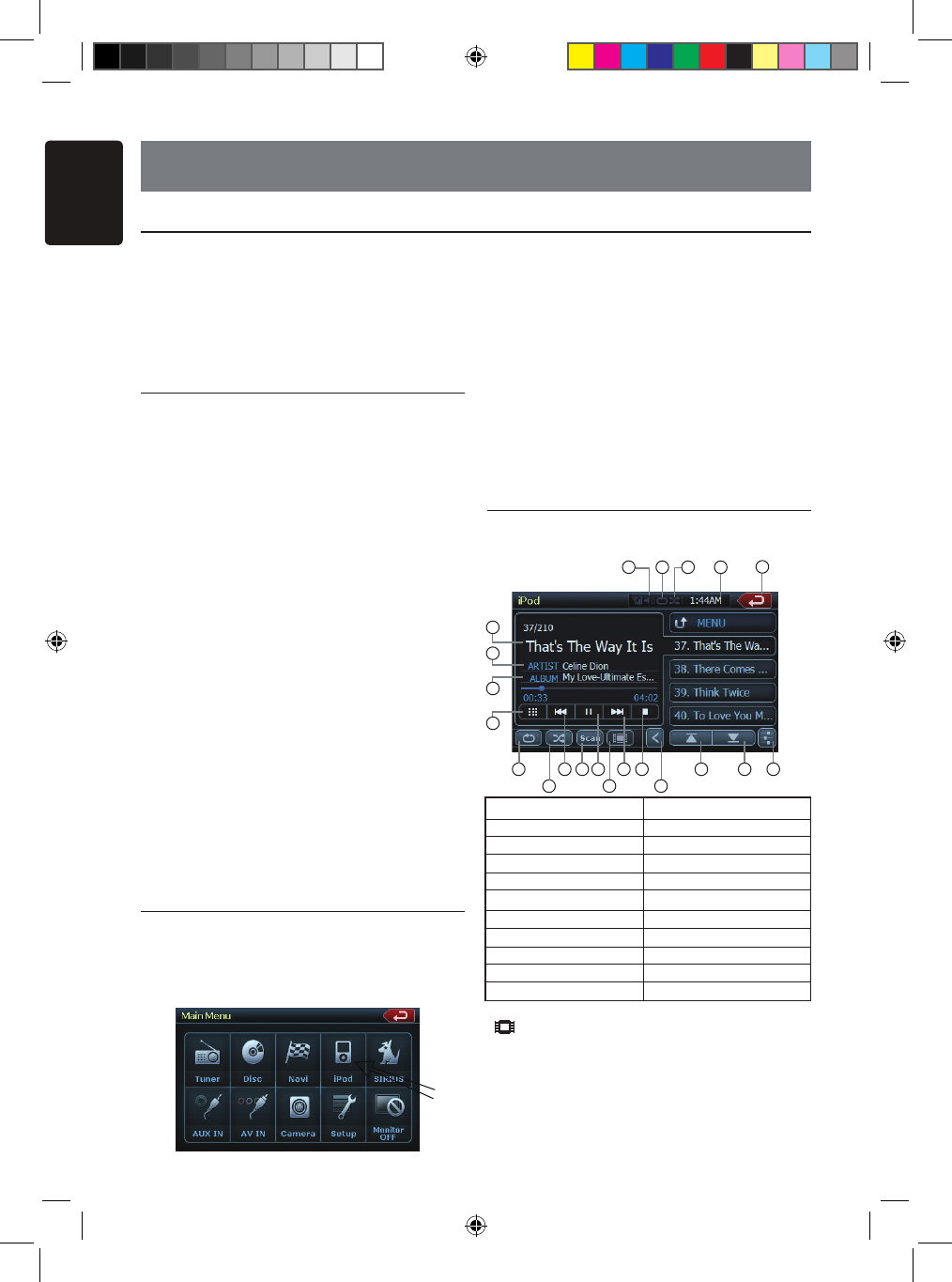
Controlling the iPod/iPhone
Operation keys
• iPod audio mode screen
[ ] Video key
• Switches to the screen of which the video
output from the iPod/iPhone is displayed.
Note:
• Note that not all iPod/iPhone devices are
compatible to output video to this unit.
iPod/iPhones can be connected by using the connector cable supplied with the iPod/iPhone, but in this
case, you can enjoy its audio sound only. To enjoy video movies stored in the iPod/iPhone with video
displaying them on this unit, it is required to use the special connector cable (CCA-723)
separately sold.
Note:
• This system will not operate or may operate improperly with unsupported versions.
• For detailed information on the playable iPod/iPhone models, see our home page: www.clarion.com
1. Repeat Button
2. Shuffle Button
3. Previous Track Button
4. Scan Button
5. Play/Pause Button
6. iPod Video Button
7. Next Track Button
8. Stop Button
9. Previous Page Button
10. Next Page Button
11. EQ Button
12. Back Button
13. Time Display
14. Shuffle Display
15. Repeat Display
16. Mute Display
17. Song Title
18. Artist Information
19. Album Information
20. Keyboard Button
21. Slide Bar
1 3
4 7 8 109
221
11
6
5
17
18
19
20
12
16 14 1315
NX_NZ500 0608.findd 8 6/16/2009 8:06:18 AM
English
NX500/NZ500 39
iPod/iPhones can be connected by using the connector cable supplied with the iPod/iPhone, but in this
case, you can enjoy its audio sound only. To enjoy video movies stored in the iPod/iPhone with video
displaying them on this unit, it is required to use the special connector cable (CCA-723)
separately sold.
Note:
• This system will not operate or may operate improperly with unsupported versions.
• For detailed information on the playable iPod/iPhone models, see our home page: www.clarion.com
[ ] Shuffle key
• Use to switch the shuffle mode on or off.
When enabled, this function performs
playback of tracks in random order,
regardless of the order in which they are
recorded.
[ ] Play/Pause key
• Use to control playback and pause.
1. Touch the key during playback. Playback
pauses.
2. To resume playback touch the key again.
[ ] EQ button
• Use to enter Audio Settings menu to set.
[ ] Keyboard button
• Use to input number to select the track.
[ ] Repeat button
• Use to repeat the selected track.
Skipping a track (searching)
1. Press the [ ] or [ ] button during
playback. Tracks are skipped, as many times
as the button is pressed, and playback starts.
• Pressing the [ ] button starts playback
from the beginning of the next track.
• Pressing the [ ] button starts playback
from the beginning of the current track.
When this button is pressed again within
about 2 seconds, playback starts from the
beginning of the previous track.
Fast forward and fast backward playback
Press and hold the [ ] or [ ] buttons on
the menu display for fast forward or fast reverse.
The first press will advance the music at
2x speed. Following presses will increase the
speed to 4x, 8x, and 16x.
Release the button to resume normal playback.
Selecting a list item from a list screen
1. Touch the display list icon in the iPod selection
screen.
2. Touch a desired list item on the screen to
display the corresponding list of tracks.
• Use the [ ] and [ ] keys to scroll the list.
3. Touch the desired track name on the list to
play back.
• Use the [ ] and [ ] keys to scroll the list.
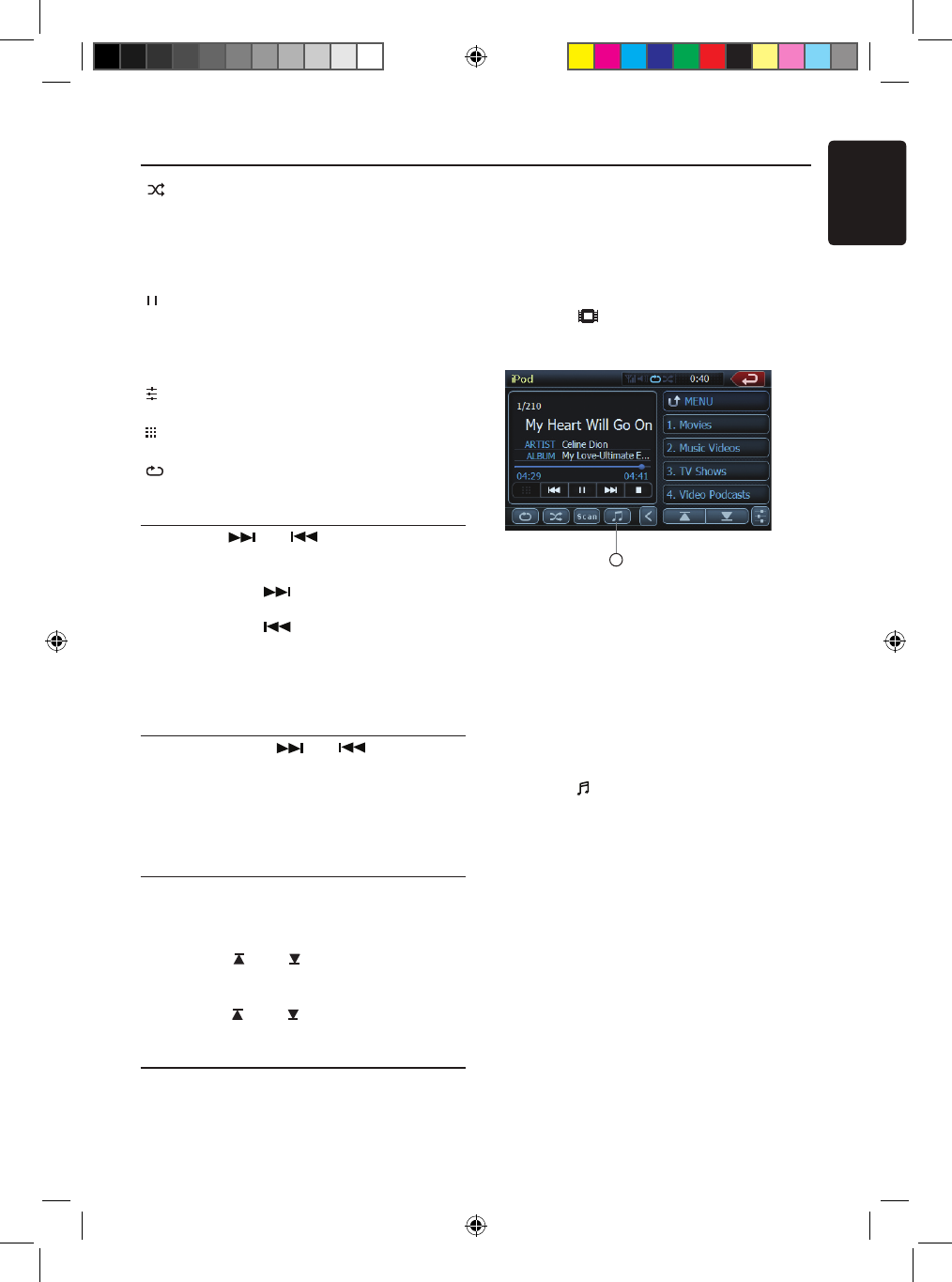
Viewing video data in the iPod/iPhone (only
for the iPod/iPhone with video features)
When you connect an iPod/iPhone with video
features by using the optional connector cable
for iPod/iPhone with video, you can enjoy the
video data and slide show data stored in the
iPod/iPhone showing them on the display of this
unit (and the rear monitor if connected).
Note:
• Do not connect the iPod/iPhone to this unit
when a Video Playlists item is selected on the
iPod/iPhone.
1. Touch the [ ] video key on the iPod audio
menu screen. The iPod play video screen is
displayed.
2. Select the type of video, you would like to be
played, by touching it on the right side of the
menu. The video playback will start.
Note:
Video playback is not available on all iPod/
iPhone devices. Please contact your Clarion
dealer for details. An optional connection cable
or accessory may be required for this feature.
3. To stop the video play, touch the screen.
iPod play video menu will be displayed.
4. Touch the [ ] audio button (1) to return to
the iPod audio menu.
Note:
• “AUDIO ONLY” is displayed when the
automobile is moving.
• Image data may not be played back according
to the status of the iPod/iPhone.
• The volume setting of video data is relatively
lower than audio data. Be sure to lower the
volume setting before switching to the other
mode.
• Do not select the categories with no track
registered from the iPod menu screen.
The iPod/iPhone may be frozen. If the iPod
/iPhone is frozen, reset the iPod/iPhone
by following the procedure described in the
instruction manual of the iPod/iPhone.
• Audio may be played back slightly out of
synchronization with video images.
iPod/iPhone Operations
1
NX_NZ500 0608.findd 9 6/16/2009 8:06:19 AM
English
NX500/NZ50040
USB Operations
This system can play audio files (MP3/WMA) stored in an USB memory which is recognized as
“USB Mass Storage Class device”. You can use your USB memory as an audio device by simply
copying desired audio files into it.
Note:
• This system will not operate or may operate improperly with some USB memory.
• Files protected with any DRM can not be played.
Notes on using USB memories
• General notes
• When no data is present, the message “NO
FILE” will be displayed.
• The USB memory is used with the equalizer
function turned OFF.
• Notes on the MP3/WMA files
• This system can play the MP3/WMA files
stored in the USB memory.
• This system cannot play DivX files stored in
the USB memory.
• Set the Sampling Frequency to:
For MP3 files:
• MPEG1 Layer3: 32, 44.1, or 48 kHz
• MPEG2 Layer3: 16, 22.05, or 24 kHz
• MPEG2.5 Layer3: 8, 11.025, or 12 kHz
For WMA files: 32, 44.1, or 48 kHz
• Set the Bit Rate to:
For MP3 files:
• MPEG1 Layer3: 32 to 320 kbps (VBR)
• MPEG2 Layer3: 16 to 160 kbps (VBR)
• MPEG2.5 Layer3: 16 to 160 kbps (VBR)
For WMA files: 32,48, 64, 80, 96, 128, 160,
or 192 kbps
• Add the following file extension using single
byte characters:
For MP3 files: “.MP3” or “.mp3”
For WMA files: “.WMA” or “.wma”
• Notes on the folder structure
• The folder hierarchy must be within 8
hierarchical levels. Otherwise, playback will
be impossible.
• The maximum allowable number of folders is
512 (including root directory and folders with
no MP3/WMA file).
• The maximum allowable number of files in a
folder is 255.
• You can store the MP3 files, WMA files
together in a folder.
• Notes on the Tag titles
The limitations on the Tag titles are same as
those in the MP3/WMA modes.
• Folder representation in the folder list
The limitations on the folder representation
are same as those in the MP3/WMA
modes.
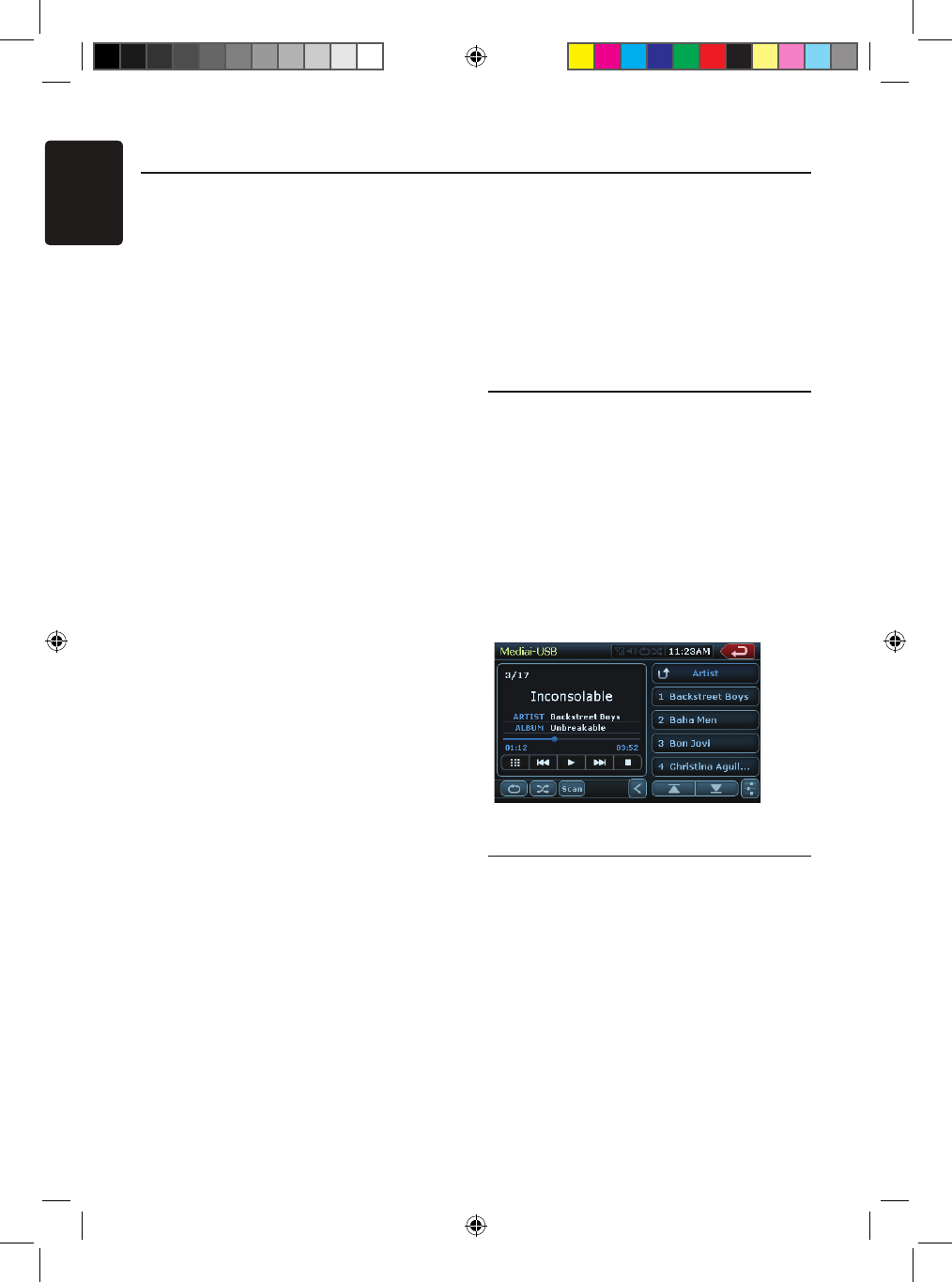
Selecting the USB Memory mode
Connect your USB memory to the USB
connector. The system will automatically
detect the connected device, and change to
the USB mode (USB Memory mode), and
start playback after a while. If you reconnect
the same device that you disconnected last,
the system will play back where it left off.
• When an USB memory is already connected
Touch the [USB] key to select the USB in a
Main Menu mode.
The system changes to the USB mode (Mediai-
USB mode), and starts playback from the
previous position.
Playing back files in the USB memory
The operations in the USB Memory mode are
same as those in the MP3/WMA modes.
See “Listening to a CD” for details.
Note:
When performing the fast forward or fast
backward function, the playback speed will
become 10-time faster. For the VBR files, it
may differ depending on the file.
NX_NZ500 0608.findd 40 6/16/2009 8:06:19 AM
English
NX500/NZ500 41
External peripheral devices, including a game
console, camcorder, navigation unit, iPod/
iPhone, etc. can be connected to the AUX IN or
AV IN connector on the back of this unit using
the A/V media cables.
NOTE:
For your safety, the unit has a safety function,
which turns off the picture when car is moving,
so only the audio can be heard. The picture can
be only watched, when the car is stopped and
parking brake is applied.
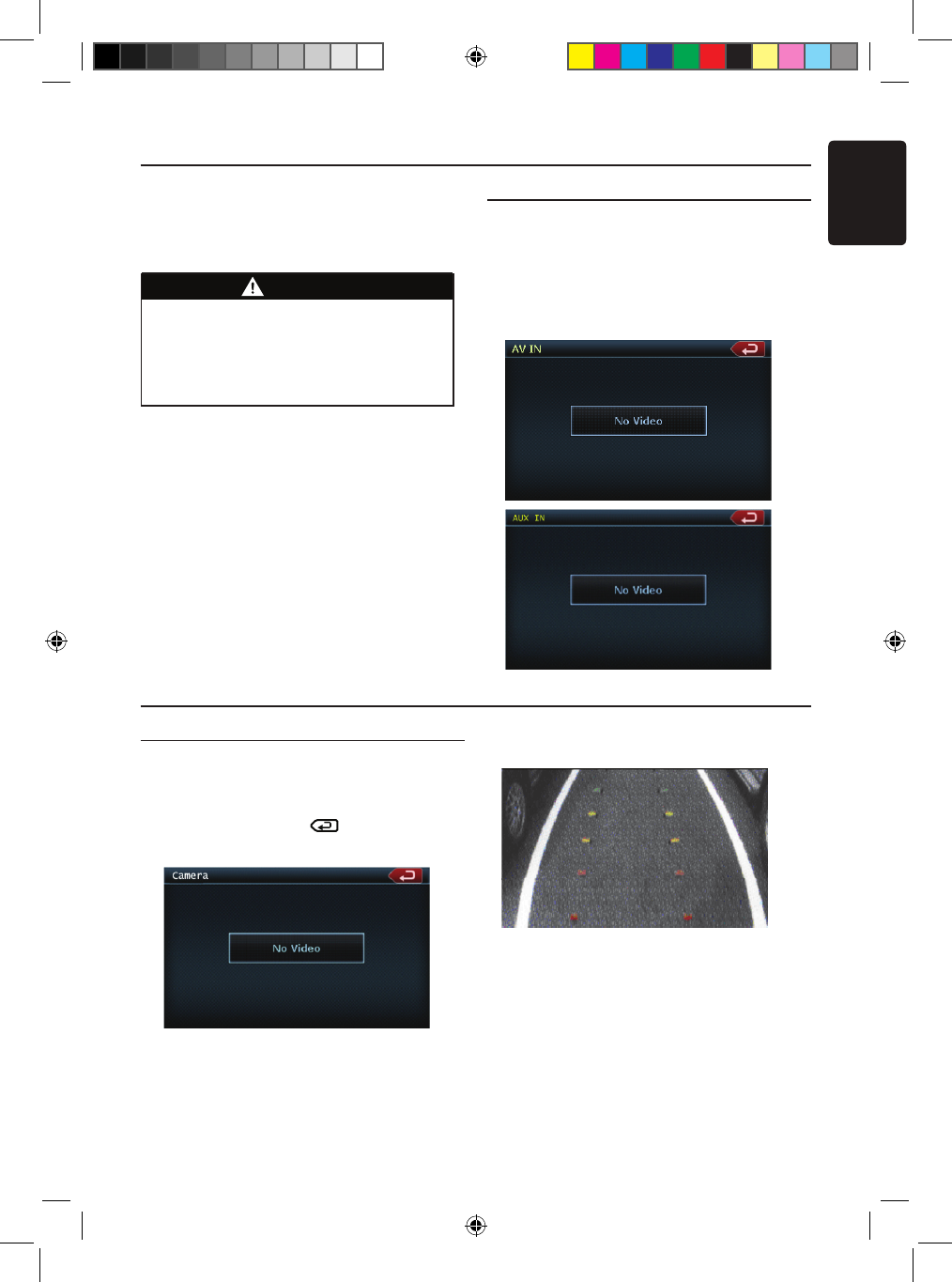
Switching to AUX IN / AV IN mode
Press [AUX IN] or [AV IN] button on Main Menu
to select desired mode (when unit is reading).
The LCD will display the external video.
The screen will dispaly “No Video” menu, if there
is no video signal.
You cannot directly control external devices
connected to the AUX IN or AV IN input.
AUX In / AV In Operations
WARNING
For your safety, the driver should not
watch the VTR, etc. or operate the controls
while driving. Please note that watching
and operating the VTR, etc. while driving
are prohibited by law in some countries.
Switching to Camera mode
Press [Camera] button on Main Menu
to select desired mode (when unit is reading).
The LCD will display the external video.
The screen will dispaly “No Video” menu, if there
is no video signal. Press [ ] back button to
return to the Main Menu.
When the video signal is displayed, press right
top corner to return to the Main Menu.
Camera In Operations
NX_NZ500 0608.findd 41 6/16/2009 8:06:20 AM