Unigen UGWC821R NEMO BLUETOOTH RADIO MODULE User Manual NEMO Datasheet UGWC621RSMA133

Unigen Corporation NEMO BLUETOOTH RADIO MODULE NEMO Datasheet UGWC621RSMA133

Contents

user manual
     NEMO Bluetooth Radio Module Solutions for a Real Time World  Datasheet Re-Tek - 1573    - 1 -  45388 Warm Springs Blvd. Fremont, CA 94539 support@unigen.com    TEL: (510) 668.2088 FAX: (510) 661.2788 http://www.unigen.com  Customer Comment Line: (800) 826.0808 Copyright Unigen Corporation, 2008            Unigen Corp. Wireless Module Products  NEMO Bluetooth Radio Modules UGWC621RSMA133              Issue Date: 18-Aug-09 Revision:  1.1
     NEMO Bluetooth Radio Module Solutions for a Real Time World Datasheet Re-Tek - 1573                                                                                 - 2 -                                          45388 Warm Springs Blvd. Fremont, CA 94539 support@unigen.com                     TEL: (510) 668.2088 FAX: (510) 661.2788 http://www.unigen.com  Customer Comment Line: (800) 826.0808 Copyright Unigen Corporation, 2008  Revision History  Rev. No.  History  Issue Date Remarks 1.0  Draft  Dec. 5, 2008  Advanced information; Author: Allen B. Cabreros 1.1  Revision  Aug. 18, 2009  Added dimensional drawings.                       THIS DOCUMENT IS PROVIDED “AS IS” WITH NO WARRANTIES WHATSOEVER, INCLUDING ANY WARRANTY OF MERCHANTABILITY, NON-INFRINGEMENT, FITNESS FOR ANY PARTICULAR PURPOSE, OR ANY WARRANTY OTHERWISE ARISING OUT OF ANY PROPOSAL, SPECIFICATION OR SAMPLE.  Unigen Corporation disclaims all liability, including liability for infringement of any proprietary rights, relating to use of information in this document.  No license, expressed or implied, by estoppel or otherwise, to any intellectual property rights is granted herein.  *Third-party brands, names, and trademarks are the property of their respective owners.
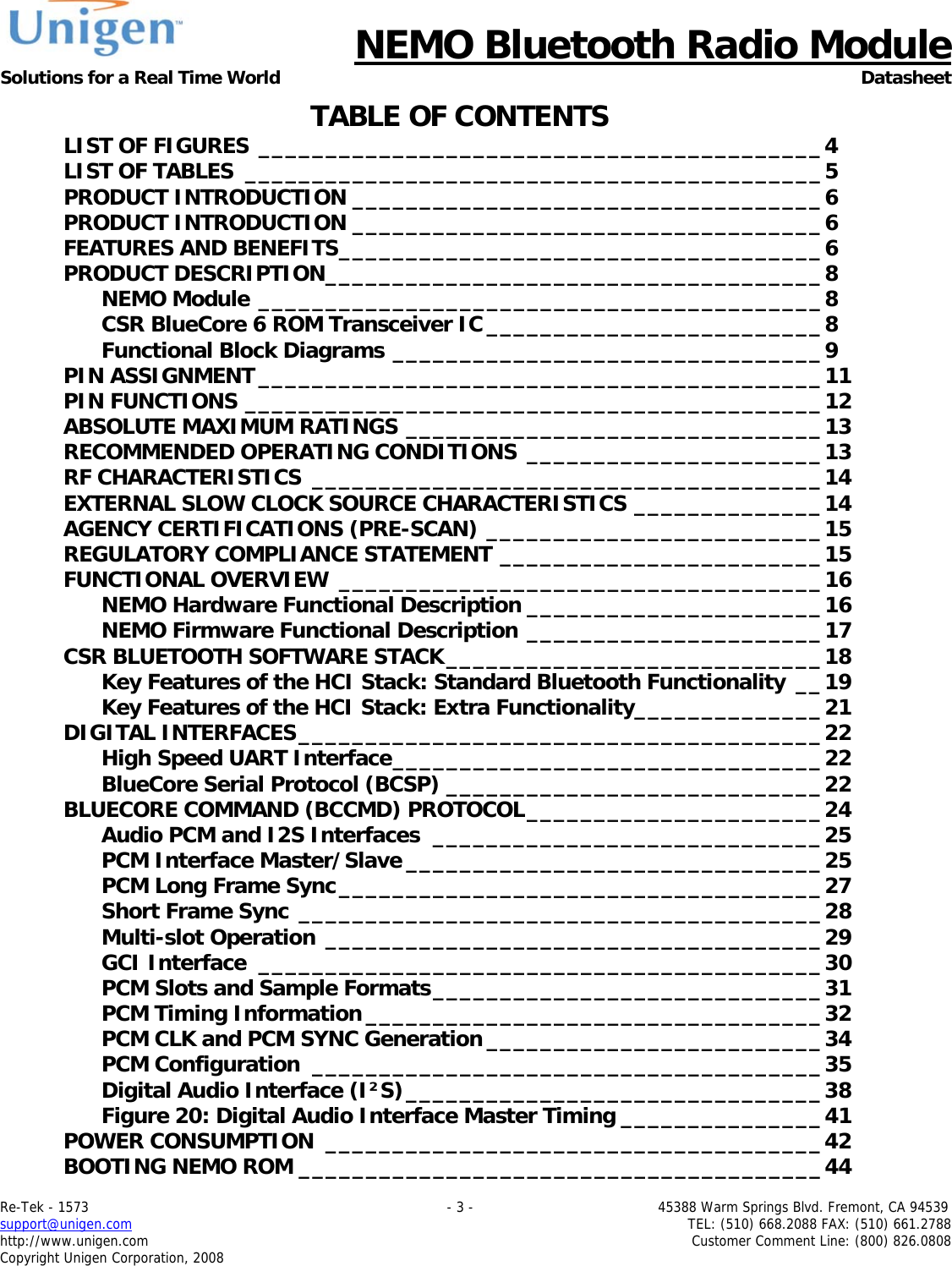
     NEMO Bluetooth Radio Module Solutions for a Real Time World Datasheet Re-Tek - 1573                                                                                 - 3 -                                          45388 Warm Springs Blvd. Fremont, CA 94539 support@unigen.com                     TEL: (510) 668.2088 FAX: (510) 661.2788 http://www.unigen.com  Customer Comment Line: (800) 826.0808 Copyright Unigen Corporation, 2008 TABLE OF CONTENTS LIST OF FIGURES __________________________________________4 LIST OF TABLES ___________________________________________5 PRODUCT INTRODUCTION ___________________________________6 PRODUCT INTRODUCTION ___________________________________6 FEATURES AND BENEFITS____________________________________6 PRODUCT DESCRIPTION_____________________________________8 NEMO Module __________________________________________8 CSR BlueCore 6 ROM Transceiver IC _________________________8 Functional Block Diagrams ________________________________9 PIN ASSIGNMENT__________________________________________11 PIN FUNCTIONS ___________________________________________12 ABSOLUTE MAXIMUM RATINGS _______________________________13 RECOMMENDED OPERATING CONDITIONS ______________________13 RF CHARACTERISTICS ______________________________________14 EXTERNAL SLOW CLOCK SOURCE CHARACTERISTICS ______________14 AGENCY CERTIFICATIONS (PRE-SCAN) _________________________15 REGULATORY COMPLIANCE STATEMENT ________________________15 FUNCTIONAL OVERVIEW ____________________________________16 NEMO Hardware Functional Description ______________________16 NEMO Firmware Functional Description ______________________17 CSR BLUETOOTH SOFTWARE STACK____________________________18 Key Features of the HCI Stack: Standard Bluetooth Functionality __19 Key Features of the HCI Stack: Extra Functionality______________21 DIGITAL INTERFACES_______________________________________22 High Speed UART Interface________________________________22 BlueCore Serial Protocol (BCSP) ____________________________22 BLUECORE COMMAND (BCCMD) PROTOCOL______________________24 Audio PCM and I2S Interfaces _____________________________25 PCM Interface Master/Slave _______________________________25 PCM Long Frame Sync____________________________________27 Short Frame Sync _______________________________________28 Multi-slot Operation _____________________________________29 GCI Interface __________________________________________30 PCM Slots and Sample Formats_____________________________31 PCM Timing Information __________________________________32 PCM CLK and PCM SYNC Generation _________________________34 PCM Configuration ______________________________________35 Digital Audio Interface (I²S)_______________________________38 Figure 20: Digital Audio Interface Master Timing _______________41 POWER CONSUMPTION _____________________________________42 BOOTING NEMO ROM _______________________________________44
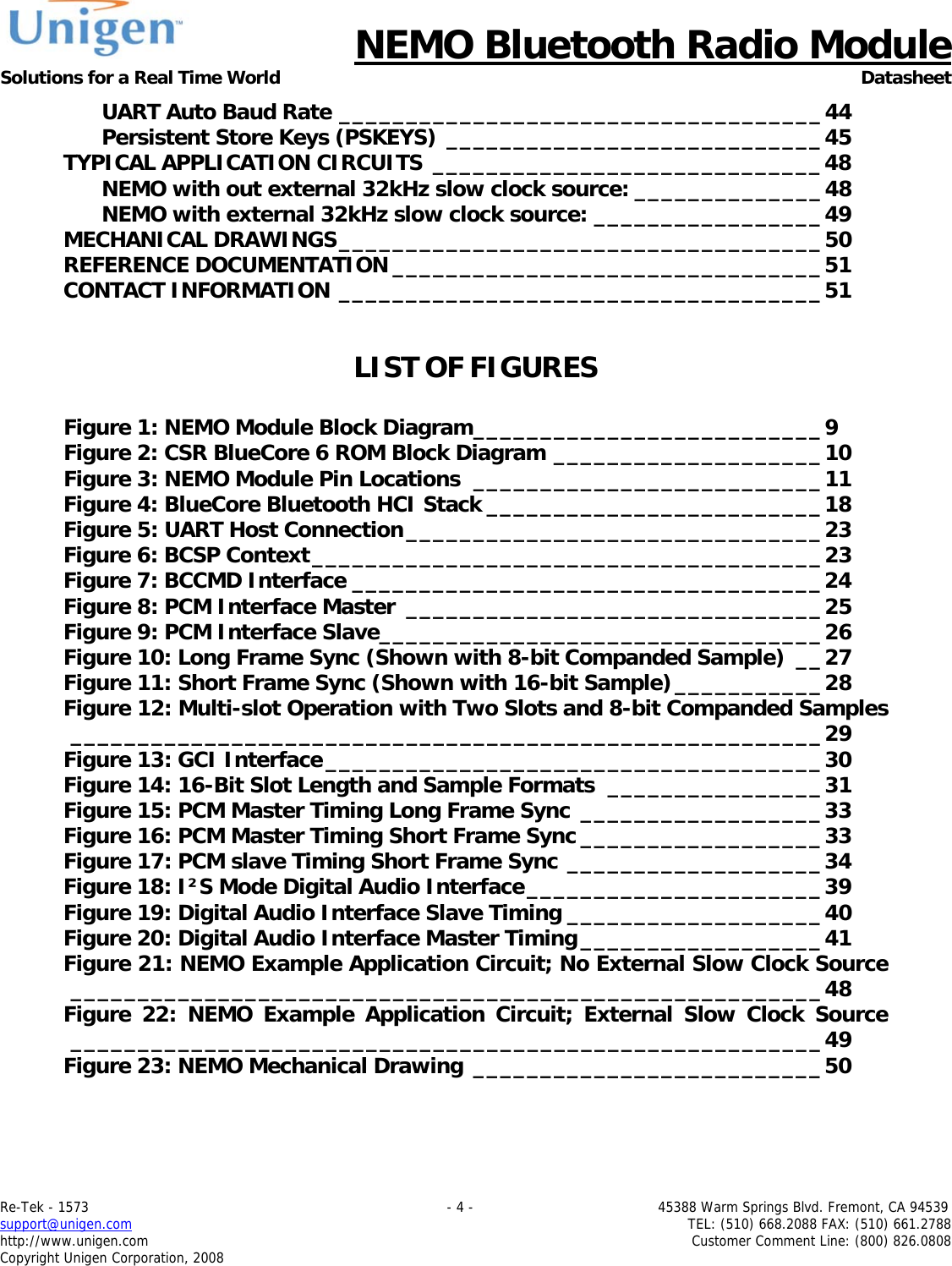
     NEMO Bluetooth Radio Module Solutions for a Real Time World Datasheet Re-Tek - 1573                                                                                 - 4 -                                          45388 Warm Springs Blvd. Fremont, CA 94539 support@unigen.com                     TEL: (510) 668.2088 FAX: (510) 661.2788 http://www.unigen.com  Customer Comment Line: (800) 826.0808 Copyright Unigen Corporation, 2008 UART Auto Baud Rate ____________________________________44 Persistent Store Keys (PSKEYS) ____________________________45 TYPICAL APPLICATION CIRCUITS _____________________________48 NEMO with out external 32kHz slow clock source: ______________48 NEMO with external 32kHz slow clock source: _________________49 MECHANICAL DRAWINGS____________________________________50 REFERENCE DOCUMENTATION ________________________________51 CONTACT INFORMATION ____________________________________51  LIST OF FIGURES  Figure 1: NEMO Module Block Diagram__________________________9 Figure 2: CSR BlueCore 6 ROM Block Diagram ____________________10 Figure 3: NEMO Module Pin Locations __________________________11 Figure 4: BlueCore Bluetooth HCI Stack _________________________18 Figure 5: UART Host Connection_______________________________23 Figure 6: BCSP Context______________________________________23 Figure 7: BCCMD Interface ___________________________________24 Figure 8: PCM Interface Master _______________________________25 Figure 9: PCM Interface Slave_________________________________26 Figure 10: Long Frame Sync (Shown with 8-bit Companded Sample) __27 Figure 11: Short Frame Sync (Shown with 16-bit Sample)___________28 Figure 12: Multi-slot Operation with Two Slots and 8-bit Companded Samples________________________________________________________29 Figure 13: GCI Interface_____________________________________30 Figure 14: 16-Bit Slot Length and Sample Formats ________________31 Figure 15: PCM Master Timing Long Frame Sync __________________33 Figure 16: PCM Master Timing Short Frame Sync __________________33 Figure 17: PCM slave Timing Short Frame Sync ___________________34 Figure 18: I²S Mode Digital Audio Interface______________________39 Figure 19: Digital Audio Interface Slave Timing ___________________40 Figure 20: Digital Audio Interface Master Timing__________________41 Figure 21: NEMO Example Application Circuit; No External Slow Clock Source________________________________________________________48 Figure 22: NEMO Example Application Circuit; External Slow Clock Source________________________________________________________49 Figure 23: NEMO Mechanical Drawing __________________________50
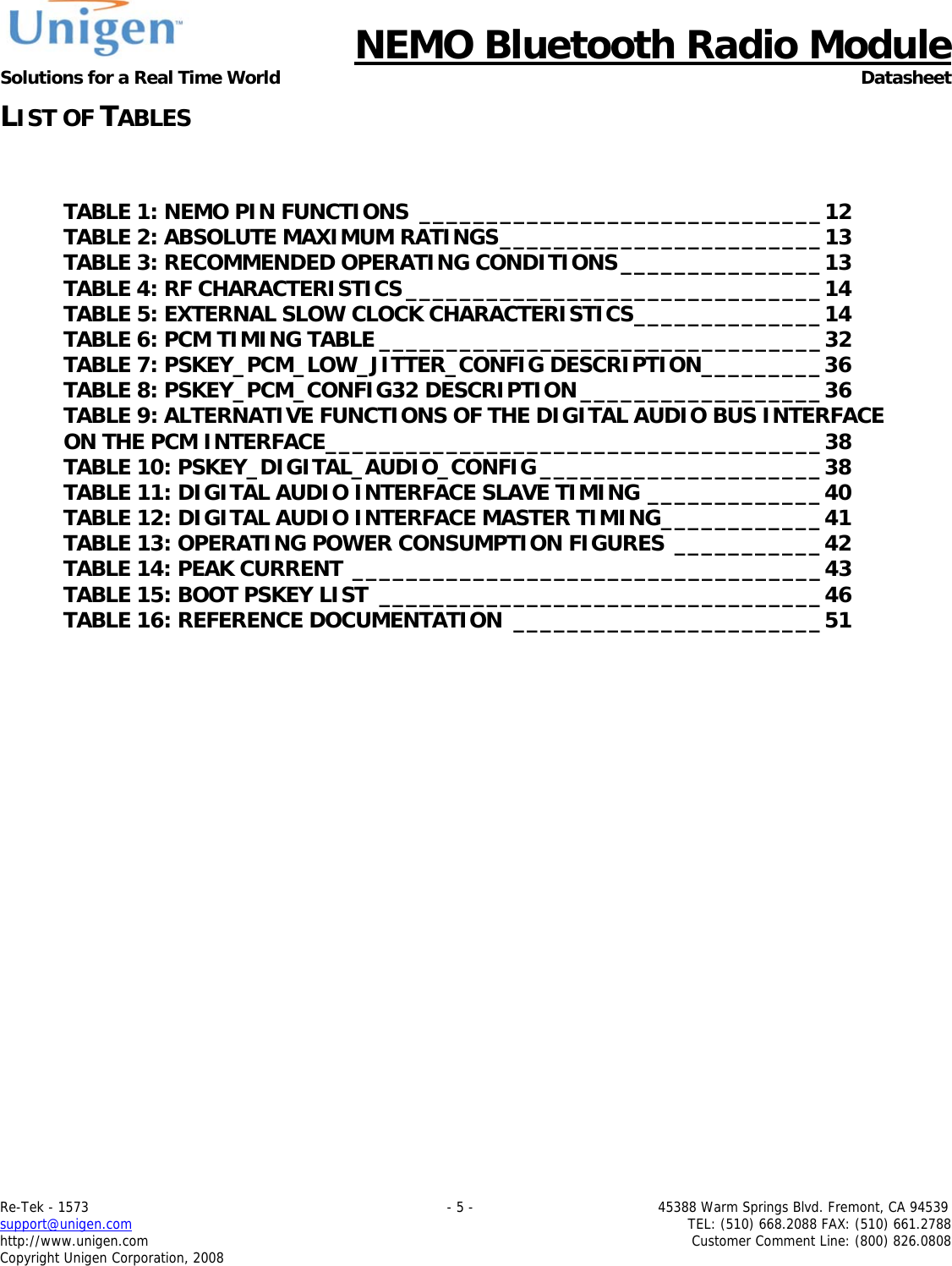
     NEMO Bluetooth Radio Module Solutions for a Real Time World Datasheet Re-Tek - 1573                                                                                 - 5 -                                          45388 Warm Springs Blvd. Fremont, CA 94539 support@unigen.com                     TEL: (510) 668.2088 FAX: (510) 661.2788 http://www.unigen.com  Customer Comment Line: (800) 826.0808 Copyright Unigen Corporation, 2008 LIST OF TABLES  TABLE 1: NEMO PIN FUNCTIONS ______________________________12 TABLE 2: ABSOLUTE MAXIMUM RATINGS________________________13 TABLE 3: RECOMMENDED OPERATING CONDITIONS_______________13 TABLE 4: RF CHARACTERISTICS _______________________________14 TABLE 5: EXTERNAL SLOW CLOCK CHARACTERISTICS______________14 TABLE 6: PCM TIMING TABLE _________________________________32 TABLE 7: PSKEY_PCM_LOW_JITTER_CONFIG DESCRIPTION_________36 TABLE 8: PSKEY_PCM_CONFIG32 DESCRIPTION __________________36 TABLE 9: ALTERNATIVE FUNCTIONS OF THE DIGITAL AUDIO BUS INTERFACE ON THE PCM INTERFACE_____________________________________38 TABLE 10: PSKEY_DIGITAL_AUDIO_CONFIG _____________________38 TABLE 11: DIGITAL AUDIO INTERFACE SLAVE TIMING _____________40 TABLE 12: DIGITAL AUDIO INTERFACE MASTER TIMING____________41 TABLE 13: OPERATING POWER CONSUMPTION FIGURES ___________42 TABLE 14: PEAK CURRENT ___________________________________43 TABLE 15: BOOT PSKEY LIST _________________________________46 TABLE 16: REFERENCE DOCUMENTATION _______________________51
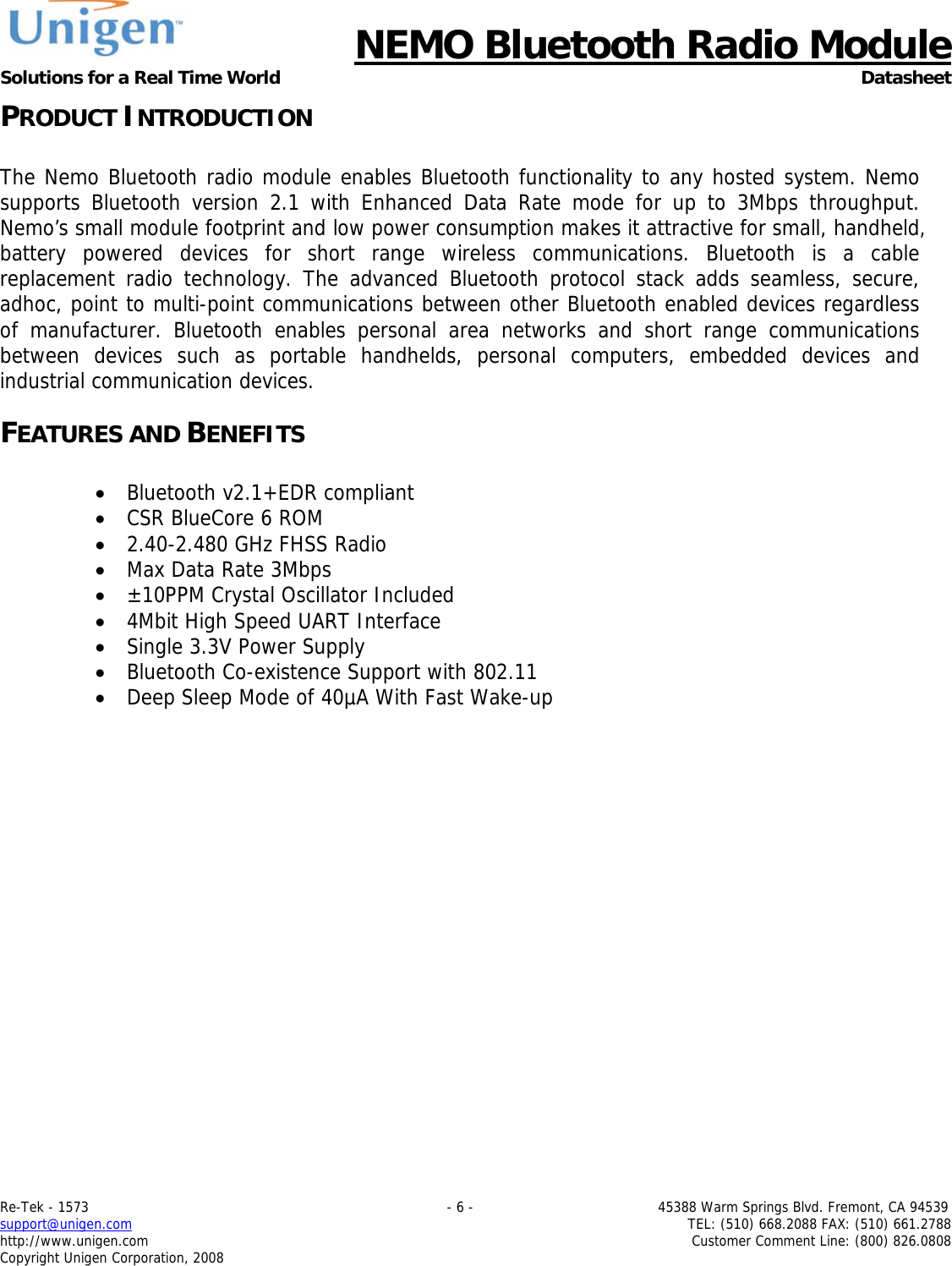
     NEMO Bluetooth Radio Module Solutions for a Real Time World Datasheet Re-Tek - 1573                                                                                 - 6 -                                          45388 Warm Springs Blvd. Fremont, CA 94539 support@unigen.com                     TEL: (510) 668.2088 FAX: (510) 661.2788 http://www.unigen.com  Customer Comment Line: (800) 826.0808 Copyright Unigen Corporation, 2008 PRODUCT INTRODUCTION  The Nemo Bluetooth radio module enables Bluetooth functionality to any hosted system. Nemo supports Bluetooth version 2.1 with Enhanced Data Rate mode for up to 3Mbps throughput. Nemo’s small module footprint and low power consumption makes it attractive for small, handheld, battery powered devices for short range wireless communications. Bluetooth is a cable replacement radio technology. The advanced Bluetooth protocol stack adds seamless, secure, adhoc, point to multi-point communications between other Bluetooth enabled devices regardless of manufacturer. Bluetooth enables personal area networks and short range communications between devices such as portable handhelds, personal computers, embedded devices and industrial communication devices. FEATURES AND BENEFITS  • Bluetooth v2.1+EDR compliant • CSR BlueCore 6 ROM • 2.40-2.480 GHz FHSS Radio • Max Data Rate 3Mbps • ±10PPM Crystal Oscillator Included • 4Mbit High Speed UART Interface • Single 3.3V Power Supply • Bluetooth Co-existence Support with 802.11 • Deep Sleep Mode of 40µA With Fast Wake-up
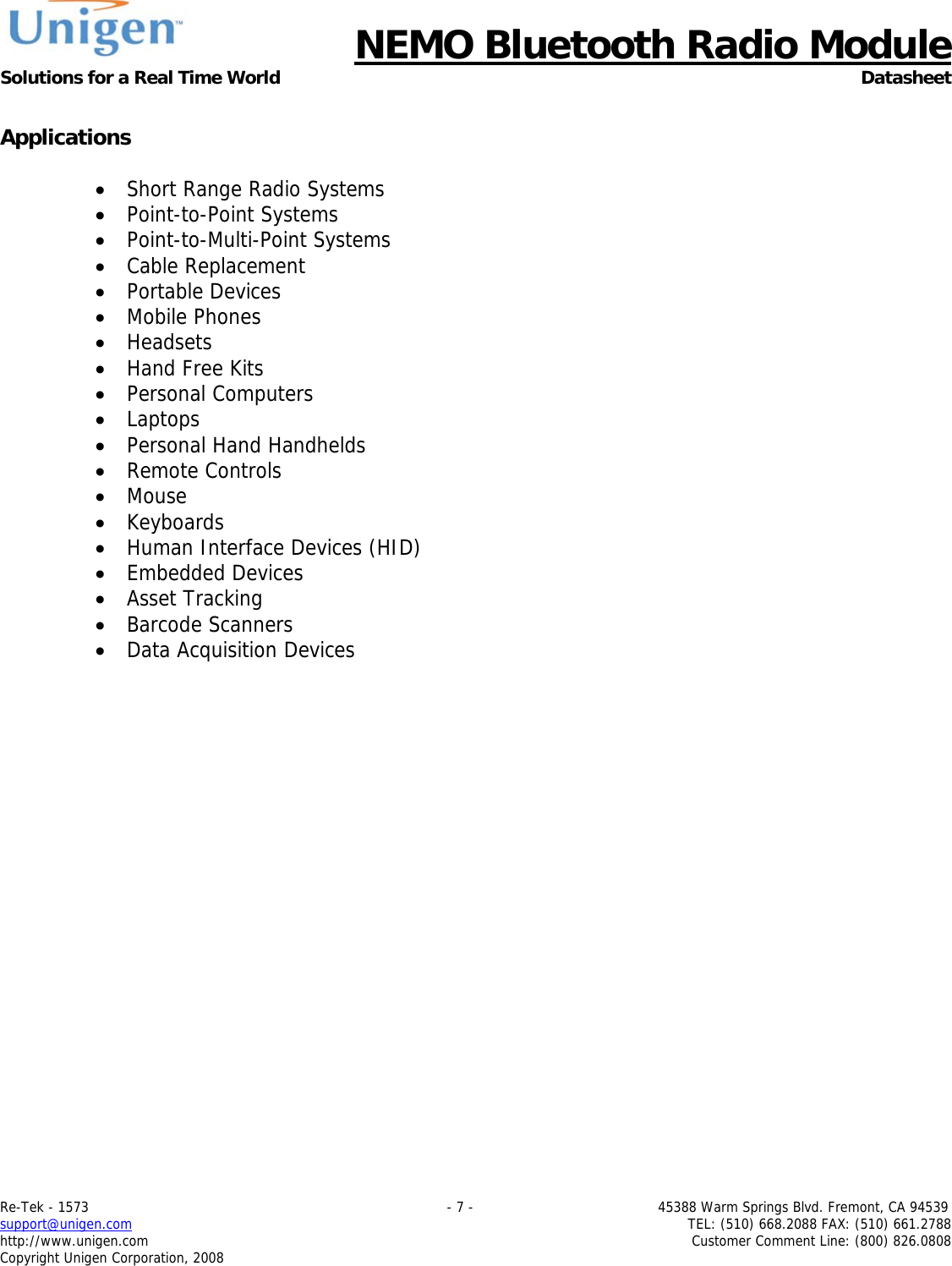
     NEMO Bluetooth Radio Module Solutions for a Real Time World Datasheet Re-Tek - 1573                                                                                 - 7 -                                          45388 Warm Springs Blvd. Fremont, CA 94539 support@unigen.com                     TEL: (510) 668.2088 FAX: (510) 661.2788 http://www.unigen.com  Customer Comment Line: (800) 826.0808 Copyright Unigen Corporation, 2008  Applications  • Short Range Radio Systems • Point-to-Point Systems • Point-to-Multi-Point Systems • Cable Replacement • Portable Devices • Mobile Phones • Headsets • Hand Free Kits • Personal Computers • Laptops • Personal Hand Handhelds • Remote Controls • Mouse • Keyboards • Human Interface Devices (HID) • Embedded Devices • Asset Tracking • Barcode Scanners • Data Acquisition Devices
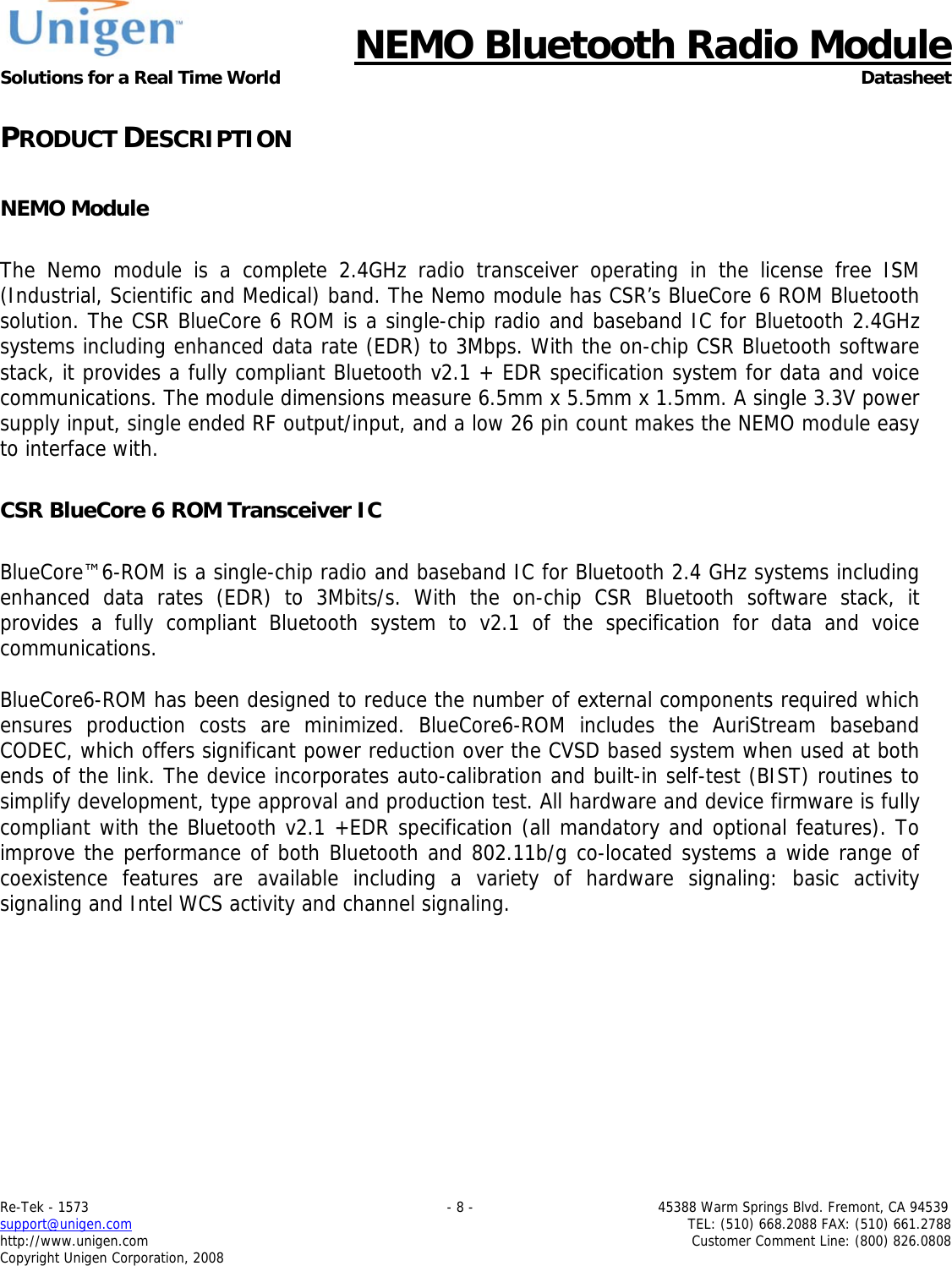
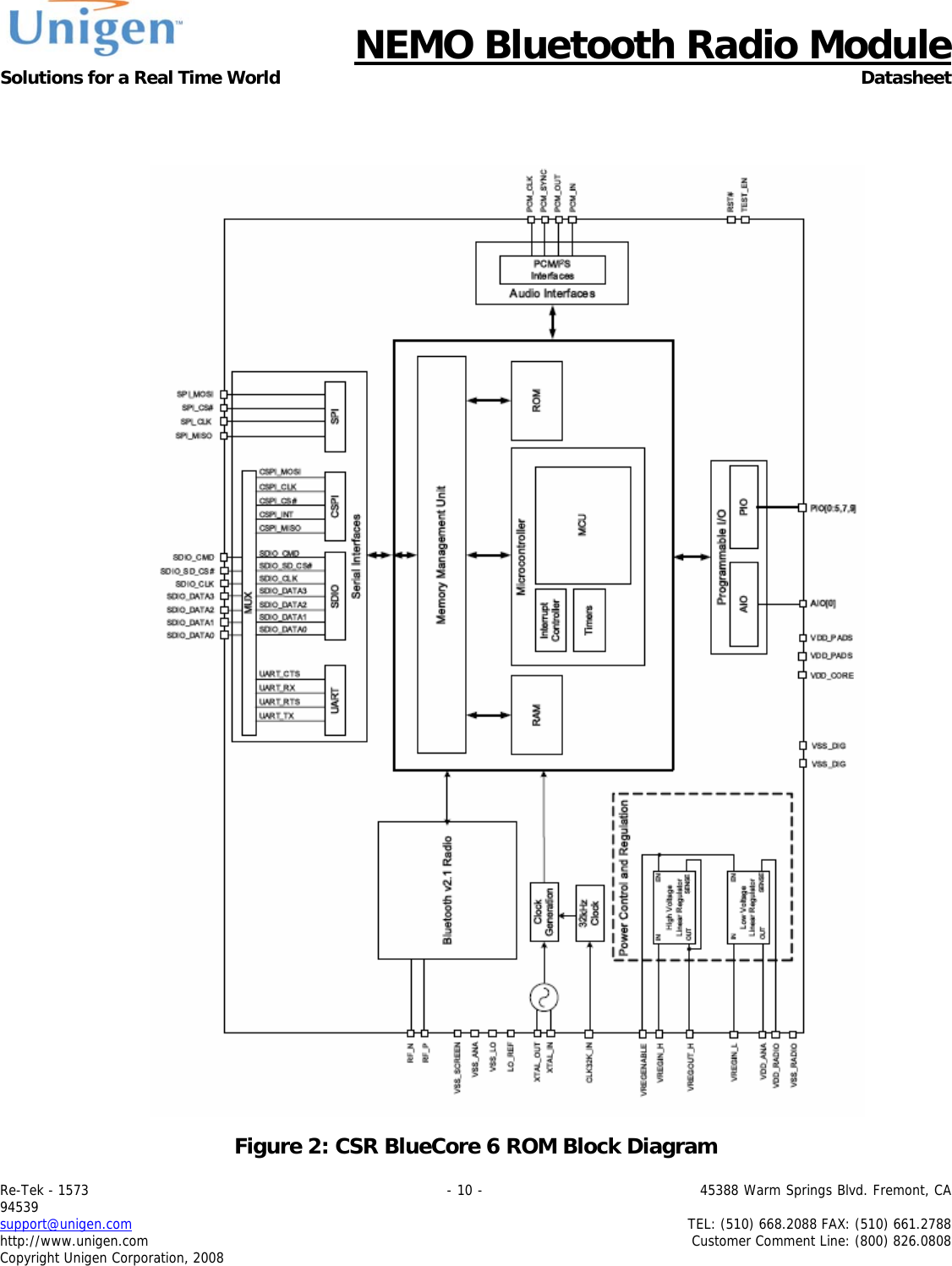
     NEMO Bluetooth Radio Module Solutions for a Real Time World Datasheet Re-Tek - 1573                                                                                 - 8 -                                          45388 Warm Springs Blvd. Fremont, CA 94539 support@unigen.com                     TEL: (510) 668.2088 FAX: (510) 661.2788 http://www.unigen.com  Customer Comment Line: (800) 826.0808 Copyright Unigen Corporation, 2008 PRODUCT DESCRIPTION  NEMO Module  The Nemo module is a complete 2.4GHz radio transceiver operating in the license free ISM (Industrial, Scientific and Medical) band. The Nemo module has CSR’s BlueCore 6 ROM Bluetooth solution. The CSR BlueCore 6 ROM is a single-chip radio and baseband IC for Bluetooth 2.4GHz systems including enhanced data rate (EDR) to 3Mbps. With the on-chip CSR Bluetooth software stack, it provides a fully compliant Bluetooth v2.1 + EDR specification system for data and voice communications. The module dimensions measure 6.5mm x 5.5mm x 1.5mm. A single 3.3V power supply input, single ended RF output/input, and a low 26 pin count makes the NEMO module easy to interface with.   CSR BlueCore 6 ROM Transceiver IC  BlueCore™6-ROM is a single-chip radio and baseband IC for Bluetooth 2.4 GHz systems including enhanced data rates (EDR) to 3Mbits/s. With the on-chip CSR Bluetooth software stack, it provides a fully compliant Bluetooth system to v2.1 of the specification for data and voice communications.  BlueCore6-ROM has been designed to reduce the number of external components required which ensures production costs are minimized. BlueCore6-ROM includes the AuriStream baseband CODEC, which offers significant power reduction over the CVSD based system when used at both ends of the link. The device incorporates auto-calibration and built-in self-test (BIST) routines to simplify development, type approval and production test. All hardware and device firmware is fully compliant with the Bluetooth v2.1 +EDR specification (all mandatory and optional features). To improve the performance of both Bluetooth and 802.11b/g co-located systems a wide range of coexistence features are available including a variety of hardware signaling: basic activity signaling and Intel WCS activity and channel signaling.
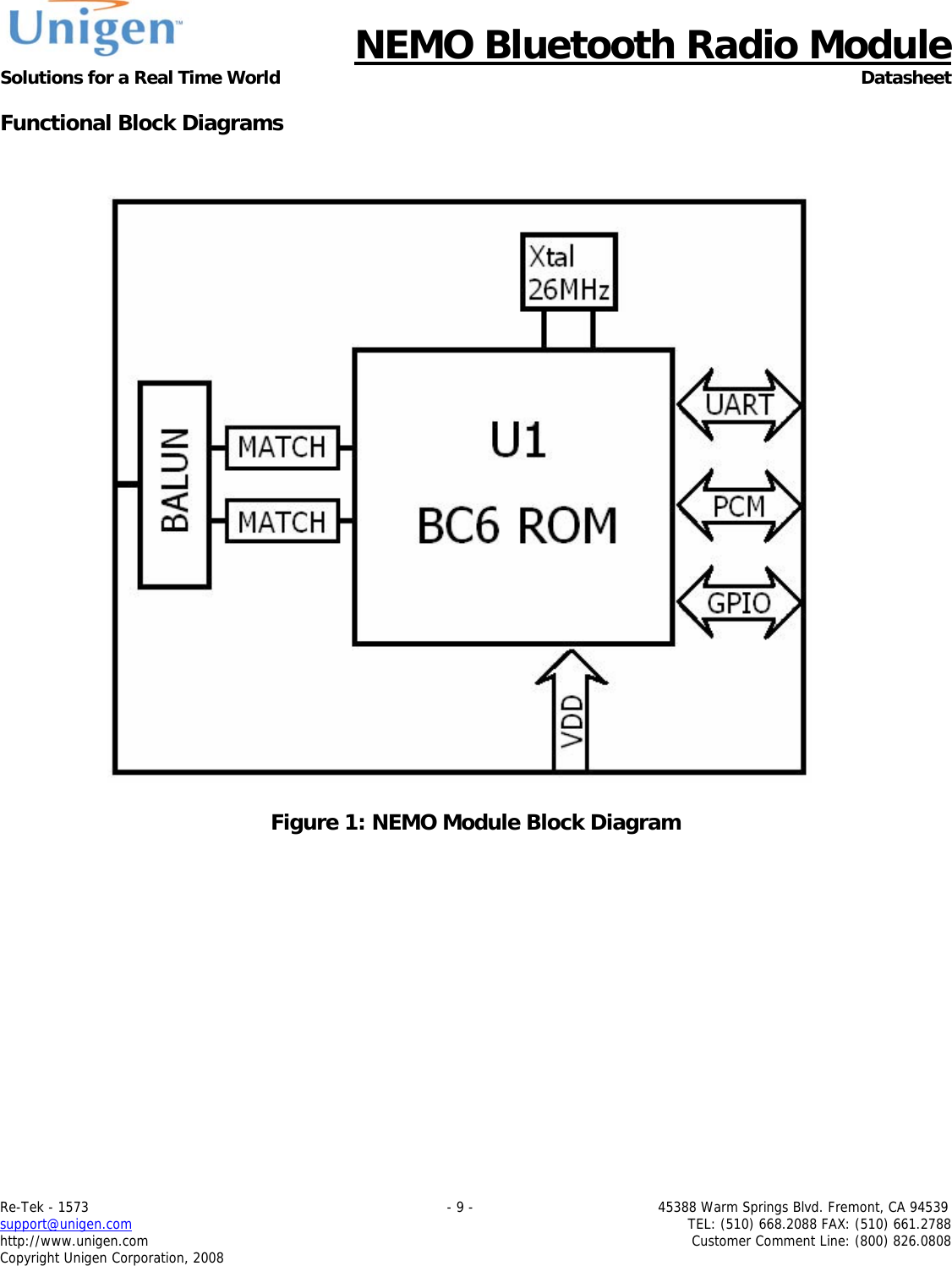
     NEMO Bluetooth Radio Module Solutions for a Real Time World Datasheet Re-Tek - 1573                                                                                 - 9 -                                          45388 Warm Springs Blvd. Fremont, CA 94539 support@unigen.com                     TEL: (510) 668.2088 FAX: (510) 661.2788 http://www.unigen.com  Customer Comment Line: (800) 826.0808 Copyright Unigen Corporation, 2008 Functional Block Diagrams     Figure 1: NEMO Module Block Diagram
     NEMO Bluetooth Radio Module Solutions for a Real Time World Datasheet Re-Tek - 1573                                                                                 - 10 -                                          45388 Warm Springs Blvd. Fremont, CA 94539 support@unigen.com                     TEL: (510) 668.2088 FAX: (510) 661.2788 http://www.unigen.com  Customer Comment Line: (800) 826.0808 Copyright Unigen Corporation, 2008   Figure 2: CSR BlueCore 6 ROM Block Diagram
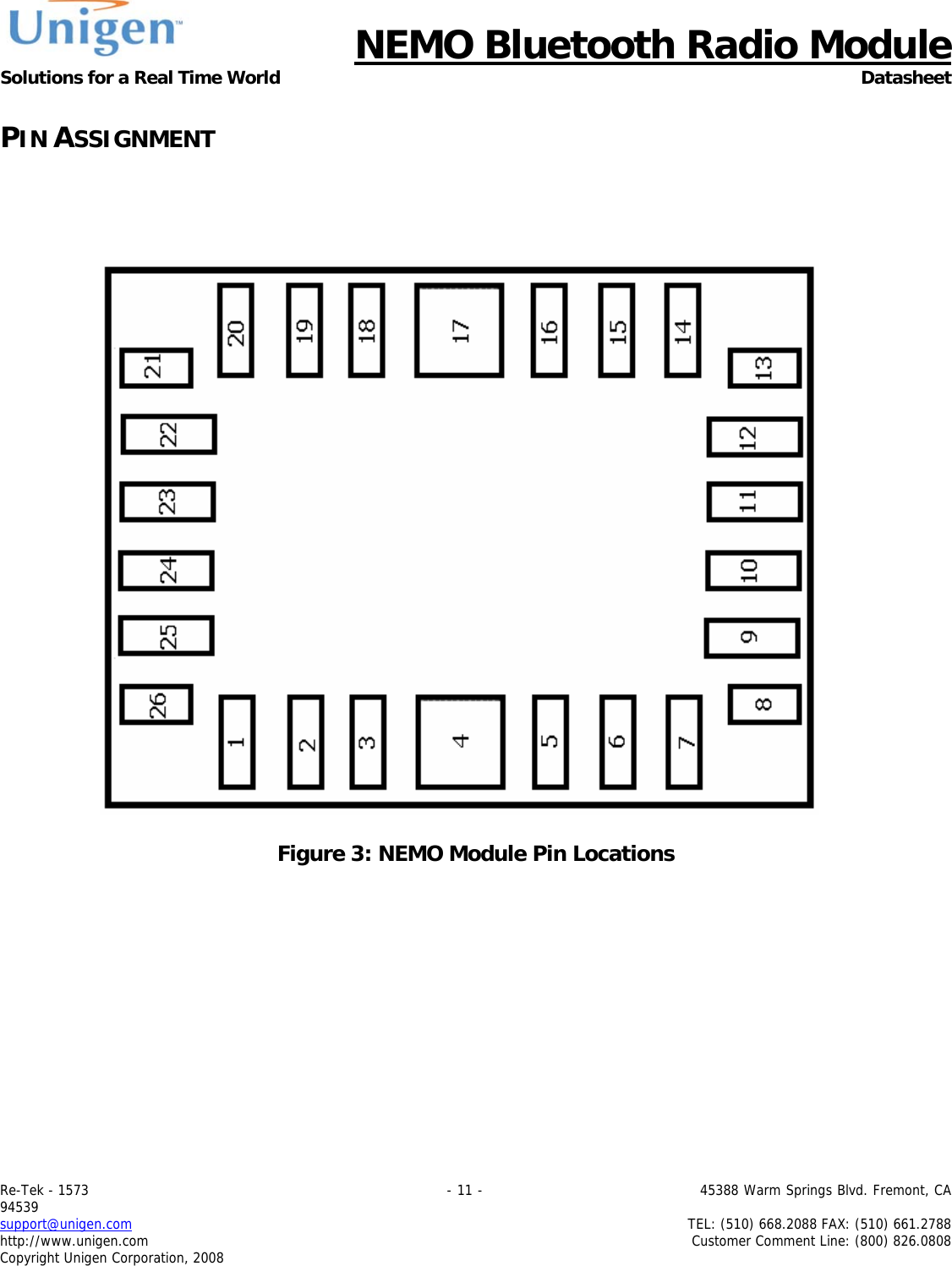
     NEMO Bluetooth Radio Module Solutions for a Real Time World Datasheet Re-Tek - 1573                                                                                 - 11 -                                          45388 Warm Springs Blvd. Fremont, CA 94539 support@unigen.com                     TEL: (510) 668.2088 FAX: (510) 661.2788 http://www.unigen.com  Customer Comment Line: (800) 826.0808 Copyright Unigen Corporation, 2008 PIN ASSIGNMENT       Figure 3: NEMO Module Pin Locations
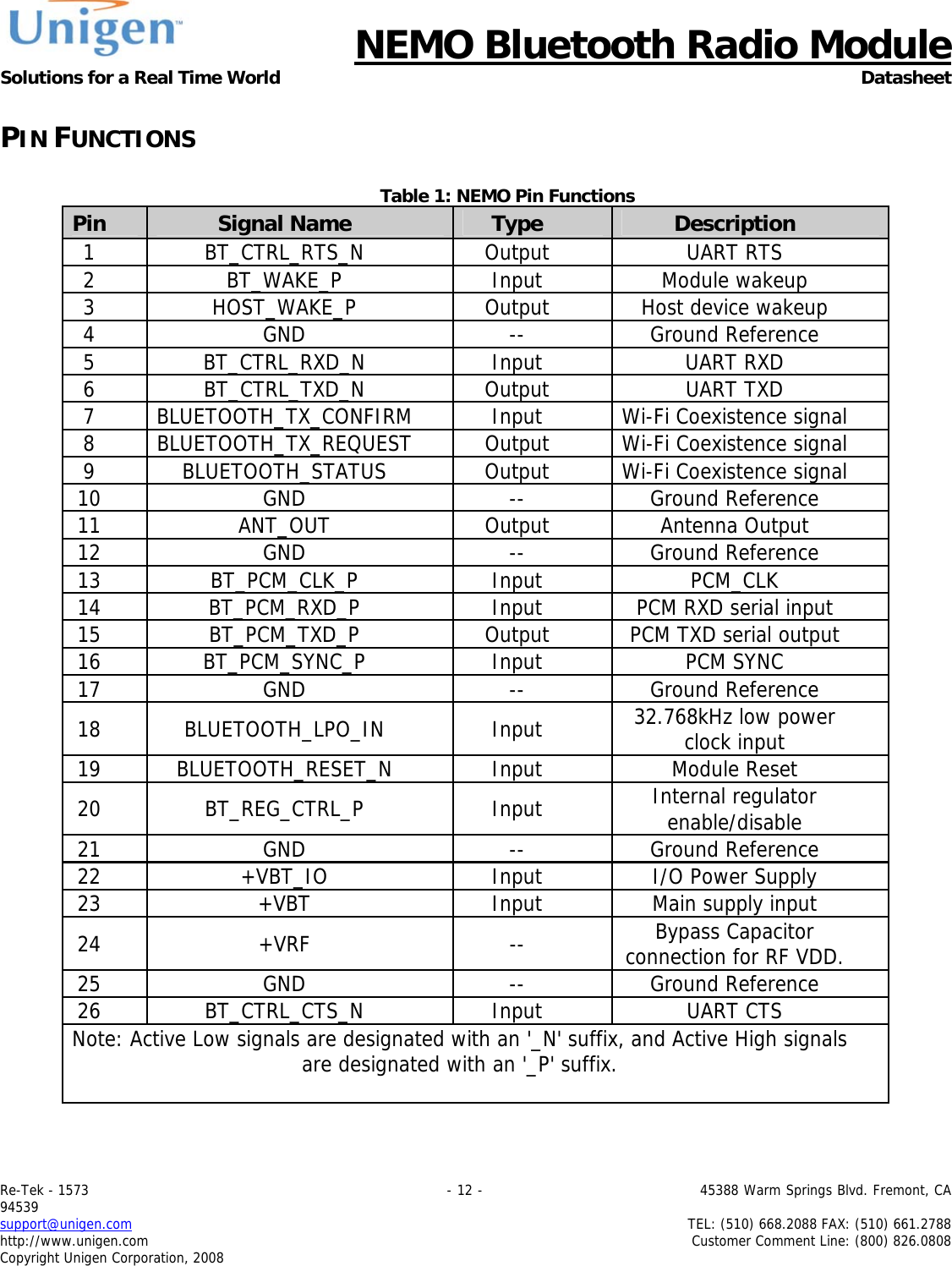
     NEMO Bluetooth Radio Module Solutions for a Real Time World Datasheet Re-Tek - 1573                                                                                 - 12 -                                          45388 Warm Springs Blvd. Fremont, CA 94539 support@unigen.com                     TEL: (510) 668.2088 FAX: (510) 661.2788 http://www.unigen.com  Customer Comment Line: (800) 826.0808 Copyright Unigen Corporation, 2008 PIN FUNCTIONS  Table 1: NEMO Pin Functions     Pin  Signal Name  Type  Description 1 BT_CTRL_RTS_N  Output  UART RTS 2 BT_WAKE_P  Input Module wakeup 3  HOST_WAKE_P  Output  Host device wakeup  4 GND  -- Ground Reference 5 BT_CTRL_RXD_N  Input  UART RXD 6 BT_CTRL_TXD_N  Output  UART TXD 7 BLUETOOTH_TX_CONFIRM Input Wi-Fi Coexistence signal 8  BLUETOOTH_TX_REQUEST  Output  Wi-Fi Coexistence signal 9  BLUETOOTH_STATUS  Output  Wi-Fi Coexistence signal 10 GND  -- Ground Reference 11 ANT_OUT  Output Antenna Output 12 GND  -- Ground Reference 13 BT_PCM_CLK_P  Input  PCM_CLK  14  BT_PCM_RXD_P  Input  PCM RXD serial input 15  BT_PCM_TXD_P  Output  PCM TXD serial output 16 BT_PCM_SYNC_P  Input  PCM SYNC  17 GND  -- Ground Reference 18 BLUETOOTH_LPO_IN  Input  32.768kHz low power clock input 19 BLUETOOTH_RESET_N  Input  Module Reset 20 BT_REG_CTRL_P  Input  Internal regulator enable/disable 21 GND  -- Ground Reference 22  +VBT_IO  Input  I/O Power Supply  23  +VBT  Input  Main supply input  24 +VRF  -- Bypass Capacitor connection for RF VDD. 25 GND  -- Ground Reference 26 BT_CTRL_CTS_N  Input  UART CTS Note: Active Low signals are designated with an '_N' suffix, and Active High signals are designated with an '_P' suffix.
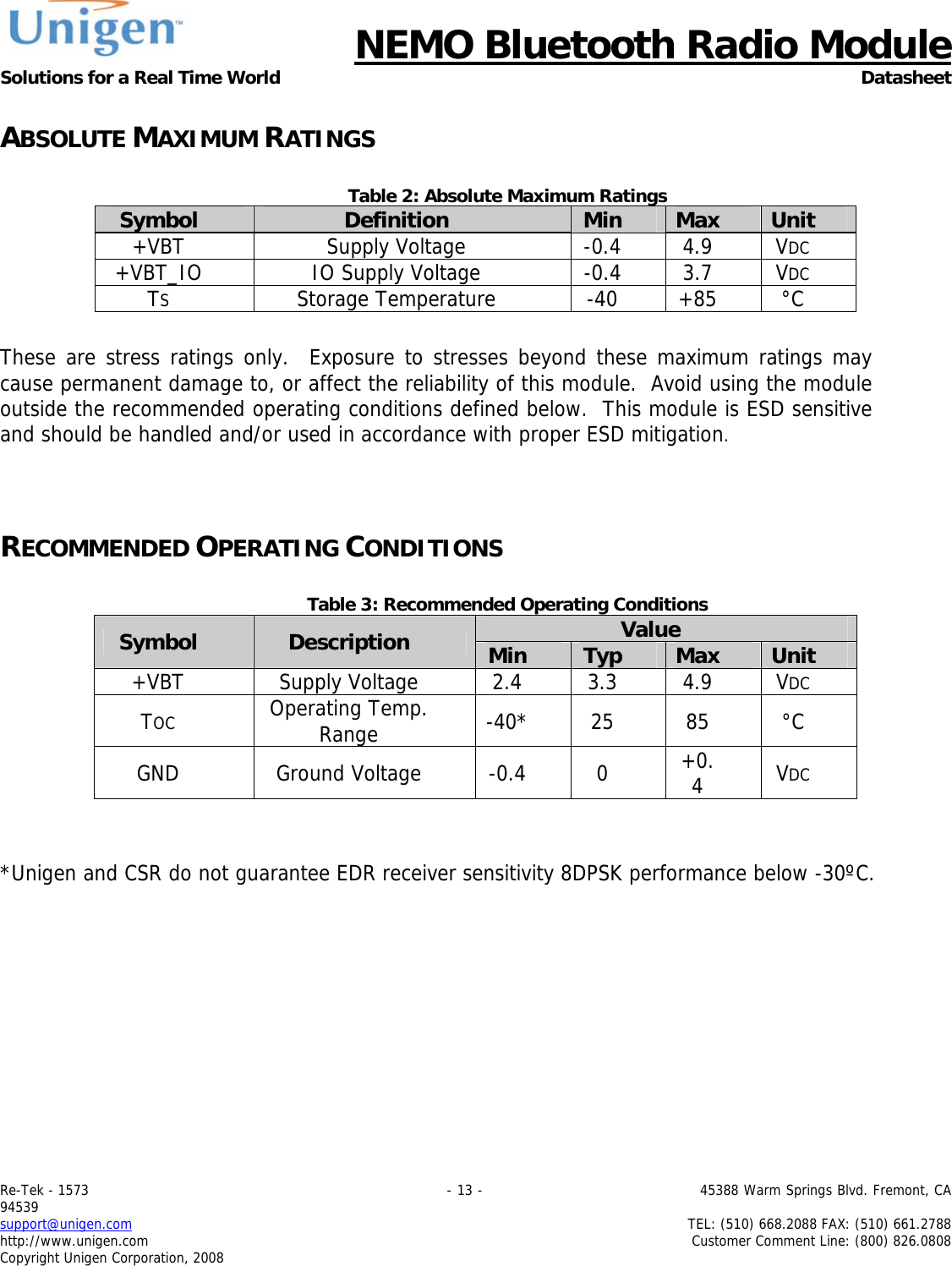
     NEMO Bluetooth Radio Module Solutions for a Real Time World Datasheet Re-Tek - 1573                                                                                 - 13 -                                          45388 Warm Springs Blvd. Fremont, CA 94539 support@unigen.com                     TEL: (510) 668.2088 FAX: (510) 661.2788 http://www.unigen.com  Customer Comment Line: (800) 826.0808 Copyright Unigen Corporation, 2008 ABSOLUTE MAXIMUM RATINGS  Table 2: Absolute Maximum Ratings Symbol  Definition  Min  Max  Unit +VBT Supply Voltage -0.4 4.9 VDC +VBT_IO IO Supply Voltage -0.4 3.7 VDC TS Storage Temperature -40 +85 °C  These are stress ratings only.  Exposure to stresses beyond these maximum ratings may cause permanent damage to, or affect the reliability of this module.  Avoid using the module outside the recommended operating conditions defined below.  This module is ESD sensitive and should be handled and/or used in accordance with proper ESD mitigation.   RECOMMENDED OPERATING CONDITIONS  Table 3: Recommended Operating Conditions Value Symbol  Description  Min  Typ  Max  Unit +VBT  Supply Voltage  2.4 3.3 4.9 VDC TOC Operating Temp. Range  -40* 25  85  °C GND Ground Voltage -0.4 0 +0.4  VDC  *Unigen and CSR do not guarantee EDR receiver sensitivity 8DPSK performance below -30ºC.
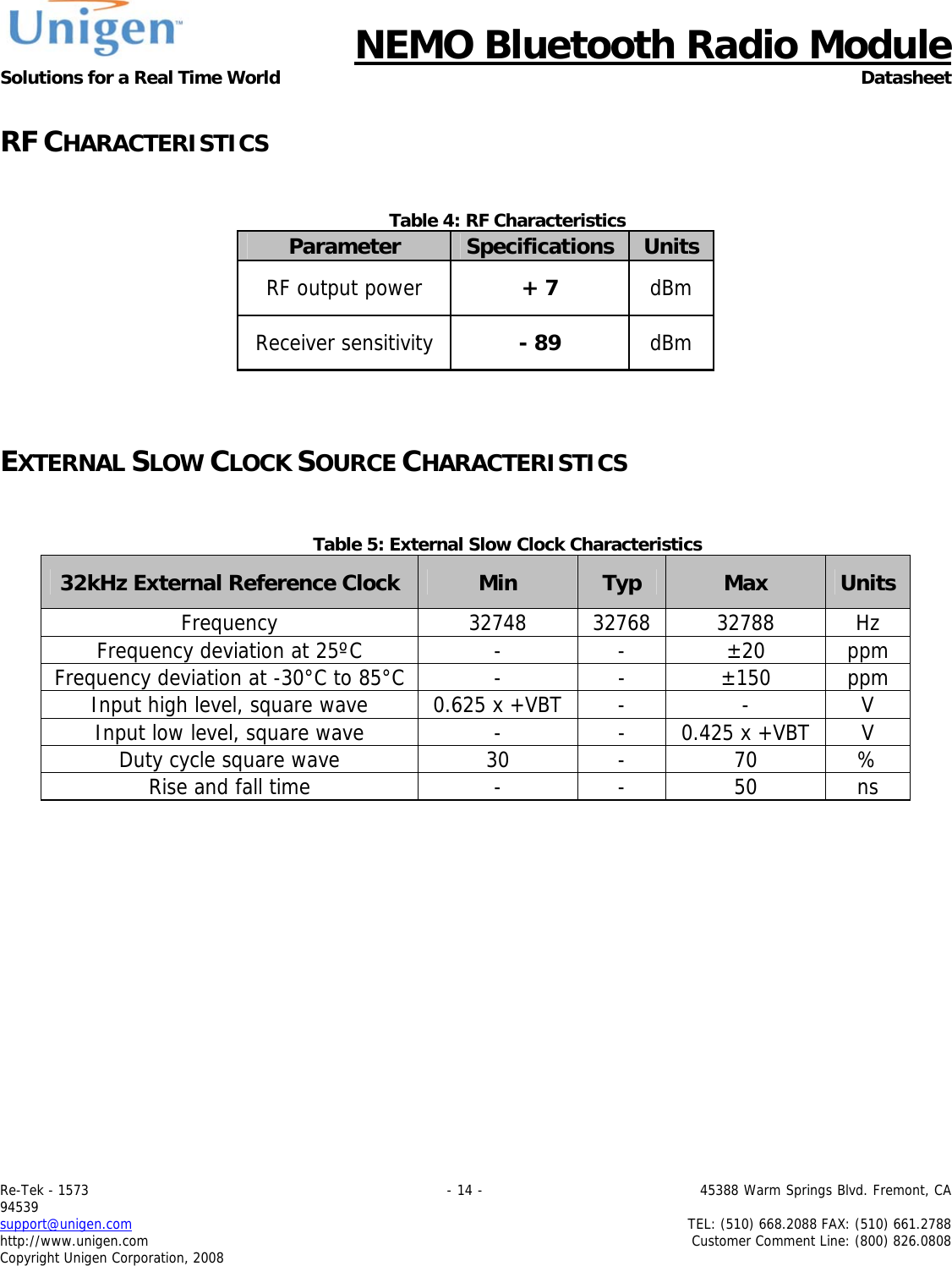
     NEMO Bluetooth Radio Module Solutions for a Real Time World Datasheet Re-Tek - 1573                                                                                 - 14 -                                          45388 Warm Springs Blvd. Fremont, CA 94539 support@unigen.com                     TEL: (510) 668.2088 FAX: (510) 661.2788 http://www.unigen.com  Customer Comment Line: (800) 826.0808 Copyright Unigen Corporation, 2008  RF CHARACTERISTICS   Table 4: RF Characteristics Parameter  Specifications Units RF output power  + 7  dBm Receiver sensitivity  - 89  dBm   EXTERNAL SLOW CLOCK SOURCE CHARACTERISTICS   Table 5: External Slow Clock Characteristics 32kHz External Reference Clock  Min  Typ  Max  UnitsFrequency 32748 32768 32788 Hz Frequency deviation at 25ºC  -  -  ±20  ppm Frequency deviation at -30°C to 85°C -  -  ±150  ppm Input high level, square wave  0.625 x +VBT -  -  V Input low level, square wave  -  -  0.425 x +VBT V Duty cycle square wave  30  -  70  % Rise and fall time  -  -  50  ns
     NEMO Bluetooth Radio Module Solutions for a Real Time World  Datasheet Re-Tek - 1573    - 15 -  45388 Warm Springs Blvd. Fremont, CA 94539 support@unigen.com    TEL: (510) 668.2088 FAX: (510) 661.2788 http://www.unigen.com  Customer Comment Line: (800) 826.0808 Copyright Unigen Corporation, 2008  AGENCY CERTIFICATIONS (PRE-SCAN)  TBD  REGULATORY COMPLIANCE STATEMENT  TBD
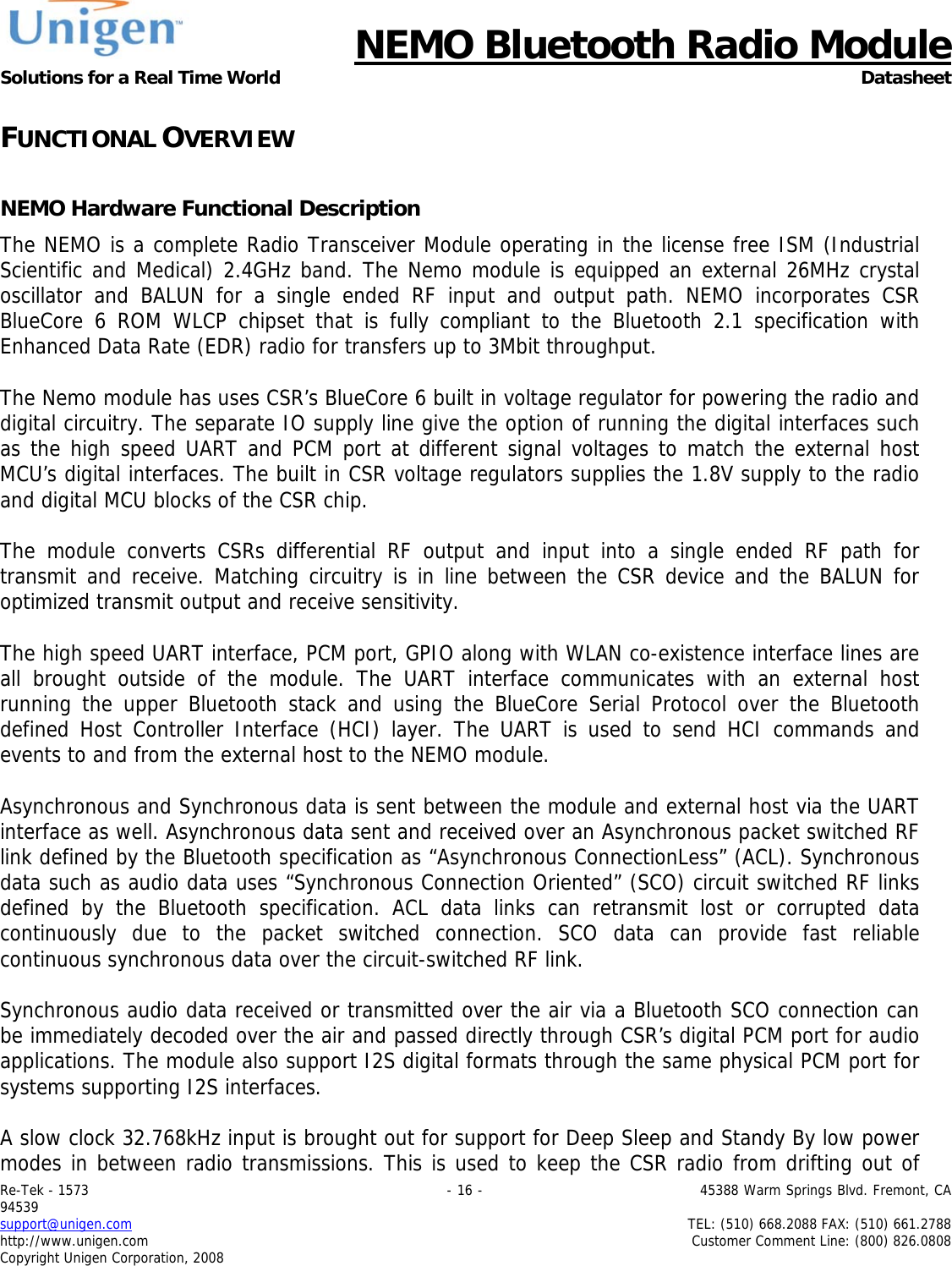
     NEMO Bluetooth Radio Module Solutions for a Real Time World Datasheet Re-Tek - 1573                                                                                 - 16 -                                          45388 Warm Springs Blvd. Fremont, CA 94539 support@unigen.com                     TEL: (510) 668.2088 FAX: (510) 661.2788 http://www.unigen.com  Customer Comment Line: (800) 826.0808 Copyright Unigen Corporation, 2008 FUNCTIONAL OVERVIEW  NEMO Hardware Functional Description The NEMO is a complete Radio Transceiver Module operating in the license free ISM (Industrial Scientific and Medical) 2.4GHz band. The Nemo module is equipped an external 26MHz crystal oscillator and BALUN for a single ended RF input and output path. NEMO incorporates CSR BlueCore 6 ROM WLCP chipset that is fully compliant to the Bluetooth 2.1 specification with Enhanced Data Rate (EDR) radio for transfers up to 3Mbit throughput.   The Nemo module has uses CSR’s BlueCore 6 built in voltage regulator for powering the radio and digital circuitry. The separate IO supply line give the option of running the digital interfaces such as the high speed UART and PCM port at different signal voltages to match the external host MCU’s digital interfaces. The built in CSR voltage regulators supplies the 1.8V supply to the radio and digital MCU blocks of the CSR chip.   The module converts CSRs differential RF output and input into a single ended RF path for transmit and receive. Matching circuitry is in line between the CSR device and the BALUN for optimized transmit output and receive sensitivity.   The high speed UART interface, PCM port, GPIO along with WLAN co-existence interface lines are all brought outside of the module. The UART interface communicates with an external host running the upper Bluetooth stack and using the BlueCore Serial Protocol over the Bluetooth defined Host Controller Interface (HCI) layer. The UART is used to send HCI commands and events to and from the external host to the NEMO module.   Asynchronous and Synchronous data is sent between the module and external host via the UART interface as well. Asynchronous data sent and received over an Asynchronous packet switched RF link defined by the Bluetooth specification as “Asynchronous ConnectionLess” (ACL). Synchronous data such as audio data uses “Synchronous Connection Oriented” (SCO) circuit switched RF links defined by the Bluetooth specification. ACL data links can retransmit lost or corrupted data continuously due to the packet switched connection. SCO data can provide fast reliable continuous synchronous data over the circuit-switched RF link.   Synchronous audio data received or transmitted over the air via a Bluetooth SCO connection can be immediately decoded over the air and passed directly through CSR’s digital PCM port for audio applications. The module also support I2S digital formats through the same physical PCM port for systems supporting I2S interfaces.   A slow clock 32.768kHz input is brought out for support for Deep Sleep and Standy By low power modes in between radio transmissions. This is used to keep the CSR radio from drifting out of
     NEMO Bluetooth Radio Module Solutions for a Real Time World Datasheet Re-Tek - 1573                                                                                 - 17 -                                          45388 Warm Springs Blvd. Fremont, CA 94539 support@unigen.com                     TEL: (510) 668.2088 FAX: (510) 661.2788 http://www.unigen.com  Customer Comment Line: (800) 826.0808 Copyright Unigen Corporation, 2008 sync from the remote Bluetooth device during an active connection with “dead silence” and allows BlueCore to enter Deep Sleep low power mode during “dead silence” to conserve power consumption.   NEMO Firmware Functional Description  The Nemo module incorporates the CSR BlueCore 6 ROM chipset and ROM Bluetooth firmware. The firmware controls the CSR internal MCU, IO handling, radio control and also incorporates the lower Bluetooth protocol stack. The lower stack includes the Link Controller (LC), Link Manager or Link Manager Protocol (LM, LMP), Bluetooth radio Baseband (BB). These Bluetooth protocol stack components are all qualified to the Bluetooth v2.1+ EDR specification supporting all features such as Adaptive Frequency Hopping “AFH”, low power mode link modes (Hold, Sniff, Park) end Extended Synchronous Connection Oriented (eSCO) links.   The lower stack is a prequalified Bluetooth component. This means that the lower stack and baseband has already been tested and recognized by the Bluetooth Special Interest Group (SIG) as a working qualified software stack. No further testing of these lower stack components are necessary when seeking Bluetooth qualification. Protocol Implementation Conformance Statement (PICS) can be obtained from CSR or the Bluetooth SIG and submitted for these particular test cases and bypassed.   The firmware is burned into ROM within the CSR BlueCore 6 chipset. There is no need to load the firmware from an external memory device or from the host via a communication interface. The Nemo module and CSR chipset is initialized via a small subset of registers (PSKEYS) that can easily be programmed via the UART interface. These PSKEYS configure and control the radio behavior, interfaces (UART baud rate, PCM settings, etc), and holds information such as the Bluetooth address and country code of operation. Detailed descriptions of the necessary PSKEY that need to be set are discussed later in this document.
     NEMO Bluetooth Radio Module Solutions for a Real Time World Datasheet Re-Tek - 1573                                                                                 - 18 -                                          45388 Warm Springs Blvd. Fremont, CA 94539 support@unigen.com                     TEL: (510) 668.2088 FAX: (510) 661.2788 http://www.unigen.com  Customer Comment Line: (800) 826.0808 Copyright Unigen Corporation, 2008 CSR BLUETOOTH SOFTWARE STACK   NEMO is supplied with the CSR BlueCore 6 ROM chip. CSR’s BlueCOre 6 ROM contains the lower layers of the Bluetooth stack. The stack is Bluetooth v2.1+EDR compliant and runs on the internal RISC microcontroller within BlueCore. The implementation shown below illustrates the internal processor of BlueCore running the Bluetooth stack up to the Host Controller Interface (HCI). The external host processor, external to NEMO, must provide all the upper layers of the Bluetooth stack including the application.      Figure 4: BlueCore Bluetooth HCI Stack
     NEMO Bluetooth Radio Module Solutions for a Real Time World  Datasheet Re-Tek - 1573    - 19 -  45388 Warm Springs Blvd. Fremont, CA 94539 support@unigen.com    TEL: (510) 668.2088 FAX: (510) 661.2788 http://www.unigen.com  Customer Comment Line: (800) 826.0808 Copyright Unigen Corporation, 2008 Key Features of the HCI Stack: Standard Bluetooth Functionality  CSR supports the following Bluetooth v2.1 + EDR functionality:  • Secure simple pairing • Sniff subrating • Encryption pause resume • Packet boundary flags • Encryption • Extended inquiry response  CSR supports the following Bluetooth v2.0 + EDR mandatory functionality:  • Adaptive frequency hopping (AFH), including classifier • Faster connection - enhanced inquiry scan (immediate FHS response) • LMP improvements • Parameter ranges  Optional Bluetooth v2.0 + EDR functionality supported:  • Adaptive Frequency Hopping (AFH) as Master and Automatic Channel Classification • Fast Connect - Interlaced Inquiry and Page Scan plus RSSI during Inquiry • Extended SCO (eSCO), eV3 +CRC, eV4, eV5 • SCO handle • Synchronization
     NEMO Bluetooth Radio Module Solutions for a Real Time World  Datasheet Re-Tek - 1573    - 20 -  45388 Warm Springs Blvd. Fremont, CA 94539 support@unigen.com    TEL: (510) 668.2088 FAX: (510) 661.2788 http://www.unigen.com  Customer Comment Line: (800) 826.0808 Copyright Unigen Corporation, 2008  The firmware was written against the Bluetooth v2.0+EDR specification.  • Bluetooth components: o Baseband (including LC) o LM o HCI • Standard UART HCI Transport Layers • All standard Bluetooth radio packet types • Full Bluetooth data rate, enhanced data rates of 2 and 3Mbps • Operation with up to seven active slaves • Scatternet v2.5 operation • Maximum number of simultaneous active ACL connections: 7 • Maximum number of simultaneous active SCO connections: 3 • Operation with up to three SCO links, routed to one or more slaves • All standard SCO voice coding, plus transparent SCO • Standard operating modes: Page, Inquiry, Page-Scan and Inquiry-Scan • All standard pairing, authentication, link key and encryption operations • Standard Bluetooth power saving mechanisms: Hold, Sniff and Park modes, including Forced Hold • Dynamic control of peers' transmit power via LMP • Master/Slave switch • Broadcast • Channel quality driven data rate • All standard Bluetooth test modes   The firmware's supported Bluetooth features are detailed in the standard Protocol Implementation Conformance Statement (PICS) documents, available from http://www.csr.com.
     NEMO Bluetooth Radio Module Solutions for a Real Time World  Datasheet Re-Tek - 1573    - 21 -  45388 Warm Springs Blvd. Fremont, CA 94539 support@unigen.com    TEL: (510) 668.2088 FAX: (510) 661.2788 http://www.unigen.com  Customer Comment Line: (800) 826.0808 Copyright Unigen Corporation, 2008 Key Features of the HCI Stack: Extra Functionality  The firmware extends the standard Bluetooth functionality with the following features:  • Supports BlueCore Serial Protocol (BCSP), a proprietary, reliable alternative to the standard Bluetooth UART Host Transport • Provides a set of approximately 50 manufacturer-specific HCI extension commands. This command set, called BlueCore Command (BCCMD), provides: o Access to the chip's general-purpose PIO port o The negotiated effective encryption key length on established Bluetooth links o Access to the firmware's random number generator o Controls to set the default and maximum transmit powers; these can help minimize interference between overlapping, fixed-location piconets o Dynamic UART configuration o Bluetooth radio transmitter enable/disable. A simple command connects to a dedicated hardware switch that determines whether the radio can transmit. • A block of BCCMD commands provides access to the chip's Persistent Store (PS) configuration database. The database sets the device's Bluetooth address, Class of Device, Bluetooth radio (transmit class) configuration, SCO routing, LM, constants, etc. • A UART break condition can be used in three ways: o Presenting a UART break condition to the chip can force the chip to perform a hardware reboot o Presenting a break condition at boot time can hold the chip in a low power state, preventing normal initialization while the condition exists o With BCSP, the firmware can be configured to send a break to the host before sending data. (This is normally used to wake the host from a Deep-Sleep state.) • A block of Bluetooth radio test or BIST commands allows direct control of the chip's radio. This aids the development of modules' radio designs, and can be used to support Bluetooth qualification. • Hardware low power modes: Shallow Sleep and Deep-Sleep. The chip drops into modes that significantly reduce power consumption when the software goes idle. • SCO channels are normally routed via HCI (over BCSP). However, up to three SCO channels can be routed over the chip's PCM ports (at the same time as routing any remaining SCO channels over HCI).   For more details on the CSR Bluetooth stack, limitations and firmware refer to CSR’s firmware release note “BlueCore Unified 23c Release Note (CS-116212-RNP3).pdf”
     NEMO Bluetooth Radio Module Solutions for a Real Time World  Datasheet Re-Tek - 1573    - 22 -  45388 Warm Springs Blvd. Fremont, CA 94539 support@unigen.com    TEL: (510) 668.2088 FAX: (510) 661.2788 http://www.unigen.com  Customer Comment Line: (800) 826.0808 Copyright Unigen Corporation, 2008 DIGITAL INTERFACES  High Speed UART Interface  NEMO uses a standard UART interface for communicating to other serial devices. Four signals from NEMO implement the UART function. The signal operation amplitude can be varied with the external +VBT_IO supply pin. This is useful for different systems that support different digital communication amplitudes such as 3.3V or 1.8V. When NEMO is connected to another digital device, BT_CTRL_RXD_N and BT_CTRL_TXD_N transfer data between the two devices. The other two remaining UART pins, BT_CTRL_RTS_N and BT_CTRL_CTS_N, can be used as hardware flow control signal as used in RS232 communications.   The high speed UART can support up to 4Mbits in throughput which is needed for data transfers using EDR RF link payloads with 3Mbit over the air throughput. The baud rate and other configuration parameters can be set via the firmware and PSKEYs during bootup and initialization.    BlueCore Serial Protocol (BCSP)   This document only describes CSR’s BlueCore Serial Protocol overview and does not go into detail on BCSP implementation, packet structure and stack elements. Please refer to CSR’s “BlueCore Serial Protocol (bcore-sp-012Pb).pdf” document for more a detailed explanation and implementation. BCSP must be implemented on the Host to communicate to the NEMO module.   BlueCore Serial Protocol (BCSP) is a protocol used to carry data that flow through a reliable UART link. The Bluetooth stack has been designed to transfer data between a Bluetooth Host and a Host Controller (NEMO). The Bluetooth stack is intended to be used to carry the Bluetooth HCI (Host Controller Interface) protocols plus several others. BCSP is intended to be used with CSR based Host Controllers (NEMO), which provides hardware to support much of the Bluetooth stack functionality.
     NEMO Bluetooth Radio Module Solutions for a Real Time World Datasheet Re-Tek - 1573                                                                                 - 23 -                                          45388 Warm Springs Blvd. Fremont, CA 94539 support@unigen.com                     TEL: (510) 668.2088 FAX: (510) 661.2788 http://www.unigen.com  Customer Comment Line: (800) 826.0808 Copyright Unigen Corporation, 2008  Figure 5: UART Host Connection     BCSP is used to control and format information that flows between the Bluetooth Host and the NEMO modules. The Bluetooth stack carries a set of parallel information that flows between the two process entities, multiplexing them over the single UART link.    Figure 6: BCSP Context   An instance of the BCSP stack runs on both the Host and the Host Controller (NEMO). The BCSP stack is layered above the UART on each side.
     NEMO Bluetooth Radio Module Solutions for a Real Time World Datasheet Re-Tek - 1573                                                                                 - 24 -                                          45388 Warm Springs Blvd. Fremont, CA 94539 support@unigen.com                     TEL: (510) 668.2088 FAX: (510) 661.2788 http://www.unigen.com  Customer Comment Line: (800) 826.0808 Copyright Unigen Corporation, 2008  The top of the BCSP stack presents:  • One bidirectional reliable datagram service • One bidirectional unreliable datagram service  The BCSP protocol is defined to run on a 3-wire UART connection (TXD, RXD, & GND). However, BCSP can also run on a 5 wire UART connection (TXD, RXD, GND, CTS, RTS) which is common for higher baud rates.   BLUECORE COMMAND (BCCMD) PROTOCOL  This document only gives an overview of CSR’s BCCMD Protocol overview and does not go into detail on BCCMD implementation, command set and events. The BlueCore Command Protocol (BCCMD) is used to configure parameters such as UART Baud Rate, Bluetooth address and initiate NEMO’s radio. BCCMD and BCSP are protocols that need to be implemented on the Host connected to NEMO via the UART interface. For detailed information and implementation of CSR’s BCCMD Protocol please refer to CSR’s “BCCMD Protocol (bcore-sp-002Pc).pdf” document.  BCCMD describes a software interface to a command interpreter on a CSR BlueCore Bluetooth device, in this case the BlueCore 6 ROM chip inside NEMO. The command interpreter presents commands and events that allow monitoring and control of specific CSR ship functions outside of the Bluetooth stack protocol. The command set is not part of the Bluetooth protocol.   BCCMD allows the software on the Bluetooth Host to control and monitor the CSR BlueCore ship and flows alongside the normal Host Controller Interface (HCI) channels. The BCCMD protocol is carried over the UART link over a BCSP channel.   Figure 7: BCCMD Interface
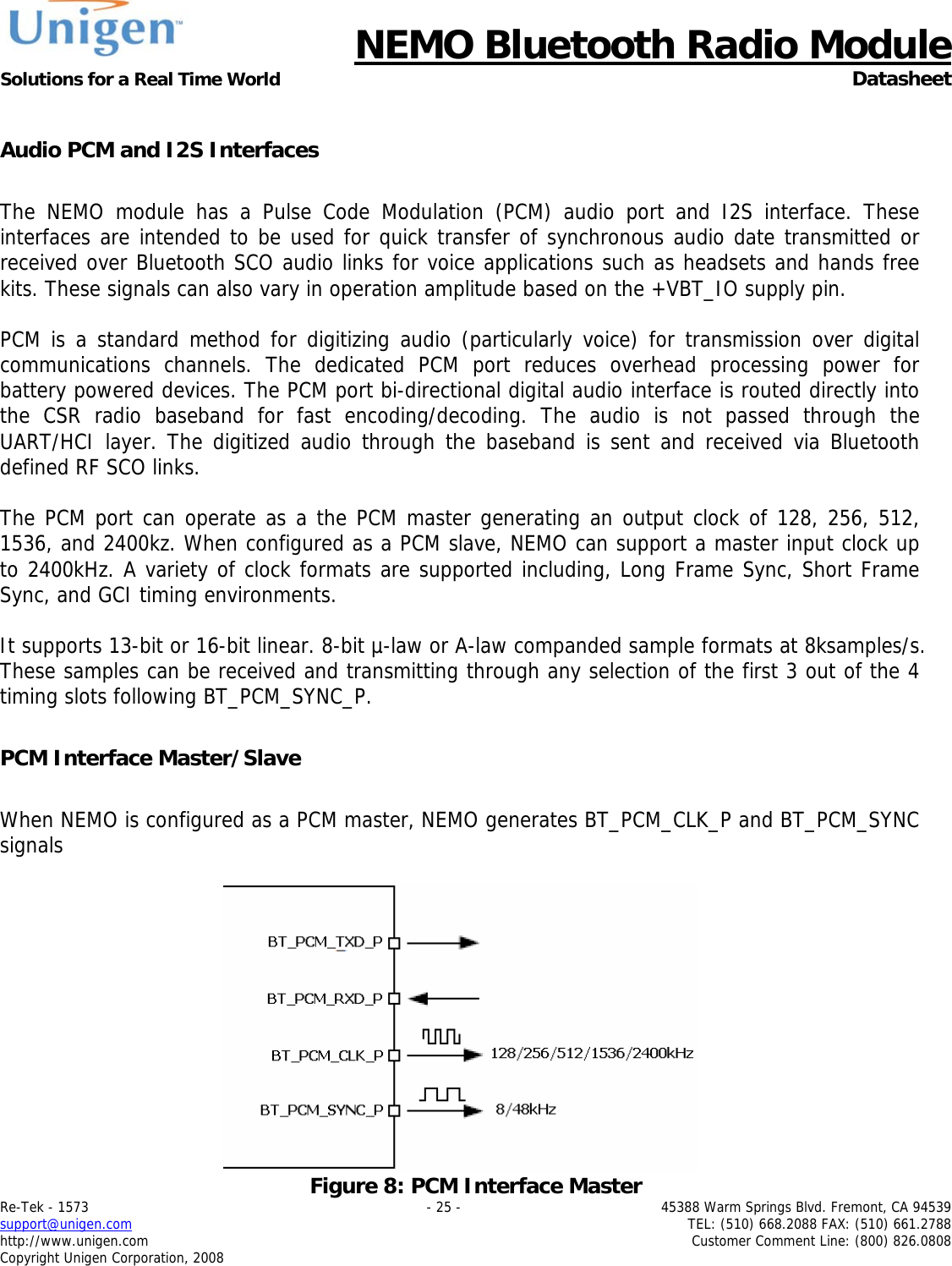
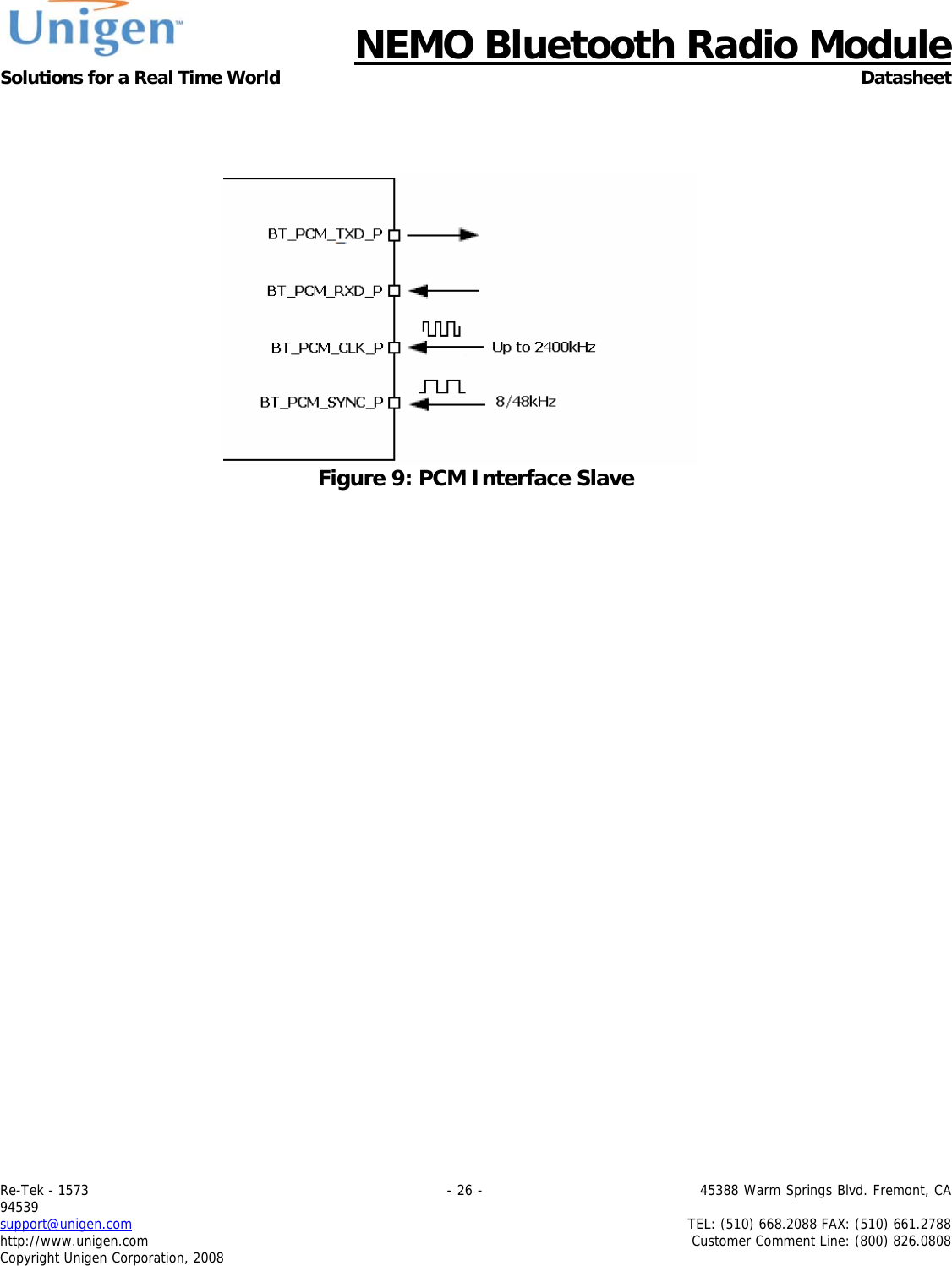
     NEMO Bluetooth Radio Module Solutions for a Real Time World  Datasheet Re-Tek - 1573    - 25 -  45388 Warm Springs Blvd. Fremont, CA 94539 support@unigen.com    TEL: (510) 668.2088 FAX: (510) 661.2788 http://www.unigen.com  Customer Comment Line: (800) 826.0808 Copyright Unigen Corporation, 2008  Audio PCM and I2S Interfaces  The NEMO module has a Pulse Code Modulation (PCM) audio port and I2S interface. These interfaces are intended to be used for quick transfer of synchronous audio date transmitted or received over Bluetooth SCO audio links for voice applications such as headsets and hands free kits. These signals can also vary in operation amplitude based on the +VBT_IO supply pin.   PCM is a standard method for digitizing audio (particularly voice) for transmission over digital communications channels. The dedicated PCM port reduces overhead processing power for battery powered devices. The PCM port bi-directional digital audio interface is routed directly into the CSR radio baseband for fast encoding/decoding. The audio is not passed through the UART/HCI layer. The digitized audio through the baseband is sent and received via Bluetooth defined RF SCO links.   The PCM port can operate as a the PCM master generating an output clock of 128, 256, 512, 1536, and 2400kz. When configured as a PCM slave, NEMO can support a master input clock up to 2400kHz. A variety of clock formats are supported including, Long Frame Sync, Short Frame Sync, and GCI timing environments.   It supports 13-bit or 16-bit linear. 8-bit µ-law or A-law companded sample formats at 8ksamples/s. These samples can be received and transmitting through any selection of the first 3 out of the 4 timing slots following BT_PCM_SYNC_P.   PCM Interface Master/Slave  When NEMO is configured as a PCM master, NEMO generates BT_PCM_CLK_P and BT_PCM_SYNC signals    Figure 8: PCM Interface Master
     NEMO Bluetooth Radio Module Solutions for a Real Time World Datasheet Re-Tek - 1573                                                                                 - 26 -                                          45388 Warm Springs Blvd. Fremont, CA 94539 support@unigen.com                     TEL: (510) 668.2088 FAX: (510) 661.2788 http://www.unigen.com  Customer Comment Line: (800) 826.0808 Copyright Unigen Corporation, 2008     Figure 9: PCM Interface Slave
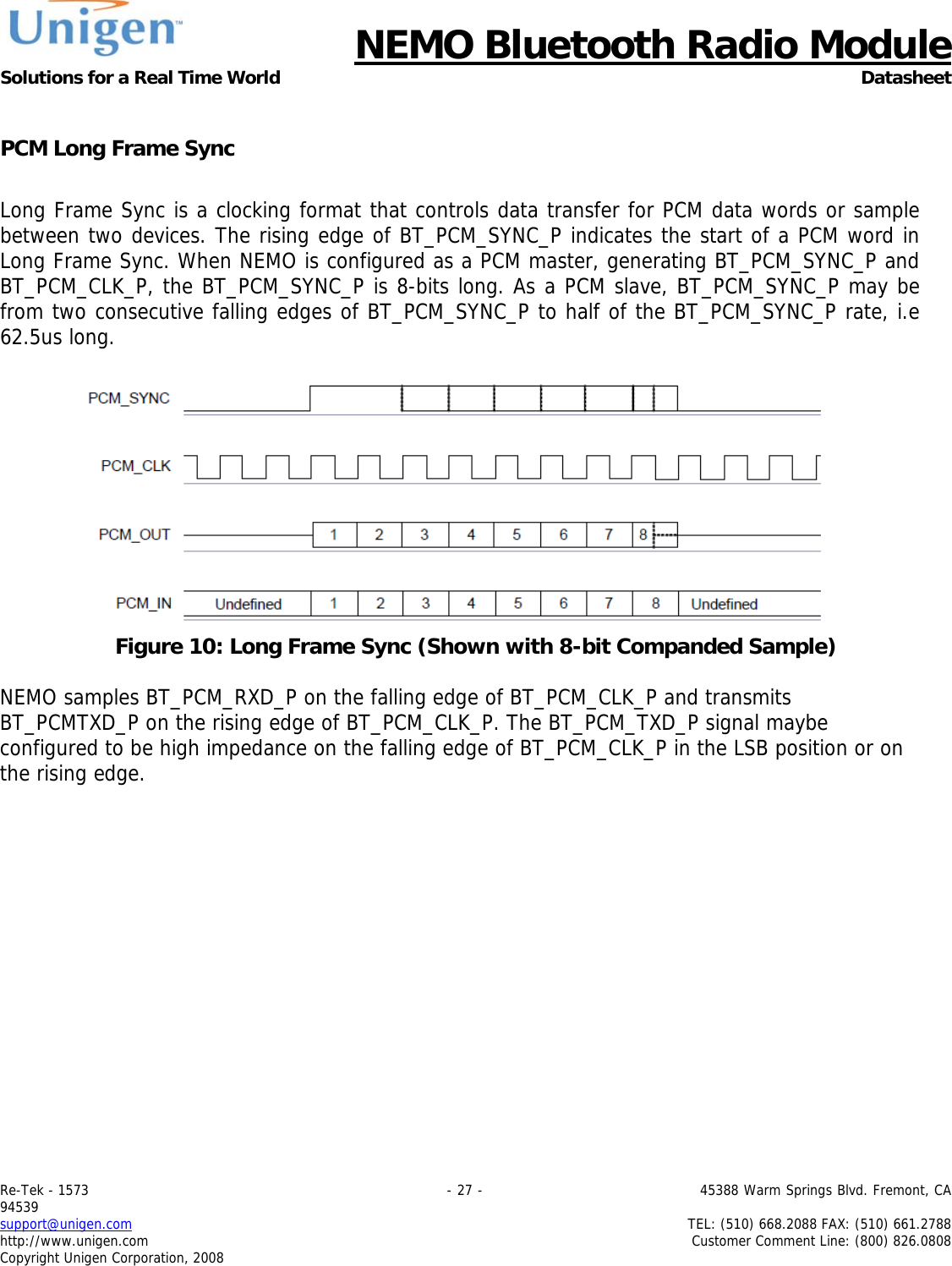
     NEMO Bluetooth Radio Module Solutions for a Real Time World Datasheet Re-Tek - 1573                                                                                 - 27 -                                          45388 Warm Springs Blvd. Fremont, CA 94539 support@unigen.com                     TEL: (510) 668.2088 FAX: (510) 661.2788 http://www.unigen.com  Customer Comment Line: (800) 826.0808 Copyright Unigen Corporation, 2008  PCM Long Frame Sync  Long Frame Sync is a clocking format that controls data transfer for PCM data words or sample between two devices. The rising edge of BT_PCM_SYNC_P indicates the start of a PCM word in Long Frame Sync. When NEMO is configured as a PCM master, generating BT_PCM_SYNC_P and BT_PCM_CLK_P, the BT_PCM_SYNC_P is 8-bits long. As a PCM slave, BT_PCM_SYNC_P may be from two consecutive falling edges of BT_PCM_SYNC_P to half of the BT_PCM_SYNC_P rate, i.e 62.5us long.    Figure 10: Long Frame Sync (Shown with 8-bit Companded Sample)  NEMO samples BT_PCM_RXD_P on the falling edge of BT_PCM_CLK_P and transmits BT_PCMTXD_P on the rising edge of BT_PCM_CLK_P. The BT_PCM_TXD_P signal maybe configured to be high impedance on the falling edge of BT_PCM_CLK_P in the LSB position or on the rising edge.
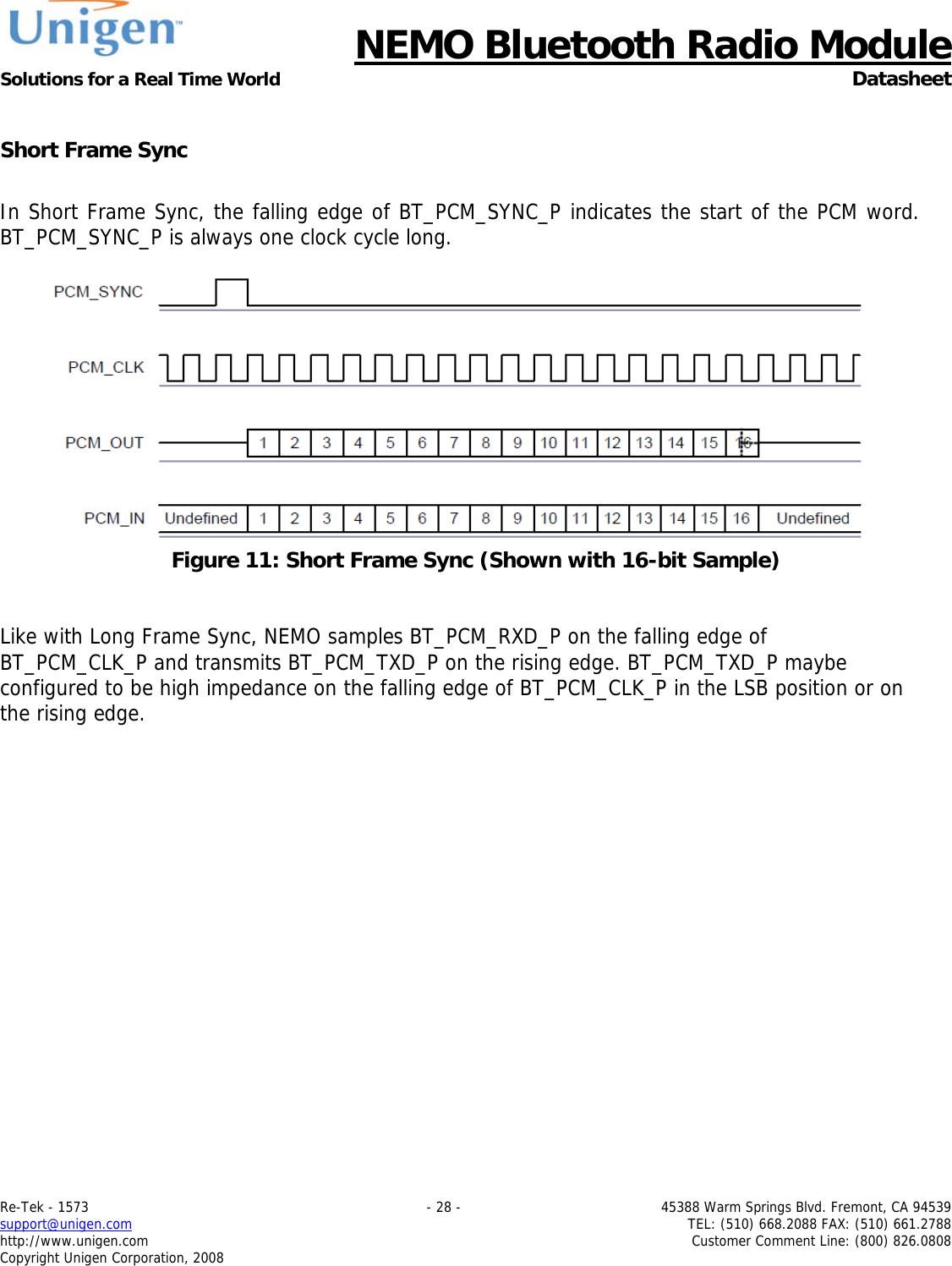
     NEMO Bluetooth Radio Module Solutions for a Real Time World  Datasheet Re-Tek - 1573    - 28 -  45388 Warm Springs Blvd. Fremont, CA 94539 support@unigen.com    TEL: (510) 668.2088 FAX: (510) 661.2788 http://www.unigen.com  Customer Comment Line: (800) 826.0808 Copyright Unigen Corporation, 2008  Short Frame Sync  In Short Frame Sync, the falling edge of BT_PCM_SYNC_P indicates the start of the PCM word. BT_PCM_SYNC_P is always one clock cycle long.   Figure 11: Short Frame Sync (Shown with 16-bit Sample)   Like with Long Frame Sync, NEMO samples BT_PCM_RXD_P on the falling edge of BT_PCM_CLK_P and transmits BT_PCM_TXD_P on the rising edge. BT_PCM_TXD_P maybe configured to be high impedance on the falling edge of BT_PCM_CLK_P in the LSB position or on the rising edge.
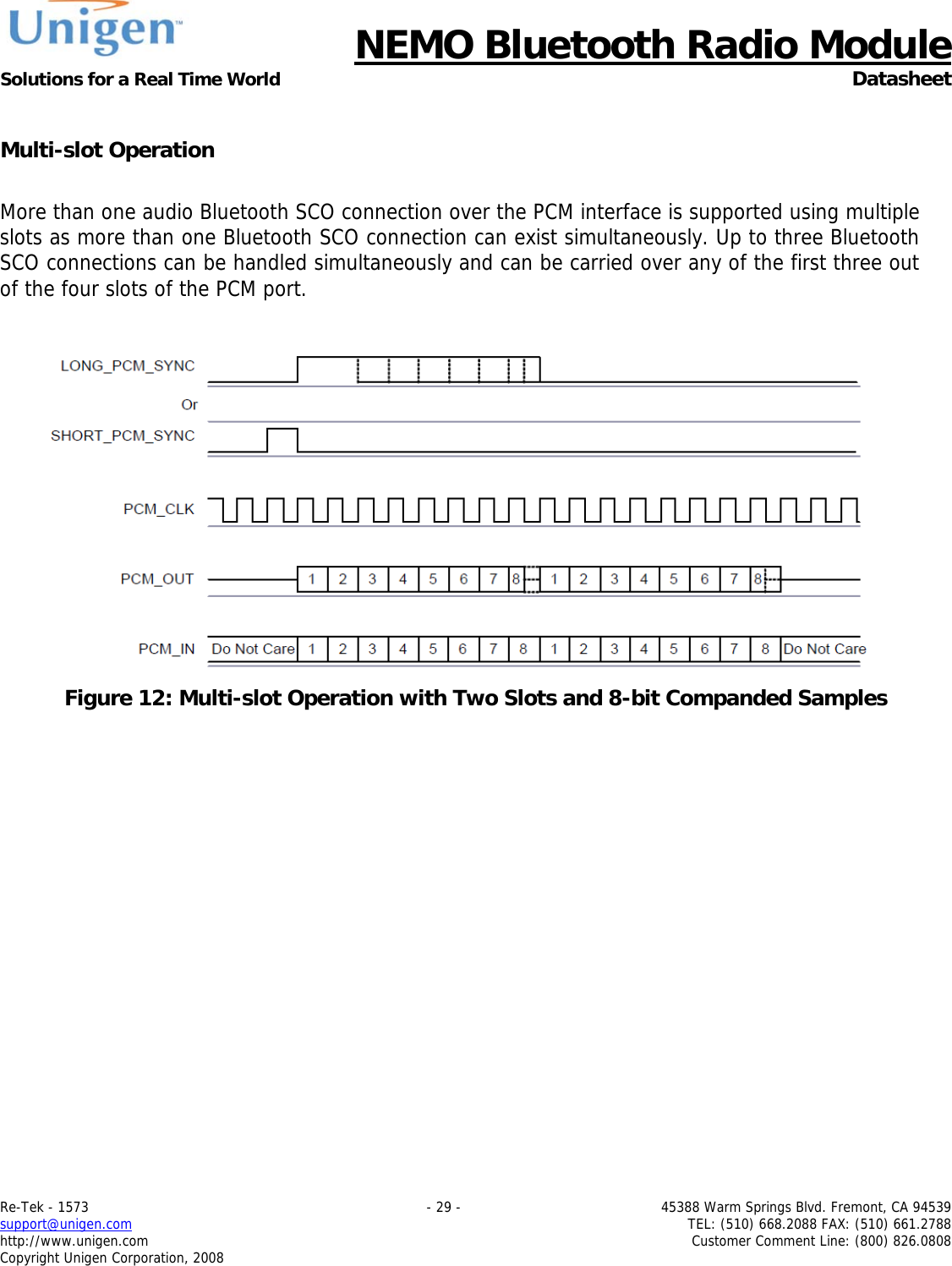
     NEMO Bluetooth Radio Module Solutions for a Real Time World  Datasheet Re-Tek - 1573    - 29 -  45388 Warm Springs Blvd. Fremont, CA 94539 support@unigen.com    TEL: (510) 668.2088 FAX: (510) 661.2788 http://www.unigen.com  Customer Comment Line: (800) 826.0808 Copyright Unigen Corporation, 2008  Multi-slot Operation  More than one audio Bluetooth SCO connection over the PCM interface is supported using multiple slots as more than one Bluetooth SCO connection can exist simultaneously. Up to three Bluetooth SCO connections can be handled simultaneously and can be carried over any of the first three out of the four slots of the PCM port.    Figure 12: Multi-slot Operation with Two Slots and 8-bit Companded Samples
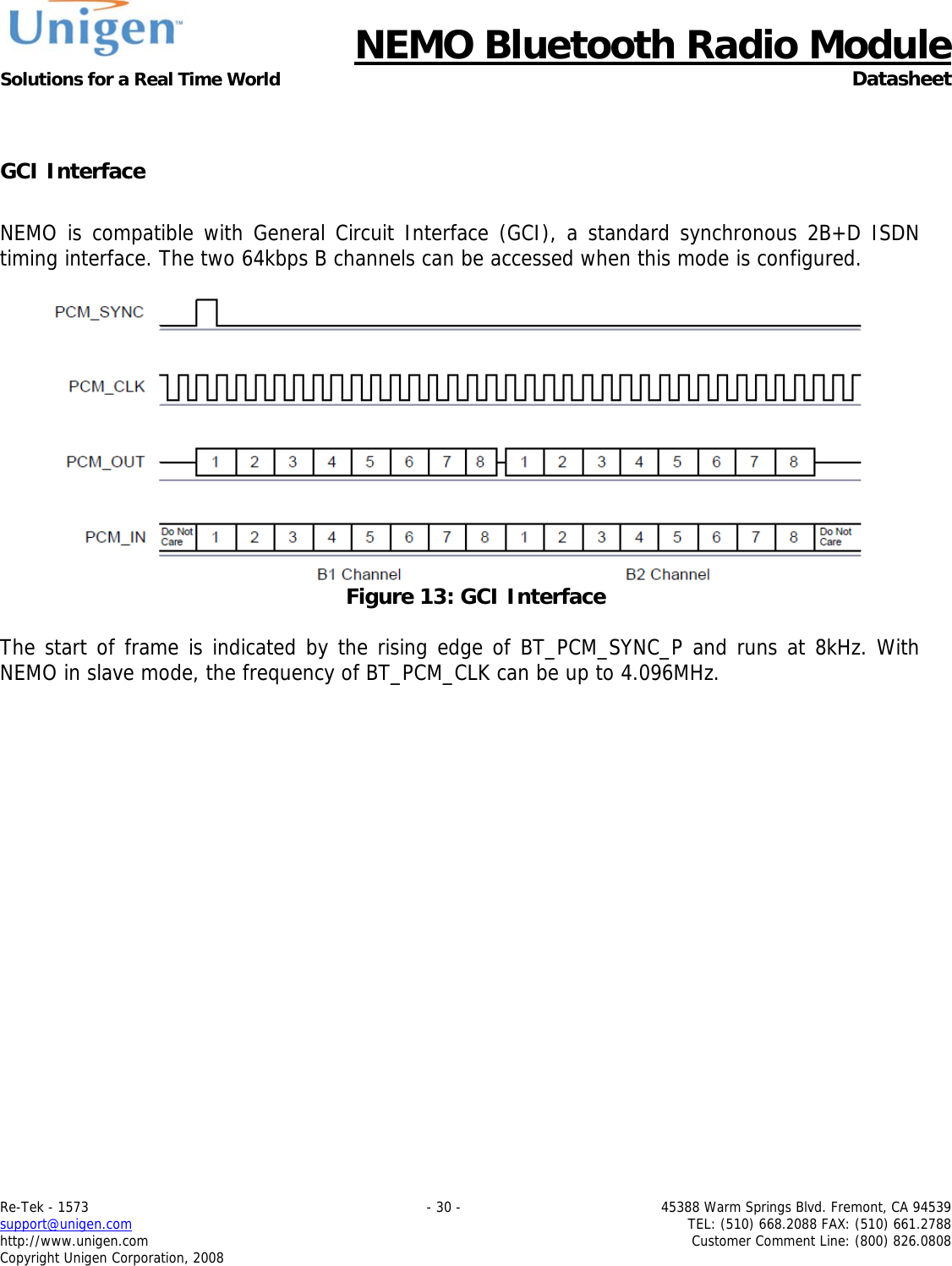
     NEMO Bluetooth Radio Module Solutions for a Real Time World  Datasheet Re-Tek - 1573    - 30 -  45388 Warm Springs Blvd. Fremont, CA 94539 support@unigen.com    TEL: (510) 668.2088 FAX: (510) 661.2788 http://www.unigen.com  Customer Comment Line: (800) 826.0808 Copyright Unigen Corporation, 2008  GCI Interface  NEMO is compatible with General Circuit Interface (GCI), a standard synchronous 2B+D ISDN timing interface. The two 64kbps B channels can be accessed when this mode is configured.    Figure 13: GCI Interface  The start of frame is indicated by the rising edge of BT_PCM_SYNC_P and runs at 8kHz. With NEMO in slave mode, the frequency of BT_PCM_CLK can be up to 4.096MHz.
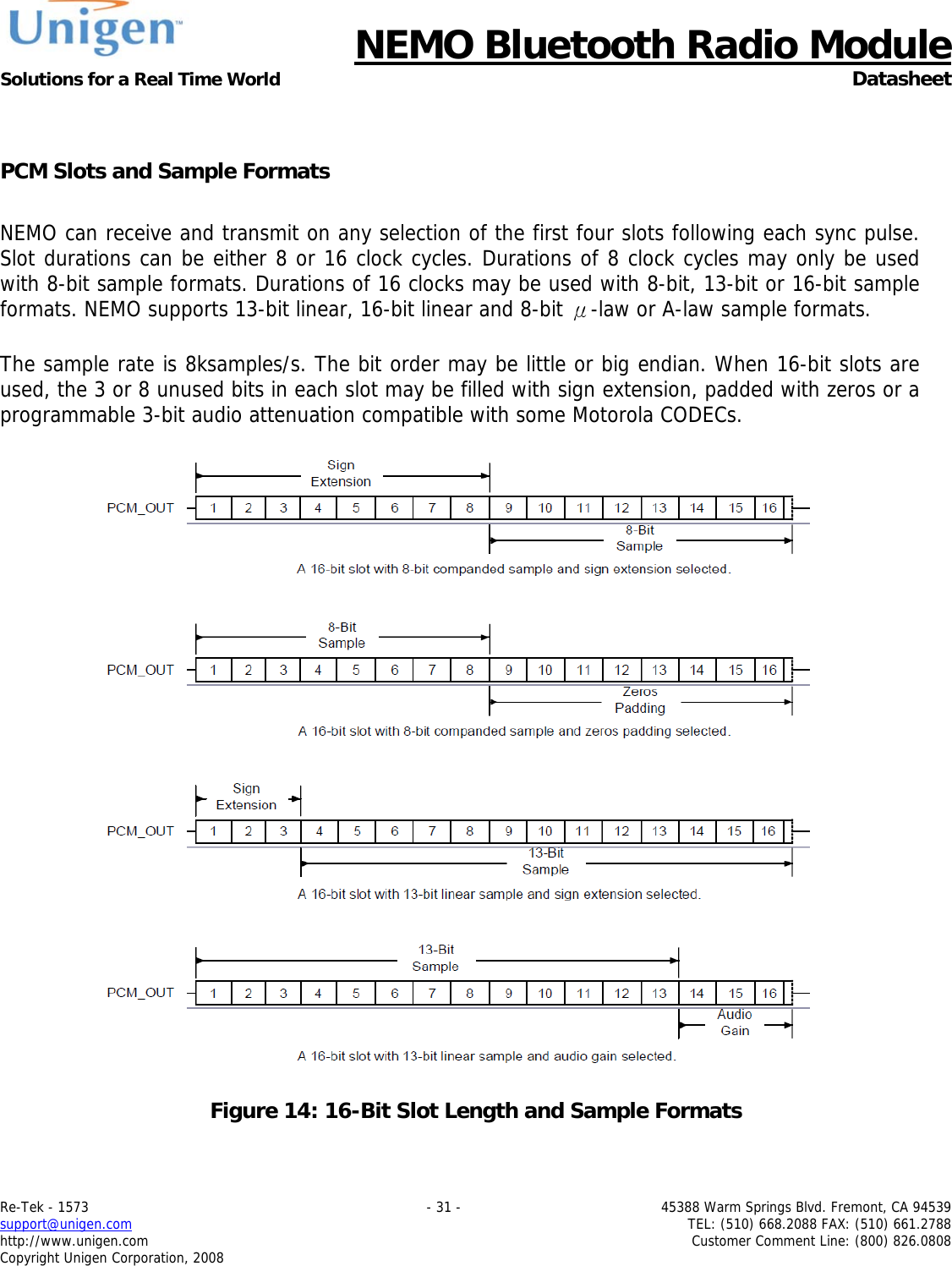
     NEMO Bluetooth Radio Module Solutions for a Real Time World  Datasheet Re-Tek - 1573    - 31 -  45388 Warm Springs Blvd. Fremont, CA 94539 support@unigen.com    TEL: (510) 668.2088 FAX: (510) 661.2788 http://www.unigen.com  Customer Comment Line: (800) 826.0808 Copyright Unigen Corporation, 2008  PCM Slots and Sample Formats  NEMO can receive and transmit on any selection of the first four slots following each sync pulse. Slot durations can be either 8 or 16 clock cycles. Durations of 8 clock cycles may only be used with 8-bit sample formats. Durations of 16 clocks may be used with 8-bit, 13-bit or 16-bit sample formats. NEMO supports 13-bit linear, 16-bit linear and 8-bit μ-law or A-law sample formats.   The sample rate is 8ksamples/s. The bit order may be little or big endian. When 16-bit slots are used, the 3 or 8 unused bits in each slot may be filled with sign extension, padded with zeros or a programmable 3-bit audio attenuation compatible with some Motorola CODECs.    Figure 14: 16-Bit Slot Length and Sample Formats
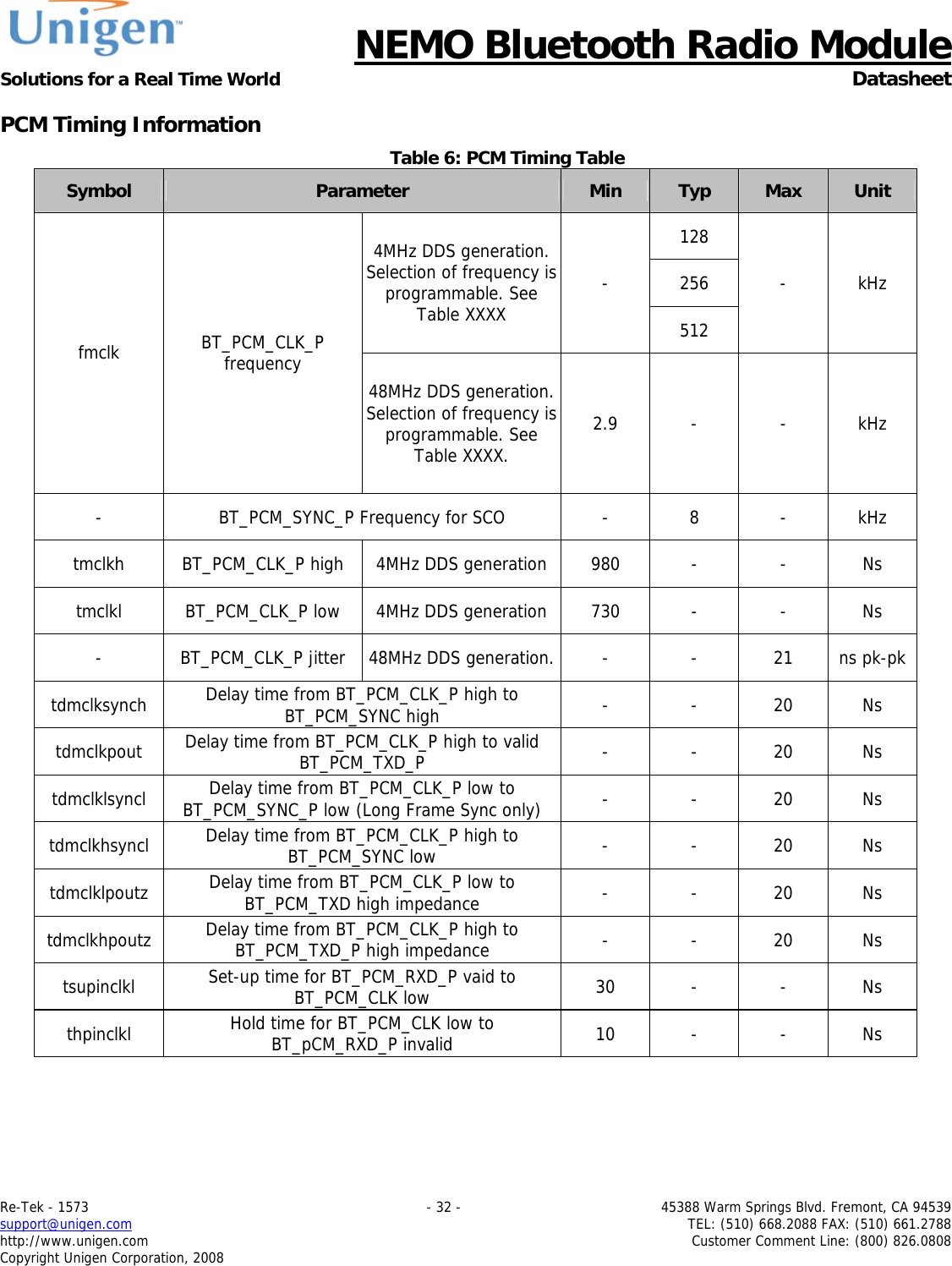
     NEMO Bluetooth Radio Module Solutions for a Real Time World  Datasheet Re-Tek - 1573    - 32 -  45388 Warm Springs Blvd. Fremont, CA 94539 support@unigen.com    TEL: (510) 668.2088 FAX: (510) 661.2788 http://www.unigen.com  Customer Comment Line: (800) 826.0808 Copyright Unigen Corporation, 2008 PCM Timing Information Table 6: PCM Timing Table Symbol  Parameter  Min  Typ  Max  Unit 128 256 4MHz DDS generation. Selection of frequency is programmable. See Table XXXX - 512 - kHz fmclk  BT_PCM_CLK_P frequency  48MHz DDS generation. Selection of frequency is programmable. See Table XXXX. 2.9 -  - kHz -  BT_PCM_SYNC_P Frequency for SCO  -  8  -  kHz tmclkh  BT_PCM_CLK_P high  4MHz DDS generation 980  -  -  Ns tmclkl  BT_PCM_CLK_P low  4MHz DDS generation 730  -  -  Ns -  BT_PCM_CLK_P jitter  48MHz DDS generation. -  -  21  ns pk-pktdmclksynch  Delay time from BT_PCM_CLK_P high to BT_PCM_SYNC high  - - 20 Ns tdmclkpout  Delay time from BT_PCM_CLK_P high to valid BT_PCM_TXD_P  - - 20 Ns tdmclklsyncl  Delay time from BT_PCM_CLK_P low to BT_PCM_SYNC_P low (Long Frame Sync only)  - - 20 Ns tdmclkhsyncl  Delay time from BT_PCM_CLK_P high to BT_PCM_SYNC low  - - 20 Ns tdmclklpoutz  Delay time from BT_PCM_CLK_P low to BT_PCM_TXD high impedance  - - 20 Ns tdmclkhpoutz  Delay time from BT_PCM_CLK_P high to BT_PCM_TXD_P high impedance  - - 20 Ns tsupinclkl  Set-up time for BT_PCM_RXD_P vaid to BT_PCM_CLK low  30 -  - Ns thpinclkl  Hold time for BT_PCM_CLK low to BT_pCM_RXD_P invalid  10 -  - Ns
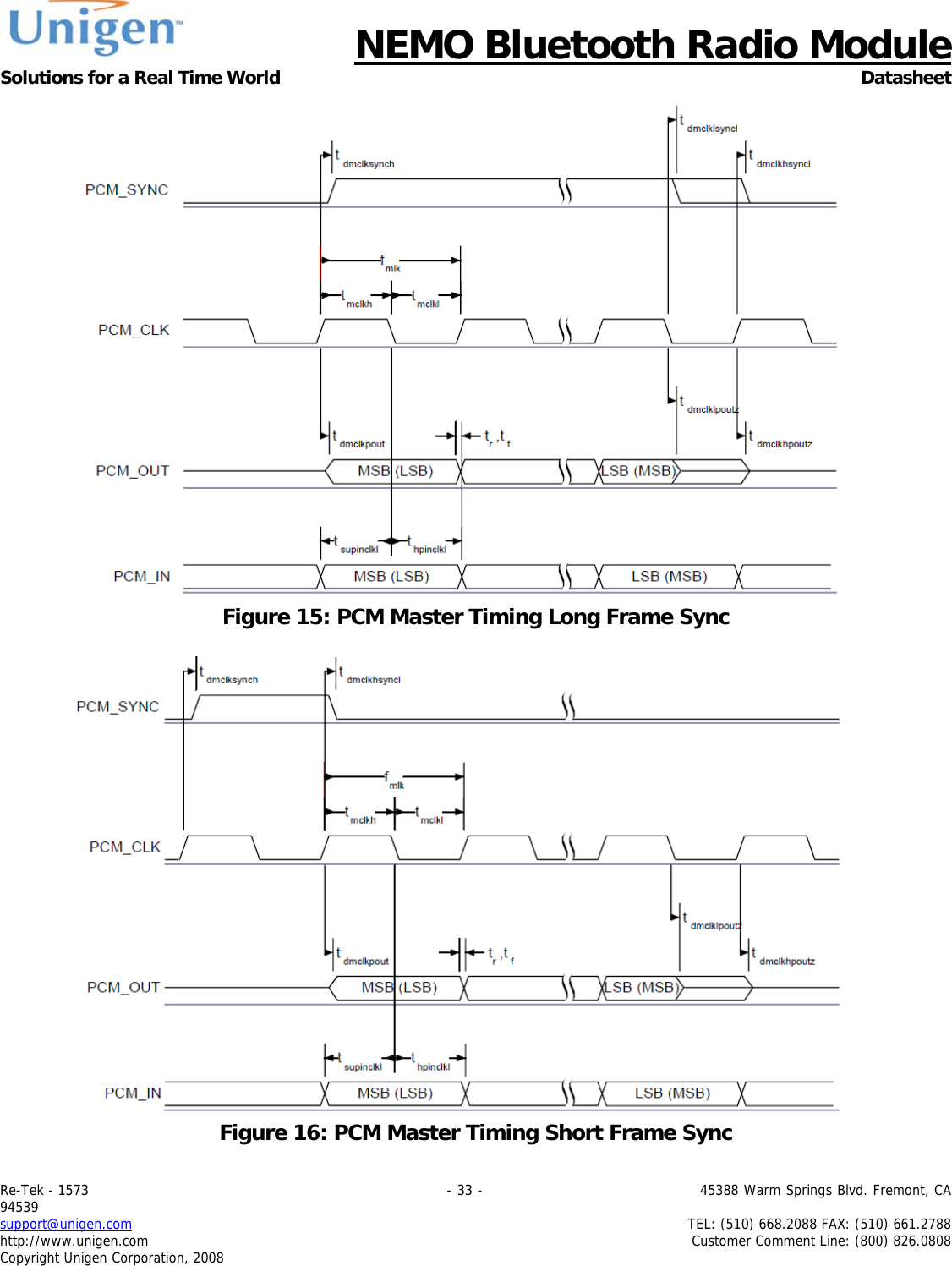
     NEMO Bluetooth Radio Module Solutions for a Real Time World Datasheet Re-Tek - 1573                                                                                 - 33 -                                          45388 Warm Springs Blvd. Fremont, CA 94539 support@unigen.com                     TEL: (510) 668.2088 FAX: (510) 661.2788 http://www.unigen.com  Customer Comment Line: (800) 826.0808 Copyright Unigen Corporation, 2008  Figure 15: PCM Master Timing Long Frame Sync   Figure 16: PCM Master Timing Short Frame Sync
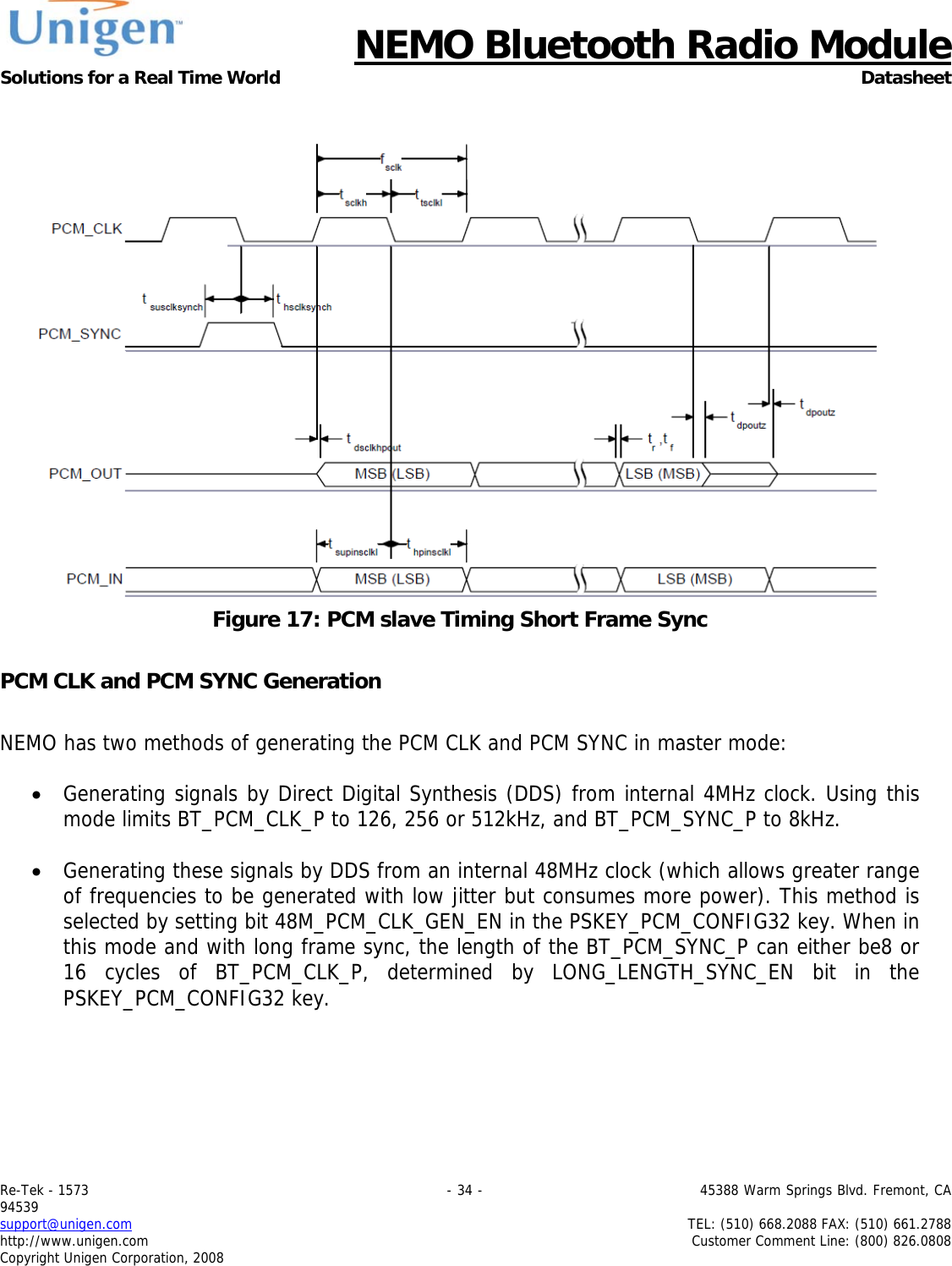
     NEMO Bluetooth Radio Module Solutions for a Real Time World Datasheet Re-Tek - 1573                                                                                 - 34 -                                          45388 Warm Springs Blvd. Fremont, CA 94539 support@unigen.com                     TEL: (510) 668.2088 FAX: (510) 661.2788 http://www.unigen.com  Customer Comment Line: (800) 826.0808 Copyright Unigen Corporation, 2008   Figure 17: PCM slave Timing Short Frame Sync  PCM CLK and PCM SYNC Generation  NEMO has two methods of generating the PCM CLK and PCM SYNC in master mode:  • Generating signals by Direct Digital Synthesis (DDS) from internal 4MHz clock. Using this mode limits BT_PCM_CLK_P to 126, 256 or 512kHz, and BT_PCM_SYNC_P to 8kHz.  • Generating these signals by DDS from an internal 48MHz clock (which allows greater range of frequencies to be generated with low jitter but consumes more power). This method is selected by setting bit 48M_PCM_CLK_GEN_EN in the PSKEY_PCM_CONFIG32 key. When in this mode and with long frame sync, the length of the BT_PCM_SYNC_P can either be8 or 16 cycles of BT_PCM_CLK_P, determined by LONG_LENGTH_SYNC_EN bit in the PSKEY_PCM_CONFIG32 key.
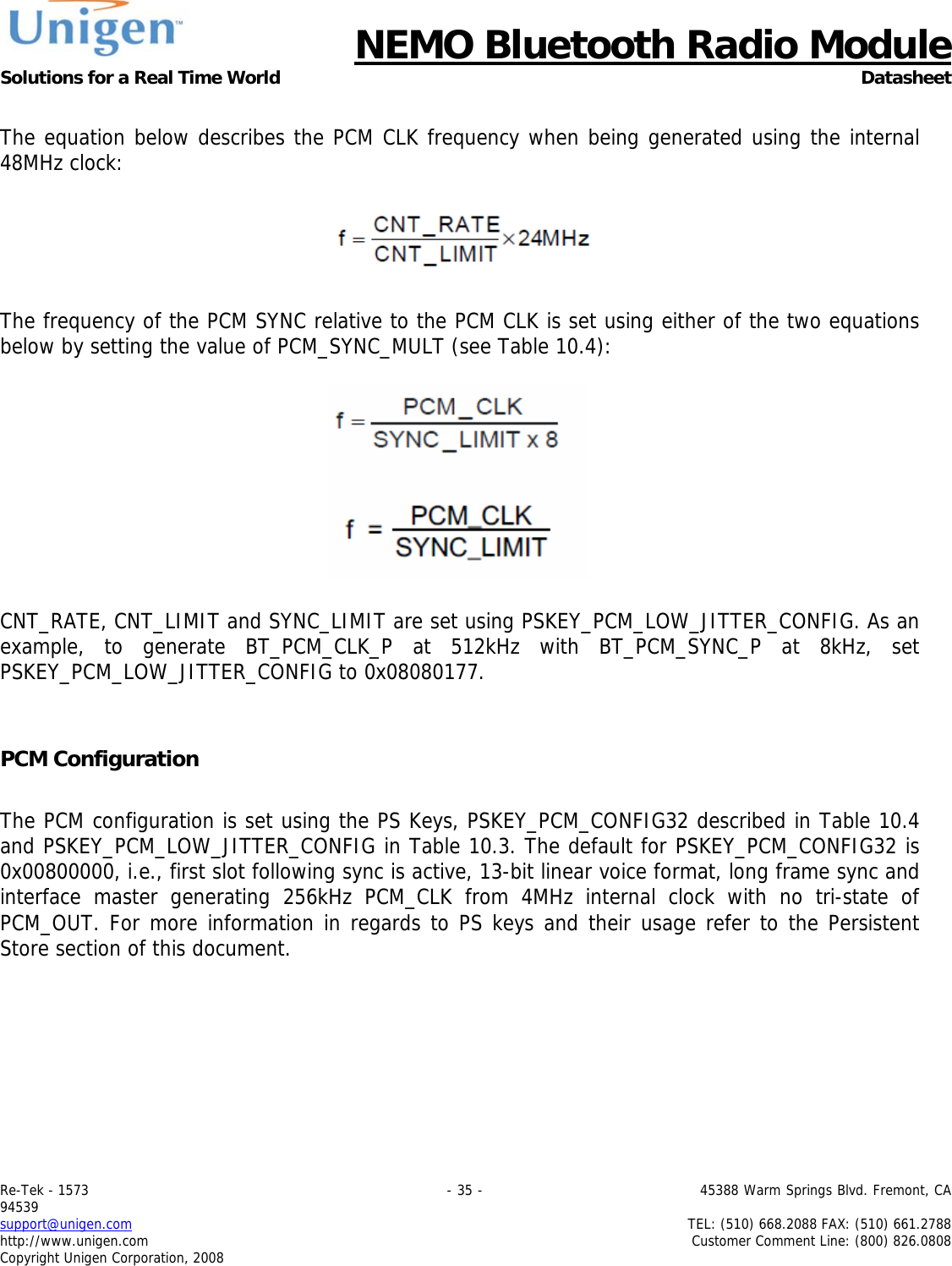
     NEMO Bluetooth Radio Module Solutions for a Real Time World Datasheet Re-Tek - 1573                                                                                 - 35 -                                          45388 Warm Springs Blvd. Fremont, CA 94539 support@unigen.com                     TEL: (510) 668.2088 FAX: (510) 661.2788 http://www.unigen.com  Customer Comment Line: (800) 826.0808 Copyright Unigen Corporation, 2008  The equation below describes the PCM CLK frequency when being generated using the internal 48MHz clock:    The frequency of the PCM SYNC relative to the PCM CLK is set using either of the two equations below by setting the value of PCM_SYNC_MULT (see Table 10.4):     CNT_RATE, CNT_LIMIT and SYNC_LIMIT are set using PSKEY_PCM_LOW_JITTER_CONFIG. As an example, to generate BT_PCM_CLK_P at 512kHz with BT_PCM_SYNC_P at 8kHz, set PSKEY_PCM_LOW_JITTER_CONFIG to 0x08080177.    PCM Configuration  The PCM configuration is set using the PS Keys, PSKEY_PCM_CONFIG32 described in Table 10.4 and PSKEY_PCM_LOW_JITTER_CONFIG in Table 10.3. The default for PSKEY_PCM_CONFIG32 is 0x00800000, i.e., first slot following sync is active, 13-bit linear voice format, long frame sync and interface master generating 256kHz PCM_CLK from 4MHz internal clock with no tri-state of PCM_OUT. For more information in regards to PS keys and their usage refer to the Persistent Store section of this document.
     NEMO Bluetooth Radio Module Solutions for a Real Time World Datasheet Re-Tek - 1573                                                                                 - 36 -                                          45388 Warm Springs Blvd. Fremont, CA 94539 support@unigen.com                     TEL: (510) 668.2088 FAX: (510) 661.2788 http://www.unigen.com  Customer Comment Line: (800) 826.0808 Copyright Unigen Corporation, 2008  Table 7: PSKEY_PCM_LOW_JITTER_CONFIG Description Name  Bit Position  Description CNT_LIMIT  [12:0]  Sets the PCM CLK counter limit CNT_RATE  [23:16]  Sets the PCM CLK count rate SYNC_LIMIT  [31:24]  Sets the PCM SYNC division relative to PCM CLK   Table 8: PSKEY_PCM_CONFIG32 Description Name  Bit Position Description    0  Set to 0 SLAVE_MODE_EN 1 0 = Master mode with internal generation of the BT_PCM_CLK_P and BT_PCM_SYNC_P. 1 = Slave mode requiring externally generated PCM CLK and the PCM SYNC signals. SHORT_SYNC_EN 2 0 = Long Frame Sync mode (rising edge indicates start of frame). 1 = Short Frame Sync mode (falling edge indicates start of frame).    3  Set to 0 SIGN_EXTENDED_EN 4 0 = Padding of 8 or 13-bit voice sample into a 16-bit slot by inserting extra LSBs. When padding is selected with 13-bit voice sample, the 3 padding bits are the audio gain setting; with 8-bit sample the 8 padding bits are zeroes. 1 = Sign-extension. LSB_FIRST_EN 5 0 = MSB first of transmit and receive voice samples.  1 = LSB first of transmit and receive voice samples. TX_TRISTATE_EN 6 0 = Drive PCM_OUT continuously. 1 = Tri-state BT_PCM_TXD_P immediately after falling edge of BT_PCM_CLK_P in the last bit of an active slot, assuming the next slot is not active. TX_TRISTATE_RISING_EDGE_EN 7 0 = Tri-state BT_PCM_TXD_P immediately after falling edge of BT_PCM_CLK_P in last bit of an active slot, assuming the next slot is also not active. 1 = Tri-state BT_PCM_TXD after rising edge of BT_PCM_CLK_P.
     NEMO Bluetooth Radio Module Solutions for a Real Time World Datasheet Re-Tek - 1573                                                                                 - 37 -                                          45388 Warm Springs Blvd. Fremont, CA 94539 support@unigen.com                     TEL: (510) 668.2088 FAX: (510) 661.2788 http://www.unigen.com  Customer Comment Line: (800) 826.0808 Copyright Unigen Corporation, 2008 SYNC_SUPPRESS_EN 8 0 = enable PCM_SYNC output when master. 1 = suppress PCM_SYNC while keeping PCM_CLK running. Some CODECS use this to enter a low power state. GCI_MODE_EN  9  1 = enable GCI mode. MUTE_EN  10  1 = force BT_PCM_TXD_P to 0. 48M_PCM_CLK_GEN_EN 11 0 = set PCM_CLK and PCM_SYNC generation via DDS from internal 4MHz clock. 1 = set PCM_CLK and PCM_SYNC generation via DDS from internal 48MHz clock. LONG_LENGTH_SYNC_EN 12 0 = set PCM_SYNC length to 8 PCM_CLK cycles. 1 = set length to 16 PCM_CLK cycles. Only applies for long frame sync and with 48M_PCM_CLK_GEN_EN set to 1. PCM_SYNC_MULT 13 0 = Sync limit = SYNC_LIMIT x 8. 1 = SYNC_LIMIT.    [20:16]  Set to 0b00000 MASTER_CLK_RATE [22:21] Selects 128 (0b01), 256 (0b00), 512 (0b10) kHz BT_PCM_CLK+P frequency when master and 48M_PCM_CLK_GEN_EN (bit 11) is low. ACTIVE_SLOT [26:23] Default is 0001. Ignored by firmware. SAMPLE_FORMAT [28:27] Selects between 13 (0b00), 16 (0b01), 8 (0b10) bit sample with 16-cycle slot duration or 8 (0b11) bit sample with 8-cycle slot duration.
     NEMO Bluetooth Radio Module Solutions for a Real Time World  Datasheet Re-Tek - 1573    - 38 -  45388 Warm Springs Blvd. Fremont, CA 94539 support@unigen.com    TEL: (510) 668.2088 FAX: (510) 661.2788 http://www.unigen.com  Customer Comment Line: (800) 826.0808 Copyright Unigen Corporation, 2008  Digital Audio Interface (I²S)  The digital audio interface supports the industry standard formats for I²S, left-justified (LJ) or right-justified (RJ). The interface shares the same pins as the PCM interface, which means each audio bus is mutually exclusive in its usage. Table 7 lists these alternative functions.   Table 9: Alternative Functions of the Digital Audio Bus Interface on the PCM Interface PCM Interface  I²S Interface BT_PCM_TXD_P SD_OUT BT_PCM_RXD_P SD_IN BT_PCM_SYNC_P WS BT_PCM_CLK_P SCK  Table 8 describes the values for the PS Key (PSKEY_DIGITAL_AUDIO_CONFIG) that is used to set-up the digital audio interface. For example, to configure an I²S interface with 16-bit SD data set PSKEY_DIGITAL_CONFIG to 0x0406.  Table 10: PSKEY_DIGITAL_AUDIO_CONFIG Bit  Mask  Name  Description D[0] 0x0001 CONFIG_JUSTIFY_FORMAT  0 for left justified, 1 for right justified. D[1] 0x0002 CONFIG_LEFT_JUSTIFY_DELAY For left justified formats: 0 is MSB of SD data occurs in the first SCLK period following WS transition. 1 is MSB of SD data occurs in the second SCLK period. D[2] 0x0004 CONFIG_CHANNEL_POLARITY  For 0, SD data is left channel when WS is high. For 1 SD data is right channel. D[3] 0x0008 CONFIG_AUDIO_ATTEN_EN For 0, 17 bit SD data is rounded down to 16 bits. For 1, the audio attenuation defined in CONFIG_AUDIO_ATTEN is applied over 24 bits with saturated rounding. Requires CONFIG_16_BIT_CROP_EN to be 0. D[7:4] 0x00F0  CONFIG_AUDIO_ATTEN  Attenuation in 6 dB steps.
     NEMO Bluetooth Radio Module Solutions for a Real Time World Datasheet Re-Tek - 1573                                                                                 - 39 -                                          45388 Warm Springs Blvd. Fremont, CA 94539 support@unigen.com                     TEL: (510) 668.2088 FAX: (510) 661.2788 http://www.unigen.com  Customer Comment Line: (800) 826.0808 Copyright Unigen Corporation, 2008 D[9:8] 0x0300  CONFIG_JUSTIFY_RESOLUTION Resolution of data on SD_IN, 00=16 bit, 01=20 bit, 10=24 bit, 11=Reserved. This is required for right justified format and with left justified LSB first. D[10] 0x0400 CONFIG_16_BIT_CROP_EN For 0, 17 bit SD_IN data is rounded down to 16 bits. For 1 only the most significant 16 bits of data are received.    Figure 18: I²S Mode Digital Audio Interface
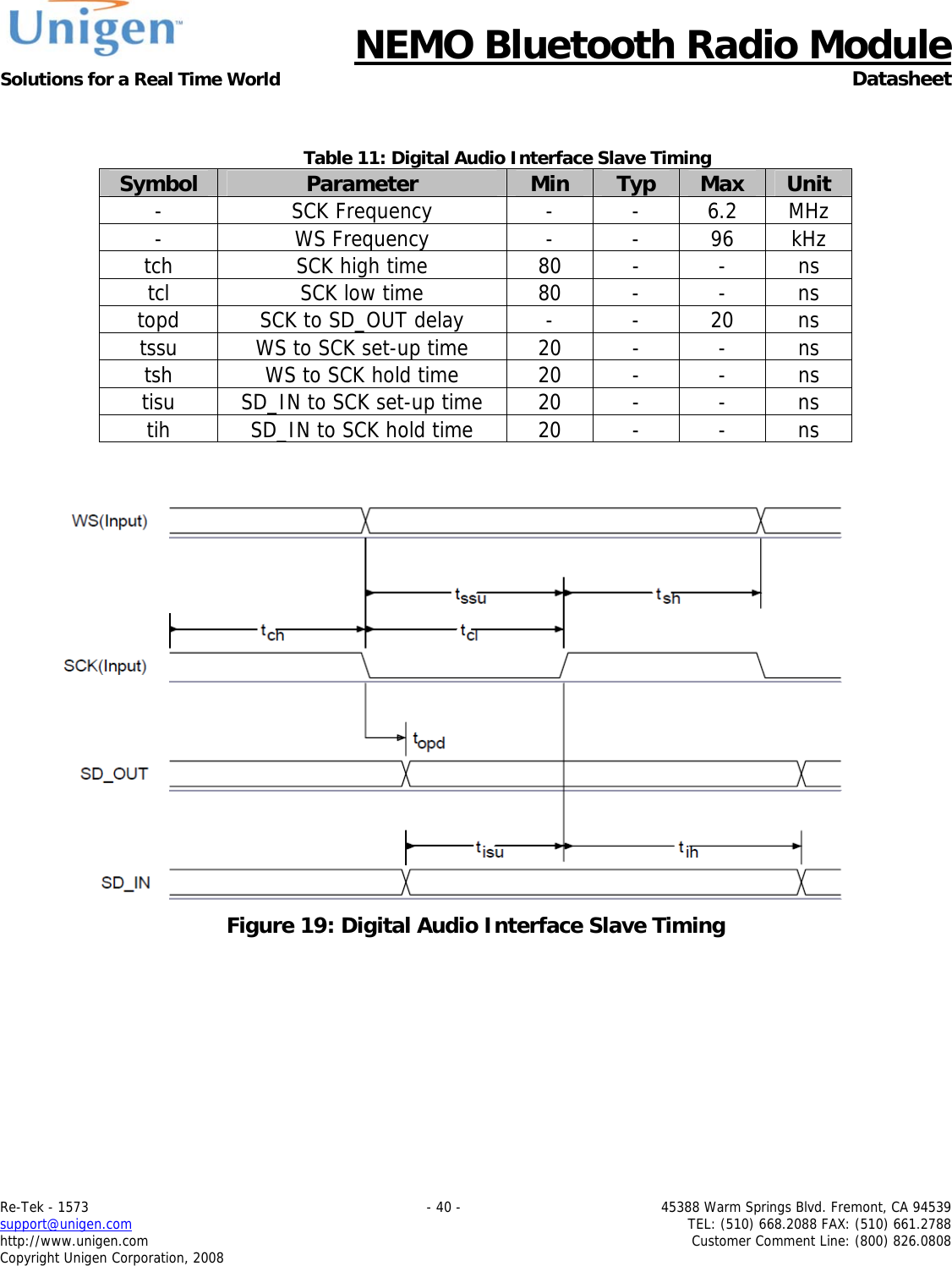
     NEMO Bluetooth Radio Module Solutions for a Real Time World  Datasheet Re-Tek - 1573    - 40 -  45388 Warm Springs Blvd. Fremont, CA 94539 support@unigen.com    TEL: (510) 668.2088 FAX: (510) 661.2788 http://www.unigen.com  Customer Comment Line: (800) 826.0808 Copyright Unigen Corporation, 2008  Table 11: Digital Audio Interface Slave Timing Symbol  Parameter  Min  Typ  Max  Unit - SCK Frequency - - 6.2 MHz - WS Frequency - - 96 kHz tch  SCK high time  80  -  -  ns tcl  SCK low time  80  -  -  ns topd  SCK to SD_OUT delay  -  -  20  ns tssu  WS to SCK set-up time  20  -  -  ns tsh  WS to SCK hold time  20  -  -  ns tisu  SD_IN to SCK set-up time  20  -  -  ns tih  SD_IN to SCK hold time  20  -  -  ns    Figure 19: Digital Audio Interface Slave Timing
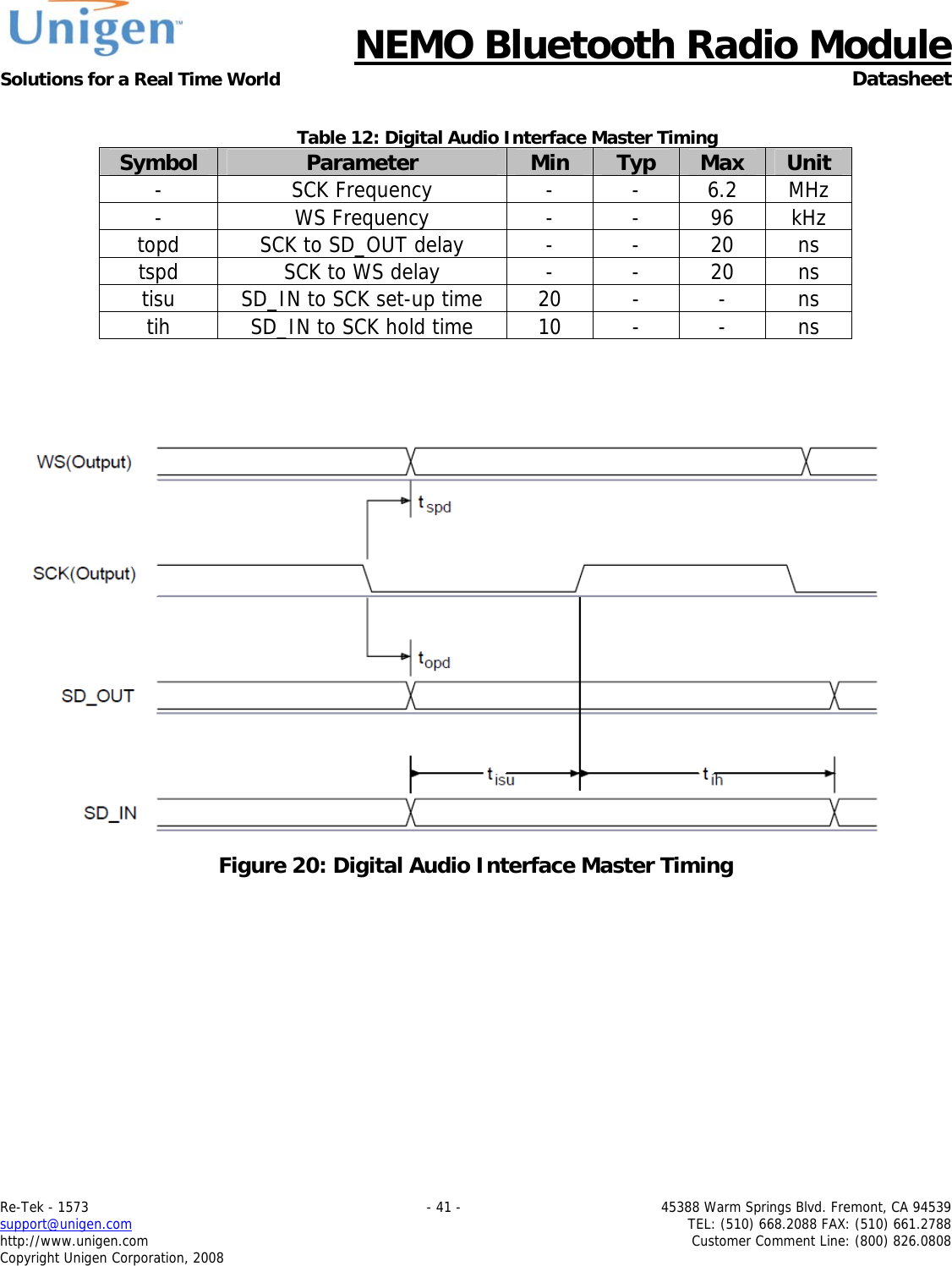
     NEMO Bluetooth Radio Module Solutions for a Real Time World  Datasheet Re-Tek - 1573    - 41 -  45388 Warm Springs Blvd. Fremont, CA 94539 support@unigen.com    TEL: (510) 668.2088 FAX: (510) 661.2788 http://www.unigen.com  Customer Comment Line: (800) 826.0808 Copyright Unigen Corporation, 2008  Table 12: Digital Audio Interface Master Timing Symbol  Parameter  Min  Typ  Max  Unit - SCK Frequency - - 6.2 MHz - WS Frequency - - 96 kHz topd  SCK to SD_OUT delay  -  -  20  ns tspd  SCK to WS delay  -  -  20  ns tisu  SD_IN to SCK set-up time  20  -  -  ns tih  SD_IN to SCK hold time  10  -  -  ns    Figure 20: Digital Audio Interface Master Timing
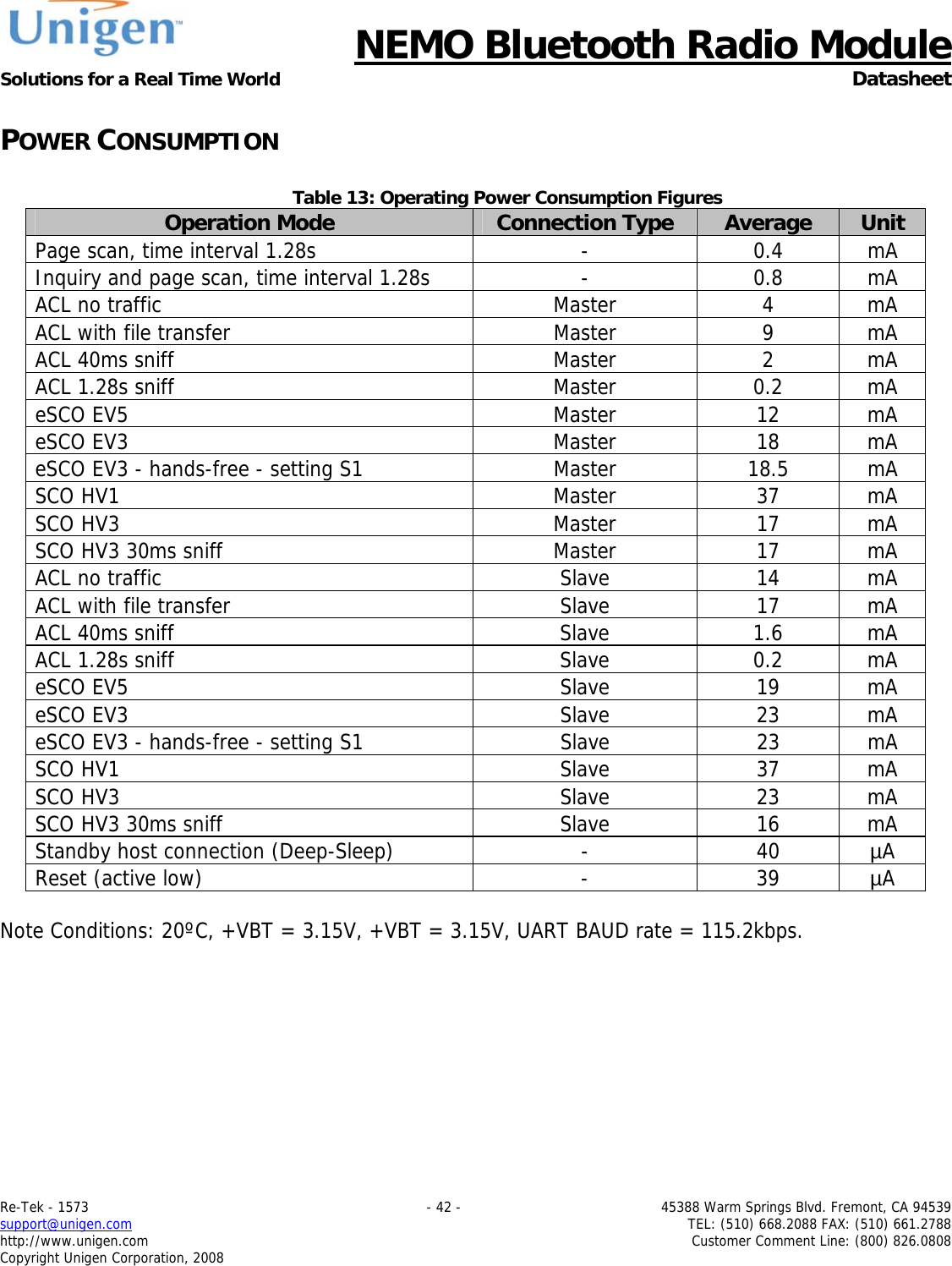
     NEMO Bluetooth Radio Module Solutions for a Real Time World  Datasheet Re-Tek - 1573    - 42 -  45388 Warm Springs Blvd. Fremont, CA 94539 support@unigen.com    TEL: (510) 668.2088 FAX: (510) 661.2788 http://www.unigen.com  Customer Comment Line: (800) 826.0808 Copyright Unigen Corporation, 2008 POWER CONSUMPTION  Table 13: Operating Power Consumption Figures Operation Mode  Connection Type  Average  Unit Page scan, time interval 1.28s  -  0.4  mA Inquiry and page scan, time interval 1.28s  -  0.8  mA ACL no traffic  Master  4  mA ACL with file transfer  Master  9  mA ACL 40ms sniff  Master  2  mA ACL 1.28s sniff  Master  0.2  mA eSCO EV5  Master  12  mA eSCO EV3  Master  18  mA eSCO EV3 - hands-free - setting S1  Master  18.5  mA SCO HV1  Master  37  mA SCO HV3  Master  17  mA SCO HV3 30ms sniff  Master  17  mA ACL no traffic  Slave  14  mA ACL with file transfer  Slave  17  mA ACL 40ms sniff  Slave  1.6  mA ACL 1.28s sniff  Slave  0.2  mA eSCO EV5  Slave  19  mA eSCO EV3  Slave  23  mA eSCO EV3 - hands-free - setting S1  Slave  23  mA SCO HV1  Slave  37  mA SCO HV3  Slave  23  mA SCO HV3 30ms sniff  Slave  16  mA Standby host connection (Deep-Sleep)  -  40  µA Reset (active low)  -  39  µA  Note Conditions: 20ºC, +VBT = 3.15V, +VBT = 3.15V, UART BAUD rate = 115.2kbps.
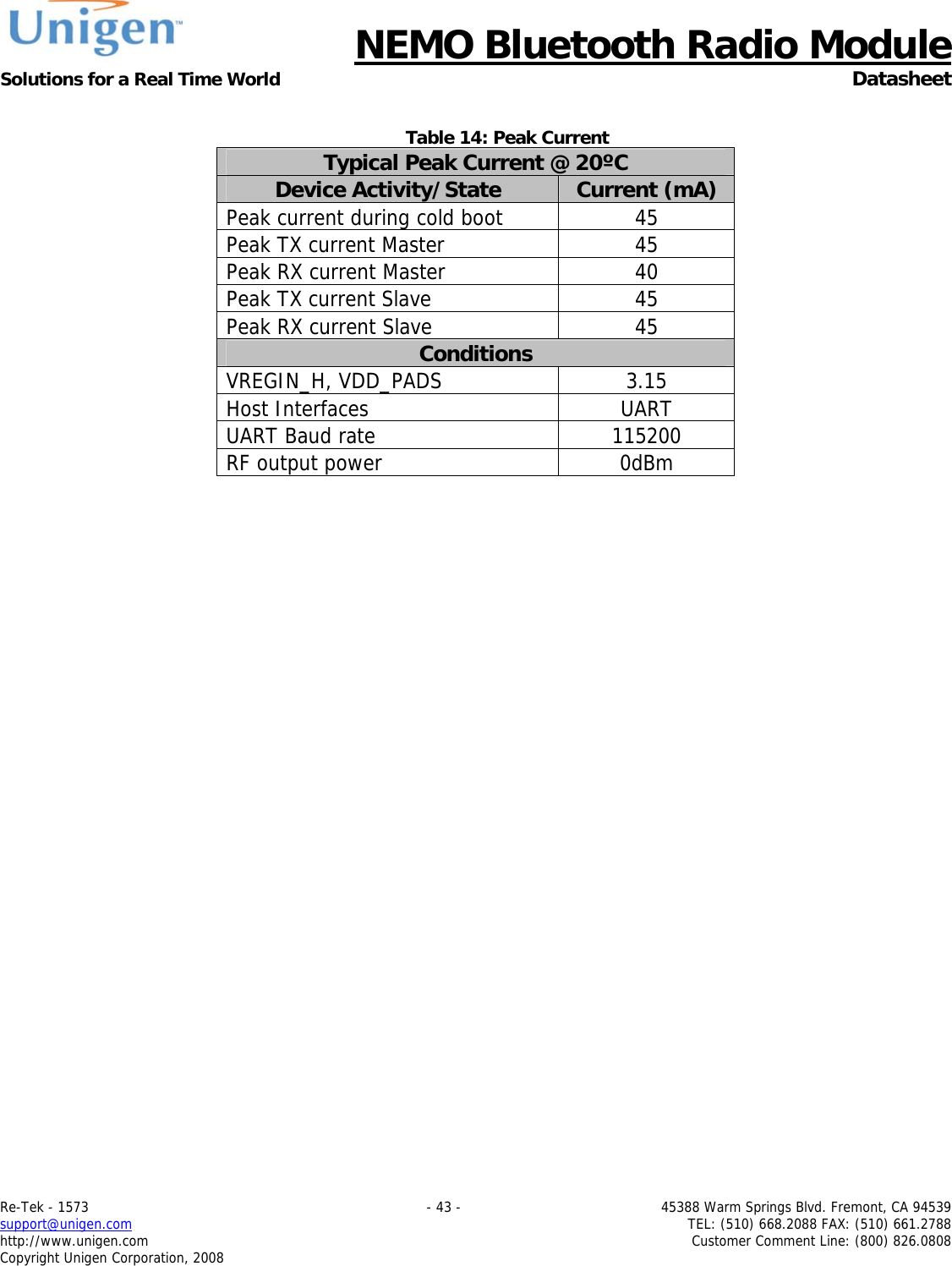
     NEMO Bluetooth Radio Module Solutions for a Real Time World  Datasheet Re-Tek - 1573    - 43 -  45388 Warm Springs Blvd. Fremont, CA 94539 support@unigen.com    TEL: (510) 668.2088 FAX: (510) 661.2788 http://www.unigen.com  Customer Comment Line: (800) 826.0808 Copyright Unigen Corporation, 2008  Table 14: Peak Current Typical Peak Current @ 20ºC Device Activity/State  Current (mA) Peak current during cold boot  45 Peak TX current Master  45 Peak RX current Master  40 Peak TX current Slave  45 Peak RX current Slave  45 Conditions VREGIN_H, VDD_PADS  3.15 Host Interfaces  UART UART Baud rate  115200 RF output power  0dBm
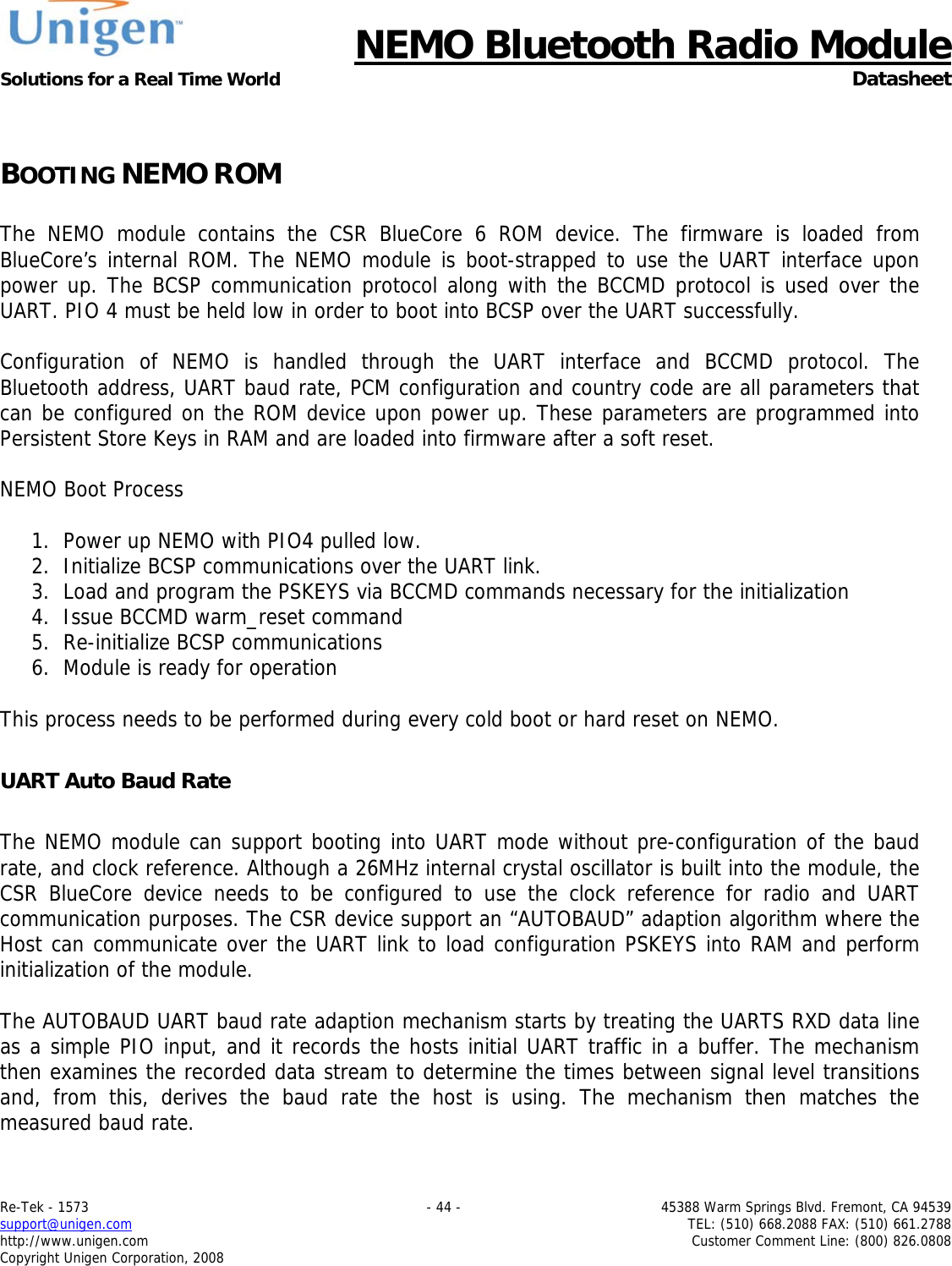
     NEMO Bluetooth Radio Module Solutions for a Real Time World  Datasheet Re-Tek - 1573    - 44 -  45388 Warm Springs Blvd. Fremont, CA 94539 support@unigen.com    TEL: (510) 668.2088 FAX: (510) 661.2788 http://www.unigen.com  Customer Comment Line: (800) 826.0808 Copyright Unigen Corporation, 2008  BOOTING NEMO ROM  The NEMO module contains the CSR BlueCore 6 ROM device. The firmware is loaded from BlueCore’s internal ROM. The NEMO module is boot-strapped to use the UART interface upon power up. The BCSP communication protocol along with the BCCMD protocol is used over the UART. PIO 4 must be held low in order to boot into BCSP over the UART successfully.   Configuration of NEMO is handled through the UART interface and BCCMD protocol. The Bluetooth address, UART baud rate, PCM configuration and country code are all parameters that can be configured on the ROM device upon power up. These parameters are programmed into Persistent Store Keys in RAM and are loaded into firmware after a soft reset.   NEMO Boot Process  1. Power up NEMO with PIO4 pulled low. 2. Initialize BCSP communications over the UART link. 3. Load and program the PSKEYS via BCCMD commands necessary for the initialization 4. Issue BCCMD warm_reset command 5. Re-initialize BCSP communications 6. Module is ready for operation  This process needs to be performed during every cold boot or hard reset on NEMO.   UART Auto Baud Rate  The NEMO module can support booting into UART mode without pre-configuration of the baud rate, and clock reference. Although a 26MHz internal crystal oscillator is built into the module, the CSR BlueCore device needs to be configured to use the clock reference for radio and UART communication purposes. The CSR device support an “AUTOBAUD” adaption algorithm where the Host can communicate over the UART link to load configuration PSKEYS into RAM and perform initialization of the module.  The AUTOBAUD UART baud rate adaption mechanism starts by treating the UARTS RXD data line as a simple PIO input, and it records the hosts initial UART traffic in a buffer. The mechanism then examines the recorded data stream to determine the times between signal level transitions and, from this, derives the baud rate the host is using. The mechanism then matches the measured baud rate.
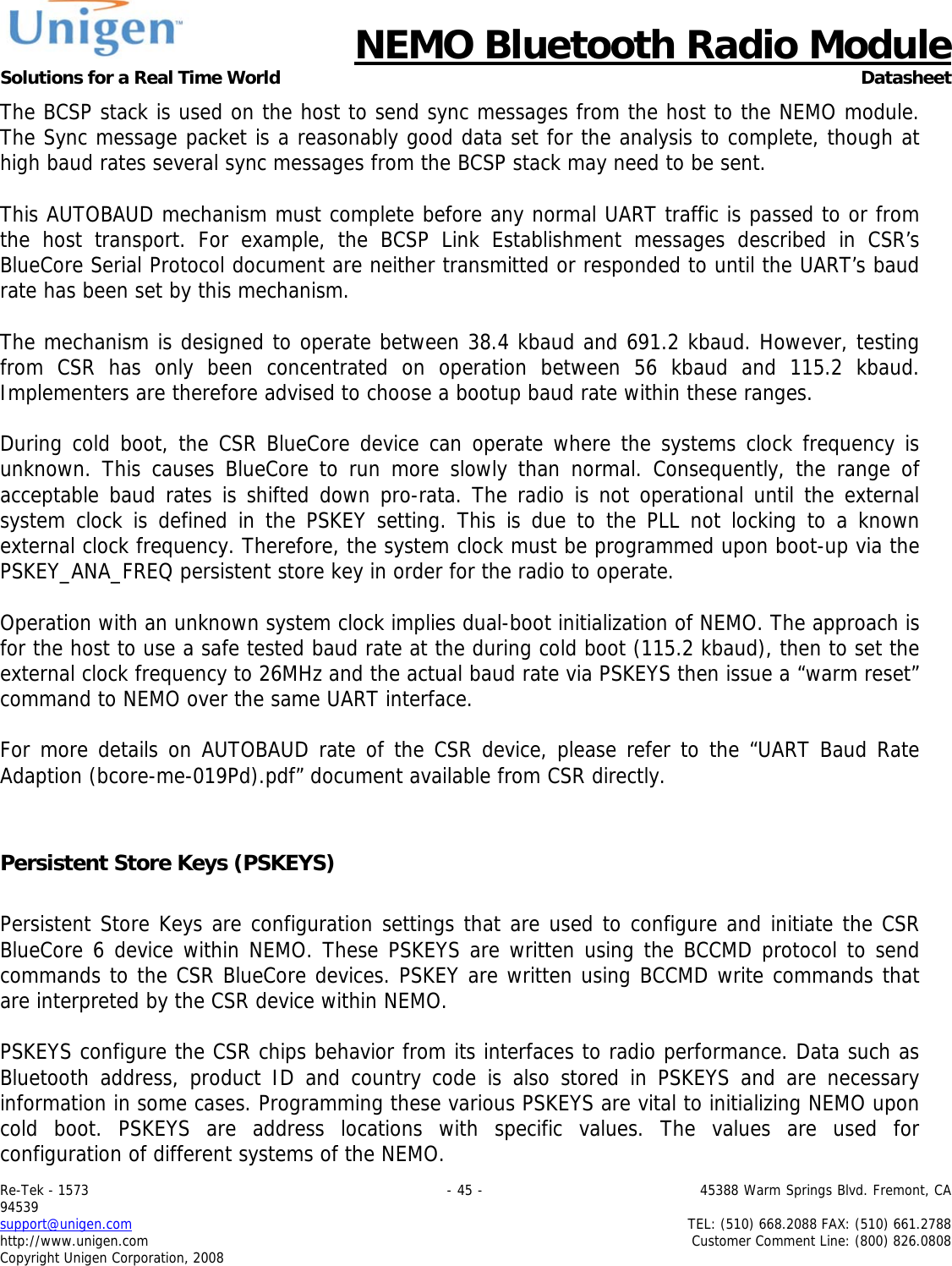
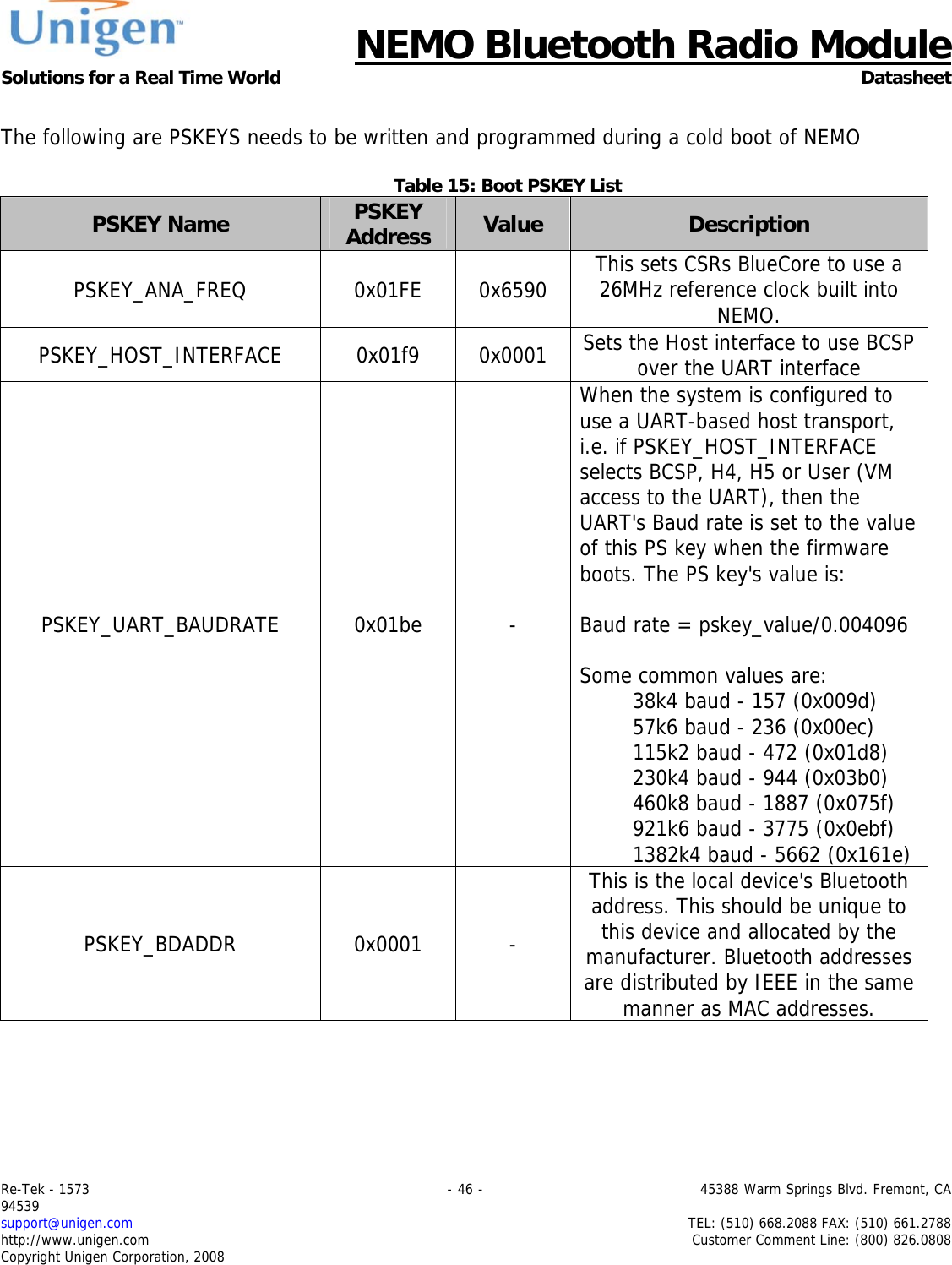
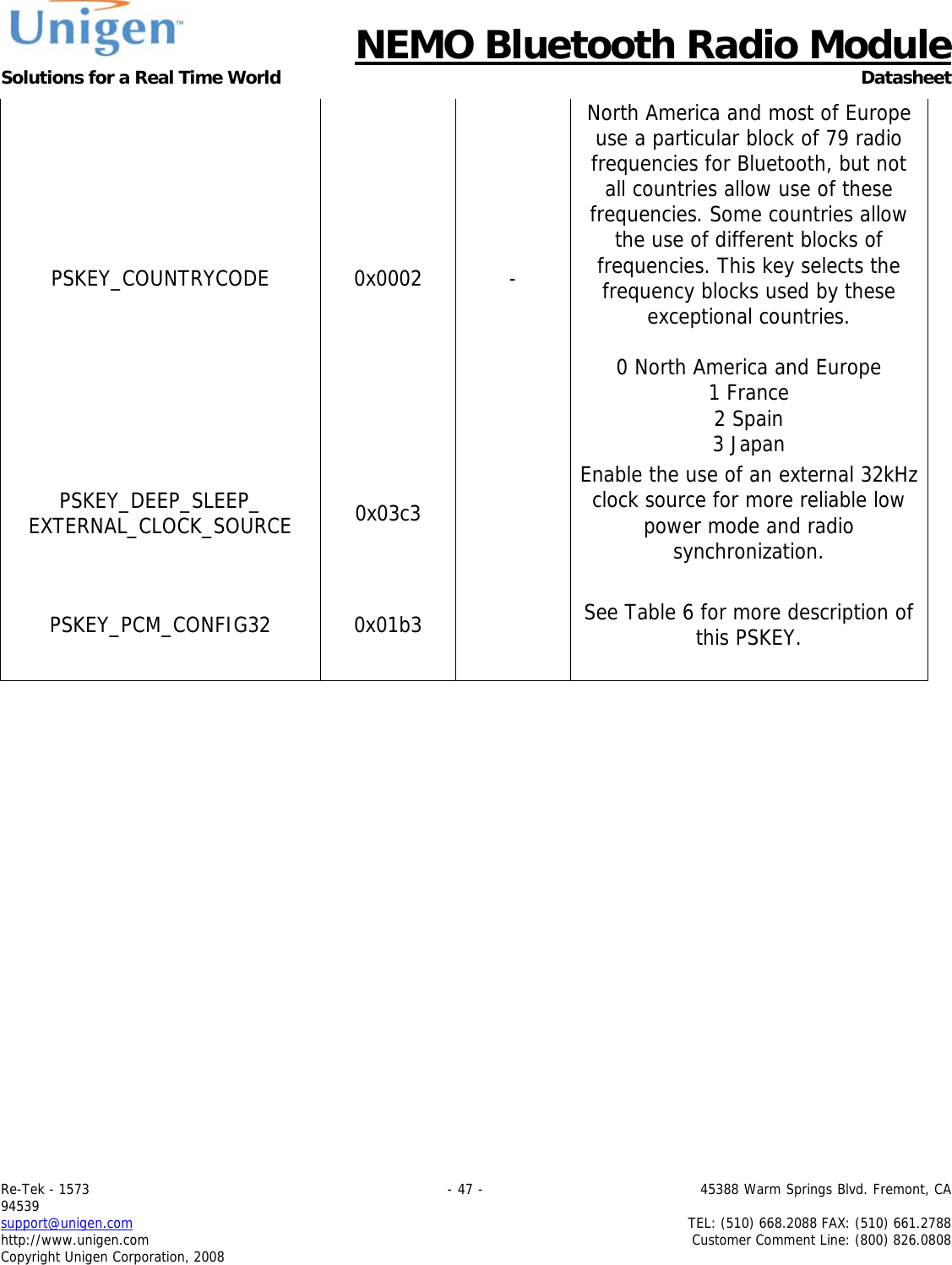
     NEMO Bluetooth Radio Module Solutions for a Real Time World Datasheet Re-Tek - 1573                                                                                 - 45 -                                          45388 Warm Springs Blvd. Fremont, CA 94539 support@unigen.com                     TEL: (510) 668.2088 FAX: (510) 661.2788 http://www.unigen.com  Customer Comment Line: (800) 826.0808 Copyright Unigen Corporation, 2008 The BCSP stack is used on the host to send sync messages from the host to the NEMO module. The Sync message packet is a reasonably good data set for the analysis to complete, though at high baud rates several sync messages from the BCSP stack may need to be sent.   This AUTOBAUD mechanism must complete before any normal UART traffic is passed to or from the host transport. For example, the BCSP Link Establishment messages described in CSR’s BlueCore Serial Protocol document are neither transmitted or responded to until the UART’s baud rate has been set by this mechanism.   The mechanism is designed to operate between 38.4 kbaud and 691.2 kbaud. However, testing from CSR has only been concentrated on operation between 56 kbaud and 115.2 kbaud. Implementers are therefore advised to choose a bootup baud rate within these ranges.   During cold boot, the CSR BlueCore device can operate where the systems clock frequency is unknown. This causes BlueCore to run more slowly than normal. Consequently, the range of acceptable baud rates is shifted down pro-rata. The radio is not operational until the external system clock is defined in the PSKEY setting. This is due to the PLL not locking to a known external clock frequency. Therefore, the system clock must be programmed upon boot-up via the PSKEY_ANA_FREQ persistent store key in order for the radio to operate.   Operation with an unknown system clock implies dual-boot initialization of NEMO. The approach is for the host to use a safe tested baud rate at the during cold boot (115.2 kbaud), then to set the external clock frequency to 26MHz and the actual baud rate via PSKEYS then issue a “warm reset” command to NEMO over the same UART interface.   For more details on AUTOBAUD rate of the CSR device, please refer to the “UART Baud Rate Adaption (bcore-me-019Pd).pdf” document available from CSR directly.    Persistent Store Keys (PSKEYS)  Persistent Store Keys are configuration settings that are used to configure and initiate the CSR BlueCore 6 device within NEMO. These PSKEYS are written using the BCCMD protocol to send commands to the CSR BlueCore devices. PSKEY are written using BCCMD write commands that are interpreted by the CSR device within NEMO.   PSKEYS configure the CSR chips behavior from its interfaces to radio performance. Data such as Bluetooth address, product ID and country code is also stored in PSKEYS and are necessary information in some cases. Programming these various PSKEYS are vital to initializing NEMO upon cold boot. PSKEYS are address locations with specific values. The values are used for configuration of different systems of the NEMO.
     NEMO Bluetooth Radio Module Solutions for a Real Time World Datasheet Re-Tek - 1573                                                                                 - 46 -                                          45388 Warm Springs Blvd. Fremont, CA 94539 support@unigen.com                     TEL: (510) 668.2088 FAX: (510) 661.2788 http://www.unigen.com  Customer Comment Line: (800) 826.0808 Copyright Unigen Corporation, 2008  The following are PSKEYS needs to be written and programmed during a cold boot of NEMO  Table 15: Boot PSKEY List PSKEY Name  PSKEY Address  Value  Description PSKEY_ANA_FREQ 0x01FE 0x6590 This sets CSRs BlueCore to use a 26MHz reference clock built into NEMO. PSKEY_HOST_INTERFACE 0x01f9 0x0001 Sets the Host interface to use BCSP over the UART interface PSKEY_UART_BAUDRATE 0x01be  - When the system is configured to use a UART-based host transport, i.e. if PSKEY_HOST_INTERFACE selects BCSP, H4, H5 or User (VM access to the UART), then the UART's Baud rate is set to the value of this PS key when the firmware boots. The PS key's value is:   Baud rate = pskey_value/0.004096  Some common values are:         38k4 baud - 157 (0x009d)         57k6 baud - 236 (0x00ec)         115k2 baud - 472 (0x01d8)         230k4 baud - 944 (0x03b0)         460k8 baud - 1887 (0x075f)         921k6 baud - 3775 (0x0ebf)         1382k4 baud - 5662 (0x161e) PSKEY_BDADDR 0x0001 - This is the local device's Bluetooth address. This should be unique to this device and allocated by the manufacturer. Bluetooth addresses are distributed by IEEE in the same manner as MAC addresses.
     NEMO Bluetooth Radio Module Solutions for a Real Time World Datasheet Re-Tek - 1573                                                                                 - 47 -                                          45388 Warm Springs Blvd. Fremont, CA 94539 support@unigen.com                     TEL: (510) 668.2088 FAX: (510) 661.2788 http://www.unigen.com  Customer Comment Line: (800) 826.0808 Copyright Unigen Corporation, 2008 PSKEY_COUNTRYCODE 0x0002 - North America and most of Europe use a particular block of 79 radio frequencies for Bluetooth, but not all countries allow use of these frequencies. Some countries allow the use of different blocks of frequencies. This key selects the frequency blocks used by these exceptional countries.   0 North America and Europe 1 France 2 Spain 3 Japan  PSKEY_DEEP_SLEEP_ EXTERNAL_CLOCK_SOURCE  0x03c3  Enable the use of an external 32kHz clock source for more reliable low power mode and radio synchronization. PSKEY_PCM_CONFIG32 0x01b3   See Table 6 for more description of this PSKEY.
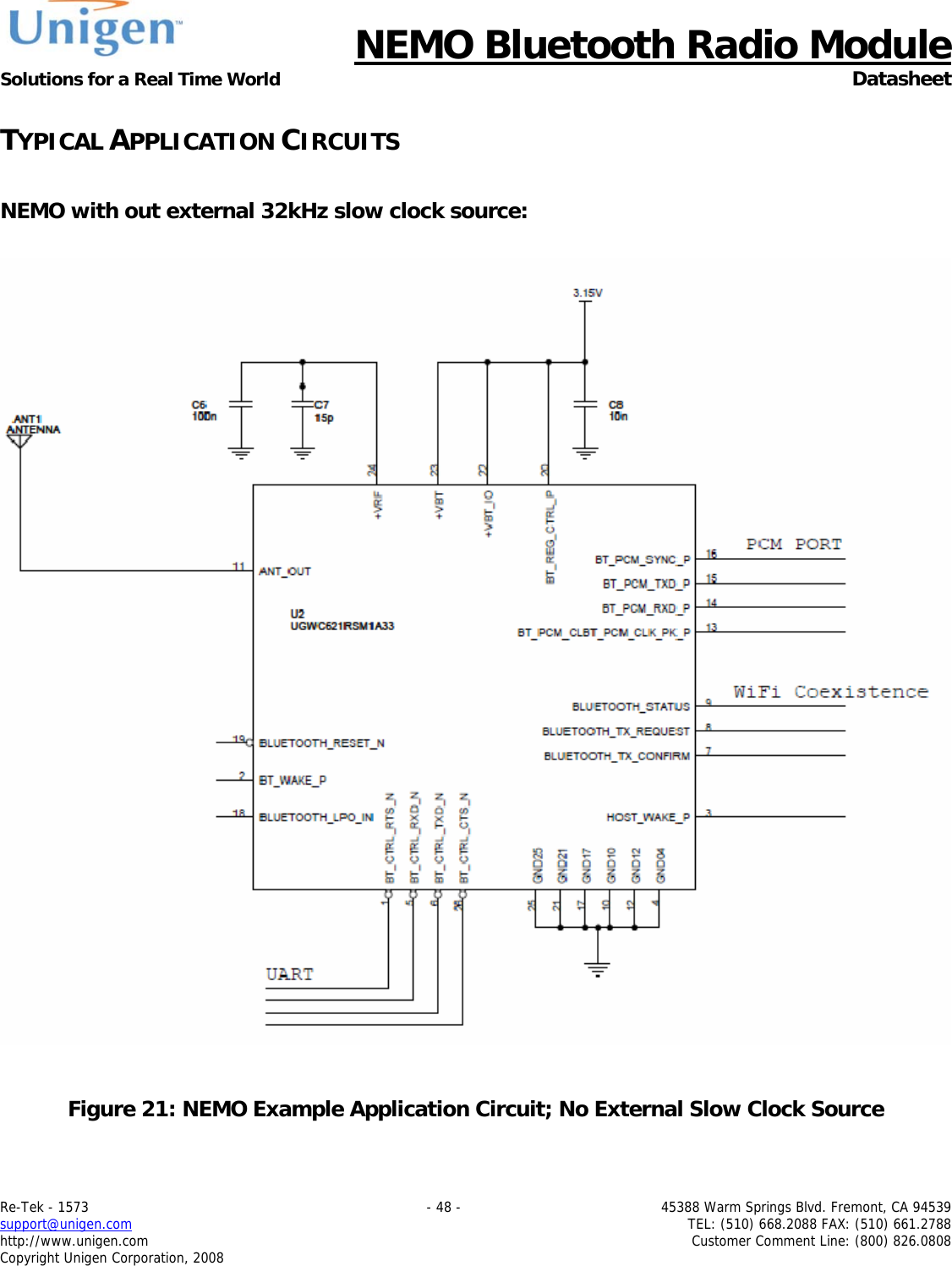
     NEMO Bluetooth Radio Module Solutions for a Real Time World  Datasheet Re-Tek - 1573    - 48 -  45388 Warm Springs Blvd. Fremont, CA 94539 support@unigen.com    TEL: (510) 668.2088 FAX: (510) 661.2788 http://www.unigen.com  Customer Comment Line: (800) 826.0808 Copyright Unigen Corporation, 2008 TYPICAL APPLICATION CIRCUITS  NEMO with out external 32kHz slow clock source:     Figure 21: NEMO Example Application Circuit; No External Slow Clock Source
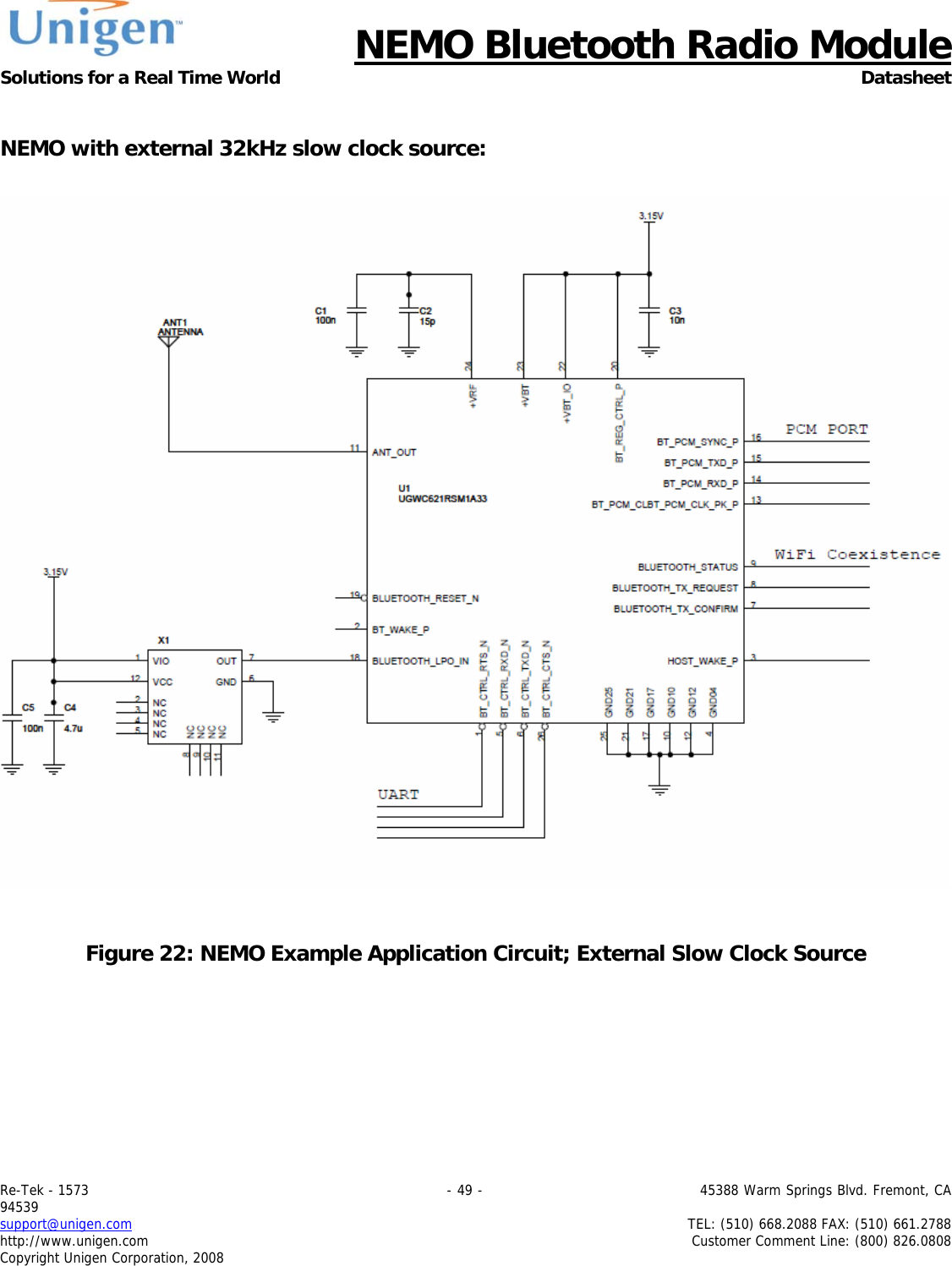
     NEMO Bluetooth Radio Module Solutions for a Real Time World Datasheet Re-Tek - 1573                                                                                 - 49 -                                          45388 Warm Springs Blvd. Fremont, CA 94539 support@unigen.com                     TEL: (510) 668.2088 FAX: (510) 661.2788 http://www.unigen.com  Customer Comment Line: (800) 826.0808 Copyright Unigen Corporation, 2008   NEMO with external 32kHz slow clock source:     Figure 22: NEMO Example Application Circuit; External Slow Clock Source
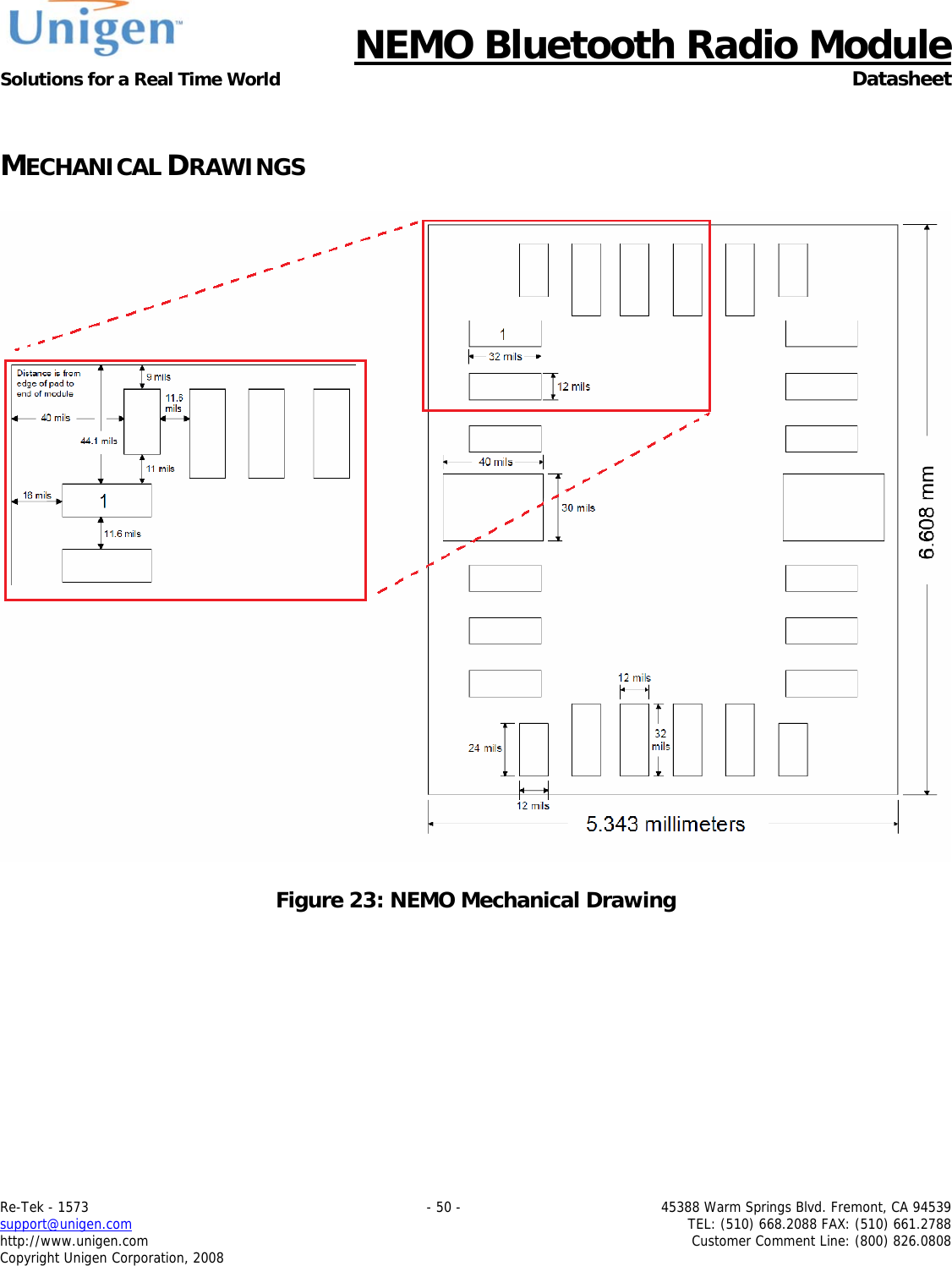
     NEMO Bluetooth Radio Module Solutions for a Real Time World  Datasheet Re-Tek - 1573    - 50 -  45388 Warm Springs Blvd. Fremont, CA 94539 support@unigen.com    TEL: (510) 668.2088 FAX: (510) 661.2788 http://www.unigen.com  Customer Comment Line: (800) 826.0808 Copyright Unigen Corporation, 2008  MECHANICAL DRAWINGS     Figure 23: NEMO Mechanical Drawing
     NEMO Bluetooth Radio Module Solutions for a Real Time World Datasheet Re-Tek - 1573                                                                                 - 51 -                                          45388 Warm Springs Blvd. Fremont, CA 94539 support@unigen.com                     TEL: (510) 668.2088 FAX: (510) 661.2788 http://www.unigen.com  Customer Comment Line: (800) 826.0808 Copyright Unigen Corporation, 2008  REFERENCE DOCUMENTATION  Table 16: Reference Documentation Document  Name  Rev/Date SourceCSR BlueCore 6 ROM Datasheet  "BC6ROM_WLCSP_CS-113960-DSP12.pdf"   Issue 12  CSR Firmware Release Note  “BlueCore Unified 23c Release Note (CS-116212-RNP3).pdf”  Issue 3  CSR AUTOBAUD rate adaption  “UART Baud Rate Adaption (bcore-me-019Pd).pdf”   Jun-05 CSR BCSP “BlueCore Serial Protocol (bcore-sp-012Pb).pdf”  Jul-04  CSR BCCMD  “BCCMD Protocol (bcore-sp-002Pc).pdf”   Jul-04  CSR   CONTACT INFORMATION  CORPORATE HEADQUARTERS  Unigen Corporation  45388 Warm Springs Boulevard  Fremont, CA 94539   Telephone:   1 (510) 688-2088 Fax:   1 (510) 668-2788 Email:   Support@unigen.com Web:   www.unigen.com Toll Free:   1 (800) 826-0808

Navigation menu