ikeGPS SP02 Spike User Manual Spike UserManual v1 6
ikeGPS Limited Spike Spike UserManual v1 6
ikeGPS >
Contents
- 1. Spike-tablet-safety-manual-1
- 2. Spike_UserManual_v1.6
Spike_UserManual_v1.6
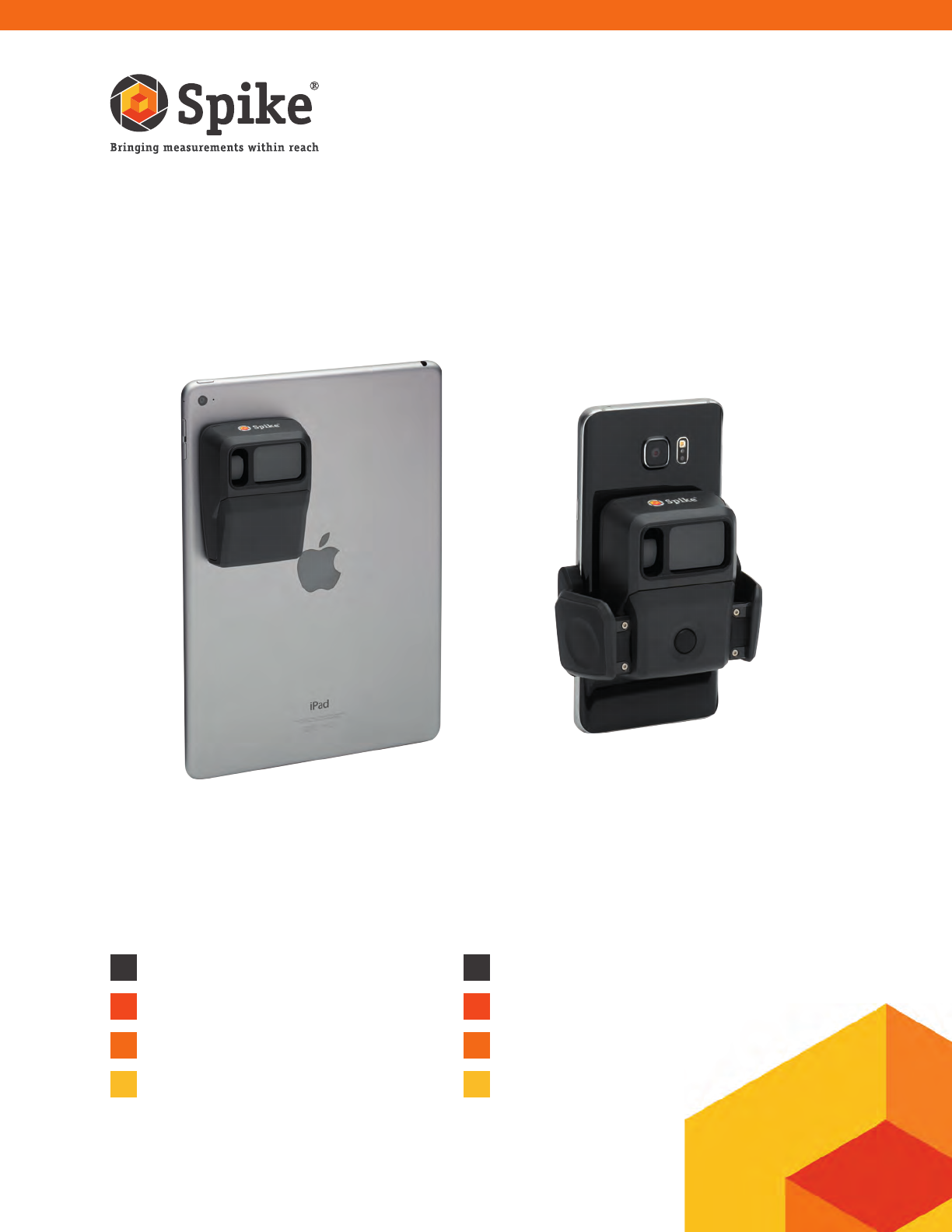
User Manual
(of Spike iOS version 1.11 and Android 1.6)
This User Manual will guide you through the steps to set up your
Spike and take measurements.
Spike User Manual v1.6
1 Mounting Your Spike 5 Taking a Point-to-Point Measurement
2
Installing the Spike App
6
Using the Spike Cloud
3
Starting Up
7
Exporting & Sharing
4
Taking a Photo Measurement
8
Spike Icon Guide
Spike User Manual 2
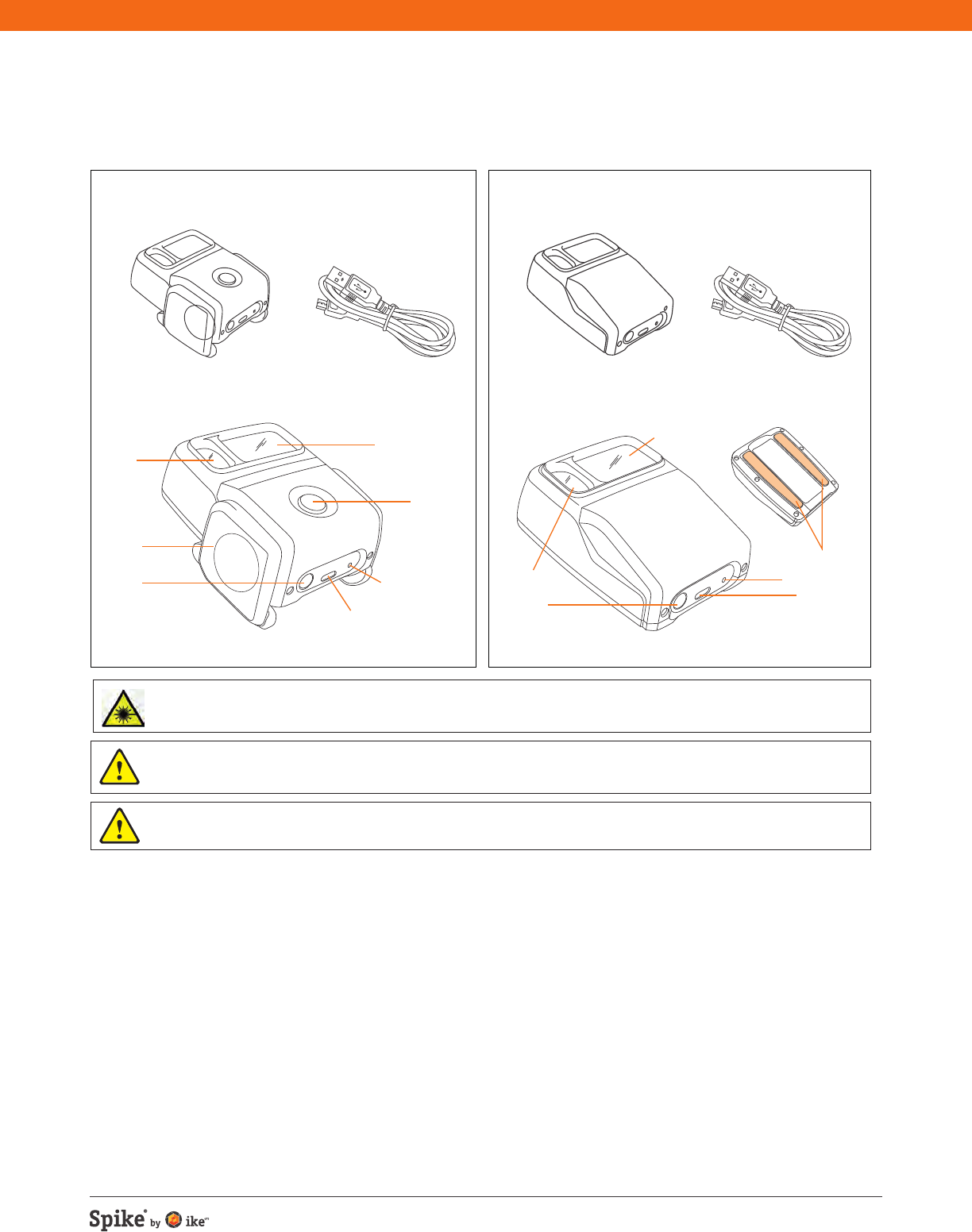
What’s in the Box
For Technical Support
WARNING This device contains an eye safe class 1 laser product. Invisible laser radiation is emitted from (and received into) the front
apertures. Avoid staring into the laser beam. This product complies with IEC60825-1 Ed 2.0 and 21CFR1040.10 except for deviations
pursuant to Laser Notice No.50, dated July 26 2001.
CAUTION Use of controls or adjustments, or performance of procedures other than those specied herein may result in hazardous
radiation exposure.
WARNING This equipment complies with FCC radiation exposure limits set forth for an uncontrolled environment. In order to avoid the
possibility of exceeding the FCC radio frequency exposure limits, human proximity to the antenna shall not be less than 20cm during
normal operation.
Visit the Spike Support Center for FAQs, video tutorials, resources, and to
contact technical support: www.ikegps.com/support
Contact Technical Support:
support@ikegps.com
toll-free: +1 844 445 3477 ext 3
Laser
emission lens
Receiving lens
LED indicator
Adhesive strips
Micro USB
charging port
Power
button
Spike unit USB cable
Laser
emission
lens
Receiving lens
Clamp
release
button
LED indicator
Micro USB charging port
Power
button
Device
clamp
Spike unit USB cable
Spike for Smartphones Spike for Tablets
Spike User Manual 3
1 Mounting Your Spike: Tablets
(or rst generation Spike)
IMPORTANT TO NOTE...
• Mount your Spike to a smartphone or tablet case. You may wish to use two cases
- one with Spike attached to it and the other for general day-to-day use.
• We recommend attaching your Spike to a hard case with a at back. It will
not attach securely to a soft or curved back design. Silicon cases should be
avoided.
• Optimal surfaces to attach Spike to are metal and hard plastic surfaces.
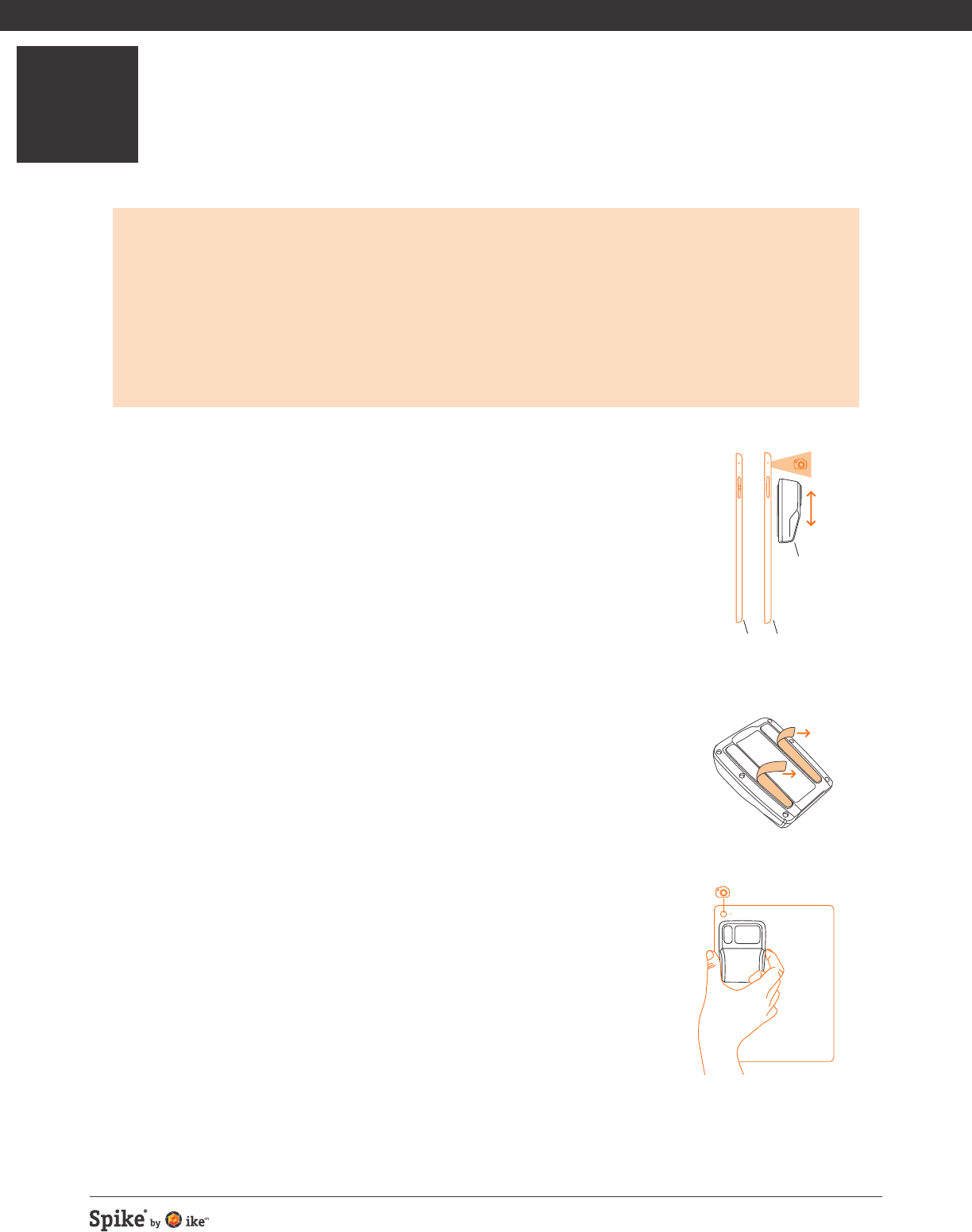
1 Find the best location for your Spike on the
back of your smartphone or tablet case.
• Place Spike close to the camera, but ensure that Spike
does not obstruct the view from your camera or ash.
• To verify, start your camera app and hold your Spike
against the back of your smartphone or tablet to validate
correct placement.
• For tablets, Spike may be orientated in a position that is
most comfortable when holding your tablet in landscape.
2 On the back of your Spike, peel off the protective
backing to expose the adhesive tape.
• Peel a corner of the backing strip using your nger or a
small knife.
• The adhesive tape adheres best at room temperature.
3 Make sure the selected position on your case is
clean, then position Spike onto your case. Press
down rmly for approximately 60 seconds
Ultimate bond strength is dependent upon the amount of
adhesive-to-surface contact developed. Be sure to press
rmly to develop this bond strength.
Tablet Case
Spike
Spike User Manual 4
Mounting Your Spike: Smartphones
IMPORTANT TO NOTE...
With the smartphone clamp, you can attach your Spike to a smartphone with or without
a case on it.
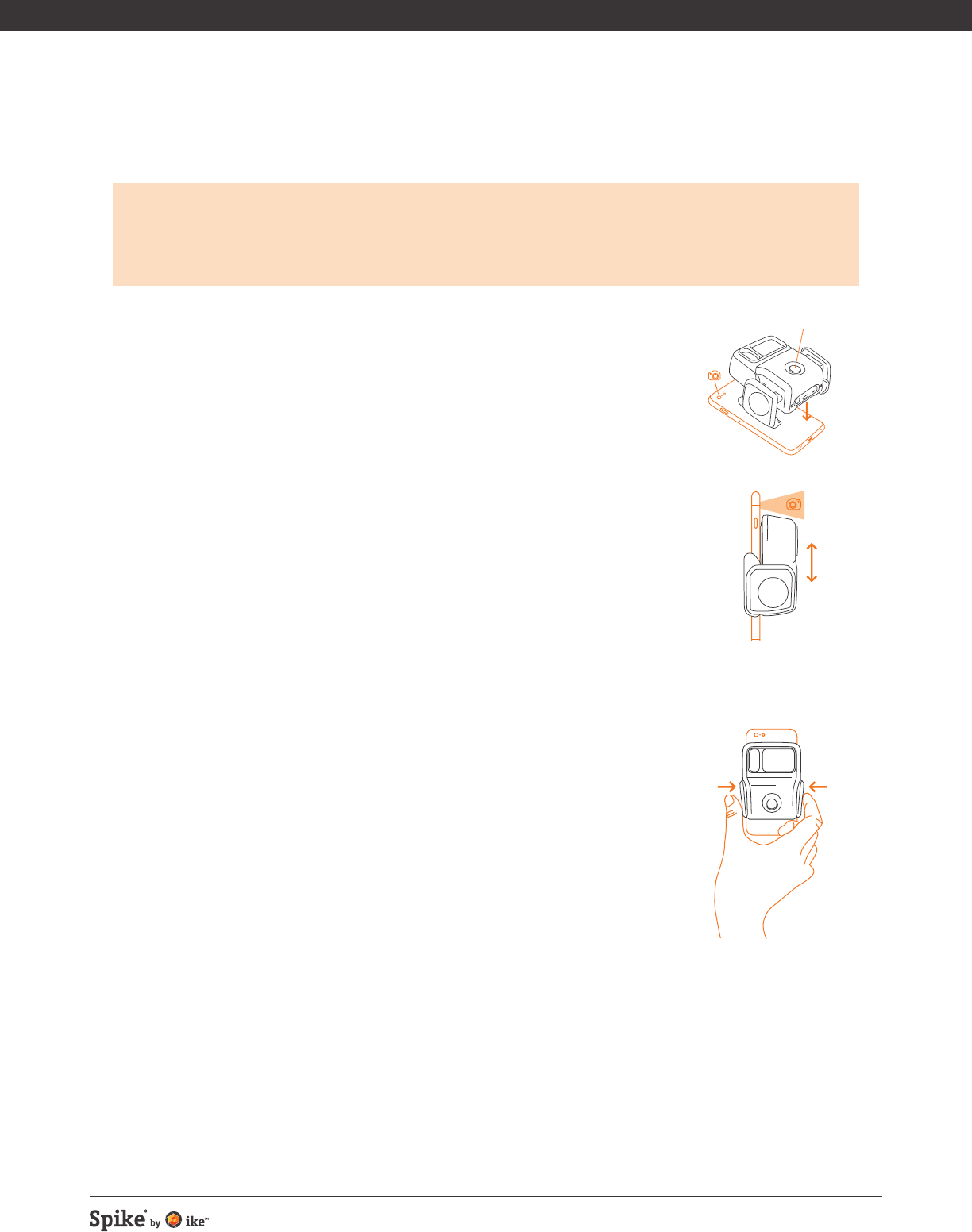
1 Press on the clamp release button. The clamps
will fully extend.
2 Find the best location for your Spike on the back
of your smartphone.
• Place Spike close to the camera, but ensure that Spike
does not obstruct the view from your camera or
ash.
• To verify, start your camera app and hold your Spike
against the back of your smartphone to validate correct
placement.
3 Once you have found the best location for your
Spike, use your ngers to squeeze the clamps
until they lock tightly around the edges of your
smartphone.
Clamp release button
Spike User Manual 5
2 Installing the Spike App
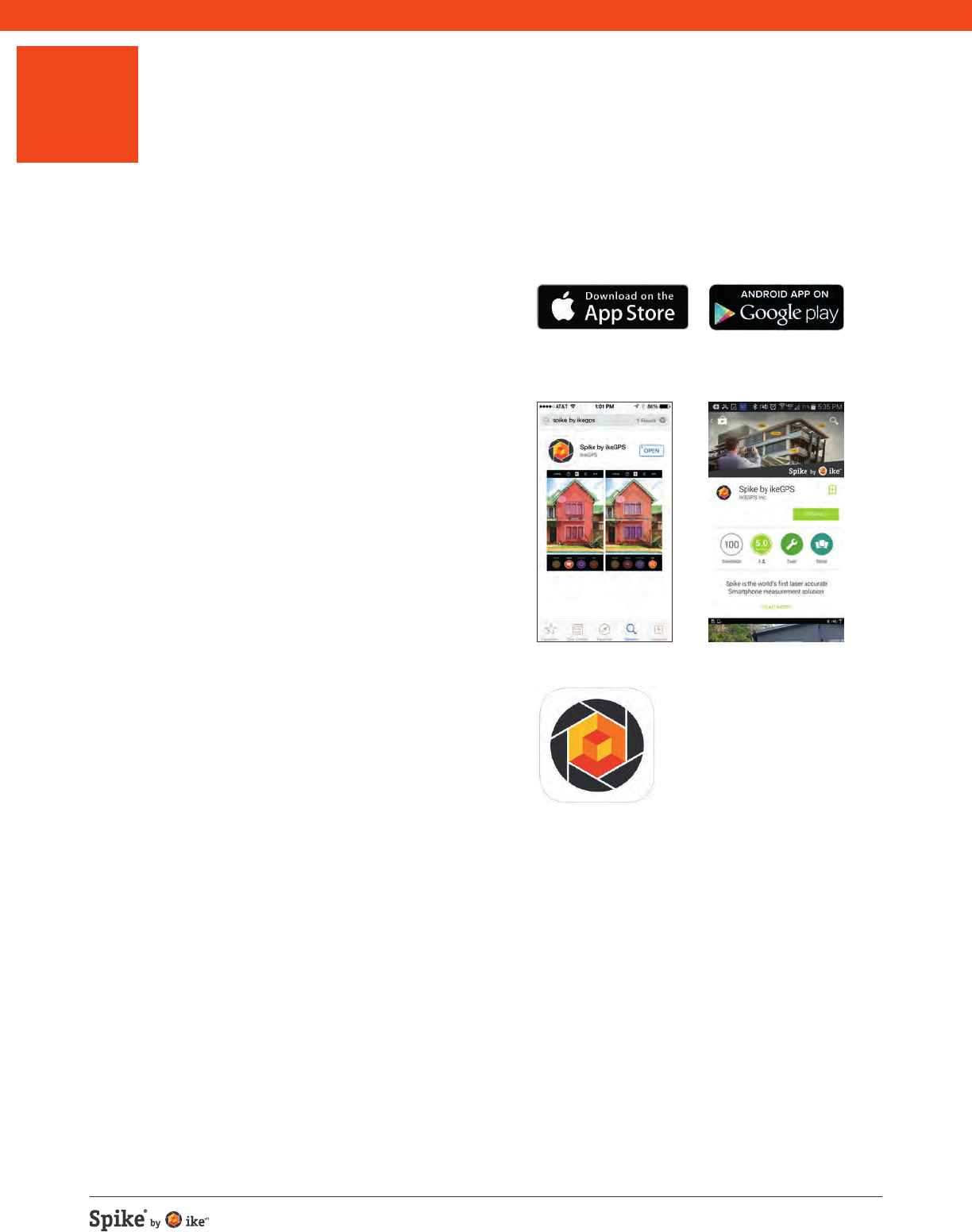
The Spike app is available for download from the App Store or Google Play.
1 On your smartphone or tablet,
launch the App Store or Google
Play.
2 Within the search box, search for
Spike by ikeGPS.
3 Follow the instructions to
download and install the app on
your smartphone or tablet.
4 Once installed, the Spike app icon
will appear.
5 Create your Spike Cloud account.
• Spike Mobile App: Go into the
Settings, scroll to the Cloud section,
and then sign up for an account.
• Online: Visit www.ikegps.com and
click on the Customer Login button
and select Spike. Then sign up for
your Spike account by entering an
email and password.
6 Once you have signed up for a
Spike account, you can log in at any
time by visiting www.ikegps.com
and clicking on the Customer Login
button.
Spike User Manual 6
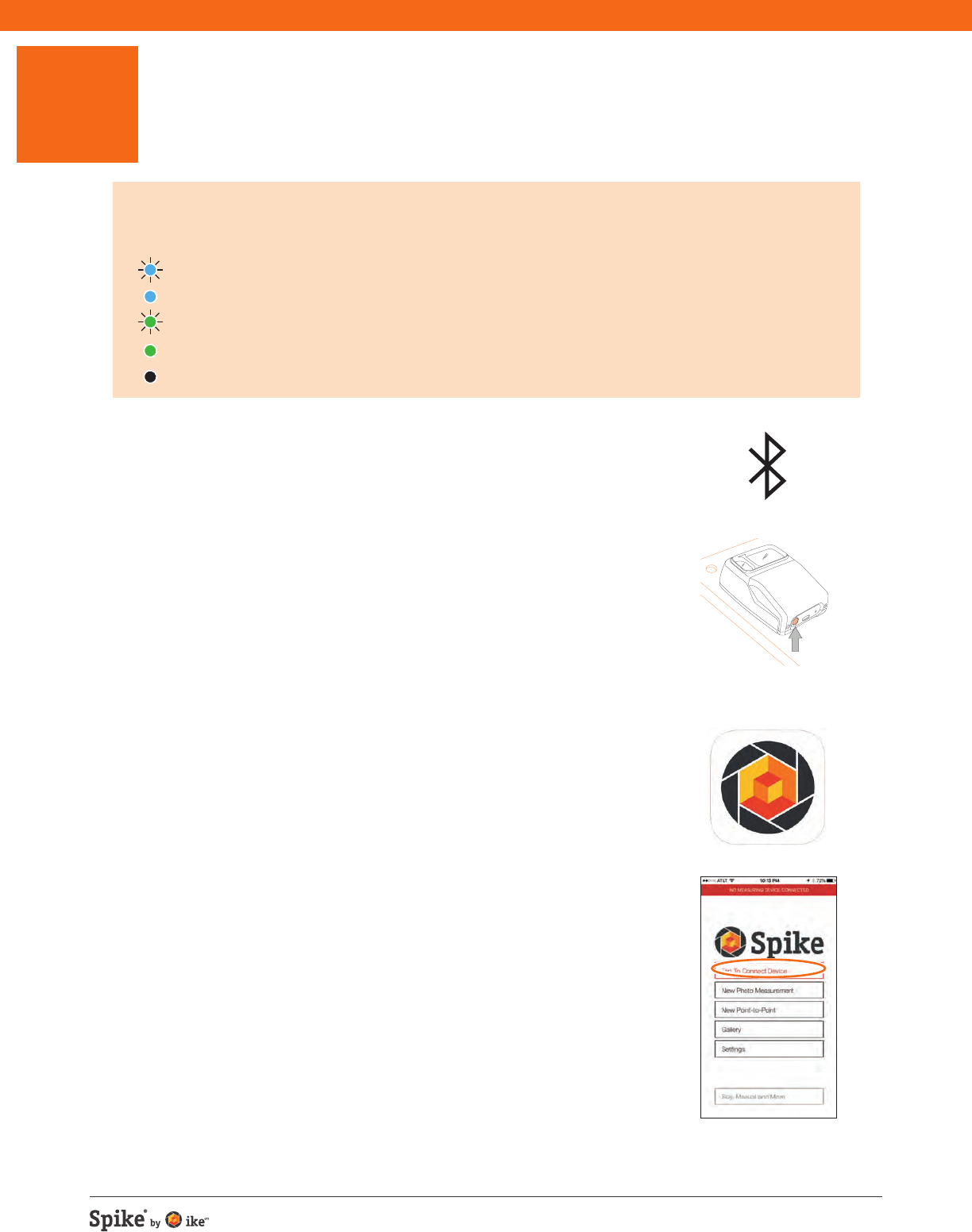
1 Turn on Bluetooth on your smartphone or tablet.
2 On your Spike, press the Power button.
• The LED indicator ashes blue indicating that the
Spike is discoverable over Bluetooth.
• If the LED indicator remains off, Spike may need
charging.
3 On your smartphone, tap on the Spike app to
launch it.
4 Tap on Tap To Connect Device. Then select
your Spike unit name to pair it with your
smartphone or tablet.
If no unit name appears, check that the Spike unit’s LED
indicator is ashing blue (see Step 2).
TIP: After connecting your Spike, go into the Spike app settings
and select your preferred units of measurements: feet,
inches, meters, or centimeters.
3 Starting Up
Blue flashing: Spike discoverable over Bluetooth
Blue on: Spike connected to Smartphone
Green flashing: Spike charging
Green on: Spike fully charged
Off: Power off
IMPORTANT TO NOTE...
The LED indicator shows the status of your Spike:
Spike User Manual 7
Aligning the Spike Laser to the Camera
IMPORTANT TO NOTE...
• Before using your Spike for the rst time, you need to ensure that the laser is
aligned with the camera of your smartphone or tablet.
• You must calibrate the Spike laser the rst time it is used with a new smartphone
or tablet. After a smartphone or tablet has been calibrated with Spike, it does
not need to be calibrated again. If Spike is removed from the device, ensure that
Spike is returned to the same location as when it was calibrated.
TIP: Video tutorials can be found in the Spike Support Center. Visit
www.ikegps.com/support
1 In the Spike app, go to the Settings, and select
Align Laser.
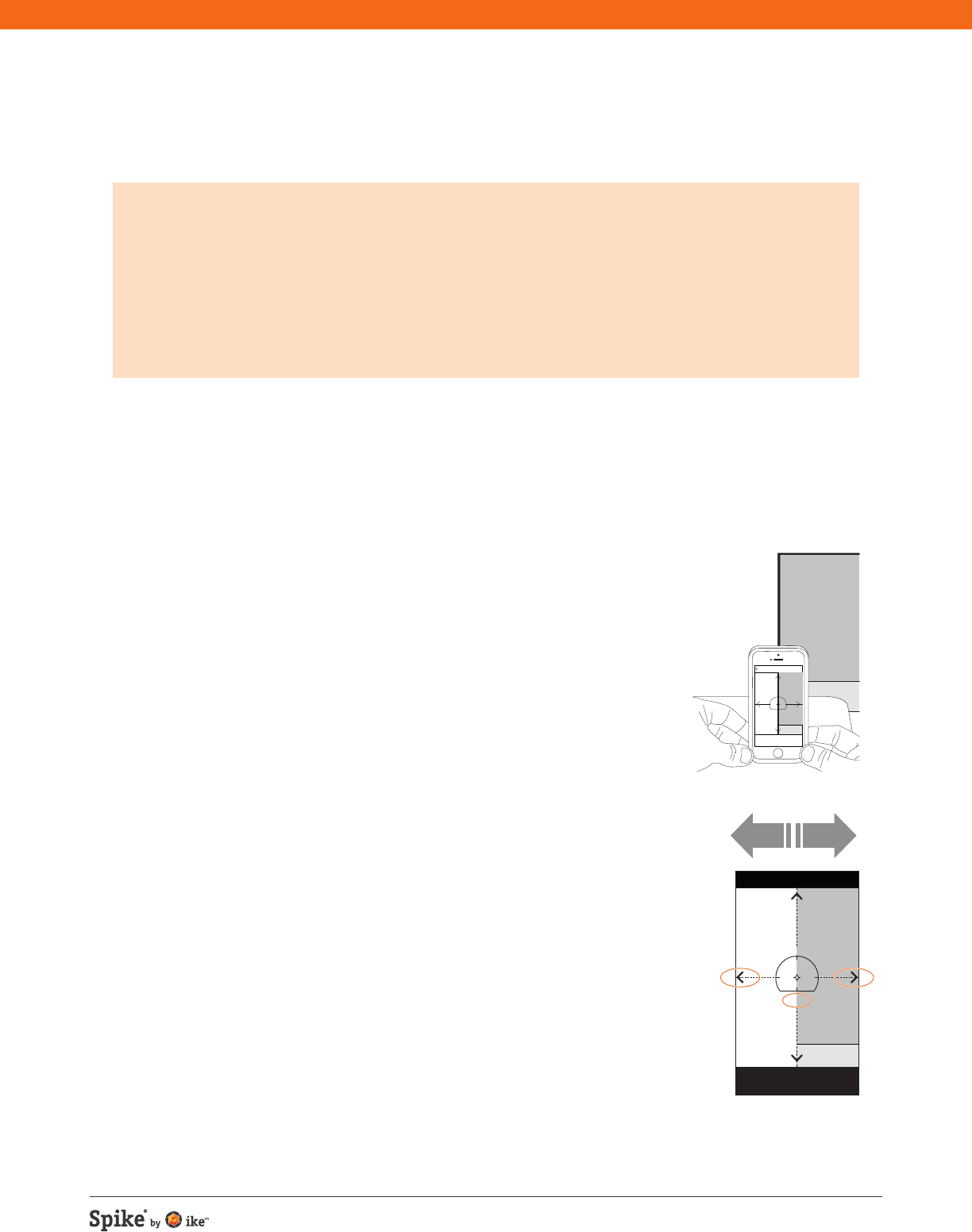
2 Rest your smartphone on top of a at, hard
surface, such as a table top. Then hold your
smartphone vertically and aim it towards two
objects that are at different distances, for
example the edge of a door. Ensure that the
closest object has a vertical edge.
• The distance between the two objects should be
at least 15 feet (5 meters).
• You can use the vertical edge of an open door
and the wall of the room behind it.
3 Slowly move your smartphone sideways ➊
and check that the distance measurement ➋
changes when the crosshair in the center of
the screen moves on and off the vertical edge.
4 If the measurement changes at the point where
the crosshair moves on and off the vertical
edge, your laser is correctly aligned. If this
does not happen at the correct point, tap on
the left and right blue arrows ➌ to adjust to the
correct point.
EDGE OF DOOR
9'1"
X: 0 Y: -15
Settings Laser Calibration
➋
Done
X: 5
6'9"
Y: 0
➌➌
➊
Spike User Manual 8
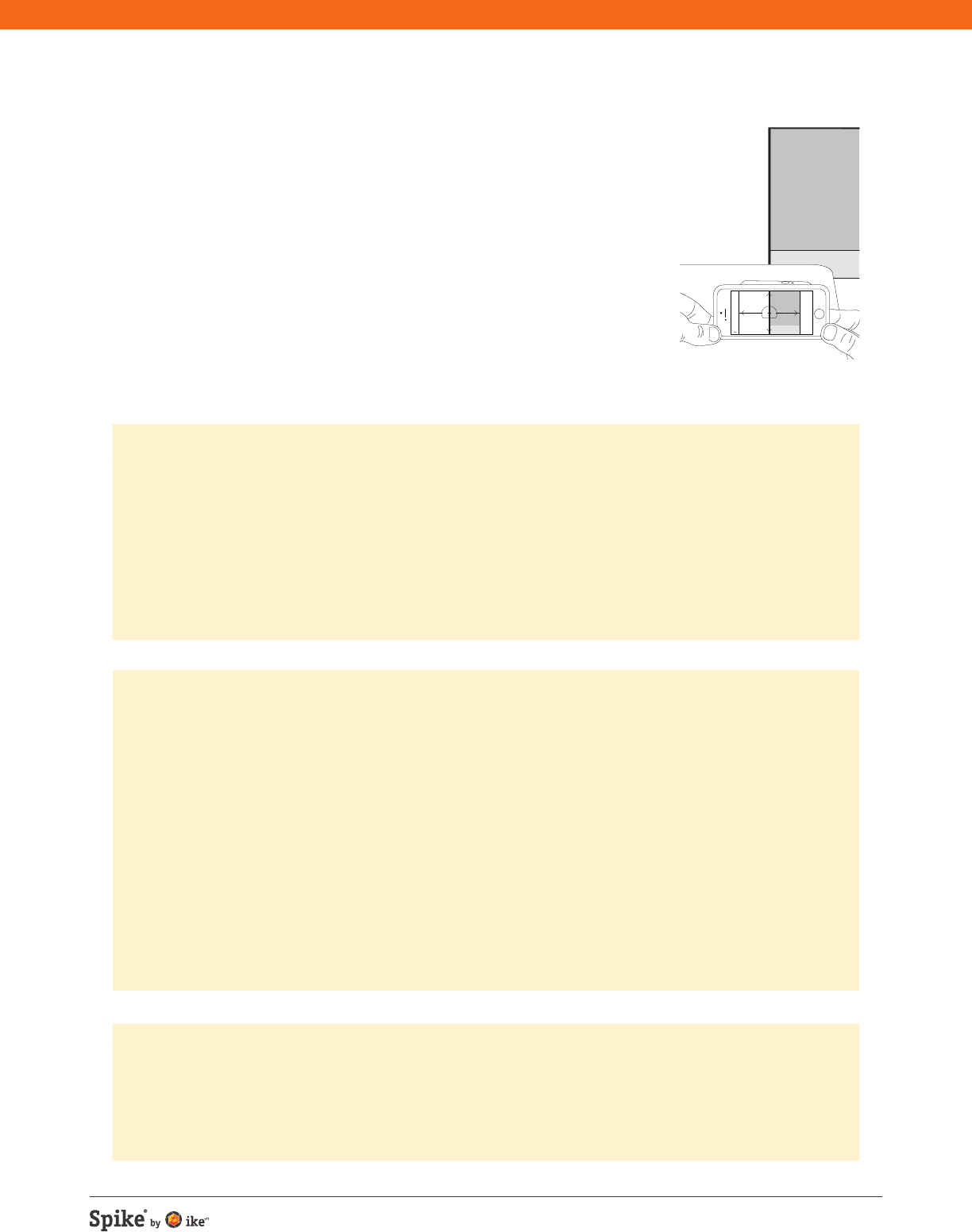
5 Turn your smartphone horizontally
and aim at the same two objects.
Repeat steps 3 and 4 to align the
laser horizontally.
Additional Information
Calibrating Your Compass
Calibrating your compass is only required if you intend to capture the location of your
target (latitude, longitude, altitude), and export KMZ les. You need to ensure that
your smartphone or tablet’s compass is calibrated so your target’s location can be
accurately captured.
TIP: Calibration instructions and video tutorials can be found in the Spike Support
Center. Visit www.ikegps.com/support
Charging Your Spike
Your Spike has an internal battery that requires charging. After setting up your Spike,
we recommend charging your Spike for approximately 3 hours.
1 Connect the USB cable provided to the micro USB charging port on the bottom
of your Spike.
2 Connect the other end of the USB cable to any device that can charge USB
devices (e.g. computer, wall charger, etc). The LED indicator will ash while
charging.
3 The LED indicator will turn green when Spike is fully charged. Disconnect the
USB cable and store in a safe place.
Turning Your Spike Off
Your Spike will automatically turn off after 1 minute of inactivity. Alternatively, you can
turn it off manually by holding down the Power button for 5 seconds until the blue
LED indicator turns off.
EDGE OF DOOR
9'1"
X:
0
Y:
-15
Settings Laser Calibration
Spike User Manual 9
4 Taking a Photo Measurement
To take an accurate Photo Measurement with your Spike, you need to
ensure that:
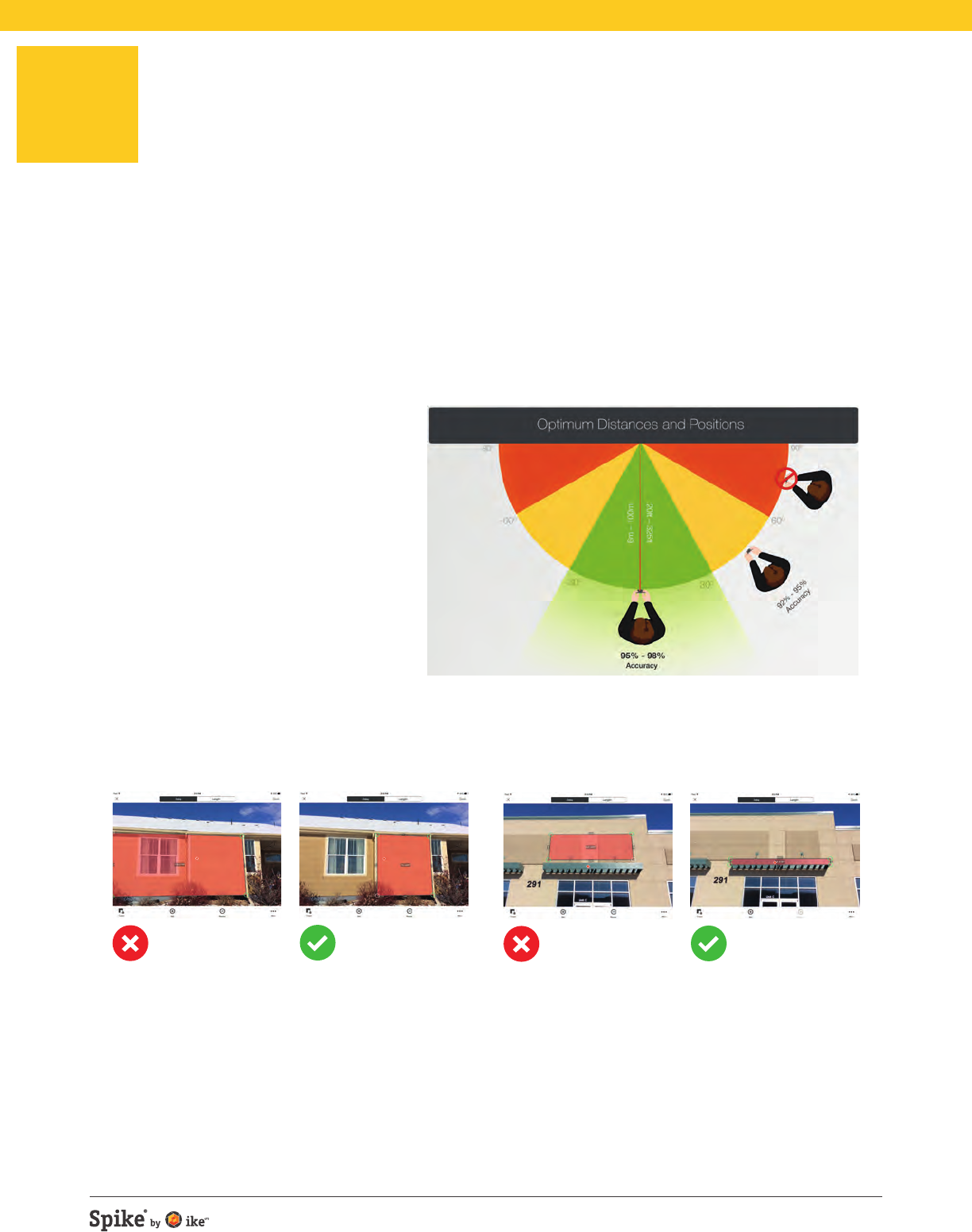
1) Your target is a at surface and is all on the same plane.
2) Your target is or has a rectangular shape on it (to align the object).
3) Your laser (crosshair on the screen) is pointed at your target. The
crosshair should be on a solid surface and not a window.
4) You are perpendicular
to the target. Photo
measurements taken
from the optimal position
typically see an accuracy
of ± 3%. Please reference
the following target
distance and positioning
guide when taking a Spike
photo.
You cannot measure an object or objects that are on different planes.
Below are some examples.
The bump out
and the side of
the house are on
different planes,
so you cannot
measure the wall
if the laser was
pointed at the
bump out.
The bump out
is on the same
plane that the
laser was pointed
at (red dot), so
measurements
will have higher
accuracy.
The awning and
the wall are not on
the same plane,
so you cannot
measure the wall
if the laser was
pointed at the
awning.
The awning is
on the same
plane that the
laser was pointed
at (red dot), so
measurements
will have higher
accuracy.
Spike User Manual 10
Taking a Photo of the Object to Measure
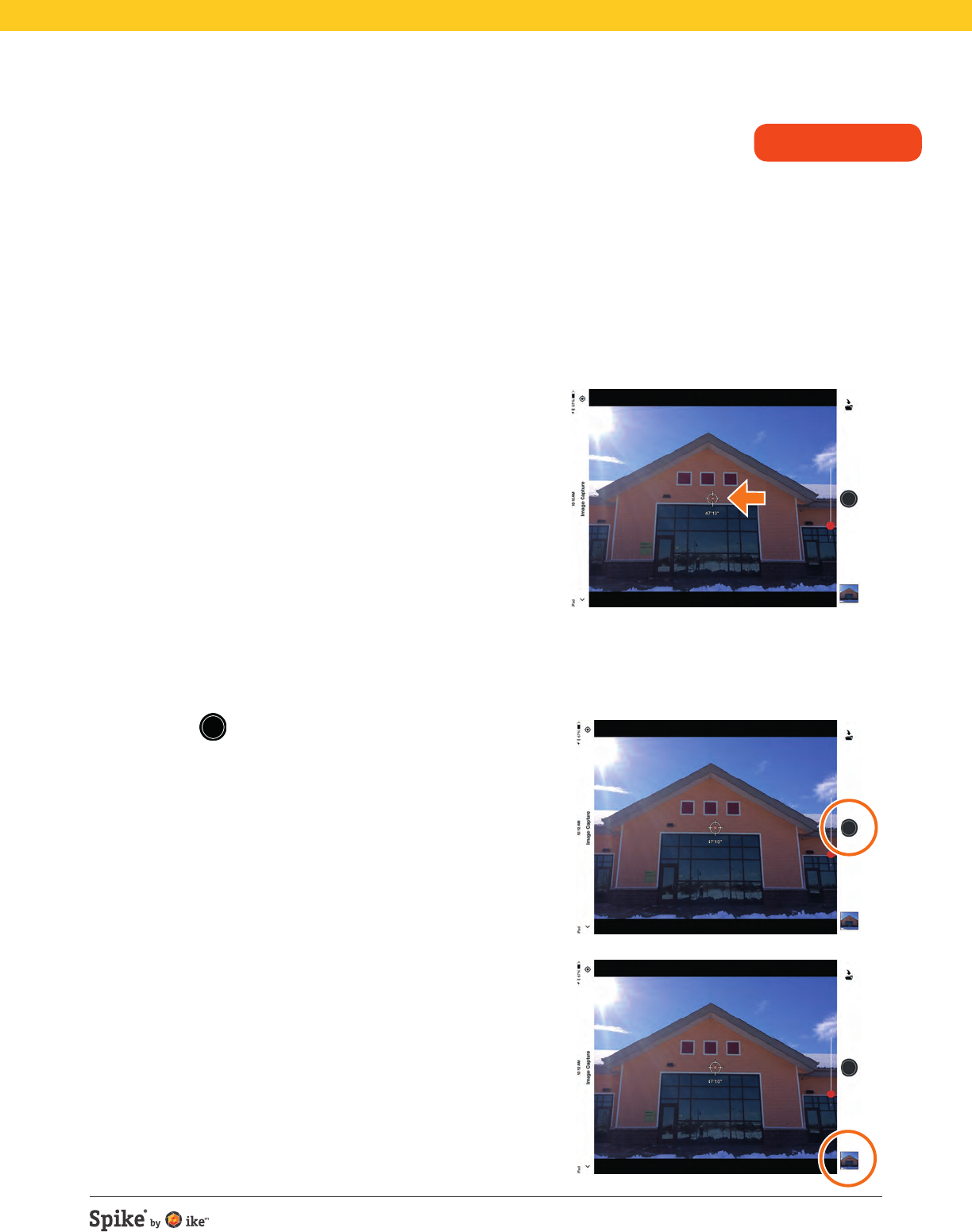
To measure an object, you need to take a photo of it rst. Be sure to aim the
laser (crosshair on the screen) directly at the object you wish to measure.
1 On your smartphone, ensure that the Spike app is open and
connected to your Spike.
Refer to Section 2 “Starting Up” for details.
2 From the Spike app menu, tap on New Photo Measurement.
3 Point your smartphone at the
object you wish to measure,
ensuring that the crosshair is on
the target.
• The object you wish to measure must be
on the same surface or plane that you
are aiming the crosshairs (laser) at.
• Ensure the crosshair is on a solid
surface and not on a window or hole.
• Use the zoom slider so you can better
view the crosshair location on your
target, or when you are positioned at
a distance from your target.
4 Tap on the screen to take a
picture.
5 Tap on the small preview image
to display the photo you have just
taken.
SPIKE MOBILE APP
Spike User Manual 11
SPIKE MOBILE APP
Aligning to the Object
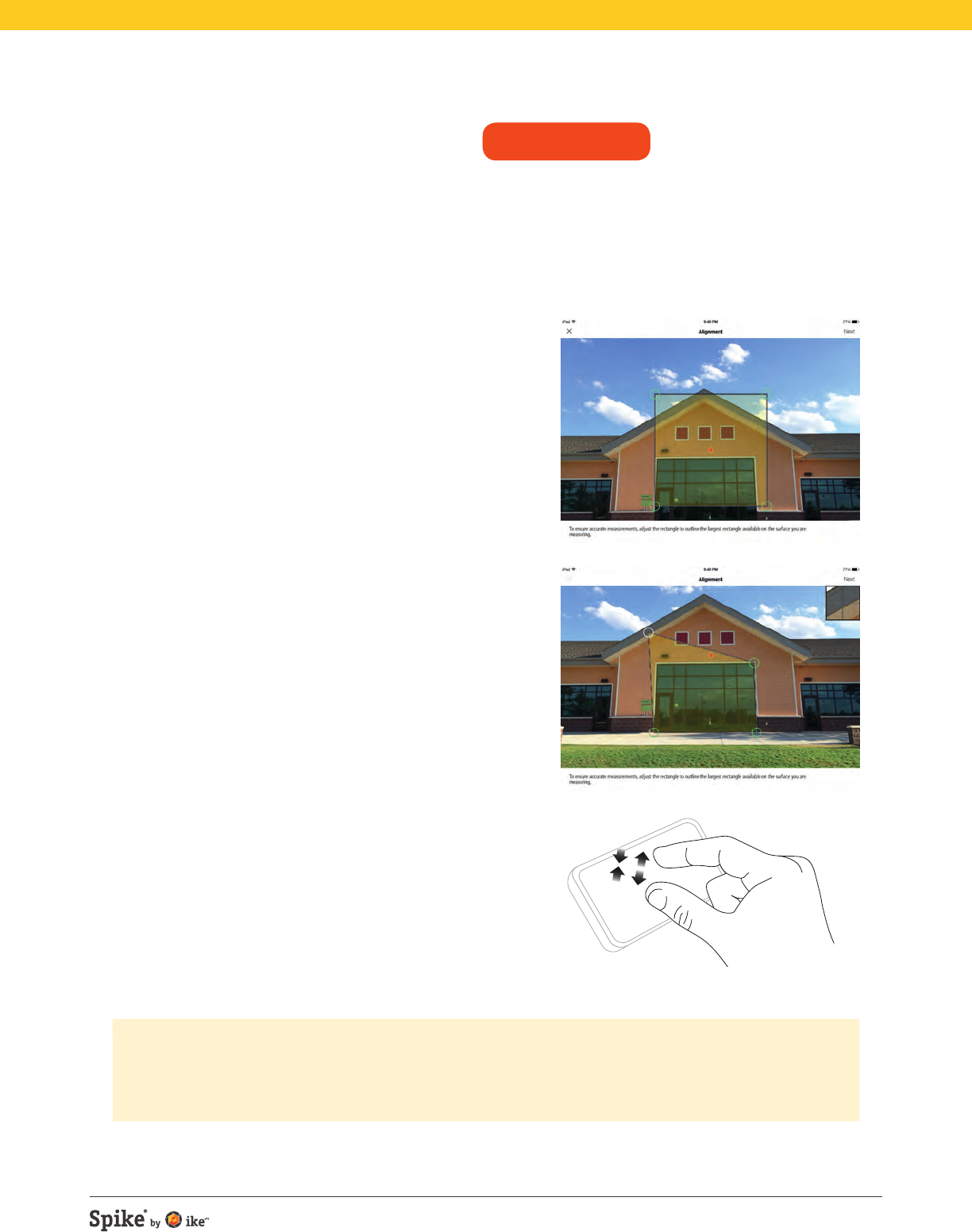
Before you can measure an object, you need to set the surface’s perspective
by outlining a large rectangle on it. This identies and corrects the horizontal
and vertical angle from which the photo was taken. Your target must be or
must contain a rectangular shape so that the object can be aligned.
1 When measuring a photo for the
rst time, you will be in alignment
mode by default.
A rectangular shape will appear over
your target.
2 Drag the anchors of the rectangle
to align them to the extreme
corners of the surface you want
to measure.
TIPS: Use the zoom window to help you
align the anchors precisely to
the corners of your object.
You may also use your ngers
to Pinch & Zoom on the photo to
better view the object.
IMPORTANT TO NOTE...
Measurement anchors are the circles that you drag to create the shapes you want to
measure, such as a rectangle or line.
Spike User Manual 12
Measuring the Area of the Object
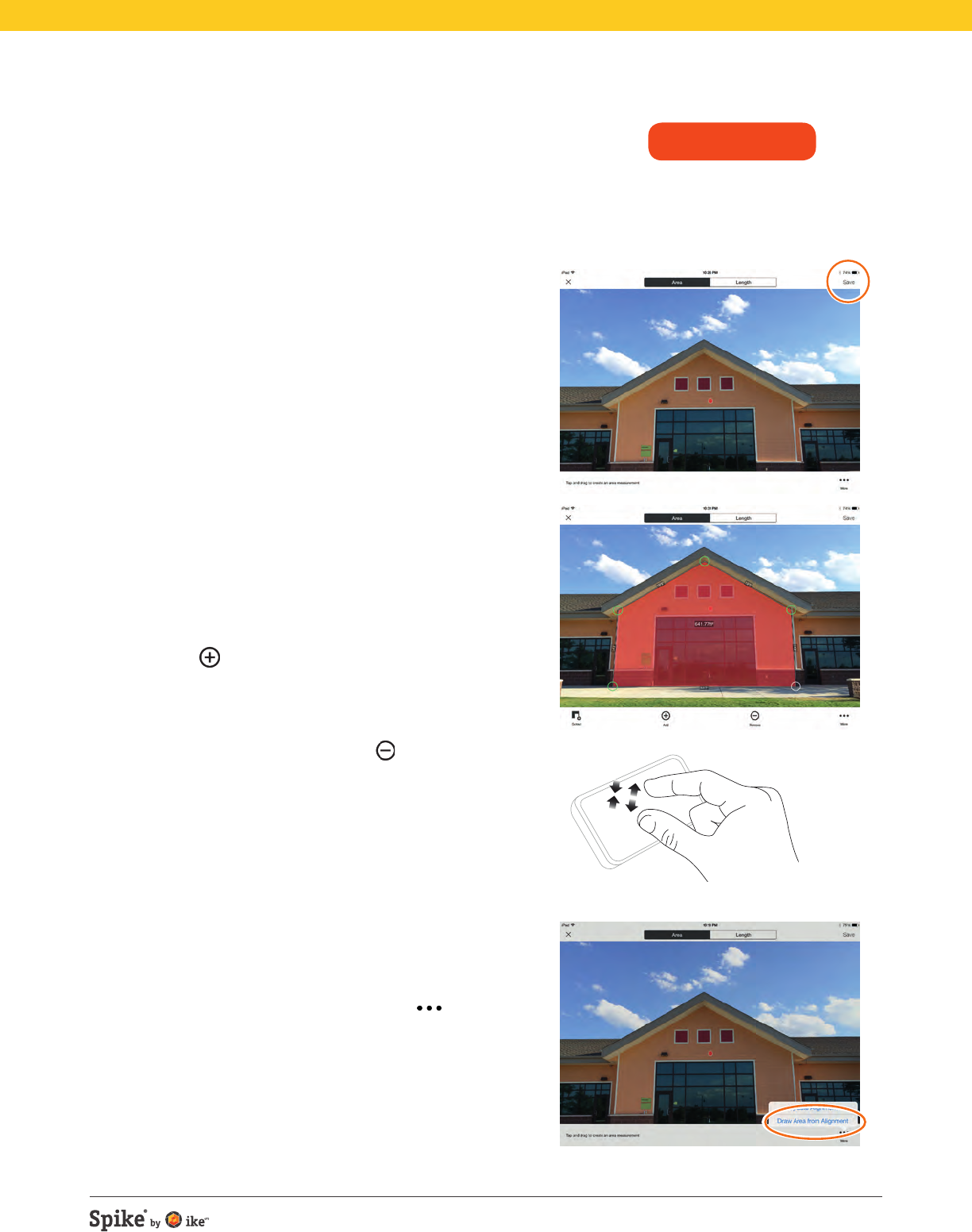
Once you have aligned the perspective of your object, you can measure the
area of your object.
1 After you have drawn the
alignment rectangle, tap Next to
measure an area.
2 Tap and drag to create an area
rectangle.
• Use the zoom window to help you align
the anchors precisely to the corners of
your object.
• You can add more anchors by selecting
and then tapping anywhere on a
line. Drag the new anchor to create a
polygon.
• To delete anchors, tap on an anchor to
select it, then tap on to delete it.
TIP: You may also use your ngers to
Pinch & Zoom on the photo to better
view the object.
3 Alternatively, you can select to
copy your alignment rectangle as
your area rectangle.
To select this option, tap on , and
select Draw Area From Alignment.
SPIKE MOBILE APP
Spike User Manual 13
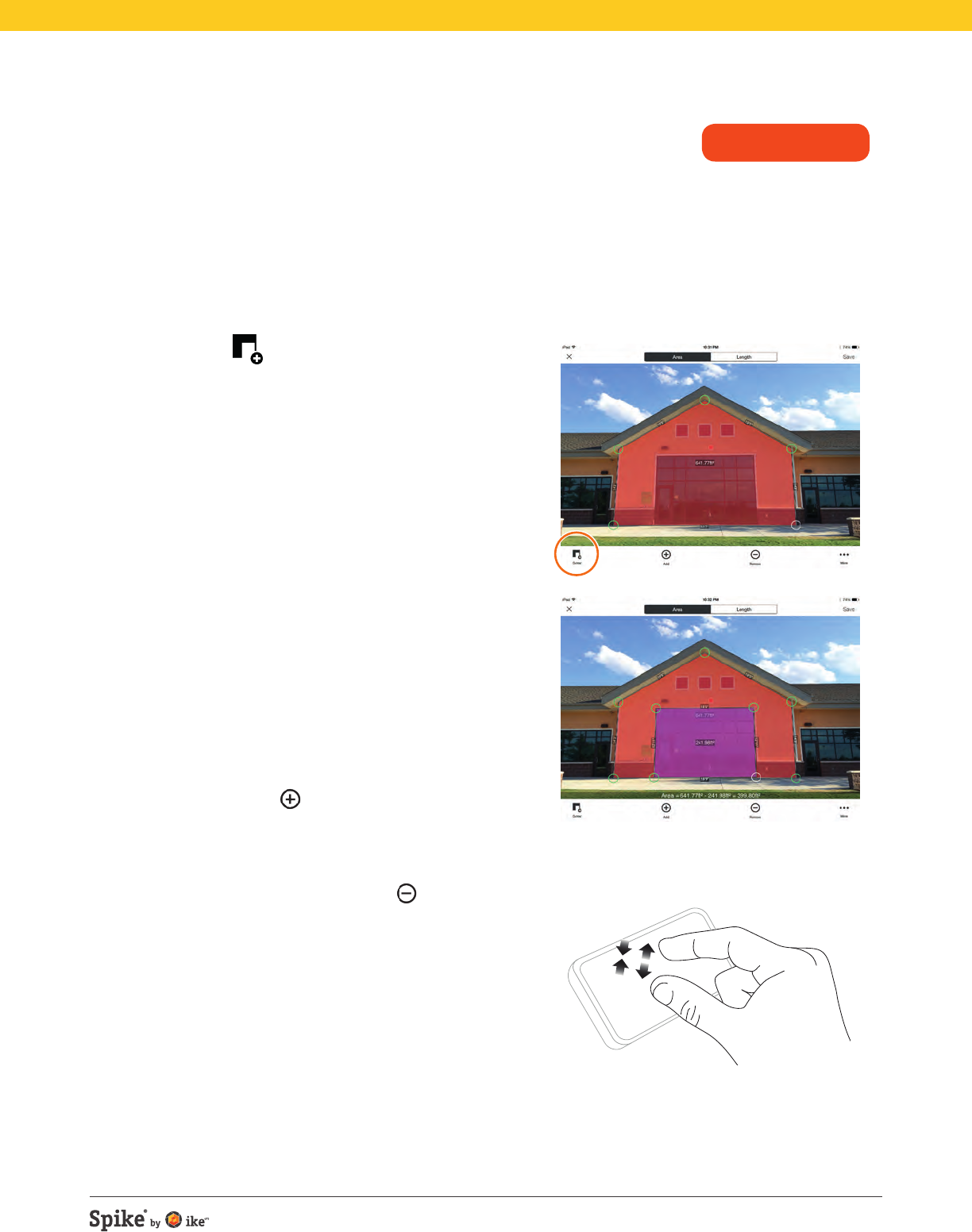
Cutting Out a Section of Your Object
You can cut out a section of your object that you do not want included in
the total measurement of the object area. For example, you may want to
measure the surface area of a wall without including the area of windows or
doors. Alternatively, the cutout tool can be used to measure additional areas
on your object.
1 Tap on and then tap and drag
to create a cutout rectangle.
2 Drag the anchors of the
rectangular shape to align them to
the section of the object you want
to cut out.
• Use the zoom window to help you
align the anchors precisely to the
corners of the cutout object.
• You can add more anchors by
selecting and then tapping
anywhere on a line. Drag the new
anchor to create a polygon.
• To delete anchors, tap on an anchor
to select it, then tap on to delete it.
• The screen will display the new area
measurement excluding the cutout
section.
TIP: You may also use your ngers
to Pinch & Zoom on the photo to
better view the object.
SPIKE MOBILE APP
Spike User Manual 14
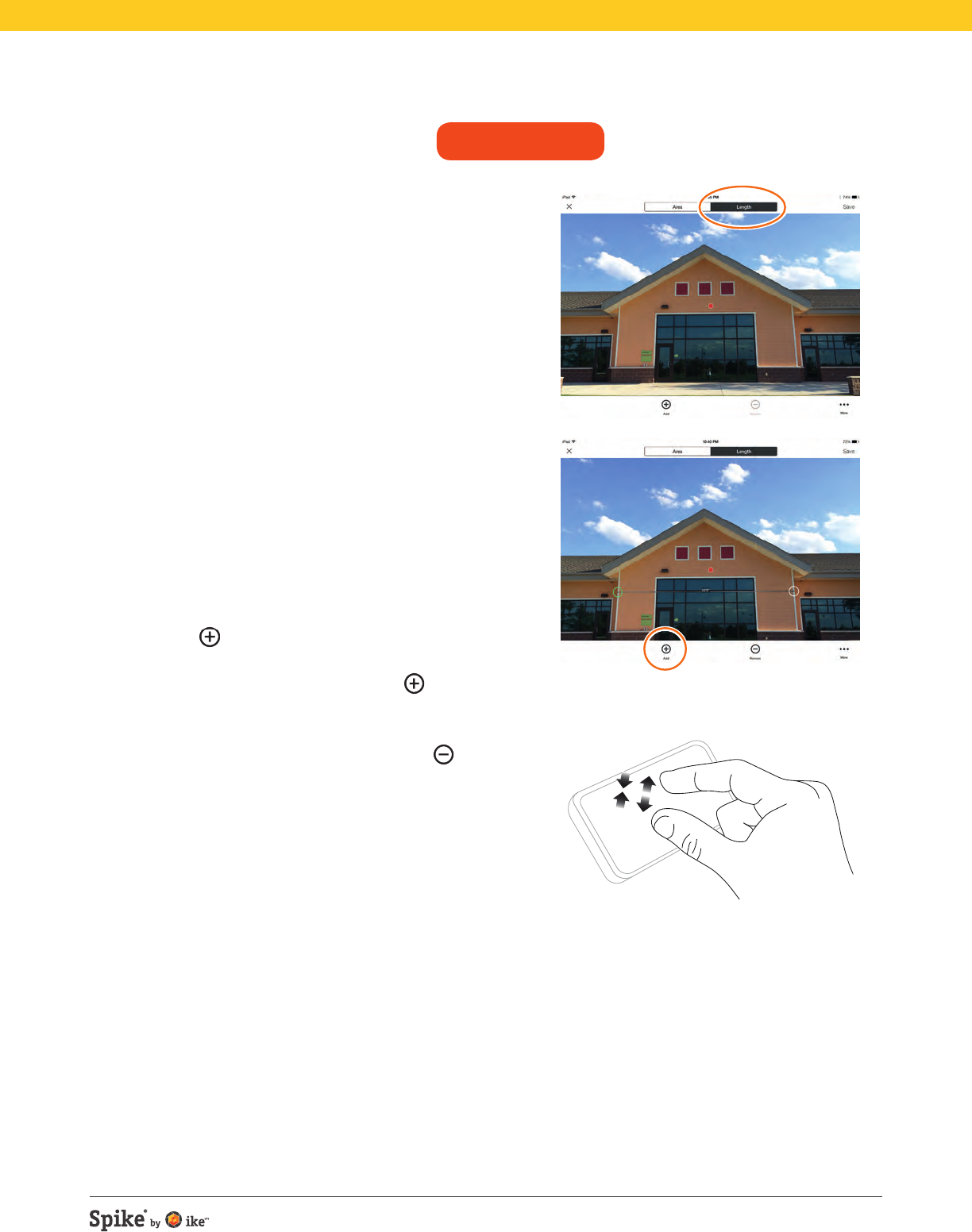
Measuring a Length
1 To measure a length, tap on
Length at the top of the screen.
2 Tap and drag to create a line.
Adjust anchors as needed.
• Use the zoom window to help you
align the line precisely to the edges of
your object.
• The length of your object will display
on the screen.
• Draw connecting lines by tapping on
and then tapping and dragging on
one of the line anchors.
• To add another line, tap and drag
to create a line.
• To delete anchors or lines, tap on an
anchor to select it, then tap .
TIP: You may also use your ngers
to Pinch & Zoom on the photo to
better view the object.
SPIKE MOBILE APP
Spike User Manual 15
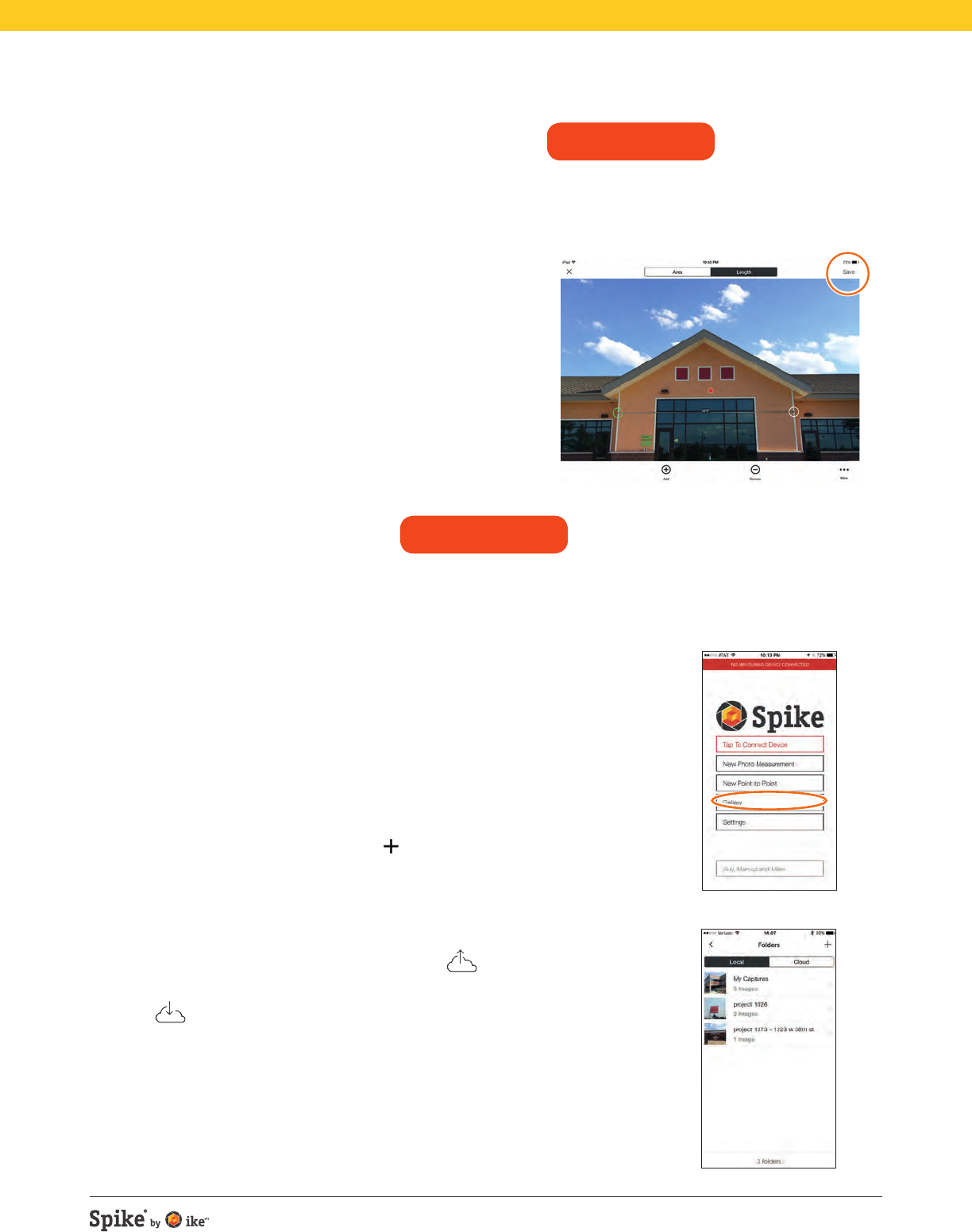
Saving Your Measurements
Once you are done taking measurements or making edits, be sure to save
your photo. All saved photos are placed in the Gallery.
1 To save your measurements,
tap Save.
SPIKE MOBILE APP
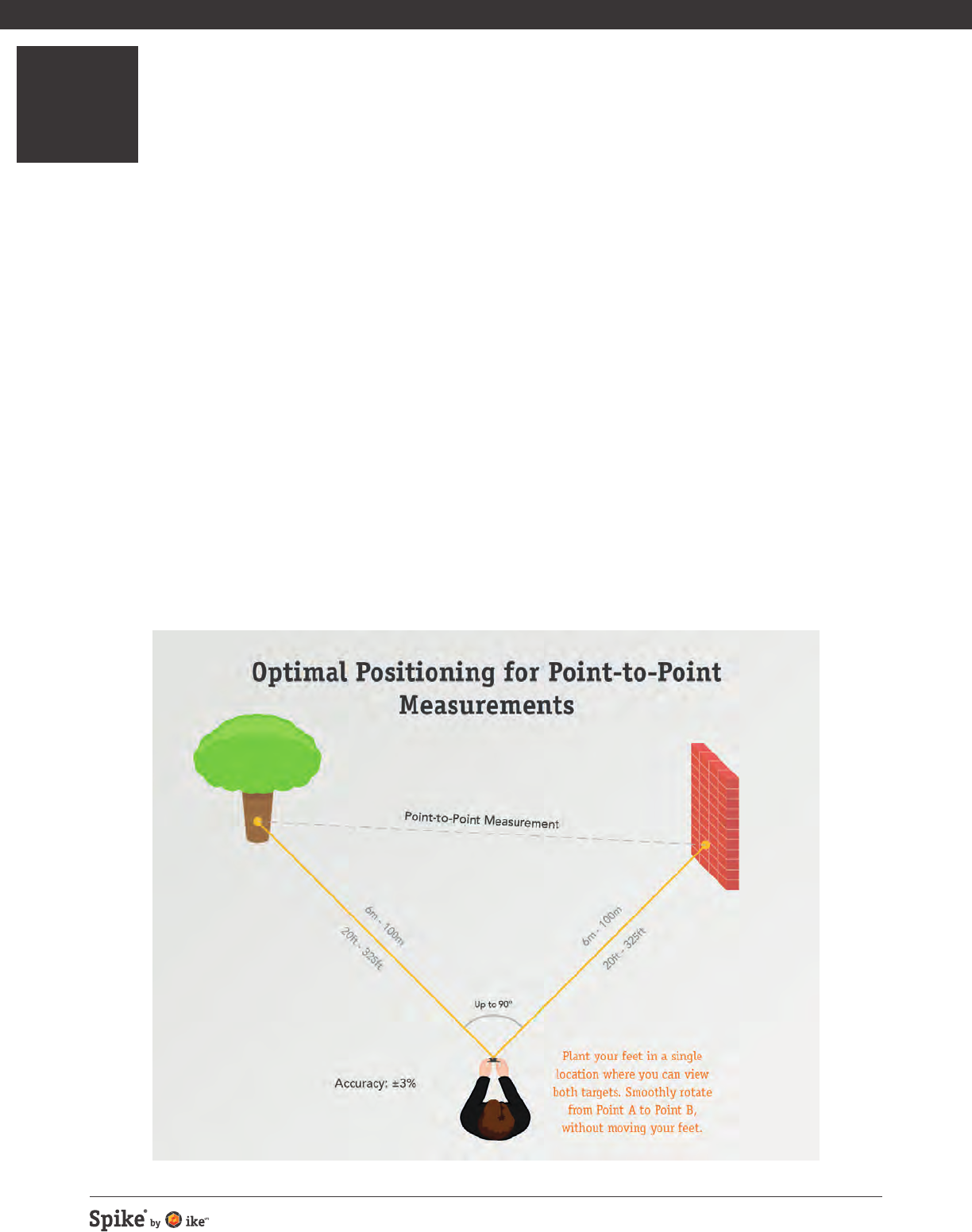
Using the Gallery
Use the Gallery to access all saved photos. From the gallery you can view,
edit, export, or delete your saved photos.
1 In the app home screen, select
Gallery.
You can view photos that are stored
within your Spike app, or on the Spike
cloud.
2 Photos may be organized in folders.
To add a new folder, tap and then
name your folder.
3 From the Gallery, you can also
upload photos to the cloud or
download photos from the cloud
.
SPIKE MOBILE APP
Spike User Manual 16
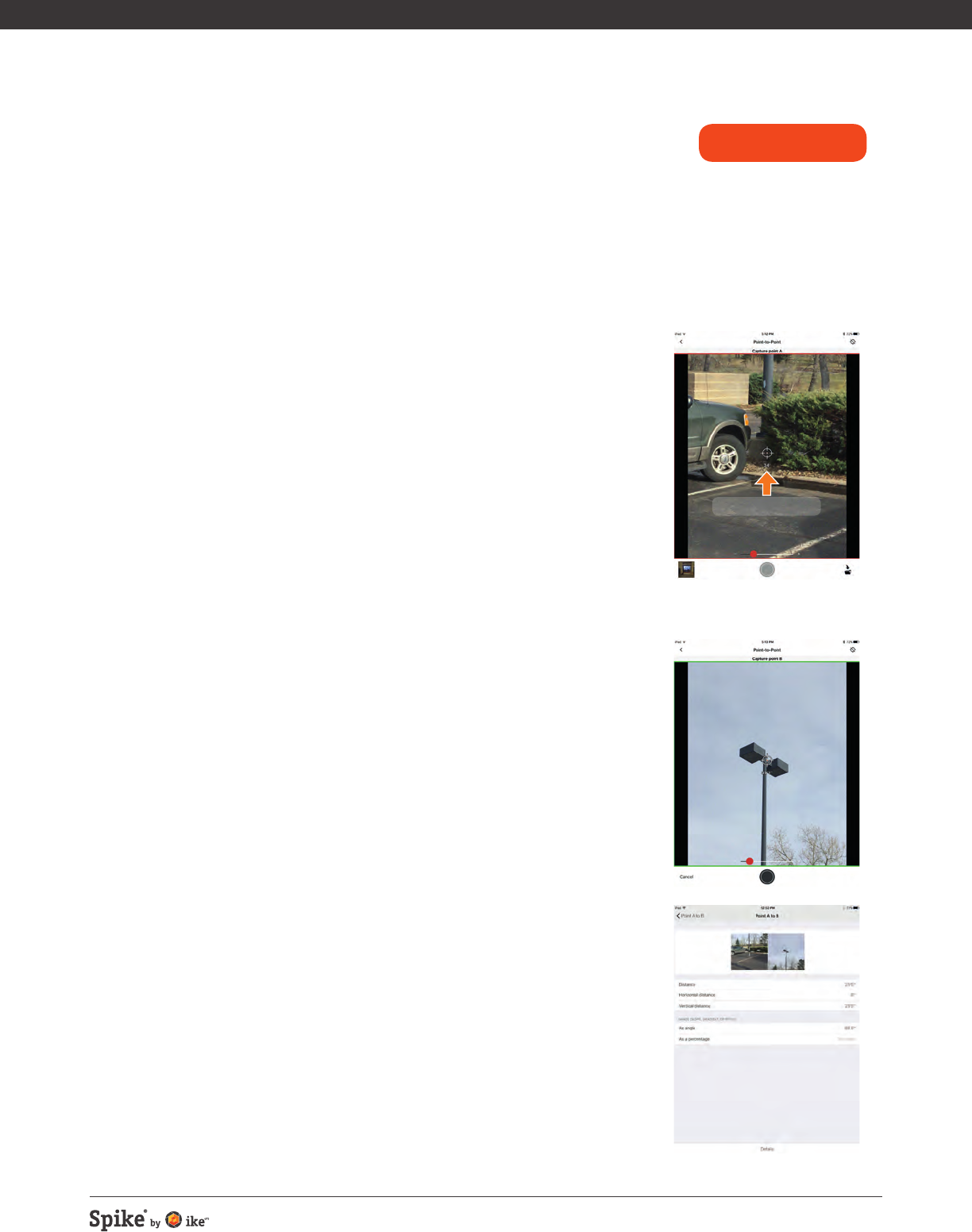
5 Taking a Point-to-Point Measurement
To take an accurate Point-to-Point Measurement with your Spike, ensure
that:
1) Your feet are planted in a single location where you can view both
targets.
2) You keep the two targets within a 90-degree arc for best accuracy.
3) Your targets are at least 20ft/6m away and within 325ft/100m.
4) You maintain a consistent arms length and hold Spike at approximately 1
foot from your head.
5) You aim Spike at your rst target and hold it steady. Spike will be ready
to capture the rst point when the border of the screen changes from red
to green and the “Hold Steady” message goes away.
6) You smoothly and quickly rotate from Point A to Point B, without moving
your feet.
Spike User Manual 17
Take Photos of the Objects to Measure
A Point-to-Point measurement captures the distance between two points
(objects) by taking two photos.
1 From the Spike app menu, tap on
New Point-to-Point.
2 Aim the Spike laser at your rst target and
hold it steady.
• Maintain a consistent arm’s length and hold
Spike approximately 1ft/.5m away from your
head.
• Spike will be ready to capture the rst point
when the border of the screen changes from
red to green and the “Hold Steady” message
goes away.
• Press the capture button.
3 Smoothly and quickly rotate your body
from Point A to Point B at a consistent
arm’s length, without moving your feet.
• Aim the laser target icon at Point B.
• Press the capture button.
4 A new window will appear showing
you the results of your Point-to-Point
Measurement. You may choose to either
save or discard the measurement.
HOLD STEADY
SPIKE MOBILE APP
Spike User Manual 18
Once you have taken a photo of the object you would like to measure using
the Spike app, you may upload that photo to the Spike Cloud. From the
Spike Cloud you can view, edit, measure and export Spike photos. The
Spike Cloud can be accessed from the Customer Login button on
www.ikegps.com.
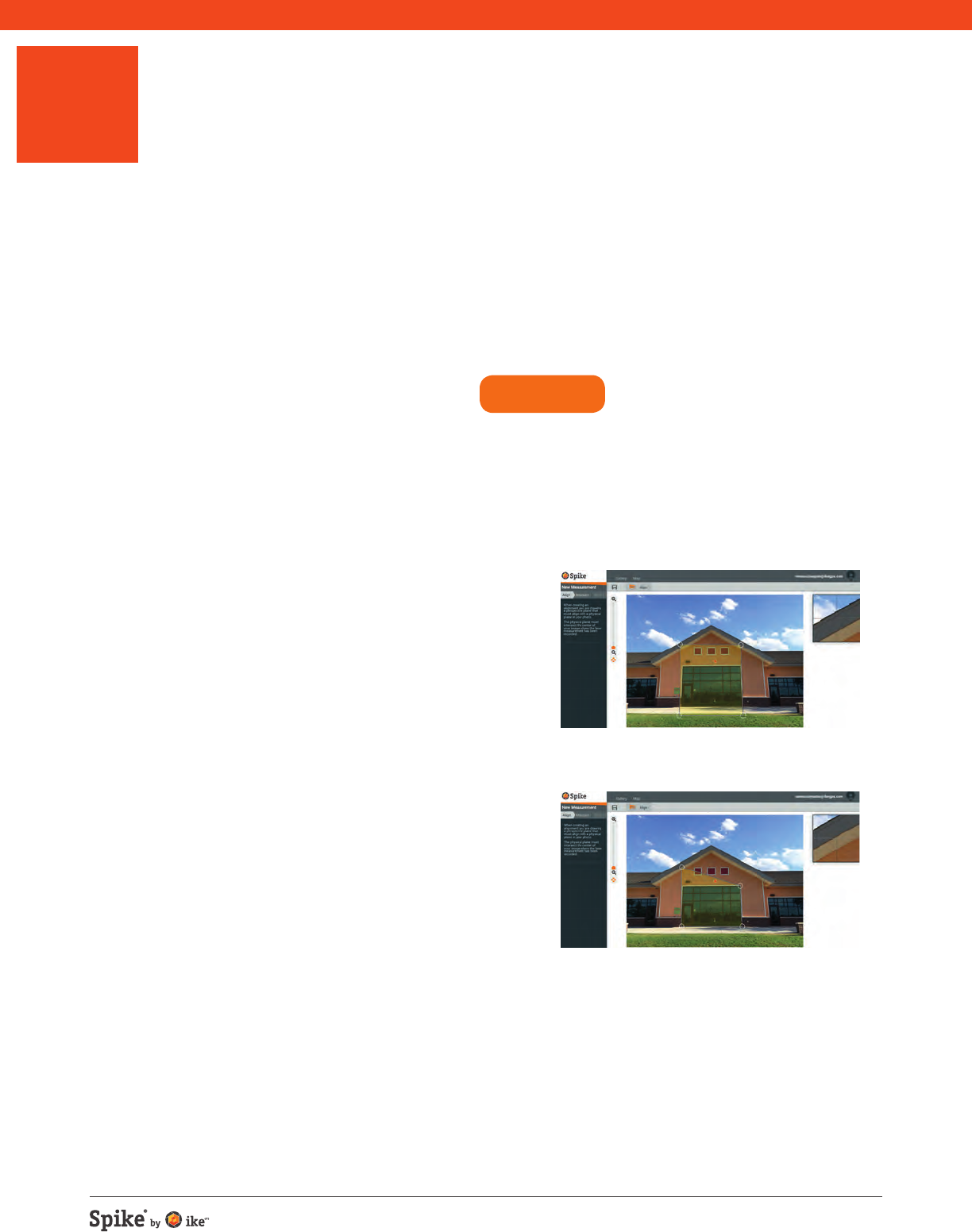
Aligning to the Object
Before you can measure an object, you need to set the surface’s perspective
by outlining a large rectangle on it. This identies and corrects the horizontal
and vertical angle from which the photo was taken. Your target must be or
must contain a rectangular shape so that the object can be aligned.
1 From the Gallery, click on the
photo you would like to measure.
A rectangular shape will appear over
your target.
2 Drag the anchors of the rectangle
to align them to the extreme
corners of the surface you want
to measure.
TIPS: Use the zoom window to help you
align the anchors precisely to
the corners of your object.
You may also use the zoom slider
to better view your object.
SPIKE CLOUD
6 Using the Spike Cloud
Spike User Manual 19
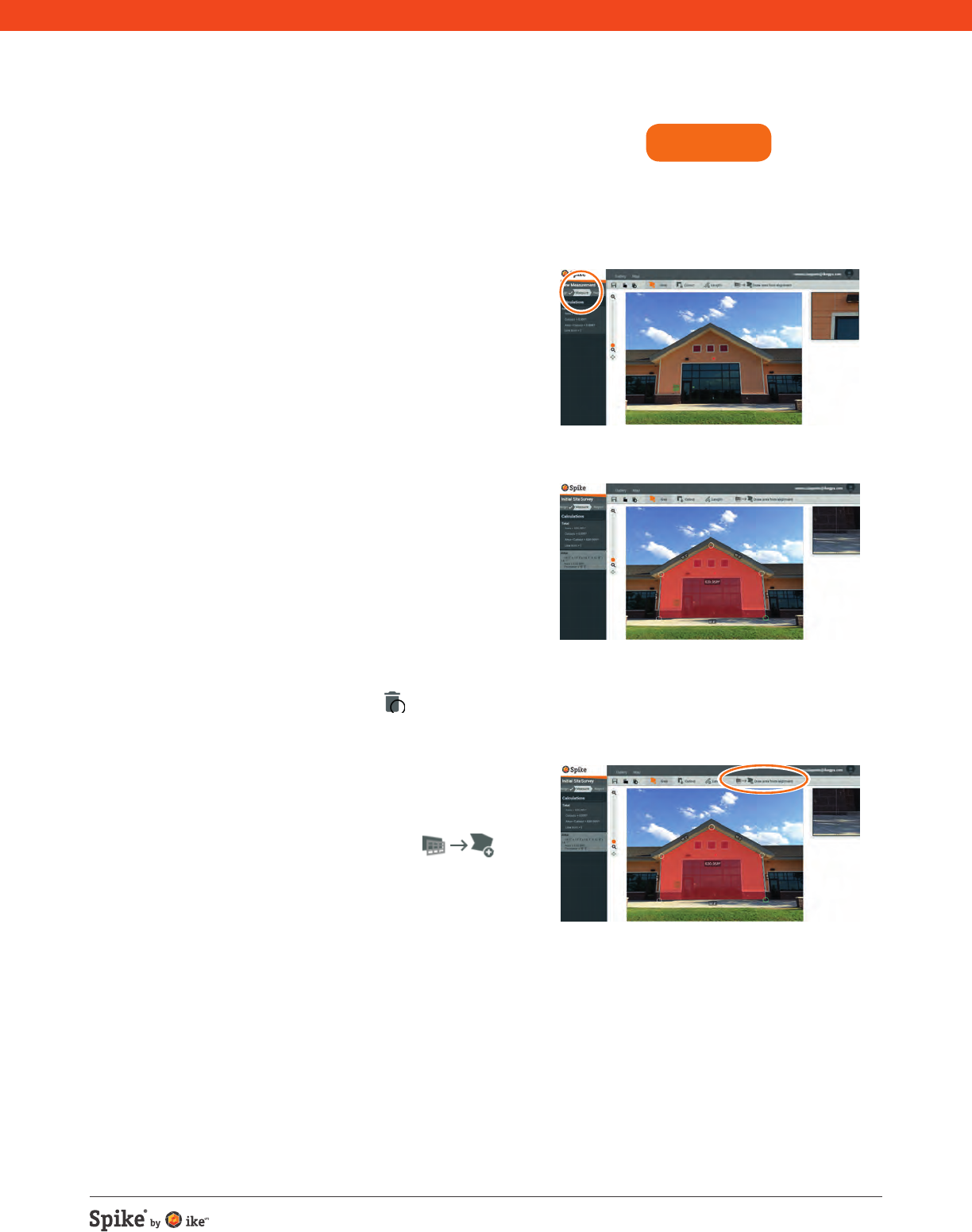
Measuring the Area of the Object
Once you have aligned the perspective of your object, you can measure the
area of your object.
1 Click on Measure on the left
side of your screen to take
measurements.
2 Click and drag to create an area
rectangle.
• Use the zoom window to help you align
the anchors precisely to the corners of
your object.
• You can add more anchors by clicking
anywhere on a line. Drag the new
anchor to create a polygon.
• To delete anchors, tap on an anchor to
select it, then click on to delete it.
3 Alternatively, you can select to
copy your alignment rectangle as
your area rectangle.
To select this option, click on .
SPIKE CLOUD
Spike User Manual 20
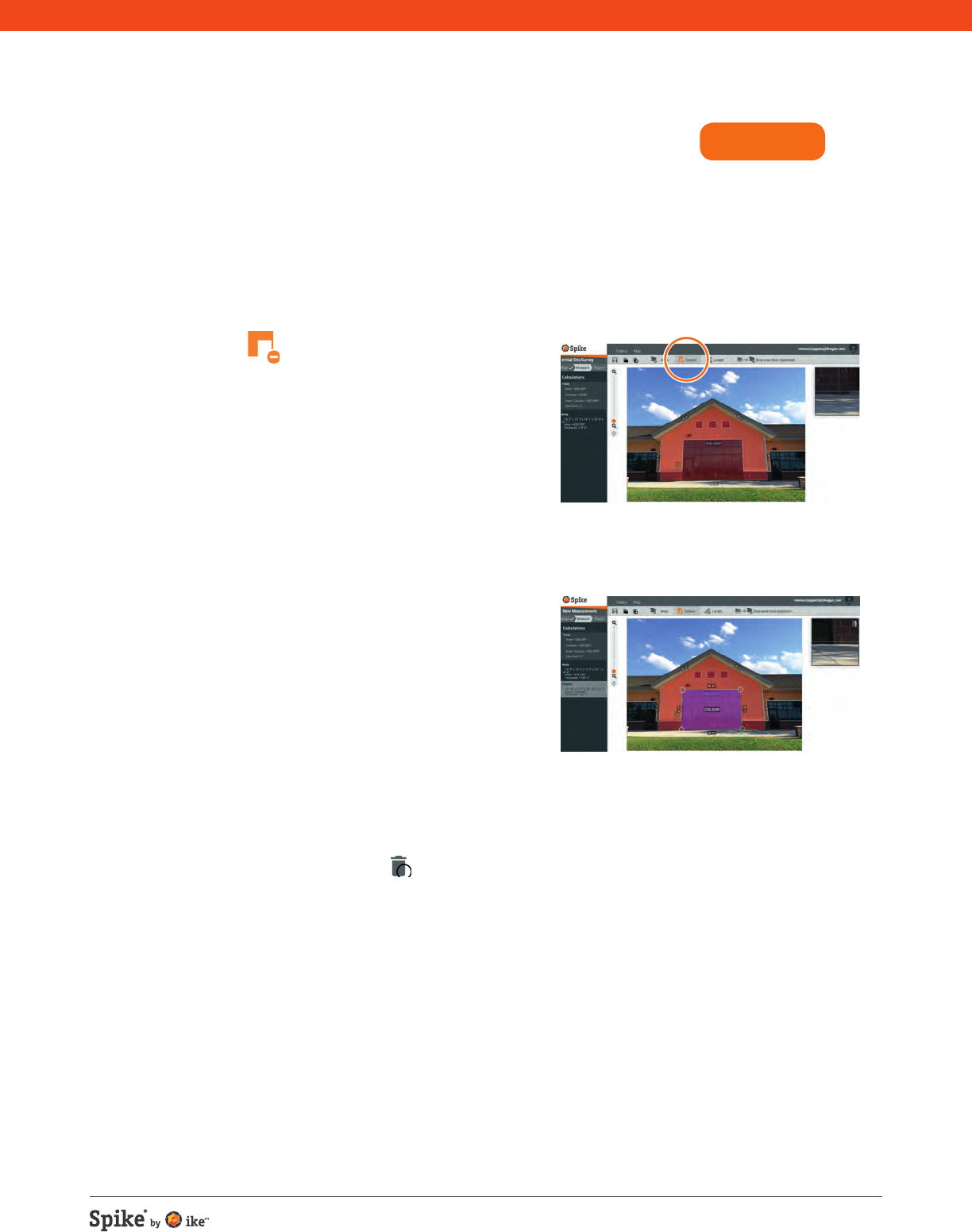
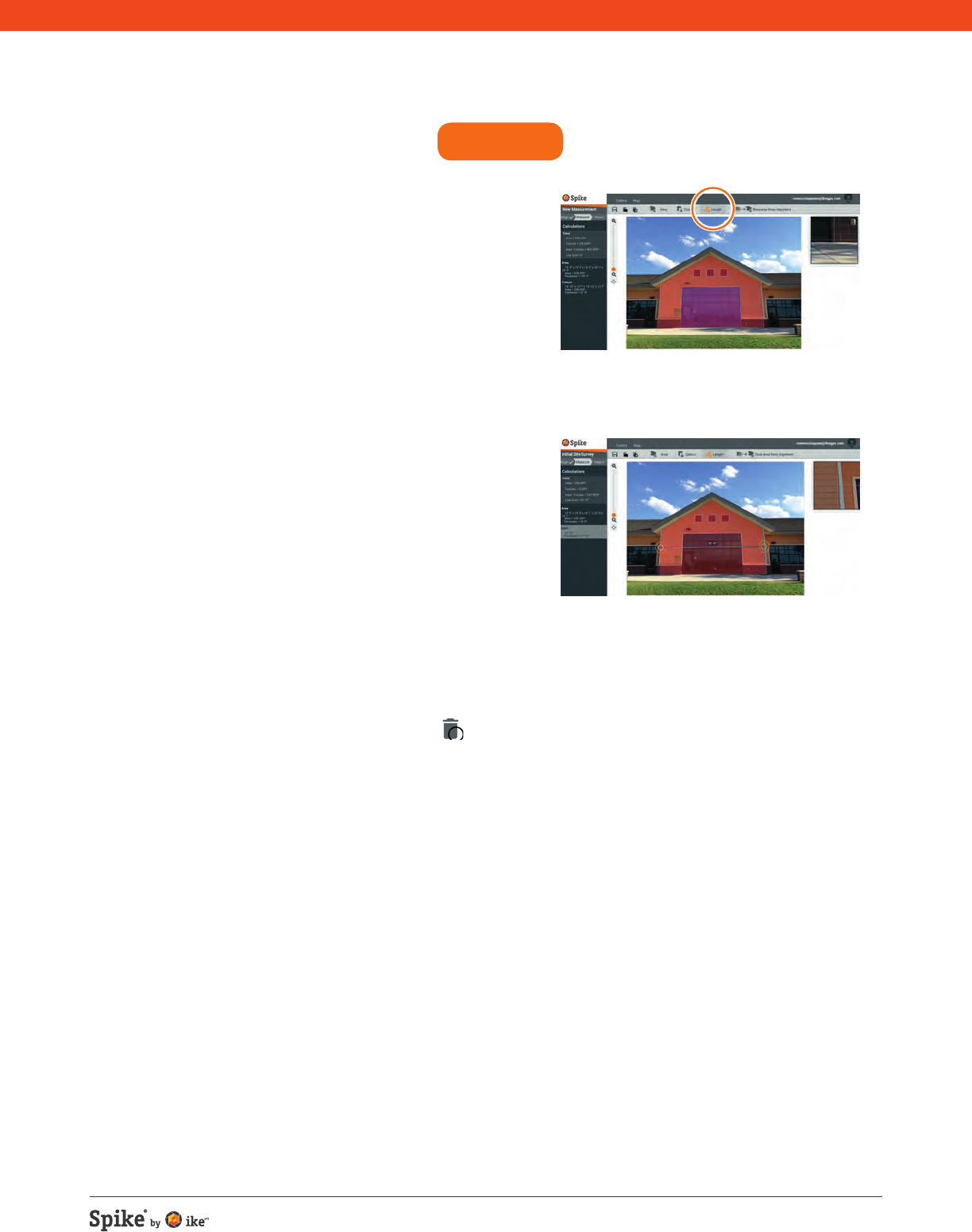
Cutting Out a Section of Your Object
You can cut out a section of your object that you do not want included in
the total measurement of the object area. For example, you may want to
measure the surface area of a wall without including the area of windows or
doors. Alternatively, the cutout tool can be used to measure additional areas
on your object.
1 Click on and then click and
drag to create a cutout rectangle.
2 Drag the anchors of the
rectangular shape to align them to
the section of the object you want
to cut out.
• Use the zoom window to help you
align the anchors precisely to the
corners of the cutout object.
• You can add more anchors by clicking
anywhere on a line. Drag the new
anchor to create a polygon.
• To delete anchors, tap on an anchor
to select, then click on to delete it.
• The calculations column will display
the new area measurement excluding
the cutout section.
SPIKE CLOUD
Spike User Manual 21
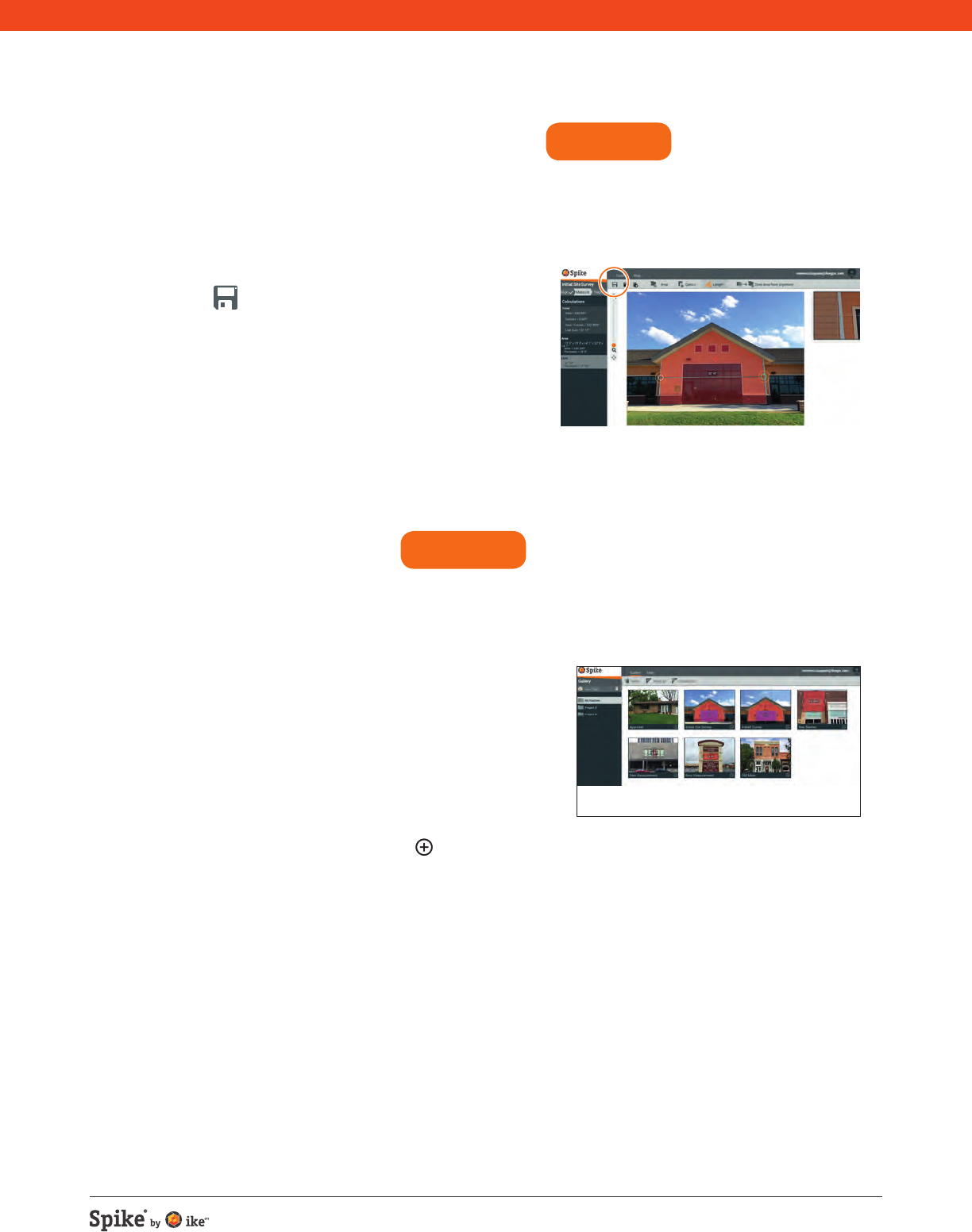
Measuring a Length
1 To measure a length, click on
Length at the top of the screen.
2 Click and drag to create a line.
Adjust anchors as needed.
• Use the zoom window to help you
align the line precisely to the edges of
your object.
• The length of your object will display
on the screen.
• Draw connecting lines by dragging the
anchors.
• To add another line, click and drag to
create a line.
• To delete anchors or lines, tap on an
anchor to select it, then click .
SPIKE CLOUD
Spike User Manual 22
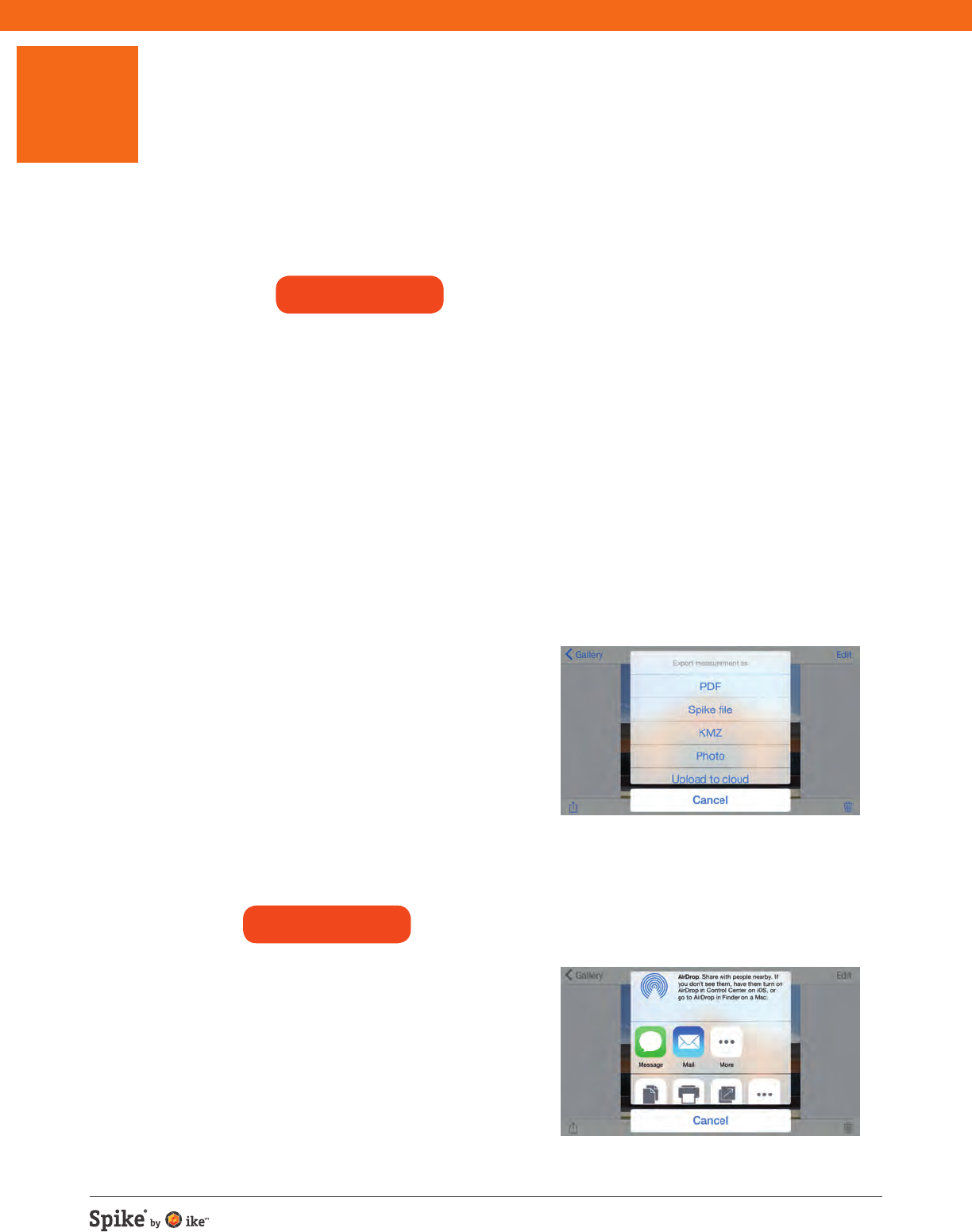
Saving Your Measurements
Once you are done taking measurements or making edits, be sure to save
your photo. All saved photos are placed in the Gallery.
1 To save your measurements,
click .
You must save your edits before
returning to the Gallery, or the edits will
not be saved.
SPIKE CLOUD
Using the Gallery
Use the Gallery to access all saved Photo Measurements. Point-to-Point
Measurements cannot be saved to the Cloud.
1 Once logged in, you will be in the
Gallery by default.
2 To add a folder, click on New
Folder and then name your folder.
To rename a folder, double click on the
name.
3 From the Gallery, you can view,
edit, move, export, or delete a
photo.
SPIKE CLOUD
Spike User Manual 23
7 Exporting and Sharing
Measurements are saved with the photo and can be exported as different
le formats and shared.
Exporting
A photo can be exported as a JPG, PDF, KMZ, and Spike le. For Android
only, HTML is also an option. The Spike le is a compressed ZIP le,
which contains three Spike photos (JPG without measurements, JPG with
measurements and a thumbnail JPG), and an XML le with measurement and
location data.
In addition, a photo can be exported to the online, cloud-based Spike
tools. By uploading a photo to the cloud, you can view, edit, measure, and
download Spike photos using your browser.
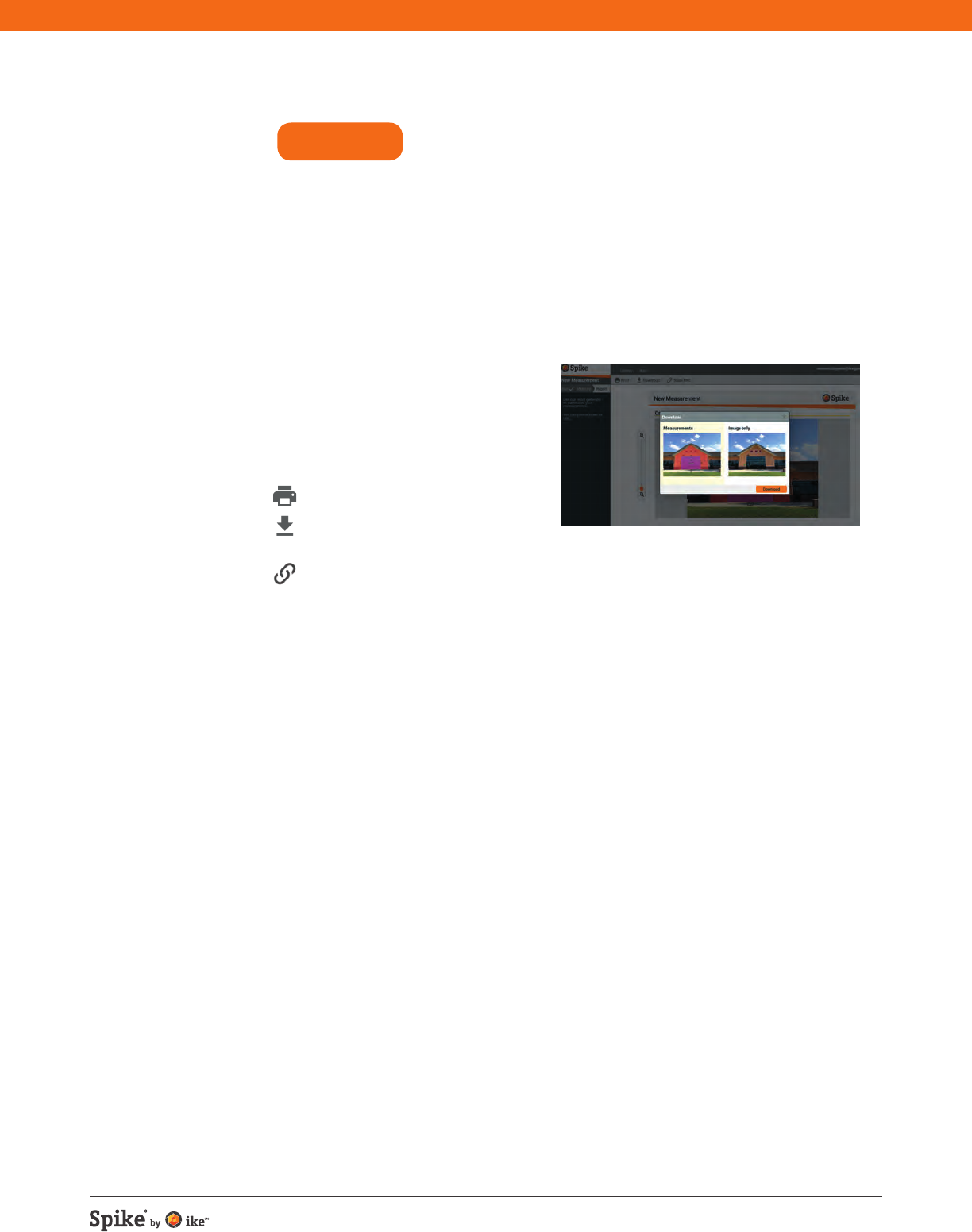
1 Access the Gallery and tap on the
photo you want to export.
2 Then tap the Share or Export
button, and select an export format.
Select Upload to cloud to export
the photo to the online Spike tools.
3 Once a Spike photo has been
uploaded to the cloud, the photo
can be accessed from the Customer
Login button on www.ikegps.com.
Sharing
Photos can be shared via email or
through various installed apps, such
as Airdrop, Google Drive, Dropbox,
Evernote, etc.
SPIKE MOBILE APP
SPIKE MOBILE APP
Spike User Manual 24
Exporting
A photo and measurements can be exported as a JPG (photo only), PDF
report, or a shareable URL. There are two options for the JPG export: with
measurements or image only. The URL can be shared with anyone, such as
co-workers, customers, or partners. Guests will be able to view the shared
report, and Spike online users will be able to import the photo into their own
gallery.
1 After you are done taking
measurements, click on Report on
the left side of your screen.
2 Then select your export format:
• Click on to print or save a PDF.
• Click on to download a JPG with
measurements or image only.
• Click on to share a URL of your
report.
SPIKE CLOUD
Spike User Manual 25
8 Spike Icon Guide
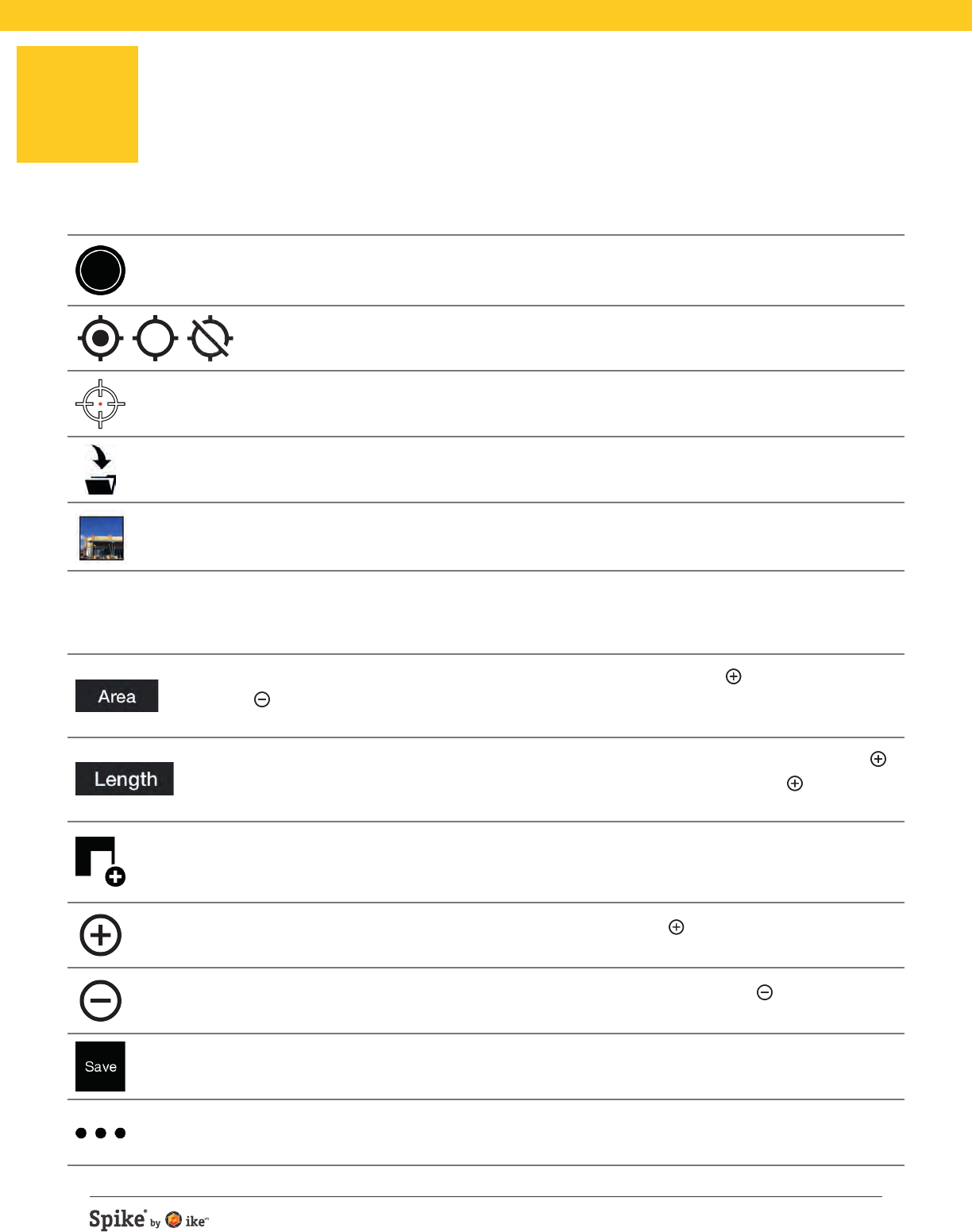
Tap to capture a photo of the object you want to measure.
Indicates whether there is a GPS lock with your smartphone or tablet.
Represents the Spike laser. Point the crosshairs at the object you want to
measure.
Select the folder where you would like to save your photos.
Displays a thumbnail of last photo you captured.
Measure the area of a polygon. Anchors can be added or deleted
to create the desired polygon shape. Length measurements are also
calculated.
Measure straight lengths. Additional lengths can be added by selecting
and dragging a new line. Lines can be connected by selecting , tapping
on an anchor, and then dragging to extend a line.
Exclude areas from your main measurement by using the cutout tool.
Alternatively, use the cutout tool to measure additional areas on your
photo.
Add additional cutout areas and lines. Highlight and then drag to create
a new area or line.
Delete anchors. Tap on an anchor to select it, then tap the icon to
delete that anchor. To delete a shape, delete all of the anchors.
Save measurements and changes. Photo and measurements are saved
within the Gallery.
Tap for additional options.
Capturing a Photo Using the Spike Mobile App
Taking Measurements with the Spike Mobile App
Spike User Manual 26
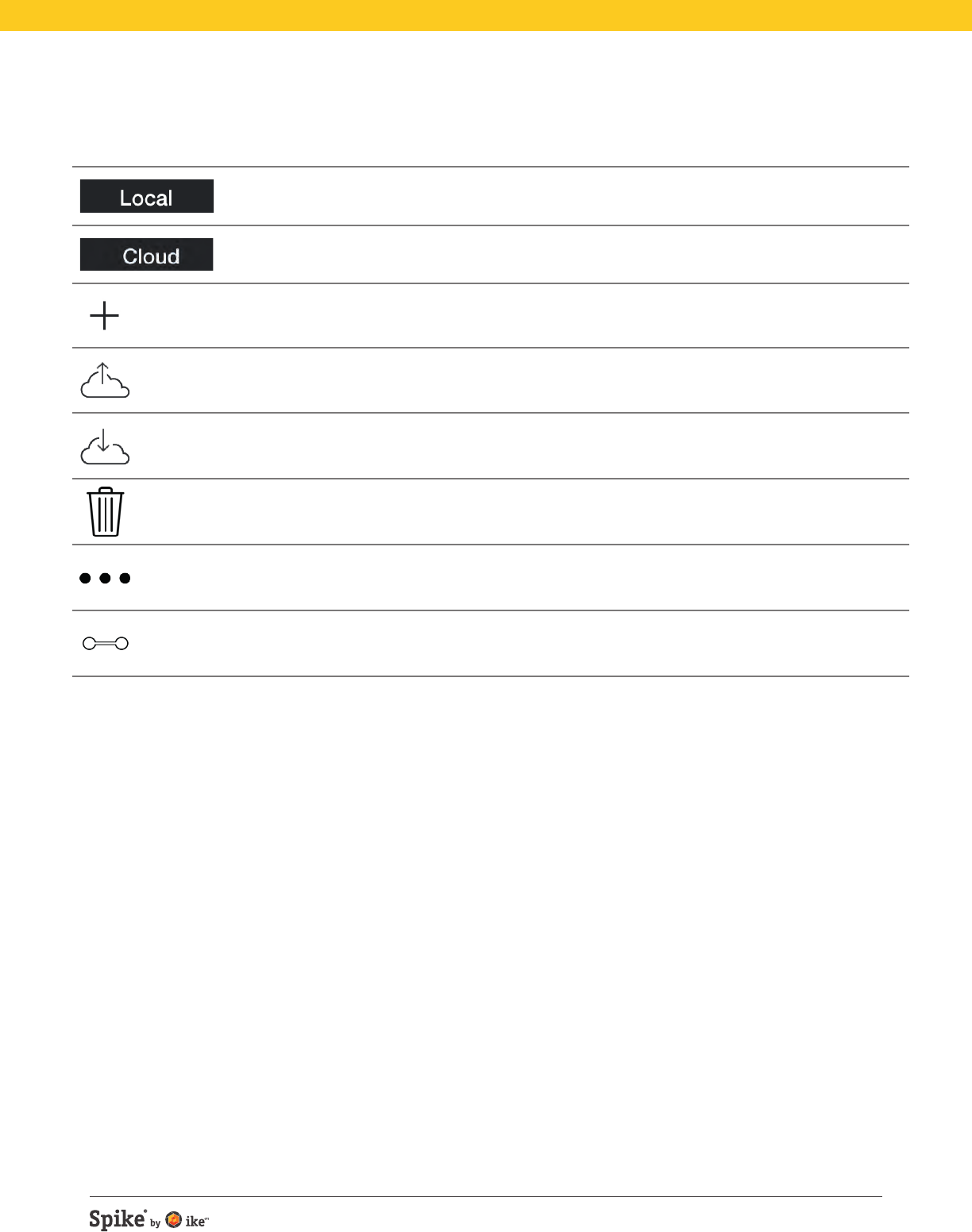
Displays all the folders and images that are saved locally within the Spike
mobile app.
Displays all the folders and images that are saved to your Spike online
account.
Tap to add a new folder locally.
Upload photos to measure from your desktop using the online tools.
Select to download photos from your online account.
Delete photos from your gallery.
Tap to delete a folder, rename a folder, or set a current folder.
Indicates a Point-to-Point Measurement.
Using the Spike Mobile App Gallery
Spike User Manual 27
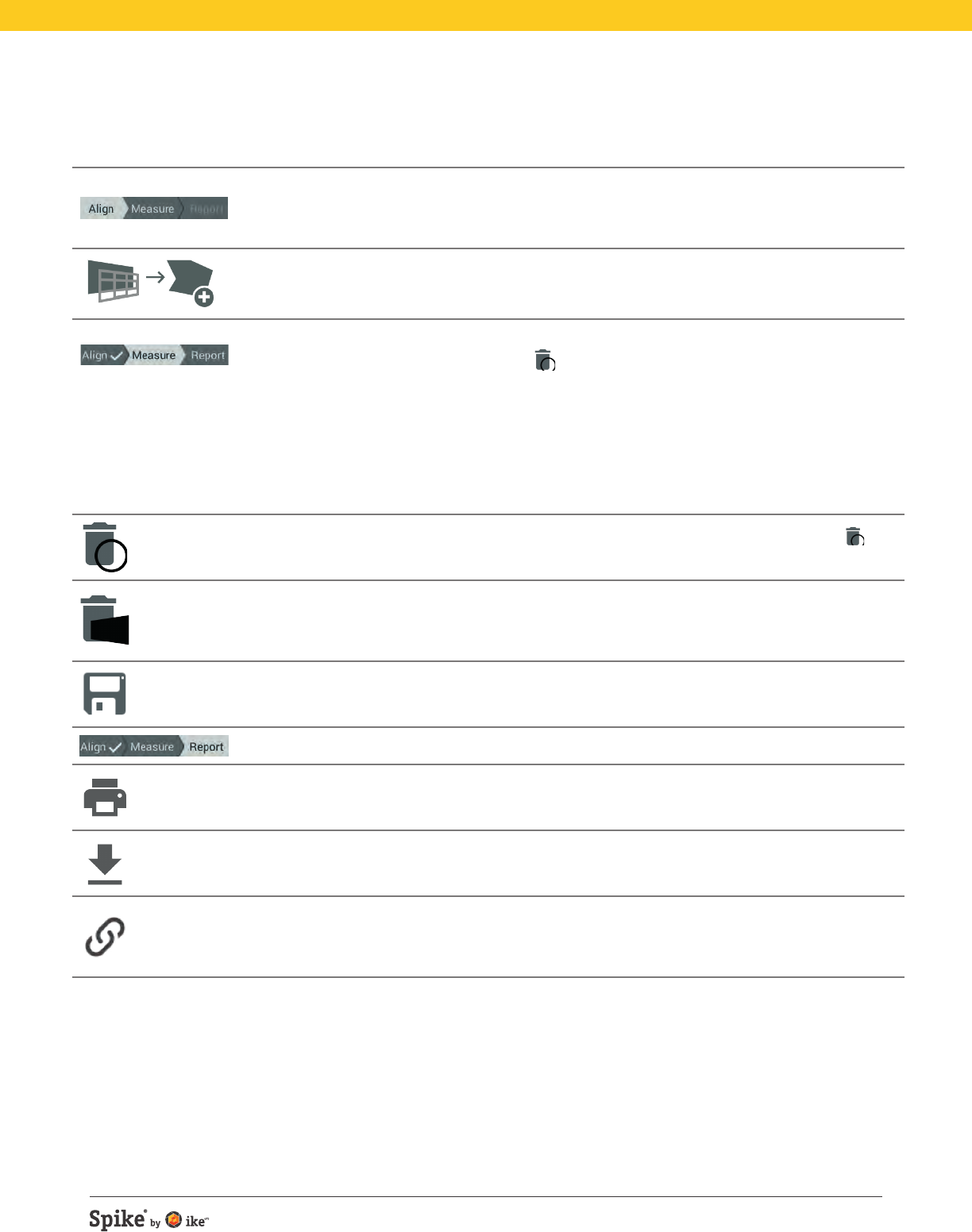
Set the surface’s perspective by outlining a rectangle on the surface you
want to measure. This identies and corrects the horizontal and vertical
angle from which your photo was taken.
Select to copy your alignment rectangle as your area rectangle.
• Measure the area of a polygon. Anchors can be added by clicking
anywhere on a line or deleted to create the desired polygon shape.
Length measurements are also calculated.
• Exclude areas from your main measurement by using the cutout tool.
Alternatively, use the cutout tool to measure additional areas on your
photo.
• Measure straight lengths. Additional lengths can be added by dragging
a new line. Lines can be connected by dragging the anchors.
Delete anchors. Tap on an anchor to select it, then tap the trash can to
delete that anchor.
Delete shapes or lengths. Tap on the shape, or select the measurement
from the left calculations list, and then tap on the trash can to delete the
shape or length.
Save measurements and any changes. Photo and measurements are saved
within the Gallery.
View and export reports.
Print a report or save as a PDF.
Download the photo as a JPG, with or without the measurements.
Copy and paste a URL of your report. If opened by a user without a Spike
account, the user can view and print the report. If opened by another user
with an online account, the user can import the image into their gallery.
Taking Measurements From Your Desktop
Spike User Manual 28
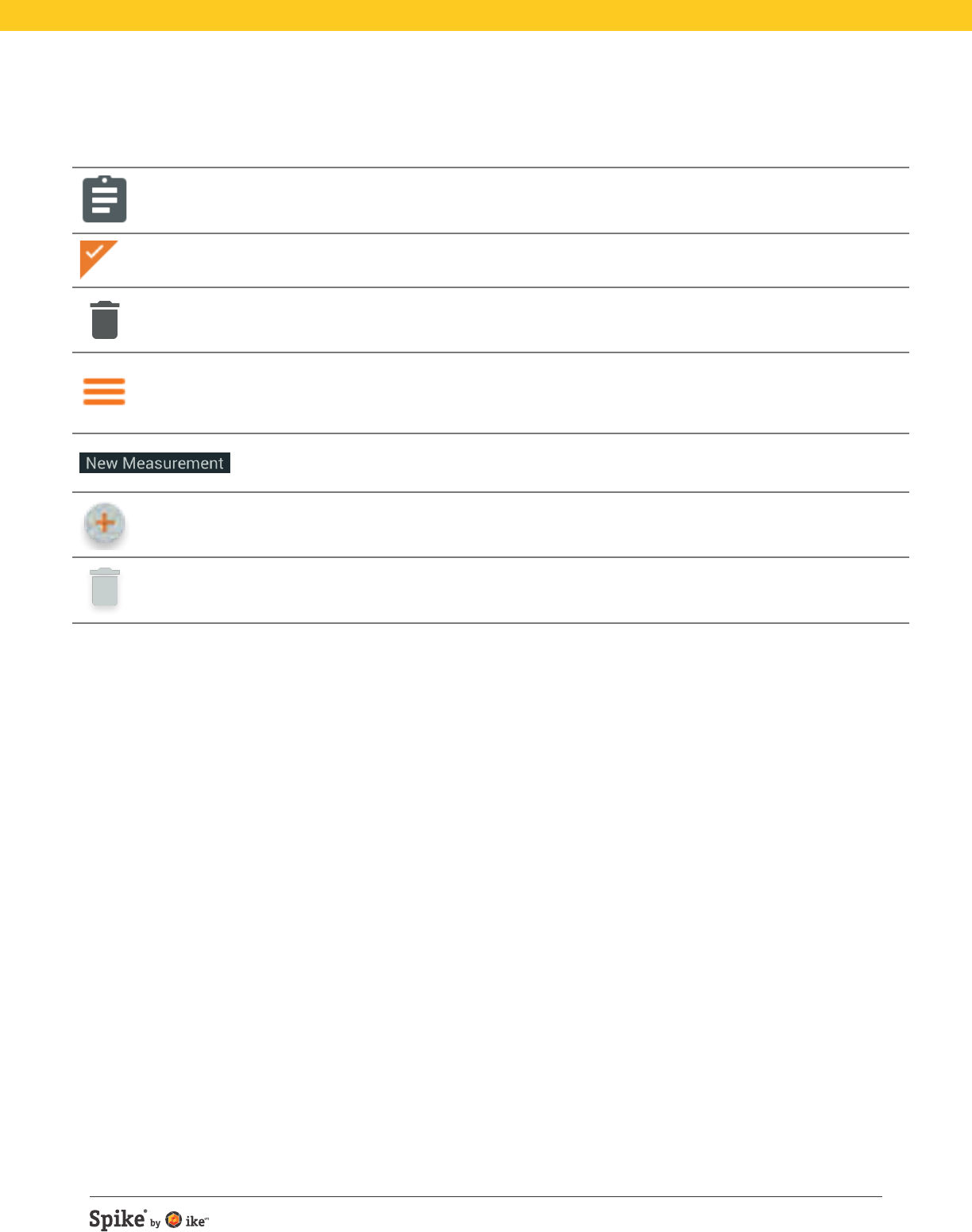
View a report of one of your photos.
Tap to select the photo(s) you want to delete.
Delete a photo.
Exclude areas from your main measurement by using the cutout tool.
Alternatively, use the cutout tool to measure additional areas on your
photo.
The default name of a photo is “New Measurement’. To rename, double
click and enter a name.
Add a new folder.
Delete a selected folder.
Using the Gallery From Your Desktop
Spike User Manual 29
Compliance
Federal Communication Commission Interference Statement
This device complies with Part 15 of the FCC Rules. Operation is
subject to the following two conditions: (1) This device may not cause
harmful interference, and (2) this device must accept any interference
received, including interference that may cause undesired operation.
This equipment has been tested and found to comply with the limits
for a Class B digital device, pursuant to Part 15 of the FCC Rules.
These limits are designed to provide reasonable protection against
harmful interference in a residential installation. This equipment
generates, uses and can radiate radio frequency energy and, if not
installed and used in accordance with the instructions, may cause
harmful interference to radio communications. However, there is no
guarantee that interference will not occur in a particular installation. If
this equipment does cause harmful interference to radio or television
reception, which can be determined by turning the equipment off and
on, the user is encouraged to try to correct the interference by one of
the following measures:
• Reorient or relocate the receiving antenna.
• Increase the separation between the equipment and receiver.
• Connect the equipment into an outlet on a circuit different from that
to which the receiver is connected.
• Consult the dealer or an experienced radio/TV technician for help.
FCC Caution: Any changes or modications not expressly approved by
the party responsible for compliance could void the user’s authority to
operate this equipment.
This transmitter must not be co-located or operating in conjunction with
any other antenna or transmitter.
Radiation Exposure Statement:
This equipment complies with FCC radiation exposure limits set forth
for an uncontrolled environment. This equipment should be installed
and operated with minimum distance 20cm between the radiator &
your body.
Note: The country code selection is for non-US model only and is
not available to all US model. Per FCC regulation, all WiFi product
marketed in US must xed to US operation channels only.
ikeGPS Contact Information
350 Interlocken Blvd, Suite 250
Broomeld, CO 80021, USA
ofce: +1 303 222 3218
42 Adelaide Rd
Wellington, NZ
www.ikegps.com
42 Adelaide Rd
Wellington, NZ
www.ikegps.com
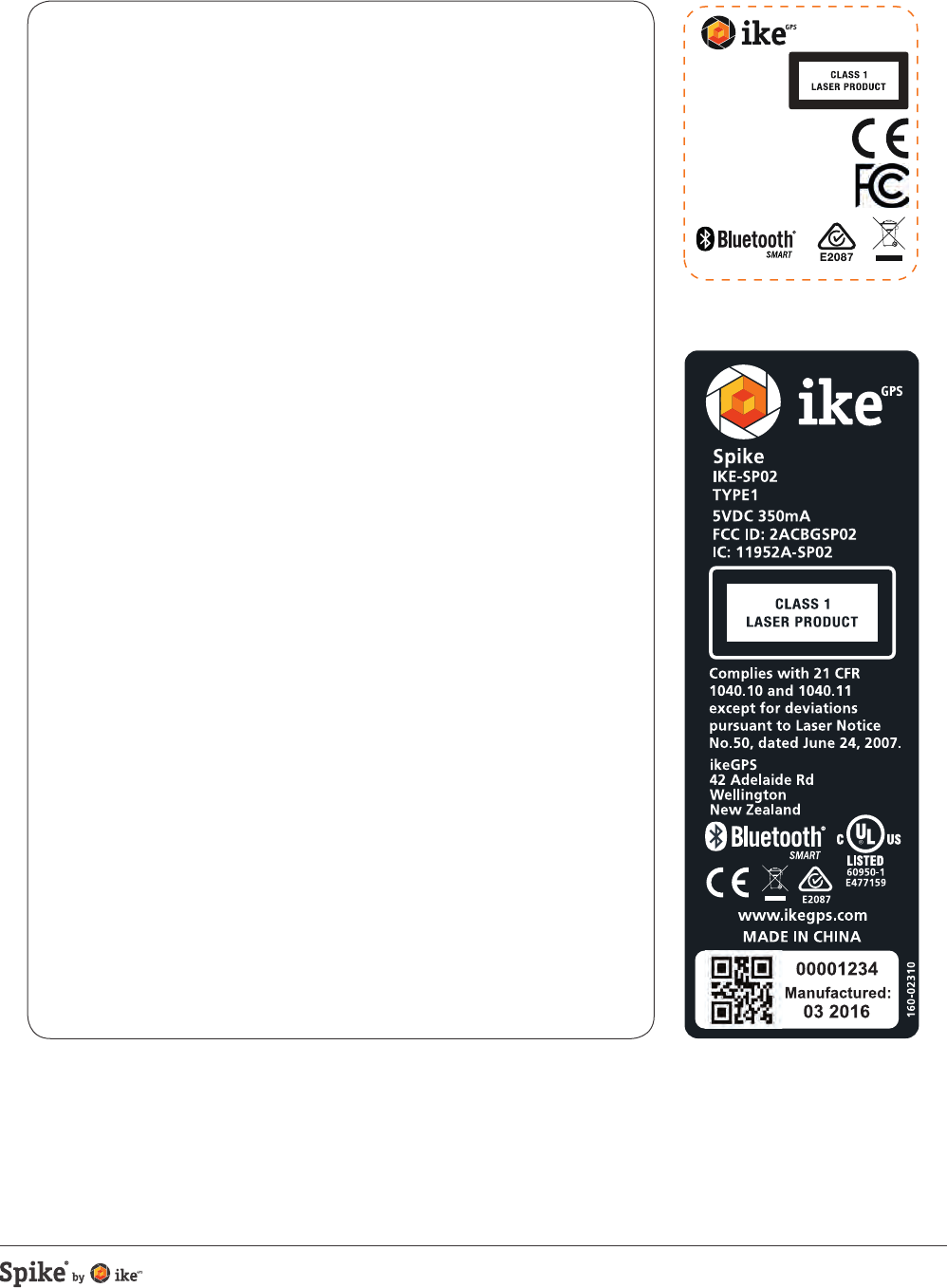
Model: Spike
Complies with 21 CFR
1040.10 and 1040.11 except
for deviations pursuant to
Laser Notice No. 50,
dated June 24, 2007
Part No.: 940-02000
5VDC 350mA
MADE IN NEW ZEALAND
Contains FCC ID: QOQBLE112
Contains IC: 5123A-BGTBLE112
Spike User Manual 30
Industry Canada Statement:
This device complies with RSS-210 of the Industry Canada Rules. Operation is subject to the following two
conditions: (1) This device may not cause harmful interference, and (2) this device must accept any interference
received, including interference that may cause undesired operation.
Ce dispositif est conforme à la norme CNR-210 d’Industrie Canada applicable aux appareils radio exempts de
licence. Son fonctionnement est sujet aux deux conditions suivantes: (1) le dispositif ne doit pas produire de
brouillage préjudiciable, et (2) ce dispositif doit accepter tout brouillage reçu, y compris un brouillage susceptible
de provoquer un fonctionnement indésirable.
Radiation Exposure Statement:
This equipment complies with IC radiation exposure limits set forth for an uncontrolled environment. This equipment
should be installed and operated with minimum distance 20cm between the radiator & your body.
Déclaration d’exposition aux radiations:
Cet équipement est conforme aux limites d’exposition aux rayonnements IC établies pour un environnement non
contrôlé. Cet équipement doit être installé et utilisé avec un minimum de 20 cm de distance entre la source de
rayonnement et votre corps.
ikeGPS Contact Information
350 Interlocken Blvd, Suite 250
Broomeld, CO 80021, USA
ofce: +1 303 222 3218
Europe - EU Declaration of Conformity
This device complies with the essential requirements and other relevant provisions of the
R&TIE Directive 1999/5/EC. The following test methods have been applied in order to
prove presumption of conformity with the essential requirements of the R&TIE Directive
1999/5/EC:
• EN 60950-1/A12: 2011
• EN 300 328 V1.8.1: 2012
Electromagnetic compatibility and Radio spectrum Matters (ERM); Wideband Transmission systems; Data
transmission equipment operating in the 2,4 GHz ISM band and using spread spectrum modulation techniques;
Harmonized EN covering essential requirements under article 3.2 of the R&TIE Directive
• EN 301 489-1 V1.9.2: 2011
Electromagnetic compatibility and Radio Spectrum Matters (ERM); ElectroMagnetic Compatibility (EMC)
standard for radio equipment and services; Part 1: Common technical requirements
• EN 301 489-17 V2.2.1: 2012
Electromagnetic compatibility and Radio spectrum Matters (ERM); ElectroMagnetic Compatibility (EMC)
standard for rad io equipment and services; Part 17: Specic conditions for 2,4 GHz wideband transmission
systems and 5 GHz high performance RLAN equipment
• EN 62479:2010
Assessment of the complia nce of low power electronic and electrical equipment with the basic restrictions
related to human exposure to electromagnetic elds (10 MHz to 300 GHz)
For additional compliance information, please visit www.ikegps.com/support.
Copyright © 2014 ikeGPS
Disposal of Old Electrical & Electronic Equipment (Applicable in the European Union)
This symbol on the product or on its packaging indicates that this product shall not be treated as household
waste. Instead it shall be returned, at no cost to you, to ikeGPS.By ensuring this product is disposed of correctly,
you will help prevent potential negative consequences for the environment and human health, which could
otherwise be caused by inappropriate waste handling of this product. The recycling of materials will help to
conserve natural resources. For more detail on how to recycle your Spike please visit www.ikegps.com/support
and submit a request for collection. ikeGPS will coordinate the collection of the unit from you with our logistics
service provider at no additional cost to you.