WJ Communications SX1115 User Manual Includes multiple antenna location instructions to installer
WJ Communications, Inc. Includes multiple antenna location instructions to installer

Includes multiple antenna location instructions to installer

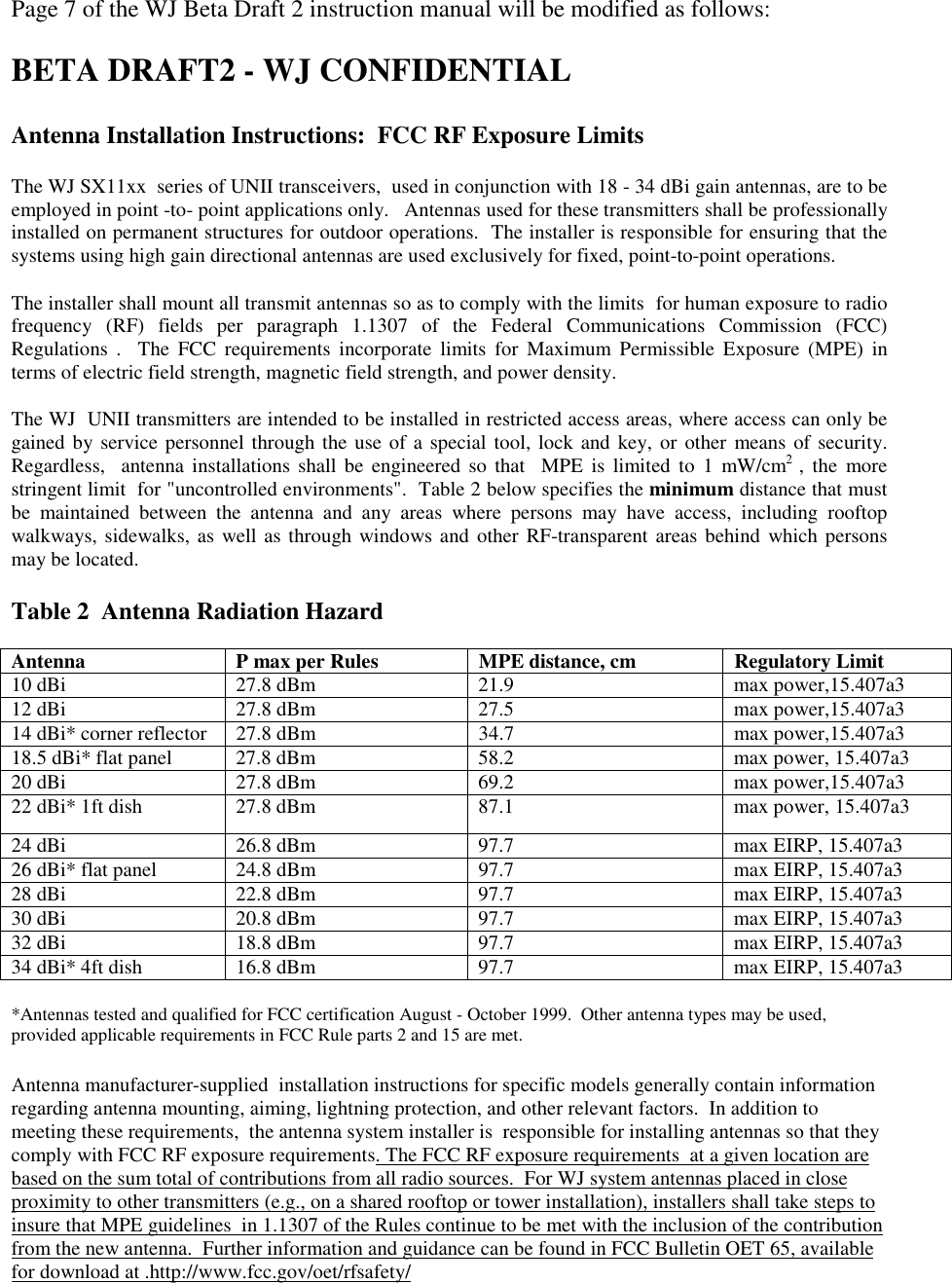
Page 7 of the WJ Beta Draft 2 instruction manual will be modified as follows:BETA DRAFT2 - WJ CONFIDENTIALAntenna Installation Instructions:  FCC RF Exposure LimitsThe WJ SX11xx  series of UNII transceivers,  used in conjunction with 18 - 34 dBi gain antennas, are to beemployed in point -to- point applications only.   Antennas used for these transmitters shall be professionallyinstalled on permanent structures for outdoor operations.  The installer is responsible for ensuring that thesystems using high gain directional antennas are used exclusively for fixed, point-to-point operations.The installer shall mount all transmit antennas so as to comply with the limits  for human exposure to radiofrequency (RF) fields per paragraph 1.1307 of the Federal Communications Commission (FCC)Regulations .  The FCC requirements incorporate limits for Maximum Permissible Exposure (MPE) interms of electric field strength, magnetic field strength, and power density.The WJ  UNII transmitters are intended to be installed in restricted access areas, where access can only begained by service personnel through the use of a special tool, lock and key, or other means of security.Regardless,  antenna installations shall be engineered so that  MPE is limited to 1 mW/cm2  , the morestringent limit  for "uncontrolled environments".  Table 2 below specifies the minimum distance that mustbe maintained between the antenna and any areas where persons may have access, including rooftopwalkways, sidewalks, as well as through windows and other RF-transparent areas behind which personsmay be located.Table 2  Antenna Radiation HazardAntenna P max per Rules MPE distance, cm Regulatory Limit10 dBi 27.8 dBm 21.9 max power,15.407a312 dBi 27.8 dBm 27.5 max power,15.407a314 dBi* corner reflector 27.8 dBm 34.7 max power,15.407a318.5 dBi* flat panel 27.8 dBm 58.2 max power, 15.407a320 dBi 27.8 dBm 69.2 max power,15.407a322 dBi* 1ft dish 27.8 dBm 87.1 max power, 15.407a324 dBi 26.8 dBm 97.7 max EIRP, 15.407a326 dBi* flat panel 24.8 dBm 97.7 max EIRP, 15.407a328 dBi 22.8 dBm 97.7 max EIRP, 15.407a330 dBi 20.8 dBm 97.7 max EIRP, 15.407a332 dBi 18.8 dBm 97.7 max EIRP, 15.407a334 dBi* 4ft dish 16.8 dBm 97.7 max EIRP, 15.407a3*Antennas tested and qualified for FCC certification August - October 1999.  Other antenna types may be used,provided applicable requirements in FCC Rule parts 2 and 15 are met.Antenna manufacturer-supplied  installation instructions for specific models generally contain informationregarding antenna mounting, aiming, lightning protection, and other relevant factors.  In addition tomeeting these requirements,  the antenna system installer is  responsible for installing antennas so that theycomply with FCC RF exposure requirements. The FCC RF exposure requirements  at a given location arebased on the sum total of contributions from all radio sources.  For WJ system antennas placed in closeproximity to other transmitters (e.g., on a shared rooftop or tower installation), installers shall take steps toinsure that MPE guidelines  in 1.1307 of the Rules continue to be met with the inclusion of the contributionfrom the new antenna.  Further information and guidance can be found in FCC Bulletin OET 65, availablefor download at .http://www.fcc.gov/oet/rfsafety/

Navigation menu