WJ Communications SX1115 User Manual Response to 2 Dec request re MPE

WJ Communications, Inc. Response to 2 Dec request re MPE

Response to 2 Dec request re MPE

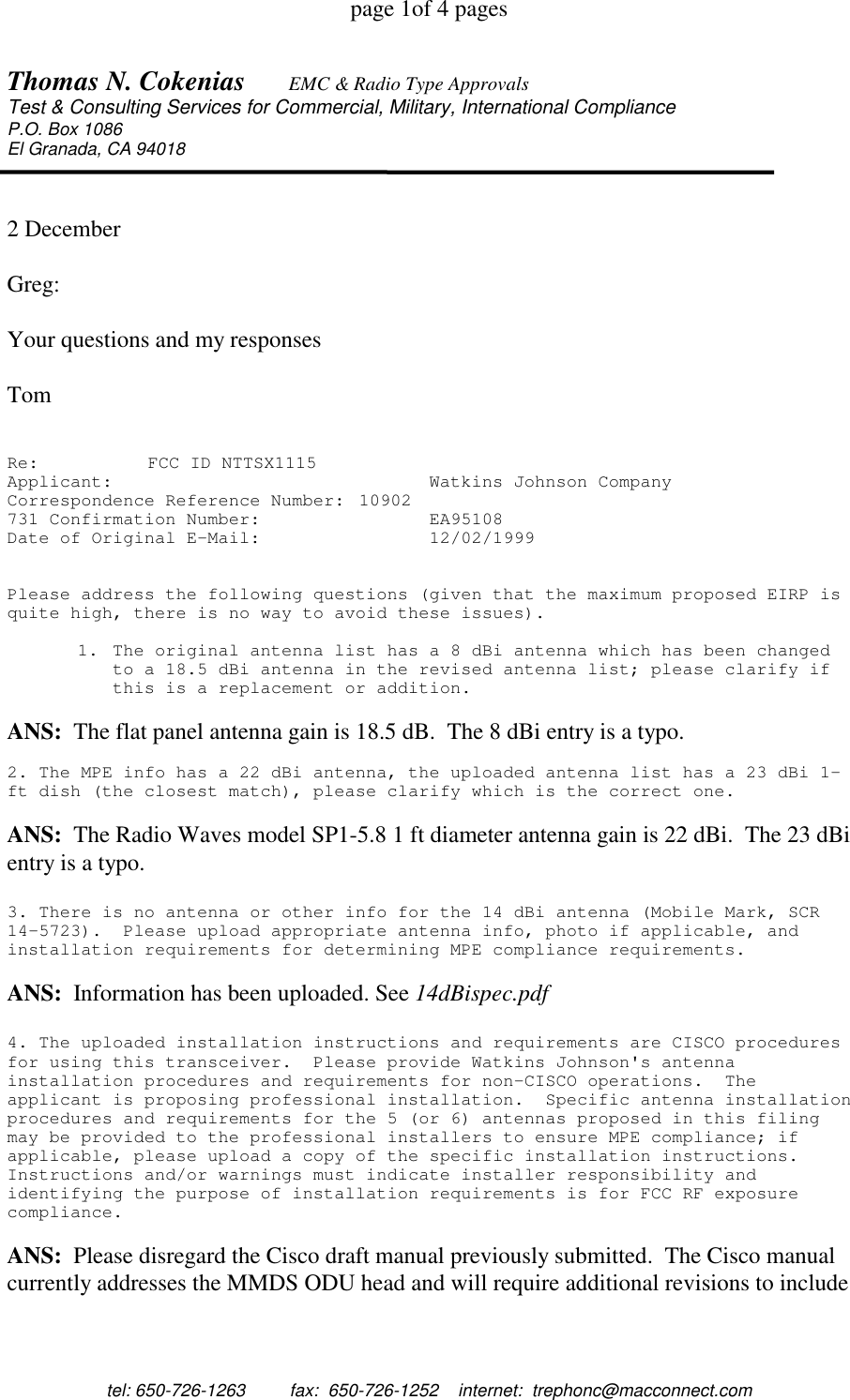
page 1of 4 pagestel: 650-726-1263         fax:  650-726-1252    internet:  trephonc@macconnect.comThomas N. Cokenias EMC & Radio Type ApprovalsTest & Consulting Services for Commercial, Military, International ComplianceP.O. Box 1086El Granada, CA 940182 DecemberGreg:Your questions and my responsesTomRe: FCC ID NTTSX1115Applicant: Watkins Johnson CompanyCorrespondence Reference Number: 10902731 Confirmation Number: EA95108Date of Original E-Mail: 12/02/1999Please address the following questions (given that the maximum proposed EIRP isquite high, there is no way to avoid these issues).1. The original antenna list has a 8 dBi antenna which has been changedto a 18.5 dBi antenna in the revised antenna list; please clarify ifthis is a replacement or addition.ANS:  The flat panel antenna gain is 18.5 dB.  The 8 dBi entry is a typo.2. The MPE info has a 22 dBi antenna, the uploaded antenna list has a 23 dBi 1-ft dish (the closest match), please clarify which is the correct one.ANS:  The Radio Waves model SP1-5.8 1 ft diameter antenna gain is 22 dBi.  The 23 dBientry is a typo.3. There is no antenna or other info for the 14 dBi antenna (Mobile Mark, SCR14-5723). Please upload appropriate antenna info, photo if applicable, andinstallation requirements for determining MPE compliance requirements.ANS:  Information has been uploaded. See 14dBispec.pdf4. The uploaded installation instructions and requirements are CISCO proceduresfor using this transceiver. Please provide Watkins Johnson's antennainstallation procedures and requirements for non-CISCO operations. Theapplicant is proposing professional installation. Specific antenna installationprocedures and requirements for the 5 (or 6) antennas proposed in this filingmay be provided to the professional installers to ensure MPE compliance; ifapplicable, please upload a copy of the specific installation instructions.Instructions and/or warnings must indicate installer responsibility andidentifying the purpose of installation requirements is for FCC RF exposurecompliance.ANS:  Please disregard the Cisco draft manual previously submitted.  The Cisco manualcurrently addresses the MMDS ODU head and will require additional revisions to include
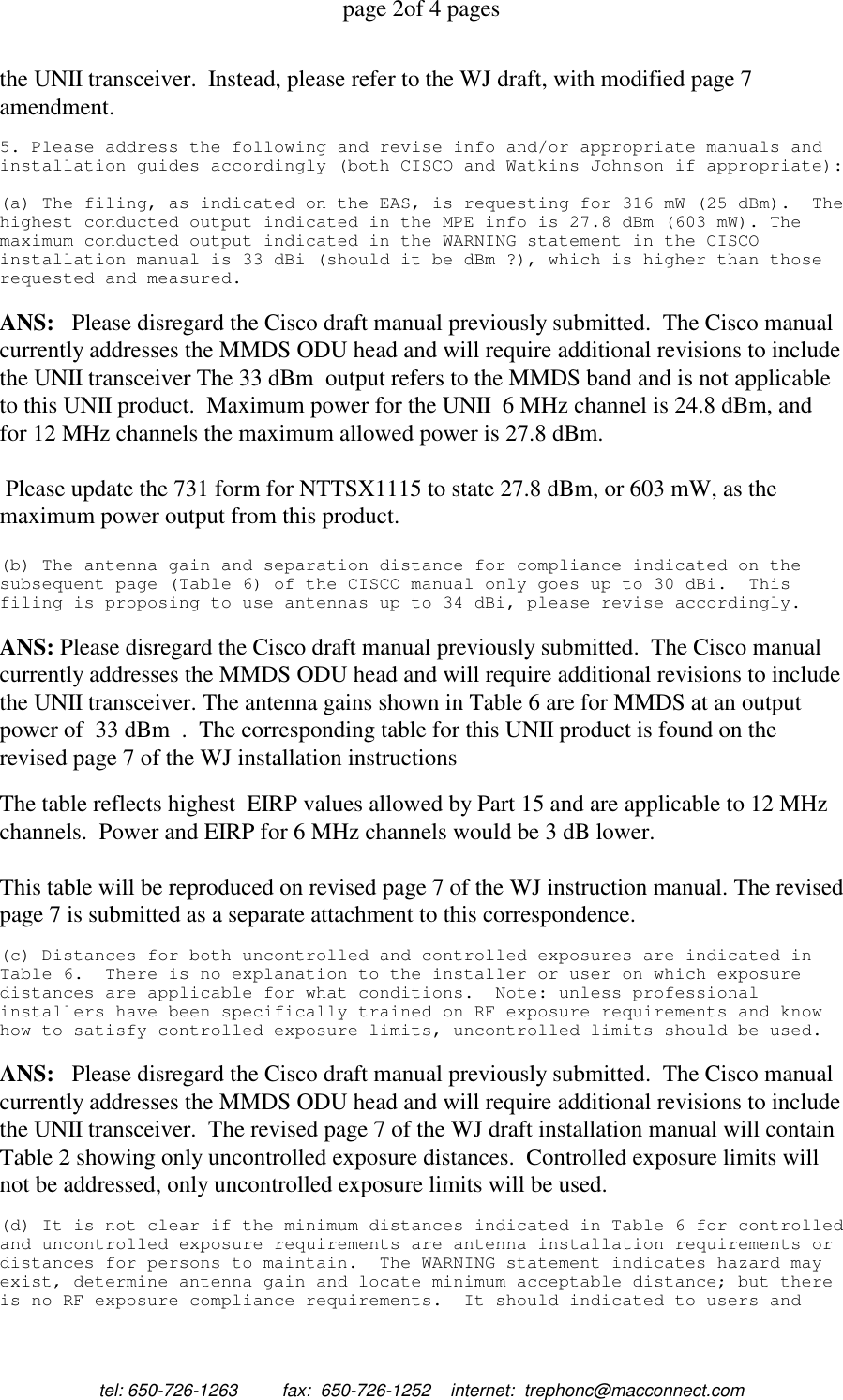
page 2of 4 pagestel: 650-726-1263         fax:  650-726-1252    internet:  trephonc@macconnect.comthe UNII transceiver.  Instead, please refer to the WJ draft, with modified page 7amendment.5. Please address the following and revise info and/or appropriate manuals andinstallation guides accordingly (both CISCO and Watkins Johnson if appropriate):(a) The filing, as indicated on the EAS, is requesting for 316 mW (25 dBm). Thehighest conducted output indicated in the MPE info is 27.8 dBm (603 mW). Themaximum conducted output indicated in the WARNING statement in the CISCOinstallation manual is 33 dBi (should it be dBm ?), which is higher than thoserequested and measured.ANS:   Please disregard the Cisco draft manual previously submitted.  The Cisco manualcurrently addresses the MMDS ODU head and will require additional revisions to includethe UNII transceiver The 33 dBm  output refers to the MMDS band and is not applicableto this UNII product.  Maximum power for the UNII  6 MHz channel is 24.8 dBm, andfor 12 MHz channels the maximum allowed power is 27.8 dBm. Please update the 731 form for NTTSX1115 to state 27.8 dBm, or 603 mW, as themaximum power output from this product.(b) The antenna gain and separation distance for compliance indicated on thesubsequent page (Table 6) of the CISCO manual only goes up to 30 dBi. Thisfiling is proposing to use antennas up to 34 dBi, please revise accordingly.ANS: Please disregard the Cisco draft manual previously submitted.  The Cisco manualcurrently addresses the MMDS ODU head and will require additional revisions to includethe UNII transceiver. The antenna gains shown in Table 6 are for MMDS at an outputpower of  33 dBm  .  The corresponding table for this UNII product is found on therevised page 7 of the WJ installation instructionsThe table reflects highest  EIRP values allowed by Part 15 and are applicable to 12 MHzchannels.  Power and EIRP for 6 MHz channels would be 3 dB lower.This table will be reproduced on revised page 7 of the WJ instruction manual. The revisedpage 7 is submitted as a separate attachment to this correspondence.(c) Distances for both uncontrolled and controlled exposures are indicated inTable 6. There is no explanation to the installer or user on which exposuredistances are applicable for what conditions. Note: unless professionalinstallers have been specifically trained on RF exposure requirements and knowhow to satisfy controlled exposure limits, uncontrolled limits should be used.ANS:   Please disregard the Cisco draft manual previously submitted.  The Cisco manualcurrently addresses the MMDS ODU head and will require additional revisions to includethe UNII transceiver.  The revised page 7 of the WJ draft installation manual will containTable 2 showing only uncontrolled exposure distances.  Controlled exposure limits willnot be addressed, only uncontrolled exposure limits will be used.(d) It is not clear if the minimum distances indicated in Table 6 for controlledand uncontrolled exposure requirements are antenna installation requirements ordistances for persons to maintain. The WARNING statement indicates hazard mayexist, determine antenna gain and locate minimum acceptable distance; but thereis no RF exposure compliance requirements. It should indicated to users and
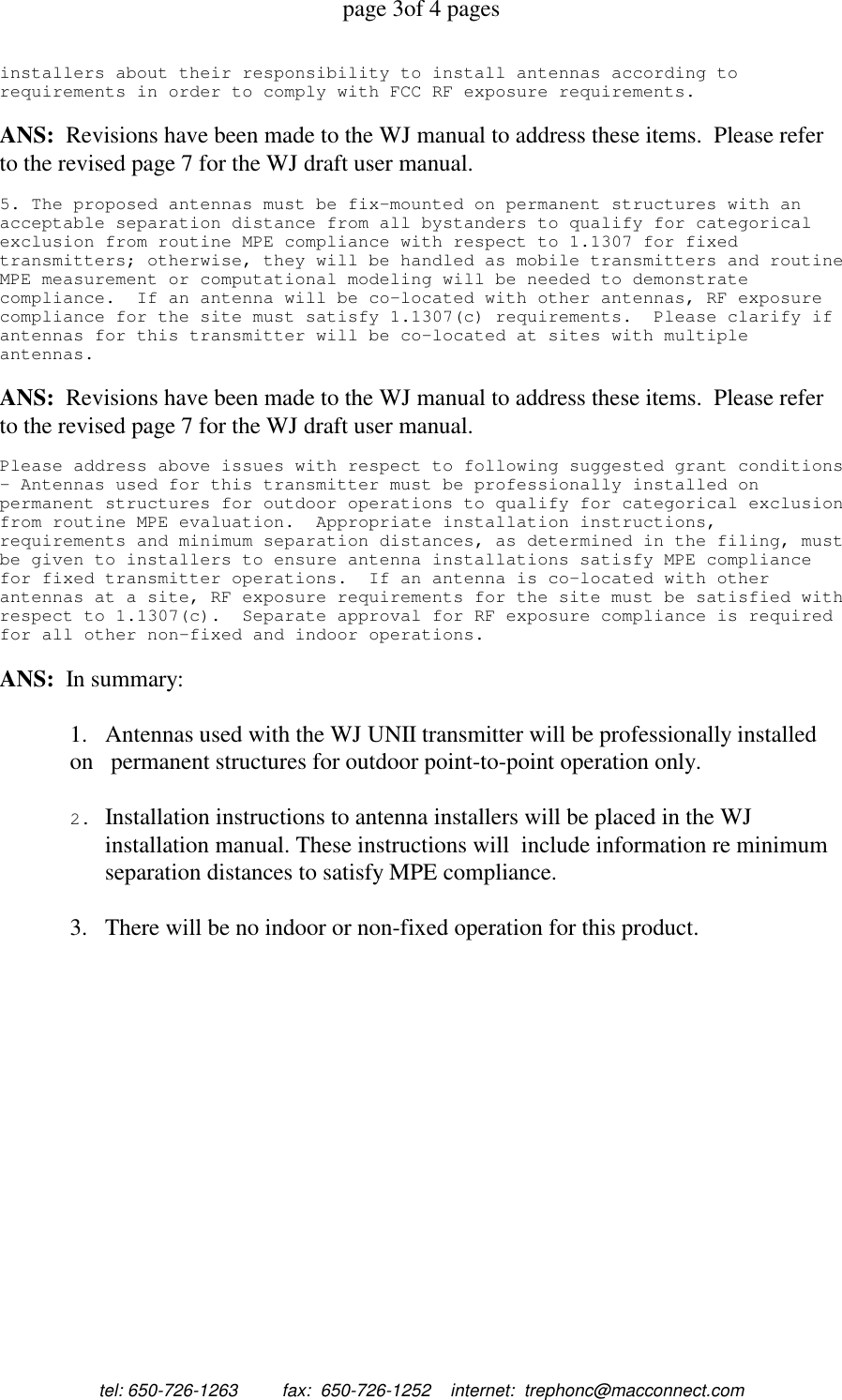
page 3of 4 pagestel: 650-726-1263         fax:  650-726-1252    internet:  trephonc@macconnect.cominstallers about their responsibility to install antennas according torequirements in order to comply with FCC RF exposure requirements.ANS:  Revisions have been made to the WJ manual to address these items.  Please referto the revised page 7 for the WJ draft user manual.5. The proposed antennas must be fix-mounted on permanent structures with anacceptable separation distance from all bystanders to qualify for categoricalexclusion from routine MPE compliance with respect to 1.1307 for fixedtransmitters; otherwise, they will be handled as mobile transmitters and routineMPE measurement or computational modeling will be needed to demonstratecompliance. If an antenna will be co-located with other antennas, RF exposurecompliance for the site must satisfy 1.1307(c) requirements. Please clarify ifantennas for this transmitter will be co-located at sites with multipleantennas.ANS:  Revisions have been made to the WJ manual to address these items.  Please referto the revised page 7 for the WJ draft user manual.Please address above issues with respect to following suggested grant conditions- Antennas used for this transmitter must be professionally installed onpermanent structures for outdoor operations to qualify for categorical exclusionfrom routine MPE evaluation. Appropriate installation instructions,requirements and minimum separation distances, as determined in the filing, mustbe given to installers to ensure antenna installations satisfy MPE compliancefor fixed transmitter operations. If an antenna is co-located with otherantennas at a site, RF exposure requirements for the site must be satisfied withrespect to 1.1307(c). Separate approval for RF exposure compliance is requiredfor all other non-fixed and indoor operations.ANS:  In summary:1.   Antennas used with the WJ UNII transmitter will be professionally installedon   permanent structures for outdoor point-to-point operation only.2. Installation instructions to antenna installers will be placed in the WJinstallation manual. These instructions will  include information re minimumseparation distances to satisfy MPE compliance.3.   There will be no indoor or non-fixed operation for this product.
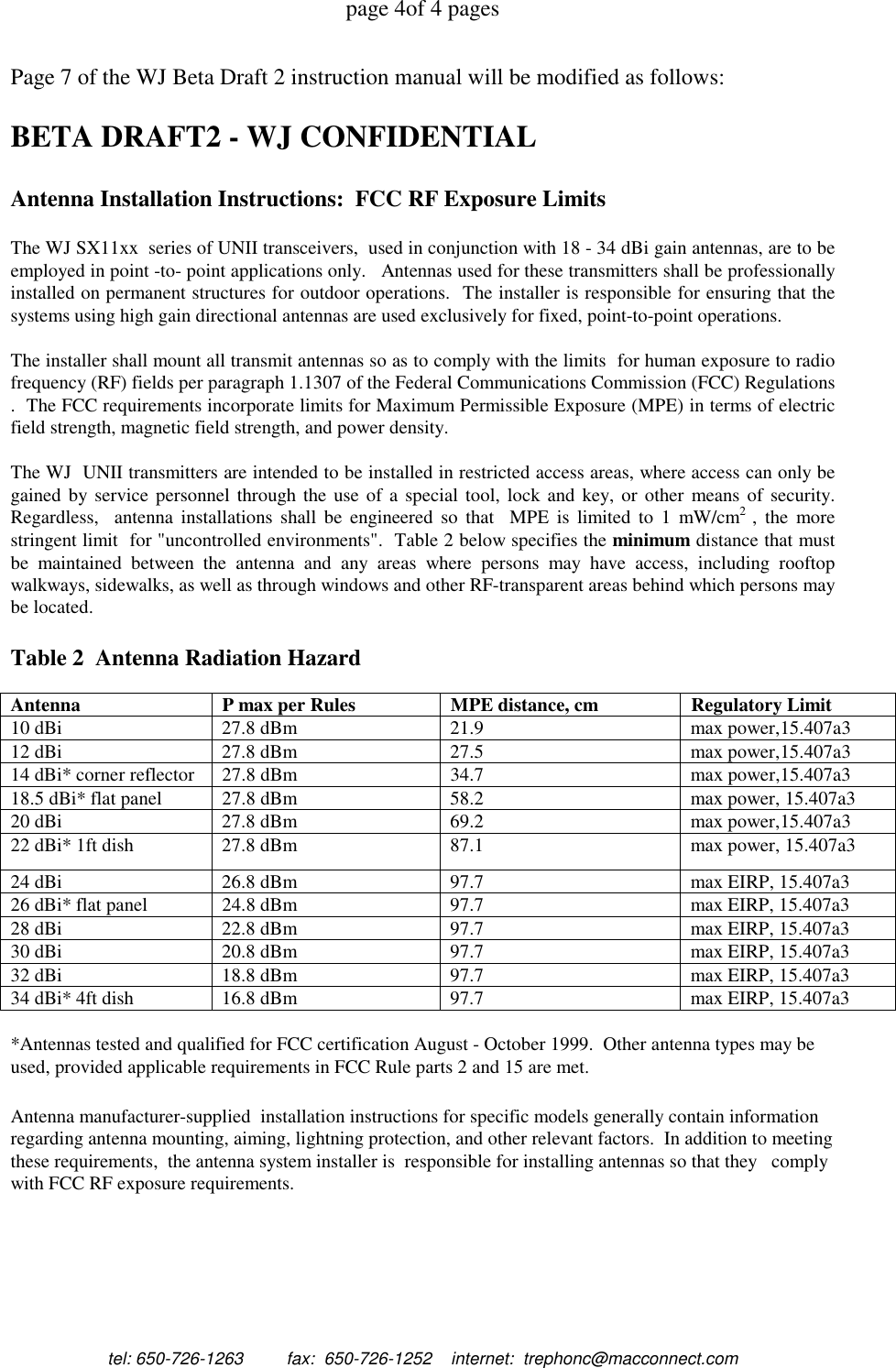
page 4of 4 pagestel: 650-726-1263         fax:  650-726-1252    internet:  trephonc@macconnect.comPage 7 of the WJ Beta Draft 2 instruction manual will be modified as follows:BETA DRAFT2 - WJ CONFIDENTIALAntenna Installation Instructions:  FCC RF Exposure LimitsThe WJ SX11xx  series of UNII transceivers,  used in conjunction with 18 - 34 dBi gain antennas, are to beemployed in point -to- point applications only.   Antennas used for these transmitters shall be professionallyinstalled on permanent structures for outdoor operations.  The installer is responsible for ensuring that thesystems using high gain directional antennas are used exclusively for fixed, point-to-point operations.The installer shall mount all transmit antennas so as to comply with the limits  for human exposure to radiofrequency (RF) fields per paragraph 1.1307 of the Federal Communications Commission (FCC) Regulations.  The FCC requirements incorporate limits for Maximum Permissible Exposure (MPE) in terms of electricfield strength, magnetic field strength, and power density.The WJ  UNII transmitters are intended to be installed in restricted access areas, where access can only begained by service personnel through the use of a special tool, lock and key, or other means of security.Regardless,  antenna installations shall be engineered so that  MPE is limited to 1 mW/cm2  , the morestringent limit  for "uncontrolled environments".  Table 2 below specifies the minimum distance that mustbe maintained between the antenna and any areas where persons may have access, including rooftopwalkways, sidewalks, as well as through windows and other RF-transparent areas behind which persons maybe located.Table 2  Antenna Radiation HazardAntenna P max per Rules MPE distance, cm Regulatory Limit10 dBi 27.8 dBm 21.9 max power,15.407a312 dBi 27.8 dBm 27.5 max power,15.407a314 dBi* corner reflector 27.8 dBm 34.7 max power,15.407a318.5 dBi* flat panel 27.8 dBm 58.2 max power, 15.407a320 dBi 27.8 dBm 69.2 max power,15.407a322 dBi* 1ft dish 27.8 dBm 87.1 max power, 15.407a324 dBi 26.8 dBm 97.7 max EIRP, 15.407a326 dBi* flat panel 24.8 dBm 97.7 max EIRP, 15.407a328 dBi 22.8 dBm 97.7 max EIRP, 15.407a330 dBi 20.8 dBm 97.7 max EIRP, 15.407a332 dBi 18.8 dBm 97.7 max EIRP, 15.407a334 dBi* 4ft dish 16.8 dBm 97.7 max EIRP, 15.407a3*Antennas tested and qualified for FCC certification August - October 1999.  Other antenna types may beused, provided applicable requirements in FCC Rule parts 2 and 15 are met.Antenna manufacturer-supplied  installation instructions for specific models generally contain informationregarding antenna mounting, aiming, lightning protection, and other relevant factors.  In addition to meetingthese requirements,  the antenna system installer is  responsible for installing antennas so that they   complywith FCC RF exposure requirements.

Navigation menu