Acrodyne NW8201E DIGITAL TELEVISION BROADCAST TRANSMITTER User Manual 32 NV8202 26 04 06 01 00

Acrodyne Industries, Inc. DIGITAL TELEVISION BROADCAST TRANSMITTER 32 NV8202 26 04 06 01 00

Users Manual Part 13
Broadcasting Division2095.7346.32 - 5.0 - E-1CHAPTER 5OPERATINGPrinted in Germany
Chapter 5 Operating2098.0594.72 - 5.01 - E-1CONTENTS1 Operating Options  ........................................................................... 11.1 Local Operation  ..............................................................................................11.2 Operation from a PC or via Remote Control  ................................................41.2.1 Installation and Configuration .......................................................................41.2.2 Browser-Based Operation  ............................................................................72 NETCCU Menus  ............................................................................. 112.1 Overview of Menus .......................................................................................112.2 Login ..............................................................................................................122.3 Status Menu  ..................................................................................................132.3.1 Tx Status Menu Window ............................................................................132.3.2 RF Status Menu Window ............................................................................142.3.3 Device Status Menu Window  .....................................................................152.4 Logbook Menu  ..............................................................................................152.4.1 Summary Menu Window  ............................................................................162.5 Operation Menu Window  .............................................................................172.6 Setup Menu  ...................................................................................................182.6.1 Tx Setup Menu Window  .............................................................................182.7 NetCCU Setup Menu .....................................................................................192.7.1 Common Menu Window  .............................................................................192.7.2 SW Maintenance Menu Window  ................................................................202.7.3 Ethernet Menu Window ..............................................................................212.7.4 SNMP Menu Window  .................................................................................222.8 RF settings/values Menu  .............................................................................222.8.1 RF Vision Menu Window ............................................................................232.8.2 RF Probe Forward Menu Window  ..............................................................232.8.3 RF Probe Reflected Menu Window ............................................................242.8.4 RF Probes Measure Values Menu Window  ...............................................252.9 Device Info Menu  ..........................................................................................262.9.1 NetCCU Menu Window  ..............................................................................262.9.2 Mainboard Menu Window ...........................................................................272.10 Measure Values Menu Window ...................................................................272.11 Parameter Set Menu Window  ......................................................................28
Chapter 5 Operating2098.0594.72 - 5.02 - E-13 Exciter A/B Menus  ......................................................................... 303.1 Overview of Menus .......................................................................................303.2 Status Menu  ..................................................................................................333.2.1 Status Displays, Warnings and Error Messages  ........................................353.3 Logbook Menu  ..............................................................................................353.3.1 Logbook > Summary/Status/Warning/Fault ...............................................363.3.2 Logbook Contextual Menu  .........................................................................363.4 Setup Menu  ...................................................................................................373.4.1 Setup > DVB  ..............................................................................................373.5 Input Menu  ....................................................................................................383.5.1 Input > Input Config HP ..............................................................................383.5.1.1 Checking the Measured Data Rate  .................................................................. 393.5.2 Input > Input Config LP  ..............................................................................403.5.2.1 Checking the Measured Data Rate  .................................................................. 413.5.3 Input > Input Automatic  ..............................................................................413.5.3.1 Automatic Input Switchover .............................................................................. 423.5.3.2 Behavior in the Event of a Defective Input Signal  ............................................ 433.6 DVB Parameters Menu  .................................................................................433.6.1 DVB Parameters > TPS  .............................................................................443.6.1.1 Settings for DVB-T  ........................................................................................... 463.6.1.2 Settings for DVB-H  ........................................................................................... 473.6.1.3 Settings for Hierarchical Coding ....................................................................... 473.6.2 DVB Parameters > SFN Delay ...................................................................483.6.2.1 Distribution of Delays on the Timeline .............................................................. 503.6.3 DVB Parameters > Test Signals ................................................................503.6.3.1 The Arrangement of Test Signals in the Output Frequency Spectrum ............. 523.7 Precorrection Menu ......................................................................................533.8 RF Menu  ........................................................................................................533.8.1 RF > Synthesizer ........................................................................................543.8.1.1 Reference Frequency Source  .......................................................................... 553.8.1.2 Holdover Mode (In Case of Failure of the Reference Frequency) .................... 553.8.2 RF > Output ................................................................................................563.8.2.1 Output Level Control  ........................................................................................ 563.8.3 RF > IQ Adjust ............................................................................................573.9 Reference Menu ............................................................................................583.9.1 Behavior in the Event of Failure of a Reference Source  ............................593.10 Device Info Menu  ..........................................................................................604 Manual Adjustment of the I/Q Modulator ..................................... 62
Chapter 5 Operating2098.0594.72 - 5.03 - E-15 Outputstage A/B Menus  ................................................................ 655.1 Overview of Menus .......................................................................................655.2 Status Menu  ..................................................................................................665.2.1 OS Status Menu Window  ...........................................................................665.2.2 Status/Rack Controller Menu Window ........................................................675.3 Logbook Menu  ..............................................................................................695.3.1 Logbook Menu Window ..............................................................................695.4 Output Power Menu ......................................................................................705.4.1 Output Power Menu Window ......................................................................705.5 Setup Menu  ...................................................................................................705.5.1 OS Setup Menu Window  ............................................................................705.6 Measure Values Menu  ..................................................................................715.6.1 Measure Values/Rack Controller Menu Window ........................................715.7 Device Info Menu  ..........................................................................................725.7.1 Device Info/Rack Controller Menu Window ................................................72
Chapter 5 Operating2098.0594.72 - 5.1 - E-11 Operating OptionsThe transmitter is controlled by the NETCCU®. The NETCCU® can be operated in the fol-lowing manners:– Locally via the display and menu keys on the front panel of the NETCCU®– Via a Web browser If the unit is operated via the Web browser of an attached PC/client computer, two modesare possible: – Direct operation via a PC– Remote operation via a distant network client 1.1 Local OperationMenu keysFig. 1 Menu operationKey Meaning/functionMENU Access the menu control (activation from system overview): call a context menu (activation from menu)BACK Cancel an entered value if not confirmed with OK; goes back one step in menuHOME Return from menu tree to system overview.FUNCTION Call a context menu for current menu entryOK Confirm an entry or selection
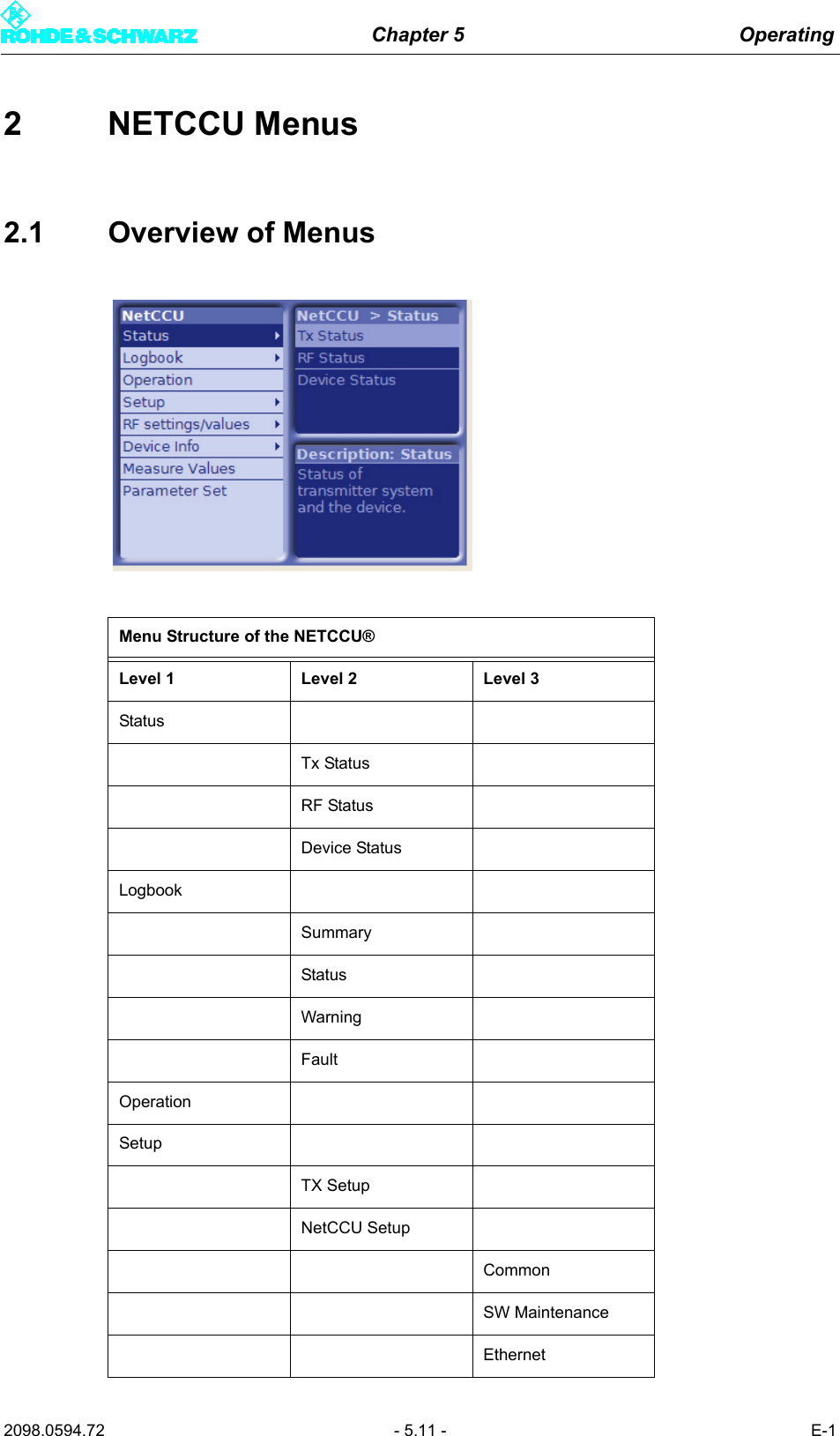
Chapter 5 Operating2098.0594.72 - 5.2 - E-1Operating structureTo navigate within the menu system: 1. Press the MENU key.The menu is called up. 2. Select the menu you want and confirm with OK. The overview of the selected menu will open (here NETCCU®).1) Window and title bar for main menu2) Window and title bar for submenus (submenus of the main menu selected in the window at the left)3) Window and title bar for describing the menu currently selected4) The menu contains additional submenus (no arrow symbol: a menu window will open)5) Not all available menus are displayed (use cursor keys to scroll up/down)STATUS Display the system logbook (when activated from system overview); display the status screen for a system component (when activated after selecting a system component from the menu)CURSOR KEYSÕ Ö × ØMove through the menu structure and highlight menu ele-ments; select entriesKey Meaning/function
Chapter 5 Operating2098.0594.72 - 5.3 - E-13. Using the cursor keys, select a menu from the left part of the window and confirm withOK. The left window now shows the next menu level; the right window shows the submenusof the entry selected at the left. 4. Using the cursor keys (up/down), select another menu or menu window from the rightside of the window and confirm with OK. Using the cursor keys (up/down), select an entry from the menu window and confirmwith OK. 1) The entry can be edited.2) The entry cannot be edited under the current authorization (Login).5. Using the up/down cursor keys, select an entry or Using the left/right cursor keys, selectthe value to be changed and change it using the up/down cursor keys.6. Confirm the selection/change with OK.7. Using the HOME key, return to the system overview.By using the MENU or FUNCTION key, you can call up a context menu at any position. The context menus usually contain default entries or special functions about the selectedmenu/menu window/menu entry.Use the BACK key to go back one step in the menu structure (even from the Help window):you can also use BACK to cancel an entered value as long as you have not already con-firmed it with OK.
Chapter 5 Operating2098.0594.72 - 5.4 - E-1Use the HOME key to exit the menu structure and return to the system overview.1.2 Operation from a PC or via Remote ControlYou need a Web browser in order to operate the system from a PC or via remote control.Note Depending on their rights, logged-on users can monitor the transmitter in question or con-trol all of its functions. There is no difference between PC control and remote control withrespect to this functionality.The NETCCU® comes equipped with the components necessary for PC or remote controloperation: Network port (10/100 MBit) Network card (RJ-45)RJ-45 crossover cable1.2.1 Installation and ConfigurationConnecting a PC/client1. Connect the NETCCU® to a local PC with the aid of an RJ-45 crossover cable attachedat the Ethernet socket on the front panel of the unit.Fig. 2 Ethernet link using a crossover cable connectionor Connect the NETCCU® to your network with the aid of an RJ-45 1:1 cable attached tothe NETLINK socket (Ethernet NetLink X5) on the rear panel of the unit. Fig. 3 Link to a network using an RJ-45 1:1 cable connection
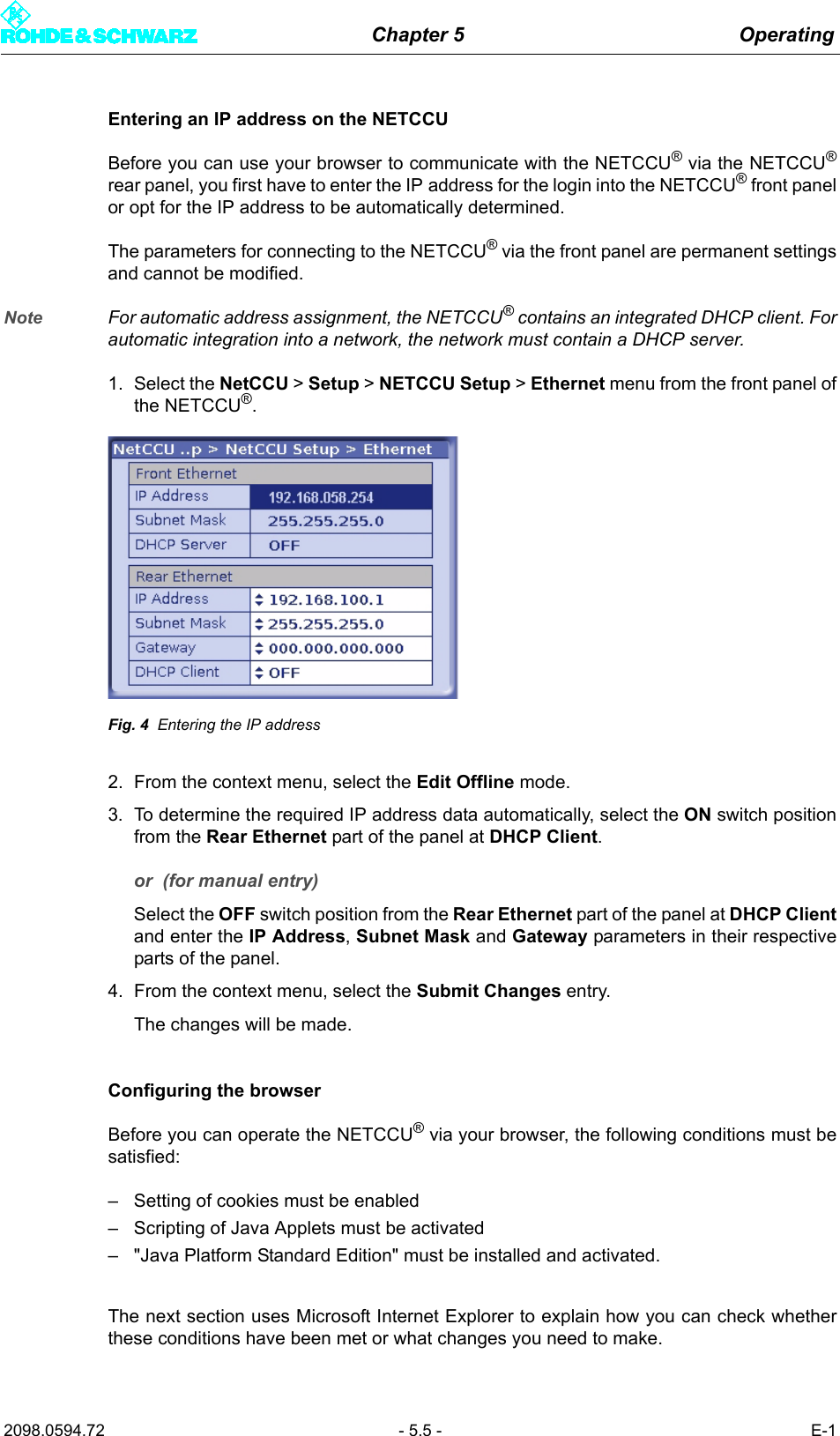
Chapter 5 Operating2098.0594.72 - 5.5 - E-1Entering an IP address on the NETCCUBefore you can use your browser to communicate with the NETCCU® via the NETCCU®rear panel, you first have to enter the IP address for the login into the NETCCU® front panelor opt for the IP address to be automatically determined. The parameters for connecting to the NETCCU® via the front panel are permanent settingsand cannot be modified.Note For automatic address assignment, the NETCCU® contains an integrated DHCP client. Forautomatic integration into a network, the network must contain a DHCP server. 1. Select the NetCCU > Setup > NETCCU Setup > Ethernet menu from the front panel ofthe NETCCU®.Fig. 4 Entering the IP address2. From the context menu, select the Edit Offline mode.3. To determine the required IP address data automatically, select the ON switch positionfrom the Rear Ethernet part of the panel at DHCP Client.or  (for manual entry)Select the OFF switch position from the Rear Ethernet part of the panel at DHCP Clientand enter the IP Address, Subnet Mask and Gateway parameters in their respectiveparts of the panel. 4. From the context menu, select the Submit Changes entry. The changes will be made.Configuring the browserBefore you can operate the NETCCU® via your browser, the following conditions must besatisfied: – Setting of cookies must be enabled– Scripting of Java Applets must be activated– "Java Platform Standard Edition" must be installed and activated. The next section uses Microsoft Internet Explorer to explain how you can check whetherthese conditions have been met or what changes you need to make.
Chapter 5 Operating2098.0594.72 - 5.6 - E-1Note Please note that the settings described here need not necessarily match your currentbrowser settings one hundred percent. All necessary changes and settings can be found in the Tools > Internet Options menu onyour Internet Explorer. Checking and adapting the settings for cookies: 1. Select the Data Protection tab and click on the Default button if available. 2. Set the security level via the slider (right the way down) to Accept All Cookies. Checking and adapting the settings for Java applets:1. Select the Security tab.2. For the Internet zone select the option Custom Level. 3. In the tree structure go to Scripting > Scripting of Java applets and select the Enableoption. Installing Java (Sun) JRE if necessary; checking and adapting the settings1. Select the Advanced tab.2. Check whether the entry Java (Sun) JRE ... is present and enabled. 3. If necessary download "Java Platform Standard Edition" (including standard installation)from the Sun web site "www.java.com". 4. Then select the Internet Explorer's Advanced tab again and check whether the softwareis installed and enabled. Starting the program1. Start the browser on your PC or client.2. Enter the same IP address as the one you entered on the NETCCU®. The Login screenwill appear. ATTENTION!Please note that the modified settings described here may adversely affect the security of your Internet connections. The following authorizations will be available to you:Authorization PasswordCalibration (authorization to calibrate trans-mitter components, e.g. exciters)1234Configuration (authorization to set basic transmitter parameters, e.g. Setup)1234Maintenance (authorization to perform main-tenance tasks, e.g. software updates)1234
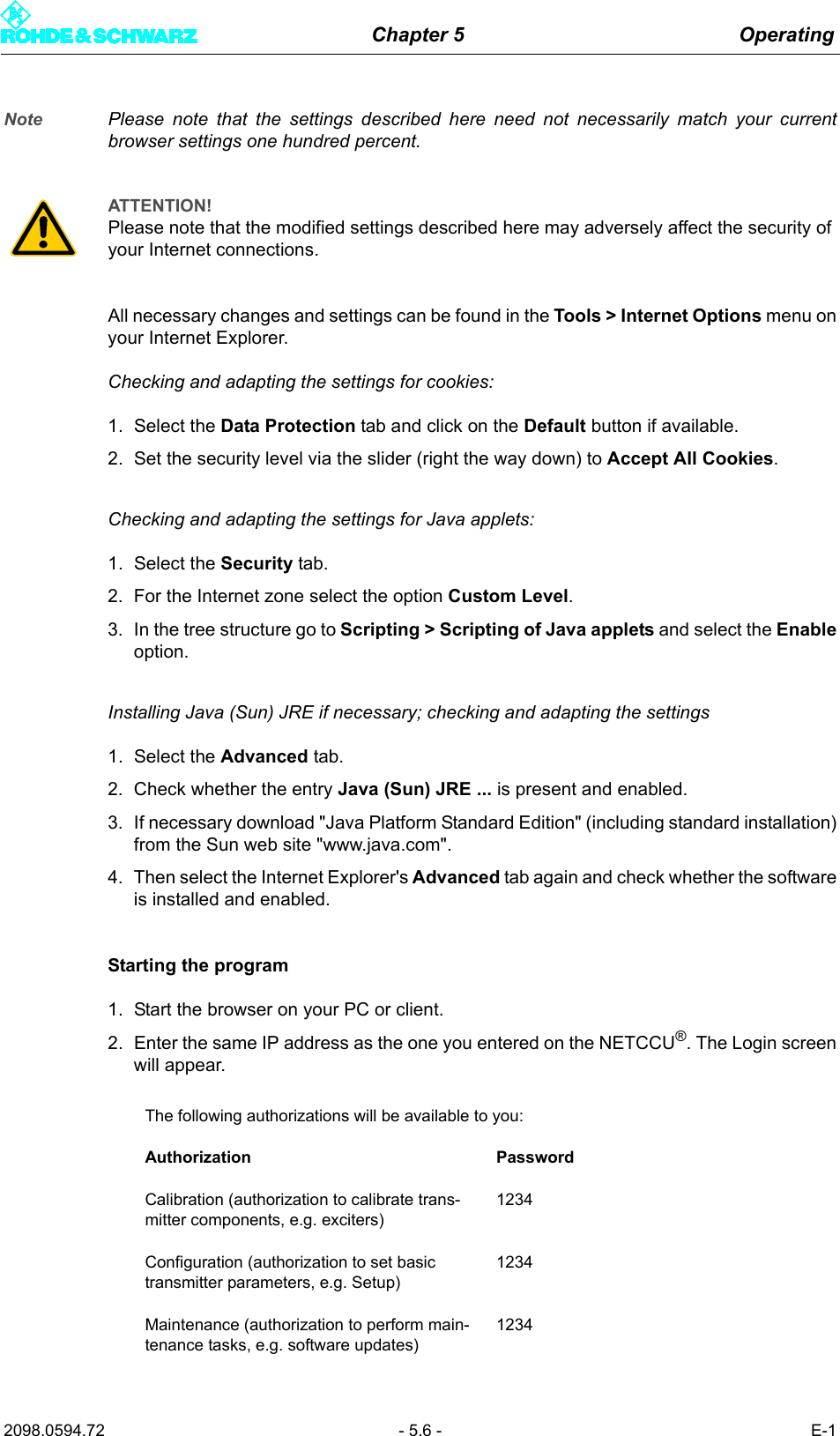
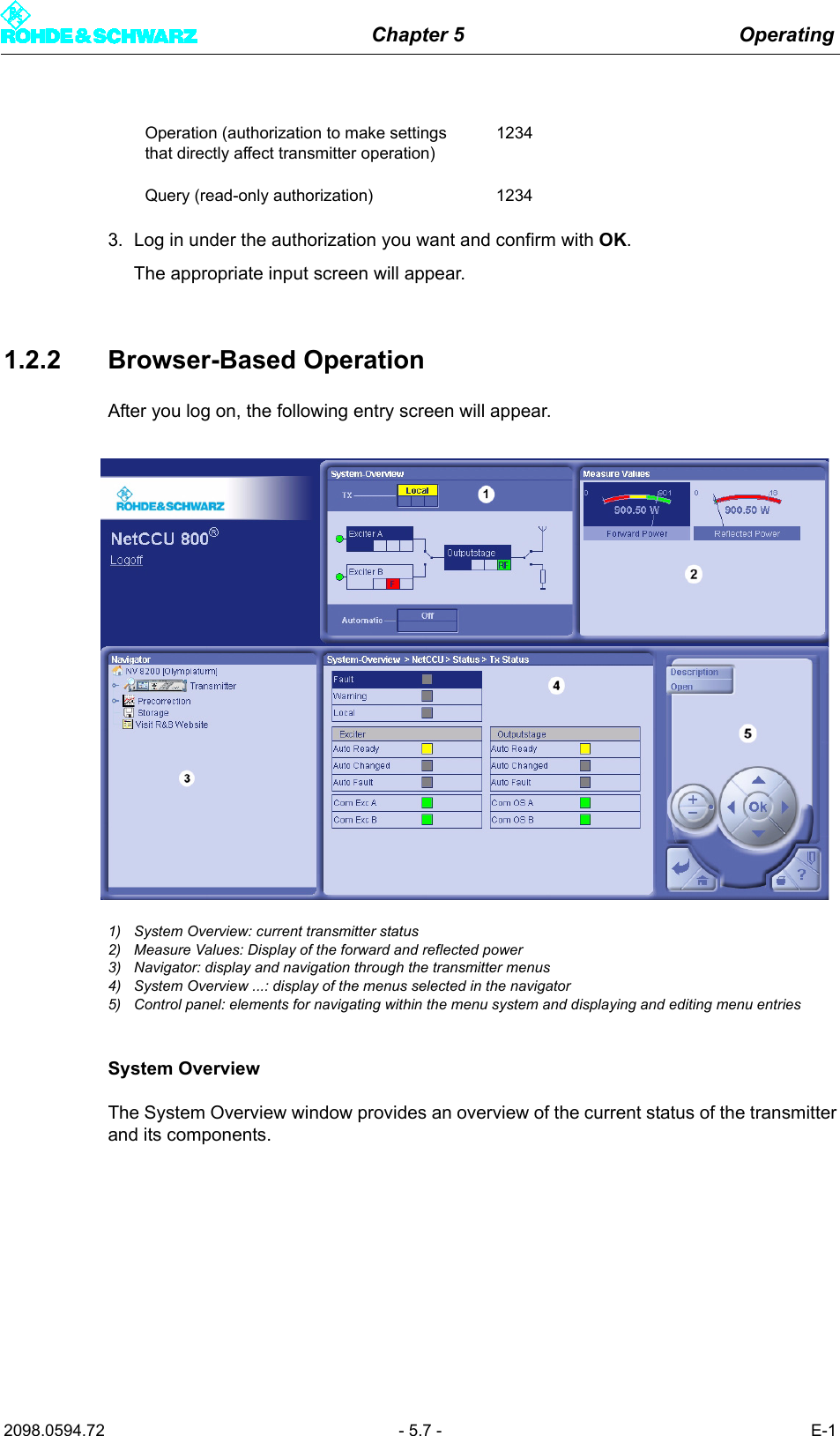
Chapter 5 Operating2098.0594.72 - 5.7 - E-13. Log in under the authorization you want and confirm with OK.The appropriate input screen will appear.1.2.2 Browser-Based OperationAfter you log on, the following entry screen will appear. 1) System Overview: current transmitter status2) Measure Values: Display of the forward and reflected power3) Navigator: display and navigation through the transmitter menus4) System Overview ...: display of the menus selected in the navigator5) Control panel: elements for navigating within the menu system and displaying and editing menu entriesSystem OverviewThe System Overview window provides an overview of the current status of the transmitterand its components.Operation (authorization to make settings that directly affect transmitter operation)1234Query (read-only authorization) 1234
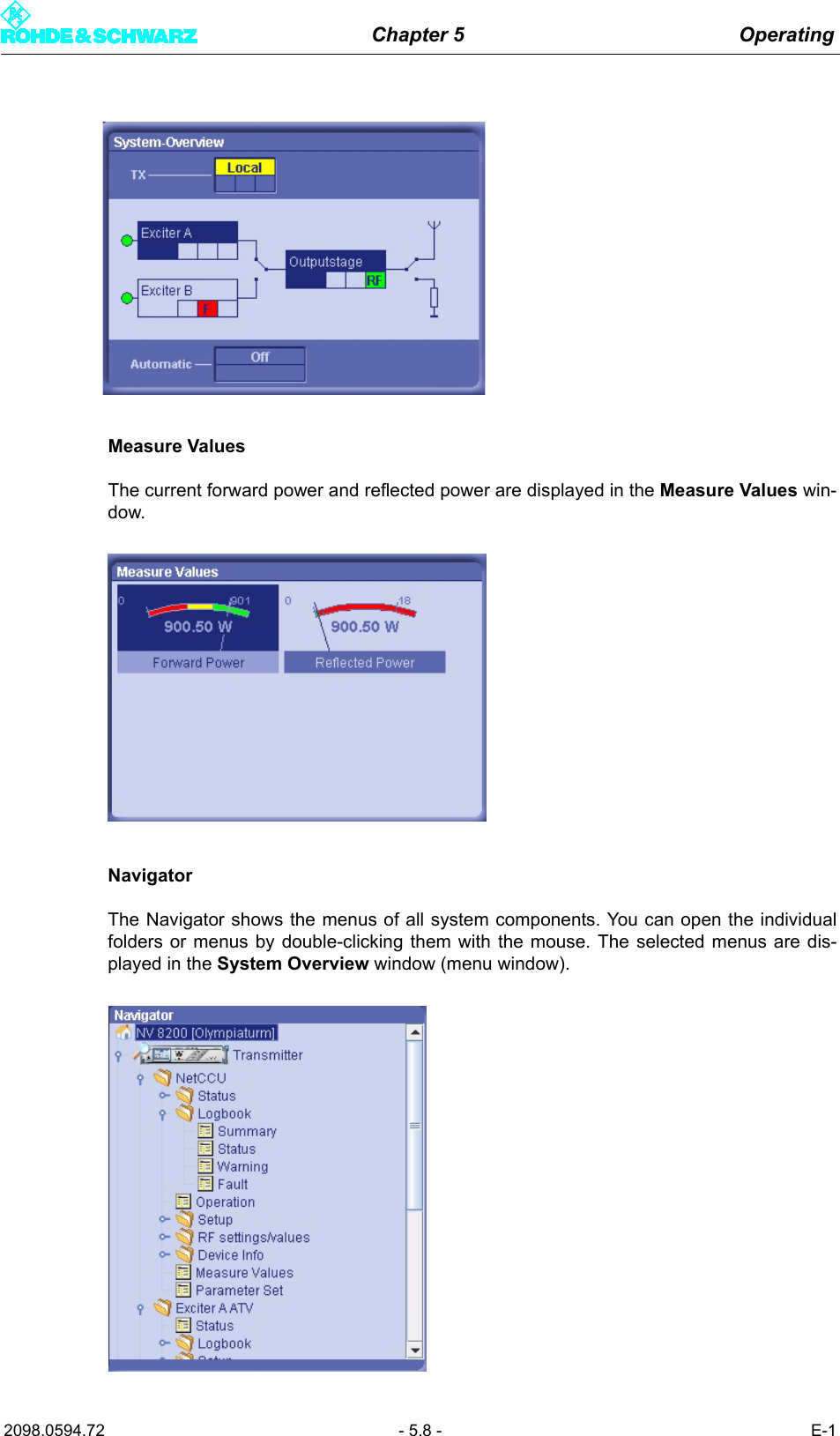
Chapter 5 Operating2098.0594.72 - 5.8 - E-1Measure ValuesThe current forward power and reflected power are displayed in the Measure Values win-dow. NavigatorThe Navigator shows the menus of all system components. You can open the individualfolders or menus by double-clicking them with the mouse. The selected menus are dis-played in the System Overview window (menu window).
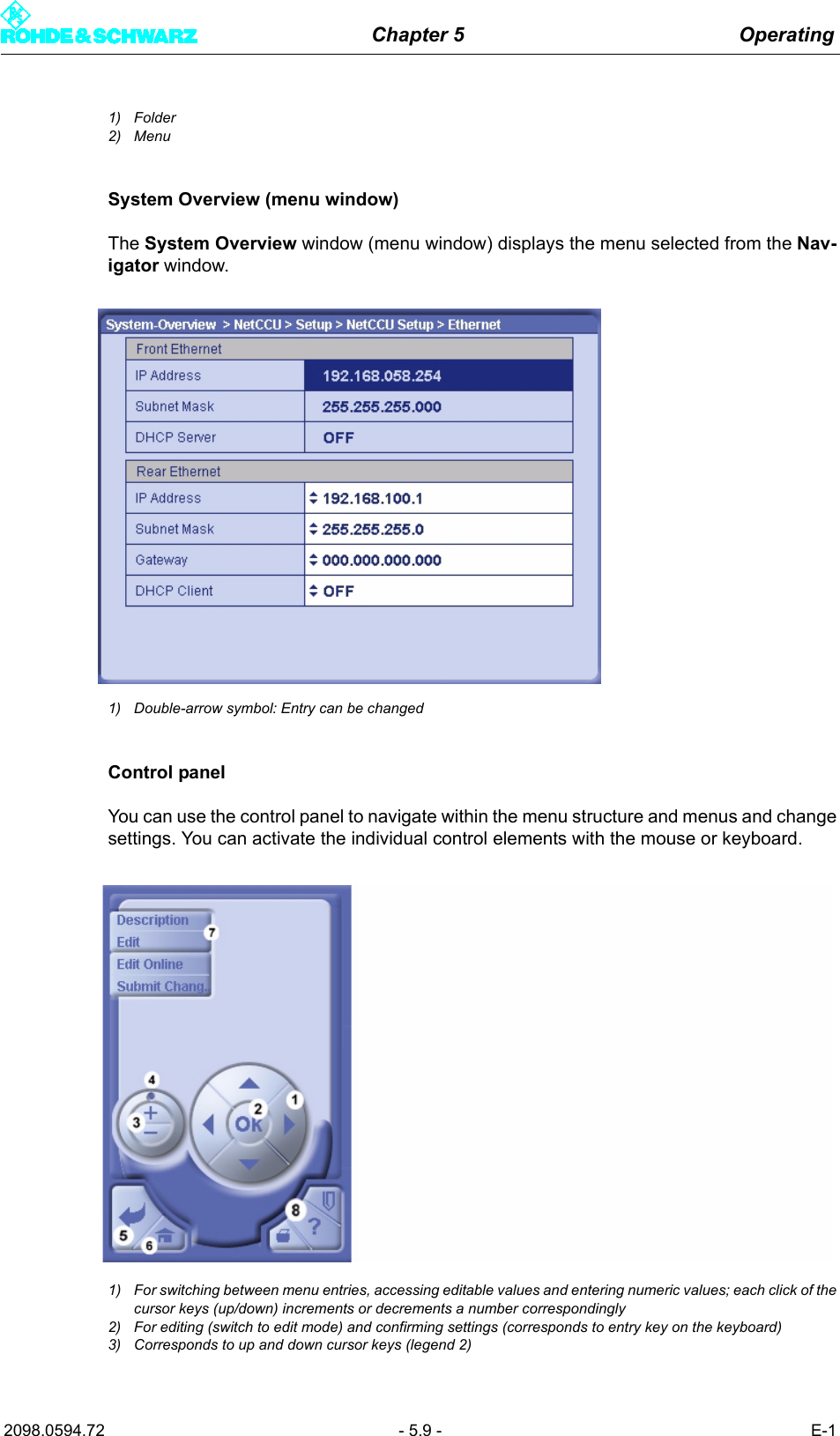
Chapter 5 Operating2098.0594.72 - 5.9 - E-11) Folder2) MenuSystem Overview (menu window)The System Overview window (menu window) displays the menu selected from the Nav-igator window.1) Double-arrow symbol: Entry can be changedControl panelYou can use the control panel to navigate within the menu structure and menus and changesettings. You can activate the individual control elements with the mouse or keyboard. 1) For switching between menu entries, accessing editable values and entering numeric values; each click of thecursor keys (up/down) increments or decrements a number correspondingly2) For editing (switch to edit mode) and confirming settings (corresponds to entry key on the keyboard)3) Corresponds to up and down cursor keys (legend 2)
Chapter 5 Operating2098.0594.72 - 5.10 - E-14) For quickly switching between menu entries, for quickly accessing editable values, and for quickly enteringnumeric values5) Primarily for taking one step back in the menu structure; also used to cancel settings that have not yet beenconfirmed with OK6) Return to home menu7) For displaying context menus for current menu window (standard context menus: Description: help texts;Open: opens menu or menu entry; Edit: for editing entry; Edit Offline: for editing entry without immediately in-corporating change; Submit Change: entry edited offline is accepted in system)8) Not enabled in this software version
Chapter 5 Operating2098.0594.72 - 5.11 - E-12 NETCCU Menus2.1 Overview of MenusMenu Structure of the NETCCU®Level 1 Level 2 Level 3StatusTx StatusRF StatusDevice StatusLogbookSummaryStatusWarningFaultOperationSetupTX SetupNetCCU SetupCommonSW MaintenanceEthernet
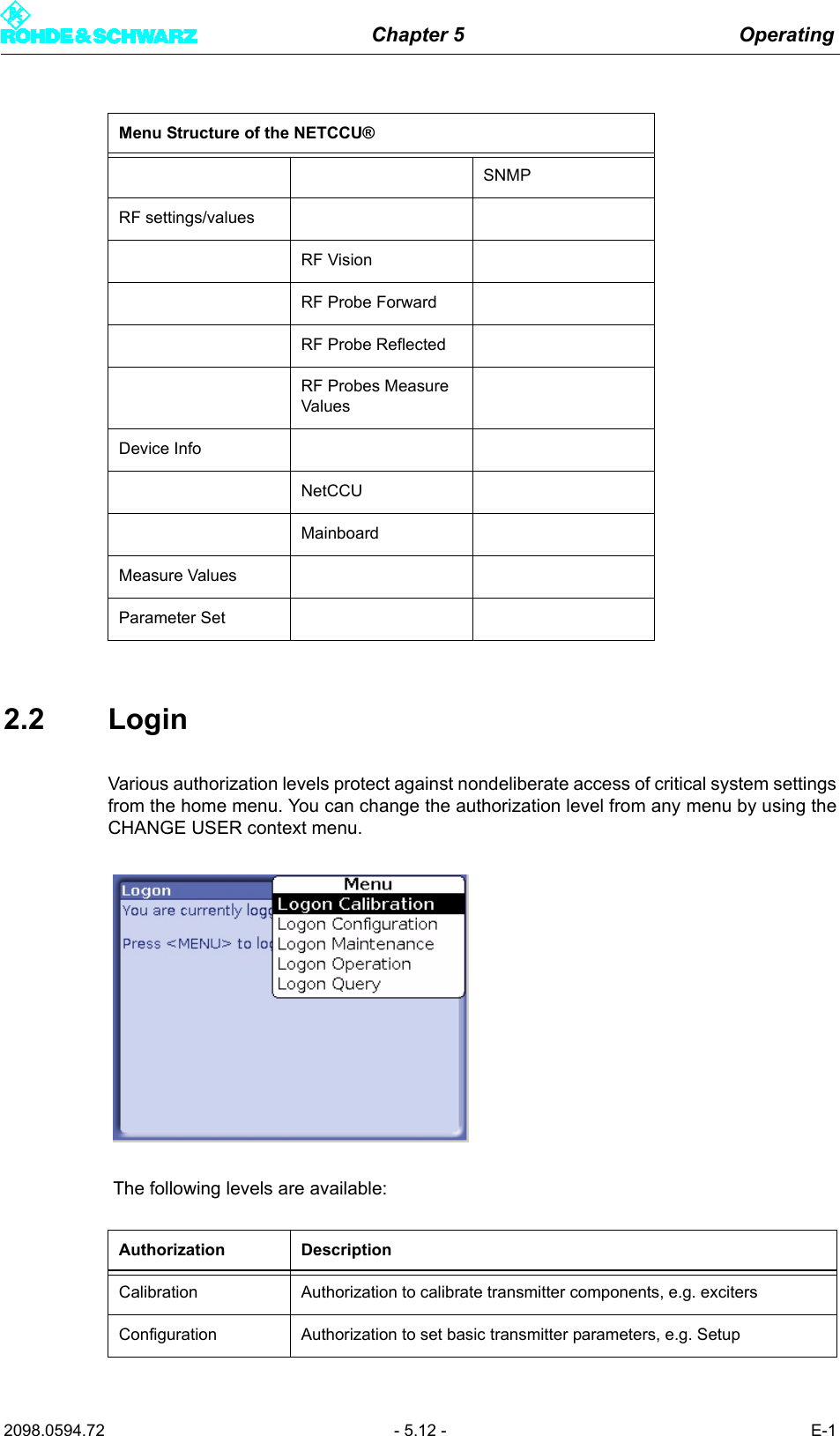
Chapter 5 Operating2098.0594.72 - 5.12 - E-12.2 LoginVarious authorization levels protect against nondeliberate access of critical system settingsfrom the home menu. You can change the authorization level from any menu by using theCHANGE USER context menu.  The following levels are available: SNMPRF settings/valuesRF VisionRF Probe ForwardRF Probe ReflectedRF Probes Measure ValuesDevice InfoNetCCUMainboardMeasure ValuesParameter SetAuthorization DescriptionCalibration Authorization to calibrate transmitter components, e.g. excitersConfiguration Authorization to set basic transmitter parameters, e.g. SetupMenu Structure of the NETCCU®
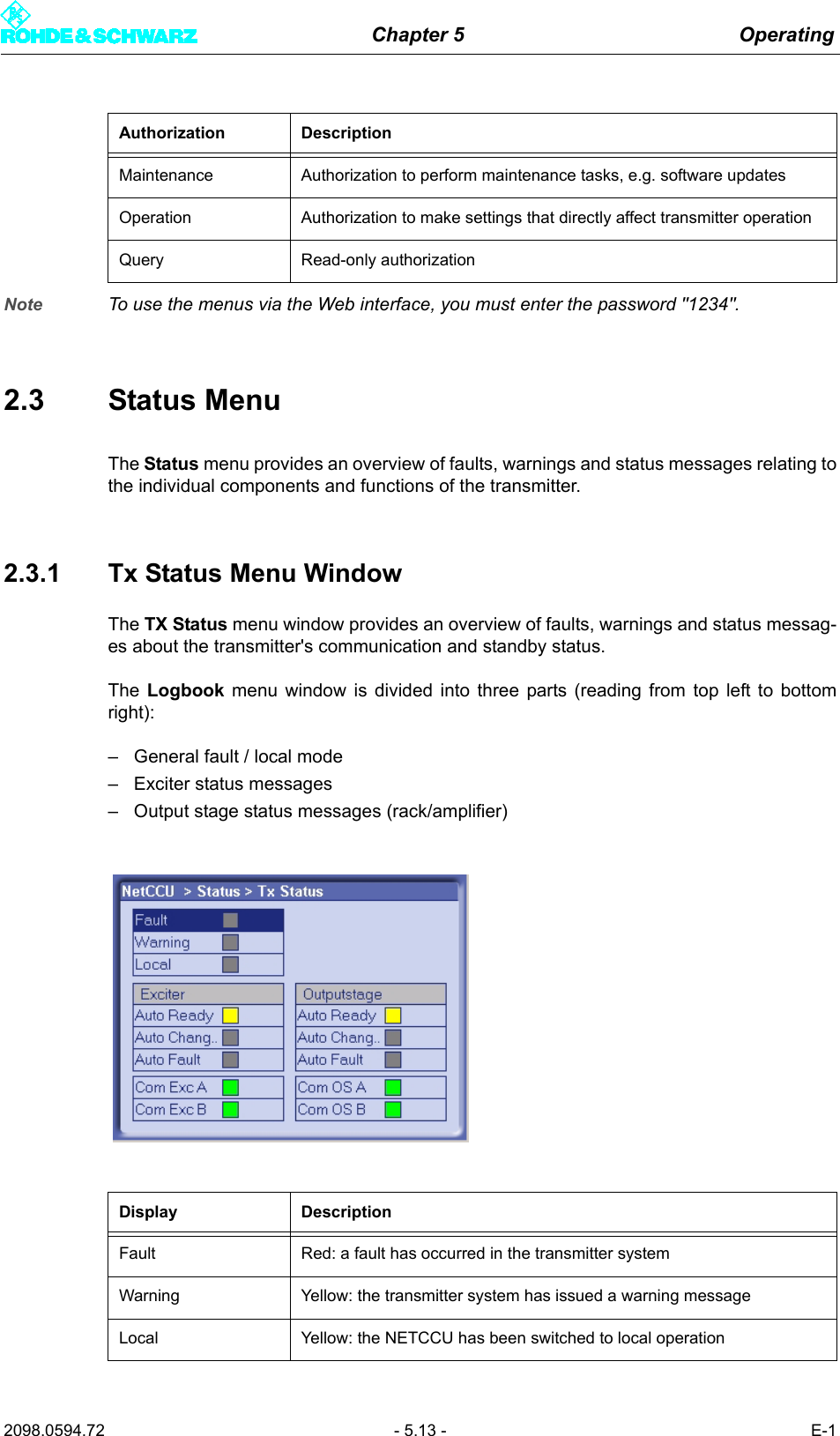
Chapter 5 Operating2098.0594.72 - 5.13 - E-1Note To use the menus via the Web interface, you must enter the password "1234".2.3 Status MenuThe Status menu provides an overview of faults, warnings and status messages relating tothe individual components and functions of the transmitter. 2.3.1 Tx Status Menu WindowThe TX Status menu window provides an overview of faults, warnings and status messag-es about the transmitter's communication and standby status. The Logbook menu window is divided into three parts (reading from top left to bottomright): – General fault / local mode– Exciter status messages– Output stage status messages (rack/amplifier)Maintenance Authorization to perform maintenance tasks, e.g. software updatesOperation Authorization to make settings that directly affect transmitter operationQuery Read-only authorizationDisplay DescriptionFault Red: a fault has occurred in the transmitter systemWarning Yellow: the transmitter system has issued a warning messageLocal Yellow: the NETCCU has been switched to local operationAuthorization Description
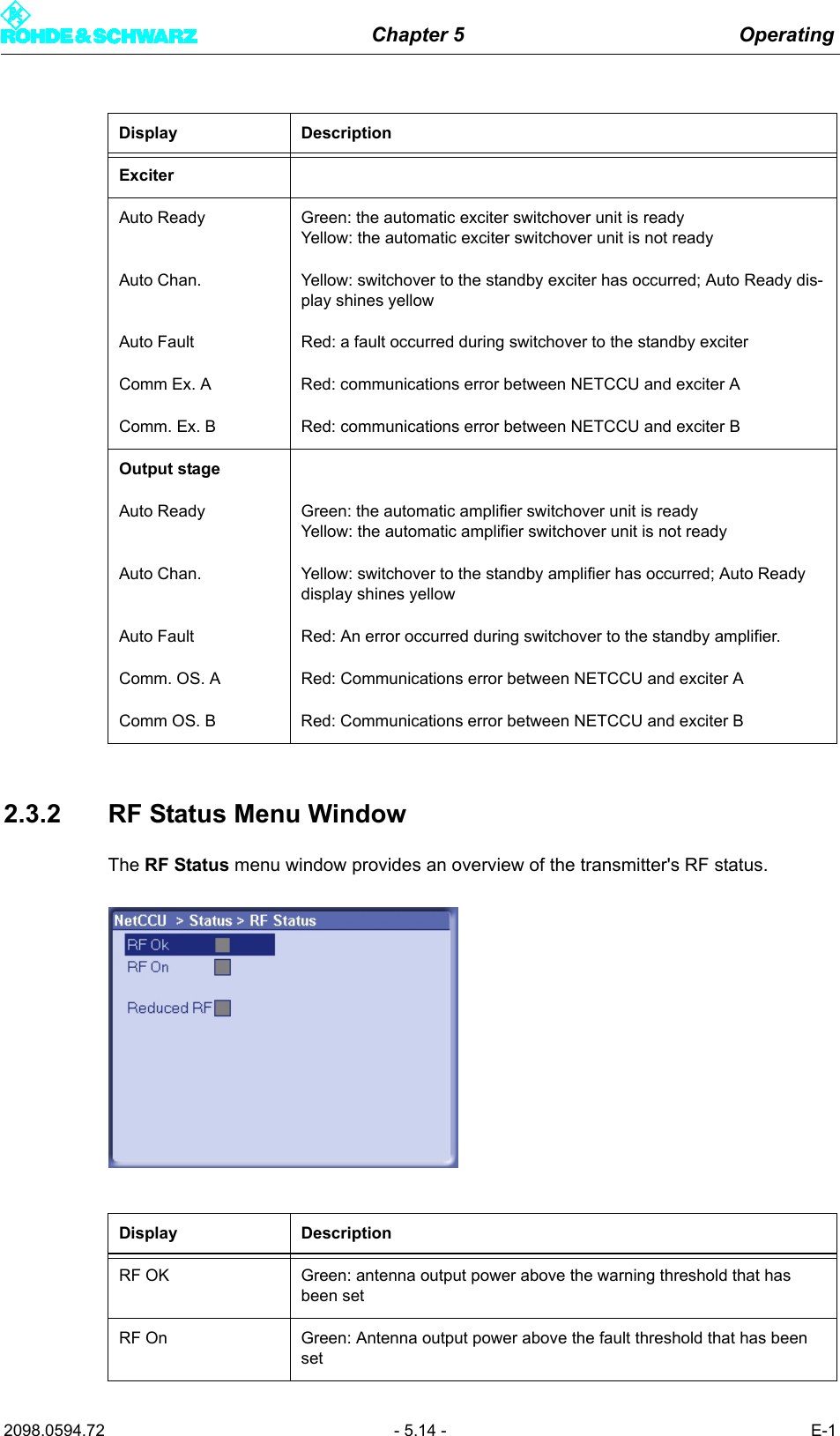
Chapter 5 Operating2098.0594.72 - 5.14 - E-12.3.2 RF Status Menu WindowThe RF Status menu window provides an overview of the transmitter's RF status.ExciterAuto Ready Green: the automatic exciter switchover unit is readyYellow: the automatic exciter switchover unit is not readyAuto Chan. Yellow: switchover to the standby exciter has occurred; Auto Ready dis-play shines yellowAuto Fault Red: a fault occurred during switchover to the standby exciterComm Ex. A Red: communications error between NETCCU and exciter AComm. Ex. B Red: communications error between NETCCU and exciter BOutput stageAuto Ready Green: the automatic amplifier switchover unit is readyYellow: the automatic amplifier switchover unit is not readyAuto Chan. Yellow: switchover to the standby amplifier has occurred; Auto Ready display shines yellowAuto Fault Red: An error occurred during switchover to the standby amplifier.Comm. OS. A Red: Communications error between NETCCU and exciter AComm OS. B Red: Communications error between NETCCU and exciter BDisplay DescriptionRF OK Green: antenna output power above the warning threshold that has been setRF On Green: Antenna output power above the fault threshold that has been setDisplay Description
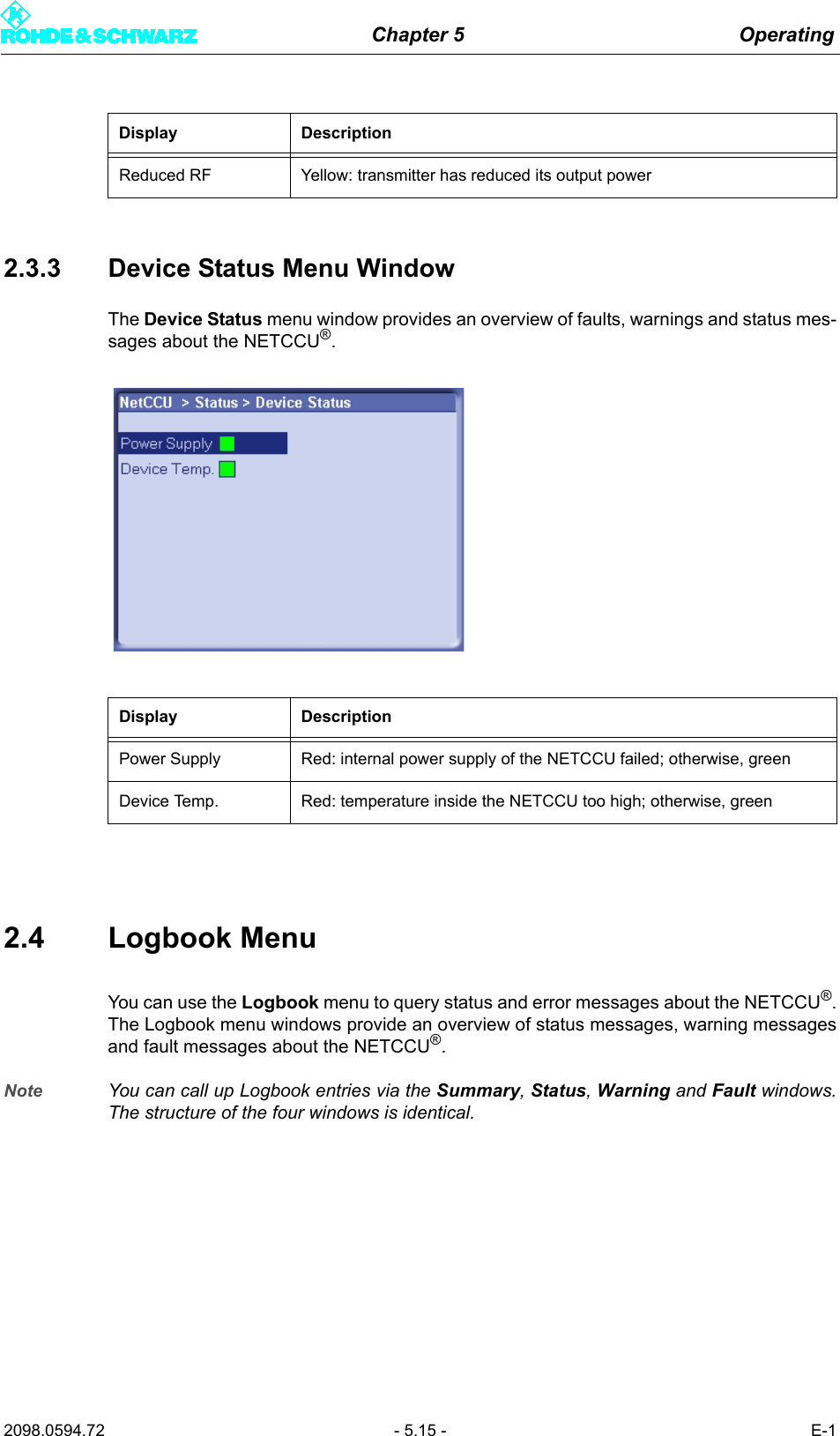
Chapter 5 Operating2098.0594.72 - 5.15 - E-12.3.3 Device Status Menu WindowThe Device Status menu window provides an overview of faults, warnings and status mes-sages about the NETCCU®.2.4 Logbook MenuYou can use the Logbook menu to query status and error messages about the NETCCU®.The Logbook menu windows provide an overview of status messages, warning messagesand fault messages about the NETCCU®. Note You can call up Logbook entries via the Summary, Status, Warning and Fault windows.The structure of the four windows is identical.Reduced RF Yellow: transmitter has reduced its output powerDisplay DescriptionPower Supply Red: internal power supply of the NETCCU failed; otherwise, greenDevice Temp. Red: temperature inside the NETCCU too high; otherwise, greenDisplay Description
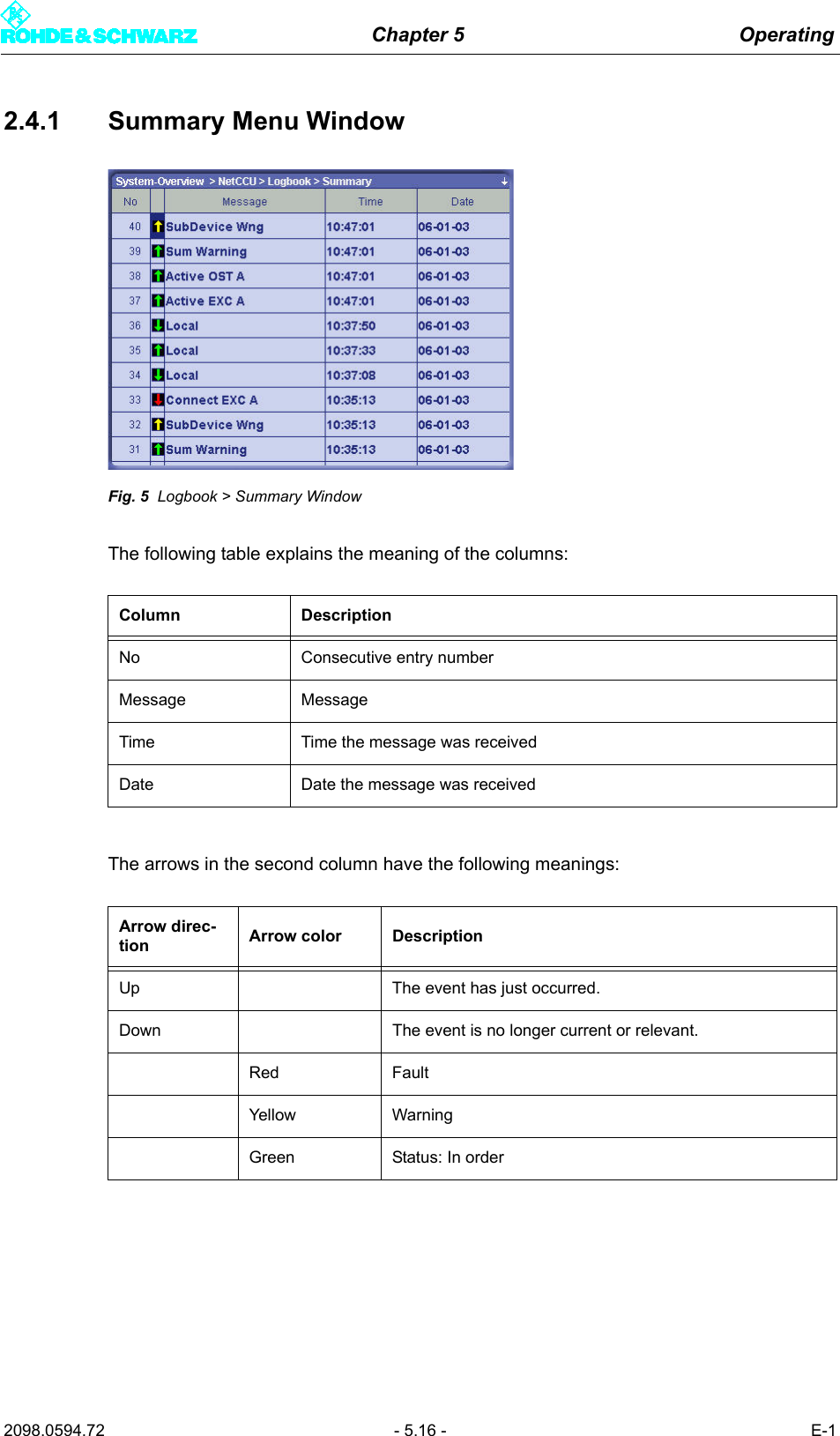
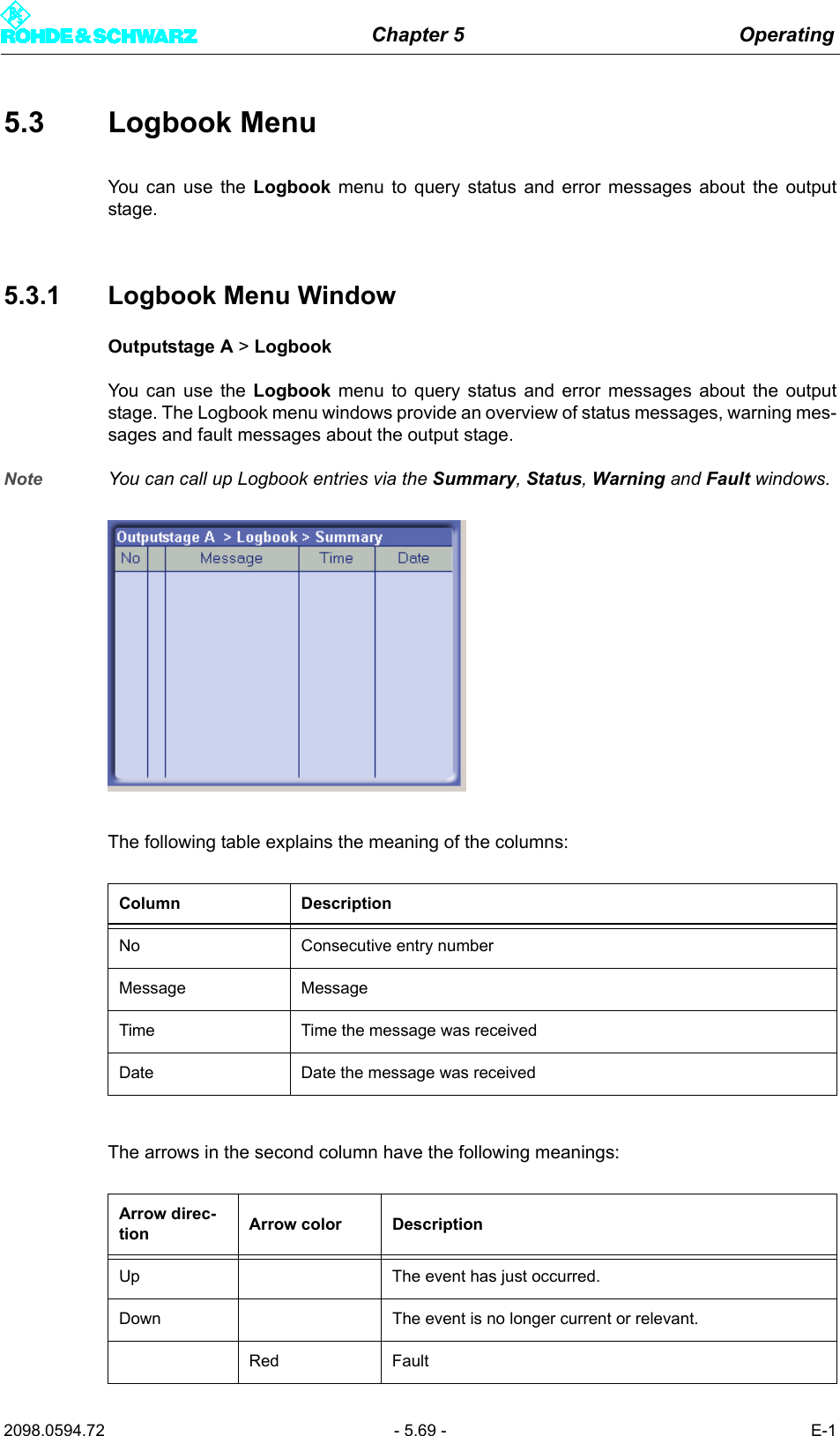
Chapter 5 Operating2098.0594.72 - 5.16 - E-12.4.1 Summary Menu WindowFig. 5 Logbook > Summary WindowThe following table explains the meaning of the columns:The arrows in the second column have the following meanings:Column DescriptionNo Consecutive entry numberMessage MessageTime Time the message was receivedDate Date the message was receivedArrow direc-tion Arrow color DescriptionUp The event has just occurred.Down The event is no longer current or relevant.Red FaultYellow WarningGreen Status: In order
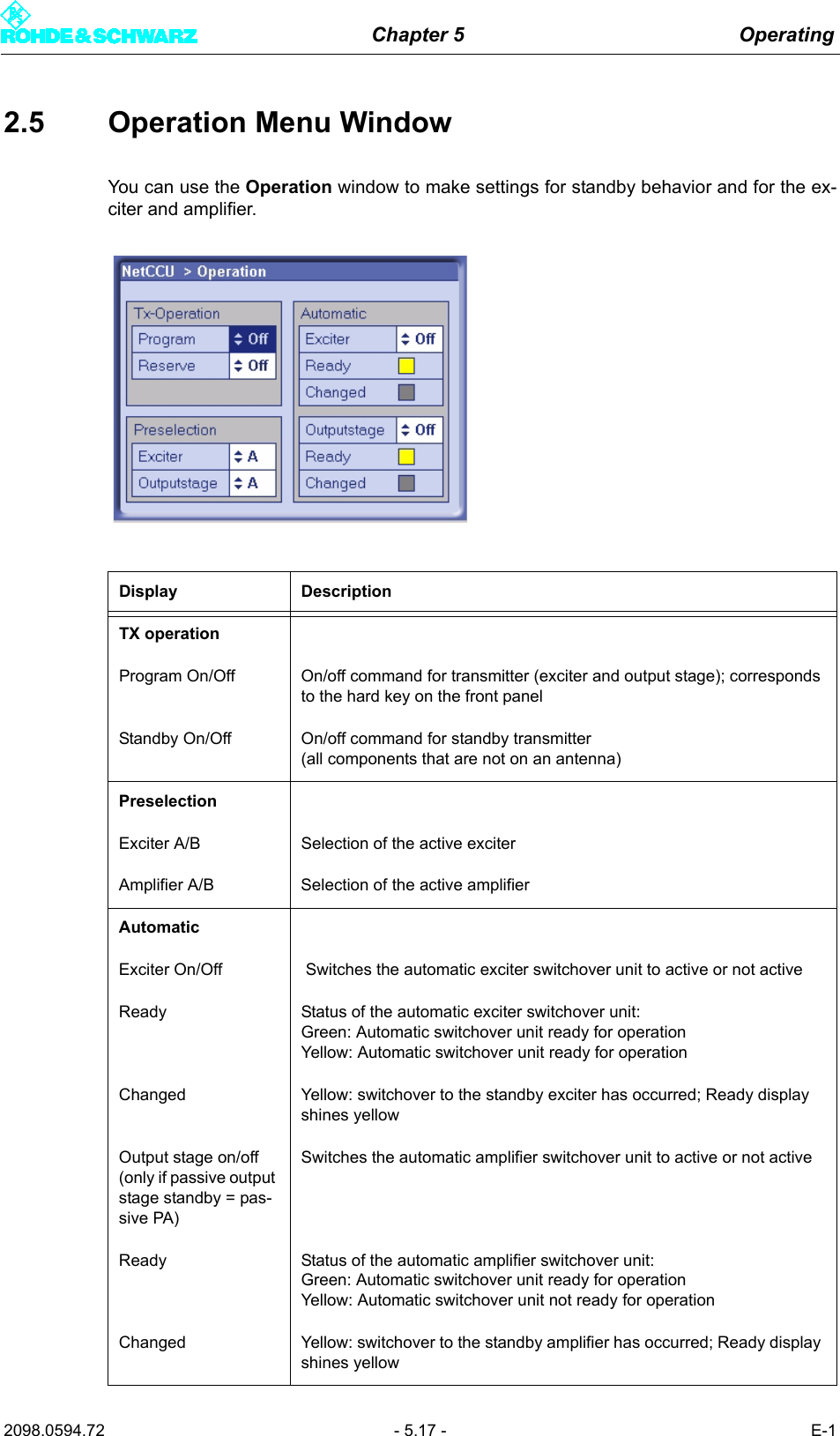
Chapter 5 Operating2098.0594.72 - 5.17 - E-12.5 Operation Menu WindowYou can use the Operation window to make settings for standby behavior and for the ex-citer and amplifier. Display DescriptionTX operationProgram On/Off On/off command for transmitter (exciter and output stage); corresponds to the hard key on the front panelStandby On/Off On/off command for standby transmitter (all components that are not on an antenna)PreselectionExciter A/B Selection of the active exciterAmplifier A/B Selection of the active amplifierAutomaticExciter On/Off  Switches the automatic exciter switchover unit to active or not activeReady Status of the automatic exciter switchover unit: Green: Automatic switchover unit ready for operationYellow: Automatic switchover unit ready for operationChanged Yellow: switchover to the standby exciter has occurred; Ready display shines yellowOutput stage on/off (only if passive output stage standby = pas-sive PA)Switches the automatic amplifier switchover unit to active or not activeReady Status of the automatic amplifier switchover unit: Green: Automatic switchover unit ready for operationYellow: Automatic switchover unit not ready for operationChanged Yellow: switchover to the standby amplifier has occurred; Ready display shines yellow
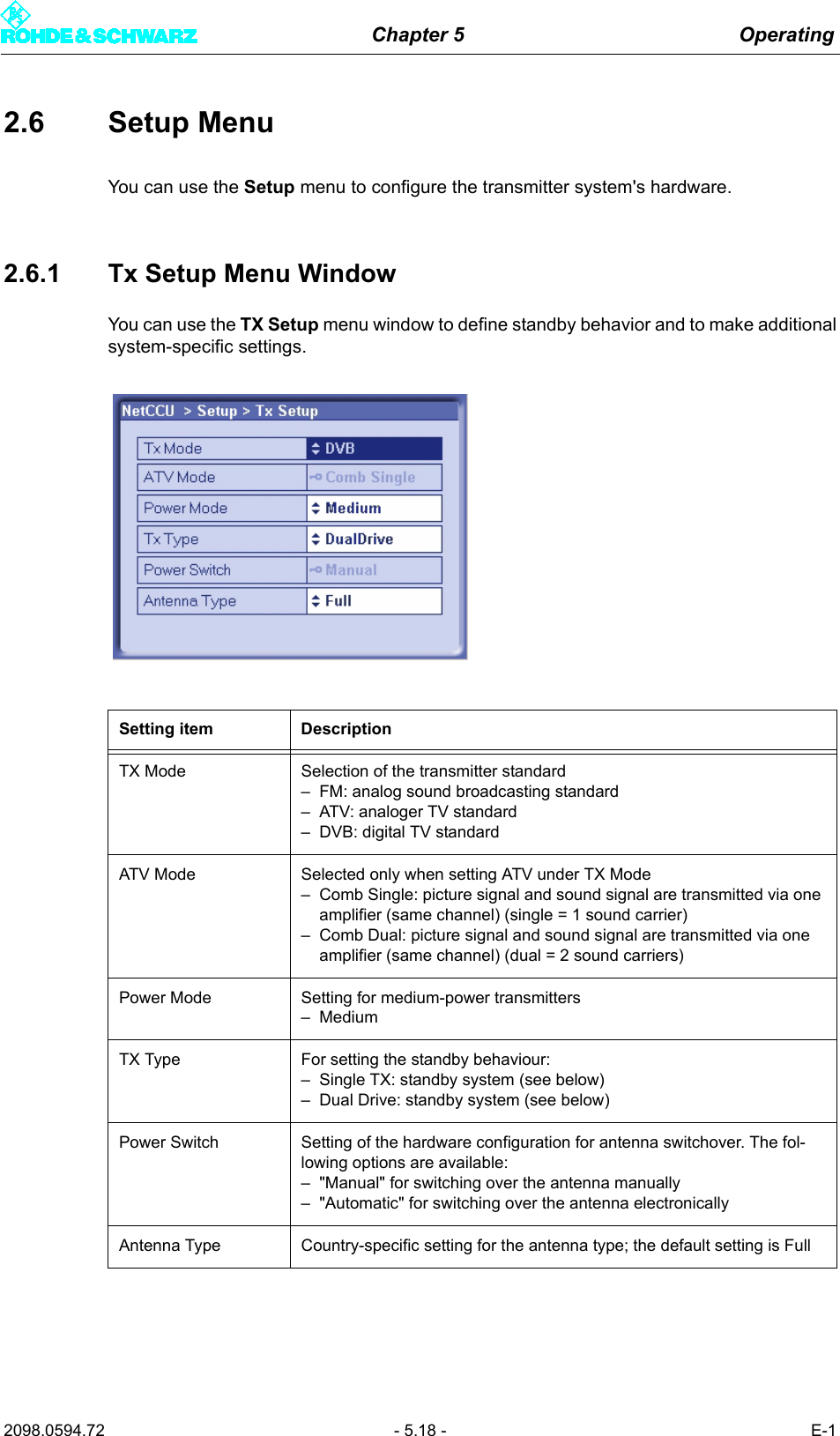
Chapter 5 Operating2098.0594.72 - 5.18 - E-12.6 Setup MenuYou can use the Setup menu to configure the transmitter system's hardware.2.6.1 Tx Setup Menu WindowYou can use the TX Setup menu window to define standby behavior and to make additionalsystem-specific settings.Setting item DescriptionTX Mode Selection of the transmitter standard– FM: analog sound broadcasting standard– ATV: analoger TV standard– DVB: digital TV standardATV Mode Selected only when setting ATV under TX Mode– Comb Single: picture signal and sound signal are transmitted via one amplifier (same channel) (single = 1 sound carrier)– Comb Dual: picture signal and sound signal are transmitted via one amplifier (same channel) (dual = 2 sound carriers)Power Mode Setting for medium-power transmitters– MediumTX Type For setting the standby behaviour:– Single TX: standby system (see below)– Dual Drive: standby system (see below)Power Switch Setting of the hardware configuration for antenna switchover. The fol-lowing options are available:– "Manual" for switching over the antenna manually– "Automatic" for switching over the antenna electronicallyAntenna Type Country-specific setting for the antenna type; the default setting is Full
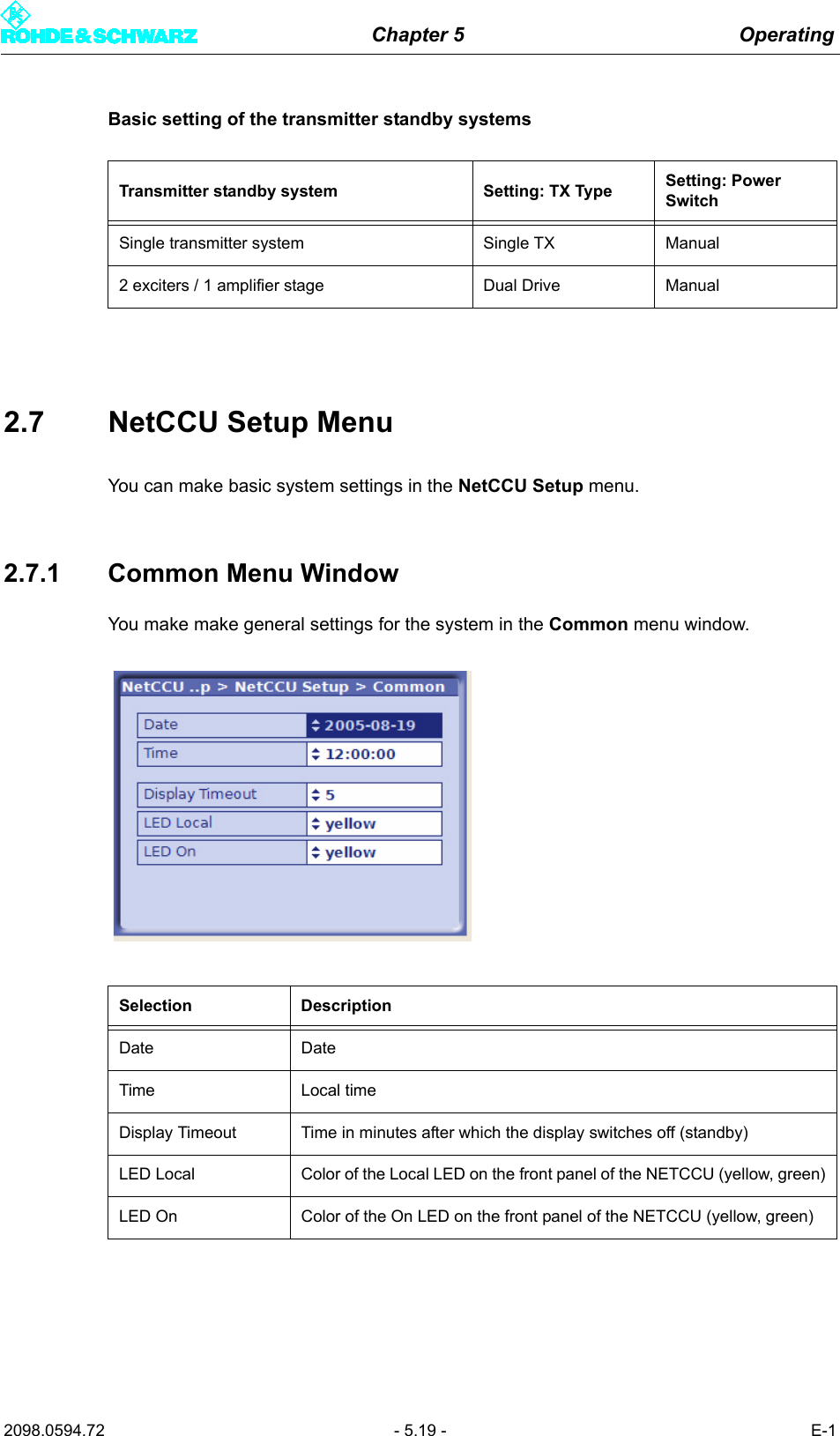
Chapter 5 Operating2098.0594.72 - 5.19 - E-1Basic setting of the transmitter standby systems2.7 NetCCU Setup MenuYou can make basic system settings in the NetCCU Setup menu.2.7.1 Common Menu WindowYou make make general settings for the system in the Common menu window. Transmitter standby system Setting: TX Type Setting: Power SwitchSingle transmitter system Single TX Manual2 exciters / 1 amplifier stage Dual Drive ManualSelection DescriptionDate DateTime Local timeDisplay Timeout Time in minutes after which the display switches off (standby)LED Local Color of the Local LED on the front panel of the NETCCU (yellow, green)LED On Color of the On LED on the front panel of the NETCCU (yellow, green)
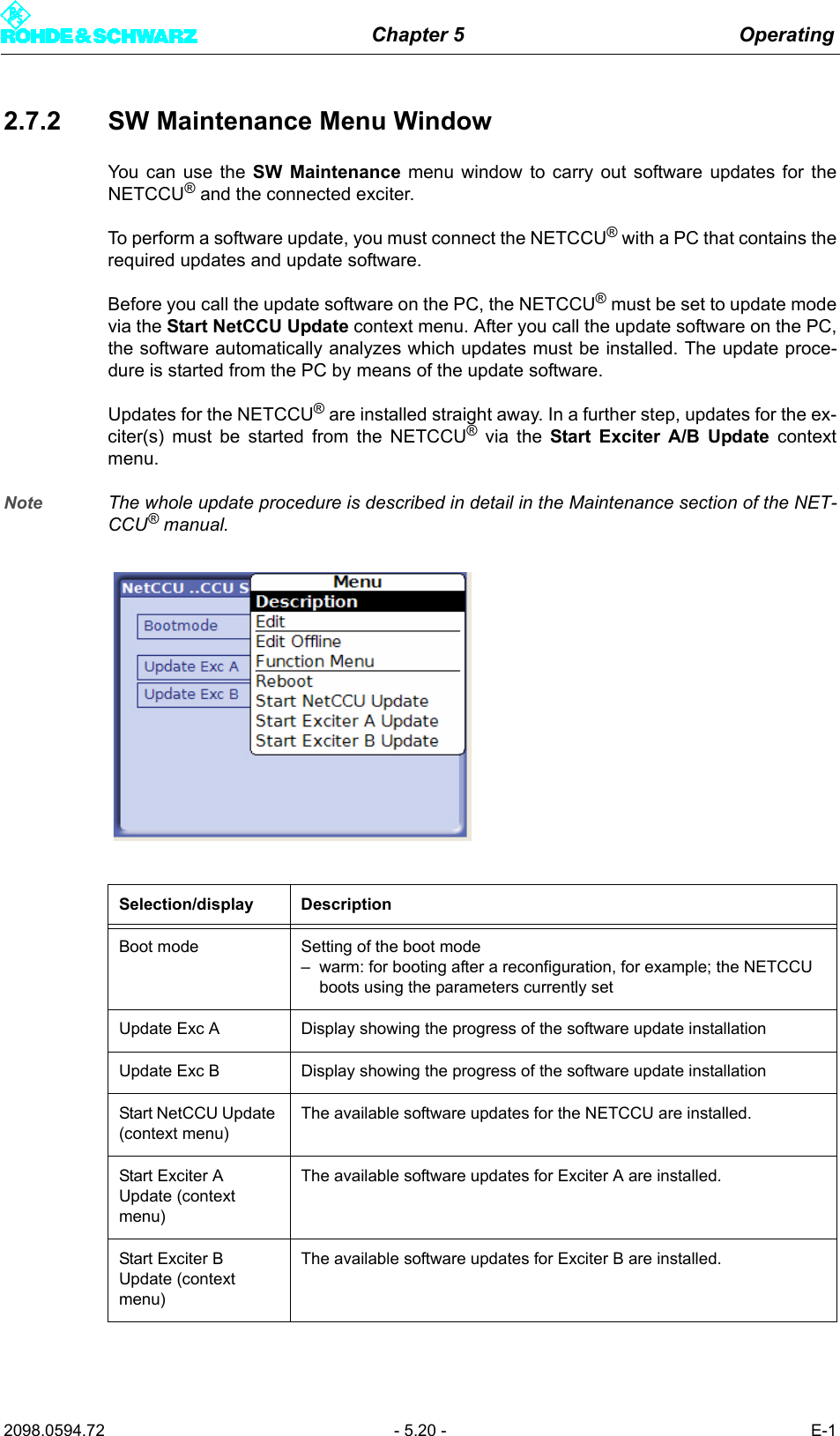
Chapter 5 Operating2098.0594.72 - 5.20 - E-12.7.2 SW Maintenance Menu WindowYou can use the SW Maintenance menu window to carry out software updates for theNETCCU® and the connected exciter. To perform a software update, you must connect the NETCCU® with a PC that contains therequired updates and update software. Before you call the update software on the PC, the NETCCU® must be set to update modevia the Start NetCCU Update context menu. After you call the update software on the PC,the software automatically analyzes which updates must be installed. The update proce-dure is started from the PC by means of the update software. Updates for the NETCCU® are installed straight away. In a further step, updates for the ex-citer(s) must be started from the NETCCU® via the Start Exciter A/B Update contextmenu. Note The whole update procedure is described in detail in the Maintenance section of the NET-CCU® manual.Selection/display DescriptionBoot mode Setting of the boot mode– warm: for booting after a reconfiguration, for example; the NETCCU boots using the parameters currently setUpdate Exc A Display showing the progress of the software update installationUpdate Exc B Display showing the progress of the software update installationStart NetCCU Update (context menu)The available software updates for the NETCCU are installed. Start Exciter A Update (context menu)The available software updates for Exciter A are installed. Start Exciter B Update (context menu)The available software updates for Exciter B are installed.
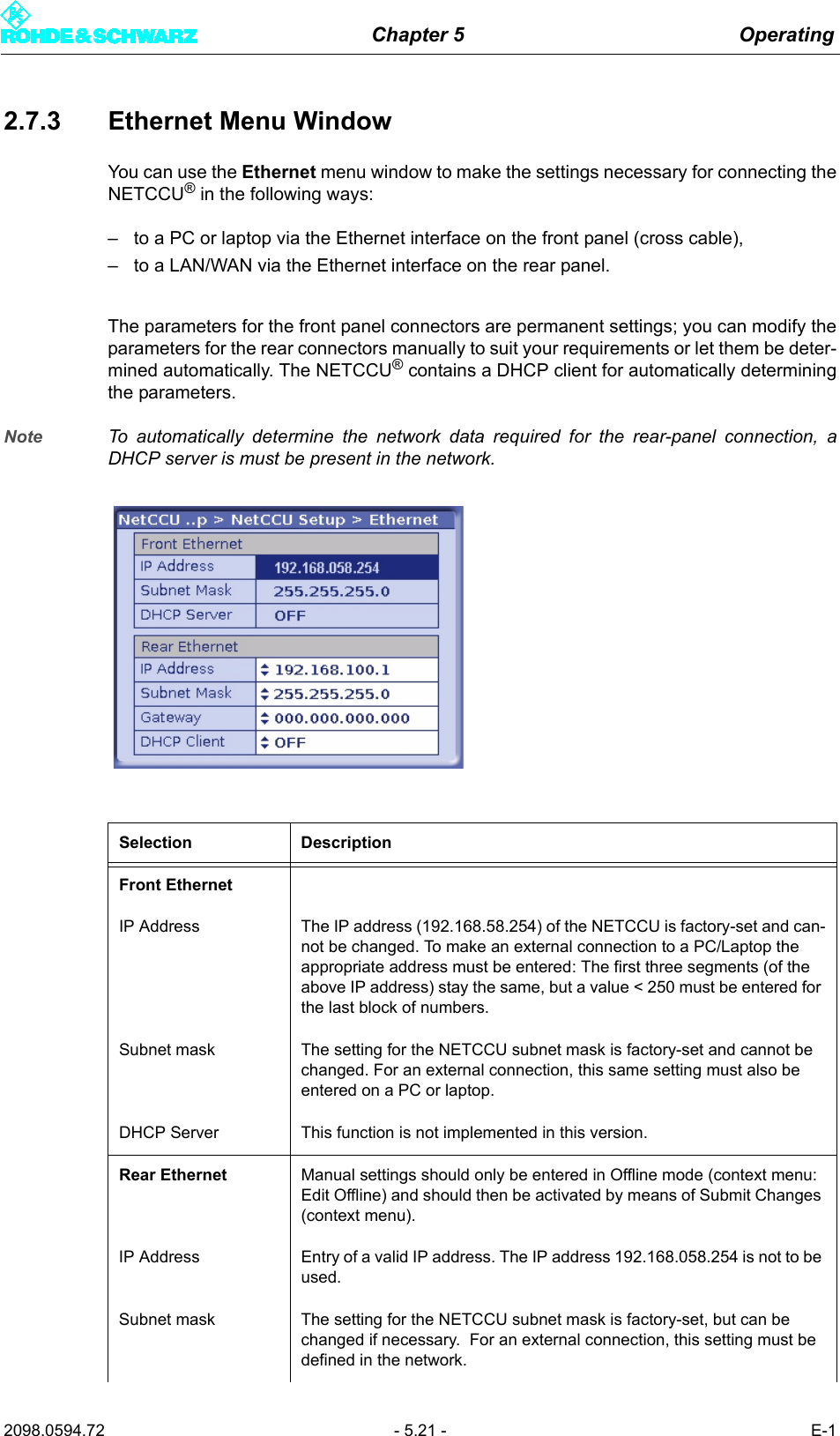
Chapter 5 Operating2098.0594.72 - 5.21 - E-12.7.3 Ethernet Menu WindowYou can use the Ethernet menu window to make the settings necessary for connecting theNETCCU® in the following ways: – to a PC or laptop via the Ethernet interface on the front panel (cross cable),– to a LAN/WAN via the Ethernet interface on the rear panel.The parameters for the front panel connectors are permanent settings; you can modify theparameters for the rear connectors manually to suit your requirements or let them be deter-mined automatically. The NETCCU® contains a DHCP client for automatically determiningthe parameters. Note To automatically determine the network data required for the rear-panel connection, aDHCP server is must be present in the network.Selection DescriptionFront EthernetIP Address The IP address (192.168.58.254) of the NETCCU is factory-set and can-not be changed. To make an external connection to a PC/Laptop the appropriate address must be entered: The first three segments (of the above IP address) stay the same, but a value < 250 must be entered for the last block of numbers. Subnet mask The setting for the NETCCU subnet mask is factory-set and cannot be changed. For an external connection, this same setting must also be entered on a PC or laptop. DHCP Server This function is not implemented in this version. Rear Ethernet Manual settings should only be entered in Offline mode (context menu: Edit Offline) and should then be activated by means of Submit Changes (context menu).IP Address Entry of a valid IP address. The IP address 192.168.058.254 is not to be used.Subnet mask The setting for the NETCCU subnet mask is factory-set, but can be changed if necessary.  For an external connection, this setting must be defined in the network.
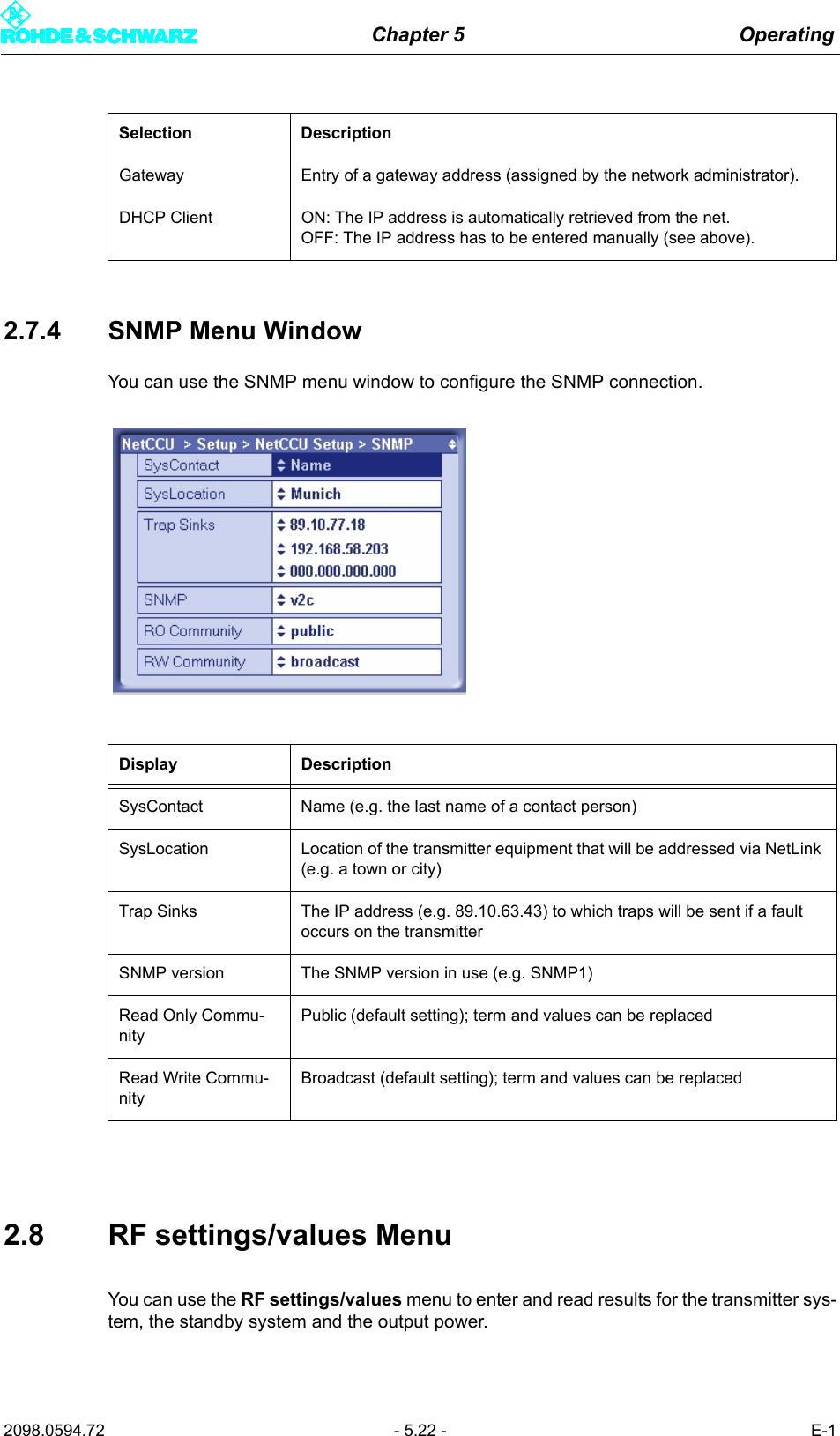
Chapter 5 Operating2098.0594.72 - 5.22 - E-12.7.4 SNMP Menu WindowYou can use the SNMP menu window to configure the SNMP connection.2.8 RF settings/values MenuYou can use the RF settings/values menu to enter and read results for the transmitter sys-tem, the standby system and the output power. Gateway Entry of a gateway address (assigned by the network administrator).DHCP Client ON: The IP address is automatically retrieved from the net. OFF: The IP address has to be entered manually (see above).Display DescriptionSysContact Name (e.g. the last name of a contact person)SysLocation Location of the transmitter equipment that will be addressed via NetLink (e.g. a town or city)Trap Sinks The IP address (e.g. 89.10.63.43) to which traps will be sent if a fault occurs on the transmitterSNMP version The SNMP version in use (e.g. SNMP1)Read Only Commu-nityPublic (default setting); term and values can be replacedRead Write Commu-nityBroadcast (default setting); term and values can be replacedSelection Description
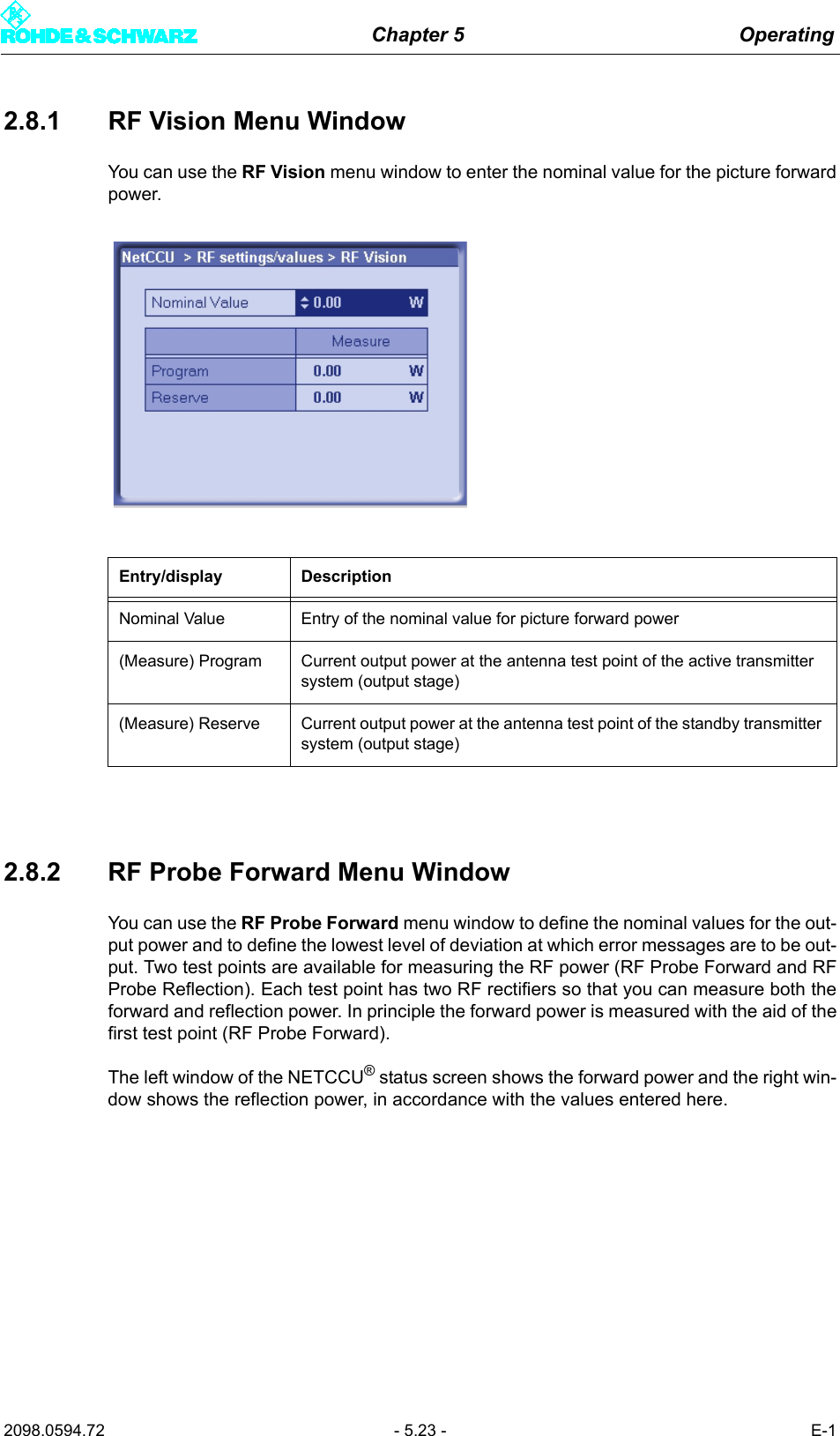
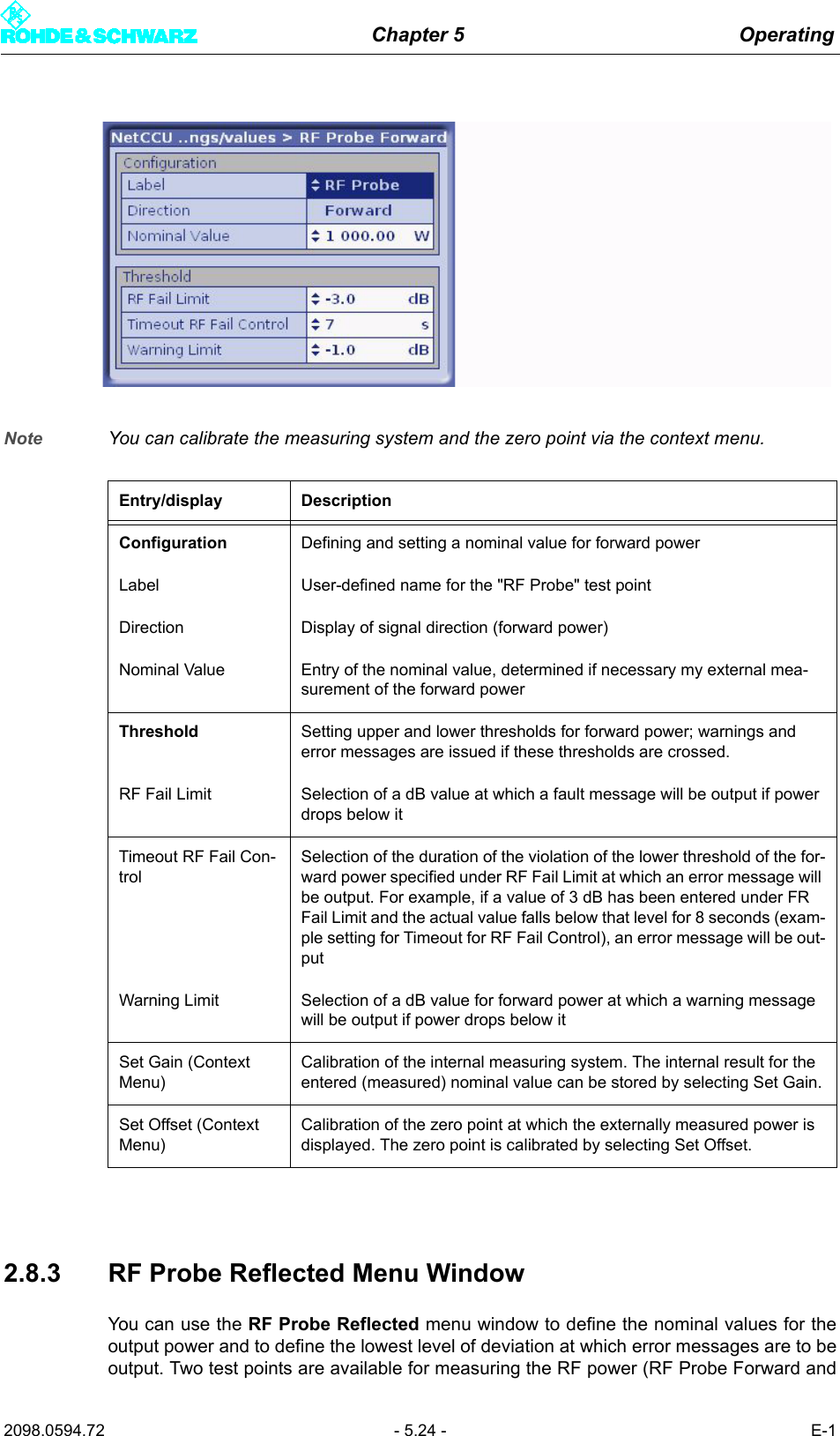
Chapter 5 Operating2098.0594.72 - 5.23 - E-12.8.1 RF Vision Menu WindowYou can use the RF Vision menu window to enter the nominal value for the picture forwardpower. 2.8.2 RF Probe Forward Menu WindowYou can use the RF Probe Forward menu window to define the nominal values for the out-put power and to define the lowest level of deviation at which error messages are to be out-put. Two test points are available for measuring the RF power (RF Probe Forward and RFProbe Reflection). Each test point has two RF rectifiers so that you can measure both theforward and reflection power. In principle the forward power is measured with the aid of thefirst test point (RF Probe Forward). The left window of the NETCCU® status screen shows the forward power and the right win-dow shows the reflection power, in accordance with the values entered here.Entry/display DescriptionNominal Value Entry of the nominal value for picture forward power(Measure) Program Current output power at the antenna test point of the active transmitter system (output stage)(Measure) Reserve Current output power at the antenna test point of the standby transmitter system (output stage)
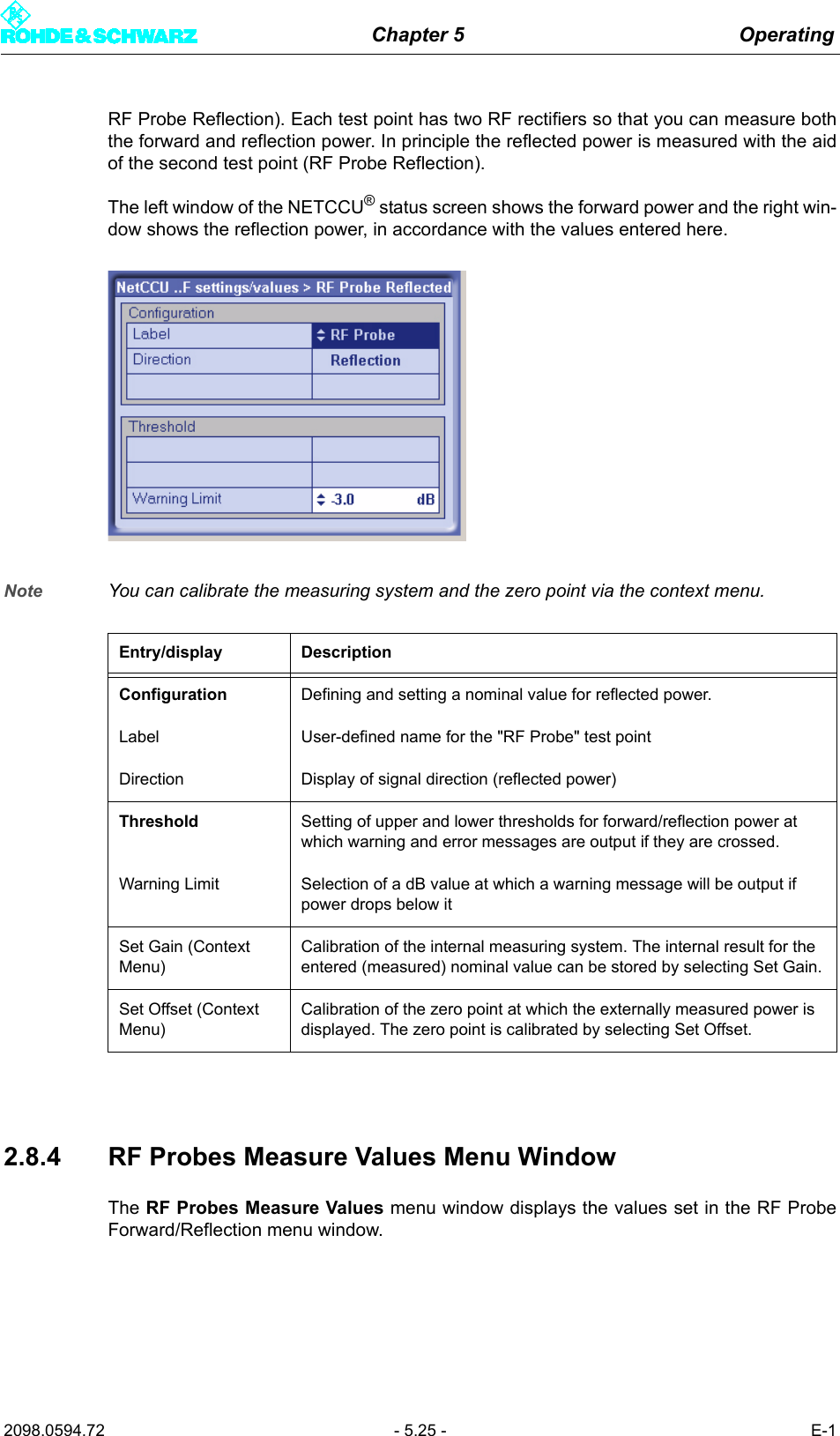
Chapter 5 Operating2098.0594.72 - 5.24 - E-1Note You can calibrate the measuring system and the zero point via the context menu.2.8.3 RF Probe Reflected Menu WindowYou can use the RF Probe Reflected menu window to define the nominal values for theoutput power and to define the lowest level of deviation at which error messages are to beoutput. Two test points are available for measuring the RF power (RF Probe Forward andEntry/display DescriptionConfiguration Defining and setting a nominal value for forward powerLabel User-defined name for the "RF Probe" test pointDirection Display of signal direction (forward power)Nominal Value Entry of the nominal value, determined if necessary my external mea-surement of the forward powerThreshold Setting upper and lower thresholds for forward power; warnings and error messages are issued if these thresholds are crossed.RF Fail Limit Selection of a dB value at which a fault message will be output if power drops below itTimeout RF Fail Con-trolSelection of the duration of the violation of the lower threshold of the for-ward power specified under RF Fail Limit at which an error message will be output. For example, if a value of 3 dB has been entered under FR Fail Limit and the actual value falls below that level for 8 seconds (exam-ple setting for Timeout for RF Fail Control), an error message will be out-putWarning Limit Selection of a dB value for forward power at which a warning message will be output if power drops below itSet Gain (Context Menu)Calibration of the internal measuring system. The internal result for the entered (measured) nominal value can be stored by selecting Set Gain.Set Offset (Context Menu)Calibration of the zero point at which the externally measured power is displayed. The zero point is calibrated by selecting Set Offset.
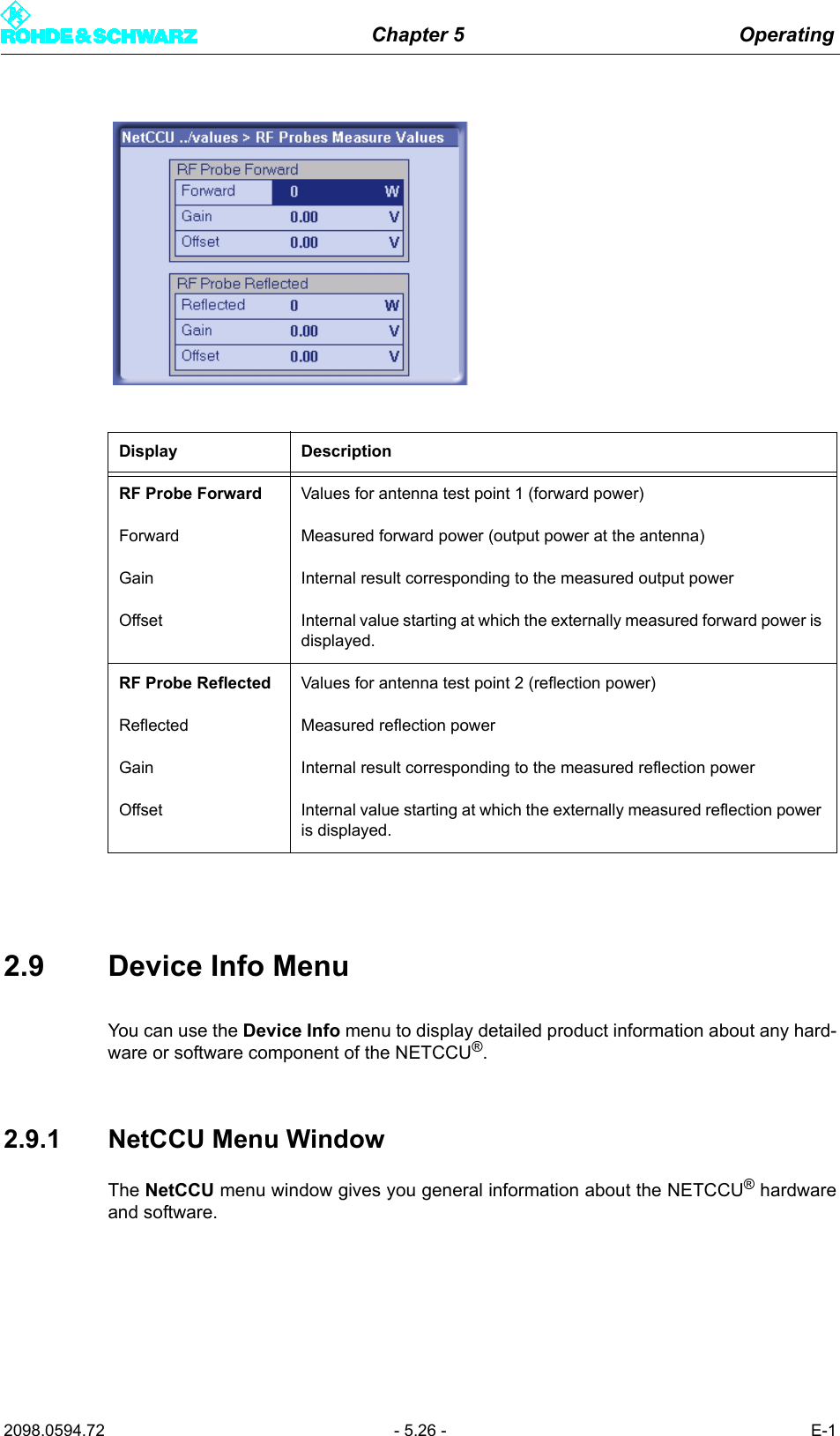
Chapter 5 Operating2098.0594.72 - 5.25 - E-1RF Probe Reflection). Each test point has two RF rectifiers so that you can measure boththe forward and reflection power. In principle the reflected power is measured with the aidof the second test point (RF Probe Reflection). The left window of the NETCCU® status screen shows the forward power and the right win-dow shows the reflection power, in accordance with the values entered here.Note You can calibrate the measuring system and the zero point via the context menu.2.8.4 RF Probes Measure Values Menu WindowThe RF Probes Measure Values menu window displays the values set in the RF ProbeForward/Reflection menu window. Entry/display DescriptionConfiguration Defining and setting a nominal value for reflected power.Label User-defined name for the "RF Probe" test pointDirection Display of signal direction (reflected power)Threshold Setting of upper and lower thresholds for forward/reflection power at which warning and error messages are output if they are crossed.Warning Limit Selection of a dB value at which a warning message will be output if power drops below itSet Gain (Context Menu)Calibration of the internal measuring system. The internal result for the entered (measured) nominal value can be stored by selecting Set Gain.Set Offset (Context Menu)Calibration of the zero point at which the externally measured power is displayed. The zero point is calibrated by selecting Set Offset.
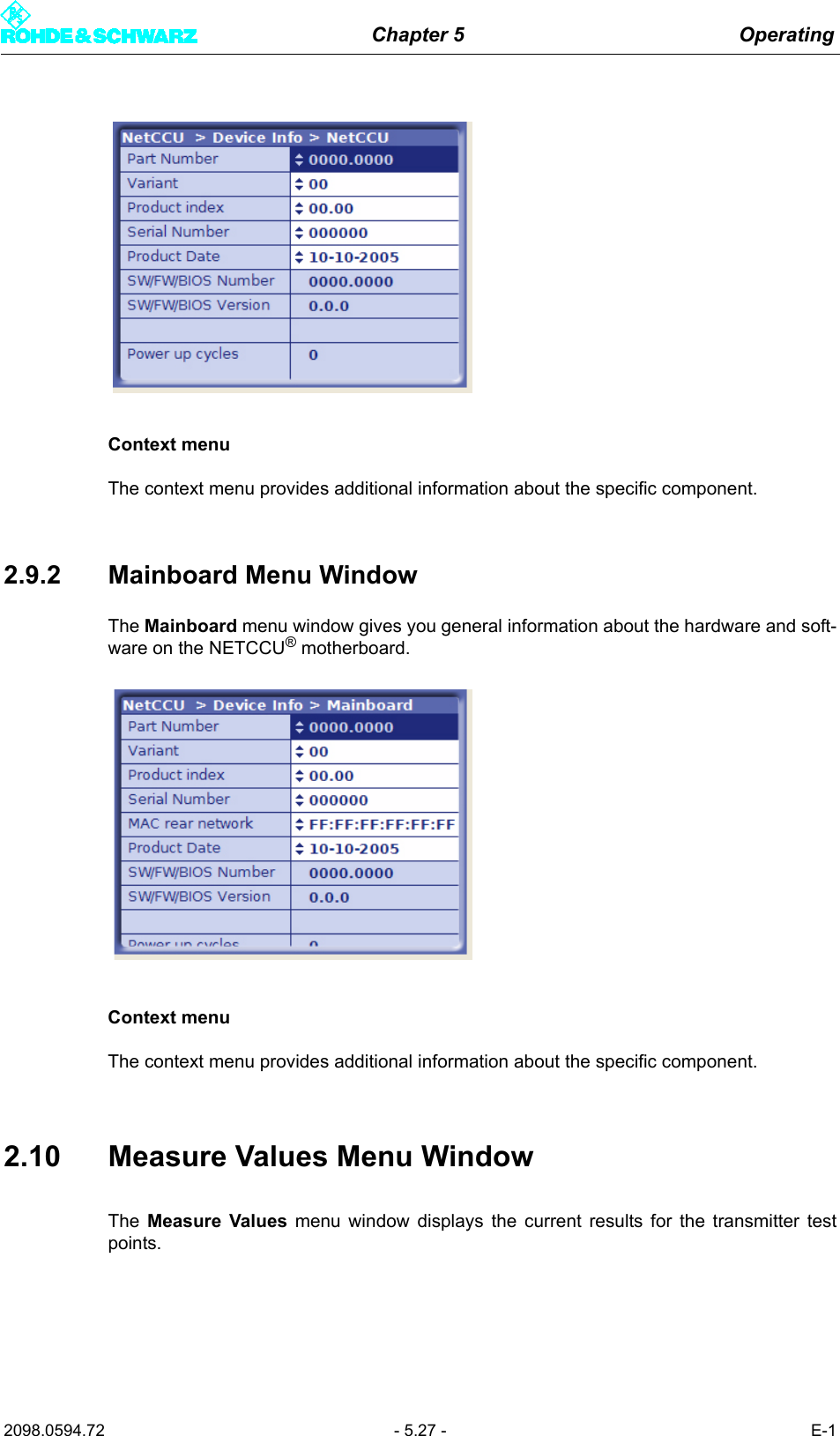
Chapter 5 Operating2098.0594.72 - 5.26 - E-12.9 Device Info MenuYou can use the Device Info menu to display detailed product information about any hard-ware or software component of the NETCCU®. 2.9.1 NetCCU Menu WindowThe NetCCU menu window gives you general information about the NETCCU® hardwareand software.Display DescriptionRF Probe Forward Values for antenna test point 1 (forward power)Forward Measured forward power (output power at the antenna)Gain Internal result corresponding to the measured output powerOffset Internal value starting at which the externally measured forward power is displayed.RF Probe Reflected Values for antenna test point 2 (reflection power)Reflected Measured reflection powerGain Internal result corresponding to the measured reflection powerOffset Internal value starting at which the externally measured reflection power is displayed.
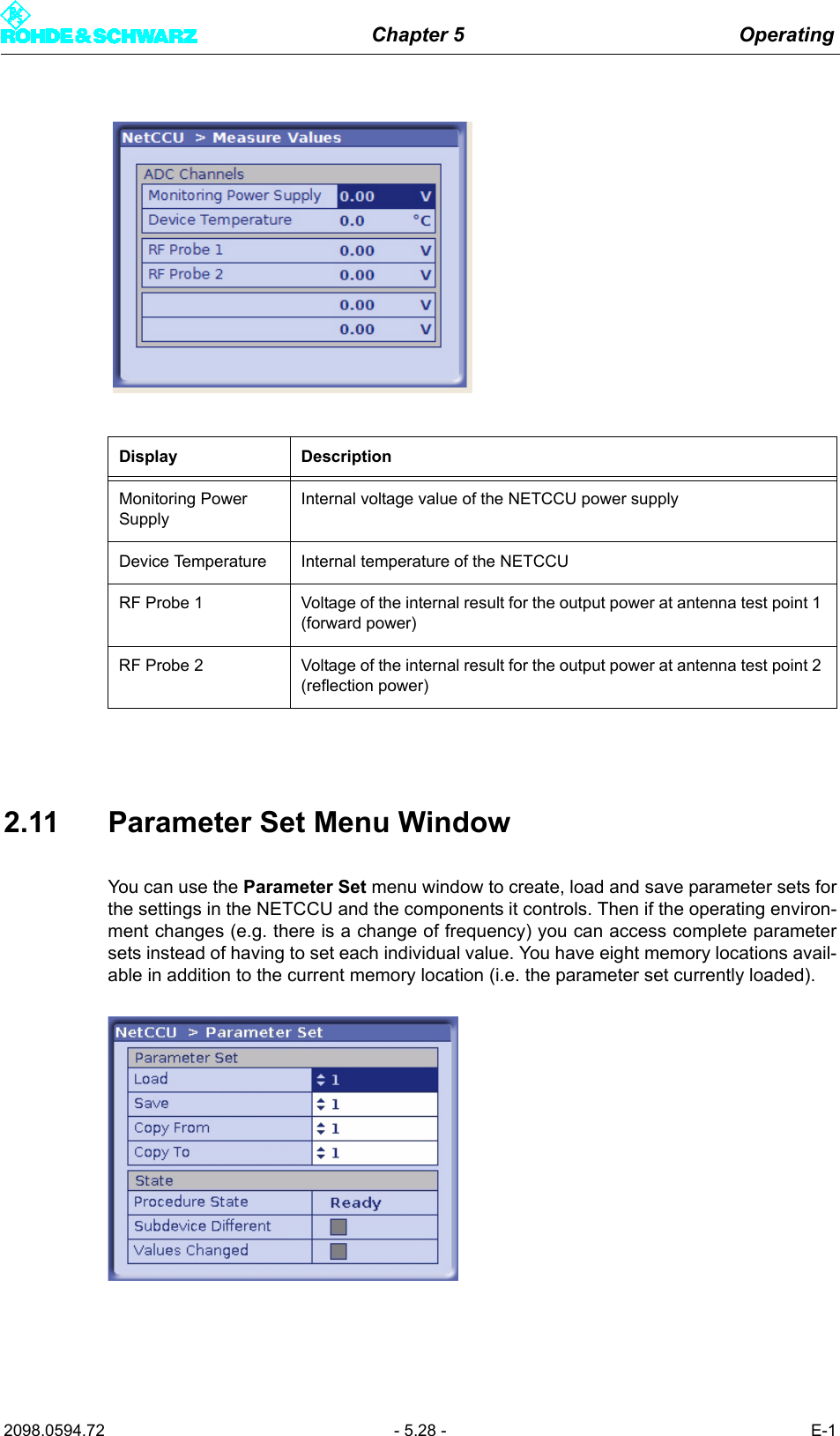
Chapter 5 Operating2098.0594.72 - 5.27 - E-1Context menuThe context menu provides additional information about the specific component.2.9.2 Mainboard Menu WindowThe Mainboard menu window gives you general information about the hardware and soft-ware on the NETCCU® motherboard. Context menuThe context menu provides additional information about the specific component.2.10 Measure Values Menu WindowThe  Measure Values menu window displays the current results for the transmitter testpoints.
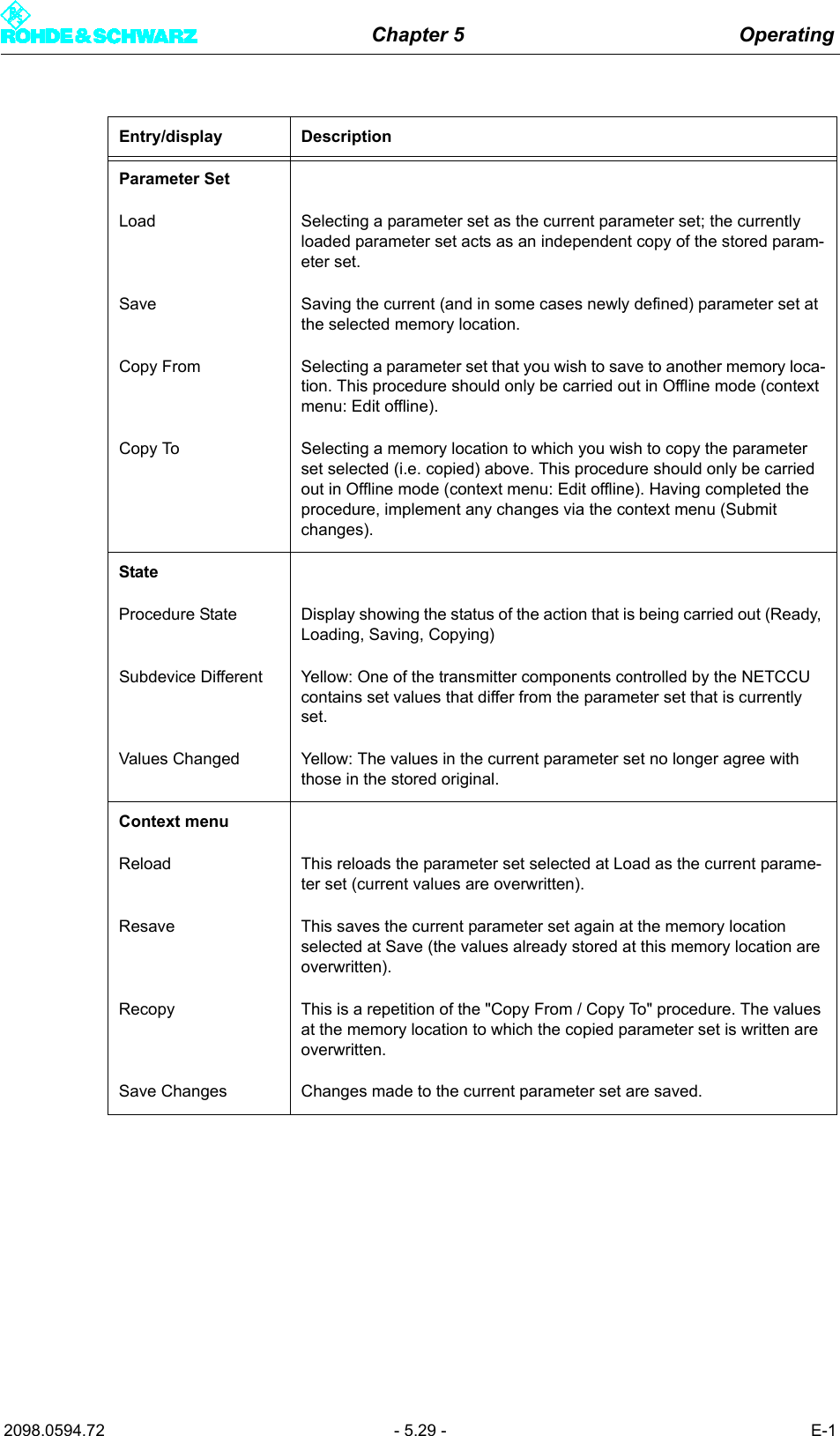
Chapter 5 Operating2098.0594.72 - 5.28 - E-12.11 Parameter Set Menu WindowYou can use the Parameter Set menu window to create, load and save parameter sets forthe settings in the NETCCU and the components it controls. Then if the operating environ-ment changes (e.g. there is a change of frequency) you can access complete parametersets instead of having to set each individual value. You have eight memory locations avail-able in addition to the current memory location (i.e. the parameter set currently loaded).Display DescriptionMonitoring Power SupplyInternal voltage value of the NETCCU power supplyDevice Temperature Internal temperature of the NETCCURF Probe 1 Voltage of the internal result for the output power at antenna test point 1 (forward power)RF Probe 2 Voltage of the internal result for the output power at antenna test point 2 (reflection power)
Chapter 5 Operating2098.0594.72 - 5.29 - E-1Entry/display DescriptionParameter SetLoad Selecting a parameter set as the current parameter set; the currently loaded parameter set acts as an independent copy of the stored param-eter set. Save Saving the current (and in some cases newly defined) parameter set at the selected memory location.Copy From Selecting a parameter set that you wish to save to another memory loca-tion. This procedure should only be carried out in Offline mode (context menu: Edit offline).Copy To Selecting a memory location to which you wish to copy the parameter set selected (i.e. copied) above. This procedure should only be carried out in Offline mode (context menu: Edit offline). Having completed the procedure, implement any changes via the context menu (Submit changes). StateProcedure State Display showing the status of the action that is being carried out (Ready, Loading, Saving, Copying)Subdevice Different Yellow: One of the transmitter components controlled by the NETCCU contains set values that differ from the parameter set that is currently set.Values Changed Yellow: The values in the current parameter set no longer agree with those in the stored original. Context menuReload This reloads the parameter set selected at Load as the current parame-ter set (current values are overwritten).Resave This saves the current parameter set again at the memory location selected at Save (the values already stored at this memory location are overwritten).Recopy This is a repetition of the "Copy From / Copy To" procedure. The values at the memory location to which the copied parameter set is written are overwritten. Save Changes Changes made to the current parameter set are saved.
Chapter 5 Operating2098.0594.72 - 5.30 - E-13 Exciter A/B MenusYou can use the Exciter A/B menus to operate and configure the exciter concerned and tocall up information.Note The Exciter B menus and menu windows are identical to the Exciter A menus and menuwindows.3.1 Overview of MenusLevel 1 > Level 2 / 3> ParametersStatus > Displays:– Sum Fault–RF– Exciter On– Loop– Input OK– Input 1 connect– Input 2 connect– Reference–1 PPS–Sum Warning– Output open–Board Error– Temperature–Fan– Active Input– Wrong Datarate–Mute–TestLogbook > Summary > Logged information:–No– Message–Time–Date– Set or reset(for warnings and error messages only)Status >Warning >Fault >
Chapter 5 Operating2098.0594.72 - 5.31 - E-1Setup > DVB > Setting items:– Digital Standard– Network Mode– TPS Source– Cell ID Enable– TX Address– TX Automatic– Amplifier ControlInput > Input Config HP > Setting items for Input HP 1 or Input HP 2 as appropri-ate:– Presel. ModeDisplays for Input HP 1 or Input HP 2 as appropriate:– Packet Length – Meas. Data Rate [bps]– Req. Data Rate [bps]–Active ModeInput > Input Config LP > Displays for Input LP 1 or Input LP 2 as appropriate:– Presel. ModeDisplays:– Packet Length – Meas. Data Rate [bps]– Req. Data Rate [bps]–Active ModeInput > Input Automatic > Setting items:– Preselect Input–Autoswitch–Seaml. Switching–Priority– Check Time Forward– Check Time Back– On Input FailDisplays:– Seamless switchingDVB Parameters > TPS > Setting item– TPS SourceDisplays: Active / Setting items: Manual:– Bandwidth– FFT Length– Guard Interval– Constellation– Alpha–Cell ID– Interleaver– Code Rate [HP/LP]– Time Slicing [HP/LP]– MPE FEC [HP/LP]Display: Active– Req. Data Rate [HP/LP]DVB Parameters > SFN Delay > Setting items:–Static Delay– Max Leap in TimeDisplays:– Processing Delay– Dynamic Delay– Network Delay– TX Offset Delay– Maximum Delay– Total DelayLevel 1 > Level 2 / 3> Parameters
Chapter 5 Operating2098.0594.72 - 5.32 - E-1DVB Parameters > Test Signals > Setting items:–PRBS Insertion– Test Signal Insertion– Carrier 1– Carrier 2Precorrection > Setting items:– Nonlinear Correction– Amplitude– Phase– Nonlinear Frequency– Point 1– Point 2– Linear Correction– Amplitude– Group DelayRF > Synthesizer > Setting items:– Frequency– Frequency Offset– Reference–OCXO AdjustRF > Output > Setting items:– RF Output– Regulation– Manual RF Level– Output Attenuation– RF Slope– Modulation SlopeDisplays:– AGC RegulationRF > IQ Adjust > Setting items:– I/Q Testsignal– Bias Coarse [I/Q]– Bias Fine [I/Q]– Gain [I/Q]–PhaseDisplays:– Auto I/Q Adjust– LO1 FrequencyReference Setting items– Reference–OCXO Adjust– Mute on PPS Fail– Mute on Ref. Fail–Fail Delay TimeDevice Info > Exciter > Displays:– Part Number– Variant– Product index– Serial Number– Product Date– Software Number– Software Version– Operating hours– Power up cyclesLevel 1 > Level 2 / 3> Parameters
Chapter 5 Operating2098.0594.72 - 5.33 - E-13.2 Status MenuThe Status menu summarizes the current status of the exciter. Color coding (green, yellowand red) is used to indicate status information, warnings and error messages. In addition,some basic settings are shown.Device Info > Boards > Displays:– Part Number– Variant– Product index– Serial Number– Product Date– BIOS Version (mainboard only)– Operating hours– Power up cyclesMainboard >Input Interface >RF Board >Synth 1 >Synth 2 >Display/LED Color DescriptionSum Fault Red Sum Fault: One or more errors occurredRF Green The RF level at the exciter output is OKRed There is no RF level at the exciter output even though the RF output is enabled- OFF - There is no RF level at the exciter output since the RF output is not enabled ("manually" disabled)Exciter On Green The RF output of the exciter is enabledThere are several options for enabling the RF output:– In the RF menu with the RF Output setting item– On the NETCCU® using the ON button– On the exciter using the ON button (if there is no NETCCU® or it is inactive)Level 1 > Level 2 / 3> Parameters
Chapter 5 Operating2098.0594.72 - 5.34 - E-1Loop Yellow RF protective loop not closedGreen RF protective loop closedInput OK Green Valid transport stream present on the active inputIn the case of hierarchical coding the input is OK if valid transport streams are present on both active inputs for HP Stream and LP Stream.Yellow Invalid transport stream on the active inputInput 1 connect Green – Input signal present on input TS 1 IN or–In the case of hierarchical coding: Input signal present on TS 1 IN (HP Stream) and TS 2 IN (LP Stream)- OFF - – No input signal on input TS 1 IN–In the case of hierarchical coding: No input signal on TS 1 IN and/or no input signal on TS 2 INInput 2 connect Green – Input signal present on input TS 3 IN or–In the case of hierarchical coding: Input signal present on TS 3 IN (HP Stream) and TS 4 IN (LP Stream)- OFF - – No input signal on input TS 3 IN–In the case of hierarchical coding: No input signal on TS 3 IN and/or no input signal on TS 4 INReference Green External reference frequency present and OK- OFF - External reference frequency not present or not OK1 PPS Green External 1-PPS source present and the internal signal process-ing is synchronized with the 1 PPS- OFF - External 1-PPS source not present or the internal signal process-ing is not synchronized with the 1 PPSSum Warning Yellow One or more warnings are activeOut Open Red The cable-break sensor has reported that the RF output is not terminated.HW Error Red A hardware error occurred in one or more modules of the exciterTemperature Red At least one module is overheatingFan Yellow A fan has failed; overheating can possibly occurRed Both fans failed; there is a high risk of overheatingWrong Datarate Yellow Wrong data rate on the active inputIn the case of hierarchical coding the LED is illuminated if an incorrect data rate is present on the active input for the HP Stream and/or on the active input for the LP Stream.Mute Yellow Output signal from signal processing disabledDisplay/LED Color Description
Chapter 5 Operating2098.0594.72 - 5.35 - E-13.2.1 Status Displays, Warnings and Error MessagesSignal colors and their meaningWhen warnings and error messages occur, this usually means that transmission operationis impaired. Different signal colors are used to distinguish the severity of an impairment orthe "quality" of the defect. The following applies:Green......................................There is no impairment.Yellow .....................................Although the exciter is functional, it is possible that externalinfluences are disrupting transmission operation.Red .........................................A severe error has occurred so that transmission operationis generally impossible.Indications with and without memory effectStatus displays (green) and warnings (yellow) always reflect the current status of the excit-er. On the other hand, error messages (red) remain active even after the reason for the errorhas passed or the error has been corrected. If the error has been corrected, you can resetthe error display with the RESET key.3.3 Logbook MenuThe logbook is used to record state changes (events) affecting the exciter. The menu windowsThe Logbook menu leads to the following menu windows:Test Yellow Exciter is set to test modeDisplay Status DescriptionActive Input 1 / 2 Display of the currently active inputIn the case of non-hierarchical coding:–1 = TS 1 IN–2 = TS 3 INIn the case of hierarchical coding:–1 = TS 1 IN (HP Stream) + TS 2 IN (LP Stream)–2 = TS 3 IN (HP Stream) + TS 4 IN (LP Stream)Display/LED Color Description
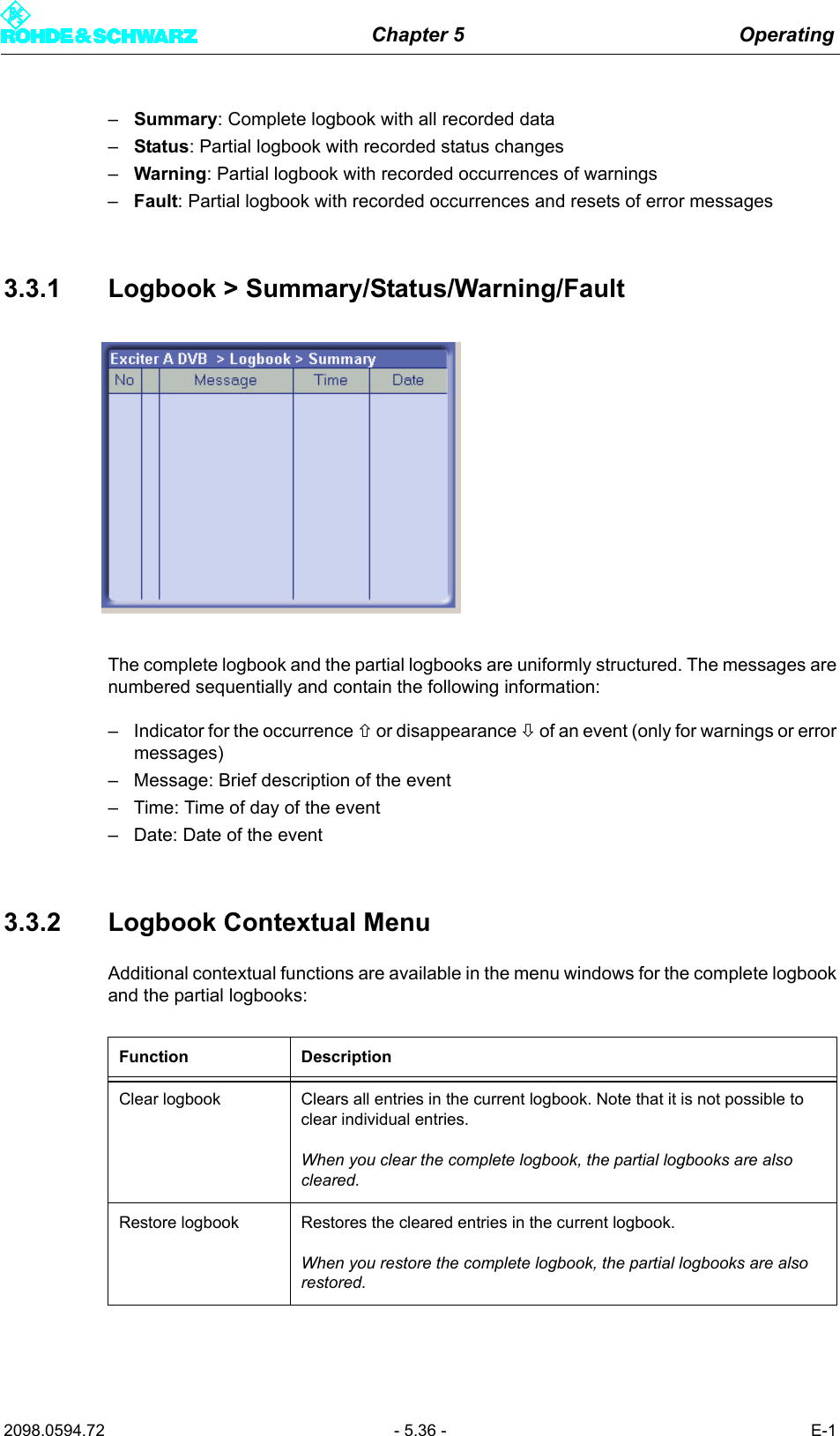
Chapter 5 Operating2098.0594.72 - 5.36 - E-1–Summary: Complete logbook with all recorded data–Status: Partial logbook with recorded status changes–Warning: Partial logbook with recorded occurrences of warnings–Fault: Partial logbook with recorded occurrences and resets of error messages3.3.1 Logbook > Summary/Status/Warning/FaultThe complete logbook and the partial logbooks are uniformly structured. The messages arenumbered sequentially and contain the following information: – Indicator for the occurrence × or disappearance Ø of an event (only for warnings or errormessages)– Message: Brief description of the event– Time: Time of day of the event– Date: Date of the event3.3.2 Logbook Contextual MenuAdditional contextual functions are available in the menu windows for the complete logbookand the partial logbooks:Function DescriptionClear logbook Clears all entries in the current logbook. Note that it is not possible to clear individual entries.When you clear the complete logbook, the partial logbooks are also cleared.Restore logbook Restores the cleared entries in the current logbook.When you restore the complete logbook, the partial logbooks are also restored.
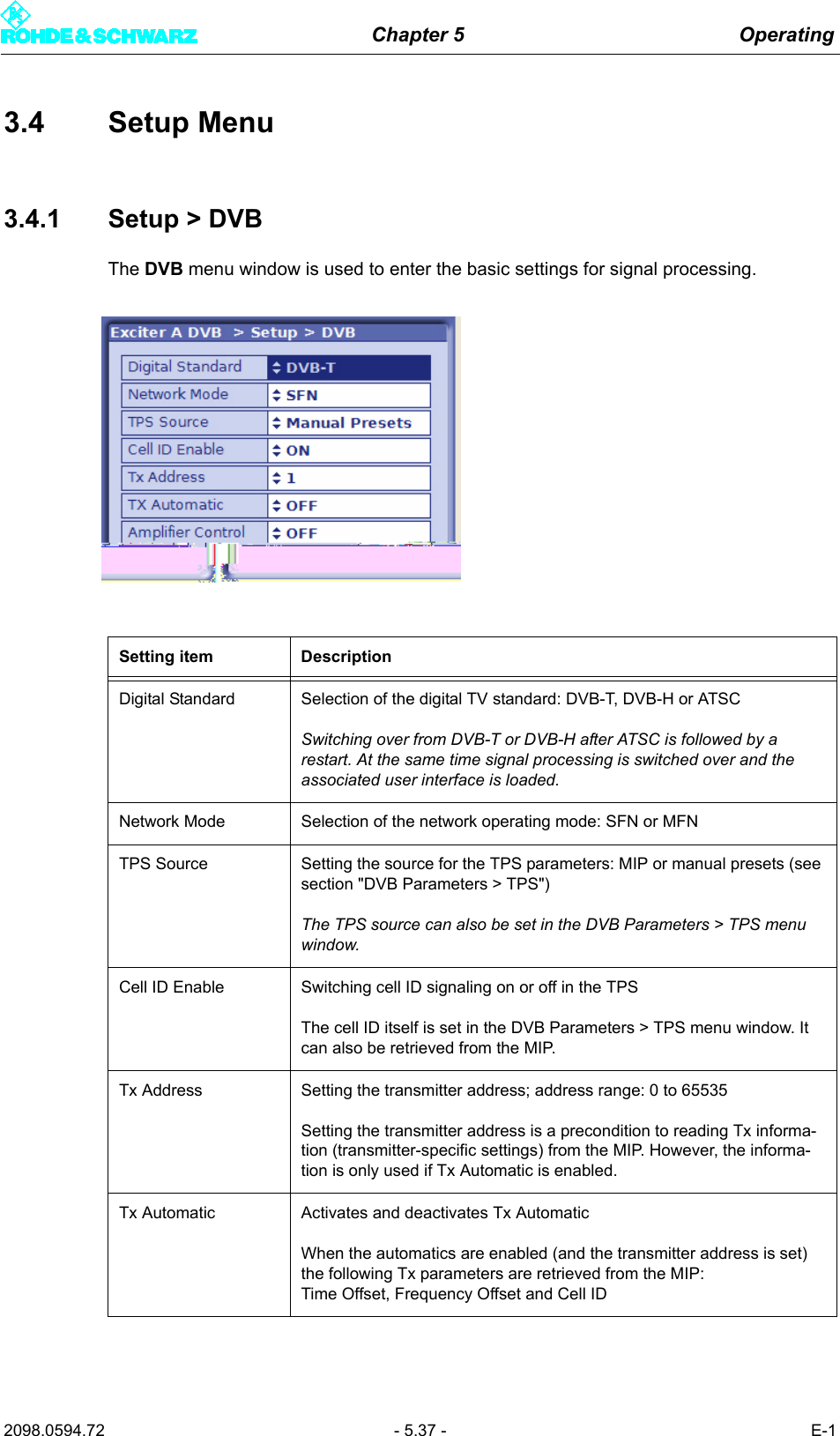
Chapter 5 Operating2098.0594.72 - 5.37 - E-13.4 Setup Menu3.4.1 Setup > DVBThe DVB menu window is used to enter the basic settings for signal processing.Setting item DescriptionDigital Standard Selection of the digital TV standard: DVB-T, DVB-H or ATSCSwitching over from DVB-T or DVB-H after ATSC is followed by a restart. At the same time signal processing is switched over and the associated user interface is loaded.Network Mode Selection of the network operating mode: SFN or MFNTPS Source Setting the source for the TPS parameters: MIP or manual presets (see section "DVB Parameters > TPS")The TPS source can also be set in the DVB Parameters > TPS menu window.Cell ID Enable Switching cell ID signaling on or off in the TPSThe cell ID itself is set in the DVB Parameters > TPS menu window. It can also be retrieved from the MIP.Tx Address Setting the transmitter address; address range: 0 to 65535Setting the transmitter address is a precondition to reading Tx informa-tion (transmitter-specific settings) from the MIP. However, the informa-tion is only used if Tx Automatic is enabled.Tx Automatic Activates and deactivates Tx AutomaticWhen the automatics are enabled (and the transmitter address is set) the following Tx parameters are retrieved from the MIP:Time Offset, Frequency Offset and Cell ID
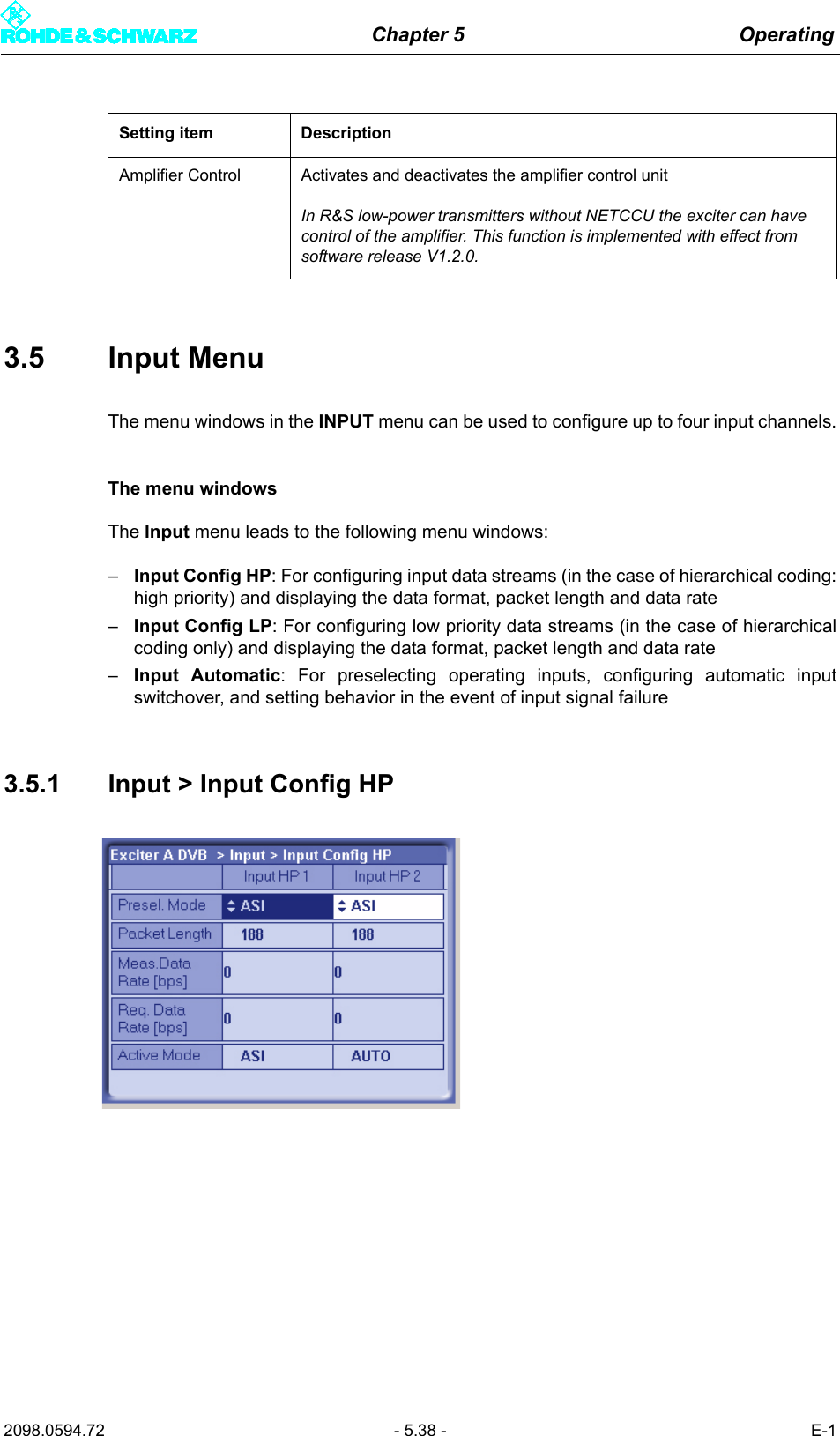
Chapter 5 Operating2098.0594.72 - 5.38 - E-13.5 Input MenuThe menu windows in the INPUT menu can be used to configure up to four input channels.The menu windowsThe Input menu leads to the following menu windows:–Input Config HP: For configuring input data streams (in the case of hierarchical coding:high priority) and displaying the data format, packet length and data rate–Input Config LP: For configuring low priority data streams (in the case of hierarchicalcoding only) and displaying the data format, packet length and data rate–Input Automatic: For preselecting operating inputs, configuring automatic inputswitchover, and setting behavior in the event of input signal failure3.5.1 Input > Input Config HPAmplifier Control Activates and deactivates the amplifier control unitIn R&S low-power transmitters without NETCCU the exciter can have control of the amplifier. This function is implemented with effect from software release V1.2.0.Setting item Description
Chapter 5 Operating2098.0594.72 - 5.39 - E-13.5.1.1 Checking the Measured Data RateBy comparing the Meas. Data Rate [bps] and Req. Data Rate [bps] displays, it is possibleto check that the input buffers (FIFO) are neither underflowing nor overflowing, since thiswould lead to breaks in transmission.Maximum data processing rate in MFN modeIn MFN mode all null packets are first of all removed from the transport stream. The asso-ciated useful data rate is then measured and displayed at Meas. Data Rate [bps]. Providedthis measured value stays below the Req. Data Rate [bps] value, trouble-free operation ispossible.Note When the useful data rate has been measured, stuffing takes place up to the data rate re-quired, that is, the difference between Req. Data Rate [bps] and Meas. Data Rate [bps]is made up by inserting null packets.Setting item DescriptionPresel. Mode[Input HP1/Input HP2]Setting the data format for the data streams HP 1 or HP 2 (operating and standby signals) on inputs TS 1 IN or TS 3 IN.The options are as follows:– AUTO: The data format is recognized automatically– ASI: Manual setting for an ASI transport stream– SMPTE: Manual setting for a SMPTE transport streamIn the case of hierarchical coding the operating or standby signal for the high priority (HP) stream is fed via the two inputs HP 1 and/or HP 2.Display DescriptionPacket Length [Input HP1/Input HP2]Display showing the packet length detected at the respective inputMeas.Data Rate [bps][Input HP1/Input HP2]Display showing the measured data rate at the respective input. In MFN mode the net data rate is displayed (without null packets).Req. Data Rate [bps][Input HP1/Input HP2]Display for checking the measured data rate. Depending on the chosen network mode, the following information is displayed:–MFN: Maximum data processing rate–SFN: Required data rateActive Mode Display showing the data format detected or set at the respective input:– ASI: As described– SMTPE: As described– Auto: Auto is selected and there is no data stream
Chapter 5 Operating2098.0594.72 - 5.40 - E-1Required data rate in SFN modeIn SFN mode the incoming transport stream is passed to processing unchanged. The as-sociated data rate is then measured and displayed at Meas. Data Rate [bps]. Provided thismeasured value matches the Req. Data Rate [bps] to within ± 1 bps, trouble-free operationis possible.3.5.2 Input > Input Config LPSetting item DescriptionPresel. Mode[Input LP1/Input LP2]In the case of hierarchical coding: Setting the data format for the low pri-ority data streams LP 1 or LP 2 (operating and standby signals) on inputs TS 2 IN or TS 4 IN.The options are as follows:– AUTO: The data format is recognized automatically– ASI: Manual setting for an ASI transport stream– SMPTE: Manual setting for a SMPTE transport streamDisplay DescriptionPacket Length [Input LP1/Input LP2]Display showing the packet length detected at the respective inputMeas.Data Rate [bps][Input LP1/Input LP2]Display showing the measured data rate at the respective input. In MFN mode the net data rate is displayed (without null packets).Req. Data Rate [bps][Input LP1/Input LP2]Display for checking the measured data rate. Depending on the chosen network mode, the following information is displayed:–MFN: Maximum data processing rate–SFN: Required data rateActive Mode Display showing the data format detected or set at the respective input:– ASI: As described– SMTPE: As described– Auto: Auto is selected and there is no data stream
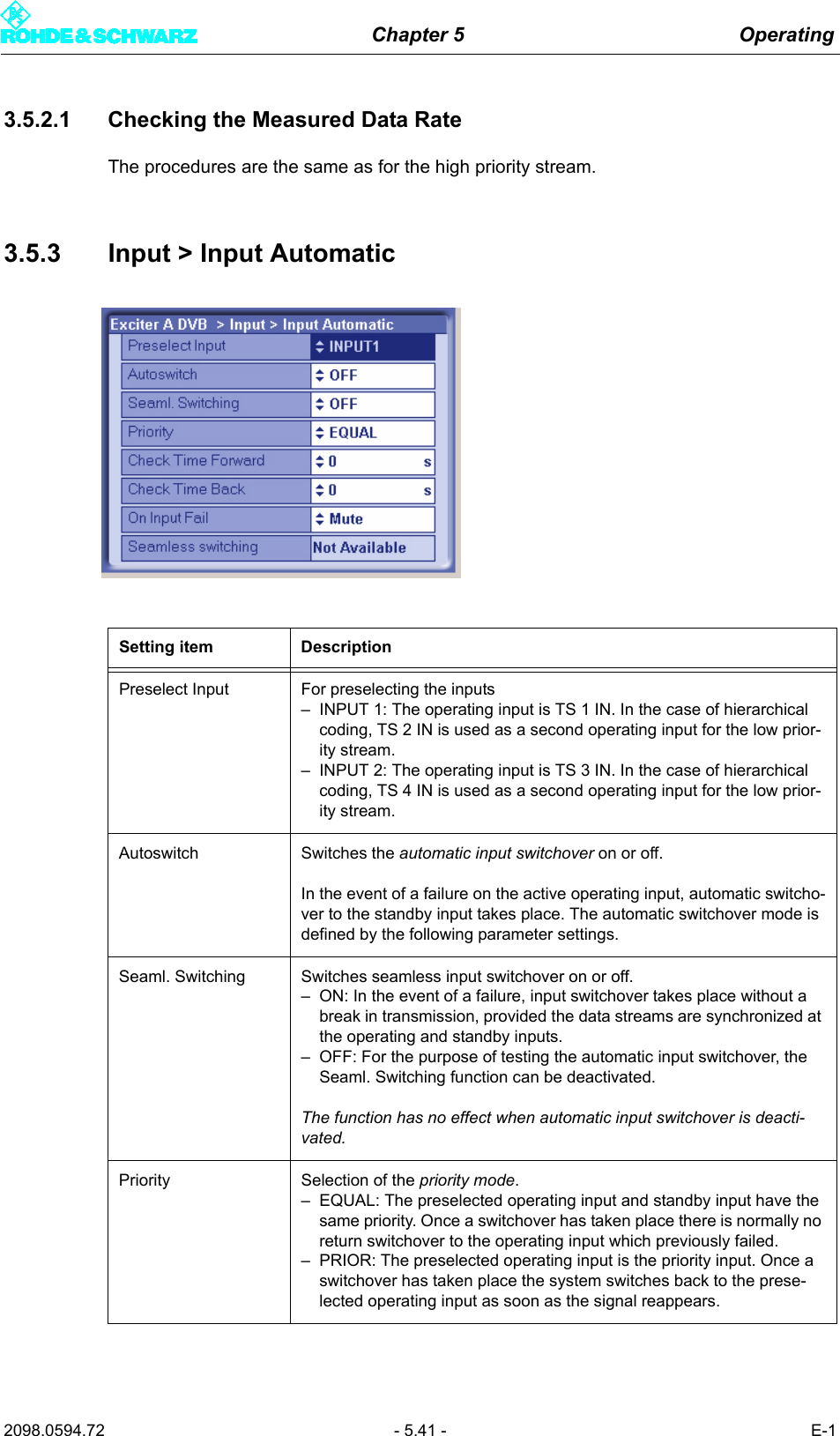
Chapter 5 Operating2098.0594.72 - 5.41 - E-13.5.2.1 Checking the Measured Data RateThe procedures are the same as for the high priority stream.3.5.3 Input > Input AutomaticSetting item DescriptionPreselect Input For preselecting the inputs– INPUT 1: The operating input is TS 1 IN. In the case of hierarchical coding, TS 2 IN is used as a second operating input for the low prior-ity stream.– INPUT 2: The operating input is TS 3 IN. In the case of hierarchical coding, TS 4 IN is used as a second operating input for the low prior-ity stream.Autoswitch Switches the automatic input switchover on or off.In the event of a failure on the active operating input, automatic switcho-ver to the standby input takes place. The automatic switchover mode is defined by the following parameter settings.Seaml. Switching Switches seamless input switchover on or off.– ON: In the event of a failure, input switchover takes place without a break in transmission, provided the data streams are synchronized at the operating and standby inputs.– OFF: For the purpose of testing the automatic input switchover, the Seaml. Switching function can be deactivated.The function has no effect when automatic input switchover is deacti-vated.Priority Selection of the priority mode.– EQUAL: The preselected operating input and standby input have the same priority. Once a switchover has taken place there is normally no return switchover to the operating input which previously failed.– PRIOR: The preselected operating input is the priority input. Once a switchover has taken place the system switches back to the prese-lected operating input as soon as the signal reappears.
Chapter 5 Operating2098.0594.72 - 5.42 - E-13.5.3.1 Automatic Input SwitchoverThe exciter comprises a circuit for automatic switchover from one input to the other, provid-ed that a valid signal is present at the second input. Before a failure occurs, the preselectedinput is active.The mode of this automatic switchover circuit is defined by the following factors:– Automatic: ON or OFF (Autoswitch)– Delay times until switchover (Check Time Forward or Check Time Back)– Priority mode: Inputs have equal priority or the preselected input has priority (Priority)– Operating and standby inputs synchronized or not synchronized (in conjunction withSeamless Switching)Automatic input switchover ON/OFFIf automatic switchover is OFF, the preselected input remains active even if the input signalfails.If automatic switchover is ON and there is a failure at the preselected input, switchover tothe associated standby input takes place.Priority mode PRIOR (input priority)Following a switchover of the preselected input, the automatic system switches back to thispriority input as soon as a signal reappears. Switchover is delayed for the set delay times.Check Time Forward For setting a delay time (0 to 60 s) which must elapse before the switchover to the standby input takes place in the event of a failure on the operating input.Check Time Back For setting a delay time (0 to 60 s) which must elapse before switching back to the operating input after switching over from the standby input (which is no longer active).The function has no effect if the priority mode is set to EQUAL.On Input Fail For setting the behavior in the event of a defective input signal (synchro-nization error)– No Mute: The output signal is not suppressed– Mute: The output signal is suppressed if the data rate is incorrect or the MIP is faulty (recommended for SFN)Display DescriptionSeamless Switching Status display for indicating whether the input streams are synchronized on the operating and standby inputs (precondition for seamless input switchover).Setting item Description
Chapter 5 Operating2098.0594.72 - 5.43 - E-1If the signal fails at both the operating input and the standby input, the priority input remainsactive.Priority mode EQUAL (equal input priority)Following a switchover of the preselected input, the standby input with the same priority re-mains active until the input signal fails on this input also. The automatic system switchesback to the preselected input, but only if a signal is present on it once again. Switchover isdelayed for the set delay times.Note Selecting this operating mode keeps to a minimum the number of switchover operationsand in certain cases the number of breaks in transmission (in the case of unsynchronizedinput streams).3.5.3.2 Behavior in the Event of a Defective Input SignalSFN modeIn the event of a defective input signal (due for example to an incorrect data rate, defectiveor missing MIP, missing or unsynchronized signal) the output signal is in effect suppressed.In this case the switch setting On Input Fail is meaningless.MFN modeThe behavior in the event of a defective input signal can be influenced by the On Input Failswitch as follows:–Mute: The output signal from the exciter is suppressed as soon as it can no longer besynchronized with the input signal (from the operating and standby inputs).–No Mute: The output signal from the exciter is not suppressed, despite a defective inputsignal. However, when this happens only null packets are transmitted.3.6 DVB Parameters MenuThe menu windows in the DVB Parameters menu can be used not only to set (and/or pre-set) the DVB transmission parameters needed for encoding and modulation, but also tocheck the settings used as well as the TPS settings signaled during transmission (TPS =Transmission Parameter Signaling).Note Providing there is a MIP (Megaframe Initialization Packet) in the transport stream, TPS in-formation can also be read out and used for configuring the DVB transmission parameters.In this case the signaled parameters may not be the same as the manually preset param-eters.The menu windowsThe DVB Parameters menu leads to the following menu windows:
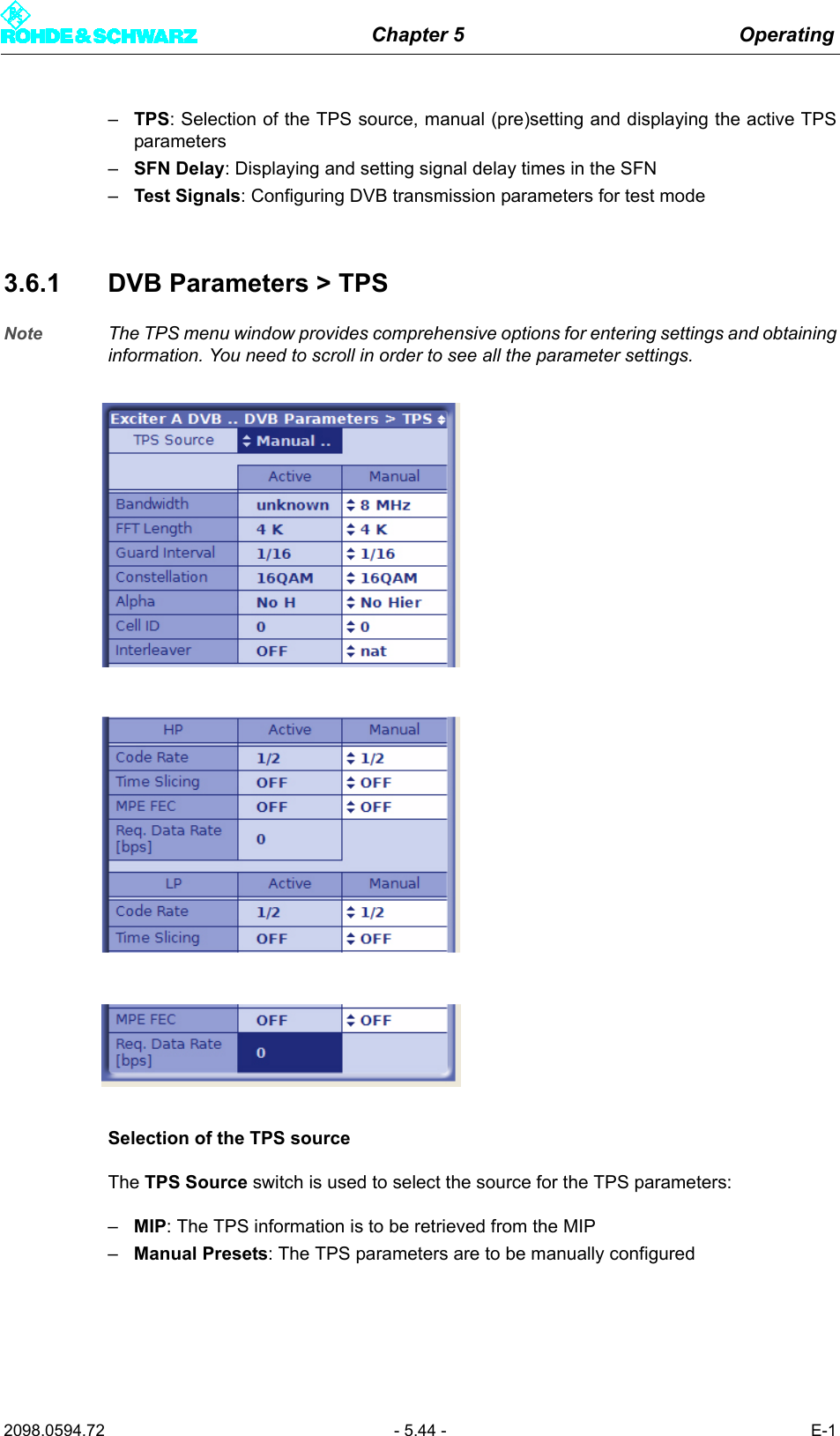
Chapter 5 Operating2098.0594.72 - 5.44 - E-1–TPS: Selection of the TPS source, manual (pre)setting and displaying the active TPSparameters–SFN Delay: Displaying and setting signal delay times in the SFN–Test Signals: Configuring DVB transmission parameters for test mode3.6.1 DVB Parameters > TPSNote The TPS menu window provides comprehensive options for entering settings and obtaininginformation. You need to scroll in order to see all the parameter settings.Selection of the TPS sourceThe TPS Source switch is used to select the source for the TPS parameters:–MIP: The TPS information is to be retrieved from the MIP–Manual Presets: The TPS parameters are to be manually configured
Chapter 5 Operating2098.0594.72 - 5.45 - E-1Manual configuration of the TPS parametersThe parameters for DVB-T, DVB-H and hierarchical coding can be configured in the columnon the right, headed Manual. These manual settings are active in the following cases:– When there is no MIP in the transport stream.– When there is a MIP in the transport stream, but this is not used because the TPS sourceis set to Manual Presets.Displaying the active TPS parametersThe active (and signaled) TPS parameters are displayed in the column on the left, headedActive. There are also two displays for the required data rates on one or two active inputs(see section "Checking the Measured Data Rate").If the TPS information from the MIP is used, the values displayed in the Active column maynot be the same as the manual settings (Manual column).The available parametersSetting item DescriptionTPS Source Setting the source for the TPS parameters: MIP or manual presetsDisplay/Setting itemDescription of theactive or manually set TPS parametersBandwidth Signal bandwidthDisplay/setting: 5, 6, 7 or 8 MHzFFT Length IFFT lengthDisplay/setting: 2k or 8k; also 4k in the case of DVB-HGuard Interval Guard intervalDisplay/setting: 1/4, 1/8, 1/16 or 1/32Constellation Modulation modeDisplay/setting: QPSK, 16QAM or 64QAMIn the case of hierarchical coding the value refers to the sum of the HP and LP stream constellation points; possible values are therefore: 16QAM or 64QAMAlpha Hierarchy parameter αDisplay/setting:– No Hier: Non-hierarchical coding– 1 H: Hierarchical coding with α = 1– 2 H: Hierarchical coding with α = 2– 3 H: Hierarchical coding with α = 31 H, 2 H or 3 H activates the hierarchical coding mode. However, this is only possible if Constellation is set to 16QAM or 64QAM.
Chapter 5 Operating2098.0594.72 - 5.46 - E-13.6.1.1 Settings for DVB-TThe following quantities form the standard parameters for DVB-T:–DVB signal bandwidth: Spectrum bandwidth in the transmit channel–IFFT length: The signal bandwidth is divided into 2k (2048) or 8k (8192) frequency sub-carriers. The 4k (4096) option is available for DVB-H only.–Guard interval: A protection interval of 1/4, 1/8, 1/16 or 1/32 symbol length. The longerthe guard interval, the better the intersymbol echo suppression.–Code rate: Error correction bits (1/2, 2/3, 3/4, 5/6 or 7/8) added to the information datain the FEC (forward error correction) block. For instance, a code rate of 5/6 correspondsto a ratio of 5:1 between information data and FEC.–Modulation mode: Depending on the modulation mode, a frequency subcarrier may con-tain 2-bit (QPSK), 4-bit (16QAM) or 6-bit (64QAM) information.Cell ID Cell IDDisplay/setting: 0x0000 to 0xFFFFThe Cell ID can only be retrieved from the MIP if the Tx Automatic is activated and the Tx address is correctly set (see section "Setup > DVB").For the purpose of signaling in the output signal (TPS), Parameter Cell ID Enable must also be activated (see section "Setup > DVB").Interleaver InterleaverDisplay/setting:– nat: Default setting ("native") with normal function for DVB-T– in depth: 8k interleaving for DVB-H at IFFT lengths of 2k and 4k for improved transmission reliability (DVB-H parameter)Code Rate [HP/LP] Internal code rate (separate for HP and LP stream)Display/setting: 1/2, 2/3, 3/4, 5/6 or 6/7 Time Slicing [HP/LP] Time Slicing Flag (DVB-H parameter)Display/setting separate for HP and LP stream:– OFF: Default setting; no signaling via flag– ON: A flag is set in the broadcast DVB signal. This flag informs the receiver that at least one service in the DVB-H data stream uses time slicing.MPE FEC [HP/LP] MPE FEC Flag (DVB-H parameter)Display/setting separate for HP and LP stream:– OFF: Default setting; no signaling via flag– ON: This flag informs the receiver that at least one service in the DVB-H data stream uses forward error correction for MPE (multipro-tocol encapsulation).Req. Data Rate [HP/LP]Display showing the required data rate;cf. section "Input > Input Config HP"Display/Setting itemDescription of theactive or manually set TPS parameters
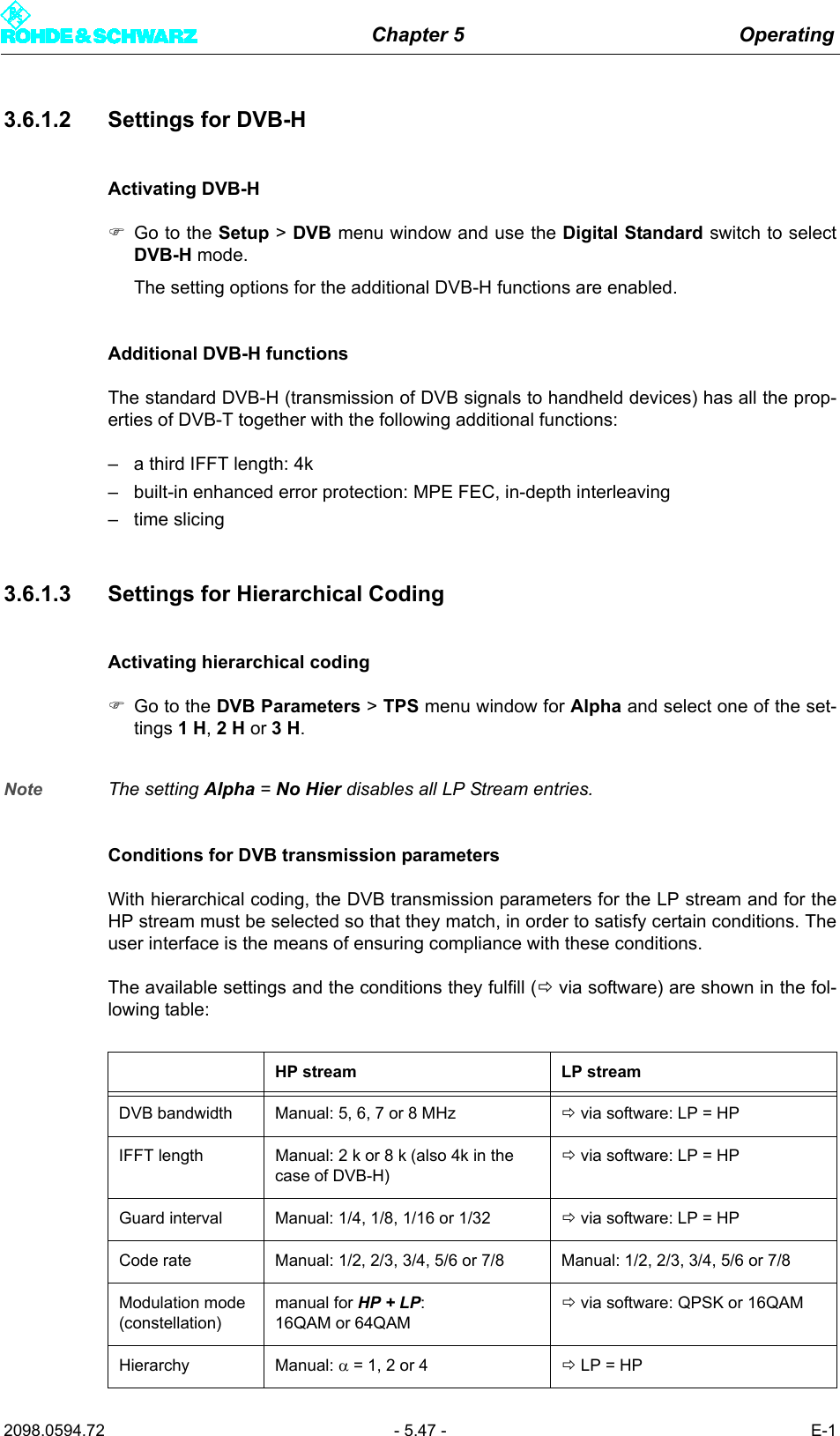
Chapter 5 Operating2098.0594.72 - 5.47 - E-13.6.1.2 Settings for DVB-HActivating DVB-H)Go to the Setup > DVB menu window and use the Digital Standard switch to selectDVB-H mode.The setting options for the additional DVB-H functions are enabled.Additional DVB-H functionsThe standard DVB-H (transmission of DVB signals to handheld devices) has all the prop-erties of DVB-T together with the following additional functions:– a third IFFT length: 4k– built-in enhanced error protection: MPE FEC, in-depth interleaving– time slicing3.6.1.3 Settings for Hierarchical CodingActivating hierarchical coding)Go to the DVB Parameters > TPS menu window for Alpha and select one of the set-tings 1H, 2H or 3H.Note The setting Alpha = No Hier disables all LP Stream entries.Conditions for DVB transmission parametersWith hierarchical coding, the DVB transmission parameters for the LP stream and for theHP stream must be selected so that they match, in order to satisfy certain conditions. Theuser interface is the means of ensuring compliance with these conditions.The available settings and the conditions they fulfill (Ö via software) are shown in the fol-lowing table:HP stream LP streamDVB bandwidth Manual: 5, 6, 7 or 8 MHz Ö via software: LP = HPIFFT length Manual: 2 k or 8 k (also 4k in the case of DVB-H)Ö via software: LP = HPGuard interval Manual: 1/4, 1/8, 1/16 or 1/32 Ö via software: LP = HPCode rate Manual: 1/2, 2/3, 3/4, 5/6 or 7/8 Manual: 1/2, 2/3, 3/4, 5/6 or 7/8Modulation mode(constellation)manual for HP + LP: 16QAM or 64QAMÖ via software: QPSK or 16QAMHierarchy Manual: α = 1, 2 or 4 Ö LP = HP
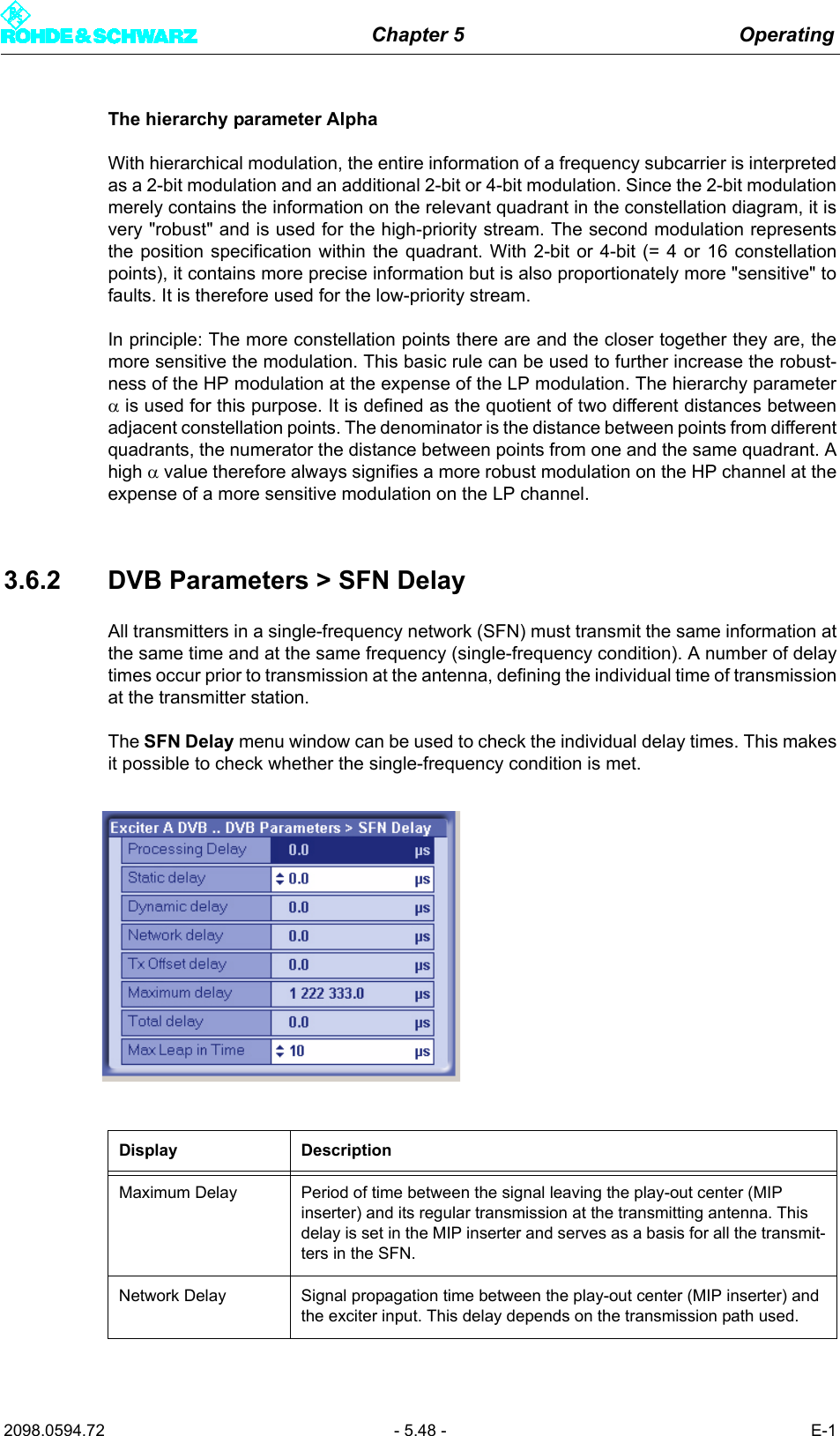
Chapter 5 Operating2098.0594.72 - 5.48 - E-1The hierarchy parameter AlphaWith hierarchical modulation, the entire information of a frequency subcarrier is interpretedas a 2-bit modulation and an additional 2-bit or 4-bit modulation. Since the 2-bit modulationmerely contains the information on the relevant quadrant in the constellation diagram, it isvery "robust" and is used for the high-priority stream. The second modulation representsthe position specification within the quadrant. With 2-bit or 4-bit (= 4 or 16 constellationpoints), it contains more precise information but is also proportionately more "sensitive" tofaults. It is therefore used for the low-priority stream.In principle: The more constellation points there are and the closer together they are, themore sensitive the modulation. This basic rule can be used to further increase the robust-ness of the HP modulation at the expense of the LP modulation. The hierarchy parameterα is used for this purpose. It is defined as the quotient of two different distances betweenadjacent constellation points. The denominator is the distance between points from differentquadrants, the numerator the distance between points from one and the same quadrant. Ahigh α value therefore always signifies a more robust modulation on the HP channel at theexpense of a more sensitive modulation on the LP channel.3.6.2 DVB Parameters > SFN DelayAll transmitters in a single-frequency network (SFN) must transmit the same information atthe same time and at the same frequency (single-frequency condition). A number of delaytimes occur prior to transmission at the antenna, defining the individual time of transmissionat the transmitter station.The SFN Delay menu window can be used to check the individual delay times. This makesit possible to check whether the single-frequency condition is met.Display DescriptionMaximum Delay Period of time between the signal leaving the play-out center (MIP inserter) and its regular transmission at the transmitting antenna. This delay is set in the MIP inserter and serves as a basis for all the transmit-ters in the SFN.Network Delay Signal propagation time between the play-out center (MIP inserter) and the exciter input. This delay depends on the transmission path used.
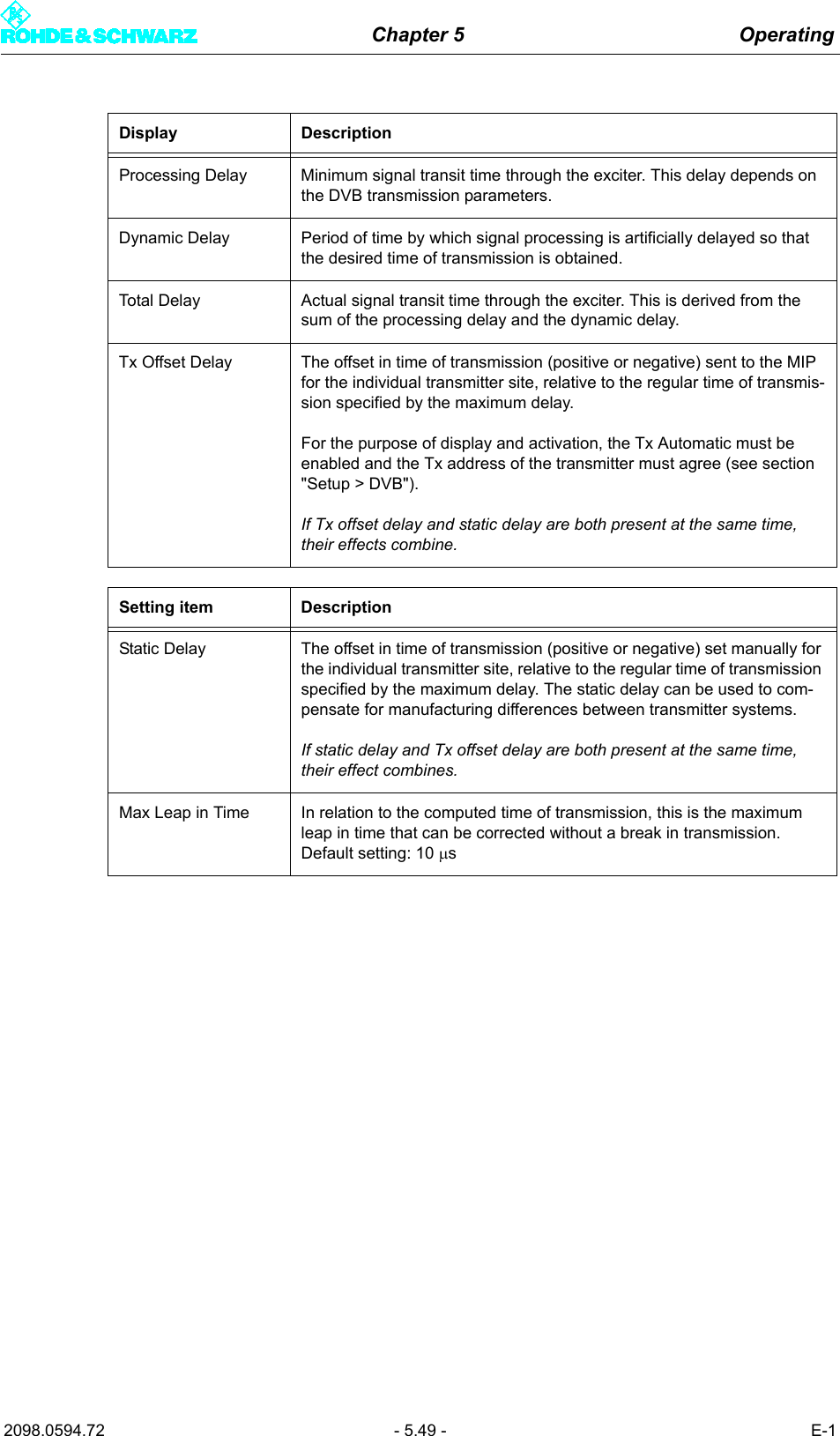
Chapter 5 Operating2098.0594.72 - 5.49 - E-1Processing Delay Minimum signal transit time through the exciter. This delay depends on the DVB transmission parameters.Dynamic Delay Period of time by which signal processing is artificially delayed so that the desired time of transmission is obtained.Total Delay Actual signal transit time through the exciter. This is derived from the sum of the processing delay and the dynamic delay.Tx Offset Delay The offset in time of transmission (positive or negative) sent to the MIP for the individual transmitter site, relative to the regular time of transmis-sion specified by the maximum delay. For the purpose of display and activation, the Tx Automatic must be enabled and the Tx address of the transmitter must agree (see section "Setup > DVB").If Tx offset delay and static delay are both present at the same time, their effects combine.Setting item DescriptionStatic Delay The offset in time of transmission (positive or negative) set manually for the individual transmitter site, relative to the regular time of transmission specified by the maximum delay. The static delay can be used to com-pensate for manufacturing differences between transmitter systems.If static delay and Tx offset delay are both present at the same time, their effect combines.Max Leap in Time In relation to the computed time of transmission, this is the maximum leap in time that can be corrected without a break in transmission.Default setting: 10 µsDisplay Description
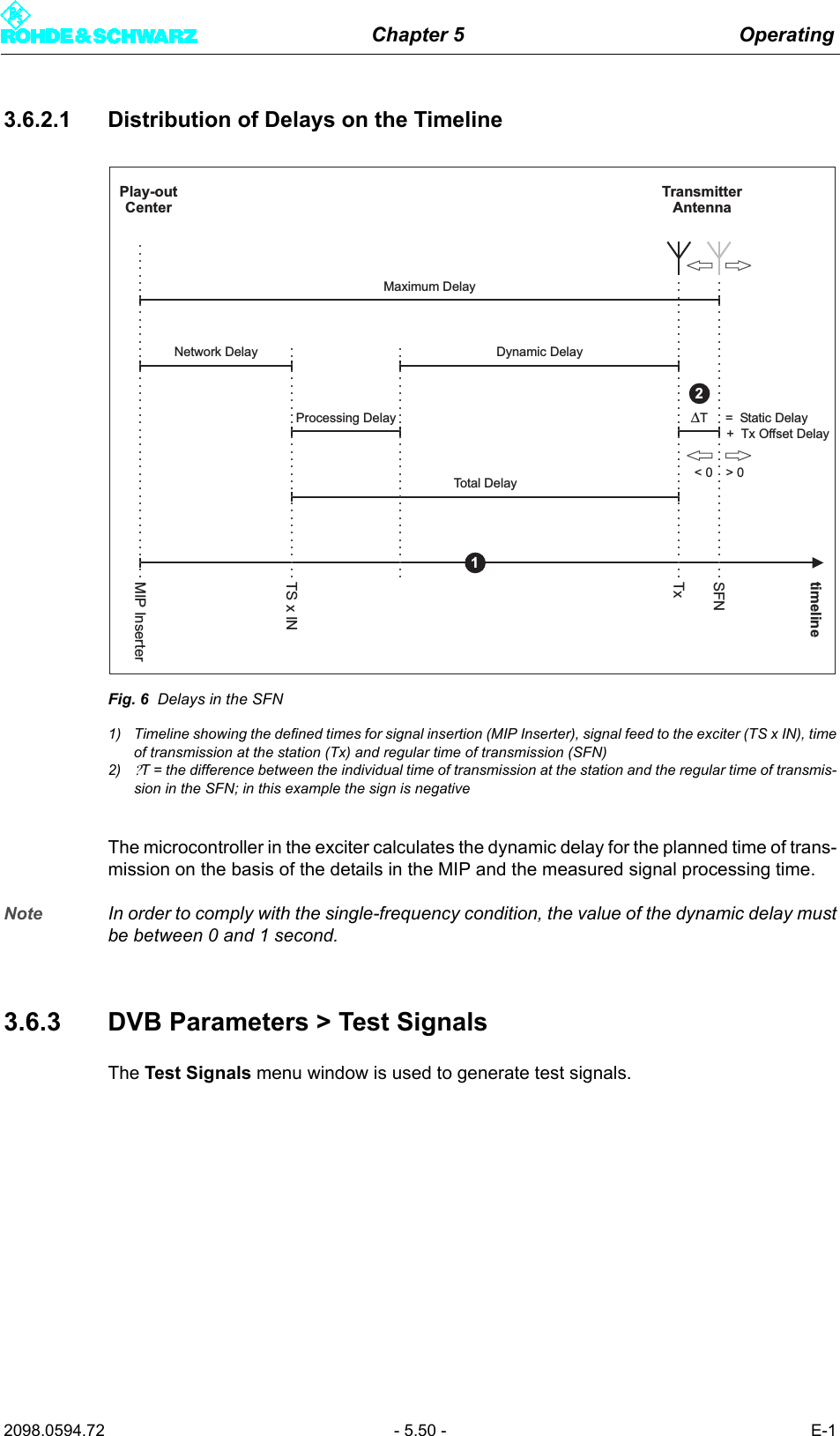
Chapter 5 Operating2098.0594.72 - 5.50 - E-13.6.2.1 Distribution of Delays on the TimelineFig. 6 Delays in the SFN1) Timeline showing the defined times for signal insertion (MIP Inserter), signal feed to the exciter (TS x IN), timeof transmission at the station (Tx) and regular time of transmission (SFN)2)?T = the difference between the individual time of transmission at the station and the regular time of transmis-sion in the SFN; in this example the sign is negativeThe microcontroller in the exciter calculates the dynamic delay for the planned time of trans-mission on the basis of the details in the MIP and the measured signal processing time.Note In order to comply with the single-frequency condition, the value of the dynamic delay mustbe between 0 and 1 second.3.6.3 DVB Parameters > Test SignalsThe Test Signals menu window is used to generate test signals.MIP InserterTSxINTxSFNPlay-outCentertimelineTransmitterAntennaMaximum DelayNetwork DelayProcessing DelayDynamic DelayTotal Delay∆T = Static Delay+ Tx Offset Delay<0 >012
Chapter 5 Operating2098.0594.72 - 5.51 - E-1Setting item DescriptionPRBS Insertion Insertion of a PRBS sequence instead of the transport stream present at the inputSelection:– OFF: Normal operating status, test sequence not active– 2^23-1, 2^15-1 or 2^9-1: Displayed PRBS sequence selectedTest Signal Insertion Insertion of unmodulated test carriers or suppression of modulated car-rier ranges in the output frequency spectrumSelection:– OFF: Normal operating status, test signal not active– CARRIER 1: Insertion of an unmodulated test carrier at carrier position 1– CARRIER 2: Insertion of an unmodulated test carrier at carrier position 2– C1 and C2: Insertion of two unmodulated test carriers at carrier position 1 and carrier position 2– BANDPASS: Suppression of the modulated carriers from position 0 to carrier position 1 and from carrier position 2 to the end of the fre-quency spectrum– BANDSTOP: Suppression of the modulated carriers in the range between carrier position 1 and carrier position 2In the BANDPASS and BANDSTOP functions, the value for carrier 1 must be smaller than the value for carrier 2.Carrier 1 Sets the position for test carrier 1Carrier 2 Sets the position for test carrier 2
Chapter 5 Operating2098.0594.72 - 5.52 - E-13.6.3.1 The Arrangement of Test Signals in the Output Frequency SpectrumFig. 7 Test Signal Insertion function | C1 and C2Fig. 8 Test Signal Insertion function | BandpassFig. 9 Test Signal Insertion function | Bandstopused BandwidthChannel BandwidthC1 C22k 04k 08k 085217043408170434086816used BandwidthChannel BandwidthC1 C22k 04k 08k 085217043408170434086816used BandwidthChannel BandwidthC1 C22k 04k 08k 085217043408170434086816
Chapter 5 Operating2098.0594.72 - 5.53 - E-13.7 Precorrection MenuIn the Precorrection menu window, you can activate or deactivate individual precorrectorbranches without having to access the precorrector GUI (see the section "Introduction toOperation of the Precorrector"). The different switch settings (On/Off) correspond to the re-lated settings in the precorrector GUI.3.8 RF MenuThe menu windows in the RF menu are used to make the settings for frequency generation,modulation and RF monitoring.Setting item DescriptionNonlinear Correction Switches the entire nonlinear correction on or off.– Amplitude Switches the amplitude correction in the nonlinear corrector on or off.– Phase Switches the phase correction in the nonlinear corrector on or off.– Nonlinear Fre-quencySwitches the entire nonlinear frequency response correction on or off.– Point 1 Switches the frequency response influence on branch 1 on or off (non-linear frequency response correction).– Point 2 Switches the frequency response influence on branch 2 on or off (non-linear frequency response correction).Linear Correction Switches the entire linear correction on or off.– Amplitude Switches the amplitude frequency response correction in the linear cor-rector on or off.– Group Delay Switches the group delay correction in the linear corrector on or off.
Chapter 5 Operating2098.0594.72 - 5.54 - E-1The menu windowsThe RF menu leads to the following menu windows:–Synthesizer: Set the channel center frequency and the reference frequency source–Output: Enable the RF output, activate output level control or set the level manually, cor-rect the amplitude frequency response of subsequent components–IQ Adjust: Adjust the modulator3.8.1 RF > SynthesizerSetting item DescriptionFrequency Setting the channel center frequencyReference Selecting the reference source for stabilization of the frequency pro-cessing (reference frequency source). The following settings are possi-ble:– Internal: Operation without an external reference frequency source.– External 5 MHz: Operation with an external 5 MHz reference.– External 10 MHz: Operation with an external 10 MHz reference.– External 1pps: Operation with an external time reference (1 pps)The same setting options can be found in the RF > Reference menu window.OCXO adjust Setting for adjusting the internal OCXO frequency (for "Internal" mode).The same setting options can be found in the RF > Reference menu window.
Chapter 5 Operating2098.0594.72 - 5.55 - E-13.8.1.1 Reference Frequency SourceThe basis for frequency generation in the exciter is a 10 MHz oven controlled crystal oscil-lator (OCXO). This OCXO can be operated in two different modes:"Internal" modeThe OCXO runs in uncontrolled mode.It obtains its control voltage via a D/A converter which can be set using the OCXO adjustitem. The frequency of the OCXO present at the 10 MHz MONITORING test output (on thefront panel of the exciter) can be adjusted to 10 MHz if necessary."External" modeThe OCXO runs in controlled mode.Due to the control, the control voltage generated by the D/A converter is adapted on an on-going basis so that the 10 MHz frequency of the OCXO is synchronized to the externallysupplied 5 MHz or 10 MHz reference frequency, or to the external 1-pps signal.3.8.1.2 Holdover Mode (In Case of Failure of the Reference Frequency)As soon as a failure of the external reference frequency is detected, the control voltage forthe OCXO is no longer modified. The result of this is that the RF generation is now basedon the stability of the OCXO.As soon as the external reference frequency is restored, the control voltage on the OCXOwill be controlled again with the externally supplied reference frequency.Display DescriptionFrequency offset Any frequency offset is added straight to the channel center frequency.The frequency offset transferred in the MIP is addressed to a particular transmitter in the network and is evaluated only if the Tx address set in the Setup > DVB menu window is the correct recipient. For the purpose of display and activation the Tx Automatic also needs to be enabled (see section "Setup > DVB").
Chapter 5 Operating2098.0594.72 - 5.56 - E-13.8.2 RF > Output3.8.2.1 Output Level ControlThe output power delivered by the exciter is determined by a nominal output level controller.Setting item DescriptionRF Output Enables (On) or disables (Off) the RF output.Regulation Activates (On) or activates (Off) the output level control. During trans-mission operation, control must be enabled.The current status of the related level adjuster is displayed as a percent-age under RF > RF Monitor > AGC Exciter.Manual RF Level Manual setting of the output level; the setting has an effect only if output level control is deactivated.The current status of the related level adjuster is displayed as a percent-age under RF > RF Monitor > AGC Exciter.Output Attenuation For level adaptation purposes, an integrated attenuator with a value of 3 dB, 6 dB or 9 dB can be connected. This has no influence on the level control.RF Slope Correction of a slope of the amplitude frequency response in the spec-trum for equalizing subsequent components (output stage, filter).Modulation Slope Correction of a curvature of the amplitude frequency response in the spectrum for equalizing subsequent components (output stage, filter).Display DescriptionAGC Regulation Displays the level of the output level control
Chapter 5 Operating2098.0594.72 - 5.57 - E-1For test purposes this controller can be deactivated. The output level is then set via theManual RF Level control element.Note If Manual RF Level is set too low, the RF FAIL error will be generated.3.8.3 RF > IQ AdjustWhen it is delivered from the factory, the I/Q modulator is preadjusted so that no customerintervention is normally required.If you need a new I/Q adjustment at a later point in time, this will involve the use of the ac-tuators in the RF > IQ Adjust menu window. The I/Q adjustment is dependent on the automatically selected intermediate frequencyLO1. Accordingly, it applies only for the intermediate frequency displayed under LO1 Fre-quency.Note The following table shows the relationship between the set vision carrier frequency and in-termediate frequency LO1:Note For information on how to carry out a manual I/Q adjustment, see the section "Manual Ad-justment of the I/Q Modulator".Vision carrier frequency Intermediate frequency47 MHz ≤ fV < 510 MHz ⇒LO1 = 2160 MHz510 MHz ≤ fV < 580 MHz ⇒LO1 = 1920 MHz580 MHz ≤ fV < 680 MHz ⇒LO1 = 2160 MHz680 MHz ≤ fV < 860 MHz ⇒LO1 = 1920 MHzSetting item DescriptionAuto I/Q Adjust An option for automatic I/Q adjustment will be implemented in a later software release.I/Q Test Signal Switches a test signal on or off for use in performing manual I/Q adjust-ment.
Chapter 5 Operating2098.0594.72 - 5.58 - E-13.9 Reference MenuA reference source for stabilization of the frequency processing (reference frequencysource) can be selected via the Reference menu window.It is also possible to set the behavior of the exciter in the event of failure of the referencesources for frequency processing and for synchronization in the SFN (external 1-pps sig-nal).Bias Coarse [I/Q] Course setting of an actuator for suppressing the undesired center car-rier; setting range: -1023 to +1023Bias Fine [I/Q] Fine setting of an actuator for suppressing the undesired center carrier; setting range: -32767 to +32767Gain (I/Q) Setting of an actuator for suppressing the undesired carrier in the side-band; setting range: 0 to 255Phase Setting of an actuator for suppressing the undesired carrier in the side-band; setting range: -14 to +14Display DescriptionLO1 Frequency Display of the intermediate frequency LO1 which is automatically set in the modulator (1.92 GHz or 2.16 GHz)The adjustment values for the actuators described above apply only for the displayed intermediate frequency.Setting item Description
Chapter 5 Operating2098.0594.72 - 5.59 - E-13.9.1 Behavior in the Event of Failure of a Reference SourceThe behavior in the event of failure of the reference frequency source or time reference isdefined by the settings in the Reference menu window.The failure of a required or set reference source is indicated as follows:Setting item DescriptionReference Selection of the reference frequency source. The following settings are possible:– Internal: Operation without an external reference frequency source– External 5 MHz: Operation with an external 5 MHz reference– External 10 MHz: Operation with an external 10 MHz reference– External 1pps: Operation with an external time reference (1 pps)The same setting option can be found in the RF > Synthesizer menu window.OCXO Adjust Setting for adjusting the internal OCXO frequency (for "Internal" mode)The same setting option can be found in the RF > Synthesizer menu window.Mute on PPS Fail For setting the behavior in SFN mode in the event of failure of the exter-nal time reference. The following settings are possible:– off: The output signal is not suppressed.– only at startup: The output signal is suppressed at startup until a valid 1-pps signal is detected; if the 1-pps signal fails after synchronization, the output signal is no longer suppressed– after fail delay time: The output signal is suppressed if the 1-pps sig-nal fails for longer than the period specified at Fail Delay TimeThis is the recommended setting for operation in SFN mode.Mute on Ref. Fail For setting the behavior in SFN and MFN mode in the event of failure of the external reference frequency source. The following settings are pos-sible:– off: The output signal is not suppressed.– only at startup: The output signal is suppressed at startup until a valid reference source is detected; if the reference source fails after syn-chronization, the output signal is no longer suppressed– after fail delay time: The output signal is suppressed if the reference source fails for longer than the period specified at Fail Delay TimeThis is the recommended setting for operation in SFN mode.Fail Delay Time Delay time until the output signal is suppressed after failure of a refer-ence source. The setting takes effect if the 'after fail delay time' behavior is set at Mute on PPS Fail or Mute on Ref. Fail.Selection: 0 to 24 hours
Chapter 5 Operating2098.0594.72 - 5.60 - E-13.10 Device Info MenuThe menu windows under Device Info contain the electronic type plates for the exciter as awhole as well as for the individual modules or elements in the exciter:– Exciter (complete device)– Boards (modules)– Mainboard– Input interface– RF board– Synth 1– Synth 2The structure of the different type plates is more or less identical. The information which isdisplayed is explained below using the exciter type plate as an example:LED (front panel) LED (Status menu) Logbook entryIn SFN mode in the event of failure ofReference fre-quency source: 5 MHz, 10 MHz or 1ppsREF FAIL: Yellow – Reference: - OFF -– Sum Warning: Yellowno referenceTime reference: 1ppsREF FAIL: Yellow – 1 PPS: - OFF -– Sum Warning: YellowExt PPS FailIn MFN mode in the event of failure ofReference fre-quency source: 5MHz or 10MHzREF FAIL: Yellow – Reference: - OFF -– Sum Warning: Yellowno referenceReference fre-quency source: 1ppsREF FAIL: Yellow – 1 PPS: - OFF -– Sum Warning: YellowExt PPS Fail
Chapter 5 Operating2098.0594.72 - 5.61 - E-1Device Info > ExciterThe information saved here is used for troubleshooting purposes. In case servicing is re-quired, this information allows you to precisely identify the defective component and ordera replacement.Display DescriptionPart Number Part numberVariant Device or module variant (model)Product Index Product modification indexSerial Number Serial numberProduct Date Date of productionSoftware Number Part number for the softwareSoftware Version Version number for the softwareOperating hours Number of operating hoursPower up cycles Number of times device has been switched on/off
Chapter 5 Operating2098.0594.72 - 5.62 - E-14 Manual Adjustment of the I/Q ModulatorNote Before performing the adjustment, make sure that the exciter has been in operation for atleast 15 minutes.ObjectiveIf quadrature modulation were optimal (theoretically possible), the residual carrier would becompletely suppressed. In actual practice however, residual carriers arise (e.g. due tocrosstalk). They must be suppressed using suitable correction carriers.The objective of I/Q adjustment is to suppress the undesired center carrier and undesiredcarrier in the sideband with respect to a test carrier by better than 70 dB.Preparation and test carrier measurement1. Call up the exciter menu with RF > IQ Adjust.2. Use the I/Q Test Signal switch to turn on the test signal.3. Connect a spectrum analyzer to the RF MONITORING output on the front panel of theexciter and make the following settings:Center Frequency Frequency of the vision carrierSpan 6 MHzResolution BW 30 kHzVideo BW 300 HzSweep Coupled
Chapter 5 Operating2098.0594.72 - 5.63 - E-1Fig. 10 Spectrum analyzer display prior to adjustment1) Undesired carrier in the sideband at the vision carrier frequency + 2.5 MHz2) Undesired center carrier at the vision carrier frequency3) Desired test carrier at the vision carrier frequency - 2.5 MHzImplementation1. Set the Bias Fine [I/Q] actuators to zero.2. Course adjustment, center carrier: Using the Bias Coarse [I/Q] actuators, suppress theundesired center carrier as much as possible with respect to the test carrier. You shouldindividually adjust each actuator going back and forth several times until you achieve anoptimum value.3. Sideband adjustment: Use the Gain [I/Q] and Phase actuators to suppress the undes-ired carrier in the sideband by more than 70 dB with respect to the test carrier. Youshould individually adjust each actuator going back and forth several times until youachieve an optimum value.4. Course adjustment, center carrier optimization: Using the Bias Coarse [I/Q] actuators,suppress the undesired center carrier as much as possible with respect to the test car-rier. You should individually adjust each actuator going back and forth several times untilyou achieve an optimum value.5. Fine adjustment, center carrier: If the center carrier is suppressed by less than 70 dB,carry out a fine adjustment using the Bias Fine [I/Q] actuators. 1APCLRWRARef 20 dBm Att 45 dBEXTEXREFCenter 602 MHz Span 10 MHz1 MHz/*RBW 30 kHz*VBW 300 HzSWT 1.9 s-80-70-60-50-40-30-20-1001020132
Chapter 5 Operating2098.0594.72 - 5.64 - E-1Fig. 11 Spectrum analyzer display after the adjustment6. Use the I/Q Test Signal switch to turn the test signal back off.1APCLRWRARef 20 dBm Att 45 dBEXTEXREFCenter 602 MHz Span 10 MHz1 MHz/*RBW 30 kHz*VBW 300 HzSWT 1.9 s-80-70-60-50-40-30-20-1001020
Chapter 5 Operating2098.0594.72 - 5.65 - E-15 Outputstage A/B MenusYou can use the Outputstage A/B menus to operate and configure the transmitter rack andthe amplifier and to call up information.Note The Outputstage B menus and menu windows are identical to the Outputstage A menusand menu windows.5.1 Overview of MenusOutputstage A menu structureLevel 1 Level 2 Level 3 Level 4StatusOS StatusRack StatusRack 1Rack controllerLogbookSummaryStatusWarningFault
Chapter 5 Operating2098.0594.72 - 5.66 - E-15.2 Status MenuThe Status menu provides an overview of faults, warnings and status messages relating tothe individual output stage components. 5.2.1 OS Status Menu WindowOutputstage A > Status > OS StatusThe OS Status menu window provides an overview of faults, warnings and status messag-es relating to the output stage components. The following table explains the meaning of the individual display fields:Output PowerSetupOS SetupMeasure ValuesRack Measure ValuesRack 1Device InfoRack 1Outputstage A menu structure
Chapter 5 Operating2098.0594.72 - 5.67 - E-15.2.2 Status/Rack Controller Menu WindowOutputstage A > Status > Rack Status > Rack x > Rack ControllerThe Status/Rack Controller menu window provides you with status information about therack controller.Display DescriptionRF Fail  Red: Antenna output power below the fault threshold that has been setReflection  Red: Antenna reflected power above the fault threshold that has been setAC  Red: Interference AC supply voltage (e.g. phase absent)Communic.. Red: Communication to output stage interruptedCooling Red: Disruption to cooling system, both fans failed Fault Red: Output stage sum faultWarning Yellow: Output stage sum warningRF On Green: Antenna output power above the fault threshold that has been setRF Warning Yellow: Antenna output power below the warning threshold that has been setReflection Yellow: Antenna reflected power above the warning threshold that has been setRack Yellow: Fault on at least one transmitter rack Cooling Yellow: Fault on cooling systemRF OK Green: Antenna output power above the warning limit that has been setReduced RF Yellow: Amplifiers operating on reduced power (VF absent)No Input Yellow: No input signal to amplifiers
Chapter 5 Operating2098.0594.72 - 5.68 - E-1The following table explains the meaning of the individual display fields:Display DescriptionFault Red: Transmitter rack sum faultCooling Fa.. Red: Cooling system sum faultTemp. Fault Red: Outlet temperature above the fault threshold that has been setAbs. 1 Fault Red: Fault on absorber 1Abs. 2 Fault Red: Fault on absorber 2AC Fault Red: Network interference (e.g. phase absent)DC Fault Red: Fault on auxiliary power supplyLink OK Green: Communication to transmitter rack presentRack On Green: On command presentWarning Yellow: Transmitter rack sum warningExt. Coolin.. Yellow: Disruption to ext. coolingFan 1 Fault Yellow: Fault on fan 1Fan 2 Fault Yellow: Fault on fan 2Amp. Fault Yellow: Amplifier sum fault (at least one amplifier showing interference)Red. Ref. E. Yellow: Exciter A initiates reduction in transmitter output power (VF absent)Red. Ref. E. Yellow: Exciter B initiates reduction in transmitter output power (VF absent)
Chapter 5 Operating2098.0594.72 - 5.69 - E-15.3 Logbook MenuYou can use the Logbook menu to query status and error messages about the outputstage.5.3.1 Logbook Menu WindowOutputstage A > Logbook You can use the Logbook menu to query status and error messages about the outputstage. The Logbook menu windows provide an overview of status messages, warning mes-sages and fault messages about the output stage.Note You can call up Logbook entries via the Summary, Status, Warning and Fault windows.The following table explains the meaning of the columns:The arrows in the second column have the following meanings:Column DescriptionNo Consecutive entry numberMessage MessageTime Time the message was receivedDate Date the message was receivedArrow direc-tion Arrow color DescriptionUp The event has just occurred.Down The event is no longer current or relevant.Red Fault
Chapter 5 Operating2098.0594.72 - 5.70 - E-15.4 Output Power MenuYou may use the Output Power menu to access the Output Power window. 5.4.1 Output Power Menu WindowOutputstage A > Output PowerUse the Output Power menu window to set the transmitter output power.The following table explains the meaning of the individual settings:5.5 Setup MenuYou may use the Setup menu to access the OS Setup window. 5.5.1 OS Setup Menu WindowOutputstage A > Setup > OS SetupYellow WarningGreen Status: In orderSetting DescriptionReference Voltage Forward PowerFor setting the forward power.Values from 0% to 100%Arrow direc-tion Arrow color Description
Chapter 5 Operating2098.0594.72 - 5.71 - E-1You can enter the basic settings for the output stage in the OS Setup menu window.The following table explains the meaning of the individual settings:5.6 Measure Values MenuYou can use the Measure Values menu to read results. 5.6.1 Measure Values/Rack Controller Menu WindowOutputstage A > Measure Values > Rack Measure Values > Rack x > Rack ControllerThe Measure Values/Rack Controller menu window displays the inlet and outlet air tem-peratures and the transmitter rack control voltage.Setting DescriptionRacks per OS For entering the number of racks belonging to the transmitterCooling System For setting the cooling system usedValue: AirMax. Outlet Temp. For inputting the maximum permitted outlet air temperatureIf the entered limit is exceeded the rack controller switches off the trans-mitter rack.Value: 45 °C - 65 °CAmplifiers per Rack For entering the number of amplifiers installed in the rackValue: 1 - 4
Chapter 5 Operating2098.0594.72 - 5.72 - E-1The following table explains the meaning of the fields:5.7 Device Info MenuYou can use the Device Info menu to call for information on the transmitter rack. 5.7.1 Device Info/Rack Controller Menu WindowOutputstage A > Device Info > Rack x > Rack ControllerYou can use the Device Info/Rack Controller menu to call for information on the transmit-ter rack.Display DescriptionInlet Temperature Inlet temperature of the cooling medium (intake)Outlet Temperature Outlet temperature of the cooling medium (outgoing air)Aux Power Supply Control voltage of the internal auxiliary power supply for the transmitter rackThe value must be between 3.7 V and 4.4 V.
Chapter 5 Operating2098.0594.72 - 5.73 - E-1The following table explains the meaning of the display fields:Display DescriptionPart Number R&S stock numberVariant Model (basic model = 02)Product Index Hardware amendment indexSerial Number Serial numberProduct Date Date of productionSW/FW/BIOS Number R&S stock number for software, firmware or BIOSSW/FW/BIOS Version Version number of software, firmware or BIOS

Navigation menu